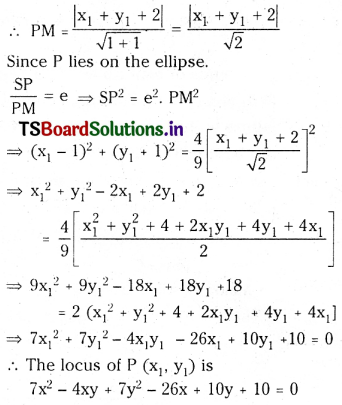
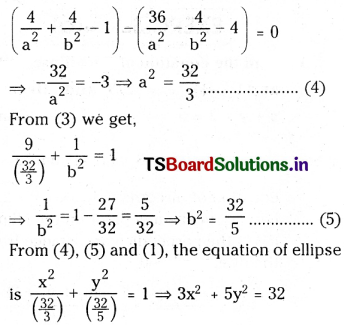
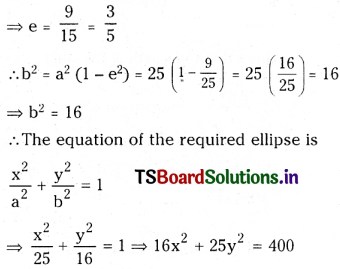
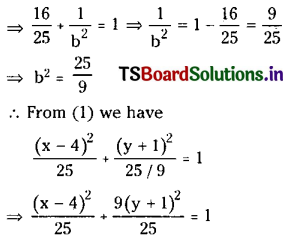
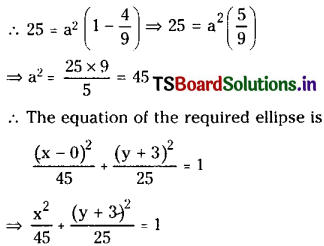
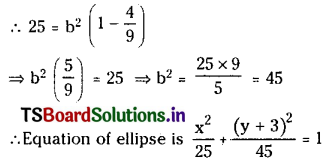
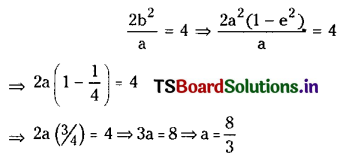
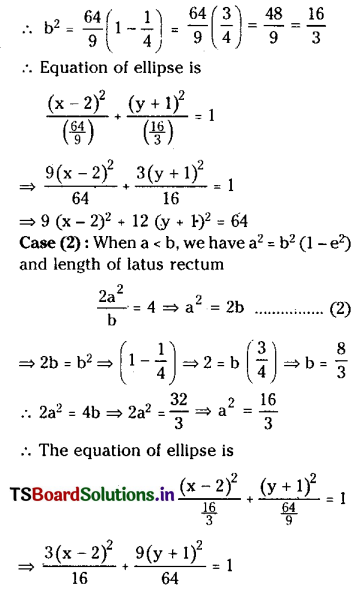
TS Inter 2nd Year Maths 2B Solutions Chapter 6 Integration Ex 6(c)

Students must practice this TS Intermediate Maths 2B Solutions Chapter 6 Integration Ex 6(c) to find a better approach to solving the problems.

TS Inter 2nd Year Maths 2B Solutions Chapter 6 Integration Exercise 6(c)

I. Evaluate the following integrals.

Question 1.
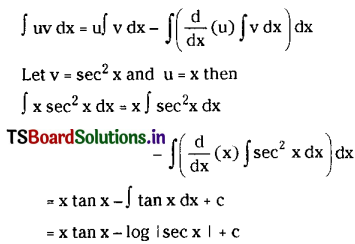
∫x sec2x dx on I ⊂ R – {\(\frac{(2 n+1) \pi}{2}\) : n is an integer}.
Solution:
We use the formula for integration by parts which state that
TS Inter 2nd Year Maths 2B Solutions Chapter 6 Integration Ex 6(c) I Q1

Question 2.
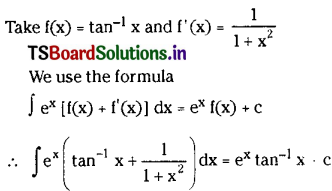
\(\int e^x\left(\tan ^{-1} x+\frac{1}{1+x^2}\right) d x\), x ∈ R.
Solution:
TS Inter 2nd Year Maths 2B Solutions Chapter 6 Integration Ex 6(c) I Q2

TS Inter 2nd Year Maths 2B Solutions Chapter 6 Integration Ex 6(c)

Question 3.
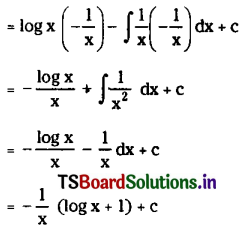
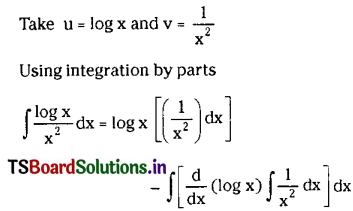
\(\int \frac{\log x}{x^2} d x\) on(0, ∞).
Solution:
TS Inter 2nd Year Maths 2B Solutions Chapter 6 Integration Ex 6(c) I Q3
TS Inter 2nd Year Maths 2B Solutions Chapter 6 Integration Ex 6(c) I Q3.1

Question 4.
∫(log x)2 dx on (0, ∞).
Solution:
Take (log x)2 = u and 1 = v.
Then by integration by parts,
∫(log x)2 . 1 . dx = (log x)2 . x – ∫2 (log x) \(\frac{1}{x}\) . x dx
= x(log x)2 – 2 ∫log x . 1 . dx
= x(log x)2 – 2[logx . x – ∫\(\frac{1}{x}\) . x dx]
= x(log x)2 – 2x[log x] + 2x + c

Question 5.
∫ex (sec x + sec x tan x) dx on I ⊂ R – {(2n + 1)\(\frac{\pi}{2}\) : n ∈ Z}.
Solution:
Let f(x) = sec x then f'(x) = sec x tan x
∴ Using ∫ex [f(x) + f'(x)] dx = ex f(x) + c
we have ∫ex (sec x + sec x tan x) dx = ex sec x + c

Question 6.
∫ex cos x dx on R.
Solution:
Let I = ∫ex cos x dx
and take u = ex and v = cos x.
Then using integration by parts,
I = ex (sin x) – ∫ex sin x dx
= ex (sin x) – [ex(-cos x) – ∫ex (-cos x) dx]
= ex sin x + ex cos x – ∫ex cos x dx
= ex (sin x + cos x) – 1
2I = ex (sin x + cos x)
I = \(\frac{1}{2}\) ex (sin x + cos x) + c
∴ ∫ex cos x dx = \(\frac{1}{2}\) ex (sin x + cos x)

Question 7.
∫ex (sin x + cos x) dx on R.
Solution:
Take f(x) = sin x then f'(x) = cos x
So by using formula ∫ex [f(x) + f'(x)] dx = ex f(x) + c
we have ∫ex (sin x + cos x) dx = ex sin x + c.

TS Inter 2nd Year Maths 2B Solutions Chapter 6 Integration Ex 6(c)

Question 8.
∫(tan x + log sec x) ex dx on ((2n – \(\frac{1}{2}\))π, (2n + \(\frac{1}{2}\))π), n ∈ Z.
Solution:
Take f(x) = log|sec x| then f'(x) = \(\frac{1}{\sec x}\) (sec x tan x) = tan x
So by the formula ∫ex [f(x) + f'(x)] dx = ex f(x) + c
we have ∫(tan x + log sec x) ex dx = ex log|sec x| + c

II. Evaluate the following integrals.

Question 1.
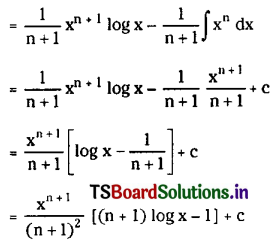
∫xn log x dx on (0, ∞), n is a real number and n ≠ -1.
Solution:
Take u = log x and v = xn
applying integration by parts,
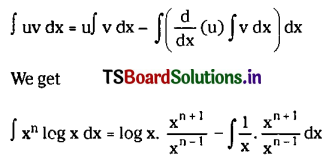
TS Inter 2nd Year Maths 2B Solutions Chapter 6 Integration Ex 6(c) II Q1
TS Inter 2nd Year Maths 2B Solutions Chapter 6 Integration Ex 6(c) II Q1.1

Question 2.
∫log(1 + x2) dx on R.
Solution:
Take log(1 + x2) = u and 1 = v then
using integration by parts, we get
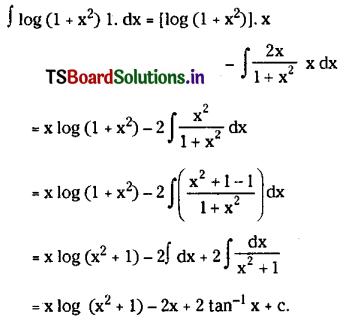
TS Inter 2nd Year Maths 2B Solutions Chapter 6 Integration Ex 6(c) II Q2

Question 3.
∫√x log x dx on (0, ∞).
Solution:
Take u = log x and v = x1/2 and
using integration by parts, we get
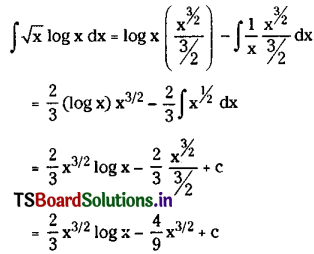
TS Inter 2nd Year Maths 2B Solutions Chapter 6 Integration Ex 6(c) II Q3

Question 4.
\(\int e^{\sqrt{x}} d x\) on (0, ∞).
Solution:
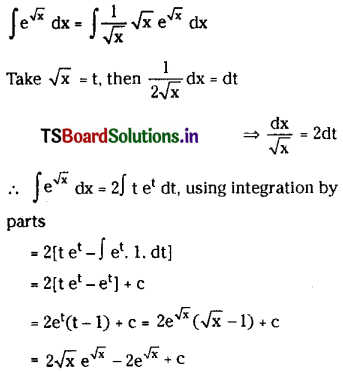
TS Inter 2nd Year Maths 2B Solutions Chapter 6 Integration Ex 6(c) II Q4

Question 5.
∫x2 cos x dx on R.
Solution:
Take x2 = u and cos x = v,
and using integration by parts, we get
∫x2 cos x dx = x2 (sin x) – ∫2x sin x dx
= x2 sin x – [2x(-cos x) – ∫2 . (-cos x) dx]
= x2 sin x + 2x cos x – 2∫cos x dx
= x2 sin x + 2x cos x – 2 sin x + c

TS Inter 2nd Year Maths 2B Solutions Chapter 6 Integration Ex 6(c)

Question 6.
∫x sin2x dx on R.
Solution:
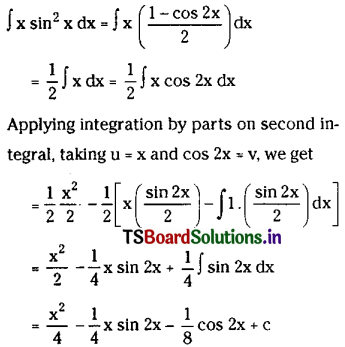
TS Inter 2nd Year Maths 2B Solutions Chapter 6 Integration Ex 6(c) II Q6

Question 7.
∫x cos2x dx on R.
Solution:
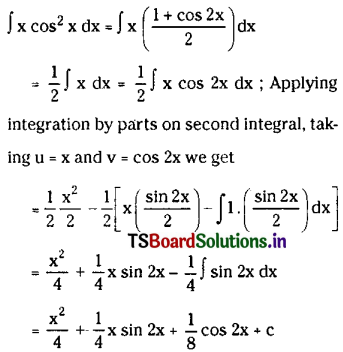
TS Inter 2nd Year Maths 2B Solutions Chapter 6 Integration Ex 6(c) II Q7

Question 8.
∫cos√x dx on R.
Solution:
∫cos√x dx = ∫\(\frac{1}{\sqrt{x}}\) √x cos√x dx
Taking √x = t, we get \(\frac{1}{2 \sqrt{x}}\) dx = dt
⇒ \(\frac{\mathrm{dx}}{\sqrt{\mathrm{x}}}\) = 2 dt
∴ ∫cos √x dx = 2∫t cos t dt
using Integration by parts,
= 2[t(sin t) – ∫1 . sin t dt]
= 2[t sin t + cos t + c]
= 2[√x sin √x + cos √x ] + c

Question 9.
∫x sec22x dx on I ⊂ R \ {(2nπ + 1) \(\frac{\pi}{4}\) : n ∈ Z}
Solution:
Taking x = u and sec22x = v,
and applying integration by parts we get
∫x sec22x dx = x(\(\frac{1}{2}\) tan 2x – ∫1 . \(\frac{1}{2}\) tan 2x dx
= \(\frac{x}{2}\) tan 2x – \(\frac{1}{2}\) ∫tan 2x dx
= \(\frac{x}{2}\) tan 2x – \(\frac{1}{4}\) log|sec 2x| + c

Question 10.
∫x cot2x dx on I ⊂ R \ {nπ : n ∈ Z).
Solution:
∫x cot2x dx = ∫x(cosec2x – 1) dx = ∫x cosec2x dx – ∫x dx
Taking u = x and v = cosec2x on the first integral
and using integration by parts we get
∫x cot2x dx = x(-cot x) – ∫1 . (-cot x) dx – \(\frac{x^2}{2}\)
= -x cot x + ∫cot x dx – \(\frac{x^2}{2}\)
= -x cot x + log|sin x| – \(\frac{x^2}{2}\) + c

Question 11.
∫ex (tan x + sec2x) dx on I ⊂ R \ {(2n + 1)\(\frac{\pi}{2}\) : n ∈ Z}.
Solution:
Let f(x) = tan x, then f'(x) = sec2x
So by the formula ∫ex [f(x) + f'(x)] dx = ex f(x) + c
we have ∫ex (tan x + sec2x) dx = ex tan x + c

Question 12.
∫\(e^x\left(\frac{1+x \log x}{x}\right) d x\) on (0, ∞). (Mar. ’13)
Solution:
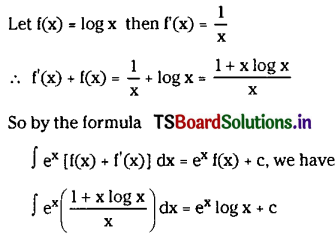
TS Inter 2nd Year Maths 2B Solutions Chapter 6 Integration Ex 6(c) II Q12

Question 13.
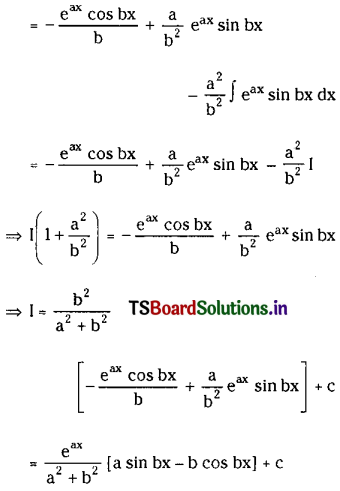
∫eax sin bx dx on R, a, b ∈ R.
Solution:
Let I = ∫eax sin bx dx
Taking u = eax and v = sin bx
and applying integration by parts
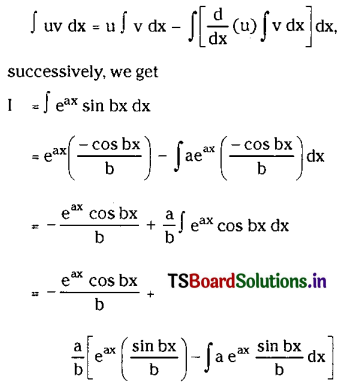
TS Inter 2nd Year Maths 2B Solutions Chapter 6 Integration Ex 6(c) II Q13
TS Inter 2nd Year Maths 2B Solutions Chapter 6 Integration Ex 6(c) II Q13.1

TS Inter 2nd Year Maths 2B Solutions Chapter 6 Integration Ex 6(c)

Question 14.
\(\int \frac{x e^x}{(x+1)^2} d x\) on I ⊂ R \ {-1}.
Solution:
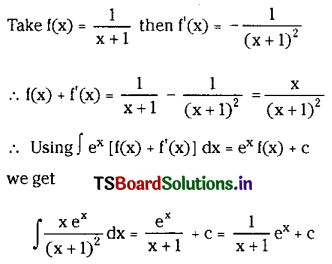
TS Inter 2nd Year Maths 2B Solutions Chapter 6 Integration Ex 6(c) II Q14

Question 15.
\(\int \frac{d x}{\left(x^2+a^2\right)^2}\), (a > 0) on R.
Solution:
Take substitution x = a tan θ
so that dx = a sec2θ dθ
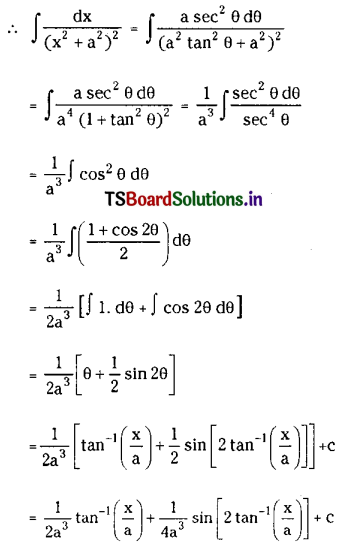
TS Inter 2nd Year Maths 2B Solutions Chapter 6 Integration Ex 6(c) II Q15

Question 16.
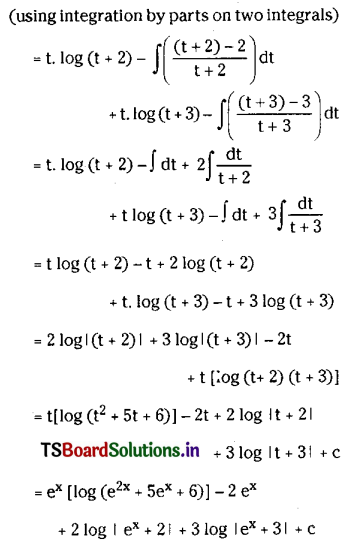
∫ex log(e2x + 5ex + 6) dx on R.
Solution:
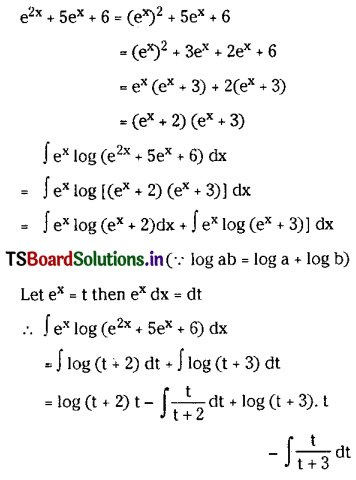
TS Inter 2nd Year Maths 2B Solutions Chapter 6 Integration Ex 6(c) II Q16
TS Inter 2nd Year Maths 2B Solutions Chapter 6 Integration Ex 6(c) II Q16.1

Question 17.
\(\int e^x \frac{(x+2)}{(x+3)^2} d x\) on I ⊂ R \ {-3}.
Solution:
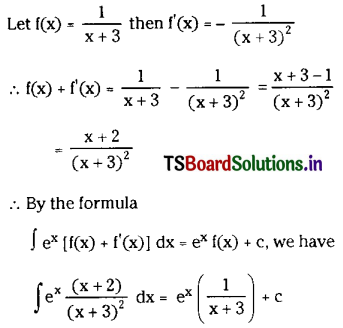
TS Inter 2nd Year Maths 2B Solutions Chapter 6 Integration Ex 6(c) II Q17

Question 18.
∫cos(log x) dx on (0, ∞).
Solution:
Let I = ∫cos (log x) dx = ∫cos (log x) . 1 dx
Take u = cos (log x) and v = 1
and using integration by parts successively.
I = cos (log x) . x – ∫-sin (log x) \(\frac{1}{x}\) . x . dx
= x cos (log x) + ∫sin(log x) dx
= x cos (log x) + sin (log x) . x – ∫cos (log x) \(\frac{1}{x}\) . x . dx
= x cos (log x) + x . sin(log x) – ∫cos (log x) dx
= x [cos (log x) + sin (log x)] – ∫cos (log x) dx
= x [cos (log x) + sin (log x)] – I
∴ 2I = x [cos (log x) + sin (log x)]
⇒ I = \(\frac{x}{2}\) [cos (log x) + sin (log x)] + c
∴ ∫cos (log x) dx = \(\frac{x}{2}\) [cos (log x) + sin (log x)] + c

III. Evaluate the following integrals.

Question 1.
∫x tan-1x dx, x ∈ R.
Solution:
Let u = tan-1x and v = x then using integration by parts
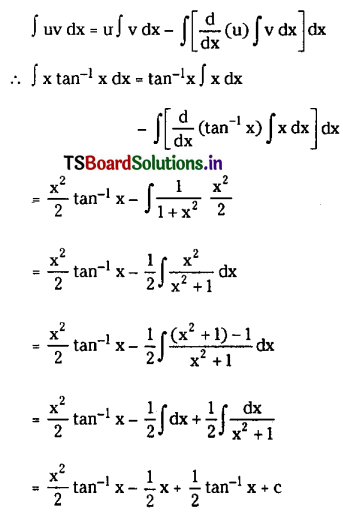
TS Inter 2nd Year Maths 2B Solutions Chapter 6 Integration Ex 6(c) III Q1

TS Inter 2nd Year Maths 2B Solutions Chapter 6 Integration Ex 6(c)

Question 2.
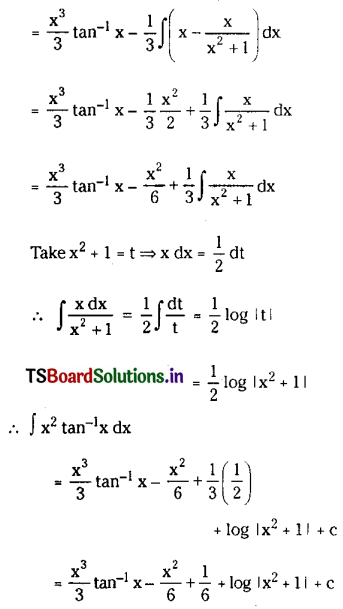
∫x2 tan-1x dx, x ∈ R.
Solution:
Take u = tan-1x and v = x2
and apply integration by parts we get
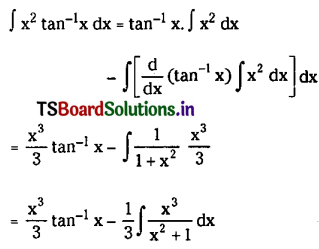
TS Inter 2nd Year Maths 2B Solutions Chapter 6 Integration Ex 6(c) III Q2
TS Inter 2nd Year Maths 2B Solutions Chapter 6 Integration Ex 6(c) III Q2.1

Question 3.
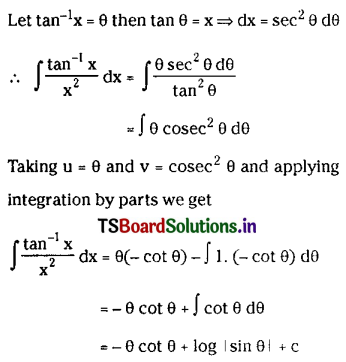
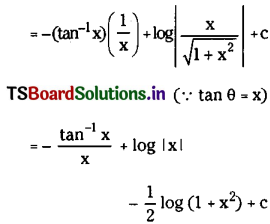
\(\int \frac{\tan ^{-1} x}{x^2} d x\), x ∈ I ⊂ R \ {0}.
Solution:
TS Inter 2nd Year Maths 2B Solutions Chapter 6 Integration Ex 6(c) III Q3
TS Inter 2nd Year Maths 2B Solutions Chapter 6 Integration Ex 6(c) III Q3.1

Question 4.
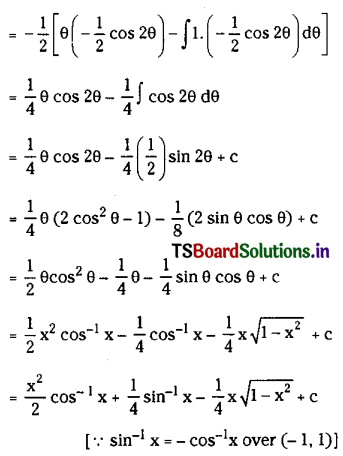
∫x cos-1x dx, x ∈ (-1, 1).
Solution:
Let cos-1x = θ then cos θ = x
⇒ dx = -sin θ dθ
∴ ∫x cos-1x dx = ∫θ cos θ (-sin θ dθ) – \(\frac{1}{2}\) ∫θ sin 2θ dθ
Using integration by parts by taking u = θ, v = sin 2θ we get
TS Inter 2nd Year Maths 2B Solutions Chapter 6 Integration Ex 6(c) III Q4

Question 5.
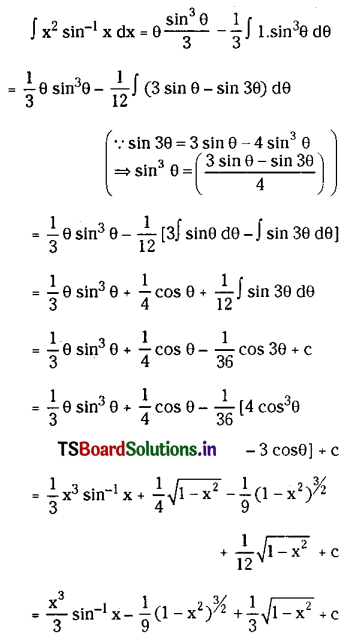
∫x2 sin-1x dx, x ∈ (-1, 1).
Solution:
Let sin-1x = θ then sin θ = x
⇒ dx = cos θ dθ
∴ ∫x2 sin-1x dx = ∫θ sin2θ cos θ dθ
Using integration by parts
by choosing functions u = θ and v = sin2θ cos θ, we get
TS Inter 2nd Year Maths 2B Solutions Chapter 6 Integration Ex 6(c) III Q5

Question 6.
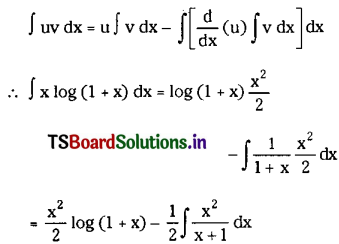
∫x log(1 + x) dx, x ∈ (-1, ∞).
Solution:
Take u = log(1 + x) and v = x
and apply integration by parts
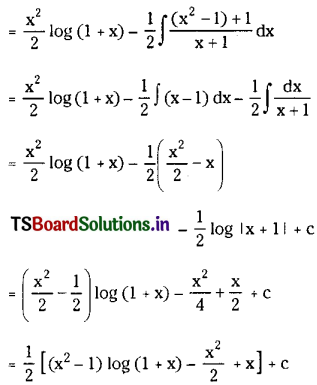
TS Inter 2nd Year Maths 2B Solutions Chapter 6 Integration Ex 6(c) III Q6
TS Inter 2nd Year Maths 2B Solutions Chapter 6 Integration Ex 6(c) III Q6.1

Question 7.
∫sin√x dx on (0, ∞).
Solution:
\(\int \frac{\sqrt{x}}{\sqrt{x}} \sin \sqrt{x} d x\)
Let √x = t then \(\frac{1}{2 \sqrt{x}}\) dx = dt
⇒ \(\frac{d x}{\sqrt{x}}\) = 2 dt
∴ ∫sin √x dx = 2∫t sin t dt,
using Integration by parts by taking u = t and v = sin t, we get
= 2[t(-cos t) – ∫1 . (-cos t) dt]
= 2[-t cos t + ∫cos t dt]
= 2[-t cos t + sin t] + c
= 2[sin √x – √x cos √x ] + c

TS Inter 2nd Year Maths 2B Solutions Chapter 6 Integration Ex 6(c)

Question 8.
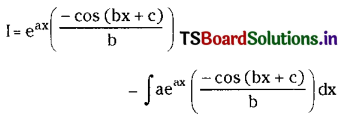
∫eax sin(bx + c) dx, (a, b, c ∈ R, b ≠ 0) on R.
Solution:
Let I = ∫eax sin (bx + c) dx, taking u = eax and v = sin (bx + c)
and applying integration by parts,
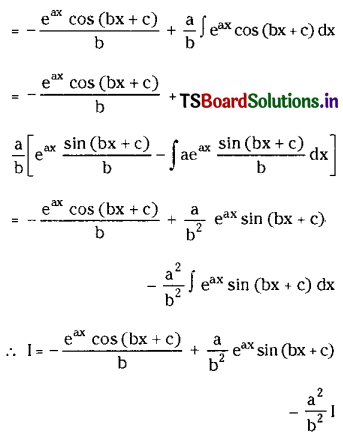
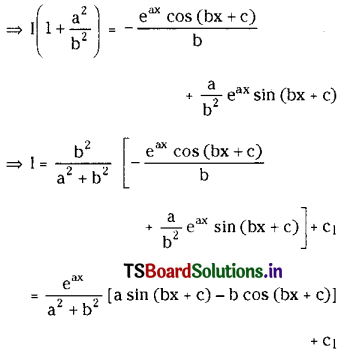
TS Inter 2nd Year Maths 2B Solutions Chapter 6 Integration Ex 6(c) III Q8
TS Inter 2nd Year Maths 2B Solutions Chapter 6 Integration Ex 6(c) III Q8.1
TS Inter 2nd Year Maths 2B Solutions Chapter 6 Integration Ex 6(c) III Q8.2

Question 9.
∫ax cos 2x dx on R (a > 0 and a ≠ 1).
Solution:
Let I = ∫ax cos 2x dx
using integration by parts by taking cos 2x = u and ax = v, we have
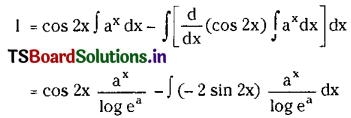
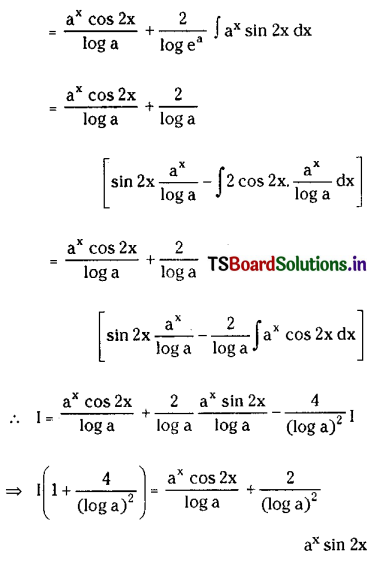
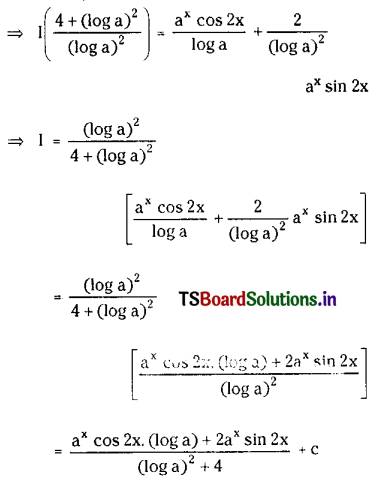
TS Inter 2nd Year Maths 2B Solutions Chapter 6 Integration Ex 6(c) III Q9
TS Inter 2nd Year Maths 2B Solutions Chapter 6 Integration Ex 6(c) III Q9.1
TS Inter 2nd Year Maths 2B Solutions Chapter 6 Integration Ex 6(c) III Q9.2

Question 10.
\(\int \tan ^{-1}\left(\frac{3 x-x^3}{1-3 x^2}\right) d x\) on I ⊂ R – \(\left\{-\frac{1}{\sqrt{3}}, \frac{1}{\sqrt{3}}\right\}\).
Solution:
TS Inter 2nd Year Maths 2B Solutions Chapter 6 Integration Ex 6(c) III Q10

Question 11.
∫sinh-1x dx on R.
Solution:
Take sinh-1x = u and v = 1,
Applying integration by parts we get
TS Inter 2nd Year Maths 2B Solutions Chapter 6 Integration Ex 6(c) III Q11
TS Inter 2nd Year Maths 2B Solutions Chapter 6 Integration Ex 6(c) III Q11.1

TS Inter 2nd Year Maths 2B Solutions Chapter 6 Integration Ex 6(c)

Question 12.
∫cosh-1x dx on [1, ∞).
Solution:
∫cosh-1x dx = ∫cosh-1x . 1 . dx
Take u = cosh-1x and v = 1 then
TS Inter 2nd Year Maths 2B Solutions Chapter 6 Integration Ex 6(c) III Q12

Question 13.
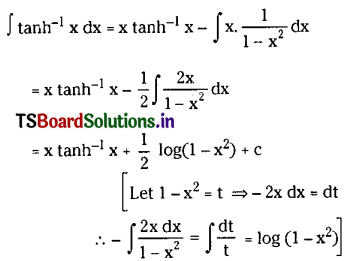
∫tanh-1x dx on (-1, 1).
Solution:
∫tanh-1x dx = ∫tanh-1x . 1 . dx
Take u = tanh-1x and v = 1
and apply integration by parts we get
TS Inter 2nd Year Maths 2B Solutions Chapter 6 Integration Ex 6(c) III Q13

TS Inter 2nd Year Maths 2B Solutions Chapter 6 Integration Ex 6(f)

Students must practice this TS Intermediate Maths 2B Solutions Chapter 6 Integration Ex 6(f) to find a better approach to solving the problems.

TS Inter 2nd Year Maths 2B Solutions Chapter 6 Integration Exercise 6(f)

I. Evaluate the following integrals.

Question 1.
∫ex (1 + x2) dx
Solution:
∫ex (1 + x2) dx = ∫(ex + ex x2) dx
= ∫ex dx + ∫ex x2 dx
= ex + x2 ex – ∫2x ex dx
= ex + x2 ex – [2x ex – ∫2ex dx]
= ex + x2 ex – 2x ex + 2ex + c
= ex [1 + x2 – 2x + 2] + c
= ex (x2 – 2x + 3) + c
[Integration by parts ∫uv dx = u∫v dx – ∫(\(\frac{\mathrm{d}}{\mathrm{dx}}\)(u) ∫v dx) is used]

TS Inter 2nd Year Maths 2B Solutions Chapter 6 Integration Ex 6(f)

Question 2.
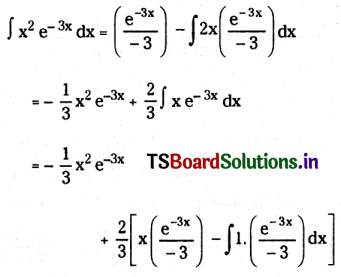
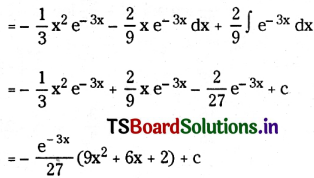
∫x2 e-3x dx
Solution:
Use integration by parts successively using u = x2 and v = e-3x then
TS Inter 2nd Year Maths 2B Solutions Chapter 6 Integration Ex 6(f) I Q2
TS Inter 2nd Year Maths 2B Solutions Chapter 6 Integration Ex 6(f) I Q2.1

Question 3.
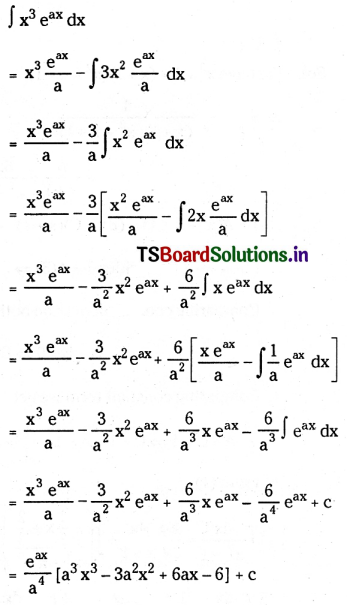
∫x3 eax dx
Solution:
TS Inter 2nd Year Maths 2B Solutions Chapter 6 Integration Ex 6(f) I Q3

II.

Question 1.
Show that ∫xn e-x dx = -xn e-x + n ∫xn-1 e-x dx
Solution:
∫xn e-x dx using integration by parts
= xn (e-x) – ∫n xn-1 (-e-x) dx
= -xn e-x + n∫xn-1 e-x dx

Question 2.
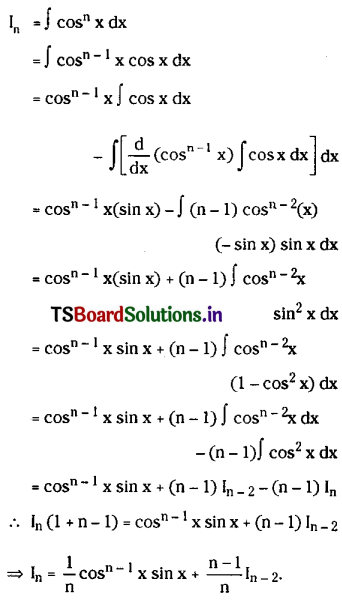
If In = ∫cosnx dx, then show that In = \(\frac{1}{n} \cos ^{n-1} x \sin x+\frac{n-1}{n} I_{n-2}\)
Solution:
TS Inter 2nd Year Maths 2B Solutions Chapter 6 Integration Ex 6(f) II Q2

III.

Question 1.
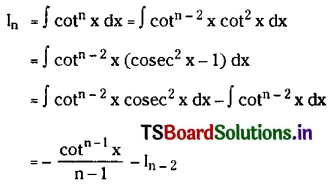
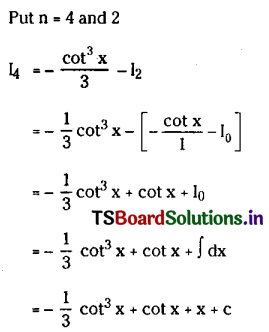
Obtain the reduction formula for In = ∫cotnx dx, n being a positive integer, n ≥ 2 and deduce the value of ∫cot4x dx. (May ’11)
Solution:
TS Inter 2nd Year Maths 2B Solutions Chapter 6 Integration Ex 6(f) III Q1
TS Inter 2nd Year Maths 2B Solutions Chapter 6 Integration Ex 6(f) III Q1.1

TS Inter 2nd Year Maths 2B Solutions Chapter 6 Integration Ex 6(f)

Question 2.
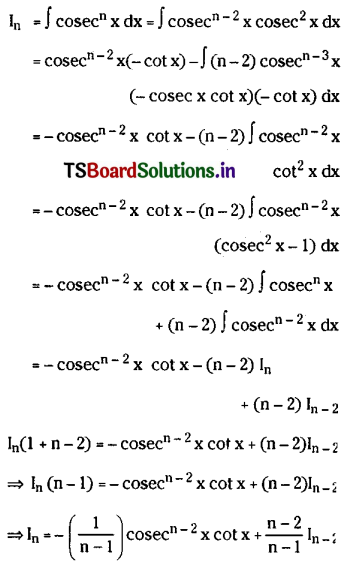
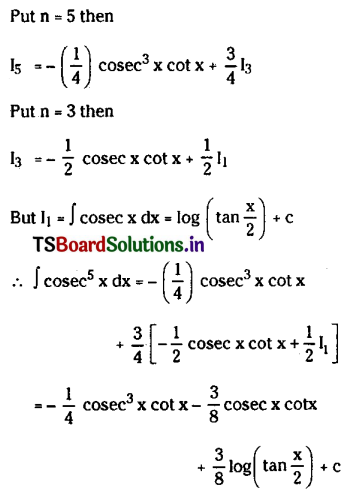
Obtain the reduction formula for In = ∫cosecnx dx, n being a positive integer, n ≥ 2 and deduce the value of ∫cosec5x dx.
Solution:
TS Inter 2nd Year Maths 2B Solutions Chapter 6 Integration Ex 6(f) III Q2
TS Inter 2nd Year Maths 2B Solutions Chapter 6 Integration Ex 6(f) III Q2.1

Question 3.
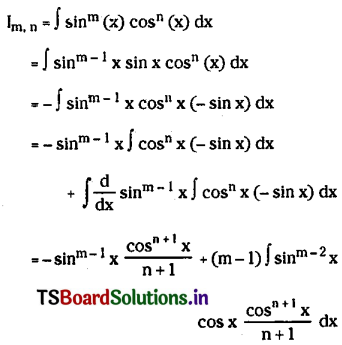
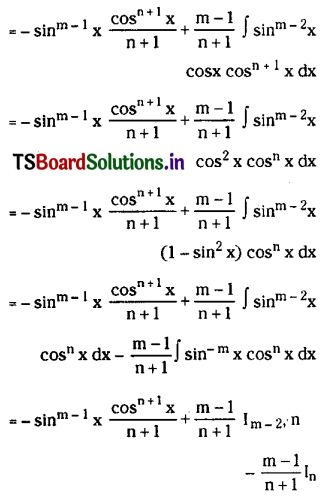
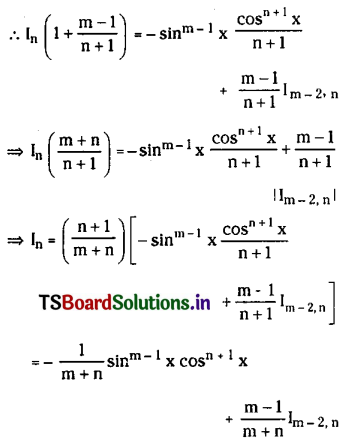
If Im,n = ∫sinmx cosnx dx, then show that \(I_{m, n}=-\frac{\sin ^{m-1} x \cos ^{n+1} x}{m+n}+\frac{m-1}{m+n} I_{m-2, n}\) for a positive Integer n and an integer m ≥ 2.
Solution:
TS Inter 2nd Year Maths 2B Solutions Chapter 6 Integration Ex 6(f) III Q3
TS Inter 2nd Year Maths 2B Solutions Chapter 6 Integration Ex 6(f) III Q3.1
TS Inter 2nd Year Maths 2B Solutions Chapter 6 Integration Ex 6(f) III Q3.2

Question 4.
Evaluate ∫sin5x cos4x dx
Solution:
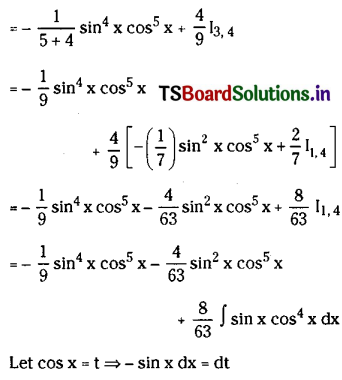
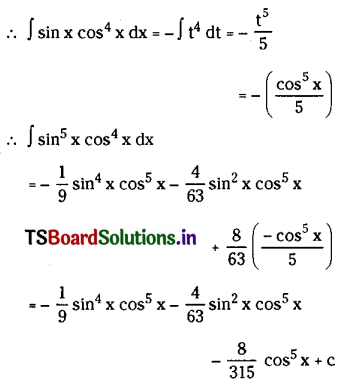
Denote I5,4 = ∫sin5x cos4x dx using the above reduction formula
TS Inter 2nd Year Maths 2B Solutions Chapter 6 Integration Ex 6(f) III Q4
TS Inter 2nd Year Maths 2B Solutions Chapter 6 Integration Ex 6(f) III Q4.1

TS Inter 2nd Year Maths 2B Solutions Chapter 6 Integration Ex 6(f)

Question 5.
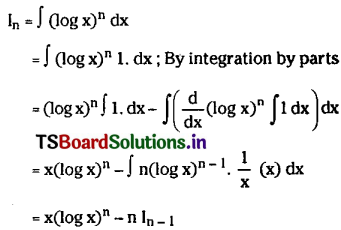
If In = ∫(log x)n dx then show that In = x(log x)n – n In-1 and hence find ∫(log x)4 dx.
Solution:
TS Inter 2nd Year Maths 2B Solutions Chapter 6 Integration Ex 6(f) III Q5
Put n = 4, 3, 2, 1 we get
I4 = x(log x)4 – 4I3
= x(log x)4 – 4[x(log x)3 – 3I2]
= x(log x)4 – 4x(log x)3 + 12[x(log x)2 – 2I1]
= x(log x)4 – 4x(log x)3 + 12x(log x)2 – 24I1]
= x(log x)4 – 4x(log x)3 + 12x(log x)2 – 24 ∫log x dx
= x(log x)4 – 4x(log x)3 + 12x(log x)2 – 24[x log x – x] + c
= x(log x)4 – 4x(log x)3 + 12x(log x)2 – 24x log x – 24x + c

TS Inter 2nd Year Maths 2B Solutions Chapter 6 Integration Ex 6(e)

Students must practice this TS Intermediate Maths 2B Solutions Chapter 6 Integration Ex 6(e) to find a better approach to solving the problems.

TS Inter 2nd Year Maths 2B Solutions Chapter 6 Integration Exercise 6(e)

I. Evaluate the following integrals.

Question 1.
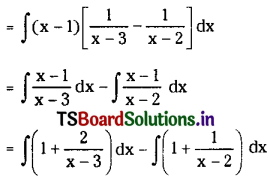
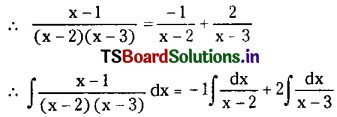
\(\int \frac{x-1}{(x-2)(x-3)} d x\)
Solution:
\(\int \frac{x-1}{(x-2)(x-3)} d x\)
TS Inter 2nd Year Maths 2B Solutions Chapter 6 Integration Ex 6(e) I Q1
= x + 2 log|x – 3| – x – log|x – 2| + c
= 2 log|x – 3| – log|x – 2| + c
Alter: Let \(\frac{x-1}{(x-2)(x-3)}=\frac{A}{x-2}+\frac{B}{x-3}\) (Partial fractions method)
∴ x – 1 = A(x – 3) + B(x – 2)
Comparing coefficients of x and constant terms on both sides
A + B = 1 ………(1) and
-3A – 2B = -1
⇒ 3A + 2B = 1 ………(2)
From (1), 2A + 2B = 2
Solving A = -1 and B = 2
TS Inter 2nd Year Maths 2B Solutions Chapter 6 Integration Ex 6(e) I Q1.1
= -log|x – 2| + 2 log|x – 3| + c
= 2 log|x – 3| – log|x – 2| + c

TS Inter 2nd Year Maths 2B Solutions Chapter 6 Integration Ex 6(e)

Question 2.
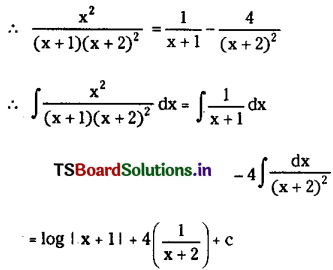
\(\int \frac{x^2}{(x+1)(x+2)^2} d x\)
Solution:
Let \(\frac{x^2}{(x+1)(x+2)^2}=\frac{A}{x+1}+\frac{A}{x+2}+\frac{C}{(x+2)^2}\)
∴ x2 = A(x + 2)2 + B(x + 1)(x + 2) + C(x + 1)
Put x = -1, then A = 1
Comparing the coefficient of x2,
A + B = 1 ⇒ B = 0
Put x = -2, and we get
4 = C(-1)
⇒ C = -4
TS Inter 2nd Year Maths 2B Solutions Chapter 6 Integration Ex 6(e) I Q2

Question 3.
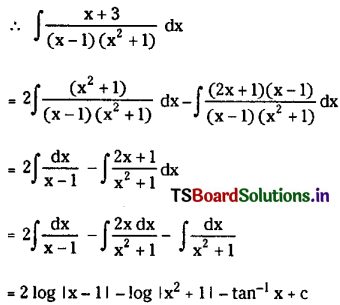
\(\int \frac{x+3}{(x-1)\left(x^2+1\right)} d x\)
Solution:
Let \(\frac{x+3}{(x-1)\left(x^2+1\right)}=\frac{A}{x-1}+\frac{B x+C}{x^2+1}\)
∴ x + 3 = A(x2 + 1) + (Bx + C)(x – 1)
Put x = 1, then 4 = 2A
⇒ A = 2
Comparing the coefficient of x2,
A + B = 0
⇒ B = -A = -2
Comparing the coefficient of constant terms
A – C = 3
⇒ C = A – 3 = 2 – 3 = -1
∴ x + 3 = 2(x2 + 1) + (-2x – 1)(x – 1) = 2(x2 + 1) – (2x + 1)(x – 1)
TS Inter 2nd Year Maths 2B Solutions Chapter 6 Integration Ex 6(e) I Q3

Question 4.
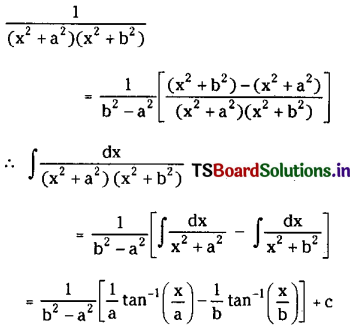
\(\int \frac{d x}{\left(x^2+a^2\right)\left(x^2+b^2\right)}\)
Solution:
TS Inter 2nd Year Maths 2B Solutions Chapter 6 Integration Ex 6(e) I Q4

Question 5.
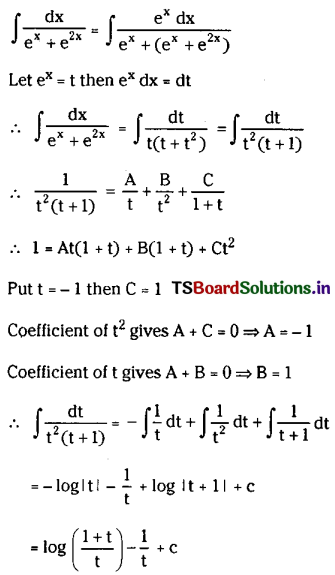
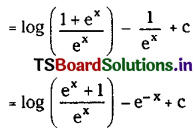
\(\int \frac{d x}{e^x+e^{2 x}}\)
Solution:
TS Inter 2nd Year Maths 2B Solutions Chapter 6 Integration Ex 6(e) I Q5
TS Inter 2nd Year Maths 2B Solutions Chapter 6 Integration Ex 6(e) I Q5.1

Question 6.
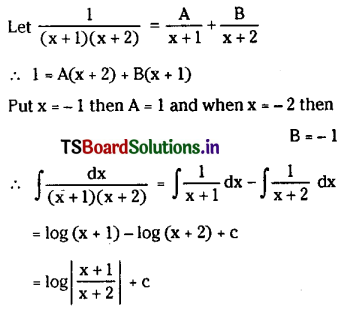
\(\int \frac{d x}{(x+1)(x+2)}\) (Mar. ’12; May ’11)
Solution:
TS Inter 2nd Year Maths 2B Solutions Chapter 6 Integration Ex 6(e) I Q6

TS Inter 2nd Year Maths 2B Solutions Chapter 6 Integration Ex 6(e)

Question 7.
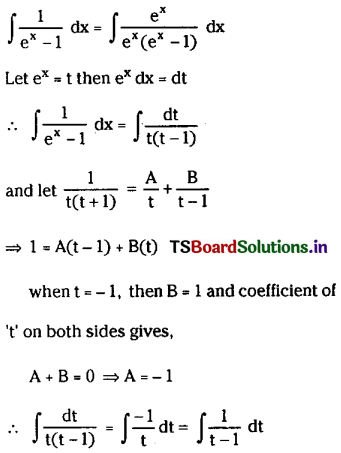
\(\int \frac{1}{e^x-1} d x\)
Solution:
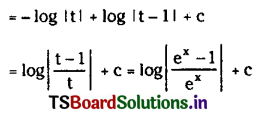
TS Inter 2nd Year Maths 2B Solutions Chapter 6 Integration Ex 6(e) I Q7
TS Inter 2nd Year Maths 2B Solutions Chapter 6 Integration Ex 6(e) I Q7.1

Question 8.
\(\int \frac{1}{(1-x)\left(4+x^2\right)} d x\)
Solution:
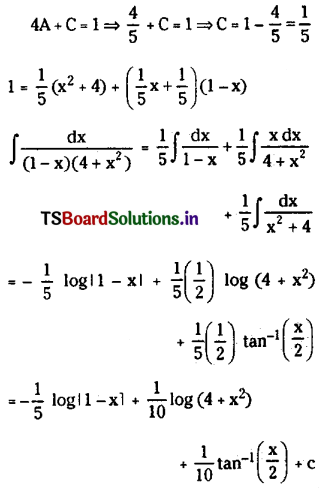
Let \(\frac{1}{(1-x)\left(4+x^2\right)}=\frac{A}{1-x}+\frac{B x+C}{x^2+4}\)
∴ 1 = A(x2 + 4) + (Bx + C)(1 – x)
When x – 1 then 5A = 1 ⇒ A = \(\frac{1}{5}\)
The coefficient of x2 on both sides gives
A – B = 0 ⇒ B = \(\frac{1}{5}\)
Comparing constant terms,
TS Inter 2nd Year Maths 2B Solutions Chapter 6 Integration Ex 6(e) I Q8

Question 9.
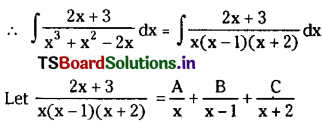
\(\int \frac{2 x+3}{x^3+x^2-2 x} d x\)
Solution:
x3 + x2 – 2x = x(x2 + x – 2) = x(x – 1)(x + 2)
TS Inter 2nd Year Maths 2B Solutions Chapter 6 Integration Ex 6(e) I Q9
∴ 2x + 3 = A(x – 1)(x + 2) + Bx(x + 2) + Cx(x – 1)
Put x = 1 we get
5 = 3B ⇒ B = \(\frac{5}{3}\)
Put x = -2 on both sides
-4 + 3 = C(-2) (-2 – 1)
⇒ -1 = 6C
⇒ C = \(-\frac{1}{6}\)
Coefficient of x2 on both sides
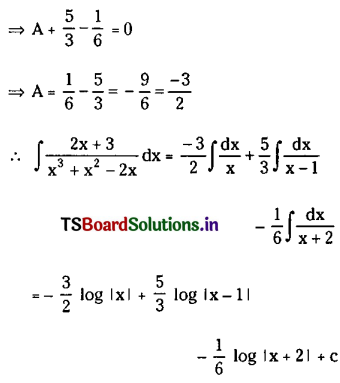
A + B + C = 0
TS Inter 2nd Year Maths 2B Solutions Chapter 6 Integration Ex 6(e) I Q9.1

II. Evaluate the following integrals.

Question 1.
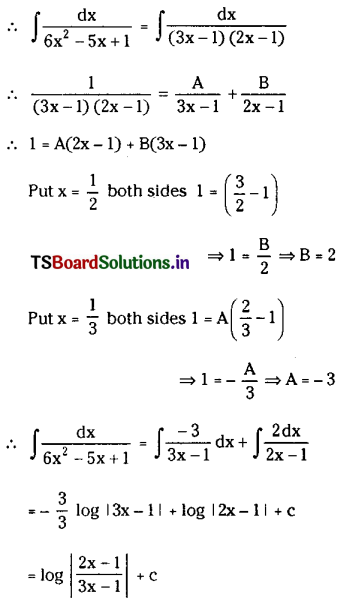
\(\int \frac{d x}{6 x^2-5 x+1}\)
Solution:
6x2 – 5x + 1 = 6x2 – 3x – 2x + 1
= 3x(2x – 1) – 1(2x – 1)
= (3x – 1)(2x – 1)
TS Inter 2nd Year Maths 2B Solutions Chapter 6 Integration Ex 6(e) II Q1

Question 2.
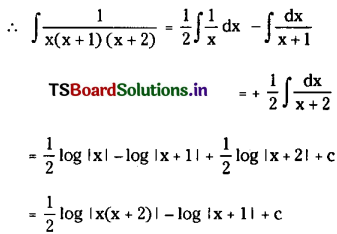
\(\int \frac{d x}{x(x+1)(x+2)}\)
Solution:
Let \(\frac{1}{x(x+1)(x+2)}=\frac{A}{x}+\frac{B}{x+1}+\frac{C}{x+2}\)
∴ 1 = A(x + 1)(x + 2) + Bx(x + 2) + Cx(x + 1)
Put x = -1 then -B = 1 ⇒ B = -1
Coefficient of x2 both sides
A + B + C = 0 and put x = – 2 then
C(-2)(-1) = 1
⇒ C = \(\frac{1}{2}\)
∴ A = -B – C = 1 – \(\frac{1}{2}\) = \(\frac{1}{2}\)
TS Inter 2nd Year Maths 2B Solutions Chapter 6 Integration Ex 6(e) II Q2

TS Inter 2nd Year Maths 2B Solutions Chapter 6 Integration Ex 6(e)

Question 3.
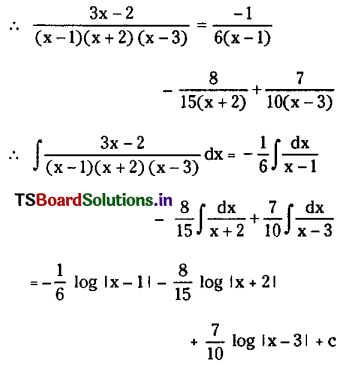
\(\int \frac{3 x-2}{(x-1)(x+2)(x-3)} d x\)
Solution:
Let \(\frac{3 x-2}{(x-1)(x+2)(x-3)}=\frac{A}{x-1}+\frac{B}{x+2}\) + \(\frac{C}{x-3}\)
∴ 3x – 2 = A(x + 2)(x – 3) + B(x – 1)(x – 3) + C(x – 1)(x + 2)
Put x = 1, then 1 = A(3)(-2) ⇒ A = \(-\frac{1}{6}\)
Put x = -2, then -8 = B(-3)(-5) ⇒ B = \(-\frac{8}{15}\)
Put x = 3, then 7 = C(2)(5) ⇒ C = \(\frac{7}{10}\)
TS Inter 2nd Year Maths 2B Solutions Chapter 6 Integration Ex 6(e) II Q3

Question 4.
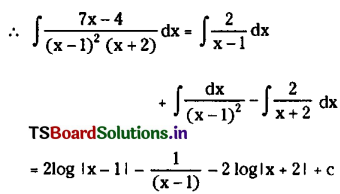
\(\int \frac{7 x-4}{(x-1)^2(x+2)} d x\)
Solution:
Let \(\frac{7 x-4}{(x-1)^2(x+2)}=\frac{A}{x-1}+\frac{B}{(x-1)^2}+\frac{C}{x+2}\)
∴ 7x – 4 = A(x – 1)(x + 2) + B(x + 2) + C(x – 1)2
Put x = 1 both sides 3 = 3B ⇒ B = 1
Put x = -2 both sides -18 = 9C ⇒ C = -2
Comparing the coefficient of x2 on both sides
A + C = 0
⇒ A = -C = 2
TS Inter 2nd Year Maths 2B Solutions Chapter 6 Integration Ex 6(e) II Q4

III. Evaluate the following integrals.

Question 1.
\(\int \frac{1}{(x-a)(x-b)(x-c)} d x\)
Solution:
Let \(\frac{1}{(x-a)(x-b)(x-c)}\) = \(\frac{A}{x-a}+\frac{B}{x-b}+\frac{C}{x-c}\)
Then 1 = A(x – b)(x – c) + B(x – a)(x – c) + C(x – a)(x – b)
Put x = a both sides we get 1 = A(a – b)(a – c)
⇒ A =\(\frac{1}{(a-b)(a-c)}\)
Put x = b both sides we get 1 = B(b – a)(b – c)
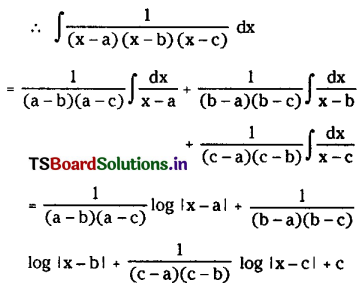
⇒ B = \(\frac{1}{(b-a)(b-c)}\)
Put x = c both sides we get 1 = C (c – a)(c – b)
⇒ C = \(\frac{1}{(c-a)(c-b)}\)
TS Inter 2nd Year Maths 2B Solutions Chapter 6 Integration Ex 6(e) III Q1

Question 2.
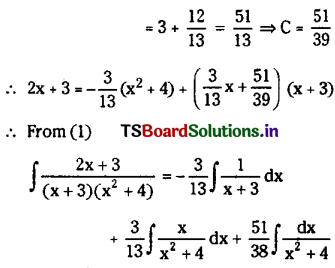
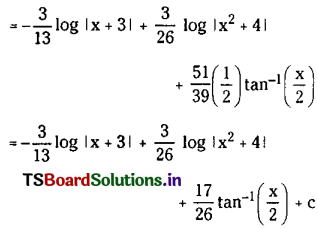
\(\int \frac{2 x+3}{(x+3)\left(x^2+4\right)} d x\)
Solution:
Let \(\frac{2 x+3}{(x+3)\left(x^2+4\right)}=\frac{A}{x+3}+\frac{B x+C}{x^2+4}\) ……(1)
∴ 2x + 3 = A(x2 + 4) + (Bx + c)(x + 3)
Put x = -3 both sides -6 + 3 = A(9 + 4)
⇒ A = \(-\frac{3}{13}\)
Comparing the coefficient of x2 on both sides
A + B = 0
⇒ B = -A = \(\frac{3}{13}\)
and comparing constant terms on both sides
4A + 3C = 3
⇒ 3C = 3 – 4A
TS Inter 2nd Year Maths 2B Solutions Chapter 6 Integration Ex 6(e) III Q2
TS Inter 2nd Year Maths 2B Solutions Chapter 6 Integration Ex 6(e) III Q2.1

TS Inter 2nd Year Maths 2B Solutions Chapter 6 Integration Ex 6(e)

Question 3.
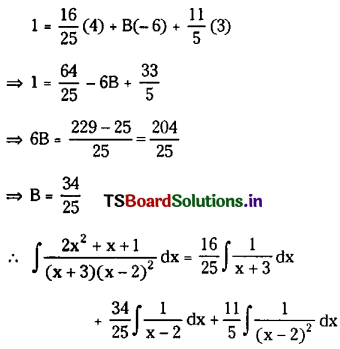
\(\int \frac{2 x^2+x+1}{(x+3)(x-2)^2} d x\)
Solution:
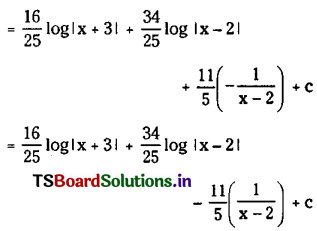
Let \(\frac{2 x^2+x+1}{(x+3)(x-2)^2}=\frac{A}{x+3}+\frac{B}{x-2}\) + \(\frac{C}{(x-2)^2}\)
∴ 2x2 + x + 1 = A(x – 2)2 + B(x – 2)(x + 3) + C(x + 3)
Put x = 2 on both sides
8 + 2 + 1 = C(5)
⇒ C = \(\frac{11}{5}\)
Put x = -3 on both sides
18 – 3 + 1 = A(-5)2
⇒ A = \(\frac{16}{25}\)
Put x = 0 on both sides
TS Inter 2nd Year Maths 2B Solutions Chapter 6 Integration Ex 6(e) III Q3
TS Inter 2nd Year Maths 2B Solutions Chapter 6 Integration Ex 6(e) III Q3.1

Question 4.
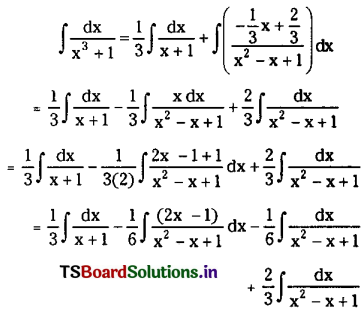
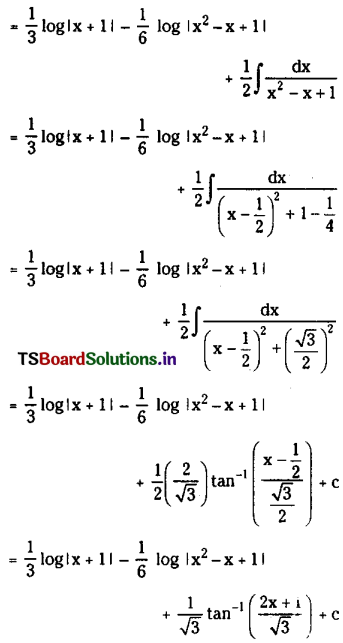
\(\int \frac{d x}{x^3+1}\)
Solution:
We have x3 + 1 = (x + 1)(x2 – x + 1)
∴ \(\frac{1}{x^3+1}=\frac{1}{(x+1)\left(x^2-x+1\right)}\) = \(\frac{A}{x+1}+\frac{B x+C}{x^2-x+1}\)
∴ 1 = A(x2 – x + 1) + (Bx + C)(x + 1) …….(1)
Put x = -1 both sides 1 = A(3)
⇒ A = \(\frac{1}{3}\)
Comparing the coefficient of x2 on both sides
A + B = 0
⇒ B = \(-\frac{1}{3}\)
Comparing constant terms we get
A + C = 1
⇒ C = 1 – A
= 1 – \(\frac{1}{3}\)
= \(\frac{2}{3}\)
∴ From(1)
TS Inter 2nd Year Maths 2B Solutions Chapter 6 Integration Ex 6(e) III Q4
TS Inter 2nd Year Maths 2B Solutions Chapter 6 Integration Ex 6(e) III Q4.1

TS Inter 2nd Year Maths 2B Solutions Chapter 6 Integration Ex 6(e)

Question 5.
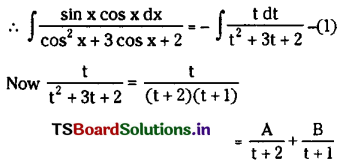
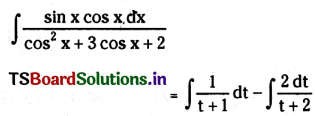
\(\int \frac{\sin x \cos x}{\cos ^2 x+3 \cos x+2} d x\)
Solution:
Let cos x = t then sin x dx = -dt
TS Inter 2nd Year Maths 2B Solutions Chapter 6 Integration Ex 6(e) III Q5
∴ t = A(t + 1) + B(t + 2)
Put t = -1 then -1 = B(-1 + 2)
⇒ B = -1
and when t = -2 then -2 = A(-1)
⇒ A = 2
∴ \(\int \frac{t}{t^2+3 t+2} d t=\int \frac{2}{t+2} d t-\int \frac{1}{t+1} d t\)
∴ From (1)
TS Inter 2nd Year Maths 2B Solutions Chapter 6 Integration Ex 6(e) III Q5.1
= log|t + 1| – 2 log|t + 2|
= log|cos x + 1| – 2 log|cos x + 2| + c

TS Inter 2nd Year Maths 2B Solutions Chapter 6 Integration Ex 6(b)

Students must practice this TS Intermediate Maths 2B Solutions Chapter 6 Integration Ex 6(b) to find a better approach to solving the problems.

TS Inter 2nd Year Maths 2B Solutions Chapter 6 Integration Exercise 6(b)

I. Evaluate the following integrals.

Question 1.
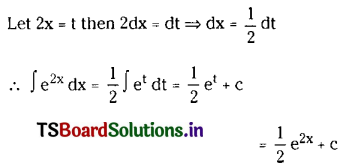
∫e2x dx, x ∈ R
Solution:
TS Inter 2nd Year Maths 2B Solutions Chapter 6 Integration Ex 6(b) I Q1

Question 2.
∫sin 7x dx, x ∈ R
Solution:
Let 7x = t then 7 dx = dt
⇒ dx = \(\frac{1}{7}\) dt
∴ ∫sin 7x dx = \(\frac{1}{7}\) ∫sint dt
= \(-\frac{1}{7}\) cos t
= \(-\frac{1}{7}\) cos 7x + c

TS Inter 2nd Year Maths 2B Solutions Chapter 6 Integration Ex 6(b)

Question 3.
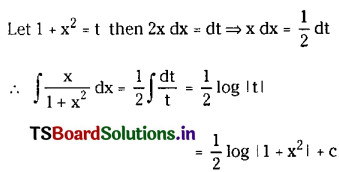
\(\int \frac{x}{1+x^2} d x\), x ∈ R
Solution:
TS Inter 2nd Year Maths 2B Solutions Chapter 6 Integration Ex 6(b) I Q3

Question 4.
∫2x sin(x2 + 1) dx, x ∈ R
Solution:
Let x2 + 1 = t then 2x dx = dt
∴ ∫2x sin(x2 + 1) dx = ∫sin t dt
= -cos t + c
= -cos(x2 + 1) + c

Question 5.
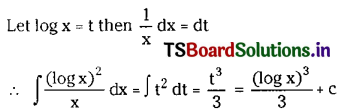
\(\int \frac{(\log x)^2}{x} d x\) on I ⊂ (0, ∞).
Solution:
TS Inter 2nd Year Maths 2B Solutions Chapter 6 Integration Ex 6(b) I Q5

Question 6.
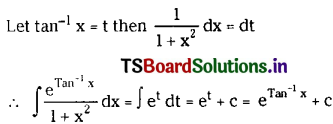
\(\int \frac{e^{Tan^{-1} x}}{1+x^2} d x\) on I ⊂ (0, ∞).
Solution:
TS Inter 2nd Year Maths 2B Solutions Chapter 6 Integration Ex 6(b) I Q6

Question 7.
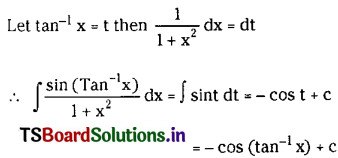
\(\int \frac{\sin \left({Tan}^{-1} x\right)}{1+x^2} d x\), x ∈ R
Solution:
TS Inter 2nd Year Maths 2B Solutions Chapter 6 Integration Ex 6(b) I Q7

Question 8.
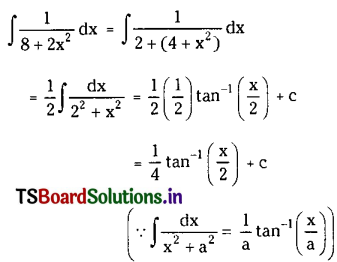
\(\int \frac{1}{8+2 x^2} d x\) on R.
Solution:
TS Inter 2nd Year Maths 2B Solutions Chapter 6 Integration Ex 6(b) I Q8

Question 9.
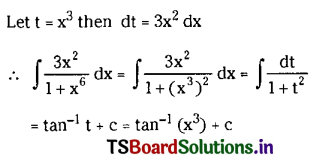
\(\int \frac{3 x^2}{1+x^6} d x\) on R.
Solution:
TS Inter 2nd Year Maths 2B Solutions Chapter 6 Integration Ex 6(b) I Q9

TS Inter 2nd Year Maths 2B Solutions Chapter 6 Integration Ex 6(b)

Question 10.
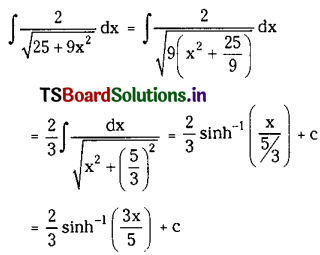
\(\int \frac{2}{\sqrt{25+9 x^2}} d x\) on R.
Solution:
TS Inter 2nd Year Maths 2B Solutions Chapter 6 Integration Ex 6(b) I Q10

Question 11.
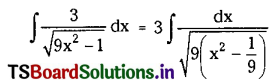
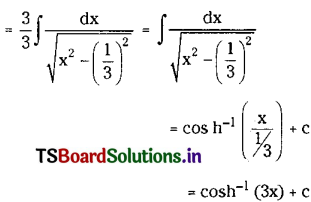
\(\int \frac{3}{\sqrt{9 x^2-1}} d x\) on (\(\frac{1}{3}\), ∞).
Solution:
TS Inter 2nd Year Maths 2B Solutions Chapter 6 Integration Ex 6(b) I Q11
TS Inter 2nd Year Maths 2B Solutions Chapter 6 Integration Ex 6(b) I Q11.1

Question 12.
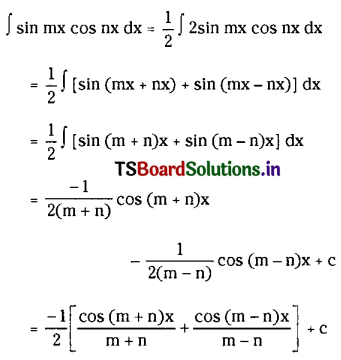
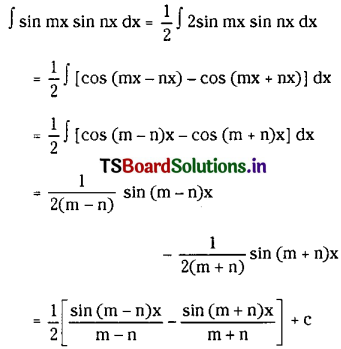
∫sin mx cos nx dx on R, m ≠ n, m and n are positive integers.
Solution:
TS Inter 2nd Year Maths 2B Solutions Chapter 6 Integration Ex 6(b) I Q12

Question 13.
∫sin mx sin nx dx on R, m ≠ n, m and n are positive integers.
Solution:
TS Inter 2nd Year Maths 2B Solutions Chapter 6 Integration Ex 6(b) I Q13

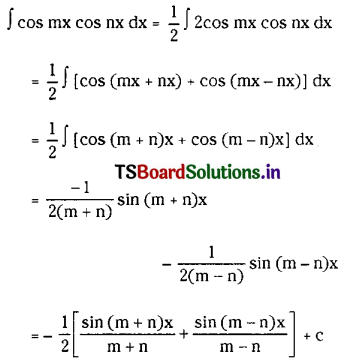
Question 14.
∫cos mx cos nx dx on R, m ≠ n, m and n are positive integers.
Solution:
TS Inter 2nd Year Maths 2B Solutions Chapter 6 Integration Ex 6(b) I Q14

Question 15.
∫sin x sin 2x sin 3x dx on R.
Solution:
Consider sin x sin 2x sin 3x = \(\frac{1}{2}\) (2 sin x sin 2x sin 3x)
= \(\frac{1}{2}\) [cos(3x – 2x) – cos(3x + 2x)] sin x
= \(\frac{1}{2}\) [sin x cos x – sin x cos 5x]
= \(\frac{1}{4}\) [2 sin x cos x – 2 sin x cos 5x]
= \(\frac{1}{4}\) [sin 2x – [sin(5x + x) + sin(x – 5x)]
= \(\frac{1}{4}\) [sin 2x – [sin 6x – sin 4x]]
= \(\frac{1}{4}\) [sin 2x – sin 6x + sin 4x]
∴ ∫sin x sin 2x sin 3x dx = \(\frac{1}{4}\) ∫sin 2x dx – \(\frac{1}{4}\) ∫sin 6x dx + \(\frac{1}{4}\) ∫sin 4x dx
= \(-\frac{1}{8}\) cos 2x + \(\frac{1}{24}\) cos 6x – \(\frac{1}{16}\) cos 4x + c
= \(\frac{1}{4}\left[\frac{\cos 6 x}{6}-\frac{\cos 4 x}{4}-\frac{\cos 2 x}{2}\right]\) + c

TS Inter 2nd Year Maths 2B Solutions Chapter 6 Integration Ex 6(b)

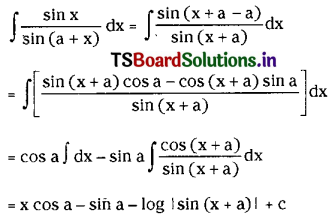
Question 16.
\(\int \frac{\sin x}{\sin (a+x)} d x\) on I ⊂ R – {nπ – a : n ∈ Z}.
Solution:
TS Inter 2nd Year Maths 2B Solutions Chapter 6 Integration Ex 6(b) I Q16

II. Evaluate the following integrals.

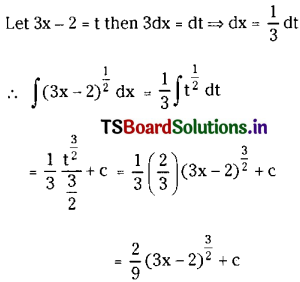
Question 1.
\(\int(3 x-2)^{\frac{1}{2}} d x\) on (\(\frac{2}{3}\), ∞)
Solution:
TS Inter 2nd Year Maths 2B Solutions Chapter 6 Integration Ex 6(b) II Q1

Question 2.
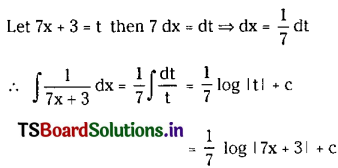
\(\int \frac{1}{7 x+3} d x\) on I ⊂ R – {\(-\frac{3}{7}\)}
Solution:
TS Inter 2nd Year Maths 2B Solutions Chapter 6 Integration Ex 6(b) II Q2

Question 3.
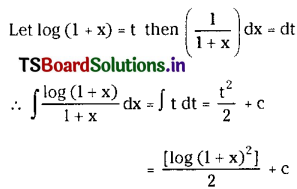
\(\int \frac{\log (1+x)}{1+x} d x\) on (-1, ∞).
Solution:
TS Inter 2nd Year Maths 2B Solutions Chapter 6 Integration Ex 6(b) II Q3

Question 4.
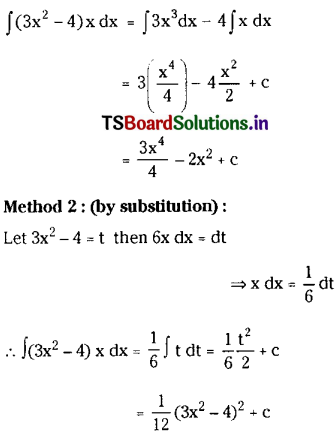
∫(3x2 – 4)x dx on R.
Solution:
TS Inter 2nd Year Maths 2B Solutions Chapter 6 Integration Ex 6(b) II Q4

Question 5.
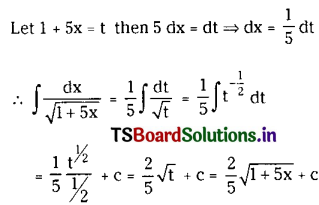
\(\int \frac{d x}{\sqrt{1+5 x}} \text { on }\left(-\frac{1}{5}, \infty\right)\)
Solution:
TS Inter 2nd Year Maths 2B Solutions Chapter 6 Integration Ex 6(b) II Q5

TS Inter 2nd Year Maths 2B Solutions Chapter 6 Integration Ex 6(b)

Question 6.
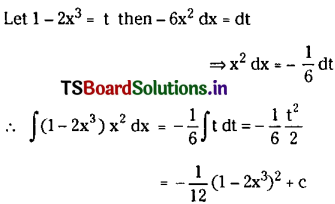
∫(1 – 2x3) x2 dx on R.
Solution:
TS Inter 2nd Year Maths 2B Solutions Chapter 6 Integration Ex 6(b) II Q6

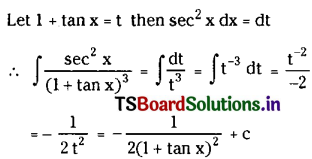
Question 7.
\(\int \frac{\sec ^2 x}{(1+\tan x)^3} d x\) on I ⊂ R – {nπ – \(\frac{\pi}{4}\) : n ∈ Z}
Solution:
TS Inter 2nd Year Maths 2B Solutions Chapter 6 Integration Ex 6(b) II Q7

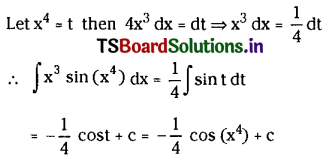
Question 8.
∫x3 sin(x4) dx on R.
Solution:
TS Inter 2nd Year Maths 2B Solutions Chapter 6 Integration Ex 6(b) II Q8

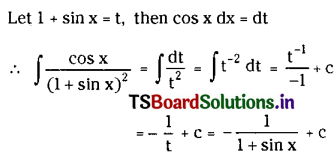
Question 9.
\(\int \frac{\cos x}{(1+\sin x)^2} d x\) on I ⊂ R – {2nπ + \(\frac{3 \pi}{2}\) : n ∈ Z}
Solution:
TS Inter 2nd Year Maths 2B Solutions Chapter 6 Integration Ex 6(b) II Q9

Question 10.
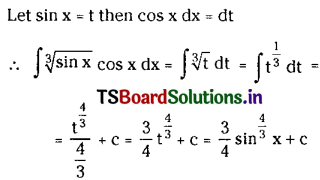
∫\(\sqrt[3]{\sin x}\) cos x dx on [2nπ, (2n + 1)π], (n ∈ Z).
Solution:
TS Inter 2nd Year Maths 2B Solutions Chapter 6 Integration Ex 6(b) II Q10

Question 11.
∫2x \(e^{x^2}\) dx on R.
Solution:
Let x2 = t then 2x dx = dt
∴ ∫2x \(e^{x^2}\) dx = ∫et dt
= et + c
= \(e^{x^2}\) + c

Question 12.
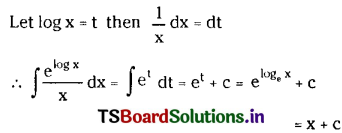
\(\int \frac{e^{\log x}}{x} d x\) on (0, ∞).
Solution:
TS Inter 2nd Year Maths 2B Solutions Chapter 6 Integration Ex 6(b) II Q12

Question 13.
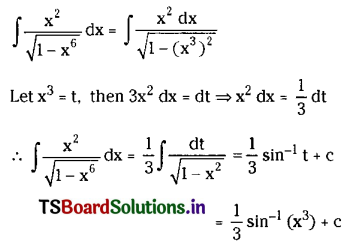
\(\int \frac{x^2}{\sqrt{1-x^6}} d x\) on I ∈ (-1, 1)
Solution:
TS Inter 2nd Year Maths 2B Solutions Chapter 6 Integration Ex 6(b) II Q13

TS Inter 2nd Year Maths 2B Solutions Chapter 6 Integration Ex 6(b)

Question 14.
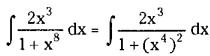
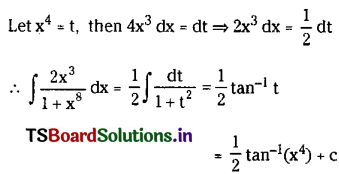
\(\int \frac{2 x^3}{1+x^8} d x\) on R.
Solution:
TS Inter 2nd Year Maths 2B Solutions Chapter 6 Integration Ex 6(b) II Q14
TS Inter 2nd Year Maths 2B Solutions Chapter 6 Integration Ex 6(b) II Q14.1

Question 15.
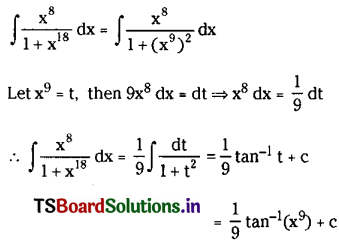
\(\int \frac{x^8}{1+x^{18}} d x\) on R. (Mar. ’09)
Solution:
TS Inter 2nd Year Maths 2B Solutions Chapter 6 Integration Ex 6(b) II Q15

Question 16.
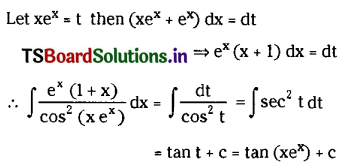
\(\int \frac{e^x(1+x)}{\cos ^2\left(x e^x\right)} d x\) on I ⊂ R – {x ∈ R : cos(xex) = 0}. (Mar. ’10, ’04)
Solution:
TS Inter 2nd Year Maths 2B Solutions Chapter 6 Integration Ex 6(b) II Q16

Question 17.
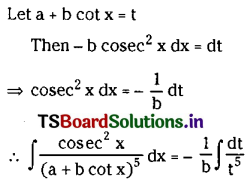
\(\int \frac{{cosec}^2 x}{(a+b \cot x)^5} d x\) on I ⊂ R – {x ∈ R : a + b cot x = 0}, where a, b ∈ R, b ≠ 0.
Solution:
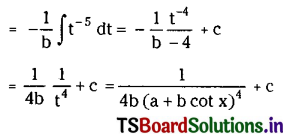
TS Inter 2nd Year Maths 2B Solutions Chapter 6 Integration Ex 6(b) II Q17
TS Inter 2nd Year Maths 2B Solutions Chapter 6 Integration Ex 6(b) II Q17.1

Question 18.
∫ex sin ex dx on R.
Solution:
Let t = ex then dt = ex dx
∴ ∫ex sin ex dx = ∫sin t dt
= -cos t + c
= -cos(ex) + c

Question 19.
\(\int \frac{\sin (\log x)}{x} d x\) on (0, ∞).
Solution:
Let log x = t then \(\frac{1}{x}\) dx = dt
∴ \(\int \frac{\sin (\log x)}{x} d x\) = ∫sin t dt
= -cos t + c
= -cos(log x) + c

TS Inter 2nd Year Maths 2B Solutions Chapter 6 Integration Ex 6(b)

Question 20.
\(\int \frac{1}{x \log x} d x\) on (1, ∞).
Solution:
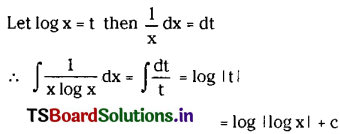
TS Inter 2nd Year Maths 2B Solutions Chapter 6 Integration Ex 6(b) II Q20

Question 21.
\(\int \frac{(1+\log x)^n}{x} d x\) on (e-1, ∞), n ≠ -1.
Solution:
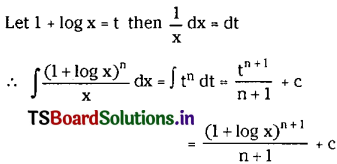
TS Inter 2nd Year Maths 2B Solutions Chapter 6 Integration Ex 6(b) II Q21

Question 22.
\(\int \frac{\cos (\log x)}{x} d x\) on (0, ∞).
Solution:
Let log x = t then \(\frac{1}{x}\) dx = dt
∴ \(\int \frac{\cos (\log x)}{x} d x\) = ∫cos t dt
= sin t + c
= sin(log x) + c

Question 23.
\(\int \frac{\cos \sqrt{x}}{\sqrt{x}} d x\) on (0, ∞).
Solution:
Let √x = t then \(\frac{1}{2 \sqrt{x}}\) dx = dt
∴ \(\int \frac{\cos \sqrt{x}}{\sqrt{x}} d x\) = 2 ∫cos t dt
= 2 sin t + c
= 2 sin(√x) + c

Question 24.
\(\int \frac{2 x+1}{x^2+x+1} d x\) on R.
Solution:
Let x2 + x + 1 = t then (2x + 1) dx = dt
∴ \(\int \frac{2 x+1}{x^2+x+1} d x=\int \frac{d t}{t}\)
= log|t| + c
= log|x2 + x + 1| + c

Question 25.
\(\int \frac{a x^{n-1}}{b x^n+c} d x\) where n ∈ N, a, b, c are real numbers, b ≠ 0 and x ∈ I ⊂ {x ∈ R : xn ≠ \(-\frac{c}{b}\)}
Solution:
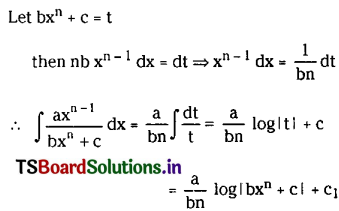
TS Inter 2nd Year Maths 2B Solutions Chapter 6 Integration Ex 6(b) II Q25

Question 26.
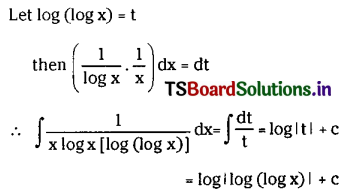
\(\int \frac{1}{x \log x[\log (\log x)]} d x\) on (1, ∞).
Solution:
TS Inter 2nd Year Maths 2B Solutions Chapter 6 Integration Ex 6(b) II Q26

Question 27.
∫coth x dx on R.
Solution:
∫coth x dx = \(\int \frac{\cosh x}{\sinh x} d x\)
Let sinh x = t then cosh x dx = dt
∴ ∫coth x dx = \(\int \frac{\mathrm{dt}}{\mathrm{t}}\)
= log|t| + c
= log|sinh x| + c

Question 28.
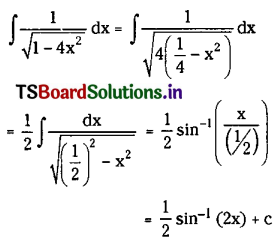
\(\int \frac{1}{\sqrt{1-4 x^2}} d x \text { on }\left(-\frac{1}{2}, \frac{1}{2}\right)\).
Solution:
TS Inter 2nd Year Maths 2B Solutions Chapter 6 Integration Ex 6(b) II Q28

TS Inter 2nd Year Maths 2B Solutions Chapter 6 Integration Ex 6(b)

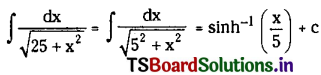
Question 29.
\(\int \frac{d x}{\sqrt{25+x^2}}\) on R.
Solution:
TS Inter 2nd Year Maths 2B Solutions Chapter 6 Integration Ex 6(b) II Q29

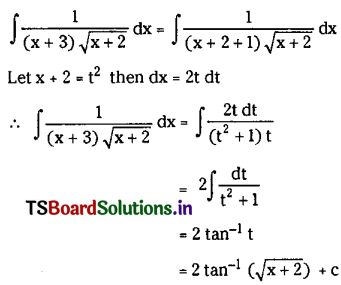
Question 30.
\(\int \frac{1}{(x+3) \sqrt{x+2}}\) on I ⊂ (-2, ∞). (New Model Paper & May ’12)
Solution:
TS Inter 2nd Year Maths 2B Solutions Chapter 6 Integration Ex 6(b) II Q30

Question 31.
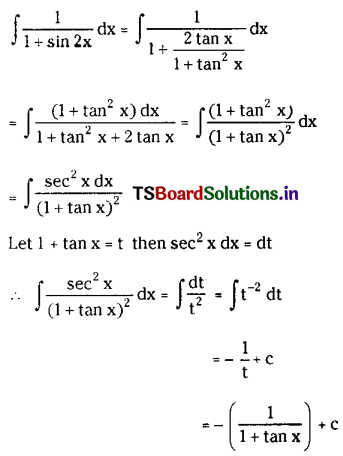
\(\int \frac{1}{1+\sin 2 x} d x\) on I ⊂ R – {\(\frac{n \pi}{2}+(-1)^n \frac{\pi}{4}\) : n ∈ Z}.
Solution:
TS Inter 2nd Year Maths 2B Solutions Chapter 6 Integration Ex 6(b) II Q31

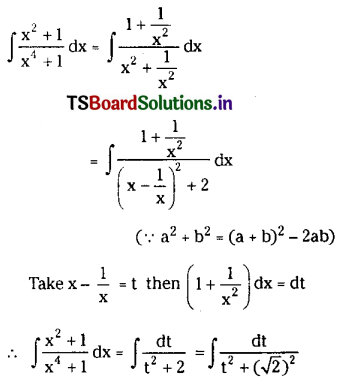
Question 32.
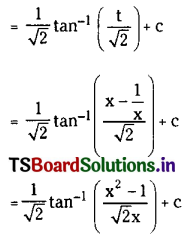
\(\int \frac{x^2+1}{x^4+1} d x\) on R.
Solution:
TS Inter 2nd Year Maths 2B Solutions Chapter 6 Integration Ex 6(b) II Q32
TS Inter 2nd Year Maths 2B Solutions Chapter 6 Integration Ex 6(b) II Q32.1

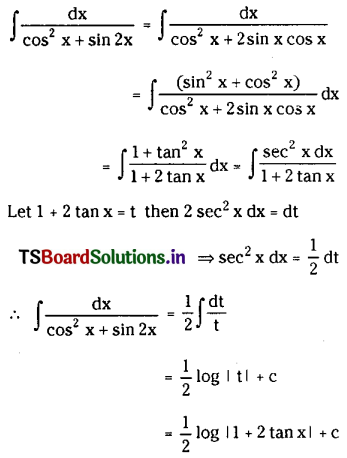
Question 33.
\(\int \frac{d x}{\cos ^2 x+\sin 2 x}\) on I ⊂ R / ({(2n + 1)\(\frac{\pi}{2}\) : n ∈ Z} ∪ {2nπ + \({tan}^{-1} \frac{1}{2}\) : n ∈ Z})
Solution:
TS Inter 2nd Year Maths 2B Solutions Chapter 6 Integration Ex 6(b) II Q33

Question 34.
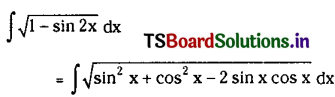
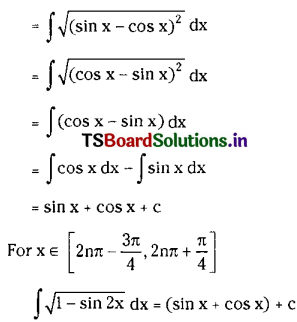
\(\int \sqrt{1-\sin 2 x} d x\) on I ⊂ [2nπ – \(\frac{3 \pi}{4}\), 2nπ + \(\frac{\pi}{4}\)], n ∈ Z.
Solution:
TS Inter 2nd Year Maths 2B Solutions Chapter 6 Integration Ex 6(b) II Q34
TS Inter 2nd Year Maths 2B Solutions Chapter 6 Integration Ex 6(b) II Q34.1

Question 35.
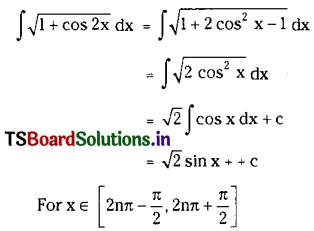
\(\int \sqrt{1+\cos 2 x} d x\) on I ⊂ [2nπ – \(\frac{\pi}{2}\), 2nπ + \(\frac{\pi}{2}\)], n ∈ Z.
Solution:
TS Inter 2nd Year Maths 2B Solutions Chapter 6 Integration Ex 6(b) II Q35

Question 36.
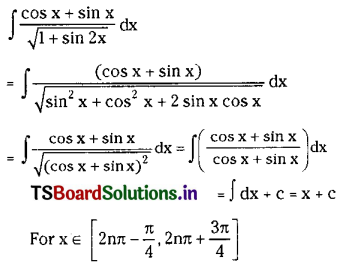
\(\int \frac{\cos x+\sin x}{\sqrt{1+\sin 2 x}} d x\) on I ⊂ [2nπ – \(\frac{\pi}{4}\), 2nπ + \(\frac{3 \pi}{4}\)], n ∈ Z.
Solution:
TS Inter 2nd Year Maths 2B Solutions Chapter 6 Integration Ex 6(b) II Q36

TS Inter 2nd Year Maths 2B Solutions Chapter 6 Integration Ex 6(b)

Question 37.
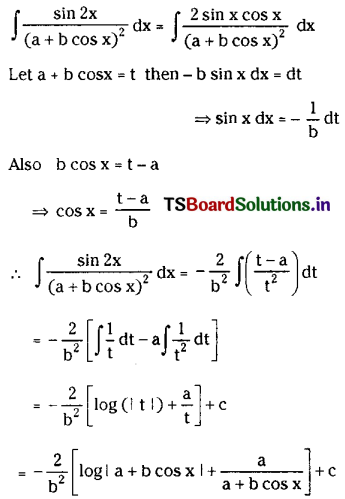
\(\int \frac{\sin 2 x}{(a+b \cos x)^2} d x\) on {R, if |a| > |b|, I ⊂ {x ∈ R : a + b cos x ≠ 0}, if |a| < |b|}.
Solution:
TS Inter 2nd Year Maths 2B Solutions Chapter 6 Integration Ex 6(b) II Q37

Question 38.
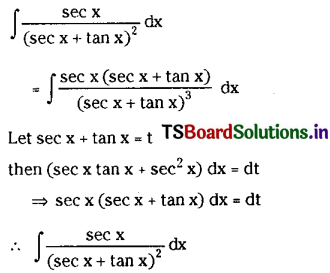
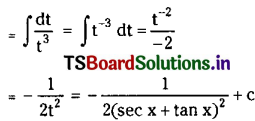
\(\int \frac{\sec x}{(\sec x+\tan x)^2} d x\) on I ⊂ R – {(2n + 1)\(\frac{\pi}{2}\), n ∈ Z}.
Solution:
TS Inter 2nd Year Maths 2B Solutions Chapter 6 Integration Ex 6(b) II Q38
TS Inter 2nd Year Maths 2B Solutions Chapter 6 Integration Ex 6(b) II Q38.1

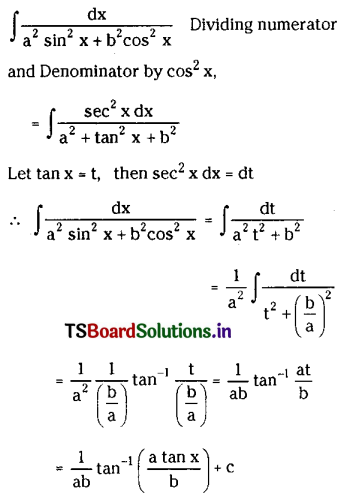
Question 39.
\(\int \frac{d x}{a^2 \sin ^2 x+b^2 \cos ^2 x}\) on R, a ≠ 0, b ≠ 0.
Solution:
TS Inter 2nd Year Maths 2B Solutions Chapter 6 Integration Ex 6(b) II Q39

Question 40.
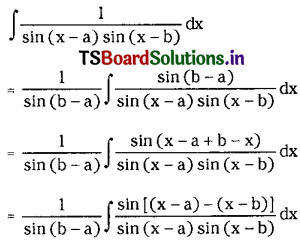
\(\int \frac{d x}{\sin (x-a) \sin (x-b)}\) on I ⊂ R – ({a + nπ : n ∈ Z} ∪ {b + nπ : n ∈ Z}).
Solution:
TS Inter 2nd Year Maths 2B Solutions Chapter 6 Integration Ex 6(b) II Q40
TS Inter 2nd Year Maths 2B Solutions Chapter 6 Integration Ex 6(b) II Q40.1

TS Inter 2nd Year Maths 2B Solutions Chapter 6 Integration Ex 6(b)

Question 41.
\(\int \frac{1}{\cos (x-a) \cos (x-b)} \mathbf{d x}\) on I ⊂ R – ({a + \(\frac{(2 n+1) \pi}{2}\) : n ∈ Z} ∪ {b + \(\frac{(2 n+1) \pi}{2}\) : n ∈ Z})
Solution:
TS Inter 2nd Year Maths 2B Solutions Chapter 6 Integration Ex 6(b) II Q41
TS Inter 2nd Year Maths 2B Solutions Chapter 6 Integration Ex 6(b) II Q41.1

III. Evaluate the following integrals.

Question 1.
\(\int \frac{\sin 2 x}{a \cos ^2 x+b \sin ^2 x} d x\) on I ⊂ R – {x ∈ R | a cos2x + b sin2x = 0}
Solution:
TS Inter 2nd Year Maths 2B Solutions Chapter 6 Integration Ex 6(b) III Q1

Question 2.
\(\int \frac{1-\tan x}{1+\tan x} d x\) for x ∈ I ⊂ R – {nπ – \(\frac{\pi}{4}\) : n ∈ Z}
Solution:
TS Inter 2nd Year Maths 2B Solutions Chapter 6 Integration Ex 6(b) III Q2

Question 3.
\(\int \frac{\cot (\log x)}{x} d x\), x ∈ I ⊂ (0, ∞) – {enπ : n ∈ Z}
Solution:
TS Inter 2nd Year Maths 2B Solutions Chapter 6 Integration Ex 6(b) III Q3

Question 4.
∫ex cot ex dx, x ∈ I ⊂ R – {log nπ : n ∈ Z}
Solution:
Let ex = t then ex dx = dt
∴ ∫ex cot x dx = ∫cot t dt
= log|sin t| + c
= log|sin(ex)| + c

TS Inter 2nd Year Maths 2B Solutions Chapter 6 Integration Ex 6(b)

Question 5.
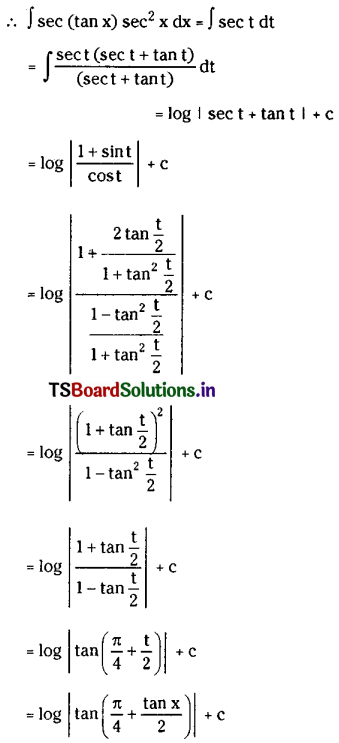
∫sec(tan x) sec2x dx on I ⊂ {x ∈ E : tan x ≠ \(\frac{(2 k+1) \pi}{2}\) for any k ∈ Z), where E = R – {\(\frac{(2 n+1) \pi}{2}\), n ∈ Z}
Solution:
Let tan x = t, then sec2x dx = dt
TS Inter 2nd Year Maths 2B Solutions Chapter 6 Integration Ex 6(b) III Q5

Question 6.
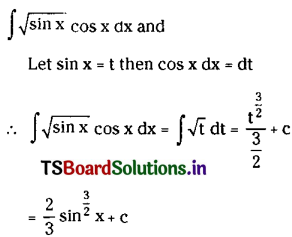
\(\int \sqrt{\sin x} \cos x d x\) on [2nπ, (2n + 1)π], (n ∈ Z).
Solution:
TS Inter 2nd Year Maths 2B Solutions Chapter 6 Integration Ex 6(b) III Q6

Question 7.
∫tan4x sec2x dx, x ∈ I ⊂ R – {\(\frac{(2 n+1) x}{2}\) : n ∈ Z}.
Solution:
Let tan x = t then sec2x dx = dt
∴ ∫tan4x sec2x dx = ∫t4dt
= \(\frac{t^5}{5}\) + c
= \(\frac{\tan ^5 x}{5}\) + c

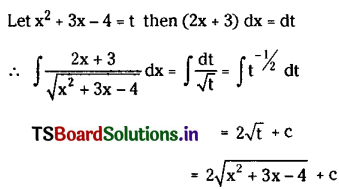
Question 8.
\(\int \frac{2 x+3}{\sqrt{x^2+3 x-4}} d x\), x ∈ I ⊂ R – [-4, 1]
Solution:
TS Inter 2nd Year Maths 2B Solutions Chapter 6 Integration Ex 6(b) III Q8

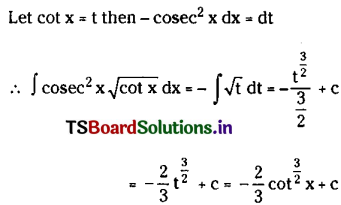
Question 9.
\(\int {cosec}^2 x \sqrt{\cot x} d x\) on (0, \(\frac{\pi}{2}\)].
Solution:
TS Inter 2nd Year Maths 2B Solutions Chapter 6 Integration Ex 6(b) III Q9

Question 10.
∫sec x log(sec x + tan x) dx on (0, \(\frac{\pi}{2}\)).
Solution:
Let log(sec x + tan x) = t then \(\frac{1}{\sec x+\tan x}\) (sec x tan x + sec2x) dx = dt
⇒ \(\frac{\sec x(\sec x+\tan x) d x}{\sec x+\tan x}\) = dt
⇒ sec x dx = dt
∴ ∫sec x log(sec x + tan x) dx = ∫t dt + c
= \(\frac{\mathrm{t}^2}{2}\) + c
= \(\frac{1}{2}\) [log(sec x + tan x)]2 + c

TS Inter 2nd Year Maths 2B Solutions Chapter 6 Integration Ex 6(b)

Question 11.
∫sin3x dx on R.
Solution:
sin 3x = 3 sin x – 4 sin3x
⇒ 4 sin3x = 3 sin x – sin 3x
⇒ sin3x = \(\frac{3 \sin x-\sin 3 x}{4}\)
∴ ∫sin3x dx = \(\frac{1}{2}\) ∫(3 sin x – sin 3x) dx
= \(\frac{3}{4}\)∫sin x dx – \(\frac{1}{4}\)∫sin 3x dx
= \(-\frac{3}{4}\) cos x + \(\frac{1}{12}\) cos 3x + c
= \(\frac{1}{12}\) (cos 3x – 9 cos x] + c

Question 12.
∫cos3x dx on R.
Solution:
cos 3x = 4 cos3x – 3 cos x
⇒ 4cos3x = cos 3x + 3 cos x
⇒ cos3x = \(\frac{1}{4}\)(cos 3x + 3 cos x)
∴ ∫cos3x dx = \(\frac{1}{4}\)∫(cos 3x + 3 cos x) dx
= \(\frac{1}{12}\) sin 3x + \(\frac{3}{4}\) sin x dx + c
= \(\frac{1}{12}\) [sin 3x + 9 sin x] + c

Question 13.
∫cos x cos 2x dx on R.
Solution:
We have cos A cos B = \(\frac{1}{2}\) [cos(A + B) + cos(A – B)]
⇒ cos x cos 2x = \(\frac{1}{2}\) [cos 3x + cos x]
∴ ∫cos x cos 2x dx = \(\frac{1}{2}\) [∫cos 3x + ∫cos x] dx
= \(\frac{1}{2}\left(\frac{1}{3}\right)\) sin 3x + \(\frac{1}{2}\) sin x + c
= \(\frac{1}{6}\) sin 3x + \(\frac{1}{2}\) sin x + c
= \(\frac{1}{6}\) [sin 3x + 3 sin x] + c

Question 14.
∫cos x cos 3x dx on R.
Solution:
cos x cos 3x = \(\frac{1}{2}\) [cos 4x + cos 2x]
∴ ∫cos x cos 3x dx = \(\frac{1}{2}\) ∫cos 4x dx + \(\frac{1}{2}\) ∫cos 2x dx
= \(\frac{1}{8}\) sin 4x + \(\frac{1}{4}\) sin 2x + c

Question 15.
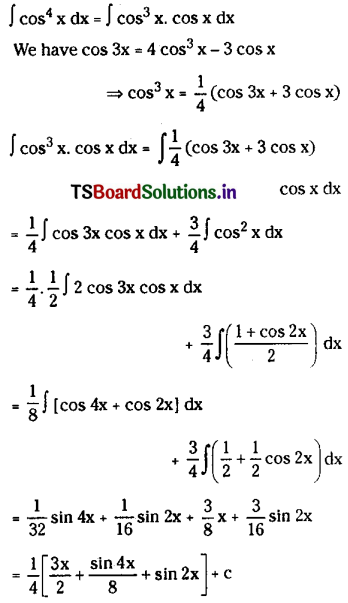
∫cos4x dx on R.
Solution:
TS Inter 2nd Year Maths 2B Solutions Chapter 6 Integration Ex 6(b) III Q15

TS Inter 2nd Year Maths 2B Solutions Chapter 6 Integration Ex 6(b)

Question 16.
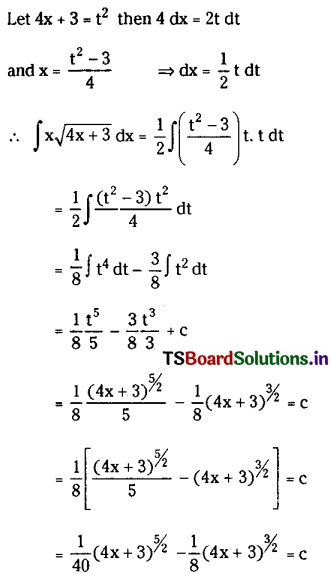
\(\int x \sqrt{4 x+3} d x\) on (\(-\frac{3}{4}\), ∞).
Solution:
TS Inter 2nd Year Maths 2B Solutions Chapter 6 Integration Ex 6(b) III Q16

Question 17.
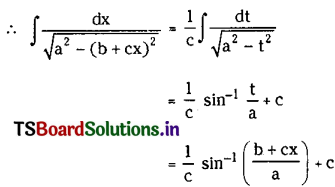
\(\int \frac{d x}{\sqrt{a^2-(b+c x)^2}}\) on {x ∈ R : |b + cx| < a}, where a, b, c are real numbers c ≠ 0 and a > 0.
Solution:
Let b + cx = t then c dx = dt
⇒ dx = \(\frac{1}{c}\) dt
TS Inter 2nd Year Maths 2B Solutions Chapter 6 Integration Ex 6(b) III Q17

Question 18.
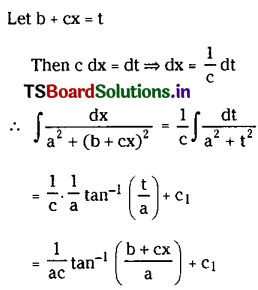
\(\int \frac{d x}{a^2+(b+c x)^2}\) on R, where a, b, c are real numbers c ≠ 0 and a > 0.
Solution:
TS Inter 2nd Year Maths 2B Solutions Chapter 6 Integration Ex 6(b) III Q18

Question 19.
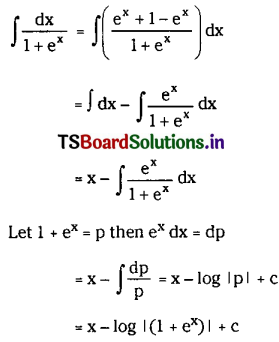
\(\int \frac{d x}{1+e^x}\), x ∈ R.
Solution:
TS Inter 2nd Year Maths 2B Solutions Chapter 6 Integration Ex 6(b) III Q19

Question 20.
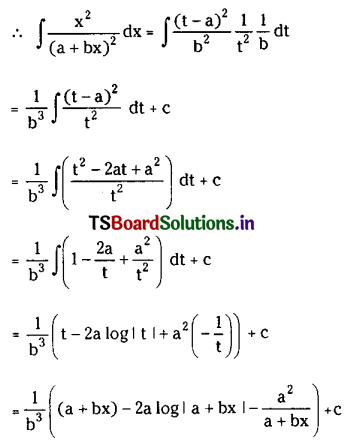
\(\int \frac{x^2}{(a+b x)^2} d x\), x ∈ I ⊂ R – {\(-\frac{a}{b}\)}, where a, b are real numbers, b ≠ 0.
Solution:
Let a + bx = t then b dx = dt
⇒ dx = \(\frac{1}{b}\) dt
Also x = \(\frac{t-a}{b}\)
TS Inter 2nd Year Maths 2B Solutions Chapter 6 Integration Ex 6(b) III Q20

TS Inter 2nd Year Maths 2B Solutions Chapter 6 Integration Ex 6(b)

Question 21.
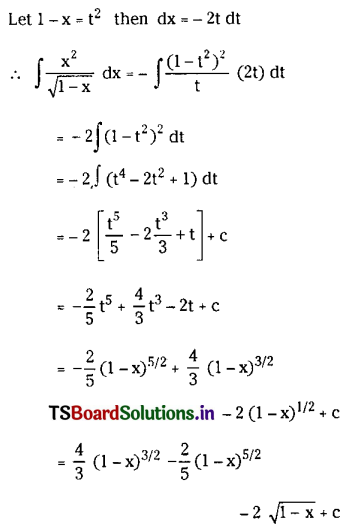
\(\int \frac{x^2}{\sqrt{1-x}} d x\), x ∈ (-∞, 1).
Solution:
TS Inter 2nd Year Maths 2B Solutions Chapter 6 Integration Ex 6(b) III Q21

TS Inter 2nd Year Maths 2B Solutions Chapter 6 Integration Ex 6(a)

Students must practice this TS Intermediate Maths 2B Solutions Chapter 6 Integration Ex 6(a) to find a better approach to solving the problems.

TS Inter 2nd Year Maths 2B Solutions Chapter 6 Integration Exercise 6(a)

I. Evaluate the following integrals.

Question 1.
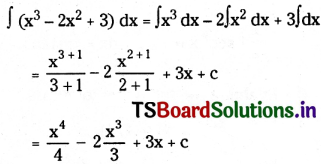
∫(x3 – 2x2 + 3) dx on R.
Solution:
TS Inter 2nd Year Maths 2B Solutions Chapter 6 Integration Ex 6(a) I Q1

Question 2.
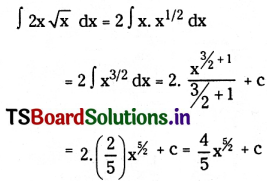
∫2x√x dx on (0, ∞).
Solution:
TS Inter 2nd Year Maths 2B Solutions Chapter 6 Integration Ex 6(a) I Q2

Question 3.
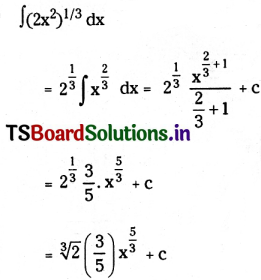
\(\int \sqrt[3]{2 x^2}\) dx on (0, ∞).
Solution:
TS Inter 2nd Year Maths 2B Solutions Chapter 6 Integration Ex 6(a) I Q3

TS Inter 2nd Year Maths 2B Solutions Chapter 6 Integration Ex 6(a)

Question 4.
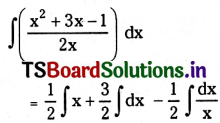
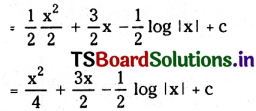
\(\int\left(\frac{x^2+3 x-1}{2 x}\right)\) dx, x ∈ I ⊂ R – {0}
Solution:
TS Inter 2nd Year Maths 2B Solutions Chapter 6 Integration Ex 6(a) I Q4
TS Inter 2nd Year Maths 2B Solutions Chapter 6 Integration Ex 6(a) I Q4.1

Question 5.
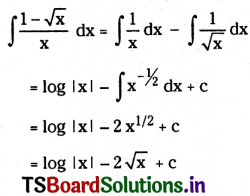
\(\int \frac{1-\sqrt{x}}{x}\) dx on (0, ∞).
Solution:
TS Inter 2nd Year Maths 2B Solutions Chapter 6 Integration Ex 6(a) I Q5

Question 6.
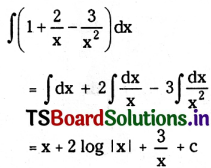
\(\int\left(1+\frac{2}{x}-\frac{3}{x^2}\right) d x\) on I ⊂ R – {0}
Solution:
TS Inter 2nd Year Maths 2B Solutions Chapter 6 Integration Ex 6(a) I Q6

Question 7.
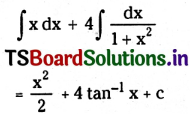
\(\int\left(x+\frac{4}{1+x^2}\right) d x\) on R
Solution:
TS Inter 2nd Year Maths 2B Solutions Chapter 6 Integration Ex 6(a) I Q7

Question 8.
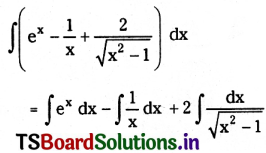
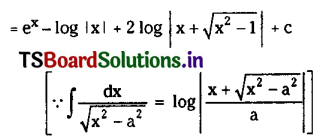
\(\int\left(e^x-\frac{1}{x}+\frac{2}{\sqrt{x^2-1}}\right) d x\) on I ⊂ R – [-1, 1]
Solution:
TS Inter 2nd Year Maths 2B Solutions Chapter 6 Integration Ex 6(a) I Q8
TS Inter 2nd Year Maths 2B Solutions Chapter 6 Integration Ex 6(a) I Q8.1

Question 9.
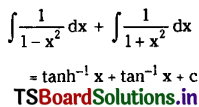
\(\int\left(\frac{1}{1-x^2}+\frac{1}{1+x^2}\right) d x\) on (-1, 1)
Solution:
TS Inter 2nd Year Maths 2B Solutions Chapter 6 Integration Ex 6(a) I Q9

TS Inter 2nd Year Maths 2B Solutions Chapter 6 Integration Ex 6(a)

Question 10.
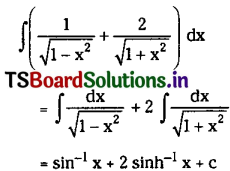
\(\int\left(\frac{1}{\sqrt{1-x^2}}+\frac{2}{\sqrt{1+x^2}}\right) d x\) on (-1, 1). [May ’11]
Solution:
TS Inter 2nd Year Maths 2B Solutions Chapter 6 Integration Ex 6(a) I Q10

Question 11.
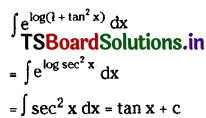
\(\int e^{\log \left(1+\tan ^2 x\right)} d x\) on I ⊂ R – {\(\frac{(2 n+1) \pi}{2}\) : n ∈ Z}
Solution:
TS Inter 2nd Year Maths 2B Solutions Chapter 6 Integration Ex 6(a) I Q11

Question 12.
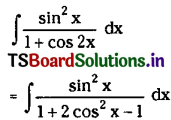
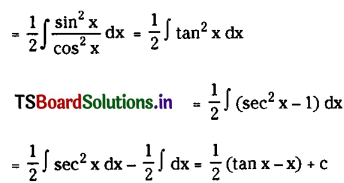
\(\int \frac{\sin ^2 x}{1+\cos 2 x} d x\) on I ⊂ R – {(2n ± 1)π : n ∈ Z}.
Solution:
TS Inter 2nd Year Maths 2B Solutions Chapter 6 Integration Ex 6(a) I Q12
TS Inter 2nd Year Maths 2B Solutions Chapter 6 Integration Ex 6(a) I Q12.1

II. Evaluate the following integrals.

Question 1.
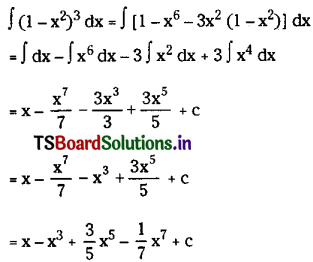
∫(1 – x2)3 dx on (-1, 1).
Solution:
TS Inter 2nd Year Maths 2B Solutions Chapter 6 Integration Ex 6(a) II Q1

Question 2.
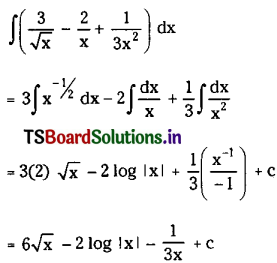
\(\int\left(\frac{3}{\sqrt{x}}-\frac{2}{x}+\frac{1}{3 x^2}\right) d x\) on (0, ∞).
Solution:
TS Inter 2nd Year Maths 2B Solutions Chapter 6 Integration Ex 6(a) II Q2

TS Inter 2nd Year Maths 2B Solutions Chapter 6 Integration Ex 6(a)

Question 3.
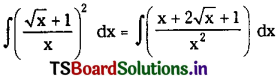
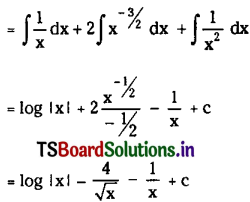
\(\int\left(\frac{\sqrt{x}+1}{x}\right)^2 d x\) on (0, ∞).
Solution:
TS Inter 2nd Year Maths 2B Solutions Chapter 6 Integration Ex 6(a) II Q3
TS Inter 2nd Year Maths 2B Solutions Chapter 6 Integration Ex 6(a) II Q3.1

Question 4.
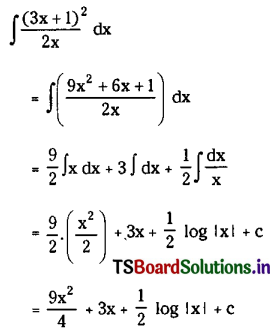
\(\int \frac{(3 x+1)^2}{2 x} d x\), x ∈ I ⊂ R – {0}.
Solution:
TS Inter 2nd Year Maths 2B Solutions Chapter 6 Integration Ex 6(a) II Q4

Question 5.
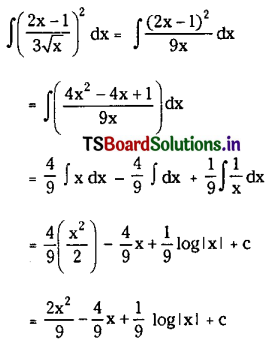
\(\int\left(\frac{2 x-1}{3 \sqrt{x}}\right)^2 d x\) on (0, ∞).
Solution:
TS Inter 2nd Year Maths 2B Solutions Chapter 6 Integration Ex 6(a) II Q5

Question 6.
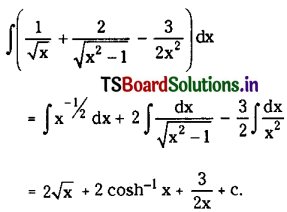
\(\int\left(\frac{1}{\sqrt{x}}+\frac{2}{\sqrt{x^2-1}}-\frac{3}{2 x^2}\right) d x\) on (1, ∞).
Solution:
TS Inter 2nd Year Maths 2B Solutions Chapter 6 Integration Ex 6(a) II Q6

Question 7.
∫(sec2x – cos x + x2) dx, x ∈ I ⊂ R – {\(\frac{n \pi}{2}\) : n is an odd integer}.
Solution:
∫(sec2x – cos x + x2) dx
= ∫sec2x dx – ∫cos x dx + ∫x2 dx
= tan x – sin x + \(\frac{x^3}{3}\) + c

Question 8.
∫(sec x tan x + \(\frac{3}{x}\) – 4] dx, x ∈ I ⊂ R – ({\(\frac{n \pi}{2}\) : n is an odd integer} ∪ {0})
Solution:
∫(sec x tan x + \(\frac{3}{x}\) – 4] dx
= ∫sec x + tan x dx + 3 ∫\(\frac{dx}{x}\) – 4∫dx
= sec x + 3 log|x| – 4x + c

TS Inter 2nd Year Maths 2B Solutions Chapter 6 Integration Ex 6(a)

Question 9.
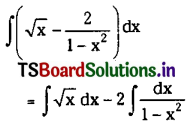
\(\int\left(\sqrt{x}-\frac{2}{1-x^2}\right) d x\) on (0, 1)
Solution:
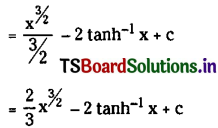
TS Inter 2nd Year Maths 2B Solutions Chapter 6 Integration Ex 6(a) II Q9
TS Inter 2nd Year Maths 2B Solutions Chapter 6 Integration Ex 6(a) II Q9.1

Question 10.
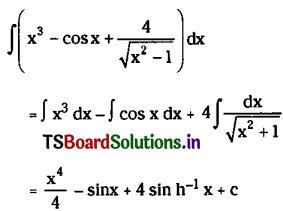
\(\int\left(x^3-\cos x+\frac{4}{\sqrt{x^2+1}}\right) d x\), x ∈ R
Solution:
TS Inter 2nd Year Maths 2B Solutions Chapter 6 Integration Ex 6(a) II Q10

Question 11.
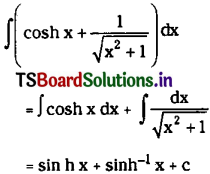
\(\int\left(\cosh x+\frac{1}{\sqrt{x^2+1}}\right) d x\), x ∈ R
Solution:
TS Inter 2nd Year Maths 2B Solutions Chapter 6 Integration Ex 6(a) II Q11

Question 12.
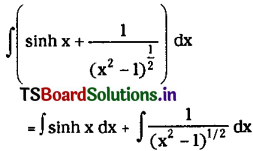
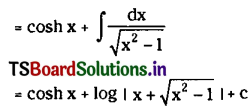
\(\int\left(\sinh x+\frac{1}{\left(x^2-1\right)^{\frac{1}{2}}}\right) d x\), x ∈ I ⊂ (-∞, -1) ∪ (1, ∞).
Solution:
TS Inter 2nd Year Maths 2B Solutions Chapter 6 Integration Ex 6(a) II Q12
TS Inter 2nd Year Maths 2B Solutions Chapter 6 Integration Ex 6(a) II Q12.1

TS Inter 2nd Year Maths 2B Solutions Chapter 6 Integration Ex 6(a)

Question 13.
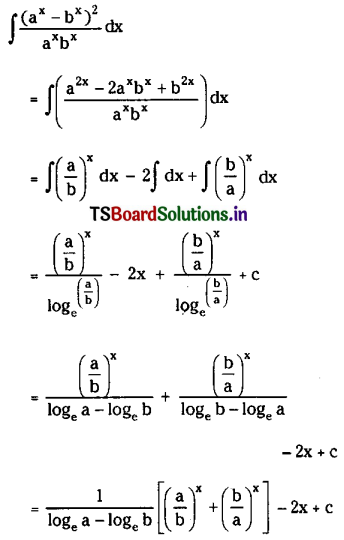
\(\int \frac{\left(a^x-b^x\right)^2}{a^x b^x} d x\), (a > 0, a ≠ 1 and b > 0, b ≠ 1) on R.
Solution:
TS Inter 2nd Year Maths 2B Solutions Chapter 6 Integration Ex 6(a) II Q13

Question 14.
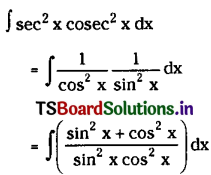
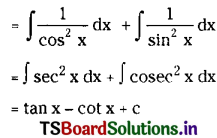
∫sec2x cosec2x dx on I ⊂ R – ({nx : n ∈ Z} ∪ {(2n + 1)\(\frac{\pi}{2}\) : n ∈ Z}) (May ’09)
Solution:
TS Inter 2nd Year Maths 2B Solutions Chapter 6 Integration Ex 6(a) II Q14
TS Inter 2nd Year Maths 2B Solutions Chapter 6 Integration Ex 6(a) II Q14.1

Question 15.
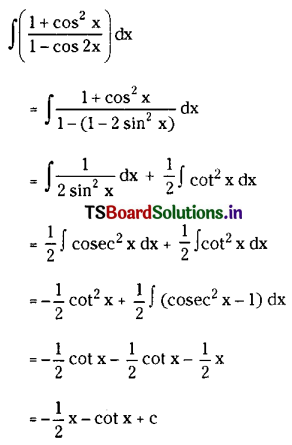
\(\int\left(\frac{1+\cos ^2 x}{1-\cos 2 x}\right) d x\) on I ⊂ R – {nπ : n ∈ Z} (Mar. ’13)
Solution:
TS Inter 2nd Year Maths 2B Solutions Chapter 6 Integration Ex 6(a) II Q15

Question 16.
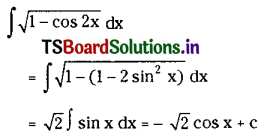
\(\int \sqrt{1-\cos 2 x} d x\) on I ⊂ [2nπ, (2n + 1)π], n ∈ Z. (Mar. ’09)
Solution:
TS Inter 2nd Year Maths 2B Solutions Chapter 6 Integration Ex 6(a) II Q16

Question 17.
\(\int \frac{1}{\cosh x+\sinh x} d x\) on R.
Solution:
\(\int \frac{1}{\cosh x+\sinh x} d x\)
= \(\int \frac{\cosh x-\sinh x}{\cosh ^2 x-\sinh ^2 x} d x\)
= ∫(cos hx – sin hx) dx (∵ cosh2x – sinh2x = 1)
= ∫cosh x dx – ∫sinh x dx
= sinh x – cosh x + c

TS Inter 2nd Year Maths 2B Solutions Chapter 6 Integration Ex 6(a)

Question 18.
\(\int \frac{1}{1+\cos x} d x\) on I ⊂ R – [(2n + 1)π : n ∈ Z].
Solution:
\(\int \frac{1}{1+\cos x} d x\)
= \(\int \frac{1-\cos x}{(1+\cos x)(1-\cos x)} d x\)
= \(\int \frac{1-\cos x}{\sin ^2 x} d x\)
= ∫cosec2x dx – ∫cot x cosec x dx
= -cot x + cosec x + c
= cosec x – cot x + c

TS Inter 2nd Year Maths 2B Solutions Chapter 4 Ellipse Ex 4(b)

Students must practice this TS Intermediate Maths 2B Solutions Chapter 4 Ellipse Ex 4(b) to find a better approach to solving the problems.

TS Inter 2nd Year Maths 2B Solutions Chapter 4 Ellipse Exercise 4(b)

I.

Question 1.
Find the equation of the tangent and normal to the ellipse x2 + 8y2 = 33 at (-1, 2).
Solution:
Given ellipse is x2 + 8y2 = 33
⇒ \(\frac{x^2}{33}+\frac{y^2}{(33 / 8)}=1\) ……..(1)
Let P(x1, y1) = (-1, 2) be a point on (1) then
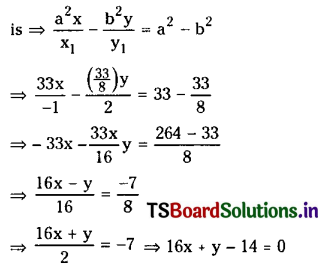
the equation of tangent at (x1, y1) is \(\frac{\mathrm{xx}_1}{33}+\frac{\mathrm{yy}_1}{(33 / 8)}-1=0\)
\(\frac{x(-1)}{33}+\frac{y(2)}{(33 / 8)}=1\)
⇒ -x + 16y = -33
⇒ x – 16y + 33 = 0
Equation of normal at P(-1, 2) on the ellipse
TS Inter 2nd Year Maths 2B Solutions Chapter 4 Ellipse Ex 4(b) I Q1

Question 2.
Find the equation of tangent and normal to the ellipse x2 + 2y2 – 4x + 12y + 14 = 0 at (2, -1).
Solution:
Given equation of ellipse is x2 + 2y2 – 4x + 12y + 14 = 0
Let P(x1, y1) = (2, -1)
Now differentiating w.r.t ‘x’
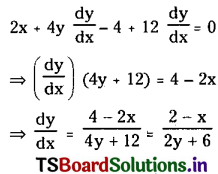
TS Inter 2nd Year Maths 2B Solutions Chapter 4 Ellipse Ex 4(b) I Q2
∴ Slope of the tangent at (2, -1) is \(\frac{d y}{d x}(2,-1)=\frac{2-2}{-2+6}=0\)
∴ The slope of the normal at (2, -1) is ∞.
∴ Equation of the tangent to the given ellipse at P(2, -1) is y + 1 = 0, and the equation of normal at P(2, -1) is x – 2 = 0.

TS Inter 2nd Year Maths 2B Solutions Chapter 4 Ellipse Ex 4(b)

Question 3.
Find the equation of the tangents to 9x2 + 16y2 = 144, which makes equal intercepts on the coordinate axis.
Solution:
Given the equation of the ellipse is 9x2 + 16y2 = 144
⇒ \(\frac{x^2}{16}+\frac{y^2}{9}=1\)
Let S ≡ \(\frac{x^2}{16}+\frac{y^2}{9}-1=0\)
Compared with the general equation S = 0 we have
a2 = 16, b2 = 9
⇒ a = 4, b = 3
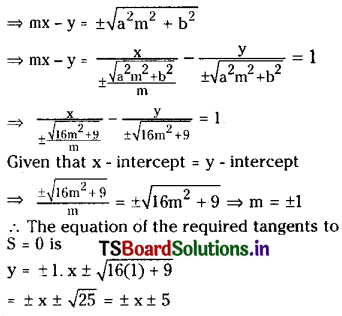
∴ Equation of the tangent to the ellipse S = 0 having slope is y = mx ± \(\sqrt{a^2 m^2+b^2}\)
TS Inter 2nd Year Maths 2B Solutions Chapter 4 Ellipse Ex 4(b) I Q3

Question 4.
Find the coordinates of the points on the ellipse x2 + 3y2 = 37 at which the normal is parallel to the line 6x – 5y = 2.
Solution:
Given equation of ellipse is x2 + 3y2 = 37 …….(1)
⇒ \(\frac{x^2}{37}+\frac{y^2}{\left(\frac{37}{3}\right)}=1\)
Let P(x1, y1) be any point on the ellipse (1) then \(\frac{x_1^2}{37}+\frac{y_1^2}{\left(\frac{37}{3}\right)}=1\)
⇒ \(x^2+3 y_1^2=37\)
Given line is 6x – 5y + 2 = 0 …….(2)
Slope of the line = \(\frac{6}{5}\)
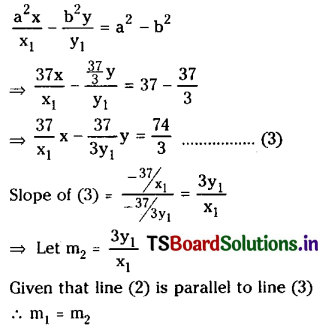
∴ Equation of the normal at P(x1, y1) to the ellipse S = 0 is
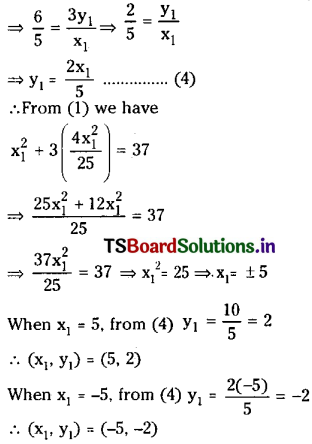
TS Inter 2nd Year Maths 2B Solutions Chapter 4 Ellipse Ex 4(b) I Q4
TS Inter 2nd Year Maths 2B Solutions Chapter 4 Ellipse Ex 4(b) I Q4.1
∴ The coordinates of the points on ellipse x2 + 7y2 = 37 at which the normal is parallel to the line 6x – 5y = 2 are (5, 2), (-5, -2).

Question 5.
Find the value of k if 4x + y + k = 0 is a tangent to the ellipse x2 + 3y2 = 3.
Solution:
Given ellipse is x2 + 3y2 = 3
⇒ \(\frac{x^2}{3}+\frac{y^2}{1}=1\)
Hence a2 = 3 and b2 = 1
The equation of the given line is 4x + y + k = 0.
⇒ y = -4x – k where m = -4, and c = -k
The condition for tangency is c2 = a2m2 + b2
⇒ k2 = 3(16) + 1
⇒ k2 = 49
⇒ k = ±7

TS Inter 2nd Year Maths 2B Solutions Chapter 4 Ellipse Ex 4(b)

Question 6.
Find the condition for the line x cos α + y sin β = p to be a tangent to the ellipse \(\frac{x^2}{a^2}+\frac{y^2}{b^2}=1\).
Solution:
Given equation of ellipse is \(\frac{x^2}{a^2}+\frac{y^2}{b^2}=1\) ……..(1)
and equation of given line is x cos α + y sin α = p
⇒ y sin α = p – x cos α
⇒ y = -x cot α + p cosec α …….(2)
which is of the form y = mx + c where m = -cot α and c = p cosec α
Condition for tangency is c2 = a2m2 + b2
⇒ p2 cosec2α = a2 cot2α + b2
⇒ p2 = \(a^2 \frac{\cot ^2 \alpha}{{cosec}^2 \alpha}+\frac{b^2}{{cosec}^2 \alpha}\)
⇒ p2 = a2 cos2α + b2 sin2α which is the required condition.

II.

Question 1.
Find the equations of tangent and normal to the ellipse 2x2 + 3y2 = 11 at the point whose ordinate is 1.
Solution:
Let P(x1, y1) be a given point and given y1 = 1 and (x1, y1) lies on 2x2 + 3y2 = 11.
⇒ \(2 \mathrm{x}_1^2+3 \mathrm{y}_1{ }^2=11\)
⇒ \(2 \mathrm{x}_1^2+3=11\)
⇒ 2\(\mathrm{x}_1^2\) = 8
⇒ \(\mathrm{x}_1^2\) = 4
⇒ x1 = ±2
The required points are (2, 1) and (-2, 1) at which the equations of tangent and normal are to be determined.
The equation of tangent at (x1, y1) to the ellipse 2x2 + 3y2 = 11
⇒ \(\frac{x^2}{\left(\frac{11}{2}\right)}+\frac{y^2}{\left(\frac{11}{3}\right)}=1\) is \(\frac{\mathrm{xx}}{\left(\frac{11}{2}\right)}+\frac{\mathrm{yy}}{\left(\frac{11}{3}\right)}=1\)
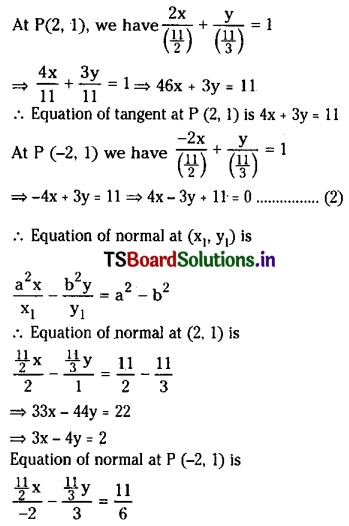
TS Inter 2nd Year Maths 2B Solutions Chapter 4 Ellipse Ex 4(b) II Q1
⇒ -3x – 4y = 2
⇒ 3x + 4y + 2 = 0 ……..(4)
∴ Tangents are 4x + 3y – 11 = 0 and 4x – 3y – 11 = 0
Also the normals are 3x – 4y – 2 = 0 and 3x + 4y + 2 = 0.

Question 2.
Find the equations to the tangents to the ellipse x2 + 2y2 = 3 drawn from the point (1, 2) and also find the angle between these tangents.
Solution:
Given the equation of the ellipse is x2 + 2y2 = 3
⇒ \(\frac{x^2}{3}+\frac{y^2}{\left(\frac{3}{2}\right)}=1\) which is of the form \(\frac{x^2}{a^2}+\frac{y^2}{b^2}=1\) where a2 = 3 and b2 = \(\frac{3}{2}\)
Equation of any tangent to the ellipse is y = mx ± \(\sqrt{a^2 m^2+b^2}\)
If the tangents are drawn from (1, 2) then
2 = m ± \(\sqrt{3 m^2+3 / 2}\)
⇒ 2 – m = \(\pm \sqrt{3 m^2+3 / 2}\)
⇒ m2 – 4m + 4 = 3m2 + \(\frac{3}{2}\)
⇒ 2m2 – 8m + 8 = 6m2 + 3
⇒ 4m2 + 8m – 5 = 0
⇒ 4m2 + 10m – 2m – 5 = 0
⇒ 2m(2m + 5) – 1(2m + 5) = 0
⇒ 2m – 1 = 0 (or) 2m + 5 = 0
⇒ m = \(\frac{1}{2}\) (or) m = \(-\frac{5}{2}\)
The equation of tangents when m = \(\frac{1}{2}\) is
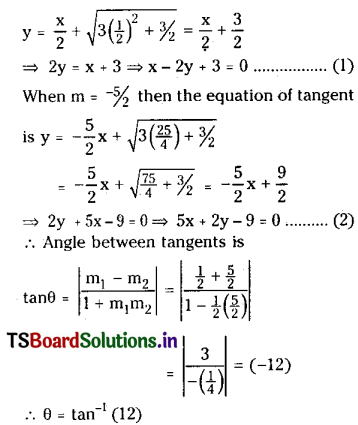
TS Inter 2nd Year Maths 2B Solutions Chapter 4 Ellipse Ex 4(b) II Q2
∴ Equations of tangents drawn from the point (1, 2) to the ellipse S = 0 are given by x – 2y + 3 = 0 and 5x + 2y – 9 = 0.
Also, the angle between them is tan-1(12).

TS Inter 2nd Year Maths 2B Solutions Chapter 4 Ellipse Ex 4(b)

Question 3.
Find the equation of the tangents to the ellipse 2x2 + y2 = 8 which are
(i) parallel to x – 2y – 4 = 0
(ii) perpendicular to x + y + 2 = 0
(iii) which makes an angle \(\frac{\pi}{4}\) with x-axis.
Solution:
Given the equation of the ellipse is 2x2 + y2 = 8
⇒ \(\frac{x^2}{4}+\frac{y^2}{8}=1\)
Let S ≡ \(\frac{x^2}{4}+\frac{y^2}{8}-1=0\) ……..(1)
and compare with general equation a2 = 4, and b2 = 8
⇒ a = 2, b = 2√2
(i) Parallel to x – 2y – 4 = 0:
Given line is x – 2y – 4 = 0 ……..(2)
Equation of any line parallel to x – 2y – 4 = 0 is x – 2y + k = 0 ………(3)
⇒ 2y = x + k
⇒ y = \(\frac{\mathrm{x}}{2}+\frac{\mathrm{k}}{2}\) where m = \(\frac{1}{2}\) and c = \(\frac{k}{2}\)
If (3) is a tangent to (1) them c2 = a2m2 + b2
⇒ \(\frac{\mathrm{k}^2}{4}=4\left(\frac{1}{4}\right)+8\)
⇒ \(\frac{\mathrm{k}^2}{4}\) = 1 + 8
⇒ k2 = 36
⇒ k = ±6
∴ The equation of the required tangent from (3) is x – 2y ± 6 = 0.

(ii) Perpendicular to x + y – 2 = 0:
Given line is x + y – 2 = 0 ………(4)
Equation of any line perpendicular to (4) is x – y + k = 0 ……….(5)
∴ y = x + k and m = 1, c = k
By the condition for tangency c2 = a2m2 + b2
⇒ k2 = 4(1) + 8
⇒ k2 = 12
⇒ k = ±2√ 3
∴ Equation of the required line from (5) is x – y ± 2√3 = 0 ………..(6)

(iii) Which makes an angle \(\frac{\pi}{4}\) with x-axis:
If the line makes \(\frac{\pi}{4}\) with x-axis then m = tan\(\frac{\pi}{4}\) = 1.
∴ Equation of the line is y = x + c ………..(7)
If this is a tangent to (1) then c2 = a2m2 + b2
⇒ c2 = 4(1) + 8
⇒ c2 = 12
⇒ c = ±2√3
∴ From (7), the equation of the required line is y = x ± 2√3.

TS Inter 2nd Year Maths 2B Solutions Chapter 4 Ellipse Ex 4(b)

Question 4.
A circle of radius 4, is concentric with the ellipse 3x2 + 13y2 = 78. Prove that a common tangent is inclined to the major axis at an angle \(\frac{\pi}{4}\).
Solution:
Given ellipse is 3x2 + 13y2 = 78
⇒ \(\frac{x^2}{26}+\frac{y^2}{6}=1\)
Comparing with \(\frac{x^2}{a^2}+\frac{y^2}{b^2}=1\) we have a2 = 26, b2 = 6,
centre of the ellipse = (0, 0).
The equation of a circle with centre (0, 0) and radius 4 is x2 + y2 = 16 ……….(2)
Equation of any tangent to the ellipse having slope ‘m’ is y = mx ± \(\sqrt{a^2 m^2+b^2}\)
⇒ mx – y + \(\sqrt{a^2 m^2+b^2}\) = 0 (Taking one tangent as common)
⇒ mx – y + \(\sqrt{26 m^2+6}\) = 0 ………(3)
If (3) is a tangent to (2) then the perpendicular distance from (0, 0) to (3) = Radius of the circle (2)
∴ \(\frac{\sqrt{26 m^2+6}}{\sqrt{m^2+1}}\)
⇒ 26m2 + 6 = 16(m2 + 1)
⇒ 10m2 – 10 = 0
⇒ m2 = 1
⇒ m = ±1
If θ is the angle made by the common tangent with the major axis of the ellipse then tan θ = ±1
⇒ θ = ±\(\frac{\pi}{4}\)
Hence common tangent makes an angle \(\frac{\pi}{4}\) with the major axis of the ellipse.

III.

Question 1.
Show that the foot of the perpendicular drawn from the centre on any tangent to the ellipse lies on the curve (x2 + y2)2 = a2x2 + by2.
Solution:
Let S ≡ \(\frac{x^2}{a^2}+\frac{y^2}{b^2}-1=0\) be the equation of ellipse.
Let P(x1, y1) be any point on the ellipse.
The equation of the tangent to the ellipse S = 0 having slope m is y = mx ± \(\sqrt{a^2 m^2+b^2}\)
⇒ y – mx = ±\(\sqrt{a^2 m^2+b^2}\) ……..(1)
The equation to the perpendicular from centre on this tangent (1) is y – 0 = \(\frac{-1}{m}\)(x – 0)
⇒ my + x = 0 ……….(2)
Now P(x1, y1) is the point of intersection of (1) and (2)
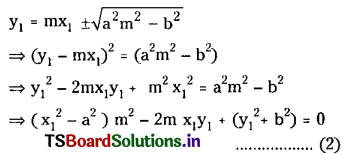
∴ y1 – mx1 = ±\(\sqrt{a^2 m^2+b^2}\) ……(3) and my1 + x1 = 0 ………(4)
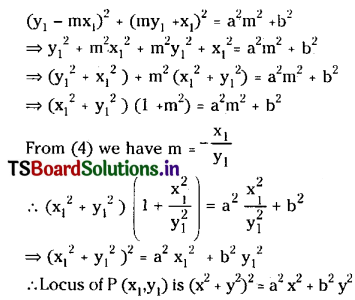
Squaring (3) and (4) and adding
TS Inter 2nd Year Maths 2B Solutions Chapter 4 Ellipse Ex 4(b) III Q1

Question 2.
Show that the locus of the feet of the perpendiculars drawn from foci to any tangent of the ellipse is the auxiliary circle.
Solution:
Let S ≡ \(\frac{x^2}{a^2}+\frac{y^2}{b^2}-1=0\) be the equation of ellipse.
TS Inter 2nd Year Maths 2B Solutions Chapter 4 Ellipse Ex 4(b) III Q2
Let P(x1, y1) be any point on the locus.
The equation of tangent to the ellipse S = 0 having slope ‘m’ is y = mx ± \(\sqrt{a^2 m^2+b^2}\)
⇒ y – mx = ±\(\sqrt{a^2 m^2+b^2}\) ……..(1)
The equation to the perpendicular from either focus (±ae, 0) on the tangent (1) is
y – 0 = \(\frac{-1}{m}\)(x ± ae)
⇒ my + x = ±ae ………(2)
Since P(x1, y1) is a point of intersection of (1) and (2) we have
y1 – mx1 = ±\(\sqrt{a^2 m^2+b^2}\) ……..(3)
and my1 + x1 = ±ae ……….(4)
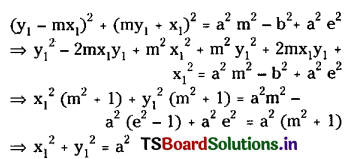
Eliminating in from the equation by squaring and adding (3) and (4)
(y1 – mx1)2 + (my1 + x1)2 = a2m2 + b2 + a2e2
= a2m2 + a2 (1 – e2) + a2e2
= a2m2 + a2
= a2(m2 + 1)
∴ \(\mathrm{y}_1^2\left(1+\mathrm{m}^2\right)+\mathrm{x}_1^2\left(1+\mathrm{m}^2\right)=\mathrm{a}^2\left(1+\mathrm{m}^2\right)\)
⇒ \(x_1^2+y_1{ }^2=a^2\)
∴ The Locus of P(x1, y1) is x2 + y2 = a2 which is the equation of the auxiliary circle of the ellipse.

TS Inter 2nd Year Maths 2B Solutions Chapter 4 Ellipse Ex 4(b)

Question 3.
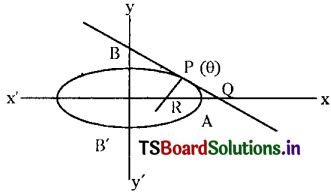
The tangent and normal to the ellipse x2 + 4y2 = 4 at a point P(θ) on it meets the major axis in Q and R respectively. If 0 < θ < \(\frac{\pi}{2}\) and QR = 2 then show that θ = \(\cos ^{-1}\left(\frac{2}{3}\right)\). (March 2012)
Solution:
Given ellipse is x2 + 4y2 = 4
⇒ \(\frac{x^2}{4}+\frac{y^2}{1}=1\)
TS Inter 2nd Year Maths 2B Solutions Chapter 4 Ellipse Ex 4(b) III Q3
Let S ≡ \(\frac{x^2}{4}+\frac{y^2}{1}-1=0\) be the given ellipse.
Comparing this with \(\frac{x^2}{a^2}+\frac{y^2}{b^2}-1=0\) we get a2 = 4, b2 = 1
⇒ a = 2, b = 1
The equation of the tangent at P(θ) on the ellipse S = 0 is \(\frac{x}{a} \cos \theta+\frac{y}{b} \sin \theta=1\)
⇒ \(\frac{\mathrm{x}}{2} \cos \theta+\frac{\mathrm{y}}{1} \sin \theta=1\) ……..(1)
The tangent (1) meets the major axis at the Q
∴ y-coordinate of Q = 0; Put y = 0 in (1)
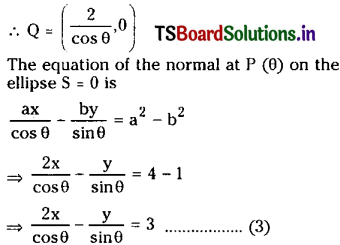
TS Inter 2nd Year Maths 2B Solutions Chapter 4 Ellipse Ex 4(b) III Q3.1
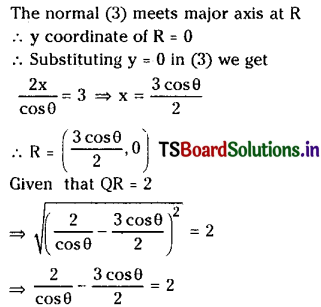
TS Inter 2nd Year Maths 2B Solutions Chapter 4 Ellipse Ex 4(b) III Q3.2
⇒ -3 cos2θ + 4 = 4 cosθ
⇒ 3 cos2θ + 4 cos θ – 4 = 0
⇒ 3 cos2θ + 6 cos θ – 2 cos θ – 4 = 0
⇒ 3 cos θ (cos θ + 2) – 2(cos θ + 2) = 0
⇒ (cos θ + 2) (3 cos θ – 2) = 0
⇒ cos θ + 2 = 0; solution is not admissive (∵ -1 ≤ cos θ ≤ 1)
and 3 cos θ – 2 = 0
⇒ cos θ = \(\frac{2}{3}\)
⇒ θ = \(\cos ^{-1}\left(\frac{2}{3}\right)\)

TS Inter 2nd Year Maths 2B Solutions Chapter 5 Hyperbola Ex 5(a)

Students must practice this TS Intermediate Maths 2B Solutions Chapter 5 Hyperbola Ex 5(a) to find a better approach to solving the problems.

TS Inter 2nd Year Maths 2B Solutions Chapter 5 Hyperbola Exercise 5(a)

I.

Question 1.
One focus of a hyperbola is located at the point (1, -3) and the corresponding directrix is the line y = 2. Find the equation of the hyperbola if its eccentricity is \(\frac{3}{2}\). (May 2009)
Solution:
Given one focus of hyperbola is at (1, -3)
∴ S = (1, -3) and directrix is y – 2 = 0
Given e = \(\frac{3}{2}\).
Let P(x1, y1) be a point on the locus. Then
SP = e . PM
⇒ SP2 = e2 . PM2
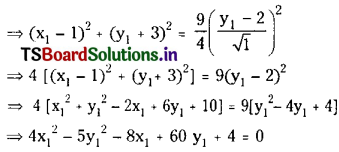
TS Inter 2nd Year Maths 2B Solutions Chapter 5 Hyperbola Ex 5(a) I Q1
∴ Locus of (x1, y1) is the equation of hyperbola 4x2 – 5y2 – 8x + 60y + 4 = 0.

Question 2.
If the lines 3x – 4y = 12 and 3x + 4y = 12 meets on a hyperbola \(\frac{x^2}{a^2}-\frac{y^2}{b^2}=1\) then find the eccentricity of the hyperbola.
Solution:
Given the equation of lines are
3x – 4y = 12 …….(1)
3x + 4y = 12 ………(2)
The combined equations of lines (1) and (2) is (3x – 4y) (3x + 4y) = 144
⇒ 9x2 – 16y2 = 144
⇒ \(\frac{x^2}{16}-\frac{y^2}{9}=1\) which represents a hyperbola of the form \(\frac{x^2}{a^2}-\frac{y^2}{b^2}=1\).

TS Inter 2nd Year Maths 2B Solutions Chapter 5 Hyperbola Ex 5(a)

Question 3.
Find the equations of hyperbola whose foci are (±5, 0); the transverse axis is of length 8.
Solution:
Given foci as (±5, 0)and comparing with the standard equation we get
ae = 5 …….(1)
and the length of the transverse axis is 2a = 8
⇒ a = 4
∴ ae = 5
⇒ e = \(\frac{5}{4}\)
since b2 = a2(e2 – 1)
⇒ b2 = 16\(\left(\frac{25}{16}-1\right)\) = 9
∴ Equation of hyperbola whose foci are (±5, 0) and the transverse axis of length ‘8’ is \(\frac{x^2}{16}-\frac{y^2}{9}=1\)
⇒ 9x2 – 16y2 = 144

Question 4.
Find the equation of hyperbola whose asymptotes are the straight lines (x + 2y + 3) = 0 and (3x + 4y + 5) = 0 and which passes through the point (1, -1).
Solution:
Given asymptotes are x + 2y + 3 = 0 and 3x + 4y + 5 = 0.
∴ The equation of point of asymptotes is (x + 2y + 3) (3x + 4y + 5) = 0
⇒ 3x2 + 6xy + 9x + 4xy + 8y2 + 10y + 9x + 12y + 15 = 0
⇒ 3x2 + 10xy + 8y2 + 14x + 22y + 15 = 0
∴ The equation of hyperbola having the given lines as asymptotes are
3x2 + 10xy + 8y2 + 14x + 22y + k = 0 ……..(1)
Given (1) is passing through (1, -1) then
3 – 10 + 8 + 14 – 22 + k = 0
⇒ k = 7
∴ From (1) the equation of the required hyperbola is 3x2 + 10xy + 8y2 + 14x + 22y + 7 = 0

Question 5.
If 3x – 4y + k = 0 is a tangent to x2 – 4y2 = 5, find the value of k.
Solution:
Given the equation of the hyperbola is x2 – 4y2 = 5
⇒ \(\frac{x^2}{5}-\frac{y^2}{\left(\frac{5}{4}\right)}=1\)
Comparing with \(\frac{x^2}{a^2}-\frac{y^2}{b^2}=1\)
We get a2 = 5 and b2 = \(\frac{5}{4}\)
Given 3x – 4y + k = 0
⇒ 4y = 3x + 3
⇒ y = \(\frac{3}{4} x+\frac{k}{4}\)
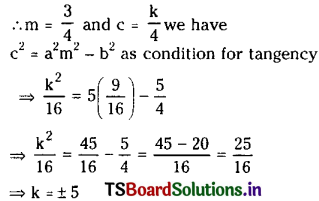
TS Inter 2nd Year Maths 2B Solutions Chapter 5 Hyperbola Ex 5(a) I Q5

Question 6.
Find the product of lengths of perpendiculars from any point on the hyperbola \(\frac{x^2}{16}-\frac{y^2}{9}=1\) to its asymptotes.
Solution:
Let S ≡ \(\frac{x^2}{16}-\frac{y^2}{9}-1=0\) be the given hyperbola.
Let P = (a sec θ, b tan θ) be any point on S = 0.
The equation of asymptotes of the hyperbola S = 0 are \(\frac{x}{4}+\frac{y}{3}=0\) and \(\frac{x}{4}-\frac{y}{3}=0\)
⇒ 3x + 4y = 0 ………(1) and 3x – 4y = 0 ………(2)
Let PM be the length of the perpendicular drawn from P(4 sec θ, 3 tan θ) to the line (1) then
PM = \(\left|\frac{12 \sec \theta+12 \tan \theta}{\sqrt{9+16}}\right|\) = \(\left|\frac{12 \sec \theta+12 \tan \theta}{5}\right|\)
Let PN be the length of the perpendicular from P(4 sec θ, 3 tan θ) on line (2). Then
PN = \(\frac{|12 \sec \theta-12 \tan \theta|}{\sqrt{9+16}}=\frac{|12 \sec \theta-12 \tan \theta|}{5}\)
∴ Product of perpendiculars = PM . PN
= \(\frac{|12 \sec \theta+12 \tan \theta|}{5} \cdot \frac{|12 \sec \theta-12 \tan \theta|}{5}\)
= \(\frac{144\left(\sec ^2 \theta-\tan ^2 \theta\right)}{25}\)
= \(\frac{144}{25}\)
∴ Product of length of perpendiculars = \(\frac{144}{25}\)

TS Inter 2nd Year Maths 2B Solutions Chapter 5 Hyperbola Ex 5(a)

Question 7.
If the eccentricity of a hyperbola is \(\frac{5}{4}\), then find the eccentricity of its conjugate hyperbola. (March 2012, 2013)
Solution:
If S ≡ \(\frac{x^2}{a^2}-\frac{y^2}{b^2}-1=0\) is the equation of hyperbola then S’ ≡ \(\frac{x^2}{a^2}-\frac{y^2}{b^2}+1=0\) is the equation of the conjugate hyperbola.
Let e and e1 be the eccentricities of the hyperbola and its conjugate respectively,
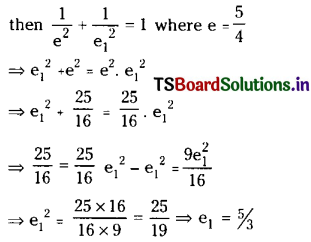
TS Inter 2nd Year Maths 2B Solutions Chapter 5 Hyperbola Ex 5(a) I Q7
∴ The eccentricity of the conjugate hyperbola is \(\frac{5}{3}\).

Question 8.
Find the equation of the hyperbola whose asymptotes are 3x = ±5y and the vertices and (±5, 0).
Solution:
The equation of asymptotes is given by 3x – 5y = 0 and 3x + 5y = 0.
∴ The equation of hyperbola is of the form (3x – 5y) (3x + 5y) = k
⇒ 9x2 – 25y2 = k
If the hyperbola passes through the vertex (±5, 0) then 9(25) = k
⇒ k = 225
Hence the equation of asymptotes of a hyperbola is 9x2 – 25y2 = 225

Question 9.
Find the equation of normal at θ = \(\frac{\pi}{3}\) to the hyperbola 3x2 – 4y2 = 12.
Solution:
The given equation of the hyperbola is 3x2 – 4y2 = 12
⇒ \(\frac{x^2}{4}-\frac{y^2}{3}=1\)
The equation of normal at P(a sec θ, b tan θ) to the hyperbola S = 0 is
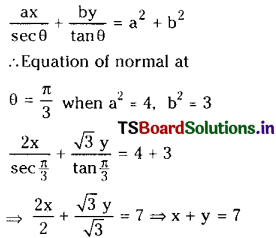
TS Inter 2nd Year Maths 2B Solutions Chapter 5 Hyperbola Ex 5(a) I Q9

Question 10.
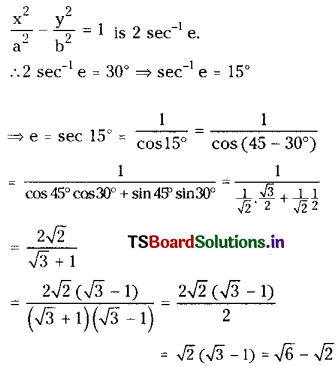
If the angle between asymptotes is 30° then find its eccentricity.
Solution:
The angle between asymptotes of the hyperbola
TS Inter 2nd Year Maths 2B Solutions Chapter 5 Hyperbola Ex 5(a) I Q10

II.

Question 1.
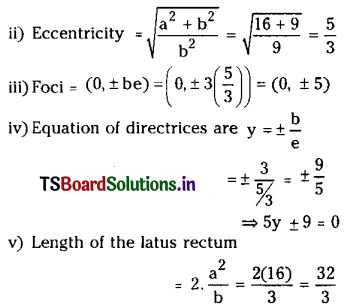
Find the centre, foci, eccentricity, equation of directrices, and length of the latus rectum of the following hyperbolas.
(i) 16y2 – 9x2 = 144 (June 2010)
Solution:
The given equation of the hyperbola is 16y2 – 9x2 = 144
⇒ \(\frac{y^2}{9}-\frac{x^2}{16}=1\)
⇒ \(\frac{x^2}{16}-\frac{y^2}{9}=-1\)
Comparing with \(\frac{x^2}{a^2}-\frac{y^2}{b^2}=-1\) We get
a2 = 16 and b2 = 9
⇒ a = 4 and b = 3
(i) Centre of the hyperbola = (0, 0)
TS Inter 2nd Year Maths 2B Solutions Chapter 5 Hyperbola Ex 5(a) II Q1(i)

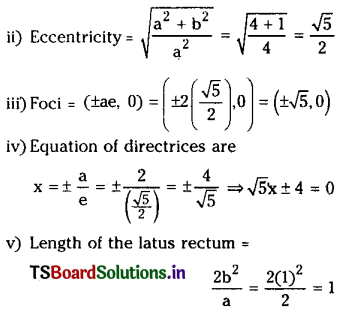
(ii) x2 – 4y2 = 4 (May 2011)
Solution:
This can be written as \(\frac{x^2}{4}-\frac{y^2}{1}=1\)
⇒ a2 = 4 and b2 = 1
⇒ a = 2 and b = 1
(i) Centre = (0, 0)
TS Inter 2nd Year Maths 2B Solutions Chapter 5 Hyperbola Ex 5(a) II Q1(ii)

(iii) 5x2 – 4y2 + 20x + 8y – 4 = 0 (Mar 2012)
Solution:
The given equation is 5x2 – 4y2 + 20x + 8y – 4 = 0
⇒ 5x2 + 20x – 4y2 + 8y = 4
⇒ 5(x2 + 4x) – 4(y2 – 2y) = 4
⇒ 5(x2 + 4x + 4) – 4(y2 – 2y + 1) = 20 + 4 – 4 = 20
⇒ 5(x + 2)2 – 4(y – 1)2 = 20
⇒ \(\frac{\left(\mathrm{x}-(-2)^2\right)}{4}-\frac{(\mathrm{y}-1)^2}{5}=1\)
This is of the form \(\frac{(x-h)^2}{a^2}-\frac{(y-k)^2}{b^2}=1\)
Where a2 = 4 and b2 = 5, h = -2, k = 1
(i) Centre of the hyperbola = C(h, k) = (-2, 1)
(ii) Eccentricity = \(\sqrt{\frac{a^2+b^2}{a^2}}=\sqrt{\frac{4+5}{4}}=\frac{3}{2}\)
(iii) Foci = (h ± ae, k)
= (-2 ± 2(\(\frac{3}{2}\)), 1)
= (1, 1), (-5, 1)
∴ Foci of the hyperbola = (1, 1), (-5, 1)
(iv) Equations of directrices are x = h ± \(\frac{a}{e}\)
= \(-2 \pm \frac{2}{(3 / 2)}=-2 \pm \frac{4}{3}\)
∴ 3x = -6 ± 4
⇒ 3x = -2 and 3x = -10
⇒ 3x + 2 = 0 and 3x + 10 = 0
(v) Length of the latus rectum = \(\frac{2 b^2}{a}=\frac{2 \times 5}{2}\) = 5

(iv) 9x2 – 16y2 + 72x – 32y – 16 = 0
Solution:
The given equation is 9x2 – 16y2 + 72x – 32y – 16 = 0
⇒ 9x2 + 72x – 16y2 – 32y = 16
⇒ 9(x2 + 8x) – 16(y2 + 2y) = 16
⇒ 9(x2 + 8x + 16) – 16(y2 + 2y + 1) = 16 + 144 – 16 = 144
⇒ \(\frac{(x-(-4))^2}{16}+\frac{[y-(-1)]^2}{9}=1\)
This is of the form \(\frac{(x-h)^2}{a^2}+\frac{(y-k)^2}{b^2}=1\)
Where a2 = 16 and b2 = 9
⇒ a = 4 and b = 3
(i) Coordinates of centre = C(h, k) = C(-4, -1)
(ii) Eccentricity e = \(\sqrt{\frac{a^2+b^2}{a^2}}=\sqrt{\frac{16+9}{16}}=\frac{5}{4}\)
(iii) Coordinates of foci = (h ± ae, k)
= (-4 ± 4(\(\frac{5}{4}\)), -1)
= (-9, -1), (1, -1)
(iv) Equations of directrices are x = ±\(\frac{a}{e}\)
= \(-4 \pm \frac{4}{(5 / 4)}\)
= \(-4 \pm \frac{16}{5}\)
⇒ x + 4 = ±\(\frac{16}{5}\)
⇒ 5x + 20 = 16 or 5x + 20 = -16
⇒ 5x + 4 = 0 (or) 5x + 36 = 0
(v) Length of the latus rectum = \(\frac{2 b^2}{a}=\frac{2(9)}{4}=\frac{9}{2}\)

TS Inter 2nd Year Maths 2B Solutions Chapter 5 Hyperbola Ex 5(a)

Question 2.
Find the equation to the hyperbola whose foci are (4, 2) and (8, 2) and whose eccentricity is 2. (March 2009)
Solution:
Let S = (4, 2) and S’ = (8, 2) be the foci.
Since the Y-coordinate of S and S’ are the same, the hyperbola’s major axis is parallel to the X-axis.
The equation of required hyperbola is \(\frac{(x-h)^2}{a^2}-\frac{(y-k)^2}{b^2}=1\)
Centre of Hyperbola C = Midpoint of SS’
= \(\left(\frac{4+8}{2}, \frac{2+2}{2}\right)\)
= (2, 2)
Given that e = 2
Distance between the foci is SS’ = 2ae
∴ 2ae = \(\sqrt{(4-8)^2+(2-2)^2}\) = 4
⇒ ae = 2
⇒ a(2) = 2
⇒ a = 1
But b2 = a2(e2 – 1) = 1(4 – 1) = 3
The equation of required hyperbola is \(\frac{(x-6)^2}{1}-\frac{(y-2)^2}{3}=1\)
⇒ (x2 – 12x + 36) – \(\frac{\left(y^2-4 y+4\right)}{3}\) = 1
⇒ 3x2 – y2 – 36x + 4y + 101 = 0
∴ Equation of Hyperbola is 3x2 – y2 – 36x + 4y + 101 = 0

Question 3.
Find the equation of hyperbola of a given length of transverse axis 6 whose vertex bisects the distance between the centre and the focus.
Solution:
Let C be the centre.
S is the focus and A, A’ are vertices of the required hyperbola.
TS Inter 2nd Year Maths 2B Solutions Chapter 5 Hyperbola Ex 5(a) II Q3
C = (0, 0), S = (ae, 0);
Given AA’ = 2a = 6
⇒ CA = a = 3; A = (3, 0)
Given that A bisects \(\overline{\mathrm{CS}}\)
∴ A is midpoint of \(\overline{\mathrm{CS}}\)
∴ (\(\frac{ae}{2}\)) = a
⇒ e = 2
But b2 = a2(e2 – 1)
⇒ b2 = a2(4 – 1) = 3a2 = 27
∴ The equation of the required hyperbola is \(\frac{x^2}{a^2}-\frac{y^2}{b^2}=1\)
⇒ \(\frac{x^2}{9}-\frac{y^2}{27}=1\)
⇒ 3x2 – y2 = 27

Question 4.
Find the equation of the tangents to the hyperbola x2 – 4y2 = 4 which are (i) parallel (ii) perpendicular to the line x + 2y = 0. (May 2011)
Solution:
Given the equation of Hyperbola x2 – 4y2 = 4
⇒ \(\frac{x^2}{4}-\frac{y^2}{1}=1\) ……..(1)
∴ a2 = 4, b2 = 1
Given line is x + 2y = 0 ……..(2)
(i) Equation of any line parallel to (2) is x + 2y + k = 0
⇒ 2y = -x – k
⇒ y = \(-\frac{x}{2}-\frac{k}{2}\) ……(3)
Condition for (3) to be a tangent to the hyperbola (1) is c2 = a2m2 – b2
where c = \(-\frac{k}{2}\), m = \(-\frac{1}{2}\)
∴ \(\frac{k^2}{4}=4\left(\frac{1}{4}\right)-1\)
⇒ \(\frac{k^2}{4}\) = 0
⇒ k = 0
The equation of tangent parallel to x + 2y = 0 is x + 2y = 0.
(ii) Equation of line perpendicular to x + 2y = 0 is 2x – y + k = 0.
⇒ y = 2x + k, where m = 2 and c = k
∴ c2 = a2m2 – b2
⇒ k2 = 4(4) – 1 = 15
⇒ k = ±√15
∴ Equation of tangent perpendicular to x + 2y = 0 is 2x – y ± √15 = 0.

TS Inter 2nd Year Maths 2B Solutions Chapter 5 Hyperbola Ex 5(a)

Question 5.
Find the equations of tangents drawn to the hyperbola 2x2 – 3y2 = 6 through (-2, 1).
Solution:
Given equation of hyperbola 2x2 – 3y2 = 6
⇒ \(\frac{x^2}{3}-\frac{y^2}{2}=1\) …….(1)
Comparing (1) with \(\frac{x^2}{a^2}-\frac{y^2}{b^2}=1\) we get a2 = 3, b2 = 2
Equation of any tangent to the hyperbola (1) having slope ‘m’ is y = mx ± \(\sqrt{a^2 m^2-b^2}\)
⇒ y = mx ± \(\sqrt{3 m^2-2}\) ……….(2)
If the tangent (2) passes through (-2, 1) then 1 = -2m ± \(\sqrt{3 m^2-2}\)
⇒ (2m + 1)2 = 3m2 – 2
⇒ 4m2 + 4m + 1 = 3m2 – 2
⇒ m2 + 4m + 3 = 0
⇒ (m + 3) (m + 1) = 0
⇒ m = -1 (or) m = -3
∴ The equations of tangents from (2) are y = -x ± √1 and y = -3x ± √25 = -3x ± 5
∴ x + y ± 1 = 0 and 3x + y ± 5 = 0 are the equations.
But the point (-2, 1) does not satisfy x + y – 1 = 0 and 3x + y – 5 = 0.
Hence the equations of required tangents passing through (-2, 1) are x + y + 1 = 0 and 3x + y + 5 = 0.

Question 6.
Prove that the product of the perpendicular distances from any point on a hyperbola to its asymptotes is constant.
Solution:
Let S ≡ \(\frac{x^2}{a^2}+\frac{y^2}{b^2}-1=0\) be the given hyperbola.
Let P = (a sec θ, b tan θ) be any point on S = 0.
The equations of asymptotes of hyperbola S = 0 are \(\frac{x}{a}+\frac{y}{b}=0\) and \(\frac{x}{a}-\frac{y}{b}=0\)
⇒ bx + ay = 0 (1) and bx – ay = 0 ………(2)
Let PM be the perpendicular length drawn from P(a sec θ, b tan θ) on line (2).
∴ PM = \(\frac{|b a \sec \theta+a b \tan \theta|}{\sqrt{a^2+b^2}}\)
Let PN be the perpendicular length drawn from P(a sec θ, b tan θ) on line (2).
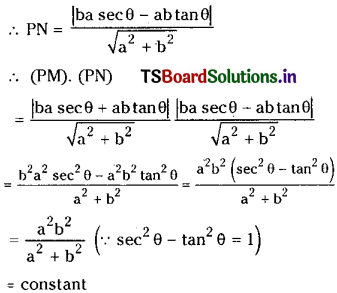
TS Inter 2nd Year Maths 2B Solutions Chapter 5 Hyperbola Ex 5(a) II Q6
∴ The product of the perpendicular distances from any point on a hyperbola to its asymptotes is a constant.

III.

Question 1.
Tangents to the hyperbola \(\frac{x^2}{a^2}-\frac{y^2}{b^2}=1\) make angles θ1, θ2 with transverse axis of a hyperbola. Show that the point of intersection of these tangents lies on the curve 2xy = k(x2 – a2) when tan θ1 + tan θ2 = k.
Solution:
Given hyperbola is \(\frac{x^2}{a^2}-\frac{y^2}{b^2}=1\)
The transverse axis of the hyperbola is the x-axis, (i.e., y = 0)
Let P(x1, y1) be the point of intersection of the tangents drawn to the given hyperbola.
The equation of any tangent to the hyperbola is of the form y = mx ± \(\sqrt{a^2 m^2-b^2}\)
If this passes through (x1, y1) then
TS Inter 2nd Year Maths 2B Solutions Chapter 5 Hyperbola Ex 5(a) III Q1
This is a quadratic equation in ‘m’ and be m1, m2 be the roots which corresponds to the slopes tan θ1, tan θ2 of tangents.
TS Inter 2nd Year Maths 2B Solutions Chapter 5 Hyperbola Ex 5(a) III Q1.1
∴ Locus of (x1, y1) is the curve 2xy = k(x2 – a2).

TS Inter 2nd Year Maths 2B Solutions Chapter 5 Hyperbola Ex 5(a)

Question 2.
Show that the locus of feet of the perpendiculars drawn from foci to any tangent of the hyperbola \(\frac{x^2}{a^2}-\frac{y^2}{b^2}=1\) is the auxiliary circle of the hyperbola.
Solution:
Let S ≡ \(\frac{x^2}{a^2}-\frac{y^2}{b^2}-1=0\) be the given hyperbola.
Foci of the hyperbola S = 0 are (±ae, 0).
Equation of any tangent to S = 0 having slope ‘m’ is y = mx ± \(\sqrt{a^2 m^2-b^2}\)
⇒ y – mx = ±\(\sqrt{a^2 m^2-b^2}\) ………(1)
Let P(x1, y1) be the locus of feet of the perpendicular form foci of the hyperbola to the tangent (1).
The equation of the perpendicular from either focus (±ae, 0) on the above tangent is
y – 0 = \(-\frac{1}{m}\)(x – (±ae))
⇒ my + x = ±ae …….(2)
P(x1, y1) lies on (1) and (2).
y1 – mx1 = \(\pm \sqrt{a^2 m^2-b^2}\) …….(3)
and my1 + x1 = ±ae ………(4)
Eliminating m from equations (3) and (4)
TS Inter 2nd Year Maths 2B Solutions Chapter 5 Hyperbola Ex 5(a) III Q2
∴ The Locus of (x1, y1) is x2 + y2 = a2 which is the equation of the Auxiliary circle of the Hyperbola.

Question 3.
Show that the equation \(\frac{x^2}{9-c}+\frac{y^2}{5-c}=1\) represents
(i) an ellipse if ‘c’ is a real constant less than 5.
(ii) a hyperbola if ‘c’ is any real constant between 5 and 9.
(iii) show that each ellipse in (i) and each hyperbola (ii) has foci at the two points (±2, 0), independent of the value of ‘c’.
Solution:
Given equation \(\frac{x^2}{9-c}+\frac{y^2}{5-c}=1\) ……(1) represents an ellipse
if 9 – c > 0 and 5 – c > 0
⇒ 9 > c and 5 > c
⇒ c < 9 and c < 5
⇒ c < 5 ∴ c is a real constant and less than 5 if (1) represents an ellipse.
(i) The equation of the hyperbola is of the form \(\frac{x^2}{a^2}-\frac{y^2}{b^2}=1\) and the given equation (1) represents a hyperbola
if 9 – c > 0 and 5 – c < 0
⇒ 9 > c and 5 < c
⇒ 5 < c < 9
∴ (1) represents hyperbola if C is a real constant such that 5 < c < 9
(ii) If \(\frac{x^2}{9-c}+\frac{y^2}{5-c}=1\) represents ellipse then
a2 = 9 – c and b2 = 5 – c
Eccentricity b2 = a2(1 – e2)
⇒ 5 – c = (9 – c) (1 – e2)
TS Inter 2nd Year Maths 2B Solutions Chapter 5 Hyperbola Ex 5(a) III Q3(i)
Hence each ellipse in (i) and each hyperbola in (ii) has foci at the two points (±2, 0) independent of the value of C.

TS Inter 2nd Year Maths 2B Solutions Chapter 5 Hyperbola Ex 5(a)

Question 4.
Show that the angle between the two asymptotes of a hyperbola \(\frac{x^2}{a^2}-\frac{y^2}{b^2}=1\) is \(2 {tan}^{-1}\left(\frac{b}{a}\right)\) (or) 2 sec-1(e). [New Model Paper, May 2012]
Solution:
Let the equation of the hyperbola be \(\frac{x^2}{a^2}-\frac{y^2}{b^2}=1\)
The asymptotes of hyperbola are y = ±\(\frac{b}{a}\)x where m1 = \(\frac{b}{a}\) and m2 = \(-\frac{b}{a}\).
If θ is the angle between asymptotes of the hyperbola then
TS Inter 2nd Year Maths 2B Solutions Chapter 5 Hyperbola Ex 5(a) III Q4
TS Inter 2nd Year Maths 2B Solutions Chapter 5 Hyperbola Ex 5(a) III Q4.1
TS Inter 2nd Year Maths 2B Solutions Chapter 5 Hyperbola Ex 5(a) III Q4.2

TS Inter 2nd Year Maths 2B Solutions Chapter 4 Ellipse Ex 4(a)

Students must practice this TS Intermediate Maths 2B Solutions Chapter 4 Ellipse Ex 4(a) to find a better approach to solving the problems.

TS Inter 2nd Year Maths 2B Solutions Chapter 4 Ellipse Exercise 4(a)

I.

Question 1.
Find the equation of the ellipse with focus at (1, -1), e = \(\frac{2}{3}\) and directrix as x + y + 2 = 0. (Mar. 2001)
Solution:
Given that focus S = (1, -1) and e = \(\frac{2}{3}\) and
equation of directrix is L = x + y + 2 = 0
Let (x1, y1) be any point on the ellipse and PM is the perpendicular distance from P to the directrix L = 0.
TS Inter 2nd Year Maths 2B Solutions Chapter 4 Ellipse Ex 4(a) I Q1

Question 2.
Find the equation of the ellipse in the standard form whose distance between foci is 2 and the length of latus rectum is \(\frac{15}{2}\).
Solution:
The equation of an ellipse in the standard form is \(\frac{x^2}{a^2}+\frac{y^2}{b^2}=1\), a > b
Given that the length of the latus rectum = \(\frac{15}{2}\)
∴ \(\frac{2 b^2}{a}=\frac{15}{2}\)
⇒ 4b2 = 15a
Given that the distance between foci = 2
∴ 2ae = 2
⇒ ae = 1 ……(2)
From (1), 4a2(1 – e2) = 15a (∵ b2 = a2(1 – e2))
⇒ 4(a2 – a2e2) = 15a
⇒ 4(a2 – 1) = 15a (∵ ae = 1)
⇒ 4a2 – 15a – 4 = 0
⇒ 4a2 – 16a + a – 4 = 0
⇒ 4a(a – 4) + 1(a – 4) = 0
⇒ a = 4 or a = \(-\frac{1}{4}\)
∴ a = 4 (∵ a > 0)
∴ From (1), 4b2 = 15(4) = 60
⇒ b2 = 15
Hence the required equation of the ellipse is \(\frac{x^2}{16}+\frac{y^2}{15}\) = 1

TS Inter 2nd Year Maths 2B Solutions Chapter 4 Ellipse Ex 4(a)

Question 3.
Find the equation of the ellipse in the standard form such that the distance between foci is 8 and the distance between directrices is 32.
Solution:
Given that the distance between foci = 8
∴ 2ae = 8
⇒ ae = 4 ……(1)
The distance between the directrices is ZZ’ = 32
⇒ 2 \(\frac{a}{e}\) = 32
⇒ \(\frac{a}{e}\) = 16 ……..(2)
From (1) and (2),
(ae) (\(\frac{a}{e}\)) = 4(16)
⇒ a2 = 64
⇒ a = 8
b2 = a2(1 – e2)
= a2 – a2e2
= 64 – 16
= 48
∴ The equation of the required ellipse is \(\frac{x^2}{a^2}+\frac{y^2}{b^2}=1\)
⇒ \(\frac{x^2}{64}+\frac{y^2}{48}=1\)

Question 4.
Find the eccentricity of the ellipse (in standard form), if the length of the latus rectum is equal to half of its major axis.
Solution:
Let the ellipse be \(\frac{x^2}{a^2}+\frac{y^2}{b^2}=1\)
Length of the latus rectum of the ellipse = \(\frac{2 b^2}{a}\)
Length of major axis = 2a
∴ \(\frac{2 b^2}{a}\) = a
⇒ 2b2 = a2
⇒ 2a2(1 – e2) = a2
⇒ 2(1 – e2) = 1
⇒ 1 – e2 = \(\frac{1}{2}\)
⇒ e2 = \(\frac{1}{2}\)
⇒ e = \(\frac{1}{\sqrt{2}}\)
∴ The eccentricity of the ellipse is \(\frac{1}{\sqrt{2}}\).

Question 5.
The distance of a point on the ellipse x2 + 3y2 = 6 from its centre is equal to 2. Find the eccentric angles.
Solution:
Given ellipse is x2 + 3y2 = 6
\(\frac{x^2}{6}+\frac{y^2}{2}=1\) ……(1)
Comparing with \(\frac{x^2}{a^2}+\frac{y^2}{b^2}=1\), we have a2 = 6, b2 = 2.
∴ a = √6, b = √2
The Centre of the ellipse (1) is C = (0, 0)
Let P = (a cos θ, b sin θ) = (√6 cos θ, √2 sin θ) which is a point on the ellipse whose distance from C(0, 0) is equal to 2.
∴ CP = 2
⇒ \(\sqrt{6 \cos ^2 \theta+2 \sin ^2 \theta}\) = 2
⇒ 6 cos2θ + 2 sin2θ = 4
⇒ 6 cos2θ + 2 (1 – cos2θ) = 4
⇒ 4 cos2θ = 2
⇒ cos2θ = \(\frac{1}{2}\)
⇒ cos θ = ±\(\frac{1}{\sqrt{2}}\)
⇒ θ = \(\frac{\pi}{4}, \frac{3 \pi}{4}, \frac{5 \pi}{4}, \frac{7 \pi}{4}\)

TS Inter 2nd Year Maths 2B Solutions Chapter 4 Ellipse Ex 4(a)

Question 6.
Find the equation of the ellipse in the standard form, if it passes through the points (-2, 2) and (3, -1).
Solution:
Let the equation of the ellipse be \(\frac{x^2}{a^2}+\frac{y^2}{b^2}=1\) …….(1)
since (1) passes through (-2, 2) we have \(\frac{4}{a^2}+\frac{4}{b^2}=1\) ……..(2)
since (1) passes through (3, -1) we have \(\frac{9}{a^2}+\frac{1}{b^2}=1\) ……(3)
From (2) and (3)
TS Inter 2nd Year Maths 2B Solutions Chapter 4 Ellipse Ex 4(a) I Q6

Question 7.
If the ends of the major axis of an ellipse are (5, 0) and (-5, 0). Find the equation of the ellipse in the standard form if its focus lies on line 3x – 5y – 9 = 0.
Solution:
Let A(5, 0), A’ = (-5, 0) are the ends of the major axis of an ellipse.
Since the Y coordinates of A, A’ is zero,
The major axis is y = 0
⇒ Major axis lies along the x-axis
∴ The equation of the required ellipse is \(\frac{x^2}{a^2}+\frac{y^2}{b^2}=1\) (a > b)
Also 2a = AA’ = \(\sqrt{(-5-5)^2}=\sqrt{(-10)^2}\) = 10
⇒ a = 5
Focus is S = (+ae, 0) = (5e, 0).
Given that focus lies on line 3x – 5y – 9 = 0
⇒ 3(5e) – 5(0) – 9 = 0
TS Inter 2nd Year Maths 2B Solutions Chapter 4 Ellipse Ex 4(a) I Q7

Question 8.
If the length of the major axis of an ellipse is three times the length of its minor axis then find the eccentricity of the ellipse.
Solution:
Let the ellipse in the standard form be \(\frac{x^2}{a^2}+\frac{y^2}{b^2}=1\) ……(1)
The length of the major axis is ‘a’ and the length of the minor axis is ‘b’.
Given that a = 3b
⇒ a2 = 9b2
⇒ a2 = 9a2(1 – e2)
⇒ 1 – e2 = \(\frac{1}{9}\)
⇒ e2 = \(\frac{8}{9}\)
⇒ e = \(\frac{2 \sqrt{2}}{3}\)
∴ Eccentricity of the ellipse = \(\frac{2 \sqrt{2}}{3}\)

II.

Question 1.
Find the length of the major axis, minor axis, latus rectum, eccentricity, coordinates of centre, foci, and the equations of directrices of the following ellipse. (New Model Paper)
(i) 9x2 + 16y2 = 144
Solution:
The given equation of the ellipse is 9x2 + 16y2 = 144
Writing this in the standard form we get \(\frac{x^2}{16}+\frac{y^2}{9}=1\) and comparing with S = 0.
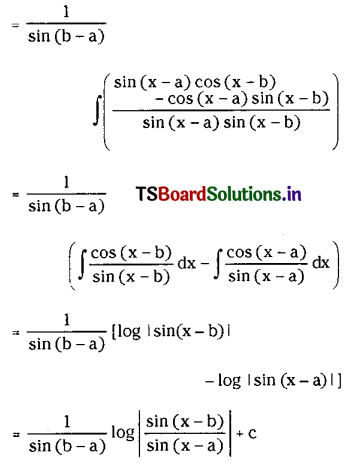
We get a2 = 16, and b2 = 9
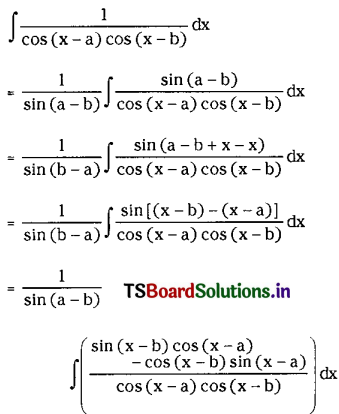
⇒ a = 4 and b = 3
Here a > b
(i) Length of the major axis = AA’= 2a = 2(4) = 8
(ii) Length of the minor axis is = BB’ = 2b = 2(3) = 6
(iii) Length of the latus rectum = \(\frac{2 b^2}{a}=\frac{2(9)}{4}=\frac{9}{2}\)
(iv) Eccentricity = \(\sqrt{\frac{a^2-b^2}{a^2}}=\sqrt{\frac{16-9}{16}}=\sqrt{\frac{7}{4}}\)
(v) Coordinates of centre = (0, 0)
(vi) Foci = (±ae, 0) = (±√7, 0)
(vii) Equation of directrices are x = \(\pm \frac{a}{e}\)
⇒ x = \(\pm \frac{4}{\frac{\sqrt{7}}{4}}=\pm \frac{16}{\sqrt{7}}\)
⇒ √7x = ±16
⇒ √7x ± 16 = 0

(ii) 4x2 + y2 – 8x + 2y + 1 = 0 (Mar. ’10, ’11)
Solution:
4x2 – 8x + y2 + 2y + 1 = 0
⇒ 4x2 – 8x + 4 + y2 + 2y + 1 = 4
⇒ 4(x2 – 2x + 1) + y2 + 2y + 1 = 4
⇒ 4 (x – 1)2 + (y + 1)2 = 4
⇒ \(\frac{(x-1)^2}{1}+\frac{(y+1)^2}{4}=1\)
Comparing with \(\frac{(x-h)^2}{a^2}+\frac{(y-k)^2}{b^2}=1\)
Where a2 = 1 and b2 = 4
⇒ a = 1 and b = 2 and a < b.
(i) Length of the major axis = BB’ = 2b = 2(2) = 4
(ii) Length of the minor axis = AA’ = 2a = 2(1) = 2
(iii) Length of the latus rectum = \(\frac{2 a^2}{b}=\frac{2(1)}{2}\) = 1
(iv) Eccentricity = \(\sqrt{\frac{b^2-a^2}{b^2}}=\sqrt{\frac{4-1}{4}}=\frac{\sqrt{3}}{2}\)
(v) Coordinates of centre = (1, -1)
(vi) foci = (h, k ± be)
= \(\left(1 , -1 \pm 2\left(\frac{\sqrt{3}}{2}\right)\right)\)
= (1, -1 ± √3)
(vii) Equations of directrices is y = k ± \(\frac{b}{e}\) = \(-1 \pm \frac{2}{\left(\frac{\sqrt{3}}{2}\right)}=-1 \pm \frac{4}{\sqrt{3}}\)
⇒ √3y + √3 ± 4 = 0

TS Inter 2nd Year Maths 2B Solutions Chapter 4 Ellipse Ex 4(a)

(iii) x2 + 2y2 – 4x + 12y + 14 = 0
Solution:
The given equation can be written as x2 – 4x + 2y2 + 12y = -14
⇒ x2 – 4x + 4 + 2(y2 + 6y) = -14 + 4
⇒ x2 – 4x + 4 + 2(y2 + 6y + 9) = -14 + 4 + 18
⇒ (x – 2)2 + 2(y + 3)2 = 8
⇒ \(\frac{(x-2)^2}{8}+\frac{(y+3)^2}{4}\) = 1 …….(1)
Comparing the given ellipse (1) with \(\frac{(x-h)^2}{a^2}+\frac{(y+k)^2}{b^2}\) = 1, we get
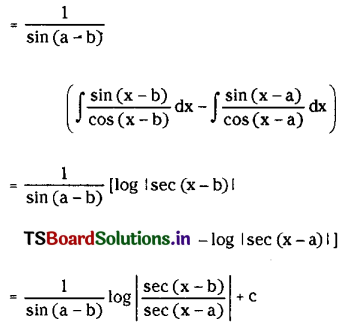
h = 2, k = -3, a2 = 8, b2 = 4
⇒ a = 2√2, b = 2
Clearly a > b
(i) Length of the major axis = AA’
= 2a
= 2(2√2)
= 4√2
(ii) Length of the minor axis is BB’ = 2b
= 2(2)
= 4
(iii) Length of the latus rectum = \(\frac{2 b^2}{a}\)
= \(\frac{2(4)}{2 \sqrt{2}}\)
= 2√2
(iv) Eccentricity = \(\sqrt{\frac{a^2-b^2}{a^2}}=\sqrt{\frac{8-4}{8}}=\sqrt{\frac{4}{8}}=\frac{1}{\sqrt{2}}\)
(v) Coordinates of centre = (2, -3)
(vi) Foci = (h ± ae, k)
= \(\left(2 \pm 2 \sqrt{2} \cdot\left(\frac{1}{\sqrt{2}}\right),-3\right)\)
= (2 ± 2, -3)
= (4, -3),(0, -3)
(vii) Equation of directrices are x = \(h \pm \frac{a}{e}\)
= \(2 \pm \frac{2 \sqrt{2}}{(1 / \sqrt{2})}\)
= 2 ± 4
∴ x = 6, x = -2 are the equations of directrices.

Question 2.
Find the equation of the ellipse in the form \(\frac{(x-h)^2}{a^2}+\frac{(y-k)^2}{b^2}\) = 1, given the following data.
(i) Centre (2, -1), one end of the major axis (2, -5), e = \(\frac{1}{3}\)
Solution:
Centre C(h, k) = (2, -1)
Let one end of the major axis is B = (2, -5)
Since the x-coordinates of C and B are the same and equal to ‘2’,
the major axis of an ellipse is x = 2 which is a line parallel to the y-axis.
The equation of ellipse is \(\frac{(x-h)^2}{a^2}+\frac{(y-k)^2}{b^2}\) = 1 where a < b.
CB = b where C = (2, -1) and B = (2, -5)
∴ b = \(\sqrt{(2-2)^2+(-1+5)^2}\) = 4
But a2 = b2(1 – e2)
= 16(1 – \(\frac{1}{9}\))
= \(\frac{128}{9}\)
∴ The equation of the required ellipse is \(\frac{(\mathrm{x}-\mathrm{h})^2}{\left(\frac{128}{9}\right)}+\frac{(\mathrm{y}+1)^2}{16}=1\)
⇒ \(\frac{9(x-2)^2}{128}+\frac{(y+1)^2}{16}=1\)
⇒ 9(x – 2)2 + 8(y + 1)2 = 128

(ii) Centre = (4, -1) one end of the minor axis is (-1, -1) and passes through (8, 0).
Solution:
Given centre C(h, k) = (4, -1) and one ends of the minor axis is (-1, -1).
Let A = (-1, -1)
Since the y-coordinates of C and A are the same and equal to ‘-1’, the minor axis is parallel to the X-axis.
∴ Major axis parallel to Y-axis.
∴ a = CA = \(\sqrt{(4+1)^2+(-1+1)^2}\) = 5
∴ The equation of the required ellipse is \(\frac{(\mathrm{x}-\mathrm{h})^2}{\mathrm{a}^2}+\frac{(\mathrm{y}+\mathrm{k})^2}{\mathrm{~b}^2}=1\)
⇒ \(\frac{(x-4)^2}{25}+\frac{(y+1)^2}{b^2}=1\) ……(1)
Since Ellipse is passing through the point (8, 0) we have \(\frac{(8-4)^2}{25}+\frac{1}{b^2}=1\)
TS Inter 2nd Year Maths 2B Solutions Chapter 4 Ellipse Ex 4(a) II Q2(ii)
∴ Required equation of ellipse is (x – 4)2 + 9(y + 1)2 = 25.

(iii) Centre (0, -3), e = \(\frac{2}{3}\), semi minor axis is 5.
Solution:
Given that centre C(h, k) = (0, -3), e = \(\frac{2}{3}\)
Semi minor axis = 5
The equation of the required ellipse is \(\frac{(x-h)^2}{a^2}+\frac{(y-k)^2}{b^2}=1\)
Case (1): If a > b then b2 = a2(1 – e)2
Given semi-minor axis b = 5
TS Inter 2nd Year Maths 2B Solutions Chapter 4 Ellipse Ex 4(a) II Q2(iii)
Case (2): If a < b then a2 = b2( 1 – e2)
semi minor axis = 5
⇒ a = 5
TS Inter 2nd Year Maths 2B Solutions Chapter 4 Ellipse Ex 4(a) II Q2(iii).1

(iv) Centre (2, -1), e = \(\frac{1}{2}\), length of latus rectum = 4.
Solution:
Given C(h, k) = (2, -1), e = \(\frac{1}{2}\), length of latus rectum = 4
Case (1): Where a > b, we have b2 = a2(1 – e2)
and length of latus rectum =
TS Inter 2nd Year Maths 2B Solutions Chapter 4 Ellipse Ex 4(a) II Q2(iv)
TS Inter 2nd Year Maths 2B Solutions Chapter 4 Ellipse Ex 4(a) II Q2(iv).1
⇒ (x – 2)2 + 9(y + 1)2 = 64 is the required equation of ellipse.

TS Inter 2nd Year Maths 2B Solutions Chapter 4 Ellipse Ex 4(a)

Question 3.
Find the radius of the circle passing through the foci of an ellipse 9x2 + 16y2 = 144 and having the least radius.
Solution:
Given the equation of the ellipse is 9x2 + 16y2 = 144
\(\frac{x^2}{16}+\frac{y^2}{9}=1\)
Compared with the general equation we have
a2 = 16, b2 = 9
⇒ a = 4 and b = 3
Foci of ellipse = (±ae, 0)
Also since a2 > b2 we have b2 = a2(1 – e2)
⇒ 9 = 16(1 – e2)
⇒ 1 – e2 = \(\frac{9}{16}\)
⇒ e2 = 1 – \(\frac{9}{16}\) = \(\frac{7}{16}\)
⇒ e = \(\frac{\sqrt{7}}{4}\)
Eccentricity of ellipse (e) = \(\frac{\sqrt{7}}{4}\)
∴ Focus = (±ae, 0)
= \(\left(\pm 4\left(\frac{\sqrt{7}}{4}\right), 0\right)\)
= (±√7, 0)
Now the equation of a circle having (√7, 0) and (-√7, 0) as extremities of diameter is given by
(x – √7 ) (x + √7 ) + (y – 0) (y – 0) = 0
⇒ x2 + y2 = 7
Hence the least radius of the circle x2 + y2 = 7 is √7.

Question 4.
A man running on a race course notices that the sum of the distances between the two flag posts is always 10m. and the distance between the flag posts is 8m. Find the equation of the race course traced by the man.
Solution:
TS Inter 2nd Year Maths 2B Solutions Chapter 4 Ellipse Ex 4(a) II Q4
Given AA’ = 2a = 10
⇒ a = 5 (Taking flag posts located at A & A’)
Also given the distance between two fixed points S and S’ = 8m
∴ 2ae = 8
⇒ ae = 4
∴ b2 = a2(1 – e2)
⇒ a2 – a2e2 = 25 – 16 = 9
⇒ b2 = 9
Hence the equation of ellipse is \(\frac{x^2}{25}+\frac{y^2}{9}\) = 1.

III.

Question 1.
A line of fixed length (a + b) moves so that its ends are always on two fixed perpendicular straight lines. Prove that a marked point on the line, which divides this line into portions of length ‘a’ and ‘b’ describes an ellipse and also finds the eccentricity of the ellipse when a = 8, b = 12.
Solution:
TS Inter 2nd Year Maths 2B Solutions Chapter 4 Ellipse Ex 4(a) III Q1
Let AB be a line of fixed length and a + b which moves with its end A, B on the x and y-axis.
AB = a + b
Let P(x1, y1) be any point on the line AB and BP = a, and AP = b.
Let M and N be the projections of P on the x and y-axis.
Such that OM = x1 and ON = y1
TS Inter 2nd Year Maths 2B Solutions Chapter 4 Ellipse Ex 4(a) III Q1.1

TS Inter 2nd Year Maths 2B Solutions Chapter 4 Ellipse Ex 4(a)

Question 2.
Prove that the equation of the chord joining the points ‘α’ and ‘β’ on the ellipse \(\frac{x^2}{a^2}+\frac{y^2}{b^2}=1\) is \(\frac{{x}}{a} \cos \left(\frac{\alpha+\beta}{2}\right)+\frac{y}{b} \sin \left(\frac{\alpha+\beta}{2}\right)=\cos \left(\frac{\alpha-\beta}{2}\right)\).
Solution:
Let S = \(\frac{x^2}{a^2}+\frac{y^2}{b^2}-1\) = 0 be the given ellipse
and let P = (a cos α, b sin α) and Q = (a cos β, b sin β) be the two given points on the ellipse S = 0.
The equation of the chord PQ is
TS Inter 2nd Year Maths 2B Solutions Chapter 4 Ellipse Ex 4(a) III Q2
Dividing by ‘ab’ on both sides, the equation of the chord joining the points (α, β) on the ellipse S = 0 is \(\frac{{x}}{a} \cos \left(\frac{\alpha+\beta}{2}\right)+\frac{y}{b} \sin \left(\frac{\alpha+\beta}{2}\right)=\cos \left(\frac{\alpha-\beta}{2}\right)\)

TS Inter 2nd Year English Study Material Revision Test-II

Telangana TSBIE TS Inter 2nd Year English Study Material Revision Test-II Exercise Questions and Answers.

TS Inter 2nd Year English Study Material Revision Test-II

Time: 1 1/2 Hrs
Marks : 50

Section – A

Question 1.
Annotate ANY ONE of the following in about 100 words. [1 × 4 = 4]

a) Undoubtedly women in ancient India enjoyed a much higher status than their descendants in the eighteenth and nineteenth centuries.
Answer:
The given lines occur in the informative essay “The Awakening of Women”. This article was composed by a committed writer K.M. Phanikkar. The article deals with the status of women over various periods. Every statement is backed with supporting details.

The essay focuses mainly on the impact the Gandhian Movement had on the progress of women. Yet, the writer states how women’s status was in the past. Women ancient India had a respectable position. It is only in the eighteenth and nineteenth centuries that women’s condition touched a pathetic low. The given lines highlight the fact that writer is balanced but not biased.

TS Inter 2nd Year English Study Material Revision Test-II

b) It was a matter of surprise to the outside world that independence of India should have appointed women to the highest posts so freely, as members of the Cabinet,
Answer:
The given lines occur in the informative essay “The Awakening of Women”. This article was composed by a committed writer, K.M. Phanikkar. The article deals with the status of women’s over various periods. Every statement is backed with supporting details. The position of women started to improve with their active participation in the Gandhian Movement, showed constant progress in all fields.

In pre-independent India, legislation was made in favour of their rights. After India became independent, women were appointed in both key government and administrative posts. This surprised the world. People outside India thought that India was very conservative regarding women’s position. Thus the lines play an important role in clearing certain prejudices.

Question 2.
Annotate ANY ONE of the following in about 100 words. [1 × 4 = 4]

a) He rests at case beneath some pleasant weed.
Answer:
Introduction:
The above line is taken from the sonnet “On the Grasshopper and Cricket” written by John Keats. He denoted his life to the perfection of poverty.

Context and Meaning:
Here the poet expresses his feelings, regarding natures song. The Grasshopper and the Cricket are used as symbols. Seasons may come and go. But Nature never fails to inspire us with its songs. When birds, stop singing in extreme heat, during the summer. The earth is filled with songs of a grasshopper. We can hear the voice of the grasshopper who runs from hedge to hedge. He keeps singing tiredlessly and when he gets tired with fun, he goes under some pleasant weed to take rest.

Critical Comment:
The poet sends the message that nature is beautiful all the line, irrespective of the season.

TS Inter 2nd Year English Study Material Revision Test-II

b) And seems to one in drowsiness half lost, The Grasshopper’s among some grassy hills.
Answer:
Introduction:
These are the conducting lines of the poem “On the Grasshopper and Cricket?? written by John Keats, a Romantic poet. He devoted his life to the perfection of poetry.

Context and Meaning:
John Keats celebrates the music of the Earth. He finds beauty in hot summer as well as in the cold winter. Here, the grasshopper is symbol of hot summer and cricket is symbol of cold winter. During the winter season in the frosty evening, the birds stop singing songs. At that time the cricket begins to sing. He spreads the warmth ofjoy everywhere. The people who are half sleep feel that it is the grasshopper song which is coming from the grassy hills. Thus, he depicts the beauty of Nature.

Critical Comment:
The poet sends the message that nature is beautiful all the time, irrespective of the season. In a similar way, we should be joyful in our life and be happy in all situations.

Question 3.
Answer ANY ONE of the following questions in about 100 words. [1 × 4 = 4]

a) But when the movement was actually started, women were everywhere at the forefront. Elaborate.
Answer:
The essay “The Awakening of Women” traces the evolution women’s progress in India over ages. K.M. Panikkar, a multifaceted genius, discusses the theme at length. Facts have been presented in a systematic order. Supporting details have been provided, Gandhiji understood the power of women. He believed that women could be an inexhaustible source of power.

He gave a call to them to participate in his movement. But, he had certain doubts about their readiness. His doubts were proved to be baseless. Women were very active in every area. They picketed liquor shops. They boycotted foreign goods. They took part in civil disobedience. Nowhere were women inferior to men. It was in fact the other way round.

TS Inter 2nd Year English Study Material Revision Test-II

b) Name some legislative reforms mentioned in the essay The Awakening of Women that seek to establish the equality of women.
Answer:
“The Awakening of Women” traces the evolution women’s progress in India over ages. K.M. Panikkar, a multifaceted genius, discusses the theme at length. Facts have been presented in a systematic order. Supporting details have been provided. Women’s active part in the struggle for freedom initiated a positive change in their status.

Even before India attained independence, laws were enacted and enforced in their favour. And that process continued after independence. Rights to property, to freedom of marriage, to education and employment, raising the age of marriage and the prevention of the dedication of women to temple services were some major legislative reforms.

Question 4.
Answer ANYONE of the following questions in about 100 words [1 × 4 = 4]

a) What is the theme of the poem On the Grasshopper and Cricket?
Answer:
The poem “On the Grasshoppers and Cricket’ is written by John Keats, an English Romantic poet. He has devoted his life to the perfection of poetry. In this poem, John Keats depicts the beauty of Nature. He says that the poetry of earth as symbols to praise Nature is never ending beauty. Seasons may come and go but Nature never fails to inspire us with its songs.

When birds stop singing in extreme heat, the earth is filled with the songs of a grasshopper. He sings endlessly, but when tired rests under some pleasant weed. During winter birds stop singing. There is a deathly silence. Frost spreads its blanket over Nature. Regardless, a shrill second cOmes from beneath stones and it is the cricket singing. Its song restores warmth. Thus, the small creatures prove to the world that the poetry of earth never ceases.

TS Inter 2nd Year English Study Material Revision Test-II

b) Discuss the common features between the grasshopper and cricket.
Answer:
The poem “ On the Grasshopper and Cricket” is written by John Keats. He is an English Romantic poet. He has developed his life to the perfections of poetry. In this poem, he depicts the beauty of nature. He says that the poetry of earth never ceases. He uses the Grasshopper and the Cricket as symbol to praise nature’s never ending beauty.

Seasons may come and go. But, nature never fails to inspire us with its songs. Therefore both the grasshopper and the cricket are the representative voices of nature’s music or poetry. Both offer a soothing effect to the extremities of climate. The grasshoppers song balances the extreme heat during the summer by providing music that is comforting and pleasing the cricket does the same during winter.

Question 5.
Answer ANYONE of the following questions in about 100 words. [1 × 4 = 4]

a) “Love, sacrifice and generosity are the essential elements for happy living”. Explain the statement with reference to the story A Gift for Christmas.
Answer:
A Gift for Christmas” is a well-known short story by O. Henry. The original name of the author is William Sydney Porter. This story was first published in 1905. A Gift for Christmas” is a Christmas story, and it functions as a parable about both the nature of love and the true meaning of generosity. Della’s earnest desire to buy a meaningful Christmas gift for Jim drives the plot of the story, and Jim’s reciprocity of that sentiment is shown when he presents Della with the tortoise-shell combs. Both Jim and Della give selflessly, without expectation of reciprocity. Their sole motivation is to make the other person happy. This, combined with the personal meaning imbued in each of the gifts, conveys the story’s moral that true generosity is both selfless and thoughtful.

TS Inter 2nd Year English Study Material Revision Test-II

b) Sketch the character of Jim.
Answer:
A Gift for Christmas” is a well-known short story by O. Henry. The original name of the author is William Sydney Porter. This story was first published in1905. Jim is a thin man of twenty two. He does not have enough income to support his wife. He bears the burden of fulfilling everyday demands of his wife. He is a very punctual person that why he constantly looks at his watch.

Section – B

Question 6.
Read the following passage and answer ANV FIVE questions given below: [5 × 1 = 5]

Della’s white fingers quickly opened the package. And then at first a scream of joy followed by a quick feminine change to tears. For, there lay The Combs — the set of combs, side and back, that Della had seen in a Broadway window and liked so much. They were beautiful combs, so expensive and they were hers now. But alas, the hair in which she was to wear them was sold and gone! She took them up lovingly, smiled through her tears and said, ‘My hair grows so fast, Jim!’

i) Who gave the package to Delia?
Answer:
to sharpen it

ii) What was Della’s reaction at first?
Answer:
We become better persons

iii) How did her joy change?
Answer:
No

iv) What did Della find in the package?
Answer:
the graphite inside

v) Where had she seen the combs earlier?
Answer:
because every action leaves a mark

TS Inter 2nd Year English Study Material Revision Test-II

vi) The combs were inexpensive. Write true or false.
Answer:
True

vii) Write the antonym of the word happy from the passage.
Answer:
exterior

viii) Write he synonym of the word shout from the passage.
an:
sorrows

Question 7.
Study the following advertisement and answer ANY FIVE questions that follow. [5 × 1 = 5]

TS Inter 2nd Year English Study Material Revision Test-II 1
i) Expand SHIP.
Answer:
Swach Hyderabad Internship Programme

ii) What are the eligibility criteria for participating in the programme?
Answer:
Social responsibility, passion, above 18years of age.

iii) Can very young boys and girls participate in this programme?
Answer:
no

iv) State any two themes of the internship programme.
Answer:
Lake cleanup, plantation

v) Registration is both online and offline. Write true or false.
Answer:
false

TS Inter 2nd Year English Study Material Revision Test-II

vi) When is the programme scheduled to begin?
Answer:
21st January 2022

vii) The number of hours of-the schedule is ___________ . (Fill in the blank.)
Answer:
20

viii) Write the word used in the ad to mean ‘a short term training period for practical experience’.
Answer:
Internship

Question 8.
Study the bar graph below and answer ANT FIVE questions given after it. [5 × 1 = 5]

TS Inter 2nd Year English Study Material Revision Test-II 2
i) What does the bar graph present?
Answer:
Sales of ice-creams of different flavours

ii) Ice cream of which flavour do people like the most in shop A?
Answer:
Ice-cream of mango flavours

iii) How many ice creams of almond flavour are sold in shop B?
Answer:
65

TS Inter 2nd Year English Study Material Revision Test-II

iv) Find the total number of ice creams of chocolate flavour sold in shop A and shop B.
Answer:
165

v) 30 ice creams of coconut flavour are sold in ___________. (Fill in the blank.)
Answer:
shop B

vi) Ice cream of which flavour do people like more in shop B, Chocolate or Vanilla?
Answer:
Chocolate

vii) How many ice creams of mango flavour are sold in shop A?
Answer:
100

viii) How many ice cream flavours are shown in the graph?
Answer:
5

Section – C

Question 9.
Rewrite the following passage using FIVE punctuation marks wherever necessary- [5 × 1 = 5]

The brahmo samaj led the movement for emancipation the ancient rules of purdah were broken and brahmo women moved freely in society: but this was. but a false dawn as it was far in advance of popular opinion.
Answer:
The Brahmo Samaj led the movement for emancipation. The ancient rules of purdah were broken and Brahmo women moved freely in society: but this was but a false dawn as it was far in advance of popular opinion.

TS Inter 2nd Year English Study Material Revision Test-II

Question 10.
Match the following words in Column ‘A’ with their definitions in Column ‘B’. [5 × 1 = 5]
Column A —– Column B
i) amphibious   ( ) a) lasting for a very short time
ii) antidote       ( ) b) designed to cause death
iii) ephemeral  ( ) c) living on land as well as in water
iv) lethal          ( ) d) someone who has a lot of experience in a field
v) veteran        ( ) e) a substance that can act against the effect of poison
Answer:
i) c
ii) e
iii) a
iv) b
v) d

TS Inter 2nd Year English Study Material Revision Test-I

Telangana TSBIE TS Inter 2nd Year English Study Material Revision Test-I Exercise Questions and Answers.

TS Inter 2nd Year English Study Material Revision Test-I

Time : 1 1/2 Hrs
Marks : 50

Section – A

Question 1.
Annotate ANY ONt of the following in about 100 words. [1 × 4 = 4]

a) If someone maintains that two and two are five or that Iceland is on the equator, you feel pity rather than anger.
Answer:
Introduction:
These beautiful lines are taken from the thought-provoking essay,” How to Avoid Foolish Opinions” written by Bertrand Russell. His clarity of thought and fluency of expression lend beauty to his style.

Context and Meanings:
Russell gives us tips on how to avoid foolish opinions. He says that there are many ways to avoid being dramatic. To avoid foolish opinions, no super human or genius is required. Many matters are less easily brought to the test of experience. If we hear views opposite to our opinions, it makes us angry. It is a sign that we actually have no good reason for our opinion. If someone has very stupid and wrong opinions, we feel pity rather than anger. So, we must carefully reconsider our ideas.

Critical Comment:
Though the article discusses many mistakes mankind is prove to make, it ends with a lively ray of hope.

TS Inter 2nd Year English Study Material Revision Test-I

b) Persecution is used in theology, not in arithmetic because in arithmetic, there is knowledge, but in theology, there is only opinion.
Answer:
Introduction:
These lines are taken from the thought provoking essay, “How to Avoid Foolish Opinion” written by Bertrand Russell. His clarity of thought and fluency of expression lend beauty to his style.

Context and Meanings:
Russell gives us tips on how to avoid foolish opinion. Here, he teas us about controversies. The worst controversies are about matters which have no good evidence either way. If you can not observe an issue, think about any biases you might have about it. This is because belief can go beyond facts. Persecution means annoying others deliberately all the time, the theology is required belief where as arithmetic is require facts and figures. Hence, persecution is not used in arithmetic but in theology – the study of God and religion.

Critical Comment:
The author says that belief can go beyond facts.

Question 2.
Annotate ANY ONE of the following in about 100 words. [1 × 4 = 4]

a) We are meeting today to wish her bon voyage.
Answer:
Reference:
These lines are taken from the satirical and humorous poem “Goodbye party for Miss Pushpa TS” by Nission Ezekid, a.versalite Indo-Anglian poet with a great sense of humour and wit.

Context and Explanation:
It is a farewell speech for miss pushpa, who is leaving the country the poem is a parody of English as used by some indians. The speaker adresses his colleagues as friends and miss pushpa as sister.

Critical Comment:
The lines highlight the speaker’s good nature and good intention. The style is simple and clear.

TS Inter 2nd Year English Study Material Revision Test-I

b) That is showing good spirit. I am always appreciating the good spirit
Answer:
Reference:
These lines are extracted from the satirical and humorous peom “Goodbye party for Miss Pushpa TS” written by Nission Ezhekiel, a versatile Indo-Anglion poet with a great sense of humour and wit. The poem is a parody of English as used by some Indians.

Context and Explanation:
It is a farewell speech for Miss pushpa, who is leaving the country. On the occasion, the speaker is praising the helpful nature of Miss. Pushpa. He praises her good nature. Whenever he asked her to do anything, she was saying that she would do it just now only. This reply from her is showing her good spirit and he is always appreciating the good spirit.

Critical Comment:
This shows her good spirit and her readiness to do any work she is a willing worker.

Question 3.
Answer ANY ONE of the following questions in about 100 words [1 × 4 = 4]

a) How can we prevent developing a dogmatic attitude as per Russell’s suggestion?
Answer:
The thought provoking essay,”How to Avoid Foolish Opinion’s” is written by Bertrand Russell. In this essay, he says that there are many ways to avoid being dogmatic. Making a keen observation where it can settle the bias is the first way. Next to know what other people think.

One has to be aware of what they think. This can be done by going on vacation and talking to people with different ideas. The third is arguing with an imaginary character. The fourth one is to deal with one’s sense of self worth. To overcome conceit, we must remember that we live for a short while on a small planet in vast cosmos.

TS Inter 2nd Year English Study Material Revision Test-I

b) What does Bertrand Russell say about a person getting angry about a difference of opinion?
Answer:
The thought provoking essay,”How to Avoid Foolish Opinions” is wiitten by Bertrand Russell. In this essay, he gives us tips on how to avoid foolish opinions and being dogmatic. He advices us to identify our weak points and reconsider our opinions. when we hear views opposite to our opinions. It makes us angry. It is a clear sign of something wrong with our beliefs, then we must carefully reconsider our ideas. We have to be aware of what other people think. Thus, we can avoid such problem.

Question 4.
Answer ANY ONE of the following questions in about 100 words [1 × 4 = 4]

a) How does the speaker describe Miss Pushpa in the poem?
Answer:
The poem “Goodbye Party for Miss Pushpa T.S.” is written by Nission Ezekiel. He is a versatile poet with a great sense of humor and wit. His present poem is a parody of English as used by some Indians. It is a farewell speach for Miss Push pa, who is going abroad. On this occasion, they have gathered there to hid farewell to her. A person comes and gives a speech. the poet creates humour through the speakers description of Miss Pushpa.

The speaker describes not only her internal but external sweetness. He says that she always ‘smiles’ without reason. He describes her good and amicasle nature. He also refers to her helpful qualities. He appreciates her concern for friends. He says that she always says ‘yes’ to any of their request. Thus, he is trying to exaggesate to show his love and respect for her. But, he doesn’t realize that he is describing her humorously and very lovsely. He doesn’t mind that his English is wrong linguestically. Thus, he describes her humorously with his Babu English.

TS Inter 2nd Year English Study Material Revision Test-I

b) Does the poem bring out the sweetness of Miss Pushpa? Justify your answer.
Answer:
The poem “Goodbye party for Miss Pushpa TS” is written by Nission Ezekiel. He is a versatile poet with a great sense of humour and wit. The poem is an extract from his volume of pems. ‘Hymns in Darkness’. It is an parody of English as used by Some Indians. It is farewell party for Miss. Pushpa, who is going abroad for better prospects. The Speaker announces in the very beginning that they have gathered there to bid farewell to her.

They want to wish her a happy journey. On this occasion, the speaker brings out the sweetness Miss Pushpa. He starts praising her sweetness which is both internal and external. She is beautiful not only because of her charms, but her honesty also. She is a sweet lady with all smile on her face. She smiles without a reason. She belongs to a reputed family. She is very popular among people. She is always ready to do anything for everyone. Thus the poem brings out the sweetness of Miss Pushpa. It appreciates her concern for friends. These are sweet qualities of Miss Pushpa.

Question 5.
Answer ANY ONE of the following questions in about 100 words; [1 × 4 = 4]

a) Describe the character of Arun, the boarding school boy?
Answer:
Ruskin Bond is a well-known contemporary Indian writer of British descent. He wrote many books inspirational children’s books and was honoured with the Sahitya Akademi Award for his literary work. The present short story represent from “The women on plat form No. 8” the main idea of is a story about love and affection that overcomes all sense of belonging barriers.

Arun was a boarding school student. He was returning to school. His parents thought he was old enough to travel alone. So he took a bus from his hometown to Ambala, arriving early in the evening. The train he needed to catch left at 12 a.m. He was waiting for the northbound train on platform 8 at Ambala station. It had been a long time for him. He walked up and down the platform, browsing the book stall and feeding Street dogs biscuits. He stood there watching the trains come and go. Whenever a train arrived, the platform became a center for activity, and it would be quiet after the train had left. He sat down on his suitcase, tired of pacing around the platform, and stare at the railway tracks.

A soft voice asked from behind if he was alone. Arun saw a middle aged woman in white sari, with dark kind eyes leaning over him. There was some kind of dignity about her which made Arun stand up respectfully and answer. He told her that he was alone and that he was going to school. She asked him if his parents had not come to see him off. Arun said that he did not live there and he could travel alone. The lady agreed with him. Arun liked her for her simplicity, her deep soft voice and the serenity of her face.

TS Inter 2nd Year English Study Material Revision Test-I

b) What made Arun call the strange woman ‘mother’ at the end?
Answer:
Ruskin Bond is a well-known contemporary English Indian writer. He wrote a number of inspirational children’s books and was awarded the Sahitya Akademi Award for his literary work. The following is a short story from “The Women on Plat Form No. 8.” This short story’s core concept is about love and affection overcoming all obstacles to belonging.

Arun called the stranger woman ‘mother’ at the end, because she had treated him tenderly and offered him tea and sweets. She listened to him and showed trust in him. He liked her kindness and graceful behaviour. She introduced herself as his mother. She supported Arun against satish’s mother, Arun wanted to repay her kindness by acknowledging her as mother.

Section – B

Question 6.
Read the following passage and answer ANY SIX questions given below: [6 × 1 = 6]

I was going to refuse out of shyness and suspicion, but she took me by the hand. Then I felt it would be silly to pull my hand away. She told a porter to look after my suitcase and then she led me down the platform. Her hand was gentle. She held my hand neither too firmly nor too lightly. I looked up at her again. She was not young, but she was not old.

i) Name the short story from which this passage is taken.
Answer:
The Woman on Platform No. 8

ii) What was Arun going to do?
Answer:
To Refuse out of shyness and suspicion

iii) How did she hold his hand?
Answer:
neighter to firmly nor too lightly

iv) How did Arun feel of taking back his hand away?
Answer:
He felt silly

v) What did she tell a porter?
Answer:
To look after Arun’s suitcase

TS Inter 2nd Year English Study Material Revision Test-I

vi) Pick out the word from the passage which means tender.
Answer:
Gentle

vii) ‘She held my hand neither too firmly nor too lightly.’ Say true or false.
Answer:
True

viii) Rewrite the sentence “She was not young, but she was not old.” using “neither. nor……”.
Answer:
She was neither young nor old.

Question 7.
Read the following passage and answer ANY SIX questions given below: [6 × 1 = 6]

The Warrior Who Broke All Barriers The very word COVID spreads dread worldwide. But, Dr Annam Srinivasa Rao of Khammam stands out as an exception. Putting his life at risk, he served a large number of COVID patients in various ways. His organization served food and extended medical facilities to them while alive. When died, the Foundation arranged for transportation and last rites of hundreds of bodies when their own families abandoned the bodies!

When he was tested positive, he was worried, not of his health, but of the people who needed his service! By looking after hundreds of disabled (both physically and mentally) orphans from far and near for over a decade, his organization – Annam Seva Foundation, Danvaigudem, Khammam – has redefined philanthropy. He was inspired into this service when he himself grew up in an orphanage. His struggles to secure some employment helped him master the art of taking everything in his stride. Thus, he continues his services undeterred by police cases, neighbours’ wrath, financial constraints etc. An admirable spirit indeed!

i) What makes one describe Dr Annam Srinivasa Rao as the warrior who broke all barriers?
Answer:
Has he put his life at risk and served COVID patients also

ii) How does the world respond to the word COVID, according to the passage?
Answer:
Reads the word COVID

iii) Why was Dr Annam Srinivasa Rao worried when he tested positive?
Answer:
Of the people who needed his service and missed it

TS Inter 2nd Year English Study Material Revision Test-I

iv) Name the organization that he founded and its location.
Answer:
Annam Seva Foundation: Danavayagudem, Khammam

v) Why did Dr Annam Srinivasa Rao choose this path?
Answer:
Has he him self growup in a orphanage

vi) Pick out from the passage the one-word substitute that means selfless service out of love for humanity.
Answer:
Phinlanthropy

vii) Find out from the passage the phrasal verb that means taking full care and responsibility of.
Answer:
Looking after

viii) Write the idiom used in the passage that means accepting and dealing with difficulties without letting them worry one too much
Answer:
Taking something in one’s stried

Question 8.
Study the pie-chart below and answer any Six questions given after it. [6 × 1 = 6]

TS Inter 2nd Year English Study Material Revision Test-I 1
i) What does the pie chart show?
Answer:
favourite beverages of people

ii) How many beverages are taken into account?
Answer:
5

iii) What is the most preferred beverage?
Answer:
Coconut Water (38%)

TS Inter 2nd Year English Study Material Revision Test-I

iv) How many people preferred coffee?
Answer:
15%

v) What is the least preferred beverage?
Answer:
Sugarcane Juice

vi) People who preferred tea are _____________.
Answer:
25%

vii) People who preferred cola are __________.
Answer:
12%

viii) People who preferred Coconut water are 27%. Write true or false.
Answer:
False

Section – C

Question 9.
Rewrite’th6 following passage using SIX of the punctuation marks wherever necessary. [6 × 1 = 6]

It is more difficult to deal with the self-esteem of man as a man because we cannot argue out the matter with some non-human mind, the only way I know of dealing with this general human conceit is to remind ourselves that man is a brief episode in the life of a small planet in a little comer of the universe and that for aught we know other parts of the cosmos may contain beings as superior to ourselves as we are to jellyfish.
Answer:
It is more difficult to deal with the self-esteem of man as a man because we cannot argue out the matter with some non- human mind. The only way I know of dealing with this general human conceit is to remind ourselves that man is a brief episode in the life of a small planet in a little corner of the universe and that, for aught we know, other parts of the cosmos may contain beings as superior to ourselves as we are to jellyfish.

TS Inter 2nd Year English Study Material Revision Test-I

Question 10.
Match the following words in Column ‘A’ with their definitions in Column ‘B’. [6 × 1 = 6]
Column A —- Column B
i) ambidextrous   ( ) a) one who eats excessively
ii) contemporary ( ) b) something which is out of date
iii) glutton           ( ) c) a person walking on a street
iv) invincible       ( ) d) able to use both hands equally well
v) obsolete         ( ) e) living or occurring at the same time
vi) pedestrian     ( ) f) too strong to be defeated
Answer:
i) d
ii) e
iii) a
iv) f
v) b
vi) c

TS Inter 2nd Year Maths 2B Solutions Chapter 3 Parabola Ex 3(a)

Students must practice this TS Intermediate Maths 2B Solutions Chapter 3 Parabola Ex 3(a) to find a better approach to solving the problems.

TS Inter 2nd Year Maths 2B Solutions Chapter 3 Parabola Exercise 3(a)

I.

Question 1.
Find the vertex and focus of 4y2 + 12x – 20y + 67 = 0.
Solution:
Given equation is 4y2 + 12x – 20y + 67 = 0
⇒ 4y2 – 20y = -12x – 67
⇒ 4(y2 – 5y) = -12x – 67
TS Inter 2nd Year Maths 2B Solutions Chapter 3 Parabola Ex 3(a) I Q1
TS Inter 2nd Year Maths 2B Solutions Chapter 3 Parabola Ex 3(a) I Q1.1

Question 2.
Find the vertex and focus of x2 – 6x – 6y + 6 = 0.
Solution:
The given equation is x2 – 6x – 6y + 6 = 0
⇒ x2 – 6x = 6y – 6
⇒ x2 – 6x + 9 = 6y – 6 + 9 = 6y + 3
⇒ (x – 3)2 = \(6\left(y+\frac{1}{2}\right)=6\left(y-\left(-\frac{1}{2}\right)\right)\)
This is of the form (x – h)2 = 4a(y – k)
where h = 3, 4a = 6 ⇒ a = \(\frac{3}{2}\) and k = \(\frac{-1}{2}\)
Vertex = (h, k) = (3, \(\frac{-1}{2}\))
Focus = (h, a + k) = (3, \(\frac{3}{2}-\frac{1}{2}\)) = (3, 1)

TS Inter 2nd Year Maths 2B Solutions Chapter 3 Parabola Ex 3(a)

Question 3.
Find the equations of the axis and directrix of the parabola y2 + 6y – 2x + 5 = 0.
Solution:
The given equation is y2 + 6y – 2x + 5 = 0
⇒ y2 + 6y = 2x – 5
⇒ y2 + 6y + 9 = 2x – 5 + 9 = 2x + 4
⇒ (y + 3)2 = 2(x + 2)
⇒ [y – (-3)]2 = 2[x – (-2)]
This is of the form (y – k)2 = 4a(x – h)
where k = -3, 4a = 2 ⇒ a = \(\frac{1}{2}\), h = -2
∴ Axis is y – k = 0 ⇒ y + 3 = 0
and Directrix is x – h + a = 0
⇒ x + 2 + \(\frac{1}{2}\) = 0
⇒ x + \(\frac{5}{2}\) = 0
⇒ 2x + 5 = 0

Question 4.
Find the equations of the axis and directrix of the parabola 4x2 + 12x – 20y + 67 = 0.
Solution:
Given equation is 4x2 + 12x – 20y + 67 = 0
⇒ 4(x2 + 3x) = 20y – 67
TS Inter 2nd Year Maths 2B Solutions Chapter 3 Parabola Ex 3(a) I Q4
TS Inter 2nd Year Maths 2B Solutions Chapter 3 Parabola Ex 3(a) I Q4.1

Question 5.
Find the equation of a parabola whose focus is S(1, -7) and whose vertex is A(1, -2). (New Model Paper, Mar. ’12)
Solution:
Given that vertex A(h, k) = (1, -2) and focus S = (1, -7).
Since the x coordinates of A and S are equal and equal to 1,
the axis of the parabola is x = 1 and it is a line parallel to the y-axis.
Also, the focus is below the vertex.
∴ The equation of the parabola is (x – h)2 = -4a(y – k)
⇒ (x – 1)2 = -4a(y + 2) ……..(1)
where a = AS = \(\sqrt{(1-1)^2+(-2+7)^2}\) = 5
∴ From (1) we have (x – 1)2 = -20(y + 2)
Which is the equation of the required parabola.

TS Inter 2nd Year Maths 2B Solutions Chapter 3 Parabola Ex 3(a)

Question 6.
Find the equation of the parabola whose focus is S(3, 5) and vertex is A(1, 3). (E.Q.)
Solution:
Given vertex A = (1, 3) and focus S = (3, 5)
TS Inter 2nd Year Maths 2B Solutions Chapter 3 Parabola Ex 3(a) I Q6
Let the directrix meets the axis of the parabola at Z(x, y), A is the midpoint of SZ.
Hence \(\frac{\mathrm{x}+3}{2}\) = 1 and \(\frac{\mathrm{y}+5}{2}\) = 3
⇒ x = -1 and y = 1
∴ Coordinates of Z = (-1, 1)
Slope of AZ = \(\frac{5-1}{3+1}\) = 1
∴ Slope of directrix = -1 (∵ directrix is perpendicular to \(\overline{\mathrm{AS}}\))
∴ Equation of directrix L = 0 is y – 1 = -1(x + 1)
⇒ x + y = 0
Let P(x1, y1) be any point on the parabola and PM is the perpendicular distance from P to the directrix L = 0 is
TS Inter 2nd Year Maths 2B Solutions Chapter 3 Parabola Ex 3(a) I Q6.1
⇒ \(\mathrm{x}_1^2+\mathrm{y}_1^2\) – 2x1y1 – 12x1 – 20y1 + 68 = 0
∴ Locus of (x1, y1) is the equation of parabola given by x2 + y2 – 2xy – 12x – 20y + 68 = 0.

Question 7.
Find the equation of the parabola whose latus rectum is the line segment joining points (-3, 2) and (-3, 1). (E.Q.)
Solution:
Given L = (-3, 2) and L’ = (-3, 1) be the two end points of the latus rectum of the parabola.
Since the x coordinates of L and L’ are ‘1’ we have an axis of the parabola parallel to the x-axis.
∴ The equation of the required parabola is (y – k)2 = ±4a(x – h)
The length of the latus rectum LL’ = 4a
⇒ 4a = \(\sqrt{(-3+3)^2+(2-1)^2}\) = 1
⇒ a = \(\frac{1}{4}\)
Let S be the focus of the required parabola Then
S = mid point of LL’ = (h, k)
TS Inter 2nd Year Maths 2B Solutions Chapter 3 Parabola Ex 3(a) I Q7
TS Inter 2nd Year Maths 2B Solutions Chapter 3 Parabola Ex 3(a) I Q7.1

Question 8.
Find the position (Interior or exterior or on) of the following points with respect to the parabola y2 = 6x.
(i) (6, -6)
(ii) (0, 1)
(iii) (2, 3)
Solution:
Given the equation of a parabola is y2 – 6x = 0
Comparing with y2 = 4ax
we have 4a = 6
⇒ a = \(\frac{3}{2}\)
(i) Let P(x1, y1) = (6, -6) be the given point.
Then S11 = \(\mathrm{y}_1{ }^2\) – 4ax1
= (-6)2 – 4(\(\frac{3}{2}\))(6)
= 36 – 36
= 0
∴ The point (6, -6) lies on the parabola y2 = 6x.
(ii) Let P(x1, y1) = (0, 1) and \(\mathrm{y}_1{ }^2\) – 4ax1
= 1 – 4(\(\frac{3}{2}\))(0)
= 1
∴ S11 > 0 and the point (0, 1) lies outside the parabola y2 = 6x.
(iii) Let P(x1, y1) = (2, 3) Then S11 = \(\mathrm{y}_1{ }^2\) – 6x1
= 9 – 6(2)
= -3 < 0
∴ Point (2, 3) lies inside the parabola y2 = 6x.

TS Inter 2nd Year Maths 2B Solutions Chapter 3 Parabola Ex 3(a)

Question 9.
Find the coordinates of the point on the parabola y = 8x whose focal distance is 10. (Mar. ’11)
Solution:
Given y2 = 8x and Let P(x1, y1) be any point on the parabola y2 = 8x
Comparing with y2 = 4ax we get
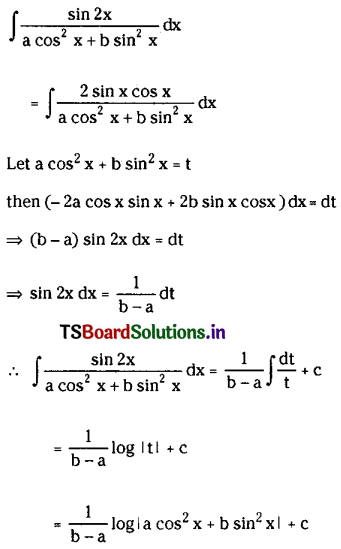
4a = 8
⇒ a = 2
The focal distance of the parabola = x1 + a = x1 + 2
Given x1 + 2 = 10
Since \(\mathrm{y}_1^2\), we have \(\mathrm{y}_1^2\) = 8(8) = 64
⇒ y1 = ±8
Hence the required points on the parabola y2 = 8x are given by (8, 8) and (8, -8).

Question 10.
If (\(\frac{1}{2}\), 2) is one extremity of a focal chord of the parabola y2 = 8x. Find the coordinates of the other extremity. (June ’10)
Solution:
The given equation of a parabola is y2 = 8x.
Comparing with y2 = 4ax we get
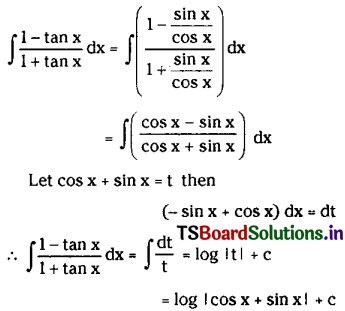
4a = 8
⇒ a = 2
Let P(x1, y1) = (\(\frac{1}{2}\), 2) be one extremity of the focal chord.
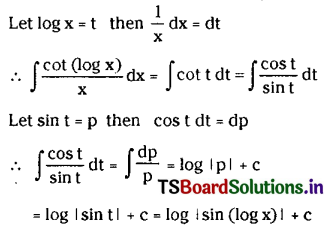
Let Q(x2, y2) be the other extremity of the focal chord of the parabola y2 = 8x.
∴ x1x2 = a2 and y1y2 = -4a2 (standard result)
⇒ \(\frac{1}{2}\)x2 = 4
⇒ x2 = 8
and 2y2 = -4(4)
⇒ y2 = -8
[∵ P(x1, y1) = (\(\frac{1}{2}\), 2)]
∴ The other extremity of the focal chord of the given parabola is (8, -8).

Question 11.
Prove that the point on the parabola y2 = 4ax, (a > 0) nearest to the focus is its vertex.
Solution:
Given equation is y2 = 4ax …….(1) and focus is S = (a, 0).
Let P(at2, 2at) be any point on y2 = 4ax.
Let f(t) = SP = \(\sqrt{\left(a t^2-a\right)+4 a^2 t^2}\)
= \(\sqrt{a^2\left[\left(t^2-1\right)^2+4 t^2\right]}\)
= a(t2 + 1)
∴ f(t) = 2at and f”(t) = 2a > 0
∴ For f(t) to be minimum or maximum f'(t) = 0 ⇒ t = 0
∴ P = (0, 0).
Hence the f(t) has a minimum at t = 0 and the point on the parabola nearest to its focus is (0, 0).

Question 12.
A comet moves in a parabolic orbit with the sun as the focus. When the comet is 2 × 10⁷ Km. from the sun the line from the sun to it makes an angle \(\frac{\pi}{2}\) with the axis of the orbit. Find how near the comet comes to the sun.
Solution:
TS Inter 2nd Year Maths 2B Solutions Chapter 3 Parabola Ex 3(a) I Q12
Let the equation of the parabolic orbit be y2 = 4ax
Let S be the position of the sun (focus) on the axis of the parabola.
Let P be the position of a comet when it is at a distance of 2 × 10⁷ Km from the Sun ‘S’.
∴ SP = 2 × 10⁷
⇒ 2a = 2 × 10⁷ Km
⇒ a = 107 Km
The distance of the comet from the Sun S is minimum when it is at the vertex.
∴ The nearest distance of the comet from the sun S is SA = a = 107 Km.

II.

Question 1.
Find the locus of the point of trisection of the double ordinate of a parabola y2 = 4ax, (a > 0).
Solution:
TS Inter 2nd Year Maths 2B Solutions Chapter 3 Parabola Ex 3(a) II Q1
Let P(at2, 2at), and P’ = (at2, -2at) be the ends of double ordinate PP’ of the parabola y2 = 4ax.
Let Q(x1, y1) be any point on the locus.
∴ Q(x1, y1) is the point of trisection of PP’.
⇒ Q(x1, y1) divides PP’ in the ratio 1 : 2.
TS Inter 2nd Year Maths 2B Solutions Chapter 3 Parabola Ex 3(a) II Q1.1
∴ 9\(\mathrm{y}_1^2\) = 4ax1 and locus of (x1, y1) is 9y2 = 4ax.

TS Inter 2nd Year Maths 2B Solutions Chapter 3 Parabola Ex 3(a)

Question 2.
Find the equation of the parabola whose vertex and focus are on the positive x-axis at a distance ‘a’ and ‘a’ ‘ from the origin respectively.
Solution:
Let A(a, 0) be vertex and S(a’, 0) be the focus
We have
TS Inter 2nd Year Maths 2B Solutions Chapter 3 Parabola Ex 3(a) II Q2
∴ a = AS
∴ a = \(\sqrt{\left(a-a^{\prime}\right)^2}\) = a’ – a
The equation of the required parabola is (y – k)2 = 4a(x – h)
⇒ (y – 0)2 = 4(a’ – a) (x – a)
⇒ y2 = 4(a’ – a) (2 – a)

Question 3.
If L and L’ are the ends of the latus rectum of the parabola x2 = 6y, find the equation of OL and OL’ where ‘O’ is the origin. Also, find the angle between them.
Solution:
Given equation of parabola is x2 = 6y ……..(1)
Comparing with y2 = 4ax we have 4a = 6
⇒ a = \(\frac{3}{2}\)
Given L, L’, and the ends of the latus rectum of the parabola (1).
L = (2a, a) and L’ = (-2a, a)
TS Inter 2nd Year Maths 2B Solutions Chapter 3 Parabola Ex 3(a) II Q3
TS Inter 2nd Year Maths 2B Solutions Chapter 3 Parabola Ex 3(a) II Q3.1
TS Inter 2nd Year Maths 2B Solutions Chapter 3 Parabola Ex 3(a) II Q3.2

Question 4.
Find the equation of a parabola whose axis is parallel to the x-axis and which passes through the points (-2, 1), (1, 2), and (-1, 3).
Solution:
Let A = (-2, 1), B = (1, 2), C = (-1, 3) be the given points.
Let the equation of the parabola whose axis is parallel to the x-axis and passing through the points A, B, C be x = ly2 + my + n …….(1)
If parabola (1) passes through A(-2, 1) then -2 = l + m + n …….(2)
If (1) passes through B(1, 2) then
1 = 4l + 2m + n ……..(3)
If (1) passes through C(-1, 3) then
-1 = 9l + 3m + n ……..(4)
From (2) and (3),
-3l – m = -3
⇒ 3l + m = 3 ……..(5)
From (3) and (4),
-5l – m = 2
⇒ 5l + m = -2 ………(6)
Solving (5) and (6), we get
-2l = 5
⇒ l = \(\frac{-5}{2}\)
and 5(\(\frac{-5}{2}\)) + m = -2
⇒ m = -2 + \(\frac{25}{2}\) = \(\frac{21}{2}\)
∴ From (2) we have l + m + n = 2
⇒ \(-\frac{5}{2}+\frac{21}{2}\) + n = -2
⇒ n + 8 = -2
⇒ n = -10
Hence the required equation of parabola from (1) is x = \(-\frac{5}{2} y^2+\frac{21}{2} y-10\)
⇒ 5y2 + 2x – 21y + 20 = 0

TS Inter 2nd Year Maths 2B Solutions Chapter 3 Parabola Ex 3(a)

Question 5.
Find the equation of the parabola whose axis is parallel to the y-axis and which passes through the points (4, 5), (-2, 11), and (-4, 21). (Mar. ’12)
Solution:
Let A(4, 5), B(-2, 11) and C(-4, 21) be the given points.
The equation of the parabola whose axis is parallel to the y-axis is
y = lx2 + mx + n ………(1)
Since (1) passes through point A(4, 5) we have
5 = 16l + 4m + n ………(2)
Since (1) passes through point B(-2, 11) then
11 = 4l – 2m + n ……..(3)
Also since (1) passes through C(-4, 21) we have
21 = 16l – 4m + n ………(4)
From (2) and (3)
12l + 6m = -6
61 + 3m = -3
2l + m = -1 ……….(5)
From (3) and (4)
-12l + 2m = -10
⇒ -6l + m = -5
⇒ 6l – m = 5 ……….(6)
Solving (5) and (6) we get
8l = 4
⇒ l = \(\frac{1}{2}\)
∴ From (6)
3 – m = 5
⇒ -m = 2
⇒ m = -2
From (2) we have
16l + 4m + n = 5
⇒ 8 – 8 + n = 5
⇒ n = 5
∴ The equation of the required parabola passing through points A, B, C from (1) is
y = \(\frac{1}{2}\)x2 – 2x + 5
⇒ x2 – 4x – 2y + 10 = 0

III.

Question 1.
Find the equation of the parabola whose focus is (-2, 3) and whose directrix is the line 2x + 3y – 4 = 0. Also, find the length of the latus rectum and the equation of the axis of the parabola. (Mar. ’13)
Solution:
Let S = (-2, 3) be the focus and L = 2x + 3y – 4 = 0 be the directrix.
Let P(x1, y1) be any point on the parabola and PM be the perpendicular distance from P to the directrix.
TS Inter 2nd Year Maths 2B Solutions Chapter 3 Parabola Ex 3(a) III Q1
∴ The locus of P(x1, y1) is the equation of parabola given by 9x2 – 12xy + 4y2 + 68x – 54y + 153 = 0
The length of the latus rectum = 4a = 2(2a) = 2
The perpendicular distance from focus to the directrix = \(\frac{2|2(-2)+3(3)-4|}{\sqrt{4+9}}=\frac{2}{\sqrt{13}}\) units
Since the axis of the parabola is perpendicular to the directrix and passes through the focus (-2, 3).
The equation of the line passing through (-2, 3) and perpendicular to L = 0 is L(x – x1) – a(y – y1) = 0
⇒ 3(x + 2) – 2(y – 3) = 0
⇒ 3x – 2y + 12 = 0
∴ Axis of the parabola is 3x – 2y + 12 = 0.

TS Inter 2nd Year Maths 2B Solutions Chapter 3 Parabola Ex 3(a)

Question 2.
Prove that the area of the triangle inscribed in the parabola y2 = 4ax is \(\frac{1}{8a}\) |(y1 – y2) (y2 – y3) (y3 – y1)| sq. units. where y1, y2, y3 are the ordinates of its vertices. (New Model Paper)
Solution:
Let A(x1, y1), B(x2, y2) and C(x3, y3) be the vertices of ∆ABC inscribed in a parabola y2 = 4ax.
Then the area of the triangle ABC is ∆ = |\(\frac{1}{2}\)Σx1(y2 – y3)| sq.units
In the parametric form x1 = \(\mathrm{at}_1{ }^2\) and y1 = 2at1
∴ Take A = \(\left(a t_1{ }^2, 2 a t_1\right)\) = (x1, y1)
B = \(\left(a t_2{ }^2, 2 a t_2\right)\) = (x2, y2)
C = \(\left(a t_3{ }^2, 2 a t_3\right)\) = (x3, y3)
TS Inter 2nd Year Maths 2B Solutions Chapter 3 Parabola Ex 3(a) III Q2
TS Inter 2nd Year Maths 2B Solutions Chapter 3 Parabola Ex 3(a) III Q2.1
∴ LHS = RHS and hence the area of the triangle inscribed in the parabola y2 = 4ax is \(\frac{1}{8a}\) |(y1 – y2) (y2 – y3) (y3 – y1)| sq. units.

Question 3.
Find the coordinates of the vertex and focus, the equation of the directrix, and the axis of the following parabolas.
(i) y2 + 4x + 4y – 3 = 0
Solution:
The given equation can be written as y2 + 4y = -4x + 3
⇒ y2 + 4y + 4 = -4x + 3 + 4 = -4x + 7
⇒ (y + 2)2 = -4(x – \(\frac{7}{4}\))
⇒ \([y-(-2)]^2=-4\left[x-\left(\frac{7}{4}\right)\right]\)
Which is of the form (y – k)2 = -4a(x – h)
Where (h, k) =(\(\frac{7}{4}\), 1) and a = 1,
Vertex = (h, k) = (\(\frac{7}{4}\), -2)
Focus = (h – a, k)
= (\(\frac{7}{4}\) – 1, -2)
= (\(\frac{3}{4}\), -2)
Axis of the parabola = y – k = 0
⇒ y + 2 = 0
Directrix of the parabola is x – h – a = 0
⇒ x – \(\frac{7}{4}\) – 1 = 0
⇒ x – \(\frac{11}{4}\) = 0
⇒ 4x – 11 = 0

(ii) x2 – 2x + 4y – 3 = 0
Solution:
The given equation can be written as x2 – 2y = -4y + 3
⇒ x2 – 2x + 1 = -4y + 3 + 1 = -4y + 4
⇒ (x – 1)2 = -4(y – 1)
This is of the form (x – h)2 = -4a(y – k) whose a = 1, (h, k) = (1, 1)
Vertex = (h, k) = (1, 1)
Focus = (h, k – a) = (1, 1 – 1) = (1, 0)
Axis is x – h = 0 ⇒ x – 1 = 0
Directrix is y – k – a = 0
⇒ y – 1 – 1 = 0
⇒ y – 2 = 0
⇒ y = 2