TS 6th Class Maths Bits with Answers Pdf

TS 6th Class Maths Important Bits | TS 6th Class Maths Bit Bank

TS 6th Class Study Material

TS 6th Class Science Bits with Answers Pdf

TS 6th Class Science Important Bits – TS 6th Class Science Bit Bank

TS 6th Class Study Material

TS 6th Class Science Important Questions

TS 6th Class Science Important Questions

TS 6th Class Study Material

TS 6th Class Science 3rd Lesson Questions and Answers Telangana – Rain: Where Does it Come From?

TS Board Telangana SCERT Class 6 Science Solutions 3rd Lesson Rain: Where Does it Come From? Textbook Questions and Answers.

Rain: Where Does it Come From? – TS 6th Class 3rd Science Lesson Questions and Answers Telangana

Improve Your Learning

Question 1.
How are clouds formed ? Explain. (Conceptual Understanding) 8 M
Answer:

  1. On a sunny day, the sun heats up the ground as well as the water in seas, oceans, rivers, ponds etc. This water converts into water vapour by the process of evaporation.
  2. Evaporation is the process of water changing into water vapour.
  3. Evaporation is a natural process which takes place on the earth.
  4. Water evaporates continuously from the surfaces of water bodies like seas, oceans, rivers, ponds etc., and changes into water vapour due to the heat supplied by sunlight.
  5. The water vapour entered into air through the process of evaporation forms clouds in the sky.

Question 2.
How does the rain water reach from clouds to rivers or oceans?
(Or)
Describe the relationship between oceans and rains. (Conceptual Understanding) 8M
Answer:

  1. The water in the water bodies gets heated up and converts into water vapour by the process of evaporation.
  2. When water vapour reaches higher levels it condenses due to contact with cool air and forms water droplets.
  3. These droplets remain floating in air at higher levels of the atmosphere and appear as clouds.
  4. Sometimes the cool breeze coming along with air makes the clouds cooler.
  5. This leads to water in the clouds condense and form large water drops.
  6. When the size of the water drops increases further it becomes difficult for the cloud to hold them and water drops begin to fall on the earth. This is called rain.
  7. In this way the rain water reaches from clouds to rivers and oce.

TS 6th Class Science 3rd Lesson Questions and Answers Telangana - Rain: Where Does it Come From?

Question 3.
When do clouds become cool ?
(Or)
Explain the changes that take place in clouds before it rain.
(Or)
How do you imagine that it is likely to rain?
(Or)
Water vapour converts into clouds. How clouds turn into rain?
(Or)
Krishnaveni said, “The raining takes place from clouds”. What are the observations you make at the time of raining ? (Conceptual Understanding) 4 M
Answer:

  1. Winds bring the clouds from the sea to the land. Clouds are nothing but evaporated water.
  2. The colder air in the upper layers of the atmosphere cools the clouds.
  3. The clouds moving in air are generally at higher levels.
  4. Sometimes the cool breeze coming along with air makes the clouds cooler.
  5. These cool clouds bring rain.

Question 4.
Explain the relationship between the heat of sun and evaporation. (Conceptual Understanding) 4 M
Answer:

  1. On a warm day, the sun heats the ground as well as the water in the water bodies.
  2. This water converts into water vapour by the process of evaporation.
  3. More the sun heats up the water from water bodies, the more evaporation of water occurs.
  4. The formation of clouds depends on the amount of water that evaporates due to sun heat.

Question 5.
Why do we experience cloud like smoke near our mouth while we speak during the winter season ? (Asking Questions and Making Hypothesis) 4 M
Answer:

  1. In winter, the air in our atmosphere is very cool as compared to the air coming out from our mouth.
  2. Water vapour present in the air coming out from our mouth gets cooled suddenly to form very tiny droplets.
  3. These tiny droplets concentrated in a limited area, appear like smoke or a small cloud near our mouth.

TS 6th Class Science 3rd Lesson Questions and Answers Telangana - Rain: Where Does it Come From?

Question 6.
Correct the given sentence if necessary.
“If the size of water drops decreases in the clouds, they can no longer hold the water drops.” (Asking Questions and Making Hypothesis) 4 M
Answer:

  1. The given sentence is not applicable for the characteristic feature of the appearance of the clouds.
  2. When water vapour reaches higher levels it condenses due to contact with cool air and forms small drops or water droplets.
  3. These tiny droplets remain floating in air at higher levels of the atmosphere and appear as clouds.
  4. Therefore if the size of water drops decreases in the clouds, they can hold water drops.

Question 7.
Which of the following days is more suitable for drying of washed clothes? Explain why. a) Windy day b) Cloudy day (Conceptual Understanding) 4 M
Answer:

  1. Windy day is more suitable than the cloudy day for drying of washed clothes.
  2. The rate of evaporation increases with the wind flow.
  3. Cloudy atmosphere has less capacity of evaporating water into vapour than windy atmosphere. The evaporation will be slow.
  4. Clothes dry faster in windy atmosphere, and slower in cloudy regions.

Question 8.
Which of the following statements are right (Or) wrong ? (Conceptual Understanding) 4 M
a) Evaporation takes place quickly when more heat is supplied.
b) For condensation of water vapour, it should be cooled.
c) Water vapour is obtained from water by its evaporation.
Answer:
The three given statements are true to their nature.
(a) Evaporation takes place quickly when more heat is supplied.

(b) When water vapour gets cooled, it turns into water. Cool air converts water vapour into water droplets which in turn finally into water by the process of condensation.

(c) The process of changing of water into water vapour is called evaporation.

Question 9.
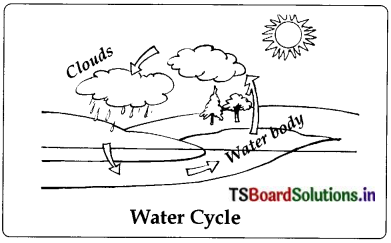
Draw a diagram to explain the water cycle. (Communication through Drawing and Model Making) 4 M
Answer:
TS 6th Class Science 3rd Lesson Questions and Answers Telangana Rain Where Does it Come From 1

Question 10.
How do you feel when you see the beauty of Rainbow ? Express your feelings in the form of a song or a poem. (Aesthetic Sence, Values
and Application to Daily Life and Concern to Bio-diversity) 8M
Answer:

  1. The Rainbow formation during rainy season is a natural phenomenon in the sky.
  2. The refractive index of the light through tiny droplets of rain after rain fall designs the rainbow.
  3. The rainbow is the seven coloured structure of visible light rays of electro magnetic radiation.
  4. It possesses Violet, Indigo, Blue, Green, Yellow, Orange and Red colours which are embedded in visible light.
  5. The beauty of rainbow is beyond our imagination.
    My feelings on rainbow are as follows :
    The beauty of seven colours of crayon
    I am smiling at nature that goes on
    Greet me, I greet you forever and ever
    See me, I see you and leave you never
    Oh God ! What a great creation you make
    For the leisure of creatures and their sake

TS 6th Class Science 3rd Lesson Questions and Answers Telangana - Rain: Where Does it Come From?

Question 11.
Clouds once seen at a particular point, may not be there after sometime? Why? (Asking Questions and Making Hypothesis) 4 M
Answer:

  1. The clouds once seen at a particular point may not be there after sometime.
  2. This is because of the movement of clouds from high pressure areas to lower pressure areas.
  3. Pressure influences the movement of clouds.
  4. The difference in pressures in two different areas leads to the movement of air.
  5. Thus the clouds also move along with air from high pressure area to low pressure area.

Question 12.
Revanth blew air from his mouth onto the mirror while he was getting ready to go to school. He observed that the image in the mirror was not clear. Do you have any doubts to raise in this situation ? Prepare questions on your doubts. (Asking Questions and Making Hypothesis) 8 M
Answer:
Revanth blew air from his mouth onto the mirror. He confused at the appearance of moist layer on the mirror. He doubted and may have questioned himself in the following way.

  1. What is the reason for the formation of some moist layer on the mirror ?
  2. Why did the mirror become unclear after blowing air on it by mouth ?
  3. What comes out of my mouth while blowing ?
  4. Does it happen even for other animals also ?

Question 13.
If it is raining in a village you don’t find rain another village. Why do you think it is happening so? (Asking Questions and Making Hypothesis) 8 M
Answer:

  1. Often we see that there may be rain in some area, where it may not be in its adjacent areas.
  2. This is because of condensation of clouds due cool air which affects on them in the specific area.
  3. Occurance of winds won’t be same in all the areas. Pressure influences on the presence of air.
  4. Clouds along with winds move from high pressure area to low pressure area at which cool air occurs.
  5. That’s why rain is seen only in some areas, where we can’t see it in its adjacent areas.

Question 14.
If condensation fails to occur innature what happens? (Asking Questions and Making Hypothesis) 8 M
Answer:
If there is no occurance of condensation in the water, water cycle stops due to lack of rains. If there are no rains water sources will not be filled with water. Even ground water level decreases. Low percentage of water levels in the natural water bodies cause damage to the living kingdom, thus it finally lead to destruction of nature. Hence condensation process is very essential in the water cycle.

TS 6th Class Science 3rd Lesson Questions and Answers Telangana - Rain: Where Does it Come From?

Question 15.
Why does the driver of a vehicle wipe the glass inside, even if the wiper is working on outer surface of the glass when he drives in rain ?
(Aesthetic Sence, Values and Application to Daily Life and Concern to Bio-diversity) 8 M
Answer:

  1. The driver wipes the glass inside, even wiper is working on outer surface of the glass when he drives in rain.
  2. Because of the natural process called condensation rain that falls on the glass of the cabin cools its surface.
  3. Air inside the driver’s cabin contains water vapour which is warmer than the outside surface of the glass.
  4. Due to the cold glass, air close to its inner surface will also become cooler.
  5. This changes the water vapour in the air of the inner surface of the glass into water and forms small drops on the inner surface.

TS 6th Class Science 3rd Lesson Notes – Rain: Where Does it Come From?

  • Water is available in nature in three forms, ice (solid form), water (liquid form) and vapour (gaseous form).
  • Solid form of water is ice. Snow occurs naturally.
  • The three forms of water are interchangeable.
    TS 6th Class Science 3rd Lesson Questions and Answers Telangana - Rain Where Does it Come From 2
  • Evaporation : The process of changing of water into water vapour is called evaporation.
  • Condensation : The process of conversion of water vapour into water is called condensation.
  • Water cycle : The conversion of water into water vapour, water vapour to clouds and clouds to rain is known as water cycle.
  • Cloud : Clouds are formed from tiny droplets of water vapour.
  • Water vapour : The gaseous form of water is water vapour.
  • Atmosphere : Atmosphere is the main factor on the earth.
  • Stream : A narrow flow of water.
  • Droplets : Tiny particLes of water.
  • Dew : Small drops of water that form on outdoor surfaces.
  • Rain : Small drops of water falling from clouds.
  • Hails : Winds on the earth are called hails.
  • Breeze : Cool winds are called breeze.
  • Wind : Movement of air from high pressure area to low pressure area.

TS 6th Class Hindi Guide Study Material Pdf Telangana

TS 6th Class Hindi Study Material Pdf Download Telangana

Telangana SCERT Class 6 Hindi Solutions

TS 6th Class Study Material

Telangana SCERT Class 6 Science Solutions – TS 6th Class Science Guide Study Material Telangana Pdf

TS 6th Class Science Study Material Guide Telangana Pdf

TS SCERT Class 6 Science Solutions

TS 6th Class Study Material

TS 6th Class Study Material Telangana Pdf Textbook Solutions

TS 6th Class Study Material Pdf Telangana | TS 6th Class Textbook Solutions Guide

TS Board Solutions

TS 6th Class Maths Guide Pdf | Telangana 6th Class Maths Textbook Solutions Pdf English Medium

Telangana SCERT Class 6 Maths Solutions | TS 6th Class Maths Solutions Study Material Pdf

TS 6th Class Maths Guide Pdf Chapter 1 Knowing Our Numbers

Telangana 6th Class Maths Textbook Solutions Pdf Chapter 2 Whole Numbers

TS 6th Class Maths Solutions Chapter 3 Playing with Numbers

SCERT Telangana Class 6 Maths Solutions Chapter 4 Basic Geometrical Ideas

TS 6th Class Maths Textbook Pdf Chapter 5 Measures of Lines and Angles

TS 6th Class Maths Study Material Pdf Chapter 6 Integers

TS SCERT Class 6 Maths Solutions Chapter 7 Fractions and Decimals

Telangana 6th Class Maths Solutions Pdf Chapter 8 Data Handling

SCERT Telangana 6th Maths Solutions Chapter 9 Introduction to Algebra

TS SCERT 6th Class Maths Solutions Chapter 10 Perimeter and Area

Telangana SCERT 6th Class Maths Solutions Chapter 11 Ratio and Proportion

6th Class Maths Textbook Telangana Chapter 12 Symmetry

6th Class Maths Solutions Telangana Chapter 13 Practical Geometry

Telangana 6th Class Maths Textbook Pdf Chapter 14 Understanding 3D and 2D Shapes

TS 6th Class Study Material

TS 6th Class Telugu Guide Study Material Telangana Pdf

TS 6th Class Telugu Study Material Guide Pdf Download Telangana

6th Class Telugu Question Bank Pdf Telangana

Telangana SCERT Class 6 Telugu Solutions ఉపవాచకం

TS 6th Class Study Material

TS Board 6th Class Science Important Questions 10th Lesson Changes Around Us

These TS 6th Class Science Important Questions 10th Lesson Changes Around Us are crafted to align with the curriculum, ensuring students are well-prepared for assessments.

TS 6th Class Science Important Questions 10th Lesson Changes Around Us

Question 1.
How do colours change?
Answer:
When substances of different colours are mixed, a new substance with a different colour may be formed. This is a reason for the change of colour.

Question 2.
Why do some substances appear coloured?
Answer:
A coloured substance absorbs some components of white light (VIBGYOR) and reflects the remaining colours. For example, a red book absorbs all the components of the white light except red (absorbs VIBGYO only). So the book reflects red light only. So the book appears red to our eyes.
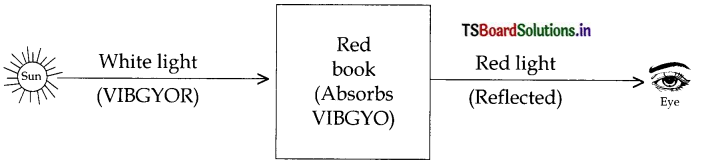
TS Board 6th Class Science Important Questions 10th Lesson Changes Around Us 1

Question 3.
What can be the reasons for the changes taking place, when milk changes to curd?
Answer:
Reasons:

  • The reason for change of milk into curd is due to addition of some curd to warm milk.
  • This added curd helps to grow some kind of bacteria in it and enables convertion of the milk into curd. Curd is a milk protein.

Question 4.
What changes do you observe from winter season to summer season?
Answer:

  • The winter season is cool and summer season is hot.
  • In winter, duration of night is longer than in summer.

The above changes are because of changes in seasons.

TS Board 6th Class Science Important Questions 10th Lesson Changes Around Us

Question 5.
Which changes could possibly be the causes for the change in seasons?
Answer:
(i) Seasons are caused because of earth’s inclination. It is inclined at an angle of 23! degrees to the orbit of its rotation around the sun. The earth is at four different places in the above figure. The sun is in the middle. The earth is away from the sun in different distances. The axis of the earth is inclined (we can observe it 23 12°) Seasons are caused because of earth’s inclination.
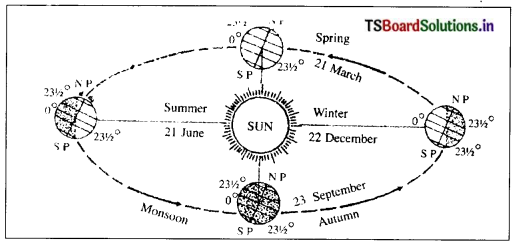
TS Board 6th Class Science Important Questions 10th Lesson Changes Around Us 2

(ii) Seasons change, because of revolution of the earth round the sun. The sun does not exactly rise in the east every day. It changes slightly every day. The slight change in the direction of the sunrise is also a reason for changes in seasons.

Question 6.
What is the duration of longest day in December?
Answer:
11 hours 11 minutes (17: 40-06 : 29).

Question 7.
What is the duration of longest day in May?
Answer:
13 hours 5 minutes (18 : 46 – 5 : 41).

TS Board 6th Class Science Important Questions 10th Lesson Changes Around Us

Question 8.
Do December and May belong to the same season ? If not, to which seasons do they belong?
Answer:
No. December belongs to winter season. May belongs to summer season.

Question 9.
Does the sun rise exactly in the east in all seasons? Explain.
Answer:
No.

  • Around 20th December the direction of sunrise is a little south of east.
  • Around 15 May, the direction of sunrise is very close to the east.

Question 10.
Are there differences in the duration of day and night everyday? If so, why?
Answer:

  • Yes. There are differences in the duration of day and night everyday. We do not find ‘day’ and ‘night’ of equal duration everyday.
  • Reason : The axis of the earth is inclined at an angle of 23 degrees to the plane of its orbit. Hence we do not find day and night of equal duration every day.
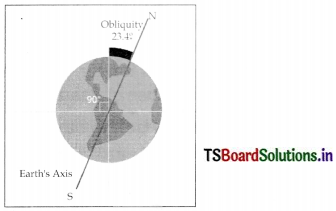
TS Board 6th Class Science Important Questions 10th Lesson Changes Around Us 3

Question 11.
Statements: Milk changes to curd. Seasons change.
(i) Which change is slow and which is fast? Why?
Answer:
Change of seasons is slow when compared to change of milk into curd.
Reason:

  • Every season extends for 4 months. So change of seasons is a slow process.
  • Curdling of milk is a chemical reaction initiated by bacteria. Chemical reactions take place quickly.

(ii) Which change takes place naturally?
Answer:
Change of seasons. It is related to the earth and its revolution around the sun.

TS Board 6th Class Science Important Questions 10th Lesson Changes Around Us

(iii) Which change needs initiation I intervention of human beings to occur?
Answer:
Change of milk to curd needs initiation and intervention from human beings. Because we have to add some curd to warm milk and keep it undisturbed for sometime.

(iv) Which is a temporary change and which is permanent?
Answer:
Seasonal changes are temporary because these changes are continuous as shown below. winter

Question 12.
Is it possible to classify certain changes? How would you classify?
Answer:

  • It is possible to classify certain changes.
  • The changes can be classified based on some grounds.

Ex : Slow changes – Fast changes; Natural changes – Man-made changes; Temporary changes Permanent changes; Physical changes – Chemical changes; Reversible changes – Irreversible changes etc.

Question 13.
Write the indicators and causes for the changes given below.
Answer:
Indicators of change are – colour, taste, state, smell etc.
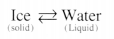
(i) Change of ice into water and water into ice.
Indicators of change: Physical state, colour
TS 6th Class Science Important Questions 10th Lesson Changes Around Us 5
These two states of matter differ in their state and also differ in appearance.
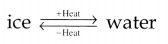
Reason for change : When ice absorbs heat, it melts and gives water. When water is cooled to 0°C, it loses heat and changes to ice.
TS 6th Class Science Important Questions 10th Lesson Changes Around Us 7

TS Board 6th Class Science Important Questions 10th Lesson Changes Around Us

(ii) Rusting of Iron : Indicators of change : Change in colour, hardness of metal, formation of layers.
When iron rusts, a reddish brown coating is formed on it. It converts into a loose layer and detaches after sometime. Thus iron decays gradually.

Reason for change : In presence of sunlight, moisture and air, iron reacts with oxygen of air and moisture (water vapour present in air). Then the iron converts into a new substance, called rust (hydrated ferric oxide).

TS 6th Class Science Important Questions 10th Lesson Changes Around Us 9

(iii) Growth in plants:
Indicators of change: Height of plant, number of leaves, hardening of its stem.
Reason for change : Availability of water, fresh air, sun-light, nutrients etc.

(iv) Rice to cooked rice:
Indicators of change : Physical state, appearance, smell, stickiness.
Reason for change : The solid rice absorbs water and turns to semi-solid. white sticky mass. The volume also increases due to absorption of water. Cooked rice has a different smell.

(v) Melting of Ice- Cream:
Indicators of change : Physical state.
Reason for change : Absorption of heat from the surroundings by the ice-cream.

TS 6th Class Science Important Questions 10th Lesson Changes Around Us 10

(vi) Boiling the egg in water:
Indicators of change : Size of egg, hardness, weight.
Reason for change : The contents of the egg convert into a soft solid mass from semi solid form, due to heat.

(vii) Electric bulb on and off:
Indicators of change : Emission of light, consumption of electrical energy.
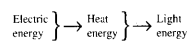
Reason for change : When switched on, electricity flows through the filament of the bulb. The filament gets heated up. This hot filament emits light. Here, electrical energy changes into heat energy and then to light energy.
TS 6th Class Science Important Questions 10th Lesson Changes Around Us 11

(viii) Changes in Atti Patti plant (Touch – me – not plant) : When we touch (a physical action) the attipatti plant, chemical change occurs inside the leaves and the leaves get folded.

TS Board 6th Class Science Important Questions 10th Lesson Changes Around Us

Question 14.
Mention one change you observe in nature.
Answer:
Growth of fresh leaves on plants.

Question 15.
Mention one change you observe in our body.
Answer:
Increase in height.

Question 16.
What is the physical state of curd?
Answer:
A semi-solid.

Question 17.
Which enables conversion of the milk into curd?
Answer:
A kind of bacteria.

Question 18.
Which type of clothes do we like to wear in summer?
Answer:
Cotton clothes.

Question 19.
Does the sunrise exactly in the same place on all the days?
Answer:
No.

Question 20.
Does the sun rise exactly in the east in all seasons?
Answer:
No

TS Board 6th Class Science Important Questions 10th Lesson Changes Around Us

Question 21.
Why days and nights are formed?
Answer:
Because of the rotation of earth on its own axis.

Question 22.
Why seasons are formed?
Answer:
Because of earth’s inclination.

Question 23.
What questions will you ask your teacher to know about any change that occurs in the nature?
Answer:

  • What has changed?
  • How do we know that it has changed?
  • What are the possible reasons for that change?
  • Which seems to be the most appropriate reason?
  • How would we check if the reason is correct?

Question 24.
If changes do not occur in nature, what would be the consequence?
Answer:
We can’t imagine our life without occurrence of changes in nature Absence or lack of changes make us suffer from availability of food, shelter, water, protection etc. Not only man but also other living things will struggle due to absence of changes.

Question 25.
Are there any other properties by which you can categorize the above changes?
Answer:
They can be further categorized based on properties like:

  • Physical change – Chemical change.
  • Reversible change – Irreversible change.
  • Colour change.

Question 26.
Do you know how milk can be converted into curd?
(Or)
How can milk be converted into curd ? Explain.
Answer:
Curdling of Milk:

  • Milk is heated gently to boiling and allowed to cool.
  • To the warm milk, a very small quantity of curd (sample curd) is added and stirred well.
  • The vessel is kept undisturbed for a few hours.
  • Then a white semi-solid mass appears in the vessel. It is curd.

TS Board 6th Class Science Important Questions 10th Lesson Changes Around Us

Question 27.
What changes do you see when milk is converted into curd?
Answer:
When milk changes to curd, there is change in the colour, taste and in the state.
Colour : Though both milk and the curd appear white, there is a slight difference in their colours.
Taste: Milk is some what sweet and curd is slightly sour to taste.
Physical state : Milk is a liquid. Curd is a semi-solid.
However, the weights and volumes of the two substance remains the same.

Question 28.
What changes do you observe when the season changes?
Answer:
The following changes we observe when the season changes.

  • Change in temperature.
  • Direction of the sun.
  • Humidity condïtions in the weather.
  • Change in wearing type of clothes.
  • Change in duration of day and night.

Question 29.
Observe the following table and answer to the questions given below.
Answer:

ChangesNaturalManTemporaryPermanentChanges in the StateChanges in the Shape
Milk to curdNomadeNoYesYesNo
Change in SeasonsYesYesYesNoYes
Egg to boiled EggNoNoNoYesYesYes
Rusting of IronYesYesNoYesYesYes
Growth in PlantsYesNoNoYesYesYes
Rice to cooked riceNoNoNoYesYesYes
Melting of Ice-CreamYesYesYesNoYesYes
Changes in Atti patti PlantYesNoYesNoYesYes

Questions:
(a) Write about any one man made change?
(b) What are the natural changes?
(c) What are the permanent changes?
(d) Why boiled egg is permanent change?
Answer:
(a) Rice to cooked rice is a man made change.
(b) Changes in seasons, rusting of iron, growth in plants, changes in Atti patti plant, Milk to curd, melting of ice-cream. Changes that occur themselves in the nature are called natural changes.
(c) Milk to curd, egg to boiled egg, rusting of iron, growth in plants, rice to cooked rice, Melting of
ice-cream. The change that occurs in the matter and never come back to its original state is called permanent change.
(d) Raw egg has shed with liquid yolk. After boiling yolk (liquid part) becomes solid substance.

TS Board 6th Class Science Important Questions 10th Lesson Changes Around Us

Question 30.
Observe the following table and answer to the questions given below.

ManukotaMonthTemperature


Rainfall
ManukotaJanuaryMin.Max.2.42 mm
April20°C28°C0.02 mm
August38°C49°C39.12 mm
January25°C36°C

1. Which month had minimum rainfall?
Answer: Month of April had minimum rain fall.

2. August occurs In which season ? How can you support your answer?
Answer: Rainy season occures in the month of August because the rainfall is more in this month.

TS Board 6th Class Science Important Questions 10th Lesson Changes Around Us

Question 31.
Read the following table and answer the questions.
Answer the following questions:

PlaceMonth


Temperature

RainfallSun riseSun rise
Min.Max.
Renta

Chintala

January21 °C27°C2.44 mm6.556.55
April39°C47°C0.10 mm6.106.10
August24°C34°C38.42 mm6.336.33

(i) Which month was recorded with lowest temperature? How much?
Answer:
Month of January was recorded with lowest temperature. The recorded temperature was 21°C.

(ii) In which month the duration of the day the time was maximum?
Answer:
In the month of April duration of day was maximum.

(iii) What changes do you identify ¡n January to April?
Answer:
Winter season changes into summer season.

(iv) Which season occurs in the month of April ? What changes takes does in this season?
Answer:
Summer season is seen in April. Climate become very hot.

Question 32.
Ramesh has observed the changes and filled the table. Can you do this?

ChangeNaturalMan madeTemporaryPermanent
Change from Milk to curd
Change in seasons
Rusting of iron
Growth in plants
Changes in Attipatti
Boiling of egg

(a) In the above changes which are natural and permanent changes?
Answer:
Rusting of iron and growth in plants are natural and permanent changes.

(b) Which of the above changes are man made?
Answer:
Change from milk to curd and boiling of egg are man made changes.

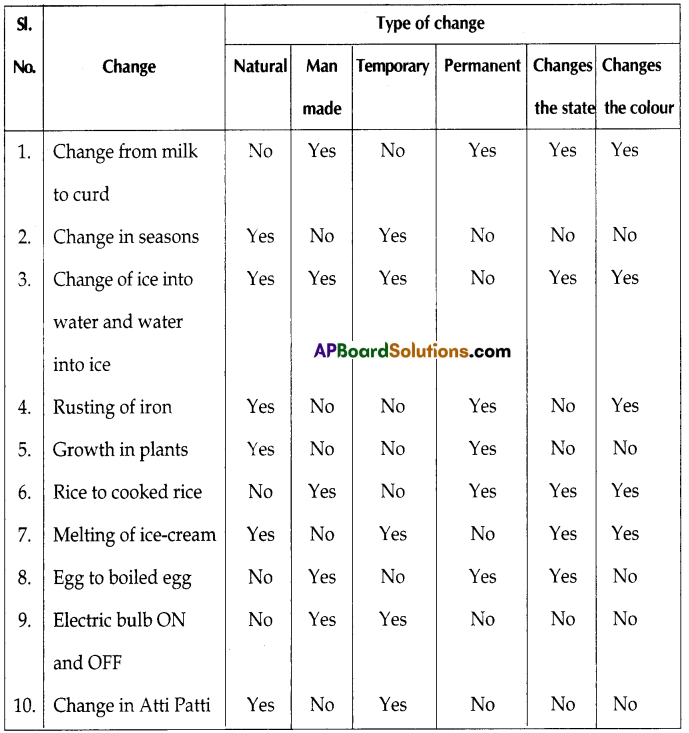
Question 33.
Observe the table and answer the following questions.
Answer:
TS-6th-Class-Science-Important-Questions-10th-Lesson-Changes-Around-Us-15

(i) How many changes are natural?
Answer:
Six.

(ii) How many are man-made?
Answer:
Five

(iii) How many changes are temporary?
Answer:
Five.

(iv) How many are permanent?
Answer:
Five.

(v) How many changes are slow?
Answer:
Slow’ is a relative term.

(vi) How many are fast?
Answer:
‘Fast’ is a relative term.

TS Board 6th Class Science Important Questions 10th Lesson Changes Around Us

List the changes in the following table.
Answer:

Slow ChangeFast Change
Change from milk to curdMelting of ice-cream
Change in seasons
Change of ice into water and water into ice Electric bulb ON and OFF
Rusting of iron
Growth in plants
Egg to boiled egg
Rice to cooked riceChange in Atti Patti

Question 34.
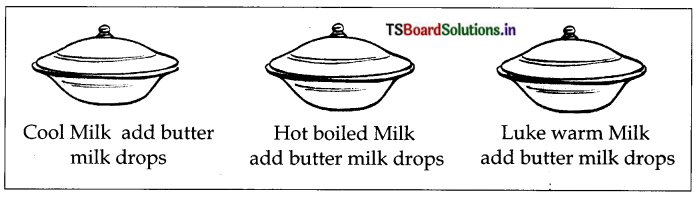
Observe the below pictures. Give a brief explanation about curdling of milk in which vessel we will see curd ? why?
TS Board 6th Class Science Important Questions 10th Lesson Changes Around Us 6
Answer:

  • The vessel with luke warm milk and butter milk drops will have curd.
    Luke warm condition of milk enables curd.
  • Where as two vessels with cool milk and hot boiled milk cannot bring the change.
  • The temperature is the factor that helps in curdling of milk.

TS Board 6th Class Science Important Questions 10th Lesson Changes Around Us

Question 35.
Observe the given pictures. Write your conclusion?
Answer:
It is concluded that the sun does not rise exactly in the east in all seasons. In summer it rises exactly in the east. During winter it rises in little south of east.

Question 36.
How changes that occur in the nature keep the man in a comfortable living conditions?
Answer:

  • Changes in the seasons help the man growing crops in the field.
  • Different seasonal changes from rainy season to summer season help to harvest different types of crops.
  • Changing milk into curd is an amazing fact. Microbes bring the change in milk.
  • Changes in seasons help the man to protect health from various diseases.

TS 6th Class Science Bits 10th Lesson Changes Around Us

The multiple-choice format of TS 6th Class Science Bits with Answers 10th Lesson Changes Around Us allows students to practice decision-making and selecting the most appropriate answer.

TS 6th Class Science Bits 10th Lesson Changes Around Us

Question 1.
This is our common experience
A) cyclones
B) hail storms
C) curdling of milk
D) earth quakes
Answer:
C) curdling of milk

Question 2.
Curd is prepared by. …… to the lukewarm milk.
A) adding little curd
B) adding drops of butter milk
C) removing milk protein
D) A and B
Answer:
D) A and B

TS 6th Class Science Bits 10th Lesson Changes Around Us

Question 3.
We notice changes in our body such as …….
A) height of body
B) length of nails
C) A and B
D) decrease in brain size
Answer:
C) A and B

Question 4.
Change in the colour of shirt may occur due to ………
A) tea drops
B) water drops
C) white petrol
D) All the above
Answer:
A) tea drops

Question 5.
The adding of little curd to the milk helps to ……….
A) grow microbes
B) grow bacteria
C) grow proteins
D) grow fungi
Answer:
B) grow bacteria

Question 6.
Days and nights occur due to … of earth on its own axis.
A) change
B) reaction
C) jumping
D) rotation
Answer:
D) rotation

TS 6th Class Science Bits 10th Lesson Changes Around Us

Question 7.
Duration of a day is …………… of changes in season.
A) reaction
B) an indicator
C) commander
D) follower
Answer:
B) an indicator

Question 8.
Sun light Is the mixture of ………… colours.
A) 6
B) 7
C) 5
D) 8
Answer:
B) 7

Question 9.
Seasons are caused because of
A) Earth’s inclination
B) Sun’s rotation
C) Moon’s rotation around the Sun
D) Moon
Answer:
A) Earth’s inclination

TS 6th Class Science Bits 10th Lesson Changes Around Us

Question 10.
Identify the correct match
1. Iron rusting ( ) a. Temporary change
2. Melting of ice ( ) b. Man-made change
3. Milk turns into curd ( ) c. Permanent change
A) 1 – a, 2 – b, 3 – c
B) 1 – a, 2 – c, 3 – b
C) 1 – b, 2 – a, 3 – c
D) 1 – c, 2 – a, 3 – b
Answer:
A) 1 – a, 2 – b, 3 – c

Question 11.
A temporary change …………
A) Burning of candle
B) Growth of nails
C) Rusting of iron
D) Burning of coal
Answer:
A) Burning of candle

TS 6th Class Science Bits 10th Lesson Changes Around Us

Question 12.
A change that cannot be reversed
A) Cooking of food
B) Curdling of milk
C) Ripening of a mango
D) All of them
Answer:
D) All of them

Question 13.
Blowing of a balloon is a …….. change
A) temporary
B) permanent
C) stable
D) unstable
Answer:
A) temporary

Question 14.
Change of season is ………….
A) Temporary
B) permanent
C) continuous
D) B or C
Answer:
A) Temporary

Question 15.
Conversion of ice into water is ………..
A) temporary change
B) permanent change
C) no change
D) chemical change
Answer:
A) temporary change

Question 16.
Classification of changes is based on .……..
A) chemicals
B) hard ships
C) indicators
D) substances
Answer:
C) indicators

TS 6th Class Science Bits 10th Lesson Changes Around Us

Question 17.
Process of melting of icecream is
A) Permanent change
B) Temporary change
C) Chemical change
D) None
Answer:
B) Temporary change

Question 18.
When iron rusts
A) It changes colour
B) It changes physical state
C) It does not change
D) It becomes vapour
Answer:
A) It changes colour

Question 19.
Find out the man-made activity
A) Sun rays
B) Changing the milk into curd
C) Moon light
D) All the above
Answer:
B) Changing the milk into curd

Question 20.
Changing milk into curd is not a
A) Temporary change
B) Chemical change
C) Slow change
D) Permanent change
Answer:
D) Permanent change

Question 21.
This change takes place without any cause
A) Melting of ice
B) Evaporation of water
C) Rising of sun
D) None of these
Answer:
C) Rising of sun

Question 22.
Match the following:
1. Summer ( ) a. Sun rises in south of east
2. Winter ( ) b. More water available
3. Rainy season ( ) c. Temporary change
A) 1 – a, 2 – c, 3 – b
B) 1 – c,  2 – a, 3 – b
C) 1 – b, 2 – c, 3 – a
D) 1- a, 2 – b, 3 – c
Answer:
B) 1 – c,  2 – a, 3 – b

TS 6th Class Science Bits 10th Lesson Changes Around Us

Question 23.
Read the following:
1) Melting of ice-cream is a fast change.
2) Change in seasons is a slow change.
3) Growth in plants is a fast change.
4) Change in Atti patti is a slow change. The correct statements are…………..
A) 1 & 3
B) 1 & 4
C) 1& 2
D) 2 & 3
Answer:
B) 1 & 4

Question 24.
Milk is not turned into curd. Guess the reasons.
1. Buttermilk added to hot milk
2. Buttermilk added to cold milk
3. Buttermilk added to luke warm milk
4. Buttermilk is not added to milk
A) 1,2,3
B) 1,2,4
C) 2, 3, 4
D) All of the Above
Answer:
B) 1,2,4

Question 25.
Find the odd one out regarding natural and man made change.
A) Milk into curd
B) Eggs to boiled egg
C) Melting of ice-cream
D) Summer season
Answer:
A) Milk into curd

Question 26.
Read the statements
P. Growth in the plants is temporary change
Q. Melting of Ice cream is temporary change.In the above statements
A) P is correct
B) Q is correct
C) P and Q are correct
D) P and Q both are wrong
Answer:
B) Q is correct

Question 27.
Summer is hot: cotton dress : Winter is cool.
A) hot coffee
B) Sweden
C) cold water
D) none
Answer:
B) Sweden

Question 28.
Find the natural change among the following options.
A) Seasonal changes
B) Growing plants
C) Rusting of iron
D) All the above
Answer:
D) All the above

Question 29.
One of the changes is not man made
A) Furniture works
B) Seasons
C) Making dosa
D) Preparing coffee
Answer:
B) Seasons

Question 30.
To explain any change what type of questions we need to ask?
A) What has changed?
B) Write the reasons for the change.
C) How do we know that it has changed?
D) All the above are relavant questions
Answer:
D) All the above are relavant questions

Question 31.
1) Flowers bloom and wither away.
2) Increase in body height.
The above mentioned changes are …………….
A) Temporary changes
B) Permanent changes
C) Man made changes
D) Transparent changes
Answer:
B) Permanent changes

TS 6th Class Science Bits 10th Lesson Changes Around Us

Question 32.
Slight change in the direction of the sunrise is ……………
A) One of the reasons for seasons
B) Only the reason for season
C) Not a reason for seasons
D) Reason influenced by man
Answer:
A) One of the reasons for seasons

Question 33.
1) Change of seasons is a natural change.
2) Changing milk into curd needs our interference
A) Both 1 & 2 sentences are correct
B) 1 is true 2 sentence is false
C) Sentence 1 is false and 2 sentence is true
D) Both 1 & 2 sentences are false
Answer:
A) Both 1 & 2 sentences are correct

Question 34.
The indicators you observed while changing milk into curd
A) state
B) taste
C) smell
D) all the above
Answer:
D) all the above

Question 35.
You wear these clothes in winter
A) woollen
B) cotton
C) silk
D) jute
Answer:
A) woollen

Question 36.
Example of a chemical change
A) Change of ice into water
B) Changes in Atti pathi
C) Explosion of fire works
D) All the above
Answer:
C) Explosion of fire works

Question 37.
What did you notice while comparing milk and curd in your class room?
A) Difference in colour between milk and curd
B) Similarity in liquid condition of milk and curd
C) Difference in size of the milk and curd
D) B or C observation
Answer:
A) Difference in colour between milk and curd

Question 38.
Some of the following show changes in the shape.
(i) Changes in seasons
(ii) Growth in plants
(iii) Melting of candle
(iv) Rice to cooked rice
(v) Melting of ice-cream
A) i, ii, iii, v
B) ii, iii, iv, v
C) iii, iv, v
D) i, iv, v
Answer:
C) iii, iv, v

Question 39.
One of the following need human intervention to bring the change in it.
A) Changes in seasons
B) Rusting of iron
C) Growth in plants
D) Milk to curd
Answer:
D) Milk to curd

Question 40.
In summer we wear these clothes
A) Woollen
B) Polyester
C) Nylon
D) Cotton
Answer:
D) Cotton

Question 41.
Ravi prepared an idol with mud and water. Name the change in it.
A) Permanent change
B) Temporary change
C) Natural change
D) Artificial change
Answer:
B) Temporary change

Question 42.
Find out the correct sentence
A) Change of ice into water – permanent change
B) Change of rice into idly – permanent change
C) Change of vegetables into curry – temporary change
D) All are correct
Answer:
B) Change of rice into idly – permanent change

TS 6th Class Science Bits 10th Lesson Changes Around Us

Question 43.
Day time is less during
A) Winter season
B) Summer
C) Rains season
D) None
Answer:
A) Winter season

Question 44.

ChangeIndicators of changeCauses of the change
Change from milk to curdThe small quantity of curd added to warm milk makes certain bacteria converts milk into curd.

What are the indicators you determine for the above activity?
A) Change in state
B) Change in taste
C) Change in smell
D) Above all
Answer:
D) Above all

Question 45.
What have (instrument) you used to observe the directions of the sun rise and sun set?
A) Magnetic compass
B) Bar magnets
C) Clothes
D) Sticks
Answer:
A) Magnetic compass

Question 46.

Slow changeFast change
Growth in plants Changes in seasons Drying wet clothesChange in Atti plant Melting of ice-cream Electric bulb ON and OFF

Find the fast change based on the above table.
A) Growth in plants
B) Melting of ice-cream
C) Drying wet clothes
D) seed into
Answer:
B) Melting of ice-cream

Question 47.

Permanent ChangeTemporary Change
Rusting of iron Curdling of milk Cutting tree into piecesMelting candle wax Water into ice Electric bulb ON and OFF

What are the temporary changes?
A) Rusting of iron
B) Water into ice
C) Cutting tree into pieces
D) Curdling of milk
Answer:
B) Water into ice

Question 48.

Natural changeMan made change
Decomposing dry leaves in the soilFlowers are tied as garland
Growth in plantsConcrete formation
Water vapourisation from seaRaw vegetables into curry

What are natural changes?
A) Leaves decompose in the soil
B) Making concrete
C) Curry formation
D) Electric bulb ON and OFF
Answer:
A) Leaves decompose in the soil

Question 49.

ChangeIndicators changeCauses of the change
Changes in seasonsChange in dress we wear, coldness or hotness of air, food/ drinks we take, usage of water, fruits and flowers available duration of a dayThe change in the direction of sunrise

What are the indicators that influence changes in the seasons?
A) Cold or hot
B) Usage of water and fruits
C) Flowering in the plants
D) Above all
Answer:
D) Above all

TS 6th Class Science Bits 10th Lesson Changes Around Us

Question 50.

Egg to boiled eggMan made change
Electric bulbs ON and OFFMan made change
Changes in Atti patti?

What will be the answer in the place ‘?’ mark?
A) Natural change
B) Artificial change
C) Natural or artificial change
D) Both natural and artificial changes
Answer:
A) Natural change

Question 51.

Growth in plantsPermanent change
Rusting of iron‘?’
Change in seasonTemporary change

What do we see in the iron?
A) Man made change
B) Natural change
C) Permanent change
D) B and C
Answer:
D) B and C

Question 52.
Read the following :

1. Rice to cooked riceSlow change
2. Growth in plantsSlow change
3. Raw vegetables into cooked curry?

What is the nature of change in 3rd one?
A) Slow change
B) Fast change
C) Slow did Fast change
D) Slow or Fast change
Answer:
A) Slow change

TS 6th Class Science Bits 10th Lesson Changes Around Us

Question 53.
The picture shows which season?
TS-6th-Class-Science-Bits-10th-Lesson-Changes-Around-Us-2
A) Summer
B) Rainy
C) Winter
D) All the seasons
Answer:
A) Summer

Question 54.
Which season is conveyed through the given picture?
TS-6th-Class-Science-Bits-10th-Lesson-Changes-Around-Us-4
A) Summer
B) Winter
C) Rainy
D) All the seasons
Answer:
B) Winter

Question 55.
Human intervention doesn’t bring change in one of the following.
A) Milk to curd
B) Egg to boiled egg
C) Flowering in plant
D) Lighting candle
Answer:
C) Flowering in plant