AP Inter 2nd Year Maths Exercise 7h Solutions

Referring to the AP Inter 2nd Year Maths Study Material Chapter 7 Integrals Exercise 7h Solutions makes it easier to understand complex problems.

AP Inter 2nd Year Maths Integrals Solutions Exercise 7h

I.

Question 1.
Evaluate \(\int_{-1}^1(x+1) d x\)
Solution:
Let I = \(\int_{-1}^1(x+1) d x=\left[\frac{x^2}{2}+x\right]_{-1}^1=\left[\frac{1}{2}+1\right]-\left[\frac{1}{2}-1\right]=\frac{1}{2}+1-\frac{1}{2}+1=2\)

Question 2.
Evaluate \(\int_2^3 \frac{1}{x} d x\)
Solution:
Let I = \(\int_2^3 \frac{1}{x} d x=[\log |x|]_2^3=\log |3|-\log |2|=\log \frac{3}{2}\)

AP Inter 2nd Year Maths Exercise 7h Solutions

Question 3.
Evaluate \(\int_1^2\left(4 x^3-5 x^2+6 x+9\right) d x\)
Solution:
\(\int_1^2\left[4 x^3-5 x^2+6 x+9\right] d x=\left[4 \frac{x^4}{4}-5 \frac{x^3}{3}+6 \frac{x^2}{2}+9 x\right]_1^2\)
= \(\left[x^4-\frac{5}{3} x^3+3 x^2+9 x\right]_1^2=\left[2^4-\frac{5}{3}(2)^3+3(2)^2+9(2)\right]-\left[1-\frac{5}{3}+3+9\right]\)
= \(\left[16-\frac{40}{3}+12+18\right]-\left[13-\frac{5}{3}\right]=\left[46-\frac{40}{3}\right]-\left[13-\frac{5}{3}\right]\)
= \(46-\frac{40}{3}-13+\frac{5}{3}=33-\frac{40}{3}+\frac{5}{3}=\frac{99-40+5}{3}=\frac{104-40}{3}=\frac{64}{3}\).

Question 4.
Evaluate \(\int_0^\pi 4 \sin 2 x d x\)
Solution:
\(\int_0^{\frac{\pi}{4}} \sin 2 x d x=\left[\frac{-\cos 2 x}{2}\right]_0^{\frac{\pi}{4}}=\left[\frac{-\cos 2 \frac{\pi}{4}}{2}\right]-\left[\frac{-\cos 0}{2}\right]=0-\left(\frac{-1}{2}\right)=0+\frac{1}{2}=\frac{1}{2}\) [∵ \(\cos \frac{\pi}{2}\) = 0]
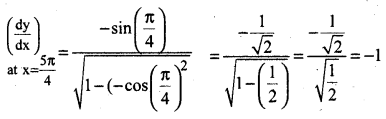
AP Inter 2nd Year Maths Exercise 7h Solutions

Question 5.
Evaluate \(\int_0^\pi 2 \cos 2 x d x\)
Solution:
\(\int_0^{\frac{\pi}{2}} \cos 2 x d x=\left[\frac{\sin 2 x}{2}\right]_0^{\frac{\pi}{2}}=\frac{\sin \pi}{2}-\frac{\sin 0}{2}=\frac{0}{2}-\frac{0}{2}=0\) [∵ sin π = sin 180° = 0]

Question 6.
Evaluate \(\int_4^5 e^x d x\)
Solution:
Let I = \(\int_4^5 e^x d x=\left[e^x\right]_4^5\) = e5 – e4 = e4(e – 1)

AP Inter 2nd Year Maths Exercise 7h Solutions

Question 7.
Evaluate \(\int_0^\pi 4 \tan x d x\)
Solution:
Let I = \(\int_0^{\frac{\pi}{4}} \tan x d x=[-\log \cos x]_0^{\pi / 4}=-\log \left|\cos \frac{\pi}{4}\right|+\log |\cos 0|\)
= \(-\log \left|\frac{1}{\sqrt{2}}\right|+\log |1|=-\log (2)^{\frac{-1}{2}}=\frac{1}{2} \log 2\)

Question 8.
Evaluate \(\int_{\frac{\pi}{6}}^{\frac{\pi}{4}} {cosec} x d x\)
Solution:
I = \(\int_{\frac{\pi}{6}}^{\frac{\pi}{4}} {cosec} x d x=[\log |{cosec} x-\cot x|]_{\pi / 6}^{\pi / 4}=\log \left|{cosec} \frac{\pi}{4}-\cot \frac{\pi}{4}\right|-\log \left|{cosec} \frac{\pi}{6}-\cot \frac{\pi}{6}\right|\)
= \(\log |\sqrt{2}-1|-\log |2-\sqrt{3}|=\log \left(\frac{\sqrt{2}-1}{2-\sqrt{3}}\right)\)

AP Inter 2nd Year Maths Exercise 7h Solutions

Question 9.
Evaluate \(\int_0^1 \frac{d x}{\sqrt{1-x^2}}\)
Solution:
Let I = \(\int_0^1 \frac{d x}{\sqrt{1-x^2}}=\left[\sin ^{-1} x\right]_0^1=\sin ^{-1}(1)-\sin ^{-1}(0)=\frac{\pi}{2}-0=\frac{\pi}{2}\)

Question 10.
Evaluate \(\int_0^1 \frac{d x}{1+x^2}\)
Solution:
Let I = \(\int_0^1 \frac{d x}{1+x^2}=\left[\tan ^{-1} x\right]_0^1=\tan ^{-1}(1)-\tan ^{-1}(0)=\frac{\pi}{4}\)

AP Inter 2nd Year Maths Exercise 7h Solutions

Question 11.
Evaluate \(\int_2^3 \frac{d x}{x^2-1}\)
Solution:
Let I = \(\int_2^3 \frac{\mathrm{dx}}{\mathrm{x}^2-1}=\left[\frac{1}{2} \log \left|\frac{\mathrm{x}-1}{\mathrm{x}+1}\right|\right]_2^3\)
= \(\frac{1}{2}\left[\log \left|\frac{3-1}{3+1}\right|-\log \left|\frac{2-1}{2+1}\right|\right]=\frac{1}{2}\left[\log \left|\frac{2}{4}\right|-\log \left|\frac{1}{3}\right|\right]=\frac{1}{2}\left[\log \frac{1}{2}-\log \frac{1}{3}\right]=\frac{1}{2}\left[\log \frac{3}{2}\right]\)

Question 12.
Evaluate \(\int_2^3 \frac{x d x}{x^2+1}\)
Solution:
Let I = \(\int_2^3 \frac{x}{x^2+1} d x=\frac{1}{2} \int_2^3 \frac{2 x}{x^2+1} d x=\frac{1}{2}\left[\log \left(1+x^2\right)\right]_2^3\)
= \(\frac{1}{2}\left[\log \left(1+3^2\right)-\log \left(1+2^2\right)\right]=\frac{1}{2}[\log (10)-\log (5)]=\frac{1}{2} \log \left(\frac{10}{5}\right)=\frac{1}{2} \log 2\)

AP Inter 2nd Year Maths Exercise 7h Solutions

Question 13.
Evaluate \(\int_0^1 x e^{x^2} d x\)
Solution:
Let I = \(\int_0^1 x e^{x^2} d x\) put x2 = t ⇒ 2x dx = dt
As x → 0, t → 0 and as x → 1, t → 1
∴ I = \(\frac{1}{2} \int_0^1 e^t d t=\frac{1}{2}\left[e^t\right]_0^1=\frac{1}{2} e-\frac{1}{2} e^0=\frac{1}{2}(e-1)\)

Question 14.
Evaluate \(\int_0^{\pi / 4}\left(2 \sec ^2 x+x^3+2\right) d x\)
Solution:
\(\int_0^{\pi / 4}\left(2 \sec ^2 x+x^3+2\right) d x=\left[2 \tan x+\frac{x^4}{4}+2 x\right]_0^{\pi / 4}\)
= \(\left[\left(2 \tan \frac{\pi}{4}+\frac{1}{4}\left(\frac{\pi}{4}\right)^4+2\left(\frac{\pi}{4}\right)\right)-(2 \tan 0+0+0)\right]=2+\frac{\pi^4}{4^5}+\frac{\pi}{2}=2+\frac{\pi}{2}+\frac{\pi^4}{1024}\)

AP Inter 2nd Year Maths Exercise 7h Solutions

Question 15.
Evaluate \(\int_0^\pi\left(\sin ^2 \frac{x}{2}-\cos ^2 \frac{x}{2}\right) d x\)
Solution:
Let I = \(\int_0^\pi\left(\sin ^2 \frac{x}{2}-\cos ^2 \frac{x}{2}\right) d x=-\int_0^\pi\left(\cos ^2 \frac{x}{2}-\sin ^2 \frac{x}{2}\right) d x\)
= \(-\int_0^\pi \cos x d x=-[\sin x]_0^\pi\) = -(sin π – sin 0) = 0 – 0 = 0

Question 16.
Evaluate \(\int_0^{\frac{\pi}{2}} \cos ^2 x d x\)
Solution:
Let I = \(\int_0^{\frac{\pi}{2}} \cos ^2 x d x=\int_0^{\pi / 2}\left(\frac{1+\cos 2 x}{2}\right) d x=\left[\frac{x}{2}+\frac{\sin 2 x}{4}\right]_0^{\pi / 2}=\frac{1}{2}\left[x+\frac{\sin 2 x}{2}\right]_0^{\pi / 2}\)
= \(\frac{1}{2}\left[\left(\frac{\pi}{2}+\frac{\sin \pi}{2}\right)-\left(0+\frac{\sin 0}{2}\right)\right]=\frac{1}{2}\left[\frac{\pi}{2}+0-0-0\right]=\frac{\pi}{4}\)

AP Inter 2nd Year Maths Exercise 7h Solutions

Question 17.
Find the integral of \(\int_0^1 \frac{\mathrm{dx}}{\sqrt{1+\mathrm{x}}-\sqrt{\mathrm{x}}}\)
Solution:
AP Inter 2nd Year Maths Exercise 7h Solutions-1

Question 18.
Evaluate \(\int_0^{\frac{\pi}{2}} \sin ^3 x d x\)
Solution:
Let I = \(\int_0^{\frac{\pi}{2}} \sin ^3 x d x\)
I = \(\int_0^{\frac{\pi}{2}} \sin ^2 x \cdot \sin x d x=\int_0^{\frac{\pi}{2}}\left(1-\cos ^2 x\right) \sin x d x=\int_0^{\frac{\pi}{2}} \sin x d x-\int_0^{\frac{\pi}{2}} \cos ^2 x \cdot \sin x d x\)
= \([-\cos x]_0^{\frac{\pi}{2}}+\left[\frac{\cos ^3 x}{3}\right]_0^{\frac{\pi}{2}}=\left[\cos \frac{\pi}{2}-\cos 0\right]+\frac{1}{3}\left[\cos ^3 \frac{\pi}{2}-\cos ^3 0\right]=1+\frac{1}{3}[-1]=1-\frac{1}{3}=\frac{2}{3}\)

AP Inter 2nd Year Maths Exercise 7h Solutions

II.

Question 1.
Evaluate \(\int_0^1 \frac{2 x+3}{5 x^2+1} d x\)
Solution:
AP Inter 2nd Year Maths Exercise 7h Solutions-2

Question 2.
Evaluate \(\int_0^2 \frac{6 x+3}{x^2+4} d x\)
Solution:
AP Inter 2nd Year Maths Exercise 7h Solutions-3

AP Inter 2nd Year Maths Exercise 7h Solutions

Question 3.
Evaluate \(\int_1^2 \frac{5 x^2}{x^2+4 x+3}\)
Solution:
Let I = \(\int_1^2 \frac{5 x^2}{x^2+4 x+3}\) dx
Dividing the Nr. & Dr. By x2 + 4x + 3 and simplifying, we get
Dividing 5x2 by x2 + 4x + 3, we get
I = \(\int_1^2\left[5-\frac{20 x+15}{x^2+4 x+3}\right] d x=\int_1^2 5 d x-\int_1^2 \frac{20 x+15}{x^2+4 x+3} d x=[5 x]_1^2-\int_1^2 \frac{20 x+15}{x^2+4 x+3} d x\) …(1)
Let I1 = \(\int_1^2 \frac{20 x+15}{x^2+4 x+3} d x\) …………(1)
Let 20x + 15 = A\(\frac{d}{d x}\)(x2 + 4x + 3) + B = 2Ax + (4A + B)
Equating the coefficients of x and constant term, we get
A = 10 and B = -25
∴ 20x + 15 = 10(2x + 4) – 25 [∵ \(\int \frac{d x}{x^2-a^2}=\frac{1}{2 a} \log \left|\frac{x-a}{x+a}\right|+C\)]
⇒ I1 = \(10 \int_1^2 \frac{2 x+4}{x^2+4 x+3} d x-25 \int_1^2 \frac{d x}{(x+2)^2-1^2}=10\left[\log \left|x^2+4 x+3\right|\right]_1^2-25\left[\frac{1}{2} \log \left(\frac{x+2-1}{x+2+1}\right)\right]_1^2\)
= \(\left[10 \log \left(x^2+4 x+3\right)\right]_1^2-25\left[\frac{1}{2} \log \left(\frac{x+1}{x+3}\right)\right]_1^2\)
= [10log15 – 10log8] – 25 \(\left[\frac{1}{2} \log \frac{3}{5}-\frac{1}{2} \log \frac{2}{4}\right]\)
= [10 log(5 × 3) – 10 log(4 × 2)] – \(\frac{25}{2}\)[log 3 – log 5 – log 2 + log 4]
= [10 log5 + 10log3 – 10log4 – 10log2] – \(\frac{25}{2}\)[log3 – log5 – log2 + log4]
= \(\left[10+\frac{25}{2}\right] \log 5+\left[-10-\frac{25}{2}\right] \log 4+\left[10-\frac{25}{2}\right] \log 3+\left[-10+\frac{25}{2}\right] \log 2\)
= \(\frac{45}{2} \log 5-\frac{45}{2} \log 4-\frac{5}{2} \log 3+\frac{5}{2} \log 2=\frac{45}{2} \log \frac{5}{4}-\frac{5}{2} \log \frac{3}{2}\)
Substituting the value I1, in (1), we get
I = \(5-\left[\frac{45}{2} \log \frac{5}{4}-\frac{5}{2} \log \frac{3}{2}\right]=5-\frac{5}{2}\left[9 \log \frac{5}{4}-\log \frac{3}{2}\right]\)

Question 4.
Evaluate \(\int_0^1\left[x e^x+\sin \frac{\pi x}{4}\right] d x\)
Solution:
Let I = \(\int_0^1\left[x e^x+\sin \frac{\pi x}{4}\right] d x\)
AP Inter 2nd Year Maths Exercise 7h Solutions-4

AP Inter 2nd Year Maths Exercise 7h Solutions

Question 5.
Evaluate \(\int_1^3 \frac{d x}{x^2(x+1)}\)
Solution:
Let, \(\frac{1}{x^2(x+1)}=\frac{A}{x}+\frac{B}{x^2}+\frac{C}{x+1} \Rightarrow \frac{A x(x+1)+B(x+1)+C\left(x^2\right)}{x\left(x^2\right)(x+1)}\)
⇒ 1 = Ax(x + 1) + B(x + 1) + C(x2) ⇒ 1 = Ax2 + Ax + Bx + B + Cx2
Equatingthe coefficients of x2, x and constant terms, we get A + C = 0, A + B = 0, B = 1
On solving these equations, we get A = -1, C = 1, B = 1
∴ \(\frac{1}{x^2(x+1)}=\frac{-1}{x}+\frac{1}{x^2}+\frac{1}{(x+1)}\)
⇒ I = \(\int_1^3\left[-\frac{1}{x}+\frac{1}{x^2}+\frac{1}{(x+1)}\right] d x=\left[-\log x-\frac{1}{x}+\log (x+1)\right]_1^3\)
= \(\left[\log \left(\frac{x+1}{x}\right)-\frac{1}{x}\right]_1^3=\log \left(\frac{4}{3}\right)-\frac{1}{3}-\log \left(\frac{2}{1}\right)+1\)
= log 4 – log 3 – log 2 + \(\frac{2}{3}\) = log 2 – log 3 + \(\frac{2}{3}\) = \(\log \left(\frac{2}{3}\right)+\frac{2}{3}\), Hence proved.

Question 6.
Evaluate \(\int_0^1 \frac{x^{\frac{1}{4}}}{1+x^{\frac{1}{2}}} d x\)
Solution:
Put x1/4 = t ⇒ x = t4 ⇒ dx = 4t3 dt.
Also, when x = 0 we get t = 0 and when x = 1 we get t = 11/4 = 1
AP Inter 2nd Year Maths Exercise 7h Solutions-5

AP Inter 2nd Year Maths Exercise 5d Solutions

Referring to the AP Inter 2nd Year Maths Study Material Chapter 5 Continuity and Differentiability Exercise 5d Solutions makes it easier to understand complex problems.

AP Inter 2nd Year Maths Continuity and Differentiability Solutions Exercise 5d

Question 1.
Differentiate \(\frac{e^x}{\sin x}\) w.r.t. x
Solution:
AP Inter 2nd Year Maths Exercise 5d Solutions 1

Question 2.
Differentiate esin-1x w.r.t. x
Solution:
Let y = esin-1x
∴ \(\frac{\mathrm{dy}}{\mathrm{dx}}\) = esin-1x \(\frac{\mathrm{d}}{\mathrm{dx}}\)sin-1x [∵ \(\frac{\mathrm{d}}{\mathrm{dx}}\) ef(x) = ef(x) \(\frac{\mathrm{d}}{\mathrm{dx}}\)f(x)]
= esin-1x \(\frac{1}{\sqrt{1-x^2}}\), x ∈ (-1, 1)

AP Inter 2nd Year Maths Exercise 5d Solutions

Question 3.
Differentiate ex3 w.r.t. x.
Solution:
Let y = ex3 = e(x3)
∴ \(\frac{\mathrm{dy}}{\mathrm{dx}}\) = e(x3) \(\frac{\mathrm{d}}{\mathrm{dx}}\)x3 [∵ \(\frac{\mathrm{d}}{\mathrm{dx}}\) ef(x) = ef(x) \(\frac{\mathrm{d}}{\mathrm{dx}}\)f(x)]
= e(x3)3x2 = 3x2e(x3)

Question 4.
Differentiate sin(tan-1e-x) w.r.t. x:
Solution:
Let y = sin(tan-1e-x)
AP Inter 2nd Year Maths Exercise 5d Solutions 2

AP Inter 2nd Year Maths Exercise 5d Solutions

Question 5.
Differentiate log(cos ex) w.r.t. x.
Solution:
Let y = log(cos ex)
∴ \(\frac{\mathrm{dy}}{\mathrm{dx}}\) = \(\frac{1}{\cos e^x} \frac{d}{d x}\) (cos ex)
= \(\frac{1}{\cos \mathrm{e}^{\mathrm{x}}}\)(-sin ex) \(\frac{\mathrm{d}}{\mathrm{dx}}\) ex
= -(tan ex)ex = -ex (tan ex)

Question 6.
Differentiate ex + ex2+ ……….. + ex5 w.r.t. x.
Solution:
Let y = ex + ex2+ ex3 + ex4 + ex5
∴ \(\frac{\mathrm{dy}}{\mathrm{dx}}\) = \(\frac{\mathrm{d}}{\mathrm{dx}}\)ex + \(\frac{\mathrm{d}}{\mathrm{dx}}\)ex2+ \(\frac{\mathrm{d}}{\mathrm{dx}}\) ex3 + \(\frac{\mathrm{d}}{\mathrm{dx}}\) ex4 + ……….. + \(\frac{\mathrm{d}}{\mathrm{dx}}\)ex5
= ex + ex2\(\frac{\mathrm{d}}{\mathrm{dx}}\) x2 + ex3 \(\frac{\mathrm{d}}{\mathrm{dx}}\) x3 + ex4\(\frac{\mathrm{d}}{\mathrm{dx}}\) x4 + ……….. + ex5 \(\frac{\mathrm{d}}{\mathrm{dx}}\) x5 [∵ \(\frac{\mathrm{d}}{\mathrm{dx}}\) ef(x) = ef(x) \(\frac{\mathrm{d}}{\mathrm{dx}}\)f(x)]
= ex + ex2 2x + ex3 3x2 + ex4 4x3 + ex5 5x4
= ex + 2x ex2+ 3x2 ex3 + 4x3 ex4 + 5x4 ex5

AP Inter 2nd Year Maths Exercise 5d Solutions

Question 7.
Differentiate \(\sqrt{e^{\sqrt{x}}}\), x > 0 w.r.t. x.
Solution:
Let y = \(\sqrt{e^{\sqrt{x}}}\) = \(\left(e^{\sqrt{x}}\right)^{1 / 2}\)
∴ \(\frac{\mathrm{dy}}{\mathrm{dx}}\) = \(\frac{1}{2}\left(e^{\sqrt{x}}\right)^{-1 / 2} \frac{d}{d x} e^{\sqrt{x}}\)
= \(\frac{1}{2 \sqrt{e^{\sqrt{x}}}} e^{\sqrt{x}} \frac{d}{d x} \sqrt{x}\) = \(\frac{1}{2 \sqrt{e^{\sqrt{x}}}} e^{\sqrt{x}} \frac{1}{2 \sqrt{x}}\)
= \(\frac{e^{\sqrt{x}}}{4 \sqrt{x} \sqrt{e^{\sqrt{x}}}}\)=\(\frac{e^{\sqrt{x}}}{4 \sqrt{x e^{\sqrt{x}}}}\)

Question 8.
Differentiate log (log x), x > 1 w.r.t. x
Solution:
Let y = log (log x)
∴ \(\frac{\mathrm{dy}}{\mathrm{dx}}\) = \(\frac{1}{\log x} \frac{d}{d x}(\log x)\) [∵ \(\frac{\mathrm{d}}{\mathrm{dx}}\) logf(x) = \(\frac{1}{f(x)} \frac{d}{d x}\) f(x)]
= \(\frac{1}{\log x} \frac{d}{d x}(\log x)\)
= \(\frac{1}{x \log x}\)

AP Inter 2nd Year Maths Exercise 5d Solutions

Question 9.
Differentiate \(\frac{\cos x}{\log x}\), x > 0 w.r.t. x
Solution:
AP Inter 2nd Year Maths Exercise 5d Solutions 3

Question 10.
Differentiate cos(logx + ex), x > 0 w.r.t x.
Solution:
Let y = cos(logx + ex)
∴ \(\frac{\mathrm{dy}}{\mathrm{dx}}\) = -sin(log x + ex) \(\frac{\mathrm{d}}{\mathrm{dx}}\)(log x + ex)
= -sin(log x + ex) . (\(\frac{1}{x}\) + ex) = -(\(\frac{1}{x}\) + ex)sin(log x + ex)

AP Inter 2nd Year Maths Exercise 7g Solutions

Referring to the AP Inter 2nd Year Maths Study Material Chapter 7 Integrals Exercise 7g Solutions makes it easier to understand complex problems.

AP Inter 2nd Year Maths Integrals Solutions Exercise 7g

I.

Question 1.
Find the integral of \(\sqrt{4-x^2}\)
Solution:
Let I = \(\int \sqrt{4-x^2} d x=\int \sqrt{(2)^2-(x)^2} d x\) [∵ \(\int \sqrt{a^2-x^2} d x=\frac{x}{2} \sqrt{a^2-x^2}+\frac{a^2}{2} \sin ^{-1} \frac{x}{a}+C\)]
∴ I = \(\frac{x}{2} \sqrt{4-x^2}+\frac{4}{2} \sin ^{-1} \frac{x}{2}+C=\frac{x}{2} \sqrt{4-x^2}+2 \sin ^{-1} \frac{x}{2}+C\)

Question 2.
Find the integral of \(\sqrt{1-4 x^2}\)
Solution:
Let I = \(\int \sqrt{1-4 \mathrm{x}^2} \mathrm{dx}=\int \sqrt{1^2-(2 \mathrm{x})^2} \mathrm{dx}\) dx Put 2x = t ⇒ 2 dx = dt
∴ I = \(\frac{1}{2} \int \sqrt{1^2-t^2}=\frac{1}{2}\left[\frac{t}{2} \sqrt{1-t^2}+\frac{1}{2} \sin ^{-1} t\right]+C=\frac{t}{4} \sqrt{1-t^2}+\frac{1}{4} \sin ^{-1} t+C\)
= \(\frac{2 x}{4} \sqrt{1-4 x^2}+\frac{1}{4} \sin ^{-1} 2 x+C=\frac{x}{2} \sqrt{1-4 x^2}+\frac{1}{4} \sin ^{-1} 2 x+C\)

AP Inter 2nd Year Maths Exercise 7g Solutions

Question 3.
Find the integral of \(\sqrt{x^2+4 x+6}\)
Solution:
AP Inter 2nd Year Maths Exercise 7g Solutions-1

Question 4.
Find the integral of \(\sqrt{x^2+4 x+1}\)
Solution:
Let I = \(\int \sqrt{x^2+4 x+1} d x=\int \sqrt{\left(x^2+4 x+4\right)-3} d x\)
= \(\int \sqrt{(x+2)^2-(\sqrt{3})^2} d x\) [∵ \(\int \sqrt{x^2-a^2} d x=\frac{x}{2} \sqrt{x^2-a^2}-\frac{a^2}{2} \log \left|x+\sqrt{x^2-a^2}\right|+C\)]
∴ I = \(\frac{(x+2)}{2} \sqrt{x^2+4 x+1}-\frac{3}{2} \log \left|(x-2)+\sqrt{x^2+4 x+1}\right|+C\)

AP Inter 2nd Year Maths Exercise 7g Solutions

Question 5.
Find the integral of \(\sqrt{1-4 x-x^2}\)
Solution:
Let I = \(\int \sqrt{1-4 x-x^2} d x=\int \sqrt{1-\left(x^2+4 x+4-4\right)} d x=\int \sqrt{1+4-(x+2)^2} d x\)
= \(\int \sqrt{(\sqrt{5})^2-(x+2)^2} d x\) [∵ \(\int \sqrt{a^2-x^2} d x=\frac{x}{2} \sqrt{a^2-x^2}+\frac{a^2}{2} \sin ^{-1} \frac{x}{a}+C\)]
∴ I = \(\frac{(x+2)}{2} \sqrt{1-4 x-x^2}+\frac{5}{2} \sin ^{-1}\left(\frac{x+2}{\sqrt{5}}\right)+C\)

Question 6.
Find the integral of \(\sqrt{x^2+4 x-5}\)
Solution:
Let I = \(\int \sqrt{x^2+4 x-5} d x\)
= \(\int \sqrt{\left(x^2+4 x+4\right)-9} d x=\int \sqrt{(x+2)^2-3^2} d x\)
∴ I = \(\frac{(x+2)}{2} \sqrt{x^2+4 x-5}-\frac{9}{2} \log \left|(x+2)+\sqrt{x^2+4 x-5}\right|+C\)

AP Inter 2nd Year Maths Exercise 7g Solutions

Question 7.
Find the integral of \(\sqrt{1+3 x-x^2}\)
Solution:
AP Inter 2nd Year Maths Exercise 7g Solutions-2

Question 8.
Find the integral of \(\sqrt{x^2+3 x}\)
Solution:
AP Inter 2nd Year Maths Exercise 7g Solutions-3

AP Inter 2nd Year Maths Exercise 7g Solutions

Question 9.
Find the integral of \(\sqrt{1+\frac{x^2}{9}}\)
Solution:
AP Inter 2nd Year Maths Exercise 7g Solutions-4

AP Inter 2nd Year Maths Exercise 5c Solutions

Referring to the AP Inter 2nd Year Maths Study Material Chapter 5 Continuity and Differentiability Exercise 5c Solutions makes it easier to understand complex problems.

AP Inter 2nd Year Maths Continuity and Differentiability Solutions Exercise 5c

I.

Question 1.
Find \(\frac{\mathrm{dy}}{\mathrm{dx}}\) of 2x + 3y = sin x
Solution:
Given that 2x + 3y = sin x.
Differentiating both sides w.r.t x, we have
\(\frac{\mathrm{d}}{\mathrm{dx}}\) (2x) + \(\frac{\mathrm{d}}{\mathrm{dx}}\) (3y) = \(\frac{\mathrm{d}}{\mathrm{dx}}\) sin x
∴ 2 + 3 \(\frac{\mathrm{dy}}{\mathrm{dx}}\) = cos x
∴ \(\frac{\mathrm{dy}}{\mathrm{dx}}\) = \(\frac{\cos x-2}{3}\)
⇒ 3\(\frac{\mathrm{dy}}{\mathrm{dx}}\) = cos x – 2

v

Question 2.
Find \(\frac{\mathrm{dy}}{\mathrm{dx}}\) of 2x + 3y = sin y
Solution:
Given that 2x + 3y = sin y ⇒ \(\frac{\mathrm{d}}{\mathrm{dx}}\) (2x) + \(\frac{\mathrm{d}}{\mathrm{dx}}\) (3y)
= \(\frac{\mathrm{d}}{\mathrm{dx}}\) sin y
∴ 2 + 3\(\frac{\mathrm{dy}}{\mathrm{dx}}\) = cos y\(\frac{\mathrm{dy}}{\mathrm{dx}}\) – 3\(\frac{\mathrm{dy}}{\mathrm{dx}}\)
⇒ \(\frac{\mathrm{dy}}{\mathrm{dx}}\) (cos y – ) = 2
⇒ \(\frac{\mathrm{dy}}{\mathrm{dx}}\) = \(=\frac{2}{\cos y-3}\)

Question 3.
Find \(\frac{\mathrm{dy}}{\mathrm{dx}}\) of ax + by2 = cos y
Solution:
Given that ax + by2 = cos y ⇒ \(\frac{\mathrm{d}}{\mathrm{dx}}\) (ax) + \(\frac{\mathrm{d}}{\mathrm{dx}}\) (by2) = \(\frac{\mathrm{d}}{\mathrm{dx}}\) (cos y)
∴ a + b.2y \(\frac{\mathrm{dy}}{\mathrm{dx}}\) = -sin y\(\frac{\mathrm{d}}{\mathrm{dx}}\)
⇒ 2by \(\frac{\mathrm{dy}}{\mathrm{dx}}\) + sin y\(\frac{\mathrm{dy}}{\mathrm{dx}}\) = -a
⇒ \(\frac{\mathrm{dy}}{\mathrm{dx}}\) (2by + sin y) = -a ⇒ \(\frac{\mathrm{dy}}{\mathrm{dx}}\) = \(\frac{-a}{2 b y+\sin y}\)

Question 4.
Find \(\frac{\mathrm{dy}}{\mathrm{dx}}\) of xy + y2 = tan x + y
Solution:
Given that xy + y2 = tan x + y. ⇒ \(\frac{\mathrm{d}}{\mathrm{dx}}\)(xy) + \(\frac{\mathrm{d}}{\mathrm{dx}}\)y2 = \(\frac{\mathrm{d}}{\mathrm{dx}}\)tan x + \(\frac{\mathrm{d}}{\mathrm{dx}}\)y
(x\(\frac{\mathrm{d}}{\mathrm{dx}}\)y + y\(\frac{\mathrm{d}}{\mathrm{dx}}\)x) + 2y\(\frac{\mathrm{dy}}{\mathrm{dx}}\) = sec2x + \(\frac{\mathrm{dy}}{\mathrm{dx}}\) [∵ From Product Rule]
⇒ x\(\frac{\mathrm{dy}}{\mathrm{dx}}\) + y + 2y\(\frac{\mathrm{dy}}{\mathrm{dx}}\) = sec2 x + \(\frac{\mathrm{dy}}{\mathrm{dx}}\) ⇒ x\(\frac{\mathrm{dy}}{\mathrm{dx}}\) + 2y\(\frac{\mathrm{dy}}{\mathrm{dx}}\) – \(\frac{\mathrm{dy}}{\mathrm{dx}}\) = sec2 x – y
⇒ (x + 2y – 1)\(\frac{\mathrm{dy}}{\mathrm{dx}}\) = sec2x – y
∴ \(\frac{\mathrm{dy}}{\mathrm{dx}}=\frac{\sec ^2 x-y}{x+2 y-1}\)

v

Question 5.
Find \(\frac{\mathrm{dy}}{\mathrm{dx}}\) of x2 + xy + y2 = 100
Solution:
Given that 2 + xy + y2 = 100
⇒ \(\frac{\mathrm{d}}{\mathrm{dx}}\)x2 + \(\frac{\mathrm{d}}{\mathrm{dx}}\)xy + \(\frac{\mathrm{d}}{\mathrm{dx}}\)y2 = \(\frac{\mathrm{d}}{\mathrm{dx}}\)(100)
∴ 2x + (x\(\frac{\mathrm{d}}{\mathrm{dx}}\)y + y\(\frac{\mathrm{d}}{\mathrm{dx}}\)x) + 2y\(\frac{\mathrm{dy}}{\mathrm{dx}}\) = 0
⇒ 2x + x\(\frac{\mathrm{dy}}{\mathrm{dx}}\) + y + 2y\(\frac{\mathrm{dy}}{\mathrm{dx}}\) = 0
⇒ (x + 2y)\(\frac{\mathrm{dy}}{\mathrm{dx}}\) – 2x – y
⇒ \(\frac{\mathrm{dy}}{\mathrm{dx}}=-\frac{(2 x+y)}{x+2 y}\)

Question 6.
Find \(\frac{\mathrm{dy}}{\mathrm{dx}}\) of x3 + x2y + xy2 + y3 = 81
Solution:
Given that x3 + x2y + xy2 + y3 = 81
⇒ \(\frac{\mathrm{d}}{\mathrm{dx}}\)x3 + \(\frac{\mathrm{d}}{\mathrm{dx}}\)x2y + \(\frac{\mathrm{d}}{\mathrm{dx}}\)xy2 + \(\frac{\mathrm{d}}{\mathrm{dx}}\)y3 = 81
∴ 3x2 + x2 \(\frac{\mathrm{dy}}{\mathrm{dx}}\) + y.\(\frac{\mathrm{d}}{\mathrm{dx}}\)x2) + x\(\frac{\mathrm{d}}{\mathrm{dx}}\)y2 + y2 \(\frac{\mathrm{d}}{\mathrm{dx}}\) (x) = 3y2\(\frac{\mathrm{dy}}{\mathrm{dx}}\) = 0
⇒ 3x2 + x2 \(\frac{\mathrm{dy}}{\mathrm{dx}}\) + y2x + x2y \(\frac{\mathrm{dy}}{\mathrm{dx}}\) + y2 . 1 + 3y2 \(\frac{\mathrm{dy}}{\mathrm{dx}}\) = 0
⇒ \(\frac{\mathrm{d}}{\mathrm{dx}}\) (x2 +2xy + 3y2) = -3x2 – 2xy – y2
⇒ \(\frac{\mathrm{dy}}{\mathrm{dx}}=-\frac{\left(3 x^2+2 x y+y^2\right)}{x^2+2 x y+3 y^2}\)

v

Question 7.
Find \(\frac{\mathrm{dy}}{\mathrm{dx}}\) of sin2y + cos xy = k
Solution:
Given that sin2 y + cos xy = k
⇒ \(\frac{\mathrm{d}}{\mathrm{dx}}\) (sin y)2 + \(\frac{\mathrm{d}}{\mathrm{dx}}\)cos xy = \(\frac{\mathrm{d}}{\mathrm{dx}}\)(k)
∴ 2(sin.y)\(\frac{\mathrm{d}}{\mathrm{dx}}\)sin y – sin xy\(\frac{\mathrm{d}}{\mathrm{dx}}\)(xy) = 0
⇒ 2sin y cos y\(\frac{\mathrm{dy}}{\mathrm{dx}}\) – sin xy(x\(\frac{\mathrm{dy}}{\mathrm{dx}}\) + y.1) = 0
⇒ sin2y\(\frac{\mathrm{dy}}{\mathrm{dx}}\) – x sin xy\(\frac{\mathrm{dy}}{\mathrm{dx}}\) – y sin xy = 0
⇒ (sin2y – x sin xy)\(\frac{\mathrm{dy}}{\mathrm{dx}}\) = y sin xy
∴ \(\frac{\mathrm{dy}}{\mathrm{dx}}=\frac{y \sin x y}{\sin 2 y-x \sin x y}\)

Question 8.
Find \(\frac{\mathrm{dy}}{\mathrm{dx}}\) of sin2x + cos2 y = 1
Solution:
Given that sin2 x + cos2 y = 1
⇒ \(\frac{\mathrm{d}}{\mathrm{dx}}\) (sin x)2 + \(\frac{\mathrm{d}}{\mathrm{dx}}\) (cos y)2 = \(\frac{\mathrm{d}}{\mathrm{dx}}\) (1)
∴ 2(sin x)\(\frac{\mathrm{d}}{\mathrm{dx}}\) sin x + 2(cos y)\(\frac{\mathrm{d}}{\mathrm{dx}}\) cos y = 0
⇒ 2 sin x cos x + 2cos y(-sin y\(\frac{\mathrm{dy}}{\mathrm{dx}}\)) = 0
⇒ 2 sin x cos x – 2 sin y cos y\(\frac{\mathrm{dy}}{\mathrm{dx}}\) = 0
⇒ sin 2x – sin 2y\(\frac{\mathrm{dy}}{\mathrm{dx}}\) = o
⇒ sin 2y \(\frac{\mathrm{dy}}{\mathrm{dx}}\) = sin 2x
⇒ \(\frac{\mathrm{dy}}{\mathrm{dx}}=\frac{\sin 2 x}{\sin 2 y}\)

v

II.

Question 1.
Find \(\frac{\mathrm{dy}}{\mathrm{dx}}\) in y = sin-1\(\left(\frac{2 x}{1+x^2}\right)\)
Solution:
Given that y = sin-1\(\left(\frac{2 x}{1+x^2}\right)\)
To simplify the given inverse t-function, we put x = tanθ.
∴ y = sin-1\(\left(\frac{2 \tan \theta}{1+\tan ^2 \theta}\right)\) = sin-1(sin 2θ) = 2θ
⇒ y = 2tan-1x (∵ x tanθ ⇒ θ = tan-1x)
∴ \(\frac{d y}{d x}=2 \frac{1}{1+x^2}=\frac{2}{1+x^2}\)

Question 2.
Find \(\frac{\mathrm{dy}}{\mathrm{dx}}\) in y = tan-1\(\left(\frac{3 x-x^3}{1-3 x^2}\right)\), \(-\frac{1}{\sqrt{3}}<x<\frac{1}{\sqrt{3}}\)
Solution:
Given y = tan-1\(\left(\frac{3 x-x^3}{1-3 x^2}\right)\), \(-\frac{1}{\sqrt{3}}<x<\frac{1}{\sqrt{3}}\)
Put x = tanθ
∴ y = tan-1\(\left(\frac{3 \tan \theta-\tan ^3 \theta}{1-3 \tan ^2 \theta}\right)\) = tan-1(tan 3θ) = 3θ
⇒ y = 3 tan-1x (∵ x = tan θ ⇒ θ = tan-1x)
∴ \(\frac{\mathrm{dy}}{\mathrm{dx}}\) = 3 . \(\frac{1}{1+x^2}=\frac{3}{1+x^2}\)

v

Question 3.
Find \(\frac{\mathrm{dy}}{\mathrm{dx}}\) in y = cos-1\(\left(\frac{1-x^2}{1+x^2}\right)\), 0 < x < 1
Solution:
Given that y = cos-1\(\left(\frac{1-x^2}{1+x^2}\right)\), 0 < x < 1
Put x = tanθ
∴ y = cos-1\(\left(\frac{1-\tan ^2 \theta}{1+\tan ^2 \theta}\right)\) = cos-1(cos 2θ)
y = 2θ = 2tan-1x (∵ x = tan θ ⇒ θ = tan-1x)
∴ \(\frac{\mathrm{dy}}{\mathrm{dx}}\) = 2 . \(\frac{1}{1+x^2}=\frac{2}{1+x^2}\)

Question 4.
Find \(\frac{\mathrm{dy}}{\mathrm{dx}}\) of y = sin-1\(\left(\frac{1-x^2}{1+x^2}\right)\), 0 < x < 1
Solution:
Given that y = sin-1\(\left(\frac{1-x^2}{1+x^2}\right)\)
Put x = tanθ
∴ y = sin-1\(\left(\frac{1-\tan ^2 \theta}{1+\tan ^2 \theta}\right)\) = sin-1(cos 2θ)
= sin-1 sin(\(\frac{\pi}{2}\) – 2θ) = \(\frac{\pi}{2}\) – 2θ
⇒ y = \(\frac{\pi}{2}\) – 2 tan-1x (∵ x = tan θ ⇒ θ = tan-1x)
∴ \(\frac{\mathrm{dy}}{\mathrm{dx}}\) = 0 – 2\(\frac{1}{1+x^2}=\frac{-2}{1+x^2}\)

Question 5.
Find \(\frac{\mathrm{dy}}{\mathrm{dx}}\) of y = cos-1\(\left(\frac{2 x}{1+x^2}\right)\), -1 < x < 1
Solution:
Given that y = cos-1\(\left(\frac{2 x}{1+x^2}\right)\)
Put x = tanθ
∴ y = cos-1\(\left(\frac{2 \tan \theta}{1+\tan ^2 \theta}\right)\) = cos-1(sin 2θ)
= cos-1 sin(\(\frac{\pi}{2}\) – 2θ) = \(\frac{\pi}{2}\) – 2θ
⇒ y = \(\frac{\pi}{2}\) – 2 tan-1x (∵ x = tan θ ⇒ θ = tan-1x)
∴ \(\frac{\mathrm{dy}}{\mathrm{dx}}\) = 0 – 2\(\frac{1}{1+x^2}=\frac{-2}{1+x^2}\)

v

Question 6.
Find \(\frac{\mathrm{dy}}{\mathrm{dx}}\) of y = sin-1(2x\(\sqrt{1-\mathrm{x}^2}\)), \(-\frac{1}{\sqrt{2}}<x<\frac{1}{\sqrt{2}}\)
Solution:
Given that y = sin-1(2x\(\sqrt{1-\mathrm{x}^2}\)). Put x = sinθ
∴ y = sin-1(2 sinθ\(1-\sin ^2 \theta\)) = sin-1(2sinθ\(\cos ^2 \theta\)) = sin-1(2 sinθ cosθ)
⇒ y = sin-1 (sin 2θ) = 2θ = 2 sin-1 x [∵ x = sin θ ⇒ θ = sin-1x)
∴ \(\frac{\mathrm{dy}}{\mathrm{dx}}\) = \(\frac{2}{\sqrt{1-x^2}}\)

Question 7.
Find \(\frac{\mathrm{dy}}{\mathrm{dx}}\) of y = sec-1\(\left(\frac{1}{2 x^2-1}\right),\), 0 < x < \(\frac{1}{\sqrt{2}}\)
Solution:
Put x = cosθ then 2x2 – 1 = 2cos2θ – 1 = cos 2θ) = 2θ
∴ y = sec-1\(\left(\frac{1}{\cos 2 \theta}\right)\) = sec-1 (sec 2θ) = 2θ = 2 cos-1
∴ \(\frac{\mathrm{dy}}{\mathrm{dx}}\) = \(\frac{\mathrm{d}}{\mathrm{dx}}\) (2cos-1x)
= 2\(\left(\frac{-1}{\sqrt{1-x^2}}\right)=\frac{-2}{\sqrt{1-x^2}}\)

AP Inter 2nd Year Maths Exercise 7f Solutions

Referring to the AP Inter 2nd Year Maths Study Material Chapter 7 Integrals Exercise 7f Solutions makes it easier to understand complex problems.

AP Inter 2nd Year Maths Integrals Solutions Exercise 7f

I.

Question 1.
Find the integral of x sin x
Solution:
Let I = ∫x sin x dx
Taking u = x, v = sinx and integrating by parts, we have
I = \(x \int \sin x d x-\int\left[\left(\frac{d}{d x}(x)\right) \int \sin x d x\right] d x=x(-\cos x)-\int 1 \cdot(-\cos x) d x\) = -x cosx + sinx + C

Question 2.
Find the integral of x sin 3x
Solution:
Let I = ∫x sin 3x dx
Taking u = x, v = sin3x and integrating by parts, we have
I = \(x \int \sin 3 x d x-\int\left[\left(\frac{d}{d x} x\right) \int \sin 3 x d x\right] d x\)
= \(x\left(\frac{-\cos 3 x}{3}\right)-\int 1 \cdot\left(\frac{-\cos 3 x}{3}\right) d x=\frac{-x \cos 3 x}{3}+\frac{1}{3} \int \cos 3 x d x\)
= \(\frac{-x \cos 3 x}{3}+\frac{1}{9} \sin 3 x+C=\frac{-x}{3} \cos 3 x+\frac{1}{9} \sin 3 x+C\)

AP Inter 2nd Year Maths Exercise 7f Solutions

Question 3.
Find the integral of x log x
Solution:
Let I = ∫x log x dx
Taking u = log x, v = sin3x and integrating by parts, we have
I = \(\log x \int x d x-\int\left[\left(\frac{d}{d x} \log x\right) \int x d x\right] d x\)
= \(\log x \cdot \frac{x^2}{2}-\int \frac{1}{x} \cdot \frac{x^2}{2} d x=\frac{x^2 \log x}{2}-\int \frac{x}{2} d x=\frac{x^2 \log x}{2}-\frac{x^2}{4}+C\)

Question 4.
Find the integral of x log 2x
Solution:
Let I = ∫x log 2x dx
Taking u = log 2x, v = sin3x and integrating by parts, we have
I = \(\log 2 x \int x d x-\int\left[\left(\frac{d}{d x} \log 2 x\right) \int x d x\right] d x\)
= \(\log 2 x \cdot \frac{x^2}{2}-\int \frac{2}{2 x} \cdot \frac{x^2}{2} d x=\frac{x^2 \log 2 x}{2}-\int \frac{x}{2} d x=\frac{x^2 \log 2 x}{2}-\frac{x^2}{4}+C\)

AP Inter 2nd Year Maths Exercise 7f Solutions

Question 5.
Find the integral of x2 log x
Solution:
Let I = ∫x2 log x dx
Taking u = log x, v = x2 and integrating by parts, we have
I = \(\log x \int x^2 d x-\int\left[\left(\frac{d}{d x} \log x\right) \int x^2 d x\right] d x\)
= \(\log x .\left(\frac{x^3}{3}\right)-\int \frac{1}{x} . \frac{x^3}{3} d x=\frac{x^3 \log x}{3}-\int \frac{x^2}{3} d x=\frac{x^3 \log x}{3}-\frac{x^3}{9}+C\)

Question 6.
Find the integral of x sec2 x
Solution:
Let I = ∫x sec2 x dx
Taking u = x, v = sec2x and integrating by parts, we have
I = \(x \int \sec ^2 x d x-\int\left[\left(\frac{d}{d x} x\right) \int \sec ^2 x d x\right] d x\)
= x tan x – ∫1. tan xdx = x tanx + log|cos x| + C

AP Inter 2nd Year Maths Exercise 7f Solutions

Question 7.
Find the integral of tan-1 x
Solution:
Let I = ∫1.tan-1 x dx
Taking u = tan-1 x, v = 1 and integrating by parts, we have
I = \(\tan ^{-1} x \int 1 d x-\int\left[\left(\frac{d}{d x} \tan ^{-1} x\right) \int 1 . d x\right] d x\)
= \(\tan ^{-1} x . x-\int \frac{1}{1+x^2} x d x=x \tan ^{-1} x-\frac{1}{2} \int \frac{2 x}{1+x^2} d x\)
= \(x \tan ^{-1} x-\frac{1}{2} \log \left|1+x^2\right|+C=x \tan ^{-1} x-\frac{1}{2} \log \left(1+x^2\right)+C\)

Question 8.
Find the integral of (x2 + 1)log x
Solution:
Let I = ∫(x2 + 1)log x dx = ∫x2 logxdx + ∫logx dx
Let I = I1 + I2 ……….(1)
Where, I1 = ∫x2 logxdx and I1 = ∫logx dx
I1 = ∫x2log xdx
Taking u = log x, v = x2 and integrating by parts, we have
I1 = \(\log x \int x^2 d x-\int\left[\left(\frac{d}{d x} \log x\right) \int x^2 d x\right] d x=\log x \cdot \frac{x^3}{3}-\int \frac{1}{x} \cdot \frac{x^3}{3} d x\)
= \(\frac{x^3}{3} \log x-\frac{1}{3}\left(\int x^2 d x\right)=\frac{x^3}{3} \log x-\frac{x^3}{9}+C_1\) …(2)
I2 = ∫log xdx
Taking u = log x, v = 1 and integrating by parts, we have
I2 = \(\log x \int 1 . d x-\int\left[\left(\frac{d}{d x} \log x\right) \int 1 . d x\right]\)
= \(\log x \cdot x-\int \frac{1}{x} \cdot x d x=x \log x-\int 1 \cdot d x=x \log x-x+C_2\) …………(3)
Using equation (2) and (3) in (1), we get
AP Inter 2nd Year Maths Exercise 7f Solutions-1

AP Inter 2nd Year Maths Exercise 7f Solutions

Question 9.
Find the integral of ex(sinx + cosx)
Solution:
We know that ∫ex{f(x) + f(x)} dx = exf(x) + C
Here f(x) = sin x and f'(x) = cos x
∴ I = ∫ex(sin x + cos x) dx = exsin x + C

Question 10.
Find the integral of ex\(\left(\frac{1}{x}-\frac{1}{x^2}\right)\)
Solution:
Let I = ∫ex\(\left(\frac{1}{x}-\frac{1}{x^2}\right)\)dx
We know that ∫ex[f(x) + f'(x)]dx = exf(x) + C
Here, f(x) = \(\frac{1}{x}\) & f'(x) = \(\frac{-1}{x^2}\)
∴ I = \(e^x\left(\frac{1}{x}\right)+C=\frac{e^x}{x}+C\)

AP Inter 2nd Year Maths Exercise 7f Solutions

II.

Question 1.
Find the integral of x2ex
Solution:
Let I = ∫ x2ex dx
Taking u = x2, v = ex and integrating by parts, we have
I = \(x^2 \int e^x d x-\int\left[\left(\frac{d}{d x} x^2\right) \int e^x d x\right] d x=x^2 e^x-\int 2 x e^x d x=x^2 e^x-2 \int x e^x d x\)
Again using integration by parts, we have
I = \(x^2 e^x-2\left[x \int e^x d x-\int\left(\frac{d}{d x} x\right) \int e^x d x\right] d x\)
= x2ex – 2[xex – ex dx] = x2ex – 2[xex – ∫ex]
= x2ex – 2xex + 2ex + C = ex(x2 – 2x + 2) + C

Question 2.
Find the integral of x sin-1 x
Solution:
Let I = ∫ xsin-1x dx
Taking u = sin-1 x, v = x and integrating by parts we have
I = \(\sin ^{-1} x \int x d x-\int\left[\left(\frac{d}{d x} \sin ^{-1} x\right) \int x d x\right] d x=\sin ^{-1} x\left(\frac{x^2}{2}\right)-\int \frac{1}{\sqrt{1-x^2}} \cdot \frac{x^2}{2} d x\)
= \(\frac{x^2 \sin ^{-1} x}{2}+\frac{1}{2} \int \frac{-x^2}{\sqrt{1-x^2}} d x\)
AP Inter 2nd Year Maths Exercise 7f Solutions-2

AP Inter 2nd Year Maths Exercise 7f Solutions

Question 3.
Find the integral of x tan-1 x
Solution:
Let I = ∫ x tan-1 xdx
Taking u = tan-1 x, v = x and integrating by parts we have
AP Inter 2nd Year Maths Exercise 7f Solutions-3

Question 4.
Find the integral of x cos-1 x
Solution:
Let I = ∫ x cos-1 xdx
Taking u = cos-1 x, v = x and integrating by parts we have
AP Inter 2nd Year Maths Exercise 7f Solutions-4
AP Inter 2nd Year Maths Exercise 7f Solutions-5

AP Inter 2nd Year Maths Exercise 7f Solutions

Question 5.
Find the integral of \(\frac{x \cos ^{-1} x}{\sqrt{1-x^2}}\)
Solution:
Let I = \(\int \frac{x \cos ^{-1} x}{\sqrt{1-x^2}} d x=\frac{-1}{2} \int \frac{-2 x}{\sqrt{1-x^2}} \cdot \cos ^{-1} x d x\)
Taking u = cos-1 x, v = \(\left(\frac{-2 x}{\sqrt{1-x^2}}\right)\) and integrating by parts we have
AP Inter 2nd Year Maths Exercise 7f Solutions-6

Question 6.
Find the integral of x(log x)2
Solution:
Let I = ∫ x(log x)2 dx
Taking u = (log x)2, v = x and integrating by parts, we have
I = \((\log x)^2 \int x d x-\int\left[\left(\frac{d}{d x}(\log x)^2\right) \int x d x\right] d x\)
= \(\frac{x^2}{2}(\log x)^2-\left[\int 2 \log x \frac{1}{x} \frac{x^2}{2} d x\right]=\frac{x^2}{2}(\log x)^2-\int x \log x d x\)
Again, using integrated by parts, we have
I = \(\frac{x^2}{2}(\log x)^2-\left[\log x \int x d x-\int\left(\left(\frac{d}{d x} \log x\right) \int x d x\right) d x\right]\)
= \(\frac{x^2}{2}(\log x)^2-\left[\frac{x^2}{2} \log x-\int \frac{1}{x} \cdot \frac{x^2}{2} d x\right]=\frac{x^2}{2}(\log x)^2-\frac{x^2}{2} \log x+\frac{1}{2} \int x d x\)
= \(\frac{x^2}{2}(\log x)^2-\frac{x^2}{2} \log x+\frac{x^2}{4}+C\)

AP Inter 2nd Year Maths Exercise 7f Solutions

Question 7.
Find the integral of \(\frac{x e^x}{(1+x)^2}\)
Solution:
We know that ∫ex[f(x) + f'(x)] dx = exf(x) + C
Here, f(x) = \(\frac{1}{1+x}\) and f'(x) = \(\frac{-1}{(1+x)^2}\)
∴ I = \(\int \frac{x e^x}{(1+x)^2} d x=\int e^x\left[\frac{x}{(1+x)^2}\right] d x=\int e^x\left[\frac{1+x-1}{(1+x)^2}\right] d x=\int e^x\left[\frac{1}{1+x}-\frac{1}{(1+x)^2}\right] d x\)
∴ I = \(e^x \frac{1}{1+x}+C=\frac{e^x}{1+x}+C\)

Question 8.
Find the integral of \(e^x\left(\frac{1+\sin x}{1+\cos x}\right)\)
Solution:
AP Inter 2nd Year Maths Exercise 7f Solutions-7
[∵ ∫ ex[f(x) + f'(x)] dx = exf(x) + C Here \(\tan \frac{x}{2}\) = f(x) & f'(x) = \(\frac{1}{2}\)sec2\(\frac{x}{2}\)]

AP Inter 2nd Year Maths Exercise 7f Solutions

Question 9.
Find the integral of \(\frac{(x-3) e^x}{(x-1)^3}\)
Solution:
Let I = \(\int e^x\left[\frac{x-3}{(x-1)^3}\right] d x=\int e^x\left[\frac{x-1-2}{(x-1)^3}\right] d x=\int e^x\left[\frac{1}{(x-1)^2}-\frac{2}{(x-1)^3}\right] d x\)
Here f(x) = \(\frac{1}{(x-1)^2}\) and f'(x) = \(\frac{-2}{(x-1)^3}\)
We know that ∫ ex[f(x) + f'(x)] dx = exf(x) + C ∵ I = \(\frac{\mathrm{e}^{\mathrm{x}}}{(\mathrm{x}-1)^2}\) + C

Question 10.
Find the integral of e2x sin x
Solution:
Let I = e2x sin x dx …….(1)
Taking u = sin x, v = e2x and integrating by parts, we have
AP Inter 2nd Year Maths Exercise 7f Solutions-8

AP Inter 2nd Year Maths Exercise 7f Solutions

Question 11.
Find the integral of \(\sin ^{-1}\left(\frac{2 x}{1+x^2}\right)\)
Solution:
Let x = tan θ ⇒ dx = sec2 θdθ
∴ sin-1\(\left(\frac{2 x}{1+x^2}\right)\) = sin-1\(\left(\frac{2 \tan \theta}{1+\tan ^2 \theta}\right)\) = sin-1(sin 2θ) = 2θ
∫ sin-1\(\left(\frac{2 x}{1+x^2}\right)\) dx = ∫ 2θ.sec2 θdθ = 2∫θ. sec2 θdθ
Using integration by parts, we get
I = \(\left[\theta \cdot \int \sec ^2 \theta \mathrm{~d} \theta-\int\left[\left(\left(\frac{\mathrm{d}}{\mathrm{~d} \theta} \theta\right) \int \sec ^2 \theta \mathrm{~d} \theta\right)\right] \mathrm{d} \theta=2\left[\theta \cdot \tan \theta-\int \tan \theta \mathrm{d} \theta\right]\right.\)
= 2[θ. tanθ + log |cos θ|] + C = \(2\left[x \tan ^{-1} x+\log \left|\frac{1}{\sqrt{1+x^2}}\right|\right]+C\)
= 2x tan-1 x + 2log(1 + x2)\(\frac{-1}{2}\) + C = \(2 x \tan ^{-1} x+2\left[\frac{-1}{2} \log \left(1+x^2\right)\right]+C\)
= 2x tan-1 x – log(1 + x2) + C

Question 12.
Find the integral of \(\frac{2+\sin 2 x}{1+\cos 2 x} e^x\)
Solution:
I = \(\int\left(\frac{2+\sin 2 x}{1+\cos 2 x}\right) e^x=\int\left(\frac{2+2 \sin x \cos x}{2 \cos ^2 x}\right) e^x\)
= \(\int\left(\frac{1+\sin x \cos x}{\cos ^2 x}\right) e^x\) = ∫(sec2 x + tan x)ex
Let f(x) = tan x ⇒ f'(x) = sec2 x
∴ I = ∫[f(x) + f'(x)] ex dx = exf(x) + C = ex tan x + C

AP Inter 2nd Year Maths Exercise 7f Solutions

III.

Question 1.
Find the integral of \(\tan ^{-1} \sqrt{\frac{1-x}{1+x}}\)
Solution:
Given integral is \(\tan ^{-1} \sqrt{\frac{1-x}{1+x}}\) dx
Let x = cosθ ⇒ dx = -sin θ dθ
AP Inter 2nd Year Maths Exercise 7f Solutions-9

Question 2.
Find the integral of \(\frac{\sqrt{x^2+1}\left[\log \left(x^2+1\right)-2 \log x\right]}{x^4}\)
Solution:
Given integral of \(\frac{\sqrt{x^2+1}\left[\log \left(x^2+1\right)-2 \log x\right]}{x^4}=\frac{\sqrt{x^2+1}}{x^4}\left[\log \left(x^2+1\right)-\log x^2\right]\)
AP Inter 2nd Year Maths Exercise 7f Solutions-10

AP Inter 2nd Year Maths Exercise 7f Solutions

Question 3.
Find the integral of (sin-1 x)2
Solution:
Let I = ∫(sin-1 x)2 . 1 dx
Taking u = (sin-1 x)2, v = 1 and integrating by parts, we have
AP Inter 2nd Year Maths Exercise 7f Solutions-11

AP Inter 2nd Year Maths Exercise 5b Solutions

Referring to the AP Inter 2nd Year Maths Study Material Chapter 5 Continuity and Differentiability Exercise 5b Solutions makes it easier to understand complex problems.

AP Inter 2nd Year Maths Continuity and Differentiability Solutions Exercise 5b

I.

Question 1.
Differentiate the function sin(x2 + 5) with respect to x.
Solution:
Let y = sin(x2 + 5)
∴ \(\frac{\mathrm{dy}}{\mathrm{dx}}\) = \(\frac{\mathrm{d}}{\mathrm{dx}}\) sin(x2 + 5) = cos(x2 + 5) \(\frac{\mathrm{d}}{\mathrm{dx}}\)(x2 + 5) [∵ \(\frac{\mathrm{d}}{\mathrm{dx}}\) sin f(x) = cos f(x) \(\frac{\mathrm{d}}{\mathrm{dx}}\)f(x)]
= cos(x2 + 5) (2x + 0) [∵ \(\frac{\mathrm{d}}{\mathrm{dx}}\) xn = nxn-1 and \(\frac{\mathrm{d}}{\mathrm{dx}}\) (c) = 0]
= 2x cos(x2 + 5)

AP Inter 2nd Year Maths Exercise 5b Solutions

Question 2.
Differentiate the function cos(sin x) with respect to x.
Solution:
Let y = cos(sin x)
∴ \(\frac{\mathrm{dy}}{\mathrm{dx}}\) = \(\frac{\mathrm{d}}{\mathrm{dx}}\) cos(sin x) = -sin(sin x) \(\frac{\mathrm{d}}{\mathrm{dx}}\)(sin x) [∵ \(\frac{\mathrm{d}}{\mathrm{dx}}\) cos f(x) = -sin f(x) \(\frac{\mathrm{d}}{\mathrm{dx}}\)f(x)]
= -sin(sin x) cos x = -cos x sin(sin x)

Question 3.
Differentiate the function sin(ax + b) with respect to x.
Solution:
Let y = sin(ax + b)
∴ \(\frac{\mathrm{dy}}{\mathrm{dx}}\) = \(\frac{\mathrm{d}}{\mathrm{dx}}\)sin(ax + b) = cos(ax + b) \(\frac{\mathrm{d}}{\mathrm{dx}}\)(ax + b)
= cos(ax + b)[a\(\frac{\mathrm{d}}{\mathrm{dx}}\)(x) + \(\frac{\mathrm{d}}{\mathrm{dx}}\)(b)]
= cos(ax + b)[a(1) + 0] = a cos(ax + b)

Question 4.
Differentiate the function sec(tan(\(\sqrt{x}\))) with respect to x.
Solution:
Let y = sec(tan(\(\sqrt{x}\)))
AP Inter 2nd Year Maths Exercise 5b Solutions 1

Question 5.
Differentiate the function \(\frac{\sin (a x+b)}{\cos (c x+d)}\) with respect to x.
Solution:
AP Inter 2nd Year Maths Exercise 5b Solutions 2

AP Inter 2nd Year Maths Exercise 5b Solutions

Question 6.
Differentiate the function cosx3 . sin2(x5) with respect to x.
Solution:
Let y = cosx3 . sin2(x5) = cos x3 (sin x5)2 [∵ sin2f(x) = [sin f(x)]2]
∴ \(\frac{\mathrm{dy}}{\mathrm{dx}}\) = cos x3 \(\frac{\mathrm{d}}{\mathrm{dx}}\) (sin x5)2 + (sin x5)2 \(\frac{\mathrm{d}}{\mathrm{dx}}\) cos x3 [∵ \(\frac{\mathrm{d}}{\mathrm{dx}}\) (uv) = u\(\frac{\mathrm{dv}}{\mathrm{dx}}\) + v\(\frac{\mathrm{du}}{\mathrm{dx}}\)]
= cos x3 2(sin x5)\(\frac{\mathrm{d}}{\mathrm{dx}}\)sin x5 +(sin x5)2 (-sin x3 )\(\frac{\mathrm{d}}{\mathrm{dx}}\)x3
= cos x32(sin x5)cos x5 (5x4 + (sin x5)2(-sin x3)(3x2) [∵ \(\frac{\mathrm{d}}{\mathrm{dx}}\) sin x5 = cos x5 \(\frac{\mathrm{d}}{\mathrm{dx}}\) x5 = cos x5(5x4)]
= 10x4 cos x3 sin x5 cos x5 – 3x2 sin2 x5 sin x3
= x2 sin x5[10x2 cos x3 cos x5 – 3 sin x5 sin x3].

Question 7.
Differentiate the function \(2 \sqrt{\cot \left(x^2\right)}\) with respect to x.
Solution:
AP Inter 2nd Year Maths Exercise 5b Solutions 3

Question 8.
Differentiate the function cos(\(\sqrt{x}\)) with respect to x.
Solution:
Let y = cos(\(\sqrt{x}\))
∴ \(\frac{\mathrm{dy}}{\mathrm{dx}}\) = \(\frac{\mathrm{d}}{\mathrm{dx}}\) cos(\(\sqrt{x}\))
= -sin \(\sqrt{x}\) \(\frac{\mathrm{d}}{\mathrm{dx}}\) \(\sqrt{x}\) [∵ \(\frac{\mathrm{d}}{\mathrm{dx}}\) cos f(x) = -sin f(x) \(\frac{\mathrm{d}}{\mathrm{dx}}\) f(x)]
= -sin \(\sqrt{x} \frac{1}{2 \sqrt{x}}\) [∵ \(\frac{\mathrm{d}}{\mathrm{dx}} \sqrt{x}=\frac{1}{2 \sqrt{x}}\)

AP Inter 2nd Year Maths Exercise 5b Solutions

II.

Question 1.
Prove that the function f given by f(x) = |x – 1|, x ∈ R k is not differentiable at x = 1.
Solution:
Given f(x) = |x – 1| , x ∈ R ……….. (i)
To prove: f(x) is not differentiable at x = 1
Putting x = 1 in (i), f'(1) = |1 – 1| = |0| = 0
AP Inter 2nd Year Maths Exercise 5b Solutions 4
Here, L.H.L of f'(1) ≠ R.H.L of f'(1)
∴ f(x) is not differentiable at x = 1

AP Inter 2nd Year Maths Exercise 5b Solutions

Question 2.
Prove (hat the greatest nleger function defined by f(x) = |x|, 0 < x < 3 is not differentiable at x = 1 and x = 2.
Solution:
Given f(x) = [x], 0 < x < 3 ……….(i)
(a) Differentiability at x = 1
Putting x = 1 in (i), f(1) = [1] = 1 .
Left Hand derivative of f'(1) = \(\underset{\mathrm{x} \rightarrow 1-}{\mathrm{Lt}}\) \(\frac{f(x)-f(1)}{x-1}\) = \(\underset{\mathrm{x} \rightarrow 1-}{\mathrm{Lt}}\)\(\frac{[x]-1}{x-1}\)
Put x = 1 – h, h → 0+
\(\underset{\mathrm{h} \rightarrow 0+}{\mathrm{Lt}}\)\(\frac{[1-\mathrm{h}]-1}{1-\mathrm{h}-1}\) = \(\underset{\mathrm{h} \rightarrow 0+}{\mathrm{Lt}}\)\(\frac{0-1}{-h}\)
= \(\underset{\mathrm{h} \rightarrow 0+}{\mathrm{Lt}}\)\(\frac{1}{h}\)
We know that as h → 0+, [c – h] = c – 1 if c is an integer
∴ [1 – h] = 1 – 1 = 0
Put h = 0, \(\frac{1}{h}\) = \(\frac{1}{0}\) = ∞ does not exist
∴ f(x) is not differentiable at x = 1
(We need not find R f'(1) as L f'(1) does not exist).

AP Inter 2nd Year Maths Exercise 5b Solutions

(b) Differentiability at x = 2
Putting x = 2 in (i), f(2) = [2] = 2 .
Left Hand derivative of f'(2) = \(\underset{\mathrm{x} \rightarrow 1-}{\mathrm{Lt}}\) \(\frac{f(x)-f(2)}{x-2}\) = \(\underset{\mathrm{x} \rightarrow 1-}{\mathrm{Lt}}\)\(\frac{[x]-2}{x-2}\)
Put x = 2 – h, h → 0+
\(\underset{\mathrm{h} \rightarrow 0+}{\mathrm{Lt}}\)\(\frac{[2-\mathrm{h}]-2}{2-\mathrm{h}-2}\) = \(\underset{\mathrm{h} \rightarrow 0+}{\mathrm{Lt}}\)\(\frac{1-2}{-h}\)
= \(\underset{\mathrm{h} \rightarrow 0+}{\mathrm{Lt}}\)\(\frac{-1}{-h}\)
(For h → 0+, [2 – h] = 2 – 1 = 1
\(\underset{\mathrm{h} \rightarrow 0+}{\mathrm{Lt}}\)\(\frac{1}{h}\) = \(\frac{1}{0}\) = ∞ does not exist
∴ f(x) is not differentiable at x = 2
Note. For h → 0+, [c + h] = c if c is an integer

AP Inter 2nd Year Maths Exercise 7e Solutions

Referring to the AP Inter 2nd Year Maths Study Material Chapter 7 Integrals Exercise 7e Solutions makes it easier to understand complex problems.

AP Inter 2nd Year Maths Integrals Solutions Exercise 7e

I.

Question 1.
Find the integral of \(\frac{x}{(x+1)(x+2)}\)
Solution:
Let \(\frac{\mathrm{x}}{(\mathrm{x}+1)(\mathrm{x}+2)}=\frac{\mathrm{A}}{(\mathrm{x}+1)}+\frac{\mathrm{B}}{(\mathrm{x}+2)}=\frac{\mathrm{A}(\mathrm{x}+2)+\mathrm{B}(\mathrm{x}+1)}{(\mathrm{x}+1)(\mathrm{x}+2)}\)
⇒ A(x + 2) + B(x + 1) = x …………(1)
Put x = -1 in (1) ⇒ A(1) + 0 = -1 ⇒ A = -1
Put x = -2 in (1) ⇒ 0 + B(-1) = -2 ⇒ B = 2
\(\frac{x}{(x+1)(x+2)}=\frac{-1}{(x+1)}+\frac{2}{(x+2)}\)
⇒ \(\int \frac{x}{(x+1)(x+2)} d x=\int \frac{-1}{(x+1)}+\frac{2}{(x+2)} d x\) = -log |x + 1| + 2 log|x + 2| + C
= log(x + 2)2 – log(x + 1) + C = \(\log \frac{(x+2)^2}{|x+1|}+C\) [∵ loga – logb = \({log}\left(\frac{\mathrm{a}}{\mathrm{~b}}\right)\)]

Question 2.
Find the integral of \(\frac{1}{x^2-9}\)
Solution:
Let \(\frac{1}{x^2-9}=\frac{1}{(x+3)(x-3)}=\frac{A}{(x+3)}+\frac{B}{(x-3)}=\frac{A(x-3)+B(x+3)}{(x+3)(x-3)}\)
⇒ A(x – 3) + B(x + 3) = 1 …………..(1)
Put x = 3 in (1) ⇒ 1 = A(3 – 3) + B(3 + 3) ⇒ 6B = 1 ⇒ B = 1/6
Put x = -3 in (1) ⇒ 1 = A(-3 – 3) + B(-3 + 3) ⇒ -6A = 1 ⇒ A = -1/6
∴ \(\frac{1}{(x+3)(x-3)}=\frac{-1}{6(x+3)}+\frac{1}{6(x-3)}\)
⇒ \(\int \frac{1}{\left(x^2-9\right)} d x=\int\left(\frac{-1}{6(x+3)}+\frac{1}{6(x-3)}\right) d x\)
= \(-\frac{1}{6} \log |x+3|+\frac{1}{6} \log |x-3|+C=\frac{1}{6} \log \left|\frac{x-3}{x+3}\right|+C\)

AP Inter 2nd Year Maths Exercise 7e Solutions

Question 3.
Find the integral of \(\frac{1-x^2}{x(1-2 x)}\)
Solution:
The given integral is an improper rational function.
So by dividing the numerator 1 – x2 by the denominator x(1 – 2x) = x – 2x2 we get
\(\frac{1-x^2}{x(1-2 x)}=\frac{1}{2}+\frac{1}{2}\left(\frac{2-x}{x(1-2 x)}\right)\)
Now let \(\frac{2-x}{x(1-2 x)}=\frac{A}{x}+\frac{B}{1-2 x}=\frac{A(1-2 x)+B x}{(x)(1-2 x)}\)
A(1 – 2x) + Bx = (2 – x) ……..(1)
Pit x = 0 in (1) ⇒ A(1 – 0) + B(0) = 2 – 0 ⇒ A = 2
Put x = 1/2 in (1) ⇒ A(0) + B(1/2) = 1 – 0 ⇒ 2 – \(\frac{1}{2}=\frac{3}{2}\)
∴ \(\frac{2-x}{x(1-2 x)}=\frac{2}{x}+\frac{3}{1-2 x}\)
∴ \(\frac{1-x^2}{x(1-2 x)}=\frac{1}{2}+\frac{1}{2}\left[\frac{2}{x}+\frac{3}{1-2 x}\right] \Rightarrow \int \frac{1-x^2}{x(1-2 x)} d x=\int\left[\frac{1}{2}+\frac{1}{2}\left(\frac{2}{x}+\frac{3}{1-2 x}\right)\right] d x\)
= \(\frac{x}{2}+\log |x|+\frac{3}{2(-2)} \log |1-2 x|+C\) [∵ \(\int \frac{1}{a x+b} d x=\frac{1}{a} \log |a x+b|+C\)]
= \(\frac{x}{2}+\log |x|-\frac{3}{4} \log |1-2 x|+C\)

II.

Question 1.
Find the integral of \(\frac{3 x-1}{(x-1)(x-2)(x-3)}\)
Solution:
Let \(\frac{3 x-1}{(x-1)(x-2)(x-3)}=\frac{A}{(x-1)}+\frac{B}{(x-2)}+\frac{C}{(x-3)}\)
= \(\frac{A(x-2)(x-3)+B(x-1)(x-3)+C(x-1)(x-2)}{(x-1)(x-2)(x-3)}\)
⇒ A(x – 2)(x – 3) + B(x – 1)(x – 3) + C(x – 1)(x – 2) = 3x – 1 …..(1)
Put x = 1 in (1) ⇒ A(-1)(-3) + 0 + 0 = 3 – 1 ⇒ 2A = 2 ⇒ A = 1
Put x = 2 in (1) ⇒ 0 + B1(-1) + 0 = 6 – 1 ⇒ -B = 5 ⇒ B = -5
Put x = 3 in (1) ⇒ 0 + 0 + C(2)1 = 9 – 1 ⇒ 2C = 8 ⇒ C = 4
∴ \(\frac{3 x-1}{(x-1)(x-2)(x-3)}=\frac{1}{(x-1)}-\frac{5}{(x-2)}+\frac{4}{(x-3)}\)
⇒ \(\int \frac{3 x-1}{(x-1)(x-2)(x-3)} d x=\int\left[\frac{1}{(x-1)}-\frac{5}{(x-2)}+\frac{4}{(x-3)}\right] d x\)
= log |x – 1| – 5log |x – 2| + 4log |x – 3| + C

AP Inter 2nd Year Maths Exercise 7e Solutions

Question 2.
Find the integral of \(\frac{x}{(x-1)(x-2)(x-3)}\)
Solution:
Let \(\frac{\mathrm{x}}{(\mathrm{x}-1)(\mathrm{x}-2)(\mathrm{x}-3)}=\frac{\mathrm{A}}{(\mathrm{x}-1)}+\frac{\mathrm{B}}{(\mathrm{x}-2)}+\frac{\mathrm{C}}{(\mathrm{x}-3)}\)
= \(\frac{A(x-2)(x-3)+B(x-1)(x-3)+C(x-1)(x-2)}{(x-1)(x-2)(x-3)}\)
A(x – 2)(x – 3) + B(x – 1)(x – 3) + C(x – 1)(x -2) = x ……..(1)
Put x = 1 in (1) ⇒ A(-1)(-2) + 0 + 0 = 1 ⇒ 2A = 1 ⇒ A = 1/2
Put x = 2 in (1) ⇒ 0 + B1(-1) + 0 = 2 ⇒ -B = 2 ⇒ B = -2
Put x = 3 in (1) ⇒ 0 + 0 + C(2)1 = 3 ⇒ 2C = 3 ⇒ C = 3/2
∴ \(\frac{x}{(x-1)(x-2)(x-3)}=\frac{1}{2(x-1)}-\frac{2}{(x-2)}+\frac{3}{2(x-3)}\)
⇒ \(\begin{aligned}
\int \frac{x}{(x-1)(x-2)(x-3)} d x=\int & {\left[\frac{1}{2(x-1)}-\frac{2}{(x-2)}+\frac{3}{2(x-3)}\right] d x } \\
& =\frac{1}{2} \log |x-1|-2 \log |x-2|+\frac{3}{2} \log |x-3|+C
\end{aligned}\)

Question 3.
Find the integral of \(\frac{2 x}{x^2+3 x+2}\)
Solution:
Let \(\frac{2 x}{x^2+3 x+2}=\frac{2 x}{(x+1)(x+2)}=\frac{A}{(x+1)}+\frac{B}{(x+2)}=\frac{A(x+2)+B(x+1)}{(x+1)(x+2)}\)
⇒ A(x + 2) + B(x + 1) = 2x …….(1)
Put x = -1 ⇒ A(-1 + 2) + B(0)2(-1) ⇒ A = -2
Put x = -2 ⇒ A(-2 + 2) + B(-2 + 1) = 2(-2) ⇒ B = -4
∴ \(\frac{2 x}{(x+1)(x+2)}=\frac{-2}{(x+1)}+\frac{4}{(x+2)} \Rightarrow \int \frac{2 x}{(x+1)(x+2)} d x=\int\left[\frac{4}{(x+2)}-\frac{2}{(x+1)}\right] d x\)
= 4log |x + 2| – 2log |x + 1| + C

AP Inter 2nd Year Maths Exercise 7e Solutions

Question 4.
Find the integral of \(\frac{x}{\left(x^2+1\right)(x-1)}\)
Solution:
Let \(\frac{x}{\left(x^2+1\right)(x-1)}=\frac{A x+B}{\left(x^2+1\right)}+\frac{C}{(x-1)}=\frac{(A x+B)(x-1)+C\left(x^2+1\right)}{\left(x^2+1\right)(x-1)}\)
⇒ (Ax + B)(x – 1) + C(x2 + 1) = x ………….(1)
Put x = 1 in (1) ⇒ 0 +C(1 + 1) = 1 ⇒ 2C = 2 ⇒ C = 1/2
Put x = 0 in (1) ⇒ (0 + B)( 0 – 1) + C(0 + 1) = 0 ⇒ -B + C = 0 ⇒ B = C = 1/2
Equating the coefficients of x2
⇒ A + C = 0 ⇒ A = -C = -1/2 A = \(-\frac{1}{2}\), B = \(\frac{1}{2}\) and C = \(\frac{1}{2}\)

AP Inter 2nd Year Maths Exercise 7e Solutions-1

Question 5.
Find the integral of \(\frac{2}{(1-x)\left(1+x^2\right)}\)
Solution:
Let \(\frac{2}{(1-x)\left(1+x^2\right)}=\frac{A}{(1-x)}+\frac{B x+C}{\left(1+x^2\right)}=\frac{A\left(1+x^2\right)+(B x+C)(1-x)}{(1-x)\left(1+x^2\right)}\)
⇒ A(1 + x2) + (Bx + C)(1 – x) = 2 ……..(1)
Put x = 1 in (1) ⇒ A(1 + 1) + 0 = 2 ⇒ 2A = 2 ⇒ A = 1
Equating the coefficients of x2 we get A – B = 0 ⇒ B = A = 1
Equating the coefficients of x we get B – C = 0 ⇒ C = A = 1
∴ \(\frac{2}{(1-x)\left(1+x^2\right)}=\frac{1}{1-x}+\frac{x+1}{1+x^2}\) [\(\int \frac{f^{\prime}(x)}{f(x)} d x\) = log |f(x)| + c]
⇒ \(\int \frac{2}{(1-x)\left(1+x^2\right)} d x=\int \frac{1}{1-x} d x+\int \frac{x}{1+x^2} d x+\int \frac{1}{1+x^2} d x\)
= \(-\int \frac{-1}{x-1} d x+\frac{1}{2} \int \frac{2 x}{1+x^2} d x+\int \frac{1}{1+x^2} d x=-\log |x-1|+\frac{1}{2} \log \left(1+x^2\right)+\tan ^{-1} x+C\)

AP Inter 2nd Year Maths Exercise 7e Solutions

Question 6.
Find the integral of \(\frac{3 x-1}{(x+2)^2}\)
Solution:
Let \(\frac{3 x-1}{(x+2)^2}\)
Consider \(\frac{3 x-1}{(x+2)^2}\)
Put x + 2 = y ⇒ x = y – 2
\(\begin{aligned}
\frac{3 x-1}{(x+2)^2} & =\frac{3(y-2)-1}{(y)^2} \\
& =\frac{3 y-6-1}{y^2}=\frac{3 y-7}{y^2} \\
& =\frac{3}{y}-\frac{7}{y^2}
\end{aligned}\)
⇒ A(x + 2) + B = 3x – 1 …………….(1)
Put x = -2 in (1) ⇒ A(0) + B = 3(-2) – 1 ⇒ B = 7
Comparing the coefficient of x we get A = 3
AP Inter 2nd Year Maths Exercise 7e Solutions-2

Question 7.
Find the integral of \(\frac{1}{x\left(x^n+1\right)}\)
[Hint: Multiply numerator and denominator by xn-1 and put xn = t]
Solution:
Multiplying numerator and denominator of the integral by xn-1, we get
\(\frac{1}{x\left(x^n+1\right)}=\frac{x^{n-1}}{x^{n-1} x\left(x^n+1\right)}=\frac{x^{n-1}}{x^n\left(x^n+1\right)}\)
Put xn = t ⇒ nxn-1dx = dt
∴ \(\int \frac{1}{x\left(x^n+1\right)} d x=\int \frac{x^{n-1}}{x^n\left(x^n+1\right)} d x=\frac{1}{n} \int \frac{1}{t(t+1)} d t\)
Let \(\frac{1}{t(t+1)}=\frac{A}{t}+\frac{B}{(t+1)}=\frac{A(1+t)+B t}{t(t+1)}\)
A(1 + t) + Bt = 1 …………(1)
Put t = 0 in (1) ⇒ A(1 + 0) + 0 = 1 ⇒ A = 1
Put t = -1 in (1) ⇒ 0 – B = 1 ⇒ B = -1
AP Inter 2nd Year Maths Exercise 7e Solutions-3

AP Inter 2nd Year Maths Exercise 7e Solutions

Question 8.
Find the integral of \(\frac{1}{\left(e^x-1\right)}\) [Hint: Put ex = t]
Solution:
Put ex = t ⇒ ex dx = dt
∴ \(\int \frac{1}{\left(e^x-1\right)} d x=\int\left(\frac{1}{t-1}\right) \frac{d t}{t}=\int \frac{1}{t(t-1)} d t\)
Let \(\frac{1}{t(t-1)}=\frac{A}{t}+\frac{B}{t-1}=\frac{A(t-1)+B t}{t(t-1)}\) ⇒ A(t – 1) + Bt = 1 ………..(1)
Put t = 0 in (1) ⇒ A(0 – 1) + 0 = 1 ⇒ A = -1
Put t = 1 in (1) ⇒ 0 – B = 1 ⇒ B = 1
∴ \(\frac{1}{t(t-1)}=\frac{-1}{t}+\frac{1}{t-1}\) [∵ log a – log b = \(\log \left(\frac{a}{b}\right)\)]
⇒ \(\int \frac{1}{t(t-1)} d t=-\log t+\log |t-1|=\log \left|\frac{t-1}{t}\right|+C=\log \left(\frac{e^x-1}{e^x}\right)+C\)

Question 9.
Find the integral of \(\frac{e^x}{\left(1+e^x\right)\left(2+e^x\right)}\)
Solution:
Put ex = t ⇒ ex dx = dt
∴ \(\int \frac{e^x}{\left(1+e^x\right)\left(2+e^x\right)} d x=\int \frac{d t}{(t+1)(t+2)}=\int \frac{(t+2)-(t+1)}{(t+1)(t+2)} d t=\int\left[\frac{1}{(t+1)}-\frac{1}{(t+2)}\right] d t\)
= log |t + 1| – log |t + 2| + C = \(\log \left|\frac{t+1}{t+2}\right|+C=\log \left|\frac{1+e^x}{2+e^x}\right|+C\)

AP Inter 2nd Year Maths Exercise 7e Solutions

Question 10.
Find the integral of \(\frac{1}{\left(x^2+1\right)\left(x^2+4\right)}\)
Solution:
Put x2 = t.
Then \(\frac{1}{\left(x^2+1\right)\left(x^2+4\right)}=\frac{1}{(t+1)(t+4)}=\frac{A}{(t+1)}+\frac{B}{(t+4)}=\frac{A(t+4)+B(t+1)}{(t+1)(t+4)}\)
⇒ A(t + 4) + B(t + 1) = 1 ………(1)
Put t = -1 in (1) ⇒ A(-1 + 4) + B(0) = 1 ⇒ 3A = 1 ⇒ 3A = 1/3
Put t = -4 in (1) ⇒ A(0) + B(-4 + 1) = 1 ⇒ -3B = 1 ⇒ B = -1/3
AP Inter 2nd Year Maths Exercise 7e Solutions-4

III.

Question 1.
Find the integral of \(\frac{x}{(x-1)^2(x+2)}\)
Solution:
Let \(\frac{x}{(x-1)^2(x+2)}=\frac{A}{(x-1)}+\frac{B}{(x-1)^2}+\frac{C}{(x+2)}=\frac{A(x-1)(x+2)+B(x+2)+C(x-1)^2}{(x-1)^2(x+2)}\)
A(x – 1)(x + 2) + B(x + 2) + C(x – 1)2 = x …….(1)
Put x = 1 in (1) ⇒ 0 + 3B + 0 = 1 ⇒ 3B = 1 ⇒ B = 1/3
Put x = -2 in (1) ⇒ 0 + 0 + C(-2 – 1)2 = -2 ⇒ 9C = -2 ⇒ C = -2/9
Equating the coefficient of x2 we get
A + C = 0 ⇒ A = -C = 2/9 A = \(\frac{2}{9}\), B = \(\frac{1}{3}\) and C = \(-\frac{2}{9}\)
AP Inter 2nd Year Maths Exercise 7e Solutions-5

AP Inter 2nd Year Maths Exercise 7e Solutions

Question 2.
Find the integral of \(\frac{3 x+5}{x^3-x^2-x+1}\)
Solution:
We have \(\frac{3 x+5}{x^3-x^2-x+1}=\frac{3 x+5}{(x-1)^2(x+1)}\)
Let \(\frac{3 x+5}{(x-1)^2(x+1)}=\frac{A}{(x-1)}+\frac{B}{(x-1)^2}+\frac{C}{(x+1)}=\frac{A(x-1)(x+1)+B(x+1)+C(x-1)^2}{(x-1)^2(x+2)}\)
⇒ A(x – 1)(x + 1) + B(x + 1) + C(x – 1)2 = 3x + 5 ….(1)
Put x = 1 in (1) ⇒ 0 + 2B + 0 = 3 + 5 ⇒ B = 4
Put x = -1 in (1) ⇒ 0 + 0 + 4C = -3 + 5 ⇒ 4C = 2 ⇒ C = 1/2
Equating the coefficient of x2 we get
A + C = 0 ⇒ A = -C = -1/2 ∴ A = \(-\frac{1}{2}\), B = 4 and C = \(\frac{1}{9}\)
AP Inter 2nd Year Maths Exercise 7e Solutions-6

Question 3.
Find the integral of \(\frac{2 x-3}{\left(x^2-1\right)(2 x+3)}\)
Solution:
We have \(\frac{2 x-3}{\left(x^2-1\right)(2 x+3)}=\frac{2 x-3}{(x-1)(x+1)(2 x+3)}\)
Let \(\frac{2 x-3}{(x-1)(x+1)(2 x+3)}=\frac{A}{(x+1)}+\frac{B}{(x-1)}+\frac{C}{(2 x+3)}\)
= \(\frac{A(x-1)(2 x-3)+B(x+1)(2 x+3)+C(x+1)(x-1)}{(x+1)(x-1)(2 x-3)}\)
⇒ A(x – 1)(2x – 3) + B(x + 1)(2x + 3) + C(x + 1)(x – 1) = 2x – 3 …..(1)
Put x = -1 in (1) ⇒ A(-1 – 1)(-2 + 3) + 0 + 0 = -2 – 3 ⇒ -2A = -5 ⇒ A = 5/2
Put x = 1 in (1) ⇒ 0 + B(2)(5) + 0 = 2 – 3 ⇒ 10B = -1 ⇒ B = -1/10
Put x = -3/2 in (1) ⇒ 0 + 0 + C\(\left(\frac{-3}{2}+1\right)\left(\frac{-3}{2}-1\right)=2\left(-\frac{3}{2}\right)-3 \Rightarrow-6=C\left(\frac{-1}{2}\right)\left(\frac{-5}{2}\right)\)
⇒ 5C = -24 ⇒ C = \(-\frac{24}{5}\)
∴ A = \(\frac{5}{2}\), B = \(-\frac{1}{10}\) and C = \(-\frac{24}{5}\)
AP Inter 2nd Year Maths Exercise 7e Solutions-7

AP Inter 2nd Year Maths Exercise 7e Solutions

Question 4.
Find the integral of \(\frac{5 x}{(x+1)\left(x^2-4\right)}\)
Solution:
We have \(\frac{5 x}{(x+1)\left(x^2-4\right)}=\frac{5 x}{(x+1)(x+2)(x-2)}\)
Let \(\frac{5 x}{(x+1)\left(x^2-4\right)}=\frac{A}{(x+1)}+\frac{B}{(x+2)}+\frac{C}{(x-2)}\)
= \(\frac{A(x+2)(x-2)+B(x+1)(x-2)+C(x+1)(x+2)}{(x+1)(x+2)(x-2)}\)
A(x + 2)(x – 2) + B(x + 1)(x – 2) + C(x+ 1)(x + 2) = 5x ……..(1)
Put x = -1 in (1) ⇒ A(-1 + 2)(-1 – 2) + 0 + 0 = -5 ⇒ -3A = -5 ⇒ A = 5/3
Put x = -2 in (1) ⇒ 0 + B(-2 + 1)(-2 – 2)(5) + 0 = -10 ⇒ 4B = -10 ⇒ B = -5/2
Put x = 2 in (1) ⇒ 0 + 0 + C(2 + 1)(2 + 2) = 10 ⇒ 12C = 10 ⇒ C = 5/6
A = \(\frac{5}{3}\), B = \(-\frac{5}{2}\) and C = \(\frac{5}{6}\)
AP Inter 2nd Year Maths Exercise 7e Solutions-8

Question 5.
Find the integral of \(\frac{x^3+x+1}{x^2-1}\)
Solution:
The given integral is an improper rational function
On dividing (x3 + x + 1) by x2 – 1, we get \(\frac{x^3+x+1}{x^2-1}=x+\frac{2 x+1}{x^2-1}\)
Let \(\frac{2 x+1}{x^2-1}=\frac{A}{(x+1)}+\frac{B}{(x-1)}=\frac{A(x-1)+B(x+1)}{x^2-1}\)
⇒ A(x – 1) + B(x + 1) = 2x + 1 ………..(1)
Put x = -1 in (1) ⇒ A(-1 – 1) + 0 = -2 + 1 ⇒ -2A = -1 ⇒ A = 1/2
Put x = 1 in (1) ⇒ 0 + B(1 + 1) = 2 + 1 ⇒ 2B = 3 ⇒ B = 3/2
AP Inter 2nd Year Maths Exercise 7e Solutions-9

AP Inter 2nd Year Maths Exercise 7e Solutions

Question 6.
Find the integral of \(\frac{1}{x^4-1}\)
Solution:
GE = \(\frac{1}{\left(x^4-1\right)}=\frac{1}{\left(x^2-1\right)\left(x^2+1\right)}=\frac{1}{(x+1)(x-1)\left(x^2+1\right)}\)
Let \(\frac{1}{(x+1)(x-1)\left(x^2+1\right)}=\frac{A}{(x+1)}+\frac{B}{(x-1)}+\frac{C x+D}{\left(x^2+1\right)}\)
= \(\frac{A(x-1)\left(1+x^2\right)+B(x+1)\left(1+x^2\right)+(C x+D)\left(x^2-1\right)}{(x+1)(x-1)\left(x^2+1\right)}\)
A(x – 1)(1 + x2)
⇒ A(x3 + x – x2 – 1) + B(x3 + x + x2 + 1) + Cx3 + Dx2 – Cx – D = 1
⇒ (A + B + C)x3 + (-A + B + D)x2 + (A + B – C)x + (-A + B – D) = 1
Put x = -1 in(1) ⇒ A(-1 – 1)(1 + 1) + 0 + 0 = 1 ⇒ -4A = 1 ⇒ A = -1/4
Put x = 1 in (1) ⇒ 0 + B(1 + 1)(1 + 1) + 0 = 1 ⇒ 4B = 1 ⇒ B = 1/4
Equating the coefficient of x3 we get
A + B + C = 0 ⇒ C = -A – B = \(\frac{1}{4}-\frac{1}{4}\) = 0
Equating the coefficient of x2 we get
-A + B – D = 1 ⇒ D = A – B = \(-\frac{1}{4}-\frac{1}{4}=\frac{-2}{4}=-\frac{1}{2}\)
∴ A = \(-\frac{1}{4}\), B = \(\frac{1}{4}\), C = 0, D = \(-\frac{1}{2}\)
AP Inter 2nd Year Maths Exercise 7e Solutions-10

Question 7.
Find the integral of \(\frac{\cos x}{(1-\sin x)(2-\sin x)}\) [Hint: Put sin x = t]
Solution:
Put sin x = t ⇒ cos xdx = dt
∴ I = \(\int \frac{\cos x}{(1-\sin x)(2-\sin x)} d x=\int \frac{d t}{(1-t)(2-t)}\)
Let \(\frac{1}{(1-t)(2-t)}=\frac{A}{(1-t)}+\frac{B}{(2-t)}=\frac{A(2-t)+B(1-t)}{(2-t)(1-t)}\)
A(2 – t) + B(1 – t) = 1 …….(1)
Put t = 1 in (1) ⇒ A(2 – 1) + 0 = 1 ⇒ A = 1
put t = 2 in (1) ⇒ 0 + B(1 – 2) = 1 ⇒ B = -1
AP Inter 2nd Year Maths Exercise 7e Solutions-11

AP Inter 2nd Year Maths Exercise 7e Solutions

Question 8.
Find the integral of \(\frac{\left(x^2+1\right)\left(x^2+2\right)}{\left(x^2+3\right)\left(x^2+4\right)}\)
Solution:
We have \(\frac{\left(x^2+1\right)\left(x^2+2\right)}{\left(x^2+3\right)\left(x^2+4\right)}=\frac{x^4+3 x^2+2}{x^4+7 x^2+12}=\frac{x^4+7 x^2+12-4 x^2+10}{x^4+7 x^2+12}=1-\frac{\left(4 x^2+10\right)}{\left(x^2+3\right)\left(x^2+4\right)}\) …………(a)
Put x = t then
Let \(\frac{(4 t+10)}{(t+3)(t+4)}=\frac{A}{(t+3)}+\frac{B}{(t+4)}=\frac{A(t+4)+B(t+3)}{(t+3)(t+4)}\)
⇒ A(t + 4) + B(t + 3) = (4t + 10) ..(1)
Put t = -3 in (1) ⇒ A(-3 + 4) + B(0) = -12 + 10 = -2 ⇒ A = -2
Put t = -4 in (1) ⇒ A(0) + B(-4 + 3) = -16 + 10 = -6 ⇒ B = 6
From (1),
AP Inter 2nd Year Maths Exercise 7e Solutions-12

Question 9.
Find the integral of \(\frac{2 x}{\left(x^2+1\right)\left(x^2+3\right)}\)
Solution:
Given integral is \(\frac{2 x}{\left(x^2+1\right)\left(x^2+3\right)}\) Put x2 = t ⇒ 2x dx = dt
∴ \(\int \frac{2 x}{\left(x^2+1\right)\left(x^2+3\right)} d x=\int \frac{d t}{(t+1)(t+3)}\) ……(1)
Let \(\frac{1}{(t+1)(t+3)}=\frac{A}{(t+1)}+\frac{B}{(t+3)}=\frac{A(t+3)+B(t+1)}{(t+1)(t+3)}\)
⇒ A(t + 3) + B(t + 1) = 1 …..(1)
Put t = -1 in (1) ⇒ A(-1 + 3) + 0 = 1 ⇒ A = 1/2
Put t = -3 in (1) ⇒ 0 + B(-3 + 1) = 1 ⇒ B = -1/2
AP Inter 2nd Year Maths Exercise 7e Solutions-13

AP Inter 2nd Year Maths Exercise 7e Solutions

Question 10.
Find the integral of \(\frac{1}{x\left(x^4-1\right)}\)
Solution:
Given integrand is \(\frac{1}{x\left(x^4-1\right)}\)
Multiplying Nr and Dr by x3, we get \(\frac{1}{x\left(x^4-1\right)}=\frac{x^3}{x^4\left(x^4-1\right)}\)
∴ \(\int \frac{1}{x\left(x^4-1\right)} d x=\int \frac{x^3}{x^4\left(x^4-1\right)} d x \)
Put x = t ⇒ 4x3 = dt
∴ \(\int \frac{1}{x\left(x^4-1\right)} d x=\frac{1}{4} \int \frac{d t}{t(t-1)}\)
Let \(\frac{1}{t(t-1)}=\frac{A}{t}+\frac{B}{(t-1)}=\frac{A(t-1)+B(t)}{(t-1) t}\) ⇒ A(t – 1) + Bt = 1 ………….(1)
Put t = 0 in (1) ⇒ A(0 – 1) + 0 = 1 ⇒ A = -1
Put t = 1 in(1) ⇒ 0 + B = 1 ⇒ B = 1
AP Inter 2nd Year Maths Exercise 7e Solutions-14

Question 11.
Find the integral of \(\frac{1}{x-x^3}\)
Solution:
We have \(\frac{1}{x-x^3}=\frac{1}{x\left(1-x^2\right)}=\frac{1}{x(1-x)(1+x)}\)
Let \(\frac{1}{x(1-x)(1+x)}=\frac{A}{x}+\frac{B}{(1-x)}+\frac{C}{(1+x)}=\frac{A\left(1-x^2\right)+B x(1+x)+C x(1-x)}{x(1-x)(1+x)}\)
⇒ A(1 – x2) + Bx(1 + x) + Cx(1 – x) = 1 ……….(1)
Put x = 1 in (1) ⇒ A(0) + B(1 + 1) + C(0) = 1 ⇒ 2B = 1 ⇒ B = 1/2
Put x = 0 in (1) ⇒ A(1) + B(0) + C(0) = 1 ⇒ A = 1
Comparingthe coefficient of x, B + C = 0 ⇒ C = -B = \(-\frac{1}{2}\)
A = 1, B = \(\frac{1}{2}\) , C = \(-\frac{1}{2}\)
AP Inter 2nd Year Maths Exercise 7e Solutions-15

AP Inter 2nd Year Maths Exercise 7e Solutions

Question 12.
Find the integral of \(\frac{1}{x^{\frac{1}{2}}+x^{\frac{1}{3}}}\) [Hint: \(\frac{1}{x^{\frac{1}{3}}\left(1+x^{\frac{1}{6}}\right)}\), put x = t6]
Solution:
Given that \(\frac{1}{x^{\frac{1}{2}}+x^{\frac{1}{3}}}=\frac{1}{x^{\frac{1}{3}}\left(1+x^{\frac{1}{6}}\right)}\)
Put x = t6 ⇒ dx = 6t5 dt
AP Inter 2nd Year Maths Exercise 7e Solutions-16

Question 13.
Find the integral of \(\frac{5 x}{(x+1)\left(x^2+9\right)}\)
Solution:
Let \(\frac{5 x}{(x+1)\left(x^2+9\right)}=\frac{A}{(x+1)}+\frac{B x+C}{\left(x^2+9\right)}=\frac{A\left(x^2+9\right)+(B x+C)(x+1)}{(x+1)\left(x^2+9\right)}\)
⇒ A(x2 + 9) + (Bx + C)(x + 1) = 5x …….(1)
Put x = -1 in (1) ⇒ A(1 + 9) + (Bx + C)(0) = 5(-1) ⇒ 10A = -5 ⇒ A = -1/2
Comparingthe coefficientof x2 we have B + A = 0 ⇒ B = -A = 1/2
Comparingthe coefficientof x2 we have C + 9A = 0 ⇒ C = -9A = 9/2
A = \(-\frac{1}{2}\), B = \(\frac{1}{2}\), C = \(\frac{9}{2}\)
AP Inter 2nd Year Maths Exercise 7e Solutions-17

AP Inter 2nd Year Maths Exercise 7e Solutions

Question 14.
Find the integral of \(\frac{x^2+x+1}{(x+1)^2(x+2)}\)
Solution:
Let \(\frac{x^2+x+1}{(x+1)^2(x+2)}=\frac{A}{(x+1)}+\frac{B}{(x+1)^2}+\frac{C}{(x+2)}=\frac{A(x+1)(x+2)+B(x+2)+C(x+1)^2}{(x+1)^2(x+2)}\)
⇒ A(x + 1)(x + 2) + B(x + 2) + C(x + 1)2 = x + x + 1 ……….(1)
= A(x2 + 3x + 2) + B(x + 2) + C(x2 + 2x + 1)
⇒ x2 + x + 1 = (A + C)x2 + (3A + B + 2C)x + (2A + 2B + C)
Put x = -1 in (1) ⇒ A(0) + B(-1 + 2) + C(0) = 1 – 1 + 1 ⇒ B = 1
Put x = -2 in (1) ⇒ A(0) + B(0) + C(-2 + 1)2 = (-2)2 – 2 + 1 ⇒ C = 4 – 2 + 1 = 3
Equating the coefficient os x2, we get A + C = 1 ⇒ A = 1 – C = 1 – 3 = -2
A = -2, B = 1, C = 3
AP Inter 2nd Year Maths Exercise 7e Solutions-18

AP Inter 2nd Year Maths Exercise 5a Solutions

Referring to the AP Inter 2nd Year Maths Study Material Chapter 5 Continuity and Differentiability Exercise 5a Solutions makes it easier to understand complex problems.

AP Inter 2nd Year Maths Continuity and Differentiability Solutions Exercise 5a

Question 1.
Prove that the function f(x) = 5x – 3 is continuous at x = 0.
Solution:
Given function is f(x) = 5x – 3; At x = 0
(i) f(x) = 5x – 3 = f(0) = 5(0) – 3 – 3 ………..(1)
(ii) \(\underset{\mathrm{x} \rightarrow 0}{\mathrm{Lt}}\) f(x) = \(\underset{\mathrm{x} \rightarrow 0}{\mathrm{Lt}}\) (5x – 3) = 5(0) – 3 = -3 …………….. (2)
(iii) From (1) & (2), \(\underset{\mathrm{x} \rightarrow 0}{\mathrm{Lt}}\) f(x) = f(0)
So, f(x) is continuous at x = 0

AP Inter 2nd Year Maths Exercise 5a Solutions

Question 2.
Prove that the function f(x) = 5x – 3 is continuous at x = -3
Solution:
Given function is f(x) = 5x – 3; At x = -3
(i) f(x) = 5x – 3 ⇒ f(-3) = 5(-3) – 3 = -18 …………….. (1)
(ii) \(\underset{x \rightarrow-3}{\mathrm{Lt}}\) f(x) = \(\underset{x \rightarrow-3}{\mathrm{Lt}}\) (5x – 3) = 5(-3) – 3 = -18 …………. (2)
(iii) From (1) & (2), \(\underset{x \rightarrow-3}{\mathrm{Lt}}\) f(x) = f(3).
So, f(x) is continuous at x = -3

Question 3.
Prove that the function f(x) = 5x – 3 is continuous at x = 5.
Solution:
Given function is f(x) = 5x – 3; At x = 5
(i) f(x) = 5x – 3 ⇒ f(5) = 5(5) – 3 = 22 ………….. (1)
(ii) \(\underset{\mathrm{x} \rightarrow 5}{\mathrm{Lt}}\) f(x) = \(\underset{\mathrm{x} \rightarrow 5}{\mathrm{Lt}}\) (5x – 3) = 5(5) – 3 = 22 …………….. (2)
(iii) From (1) & (2), \(\underset{\mathrm{x} \rightarrow 5}{\mathrm{Lt}}\) f(x) = f(5)
So, f(x) is continuous at x = 5

Question 4.
Prove that the function f(x) = 2x2 – 1 is continuous at x = 3
Solution:
Given function is f(x) = 2x2 – 1; At x = 3
(i) f(x) = 2x2 – 1 ⇒ f(3) = 2(3)2 – 1 = 17 …………….. (1)
(ii) \(\underset{x \rightarrow3}{\mathrm{Lt}}\) f(x) = \(\underset{x \rightarrow3}{\mathrm{Lt}}\) (2x2 – 1) = 2(3)2 – 1 = 17 …………. (2)
(iii) From (1) & (2), \(\underset{x \rightarrow3}{\mathrm{Lt}}\) f(x) = f(3).
So, f(x) is continuous at x = 3

AP Inter 2nd Year Maths Exercise 5a Solutions

Question 5.
Examine f(x) = x – 5 for continuity.
Solution:
The given function is f(x) = x – 5
For a real k, f(k) = k – 5.
\(\underset{\mathrm{x} \rightarrow k}{\mathrm{Lt}}\) f(x) = \(\underset{\mathrm{x} \rightarrow k}{\mathrm{Lt}}\) (x – 5) = k – 5 = f(k)
∴ \(\underset{\mathrm{x} \rightarrow k}{\mathrm{Lt}}\) f(x) = f(k)
Thus f is continuous at every real number and hence it is a continuous function.

Question 6.
Examine f(x) = \(\frac{1}{x-5}\), x ≠ 5 for continuity.
Solution:
The given function is f(x) = \(\frac{1}{x-5}\), x ≠ 5
For any real number k ≠ 5 ,we have f(k) = \(\frac{1}{k-5}\)
\(\underset{\mathrm{x} \rightarrow k}{\mathrm{Lt}}\) f(x)= \(\underset{\mathrm{x} \rightarrow k}{\mathrm{Lt}}\) \(\frac{1}{x-5}\) = \(\frac{1}{k-5}\)
∴ \(\underset{\mathrm{x} \rightarrow k}{\mathrm{Lt}}\) f(x) = f(k)
Thus f is continuous at every point in the domain of f and hence it is a continuous function.

Question 7.
Examine f(x) = \(\frac{x^2-25}{x+5}\), x ≠ -5 for continuity.
Solution:
The given function is f(x) = \(\frac{x^2-25}{x+5}\), x ≠ -5
For any real number c≠5, we have f(c) = \(\frac{c^2-25}{c+5}\) = \(\frac{(c+5)(c-5)}{c+5}\) = (c – 5)
\(\underset{x \rightarrow c} {\mathrm{Lt}} f(x)=\underset{x \rightarrow c}{\mathrm{Lt}} \frac{x^2-25}{x+5}\)
\(\underset{x \rightarrow c} {\mathrm{Lt}}\frac{(x+5)(x-5)}{x+5}\)
\(\underset{\mathrm{x} \rightarrow \mathrm{c}}{\mathrm{Lt}}\) (x – 5) = (c – 5)
∴ \(\underset{\mathrm{x} \rightarrow c}{\mathrm{Lt}}\) f(x) = f(c)
Thus f is continuous at every point in the domain of f and hence it is a continuous function.

AP Inter 2nd Year Maths Exercise 5a Solutions

Question 8.
Examine f(x) = |x – 5| for continuity.
Solution:
The given function is
AP Inter 2nd Year Maths Exercise 5a Solutions 1
This function f is defined at all points on the real line.
Let c be a point on a real line. Then, c < 5, c – 5 or c > 5.
Case i:
c < 5
Here, f(c) = 5 – c \(\underset{\mathrm{x} \rightarrow \mathrm{c}}{\mathrm{Lt}}\) f(x)= \(\underset{\mathrm{x} \rightarrow \mathrm{c}}{\mathrm{Lt}}\) (5 – x) = 5 – c
∴ \(\underset{\mathrm{x} \rightarrow \mathrm{c}}{\mathrm{Lt}}\) f(x) = f(c)
∴ f is continuous at all real numbers less than 5.

Case ii:
c = 5
Here, f(c) = f(5) = (5 – 5) = 0
\(\underset{\mathrm{x} \rightarrow 5}{\mathrm{Lt}}\) f(x) = \(\underset{\mathrm{x} \rightarrow 5}{\mathrm{Lt}}\)(5 – x) = (5 – 5) = 0
\(\underset{\mathrm{x} \rightarrow 5}{\mathrm{Lt}}\) f(x) = \(\underset{\mathrm{x} \rightarrow 5}{\mathrm{Lt}}\) (x – 5) = 0
\(\underset{\mathrm{x} \rightarrow 5}{\mathrm{Lt}}\) f(x) = \(\underset{\mathrm{x} \rightarrow 5}{\mathrm{Lt}}\) f(x) = f(c) ∴ f is continuous at x = 5

Case iii:
c > 5
Here f(c) = f(5) = c – 5
\(\underset{\mathrm{x} \rightarrow \mathrm{c}}{\mathrm{Lt}}\) f(x)= \(\underset{\mathrm{x} \rightarrow \mathrm{c}}{\mathrm{Lt}}\) (x – 5) = c – 5
∴ \(\underset{\mathrm{x} \rightarrow \mathrm{c}}{\mathrm{Lt}}\) f(x) = f(c)
∴ f is continuous at all real numbers greater than 5.
Thus f is continuous at every real number and hence it is a continuous function.

AP Inter 2nd Year Maths Exercise 5a Solutions

Question 9.
Prove that the function f(x) = xn Is continuous at x = n, where n is a positive Integer.
Solution:
Given function is f(x) = xn
for all positive integers n, we have f(n) = nn
\(\underset{\mathrm{x} \rightarrow \mathrm{n}}{\mathrm{Lt}}\) f(x) = \(\underset{\mathrm{x} \rightarrow \mathrm{n}}{\mathrm{Lt}}\) (xn) = nn
∴ \(\underset{\mathrm{x} \rightarrow \mathrm{n}}{\mathrm{Lt}}\) f(x) = f(n)
Thus f(x) is continuous at n, where n is a positive integer.

Question 10.
Discuss the continuity of the function f(x) sin x + cos x
Solution:
We know that if g and h are two continuous functions, then g+h is continuous.
Let g(x) = sinx and h(x) = cosx. These two are continuous functions.
g(x) = sinx is defined for every real number.
Let c be a real number.
Put x = c+h. If x → c, then h → 0
Now g(c) = sinc .
\(\underset{\mathrm{x} \rightarrow \mathrm{c}}{\mathrm{Lt}}\) g(x) = \(\underset{\mathrm{x} \rightarrow \mathrm{c}}{\mathrm{Lt}}\) sin x = \(\underset{\mathrm{h} \rightarrow \mathrm{0}}{\mathrm{Lt}}\) sin(c + h) = sin(c + 0) = sin c = g (c)
\(\underset{\mathrm{x} \rightarrow \mathrm{c}}{\mathrm{Lt}}\) g (x ) = g (c)
∴ g(x) = sin x is a continuous function.

II.

Question 1.
Is the function f defined by \(f(x)= \begin{cases}x, & \text { if } x \leq 1 \\ 5, & \text { if } x>1\end{cases}\) continuous at x = 0? At x = 1? At x = 2?
Solution:
Given function is \(f(x)= \begin{cases}x, & \text { if } x \leq 1 \\ 5, & \text { if } x>1\end{cases}\)
(a) At x = 0,
It is clear that f is defined at 0 and its value at 0 is f(0) = 0.
Then, \(\underset{\mathrm{x} \rightarrow \mathrm{0}}{\mathrm{Lt}}\) f(x) = \(\underset{\mathrm{x} \rightarrow \mathrm{0}}{\mathrm{Lt}}\) (x) = 0
∴ \(\underset{\mathrm{x} \rightarrow \mathrm{0}}{\mathrm{Lt}}\) f(x) = f(0)
∴ f is continuous at x = 0

AP Inter 2nd Year Maths Exercise 5a Solutions

(b) At x = 1,
It is clear that f is defined at 1 and its value at 1 is f(1) = 1.
L.H.L = \(\underset{\mathrm{x} \rightarrow \mathrm{1-}}{\mathrm{Lt}}\) f(x) = \(\underset{\mathrm{x} \rightarrow \mathrm{1-}}{\mathrm{Lt}}\) (x) = 1 = 1.
R.H.L = \(\underset{\mathrm{x} \rightarrow \mathrm{1+}}{\mathrm{Lt}}\) f(x) = \(\underset{\mathrm{x} \rightarrow \mathrm{1+}}{\mathrm{Lt}}\) (5) = 5
Here L.H.L ≠ R.H.L
∴ \(\underset{\mathrm{x} \rightarrow \mathrm{1}}{\mathrm{Lt}}\) f(x) ≠ f(1)
∴ f(x) is not continuous at x = 1

(c) At x = 2
It is clear that f is defined at 2 and its value at 2 is f(2) = 5.
\(\underset{\mathrm{x} \rightarrow \mathrm{2}}{\mathrm{Lt}}\) f(x) = \(\underset{\mathrm{x} \rightarrow \mathrm{2}}{\mathrm{Lt}}\) 5 = 5
∴ \(\underset{\mathrm{x} \rightarrow \mathrm{1}}{\mathrm{Lt}}\) f(x) = f(2)
∴ f(x) is continuous at x = 2

Question 2.
Find all points of discontinuity of f, where f is defined by f(x) = \(\left\{\begin{array}{l}
2 x+3, \text { if } x \leq 2 \\
2 x-3, \text { if } x>2
\end{array}\right.\)
Solution:
Given function is f(x) = \(\left\{\begin{array}{l}
2 x+3, \text { if } x \leq 2 \\
2 x-3, \text { if } x>2
\end{array}\right.\)
It is clear that the given function is defined at all the points of the real line.
Let c be a point on the real line. Then, three cases arise. c < 2, c > 2, c = 2

AP Inter 2nd Year Maths Exercise 5a Solutions

Case i: c < 2
Here f(c) = 2c + 3.
Then, \(\underset{\mathrm{x} \rightarrow \mathrm{c}}{\mathrm{Lt}}\) f(x) = \(\underset{\mathrm{x} \rightarrow \mathrm{c}}{\mathrm{Lt}}\) (2x + 3) = 2c + 3
∴ \(\underset{\mathrm{x} \rightarrow \mathrm{c}}{\mathrm{Lt}}\) f(x) = f(c)
∴ f is continuous at all points x, such that x < 2. Case ii: c > 2
Here f(c) = 2c – 3.
Then, \(\underset{\mathrm{x} \rightarrow \mathrm{c}}{\mathrm{Lt}}\) f(x) = \(\underset{\mathrm{x} \rightarrow \mathrm{c}}{\mathrm{Lt}}\) (2x – 3) = 2c – 3
∴ \(\underset{\mathrm{x} \rightarrow \mathrm{c}}{\mathrm{Lt}}\) f(x) = f(c)
∴ f is continuous at all points x, such that x > 2.

Case iii: c = 2
L.H.L = \(\underset{\mathrm{x} \rightarrow \mathrm{2-}}{\mathrm{Lt}}\) f(x) = \(\underset{\mathrm{x} \rightarrow \mathrm{2-}}{\mathrm{Lt}}\) (2x + 3) = 2(2) + 3 = 7
R.H.L = \(\underset{\mathrm{x} \rightarrow 2+}{\mathrm{Lt}}\) f(x) = \(\underset{\mathrm{x} \rightarrow 2+}{\mathrm{Lt}}\) (2x – 3) = 2(2) – 3 = 1.
Here L.H.L. ≠ R.H.L
∴ f is not continuous at x = 2
Thus, x = 2 is the only point of discontinuity of f.

AP Inter 2nd Year Maths Exercise 5a Solutions

Question 3.
Find all points of discontinuity of f, where f is defined by f(x) = \(\begin{cases}|x|+3, & \text { if } x \leq-3 \\ -2 x, & \text { if }-3<x<3 \\ 6 x+2, & \text { if } x \geq 3\end{cases}\)
Solution:
The given function is f(x)= \(\begin{cases}|x|+3, & \text { if } x \leq-3 \\ -2 x, & \text { if }-3<x<3 \\ 6 x+2, & \text { if } x \geq 3\end{cases}\)
The given function f is defined at all the points of the real line.
Let c be a point on the real line.

Case i:
If c < -3, then f(c) = -c+3,
\(\underset{\mathrm{x} \rightarrow \mathrm{c}}{\mathrm{Lt}}\) f(x)= \(\underset{\mathrm{x} \rightarrow \mathrm{c}}{\mathrm{Lt}}\) (-x + 3) = -c + 3
∴ \(\underset{\mathrm{x} \rightarrow \mathrm{c}}{\mathrm{Lt}}\) f(x) = f(c)
∴ f is continuous at all points x, such that x < -3.

Case ii:
If c = -3, then f(-3) = -(-3) + 3 = 6
L.H.L = \(\underset{\mathrm{x} \rightarrow 3-}{\mathrm{Lt}}\) f(x) = \(\underset{\mathrm{x} \rightarrow 3-}{\mathrm{Lt}}\) (-x + 3) = -(3) + 3 = 6;
R.H.L = \(\underset{\mathrm{x} \rightarrow 3+}{\mathrm{Lt}}\) f(x) = \(\underset{\mathrm{x} \rightarrow 3+}{\mathrm{Lt}}\) (-2x)= -2(-3) = 6
Here L.H.L = R.H.L
∴ \(\underset{\mathrm{x} \rightarrow -3}{\mathrm{Lt}}\) f(x) = 6 = f(-3)
∴ f is continuous at x = -3

Case iii:
If -3 < c < 3, then f(c) = -2c \(\underset{\mathrm{x} \rightarrow \mathrm{c}}{\mathrm{Lt}}\) f(x) = \(\underset{\mathrm{x} \rightarrow \mathrm{c}}{\mathrm{Lt}}\) (-2x) = -2c
∴ \(\underset{\mathrm{x} \rightarrow \mathrm{c}}{\mathrm{Lt}}\) f(x) = f(c)
∴ f is continuous in (-3, 3)

Case iv:
If c = 3, then
L.H.L = \(\underset{\mathrm{x} \rightarrow 3-}{\mathrm{Lt}}\) f(x) = \(\underset{\mathrm{x} \rightarrow 3-}{\mathrm{Lt}}\) (-2x) = -2(3) = -6
R.H.L = \(\underset{\mathrm{x} \rightarrow 3+}{\mathrm{Lt}}\) f(x) = \(\underset{\mathrm{x} \rightarrow 3+}{\mathrm{Lt}}\) (6x + 2) = 6(3) + 2 = 20
Here L.H.L ≠ R.H.L
∴ f is continuous at x = 3

Case v.
If c > 3, then f(c) = 6c + 2
\(\underset{\mathrm{x} \rightarrow \mathrm{c}}{\mathrm{Lt}}\) f(x) = \(\underset{\mathrm{x} \rightarrow \mathrm{c}}{\mathrm{Lt}}\) (6x + 2) = 6c + 2
∴ \(\underset{\mathrm{x} \rightarrow \mathrm{c}}{\mathrm{Lt}}\) f(x) = f(c)
∴ f is continuous at all points x , such that x > 3.
Hence, x = 3 is the only point of discontinuity of f.

AP Inter 2nd Year Maths Exercise 5a Solutions

Question 4.
Find all points of discontinuity of f, where f is defined by f(x) = \(\begin{cases}\frac{|x|}{x}, & \text { if } x \neq 0 \\ x & \text { if } x=0\end{cases}\)
Solution:
The given function is f(x) = \(\begin{cases}\frac{|x|}{x}, & \text { if } x \neq 0 \\ x & \text { if } x=0\end{cases}\)
We know that, |x| = -x when x < 0 and |x| = x when x > 0
∴ the given function can be rewritten f (x) = \(\begin{cases}\frac{|x|}{x}=\frac{-x}{x}=-1, & \text { if } x<0 \\ 0, & \text { if } x=0 \\ \frac{|x|}{x}=\frac{x}{x}=1, & \text { if } x>0\end{cases}\)
The given function f is defined at all the points of the real line.
Let c be a point on the real line.

Case i:
if c < 0, then f(c) = -1
\(\underset{\mathrm{x} \rightarrow \mathrm{c}}{\mathrm{Lt}}\) f(x) = \(\underset{\mathrm{x} \rightarrow \mathrm{c}}{\mathrm{Lt}}\) (-1) = -1
∴ \(\underset{\mathrm{x} \rightarrow \mathrm{c}}{\mathrm{Lt}}\) f(x) = f(c)
∴ f is continuous at all points x < 0

Case ii:
If c = 0, then L.H.L = \(\underset{\mathrm{x} \rightarrow 0-}{\mathrm{Lt}}\) f(x) = \(\underset{\mathrm{x} \rightarrow 0-}{\mathrm{Lt}}\) (-1) = -1
R.H.L = \(\underset{\mathrm{x} \rightarrow 0+}{\mathrm{Lt}}\) f(x) = \(\underset{\mathrm{x} \rightarrow 0+}{\mathrm{Lt}}\) (1) = 1
Here L.H.L ≠ R.H.L
∴ f is not continuous at x = 0.

Case iii.
If c > 0, then f(c) = 1
\(\underset{\mathrm{x} \rightarrow \mathrm{c}}{\mathrm{Lt}}\) f(x) = \(\underset{\mathrm{x} \rightarrow \mathrm{c}}{\mathrm{Lt}}\) (1) = 1
∴ \(\underset{\mathrm{x} \rightarrow \mathrm{c}}{\mathrm{Lt}}\) f(x) = f(c)
∴ f is continuous at all points x, such that x > 0.
Hence, x = 0 is the only point of discontinuity of f.

AP Inter 2nd Year Maths Exercise 5a Solutions

Question 5.
Find all points of discontinuity of f, where f is defined by f(x) = \(\begin{cases}\frac{x}{|x|}, & \text { if } x<0 \\ -1, & \text { if } x \geq 0\end{cases}\)
Solution:
Given function is f(x) = \(\begin{cases}\frac{x}{|x|}, & \text { if } x<0 \\ -1, & \text { if } x \geq 0\end{cases}\)
We know that |x| = -x when x < 0
∴ the given function can be rewritten as f(x) = \(\begin{cases}\frac{x}{|x|}=\frac{x}{-x}=-1, & \text { if } x<0 \\ -1, & \text { if } x \geq 0\end{cases}\)
Let c be any real number.
\(\underset{\mathrm{x} \rightarrow \mathrm{c}}{\mathrm{Lt}}\) f(x) = \(\underset{\mathrm{x} \rightarrow \mathrm{c}}{\mathrm{Lt}}\) (-1) = -1
Also, f(c) = -1 = \(\underset{\mathrm{x} \rightarrow \mathrm{c}}{\mathrm{Lt}}\) f(x)
∴ the given function is a continuous function.
Hence, the given function f(x) has no point of discontinuity.

Question 6.
Find all points of discontinuity of f, where f is defined by f(x) = \(\begin{cases}x+1, & \text { if } x \geq 1 \\ x^2+1, & \text { if } x<1\end{cases}\)
Solution:
Given function is f (x) = \(\begin{cases}x+1, & \text { if } x \geq 1 \\ x^2+1, & \text { if } x<1\end{cases}\)
The given function f is defined at all the points of the real line.
Let c be a point on the real line.

Case i:
If c < 1, then f(c) = c2 + 1
\(\underset{\mathrm{x} \rightarrow \mathrm{c}}{\mathrm{Lt}}\) f(x) = \(\underset{\mathrm{x} \rightarrow \mathrm{c}}{\mathrm{Lt}}\) (x2 + 1) = c2 + 1
∴ \(\underset{\mathrm{x} \rightarrow \mathrm{c}}{\mathrm{Lt}}\) f(x) = f(c)
∴ f is continuous at all points x, such that x < 1.

Case ii.
If c = 1, then f(c) = f(1) = 1 + 1 = 2
L.H.L = \(\underset{\mathrm{x} \rightarrow 1-}{\mathrm{Lt}}\) f(x) = \(\underset{\mathrm{x} \rightarrow 1-}{\mathrm{Lt}}\) (x2 + 1) = 12 + 1 = 2
R.H.L = \(\underset{\mathrm{x} \rightarrow 1+}{\mathrm{Lt}}\) f(x) = \(\underset{\mathrm{x} \rightarrow 1+}{\mathrm{Lt}}\) (x + 1) = 1 + = 2
Here L.H.L = R.H.L
∴ \(\underset{\mathrm{x} \rightarrow 1}{\mathrm{Lt}}\) f(x) = 2 = f(1)
∴ f is continuous at x = 1.

Case iii.
If c > 1, then f(c) = c + 1
\(\underset{\mathrm{x} \rightarrow \mathrm{c}}{\mathrm{Lt}}\) f(x) = \(\underset{\mathrm{x} \rightarrow \mathrm{c}}{\mathrm{Lt}}\) (x + 1) = c + 1
∴ \(\underset{\mathrm{x} \rightarrow \mathrm{c}}{\mathrm{Lt}}\) f(x) = f(c)
∴ f is continuous at all points x, such that x > 1.
Hence, the given function f(x) has no point of discontinuity.

AP Inter 2nd Year Maths Exercise 5a Solutions

Question 7.
Find all points of discontinuity of f, where f is defined by f(x) = \(\begin{cases}x^3-3, & \text { if } x \leq 2 \\ x^2+1, & \text { if } x>2\end{cases}\)
Solution:
The given function is f(x) = \(\begin{cases}x^3-3, & \text { if } x \leq 2 \\ x^2+1, & \text { if } x>2\end{cases}\)
The given function f is defined at all the points of the real line.
Let c be a point on the real line.

Case i:
If c < 2, then f(c) = c3 – 3
\(\underset{\mathrm{x} \rightarrow \mathrm{c}}{\mathrm{Lt}}\) f(x) = \(\underset{\mathrm{x} \rightarrow \mathrm{c}}{\mathrm{Lt}}\) (x3 – 3) = c3 – 3
∴ \(\underset{\mathrm{x} \rightarrow \mathrm{c}}{\mathrm{Lt}}\) f(x) = f(c)
∴ f is continuous at all points x, such that x< 2.

Case ii:
If c = 2, then f(c) = f(2) = 23 – 3 = 5
L.H.L = \(\underset{\mathrm{x} \rightarrow 2-}{\mathrm{Lt}}\) f(x) = \(\underset{\mathrm{x} \rightarrow 2-}{\mathrm{Lt}}\) (x3 – 3) = 2 – 3 = 5
R.H.L = \(\underset{\mathrm{x} \rightarrow 2+}{\mathrm{Lt}}\) f(x) = \(\underset{\mathrm{x} \rightarrow 2+}{\mathrm{Lt}}\) (x2 + 1) = 22 + 1 = 5
Here L.H.L = R.H.L
∴ \(\underset{\mathrm{x} \rightarrow 2}{\mathrm{Lt}}\) f(x)= 5 = f(2)
∴ f is continuous at x = 2.

Case iii:
If c > 2, then f(c) = c2 + 1
\(\underset{\mathrm{x} \rightarrow \mathrm{c}}{\mathrm{Lt}}\) f(x) = \(\underset{\mathrm{x} \rightarrow \mathrm{c}}{\mathrm{Lt}}\) (x2 + 1) = c2 + 1
∴ \(\underset{\mathrm{x} \rightarrow \mathrm{c}}{\mathrm{Lt}}\) f(x) = f(c)
∴ f is continuous at all points x, such that x > 2.
Thus, the given function f is continuous at every point on the real line.
Hence, the given function f(x) has no point of discontinuity.

AP Inter 2nd Year Maths Exercise 5a Solutions

Question 8.
Find all points of discontinuity off, where f is defined by f(x) = \(\begin{cases}x^{10}-1, & \text { if } x \leq 1 \\ x^2, & \text { if } x>1\end{cases}\)
Solution:
The given function is f(x) = \(\begin{cases}x^{10}-1, & \text { if } x \leq 1 \\ x^2, & \text { if } x>1\end{cases}\)
The given function fis defmed at all the points of the real line.
Let c be a point on the real line.

Case i:
If c < 1,then f(c) = c10 – 1
\(\underset{\mathrm{x} \rightarrow \mathrm{c}}{\mathrm{Lt}}\) f(x) = \(\underset{\mathrm{x} \rightarrow \mathrm{c}}{\mathrm{Lt}}\) (x10 – 1) = c10 – 1
∴ \(\underset{\mathrm{x} \rightarrow \mathrm{c}}{\mathrm{Lt}}\) f(x) = f(c)
∴ f is continuous at all points x, such that x < 1.

Case ii:
L.H.L = \(\underset{\mathrm{x} \rightarrow 1-}{\mathrm{Lt}}\) f(x) = \(\underset{\mathrm{x} \rightarrow 2-}{\mathrm{Lt}}\) (x10 – 1) = 110 – 1 = 1 – 1 = 0
R.H.L = \(\underset{\mathrm{x} \rightarrow 1+}{\mathrm{Lt}}\) f(x)= \(\underset{\mathrm{x} \rightarrow 1+}{\mathrm{Lt}}\) (x2) = 12 = 1
Here L.H.L ≠ R.H.L
∴ f is not continuous at x = 1.

Case iii
If c > 1 then f(c) = c2
\(\underset{\mathrm{x} \rightarrow \mathrm{c}}{\mathrm{Lt}}\) f(x) = f(c) = \(\underset{\mathrm{x} \rightarrow \mathrm{c}}{\mathrm{Lt}}\) (x2) = c2
∴ \(\underset{\mathrm{x} \rightarrow \mathrm{c}}{\mathrm{Lt}}\) f(x) = f(c)
∴ f is continuous at all points x, such that x > 1.
We observe that x = 1 is the only point of discontinuity of f.

AP Inter 2nd Year Maths Exercise 5a Solutions

Question 9.
Is the function defined by f(x) = \(\begin{cases}x+5, & \text { if } x \leq 1 \\ x-5, & \text { if } x>1\end{cases}\) a continuous function?
Solution:
Given function is f(x) = \(\begin{cases}x+5, & \text { if } x \leq 1 \\ x-5, & \text { if } x>1\end{cases}\)
The given function f is defined at all the points of the real line.
Let c be a point on the real line.

Case i:
If c < 1, then f(c) = c + 5 \(\underset{\mathrm{x} \rightarrow \mathrm{c}}{\mathrm{Lt}}\) f(x) = \(\underset{\mathrm{x} \rightarrow \mathrm{c}}{\mathrm{Lt}}\) (x + 5) = c + 5
∴ \(\underset{\mathrm{x} \rightarrow \mathrm{c}}{\mathrm{Lt}}\) f(x) = f(c)

Case ii:
If c = 1, then f(1) = 1 + 5 = 6
L.H.L = \(\underset{\mathrm{x} \rightarrow 1-}{\mathrm{Lt}}\) f(x) = \(\underset{\mathrm{x} \rightarrow 1-}{\mathrm{Lt}}\) (x + 5) = 1 + 5 = 6
R.H.L = \(\underset{\mathrm{x} \rightarrow 1+}{\mathrm{Lt}}\) f(x) = \(\underset{\mathrm{x} \rightarrow 1+}{\mathrm{Lt}}\) (x – 5) = 1 – 5 = -4
Here L.H.L ≠ R.H.L
∴ f is not continuous at x = 1.

Case iii:
If c >1, then f(c) = c – 5
\(\underset{\mathrm{x} \rightarrow \mathrm{c}}{\mathrm{Lt}}\) f(x) = \(\underset{\mathrm{x} \rightarrow \mathrm{c}}{\mathrm{Lt}}\) (x – 5) = c – 5
∴ \(\underset{\mathrm{x} \rightarrow \mathrm{c}}{\mathrm{Lt}}\) f(x) = f(c)
∴ f is continuous at all points x, such that x > 1.
We observe that, x = 1 is the only point of discontinuity of f.

AP Inter 2nd Year Maths Exercise 5a Solutions

Question 10.
Discuss the continuity of the function f, where f is defined by f(x) = \(\left\{\begin{array}{l}
3, \text { if } 0 \leq x \leq 1 \\
4, \text { if } 1<x<3 \\
5, \text { if } 3 \leq x \leq 10
\end{array}\right.\)
Solution:
The given function is f(x) = \(\left\{\begin{array}{l}
3, \text { if } 0 \leq x \leq 1 \\
4, \text { if } 1<x<3 \\
5, \text { if } 3 \leq x \leq 10
\end{array}\right.\)
The given function is defined at all the points of the interval [0, 10].
Let c be a point in the interval [0, 10].

Case i:
If 0 ≤ c < 1, then f(c) = 3
\(\underset{\mathrm{x} \rightarrow \mathrm{c}}{\mathrm{Lt}}\) f(x) = \(\underset{\mathrm{x} \rightarrow \mathrm{c}}{\mathrm{Lt}}\) (3) = 3
∴ \(\underset{\mathrm{x} \rightarrow \mathrm{c}}{\mathrm{Lt}}\) f(x) = f(c)
∴ f is continuous in the interval [0, 1)

Case ii:
If c = 1, then f(3) = 3
L.H.L = \(\underset{\mathrm{x} \rightarrow 1-}{\mathrm{Lt}}\) f(x) = \(\underset{\mathrm{x} \rightarrow 1-}{\mathrm{Lt}}\) (3) = 3
R.H.L = \(\underset{\mathrm{x} \rightarrow 1+}{\mathrm{Lt}}\) f(x) = \(\underset{\mathrm{x} \rightarrow 1+}{\mathrm{Lt}}\) (4) = 4
Here L.H.L≠ R.H.L
∴ f is not continuous at x = 1.

Case iii:
If 1 < c < 3, then f(c) = 4
\(\underset{\mathrm{x} \rightarrow \mathrm{c}}{\mathrm{Lt}}\) f(x) = \(\underset{\mathrm{x} \rightarrow \mathrm{c}}{\mathrm{Lt}}\) (4) = 4
∴ \(\underset{\mathrm{x} \rightarrow \mathrm{c}}{\mathrm{Lt}}\) f(x) = f(c)
∴ f is continuous in the interval (1, 3).

AP Inter 2nd Year Maths Exercise 5a Solutions

Case iv:
If c = 3, then f(c) = 5
L.H.L = \(\underset{\mathrm{x} \rightarrow 3-}{\mathrm{Lt}}\) f(x) = \(\underset{\mathrm{x} \rightarrow 3-}{\mathrm{Lt}}\) (4) = 4
R.H.L = \(\underset{\mathrm{x} \rightarrow 3+}{\mathrm{Lt}}\) f(x) = \(\underset{\mathrm{x} \rightarrow 3+}{\mathrm{Lt}}\) (5) = 5
Here L.H.L≠ R.H.L
∴ f is not continuous at x = 3.

Case v:
If 3 < c ≤ 10, then f(c) = 5
\(\underset{\mathrm{x} \rightarrow \mathrm{c}}{\mathrm{Lt}}\) f(x) = \(\underset{\mathrm{x} \rightarrow \mathrm{c}}{\mathrm{Lt}}\) (5) = 5
∴ \(\underset{\mathrm{x} \rightarrow \mathrm{c}}{\mathrm{Lt}}\) f(x) = f(c)
∴ f is continuous at all points of the interval (3, 10]
Also f is discontinuous at x = 1 and x = 3.

Question 11.
Discuss the continuity of the function f, where f is defined by f(x) = \(\begin{cases}2 x, & \text { if } x<0 \\ 0, & \text { if } 0 \leq x \leq 1 \\ 4 x, & \text { if } x>1\end{cases}\)
Solution:
Given function is f(x) = \(\begin{cases}2 x, & \text { if } x<0 \\ 0, & \text { if } 0 \leq x \leq 1 \\ 4 x, & \text { if } x>1\end{cases}\)
The given function f is defined at all the points of the real line.
Let c be a point in the interval (-∞, 0).

Case i:
If c < 0, then f(c) = 2c
\(\underset{\mathrm{x} \rightarrow \mathrm{c}}{\mathrm{Lt}}\) f(x) = \(\underset{\mathrm{x} \rightarrow \mathrm{c}}{\mathrm{Lt}}\)(2x) = 2c
∴ \(\underset{\mathrm{x} \rightarrow \mathrm{c}}{\mathrm{Lt}}\) f(x) = f(c)
∴ f is continuous at all points x, such that x < 0.

Case ii:
If c = 0, then f(c) = f(0) = 0
L.H.L = \(\underset{\mathrm{x} \rightarrow 0-}{\mathrm{Lt}}\) f(x) = \(\underset{\mathrm{x} \rightarrow 0-}{\mathrm{Lt}}\) (2x) = 2(0) = 0
R.H.L = \(\underset{\mathrm{x} \rightarrow 0+}{\mathrm{Lt}}\) f(x) = \(\underset{\mathrm{x} \rightarrow 0+}{\mathrm{Lt}}\) (0) = 0
∴ \(\underset{\mathrm{x} \rightarrow \mathrm{c}}{\mathrm{Lt}}\) f(x) = f(0)
∴ f is continuous at x = 0.

AP Inter 2nd Year Maths Exercise 5a Solutions

Case iii:
If 0 < c < 1, then f(x) = 0
\(\underset{\mathrm{x} \rightarrow \mathrm{c}}{\mathrm{Lt}}\) f(x) = \(\underset{\mathrm{x} \rightarrow \mathrm{c}}{\mathrm{Lt}}\) (0) = 0
∴ \(\underset{\mathrm{x} \rightarrow \mathrm{c}}{\mathrm{Lt}}\) f(x) = f(c)
∴ f is continuous in the interval (0, 1)

Case iv:
If c = 1, then f(c) = f(1) = 0
L.H.L = \(\underset{\mathrm{x} \rightarrow 1-}{\mathrm{Lt}}\) f(x)= \(\underset{\mathrm{x} \rightarrow 1-}{\mathrm{Lt}}\) (0) = 0
R.H.L = \(\underset{\mathrm{x} \rightarrow 1+}{\mathrm{Lt}}\) f(x)= \(\underset{\mathrm{x} \rightarrow 1+}{\mathrm{Lt}}\) (4x) = 4(1) = 4
Here L.H.L ≠ R.H.L
∴ f is not continuous at x = 1.

Case v:
If c > 1, then f(c) = 4c
\(\underset{\mathrm{x} \rightarrow \mathrm{c}}{\mathrm{Lt}}\) f(x) = \(\underset{\mathrm{x} \rightarrow \mathrm{c}}{\mathrm{Lt}}\) (4x) = 4c
∴ \(\underset{\mathrm{x} \rightarrow \mathrm{c}}{\mathrm{Lt}}\) f(x) = f(c)
∴ f is continuous at all points x, such that x > 1.

Question 12.
Discuss the continuity of the function f. where f is defined by f(x) = \(\begin{cases}-2, & \text { if } x \leq-1 \\ 2 x, & \text { if }-11\end{cases}\)
Solution:
Given function is f(x) = \(\begin{cases}-2, & \text { if } x \leq-1 \\ 2 x, & \text { if }-11\end{cases}\)
The given function f is defined at all the points.
Let c be a point on the real line.

Case i:
If c < -1, then f(c) = -2
\(\underset{\mathrm{x} \rightarrow \mathrm{c}}{\mathrm{Lt}}\) f(x) = \(\underset{\mathrm{x} \rightarrow \mathrm{c}}{\mathrm{Lt}}\) (-2) = -2
∴ \(\underset{\mathrm{x} \rightarrow \mathrm{c}}{\mathrm{Lt}}\) f(x) = f(c) .
∴ f is continuous at all points x. such that x < -1.

Case ii:
If c = -1, then f(c) = f (-1) = -2 .
L.H.L = \(\underset{x \rightarrow 1-}{\mathrm{Lt}}\) f(x) = \(\underset{x \rightarrow 1-}{\mathrm{Lt}}\) (-2) = -2
R.H.L = \(\underset{x \rightarrow 1+}{\mathrm{Lt}}\) f(x) = \(\underset{x \rightarrow 1+}{\mathrm{Lt}}\) (2x) = 2(-1) = -2
Here L.H.L = R.H.L
∴ \(\underset{\mathrm{x} \rightarrow \mathrm{c}}{\mathrm{Lt}}\) f(x) = -2 = f(-1)
∴ f is continuous at x = -1.

AP Inter 2nd Year Maths Exercise 5a Solutions

Case iii:
If -1 < ç < 1, then f(ç) = 2c \(\underset{\mathrm{x} \rightarrow \mathrm{c}}{\mathrm{Lt}}\)
f(x) = \(\underset{\mathrm{x} \rightarrow \mathrm{c}}{\mathrm{Lt}}\) (2x) = 2c
∴ \(\underset{\mathrm{x} \rightarrow \mathrm{c}}{\mathrm{Lt}}\) f(x) = f(c)
∴ f is continuous in the interval (-1, 1).

Case iv:
If c = 1, then f(ç) = f(1) = 2(1) = 2
L.H.L = \(\underset{x \rightarrow 1-}{\mathrm{Lt}}\) f(x) = \(\underset{x \rightarrow 1-}{\mathrm{Lt}}\) (2x) = 2(1) = 2
R.H.L = \(\underset{x \rightarrow 1+}{\mathrm{Lt}}\) f(x) = \(\underset{x \rightarrow 1+}{\mathrm{Lt}}\) (2) = 2
Here L.H.L = R.H.L
∴ \(\underset{\mathrm{x} \rightarrow \mathrm{c}}{\mathrm{Lt}}\) f(x) = f(c)
∴ f is continuous at x = 2.

Case v:
If c > 1, then f(c) = 2
\(\underset{\mathrm{x} \rightarrow \mathrm{c}}{\mathrm{Lt}}\) f(x) = \(\underset{\mathrm{x} \rightarrow \mathrm{c}}{\mathrm{Lt}}\)(2) = 2
∴ \(\underset{\mathrm{x} \rightarrow \mathrm{c}}{\mathrm{Lt}}\) f(x) = f(c)
∴ f is continuous at all points x, such that x > 1.
Thus f is continuous at all points of all real line.

Question 13.
Find the relationship between a and b so that the function f defined by f(x) = \(\left\{\begin{array}{l}
a x+1, \text { if } x \leq 3 \\
b x+3, \text { if } x>3
\end{array}\right.\) is continuous at x = 3.
Solution:
Given function is f(x) = \(\left\{\begin{array}{l}
a x+1, \text { if } x \leq 3 \\
b x+3, \text { if } x>3
\end{array}\right.\)
For f to be continuous at x = 3, then \(\underset{x \rightarrow 3-}{\mathrm{Lt}}\) f(x) = \(\underset{x \rightarrow 3+}{\mathrm{Lt}}\) f(x)= f(3)
L.H.L = \(\underset{x \rightarrow 3-}{\mathrm{Lt}}\) f(x) = \(\underset{x \rightarrow 3-}{\mathrm{Lt}}\) (ax + 1) = 3a + 1
R.H.L = \(\underset{x \rightarrow 3+}{\mathrm{Lt}}\) f(x) = \(\underset{x \rightarrow 3+}{\mathrm{Lt}}\) (bx + 3) = 3b + 3
Also f(3) = 3a + 1
When L.H.L = R.H.L then 3a + 1 = 3b + 3 = 3a = 3b + 2 = a = b + \(\frac{2}{3}\)
This is the required relation.

AP Inter 2nd Year Maths Exercise 5a Solutions

Question 14.
For what value of λ is the function defined by f(x) = \(\begin{cases}\lambda\left(x^2-2 x\right), & \text { if } x \leq 0 \\ 4 x+1, & \text { if } x>0\end{cases}\) continuous at x = 0? What about continuity at x = 1?
Solution:
Given function is f(x) = \(\begin{cases}\lambda\left(x^2-2 x\right), & \text { if } x \leq 0 \\ 4 x+1, & \text { if } x>0\end{cases}\)
If f is continuous at x = 0,then \(\underset{x \rightarrow 0-}{\mathrm{Lt}}\) f(x) = \(\underset{x \rightarrow 0+}{\mathrm{Lt}}\) f(x) = f(0)
∴ \(\underset{x \rightarrow 0-}{\mathrm{Lt}}\) λ(x2 – 2x) = \(\underset{x \rightarrow 0+}{\mathrm{Lt}}\) (4x + 1) = X(02 – 2 × 0)
⇒ λ(2 – 2 × 0) = 4(0) + 1 = 0
⇒ 0 = 1 = 0 [which is not possible]
∴ f is continuous at x = 0 for no value of λ.
At x = 1, f(1) = 4x + 1 = 4(1) + 1 = 5
\(\underset{x \rightarrow 1}{\mathrm{Lt}}\) (4x + 1) = 4(1) + 1 = 5
\(\underset{x \rightarrow 1}{\mathrm{Lt}}\) f(x)=f(l)
∴ f, is continuous at x = 1 for any value of λ.

Question 15.
Show that the function defined by g(x) = x – |x| is discontinuous at all integral points. Here |x| denotes (he greatest integer less than or equal to x.
Solution:
The given function ¡s g(x) = x – [x] .
It is clear that g is defined at all integral points.
Let n be an integer
Then, g(n) n – [n] = n – n = 0
LHL = \(\underset{\mathrm{x} \rightarrow \mathrm{n}-}{\mathrm{Lt}}\) g(x) = \(\underset{\mathrm{x} \rightarrow \mathrm{n}-}{\mathrm{Lt}}\) (x – [x]) = \(\underset{\mathrm{x} \rightarrow \mathrm{n}-}{\mathrm{Lt}}\) (x) – \(\underset{\mathrm{x} \rightarrow \mathrm{n}-}{\mathrm{Lt}}\) [x] = n – (n – 1) = 1
R.H.L = \(\underset{\mathrm{x} \rightarrow \mathrm{n}+}{\mathrm{Lt}}\) g(x) = \(\underset{\mathrm{x} \rightarrow \mathrm{n}+}{\mathrm{Lt}}\) (x – [x]) = \(\underset{\mathrm{x} \rightarrow \mathrm{n}+}{\mathrm{Lt}}\) (x) – \(\underset{\mathrm{x} \rightarrow \mathrm{n}+}{\mathrm{Lt}}\) [x] = n – n = 0
Here L.H.L ≠ R.H.L
∴ g is not continuous at x = n.
Hence, g is discontinuous at all integral points.

AP Inter 2nd Year Maths Exercise 5a Solutions

Question 16.
Is the function defined by f(x) = x2 – sin x + 5 continuous at x = π?
Solution:
The given function is f(x) = x2 – sin x + 5
It is clear that f is defined at x = π.
At x = π, f(x) = f(π) = π2 – sin π + 5 = π2 – 0 + 5 = π2 + 5
Now \(\underset{\mathrm{x} \rightarrow \pi}{\mathrm{Lt}}\) f(x) = \(\underset{\mathrm{x} \rightarrow \pi}{\mathrm{Lt}}\) (x2 – sin x + 5)
∴ \(\underset{\mathrm{x} \rightarrow \pi}{\mathrm{Lt}}\) f(x) = \(\underset{\mathrm{x} \rightarrow \pi}{\mathrm{Lt}}\) (x2 – sin x) + 5
= (π + 0)2 – sin(π + 0) + 5 = π2 – sin π + 5
= π2 – 0(1) – (-1)0 + 5 = π2 + 5 = f(π)
∴ the given function f is continuous at x = π.

Question 17.
Find all points of discontinuity of f, where f(x) = \(\begin{cases}\frac{\sin x}{x}, & \text { if } x<0 \\ x+1, & \text { if } x \geq 0\end{cases}\)
Solution:
The given function is f(x) = \(\begin{cases}\frac{\sin x}{x}, & \text { if } x<0 \\ x+1, & \text { if } x \geq 0\end{cases}\)
The given function f is defined at all the points of the real line.
Let c be a point on the real line.
Case i:
If c < 0, then f(c) = \(\frac{\sin c}{c}\)
\(\underset{\mathrm{x} \rightarrow \mathrm{c}}{\mathrm{Lt}}\) f(x) = \(\underset{\mathrm{x} \rightarrow \mathrm{c}}{\mathrm{Lt}}\) \(\left(\frac{\sin x}{x}\right)=\frac{\sin c}{c}\)
∴ \(\underset{\mathrm{x} \rightarrow \mathrm{c}}{\mathrm{Lt}}\) f(x) = f(c)
∴ f is continuous at all points x, such that, x < 0.

Case ii:
If c > 0, then f(c) = c + 1
\(\underset{\mathrm{x} \rightarrow \mathrm{c}}{\mathrm{Lt}}\) f(x) = \(\underset{\mathrm{x} \rightarrow \mathrm{c}}{\mathrm{Lt}}\) (x + 1) = c + 1
∴ \(\underset{\mathrm{x} \rightarrow \mathrm{c}}{\mathrm{Lt}}\) f(x) = f(c)
∴ f is continuous at all points x . such that x > 0.

Case iii:
If c = 0, then f(c) = f(0) = 0 + 1 = 1
L.H.L = \(\underset{\mathrm{x} \rightarrow 0-}{\mathrm{Lt}}\) f(x) = \(\underset{\mathrm{x} \rightarrow 0-}{\mathrm{Lt}}\) \(\left(\frac{\sin x}{x}\right)\) = 1
R.H.L = \(\underset{\mathrm{x} \rightarrow 0+}{\mathrm{Lt}}\) f(x) = \(\underset{\mathrm{x} \rightarrow 0+}{\mathrm{Lt}}\) (x + 1) = 1
\(\underset{\mathrm{x} \rightarrow 0+}{\mathrm{Lt}}\) f(x) = \(\underset{\mathrm{x} \rightarrow 0-}{\mathrm{Lt}}\) f(x) = f(0)
∴ f is continuous at x = 0
Thus, f is continuous at all points of the real line.
Thus, f has no point of discontinuity.

AP Inter 2nd Year Maths Exercise 5a Solutions

Question 18.
Determine if f defined by f(x) = \(\begin{cases}x^2 \sin \frac{1}{x}, & \text { if } x \neq 0 \\ 0, & \text { if } x=0\end{cases}\) is a continuous function?
Solution:
The given function is f(x) = \(\begin{cases}x^2 \sin \frac{1}{x}, & \text { if } x \neq 0 \\ 0, & \text { if } x=0\end{cases}\)
The given function is defined at all the points of the real line.
Let c be a point on the real line.

Case i:
If c ≠ 0, then f(c) = c2sin\(\frac{1}{c}\)
AP Inter 2nd Year Maths Exercise 5a Solutions 3
∴ f is continuous at x = 0
Hence f is continuous at every point of the real line.
Thus, f is a continuous function on R.

Question 19.
Examine the continuity of f, where f ¡s defined by f(x) = \(\begin{cases}\sin x-\cos x, & \text { if } x \neq 0 \\ -1, & \text { if } x=0\end{cases}\)
Solution:
The given function is f(x) = \(\begin{cases}\sin x-\cos x, & \text { if } x \neq 0 \\ -1, & \text { if } x=0\end{cases}\)
The given function f is defined at all the points of the real line.
Let c be a point on the real line.
Case i:
If c ≠ 0, then f(c) = sin c – cos c
\(\underset{\mathrm{x} \rightarrow \mathrm{c}}{\mathrm{Lt}}\) f(x) = \(\underset{\mathrm{x} \rightarrow \mathrm{c}}{\mathrm{Lt}}\) (sinx – cosx) = sinc – cosc
∴ \(\underset{\mathrm{x} \rightarrow \mathrm{c}}{\mathrm{Lt}}\) f(x) = f(c)
∴ f is continuous at all points x , such that x ≠ 0.

Case ii:
If c = 0, then f(0) = -1.
L H L = \(\underset{\mathrm{x} \rightarrow 0-}{\mathrm{Lt}}\) f(x) = \(\underset{\mathrm{x} \rightarrow 0-}{\mathrm{Lt}}\) (sin x – cos x) = sin 0 – cos 0 = 0 – 1 = -1
R.H.L= \(\underset{\mathrm{x} \rightarrow 0+}{\mathrm{Lt}}\) f(x) = \(\underset{\mathrm{x} \rightarrow 0+}{\mathrm{Lt}}\) (sin x – cos x) = sin 0 – cos 0 = 0 – 1 = -1
Here L.H.L = R.H.L
\(\underset{\mathrm{x} \rightarrow 0-}{\mathrm{Lt}}\) f(x)= \(\underset{\mathrm{x} \rightarrow 0+}{\mathrm{Lt}}\) f(x) = f(0)
∴ f is continuous at x = 0
Hence f is continuous at every point of the real line. Thus, f is a continuous function on R.

AP Inter 2nd Year Maths Exercise 5a Solutions

Question 20.
Find the values of k. so that the function f is continuous at the indicated point f(x) = \(\begin{cases}\frac{k \cos x}{\pi-2 x}, & \text { if } x \neq \frac{\pi}{2} \\ 3, & \text { if } x=\frac{\pi}{2}\end{cases}\) at x = \(\frac{\pi}{2}\)
Solution:
The given function is f(x) = \(\begin{cases}\frac{k \cos x}{\pi-2 x}, & \text { if } x \neq \frac{\pi}{2} \\ 3, & \text { if } x=\frac{\pi}{2}\end{cases}\)
It is clear that f is defined at x = \(\frac{\pi}{2}\) and f(\(\frac{\pi}{2}\)) = 3
From the given f(x) to be continuous at x = \(\frac{\pi}{2}\), we have
AP Inter 2nd Year Maths Exercise 5a Solutions 4

Question 21.
Find the values of k so that the function f is continuous at the indicated point f(x) = \(\begin{cases}k x^2, & \text { if } x \leq 2 \\ 3, & \text { if } x>2\end{cases}\) at x = 2
Solution:
The given function is f(x) = \(\begin{cases}k x^2, & \text { if } x \leq 2 \\ 3, & \text { if } x>2\end{cases}\)
f is defined at x = and f(2) = k(2)2 = 4k
For the given function f(x) to be continuous at x = 2 we have
\(\underset{\mathrm{x} \rightarrow 2-}{\mathrm{Lt}}\) f(x) = \(\underset{\mathrm{x} \rightarrow 2-}{\mathrm{Lt}}\) f(x) = f(2)
⇒ \(\underset{\mathrm{x} \rightarrow 2-}{\mathrm{Lt}}\) (kx2) = \(\underset{\mathrm{x} \rightarrow 2+}{\mathrm{Lt}}\) (3) = 4k ⇒ 4k = 3 ⇒ k = \(\frac{3}{4}\)
∴ the value of k = \(\frac{3}{4}\)

AP Inter 2nd Year Maths Exercise 5a Solutions

Question 22.
Find the values of k so that the function f is continuous at the indicated point f(x) = \(\begin{cases}k x+1, & \text { if } x \leq \pi \\ \cos x, & \text { if } x>\pi\end{cases}\) at x = π
Solution:
The given function is f(x) = \(\begin{cases}k x+1, & \text { if } x \leq \pi \\ \cos x, & \text { if } x>\pi\end{cases}\)
It is clear that f is defined at x = π and f(π) = kπ + 1
For the given function f(x) to be continuous at x = π we have
\(\underset{\mathrm{x} \rightarrow \pi-}{\mathrm{Lt}}\) f(x) = \(\underset{\mathrm{x} \rightarrow \pi+}{\mathrm{Lt}}\) f(x) = f(π)
⇒ \(\underset{\mathrm{x} \rightarrow \pi-}{\mathrm{Lt}}\) (kx + 1) = \(\underset{\mathrm{x} \rightarrow \pi+}{\mathrm{Lt}}\) (cosx)kπ + 1
⇒ kπ + 1 = cos π = kπ + 1
⇒ kπ + 1 = -1 = kπ + 1
⇒ k = –\(\frac{2}{\pi}\)
∴ the value of k = –\(\frac{2}{\pi}\)

Question 23.
Find the values of k so that the function f is continuous at the indicated point f(x) = \(\begin{cases}k x+1, & \text { if } x \leq 5 \\ 3 x-5, & \text { if } x>5\end{cases}\) at x =
Solution:
The given function is f(x) = \(\begin{cases}k x+1, & \text { if } x \leq 5 \\ 3 x-5, & \text { if } x>5\end{cases}\)
It is clear that f is defined at x = 5 and f(5) = kx + 1 = 5k + 1
For the given function f(x) to be continuous at x = 5, we have
\(\underset{\mathrm{x} \rightarrow 5-}{\mathrm{Lt}}\) f(x) = \(\underset{\mathrm{x} \rightarrow 5+}{\mathrm{Lt}}\) f(x) = f(5)
⇒ \(\underset{\mathrm{x} \rightarrow 5-}{\mathrm{Lt}}\) (kx + 1) = \(\underset{\mathrm{x} \rightarrow 5-}{\mathrm{Lt}}\) (3x – 5) = 5k + 1
⇒ 5k + 1 = 3(5) – 5 = 5k + 1
⇒ 5k + 1 = 15 – 5 = 5k + 1
⇒ 5k + 1 = 10 = 5k + 1
⇒ 5k + 1 = 10 ⇒ 5k = 9 ⇒ k = \(\frac{9}{5}\)
∴ the value of k = \(\frac{9}{5}\)

Question 24.
Find the values of a and b such that the function defined by f(x) = \(\begin{cases}5, & \text { if } x \leq 2 \\ a x+b, & \text { if } 2<x<10 \\ 21, & \text { if } x \geq 10\end{cases}\) is a continuous function.
Solution:
The given function is f(x) = \(\begin{cases}5, & \text { if } x \leq 2 \\ a x+b, & \text { if } 2<x<10 \\ 21, & \text { if } x \geq 10\end{cases}\)
It is clear that f is defined at all points of the real line.
If f is a continuous function, then f is continuous at all real numbers.
In particular, f is continuous at x = 2 and x = 10
(i) When f is continuous at x = 2 , we obtain
\(\underset{\mathrm{x} \rightarrow 2-}{\mathrm{Lt}}\) f(x) = \(\underset{\mathrm{x} \rightarrow 2+}{\mathrm{Lt}}\) f(x) = f(2)
⇒ \(\underset{\mathrm{x} \rightarrow 2-}{\mathrm{Lt}}\) (5) = \(\underset{\mathrm{x} \rightarrow 2+}{\mathrm{Lt}}\) (ax + b) = 5
⇒ 5 = 2a + b = 5
⇒ 2a + b = 5 …………. (1)

(ii) When f is continuous at x = 10, we obtain
\(\underset{\mathrm{x} \rightarrow 10-}{\mathrm{Lt}}\) f(x) = \(\underset{\mathrm{x} \rightarrow 10+}{\mathrm{Lt}}\) f(x) = f(10)
⇒ \(\underset{\mathrm{x} \rightarrow 10-}{\mathrm{Lt}}\) (ax + b) = \(\underset{\mathrm{x} \rightarrow 10+}{\mathrm{Lt}}\) (21) = 21
⇒ 10a + b = 21 ………… (2)
On subtracting equation (1) from equation (2), we obtain 8a = 16 ⇒ a = 2
By putting a = 2 in equation (1), we get 2(2) + b = 5 ⇒ 4 + b = 5 ⇒ b = 1
∴ the values of a and b for which is a continuous function are 2 and 1 respectively.

AP Inter 2nd Year Maths Exercise 5a Solutions

Question 25.
Show that the function defined by f(x) = cos (x2) is a continuous function.
Solution:
The given function is f(x) = cos (x2).
This function f is defined for every real number and f can be written as the composition of two functions as,f = goh,where g(x) = cos x and h(x) = x2
[∵ (goh)(x) = g(h(x)) = g(x2) = cos(x2) = f(x)]
It has to be proved first that g(x) = cosx and h(x) = x2 are continuous functions.
It is clear that g is defined for every real number.
Let c be a real number.
(i) Let g(c) = cosc. Put x = c + h
If x → c, then, h → 0
\(\underset{\mathrm{x} \rightarrow \mathrm{c}}{\mathrm{Lt}}\) g(x) = \(\underset{\mathrm{x} \rightarrow \mathrm{c}}{\mathrm{Lt}}\) cos x
= \(\underset{\mathrm{x} \rightarrow \mathrm{h}}{\mathrm{Lt}}\) cos(c + h) = cos(c + 0) = cos c = g(c)
∴ \(\underset{\mathrm{x} \rightarrow \mathrm{c}}{\mathrm{Lt}}\) g(x) = g(c)
∴ g(x) = cosx is a continuous function.

(ii) Let h(x) = x2
It is evident that h is defined for every real number.
Let k be a real number, then h(k) = k2
\(\underset{\mathrm{x} \rightarrow \mathrm{k}}{\mathrm{Lt}}\) h(x) = \(\underset{\mathrm{x} \rightarrow \mathrm{k}}{\mathrm{Lt}}\) x2 = k2
∴ h is a continuous function.
∴ f(x) = (goh)(x) = cos(x2) is a continuous function.

Question 26.
Show that the function defined by f(x) = |cos x| is a continuous function.
Solution:
We may rewrite f as f(x) = \(\begin{cases}-x, & \text { if } x<0 \\ x, & \text { if } x \geq 0\end{cases}\)
By Example 3, we know that f is continuous at x = 0.
LH.L = \(\lim _{x \rightarrow c-}\) f(x) = \(\lim _{x \rightarrow c-}\) (x) = c
R.H.L = \(\lim _{x \rightarrow c+}\) f(x) = \(\lim _{x \rightarrow c+}\) x = c
Here L.H.L = R.H.L = f(c) for all real values of c.
Hence, f is continuous at all points.
In Ex 21 Part 2 we proved that cosx is a continuous function.
Thus, their composite functions |cosx| is also a continuous function.

AP Inter 2nd Year Maths Exercise 5a Solutions

Question 27.
Examine that sin is a continuous function.
Solution:
Let f(x) = sin x and g(x) = x
We know that sin x and |x| are continuous functions. .. f and g are continuous.
Now (fog) (x) = f(g(x)) = f(|x|) = sin |x|
We know that composite function of two continuous functions ¡s continuous.
∴ fog is continuous.
Hence, sin |x| is continuous.

Question 28.
Find all the points of discontinuity of f defined by f(x) = |x| – |x + 1|
Solution:
We may rewrite f as f(x) = \(\begin{cases}-x, & \text { if } x<0 \\ x, & \text { if } x \geq 0\end{cases}\)
By Example 3, we know that f is continuous at x = 0.
LH.L = \(\lim _{x \rightarrow c-}\) f(x) = \(\lim _{x \rightarrow c-}\) (x) = c
R.H.L = \(\lim _{x \rightarrow c+}\) f(x) = \(\lim _{x \rightarrow c+}\) x = c
Here L.H.L = R.H.L = f(c) for all real values of c.
Hence, f is continuous at all points.

Let h(x) = |x + 1|can be written as h(x) = \(\left\{\begin{array}{l}
-(x+1), \text { if } x<-1 \\
x+1, \text { if } x \geq-1
\end{array}\right.\)
It is clear that h is defined for every real number.
Let c be a real number.

Case I:
If c < -1, then h(c) = -(c + 1)
\(\underset{\mathrm{x} \rightarrow \mathrm{c}}{\mathrm{Lt}}\) h(x) = \(\underset{\mathrm{x} \rightarrow \mathrm{c}}{\mathrm{Lt}}\) [-(x + 1)] = -(c + 1)
∴ \(\underset{\mathrm{x} \rightarrow \mathrm{c}}{\mathrm{Lt}}\) h(x) = h(c)
∴ h is continuous at all points x, such that x < -1.

Case II:
If c > -1, then h(c) = c + 1
\(\underset{\mathrm{x} \rightarrow \mathrm{c}}{\mathrm{Lt}}\) h(x) = \(\underset{\mathrm{x} \rightarrow \mathrm{c}}{\mathrm{Lt}}\) (x + 1) = c + 1
∴ \(\underset{\mathrm{x} \rightarrow \mathrm{c}}{\mathrm{Lt}}\) h(x) = h(c)
∴ h is continuous at all points x, such that x > -1.

AP Inter 2nd Year Maths Exercise 5a Solutions

Case III:
If c = -1, then h(c) = h(-1) = -1 + 1 = 0
L.H.L = \(\underset{\mathrm{x} \rightarrow 1-}{\mathrm{Lt}}\) h(x) = \(\underset{\mathrm{x} \rightarrow 1-}{\mathrm{Lt}}\) [-(x + 1)] = -(-1 + 1) = 0
R.H.L = \(\underset{\mathrm{x} \rightarrow 1+}{\mathrm{Lt}}\) h(x) = \(\underset{\mathrm{x} \rightarrow 1+}{\mathrm{Lt}}\) (x + 1) = (-1 + 1) = 0
Here L.H.L = R.H.L
∴ \(\underset{\mathrm{x} \rightarrow 1-}{\mathrm{Lt}}\) h(x)= \(\underset{\mathrm{x} \rightarrow 1+}{\mathrm{Lt}}\) h(x) = h(-1)
∴ h is continuous at x = -1
Thus h is continuous at all points. It concludes that g and h are continuous functions.
∴ f = g – h is also a continuous function.

Question 29.
Discuss the continuity of the following functions:
(a) f(x) = sin x – cos x
(b) f(x) = sin x . cos x
Solution:
We know that if g and h are two continuous functions, then g – h, gh are also continuous.
Let g(x) = sinx and h(x) = cosx.
(a) Let h(x) = cosx
It is clear that h(x) = cosx is defined for every real number.
Let c be a real number.
Put x = c + h. If x → c, then h → 0
h(c) = cosc
\(\underset{\mathrm{x} \rightarrow \mathrm{c}}{\mathrm{Lt}}\) h(x) = \(\underset{\mathrm{x} \rightarrow \mathrm{c}}{\mathrm{Lt}}\) cos x = \(\underset{\mathrm{x} \rightarrow 0}{\mathrm{Lt}}\) cos(c + h) = cos(c + 0) = cos c = h(c)
∴ \(\underset{\mathrm{x} \rightarrow \mathrm{c}}{\mathrm{Lt}}\) h(x) = h(c)
∴ h(x) = cos x is a continuous function.
Here, we conclude that,
f(x) = g(x) – h(x) = sinx – cosx is a continuous function.
f(x) = g(x) × h(x) = sinx × cosx is a continuous function.

III.

Question 1.
Discuss the continuity of the cosine function and cosecant function.
Solution:
We know that if h(x), g(x) and are two continuous functions, then we have
(i) \(\frac{\mathrm{h}(\mathrm{x})}{\mathrm{g}(\mathrm{x})}\), g(x) ≠ 0
(ii) \(\frac{1}{\mathrm{~g}(\mathrm{x})}\), g(x) ≠ 0
(iii) \(\frac{1}{\mathrm{~h}(\mathrm{x})}\), h(x) ≠ 0 is continuous.
In the previous problem we proved that sinx and cosx are continous functions.
\(\frac{1}{\sin x}\) = csc x is continuous except at x = nπ (n ∈ Z)

AP Inter 2nd Year Maths Exercise 5a Solutions

Question 2.
Discuss the continuity of the secant function and cotangent function.
Solution:
We know that if h(x), g(x) and are two continous functions, then we have
(i) \(\frac{\mathrm{h}(\mathrm{x})}{\mathrm{g}(\mathrm{x})}\), g(x) ≠ 0
(ii) \(\frac{1}{\mathrm{~g}(\mathrm{x})}\), g(x) ≠ 0
(iii) \(\frac{1}{\mathrm{~h}(\mathrm{x})}\), h(x) ≠ 0 is continuous.
In the previous problem we proved that sinx and cosx are continous functions.
\(\frac{1}{\sin x}\) = csc x is continuous except at x = nπ (n ∈ Z)
secx = \(\frac{1}{\cos x}\) is continuous when cos x ≠ 0
⇒ sec x is continuous when x ≠ (2n + 1)\(\frac{\pi}{2}\) (n ∈ Z)
secant is continuous except at x = (2n + 1)\(\frac{\pi}{2}\) (n ∈ Z)
cot x = \(\frac{\cos x}{\sin x}\). when sin x ≠ 0 cot x is continuous When x ≠ nπ (n ∈ Z)
cotangent is continuous except at x = nπ (n ∈ Z)

AP Inter 2nd Year Maths Exercise 7d Solutions

Referring to the AP Inter 2nd Year Maths Study Material Chapter 7 Integrals Exercise 7d Solutions makes it easier to understand complex problems.

AP Inter 2nd Year Maths Integrals Solutions Exercise 7d

I.

Question 1.
Find the integral of \(\frac{3 x^2}{x^6+1}\)
Solution:
Put x3 = t ⇒ 3x2 dx = dt
AP Inter 2nd Year Maths Exercise 7d Solutions-1

Question 2.
Find the integral of \(\frac{3 x^2}{x^6+1}\)
Solution:
Put 2x = t ⇒ 2dx = dt
AP Inter 2nd Year Maths Exercise 7d Solutions-2

Question 3.
Find the integral of \(\frac{1}{\sqrt{(2-x)^2+1}}\)
Solution:
Put 2 – x = t ⇒ -dx = dt
AP Inter 2nd Year Maths Exercise 7d Solutions-3

AP Inter 2nd Year Maths Exercise 7d Solutions

Question 4.
Find the integral of \(\frac{1}{\sqrt{9-25 x^2}}\)
Solution:
Put 5x = t ⇒ 5dx = dt \(\left[ \int \frac{1}{\sqrt{a^2-x^2}} d x={Sin}^{-1}\left(\frac{x}{a}\right)+C\right]\)
AP Inter 2nd Year Maths Exercise 7d Solutions-4

Question 5.
Find the integral of \(\frac{3 x}{1+2 x^4}\)
Solution:
Put \(\sqrt{2}\)x2 = t ⇒ 2\(\sqrt{2}\)xdx = dt \(\left[\int \frac{1}{x^2+a^2} d x=\frac{1}{a} \tan ^{-1} \frac{x}{a}+C\right]\)
AP Inter 2nd Year Maths Exercise 7d Solutions-5

Question 6.
Find the integral of \(\frac{x^2}{1-x^6}\)
Solution:
Put x3 = t ⇒ 3x2 dx = dt
∴ \(\int \frac{x^2}{1-x^6} d x=\frac{1}{3} \int \frac{d t}{1-t^2}=\frac{1}{3}\left[\frac{1}{2} \log \left|\frac{1+t}{1-t}\right|\right]+C=\frac{1}{6} \log \left|\frac{1+x^3}{1-x^3}\right|+C\)

AP Inter 2nd Year Maths Exercise 7d Solutions

Question 7.
Find the integral of \(\frac{x-1}{\sqrt{x^2-1}}\)
Solution:
AP Inter 2nd Year Maths Exercise 7d Solutions-6

Question 8.
Find the integral of \(\frac{x^2}{\sqrt{x^6+a^6}}\)
Solution:
Put x3 = t ⇒ 3x2 dx = dt \(\left[\int \frac{1}{\sqrt{x^2+a^2}} d x=\log \left|x+\sqrt{x^2+a^2}\right|\right]\)
AP Inter 2nd Year Maths Exercise 7d Solutions-7

Question 9.
Find the integral of \(\frac{\sec ^2 x}{\sqrt{\tan ^2 x+4}}\)
Solution:
Put tan x = t ⇒ sec2 dx = dt
∴ \(\int \frac{\sec ^2 x}{\sqrt{\tan ^2 x+4}} d x=\int \frac{d t}{\sqrt{t^2+2^2}}=\log \left|t+\sqrt{t^2+4}\right|+C=\log \left|\tan x+\sqrt{\tan ^2 x+4}\right|+C\)

AP Inter 2nd Year Maths Exercise 7d Solutions

Question 10.
Find the integral of \(\frac{\cos x}{\sqrt{4-\cos ^4 x}}\)
Solution:
Put sin x = t ⇒ cos xdx = dt
∴ \(\int \frac{\cos x}{\sqrt{4-\cos ^4 x}} d x=\int \frac{d t}{\sqrt{2^2-(t)^2}}=\sin ^{-1}\left(\frac{t}{2}\right)+C=\sin ^{-1}\left(\frac{\sin x}{2}\right)+C\)

II.

Question 1.
Find the integral of \(\frac{1}{\sqrt{x^2+2 x+2}}\)
Solution:
We have x2 + 2x + 2 = x2 + 2x + 1 – 1 + 2 = (x + 1)2 + 12
AP Inter 2nd Year Maths Exercise 7d Solutions-8

Question 2.
Find the integral of \(\frac{1}{9 x^2+6 x+5}\)
Solution:
We have 9x2 + 6x + 5 = 9x2 + 6x + 1 + 4 = (3x + 1)2 + 22
AP Inter 2nd Year Maths Exercise 7d Solutions-9

AP Inter 2nd Year Maths Exercise 7d Solutions

Question 3.
Find the integral of \(\frac{1}{\sqrt{7-6 x-x^2}}\)
Solution:
7 – 6x – x2 can be written as 7 – (x2 + 6x + 9 – 9) [∵ \(\int \frac{1}{\sqrt{a^2-x^2}} d x=\sin ^{-1}\left(\frac{x}{a}\right)+C\)]
Thus 7 – (x2 + 6x + 9 – 9) = 16 – (x2 + 6x + 9) = 16 – (x + 3)2 = 42 – (x + 3)2
∴ \(\int \frac{1}{\sqrt{7-6 x-x^2}} d x=\int \frac{1}{\sqrt{4^2-(x+3)^2}} d x\) Put x + 3 = t ⇒ dx = dt
∴ \(\int \frac{1}{\sqrt{4^2-(x+3)^2}} d x=\int \frac{1}{\sqrt{4^2-t^2}} d t=\sin ^{-1}\left(\frac{t}{4}\right)+C=\sin ^{-1}\left(\frac{x+3}{4}\right)+C\)

Question 4.
Find the integral of \(\frac{1}{\sqrt{(x-1)(x-2)}}\)
Solution:
We have (x – 1)(x – 1) = x2 – 3x + 2
AP Inter 2nd Year Maths Exercise 7d Solutions-10

Question 5.
Find the integral of \(\frac{1}{\sqrt{8+3 x-x^2}}\)
Solution:
We have 8 + 3x – x2 = -(x2 – 3x – 8) = \(-\left(x^2-3 x+\left(\frac{3}{2}\right)^2-\left(\frac{3}{2}\right)^2-8\right)\)
AP Inter 2nd Year Maths Exercise 7d Solutions-11

AP Inter 2nd Year Maths Exercise 7d Solutions

Question 6.
Find the integral of \(\frac{1}{\sqrt{(x-a)(x-b)}}\)
Solution:
We have (x – a)(x – b) = x2 – (a + b)x + ab
⇒ x2 – (a + b)x + ab = x2 – (a + b)x + \(\frac{(a+b)^2}{4}-\frac{(a+b)^2}{4}+a b=\left[x-\left(\frac{a+b}{2}\right)\right]^2-\frac{(a-b)^2}{4}\)
AP Inter 2nd Year Maths Exercise 7d Solutions-12

Question 7.
Find the integral of \(\frac{x+2}{\sqrt{x^2-1}}\)
Solution:
Let x + 2 = A\(\frac{d}{d x}\)(x2 – 1) + B …………..(1) ⇒ x + 2 = A(2x) + B
Equating the coefficientsof x and constant term on both sides, we get
2A = 1 ⇒ A = \(\frac{1}{2}\); B = 2
From (1) we get \(\int \frac{\mathrm{x}+2}{\sqrt{\mathrm{x}^2-1}} \mathrm{dx}=\int \frac{\frac{1}{2}(2 \mathrm{x})+2}{\sqrt{\mathrm{x}^2-1}} \mathrm{dx}=\frac{1}{2} \int \frac{2 \mathrm{x}}{\sqrt{\mathrm{x}^2-1}} \mathrm{dx}+\int \frac{2}{\sqrt{\mathrm{x}^2-1}} \mathrm{dx}\) ……………….(2)
To find \(\frac{1}{2} \int \frac{2 x}{\sqrt{x^2-1}} d x\) we take x2 – 1 = t ⇒ 2xdx = dt
AP Inter 2nd Year Maths Exercise 7d Solutions-13

Question 8.
Find the integral of \(\frac{4 x+1}{\sqrt{2 x^2+x-3}}\)
Solution:
Put 2x2 + x – 3 = t ⇒ (4x + 1)dx = dt
∴ \(\int \frac{4 x+1}{\sqrt{2 x^2+x-3}} d x=\int \frac{1}{\sqrt{t}} d t=2 \sqrt{t}+C=2 \sqrt{2 x^2+x-3}+C\)
\(\int \frac{f^{\prime}(x)}{\sqrt{f(x)}} d x=2 \sqrt{f(x)}+c\)

AP Inter 2nd Year Maths Exercise 7d Solutions

III.

Question 1.
Find the integral of \(\frac{5 x-2}{1+2 x+3 x^2}\)
Solution:
Let 5x – 2 = A\(\frac{d}{d x}\)(1 + 2x + 3x2) + B ⇒ 5x – 2 = A(2 + 6x) + B
Equating the coefficients of x and constant term on both sides, we get
5 = 6A ⇒ A = \(\frac{5}{6}\)
2A + B = -2 ⇒ B = \(-\frac{11}{3}\)
∴ 5x – 2 = \(\frac{5}{6}\)(2 + 6x) + (\(-\frac{11}{3}\))
∴ \(\int \frac{5 x-2}{1+2 x+3 x^2} d x=\int \frac{\frac{5}{6}(2+6 x)-\frac{11}{3}}{1+2 x+3 x^2} d x=\frac{5}{6} \int \frac{2+6 x}{1+2 x+3 x^2} d x-\frac{11}{3} \int \frac{1}{1+2 x+3 x^2} d x\)
Let I1 = \(\int \frac{2+6 x}{1+2 x+3 x^2}\)dx and I2 = \(\int \frac{1}{1+2 x+3 x^2}\)dx
∴ \(\int \frac{5 x-2}{1+2 x+3 x^2} d x=\frac{5}{6} I_1-\frac{11}{3} I_2\) …..(1)
First we find I1 = \(\int \frac{2+6 x}{1+2 x+3 x^2}\)dx
Put 1 + 2x + 3x2 = t ⇒ (2+ 6x)dx = dt
∴ I1 = \(\int \frac{d t}{t}\) ⇒ I1 = log |t| ⇒ I1 = log |1 + 2x + 3x2 | ……(2)
Now I2 = \(\int \frac{1}{1+2 x+3 x^2} d x\)
Here, 1 + 2x + 3x2 = 1 + 3(x2 + \(\frac{2}{3}\)x) [\(\int \frac{f^{\prime}(x)}{f(x)} d x\) = log |f(x)| + c]
AP Inter 2nd Year Maths Exercise 7d Solutions-14

Question 2.
Find the integral of \(\frac{6 x+7}{\sqrt{(x-5)(x-4)}}\)
Solution:
We have \(\frac{6 x+7}{\sqrt{(x-5)(x-4)}}=\frac{6 x+7}{\sqrt{x^2-9 x+20}}\)
Let 6x + 7 = A\(\frac{d}{d x}\)(x – 9x + 20) + B ⇒ 6x + 7 = A(2x – 9) + B
Equating the coefficients of x and constant term, we get
2A = 6 ⇒ A = 3; -9A + B = 7 ⇒ B = 34
∴ 6x+ 7 = 3(2x – 9) + 34
AP Inter 2nd Year Maths Exercise 7d Solutions-15
Let x2 – 9x + 20 = t ⇒ (2x – 9)dx = dt
∴ I1 = \(\int \frac{d t}{\sqrt{t}} \Rightarrow I_1=2 \sqrt{t} \Rightarrow I_1=2 \sqrt{x^2-9 x+20}\) ……………..(2)
Now I2 = \(\int \frac{1}{\sqrt{x^2-9 x+20}}\)
x2 – 9x + 20 = x2 – 9x + 20 + \(\frac{81}{4}-\frac{81}{4}\)
x2 – 9x + 20 + \(\frac{81}{4}-\frac{81}{4}=\left(x-\frac{9}{2}\right)^2-\frac{1}{4}=\left(x-\frac{9}{2}\right)^2-\left(\frac{1}{2}\right)^2\)
⇒ I2 = \(\int \frac{1}{\left(x-\frac{9}{2}\right)^2-\left(\frac{1}{2}\right)^2} d x=\log \left|\left(x-\frac{9}{2}\right)+\sqrt{x^2-9 x+20}\right|\) ………….(3)
Substituting equations (2) and (3) in (1), we get
\(\int \frac{6 x+7}{\sqrt{x^2-9 x+20}} d x=3\left[2 \sqrt{x^2-9 x+20}\right]+34 \log \left[\left(x-\frac{9}{2}\right)+\sqrt{x^2-9 x+20}\right]+C\)
= \(6 \sqrt{x^2-9 x+20}+34 \log \left[\left(x-\frac{9}{2}\right)+\sqrt{x^2-9 x+20}\right]+C\)

AP Inter 2nd Year Maths Exercise 7d Solutions

Question 3.
Find the integral of \(\frac{x+2}{\sqrt{4 x-x^2}}\)
Solution:
Let x + 2 = A\(\frac{d}{d x}\)(4x – x2) + B
Equating the coefficients of x and constant term on both sides, we get
-2A = 1 ⇒ A = \(-\frac{1}{2}\); 4A + B = 2 ⇒ B = 4 ⇒ (x + 2) = \(-\frac{1}{2}\)(4 – 2x) + 4
∴ \(\int \frac{x+2}{\sqrt{4 x-x^2}} d x=\int \frac{-\frac{1}{2}(4-2 x)+4}{\sqrt{\left(4 x-x^2\right)}} d x=-\frac{1}{2} \int \frac{(4-2 x)}{\sqrt{\left(4 x-x^2\right)}} d x+4 \int \frac{1}{\sqrt{\left(4 x-x^2\right)}} d x\)
let I1 = \(\int \frac{4-2 x}{\sqrt{4 x-x^2}} d x\) and I2 = \(\int \frac{1}{\sqrt{4 x-x^2}} d x\)
∴ \(\int \frac{x+2}{\sqrt{4 x-x^2}} d x=-\frac{1}{2} I_1+4 I_2\) …….(1)
First we find I1 = \(\int \frac{4-2 x}{\sqrt{4 x-x^2}} d x\) [∵ \(\int \frac{1}{\sqrt{x}} d x=2 \sqrt{x}+C\)]
Let 4x – x2 = t ⇒ (4 – 2x)dx = dt ⇒ I1 = \(\int \frac{\mathrm{dt}}{\sqrt{\mathrm{t}}}=2 \sqrt{\mathrm{t}}=2 \sqrt{4 \mathrm{x}-\mathrm{x}^2}\) …….(2)
Now I2 = \(\int \frac{1}{\sqrt{4 x-x^2}} d x\)
⇒ 4x – x2 = -(-4x + x2) = (-4x + x2 + 4 – 4) = 4 – (x – 2)2 = (2)2 – (x – 2)2
∴ I2 = \(\int \frac{1}{\sqrt{(2)^2-(x-2)^2}} d x=\sin ^{-1}\left(\frac{x-2}{2}\right)\) …..(3)
Substituting (2) and (3) in (1), we get
\(\int \frac{x+2}{\sqrt{4 x-x^2}} d x=-\frac{1}{2}\left(2 \sqrt{4 x-x^2}\right)+4 \sin ^{-1}\left(\frac{x-2}{2}\right)+C\)
= \(-\sqrt{4 x-x^2}+4 \sin ^{-1}\left(\frac{x-2}{2}\right)+C\)

Question 4.
Find the integral of \(\frac{x+2}{\sqrt{x^2+2 x+3}}\)
Solution:
AP Inter 2nd Year Maths Exercise 7d Solutions-16
First we find I1 = \(\int \frac{2 x+2}{\sqrt{x^2+2 x+3}} d x\)
Put x2 + 2x + 3 = t ⇒ (2x + 2)dx = dt
∴ I1 = \(\int \frac{d t}{\sqrt{t}}=2 \sqrt{t}=2 \sqrt{x^2+2 x+3}\) ………..(2)
Now I2 = \(\int \frac{1}{\sqrt{x^2+2 x+3}} d x\),
Consider x2 + 2x + 3 = x2 + 2x + 1 + 2 = (x + 1)2 + \((\sqrt{2})^2\)
Now I2 = \(\int \frac{1}{\sqrt{(x+1)^2+(\sqrt{2})^2}} d x=\log \left|(x+1)+\sqrt{x^2+2 x+3}\right|\) ….(3)
Substituting (2) and (3) in (1), we get
\(\int \frac{x+2}{\sqrt{x^2+2 x+3}} d x=\frac{1}{2}\left[2 \sqrt{x^2+2 x+3}\right]+\log \left|(x+1)+\sqrt{x^2+2 x+3}\right|+C\)
= \(\sqrt{x^2+2 x+3}+\log \left|(x+1)+\sqrt{x^2+2 x+3}\right|+C\)

AP Inter 2nd Year Maths Exercise 7d Solutions

Question 5.
Find the integral of \(\frac{x+3}{x^2-2 x-5}\)
Solution:
Let (x + 3) = A\(\frac{d}{d x}\)(x2 – 2x – 5) + B
⇒ (x + 3) = A(2x – 2) + B
Equating the coefficients of x and constant term on both sides, we get
2A = 1 ⇒ A = \(\frac{1}{2}\)
-2A + B = 3 ⇒ B = 4 ⇒ (x = 3) = \(\frac{1}{2}\)(2x – 2) + 4
AP Inter 2nd Year Maths Exercise 7d Solutions-17
Substituting (2) and (3) in (1), we get
\(\begin{aligned}
\int \frac{x+3}{x^2-2 x-5} d x & =\frac{1}{2} \log \left|x^2-2 x-5\right|+\frac{A}{\not 2 \sqrt{6}} \log \left|\frac{x-1-\sqrt{6}}{x-1+\sqrt{6}}\right|+C \\
& =\frac{1}{2} \log \left|x^2-2 x-5\right|+\frac{2}{\sqrt{6}} \log \left|\frac{x-1-\sqrt{6}}{x-1+\sqrt{6}}\right|+C
\end{aligned}\)

Question 6.
Find the integral of \(\frac{5 x+3}{\sqrt{x^2+4 x+10}}\)
Solution:
Let 5x + 3 = A\(\frac{d}{d x}\)(x2 + 4x + 10) + B ⇒ 5x + 3 = A(2x + 4) + B
Equating the coefficients of x and constant term on both sides, we get 2A = 5 ⇒ A = \(\frac{5}{2}\)
4A + B = 3 ⇒ B = -7 ⇒ 5x + 3 = \(\frac{5}{2}\)(2x + 4) – 7
AP Inter 2nd Year Maths Exercise 7d Solutions-18

AP Inter 2nd Year Maths Exercise 7d Solutions

Question 7.
Find the integral of \(\frac{1}{x \sqrt{a x-x^2}}\) [Hint : Put x = \(\frac{a}{t}\)]
Solution:
Put x = \(\frac{a}{t}\) ⇒ dx = \(-\frac{a}{t^2}\)dt
∴ \(\int \frac{1}{x \sqrt{a x-x^2}} d x=\int \frac{1}{\frac{a}{t} \sqrt{a \cdot \frac{a}{t}-\left(\frac{a}{t}\right)^2}}\left(-\frac{a}{t^2} d t\right)=-\int \frac{1}{a t} \frac{1}{\sqrt{\frac{1}{t}-\frac{1}{t^2}}} d t=-\frac{1}{at} \int \frac{d t}{\frac{\sqrt{t-1}}{t}}\)
= \(-\frac{1}{a} \int \frac{1}{\sqrt{t-1}} d t=-\frac{1}{a}[2 \sqrt{t-1}]+C=-\frac{1}{a}\left[2 \sqrt{\frac{a}{x}-1}\right]+C=-\frac{2}{a}\left(\sqrt{\frac{a-x}{x}}\right)+C\)

AP Inter 2nd Year Maths Exercise 4f Solutions

Referring to the AP Inter 2nd Year Maths Study Material Chapter 4 Determinants Exercise 4f Solutions makes it easier to understand complex problems.

AP Inter 2nd Year Maths Determinants Solutions Exercise 4f

I.

Question 1.
Prove that the determinant \(\left|\begin{array}{ccc}
x & \sin \theta & \cos \theta \\
-\sin \theta & -x & 1 \\
\cos \theta & 1 & x
\end{array}\right|\) is independent of θ.
Solution:
∆ = \(\left|\begin{array}{ccc}
x & \sin \theta & \cos \theta \\
-\sin \theta & -x & 1 \\
\cos \theta & 1 & x
\end{array}\right|\)
= x(-x2 – 1) – sin θ(-x sin θ – cos θ) + cos θ(-sin θ + x cos θ)
= -x3 – x + x sin2θ – sin θ cos θ sin θ cos θ + x cos2θ
= -x3 – x + x(sin2θ + cos2θ) = -x3 – x + x(1) = -x3
Thus, ∆ is independent of θ.

AP Inter 2nd Year Maths Exercise 4f Solutions

Question 2.
Evaluate \(\left|\begin{array}{ccc}
\cos \alpha \cos \beta & \cos \alpha \sin \beta & -\sin \alpha \\
-\sin \beta & \cos \beta & 0 \\
\sin \alpha \cos \beta & \sin \alpha \sin \beta & \cos \alpha
\end{array}\right|\)
Solution:
Let ∆ = \(\left|\begin{array}{ccc}
\cos \alpha \cos \beta & \cos \alpha \sin \beta & -\sin \alpha \\
-\sin \beta & \cos \beta & 0 \\
\sin \alpha \cos \beta & \sin \alpha \sin \beta & \cos \alpha
\end{array}\right|\)
Expanding along C3, we get
∆ = -sin α(-sin αsin2β – cos2β sin α) + cos α(cosα(cos2β + cosαsin2β)
= sin2α(sin2β + cos2β) + cos2α(cos2β + sin2β)
= sin2α(1) + cos2α(1) = 1

Question 3.
Evaluate \(\left|\begin{array}{ccc}
1 & x & y \\
1 & x+y & y \\
1 & x & x+y
\end{array}\right|\)
Solution:
∆ = \(\left|\begin{array}{ccc}
1 & x & y \\
1 & x+y & y \\
1 & x & x+y
\end{array}\right|\) [R2 → R2 – R1 and R3 → R3 – R1]
= 1 (xy – 0) [Expanding along C1]
= xy

AP Inter 2nd Year Maths Exercise 4f Solutions

II.

Question 1.
If A-1 = \(\left[\begin{array}{ccc}
3 & -1 & 1 \\
-15 & 6 & -5 \\
5 & -2 & 2
\end{array}\right]\) and B = \(\left[\begin{array}{ccc}
1 & 2 & -2 \\
-1 & 3 & 0 \\
0 & -2 & 1
\end{array}\right]\), find (AB)-1
Solution:
We know that (AB)-1 = B-1A-1.
Given that B = \(\left[\begin{array}{ccc}
1 & 2 & -2 \\
-1 & 3 & 0 \\
0 & -2 & 1
\end{array}\right]\)
∴ |B| = 1(3) – 2(-1) – 2(2) = 3 + 2 – 4 = 5 – 4 = 1
Now, B11 = 3; B12 = 1; B13 = 2
B21 = 2; B22 = 1; B23 = 2
B31 = 6; B32 = 2; B33 = 5
AP Inter 2nd Year Maths Exercise 4f Solutions 1

AP Inter 2nd Year Maths Exercise 4f Solutions

Question 2.
Evaluate \(\left|\begin{array}{ccc}
x & y & x+y \\
y & x+y & x \\
x+y & x & y
\end{array}\right|\)
Solution:
∆ = \(\left|\begin{array}{ccc}
x & y & x+y \\
y & x+y & x \\
x+y & x & y
\end{array}\right|\)
AP Inter 2nd Year Maths Exercise 4f Solutions 2

Question 3.
Show that \(\left|\begin{array}{ccc}
y+z & x & x \\
y & z+x & y \\
z & z & x+y
\end{array}\right|\) = 4xyz
Solution:
L.H.S = \(\left|\begin{array}{ccc}
y+z & x & x \\
y & z+x & y \\
z & z & x+y
\end{array}\right|\) = \(\left|\begin{array}{ccc}
0 & -2 z & -2 y \\
y & z+x & y \\
z & z & x+y
\end{array}\right|\) (∵ R1 → (R1 – (R2 + R3))
= -2\(\left|\begin{array}{ccc}
0 & \mathrm{z} & \mathrm{y} \\
\mathrm{y} & \mathrm{z}+\mathrm{x} & \mathrm{y} \\
\mathrm{z} & \mathrm{z} & \mathrm{x}+\mathrm{y}
\end{array}\right|\) = -2\(\left|\begin{array}{lll}
0 & z & y \\
y & x & 0 \\
z & 0 & x
\end{array}\right|\) (∵ R2 → R2 – R1 ; R3 → R3 – R1)
= -2[0(x2 – 0) – z(xy – 0) + y(0 – xz)]
= -2[0 – xyz – xyz] = -2(-2 xyz) = 4xyz
= R.H.S

AP Inter 2nd Year Maths Exercise 4f Solutions

Question 4.
Show that \(\left|\begin{array}{ccc}
\mathrm{a} & \mathrm{~b} & \mathrm{c} \\
\mathrm{~b} & \mathrm{c} & \mathrm{a} \\
\mathrm{c} & \mathrm{a} & \mathrm{~b}
\end{array}\right|\) = (a3 + b3 + c3 – 3abc)2
Solution:
Let ∆ = \(\left|\begin{array}{ccc}
\mathrm{a} & \mathrm{~b} & \mathrm{c} \\
\mathrm{~b} & \mathrm{c} & \mathrm{a} \\
\mathrm{c} & \mathrm{a} & \mathrm{~b}
\end{array}\right|\) = a(bc – a2) – b(b2 – ac) + c(ab – c2)
= abc – a3 + b3 + abc + abc – c3
= -(a3+ b3 + c3 – 3abc)
⇒ ∆2 = (a3+ b3 + c3 – 3abc)2 ………. (1)
AP Inter 2nd Year Maths Exercise 4f Solutions 3

III.

Question 1.
Let A = \(\left[\begin{array}{lll}
1 & 2 & 1 \\
2 & 3 & 1 \\
1 & 1 & 5
\end{array}\right]\). Verify that (i) |adj A|-1 = adj (A-1)
(ii) (A-1)-1 = A
Solution:
Given that A = \(\left[\begin{array}{lll}
1 & 2 & 1 \\
2 & 3 & 1 \\
1 & 1 & 5
\end{array}\right]\)
⇒|A| = 1(15 – 1) – 2(10 – 1) + 1(2 – 3) = 14 – 18 – 1 = -5
Cofactor matrix of A:
Now, A11 = 14; A12 = -9; A13 = -1
A21 = -9; A22 = 4; A23 = 1
A31 = -1; A32 = 1; A33 = -1
Hence, adj A = \(\left[\begin{array}{ccc}
14 & -9 & -1 \\
-9 & 4 & 1 \\
-1 & 1 & -1
\end{array}\right]\) …………. (1)
∴ A-1 = \(\frac{1}{\mathrm{~A}}\) (adj A) = –\(\frac{1}{5}\left[\begin{array}{ccc}
14 & -9 & -1 \\
-9 & 4 & 1 \\
-1 & 1 & -1
\end{array}\right]\) = \(\frac{1}{5}\left[\begin{array}{ccc}
-14 & 9 & 1 \\
9 & -4 & -1 \\
1 & -1 & 1
\end{array}\right]\) …………… (2)
(i) Using (1) & (2) we prove the result [adj A]-1 = adj (A-1)
(i) |adjA| = 14(-4 – 1) + 9(9 + 1) – 1(-9 + 4)
= 14(-5) + 9(10) + (-1)(-5)= -70 + 90 + 5 = 25
From (1) Cofactor matrix of AdjA
A11 = -5; A12 = -10; A13 = -5
A21 = -10; A22 = -15; A23 = -5
A31 = -5; A32 = -5; A33 = -25
AP Inter 2nd Year Maths Exercise 4f Solutions 4
Hence, (A-1)-1 = A is proved.

AP Inter 2nd Year Maths Exercise 4f Solutions

Question 2.
Solve the system of equations \(\frac{2}{x}+\frac{3}{y}+\frac{10}{z}\) = 4, \(\frac{4}{x}-\frac{6}{y}+\frac{5}{z}\) = 1, \(\frac{6}{x}+\frac{9}{y}-\frac{20}{z}\) = 2
Solution:
Let \(\frac{1}{x}\) = p, \(\frac{1}{y}\) = q, and \(\frac{1}{z}\) = r
∴ The given system of equations is
2p + 3q + 10r = 4
4p – 6q + 5r = 1
6p + 9q – 20r = 2
This system can be written in the form of AX = B, where
A = \(\left[\begin{array}{ccc}
2 & 3 & 10 \\
4 & -6 & 5 \\
6 & 9 & -20
\end{array}\right]\), X = \(\left[\begin{array}{l}
\mathrm{p} \\
\mathrm{q} \\
\mathrm{r}
\end{array}\right]\) B = \(\left[\begin{array}{l}
4 \\
1 \\
2
\end{array}\right]\)
∴ |A = 2(120 – 45) – 3(-80 – 30) + 10(36 + 36)
= 150 + 330 + 720 = 1200
Thus, A is non-singular
∴ A-1 exists.
Here, A11 = 75; A12 = 110; A13 = 72
A21 = 150; A22 = -100; A23 = 0
A31 = 75; A32 = 30; A33 = -24
AP Inter 2nd Year Maths Exercise 4f Solutions 5

AP Inter 2nd Year Maths Exercise 4f Solutions

AP Inter 2nd Year Maths Exercise 7c Solutions

Referring to the AP Inter 2nd Year Maths Study Material Chapter 7 Integrals Exercise 7c Solutions makes it easier to understand complex problems.

AP Inter 2nd Year Maths Integrals Solutions Exercise 7c

I.

Question 1.
Find the integral of sin2(2x + 5)
Solution:
sin2(2x + 5) = \(\frac{1-\cos 2(2 x+5)}{2}=\frac{1-\cos (4 x+10)}{2}\) [∵ sin2 A = \(\frac{1-\cos 2 \mathrm{~A}}{2}\)]
∴ ∫sin2(2x + 5) = ∫ \(\frac{1-\cos (4 x+10)}{2}\)dx
= \(\frac{1}{2} \int 1 d x-\frac{1}{2} \int \cos (4 x+10) d x=\frac{1}{2} x-\frac{1}{2}\left(\frac{\sin (4 x+10)}{4}\right)+C=\frac{1}{2} x-\frac{1}{8} \sin (4 x+10)+C\)

Question 2.
Find the integral of sin 3xcos 4x
Solution:
I = ∫sin 3x cos 4xdx = \(\frac{1}{2}\)∫2sin3x cos4x dx
= \(\frac{1}{2}\)∫(sin(3x + 4x) + sin(3x – 4x)dx [∵ 2sin A cos B = sin(A + B) + sin(A – B)]
= \(\frac{1}{2}\)∫(sin 7x + sin(-x)) dx = \(\frac{1}{2}\)∫(sin 7x – sin x) dx [∵ sin(θ) = -sinθ]
= \(\frac{1}{2}\)[∫sin 7xdx – ∫sinxdx = \(\frac{1}{2}\) \(\left[\frac{-\cos 7 x}{7}-(-\cos x)\right]\) + c
= \(\frac{-1}{14}\)cos 7x + \(\frac{1}{2}\)cos x + C

Question 3.
Find the integral of sin4x sin8x
Solution:
We know that SinA SinB = \(\frac{1}{2}\)[cos(A – B) – cos(A + B)]
∴ ∫sin4x sin 8x dx = ∫[\(\frac{1}{2}\)cos(4x – 8x) – \(\frac{1}{2}\)cos(4x + 8x)] dx
= \(\frac{1}{2}\)∫(cos(-4x) – cos12x) dx = \(\frac{1}{2}\)∫(cos 4x – cos 12x) dx = \(\frac{1}{2}\left[\frac{\sin 4 x}{4}-\frac{\sin 12 x}{12}\right]\)

AP Inter 2nd Year Maths Exercise 7c Solutions

Question 4.
Find the integral of \(\frac{1-\cos x}{1+\cos x}\)
Solution:
AP Inter 2nd Year Maths Exercise 7c Solutions-1

Question 5.
Find the integral of \(\frac{\cos x}{1+\cos x}\)
Solution:
AP Inter 2nd Year Maths Exercise 7c Solutions-2

Question 6.
Find the integral of \(\frac{\sin ^3 x+\cos ^3 x}{\sin ^2 x \cos ^2 x}\)
Solution:
\(\frac{\sin ^3 x+\cos ^3 x}{\sin ^2 x \cos ^2 x}=\frac{\sin ^3 x}{\sin ^2 x \cos ^2 x}+\frac{\cos ^3 x}{\sin ^2 x \cos ^2 x}=\frac{\sin x}{\cos ^2 x}+\frac{\cos x}{\sin ^2 x}\) = tan xsec x + cot xcosec x
∴ \(\int \frac{\sin ^3 x+\cos ^3 x}{\sin ^2 x \cos ^2 x} d x\) = ∫(tan x sec x + cot x cosec x) dx = sec x – cosecx + C

AP Inter 2nd Year Maths Exercise 7c Solutions

Question 7.
Find the integral of \(\frac{\cos 2 x+2 \sin ^2 x}{\cos ^2 x}\)
Solution:
AP Inter 2nd Year Maths Exercise 7c Solutions-3

Question 8.
Find the integral of \(\frac{\cos 2 x}{(\cos x+\sin x)^2}\)
Solution:
Let I = \(\int \frac{\cos 2 x}{(\cos x+\sin x)^2} d x=\int \frac{\cos ^2 x-\sin ^2 x}{(\cos x+\sin x)^2} d x\)
AP Inter 2nd Year Maths Exercise 7c Solutions-4
Put cos x + sin x = t ⇒ (-sinx + cosx)dx = dt
∴ From (i), I = \(\int \frac{d t}{t}\) = log|t| + C = log|cos x + sinx| + C

Question 9.
Find the integral of sin-1(cos x)
Solution:
\(\int \sin ^{-1}(\cos x) d x=\int \sin ^{-1} \sin \left(\frac{\pi}{2}-x\right) d x\) [∵ sin-1 sin θ = θ]
\(=\int\left(\frac{\pi}{2}-x\right) d x=\int \frac{\pi}{2} d x-\int x d x=\frac{\pi}{2} \int 1 d x-\int x^1 d x=\frac{\pi}{2} x-\frac{x^2}{2}+c\)

AP Inter 2nd Year Maths Exercise 7c Solutions

Question 10.
Find the integral of \(\frac{\sin ^2 x}{1+\cos x}\)
Solution:
AP Inter 2nd Year Maths Exercise 7c Solutions-5

II.

Question 1.
Find the integral of cos 2x cos 4x cos 6x
Solution:
We know that Cos A cos B = \(\frac{1}{2}\)[cos(A + B) + cos(A – B)]
∫cos 2x(cos 4x cos 6x) dx = ∫cos 2x[\(\frac{1}{2}\)[cos(4x + 6x) + cos(4x – 6x)]] dx
= ∫\(\frac{1}{2}\)[cos 2x cos 10x + cos 2x cos(-2x) dx = \(\frac{1}{2}\)∫\(\frac{1}{2}\)[cos 2x cos 10x + cos2 2x] dx
= \(\frac{1}{2}\)∫[(\(\frac{1}{2}\)cos(2x + 10x) + \(\frac{1}{2}\)cos(2x – 10x)) + (\(\frac{1+\cos 4 x}{2}\))] dx
= \(\frac{1}{4}\)∫(cos 12x + cos8x + 1 + cos4x) dx = \(\frac{1}{4}\left[\frac{\sin 12 x}{12}+\frac{\sin 8 x}{8}+x+\frac{\sin 4 x}{4}\right]\) + C

Question 2.
Find the integral of sin x sin 2x sin 3x
Solution:
We know that Sin A sin B = \(\frac{1}{2}\)[cos(A – B) – cos(A + B)]
AP Inter 2nd Year Maths Exercise 7c Solutions-6

AP Inter 2nd Year Maths Exercise 7c Solutions

Question 3.
Find the integral of sin3(2x + 1)
Solution:
Let I = ∫sin3(2x + 1) = ∫sin2(2x + 1) sin(2x + 1) dx
= ∫(1 – cos2(2x + 1)) sin(2x + 1) dx
Put cos(2x + 1) = t ⇒ -2 sin(2x + 1) dx = dt ⇒ sin(2x + 1) dx = \(\frac{-\mathrm{dt}}{2}\)
∴ \(I=\frac{-1}{2} \int\left(1-t^2\right) d t=\frac{-1}{2}\left[t-\frac{t^3}{3}\right]=\frac{-1}{2}\left[\cos (2 x+1)-\frac{\cos ^3(2 x+1)}{3}\right]\)
\(=\frac{-\cos (2 x+1)}{2}+\frac{\cos ^3(2 x+1)}{6}+C=\frac{\cos ^3(2 x+1)}{6}-\frac{\cos (2 x+1)}{2}++C\)

Question 4.
Find the integral of sin3x cos3 x
Solution:
Let I = ∫sin3x cos3x dx = ∫cos3 xsin2x sin x dx = ∫cos3x(1 – cos2 x) sin x dx
Put cos x = t ⇒ -sin x dx = dt
∴ I = \(-\int t^3\left(1-t^2\right) d t=-\int\left(t^3-t^5\right) d t=-\left[\frac{t^4}{4}-\frac{t^6}{6}\right]+C\)
\(=-\left[\frac{\cos ^4 x}{4}-\frac{\cos ^6 x}{6}\right]+C=\frac{\cos ^6 x}{6}-\frac{\cos ^4 x}{4}+C\)

Question 5.
Find the integral of sin4x.
Solution:
We have sin4 x = sin2 x sin2 x = \(\left(\frac{1-\cos 2 x}{2}\right)\left(\frac{1-\cos 2 x}{2}\right)=\frac{1}{4}(1-\cos 2 x)^2\)
AP Inter 2nd Year Maths Exercise 7c Solutions-7

AP Inter 2nd Year Maths Exercise 7c Solutions

Question 6.
Find the integral of cos4 x .
Solution:
We have cos 42x = (cos 2 2x)2 = \(\left(\frac{1+\cos 4 x}{2}\right)^2\)
AP Inter 2nd Year Maths Exercise 7c Solutions-8

Question 7.
Find the integral of \(\frac{\cos 2 x-\cos 2 u}{\cos x-\cos \alpha}\)
Solution:
AP Inter 2nd Year Maths Exercise 7c Solutions-9

Question 8.
Find the integral of \(\frac{\cos x-\sin x}{1+\sin 2 x}\)
Solution:
We have \(\frac{\cos x-\sin x}{1+\sin 2 x}=\frac{\cos x-\sin x}{\left(\sin ^2 x+\cos ^2 x\right)+2 \sin x \cos x}\) [∵ sin2 x + cos2 x = 1; sin 2x = 2sin x cosx ]
= \(=\frac{\cos x-\sin x}{(\sin x+\cos x)^2}\)
Put sin x + cos x = t ⇒ (cos x – sin x) dx = dt
∴ \(\int \frac{\cos x-\sin x}{1+\sin 2 x} d x=\int \frac{\cos x-\sin x}{(\sin x+\cos x)^2} d x\)
\(=\int \frac{d t}{t^2}=\int t^{-2} d t=-t^{-1}+C=-\frac{1}{t}+C=\frac{-1}{\sin x+\cos x}+C\)

AP Inter 2nd Year Maths Exercise 7c Solutions

Question 9.
Find the integral of tan32x sec 2x
Solution:
Let I = ∫tan32xsec 2x dx = ∫tan2 2x tan 2x sec 2x dx
= ∫(sec2 2x – 1) sec 2x tan ex dx [∵ tan2 θ = sec2 θ – 1]
= \(\frac{1}{2}\)∫(sec2 2x – 1)(2 sec 2x tan 2x) dx ……(i)
Put sec 2x = t ⇒ sec 2x tan 2x \(\frac{d}{dx}\)(2x) = \(\frac{dt}{dx}\) ⇒ 2 sec 2x tan 2x dx = dt
∴ From (i), I = \(\frac{1}{2} \int\left(\mathrm{t}^2-1\right) \mathrm{dt}=\frac{1}{2}\left(\int \mathrm{t}^2 \mathrm{dt}-\int 1 \mathrm{dt}\right)\)
= \(\frac{1}{2}\left(\frac{t^3}{3}-t\right)+c=\frac{1}{6} t^3-\frac{1}{2} t+c=\frac{1}{6} \sec ^3 2 x-\frac{1}{2} \sec 2 x+c\)   [∵ t = sec 2x]

Question 10.
Find the integral of tan4 x.
Solution:
∫tan4 x dx = ∫tan2 x tan2 x dx = ∫tan2 x(sec2 x – 1) dx
= ∫(tan2 x sec2 x – tan2 x) dx = ∫tan2 x sec2 dx – ∫tan2 dx
= ∫tan2 x sec2 x dx – ∫(sec2x – 1)dx
= ∫tan2 x sec2xdx – ∫sec2dx + 1dx
= ∫tan2 x sec2 x dx – tan x + x + C1 …….(i)
For this integral, put tan x = t, ⇒ sec2x dx = dt
∴ \(\int \tan ^2 x \sec ^2 x d x=\int t^2 d t=\frac{t^3}{3}+C_2=\frac{\tan ^3 x}{3}+C_2\)
From (i) I = \(\frac{\tan ^3 x}{3}\) – tan x + x + C, where C = C1 + C2

AP Inter 2nd Year Maths Exercise 7c Solutions

Question 11.
Find the integral of \(\frac{1}{\sin x \cos ^3 x}\)
Solution:
AP Inter 2nd Year Maths Exercise 7c Solutions-10

Question 12.
Find the integral of \(\frac{1}{\cos (x-a) \cos (x-b)}\)
Solution:
AP Inter 2nd Year Maths Exercise 7c Solutions-11

Question 13.
Find the integral of \(\frac{\sin x}{\sin (x-a)}\)
Solution:
Put x – a = t ⇒ x = t + a ⇒ dx = dt
∴ \(\int \frac{\sin x}{\sin (x-a)} d x=\int \frac{\sin (t+a)}{\sin t} d t=\int \frac{\sin t \cos a+\cos t \sin a}{\sin t} d t=\int(\cos a+\cot t \sin a) d t\)
= tcos a + sin a log|sin t| + C1 = (x – 1)cos a + sin alog|sin(x – a)| + C1
= x cos a + sin a log|sin(x – a)| – a cos a + C1 = sin a log|sin(x – a)| + x cos a + C

AP Inter 2nd Year Maths Exercise 7c Solutions

Question 14.
Find the integral of \(\frac{\sin ^8 x-\cos ^8 x}{1-2 \sin ^2 x \cos ^2 x}\)
Solution:
AP Inter 2nd Year Maths Exercise 7c Solutions-12

Question 15.
Find the integral of \(\frac{1}{\cos (x+a) \cos (x+b)}\)
Solution:
Given integral is \(\frac{1}{\cos (x+a) \cos (x+b)}\) Multiplying and dividing by sin(a – b), we get
AP Inter 2nd Year Maths Exercise 7c Solutions-13