
Regular practice with AP Inter 2nd Year Physics Study Material Chapter 5 Magnetism and Matter Questions and Answers helps students stay prepared for examinations.
AP Inter 2nd Year Physics 5th Lesson Magnetism and Matter Questions and Answers
I. Multiple Choice Questions
Question 1.
The magnetic field lines of the bar magnet looks similar to the magnetic field lines of
1) a current carrying circular coil
2) a straight long current carrying wire
3) a long solenoid
4) a plane current sheet
Answer:
3) a long solenoid
A long solenoid produces a magnetic field that is similar to that of a bar magnet, with field lines forming continuous loops through the centre and spreading out of the poles.
Question 2.
A bar magnet of magnetic moment m is placed in a uniform magnetic field B. Its potential energy is zero when the angle between magnetic moment and magnetic field is ….
1) 0°
2) 90°
3) 180°
4) 45°
Answer:
2) 90°
Potential energy U = -MB cosθ = 0 ⇒ cosθ = 0 ⇒ θ = 90°
Question 3.
Which of the following is not true for the magnetic field lines?
1) The magnetic lines are open curves
2) The magnetic lines never intersect
3) The direction of magnetic induction is tangential to the field line at a point
4) The magnetic field is strong where the field lines are denser
Answer:
1) The magnetic lines are open curves
Magnetic lines always form closed loops. Hence open curves are not possible.
Question 4.
The magnetic field induction and magnetisation in a paramagnetic material are \(\overrightarrow{\mathrm{B}}\) and \(\overrightarrow{\mathrm{M}}\). Then the magnetic field intensity is ________
1) \(\overrightarrow{\mathrm{H}}=\mu_0(\overrightarrow{\mathrm{~B}}+\overrightarrow{\mathrm{M}})\)
2) \(\overrightarrow{\mathrm{H}}=\frac{1}{\mu_0}(\overrightarrow{\mathrm{~B}}+\overrightarrow{\mathrm{M}})\)
3) \(\overrightarrow{\mathrm{H}}=\frac{\overrightarrow{\mathrm{M}}}{\mu_0}-\overrightarrow{\mathrm{B}}\)
4) \(\overrightarrow{\mathrm{H}}=\frac{\overrightarrow{\mathrm{B}}}{\mu_0}-\overrightarrow{\mathrm{M}}\)
Answer:
4) \(\overrightarrow{\mathrm{H}}=\frac{\overrightarrow{\mathrm{B}}}{\mu_0}-\overrightarrow{\mathrm{M}}\)
The relation between B, H & M is B = μ0(H + M)
⇒ H + M = \(\frac{\mathrm{B}}{\mu_0}\)
∴ H = \(\frac{\mathrm{B}}{\mu_0}\) – M

Question 5.
The universal character of every material is
1) diamagnetic
2) paramagnetic
3) ferromagnetic
4) ferrimagnetic
Answer:
1) diamagnetic
Diamagnetism is a fundamental property present in all atoms and molecules.
It arises Iromthe orbital motion of atoms.
Question 6.
Which of the following materials exhibits paramagnetic property?
1) Iron
2) Cobalt
3) Aluminium
4) Nickel
Answer:
3) Aluminium
Aluminium is paramagnetic. Iron, Nickel and cobalt are ferromagnetic.
Question 7.
A freely suspended magnet align in direction.
1) South-West
2) East-West
3) North-South
4) North-East
Answer:
3) North-South
Due to earth’s magnetic field, a suspended magnet always aligns, it self along geographic north and south poles.
Question 8.
Which one among the following materials exhibits higher magnetic susceptibility?
1) Ferromagnetic
2) Paramagnetic
3) Diamagnetic
4) Both Paramagnetic and Diamagnetic
Answer:
1) Ferromagnetic
Ferromagnetic materials have very high and positive susceptibility (𝜒).
II. Fill in the Blanks
Question 1.
The minimum potential energy of the bar magnet of magnetic moment m placed in a uniform magnetic field B is ________.
Answer:
-mB.
When the magnet is aligned parallel to the field, θ = 0° or 180°
When θ = 180° , Potential energy U= MB cos θ = MB cos 180° = MB(-1 )= -MB
Question 2.
The SI unit of magnetisation (M) is _________
Answer:
ampere/metre.
SI Units of M=Ampere/metre (or) A/m
Question 3.
The SI unit of magnetic field intensity (H) is _________
Answer:
ampere/metre.
SI Units of H = Ampere/ metre (or) A/m
Question 4.
The magnetic material which tries move from strong field region to weak field region is known as _________
Answer:
diamagnetic.
Diamagnetic materials are repelled from strong field to weak field.
Question 5.
The magnetic material whose susceptibility is positive but small is ________
Answer:
paramagnetic.
Paramagnetic materials have a small positive susceptibility.
Question 6.
There is __________ kind of force when the north poles of two magnets are brought close together.
Answer:
repulsive
Repulsive force exists when the north poles (like poles) are brought close together.
Question 7.
A long magnet of length 2L and magnetic moment M and pole strength m units is broken into two pieces at the middle then magnetic moment of the piece is _______ than the original magnet.
Answer:
less
Magnetic moment M = pole strength × length ⇒ M = m2l. When the magnet is broken into two pieces at the middle, length becomes half.
So, M’ = m\(\left[\frac{2 l}{2}\right]=\frac{2 l \mathrm{~m}}{2}=\frac{\mathrm{M}}{2}\)
Question 8.
The sign of susceptibility of the diamagnetic material is _________.
Answer:
negative
For diamagnetic material, Susceptibility is negative. Induced magnetic moment of these materials is opposite direction of applied field.
Question 9.
Domains are the characteristic feature of _________ magnetic materials
Answer:
ferro
Domains are the characteristic feature of ferromagnetic materials.
Question 10.
The net magnetic flux passing through any closed surface around bar magnet is _______
Answer:
zero.
The net magnet flux passing through any closed surface around bar magnet is zero.
Based as Gauss’s law for magnetism, the magnetic monopoles do not exists.
III. One Word Answer Questions
Question 1.
What happens to magnetic moment of a magnet, if it is cut into two pieces along its length?
Answer:
Magnetic moment becomes half of the original (M’=M/2) ‘
Magnetic moment M = pole strength × length ⇒ M = m2l.
When the magnet is broken into two pieces, length becomes half.
So, M’ = m\(\left[\frac{2 l}{2}\right]=\frac{2 l \mathrm{~m}}{2}=\frac{\mathrm{M}}{2}\)
Question 2.
What is the magnetic field induction at a distance of r from the center of the bar magnet of magnetic moment m on its axis?
Answer:
Along the axial line, for short magnet Baxial = \(\frac{\mu_0}{4} \frac{2 M}{3}\). M = magnetic moment, r = distance
Question 3.
What is the magnetic field induction at a distance of r from the center of the bar magnet of magnetic moment rn on its bisector line (equatorial line)?
Answer:
Along the equatorial line, for short magnet Beq = \(\frac{\mu_0}{4} \frac{M}{3}\). M = magnetic moment, r = distance
Question 4.
What is the analogy to permittivity ε₀ free space in magnetic field?
Answer:
Permeability of free space (μ0) [μ0 = 4π × 10-7 H/m.]
Question 5.
Write a relation between susceptibility and relative permeability.
Answer:
μr = 1 + 𝜒 is a relation between relative permeability (μ0) and magnetic susceptibility (𝜒)
Question 6.
Which law confirms that no mono magnetic poles exist?
Answer:
Gauss’s law for magnetism is the law that confirms that no mono magnetic poles exist.
Question 7.
What is magnetization of a sample?
Answer:
Magnetisation M of a sample is the net magnetic moment per unit volume.
Question 8.
How many atoms does a magnetic domain roughly contain?
Answer:
1011 to 1018 atoms will be there in the magnetic domain of ferromagnetic material.
Question 9.
Write down (he relation between magnetic induction (II) and magnetic Intensity (II).
Answer:
B = μH(or)B = μ0μrH
This is the relation between magnetic induction (B) and magnetic field intensity (H).
IV. Very Short Answer Questions
Question 1.
State Gauss law in magnetism and write it its mathematical expression.
Answer:
Gauss law: The net magnetic flux (Φ) through any closed surface is equal to zero.
Mathematical expression: \(\oint \vec{\mathrm{B}} \cdot \mathrm{~d} \vec{\mathrm{~S}}\) = 0
Here \(\vec{\mathrm{B}}\) is the magnetic vector, and \(\mathrm{~d} \vec{\mathrm{~S}}\) is surface vector area.
Question 2.
Define magnetisation of a material and write its formula.
Answer:
Magnetisation (M) is defined as the net magnetic dipole moment per unit volume of the material.
Formula: M = \(\frac{m_{\text {net }}}{V}\)
Question 3.
Define magnetic susceptibility and relative permeability.
Answer:
a) Magnetic Susceptibility (𝜒) is the ratio between magnetisation (M) and magnetic intensity (H) Formula: 𝜒 = \(\frac{\mathrm{M}}{\mathrm{H}}\). It has no units. It determines how easily a material can be magnetized. H.
b) Relative permeability (μr) is the ratio of the magnetic permeability of a specific medium (μ) to the magnetic permeability of free space (μ0) μr = μ/μ0
Question 4.
What is the magnetic moment associated with a solenoid?
Answer:
Magnetic moment of a solenoid is \(\overline{\mathrm{M}}=\mathrm{NI} \overline{\mathrm{~A}}\). Here N is the number of turns, I is the current passing through it and \(\overline{\mathrm{~A}}\) is the area of cross section.
Question 5.
Magnetic lines form continuous closed loops. Why?
Answer:
The magnetic field lines of a magnet or a solenoid form continuous closed loops because the magnetic poles N and S always exist together in pairs.
Question 6.
Classify the following materials with regard to magnetism.
Iron, Platinum, Copper, Magnesium.
Answer:
Ferromagnetic material: Iron
Paramagnetic material: Platinum, Magnesium
Diamagnetic material; Copper
Question 7.
Magnetic lines of force don’t intersect. Why?
Answer:
Any two magnetic field Lines do not intersect each other because if they do, it means that at the point of intersection it shows two different directions which is impossible.
V. Short Answer Questions
Question 1.
Mention the properties of magnetic field lines.
Answer:
Properties of magnetic field lines :
- The magnetic field lines of a magnet form continuous closed loops.
- The magnetic line of force starts from a north pole and ends at south pole outside the magnet and will be from south pole to north pole inside the magnet.
- At a given point of the field line, the tangent represents the direction of the field at that point.
- The magnetic field lines don’t intersect. If they intersect, magnetic field at that point will have ‘ two directions which is not possible.
- The magnetic lines of force experience longitudinal strain. Due to this property unlike poles attract each other.
- The magnetic lines of force exert lateral pressure. Due to this property like poles repel each other.
Question 2.
State Gauss’ law-in magnetism. Show that how this law proved the non-existence of magnetic monopoles.
Answer:
Gauss’ Law for Magnetism: Gauss’ Law for magnetism states that the net magnetic flux through any closed surface is always zero.
Gauss law for magnetism is \(\oint \vec{\mathrm{B}} \cdot \mathrm{~d} \vec{\mathrm{~S}}\) = 0
Explanation: The above equation states that the net magnetic flux through any closed surface is zero. Magnetic filed lines always form closed continous loops. They do not begin or end at any point, unlike electric field lines.
Non-existence of Magnetic Monopoles: Since the net flux through a closed surface is zero there is no isolated magnetic poles (monOpoles) in nature. Magnetic poles always exist in pairs (North & south)
Conclusion: Gauss law in Magnetism proves that mangetic monopoles do not exist.
Question 3.
Explain the properties of diamagnetic materials.
Answer:
Properties of diamagnetic substances: .
- Diamagnetic substances are weakly magnetised in opposite direction to that of magnetising field
Ex: Cu, Ag; Au, H2O - They are feebly repelled by a magnet.
- They move from higher intensity to lower intensity in a non-uniform magnetic field.
- They are independent of temperature.
- Their relative permeability μr < 1, (𝜒 < 0, 𝜒 is small and negative) .
- Resultant magnetic moment of its atom is zero, in the absence of external field.
Question 4.
Explain the properties of paramagnetic materials.
Answer:
Properties of Paramagnetic substances:
- Paramagnetic substances are weakly magnetised in the direction of magnetising field.
Ex: Al, Na, Pt. - They are feebly attracted by a magnet.
- They move from lower intensity to higher intensity in a non-uniform magnetic field.
- They are dependent on temperature.
- Their relative permeability μr > 1., (𝜒 > 0, 𝜒 is small and positive)
- Resultant magnetic moment of its atom is non-zero, due to unpaired electrons.
Question 5.
How the existence of domains, explain the behavior of ferromagnetic material?
Answer:
Ferromagnetic materials are the substances which are strongly attracted by magnets.
Their atomic dipoles align spontaneously to form strong clusters called domains.
- In ferromagnetic materials the atoms form innumerable small effective regions called “domains”.
- The size of domain varies from about 10-6 m to 10-3m.
- Each domain contains 1017 to 1021 atomic magnets aligned in the same direction.
- In an external magnetic field, the resultant magnetism increases due to reorientation of all – domains into the direction of field.
- In the absence of external field the domains are oriented randomly, so that net magnetic moment is zero.
Question 6.
Define magnetisation of a sample, magnetic induction and susceptibility. How magnetic induction is related to magnetic intensity?
Answer:
a) Magnetisation (M) of a sample is defined as the net magnetic moment per unit volume.
Formula: M = \(\frac{\mathrm{m}_{\text {net }}}{\mathrm{V}}\) unit: A m-1.
b) Magnetic induction(B) is defined as the total number of magnetic lines of force passing normally through a unit area of a substance. SI unit: Tesla (T)
c) Magnetic Susceptibility (x) is defined as the ratio between magnetisation (M) and magnetic intensity (H). Formula: 𝜒 =\(\frac{\mathrm{M}}{\mathrm{H}}\). It has no units
Relation between (B) and (H):
In a material of a susceptibility 𝜒m, magnetic induction B is proportional to the magnetic intensity H Thus B ∝ H ⇒ B = μH; Here μ = permeability of the substance.
In free space, B = μ0H
The total magnetic induction B = B (applied field) + B (Magnetization)
∴ B = μ0H + μ0H 𝜒m = μ0H( 1 + 𝜒m)
= μ0(1 + 𝜒m)H = μ0(μr)H [∵ 1 + 𝜒m = μr]
∴ B = μH [∵ μ0(μr) = μ]
VI. Long Answer Questions
Question 1.
Prove that a bar magnet and solenoid produce similar fields.
Answer:
Consider a solenoid of length 21 and radius R, containing n turns per unit length carrying current I.
Let P be a point on its axial line at a distance r from its centre O. Let us consider an element of thickness dx at a distance x from its centre.
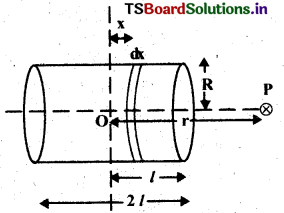
The number of turns on the element will be n dx.
We know the magnetic field on the axis of the coil B = \(\frac{\mu_0 \mathrm{NIR}^2}{2\left(x^2+\mathrm{R}^2\right)^{3 / 2}}\)
Now by taking N = ndx, replacing x by (r – x) and taking differential, we get
dB = \(\frac{\mu_0 n d x \mathrm{IR}^2}{2\left[(r-x)^2+R^2\right]^{3 / 2}}\)
To get total magnetic field, we integrate the above equation between the limits -l to +l
B = \(\frac{\mu_0 \mathrm{nIR}^2}{2} \int_{-l}^l \cdot \frac{\mathrm{dx}}{\left[(\mathrm{r}-\mathrm{x})^2+\mathrm{R}^2\right]^{3 / 2}}\)
When x<2 +R2]3/2 = r3
∴ B = \(\frac{\mu_0 \mathrm{nIR}^2}{2} \int_{-l}^l \frac{\mathrm{dx}}{\mathrm{r}^3}=\frac{\mu_0 \mathrm{nIR}^2}{2 \mathrm{r}^3} \int_{-l}^l \mathrm{dx}=\frac{\mu_0 \mathrm{nIR}^2}{2 \mathrm{r}^3}(2 l)=\frac{\mu_0 \mathrm{n}(2 l) \mathrm{I}\left(\pi \mathrm{R}^2\right)}{2 \pi \mathrm{r}^3}\)
But n (2l)I(πR2) = m = magnetic moment of the solenoid.
∴ B = \(\frac{\mu_0}{4 \pi} \frac{2 \mathrm{M}}{\mathrm{r}^3}\)
This is the expression for the magnetic field on the axial field of a solenoid.
The axial field of a bar magnet is also given by same equation B = \(\frac{\mu_0}{4 \pi} \frac{2 \mathrm{M}}{\mathrm{r}^3}\)
Thus, a bar magnet and a solenoid produce similar magnetic fields.
Hence, a solenoid behaves like a magnetic dipole similar to a bar magnet.
Question 2.
Explain the properties of dia, para and ferro magnetic materials.
Answer:
Properties of dia Magnetic substances:
- Diamagnetic substances are weakly magnetised in opposite direction to that of magnetising field Ex: Cu, Ag, Au, H2O
- They are feebly repelled by a magnet.
- They move from higher intensity to lower intensity in a non-uniform magnetic field.
- They are independent of temperature.
- Their relative permeability μr < 1, (𝜒 < 0, 𝜒 is small and negative)
- Resultant magnetic moment of its atom is zero, in the absence of external field.
Properties of Paramagnetic substances:
- Paramagnetic substances are feebly magnetised in the direction of magnetising field.
Ex: Ai, Na, Pt, etc - They are feebly attracted by a magnet.
- They move from lower intensity to higher intensity in a non-uniform magnetic field.
- They are dependent on temperature.
- Their relative permeability (μr > 1., (𝜒 > 0, 𝜒 is small and positive)
- Resultant magnetic moment of its atom is non-zero, due to unpaired electrons.
Properties of Ferromagnetic substances:
- Ferromagnetic substances are strongly magnetised in the direction of magnetising field.
Ex:Iron, cobalt, nickel etc. - They are strongly attracted by a magnet.
- They move from lower intensity to higher intensity in a non-uniform magnetic field.
- A ferromagnetic substance turns into a paramagnetic at a temperature called Curie temperature.
- Their relative permeability μr >> 1 (10 to 104)
- In ferromagnetic substances, domains having high, non-zero magnetic moments are formed.
Textual Solved Problems
Question 1.
(a) Magnetic field lines show the direction (at every point) along which a small magnetised needle aligns (at the point). Do the magnetic field lines also represent the lines of force on a moving charged particle at every point?
(b) If magnetic monopoles existed, how would the Gauss’s law of magnetism be modified?
(c) Does a bar magnet exert a torque on itself due to its own field? Does one element of a current-carrying wire exert a force on another element of the same wire?
(d) Magnetic field arises due to charges in motion. Can a system have magnetic moments even though its net charge is zero?
Solution:
(a)No. The magnetic force is always normal to B (remember magnetic force = qv B). It is misleading to call magnetic field lines as lines of force.
(b) Gauss’s law of magnetism states that die flux of B through any closed surface is always zero \(\oint \vec{\mathrm{B}} \cdot \mathrm{~d} \vec{\mathrm{~S}}\) = 0. If monopoles existed, the right hand side would be equal to the monopole (magnetic charge) qm enclosed by S. [Analogous to Gauss’s law of electrostatics, \(\oint \vec{\mathrm{B}} \cdot \mathrm{~d} \vec{\mathrm{~S}}\) = μ0qm,
here qm is the (monopole) magnetic charge enclosed by S .]
(c) No. There is no force or torque on an element due to the field produced by that element itself. But there is a force (or torque) on an element of the same wire. .
(For the special case of a straight wire, this force is zero.)
(d) Yes. The average of the charge in the system may be zero. Yet, the mean of the magnetic moments due to various current loops may not be zero. We will come across such examples in connection with paramagnetic material where atoms have net dipole moment through their net charge is zero.
Question 2.
A solenoid has a core of a material with relative permeability 400. The windings of the solenoid are insulated from the core and carry a current of 2A. If the number of turns is 1000 per metre, calculate (a) H, (b) M, (c) B and (d) the magnetising current IM.
Solution:
(a) The field His dependent of the material of the core, and is
H = nI = 1000 × 2.0 = 2 × 10³ A/m.
(b) The magnetic field B is given by B = μrμ0H = 400 × 4π × 10-7 × 2 × 103 = 1.0T
(c) Magnetisation is given by M = (B – μ0H)/μ0
= (μrμ0H – μ0H) / μ0 = (μr – 1)H – 399 × H ≅ 8 × 10⁵ A / m
(d) The magnetising current IM is die additional current that needs to be passed through the windings of the solenoid in the absence of the core which would give a B value as in the presence of the core. Thus B = μrn(I + IM)
Using I = 2A, B = 1 T, we get IM = 794 A.
Exercise Problems
Question 1.
The magnetic moment of a bar magnet is 8 × 10³ Am2. What is the magnetic field induction at a distance 4 cm oil its equatorial line?
Solution:
Given Magnetic moment M = 8 × 10³ Am2, distance r = 4cm = 0.04m.
Magnetic induction at a point in equatorial line B = \(\frac{\mu_0}{4 \pi} \frac{\mathrm{M}}{\mathrm{r}^3}\)
= \(\frac{4 \pi \times 10^{-7}}{4 \pi} \frac{8 \times 10^3}{(0.04)^3}\) = 0.125 × 102 = 12.5
∴ Magnetic induction B = 12.5 T
Question 2.
What is the potential energy of the magnetic moment if it is placed in a uniform magnetic field such that its magnetic moment points opposite to the magnetic field?
Solution:
Potential Energy (U) = –\(\vec{\mathrm{M}} \cdot \vec{\mathrm{~B}}\) = -MBcosθ, θ is the angle between \(\vec{\mathrm{M}}\) and \(\vec{\mathrm{B}}\)
When magnetic moment points opposite to the field, θ = 180°
∴ U = -MB cos 180° = – MB (- 1) = MB
∴ The potential energy of a magnetic moment M, placed in a field B is U = MB
Question 3.
The magnetic susceptibility of a material is 0.1. Then what is its relative permeability?
Solution:
Magnetic susceptibility 𝜒 = 0.1
∴ Relative permeability μr = 1 + 𝜒 = 1 + 0.1 = 1.1
Question 4.
A short bar magnet placed with its axis at 30″ with a uniform external magnetic field of 0.45T experiences a torque of magnitude equal to 4.5 xlO-2 J . What is the magnitude of magnetic moment of the magnet?
Solution:
Magnetic induction B = 0.45 T, Angle θ = 30°, Torque 𝜏 = 4.5 × 10²J
Formula: 𝜏 = MB sinθ
Magnetic moment M = \(\frac{\tau}{B \sin \theta}=\frac{4.5 \times 10^{-2}}{0.45 \times \sin 30^{\circ}}=\frac{0.0045}{0.45 \times 0.5}\) = 0.2 JT-1
Objective Questions
Question 1.
A bar magnet of magnetic moment M is placed at right angles to a magnetic induction B. If a force F is experienced by each pole of the magnet, the length of the magnet will be Q]
1) MB/F
2) BF/M
3) MF/B
4) F/MB
Answer:
1) MB/F
Question 2.
A magnetic needle suspended parallel to a magnetic field requires \(\sqrt{3}\)J of work to turn it through 60°. The torque needed to maintain the needle in this position will be
1) 2\(\sqrt{3}\)J
2) 3J
3) \(\sqrt{3}\)J
4) 3/2 J
Answer:
2) 3J
Question 3.
A bar magnet having a magnetic moment of 2 × 10⁻⁴JT-1 is free to rotate in a horizontal plane. A horizontal magnetic field B = 6 × 10⁻⁴ T exists in the space. The work done in taking the magnet slowly from a direction parallel to the field to a direction 60° from the field is
1) 12
2) 6J
3) 2J
4) 0.6J
Answer:
2) 6J
Question 4.
A bar magnet of magnetic moment \(\vec{\mathrm{M}}\), is placed in a magnetic field of induction \(\vec{\mathrm{B}}\). The torque exerted on it is
1) \(\vec{\mathrm{M}} \times \vec{\mathrm{B}}\)
2) \(-\vec{\mathrm{M}} \cdot \vec{\mathrm{~B}}\)
3) \(\vec{\mathrm{M}} \cdot \vec{\mathrm{~B}}\)
4) \(-\vec{\mathrm{B}} \cdot \vec{\mathrm{~M}}\)
Answer:
1) \(\vec{\mathrm{M}} \times \vec{\mathrm{B}}\), 4) \(-\vec{\mathrm{B}} \cdot \vec{\mathrm{~M}}\)
Question 5.
A bar magnet of magnetic moment M is cut into two parts of equal length. The magnetic moment of each part will be
1) M
2) 2M
3) zero
4) 0.5M
Answer:
4) 0.5M
Question 6.
Tangent galvanometer is used to measure
1) potential difference
2) current
3) resistance
4) charge.
Answer:
2) current
Question 7.
An iron rod of susceptibility 599 is subjected to a magnetising field of 1200 A m’. The permeability of the material of the rod is μ0 = 4π × 10-7 T m A-1)
1) 2.4π × 10-4 T m A-1
2) 8.0 × 10⁻⁵ T m A-1
3) 2.4π × 10-5 T m A-1
4) 2.4π × 10-7 T m A-1
Answer:
1) 2.4π × 10-4 T m A-1
Question 8.
The magnetic moment of a diamagnetic atom is
1) much greater than one
2) 1
3) between zero and one
4) equal to zero
Answer:
4) equal to zero
Question 9.
Curie temperature above which
1) paramagnetic material becomes ferromagnetic material
2) ferromagnetic material becomes diamagnetic material
3) ferromagnetic material becomes paramagnetic material
4) paramagnetic material becomes diamagnetic material
Answer:
3) ferromagnetic material becomes paramagnetic material
Question 10.
Nickel shows ferromagnetic property at room temperature. If the temperature is increased beyond Curie temperature, then it will show
1) anti ferromagnetism
2) no magnetic property
3) diamagnetism
4) paramagnetism
Answer:
4) paramagnetism
Question 11.
According to Curie’s law, the magnetic susceptibility of a substance at an absolute temperature T is proportional to
1) 1/T
2) T
3) 1/T2
4) T2
Answer:
1) 1/T
Question 12.
Among which the magnetic susceptibility does not depend on the temperature?
1) Diamagnetism
2) Paramagnetism
3) Ferromagnetism
4) Ferrite
Answer:
1) Diamagnetism