Regular practice with AP Inter 1st Year Accounts Study Material Chapter 6 Subsidiary Books Questions and Answers helps students stay prepared for examinations.
AP Inter 1st Year Accountancy 6th Lesson Subsidiary Books Questions and Answers
I. Fill in the blanks
Question 1.
Separate or special books that are maintained to record a particular category of transactions are known as “…….”.
Answer:
Subsidiary Books
Question 2.
Subsidiary Book is also known as …….
Answer:
Day Book
Question 3.
In the purchases book …….. purchases of goods are only recorded.
Answer:
Credit
Question 4.
In case of purchase returns, we have to prepare a ……… Note.
Answer:
Debit
Question 5.
The document received by the trader from the supplier stating that the goods are supplied as per the order is called ……. Invoice.
Answer:
Inward
Question 6.
A rebate offered by the supplier on the catalogue price is known as a ……. discount.
Answer:
Trade
Question 7.
The book that is used to record the return of goods to the suppliers is called ……….
Answer:
Returns Outward/Purchase Returns Book Customer
Question 8.
A Debit Note is prepared by the ……….
Answer:
Customer
Question 9.
A Credit Note is prepared by the ……..
Answer:
Supplier
Question 10.
In case of sales returns, we have to prepare a …….. Note.
Answer:
Credit

Question 11.
A sales book is also called a ………
Answer:
“Sales Day Book” (or) “Sales Journal”
Question 12.
In sales Book ……… sales of goods are only recorded.
Answer:
Credit
Question 13.
Sales Returns Book is also called a …….. Book.
Answer:
Returns outward
Question 14.
Purchase Returns Book is also called a Book.
Answer:
Cash
Question 15.
Cash purchases should be recorded in the book.
Answer:
Cash
Question 16.
Cash sales should be recorded in the ……. book.
Answer:
Cash
Question 17.
The Periodical total of the purchases book should be ……. to the purchases a/c in the ledger.
Answer:
Debited
Question 18.
The periodical total of the sales book should be to the sales a/c in the ledger.
Answer:
Credited
II. Very Short Answer Type Questions
a. Invoice
Answer:
It is the document prepared by the supplier of goods with all the details like quantity, price discount offered and other terms and conditions. This is also known as “Inward Invoice”.
b. Debit Note
Answer:
If goods are returned to the supplier, a debit note or letter is sent along with goods, informing the supplier about the debit given to his account for the value of the goods returned. This note is known as debit note.
c. Credit Note
Answer:
If the customer returned the goods, a credit note is sent to him by the traders informing the customer that his account has been credited with the value of the goods returned.
d. Trade Discount
Answer:
It is a reduction in the catalogue price of an article. This is given by the wholesaler to the retailer to enable him to sell at a catalogue price and make a profit. It is not entered in books.
e. Journal Proper
Answer:
This book is used for recording only those transactions which cannot be recorded in any one of the seven subsidiary books said above.
III. Short Answer Type Questions
Question 1.
Explain the various Subsidiary Books with suitable examples.
Answer:
Separate Books or special books which are maintained to record a particular category of transactions are known as “Subsidiary books”.
The journal is divided into eight subsidiary books. They are :
a) Purchase book : This book records all the goods purchased on credit. Cash purchases and purchase of assets are not recorded in this book.
Whenever goods are bought on credit we receive an invoice from the seller. It is called “Inward Invoice”. It is evidence for recording in purchase book.
b) Sales book : The goods sold on credit are recorded in this book. Cash sales and assets sold for cash or credit are not recorded in this book.
Whenever goods are sold on credit we send an Invoice to the customer. It is called “Outward Invoice”. It is evidence for recording in sales book.
c) Purchase returns book : This book is also known as returns outward book. This book records the goods returned to the suppliers.
When goods are returned to their sellers a ‘Debit Note’ is prepared and sent to the suppliers along with goods.
d) Sales returns book : This book is also known as returns inward book. This book records the goods returned by the customers.
When the sellers receive goods back from the customer along with a debit note, then he prepares a credit note and sends to the customer.
e) Cash book : Cash book is used for recording all cash transactions i.e. cash receipts and cash payments either in cash or by cheque are recorded in this book.
f) Bills receivable book : This book is used to record all the bills received from the cus-tomers for the amount due. It contains details of acceptor of the bill, its due date, date bill, the amount due, etc.
g) Bills payable book : If the goods are purchased on credit and bills are accepted for the due amounts, all these bills payable are recorded in this book. It contains the amount due, date of bill, place of payment, due date, etc .
h) Journal proper : This book is used to record only those transactions, which cannot be recorded in any one of the seven subsidiary books side above.
Question 2.
Write the advantages of subsidiary books.
Answer:
Subsidiary Book Advantages :
- Saving of Time : No need of writing the Journal Entries. Transactions are directly entered into their respective journals.
- Division of Work : By entrusting different Subsidiary Books to different persons, division of principle can be implemented.
- Easy Recording : Transactions can be recorded very fast and easy.
- Improves Efficiency : Accounting work will be done efficiently by allotting work to different experts who prepare the Special Books.
- Detection of Errors : Since Separate Books are maintained to record a particular set of transactions, errors can be easlily noticed.
Question 3.
Explain about purchases book and draw the pro forma of it.
Answer:
This book records all the goods purchased on credit. Cash purchases and purchase of assets are not recorded in this book.
Whenever goods are bought on credit we receive an invoice from the seller. It is called “Inward Invoice”. It is evidence for recording in purchase book. It is numbered serially and filed in a separate file.
Proforma of purchase book :
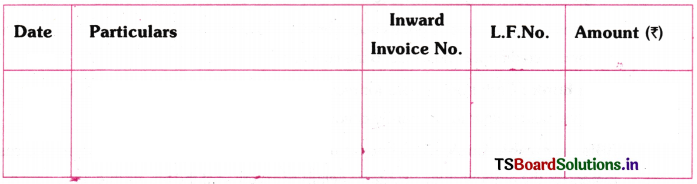
Purchase book contains five columns, such as Date, Particulars, Invoice No., L.F.No. and Amount.
Purchase Book
Question 4.
Explain about Sales book and draw the proforma of it.
Answer:
The goods sold on credit are recorded in this book. Cash sales and assets sold for cash or credit are not recorded in this book.
Whenever goods are sold on credit we send an invoice to the customer. It is called “Outward invoice”. It is evidence for recording in sales book. It is serially numbered and kept in a separate file.
Proforma of sales book :
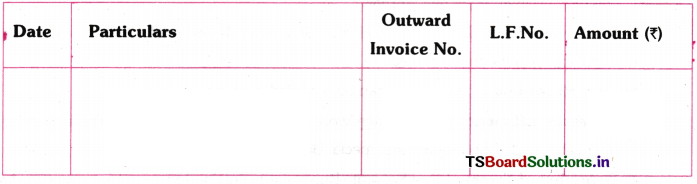
Sales book contains five columns, such as Date, Particulars, Invoice No., L.F.No. and Amount.
Problems
Question 1.
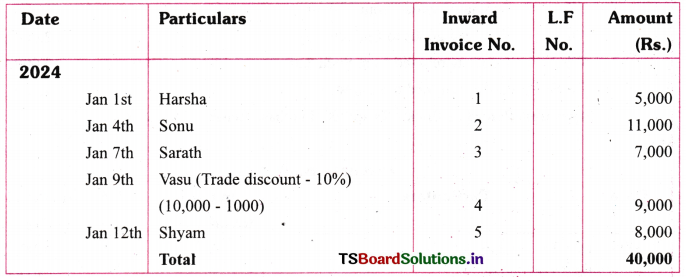
Record the following transactions in the purchases book.
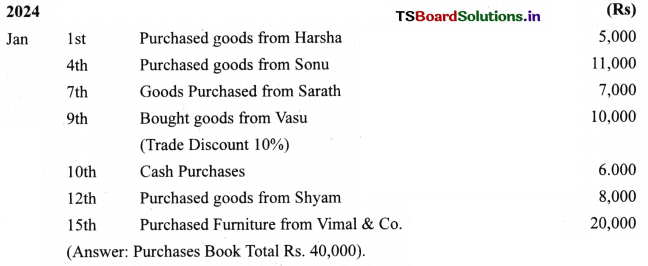
Hint 1: January 10th Cash purchases. Hence not to be taken in purchases Book.
Hint 2: January 15th Assets (Furniture) purchase will not be entered in subsidiary Books
Answer:
Purchase book
Question 2.
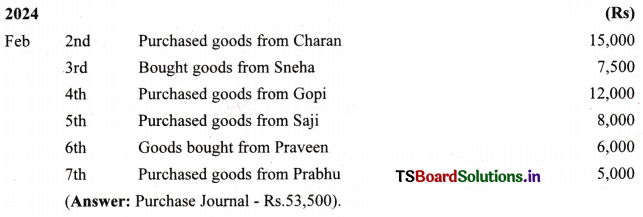
Prepare Purchases Journal from the following
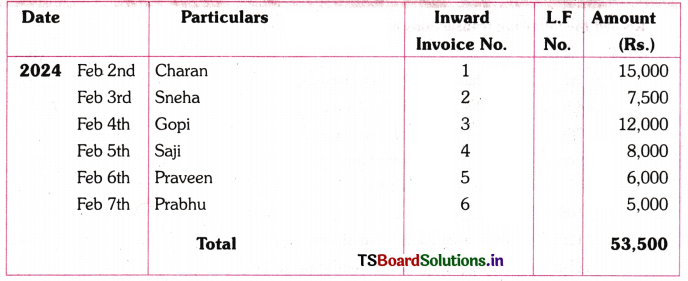
Answer:
Purchase Book
Question 3.
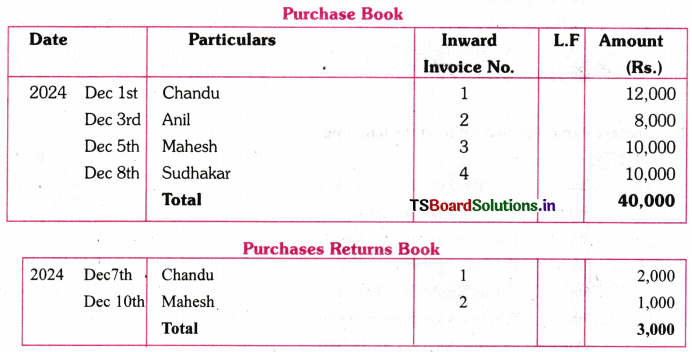
Enter the following particulars in Purchases Book and Purchase Returns Book. 2024
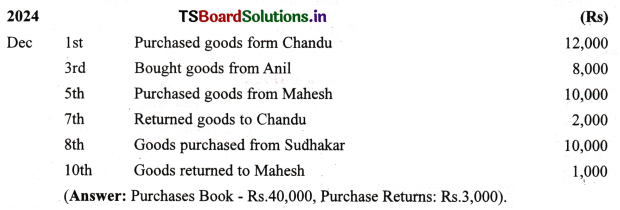
(Answer: Purchases Book – Rs.40,000, Purchase Returns: Rs.3,000).
Answer:
Question 4.
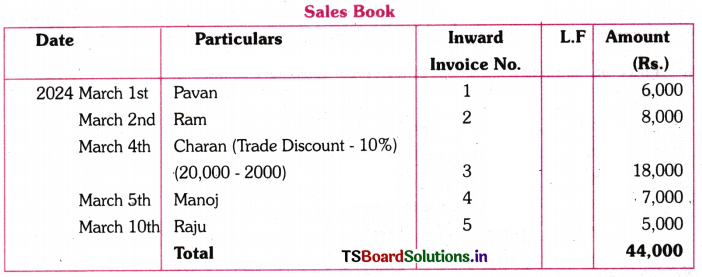
Record the following in Sales Book
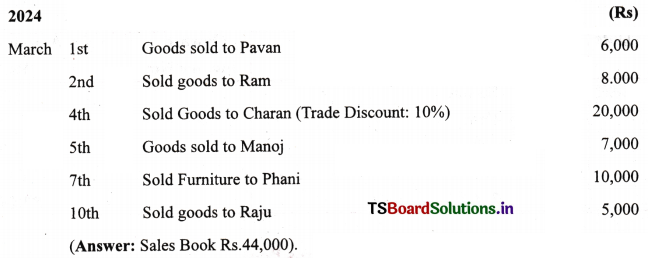
Hint 1: March 4th Trade Discount is 20,000 × \(\frac{10}{100}\) = 2,000
2: March 7th Furniture (Assets) sold should not be recorded in the subsidiary books
Answer:
Question 5.
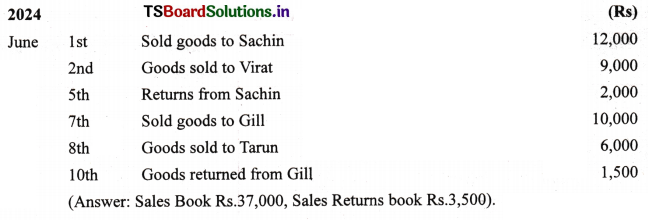
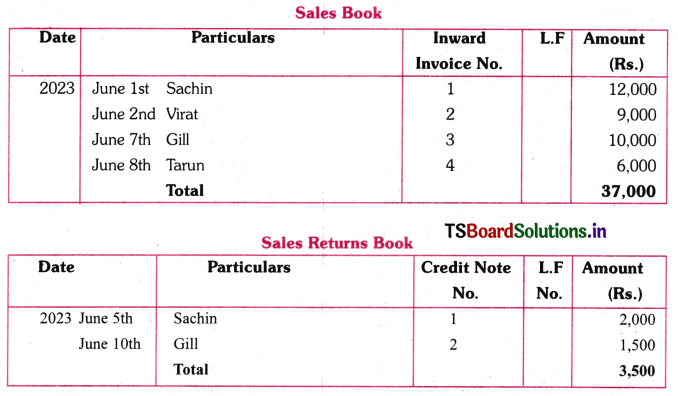
Record the following transactions in suitable subsidiary Books
Answer:
Question 6.
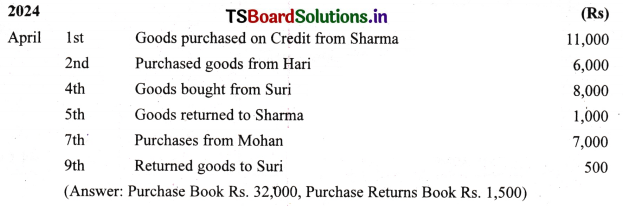
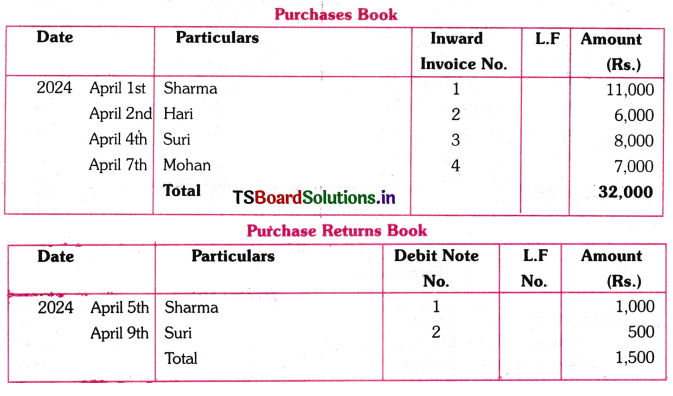
Enter the following transactions in the proper subsidiary books.
Answer:
Question 7.
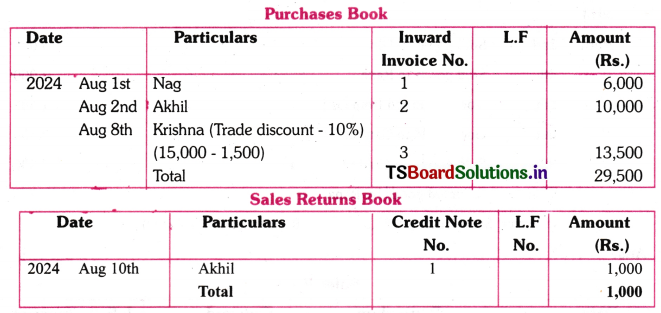
Prepare Sales book and Sales returns books from the following transactions
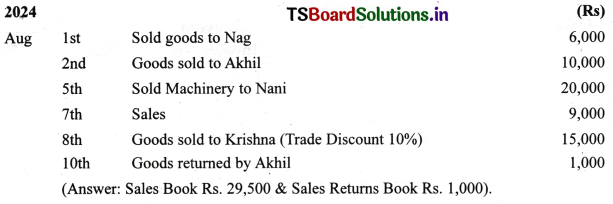
Answer:
Question 8.
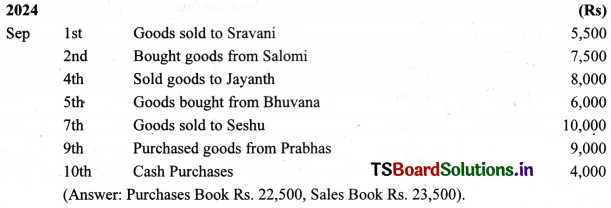
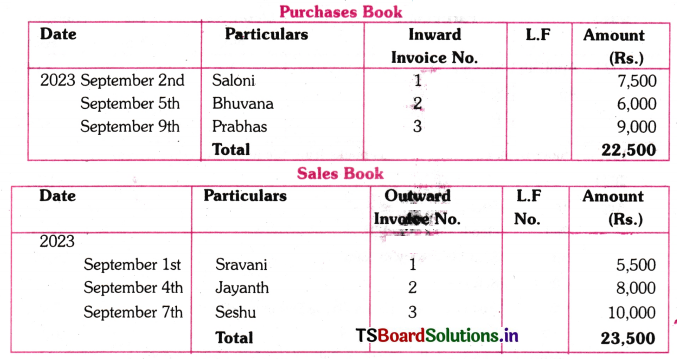
Record the following transactions In proper subsidiary books
Answer:
Question 9.
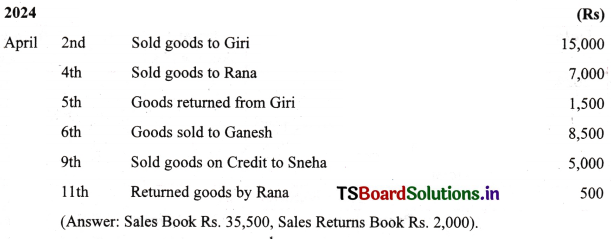
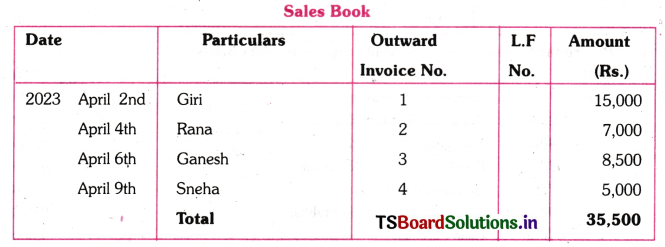
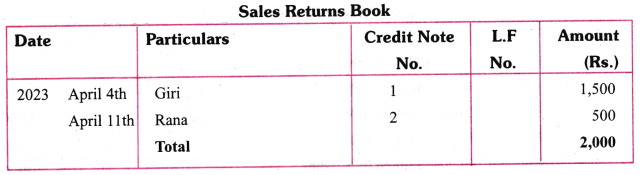
From the following transactions prepare Sales book and Sales Returns Book
Answer:
Question 10.
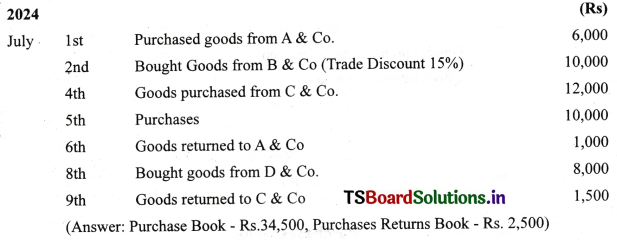
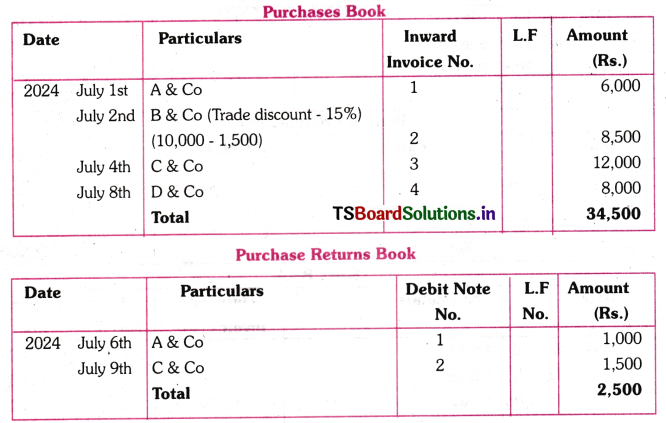
From the following transactions prepare subsidiary books
Answer:
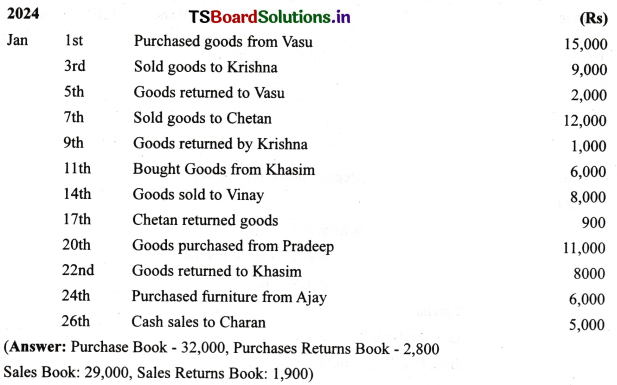
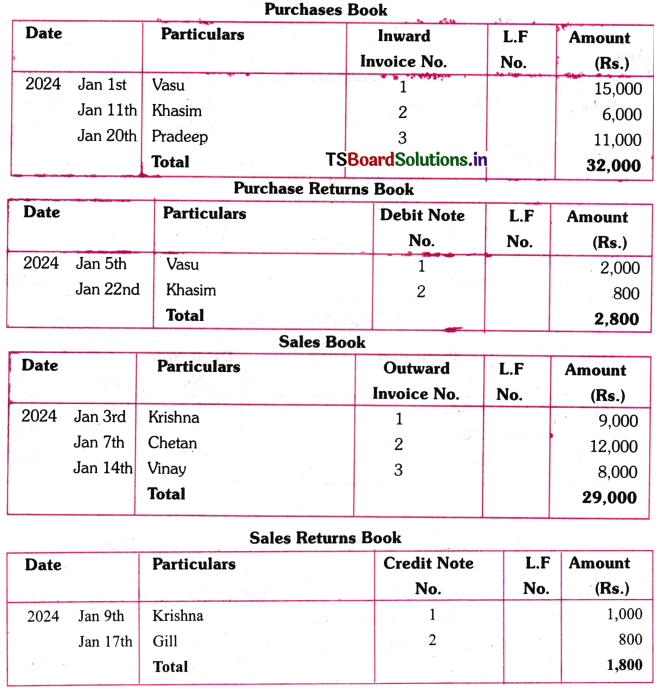
Question 11.
Record the following in proper subsidiary books
Answer:
Question 12.
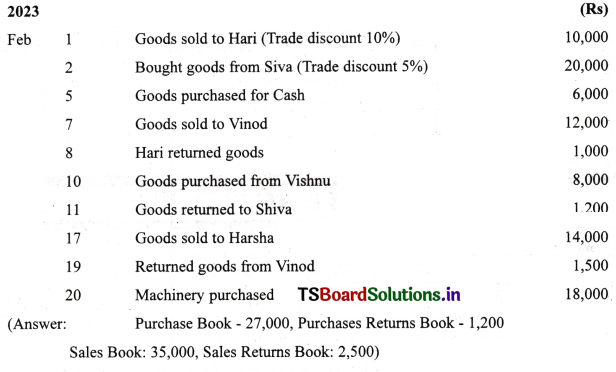
Enter the following transactions in Proper subsidiary Books
Answer: