
Regular practice with AP Inter 2nd Year Physics Study Material Chapter 12 Atoms Questions and Answers helps students stay prepared for examinations.
AP Inter 2nd Year Physics 12th Lesson Atoms Questions and Answers
I. Multiple Choice Questions
Question 1.
The first model of an atom was proposed by [ ]
1) J.J.Thomson
2) Rutherford
3) Niels Bohr
4) Hans Geiger
Answer:
1) J.J.Thomson
The first model of an atom was proposed by J.J.Thomson
Question 2.
Identify the source of α -particles in H.Geiger and E.Marsedeins experiment [ ]
1) 92U235
2) 92U238
3) 90Pb231
4) 83Bi214
Answer:
4) 83Bi214
In the gold foil experiment, a radioactive source of Bismuth was used inside a lead cavity to emit a stream of high energy alpha particles.
Question 3.
The expression for kinetic energy (K) and electrostatic potential energy (U) of the electron in hydrogen atom are [ ]
1) K = e28π\(\varepsilon_0\)r2 and U = -e2/4π\(\varepsilon_0\)r2
2) K = e2/4π\(\varepsilon_0\)r2 and U = -e2/8π\(\varepsilon_0\)r2
3) K = e2 /4π\(\varepsilon_0\)r2 and U = -e2 /8π\(\varepsilon_0\)r2
4) K = e2/8π\(\varepsilon_0\)r and U = -e2/4π\(\varepsilon_0\)r
Answer:
4) K = e2/8π\(\varepsilon_0\)r and U = -e2/4π\(\varepsilon_0\)r
K = e2/8π\(\varepsilon_0\)r and U = -e2/4π\(\varepsilon_0\)r
Question 4.
According to second postulate of Bohr’s model, which parameter is quantized for orbiting electron? [ ]
1) Energy
2) Charge
3) Mass
4) Angular momentum
Answer:
4) Angular momentum
From Bohr’s second postulate angular momentum of orbiting electron is quantized.

Question 5.
1eV is equivalent to [ ]
1) 6.67 × 10⁻³⁴J
2) 1.6 × 10⁻²⁷J
3) 1.6 × 10⁻¹⁹ J
4) 6.24 × 10⁻²²J
Answer:
3) 1.6 × 10⁻¹⁹ J
1 eV= 1.6 × 10⁻¹⁹ Joule.
Question 6.
Identify the incorrect postulate of Niels Bohr’s theory of atomic model. [ ]
1) Electron revolve in certain stable orbits without radiating energy
2) Energy is only emitted or absorbed when electron jumps between orbits
3) The angular momentum of the revolving electron is quantized
4) The energy of emitted/absorbed photon is hυ = Er – Ei
Answer:
4) The energy of emitted/absorbed photon is hυ = Er – Ei
Then energy hv = Ef + Ei is incorrect. But, hv = Ei – Ef is correct.
Question 7.
The total energy of an electron in the stationary states of the hydrogen atom is [ ]
1) En = \(\frac{13.6}{n}\) eV
2) En = –\(\frac{13.6}{n^2}\)eV
3) En = \(\frac{13.6}{n}\)eV
4) E = \(\frac{13.6}{\mathrm{n}^2}\)eV
Answer:
2) En = –\(\frac{13.6}{n^2}\)eV
En = \(\frac{13.6 \mathrm{Z}^2}{\mathrm{n}^2}\)eV = \(\frac{13.6}{\mathrm{n}^2}\)eV For Hydrogen Z = 1
Question 8.
Bohr’s atomic model is not valid for [ ]
1) hydrogen atom
2) singly ionized helium atom (He+)
3) deutenum atom
4) singly ionized neon atom (Ne+)
Answer:
4) singly ionized neon atom (Ne+)
Bohr’s model fails on multiple electron systems. Atomic number of Ne is 10.
Hence singly ionized (Ne+) has 9 electrons. So, Bohr’s model does not apply to it.
Question 9.
If an electron is revolving in the nth orbit of hydrogen atom, then its velocity in the nth
orbitis [ ]
1) proportional to n
2) inversely proportional to n
3) proportional to n2
4) inversely proportional to n2
Answer:
2) inversely proportional to n
According to Bohr’s theory, the velocity of an electron in the nth orbit vn ∝ \(\frac{\mathrm{Z}}{\mathrm{n}}\), for hydrogen, Z = 1. So, V ∝ \(\frac{1}{n}\)
Question 10.
The angular momentum of an electron revolving in orbit is given by [
1) mvr = nh/2π
2) mvr = n2h/2π
3) mvr = hπn3
4) mvr = n2h2/2π
Answer:
1) mvr = nh/2π
According to Bohr’s second postulate mvr = \(\frac{\mathrm{nh}}{2 \pi}\)
Question 11.
The ratio of kinetic energy to the total energy of an electron in a Bohr orbit of the hydrogen atom is [ ]
1) 1 : 1
2) 1 : -1
3) 2 : -1
4) 1 : -2
Answer:
2) 1 : -1
In a Bohr’s orbit, Total energy E = – KE. Hence KE:E = 1 : -1
Question 12.
The ground state energy of hydrogen atom is -13.6eV. When its electron is excited to first excited state, it’s excitation energy is [ ]
1) 0 eV
2) -13.6 eV
3) 3.4 eV
4) 10.2 eV
Answer:
4) 10.2 eV
Ground state energy E1 = -13.6eV. ; First excited state energy E2 = \(\frac{-13.6}{2^2}\) = -3.4eV
Excitationenergyrequired E2 – E1 = -3.4 – (-13.6) = 10.2eV or
Question 13.
According to Bohr atomic model, in which of the followingtransition will the frequency be maximum? [ ]
1) n = 4 to n = 3
2) n = 2 to n = 1
3) n = 5 to n = 4
4) n = 3 to n = 2
Answer:
2) n = 2 to n = 1
Energies of hydrogen levels are, E1 = -13.6ev, E2 = -3.4eV, E3 = -1.51eV, E4 = -0.85eV
The transition from n = 2 to n = 1 has an energy difference of 10.2 eV which is maximum
or Frequency v = k\(\left(\frac{1}{\mathrm{n}_1^2}-\frac{1}{\mathrm{n}_2^2}\right)\) = k\(\left(\frac{\mathrm{n}_2^2-\mathrm{n}_1^2}{\mathrm{n}_1^2 \mathrm{n}_2^2}\right)\)
Among the given options for n1 = 1 and n2 = 2 we have V = k\(\left(\frac{2^2-1^2}{(1 \times 2)^2}\right)\) = \(\frac{3}{4}\)k which is max.
II. Fill in the Blanks
Question 1.
If Fe, Fc denotes the electrostatic force of attraction, centripetal force respectively, then the relation between Fe and Fc for a dynamically state orbit in a hydrogen atom is ___
Answer:
Fe = Fc
For electron to revolve in a stable circular orbit the inward electrostatic force of attraction (Fe) outwards centripetal force(Fc) required. Fe= Fc
Question 2.
A He+ ion is in its first excited state, its ionization energy is ____.
Answer:
13.6 eV
Energy En = \(\frac{-13.6 Z^2}{n^2}\) ⇒ E2 = \(\frac{-13.6(2)^2}{2^2}\) = -13.6eV For He, n = 2,Z = 2
Question 3.
Energy required for the electron excitation in Li++ from the first to the third Bohr’s orbit is ___.
Answer:
108.8eV
Atomic number of Lithium is Z = 3.; En = \(\frac{-13.6 Z^2}{n^2}\) = \(\frac{-13.6(3)}{n^2}\) = \(\frac{-122.4}{n^2}\);
For 1st orbit E1 = \(\frac{-122.4}{1^2}\) = -122.4eV ; For 3rd orbit, E3 = \(\frac{-122.4}{3^2}\) = \(\frac{-122.4}{9}\) = -13.6eV
∴ ΔE = E3 – E1 = -13.6 – (-122.4) = -13.6 + 122.4 = 108.8eV
Question 4.
The change in angular momentum of an electron when it jumps from 4th orbit to 5th orbit in hydrogen atom is ___.
Answer:
h/2π
Angular momentum (L) of an electron in the nth orbit is L = \(\frac{\mathrm{nh}}{2 \pi}\)
The change in angular momentum from 4th to 5th orbit is ΔL = \(\frac{5 \mathrm{~h}}{2 \pi}-\frac{4 \mathrm{~h}}{2 \pi}\) = \(\frac{\mathrm{h}}{2 \pi}\)
Also \(\frac{h}{2 \pi}\) = \(\frac{6.63 \times 10^{-34}}{2 \times 3.14}\) = 1.055 × 10⁻³⁴J
Question 5.
The wavelength of the photon emitted by a hydrogen atom when an electron makes transition from n = 2 to n = 1 state is ___.
Answer:
121.8 nm
We know \(\frac{1}{\lambda}\) = \(\mathrm{R}\left[\frac{1}{\mathrm{n}_1^2}-\frac{1}{\mathrm{n}_2^2}\right]\) ⇒ \(\frac{1}{\lambda}\) = 1.097 × 10⁷\(\left(\frac{3}{4}\right)\)
Hence, we get λ = 121.8 nm
Question 6.
The de-Broglie wavelength of electron revolving in its second excited state (having radius 4.65 A) is ___ A.
Answer:
9.7
Given n = 3, r = 4.65A We know 2πr = nλ ⇒ 2 × π × 4.65 = 3λ
∴ λ = \(\frac{9.3 \pi}{3}\) = 3.1 × 3.14 = 9.74 A
Question 7.
The process of raising or transferring the electron from lower energy state to higher energy state is called ___.
Answer:
excitation
The process of raising or transferring the electron from lower energy state to higher energy state is called excitation.
Question 8.
The process of raising the atom from the normal state to the ionized state is called ___.
Answer:
ionization
The process of raising the atom from the normal state to the ionized state is called ionization.
Question 9.
The total energy of an electron in an atom in an orbit is -3.4 eV, then its potential energy is ___.
Answer:
-6.8 eV
Given E = -3.4 eV ∴ U = 2E = 2 × -3.4eV = -6.8eV
Question 10.
The energy of the ground electronic state of hydrogen atom is -13.6 eV. The energy of the first excited state will be ____.
Answer:
-3.4 eV
The energy of the ground electronic state of hydrogen atom is -13.6 eV. The energy of the first excited state will be -3.4 eV.
Question 11.
The value of impact parameter (b) for head-on collision is ___.
Answer:
zero
The value of impact parameter (b) for head-on collision is zero.
Question 12.
1 fermi is equal to ___ meter.
Answer:
10-15
1 fermi = 1o-15 meter.
III. One Word Answer Questions
Question 1.
What is the net charge of an atom, based on plum pudding model?
Answer:
According to J.J.Thomson’s plum pudding model, the net charge of an atom is zero.
Question 2.
What kind of charge is spread throughout the atom in Thomson’s model?
Answer:
In Thomson’s model, positive charge is spread throughout the atom.
Question 3.
Which metal foil is used in the Rutherford α – scattering experiment?
Answer:
Gold foil is used in Rutherford α – scattering experiment
Question 4.
What is the SI unit of the impact parameter?
Answer:
The SI unit of impact parameter is metre (m).
Question 5.
What type of energy arises due to attraction between electron and nucleus?
Answer:
Electrostatic potential energy arises due to the attraction between electron & nucleus.
Question 6.
What is the value of Planck’s constant in J sec ?
Answer:
The value of Planck’s constant is h = 6.63 × 10⁻³⁴ Js
Question 7.
The energy of a hydrogen atom in the ground state is -13.6eV. What will be the energy of He+ ion in the first excited state?
Answer:
For He+ ion we have Z = 2 and for the first excited state n = 2
Energy En = \(\frac{-13.6 Z^2}{n^2}\) ⇒ E2 = \(\frac{-13.6(2)^2}{(2)^2}\) = -13.6eV.
Question 8.
An electron in a hydrogen atom revolving in its second excited state having the radius of 4.65A. What is its de-Broglie wavelength?
Answer:
According to Bohr’s postulate, 2π = nλ ⇒ λ = \(\frac{2 \pi \mathrm{r}}{\mathrm{n}}\) = \(\frac{2 \times 3.14 \times 4.65}{3}\) = 9.734 A
Question 9.
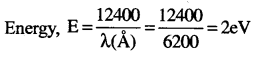
Express the energy of a photon of wavelength 620nm in terms of eV.
Answer:
Given λ = 620nm = 6200Å
Question 10.
What is the ratio of wavelengths of photons having energies E and 3E?
Answer:
Energy E = \(\frac{\mathrm{hc}}{\lambda}\) ⇒ E ∝ \(\frac{1}{\lambda}\) ⇒ λ ∝
Question 11.
Write the formula for the energy of an electron in the nth orbit for hydrogen atom.
Answer:
Energy of an electron in the nth orbit for hydrogen atom is En = \(\frac{-13.6}{\mathrm{n}^2}\) eV Here n = 1, 2, 3,….
Question 12.
What is the path of an electron around the nucleus as per Rutherford’s atomic model?
Answer:
According to Rutherford’s atomic model, the path of an electron around the nucleus is a circular orbit
IV. Very Short Answer Questions
Question 1.
What is the angular momentum of an electron in the second orbit of Bohr’s model of hydrogen atom?
Answer:
From Bohr’s model of hydrogen atom, the angular momentum of electron in nth orbit is L = \(\frac{\mathrm{nh}}{2 \pi}\)
For n = 2, L = \(\frac{2 h}{2 \pi}\) = \(\frac{\mathrm{h}}{\pi}\)
Question 2.
Express the magnitude of electrostatic force of repulsion between the α – particle and the positively charged nucleus?
Answer:
From Coulomb’s law, Force F = \(\frac{1}{4 \pi \varepsilon_0} \frac{\mathrm{q}_1 \mathrm{q}_2}{\mathrm{r}^2}\) = \(\frac{1}{4 \pi \varepsilon_0} \frac{2 \mathrm{Ze}^2}{\mathrm{r}^2}\)
Here r is the distance between the alpha particle and the nucleus, (2e) is the charge of the alpha particle, and (Ze) is the charge of the nucleus.
Question 3.
Why did most of the α – particles pass through the gold foil undetlected in Rutherford
scattering?
Answer:
Most of the a particles passed straight through the gold foil undeflected. Because most of the space inside an atom is empty. Thus nucleus occupies only a small fraction of total volume of atom.
Question 4.
What is the physical meaning of negative energy of an electron?
Answer:
The physical meaning of the negative energy of an electron in an orbit means that the electron is bound to the positive nucleus due to attractive force.
The energy of electron in first orbit of hydrogen is -13.6 eV. It means that the energy required to take the electron out of the hydrogen atom from first orbit is 13.6 eV.
Question 5.
Name the physical quantity whose dimensions are the same as those of angular momentum?
Answer:
Planck’s constant (h) has same dimensions as angular momentum.
E = hv ⇒ h = \(\frac{E}{v}\) = \(\frac{\mathrm{ML}^2 \mathrm{~T}^{-2}}{\mathrm{~T}^{-1}}\) = ML2T-1
Question 6.
What is the difference between α – particle and helium atom?
Answer:
Helium atom is electrically neutral whereas alpha particle is positively charged.
Helium atom consists of 2 protons, 2 neutrons and 2 electrons whereas alpha particle is a double ionized helium ion (He2+) consisting of 2 protons and 2 neutrons but with zero electrons.
Question 7.
What happens when an electron jumps from higher energy level to lower energy level according to Bohr’s model?
Answer:
When an electron jumps from higher energy level to lower energy level, it emits a photon of electromagnetic radiation. The energy of the photon is equal to the difference between the higher energy level and the lower energy level is given by ΔE = hv.
Question 8.
Define impact parameter.
Answer:
The impact parameter (b) is defined as the perpendicular distance of the initial velocity vector of the a- particle from the centre of die nucleus.
Question 9.
Define distance of closest approach.
Answer:
Distance of closest approach is the minimum distance to which a fast moving a particle can approach the nucleus when it collides head-on before its KF is completely converted into electrostatic PE.
V. Short Answer Questions
Question 1.
What are the observations of Rutherford’s α – particle scattering experiment and how these findings supported the existence of atomic nucleus.
Answer:
Obervations of Rutherford’s α – particle scattering :
- The majority of the alpha particles passed directly through the gold foil without any deflection.
- A small fraction of α-particles were deflected by very small angles. (just more than 1°)
- Very few (about 1 in 8000) were deflected by large angles (more than 90°) and some even bounced back.
Conclusions:
- Most alpha particles passed straight through the gold foil. It shows that most of the space inside an atom is empty.
- Some positively charged alpha particles were deflected by small angles. It shows that the positive charge is concentrated at the centre of the atom.
- A tiny particle bounced straight back shows that it must have hit something extremely heavy and dense for which Rutherford called the nucleus of the atom.
By analyzing these findings, Rutherford concluded that an atom consists of a tiny, dense, positively charged the nucleus.
Question 2.
Derive expressions for potential and kinetic energies of an electron in any orbit of a hydrogen atom according to Bohr’s atomic model.
Answer:
Consider an electron of H-atom of mass m, charge e.
Let it revolve in nth orbit of radius r with a velocity v.
For electron to revolve, Centripetal force = Electrostatic force of attraction
⇒ \(\frac{\mathrm{mv}^2}{\mathrm{r}}\) = \(\frac{1}{4 \pi \varepsilon_{\mathrm{o}}} \frac{\mathrm{e}^2}{\mathrm{r}^2}\) ⇒ mv2 = \(\)
From Bohr’s 2nd postulate, we have mvr = \(\frac{\mathrm{nh}}{2 \pi}\) ⇒ m2v2r2 = \(\frac{n^2 h^2}{4 \pi^2}\) …. (2)
\(\frac{(2)}{(1)}\) ⇒ \(\frac{\mathrm{m}^2 \mathrm{v}^2 \mathrm{r}^2 .}{\mathrm{m} \mathrm{v}^2}\) = \(\frac{n^2 h^2 4 \pi \varepsilon_0 r}{4 \pi^2 . e^2}\) ⇒ r = \(\frac{\mathrm{h}^2 \varepsilon_0 \mathrm{n}^2}{\pi \mathrm{e}^2 \mathrm{~m}}\) …. (3)
a) K.E of electron: We know K.E. = \(\frac{1}{2}\)mv2
From (1), K = \(\frac{1}{2}\left(\frac{1}{4 \pi \varepsilon_0} \frac{\mathrm{e}^2}{\mathrm{r}}\right)\) = \(\frac{1}{8 \pi \varepsilon_0} \frac{\mathrm{e}^2}{\mathrm{r}}\) ….. (4)
Substituting value of r from eq(3) in (4) we get
Kinetic Energy K = \(\frac{1}{8 \pi \varepsilon_0} \frac{e^2 \cdot \pi e^2 m}{h^2 \varepsilon_0 n^2}\) = \(\frac{\mathrm{me}^4}{8 \varepsilon_0^2 \mathrm{~h}^2 \mathrm{n}^2}\)
b) PE of electron: P.E = Potential (V) × charge of electron.
Potential energy U = \(\frac{1}{4 \pi \varepsilon_0} \frac{\mathrm{e}}{\mathrm{r}}(-\mathrm{e})\) = \(-\frac{1}{4 \pi \varepsilon_0} \frac{\mathrm{e}^2}{\mathrm{r}}\) …… (5)
Substituting the value of radius r from (3) in eqn (5) we get
U = –\(\frac{e^2}{4 \pi \varepsilon_0}\left(\frac{\pi e^2 m}{h^2 \varepsilon_0 n^2}\right)\) = –\(\frac{\mathrm{me}^4}{4 \varepsilon_0^2 \mathrm{~h}^2 \mathrm{n}^2}\)
Question 3.
State Bohr’s postulates of hydrogen atom.
Answer:
Postulates of Bohr’s Theory :
i) First postulate: Electron revolves around the positively charged nucleus in circular orbits called stationary orbits. Electrons do not radiate energy while revolving in stationary orbits.
For electron to revolve, Centripetal force= Electrostatic force of attraction
∴ \(\frac{\mathrm{mv}^2}{\mathrm{r}}\) = \(\frac{1}{4 \pi \varepsilon_0} \frac{\mathrm{e}^2}{\mathrm{r}^2}\)
ii) Second postulate: Angular momentum of revolving electron around the nucleus is an integral multiple of \(\frac{\mathrm{h}}{2 \pi}\) ∴ mvr = \(\frac{\mathrm{nh}}{2 \pi}\), n = 1,2,3…. represents the principal quantum number
iii) Third postulate: When electron jumps from higher energy level to lower enery level, the energy will be radiated in the form a light photon
ΔE = E2 – E1 = hv
Here E1 and E2 are the energies of the initial and the final states, v is the frequency of emitted radiation and h is Planck’s constant.
Question 4.
Write a short note on debroglie’s explanation of Bohr’s second postulate of quantization?
Answer:
Bohr’s second postulate: The angular momentum of electron in a stationary orbit is quantised.
Thus, m vn rn = n = 1, 2, 3 …… (1)
de -Brogue’s explanation:
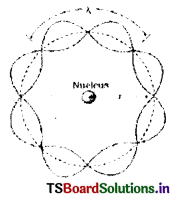
de- Brogue explained that the electron in the stationaly orbit acts like a particle wave.
So it forms stationary waves in the orbit.
The distance travelled by the particle wave along circumference is an integral multiple of wavelength. Thus, 2π rn = nλ ….(2)
From de Broglie hypothesis, we have λ = \(\frac{\mathrm{h}}{\mathrm{p}}\) = \(\frac{h}{m v_n}\)
From (2), 2πrn = \(n\left(\frac{h}{m v_n}\right)\) ⇒ m vnrn = \(\frac{\mathrm{nh}}{2 \pi}\) …… (3)
Thus, from (1) & (3) we conclude that de Broglie’s explanation coincides with the second postulate of Bohr model of atom.
Question 5.
What are the limitalions of Bohr’s theory of hydrogen atom?
Answer:
Limitations of Bohr’s theory of Hydrogen atom :
- It could not explain the fine structure of spectral lines in hydrogen atom.
- It could not explain the elliptical orbits because Bohr assumed the circular orbits.
- It could not explain the wave properties of electron.
- It could not explain the splitting of spectra under electric and magnetic field.
VI. Long Answer Questions
Question 1.
Describe Rutherford atom model. What are the draw backs of this model?
Answer:
Rutherford’s atom model:
- Every atom consists of a tiny core, called atomic nucleus, in which the entire positive charge and entire mass of the atom are concentrated.
- The size of the nucleus is of the order of 10-15m , which is very small as compared to the size of the atom which is of the order of 10-10m.
- The electrons are distributed around the nucleus. So, there is lot of empty space in the atom.
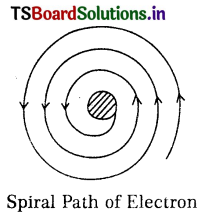
- These electrons revolve around the nucleus in circular orbits
- The centripetal force required by electron for revolution is provided by the electrostatic force of attraction between the electrons and the nucleus.
- Whole atom is electrically neutral. The total negative charge of electrons surrounding the nucleus in equal to total positive charge on the nucleus.
Drawbacks of Rutherfords atom model:
- According to classical electromagnetic theory, the revolving electrons around the nucleus must radiate energy in the form of electromagnetic waves.
- As a result of continuous loss of energy of these electrons, the energy of the electrons gradually decreases and finally it should fall into the nucleus.Then atom should collapse. But the atom is stable. Thus, Rutherford model fails to explain the stability of the atom.
- Also, Rutherford model could not explain the line spectra of the atoms.
Question 2.
State the basic postulates of Bohr’s theory of atomic spectra. Hence obtain an expression for the radius of the orbit and the energy of orbital electron in hydrogen atom.
Answer:
Postulates of Bohr’s Theory :
i) First postulate: Electron revolves around the positively charged nucleus in circular orbits called stationary orbits. Electrons do not radiate energy while revolving in stationary orbits.
For electron to revolve, Centripetal force= Electrostatic force of attraction
∴ \(\frac{\mathrm{mv}^2}{\mathrm{r}}\) = \(\frac{1}{4 \pi \varepsilon_0} \frac{\mathrm{e}^2}{\mathrm{r}^2}\)
ii) Second postulate: Angular momentum of revolving electron around the nucleus is an integral multiple of \(\frac{\mathrm{h}}{2 \pi}\) ∴ mvr = \(\frac{\mathrm{nh}}{2 \pi}\), n = 1,2,3…. represents the principal quantum number
iii) Third postulate: When electron jumps from higher energy level to lower enery level, the energy will be radiated in the form a light photon
ΔE = E2 – E1 = hv
Here E1 and E2 are the energies of the initial and the final states, v is the frequency of emitted radiation and h is Planck’s constant.
Consider an electron of H-atom of mass m, charge e.
Let it revolve in nth orbit of radius r with a velocity v.
For electron to revolve, Centripetal force = Electrostatic force of attraction
⇒ \(\frac{\mathrm{mv}^2}{\mathrm{r}}\) = \(\frac{1}{4 \pi \varepsilon_{\mathrm{o}}} \frac{\mathrm{e}^2}{\mathrm{r}^2}\) ⇒ mv2 = \(\)
From Bohr’s 2nd postulate, we have mvr = \(\frac{\mathrm{nh}}{2 \pi}\) ⇒ m2v2r2 = \(\frac{n^2 h^2}{4 \pi^2}\) …. (2)
\(\frac{(2)}{(1)}\) ⇒ \(\frac{\mathrm{m}^2 \mathrm{v}^2 \mathrm{r}^2 .}{\mathrm{m} \mathrm{v}^2}\) = \(\frac{n^2 h^2 4 \pi \varepsilon_0 r}{4 \pi^2 . e^2}\) ⇒ r = \(\frac{\mathrm{h}^2 \varepsilon_0 \mathrm{n}^2}{\pi \mathrm{e}^2 \mathrm{~m}}\) …. (3)
a) K.E of electron: We know K.E. = \(\frac{1}{2}\)mv2
From (1), K = \(\frac{1}{2}\left(\frac{1}{4 \pi \varepsilon_0} \frac{\mathrm{e}^2}{\mathrm{r}}\right)\) = \(\frac{1}{8 \pi \varepsilon_0} \frac{\mathrm{e}^2}{\mathrm{r}}\) ….. (4)
Substituting value of r from eq(3) in (4) we get
Kinetic Energy K = \(\frac{1}{8 \pi \varepsilon_0} \frac{e^2 \cdot \pi e^2 m}{h^2 \varepsilon_0 n^2}\) = \(\frac{\mathrm{me}^4}{8 \varepsilon_0^2 \mathrm{~h}^2 \mathrm{n}^2}\)
b) PE of electron: P.E = Potential (V) × charge of electron.
Potential energy U = \(\frac{1}{4 \pi \varepsilon_0} \frac{\mathrm{e}}{\mathrm{r}}(-\mathrm{e})\) = \(-\frac{1}{4 \pi \varepsilon_0} \frac{\mathrm{e}^2}{\mathrm{r}}\) …… (5)
Substituting the value of radius r from (3) in eqn (5) we get
U = –\(\frac{e^2}{4 \pi \varepsilon_0}\left(\frac{\pi e^2 m}{h^2 \varepsilon_0 n^2}\right)\) = –\(\frac{\mathrm{me}^4}{4 \varepsilon_0^2 \mathrm{~h}^2 \mathrm{n}^2}\)
Exercise Problems
Question 1.
The radius of the first electron orbit of a hydrogen atom is 5.3 × 10⁻¹¹ m. What is the radius of the second orbit?
Answer:
Radius of first orbit r1 = 5.3 × 10⁻¹¹ m
Radius of nth orbit rn ∝ n2 ⇒ \(\frac{r_1}{r_2}\) = \(\frac{\mathrm{n}_1^2}{\mathrm{n}_1^2}\) ⇒ r2 = \(\frac{\mathrm{r}_1 \mathrm{n}_2^2}{\mathrm{n}_1^2}\) = \(\frac{5.3 \times 10^{-11} \times(2)^2}{1}\) = 21.2 × 10⁻¹¹ m
Question 2.
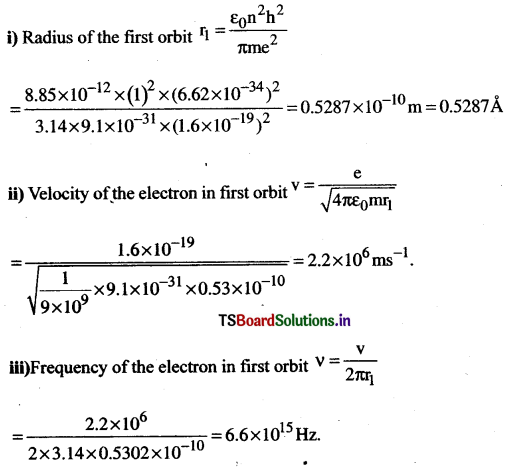
Determine the radius of the first orbit of the hydrogen atom. What would be the velocity and frequency of the electron in the first orbit? Given that h = 6.62 × 10⁻³⁴ Js, m = 9.1 × 10⁻³¹ kg, e = 1.6 × 10⁻¹⁹ C, K = 9 × 10⁹ Nm2 C-2
Answer:
Given Mass of the electron m = 9.1 × 10⁻³¹ kg, Planck’s constant h = 6.62 × 10⁻³⁴ Js, Charge of the electron e = 1.6 × 10⁻¹⁹ C, K = 9 × 10⁹ Nm2 C-2
Question 3.
The total energy of an electron in the first excited state of the hydrogen atom is -3.4 eV. What are the potential energy and kinetic energies of the electron on this state?
Answer:
Total energy of the electron in the first excited state is E1 = -3.4 eV
Potential energy of electron is U = 2ET = 2(-3.4) = -6.8 eV
Kinetic energy of the electron is K = ET – (-3.4 ) = 3.4 eV
Objectives
Question 1.
Two ions having equal masses, but charges in the ratio 1 : 2 are projected perpendicular to a uniform magnetic field with speeds in the ratio 2 : 3. The ratio of the radii of the circular paths along which the two ions move is
1) 4 : 3
2) 2 : 3
3) 3 : 2
4) 1 : 4
Answer:
1) 4 : 3
Question 2.
An X-ray tube is operated at a constant potential difference and it is required to get X-rays of wavelength not less than 0.2 nanometres. Then die potential difference in kilovolts is (h = 6.63 × 10⁻³⁴ J-s; e = 1.6 × 10⁻¹⁹ coulombs, c = 3 × 10⁸ m/s)
1) 24.8
2) 12.4
3) 6.2
4) 3.1
Answer:
3) 6.2
Question 3.
A proton, a deutron (nucleus of 1H2) and an α-particle with same kinetic energy enter a region of uniform magnetic field moving at right angles to the field .The ratio of the radii of their circular paths is
1) 1 : 2 : 4
2) 1 : \(\sqrt{2}\) : 1
3) 2 : \(\sqrt{2}\) : 1
4) 1 : 1 : 2
Answer:
2) 1 : \(\sqrt{2}\) : 1
Question 4.
When an α-particle of mass m moving with velocity v bombards on a heavy nucleus of charge Ze, its distance of closest approach from the nucleus depends on m as
1) \(\frac{1}{\mathrm{~m}^2}\)
2) m
3) \(\frac{1}{\mathrm{~m}}\)
4) \(\frac{1}{\sqrt{\mathrm{~m}}}\)
Answer:
3) \(\frac{1}{\mathrm{~m}}\)
Question 5.
The ratio of wavelengths of the last line of Baimer series and the last line of Lyman series is –
1) 1
2) 4
3) 0.5
4) 2
Answer:
2) 4
Question 6.
Ratio of longest wavelengths corresponding to Lyman and Baimer series in hydrogen spectrum is
1) 7/29
2) 9/31
3) 5/27
4) 5/23
Answer:
3) 5/27
Question 7.
Which source is associated with a line emission spectrum?
1) Electric fire
2) Neon street sign
3) Red traffic light
4) Sim
Answer:
2) Neon street sign
Question 8.
The total energy of an electron in an atom in orbit is – 3.4 eV. Its kinetic and potential energies are, respectively
1) 3.4 eV, 3.4 eV
2) -3.4 eV, -3.4 eV
3) -3.4 eV, -6.8 eV
4) 3.4 eV, – 6.8 eV
Answer:
4) 3.4 eV, – 6.8 eV
Question 9.
The ratio of kinetic energy to the total energy of an electron in a Bohr orbit of the hydrogen atom, is
1) 1 : 1
2) 1 : -1
3) 2 : -1
4) 1 : -2
Answer:
2) 1 : -1
Question 10.
Out of the following which one is not a possible energy for a photon to be emitted by hydrogen atom according to Bohr’s atomic model?
1) 0.65 eV
2) 1.9 eV
3) 11.1 eV
4) 13.6 eV
Answer:
3) 11.1 eV
Question 11.
An electron in the hydrogen atom jumps from excited state n to the ground state. The wavelength so emitted illuminates a photosensitive material having work function 2.75 eV. If the stopping potential of the photoelectron is 10 V, then the value of n is
1) 2
2) 3
3) 4
4) 5
Answer:
3) 4
Question 12.
An electron in hydrogen atom makes a transition n1 → n2 where n2 and n2 are principal quantum numbers of the two states. Assuming Bohr’s model to be valid, the time period of the electron in the initial state is eight times that in the final state. The possible values of n1 and n2 are
1) n1 = 6 and n2 = 2
2) n1 = 8 and n2 = 1
3) n1 = 8 and n2 = 2
4) n1 = 4 and n2 = 2
Answer:
4) n1 = 4 and n2 = 2
Question 13.
The electron in the hydrogen atom jumps from excited state (n = 3) to its ground state (n = 1) and the photons thus emitted irradiate a photosensitive material. If the work function of the material is 5.1 eV, the stopping potential is estimated to be (the energy of the electron in nth state En = \(\frac{-13.6}{n^2}\)ev )
1) 5.1 V
2) 12.1V
3) 17.2 V
4) 7V
Answer:
4) 7V
Question 14.
The total energy of electron in the ground state of hydrogen atom is -13.6 eV. The kinetic energy of an electron in the first excited state is
1) 6.8 eV
2) 13.6 eV
3) 1.7 eV
4) 3.4 eV
Answer:
4) 3.4 eV
Question 15.
The total energy of an electron in the first excited state of hydrogen atom is about -3.4 eV. Its kinetic energy in this state is
1) 3.4 eV
2) 6.8 eV
3) -3.4 eV
4) -6.8 eV
Answer:
1) 3.4 eV
Question 16.
The life span of atomic hydrogen is
1) fraction of one second
2) one year
3) one hour
4) one day
Answer:
1) fraction of one second
Question 17.
When hydrogen atom is in its first excited level, its radius is of the Bohr radius.
1) twice
2) 4 times
3) same
4) half
Answer:
2) 4 times
Question 18.
When a hydrogen atom is raised from the ground state to an excited state,
1) both K.E. and P.E. increase
2) both K.E. and P.E. decrease
3) the P.E. decreases and K.E. increases
4) the P.E. increases and K.E. decreases.
Answer:
4) the P.E. increases and K.E. decreases.
Question 19.
The ground state energy of H-atom is – 13.6 eV. The energy needed to ionize H- atom from its second excited state 1) 1.51 eV
2) 3.4 eV
3) 13.6 eV
4) none of these
Answer:
1) 1.51 eV
Question 20.
Hydrogen atom in ground state is excited by a monochromatic radiation of λ = 975A°. Number of spectral lines in the resulting spectrum emitted will be
1) 3
2) 2
3) 6
4) 10
Answer:
3) 6
Question 21.
The transition from the state n = 3 to n = 1 in a hydrogen like atom results in ultraviolet radiation. Infrared radiation will be obtained in the transition from
1) 2 → 1
2) 3 → 2
3) 4 → 2
4) 4 → 3
Answer:
4) 4 → 3
Question 22.
Maximum frequency of emission is obtained for the transition
1) n = 2 to n = 1
2) n = 6 to n = 2
3) n = 1 to n = 2
4) n = 2 to n = 6
Answer:
1) n = 2 to n = 1
Question 23.
When an electron does transition from n = 4 to n = 2, then emitted line spectrum will be
1) first line of Lyman series
2) second line of Balmer series
3) first line of Paschen series
4) second line of Paschen series.
Answer:
2) second line of Balmer series
Question 24.
Hydrogen atoms are excited from ground state of the principle quantum number 4. Then the number of spectral lines observed will be
1) 3
2) 6
3) 5
4) 2
Answer:
2) 6