
Regular practice with AP Inter 2nd Year Physics Study Material Chapter 9 Ray Optics and Optical Instruments Questions and Answers helps students stay prepared for examinations.
AP Inter 2nd Year Physics 9th Lesson Ray Optics and Optical Instruments Questions and Answers
I. Multiple Choice Questions
Question 1.
What is the magnification when the object is placed at a distance of ‘2f’ from the pole of a convex mirror?
1) 1/3
2) 2/3
3) 1
4) 3/2
Answer:
1) 1/3
For a convex mirror, the focal length f is positive. The object distance p is negative. So u= – 2f
From mirror formula, \(\frac{1}{f}=\frac{1}{v}+\frac{1}{u}\) ⇒ \(\frac{1}{v}=\frac{1}{f}-\frac{1}{u}\) = \(\frac{1}{f}-\frac{1}{-2 f}\) = \(\frac{1}{f}+\frac{1}{2 f}=\frac{3}{2 f}\)
⇒ v = \(\frac{2f}{3}\)
Magnification m = –\(\frac{\mathrm{v}}{\mathrm{u}}\) = \(\frac{-2 \mathrm{f} / 3}{-2 \mathrm{f}}\) = \(\frac{1}{3}\)
Question 2.
The minimum distance between the object and its real image for a concave mirror is
1) f
2) 2f
3) 4f
4) Zero
Answer:
4) Zero
In concave mirror, when an object is placed at the centre of curvature, which is at a distance of 2f. Then the real image is formed exactly at the same point.
So, the distance between die object and the image is zero.
Question 3.
When a light ray goes from air into water, the quantity that remains unchanged is, its
1) speed
2) amplitude
3) frequency
4) wavelength
Answer:
3) frequency
When light travels from one medium to another, it’s speed and wavelength change due to optical density, but the frequency remains constant.
Question 4.
A lens behaves as a converging lens in air, and a diverging lens in water. The refractive index of the material is
1) Equal to unity
2) Equal to 1.33
3) between unity and 1.33
4) greater than 1.33
Answer:
3) between unity and 1.33
For a lens to reverse from converging to diverging, it must be placed is a medium with a higher refractive index than the lens material itself. Since it diverges in water (p = 1.33) the lens material must be less ihan 1.33 but greater than air (1).
Question 5.
A lens (n = 1.5) with power +P is immersed in water. It’s power
1) increases
2) decreases
3) remains unchanged
4) increases for red colour decreases for blue colour
Answer:
2) decreases
Power P = \(\frac{1}{f}\) Hence, when focal length increases, the power decreases.

Question 6.
A convex lens of focal length T is put in contact with a concave lens of same focal length. The focal length of combination is
1) zero
2) 2f
3) f
4) infinity
Answer:
4) infinity
The effective power P of lenses in contact is the sum of individual powers.
Ptotal = P1 + P2 = \(\frac{1}{f}\) + (-\(\frac{1}{f}\)) = 0
Since f = \(\frac{1}{\mathrm{P}}=\frac{1}{0}\) = ∞
Question 7.
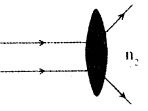
The relation between n1 and n2 if behaviour of light rays is as shown in figure is
1) n1 >> n2
2) n2 > n1
3) n1 > n2
4) n1 = n2
Answer:
2) n2 > n1
Light rays are diverging in medium of refractive index n2. This is possible only when n2 > n1.
Question 8.
An object is immersed in a fluid, in order that object becomes invisible, it
1) behaves as perfect reflector
2) absorbs all light falling on it
3) should have refractive index of object is one
4) should have refractive index of object is equal to refractive index of fluid
Answer:
4) should have refractive index of object is equal to refractive index of fluid
If the refractive index of the object matches the refractive index of the fluid, light will pass through the boundary without bending or reflecting to an observer. Object appears as if the light travelled through a single, continuous medium, making the object invisible.
Question 9.
In a simple microscope, the distance of object from the lens should be
1) more than the focal length of lens
2) less than focal length of lens
3) more than twice the focal length
4) more than focal length, but less than twice the focal length
Answer:
2) less than focal length of lens
In a simple microscope, the distance of object from the lens should be less than focal length of lens.
Question 10.
To increase magnifying power of a telescope, we should increase
1) the focal length of objective
2) the focal length of eye piece
3) the aperture of objective
4) the aperture of eye piece
Answer:
1) the focal length of objective
Magnifying power of an astronomical telescope m = \(\frac{f_0}{f_e}\).
Question 11.
In a compound microscope, the objective lens of f0 and eye piece lens of f2 are placed at a distance L such that L equals to
1) f0 + fe
2) f0 – f2
3) much greater than (f0 + fe)
4) much less than (f0 – fe)
Answer:
3) much greater than (f0 + fe)
To increase m, we must either increase the nbrneratorffg) or decrease the denominator. In a compound microscopes, to achieve high magnification, the tube length (L) must be larger than the sum of focal length. L ≥ f0 + fe
Question 12.
A fish at a depth of 12 cm in water is viewed by an observer on the bank of a lake. Through what height is the image of fish raised (n = \(\frac{4}{3}\))
1) 9 cm
2) 12 cm
3) 3 cm
4) 3.8 cm
Answer:
3) 3 cm
The height raised is known as normal shift. Real depth = 12cm, n = latex]\frac{4}{3}[/latex]
Shift = Real depth × (1 – \(\frac{1}{n}\)) = 12[1 – \(\frac{1}{4 / 3}\)] = 12[1 – \(\frac{3}{4}\)]
= 12 × \(\frac{1}{4}\) = 3 cm
II. Fill in the Blanks
Question 1.
The diameter of spherical mirror is called _________ of the mirror.
Answer:
aperture
The diameter of spherical mirror is called aperture of the mirror.
Question 2.
The nature of the image formed in a convex mirror is always ________ image.
Answer:
virtual
The nature of the image formed in a convex mirror is always virtual image.
Question 3.
Laws of reflection are valid for _________ mirrors.
Answer:
plane and curved
Laws of reflection are valid for all types of mirrors (plane and curved)
Question 4.
________ percentage of light gets reflected by total internal reflection.
Answer:
100
100 percentage of light gets reflected by total internal reflection
Question 5.
In a rectangular glass slab, the incident ray does not deviate, but suffers ___________.
Answer:
lateral shift fori lateral displacement
In a rectangular glass slab,, the incident ray does not deviate, but suffers lateral shift (or) lateral displacement.
Question 6.
In minimum deviation position, the refracted ray __________ to the base of the prism.
Answer:
parallel
When a prism is in the position of minimum deviation, the path of light through the prism is symmetrical. Due, to this symmetry, the reflected ray travel parallel to the prism base.
Question 7.
In telescope, the focal length of objective is _________ than focal length of eye piece.
Answer:
larger
Magnifying power M = \(\frac{f_0}{f_e}\). So, the focal length of objective is greater than focal length of eye piece.
Question 8.
In modem telescope ___________ aberrations are removed.
Answer:
spherical and chromatic
In modem telescope both chromatic & spherical aberrations are removed because of using mirror instead of lenses.
Question 9.
In normal adjustment of telescope, final image is formed at __________.
Answer:
infinity
In normal adjustment of telescope, final image is formed at infinity.
Question 10.
In Cassegrain telescope, objective lens replaced by ___________.
Answer:
large concave mirror.
In Cassegrain telescope, objective lens replaced by large concave mirror.
III. One Word Answer Questions
‘
Question 1.
When does Snell’s law of refraction fail?
Answer:
Snell’s law fails at normal incidence (or) when the angle of incidence is 0.
Question 2.
Which part of optical fibre has higher value of refractive index?
Answer:
The core has higher refractive index compared to cladding.
Question 3.
A lens has a power of -2.5 D, What is the nature of the lens?
Answer:
Lens with power -2.5 D indicates a concave (or) diverging lens.
The negative sign of the power indicates a negative focal length of the concave lens.
Question 4.
Three lenses with magnifications 2. 3 and 10 form a combination, what is total magnification?
Answer:
Total magnification m = m1 × m2 × m3 = 2 × 3 × 10 = 60.
Question 5.
You are given two convex lenses of focal lengths 5 cm and 20 cm which one will you choose as an objective lens for forming a compound microscope?
Answer:
Convex lens of focal length 5cm is selected for objective lens.
Because objective lens should have a short focal length.
Question 6.
A double convex lens, made from a material of refractive index n1, is immersed in a liquid of refractive index n2, where n2 > n1, what change would occur in the nature of the lens ?
Answer:
Nature of lens changes from converging to diverging.
Question 7.
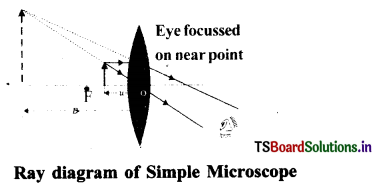
Draw a ray diagram of simple microscope, when object is placed between focus and pole?
Answer:
Question 8.
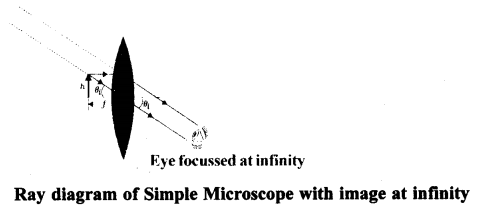
Draw a ray diagram of simple microscope, when image formed at infinity?
Answer:
Question 9.
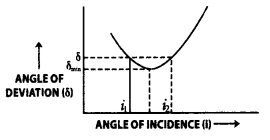
Plot a graph showing the variation of angle of deviation versus angle of incidence?
Answer:
Question 10.
What is the magnification of a simple microscope, if the final image formed at infinity?
Answer:
Magnification at infinity m = \(\frac{D}{f}\).
Here D is the least distance of distinct vision D(25 cm), f is the focal length of the convex lens.
IV. Very Short Answer Questions
Question 1.
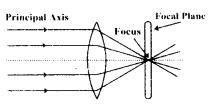
What do you understand by the focal plane? Explain with a neat ray diagram.
Answer:
The light rays coming from an object at infinity, when pass through a lens converge (or appear to diverge) at a point to form a clear image. The plane passing through that point and perpendicular to the principal axis of the lens is called focal plane.
Question 2.
Define power of a convex lens. What is its unit?
Answer:
Power of a convex Lens is defined as the reciprocal of its focal length (f).
Power P = \(\frac{1}{f}\) SI unit: dioptre (D)
Power of a lens is its ability to converge incoming light rays.
Question 3.
What is the critical angle? Cive one application of total internal reflection?
Answer:
Critical Angle (iC): When a light ray travels from denser medium to rarer medium, the angle of incidence for which the angle of refraction 90° is called critical angle.
Applications of TIR : Optical fibre, Mirage.
Question 4.
State the conditions under which total internal reflection takes place.
Answer:
Conditions for TIR:
(a) Light must travel from a denser to rarer medium.
(b) The angle of incidence at the interface must be greater than the critical angle, (i > ic)
Question 5.
Two thin lens of power +4D and -2D are in contact. What is the focal length of the combination?
Answer:
Given P1 = + 4D, P2 = -2D; Equivalent power Peq = P1 + P2 = 4 + (-2) = +2D
Focal length f = \(\frac{1}{P_{e q}}\) = \(\frac{1}{2}\) = 0.5m = 50 cm
Question 6.
A small angled prism of 4° deviates a ray through 2.4°. Find the refractive index of the prism.
Answer:
Given angle of prism A = 4°, angle of deviation Dm = 2.4°, refractive index n21 =?
Formula: For a thin angled prism Dm = (n21 – 1) A
⇒ 2.4 = (n21 – 1) 4 ⇒ n21 – 1 = \(\frac{2.4}{5}\) = 0.6 ⇒ n21 = 1 + 0.6 = 1.6
Question 7.
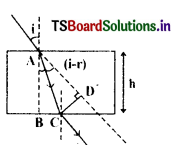
Discuss the lateral shift of a ray refracted through a parallel side glass slab with neat ray diagram.
Answer:
Lateral shift is the perpendicular distance between the incident ray’s original path and the emergent ray after passing through a parallel sided glass slab. In the diagram the lateral shift is CD.
Lateral shift of a ray
Question 8.
Draw the ray diagrams of crown glass prism to bend rays by 90“ and 180″ to form an inverted image with the use of total internal reflection.
Answer:
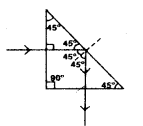
Bending rays by 90°
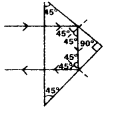
Bending rays by 180°
Question 9.
Draw a labelled ray diagram to show the formation of an image by a compound microscope. Write the expression for its magnifying power.
Answer:
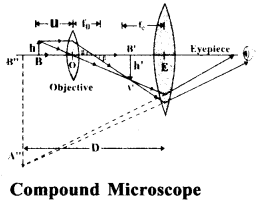
Compound Microscope
Formula: At near point, magnifying power m = m0m2 = \(\left[\frac{v_0}{u_0}\right]\left[1+\frac{D}{f_e}\right]\)
At infinity, magnifying power m = m0me = \(\left[\frac{v_0}{u_0}\right]\left[\frac{D}{f_e}\right]\)
m0 = Magnification of the object; me = Magnification of the eye piece, fe = Focal length of eye piece D = least distance of distinct of vision; u0 = object distance; v0 = image distance
Question 10.
Draw a ray diagram of an astronomical telescope (refracting telescope) in normal adjustment position (image formed at infinity). State any one drawback of this type of telescope.
Answer:
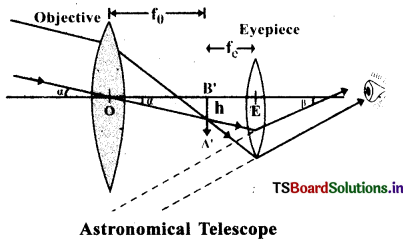
Drawback: Astronomical telescopes suffer from chromatic aberrations, blurred edges.
V. Short Answer Questions
Question 1.
Prove that the radius of curvature of curved mirror is double its focal length with a neat ray diagram.
Answer:
Focal Length(f): The distance between the focus F and the pole P of the concave mirror is called focal length (f) of the concave mirror.
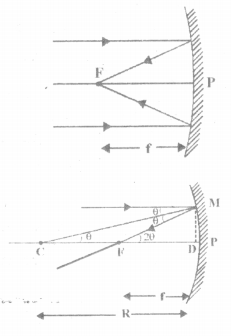
To show that R = 2f for concave mirror:
Consider a concave mirror of pole P, focus F , centre of curvature C and radius of curvature R (CP).
When a light ray parallel to its principal axis is incident at M, the reflected ray passes through its focus F.
The line joining M and C is normal to the mirror at M.
If the angle of incidence is θ, the angle of reflection ∠FMC will also be θ as per law of reflection.
In the figure, ∠MCP = θ and ∠MFP = 2θ
The perpendicular drawn from M onto principal axis is MD.
From ∆MCD, tan θ = \(\frac{M D}{C D}\) and from ∆ MFD, tan 2θ = \(\frac{M D}{F D}\)
θ = \(\frac{M D}{C D}\) and 2θ = \(\frac{M D}{F D}\) [Here tan θ ≈ θ and also tan 2θ ≈ 2θ when θ is very small]
⇒ 2 \(\left(\frac{M D}{C D}\right)\) = \(\frac{M D}{F D}\) ⇒ \(\frac{2}{\mathrm{CD}}=\frac{1}{\mathrm{FD}}\)
⇒ CD = 2FD
⇒ R=2f [ When D is very close to P, CD ≈ CP = R and FD ≈ FP = f]
∴ Radius of curvature = 2 (focal length).
Question 2.
Explain the Cartesian sign convention for a spherical mirror (or) spherical lenses with a neat ray diagram
Answer:
Cartesian Sign Convention :
The following cartesian sign convention is used for measuring various distances in the ray diagrams of spherical mirrors:
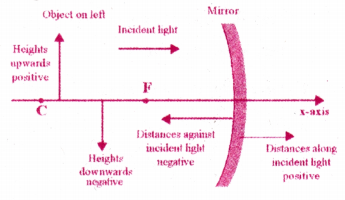
1) Object is always placed to the left of mirror.
2) All distances are measured from the pole of the mirror.
3) Distances measured in the direction (+ve x-axis) of the incident ray are positive and the distances measured in the direction opposite (-ve x-axis) to that of the incident ray are negative.
4) Distances measured above (+ve y-axis) the principal axis are positive and that measured below (-ve y-axis) the principal axis are negative.
Question 3.
Derive an expression for equivalent focal length of combination of two thin lenses in contact with a neat ray diagram.
Answer:
Consider two thin convex lenses A, B kept in contact. Their focal lengths are f1, f2 respectively.
Let a point object be placed at O.
The first lens A produces an image at I1, which serves as a virtual object for the second lens B.
The second lens produces the final image at I.
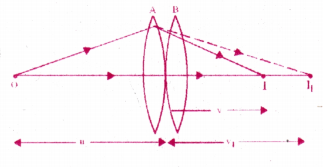
Also, the object distance is u. Image distance of I is v and image distance of I1 is v1.
Applying thin lens formula to the first lens A, we get \(\frac{1}{v_1}-\frac{1}{u}=\frac{1}{f_1}\) ………. (1)
Applying thin lens formula to the second lens t, we get \(\frac{1}{v}-\frac{1}{v_1}=\frac{1}{f_2}\) ………… (2)
Adding equ (l)and (2), we get \(\frac{1}{v}-\frac{1}{u}=\frac{1}{f_1}+\frac{1}{f_2}\) ………… (3)
If the two lenses act as a single lens with combined equivalent focal length f, then from lens formula, we get \(\frac{1}{v}-\frac{1}{u}=\frac{1}{f}\) ……….. (4)
From (3) and (4) we have \(\frac{1}{f}=\frac{1}{f_1}+\frac{1}{f_2}\)………….. (5)
This is the equation for combined focal length (f) of two thin lenses kept in contact.
Question 4.
Draw a neat ray diagram of a compound microscope and explain its working.
Answer:
Compound Microscope: Compound microscope consists of two convex lenses. The lens facing the object is called objective. The lens facing the eye is called eyepiece.
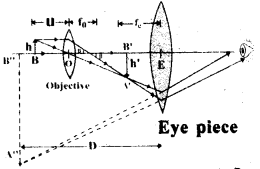
Working The ray diagram of compound microscope is as shown in the figure.
The object AB is outside its focus of objective.
Hence, it forms a real, inverted and magnified image A’B’ just inside the focus of eyepiece.
Then the eyepiece acts as a simple microscope and forms a final image A”B” at the distance*of near point (D). The final image A”B” is virtual, well magnified and inverted.
Question 5.
State any four advantages of reflecting telescope over a refracting telescope.
Answer:
Advantages of reflecting telescopes over refracting telescopes:
- Reflecting telescopes offer non-chromatic aberration.
- It is mechanically easier to construct and has large aperture and better light gathering ability.
- By using a parabolic reflecting surface, spherical aberration is reduced.
- These are very cheap and easier to manufacture at low maintenance.
Question 6.
With neat diagrams, explain the working of totally reflecting prisms.
Answer:
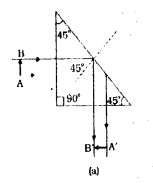
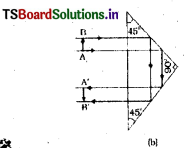
Totally Reflecting Prism: A totally reflecting prism is a right-angled isosceles prism that uses the phenomenon of total internal reflection to deviate light without significant loss of intensity. The angles of the prism are 45°, 45°, 90°
1. Prism used to deviate Light through 90°:
When a ray is incident normally on one face of the prism, it enters without refraction.
It strikes the hypotenuse face at an angle of incidence 45°, which is greater than the critical angle.
Hence, total internal reflection occurs.
The reflected ray deviates through 90° and emerges normally from the third face.
2. Prism used to deviate Light through 180°:
The ray is made incident normally on the hypotenuse face.
Inside the prism, the ray undergoes total internal reflection at the other two faces successively.
Finally, the ray emerges in the opposite direction, producing a deviation of 180°
VI. Long Answer Questions
Question 1.
Derive the mirror equation and magnification formula for a concave mirror in case of object placed beyond the center of curvature with a neat ray diagram.
Answer:
Derivation of Mirror Equation :
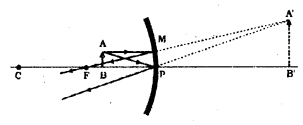
Consider a concave mirror with pole P, focus F, and centre of curvature C.
AB is an object in front of the mirror. A’B’ is its image formed by the mirror.
PF = f = focal length of concave mirror; PB’ = v = image distance; PB = u = object distance.
In figure, the triangles ∆ FB’A’, ∆MFP are similar triangles.
Hence, the ratio of their corresponding sides are equal.
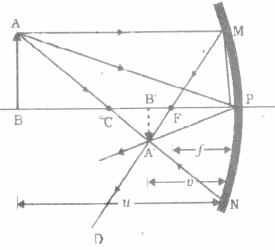
∴ \(\frac{B^{\prime} A^{\prime}}{M P}=\frac{B^{\prime} F}{F P}\)
But from figure, MP = AB
\(\frac{B^{\prime} A^{\prime}}{A B}=\frac{B^{\prime} F}{F P}\) ……….. (1)
∆ A’B’P, ∆ABP are also similar triangles.
Hence, the ratio of their corresponding sides are equal.
∴ \(\frac{B^{\prime} A^{\prime}}{A B}=\frac{B^{\prime} P}{B P}\) …………….. (2)
From (1) and (2), \(\frac{B^{\prime} A^{\prime}}{A B}=\frac{B^{\prime} P}{B P}\)
But from the figure, B’F = B’P – FP
∴ \(\frac{B^{\prime} P-F P}{F P}=\frac{B^{\prime} P}{B P}\) …………… (3)
From sign convention, distances from P against the direction of incident light are negative.
Here B’P = -v, FP =-f, BP = -u
From (3), we get \(\frac{-v-(-f)}{-f}=\frac{-v}{-u}\) ⇒ \(\frac{v-f}{f}=\frac{v}{u}\) ⇒ \(\frac{1}{v}+\frac{1}{u}=\frac{1}{f}\)
This is the mirror formula.
Linear Magnification (m) :
It is the ratio of height of the image (h’) to height of the object (h) ∴m = \(\frac{h^{\prime}}{h}\)
In the case of a mirror w ith propel sign convention we have m = –\(\frac{\mathrm{v}}{\mathrm{u}}\)
Hence, we conclude that a real inverted image is formed by a concave mirror.
Question 2.
a) Explain the total internal reflection of light with a neat ray diagram. Derive the relation between critical angle and refractive index,
b) Explain the working of optical fiber with a neat diagram.
Answer:
a) Total Internal Reflection: When a light ray is passing from denser medium to rarer medium and if the angle of incidence is greater than its critical angle (i > iC), it gets reflected into the same denser medium without any refraction. This phenomenon is called total internal reflection.
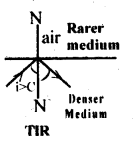
Relation between critical angle and referactive index:
Let n2 be the refractive index of the denser medium n1 be the refractive index of the rarer medium .
From Snell’s law, \(\frac{n_1}{n_2}=\frac{\sin r}{\sin i_C}=\frac{1}{\sin i_C}\) (r = 90° ⇒ sin90° = 1)
Equation for critical angle is n21 = \(\frac{1}{\sin _{\mathrm{C}}}\) (or) sin iC = \(\frac{1}{n_{21}}\)
where n21 = refractive index of the denser medium with respect to rarer medium.
b) Working of optical fiber:
An optical fibre works op the principle of total internal reflection.
Optical fibre consists of a core and cladding.
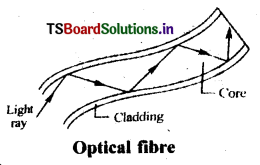
The refractive index of the material of the core is higher than that of the cladding.
When a light signal is directed at one end of the fibre at a suitable angle, it undergoes repeated total internal reflections along the length of the fibre and finally comes out at the other end.
Since light undergoes total internal reflection at each stage, there is no appreciable loss in the intensity of the light signal.
Optical fibres are fabricated such that light reflected at one side of inner surface strikes the other at an angle larger than the critical angle. Even if the fibre is bent, then also light can easily travel along its length.
Question 3.
Derive the lens makers formula with suitable diagram and thereby derive the lens formula.
Answer:
Lens makers formula & Lens formula:
Consider a thin double convex lens of material of refractive index n2.
The lens is placed in a medium of refractive index n1.T
he radii of curvature of its two spherical surfaces are R1, R2. O is the point object on the principal axis of the lens . I is the image of O formed by the lens. Object distance is u Image distance is v.
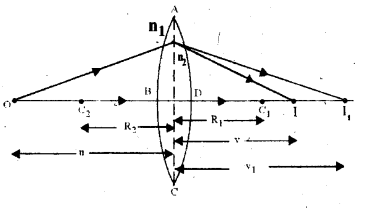
The general formula of refraction for curved surface is \(\frac{\mathrm{n}_2}{\mathrm{v}}-\frac{\mathrm{n}_1}{\mathrm{u}}=\frac{\mathrm{n}_2-\mathrm{n}_1}{\mathrm{R}}\) ………….. (1)
For first surface: Object distance = u, image distance = v, RI of the object space = n1,
RI of the image space = n2, Radius of curvature = R1
From (1), weget = \(\frac{\mathrm{n}_2}{\mathrm{v}_1}-\frac{\mathrm{n}_1}{\mathrm{u}}=\frac{\mathrm{n}_2-\mathrm{n}_1}{\mathrm{R}_1}\) ……………. (2) .
For second surface:Object distance = v1 image distance = v, RI of the object space = n2, RI of the image space = n1, Radius of curvature = R2
From (1), we get = \(\frac{n_1}{v}-\frac{n_2}{v_1}=\frac{n_2-n_1}{-R_2}\) ……….. (3) .
Adding equations (2), and (3), we get \(\frac{\mathrm{n}_1}{\mathrm{v}}-\frac{\mathrm{n}_1}{\mathrm{u}}=\left(\mathrm{n}_2-\mathrm{n}_1\right)\left[\frac{1}{\mathrm{R}_1}-\frac{1}{\mathrm{R}_2}\right]\) ………….. (4)
If the object is at infinity, its image is formed at focus, ie, If u = °° then n1/u = 0; also v = f
Putting these in equ (4), we get \(\frac{\mathrm{n}_1}{\mathrm{f}}\) = (n2 – n1) \(\left[\frac{1}{R_1}-\frac{1}{R_2}\right]\) ……………. (5)
Dividing it by n1, we get \(\frac{1}{\mathrm{f}}\) = (n21 – 1) \(\left[\frac{1}{R_1}-\frac{1}{R_2}\right]\) …….. (5) where n21 = \(\frac{\mathrm{n}_2}{\mathrm{n}_1}\)
This is the lens maker’s formula.
By comparing (4) and (5) we get \(\frac{\mathrm{n}_1}{\mathrm{v}}-\frac{\mathrm{n}_1}{\mathrm{u}}=\frac{\mathrm{n}_1}{\mathrm{f}}\) ⇒ \(\frac{1}{v}-\frac{1}{u}=\frac{1}{f}\) …………. (6)
This is the thin lens formula.
Question 4.
Derive the equation for angle of deviation produced by a triangular prism with a neat labelled diagram, and there by derive an expression for refractive index of material of the prism.
Answer:
(a) Angle of incidence, Angle of deviation:
Consider a triangular glass prism ABC.
A = Refracting angle of the prism.
n21 = Refractive index of glass w.r.to air.
PQ = Incident ray., RS = Emergent ray
QR = Refracted ray in the prism.
The normals to AB and AC meet at N.
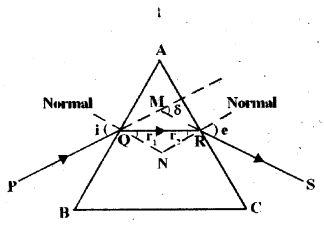
i = Angle of incidence at the first surface,
r1 = Angle of refraction at the first surface.
r2 = Angle of refraction at the second surface (if light enters from 2nd surface). ,
e = Angle of emergence.
δ = Angle of deviation is the angle between (PQ and RS).
In the quadrilateral AQNR, ∠ A + ∠ QNR= 180° ………….. (1)
In ∆ QNR, r1 + r2 + ∠QNR = 180° …………….. (2)
Equating eq. (1) and (2), r1 + r2 + ∠QNR = A + ∠QNR ⇒ r1 + r2 = A
The total deviation δ = sum of deviations at die two faces.
∴ δ = (i – r1) + (e – r2) ⇒ δ = i + e – (r1 + r2) ……………. (4)
From (3), δ = i + e – A …………….. (5)
This shows that the angle of deviation δ depends on angle of incidence i.
The graph between i and δ is as shown in the (i-δ curve).
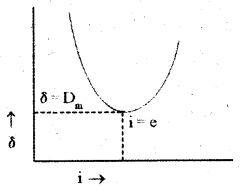
The value of δ decreases to a minimum called angle of minimum deviation (Dm) and then increases.
At δ = Dm = angle of minimum deviation, it was found experimentally that i = e and r1 = r2 = r
Putting these in equations (3) and (5), 2r = A ⇒ r = \(\left(\frac{\mathrm{A}}{2}\right)\) ………….. (6)
and i + i = A + Dm ⇒ 2i = A + Dm ⇒ i = \(\left(\frac{\mathrm{A}+\mathrm{D}_{\mathrm{m}}}{2}\right)\) …………. (7)
This is the equation for angle of incidence in terms of angle of prism and angle of minimum deviation.
(b) Prism formula for refractive index of prism:
When the light ray is passing from medium 1 (air) to medium 2 (glass), the refractive index (n21) of medium 2 with respect to medium 1 is given by n21 = \(\frac{\sin i}{\sin r}\) ……(8)
From (6) & (7) we get n21 = \(\frac{\sin \left(\frac{A+D_m}{2^{-}}\right)}{\sin \left(\frac{A}{2}\right)}\)
Question 5.
With a neat labelled diagram explain the formation of image in a simple microscope. Derive the expression for magnification when the image is formed at i) near point ii) at infinity.
Answer:
Simple Microscope:
A simple microscope or magnifying glass is a convex lens of small focal length.
In this, the object is placed between the principal focus F and the optic centre of the convex lens.
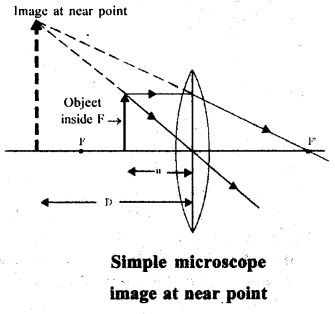
Formation of image can be explained by two ray diagram. The light ray coming from the object parallel to principal axis refracts at lens and passes through second principal focus F’.
Another light ray from the object passes through the optic centre of the lens undeviated.
These two rays meet on the back side of the object to form the image.
Hence, the image formed is virtual, erect and magnified as shown in the figure.
The closest comfortable distance for viewing the image is the distance of the near point D = 25 cm.
Position of Object in Simple Microscope:
In simple microscope, the object is placed between the principal focus F and the optic centre of the convex lens. The image formed in it is on back side of the object. Its nature is virtual, erect and magnified,
i) Magnification when image at near point:
The linear magnification (m) of a simple microscope for the image formed at the near point D = 25 cm, m = \(\frac{\mathrm{v}}{\mathrm{u}}\)
But lens equation is \(\frac{1}{v}-\frac{1}{u}=\frac{1}{f}\) (o) r \(\frac{1}{u}\) = \(\frac{1}{v}-\frac{1}{f}\) ⇒ \(\left(\frac{1}{v}-\frac{1}{f}\right)\)
∴ m = v\(\left(\frac{1}{v}-\frac{1}{f}\right)\) = \(\left(1-\frac{v}{f}\right)\)
But here, v = -D ∴ m = 1 + \(\frac{\mathrm{D}}{\mathrm{f}}\)
ii) Magnification when image at infinity:
If the image is formed at infinity, the equation for magnification becomes m = \(\frac{\mathrm{D}}{\mathrm{f}}\)
Textual Solved Problems
Question 1.
Suppose that the lower half of the concave mirror’s reflecting surface is covered with an opaque (non-reflective) material. What effect will this have on the image of an object placed in front of the mirror?
Answer:
The image will be that of the whole object.
But the intensity of the image will reduce to half because, the area of die reflecting surface has been reduced.
Question 2.
A mobile phone lies along the principal axis of a concave mirror, as shown in figure. Show by suitable diagram, the formation of its image. Explain why the magnification is not uniform. Will the distortion of image depend on the location of the phone with respect to the mirror?
Answer:
Ifa mobile phone lies along the principal axis of a concave mirror longitudinally, the object distance (u) changes for different portions of mobile phone. When the value of u changes, the value of image distance (v) also changes.
As a result, the image framed is not uniform.
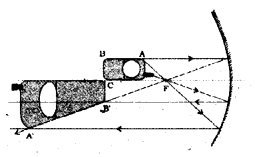
The value of magnification m = -v/u will be different for different portions of the mobile phone .because v decreases with the increase of u for concave mirror.
Hence, the magnification of die image will not be uniform.Its shape will be conical
Question 3.
An object is placed at (i)t10 cm, (ii) 5 cm in front of a concave mirror of radius of curvature 15 cm. Find the position, nature, and magnification of the image in each, case.
Solution:
Given focal length f = -15/2 cm = -7.5 cm
(i) When the object distance is u =-10 cm.
Mirror formula: \(\frac{1}{v}+\frac{1}{u}=\frac{1}{f}\)
\(\frac{1}{v}+\frac{1}{-10}=\frac{1}{-7.5}\) ⇒ v = \(\frac{10 \times 7.5}{-2.5}\) = -30 cm
The image is at 30 cm from the mirror on the same side as the object, v -30
Magnification m = \(\frac{\mathrm{v}}{\mathrm{u}}\) = \(\frac{-30}{-10}\) = – 3
The image is magnified, real and inverted.
(ii) When object distance is u = -5 cm, f = -7.5 cm
Mirror formula: \(\frac{1}{v}+\frac{1}{u}=\frac{1}{f}\) ⇒ \(\frac{1}{v}+\frac{1}{-5}=\frac{1}{-7.5}\) ⇒ v = \(\frac{5 \times 7.5}{(7.5-5)}\) = 15 cm
The image is formed at 15 cm behind the mirror. It is a virtual image.
Magnification m = –\(\frac{\mathrm{v}}{\mathrm{u}}\) = –\(\frac{-15}{-5}\) = 3
The image is magnified, virtual and erect.
Question 4.
Light from a point source in air falls on a spherical glass surface (n = 1.5 and radius of curvature = 20 cm). The distance of the light source from the glass surface is 100 cm. At what position the image is formed?
Solution:
Given u = -100 cm, v = ?, R = + 20cm, n1 = 1, and n2 = 1.5.
Formula: \(\frac{\mathrm{n}_2}{\mathrm{v}}-\frac{\mathrm{n}_1}{\mathrm{u}}=\frac{\mathrm{n}_2-\mathrm{n}_1}{\mathrm{R}}\) ⇒ \(\frac{1.5}{v}+\frac{1}{100}=\frac{0.5}{20}\) ⇒ v = +100cm v
The image is formed at a distance of 100 cm from the glass surface, in the direction of incident light.
Question 5.
A magician during a show makes a glass lens with n = 1.47 disappear in a trough of liquid. What is the refractive index of the liquid? Could the liquid be water?
Solution:
The refractive index of die liquid must be equal to 1.47 in orderto make the lens disappear.
This means n1 = n2.
This gives 1/f = 0 or f → ∞. The lens in the liquid will act like a plane sheet of glass.
No, the liquid is not water. It could be glycerine.
Question 6.
If f = 0.5 in for a glass lens, what is the power of the lens?
Solution:
f = 0.5m, p = ?. Formula: p = \(\frac{1}{\mathrm{f}}\)
∴ p = \(\frac{1}{0.5}\) = 2D
Power of die lens p = +2 dioptre.
Question 7.
The radii of curvature of the faces ola double convex lens are 10cm and 15cm. Its focal Ieagth is 12 cm. What ¡s the refractive index of glass?
Solution:
Given f = +12 cm(convcxlens)
R1= +10 cm (convex surface for incident rays),
R2 = -15 cm(concave surface for incident rays),
Refractive index ofair n1 = 1, n2 = ? Also n21 = \(\frac{\mathrm{n}_2}{\mathrm{n}_1}\) = n2
Lens maker’sformula: \(\frac{1}{\mathrm{f}}\) = (n21 – 1) \(\left(\frac{1}{R_1}-\frac{1}{R_2}\right)\) ⇒ \(\frac{1}{+12}\) = (n2 – 1) \(\left(\frac{1}{+10}-\frac{1}{-15}\right)\)
⇒ (n2 – 1) = \(\frac{10 \times 15}{12(10+15)}\) = 0.5 ⇒ 1 + 0.5 = 1.5
Thus the refractive index of the glass is 1.5.
Question 8.
A convex lens has 20 cm focal length in air. What is its focal length in water? (Refractive index of air-water = 1.33 refractive index for air-glass = 1.5.)
Solution:
Lens maker’sformula: \(\frac{1}{\mathrm{f}}\) = (n21 – 1) \(\left(\frac{1}{R_1}-\frac{1}{R_2}\right)\)
(i) When the lens is in air, f = +20 cm, n21 = \(\frac{\mathrm{n}_2}{\mathrm{n}_1}\) = 1.5,
∴ \(\frac{1}{20}\) = (1.5 – 1) \(\left(\frac{1}{R_1}-\frac{1}{R_2}\right)\) = (0.5) \(\left(\frac{1}{R_1}-\frac{1}{R_2}\right)\) ……….. (1)
(ii) When the lens is put in water, n21 = \(\frac{\mathrm{n}_2}{\mathrm{n}_1}\) = latex]\frac{1.5}{1.33}[/latex], f = ?
∴ \(\frac{1}{\mathrm{f}}\) = \(\left(\frac{1.5}{1.33}-1\right)\) \(\left(\frac{1}{R_1}-\frac{1}{R_2}\right)\) ………… (2)
Dividing equ (1) by equ (2), we get \(\frac{\mathrm{f}}{20}\) = \(\frac{0.5}{\left(\frac{1.5}{1.33}-1\right)}\) ⇒ f = \(\frac{20 \times 0.5 \times 1.33}{1.5-1.33}=\frac{13.3}{0.17}\) = 78.2 cm
Thus, when a lens is immersed in water, its focal length becomes roughly 4 times to its focal length in air.
Question 9.
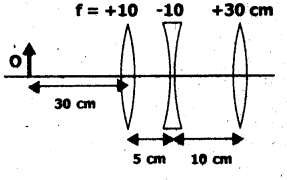
Find the position of image formed by the lens combination given in the figure.
Solution:
The image formed by the first lens, \(\frac{1}{v_1}-\frac{1}{u_1}=\frac{1}{f_1}\) ⇒ \(\frac{1}{v_1}-\frac{1}{-30}=\frac{1}{10}\) ⇒ v1 = 15 cm
The image formed by the first lens serves as the object for the second lens.
This is at a distance of (15 – 5) cm = 10 cm to the right of the second lens.
It serves as the virtual object forthe second lens.
Thus, \(\frac{1}{v_2}=\frac{1}{10}=\frac{1}{-10}\) ⇒ v2 = ∞
This becomes the object distance for the third lens.
\(\frac{1}{v_3}-\frac{1}{u_3}=\frac{1}{f_3}\) ⇒ \(\frac{1}{v_3}-\frac{1}{\infty}=\frac{1}{30}\) ⇒ v3 = 30 cm
Thus, the final image is formed to the right of the third lens at a distance of 30 cm.
Exercise Problems
Question 1.
A light wave of frequency 4 × 10¹⁴Hz and a wave length of 5 × 10⁻⁷m, passes through a medium. Estimate refractive index of medium [speed of light in vacuum c = 3 × 10⁸ m/s]
Answer:
Given frequency f = 4 × 10¹⁴ Hz; wavelength λ = 5 × 10⁻⁷m, velocity of light c = 3 × 10⁸ m/s
wave velocity v = frequency × wavelength = f × λ= 4 × 1014 × 5 × 10-7 = 2 × 10⁸ m/s
∴ Refractive index μ = \(\frac{c}{v}=\frac{3 \times 10^8}{2 \times 10^8}=\frac{3}{2}\) = 1.5
Question 2.
Calculate the refractive index of medium, if its critical angle is 60°?
Answer:
Refractive index μ = \(\frac{1}{\sin c}=\frac{1}{\sin 60^{\circ}}=\frac{1}{(\sqrt{3} / 2)}=\frac{2}{\sqrt{3}}\) (∵ c = 60°)
Question 3.
An object is placed at a distance of 15 cm, from a convex mirror and image is formed at a distance of 5 cm from the mirror. Calculate the radius of curvature of the mirror.
Answer:
Here, object distance u = -15cm,Image distance v = +5cm
From mirror formula \(\frac{1}{f}=\frac{1}{v}+\frac{1}{u}\)=\(\frac{1}{5}+\frac{1}{(-15)}=\frac{2}{15}\)⇒ f = \(\frac{15}{2}\) = 7.5 csm;
∴ Radius of curvature R = 2f = 2 × 7.5 = 15 cm
Question 4.
A convex refracting surface of radius of curvature 20 cm separating two media of refractive index 4/3 and 1.60, an object is placed in the first medium (n = \(\frac{4}{3}\)) distance of 200 cm, from refracting surface. Calculate the position of the image formed?
Solution:
Here, u = -200 cm, v = ?, R = + 20 cm, n1 = 4/3, and n2 = 1.6.
As refraction occurs from rarer to denser medium,
\(\frac{n_2}{v}-\frac{n_1}{u}=\frac{n_2-n_1}{R}\) ⇒ \(\frac{1.6}{v}-\frac{4 / 3}{-200}=\frac{1.60-4 / 3}{20}\) ⇒ \(\frac{1.6}{v}+\frac{4}{3 \times 200}\) = \(\frac{(4.8) / 3-4 / 3}{20}\)
⇒ \(\frac{1.6}{v}+\frac{1}{150}=\frac{0.8}{3 \times 20}\) ⇒ \(\frac{1.6}{v}+\frac{1}{150}=\frac{8}{600}\) ⇒\(\frac{1.6}{v}=\frac{8}{600}-\frac{1}{150}\) ⇒ v = 1.6 × 150 = 240 cm
Since, the value is positive, the image is formed in the denser medium (second medium)
Question 5.
An object is placed at 0. 06 m from a convex lens of focal length 0.10 m, calculate the position and nature of the image.
Solution:
Given object distance u = -0.06m = -6cm, Focal length f = 0.1m = 10 cm
From lens formula, \(\frac{1}{f}=\frac{1}{v}+\frac{1}{u}\) ⇒ \(\frac{1}{v}=\frac{1}{f}+\frac{1}{u}\) = \(\frac{1}{10}\) + \(\frac{1}{-6}\)
= \(\frac{6-10}{60}\) = \(\frac{-4}{60}\) = \(\frac{-1}{15}\) cm
∴ Image distance v = -15cm
The negative sign indicates that the image is formed on the same side as the object.
Question 6.
Two lenses of powers + 15 D and – 5 D are in contact each other forming a combination of lens a) What is the focal length of this combination? b)An object of size 3 cm is placed at 30 cm from this combination of lenses.
Calculate the position and size of the image formed.
Answer:
Given P1 = 15D, P2 = -5D, object distance u=-30cm, combined power P = P1 + P2 = 15 – 5 = 10D
a) Focal length f = \(\frac{1}{\mathrm{P}}\) = \(\frac{1}{10}\) = 0.1m = 10cm
b) Using Lens formula \(\frac{1}{f}=\frac{1}{v}+\frac{1}{u}\) ⇒ \(\frac{1}{v}=\frac{1}{f}+\frac{1}{u}\) = \(\frac{1}{10}\) + \(\frac{1}{(-30)}\) = \(\frac{1}{15}\)
∴ Image distance v = +15cm
Magnification m = \(\frac{v}{u}=\frac{15}{-30}\) = -0.5 (∵ h0 = 3cm)
m = \(\frac{h_i}{h_0}\) ⇒ hi = mh0 = -0.5 × 3 = -1.5 cm
∴ hi = -1.5cm
The negative sign indicates the image is inverted.
Question 7.
Calculate the refractive index of material of an equilateral prism for which angle of minimum deviation is 60°.
Answer:
Angle of prism A = 60°, Angle of minimum deviation Dm = 60°
Refractive index of prism µ = \(\frac{\sin \left(\frac{A+D_m}{2}\right)}{\sin \left(\frac{A}{2}\right)}\) ⇒ µ = \(\frac{\sin \left(\frac{60^{\circ}+60^{\circ}}{2}\right)}{\sin \left(\frac{60^{\circ}}{2}\right)}\)
= \(\frac{\sin 60^{\circ}}{\sin 30^{\circ}}\) = \(\frac{\sqrt{3}}{2} \times \frac{2}{1}=\) = \(\sqrt{3}\) = 1.732
Question 8.
The magnifying power of an astronomical telescope in the normal adjustment position is 100. The distance between the objective and the eye piece is 101 cm, calculate focal lengths of the objective and eye piece.
Answer:
Given Magnifying power m = 100,Distance between lenses L = 101cm
Magnifying power m = \(\frac{f_0}{f_e}\) ⇒ 100 = \(\frac{f_0}{f_e}\) ⇒ f0 = 100fe.
Distance between lenses L = f0 + fe ⇒ 101 = 100fe + fe = (100 + 1)fe ⇒ fe = \(\frac{101}{101}\) = 1cm
∴ f0 = 100 × fe = 100 × 1 = 100 cm
∴ Focal length of objective, f0 = 100cm and eyepiece fe = 1cm
fe = 1 cm, f0 = 100 cm
Objective Questions
Question 1.
A ray of light is incident on one of the refracting faces of an equilateral prism, at an angle of incidence 48″, in the minimum deviation position. The angle of deviation produced by the prism is
1) 48°C
2) 36°C
3) 24°C
4) 18°C
Answer:
2) 36°C
Question 2.
The refractive index of a material of a piano concave lens is 5/3, the radius of curvature is 0.3m. The focal length of the lens in air is
1) -0.45 m
2) -0.6 m
3) -0.75 m
4) -1.0 m
Answer:
1) -0.45 m
Question 3.
A prism is made up of material of refractive index \(\sqrt{3}\). The angle of the prism is A. If the angle of minimum deviation is equal to the angle of the prism, then the value of A is
1) 30°
2) 45°
3) 60°
4) 75°
Answer:
3) 60°
Question 4.
A simple microscope has a focal length of 5cm. The magnification at the least distance of distance of distinct vision is
1) 2
2) 5
3) 4
4) 6
Answer:
4) 6
Question 5.
A rod of length 10 cm lies along the principal axis of ‘ a concave mirror of focal length 10 cm in such a way that its end closer to the pole is 20 cm away from the mirror. The length of the image is
1) 10 cm
2) 15 cm
3) 2.5 cm
4) 5 cm.
Answer:
4) 5 cm.
Question 6.
A tall man of height 6 feet, want to see his full image. Then required minimum length of the mirror will be
1) 12 feet
2) 3 feet
3) 6 feet
4) any length
Answer:
2) 3 feet
Question 7.
A microscope is focussed on a mark on a piece of paper and then a slab of glass of thickness 3 cm and refractive index 1.5 is placed over the mark. How should the microscope be moved to get the mark in focus again?
1) 2 cm upward
2) 1 cm upward
3) 4.5 cm downward
4) 1 cm downward
Answer:
2) 1 cm upward
Question 8.
In total internal reflection when the angle of incidence is equal to the critical angle for the pair of media in contact, what will be angle of refraction?
1) 90°
2) 180°
3) 0°
4) equal to angle of incidence
Answer:
1) 90°
Question 9.
Optical fibre are based on
1) total internal reflection
2) less scattering
3) refraction
4) less absorption coefficient
Answer:
1) total internal reflection
Question 10.
A disc is placed on a surface of pond which has refractive index 5/3. A source of light is placed 4 m below the surface of liquid. The minimum radius of disc needed so that light is not coming out is,
1) ∞
2) 3 m
3) 6 m
4) 4 m
Answer:
2) 3 m
Question 11.
Two identical glass (μg = 3/2) equiconvex lenses of focal length / each are kept in contact The space between the two lenses is filled with water (μw = 4/3). The focal length of the combination is
1) f/3
2) f
3) 4f/3
4) 3f/4
Answer:
4) 3f/4
Question 12.
Two thin lenses of focal lengths f1 and f2 are in contact and coaxial. The power of the combination is
1) \(\frac{f_1+f_2}{2}\)
2) \(\frac{f_1+f_2}{f_1 f_2}\)
3) \(\sqrt{\frac{f_1}{f_2}}\)
4) \(\sqrt{\frac{f_2}{f_1}}\)
Answer:
2) \(\frac{f_1+f_2}{f_1 f_2}\)
Question 13.
A convex lens is dipped in a liquid whose refractive index is equal to the refractive index of the lens. Then its focal length will
1) become zero
2) become infinite
3) become small, but non-zero
4) remain unchanged.
Answer:
2) become infinite
Question 14.
For a piano convex lens (μ = 1.5) has radius of curvature 10 cm. It is silvered on its plane surface. Find focal length after silvering.
1) 10 cm
2) 20 cm
3) 15cm
4) 25 cm
Answer:
1) 10 cm
Question 15.
A piano convex lens is made of refractive index 1.6. The radius of curvature of the curved surface is 60 cm. The focal length of the lens is
1) 200 cm
2) 100 cm
3) 50 cm
4) 400 cm
Answer:
2) 100 cm
Question 16.
If a convex lens of focal length 80 cm and a concave lens of focal length 50 cm are combined together; what will be their resulting power?
1) + 7.5 D
2) – 0.75 D
3) + 6.5 D
4) – 6.5 D
Answer:
2) – 0.75 D
Question 17.
Focal length of a convex lens of refractive index 1.5 is 2 cm. Focal length of lens when immersed in a liquid of refractive index of 1.25 will be
1) 10 cm
2) 2.5 cm
3) 5 cm
4) 7.5 cm
Answer:
3) 5 cm
Question 18.
If the refractive index of a material of equilateral prism is \(\sqrt{3}\), then angle of minimum deviation of the prism is
1) 60°
2) 45°
3) 30°
4) 75°
Answer:
1) 60°
Question 19.
Which colour of the light has the longest wavelength?
1) violet
2) red
3) blue
4) green
Answer:
2) red
Question 20.
The reddish appearance of the sun at sunrise and sunset is due to
1) the scattering of light
2) the polarisation of light
3) the colour of the sun
4) the colour of the sky
Answer:
1) the scattering of light
Question 21.
The blue colour of the sky is due to the phenomenon of
1) scattering
2) dispersion
3) reflection
4) refraction
Answer:
1) scattering
Question 22.
Rainbow is formed due to
1) scattering and refraction
2) internal reflection and dispersion
3) reflection only
4) diffraction and dispersion
Answer:
2) internal reflection and dispersion
Question 23.
The magnifying power of a telescope is 9. When it is adjusted for parallel rays the distance between the objective and eyepiece is 20 cm. The focal length of lenses are
1) 10 cm, 10 cm
2) 15 cm, 5 cm
3) 18 cm, 2 cm
4) 11 cm, 9 cm
Answer:
3) 18 cm, 2 cm
Question 24.
An astronomical telescope of tenfold angular magnification has a length of 44 cm. The focal length of the objective is
1) 44 cm
2) 440 cm
3) 4 cm
4) 40 cm
Answer:
4) 40 cm
Question 25.
Exposure time of camera lens at f/2.8 setting is 1/200 second. The correct time of exposure at f/5.6 is
1) 0.20 second
2) 0.40 second
3) 0.02 second
4) 0.04 second
Answer:
3) 0.02 second