
Regular practice with AP Inter 2nd Year Physics Study Material Chapter 1 Electric Charges and Fields Questions and Answers helps students stay prepared for examinations.
AP Inter 2nd Year Physics 1st Lesson Electric Charges and Fields Questions and Answers
I. Multiple Choice Questions
Question 1.
By quantisation, charge q of a body is given by (wheren is an integer):
1) q = \(\frac{\mathrm{n}}{2 \mathrm{e}}\)
2) q = \(n\left(\frac{e}{3}\right)\)
3) q = \(\mathrm{n}\left(\frac{2 \mathrm{e}}{3}\right)\)
4) q = ne
Answer::
4) q = ne
The total charge of a body is always an integral multiple of the unit charge.
Question 2.
The value of permittivity of free space is : [ 3 ]
1) 9 × 10⁹ N m2/C2
2) 8.85 × 10⁻¹² \(\frac{\mathrm{Nm}^2}{\mathrm{C}^2}\)
3) 8.85 × 10⁻¹² \(\frac{\mathrm{C}^2}{\mathrm{Nm}^2}\)
4) 9 × 10⁹ \(\frac{\mathrm{C}^2}{\mathrm{Nm}^2}\)
Answer:
3) 8.85 × 10⁻¹² \(\frac{\mathrm{C}^2}{\mathrm{Nm}^2}\)
ε₀ is derived from Coulomb’s constant K = 9 × 10⁹ Nm2/ C2
We know K = \(\frac{1}{4 \pi \varepsilon_0}\) ⇒ ε₀ = \(\frac{1}{4 \pi \mathrm{~K}}=\frac{1}{4 \pi \times 9 \times 10^9}\) = 8.85 × 10⁻¹² \(\frac{\mathrm{C}^2}{\mathrm{Nm}^2}\)
Question 3.
If two bodies are rubbed and one of them acquires q1 charge and another acquires q2 charge, then the ratio q1 : q2 is:
1) 1: 2
2) 2 : 1
3) -1 : 1
4) 1 : 4
Answer:
3) -1 : 1
When two bodies are rubbed together, the bodies get equal and opposite charges
so that q1 := – q2
Ratio q1 : q2 = -1 : 1
Question 4.
Two charges of equal magnitudes and at a distance r exert a force F on each other. If the charges are halved and distance between them is doubled, then the new force acting on each charge is
1) F/8
2) F/4
3) 4F
4) F/ 16
Answer:
4) F/ 16
From Coulomb’s law F ∝ \(\) ⇒ F = \(\)
Here charges are halved and distance is doubled
F1 = \(\frac{K\left(\frac{q_1}{2}\right)\left(\frac{q_2}{2}\right)}{(2 r)^2}=\frac{K}{16}\left[\frac{q_1 q_2}{r^2}\right]=\frac{F}{16}\)
∴ F1 = \(\frac{F}{16}\)
Question 5.
Two charges +2C and +6C are repelling each other with a force of 12N. If each charge is added with -2 C, then the value of the force will be
1) 4 (Attractive)
2) 4 (Repulsive)
3) 8 (Repulsive)
4) Zero
Answer:
4) Zero
From Coulomb’s law F ∝ q1q2.
Given q1 = 2e, q2 = 6e. When each charge is added with -2c.
New charge \(\mathrm{q}_1^1\) = +2c – 2 = 0, \(\mathrm{q}_2^1\) = 6e – 2c = 4c
∴ F’ = 0 (4c) = 0

Question 6.
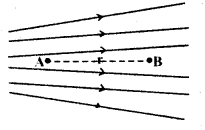
Figure shows the electric lines of force emerging from a charged body. If the electric field at A and B are EA and EB respectively and the displacement between A and B is r, Then
1) EA > EB
2) EA < EB
3) EA = \(\frac{E_B}{r}\)
4) EA = \(\frac{E_B}{r^2}\)
Answer:
1) EA > EB
The electric field lines are more concentrated at A than at B.
So that the magnitude of electric field at A ¡s greater than at B.
∴ EA > EB.
Question 7.
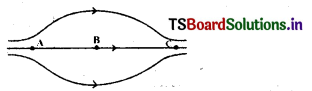
The figure shows some of the electric field lìes corresponding to an electric field. The figure suggests
1) EA > EB > EC
2) EA = EB = EC
3) EA = EB = EC
4) EA = EB < EC
Answer:
3) EA = EB = EC
When the electric lines are closer together, the field is stronger, when they are spread apart, the field is weaker.
At points A & C, the field lines are equally crowded. At point B, the field lines are spread out.
S0, EA = EC > EB
Question 8.
The intensity of an electric field E due to a short dipole depends on distance r as :
1) E ∝ \(\frac{1}{r^4}\)
2) E ∝ \(\frac{1}{r^3}\)
3) E ∝ \(\frac{1}{r^2}\)
4) E ∝ \(\frac{1}{r}\)
Answer:
2) E ∝ \(\frac{1}{r^3}\)
Eaxial = \(\frac{1}{4 \pi \varepsilon_0} \frac{2 \mathrm{P}}{\mathrm{r}^3}\), Eeq = \(\frac{1}{4 \pi \varepsilon_0} \frac{\mathrm{P}}{\mathrm{r}^3}\)
In both the cases, E ∝ \(\frac{1}{\mathrm{r}^3}\)
Question 9.
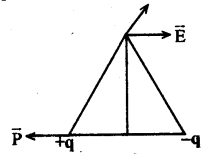
The angle between the electric dipole moment \(\overrightarrow{\mathrm{p}}\) and the direction of electric field strength due to it on the equatorial line is :
1) 0°
2) 90°
3) 180°
4) 60°
Answer:
3) 180°
On the equatorial plane, the resultant electric field E always directed antiparallel to the direction of the dipole moment.When they are in opposite, θ = 180°.
Question 10.
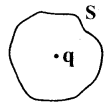
For the surface S shown in the figure (a closed surface) if the charge enclosed is q, then the net outward flux is:
1) \(\frac{q}{\varepsilon_0}\)
2) \(\frac{2 q}{\varepsilon_0}\)
3) 0
4) \(\frac{q}{2 \varepsilon_0}\)
Answer:
1) \(\frac{q}{\varepsilon_0}\)
From Gauss’s Law, the total electric flux Φ through any closed surface is equal to \(\frac{1}{\varepsilon_0}\) times q.
∴ Φ = \(\frac{q}{\varepsilon_0}\)
II. Fill in the Blanks
Question 1.
When a glass rod is rubbed with silk, then the charge on glass rod becomes ________.
Answer:
positive.
When we rub glass with silk, electrons are transferred from glass to silk.
Since glass loses electrons, it becomes positive.
Question 2.
A simple apparatus to detect charge on a body is the __________.
Answer:
Gold – Leaf electroscope.
A gold leaf electroscope consists of gold leaves. When a charged object touches the at the top, the charge spreads to the leaves. Since the like charges repel, the gold leaves get diverge.
Question 3.
The fact that the electric charge is always an integral multiple of ‘e’ is termed as _________
Answer:
Quantization of charge.
The total charge is given by q = ne . This is the quanitzation of charge. Here n is an integer.
Question 4.
A soap bubble is given a negative charge then its radius _________
Answer:
increases.
When we add positive or negative charges, the charges spread over the surface and repel each other. Due to this, the repulsion acts outwards. Then the bubble expand hence radius increases.
Question 5.
The value of basic unit of charge is __________
Answer:
1.6 × 10⁻¹⁹C
e = 1.6 × 10⁻¹⁹ C. This is the magnitude of the charge on a single electron.
Question 6.
The SI unit of electric field is _________
Answer:
N/C torV Volt/m.
The SI unit of electric field N/C or V/m
(∵ E = \(\frac{F}{q}\) ⇒ \(\frac{N}{C}\)) or (E = \(\frac{V}{d}\) ⇒ \(\frac{V}{m}\))
Question 7.
The direction of electric field lines of a isolated negative charge are _________.
Answer:
radially inward.
Isolated negative charge directs inward because negative charge attracts the positive.
Question 8.
The net force exerted on electric dipole placed in a uniform external electric field is ________
Answer:
zero.
In a uniform electric field, the force on the positive charge (+Eq) and negative charge (-Eq) are equal and opposite. So, they cancel each other.
Question 9.
The electrostatic field inside a charged conductor is __________
Answer:
zero.
In electrostatic equilibrium, charges resides only on the outer surface of the conductor, hence inside conductor is zero.
Question 10.
The magnitude of torque on electric dipole of dipole moment P in a uniform external field E is _________.
Answer:
pE sinθ.
In vector form 𝜏 = P × E = PE sinθ.
Question 11.
SI unit of volume charge density is __________.
Answer:
C/m3.
Volume charge density ρ = \(\frac{q}{v}\) ⇒ \(\frac{\mathrm{C}}{\mathrm{~m}^3}\)
Question 12.
SI unit of linear charge density is ________.
Answer:
C/m.
Linear charge density λ = \(\frac{\mathrm{q}}{l}=\frac{\mathrm{C}}{\mathrm{~m}}\)
III. One Word Answer Questions
Question 1.
What is the SI unit of electric charge?
Answer:
SI unit of electricicharge is coulomb (C).
Question 2.
What is the nature of force between two like charges?
Answer:
The nature of the force between two like charges is repulsive.
Question 3.
How many number of electrons are in 1 coulomb charge?
Answer:
Given that q = 1C, e = 1.6 ×10⁻¹⁹ C, n = ?
Formula: q = ne ⇒ n = \(\frac{\mathrm{q}}{e}\) ⇒ n = \(\frac{1}{1.6 \times 10^{-19}}\)
= 0.625 × 10¹⁹ electrons
Question 4.
What happens to the weight of a body when it is charged positively?
Answer:
When a body is charged positively, its weight decreases very slightly. Because, some electrons are removed from the body.
Question 5.
Give the expression for net force on charge q1 due to system of charges q2, q3, q4,… are located at r12, r13,… distance from charge q1.
Answer:
The net force on q1, due to charges q2, q3, q4… is Fnet = F12 + F13 + F14 + ……
∴ Fnet = \(\frac{1}{4 \pi \varepsilon_0}\left(\frac{q_1 q_2}{r_{12}^2}+\frac{q_1 q_3}{r_{13}^2}+\frac{q_1 q_4}{r_{14}^2}+\ldots\right)\)
Question 6.
What is the direction of electric Held due to a single positive charge?
Answer:
The direction of electric field due to a single positive charge is radially outward in all directions.
Question 7.
Define electric field intensity at a point.
Answer:
Electric field intensity at a point is the force experienced by unit positive test charge placed at that point. Formula: E = \(\frac{F}{q}\)
Question 8.
What is the SI unit of electric flux?
Answer:
SI unit of electric flux is the Volt-meter (V-m). It is also equal to Nm2 /C.
Question 9.
What is the SI unit of electric dipole moment?
Answer:
SI unit of dipole moment is coulomb -meter (C-m)
Question 10.
What is the total charge of electric dipole?
Answer:
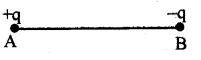
Zero. Total charge of an electric dipole is (+q) + (-q) = 0
IV. Very Short Answer Questions
Question 1.
What is meant by the statement charge is quantised ?
Answer:
Quantisation of charge: The electric charge(q) is always equal to an integral multiple of the electron charge (e).
Thus q = ne. Here n = 0, ± 1, ±2, ±3, … and e = 1.6 × 10⁻¹⁹C.
Question 2.
How many electrons constitute 1C of charge ?
Answer:
Given that q= 1C, e = 1.6 × 10⁻¹⁹ C, n = ?
Formula: q = ne ⇒ n = \(\frac{\mathrm{q}}{e}\) ⇒ n = \(\frac{1}{1.6 \times 10^{-19}}\)
= 0.625 × 10¹⁹ electrons
Question 3.
What happens to the force between two charges if the distance between them is a) halved b) doubled
Answer:
From coulomb’s law, we have F ∝ \(\frac{1}{r^2}\) ⇒ \(\frac{F_2}{F_1}=\frac{r_1^2}{r_2^2}\)
a) When distance is halved r2 = \(=\frac{\mathrm{r}_1}{2}\) ; New force F2 = ?
\(\frac{F_2}{F_1}=\frac{r_1^2}{r_2^2}=\frac{r_1^2}{\left(r_1 / 2\right)^2}=\frac{r^4}{r^4 / 4}\) = 4 ⇒ F2 = 4F1.
Thus, force increases to 4 times
b) When distance is doubled r2 = 2r1, F2 = ?
\(\frac{F_2}{F_1}=\frac{r_1^2}{r_2^2}=\frac{r_1^2}{\left(2 r_1\right)^2}=\frac{r^2}{4 r^2}=\frac{1}{4}\) ⇒ F2 = F1/4.
Thus, force decreases to 1/4
Question 4.
The electric lines of force do not intersect. Why ?
Answer:
If electric lines of force intersect, the electric field at the point of intersection will have two directions simultaneously, which is physically impossible. So, for electric lines of force do not intersect
Question 5.
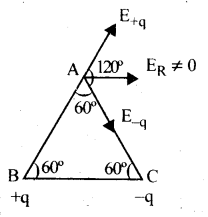
Consider two charges +q and -q placed at B and C of an equilateral triangle ABC. For this system, the total charge is zero. But the electric field (intensity) at A which is equidistant from B and C is not zero. Why ?
Answer:
At point A, the electric field vectors due to +q and -q
are not in opposite direction, (actually 120° ).
So they do not cancel each other.
Hence the resultant vector is non-zero.
So, intensity of electric field is not zero at A.
V. Short Answer Questions
Question 1.
State and explain Coulomb’s inverse square law in electricity.
Answer:
Coulomb’s inverse square law:
The force of attraction or repulsion between two electric charges is directly proportional to product of their charges and is inversely proportional to the square of distance between them and acts along the line joining the charges.
Explanation: Consider two point charges q1, q2 separated by a distance r .
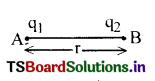
From Coulomb’s law: i) F ∝ q1q2 (ii) F ∝ \(\frac{1}{\mathrm{r}^2}\)
∴ F ∝ \(\frac{q_1 q_2}{r^2}\) ⇒ F = k \(\frac{q_1 q_2}{r^2}\) ⇒ F = \(\frac{1}{4 \pi \varepsilon_0} \frac{\mathrm{q}_1 \mathrm{q}_2}{\mathrm{r}^2}\)
Here ε₀ is the permittivity of free space and \(\frac{1}{4 \pi \varepsilon_0}\) = 9 x 10⁹ Nm2C~2
If the charges are in a medium with permittivity ε then Fmed = \(\frac{1}{4 \pi \varepsilon} \frac{\mathrm{q}_1 \mathrm{q}_2}{\mathrm{r}^2}\)
Question 2.
Define intensity of electric field at a point. Derive an expression for the intensity due to a point charge.
Answer:
Intensity of Electric Field (E):
The intensity of electric field at’ a point in space is defined as the force (F) experienced by a unit positive test charge (q) placed at that point in the field.
Formula: E = \(\frac{F}{q}\) SI Unit: N/C
Intensity due to a Point Charge :
Consider a point charge q kept at point O.
Let a test charge q0 be kept at P, which is at a distance r from O.
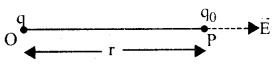
The force between the two charges is F = \(\frac{1}{4 \pi \varepsilon_0} \frac{\mathrm{q} q_0}{\mathrm{r}^2}\) ⇒ \(\frac{\mathrm{F}}{\mathrm{q}_0}=\frac{1}{4 \pi \varepsilon_0} \frac{\mathrm{q}}{\mathrm{r}^2}\)
E = \(\frac{1}{4 \pi \varepsilon_0} \frac{\mathrm{q}}{\mathrm{r}^2}\) (∵ E = \(\frac{\mathrm{F}}{\mathrm{q}_0}\))
Question 3.
Derive an equation tor the couple acting on an electric dipole in a uniform electric field.
Answer:
Consider an electric dipole consisting of two equal and opposite charges +q & -q separated by a distance 2a.
Let the dipole be placed in a uniform electric field of intensity E at an angle θ to the direction of electric field. The electrostatic forces acting on the charges q and-q are Eq and-Eq respectively.
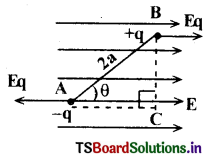
These two forces form a couple.
couple 𝜏 = Force × Perpendicular distance between the forces
𝜏 = Eq × BC ………….. (1)
From ∆ ABC, sin θ = \(\frac{B C}{A B}=\frac{B C}{2 a}\) ⇒ BC = 2a sin θ ………….. (2)
From (1) and (2), x = Eq (2a sin 0) = (2aEq) sin θ = q(2a)E sin θ
But we know dipole moment p= q(2a)
∴ 𝜏 = pE sin θ …………… (3)
In vector form \(\vec{\tau}=\vec{\mathrm{p}} \times \vec{\mathrm{E}}\)
Direction of the couple \(\vec{\tau}\) is perpendicular to the plane containing \(\vec{\mathrm{p}}\) and \(\vec{\mathrm{E}}\).
Question 4.
Derive an expression for the intensity of the electric field at a point on the axial line of a dipole.
Answer:
Consider an electric dipole AB consisting of two equal and opposite charges -q & q separated by a distance 2a.
Let P be a point on the axial line of the dipole at a distance r from its centre O.
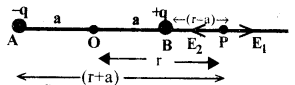
Then distance PB = (r – a) and PA = (r+a).
Intensity of electric field at P due to +q is E1 = \(\frac{1}{4 \pi \varepsilon_0} \frac{q}{(r-a)^2}\) …………… (1)
Intensity of electric field at P due to -q is E2 = \(\frac{1}{4 \pi \varepsilon_0} \frac{q}{(r+a)^2}\) ………….. (2)
The resultant intensity of electric field due to the dipole at point P is E = E1 – E2
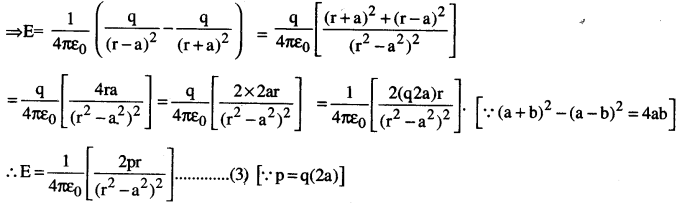
For shorter dipole we have (a<<<r) so that a2 can be neglected.
∴ E = \(\frac{1}{4 \pi \varepsilon_0} \frac{2 \mathrm{pr}}{\mathrm{r}^4}=\frac{1}{4 \pi \varepsilon_0} \frac{2 \mathrm{p}}{\mathrm{r}^3}\)
Thus, the intensity of electric field on the axial line is E = \(\frac{1}{4 \pi \varepsilon_0} \frac{2 \mathrm{p}}{\mathrm{r}^3}\)
Question 5.
Derive an expression for the intensity of the electric field at a point on the equatorial plane of an electric dipole.
Answer:
Consider an electric dipole AB consisting of two equal and
opposite charges -q & q separated by a distance 2a.
Let P be a point on the equatorial plane of the dipole at a distance r from its centre.
Electric field at P due to +q is E1 = \(\frac{1}{4 \pi \varepsilon_0}\left(\frac{\mathrm{q}}{\mathrm{r}^2+\mathrm{a}^2}\right) .\) ……….. (1) (∵ AP2 = r2 + a2)
Electric field at P due to -q is E2 = \(\frac{1}{4 \pi \varepsilon_0}\left(\frac{\mathrm{q}}{\mathrm{r}^2+\mathrm{a}^2}\right) .\) ………… (2) (∵ BP2 = r2 + a2)
From figure, it is clear that the
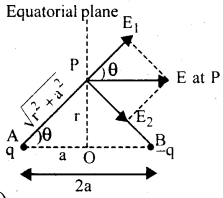
y-components of E1 and E2 are equal and opposite.
Hence they cancel each other.
But the sum of x-components gives the resultant field E at P.
Magnitude of resultant electric field is E= E1 cosθ + E2 cosθ
= \(\frac{1}{4 \pi \varepsilon_0}\left(\frac{\mathrm{q}}{\mathrm{r}^2+\mathrm{a}^2}\right) \cos \theta+\frac{1}{4 \pi \varepsilon_0}\left(\frac{\mathrm{q}}{\mathrm{r}^2+\mathrm{a}^2}\right) \cos \theta\) = 2 × \(\frac{1}{4 \pi \varepsilon_0}\left(\frac{\mathrm{q}}{\mathrm{r}^2+\mathrm{a}^2}\right) \cos \theta\)
From ∆ PAO, cos θ = \(\frac{A O}{A P}=\frac{a}{\sqrt{r^2+a^2}}\)
∴ E = \(2 \frac{1}{4 \pi \varepsilon_0}\left(\frac{q}{r^2+a^2}\right) \frac{a}{\sqrt{r^2+a^2}}\) = \(\frac{2 \mathrm{qa}}{4 \pi \varepsilon_0\left(\mathrm{r}^2+\mathrm{a}^2\right)^{3 / 2}}\)
But we know dipole moment p = q(2a)
∴ E = \(\frac{1}{4 \pi \varepsilon_0} \frac{\mathrm{p}}{\left(\mathrm{r}^2+\mathrm{a}^2\right)^{3 / 2}}\) …………. (3)
For shorter dipole we have (a<<r) so that a2 can be neglected.
From (3), for shorter dipole, E = \(\frac{1}{4 \pi \varepsilon_0} \frac{\mathrm{p}}{\mathrm{r}^3}\)
Question 6.
State Gauss’s law in electrostatics and prove it.
Answer:
Gauss’s Law: The total electric flux (Φ) through any closed surface is equal to \(\frac{1}{\varepsilon_0}\) times the net charge (q) enclosed by the closed surface.
Thus Φ = \(\frac{1}{\varepsilon_0}\) (q)
Proof of Gauss’s Law
Suppose an isolated positive point charge q is situated at the centre O of a sphere of radius r.
Consider a point P on the sphere enclosed in a small closed surface area dS.
The electric field intensity at P is E = \(\frac{1}{4 \pi \varepsilon_0} \frac{\mathrm{q}}{\mathrm{r}^2} .\) ………… (1)
Total electric flux over the entire surface of sphere is ΦE = \(\oint_S \overrightarrow{\mathrm{E}} \cdot \overrightarrow{\mathrm{dS}}=\oint_{\mathrm{S}} \mathrm{EdS} \cos \theta\)
Here, \(\overrightarrow{\mathrm{E}}\) and \(\overrightarrow{\mathrm{dS}}\) are parallel. Hence θ = 0° ⇒ cos θ = cos 0° = 1
∴ ΦE = \(\oint\) EdS = E\(\oint\)dS = E[S] = E × 4πr2 …………. (2) [∵ Surface area of sphere S = 4πr2]
From (1) & (2), ΦE = \(\frac{1}{4 \pi \varepsilon_0} \frac{\mathrm{q}}{r^2}\) × 4 πr2 = \(\frac{q}{\varepsilon_0}=\frac{1}{\varepsilon_0}\)(q)
∴ Φ = \(\frac{1}{\varepsilon_0}\) (q)
Hence Gauss law is proved.
VI. Long Answer Questions
Question 1.
Define electric flux. Applying Gauss’s law, derive the expression for electric intensity due to an infinite long straight charged wire. (Assume that the electric field is everywhere radial and depends only on the radial distance r of the point from the wire.)
Answer:
Electric flux is the total number of electric field lines passing normally through a given area.
The electric flux through the surface area S due to electric field E is Φ = \(\vec{E} \vec{S}\) = ES cosθ
Here θ is the angle between \(\vec{E}\) and \(\vec{S}\).
Intensity (E) due to an infinite long wire :
Consider an infinite long straight wire having uniform linear charge density ‘λ’.
Let P be a point at a radial distance r from the wire.
Imagine a cylindrical Gaussian surface of length l and radius r coaxial with the wire.
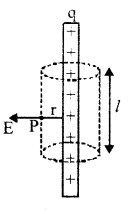
The electric field is radial everywhere,.
Flux through the two end flat surfaces is zero.
(∵ Φ = \(\vec{E} \vec{S}\) = EScosθ and θ = 90°)
At the curved surface of the cylinder at every point, its magnitude of E is constant which depends only one r.
Curve surface area of the cylindrical surface is S= 2πrl
Total Electric flux Φ = EScos0 = ES (1)= E (2πrl) ………… (1)
The charge enclosed by the Gaussian surface is q = λ l
From Gauss’ law, Φ = \(\frac{\mathrm{q}}{\varepsilon_0}=\frac{\lambda l}{\varepsilon_0}\) ……….. (2)
From (1) & (2), E(2πrl) = \(\frac{\lambda l}{\varepsilon_0}\) ⇒ E = \(\frac{\lambda}{2 \pi \varepsilon_0 \mathrm{r}}\)
∴ Intensity due to infinite long wire is E = \(\frac{\lambda}{2 \pi \varepsilon_0 \mathrm{r}}\)
In the vector form, E = \(\vec{\mathrm{E}}=\frac{\lambda}{2 \pi \varepsilon_0 \mathrm{r}} \hat{\mathrm{n}}\)
Here \(\hat{\mathrm{n}}\) is the radial unit vector in the plane normal to the wire.
Question 2.
State Gauss’s law in electrostatics. Applying Gauss’ law derive the expression for electric intensity due to an infinite plane sheet of charge.
Answer:
Gauss’s Law: The total electric flux (Φ) through any closed surface is equal to \(\frac{1}{\varepsilon_0}\) times the net charge (q) enclosed by the closed surface.
Φ = \(\frac{1}{\varepsilon_0}\) (q)
Electric Intensity at a point due to an infinite plane sheet of charge:
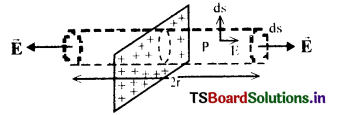
Consider an infinite plane sheet has a uniform surface charge density ‘σ’.
Let us imagine a cylindrical Gaussian surface piercing through the vertical plane sheet.
Let P be a point on the cylindrical surface.
As the field is perpendicular to the plane sheet, the flux through the curved surface of the cylinder is zero. θ = 90° ⇒ Φ = EScosθ = EScos90° = ES(0) = 0
Total flux through the two flat surfaces of the Gaussian cylinder Φ = ES cos0° + EScos0°
⇒ Φ = ES + ES = 2ES ……..(1)
From Gauss’ law, Φ = \(\frac{q}{\varepsilon_0}=\frac{\sigma S}{\varepsilon_0}\) …….. (2) (∵ Surface charge density σ = \(\frac{q}{S}\) ⇒ q = σS)
From (1) & (2), E(2 S) = \(\frac{\sigma {S}}{\varepsilon_0}\) ⇒ E = \(\frac{\sigma}{2 \varepsilon_0}\)
∴ The electric intensity due an infinite plane sheet of charge is E = \(\frac{\sigma}{2 \varepsilon_0}\)
Its vector form is \(\vec{\mathrm{E}}=\frac{\sigma}{2 \varepsilon_0} \hat{\mathrm{n}}\)
where \(\hat{\mathrm{n}}\) is the unit vector normal to the plane and going away from it.
Question 3.
Applying Gauss’s law derive the expression for electric intensity due to a charged conducting spherical shell at (i) a point outside the shell (ii) a point on the surface of the shell and (iii)a point inside the shell.
Answer:
Intensity at a point due to a charged spherical shell:
Case(i): Point P, outside the shell:
Consider a charged conducting spherical shell of surface charge density σ and radius R.
Let P be a point outside the shell at a distance r from the centre of the shell. Imagine a Gaussian spherical surface of radius r such that its centre coincides with the centre of the shell.
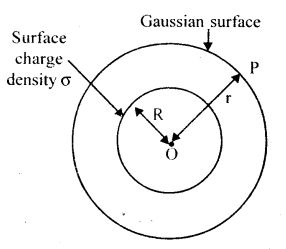
Total Electric flux = Intensity × surface area of the sphere
Φ = E (4πr2) ………….. (1)
From Gauss’s law, Φ = \(\frac{q}{\varepsilon_0}\) ……….. (2)
The charge enclosed by Gaussian surface is q = σ (4πR2)
From (1) & (2), E(4πr2) = \(\frac{\mathrm{q}}{\varepsilon_0}=\frac{\sigma 4 \pi \mathrm{R}^2}{\varepsilon_0}\)⇒ E = \(\frac{\sigma 4 \pi \mathrm{R}^2}{4 \pi \mathrm{r}^2 \varepsilon_0}\)
⇒ E = \(\frac{\sigma \mathrm{R}^2}{\varepsilon_0 \mathrm{r}^2}=\frac{\mathrm{q} \mathrm{R}^2}{4 \pi \mathrm{R}^2 \varepsilon_0 \mathrm{r}^2}\) ⇒ E = \(\frac{1}{4 \pi \varepsilon_0} \frac{\mathrm{q}}{\mathrm{r}^2}\) ………… (3) [∵ σ = \(\frac{\mathrm{q}}{4 \pi \mathrm{R}^2}\)]
Case (ii): Point P, on the surface of the shell
In this case r = R,
From (3) E = \(\frac{1}{4 \pi \varepsilon_0} \frac{\mathrm{q}}{\mathrm{r}^2}\)
E = \(\frac{1}{4 \pi \varepsilon_0} \frac{\sigma 4 \pi R^2}{R^2}=\frac{\sigma}{\varepsilon_0}\) [∵ q = σ (4πR2)
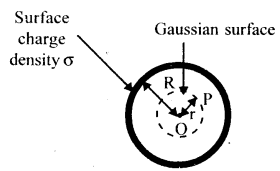
Case (iii): Point P, inside the Shell
Electric flux Φ = Intensity × surface area = E (4πr2) ………. (1)
The charge enclosed by Gaussian surface inside the sphere is q = 0
From Gauss’ law, Φ = \(\frac{q}{\varepsilon_0}=\frac{0}{\varepsilon_0}\) = 0 ……….. (2)
From (1) & (2), E(4πr2) = 0 ⇒ E = 0
Thus the field due to a charged conducting shell is zero at all points inside the shell.
Textual Solved Problem
Question 1.
If 109 electrons move out of a body to another body every second, how much time is required to get a total charge of 1 C on the other body?
Solution:
Given n = 109, we know e = 1.6 × 10⁻¹⁹
∴ The charge that moves out in 1 second is q = ne = 109 × 1.6 × 10-19 = 1.6 × 10⁻¹⁰C
∴ The time required for 1 C is t = \(\frac{1}{1.6 \times 10^{-10}}\) = 6.25 × 10⁹s = \(\frac{6.25 \times 10^9}{365 \times 24 \times 3600}\) ≅ 198 years
Question 2.
How much positive and negative charge is there in a cup of water?
Solution:
Suppose the mass of one cup of water is 250 g. The molecular mass of water is 18g.
Thus, mass of one mole (= 6.02 × 10²³ molecules) of water 18 g.
∴ the number of molecules in one cup of water is (250/18) × 6.02 × 1023.
Each molecule of water (H2O) contains 10 electrons and 10 protons.
Also the total positive and total negative charge has same magnitude.
∴ Total charge = (250/18) × 6.02 × 1023 × 10 × 1.6 × 10-19 C = 1.34 × 10⁷ C.
Question 3.
Consider three charges q1, q2, q3 each equal to q at the vertices of an equilateral triangle of side l. What is the force on a charge Q (with the same sign as q) placed at the centroid of the triangle, as shown in figure.
Solution:
Let F1, F2, F3 be the forces on Q at centroid due to charges q at each vertices. The distance of the centroid from any vertex is l/\(\sqrt{3}\)
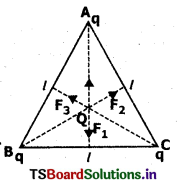
Thus, |F1| = |F2| = |F3| = \(\frac{1}{4 \pi \varepsilon_0} \frac{\mathrm{Qq}}{(l / \sqrt{3})^2}\)
As the three forces of equal magnitude with angle between each pair 120° are acting simultaneously, symmetrically, the net force of the charge Q is zero.
Question 4.
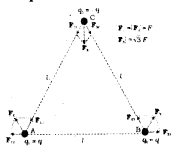
Consider the charges q, q, and -q placed at the vertices of an equilateral triangle, as shown in figure. What is the force on each char.
Solution:
Force on +Q at A due to -q at C is, FAC = \(\frac{1}{4 \pi \varepsilon_0} \frac{\mathrm{q}^2}{l^2}\)
Force on +Q at A due to +q at B is, FAB = \(\frac{1}{4 \pi \varepsilon_0} \frac{\mathrm{q}^2}{l^2}\)
These two forces act at 120°. So, the resultant force, Fres = 2Fcos \(\frac{\theta}{2}\)
⇒ Fres = 2 × \(\frac{1}{4 \pi \varepsilon_0} \frac{\mathrm{q}^2}{l^2}\) × cos 60°
= 2 × \(\frac{1}{4 \pi \varepsilon_0} \frac{q^2}{l^2} \times \frac{1}{2}\) = \(\frac{1}{4 \pi \varepsilon_0} \frac{\mathrm{q}^2}{l^2}\)
Exercise Problem
Question 1.
Calculate the charge on an alpha particle (Given charge on a proton = +1.6 × 10⁻¹⁹C)
Answer:
An α particle consists of two protons and two neutrons.
The charge on each proton is = 1.602 × 10⁻¹⁹ C.
Total charge Q = 2 × charge of proton= 2 × 1.602 × 10-19 = 3.204 × 10⁻¹⁹C
Question 2.
Calculate the distance between two protons such that the electrical repulsive force between them is equal to the weight of either. (Given mass of the proton = +1.67 × 10⁻²⁷ kg, Charge of the proton = +1.6 × 10⁻¹⁹ C )
Answer:
From Coulomb’s law,F = \(\frac{1}{4 \pi \varepsilon_0} \frac{\mathrm{q}_1 \mathrm{q}_2}{\mathrm{r}^2}\) ⇒ r2 = \(\frac{\mathrm{q}_1 \mathrm{q}_2}{4 \pi \varepsilon_0 \mathrm{~F}}\) …………… (1)
We know \(\frac{1}{4 \pi \varepsilon_0}\) = 9 × 10⁹, q1 = q2 = 1.602 × 10⁻¹⁹ C m = 1.67 × 10⁻²⁷Kg
Repulsive force between two protons = Weight of the proton
⇒ F = mg = 1.67 × 10-27 × 9.8 = 1.64 × 10⁻²⁶ N [∵ g = 9.8]
From (1), r2 = \(\frac{1}{4 \pi \varepsilon_0} \frac{\mathrm{q}_1 \mathrm{q}_2}{\mathrm{~F}}=\frac{9 \times 10^9 \times\left(1.602 \times 10^{-19}\right)^2}{1.64 \times 10^{-26}}\) = 0.014078
∴ Distance r = \(\sqrt{0.014078}\) = 0.118 m = 11.8 cm
Question 3.
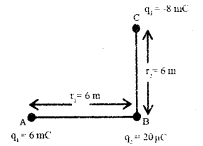
Charges q1 = 6 mc, q2 = 20 μC and q3 = -8 mc are placed at the points A, R and C respectively as shown in figure. If r1 = 6 m and r2 = 6m. Calculate the magnitude of resultant force on q2.
Answer:
Given q1 = 6mc = 6 × 10⁻³ C, q2 = 20 mc = 20 × 10-6 C, r1 = 6m, r2 = 6m,
Force on q2 due to q1 is F21 = \(\frac{1}{4 \pi \varepsilon_0} \frac{\mathrm{q}_1 \mathrm{q}_2}{\mathrm{r}_1^2}=\frac{9 \times 10^9 \times 6 \times 10^{-3} \times 20 \times 10^{-6}}{6^2}=\frac{1080}{36}\) = 30N
Also q3 = -8 -13C, r2 = 6m
Force on q2 due to q3 is F23 = \(\frac{1}{4 \pi \varepsilon_0} \frac{q_2 q_3}{r_2^2}=\frac{9 \times 10^9 \times 20 \times 10^{-6} \times 8 \times 10^{-3}}{6^2}=\frac{1440}{36}\) = 40 N
As the two charges are at right angle, net force FR = \(\sqrt{\mathrm{F}_{21}^2+\mathrm{F}_{23}^2}=\sqrt{30^2+40^2}\) = 50N
Question 4.
Calculate the electric field strength required to just support a water drop of mass 10-3 kg and having a charge of 1.6 × 10⁻¹⁹ C .
Answer:
Given Mass = 10-3 kg, charge q = 1.6 × 10⁻¹⁹ C , g = 9.8 m/s2
When the drop is at equilibrium then we have Electric force = Gravitational force
Eq = mg ⇒ E = \(\frac{\mathrm{mg}}{\mathrm{q}}=\frac{10^{-3} \times 9.8}{1.6 \times 10^{-19}}\) = 6.125 × 10¹⁶ N/C
Question 5.
Determine the electric field produced by a helium nucleus at a distance of lA from it.
Answer:
Charge of the nucleus q = 2e = 2 × 1.6 × 10-19 = 3.2 × 10⁻¹⁹ C,
Distance r = 1 Å = 10-10 m
Electric field intensity E = \(\frac{1}{4 \pi \varepsilon_0} \times \frac{q}{r^2}=\frac{9 \times 10^9 \times 3.2 \times 10^{-19}}{\left[10^{-10}\right]^2}\) = 2.88 × 10¹¹ N/C [∵ \(\frac{1}{4 \pi \varepsilon_0}\) = 9 × 10⁹]
∴ E = 2.88 × 10¹¹ N/C
Question 6.
Two charges, one +5 μC and another -5 μC are placed 1mm apart. Calculate the dipole moment.
Answer:
Given charge q = +5 μC = 5 × 10⁻⁶ C, distance 2a = 1 mm = 10-3 m
∴ dipole moment p = (2a) q = (10-3)(5 × 10⁻⁶) = 5 × 10⁻⁹ C – m
Question 7.
An electric dipole of dipole moment 4 × 10⁻⁵ Cm is located in a uniform electric field of 10-3 N/C making an angle of 30° with the direction of the field. Calculate the Torque exerted by electric field on the dipole.
Answer:
Given dipole moment p = 4 × 10⁻⁵ C, Electric field intensity E = 10-3 N/C, Angle θ = 30°
Torque 𝜏 = pE sin θ = 4 × 10-5× 10-3 × sin 30°= 4 × 10⁻⁸ × \(\frac{1}{2}\) = 2 × 10⁻⁸ Nm
Question 7.
An electric dipole of dipole moment 4 × 10⁻⁵ Cm ¡s located in a uniform electric field of N/C making an angle of 30U with the direction of the field. Calculate the Torque exerted by electric field on the dipole.
Answer:
Given dipole moment p = 4 × 10⁻⁵ C, Electric field intensity E = 10-3 N/C, Angle θ = 30°
Torque 𝜏 = pE sinθ = 4 × 10-5 × 10-3 × sin30° = 4 × 10⁻⁸ × \(\frac{1}{2}\) = 2 × 10⁻⁸ Nm
Question 8.
If the electric field is given by E = \(3 \hat{i}+4 \hat{j}+3 \hat{k}\) N / C . Calculate the electric flux through a surface area 100m2 lying in the X-V plane.
Answer:
Given electric field intensity \(\vec{\mathrm{E}}=8 \hat{\mathrm{i}}+4 \hat{\mathrm{j}}+3 \hat{\mathrm{k}}\) N / C Area \(\vec{\mathrm{E}}\) = 100 \(\hat{k}\) m2;
Flux Φ = \(\vec{E} \cdot \vec{A}=(8 \hat{i}+4 \hat{j}+3 \hat{k}) \cdot(100 \hat{k})\) = 300
∴ Φ = 300 Nm2C-1.
Question 9.
A spherical Gaussian surface enclosed by a charge of 8.85 × 10⁻⁸C.
(i) Calculate the electric flux passing through the surface.
(ii) If the radius of the Gaussian surface is doubled, how would the flux change?
Answer:
Charge q = 8.85 × 10⁻⁸C, Permittivity ε₀ = 8.85 × 10⁻¹² C2/Nm/2
i) Total electric flux Φ = \(\frac{1}{\varepsilon_0}\)q = \(\frac{8.85 \times 10^{-8}}{8.85 \times 10^{-12}}\) = 104 Nm2C-1
ii) The electric flux depends only on the charge enclosed and is independent of the radius of the surface. “So, flux doesnot change.”
Question 10.
A point charge of 17.7 μC is located at the centre of a cube of side 0.03m. Find the electric flux through each face of the cube.
Answer:
Given charge q = 17.7 μC = 17.7 × 10⁻⁶C, ε₀ = 8.85 × 10⁻¹² C2/Nm2
Total electnc flux Φ = \(\frac{1}{\varepsilon_0}\)q = \(\frac{17.7 \times 10^{-6}}{8.85 \times 10^{-12}}\) = 2 × 10⁶ Nm2 /C
Flux through each face of cube Φface = \(\frac{\phi}{6}=\frac{2 \times 10^{\circ}}{6}\) = 3.3 × 10⁵ Nm2C-1
Question 11.
An infinite number of charges each of magnitude q are placed on x – axis at distances of 1. 2, 4, 8 meter from the origin respectively. Find intensity of the electric field at origin.
Answer:
E = \(\frac{1}{4 \pi \varepsilon_0}\left(\frac{q}{r_1^2}+\frac{q}{r_2^2}+\frac{q}{r_3^2}+\frac{q}{r_4^2}+\ldots .+\infty\right)\)
= \(\frac{q}{4 \pi \varepsilon_0}\left(\frac{1}{2^0}+\frac{1}{2^2}+\frac{1}{2^4}+\frac{1}{2^6}+\ldots \infty\right)\)
Here, a = 1, r = 1/4 and S∞ = \(\frac{\mathrm{a}}{1-\mathrm{r}}=\frac{1}{1-\frac{1}{4}}=\frac{1}{\frac{3}{4}}=\frac{4}{3}\)
∴ E = \(\frac{q}{4 \pi \varepsilon_0}\left(\frac{4}{3}\right)=\frac{q}{3 \pi \varepsilon_0}\) towards origin.
Question 12.
The electric field in a region is given by \(\vec{\mathrm{E}}=\mathrm{a} \hat{\mathrm{i}}+\mathrm{b} \hat{\mathrm{j}}\). Here a and b are constants. Find the net flux passing through a square area of side L parallel to y – z plane.
Answer:
Given \(\vec{\mathrm{E}}=\mathrm{a} \hat{\mathrm{i}}+\mathrm{b} \hat{\mathrm{j}}\)
The area parallel to YZ plane means the normal to the area is parallel to x-axis.
∴ \(\vec{\mathrm{A}}=\mathrm{L}^2 \hat{\mathrm{i}}\)
Net flux ΦE = \(\overrightarrow{\mathrm{E}} \cdot \overrightarrow{\mathrm{~A}}=(\mathrm{a} \hat{\mathrm{i}}+\mathrm{b} \hat{\mathrm{j}}) \cdot \mathrm{L}^2 \hat{\mathrm{i}}\) = aL2 Weber
Question 13.
Two infinitely long thin straight wires having uniform linear charge densities λ and 2λ are arranged parallel to each other at a distance r apart. The intensity of the electric field at a point midway between them is
Answer:
Field due to an infinite long wire of linear charge density λ at a distance r is given by \(\frac{\lambda}{2 \pi \varepsilon_0 \mathrm{r}}\)
Here, E = E2 – E1
E = \(\frac{2 \lambda}{2 \pi \varepsilon_0(\mathrm{r} / 2)}-\frac{\lambda}{2 \pi \varepsilon_0(\mathrm{r} / 2)}=\frac{2 \lambda}{\pi \varepsilon_0 \mathrm{r}}-\frac{\lambda}{\pi \varepsilon_0 \mathrm{r}}=\frac{\lambda}{\pi \varepsilon_0 \mathrm{r}}\)
Objective Questions
Question 1.
Two electrons separated by distance V experience a force ‘F’ between them. The force between a proton and a singly ionised helium atom separated by distance 2r is
1) 4F
2) 2F
3) F/2
4) F/4
Answer:
4) F/4
Question 2.
The magnitude of electric intensity at a distance V from a charge ‘q’ is E. An identical charge is placed at a distance ‘2x’ from it. Then the magnitude of the force its experiences is
1) Eq
2) 2Eq
3) \(\frac{\mathrm{Eq}}{2}\)
4) \(\frac{\mathrm{Eq}}{4}\)
Answer:
4) \(\frac{\mathrm{Eq}}{4}\)
Question 3.
Two electric charges of 9μC and -3μC are placed 0.16m apart in air. There will be a point P at which electric potential is zero on the line joining the two charges and in between them. The distance of P from 9μC charge is
1) 0.14m
2) 0.12 m
3) 0.08 m
4) 0.06 m
Answer:
2) 0.12 m
Question 4.
The electric intensity in air at a point 20cm from a point charge Q coulombs is 4.5 × 10⁵ N/C. The magnitude of Q is
1) 0.1 μC
2) 0.2 μC
3) 1 μC
4) 2 μC
Answer:
4) 2 μC
Question 5.
Two point charges A and B, having charges +Q and -Q respectively, are placed at certain distance apart and force acting between them is F. If 25% charge of A is transferred to B, then force between the charges becomes
1) 4F/3
2) F
3) 9F/16
4) 16F/9
Answer:
3) 9F/16
Question 6.
When air is replaced by a dielectric medium of constant K, the maximum force of attraction between two charges separated by a distance
1) increases K times
2) remains unchanged
3) decreases K times
4) increases K-1 times
Answer:
3) decreases K times
Question 7.
A charge q is placed at the centre of the line joining two equal charges Q. The system of the three charges will be in equilibrium if q is equal to
1) -Q/4
2) Q/4
3) -Q/2
4) Q/2
Answer:
1) -Q/4
Question 8.
A particle of mass m and charge q is placed at rest in a uniform electric field E and then released. The kinetic energy attained by the particle after moving a distance y is
1) qEy
2) qE2y
3) qEy2
4) q2Ey
Answer:
1) qEy
Question 9.
A point Q lies on the perpendicular bisector of an electrical dipole of dipole moment p. If the distance of Q from the dipole is r (mdch larger than the size of the dipole), then the electric field at Q is proportional to
1) p2 and r3
2) p and r2
3) p-1 and r2
4) p and r3
Answer:
4) p and r3
Question 10.
An electric dipole is placed at an angle of 30° with an electric field intensity 2 × 10⁵ NC-1. It experiences a torque equal to 4 Nm. The charge on the dipole, if the dipole length is 2 cm, is
1) 8 mC
2) 2 mC
3) 5 mC
4) 7 μC
Answer:
2) 2 mC
Question 11.
A dipole of dipole moment \(\vec{\mathrm{p}}\) is placed in uniform electric field \(\vec{\mathrm{E}}\), then torque acting on it is given by
1) \(\vec{\tau}=\vec{\mathrm{p}} \cdot \vec{\mathrm{E}}\)
2) \(\vec{\tau}=\vec{\mathrm{p}} \times \vec{\mathrm{E}}\)
3) \(\vec{\tau}=\vec{\mathrm{p}}+\vec{\mathrm{E}}\)
4) \(\vec{\tau}=\vec{\mathrm{p}}-\vec{\mathrm{E}}\)
Answer:
2) \(\vec{\tau}=\vec{\mathrm{p}} \times \vec{\mathrm{E}}\)
Question 12.
A spherical conductor of radius 10 cm has a charge of 3.2 × 10⁻⁷ C distributed uniformly. What is the magnitude of electric field at a point 15 cm from the
centre of the sphere? [\(\frac{1}{4 \pi {\varepsilon_0}}\) = 9 × 10⁹ Nm2/C2)
1) 1.28 × 10⁴ N/C
2) 1.28 × 10⁵ N/C
3) 1.28 × 10⁶ N/C
4) 1.28 × 10⁷ N/C
Answer:
2) 1.28 × 10⁵ N/C
Question 13.
What is the flux through a cube of side a if a point charge of q is at one of its corner?
1) \(\frac{2 q}{\varepsilon_0}\)
2) \(\frac{q}{8 \varepsilon_0}\)
3) \(\frac{q}{\varepsilon_0}\)
4) \(\frac{q}{2 \varepsilon_0} 6 a^2\)
Answer:
2) \(\frac{q}{8 \varepsilon_0}\)
Question 14.
A charge Q μC is placed at the centre of a cube, the flux coming out from each face will be
1) \(\frac{\mathrm{Q}}{6 \varepsilon_0}\) × 10-6
2) \(\frac{\mathrm{Q}}{6 \varepsilon_0}\) × 10-3
3) \(\frac{\mathrm{Q}}{24 \varepsilon_0}\)
4) \(\frac{\mathrm{Q}}{8 \varepsilon_0}\)
Answer:
1) \(\frac{\mathrm{Q}}{6 \varepsilon_0}\) × 10-6
Question 15.
A charge Q is situated at the corner of a cube, the electric flux passed through all the six faces of the cube is
1) Q/6ε₀
2) Q/8ε₀
3) Q/ε₀
4) Q/2ε₀
Answer:
2) Q/8ε₀
Question 16.
A point charge+q is placed at the centre of a cube of side l. The electric flux emerging from the cube is
1) \(\frac{6 q \ell^2}{\varepsilon_0}\)
2) \(\frac{q}{6 \ell^2 \varepsilon_0}\)
3) zero
4) \(\frac{q}{\varepsilon_0}\)
Answer:
4) \(\frac{q}{\varepsilon_0}\)
Question 17.
A hollow insulated conduction sphere is given a positive charge of 10 μC. What will be the electric field at the centre of the sphere if its radius is 2 metres?
1) 20 μCm-2
2) 5 μCm-2
3) zero
4) 8 mCm-2
Answer:
3) zero