Regular practice with AP Inter 1st Year Chemistry Study Material Chapter 6 Equilibrium Questions and Answers helps students stay prepared for examinations.
AP Inter 1st Year Chemistry 6th Lesson Equilibrium Questions and Answers
I. Multiple Choice Questions
Question 1.
The pH of a solution of hydrochloric acid is 4. The molarity of the solution is :
1) 4.0 M
2) 0.4 M
3) 0.0001 M
4) 0.04 M
Answer:
3) 0.0001 M
If [H+] = 0.0001M (Molarity), then
pH = -log10 [H+] = -log 0.0001 = -log 10-4 = 4.
Question 2.
The strong conjugate base in the following is
1) NO3–
2) Cl–
3) SO42-
4) CH3COO–
Answer:
4) CH3COO–
Strong conjugate base is CH3COO–, which is obtaining from weak acid.
Question 3.
When NH4Cl is added to NH4OH solution the dissociation of ammonium hydroxide is reduced. It is due to
1) common ion effect
2) hydrolysis
3) oxidation
4) reduction
Answer:
1) common ion effect
Due to common ion effect dissociation of NH4OH is reduced.
Question 4.
The following reaction is at equilibrium.
Fe3+(aq) + SCN–(aq) ⇌ [Fe(SCN)]2+(aq)
In the above reaction, colour intensity of red colour can be increased by
l) addition of oxalic acid which reacts with Fe3+ ions.
2) addition of Hg2+ ions which reacts with SCN– ions.
3) addition of KSCN.
4) red colour intensity cannot be changed.
Answer:
3) addition of KSCN.
\(\mathrm{Fe}_{(\mathrm{aq})}^{+3}+\mathrm{SCN}_{(\mathrm{aq})}^{-} \rightleftharpoons[\mathrm{Fe}(\mathrm{SCN})]_{(\mathrm{aq})}^{+2}\)
on adding KSCN colour intensity of red colour increased.
Question 5.
Ksp of a sparingly soluble salt AB2 is 4 × 10-12. The solubility of the salt is
1) 2 × 10⁻⁶M
2) 4 × 10⁻⁴M
3) 1 × 10-12
4) 1 × 10⁻⁴M
Solution:
4) 1 × 10⁻⁴M
For AB2 type of salt, Ksp = 4s3 ⇒ s2 = \(\frac{\mathrm{K}_{\mathrm{sp}}}{4}\)
⇒ s = \(\sqrt[3]{\frac{\mathrm{K}_{\mathrm{sp}}}{4}}=\sqrt[3]{\frac{4 \times 10^{-12}}{4}}\) = 10-4m

Question 6.
An aqueous solution of ammonia consists of
1) H+ only
2) OH– only
3) NH4+ only
4) NH4+ and OH–
Answer:
Aqueous solution of ammonia contains NH4+ and OH– ions.
NH4OH(aq) → NH4+ + OH–
Question 7.
The pH of a 0.05 M of H2SO4 solution is
1) 0.05
2) 1
3) -1
4) 1.3010
Answer:
2) 1
For 0.05M of H2SO4
[H+] = 2 × 0.05(Di basic H2SO4) = 0.1
pH = -log10[H+] = -log 0.1 = -log 10-1 = 1
Question 8.
If the molar solubility of Zirconium phosphate Zr3(PO4)4 is ‘S’. Solubility product Ksp of Zirconium phosphate is
1) 6912 (S)5
2) 6912 (S)7
3) 108 (S)7
4) 27 (S)5
Answer:
2) 6912 (S)7

Question 9.
For a reversible reaction, if the concentration of reactants is increased, the equilibrium constant of the reaction
1) Increases
2) Remains constant
3) Decreases
4) Depends on amount of reactant
Answer:
Equilibrium constant remains constant on increasing the concentration of reactants.
Question 10.
The pKa of acetic acid and pKb of ammonium hydroxide are 4.76 and 4.75 respectively.
1) 6.098
2) 7.005
3) 8
4) 5.0
Answer:
2) 7.005
CH3COONH4 is the salt formed by weak acid and weak base
∴ pH = 7 + — (PKa – PKb) = 7 + \(\frac{1}{2}\) (4.76 – 4.78) = 7 × \(\frac{1}{2}\) × 0.01 = 7.005
Question 11.
Which among the following salt solutions is basic in nature?
1) Ammonium chloride
2) Ammonium sulphate
3) Ammonium nitrate
4) Sodium acetate
Answer:
4) Sodium acetate
Sodium acetate is the salt obtained from sodium hydroxide (Strong base) and acetic acid (weak acid). So aq. CH3COONa is in basic nature.
Question 12.
Observe the following equilibrium at T (Kelvin)
H2(g) + I2(g) ⇌ HI(g)
Which one of the following does not disturb the above equilibrium at constant volume?
1) Addition of H2(g)
2) Removal of HI(g)
3) Addition of I2(g)
4) Addition of He(g)
Answer:
4) Addition of He(g)
He is a Noble gas, it is chemically inert, so by adding inertgas the equilibrium does not disturbed.
Question 13.
Solution of 0.1 N NH4OH and 0.1 N NH4Cl has pH 9.25. Find out pKb of NH4OH.
1) 9.25
2) 4.75
3) 3.75
4) 8.25
Solution:
2) 4.75
POH = PKb + log \(\frac{[\text { salt }]}{[\text { base }]}\) (basic buffer)
pH + POH = 14 ⇒ POH = 14 – 9.25 = 4.75
4.75 = PKb + log \(\frac{0.1}{0.1}\) ⇒ PKb = 4.75
Question 14.
For the following process, the expression for the Kc
Ni(s) + 4CO(g) ⇌ Ni(CO)4(g)
1) Kc = \(\frac{\left[\mathrm{Ni}(\mathrm{CO})_4\right]^2}{[\mathrm{Ni}][\mathrm{CO}]^4}\)
2) Kc = \(\frac{\left[\mathrm{Ni}(\mathrm{CO})_4\right]}{[\mathrm{CO}]^4}\)
3) Kc = \(\frac{[\mathrm{Ni}][\mathrm{CO}]^4}{\left[\mathrm{Ni}(\mathrm{CO})_4\right]^{2-}}\)
4) Kc = \(\frac{[\mathrm{CO}]^4}{\left[\mathrm{Ni}(\mathrm{CO})_4\right]^2}\)
Answer:
2) Kc = \(\frac{\left[\mathrm{Ni}(\mathrm{CO})_4\right]}{[\mathrm{CO}]^4}\)
Kc = \(\frac{\text { Molar concentrations of products }(\mathrm{g})}{\text { Molar concentrations of reactants }(\mathrm{g})}\) ⇒ Kc = \(\frac{\left[\mathrm{Ni}(\mathrm{CO})_4\right]}{[\mathrm{CO}]^4}\)
Question 15.
K1 and K2 are equilibrium constants for reactions (i) & (ii). Then the relation between
K1 and K2
(i) H2(g) + I2(g) ⇌ 2HI(g)
(ii) HI(g) ⇌ 1/2 H2(g) + 1/2 I2(g)
1) K1 = K22
2) K1 = \(\frac{1}{\mathrm{~K}_2}\)
3) K1 = K20
4) K1 = \(\frac{1}{K_2^2}\)
Solution:
4) K1 = \(\frac{1}{K_2^2}\)
H2(g) + I2(g) ⇌ 2HI(g) …………… (1)
HI(g) ⇌ \(\frac{1}{2}\) H2(g) + \(\frac{1}{2}\) I2(g) ………… (2)
K1 = Equilibrium constant
K2 = Equilibrium constant
K2 = \(\frac{1}{\sqrt{\mathrm{~K}_1}}\) [eq.(2) is reverse reaction and halved]
Squaring on both sides, \(\mathrm{K}_2^2=\frac{1}{\mathrm{~K}_1}\)
⇒ K1 = \(\frac{1}{K_2^2}\)
II. Fill in the Blanks
Question 1.
Acidity of BF3 can be explained on the basis of __________ theory of acids and bases.
Answer:
Lewis acid base theory
Question 2.
The nature of aqueous solution of ammonium chloride (NH4Cl) is ______.
Answer:
NH4Cl is the salt of weak base (NH4OH) and strong acid (HCl).
So aq. solution of NH4Cl is acidic.
Question 3.
Kp for the following equation: ______.
CaCO3(s) ⇌ CaO(s) + CO2(g)
Answer:
Kp = PCO2
Question 4.
The molarity of pure water is ______.
Answer:
Molarity of pure water is = 55.5.M
M = \(\frac{\mathrm{W}}{\mathrm{GMW}} \times \frac{1000}{\mathrm{~V}(\mathrm{ml})}=\frac{1000}{18} \times \frac{1000}{1000}\) = 55.5 M
Question 5.
If K is in the range of ________ appreciable concentrations of both reactants and products are present.
Answer:
10-3 to 103
III. One Word Answer Questions
Question 1.
What is a bronsted base?
Answer:
The substance which can accept a proton is said to be bronsted base. Eg : Cl–, HCO3–.
Question 2.
What is Lewis acid?
Answer:
Lewis acid is the substance which can accept a pair of electrons and form a coordinate covalent bond. Eg : BF3, H+.
Question 3.
What is the value of Kw at 25°C? What are its units ?
Answer:
Ionic product of water Kw = 1 × 10-14 ; Units are mole2/lit2.
Question 4.
What is conjugate acid-base pair?
Answer:
An acid-base pair which differ by proton (H+) is called a conjugate acid base pair.
Eg : HCl and Cl–.
Question 5.
Write the relation between Gibbs energy and equilibrium constant.
Answer:
∆G° : – 2.303 RT log Kc
R = gas constant ; T= temperature ; Kc = Equilibrium constant
IV. Very Short Answer Questions
Question 1.
State law of chemical equilibrium.
Answer:
The ratio of product of molar concentrations of products to the product of molar concentrations of reactants is a constant value. This constant is called equilibrium constant and this is called law of chemical equilibrium.
Eg : aA + bB ⇌ cc + dD (or) Equilibrium constant (Kc) = \(\frac{[\mathrm{C}]^{\mathrm{c}}[\mathrm{D}]^{\mathrm{d}}}{[\mathrm{~A}]^{\mathrm{a}}[\mathrm{~B}]^{\mathrm{b}}}\)
Eg : H2(g) + I2(g) ⇌ (Kc) = \(\frac{[\mathrm{HI}]^2}{\left[\mathrm{H}_2\right]\left[\mathrm{I}_2\right]}\)
Question 2.
What is homogeneous equilibrium? Give two examples.
Answer:
The equilibrium in which all the substances are present in the same phase is known as homogeneous equilibrium.
Eg: N2 (g) + 3H2 (g) ⇌ 2NH3 (g)
CH3COOH (l) + C2H5OH (l) ⇌ CH3COO C2H5 (l) + H2O (l)
Question 3.
What is heterogeneous equilibrium? Give two examples.
Answer:
The equilibrium in which the substances involved are present in different phases is called heterogeneous equilibrium.
CaCO3 (s) ⇌ CO(s) + CO2 (g) and H2O (l) ⇌ H2O (g)
Question 4.
What is meant by dynamic equilibrium?
Answer:
A state in a reversible reaction where the forward and backward reaction continue to takes place with same rate is known as dynamic equilibrium.
Question 5.
Give two chemical equilibrium reactions for which Kp > Kc
Answer:
In order that Kp > Kc, ∆n should be +ve
1) PCl5 (g) ⇌ PCl3 (g) + Cl2(g); ∆n = (2 – 1)
2) N2O4(g) ⇌ 2NO2 (g) ; ∆n = (2 – 1)
Question 6.
Give two chemical equilibrium reactions for which Kp <Kc.
Answer:
In order that Kp <Kc, ∆n should be -ve
1) N2 (g) + 3H2 (g) ⇌ 2NH3(g) ; ∆n = (2 – 4)
2) 2SO2 (g) + O2 (g) ⇌ 2SO3(g) ; ∆n = (2 – 3)
Question 7.
Write the equations for the conversion of Kc to Kp for the following reaction
CO(g) + H2O(g) ⇌ CO2(g) + H2(g)
Answer:
CO(g) + H2O(g) ⇌ CO2(g) + H2(g)
Kp = Kc (RT)∆n
∆n = (1+1) – (1 + 1) = O
Kp = Kp (RT)
Kp = Kc
Question 8.
What are the factors which influence the chemical equilibrium?
Answer:
Molar concentration, temperature and pressure influence the equilibrium.
Question 9.
What is meant by ionic product of water?
Answer:
The product of concentration of H+ and OH– ions in aqueous solution (or) in pure water is called ionic product of water.
Question 10.
Give two examples of salts whose aqueous solutions are acidic.
Answer:
NH4Cl (Ammonium Chloride); Cu2SO4 (copper sulphate) and (NH4)2SO4 (Ammonium sulphate) .
These aqueous solutions are acidic in nature.
V. Short Answer Questions
Question 1.
Derive the relation between Kp and Kc for the equilibrium reaction.
N2(g) + 3H2(g) ⇌ 2NH3(g)
Answer:
N2(g) + 3H2(g) ⇌ 2NH3(g)
Kc = \(=\frac{\left[\mathrm{NH}_3\right]^2}{\left[\mathrm{~N}_2\right]\left[\mathrm{H}_2\right]^3}\) ; Kp = \(\frac{P_{\mathrm{NH}_3}^2}{P_{\mathrm{N}_2} \times \mathrm{P}_{\mathrm{H}_2}^3}\)
Partial pressures of PN2, PH2 and PNH3 can be written as
PN2 = \(\frac{\mathrm{n}_{\mathrm{N}_2} \mathrm{RT}}{\mathrm{~V}}\) = CN2RT ; PH2 = \(\frac{\mathrm{n}_{\mathrm{H}_2} \mathrm{RT}}{\mathrm{~V}}\) = CH2RT and PNH3 = \(\frac{\mathrm{n}_{\mathrm{NH}_3} \mathrm{RT}}{\mathrm{~V}}\) = CNH3
Substituting these values in Kp equation, Kp = \(\frac{\left(\mathrm{C}_{\mathrm{NH}_3}\right)^2}{\left(\mathrm{C}_{\mathrm{N}_2}\right)\left(\mathrm{C}_{\mathrm{H}_2}\right)^3}\) × [RT]-2
∴ Kp = Kc[RT]-2 [∵ \(\frac{\mathrm{C}_{\mathrm{NH}_3}^2}{\left(\mathrm{C}_{\mathrm{N}_2}\right)\left(\mathrm{C}_{\mathrm{H}_2}\right)^3}\) = Kc]
Question 2.
State Le Chateliers’s Principle. Discuss the application of Le Chatelier’s principle for the industrial synthesis of Ammonia by Haber’s process.
Answer:
Le Chatelier’s principle : If a chemical reaction at equilibrium is subjected to a change in temperature, pressure or concentration that govern the chemical equilibrium, the equilibrium position shifts in the direction in which the change is reduced or nullified.
Application of Le Chatelier’s principle to by Haber’s process :
N2(g) + 3H2(g) ⇌ 2NH3(g); ∆H = -92 kJ
Effect of pressure :
Increase of external pressure on the reaction at equilibrium favours the reaction in the direction in which the volume or the number of molecules decreases.
In the above reaction of formation of ammonia forward reaction involves decrease in volume or number of molecules. So high pressure is favourable for the formation of ammonia. Hence ammonia is manufactured at 200 atm pressure.
Effect of temperature :
In a reversible reaction, if the forward reaction is exothermic, the backward reaction will be endothermic.
High temperature favours the endothermic reaction while low temperature favours the exothermic reaction.
- Since the formation of ammonia is exothermic reaction, low temperature is favourable for the manufacture of ammonia.
- But at low temperature, the reaction is slow. So an optimum temperature of about 725 – 775 K is used.
Effect of catalyst:
- To increase the rate of formation of ammonia iron powder mixed with molybdenum powder is used as catalyst.
- Molybdenum acts as promoter to iron catalyst.
Effect of concentration :
- Increase in concentrations of reactants increases the rate of forward reaction.
- Removal of the products from reaction mixture decreases the rate of backward reaction.
- So more ammonia can be obtained by increasing the concentration of N2 and H2 and removing the NH3 formed at regular intervals.
- Optimum conditions for the synthesis of ammonia are
Pressure = 200 atm
Temperature = 725 – 775 K
Catalyst = Fe
Promoter = Mo
Question 3.
State Le Chateliers’s Principle. Discuss the application of Le Chatelier’s principle for the manufacture of SO3 by contact process.
Answer:
Le Chatelier’s principle : If a chemical reaction at equilibrium is subjected to a change in temperature, pressure or concentration that govern the chemical equilibrium, the equilibrium position shifts in the direction in which the change is reduced or nullified.
Application of Le Chatelier’s principle by contact process :
2SO2(g) + O2(g) ⇌ 2SO3(g) + Heat; ∆H = -189 kJ
Effect of pressure :
- Increase of external pressure on the reaction at equilibrium favours the reaction in the direction in which the volume or the number of molecules decreases.
- Formation of SO3 in the above reaction involves decrease in volume.
- According to Le Chatelier’s principle high pressure is favourable for the formation of SO3.
- So, SO3 is prepared at a pressure of 1.5 to 1.7 atmospheres.
Effect of temperature :
- In a reversible reaction if the forward reaction is exothermic, the backward reaction is endothermic.
- High temperatures are favourable for the endothermic reaction, while the low temperatures are favourable for the exothermic reactions.
- Since the formation of SO3 is exothermic reaction, low temperatures are favourable. So, SO3 is prepared at a temperature of about 673 K.
Effect of catalyst: To increase the rate of formation of SO3 catalyst like V2O5 or platinised asbestos is used.
Effect of concentration :
- Increase in the concentration of the reactants, increase the rate of forward reaction.
- Removal of products from reaction mixture decreases the rate of backward reaction.
- So more SO3 can be obtained by increasing the concentrations of SO2 and O2 and by removing, the SO3 is formed at regular intervals.
Optimum conditions for the synthesis of ammonia are
Pressure : 1.5 – 1.7 atmospheres Temperature : 673 K
Catalyst: V2O5 (Vanadium pentoxide) or Platinised asbestos.
Question 4.
The species H2O, HCO3–, HSO4– and NH3 can act as both bronsted acids and bases. Give the corresponding conjugate acid and base for each of them.
Answer:
| Substance | Conjugate Acid | Conjugate base |
| H2O | H3O+ | OH– |
| HCO3– | H2CO3 | CO3-2 |
| HSO4– | H2SO4 | SO42 |
| NH3 | NH4+ | NH2– |
Question 5.
Write notes on
(i) Common ion effect.
(ii) Solubility product
Answer:
i) Common ion Effect : The decrease in the dissociation of the aq. solution of weak electrolyte by adding another strong electrolyte having one common ion is called common ion effect. Eg : To the saturated solution of AgCl, electrolyte NaCl is added to decrease the dissociation.
ii) Solubility Product (Ksp) : The solubility product is the product of molar equilibrium concentrations of cation and anion at a particular temperature in a saturated solution of sparingly soluble salt.
Applying the concept at equilibrium, AxBy(s) ⇌ xAy+ + yBx-
Applying the concept at equilibrium, Ksp = [Ay+]x [Bx-]y
AgCl ⇌ Ag+ + Cl–
Ksp = [Ag+] [Cl–]
⇒ Ksp = s × s [where s is the solubility]
⇒ Ksp = s2
Solubility s = \(\sqrt{\mathrm{K}_{\mathrm{sp}}}\)
Question 6.
Explain the concept of Bronsted-Lowry acids and bases. Illustrate with suitable examples.
Answer:
Bronsted – Lowry theory : Any substance that can lose a proton or protons is an acid.
Eg : HCl, H2SO4, H3PO4, CH3COOH.
- Any substance that can gain a proton or protons is a base. Eg : NH3, H2O, OH– etc.
- When an acid react with base neutralization takes place. As per Bronsted – Lowry theory proton transfer from an acid to a base is called neutralization.
Eg : HCl + H2O ⇌ H3O+ + Cl– - The above reaction is reversible. In this reaction,
- HCl donates proton to water. So it is a bronsted acid.
- H2O gains the proton. So it is a bronsted base.
- H2O+ donates a proton to Cl–. So it is bronsted acid.
- Cl– can gain a proton. So it is a bronsted base.
- The acid base pair which differ by a single proton is said to be conjugate acid-base pair.
- In the above reaction HCl & Cl– and H3O+ and H2O are conjugate acid-base pairs.
- Every bronsted acid has its conjugate base and every bronsted base has a conjugate protonic acid.
- According to bronsted – Lowry theory greater the tendency to donate proton stronger is the acid. Higher the tendency of the base to accept protons, stronger is the base.
- In the above reaction, HCl gives proton easily than H3O+. So HCl is stronger acid than H20. H20 accepts the proton more easily than Cl–. So H2O is a stronger base than NH3
- In all acid – base reactions, the reaction takes place in the direction of formation of weaker acid and a weaker base.
- A stronger acid has a weaker conjugate base and a stronger base has a weaker conjugate acid.
Advantages of Bronsted – Lowry theory :
- This theory explains the behaviour of acids and bases in both aqueous and non-aqueous solvents.
- It explains the behaviour of NH3, CaO, etc. as bases and CO2, SO2, etc. as acids.
Drawbacks of Bronsted – Lowry theory :
- Proton donation or acceptance happens only in the presence of other substances.
- It could not explain the behaviour of electron deficient molecules like AlCl3, BCl3, etc. as acids.
Question 7.
Explain Lewis acids and bases with suitable examples. Classify the following species into Lewis acids and Lewis bases.
a) OH–
b) F–
c) H+
d) BCl3.
Answer:
Lewis acid : The substance which can accept an electron pair to form a coordinate covalent bond is called Lewis acid.
Types of Lewis acids :
1) All +vely charged metal ions or cations act as Lewis acids.
Eg : Ag+, CO+3, Cu+2, Fe+3, etc.
2) Electron deficient compounds whose central atom has an incomplete octet, possessing an empty orbital acts as Lewis acid. Eg : BF3, BCl3, AlCl3, FeCl3.
3) Compounds in which central atom has vacant’d’ orbitals and which can expand its octet. Eg : SiF4, SnCl4, SF4, TeF4, FeCl3.
4) Molecules having multiple bonds between atoms of different electronegativities.
Eg : CO2, SO2, SO3, NO2, Cl2O7, P4O10.
5) Elements with an electron sextet. Eg : S, O.
Lewis base : The substance which donates electron pair to form a coordinate covalent bond is called Lewis base.
Types of Lewis bases :
1) All anions will act as Lewis bases. Eg : Cl–, OH–, CN–, NH2–, F–, SCN–.
2) Molecules with one or two lone pairs on the central atom.
Eg : H2O, NH3, R – OH, R – NH2,
R-O-R, C5H5N.
3) Molecules with multiple bonds. Eg : CO, NO, HC ☰ CH, H2C ☰ CH2
a) OH– is Lewis base, b) F– is Lewis base, c) H+ is Lewis acid, d) BCl3 is Lewis acid.
Question 8.
Calculate the pH of
a. 10-3 M of HCl
b. 10-3 M of H2SO4 [log 2 = 0.3010]
Solution:
a) 10-3M of HCl [H+] = 10-3M
pH = – log [H+] = – Log 10-3 = 3 log 10 = 3
b) 10-3 M of H2SO4
[H+] = 2 × 10⁻³
pH = -log [H+] = -log 2 × 10-3 = – log 2 – log 10-3
= – log 2 + 3 log 10 = -log 2 + 3
= 3 – log 2
= 3 – 0.3010 = 2.6990
Question 9.
Calculate the pH for
a. 0.001 M of NaOH
b. 0.01 M of Ca(OH)2
Solution:
a) 0.001 M of NaOH
[OH+] = 0.001M
POH = -log [OH–] = – log 10-3 = 3 log 10 = 3
pH + POH =14
pH = 14 – 3 = 11.
∴ pH = 11
b) 0.01 M of Ca(OH)2
[OH–] = 0.01 × 2 = 2 × 10⁻²
POH = – log [OH–]
= – log 2 × 10-2
= – log 2 – log 10-2 = – log2 + 2 log 10
= 2 – log2 = 2 – 0.3010 = 1.6990
pH + POH = 14
pH = 14 – 1.699 = 12.3010
Question 10.
The pH of 0.1M solution of weak mono protic acid is 4.0. Calculate its [H+] and Ka.
Solution:
HA ⇌ H+ + A–
pH = 4 ; [H+] = 10-4
Ka = \(\frac{c \alpha^2}{1-\alpha}=\frac{(0.1)\left(10^{-4}\right)^2}{1}\) [Neglecting α in the denominator]
Ka = 10-7
Question 11.
One litre of buffer solution contains 0.1 mole of acetic acid and 1 mole of sodium acetate. Find its pH if pKa of CH3COOH is 4.8.
Solution:
Henderson’s Equation, pH = PKa + log \(\frac{[\text { Salt }]}{[\text { Acid }]}\)
Given [Salt] = 1M; [Acid] = 0.1M; PKa = 4.8
= 4.8 + log \(\frac{1}{0.1}\)
= 4.8 + log 10
= 4.8 +1 = 5.8
VI. Long Answer Questions
Question 1.
What are equilibrium processes? Explain equilibrium in Physical and Chemical processes with examples.
Answer:
- In a reversible process, a state will be attained such that the rate of forward reaction is equal to the rate of backward reaction.
- Such a state is known as equilibrium state.
- Equilibrium processes are of two types. They are
1. Physical equilibrium process : In such a process, equilibrium occurs in a phase transformation process.
Ex: Solid ⇌ Liquid
Solid ⇌ Vapour
Vapour ⇌ Liquid
2. Chemical equilibrium process: If there exists an equilibrium in between reactants and products, such reactions are said to be chemical equilibrium process.
1) N2(g) + 3H2(g) ⇌ 2 NH3(g)
2) 2SO2(g) + O2(g) ⇌ 2SO3(g)
Question 2.
What is meant by dynamic equilibrium? Explain with suitable examples.
Answer:
- In a reversible process, a state will be attained such that the rate of forward reaction is equal to the rate of backward reaction. Such a state is known as equilibrium state.
- At equilibrium we find no change in the concentration of either reactants (or) products then we may feel that the reaction has stopped. But actually the reaction will be going on. Such a state of reaction is called dynamic equilibrium.
Equilibrium processes are of two types. They are :
1. Physical equilibrium process : In such a process, equilibrium occurs in a phase transformation process.
Ex : Solid ⇌ liquid
Solid ⇌ vapour
Vapour ⇌ liquid
2. Chemical equilibrium process: If there exists an equilibrium in between reactants and products, such reactions are said to be chemical equilibrium process.
1) N2(g) + 3H2(g) ⇌ 2 NH3(g)
2) 2SO2(g) + O2(g) ⇌ 2SO3(g)
The forward and backward reactions of a reversible reaction continuously takes place with equal rates simultaneously at the equilibrium stage also. Hence the equilibrium is called dynamic equilibrium.
At this stage, the reaction appears to be stopped.
All chemical equilibrium processes are dynamic equilibriums in nature.
Question 3.
What are the important features of equilibrium constant? Discuss any two applications of equilibrium constant.
Answer:
- The equilibrium constant has a definite value for every chemical reaction at a particular temperature. The value of equilibrium constant is independent of initial concentrations of reacting species.
- The value of equilibrium constant K changes with change in temperature.
- For a reversible reaction, the equilibrium constant for the backward reaction is inverse of the equilibrium constant for the forward reaction.
- The equilibrium constant is independent of the presence of catalyst.
- The equilibrium constant is expressed in terms of concentration, it has different units for different reactions.
- When addition of two equilibria leads to another equilibrium then the product of their equilibrium constants gives the equilibrium constant of the resultant equilibrium.
Eg : N2 + O2 ⇌ 2NO ; K1
2NO + O2 + O2 ⇌ 2NO2; K2
N2 + 2O2 ⇌ 2NO2; K3
K = K1 × K2 × K3
Applications of equilibrium constant:
i) Predicting of extent of reaction: The magnitude of equilibrium constant tells us about the extent to which the reactants are converted into the products before the equilibrium is attained.
ii) Predicting the direction of the reaction : From the knowledge of equilibrium con¬stant it is possible to predict the direction in which the net reaction is taking place at a given concentrations or partial pressures of reactants and products.
- If Qc > Kc the reaction taking place in backward direction is more.
- If Qc < Kc the reaction taking place in forward direction is more.
- If Qc = Kc the reaction is at equilibrium. No reaction taking place.
Question 4.
What is Le Chatelier’s principle? Discuss briefly the factors which can influence the equilibrium.
Answer:
Le Chatelier’s principle : If a chemical reaction at equilibrium is subjected to a change in temperature, pressure or concentration that govern the chemical equilibrium, the equilibrium position shifts in the direction in which the change is reduced or nullified.
1) Effect of pressure : ,
- Pressure is inversely proportional to volume.
- When pressure is increased the equilibrium shifts in such a direction where the decrease in volume is observed.
- Similarly when pressure is decreased, the equilibrium shifts in such a direction where increase in volume is observed. This is applicable exclusively for gaseous reactions.
2) Effect of temperature :
- When temperature is increased, equilibrium shift in such a direction where the temperature change is nullified or equilibrium shifts towards the direction in which temperature is decreased or heat is absorbed. That is endothermic reaction is favoured.
- When temperature is decreased equilibrium shifts in such a direction where temperature is increased or heat is liberated. That is exothermic reaction is favoured.
3) Effect of concentration :
- Increase in concentration of the reactants favours forward reaction and decrease in concentration of the reactants favours the backward reaction.
- When products are added to the equilibrium reaction the concentration of the products increases and reaction proceeds in backward direction.
- Removal of products leads to decrease in concentration of the products and leads to forward reaction.
Question 5.
Describe the effect of:
a) addition of H2
b) addition of CH3OH
c) removal of CO
d) removal of CH3OH on the equilibrium of the reaction 2H2 (g) + CO (g) ⇌ CH3OH (g)
Answer:
a) According to Le Chatelier’s principle increase in the concentration of reactant increase the forward reaction.
So the addition of H2 results in the formation of more amount of CH3OH.
b) According to Le Chatelier’s principle increase in the concentration of the product, shift the equilibrium in the backward direction. So the addition of CH3OH (product) results in the decrease in concentration and CH3OH and increase in the concentration of H2 and CO.
c) According to Le Chatelier’s principle the decrease in the concentration of reactant equilibrium shift in the backward direction. So removal of CO (reactant) the equilibrium shift in the backward direction. So formation of CH3OH decreases.
d) According to Le Chatelier’s principle the decrease in concentration of product shifts the equilibrium in the forward direction. So the removal of CH3OH (product) shift the equilibrium in the forward direction. Thus more amount of CH3OH is formed.
Question 6.
What is degree of ionization in respect of weak acids and weak bases? Derive the relationship between degree of ionization (α) and ionization constant (Ka) for the weak acid HX.
Answer:
Degree of ionization : It can be defined as the fraction of acid (a) base that undergoes ionization per one mole of acid or base. For strong acids or bases degree of ionization (a) is equal to ‘1’.
Let’s consider a weak acid HX with concentration ‘c’. It undergoes partial ionization.
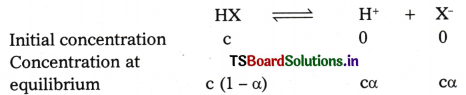
where α is degree of ionization
Ionization constant Ka = \(\frac{\left[\mathrm{H}^{+}\right]\left[\mathrm{X}^{-}\right]}{[\mathrm{HX}]}\)
⇒ Ka = \(\frac{(\mathrm{c} \alpha)(\mathrm{c} \alpha)}{\mathrm{c}(1-\alpha)}\) for weak acids α < < 1, so α is negligible.
⇒ Ka = \(\frac{c^2 \alpha^2}{c}\) ⇒ α = \(\sqrt{\frac{K_a}{c}}\)
Question 7.
Define pH. What is buffer solution? Derive Henderson – Hasselbalch equation for calculating the pH of an acid buffer solution.
Answer:
The pH of a solution may be defined as negative logarithm of the activity of hydrogen ion [H+]
pH = – log [H+]
Buffer solution : A buffer solution is the solution which can resist the change in pH on
addition of small amount of acid or base. The ability of a solution to resist change in pH on
addition of small amount of acid or base is called buffer solution.
Henderson – Hasselbalch equation :
HA + H2 ⇌ H3O+ + A– Partial ionisation.
NaA → Na+ + A– Complete ionisation
Ka = \(\frac{\left[\mathrm{H}_3 \mathrm{O}^{+}\right]\left[\mathrm{A}^{-}\right]}{[\mathrm{HA}]}\)
Since HA is weakly dissociated, the conc. HA ion solution can be taken equal to the initial conc. of the acid.
Since NaA is completely dissociated, conc. of A- can be taken equal to the conc. of NaA (salt)
Ka = \(\frac{\left[\mathrm{H}_3 \mathrm{O}^{+}\right][\text {Salt }]}{[\text { Acid }]}\)
H3O+ = \(\frac{\mathrm{K}_{\mathrm{a}} \text { [Acid] }}{[\text { Salt }]}\)
-log [H3O+] = – logKa – log\(\frac{\text { [Acid] }}{[\text { Salt }]}\)
pH = pKa + log \(\frac{\text { [Salt] }}{[\text { Acid }]}\)
Question 8.
Write notes on
(i) Common ion effect.
(ii) The relation between Ksp and solubility (S) of a sparingly soluble salt BaSO4.
Answer:
i) Common ion effect: The solubility of an electrolyte in water decreases by the addition of another electrolyte which has one ion common with the electrolyte.
- For example the solubility of NaCl decreases on addition of HCl to the solution of NaCl in water which is known as salting out of water.
- Acetic acid is weak acid and it undergoes partial ionization as follows.
CH3COOH ⇌ CH3COO– + H+ - In case of such electrolytes there exists an equilibrium in between ions and molecular form. In such a condition, the addition of electrolyte with common ions shifts the equilibrium in backward direction which causes the decrease in solubility.
Significance :
1) Common ion effect is an important phenomenon in qualitative analysis.
2) The common ion effect principle is also used in controlling the H+ ion concentration in buffer solution.
ii) The relation between K and solubility (S) of a sparingly soluble salt BaSO4 : The sparingly soluble salt like BaSO4, when added to water form saturated solution. There exists an equilibrium between undissolved solid and the ions in saturated solution.
BaSO4 ⇌ Ba2+ + SO42-
The equilibrium constant, K = \(\frac{\left[\mathrm{Ba}^{2+}\right]\left[\mathrm{SO}_4^{2-}\right]}{\left[\mathrm{BaSO}_4\right]}\)
K = \(\frac{\left[\mathrm{Ba}^{2+}\right]\left[\mathrm{SO}_4^{2-}\right]}{\mathrm{K}_1}\) (∴ Activity of solid BaSO4 is constant)
K × K1 = [Ba2+][SO2-] or Ksp = [Ba2+][SO42-]
The new constant Ksp is called solubility product.
If S moles lit-1 is the solubility of BaSO4.
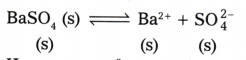
Ksp = s × s = s2
or solubility of BaSO4 is s = \(\sqrt{\mathrm{K}_{\mathrm{sp}}}\) .
Equilibrium Class 11 NCERT Solutions
Question 1.
A liquid is in equilibrium with its vapour in a sealed container at a fixed temperature.
The volume of the container is suddenly increased.
i) What is the initial effect of the change on vapour pressure ?
ii) How do rates of evaporation and condensation change initially ?
iii) What happens when equilibrium is restored finally and what will be the final vapour pressure ?
Answer:
i) The vapour pressure will decrease due to increase in volume.
ii) Since, the temperature is fixed, the rate of evaporation will remain constant. However, the rate of condensation will be low initially due to lesser number of molecules per unit volume in the vapour phase.
iii) When equilibrium is restored, the final vapour pressure will be the same as original vapour pressure because at equilibrium the rates of evaporation and condensation are equal.
Question 2.
W hat is Kc for the following equilibrium when the equilibrium concentration of each substance is : [SO2] = 0.60 M, [O2] = 0.82 M and [SO3] = 1.90 M ?
2SO2(g) + O2(g) ⇌ 2SO3(g)
Answer:
Kc = \(\frac{\left[\mathrm{SO}_3(\mathrm{~g})\right]^2}{\left[\mathrm{SO}_2(\mathrm{~g})\right]^2\left[\mathrm{O}_2(\mathrm{~g})\right]}=\frac{(1.90)^2}{(0.60)^2 \times(0.82)}\) = 12.229 L mol-1
Question 3.
At a certain temperature and a total pressure of 105 Pa, iodine vapour contains 40% by volume of I atoms.
I2(g) ⇌ 2I(g)
Calculate Kp, for the equilibrium.
Answer:
Partial pressure of I atom (pI1) = \(\frac{40}{100}\) × 105
Partial pressure of I2 (pI2) = \(\frac{(100-40)}{100}\) × 105
∴ Kp = \(\frac{\mathrm{p}_{\mathrm{I}}^2}{\mathrm{p}_{\mathrm{I}_2}}=\frac{\left(4.0 \times 10^4\right)^2}{6.0 \times 10^4}\)
= 2.67 × 10⁴ Pa
Question 4.
Write the expression for the equilibrium constant, Kc for each of the following reactions.
i) 2NOCl(g) ⇌ 2NO(g) + Cl2(g)
ii) 2Cu(NO3)2(s) ⇌ 2Cu0(s) + 4NO2(g) + O2(g)
iii) CH3COOC2H5(aq) + H2O(l) ⇌ CH3COOH(aq) + C2H5OH(aq)
iv) Fe3+(aq) + 3OH–(aq) ⇌ Fe(OH)3(s)
v) I2(s) + 5F2(g) ⇌ 2IF5(g)
Answer:
i) Kc = \(\frac{[\mathrm{NO}(\mathrm{~g})]^2\left[\mathrm{Cl}_2(\mathrm{~g})\right]}{[\mathrm{NOCl}(\mathrm{~g})]^2}\)
ii) Kc = [NO2(g)]4[O2(g)] {∵ [CuO(s) = [Cu(NO3)2(s)] = 1}
iii) Kc = \(\frac{\left[\mathrm{CH}_3 \mathrm{COOH}(\mathrm{aq})\right]\left[\mathrm{C}_2 \mathrm{H}_5 \mathrm{OH}(\mathrm{aq})\right]}{\left[\mathrm{CH}_3 \mathrm{COOC}_2 \mathrm{H}_5(\mathrm{aq})\right]}\) (∵ [H2O(l)] = 1)
iv) Kc = \(\frac{1}{\left[\mathrm{Fe}^{3+}(\mathrm{aq})\right]\left[\mathrm{OH}^{-}(\mathrm{aq})\right]^3}\) (∵ [Fe(OH)3(s)] = 1)
v) Kc = \(\frac{\left[\mathrm{IF}_5\right]^2}{\left[\mathrm{~F}_2\right]^5}\) (∵ [I2(s) = 1)
Question 5.
Find out the value of Kc for each of the following equilibria from the value of Kp.
i) 2NOCl(g) ⇌ 2NO(g) + Cl2(g) ;Kp = 1.8 × 10⁻² at 500 K
ii) CaCO3(s) ⇌ CaO(s) + CO2(g); Kp = 167 at 1073 K
Answer:
i) For the reaction, 2NOCl(g) ⇌ 2NO(g) + Cl2(g) ; ∆n = (2 + 1) – 2 = 1
Kp = Kc (RT)∆n
∴ Kc = \(\frac{\mathrm{K}_{\mathrm{p}}}{(\mathrm{RT})^{\Delta \mathrm{n}}}=\frac{1.8 \times 10^{-2}}{(0.0831 \times 500)}\) = 4.33 × 10⁻⁴ (∵ R = 0.0831 L bar mol-1K-1)
ii) For the reaction, CaCO3(s) ⇌ CaO(s) + CO2(g) ; ∆n = 1 – 0 = 1
∵ Kc = \(\frac{\mathrm{K}_{\mathrm{p}}}{(\mathrm{RT})^{\mathrm{An}}}=\frac{167}{(0.0831 \times 1073)}\) = 1.873
Question 6.
For the following equilibrium, Kc = 6.3 × 10¹⁴ at 1000 K.
NO(g) + O3(g) ⇌ NO2(g) + O2(g)
Both the forward and reverse reactions in the equilibrium are elementary bimolecular reactions. What is Kc, for the reverse reactions ?
Answer:
Kc(reverse) = \(\frac{1}{\mathrm{~K}_{\mathrm{c}(\text { forward })}}\) = \(\frac{1}{3.3 \times 10^{14}}\) = 1.59 × 10⁻¹⁵
Question 7.
Explain why pure liquids and solids can be ignored while writing the equilibrium constant expression ?
Answer:
[Pure solid] or [Pure liquid] = \(\frac{\text { No.of moles }}{\text { Volume (in } \mathrm{L})}\) = \(\frac{\text { Mass } / \text { molecular mass }}{\text { Volume }}\)
= \(\frac{\text { Density }}{\text { Molecular mass }}\) = Constant
(The density of a pure solid or a pure liquid is constant at constant temperature)
Question 8.
Reaction between N2 and O2 takes place as follows.
2N2(g) + O2(g) ⇌ 2N2O(g)
If a mixture of 0.482 mol of N2 and 0.933 mol of O2 is placed in a 10L reaction vessel and allowed to form N2O at a temperature for which Kc = 2.0 × 10-37, determine the composition of equilibrium mixture.
Answer:
Suppose x moles of N2 react till equilibrium is attained.
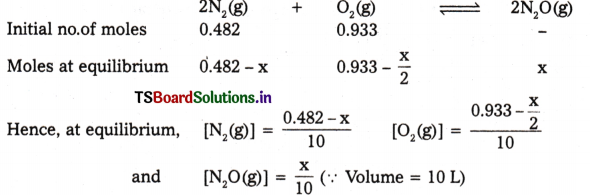
Since, the value of Kc for the reaction (Kc = 2.0 × 10-37) is very small, the value of x must be very small. Therefore,
[N2(g)] = \(=\frac{0.482-x}{10}=\frac{0.482}{10}\) = 0.0482 mol L-1
[O2(g)] = \(\frac{0.933-x / 2}{10}=\frac{0.933}{10}\frac{0.933-x / 2}{10}=\frac{0.933}{10}\) = 0.0933 mol L-1 and [N2O(g)] = \(\frac{\mathrm{x}}{10}\)
From Kc = \(\frac{\left[\mathrm{N}_2 \mathrm{O}(\mathrm{~g})\right]^2}{\left[\mathrm{~N}_2(\mathrm{~g})\right]^2\left[\mathrm{O}_2(\mathrm{~g})\right]}\)
We have, 2.0 × 10-37 = \(\frac{(x / 10)^2}{(0.0482)^2 \times 0.0933}\)
Which gives, x = 6.6 × 10⁻²⁰
∴ [N2O(g)] = \(\frac{x}{10}=\frac{6.6 \times 10^{-20}}{10}\) = 6.6 × 10⁻²¹
Question 9.
Nitric oxide reacts with Br2 and gives nitrosyl bromide as per reaction given below.
2NO(g) + Br2(g) ⇌ 2NOBr(g)
When 0.087 mol of NO and 0.0437 mol of Br2 are mixed in a closed container at constant temperature, 0.0518 mol of NOBr is obtained at equilibrium. Calculate equilibrium amount of NO and Br2.
Answer:

Given that x = 0.0518
No. of moles of NO(g) at equilibrium = 0.087 – x = 0.087 – 0.518 = 0.0352
and number of moles of Br2(g) at equilibrium = 0.0437 – \(\frac{\mathrm{x}}{2}\) = 0.0437 – \(\frac{0.0518}{2}\) = 0.0178
Question 10.
At 450 K, Kp = 2.0 × 10¹⁰ bar for the given reaction at equilibrium.
2SO2(g) + O2(g) ⇌ 2SO3(g)
What is Kc at this temperature ?
Answer:
For the given reaction, ∆n = 2 – (2 + 1) = -1
Kp = Kc(RT)∆n
⇒ Kc = \(\frac{\mathrm{K}_{\mathrm{p}}}{(\mathrm{RT})^{\Delta \mathrm{n}}}=\frac{2.0 \times 10^{10}}{(0.0831 \times 450)^{-1}}\) L mol-1, (∵ R = 0.0831 L bar K-1 mol-1)
= 2.0 × 1010 × 0.831 × 450 L mol-1
= 7.48 × 10¹¹ L mol-1
Question 11.
A sample of HI(g) is placed in a flask at a pressure of 0.2 atm. At equilibrium the partial pressure of HI(g) is 0.04 atm. What is Kp for the given equilibrium ?
2HI(g) ⇌ H2(g) + I2(g)
Answer:

[∵ (0.2 – 0.04) is the decrease in the pressure of HI]
Kp = \(\frac{\mathrm{p}_{\mathrm{H}_2} \times \mathrm{p}_{\mathrm{I}_2}}{\mathrm{p}_{\mathrm{HI}}^2}=\frac{0.08 \times 0.08}{(0.04)^2}\) = 4.0
Question 12.
A mixture of 1.57 mol of N2, 1.92 mol of H2 and 8.13 mol of NH3 is introduced into a 20 L reaction vessel at 500 K. At this temperature, the equilibrium constant, Kc for the reaction
N2(g) + 3H2(g) ⇌ 2NH3(g) is 1.7 × 10². Is the reaction mixture at equilibrium ? If not, what is the direction of the net reaction ?
Answer:
N2(g) + 3H2(g) ⇌ 2NH3(g)
Qc = \(\frac{\left[\mathrm{NH}_3(\mathrm{~g})\right]^2}{\left[\mathrm{~N}_2(\mathrm{~g})\right]\left[\mathrm{H}_2(\mathrm{~g})\right]^3}=\frac{(8.13 / 20)^2}{\left(\frac{1.57}{20}\right) \times\left(\frac{1.92}{20}\right)^3}\) = 2.38 × 10³ (V = 20 L)
Given that Kc = 1.7 × 10²
Obviously, Qc ≠ Kc
Therefore, the reaction is not in equilibrium because Qc ≠ Kc. It will proceed in the reverse direction.
Question 13.
The equilibrium constant expression for a gas reaction is, Kc = \(\frac{\left[\mathrm{NH}_3\right]^4\left[\mathrm{O}_2\right]^5}{[\mathrm{NO}]^4\left[\mathrm{H}_2 \mathrm{O}\right]^6}\)
Write the balanced chemical equation corresponding to this expression.
Answer:
4NO(g) + 6H2O(g) ⇌ 4NH3(g) + 5O2(g)
Question 14.
One mole of H2O and one mole of CO are taken in 10 L vessel and heated to 725 K. At equilibrium, 40% of water (by mass) reacts with CO according to the equation,
H2O(g) + CO(g) ⇌ H2(g) + CO2(g)
Calculate the equilibrium constant for the reaction.
Answer:
The given reaction is H2O(g) + CO(g) ⇌ H2(g) + CO2(g)
Initial number of moles of H2O(g) = 1
Number of moles of H2O(g) (reacted) = \(\frac{1 \times 40}{100}\) = 0.4
∴ Number of moles of H2O(g) left (unreacted) = 1 – 0.4 = 0.6
From the given equation it is clear that 0.4 moles of H2O(g) react with 0.4 moles of CO(g) to form 0.4 moles of H2(g) and 0.4 moles of CO2(g). The total volume is 10 litres.
∴ At equilibrium,
[H2O(g)] = \(\frac{1-0.4}{10}\) = \(\frac{0.6}{10}\) = 0.06 mol L-1 ; [CO(g)] = \(\frac{1-0.4}{10}\) = \(\frac{0.6}{10}\) = 0.06 mol L-1
[H2(g)] = \(\frac{0.4}{10}\) = 0.04 mol L-1 ; [CO2(g)] = \(\frac{0.4}{10}\) = 0.04 mol L-1
Hence, K = \(\frac{\left[\mathrm{H}_2(\mathrm{~g})\right]\left[\mathrm{CO}_2(\mathrm{~g})\right]}{\left[\mathrm{H}_2 \mathrm{O}(\mathrm{~g})\right][\mathrm{CO}(\mathrm{~g})]}=\frac{0.04 \times 0.04}{0.06 \times 0.06}\) = 0 44
Question 15.
At 700 K, equilibrium constant for the reaction :
H2(g) + I2(g) ⇌ 2HI(g)
is 54.8. If 0.5 mol L_1 of HI(g) js present at equilibrium at 700 K, what are the concentration of H2(g) and I2(g) assuming that we initially started with HI(g) and allowed it to reach equilibrium at 700 K ?
Answer:
The given reaction can be written as 2HI(g) ⇌ H2(g) + I2(g)
For this reaction, K = \(\frac{1}{54.8}\) = 1.82 × 10⁻² (∵ because for the reverse reaction, K = 54.8)
As the number of moles of H2 and N2 are equal, their concentrations at equilibrium will also be equal.
Suppose [H2(g)] = [I2(g)] = x mol L-1
Given that [HI(g)] = 0.5 mol L-1
K = \(\frac{\left[\mathrm{H}_2(\mathrm{~g})\right]\left[\mathrm{I}_2(\mathrm{~g})\right]}{[\mathrm{HI}(\mathrm{~g})]^2}\) ⇒ 1.82 × 10-2 = \(\frac{x \times x}{(0.5)^2}\) ⇒ x = [1.82 × 10-2 × (0.5)2]1/2 = 0.068 mol L-1
Hence, at equilibrium, [H2(g)] = [I2(g)] = 0.068 mol L-1
Question 16.
What is the equilibrium concentration of each of the substances in the equilibrium when the initial, concentration of ICl was 0.78 M ?
2ICl(g) ⇌ I2(g) + Cl2(g); Kc = 0.14
Answer:
Suppose at equilibrium, [I2(g)] = [Cl2(g>] = x mol L-1

Given that, Kc = 0.14
Kc = \(\frac{\left[\mathrm{I}_2(\mathrm{~g})\right]\left[\mathrm{Cl}_2(\mathrm{~g})\right]}{[\mathrm{ICl}(\mathrm{~g})]^2}\)
⇒ 0.14 = \(\frac{x \times x}{(0.78-2 x)^2}\) ⇒ x2 = 0.14(0.78 -2x)2
⇒ x = \(\sqrt{0.14}\) (0.78 – 2x) = 0.374(0.78 – 2x)
⇒ x = 0.292 – 0.748 x
⇒ 1.748 x = 0.292
x = \(\frac{0.292}{1.748}\) = 0.167
Hence, equilibrium concentrations will be as follows.
[I2(g)] – [Cl2(g)] = x = 0.167 M
[ICl(g)] = 0.78 – 2x = 0.78 – (2 × 0.167) = 0.446 M
Question 17.
Kp = 0.04 atm at 899 K for the equilibrium shown below. What is the equilibrium concentration of C2H6 when it is placed in a flask at 4.0 atm pressure and allowed to come to equilibrium?
C2H6(g) ⇌ C2H4(g) + H2(g)
Answer:
Suppose the partial pressure of C2H6 decreases by p atm till equilibrium is attained.

Kp = \(\frac{\mathrm{p}_{\mathrm{C}_2 \mathrm{H}_4} \cdot \mathrm{p}_{\mathrm{H}_2}}{\mathrm{p}_{\mathrm{C}_2 \mathrm{H}_6}}\) = \(\frac{\mathrm{p} \times \mathrm{p}}{4.0-\mathrm{p}}\) ⇒ 0.04 = \(\frac{\mathrm{p}^2}{4.0-\mathrm{p}}\) = 0.16 – 0.04 p ⇒ p2 + 0.04 p – 0.16 = 0
p = \(\frac{-0.04 \pm \sqrt{(0.04)^2-4 \times 1 \times(-0.16)}}{2 \times 1}=\frac{-0.04 \pm 0.801}{2}\)
Taking positive value, p = 0.38
∴ [C2H6(g)]eq = 4.0 – p = 4.0 – 0.38 = 3.62 atm
Question 18.
Ethyl acetate is formed by the reaction between ethanol and acetic acid and the equilibrium is represented as,
CH3COOH(l) + C2H5OH(l) ⇌ CH3COOC2H5(l) + H2O(l)
i) Write the concentration ratio (reaction quotient), Qc, for this reaction (note : water is not in excess and is not a solvent in this reaction)
ii) At 293 K, if one starts with 1.00 mol of acetic acid and 0.18 mol of ethanol, there is 0.171 mol of ethyl acetate in the final equilibrium mixture. Calculate the equilibrium constant.
iii) Starting with 0.5 mol of ethanol and 1.0 mol of acetic acid and maintaining it at 293 K, 0.214 mol of ethyl acetate is found after sometime. Has equilibrium been reached?
Answer:
i) Qc = \(\frac{\left[\mathrm{CH}_3 \mathrm{COOC}_2 \mathrm{H}_5(l)\right]\left[\mathrm{H}_2 \mathrm{O}(l)\right]}{\left[\mathrm{CH}_3 \mathrm{COOH}(l)\right]\left[\mathrm{C}_2 \mathrm{H}_5 \mathrm{OH}(l)\right]}\)
ii)

If the volume of the reaction mixture is V L, we have at equilibrium,
[CH3COOH(l)] = \(\frac{0.829}{\mathrm{V}}\) mol L-1 ; [C2H5OH(l)] = \(\frac{0.009}{\mathrm{V}}\) mol L-1
[CH3COOC2H5(l)] = \(\frac{0.171}{\mathrm{V}}\) mol L-1 ; [H2O(l)] = \(\frac{0.171}{\mathrm{V}}\) mol L-1
Kc = \(\frac{\left[\mathrm{CH}_3 \mathrm{COOC}_2 \mathrm{H}_5(l)\right]\left[\mathrm{H}_2 \mathrm{O}(l)\right]}{\left[\mathrm{CH}_3 \mathrm{COOH}(l)\right]\left[\mathrm{C}_2 \mathrm{H}_5 \mathrm{OH}(l)\right]}=\frac{\frac{0.171}{\mathrm{~V}} \times \frac{0.171}{\mathrm{~V}}}{\frac{0.829}{\mathrm{~V}} \times \frac{0.009}{\mathrm{~V}}}=\frac{0.171 \times 0.171}{0.829 \times 0.009}\) = 3.92
iii)

∴ Qc = \(\frac{\frac{0.214}{V} \times \frac{0.214}{V}}{\frac{0.786}{V} \times \frac{0.286}{V}}\) = 0.204
Since, Qc < Kc, equilibrium has not been reached.
Question 19.
A sample of pure PCl5, was introduced into an evacuated vessel at 473 K. After equilibrium was attained, concentration of PCl5 was found to be 0.5 × 10⁻¹ mol L-1. If value of Kc is 8.3 × 10⁻⁵ what are the concentrations of PCl3 and Cl2 at equilibrium ?
PCl5(g) ⇌ PCl3(g) + Cl2(g)
Answer:
PCl5(g) ⇌ PCl3(g) + Cl2(g)
Since, the number of moles of PCl3(g) and Cl2(g) are equal, their concentrations at equilibrium will also be equal.
Suppose, at equilibrium, [PCl3(g)] = [Cl2(g)] = x mol L-1
Given that at equilibrium, [PCl5] = 0.5 × 10⁻¹ mol L-1
∴ Kc = \(\frac{\left[\mathrm{PCl}_3(\mathrm{~g})\right]\left[\mathrm{Cl}_2(\mathrm{~g})\right]}{\left[\mathrm{PCl}_5(\mathrm{~g})\right]}\) ⇒ 8.3 × 10-3 = \(\frac{\mathrm{x} \times \mathrm{x}}{0.5 \times 10^{-1}}\)
⇒ x = (8.3 × 10-3 × 0.5 × 10-1)1/2 = 0.02
Hence, [PCl3(g)] = [Cl2(g)] = 0.02 mol L-1.
Question 20.
One of the reaction that takes place in producing steel from iron ore is the reduction of iron (II) oxide by carbon monoxide to give iron metal and CO2.
FeO(s) + CO(g) ⇌ Fe(s) + CO2(g); Kp = 0.265 atm at 1050 K
What are the equilibrium partial pressures of CO and CO2 at 1050 K if the initial partial pressures are : P CO = 1.4 atm and PCO2 = 0.80 atm?
Answer:

Qp = \(\frac{\mathrm{P}_{\mathrm{CO}_2}}{\mathrm{P}_{\mathrm{CO}}}=\frac{0.80}{1.4}\) = 0.571
Since, Qp > Kp, the reaction will proceed in the reverse direction. On account of this partial pressure of CO2 will decrease while that of CO will increase.
Suppose, the decrease in the partial pressure of CO2 is p atm.
∴ At equilibrium, PCO2 = (0.80 – p) atm and PCO = (1.4 + p) atm
∵ Kp = \(\frac{\mathrm{P}_{\mathrm{CO}_2}}{\mathrm{P}_{\mathrm{CO}}}\), we have
0.265 = \(\frac{0.80-\mathrm{p}}{1.4+\mathrm{p}}\) ⇒ 0.265 (1.4 + p) = 0.80 – p
⇒ 0.371 + 0.265 p = 0.80 – p
⇒ 1.265 p = 0.429 ⇒ p = \(\frac{0.429}{1.265}\) = 0.339 atm
∴ P CO at equilibrium = 1.4 + 0.339 = 1.739 atm.
and PCO2 at equilibrium = 0.80 – 0.339 = 0.461 atm.
Question 21.
Equilibrium constant, Kc for the reaction
N2(g) + 3H2(g) ⇌ 2NH3(g) at 500 K is 0.061 At a particular time, the analysis shows that composition of the reaction mixture is 3.0 mole L-1 N2(g) 2.0 mol L-1 H2 and 0.5 mol L-1 NH3. Is the reaction at equilibrium ? If not in which direction does the reaction tend to proceed to reach equilibrium ?
Answer:
N2(g) + 3H2(g) ⇌ 2NH3(g) ; Kc = 0.061
For the given set of conditions, Qc = \(\frac{\left[\mathrm{NH}_3(\mathrm{~g})\right]^2}{\left[\mathrm{~N}_2(\mathrm{~g})\right]\left[\mathrm{H}_2(\mathrm{~g})\right]^3}=\frac{(0.5)^2}{(3.00) \times(2.00)^3}\) = 0.0104
Since, Qc < Kc, the reaction is not at equilibrium. It will proceed in the forward direction.
Question 22.
Bromine monochioride, BrCl decomposes into bromine and chlorine and reaches the equilibrium:
2BrCl(g) ⇌ Br2(g) + Cl2(g)
for which Kc = 32 at 500 K. If initially pure BrCl is present at a concentration 3.3 × 10⁻³ mol L-1, what is its molar concentration in the mixture at equilibrium?
Answer:

Kc = \(\frac{\left[\mathrm{Br}_2(\mathrm{~g})\right]\left[\mathrm{C} l_2(\mathrm{~g})\right]}{[\mathrm{BrCl}(\mathrm{~g})]^2}\) ⇒ 32 = \(\frac{\frac{x}{2} \times \frac{x}{2}}{\left(3.30 \times 10^{-3}-x\right)^2}\)
Taking square root on both sides, we get
5.66 = \(\frac{\frac{x}{2}}{3.30 \times 10^{-3}-x}=\frac{x}{2\left(3.30 \times 10^{-3}-x\right)}\)
⇒ 0.037 – 11.32 x = x ⇒ (1 + 11.32)x = 0.037 ⇒ x = \(\frac{0.037}{1+11.32}\) = 3.0 × 10⁻³
∴ Equilibrium centration of BrCl = 3.30 × 10⁻³ – x
= 3.30 × 10⁻³ – 3.0 × 10-3
= 3.0 × 10⁻⁴ mol L-1
Question 23.
At 1127 K and 1 atm pressure, a gaseous mixture of CO and CO2 in equilibrium with solid carbon has 90.55% CO by mass, C(s) + CO2(g) ⇌ 2CO(g)
Calculate Kc for this reaction at the above temperature.
Answer:
If the total mass of the gaseous mixture at equilibrium is 100 g then
mass of CO(g) = 90.55 g
and mass of CO2(g) = 100 – 90.55 = 9.45 g
Number of moles of COg) = \(\frac{90.55}{28}\) = 3.234,
(∵ molar mass of CO = 28 g/mol, molar mass of CO2 = 44 g/mol)
and number of moles of CO2(g) = \(\frac{9.45}{44}\) = 0.215
Total number of gaseous moles = 3.234 + 0.2 15 = 3.449
∴ PCO = \(\frac{3.234}{3.449}\) × 1 = 0.938 atm (∵ Partial pressure = \(\frac{\text { No.of moles }}{\text { Total no.of moles }}\) × Total pressure)
and PCO2 = \(\frac{0.215}{3.449}\) × 1 = 0.062 atm
Hence, for the reaction C(s) + CO2(g) ⇌ 2CO(g)
Kp = \(\frac{\mathrm{p}{\mathrm{CO}}^2}{\mathrm{p}{\mathrm{CO}_2}}=\frac{(0.938)^2}{0.062}\) = 14.19
For the above reaction, ∆n = 2 – 1 = 1
Kp = Kp(RT)∆n ⇒ Kc = \(\frac{\mathrm{K}_{\mathrm{p}}}{(\mathrm{RT})^{\mathrm{An}}}=\frac{14.19}{(0.0821 \times 1127)^1}\) = 0.153
Question 24.
Calculate (i) ∆G° and (ii) the equilibrium constant for the formation of NO2 from NO and O2 at 298
NO(g) + 1/2O2(g) ⇌ NO2(g)
where ∆fG°(NO2) = 52.0 kJ/mol ; ∆fG°(NO) = 87,0 kJ/mol ; ∆fG°(O2) = 0 kJ/mol
Answer:
i) ∆rG° = ∆fG° (products) – ∆fG° (reactants)
or = ∆rG° [NO2] – {∆fG° [NO] + ½∆fG° [O2])
or ∆r = 52.0 – (87.0 + 0) = -35.0 kJ mol -1
ii) ∆rG° = -2.303 RT log10K
⇒ log10K = –\(\frac{\Delta_{\mathrm{r}} G^{\circ}}{2.303 \mathrm{RT}}\) = \(\frac{(-35.0)}{-2.303 \times 8.314 \times 10^{-3} \times 298}\) = 6.1341
(∵ R = 8.314 × 10⁻³ kJ K-1 mol-1)
⇒ K = antilog106.134l = 1.362 × 10⁶
Question 25.
Does the number of moles of reaction products increase, decrease or remain same when each of the following equilibria is subjected to a decrease In pressure by increasing the volume?
i) PCl5(g) ⇌ PCl3(g) + Cl2(g)
ii) CaO(s) + CO2(g) ⇌ CaCO3(s)
iii) 3Fe(s) + 4H2O(g) ⇌ Fe3O4(s) + 4H2(g)
Answer:
According to Le Chateliers principle, if the pressure on the system is decreased, then the equilibrium shifts in the direction in which the number of moles of gases is more.
i) No.of moles of products will increase on decreasing pressure as the forward reaction will be favoured.
ii) No.of moles of products will decrease as the backward reaction will be favoured.
iii) No.of moles of products will remain the same as the number of moles of gaseous substances is the same on both the sides.
Question 26.
Which of the following reactions will get affected by increasing the pressure ? Also, mention whether change will cause the reaction to go into forward or backward direction.
i) COCl2(g) ⇌ CO(g) + Cl2(g)
ii) CH4(g) + 2S2(g) ⇌ CS2(g) + 2H2S(g)
iii) CO2(g) + C(s) ⇌ 2C0(g)
iv) 2H2(g) + CO(g) ⇌ CH3OH(g)
v) CaCO3(s) ⇌ CaO(s) + CO2(g)
vi) 4NH3(g) + 5O2(g) ⇌ 4NO(g) + 6H2O(g)
Answer:
i) Reaction will go in the backward direction as nP > nR
ii) Reaction will remain unaffected as nP = nR.
iii) Reaction will go in the backward direction as nP > nR
iv) Reaction will go in the forward direction as nP < nR
v) Reaction will go in the backward direction as nP > nR
vi) Reaction will go in the backward direction as nP > nR.
Question 27
The equilibrium constant for the following reaction is 1.6 × 10⁵ at 1024 K
H2(g) + Br2(g) ⇌ 2HBr(g)
Find the equilibrium pressure of all gases if 10.0 bar of HBr is introduced into a sealed container at 1024 K.
Answer:
For the reaction

For the above reaction, K = \(\frac{1}{1.6 \times 10^5}\) = 6.25 × 10⁻⁶
Further, K = K = 6.25 × 10⁻⁶ ⇒ Kp = \(\frac{\mathrm{p}{\mathrm{H}_2} \cdot \mathrm{p}{\mathrm{Br}2}}{\mathbf{p}{\mathrm{HBr}}^2}\)
Hence, 6.25 × 10-6 = \(\frac{\frac{\mathrm{p}}{2} \cdot \frac{\mathrm{p}}{2}}{(10.0-\mathrm{p})^2}\)
Taking square mot on both sides, we have, 2.5 × 10-3 = \(\frac{\frac{p}{2}}{10.0-p}=\frac{p}{2(10.0-p)}\)
⇒ 0.05 – 5.0 × 10⁻³ p ⇒ p = p(1 +5.0 × 10⁻³)= 0.05 ⇒ p = \(\frac{0.05}{1+5.0 \times 10^{-3}}\) = 4.98 × 10⁻² bar
Hence, at equilibrium, PH2 = PBr2 = \(\frac{p}{2}=\frac{4.98 \times 10^{-2}}{2}\) = 2.49 × 10⁻² bar
and PHBr = (10.0 – p) = 10.0 – 4.98 × 10-2 = 9.95 bar
Question 28.
Dihydrogen gas ¡s obtained from natural gas by partial oxidation with steam as per following endothermic reaction:
CH4(g) + H2O(g) ⇌ CO(g) + 3H2(g)
i) Write an expression for Kp for the above reaction.
ii) How will the values of Kp and composition of equilibrium mixture be affected by
a) increasing the pressure b) increasing the temperature c) using a catalyst?
Answer:
i) Kp = \(\frac{\mathrm{p}{\mathrm{CO}} \times \mathrm{p}{\mathrm{H}2}^3}{\mathrm{p}{\mathrm{CH}4} \times \mathrm{p}{\mathrm{H}_2 \mathrm{O}}}\)
ii) a) Equilibrium will shift in the backward direction as np > nR.
b) Equilibrium will shift in the forward direction because the reaction is endothermic.
c) Composition of equilibrium mixture will remain unchanged. However, the equilibrium will be attained earlier,
The value of Kp will remain unchanged in (a) and (C). Kp will increase in (b).
Question 29.
Describe the effect of:
i) addition of H2
ii) addition of CH3OH
iii) removal of CO
iv) removal of CH3OH
on the equilibrium of the reaction:
2H2(g) + CO(g) ⇌ CH3OH(g)
Answer:
i) Equilibrium will shift in the forward direction.
ii) Equilibrium will shift in the backward direction.
iii) Equilibrium will shift in the backward direction.
iv) Equilibrium will shift in the forward direction.
Question 30.
At 473 K, equilibrium constant Kc for decomposition of phosphorus pentachioride, PCl5 is 8.3 × 10⁻³. If decomposition is depicted as,
PCl5(g) ⇌ PCl3(g) + Cl2(g); ∆rH° = 124.0 kJ mol-1
i) Write an expression for Kc for the reaction.
ii) What is the value of Kc for the reverse reaction at the same temperature?
iii) What would be the effect on Kc if (a) more PCl5 is added (b) pressure is increased (c) the temperature is increased?
Answer:
i) Kc = \(\frac{\left[\mathrm{PCl}_3(\mathrm{~g})\right]\left[\mathrm{Cl}_2(\mathrm{~g})\right]}{\left[\mathrm{PCl}_5(\mathrm{~g})\right]}\)
ii) K’ = \(\frac{1}{K_c}=\frac{1}{8.3 \times 10^{-3}}\) = 120.48
iii) a) M constan temperature, the value of Kc is not affected by addition of reactants.
Therefore, Kc will remain unchanged.
b) Kc will remain unchanged.
c) Since, Kc = \(\frac{K_1}{K_2}\), an increase in temperature will favour the forward reaction as the reaction is endothermic. Thus, K1 will Increase. Hence, the value of Kc will increase or increasing temperature.
Question 31.
Dihydrogen gas used in Haber’s process is produced by reacting methane from natural gas with high temperature steam. The first stage of two stage reaction involves the formation of CO and H2. In second stage, CO formed in first stage is reacted with more steam in water gas shift reaction,
CO(g) + H2O(g) ⇌ CO2(g) + H2(g)
If a reaction vessel at 4000 C is charged with an equimolar mixture of CO and steam such that pCO = pH2O = 4.0 bar, what will be the partial pressure of H2 at equilibrium? Kp = 10.1 at 400°C.
Answer:
Suppose the partial pressure of H2 at equilibrium is p bar.

∴ Kp = \(\frac{\mathrm{p}_{\mathrm{CO}_2} \cdot \mathrm{p}_{\mathrm{H}_2}}{\mathrm{p}_{\mathrm{CO}} \cdot \mathrm{p}_{\mathrm{H}_2 \mathrm{O}}}\)
⇒ 10.1 = \(\frac{p \times p}{(4.0-p) \times(4.0-p)}=\left(\frac{p}{4.0-p}\right)^2\) ⇒ \(\frac{p}{4.0-p}\) = \(\sqrt{10.1}\) = 3.178
⇒ p = 3.178 (40 – p) ⇒ p = 12.712 – 3.178 p ⇒ 3.178 + p = 12.712 bar
∴ p = 12.712/4.178 bar
p = 3.04 bar
Question 32.
Predict which of the following reaction will have appreciable concentration of reactants and products.
i) Cl2(g) ⇌ 2Cl(g) ; Kc = 5 × 10-39
ii) Cl2(g) + 2NO(g) ⇌ 2NOCl(g) ; Kc = 3.7 × 10⁸
iii) Cl2(g) + 2NO2(g) ⇌ 2NO2Cl(g) ; Kc = 1.8
Answer:
i) For reaction (a), Kc is very low. Therefore, the concentration of products will be very low.
ii) For reaction (b), Kc is quite high. Therefore, the reaction will proceed almost to completion and there will be no appreciable concentrations of reactants.
iii) The reaction (c) has a moderate value of Kc and will have appreciable concentrations of both reactants and products.
Question 33.
The value of Kc for the reaction 3O2(g) ⇌ 2O3(g) is 2.0 × 10-50 at 25°C. If the equilibrium concentration of O2 in air at 25°C is 1.6 × 10⁻², what is the concentration of O3 ?
Answer:
Kc = \(\frac{\left[\mathrm{O}_3(\mathrm{~g})\right]^2}{\left[\mathrm{O}_2(\mathrm{~g})\right]^3}\) ⇒ 2.0 × 10-30 = \(\frac{\left[\mathrm{O}_3(\mathrm{~g})\right]^2}{\left(1.6 \times 10^{-2}\right)^3}\)
⇒ [O3(g)]2 = 2.0 × 10-50 × (1.6 × 10-2)3 = 8.192 × 10-56
∴ [O3(g)] = (8.192 × 10-56)10 = 2.86 × 10⁻²⁸ M
Question 34.
The reaction, CO(g) + 3H2(g) ⇌ CH4(g) + H2O(g) is at equilibrium at 1300 K in a 1 L flask. It also contain 0.30 mol of CO, 0.10 mol of H2 and 0.02 mol of H2O and an unknown amount of CH4 in the flask. Determine the concentration of CH4 in the mixture. The equilibrium constant, Kc for the reaction at the given temperature is 3.90.
Answer:
Kc = \(\frac{\left[\mathrm{CH}_4(\mathrm{~g})\right]\left[\mathrm{H}_2 \mathrm{O}(\mathrm{~g})\right]}{[\mathrm{CO}(\mathrm{~g})]\left[\mathrm{H}_2(\mathrm{~g})\right]^3}\)
∴ 3.90 = \(\frac{\left[\mathrm{CH}_4(\mathrm{~g})\right] \times 0.02}{0.30 \times(0.10)^3}\) (V = 1 L)
⇒ [CH4(g)] = \(\frac{3.90 \times 0.30 \times(0.10)^3}{0.02}\) = 0.0585 = 5.85 × 10⁻² mol L-1
Question 35.
What is meant by the conjugate acid-base pair ? Find the conjugate acid/base for the following species.
HNO2, CN–, HClO4, F–, OH–, \(\mathrm{CO}_3^2\) and S2-
Answer:
A conjugate acid-base pair that differs only by one proton. Conjugate pairs of the given species are NO2–, HCN, ClO4–, HF, H2O, HCO3– and HS– respectively.
Question 36.
Which of the followings are Lewis acids ? H2O, BF3, H+, and \(\mathrm{NH}_4^{+}\)?
Answer:
BF3, H+ and \(\mathrm{NH}_4^{+}\).
Question 37.
What will be the conjugate bases for the Bronsted acids : HF, H2SO4 and \(\mathrm{HCO}_3^{-}\) ?
Answer:
F–, HSO4– and CO32-
(Conjugate base = Conjugate acid – H+)
Question 38.
Write the conjugate acids for the following Bronsted bases : NH2–, NH3 and HCO3–.
Answer:
NH3, NH4+, HCOOH (Conjugate acid = Conjugate base + H+)
Question 39.
The species : H2O, HCO3–, HS4– and NH3 can act both as Bronsted acids and bases. For each case give the corresponding conjugate acid and base.
Answer:
| Substance | Conjugate Acid | Conjugate base |
| H2O | H3O+ | OH– |
| HCO3– | H2CO3 | CO32- |
| HSO4– | H2SO4 | SO42- |
| NH3 | NH4+ | NH2– |
Question 40.
Classify the following species into Lewis acids and Lewis bases and show these act as Lewis acid/base :
(a) OH–
(b) F–
(c) H+
(d) BCl3.
Answer:
a) OH– is a Lewis base because it can donate an electron pair.
b) F– is a Lewis base because it can donate electron pair.
c) H+ is a Lewis acid because it can accept an electron pair.
d) BCl3 is a Lewis acid because it is an electron deficient molecule and can accept an electron pair.
Question 41.
The concentration of hydrogen ion in a sample of soft drink is 3.8 × 10⁻³ M. What is its pH?
Answer:
pH = -log10(H+) = -log10(3.8 × 10⁻³) = 2.42
Question 42.
The pH of a sample of vinegar is 3.76. Calculate the concentration of hydrogen ion in it.
Answer:
log10[H+] = -3.76
[H+] = antilog10(-3.76) = antilog10\(\overline{4} .24\) = 1.74 × 10⁻⁴ M
Question 43.
The ionization constant of HF, HCOOH and HCN at 298 K are 6.8 × 10⁻⁴, 1.8 × 10⁻⁴ and 4.8 × 10⁻⁹ respectively. Calculate the ionization constants of the corresponding conjugate base.
Answer:
i) The conjugate base of HF is F–. It will react with water as follows.
F– + H2O ⇌ HF + OH–
Obviously, this is the equation of hydrolysis of a salt of HF with a strong base. Hence,
KF = Kh = \(\frac{\mathrm{K}_{\mathrm{w}}}{\mathrm{~K}_{\mathrm{a}}}=\frac{1.0 \times 10^{-14}}{6.8 \times 10^{-4}}\) = 1.5 × 10⁻¹¹
ii) Similarly, for HCOOH, KHCOO– = Kh = \(\frac{\mathrm{K}_{\mathrm{w}}}{\mathrm{~K}_{\mathrm{a}}}=\frac{1.0 \times 10^{-14}}{1.8 \times 10^{-9}}\) = 5.6 × 10⁻¹¹
iii) For HCN, KCN– = Kh = \(\frac{K_w}{K_a}=\frac{1.0 \times 10^{-14}}{4.8 \times 10^{-9}}\) = 2.1 × 10⁻⁶
Question 44.
The ionization constant of phenol is 1.0 × 10⁻¹⁰. What is the concentration of phenolate ion is 0.05 M solution of phenol ? What will be its degree of ionization if the solution is also 0.01M in sodium phenolate ?
Answer:

∴ Ka = \(\frac{\left[\mathrm{C}_6 \mathrm{H}_5 \mathrm{O}^{-}\right]\left[\mathrm{H}^{+}\right]}{\left[\mathrm{C}_6 \mathrm{H}_5 \mathrm{OH}\right]}=\frac{\mathrm{x} . \mathrm{x}}{0.05-\mathrm{x}}\) = 1.0 × 10⁻¹⁰(given)
⇒ \(\frac{x^2}{0.05-x}\) = 1.0 × 10⁻¹⁰
Since, phenol is not much dissociated, 0.05 – x ≈ 0.05.
Hence, \(\frac{x^2}{0.05}\) = 1.0 × 10⁻¹⁰ ⇒ x = (0.05 × 1.0 × 10-10)1/2 = 2.24 × 10⁻⁶
Hence, [C6H5O–] in solution = x = 2.24 × 10⁻⁶ M
In the presence of 0.01 M of C6H5ONa :
Suppose y is the amount of phenol dissociated. Therefore, at equilibrium
[C6H5OH] – 0.05 – y, [C6H5O–] = 0.01 + y and [H+] = y
∴ Ka = \(\frac{(0.01+\mathrm{y})(\mathrm{y})}{(0.05-\mathrm{y})}\) = 1.0 × 10⁻¹⁰ (given)
Since, in the presence of sodium phenolate, the dissociation of phenol will get further suppressed we can take
0.01 + y ≈ 0.01 and 0.05 – y ≈ 0.05
Hence, \(\frac{0.01+\mathrm{y}}{0.05}\) = 1.0 × 10⁻¹⁰ ⇒ y = \(\frac{1.0 \times 10^{-10} \times 0.05}{0.01}\) = 5.0 × 10⁻¹⁰
Hence, degree of dissociation of phenol
α = \(\frac{\text { Number of moles dissociated }}{\text { Total no.of moles initially taken }}=\frac{5.0 \times 10^{-10}}{0.05}\) = 1.0 × 10⁻¹⁰
Question 45.
The first ionization constant of H2S is 9.1 × 10⁻⁸. Calculate the concentration of HS– ion in its 0.1 M solution. How will this concentration be affected if the solution is 0.1 M in HCl also? If the second dissociation constant of H2S is 1.2 × 10⁻¹³, calculate the concentration of Sounder both conditions.
Answer:
Calculation of [HS–]
H2S ionises in two stages. The first stage of ionisation is as follows.

Ka1 = 9.1 × 10⁻⁸ (given)
According to the law of equilibrium, Ka1 = \(\)
⇒ 9.1 × 10-8 = \(\frac{x \cdot x}{0.1-x}\) = \(\frac{x^2}{0.1}\) (as x is very small so 0.1 – x = 0.1)
⇒ x = (9.1 × 10-8 × 0.1)1/2 = 9.54 × 10⁻⁵
Hence, [HS–] in 0.1 M solution = x = 9.54 × 10⁻⁵.
In the presence of 0.1 M HCl, suppose H2S dissociates to an extent of y M.
Therefore, [H2S] = 0.1 – y ≈ 0.1M, [H+] = y + 0.1 ≈ 0.1M and [HS–] = y M
(Since, in the presence of HCl, the dissociation of H2S will further get suppressed)
∴ Ka1 = \(\frac{0.1 \times \mathrm{y}}{0.1}\) = 9.1 × 10⁻⁸ ⇒ y = 9.1 × 10⁻⁸M
Hence, in the presence of 0.1 M of HCl,
[HS–] = y = 9.1 × 10⁻⁸M
Calculation of [S2-]

The overall dissociation can be expressed as follows.
H2S ⇌ 2H+ + S2-
Ka = \(\frac{\left[\mathrm{H}^{+}\right]^2\left[\mathrm{~S}^{2-}\right]}{\left[\mathrm{H}_2 \mathrm{~S}\right]}\)
Ka = Ka1 × Ka2 = 9.1 × 10-8 × 1.2 × 10-13 = 1.1 × 10⁻²⁰
In the absence of 0.1 M of HCl:

⇒ x’ = \(\left(\frac{1.1 \times 10^{-20} \times 0.1}{4}\right)^{1 / 3}\) = 6.5 × 10⁻⁸ M
Hence, [S2-] in the absence of 0.1 M of HCl = 6.5 × 10⁻⁸ M
In the presence of 0.1 M of HCl:
Suppose H2S dissociates to an extent of y’ M
∴ [H2S] = 0.1M – y’ ≈ 0.1 M, [H+] = 2y’ + 0.1 ≈ 0.1 M and [S2-] = y
∴ Ka = \(\frac{(0.1)^2 \times y^{\prime}}{0.1}\) = 1.1 × 10⁻²⁰ ⇒ y’ = \(\frac{1.1 \times 10^{-20}}{0.1}\) = 1.1 × 10⁻¹⁹ M
Hence, [S2-] in the presence of 0.1 M of HCl = 1.1 × 10⁻¹⁹ M
Question 46.
The ionization constant of acetic acid is 1.74 × 10⁻⁵. Calculate the degree of dissociation of acetic acid in its 0.05 M solution. Calculate the concentration of acetate ion in the solution and its pH.
Answer:

According to the law of equilibrium,
⇒ K = \(\frac{\left[\mathrm{CH}_3 \mathrm{COO}^{-}\right]\left[\mathrm{H}^{+}\right]}{\left[\mathrm{CH}_3 \mathrm{COOH}\right]}\) ⇒ 1.74 × 10-5 = \(\frac{x . x}{0.05-x}=\frac{x^2}{0.05}\) (∵ x is very small)
⇒ x = (1.74 × 10-5 × 0.05)1/2 = 9.33 × 10⁻⁴ M
[CH3COO–] = x = 9.33 × 10⁻⁴ mol L-1
[H+] = x = 9.33 × 10⁻⁴ mol L-1
∴ pH = -log10[H+] = -log10(9.33 × 10⁻⁴) = 3.03
Question 47.
It has been found that the pH of a 0.01 M solution of an organic acid is 4.15. Calculate the concentration of the anion, the ionization constant of the acid and its pKa.
Answer:
Suppose the organic acid is HA. HA ⇌ H+ + A–
pH = -log10[H+]
4.15 = -log10[H+]
∴ [H+] = antilog10(-4.15) = 7.08 × 10⁻⁵ M
[A] = [H+] = 7.08 × 10⁻⁵ M
∴ Ka = \(\frac{\left[\mathrm{H}^{+}\right]\left[\mathrm{A}^{-}\right]}{[\mathrm{HA}]}\)
Ka = \(\frac{7.08 \times 10^{-5} \times 7.08 \times 10^{-5}}{0.01}\) = 5.01 × 10⁻⁷ (∵ Dissociation of the acid is very low)
pKa = -log10 Ka = -log10(5.01 × 10⁻⁷) = 6.3002
Question 48.
Assuming complete dissociation, calculate the pH of the following solutions :
i) 0.003 M HCl
ii) 0.005 M NaOH
iii) 0.002 M HBr
iv) 0.002 M KOH
Answer:
i) [H3O+] = [HCl] – 0.003 mol L-1
∴ pH = -log10[H3O+] = -log10 (0.003) = 2.52
ii) [OH–] = [NaOH] = 0.005
∴ [H3O+] = \(\frac{\mathrm{K}_{\mathrm{w}}}{\left[\mathrm{OH}^{-}\right]}=\frac{1.0 \times 10^{-14}}{0.005}\) = 20 × 10-12
pH = -log10[H3O+] = -log10(2.0 × 10⁻¹²) = 11.7
iii) [H3O+] = [HBr] = 0.002 mol L-1
∴ pH = -log10[H3O+] = -log10(0.002) = 2.70
iv) [OH–] = [KOH] = 0.002 mol L-1
∴ [H3O+] = \(\frac{\mathrm{K}_{\mathrm{w}}}{\left[\mathrm{OH}^{-}\right]}=\frac{1.0 \times 10^{-14}}{0.002}\) = 5.0 × 10⁻¹²
pH = -log10[H3O+] = -log10(5.0 × 10⁻¹²) = 11.3
Question 49.
Calculate the pH of the following solutions.
i) 2 g of TlOH dissolved in water to give 2 litres of solution.
ii) 0.3 g of Ca(OH)2 dissolved in water to give 500 mL of solution.
iii) 0.3 g of NaOH dissolved in water to give 200 mL of solution.
iv) 1 mL of 13.6 M HCl is diluted with water to give 1 litre of solution,
Answer:
i)
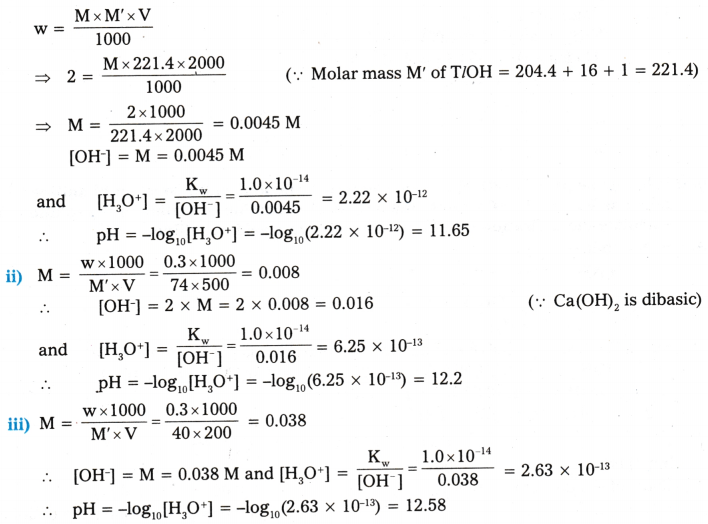
iv) Suppose the molarity of the diluted solution is M’.
M1V1 = M’V’ ⇒ 13.6 × 1 = M’ × 1000
⇒ M’ = \(\frac{13.6 \times 1}{1000}\) = 1.36 × 10⁻²
∴ [H3O+] = 1.36 × 10⁻² M
pH = -log10[H3O+] = -log10(1.36 × 10⁻²) = 1.87
Question 50.
The degree of ionization of a 0.1 M bromoacetic acid solution is 0.132. Calculate the pH of the solution and the PK. of bromoacetic acid.
Answer:

∴ Ka = \(\frac{\left[\mathrm{BrCH}_2 \mathrm{COO}^{-}\right]\left[\mathrm{H}^{+}\right]}{\left[\mathrm{BrCH}_2 \mathrm{COOH}\right]}=\frac{(0.1 \times 0.132) \times(0.1 \times 0.132)}{0.1(1-0.132)}\) = 2.01 × 10⁻³
pKa = -log10Ka = -log10(2.01 × 10⁻³) = 2.70
[H+] = 0.1 × 0.132 = 0.0132 = 1.32 × 10⁻²
pH = -log10[H+] = – log10(1.32 × 10⁻²) = 1.88
Question 51.
The pH Of 0.005 M codeine (C18H21NO3) solution is 9.95. Calculate its ionization constant as pKb.
Answer:
Codeine is a base, therefore, it is expected to ionise in solution as follows.
Codeine + H2 ⇌ Codeine H+ + OH–
Given, pH = 9.95
∴ POH = 14 – 9.95 = 4.05
i.e., -log10[OH–] = 4.05
[OH–] = antilog10(-4.05) = 8.91 × 10⁻⁵
[Codeine H+] = [OH–] = 8.91 × 10⁻⁵
[Codeine] = 0.005 M
Kb = \(\frac{\left[\text { Codeine } \mathrm{H}^{+}\right]\left[\mathrm{OH}^{-}\right]}{[\text {Codeine }]}=\frac{\left(8.91 \times 10^{-5}\right) \times\left(8.91 \times 10^{-5}\right.}{0.005}\) = 1.587 × 10⁻⁵
[Codeine W] [OH ]
and pKb = -log10Kb = -log10(1.587 × 10⁻⁶) = 5.8
Question 52.
What is the pH of 0.001 M aniline solution ? The ionization constant of aniline can be taken as 4.27 × 10⁻¹⁰. Calculate the degree of ionization of aniline in the solution. Also calculate the ionization constant of the conjugate acid of aniline.
Answer:
Kb for aniline = 4.27 × 10⁻¹⁰
C6H5NH2 + H3O+ ⇌ C6H5NH3+ + OH–
Kb = \(\frac{\left[\mathrm{C}_6 \mathrm{H}_5 \mathrm{NH}_3^{+}\right]\left[\mathrm{OH}^{-}\right]}{\left[\mathrm{C}_6 \mathrm{H}_5 \mathrm{NH}_2\right]}\)
Since, [C6H5NH3+] = [OH–] and dissociation of aniline is not much, we have
and
[OH–] = {Kb[C6H5NH2]}1/2 = (4.27 × 10-10 × 0.00)1/2 = 6.53 × 10⁻⁷ M
∴ POH = -log10(6.53 × 10⁻⁷) = 6.185
and pH = 14 – 6.185 = 7.815

∴ Kb = \(\frac{0.001 \alpha \times 0.001 \alpha}{0.001(1-\alpha)}=\frac{0.001 \alpha^2}{1-\alpha}\) = 0.001 α2 (Since, α is very small, 1 – α = 1)
Thus, 0.001 α2 = 4.27 × 10⁻¹⁰ ⇒ α = \(\left(\frac{4.27 \times 10^{-10}}{0.001}\right)^{1 / 2}\) = 6.53 × 10⁻⁴
For a pair of conjugate acid and base,
pKb + pKa = 14 ⇒ pKa = 14 – pKb = 14 – (-log10 4.27 × 10⁻¹⁰) = 14 – 9.37 = 4.63
Hence, the ionisation constant of the conjugate acid.
Ka = antilog10(-pKa) (∵ pKa = -log10Ka)
= antilog10 (-4.63) = 2.34 × 10⁻⁵
Question 53.
Calculate the degree of ionization of 0.05 M acetic acid if its pKa value is 4.74. How is the degree of dissociation affected when its solution also contains
i) 0.01 M
ii) 0.1 M of HCl?
Answer:
pKa = -log10Ka = 4.74
∴ Ka = antilog10(-4.74) = 1.82 × 10⁻⁵
For a weak electrolyte, α = \(\sqrt{\frac{K_a}{c}}\); For acetic acid, α = \(\sqrt{\frac{\mathrm{K}_{\mathrm{a}}}{\mathrm{c}}}=\sqrt{\frac{1.82 \times 10^{-5}}{0.05}}\) = 1.908 × 10⁻²
In the presence of HCl, the dissociation of acetic acid will be suppressed due to common ion effect.
i) When the solution contains 0.01 M of HCl also : Suppose the concentration of CH3COOH decreases by x.

Ka = \(\frac{\left[\mathrm{CH}_3 \mathrm{COO}^{-}\right]\left[\mathrm{H}^{+}\right]}{\left[\mathrm{CH}_3 \mathrm{COOH}\right]}\) ⇒ 1.80 × 10-5 = \(\frac{x(x+0.01)}{(0.05-x)}=\frac{0.01 x}{0.05}\)
(∵ Since, x is very small, x + 0.01 = 0.01 and 0.05 – x = 0.05)
⇒ x = \(\frac{1.82 \times 10^{-5} \times 0.05}{0.01}\) = 9.1 × 10⁻⁵
Degree of dissociation (α) = \(\frac{\text { Amount dissociated }}{\text { Initial amount }}=\frac{9.1 \times 10^{-5}}{0.05}\) = 1.85 × 10⁻⁵
ii) When the solution contains 0.1 M of HCl:
Proceeding as above, we have, α’ = \(\frac{1.82 \times 10^{-5} \times 0.05}{0.1}\) = 9.1 × 10⁻⁴ and
α’ = \(\frac{9.1 \times 10^{-6}}{0.05}\) = 1.82 × 10⁻⁴
Question 54.
The ionization constant of dimethylamine is 5.4 × 10⁻⁴. Calculate its degree of ionization in its 0.02 M solution. What percentage of dimethylamine is ionized if the solution is also 0.11 in NaOH?
Answer:
Dimethylamine is weak base. For a weak base, α = \(\sqrt{\frac{K_b}{c}}\)
Therefore, for dimethylamine, α = \(\sqrt{\frac{5.4 \times 10^{-4}}{0.02}}\) = 0.164
In presence of 0.1 M of NaOH, its dissociation will get suppressed.

∴ Ka = \(\frac{x(x+0.1)}{0.02-x}=\frac{0.1 x}{0.02}\) (∵ x is very small, x + 0.1 ≈ 0.1 and 0.02 – x ≈ 0.02)
⇒ 5.4 × 10-4 = \(\frac{0.1 x}{0.02}\) ⇒ x = \(\frac{5.4 \times 10^{-4} \times 0.02}{0.1}\) = 1.08 × 10⁻⁴
∴ Percent ionisation of dimethylamine = \(\frac{\text { Amount dissociated }}{\text { Total amount }}\) × 100
= \(\frac{x \times 100}{0.02}=\frac{1.08 \times 10^{-4}}{0.02}\) × 100 = 0.57%
Question 55.
Calculate the hydrogen ion concentration in the following biological fluids whose pH are given below.
i) Human muscle-fluid, 6.83
iii) Human blood, 7.38
ii) Human stomach fluid, 1.2
iv) Human saliva, 6.4
Answer:
Given, pH = -log10[H3O+]
[H3O+] = antilog10(-pH)
i) [H3O+] in human muscle fluid = antilog10(-6.83) = 1.47 × 10⁻⁷ mol L-1
ii) [H3O+] in stomach fluid = antilog10(-1.2) = 6.3 × 10⁻² mol L-1
iii) [H3O+] in human blood = antilog10(-7.38) = 4.1 × 10⁻⁸ mol L-1
iv) [H3O+] in human saliva = antilog10(-6.4) = 3.98 × 10⁻⁷ mol L-1
Question 56.
The pH of milk, black coffee, tomato juice, lemon juice and egg white are 6.8, 5.0, 4.2, 2.2 and 7.8 respectively. Calculate the corresponding hydrogen ion concentration in each.
Answer:
[H+] = [H3O+]
= = antilog10(-pH) = antilog10(-6.8) = 1.58 × 10⁻⁷ mol L-1
[H3O+] in milk = antilog10(-5.0) = 1.0 × 10⁻⁵ mol L-1
[H3O+] in black coffee = antilog10(-4.2) =1.0 × 10⁻⁵ mol L-1
[H3O+] in tomato juice = antilog10(-2.2) = 6.31 × 10⁻⁵ mol L-1
[H3O+] in lemon juice = antilog10(-7.8) = 6.31 × 10⁻³ mol L-1
[H3O+] in egg white = antilog10(-7.8) = 1.58 × 10⁻⁸ mol L-1
Question 57.
If 0.561 g of KOH is dissolved in water to give 200 mL of solution at 298 K. Calculate the concentrations of potassium, hydrogen and hydroxyl ions. What is its pH ?
Answer:
Molarity of a solution is given by w = \(\frac{\mathrm{M} \times \mathrm{M}^{\prime} \times \mathrm{V}}{1000}\)
∴ 0.561 = \(\frac{\mathrm{M} \times 56 \times 200}{1000}\) (mol. mass of KOH = 56)
⇒ M = \(\frac{0.561 \times 1000}{56 \times 200}\) = 0.05 M
Since, KOH dissociates completely in the solution, KOH → K+ + OH–
∴ [K+] = [OH–] = Molarity of KOH = 0.05 M
and [H+] = \(\frac{K_w}{\left[\mathrm{OH}^{-}\right]}=\frac{1.0 \times 10^{-14}}{0.05}\) = 2.0 × 10⁻¹³ M
Now, pH = -log10[H+] = -log10(2 × 10-13) = -log102 + 13 log 10 = -0.3010 + 13 = 12.70
Question 58.
The solubility of Sr(OH)2 at 298 K is 19.23 g/L of solution. Calculate the concentrations of strontium and hydroxyl ions and the pH of the solution.
Answer:
Molecular mass of Sr(OH)2 = 87.6 + 2 × (16 + 1) = 121.6
Solubility of Sr(OH)2 = 19.23 g/L = \(\frac{19.23}{121.6}\) mol/L-1 = 0.1581 mol L-1
Sr(OH)2 ⇌ Sr2+ + 2OH–
If Sr(OH)2 is assumed to be completely ionised, we have
[Sr2+] = 0.1581 mol L-1
and [OH–] = 2 × 0.1581 = 0.3162 mol L-1
∴ [H3O+] = \(\) = 3.16 × 10⁻¹⁴
and pH = -log10[H3O+] = -log10(3.16 × 10⁻¹⁴) = 13.50
Question 59.
The ionization constant of propanoic acid is 1.32 × 10⁻⁵. Calculate the degree of ionization of the acid in its 0.05 M solution and also its pH. What will be its degree of ionization if the solution is 0.01 M in HCl also ?
Answer:

∴ Ka = \(\frac{\left[\mathrm{CH}_3 \mathrm{CH}_2 \mathrm{COO}^{-}\right]\left[\mathrm{H}^{+}\right]}{\left[\mathrm{CH}_3 \mathrm{CH}_2 \mathrm{COOH}\right]}\)
or 1.32 × 10-5 = \(\frac{0.05 \alpha \times 0.05 \alpha}{0.05(1-\alpha)} \approx \frac{(0.05 \alpha)^2}{0.05}=\frac{0.05 \alpha^2}{1}\)
α = 1.63 × 10⁻²
Then, [H3O+] = 0.05α = 0.05 × 1.63 × 10-2 = 8.15 × 10⁻⁴ M
∴ pH = 3.09
In the presence of 0.1 M of HCl, let ‘α’ be the degree of ionization.
Then, [H3O+] = 0.01; [A–] = 0.05 α’ ; [HA] = 0.05
Ka = \(\frac{0.01 \times 0.05 \alpha^{\prime}}{0.05}\) ⇒ 1.32 × 10-5 = 0.01 α’
⇒ α’ = 1.32 × 10⁻³
Question 60.
The pH of 0.1 M solution of cyanic acid (HCNO) is 2.34. Calculate the ionization constant of the acid and its degree of ionization in the solution.
Answer:
Suppose the degree of ionisation of HCNO is α.

Given that pH of the solution is 2.34.
∴ -log10(0.1 × α) = 2.34
⇒ log10(0.1 × α) = -2.34 ⇒ 0.1 × α = antilog10(-2.34) = 0.00457 = \(\frac{0.00457}{0.1}\) = 0.0457
Ka = \(\frac{\left[\mathrm{H}^{+}\right]\left[\mathrm{CNO}^{-}\right]}{[\mathrm{HCNO}]}=\frac{(0.1 \times \alpha) \times(0.1 \times \alpha)}{0.1(1-\alpha)}\)
= \(\frac{(0.1 \times \alpha)^2}{0.1}=\frac{(0.1 \times 0.0457)^2}{0.1}\) = 2.09 × 10⁻⁴
Question 61.
The ionization constant of nitrous acid is 4.5 × 10⁻⁴. Calculate the pH of 0.04 M sodium nitrite solution and also its degree of hydrolysis.
Answer:
Sodium nitrite is a salt of a strong base and a weak acid. For such a salt,
pH = \(\frac{1}{2}\)pKw + \(\frac{1}{2}\)pKa + \(\frac{1}{2}\)log10c
= \(\frac{1}{2}\) × (-log101.0 × 10-14) + \(\frac{1}{2}\) × (-log104.5 × 10-4) + \(\frac{1}{2}\) × log100.04
= 7.0 + 1.673 – 0.698 = 7.975
The degree of hydrolysis of such a salt is given by
h = \(\sqrt{\frac{K_w}{K_a \cdot c}}=\sqrt{\frac{1.0 \times 10^{-14}}{4.5 \times 10^{-4} \times 0.04}}\) = 2,36 × 10⁻⁵
Question 62.
A 0.02 M solution of pyridinium hydrochloride has pH = 3.44. Calculate the ionization constant of pyridine.
Answer:
Pyridinium hydrochloride is the salt of a weak base (pyridine) and a strong acid (HCl). For the salt of a weak base and strong acid.
pH = \(\frac{1}{2}\)pKw + \(\frac{1}{2}\)pKa + \(\frac{1}{2}\)log10c
Substituting the values, we have
3.44 = [-\(\frac{1}{2}\)log101.0 × 10-14 – \(\frac{1}{2}\) × (- log10 Kb) – \(\frac{1}{2}\) × log10 0.02
⇒ 3.44 = – \(\frac{1}{2}\) × (-14) + \(\frac{1}{2}\)log10 Kb – \(\frac{1}{2}\) × (-1.699)
⇒ 3.44 = 7 + \(\frac{1}{2}\)log10Kb + 0.849
log10Kb = (3.44 – 7 – 0.849) × 2 = -8.82
⇒ Kb = anti log10(-8.82) = 1.5 × 10⁻⁹
Question 63.
Predict if the solutions of the following salts are neutral, acidic or basic.
NaCl, KBr, NaCN, NH4NO3, NaNO2 and KF
Answer:
Neutral solutions : NaCl, KBr.
Acidic solutions : NH4NO3.
Basic solutions : NaCN, NaNO2, KF.
Question 64.
The ionization constant of chloroacetic acid is 1.35 × 10⁻³. What will be the pH of 0.1 M acid and its 0.1 M of sodium salt solution ?
Answer:
pH of 0.1 M acid :
Suppose the degree of ionisation of chloroacetic acid is α.

∴ Ka = \(\frac{\left[\mathrm{Cl} \mathrm{CH}_2 \mathrm{COO}^{-}\right]\left[\mathrm{H}^{+}\right]}{\left[\mathrm{ClCH}{ }_2 \mathrm{COOH}\right]}\)
⇒ 1.35 × 10-3 = \(\frac{0.1 \alpha \times 0.1 \alpha}{0.1(1-\alpha)}\) ≈ \(\frac{(0.1 \alpha)^2}{0.1}\) ⇒ α = \(\left(\frac{1.35 \times 10^{-3} \times 0.1}{(0.1)^2}\right)^{1 / 2}\) = 0.116
∴ [H+] = 0.1 × α = 0.1 × 0.116 = 0.0116
and pH = -log10[H+] = -log10(0.0116) = 1.94
pH of 0.1 M of sodium salt:
The sodium salt of chloroacetic acid is the salt of a weak acid and a strong base.
For such as salt
pH = \(\frac{1}{2}\)pKw + \(\frac{1}{2}\)pKa + \(\frac{1}{2}\)log10c
= \(\frac{1}{2}\)(-log101.0 × 10-14) + \(\frac{1}{2}\)(-log101.35 × 10-3) + \(\frac{1}{2}\) × log100.1
= 7.0 + 1.435 + (-0.5) = 7.94
Question 65.
Ionic product of water at 310 K is 2.7 × 10⁻¹⁴. What is the pH of neutral water and temperature?
Answer:
In neutral water, [H3O+] = [OH–]
Kw = [H3O+] [OH–] = [H3O+]2
⇒ [H3O+]2 = Kw = 2.7 × 10⁻¹⁴
[H3O+] = (2.7 × 10⁻¹⁴)12 = 1.64 × 10⁻⁷
Hence, pH = -log10[H3O+] = -log10(1.64 × 10⁻⁷) = 6.78
Question 66.
Calculate the pH of the resultant mixtures.
i) 10 mL Of 0.2 M of Ca(OH)2 + 25 mL of 0.1 M of HCl
ii) 10 mL Of 0.01 M of H2SO4 + 10 mL of 0.01 M of Ca(OH)2
iii) 10 mL of 0.1 M of H2SO4 + 10 mL of 0.1 M of KOH
Answer:
i) Normality of Ca(OH)2 solution = 0.2 × 2 = 0.4 N
and normality of HCl solution = 0.1 × 1 = 0.1 N
Gram equivalents of is taken as = \(\frac{\mathrm{N} \times \mathrm{V}}{1000}=\frac{0.4 \times 10}{1000}\) = 0.004
Gram equivalents of HCl is taken as = \(\frac{N \times V}{1000}=\frac{0.1 \times 25}{1000}\) = 0.0025
0.0025 gram eq. of HCl would neutralise 0.0025 gram eq. of Ca(OH)2.
∴ Amount of left unreacted = 0.004 – 0.0025 = 0.0015 gram equivalents
Total volume of the mixture = 10 + 25 = 35 mL
Suppose the normality of the resultant solution is N’.
No.of gram eq. = \(\frac{\mathrm{N}^{\prime} \times \mathrm{V}}{1000}\)
⇒ 0.0015 = \(\frac{\mathrm{N}^{\prime} \times 35}{1000}\)
⇒ N’ = \(\frac{0.0015 \times 1000}{35}\) = 0.0429
∴ [OH–] = N’ = 0.042
∴ [H3O+] = \(\frac{\mathrm{K}_{\mathrm{w}}}{\left[\mathrm{OH}^{-}\right]}=\frac{1.0 \times 10^{-14}}{0.0429}\) = 2.331 × 10⁻¹³
pH = -log10[H3O+] = -log102.331 × 10-13 = 12.63
ii) 10 mL of 0.01 M of H2SO4 would exactly neutralise 10 mL of 0.01 M Ca(OH)2 and resultant solution would be neutral.
Hence, pH of the resultant mixture = 7.00
iii) Normality of H2SO4 = 0.1 × 2 = 0.2 N and Normality of KOH = 0.1 × 1 = 0.1 N
Gram equivalents of H2SO4 = \(\frac{\mathrm{N} \times \mathrm{V}}{1000}=\frac{0.2 \times 10}{1000}\) = 0.002
Gram equivalents of NaOH = \(\frac{\mathrm{N} \times \mathrm{V}}{1000}=\frac{0.1 \times 10}{1000}\) = 0.001
0.001 gram equation of NaOH would neutralise 0.001 gram equation of H2SO4.
Total volume of the mixture = 10 + 10 = 20 mL. If the normality of the resultant solution is N’.
0.001 = \(\frac{\mathrm{N}^{\prime} \times 20}{1000}\) ⇒ \(\frac{0.001 \times 1000}{20}\) = 0.05
∴ [H3O+] = N’ = 0.05
pH = -log10[H3O+] = -log100.05 = 1.30
Question 67.
Determine the solubilities of silver chromate, barium chromate, ferric hydroxide, lead chloride and mercurous iodide at 298 K from their solubility product constants given. Determine also the molarities of individual ions.
Given, Ksp Ag2CrO4 = 1.1 × 10⁻¹², Ksp BaCrO4 = 1.2 × 10⁻¹⁰
Ksp = 1.0 × 10-38, Ksp PbCl2 = 1.6 × 10⁻⁵,
Ksp Hg2I2 = 4.5 × 10⁻²⁹
Answer:
i) For silver chromate (Ag2CrO4) :
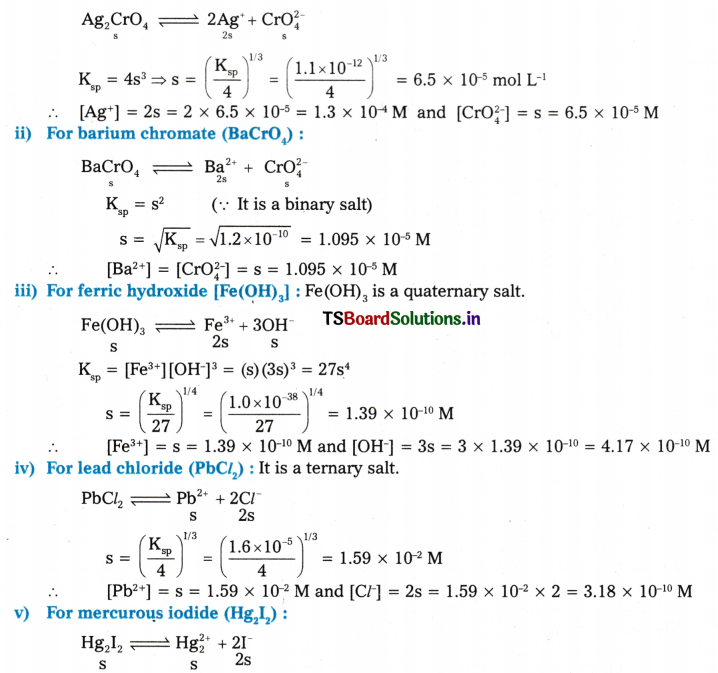 1
1
s = \(\) = \(\) = 2.24 × 10⁻¹⁰ M
and [Hg22+] = s = 2.2 × 10⁻¹⁰ M and [I–] = 2s = 2.24 × 10-10 × 2 = 4.48 × 10⁻¹⁰ M
Question 68.
The solubility product constant of Ag2CrO4 and AgBr are 1.1 × 10⁻² and 5.0 × 10⁻¹⁵ respectively. Calculate the ratio of the molarities of their saturated solutions.
Answer:
For Ag2CrO4 (a ternary salt), s = \(\left(\frac{\mathrm{K}_{\mathrm{sp}}}{4}\right)^{1 / 3}\) = \(\left(\frac{1.1 \times 10^{-12}}{4}\right)^{1 / 3}\) = 6.5 × 10⁻⁵ M
For AgBr (a binary salt), s’ = \(\sqrt{\mathrm{K}_{\mathrm{sp}}}\) = \(\sqrt{5.0 \times 10^{-13}}\) = 7.1 × 10⁻⁷ M
Ratio of molarities of their saturated solutions = \(\frac{\mathrm{s}}{\mathrm{~s}^{\prime}}\) = \(\frac{6.5 \times 10^{-5}}{7.1 \times 10^{-7}}\) = 91.5
Question 69.
Equal volumes of 0.002 M solutions of sodium iodate and cupric chlorate are mixed together. Will it lead to precipitation of copper iodate? (For cupric iodate Ksp = 7.4 × 10⁻⁸).
Answer:
[I\(\mathrm{O}_3^{-}\) = 0.002 M and [Cu2+] = 0.002 M
Cu2+ + 2I\(\mathrm{O}_3^{-}\) → Cu(IO3)2
K,sub.sp Cu(IO3)2 = [Cu2+][I\(\mathrm{O}_3^{-}\)]2 = 7.4 × 10⁻⁸ (given)
On mixing equal volumes, the concentration gets halved.
[Cu2+][I\(\mathrm{O}_3^{-}\)]2 = \(\left(\frac{0.002}{2}\right)\) × \(\left(\frac{0.002}{2}\right)^2\) = 1.0 × 10⁻⁹
Since, the ionic product is less than the solubility product, precipitation will not take place.
Question 70.
The ionization constant of benzoic acid is 6.46 × 10⁻⁵ and Ksp for silver benzoate is 2.5 × 10⁻¹³. How many times is silver benzoate more soluble in a buffer of pH 3.19 compared
to its solubility in pure water?
Answer:
C6H5COOAg \(\text { ⇌ }\) C6H5COO– + Ag+
Solubility in water : s = \(\sqrt{\mathrm{K}_{\mathrm{sp}}}\) = \(\sqrt{2.5 \times 10^{-13}}\) = 5.0 × 10⁻⁷ mol L-7
Solubility in a buffer of pH = 3.19:
In a buffer of pH = 3.19, -log10[H+] = 3.19
∴ [H+] = antilog10(-3.19) = 6.457 × 10⁻⁴ mol L-1.
The H+ ions present in buffer solution will combine with C6H5COO– ions to form C6H5COOH but (H+) in the solution will remain unchanged because the solution is a buffer solution.
C6H5COOH \(\text { ⇌ }\) C6H5COO– + H+
∴ Ka = \(\frac{\left[\mathrm{C}6 \mathrm{H}_5 \mathrm{COO}^{-}\right]\left[\mathrm{H}^{+}\right]}{\left[\mathrm{C}_6 \mathrm{H}_5 \mathrm{COOH}\right]}\) ⇒ \(\frac{\left[\mathrm{C}_6 \mathrm{H}_5 \mathrm{COOH}\right]}{\left[\mathrm{C}_6 \mathrm{H}_5 \mathrm{COO}^{-}\right]}\) = \(\frac{\left[\mathrm{H}^{+}\right]}{\mathrm{K}{\mathrm{a}}}\) = \(\frac{6.457 \times 10^{-4}}{6.46 \times 10^{-5}}\) = 9.995 ….. (i)
Suppose the solubility of silver benzoate in the buffer is s’ mol L-1.
Since, almost all the C6H5COO– ions get converted to benzoic acid which remains almost unionised, we have
s’ = [Ag+] = [C6H5COO-] + [C6H5COOH]
= [C6H5COO–] + 9.995 × [C6H5COO–] (From eq. (i))
∴ [C6H5COO-] = \(\frac{\mathrm{s}^{\prime}}{10.995}\)
Ksp = [C6H5COO–][Ag+]
⇒ 2.5 × 10-13 = \(\frac{\mathrm{s}^{\prime}}{10.995}\) × s’ = s‘2 = 2.5 × 10-13 × 10.995
⇒ s’ = \(\sqrt{2.5 \times 10^{-13} \times 10.995}\) = 1.657 × 10⁻⁶ mol L-1
∴ \(\frac{s^{\prime}}{s}\) = \(\frac{1.657 \times 10^{-6}}{5.0 \times 10^{-7}}\) = 3.314
Question 71.
What is the maximum concentration of equlmolar solutions of ferrous sulphate and sodium sulphide so that when mixed in equal volumes, there is no precipitation of iron sulphide? (For an iron sulphide, Ksp = 6.3 × 10⁻¹⁸).
Answer:
Suppose the required concentration is x M. On mixing equal volumes, concentration gets halved. Therefore, [Fe2+] = \(\frac{\mathbf{x}}{2}\) and [S2-] = \(\frac{\mathbf{x}}{2}\)
For the state of no precipitation, [Fe2+] [S2-] = Ksp
⇒ \(\frac{x}{2} \cdot \frac{x}{2}[latex] 6.3 × 10⁻¹⁸ ⇒ x = (6.3 × 10-18 × 4)1/2 = 5.02 × 10⁻⁹ mol L-1
Question 72.
What is the minimum volume of water required to dissolve 1 g of calcium sulphate at 298 K? (For calcium sulphate, Ksp is 9.1 × 10⁻⁸). V
Answer:
For a binary salt, s = [latex]\sqrt{K_{s p}}\)
∴ For CaSO4, S = 1\(\sqrt{9.1 \times 10^{-6}}\) = 3.0 × 10⁻³ mol L-1
Solubility of CaSO4 in g/L = 3.0 × 10-3 × 136 = 0.41 gL-1
(Mol. mass of CaSO4 = 40 + 32 + 64 = 136 g/mol)
Thus, a saturated solution of CaSO4 contains 0.41 g of the salt in 1 L.
Hence, the volume of water required to dissolve 1 g of CaSO4 = \(\frac{1}{0.41}\) = 2.44 L
Question 73.
The concentration of suiphide ion in 0.1 M HCl solution saturated with hydrogen sulphide is 1.0 × 10⁻¹⁹M. If 10 ml. of this is added to 5 mL of 0.04 M solution of the following FeSO4, MnCl2, ZnCl2 and CdCl2. In which of these solutions precipitation will take place?
Answer:
Precipitation takes only when the ionic product exceeds the solubility product.
Since 10 mL of the solution containing S2- ion is mixed with 5 mL of the different metal salt solutions, volume of the mixture after mixing in each case = 10 + 5 = 15 mL.
∴ [S2-] = 1.0 × 10⁻¹⁹ × \(\frac{10}{15}\) = 6.67 × 10⁻²⁰M
and M2+ = [Fe2+] = [Mn2+] = [Zn2+] = [Cd2+] = 0.04 × \(\frac{5}{15}\) = 1.33 × 10⁻² M
Therefore, in each case
Ionic product = [M2+][S2+] = (1.33 × 10-2) × (6.67 × 10-20) = 8.87 × 10⁻²²
This ionic product is greater than the solubility product of ZnS and CdS. Hence, precipitation will take place only in ZnCl2 and CdCl2 solutions.