
Regular practice with AP Inter 2nd Year Chemistry Study Material Chapter 3 Chemical Kinetics Questions and Answers helps students stay prepared for examinations.
AP Inter 2nd Year Chemistry 3rd Lesson Chemical Kinetics Questions and Answers
I. Multiple Choice Questions
Question 1.
The unit of rate of a chemical reaction is generally expressed as: [ ]
1. mol L-1 s-1
2. mol L-1
3. mol
4. s-1
Answer:
1. mol L-1 s-1
Rate change in concentration / time
Unit = mol L-1 / s = mol L-1 / s-1 (or) mol L-1 / s-1
Question 2.
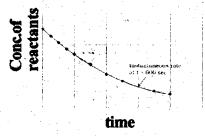
The instantaneous rate of reaction can be determined by using [ ]
1. average time
2. total time
3. slope of the concentration-time curve
4. product concentration and time
Answer:
3. slope of the concentration-time curve
Instantaneous rate = rate at a particular moment
It is given by the slope of tangent to concentration-time graph
Slope of the concentration-time curve
Question 3.
Which of the following does not affect the rate of reaction? [ ]
1. Temperature
2. Catalyst
3. Pressure
4. Color of reactants and products
Answer:
4. Color of reactants and products
Rate depends on physical conditions like temperature, pressure, catalyst
Color has no effect on rate of reaction. Color of reactants and products
Question 4.
The rate law for a given reaction is determined from [ ]
1. balanced chemical equation
2. thermodynamic data
3. experimental data
4. catalyst used
Answer:
3. experimental data
Rate law cannot be predicted from equation. It must be determined experimentally Experimental data
Question 5.
Molecularitv of a reaction can be [ ]
1. zero
2. always integer
3. negative
4. fractional
Answer:
2. always integer
Molecularity = No. of atoms, ions or molecules in rate determine step.
It is always a whole number (never fraction/zero). Always integer
Question 6.
What is the overall order of a reaction which has the rate expression rate = k|A|2|B|? [ ]
1. One
2. Two
3. Three
4. Zero
Answer:
3. Three
Overall order = sum of powers in rate law. k[A]2[B]1 = 2 + 1 = 3

Question 7.
Radioactive decay is an example of which order kinetics? [ ]
1. Zero
2. First
3. Second
4. Third
Answer:
2. First
Radioactive decay rate depends on only one nucleus at a time. So it follows first-order kinetics
Question 8.
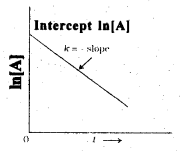
What is the slope of the |A| vs. t graph for a first order reaction? [ ]
1. -k
2. k
3. -1/k
4. ln k
Answer:
1. -k
For first order:ln[A] = ln[A0]-kt
Slope of graph = -k
ln[A] = ln[A0] – kt
Question 9.
The unit of rate constant of a first order reaction is [ ]
1. s-1
2. Lmol-1s-1
3. mol L-1s-1
4. mol s-1
Answer:
1. s-1
For first order: rate = k[A]. So k must have unit s-1
Question 10.
The half-life of a first-order reaction is given by [ ]
1. t1/2 = 1/k
2. t1/2 = [A]0 2k
3. t1/2 = 0.693/k
4. t1/2 = k/0.693
Answer:
3. t1/2 = 0.693/k
Standard half-life formula for first order reaction: t1/2 = \(\frac{0.693}{k}\)
Question 11.
The hydrolysis of methyl acetate in aqueous acid is considered as pseudo first-order reaction because [ ]
1. acid acts as catalyst
2. water is in large excess
3. methyl acetate is in excess
4. reaction occurs slowly
Answer:
2. water is in large excess
In pseudo first-order reactions, one reactant is in large excess.
Its concentration remains almost constant. Here water is in excess
Question 12.
With the rise in temperature by 10 °C, the rate constant of a reaction
1. decreases by 2 or 3 times
2. remains same
3. increases by 2 or 3 times
4. increases by 10 times
Answer:
3. increases by 2 or 3 times
Rule of thumb in kinetics: For every 10°C rise, rate constant roughly doubles or triples. This is due to more molecules crossing activation energy. Increases by 2 or 3 times
Question 13.
Which of the following represents Arrhenius equation?
1. k = A/T
2. k = A + Ea/RT
3. k = Ae-Ea/RT
4. k = ln A – Ea
Answer:
1. k = A/T
Arrhenius equation relates rate constant with temperature and activation energy:
k = Ae-Ea/RT Only option matching exponential form is correct.
Question 14.
Catalyst increases the rate of a reaction by [ ]
1. decreasing activation energy
2. increasing temperature
3. increasing activation energy
4. increasing concentration
Answer:
1. decreasing activation energy
Catalyst provides an alternative pathway with lower energy barrier. It does NOT change temperature or concentration. Decreasing activation energy
Question 15.
Identify the correct statements among the following. [ ]
a. A catalyst does not alter Gibbs energy
b. A catalyst does not change equilibrium constant
c. A catalyst can catalyze a nonspontaneous reaction
1. a only
2. a & b only
3. b & c only
4. a & c only
Answer:
2. a & b only
(a) Catalyst does NOT change ΔG → True
(b) Catalyst does NOT change equilibrium constant → True
(c) Cannot make non-spontaneous reaction spontaneous → x False
Catalyst only speeds up equilibrium attainment. a & b only
II. Fill in the Blanks
Question 1.
The sum of powers of the concentration terms in the rate law expression is called ____ of that chemical reaction.
Answer:
order
Question 2.
The overall rate of the reaction is controlled by the slowest step of the reaction and is called the ____
Answer:
rate determining step
Question 3.
The number of collisions per second per unit volume of the reaction mixture is known as ____
Answer:
collision frequency
Question 4.
k = A e-Ea/RT where A is called ____
Answer:
Arrhenius factor or frequency factor
Question 5.
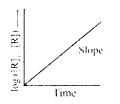
For a first order reaction the following graph is obtained. From this graph slope is equal to ____
Answer:
k/2.303
III. One Word Answer Questions
Question 1.
What is the molecularity of the elementary reaction: A + B → Products?
Answer:
Molecularity of the given elementary reaction is 2 (two)
Question 2.
Which reactions takes place in one step?
Answer:
Elementary reactions takes place in one step.
Question 3.
In a zero order reaction, if initial concentration of reactant is 0.4 mol/L and rate constant is 0.1 mol L-1s-1, what is its t1/2 ?
Answer:
Given that [A0] = 0.4 m/L, K = 0.1 m.L-1 s-1.
For Zero order reaction t1/2 = \(\frac{\left[\mathrm{A}_0\right]}{2 \mathrm{~K}}\) = \(\frac{0.4}{2 \times 0.1}\) = 2 s
Question 4.
What is the unit of rate constant for a zero-order reaction?
Answer:
Unit of rate constant for a zero-order reaction is mol L-1 s-1
Question 5.
Collision theory is based on which theory of gases?
Answer:
Collision theory is based on Kinetic molecular theory of gases.
IV. Very Short Answer Questions
Question 1.
Write the equation for the rate of the reaction 5Br–(aq) + BrO3– (aq) + 6H+ (aq) → 3 Br2(aq) + 3 H2O (l)
Answer:

Question 2.
What is rate law? Illustrate with an example.
Answer:
Rate Law: It is an experimentally determined expression which relates the rate of reaction with concentration of reactants. For a hypothetical reaction, aA + bB → Products
Rate ∝ [A]m [B]n, where ‘m’ and ‘n’ may or may not be same as the stoichiometric coefficients of the reaction in a balanced chemical equation.
Question 3.
What are elementary reactions?
Answer:
The reactions taking place in one step are called elementary reactions.
Ex: 2HI → H2 + I2
Question 4.
What are complex reactions? Name one complex reaction.
Answer:
Complex reactions: These are the reactions which involve sequence of elementary reactions for the conversion of reactants into products.
Ex 1: Oxidation of ethane to, CO2 and H2O passes through a series of intermediate steps. Here alcohol, aldehyde and acid are formed.
Ex 2: 2H2O2 → 2H2O + O2
Question 5.
Define molecularity of a reaction with an example.
Answer:
Molecularity of a reaction: It is the number of reacting species (atoms, ions or molecules) taking part in an elementary reaction, which must collide simultaneously in order to bring about a chemical reaction.
Examples:
- NH4NO2 → N2 + 2H2O (Unimolecular reaction)
- 2HI(g) → H2(g) + I2(g) (Bimolecular reaction)
- 2NO(g) + O2(g) → 2NO2(g) (Trimolecular reaction)
Question 6.
Give two examples for zero Order reactions.
Answer:

Question 7.
Give two examples for gaseous first order reactions.
Answer:
- N2O5(g) → 2NO2(g) + \(\frac{1}{2}\) O2(g), order = 1 [ Decomposition of N2O5]
- C2H4(g) + H2(g) → C2H6(g), order =1 [Hydrogenation of ethene]
Question 8.
What is half-life of a reaction? Illustrate your answer with an example.
Answer:
Half-life of a reaction (t1/2):
It is the time required to reduce half of the initial concentration of reactant.
1) For a zero order reaction, rate constant is given by k = \(\frac{\left[\mathrm{R}_0\right]-[\mathrm{R}]}{\mathrm{t}}\)

2) For a first order reaction, t1/2 = \(\frac{0.693}{k}\)
Question 9.
What are pseudo first order reactions? Give one example.
Answer:
Pseudo first order reactions: It is a reaction in which one of the reactants, is present in large amount and its concentration does not get altered during the course of the reaction and it behaves as first order reaction.
Ex: Hydrolysis of Ethyl acetate:

Rate of reaction =k[CH3COOC2H5]
Here the H2O is taken in excess. So, the rate doesn’t depend on [H2O]
Question 10.
Explain the term ‘activation energy’ of a reaction with a suitable diagram.
Answer:
Activation energy: It is the minimum energy required to initiate a chemical reaction to form an intermediate activated complex (C).
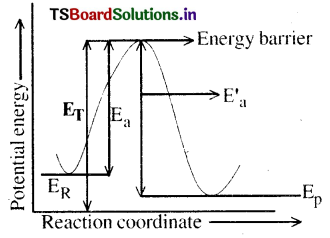
Ea = Activation energy of forward reaction [Er-ER]
E’a = Activation energy of backward reaction [Er-Ep]
Ep = Energy of products,
ER = Energy of reactants
ET = Threshold energy
Also Ea = ET – ER
Ex 1: Lighting a match stick using match box.
Ex 2: The spark produces the energy to start the combustion of fuel and air.
V. Short Answer Questions
Question 1.
What is ‘molecularity’ of a reaction? How is it different from the ‘order’ of a reaction? Name one bimolecular and one trimolecular gaseous reactions.
Answer:
1) Molecularity of a reaction: It is the number of reacting species (atoms, ions or molecules) taking part in an elementary reaction, which must collide simultaneously in order to bring about a chemical reaction.
2) Differences between order and molecularity of a reaction:
- Order of reaction is an experimental quantity. It can be zero and even a fraction. but molecularity can not be zero or a non integer.
- Order is applicable to elementary as well as complex reactions where as molecularity is applicable only for elementary reactions.
- For a complex reaction, order given by the slowest step and molecularity of the slowest step is taken as the order of the overall reaction.
3) Bimolecular reaction:
Ex: 2HI → H2 + I2 [Dissociation of HI into H2 and I2.]
4) Trimolecular reaction:
Ex: 2NO + O2 → 2NO2
Question 2.
Derive the integrated rate equation for a zero order reaction.
Answer:
Consider a zero order reaction: R→ product
∴ Rate = \(\frac{-\mathrm{d}[\mathrm{R}]}{\mathrm{dt}}\) = k[R]0 = k ⇒ d[R] = – kdt
Integrating both sides, we get [R] = −kt + I….(1), I is the constant of integration At t = 0, we have [R] = [R]o, where [R]0 is initial concentration of the reactant.
Equation (1) can be written as [R]o = -k × 0 + I ⇒ [R]0 = I
Substituting the value of I in the equation (1), we have [R] = -kt + [R]o
[This is in the form y = mx + C of a line, with slope m = -k]
⇒ kt = [R]o – [R] ⇒ k = \(\frac{[\mathrm{R}]_0-[\mathrm{R}]}{\mathrm{t}}\). This is the integrated equation for zero order reaction.
Here, k= rate constant ;
[R] = Initial concentration of the reactant
t = time,
[R] = Final concentration of the time t.
Question 3.
Derive an integrated rate equation for a first order reaction.
Answer:
Consider a first order reaction: R→ Product
Rate = \(\frac{-\mathrm{d}[\mathrm{R}]}{\mathrm{dt}}\) = k[R] ⇒ \(\frac{d[R]}{[R]}\) = -kdt
Integrating this equation, we get ln[R] = -kt + I……(1), where I is the constant of integration When t=0 we have [R] = [R]o, where [R]o is the initial concentration of the reactant.
∴ Equation (1) can be written as ln[R]o = k × 0 + I ⇒ ln[R]o = I
Substituting the value of I in equation (1), we have
ln[R] = -kt + ln[R]o ⇒ kt = ln[R]o – ln[R] = ln\(\frac{[\mathrm{R}]_0}{[\mathrm{R}]}\) ⇒ k = \(\frac{1}{t} \ln \frac{[R]_0}{[R]}\) ⇒ k = \(\frac{2.303}{t}\)log\(\frac{[\mathrm{R}]_0}{[\mathrm{R}]}\)
This is the integrated rate equation for first order reaction.
Here, k = rate constant ; [R]o = Initial concentration of the reactant
t = time, [R] = Final concentration of the time t.
Question 4.
What is Arrhenius equation? Derive an equation which describes the effect of rise of temperature (T) on the rate constant (k) of a reaction.
Answer:
Arrhenius equation gives the temperature dependence of the rate of a chemical reaction. Arrhenius equation: Rate constant k = A e-Ea/RT ….. (1)
Where A is frequency factor, Ea activation energy.
Taking natural logarithm on both sides of equation (1), we get ln k = \(\frac{-\mathrm{E}_{\mathrm{a}}}{\mathrm{RT}}\) + ln A …… (2)
At temperature T1, equation (2) is ln k1 = \(\frac{-E_a}{R T_1}\) + ln A …… (3)
At temperature T2, equation (2) is ln k2 = \(\frac{-\mathrm{E}_{\mathrm{a}}}{\mathrm{RT}_2}\) + ln A …..(4)
Here K1 and K2 are the values of rate constants at temperature T1 and T2 respectively.
Subtracting equation (3) from (4), we get lnk2 – Ink1 = \(\frac{\mathrm{E}_{\mathrm{a}}}{\mathrm{RT} 1}\) – \(\frac{\mathrm{E}_{\mathrm{a}}}{\mathrm{RT}_2}\)
ln \(\frac{\mathbf{k}_2}{\mathbf{k}_1}\) = \(\frac{E_a}{R}\left[\frac{1}{T_1}-\frac{1}{T_2}\right]\) ⇒ 2.303l0g \(\frac{\mathbf{k}_2}{\mathbf{k}_1}\) = \(\frac{E_a}{R}\left[\frac{1}{T_1}-\frac{1}{T_2}\right]\) ⇒ 2.303log[] \(\frac{k_2}{k_1}\) = \(\frac{E_a}{R}\left[\frac{1}{T_1}-\frac{1}{T_2}\right]\)
Question 5.
Discuss the effect of catalyst on the kinetics of a chemical reaction with a suitable diagram.
Answer:
A catalyst is a substance which increases the rate of a reaction without itself undergoing any permanent chemical change.
Ex: MnO2 acts as catalyst in the following reaction to increase its rate.

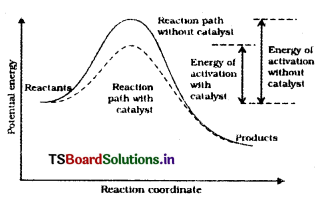
The action of the catalyst can be explained by intermediate complex theory. According to this theory, a catalyst participates in a chemical reaction by forming temporary bonds with the reactants. It results in the formation of an intermediate complex. This has a transitory existence and decomposes to yield products and the catalyst.
Catalyst takes the reaction in a new path having low activation energy. When the activation energy decreases, the rate of reaction increases.
Question 6.
Describe the salient features of the collision theory of reaction rates of bimolecular reactions.
Answer:
Molecular collision theory was proposed by Arrhenius.
It explains the rate of gaseous bimolecular reactions.
Main postulates :
- A reaction takes place only when reactant molecules collide with proper orientation.
- All collisions do not lead to the formation of products.
- Threshold energy (ET): It is the minimum energy that the reactant molecules should possess to give products.
- Under STP conditions, very few molecules possess ET. But most of the molecules have less energy than threshold energy.
- Activation energy (Ea): It is the minimum excess energy that reactant molecules should acquire to participate in chemical reaction or to cross threshold energy barrier. Ea = ET – ER
- The molecules possessing the threshold energy are called activated molecules and collisions between these activatedmolecules alone lead to the formation of products. Hence these collisions are called activated collisions or fruitful collisions or effective collisions.
- Number of binary collisions per unit time is given by Z = \(\Pi \sigma_{A B}^2 \sqrt{\frac{8 k T}{\pi \mu}} n_A \cdot n_B\)
where \(\sigma_{\mathrm{AB}}\) = collision diameter, μ= reduced mass. - Specific rate, k = PZ.e-Ea/RT (or) k = Ae-Ea/RT
Graphical representation of activation energy :
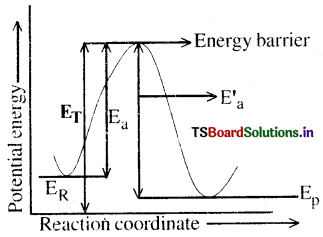
Ea= Activation energy of forward reaction [ET – ER]
E’a = Activation energy of backward reaction [ET – EP]
EP = Energy of products
ER = Energy of reactants
ET = Threshold energy
Question 7.
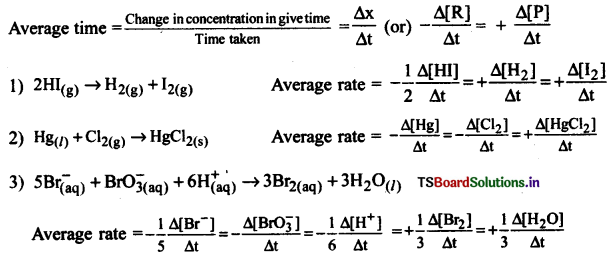
Define average rate of a reaction. How is the rate of reaction expressed in terms of change in the concentration of reactants and products for the following reactions.
1) 2Hl(g) → H2(g) + I2(g)
2) Hg(l) + Cl2(g) → HgCl2(s)
3) \(\mathrm{Br}_{(\mathrm{aq})}^{-}\) + \(\mathrm{BrO}_{3(\mathrm{aq})}^{-}\) + \(6 \mathrm{H}_{(\mathrm{aq})}^{+}\) → 3Br2(aq) + 3H2O(l)
Answer:
Average rate of a reaction is defined as the rate of change of concentration per unit time.
Question 8.
What is rate equation? How is it obtained? Write the rate equations for
1) 2NO(g) + O2(g) → 2NO2(g)
2) CHCl3 + Cl2 → CCl4 + HCl
3) CH3COOC2H5 + H2O → CH3COOH(aq) + C2H5OH(aq)
Answer:
Rate equation (rate law) is the expression in which reaction rate is given in terms of molar concentration of reactants with each term raised to some power, which may or may not be same as the stoichiometric coefficient of the reacting species, in a balanced chemical equation.
Rate equation is always obtained from the experimental data.
1) 2NO(g) + O2(g) → 2NO2(g); Rate = k[NO]2[O2]
2) CHCl3 + Cl2 → CCl4 + HCl; Rate = [CHCl3][Cl2]1⁄2.
3) CH3COOC2H5 + H2O → CH3COOH + C2H5OH; Rate = k[CH3COOC2H5]
Question 9.
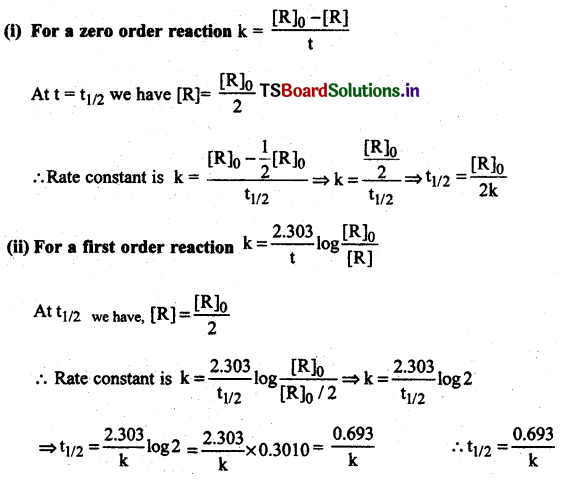
What is half-life (t1/2) of a reaction? Derive the equations for the ‘half-life’ value of zero and first order reactions.
Answer:
Half-life of a reaction (t1/2) is the time in which the concentration of a reactant is reduced to one half of its initial concentration.
Question 10.
Explain the terms
a) Activation energy (Ea)
b)Collision frequency (Z)
c) Probability factor (P) with respect to Arrhenius equation.
Answer:
a) Activation Energy: It is the minimum excess energy that reactant molecules should acquire to participate in chemical reaction or to cross threshold energy barrier. Eaa= ET – ER.
In other words, activation energy is the difference between threshold energy and the average kinetic energy of the reactant molecules.
b) Collision Frequency: The number of collisions that take place per second per unit volume of the reaction mixture is called collision frequency.
c) Probability Factor: For a collision to be effective, the colliding molecules must have energy greater than threshold energy and also must have proper orientations.
For the collision to be effective, another factor, P is called probability factor has to be introduced. Thus Arrhenius equation is modified to the form k = PZAB e-Ea/RT
where P = Probability factor
VI. Long Answer Questions
Question 1.
Explain the following terms with suitable examples.
a) Average rate of a reaction
b) Slow and fast reactions
c) Order of a reaction
d) Molecularity of a reaction
e) Activation energy of a reaction
Answer:
a) Average rate of a reaction : The average rate of a reaction is defined as the rate of change of concentration per unit time.
Average time \(=\frac{\text { Change in concentration in give time }}{\text { Time taken }}\)
= \(\frac{\Delta x}{\Delta t}\) or –\(\frac{\Delta[\mathrm{R}]}{\Delta \mathrm{t}}\) = +\(\frac{\Delta[\mathrm{P}]}{\Delta \mathrm{t}}\)
b) Slow reactions: These reactions involve high activation energy making them proceed slowly.
Ex:Rusting of Iron
Fast reactions:These reactions involve low activation energy making them proceed quickly. Ex Reactions between ionic compounds NaCl + AgNO3 → NaNO3 + AgCl ↓
c) Order of a reaction “The sum of powers of the concentration terms of reactants in the rate law expression” is called order of a reaction.
Consider a hypothetical reaction:
aA + bB → products.
The rate law expression for this reaction is, Rate = k[A]m[B]n.
The order of the above reaction is (m+n).
d) Molecularity of a reaction: The number of reacting species (atoms, ions or molecules) taking part in an elementary reaction, which must collide simultaneously in order to bring about a chemical reaction is called molecularity of a reaction.
The reaction can be unimolecular when one reacting species is involved.
Ex:decomposition of ammonium nitrite into N2 and H2O.
NH4NO2 → N2 + 2H2O
e) Activation Energy (E): It is the minimum excess energy that reactant molecules should acquire to participate in chemical reaction or to cross threshold energy barrier. Ea = ET – ER
In other words, activation energy is the difference between threshold energy and the average kinetic energy of the reactant molecules.
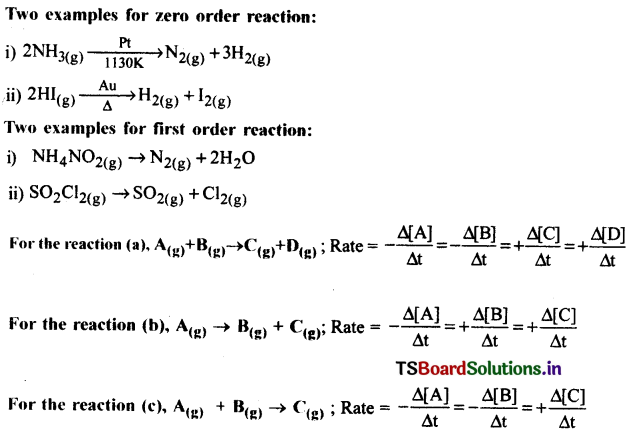
Question 2.
Give two examples for each of zero order and first order reactions. Write the equations for the rate of a reaction in terms of concentration changes of reactants and products for the following reactions:
i) A(g) + B(g) → C(g) + D(g)
ii) A(g) → B(g) + C(g)
iii) A(g) + B(g) → C(g)
Answer:
Question 3.
Discuss the effect of temperature on the rate of a reaction. Derive necessary equations in this context.
Answer:
Effect of temperature on rate of reaction: In general for every 10°C rise of temperature the rate of a reaction is nearly doubled and in some cases it is tripled.
The ratio of specific rates that differ by 10°C is known as temperature coefficient.
\(\frac{K_{t+10^{\circ} \mathrm{C}}}{K_{t^{\circ} \mathrm{C}}}\) = 2(or)3
Effect of temperature on rate of reaction is explained by Arrhenius in the form of an equation known as Arrhenius Equation.
1) Arrhenius equation: The arrhenius equation gives accurately the temperature dependence of the rate of a chemical reaction.
2) Rate constant k = A e-Ea/RT ….. (i)
Where A is frequency factor, Ea is activation energy
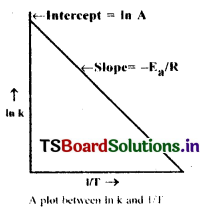
3) Taking natural logarithm of both sides of equation (i), we get ln k = \(\frac{-\mathrm{E}_{\mathrm{a}}}{\mathrm{RT}}\) + ln A ……. (ii)
4) The plot of ln k vs 1/T is a straight line.
The slope of the line = \(-\frac{E_a}{R}\)
y-intercept = lnA.
Using these values, E, and A can be calculated.
5) At temperature T1, equation (ii) is lnk1 = \(\frac{-E_a}{R T_1}\) + ln A …..(iii)
6) At temperature T2, equation (ii) is ln k2 = \(\frac{-\mathrm{E}_{\mathrm{a}}}{\mathrm{RT}_2}\) + ln A …..(iv)
K1 and K2 are the values of rate constants at temperature T1 and T2 respectively.
7) Subtracting equation (iii) from (iv) we get, ln k2 – ln k1 = \(\frac{E_a}{R T_1}\) – \(\frac{E_a}{R T_2}\) [∵ T2 > T1]
8) ln \(\frac{k_2}{k_1}\) = \(\frac{E_a}{R}\left[\frac{1}{T_1}-\frac{1}{T_2}\right]\) ⇒ 2.303log\(\frac{k_2}{k_1}\) ⇒ \(\frac{E_a}{R}\left[\frac{1}{T_1}-\frac{1}{T_2}\right]\) ⇒ log\(\frac{k_2}{k_1}\) = \(\frac{\mathrm{E}_{\mathrm{a}}}{2.303 \mathrm{R}}\left[\frac{1}{\mathrm{~T}_1}-\frac{1}{\mathrm{~T}_2}\right]\)
Question 4.
Give a detailed account of the collision theory of reaction rates of bimolecular gaseous reactions.
Answer:
Molecular collision theory was proposed by Arrhenius.
It explains the rate of gaseous bimolecular reactions.
Main postulates :
- A reaction takes place only when reactant molecules collide with proper orientation.
- All collisions do not lead to the formation of products.
- Threshold energy (ET): It is the minimum energy that the reactant molecules should possess to give products
- Under STP conditions, very few molecules possess E. But most of the molecules have less energy than threshold energy.
- Activation Energy (Ea): It is the minimum excess energy that reactant molecules should acquire to participate in chemical reaction or to cross threshold energy barrier. Ea = ET – ER
- The molecules possessing the threshold energy are called activated molecules and collisions between these activated molecules alone lead to the formation of products. Hence these collisions are called activated collisions or fruitftil collisions or effective collisions.
- Number of binaiy collisions per unit time is given by Z = \(\Pi \sigma_{A B}^2 \sqrt{\frac{8 k T}{\pi \mu}} n_A \cdot n_B\)
where σAB = collision diameter, µ = reduced mass. - Specific rate, k = PZe-Ea/RT (or) k = AeT
Formation of methanol from bromoethane depends upon the orientation of reactant molecules as shown below.
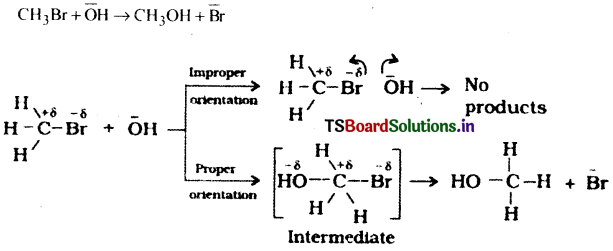
Diagram showing molecules having proper and improper orientation
The Proper orientation of reactant molecules lead to bond formation whereas improper orientation makes them simply bounce back and no products are formed.
To account for effective collisions, another factor P, called the probability factor is introduced. It takes into account the fact that in a collision, molecules must be properly oriented
Rate = PZ e-Ea/RT.
Thus in collision theory, activation energy and proper orientation of the molecules together determine the criteria for an effective collision and hence the rate of a chemical reaction.
Question 5.
a) Write the differences between order & molecularity.
b) Describe the salient features of collision theory.
Answer:
Differences between order & molecularity.
| Order | Molecularity |
| i) It is determined experimentally. | i) It is determined theoretically. |
| ii) It can have fractional values also. | ii) It can have integral values only. |
| iii) It can be zero order, first order. | iii) It can be unimolecular,bimolecular…. |
| iv) It is applicable to elementary and complex reactions. | iv) It is applicable only to elementary reactions. |
Salient features of collision theory:
Molecular collision theory was proposed by Arrhenius. It explains the rate of gaseous bimolecular reactions.
Main postulates :
- A reaction takes place only when reactant molecules collide with proper orientation.
- All collisions do not lead to the formation of products.
- Threshold energy (ET): It is the minimum energy that the reactant molecules should possess to give products
- Under STP conditions, very few molecules possess ET. But most of the molecules have less energy than threshold energy.
- ctivation Energy (Ea): It is the minimum excess energy that reactant molecules should acquire to participate in chemical reaction or to cross threshold energy barrier. Ea = ET – ER
- The molecules possessing the threshold energy are called activated molecules and collisions between these activatedmolecules alone lead to the formation of products. Hence these collisions are called activated collisions or fruitful collisions or effective collisions.
- Number of binary collisions per unit time is given by Z = \(\Pi \sigma_{A B}^2 \sqrt{\frac{8 k T}{\pi \mu}} n_A \cdot n_B\)
where σAB collision diameter, μ = reduced mass. - Specific rate, k = PZ.e-Ea/RT (or) k = Ae-Ea/RT
Graphical representation of activation energy :
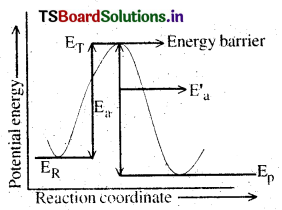
Ea = Activation energy of forward reaction [Er – ER]
E’a= = Activation energy of backward reaction [ET – EP]
Ep = Energy of products ER = Energy of reactants
ET = Threshold energy. Also Ea = ET – ER
Textual Solved Problems
Question 1.
The decomposition of N2O5 in CCl4 at 318K has been studied by monitoring the concentration of N2O5 in the solution. Initially the concentration of is 2.33 mol L-1 and after 184 minutes, it is reduced to 2.08mol L-1. The reaction takes place according to the equation.
2N2O5 → 4NO2(g) + O2(g)
Calculate the average rate of this reaction in terms of hours, minutes and seconds. What is the rate of production of NO2 during this period?
Answer:
Average Rate = \(\frac{1}{2}\left\{-\frac{\Delta\left[\mathrm{N}_2 \mathrm{O}_5\right]}{\Delta \mathrm{t}}\right\}\) = \(-\frac{1}{2}\left[\frac{(2.08-2.33) \mathrm{mol} \mathrm{~L}^{-1}}{184 \mathrm{~min}}\right]\)
= 6.79 × 10⁻⁴ mol L-4/min = (6.79 × 10⁻⁴ mol L-1/min-1)(60 min/1h)
= 4.07 × 10⁻² mol L-1/h = 6.79 × 10⁻⁴ mol L-1/1min/60s = 1.13 × 10⁻⁵ mol L-1/s-1
It may be remembered that Rate = \(\frac{1}{4}\left\{\frac{\Delta\left[\mathrm{NO}_2\right]}{\Delta \mathrm{t}}\right\}\)
⇒ \(\frac{\Delta\left[\mathrm{NO}_2\right]}{\Delta \mathrm{t}}\) = 4 × Rate = 6.79 × 10-44 mol L-1/m = 2.72 × 10⁻³mol L-1min-1
Question 2.
Calculate the overall order of a reaction which has the rate expression
(a) Rate = k[A]1/2[B]3/2
(b) Rate = k[A]3/2|B|-1
Answer:
(a) Rate = k[A]x[B]y; Order = x + y
∴ Order = \(\frac{1}{2}\) + \(\frac{3}{2}\) = \(\frac{4}{2}\) = 2 i.e., second order
(b) Order = \(\frac{3}{2}\) + (-1) = \(\frac{3}{2}\) – 1 = \(\frac{1}{2}\) i.e., half order
Question 3.
The initial concentration of N2O5 in the following first order reaction N2O5 → 2NO2(g) + 1/2O2(g) was 1.24 ×10⁻² mol L-1 at 318 K. The concentration of N2O5 after 60 minutes was 0.20 × 10⁻² mol L-1. Calculate the rate constant for the reaction at 318K.
Answer:
For a first order reaction, rate constant k = \(\frac{2.303}{\left(t_2-t_1\right)}\)log\(\frac{[\mathrm{R}]_1}{[\mathrm{R}]_2}\) = \(\frac{2.303}{(60-0)}\)log\(\frac{1.24 \times 10^{-2}}{0.20 \times 10^{-2}}\)
= \(\frac{2.303}{60}\) log 6.2 min-1 = \(\frac{2.303}{60}\) × 0.793 = 0.0304 min-1
∴ k = 0.0304 min-1.
Question 4.
A first order reaction is found to have a rate constant k = 5.5 × 10⁻¹⁴ s-1. Find the half-life of the reaction.
Answer:
Half-life for a first order reaction is t1/2 = \(\frac{0.693}{k}\) = \(\frac{0.693}{5.5 \times 10^{-14} \mathrm{~s}^{-1}}\) = 1.26 × 10¹³s
Question 5.
The first order rate constant for the decomposition of ethyl iodide by the reaction.
C2H5I(g) → C2H4(g) + HI(g) at 600K is 1.60 × 10⁻⁵ s-1. Its energy of activation is 209 kJ/mol Calculate the rate constant of the reaction at 700K.
Answer:
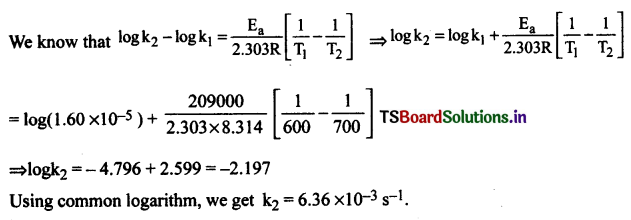
Given data Ea = 209 kJ/mol = 209000 J/mol, k1 = 1.60 × 10⁻⁵ s-1, T1 = 600K, T2 = 700K We have to find k2
We know that logk2 – logk1
Objective Questions
Question 1.
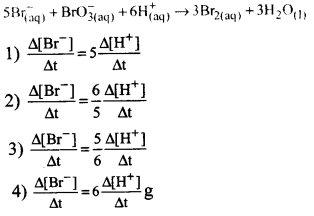
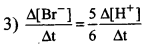
Which of the following expressions is correct for the rate of reaction given below?
Answer:
Question 2.
The role of a catalyst is to change
1) gibbs energy of reaction.
2) enthalpy of reaction.
3) activation energy of reaction.
4) equilibrium constant.
Answer:
3) activation energy of reaction.
Question 3.
Rate law for the reaction A + 2B → C is found to be Rate = k [A][B]. Concentration of reactant ‘B’ is doubled, keeping the concentration of ‘A’ constant, the value of rate constant will be
1) the same
2) doubled
3) quadrupled
4) halved
Answer:
2) doubled
Question 4.
In a reaction A + B → Product, rate is doubled when the concentration of B is doubled and rate increases by a factor of 8 when the concentration of both the reactants (A and B) are doubled, rate law for the reaction can be written as
1) Rate = k [A] [B]
2) Rate = k[A]2 [B]
3) Rate = k [A] [B]2
4) Rate = k [A]2 [B]2
Answer:
2) Rate = k[A]2 [B]
Question 5.
For the reaction
N2O2(g) → 2NO2(g) + \(\frac{1}{2}\)O2(g)
The value of rate of disappearance of N2O5 is given as 6.25 × 10⁻³ mol L-1s-1. The rate of formation of NO2 and O2 is given respectively as
1) 6.25 × 10⁻³molL-1s-1&6.25×10⁻³molL-3s-1
2) 1.25 × 10⁻²molL-1s-1&3.125×10⁻³molL-1s-1
3) 6.25 × 10⁻³molL-1s-1&3.125×10⁻³molL-1s-1
4) 1 .25 × 10-2molL-1 s-1 & 6.25 × 10⁻³molL-1s-1
Answer:
2) 1.25 × 10⁻²molL-1s-1&3.125×10⁻³molL-1s-1
Question 6.
Consider a first order gas phase decomposition reaction given below :
A(g) → B(g) + C(g)
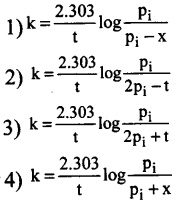
The initial pressure of the system before decomposition of A was p. After lapse of time ‘t’, total pressure of the system increased by x units and became ‘pt’ The rate constant k for the reaction is given as ________
Answer:
2) k = \(\frac{2.303}{t}\)log\(\frac{p_i}{2 p_i-t}\)
Question 7.
In the presence of a catalyst, the heat evolved or absorbed during the reaction ___
1) increases
2) decreases
3) remains unchanged.
4) may increase or decrease.
Answer:
3) remains unchanged.
Question 8.
Activation energy of a chemical reaction can be determined by
1) determining the rate constant at standard temperature.
2) determining the rate constants at two temperatures.
3) determining probability of collision.
4) using catalyst.
Answer:
2) determining the rate constants at two temperatures.
Question 9.
Consider the Arrhenius equation given below and mark the correct option. k = \(\mathrm{Ae}^{-k_a / \mathrm{RT}}\)
1) Rate constant increases exponentially with increasing activation energy and decreasing temperature.
2) Rate constant decreases exponentially with increasing activation energy and decreasing temperature.
3) Rate constant increases exponentially with decreasing activation energy and decreasing temperature.
4) Rate constant increases exponentially with decreasing activation energy and increasing temperature.
Answer:
4) Rate constant increases exponentially with decreasing activation energy and increasing temperature.
Question 10.
A first order reaction is 50% completed in 1.26 × 10¹⁴ s. How much time would it take for 100% completion?
1) 1.26 × 10¹⁵ s
2) 2.52 × 10¹⁴ s
3) 2.52 × 1028 s
4) infinite
Answer:
4) infinite
Question 11.
The value of rate constant of a pseudo first order reaction is
1) depends on the concentration of reactants present in small amount.
2) depends on the concentration of reactants present in excess.
3) is independent of the concentration of reactants.
4) depends only on temperature.
Answer:
2) depends on the concentration of reactants present in excess.
Question 12.
What is the activation energy for a reaction if its rate doubles when the temperature is raised from 20°C to 35°C? (R = 8.314 J mol-1K-1)
1) 15.1 kJ mol-1
2) 342kJ mol-1
3) 269 kJ mol-1
4) 34.7 kJ mol-1
Answer:
4) 34.7 kJ mol-1
Question 13.
A first order reaction has a rate constant of 2.303 × 10⁻³s-1. The time required for 40g of this reactant to reduce 10g will be
[Given that log102=0.3010]
1) 230.3 s
2) 301s
3) 2000s
4) 602s
Answer:
4) 602s
Question 14.
If the rate constant for a first order reaction is k, the time(t) required for the completion of 99% of the reaction is given by
1) t = 2.303/k
2) t = 0.693/k
3) t = 6.909/k
4) t = 4.606/k
Answer:
4) t = 4.606/k
Question 15.
An increase in the concentration of the reactants of a reaction leads to change in
1) activation energy
2) heat of reaction
3) threshold energy
4) collision frequency
Answer:
4) collision frequency
Question 16.
The slope of Arrhenius plot \(\left(\ln k \text { vs } \frac{1}{1}\right)\) of first order reaction -5×10³ K. The value of Ea, of the reaction is
| given R=8.314 JK-1mol-1]
1) -83 kJmol-1
2) 41.5 kJmol-1
3) 83.0 kJmol-1
4) 166kJmol-1
Answer:
2) 41.5 kJmol-1
Question 17.
In a zero-order reaction for every 10o rise of temperature, the rate is doubled. If the temperature is increased from 10oC to 100°C, the rate of the reaction will become
1) 64 times
2) 128 times
3) 256 times
4) 512 times
Answer:
4) 512 times
Question 18.
Which of the following statements is not correct about order of a reaction.
1) The order of a reaction can be a fractional number.
2) Order of a reaction is experimentally determined quantity.
3) The order of a reaction is always equal to the sum of the stoichiometric coefficients of reactants in the balanced chemical equation for a reaction.
4) The order of a reaction is the sum of the powers of molar concentration of the reactants in the rate law expression.
Answer:
3) The order of a reaction is always equal to the sum of the stoichiometric coefficients of reactants in the balanced chemical equation for a reaction.
Question 19.
Which of the following statements is incorrect about the collision theory of chemical reaction?
1) It considers reacting molecules or atoms to be hard spheres and ignores their structural features.
2) Number of effective collisions determines the rate of reaction.
3) Collision of atoms or molecules possessing sufficient threshold energy results into the product formation.
4) Molecules should collide with sufficient threshold energy and proper orientation for the collision to be effective.
Answer:
3) Collision of atoms or molecules possessing sufficient threshold energy results into the product formation.