
Regular practice with AP Inter 2nd Year Physics Study Material Chapter 4 Moving Charges and Magnetism Questions and Answers helps students stay prepared for examinations.
AP Inter 2nd Year Physics 4th Lesson Moving Charges and Magnetism Questions and Answers
I. Multiple Choice Questions
Question 1.
A positron, moving vertically up from the ground, experiences a magnetic force by a magnetic field, directed due east. The magnetic force on it points due
1) South
2) North
3) West
4) South-east
Answer:
2) North
For a charged particle,, \(\vec{F}=q(\vec{v} \times \vec{B})\). Since a positron is a positive charge, the force
direction is given directly by the right-hand rule.
Velocity \(\vec{v}\) → vertically upward; Magnetic field \(\vec{B}\) → due east
Using right-hand rule: Upward × East = North
Question 2.
An electron moves through a uniform magnetic field B at a velocity v at time t. Then the magnetic force experienced by it is
1) parallel to \(\vec{v}\) only
2) perpendicular to \(\vec{v}\) × \(\vec{B}\)
3) opposite to \(\vec{B}\) only
4) opposite to \(\vec{v}\) × \(\vec{B}\)
Answer:
4) opposite to \(\vec{v}\) × \(\vec{B}\)
From the equation, \(\vec{F}=q(\vec{v} \times \vec{B})\), due to the negative charge of electron, the direction of force is exactly opposite to the direction of the vector cross product \(\vec{v} \times \vec{B}\)
Question 3.
A straight conducting wire, carrying an electric current of 0.1 A, is kept perpendicular to the uniform magnetic field of 1 T. The magnetic force per meter experienced by the wire is ….
1) 1 N/m
2) 0.01 N/m
3) 10N/m
4) 0.1 N/m
Answer:
4) 0.1 N/m
Current I = 0.1 A, Induction, B = 1T.
From F = BIl sinθ (where θ = 90°) ⇒ F = BIl
∴ Force per unit length \(\frac{\mathrm{F}}{l}\) = BI = 1 x 0.1 = 0.1N
Question 4.
A charged particle moves in a uniform magnetic field and its velocity makes an angle 6 with the direction of magnetic field. If 6 is other than 0°, 90° and 180°, its path is …
1) Helical path
2) Circle
3) Straight line
4) Elliptical path
Answer:
1) Helical path
At 0°, 180° the path is a straight line. At 90°, it is a circle.
At any other angle the path of the charged particle is helical path.
Question 5.
The magnetic field due to small length element \(\overrightarrow{\mathrm{dl}}\) of current carrying wire is given by \(\overrightarrow{\mathrm{dB}}\) = \(\frac{\mu_0 \mathbf{I}}{4 \pi} \frac{\overrightarrow{\mathbf{d l}} \times \overrightarrow{\mathbf{r}}}{\mathbf{r}^3},\), where \(\overrightarrow{\mathrm{r}}\) is the position of a point where \(\overrightarrow{\mathrm{dB}}\) is calculated. The direction of \(\overrightarrow{\mathrm{dl}}\) is
1) anti parallel to the direction electric current
2) parallel to \(\overrightarrow{\mathrm{r}}\)
3) perpendicular to \(\overrightarrow{\mathrm{r}}\).
4) parallel to the direction electric current
Answer:
4) parallel to the direction electric current
From Biot – Savart law, die length dl is always takes the direction of the current flow.
Question 6.
The magnetic field inside the very long solenoid is
1) non-uniform and varies along its radial direction
2) uniform and is parallel to its axis
3) non-uniform and varies along its length
4) uniform and is parallel to radial direction
Answer:
uniform and is parallel to its axis
For an ideal solenoid, the magnetic field lines inside are parallel, equally spaced and move along axis of the solenoid. This indicates the field is uniform, parallel to its axis.

Question 7.
Two straight long parallel wires, kept on an insulated horizontal table, carry electric currents in opposite directions. They
1) repel along horizontal direction
2) repel in upward direction
3) attract along horizontal direction
4) attract in vertically downward direction
Answer:
1) repel along horizontal direction
Parallel wires carrying current in opposite directions experience a repulsive force.
Question 8.
A current carrying coil is placed in a uniform magnetic field, it experiences in general
1) zero force and a constant torque
2) zero force and a variable torque
3) non-zero force and a constant torque
4) non-zero force and a variable torque
Answer:
2) zero force and a variable torque
In a uniform, magnetic field, the net force on a closed loop is always zero. Because the opposite forces cancel each other. If the current carrying coil is placed in magnetic field the coil rotates due to torque.
Torque 𝜏 = NIAB sinθ, So, Torque changes with rotation, (Angle θ varies)
Question 9.
The SI unit of magnetic moment is
1) ampere per meter
2) ampere per meter2
3) ampere – meter
4) ampere – meter2
Answer:
4) ampere – meter2
Magnetic moment M = NIA. Hoe N=number of turns, I = current in ampere, A = Area in m2
So, unit of M = ampere – metre2
Question 10.
A soft cylindrical iron is inserted into the coil of galvanometer because
1) it makes the magnetic field radial and increases the strength of the magnetic field
2) it makes the magnetic field radial and decreases the strength of the magnetic field
3) it makes die magnetic field uniform and increases the strength of the magnetic field
4) it makes the magnetic field uniform and decreases the strength of the magnetic field
Answer:
1) it makes the magnetic field radial and increases the strength of the magnetic field
The soft iron core has high permeability due to radial magnetic field strengths.
Question 11.
If the number of turns in the coil of galvanometer is increased by 4 times, then its voltage sensitivity
1) increases by 4 times
2) is unchanged
3) decreases by 4 times
4) increases by twice
Answer:
2) is unchanged
When no.of turns increases by 4 times, resistance also increases 4 times.
Thus if N = 4 N then we get R’ = 4R
Voltage sensitivity VS = \(\frac{\mathrm{NBA}}{\mathrm{KR}}\) ⇒ VS1 = \(\frac{(4 N) B A}{K(4 R)}=\frac{N B A}{K R}\) = VS
VS is unchanged.
II. Fill in the Blanks
Question 1.
A neutron, moving through a magnetic field of 2T, has a speed of 104 m/s at an angle of 30° with the direction of magnetic field. The magnitude of magnetic force experienced by it is _________
Answer:
zero.
The magnetic force is F = Bqv sinθ.
A neutron has a zero charge.
So, there is no field strength .Hence the magnetic force is zero.
Question 2.
A current carrying coil of area A is placed in a uniform magnetic filed B. The magnetic force experienced by the coil if it carries a current I is ________.
Answer:
zero.
For any closed coil, when it is situated in a uniform magnetic field, the vector sum of the magnetic forces on all segments of the loop in zero.
Question 3.
The distance, covered by a charged particle moving in a helical path, along the direction of magnetic field in one rotation is called ________.
Answer:
pitch.
The linear distance covered by a charged particle in one rotation in an helical path is known as the pitch.
Question 4.
The shape of the magnetic field lines due to a very lone straight wire is _________
Answer:
circular.
The magnetic field lines around a straight conductor form concentric circles centered on the wire.
Question 5.
The magnetic field inside the long solenoid carrying a current I is B = μ0nI, where n is __________.
Answer:
number of turns per unit length.
In B = μ0nI ‘n’ indicates number of turns per unit length.
Question 6.
Two parallel current carrying straight wires A and B exert force on each other. If the wire ‘A’ exerts a force 10 N due south on wire ‘B’, the force on wire A by wire B is _________
Answer:
10N due North.
According to Newton’s 3rd law, the force exerted by wire B on wire A is equal in magnitude & opposite in direction. Hence the direction is 10 N due North.
Question 7.
If one ampere current passes through each wire of two straight parallel wires of 1m separation, then the magnitude of magnetic force per unit length of each wire is _______.
Answer:
2 × 10⁻⁷N/m
The force per unit-length between two parallel current carrying wires is \(\frac{F}{L}=\frac{\mu_0 I_1 I_2}{2 \pi d}\)
\(\frac{\mathrm{F}}{\mathrm{~L}}=\frac{4 \pi \times 10^{-7} \times 1 \times 1}{2 \pi \times 1}\) = 2 × 10⁻⁷N/m-1
Question 8.
The resistance of an ideal ammeter is ________.
Answer:
zero.
An ideal Ammeter should have no resistance, as it doesn’t change the current.
Question 9.
The resistance of an ideal voltmeter is ________
Answer:
infinity.
An ideal Voltmeter should have infinite resistance, as it draws no current form the circuit.
Question 10.
The number of turns of a coil in a galvanometer is increased by 4 times, then its current sensitivity increases by ________ times.
Answer:
4
Current sensitivity Is = \(\frac{\text { NBA }}{\mathrm{K}}\) ⇒ Is ∝ N. So if N increases 4 times then Is increases 4 times.
III. One Word Answer Questions
Question 1.
What is the relation between the units of magnetic field induction, Tesla and Gauss?
Answer:
Units of magnetic induction is Tesla. Relation: 1 Tesla(T) = 104 Gauss(G)
Question 2.
The SI unit of magnetic field B is newton per meter times x. Then what is x?
Answer:
x = ampere. SI unit of magnetic induction is Newton per meter per ampere.
Question 3.
What is the path of a moving charged particle through a uniform magnetic field if it moves perpendicular to the direction of magnetic field?
Answer:
A charged particle moving perpendicular to a uniform magnetic field follows a circular path, because it continuously changes its direction while the speed is constant.
Question 4.
A point charge of strength q moves with linear momentum p in a circular path of radius r = p / K in a uniform magnetic field B . Express K in terms of q and B.
Answer:
K = qB
When a charge q moves in a circular path in a magnetic field, centripetal force = magnetic force
∴ \(\frac{m v^2}{r}\) = Bqv ⇒ r = \(\frac{m v}{B q}=\frac{p}{B q}\) [∵ p = mv] But given r = \(\frac{\mathrm{p}}{\mathrm{~K}}\) ……….. (2)
From (1) & (2) we get K = qB
Question 5.
What is the SI unit of permeability of free space?
Answer:
SI unit of μ0 is henry per meter H/m. It is also equal to N/A2
Question 6.
The magnetic field due to small element of length \(\overrightarrow{\mathrm{dl}}\) of a current carrying wire is given by \(\overrightarrow{\mathrm{dB}}=\frac{\mu_0 \mathrm{I}[\overrightarrow{\mathrm{~d}} \mathrm{l} \times \overrightarrow{\mathrm{r}}]}{4 \pi} \frac{\mathrm{r}^{\mathrm{n}}}{\mathrm{r}^{\mathrm{n}}}\), where \(\overrightarrow{\mathrm{r}}\) is the position of a point where \(\overrightarrow{\mathrm{dB}}\) is calculated. What is the value of n?
Answer:
The vector from of Biot Savart’s law is \(\overrightarrow{\mathrm{dB}}=\frac{\mu_0 \mathrm{I}[\overrightarrow{\mathrm{~d}} \mathrm{l} \times \overrightarrow{\mathrm{r}}]}{4 \pi} \frac{\mathrm{r}^{\mathrm{n}}}{\mathrm{r}^{3}}\). So, the value of n = 3.
Question 7.
A circular wire, carrying an electric current, is placed in xy-plane and current flows in clockwise direction. What is the direction of magnetic field on its symmetry axis?
Answer:
The direction of magnetic field on its symmetry axis is along negative z-axis.
Question 8.
What is the magnetic moment of a circular coil of radius r, of number of turns N and of current I?
Answer:
Magnetic moment (M) of a circular coil M = NIA (or) M = NI(πr2)
Here N is the number of turns, r radius and A is the area of the coil.
Question 9.
What is the current sensitivity of galvanometer if its coil deflects by an angle Φ and current passes through it is I?
Answer:
Current sensitivity is SI = \(\frac{\phi}{I}\)
Question 10.
What is the voltage sensitivity of galvanometer if its coil deflects by an angle and the voltage across it is V?
Answer:
Voltage sensitivity is SV = \(\frac{\phi}{V}\)
IV. Very Short Answer Questions
Question 1.
What is the importance of Oersted’s experiment?
Answer:
Importance of Oersted’s Experiment :
Oersted’s experiment established the connection between electric current and magnetism. It showed that moving charge (current) produces magnetic field in its surrounding space.
Question 2.
What is the work done by the magnetic field on moving charge? Give reason.
Answer:
The work done by a magnetic field on a moving charge is zero.
Reason: Magnetic field \(\vec{F}\) is always perpendicular to the velocity \(\vec{v}\) of the charge.
Work done W = \(\vec{\mathrm{F}} \cdot \vec{\mathrm{ds}}=\int \vec{\mathrm{F}} \cdot \vec{\mathrm{v}}\) dt (dot product becomes zero)
Question 3.
What is the magnitude of magnetic force on a charged particle of strength q moving through a uniform magnetic field B at a velocity v which makes an angle 6 with magnetic field? When does this force become maximum?
Answer:
The magnitude of magnetic force (F) on a charge (q), moving with velocity (v) at an angle θ to a magnetic field (B) is given by F = Bqv sinθ.
This force becomes maximum when θ = 90°. Then sin0 = sin 90° = 1.
∴ Fmax = Bqv
Question 4.
What is the magnitude of magnetic force 6n a current (i) carrying wire of length ‘l’ placed in a uniform magnetic field B if it makes an angle θ with magnetic field? When does this force become maximum?
Answer:
The magnitude of magnetic force (F) on a current (i) carrying wire of length (l) placed in a magnetic field (B) which makes an angle (θ), is given by F = Bil sinθ
This force becomes maximum when θ = 90°. Then sinθ = sin 90° = 1.
∴ Fmax = Bil
Question 5.
Write expression for the magnetic field induction at a point on the axis of a circular current carrying coil. Obtain an expression for the magnetic field induction at its center.
Answer:
The magnetic induction on the axis of a circular coil at a distance x from its centre is Bx = \(\frac{\mu_0 \mathrm{NIR}^2}{2\left(x^2+R^2\right)^{3 / 2}}\)
Here N is number of the turns, I is the current passing through the coil,
R is radius of the coil, (XQ is permeability of free space:
Magnetic Induction at the centre of the circular coil:
Putting x = 0 in the above equation, we get magnetic induction the at centre of the coil B0 = \(\frac{\mu_0 \mathrm{NI}}{2 \mathrm{R}}\)
Question 6.
Write the formula for the magnetic field due to infinite straight wire and explain the terms in it.
Answer:
Magnetic field due to infinite straight wire is B = \(\frac{\mu_0}{2 \pi} \frac{I}{r}\) . Here µ0 is the permeability of free space, I is electric current, r is the perpendicular distance from line.
Question 7.
Express a relation among the quantities the speed of light in vacuum, the permeability of vacuum and the permittivity of vacuum.
Answer:
The speed of light in vacuum c = \(\frac{1}{\sqrt{\mu_0 \varepsilon_0}}\). Here µ0 is permeability and ε₀ is the permittivity ofvaccum.
Question 8.
Two parallel conducting wires, separated by a distance d carry I1 and I2 currents. When do they attract and repel? What is the magnitude of force per unit length acting on any wire?
Answer:
The two parallel current conducting wires attract when die currents flow in the same direction. They repel when the currents flow in the opposite direction.
The magnitude of the force per unit length is f = \(\frac{\mathrm{F}}{l}=\frac{\mu_0 \mathrm{I}_1 \mathrm{I}_2}{2 \pi \mathrm{~d}}\)
Here µ0 is permeability of free space and d is the distance between the wires.
Question 9.
What is the principle of moving coil galvanometer?
Answer:
Principle of MCG: The current carrying coil placed in a uniform magnetic field experiences a torque.
Question 10.
How do you convert a moving coil galvanometer into an ammeter?
Answer:
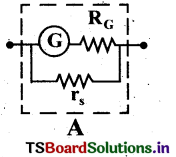
A galvanometer (G) can be converted into an ammeter (A) by connecting a very small shunt resistance (rs) m parallel with it.
Question 11.
How do you convert a moving coil galvanometer into a voltmeter?
Answer:
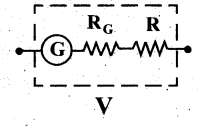
A galvanometer (G) can be converted into a voltmeter (V) by connecting a high resistance . (R) in series with it.
V. Short Answer Questions
Question 1.
State and explain Biot-Savart law with a neat diagram.
Answer:
Biot-Savart Law:The magnitude of magnetic field induction due to small element of current carrying conductor is directly proportional to the strength of the current, length of the element, sine of the angle between position vector and the element; and inversely proportional to the square of the distance of the point from the element.
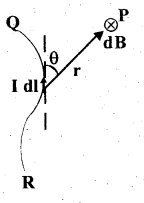
Explanation: Suppose RQ is a conductor carrying a current I. dl is a small length of element on the conductor.
The distance between dl and P is ‘r’.
Let θ be the angle between \(\overline{\mathrm{d} l}\) and radius vector \(\overline{\mathrm{r}}\)
The magnetic induction due to dl is dB
Here according to Biot-savart law
(i) dB ∝ I
(ii) dB ∝ dl
(iii) dB ∝ sin θ
(iv) dB ∝ \(\frac{1}{r^2}\)
Thus, dB ∝ \(\frac{\mathrm{Id} / \sin \theta}{\mathrm{r}^2}\) (or) dB = \(\frac{\mu_0}{4 \pi} \frac{\mathrm{Id} l \sin \theta}{\mathrm{r}^2}\) Here \(\frac{\mu_0}{4 \pi}\) = 10-7 Hm-1
Question 2.
State Ampere’s circuital law. How it is used to calculate the magnetic field for a straight infinite current carrying wire with a neat diagram.
Answer:
Ampere’s Law: The line integral of the intensity of magnetic induction around a closed path (\(\oint \vec{\mathrm{B}} \cdot \mathrm{~d} \vec{l}\)) is equal to μ0 times the net current (i) enclosed by the path.
Thus \(\oint \vec{\mathrm{B}} \cdot \mathrm{~d} \vec{l}\) = μ0. Here \(\mathrm{~d} \vec{l}\) = small element of the path, μ0 = permeability of free space.
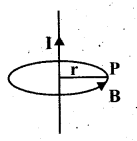
Expression for Magnetic field Induction:
Consider a long straight conductor carrying a current I.
Let P be a point at a distance r from the conductor.
Let r be the radius of the circle passing through the point P.
The circumference of the circle is 2πr.
Magnetic induction is same at all points on the circle. Consider a small element of length dl.
Now, \(\oint \vec{\mathrm{B}} \cdot \mathrm{~d} \vec{l}\) = \(\oint \) Bdl cos θ = B\(\oint \) dl cos θ
Angle between B and dl is zero ⇒ θ = 0 ⇒ cos θ = cos 0 = 1
∴ \(\oint \vec{\mathrm{B}} \cdot \mathrm{~d} \vec{l}\) = \(\vec{\mathrm{B}} \oint . \mathrm{d} \vec{l}\) = B(2πr) ………… (1)
From Ampere’s law, \(\oint \vec{\mathrm{B}} \cdot \mathrm{~d} \vec{l}\) = μ0I …………… (2)
From (1) & (2) B(2πr) = μ0I ⇒ B = \(\frac{\mu_0 I}{2 \pi r}\)
Question 3.
Derive an expression for the magnetic field induction at a point on the axis of a . current carrying circular coil using Biot-savart law with a neat diagram.
Answer:
Magnetic Induction on the axis a coil:
Consider a circular loop of radius R carrying a current I.
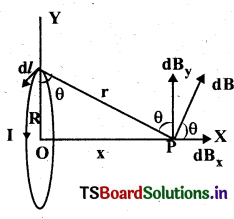
Let P be a point on the OX axis at a distance x from its centre O.
Consider a small element dl carrying the current I on the coil.
The distance of P from the element dl is r.
From the Biot-Savart law, the magnetic induction at P due to the element dl is dB = \(\frac{\mu_0}{4 \pi} \frac{||\mathrm{~d} \vec{l} \times \overrightarrow{\mathrm{r}}|}{\mathrm{r}^3}\)
The angle between dl and r is 90°. So \(\) = dlr sin90° = dlr
∴ dB = \(\frac{\mu_0}{4 \pi} \frac{\mathrm{Id} l \mathrm{r}}{\mathrm{r}^3}=\frac{\mu_0}{4 \pi} \frac{\mathrm{Id} l}{\mathrm{r}^2}\) ⇒ dB = \(\frac{\mu_0}{4 \pi} \frac{\mathrm{Id} l}{\left(\mathrm{x}^2+\mathrm{R}^2\right)}\) ………..(1) [From the figure, r2 = x2 + R2]
This dB is perpendicular to r. So its x-component dBx = dB cos θ.
From the figure, cos θ = \(\frac{R}{r}=\frac{R}{\left(x^2+R^2\right)^{1 / 2}}\) ….(2)
From (1) & (2), dBx – dB cos θ = \(\frac{\mu_0}{4 \pi} \frac{\mathrm{Id} l}{\left(\mathrm{x}^2+\mathrm{R}^2\right)} \frac{\mathrm{R}}{\left(\mathrm{x}^2+\mathrm{R}^2\right)^{1 / 2}}=\frac{\mu_0}{4 \pi} \frac{\mathrm{Id} / \mathrm{R}}{\left(\mathrm{x}^2+\mathrm{R}^2\right)^{3 / 2}}\)
Integrating on both sides and simplifying, we get B = Bx = \(\frac{\mu_0}{4 \pi} \frac{\mathrm{IR} .2 \pi \mathrm{R}}{\left(\mathrm{x}^2+\mathrm{R}^2\right)^{3 / 2}}=\frac{\mu_0 \mathrm{IR}^2}{2\left(\mathrm{x}^2+\mathrm{R}^2\right)^{3 / 2}}\)
If the coil has N turns, magnetic filed induction B = \(\frac{\mu_0 \mathrm{NIR}^2}{2\left(\mathrm{x}^2+\mathrm{R}^2\right)^{3 / 2}}\)
Question 4.
Derive an expression for the force acting on current carrying conductor placed in uni¬form magnetic field with a neat diagram.
Answer:
Force on a current carrying conductor in a magnetic field:
Consider a straight conductor of length 7’, cross sectional area ‘A’ and carrying a current ‘I’ placed in a uniform magnetic induction B as shown in figure.
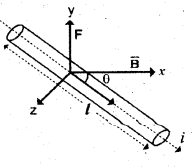
Let us assume that the current flows through the conductor from left in X-Y plane and B makes an angle θ with the direction of current.
Force acting on a charge ‘q’ in the magnetic field is given by F1 = qVdB sin θ ………….. (1)
If ‘n’ represents number of free electrons per unit volume of the conductor, then
current in the conductor is given by I = nqVdA ………….. (2)
Number of free electrons in the conductor, N = nlA …………. (3)
Total force acting on the entire conductor is,
F = F1N = (qVdB sinθ)(nLA) = (nqVdA)(lBsinθ) F = BIlsin θ (∵ I = nqVdA)
In vector form, above equation can be written as \(\overline{\mathrm{F}}=\mathrm{I}(\overline{l} \times \overline{\mathrm{B}})\)
Question 5.
Derive an expression for the force acting between two very long parallel current carrying conductors with a neat diagram.
Answer:
Force between two parallel conductors carrying Current:
Consider two straight parallel conductors a, b carrying currents Ia, Ib separated by a distance d .
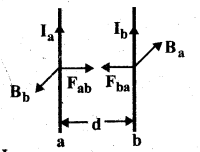
Magnetic field produced by current-carrying conductor a is Ba = \(\frac{\mu_0 \mathrm{I}_{\mathrm{a}}}{2 \pi \mathrm{~d}}\) …………. (1)
Force acting on the conductor b by magnetic field Ba is Fba = BaIbl ……….. (2)
From (1) & (2), we get Fba = Ibl\(\left(\frac{\mu_0 \mathrm{I}_{\mathrm{a}}}{2 \pi \mathrm{~d}}\right)=\frac{\mu_0 \mathrm{I}_{\mathrm{a}} l}{2 \pi \mathrm{~d}}\) ………… (3)
The direction of the force Fba is towards conductor a.
Similarly, the force acting on the conductor a by magnetic field B is Fab = \(\frac{\mu_0 \mathrm{I}_{\mathrm{a}} \mathrm{I}_{\mathrm{b}} l}{2 \pi \mathrm{~d}}\) ……… (4)
The direction of the force Fab is towards conductor b.
From (3) & (4) we get Fab = Fba = \(\frac{\mu_0 \mathrm{I}_{\mathrm{a}} \mathrm{I}_{\mathrm{b}} l}{2 \pi \mathrm{~d}}\)
Question 6.
Explain bow the circular current carrying loop acts as magnetic dipole.
Answer:
When a current is passed through a circular current carrying loop, the current loop acts as a dipole with dipole moment \(\overrightarrow{\mathrm{M}}=\mathrm{IA} \hat{\mathrm{n}}\)
Consider a circualr coil of radius R carrying a current I.
Magnetic field at any point on the axial line of a circular current carrying coil at a distance x from its centre is B = \(\frac{\mu_0}{4 \pi} \frac{2 \pi \mathrm{IR}^2}{\left(\mathrm{R}^2+\mathrm{x}^2\right)^{3 / 2}}\)
If R<2]
For a magnetic dipole, with dipole moment M, the magnetic induction at a point on its axis and far away from its centre is given by B = \(\frac{\mu_0}{4 \pi} \frac{2 \mathrm{M}}{\mathrm{x}^3}\) ………….. (2)
From (1) and (2) it follows that the current carrying loop behaves as a magnetic dipole with Magnetic moment M = IA .
Question 7.
DescriIe the method of conversion of galvanometer Into ammeter with a neat diagram. What is current sensitivity?
Answer:
A galvanometer (G) can be converted into an ammeter (A) by connecting a very small shunt resistance (rs) parallel with it.
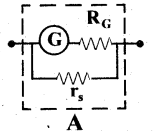
Derivation of Shunt Resistance
RG = resistance of galvanometer, IG = maximum current through galvanometer
rS = shunt resistance, I total current to be measured
Then current through shunt: IS = I – IG
Since galvanometer and shunt are in parallel, potential difference across them is same:
IGRG = ISrS
⇒ IGRG = (I – IG)rS
⇒ rS = \(\frac{I_G R_G}{I-I_G}\)
This gives the value of shunt required to convert galvanometer into an ammeter.
Current sensitivity of the galvanometer is the deflection per unit current flowing through it.
Formula: Current sensitivity SI = \(\frac{\theta}{I}=\frac{N A B}{K}\)
Question 8.
Describe the method of conversion of galvanometer into voltmeter, with a neat diagram. What is voltage sensitivity?
Answer:
A galvanometer (G) can be converted into a voltmeter (V) by connecting a high resistance (R) in series with it.
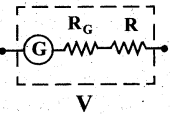
Derivation of Series Resistance
RG = resistance of galvanometer
IG = maximum current through galvanometer.
R = high resistance connected in series
V = maximum voltage to be measured
For full-scale deflection, current through galvanometer is IG
Using Ohm’s 1gw:
V = IG(RG + R) ⇒ RG + R = \(\frac{V}{I_G}\) ⇒ R = \(\frac{V}{I_G}\) – RG
Voltage sensitivity of the galvanometer is the deflection obtained per unit voltage applied
Formula: Voltage sensitivity SV = \(\frac{\theta}{V}=\left(\frac{N A B}{K}\right) \frac{1}{R}\)
VI. Long Answer Questions
Question 1.
Derive an expression for the force acting between two very long parallel current carrying conductors and hence define the ampere with a neat diagram?
Answer:
(a) Force between two parallel conductors carrying Current:
Consider two straight parallel conductors a, b carrying currents Ia, Ib separated by a distance d .
Magnetic field produced by current-carrying conductor a is Ba = \(\frac{\mu_0 \mathrm{I}_{\mathrm{a}}}{2 \pi \mathrm{~d}}\) …………. (1)
Force acting on the conductor b by magnetic field Ba is Fba = BaIbl ……….. (2)
From (1) & (2), we get Fba = Ibl\(\left(\frac{\mu_0 \mathrm{I}_{\mathrm{a}}}{2 \pi \mathrm{~d}}\right)=\frac{\mu_0 \mathrm{I}_{\mathrm{a}} l}{2 \pi \mathrm{~d}}\) ………… (3)
The direction of the force Fba is towards conductor a.
Similarly, the force acting on the conductor a by magnetic field B is Fab = \(\frac{\mu_0 \mathrm{I}_{\mathrm{a}} \mathrm{I}_{\mathrm{b}} l}{2 \pi \mathrm{~d}}\) ……… (4)
The direction of the force Fab is towards conductor b.
From (3) & (4) we get Fab = Fba = \(\frac{\mu_0 \mathrm{I}_{\mathrm{a}} \mathrm{I}_{\mathrm{b}} l}{2 \pi \mathrm{~d}}\)
(b) Ampere: When two infinitely long parallel conductors, carrying the same current are separated by a distance of 1m in vacuum, if the force per unit length on each conductor is 2 × 10⁻⁷ Nm-1 then the current flowing through each conductor is said to be one ampere.
Question 2.
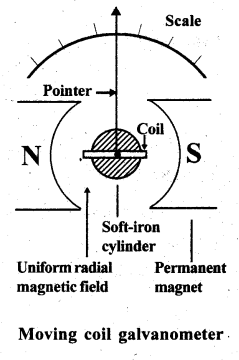
Obtain an expression for the torque on a current carrying loop placed in a uniform magnetic field. Describe the construction and working of a moving coil galvanometer with a neat diagram.
Answer:
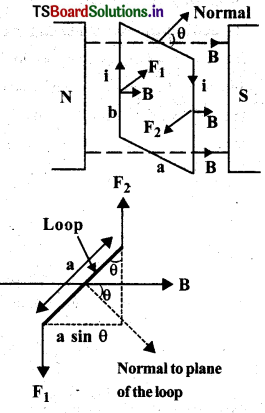
(a) Torque on a current carrying Loop in a Uniform Magnetic Field : Consider a rectangular current loop of length /, breadth b is suspended in a magnetic field B .
Let θ be the angle between the field and the normal to the loop.
The magnetic forces on the arms are given by F1 = F2 = ibB
The two forces constitute a couple.
The perpendicular distance between the forces is asin θ.
Torque = Force × Perpendicular distance
𝜏 = ibB × asinθ = iabBsinθ
= i A B sinθ [∵ Area of the loop ab = A]
(b) Construction and working of MCG:
Principle of MCG: The current-carrying coil placed in uniform magnetic field experience a torque.
Construction:
Moving coil galvanometer consists of a rectangular coil with a pivot arrangement in a strong radial magnetic field NS. The coil is free to rotate about a vertical axis. A soft iron cylinder is arranged at the centre of the coil to produce the magnetic field uniform. A spring is arranged to the coil to have a counter torque on die coil. A poiriter attached to the coil shows a reading on a semi-circular scale depending on the current flowing through it.
Working: If the current I to be measured is passed through the MCG, then the coil gets a deflection θ.
When a current I is passed through the coil suspended in a uniform radial magnetic field, it is subjected to two torques.
The deflecting torue acting on the coil is 𝜏 = BIAN …………. (1)
The restoring torque developed in the suspension is Cθ …………(2)
Here C is the torsional torque and 0 is the deflection of the coil
At equilibrium position, the deflecting magnetic torque = restoring torque due to spring
From (1) & (2), BIAN = Cθ
I = \(\frac{\mathrm{C} \theta}{\mathrm{BAN}}\). Put \(\frac{\mathrm{C}}{\mathrm{BAN}}\) = K
Hence, I = Kθ ⇒ I ∝ θ Here, K = \(\frac{\mathrm{C}}{\mathrm{BAN}}\) is called the constant of the galvanometer.
The relation I = Kθ explains the principle of MCG
By determining the values of K and θ, the current through MCG can be calculated.
Question 3.
Explain how can a Moving coil galvanometer be converted into
(a) Ammeter.
(b) Voltmeter with a neat diagram.
Answer:
A galvanometer (G) can be converted into an ammeter (A) by connecting a very small shunt resistance (rs) parallel with it.
Derivation of Shunt Resistance
RG = resistance of galvanometer, IG = maximum current through galvanometer
rS = shunt resistance, I total current to be measured
Then current through shunt: IS = I – IG
Since galvanometer and shunt are in parallel, potential difference across them is same:
IGRG = ISrS
⇒ IGRG = (I – IG)rS
⇒ rS = \(\frac{I_G R_G}{I-I_G}\)
This gives the value of shunt required to convert galvanometer into an ammeter.
Current sensitivity of the galvanometer is the deflection per unit current flowing through it.
Formula: Current sensitivity SI = \(\frac{\theta}{I}=\frac{N A B}{K}\)
A galvanometer (G) can be converted into a voltmeter (V) by connecting a high resistance (R) in series with it.
Derivation of Series Resistance
RG = resistance of galvanometer
IG = maximum current through galvanometer.
R = high resistance connected in series
V = maximum voltage to be measured
For full-scale deflection, current through galvanometer is IG
Using Ohm’s 1gw:
V = IG(RG + R) ⇒ RG + R = \(\frac{V}{I_G}\) ⇒ R = \(\frac{V}{I_G}\) – RG
Voltage sensitivity of the galvanometer is the deflection obtained per unit voltage applied
Formula: Voltage sensitivity SV = \(\frac{\theta}{V}=\left(\frac{N A B}{K}\right) \frac{1}{R}\)
Question 4.
State and explain Biot-Savart law, thereby derive an expression for magnetic field induction at any point on the axis of circular current carrying coil with neat diagrams.
Answer:
Biot-Savart Law:The magnitude of magnetic field induction due to small element of current carrying conductor is directly proportional to the strength of the current, length of the element, sine of the angle between position vector and the element; and inversely proportional to the square of the distance of the point from the element.
Explanation: Suppose RQ is a conductor carrying a current I. dl is a small length of element on the conductor.
The distance between dl and P is ‘r’.
Let θ be the angle between \(\overline{\mathrm{d} l}\) and radius vector \(\overline{\mathrm{r}}\)
The magnetic induction due to dl is dB
Here according to Biot-savart law
(i) dB ∝ I
(ii) dB ∝ dl
(iii) dB ∝ sin θ
(iv) dB ∝ \(\frac{1}{r^2}\)
Thus, dB ∝ \(\frac{\mathrm{Id} / \sin \theta}{\mathrm{r}^2}\) (or) dB = \(\frac{\mu_0}{4 \pi} \frac{\mathrm{Id} l \sin \theta}{\mathrm{r}^2}\) Here \(\frac{\mu_0}{4 \pi}\) = 10-7 Hm-1
Magnetic Induction on the axis a coil:
Consider a circular loop of radius R carrying a current I.
Let P be a point on the OX axis at a distance x from its centre O.
Consider a small element dl carrying the current I on the coil.
The distance of P from the element dl is r.
From the Biot-Savart law, the magnetic induction at P due to the element dl is dB = \(\frac{\mu_0}{4 \pi} \frac{||\mathrm{~d} \vec{l} \times \overrightarrow{\mathrm{r}}|}{\mathrm{r}^3}\)
The angle between dl and r is 90°. So \(\) = dlr sin90° = dlr
∴ dB = \(\frac{\mu_0}{4 \pi} \frac{\mathrm{Id} l \mathrm{r}}{\mathrm{r}^3}=\frac{\mu_0}{4 \pi} \frac{\mathrm{Id} l}{\mathrm{r}^2}\) ⇒ dB = \(\frac{\mu_0}{4 \pi} \frac{\mathrm{Id} l}{\left(\mathrm{x}^2+\mathrm{R}^2\right)}\) ………..(1) [From the figure, r2 = x2 + R2]
This dB is perpendicular to r. So its x-component dBx = dB cos θ.
From the figure, cos θ = \(\frac{R}{r}=\frac{R}{\left(x^2+R^2\right)^{1 / 2}}\) ….(2)
From (1) & (2), dBx – dB cos θ = \(\frac{\mu_0}{4 \pi} \frac{\mathrm{Id} l}{\left(\mathrm{x}^2+\mathrm{R}^2\right)} \frac{\mathrm{R}}{\left(\mathrm{x}^2+\mathrm{R}^2\right)^{1 / 2}}=\frac{\mu_0}{4 \pi} \frac{\mathrm{Id} / \mathrm{R}}{\left(\mathrm{x}^2+\mathrm{R}^2\right)^{3 / 2}}\)
Integrating on both sides and simplifying, we get B = Bx = \(\frac{\mu_0}{4 \pi} \frac{\mathrm{IR} .2 \pi \mathrm{R}}{\left(\mathrm{x}^2+\mathrm{R}^2\right)^{3 / 2}}=\frac{\mu_0 \mathrm{IR}^2}{2\left(\mathrm{x}^2+\mathrm{R}^2\right)^{3 / 2}}\)
If the coil has N turns, magnetic filed induction B = \(\frac{\mu_0 \mathrm{NIR}^2}{2\left(\mathrm{x}^2+\mathrm{R}^2\right)^{3 / 2}}\)
Textual Solved Problems
Question 1.
A straight wire of mass 200 g and length 1.5 m carries a current of 2 A. It is suspended in mid-air by a uniform horizontal magnetic field B. What is the magnitude of the magnetic field? .
Solution:
Weight of the wire = Upward magnetic force ⇒ m g = BIl
Here, m = 200 g = 0.2kg, g = 9.8m/s2, I = 2A, l = 1.5m, B = ?
∴ 0.2 × 9.8 = 2 × 1.5 × B ⇒ B = 1.96/3 = 0.65 T
Question 2.
What is the radius of the path of an electron (mass 9 × 10-31 kg and chaise 1.6 × 10⁻¹⁹ C) moving at a speed of 3 × 10⁷ m/s in a magnetic field of 6 × 10⁻⁴ T perpendicular to it? What is its frequency? Calculate its energy in keV. ( 1 eV = 1.6 × 10⁻¹⁹ J).
Solution:
(i) Radius of the path r = \(\frac{\mathrm{mv}}{\mathrm{qB}}=\frac{9 \times 10^{-31} \times 3 \times 10^7}{1.6 \times 10^{-19} \times 6 \times 10^{-4}}\) = 28 × 10-2m = 28 cm
(ii) Frequency of electron v = \(\frac{v}{2 \pi r}=\frac{3 \times 10^7}{2 \times 3.14 \times 0.28}\) = 17 MHz
(iii) Energy E = \(\frac{1}{2}\)mv2 = \(\frac{1}{2}\) × 9 × 10-31 × (3 × 107)2 = 40.5 × 10⁻¹⁷ J .
We know 1 eV = 1.6 × 10⁻¹⁹ J ⇒ 1 J = 6.25 × 10¹⁸ ev = 6.25 × 10¹⁵ keV
∴ Energy in k eV is E = 4015 × 10-17 × 6.25 × 1015 = 2.5 keV.
Question 3.
Consider a tightly wound 100 turn coil of radius 10 cm, carrying a current of 1 A. What is the magnitude of the magnetic field at the centre of the coil?
Solution:
Given N = 100, I = 1 A, R = 10 cm = 0.1 m, we know μ0 = 4π × 10-7 Hm-1, B = ? .
We know Magnetic field B = \(\frac{\mu_0 \mathrm{NI}}{2 \mathrm{R}}=\frac{4 \pi \times 10^{-7} \times 100 \times 1}{2 \times 0.1}\) = 6.28 × 10⁻⁴ T
Question 4.
A solenoid of length 0.5 m has a radius of 1 cm and is made up of 500 turns. It carries a current of 5 A. What is the magnitude of the magnetic field inside the solenoid?
Solution:
Number of turns per unit length is, n = 500/0.5 = 103 turns/m
Magnetic field inside the solenoid B = μ0nI ⇒ B = 4π × 10-7 × 103 × 5 T B = 6.28 × 10⁻³ T
Question 5.
The horizontal component of the earth’s magnetic field at a certain place is 3.0 × 10⁻⁵ T and the direction of the field is from the geographic south to the geographic north. A very long straight conductor is carrying a steady current of 1A. What is the force per unit length on it when it is placed on a horizontal table and the direction of the current is (a) east to west; (b) south to north?
Solution:
Given current I = 1 A, B = 3.0 × 10⁻⁵ T
Force per unit length is f = IB sin θ
a) When current flows from east to west, θ = 90° ⇒ sin 90° = 1
⇒ f = 1 × 3 × 10-5 = 3 × 10⁻⁵ Nm-1
b) When current flows from south to north θ = 0° ⇒ sin 0° = 0 ⇒ θ = 0° ⇒ f = 0
Question 6.
A 100 turn closely wound circular coil of radius 10 cm carries a current of 3.2 A.
a) What is the field at the centre of the coil ?
b) What is the magnetic moment of this coil ?
Solution:
Given N = 100, r = 10cm = 10 × 10-2m = 0.1m, I = 3.2A
a) Bcentre = \(\frac{\mu_0 \mathrm{NI}}{2 \mathrm{r}}=\frac{2 \pi \times 10^{-7} \times 100 \times 3.2}{0.1}\) = 20.096 × 10⁻⁴T = 2 × 10⁻³T
b) Magnetic moment M = NIA = 100(3.2)π(0.1)2 = 10.048 = 10 Am2
Question 7.
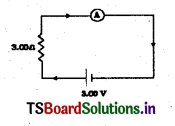
In the circuit, the current is to be measured. What is the value of the current if the ammeter shown
(a) is galvanometer with a resistance RG = 60.000Ω
(b) is a galvanometer described in (a) but converted to an ammeter by a shunt resistance rs = 0.02 Ω
(c) is an ideal ammeter with zero resistance?
Solution:
(a) Total resistance in the circuit is RG + 3 = 63 Ω
∴ I = \(\frac{3}{63}\) = 0.048 A
(b) Resistarrce of the galvanometer converted to an ammeter = \(\frac{\mathrm{R}_{\mathrm{G}} \mathrm{r}_{\mathrm{s}}}{\mathrm{R}_{\mathrm{G}}+\mathrm{r}_{\mathrm{s}}}=\frac{60 \times 0.02}{(60+0.02)}\) = 0.02Ω
Total resistance in the circuit 0.02Ω + 3Ω = 3.02Ω
∴ I = \(\frac{3}{3.02}\) = 0.99A
(c) For the ideal ammeter with zero resistance, I = \(\frac{3}{3}\) = 1A
Exercise Problems
Question 1.
What is the magnetic field at the center of a circular wire of radius 2 cm if it carries an electric current 1A?
Solution:
Given current I = 1 A; Radius R – 2cm – 0.02m, we know μ0 = 4π × 10-7
Magnetic induction B = \(\frac{\mu_0 \mathrm{I}}{2 \mathrm{R}}=\frac{4 \pi \times 10^{-7} \times 1}{2 \times 0.02}\) = π × 10-5 = 3.14 π × 10-5 T
Question 2.
What is the magnetic field inside the solenoid of length 1mm and having 104 turns and carrying a current 2A?
Solution:
Length of the solenoid l = 1 mm = 10-3m, Number of turns N = 104, Current I = 2A
Permeability μ0 = 4π × 10-7 Tm/A
Number of turns per unit length n =\(\frac{\mathrm{N}}{l}=\frac{10^4}{10^{-3}}\) = 107
∴ Magnetic Induction B = μ0nI = 4π × 10-7 × 107 × 2 = 8πT
Question 3.
A coil of area 10-2m2 and contains 106 turns is used in a galvanometer. What is the maximum torque on it if the galvanometer carrying a current of 10-4 A is placed in a magnetic field of 102 T?’
Solution:
Given area of the coil A = 10-2m2, Number of turns N = 106, Current I = 10-4 A
Magnetic induction B = 102T, Torque will be maximum when θ = 90° ⇒ sin 90°= 1
Torque = BIAN sinθ
Maximum torque, 𝜏max = BIAN = 102 ×10-4 × 10-2 × 106 = 100 Nm
Question 4.
A Moving coil galvanometer, having a resistance of I ohm can measure a current 10 A. What Is the resistance of shunt required to measure a current 1A?
Solution:
Given galvanometer, resistance RG = 1Ω, Current through galvanometer IG = 10-6 A,
Current to be measured, I = 1A, rs = ?
ShuntResistance rs = \(\frac{I_G R_G}{I-I_G}=\frac{10^{-6} \times 1}{1-10^{-6}}\) ≈ 10-6Ω (∵ 1 – 10-6 ≈ 1)
Question 5.
A current of 5A flows through each of two parallel long wires, the wires are 2.5 cms apart. Calculate the force acting per unit length of each wire.
Solution:
Current in each wire I1 = I2 = 5A
Distance between the wires r = 2.5 cm = 0.025 m. Also μ0 = 4π × 10-7
Force per unit length = \(\frac{\mathrm{F}}{l}=\frac{\mu_0 \mathrm{I}_1 \mathrm{I}_2}{2 \pi \mathrm{r}}=\frac{\left[4 \pi \times 10^{-7}\right][5][5]}{2 \pi(0.025)}\) = 2 × 10⁻⁴ Nm-1
Question 6.
A Moving coil galvanometer is placed in a radial magnetic field of 0.2T. The galvanometer coil has 200 turns and area of 1.6 × -4 m2 the torsion constant at the suspension fibre is 10-6 Nm/deg. Determine the maximum current that can be measured by this galvanometer, if its scale can accomodate a deflection of 45°.
Solution:
Magnetic induction B = 0.2T, Number of turns N = 200, Area of the coil A = 1.6 × -4 m2
Torsion constant K = 10-6 Nm/deg, Maximum deflection 0 = 45°
For MCG at equilibrium, deflecting torque = restoring torque
⇒ BIAN = Kθ
Maximum current Imax = \(\frac{\mathrm{K} \theta}{\mathrm{BAN}}=\frac{10^{-6} \times 45^{\circ}}{0.02 \times 1,6 \times 10^{-4} \times 200}\) = 0.007 = 7 mA
Question 7.
A shunt of 6 Ω is connected across a galvanometer of resistance 29 Ω . Find the fraction of the total current passing through the galvanometer.
Solution:
Given Shunt resistance S = 6 Ω galvanometer resistance G = 294 Ω :
Fraction of total current \(\frac{I_G}{I}=\frac{S}{G+S}=\frac{6}{294+6}=\frac{6}{300}=\frac{1}{50}\)
Question 8.
A galvanometer with a coil of resistance 12 Ω shows full scale deflection for a current 2.5 Ω. How will you convert the galvanometer into (a) an ammeter of range 0 to 7.5A (b) a voltmeter of range 0 to 10V?
Solution:
Given resistance of Galvanometer G = 12Ω,
Full scale current deflection IG = 2.5mA = 2.5 × 10⁻³ A
a) Range of ammeter is from 0 to 7.5A ⇒ A= 7.5
Shunt S = \(\frac{\mathrm{I}_{\mathrm{g}} \mathrm{G}}{\mathrm{I}-\mathrm{I}_{\mathrm{g}}}=\frac{2.5 \times 10^{-3} \times 12}{7.5-\left[2.5 \times 10^{-3}\right]}=\frac{0.03}{7.4975}\) = 0.004 Ω
To convert a galvanometer into a 7.5 ammeter, connect a 4 mΩ resistor in parallel.
b) Range of voltmeter is from 0 to 10V ⇒ V = 10
V = IG(G + R) ⇒ R = \(\frac{V}{I_G}\) – G = \(\left[\frac{10}{2.5 \times 10^{-3}}\right]\) – 12 = 4000 – 12 = 3988 Ω
To convert a galvanometer into a 10V voltmeter, connect a 3988Ω resistor in series.
Objective Questions
Question 1.
The magnetic induction at the centre of a current carrying circular coil of radius 10cm is 5\(\sqrt{5}\) times the magnetic induction at a point on its axis, the distance of the point from the centre of the coil in cm is
1) 5
2) 10
3) 20
4) 25
Answer:
3) 20
Question 2.
A long straight wire carries an electric current of 2A. The magnetic induction at a perpendicular distance of 5m from the wire will be
1) 4 × 10⁻⁸T
2) 8 × 10⁻⁸T
3) 12 × 10-8T
4) 16 × 10-8T
Answer:
2) 8 × 10⁻⁸T
Question 3.
Two parallel wires of length 9m each, are separated by a distance of 0.15m. If they carry equal currents in the same direction and exert a total force of 30 × 10-7N on each other, the value of the current must be
1) 1.5 Amperes
2) 2.25 Amperes
3) 0.5 Ampere
4) 0.25 Amperes
Answer:
3) 0.5 Ampere
Question 4.
An electric current passes through a long straight wire. At a distance 5cm from the wire, the magnetic field is B. The field at 20cm from the wire would be
1) 2B
2) B/4
3) B/2
4) B
Answer:
2) B/4
Question 5.
In a galvanometer 5% of the total current in the circuit passes through it. If the resistance of the galvanometer is G, the shunt resistance ‘S’ connected to the galvanometer is
1) 19G
2) \(\frac{\mathrm{G}}{19}\)
3) 20G
4) \(\frac{\mathrm{G}}{20}\)
Answer:
2) \(\frac{\mathrm{G}}{19}\)
Question 6.
A particle of mass 0.6gm and having charge of 25nC is moving horizontally with a uniform velocity 1.2xl04ra/s in a uniform magnetic field, then the value of the magnetic induction is
1) 0
2) 10T
3) 20T
4) 200T
Answer:
3) 20T
Question 7.
An electron remains undeflected when passing perpendicular to mutually perpendicular electric and magnetic fields. If the magnetic field is 8 Gauss and the electric field is 4000V/m, the velocity of the electron is
1) 2 × 10⁻⁶m/s
2) 5.0 × 10⁻⁶m/s
3) 6 × 10⁻⁶m/s
4) 7.55 × 10⁻⁶m/s
Answer:
2) 5.0 × 10⁻⁶m/s
Question 8.
In the product
\(\vec{F}=q(\vec{v} \times \vec{B})=q \vec{v} \times\left(B \hat{i}+B \hat{j}+B_0 \hat{k}\right)\) For q = 1 and \(\vec{v}=2 \hat{i}+4 \hat{j}+6 \hat{k}\) and \(\vec{\mathrm{F}}=4 \hat{\mathrm{i}}-20 \hat{\mathrm{j}}+12 \hat{\mathrm{k}}\) What will be the complete expression for g ?
1) \(6 \hat{\mathrm{i}}+6 \hat{\mathrm{j}}-8 \hat{\mathrm{k}}\)
2) \(-8 \hat{\mathrm{i}}-8 \hat{\mathrm{j}}-6 \hat{\mathrm{k}}\)
3) \(-6 \hat{\mathrm{i}}-6 \hat{\mathrm{j}}-8 \hat{\mathrm{k}}\)
4) \(8 \hat{\mathrm{i}}+8 \hat{\mathrm{j}}-6 \hat{\mathrm{k}}\)
Answer:
3) \(-6 \hat{\mathrm{i}}-6 \hat{\mathrm{j}}-8 \hat{\mathrm{k}}\)
Question 9.
A charge q moves in a region where electric field and magnetic field both exist, then force on it is
1) \(q(\vec{v} \times \vec{b})\)
2) \(q \vec{E}+q(\vec{v} \times \vec{B})\)
3) \(q \vec{E}+q(\vec{B} \times \vec{v})\)
4) \(q \vec{B}+q(\vec{E} \times \vec{v})\)
Answer:
2) \(q \vec{E}+q(\vec{v} \times \vec{B})\)
Question 10.
Tesla is the unit of
1) electric field
2) magnetic field
3) electric flux
4) magnetic flux
Answer:
2) magnetic field
Question 11.
An electron having mass m and kinetic energy E enter in uniform magnetic field B perpendicularly, then its frequency will be
1) eE/qvB
2) 2πm/eB
3) eB/2πm
4) 2m/eBE
Answer:
3) eB/2πm
Question 12.
A 10 eV electron is circulating in a plane at right angles to a uniform field at magnetic induction 10-4 Wb/m2 (= 1.0 gauss), the orbital radius of electron is 1) 11 cm
2) 18 cm
3) 12 cm
4) 16 cm
Answer:
1) 11 cm
Question 13.
A particle of mass m, charge Q and kinetic energy T enters in a transverse uniform magnetic field of induction \(\vec{\mathrm{B}}\). After 3 seconds the kinetic energy of the particle will be
1) T
2) 4T
3) 3T
4) 2T
Answer:
1) T
Question 14.
A beam, of electron passes undeflected through mutually perpendicular electric and magnetic fields. If the electric field is switched off, and the same magnetic field is maintained, the electrons move
1) in a circular orbit
2) along a parabolic path
3) along a straight line
4) in an elliptical orbit
Answer:
1) in a circular orbit
Question 15.
A beam of electrons is moving constant velocity in a region having electric and magnetic fields of strength 20 Vm-1 and 0.5T at right angles to the direction of motion of the electrons. What is the velocity of the electrons?
1) 8 ms-1
2) 5.5 ms-1
3) 20 ms-1
4) 40 ms-1
Answer:
4) 40 ms-1
Question 16.
Charge q is uniformly spread on a thin ring of radius R. The ring rotates about its axis with a uniform frequency f Hz. The magnitude of magnetic induction at the center of the ring is
1) \(\frac{\mu_0 q f}{2 \pi R}\)
2) \(\frac{\mu_0 q f}{2 R}\)
3) \(\frac{\mu_0 \mathrm{q}}{2 \mathrm{fR}}\)
4) \(\frac{\mu_0 \mathrm{q}}{2 \pi \mathrm{f}}\)
Answer:
2) \(\frac{\mu_0 q f}{2 R}\)
Question 17.
A current loop consists of two identical semicircular parts each of radius R, one lying in the x-y plane and the other in x- z plane. If the current in theloop is i. The resultant magnetic field due to the two semicircular parts at their common centre is
1) \(\frac{\mu_0 \mathrm{i}}{2 \sqrt{2} \mathrm{R}}\)
2) \(\frac{\mu_0 \mathrm{i}}{2 \mathrm{R}}\)
3) \(\frac{\mu_0 \mathrm{i}}{4 \mathrm{R}}\)
4) \(\frac{\mu_0 \mathrm{i}}{\sqrt{2} \mathrm{R}}\)
Answer:
1) \(\frac{\mu_0 \mathrm{i}}{2 \sqrt{2} \mathrm{R}}\)
Question 18.
A long straight wire of radius a carries a steady current I. The current is uniformly distributed over its cross¬section. The ratio of the magnetic fields B and B’, at radial distances a/2 and 2a respectively, from the axis of the wire is
1) 1
2) 4
3) 1/4
4) 1/2
Answer:
1) 1
Question 19.
The magnetic field at a distance r from a long wire carrying current i is 0.4 tesla. The magnetic field at a distance 2r is
1) 0.2 tesla
2) 0.8 tesla
3) 0.1 tesla
4) 1.6 tesla
Answer:
1) 0.2 tesla
Question 20.
A long solenoid 50 cm length having 100 turns carries a current of 2.5 A. The magnetic field at the centre of.the solenoid is (μ0 = 4π × 10-7 T m A-1)
1) 6.28 × 10⁻⁴T
2) 3.14 × 10⁻⁴T
3) 6.28 × 10⁻⁵T
4) 3.14 × 10⁻⁵T
Answer:
1) 6.28 × 10⁻⁴T
Question 21.
A long solenoid carrying a current produces a magnetic field B along its axis. If the current is doubled and the number of turns per cm is halved, the new value of the magnetic field is
1) B/2
2) B
3) 2B
4) 4B
Answer:
2) B
Question 22.
Two long parallel wires are at a distance of 1 metre. Both of them carry one ampere of current. The force of attraction per unit length between the two wires is
1) 5 × 10⁻⁸N/m
2) 2 × 10⁻⁸ N/m
3) 2 × 10⁻⁷N/m
4) 10-7 N/m
Answer:
3) 2 × 10⁻⁷N/m
Question 23.
Two parallel wires in free space are 10cm apart and each carries a current of 10 A in the same direction. The force exerted by one wire on the other, per metre length is
1) 2 × 10⁻⁴ N, repulsive
2) 2 × 10⁻⁷N, repulsive
3) 2 × 10⁻⁴ N, attractive
4) 2 × 10⁻⁷N, attractive.
Answer:
3) 2 × 10⁻⁴ N, attractive
Question 24.
If number of turns, area and current through a coil is given by n. A and i respectively then its magnetic moment will be
1) niA
2) n2iA
3) niA2
4) ni/\(\sqrt{\mathrm{A}}\)
Answer:
1) niA
Question 25.
A circular loop of area 0.01 m2 carrying a current 10 A, is held perpendicular to a magnetic field of intensity 0.1 T. The torque acting on the loop is
1) 0.001 Nm
2) 0.8 N m
3) zero
4) 0.01 N m.
Answer:
3) zero
Question 26.
A coil carrying electric current is placed in uniform magnetic field
1) torque is formed
2) e.m.f is induced
3) both (1) and (2) are correct
4) none of these
Answer:
1) torque is formed
Question 27.
In an ammeter 0.2% of main current passes through the galvanometer. If resistance of galvanometer is G, the resistance of ammeter will be
1) 1/499 G
2) 499/500 G
3) 1/500 G
4) 500/499 G
Answer:
3) 1/500 G
Question 28.
A galvanometer of resistance, G, is shunted by a resistance S ohm. To keep the main current in the circuit unchanged, the resistance to be put in series with the galvanometer is
1) \(\frac{\mathrm{G}}{(\mathrm{~S}+\mathrm{G})}\)
2) \(\frac{S^2}{(S+G)}\)
3) \(\frac{S G}{(S+G)}\)
4) \(\frac{G^2}{(S+G)}\)
Answer:
4) \(\frac{G^2}{(S+G)}\)
Question 29.
To convert a galvanometer into a voltmeter one should connect a
1) high resistance in series with galvanometer
2) low resistance in series with galvanometer
3) high resistance in parallel with galvanometer
4) low resistance in parallel with galvanometer.
Answer:
1) high resistance in series with galvanometer
Question 30.
A galvanometer having a resistance of 9 ohm is shunted by a wire of resistance 2 ohm. If the total current is 1 amp, the part of it passing through the shunt will be
1) 0.2 amp
2) 0.8 amp
3) 0.25 amp
4) 0.5 amp
Answer:
2) 0.8 amp
Question 31.
To convert a galvanometer into a ammeter, one needs to connect a
1) low resistance in parallel
2) high resistance in parallel
3) low resistance in series
4) high resistance in series.
Answer:
1) low resistance in parallel