
Regular practice with AP Inter 2nd Year Physics Study Material Chapter 6 Electromagnetic Induction Questions and Answers helps students stay prepared for examinations.
AP Inter 2nd Year Physics 6th Lesson Electromagnetic Induction Questions and Answers
I. Multiple Choice Questions
Question 1.
Faraday’s law of electromagnetic induction states that the induced emf is proportional to:
1) the rate of change of magnetic flux
2) the absolute value of the magnetic field
3) the distance between coils
4) the square of the current
Answer:
1) the rate of change of magnetic flux
From Faraday’s second law emf e = -N \(\frac{d \phi}{d t}\) ⇒ e ∝ \(\frac{d \phi}{d t}\) = Rate of change in flux.
Question 2.
Lenz’s law is a consequence of which principle?
1) Conservation of energy
2) Newton’s first law
3) Coulomb’s law
4) Ohm’s law
Answer:
1) Conservation of energy
Lenz’s Law is a consequence of Law of conservation of energy.
Question 3.
A conducting loop is rotated in a uniform magnetic field. The induced emf will be maximum when the plane of the loop is:
1) parallel to the magnetic field
2) perpendicular to the magnetic field
3) at 45° to the magnetic field
4) at any angle
Answer:
1) parallel to the magnetic field
Induced emf in a rotating loop is e = NB Asinθ where θ is the angle between the normal to the loop and the magnetic field. The emf is maximum when sinθ = 1 ⇒ θ = 90°. That means the normal to the loop is perpendicular to the field, so the plane of the loop is parallel to the magnetic field.
Question 4.
The SI unit of self inductance is:
1) Tesla
2) Weber
3) Ampere
4) Henry
Answer:
4) Henry
Units of Self Induction : Henry.

Question 5.
A coil of 500 turns and area of 0.01 m2 is placed perpendicular to magnetic field. If the magnetic field changes uniformly from 0 to 0.5 T in 0.1 s, what is the average emf induced?
1) 0.25 V
2) 2.5 V
3) 25 V
4) 50 V
Answer:
3) 25 V
N = 500, A = 0.01m2 = 1 × 10⁻²m2, \(\frac{\mathrm{dB}}{\mathrm{dt}}=\frac{0.5}{0.1}\) = 5 Emf e = NA\(\frac{\mathrm{dB}}{\mathrm{dt}}\) = 500 × 10-2 × 5 = 25N
Question 6.
Mutual induction between two coils does not depend on:
1) number of tons in both coils
2) cross sectional area of coils
3) magnetic permeability of medium between them
4) current flowing through the coils
Answer:
4) current flowing through the coils
Mutual inductance is a material property.
So, it does not depend on the current flowing through the coils.
Question 7.
In electromagnetic induction, the direction of induced current is such that it opposes the cause of its production. This is known as:
1) Kirchhoff’s law
2) Lenz’s law
3) Ampere’s law
4) Biot-Savart’s law
Answer:
2) Lenz’s law
Lenz’s law explains the negative sign in Faraday’s law equation, indicating that the system maintain the status of the magnetic flux.
Question 8.
A metal rod moves perpendicular to a uniform magnetic field. The emf induced is given by:
1) ε = B/v
2) ε = B l / v
3) ε = B l2 v
4) ε = B v2 l
Answer:
When a conductor of length l moves with a velocity v, perpendicular to magnetic field B then emf across the conductor is ε = BlN
Question 9.
A change in magnetic flux of 0.3 Wb in 0.1 s produces an average emf of:
1) 0.03 V
2) 3 V
3) 30 V
4) 300 V
Answer:
2) 3 V
Emf ε = \(\frac{d \phi}{d t}=\frac{0.3}{0.1}\) = 3V
Question 10.
If the flux linkage in a coil changes from 2 Wb to 8 Wb in 0.5 s, the average emf induced is:
1) 10V
2) 12 V
3) 6 V
4) 4 V
Answer:
2) 12 V
Emf e = \(\frac{d \phi}{d t}=\frac{6}{0.5}\) = 12V
Question 11.
The direction of induced current in a loop moving into a magnetic field is such that it:
1) enhances the magnetic field
2) opposes the relative motion
3) has no relation to the field
4) always flows clockwise
Answer:
2) opposes the relative motion
According to lenz’s law, the induced current will create a magnetic force that acts in the opposite direction of the loops motion to resist the change in flux.
II. Fill in the Blanks
Question 1.
According to Faraday’s law, the induced emf in a coil is directly proportional to the __________ of the magnetic flux.
Answer:
rate of change
From Faraday’s second law emf e = -N\(\frac{d \phi}{d t}\) ⇒ e ∝ \(\frac{d \phi}{d t}\) = Rate of change in flux.
Question 2.
Lenz’s law states that the direction of the induced current is such that it opposes the ___________ that causes it.
Answer:
change of magnetic flux
If the magnetic flux increases, the induced current creates a field to decrease it.
If it decreases, the current tries to increase it. So induced current always opposes the change of magnetic field
Question 3.
The SI unit of magnetic flux is ________
Answer:
Weber.
SI units of Magnetic Flux is Weber (Wb)
Question 4.
The back emf in an inductor is always in the direction opposite to the __________Answer:
original emf.
Back emf is opposite to the original emf.
Question 5.
The flux linkage through a coil of N-turns is proportional to the _________ passing through the coil.
Answer:
current
Magnetic flux is created by current. Flux linkage NΦ = LI
Question 6.
Self-inductance depends on the geometry of the coil, the number of turns, and the _________ of the core material.
Answer:
permeability
Self inductance of Solenoid L = \(\frac{\mu_0 \mathrm{~N}^2 \mathrm{~A}}{l}\)
Question 7.
The average induced emf is equal to the change in magnetic flux linkage divided by the ________ during which the change takes place.
Answer:
time
Emf E = \(\frac{d \phi}{d t}\). induced emf is the result of change in flux by the time duration of that charge.
Question 8.
The direction of induced current is determined by _______ law.
Answer:
Lenz
Faraday’s law gives us the magnitude and then Lenz’s law provides the direction.
III. One Word Answer Questions
Question 1.
Which law states that the induced emf is proportional to the rate of change of magnetic flux?
Answer:
Faraday’s law of induction.
It states that the induced emf in a circuit is directly proportional to the time rate of change of magnetic flux through that circuit.
Question 2.
Which law states that the induced current opposes the change in flux that produces it?
Answer:
Lenz’s law
It states that the direction of an induced current is always such as to oppose the change that causes it.
Question 3.
Give the expression for the emf induced between the ends of a metal conductor moving perpendicular to a uniform magnetic field.
Answer:
E = Blv. Here l is the length, v is the velocity, B is the uniform magnetic field
Question 4.
What will be the dimension of L/R, if L is inductance and R is resistance.
Answer:
The dimension of L/R is T
Inductance L = [ML2T-2I-2]; Resistance R = [ML2T-3I-2]
∴ \(\frac{\mathrm{L}}{\mathrm{R}}=\frac{\mathrm{ML}^2 \mathrm{~T}^{-2} \mathrm{I}^{-2}}{\mathrm{ML}^2 \mathrm{~T}^{-3} \mathrm{I}^{-2}}\) = T
Question 5.
Why induced emf is also called back emf?
Answer:
According to Lenz’s law, the induced emf opposes the applied voltage.
Hence it is called back emf.
Question 6.
What is the working principle of a transformer?
Answer:
Transformer works on the principle of mutual inductance.
Question 7.
Why are resistance coils double wounded in opposite direction?
Answer:
To minimize/ avoid self inductance.
Question 8.
What is the change in self inductance of solenoid if iron core is inserted into solenoid?
Answer:
Inserting an iron core into a solenoid increases its self inductance L.
Question 9.
Write the expression for instantaneous value of emf in A.C generator.
Answer:
Instantaneous emf induced in an AC generator is E = NBAω sinωt
Here N is the number of turns; B is the magnetic induction.
A is the area of the coil; ω is the angular velocity
Question 10.
What is the unit of mutual inductance?
Answer:
SI unit of mutual inductance is Henry (H)
IV. Very Short Answer Questions
Question 1.
State Faraday’s law of electromagnetic induction.
Answer:
Faraday’s law: The magnitude of the induced emf in a circuit is equal to the time rate of change of magnetic flux through the circuit.
Mathematical expression: Induced emf ε = –\(\frac{\mathrm{d} \phi_{\mathrm{B}}}{\mathrm{dt}}\)
In the case of a coil of N turns, ε = – N \(\frac{\mathrm{d} \phi_{\mathrm{B}}}{\mathrm{dt}}\)
Question 2.
State Lenz’s law.
Answer:
Lenz’s Law (Neumann’s law): The polarity of induced emf is such that it tends to produce a current which opposes the change in magnetic flux.
Faraday’s law of induction: ε = –\(\frac{\mathrm{d} \phi_{\mathrm{B}}}{\mathrm{dt}}\)
The negative sign indicates Lenz’s law.
Question 3.
Define magnetic flux.
Answer:
Magnetic Flux is defined as the total number of magnetic field lines passing normally through j the given plane.
Formula: ΦB = \(\vec{\mathrm{B}} . \vec{\mathrm{A}}\) = BA cos θ. Here θ is the angle between \(\vec{\mathrm{A}}\) and \(\vec{\mathrm{B}}\) .
Magnetic flux is a scalar. Its SI unit is Tm2
Question 4.
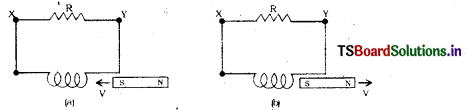
A magnet is moving towards a coil with a uniform speed ‘V’ as shown in figure (a) & (b). State the direction of induced current in the resistor ‘R’.
Answer:
According to Lenz’s law, the direction of induced current which opposes the cause of it.
a) If the magnet moves towards the coil, flux Increases.
Hence the induced current in the resistor R moves in anti-clockwise direction from Y to X.
b) If the magnet moves away from the coil, flux decreases.
Hence the induced current in the resistor R moves in clockwise direction from X to Y.
Question 5.
Write the expression for self-induced emf and explain the terms therein.
Answer:
The expression for self induced emf is ε = -L\(\frac{\mathrm{dI}}{\mathrm{dt}}\)
Here L is the self inductance, \(\frac{\mathrm{dI}}{\mathrm{dt}}\) is the rate of change of current.
Question 6.
What is self-induction?
Answer:
Self induction is the magnetic flux linked with the coil when unit current flows in it. (or)
When the current in a coil changes, an emf is induced in the coil opposing the change in the current through the coil. This phenomenon is called self induction.
∴ Φ ∝ I ⇒ Φ = LI (or) Emf = -L\(\frac{\mathrm{dI}}{\mathrm{dt}}\)
Question 7.
What is mutual induction?
Answer:
Mutual induction is defined as the flux linked with secondary coil when unit current flows through the primary coil.
(or)
When the current in one coil changes, an emf is induced in another coil kept near it. This phenomenon is called mutual inductance.
Φ ∝ I ⇒ Φ = MI (or) Emf = -M \(\frac{\mathrm{dI}}{\mathrm{dt}}\)
Question 8.
Why do birds fly off a high tension wire when the current is switched ‘ON’?
Answer:
When current is switched on, induced current flows through the body of the bird.
This induced current flows in the opposite direction through the wings of the bird.
Hence, the wings experience a force of mutual repulsion.
Thus, the wings spread and hence the birds fly due to electromagnetic induction.
Question 9.
What is the working principle of A.C. generator?
Answer:
AC generator works on the piinciple of electromagnetic induction.
The AC generator converts mechanical energy into electrical energy by rotating a coil with in a magnetic field, which changes the magnetic flux and induces an alternating emf.
Question 10.
Why is spark produced in the switch of a fan when it is switched oft?
Answer:
A fan motor contains coils of high inductance. When the fan is switched off, the current drops to zero rapidly. This sudden change induces a very high back emf (voltage) across the switch contacts.This high voltage is strong enough to ionize the air in the small gap of the switch, resulting in a visible spark.
Question 11.
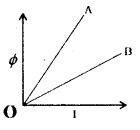
A plot of magnetic flux (Φ) versus current (I) is shown in Figure for two inductors A and B. Which of the two has larger value of’seif induction. State the reason.
Answer:
In the given graph, slope of the line represents self inductance (L).
Slope = \(\frac{\phi}{I}\) = L
In the graph, slope of line OA is greater than the slope of the line OB.
Hence, the self inductance of A is greater than the self inductance of B. Thus LA > LB
V. Short Answer Questions
Question 1.
Explain the Faradays law of induction and Lenz’s law.
Answer:
Faraday’s law of Electromagnetic Induction : The magnitude of the induced emf in a circuit is equal to the time rate of change of magnetic flux through the circuit.
Mathematically, the induced emf is given by ε = –\(\frac{d \phi_B}{d t}\)
In the case of a coil of N turns, ε = – N \(\frac{d \phi_B}{d t}\)
Lenz’s Law(Neumann’s law) : The polarity of induced emf is such that it tends to produce a current which opposes the change in magnetic flux.
Faraday’s law of induction is ε = –\(\frac{d \phi_B}{d t}\)
The negative sign in it indicates Lenz’s law.
Question 2.
Derive an expression for motional emf induced across the conductor moving perpendicular to uniform magnetic field.
Answer:
Induced emf due to motion of a conductor in a magnetic field:
Consider a rectangular conductor PQRS suspended in a uniform magnetic field B which is perpendicular to the plane of the system. The conductor PQ is free to move. Suppose, the conductor PQ is moved towards left with velocity v.
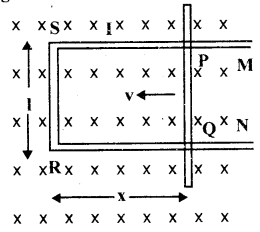
Let RQ = x, RS = l.
Then the magnetic flux enclosed by the loop PQRS is ΦB = B l x
The induced emf is given by ε = – \(\frac{d \phi_B}{d t}\) = – \(\frac{d}{d t}\) (B l x) ⇒ ε = – B l \(\frac{d x}{d t}\)
But \(\frac{d x}{d t}\) = -v
Thus the induced emf in a conductor moving in a perpendicular and uniform magnetic field is given by ε = B l v
Question 3.
Obtain an expression for the mutual inductance of two long co-axial solenoids.
Answer:
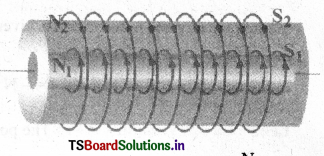
Mutual Inductance is the phenomenon where a changing current in one coil induces an EMF in a nearby secondary coil.
Mutual induced emf ε = -M \(\frac{\mathrm{di}}{\mathrm{dt}}\), here M is mutual inductance of the coils.
Expression for mutual induction:
Consider two co-axial solenoids S1, S2 each of length l. Let A be the common cross¬section area of solenoids. Let N1 and N2 be the total number of turns in the solenoids S1 and S2 .
When current I1 is passing through solenoid S1, Magnetic field produced is B1 = μ0\(\frac{\mathrm{N}_1}{l}\)I1 ………. (1)
Magnetic flux linked with each turn of solenoid S2 is B1 A = (μ0\(\frac{\mathrm{N}_1}{l}\)I1)A
∴ Total magnetic flux linked with N2 turns of solenoid S2 is, Φ2 = (B1 A)N2
=* Φ2 = (μ0\(\frac{\mathrm{N}_1}{l}\)I1) N2 = \(\frac{\mu_0 \mathrm{~N}_1 \mathrm{~N}_2 \mathrm{I}_1 \mathrm{~A}}{l}\) …………. (2)
Now total magnetic flux linked with N2 turns of solenoid S2 is Φ2 = M12I1 ………… (3)
where M12 is mutual inductance of S1 with respect to S2
From eq (2) and eq (3) we get, M12 I1 = \(\frac{\mu_0 \mathrm{~N}_1 \mathrm{~N}_2 \mathrm{I}_1 \mathrm{~A}}{l}\) ⇒ M12 = \(\frac{\mu_0 \mathrm{~N}_1 \mathrm{~N}_2 \mathrm{~A}}{l}\) ………… (4)
Let n1, n2 be the number of turns per unit length of the solenoids S1, S2
∴ M12 = μ0n1n2lA ………….. (5) (∵ n1 = \(\frac{\mathrm{N}_{1}}{l}\) , n2 = \(\frac{\mathrm{N}_{2}}{l}\) )
Similarly, mutual inductance of solenoid S2 with respect to S1 is M21 = μ0n1n2lA ………. (6)
Comparing eq (5) and eq (6), we get M21 = M12
∴ Mutual inductance of two long coaxial solenoids, M = μ0n1n2lA
Question 4.
Obtain an expression for the magnetic energy stored in a solenoid in terms of the magnetic field, area and length of the solenoid.
Answer:
Magnetic Energy stored in a Solenoid:
The energy required to build up the current in a solenoid is given by U = \(\frac{1}{2}\) LI2 ……….. (1)
where L is the self inductance of the solenoid. 2
Self inductance of a solenoid is given by L = μ0n2 A l …………. (2)
here n is number of turns per unit length, A is area of cross section, l is length of the solenoid.
Substituting eq (2) in eq (1), we get U = \(\frac{1}{2}\) (μ0 n2 A l)I2 ………….. (3)
Magnetic induction inside a solenoid is B = μ0 n I ⇒ I = B/μ0 n …………. (4)
Putting this in eq (3), we get U= \(\frac{1}{2}\) (μ0 n2 A l) \(\frac{B^2}{\mu_0{ }^2 n^2}\) = \(\frac{1}{2 \mu_0}\) B2 Al
This is the expression for magnetic energy stored in a solenoid.
Question 5.
Explain briefly working of AC generator.
Answer:
AC Generator : AC generator converts mechanical energy into electrical energy.
Construction:
AC generator consists of a coil mounted on a rotor shaft. The axis of rotation of the coil is perpendicular to the direction of the magnetic field. The coil (called armature) is mechanically rotated in the uniform magnetic field by some external means. The rotation of the coil causes the magnetic flux through it to change, so that an emf is induced in the coil. The ends of the coil are connected to an external circuit by means of slip rings and brushes.
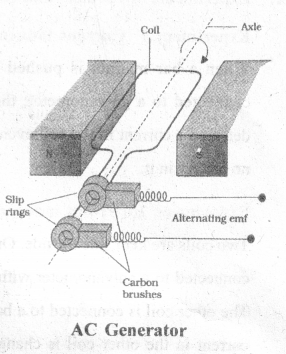
Working:
When the coil is rotated with a constant angular speed ω, θ = ωt.
where θ is the angle between vector area A and the magnetic field B at given time t.
The flux at time t is given by ΦB = BA cos θ = BA cos ωt (∵ θ = ωt)
From Faraday’s law, the induced emf is ε = – N\(\frac{d \phi_B}{d t}\) = -N\(\frac{d}{d t}\)(BAcosωtt)
= -NBA \(\frac{d}{d t}\) (cos ωt)= -NBA (-sin ωt)(ω) = NBA ω sin ωt. dt
Thus the instantaneous emf is ε = NBA ω sin ωt.
Here, NBAω = εm = maximum emf.
∴ ε = εm sin ωt (∵ εm = NBAω)
Hence the voltage produced by the generator is Sinusoidal.
VI. Long Answer Questions
Question 1.
Outline the path-breaking experiments of Faraday and Henry and highlight the contributions of these experiments to our understanding of electromagnetism.
Answer:
Experiments of Faraday and Henry:
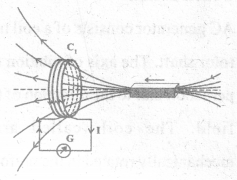
Experiment 1 (Current induced by magnet):
When a bar magnet is pushed towards a coil connected to a galvanometer, the galvanometer detected a current in the coil even though there is no battery in it.
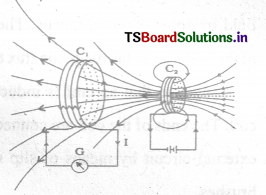
Experiment 2(Current induced by current) :
Two coils are kept side by side. One of the coils is connected to a galvanometer without any battery.
The other coil is connected to a battery. When the current in the other coil is changed, a current is detected in the first coil.
Experiment 3 (Current induced by change in current) : Two coils are kept side by side. One of the coils is connected to a galvanometer without any battery. The other coil is connected to a battery with a key in series. When the key is closed or opened, a momentary current is detected in the first coil.
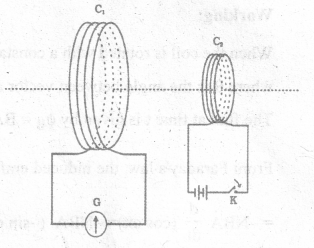
The common factor in all the above three experiments is that whenever the magnetic flux passing through the coil changes, a current is induced in it.
Basing on the results of these experiments, Faraday concluded that the induced emf in a coil is directly proportional to negative rate of change of magnetic flux passing through the coil.
∴ ε = –\(\frac{d \phi_B}{d t}\)
Question 2.
Describe the working of an AC generator with the aid of a simple diagram and necessary expressions.
Answer:
AC Generator : AC generator converts mechanical energy into electrical energy.
Construction:
AC generator consists of a coil mounted on a rotor shaft. The axis of rotation of the coil is perpendicular to the direction of the magnetic field. The coil (called armature) is mechanically rotated in the uniform magnetic field by some external means. The rotation of the coil causes the magnetic flux through it to change, so that an emf is induced in the coil. The ends of the coil are connected to an external circuit by means of slip rings and brushes.
Working:
When the coil is rotated with a constant angular speed ω, θ = ωt.
where θ is the angle between vector area A and the magnetic field B at given time t.
The flux at time t is given by ΦB = BA cos θ = BA cos ωt (∵ θ = ωt)
From Faraday’s law, the induced emf is ε = – N\(\frac{d \phi_B}{d t}\) = -N\(\frac{d}{d t}\)(BAcosωtt)
= -NBA \(\frac{d}{d t}\) (cos ωt)= -NBA (-sin ωt)(ω) = NBA ω sin ωt. dt
Thus the instantaneous emf is ε = NBA ω sin ωt.
Here, NBAω = εm = maximum emf.
∴ ε = εm sin ωt (∵ εm = NBAω)
Hence the voltage produced by the generator is Sinusoidal.
Textual Solved Problems
Question 1.
A square loop of side 10 cm and resistance 0.5 Ω is placed vertically in the east-west plane. A uniform magnetic field of 0.10 T is set up across the plane in the north-east direction. The magnetic field is decreased to zero in 0.70 s at a steady rate. Determine the magnitudes of induced emf and current during this time-interval.
Solution:
The angle θ made by the area vector of the coil with the magnetic field is 45°
The initial magnetic flux is Φ = BA cos θ = \(\frac{0.1 \times 10^{-2}}{\sqrt{2}}\) Wb
Final flux, θmin = 0
The change in flux is brought about in 0.70s.
Induced emf ε = \(\frac{|\Delta \phi|}{\Delta \mathrm{t}}=\frac{|\phi-0|}{\Delta \mathrm{t}}=\frac{10^{-3}}{\sqrt{2} \times 0.7}\) = 1.0 mV
Magnitude of current I = \(\frac{\varepsilon}{R}=\frac{10^{-3}}{0.5}\) = 2 mA
Question 2.
A circular coil of radius 10 cm, 500 turns and resistance 2 Ω is placed with its plane perpendicular to the horizontal component of the earth’s magnetic field. It is rotated about its vertical diameter through 180° in 0.25 s. Estimate the magnitudes of the emf and current induced in he coil. Horizontal component of the earth’s magnetic field at the place is 3.0 × 10⁻⁵ T.
Solution:
Initial flux through the coil, ΦB(initial) = BA cos θ = 3.0 × 10⁻⁵ × (π × 10-2) × cos0° = 3π × 10-7 Wb
Final flux after the rotation ΦB(final) = 3.0 × 10⁻⁵ × (π × 10-2) × cos 180° = -3π × 10-7 Wb
∴ Estimated value of the induced emf is,
ε = NA\(\frac{\Delta \phi}{\Delta \mathrm{t}}=\frac{500 \times\left(6 \pi \times 10^{-7}\right)}{0.25}\) = 3.8 × 10⁻³ V = 3.8 mV
Magnitude of current I = \(\frac{\varepsilon}{R}=\frac{3.8 \times 10^{-3}}{2}\) = 1.9 mA
Question 3.
A wheel with 10 metallic spokes each 0.5 in long is rotated with a speed of 120 rev/min in a plane normal to the horizontal component of earth’s magnetic field HE
at a place. If HE = 0.4 G at the placee what is the induced emf between the axle and the rim of the wheel? [Note that 1 G = 10-4 T]
Solution:
Induced emf ε = \(\frac{1}{2}\)ωBR2 = \(\frac{1}{2}\) × 4π × 0.4 × 10-4 × (0.5)2 = 6.28 × 10⁻⁵ V
The number of spokes is immaterial because the emf is across the spokes are in parallel.
Exercise Problems
Question 1.
Find the magnetic flux linked with a rectangular coil of size 6 cm × 8 cm placed at right j angles to a magnetic field of 0.5 wb/ m2
Solution:
Given Length l = 6cm = 0.06m, width b = 8cm = 0.08m, Magnetic induction B = 0.5 Wb/m2.
Area A = l x b = 0.06 × 0.08 = 0.0048m2
If the coil is perpendicular to the field, the normal is parallel to the field. So, 0 = 0°.
Magnetic flux Φ = BA cos θ = (0.5) (0.0048) cos0° = 0.0024 = 2.4 × 10⁻³ Wb
Question 2.
A small metal piece of metal wire is dragged across the gap between pole pieces of a magnet in 0.5 s. The magnetic flux between the pole pieces is known to be 8 × 10⁻⁴ wb. Estimate the emf induced in the wire.
Solution:
Change in magnetic flux ∆Φ = 8 × 10⁻⁴ wb, Time interval ∆t = 0.5 s
∴ Induced emf ε = \(\frac{\Delta \phi}{\Delta \mathrm{t}}=\frac{8 \times 10^{-4}}{0.5}\) = 16 × 10-4 = 1.6 × 10⁻³V
Question 3.
A circular coil of area 300 cm2 and 25 turns rotates about its vertical diameter with an angular speed of 40 rad/s in a uniform horizontal magnetic field of magnitude 0.05T. Obtain the maximum voltage induced in the coil.
Solution:
Given number of turns N = 25, Area A = 300cm2 = 0.03 m2, Angular speed ω = 40 rad/s
Induction B = 0.05T
The maximum induced voltage Emax = NBAω = 25 × 0.05 × 0.03 × 40 = 1.5V
Question 4.
An air craft with a wing span of 40m flies with a speed of 1080 Km/h in the eastward direction at a constant altitude in the northern hemisphere, where the vertical component of earth’s magnetic field is 1.75 × 10⁻⁵ T . Find the emf that develops between the tips of the wings.
Solution:
The speed of air craft v= 1080 km/h = \(\frac{1080 \times 5}{18}\) = 300m / s; wing span L = 40m
Vertical component of magnetic field Bv = 1.75 × 10⁻⁵ T
∴ Induced emf ε = BvVL = 1.75 × 10-5 × 300 × 40= 0.21V
Question 5.
If a rate of change of current of 4 A/s induces an emf of 20 mV in a solenoid. What is the self-inductance of the solenoid.
Solution:
Rate of change of current \(\frac{\mathrm{dI}}{\mathrm{dt}}\) = 4A/s; Induced emf ε = 20mV = 20 × 10-3 V
Formula: ε = L\(\frac{\mathrm{dI}}{\mathrm{dt}}\) ⇒ L = \(\frac{\varepsilon}{(\mathrm{di} / \mathrm{dt})}=\frac{20 \times 10^{-3}}{4}\) = 5 × 10⁻³V = 5 mH
Question 6.
The mutual inductance of two coaxial coils is 2H. The current in one coil is changed uniformly from zero to 0.5A in 100 ms. Find the (a) change in magnetic flux through the other coil (b) emf induced in the other coil during the change.
Solution:
Given Mutual inductance M = 2H, Change in current ∆I = 0.5 – 0 = 0.5A,
Time interval ∆t = 100ms = 100 × 10-3 s = 0.1 s
(a) Change in magnetic flux ∆Φ = M ∆I = 2 x 0.5 = 1 Wb.
(b) Emf induced in the other coil ε = M\(\frac{\mathrm{M}}{\mathrm{At}}\) = 2 × \(\frac{0.5}{0.1}=\) = 10V
Question 7.
If the self-inductance of an air core inductor increases from 0.01 m H to 10 m H on introducing an iron core into it. What is the relative permeability of the core used.
Solution:
Lair = 0.01 mH; Lcore = 10mH
Relative permeability μr = \(\frac{\mathrm{L}_{\text {core }}}{\mathrm{L}_{\text {air }}}=\frac{10}{0.01}\) = 1000.
Question 8.
A metallic wire 1m in length is moving normally across a magnetic field of 0.1 T with a speed of 5 m/s. Find the emf induced between the ends of the wire.
Solution:
Length of the wire L = 1 m, Magnetic induction B = 0.1 T
Speed v = 5m/s, Angle θ = 90° (the wire moves normal to the field)
The induced emf E = BLV sinθ = 0.1 × 1 × 5 × sin90° = 0.5 V
Objective Questions
Question 1.
A circular disc of radius 0.2 meter is placed in a uniform magnetic Odd of induction \(\frac{1}{\pi}\left(\frac{W b}{m^2}\right)\) in such a way that its axis makes an angle of 60° with \(\vec { B }\). The magnetic flux linked with the disc is
1) 0.08 Wb
2) 0.01 Wb
3) 0.02 Wb
4) 0.06 Wb
Answer:
3) 0.02 Wb
Question 2.
A 800 turn coil of effective area 0.05 m2 is kept perpendicular to a magnetic field 5× 10⁻⁵, T. When the plane of the coil is rotated by 90° around any of its coplanar axis in 0.1 s, the emf induced in the coil will be
1) 0.02 V
2) 2 V
3) 0.2 V
4) 2 × 10⁻³ V
Answer:
1) 0.02 V
Question 3.
A coil of resistance 400 Ω is placed in a magnetic field. If the magnetic flux Φ (Wb) linked with the coil varies with time t (sec) as Φ = 50t2 + 4. The current in the coil at t = 2 sec is
1) 0.5 A
2) 0.1 A
3) 2 A
4) 1 A
Answer:
1) 0.5 A
Question 4.
A conducting circular loop is placed in a uniform magnetic field 0.04 T with its plane perpendicular to the magnetic field. The radius of the loop starts shrinking at 2 mm/s. The induced emf in the loop when the radius is 2 cm is
1) 4.8πµ V
2) 0.8πµV
3) 1.67πµ V
4) 3.47πµ V
Answer:
4) 3.47πµ V
Question 5.
A rectangular coil of 20 turns and area of cross-section 25 sq. cm has a resistance of 100 Ω. If a magnetic field which is perpendicular to the plane of coil changes at a rate of 1000 tesla per second, the current in the coil is
1) 1 A
2) 50 A
3) 0.5 A
4) 5 A
Answer:
3) 0.5 A
Question 6.
A magnetic field of 2 × 10⁻² T acts at right angles to a coil of area 100 cm2, with 50 turns. The average e.m.f. induced in the coil is 0.1 V, when it is removed from the field in t sec. The value of t is
1) 10 s
2) 0.1s
3) 0.01s
4) 1 s
Answer:
2) 0.1s
Question 7.
A metal ring is held horizontally and bar magnet is dropped through the ring with its length along the axis of the ring. The acceleration of the falling magnet is
1) more than g
2) equal to g
3) less than g
4) either (1) or (3)
Answer:
3) less than g
Question 8.
Faraday’s laws are consequence of conservation of
1) energy
2) energy and magnetic field
3) charge
4) magnetic field
Answer:
1) energy
Question 9.
A straight line conductor of length 0.4 m is moved with a speed of 7 m/s perpendicular to a magnetic field of intensity 0.9 Wb/’m2. The induced e.m.f. across the conductor is
1) 5.04 V
2) 25.2 V
3) 1.26 V
4) 2.52 V
Answer:
4) 2.52 V
Question 10.
The total charge, induced in a conducting loop when it is moved in magnetic field depends on
1) the rate of change of magnetic flux
2) initial magnetic flux only
3) the total change in magnetic flux
4) final magnetic flux only.
Answer:
3) the total change in magnetic flux
Question 11.
In which of the following devices, the eddy current effect is not used?
1) electric heater
2) induction furnace
3) magnetic braking in train
4) electromagnet
Answer:
1) electric heater
Question 12.
Eddy currents are produced when
1) a metal is kept in varying magnetic field
2) a metal is kept in steady magnetic field
3) a circular coil is placed in a magnetic field
4) current is passed through a circular coil
Answer:
1) a metal is kept in varying magnetic field
Question 13.
Two conducting circular loops of radii R1 and R2 are placed in the same plane with their centres coinciding. If R1 >> R2. the mutual inductance M between them will be directly proportional to
1) \(\frac{\mathrm{R}_2^2}{\mathrm{R}_1}\)
2) \(\frac{R_1}{R_2}\)
3) \(\frac{R_2}{R_1}\)
4) \(\frac{R_1^2}{R_2}\)
Answer:
1) \(\frac{\mathrm{R}_2^2}{\mathrm{R}_1}\)
Question 14.
The magnetic potential energy stored in a certain inductor is 25 mJ, when the current in the inductor is 60 mA. This inductor is of inductance
1) 0.138 H
2) 138.88 H
3) 1.389 H
4) 13.89 H
Answer:
4) 13.89 H
Question 15.
Two coils of self inductance 2 mH and 8 mil are placed so close together that the effective flux in one coil is completely linked with the other. The mutual inductance between these coils is
1) 16 mH
2) 10 mH
3) 6 mH
4) 4 mH
Answer:
4) 4 mH
Question 16.
For a coil having L = 2 mH, current flow through it is I = t2e-1 then, the time at which emf becomes zero
1) 2 sec
2) 1 sec
3) 4 sec
4) 3 sec
Answer:
2) 1 sec
Question 17.
Two coils have a mutual inductance 0.005 H. The current changes in the first coil according to equation I = Io sinωt, where Io = 10 A and ω = 100π rad/sec. The maximum value of e.m.f. in the second coil is
1) π
2) 5 π
3) 2π
4) 4π
Answer:
2) 5 π
Question 18.
What is the self-inductance of a coil which produces 5 V when the current changes from 3 ampere to 2 ampere in one millisecond?
1) 5000 henry
2) 5 milli-henry
3) 50 henry
4) 5 henry
Answer:
2) 5 milli-henry
Question 19.
If the number of turns per unit length of a coil of solenoid is doubled, the self¬inductance of the solenoid will
1) remain unchanged
2) be halved
3) be doubled
4) become four times
Answer:
4) become four times
Question 20.
An inductor may store energy in
1) its electric field
2) its coils
3) its magnetic field
4) both in electric and magnetic fields
Answer:
3) its magnetic field
Question 21.
A wire loop is rotated in a magnetic field. The frequency of change of direction of the induced e.m.f. is
1) four times per revolution
2) six times per revolution
3) once per revolution
4) twice per revolution
Answer:
4) twice per revolution