
Regular practice with AP Inter 2nd Year Chemistry Study Material Chapter 2 Electrochemistry Questions and Answers helps students stay prepared for examinations.
AP Inter 2nd Year Chemistry 2nd Lesson Electrochemistry Questions and Answers
I. Multiple Choice Questions
Question 1.
During electrolytic refining of metals the refined metal is obtained at (on) the [ ]
1) anode
2) cathode
3) surface of the electrolyte
4) Both 1 & 2
Answer:
2) cathode
In electrolytic refining, the impure metal is made anode and pure metal is deposited on cathode.
Oxidation at anode → metal ions go into solution → reduction at cathode → pure metal deposits.
Question 2.
A device that converts the energy of combustion of H2 and CH4 directly into electrical energy is known as [ ]
1) Electrolytic cell
2) Concentration cell
3) Leclanche cell
4) Fuel cell
Answer:
4) Fuel cell
A fuel cell is a device that converts combustion energy of fuel directly into electrical energy.
Question 3.
The electrode potential of a standard hydrogen electrode is
1) 0.0V
2) 1.0V
3) 2.0V
4) 3.0V
Answer:
1) 0.0V
Standard Hydrogen Electrode (SHE) is used as a reference electrode.
By convention, its potential is taken as zero for all calculations.
Question 4.
The standard cell potential of a Daniel cell is [ ]
1) 1.6 V
2) 1.9 V
3) 0.6 V
4) 1.1V
Answer:
4) 1.1V
Daniel Cell: Zn | Zn<sup>2+</sup> || Cu<sup>2+</sup>| Cu
E° = \(\mathrm{E}_{\text {Cathode }}^0\) – \(\mathrm{E}_{\text {Anode }}^0\) = 0.34 – (-0.76) = 1.10V
Question 5.
Units of specific conductance are [ ]
1) S m
2) S m-1
3) S-1 m-1
4) Ohm m
Answer:
2) S m-1
Specific conductance (k) = conductance × cell constant. ⇒ S × \(\frac{1}{\mathrm{~m}}\)
SI unit = Siemens per meter. S/m

Question 6.
Consider the following cell reaction [ ]
Mg(s) + 2Ag+ (0.0001M) → Mg+2 (0.1M) + 2 Ag(s)
of E°cell is 3.17 V, the approximate value of Ecell will be
1) 2.96V
2) 3.52V
3) 4.11V
4) 8.61V
Answer:
1) 2.96V
The cell is represented as Mg | Mg2+ (0.130M) || Ag+(0.0001M)|Ag

Question 7.
The molar conductivity of a solution increases with [ ]
1) decrease in temperature
2) decrease in concentration
3) increase in concentration
4) decrease in ionic mobility
Answer:
2) decrease in concentration
Molar conductivity (\(\Lambda_{\mathrm{m}}\)) depends on mobility of ions.
On dilution → ions are far apart → less interaction → higher mobility.
So \(\Lambda_{\mathrm{m}}\)m increases as concentration decreases. \(\Lambda_{\mathrm{m}}\) = \(\frac{\mathrm{k} \times 1000}{\mathrm{M}}\) \(\Lambda_{\mathrm{m}}\) ∝ \(\frac{1}{\mathrm{M}}\)
Question 8.
In a dry cell which of the following is the electrolyte?
1) NH4Cl + ZnCl2
2) H2SO4 + NaOH
3) NaOH+KOH
4) NaOH+HCI
Answer:
1) NH4Cl + ZnCl2
Dry cell uses a paste electrolyte, not liquid.
Composition: NH4Cl + ZnCl2 + MnO2 (depolariser)
Question 9.
Which of the following is correct about cathode in an electro chemical cell? [ ]
1) Oxidation occurs
2) Electrons loss occur
3) Reduction occurs
4) No reaction occurs
Answer:
3) Reduction occurs
At cathode:
Reduction = gain of electrons always occurs (in both electrolytic & galvanic cells).
Question 10.
During the electrolysis of aqueous NaCl solution using platinum electrodes, the product obtained at the cathode is
1) Cl2
2) H2
3) O2
4) Na
Answer:
2) H2
Ionisation: 2NaCl → 2Na+ + 2Cl
At anode: 2Cl– → Cl2 + 2e–
At cathode: 2H2O + 2e– → 2OH– + H2↑
2Na+ + 2OH– → 2NaOH
Question 11.
If a current of 0.5 amperes flows through a metallic wire for 2 hours, then how many electrons would flow through the wire?
1) 1.50 × 10²¹
2) 3.75 × 10²³
3) 2.25 × 10²²
4) 1.10 × 10²³
Answer:
3) 2.25 × 10²²
Given i = 0.5 amp, t = 2 × 60 × 60s
Q = it = 0.5 × 7200 = 3600C
96000C = 1 mole electrons = 6.022 × 10²³
3600C = ____ No.of electorns
∴ No.of electrons = \(\frac{3600 \times 6.022 \times 10^{23}}{96500}\) = 2.25 × 10²² electrons
Question 12.
A lead storage battery is mainly used in [ ]
1) watches
2) automobiles
3) inverters
4) Both 2 & 3
Answer:
4) Both 2 & 3
Lead storage battery is used where large current + rechargeability is needed.
Common uses: automobiles & inverters.
Question 13.
The standard electrode potential for Daniel cell is 1.1 V. The standard Gibbs energy for the following reaction is (IF = 96500 C mol-1) []
Zn(s) + Cu2+(aq) → Zn2+ (aq) + Cu (s)
1) -212.3 kJ/mol
2) -444.4 kJ/mol
3) -101.3 kJ/mol
4) -323.8 kJ/mol
Answer:
1) -212.3 kJ/mol
Zn(s) + Cu2+(aq) → Zn2+ (aq) + Cu (s)
From above equation n = 2, F = 96500C, \(\mathrm{E}_{\text {Cell }}^0\) = 1.1V
\(\Delta \mathrm{G}_{\mathrm{F}}^0\) = -nF\(\mathrm{E}_{\text {Cell }}^0\)
Δ\(\mathrm{G}_{\mathrm{F}}^0\) = -2 × 96500 × 1.1 = -21200J.mole-1 = -212.3 KJ.mole-1
Question 14.
The electrical conductance of a metallic conductor is due to [ ]
1) flow of free electrons only
2) flow of ions only
3) Both by flow of electrons and ions
4) Neither by flow of electrons nor by ions
Answer:
1) flow of free electrons only
In metals, current is carried by free electrons, not ions.
No ionic movement in solid metals. Flow of free electrons only
Question 15.
Which of the following metals listed in the options is least reactive?
1) Fe
2) Mg
3) Au
4) Cu
Answer:
3) Au
Least reactive metal = most noble metal.
Reactivity order: Mg > Fe> Cu> Au Gold is least reactive.
II. Fill in the Blanks
Question 1.
1 Faraday value is equal to _____ C mol-1
Answer:
96487 (or) 96500
Question 2.
Corrosion of iron is mainly due to ____ and ____
Answer:
Corrosion of iron is mainly due to water and air
Question 3.
The units of molar conductivity are _____
Answer:
Scm2 mol-1 (or) S m2mol-1
Question 4.
Lead storage battery is an example of ____ cell.
Answer:
secondary
Question 5.
In Daniell cell the oxidation half reaction occurs at ____
Answer:
anode
III. One Word Answer Questions
Question 1.
Write an expression showing the relation between E°cell and Gibbs energy change.
Answer:
ΔG° = -nFE°(cell) is the relation between E°(cell) and Gibbs energy change.
Here n is the no. of electrons involved in oxidation (or) reduction, E°cell = standard EMF
Question 2.
Give an example of an inert electrode.
Answer:
Gold / Platinum / Graphite are the examples of an inert electrode.
Question 3.
What is the charge of an electron in coulombs?
Answer:
Charge of an electron in coulombs is -1.602 × 10⁻¹⁹ coulombs
Question 4.
In a galvanic cell chemical energy is converted to electrical energy by which reaction?
Answer:
In a galvanic cell chemical energy is converted to electrical energy by Spontaneous redox reaction.
Question 5.
What happens to the colour of a solution when a zinc wire is dipped in CuSO4 solution?
Answer:
Blue colour of CuSO4 disappears when a zinc wire is dipped in CuSO4 solution.
IV. Very Short Answer Questions
Question 1.
How is a galvanic cell represented on paper as per IUPAC convention? Give one example.
Answer:
As per IUPAC convention, a galvanic cell is represented as follows.
For the Daniel Cell: Zn/Zn+2 (C1)|| Cu+2(C2)/Cu
The electrode on which oxidation takes place is written on the left hand side and the other electrode on which reduction takes place is written on the right hand side.
Oxidation electrode and reduction electrode are separated by double line which represents salt bridge. C1 and C2 represent concentrations of Zn+2 and Cu+2 ions respectively.
Question 2.
What is standard hydrogen electrode?
Answer:
- Standard hydrogen electrode is a reference electrode
- H2 gas adsorbed on platinum at one atmosphere placed in contact with 1MHCl concentration in solution is treated as standard hydrogen electrode (SHE).
- Potential of this electrode is taken as zero.
- By using the standard hydrogen electrode (SHE) we can measure the potential of single electrode.
Question 3.
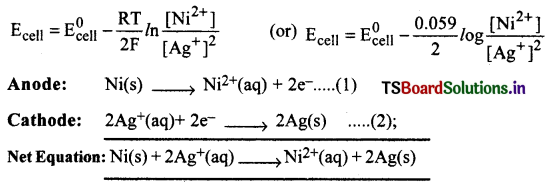
Write the Nernst equation for the EMF of the cell Ni(s) / Ni2+(aq) // Ag+(aq) / Ag(s)
Answer:
Question 4.
What is cell constant of a conductivity cell?
Answer:
Cell constant is the ratio of distance between electrodes and area of cross section. It is denoted by l/a. Its unit is Cm-1 or m-1.
Question 5.
Define molar conductivity \(\Lambda_m\) and how is it related to conductivity (k)?
Answer:
Molar conductivity is defined as the conductance of the solution containing one gram-mole of the electrolyte, when the electrodes are unit distance apart.
Molar conductivity \(\Lambda_m\) = \(\frac{\mathrm{k} \times 1000}{\mathrm{M}}\). Here k is conductivity, ‘M’ is molarity.
Question 6.
State Faraday’s first law of electrolysis.
Answer:
Faraday’s first law of electrolysis:
“The mass (m) of the substance deposited or liberated at the electrode is directly proportional to the quantity of electric charge (Q) passing through the electrolyte”.
Thus, m ∝ Q
Question 7.
State Faraday’s second law of electrolysis.
Answer:
Faraday’s second law of electrolysis:
“When same quantity of electric charge is passed through different electrolytes, connected in series the amount of different substances deposited at the electrodes is directly proportional to their equivalent masses”.
Mathematically, \(\frac{\mathrm{m}_1}{\mathrm{~m}_2}\) = \(\frac{E_1}{E_2}\)
Question 8.
What is a fuel cell? How is it different from a conventional galvanic cell?
Answer:
A fuel cell is a device that converts combustion energy of fuel directly into electrical energy. Conventional galvanic cell converts chemical energy of the spontaneous redox reaction into electrical energy.
Fuel cells relatively generate less pollution when compared to conventional galvanic cells.
Question 9.
What is metallic corrosion? Give one example.
Answer:
Metallic Corrosion: It is the process of slow eating up of metals by gases and water vapours present in atmosphere due to the formation of certain compounds like oxides, sulphides, carbonates, etc
Ex: Rusting of Iron (Fe converts into its oxide)
Question 10.
Give the electro-chemical reaction that represents the corrosion or rusting of iron.
Answer:
Corrosion reaction:
Anode: 2Fe → 2Fe+2 + 4e–
Cathode: O2 + 4H+ + 4e– → 2H2O
Overall reaction: 2Fe + O2 + 4H+ → 2Fe+2 + 2H2O
V. Short Answer Questions
Question 1.
What are galvanic cells? Explain the working of a galvanic cell with a neat sketch taking Daniel cell as example.
Answer:
Galvanic cells convert chemical energy into electrical energy.
They involve in spontaneous redox reactions.
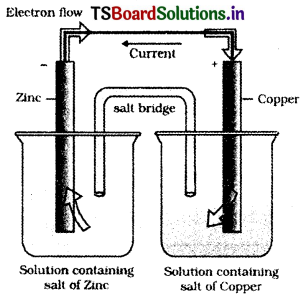
Construction:
Daniel cell consists of two half cells
- anode half cell and
- cathode half cell.
The two half cells are connected by a salt bridge containing a saturated solution of KNO3 in agar-agar gel. The anode half cell consists of zinc plate dipped in ZnSO4 solution and the cathode half cell consists of a copper plate dipped in CuSO4 solution.
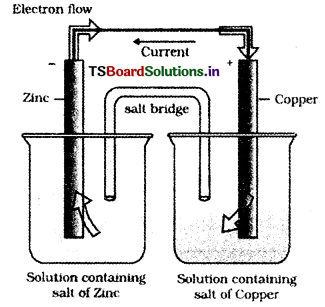
Working: When the two half cells are connected externally through a voltmeter, current flows out from the cell due to potential difference.
Electrode reactions:
At anode : Zn → Zn+2 + 2e ̄ (oxidation)
At cathode: Cu+2 + 2e– → Cu (reduction)
Net cell reaction: Zn(s) + \(\mathrm{Cu}^{+2}{ }_{(\mathrm{aq})}\) → \(\mathrm{Zn}^{+2}(\mathrm{aq})\) + Cu(s)
Question 2.
State and explain Nernst equation with the help of a metallic electrode and a non-metallic electrode.
Answer:
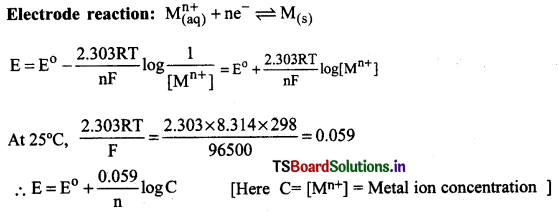
Nernst Equation: The equation that gives the dependence of the electrode potential on the concentration of ions with which electrode is reversible is known as Nernst equation.
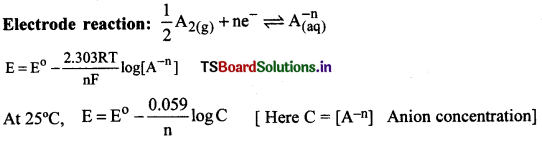
Nernst Equation: Electrode potential E = E° – \(\frac{2.303 \mathrm{RT}}{\mathrm{nF}}\)log\(\frac{\text { [Products] }}{\text { [Reactants] }}\)
Where E° = Standard reduction potential of the cell at 25°C.
n = Number of electrons involved in cell reaction.
R = Gas constant R (8.314 J K-1 mol-1);
T = Temperature = 273 + 25 = 298K;
F = Faraday constant = 96,487 ≈ 96500 c mol-1;
(a) For Metal Electrode:
(b) For Non-metal Electrode:
Question 3.
On what factors the electrical conductance of an aqueous solution of electrolyte depends?
Answer:
The conductance of the solution of an electrolyte depends on the following factors
- Nature of the electrolyte: Strong electrolytes ionize almost completely in the solution and hence conduct electricity to a large extent. Whereas weak electrolytes ionise to a small extent and hence conduct electricity to a small extent.
- Size of the ions: Greater the size of the ions or greater the solvation of the ions, lesser is the conductance.
- Nature of the solvent and its viscosity: Electrolytes ionise more in a polar solvent. Hence, greater the polarity of the solvent, greater is the ionization and hence greater is the electrical conductance. Also greater the viscosity of a solvent, lesser is the conductance.
- Concentration of the solution: Higher the concentration of the solution, lesser is the conductance. This is because in a weak electrolyte, the ionization is less whereas in a strong electrolyte, the interionic attractions are higher at higher concentration.
With dilution, incase of weak électrolytes ionization increases and incase of strong electrolytes, interionic attraction decreases and hence conductance increases. - Temperature: On increasing the temperature, the dissociation of electrolyte increases and hence the conductance increases.
Question 4.
State and explain Kohlrausch’s law of independent migration of ions.
Answer:
Kohlrausch law of independent migration of ions states that “limiting molar conductivity of an electrolyte can be represented as the sum of the individual contributions of the anion and the cation of the electrolyte, at infinite dilution.”
Thus, if \(\lambda_{\mathrm{Na}^{+}}^0\) and \(\lambda^0 \mathrm{Cl}^{-}\) are the limiting molar conductivities of the sodium and chloride ions respectively, then the limiting molar conductivity for sodium chloride is given by the equation
\(\Lambda_{(\mathrm{NaCl})}^0\) = \(\lambda_{\mathrm{Na}^{+}}^0\) + \(\lambda_{\mathrm{C} l^{-}}^0\)
In general, if an electrolyte on dissociation gives V+ cations and V– anion then its limiting molar conductivity is given by
\(\Lambda_{\mathrm{m}}^{\circ}\) = \(V_{+} \lambda_{+}^0\) + \(\mathrm{V}_{-} \lambda_{-}^0\)
Here, \(\lambda_{+}^0\) and \(\lambda_{-}^0\) are the limiting molar conductivities of the cation and anion respectively.
Question 5.
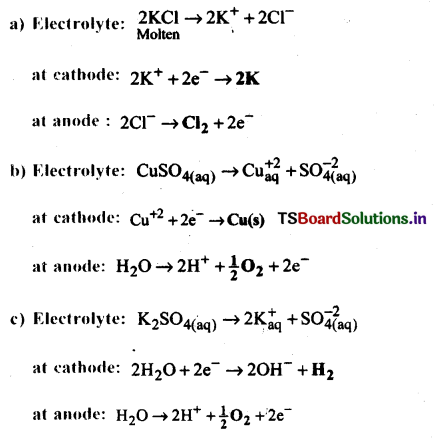
What are the products obtained at the cathode and the anode during the electrolysis of the following when platinum electrodes are used in the electrolysis
(a) Molten KCl
(b) Aq. CuSO4 solution
(c) Aq.K2SO4 solution
Answer:
Question 6.
What are fuel cells? How are they different from galvanic cells? Give the construction of H2-O2 fuel cell.
Answer:
A fuel cell is a device that converts the energy from combustion of fuel into electrical energy. The fuel cell like any other electrochemical cell has two electrodes and an electrolyte.
Oxidation of fuel occurs at the anode: Fuel → oxidation product + ne–
The oxidant gets reduced at the cathode: Oxidation + ne– → Reduction product. Fuel cells are different from conventional galvanic cells in the following aspects:
a) In a fuel cell, reactants are fed into the cell and products are removed from the cell. These do not form integral part of cell as in a conventional galvanic cell.
b) Chemical energy is not stored in a fuel cell, whereas in a galvanic cell chemical energy is converted into electrical energy.
H2-O2 fuel cell: This fuel cell consists of porous carbon electrodes suspended in concentrated NaOH solution.
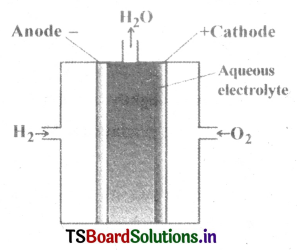
Catalysts like finely divided platinum or palladium is incorporated into the electrodes for increasing the rate of electrode reactions.
H2 and O2 gases are bubbled at the surface of the electrodes.
The electrode reactions:
At cathode: O2(g) + 2H2O + 4e – → 4\(\mathrm{H}_{\mathrm{aq}}^{-}\)
At anode: 2H2(g) + 4O\(\mathrm{H}_{\mathrm{aq}}^{-}\) → 4H2O(Cl) + 4e–
Overall reaction: 2H2(g) + O2(g) → 2H2O(Cl)
Question 7.
What is metallic corrosion? Explain it with respect to iron corrosion.
Answer:
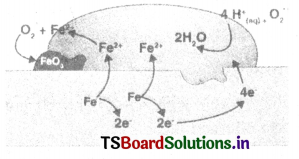
Metallic corrosion: It is the process of slow eating up of metals by gases and water vapours present in atmosphere due to the formation of certain compounds like oxides, sulphides, carbonates,etc.,
Corrosion of Iron is known as Rusting. Rusting is an electrochemical process that occurs when iron is exposed to oxygen and moisture.
Electrochemical Mechanism:
- Formation of Anodic and Cathodic Regions
- On the iron surface, tiny regions act as: “Anode ? oxidation occurs “Cathode ? reduction occurs
The corrosion process is electrochemical in nature.
On the iron surface, iron becomes oxidized in the presence of water.
On the metal surface, oxidation takes places at anode and reduction takes place at cathode.
At anode: Fe(s) → \(\mathrm{Fe}_{\mathrm{aq}}^{+2}\) + 2e– (Iron atoms lose electrons and go into solution)
At cathode: \(\frac{1}{2} \mathrm{O}_{2(\mathrm{aq})}\) + H2O(l) + 2e– → 2O\(\mathrm{H}_{\mathrm{aq}}^{-}\) (Oxygen reacts with water to form hydroxide ions)
Overall reaction: Fe(s) + \(\frac{1}{2} \mathrm{O}_{2(\mathrm{aq})}\) + H2O(l) → \(\mathrm{Fe}_{\mathrm{aq}}^{+2}\) + 2O\(\mathrm{H}_{\mathrm{aq}}^{-}\)
Formation of Rust: Ferrous ions react with hydroxide ions
\(\mathrm{Fe}_{\mathrm{aq}}^{+2}\) + 2OH– → Fe(OH)2
On further oxidation Fe(OH)2 → Fe(OH)3
The Ferrous ions finally form hydrated ferric oxide Fe2O3.xH2O (rust).
Question 8.
Explain the variation of molar conductivity with the change in the concentration of the electrolyte. Give reasons.
Answer:
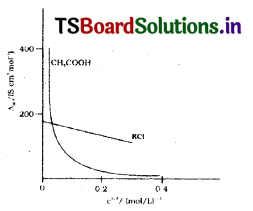
Molar conductivity of electrolytes generally, increases with dilution.
(i) For Strong Electrolytes (NaCl, KCl):
\(\Lambda^0{ }_{\mathrm{m}}\) increases slightly with dilution.
The increase is gradual and linear
Reason:
Strong electrolytes are almost completely dissociated even at higher concentrations
On dilution:
Inter-ionic attractions decrease, Ion mobility increases
Hence, conductivity increases slightly
(ii) For Weak Electrolytes (CH3COOH, NH4OH):
\(\Lambda^0{ }_{\mathrm{m}}\) increases sharply with dilution
Reason:
Weak electrolytes are partially ionised
On dilution:
Degree of ionisation increases (Le Chatelier’s principle)
More ions are produced. Hence, conductivity increases rapidly.
Graphical representation of the variation of \(\Lambda_m\) vs \(\sqrt{\mathrm{C}}\)
For a strong electrolyte (KCl) and a weak electrolyte (CH3COOH) is shown in the graph.
Strong electrolyte – straight line (small increase)
Weak electrolyte – curved line (steep increase)
Question 9.
Explain with a suitable example the relation between the Gibbs energy of chemical reaction (G) and the functioning of the electrochemical cell.
Answer:
Electrical work done in one second in an electrochemical cell is equal to decrease in its Gibbs energy. Electrical work done decrease in free energy.
In the case of an electrochemical cell, the electrical work done is equal to the electrical energy produced. This in turn is equal to the product of the quantity of electricity flowing in the circuit and the EMF of the cell.
Now, for every one mole of electrons transferred in the cell reaction, the quantity of electricity that flows through the cell is one faraday (1F = 96,500 Coulomb).
Hence, if n moles of electrons are transferred, in any cell reaction, the quantity of electricity flowing = nF Faraday
If Ecell represents the EMF of the cell, then electrical work done = nF Ecell
Hence -ΔrG = nF Ecell
For comparing different cells, standard cell potentials are used which are represented by E0cell.
The corresponding free energy change is called the standard change of the reaction, represented by ΔrG0.
Hence we can write -ΔG0 = nF \(\mathrm{E}^0{ }_{\text {cell }}\)
Thus for a cell reaction Zn(s) + \(\mathrm{Cu}^{+2}(\mathrm{aq})\) → \(\mathrm{Zn}^{+2}(\mathrm{aq})\) + Cu(s)
ΔrG0 = -2F \(\mathrm{E}^0{ }_{\text {cell }}\) [∵ n=2= no.of electrons involved]
Question 10.
Give the construction and working of a standard hydrogen electrode with a neat diagram.
Answer:
Standard hydrogen electrode (SHE):
It is a reference electrode and its reduction potential is arbitrarily assigned as zero volt at all temperatures.
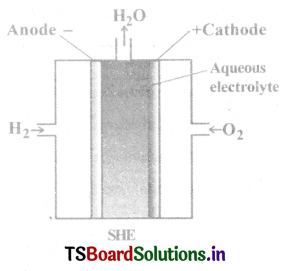
By using ‘SHE’ we can measure the potential of single electrode.
H2 gas adsorbed on platinum at one atmosphere placed in contact with 1M H+ concentration in solution is treated as standard hydrogen electrode (SHE).
Potential of this electrode is taken as zéro.
Hydrogen electrode is represented as Pt, H2(g) 1 atm / \(\mathrm{H}_{(\mathrm{aq})}^{+}\) (C = 1)
VI. Long Answer Questions
Question 1.
What are electrochemical cells? How are they constructed? Explain the working of the galvanic cells. Write any three differences between electrochemical cells and electrolytic cells.
Answer:
Electrochemical cells(Galvanic cells): They convert chemical energy into electrical energy.
They involve in spontaneous redox reactions. Construction: Daniel cell consists of two half cells
i) anode half cell and
ii) cathode half cell.
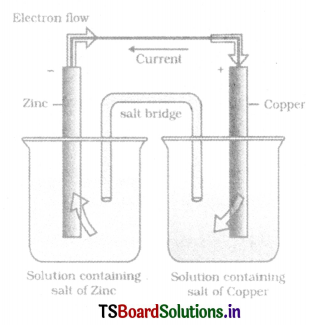
The two half cells are connected by a salt bridge containing a saturated solution of KNO3 in agar-agar gel.
The anode half cell consists of zinc plate dipped in ZnSO4 solution and the cathode half cell consists of a copper plate dipped in CuSO4 solution.
Working: When the two half cells are connected externally through a voltmeter, current flows out from the cell due to potential difference.
Electrode reactions:
At anode: Zn → Zn+2 + 2e– (oxidation)
At cathode: Cu+2 + 2e– → Cu (reduction)
Net cell reaction:Zn(s) + Cu+2(aq) → Zn+2(aq) + Cu(s)
Differences between electrochemical cells and electrolytic cells:
| Electrochemical cells | Electrolytic cells |
| 1) They convert chemical energy into electrical energy. | 1) They convert electrical energy to chemical energy. |
| 2) Spontaneous redox reactions occur. | 2) Non-Spontaneous redox reactions occur. |
| 3) At cathode: +ve electrode At anode: -ve electrode. | 3) At cathode: -ve electrode. At anode: +ve electrode |
| 4) Ex: Daniel cell, Fuel cell | 4) Ex: Rechargeable batteries, Electroplating. Electrolysis of water. |
Question 2.
Give the different types of batteries and explain the construction and working of each type of battery.
Answer:
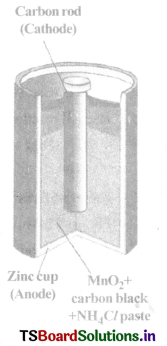
Batteries are of two types:
1) Primary Batteries
2) Secondary Batteries
1) Primary Batteries (Non- Rechargeable) :
(a) Dry cell:
Construction: The cell consists of a zinc container which acts as the anode.
The cathode is a carbon rod (graphite) surrounded by powdered manganese dioxide and carbon.
The electrolyte is a moist paste of ammonium chloride
(NH4Cl) and zinc chloride (ZnCl2).
Electrode reactions:
Anode: Zn(s) → Zn+2 + 2e–
Cathode: MnO2 + \(\mathrm{NH}_4^{+}\) + e– → MnO(OH) + NH3
The cell exhibits a potential of nearly 1.5 V.
(b) Mercury cell:

It consists of zinc-mercury amalgam as anode and a mixture of HgÒ and carbon as the cathode. The electrolyte is a paste of KOH and ZnO.
Electrode reactions:
Anode: Zn(Hg) + 2OH– → ZnO(s) + H2O + 2e–
Cathode: HgO+ H2O + 2e– → Hg(l) + 2OH–
The overall reaction is represented by Zn(Hg) + HgO(s) → ZnO(s) + Hg(l)
The cell potential is approximately 1.35 V and it remains constant during its life.
2) Secondary Batteries (Rechargeable) :
(c) Lead storage battery:
It consists of a lead anode and a grid of lead packed with lead dioxide (PbO2) as cathode. A 38% solution of sulphuric acid is used as electrolyte.
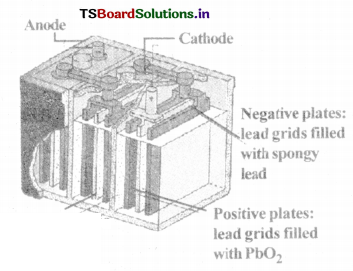
The cell reactions :
Anode: Pb(s) + \(\mathrm{SO}_{4(\mathrm{aq})}^{-2}\) → PbSO4(s) + 2e–
Cathode: \(\mathrm{PbO}_{2(\mathrm{~s})}\) + \(\mathrm{SO}_{4(\mathrm{aq})}^{-2}\) + \(4 \mathrm{H}_{\mathrm{aq}}^{+}\) + 2e– → PbSO4(s) + 2H2O(l)
These reactions occur during discharge, that is during use of the battery.
This is commonly used in automobiles and inverters.
(d) Nickel Cadmium Battery:

A rechargeable nickel-cadmium cell in a jelly roll arrangement and separated by a layer soaked in moist sodium or potassium hydroxide
Construction:
It is a jelly roll arrangement and separated by a layer soaked in moist sodium or potassium hydroxide.
Anode: Cadmium
Cathode: Nickel oxide hydroxide (NiO(OH))
Electrolyte: KOH
Working: Overall reaction:
Cd(s) + 2Ni(OH)3(s) → CdO(s) + 2Ni(OH)2(s) + H2O(l)
These batteries have longer life than the lead storage cell.
Question 3.
Calculate the concentration of silver ions in the cell constructed by using 0.1M concentration of Cu2+ and Ag+ ions. Cu and Ag metals are used as electrodes. The cell potential is 0.422 V. [\(\mathrm{E}_{\mathrm{Ag}^{+} / \mathrm{Ag}}^0\) = +0.80V; \(\mathrm{E}_{\mathrm{Cu}^{2+} / \mathrm{Cu}}^0\) = +0.34V]
Solution:
At anode : Cu → Cu+2 + 2e–
At cathode: 2Ag+ + 2e → 2Ag
Cell reaction: Cu + 2Ag+ → Cu+2 + 2Ag
\(\mathrm{E}_{\text {cell }}^0\) = \(\mathrm{E}_{\text {cathode }}^0\) – \(\mathrm{E}_{\text {anode }}^0\) = 0.80 – 0.34 = +0.46V
Given Ecell = 0.422 V; [Cu+2] = 0.1 M
Applying Nernst equation
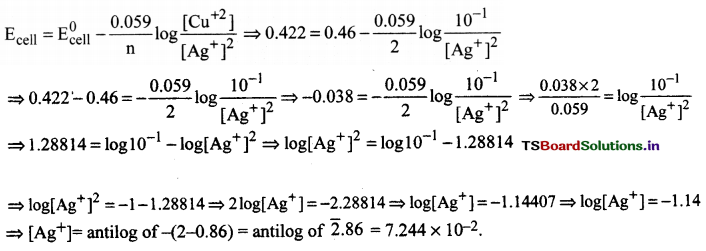
Question 4.
Calculate the degree of dissociation (α) of CH3COOH at 298 K
Given that \(\Lambda_{\mathrm{CH}_3 \mathrm{COOH}}^0\) = 11.75cm2 mol-1
Answer:
Given \(\Lambda_{\mathrm{m}}^0\left(\mathrm{CH}_3 \mathrm{COOH}\right)\) = \(\Lambda_{\mathrm{CH}_3 \mathrm{COO}^{-}}^0\) + \(\lambda_{\mathrm{H}^{+}}^0\) = 40.95 + 349.15 = 390.1
Formula: Degree of dissociation α = \(\frac{\Lambda_m^c}{\Lambda_m^0}\) = \(\frac{11.75}{390.1}\) = 0.03012 = 3.012 × 10⁻²
Question 5.
a) State and explain Kohlrausch’s law of independent migration of ions along with two applications.
b) Define molar conductivity and limiting molar conductivity.
Answer:
(a) Kohlrausch’s law of independent migration of ions:
Kohlrausch law of independent migration of ions states that “limiting molar conductivity of an electrolyte can be represented as the sum of the individual contributions of the anion and the cation of the electrolyte, at infinite dilution.”
Thus, if \(\lambda_{\mathrm{Na}^{+}}^0\) and \(\lambda_{\mathrm{C} l^{-}}^0\) are the limiting molar conductivities of the sodium and chloride ions respectively, then the limiting molar conductivity for sodium chloride is given by the equation.
\(\Lambda_{(\mathrm{NaCl})}^{\circ}\) = \(\lambda_{\mathrm{Na}^0}^0\) + \(\lambda_{\mathrm{Cl}^{-}}^0\)
In general, if an electrolyte on dissociation gives V+ cations and V– anion then its limiting molar conductivity is given by \(\Lambda_{\mathrm{m}}^{\mathrm{o}}\) = \(V_{+} \lambda_{+}^0\) + \(V_{-} \lambda_{-}^0\)
Here, \(\lambda_{+}^0\) and \(\lambda_{-}^0\) are the limiting molar conductivities of the cation and anion respectively.
Applications of Kohlarusch’s law:
(i) Calculation of molar conductivities of weak electrolyte at infinite dilution:
For example molar conductivity of acetic acid (CH3COOH) at infinite dilution can be obtained from molar conductivities at infinite dilution of strong electrolytes like CH3COONa, HCl and NaCl as shown below:

(ii) Determination of degree of dissociation of weak electrolytes:
Degree of dissociation (α) = \(\frac{\Lambda_{\mathrm{m}}}{\Lambda_{\mathrm{m}}^{\mathrm{o}}}\)
(iii) Determination of dissociation constant (K) of weak electrolytes: K = \(\frac{C \alpha^2}{1-\alpha}\)
b) Molar conductivity and limiting molar conductivity:
Molar conductivity is defined as the conductance of the solution containing one gram- mole of the electrolyte when the electrodes are unit distance apart having sufficient area of cross section to hold the electrolyte.
\(\Lambda_{\mathrm{m}}\) = \(\frac{\mathrm{k} \times 1000}{\mathrm{M}}\)
Where k is conductivity, ‘M’ is molarity and \(\Lambda_{\mathrm{m}}\) is molar conductivity
Limiting molar conductivity \(\left(\Lambda_{\mathrm{m}}^0\right)\) is the molar conductivity and infinite dilution.
It is defined as the molar conductivity of any electrolyte when the concentration of electrolyte approaches zero (i.e., at infinite dilution)
Mathematically, \(\Lambda_{\mathrm{m}}^0\) = \(\lim _{\mathrm{c} \rightarrow 0} \boldsymbol{\Lambda}_{\mathrm{m}}\) Here, \(\boldsymbol{\Lambda}_{\mathbf{m}}\) is molar conductivity at concentration C.
Textual Solved Problems
Question 1.
Represent the cell in which the following reaction takes place Mg(s) + 2Ag+(0.0001 M) → Mg2+(0.130M) + 2Ag(s)
Calculate its E(cell) if E–(cell)= 3.17 V.
Answer:
The cell is represented as Mg | Mg2+ (0.130M) || Ag+(0.0001M)|Ag
E(cell) = E–(cell) – \(\frac{\mathrm{RT}}{2 \mathrm{~F}} \ln \frac{\left[\mathrm{Mg}^{2+}\right]}{\left[\mathrm{Ag}^{+}\right]^2}\) = 3.17 V – \(\frac{0.059 \mathrm{~V}}{2}\)log\(\frac{0.130}{(0.0001)^2}\) = 3.17V – 0.21V = 2.96 V.
Question 2.
Calculate the equilibrium constant of the reaction:
Cu(s) + 2Ag+(aq) → Cu2+(aq) + 2Ag(s) \(\mathrm{E}_{\text {(cell) }}^0\) = 0.46 V
Answer:
From the above equation n = 2, \(\mathrm{E}_{\text {(cell) }}^0\) = 0.46 V
\(\mathrm{E}_{(\text {cell })}^0\) = \(\frac{0.059 \mathrm{~V}}{2}\)logKc = 0.46
0.46 V = \(\frac{0.059}{2}\)log Kc ⇒ logKc = \(\frac{0.46 \times 2}{0.059}\) = 15.6 ⇒ Kc = e15.6 = 3.92 × 10¹⁵.
Question 3.
The standard emf of Daniel cell is 1.1V. Calculate the standard Gibbs energy for the cell reaction:
Zn(s) + Cu2+(aq) → Zn2+(aq) + Cu(s)
Answer:
Zn(s) + Cu2+(aq) → Zn2+ (aq) + Cu (s)
From above equation n = 2, F = 96500C, \(\mathrm{E}_{\text {Cell }}^0\) = 1.1 V.
∆\(G_F^g\) = -nF\(\mathrm{E}_{\text {Cell }}^0\)
∆\(\mathrm{G}_{\mathrm{F}}^{\mathrm{O}}\) = -2 × 96500 × 1.1 = -21200J.mole-1 = -212.3 KJ.mole-1
Question 4.
Calculate \(\Lambda_{\mathrm{m}}^0\) for CaCl2 and MgSO4 from the given data Ca2+ = 119.08 cm2 mol-1. Cl = 76.38 cm2 mol-1 Mg2+ = 106.0 S cm2 mol-1 \(\mathrm{SO}_4^{2-}\) = 160.0S cm2 mol-1
Solution:
We know from Kohlrausch law that

Question 5.
\(\Lambda_m^0\) for NaCl, HCl and NaAc are 126.4, 425.9 and 91.0 S cm2mol-1 respectively. Calculate \(\Lambda^0\) for HAc.
Answer:
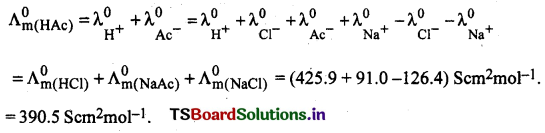
Question 6.
A solution of CuSO4 is electrolysed for 10 minutes with a current of 1.5 amperes. What is the mass of copper deposited at the cathode?
Answer:
Given time t = 10 min. = 600s, current i = 1.5 amperes
charge = current × time = 1.5 × 600 = 900C
According to the reaction: Cu2+(aq) + 2e– = Cu(s)
We require 2F or 2 × 96500 C deposit 1 mole or 63 g of Cu.
For 900C, the mass of Cu deposited = (63 ×900 )/(2 × 96500 ) = 0.2938 g
Objective Questions
Question 1.
The quantity of charge required to obtain one mole of aluminium from Al2O3 is ____
1) IF
2) 6F
3) 3F
4) 2F
Answer:
3) 3F
Question 2.
The weight of silver (at.wt= 108) displaced by a quantity of electricity which displaces 5600 mL of O2 at STP will be
1) 5.4 g
2) 10.8 g
3) 54.0 g
4) 108.0 g
Answer:
4) 108.0 g
Question 3.
The number of Faradays (F) required to produce 20g of Calcium from molten CaCl2 (Atomic mass of Ca = 40gmol-1) is
1) 1
2) 2
3) 3
4) 4
Answer:
1) 1
Question 4.
When 0.1 mol of \(\mathrm{MnO}_4^{2-}\) is oxidised the quantity of electricity required to completely oxidise Mn\(\mathrm{O}_4^{2-}\) to Mn\(\mathrm{O}_4^{-}\) is
1) 96500C
2) 2 × 96500C
3) 9650C
4) 96.50C
Answer:
3) 9650C
Question 5.
Which of the following statement is not correct about an inert electrode in a cell?
1) It does not participate in the cell reaction.
2) It provides surface either for oxidation or for reduction reaction.
3) It provides surface for conduction of electrons.
4) It provides surface for redox reaction.
Answer:
4) It provides surface for redox reaction.
Question 6.
The difference between the electrode potentials of two electrodes when no current is drawn through the cell is called ____
1) Cell potential
2) Cell emf
3) Potential difference
4) Cell voltage
Answer:
2) Cell emf
Question 7.
Which cell will measure standard electrode potential of copper electrode?
1) Pt(S)|H2 (g,0. 1 bar)| H+(aq, 1 M) || Cu2+(aq., 1 M)|Cu
2) Pt(s)|H2(g, 1 bar)H+(aq.,1 M)||Cu2+(aq., 2M)|Cu
3) Pt(s)|H2(g,1 bar)H+ (aq, 1M)||Cu2+(aq,1M)Cu
4) Pt(s)|H2 (g, 1 bar 1MjCu(aq., 1 M)IC u
Answer:
3) Pt(s)|H2(g,1 bar)H+ (aq, 1M)||Cu2+(aq,1M)Cu
Question 8.
An electrochemical cell can behave like an electrolytic cell when___
1) Ecell=0
2) Ecell > Eext
3) Eext > Ecell
4) Eext = Eext
Answer:
3) Eext > Ecell
Question 9.
Using the data given below find out the strongest reducing agent.
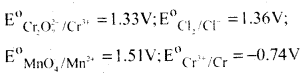
1) Cl–
2) Cr
3) Cr3+
4) Mn2+
Answer:
2) Cr
Question 10.
Standard electrode potential of three metals X, Y, and Z are -1.2 V, + 0.5 V and -3.0 V respectively. The reducing power of these metals will be
1) X > Y > Z
2) Y > Z > X
3) Y > X > Z
4) Z > X > Y
Answer:
4) Z > X > Y
Question 11.
For the cell reaction:
2Fe3+ (aq) + 2l– (aq) → 2Fe2+ (aq) + I2(aq)
\(\mathrm{E}_{\text {cell }}^0\) = 0.24V at 298 K. The standard Gibbs’ energy (∆rG°) of the cell reaction is (given that F = 96500 Cmol-1)
1) 23.16 kJmol-1
2) -46.32 kJ mol-1
3) -23. 16kJ mol-1
4) 46.32 kJ mol-1
Answer:
2) -46.32 kJ mol-1
Question 12.
For the reduction of silver ions with copper metal, the standard cell potential is 0.46 V at 25°C. The value of standard Gibbs energy, ∆G° will be
1) -89.0 kJ
2) -89.0 J
3) -44.5 kJ
4) -98.0 kJ
Answer:
1) -89.0 kJ
Question 13.
If the \(\mathrm{E}_{\text {Cell }}^O\) for a given reaction has a negative value, then which of the following gives the correct relationship for the values of ∆G° and Keq?
1) ∆G° > 0; Keq < 1 2) ∆G° > 0; Keq > 1
3) ∆G° < 0; Keq > 1
4) ∆G°< 0; Keg < 1 Answer: 1) ∆G° > 0; Keq < 1
Question 14.
For a cell involving one electron \(E_{\text {Cell }}^0\) = 0.59V at 298K, the equilibrium constant for the cell reaction is given that \(\frac{2.303 \mathrm{RT}}{\mathrm{~F}}\) 0.059V at T = 298K
1) 1.0 × 1030
2) 1.0 × 10²
3) 1.0 × 10⁵
4) 1.0 × 10¹⁰
Answer:
4) 1.0 × 10¹⁰
Question 15.
The cell constant of a conductivity cell ___
1) changes with change of electrolyte.
2) changes with change of concentration of electrolyte.
3) changes with temperature of electrolyte.
4) remains constant for a cell.
Answer:
4) remains constant for a cell.
Question 16.
\(\Lambda_{\mathrm{m}\left(\mathrm{NH}_4 \mathrm{OH}\right)}^{\mathrm{O}}\) is equal to ____
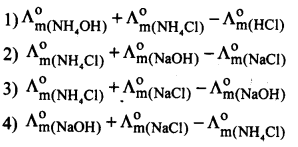
Answer:

Question 17.
The molar conductance of NaCl, HCl and CH3COONa at infinite dilution are 126.45, 426.16 and 91.0 S cm2mol-1 respectively. The molar conductance of CH3COOH at infinite dilution is
1) 540.48 Scm2mol-1
2) 201.28 Scm2mol-1
3) 390.71 Scm2mol-1
4) 698.28 Scm2mol-1
Answer:
3) 390.71 Scm2mol-1
Question 18.
The molar conductivity of 0.007M acetic acid is 20Scm2mol-1. What is the dissociation constant of acetic acid?
\(\Lambda_{\mathrm{H}}^{\circ}\) = 350 S cm2mol-1‚ \(\Lambda_{\mathrm{CH}, \mathrm{COO}}^0\)
1) 2.50 × 10⁻⁵ mol L-1
2) 1.75 × 10⁻⁴ mol L-1
3) 2.50 × 10⁻⁴ mol L-1
4) 1.75 × 10⁻⁵ mol L-1
Answer:
4) 1.75 × 10⁻⁵ mol L-1
Question 19.
While charging the lead storage battery
1) PbSO4 anode is reduced to Pb
2) PbSO4 cathode is reduced to Pb
3) PbSO4 cathode is oxidised to Pb
4) PbSO4 anode is oxidised to PbO4
Answer:
1) PbSO4 anode is reduced to Pb