
Regular practice with AP Inter 2nd Year Chemistry Study Material Chapter 5 Coordination Compounds Questions and Answers helps students stay prepared for examinations.
AP Inter 2nd Year Chemistry 5th Lesson Coordination Compounds Questions and Answers
I. Multiple Choice Questions
Question 1.
Which of the following coordination compound contains cobalt metal?
1. Chlorophyll
2. Hemoglobin
3. Vitamin B12
4. Myoglobin
Answer:
3. Vitamin B12
Check biological molecules containing metals:
Chlorophyll → Mg, Hemoglobin/Myoglobin → Fe.
Vitamin B12 contains Co (cobalt)
Question 2.
According to Werner theory of coordination compounds, the secondary valence of metal ion in CoCl3. 4NH3 is
1. 6
2. 4
3. 3
4. 7
Answer:
1. 6
Secondary valence = coordination number (ligands attached). [Co(NH3)4 Cl2] Cl
In CoCl3. 4NH3 is Co is bonded to 4 NH3 & 2Cl– .
Here coordination number is 4 + 2 = 6
Question 3.
Which of the following complex produces 2 moles of AgCl as precipitate, when 1 mole of complex reacts with excess of AgNO3?
1. C0Cl3. 4NH3
2. NiCl2. 6H2O
3. PtCl2. 2NH3
4. CoCl3. 6NH3
Answer:
2. NiCl2. 6H2O
[Ni(H2O)6]Cl2 ⇌ [Ni(H2O)6] + 2Cl–. It gives 2 chloride ions.
Question 4.
Which of the following is not a double salt?
1. FeSO4. (NH4)2SO4. 6H2O
2. KCl.MgCl26H2O
3. PtCl4. 2HCl
4. KA1(SO4)2.12H2O
Answer:
3. PtCl4. 2HCl
Double salt dissociates completely into simple ions.
PtCl4 . 2HCl does NOT behave like a double salt → complex nature. PtCl4 . 2HCl

Question 5.
Lewis acid in the complex ion [CoCI(NH3)5|2+ is
1. Cl–
2. NH3
3. Co2+
4. Co3+
Answer:
4. Co3+
Lewis acid → Electron air acceptor. Metal ion accepts electron pairs from ligands.
So Co3+ acts as Lewis acid.
Question 6.
Which among the following is a combination of amhidentate ligand and neutral ligand?
1. CN– & CO
2. EDTA & CO
3. H2O & OH–
4. Ethylene diamine (en) & oxalato
Answer:
1. CN– & CO
Ambidentate ligand = can bind through different atoms (Ex: CN). It can bind through C &N.
Neutral ligand = no charge (Ex: CO).CN– (ambidentate) + CO (neutral).
Question 7.
Which among the following is a homoleptic complex with primary valence of 3 and secondary valence of 6?
1. COCl3.6NH3
2. NiCl2.6H2O
3. PdCl2.4NH3
4. COCl3. 4NH3
Answer:
1. COCl3.6NH3
Homoleptic = only one type of ligand.
Primary valence = oxidation state, secondary = coordination number.
In COCl3.6NH3 Primary valence is 3 & secondary valency is 6.
Question 8.
Which ligand gives a stable complex?
1. SCN–
2. Cl–
3. H2O
4. Ethylene diamine(en)
Answer:
4. Ethylene diamine(en)
Chelating ligands (multidentate) form most stable complexes.
Ethylene diamine (en) is bidentate → forms chelate rings.Ethylene diamine (en)
Question 9.
The correct formula for the given IUPAC name: tris (ethane-1,2-diamine) cobalt (III) sulphate is
1. [CO(NH3)6]2(SO4)3
2. [CO(NH3)4(H2O)Cl]Cl2
3. [CO(H2NCH2CH2NH2)3](SO4)2
4. [Co(H2NCH2CH2NH2)3]2(SO4)3
Answer:
4. [Co(H2NCH2CH2NH2)3]2(SO4)3
Charge of complex ion is +3. Charge of SO4-2 is -2. Balance by Criss-cross method.
Question 10.
Which complex shows both linkage and optical isomerism?
1. [Co(en)3]Cl3
2. [CoCl2(en)2]Br
3. [Co(en)2(NO2)Cl]Cl
4. [PdCl2(NH3)2]
Answer:
3. [Co(en)2(NO2)Cl]Cl
Optical isomeristn requires non-superimposable mirror images. Typically seen in octahedral complexes with bidentate ligands. [Co(en)2]3+ shows optical isomerism.
Question 11.
Which of the following shows colour?
1. K3[Cu(CN)4]
2. [Ti(H2O)6]4+
3. CuF2
4. [Cu(CH3CN)4]BF4
Answer:
3. CuF2
Due to the presence of unpaired electrons.
Question 12.
Which complex shows geometrical, optical and also structural isomerism?
1. [Co(en)3]Cl3
2. [CoCl2(en)2]Br
3. [Co(en)(NH3)2Cl2]Cl
4. [PdCl2(NH3)2
Answer:
2. [CoCl2(en)2]Br
Geometrical → cis/trans possible .Optical → chiral (no plane of symmetry)
Structural → ionisation [CoCl2(en)2] Br . satisfies all cis/trans (geometrical), optical (due to en ligands), ionisation isomerism possible
Question 13.
Which among them has highest magnetic moment?
1. [CO(NH3)6]Cl3
2. [NiCl4]2-
3. [COF6]3-
4. [Ni(CO)4]
Answer:
3. [COF6]3-
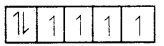
Co+3 – [Ar]4s03d6
More no.of unpaired electrons.
Question 14.
Among them, which complex shows ∆0 > P, (∆0 – relative magnitude of the crystal field splitting, P = pairing energy)
1. [CO(H2O)6]3+
2. [CO(NH3)6]3+
3. [MnF6]3-
4. [CoF6]3-
Answer:
2. [CO(NH3)6]3+
Strong field ligands → large ∆0 → pairing occurs NH3 is stronger ligand than H2O, F– , NH3 – strong field ligand.
Question 15.
In which of the following metal ion is with 5 unpaired electrons ?
1. [CO(CN)6]3-
2. [CO(NH3)6]3+
3. [MnF6]4-
4. [Ni(en)Cl4]2-
Answer:
3. [MnF6]4-
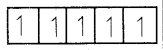
In [MnF6]4-, Mn shows +2 oxidation state. E.C of Mn+2 is [Ar] 4s03d5
More no. of unpaired electrons. (n = 5)
II. Fill in the Blanks
Question 1.
According to Werner’s theory of coordination compounds primary valences of metal ion are satisfied by _______.
Answer:
negative ions
Question 2.
Mohr’s salt formula is ________
Answer:
FeSO4(NH4)2SO4.6H2O
Question 3.
The coordination sphere in potassium ferrocyanide complex is _________
Answer:
[Fe(CN)6]4-
Question 4.
The IUPAC name of K2[PdCl4] is ________
Answer:
Potassium tetrachloridopalladate (II)
Question 5.
M-CO bond in metal carbonyls is very strong due to _______ effect, (or) π-back bonding.
Answer:
Synergic
III. One Word Answer Questions
Question 1.
Which platinum complex can effectively inhibit the growth of tumors?
Answer:
Cis-platin can effectively inhibit the growth of tumors. Ex: Cis [Pt(NH3)2Cl2]
Question 2.
Facial and Meridional isomers come under which category of isomerism?
Answer:
Facial and Meridional isomers show Geometrical isomerism.
Question 3.
What is the geometry of Fe(CO)5 complex?
Answer:
Geometry of Fe(CO)5 is Trigonal bipyramidal.
Question 4.
Which complex ion is formed when undecomposed AgBr of the film dissolves in hypo solution.
Answer:
[Ag(S2O3)2]3- is formed when AgBr film dissolves in hypo solution.
Question 5.
How many unpaired electrons are there in |NiCl4]2- ion?
Answer:
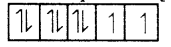
Two unpaired electrons are present in [NiCl4]2- ion.
Ni2+: [Ar]4s03d8
IV. Very Short Answer Questions
Question 1.
What are coordination compounds? Give two examples.
Answer:
Coordination compounds are the metal atoms that are bond to few anions or neutral molecules by sharing electrons through coordinate covalent bonds.
Ex: [Co(NH3)6]Cl3, K4[Fe(CN)6]
Question 2.
What is a double salt? Give example.
Answer:
Double salts contain two or more compounds which are stable in solid state. But they dissociate into its constituent ions when dissolved in water . In this process, the individual properties of constituent ions are not lost.
Ex: Mohr salt – FeSO4, (NH4)2SO4. 6H2O
Potash alum – K2SO4.Al2(SO4)3.24H2O
Camallite – KCl.MgCl2.6H2O
Question 3.
What is the difference between a double salt and a complex compound?
Answer:
A double salt differs from complex compound in its dissociation.
A double salt dissociates completely into its constituent ions when dissolved in water, whereas a complex compound do not dissociate into its constituent ions when dissolved in water. Ex: Double salt: Camalite KCl.MgCl2.6H2O → K++Mg+2+2Cl–
Ex: Complex salt: Potassium ferrocyanide K4[Fe(CN)6] → 4K+ +[Fe(CN)6]4-
Question 4.
What is a chebte ligand ? Give example.
Answer:
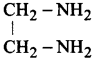
Chelate ligand: It is a ring-like structure obtained when a bidentate or a polydentate ligand uses its two or more donor atoms to bind a single metal ion.
Ex: Oxalate C2O2, en-ethylene diammine
Question 5.
What is an ambidentate ligand? Give example.
Answer:
Ambidentate ligand: It is a ligand which contains two donor atoms but only one of them forms a coordinate bond at a time with central metal atom / ion.
M ← SCN
thiocyanato
(S donor atom)
M ← NCS
isothiocyanato
(N donor atom)
Question 6.
CuSO4.5H2O is blue in colour where as anhydrous CuSO4 is colourless. Why?
Answer:
In CuSO4.5H2O, water acts as ligand. As a result it causes crystal field splitting.
Hence, d-d transition is possible in CuSO4.5H2O and it shows colour.
In the anhydrous CuSO4 due to the absence of water (ligand), crystal field splitting is not possible. Hence it is colourless.
Question 7.
How many geometrical isomers are possible in the following coordination entities?
(i) [Cr(C2O4)3]3-
(ii) [CO(NH3)3Cl3]
Answer:
i) No geometrical isomers are possible for [Cr(C2O4)3]3-
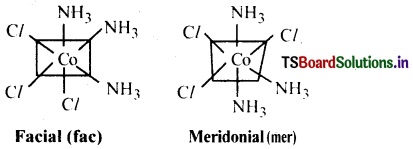
ii) Two geometrical isomers are possible for [CO(NH3)3Cl3]
Question 8.
[Cr(NH3)6]3+ is paramagnetic while [Ni(CN)4]2- is diamagnetic. Why?
Answer:
[Cr(NH3)6]3+ is paramagnetic due to the presence of three unpaired electrons.
[Ni(CN)4]2- is diamagnetic due to the absence of unpaired electrons.
Question 9.
[Fe(CN)4]2- and [Fe(H2O)6]2+ are of different colours in dilute solutions. Why?
Answer:
In both the complexes, Fe has +2 oxidation state . It has four unpaired electrons.
In the presence of weak H2O ligand, the unpaired electrons do not pair up.
In the presence of strong CN– ligand, the unpaired electrons pair up .
They have different colours due to the difference in the number of unpaired electrons.
Question 10.
What is the oxidation state of cobalt in
(i) K[Co(CO)4] and (ii) [Co(NH3)6]3+
Answer:
i) K[Co(CO)4] : Oxidation state of cobalt is-1
ii) [Co(NH3)6]3+ Oxidation state of cobalt is +3
V. Short Answer Questions
Question 1.
Explain Werner’s theory of coordination compounds with suitable examples.
Answer:
Werner’s theory explains the structure, bonding, and isomerism of complex compounds,
1) Every complex has a central metal atom (or) ion bonded with ligands and some anions.
2) The central metal atom/ion shows two types of valences: Primary & Secondary valences.
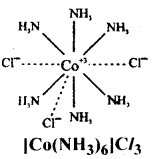
a) Primary valence (1°): It is equal to the oxidation state of the central atom. It is satisfied by the negative anions. These are ionisable and non-directional. The anion bonds connected to central metal are shown with dotted lines ( – – – – -) in the diagram.
b) Secondary valence (2°): It is equal to co-ordination number of the central atom.
It is the number of coordinate covalent bonds formed by central metal atom/ ion with ligands. The species satisfying secondary valence are not ionisable in solutions. The ligand bonds connected to the central atom are shown with continuous lines (————-) in the diagram.
Every metal has a fixed coordination number in a given oxidation state. This coordination number defines the shape of complex.
3) Some ligands satisfy both primary and secondary valence of the metal.
Such ligands are non-ionisable.
The following examples explain Werner’s theory.
Ex 1: CoCl3.6NH3 = [Co(NH3)6]Cl3
The secondary valency of the central ion Co3+ is 6.
That means Co is bonded with 6 NH3.
The primary valency of Co3+ is 3.
That means Co is bonded with 3Cl– ions.
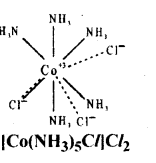
Ex 2: CoCl3.5NH3 = [Co(NH3)5Cl]Cl2
The secondary valency of the central ion Co3+ is 6.
That means Co is bonded with 5 NH3 and one Cl–.
Here Cl satisfies both 1° & 2° valencies.
The primary valency of Co3+ is 3.
Two ionisable and one Cl– satisfies both valencies which is non-ionidable.
Question 2.
Give the geometrical shapes of the following complex entities
(i) [CO(NH3)6]3+
(ii) [Ni(CO)4]
(iii) [PtCl4)]2-
(iv) [Fe(CN)6]4-
Answer:
i) [CO(NH3)6]3+ → octahedral
ii) [Ni(CO)4] → tetrahedral
iii) [PtCl4)]2- → square planar
iv) [Fe(CN)6]4- → octahedral
Question 3.
Using IUPAC norms write the formulas for the following :
(i) Tetrahydroxozincate (II) ion
(ii) Hexaaminecobalt (III) sulphate
(iii) Potassium tetrachioropalladate(II)
(iv) Potassium tri(oxoalato)chromate(III)
Answer:
i) Tetrahydroxozincate(II) ion: [Zn(OH)4]-2
ii) Hexaaminecobalt (III) sulphate : [Co(NH3)6]2(SO4)3
iii) Potassium tetrachloropalladate(II): K2[PdCl4]:
iv) Potassium trioxalatochromate(III): K4[Cr(C2O4)3]
Question 4.
Using IUPAC norms write the systematic names of the following:
(i) [Co(NH3)6]Cl3
(ii) [Pt(NH3)2Cl(NH2 CH3)]Cl
(iii) [Ti(H2O)6]3+
(iv) [NiCl4]2-
Answer:
i) [Co(NH3)6]Cl3 : Hexaammine Cobalt (III)chloride
ii) [Pt(NH3)2Cl(NH2 CH3)]Cl : Diammine chloro Methyl amtye platinum(II)chloride
iii) [Ti(H2O)6]3+ : Hexaaquotitanium (III) ion
iv) [NiCl4]2- : Tetrachloronickelate (II) ion
Question 5.
What are homoleptic and heteroleptic complexes? Give one example for each.
Answer:
Homoleptic complexes: These are the complexes in which a metal is bound by only one kind of ligands. Ex: [Co(NH3)6]+3
Heteroleptic complexes: These are the complexes in which a metal is bound by more than one kind of ligands. Ex: [Co(NH3)4Cl2]+
Question 6.
Explain geometrical isomerism in coordination compounds giving suitable examples.
Answer:
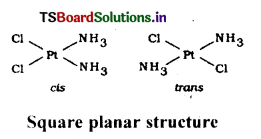
Geometrical isomerism: This type of isomerism is due to different possible geometric arrangements of the ligands. Here, the two types of isomers are cis isomer and trans isomer.
1) In the square planar complex of the form [MX2L2], the two X ligands arranged adjacent to each other in the same side are cis isomers and which are arranged opposite to each other are trans Isomers.
Ex: [Pt(NH3)2Cl2]
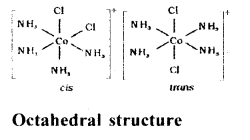
2) In the Octahedral complex of the form [MX2L4] , the two X ligands are oriented cis or trans to each other. Ex: [CoCl2(NH3)4]+
Question 7.
What is meant by chelate effect ? Give example.
Answer:
Chelate effect: It is the stabilization of complex compounds due to ring formation (chelation) by bidentate or polydentate ligands. Complexes containing chelating ligands are more stable than complexes containining unidentate ligands.
Ex: [Co(en)3]3+ is more stable than [Co(NH3)6]3+
Note: en= Ethylenediamine ⇒ bidentate ligand (chelating ligand)
Question 8.
Explain the following terms by giving an example
i) Unidentate ligand
ii)Bidentate ligand
iii) Polydentate ligand
iv)Ambidentate ligand
Answer:
i) Unidentate: It is a ligand with One donor atom. Ex: : NH3
ii) Bidentate: It is a ligand with Two donor atoms Ex: NH2-NH2
iii) Polydentate: It is a ligand with more than two donor atoms Ex: EDTA
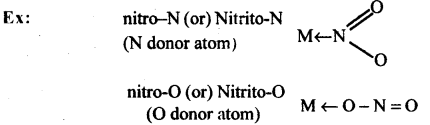
iv) Amhidentate ligand: It is a ligand with two donor atoms, but only one of them forms a coordinate bond at a time with central metal atom / ion.
Question 9.
Give the oxidation numbers of the central metal atoms in the following complex entities
(i) [Ni(CO)4]
(ii) [Co(NH3)6]+3
(iii) [Fe(CN)6]4-
(iv) [Fe(C2O4)3]3-
Answer:
i) [Ni(CO)4]
x + 4(0) = 0
⇒ x = 0
(ii) [Co(NH3)6]+3
x + 6(0) = +3
⇒ x = +3
In metal carbonyls metal oxidation state is equal to zero, (synergic effect)
iii) [Fe(CN)6]4-
x + 6(-1) = -4
⇒ x = 6 – 4 = +2
(iv) [Fe(C2O4)3]3-
x + 3(-2) = -3
⇒ x = +3
Question 10.
Explain the terms
(i) Ligand
(ii) Coordination number
(iii) Coordination entity
(iv) Central melai atom/’ ion
Answer:
i) Ligand: The ions or molecules bound to the central atom / ion in the complex by donating lone pair of electrons are called ligands. These may be
a) simple ions such as Cl–
b) small molecules such as H2O
c) large molecules such as H2N-CH2-CH2-NH2
d) macro molecules such as proteins.
ii) Coordination Number (CN) : It is the number of ligands to which the metal is directly bonded. Ex: In [Pt Cl6]-2, C.N of Pt = 6 .
iii) Coordination entity: It is the central metal atom/ ion together with the ligands directly bonded to it. It is enclosed between square brackets.
Ex: [COCl3(NH3)3], [Ni(CO)4]
iv) Central metal atom /ion:The atom / ion to which a fixed number of ligands/ ions/ molecules are bound in a complex is called central metal atom or ion.
Ex: In K4[Fe(CN)6] the central metal is Fe
VI. Long Answer Questions
Question 1.
Explain different types of isomerism exhibited by coordination compounds, giving suitable examples.
Answer:
Coordination compounds exhibit two types of isomerism
I) Stereoisomerism
II) Structural Isomerism
I) Stereoisomerism: Stereoisomerism is a form of isomerism in which two substances have the same composition and structure but differ in the relative spatial positions of the ligands.
1) Geometrical isomerism: It is due to different geometric arrangements of the ligands. Here, the two types of isomers are cis isomer and trans isomer.
i) In the square planar complex of the form [MX2L2], the two X ligands arranged adjacent to each other in the same side are cis isomers and which are arranged opposite to each other are trans isomers. Ex: [Pt(NH3)2Cl2]
ii) In the Octahedral complex of the form [MX2L4], the two X ligands are oriented cis or trans to each other. Ex: [CoCl2(NH3)4]+
In octahedral coordination entities of the type [Ma3b3] we have two types of isomers a) facial (fac) isomer b) meridional (mer) isomer Ex: [Co(NH3)3(N03)3].
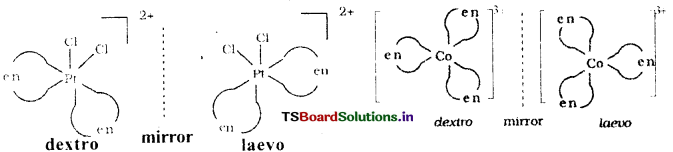
2) Optical Isomerism: Optical isomers are mirror images that cannot be superimposed on one another. One isomer that rotates the plane polarised light in clock wise direction is d-isomer and other isomer that rotates plane polarised light in anticlock wise direction is/-isomer.
Ex: [CoCl2(en)2]+ [Co(en)3],sup>3+
II) Structural Isomerism: Two (or) more compoundshaving same empirical formula but different structural arrangements are called structural isomers. They are 4 types.
1) Linkage lsomerism:Isomers which differ in point of attachment when ambidentate ligands are present in coordination sphere are known as linkage isomers and the phenomenon is known as linkage isomerism. ,
Ex: [ Co(NH3)5(NO2)] Cl2 & [Co(NH3)5(ONO)] Cl2
2) Coordination Isomerism:Isomers formed due to interchange of ligands between cationic and anionic entities of a complex are known as coordination isomers and the phenomenon is known as coordination isomerism.
Ex: [Co(NH3)6][Cr(CN)6], [Co(CN)6][Cr(NH3)6]
3) Ionisation Isomerism: It is due to exchange of ligands between coordination and ionisation sphere. Hence compounds give different ions in solution. These compounds are known as isomerisation isomers and the phenomenon is known as Ionisation Isomerism
Ex: [ Co(NH3)5SO4] Br & [Co(NH3)5Br] SO4
4) Hydrate Isomerism: Isomers which differ in number of water molecules in coordination sphere are known hydrate isomer and the phenomenon is known as hydrate isomerism.
Ex: [Cr(H2O)g]Cl3 (violet) and its solvate isomer [Cr(H2O)5Cl]Cl2.H2O (grey-green).
Question 2.
Discuss the nature of bonding and magnetic behaviour in the following coordination entities on the basis of valence bond theory
(i) [Fe(CN)6]4-
(ii) [FeF6]3-
(iii) [Co(C2O4)3]3-
(iv) [CoF6]3-
Answer:
(i) [Fe(CN)6]4- : The oxidation state of Fe in this complex is +2.
Fe (Z = 26) = [Ar] 3d64s2
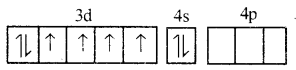
Fe+2(Z = 24) = [Ar]3d64s0
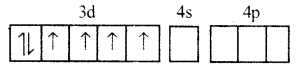
CN– is a strong ligand. So forced pairing happens and hence sp3d2 hybridization takes place.
Now six empty d2sp3 hybrid orbitals overlap with 6 ligand orbitals (CN–) to form the complex ion.
This complex ion is octahedral. It is diamagnetic as it does not contain any unpaired electron. Also (n-1)d orbitals are involved in hybridization. So it is a inner orbital or low spin complex ion.
(ii) [FeF6]3- : The oxidation state of Fe in this complex is +3.
Fe (Z = 26) = [Ar]3d64s2

Fe+3 (Z = 23) = [Ar] 3d5 4s0
F– is a weak ligand. So pairing does not happens.
Here 3d orbitals are not available to take part in bonding.
Hence nd orbitals are involved in hybridisation and sp3d2 hybridisation takes place.
[FeF6]3- :
Because of the presence of five unpaired electrons, the complex is paramagnetic.
Also outer d orbitals are involved in hybridization, so it is an outer orbital or high spin complex ion.
iii) [Co(C2O4)3]3- : The oxidation state of Co in this complex is +3
Co (Z = 27) = [Ar]3d74s2

Co+3 = [Ar] 3d64s0

C2O4-2 is a strong ligand .
So pairing happens and hence d2sp3 hybridization takes place.
Now 6 empty d2sp3 hybrid orbitals overlap with 6 ligand orbitals ( C2O4-2) to form complex ion.
[Co(C2O4)3]3- :

Since, all the electrons are paired, this complex is diamagnetic. It is an inner orbital complex because of the involvement of (n-1)d orbital for bonding.
(iv) [CoF6]3- : The oxidation state of Co in this complex is +3.
Co (Z = 27) : [Ar] 3d74s2,
Co+3 (Z = 24) [Ar] 3d64s0
F– is a weak field ligand. So pairing does not happen
Thus 3d orbitals are not available to take part in bonding.
Hence nd orbitals are involved in hybridisation and sp3d2 hybridisation takes place.
[CoF6]3- :
Because of the presence of four unpaired electrons, the complex is paramagnetic.
Since outer d orbitals take part in bonding it is an outer orbital complex ion or high spin complex ion.
Question 3.
Sketch the splitting of d-orbitals in an octahedral crystal field. A:
Answer:
Question 4.
Explain the applications of coordination compounds in different Fields.
Answer:
1) Coordination compounds are used in the estimation of qualitative and quantitative analysis of compounds. For this purpose chelating reagents like EDTA, DMG (dimethyl glyoxime) α-nitroso-β-naphthol are used.
2) Ca+2, Mg+2 ions present in hard water are estimated by chelating agent sodium salt of EDTA.
3) Silver and gold are extracted from ore by complex formation and metal displacement method.
Ex: AgCl + 2NaCN → Na[Ag(CN)2] + NaCl
2Na[Ag(CN)2] + Zn → Na2[Zn(CN)4] + 2Ag↓
4) Certain metals like Ni, Fe are purified by complex formation and subsequent decomposition of complex. In Mond’s process TMi’ is purified in this way.
5) Coordination complexes are very important in biological systems.
- Chlorophyll present in plants is a complex of Mg+2 ion
- Vitamin B12 (Cyanocobalamine) is a complex of CO+3 ion.
- In Hemoglobin, Heme is the complex of Fe+2 ion
- Enzymes like carboxypeptidase and carbonic anhydrase act as catalyst in biochemical reactions.
6) Coordination compounds are used as catalysts in industries. Wilkinson catalyst in a rhodium complex [(Ph3P)3RhCl] is used for the hydrogenation of alkenes.
7) In photography, in the process of developing [Ag(S2O3)2]3- is formed when unreduced AgBr film dissolves in hypo solution.
8) Recently complexes are used in the medicinal chemistry for treatment of diseases.
Ex: EDTA is used in the treatment of lead poisoning.
Question 5.
a) Write four postulates of Werner’s theory of coordination compounds.
b) Explain cis-trans isomerism in [Pt(NH3)2Cl2] complex.
Answer:
Werner’s theory explains the structure, bonding, and isomerism of complex compounds.
a) Postulates of Werner’s theory:
- In coordination compounds metals show two types of linkages (valences)- primary and secondary.
- The primary valences are normally ionisable and are satisfied by negative ions.
- The secondary valences are non ionisable. These are satisfied by neutral molecules or negative ions. The secondary valence is equal to the coordination number and is fixed for a metal.
- The ions/groups bound by the secondary linkages to the metal have characteristic spatial arrangements corresponding to different coordination numbers.
b) Cis-trans isomerism in [Pt(NH3)2Cl2] complex:
Geometrical or Cis-trans isomerism:
Cis Isomerism: When two ligands of same type occupy adjacent positions in coordination sphere of central metal atom, then it is called cis-isomer.
Trans Isomerism: If the two ligands occupy far apart opposite to each other in coordination sphere, then it is called trans isomer.
The given complex [Pt(NH3)2Cl2] is in the square complex of the form [MX2L2] and its Cis isomer and trans isomer are shown in the figure.

Objective Questions
Question 1.
In coordination compounds, ligands act as:
1. Electron donors
2. Electron acceptors
3. Proton donors
4. Neutral molecules only
Answer:
1. Electron donors
Question 2.
The coordination number of Co in [CO(NH3)6] Cl3 is:
1. 3
2. 4
3. 6
4. 2
Answer:
3. 6
Question 3.
Which among the following is a neutral ligand?
1. CN–
2. Cl–
3. NH3
4. OH–
Answer:
3. NH3
Question 4.
The oxidation state of Fe in K4[Fe(CN)6] is:
1. +1
2. +2
3. +3
4. +4
Answer:
2. +2
Question 5.
Which ligand is bidentate?
1. NH3
2. Cl–
3. en
4. H2O
Answer:
3. en
Question 6.
EDTA is:
1. Monodentate
2. Bidentate
3. Tetradentate
4. Hexadentate
Answer:
4. Hexadentate
Question 7.
Which ligand is ambidentate?
1. NH3
2. H2O
3. NO2–
4. EDTA
Answer:
3. NO2–
Question 8.
The coordination entity in (CU(NH3)4]SO4 is:
1. SO42-
2. Cu2+
3. [Cu(NH3)4]2+
4. NH3
Answer:
3. [Cu(NH3)4]2+
Question 9.
The IUPAC name of [CO(NH3)5Cl]Cl2 is:
1. Pentaamminechloridocobalt(III) chloride
2. Pentaamrninechlorocobalt(II) chloride
3. Chloropentaamminecobalt(III) chloride
4. Pentaamminecobalt chloride
Answer:
1. Pentaamminechloridocobalt(III) chloride
Question 10.
When 0.1 mol CoCl3(NH3)5 is treated with excess of AgNO3, 0.2 mol of AgCl are obtained. The conductivity of solution will correspond to
1) 1:3 electrolyte
2) 1:2 electrolyte
3) 1:1 electrolyte
4) 3:1 electrolyte
Answer:
4) 3:1 electrolyte
Question 11.
Werner’s theory explains:
1. Hybridisation
2. Radioactivity
3. Coordination compounds
4. Electrolysis
Answer:
3. Coordination compounds
Question 12.
Primary valency corresponds to:
1. Coordination number
2. Oxidation state
3. Number of ligands
4. Shape
Answer:
2. Oxidation state
Question 13.
Secondary valency corresponds to: .
1. Oxidation number
2. Charge on ion
3. Coordination number
4. Atomic number
Answer:
3. Coordination number
Question 14.
Which of the following is a chelating ligand?
1. NH3
2. H2O
3. en
4. Cl–
Answer:
3. en
Question 15.
Which of the following can show linkage isomerism?
1. NH3
2. H2O
3. NO2–
4. Cl–
Answer:
3. NO2–
Question 16.
The compounds [Co(SO4)(NH3)5]Br and [CO(SO4)(NH3)5]Cl represent
1) linkage isomerism
2) ionisation isomerism
3) coordination isomerism .
4) no isomerism
Answer:
4) no isomerism
Question 17.
The oxidation state of Pt in [PtCl6]2- is:
1. +2
2. +3
3. +4
4. +6
Answer:
3. +4
Question 18.
The shape of [Co(NH3)6]3+ is:
1. Tetrahedral
2. Square planar
3. Octahedral
4. Linear
Answer:
3. Octahedral
Question 19.
Hemoglobin contains:
1. Cu
2. Mg
3. Fe
4. Co
Answer:
3. Fe
Question 20.
Chlorophyll contains:
1. Cu
2. Mg
3. Fe
4. Zn
Answer:
2. Mg
Question 21.
Which complex shows ionisation isomerism?
1. [Co(NH3)5SO4]Br
2. [Ni(CO)4]
3. [Zn(NH3)4]+
4. [Ag(NH3)3]+
Answer:
1. [Co(NH3)5SO4]Br
Question 22.
Geometrical isomerism is shown by:
1. [Co(NH3)6]3+
2. [Pt(NH3)2 Cl2]
3. [Zn(NH3)4]2+
4. [Ag(NH3)2]+
Answer:
2. [Pt(NH3)2 Cl2]
Question 23.
The shape of [Ni(CO)4] is:
1. Square planar
2. Tetrahedral
3. Octahedral
4. Linear
Answer:
2. Tetrahedral
Question 24.
The hybridisation in [Ni(CN)4]2- is:
1. sp3
2. dsp2
3. sp2
4. d2sp3
Answer:
2. dsp2
Question 25.
Which complex is diamagnetic?
1. [NiCl4]2-
2. [FeCl4]–
3. [Ni(CN)4]2-
4. [COF6]3-
Answer:
3. [Ni(CN)4]2-
Question 26.
Which ligand is a strong field ligand?
1. F–
2. H2O
3. Cl–
4. CN–
Answer:
4. CN–
Question 27.
Which ligand is a weak field ligand?
1. CN–
2. CO
3. F–
4. en
Answer:
3. F–
Question 28.
Colour in coordination compounds is mainly due to:
1. Proton transfer
2. d-d transitions
3. Nuclear charge
4. Radioactivity
Answer:
2. d-d transitions
Question 29.
The effective atomic number concept was proposed by:
1. Werner
2. Sidgwick
3. Pauling
4. Bohr
Answer:
2. Sidgwick
Question 30.
Which complex is used in electroplating?
1. [Ag(CN)2]–
2. Chlorophyll
3. Hemoglobin
4. Vitamin B12
Answer:
1. [Ag(CN)2]–
Question 31.
The correct IUPAG name of [Pt(NH3)2Cl2] is
1) Diamminedichloridoplatinum (II)
2) Diamminedichloridoplatinum (IV)
3) Diamminedichloridoplatinum (0)
4) Dichloridodiammineplatinum (IV)
Answer:
1) Diamminedichloridoplatinum (II)
Question 32.
Which complex has square planar geometry?
1. [Ni(CO)4]
2. [NiCl4]2-
3. [Ni(CN)4]2-
4. [COF6]3-
Answer:
3. [Ni(CN)4]2-
Question 33.
The hybridisation of [CoF6 ]3- is:
1. dsp2
2. d2sp3
3. sp3
4. sp2
Answer:
2. d2sp3
Question 34.
Which complex is low spin?
1.[COF6]3-
2.[FeF4]3-
3. [Fe(CN)2]4-
4. [NiCl4]2-
Answer
3. [Fe(CN)2]4-
Question 35.
Which of the following is an organometallic compound?
1. K4[Fe(CN)4]
2. [Ni(CO)4]
3. [CO(NH3)6] Cl3
4. [CU(NH3)4]SO4
Answer:
2. [Ni(CO)4]
Question 36.
The ligand CO is:
1. Weak field ligand
2. Strong field ligand
3. Ambidentate ligand
4. Bidentate ligand
Answer:
2. Strong field ligand
Question 37.
Which among the following is paramagnetic?
1. [Ni(CN)4]>]2-
2. [Zn(NH3)4]>]2+
3. [COF6]>]3-
4. [PtCl4]>]2-
Answer:
3. [COF6]>]3-
Question 38.
Ethylene diaminetetraacetate (EDTA) ion is
1) tridentate ligand with three “N” donor atoms
2) hexadentate ligand with four “O” and two “N” donor atoms
3) unidentate ligand
4) bidentate ligand with two “N” donor atoms
Answer:
2) hexadentate ligand with four “O” and two “N” donor atoms
Question 39.
The complex ion present in Prussian blue is:
1. [Fe(CN)6 ]4-
2. [CU(NH3)4]2+
3. [Ni(CO)4]
4. [CoCl4]2-
Answer:
1. [Fe(CN)6 ]4-
Question 40.
Which one is NOT a coordination compound?
1. K4[Fe(CN)6] ]
2. [Cu(NH3)4]SO4
3. NaCl
4. [CO(NH3)6] Cl3
Answer:
3. NaCl