Law Questions and Answers AP Inter 1st Year Civics Chapter 4

Regular practice with AP Inter 1st Year Civics Study Material Chapter 4 Law Questions and Answers helps students stay prepared for examinations.

AP Inter 1st Year Civics 4th Lesson Law Questions and Answers

Very Short Answer Questions

Question 1.
Explain the term law and its origin.
Answer:
The concept of Law in social science explains how to regulate the behavior of men in society. The first dimension of the term ‘Law’ is derived from the German “Lag” which means to lay, or to set or to fix.

The second dimension of the term ‘Law’ is derived from the Latin words “Jus and Jungere,” which mean bond or tie.

Question 2.
What is Natural Law?
Answer:
Natural law is an abstract divine law. It is not created by any human agency. It is considered as the gift of nature based on metaphysical power. It is written in the heart of human beings by the finger of God.

Question 3.
Write about Constitutional Law.
Answer:

  • Constitutional law is the supreme law of a state. It determines the structure of the government.
  • It explains the relationship among the organs of government. It also explains the rights and responsibilities of the citizens of a state.

Question 4.
What is Administrative Law?
Answer:
Administrative law is the law of administration. It plays an important role in the smooth functioning of administration. It regulates the administrative relations between the authorities and people. It helps the government to bring reforms in the sphere of development and welfare programmes.

Law Questions and Answers AP Inter 1st Year Civics Chapter 4

Question 5.
Explain the “Rule of Law”.
Answer:
Rule of Law says all are equal before law. it is the unique feature of British Constitution.

A.V.Dicey says that “Every official from Prime Minister to attender, all are equal before the law”.

The government must treat all the citizens equally as per the law. It Simply says, rule is rule for all. It stands for equality before the law.

Short Answer Questions

Question 1.
Explain any two sources of law.
Answer:
Law is a product of history. It has passed through various stages of development.
Several elements have contributed to its evolution.

Six Sources of Law mentioned by Professor T.E. Holland:

  1. Customs.
  2. Religion.
  3. Equity.
  4. Legislature.
  5. Judicial decisions.
  6. Scientific Commentaries

1. Customs:
Customs are regarded as the earliest source of Law. In ancient period disputes between individuals were settled in accordance with the prevailing social customs. These customs, rituals and traditions in course of time became a basis for social life. For example. Marriage laws are formulated on the basis of customs.

2. Religion:
In ancient period, Customs and Religion were closely related to each other. The ancient city states were governed on the basis of divine laws. The early priests, kings and magicians played a key role in making laws supported by religion. Religion served as the basis of laws in many states. Example. The origin of the Hindu laws in -India can be traced to the Code of Manu.

Question 2.
Write any four features of law.
Answer:
Features of Law:

  1. Law comprises some rules and regulations which are approved by the soverei
  2. It is enforced by the state. It is valid because it is sanctioned by the state.
  3. It is definite, precise and universal.
  4. It reflects the will of the people.
  5. Any violation of law leads to punishment.
  6. Laws are compulsory and cohesive in nature.
  7. Law aims at securing and promoting the individual and general welfare.
  8. Law is dynamic as it goes on changing according to the needs of the people.

Law Questions and Answers AP Inter 1st Year Civics Chapter 4

Question 3.
Distinguish between Law and Morality.
Answer:
Differences between Law and Morality:

LawMorality
1. Law is concerned with the external behavior of individuals.1. Morality is concerned with the whole life of individuals.
2. Law is a concern of the state.2. Morality is concerned with individual conscience.
3. Law is backed by the coercive power.3. Public opinion and individual conscience lie behind morality.
4. Law is definite and precise.4. Morality is vague and uncertain.
5. Law acts within the territory of a state.5. Moral principles are universal iri nature.
6. Law is enacted with a specific objective.6. Moral principles are inherent in society.
7. Laws are sanctioned by the sovereign.7. Moral principles are sanctioned by the society.
8. Violation of laws leads to punishment.8. Violation of moral principles does not involve punishment.

Long Answer Questions

Question 1.
Define Law and explain the sources of law.
Answer:

  • Law is a product of history. It has passed through various stages of development.
  • Several elements have contributed to its evolution.

Definition of Law:
“Law is the collection of principles recognised and applied by the state in the administration of justice.” -John Salmond

Six Sources of Law mentioned by Professor T.E. Holland :

  1. Customs.
  2. Religion.
  3. Equity.
  4. Legislature.
  5. Judicial decisions.
  6. Scientific Commentaries

1. Customs: Customs are regarded as the earliest source of Law. In ancient period disputes between individuals were settled in accordance with the prevailing social customs. These customs, rituals and traditions in course of time became a basis for social life.
Ex: Marriage laws are formulated on the basis of customs.

2. Religion: In ancient period, customs and religion were closely related to each other. The ancient city states were governed on the basis of divine laws. The early priests, kings and magicians played a key role in making laws supported by religion.
Ex:The origin of the Hindu laws in India can be traced to the Code of Manu.

3. Equity: The term ‘equity’ stands for the principles of fairness and justice. When the existing laws are inadequate, judges use their common sense and fair understanding to give relief to the party concerned. It is viewed as judge made law.

4. Legislation: Most of the laws are passed by the legislature. Legislation is considered as the direct source of law. Legislation became a significant element in enacting laws in modem times. While formulating laws, legislature represents the voice of the general public.

5. Judicial Decisions: Judicial Decisions are also considered as the most important source of law. The judges settle various disputes and review the constitutional propriety of laws. When a law is silent, judges express their opinions to deal with such situations, with better arguments and evidences.

6. Scientific Commentaries: The views, comments and works of eminent jurists on law help in the formation of laws. Greater importance is assigned to the opinion of judges, jurists and lawyers in the formulation of laws. In the course of their commentaries, the jurists point out the drawbacks in law, and suggest the solutions.

Law Questions and Answers AP Inter 1st Year Civics Chapter 4

Question 2.
Define law and explain any six types of Maclver’s classification of Law.
Answer:

  • Law is a product of history. It has passed through various stages of development
  • Several elements have contributed to its evolution.

Definition of Law:

“Law is the collection of principles recognised and applied by the state in the administration of justice.”-John Salmond

Types of Laws in Maclver’s classification:
1. Natural Law: Natural law is also known as divine law. It is abstract. It is not created by any human agency. It is considered as the gift of nature based on metaphysical power.

2. Positive Law: Positive law is created by the human agency. It is also known as political law. It is framed on the basis of the existing social and political conditions. It is sanctioned by the sovereign political authority.

3. Constitutional Law: Constitutional Law is basically different from ordinary laws. It is supreme law of the State. It determines the structure of the government. It explains the relationship among the organs of the government.

4. Ordinary Law: Ordinary law is subordinate to the constitutional law. It is formulated and enforced by the competent authority of the state. It explains the relations of the citizens with society, government and state.

5. Public Law: Public law regulates the relations between state and individuals. It explains the basic structure and functions of the state. It covers the basic rights of the individuals against the excessive interference of the state.

6. Private Law: Private Law determines and regulates the relations among the individuals. It perescribes the conduct of individuals in society. It provides guarantee to each individual to enjoy their rights. It is sometimes termed as civil law. Public Law is further divided into Administrative Law and General Law.

7. Administrative Law: Administrative law plays an important role in the smooth functioning of administration. It regulates the administrative relations between the authorities and people, law brings discipline among the personnel in the government.

8. General Law: General Law determines the relationship between ordinary citizens and the state. It de with the private affairs of individual in relation to the state. It covers the laws relating to marriage divorce, contract, etc.. General Law is further classified into statutory law, Common law.

9. Statutory Law: Statutory law is an important part of modern law. It is enacted by the legislature of a s for the day-to-day administration. For instance, the Parliament in India, the Congress in USA and Parliament in Britain formulate this type of law.

10. Common Law: Common law is a customary law. It is a product of customs and traditions which are po among the people. The courts accept common law as a part of the legal system.

Multiple Choice Questions

Question 1.
The term ‘Equity’ is derived from the principle of ____________.
1. Natural Justice
2. Social Justice
3. Legal Justice
4. Political Justice
Answer:
1. Natural Justice

Question 2.
Which book of A. V. Dicey gave a precise explanation of the ‘Rule of law?
1. International Law
2. Politics
3. The Prince
4. Introduction to the study of The law of the constitution.
Answer:
4. Introduction to the study of The law of the constitution.

Question 3.
Which source of law is viewed as judge-made law?
1. Customs
2. Religion
3. Equity
4. Legislation
Answer:
3. Equity

Question 4.
India adopted the concept of ‘Rule of law’ from.
1. England
2. USA
3. France
4. Germany
Answer:
1. England

Question 5.
Which country believed that ‘breach of convention is a breach of law’? v
1. India
2. Britain
3. France
4. China
Answer:
2. Britain

Law Questions and Answers AP Inter 1st Year Civics Chapter 4

Question 6.
Which of the following js an incorrect statement about constitutional law?
1. It is basically different from ordinary Law.
2. It is the supreme law of a state.
3. It determines the structure of the government.
4. It is not created by any human agency.
Answer:
4. It is not created by any human agency.

Fill in the Blanks

Question 1.
The term ‘Law’ is derived from the teutonic root German ‘Log’ which means ____________________
Answer:
to lay/ to set/ something fixed

Question 2.
Violation of law leads to ____________.
Answer:
punishment

Question 3.
The source of Hindu laws in India is ____________.
Answer:
The code of Manu

Question 4.
The source of Mohammedan Law is ____________.
Answer:
Shariah

Question 5.
Natural law is also known as ____________.
Answer:
Divine law

Law Questions and Answers AP Inter 1st Year Civics Chapter 4

Question 6.
The word ‘Law’ has its roots in the Latin words “Jus and Jungere, which mean ____________.
Answer:
Bond/Tie

One Word Answers

Question 1.
What is the supreme law of the state?
Answer:
Constitutional law.

Question 2.
Which law plays an important role in the smooth functioning of administration?
Answer:
Administrative law

Question 3.
Who believed that state is a necessary evil institution?
Answer:
Individualists

Question 4.
Who gave the slogan ‘Nothing against the state”?
Answer:
Mussolini

Question 5.
Where did the concept of the ‘Rule of Law’ originate?
Answer:
England
Nationalism Questions and Answers AP Inter 1st Year Civics Chapter 3

Regular practice with AP Inter 1st Year Civics Study Material Chapter 3 Nationalism Questions and Answers helps students stay prepared for examinations.

AP Inter 1st Year Civics 3rd Lesson Nationalism Questions and Answers

Very Short Answer Questions

Question 1.
Cite any two countries that are two distinct nations even though they belong to the same race.
Answer:
Australia and Britain are two distinct countries belonging to the same race.

Question 2.
In which two countries does the sentiment of nationality prevail despite the existence of multiple languages?
Answer:
In India and Canada, nationality prevails despite of multiple languages.

Question 3.
What is National self-determination?
Answer:
National self-determination is a principle which implies that every nation should be organised as an independent political entity. It raises the question whether every nationality has the right to be a self-governing or sovereign state. Theory of national self-determination was publicised by Woodrow Wilson in 1917 AD.

Question 4.
Define Nation.
Answer:
The term ‘Nation’ is derived from a Latin word “Natio”, which means ‘born’.

Nation means a people joining together in a society by the ties of blood-relationship. “Nation is a body of people united by the common descent and language.” – Stephen Leacock

Question 5.
What is meant by Nationality?
Answer:
Nationality is derived from the Latin word ‘Nation’ which means birth or descent. Nationality is a term which denotes the status of a person in a state. Individuals who reside in a particular geographical area having a common language and common political aspiration would contribute to nationality.

Question 6.
What is the importance of Nationalism?
Answer:
Nationalism has emerged as the most inevitable political creed which has helped to shape the history. Nationalism not only inspired but also created deep hatredness among the people. It helped in liberalizing the people from oppressive rule. It became a deciding factor in the breakup of many empires and states.

Short Answer Questions

Question 1.
What are the connotations of nationality?
Answer:
The term ‘Nationality’ is used in three different connotations.
1. Nationality refers to the legal status of citizens in a particular state. Here it refers to one’s status as a citizen of the state which he belongs to.

2. Nationality means a group of persons having their distinct identity within a particular nation. For instance, there were many nationalities as Byelorussians, Ukrainians, Uzbeks, Tajiks etc in the erstwhile Soviet Union.

3. Nationality denotes a particular kind of feelings and sentiments that binds the people together. It differentiates such people from those of other nationalities. For instance, the residents in the region of Wales and Scotland in Britain have been struggling for independent status.

Question 2.
Mention the essential elements of the Nationality.
Answer:
Essential elements of Nationality:

  1. Purity of Race
  2. Common language
  3. Common Religion
  4. Geographical Unity
  5. Common History
  6. Common Culture

1. Purity of Race: Race is a physical phenomenon. Purity of race helps in the formation and strengthening of the idea of nationality. It depends on certain distinctions of skull, stature, hair, complexion etc.
2. Common Language: Language is a medium of communication and deliberations among the people. People having a common language can very easily form into a single nation. Common language embodies commpn literature. This leads to a sort of psychological unity among the people.
3. Common Religion: In the past religion played an important role in the consolidation of a nation. Common religion prompted and promoted strong bonds of unity. It helped in the formation of nationality through the common ideas and ideals of the people.
4. Geographical Unity: Geographical unity is considered to be very essential for the formation of nationality and nation. It attempts to design a separate entity to ascertain the unity of the country.

Question 3.
Write any four differences between nation and nationality.
Answer:
Differences between Nation and Nationality are given in the following table:

NationNationality
1. Nation is a political concept.1. Nationality is a psychological feeling.
2. Nation is always a politically organized state.2. Nationality is always an unorganized and flexible feeling.
3. Nation is always independent.3. Nationality is not independent.
4. There can’t be a nation without nationality.4. There can be nationality without nation.
5. People who form into a nation should obey the laws of the state.5. Until the people of a nationality form into a nation, there can’t be constitutional laws. But they oblige certain common rules in their best interests.

Long Answer Questions

Question 1.
What is nationality ? and explain any six of its essential elements.
Answer:
Definitions of Nationality:

  • “Nationality is a union of hearts once made and never unmade” -J. H. Rose
  • “Nationality is a group or portion of population which is united by racial and other bonds” -J. W. Garner

Essential elements of Nationality :

  1. Purity of Race
  2. Common language
  3. Common Religion
  4. Geographical Unity
  5. Common History
  6. Common Culture
  7. Common Political Aspirations

1. Purity of Race: Race is a physical phenomenon. Purity of race helps in the formation and strengthening of the idea of nationality, it depends on certain distinctions of skull, stature, hair, complexion etc. These distinctions serve as a cementing bond among the members of a group.

2. Common Language:
Language is a medium of communication and deliberations among the people. People having a common language can very easily form into a single nation. Common language embodies common literature. This leads to a sort of psychological unity among the people.

3. Common Religion:
In the past religion played an important role in the consolidation of a nation. Common religion prompted and promoted strong bonds of unity. It helped in the formation of nationality through the common ideas and ideals of the people.

4. Geographical Unity:
Geographical unity is considered to be very essential for the formation of nationality and nation. It attempts to design a separate entity to ascertain the unity of the country. Such unity affords an opportunity to the people to live together under similar climatic conditions.

5. Common History: Common History is considered as an Important element of Nationality. It invokes an inspiration among the people and binds them together. Sometimes historical incidents may give a chance to the people to develop national sentiments.

6. Common Culture: Culture in its broad sense means a way of life. It is reflected through certain common elements like dress, customs, conventions, food habits, religious beliefs, ethical values etc. They easily develop into a single nation.

7. Common Political Aspirations: People living together in a territory will he imbibed with common political and economic aspirations.These intum play a dominant role in the emergence of a nation.

Question 2.
Define nation and explicate the differences between nation and state.
Answer:
The term ‘Nation’ is derived from a Latin word “Natio,” which means ‘born’.

Nation means a people joining together in a society by the ties of blood^relationship.

Definition of the Nation:
“Nation is a body of people united by the common descent and language.” – Stephen Leacock

Differences between Nation and State:

NationState
1. Nation is an independent political community or an integral part of a multinational state.1. State may consist of the people of the same nation or many nations.
2. Nation precedes the state.2. State follows the nation .The final form of a nation is the accomplishment of statehood.
3. Nation is the community of people who exist together for a common goal and who were united by psychological feeling of oneness.3. State is a people organized by law in a definite territory.
4. Nation is historical and cultural in its evolution.4. State is a political and legal structure.
5. Nation is the culmination of a long coexistence of the people.5. State need not be evolutionary in nature. It may come into existence either by unification of the smaller independent political communities or by partition.

Multiple Choice Questions

Question 1.
Who wrote the book ‘The International Law’?
1. Calvo
2. Lord Bryce
3. Burgess
4. Stephen Leacock
Answer:
1. Calvo

Question 2.
Identify the incorrect statement regarding nationality.
1. Nationality is a psychological feeling.
2. Nationality is always an unorganised and flexible feeling.
3. Nationality is always independent.
4. There can be nationality without a nation.
Answer:
3. Nationality is always independent.

Question 3.
Which of the following is an incorrect statement regarding the nation?
1. Nation is a political concept.
2. Nation is always a politically organised state.
3. Nation is always independent.
4. There can be a nation without nationality.
Answer:
4. There can be a nation without nationality.

Fill in the Blanks

Question 1.
The theory of ‘One nation-One state’ became popular after the first world war. It was based on the principle of ______________.
Answer:
National Self-Determination

Question 2.
PLO stands for ________________.
Answer:
Palestine Liberation Organisation

Question 3.
The term ‘Nation’ is derived from the Latin word ‘Natio’, which means ______________.
Answer:
Born

One Word Answers

Question 1.
Who proposed the theory of ‘National self-determination’?
Answer:
Woodrow Wilson.

State Questions and Answers AP Inter 1st Year Civics Chapter 2

Regular practice with AP Inter 1st Year Civics Study Material Chapter 2 State Questions and Answers helps students stay prepared for examinations.

AP Inter 1st Year Civics 2nd Lesson State Questions and Answers

Very Short Answer Questions

Question 1.
Write any one definition of the state.
Answer:

  • State is a politically organized people of a definite territory” – Bluntschli
  • “State is a people organized for law within a definite territory” – Woodrow Wilson

Question 2.
Mention the other elements of the state.
Answer:
The four other elements of the State are:

  1. International Recognition,
  2. Permanence.
  3. General Obedience
  4. Popular Will

Question 3.
What are the primary theories of the origin of the state?
Answer:
Primary theories of the origin of the state:

  1. The Divine Origin Theory
  2. The Force Theory
  3. The Patriarchal Theory
  4. The Matriarchal Theory

Question 4.
What do you know about ‘association’?
Answer:
An association is defined as “a group of people united for a specific purpose or a limited number of purposes”. Associations are meant for realising the interests of their members only.

They may be temporary or permanent. They lack sovereignty.

State Questions and Answers AP Inter 1st Year Civics Chapter 2

Question 5.
What is international recognition?
Answer:
International recognition:

  • Every state needs to be recognised by the other states.
  • International recognition implies recognition of the sovereign status of a state by other states.
  • Such recognition is rendered by some international organizations like United Nations Organization.
  • The UNO membership is a means for recognizing state’s sovereignty.

Question 6.
Mention two thinkers who endorsed social contract theory.
Answer:
Hobbes, Locke, and Rousseau endorsed Social Contract Theory.

Short Answer Questions

Question 1.
Explain any two essential elements of the State.
Answer:
State is considered as the most important, powerful, and sovereign institution.
Essential elements of the State:

  1. Population
  2. Territory
  3. Government
  4. Sovereignty

1. Population: State is an organized human association. No state can exist and survive without people. Because there must be some one to rule and others to be ruled.

For Plato, the ideal population of a state is 5040 people and for Rousseau it is 10,000.

In modern times the maximum and minimum size of population has not been prescribed. Modern States greatly vary in their size of population. States like the United States, Russia and Canada are under populated. China and India are over populated.

2. Territory: Territory denotes geographical area of the State. It is owned and controlled by a government which exercises sovereign power.

State requires a fixed territory, with clear demarcated boundaries for exercising undisputed authority. Territory is its “material basis”.

Territory of a State comprises:

  • Land, mountains, rivers and lakes within its frontiers;
  • Territorial waters extending upto 12 nautical miles into the sea from the coast
  • Terrestrial space lying above its land.

Question 2.
Write any four differences between state and society.
Answer:
Differences between State and Society:

StateSociety
1. State is a political organization.1. Society is a social organization.
2. State regulates only the external relation of men in society.2. Society controls both internal and external activities of the individual.
3. State formulates rules.3. Society regulates all forms of social conduct.
4. State derives its strength mainly from laws.4. Society derives its strength from customs, conventions and traditions.
5. State alone has sovereignty.5. Society does not possess sovereignty.
6. Laws of the State are uniform.6. Rules of society are not uniform.

State Questions and Answers AP Inter 1st Year Civics Chapter 2

Question 3.
Write any four differences between state and government.
Answer:
Differences between State and Government:

StateGovernment
1. State has four elements: Population, territory, government and sovereignty.1. Government is one of the essential elements of the State. It is the main agency of the State.
2. State is a permanent organization.2. Government is a temporary organization.
3. State is a natural institution. It has existed since the beginning of social life.3. Government is man-made. The rise and fall of governments has been a part of history.
4. State is an abstract organisation. It cannot be seen.4. Government is concrete and definite. It carries on several activities on behalf of the State.
5. State possesses sovereignty.5. Government possesses no such power.
6. The authority of State is absolute and original.6. The powers of the Government are limited and delegated.

 
Long Answer Questions

Question 1.
Define State and explain its essential elements.
Answer:
State is considered as the most important, powerful, and sovereign institution.

Definition of the State
“State is a politically organized people of a definite territory” – Bluntschli

Essential Elements of the State:

  1. Population
  2. Territory
  3. Government
  4. Sovereignty

1. Population: State is an organized human association. No state can exist and survive without people. Because there must be some one to rule and others to be ruled.

For Plato, the ideal population of a state is 5040 people and for Rousseau it is 10,000.

In modern times the maximum and minimum size of population has not been prescribed. Modern States greatly vary in their size of population. States like the United States, Russia and Canada are under populated. China and India are over populated.

2. Territory: Territory denotes geographical area of the State. It is owned and controlled by a government which exercises sovereign power.

State requires a fixed territory, with clear demarcated boundaries for exercising undisputed authority. Territory is its “material basis”.
Territory of a State comprises:

  • Land, mountains, rivers and lakes within its frontiers;
  • Territorial waters extending upto 12 nautical miles into the sea from the coast
  • Terrestrial space lying above its land.

3. Government: State must possess an organized government. Government is the machinery through which the State exercises its supreme power. It constitutes the brain and heart of the State. Government is indeed an indispensable machinery by means of which the State maintains its existence, carries on its functions and realizes its policies and objectives. Without government, there can be no civilized body like State.

Government is the executive branch of the State. It is essential for administering political, economic, social and cultural affairs. The State performs its various functions through the Government.
Government comprises three organs:

  • Legislature
  • Executive and
  • Judiciary

4. Sovereignty: Sovereignty is the fourth essential element of the State. It is this element that distinguish the state from other association. Sovereignty denotes the supreme and final coercive authority beyond which no further coercive power exists. It is the supreme power or ultimate authority of the State. It enables the Government to rule and make laws within the State.

Sovereignty has two aspects: internal and external.

State Questions and Answers AP Inter 1st Year Civics Chapter 2

Question 2.
Write any eight differences between state and association.
Answer:
Differences between State and Association are given in the following table:

StateAssociation
1. Membership in a State is compulsory.1. Membership in associations is voluntary.
2. State is permanent.2. Associations may be temporary or permanent.
3. State strives for the welfare and progress of all the people.3. Associations are meant for realizing the interests of the members only.
4. State is a geographical organization. It has definite boundaries.4. Associations will not have specific boundaries.
5. State is a sovereign body.5. Associations lack sovereignty.
6. Citizens show obedience to one State at a time. They enjoy membership only in one State at a particular time.6. Citizens can join in as many associations as they desire at a time.
7. The scope of State is wide.7. The scope of associations is limited.
8. State can intervene in the affairs of the associations.8. Associations can’t interfere in the affairs of the State.
9. State is superior to the associations.9. Associations are inferior to the State.
10. Citizens shall be obedient to the State.10. Citizens may disagree or disobey the rules and regulations depending upon the context and necessity.

Multiple Choice Questions

Question 1.
What, according to Willoughby, is an important element of the state?
1. Government
2. Sovereignty
3. Popular Will
4. Permanence
Answer:
3. Popular Will

Question 2.
Identify the essential element of the state.
1. International recognition
2. Government
3. Permanence
4. Popular Will
Answer:
2. Government

Question 3.
Identify the other element of the state.
1. Population
2. Territory
3. Sovereignty
4. General Obedience
Answer:
4. General Obedience

Question 4.
“The Prince” book was written by
1. Machiavelli
2. Maclver
3. Aristotle
4. Bluntschli
Answer:
1. Machiavelli

Question 5.
In the following elements which is called as the “brain and heart of the state”?
1. Government
2. Population
3. Sovereignty
4. Territory
Answer:
1. Government

Fill in the Blanks

Question 1.
The origin of the modern states was in ___________.
Answer:
Ancient Greece and Medieval Europe

Question 2.
According to Plato, the size of the population of the ‘polis’ that he conceived should not comprise more than ___________ people.
Answer:
5040

State Questions and Answers AP Inter 1st Year Civics Chapter 2

Question 3.
For every coastal state, its territorial waters extend into the sea up to a distance of ___________ nautical miles from the coastal baseline.
Answer:
12

One Word Answers

Question 1.
In the modern period, which theory led to the origin of modern nation-state system?
Answer:
Theory of National Self-Determination.

Question 2.
Who used the word ‘La Stato’ for the first time in the sense of the ‘state’?
Answer:
Machiavelli.

Question 3.
At the end of the sixteenth century, who referred to the state as a ‘republic’?
Answer:
Jean Bodin.

Question 4.
Which element of the state distinguishes the state from other associations?
Answer:
Sovereignty

Question 5.
Who regarded that ‘blood relationship (kinship) created society and society in turn led to the state’?
Answer:
Maclver

Question 6.
Who believed that good citizens make a good state?
Answer:
Aristotle

Question 7.
Who considered that ‘the state has a class structure’?
Answer:
Socialists

Scope and Significance of Political Science Questions and Answers AP Inter 1st Year Civics Chapter 1

Regular practice with AP Inter 1st Year Civics Study Material Chapter 1 Scope and Significance of Political Science Questions and Answers helps students stay prepared for examinations.

AP Inter 1st Year Civics 1st Lesson Scope and Significance of Political Science Questions and Answers

Very Short Answer Questions

Question 1.
Name four ancient Greek city-states.
Answer:
Ancient Greek city-states:

  1. Athens
  2. Argos
  3. Aegina
  4. Corinth
  5. Sparta

These city states maintained the status of sovereignty.

Question 2.
What is the origin of the term ‘civics’?
Answer:

  • The term ‘Civics’ is derived from two Latin words ‘Civitas’ and ‘Civis’.
  • They mean, City and Citizen respectively.

Question 3.
How does Political Science teach the qualities of Good Citizenship?
Answer:
Good Citizenship Qualities: Political Science teaches the lessons of various aspects and virtues of good citizenship. It trains the people to become ideal citizens. It inculcates good citizenship qualities such as obedience, social service, self-sacrifice, National unity etc. it promotes and strengthens among them a sense of responsibility towards society and state.

Question 4.
Give any two traditional definitions of political Science.
Answer:
Traditional definitions of Political Sciences:

  1. Political Science – A study of State
  2. Political Sciene – A study of Government
  3. Political Sciene – A study of State and Government.

Scope and Significance of Political Science Questions and Answers AP Inter 1st Year Civics Chapter 1

Question 5.
Write about any two modern definitions of Political science.
Answer:
Modern definitions of Political Sciences:

  1. Political Science – A study of Power
  2. Political Science – A study of Allocation of values.

Short Answer Questions

Question 1.
Enumerate any four traditional definitions of political science.
Answer:
Traditional definitions of Political Science:

  1. Political Science – a study of the State.- J.W.Garner
  2. Political Science – a study of the Government.- Stephen Leacock
  3. Political Science – a study of the State and the Government.- R.N.Gilchrist

1. Political Science – a study of the State:
“Political Science begins and ends with the state” – J. W. Garner

2. Political Science – a study of the Government:

  • Stephen Leacock, John Richard Seely and others defined, Political Science as a study of the Government.
  • “Political Science deals with the Government’ – Stephen Leacock
  • “Political Science investigates the phenomenon of the Government’-John Richard Seely

3. Political Science – a study of the State and the Government:

  • Paul Janet, R. N. Gilchrist, Dimock, Prof. Catlin and others defined Political Science as a study of the State and the Government.
  • “Political Science is a study of foundations of the State and the Government’ – R. N. Gilchrist

Scope and Significance of Political Science Questions and Answers AP Inter 1st Year Civics Chapter 1

Question 2.
Distinguish between civics and political science.
Answer:

CivicsPolitical Science
1) Civics gives more importance to the citizens.1) Political Science gives more importance to the State.
2) Civics gives less priority to the state.2) Political Science gives secondary importance to the matters of citizens.
3) The scope of civics is limited.lt studies primarily the matters relating to citizen.3) The scope of political science is much wider. It studies state whose aims, objectives and functions are numerous.
4) Cooperation is the main concept in civics. Citizens follow the norms of social life through cooperation.4) Power is the main concept in political science. ‘Power’ is the driving force behind all the activities of state in political science.

Long Answer Questions

Question 1.
Define political science and explain any six points of the scope of political science.
Answer:
Define political science and explain any six points of the scope of political science.
Aristotle, used the term ‘Politics’ for the first time in his book ‘Politics’. The term ‘Politics’ is derived from Greek words ‘Polis’ and ‘Politicus’ They mean the City and Citizen respectively.

Definitions of Political Science:

  • “Political Science begins and ends with the state” – J. W. Garner
  • “Political Science is a study of foundations of the State and the Government’- R. N. Gilchrist

Scope of Political Science:

  1. Study of Man in the Society and State.
  2.  Study of State.
  3. Study of the Government.
  4. Study of Associations and Institutions.
  5. Study of Rights and Responsibilities.
  6. Study of National and International Issues
  7. Study of Power.
  8. Study of Public Policy.

1. Study of Man in the Society and State : Aristotle stated that ‘Man is a social animal’.
Man can satisfy his basic needs like food, clothing, shelter and protection in the society. Political Science explains the relationship between man and society. It also explains the origin, evolution and purpose of the society.

2. Study of State: Some Political scientists conceived the Political Science as a study of the affairs of the state. The state is indispensable (essential) for every individual. It studies the relationship between the state and the citizens.

Political Science explains about the state under three categories.

  • The study of state in present situation.
  • The study of state in the past.
  • The study of state as it should be in future.

3. Study of Government: Some Political scientists conceived the political science as a study of government. Government is agency of the state. There can be no state without a government. Government formulates, expresses and implements the aims and aspirations of the state through its organs.

4. Study of Associations and institutions: Political science explains the nature, structure and functions of the various associations and institutions. Every individual is a member of various associations and institutions in the state.

5. Study of Rights and Responsibilities: The scope of political science includes the study of the significance of rights like right to life and right to liberty etc., and the responsibilities like paying taxes, obeying laws etc., of the citizens. Political science enumerates the definitions, classification and different theories of rights and responsibilities.

6. Study of National and International lssues:The scope of political science comprises a study of the domestic issues and policies of the state as well as international issues like Cold War, balance of power, disarmament, diplomacy, international politics and international organization etc.,

7. Study of Power: The behaviouralists of twentieth century regarded Political Science as a study of sharing and shaping of power. They pointed out that Political Science discusses how power is grabbed, manipulated and perpetuated to have a control over the society.

8. Study of Public Policy: David Easton, Anderson and Charles Lindbolm considered Political Science as the study of formulation, execution and evaluation of Public Policy. They emphasized the role of formal political structures and informal political groups.

Scope and Significance of Political Science Questions and Answers AP Inter 1st Year Civics Chapter 1

Question 2.
Explain any eight points of the significance of political science. [BMP2][Mar-19]
Answer:
Political Science is very valuable and indispensable to the rulers as well as the ruled.

Significance of Political Science:

  1. Information about the state.
  2. Knowledge of Government and Administration.
  3. Information about Democratic values.
  4. Makes Democracy successful.
  5. Rights and Responsibilities.
  6. Good citizenship qualities.
  7. Knowledge about world affairs.
  8. Provides knowledge about International Organisations.
  9. Develops political awareness.
  10. Explains the need for Co-operation and Toleration.

1. Information about the State: The primary aim of studying Political Science is to provide information and knowledge of the State – its origin, nature, structure and functions. Knowledge of the State is of great significance to everyone.

2. Knowledge of Government and Administration: Political Science creates awareness about the organization, control and coordination of administration, public relations, management, administrative laws etc. It also covers the study of local self-governing bodies like Corporations, Municipalities, Zilla Parishads, Mandal Parishads, Panchayats etc.

3. Information about Democratic values:Political Science provides accurate information about the political terms like state, government, nation, nationality, constitution, democracy, socialism, and communism which are used commonly in every sphere of human life. It provides a good knowledge and awareness about the political ideas like Rights, Liberty, Equality and Justice.

4. Makes Democracy Successful: People in democracy elect their representatives and are ruled by them. They must be vigilant and enlightened for preserving and promoting democratic ideals. It educates the common men on the ideals and ideals of democracy. Its study is vital for the success of democracy.

5. Rights and Responsibilities: The study of Political Science enables the citizens to be familiar with their rights and responsibilities and their interrelationship. The success or failure of democracy depends upon the proper understanding of the relationship between the rights and responsibilities.

6. Good Citizenship Qualities : Political Science teaches the lessons of various aspects and virtues of good citizenship. It trains the people to become ideal citizens. It inculcates good citizenship qualities such as obedience, social service, self-sacrifice , National unity etc.

It promotes and strengthens among them a sense of responsibility towards society and state.

7. Knowledge about world affairs: The study of Political Science enriches individual’s knowledge on world affairs. It is useful for observing and understanding the contemporary world affairs.

It stimulates right thinking, broad vision and universal understanding of various phenomena of international politics.

8. Knowledge about International Organisations:The Study of Political Science promotes the spirit of internationalism. It provides a sound knowledge about international organizations like the UNO, WHO, UNESCO.

9. Develops Political awareness: The study of Political Science provides the necessary knowledge about political ideals namely Liberty, Equality, Fraternity, Justice etc. It also discusses about some political ideologies like fascism, socialism and communism.

10. Explains the need for Co-operation and Toleration: Many obstacles like communalism, linguism, sub-national regional and sub-regional feelings etc., have been threatening the national integration in many states. In this context, the study of Political Science teaches about the need for adjustment, co-operation and toleration.

Multiple Choice Questions

Question 1.
Which of the following is not considered an ancient Greek city-state?
1. Athens
2. Corinth
3. Argos
4. USA
Answer:
4. USA

Question 2.
Who described the ancient Greek city-states as ‘city-communities’?
1. Socrates
2. Prof. Catlin
3. Plato
4. Paul Janet
Answer:
2. Prof. Catlin

Question 3.
Socrates belonged to
1. 5th Century BC
2. 6th Century BC
3. 4th Century BC
4. 5th Century AD
Answer:
1. 5th Century BC

Question 4.
The term ‘Politics’ is derived from Greek words ‘Polis’ and ‘Politis’ which mean
1. City-Communities
2. Modern State
3. City and Citizen
4. Modern Village
Answer:
3. City and Citizen

Question 5.
Who defined “political science as the science of who gets what, when and why?”
1. William A. Robson
2. Hillman
3. Stephen Leacock
4. J.W. Garner
Answer:
2. Hillman

Scope and Significance of Political Science Questions and Answers AP Inter 1st Year Civics Chapter 1

Question 6.
Who understood political science as the authoritative allocation of values?
1. David Easton
2. Hillman
3. R.G. Gettel
4. Harold Lasswell
Answer:
1. David Easton

Fill in the Blanks

Question 1.
Modern political scientists like Anderson, David Easton and Charles Lindblom argued that political science is a ____________.
Answer:
Policy science

Question 2.
The father of political science is ____________.
Answer:
Aristotle

One Word Answer

Question 1.
Who worked hard to popularity of political science as a subject of study in developing nations?
Answer:
H.J. Laski.

Question 2.
Where did political science originate?
Answer:
Ancient Greek city-states.

Question 3.
Who said ‘man is a social animal’?
Answer:
Aristotle.

Question 4.
Who first recognised political science as a prominent academic subject?
Answer:
London School of Economics.

Scope and Significance of Political Science Questions and Answers AP Inter 1st Year Civics Chapter 1

Question 5.
Who described political science as the ‘supreme science and the master of all social sciences’?
Answer:
Aristotle.

AP Inter 1st Year Civics Study Material

AP Intermediate 1st Year Civics Textbook Solutions

Civics Inter 1st Year

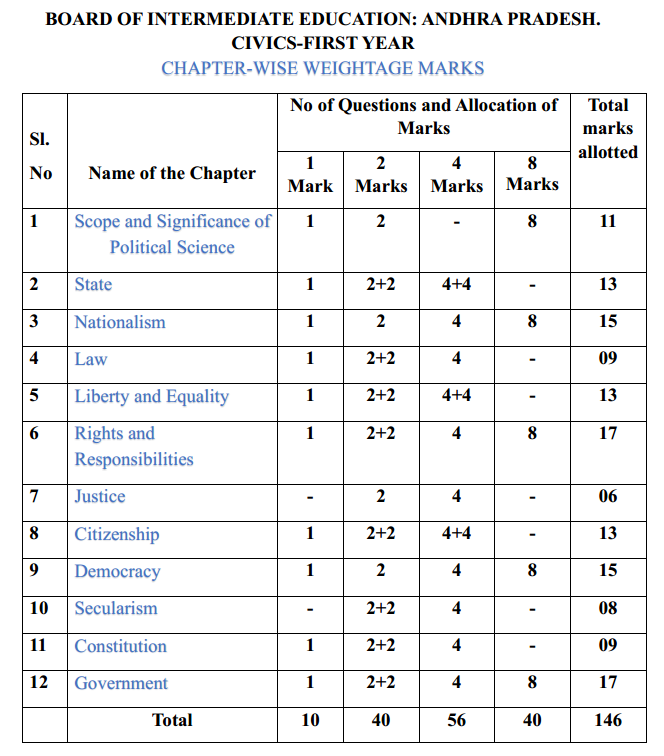
AP Inter 1st Year Civics Weightage BluePrint 2026-2027

AP Inter 1st Year Civics Weightage BluePrint 2026-2027

AP Inter 1st Year Study Material

AP Inter 1st Year Maths Exercise 13b Solutions

Referring to the AP Inter 1st Year Maths Study Material Chapter 13 Statistics Exercise 13b Solutions makes it easier to understand complex problems.

AP Inter 1st Year Maths Statistics Solutions Exercise 13b

I.

Question 1.
Find the mean and variance for each of the following data.
a) 6, 7, 10, 12, 13, 4, 8, 12.
b) First ‘n’ natural numbers,
c) First 10 multiples of 3.
Solution:
a) Given observations : 6, 7, 10, 12, 13, 4, 8, 12.

Mean, x̄ = \(\frac{\sum_{i=1}^8 x_i}{n}=\frac{6+7+10+12+13+4+8+12}{8}=\frac{72}{8}\) = 9

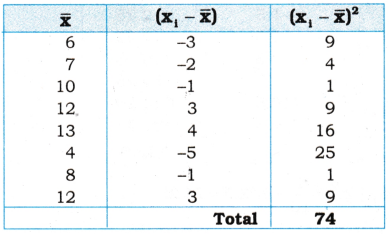
The following table is obtained for the given data.
AP Inter 1st Year Maths Exercise 13b Solutions 1

Variance (σ2) = \(\frac{1}{n} \sum_{i=1}^n\) (xi – x̄)2
= \(\frac{1}{8}\) × 74
= 9.25

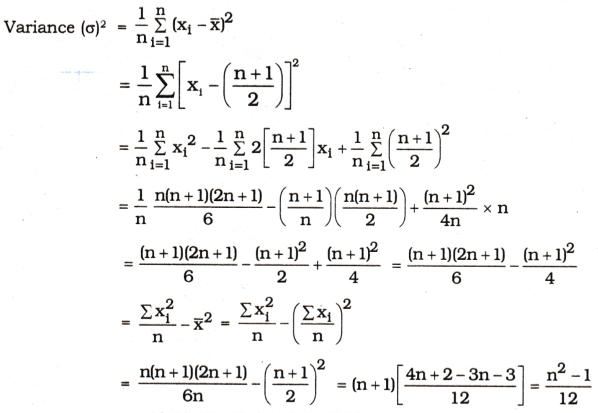
b) The mean of first ‘n’ natural numbers is calculated as follows.
Mean = \(\frac{\text { Sum of all observations }}{\text { No. of observations }}=\frac{n\left(\frac{n+1}{2}\right)}{n}=\frac{n(n+1)}{2 n}=\frac{n+1}{2}\)
AP Inter 1st Year Maths Exercise 13b Solutions 2

c) The first 10 multiples of ‘3’ are 3, 6, 9, 12, 15, 18, 21, 24, 27, 30.
Here, number of observations, n = 10
Mean, x̄ = \(\frac{\sum_{i=1}^{10} x_i}{10}=\frac{165}{10}\) = 16.5

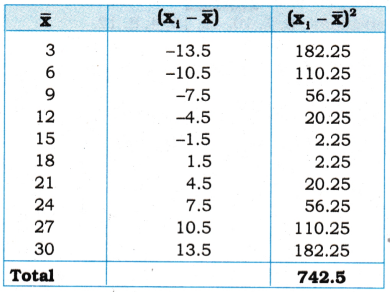
The following table is obtained for the given data.
AP Inter 1st Year Maths Exercise 13b Solutions 3
Variance (σ2) = \(\frac{1}{\mathrm{n}} \sum_{\mathrm{i}=1}^{10}\)(xi – x̄)2
= \(\frac{1}{10}\) × 742.5
= 74.25

II.

Question 1.
Find the mean and variance for each of the following data.
AP Inter 1st Year Maths Exercise 13b Solutions 4
Solution:
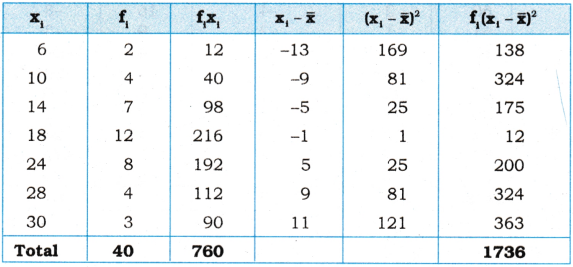
AP Inter 1st Year Maths Exercise 13b Solutions 5
Here, N = 40, \(\sum_{i=1}^7\)fixi = 760
x̄ = \(\frac{\sum_{i=1}^7 f_i x_i}{N}=\frac{760}{40}\) = 19
Variance (σ2) = \(\frac{1}{N} \sum_{i=1}^7\) fi(xi – x̄)2 = \(\frac{1}{40}\) × 1736
= 43.4

AP Inter 1st Year Maths Exercise 13b Solutions 6
Solution:
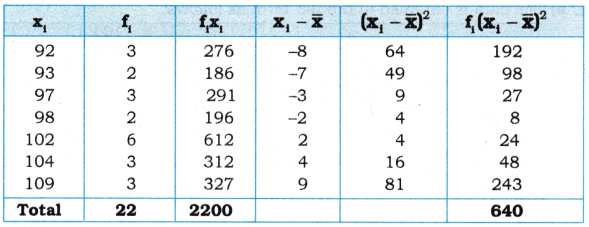
The data id obtained in tabular form as follows.
AP Inter 1st Year Maths Exercise 13b Solutions 7
Here, N = 22, \(\frac{1}{2}\)fixi = 2200
∴ x̄ = \(=\frac{1}{N} \sum_{i=1}^7\)fixi

Variance (σ2) = \(\frac{1}{N} \sum_{i=1}^7\) fi(xi – x̄)2 = \(\frac{1}{22}\) × 640 = 29.09

AP Inter 1st Year Maths Exercise 13b Solutions

Question 2.
Find the mean and standard deviation using short-cut method.
AP Inter 1st Year Maths Exercise 13b Solutions 8
Solution:
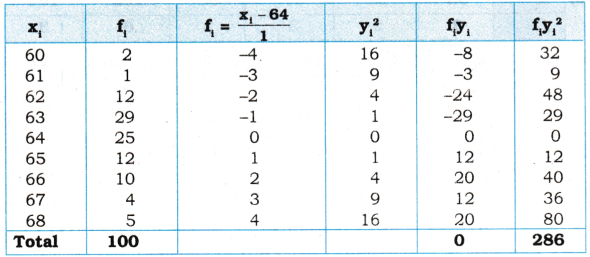
The data is obtained in tabular form as follows:
AP Inter 1st Year Maths Exercise 13b Solutions 9
Mean x̄ = A + \(\frac{\sum_{i=1}^9 f_i y_i}{N}\) × h
= 64 + \(\frac{0}{100}\) × 1
= 64 + 0
= 64

Variance (σ2) = \(\frac{h^2}{N^2}\left[N \sum_{i=1}^9 f_i y_i^2-\left(\sum_{i=1}^9 f_i y_i\right)^2\right]\)
= \(\frac{1}{100^2}\)[100 × 286 – 0]
= 2.86

∴ Standard deviation (σ) = \(\sqrt{2.86}\) = 1.69

III.

Question 1.
Find the mean and variance for the following frequency distribution.
AP Inter 1st Year Maths Exercise 13b Solutions 10
Solution:
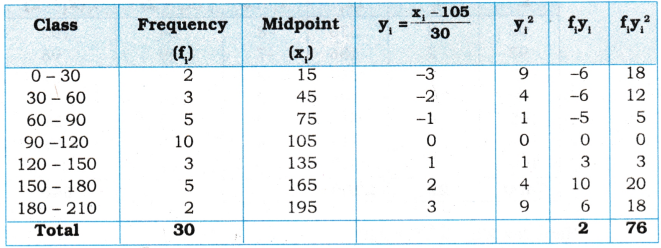
The data is obtained in tabular form as follows:
AP Inter 1st Year Maths Exercise 13b Solutions 11
Mean, x̄ = A + \(\frac{\sum_{i=1}^9 f_i y_i}{N}\) × h
= 105 + \(\frac{2}{30}\) × 30
= 105 + 2
= 107

Variance (σ2) = \(\frac{h^2}{N^2}\left[N \sum_{i=1}^9 f_i y_i^2-\left(\sum_{i=1}^9 f_i y_i\right)^2\right]\)
= \(\frac{(30)^2}{(30)^2}\)[30 × 76 – (2)2]
= 2280 – 4
= 2276

AP Inter 1st Year Maths Exercise 13b Solutions 12
Solution:
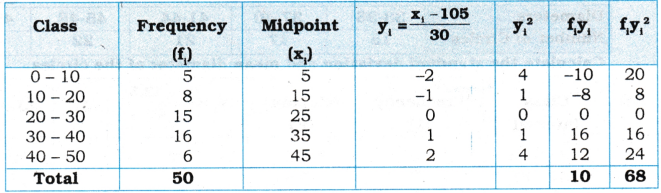
The data is obtained in tabular form as follows:
AP Inter 1st Year Maths Exercise 13b Solutions 13
Mean, x̄ = A + \(\frac{\sum_{i=1}^9 f_i y_i}{N}\) × h
= 25 + \(\frac{10}{50}\) × 10
= 25 + 2 = 27

Variance (σ2) = \(\frac{h^2}{N^2}\left[N \sum_{i=1}^9 f_i y_i^2-\left(\sum_{i=1}^9 f_i y_i\right)^2\right]\)
= \(\frac{1}{2}\)[50 × 68 – (10)2]
= \(\frac{1}{25}\)[3400 – 100]
= \(\frac{3300}{25}\) = 132

AP Inter 1st Year Maths Exercise 13b Solutions

Question 2.
Find the mean, variance and standard deviation using short-cut method.
AP Inter 1st Year Maths Exercise 13b Solutions 14
Solution:
The data is obtained in tabular form as follows:
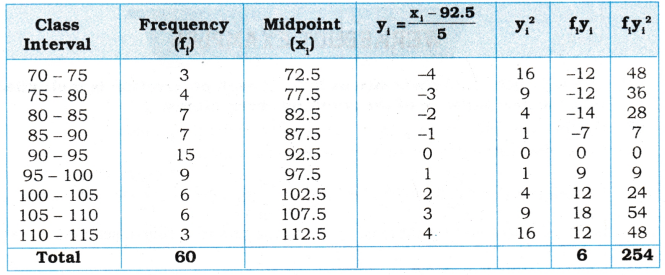
AP Inter 1st Year Maths Exercise 13b Solutions 15
Mean, x̄ = A + \(\frac{\sum_{i=1}^9 f_i y_i}{N}\) × h
= 92.5 + \(\frac{6}{60}\) × 5
= 92.5 + 0.5
= 93

Variance (σ2) = \(\frac{h^2}{N^2}\left[N \sum_{i=1}^9 f_i y_i^2-\left(\sum_{i=1}^9 f_i y_i\right)^2\right]\)
= \(\frac{(5)^2}{(60)^2}\)[60 × 254 – (6)2]
= \(\frac{25}{3600}\)[15240 – 36]
= \(\frac{25}{3600}\)(15204)
= 105.58

∴ Standard deviation (σ) = \(\sqrt{105.58}\) = 10.27

Question 3.
The diameters of circles (in mm) drawn in a design are given below.
AP Inter 1st Year Maths Exercise 13b Solutions 16
Calculate the standard deviation and mean diameter of the circles.
Solution:
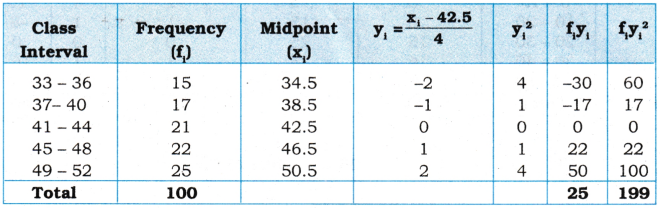
AP Inter 1st Year Maths Exercise 13b Solutions 17
Here, N = 100, h = 4. Let the assumed mean A, be 42.5
Mean, x̄ = A + \(\frac{\sum_{i=1}^9 f_i y_i}{N}\) × h
= 42.5 + \(\frac{25}{100}\) × 4
= 43.5

Variance (σ2) = \(\frac{h^2}{N^2}\left[N \sum_{i=1}^9 f_i y_i^2-\left(\sum_{i=1}^9 f_i y_i\right)^2\right]\)
= \(\frac{16}{10000}\) [100 × 199 – (25)2]
= \(\frac{16}{10000}\) [19900 – 625]
= \(\frac{16}{10000}\) × 19275
= 30.84

∴ Standard deviation (σ) = 5.55

AP Inter 1st Year Maths Exercise 13a Solutions

Referring to the AP Inter 1st Year Maths Study Material Chapter 13 Statistics Exercise 13a Solutions makes it easier to understand complex problems.

AP Inter 1st Year Maths Statistics Solutions Exercise 13a

I.

Question 1.
Find the mean deviation about the mean for the following data.
a) 4, 7, 8, 9, 10, 12, 13, 17
b) 38, 70, 48, 40, 42, 55, 63, 46, 54, 44.
Solution:
a) The given data is 4, 7, 8, 9, 10, 12, 13, 17.
Mean of the data, \(\frac{1}{n} \sum_{i=1}^n x_i\) = x̄ = \(\frac{4+7+8+9+10+12+13+17}{8}=\frac{80}{8}\) = 10
The deviations of the respective observations from the mean x̄ i.e., xi – x̄ are -6, -3, -2, -1, 0, 2, 3, 7.
The required mean deviation about the mean is 8
M.D. (x̄) = \(\frac{\sum_{i=1}^8\left|x_i-\bar{x}\right|}{8}=\frac{6+3+2+1+0+2+3+7}{8}=\frac{24}{8}\) = 3

b) The given data is 38, 70, 48, 40, 42, 55, 63, 46, 54, 44.
Mean of the given data, x̄ = \(\frac{38+70+48+40+42+55+63+46+54+44}{10}=\frac{500}{10}\) = 50
The deviations of the respective observations from the mean Xs i.e.,
xi – x̄ are -12, 20, -2, -10, -8, 5, 13, -4, 4, -6.
\(\sum_{i=1}^{10}\)|xi – x̄| = 12 + 20 + 2 + 10 + 8 + 5 + 13 + 4 + 4 + 6 = 84
The required mean deviation about the mean is
M.D. (x̄) = \(\frac{\sum_{j=1}^{10}\left|x_i-\bar{x}\right|}{10}=\frac{84}{10}\) = 8.4

Question 2.
Find the mean deviation about the median for the following data.
a) 13, 17, 16, 14, 11, 13, 10, 16, 11, 18, 12, 17.
b) 36, 72, 46, 42, 60, 45, 53, 46, 51, 49.
Solution:
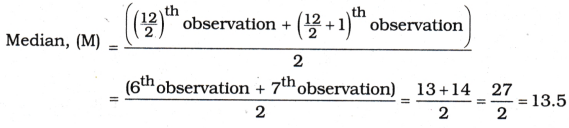
a) Here, the number of observations are 12, which is even.
Arranging the data in ascending order, we have,
10, 11, 11, 12, 13, 13, 14, 16, 16, 17, 17, 18.
AP Inter 1st Year Maths Exercise 13a Solutions 1
\(\sum_{i=1}^{12}\)|xi – M| = 3.5 + 2.5 + 2.5 + 1.5 + 0.5 + 0.5 + 0.5 + 2.5 + 2.5 + 3.5 + 3.5 + 4.5 = 28
∴ The required mean deviation about the median is
M.D. (M) = \(\frac{\sum_{i=1}^{12}\left|x_i-M\right|}{12}=\frac{28}{12}\) = 2.33

b) The given data is 36, 72, 46, 42, 60, 45, 53, 46, 51, 49.
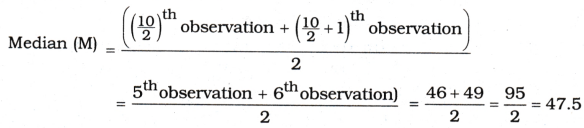
Here, the number of observations is 10, which is even.
Arranging the data in an ascending order, we have
36, 42, 45, 46, 46, 49, 51, 53, 60, 72
AP Inter 1st Year Maths Exercise 13a Solutions 2
\(\sum_{i=1}^{10}\)|xi – M| = 11.5 + 5.5 + 2.5 + 1.5 + 1.5 + 1.5 + 3.5 + 5.5 + 12.5 + 24.5 = 70
Thus, the required mean deviation about the median is
M.D (M) = \(\frac{\sum_{i=1}^{10}\left|x_i-M\right|}{10}=\frac{70}{10}\) = 7

AP Inter 1st Year Maths Exercise 13a Solutions

II.

Question 1.
Find the mean deviation about the mean for the following data.
AP Inter 1st Year Maths Exercise 13a Solutions 3
Solution:
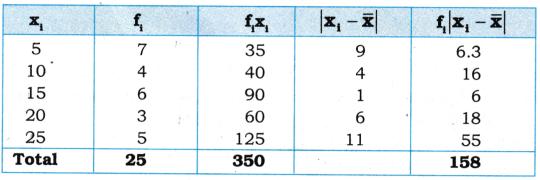
We make following table from the given data.
AP Inter 1st Year Maths Exercise 13a Solutions 4
N = \(\sum_{i=1}^5\) fi = 25 and \(\sum_{i=1}^5\)fixi = 350;
∴ x̄ = \(\frac{1}{N_i} \sum_{i=1}^5\) fixi = \(\frac{1}{25}\) × 350 = 14
∴ M.D.(x̄) = \(\frac{1}{2}\) fi |xi – x̄| = \(\frac{1}{25}\) x 158 = 6.32

AP Inter 1st Year Maths Exercise 13a Solutions 5
Solution:
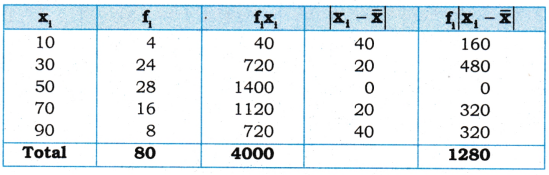
We make following table from the given data.
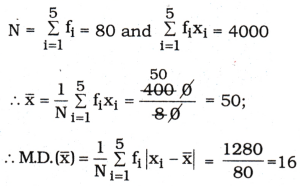
AP Inter 1st Year Maths Exercise 13a Solutions 6
AP Inter 1st Year Maths Exercise 13a Solutions 7

Question 2.
Find the mean deviation about the median for the following data.
AP Inter 1st Year Maths Exercise 13a Solutions 8
Solution:
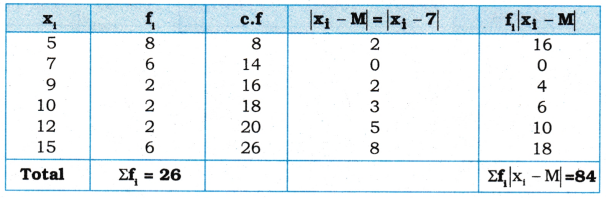
The given observations are already in ascending order. Adding a column corresponding to cumulative frequencies of the given data, we have the following table.
AP Inter 1st Year Maths Exercise 13a Solutions 9
Here, N = 26, which is even. Median is the Mean of 13th and 14th observations. Both of these observations lie in the cumulative frequency 14, for which the corresponding observation is 7.
∴ Median = \(\frac{\left(13^{\text {th }} \text { observation }+14^{\text {th }} \text { observation }\right)}{2}=\frac{7+7}{2}=\frac{14}{2}\)
Median = 7
\(\sum_{i=1}^6\)fi = 26 and \(\sum_{i=1}^6\)fi|xi – M| = 84;
M.D (M) = \(\frac{1}{N_i} \sum_{i=1}^6\)fi|xi – M| = \(\frac{1}{26\) × 84 = 3.23

AP Inter 1st Year Maths Exercise 13a Solutions 10
Solution:
The given observations are already in ascending order. Adding a column corresponding to cumulative frequencies of the given data, we have the following table.
AP Inter 1st Year Maths Exercise 13a Solutions 11
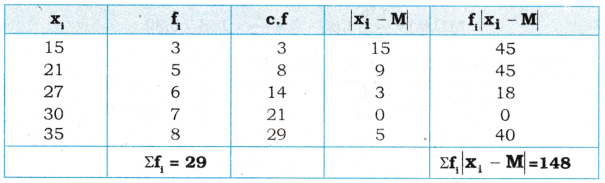
Here, N = 29, which is odd.
Median = \(\left(\frac{29+1}{2}\right)^{\text {th }}\) observation = 15th observation
This observation lies in the cumulative frequency 21, for which the corresponding observation is 30.
M = 30
\(\sum_{i=1}^5\) fi = 29, \(\sum_{i=1}^5\) fi|xi – M| = 148
∴ M.D. (M) = \(\frac{1}{N} \sum_{i=1}^5\)fi|xi – M| = \(\frac{1}{29}\) × 148 = 5.1

III.

Question 1.
Find the mean deviation about the mean for the following data.
AP Inter 1st Year Maths Exercise 13a Solutions 12
Solution:
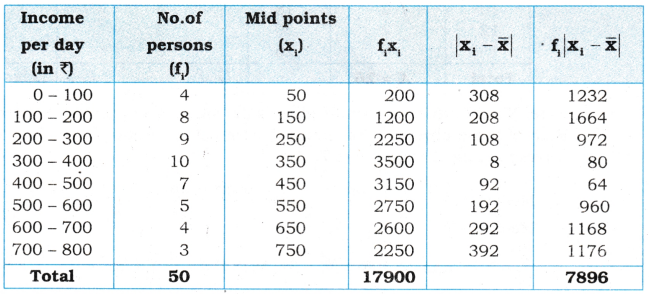
The following table is formed for the given data.
AP Inter 1st Year Maths Exercise 13a Solutions 13
Here, N = \(\frac{1}{2}\) fi = 50 and fixi = 17900
x = \(\frac{1}{2}\)fixi = \(\frac{1}{50}\) × 17900 = 358
and M.D. (x) = \(\frac{1}{N} \sum_{i=1}^8\) fi|xi – x̄| = \(\frac{7896}{50}\) = 157.92

AP Inter 1st Year Maths Exercise 13a Solutions 14
Solution:
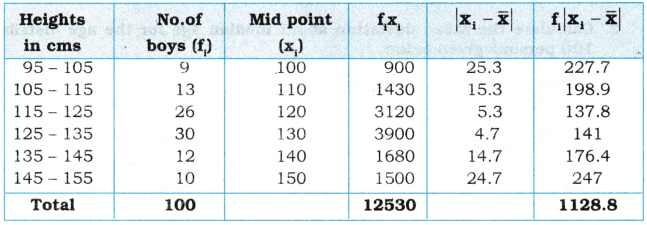
The following table is formed for the given data.
AP Inter 1st Year Maths Exercise 13a Solutions 15
Here, N = \(\sum_{i=1}^6\) fi = 100 and \(\sum_{i=1}^6\) fixi = 12530
x = \(\frac{1}{N_i} \sum_{i=1}^6\)fixi = \(\frac{1}{100}\) × 12530 = 125.3
and M.D (x̄) = \(\frac{1}{N_i} \sum_{i=1}^6\) fi|xi – x̄| = \(\frac{1}{100}\) × 1128.8 = 11.28

AP Inter 1st Year Maths Exercise 13a Solutions

Question 2.
Find the mean deviation about median for the folloeing data:
AP Inter 1st Year Maths Exercise 13a Solutions 16
Solution:
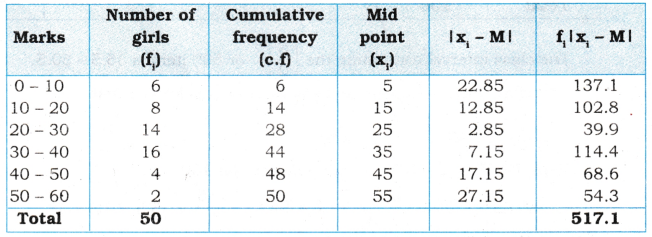
The following table is formed for the given data.
AP Inter 1st Year Maths Exercise 13a Solutions 17
The class interval containing the \(\left[\frac{\mathrm{N}}{2}\right]^{\mathrm{th}}\) or 25th item is 20 – 30.
Therefore, 20 – 30 is the median class. It is known that
Median = l + \(\frac{\frac{\mathrm{N}}{2}-\mathrm{C}}{\mathrm{f}}\) × h
Here, 1= 20, C = 14, f = 14, h = 10 and N = 50
Median = 20 + \(\frac{25-14}{14}\) × 10 = 20 + \(\frac{110}{14}\) = 20 + 7.85 = 27.85
Thus, mean deviation about the median is given by,
M.D. (M) = \(\frac{1}{N_i} \sum_{i=1}^6\)fi|xi – x̄| = \(\frac{1}{50}\) × 517.1 = 10.34

Question 3.
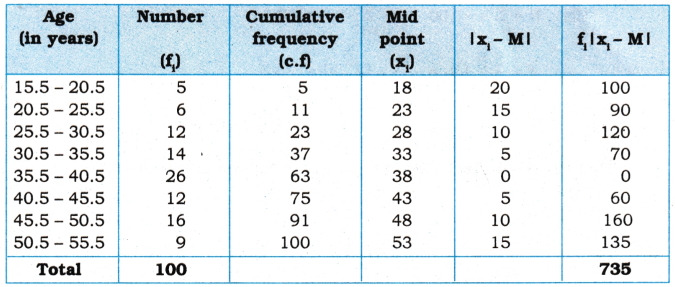
Calculate the mean deviation about median age for the age distribution of 100 persons given below.
AP Inter 1st Year Maths Exercise 13a Solutions 18
Solution:
The given data is not continuous. Therefore, it has to be converted into continuous frequency distribution by subtracting 0.5 from the lower limit and adding 0.5 to the upper limit of each class interval.

The table is formed as follows.
AP Inter 1st Year Maths Exercise 13a Solutions 19
The class interval containing the \(\left[\frac{\mathrm{N}}{2}\right]^{\text {th }}\) or 50th item is 35.5 – 50.5
Therefore, 35.5 – 40.5 is the median class. It is known that
Median (M) = l + \(\frac{\frac{\mathrm{N}}{2}-\mathrm{C}}{\mathrm{f}}\) × h
Here, l = 35.5, C = 37, f = 26, h = 5 and N = 100
∴ Median = 35.5 + \(\frac{50-37}{26}\) × 5 = 35.5 + \(\frac{13 \times 5}{26}\) = 35.5 + 2.5 = 38
Thus, mean deviation about the median is given by,
M.D. (M) = \(\frac{1}{N_i} \sum_{i=1}^8\)fi|xi – x̄| = \(\frac{1}{100}\) × 735 = 7.35

AP Inter 1st Year Maths Exercise 3e Solutions

Referring to the AP Inter 1st Year Maths Study Material Chapter Trigonometric Functions Exercise 3e Solutions makes it easier to understand complex problems.

AP Inter 1st Year Maths Trigonometric Functions Exercise 3e

I. Find the principal and general solutions of the following equations.

Question 1.
tan x = √3
Solution:
We know that tan \(\frac{1}{2}\) = √3 and tan\(\left(\frac{4 \pi}{3}\right)\) = tan\(\left(\pi+\frac{\pi}{3}\right)\)
= tan\(\frac{\pi}{3}\) = √3
The principal solutions are x = \(\frac{\pi}{3}\) and \(\frac{4 \pi}{3}\)
tan x = tan\(\frac{\pi}{3}\) ⇒ x = nπ + \(\frac{\pi}{3}\) where n ∈ Z
The general solution is x = nπ + \(\frac{\pi}{3}\) where n ∈ Z

Question 2.
sec x = 2
Solution:
We know that sec\(\frac{\pi}{3}\) = 2 and sec \(\frac{5 \pi}{3}\)
= sec (2π – \(\frac{\pi}{3}\)) = sec \(\frac{\pi}{3}\) = 2
The principal solutions are x = \(\frac{\pi}{3}\) and \(\frac{5 \pi}{3}\)
sec x = sec \(\frac{\pi}{3}\) ⇒ cos x = cos \(\frac{\pi}{3}\) [∵ sec x = \(\frac{1}{\cos x}\)]
⇒ x – 2nπ ± \(\frac{\pi}{3}\) where n ∈ Z
∴ The general solution is x = 2nπ ± \(\frac{\pi}{3}\); where n ∈ Z

Question 3.
cot x = √3
Solution:
We know that, cot \(\frac{\pi}{3}\) = √3
cot (π – \(\frac{\pi}{6}\)) = -cot\(\frac{\pi}{6}\) = -√3 and cot(2π – \(\frac{\pi}{6}\))
= -cot\(\frac{\pi}{6}\) = -√3
⇒ cot \(\frac{5 \pi}{6}\) = -√3 and cot \(\frac{11 \pi}{6}\) = -√3

The principal solutions are x = \(\frac{5 \pi}{6}\) and \(\frac{11 \pi}{6}\)
cot x = cot \(\frac{5 \pi}{6}\) ⇒ tanx = tan\(\frac{5 \pi}{6}\)
⇒ x = nx + \(\frac{5 \pi}{6}\) , where n ∈ Z
∴ The general solution is x = nx + \(\frac{5 \pi}{6}\), where n ∈ Z

AP Inter 1st Year Maths Exercise 3e Solutions

Question 4.
cosec x = -2
Solution:
We know that, cosec \(\frac{\pi}{6}\) = 2
cosec (π + \(\frac{\pi}{6}\)) = – cosec \(\frac{\pi}{6}\) = -2 and cosec (2π – \(\frac{\pi}{6}\)) = -cosec \(\frac{\pi}{6}\) = -2
⇒ cosec \(\frac{7 \pi}{6}\) = -2 and cosec \(\frac{11 \pi}{6}\) = -2
The principal solutions are x = \(\frac{7 \pi}{6}\) and \(\frac{11 \pi}{6}\)
cosec x = cosec \(\frac{7 \pi}{6}\) ⇒ sinx = sin\(\frac{7 \pi}{6}\)
x = nπ + (-1)n\(\frac{7 \pi}{6}\)
∴ The general solution is x = nπ + (-1)n\(\frac{7 \pi}{6}\) where n ∈ Z

II. Find the general solution for each of the following equations.

Question 1.
cos 4x = cos 2x
Solution:
Given that, cos 4x = cos 2x ⇒ cos 4x – cos 2x = 0
⇒ -2 sin\(\left(\frac{4 x+2 x}{2}\right)\)sin\(\left(\frac{4 x-2 x}{2}\right)\) = 0
⇒ sin 3x sin x = 0
⇒ sin 3x = 0 or sin x = 0
3x = nπ or x = nπ, where n ∈ Z ⇒ x = \(\frac{\mathrm{n} \pi}{3}\) or x = nx, where n ∈ Z

Question 2.
cos 3x + cos x – cos 2x = 0.
Solution:
Given that cos 3x + cos x – cos 2x = 0
⇒ 2cos 2x cos x -cos 2x = 0
⇒ cos 2x (2 cos x – 1) = 0
⇒ cos 2x = 0 or 2cos x – 1 = 0
⇒ cos 2x = 0 or cos x = \(\frac{1}{2}\)
⇒ cos\(\frac{\pi}{3}\) ⇒ x = (2n + 1)\(\frac{\pi}{4}\) or x = 2nx ± \(\frac{\pi}{3}\), where n ∈ Z

Question 3.
sin 2x + cos x = 0
Solution:
Given that sin 2x + cos x = 0
⇒ 2 sin x cos x + cos x = 0
⇒ cos x (2 sin x + 1) = 0
⇒ cos x = 0 or 2 sin x + 1 = 0
cos x = 0 ⇒ x = (2n + 1)\(\frac{\pi}{2}\), where n ∈ Z
2 sin x + 1 = 0
⇒ sin x = \(\frac{-1}{2}\) = -sin\(\frac{\pi}{2}\) = sin(π + \(\frac{\pi}{2}\)) = sin \(\frac{7 \pi}{2}\)
⇒ x = nπ + (-1)n\(\frac{7 \pi}{6}\), where n ∈ Z
∴ The general solution is (2n + 1)\(\frac{\pi}{2}\) or nπ + (-1)n\(\frac{7 \pi}{2}\), n ∈ Z

Question 4.
sec2 2x = 1 – tan 2x.
Solution:
Given that sec2 2x = 1 – tan 2x
⇒ 1 + tan2 2x = 1 – tan 2x
⇒ tan2 2x – tan 2x = 0
⇒ tan 2x (tan 2x – 1) = 0
⇒ tan 2x = 0 or tan 2x – 1 = 0
⇒ tan 2x = 0 or -1
⇒ 2x = nπ, where n ∈ Z
⇒ x = \(\frac{\mathrm{n} \pi}{2}\), where n ∈ Z

tan 2x = -1 = -tan \(\frac{\pi}{4}\) = tan (π – \(\frac{\pi}{4}\)) = tan \(\frac{3 \pi}{2}\)
⇒ 2x = nπ + \(\frac{3 \pi}{4}\), where n ∈ Z
⇒ x = \(\frac{\mathrm{n} \pi}{2}+\frac{3 \pi}{8}\), where n ∈ Z
∴ The general solution is \(\frac{\mathrm{n} \pi}{2}\) or \(\frac{\mathrm{n} \pi}{2}+\frac{3 \pi}{8}\), n ∈ Z

AP Inter 1st Year Maths Exercise 3e Solutions

Question 5.
sin x + sin 3x + sin 5x = 0
Solution:
We know that, sin A + sin B = 2sin\(\left(\frac{\mathrm{A}+\mathrm{B}}{2}\right)\) cos \(\left(\frac{\mathrm{A}-\mathrm{B}}{2}\right)\)
⇒ sin x + sin 5x = 2 sin \(\left(\frac{6 \mathrm{x}}{2}\right)\) cos \(\left(\frac{-4 x}{2}\right)\) = 2 sin 3x cos 2x
⇒ 2sin 3x cos 2x + sin 3x = 0
⇒ sin 3x(2 cos 2x + 1) = 0
⇒ sin 3x = 0 or 2 cos 2x + 1 = 0
⇒ sin 3x = 0
⇒ 3x = nπ
⇒ x = \(\frac{\mathrm{n} \pi}{3}\)

2 cos 2x + 1 = 0
⇒ cos 2x = –\(\frac{1}{2}\)
⇒ 2x = 2nπ ± \(\frac{2 \pi}{3}\)
⇒ x = nπ ± \(\frac{\pi}{3}\)
∴ The general solution is \(\frac{\mathrm{n} \pi}{3}\) or nπ ± \(\frac{\pi}{3}\), where n ∈ Z .

AP Inter 1st Year Maths Exercise 14d Solutions

Referring to the AP Inter 1st Year Maths Study Material Chapter 14 Probability Exercise 14d Solutions makes it easier to understand complex problems.

AP Inter 1st Year Maths Probability Solutions Exercise 14d

In each of the following Exercises 1 to 7, describe the sample space for the indicated experiment.

Question 1.
A coin is tossed four times.
Solution:
Let S’ be a Sample space. Each toss has two outcomes: H(Head), T(Tail).
Total outcomes = 24 = 16.
S = {HHHH, HHHT, HHTH, HHTT, HTHH, HTHT, HTTH, HTTT, THHH, THHT, THTH, THTT, TTHH, TTHT, TTTH, TTTT}.

Question 2.
A coin is tossed and a dice is thrown.
Solution:
Let ‘S’ be a Sample space, Coin → {H, 1, Dice → {1, 2, 3, 4, 5, 6)
S = {(H, 1), (H, 2), (H, 3), (H, 4), (H, 5), (H, 6), (T, 1), (T, 2), (T, 3), (T, 4), (T, 5), (T, 6)}
Total outcomes = 12.

Question 3.
A coin is tossed and then a dice is rolled only in case a head is shown on the coin.
Solution:
Let S’ be a Sample space. If Head : roll dice → {1, 2, 3, 4, 5, 6), If Tail : no dice roll → T
S = {T, (H, 1), (H, 2), (H, 3), (H, 4), (H, 5), (H, 6)}
Total outcomes = 7

Question 4.
2 boys and 2 girls are in Room X, and 1 boy and 3 girls in Room Y. Specify the sample space for the experiment in which a room is selected and then a person.
Solution:
Let ‘S’ be a Sample Space. Room X : B1, B2, G1, G2 Room Y : B3, G4, G3, G4
S = {(X, B1), (X, B2), (X, G1), (X, G2), (Y, B3), (Y, B4), (Y, G3), (Y, G4)}
Total outcomes = 8

AP Inter 1st Year Maths Exercise 14d Solutions

Question 5.
One dice of red colour, one of white colour and one of blue colour are placed in a bag. One dice is selected at random and rolled, its colour and the number on its uppermost face is noted. Describe the sample space.
Solution:
Dice colour → {R, W, B}, Each with outcomes 1 to 6.
S = {(R, 1), (R, 2), …, (R, 6), (W, 1), … , (W, 6), (B, 1) … , (B, 6)}
Total outcomes = 3 × 6 = 18

Question 6.
An experiment consists of recording boy-girl composition of families with 2 children.
i) What is the sample space if we are interested in knowing whether it is a boy or girl in the order of their births?
ii) What is the sample space if we are interested in the number of girls in the family?
Solution:
i) Order matters [first born, second bom) possible combinations
S = {BB, BG, GB, GG} (B = Boy, G = Girl)

ii) Only number of girls matters
S = {0, 1, 2} (0 girls → BB, 1 Girl → BG (or) GB, 2 girls → GG).

Question 7.
A box contains 1 red and 3 identical white balls. Two balls are drawn at random in succession without replacement. Write the sample space for this experiment.
Solution:
Let R = Red, W = White, Balls : {R, W1, W2, W3} {W’s are identical, so indistinct)
Unique Combinations: RW, WR, WW
Hence, S = {RW, WR, WW}
Note : W1, W2, W3 are identical, so (W1, W2) – (W2, W3) = WW.

Question 8.
An experiment consists of tossing a coin and then throwing it second time if a head occurs. If a tail occurs on the first toss, then a dice is rolled once. Find the sample space.
Solution:
Toss a coin. If head, toss again. If tail, roll a dice.
Sample Space, S :
First toss = H → toss again : (H, H), (H, T).
First toss = T → roll dice : (T, 1), (T, 2), … (T, 6).
S = {(H, H), (H, T), (T, 1), (T, 2), (T, 3), (T, 4), (T, 5), (T, 6)}
Total outcomes = 2(From HH, HT) + 6 (From T1 – T6) = 8

Question 9.
Suppose 3 bulbs are selected at random from a lot. Each bulb is tested and classified as defective (D) or non-defective (N). Write the sample space of this experiment.
Solution:
3 bulbs are to be selected at random from the lot. Each bulb in the lot is tested and classified as defective (D) or non-defective (N). The sample space of this experiment is given by
S = {DDD, DDN, DND, NDN, NND, NNN)}.

Question 10.
A coin is tossed. If the outcome is a head, a dice is thrown. If the dice shows up an even number, the dice is thrown again. What is the sample space for the experiment?
Solution:
When a coin is tossed, the possible outcomes are head (H) and tail (T).
When a dice is thrown, the possible outcomes are 1, 2, 3, 4, 5 or 6 S = {T, H1, H3, H5, H21, H22, H23, H24, H25, H26, H41, H42, H43, H44, H45, H46, H61, H62, H63, H64, H65, H66}.

AP Inter 1st Year Maths Exercise 14d Solutions

Question 11.
The numbers 1, 2, 3 and 4 are written separately on four slips of paper. The slips are put in a box and mixed thoroughly. A person draws two slips from the box, one after the other, without replacement. Describe the sample space for the experiment.
Solution:
Let ‘S’ be a Sample space.
Permutations of 2 slips out of 4 :
S = {(1, 2), (1, 3), (1, 4), (2, 1), (2, 3), (2, 4), (3, 1), (3, 2), (3, 4), (4, 1), (4, 2), (4, 3)}
Total outcomes = 4P2 = 12

Question 12.
An experiment consists of rolling a dice and then tossing a coin once if the number on the dice is even. If the number on the dice is odd, the coin is tossed twice. Write the sample space for this experiment.
Solution:
Experiment : Roll a dice, if it shows an even number, toss a coin once. If odd, toss the coin twice.
The possible outcomes when rolling dice are {1, 2, 3, 4, 5, 6}.
Outcomes for even numbers on dice : (2, H), (2, T), (4, H), (4, T), (6, H), (6, T).
Outcomes for odd numbers on dice : (1, HH), (1, TT), (1, TH), (1, HT), (3, HH), (3, TT), (3, TH), (3, HT), (5, HH), (5, TT), (5, TH), (5, HT).
So, S = {(2, H), (2, T), (4, H), (4, T), (6, H), (6, T), (1, HH), (1, TT), (1, TH), (1, HT), (3, HH), (3, TT), {3, TH), (3, HT), (5, HH), (5, TT), (5, TH), (5, HT)}
Total outcomes = 6 (even) + 12 (odd with coin twice) = 18
S = {(6), (x1, 6), (x1, x2, 6), …} where each xi ∈ {1, 2, 3, 4, 5}.
This is an infinite sample space of sequences ending with 6 and prior values being from (1, 2, 3, 4, 5}.

Question 13.
A coin is tossed. If it shows a tail, we draw a ball from a box which contains 2 red and 3 black balls. If it shows head, we throw a dice. Find the sample space for this experiment.
Solution:
Experiment : A coin is tossed if tail, draw a ball from box with 2 red and 3 black balls. If head, throw a dice.
Sample space, S :
If coin is Head → roll dice : H1, H2 … , H6
If coin is tail draw ball : TR1, TR2 (red), TB1, TB2, TB3 (Black).
5 = (H, 1), (H, 2), (H, 3), (H, 4), (H, 5), (H, 6), (T, Red 1), (T, Red 2), (T, Black 1), (T, Black 2), (T, Black 3).
Total outcomes = 6 + 5 = 11

Question 14.
A dice is thrown repeatedly untill a six comes up. What is the sample space for this experiment ?
Solution:
Experiment: A dice is thrown repeatedly untill a six comes up.
Sample space, S :
Stop only when 6 comes possible outcomes :
6
1, 6
1, 1, 6
2, 4, 3, 6
……………..
S = {6, (1, 6) ………….. (1, 1, 6) ………… (2,4, 3, 6) …………}
All sequences ending with 6 and before that only number (or) numbers from 1 to 5.

Trigonometric Functions MCQ AP Inter 1st Year Maths Chapter 3

Practice AP Inter 1st Year Maths Study Material Chapter Trigonometric Functions MCQ to identify your strengths and weak areas.

AP Inter 1st Year Maths Trigonometric Functions MCQ

Question 1.
The value of cos 5π is
1) 0
2) 1
3) – 1
4) None of these
Solution:
3) – 1

Explanation:
Cos 5π = cos (2 × 2π + π)
= cos π = – 1.

Question 2.
The value of cos 1° cos 2° cos 3° ………………………. cos 179° is
1) \(\frac{1}{\sqrt{2}}\)
2) 0
3) 1
4) – 1
Solution:
2) 0

Explanation:
cos 1° cos 2° cos 3° ………………………. cos 179°
= cos 1° . cos 2° ….. cos 3° ………………. cos 90° ………… cos 179°
= cos 1° . cos 2° …………. 0 …………. cos 179° = 0

Question 3.
If sin θ + cosec θ = 2, then sin2 θ + cosec2 θ is equal to
1) 1
2) 4
3) 2
4) None of these
Solution:
3) 2

Explanation:
Given sin θ + cosec θ = 2
⇒ sin θ + \(\frac{1}{\sin \theta}\) = 2
⇒ sin2 θ + 1 = 2 sin θ
⇒ sin2 θ – 2 sin θ + 1 = 0
⇒ sin θ – 1 = 0
⇒ sin θ = 1
Now sin2 θ + cosec2 θ = (1)2 + (1)2
= 1 + 1 = 2

Trigonometric Functions MCQ AP Inter 1st Year Maths Chapter 3

Question 4.
If tan θ = \(\frac{1}{2}\) and tan ϕ = \(\frac{1}{3}\), then the value of θ + ϕ is
1) \(\frac{\pi}{6}\)
2) π
3) 0
4) \(\frac{\pi}{4}\)
Solution:
4) \(\frac{\pi}{4}\)

Explanation:
tan (θ + ϕ) = \(\frac{\tan \theta+\tan \phi}{1-\tan \theta \tan \phi}\)
= \(\frac{\frac{1}{2}+\frac{1}{3}}{1-\frac{1}{2} \cdot \frac{1}{3}}\)
= \(\frac{3+2}{6-1}\)
= 1 [∴ (θ + ϕ) = \(\frac{\pi}{4}\)]

Question 5.
The value of \(\frac{1-\tan ^2 15}{1+\tan ^2 15}\) is
1) 1
2) √3
3) \(\frac{\sqrt{3}}{2}\)
4) 2
Solution:
3) \(\frac{\sqrt{3}}{2}\)

Explanation:
\(\frac{1-\tan ^2 15}{1+\tan ^2 15}\) = cos (2 × 15°)
= cos 30°
= \(\frac{\sqrt{3}}{2}\)

Question 6.
The value of sin (45° + θ) – cos (45° – θ) is
1) 2 cos θ
2) 2 sin θ
3) 1
4) 0
Solution:
4) 0

Explanation:
sin (45° + θ) – cos (45° – θ) = (sin 45° cos θ + cos 45° sin θ) – (cos 45° cos θ + sin 45° sin θ)
= [\(\frac{1}{\sqrt{2}}\) cos θ + \(\frac{1}{\sqrt{2}}\) sin θ] – [\(\frac{1}{\sqrt{2}}\) cos θ + \(\frac{1}{\sqrt{2}}\) sin θ] = 0

Trigonometric Functions MCQ AP Inter 1st Year Maths Chapter 3

Question 7.
The value of cot (\(\frac{\pi}{4}\) + θ) cot (\(\frac{\pi}{4}\) – θ) is
1) – 1
2) 0
3) 1
4) None of these
Solution:
3) 1

Explanation:
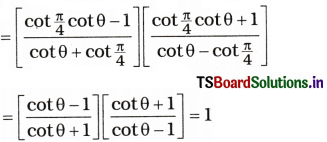
cot (\(\frac{\pi}{4}\) + θ) cot (\(\frac{\pi}{4}\) – θ)

Trigonometric Functions MCQ AP Inter 1st Year Maths Chapter 3 1

Question 8.
cos 2θ cos 2ϕ + sin2 (θ – ϕ) – sin2 (θ + ϕ) is equal to
1) sin 2 (θ + ϕ)
2) cos 2 (θ + ϕ)
3) sin 2 (θ – ϕ)
4) cos 2 (θ – ϕ)
Solution:
2) cos 2 (θ + ϕ)

Explanation:
cos 2θ cos 2ϕ + sin2 (θ – ϕ) – sin2 (θ + ϕ)
= cos 2θ cos 2ϕ + sin [(θ – ϕ) + (θ + ϕ)] sin [(θ – ϕ) – (θ + ϕ)]
= cos 2θ cos 2ϕ + sin 2θ sin (- 2ϕ)
= cos 2θ cos 2ϕ – sin 2θ sin 2ϕ
= cos (2θ + 2ϕ)
= cos 2 (θ + ϕ)

Question 9.
The value of sin 50° – sin 70° + sin 10° is equal to
1) 1
2) 0
3) ½
4) 2
Solution:
2) 0

Explanation:
sin 50° – sin 70° + sin 10° = 2 cos \(\left[\frac{50^{\circ}+70^{\circ}}{2}\right]\) sin \(\left[\frac{50^{\circ}-70^{\circ}}{2}\right]\) + sin 10°
= 2 cos 60° sin (- 10°) + sin 10°
= – sin 10° + sin 10° = 0.

Trigonometric Functions MCQ AP Inter 1st Year Maths Chapter 3

Question 10.
If sin θ + cos θ = 1 then the value of sin 2θ is equal to
1) 1
2) ½
3) 0
4) – 1
Solution:
3) 0

Explanation:
sin θ + cos θ = 1
⇒ (sin θ + cos θ)2 = 1
⇒ sin2 θ + cos2 θ + 2 sin θ cos θ = 1
⇒ 1 + sin 2θ = 1
⇒ sin 2θ = 0.

AP Inter 1st Year Maths Exercise 3d Solutions

Referring to the AP Inter 1st Year Maths Study Material Chapter Trigonometric Functions Exercise 3d Solutions makes it easier to understand complex problems.

AP Inter 1st Year Maths Trigonometric Functions Exercise 3d

I. Find sin \(\frac{x}{2}\), cos \(\frac{x}{2}\) and tan \(\frac{x}{2}\) in each of the following.

Question 1.
tan = – \(\frac{4}{3}\), x in quadrant II.
Solution:
Given, tan x = – \(\frac{4}{3}\) (x is in second quadrant)
i.e. \(\frac{\pi}{2}\) < x < π
⇒ \(\frac{\pi}{4}<\frac{x}{2}<\frac{\pi}{2}\)
i.e. \(\frac{x}{2}\) lies in the I quadrant,
so that all trigonometric ratios of \(\frac{x}{2}\) are +ve.
Now, sec2 x = 1 + tan2 x
= 1 + \(\frac{16}{9}\)
= \(\frac{9+16}{9}\)
= \(\frac{25}{9}\)
∴ sec x = ± \(\frac{5}{3}\)
But x is in II quadrant
∵ sec x is -ve. i.e., sec x = – \(\frac{5}{3}\)
⇒ cos x = – \(\frac{3}{5}\)

AP Inter 1st Year Maths Exercise 3d Solutions 1

Question 2.
cos x = – \(\frac{1}{3}\), x in quadrant II.
Solution:
Given, cos x = – \(\frac{1}{3}\) [x is in quadrant II]
i.e., π < x < \(\frac{3 \pi}{2}\)
⇒ \(\frac{\pi}{2}<\frac{x}{2}<\frac{3 \pi}{4}\)
⇒ 90° < \(\frac{x}{2}\) < 135°
i.e., \(\frac{x}{2}\) lies in II quadrant, so that sin \(\frac{x}{2}\) > 0, cos \(\frac{x}{2}\) < 0 and tan \(\frac{x}{2}\) < 0

AP Inter 1st Year Maths Exercise 3d Solutions 2

Question 3.
sin x = \(\frac{1}{4}\), x in quadrant II.
Solution:
Given, sin x = \(\frac{1}{4}\), [x is in quadrant II]
i.e. \(\frac{\pi}{2}\) < x < π
⇒ \(\frac{\pi}{4}<\frac{x}{2}<\frac{\pi}{2}\)
i.e., \(\frac{x}{2}\) lies in I quadrant,
so that all trigonometric ratios of \(\frac{x}{2}\) are +ve.
Also, cos2 x = 1 – sin2 x
= 1 – \(\frac{1}{16}\) = \(\frac{15}{16}\)
cos x = ± \(\frac{\sqrt{15}}{4}\)
But x is in II quadrant and cos x < 0.
∴ cos x = \(\frac{-\sqrt{15}}{4}\)

AP Inter 1st Year Maths Exercise 3d Solutions 3

AP Inter 1st Year Maths Exercise 3d Solutions

II. Prove the following.

Question 1.
2 cos \(\frac{\pi}{13}\) cos \(\frac{9 \pi}{13}\) + cos \(\frac{3 \pi}{13}\) + cos \(\frac{5 \pi}{13}\) = 0
Solution:
LHS = 2 cos \(\frac{\pi}{13}\) cos \(\frac{9 \pi}{13}\) + cos \(\frac{3 \pi}{13}\) + cos \(\frac{5 \pi}{13}\)

AP Inter 1st Year Maths Exercise 3d Solutions 4

Question 2.
(sin 3x + sin x) sinx + (cos 3x – cos x) cos x = 0.
Solution:
LHS = (sin 3x + sin x) sinx + (cos 3x – cos x) cos x
= sin 3x sin x + sin2 x + cos 3x cos x – cos2 x
= cos 3x cos x + sin 3x sin x – (cos2 x – sin2 x)
= cos (3x – x) – cos 2x
[∵ cos (A – B) = cos A cos B + sin A sin B]
= cos 2x – cos 2x = 0 = RHS

Question 3.
(cos x + cos y)2 + (sin x – sin y)2 = 4 cos2 \(\left(\frac{x+y}{2}\right)\)
Solution:
LHS = (cos x + cosy)2 + (sin x – sin y)2
= cos2 x + cos2 y + 2 cos x . cos y + sin2 x + sin2 y – 2 sin x . sin y
= cos2 x + sin2 x + cos2 y + sin2 y + 2(cos x . cos y – sin x . sin y)
= 1 + 1 + 2 cos (x + y)
= 2 + 2 cos (x + y)
= 2 (1 + cos(x + y))
= 2 . 2 cos2 \(\left[\frac{\mathrm{x}+\mathrm{y}}{2}\right]\)
= 4 cos2 \(\left[\frac{\mathrm{x}+\mathrm{y}}{2}\right]\) = RHS

Question 4.
(cos x – cos y)2 + (sin x – sin y)2 = 4 sin2
Solution:
LHS = (cos x – cos y)2 + (sin x – sin y)2
= cos2 x + cos2 y – 2 cos x cos y + sin2 x + sin2 y – 2sin x sin y
= (cos2 x + sin2 x) + (cos2 y + sin2 y) – 2 [cos x cos y + sin x sin y]
= 1 + 1 – 2 [cos (x – y)]
[∵ cos (A – B) = cos A cos B + sin A sin B]
= 2 [1 – cos (x – y)]
= 2 [2 sin2 \(\left[\frac{\mathrm{x}-\mathrm{y}}{2}\right]\)]
= 4 sin2 \(\left[\frac{\mathrm{x}-\mathrm{y}}{2}\right]\) = RHS

Question 5.
sin 3x + sin 2x – sin x = 4 sin x cos \(\frac{x}{2}\) cos \(\frac{3 x}{2}\)
Solution:
L.H.S. = sin 3x + sin 2x – sin x
= sin 3x – sin x + sin 2x
= 2 cos \(\left(\frac{3 x+x}{2}\right)\) sin \(\left(\frac{3 x-x}{2}\right)\) + 2 sin x cos x
= 2 cos 2x sin x + 2 sin x cos x
= 2 sin x (cos 2x + cos x)
= 4 sinx cos \(\frac{3 x}{2}\) cos \(\frac{x}{2}\)
= 4 sin x cos \(\frac{x}{2}\) cos \(\frac{3 x}{2}\) = RHS

AP Inter 1st Year Maths Exercise 3d Solutions

III. Prove the following.

Question 1.
sin x + sin 3x + sin 5x + sin 7x = 4 cos x cos 2x sin 4x.
Solution:
LHS = sin x + sin 3x + sin 5x + sin 7x
= (sin x + sin 5x) + (sin 3x + sin 7x)
= 2 sin \(\left[\frac{x+5 x}{2}\right]\) cos \(\left[\frac{x-5 x}{2}\right]\) + 2 sin \(\left[\frac{3 x+7 x}{2}\right]\) cos \(\left[\frac{3 x-7 x}{2}\right]\)
= 2 sin 3x cos (- 2x) + 2 sin 5x cos (- 2x)
= 2 sin 3x cos 2x + 2 sin 5x cos 2x
= 2 cos 2x [sin 3x + sin 5x]
= 2 cos 2x [2 sin \(\left[\frac{3 x+5 x}{2}\right]\) . cos \(\left[\frac{3 x-5 x}{2}\right]\)]
= 2 cos 2x [2 sin 4x . cos (- x)]
= 4 cos 2x sin 4x cos x = RHS

Question 2.
\(\frac{(\sin 7 x+\sin 5 x)+(\sin 9 x+\sin 3 x)}{(\cos 7 x+\cos 5 x)+(\cos 9 x+\cos 3 x)}\) = tan 6x
Solution:
\(\frac{(\sin 7 x+\sin 5 x)+(\sin 9 x+\sin 3 x)}{(\cos 7 x+\cos 5 x)+(\cos 9 x+\cos 3 x)}\)

AP Inter 1st Year Maths Exercise 3d Solutions 5