
Regular practice with AP Inter 1st Year Chemistry Study Material Chapter 7 Redox Reactions Questions and Answers helps students stay prepared for examinations.
AP Inter 1st Year Chemistry 7th Lesson Redox Reactions Questions and Answers
I. Multiple Choice Questions
Question 1.
The oxidation number of an element in a compound is evaluated on the basis of certain rules. Which of the following rule is incorrect?
1) Oxidation number of hydrogen is always
2) The algebraic sum of all the oxidation numbers of all elements is equal to charge present on a compound.
3) An element in the free or uncombined state, it’s oxidation number is zero.
4) In all its compounds, the oxidation number of fluorine is -1.
Answer:
Oxidation number of hydrogen is not always +1 (Sometimes -1)
Question 2.
When hydrogen sulphide gas is passed through a solution of Cu+2 ions solution, then
1) Black cupric sulphide is formed
2) White cupric sulphide is formed
3) Red cupric sulphide is formed
4) No reaction
Answer:
Cu+2 + H2S → CuS + H2
Black cupric sulphide is formed.
Question 3.
The Oxidation number of oxygen[ffloy – 2036] [ 3 ]
1) +2 and +1
2) +1 and +1
3) +1 and +2
4) +2 and +2
Answer:
O2F2 OF2
2x + 2(-1) = 0 x + 2(-1) = 0
2x – 2 = 0 x – 2 = 0
x = +1 x = +2
Question 4.
Which of the molecules cqn undergo disproportionation in the alkaline medium
1) S8
2) P4
3) Cl2
4) All of these
Answer:
S8, P4, Cl2 all undergo disproportionation reaction in alkaline medium.
Cl2 + 2OH– → Cl– + OCl– + H2O

S8 + 12OH– → 4S2 + 2S2O3-2 + 6H2O
Question 5.
The oxidation number of Sulphur in Na2S4O6 is
1) 2.5
2) 1.5
3) -2
4) 0
Solution:
Na2S4O6
2(1) + 4x + 6(-2) = 0 ⇒ 2 + 4x – 12 = 0 ⇒ 4x – 10 = 0 ⇒ x = 10/4 = 2.5.
Question 6.
PbO2 + 4HCl → PbCl2 + Cl2 + 2H2O. In this reaction PbO2 act as an
1) Reducing agent
2) Both Reducing agent and Oxidising agent
3) Oxidising agent
4) Bleaching agent
Answer:
PbO2 acts as oxidising agent
Question 7.
Oxidation state of middle carbon in C3O2 is
1) +2
2) +3
3) -2
4) 0
Answer:
+2 0 +2
Structure of C3O2 is O = C = C = C = 0
Carbon Suboxide
Middle Carbon has zero oxidation state.
Question 8.
xMnO4– + Br– + H2O → xMnO2 + BrO3– + 2OH–. The value of x is
1) 1
2) 2
3) 3
4) 4
Answer:
xMnO4– + Br– + H2O → xMnO2 + Br3– + 2OH–
x = 2
xMnO4– + Br– + H2O → xMnO2 + Br3– + 2OH–
Question 9.
When a strip of metallic zinc is placed in aqueous solution of copper sulphate, the blue colour of the solution disappears due to the formation of
1) Cu2+
2) Zn2+
3) ZnS
4) CuS
Answer:
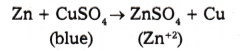
Due to formation of Zn+2. Blue colour of the solution disappears.
Question 10.
In which of the compounds, does manganese exhibits highest oxidation number?
1) MnO2
2) KMnO4
3) K2MnO4
4) MnSO4
Solution:
KMnO4 MnO2 → + 4
1 + x + 4(-2) = 0 K2MnO4 → + 6
x = +7 MnSO4 → +2
Question 11.
What is the change in oxidation number of Carbon in the following reaction?
CH4(g) + 4Cl2(g) → CCl4(1) + 4HCl(g)
1) 0 to +4
2) – 4 to + 4
3) 0 to – 4
4) + 4 to – 4
Solution:
CH4 CCl4
x + 4(1) = 0 x + 4(-1) = 0
x = -4 x = +4
∴ – 4 to 4
∴ Change in oxidatation number is – 4 to 4.

Question 12.
Which of the following is the correct order for reducing activity?
1) Zn < Cu > Ag
2) Zn > Cu < Ag
3) Zn < Cu < Ag
4) Zn > Cu > Ag
Answer:
Correct order of reducing activity is Zn > Cu > Ag.
Question 13.
The indicator to be used to detect end point in titration of FeSO4 solution with KMnO4 solution in the presence of acid is
1) Phenolphthalein
2) KMnO4 itself acts as self indicator
3) Starch solution
4) Methyl orange
Answer:
KMnO4 acts as self indicator.
The indicator to be used to detect. End point is colourless to pale pink.
Question 14.
The salt which is commonly used in salt bridge is
1) Barium sulphate
2) Aluminium chloride
3) Silver chloride
4) Potassium chloride
Answer:
Potassium chloride is used in salt bridge.
Question 15.
Which of the following have no reaction with hydrochloric acid?
1) Mg, Au
2) Ca, Ag
3) Ag, Au
4) Mg, Ca
Answer:
Ag and Au do not react with HCl.
II. Fill in the Blanks
Question 1.
Oxidation Number of sulphur in S8 molecule is __________.
Answer:
In S8 molecule, sulphur has zero oxidation number.
Question 2.
The element that can not undergo disproportionation is ______ .
Answer:
Fluorine
Question 3.
In any compounds oxidation states of I A & II A group elements are ______ and ______ respectively.
Answer:
IA Group elements oxidation state was +1.
IIA Group elements oxidation state was +2.
Question 4.
Reductant is the element which can reduce the other substances and itself undergoes _____ .
Answer:
Oxidation
Question 5.
Oxidation state of oxygen in peroxides and super oxides are _______ and ______ respectively.
Answer:
In peroxides it was 1 ; In superoxides it was 1/2.
III. Very Short Answer Questions
Question 1.
What is a redox reaction? Give an example.
Answer:
The chemical reactions in which both reduction and oxidation takes place simultaneously are called redox reactions.
Eg: 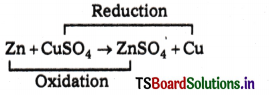
Question 2.
What is disproportionation reaction? Give example.
Answer:
Chemical reactions in which the same element undergoes both oxidation and reduction simultaneously are known as disproportionation reactions.
Eg: 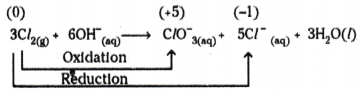
Question 3.
Assign oxidation number to the underlined elements in each of the following.
(a) K2MnO4
(b) C3O2
Answer:
(a) K2MnO4
(b) C3O2
2(1) + x + 4(-2) = 0
x = +7

Question 4.
Write formulae for the following compounds.
(a) Nickel (II) sulphate (b) Thallium (I) sulphate
Answer:
a) Formula for Nickel (II) Sulphate NiSO4
b) Formula for Thallium (I) Sulphate Tl2SO4
Question 5.
What are the oxidation numbers of the underlined elements in the following compounds,
(a) NaBH4
(b) C6H12O6
Solution:
(a) NaBH4
(b) C6H12O6
1 + x + 4(-1) = 0 ⇒ x = + 3. 6x + 12(1) + 6(-2) = 0 ⇒ x = 0
Question 6.
What are the oxidation numbers of the underlined elements in the following compounds
(a) H2S2O8
(b) CH3COOH
Answer:
(a) H2S2O8
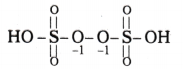
2(1) + 2x + 2(-1) + 6(-2) = 0
2x = 12 ⇒ x = +6
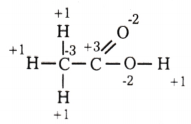
(b) CH3COOH
In CH3 carbon has -3 oxidatation state
In COOH carbon has +3 oxidatation state
IV. Short Answer Questions
Question 1.
Balance the following redox reactions by ion-electron method (in acidic medium).
Cr2O72- (aq) + Fe2+ (aq) → Cr3+ (aq) + Fe3+ (aq)
Answer:
Given reaction is 
Dividing given equation into oxidation / reduction half reaction
Reduction half reaction
\(\mathrm{Cr}_2 \mathrm{O}_7^{-2}\) → Cr+3
\(\mathrm{Cr}_2 \mathrm{O}_7^{-2}\) → 2Cr+3
Other than O, H atoms are balanced
\(\mathrm{Cr}_2 \mathrm{O}_7^{-2}\) → 2Cr+3 + 7H2O
Oxygen atoms are balanced
\(\mathrm{Cr}_2 \mathrm{O}_7^{-2}\) + 14H+ → 2Cr+3 + 7H2O
Hydrogen atoms are balanced
\(\mathrm{Cr}_2 \mathrm{O}_7^{-2}\) + 14H+ + 6e– → 2Cr+3 + 7H2O
Now charges are balanced …..(1)
Oxidation half reaction
Fe+2 → Fe+3
Fe+2 → Fe+3
Fe+2 → Fe+3 + e–
Now changes are balanced
Fe+2 → Fe+3 + e– ……(2)
Adding two half reactions

This is a required balanced equation.
Question 2.
Balance the following redox reactions by ion-electron method (in acidic medium).
Cr2O72- (aq) + SO23- (aq) → Cr3+(aq) + SO42- (aq)
Answer:
Given reaction is 
Dividing given reaction into Oxidation/Reduction half reaction
RHR (Reduction)
\(\mathrm{Cr}_2 \mathrm{O}_7^{-2}\) → Cr+3
\(\mathrm{Cr}_2 \mathrm{O}_7^{-2}\) → 2Cr+3
Other than O, H, atoms are balanced
\(\mathrm{Cr}_2 \mathrm{O}_7^{-2}\) → 2Cr+3 + 7H2O
Oxygen atoms are balanced
\(\mathrm{Cr}_2 \mathrm{O}_7^{-2}\) + 14H+ → 2Cr+3 + 7H2O
Hydrogen atoms are balanced
\(\mathrm{Cr}_2 \mathrm{O}_7^{-2}\) + 14H+ + 6e– → 2Cr+3 + 7H2O ……(1)
Here charges are balanced.
OHR (Oxidation)
\(\mathrm{SO}_3^{-2}\) → \(\mathrm{SO}_4^{-2}\)
\(\mathrm{SO}_3^{-2}\) + H2O → \(\mathrm{SO}_4^{-2}\)
Oxygen atoms are balanced
\(\mathrm{SO}_3^{-2}\) + H2O → \(\mathrm{SO}_4^{-2}\) + 2H+
Hydrogen atoms are balanced
\(\mathrm{SO}_3^{-2}\) + H2O → \(\mathrm{SO}_4^{-2}\) + 2H+ + 2e– …………(2)
Here charges are balanced
Now adding two half reactions
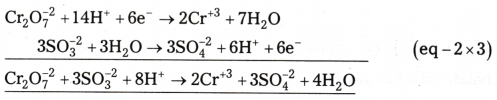
This is a required balanced equation.
Question 3.
Balance the following redox reaction by ion-electron method (in basic medium).
Cr(OH)3 + IO3– → I– + CrO42-
Answer:
Given reaction is 
Dividing given reaction into two half reactions (OHR / RHR)
OHR (Oxidation)
Cr(OH)3 → \(\mathrm{CrO}_4^{-2}\)
Cr(OH)3 + H3O → \(\mathrm{CrO}_4^{-2}\)
Oxygen atoms are balanced
Cr(OH)3 + H2O + 5OH– → \(\mathrm{CrO}_4^{-2}\) + 5H2O
Cr(OH)3 + 5OH– → \(\mathrm{CrO}_4^{-2}\) + 4H2O Hydrogen atoms are balanced
Cr (OH)3 + 5OH–→ \(\mathrm{CrO}_4^{-2}\) + 4H2O + 3e– ……. (1)
Here charges are balanced
RHR (Reduction)
\(\mathrm{IO}_3^{-}\) → I–
\(\mathrm{IO}_3^{-}\) → I– + 3H2O
Oxygen atoms are balanced
\(\mathrm{IO}_3^{-}\) + 6H2O → I– + 3H2O + 6OH–
Hydrogen atoms are balanced
\(\mathrm{IO}_3^{-}\) + 3H2O → I– + 6OH–
\(\mathrm{IO}_3^{-}\) + 3H2O + 6e– → I– + 6OH– …. (2)
Here charges are balanced
Adding two half reactions
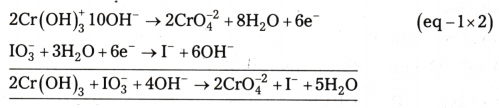
This is a balanced equation.
Question 4.
Balance the following redox reactions by ion-electron method (in basic medium).
MnO4– (aq) + Br– (aq) → MnO2 (s) + BrO3– (aq)
Answer:
Given reaction is 
Dividing given reaction into RHR / OHR
RHR (Reduction)
\(\mathrm{MnO}_4^{-}\) → MnO2
\(\mathrm{MnO}_4^{-}\) → MnO2 + 2H2O
oxygen atoms are balanced
\(\mathrm{MnO}_4^{-}\) + 4H2O → MnO2 + 2H2O + 4OH–
\(\mathrm{MnO}_4^{-}\) + 2H2O → MnO2 + 40H–
Hydrogen atoms are balanced
\(\mathrm{MnO}_4^{-}\) + 2H2O + 3e–→ MnO2 + 4OH– …….(1)
Now charges are balanced
OHR (Oxidation)
Br– → \(\mathrm{BrO}_3^{-}\)
Br– + 3H2O → \(\mathrm{BrO}_3^{-}\)
Oxygen atoms are balanced
Br– + 3H2O + 6OH– → \(\mathrm{BrO}_3^{-}\) + 6H2O
Br– + 6OH– → \(\mathrm{BrO}_3^{-}\) + 3H2O
Hydrogen atoms are balanced
Br– + 6OH– → \(\mathrm{BrO}_3^{-}\) + 3H2O + 6e– …….(2)
Now charges are balanced
Adding two half reactions

This is the required balanced equation.
Question 5.
Write the net ionic equation for the reaction of potassium dichromate with sodium nitrite, in an acid solution to give chromium (III) ion and nitrate ion.
Answer:
The net equation is

Dividing given equation into two half reactions (RHR/OHR)
RHR (Reduction)
\(\mathrm{Cr}_2 \mathrm{O}_7^{-2}\) → 2Cr+3
\(\mathrm{Cr}_2 \mathrm{O}_7^{-2}\) → 2Cr+3
Other than O, H are balanced
\(\mathrm{Cr}_2 \mathrm{O}_7^{-2}\) → 2Cr+3 + 7H2O
Oxygen atoms are balanced
\(\mathrm{Cr}_2 \mathrm{O}_7^{-2}\) + 14H+ → 2Cr+3 + 7H2O
Hydrogen atoms are balanced
\(\mathrm{Cr}_2 \mathrm{O}_7^{-2}\) + + 14H+ → 2Cr+3 + 7H2O …..(1)
Charges are balanced
OHR (Oxidation)
\(\mathrm{NO}_2^{-}\) → \(\mathrm{NO}_3^{-}\)
\(\mathrm{NO}_2^{-}\) + H2O → \(\mathrm{NO}_3^{-}\)
Oxygen atoms are balanced
\(\mathrm{NO}_2^{-}\) + H2O → \(\mathrm{NO}_3^{-3}\) + 2H+
Hydrogen atoms are balanced
\(\mathrm{NO}_2^{-}\) + H2O → \(\mathrm{NO}_3^{-}\) + 2H+ + 2e– ……….(2)
Charges are balanced.
Adding two half reactions
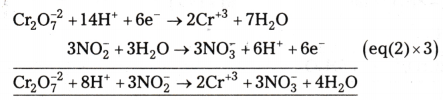
This is the required balanced equation.
Question 6.
Balance the following redox reactions by ion-electron method (in acidic medium):
MnO4– (aq) + SO2 (g) → Mn2+ (aq) + HSO4– (aq)
Answer:
Given reaction is 
Dividing into two half reactions (RHR/OHR)
RHR (Reduction)
\(\mathrm{MnO}_4^{-}\) → Mn+2
\(\mathrm{MnO}_4^{-}\) → Mn+2 + 4H2O
Oxygen atoms are balanced
\(\mathrm{MnO}_4^{-}\) + 8H+ → Mn+2 + 4H2O
Hydrogen atoms are balanced
\(\mathrm{MnO}_4^{-}\) + 8H+ + 5e– → Mn+2 + 4H2O ………(1)
Charges are balanced
OHR (Oxidation)
SO2 → \(\mathrm{HSO}_4^{-}\)
SO2 + 2H2O → \(\mathrm{HSO}_4^{-}\)
Oxygen atoms are balanced
SO2 + 2H2O → \(\mathrm{HSO}_4^{-}\) + 3H+
Hydrogen atoms are balanced
SO2 + 2H2O → \(\mathrm{HSO}_4^{-}\) + 3H+ + 2e– …….(2)
Charges are balanced
Adding two half reactions

This is the required balanced equation.
Question 7.
Explain the following:
1) Oxidation
2) Reduction
3) Oxidizing agent
4) Reducing agent
Answer:
1) Oxidation: The addition of oxygen / electronegative element to a substance (or) removal of hydrogen / electropositive element from a substance is called oxidation.
Eg : C + O2 → CO2
(or) loss of electrons (or) increase of oxidation no.of an element is also called oxidation. Fe+2 → Fe+3
2) Reduction : The addition of hydrogens / electropositive element to a substance (or) removal of oxygens / electronegative element from a substance is called reduction.
Eg : 2HgO → 2Hg + O2
Gain of electrons (or) decrease of oxidation no.of an element is also called reduction.
3) Oxidizing agent: Acceptor of electrons (or) A reagent which can increase the oxidation no. of element in a given substance is called oxidizing agent. Eg : KMnO4.
4) Reducing agent: Donor of electrons (or) A reagent which lowers the oxidation of an element in a given substance is called reducing agent. Eg : LiA/H4.
Question 8.
Justify that the following reactions are redox reactions:
1. CuO (s) + H2(g) → Cu(s) + H2O (g)
2. Fe2O3 (s) + 3CO (g) → 2Fe (s) + 3CO2 (g)
3. 2K (s) + F2 (g) → 2 KF (s)
4. 4NH3 (g) + 5O2 (g) → 4NO (g) + 6H2O (g)
Answer:
1. CuO (s) + H2(g) → Cu(s) + H2O (g)
In this reaction the oxidation number of Cu decreased from +2 to 0 and the oxidation state of H2 is increased to +1. So it is a redox reaction.
2. Fe2O3 (s) + 3CO (g) → 2Fe (s) + 3CO2 (g)
In this reaction, the oxidation number of Fe ion in Fe2O3 is decreased from + 3 to zero in Fe and the oxidation number of carbon in CO is increased from +2 to +4 in CO2. So it is a redox reaction.
3. 2K (s) + F2 (g) → 2 KF (s)
In the formation of K+F–, K loses electron (oxidation) and F gains electron (reduction) so it is redox reaction.
4. 4NH3 (g) + 5O2 (g) → 4NO (g) + 6H2O (g)
The oxidation of N increases from -3 to +2 in the conversation of NH3 to NO. It is oxidation.
The oxidation number of O2 changes from 0 (zero) to -2.
It is a reduction. So it is a redox reaction.
Question 9.
Consider the elements: Cs, Ne, I and F.
1. Identify the element that exhibits only negative oxidation state
2. Identify the element that exhibits only positive oxidation state
3. Identify the element that exhibits both positive and negative oxidation states
4. Identify the element that exhibits neither positive nor negative oxidation states
Answer:
1. Fluorine (F) exhibits only negative oxidation state.
2. Cs (Caesium) exhibits only positive oxidation state.
3. Iodine (I) exhibits both positive and negative oxidation states.
4. Neon (Ne) exhibits neither positive nor negative oxidation states.
Question 10.
Write about different types of redox reactions.
Answer:
A chemical reaction in which both oxidation and reduction reactions are involved is called an oxidation – reduction reaction or simply a redox reaction.
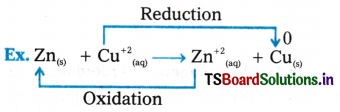
In this reaction, Zn loses two electrons to form Zn+2 and undergoes oxidation. Cu+2 gains two electrons to form Cu and thus undergoes reduction.
Most of the chemical reactions are redox reactions. There are mainly four types of redox reactions. They are
(a) Chemical combination reactions
(b) Chemical decomposition reactions
(c) Chemical displacement reactions and
(d) Chemical disproportionation reactions
a) Chemical combination reactions :
Ex : Burning of coal in air.

In this reaction, the oxidation numbers of carbon and oxygen are zero. In CO2, the oxidation number of ‘C’ is + 4 and that of oxygen is – 2. As the oxidation number of carbon increases from 0 to +4, we say that carbon undergoes oxidation. Similarly the oxidation number of oxygen decreases from 0 to – 2. Hence the oxygen undergoes reduction. Since this reaction involves both oxidation and reduction, we can infer that the above chemical combination reaction is a redox reaction.
b) Chemical decomposition reactions:
Ex : Thermal decomposition of mercuric oxide.
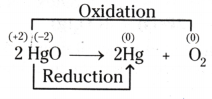
In HgO, the oxidation number of Hg is +2 and that of oxygen is – 2. The oxidation numbers of free metallic mercury and elemental oxygen are zero. In this reaction Hg undergoes reduction from + 2 to 0 and oxygen undergoes oxidation from – 2 to 0. The decomposition of HgO involves both oxidation and reduction. Hence, we can infer that the above decomposition reaction is a redox reaction.
c) Chemical displacement reactions:
Ex : Zinc displaces copper from aqueous copper sulphate solution.
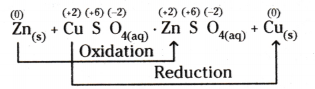
In this reaction, the oxidation numbers of elemental zinc and elemental copper are each zero, and the oxidation numbers of Cu and Zn in their aq. solutions are each +2. In this reaction the conversion of Zn into ZnSO4 is oxidation and the conversion of CuSO4 into Cu is reduction. Hence, we can infer that the above displacement reaction is a redox reaction.
d) Chemical disproportionation reactions :
Ex : Chlorine is passed into cold and dilute solution of NaOH.
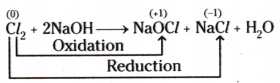
In this reaction the oxidation number of elemental chlorine is zero. The oxidation number of Cl in NaOCl is (+1) and in NaCl is (-1). In this reaction the same element chlorine has undergone both oxidation and reduction. Hence this is a redox reaction.
Question 11.
Identify the substance oxidised, reduced, oxidising agent and reducing agent for the following reaction.
2AgBr (s) + C6H6O2(aq) → 2Ag (s) + 2HBr (aq) + C6H4O2 (aq)
Answer:
A substance which undergoes oxidation acts as a good reducing agent while the one which undergoes reduction acts as a good oxidising agent, a) Oxidising agent is AgBr and reducing agent is C6H6O2.
V. Long Answer Questions
Question 1.
Write the balanced equation for the oxidation of sulphite ions to sulphate ions in acid medium by permanganate ion.
Answer:
For the given data, equation is 
RHR (Reduction)
\(\mathrm{MnO}_4^{-}\) → Mn+2
\(\mathrm{MnO}_4^{-}\) →Mn+2 + 4H2O
Oxygen atoms are balanced
\(\mathrm{MnO}_4^{-}\) + 8H+ → Mn+2 + 4H2O
Hydrogen atoms are balanced
\(\mathrm{MnO}_4^{-}\) + 8H+ + 5e– → Mn+2 + 4H2O ………(1)
Charges are balanced
OHR (Oxidation)
\(\mathrm{SO}_3^{-2}\) → \(\mathrm{SO}_4^{-2}\)
Oxygen atoms are balanced
\(\mathrm{SO}_3^{-2}\) + H2O → \(\mathrm{SO}_4^{-2}\) + 2H+
Hydrogen atoms are balanced
\(\mathrm{SO}_3^{-2}\) + H2O → \(\mathrm{SO}_4^{-2}\) +2H+ + 2e– ………(2)
Charges are balanced
Adding two half reactions

This is a balanced equation.
Question 2.
Oxalic acid is oxidised by permanganate ion in acid medium of Mn2+ balance the reaction by ion – electron method.
Answer:
Given reaction is 
Dividing into two half reactions (RHR/OHR)
RHR (Reduction)
\(\mathrm{MnO}_4^{-}\) → Mn+2
\(\mathrm{MnO}_4^{-}\) → Mn+2 + 4H2O
Oxygen atoms are balanced.
\(\mathrm{MnO}_4^{-}\) + 8H+ → Mn+2 + 4H2O
Hydrogen atoms are balanced.
\(\mathrm{MnO}_4^{-}\) + 8H+ + 5e– → Mn+2 + 4H2O ………(1)
Charges are balanced.
OHR (Oxidation)
\(\mathrm{C}_2 \mathrm{O}_4^{-2}\) → CO2
\(\mathrm{C}_2 \mathrm{O}_4^{-2}\) → 2CO2
Other than O, H atoms are balanced.
\(\mathrm{C}_2 \mathrm{O}_4^{-2}\) → 2CO2 + 2e– …………(2)
Charges are balanced.
Adding two half reactions

This is the balanced equation.
Question 3.
Assign oxidation number to the underlined elements in each of the following species,
(a) NaH2PO4
(b) NaHSO4
(c) H4P2O7
(d) K2MnO4
(e) CaO2
(f) NaBH4
(g) H2S2O7
(h) KAl(SO4)2.12 H2O
Solution:
a) NaH2PO4
1 + 2(1) + x + 4 (-2) = 0
Oxidation number of ‘P’ is x = +5
b) NaHSO4
1 + 1 + x + 4 (-2) = 0
Oxidation number of ‘S’ is x = +6
c) H4P2O7
4(1) + 2x + 7 (-2) = 0
2x = 10
Oxidation number of ‘P’ is x = +5
d) K2MnO4
2(1) + x + 4(-2) = 0
2 + x – 8 = 0
Oxidation number of ‘Mn’ is x = +6
e) CaO2
2 + 2x = 0
Oxidation number of ‘O’ is x = 1
f) NaBH4
1 + x + 4(-1) = 0
Oxidation number of ‘B’ is x = +3
g) KAl(SO4)2.12 H2O
2(1) + 2x + 7(-2) = 0
2x = 12
Oxidation number of ‘S’ is x = +6
h) KAl(SO4)2.12 H2O
1 + 3 + 2(x) + 8 (-2) = 0
4 + 2x – 16 = 0 ⇒ 2x – 12 = 0
Oxidation number of ‘S’ is x = 6
Question 4.
What are the oxidation numbers of the underlined elements in each of the following and how do you rationalize your results ?
(a) H2S4O6
(b) Fe3O4
(c) CH3CH2OH
(d) CH3COOH
Solution:
a) H2S4O6: H2S4O6 has the following structure
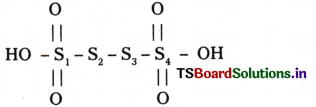
The oxidation states of S2 and S3 are zero but the oxidation states of S1 and S4 are +5.The average oxidation state is \(\frac{10}{4}\) = 2.5
b) Fe3O4: Fe3O4 contain FeO and Fe2O4
In FeO, oxidation state of Fe = +2
In Fe2O3, oxidation state of Fe = +3
So average oxidation state of Fe = \(\frac{(+2)+2 \times(+3)}{3}=\frac{8}{3}\) = 2.67
c) CH3 – CH2 – OH
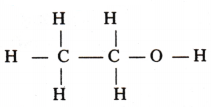
When atoms of the same element combine their oxidation states are taken as zero.
The carbon in CH3 group is in -3 oxidation state.
The carbon in CH2OH group is in zero oxidation state.
d) CH3 COOH
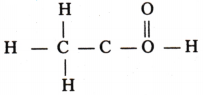
The carbon in CH3 is in -3 oxidation state while the carbon in COOH group is in +3 oxidation state.
Question 5.
Phosphorus when heated with NaOH solution gives phosphine (PH3) and H2PO2. Give the balanced equation.
Answer:
Reaction for the given data is 
Given reaction is divided into two half reactions (OHR/RHR)
RHR (Reduction)
P4 → 4PH3
P4 → 4PH3
Other than O, H atoms are balanced.
P4 + 12H2O → 4PH3 + 12OH–
Hydrogen atoms are balanced.
P4 + 12H2O + 12e– → 4PH3 + 21OH– ……….(1)
Charge is balanced.
OHR (Oxidation)
P4 → \(\mathrm{H}_2 \mathrm{PO}_2^{-}\)
P4 → \(4 \mathrm{H}_2 \mathrm{PO}_2^{-}\)
Other than O, H atoms are balanced.
P4 + 8H2O → \(4 \mathrm{H}_2 \mathrm{PO}_2^{-}\)
Oxygen atoms are balanced
P4 + 8H2O + 8OH– → \(4 \mathrm{H}_2 \mathrm{PO}_2^{-}\) + 8H2O
P4 + 8OH– → \(4 \mathrm{H}_2 \mathrm{PO}_2^{-}\)
Hydrogen atoms are balanced.
P4 + 80H– → \(4 \mathrm{H}_2 \mathrm{PO}_2^{-}\) + 4e– (2)
Charge is balanced.
Adding two equations
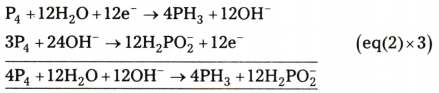
This is the required balanced equation.
Redox Reactions Class 11 NCERT Solutions
Question 1.
Assign oxidation number to the underlined elements in each of the following species :
i) NaH2PO4
ii) NaHSO4
iii) H4P2O7
iv) K2MnO4
v) CaO2
vi) NaBH4
vii) H2S2O7
viii) KAl(SO4)2.12H2O
Answer:
i) P in NaH2PO4 
(+1) + 2(+1) + x + 4(-2) = 0 ⇒ x + 3 – 8 = 0 ⇒ x = +5
Thus, oxidation number of P in NaH2PO4 is +5.
ii) S in NaHSO4 
4(+1) + (+1) + x + -4(-2) = 0 ⇒ x – 6 = 0 ⇒ x = +6
Thus, oxidation number of S in NaHSO4 is +6.
iii) P in H4P2O7: 
4(+1) + 2x + 7(-2) = 0 ⇒ 2x – 10 = 0 ⇒ x = +7
Thus, oxidation number of P in H4P2O7, is +5.
iv) Mn in K2MnO4 
2(+1) + x + 4(-2) = 0 ⇒ x – 6 = 0 ⇒ x = +6
Thus, oxidation number of Mn in K2MnO4 is +6.
v) O in CaO2 
+2 + 2(x) = 0 ⇒ x = -1
Thus, oxidation number of O in CaO2 is -1.
vi) B in NaBH4: 
+ 1 + x + 4(-1) = 0 ⇒ x = +3
Thus, oxidation number of B in NaBH4, is +3.
vii) S in H2S2O7: 
2(+1) + 2(x) + 7 (-2) = 0 ⇒ x = +6
Thus, oxidation number of S in H2S2O7 is +6.
viii) S in KAl(SO4)2.12H2O: 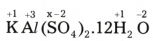
+ 1 + 3 + 2x + 8 (-2) + 12(2 × 1 – 2) = 0 ⇒ x = +6
Thus, oxidation number of S in KAl(SO4)2.12H2O. is +6.
Question 2.
What are the oxidation number of the underlined elements in each of the following and how do you rationalise your results ?
i) KI3
ii) H2S4O6
iii) Fe3O4
iv) CH3CH2OH
v) CH3COOH
Answer:
i) KI3: Let x be the oxidation number of I; Oxidation number of K = +1
Then, +1 + 3(x) = 0 ⇒ x = \(\frac{-1}{3}\)
Oxidation number cannot be fractional. Hence, consider the structure of KI3.
In KI3, an iodine atom forms coordinate covalent bond with an iodine molecule.
K+1 [I0 – I0] ← I-1
Thus, in KI3 molecule, the oxidation number of I atoms forming the molecule I2 is 0, while the oxidation number of I atom which is forming coordinate bond is -1.
ii) H2S4O6: Let x be the oxidation number of S.

2(+1) + 4(x) + 6(-2) = 0 ⇒ 2 + 4x – 12 = 0 ⇒ x = +21/2
Oxidation number cannot be fractional. Hence, S would be present with different oxidation states in molecule.
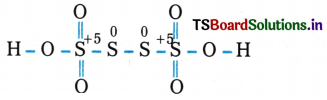
The oxidation number of two out of the four S atoms is +5 while that of other two atoms is 0.
iii) Fe3O4: Let x be the oxidation number of S.

3(x) + 4 (-2) = 0 ⇒ 3x – 8 = 0 ⇒ x = \(\frac{8}{3}\)
Oxidation number cannot be fractional.
By stoichiometry, Fe3O4 is 
One of the three atoms of Fe has oxidation number +2 and the other two atoms of Fe has oxidation number +3.
iv) CH3CH2OH : Let x be the oxidation number of C.
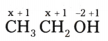
2(x) + 6(+1) + 1(-2) = 0 ⇒ x = -2
Let us consider the structure
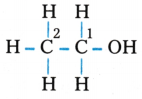
Oxidation number of C1 = 1 (+1) + 2(+1) + x + 1 (-1) = 0 ⇒ x = -2
Oxidation number of C2 = 3(+1) + x + 1(-1) = 0 ⇒ x = -2
Therefore, average oxidation state of C in CH3CH2OH is -2.
v) CH3COOH : Let x be the oxidation number of C.
CH3COOH
2(x) + 4(+1) + 2(-2) = 0 ⇒ 2x + 4 – 4 = 0 ⇒ x = 0
But, 0 is the average oxidation number of carbon. This can be explained by the following structure.
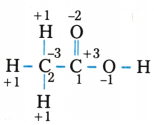
Thus, the carbon atom exhibits +3 and -3 oxidation state on C1 and C2 respectively.
Question 3.
Justify that the following reactions are redox reactions.
i) CuO(s) + H2(g) → Cu(s) + H2O(g)
ii) Fe2O3(s) + 3CO(g) → 2Fe(s) + 3CO2(g)
iii) 2K(s) + F2(g) → 2K+F–(s)
iv) 4NH3(g) + 5O2(g) → 4NO(g) + 6H2O(g)
Answer:
i). CuO (s) + H2(g) → Cu(s) + H2O (g)
In this reaction the oxidation number of Cu decreased from +2 to 0 and the oxidation state of H2 is increased to +1. So it is a redox reaction.
ii). Fe2O3 (s) + 3CO (g) → 2Fe (s) + 3CO2 (g)
In this reaction, the oxidation number of Fe ion in Fe2O3 is decreased from + 3 to zero in Fe and the oxidation number of carbon in CO is increased from +2 to +4 in CO2. So it is a redox reaction.
iii) 
The oxidation number of K is increased from 0 to +1 thus K is oxidised to KF.
The oxidation number of F is decreased from 0 to -1, thus F2 is reduced to KF.
Thus, it is a redox reaction.
iv) 4NH3 (g) + 5O2 (g) → 4NO (g) + 6H2O (g)
The oxidation of N increases from -3 to +2 in the conversation of NH3 to NO. It is oxidation.
The oxidation number of O2 changes from 0 (zero) to -2.
It is a reduction. So it is a redox reaction.
Question 4.
Fluorine reacts with ice and results in the change.
H2O(S) + F2(g) → HF(g) + HOF(g)
Justify that this reaction is a redox reaction.
Answer:

Here, oxidation number of F decreases from 0 in F2 to -1 in HF and increases from 0 in F2 to + 1 in HOF. Thus, F2 is both reduced as well as oxidised. Hence, it is a redox reaction.
Question 5.
Calculate the oxidation number of sulphur, chromium and nitrogen in H2SO5, \(\mathrm{Cr}_2 \mathrm{O}_7^{2-}\) and \(\mathrm{NO}_3^{-}\). Suggest structure of these compounds. Count for the fallacy.
Answer:
i) By conventional method, the oxidation number of S in H2SO5 is
2(+1) + x + 5 (-2) = 0 ⇒ x = +8
This is impossible because the maximum oxidation number of S cannot be more than six since it has only six electrons in the valence shell.
This fallacy is overcome by chemical bonding method.
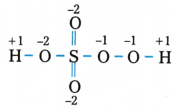
2 × (+1) + x + 2(-1) + 3 × (-2) = 0 ⇒ x = +6
Hence, oxidation number of S in H2SO5 is +6.
ii) Cr in \(\mathrm{Cr}_2 \mathrm{O}_7^{2-}\)
Let x be the oxidation number of Cr.

2x + 7(-2) = -2 ⇒ 2x – 14 = -2 ⇒ x = +6
There is no fallacy about the oxidation number of Cr in \(\mathrm{Cr}_2 \mathrm{O}_7^{2-}\).
Each of the two Cr atoms has the oxidation number of +6.
iii) \(\mathrm{NO}_3^{-}\)
Let x be the oxidation number of N.

x + 3 (-2) = -1 ⇒ x = +5
There is no fallacy about the oxidation number of N in \(\mathrm{NO}_3^{-}\).
Question 6.
Write formulas for the following compounds.
i) Mercury (II) chloride
ii) Nickel (II) sulphate
iii) Tin (IV) oxide
iv) Thallium (I) sulphate
v) Iron (III) sulphate
vi) Chromium (III) oxide
Answer:
i) HgCl2
ii) NiSO4
iii) SnO2
iv) Tl2SO4
v) Fe2(SO4)3
vi) Cr2O3
Question 7.
Suggest a list of the substances where carbon can exhibit oxidation states from – 4 to + 4 and nitrogen from -3 to +5.
Answer:
| Compound | O.N. of Carbon | Compound | O.N. of Nitrogen |
| CH4 | -4 | NH3 | -3 |
| CH3CH3 | -3 | NH2NH2 | -2 |
| CH2 = CH2 or CH3Cl | -2 | N2H2 | -1 |
| CH ≡ CH | -1 | N ≡ N | 0 |
| CH2Cl2 or C6H12O6 | 0 | N2O | + 1 |
| C2Cl2 or C6Cl6 | + 1 | NO | +2 |
| CO or CHCl3 | +2 | N2O3 | +3 |
| C2Cl6 or (COOH)2 | +3 | N2O4 | +4 |
| CO2 or CCl4 | +4 | N2O5 | +5 |
Question 8.
While sulphur dioxide and hydrogen peroxide can act as oxidising as well as reducing agents in their reactions, ozone and nitric acid act only as oxidants. Why ?
Answer:
In sulphur dioxide (SO2), the oxidation number of S is +4 and the range of oxidation number of S is +6 to -2. Hence, SO2 can act both as reducing as well as oxidising agent.
In hydrogen peroxide (H2O2), the oxidation number of O is -1 and the range of oxidation number of O is 0 to -2. Hence, H2O2 can act both as reducing as well as oxidising agent,
In ozone (O3) the oxidation number of O is 0 and the range of oxidation number of O is 0 to -2. Hence, O3 can act only as an oxidant.
In nitric acid (HNO3), the oxidation number of N is +5 and the range of oxidation number of N is +5 to -3. Hence, HNO3 acts only as an oxidant.
Question 9.
Consider the reactions.
i) 6CO2(g) + 6H2(O)(l) → C6H12O6(aq) + 6O2(g)
ii) O3(g) + H2O2(l) → H2O(l) + 2O2(g)
Why it is more appropriate to write these reactions as :
i) 6CO2(g) + 12H2O(l) → C6H12O6(aq) + 6H2O(l) + 6O2(g)
ii) O3(g) + H2O2(l) → H2O(l) + O2(g) + O2(g)
Also suggest a technique to investigate the path of the above (i) and (ii) redox reactions.
Answer:
i) 
Therefore, it is more appropriate to write the equation as (i) because it emphasises that 12H2O are used per molecule of carbohydrate formed and 6H2O are produced during this process.
The path can be found with tracer technique by using radioactive H2O18 instead of H2O.
ii) 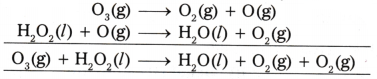
Therefore, it is more appropriate to write the equation (ii) because it suggests that O2 is being obtained from each of the two reactants.
The path can be determined by tracer technique using H2O218 or O318.
Question 10.
The compound AgF2 is unstable compound. However, if formed, the compound acts as a very strong oxidising agent. Why ?
Answer:
In AgF2, the oxidation state of Ag is +2 which is very unstable. Therefore, it quickly accepts an electron to form the more stable +1 oxidation state.
Ag2+ + e– → Ag+
Therefore, AgF2 is formed, will act as a strong oxidising agent.
Question 11.
Whenever a reaction between an oxidising agent and a reducing agent is carried out, a compound of lower oxidation state is formed if the reducing agent is in excess and a compound of higher oxidation state is formed if the oxidising agent is in excess. Justify this statement giving three illustrations.
Answer:
i) 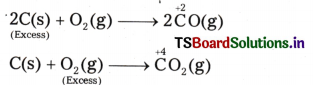
C is a reducing agent whereas O2 is an oxidising agent. If excess of C is burnt in limited supply of O2, CO is formed in which the oxidation state of C is +2. If, however, excess of O2 is used, the initially formed CO gets oxidised to CO2 in which the oxidation state of C is +4.
ii) 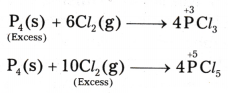
P4 is a reducing agent whereas Cl2 is an oxidising agent. If excess of P4 is used, PCl3 is formed in which the oxidation state of P is +3. If, however, excess of Cl2 is used, the initially formed PCl3 reacts with Cl2 to form PCl5, in which the oxidation state of P is +5.
iii) 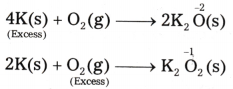
If an excess of K reacts with O2, it produces K2O. Here, the oxidation number of O is -2.
If K reacts with an excess of O2, it produces K2O2, where the oxidation number of O is -1.
Question 12.
How do you count for the following observations ?
i) Though alkaline potassium permanganate and acidic potassium permanganate both are used as oxidants, yet in the manufacture of benzoic acid from toluene we use alcoholic potassium permanganate as an oxidant. Why ? Write a balanced redox equation for the reaction.
ii) When concentrated sulphuric acid is added to an inorganic mixture containing chloride, we get colourless pungent smelling gas HCl, but if the mixture contains bromide then we get red vapour of bromine. Why ?
Answer:
i) Toluene can be oxidised to benzoic acid in acidic, basic and neutral media according to the following redox equations,
a) In acidic medium :
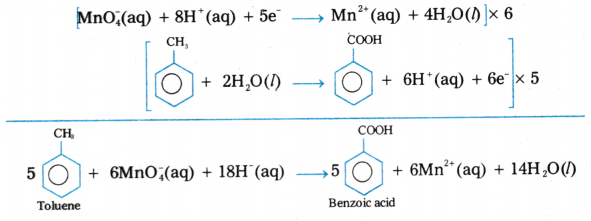
b) In basic and neutral medium:
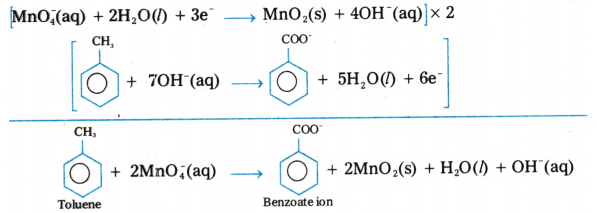
In the laboratory, benzoic acid is usually prepared by alkaline KMnO4. However, in industry, alcoholic KMnO4 is preferred over acidic or alkaline KMnO4 because of the following reasons.
The cost of adding an acid or the base is avoided because in the neutral medium, the base (OH– ions) are produced in the reaction itself.
Since reactions occur faster in homogeneous medium than in heterogeneous medium, therefore, alcohol helps in mixing the two reactants, i.e., KMnO4 (due to its polar nature) and toluene (because of its being an organic compound),
ii) When cone. H2SO is added to an inorganic mixture containing chloride, a pungent smelling gas HCl is produced because a stronger acid displaces a weaker acid from its salt.

Since HCl is a very weak reducing agent, it cannot reduce H2SO4 to SO2 and hence HCl is not oxidised to Cl2.
However, when the mixture contains bromide ion, the initially produced HBr being a strong reducing agent reduces H2SO4 to SO2 and is itself oxidised to produce red vapour of Br2.
2NaBr + 2H2SO4 → 2NaHSO4 + 2HBr
2HBr + H2SO4 → Br2↑ + SO2↑ + 2H2O
Question 13.
Identify the substance oxidised, reduced, oxidising agent and reducing agent for each of the following reactions :
i) 2AgBr(s) + C6H6O2(aq) → 2Ag(s) + 2HBr(aq) + C6H4O2(aq)
ii) HCHO(l) + 2[Ag(NH3)2]+(aq) + 3OH– (aq) → 2Ag(s) + HCOO–(aq) + 4NH3(aq) + 2H2O(l)
iii) HCHO(l) + 2Cu2+(aq) + 5OH–(aq) → Cu2O(s) + HCOO<sup-2(aq) + 3H2O(l)
iv) N2H4(l) + 2H2O2(l) → N2(g) + 4H2O(l)
v) Pb(s) + PbO2(s) + 2H2SO4(aq) → 2PbSO4(s) + 2H2O(l)
Answer:
| Substance oxidised | Substance reduced | Oxidising agent | Reducing agent |
| i) C6H6O2(aq) | AgBr(s) | Agbr(s) | C6H6O2(aq) |
| ii) HCHO(l) | [Ag(NH3)2]+ (aq) | [Ag(NH3)2]+ (aq) | HCHO (aq) |
| iii) HCHO(l) | Cu2+ (aq) | Cu2+ (aq) | HCHO (aq) |
| iv) N2H4(l) | H2O2(l) | H2O2(l) | N2H4(l) |
| v) Pb(s) | PbO2(s) | PbO2(s) | Pb(s) |
Question 14.
Consider the reactions.
\(2 \mathrm{~S}_2 \mathrm{O}_3^{2-}(\mathrm{aq})\) + I2(s) → \(\mathrm{S}_4 \mathrm{O}_6^{2-}(\mathrm{aq})\) + 2I– (aq)
\(\mathrm{S}_2 \mathrm{O}_3^{2-}(\mathrm{aq})\) + 2Br2(l) + 5H2O(l) → \(2 \mathrm{SO}_4^{2-}(\mathrm{aq})\) + 4Br–(aq) + 10H+ (aq)
Why does the same reductant, thiosulphate react differently with iodine and bromine ?
Answer:
The average oxidation numbers of S in S2O32- is +2 while in S4O62- it is +2.5. The oxidation number of S in SO42- is +6. Since Br2 is a stronger oxidising agent than I2, it oxidises S of S2O32- to a higher oxidation state of +6 and hence forms SO42- ion.
I2, however, being weaker oxidising agent oxidises S of S2O32- ion to a oxidation state of +2.5 in S4O62- ion. It is because of this reason that thiosulphate reacts differently with Br2 and I2.
Question 15.
Justify giving reactions that among halogens, fluorine is the best oxidant and among hydrohalic compounds, hydroiodic acid is the best reductant.
Answer:
Halogens have a strong tendency to accept electrons. Therefore, they are strong oxidising
agents. Their relative oxidising power is, however, measured in terms of their electrode potentials. Since the electrode potentials of halogens decreases in the order,
F2 (+2.87 V) > Cl2 (+1.36 V) > Br2(+1.09 V) > I2(+0.54V),
therefore, their oxidising power decreases in the same order.
This is evident from the observation that F2 oxidises Cl– to Cl2, Br– to Br2, I– to I2; Cl2 oxidises Br– to Br2 and I– to I2 but not F– to F2. Br2, however, oxidises I– to I2 but not F– to F2, and Cl– to Cl2.
F2(g) + 2Cl–(aq) → 2F–(aq) + Cl2(g)
F2(g) + 2Br–(aq) → 2F–(aq) + Br2(l)
F2(g) + 2I–(aq) → 2F–(aq) + I2(s)
Cl2g) + 2Br–(aq) → 2Cl–(aq) + Br2(l)
Cl2(g) + 2I–(aq) → 2Cl–(aq) + I2(s) and
Br2(l) + 2I–(aq) → 2Br–(aq) + I2(s)
Thus, F2 is the best oxidant, conversely, halide ions have a tendency to lose electrons and hence can act as reducing agents. Since the electrode potentials of halide ions decreases in the order,
I–(-0.54 V) > Br–(-1.09 V) > Cl–(-1.36 V) > I2(-2.87 V), therefore, the reducing power of the halide ions or their corresponding hydrohalic acids decreases in the same order,
HI > HBr > HCl > HF.
Thus, hydroiodic acid is the best reductant. This is supported by the following reactions. For example, HI and HBr reduce H2SO4 to SO2 while HCl and HF do not.
2HBr + H2SO4 → Br2 + SO2 + 2H2O
2HI + H2SO4 → I2 + SO2 + 2H2O
Further I– reduces Cu2+ to Cu+ but Br– does not.
2Cu2+(aq) + 4I–(aq) → Cu2I2(s) + I2(s)
Cu2+(aq) + 2Br–(aq) → No reaction.
Thus, HI is a stronger reductant than HBr. Further among HCl and HF, HCl is a stronger reducing agent than HF because HCl reduces MnO2 to Mn2+ but HF does not.
MnO2(s) + 4HCl(aq) → MnCl2(aq) + Cl2(g) + 2H2O
MnO2(s) + 4HF(l) → No reaction.
Thus, the reducing character of hydrohalic acids decreases in the order,
HI > HBr > HCl > HF
Question 16.
Why does the following reaction occur ?
\(\mathrm{XeO}_6^{4-}(\mathrm{aq})\) + 2F–(aq) + 6H+(aq) → XeO3(g) + F2(g) + 3H2O(l)
What conclusion about the compound Na4XeO6 (of which \(\mathrm{XeO}_6^{4-}\) is a part) can be drawn from the reaction? •
Answer:
Given reaction 
Here oxidation number of Xe decreases from +8 in \(\mathrm{XeO}_6^{4-}\) to +6 in XeO3 while that of F increases from -1 in F– to 0 in F2. Therefore, \(\mathrm{XeO}_6^{4-}\) is reduced while F– is oxidised. This reaction occurs because Na4XeO6 (or \(\mathrm{XeO}_6^{4-}\)) is a stronger oxidising agent than F2.
Question 17.
Consider the reactions :
i) H3PO2(aq) + 4AgNO3(aq) + 2H2O(l) → H3PO4(aq) + 4Ag(s) + 4HNO3(aq)
ii) H3PO2(aq) + 2CuSO4(aq) + 2H2O(l) → H3PO4(aq) + 2Cu(s) + H2SO4(aq)
iii) C6H5CHO(l) + 2[Ag(NH3)2]+(aq) + 3OH– (aq) → C6H5COO–(aq) + 2Ag(s) + 4NH3(aq) + 2H2O(l)
iv) C6H5CHO(l) + 2Cu2+(aq) + 5OH–(aq) → No change observed.
What inference do you draw about the behaviour of Ag+ and Cu2+ from these reactions ?
Answer:
Reactions (i) and (ii) indicate that H3PO2 (hypophosphorous acid) is a reducing agent and thus reduces both AgNO3 and CuSO4 to Ag and Cu respectively.
Conversely, both AgNO3 and CuSO4 act as an oxidising agent and thus oxidise H3PO2 to H3PO4 (orthophosphoric acid). Reaction (iii) suggests that [Ag(NH3)2]+ oxidises C6H5CHO (benzaldehyde) to C6H5COO– (benzoate ion) but reaction (iv) indicates tha Cu2+ ions cannot oxidise C6H5CHO to C6H5COO–. Therefore, from the above reactions, we can conclude that Ag+ ion is a stronger oxidising agent than Cu2+ ion.
Question 18.
Balance the following redox reactions by ion-electron method.
i) MnO4–(aq) + I– (aq) → MnO2(s) + I2(s) (in basic medium)
ii) MnO4–(aq) + SO2(g) → Mn2+(aq) + HSO4–(aq) (in acidic solution)
iii) H2O2(aq) + Fe2+(aq) → Fe3+(aq) + H2O(l) (in acidic solution)
iv) Cr2O72-(aq) + SO2(g) → Cr3+(aq) + SO42-(aq) (in acidic solution)
Answer:
i) Given reaction MnO4–(aq) + I– (aq) → MnO2(s) + I2(s) (in basic medium)
Oxidation half equation :
2I–(aq) → I2(s) + 2e– ………(i)
Reduction half equation :
MnO4–(aq) → MnO2(s)
MnO4–(aq) + 2H2O(l) + 3e– → MnO2(s) + 4OH–(aq) …….(ii)
Now multiple eq. (i) by 3 and eq. (ii) by 2 and add both the equations,

ii) Given reaction MnO4–(aq) + SO2(g) → Mn2+(aq) + HSO4–(aq) (in acidic solution)
Oxidation half equation:
SO2(g) + 2H2O(l) → HSO4– (aq) + 3H+(aq) + 2e– ……….(i)
Reduction half equation:
MnO4–(aq) + 8H+(aq) + 5e– → Mn2+(aq) + 4H2O(l) …………(ii)
Multiply eq. (i) by 5 and eq. (ii) by 2 and add, we have,
2MnO4–(aq) + 5SO2(g) + 2H2O(l) + H+(aq) → 2Mn2+(aq) + 5HSO4–(aq)
iii) Given reaction H2O2(aq) + Fe2+(aq) → Fe3+(aq) + H2O(l) (in acidic solution)
Oxidation half equation:
Fe2+(aq) → Fe3+(aq) + e– …………..(i)
Reduction half equation:
H2O2(aq) + 2H+(aq) + 2e– → 2H2O(l) …….(ii)
Multiply eq. (i) by 2 and add it to eq. (ii), we have,
H2O2(aq) + 2Fe2+2(aq) + 2H+(aq) → 2Fe3+(aq) + 2H2O(l)
iv) Given reaction Cr2O72-(aq) + SO2(g) → Cr3+(aq) + SO42-(aq) (in acidic solution)
Oxidation half equation :
SO2(g) + 2H2O(l) → SO42- (aq) + 4H+(aq) + 2e– ………(i)
Reduction half equation:
Cr2O72-(aq) + 14H+(aq) + 6e– → 2Cr3+(aq) + 7H2O(l) ……..(ii)
Multiply eq. (i) by 3 and add it to eq. (ii), we have,
Cr2O72-(aq) + 3SO2(g) + 2H+(aq) → 2Cr3+(aq) + 3SO42-(aq) + H2O(l)
Question 19.
Balance the following equations in basic medium by ion-electron method and oxidation number methods and identify the oxidising agent and the reducing agent.
i) P4(s) + OH–(aq) → PH3(g) + H2PO2–(aq)
ii) N2H4(l) + ClO3–(aq) → NO(g) + Cl–(aq)
iii) Cl2O7(g) + H2O2(aq) → ClO2–(aq) + O2(g) + H+(aq)
Answer:
i) Given equation 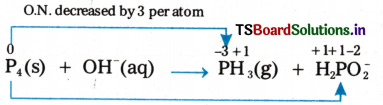
P4 acts both as an oxidising as well as a reducing agent.
Oxidation number method:
Total decrease in O.N. of P4 in PH3 = 3 × 4 = 12
Total increase in O.N. of P4 in H2PO2– = 1 × 4 = 4
Therefore, to balance increase/decrease in O.N. multiply PH3 by 1 and H2PO2– by 3,
we have, P4(s) + OH–(aq) → PH3(g) + 3H2PO2–(aq)
To balance O atoms, multiply OH– by 6, we have
P4(s) + 6OH– (aq) > PH3(g) + 3H2PO2–(aq)
To balance H atoms, added 3H2O to L.H.S. and 3OH– to the R.H.S., we have
P4(s) + 6OH–(aq) + 3H2O (l) →PH3(g) + 3H2PO2–(aq) + 3OH–(aq)
or P4(s) + 3OH–(aq) + 3H2O(l) → PH3(g) + 3H2PO2– (aq) ………..(1)
Thus, eq. (1) represents the correct balanced equation.
Ion-electron method : The two half reactions are,
Oxidation-half reaction:
P4(s) → H2PO2–(aq) ………(2)
Balancing P atoms, we have, 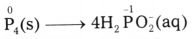
Balance O.N. by adding electrons, P4(s) → 4H2PO2–(aq) + 4e–
Balance charge by adding 8OH– ions.
P4(s) + 8OH–(aq) → 4H2PO2–(aq) + 4e– ……..(3)
O and H get automatically balanced. Thus, eq. (3) represents the balanced oxidation half reaction.
Reduction-half reaction:
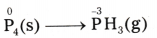
Balancing P atoms, we have, P4(s) → 4PH3(g)
Balance O.N. by adding electrons, P4(s) + 12e– → 4PH3(g)
Balance charge by adding 12OH– ions, P4(s) + 12e– → 4PH3(g) + 12OH–(aq)
Balance O atoms, by adding 12H2O to L.H.S. of above equation
P4(s) + 12H4O(l) + 12e– → 4PH3(g) + 12OH– (aq) …….(5)
To cancel out electrons, multiply eq. (3) by 3 and add it to eq. (5), we have
4P4(S) + 24OH–(aq) + 12H2O(l) → 4PH3(aq) + 12H2PO2–(aq) + 12OH–(aq)
or P4(g) + 3OH–(aq) + 3H2O(l) → PH3(aq) + 3H2PO2–(aq) …. (6)
Thus, eq. (6) represents the correct balanced equation.
ii) Given equation 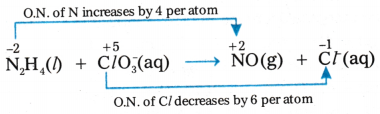
Oxidation number method:
Total increase in O.N. of N = 2 × 4 = 8
Total decrease in O.N. of Cl = 1 × 6 = 6
Therefore, to balance increase/decrease in O.N. multiply N2H4 by 3 and ClO3– by 4, we have
3N2H4(l) + 4ClO3–(aq) → NO(g) + Cl–(aq)
To balance N and Cl atoms, multiply NO by 6 and Cl– by 4, we have
3N2H4(l) + 4ClO3– (aq) → 6NO(g) + 4Cl–(aq)
Balance O atoms by adding 6H2O,
3N2H4(l) + 4ClO3–(aq) > 6NO(g) + 4Cl–(aq) + 6H2O(l) ……..(1)
H atoms get automatically balanced and thus eq. (1) represents the correct balanced equation.
Ion electron method:
Oxidation half reaction :
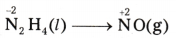
Balance N atoms, N2H4(l) → 2NO(g)
Balance O.N. by adding electrons, N2H4(l) → 2NO(g) + 8e–
Balance charge by adding 8OH– ions, N2H4(l) + 8OH–(aq) → 2NO(g) + 8e–
Balance O atoms by adding 6H2O,
N2H4(l) + 8OH–(aq) → 2NO(g) + 6H2O(l) + 8e– ……….(2)
Reduction-half reaction :
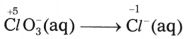
Balance O.N. by adding electrons, ClO3–(aq) + 6e– → Cl–(aq)
Balance charge by adding OH– ions, ClO3–(aq) + 6e– → Cl–(aq) + 6OH–(aq)
Balance O atoms, by adding 3H2O,
ClO3–(aq) + 3H2O(l) + 6e– → Cl–(aq) + 6OH–(aq) ………(3)
Thus, eq. (3) represents the correct balanced reduction half equation.
To cancel out electrons gained and lost, multiply eq. (2) by 3 and eq. (3) by 4 and add, we have,
3N2H4(l) + 4ClO3–(aq) → 6NO(g) + 4Cl–(aq) + 6H2O(l) …. (4)
Thus, eq. (4) represents the correct balanced equation.
iii) Given equation 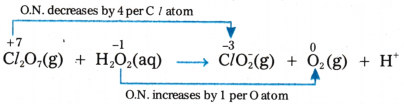
O.N. increases by 1 per O atom
Thus, Cl2O7(g) acts as an oxidising agent while H2O2(aq) as the reducing agent.
Oxidation number method:
Total decrease in O.N. of Cl2O7 = 4 × 2 = 8
Total increase in O.N. of H2O2 = 2 × 1 = 2
∴ To balance increase/decrease in O.N. multiply H2O2 and O2 by 4, we have
Cl2O7(g) + 4H2O2(aq) → ClO2–(aq) + 4O2(g)
To balance Cl atoms, multiply ClO2– by 2, we have
Cl2O7(g) + 4H2O(aq) → 2ClO2–(aq) + 4O2(g)
To balance O atoms, add 3H2O to R.H.S., we have
Cl2O7(g) + 4H2O2(aq) →2ClO2–(aq) + 4O2(g) + 3H2O(l)
To balance H atoms, add 2H2O to R.H.S. and 2OH– to L.H.S, we have
Cl2O7(g) + 4H2O2(g) + 2OH–(aq) → 2ClO2–(aq) + 4O2(g) + 5H2O(l)
This represents the balanced redox equation.
Ion electron method:
Oxidation half reaction:
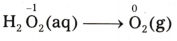
Balance O.N. by adding electrons, H2O2(aq) → O2(g) + 2e–
Balance charge by adding 2OH– ions, H2O2(aq) + 2OH–(aq) → O2(g) + 2e–
Balance O atoms by adding 2H2O,
H2O2(aq) + 2OH– (aq) → O2(g) + 2H2O(l) + 2e– ………..(1)
Reduction-half reaction:

Balance Cl atoms, Cl2O7(g) → 2ClO2–(aq)
Balance O.N. by adding electrons, Cl2O7(g) + 8e– → 2ClO2–(aq)
Add 6OH– ions to balance charge,
Cl2O7(g) + 8– → 2ClO2–(aq) + 6OH–(aq)
Balance O atoms, by adding 3H2O, to L.H.S., we have
Cl2O7(g) + 3H2O(l) + 8e– → 2ClO2–(aq) + 6OH–(aq) ……….(2)
To cancel out electrons, multiply eq. (1) by 4 and add it to eq. (2), we have,
4H2O2(aq) + 8OH–(aq) + Cl2O7(g) + 3H2O(l) → 2ClO2– (aq) + 6OH–(aq) + 4O2(g) + 8H2O(l)
⇒ Cl2O7(g) + 4H2O2(aq) + 2OH–(aq) → 2ClO2–(aq) + 4O–(g) + 5H–O(l)
Question 20.
What sorts of informations can you draw from the following reaction ?
(CN)2(g) + 2OH– (aq) → CN–(aq) + CNO–(aq) + H2O(l)
Answer:
Let x be the Oxidation number (O.N.) of C.
Oxidation number of C in cyanogen, (CN)2 = 2(x – 3) = 0 or x = +3
Oxidation number of C in cyanide ion, CN– = x – 3 = -1 or x = +2
Oxidation number of C in cyanate ion, CNO– = x – 3 – 2 = -1 or x = +4
The information about the given reaction are,
i) The reaction involves decomposition of cyanogen, (CN)2 in the alkaline medium to cyanide ion, CN– and fcyanate ion, CNO–.
ii) The Oxidation number of C decreases from +3 in (CN)2 to +2 in CN– ion and increases from +3 in (CN)2 to +4 in CNO– ion. Thus, cyanogen is simultaneously reduced to cyanide ion and oxidised to cyanate ion.
iii) It is an example of a redox reaction in general and a disproportionation reaction in particular.
iv) Cyanogen is a pseudohalogen (behaves like halogens) while cyanide ion is a pseudohalide ion (behaves like halide ion).
Question 21.
The Mn3+ ion is unstable in solution and undergoes disproportionation to give Mn2+, MnO2 and H+ ion. Write a balanced ionic equation for the reaction.
Answer:
The skeletal equation is Mn3+(aq) → Mn2+(aq) + MnO2(s) + H+(aq)
Oxidation half equation:
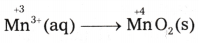
Balance O.N. by adding electrons, 
Balance O atoms by adding 2H2O, 
Balance H atoms by adding 4H+ ions,
 …………(1)
Reduction half equation :
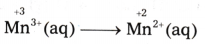
Balance O.N. by adding electrons, Mn3+(aq) + e– → Mn2+(aq) ………(2)
Adding eq. (1) and eq. (2), the balanced equation for the disproportionation reaction is
2Mn3+(aq) + 2H2O(l) → MnO2(s) + Mn2+(aq) + 4H+(aq)
Question 22.
Consider the elements : Cs, Ne, I and F
i) Identify the element that exhibits only negative oxidation state.
ii) Identify the element that exhibits only positive oxidation state.
iii) Identify the element that exhibits both positive and negative oxidation states.
iv) Identify the element which exhibits neither the negative nor the positive oxidation state.
Answer:
i) Take F, Fluorine being the most electronegative element shows only a -ve oxidation state of -1.
ii) Take Cs. Alkali metals because of the presence of a single electron in the valence shell, exhibit an oxidation state of +1.
iii) Take I. Because of the presence of seven electrons in the valence shell, I shows an oxidation state of -1 (in compounds of I with more electropositive elements such as H, Na, K, Ca, etc.) or an oxidation state of +1 compounds of I with more electronegative elements, i.e., O, F, etc) and because of the presence of d-orbitals it also exhibits +ve oxidation states of +3, +5 and +7.
iv) Take Ne. It is an inert gas (with high ionization enthalpy and high positive electron gain enthalpy) and hence it neither exhibits -ve nor +ve oxidation states.
Question 23.
Chlorine is used to purify drinking water. Excess of chlorine is harmful. The excess of chlorine is removed by treating with sulphur dioxide. Present a balanced equation for this redox change taking place in water.
Answer:
The skeletal equation is
Cl2(aq) + SO2(aq) + H2O(l) → Cl–(aq) + SO42-(aq)
Reduction half equation : Cl2(aq) → Cl–(aq)
Balance Cl atoms, 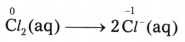
Balance Oxidation number by adding electrons, Cl2(aq) + 2e– → 2Cl– (aq) ………….(i)
Oxidation half equation:

Balance O.N. by adding electrons, SO2(aq) → SO42- (aq) + 2e–
Balance charge by adding 4H+ ions, SO2(aq) → SO42-(aq) + 4H+(aq) + 2e–
Balance O atom’s by adding 2H2O,
SO2(aq) + 2H2O(l) → SO42-(aq) + 4H+aq) + 2e– ……………(ii)
Adding eq. (i) and eq. (ii), we have
Cl2(aq) + SO2(aq) + 2H2O(l) → 2Cl–(aq) + SO42- (aq) + 4H+(aq)
This represents the balanced redox reaction.
Question 24.
Refer to the periodic table given in your book and now answer the following questions:
i) Select the possible non-metals that can show disproportionation reaction.
ii) Select three metals that can show disproportionation reaction.
Answer:
i) The taken non-metals are P, Cl and S.
a) P2(s) + 3OH–(aq) + 3H2O(l) → PH3(g) + 3H2PO2–(aq)
b)  or
or
3Cl2(g) + 6OH–(aq) → 5Cl–(aq) + ClO3– (aq) + 3H2O(l)
c) S8(s) + 12OH–(aq) → 4S2- (aq) + 2S2O32-(aq) + 6H2O(l)
ii) The taken metals are Cu, Ca, In, Mn, etc.
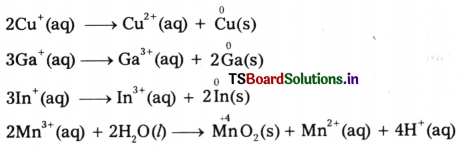
Question 25.
In Ostwald’s process for the manufacture of nitric acid, the first step involves the oxidation of ammonia gas by oxygen gas to give nitric oxide gas and steam. What is the maximum weight of nitric oxide that can be obtained starting only with 10.00 g. of ammonia and 20.00g of oxygen ?
Answer:
The balanced equation for the reaction is: 
Here, 68 g of NH3 will react with = 160 g O2
∴ 10 g of NH3 will react with = \(\frac{160 \mathrm{~g}}{68 \mathrm{~g}}\) × 10 g = 23.52 g O2
But the amount of O2 which is actually available is 20.0 g which is less than the amount
which is needed. Therefore, O2 is the limiting reagent and hence calculations must be based
upon the amount of O2taken and not on the amount of NH3 taken.
From the equation, 160 g of O2 produce NO = 120 g
120
∴ 20 g of O2 will produce NO = \(\frac{120}{160}\) × 20 = 15 g
Question 26.
Using the standard electrode potentials given below, predict if the reaction between the following is feasible :
i) Fe3+(aq) and I–(aq)
ii) Ag+(aq) and Cu(s)
iii) Fe3+(aq) and Cu(s)
iv) Ag(s) and Fe3+(aq)
v) Br2(aq) and Fe2+(aq)
Given,\(\mathbf{E}_{\mathbf{I}_{\mathbf{2}} / \mathbf{I}^{-}}^{\circ}\) = 0.54 V, \(\mathrm{E}_{\mathrm{Br}_2 / \mathrm{Br}^{-}}^{\circ}\) = 1,09 V, \(\mathbf{E}^{\circ}{ }_{\mathrm{Fe}^{3+} / \mathrm{Fe}^{2+}}\) = 0.77 V, \(\mathbf{E}^{\circ}{ }_{\mathrm{Cu}^{2+} / \mathrm{Cu}}\) = 0.34 V \(\mathbf{E}^{\circ}{ }_{\mathbf{A g}^{+} / \mathrm{Ag}}\) = 0.80 V
Answer:
i) The possible, Fe3+(aq) and I– (aq)
Oxidation half reaction: 2I– (aq) → I2(s) + 2e– ; E° = -0.54 V …. (1)
Reduction half reaction: [Fe3+(aq) + e– → Fe2+(aq)] × 2 ; E° = 0.77 V …. (2)
It may be noted that for oxidation reactions, i.e., eq. (1), the sign of the electrode potential is reversed. To get the equation for the overall reaction, the number of electrons lost in eq.(l) and gained in eq. (2) must be cancelled. To do so, eq. (2) is multiplied by 2 and added to eq.(l). Further, it may be noted that whenever any half reaction equation is multiplied by any integer, its electrode potential is not multiplied by that integer. Thus,
Overall reaction : 2Fe3+(aq) + 2I-sup> (aq) → 2Fe2+(aq) + I2(s); E° = +0.23 V
Since the EMF for the above reaction is positive, therefore, the above reaction is feasible.
ii) The possible reaction between Ag+(aq) and Cu(s) is
Cu(s) + 2Ag+(aq) → Cu2+(aq) + 2Ag(s)
The above redox reaction can be split into the following two half reactions. Writing electrode potential for each half reaction, we have

Since the EMF of the above reaction comes out to be positive, therefore, the above reaction is feasible.
iii) Suppose the reaction between Fe3+(aq) and Cu(s) occurs according to the following equation.
Cu(s) + Fe3+(aq) → Cu23+(aq) + Fe3+(aq)
The above reaction can be split into the following two half reactions. Writing electrode potential for each half reaction, we have

The EMF of the reaction is positive, therefore, the above reaction is feasible.
iv) Suppose the reaction between Ag(s) and Fe3+(aq) occurs according to the following equation.
Ag(s) + Fe3+(aq) → Ag+(aq) + Fe2+(aq)
The above redox reaction can be split into the following two half reactions. Writing electrode potential for each half reaction, we have

Since the EMF of the reaction is negative, therefore, the above reaction is not feasible.
v) Suppose the reaction between Br2(s) and Fe2+(aq) occurs according to the following equation.
Br2(s) + 2Fe2+(aq) → 2Br–(aq) + 2Fe3+(aq)
The above redox reaction can be split into the following two half reactions. Writing electrode potential for each half reaction, we have

Since the EMF for the above reaction is positive, therefore, this reaction is feasible.
Question 27.
Predict the products of electrolysis in each of the following.
i) An aqueous solution of AgNO3 with silver electrodes
ii) An aqueous solution of AgNO3 with platinum electrodes
iii) A dilute solution of H2SO4 with platinum electrodes
iv) An aqueous solution of CuCl2 with platinum electrodes.
Answer:
i) In aqueous solution, AgNO3 ionises to give Ag+(aq) and NO3–(aq) ions.
AgNO3(aq) → Ag+(aq) + NO3–(aq)
Thus, when electricity is passed, Ag+(aq) ions move towards the cathode while NO3– ions move towards the anode. In other words, at the cathode, either Ag+(aq) ions or
H2O molecules may be reduced. Which of these will actually get discharged would depend upon their electrode potentials which are given below.
Ag+(aq) + e– → Ag(s); E° = +0.8G V (1)
2H2O(l) + 2e– → H2 (g) + 2OH– (aq) ; E° = – 0.83 V
Since the electrode potential (i.e., reduction potential of Ag+(aq) ions is higher than that of H2O molecules, therefore, at the cathode, it is the Ag+(aq) ions (rather than H20 molecules) which are reduced. Similarly, at the anode, either Ag metal of the anode or H2O molecules may be oxidised. Their electrode potentials are,
Ag(s) → Ag+(aq) + e–; E° = -0.80 V (3)
2H2O(l) → O2(g) + 4H+(aq) + 4e–; E° = – 1.23 V
Since the oxidation potential of Ag is much higher than that of H2O, therefore, at the anode, it is the Ag of the silver anode which gets oxidised and not the H2O molecules. It may, however, be mentioned here that the oxidation potential of NO3– ions is even lower than that of H2O. Since more bonds are to be broken during reduction of NO3– ions than those in H2O. Thus, when an aqueous solution of AgNO3 is electrolysed, Ag from Ag anode dissolves while Ag+ (aq) ions present in the solution get reduced and get deposited on the cathode.
ii) If, however, electrolysis of AgNO3 solution is carried out using platinum electrodes, instead of silver electrodes, oxidation of water occurs at the anode since Pt being a noble metal does not undergo oxidation easily. As a result, O2 is liberated at the anode according to equation (4). Thus, when an aqueous solution of AgNO3 is electrolysed using platinum electrodes, Ag+ ions from the solution get deposited on the cathode while O2 is liberated at the anode.
iii) In aqueous solution, H2SO4 ionises to give H+(aq) and SO42-(aq) ions.
H2SO4 (aq) ⇌ 2H+(aq) + SO42- (aq)
Thus, when electricity is passed, H+(aq) ions move towards cathode while SO42-(aq) ions move towards anode. In other words, either H+(aq) ions or H2O molecules are reduced. Their electrode potentials are,
2H+(aq) + 2e– → H2(g) ; E° = 0.0 V
2H2O (aq) + 2e– → H2(g) + 2OH–(aq); E° = -0.83 V
Since the electrode potential (i.e., reduction potential) of H+(aq) ions is higher than that of H2O, therefore, at the cathode, it is H+(aq) ions (rather than H2O molecules) which are reduced to evolve H2 gas. Similarly at the anode, either SO42-(aq) ions or H2O molecules are oxidised. Since the oxidation potential of SO42- is expected to be much lower (since it involved cleavage of many bonds as compared to those in H2O) than that of H2O molecules therefore, at the anode, it is H2O molecules (rather than SO42- ions) which are oxidised to evolve O2 gas. From the above discussion, it follows that during electrolysis of an aqueous solution of H2SO4 only the electrolysis of H2O occurs liberating H2 at the cathode and O2 at the anode.
iv) In aqueous solution, CuCl2 ionises as follows.
CuCl2(aq) ⇌ CuCl2+(aq) + 2Cl–(aq)
On passing electricity, Cu2+(aq) ions move towards cathode and Cl– (aq) ions move
towards anode. Thus, at cathode, either Cu2+(aq) or H2O molecules are reduced. Their electrode potentials are:
Cu2+ + 2e– → Cu(s) ; E° = + 0,34 V
2H2O(l) + 2e– → H2(g) + 2OH– (aq) ; E° = -0.83 V
Since the electrode potential of Cu2+(aq) ions is much higher than that of H2O, therefore, at the cathode, it is Cu2+(aq) ions which are reduced and not H2O molecules. Similarly, at the anode, either Cl(aq) ions or H2O molecules are oxidised. Their oxidation potentials are,
2Cl–(aq) → Cl2(g) + 2e– ; E° = -1.36 V
2H2O(l) → O2(g) + 4H+(aq) + 4e– ; E° = -1.23 V
Although oxidation potential of H2O molecules is higher than that of Cl– ions, nevertheless oxidation of Cl–(aq) ions occurs in preference to H2O since due to over voltage of O2. Much lower potential than -1.36 V is needed for the oxidation of H2O molecules. Thus, when an aqueous solution of CuCl2 is electrolysed, Cu metal is liberated at the cathode while Cl2 gas is evolved at the anode.
Question 28.
Arrange the following metals in the order in which they displace each other from the solution of their salts. A/, Cu, Fe, Mg and Zn.
Answer:
It is based upon the relative positions of these metals in the activity series. The correct order is Mg > Al > Zn > Fe > Cu.
Question 29.
Given the standard electrode potentials,
K+/K = -2.93 V, Ag+/Ag = 0.80 V, Hg2+/Hg = 0.79 V, Mg2+/Mg = -2.37 V, Cr3+/Cr = -0.74 V
Arrange these metals in increasing order of their reducing power.
Answer:
Lower the electrode potential, better is the reducing agent. Since the electrode potentials increases in the order; K+K (-2.93 V), Mg2+ (-2.37 V), Cr3+/Cr (-0.74 V), Hg2+/Hg (0.79 V), Ag+/Ag (0.80 V), therefore, reducing power of metals increases in the order i.e., Ag < Hg < Cr < Mg < K.
Question 30.
Depict the galvanic cell in which the reaction Zn(s) + 2Ag+(aq) → Zn2+(aq) + 2Ag(s)
takes place, Further show :
i) which of the electrode is negatively charged,
ii) the carriers of the current in the cell, and
iii) individual reaction at each electrode.
Answer:
The given redox reaction is Zn(s) + 2Ag+(aq) → Zn2+(aq) + 2Ag(s)
Since Zn gets oxidised to Zn2+ ions and Ag+ gets reduced to Ag metal, therefore, oxidation occurs at the zinc electrode and reduction occurs at the silver electrode. Thus, galvanic cell corresponding to the above redox reaction may be depicted as
Zn | Zn2+(aq) || Ag+(aq) | Ag
i) Since oxidation occurs at the zinc electrode, therefore, electrons accumulate on the zinc electrode and hence zinc electrode is negatively charged.
ii) The ions carry current The electrons flow from Zn to Ag electrode while the current flows from Ag to Zn electrode.
iii) The reaction occurring at the two electrodes are,
At anode :Zn(s) → Zn2+(aq) + 2e–
At cathode: Ag+(aq) + e– → Ag(s)