
Referring to the AP Inter 1st Year Maths Study Material Chapter 6 Permutations and Combinations Exercise 6d Solutions makes it easier to understand complex problems.
AP Inter 1st Year Maths Permutations and Combinations Solutions Exercise 6d
Question 1.
If nC8 = nC2 find nC2.
Solution:
We Know that if nCa = nCb, then a = b or a + b = n
Therefore, nC8 = nC2
⇒ 8 + 2 = n
⇒ n = 10
Hence, nC2 = 10C2
= \(\frac{10!}{2!(10-2)!}=\frac{10!}{2!8!}=\frac{10 \times 9 \times 8!}{2 \times 1 \times 8!}\)
= 5 × 9
= 45
Question 2.
Dterminw n if i) 2nC3 : nC3 = 12 : 1
Solution:
Given that 2nC3 : nC3 = 12 : 1
⇒ \(\frac{{ }^{2 n} C_3}{{ }^n C_3}=\frac{12}{1}\)
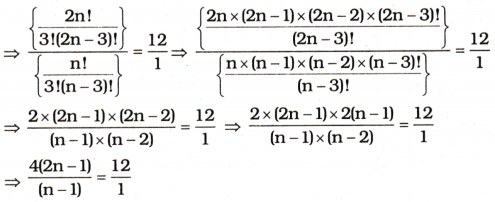
⇒ 8n – 4 = 12n – 24
⇒ 4n = 20
⇒ n = 5
ii) 2nC3 : nC3 = 11 : 1
Solution:
2nC3 : nC3 = 11 : 1
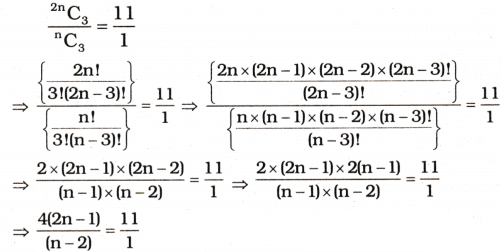
⇒ 8n – 4 = 11n – 22
⇒ 3n = 18
⇒ n = 6
Question 3.
How many chords can be drawn though 21 points on a circle ?
Solution:
Number of chords that can be drawn though 21 points on a circle
= Number of ways of selecting 2 points from 21 points = 21C2 = \(\frac{21 \times 20}{2}\) = 210.

Question 4.
In how many ways can a team of 3 boys and 3 girls be selected from 5 boys and 4 girls ?
Solution:
3 boys out of 5 boys can be selected in 5C3 ways.
3 girls out of 4 girls can be selected in 4C3 ways.
∴ No. of ways in which 3 boys and 3 girls are selected = 5C3 × 4C3
= 10 × 4
= 40 ways.
Question 5.
If nC4 = 210, find n.
Solution:
Given that nC4 = 210
⇒ \(\frac{n(n-1)(n-2)(n-3)}{1 \cdot 2 \cdot 3 \cdot 4}\) = 10 × 21
⇒ n(n – 1) (n – 2) (n – 3) = 10 × 21 × 1 × 2 × 3 × 4
⇒ n(n – 1) (n – 2) (n – 3) = 10 × 7 × 3 × 2 × 3 × 4
⇒ n(n – 1) (n – 2) (n – 3) = 10 × 9 × 8 × 7
⇒ n = 10
Question 6.
If 12Cr = 495, find the possible values of ‘r’.
Solution:
12Cr = 495
= 5 × 99
= 11 × 9 × 5
= \(\frac{12 \times 11 \times 9 \times 5 \times 2}{12 \times 2}=\frac{12 \times 11 \times 10 \times 9}{1 \times 2 \times 3 \times 4}\)
= 12C4 or 12C8
∴ r = 4 or 8
Question 7.
If 10.nC4 = 3. n+1C3, find n.
Solution:
Given that 10.nC2 = 3.n+1C3
⇒ 10 × n(n – 1)1.2 = 3(n + 1)(n – 1)1.2.3
⇒ 10 = n + 1
⇒ n = 9
Question 8.
If 15C2r-1 = 15C2r+4 + 4, find r.
Solution:
Given that 15C2r-1 = 15C2r+4
⇒ 2r – 1 = 2r + 4 or (2r – 1) + (2r + 4) = 15
⇒ (2r – 1) + (2r + 4) = 15
⇒ 4r + 3 = 15
⇒ 4r = 12
⇒ r = 3
∴ r = 3
Question 9.
If 12Cr+1 = 12C3r-5, find r.
Solution:
Given that 12Cr+1 = 12C3r-5
⇒ r + 1 = 3r – 5 or (r + 1) + (3r – 5) = 12
⇒ 1 + 5 = 2r or 4r – 4 = 12
⇒ 2r = 6 or 4r = 16
⇒ r = 3 or r = 4
r = 3 or 4
Question 10.
If nC5 = nC6, then find 13C4.
Solution:
Given that nC5 = nC6
⇒ n = 6 + 5 = 11
⇒ 13Cn = 13C11
= 13C2
= \(\frac{13 \times 12}{1 \times 2}\) = 78
II.
Question 1.
Find the number of ways of selecting 9 balls from 6 red balls, 5 white balls and 5 blue balls if each selection Solution:
The no. of ways of selecting 3 red balls out of 6 red balls = 6C3
The no. of ways of sleeting 3 white balls out of 5 white balls = 5C3
The no. of ways of selecting 3 blue balls out of 5 blue balls = 5C3
The no. of ways of selecting 3 balls of each colour = 6C3 × 5C3 × 5C3
= 20 × 10 × 10
= 2000.
Question 2.
Determine the number of 5 card combinations out of a deck of 52 cards if there is exactly one ace in each combination.
Solution:
One ace will be selected from four aces and four cards will be selected from 52 cards, then 52 – 4 = 48 cards.
If ‘p’ is the required no. of ways, then
⇒ P = 4C1 × 48C4
= 4 × \(\frac{48!}{4!(48-4)!}=\frac{4 \times 48!}{4!44!}\)
= 4 × \(\frac{48 \times 47 \times 46 \times 45 \times 44!}{4 \times 3 \times 2 \times 1 \times 44!}\)
= 778320 ways
Question 3.
In how many ways can one select a cricket team of Eleven from 17 players in which only 5 players can bowl if each cricket team of 11 must include exactly 4 bowlers ?
Solution:
Out of 17 players, 5 players are bowlers. A cricket team of 11 players is to be selected in such away that there are exactly 4 bowlers. 4 bowlers can be selected out of 5 bowlers in 5C4 ways and the remaining 7 players can be selected out of the 12 players in 12C7 ways.
Thus, by multiplication principle, required number of ways of selecting circket team
5C4 × 12C7 = \(\frac{5!}{4!(5-4)!} \times \frac{12!}{7!(12-7)!}=\frac{5 \times 4!}{4!1!} \times \frac{12 \times 11 \times 10 \times 9 \times 8 \times 7}{7!5!}\)
= 5 × 792
= 3960
Question 4.
A bag contains 5 black and 6 red balls. Determine the number of ways in which 2 black and 3 red balls can be selected.
Solution:
There axe 5 black and 6 red balls in the bag.
2 black balls can be selected out of 5 black balls in 5C2 ways and
3 red balls can be selected out of 6 red balls in 6C3 ways.
Thus, by multiplication principle, required number of ways of selecting 2 black and 3 red balls.
5C2 × 6C4
= \(\frac{5!}{2!(5-2)!} \times \frac{6!}{3!(6-3)!}=\frac{5 \times 4 \times 3!}{2!3!}=\frac{6 \times 5 \times 4 \times 3!}{3!3!}\)
= 10 × 20
= 200.
Question 5.
In how many ways can a student choose a programme of 5 courses if 9 courses are available and 2 specific courses are compulsory for every student ?
Solution:
There are 9 courses available out of which, 2 specific courses are compulsory for every student and has to choose 3 courses out of the remaining 7 courses. 2 courses can be selected out of 2 specific courses in 2C2 ways and 3 courses can be selected out of the remaing 7 courses in 7C3 ways.
Thus, the required number of ways of choosing the programme
2C2 × 7C3 = \(\frac{2!}{2!(2-2)!} \times \frac{7!}{3!(7-3)!}=\frac{2!}{2!0!} \times \frac{7 \times 6 \times 5 \times 4!}{3!4!}\)
= 1 × 35
= 35
Question 6.
Prove that for 3 ≤ r ≤ n.
(n – 3)Cr + 3.(n – 3)C(r – 1) + 3. (n – 3)C(r – 2) + n – 3Cr – 3 = nCr
Solution:
Since nCr – 1 + nCr = n + 1Cr, Given can be taken as
n – 3Cr + n – 3Cr + 2[n – 3Cr – 1 + n – 3Cr – 2] + n Cr – 2 + n – 3Cr – 3
= n – 2Cr + 2.(n – 2)Cr – 1 + n – 2Cr – 2
= n – 1Cr + n – 1Cr – 1
= n – 1 + 1Cr
= nCr
Question 7.
Simp;ify 34C5 + \(\sum_{\mathbf{r}=0}^4\) (38 – r)C4.
Solution:
34C5 + \(\sum_{\mathbf{r}=0}^4\) (38 – r)C4.

Question 8.
In a class there are 30 students. If each student plays a chess game with each of the other student, then find the total number of chess games played by them.
Solution:
Number of students in a class = 30.
Since each student plays a chess game with each of the other students, the total
number of chess games played by them = 30C2 = 435
Question 9.
Find the number of ways of selecting 3 vowels and 2 consonants from the letters of the word EQUATION.
Solution:
The word EQUATION contains 5 vowels and 3 consonants.
The 3 vowels can be selected from 5 vowels in 5C3 = 10 ways.
The 2 consonants can be selected from 3 consonants in 3C2 = 3 ways.
The required number of ways of selecting 3 vowels and 2 consonants = 10 × 3 = 30.
Question 10.
Find the number of diagonals of a polygon with 12 sides.
Solution:
The number of diagonals of a polygon with 12 sides = \(\frac{n(n-3)}{2}=\frac{12(12-3)}{2}\) = 54
Question 11.
If n persons are sitting in a row, find the number of ways of selecting two persons, who are sitting adjacent to each other.
Solution:
The number of ways of selecting 2 persons out of n persons sitting in a row, who are sitting adjacent to each other = n – 1
III.
Question 1.
Prove that \(\frac{{ }^{4 n} C_{2 n}}{{ }^{2 n} C_n}=\frac{1.3 .5 \ldots(4 n-1)}{\{1.3 .5 \ldots(2 n-1)\}^2}\).
Solution:
im-4
Question 2.
If a set A has 12 elements, find the number of subsets of A having
(i) 4 elements
(ii) Atleast 3 elements
(iii) Atmost 3 elements.
Solution:
Number of elements in set A = 12.
i) Number of subsets of A with exactly 4 elements 12C4 = 495.
ii) The required subset contains atleast 3 elements.
The number of subsets of A with exactly 0 elements is 12C0
The number of subsets of A with exactly 1 element is 12C1
The number of subsets of A with exactly 2 elements is 12C2
Total number of subsets of A formed = 212.
Number of subsets of A with atleast 3 elements = (Total number of subsets) – (number of subsets contains 0 or 1 or 2 elements)
= 212 – (12C0 + 12C1 + 12C2)
= 4096 – (1 + 12 + 66)
= 4096 – 79
= 4017
iii) The required subset contains atmost 3 elements.
i.e., it may contain 0 or 1 or 2 or 3 elements.
The number of subsets of A with exactly 0 elements is 12C0.
The number of subsets of A with exactly 1 elements is 12C1
The number of subsets of A with exactly 2 elements is 12C2.
The number of subsets of A with exactly 3 elements is 12C3.
∴ Number of subsets of A with atmost 3 elements = 12C0 + 12C1 + 12C2 + 12C3
= 1 + 12 + 66 + 220
= 299
Question 3.
There are 8 railway stations along a railway line. In how many ways can a train be stopped at 3 of these stations such that no two of them are consecutive ?
Solution:
Number of ways of selecting 3 stations out of 8 = 8C3 = 56.
Number of ways of selecting 3 out of 7 stations such that 3 are consecutive = 6. Number of ways of selecting 3 out of 8 stations such that 2 of them are consecutive = 2 × 5 + 5 × 4
= 10+ 20
= 30
Number of ways for a train to be stopped at 3 or 8 stations such that no two of them are consecutive = 56 – (6 + 30) = 20.
Question 4.
A question paper is divided into 3 sections A, B, C containing 3, 4, 5 questions respectively. Find the number of ways of attempting 6 questions choosing atleast one from each section.
Solution:
The selection of a question may be of the following
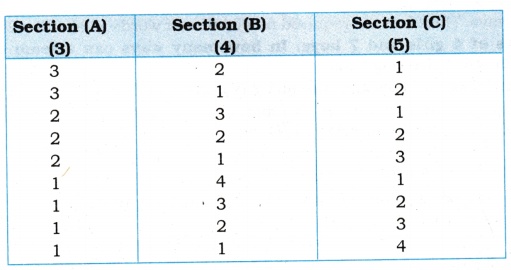
Total No. of ways of attempting 6 questions
= 3C3. 4C2.5C1 + 3C3. 4C1.5C2 + 3C2. 4C3.5C1 + 3C2. 4C2.5C2 + 3C2. 4C1.5C3 + 3C1. 4C4.5C1 + 3C1. 4C3.5C2 + 3C1. 4C2.5C3 + 3C1. 4C1.5C4
= 805
Question 5.
A class contains 4 boys and g girls. Every Sunday, five students with atleast 3 boys go for a picnic. A different group is being sent every week. During the picnic, the class teacher gives each girl in the group a doll. If the total number of dolls distributed is 85, find g.
Solution:
No. of boys = 4, No. of girls = g
Since there should be atleast 3 boys it can be done in 2 ways as shown in the table.
The number of girls in G1 = [4C3 × gC2] × 2
Since each group contains 2 girls.
The number of girls in G2 = [4C4 × gC1] × 1.
Since each group contains 1 girl.
Given no. of dolls distributed = 85
⇒ [4C3 × gC2] × 2 + [4C4 × gC1] × 1
⇒ 4. g(g – 1)2 × 2 + 1.g.1 = 85
⇒ 4g(g – 1) + 17(g – 5) = 0
⇒ (g – 5)(4g + 17) = 0
Since g ≠ –\(\frac{17}{4}\)
∴ g = 5 ⇒ Hence No. of girls = 5