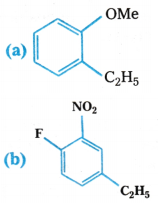
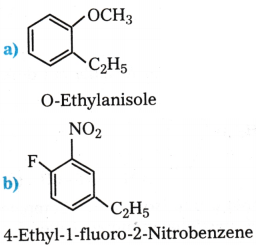
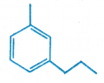
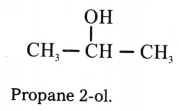
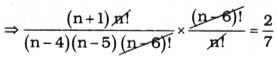
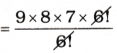
Classification of Elements and Periodicity in Properties Questions and Answers AP Inter 1st Year Chemistry Chapter 3

Regular practice with AP Inter 1st Year Chemistry Study Material Chapter 3 Classification of Elements and Periodicity in Properties Questions and Answers helps students stay prepared for examinations.

AP Inter 1st Year Chemistry 3rd Lesson Classification of Elements and Periodicity in Properties Questions and Answers

I. Multiple Choice Questions

Question 1.
Which of the following oxide, when dissolved in water form an acidic solution?
1) Na2O
2) CO
3) Al2O3
4) Cl2O7
Answer:
4) Cl2O7
Cl2O7 + H2O → 2HClO4 (Cl2O7 is acidic oxide)

Question 2.
The maximum covalency of Be in [BeF4]– and Al in [AlF6]3- are respectively?
1) 4, 6
2) 4, 4
3) 6, 4
4) 6, 6
Answer:
1) 4, 6
Maximum covalency of Be in [BeF4]– = 4
Maximum covalency of Al in [AlF6]-3 = 6
No.of Chemical bonds formed by an atom by sharing electrons with other atoms is covalency.

Question 3.
The increasing order of ionization enthalpy of second period elements is
1) Li < B < Be < C < NO < F < Ne
2) Li < Be < B < C < N < O < F < Ne
3) Li < B < Be < C < O < N < F < Ne
4) Li < Be < B < C < O < N < F < Ne
Answer:
3) Li < B < Be < C < O < N < F < Ne

Question 4.
The difference in electronegativities of elements give information regarding
1) bond length
2) nature of bond
3) volume of anion
4) volume of cation
Answer:
2) nature of bond Difference in electronegative values Of elements give information about nature of bond. Electronegativity difference > 1.7 (ionic bond) < 1.7 (covalent bond)
= 1.7 (50% covalent bond and 50% ionic bond)

Question 5.
The atomic radius of fluorine is 64 pm. What is the ionic radius of fluoride ion ?
1) 64 pm
2) 136 pm
3) 32 pm
4) 60 pm
Answer:
2) 136 pm
F- has higher radius than F (Parent atom) so 136 pm

Classification of Elements and Periodicity in Properties Questions and Answers AP Inter 1st Year Chemistry Chapter 3

Question 6.
The atomic number Of the element unnilennium is
1) 102
2) 108
3) 119
4) 109
Answer:
4) 109
Unnilennium
un – 1
nil – 0
enn – 9

Question 7.
Which one of the following sets of ions represents a collection of iso electronic series?
1) Li+, Na+, Mg2+, Ca2+
2) Ba2+, Sr2+, K+, Ca2+
3) N3-, O2-, F–, S2-
4) K+, Cl–, Ca2+, Sc3+
Answer:
4) K+, Cl–, Ca2+, Sc3+
K+ (18), Cl– (18), Ca+2 (18) and Sc+3 (18) have some no.of electrons so they are iso electronic series.

Question 8.
Three elements X, Y and Z are in the third period of the periodic table. The oxides of X,Y and Z respectively are basic, amphoteric and acidic. The correct order of the atomic numbers of X,Y and Z is [ 3 ]
1) X < Z < Y
2) Z < Y < X
3) X < Y < Z
4) Y<X<Z
Answer:
3) X < Y < Z
X – basic ; Y – Amphoteric ; Z – acidic ; X < Y < Z.

Question 9.
In which of the following, elements are arranged in the decreasing order of their metallic nature?
1) Na > Mg > Be > Si > P
2) P > Si > Be > Mg > Na
3) Si > P > Be > Na > Mg
4) Be > Na > Mg > Si > P
Answer:
1) Na > Mg > Be > Si > P
Na > Mg > Be > Si > P is the decreasing order of metallic nature.

Question 10.
What is the atomic number of the element present in the 4th period and 17th group of the periodic table?
1) 29
2) 35
3) 37
4) 30
Answer:
2) 35
4th period and 17th group element is Bromine. Atomic no is 35.

Question 11.
If the formula of oxide of Eka-aluminium is E2O3, its chloride can be
1)AlCl3
2) GaCl3
3) GeCl3
4) Ga2Cl3
Answer:
2) GaCl3
Eka Aluminium is gallium, chloride is Gallium trichloride GaCl3.

Question 12.
To which group of an element having atomic number 84.
1) Group-12
2) Group-17
3) Group-16
4) Group-11
Answer:
3) Group-16
Atomic no(Z) = 84 having Element is polonium. Polonium is belongs to group – 16

Classification of Elements and Periodicity in Properties Questions and Answers AP Inter 1st Year Chemistry Chapter 3

Question 13.
As we move from left to right across a period, the non-metallic character and as we go down in the group, metallic character
1) Increases, Decreases
2) Decreases, Increases
3) Decreases, Increases
4) Increases, Increases
Answer:
4) Increases, Increases
In periods, non-metallic character from left to right increases.
In groups, metallic character from top to bottom increases.

Question 14.
The IUPAC official name of unnilquadium
1) Seaborgium
2) Lawrencium
3) Dubnium
4) Rutherfordium
Answer:
4) Rutherfordium
Unnilquadium Atomic no = 104
104th Element is Rutherfordium (Rf).

II. Fill in the Blanks

Question 1.
Among the alkali metals, the metal with the highest ionization enthalpy is _______.
Answer:
Lithium (From top to bottom I.E. decreases)

Question 2.
The examples of neutral oxides are ________.
Answer:
Nitrous oxide (N2O), Nitric oxide (NO) and Carbon monoxide (CO) are examples of neutral oxides.

Question 3.
Beryllium more closely resembles with ______.
Answer:
Beryllium more closely resembles with Aluminium (Diagonal relationship)

Question 4.
The element with highest electronegativity on Pauling scale is _______.
Answer:
Fluorine (F), According to pauling scale it’s electronegativity = 4.0

Question 5.
In an atom the decrease in the attractions between nucleus and outer most electrons by the core electrons is called _____.
Answer:
Screening effect (or) shielding effect

III. One Word Answer Questions

Question 1.
State Mendeleev’s periodic law.
Answer:
The physical and chemical properties of elements are periodic functions of their atomic weights.

Question 2.
State Moseley’s modern periodic law.
Answer:
The physical and chemical properties of elements are periodic functions of their atomic numbers.

Classification of Elements and Periodicity in Properties Questions and Answers AP Inter 1st Year Chemistry Chapter 3

Question 3.
What are the elements having highest electronegativity and electron gain enthalpy?
Answer:
High electronegative element is fluorine (F).
High electron gain enthalpy (electron affinity) element is chlorine (Cl).

Question 4.
What is a diagonal relationship?
Answer:
The first element of a group shows similarities in properties with the second element of the next group. This is called, ‘diagonal relationship’.

GroupIIIIIIIV
2nd periodLiBeBc
3rd periodNaMgAlSi

But this relation continues effectively upto to the IV group only.

Question 5.
What is an amphoteric oxide ?
Answer:
The oxide which contains both acidic as well as basic nature is called an amphoteric oxide.
Eg : Al2O3, Ga2Os3 etc ……

Question 6.
What is iso-electronic series.
Answer:
Series of species having same no.of electrons is called iso-electronic series.
Eg : N-3, O-2, F–, Na+, Mg+2, Al+3, Ne

Question 7.
What are transuranic elements ?
Answer:
In actinoids after uranium the elements are synthesized artificially. These are called transuranic elements.

Question 8.
What is the starting element of fifth period?
Answer:
Rubidium (Rb) is the starting element of 5th period.

Question 9.
What are the units of electron gain enthalpy ?
Answer:
Units of electron gain enthalpy are KJ/mol (or) eV/atom

Question 10.
For which group, valency and group number has no relation.
Answer:
Group 18 has no relation between valency and group number.

IV. Very Short Answer Questions

Question 1.
An element ‘X’ has atomic number 34. Give it’s position in the periodic table.
Answer:
Given element’s Atomic number (Z) = 34 and its electronic configuration is [Ar] 4s23d104p4.
Total number of shells represents the period and the number of valence electrons represents the group. So it belongs to 4th period and VIth A group (Z = 34).

Question 2.
Mg2+ is smaller than O2- in size. Why?
Answer:

  • Mg+2 and O-2 are iso-electronic.
  • In iso-electronic series nuclear charge (or) positive charge increases size decreases. So Mg+2 smaller than O-2 in size.

Classification of Elements and Periodicity in Properties Questions and Answers AP Inter 1st Year Chemistry Chapter 3

Question 3.
How does the nature of oxides change along third period from Na2O to Cl2O7 ?
Answer:
The basic nature decreases and the acidic nature increases from Na2O to Cl2O7, as shown below.

ElementNaMgAlSiPSCl
OxideNa2OMgOAl2O3SiO2P2O5SO3Cl2O7
NatureStrongly basicBasicAmphotericWeakly

acidic

AcidicStrongly

acidic

Strongly

acidic

Question 4.
Consider the following species N3-, O2-, Na+, Mg2+ and Al3+.
(a) What is common in them?
(b) Arrange them in an increasing order of their ionic radii.
Answer:
a) All the ions contain same number of electrons (10 electrons).
b) Al+3 < Mg2+ < Na+ < F– < O-2 < N-3

Question 5.
Name any two bridge elements.
Answer:
2nd period elements are bridge elements.
Lithium (Li), Beryllium (Be), Boron (B), Carbon (C) etc…

Question 6.
Define metallic radius and covalent radius.
Answer:
Metallic radius The half of the distance between centre of nucleus of two adjacent metal atoms is called metallic radius.
Covalent radius : The half of the distance between centre of nucleus of two atoms bonded covalently is called covalent radius.

Question 7.
Why cation is smaller and anion is larger in radii than their parent atoms?
Answer:
Cations after losing electron, nuclear attraction increases. Where as in anions after gaining electron, where as electron repulsion increases.
∴ Cation is smaller and anion is larger in radii than parent atom.

Question 8.
How are electronegativity and metallic and non-metallic characters related ?
Answer:

  • As the electronegativity increases metallic character decreases.
    Electronegativity ∝ \(\frac{1}{\text { Metallic character }}\)
  • As the electronegativity increases non-metallic character also increases. Electronegativity oc non-metallic character

Question 9.
Ionisation enthalpy (IE1) of O is less than that of N. Why?
Answer:
Electronic configuration of N is – 1s22s22p3, lectronic configuration of O is 1s2 2s2 2p4. Nitrogen has stable half filled 2p orbital electronic configuration. So high amount of I.E. required.
So I.E. of ‘O’ is less than ‘N’.

Question 10.
What are the oxidation state and covalency of Al in [AlCl (H2O)5]2+ ?
Answer:
In the given complex [AlCl (H2O)5]+2
Oxidation state of ‘Al’ = +3 and Covalency of ‘Al’ = 6

V. Short Answer Questions

Question 1.
Give any four characteristic properties of transition elements.
Answer:
Characteristic properties of transition elements.

  • They exhibit variable oxidation states.
  • They exhibit para magnetic property.
  • They form coloured compounds.
  • They form alloys.
  • They form complex compounds.
  • They form interstitial compounds.

Classification of Elements and Periodicity in Properties Questions and Answers AP Inter 1st Year Chemistry Chapter 3

Question 2.
Assign the position of the element having outer electronic configuration
a) ns2 np4 for n = 3
b) (n – 1)d2 ns2 for n = 4.
Answer:
a) ns2np4 for n = 3
3s2 3p4 outer electronic configuration element is sulphur 1s2 2s2 2p6 3s2 3p4.
It belongs to 3rd period and group – 16 (VI A),
n = 3 refers third period and
3s2 3p4 total six valence electrons refers VIA group.

b) (n – 1)d2 ns2 for n = 4
3d2 4s2 outer electronic configuration element is titanium (Ar) 4s2 3d2.
It belongs to 4th period and IVB Group.

Question 3.
Which of the following will have the most negative electron gain enthalpy and which is the least electronegative among P, S, Cl, F.
Answer:
The most negative electron gain enthalpy element among P, S, Cl, F is chloride (Cl).
The least electronegative element among P, S, Cl, F is Phosphorus (P).

Question 4.
Arrange the following an increasing order.
1. EA : O, S and Se
2. Radius : Fe, Fe2+ and Fe3+
3. IE : Na, K and Rb.
4. EN : F, Cl, Br and I.
Answer:
1. O < Se < S increasing order of electron affinity
2. Fe+3 < Fe+2 < Fe increasing order of radius .
3. Rb < K < Na increasing order of I.E.
4. I < Br < Cl < F increasing order of electronegativity

Question 5.
Write a note on
1. Atomic radius 2. Metallic radius 3. Covalent radius
Answer:
Atomic radius refer to both metallic radius and covalent radius.
1. Atomic radius : As the atomic radius increases, the distance between the nucleus and the outermost electrons increases. Hence, the effective nuclear charge on the outermost electrons decreases. As a result of which the energy required to remove the electrons decreases. From this it is evident that as atomic radius increases I.P decreases. Similarly as atomic radius decreases I.P increases.

2. Metallic radius (Crystal radius) : It is defined as one – half of the inter – nuclear distance between two adjacent atoms of a metal.
Eg: Metallic radius of sodium = \(\frac{3.72}{2}\) = 1.86 Å
Metallic radius of potassium = \(\frac{4.62}{2}\) = 2.31 Å

3. Covalent radius : It is defined as one – half of the equilibrium distance between the nuclei of two atoms bonded by a covalent bond.
Eg: Covalent radius of hydrogen = 0.37 Å
Covalent radius of chlorine = 0.99 Å
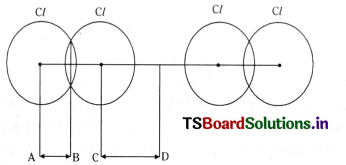
Classification of Elements and Periodicity in Properties Questions and Answers AP Inter 1st Year Chemistry Chapter 3 1
AB = covalent radius = 0.99 Å ; CD = van der Waal’s radius = 1.8 Å
Covalent, van der Waal’s radii of chlorine :
van der Waal’s radius : It is defined as one – half of the inter – nuclear distance between atoms of two adjacent molecules of an element bonded by van der Waal’s forces facing each other, in solid state.
Eg: van der Waal’s radius of hydrogen = 1.2 Å
van der Waal’s radius of chlorine = 1.80 Å
Note : van der Waal’s radius of an atom is 40% larger than its covalent radius.

Classification of Elements and Periodicity in Properties Questions and Answers AP Inter 1st Year Chemistry Chapter 3

VI. Long Answer Questions

Question 1.
Discuss the construction of long form of the periodic table.
Answer:

  • The important characteristic property of an element is found to be its ‘atomic number’ and not atomic weight.
  • Accordingly, the periodic law was modified – “The physical and chemical properties of the elements are periodic functions of their atomic numbers”.
  • Later on it was found that while deciding the properties of an element, its electronic configuration plays a very important role.
  • So Bohr constructed the long form of the periodic table, based on the electronic configurations of the elements.
  • The periodic law can be stated as “The physical and chemical properties of the elements are periodic functions of their electronic configurations”.

Salient features :

  1. This table is prepared based on a fundamental property “atomic number”.
  2. This table can be easily studied, remembered and reproduced.
  3. Similarities, differences and trends in properties are more clearly reflected in this table.
  4. Vertical columns are known as groups and horizontal rows are called periods.
  5. There are seven periods in this table. The first period consists of two elements only. Second and third periods contain 8 elements each. Fourth and fifth periods contain 18 elements each. Sixth period consists of 32 elements. Seventh period is an incomplete period and consists of 19 elements.
  6. There are eighteen groups in this table. They are designated IA, IIA, IIIB, IVB, VB, VIB, VIIB, VIII, IB, IIB, IIIA, IVA, VA, VIA, VIIA, 0 (American Convention of naming).
  7. The elements in IA, IIA, IIIA, IVA, VA, VIA and VILA are known as representative elements or normal elements.
  8. The elements in IB, IIB, IIIB, IVB, VB, VIB, VIIB and VIII are called Transition elements.
  9. Zero group elements are placed at the extreme right of the table. These are called inert gases or noble gases. They possess stable ns2np6 configuration.
  10. Short periods are broken and long periods are extended to accommodate transition elements.
  11. Lanthanides and actinides are placed separately at the bottom of the periodic table.
  12. Based on the entrance of differentiating electron, the table is divided into four blocks. They are s – block, p – block, d – block and f – block. In the elements of s – block, differentiating electron enters into s – orbital. Similarly in the elements of p – block, d – block and f – block, the differentiating electron enters into s, p, d and f – orbitals respectively.
  13. Based on complete and incomplete electron shells and chemical properties, the elements are classified into four types. They are
    1. Type I – Inert gas elements),
    2. Type II – Representative elements),
    3. Type III – Transition elements,
    4. Type IV – Inner transition elements.
  14. All the elements in a group possess similar properties, because they possess the same valence electron configuration.

Question 2.
Write an essay on s,p,d, and f-block elements.
Answer:
Depending upon the entering of differentiating electron into the atomic orbitals, the elements of long form of periodic table are divided into four blocks. They are s, p, d and f – blocks. s- Block:
1) The elements, in which the differentiating electron enters the s – sub-level are called s-block elements.
2) In this block, there are two groups. They are IA and IIA.
3) The valence electron configuration of elements of IA group is ns1 and that of IIA is ns2.
4) The elements of IA are Alkali metals and IIA are Alkaline earth metals.
5) These are metals and are highly reactive.

p – Block: .

  1. The elements in which the differentiating electron enters the p – sub-level are called p – block elements.
  2. In this block, there are six groups. They are IIIA, IVA, VA, VIA, VIIA, and ‘O’.
  3. The valence electron configuration of the elements of these groups varies from ns2 np1 to ns2 np6.
  4. It includes metals, non-metals, metalloids, noble gases.

d- Block:

  1. The elements in which the differentiating electron enters into d – sub-level are called d – block elements.
  2. In this block, there are ten groups. They are IIIB, IVB, VB, VIB, VIIB, VIII, IB, IIB.
  3. The general outer configuration of d – block elements is (n – 1)d1-10 ns1-2.
  4. These elements are also known as Transition elements.
  5. These are all metals having high M.P and B.P
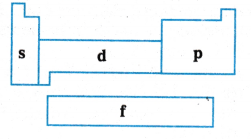
    Classification of Elements and Periodicity in Properties Questions and Answers AP Inter 1st Year Chemistry Chapter 3 2

f – Block:

  1. The elements in which the differentiating electron enters into f – orbital are called f-block elements.
  2. In this block, there are 14 groups. They have no designation.
  3. Their general outer configuration is, (n – 2)f1-14 (n – 1)d0-1 ns2.
  4. The f – block elements are arranged separately at the bottom in two rows.
  5. The elements of first row are called lanthanides and in these elements the valence electron enters into 4f orbital.
  6. The elements of second row are called actinides and in these elements the valence electron enters into 5f orbital.
  7. All the f – block elements are also known as Inner Transition elements.
  8. These are all metals.

Question 3.
Relate the electronic configuration of elements and their properties in the classification of elements.
Answer:
All the elements are divided into four types on the basis of their properties and electronic configurations. They are: (i) Noble gas elements (ii) Representative elements (iii) Transition elements and (iv) Inner transition elements.
i) Noble gas elements: Elements in which the outermost and p sub-shells are completely filled are called inert gas elements. “0” group elements belong to this type.

  • Due to completely filled shells they show chemical inertness and possess more stability.
  • The general outer configuration of these elements is ns2np6 (except helium.)
  • The configura-tion of helium is 1s2. They are called noble gases.

ii) Representative elements : Elements in which the outermost s and p sub shells are incompletely filled are called representative elements.

  • These elements are so named because they represent most of the chemical reactions known.
    Elements of s – block and p – block (except ‘O’ group) belong to this type.
  • The general outer electronic configuration of these elements is ns1, ns2, ns2np6 to ns2np5.
  • These elements enter into chemical reactions either by losing or gaining or sharing of electrons.
  • Many of the non-metals, metalloids and some metals belong to this type.

iii) Transition elements : Elements in which the outermost and penultimate shells are partially filled are called transition elements.
They belong to d-block. Their general configuration is (n -1 )d1-9 ns1-2. They are so named because there is a gradation from electro + ve nature to electro – ve nature. They possess the following characteristic properties.

  1. They exhibit variable oxidation states.
  2. They form coloured compounds.
  3. They are all paramagnetic.
  4. They and their oxides act as catalysts.
  5. They form alloys and interstitial compounds.
  6. They form complex compounds.

iv) Inner transition elements : Elements in which the outermost, penultimate and antepenultimate shells are partially filled are called Inner transition elements.

  • They belong to f – block and are placed separately at the bottom of the table.
  • Their general outer configuration is (n – 2)f1-14 (n – 1)d0-1ns1-2.
  • They are so named as they represent a transition of physical and chemical properties among them.
  • There are two series of inner transition elements corresponding to 4f and 5f series.
  • 4f series are called lanthanides and elements of 5f series are called actinides. Lanthanides are also called rare earths.
  • Majority of actinides are synthetic.

Classification of Elements and Periodicity in Properties Questions and Answers AP Inter 1st Year Chemistry Chapter 3

Question 4.
What is a periodic property? How the following properties vary in a period and group?
(a) Atomic radius
(b) Ionisation enthalpy
(c) Electronegativity
Answer:
Periodic property : The property of elements which change gradually with change in electronic configuration and repeats in regular intervals are called periodic properties. This repetition is called periodicity.
a) Atomic radius: The distance between centre of nucleus and outer most shell electrons is called atomic radius.
Variation in a group In groups from top to bottom atomic radius increases.
Reason : In a group from top to bottom valance electron enter into new shell. So size increases as a result atomic radius increases.
Variation in a period : In periods from left to right atomic radius decreases.
Reason : In a period from left to right valency electron enters into same orbit. So atomic size decreases as a result atomic radius decreases.

b) Ionisation Enthalpy: The minimum amount of energy required to remove the electron from the outer most shell of isolated neutral gaseous atom is called ionisation enthalpy.

Variation in a group : In groups from top to bottom ionisation enthalpy decreases.
Reason: In a group from top to bottom atomic size increases. This results in the decrease of nuclear attraction on outer most shell electrons.

Variation.in a period : In periods from left to right ionisation enthalpy increases.
Reason: In a period from left to right atomic size decreases. This results in increase of nuclear attraction on outer most shell electrons.

c) Electronegativity : The tendency of an atom to attract the shared pair of electrons toword? it self in a molecule is called electro negativity.

Variation in a group In groups from top to bottom electro-negativity decreases.
Reason In a group top to bottom atomic size increases. This result in the decrease of nuclear attraction on outer most shell electrons.

Variation in a period : In periods from left to right electronegativity increases.
Reason: In a period left to right atomic size decreases. This result in increase of nuclear attraction on outer most shell electrons.

Question 5.
What is a periodic property ? How the following properties vary in a period and group?
(a) Electron gain enthalpy
(b) Metallic and covalent radius
(c) Nature of oxides
Answer:
a) Electron gain enthalpy (Electron affinity) :
The amount of energy released when an electron is added to outer most shell of isolated neutral gaseous atom is called electron gain enthalpy.

Variation in a period: In periods from left to right electron gain enthalpy increases.
Reason: In a period from left to right atomic size decreases. This results in increase in nuclear attraction on outer most electrons.

Variation in a group : In groups from top to bottom electron gain enthalpy decreases.
Reason : In a group from top to bottom atomic size increases. This results in decrease in nuclear attraction on outer most electrons. .

b) Metallic and covalent radius :
Variation in periods: In periods from left to right metallic and covalent radius decreases.
Reason: In periods the no.of electron shells remains same and nuclear charge increases.

Variation in group: In groups from top to bottom metallic and covalent radius increases.
Reason : In groups the no.of electron shells increases and nuclear charge decreases.

c) Nature of oxides : Generally oxides are three types.
1) Acidic oxides.
2) Basic oxides.
3) Amphoteric oxides
1) Acidic oxides : Oxides which reacts with water to give acids are acidic oxides. Eg : SO2, N2O5, CO2

2) Basic oxides : Oxides which reacts with water to form bases (Alkalis) are called basic oxides. Eg : Na2O, K2O

3) Amphoteric oxides : Oxides which contains both acidic as well as basic nature are called amphoteric oxides. Eg : Al2O3, Ga2O3

Variation in a Period : In periods from left to right basic nature of oxides decreases and acidic nature increases.
Variation in a group : In groups from top to bottom basic nature of oxides increases.

Question 6.
Define IE1 and IE2. Why IE2 is always greater than IE1 for a given atom? Discuss the factors that effect IE of an element.
Answer:
The minimum amount of energy required to remove an electron present in the outermost orbit of a neutral, isolated gaseous atom is called ionisation potential. It is denoted by I1 and is measured in kilocalories (K. cals) or electron volts (e.v).
M(g) + I1 → \(\mathrm{M}_{(\mathrm{g})}^{+}\) + e–
The amount of energy required to remove another electron from a uni +ve ion is called second ionisation potential. It is denoted as I2.
\(\mathrm{M}_{(\mathrm{g})}^{+}\) I2 → \(\mathrm{M}_{(\mathrm{g})}^{+2}\) + e–
Ionisation energy is measured in eV/atom (or) k cal/mole (or) KJ/mole.

The uni +ve ion formed, by the removal of an electron from a neutral atom will have more nuclear attractions over the electron cloud because the number of protons will be more than the number of electrons.

As a result of which more energy is required to remove an electron from this uni +ve ion than a neutral atom. Hence second I.P values are always greater than first I.P values.

Factors affecting Ionisation potential:
1. Atomic radius : As the atomic radius increases, the distance between the nucleus and the outermost electrons increases. Hence, the effective nuclear charge on the outermost electrons decreases.

  • As a result of which the energy required to remove the electrons decreases.
  • From this it is evident that as atomic radius increases I.P decreases. Similarly as atomic radius decreases I.P increases.

2. Nuclear Charge: As nuclear charge increases, the nuclear attractions over the valence electrons increases. So, more amount of energy is required to remove these electrons. From this it is evident that as nuclear charges increases I.P increases. Similarly as nuclear charge decreases I.P. decreases.

3. Screening effect (or) Shielding effect: In multi-electron atoms, the electrons present in the inner shells screen the electron present in the outermost shells from the nuclear attractions. This effect is known as screening effect. Screening effect depends upon the number of screens (no. of inner orbits). As the screening effect increases, ionisation potential decreases. Similarly as the screening effect decreases, I.P. increases.

4. Extent of penetration of orbitals of valence electrons : As the penetration power of orbitals increases, IP also increases. Order of penetration of orbitals is S > P > d > f. Hence, order of IP is also S > P > d > f.

5. Electron configuration: Atoms of elements with half-filled or completely filled electron configuration are more stable. Such atoms have more IP values. Eg : N > O.

Question 7.
Explain the following.
1) Noble gases
2) Representative elements
3) Transition elements
4) Inner Transition elements
Answer:
All the elements are divided into four types on the basis of their properties and electronic configurations. They are : (1) Noble gas elements (2) Representative elements (3) Transition elements and (4) Inner transition elements.
1) Noble gas elements: Elements in which the outermosts and p sub-shells are completely filled are called inert gas elements. “0” group elements belong to this type.

  • Due to completely filled shells they show chemical inertness and possess more stability. The general outer configuration of these elements is ns2np6 (except helium.)
  • The configuration of helium is 1s2. They are called noble gases.

2) Representative elements : Elements in which the outermost s and p sub shells are incompletely filled are called representative elements.

  • These elements are so named because they represent most of the chemical reactions known.
  • Elements of s – block and p – block (except ‘O’ group) belong to this type. The general outer electronic configuration of these elements is ns1, ns2, ns2np1 to ns2np5.
  • These elements enter into chemical reactions either by losing or gaining or sharing of electrons. .
  • Many of the non-metals, metalloids and some metals belong to this type.

3) Transition elements : Elements in which the outermost and penultimate shells are partially filled are called transition elements.
They belong to d-block. Their general configuration is ( n -1 )d1-9 ns1-2. They are so named because there is a gradation from electro + ve nature to electro – ve nature. They possess the following characteristic properties.

  1. They exhibit variable oxidation states.
  2. They form coloured compounds.
  3. They are all paramagnetic.
  4. They and their oxides acts as catalysts.
  5. They form alloys and interstitial compounds.
  6. They form complex compounds.

4) Inner transition elements : Elements in which the outermost, penultimate and antepenultimate shells are partially filled are called Inner transition elements.

  • They belong to f – block and are placed separately at the bottom of the table. Their general outer configuration is (n – 2)f1-14 (n – 1)d0-1ns1-2.
  • They are so named as they represent a transition of physical and chemical properties among them.
  • There are two series of inner transition elements corresponding to 4f and 5f series. 4f series are called lanthanides and elements of 5f series are called actinides.
  • Lanthanides are also called rare earths. Majority of actinides are synthetic.

Classification of Elements and Periodicity in Properties Questions and Answers AP Inter 1st Year Chemistry Chapter 3

Classification of Elements and Periodicity in Properties Class 11 NCERT Solutions

Question 1.
What is the basic theme of organisation in the periodic table ?
Answer:
The basic theme of organisation of elements in the periodic table is to simplify and systematize study of the properties of all the elements and their compounds.

Question 2.
Which important property did Mendeleev use to classify the elements in his periodic table and did he stick to that ?
Answer:

  • Mendeleev recognised atomic weight as the fundamental property of elements and arranged the elements on the basis of a law called as Mendeleev’s Periodic law.
  • He sincerely stuck to this basis as many gaps were left in the periodic table for undiscovered elements and by studying the properties of adjacent elements he predicted the properties of undiscovered elements to be filled in the gaps when discovered in future.

Question 3.
What is the basic difference in approach between the Mendeleev’s Periodic Law and the Modern Periodic Law ?
Answer:
Mendeleev’s Periodic Law states that “the physical and chemical properties of the elements are periodic function of their atomic weights.”

Modern Periodic Law : “The physical and chemical properties of elements are a periodic function of their atomic numbers.” The difference between Mendeleev’s Periodic Law and Modem Periodic Law classification of elements from atomic weight to atomic number.

Question 4.
On the basis of quantum numbers, justify that the sixth period of the periodic table should have 32 elements.
Answer:

  • The 6(h period begins with the filling of principal quantum number, n = 6. But on the basis of Aufbau principle, the electrons in the 6th period can be filled in 6s, 4f, 5d and 6p subshells whose energies increases in the order 6s < 4f < 5d < 6p.
  • Therefore, there will be 16 (1 + 7 + 5 + 3) orbitals that can be filled in this period.
  • Thus, these orbitals can accommodate maximum of 32 electrons in accordance with Pauli’s exclusion principle.
  • Thus, this period contains 32 elements.

Question 5.
In terms of period and group where would you locate the element with Z = 114 ?
Answer:

  • The electronic configuration of Z = 114 is [Rn]86 7s2 5f14 6d10 7p2
  • Now, period number is equal to the principal quantum number of the valence electrons of the respective elements and group number for p-block elements is equal to the (10 + number of ns and np electrons).
  • Therefore, Z = 114 belongs to 7th period and group 14.

Classification of Elements and Periodicity in Properties Questions and Answers AP Inter 1st Year Chemistry Chapter 3

Question 6.
Write the atomic number of the element present in the third period and seventeenth group of the periodic table.
Answer:

  • In the third period, the filling up of only 3s and 3p orbitals occurs. Moreover, the general electronic configuration for 17th group element is ns2 np5.
  • Thus, the given element has electronic configuration of valence shell as 3s2 3p5.
  • Since third period starts with Z = 11 and ends at Z = 18, therefore, elements with Z = 11 and Z = 12 are s-block elements.
  • The next six elements with Z = 13 to 18 are p-block elements and belong to groups 13, 14, 15, 16, 17 and 18.
  • Therefore, the element which will lie in the third period and seventeenth group will have atomic number (Z) = 10 + 7 = 17.

Question 7.
Which element do you think would have been named by (i) Lawrence Berkeley Laboratory (ii) Seaborg’s group ?
Answer:

  1. Lawrencium (Z = 103) and Berkelium (Z = 97)
  2. Seaborgium (Z = 106)

Question 8.
Why do elements in the same group have similar physical and chemical properties ?
Answer:
Elements in the same group have similar electronic configuration of valence shell and hence have similar physical and chemical properties.

Question 9.
What does atomic radius and ionic radius really mean to you ?
Answer:

  • Atomic radius is defined as the distance from the centre of the nucleus to the outermost shell containing electrons.
  • It is measured indirectly by measuring the distance between the two bonded atoms, i.e., bond length.
  • Ionic radius is defined as the distance from the nucleus of an ion upto which it has influence on its electron cloud.

Question 10.
How do atomic radius vary in a period and in a group ? How do you explain the variation?
Answer:
i) In a period, atomic radius of elements decreases from left to right. This is because on moving left to right, incoming electron is added to the same valence shell,

ii) In a group, the atomic radius increases from top to bottom. This is because as we descend a group, the principal quantum number increases and the distance between valence electrons and the nucleus increases.

Question 11.
What do you understand by isoelectronic species ? Name a species that will be isoelectronic with each of the following atoms or ions.
(i) F–
(ii) Ar
(iii) Mg2+
(iv) Rb+
Answer:
Isoelectronic species are those atoms or ions which have the same number of electrons but different magnitude of the nuclear charge.
i) F– has 10(9 + 1) electrons. Therefore, the species nitride ion has N3- (7 + 3), oxide ion has O2- (8 + 2), neon has Ne(10 + 0), sodium ion has Na+(11 – 1), Magnesium ion has Mg2+ (12 – 2), Aluminium ion has Al3+(13 – 3), etc. Each one of which contains 10 electrons are isoelectronic with it.

ii) Ar has 18 electrons. Therefore, the species phosphide ion, P3-(15 + 3); sulphate ion, S2-(16 + 2); chloride ion, Cl–(17 + 1); potassium ion, K+(19 – 1); calcium ion, Ca2+(20 – 2), etc. Each one of which contains 18 electrons are isoelectronic with it.

iii) Mg2+ has 10(12 – 2) electrons, therefore, the species N3-, O2-, F–, Ne, Na+, Al3+, etc. Each one of which contains 10 electrons are isoelectronic with it.

iv) Rb+ has 36(37 – 1) electrons. Therefore the species, bromide ion Br–(35 + 1), krypton, Kr (36 + 0) and Strontium ion Sr2+(38 – 2) each one of which has 36 electrons are isoelectronic with it.

Question 12.
Consider the following species : N3-, O2-, F–, Na+, Mg2+ and Al3+.
a) What is common in them ?
b) Arrange them in the order of increasing ionic radii.
Answer:
a) Each one of these species contain 10 electrons and hence all are isoelectronic species, b) The ionic radii of isoelectronic species decreases with the increase in the magnitude of the nuclear charge. For example, consider the isoelectronic ions N3-, O2-, F–, Na+, Mg2+ and Al3+.

  • All these ions have 10 electrons but their nuclear charges increases in the order : N3- (+7), O2- (+8), F– (+9), Na+ (+11), Mg2+ (+12) and Al3+ (+13).
  • Hence their ionic radii decreases in the order,
    Al3+ < Mg2+ < Na+ < F– < O2- < N3-

Classification of Elements and Periodicity in Properties Questions and Answers AP Inter 1st Year Chemistry Chapter 3

Question 13.
Explain why cations are smaller and anions larger in radii than their parent atoms ?
Answer:

  • The ionic radius of a cation is always smaller than the parent atom because the loss of
    one or more electrons increases the effective nuclear charge.
  • As a result, the force of attraction of nucleus for the electrons increases and hence the ionic radii decreases. Moreover, number of shells also decreases.
  • Whereas, the ionic radius of an anion is always larger than its parent atom because the
    addition of one or more electrons decreases the effective nuclear charge.
  • As a result the force of attraction of the nucleus for the electrons decreases and therefore the ionic radii increases.

Question 14.
What is the significance of the terms – ‘isolated gaseous atom’ and ‘ground state’ while defining the ionization enthalpy and electron gain enthalpy ?
Hint: Requirements for comparison purposes.
Answer:
i) Ionization enthalpy is the minimum amount of energy required to remove the most loosely bound electron from an isolated atom in a gaseous state resulting in the formation of a cation. .

  • The force by which an electron is attracted by the nucleus of an atom is appreciably affected by presence of other atoms within its molecule or in the neighbourhood.
  • Therefore, for the purpose of determination of ionization enthalpy, it is essential that these interatomic forces of attraction should be minimum.
  • Since in the gaseous state, the atoms are widely separated, therefore, their interatomic forces are minimum.
  • Moreover, since it is not possible to isolate a single atom for the purpose of determination of its ionization enthalpy, therefore, the interatomic distances are further reduced by carrying out the measurement at a low pressure of the gaseous atom.
  • It is because of these reasons, that the term isolated gaseous atom in the ground state has been included in the definition of ionization enthalpy.

ii) Electron gain enthalpy is the energy released when an extra electron is added to an isolated gaseous atom in the ground state to form the gaseous negative ion.

  • The term isolated gaseous atom has already been explained above. The term ground state here means that the atom must be present in the most stable state, i.e., the ground state.
  • If the isolated gaseous atom is in the excited state, lesser amount of energy will be released when it gets converted into gaseous anion after accepting an electron.
  • Hence, for comparison purposes, the electron gain enthalpies of gaseous atom must be determined in their respective more stable state, i.e., ground state.

Question 15.
Energy of an electron in the ground state of the hydrogen atom is -2.18 × 10⁻¹⁸J. Calculate the ionisation enthalpy of atomic hydrojgen in terms of J mol-1.
Hint: Apply the idea of mole concept to derive the answer.
Answer:
Ionization energy is the amount of energy required to remove the electron from the ground state to infinity.
Energy of the electron in the ground state (E1) = -2.18 × 10⁻¹⁸ J (Given)
Energy of the electron at infinity (E∞) = 0

The energy required to remove an electron in the ground state of hydrogen atom
(∆E) = E∞ – E1 = 0 – E1 = 0 – (-2.18 × 10⁻¹⁸ J) = 2.18 × 10⁻¹⁸ J
∴ Ionisation enthalpy per mole of hydrogen atoms = 2.18 × 10-18 × 6.02 × 1023 J/mol
= 13.12 × 10⁵ J/mol

Question 16.
Among the second period elements the actual ionization enthalpies are in the order.
Li < B < Be < C < 0 < N < F < Ne
Explain why i) Be has higher AH than B
ii) O has lower ∆iH than N and F ?
Answer:
i)

  • The electronic configuration of 4Be is 1s2 2s2 and that of 5B is 1s2 2s2 2p1.
  • Since fully filled 2s-orbital in Be is more stable than partially filled 2p-orbital of B and hence would require more energy to pull off the 2s electrons.
  • Thus, ionisation energy of Be is higher than that of B.

ii)

  • The electronic configuration of N (1s2 2s2 \(2 p_x^1 2 p_y^1 2 p_z^1\)) in which 2p-orbitals are half filled and the electronic configuration of O (1s2 2s2 \(2 p_x^2 2 p_y^1 2 p_z^1\)) in which 2p-orbitals are neither exactly half-filled nor completely filled.
  • Therefore, it is difficult to remove an electron from N than from O. As a result, ∆iH of N is higher than that of O.
  • Further, the electronic configuration of F is 1s2 2s2 \(2 p_x^2 2 p_y^2 2 p_z^1\)).
  • Because of higher nuclear charge (+9), the first ionisation enthalpy of F is higher than that of O.

Classification of Elements and Periodicity in Properties Questions and Answers AP Inter 1st Year Chemistry Chapter 3

Question 17.
How would you explain the fact that the first ionization enthalpy of sodium is lower than that of magnesium but its second ionization enthalpy is higher than that of magnesium?
Answer:

  1. The electronic configuration of Na is 1s2 2s2 2p6 3s1 and electronic configuration of Mg is 1s2 2s2 2p6 3s2.
  2. In both the cases, first electron is to be removed from the 3s orbital but nuclear charge of Mg (+12) is higher than that of Na (+11).
  3. Moreover, 3s-orbital in Mg is completely filled (more stable) while in Na it is incompletely filled (less stable).
  4. Therefore, ∆iHi of Na is lower than that of Mg.
  5. Now, after the removal of the first electron, Na+ acquires the more stable neon gas configuration.
  6. Thus, the second electron from Na is to be removed from the more stable noble gas configuration.
  7. Thus, ∆iH2 of Na is more than ∆iH2 of Mg.

Question 18.
What are the various factors due to which the ionization enthalpy of the main group elements tends to decrease down a group ?
Answer:
On moving down a group, the ionisation energy of elements gradually decreases. It is due to the following three factors.
i) The atomic size of elements increases gradually down a group due to addition of new shells. So the distance between nucleus and valence electron increases and less amount of energy is required to remove electron from the valence shell. Therefore, I.E. should decrease.

ii) The screening effect on the valence electrons of element gradually increases due to increase in number of inner shells. So the valence electrons experience less nuclear attraction. Hence the I.E should decrease.

iii) The nuclear charge increases with increase in atomic number of elements down a group, which results in increased force of attraction between nucleus and valence electrons. Hence I.E should increase.

The combining effect of increase in atomic size and screening effect compensates the increase in nuclear charge. As a result, the valence electrons are weakly held by the nucleus.
Hence the I.E decreases down the group.

Question 19.
The first ionization enthalpy values (in kJ mol-1) of group 13 elements are.

BA1GaIn11
801577579558589

How would you explain this deviation from the general trend ?
Answer:

  • On moving down the group 13 from B to Al, the ionization enthalpy decreases due to an increase in atomic size and screening effect (of s- and p-electrons of the 2nd shell) as expected.
  • However, IE1 of Ga is only slightly higher than that of Al while that of Tl is much higher than those of Al, Ga and In. This is due to the following reasons.
  • As we move from Al to Ga, due to ineffective shielding of the valence electrons by 3d- electrons, the effective nuclear charge on Ga is slightly more than that on Pd. As a result, IE1 of Ga is slightly higher than that of Al.
  • Further, on moving down the group from Ga to In, the nuclear charge increases.
  • Here, the shielding effect of all the inner electrons overweighs the effect of the increased nuclear charge and hence IE1 of In is lower than that of Ga.
  • On further moving from In to Tl, the nuclear charge further increases. This increased nuclear charge over weighs the shielding effect of all the electrons present in the inner shells including those of 4f- and 5d-electrons and hence IE1 of Tl is higher than that of In.

Question 20.
Which of the following pairs of elements would have a more negative electron gain enthalpy?
i) O or F
ii) F or Cl
Answer:
i) Both O and F belongs to 2nd period, as we move from O to F, the atomic size decreases and the nuclear charge increases.

  • Both these factors tend to increase the attraction of the nucleus for the incoming electron and thus electron gain enthalpy becomes more negative.
  • Further, gain of one electron by F gives F– ion which has stable inert gas configuration while gain of one electron by O gives O– ion which does not have stable inert gas configuration.
  • Consequently, electron gain enthalpy of F is much more negative (-328 kJ mol-1) than that of oxygen (-141 kJ mol-1).

ii) In general, the electron gain enthalpy becomes less negative on moving down the group.
But the electron gain enthalpy of chlorine (-349 kJ mol-1) is more negative than that of fluorine (-328 kJ mol-1). This is because of the small size of F atom.

  • Due to its small size, the electron-electron repulsions in the relatively compact 2p- subshell are comparatively large and hence the incoming electron is not accepted with the same ease as in the case with the larger Cl atom.
  • Therefore, electron gain enthalpy of Cl is more negative than that of F.

Question 21.
Would you expect the second electron gain enthalpy of O as positive, more negative or less negative than the first ? Justify your answer.
Answer:
When an electron is added to O atom to form O– ion, energy is released. Thus, first electron gain enthalpy of oxygen is negative.
O(g) + e–(g) → O–(g) ; ∆egH = -141 kJ mol-1

But when another electron is added to O– ion, energy is absorbed to overcome the strong electrostatic repulsion between the negatively charged O– and the second electron been added. Hence, the second electron gain enthalpy of oxygen is positive.
O–(g) + e–(g) → O2-(g) ; ∆egH = +780 kJ mol-1

Question 22.
What is the basic difference between the terms electron gain enthalpy and electronegativity?
Answer:
The basic difference between the terms electron gain enthalpy and electronegativity is that the electron gain enthalpy is related to the isolated atom in a gaseous state but electronegativity is the property of atom in the bonded state.

The electron gain enthalpy of an element has a constant value but electronegativity does not have a constant value.

Question 23.
How would you react to the statement that the electronegativity of N on Pauling scale is 3.0 in all the nitrogen compounds ?
Answer:

  • The statement that the electronegativity of N on Pauling scale is 3.0 in all nitrogen compound is incorrect. This is because the value of electronegativity does not remain constant for any given element.
  • In actual, electronegativity varies with the state of hybridization and the oxidation state of the element.
  • The electronegativity increases as the percentage of s-character of a hybrid orbital increases or the oxidation state of the element increases.
  • For example, the electronegativity of ‘N’ decreases as we move from sp-sp2-sp3 hybrid orbital. Similarly, the electronegativity of N in NO where oxidation state of N is +4 is higher than that in NO where the oxygen state of N is +2.

Question 24.
Describe the theory associated with the radius of an atom as it
i) gains an electron
ii) loses an electron
Answer:
i) Gain of electrons : The addition of electron is not compensated by the nuclear charge.

  • As a result of which there is increased repulsion among the electrons and a decrease in effective nuclear charge.
  • In other words, the electron cloud in the anion expands. As a result of which the size of the anion increases.
  • Hence, the ionic radius of an anion is larger than the atomic radius of that element.
  • For example, the ionic radius of fluoride ion (F ) is 1.36 A whereas the atomic radius of fluorine is 0.72 Å.
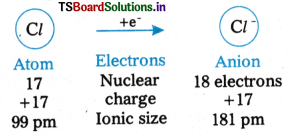
    Classification of Elements and Periodicity in Properties Questions and Answers AP Inter 1st Year Chemistry Chapter 3 3

ii) Loss of electrons: When a neutral atom loses one electron to form a cation, its atomic radius decreases.
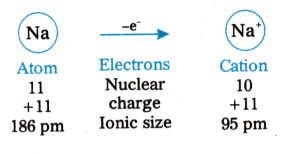
Classification of Elements and Periodicity in Properties Questions and Answers AP Inter 1st Year Chemistry Chapter 3 4

  • This is because the number of electrons in the cation decreases while its nuclear charge remains the same as the parent atom.
  • Since the same nuclear charge now attracts lesser number of electrons, therefore, the force of attraction of the nucleus on the electrons of all the shells increases (i.e., effective nuclear charge increases) and hence the radius of cation decreases.

Question 25.
Would you expect the first ionization enthalpies for two isotopes of the same element to be the same or different ? Justify your answer.
Answer:

  • Ionization enthalpy depends upon the electronic configuration (number of electrons) and effective nuclear charge (number of protons).
  • Since the isotopes of an element have the same electronic configuration and same nuclear charge, therefore, they are expected to have same ionization enthalpy.

Question 26.
What are the major differences between metals and non-metals ?
Answer:

  • Elements which have a strong tendency to loose electrons to form cations are called metals while those which have a strong tendency to accept electrons to form anions are called non-metals.
  • Thus, metals are strong reducing agents, they have low ionization enthalpies, less negative electron gain enthalpies, low electronegativity, good conductors of heat and electricity.
  • Non-metals, on the other hand, are strong oxidising agents, they have high ionization enthalpies, high negative electron gain enthalpies, high electronegativity, poor conductors of heat and electricity (except graphite and diamond).

Question 27.
Use the periodic table to answer the following questions.
i) Identify an element with five electrons in the outer subshell.
ii) Identify an element that would tend to lose two electrons.
iii) Identify an element that would tend to gain two electrons.
iv) Identify the group having metal, non-metal, liquid as well as gas at the room temperature.
Answer:
i) The general electronic configuration of the elements having five electrons in the outer subshell is ns2 np5. This electronic configuration is characteristic of elements of group 17 (halogens), i.e., F, Cl; Br, I, Ar, etc.

ii) The elements which have a tendency to lose two electrons must have two electrons in the valence shell. Therefore, their general electronic configuration should be ns2. This electronic configuration is the characteristic of group 2 elements (alkaline earth metals), for example, Mg, Ca, Sr, Ba, etc.

iii) The elements which have a tendency to accept two electrons must have six electrons in the valence shell. Therefore, their general electronic configuration is ns2np4. This electronic configuration is characteristic of group 16 elements such as O, S, Se, etc.

iv) Group 1 and 17 contains metal, non-metal in liquid as well as gaseous state at the room temperature. For example, hydrogen is a non-metal and is present in the gaseous state. And the other elements of this group are metals. Further, Cesium (Cs) is a liquid metal. Similarly, Bromine is a liquid non-metal in group 17 while other elements of this group exists as gaseous non-metals.

Classification of Elements and Periodicity in Properties Questions and Answers AP Inter 1st Year Chemistry Chapter 3

Question 28.
The increasing order of reactivity among group I elements is Li < Na < K < Rb < Cs whereas that among group 17 elements is F > Cl > Br > I. Explain.
Answer:

  • The elements of group 1 have only one electron in their respective valence shells and thus have a strong tendency to loose this electron.
  • Since the ionization enthalpy decreases down the group, therefore, the reactivity of group 1 elements increases in the same order : Li < Na < K < Rb < Cs.
  • In contrast, the elements of group 17 has seven electrons in their respective valence shells and thus have a strong tendency to accept one more electron. Since, the electrode potential of group in the same order : F > Cl > Br > I.
  • Moreover, electron gain enthalpy becomes less and less negative as we move from Cl to I, therefore, reactivity increases from Cl to I.
  • Fluorine is most reactive due to its low bond dissociation energy.

Question 29.
Write the general outer electronic configuration of s-, p-, d- and f-block elements.
Answer:

  1. s-Block element: ns1-2 (where n = 1,2, )
  2. p-Block element: ns2 np1-6 (where n = 1, 2 )
  3. d-Block element: (n – 1)d1-10 ns1-2 (where n = 4, 5, 6, 7)
  4. f-Block element: (n – 2)f1-14 (n – 1)d0-2 ns2 (where n = 6 and 7)

Question 30.
Assign the position of the element having outer electronic configuration
i) ns2 np4 for n = 3
ii) (n – 1)d2 ns2 for n = 4 and
iii) (n – 2)f7 (n – 1)d1 ns2 for n = 6, in the periodic table.
Answer:
i)

  • n = 3 suggest that the element belongs to third period. Since the last electron
    enters the p-orbital, therefore, the given element is a p-block element.
  • Further, since the valence shell contain 6(2 + 4) electrons.
  • Therefore, group number of element = 10 + number of electrons in the valence shell = 10 + 6 = 16.
  • The complete electronic configuration of the element is 1s2 2s2 2p6 3s2 3p4 and the element is S (sulphur).

ii)

  • n = 4 suggest that the element belongs to the fourth period.
    Since the d-orbital is incomplete, therefore, it is a d-block element. The group number of the element = Number of electrons in (n – l)d subshell + number of ns-electrons = 2 + 2 = 4. Thus, the element lies in group 4 and 4th period.
  • The complete electronic configuration of the element is 1s2 2s2 2p6 3s2 3p6 3d2 4s2 and the element is Ti (titanium).

iii) n = 6 means that the element belongs to the sixth period. Since the last electron goes to the f-orbital, therefore, the element is a f-block element.

  • All f-block elements lie in group 3. The complete electronic configuration of the element is [Xe] 4f7 5d1 6s2.
  • The atomic number of the element = 54 + 7+1+2 = 64 and the element is Gd (gadolinium).

Question 31.
The first (∆iH1) and the second (∆iH2) ionization enthalpies (in kJ mol1) and the (∆egH) electron gain enthalpy (in kJ mol-1) of a few elements are given below.

ElementsΔH1ΔH2∆egH
I5207300-60
II4193051-48
III16813374-328
IV10081846-295
V23725251+48
VI7381451-40

Which of the above elements is likely to be
i) the least reactive element.
ii) the most reactive metal.
iii) the most reactive non-metal.
iv) the least reactive non-metal.
v) the metal which can form a stable binary halide of the formula MX2 (X = halogen).
vi) the metal which can form a predominantly stable covalent halide of the formula MX (X = halogen) ?
Answer:
i) The element V which has highest first ionization enthalpy (∆iH1) and positive electron gain enthalpy (∆egH) and therefore it is the least reactive element.

  • Since, inert gases have positive ∆egH1 thus, the element V must be an inert gas.
  • The values of ∆iH1, ∆iH2 and ∆egH match with that of He (helium).

ii) The element which has the least first ionization enthalpy (∆iH1) and small negative electron gain enthalpy (∆egH) is the most reactive metal (element II).

  • The values of ∆iH1, ∆iH2, and ∆egH match with that of K (potassium).

iii) The element which has high first ionization enthalpy (∆iH1) and second ionization enthalpy (∆iH2) and a very high negative electron gain enthalpy (∆egH) is the most reactive non-metal (element III).

  • The values of ∆iH1, ∆iH2 and ∆egH match with that of F (fluorine).

iv) The element IV has a high negative electron gain enthalpy (∆egH) but not so high first ionization enthalpy (∆iH1).

  • Therefore, it is the least reactive non-metal.
  • The values of ∆iH1, ∆iH2 and ∆egH match with that of I (iodine).

v) The element VI has low first ionization enthalpy (∆iH1) but higher than that of alkali metals.

  • Thus, it appears that the element is an alkaline earth metal and hence will form binary halide of the formula MX2 where X = halogen.
  • The values of ∆iH1, ∆iH2 and ∆egH match with that of Mg (magnesium).

vi) The element I has low first ionization (∆iH1) but a very high second ionization enthalpy (∆iH2).
Therefore, it must be an alkali metal.

  • Since the metal forms a predominantly stable covalent halide of the formula MX (X = hydrogen).
  • The values of ∆iH1, ∆iH2 and ∆egH match with that of Li (lithium).

Classification of Elements and Periodicity in Properties Questions and Answers AP Inter 1st Year Chemistry Chapter 3

Question 32.
Predict the formulas of the stable binary compounds that would be formed by the combination of the following pairs of elements.
i) Lithium and oxygen
ii) Magnesium and nitrogen
iii) Aluminium and iodine
iv) Silicon and oxygen
v) Phosphorus and fluorine
v) Element 71 and fluorine
Answer:
i) Lithium is an alkali metal (Group 1).

  • It has only one electron in the valence shell, therefore, its valency is 1.
  • Oxygen is group 16 element with valency of 2.
  • Therefore, formula of the compound formed would be Li2O (lithium oxide).

ii) Magnesium is an alkaline earth metal (Group 2) and hence has 2 valence electrons. Nitrogen is a group 15 element with valency of 8 – 5 = 3.

  • Thus, the formula of the compound formed would be Mg3N2 (magnesium nitride).

iii) Aluminium is a group 13 element with a valency of 3 while iodine is a halogen (group 17) with valency of 1.

  • Therefore, the formula of the compound formed would be AlI3 (aluminium hydride).

iv) Silicon is a group 14 element with valency of 4 while oxygen is group 16 element with valency of 2. Hence, the formula of the compound formed would be SiO2 (silicon dioxide).

v) Phosphorus is a group 15 element with valency of 3 or 5 while fluorine is a group 17 element with valency of 1. Hence, the formula of the compound formed would be PF3 or PF5.

vi) Element with atomic number 71 is a lanthanide called lutetium (Lu). Its common valency is 3. Fluorine is a group 17 (halogen) element with valency of 1.
Therefore the formula of the compound formed would be LuF3 (lutetium fluoride).

Question 33.
In the modern periodic table, the period indicates the value of
a) atomic number
c) principal quantum number
b) atomic mass
d) azimuthal quantum number.
Answer:
In the modem periodic table, each period begins with the filling of a new shell. Therefore each period represents the principal quantum number of the valence electrons of the represent elements. Thus, option (c) is correct.

Question 34.
Which of the following statements related to the modern periodic table is incorrect ?
a) The p-block has 6 columns, because a maximum of 6 electrons can occupy all the orbitals in a p-shell.
b) The d-block has 8 columns, because a maximum of 8 electrons can occupy all the orbital in a d-subshell.
c) Each block contains a number of columns equal to the number of electrons that can occupy that subshell.
d) The block indicates value of azimuthal quantum number (l) for the last subshell the received electrons in building up the electronic configuration.
Answer:
Statement (b) is incorrect, while the other statements are correct.
The correct statement is the d-block has 10 columns, because a maximum of 10 electrons can occupy all the orbitals in a d-subshell.

Question 35.
Anything that influences the valence electrons will affect the chemistry of the element. Which one of the following factors does not affect the valence shell ?
a) Valence principal quantum number (n)
b) Nuclear charge (Z)
c) Nuclear mass
d) Number of core electrons
Answer:
Nuclear mass does not affect the valence shell because it consists of protons and neutrons, when proton, i.e., nuclear charge affects the valence shell but neutrons do not. Thus, option (c) is correct.

Question 36.
The size of isoelectronic species – F–, Ne and Na+ is affected by
a) nuclear charge (Z)
b) valence principal quantum number (n)
c) electron-electron interaction in the outer orbitals
d) none of the factors because their size is the same.
Answer:

  • The size of isoelectronic ions depends upon the nuclear charge (Z).
  • As the nuclear charge increases, the size decreases.
  • For example, F– (+9) > Ne (+10) > Na+ (+11). Thus, option (a) is correct.

Question 37.
Which one of the following statements is incorrect in relation to ionization enthalpy ?
a) Ionization enthalpy increases for each successive electron
b) The greatest increase in ionization enthalpy is experienced on removal of electron from core noble gas configuration.
c) End of valence electrons is marked by a big jump in ionization enthalpy.
d) Removal of electron from orbitals bearing lower n value is easier than from orbital having higher n value.
Answer:
Statement (d) is incorrect. Its correct form is removal of electron from orbitals bearing lower n value is difficult than from orbital having higher n value.

Question 38.
Considering the elements B, Al, Mg and K, the correct order of their metallic character is
a) B > Al > Mg > K
b) Al > Mg > B > K
c) Mg > Al > K > B
d) K > Mg > Al > B
Answer:
d) K > Mg > Al > B

  • In a period, electronegativity increases and hence the metallic character decreases as we move from left to right.
  • Therefore, metallic character of K, Mg and Al decreases in the order: K > Mg > Al. Further, within a group, the electronegativity decreases and hence the metallic character increases from top to bottom.
  • Therefore, Al is more metallic than B. Hence, the correct order of decreasing metallic character will be K > Mg > Al > B.

Question 39.
Considering the element B, C, N, F and Si, the correct order of their non-metallic character is:
a) B > C > Si > N > F
b) Si > C > B > Sl > F
c) F > N > C > B > Si
d) F > N > C > Si > B
Answer:
c) F > N > C > B > Si

  • In a period, the non-metallic character increases from left to right.
  • Thus, among B, C, N and F, non-metallic character decreases in order: F > N > C > B. Further, within a group, non-metallic character decreases from the top to bottom.
  • Therefore, C is more non-metallic than Si.
  • Hence, the correct sequence of decreasing non-metallic character will be F > N > C > B > Si.

Classification of Elements and Periodicity in Properties Questions and Answers AP Inter 1st Year Chemistry Chapter 3

Question 40.
Considering the elements F, Cl, O and N, the correct order of their chemical reactivity in terms of oxidizing property is
a) F > Cl > O > N
b) F > O > Cl > N
c) Cl > F > O > N
d) O > F > N > Cl
Answer:
b) F > O > Cl > N

  • Within a period, the oxidising character increases from left to right. Therefore, among F, O and N, oxidising power decreases in the order : F > O > N.
  • Further, within a group, oxidising power decreases from top to bottom.
  • Thus, F is a stronger bxidising agent than Cl. Moreover, because O is more electronegative than Cl, therefore, O is a stronger oxidising agent than Cl.
  • Hence, overall decreasing order of oxidising power will be F > O > Cl > N.
Binomial Theorem MCQ AP Inter 1st Year Maths Chapter 7

Practice AP Inter 1st Year Maths Study Material Chapter 7 Binomial Theorem MCQ to identify your strengths and weak areas.

AP Inter 1st Year Maths Binomial Theorem MCQ

Question 1.
The 3rd term of (3x – \(\frac{y^3}{6}\))4
1) \({ }^4 C_2(3 x)^2\left(\frac{-y^3}{6}\right)^2\)
2) \({ }^4 C_2(3 x)^2\left(\frac{-y^2}{6}\right)^2\)
3) \({ }^4 C_2(3 x)^3\left(\frac{-y^3}{6}\right)^2\)
4) \({ }^4 C_2(3 x)^3\left(\frac{-y^2}{6}\right)^2\)
Answer:
1) \({ }^4 C_2(3 x)^2\left(\frac{-y^3}{6}\right)^2\)

Explanation:
Given (3x – \(\frac{y^3}{6}\))4, Here a = 3x, b = \(\frac{-y^3}{6}\), n = 4, Tr+1 = nCr an-r.br

T3 = T2+1 = 4C2 (3x)4-2\(\left(\frac{-y^3}{6}\right)^2\)
= 4C2 (3x)2\(

Question 2.
C0 + 3.C1 + 32.C2 + …………. + 3n.Cn =
1) 2n
2) 3n
3) 4n
4) 5n
Answer:
3) 4n

Explanation:
We know that (1 + x)n = C0 + C1x + C1x2 + C3x3 + … + Cnxn … (1)
Put x = 3 in eq (1) we get C0 + C13 + C232 + … + Cn3n = (1 + 3)n
C0 + 3.C1 + 32.C2 + …… + 3n.Cn = 4n

Question 3.
The middle term in the expansion of (4 + 2x)6 is
1) 11240 x2
2) 10240 x3
3) 12240 x4
4) 10340 x4
Answer:
2) 10240 x3

Explanation:
Given (4 + 2x)6 contains 7 terms
The middle term T4 = T3+1 = 6C3 (4)6-3. (2x)3 = 20 × 64 × 8 × x3 = 10240 x3

Question 4.
The coefficient of x2y2 in the expansion of (x + 1)2 (y + 1)3 is
1) 3
2) 5
3) 2
4) 10
Answer:
1) 3

Explanation:
(x + 1)2 (y + 1)3 = (x2 + 2x + 1) (y3 + 3y2 + 3y + 1)
Coefficient of x2y2 is “3”

Binomial Theorem MCQ AP Inter 1st Year Maths Chapter 7

Question 5.
In the expansion of (1 + x)20, if the coefficients of rth and (r + 4)th terms are equal, then r is
1) 7
2) 8
3) 9
4) 10
Answer:
3) 9

Explanation:
Given expansion is (1 + x)20
Given condition is coefficient of r* term = coeff of (r + 4)th term
⇒ 20Cr-1 = 20Cr+3
⇒ r – 1 + r + 3 = 20 [∵ nCr = nCs ⇒ r + s = n]
⇒ 2r = 18
⇒ r = 9

Question 6.
The remainder when 848 is divided by 63 is
1) 4
2) 2
3) 1
4) 7
Answer:
3) 1

Explanation:
848 = (64)24 = (63 + 1)24 = 63q + 1 [∵ q is some Integer]
∴ Remainder = 1.

Question 7.
The expansion of (x + y)1000 is
1) [latex]\sum_{\mathrm{r}=0}^{1000} 1000 \mathrm{C}_{\mathrm{r}} \mathrm{x}^{\mathrm{r}-1000} \mathrm{y}^{\mathrm{r}}\)
2) \(\sum_{\mathrm{r}=0}^{1000} 1000 \mathrm{C}_{\mathrm{r}} \mathrm{x}^{1000-\mathrm{r}^2} \mathrm{y}^{\mathrm{r}}\)
3) \(\sum_{r=0}^{999}{ }^{1000} C_r x^{r-1000} y^r\)
4) \(\sum_{r=0}^{999}{ }^{1000} C_r x^{1000-r} y^r\)
Answer:
2) \(\sum_{\mathrm{r}=0}^{1000} 1000 \mathrm{C}_{\mathrm{r}} \mathrm{x}^{1000-\mathrm{r}^2} \mathrm{y}^{\mathrm{r}}\)

Explanation:
Given expansion = (x + y)1000 = \(\sum_{\mathrm{r}=0}^{1000} 1000 \mathrm{C}_{\mathrm{r}} \mathrm{x}^{1000-\mathrm{r}} \cdot \mathrm{y}^{\mathrm{r}}\)

Question 8.
The coefficients of the first and the last terms of the expansion (x + y)1000 are
1) 2
2) 3
3) 1
4) 7
Answer:
2) 3

Explanation:
Given expansion is (x + y)n
(x + y)n = nC0xn + nC1xn-1y + … + nCn. yn
Coefficient of first and last terms are nC0 and nCn
nC0 = nCn = 1.

Question 9.
The expansion of (xy + 2)2 is
1) x2 + y2 + 4
2) x2 y2 + 4xy + 4
3) xy2 + 4 + 2xy
4) x2y2 + 2xy + 4
Answer:
2) x2 y2 + 4xy + 4

Explanation:
(xy + 2)2 = (xy)2 + 2(xy) . 2 + 22 = x2y2 + 4xy + 4

Question 10.
The term 91C2x89 belongs to
1) x89
2) (x – 2)90
3) (x – 1)91
4) (x + 1)90
Answer:
3) (x – 1)91

Explanation:
Term 91C2x89 is belongs to (x – 1)91
T3 of (x – 1)91 = 91C2x91-2.(-1)2
= 91C2x89

Binomial Theorem MCQ AP Inter 1st Year Maths Chapter 7

Question 11.
The cofficient of x8y10 in the expansion f (x + y)18 is
1) 18C8
2) 18P10
3) 218
4) None of these
Answer:
1) 18C8

Explanation:
Given expansion is (x + y)18
The coefficient of x18y18 = 18C10
= 18C18-10
= 18C8

Organic Chemistry – Some Basic Principles and Techniques Questions and Answers AP Inter 1st Year Chemistry Chapter 8

Regular practice with AP Inter 1st Year Chemistry Study Material Chapter 8 Organic Chemistry – Some Basic Principles and Techniques Questions and Answers helps students stay prepared for examinations.

AP Inter 1st Year Chemistry 8th Lesson Organic Chemistry – Some Basic Principles and Techniques Questions and Answers

I. Multiple Choice Questions

Question 1.
Alicyclic compounds are
1) Aromatic compounds
2) Aliphatic cyclic compounds
3) Heterocyclic compounds Aliphatic cyclic compounds.
4) Alkanes
Answer:
2) Aliphatic cyclic compounds

Question 2.
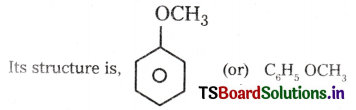
What is the formula of Anisole?
1) C6H5OCH3
2) C6H5NH2
3) C6H5COCH5
4) C6H5OH
Answer:
The IUPAC name of Anisole is methoxybenzene.
Organic Chemistry - Some Basic Principles and Techniques Questions and Answers AP Inter 1st Year Chemistry Chapter 8 1

Question 3.
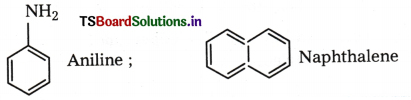
Which of the following is an example for heterocyclic aromatic compound?
1) Aniline
2) Benzene
3) Furan
4) Naphthalene
Answer:
3) Furan
Furan is an example for heterocyclic aromatic compound.
Organic Chemistry - Some Basic Principles and Techniques Questions and Answers AP Inter 1st Year Chemistry Chapter 8 92

Question 4.
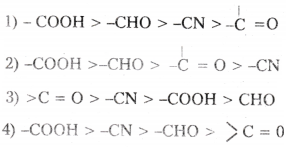
In which of the following functional groups are arranged as per the priority order of the functional groups?
Organic Chemistry - Some Basic Principles and Techniques Questions and Answers AP Inter 1st Year Chemistry Chapter 8 2
Answer:
Organic Chemistry - Some Basic Principles and Techniques Questions and Answers AP Inter 1st Year Chemistry Chapter 8 3

Question 5.
The IUPAC name of Neopentane is
1) 2-methyl propane
2) 2,2-dimethyl butane
3) 2-methyl butane
4) 2,2-dimethyl propane
Answer:
4) 2,2-dimethyl propane
The IUPAC name of Neopentane is 2, 2 – Dimethyl Propane

Organic Chemistry - Some Basic Principles and Techniques Questions and Answers AP Inter 1st Year Chemistry Chapter 8

Question 6.
Hybridisation of carbon in \(\stackrel{+}{\mathrm{C}} \mathrm{H}_3\) is
1) sp3
2) sp3
3) sp
4) sp3d
Answer:
2) sp3

Question 7.
Which of the following involves the displacement effect of sigma bonded electrons ?
1) Mesomeric effect
2) Inductive effect
3) Resonance
4) Elficirovnerk efiecf-
Answer:
2) Inductive effect

Question 8.
Kjeldahl method is not applicable to compounds containing nitrogen in
1) Nitro group
2) Az0 group
3) Nitrogen present in the ring
4) All
Answer:
4) All
Answer:
In all cases Kjeldahls method is not applicable to compounds containing nitrogen

Question 9.
Crude oil in petroleum industry is separated by
1) Distillation
2) Fractional distillation
3) Crystallisation
4) Solvent extraction
Answer:
By Fractional distillation

Question 10.
Chloroform and aniline are easily separated by the technique
1) Distillation
2) Fractional Distillation
3) Sublimation
4) Chromatography
Answer:
1) Distillation
Chloroform and Anilin. are separatd by distillation

II. Fill in the Blanks

Question 1.
Ethyl alcohol and methyl alcohol can be separated by ___
Answer:
Fractional distillation.

Question 2.
Steam distillation is applied to separate substances which are ___
Answer:
Steam volatile

Question 3.
Nitrogen, sulphur and halogens present in an organic compound are detected by ___.
Answer:
Lassaigne’s Test (or) Sodium fusion extract test.

Question 4.
Methoxy propane and Ethoxy ethane are examples of ____.
Answer:
metamers (difference in attachment of alkyl group.

Question 5.
Propanone and propanal are ____ isomers.
Propanone (ketone)
Propanal (aldehyde)
both are functional group isomers.

III. One Word Answer Questions

Question 1.
Define catenation.
Answer:
Self linkage of atoms among themselves to form long chains and rings is called catenation.

Question 2.
What is the hybridisation of carbon in Ethane ?
Answer:
In ethane (CH3 – CH3) each carbon undergo sp3 hybridization.

Question 3.
What is the hybridization of carbon in CH3F ?
Answer:
In CH3F carbon undergoes sp3 hybridization.

Question 4.
Define functional group.
Answer:
A group of atoms in a molecule that are responsible for the chemical reactivity and properties of that molecule is called functional group. Eg : Aldehyde (-CHO)

Question 5.
What is homologous series ?
Answer:
A series of organic compounds containing a characteristic functional group represented by same general formula and successive members differ by -CH2 is called homologous series. Eg : Alkanes – CH4, C2H6, C3H8 etc …….

Question 6.
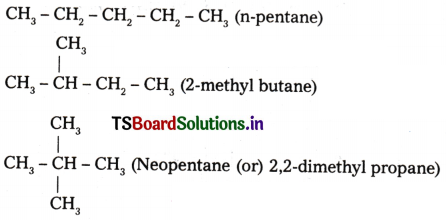
How many chain isomers are possible for alkane having molecular formula C5H12 ?
Answer:
For C5H12 possible chain isomers are three
Organic Chemistry - Some Basic Principles and Techniques Questions and Answers AP Inter 1st Year Chemistry Chapter 8 4

Question 7.
What is an electrophile ?
Answer:
An electrophile is a reagent that takes away an electron pair from reactive site.
Eg: \(\mathrm{NO}_2^{+}\), \(\mathrm{CH}_3^{+}\).

Question 8.
What is an electromeric effect ?
Answer:
The complete transfer of a shared pair of π – electrons to one of the atoms joined by a multiple bond on the demand of attacking reagent is called electromeric effect.

Question 9.
What is differential extraction ?
Answer:
When an organic compound is present in an aqueous solution. It is separated by shaking it with an organic solvent in which it is more soluble than in water.

Organic Chemistry - Some Basic Principles and Techniques Questions and Answers AP Inter 1st Year Chemistry Chapter 8

Question 10.
What is distillation ?
Answer:
The method used to separate volatile liquids from non-volatile impurities and the liquids having sufficient difference in their boiling points.

Question 11.
What is retardation factor ?
Answer:
In chromatography the relative adsorption of each component of the mixture is expressed in terms of it’s retardation factor (Rf).
Rf = \(\frac{\text { Distance travelled by component }}{\text { Distance travelled by solvent }}\)

Question 12.
Write the principle involved in paper chromatography.
Answer:
The principle involved in paper chromatography is partition. Here differential partitioning between stationary phase and mobile phase.

Question 13.
Give two examples for alicyclic compounds.
Answer:
Organic Chemistry - Some Basic Principles and Techniques Questions and Answers AP Inter 1st Year Chemistry Chapter 8 5

Question 14.
Give examples for benzenoid aromatic compounds.
Answer:
Organic Chemistry - Some Basic Principles and Techniques Questions and Answers AP Inter 1st Year Chemistry Chapter 8 6

IV. Very Short Answer Questions

Question 1.
How many n and a bonds are present in each of the following molecules ?
a) HC ≡ CCH = CHCH3
b) CH2 = C = CHCH3
Answer:
a) CH ≡ C – CH = CH – CH3
10σ bonds 3π-bonds
b) CH2 = C = CH – CH3
9σ bonds 2π-bonds

Question 2.
What is the type of hybridisation of each carbon in the following compound? CH3CH=CHCN
Answer:
Organic Chemistry - Some Basic Principles and Techniques Questions and Answers AP Inter 1st Year Chemistry Chapter 8 7

Question 3.
What is carbocation? Give example.
Answer:
A molecule with a positively charged carbon atom is called carbocation, Eg : \(\mathrm{CH}_3^{+}\).

Question 4.
What is metamerism? Give example.
Answer:
Organic compounds having same molecular formula but differ in attachment of alkyle groups is called metamerism. These are called metamers.
Organic Chemistry - Some Basic Principles and Techniques Questions and Answers AP Inter 1st Year Chemistry Chapter 8 8

Question 5.
Write the IUPAC names of
Organic Chemistry - Some Basic Principles and Techniques Questions and Answers AP Inter 1st Year Chemistry Chapter 8 9
Answer:
Organic Chemistry - Some Basic Principles and Techniques Questions and Answers AP Inter 1st Year Chemistry Chapter 8 10

Question 6.
Write the IUPAC names of
a) CH3CH(OH)CH3
b)
Organic Chemistry - Some Basic Principles and Techniques Questions and Answers AP Inter 1st Year Chemistry Chapter 8 11
Answer:
a)
Organic Chemistry - Some Basic Principles and Techniques Questions and Answers AP Inter 1st Year Chemistry Chapter 8 12

b)
Organic Chemistry - Some Basic Principles and Techniques Questions and Answers AP Inter 1st Year Chemistry Chapter 8 13

Question 7.
Write the structures of
(a) 4-ethyl 2-methyl aniline and
(b) Neopentane.
Answer:
a) 4-Ethyl 2-methyl Aniline
Organic Chemistry - Some Basic Principles and Techniques Questions and Answers AP Inter 1st Year Chemistry Chapter 8 14
b) Neopentane
Organic Chemistry - Some Basic Principles and Techniques Questions and Answers AP Inter 1st Year Chemistry Chapter 8 15

Question 7.
Explain the principle of Adsorption chromatography.
Answer:
Principle of Adsorption chromatography This is based on the fact 15 at different compounds are adsorbed on an adsorbent to different degrees.

Question 8.
Explain the term “Crystallisation”.
Answer:
Crystallisation :This technique is used for the purification of solid organic compounds. It is based on the difference in the solubilities of the compound and the impurities in a suitable solvent.

Question 10.
What are electrophiles and nucleophiles? Give examples.
Answer:.
1) Electrophiles : (Electron loving) :A reagent that takes away an electron pair from reactive site is called electrophile (E+). Eg : \(\mathrm{NO}_2^{+}\), \(\mathrm{CH}_3^{+} .\)

2) Nucleophiles: (Nucleus loving) :A reagent that brings an electron pair to the reactive site is called a nucleophile \(\left(\mathrm{Nu}^{\Theta}\right)\). Eg : CN– and OH– etc.

V. Short Answer Questions

Question 1.
What is the position isomerism and functional isomerism? Give one example for each.
Answer:
Position isomerism : Compounds having same molecular formula but differ in position of substituent / functional, group/ multiple bond are called position isomers.
This is called position isomerism.
Ex:
Organic Chemistry - Some Basic Principles and Techniques Questions and Answers AP Inter 1st Year Chemistry Chapter 8 16
Functional group isomerism : Compounds having same molecular formula but differ in nature of functional group are called functional group isomers.
Eg:
1)Alcohols, Ethens are functional group isomers
Organic Chemistry - Some Basic Principles and Techniques Questions and Answers AP Inter 1st Year Chemistry Chapter 8 17
2) Aldehydes, factors are functional group isomers
Organic Chemistry - Some Basic Principles and Techniques Questions and Answers AP Inter 1st Year Chemistry Chapter 8 18

Question 2.
Explain the difference between structural isomers and stereoisomers.
Answer:

Structural IsomersStereo Isomers
1. The compounds having same molecular formula but differ in their structural arrangements of atoms or group of atoms.1. The compounds having same molecular formula but differ in their spatial arrangement of atoms or group of atoms.
2. Spatial arrangement is not considered.2. Structure of the compound is not changed.
3. Structural isomers possess different physical properties.
Ex : With increase in number of branches in alkanes with same molecular formula, boiling points are decreased.
3. Stereo isomers may or may not differ in their physical properties.
Ex :a) Diastereomers and cis-trans isomers differ in their boiling and melting points.
b) Enantiomers have same physical properties.
4. Chain isomers, positional isomers, functional isomers, metamers, ketoenol tautomers and ring isomers are called structural isomers.4. Configurational and conformational isomers are called stereo isomers.

Question 3.
Write about hyper conjugation?
Answer:
Hyperconjugation :The delocalisation of σ – electrons of C-H bond of an alkyl group directly attached to an atom of unsaturated system (or) to an atom with unshared P-orbital is called hyperconjugation.
Organic Chemistry - Some Basic Principles and Techniques Questions and Answers AP Inter 1st Year Chemistry Chapter 8 19

Question 4.
Write a note on
a) Distillation,
b) Distillation under reduced pressure.
Answer:
Organic Chemistry - Some Basic Principles and Techniques Questions and Answers AP Inter 1st Year Chemistry Chapter 8 20
a) Distillation:

  • This process is useful for the purification of liquids contaminated with non-volatile impurities.
  • The impure liquid is boiled in a distillation flask and the vapours are condensed and collected in a receiver.
  • This method can also be used to separate liquids which differ in their boiling points by about 40°C.

Organic Chemistry - Some Basic Principles and Techniques Questions and Answers AP Inter 1st Year Chemistry Chapter 8 21

b) Distillation under reduced pressure :

  • This method is useful to purify liquids that have very high BPs and those which decompose at or below their boiling points.
  • If the external pressure is reduced the liquid boils at lower temperature than its normal BP without decomposition.

Question 5.
What are the different types of organic reactions?
Answer:
Common types of organic reactions are
(1) Substitution reactions
(2) Addition reactions
(3) Elimination reactions
(4) Rearrangement reactions.

1) Substitution (Displacement) reactions : The replacement of an atom or group from a molecule by a different atom or group is known as ‘substitution reaction’.
Ex :
i) Organic Chemistry - Some Basic Principles and Techniques Questions and Answers AP Inter 1st Year Chemistry Chapter 8 22
ii) CH3OH + HBr → CH3 Br + H2O

2) Addition reactions : Reactions in which atoms or groups of atoms are added to a molecule are known as addition reactions.
Ex :
Organic Chemistry - Some Basic Principles and Techniques Questions and Answers AP Inter 1st Year Chemistry Chapter 8 23
The multiple bond breaks and then the addition takes place.

3) Elimination reactions : The molecule loses atoms or group of atoms and a multiple bond is formed. (These are actually the reverse of addition reactions)
Ex :
i) Dehydration :
Organic Chemistry - Some Basic Principles and Techniques Questions and Answers AP Inter 1st Year Chemistry Chapter 8 24

ii) Dehalogenation:
Organic Chemistry - Some Basic Principles and Techniques Questions and Answers AP Inter 1st Year Chemistry Chapter 8 25

4) Molecular rearrangement reactions: In these reactions, an atom or a group migrates from one atom to another atom, within the same molecule.
Ex :
i) n – Butane to Isobutane :
Organic Chemistry - Some Basic Principles and Techniques Questions and Answers AP Inter 1st Year Chemistry Chapter 8 26

ii) Benzophenone oxime to Benzanilide :
Organic Chemistry - Some Basic Principles and Techniques Questions and Answers AP Inter 1st Year Chemistry Chapter 8 27

Question 6.
Write the equations involved in the detection of Nitrogen, Halogens and Sulphur in organic compounds.
Answer:
Lassaigne’s Test: In Lassaigne’s test, the organic compound is mixed with sodium metal and fused strongly.

  • The fused mass is extracted with water by plunging the red hot ignition tube in distilled water and the contents are boiled for 5 minutes and filtered.
  • The filtrate is called Sodium extract or Lassaigne’s extract.
  • If nitrogen is present in the organic compound, it reacts with sodium and carbon forming sodium cyanide.
    Organic Chemistry - Some Basic Principles and Techniques Questions and Answers AP Inter 1st Year Chemistry Chapter 8 28
  • If sulphur is present in the organic compound, it reacts with sodium forming sodium sulphide.
    2 Na + S → Na2S
  • If halogens are present in the organic compound, they form sodium halides.
    2 Na + X → 2 NaX (X = Cl, Br or I)

Test for Nitrogen : A little of the Lassaigne’s extract is made alkaline with NaOH solution and then freshly prepared FeSO4 solution is added.

  • To it 2 – 3 drops of FeCl3 solution is added, cooled and acidified with cone. HCl.
  • A prussian blue or green ppt. or colouration is observed.
    Organic Chemistry - Some Basic Principles and Techniques Questions and Answers AP Inter 1st Year Chemistry Chapter 8 29

Test for Halogens A little of the Lassaigne’s extract is acidified with nitric acid and treated with AgNO3 solution.

  • If white ppt. soluble, in NH4OH is formed, the halide is Cl–. Hence, chlorine is present.
  • If pale yellow ppt. partially soluble in NH4OH is formed, the halide is Br–. Hence, bromine is present.
  • If yellow ppt. insoluble in NH4OH is formed, the halide is I–. Hence, iodine is present.
    Test for Sulphur: To a little of the Lassaigne’s extract freshly prepared sodium nitroprusside solution is added.
  • Deep purple colouration is observed.
    Organic Chemistry - Some Basic Principles and Techniques Questions and Answers AP Inter 1st Year Chemistry Chapter 8 30

Question 7.
Write a note on Resonance effect.
Answer:
Resonance Effect : The polarity produced in the molecules by the interaction of two π bonds or between a π bond and long pair of electrons present on adjacent atom is called resonance effect (or) mesomeric effect.
Two types of Effects

1) +R Effect (Positive resonance effect) (+M effect) The transfer of electrons is away from an atom (or) substituent attached to the conjugated system is called +R effect. Eg : NH2 group

2) – R Effect (Negative resonance effect) (-M Effect): The transfer of electrons towards the atom (or)substituent attached to the conjugated system is called -R effect. Eg : CO, NO2 group.

Organic Chemistry - Some Basic Principles and Techniques Questions and Answers AP Inter 1st Year Chemistry Chapter 8

Question 8.
Explain inductive effect with a suitable example.
Answer:
Inductive Effect The polarisation of σ-bond caused by the polarisation of adjacent σ-bond is called inductive effect
Organic Chemistry - Some Basic Principles and Techniques Questions and Answers AP Inter 1st Year Chemistry Chapter 8 31
This effect is passed on to the subsequent bonds but the effect decreases after three bonds. This is a permanent effect operating in the molecule.

Types of Inductive Effect:

  1. Positive inductive Effect (+I) : Electron donating groups causes positive inductive Effet (+I). Eg : Alkyl groups R-, (Ethyl C2H5 – Methyl CH3)
  2. Negative inductive Effect (-I) Electron with drawing groups causes negative inductive effect (-I). Eg : CN–, -COOH etc…….
    • Presence of +I effect groups, in a molecule increases the basic nature of that molecule.
    • Presence of -I effect groups in a molecule increases the acidic nature of that molecule.

Question 9.
Write about homolytic fission and heterolytic fission.
Answer:
Heterolytic cleavage- Bond breaking takes place by unequal sharing of electrons of bond, i.e, shared pair of electrons remains with one of the fragment.

• Ions are formed in heterolytic cleavage.
Organic Chemistry - Some Basic Principles and Techniques Questions and Answers AP Inter 1st Year Chemistry Chapter 8 32
Homolytic cleavage : Bond breaking takes place by equal sharing of electrons of bond, i.e, one of the electrons of the shared pair in a covalent bond goes with each of the bonded atoms.

• In homolytic cleavage free radicals are formed
Organic Chemistry - Some Basic Principles and Techniques Questions and Answers AP Inter 1st Year Chemistry Chapter 8 33

Question 10.
Discuss the chemistry of Lassaigne’s test.
Answer:
Lassaigne’s Test: In Lassaigne’s test, the organic compound is mixed with sodium metal and fused strongly.

  • The fused mass is extracted with water by plunging the red hot ignition tube in distilled water and the contents are boiled for 5 minutes and filtered.
  • The filtrate is called sodium extract or Lassaigne’s extract.
  • If nitrogen is present in the organic compound, it reacts with sodium and carbon forming sodium cyanide.
    Organic Chemistry - Some Basic Principles and Techniques Questions and Answers AP Inter 1st Year Chemistry Chapter 8 34
  • If sulphur is present in the organic compound, it reacts with sodium forming sodium sulphide.
    2 Na + S → Na2S
  • If halogens are present in the organic compound, they form sodium halides.
    2 Na + X → 2 NaX (X = Cl, Br or I)
    Test for Nitrogen : A little of the Lassaigne’s extract is made alkaline with NaOH solution and then freshly prepared FeSO4 solution is added.
  • To it 2 – 3 drops of FeCl3 solution is added, cooled and acidified with cone. HCl.
  • A prussian blue or green ppt. or colouration is observed.
    Organic Chemistry - Some Basic Principles and Techniques Questions and Answers AP Inter 1st Year Chemistry Chapter 8 35

Test for Halogens: A little of the Lassaigne’s extract is acidified with nitric acid and treated with AgNO solution.

  • If white ppt. soluble in NH4OH is formed, the halide is Cl. Hence, chlorine is present.
  • If pale yellow ppt. partially soluble in NH4OH is formed, the halide is Br–. Hence, bromine is present.
  • If yellow ppt. insoluble in NH4OH is formed, the halide is I–. Hence, iodine is present. Test for Sulphur: To a little of the l.assaigne’s extract freshly prepared sodium nitroprusside solution is added.
  • Deep purple colouration is observed.
    Organic Chemistry - Some Basic Principles and Techniques Questions and Answers AP Inter 1st Year Chemistry Chapter 8 36

VI. Long Answer Questions

Question 1.
Write a note on:
a. Distillation
b. Fractional distillation
c. Distillation under reduced pressure
d. Steam distillation
Answer:
a) Distillation:

  • This process is useful for the purification of liquids contaminated with non-volatile impurities.
  • The impure liquid is boiled in a distillation flask and the vapours are condensed and collected in a receiver.
  • This method can also be used to separate liquids which differ in their boiling points by about 40 ’C.

Organic Chemistry - Some Basic Principles and Techniques Questions and Answers AP Inter 1st Year Chemistry Chapter 8 37

b) Fractional Distillation:
Organic Chemistry - Some Basic Principles and Techniques Questions and Answers AP Inter 1st Year Chemistry Chapter 8 38

  • In this process loop tubes having different shapes and designs to fit for a particular requirement are used.
  • These are called fractionating columns. The liquid mixture is taken in a distillation flask, fitted with a fractionating column at its mouth.
  • At the upper end of the column, it is connected to a water condenser.
  • Then vapours of that liquid with lower BP condense and collect in the receiver.

c) Distillation under reduced pressure :
Organic Chemistry - Some Basic Principles and Techniques Questions and Answers AP Inter 1st Year Chemistry Chapter 8 39

  • This method is useful to purify liquids that have very high BPs and those which decompose at or below their boiling points.
  • If the external pressure is reduced the liquid boils at lower temperature than its normal BP without decomposition.

d) Steam distillation :
Organic Chemistry - Some Basic Principles and Techniques Questions and Answers AP Inter 1st Year Chemistry Chapter 8 40

  • Liquids immiscible with water and possessing high BP can be purified by steam distillation. In this method, steam is passed into the hot impure liquid.
  • Steam mixed with volatile organic compound comes out. It passes through the condenser and collects in the receiver.
  • The water layer and the organic layer are separated using a separating funnel.

Question 2.
Write a brief note on chromatography.
Answer:
Chromatography is a method of separation of components of a mixture between the stationary phase and a mobile phase.

Chromatography involves the following three steps :

  1. Adsorption and retention of a mixture of substances on the stationary phase and separation of adsorbed substances by the mobile phase to different distances on the stationary phase.
  2. Recovery of the substances separated by a continuous flow of the mobile phase (known as elution) and
  3. Qualitative and quantitative analysis of the eluted substances.

* Based on the physical states of the stationary phase and mobile phase and also on the basis of the principle of adsorption of substances on the stationary phase chromatography processes are classified into several types as given below.

Chromatography processesStationary phaseMobile phase
1) Column chromatographysolidliquid
2) Liquid- liquid partition chromatographyliquidliquid
3) Paper chromatographyliquidliquid
4) Thin layer chromatography (TLC)liquid or solidliquid
5) Gasliquid chromatography (GLC)liquid gas
6) Gas – solid chromatography (GSC)solidgas
7) Ion exchange chromatographysolidliquid

There are two chromatography techniques
(1) Adsorption chromatography
(2) Partition chromatography.

Question 3.
Explain the following:
a. Column chromatography
b. Thin layer chromatography
c. Partition chromatography
Organic Chemistry - Some Basic Principles and Techniques Questions and Answers AP Inter 1st Year Chemistry Chapter 8 41
Answer:
a) Column chromatography:

  • In this type of chromatography the components of a mixture are separated by a column of adsorbent (stationary phase) packed in a glass tube. The column is fitted with a stopcock at its lower end.
  • The mixture to be adsorbed on the adsorbent is placed at the top of the stationary phase. cotton
  • A suitable eluant (solvent) is allowed to flow down the column slowly.
  • Depending on the degree to which the compounds are adsorbed, the components are separated.
  • The most readily adsorbed substances are retained near the top and others come down accordingly to various distances.

b) Thin layer chromatography:

  • This type of chromatography also involves adsorption differences. Here the adsorbent silica gel or alumina is coated over a glass plate of suitable size.
  • The plate is called TLC plate or chromoplate.
  • The solution of the mixture to be separated by a small spot at about 2 cm from the bottom of the plate. The plate is then kept in a closed jar containing the eluant (solvent).

Organic Chemistry - Some Basic Principles and Techniques Questions and Answers AP Inter 1st Year Chemistry Chapter 8 42

  • As the eluant rises up the plate, the components of the mixture move up along with the eluant to various distances depending on their degree of adsorption.
  • The relative adsorption of a component of the mixture is expressed in terms of its retardation factor (Rt) value.
    Rt \(=\frac{\text { Distance moved by the substance from base line }(\mathrm{X})}{\text { Distance moved by the solvent from the base line }(\mathrm{Y})}\)

c) Partition chromatography:
Organic Chemistry - Some Basic Principles and Techniques Questions and Answers AP Inter 1st Year Chemistry Chapter 8 43

  • This is based on continuous differential partitioning of components of a mixture between the stationary phase and the mobile phase.
  • In this type of chromatography, a special paper called chromatography paper contains water trapped in it which acts as the stationary phase.
  • The chromatography paper spotted with the solution of the mixture at the base is suspended in a suitable solvent or a mixture of solvents. This solvent acts as the mobile phase.
  • The solvent rises up the paper by capillary action and moves over the spot.
  • The paper selectively retains different components as per their differing partition in mobile and stationary phases.
  • The paper strip so developed is known as chromatogram. The spots of the separated coloured compounds are detected.
  • For colourless compounds, other methods like spraying a suitable reagent are used.

Question 4.
Explain the estimation of nitrogen of an organic compound by-
a. Dumas method
b. Kjeldahl’s method
Answer:
Organic Chemistry - Some Basic Principles and Techniques Questions and Answers AP Inter 1st Year Chemistry Chapter 8 44
a) Estimation of nitrogen by Duma’s method:

  • In this methodm, a known weight of organic compound is heated strongly with coarse cupric oxide.
  • Then carbon and hydrogen get oxidised to CO2 and H2O vapour respectively. Nitrogen is converted to N2 gas.
  • Some nitrogen converted into its oxides, gets reduced by copper gauze to nitrogen.
  • The liberated gases are passed over a solution of KOH. Then CO2 gets absorbed.
  • Nitrogen is collected over KOH solution and its volume is found out.

Calculation :
Suppose ‘a’ g of organic compound gives V ml of N2 gas at room temp. T K.
Vol. of N2 gas at STP is calculated as follows.
Expt. conditions
P1 = (P – p) mm where
p = aqueous tension
T2 = 273
V2 = ?

STP conditions
P2 = 760 mm
T1 = T K
V1 = V

From, \(\frac{\mathrm{P}_1 \mathrm{~V}_1}{\mathrm{~T}_1}\) = \(\frac{\mathrm{P}_2 \mathrm{~V}_2}{\mathrm{~T}_2}\) ⇒ V2 = \(\frac{\mathrm{P}_1 \mathrm{~V}_1 \mathrm{~T}_2}{\mathrm{P}_2 \mathrm{~T}_1}\) = \(\frac{(\mathrm{P}-\mathrm{p}) \times \mathrm{V} \times 273}{760 \times \mathrm{T}}\) = x ml.
22,400 ml. of N2 at STP weighs 28 g
∴ x ml. of N2 at STP weighs …… ?
= \(\frac{x \times 28}{22,400}\)g
‘a’ g of organic compound contains \(\frac{28 \times x}{22400}\) g of N2
∴ 100 g of organic compound contains ?
= \(\frac{100}{\mathrm{a}}\) × \(\frac{28 \times x}{22400}\) g of N2

b) Estimation of N2 by Kjeldahl’s method :

  • In this method, the organic compound is heated with conc. H2SO4 in presence of a small amount of CuSO4.
  • Then N2 is quantitatively converted into ammonium sulphate.
  • The contents of the flask are transferred into another flask and heated with excess of NaOH solution to liberate ammonia gas.

Organic Chemistry - Some Basic Principles and Techniques Questions and Answers AP Inter 1st Year Chemistry Chapter 8 45

  • The gas so liberated is passed and absorbed in a known vol. of known conc. H2SO4 (excess).
  • Now the excess of acid remained after the neutralisation by NH3 is titrated against a standard solution of alkali.
  • From this, the amount of H2SO4 used to neutralise NH3 is calculated.

From this the mass of ammonia formed is calculated and from that the % of N2 gas is calculated.

Kjeldahls method for the estimation of nitrogen:
Organic compound + H2SO4 → (NH4)2 SO4
(NH4)2SO4 + 2 NaOH → NaSO4 + 2 H2O + 2NH3
2 NH3 + H2SO4 → (NH4)2 SO4

Calculations :
Mass of organic compound = a g
Vol. of H2SO4 initially taken = Vml.
Molarity of H2SO4 = M
Vol. of NaOH consumed after complete neutralisation = V1 ml.
Molarity of NaOH = M
Organic Chemistry - Some Basic Principles and Techniques Questions and Answers AP Inter 1st Year Chemistry Chapter 8 46

Question 5.
Explain Inductive effect with a suitable example.
Answer:
Inductive Effect : The polarisation of o-bond caused by the polarisation of adjacent o-bond is called inductive effect.
Organic Chemistry - Some Basic Principles and Techniques Questions and Answers AP Inter 1st Year Chemistry Chapter 8 93

  • This effect is passed on to the subsequent bonds but the effect decreases after three bonds.
  • This is a permanent effect operating in the molecule.

Types of Inductive Effect:

1) Positive inductive effect (+I) : Electron donating groups causes positive inductive effect (+I).
Eg : Alkyl groups R-, (Ethyl C2H5 – Methyl CH3)

2) Negative inductive effect (-I) : Electron withdrawing groups causes negative inductive effect (-I). Eg : CN–, -COOH etc….
Presence of +I effect groups in a molecule increases the basic nature of that molecule. Presence of -I effect groups in a molecule increases the acidic nature of that molecule.
Eg:
1) Acidic nature of trichloro acetic acid (CCl3COOH) > dichloro acetic acid (CHCl2COO) > Mono chloroacetic acid (ClCH2COOH) > (Acetic acid (CH3COOH)
This is due to the presence of -I. effecting group – CH3.

Eg : 2) Basic nature of dimethyl amine (CH3)2NH > Methyl amine (CH3NH2) > Ammonia (NH3).
This is due to the presence of + I. effecting group CH3.

Organic Chemistry - Some Basic Principles and Techniques Questions and Answers AP Inter 1st Year Chemistry Chapter 8

Question 6.
Write a note on Mesomeric effect.
Answer:
Mesomeric Effect : The polarity produced in the molecules by the interaction of two π bonds or between a π bond and long pair of electrons present on adjacent atom is called resonance effect (or) mespmeric effect.

Two types of Effects

1) +R Effect (Positive resonance effect) (+M effect) : The transfer of electrons is away from an atom (or) substituent attached to the conjugated system is called +R effect.
Eg : NH2 group

2) – R Effect (Negative resonance Effect) (-M Effect): The transfer of electrons towards the atom (or) substituent attached to the conjugated system is called -R effect.
Eg : CO, NO2 group.

Question 7.
Describe Resonance effect with one example.
Answer:

  • It is not possible to explain the properties of a molecule by giving a single structure to it. Then several possible structures are to be proposed.
  • Each structure will explain some properties of the molecule.
  • All structures put together explain all the properties. This phenomenon is known as resonance.
  • All the structures thus proposed are called resonance or canonical structures.

Eg : Urea CO(NH2)2 has the following resonance (or canonical) structures.
Organic Chemistry - Some Basic Principles and Techniques Questions and Answers AP Inter 1st Year Chemistry Chapter 8 48

Salient features of resonance :

  1. Resonance structures are interconvertible.
  2. Resonance involves only displacement of electrons without disturbing the positions of atoms.
  3. All atoms in the molecule should lie in the same plane.
  4. The no. of paired and unpaired electrons should be the same in all the structures.
  5. The canonical structures should have nearly equal energy.
  6. More stable resonance structure contributes more to the actual structure of the molecule.
  7. More the delocalisation of electrons, more is the stability.
  8. More the covalent bonds, more is the stability and charge separation gives less stability.

Resonance effect : It is the polarity produced in a molecule by the interactions of two p bonds or between a p bond and a lone pair of electrons present on adjacent atoms. This effect is transmitted throughout the chain.

  • If the transfer of electrons is away from the atoms of substituent groups attached to the conjugated system, then the molecule gets high electron density in some of its positions as in aniline and it is given (+R).
  • If the shift of electrons is towards the atom or substituent groups, it is (-R) as in nitrobenzene.
    Organic Chemistry - Some Basic Principles and Techniques Questions and Answers AP Inter 1st Year Chemistry Chapter 8 49

Resonance Energy : The energy difference between the real structure and the most stable resonance structure is called resonance stabilisation energy or resonance energy.

Question 8.
Explain different types of organic reactions with suitable examples.
Answer:
Common types of organic reactions are
(1) Substitution reactions
(2) Addition reactions
(3) Elimination reactions
(4) Rearrangement reactions.

1) Substitution (Displacement) reactions : The replacement of an atom or group from a molecule by a different atom or group is known as ‘substitution reaction’.
Eg :
i)
Organic Chemistry - Some Basic Principles and Techniques Questions and Answers AP Inter 1st Year Chemistry Chapter 8 50
ii) CH3OH + HBr → CH3 Br + H2O

2) Addition reactions : Reactions in which atoms or groups of atoms are added to a molecule are known as addition reactions.
Eg :
Organic Chemistry - Some Basic Principles and Techniques Questions and Answers AP Inter 1st Year Chemistry Chapter 8 51
The multiple bond breaks and then the addition takes place.

3) Elimination reactions : The molecule loses atoms or group of atoms and a multiple bond is formed. (These are actually the reverse of addition reactions.)
Eg :
i) Dehydration :
Organic Chemistry - Some Basic Principles and Techniques Questions and Answers AP Inter 1st Year Chemistry Chapter 8 52

ii) Dehalogenation:
Organic Chemistry - Some Basic Principles and Techniques Questions and Answers AP Inter 1st Year Chemistry Chapter 8 53

4) Molecular rearrangement reactions : In these reactions, an atom or a group migrates from one atom to another atom, within the same molecule.
Eg :
i) n – Butane to Isobutane :
Organic Chemistry - Some Basic Principles and Techniques Questions and Answers AP Inter 1st Year Chemistry Chapter 8 54

ii) Benzophenone oxime to Benzanilide :
Organic Chemistry - Some Basic Principles and Techniques Questions and Answers AP Inter 1st Year Chemistry Chapter 8 55

Organic Chemistry – Some Basic Principles and Techniques Class 11 NCERT Solutions

Question 1.
What are hybridisation states of each carbon atom in the following compounds ?
CH2 = C = O, CH3CH = CH2, (CH3)2CO, CH2 = CHCN, C6H6
Answer:
Organic Chemistry - Some Basic Principles and Techniques Questions and Answers AP Inter 1st Year Chemistry Chapter 8 56

Question 2.
Indicate the σ and π bonds in the following molecules :
C6H6, C6H12, CH2Cl2, CH2 = C = CH2, CH3NO2, hconhch3
Answer:
i)
Organic Chemistry - Some Basic Principles and Techniques Questions and Answers AP Inter 1st Year Chemistry Chapter 8 57

ii)
Organic Chemistry - Some Basic Principles and Techniques Questions and Answers AP Inter 1st Year Chemistry Chapter 8 58

iii)
Organic Chemistry - Some Basic Principles and Techniques Questions and Answers AP Inter 1st Year Chemistry Chapter 8 62

iv)
Organic Chemistry - Some Basic Principles and Techniques Questions and Answers AP Inter 1st Year Chemistry Chapter 8 63

v)
Organic Chemistry - Some Basic Principles and Techniques Questions and Answers AP Inter 1st Year Chemistry Chapter 8 64

vi)
Organic Chemistry - Some Basic Principles and Techniques Questions and Answers AP Inter 1st Year Chemistry Chapter 8 65

Question 3.
Write bond line formulas for : Isopropyl alcohol, 2, 3-dimethyl butanal, Heptan-4-one.
Answer:
Organic Chemistry - Some Basic Principles and Techniques Questions and Answers AP Inter 1st Year Chemistry Chapter 8 66

Question 4.
Give the IUPAC names of the following compounds.
Organic Chemistry - Some Basic Principles and Techniques Questions and Answers AP Inter 1st Year Chemistry Chapter 8 67
Answer:
i) Propyl benzene
ii) 3-methylpentane-1-nitrile
iii) 2, 5-dimethyl heptane
iv) 3-bromo-3-chloro heptane
v) 3-chloro propanal
vi) 2, 2-dichloro ethanol

Question 5.
Which of the following represents the correct IUPAC name for the wipounds concerned?
i) 2, 2-dimethylpentane or 2-dimethylpentane
ii) 2, 4, 7-trimethyloctane or 2, 5, 7-trimethyloctane
iii) 2-chloro-4-methylpentane or 4-chloro-2-methylpe ntane
iv) But-3-yn-1-ol-or But-4-ol-1-yne
Answer:
i) 2, 2-dimethylpentane is correct. 2-dimethylpentane is wrong because locant 2 is mentioned only once for two methyl groups.
ii) 2, 4, 7-trimethyloctane is correct. This is because the sum 2 + 4 + 7 = 13 is lower than the sum 2 + 5 + 7 = 14
iii) 2-chloro-4-methylpentane is correct. This is because in 4-chloro-2-methylpentane, the numbering is not done from the end from which Cl is nearer.
iv) But-3-yn-l-ol is correct. In But-4-ol-l-yne, the locant for the principal group (-OH), is greater.

Question 6.
Draw formulas for the first five members of each homologous series beginning with the following compounds.
i) H – COOH
ii) CH3COCH3
Answer:
i) HCOOH, CH3COOH, CH3CH2COOH
CH3CH2CH2COOH, CH3CH2CH2CH2COCH
ii) CH3COCH3, CH3CH2COCH3, CH3CH2CH2COCH3
CH3CH2CH2CH2COCH3, CH3CH2CH2CH2CH2COCH3
iii) CH2 = CH2, CH3 – CH = CH2, CH3 – CH2 – CH = CH2
CH3 – CH2 – CH2 – CH = CH2, CH3 – CH2 – CH2 – CH2 – CH = CH2

Organic Chemistry - Some Basic Principles and Techniques Questions and Answers AP Inter 1st Year Chemistry Chapter 8

Question 7.
Give condensed and bond line structural formulas and identify the functional group(s) present, if any for
i) 2, 2, 4-trimethylpentane
ii) 2-hydroxy-l, 2, 3-propanetricarboxylic acid
iii) Hexanedial
Answer:
i) Condensed formula : (CH3)3CCH2CH(CH3)2
Bond-line formula:
Organic Chemistry - Some Basic Principles and Techniques Questions and Answers AP Inter 1st Year Chemistry Chapter 8 68
Functional group(s) present: Nil

ii) Condensed formula : HOOCCH2C (OH)
Bond-line formula:
Organic Chemistry - Some Basic Principles and Techniques Questions and Answers AP Inter 1st Year Chemistry Chapter 8 69
Functional group(s) present:
Organic Chemistry - Some Basic Principles and Techniques Questions and Answers AP Inter 1st Year Chemistry Chapter 8 70
iii) Condensed formula : OHC(CH2)4CHO
Bond-line formula:
Organic Chemistry - Some Basic Principles and Techniques Questions and Answers AP Inter 1st Year Chemistry Chapter 8 71
Functional group(s) present:
Organic Chemistry - Some Basic Principles and Techniques Questions and Answers AP Inter 1st Year Chemistry Chapter 8 72

Question 8.
Identify the functional groups in the following compounds
Organic Chemistry - Some Basic Principles and Techniques Questions and Answers AP Inter 1st Year Chemistry Chapter 8 73
Answer:
i) -CHO (aldehyde), -OH (alcohol), and -OMe i.e., -OCH3 (ether)
ii) -NH2 (1° amine, aromatic),
Organic Chemistry - Some Basic Principles and Techniques Questions and Answers AP Inter 1st Year Chemistry Chapter 8 74 -(ester), -N(C2H5)2 (3° amine)
iii) -CH = CH- (ethylenic double bond), -NO2 (nitro)

Question 9.
Which of the two : O2NCH2CH2O– or CH3CH2O–. is expected to be more stable and why?
Answer:

  • O2NCH2CH2O is more stable than CH3CH2O–. This is because -NO2 group is electron attracting and exerts -1-effect.
  • Therefore, negative charge present on —O— is dispersed and molecule is stabilised. On the other hand, -CH3 – CH2– group in CH3CH2O – exerts + 1-effect and increases electron density at -O–. This de-estabilises the CH3 – CH2O– species.
    Organic Chemistry - Some Basic Principles and Techniques Questions and Answers AP Inter 1st Year Chemistry Chapter 8 75

Question 10.
Explain, why alkyl groups act as electron donors when attached to a π system.
Answer:
Due to’ hyperconjugation, alkyl groups act as electron donors when attached to a π-system. For example, let us consider hyperconjugation in propene.
Organic Chemistry - Some Basic Principles and Techniques Questions and Answers AP Inter 1st Year Chemistry Chapter 8 76

Question 11.
Draw the resonance structures for the following compounds. Show the electron shift using curved-arrow notation.
i) C6H6OH
ii) C6H5NO2
iii) CH3CH = CHCHO
iv) C6H5 – CHO
v) C6H5 – \(\stackrel{+}{\mathrm{C}} \mathrm{H}_2\)
vi) CH3 -CH = CH\(\stackrel{+}{\mathrm{C}} \mathrm{H}_2\)
Answer:
Organic Chemistry - Some Basic Principles and Techniques Questions and Answers AP Inter 1st Year Chemistry Chapter 8 77

Question 12.
What are electrophiles and nucleophiles ? Explain with examples.
Answer:

  1. Electrophiles are electron loving reagents. They are electron deficient and so, act as Lewis acid and seek electrons.
    Ex : H+, H3O+, \(\mathrm{O}_2^{+}\) (from HNO3), SO3H+, NO+, Br+, AlCl3, BF3 are neutral species which act as electrophiles.
  2. Nucleophiles are nucleus loving reagents. They are electron rich and so, act as a Lewis base and donate electrons.
    Ex : Cl–, Br–, I–, OH–, CN–, RO– (alkoxide ion), RCOO–.

Question 13.
Identify the reagents shown in bold in the following equations as nucleophiles or electrophiles.
i) CH3COOH + HO– → CH3COO– + H2O
ii) CH3COCH3 + CN– → (CH3)2C(CN)(OH)
iii) C6H5 + \(\stackrel{+}{\mathbf{C}} \mathbf{O}\) → C6H5COCH3
Answer:
i) OH– is nucleophile.
Organic Chemistry - Some Basic Principles and Techniques Questions and Answers AP Inter 1st Year Chemistry Chapter 8 78
ii) CN– is also a nucleophile.
Organic Chemistry - Some Basic Principles and Techniques Questions and Answers AP Inter 1st Year Chemistry Chapter 8 79
iii) CH3\(\mathrm{C}^{+} \mathrm{O}\) is electrophile
Organic Chemistry - Some Basic Principles and Techniques Questions and Answers AP Inter 1st Year Chemistry Chapter 8 80

Question 14.
Classify the following reactions in one of the reaction type studied in this unit.
i) CH3CH2Br + HS– → CH3CH2SH + Br–
ii) (CH3)2C = CH2 + HCl → (CH3)2ClC – CH3
iii) CH3CH2Br + HO– → CH2 + H2O + Br–
iv) (CH3)3C – CH2OH + HBr → (CH3)2 CBrCH2CH3 + H2O
Answer:
i) Nucleophilic substitution reaction
ii) Electrophilic addition
iii) Bimolecular elimination
iv) Nucleophilic substitution with rearrangement.

Question 15.
What is the relationship between the members of following pairs of structures ? Are the structural or geometrical isomers or resonance contributors ?
Organic Chemistry - Some Basic Principles and Techniques Questions and Answers AP Inter 1st Year Chemistry Chapter 8 81
Answer:
i) Structural isomers (position isomers as well as metamers)
ii) Geometrical isomers.
iii) Resonance contributors

Question 16.
For the following bond cleavages, use curved-arrows to show the electron flow and classify each as homolysis or heterolysis. Identify reactive intermediate produced as free radical carbocation and carbanion.
Answer:
Organic Chemistry - Some Basic Principles and Techniques Questions and Answers AP Inter 1st Year Chemistry Chapter 8 82

Question 17.
Explain the terms inductive and electromeric effects. Which electron displacement effect explains the following correct orders of acidity of the carboxylic acids ?
i) Cl3CCOOCH > Cl2CHCOOH > ClCH2COOH
ii) CH3CH2COOH > (CH3)2CHCOOH > (CH3)3C.COOH
Answer:
Inductive effect:

  • Polar covalent bond in organic compounds cause inductive effect.
  • For example, in chloroethane (2CH3 1CH2– Cl), C – Cl bond is a polar covalent bond.
  • This is because Cl is more electronegative than C.
  • It is polarised in such a way that the carbon-1 gains some -ve charge (δ+), the chlorine gains some -ve charge (δ–) and may be represented as,
    Organic Chemistry - Some Basic Principles and Techniques Questions and Answers AP Inter 1st Year Chemistry Chapter 8 83
  • The polar C – Cl bond induces polarity in the adjacent bonds. Such polarisation of one σ-bond caused by the polarisation of adjacent σ-bond is referred to as the inductive effect.
  • The inductive effect is related to the ability of substituents (s) to either withdraw or donate electron density to the attached carbon atom. Electron withdrawing groups like halogens, nitro (-NO2), cyano (-CN), carboxy (-COOH), ester (-COOR), aryloxy (-OAr), produce, I-effect, whereas electron donating groups like methyl (-CH3), ethyl (-CH2 – CH3) etc. produce + I-effect.

Electromeric effect:

• It involves the complete transfer of electrons of a multiple bond e.g., double or triple bond to one of the bonded atoms (usually more electronegative) in presence of attacking reagent.
Organic Chemistry - Some Basic Principles and Techniques Questions and Answers AP Inter 1st Year Chemistry Chapter 8 84
This effect is temporary and occurs only in the presence of a reagent.

• When the electrons of a π-bond are transferred to that atom of the double bond to which the reagent get finally attached the effect is called + E-effect.
Example :
Organic Chemistry - Some Basic Principles and Techniques Questions and Answers AP Inter 1st Year Chemistry Chapter 8 85
On the other hand, when the electrons of the double bond are transferred to an atom of the double bond, other than the one to which the reagent gets finally attached, the effect is called -E-effect.
Example :
Organic Chemistry - Some Basic Principles and Techniques Questions and Answers AP Inter 1st Year Chemistry Chapter 8 86
i) Example of -I-effect:
Organic Chemistry - Some Basic Principles and Techniques Questions and Answers AP Inter 1st Year Chemistry Chapter 8 87

ii) Example of +I-effect:
Organic Chemistry - Some Basic Principles and Techniques Questions and Answers AP Inter 1st Year Chemistry Chapter 8 88

Question 18.
Give a brief description of the principles of the following techniques taking an example in each case :
i) Crystallisation
ii) Distillation
iii) Chromatography
Answer:
i) Crystallisation:

  • This is one of the most commonly used techniques for the purification of solid organic compounds. It is based on the difference in the solubilities of the compound and the impurities in a suitable solvent.
  • The impure compound is dissolved in a solvent in which it is sparingly soluble at room temperature but appreciably soluble at higher temperature.
  • The solution is concentrated to get a nearly saturated solution.
  • On cooling the solution, pure compound crystallises out and is removed by filtration. Freezing of water into ice is an example of crystallisation.

ii) Distillation :

  • A separation process in which a liquid is converted to vapour and the vapour is then condensed to a liquid is called distillation.
  • Distillation is thus a process of evaporation and condensation.
  • For example, the process can be used in the purification of a mixture of chloroform (bp 334 K) and aniline (bp 457 K) having a large difference in their boiling points.

Organic Chemistry - Some Basic Principles and Techniques Questions and Answers AP Inter 1st Year Chemistry Chapter 8 89

  • A pure solvent, a mixture of solvents, or a gas is allowed to move slowly over the stationary phase.
  • The components of the mixture get gradually is an extremely valuable method for the separation of amino-acid, geometrical and optical isomers.

Question 19.
Describe the method, which can be used to separate two compounds with different solubilities in a solvent S.
Answer:

  • Two compounds having different solubilities in a solvent S, can be separated by a technique called fractional crystallisation.
  • When a hot saturated solution of two compounds is allowed to cool, the less soluble compound crystallizes out first, leaving more soluble compound in the solution.
  • The crystals of the first compound are separated from the mother liquor.
  • Now mother liquor is further concentrated and the hot solution is again allowed to cool, when the crystals of the second i.e., more soluble compound separate out.

Question 20.
What is the difference between distillation, distillation under reduced presure and steam distillation ?
Answer:
Distillation is used to separate :

  1. volatile liquids from non-volatile impurities, and
  2.  liquids having sufficient difference in boiling point.
    • Distillation under reduced pressure is used to separate compounds which decompose at or below their boiling points.
    • Steam distillation is applied to those substances which have high boiling point are steam volatile and immiscible with water.

Organic Chemistry - Some Basic Principles and Techniques Questions and Answers AP Inter 1st Year Chemistry Chapter 8

Question 21.
Discuss the chemistry of Lassaigne’s test.
Answer:
Lassaigne’s test: For this test a “Sodium extract” is prepared for the substance. This is done by heating a pea-sized piece of sodium metal in a combustion tube (5 cm in length and 0.3 cm in diameter) and melted over bunsen burner flame.

  • Organic substance is added to the molten sodium pinch by pinch or drop by drop.
  • After some substance has reacted, the heating of the combustion tube is gradually increased to redness.
  • The red hot tube is broken into about 10 mL of distilled water kept in a dish.
  • The solution is then heated to boiling for a few minutes. Any of the sodium metal, left unreacted, reacts with water as follows :
    2Na + 2HOH → 2NaOH + H2
  • The solution is filtered. The filtered solution is called sodium extract or Lassaigne’s extract.
  • In this process, the nitrogen of the organic substance is converted to sodium cyanide, sulphur to sodium sulphide or sulpho cyanide and the halogens to the respective halides.
  • All these are soluble in water.
    Na + C + N → NaCN (cyanide)
    2Na + S → Na2S (sulphide)
    Na + S + C + N → NaSCN (sulpho cyanide)
    Na + X → NaX (halide) (X = Cl, Br or I)

Question 22.
Differentiate between the principle of estimation of nitrogen in an organic compound by
i) Dumas method
ii) Kjeldahl’s method
Answer:
i) In Dumas method, a known weight of organic compound containing nitrogen is heated in presence of CuO, such that the nitrogen present in organic compound is changed to dinitrogen.

  • The evolved dinitrogen is collected in a nitrometer.
  • The volume thus obtained is converted to NTP and the percentage of nitrogen is calculated by using the equation.
    %N = \(\frac{28}{22400}\) × \(\frac{\text { Volume of } \mathrm{N}_2 \text { at NTP } \times 100}{\text { Mass of organic compound taken }}\)

ii) In Kjeldahl’s method, a known weight of organic compound containing nitrogen is heated with cone. H2SO4. in presence of K2SO4 and little Hg in a long necked flask called Kjeldahl’s flask.

  • When nitrogen present in organic compound is converted into (NH4)2SO4 that is boiled with excess of NaOH solution to liberate NH3 gas which is further absorbed in a known excess of standard H2SO4.
  • The volume of acid unused is determined by titration against a standard alkali solution.
  • From the volume of the acid used the percentage of nitrogen is determined by using the equation.
    %N \(=\frac{1.4 \times \text { Molarity of acid × basicity of acid } \text { × } \text { volume of acid used }}{\text { Mass of the substance taken }}\)

Question 23.
Discuss the principle of estimation of halogens, sulphur and phosphorus present in an organic compound.
Answer:
i) Estimation of halogen by the Carius method:

  • A small quantity of the substance is weighed in a small ignition tube (3 mm in diameter × 50 mm in length) and is placed in Carius tube (a thick-walled Jena glass tube about 45 cm long and 2.5 cm in diameter) having enough of concentrated HNO3 and AgNO3 crystals [in Fig. (a)].
  • The Carius tube is sealed by using an oxygas flame.
  • The sealed tube is placed in an iron socket tube heated in a special furnace.
  • The furnace temperature is maintained near 475 K [in Fig. (b)] for six to seven hours and then the furnace is allowed to cool down to room temperature.

Organic Chemistry - Some Basic Principles and Techniques Questions and Answers AP Inter 1st Year Chemistry Chapter 8 90

  • The halogen part of the substance is converted into the corresponding silver halide. After breaking the seal, contents of the Carius tube are collected.
  • Silver halide is filtered, washed, dried and weighed. Percentage of the halogen is then calculated from the mass of silver halide formed.
    Percentage of halogen \(=\frac{\text { Mass of silver halide } \text { × } \text { Atomic mass of halide } \times 100}{\text { Molecular mass of silver halide } \text { × } \text { Mass of organic compound }}\)

ii) Estimation of sulphur : This is also done by the Carius method.

  • Instead of adding crystals of AgNO3 as done for halogens, crystals of BaCl2 are added.
  • The sulphur part is oxidised to sulphuric acid.
  • This gives a precipitate of BaSO4 which is collected, washed, dried and weighed. 233.34 g of BaSO4 contains 32 g of sulphur.
    Percentage of sulphur \(=\frac{\text { Weight of } \mathrm{BaSO}_4 \times \text { Atomic mass of sulphur } \times 100}{\text { Molecular mass of } \mathrm{BaSO}_4 \times \text { Mass of organic compound }}\)

iii) Estimation of Phosphorus : Non-volatile orthophosphoric acid H3PO4, which is precipitated as MgNH4PO4 with magnesia mixture.

• On heating the precipitate Mg2P2O7 is obtained as a stable residue.

•Calculation of percentage of phosphorus can be done as follows.
(P) → H3PO4
H3PO4 + Magnesia mixture → MgNH4PO4
2MgNH4PO4 → Mg2P2O7 + 2NH3 + H2O
Molecular mass of Mg2P2O7 = 2 × 24 + 2 × 31 + 7 × 16 = 222 units
222 g of Mg2P2O7 contain 62 g of phosphorus
Let mass of substance be w gram and of Mg2P2O7 residue x grams.
Mass of phosphorus in x gram of Mg2P2O7 = \(\frac{62 x}{222} \mathrm{~g}\)
Percentage of phosphorus in the compound = \(\frac{62 x}{222} \times \frac{100}{w}\)

Question 24.
Explain the principle of paper chromatography.
Answer:

  • Paper chromatography is also known as partition chromatography. It is based on the principle of continuous partitioning of component of a mixture between stationary and mobile phases.
  • In paper chromatography, a special quality paper known as chromatography paper is used and the water trapped in it act as the stationary phase.
  • A rectangular chromatography paper (of about 22 cm length and 5 cm width) is taken. It is spotted with the mixture of the solution (say blue and red ink) at the centre of its one end.
  • The chromatography paper is fixed vertically between two halves of the cork and suspended in suitable solvent or a mixture of solvent (in the present case in a mixture of 1 volume methanol and 9 volume water) taken in a boiling tube in such a way that the ink spot is just above the solvent level, (figure (a))

Organic Chemistry - Some Basic Principles and Techniques Questions and Answers AP Inter 1st Year Chemistry Chapter 8 91

  • The solvent rises up the paper by capillary action and flows over the spot (in the present case mixture of ink). As a result, the coloured components (in the present case ink) get dissolved in the solvent mixture and rises up the paper by capillary action.
  • The paper selectively retains different components (red and blue ink) are visible at different heights from the position of the initial spot on the chromatogram. (figure (b)).
  • In case the spots separated are colourless, they may be observed by the use of an appropriate spray reagent.

Question 25.
Why is nitric acid added to sodium extract before adding silver nitrate for testing halogens?
Answer:

  • Nitric acid is added to sodium extract before adding silver nitrate for testing halogens, because if sodium extract contains Na2S or NaCN along with NaX, silver nitrate will give Ag2S and AgCN etc., and will interfere in the test.
  • To remove sulphide and cyanide as H2S, and HCN dil. HNO3 is added.
    NaCN + HNO3 → NaNO3 + HCN↑
    Na2S + 2HNO3 → 2NaNO3 + H2S↑

Question 26.
Explain the reason for the fusion of an organic compound with metallic sodium for testing nitrogen, sulphur and halogens.
Answer:

  • Nitrogen, sulphur and halogens are present in organic compound in covalent form, which cannot be analysed.
  • On fusion with sodium these are converted in ionic form in the form of sodium cyanide, sodium halide, sodium sulphide etc.

Question 27.
Name a suitable technique of separation of the components from a mixture of calcium sulphate and camphor.
Answer:
By sublimation, the two can be separated. Camphor sublimates whereas CaSO4 is left behind.

Question 28.
Explain why an organic liquid vaporises at a temperature below its boiling point in its steam distillation.
Answer:

  • In steam distillation, the mixture of organic liquid and water boils at a temperature at which the sum of vapour pressure of the liquid (p1) and that of water (p2) is equal to that of the atmospheric pressure (p) i.e., p = p1 + p2
  • This is attained at a temperature much below the boiling point of the liquid. In other words, the organic liquid vaporises at a temperature much lower than its normal boiling point.

Question 29.
Will CCl4 give white precipitate of AgCl on heating it with silver nitrate ? Give reason for your answer.
Answer:
CCl4 will not give any white precipitate of AgCl on heating it with silver nitrate solution. Carbon tetrachloride contains chlorine, but it is bonded to carbon atom by a covalent bond; hence it does not give any precipitate of silver chloride.

Question 30.
Why is a solution of potassium hydroxide used to absorb carbon dioxide evolved during the estimation of carbon present in an organic compound ?
Answer:
2KOH + CO2 → K2CO3 + H2O
Total CO2 formed by organic compound is absorbed by potassium hydroxide solution. And then the percentage of C present in organic compound can be calculated using,
C% \(=\frac{12}{44}\) \(\times \frac{\text { Mass of } \mathrm{CO}_2}{\text { Mass of the organic compound }}\) × 100

Question 31.
Why is it necessary to use acetic acid and not sulphuric acid for acidification of sodium extract for testing sulphur by lead acetate test ?
Answer:
Sulphuric acid is a powerful oxidising agent; it may oxidise Na2S present in sodium extract to sodium sulphate and then we will not be able to get the nitroprusside test of sulphur while if acidification done by using acetic acid the formed product lead acetate is soluble and do not interfere with the test.

Question 32.
An organic compound contains 69% carbon and 4.8% hydrogen, the remainder being oxygen. Calculate the masses of carbon dioxide and water produced when 0.20 g of this substance is subjected to complete combustion.
Answer:
100 g of organic compound contains 69 g of carbon
∴ 0.2 g of organic compound contains \(\frac{69}{100}\) × 0.2 g carbon = 0.138 g of carbon
Now we know that:
12 g of carbon gives = 44 g of CO2
∴ 0.138 g of carbon gives = \(\frac{44}{12}\) × 0.138g of CO2 = \(\frac{6.072}{12}\) g = 0.506 g
Also, 100 g of organic compound contains = 4.8 g of hydrogen
∴ 0.2 g of organic compound contains = \(\frac{4.8}{100}\) × 0.2 g of hydrogen = 0.0096 g of hydrogen
2 g of hydrogen gives = 18 g of H2O
∴ 0.0096 g of hydrogen gives = \(\frac{18}{2}\) × 0.0096 g of H2O = 0.0864 g

Question 33.
A sample of 0.50 g of an organic compound was treated according to Kjeldahl’s method. The ammonia evolved was absorbed in 50 mL of 0.5 M H2SO4. The residual acid required 60 mL of 0.5 M solution NaOH for neutralisation. Find the percentage composition of nitrogen in the compound.
Answer:
Mass of organic compound taken = 0. 50 g
Volume of 0.5 M of H2SO4 solution = 50 mL
Volume of NaOH of 0.5 M required for neutralisation of residual acid
= 60 mL = 30 mL of 0.5 M of H2SO4
Volume of 0.5 M of H2SO4 used for absorbing NH3 = (50 – 30) mL or 20 mL of 0.5 M of H2SO4
Now, 20 mL of 0.5 M of H2SO4 = 40 mL of 0.5 M of NH3 or 20 mL of 1 M of NH3
1000 mL of 1 M of NH3 contains 17 g ammonia or 14 g of Nitrogen
20 mL of 1 M NH3 contains = \(\frac{20}{1000}\) × 14 = 0.28 g of nitrogen
∴ Nitrogen in 0.5 g of organic substance = 0.28 g
or Percentage of Nitrogen = \(\frac{0.28}{0.5}\) × 100 = 56

Organic Chemistry - Some Basic Principles and Techniques Questions and Answers AP Inter 1st Year Chemistry Chapter 8

Question 34.
0.3780 g of an organic chloro compound gave 0.5740 g of silver chloride in Carius estimation. Calculate the percentage of chlorine present in the compound.
Answer:
Using the relation :
Percentage of chlorine = \(\frac{35.5}{01435}\) × \(\frac{\text { Mass of } \mathrm{AgCl} \text { formed }}{\text { Mass of the substance taken }}\) × 100
Given, Mass of AgCl formed = 0.5740 g
Mass of organic chioro compound taken = 0.3780 g
Substituting the values in the equation above, we get
= \(\frac{35.5}{143.5} \) × \(\frac{0.5740}{0.3780}\) = 37.566%

Question 35.
In the estimation of sulphur by Carius method, 0.468 g of an organic sulphur compound afforded 0.668 g of barium sulphate. Find out the percentage of sulphur in the given compound.
Answer:
Percentage of sulphur in an organic compound is given by
%S = \(\frac{32}{233}\) × \(\frac{\text { Mass of } \mathrm{BaSO}_4 \text { formed }}{\text { Mass of compound taken }}\) × 100
%S = \(\frac{32}{233}\) × \(\frac{0.668}{0.468}\) × 100 = 19.60

Question 36.
In the organic compound CH2 = CH – CH2 – CH2 – C ≡ CH, the pair of hydridised orbitals involved in the formation of C2 – C3 bond is :
a) sp-sp2
b) sp-sp3
c) sp2-sp3
d) sp3 = sp3
Answer:
(c) sp2-sp3

Question 37.
In the Lassaigne’s test for nitrogen in an organic compound, the Prussian blue colour is obtained due to the formation of
a) Na4[Fe(CN)6]
b) Fe4[Fe(CN)6]3
c) Fe2[Fe(CN)6]
d) Fe3[Fe(CN)6]4
Answer:
b) Fe4[Fe(CN)6]3

Question 38.
Which of the following carbocation is most stable ?
a) (CH3)3C.\(\stackrel{ \pm}{\mathbf{C}}\)H2
b) (CH3)3\(\stackrel{+}{\mathrm{C}}\)
c) CH3CH2\(\stackrel{+}{\mathbf{C}}\)H2
d) CH3\(\stackrel{+}{\mathrm{C}}\)HCH2CH3
Answer:
b) (CH3)3\(\stackrel{+}{\mathrm{C}}\). This is because order of stability of carbocations is 3° > 2° > 1°.

Question 39.
The best and latest technique for isolation, purification and separation of organic compounds is
a) Crystallisation
b) Distillation
c) Sublimation
d) Chromatography
Answer:
(d) Chromatography

Question 40.
The reaction : CH3CH2I + KOH(aq) → CH3CH2OH + KI is classified as,
a) electrophilic substitution
b) nucleophilic substitution
c) elimination
d) addition
Answer:
(b) Nucleophilic substitution. In this reaction the nucleophile I– is replaced by the nucleophile OH–.

Articles Inter 1st Year English Grammar

For systematic learning, students can include AP Inter 1st Year English Grammar with Answers and Articles in English Inter 1st Year in their daily study routine.

AP Inter 1st Year English Articles with Answers

  • ‘A, an and the’ are called articles.
  • They are basically adjectives.
  • ‘A/an’ is the ‘Indefinite Article’.
  • The’ is the Definite Article.

(A) THE USE OF THE INDEFINITE ARTICLE

The basic meaning of the Indefinite Article is ‘one’. Therefore, it can be used only before the singular countable nouns. The Definite Article, on the other hand, can be used before the singular or plural countable nouns and even before the uncountable nouns.

When to use a’ or ‘an’ depends on the sound, not the letter that begins the following word. An’ is used before words that begin with a vowel sound. A’ is used before words that begin with a consonant sound. Pronunciation plays the key role in deciding the use of ‘a’ / ‘an’. Both of them are used with the same basic meaning, i.e. one.

Some examples of the use of ‘a’ and ‘an’,:

  • a pen
  • a choice
  • a building
  • an employee
  • an oak tree
  • an interesting story
  • a university
  • a universal rule
  • a European
  • a union leader
  • a one-eyed man
  • a one-act play
  • an hour
  • an honest man
  • an honourable teacher
  • a humble man
  • a hint
  • a humorous event
  • an ISI product
  • an M.A.
  • an SBI document
  • an MP
  • a SAARC country (సార్క్)
  • a NATO member (న్యాటో)
  • an umbrella
  • an accident
  • an Italian
  • an eel
  • an egg
  • an eye
  • an old man
  • an owl
  • an OMR sheet
  • an NGO

Articles Inter 1st Year English Grammar

The indefinite article a/an is used :

1. in the sense of’a certain’.
(ఎదో ఒక అనే అర్థంతో)
A man came to see my dad.
There is an apple.

2. to represent a class’
(ఒక వర్గాన్ని తెలుపుటకు)
A peacock is a colourful bird.
An ant is a social animal.

3. in its basic sense of ‘one’
Three feet make a yard.
She needs a one-hundred-rupee note.
(Note that ‘o’ in ‘one’ is a vowel letter but here sounds as a consonant. Hence ‘a’, not an .)

4. in the sense of every, at the rate of, in the ratio of, etc.’
(ప్రతి, ఈ లెక్కన, ఈ నిష్పత్తిలో అనే అర్థంతో)
He pays as rent Rs. 3,000 a month.
The machine purifies 10 litres of water an hour.
Three times a month, ten rupees a piece, five kilometers a minute.

5. Before a proper noun to show that the speaker knows that man only by name.
(మాట్లాడేవారికి ఆ వ్యక్తి పేరు తప్ప ఇంక ఏమీ తెలియదనుటకు proper noun ముందు)
A Mr. Raghu is on phone.
(చెబుతున్న వ్యక్తి కి రఘు గురించి ఏమి తెలియదు)

6. in the sense of the same (ఒకటే అని అర్థంతో)
Birds of a feather flock together.

7. before a proper noun used as a common noun (ఒక proper noun ను దేనికి ప్రసిద్ధో ‘ఆ లక్షణములు గల’ అనే అర్థంతో common noun గా వాడినప్పుడు)
She thinks she is a Shakuntala Devi.
(Note: ఇదే అర్థంతో ‘time’, ‘space’ specifications ఉన్నట్లయితే అక్కడ ‘the’ వాడాలి. Indefinite article కాదు.)
He feels he is a Sachin. (No ‘time’ or space’ modification).
He is the Sachin of our college, (of – college – space specification. Hence the.)

8. before the name of a profession, a trade, an occupation, a class, a religion (వృత్తి, వ్యాపార, వ్యాపక, వర్గ, మత మొదలగువాని పేర్ల ముందు) a clerk, a lawyer, an actor, a farmer, a Hindu

9. in exclamations like (ఆశ్చర్యార్థకాలలో)
What a beautiful sight!

10. idiomatically
a little, a few (to make them mean positive.)
many an accident, such a person.

(B) THE USE OF THE DEFINITE ARTICLE

The Definite Article is used

1. Before a noun whose identity is clear,
e.g.: The weather is fine.
What is the time ?

2. Before a singular noun representing the whole class.
[మొత్తం జాతికి చెందిన ఏకవచన నామవాచకాలకు ముందు]
e.g.: The cow is a useful animal.
The lion is the king of all animals.

3. Before a noun which is unique or one of its kind.
[ఒకే ఒకటిగా నన్ను పేర్లముందు]
e.g.: the earth, the sky

4. Before the names of rivers. [నదుల పేర్లు ముందు]
e.g.: the Godavari, the Nile, the Mississippi, etc.

5. Before the names of oceans and seas.
[మహాసముద్రాలు, సముద్రాల పేర్ల ముందు]
e.g.: the Arabian sea, the Indian ocean, the Caspian sea

6. Before the names of gulfs and canals.
[అగాధముల, కాలువల పేర్ల ముందు]
e.g.: the Persian gulf; the Gulf of Mannar
the Suez canal; the Panama canal

7. Before the names of mountain ranges.
[పర్వత వరుసల పేర్ల ముందు]
e.g.: the Alps, the Himalayas, the Vindhyas

8. Before the names of holy books.
[పవిత్ర గ్రంథాల పేర్ల ముందు]
e.g.: the Bible, the Ramayana, the Koran

9. Before the names of musical instruments.
[సంగీత వాయిద్యాల పేర్ల ముందు]
e.g.: the violin, the guitar, the drum, the harmonium, etc.

10. Before a Proper Noun when it is qualified by an adjective.
[విశేషణముచే నిర్దేశింపబడిన నమాచకాల ముందు]
e.g.: the great Shakespeare
the immortal Kalidas, etc.

11. Before the names of inventions, human body and articles of clothing.
[కనిపెట్టబడిన వస్తువుల, మానవ శరీర అంగాల మరియు దుస్తుల ముందు]
e.g.: Who invented the microscope?
He was hit on the head.
The shirt is blue in colour.

12. Before the names of groups of islands.
[దీవుల సముదాయాల పేర్ల ముందు]
e.g.: the Maldives, the Andamans, the Carribean islands.

13. Before comparatives when they are used in a special way.
[ప్రత్యేకమైన Comparative degree లోని పదాల ముందు]
e.g.: The higher you climb, the better the view.
The more you work, the more you get.

14. Before the superlative degree.
[Superlative degrees లో]
e.g.: Sarala is the tallest girl in the class.
This is the most beautiful flower here.

15. Before Comparative degree when one of the items is singled out.
[Comparative degree లో రెండు విషయాలలో ఒకదాని గురించి ప్రత్యేకంగా చెప్పేటప్పుడు]
e.g.: Of Bengaluru and Hyderabad, Bengaluru is the cooler.

16. Before nouns denoting units of measurement.
[తూనికల విషయంలో ]
e.g.: Now we are buying water by the litre.

17. Before Adjectives used as Nouns.
[విశేషణాలను నామవాచకాలుగా వాడినప్పుడు]
e.g.: The brave deserve the praise.
The rich are not always happy.

18. Before abbreviations.
[సంకేతాక్షరాల ముందు]
e.g.: the C.B.I., the U.S.A., the U.N.E.S.C.O.

19. Before the names of ships, public buildings, aeroplanes, hotels, etc.
e.g.: Ships : the Viceroy, the Vikranth
Public buildings : the Secretariat, the Parliament House
Hotels : the Oberio Sheraton, the Taj
Aeroplanes : the Kanishka, the Ashoka, etc.

20. Before words like middle, top, end, first, next, centre, etc.
e.g.: the middle order, the top floor,
at the end, the first child,
the next train, in the centre.

Articles Inter 1st Year English Grammar

(C) WHERE NO ARTICLE IS USED

1. No article is used before the branches of knowledge.
[విద్య లేక జ్ఞాన సంబంధ విషయాల ముందు ఎటువంటి Article నుపయోగింపరాదు.]
e.g.: English (not the English)
Geology (not the Geology)

2. No article is used before the names of days, months and seasons.
[దినముల, నెలల ఋతువుల పేర్ల ముందు ఎటువంటి Article నుపయోగింపరాదు.]
e.g.: Sunday is a holiday. (Not the Sunday)
If winter comes, can spring be far behind ? (Not the winter, not the spring)

3. No article is used before nouns in certain phrases.
[కొన్ని phrases లోని నామవాచకాల ముందు ఏ విధమైన Article నుపయోగింపరాదు.]
e.g.: by air (not by the air)
over hill and dale (not over the hill or the dale)

4. Don’t use any article before the names of games.
[ఆతల పేర్ల ముందు ఏ విధమైన article నుపయోగింపరాదు.]
e.g.: I play hockey, (not the hockey)
Chess is a fine game, (not the chess)

5. No article is used before collective nouns.
[సామూహిక నామవాచకాల ముందు ఏ విధమైన article నుపయోగింపరాదు.]
e.g.: Mankind loves nature, (not the mankind)
We are members of society, (not the society)

6. No article is used before a Common Noun used in the vocative case.
[సంబోధనాత్మక నామవాచకాల ముందు ఎటువంటి article నుపయోగింపరాదు.]
e.g,: King Arthur ……. (not the King Arthur)
General Ajay ………… (not the General Ajay)

7. In certain phrases consisting of a preposition, no article is placed.
[కొన్ని phrases లో విభక్తి ప్రత్యయముల ముందు ఏ విధమైన article నుపయోగింపరాదు.]
e.g.: on foot ………. (not on the foot)
by train ……….. (not by the train)
on account of ………. (not on the account of)

8. Don’t use any article before the names of substances.
[పదార్ధాల పేర్ల ముందు ఏ విధమైన article నుపయోగింపరాదు.]
e.g.: Gold is a precious metal, (not the gold)

9. No article is used before the nouns such as school, college, hospital, prison when they are referred to for their primary purpose,
[school/college, hospital, prison మొదలగు పదాలు వాటి ఆశయాన్ని నిర్దేశిస్తుంటే ఏ విధమైన article నుపయోగింపరాదు.]
e.g.: He likes to go to school, (not the school)
She went to hospital, (not the hospital)
The culprit was put in prison, (not the prison or not a prison)

10. Don’t use any article before the names of diseases.
[వ్యాధుల పేర్ల ముందు ఏ విధమైన article నుపయోగింపరాదు.]
e.g.: She has diabetes, (not the diabetes)
He has been suffering from flu. (not the flu).

Exercises For Practice

1. Fill in the blanks using A / An.

Question 1.
______________ boy
Answer:
a

Question 2.
______________ hour
Answer:
an

Question 3.
______________ European
Answer:
a

Question 4.
______________ elephant
Answer:
an

Question 5.
______________ Irishman
Answer:
an

Question 6.
______________ car
Answer:
a

Question 7.
______________ Indian
Answer:
an

Question 8.
______________ zoo
Answer:
a

Question 9.
______________ orphan
Answer:
an

Question 10.
______________ IAS Officer
Answer:
an

Articles Inter 1st Year English Grammar

Question 11.
______________ humble dog
Answer:
a

Question 12.
______________ unhappy man
Answer:
an

Question 13.
______________ igloo
Answer:
an

Question 14.
______________ one rupee
Answer:
a

Question 15.
______________ broken egg
Answer:
a

Question 16.
______________ idiot
Answer:
an

Question 17.
______________ ostrich
Answer:
an

Question 18.
______________ owl
Answer:
an

Question 19.
______________ old lady
Answer:
an

Question 20.
______________ alien
Answer:
an

Question 21.
______________ uniform
Answer:
a

Question 22.
______________ SBI branch
Answer:
an

Question 23.
______________ RD account
Answer:
an

Question 24.
______________ 8-year-old child
Answer:
an

Question 25.
______________ four storey building
Answer:
a

Articles Inter 1st Year English Grammar

2. Fill in the blanks with the respective rule number of article THE.

A Journey through India

The Indian Peninsula ______________ (1) is rich and diverse, stretching from the majestic mountain ranges of the Himalayas and the Nilgiris ______________ (2) to the serene island groups of the Andaman and the Lakshadweep ______________ (3). It is surrounded by the Indian Ocean, the Arabian Sea, and the Bay of Bengal ______________ (4). From the vast expanse of the Thar Desert ______________ (5) verdant jungles of the Sundarbans ______________ (6) its beauty is boundless. This land is blessed with the rolling waters of rivers like the Ganges, the Krishna, and the Godavari, ______________ (7) and the soothing breezes of the Kashmir Valley in the north and the Silent Valley in the south ______________ (8) & ______________ (9). People here read the Gita the Bible and the Quran ______________ (10).
Answers:
1. Rule 4 – iii (d)
2. Rule 4 – iii (a)
3. Rule 4 – iii (b)
4. Rule 4 – iii (c)
5. Rule 4 – iii (d)
6. Rule 4 – iii (d)
7. Rule 4 – iii (c)
8. Rule 4 – iii (d)
9. Rule 10
10. Rule – 9 (b)

Note : Students are advised to refer to textbook for rules regarding Definite Article ‘The’.

3. Fill in the blanks with the respective rule number of article THE.

A Journey of India

India is not a federation like the United States nor is it a union like the European Union; it isn’t even a monarchy like the Kingdom of Bhutan ______________ (1).

It is a land of the humble and the friendly, ______________ (2) home to the most ancient civilization on the earth ______________ (3).

We welcomed the French, the Dutch, the Portuguese and many to our shores. But when the English oppressed us we used English to fight back ______________ (4).

Then we elected the president of India rejecting the queen of Britain. ______________ (5)
Answers:
1. Rule 8
2. Rule 5
3. Rule 4 (i)
4. Rule 7
5. Rule 4(ii)
Note : Students are advised to refer to textbook on Page for rules regarding Definite Article ‘The’.

4. Tick the nouns before which the definite article can be used.

Question 1.
Best idea Articles Inter 1st Year English Grammar 1
Answer:
Articles Inter 1st Year English Grammar 2

Question 2.
South Pole Articles Inter 1st Year English Grammar 1
Answer:
Articles Inter 1st Year English Grammar 2

Question 3.
Elephant Articles Inter 1st Year English Grammar 1
Answer:
Articles Inter 1st Year English Grammar 2

Question 4.
School Articles Inter 1st Year English Grammar 1
Answer:
Articles Inter 1st Year English Grammar 2

Question 5.
Italians Articles Inter 1st Year English Grammar 1
Answer:
Articles Inter 1st Year English Grammar 2

Question 6.
Moon Articles Inter 1st Year English Grammar 1
Answer:
Articles Inter 1st Year English Grammar 2

Question 7.
Nile Articles Inter 1st Year English Grammar 1
Answer:
Articles Inter 1st Year English Grammar 2

Question 8.
Uniform Articles Inter 1st Year English Grammar 1
Answer:
Articles Inter 1st Year English Grammar 2

Question 9.
Hindu Paper Articles Inter 1st Year English Grammar 1
Answer:
Articles Inter 1st Year English Grammar 2

Question 10.
Philippines Articles Inter 1st Year English Grammar 1
Answer:
Articles Inter 1st Year English Grammar 2

Articles Inter 1st Year English Grammar

5. Fill in the blanks using ‘a’ / ‘an’ / ‘the’.

Question 1.
A : What’s wrong ?
B : I have ________ bad headache.
Answer:
a

Question 2.
A : Why was today’s class cancelled ?
B : Because ________ teacher is sick.
Answer:
the

Question 3.
A : What does he do ?
B : He’s ________ engineer.
Answer:
an

Question 4.
A : What did Sarala buy ?
B : She bought ________ new camera.
Answer:
a

Question 5.
A : How long does it take to get there ?
B : It takes about ________ hour.
Answer:
an

Question 6.
A : I want to change the channel.
B : OK, ________ remote control is over there.
Answer:
the

Question 7.
A : Have you been to the North Pole ?
B : No. but I’ve been to ________ South Pole.
Answer:
the

Question 8.
A : Where does Jhansi live ?
B : On ________ third floor in that apartment.
Answer:
the

Articles Inter 1st Year English Grammar

6. Rewrite the sentences using the correct article wherever necessary.

Question 1.
Mrs Swetha is good teacher.
Answer:
Mrs Swetha is a good teacher.

Question 2.
Our Sports Day is on fourth of May.
Answer:
Our Sports Day is on the fourth of May.

Question 3.
He was Chief Engineer who built this ship.
Answer:
He was the Chief Engineer who built this ship.

Question 4.
Dog was limping.
Answer:
The dog was limping.

Question 5.
Revant had pictures of ape and panda.
Answer:
Revant had pictures of an ape and a panda.

Question 6.
He is excellent painter.
Answer:
He is an excellent painter.

Question 7.
Manager of SBI is my uncle.
Answer:
The Manager of SBI is my uncle.

Question 8.
River Ganga is in India.
Answer:
The River Ganga is in India.

Question 9.
Water in our school tank has become polluted.
Answer:
The water in our school tank has become polluted.

Question 10.
Kalyan is best batsman of the team.
Answer:
Kalyan is the best batsman of the team.

Articles Inter 1st Year English Grammar

7. Tick the correct articles to complete the passage.

In (a / an) quiet residential area, I saw (a / an) old house. The handle on (a / the) front door came off at the slightest touch. (A / The) living room was musty and damp. (An / The) attic had a mountain of rubbish. Everything was in (a / the) mess. Then I walked into (a / the) kitchen. It had (an / the) interesting window through which (a / the) sun’s rays came in. I realized that I had found (a / the) house of my dreams.
Answer:
In a quiet residential area, I saw’ an old house. The handle on the front door came off at the slightest touch. The living room was musty and damp. The attic had a mountain of rubbish. Everything was in a mess. Then 1 walked into the kitchen. It had an interesting window through which the sun’s rays came in. 1 realized that I had found the house of my dreams.

8. Champion’s Corner

Your friend needs your help in finishing the letter. Use articles in the blanks wherever necessary.

Dear Friend,
Sorry I didn’t message you sooner to tell you about ______________ (1) trip, but I’ve been quite busy with a lot of things since we returned. We had ______________ (2) amazing time in ______________ (3) Araku Valley. Although this was my first time visiting ______________ (4) place, I can confidently say that it is one of ______________ (5) most vibrant and culturally rich places in ______________ (6) country.

We started our journey from ______________ (7) Visakhapatnarn, just as you suggested. It’s such a beautiful coastal city. I’m so glad you recommended that we visit ______________ (8) famous Kailasagiri Hill for ______________ (9) panoramic view of the coastline. While enjoying ______________ (10) breathtaking scenery, we met ______________ (11) local who runs a traditional guesthouse near ______________ (112) Araku, He offered us to stay at his place for ______________ (13) few days, so we rented ______________ (14) car and took ______________ (15) scenic drive through ______________ (16) Eastern Ghats, spending our time exploring ______________ (17) lush hills and coffee plantations of Araku. What ______________ (18) memorable experience!
Take care,
Sri
Answers:
1. the
2. an
3. the
4. the
5. the
6. the
7. No article
8. the
9. a
10. the
11. a
12. No article
13. a
14. a
15. a
16. the
17. the
18. a

Articles Inter 1st Year English Grammar

Exercises

1. Fill in the blanks with ‘A’/ ‘An’/ ‘The’/ ‘No article’.

Question 1.
Janu is eating ________ icecream.
Answer:
an

Question 2.
You said that he was ________ well-known player.
Answer:
a

Question 3.
________ Sugar isn’t good for health.
Answer:
No article

Question 4.
Would you like ________ orange or a banana?
Answer:
an

Question 5.
Amrita wants to be ________ journalist after studies.
Answer:
a

Question 6.
________ idea can change your life.
Answer:
An

Question 7.
What ________ interesting story!
Answer:
an

Question 8.
Swetha spends most of her time watching ________ T.V.
Answer:
No article

Question 9.
Write your name at ________ top of the page.
Answer:
the

Question 10.
Does anyone have ________ cellphone?
Answer:
a

Articles Inter 1st Year English Grammar

Question 11.
Sita is learning to play ________ piano.
Answer:
the

Question 12.
The sky is blue and ________ sun is shining.
Answer:
the

Question 13.
I need to make ________ emergency phone call.
Answer:
an

Question 14.
Excuse me, where is ________ nearest bank?
Answer:
the

Question 15.
________ Children love to play.
Answer:
No article

Question 16.
Our apartment is on ________ second floor.
Answer:
the

Question 17.
This work cannot be done in ________ day.
Answer:
a

Question 18.
What ________ memorable day !
Answer:
a

Question 19.
________ blind should be respected.
Answer:
The

Question 20.
I saw ________ cat you were talking about.
Answer:
the

Articles Inter 1st Year English Grammar

Question 21.
The company is making ________ app now.
Answer:
an

Question 22.
________ Knowledge is power.
Answer:
No article

Question 23.
I drive ________ four wheeler every day.
Answer:
a

Question 24.
Praveen is ____________ NSS Volunteer.
Answer:
an

Question 25.
The best coffee seeds are grown near ____________ Equator.
Answer:
the

Question 26.
____________ Mumbai is a major global city.
Answer:
No article

Question 27.
The taecher is waiting for ____________ answer from the student.
Answer:
an

Question 28.
She visited ________ Eiffel Tower in Paris.
Answer:
the

Question 29.
How much is ____________ loaf of bread ?
Answer:
a

Question 30.
I have ____________ fifty rupee note. Is it enough ?
Answer:
a

Question 31.
____________ Mahabharata is considered the largest epic poem.
Answer:
The

Question 32.
It is not ____________ easy thing to do.
Answer:
an

Question 33.
He will reach there within ____________ hour.
Answer:
an

Question 34.
I helped ____________ one-eyed beggar on the way.
Answer:
a

Question 35.
I have two sisters and ____________ brother.
Answer:
a

Articles Inter 1st Year English Grammar

2. Fill in the blanks with suitable articles “a/an/the” or “no article”.

Question 1.
I thought it was ____________ interesting case.
Answer:
an

Question 2.
I sat for ____________ while frozen with horror.
Answer:
a

Question 3.
He told ____________ teller that he didn’t want anything.
Answer:
the

Question 4.
The next morning, Jimmy took ____________ breakfast at the Adamses.
Answer:
the

Question 5.
He gave ____________ grunt of helplessness.
Answer:
a

Question 6.
It crashed upon ____________ dead beast with finality.
Answer:
the

3. Fill in the blanks with suitable articles “a/an/the” or “no article”.

Question 1.
____________ idea can change your life.
Answer:
An

Question 2.
____________ woman in blue saree is my English teacher.
Answer:
The

Question 3.
Children go to ____________ school.
Answer:
No article

Question 4.
She told ____________ interesting story.
Answer:
an

Question 5.
____________ Iron is a useful material.
Answer:
No article

Question 6.
He is ____________ best batsman of the team.
Answer:
the

Permutations and Combinations MCQ AP Inter 1st Year Maths Chapter 6

Practice AP Inter 1st Year Maths Study Material Chapter 6 Permutations and Combinations MCQ to identify your strengths and weak areas.

AP Inter 1st Year Maths Permutations and Combinations MCQ

Question 1.
A student has 5 pants and 8 shirts. The number of ways in which he can wear the dress in different combinations as
1) 8P5
2) 8C5
3) 8! × 5!
4) 40
Answer:
4) 40

Explanation:
Student can select a pant from 5 pants in 5 ways and a shirt from 8 shirts in 8 ways.
∴ The number of ways he can wear the dress in different combinations = 5 × 8 = 40.

Question 2.
If nP4 = 1680 then n is
1) 7
2) 8
3) 9
4) 10
Answer:
2) 8

Explanation:
nP4 = 1680 = 8 × 7 × 6 × 5
∴ n = 8

Question 3.
If nPr = 1320, then r is
1) 3
2) 4
3) 5
4) 6
Answer:
1) 3

Explanation:
nPr = 1320 = 12 × 11 × 10
∴ r = 3

Question 4.
A man has 3 sons and 6 schools within his reach. In how many ways he can send his sons to school if no two of his sons are to read in the same school ?
1) 6P3
2) 6P3
3) 63
4) 36
Answer:
1) 6P3

Explanation:
The number of ways that he can send his 3 sons to 6 schools if no two of then are in the same school = 6P3

Permutations and Combinations MCQ AP Inter 1st Year Maths Chapter 6

Question 5.
The number of arrangements that can be formed by talking all the letters {T, U, E, S, D. A, Y}
1) 720
2) 5040
3) 120
4) 40320
Answer:
2) 5040

Explanation:
The number of required arrangements = 7! = 5040

Question 6.
The number of arrangements that can be made out of the letters in expresesion a4b3c5 when written in full length is
1) \(\frac{9!}{3!2!4!}\)
2) \(\frac{7!}{2!3!2!}\)
3) \(\frac{5!}{4!3!2!}\)
4) \(\frac{(12)!}{4!3!5!}\)
Answer:
4) \(\frac{(12)!}{4!3!5!}\)

Explanation:
The required number of arrangements = \(\frac{(12)!}{4!3!5!}\)

Question 7.
The number of permutations of 4-digit numbers that can be formed using the digits 1, 2, 3, 4, 5, 6 when repitition allowed is
1) 6P4
2) 6C4
3) 64
4) 46
Answer:
3) 64

Explanation:
The number fo 4-digit numbers formed = 64.

Question 8.
The number of ways of arranging 8 men and 4 women in a row is
1) 8!
2) 4!
3) (12)!
4) (11)!
Answer:
3) (12)!

Explanation:
The number of ways of arranging 8 men and 4 women in a row = 12!

Question 9.
The number of positive divisors of 1080 is
1) 8
2) 16
3) 32
4) 40
Answer:
3) 32

Explanation:
1080 = 23 × 33 × 51 ⇒ The number of positive divisors of 1080 is
(3 + 1) (3 + 1) (1 + 1) = 32.

Question 10.
The number of ways of selecting 4 boys and 3 girls from a group of 8 boys and 5 girls is
1) 8C4 + 5C3
2) 8C4 × 5C3
3) 8C3 – 5C3
4) None
Answer:
2) 8C4 × 5C3

Explanation:
The number of ways of selecting 4 boys and 3 girls from a group of 8 boys and 5 girls is 8C4 × 5C3

Question 11.
If 12Cs+1 = 12C2s-5 then the value of S is
1) 4
2) 8
3) 12
4) 6
Answer:
4) 6

Explanation:
12Cs+1 = 12C2s-5 ⇒ S + 1 = 2S – 5 or S + 1 + 2S – 5 = 12
S = 6 or 3S = 16
S = 6 [∵ S is a non-negative integer]

Question 12.
The number of diagonals of a polygon of 10 sides is
1) 35
2) 36
3) 38
4) 39
Answer:
1) 35

Explanation:
Number of diagonals of a polygon of 10 sides = \(\frac{10(10-3)}{2}\) = 35

Permutations and Combinations MCQ AP Inter 1st Year Maths Chapter 6

Question 13.
A polygon has 54 diagonals. Then the number of its sides is
1) 7
2) 9
3) 10
4) 12
Answer:
4) 12

Explanation:
If the number of sides is 4 then the number of diagonals
\(\frac{\mathrm{n}(\mathrm{n}-3)}{2}\) = 54
⇒ n = 12.

AP Inter 1st Year Maths Exercise 6e Solutions

Referring to the AP Inter 1st Year Maths Study Material Chapter 6 Permutations and Combinations Exercise 6e Solutions makes it easier to understand complex problems.

AP Inter 1st Year Maths Permutations and Combinations Solutions Exercise 6e

I.

Question 1.
A committee of 7 has to be formed from 9 boys and 4 girls. In how many ways can this be done when the committee consists of i) exactly 3 girls ii) atleast 3 girls iii) atmost 3 girls.
Solution:
A committee of 7 has to be formed from 9 boys and 4 girls.
i) Since exactly 3 girls are to be there in every committee. Each committee must consist of (7 – 3) = 4 boys only.
Thus, in this case, required number of ways
= 4C3 × 9C4
= \(\frac{4!}{3!1!} \times \frac{9!}{4!5!}\)
= 4 × \(\frac{9 \times 8 \times 7 \times 6 \times 5!}{4 \times 3 \times 2 \times 1 \times 5!}\)
= 508

ii) Since atleast 3 girls are to be there in every committee. The committee can consist of
a) 3 girls and 4 boys
b) 4 girls and 3 boys
3 girls and 4 boys can be selected in 4C3 × 9C4 ways.
4 girls and 3 boys can be selected in 4C2 × 9C5 ways.
Therefore, in this case, required number of ways.
= 4C3 × 9C4 + 4C4 × 9C3
= 504 + 84
= 588
Therefore, in this case, required number of ways.
= 4C3 × 9C4 + 4C4 × 9C3
= 504 + 84
= 588

iii) Since atmost 3 girls are to be there in every committee. The committee can consist of
a) 3 girls and 4 boys
b) 2 girls and 5 boys
c) 1 girl and 6 boys
d) No girl and 7 boys
3 girls and 4 boys can be selected in 4C3 × 9C4 ways.
2 girls and 5 boys can be selected in 4C2 × 9C5
1 girl and 6 boys can be selected in 4C1 × 9C6
No girl and 7 boys can be selected in 4C0 × 9C7 ways.
Therefore, in this case, required number of ways.
= 4C3 × 9C4 + 4C2 × 9C5 + 4C1 × 9C6 + 4C0 × 9C7
= \(\frac{4!}{3!1!} \times \frac{9!}{4!5!}+\frac{4!}{2!2!} \times \frac{9!}{5!4!}+\frac{4!}{1!3!} \times \frac{9!}{6!3!}+\frac{4!}{0!4!} \times \frac{9!}{7!2!}\)
= 504 + 756 + 336 + 36
= 1632

AP Inter 1st Year Maths Exercise 6e Solutions

Question 2.
It is required to seat 5 .men and 4 women in a row so that the women occupy the even places. How many such arrangements are possible ?
Solution:
5 men and 4 women are to be seated in a row such that the women occupy the even places.
The 5 men can be seated in 5! ways = M × M × M × M × M.
Therefore, the women can be seated in 4! ways.
Hence, possible number of arrangements = 4! × 5! = 24 × 120 = 2880.

Question 3.
In how many ways can be letters of the word ASSASSINATION be arranged so that all the S’s are together ?
Solution:
In the given word ASSASSINATION, the letter A appear 3 times.
S appears 4 times, I appear 2 times, N appears 2 times, and all the other letters appear only once.
Since all the words have to be arranged in such a way that all the ‘S’ are together, SSSS is treated as a single objects for the time being. This single object together with the remaining 9 objects will account for 10 objects.
The number of arrangements of 10 objects in which there are 3’A’, 2T and 2’N’.
\(\frac{10!}{3!2!2!}=\frac{10 \times 9 \times 8 \times 7 \times 6 \times 5 \times 4 \times 3!}{3!\times 2 \times 1 \times 2 \times 1}\) = 151200.
Hence, the required number of ways of arranging the letters of the given word is 151200.

II.

Question 1.
How many words, with or without meaning, each of 2 vowels and 3 consonants can be formed from the letters of the word DAUGHTER?
Solution:
In the word DAUGHTER, there are 3 vowels namely A, U and E and 5 consonants, namely D, G, H, T and R.
Number of ways of selecting 2 vowels out of 3 vowels = 3C2 = 3.
Number of ways of selecting 3 consonants out of 5 consonants = 5C3 =10. Therefore, number of combinations of 2 vowels and 3 consonants = 3 × 10 = 30.
Each of these 30 combinations of 2 vowels and 3 consonants can be arranged among themselves in 5! ways.
Hence, required number of different words = 30 × 5! = 3600.

Question 2.
How many words, with or without meaning, can be formed using all the letters of the word EQUATION at a time so that the vowels and consonants occur together ?
Solution:
In the word EQUATION, there are 5 vowels, namely, A, E, I, O and U and 3 consonants namely Q, T and N.

Since all the vowels and consonants have to occur together, both (AEIOU) and (QTN) can be assumed as single objects. Then, the permutations of these 2 objects taken all at a time are counted.
This number would be 2P2 = 2!
Corresponding to each of these permutations, there are 5! Permutations of the 5 vowels taken all at a time and 3! Permutations of the 3 consonants taken all at a time.
Hence, by multiplication principle, required number of words = 2! × 5! × 3! = 1440.

Question 3.
If the different permutations of all the letters of the word EXAMINATION are listed in a dictionary, how many words are there in this list before first word start with E ?
Solution:
In the given word EXAMINATION there are 11 letters out of which A, I and N appear 2 times and all the other letters appears only once.
The words that will be listed before the word starting with E in a dictionary will be word that start with A. Therefore to get the number of words starting with E in a dictionary will be the words that start with A since there are 2T and 2 ’N’ in the remaining 10 letters.
Number of words starting with A = \(\frac{10!}{2!2!}=\frac{10 \times 9 \times 8 \times 7 \times 6 \times 5 \times 4 \times 3 \times 2!}{2 \times 1 \times 2!}\)
= 907200
Hence, the required number of words are 907200.

Question 4.
How many 6-digit numbers can be formed from the digits 0, 1, 3, 5, 7 and 9 which are divisible by 10 and no digit is repeated ?
Solution:
A number is divisible by 10 if its unit’s digits is 0.
Therefore, 0 is fixed at the unit’s place.
Therefore, there will be as many ways as there are ways of filling 5 vacant places
AP Inter 1st Year Maths Exercise 6e Solutions 1
In succession by the remaining 5 digits (i.e., 1, 3, 5, 7 and 9)
The 5 vacant places can be filled in 5! ways.
Hence, required number of 6-digits = 5! = 120.

Question 5.
The English alphabet has 5 vowels and 21 consonants. How many words with two different vowels and 2 different consonants can be formed from the alphabet?
Solution:
2 different vowels and 2 different consonants are to be selected from the English alphabet.
Since there are 5 vowels in the English alphabet.
Number of ways of selecting 2 different vowels = 5C2 = \(\frac{5!}{2!3!}=\frac{5 \times 4 \times 3!}{2 \times 1 \times 3!}\) = 10
Since there are 21 consonants in the English alphabet.
Number of ways of selecting 2 different consonants from the alphabet
= 21C2 = \(\frac{21!}{2!9!}=\frac{21 \times 20 \times 19!}{2 \times 1 \times 19!}\) = 210
Therefore, number of combinations of 2 different vowels and 2 different consonants = 10 x 210 = 2100
Each of these 2100 combinations has 4 letters which can be arranged among themselves in 4! ways.
Therefore, required number of words = 2100 × 4! = 50400.

III.

Question 1.
In an examination, a question paper consists of 12 questions divided into two parts i.e. part I and part II containing 5 and 7 questions, respectively. A student is required to attempt 8 questions in all, selecting at least 3 from each part. In how many ways can a student select the questions?
Solution:
It is given that the question paper consists of 12 questions divided into two parts – part I and and part II containing 5 and 7 questions, respectively.
A student has to attempts 8 questions at least 3 from each part. This can be done as follows.
a) 3 questions from part I and 5 questions from part II
b) 4 questions from part I and 4 questions from part II
c) 5 questions from part I and 3 questions from part II
3 questios from part I and 5 questions from part II can be selected in 5C3 × 7C4 ways.
4 questions from part I and 4 questions from part II can be selected in 5C4 × 7C4 ways.
5 questions from part I and 3 questions from part II can be selected in 5C5 × 7C2 ways
= 5C3 × 7C4 + 5C4 × 7C4 + 5C5 × 7C2

AP Inter 1st Year Maths Exercise 6e Solutions

Question 3.
From a class of 25 students, 10 are to be chosen for an excursion party. There are 3 students who decide that either all of them will join or none of them will join. In how many ways can the excursion party be chosen ?
Solution:
From the class of 25 students, 10 are to be chosen for an excursion party.
Since there are 3 students who decide that either all of them will join or none of them will join, there are two cases.
Case-I : All of three students join.
Then, 10 students can be chosen from the remaining 22 students 22C7 ways.
Case-II : None of the three students join.
Then, 10 students can be chosen from the remaining 22 students in 22C10 ways. Hence, the required number of ways of choosing the excursion party is 22C7 + 22C10

Thermodynamics Questions and Answers AP Inter 1st Year Chemistry Chapter 5

Regular practice with AP Inter 1st Year Chemistry Study Material Chapter 5 Thermodynamics Questions and Answers helps students stay prepared for examinations.

AP Inter 1st Year Chemistry 5th Lesson Thermodynamics Questions and Answers

I. Multiple Choice Questions

Question 1.
According to the third law of thermodynamics which one of the following quantities for a perfectly crystalline solid is zero at absolute zero (- 273.15 °C) ?
1) Gibbs energy
2) Entropy
3) Enthalpy
4) Internal energy
Answer:
2) Entropy
The Entrops of pure and perfectly crystalline substances is zero at absolute zero (0°k).

Question 2.
The heat of combustion of carbon is-393.5 kJ/mol. The enthalpy change in the formation of 35.2g of CO2 from carbon and oxygen gas is
1) -315 kJ
2) + 315 kJ
3) -630 kJ
4)-3.15kJ
Answer:
1) -315 kJ
Thermodynamics Questions and Answers AP Inter 1st Year Chemistry Chapter 5 1

Question 3.
For the reaction. N2 + 3H2 ⇌ 2NH3, ∆H = ?
1) ∆U+2RT
2) ∆U – 2RT
3) ∆H = RT
4) ∆U- RT
Solution:
2) ∆U – 2RT
N2 + 3H2 ⇌ 2NH3
∆H = ∆U + ∆nRT
∆n = no. of gas products – no. of gas reactants = 2 – (1 + 3) = -2
∆H = ∆U – 2RT

Question 4.
Which amongst the following options is the correct relation between change in enthalpy and change in internal energy?
1) ∆H = ∆U + ∆ngRT
2) ∆H – ∆U – ∆nRT
3) ∆H + ∆U = ∆nR
4) ∆H = ∆U – ∆ngRT
Answer:
1) ∆H = ∆U + ∆ngRT
∆H = ∆U+ ∆n(g), RT is the correct relation

Question 5.
A thermodynamic state function is a quantity
1) used to determine heat changes
2) whose value is independent of path
3) used to determine pressure-volume work
4) whose value depends on temperature only
Answer:
2) whose value is independent of path
State function depends on initial and final states but independent on path.

Thermodynamics Questions and Answers AP Inter 1st Year Chemistry Chapter 5

Question 6.
For the process to occur under adiabatic conditions, the correct condition is
1) ∆T = 0
2) ∆p = 0
3) q = 0
4) w = 0
Answer:
3) q = 0
In adiabatic process no heat is transferred between system and surroundings.
∴ q = 0

Question 7.
The enthalpies of all elements in their standard states are
1) Unity
2) Zero
3) < 0
4) Different for every element
Answer:
2) Zero
Enthalpies of all Elements in their standard states are zero.

Question 8.
The enthalpy of combustion of methane, graphite and dihydrogen at 298 K are – 890.3 kJ/mol, – 393.5 kJ mol-1 and -285.8 kJ mol-1 respectively. Enthalpy of formation of CH4 (g) will be
1) – 74.8kJ mol-1
2) 52.27kJ mol-1
3) + 74.8kJ mol-1
4) – 52.26 kJ mol-1
Solution:
1) – 74.8kJ mol-1
Combustion of methane are CH4(g) + O2(g) → CO2(g) + 2H2O(l); ∆H(CH4) = – 890.3kJ/mol
Combustion of graphite, C(S) +O2(g) → CO2(g) ; ∆H(c) = -393 kJ/mol
Combustion of dihydrogen, 2H2(g) + O2(g) → 2H2O(l) ; ∆H(H2) =-285.8 kJ/mol
Formation of methane C(S) + 2H2(g) → CH4(g) ; ∆Hf = ?
∆Hf = ∆Hc + 2∆H(H2) – ∆HCH4 = -393 + -2 × (-285.5) – (-890.3 kJ)
= -393 – 575.6 + 890.3 = -74.8 kJ/mol

Question 9.
A reaction, A + B → C + D + qis found to have a positive entropy change. The reaction will be
1) possible at high temperature
2) possible only at low temperature
3) not possible at any temperature
4) possible at any temperature
Answer:
4) possible at any temperature
The given reaction will be possible at any temperature because entropy change is positive and enthalpy change is negative.

Question 10.
Which of the following are not state functions ?
1) work and entropy
2) heat and work
3) entropy and internal energy
4) heat and entropy
Answer:
2) heat and work
Heat and work are not state functions. Both are path functions.

Question 11.
The Gibbs energy change (∆G) at constant temperature is equal to
1) ∆H – TS
2) ∆H + TS
3) ∆H + T∆S
4) ∆H – T∆S
Answer:
∆G = ∆H – T∆S

Question 12.
For the reaction, 2Cl (g) → Cl2 (g) the correct option is
1) ∆rH > 0 and ∆rS < 0
2) ∆H < 0 and ∆S > 0
3) ∆rH < 0 and ∆rS < 0
4) ∆rH > 0 and ∆rS > 0
Answer:
3) ∆rH < 0 and ∆rS < 0
2Cl(g) → Cl2(g)
This reaction is exothermic so ∆H < 0. In the reaction no.of moles decreases (2 → 1) so randomness decreases so ∆S < O
∴ ∆H < O and ∆S < O

Question 13.
Which of the following is not an extensive property?
1) Mass
2) Volume
3) Temperature
4) Enthalpy
Answer:
3) Temperature
Temperature is an intensive property.

Thermodynamics Questions and Answers AP Inter 1st Year Chemistry Chapter 5

Question 14.
The correct thermodynamic conditions for the spontaneous reaction at all temperatures is
1) ∆rH > 0 and ∆rS < 0
2) ∆rH < 0 and ∆rS > 0
3) ∆rH < 0 and ∆rS < 0
4) ∆rH > 0 and ∆rS > 0
Answer:
2) ∆rH < 0 and ∆rS > 0
For a reaction to be spontaneous ∆H < 0 and ∆S > 0

Question 15.
If a process is carried out at constant volume (∆V = 0), the correct expression is
1) ∆U= Q – Pex∆V
2) ∆U = q
3) ∆U = q + Pex∆V
4) ∆U = w
Answer:
2) ∆U = q
∆H = ∆U + P∆V
∆V = 0
∆H = ∆Q + P∆V ∴ ∆U = Q

II. Fill in the Blanks

Question 1.
q = w = -Pext (vf – vi) is for irreversible __________ change.
Answer:
For irreversible isothermal change q = w = -Pext (vf – vi)

Question 2.
q = -w = nRT In (vf/vi) is for _______ isothermal change.
Answer:
For reversible isothermal change q = -w = nRT ln\(\left(\frac{V_f}{V_i}\right)\)

Question 3.
For an isolated system, ∆U = 0, the value of AS will be
For an isolated system ∆U = 0, ∆S ≥ 0 (Zero)

Question 4.
In _______ system there is no exchange of matter and energy between the system and surroundings.
Answer:
In isolated system there is no exchange of matter and energy between system and surroundings takes place.

Question 5.
For chemical reactions, _______ is used to measure the value of heat change at constant volume.
Answer:
Bomb calorimeter is used to measure the value of any heat change at constant volume.

III. One Word Answer Questions

Question 1.
Work is done by the system and ‘q’ is the amount of heat is supplied to the system. What type of system would it be?
Answer:
Work is done by the system and ‘q’ is the amount of heat is supplied to the system then it is a closed system.

Question 2.
The system loses ‘q’ amount of heat though no work is done on the system. What type of wall does the system have?
Answer:
The wall is thermally conducting wall.

Question 3.
What is the work done in the free expansion of an ideal gas in reversible and irreversible processes?
Answer:
Work done is zero. No work is done.

Thermodynamics Questions and Answers AP Inter 1st Year Chemistry Chapter 5

Question 4.
In isothermal reversible change of an ideal gas, what is the value of q ?
Answer:
q = 2.303 nRT log\(\left(\frac{\mathrm{V}_2}{\mathrm{~V}_1}\right)\)
Where, n = no. of moles ; R = gas constant; T = Temperature ; V2 = final volume ; V1 = initial volume

Question 5.
For an adiabatic change in an ideal gas what is the relationship between its ∆U and W (adiabatic)?
Answer:
For an adiabatic change in an ideal gas ∆V = w

IV. Very Short Answer Questions

Question 1.
Define a system.
Answer:
A small part of universe which is taken to study thermodynamics is called a system.

Question 2.
State the first law of thermodynamics.
Answer:
First law of Thermodynamics : Energy can neither be created nor be destroyed. It can transform from one form to another.

Question 3.
State the second law of thermodynamics.
Answer:
2nd law of thermodynamics: All spontaneous processes are thermodynamically irreversible and entropy of system increases.

Question 4.
State the third law of thermodynamics.
Answer:
3rd law of thermodynamics : The Entropy of pure and perfectly crystalline substances is zero at absolute zero (0° K).

Question 5.
What are intensive and extensive properties?
Answer:
Measurable properties of A system may be classified into two types, i) Extensive properties, i’i) Intensive properties.
i) Extensive Properties: The properties of a system which depend on the total amount of the material present in the system are called extensive properties.
Eg : Mass (m), volume (V), internal energy (E), heat content (H), Gibbs energy (G), entropy (s), heat capacity (v), etc. are extensive properties.

ii) Intensive properties : Properties of a system which are independent of the amount of the material in the system are called intensive properties.
Eg: Density, molar properties such as molar volume, molar entropy, molar heat capacity, surface tension(S), viscosity, specific heat, refractive index, pressure, temperature, boiling point, freezing point and vapour pressure are intensive properties.

Question 6.
Define the state function. Give two examples.
Answer:
State function: The thermodynamic function that depends on initial and final states of the substance but not on the path is called state function.
Eg Temperature, Enthalpy, internal Energy.

Question 7.
The equilibrium constant for a reaction is 10. What will be the value of ∆G° ? (R= 8.314JK-1 mol-1, T = 300K)
Solution:
From the expression, ∆G° = -2.303 RT logKeq
AG® for the reaction = (2.303) (8.314 JK-1 mol-1) (300 K) log 10
= – 5744.14 J mol-1 = – 5.744 kJ mol-1

Question 8.
Two litres of an ideal gas at a pressure of 10 atm expands isothermally into vacuum until its total volume is 10 litres. How much heat is absorbed and how much work is done in the expansion?
Solution:
We have q = – w = pex (10 – 2) = 0(8) = 0
No work is done. So no heat is absorbed.

Question 9.
Calculate the entropy change in surroundings when 1.00 mole of H2O(l), is formed under standard conditions ∆fH° = – 286 kJ mol-1.
Solution:
∆fS = [Si – Ss] = \(\frac{\Delta_{\text {fus }} \mathrm{H}}{\mathrm{~T}_{\mathrm{f}}}\)
= \(\frac{-286 \mathrm{kJmol}^{-1}}{298 \mathrm{~K}}\) = 959 JK-1mol-1

Thermodynamics Questions and Answers AP Inter 1st Year Chemistry Chapter 5

Question 10.
Given N2(g) + 3H2(g) → 2NH3 (g): ∆rH° = – 92.4 kJ. What is the standard enthalpy of the formation of NH3 gas?
Solution:
The heat of reaction ∆rH° is – 92.4 kJ mol-1
This is the heat of formation of 2 moles of ammonia.
The enthalpy of formation of 1 mol of NH3 = \(\frac{-92.4}{2}\)
= – 46.2 kJ
∴ Standard enthalpy of formation of ammonia = – 46.2 kJ

V. Short Answer Questions

Question 1.
What are open, closed and isolated systems ? Give one example for each.
Answer:
Types of systems :
Basing on the fact whether energy or matter or both are exchanging between the system and the surroundings. The systems are classified into three types, a) open system b) closed system c) isolated system.

a) Open system :
A system which can exchange both matter and energy with its surroundings is called open system.
Ex: A liquid in an open vessel. It can absorb heat energy from the surroundings and can give heat energy to the surroundings during evaporation and condensation. Similarly water can go as vapour into the surroundings and vapour can condense as liquid into the beaker.

b) Closed system :
A system which can exchange energy but not matter with its surroundings is called closed system.
Ex : Water taken in a closed non-porous vessel. This can take heat from the surroundings and is evaporated. The vapour can condense back into liquid releasing heat to the surroundings. But water cannot leave or enter the vessel because it is closed.

c) Isolated system :
A system in which neither rnatter nor enerß,’ is exchanged with surroundings.
Ex : Liquid taken in a closed thermos flask. Heat can neither enter nor leave the flask. Similarly liquid or its vapour cannot go into the surroundings.

Question 2.
State and explain the Hess’s law of constant Heat summation.
Answer:
Hess’s law :
Energy changes remains constant whether the reactions takes place in single step or in several steps.
I. Formation of CO2: CO2 can be formed either in one step or in two steps.
a) C(graphite) + O2(g) → CO2(g), ∆H = – 393.5 kJ
b) C(graphite) + O2→ CO (g), ∆H = -110.5kJ –
CO (g) + O2 (g) → CO2 (g), ∆H = – 283.5 kJ
Total ∆H = – 393.52 kJ
Reaction ‘a’ is completed in single step and reaction ‘b’ is completed in two steps. But in both the cases energy changes remains constant, which proves Hess’s law.

II. Formation of NH4Cl (aq) :
a) NH3 (g) + H2O (l) → NH3 (aq), ∆H = -35.1 k.J
HCl (g) + H2O (l) → HCl (aq), ∆H = 72.9 kJ
NH3 (aq) + HCl (aq) → NH4Cl (aq), ∆H = -51.5kJ
Total ∆H = – 159.5 kJ

b) NH3 (g) + HCl (g) → NH4Cl (g), ∆H = – 176.1 kJ
NH4Cl (s) + H2O (l) → NH4Cl (aq), ∆H = + 16.3 kJ
Total ∆H = – 159.8 kJ
In both reactions (a) and (b), the heat of formation of NH4C/ (aq.) is the same, which proves Hess’s law.
Uses of Hess’s law : It is used to determine

  1. Heat of formation.
  2. Heat of reaction.
  3. Crystal lattice energy.
  4. Transition temperatures of allotropic forms.

Question 3.
Define heat capacity. What are Cp and Cv ? Show that Cp – Cv = R.
Answer:

  • Heat capacity of a substance is defined as the amount of heat required to raise its temperature through one degree.
  • The heat capacity at constant volume is represented by Cv. Cv gives the measure of the change of internal energy (E) of a system with temperature.
  • If heat is absorbed by the system at a constant pressure, heat capacity is represented by Cp. It is called heat capacity at constant pressure.
  • At constant pressure, when heat is absorbed the volume of the gas increase. While the gas expands it does some work, for which extra heat amount is required. Hence Cp always greater than Cv. The Cp is equal to change in internal energy and the work done.
  • The work done is equal to PV where V is the change in volume.

Relation between Cp and Cv :
For an ideal gas H = E + PV
Differentiating with temperature, \(\frac{\mathrm{dH}}{\mathrm{dT}}=\frac{\mathrm{dE}}{\mathrm{dT}}+\frac{\mathrm{d}(\mathrm{PV})}{\mathrm{dT}}\)
For one mole of ideal gas, PV = RT
∴ \(\frac{\mathrm{dH}}{\mathrm{dT}}=\frac{\mathrm{dE}}{\mathrm{dT}}+\frac{\mathrm{d}(\mathrm{RT})}{\mathrm{dT}}\) or \(\frac{\mathrm{dE}}{\mathrm{dT}}+\mathrm{R} \frac{\mathrm{dT}}{\mathrm{dT}}=\frac{\mathrm{dE}}{\mathrm{dT}}+\mathrm{R}\)
∴ Cp = Cv + R or Cp – Cv = R or \(\frac{C_p}{C_V}\) = γ

Question 4.
What is entropy? Explain with examples.
Answer:
Entropy means transformation. It is denoted by ‘S’.
Entropy is a measure of disorder or randomness in a system.
The greater the disorder in a system the higher is the entropy.
Entropy is a state function.
Entropy change (∆S) between any two states is therefore given by the equation.
∆S = \(\frac{\mathrm{q}_{\text {rev }}}{\mathrm{T}}\)
qrev is the heat absorbed by the system isothermally and reversibly at T during the state change.

A substance in solid state have lowest entropy because the particles are orderly arranged. The gaseous state of the same substance have highest entropy because the particles are moving most disorderly. The liquid state of the same substance have entropy in between the values for solid and the gaseous state.

For a spontaneous process in an isolated system the change in entropy (∆S) is positive.

Thermodynamics Questions and Answers AP Inter 1st Year Chemistry Chapter 5

Question 5.
Show that ∆H = ∆U + ∆ngRT.
Answer:
Derivation of ∆H = ∆U + ∆ngRT ; Change in Enthalpy = ∆H
Change in internal energy = ∆V ; Change in no. of moles of gas = ∆n
According to Enthalpy H = U+ PV ; Ideal gas equation is PV = nRT
Consider H = U + PV
∆H = ∆(U + PV) ⇒ ∆H = ∆U + ∆(PV)
At Constant temperature T, [∆PV = ∆(nRT) = ∆n(RT)]
∴ ∆H = ∆U = ∆n(RT)
∴ ∆H = ∆U + ∆n(g)RT
Hence Derived.

Question 6.
What is enthalpy of a reaction? Explain the standard enthalpy of a reaction.
Answer:
The enthalpy of a reaction is defined as the enthalpy change accompanying the chemical reaction when the molar quantities of reactants and products are the same as indicated in the chemical equation.

  • It is also known as heat of reaction. It is represented by ∆H.
  • The enthalpy change at the standard state conditions is called standard enthalpy of the
    reaction. It is denoted by ∆rHθ. The superscript (θ) represents standard state.
  • Standard state of a substance is its most stable state at one bar pressure and 298 K.

Question 7.
Define and explain the standard enthalpy of formation (∆fHθ).
Answer:
Standard heat of formation of a compound is defined as the heat change accompanying the formation of one mole of a compound from its constituent elements, all the substances being in their standard states (1 bar pressure and 298 K).
Standard enthalpy of formation of the substance is also called its standard enthalpy
and denoted by Hq. Standard enthalpies of free elements are taken to be zero.
Eg : C(graphite) + O2 (g) → CO2 (g); ∆Hθ = – 393.5 kJ

Question 8.
Define and explain the enthalpy of combustion (∆cHθ).
Answer:
It is the enthalpy change accompanying the complete combustion of one mole of a substance in excess of oxygen or air.
For example, the enthalpy of combustion of carbon is represented as
C(s) + O2 (g) → CO2 (g) ; ∆H = – 393.5 kJ
Combustion reactions are always accompanied by the evolution of heat, therefore, the value of ∆cH is always negative.

Question 9.
In a process, 701 J of heat is absorbed by a system and 394 J of work is done by the system. What is the change in internal energy for the process?
Solution:
dq = dU – dW ⇒ 701 = dU – (- 394 J)
⇒ dU = 701 – 394 = 307 J
So, the change in internal energy for the process = 307 J.

Question 10.
Calculate the number of kJ of heat necessary to raise the temperature of 60.0 g of aluminum from 35°C to 55°C. Molar heat capacity of Al is 24 J mol-1 K-1.
Solution:
q = m.c × dT
Where q = heat liberated ; m = mass of Aluminum 60/27
c = 1 molar heat capacity of Aluminium = 24 ;
dT = Temperature change = 55 – 35 = 20.
q = \(\frac{60}{27}\) × 24 × 20 = 1.067 kJ.

Thermodynamics Questions and Answers AP Inter 1st Year Chemistry Chapter 5

VI. Long Answer Questions

Question 1.
Explain the experiment to determine the internal energy change of a chemical reaction.
Answer:

  • The change in internal energy ∆U in a chemical reaction can be determined using bomb calorimeter.
  • The bomb is a steel vessel. It is immersed in a water bath.
  • The whole device is called calorimeter.
    Thermodynamics Questions and Answers AP Inter 1st Year Chemistry Chapter 5 2
  • A combustible substance is burnt in pure oxygen supplied in the steel bomb.
  • The heat evolved during the reaction measured from the rise in the temperature.
  • Since the bomb calorimeter is sealed, the energy changes taking place in it are considered as that taking place at constant volume.
  • Temperature change of the calorimeter produced by the reaction is then converted to qv by using the known heat capacity of the calorimeter.
    q = -C × \(\frac{\mathrm{M}}{\mathrm{W}}\) × ∆T
    where ‘C’ is the heat capacity of calorimeter ; ∆T is the change in temperature
    W is the mass of substance ; M is the molecular mass of substance taken.

Question 2.
Explain the experiment to determine the enthalpy change of a chemical reaction.
Solution:

  • The change of enthalpy ∆H of a reaction can be measured in a calorimeter as shown in the figure.
  • However the calorimeter is kept open to the atmosphere.
  • The calorimeter is immersed in an insulated water bath fitted with stirrer and thermometer.
  • The temperature of the bath is recorded in the beginning and after the end of the reaction and change in temperature is recorded.
  • Knowing the heat capacity of water bath and calorimeter and also the change in temperature, the heat absorbed or evolved in the reaction can be calculated.
  • This gives the enthalpy change (∆H) of the reaction.
    Thermodynamics Questions and Answers AP Inter 1st Year Chemistry Chapter 5 3

Question 3.
Explain the spontaneity of a reaction in terms of enthalpy change, entropy change and Gibb’s energy change.
Solution:
The spontaneity of a process occurs on it’s own without external influence.
It is determined by the change in Gibb’s free Energy (∆G).
This combines the Enthalpy change acted (∆H) and the Entropy Change (∆S) of the system at a given temperature (T).
G = H – TS ⇒ ∆G = ∆H – T∆S
If ∆G < O (negative) indicates a spontaneous process.
If ∆G > O (positive) indicates a non-spontaneous process.
If ∆G = 0 indicates equilibrium reaction.
In terms of Enthalpy change (∆H)
This is heat absorbed or released during a process.

Exothermic reactions (∆H < O) release heat and tends to be spontaneous, especially at low temperatures.
While endothermic process (∆H > O) absorb heat and are usually non-spontaneous.
Entropy change (∆S)
Entropy is measure of randomness of disorderness of a system.
Process that increase entropy (∆S > O) tend to be spontaneous.
Temperature plays an important role when enthalpy and entropy changes have opposing signs.
Gibbs Energy : Gibbs energy is a thermodynamic function. This is the difference in the
enthalpy (H) and the product of entropy (S) and absolute temperature (T) of the system.
G = H – TS
Gibbs energy is the amount of energy available from a system which can be put to useful work at constant temperature and pressure.
The change in Gibbs energy for the system ∆Gsystem at constant temperature is
∆ Gsystem = ∆Hsystem – T∆Hsystem
If ∆Gsystem is negative (< 0) the process is spontaneous.
If ∆Gsystem is positive (> 0) the process is non-spontaneous.
If ∆Gsystem is zero the system has attained equilibrium.

Thermodynamics Questions and Answers AP Inter 1st Year Chemistry Chapter 5

Thermodynamics Class 11 NCERT Solutions

Question 1.
Choose the correct answer. A thermodynamic state function is a quantity
a) used to determine the heat changes.
b) whose value is independent of path.
c) used to determine the pressure, volume, work.
d) whose value depends on temperature only.
Answer:
(b), A thermodynamic state function is a quantity whose value is independent of path.

Question 2.
For the process to occur under adiabatic conditions, the correct condition is
a) ∆T = 0
b) ∆p = 0
c) ∆q = 0
d) w = 0
Answer:
(c) ∆q = 0

Question 3.
The enthalpies of all elements in their standard states are
a) unity
b) zero
c) < 0
d) different for each element
Answer:
(b) zero

Question 4.
∆U° for combustion of methane is – X kJ mol-1. The value of ∆H° is
a) = ∆U°
b) > ∆U°
c) < ∆U°
d) = 0
Answer:
(c) < ∆U°

Question 5.
The enthalpy of combustion of methane, graphite and dihydrogen at 298 K are -890.3 kJ mol-1, – 393.5 kJ mol-1 and – 285.8 kJ mol-1 respectively. Enthalpy of formation of CH4(g) will be
a) – 74.8 kJ mol-1
b) – 52.27 kJ mol-1
c) +74.8 kJ mol-1
d) +52.26 kJ mol-1
Answer:
(a) – 74.8 kJ mol-1

Question 6.
A reaction A + B → C + D + q is found to have a positive entropy change. The reaction will be
a) possible at high temperature
b) possible only at low temperature
c) not possible at any temperature
d) possible at any temperature
Answer:
(d), possible at any temperature.

Question 7.
In a process, 701 J of heat is absorbed by a system and 394 J of work is done by the system. What is the change in internal energy of the process ?
Solution:
In the given case, q = 701 J, w = -394 J.
According to the first law of thermodynamics,
∆U = q + w = +701 + (-394) = +307 J.
Thus, internal energy increases by 307 J.

Question 8.
The reaction of cynamide. NH2CN(s), with dioxygen was carried out in a bomb calorimeter and ∆U was found to be -742.7 kJ mol-1 at 298 K. Calculate enthalpy change for the reaction at 298 K.
NH2CN(S) + \(\frac{3}{2}\)O2(g) → N2(g) + CO2(g) + H2O(l)
Solution:
For the given reaction, ∆ng = (1 +1) – (\(\frac{3}{2}\)) – 1 = +(\(\frac{1}{2}\)) mole ;
∆H = ∆U + ∆ngRT
We have, ∆H = 742.7 + (\(\frac{1}{2}\) × 8.314 × 10-3 × 298j (∵ R = 8.314 × 10⁻³ kJ mo-1 K-1)
=-741.5 kJ mol-1

Thermodynamics Questions and Answers AP Inter 1st Year Chemistry Chapter 5

Question 9.
Calculate the number of kJ of heat necessary to raise the temperature of 60.0 g of aluminium from 35°C to 55°C. Molar heat capacity of Al is 24 J mol-1 K-1.
Solution:
For n moles of a substance, q = n × C × ∆T.
In the present case, n = \(\frac{60.0}{27}\) = 2.22 moles.
Cm = 24 J mol-1 K-1 = 24 × 10-3 kJ mol-1 K-1 ; ∆T = (273 + 55) – (273 + 35) = 20 K
∴ q = 2.22 × 24 × 10-3 × 20 = 1.07 kJ

Question 10.
Calculate the enthalpy change on freezing of 1.0 mol of water at 10.0° C to ice at -10.0° C.
∆fusH = 6.03 kJ mol-1 at 0°C.
Cp [H2O(l)] = 75.3 J mol-1 K-1 ; Cp [H2O(s)] = 36.8 J mol-1 K-1
Solution:
∆H = Cp ∆T (at constant pressure)
i) ∆H involved in changing the temperature of 1 mole of liquid water from 10°C to 0°C
= Cp [H2O(l)] × ∆T = 75.3 × (0 – 10) = -753 J/mol – -0.753 kJ/mol
ii) ∆H involved in changing 1 mole of liquid water at 0°C to 1 mole of ice at 0°C
= -∆fusH = -6.03 kJ/mol
iii) ∆H involved in changing 1 mole of ice at 0°C (273 K) to 1 mole of ice at -10°C (263 K)
= Cp [H2O(s)] × ∆T = 36.8 × (-10 – 0) = -368 J/mol = -0.368 kJ/mol
∴ Total enthalpy change in the entire process
= – 0.753 + (-6.03) + (-0.368) = – 7.151 kJ mol-1

Question 11.
Enthalpy of combustion of carbon to CO2 is -393.5 kJ mol-1. Calculate the heat released upon formation of 35.2 g of CO2 from carbon and dioxygen gas.
Solution:

  • The corresponding equation is C(s) + O2(g) → CO2(g); ∆H = -393.5 kJ/mol
    1 mole = 44g
  • Heat released during the formation of 44 g of CO2 = -393.5 kJ
  • Heat released upon, formation of 35.2 g of CO2 = \(\frac{393.5}{44}\) × 35.2 = -314.8 kJ/mol

∴ The value of ∆H involved in the formation of 35.2 g of CO2 = -314.8 kJ

Question 12.
Enthalpies of formation of CO(g), CO2(g), N2O(g) and N2O4(g) are -110, -393, 81 and 9.7 kJ mol-1 respectively. Find the value of ∆rH for the reaction,
N2O4(g) + 3CO(g) → N2O(g) + 3CO2(g)
Solution:
∆rH° = Σ∆fH° (products) – l∆fH° (reactants)
= {∆fH° [N2O(g)] + 3 × ∆fH° [CO2(g)]> – {∆fH° [N2O4(g)] + 3 × ∆fH°[CO(g)]}
= (81 + [3 × (-393)]} – (9.7 + 3 × (-110)} kJ/mol
= (-1098) – (-320.3) kJ/mol = -777.7 kJ/mol

Question 13.
Given N2(g) + 3H2(g) → 2NH3(g); ∆rH° = -92.4 kJ mol-1. What is the standard enthalpy of formation of NH3 gas ?
Solution:
Reaction corresponding to the formation of ammonia can be written as
\(\frac{1}{2}\)N2(g) + \(\frac{3}{2}\)H2(g) → NH3(g)
∴ ∆fH° [NH3(g)] = \(\frac{1}{2}\) ∆rH° = \(\frac{1}{2}\) × (-92.4) = -46.2 kJ mol-1.

Question 14.
Calculate the standard enthalpy of formation of CH3OH(l) from the following data.
CH3(OH)(l) + \(\frac{3}{2}\) O2(g) → CO2(g) + 2H2O(l); ∆rH° = -726 kJ mol-1
C(s) + O2(g) → CO2(g) ; ∆cH° = -393 kJ mol-1
H2(g) + 1/2 O2(g) → H2O(l); ∆fH° = -286 kJ mol-1
Solution:
In the given data,
∆cH°[CO2(g)] = ∆fH° [CO2(g)] = -393 kJ mol-1
∴ ∆rH° = Σ∆fH° (products) – Σ∆fH° (reactants)
⇒ ∆rH° = {∆fH° [CO2(g)] + 2 × ∆fH° [H2O(l)]> – {∆fH° [CH3OH(l) + 3/2 × ∆fH° [O2(g)]
⇒ -726 = {-393 + 2 × (-286)} – {∆fH° [CH3OH(l)] + 3/2 × 0}
⇒ -726 = (-965) – ∆fH° [CH3OH(l)]
⇒ ∆fH° [CH3OH(l)] = +726 – 965 = -239 kJ mol-1

Question 15.
Calculate enthalpy change for the process, CCl4(g) → C(g) + 4Cl(g) and calculate bond enthalpy of C — Cl in CCl4(g).
∆vapH°[CCl4] = 30.5 kJ mol-1 ; [CCl4] = -135.5 kJ mol-1 ;
∆aH° [C] = 715.0 kJ mol-1 ; ∆aH° [Cl2] = 242 k.J mol-1
where ∆aH° is enthalpy of atomisation.
Solution:
The given data can be expressed as follows.
CCl4(l) → CCl4(g) ; ∆vapH° = 30.5 kJ mol-1 ………. (i)
C(s) + 2C/2(g) → CCl4(l) ; ∆fH° = -135.5 kJ mol-1 ………. (ii)
C(s) → C(g); ∆aH° = 715.0 kJ mol-1 ………. (iii)
Cl2(g) → 2Cl(g) ; ∆aH° – 242 kJ mol-1 ………… (iv)
The required equation is CCl4(g) → C(g) + 4Cl(g)
The required equation can be obtained as follows.
Equation (iii) + 2 × Equation (iv) – Equation (i) – Equation (ii)
Thus, we have, ∆H = [715.0 + (2 × 242) – 30.5 – (-135.5)] kJ/mol-1
⇒ CCl4(g) → C(g) + 4C/(g) ; ∆H = 1304 kJ mol-1
Hence, the enthalpy change for the given process is 1304 kJ mol-1.
Bond enthalpy of C – Cl in CCl4(g) = \(\frac{1304}{4}\) = 326 kJ mol-1

Thermodynamics Questions and Answers AP Inter 1st Year Chemistry Chapter 5

Question 16.
For an isolated system, ∆U = 0, what will be ∆S ?
Answer:
For an isolated system, ∆U = 0 and for a process to be spontaneous, the value of ∆S must be positive.

Question 17.
For the reaction at 298 K, 2A + B → C ; ∆H = 400 kJ mol-1 and ∆S = 0.2 kJ/K/mol-1.
At what temperature, will the reaction become spontaneous considering ∆H and ∆S to be constant over the temperature range ?
Solution:
When ∆G = 0, the reaction will be at equilibrium.
The temperature at which the reaction is in equilibrium can be obtained as follows,
∵ ∆G = ∆H – T∆S
T = \(\frac{\Delta \mathrm{H}-\Delta \mathrm{G}}{\Delta \mathrm{~S}}=\frac{400-0}{0.2}\) = 2000 K
The reaction will be spontaneous when ∆G is negative. This is possible only at a temperature greater than 2000 K.

Question 18.
For the reaction, 2Cl(g) → Cl2(g), what are the signs of ∆H and ∆S ?
Answer:

  • The given reaction involves the formation of Cl – Cl bond. The process will therefore involve a release of energy, i.e., ∆H will be negative.
  • Further, the proces involves a decrease in the randomness because 2 moles of isolated atoms will have greater randomness than one mole of a molecule. Hence, entropy decreases, i.e., ∆S is negative.
  • Thus, in the given process both ∆H and ∆S are negative.

Question 19.
For the reaction 2A(g) + B(g) → 2D(g); ∆U° = -10.5 kJ and ∆S° = -44.1 JK-1
Calculate ∆G° for the reaction, and predict whether the reaction may occur spontaneously.
Solution:
For the given reaction, ∆ng = 2-(2 + 1) = -1
∴ ∆H° = ∆U° + ∆ngRT
= -10.5 + (-1) × 8.314 × 10-3 kJ mol-1 K-1 × 298
= -12.98 kJ (∵R = 8.314 × 10⁻³ kJ mol-1 K-1 and all substances are in standard states, i.e., T = 298 K)
Hence, ∆G° = ∆H° – T∆S°
= -12.98 – [298 × (-44.1 × 10⁻³)] = 0.162 kJ
Since, ∆G° for the process is positive, the reaction will not occur spontaneously.

Question 20.
The equilibrium constant for a reaction is 10. What will be the value of ∆G° ?
R = 8.314 JK-1 mol-1, T = 300 K.
Solution:
∵ ∆G° = -2.303 RT log10 K
We have, ∆G° = -2.303 × 8.314 × 300 × log1010
= -2.303 × 8.314 × 300 × 1
= -5744.1 J/mol = -5.744 kJ/mol

Question 21.
Comment on the thermodynamic stability of NO2(g), given
\(\frac{1}{2}\)N2(g) + \(\frac{1}{2}\) O2(g) → NO(g) ; ∆rH° = 90 kJ mol-1
NO(g) + \(\frac{1}{2}\) O2(g) → NO2(g) ; ∆rH° = -74 kJ mol-1
Answer:

  • In the formation of NO(g), heat is absorbed. Therefore, NO(g) has a higher heat energy than the reactants and therefore is unstable.
  • On the other hand, formation of NO2(g) involves release of heat energy.
  • Hence, NO2(g) has a lower heat energy and is stable.
  • Thus, unstable NO(g) changes to stable NO2(g).

Thermodynamics Questions and Answers AP Inter 1st Year Chemistry Chapter 5

Question 22.
Calculate the entropy change in surroundings when 1.00 mol of H2O(l) is formed under standard conditions.
∆fH° = -286 kJ mol-1
Solution:
The standard enthalpy of formation of H2O(l), i.e., ∆fH° is -286 kJ mol-1. It implies that formation of H2O(l) is an exothermic process and 286 kJ mol-1 heat is evolved. This heat is absorbed by the surroundings. Thus, qsurr = +286 kJ mol-1
Hence, entropy change in surroundings is
∆Ssurr = \(\frac{\mathrm{q}_{\text {surr }}}{\mathrm{T}}=\frac{286}{298}\) = 0.9597 kJ K-1 mol-1 = 959.7 JK-1 mol-1

AP Inter 1st Year English Study Material Odyssey

AP Intermediate 1st Year English Textbook Solutions

English Inter 1st Year Material

UNIT 1 THE AWAKENING

  1. The Malady of Overthinking Questions and Answers
  2. The Lamb and The Tyger Questions and Answers
  3. The Blind Dog Questions and Answers

UNIT 2 METAMORPHOSIS

  1. Chief Seattle’s Letter Questions and Answers
  2. Invictus Questions and Answers
  3. A Retrieved Reformation Questions and Answers

UNIT 3 BRAVE NEW WORLD

  1. You’ve Got to Find What You Love Questions and Answers
  2. Refugees Questions and Answers
  3. A Sound of Thunder Questions and Answers

AP Inter 1st Year English Grammar with Answers

English Grammar Inter 1st Year

AP Inter 1st Year English Weightage BluePrint 2026-2027

AP Inter 1st Year English Weightage BluePrint 2026-2027

AP Inter 1st Year Study Material

Redox Reactions Questions and Answers AP Inter 1st Year Chemistry Chapter 7

Regular practice with AP Inter 1st Year Chemistry Study Material Chapter 7 Redox Reactions Questions and Answers helps students stay prepared for examinations.

AP Inter 1st Year Chemistry 7th Lesson Redox Reactions Questions and Answers

I. Multiple Choice Questions

Question 1.
The oxidation number of an element in a compound is evaluated on the basis of certain rules. Which of the following rule is incorrect?
1) Oxidation number of hydrogen is always
2) The algebraic sum of all the oxidation numbers of all elements is equal to charge present on a compound.
3) An element in the free or uncombined state, it’s oxidation number is zero.
4) In all its compounds, the oxidation number of fluorine is -1.
Answer:
Oxidation number of hydrogen is not always +1 (Sometimes -1)

Question 2.
When hydrogen sulphide gas is passed through a solution of Cu+2 ions solution, then
1) Black cupric sulphide is formed
2) White cupric sulphide is formed
3) Red cupric sulphide is formed
4) No reaction
Answer:
Cu+2 + H2S → CuS + H2
Black cupric sulphide is formed.

Question 3.
The Oxidation number of oxygen[ffloy – 2036] [ 3 ]
1) +2 and +1
2) +1 and +1
3) +1 and +2
4) +2 and +2
Answer:
O2F2 OF2
2x + 2(-1) = 0 x + 2(-1) = 0
2x – 2 = 0 x – 2 = 0
x = +1 x = +2

Question 4.
Which of the molecules cqn undergo disproportionation in the alkaline medium
1) S8
2) P4
3) Cl2
4) All of these
Answer:
S8, P4, Cl2 all undergo disproportionation reaction in alkaline medium.
Cl2 + 2OH– → Cl– + OCl– + H2O
Redox Reactions Questions and Answers AP Inter 1st Year Chemistry Chapter 7-1
S8 + 12OH– → 4S2 + 2S2O3-2 + 6H2O

Question 5.
The oxidation number of Sulphur in Na2S4O6 is
1) 2.5
2) 1.5
3) -2
4) 0
Solution:
Na2S4O6
2(1) + 4x + 6(-2) = 0 ⇒ 2 + 4x – 12 = 0 ⇒ 4x – 10 = 0 ⇒ x = 10/4 = 2.5.

Question 6.
PbO2 + 4HCl → PbCl2 + Cl2 + 2H2O. In this reaction PbO2 act as an
1) Reducing agent
2) Both Reducing agent and Oxidising agent
3) Oxidising agent
4) Bleaching agent
Answer:
PbO2 acts as oxidising agent

Question 7.
Oxidation state of middle carbon in C3O2 is
1) +2
2) +3
3) -2
4) 0
Answer:
+2 0 +2
Structure of C3O2 is O = C = C = C = 0
Carbon Suboxide
Middle Carbon has zero oxidation state.

Question 8.
xMnO4– + Br– + H2O → xMnO2 + BrO3– + 2OH–. The value of x is
1) 1
2) 2
3) 3
4) 4
Answer:
xMnO4– + Br– + H2O → xMnO2 + Br3– + 2OH–
x = 2
xMnO4– + Br– + H2O → xMnO2 + Br3– + 2OH–

Question 9.
When a strip of metallic zinc is placed in aqueous solution of copper sulphate, the blue colour of the solution disappears due to the formation of
1) Cu2+
2) Zn2+
3) ZnS
4) CuS
Answer:
Redox Reactions Questions and Answers AP Inter 1st Year Chemistry Chapter 7-2
Due to formation of Zn+2. Blue colour of the solution disappears.

Question 10.
In which of the compounds, does manganese exhibits highest oxidation number?
1) MnO2
2) KMnO4
3) K2MnO4
4) MnSO4
Solution:
KMnO4 MnO2 → + 4
1 + x + 4(-2) = 0 K2MnO4 → + 6
x = +7 MnSO4 → +2

Question 11.
What is the change in oxidation number of Carbon in the following reaction?
CH4(g) + 4Cl2(g) → CCl4(1) + 4HCl(g)
1) 0 to +4
2) – 4 to + 4
3) 0 to – 4
4) + 4 to – 4
Solution:
CH4 CCl4
x + 4(1) = 0 x + 4(-1) = 0
x = -4 x = +4
∴ – 4 to 4
∴ Change in oxidatation number is – 4 to 4.

Redox Reactions Questions and Answers AP Inter 1st Year Chemistry Chapter 7

Question 12.
Which of the following is the correct order for reducing activity?
1) Zn < Cu > Ag
2) Zn > Cu < Ag
3) Zn < Cu < Ag
4) Zn > Cu > Ag
Answer:
Correct order of reducing activity is Zn > Cu > Ag.

Question 13.
The indicator to be used to detect end point in titration of FeSO4 solution with KMnO4 solution in the presence of acid is
1) Phenolphthalein
2) KMnO4 itself acts as self indicator
3) Starch solution
4) Methyl orange
Answer:
KMnO4 acts as self indicator.
The indicator to be used to detect. End point is colourless to pale pink.

Question 14.
The salt which is commonly used in salt bridge is
1) Barium sulphate
2) Aluminium chloride
3) Silver chloride
4) Potassium chloride
Answer:
Potassium chloride is used in salt bridge.

Question 15.
Which of the following have no reaction with hydrochloric acid?
1) Mg, Au
2) Ca, Ag
3) Ag, Au
4) Mg, Ca
Answer:
Ag and Au do not react with HCl.

II. Fill in the Blanks

Question 1.
Oxidation Number of sulphur in S8 molecule is __________.
Answer:
In S8 molecule, sulphur has zero oxidation number.

Question 2.
The element that can not undergo disproportionation is ______ .
Answer:
Fluorine

Question 3.
In any compounds oxidation states of I A & II A group elements are ______ and ______ respectively.
Answer:
IA Group elements oxidation state was +1.
IIA Group elements oxidation state was +2.

Question 4.
Reductant is the element which can reduce the other substances and itself undergoes _____ .
Answer:
Oxidation

Question 5.
Oxidation state of oxygen in peroxides and super oxides are _______ and ______ respectively.
Answer:
In peroxides it was 1 ; In superoxides it was 1/2.

III. Very Short Answer Questions

Question 1.
What is a redox reaction? Give an example.
Answer:
The chemical reactions in which both reduction and oxidation takes place simultaneously are called redox reactions.
Eg: Redox Reactions Questions and Answers AP Inter 1st Year Chemistry Chapter 7-3

Question 2.
What is disproportionation reaction? Give example.
Answer:
Chemical reactions in which the same element undergoes both oxidation and reduction simultaneously are known as disproportionation reactions.
Eg: Redox Reactions Questions and Answers AP Inter 1st Year Chemistry Chapter 7-4

Question 3.
Assign oxidation number to the underlined elements in each of the following.
(a) K2MnO4
(b) C3O2
Answer:
(a) K2MnO4
(b) C3O2
2(1) + x + 4(-2) = 0
x = +7
Redox Reactions Questions and Answers AP Inter 1st Year Chemistry Chapter 7-5

Question 4.
Write formulae for the following compounds.
(a) Nickel (II) sulphate (b) Thallium (I) sulphate
Answer:
a) Formula for Nickel (II) Sulphate NiSO4
b) Formula for Thallium (I) Sulphate Tl2SO4

Question 5.
What are the oxidation numbers of the underlined elements in the following compounds,
(a) NaBH4
(b) C6H12O6
Solution:
(a) NaBH4
(b) C6H12O6
1 + x + 4(-1) = 0 ⇒ x = + 3. 6x + 12(1) + 6(-2) = 0 ⇒ x = 0

Redox Reactions Questions and Answers AP Inter 1st Year Chemistry Chapter 7

Question 6.
What are the oxidation numbers of the underlined elements in the following compounds
(a) H2S2O8
(b) CH3COOH
Answer:
(a) H2S2O8
Redox Reactions Questions and Answers AP Inter 1st Year Chemistry Chapter 7-6
2(1) + 2x + 2(-1) + 6(-2) = 0
2x = 12 ⇒ x = +6

(b) CH3COOH
In CH3 carbon has -3 oxidatation state
In COOH carbon has +3 oxidatation state
Redox Reactions Questions and Answers AP Inter 1st Year Chemistry Chapter 7-7

IV. Short Answer Questions

Question 1.
Balance the following redox reactions by ion-electron method (in acidic medium).
Cr2O72- (aq) + Fe2+ (aq) → Cr3+ (aq) + Fe3+ (aq)
Answer:
Given reaction is Redox Reactions Questions and Answers AP Inter 1st Year Chemistry Chapter 7-8
Dividing given equation into oxidation / reduction half reaction
Reduction half reaction
\(\mathrm{Cr}_2 \mathrm{O}_7^{-2}\) → Cr+3
\(\mathrm{Cr}_2 \mathrm{O}_7^{-2}\) → 2Cr+3
Other than O, H atoms are balanced
\(\mathrm{Cr}_2 \mathrm{O}_7^{-2}\) → 2Cr+3 + 7H2O
Oxygen atoms are balanced
\(\mathrm{Cr}_2 \mathrm{O}_7^{-2}\) + 14H+ → 2Cr+3 + 7H2O
Hydrogen atoms are balanced
\(\mathrm{Cr}_2 \mathrm{O}_7^{-2}\) + 14H+ + 6e– → 2Cr+3 + 7H2O
Now charges are balanced …..(1)

Oxidation half reaction
Fe+2 → Fe+3
Fe+2 → Fe+3
Fe+2 → Fe+3 + e–
Now changes are balanced
Fe+2 → Fe+3 + e– ……(2)
Adding two half reactions
Redox Reactions Questions and Answers AP Inter 1st Year Chemistry Chapter 7-9
This is a required balanced equation.

Question 2.
Balance the following redox reactions by ion-electron method (in acidic medium).
Cr2O72- (aq) + SO23- (aq) → Cr3+(aq) + SO42- (aq)
Answer:
Given reaction is Redox Reactions Questions and Answers AP Inter 1st Year Chemistry Chapter 7-10
Dividing given reaction into Oxidation/Reduction half reaction
RHR (Reduction)
\(\mathrm{Cr}_2 \mathrm{O}_7^{-2}\) → Cr+3
\(\mathrm{Cr}_2 \mathrm{O}_7^{-2}\) → 2Cr+3
Other than O, H, atoms are balanced
\(\mathrm{Cr}_2 \mathrm{O}_7^{-2}\) → 2Cr+3 + 7H2O
Oxygen atoms are balanced
\(\mathrm{Cr}_2 \mathrm{O}_7^{-2}\) + 14H+ → 2Cr+3 + 7H2O
Hydrogen atoms are balanced
\(\mathrm{Cr}_2 \mathrm{O}_7^{-2}\) + 14H+ + 6e– → 2Cr+3 + 7H2O ……(1)
Here charges are balanced.

OHR (Oxidation)
\(\mathrm{SO}_3^{-2}\) → \(\mathrm{SO}_4^{-2}\)
\(\mathrm{SO}_3^{-2}\) + H2O → \(\mathrm{SO}_4^{-2}\)
Oxygen atoms are balanced
\(\mathrm{SO}_3^{-2}\) + H2O → \(\mathrm{SO}_4^{-2}\) + 2H+
Hydrogen atoms are balanced
\(\mathrm{SO}_3^{-2}\) + H2O → \(\mathrm{SO}_4^{-2}\) + 2H+ + 2e– …………(2)
Here charges are balanced

Now adding two half reactions
Redox Reactions Questions and Answers AP Inter 1st Year Chemistry Chapter 7-11
This is a required balanced equation.

Question 3.
Balance the following redox reaction by ion-electron method (in basic medium).
Cr(OH)3 + IO3– → I– + CrO42-
Answer:
Given reaction is Redox Reactions Questions and Answers AP Inter 1st Year Chemistry Chapter 7-12
Dividing given reaction into two half reactions (OHR / RHR)
OHR (Oxidation)
Cr(OH)3 → \(\mathrm{CrO}_4^{-2}\)
Cr(OH)3 + H3O → \(\mathrm{CrO}_4^{-2}\)
Oxygen atoms are balanced
Cr(OH)3 + H2O + 5OH– → \(\mathrm{CrO}_4^{-2}\) + 5H2O
Cr(OH)3 + 5OH– → \(\mathrm{CrO}_4^{-2}\) + 4H2O Hydrogen atoms are balanced
Cr (OH)3 + 5OH–→ \(\mathrm{CrO}_4^{-2}\) + 4H2O + 3e– ……. (1)
Here charges are balanced

RHR (Reduction)
\(\mathrm{IO}_3^{-}\) → I–
\(\mathrm{IO}_3^{-}\) → I– + 3H2O
Oxygen atoms are balanced
\(\mathrm{IO}_3^{-}\) + 6H2O → I– + 3H2O + 6OH–
Hydrogen atoms are balanced
\(\mathrm{IO}_3^{-}\) + 3H2O → I– + 6OH–
\(\mathrm{IO}_3^{-}\) + 3H2O + 6e– → I– + 6OH– …. (2)
Here charges are balanced

Adding two half reactions
Redox Reactions Questions and Answers AP Inter 1st Year Chemistry Chapter 7-13
This is a balanced equation.

Question 4.
Balance the following redox reactions by ion-electron method (in basic medium).
MnO4– (aq) + Br– (aq) → MnO2 (s) + BrO3– (aq)
Answer:
Given reaction is Redox Reactions Questions and Answers AP Inter 1st Year Chemistry Chapter 7-14
Dividing given reaction into RHR / OHR
RHR (Reduction)
\(\mathrm{MnO}_4^{-}\) → MnO2
\(\mathrm{MnO}_4^{-}\) → MnO2 + 2H2O
oxygen atoms are balanced
\(\mathrm{MnO}_4^{-}\) + 4H2O → MnO2 + 2H2O + 4OH–
\(\mathrm{MnO}_4^{-}\) + 2H2O → MnO2 + 40H–
Hydrogen atoms are balanced
\(\mathrm{MnO}_4^{-}\) + 2H2O + 3e–→ MnO2 + 4OH– …….(1)
Now charges are balanced

OHR (Oxidation)
Br– → \(\mathrm{BrO}_3^{-}\)
Br– + 3H2O → \(\mathrm{BrO}_3^{-}\)
Oxygen atoms are balanced
Br– + 3H2O + 6OH– → \(\mathrm{BrO}_3^{-}\) + 6H2O
Br– + 6OH– → \(\mathrm{BrO}_3^{-}\) + 3H2O
Hydrogen atoms are balanced
Br– + 6OH– → \(\mathrm{BrO}_3^{-}\) + 3H2O + 6e– …….(2)
Now charges are balanced

Adding two half reactions
Redox Reactions Questions and Answers AP Inter 1st Year Chemistry Chapter 7-15
This is the required balanced equation.

Question 5.
Write the net ionic equation for the reaction of potassium dichromate with sodium nitrite, in an acid solution to give chromium (III) ion and nitrate ion.
Answer:
The net equation is
Redox Reactions Questions and Answers AP Inter 1st Year Chemistry Chapter 7-16
Dividing given equation into two half reactions (RHR/OHR)
RHR (Reduction)
\(\mathrm{Cr}_2 \mathrm{O}_7^{-2}\) → 2Cr+3
Other than O, H are balanced
\(\mathrm{Cr}_2 \mathrm{O}_7^{-2}\) → 2Cr+3 + 7H2O
Oxygen atoms are balanced
\(\mathrm{Cr}_2 \mathrm{O}_7^{-2}\) + 14H+ → 2Cr+3 + 7H2O
Hydrogen atoms are balanced
\(\mathrm{Cr}_2 \mathrm{O}_7^{-2}\) + + 14H+ → 2Cr+3 + 7H2O …..(1)
Charges are balanced

OHR (Oxidation)
\(\mathrm{NO}_2^{-}\) → \(\mathrm{NO}_3^{-}\)
\(\mathrm{NO}_2^{-}\) + H2O → \(\mathrm{NO}_3^{-}\)
Oxygen atoms are balanced
\(\mathrm{NO}_2^{-}\) + H2O → \(\mathrm{NO}_3^{-3}\) + 2H+
Hydrogen atoms are balanced
\(\mathrm{NO}_2^{-}\) + H2O → \(\mathrm{NO}_3^{-}\) + 2H+ + 2e– ……….(2)
Charges are balanced.

Adding two half reactions
Redox Reactions Questions and Answers AP Inter 1st Year Chemistry Chapter 7-17
This is the required balanced equation.

Question 6.
Balance the following redox reactions by ion-electron method (in acidic medium):
MnO4– (aq) + SO2 (g) → Mn2+ (aq) + HSO4– (aq)
Answer:
Given reaction is Redox Reactions Questions and Answers AP Inter 1st Year Chemistry Chapter 7-18
Dividing into two half reactions (RHR/OHR)
RHR (Reduction)
\(\mathrm{MnO}_4^{-}\) → Mn+2
\(\mathrm{MnO}_4^{-}\) → Mn+2 + 4H2O
Oxygen atoms are balanced
\(\mathrm{MnO}_4^{-}\) + 8H+ → Mn+2 + 4H2O
Hydrogen atoms are balanced
\(\mathrm{MnO}_4^{-}\) + 8H+ + 5e– → Mn+2 + 4H2O ………(1)
Charges are balanced

OHR (Oxidation)
SO2 → \(\mathrm{HSO}_4^{-}\)
SO2 + 2H2O → \(\mathrm{HSO}_4^{-}\)
Oxygen atoms are balanced
SO2 + 2H2O → \(\mathrm{HSO}_4^{-}\) + 3H+
Hydrogen atoms are balanced
SO2 + 2H2O → \(\mathrm{HSO}_4^{-}\) + 3H+ + 2e– …….(2)
Charges are balanced

Adding two half reactions
Redox Reactions Questions and Answers AP Inter 1st Year Chemistry Chapter 7-19
This is the required balanced equation.

Question 7.
Explain the following:
1) Oxidation
2) Reduction
3) Oxidizing agent
4) Reducing agent
Answer:
1) Oxidation: The addition of oxygen / electronegative element to a substance (or) removal of hydrogen / electropositive element from a substance is called oxidation.
Eg : C + O2 → CO2
(or) loss of electrons (or) increase of oxidation no.of an element is also called oxidation. Fe+2 → Fe+3

2) Reduction : The addition of hydrogens / electropositive element to a substance (or) removal of oxygens / electronegative element from a substance is called reduction.
Eg : 2HgO → 2Hg + O2
Gain of electrons (or) decrease of oxidation no.of an element is also called reduction.

3) Oxidizing agent: Acceptor of electrons (or) A reagent which can increase the oxidation no. of element in a given substance is called oxidizing agent. Eg : KMnO4.

4) Reducing agent: Donor of electrons (or) A reagent which lowers the oxidation of an element in a given substance is called reducing agent. Eg : LiA/H4.

Question 8.
Justify that the following reactions are redox reactions:
1. CuO (s) + H2(g) → Cu(s) + H2O (g)
2. Fe2O3 (s) + 3CO (g) → 2Fe (s) + 3CO2 (g)
3. 2K (s) + F2 (g) → 2 KF (s)
4. 4NH3 (g) + 5O2 (g) → 4NO (g) + 6H2O (g)
Answer:
1. CuO (s) + H2(g) → Cu(s) + H2O (g)
In this reaction the oxidation number of Cu decreased from +2 to 0 and the oxidation state of H2 is increased to +1. So it is a redox reaction.

2. Fe2O3 (s) + 3CO (g) → 2Fe (s) + 3CO2 (g)
In this reaction, the oxidation number of Fe ion in Fe2O3 is decreased from + 3 to zero in Fe and the oxidation number of carbon in CO is increased from +2 to +4 in CO2. So it is a redox reaction.

3. 2K (s) + F2 (g) → 2 KF (s)
In the formation of K+F–, K loses electron (oxidation) and F gains electron (reduction) so it is redox reaction.

4. 4NH3 (g) + 5O2 (g) → 4NO (g) + 6H2O (g)
The oxidation of N increases from -3 to +2 in the conversation of NH3 to NO. It is oxidation.
The oxidation number of O2 changes from 0 (zero) to -2.
It is a reduction. So it is a redox reaction.

Question 9.
Consider the elements: Cs, Ne, I and F.
1. Identify the element that exhibits only negative oxidation state
2. Identify the element that exhibits only positive oxidation state
3. Identify the element that exhibits both positive and negative oxidation states
4. Identify the element that exhibits neither positive nor negative oxidation states
Answer:
1. Fluorine (F) exhibits only negative oxidation state.
2. Cs (Caesium) exhibits only positive oxidation state.
3. Iodine (I) exhibits both positive and negative oxidation states.
4. Neon (Ne) exhibits neither positive nor negative oxidation states.

Question 10.
Write about different types of redox reactions.
Answer:
A chemical reaction in which both oxidation and reduction reactions are involved is called an oxidation – reduction reaction or simply a redox reaction.
Redox Reactions Questions and Answers AP Inter 1st Year Chemistry Chapter 7-20
In this reaction, Zn loses two electrons to form Zn+2 and undergoes oxidation. Cu+2 gains two electrons to form Cu and thus undergoes reduction.
Most of the chemical reactions are redox reactions. There are mainly four types of redox reactions. They are
(a) Chemical combination reactions
(b) Chemical decomposition reactions
(c) Chemical displacement reactions and
(d) Chemical disproportionation reactions

a) Chemical combination reactions :
Ex : Burning of coal in air.
Redox Reactions Questions and Answers AP Inter 1st Year Chemistry Chapter 7-21
In this reaction, the oxidation numbers of carbon and oxygen are zero. In CO2, the oxidation number of ‘C’ is + 4 and that of oxygen is – 2. As the oxidation number of carbon increases from 0 to +4, we say that carbon undergoes oxidation. Similarly the oxidation number of oxygen decreases from 0 to – 2. Hence the oxygen undergoes reduction. Since this reaction involves both oxidation and reduction, we can infer that the above chemical combination reaction is a redox reaction.

b) Chemical decomposition reactions:
Ex : Thermal decomposition of mercuric oxide.
Redox Reactions Questions and Answers AP Inter 1st Year Chemistry Chapter 7-22
In HgO, the oxidation number of Hg is +2 and that of oxygen is – 2. The oxidation numbers of free metallic mercury and elemental oxygen are zero. In this reaction Hg undergoes reduction from + 2 to 0 and oxygen undergoes oxidation from – 2 to 0. The decomposition of HgO involves both oxidation and reduction. Hence, we can infer that the above decomposition reaction is a redox reaction.

c) Chemical displacement reactions:
Ex : Zinc displaces copper from aqueous copper sulphate solution.
Redox Reactions Questions and Answers AP Inter 1st Year Chemistry Chapter 7-23
In this reaction, the oxidation numbers of elemental zinc and elemental copper are each zero, and the oxidation numbers of Cu and Zn in their aq. solutions are each +2. In this reaction the conversion of Zn into ZnSO4 is oxidation and the conversion of CuSO4 into Cu is reduction. Hence, we can infer that the above displacement reaction is a redox reaction.

d) Chemical disproportionation reactions :
Ex : Chlorine is passed into cold and dilute solution of NaOH.
Redox Reactions Questions and Answers AP Inter 1st Year Chemistry Chapter 7-24
In this reaction the oxidation number of elemental chlorine is zero. The oxidation number of Cl in NaOCl is (+1) and in NaCl is (-1). In this reaction the same element chlorine has undergone both oxidation and reduction. Hence this is a redox reaction.

Redox Reactions Questions and Answers AP Inter 1st Year Chemistry Chapter 7

Question 11.
Identify the substance oxidised, reduced, oxidising agent and reducing agent for the following reaction.
2AgBr (s) + C6H6O2(aq) → 2Ag (s) + 2HBr (aq) + C6H4O2 (aq)
Answer:
A substance which undergoes oxidation acts as a good reducing agent while the one which undergoes reduction acts as a good oxidising agent, a) Oxidising agent is AgBr and reducing agent is C6H6O2.

V. Long Answer Questions

Question 1.
Write the balanced equation for the oxidation of sulphite ions to sulphate ions in acid medium by permanganate ion.
Answer:
For the given data, equation is Redox Reactions Questions and Answers AP Inter 1st Year Chemistry Chapter 7-25
RHR (Reduction)
\(\mathrm{MnO}_4^{-}\) → Mn+2
\(\mathrm{MnO}_4^{-}\) →Mn+2 + 4H2O
Oxygen atoms are balanced
\(\mathrm{MnO}_4^{-}\) + 8H+ → Mn+2 + 4H2O
Hydrogen atoms are balanced
\(\mathrm{MnO}_4^{-}\) + 8H+ + 5e– → Mn+2 + 4H2O ………(1)
Charges are balanced

OHR (Oxidation)
\(\mathrm{SO}_3^{-2}\) → \(\mathrm{SO}_4^{-2}\)
Oxygen atoms are balanced
\(\mathrm{SO}_3^{-2}\) + H2O → \(\mathrm{SO}_4^{-2}\) + 2H+
Hydrogen atoms are balanced
\(\mathrm{SO}_3^{-2}\) + H2O → \(\mathrm{SO}_4^{-2}\) +2H+ + 2e– ………(2)
Charges are balanced

Adding two half reactions
Redox Reactions Questions and Answers AP Inter 1st Year Chemistry Chapter 7-26
This is a balanced equation.

Question 2.
Oxalic acid is oxidised by permanganate ion in acid medium of Mn2+ balance the reaction by ion – electron method.
Answer:
Given reaction is Redox Reactions Questions and Answers AP Inter 1st Year Chemistry Chapter 7-27
Dividing into two half reactions (RHR/OHR)
RHR (Reduction)
\(\mathrm{MnO}_4^{-}\) → Mn+2
\(\mathrm{MnO}_4^{-}\) → Mn+2 + 4H2O
Oxygen atoms are balanced.
\(\mathrm{MnO}_4^{-}\) + 8H+ → Mn+2 + 4H2O
Hydrogen atoms are balanced.
\(\mathrm{MnO}_4^{-}\) + 8H+ + 5e– → Mn+2 + 4H2O ………(1)
Charges are balanced.

OHR (Oxidation)
\(\mathrm{C}_2 \mathrm{O}_4^{-2}\) → CO2
\(\mathrm{C}_2 \mathrm{O}_4^{-2}\) → 2CO2
Other than O, H atoms are balanced.
\(\mathrm{C}_2 \mathrm{O}_4^{-2}\) → 2CO2 + 2e– …………(2)
Charges are balanced.

Adding two half reactions
Redox Reactions Questions and Answers AP Inter 1st Year Chemistry Chapter 7-28

This is the balanced equation.

Question 3.
Assign oxidation number to the underlined elements in each of the following species,
(a) NaH2PO4
(b) NaHSO4
(c) H4P2O7
(d) K2MnO4
(e) CaO2
(f) NaBH4
(g) H2S2O7
(h) KAl(SO4)2.12 H2O
Solution:
a) NaH2PO4
1 + 2(1) + x + 4 (-2) = 0
Oxidation number of ‘P’ is x = +5

b) NaHSO4
1 + 1 + x + 4 (-2) = 0
Oxidation number of ‘S’ is x = +6

c) H4P2O7
4(1) + 2x + 7 (-2) = 0
2x = 10
Oxidation number of ‘P’ is x = +5

d) K2MnO4
2(1) + x + 4(-2) = 0
2 + x – 8 = 0
Oxidation number of ‘Mn’ is x = +6

e) CaO2
2 + 2x = 0
Oxidation number of ‘O’ is x = 1

f) NaBH4
1 + x + 4(-1) = 0
Oxidation number of ‘B’ is x = +3

g) KAl(SO4)2.12 H2O
2(1) + 2x + 7(-2) = 0
2x = 12
Oxidation number of ‘S’ is x = +6

h) KAl(SO4)2.12 H2O
1 + 3 + 2(x) + 8 (-2) = 0
4 + 2x – 16 = 0 ⇒ 2x – 12 = 0
Oxidation number of ‘S’ is x = 6

Question 4.
What are the oxidation numbers of the underlined elements in each of the following and how do you rationalize your results ?
(a) H2S4O6
(b) Fe3O4
(c) CH3CH2OH
(d) CH3COOH
Solution:
a) H2S4O6: H2S4O6 has the following structure
Redox Reactions Questions and Answers AP Inter 1st Year Chemistry Chapter 7-29
The oxidation states of S2 and S3 are zero but the oxidation states of S1 and S4 are +5.The average oxidation state is \(\frac{10}{4}\) = 2.5

b) Fe3O4: Fe3O4 contain FeO and Fe2O4
In FeO, oxidation state of Fe = +2
In Fe2O3, oxidation state of Fe = +3
So average oxidation state of Fe = \(\frac{(+2)+2 \times(+3)}{3}=\frac{8}{3}\) = 2.67

c) CH3 – CH2 – OH
Redox Reactions Questions and Answers AP Inter 1st Year Chemistry Chapter 7-30

When atoms of the same element combine their oxidation states are taken as zero.
The carbon in CH3 group is in -3 oxidation state.
The carbon in CH2OH group is in zero oxidation state.

d) CH3 COOH
Redox Reactions Questions and Answers AP Inter 1st Year Chemistry Chapter 7-31
The carbon in CH3 is in -3 oxidation state while the carbon in COOH group is in +3 oxidation state.

Question 5.
Phosphorus when heated with NaOH solution gives phosphine (PH3) and H2PO2. Give the balanced equation.
Answer:
Reaction for the given data is Redox Reactions Questions and Answers AP Inter 1st Year Chemistry Chapter 7-32
Given reaction is divided into two half reactions (OHR/RHR)
RHR (Reduction)
P4 → 4PH3
P4 → 4PH3
Other than O, H atoms are balanced.
P4 + 12H2O → 4PH3 + 12OH–
Hydrogen atoms are balanced.
P4 + 12H2O + 12e– → 4PH3 + 21OH– ……….(1)
Charge is balanced.

OHR (Oxidation)
P4 → \(\mathrm{H}_2 \mathrm{PO}_2^{-}\)
P4 → \(4 \mathrm{H}_2 \mathrm{PO}_2^{-}\)
Other than O, H atoms are balanced.
P4 + 8H2O → \(4 \mathrm{H}_2 \mathrm{PO}_2^{-}\)
Oxygen atoms are balanced
P4 + 8H2O + 8OH– → \(4 \mathrm{H}_2 \mathrm{PO}_2^{-}\) + 8H2O
P4 + 8OH– → \(4 \mathrm{H}_2 \mathrm{PO}_2^{-}\)
Hydrogen atoms are balanced.
P4 + 80H– → \(4 \mathrm{H}_2 \mathrm{PO}_2^{-}\) + 4e– (2)
Charge is balanced.

Adding two equations
Redox Reactions Questions and Answers AP Inter 1st Year Chemistry Chapter 7-33
This is the required balanced equation.

Redox Reactions Class 11 NCERT Solutions

Question 1.
Assign oxidation number to the underlined elements in each of the following species :
i) NaH2PO4
ii) NaHSO4
iii) H4P2O7
iv) K2MnO4
v) CaO2
vi) NaBH4
vii) H2S2O7
viii) KAl(SO4)2.12H2O
Answer:
i) P in NaH2PO4 Redox Reactions Questions and Answers AP Inter 1st Year Chemistry Chapter 7-34
(+1) + 2(+1) + x + 4(-2) = 0 ⇒ x + 3 – 8 = 0 ⇒ x = +5
Thus, oxidation number of P in NaH2PO4 is +5.

ii) S in NaHSO4 Redox Reactions Questions and Answers AP Inter 1st Year Chemistry Chapter 7-35
4(+1) + (+1) + x + -4(-2) = 0 ⇒ x – 6 = 0 ⇒ x = +6
Thus, oxidation number of S in NaHSO4 is +6.

iii) P in H4P2O7: Redox Reactions Questions and Answers AP Inter 1st Year Chemistry Chapter 7-36
4(+1) + 2x + 7(-2) = 0 ⇒ 2x – 10 = 0 ⇒ x = +7
Thus, oxidation number of P in H4P2O7, is +5.

iv) Mn in K2MnO4 Redox Reactions Questions and Answers AP Inter 1st Year Chemistry Chapter 7-37
2(+1) + x + 4(-2) = 0 ⇒ x – 6 = 0 ⇒ x = +6
Thus, oxidation number of Mn in K2MnO4 is +6.

v) O in CaO2 Redox Reactions Questions and Answers AP Inter 1st Year Chemistry Chapter 7-38
+2 + 2(x) = 0 ⇒ x = -1
Thus, oxidation number of O in CaO2 is -1.

vi) B in NaBH4: Redox Reactions Questions and Answers AP Inter 1st Year Chemistry Chapter 7-39
+ 1 + x + 4(-1) = 0 ⇒ x = +3
Thus, oxidation number of B in NaBH4, is +3.

vii) S in H2S2O7: Redox Reactions Questions and Answers AP Inter 1st Year Chemistry Chapter 7-40
2(+1) + 2(x) + 7 (-2) = 0 ⇒ x = +6
Thus, oxidation number of S in H2S2O7 is +6.

viii) S in KAl(SO4)2.12H2O: Redox Reactions Questions and Answers AP Inter 1st Year Chemistry Chapter 7-41
+ 1 + 3 + 2x + 8 (-2) + 12(2 × 1 – 2) = 0 ⇒ x = +6
Thus, oxidation number of S in KAl(SO4)2.12H2O. is +6.

Question 2.
What are the oxidation number of the underlined elements in each of the following and how do you rationalise your results ?
i) KI3
ii) H2S4O6
iii) Fe3O4
iv) CH3CH2OH
v) CH3COOH
Answer:
i) KI3: Let x be the oxidation number of I; Oxidation number of K = +1
Then, +1 + 3(x) = 0 ⇒ x = \(\frac{-1}{3}\)
Oxidation number cannot be fractional. Hence, consider the structure of KI3.
In KI3, an iodine atom forms coordinate covalent bond with an iodine molecule.
K+1 [I0 – I0] ← I-1
Thus, in KI3 molecule, the oxidation number of I atoms forming the molecule I2 is 0, while the oxidation number of I atom which is forming coordinate bond is -1.

ii) H2S4O6: Let x be the oxidation number of S.
Redox Reactions Questions and Answers AP Inter 1st Year Chemistry Chapter 7-42
2(+1) + 4(x) + 6(-2) = 0 ⇒ 2 + 4x – 12 = 0 ⇒ x = +21/2
Oxidation number cannot be fractional. Hence, S would be present with different oxidation states in molecule.
Redox Reactions Questions and Answers AP Inter 1st Year Chemistry Chapter 7-43
The oxidation number of two out of the four S atoms is +5 while that of other two atoms is 0.

iii) Fe3O4: Let x be the oxidation number of S.
Redox Reactions Questions and Answers AP Inter 1st Year Chemistry Chapter 7-44
3(x) + 4 (-2) = 0 ⇒ 3x – 8 = 0 ⇒ x = \(\frac{8}{3}\)
Oxidation number cannot be fractional.
By stoichiometry, Fe3O4 is Redox Reactions Questions and Answers AP Inter 1st Year Chemistry Chapter 7-45
One of the three atoms of Fe has oxidation number +2 and the other two atoms of Fe has oxidation number +3.

iv) CH3CH2OH : Let x be the oxidation number of C.
Redox Reactions Questions and Answers AP Inter 1st Year Chemistry Chapter 7-46
2(x) + 6(+1) + 1(-2) = 0 ⇒ x = -2
Let us consider the structure
Redox Reactions Questions and Answers AP Inter 1st Year Chemistry Chapter 7-47
Oxidation number of C1 = 1 (+1) + 2(+1) + x + 1 (-1) = 0 ⇒ x = -2
Oxidation number of C2 = 3(+1) + x + 1(-1) = 0 ⇒ x = -2
Therefore, average oxidation state of C in CH3CH2OH is -2.

v) CH3COOH : Let x be the oxidation number of C.
CH3COOH
2(x) + 4(+1) + 2(-2) = 0 ⇒ 2x + 4 – 4 = 0 ⇒ x = 0
But, 0 is the average oxidation number of carbon. This can be explained by the following structure.
Redox Reactions Questions and Answers AP Inter 1st Year Chemistry Chapter 7-48
Thus, the carbon atom exhibits +3 and -3 oxidation state on C1 and C2 respectively.

Redox Reactions Questions and Answers AP Inter 1st Year Chemistry Chapter 7

Question 3.
Justify that the following reactions are redox reactions.
i) CuO(s) + H2(g) → Cu(s) + H2O(g)
ii) Fe2O3(s) + 3CO(g) → 2Fe(s) + 3CO2(g)
iii) 2K(s) + F2(g) → 2K+F–(s)
iv) 4NH3(g) + 5O2(g) → 4NO(g) + 6H2O(g)
Answer:
i). CuO (s) + H2(g) → Cu(s) + H2O (g)
In this reaction the oxidation number of Cu decreased from +2 to 0 and the oxidation state of H2 is increased to +1. So it is a redox reaction.

ii). Fe2O3 (s) + 3CO (g) → 2Fe (s) + 3CO2 (g)
In this reaction, the oxidation number of Fe ion in Fe2O3 is decreased from + 3 to zero in Fe and the oxidation number of carbon in CO is increased from +2 to +4 in CO2. So it is a redox reaction.

iii) Redox Reactions Questions and Answers AP Inter 1st Year Chemistry Chapter 7-49
The oxidation number of K is increased from 0 to +1 thus K is oxidised to KF.
The oxidation number of F is decreased from 0 to -1, thus F2 is reduced to KF.
Thus, it is a redox reaction.

iv) 4NH3 (g) + 5O2 (g) → 4NO (g) + 6H2O (g)
The oxidation of N increases from -3 to +2 in the conversation of NH3 to NO. It is oxidation.
The oxidation number of O2 changes from 0 (zero) to -2.
It is a reduction. So it is a redox reaction.

Question 4.
Fluorine reacts with ice and results in the change.
H2O(S) + F2(g) → HF(g) + HOF(g)
Justify that this reaction is a redox reaction.
Answer:
Redox Reactions Questions and Answers AP Inter 1st Year Chemistry Chapter 7-50
Here, oxidation number of F decreases from 0 in F2 to -1 in HF and increases from 0 in F2 to + 1 in HOF. Thus, F2 is both reduced as well as oxidised. Hence, it is a redox reaction.

Question 5.
Calculate the oxidation number of sulphur, chromium and nitrogen in H2SO5, \(\mathrm{Cr}_2 \mathrm{O}_7^{2-}\) and \(\mathrm{NO}_3^{-}\). Suggest structure of these compounds. Count for the fallacy.
Answer:
i) By conventional method, the oxidation number of S in H2SO5 is
2(+1) + x + 5 (-2) = 0 ⇒ x = +8
This is impossible because the maximum oxidation number of S cannot be more than six since it has only six electrons in the valence shell.
This fallacy is overcome by chemical bonding method.
Redox Reactions Questions and Answers AP Inter 1st Year Chemistry Chapter 7-51
2 × (+1) + x + 2(-1) + 3 × (-2) = 0 ⇒ x = +6
Hence, oxidation number of S in H2SO5 is +6.

ii) Cr in \(\mathrm{Cr}_2 \mathrm{O}_7^{2-}\)
Let x be the oxidation number of Cr.
Redox Reactions Questions and Answers AP Inter 1st Year Chemistry Chapter 7-52
2x + 7(-2) = -2 ⇒ 2x – 14 = -2 ⇒ x = +6
There is no fallacy about the oxidation number of Cr in \(\mathrm{Cr}_2 \mathrm{O}_7^{2-}\).
Each of the two Cr atoms has the oxidation number of +6.

iii) \(\mathrm{NO}_3^{-}\)
Let x be the oxidation number of N.
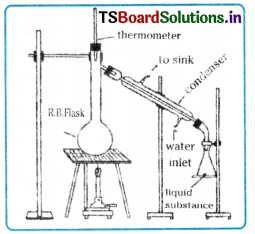
Redox Reactions Questions and Answers AP Inter 1st Year Chemistry Chapter 7-53
x + 3 (-2) = -1 ⇒ x = +5
There is no fallacy about the oxidation number of N in \(\mathrm{NO}_3^{-}\).
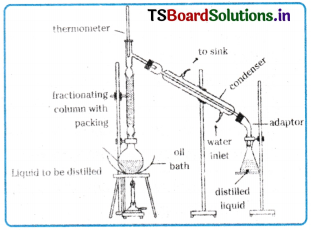
Question 6.
Write formulas for the following compounds.
i) Mercury (II) chloride
ii) Nickel (II) sulphate
iii) Tin (IV) oxide
iv) Thallium (I) sulphate
v) Iron (III) sulphate
vi) Chromium (III) oxide
Answer:
i) HgCl2
ii) NiSO4
iii) SnO2
iv) Tl2SO4
v) Fe2(SO4)3
vi) Cr2O3

Question 7.
Suggest a list of the substances where carbon can exhibit oxidation states from – 4 to + 4 and nitrogen from -3 to +5.
Answer:

CompoundO.N. of CarbonCompoundO.N. of Nitrogen
CH4-4NH3-3
CH3CH3-3NH2NH2-2
CH2 = CH2 or CH3Cl-2N2H2-1
CH ≡ CH-1N ≡ N0
CH2Cl2 or C6H12O60N2O+ 1
C2Cl2 or C6Cl6+ 1NO+2
CO or CHCl3+2N2O3+3
C2Cl6 or (COOH)2+3N2O4+4
CO2 or CCl4+4N2O5+5

Question 8.
While sulphur dioxide and hydrogen peroxide can act as oxidising as well as reducing agents in their reactions, ozone and nitric acid act only as oxidants. Why ?
Answer:
In sulphur dioxide (SO2), the oxidation number of S is +4 and the range of oxidation number of S is +6 to -2. Hence, SO2 can act both as reducing as well as oxidising agent.

In hydrogen peroxide (H2O2), the oxidation number of O is -1 and the range of oxidation number of O is 0 to -2. Hence, H2O2 can act both as reducing as well as oxidising agent,

In ozone (O3) the oxidation number of O is 0 and the range of oxidation number of O is 0 to -2. Hence, O3 can act only as an oxidant.

In nitric acid (HNO3), the oxidation number of N is +5 and the range of oxidation number of N is +5 to -3. Hence, HNO3 acts only as an oxidant.

Question 9.
Consider the reactions.
i) 6CO2(g) + 6H2(O)(l) → C6H12O6(aq) + 6O2(g)
ii) O3(g) + H2O2(l) → H2O(l) + 2O2(g)
Why it is more appropriate to write these reactions as :
i) 6CO2(g) + 12H2O(l) → C6H12O6(aq) + 6H2O(l) + 6O2(g)
ii) O3(g) + H2O2(l) → H2O(l) + O2(g) + O2(g)
Also suggest a technique to investigate the path of the above (i) and (ii) redox reactions.
Answer:
i) Redox Reactions Questions and Answers AP Inter 1st Year Chemistry Chapter 7-54
Therefore, it is more appropriate to write the equation as (i) because it emphasises that 12H2O are used per molecule of carbohydrate formed and 6H2O are produced during this process.
The path can be found with tracer technique by using radioactive H2O18 instead of H2O.

ii) Redox Reactions Questions and Answers AP Inter 1st Year Chemistry Chapter 7-55
Therefore, it is more appropriate to write the equation (ii) because it suggests that O2 is being obtained from each of the two reactants.
The path can be determined by tracer technique using H2O218 or O318.

Question 10.
The compound AgF2 is unstable compound. However, if formed, the compound acts as a very strong oxidising agent. Why ?
Answer:
In AgF2, the oxidation state of Ag is +2 which is very unstable. Therefore, it quickly accepts an electron to form the more stable +1 oxidation state.
Ag2+ + e– → Ag+
Therefore, AgF2 is formed, will act as a strong oxidising agent.

Question 11.
Whenever a reaction between an oxidising agent and a reducing agent is carried out, a compound of lower oxidation state is formed if the reducing agent is in excess and a compound of higher oxidation state is formed if the oxidising agent is in excess. Justify this statement giving three illustrations.
Answer:
i) Redox Reactions Questions and Answers AP Inter 1st Year Chemistry Chapter 7-56
C is a reducing agent whereas O2 is an oxidising agent. If excess of C is burnt in limited supply of O2, CO is formed in which the oxidation state of C is +2. If, however, excess of O2 is used, the initially formed CO gets oxidised to CO2 in which the oxidation state of C is +4.

ii) Redox Reactions Questions and Answers AP Inter 1st Year Chemistry Chapter 7-57
P4 is a reducing agent whereas Cl2 is an oxidising agent. If excess of P4 is used, PCl3 is formed in which the oxidation state of P is +3. If, however, excess of Cl2 is used, the initially formed PCl3 reacts with Cl2 to form PCl5, in which the oxidation state of P is +5.

iii) Redox Reactions Questions and Answers AP Inter 1st Year Chemistry Chapter 7-58
If an excess of K reacts with O2, it produces K2O. Here, the oxidation number of O is -2.
If K reacts with an excess of O2, it produces K2O2, where the oxidation number of O is -1.

Question 12.
How do you count for the following observations ?
i) Though alkaline potassium permanganate and acidic potassium permanganate both are used as oxidants, yet in the manufacture of benzoic acid from toluene we use alcoholic potassium permanganate as an oxidant. Why ? Write a balanced redox equation for the reaction.
ii) When concentrated sulphuric acid is added to an inorganic mixture containing chloride, we get colourless pungent smelling gas HCl, but if the mixture contains bromide then we get red vapour of bromine. Why ?
Answer:
i) Toluene can be oxidised to benzoic acid in acidic, basic and neutral media according to the following redox equations,
a) In acidic medium :
Redox Reactions Questions and Answers AP Inter 1st Year Chemistry Chapter 7-59

b) In basic and neutral medium:
Redox Reactions Questions and Answers AP Inter 1st Year Chemistry Chapter 7-60
In the laboratory, benzoic acid is usually prepared by alkaline KMnO4. However, in industry, alcoholic KMnO4 is preferred over acidic or alkaline KMnO4 because of the following reasons.

The cost of adding an acid or the base is avoided because in the neutral medium, the base (OH– ions) are produced in the reaction itself.

Since reactions occur faster in homogeneous medium than in heterogeneous medium, therefore, alcohol helps in mixing the two reactants, i.e., KMnO4 (due to its polar nature) and toluene (because of its being an organic compound),

ii) When cone. H2SO is added to an inorganic mixture containing chloride, a pungent smelling gas HCl is produced because a stronger acid displaces a weaker acid from its salt.

Redox Reactions Questions and Answers AP Inter 1st Year Chemistry Chapter 7-61
Since HCl is a very weak reducing agent, it cannot reduce H2SO4 to SO2 and hence HCl is not oxidised to Cl2.

However, when the mixture contains bromide ion, the initially produced HBr being a strong reducing agent reduces H2SO4 to SO2 and is itself oxidised to produce red vapour of Br2.
2NaBr + 2H2SO4 → 2NaHSO4 + 2HBr
2HBr + H2SO4 → Br2↑ + SO2↑ + 2H2O

Question 13.
Identify the substance oxidised, reduced, oxidising agent and reducing agent for each of the following reactions :
i) 2AgBr(s) + C6H6O2(aq) → 2Ag(s) + 2HBr(aq) + C6H4O2(aq)
ii) HCHO(l) + 2[Ag(NH3)2]+(aq) + 3OH– (aq) → 2Ag(s) + HCOO–(aq) + 4NH3(aq) + 2H2O(l)
iii) HCHO(l) + 2Cu2+(aq) + 5OH–(aq) → Cu2O(s) + HCOO<sup-2(aq) + 3H2O(l)
iv) N2H4(l) + 2H2O2(l) → N2(g) + 4H2O(l)
v) Pb(s) + PbO2(s) + 2H2SO4(aq) → 2PbSO4(s) + 2H2O(l)
Answer:

Substance oxidisedSubstance reducedOxidising agentReducing agent
i) C6H6O2(aq)AgBr(s)Agbr(s)C6H6O2(aq)
ii) HCHO(l)[Ag(NH3)2]+ (aq)[Ag(NH3)2]+ (aq)HCHO (aq)
iii) HCHO(l)Cu2+ (aq)Cu2+ (aq)HCHO (aq)
iv) N2H4(l)H2O2(l)H2O2(l)N2H4(l)
v) Pb(s)PbO2(s)PbO2(s)Pb(s)

Question 14.
Consider the reactions.
\(2 \mathrm{~S}_2 \mathrm{O}_3^{2-}(\mathrm{aq})\) + I2(s) → \(\mathrm{S}_4 \mathrm{O}_6^{2-}(\mathrm{aq})\) + 2I– (aq)
\(\mathrm{S}_2 \mathrm{O}_3^{2-}(\mathrm{aq})\) + 2Br2(l) + 5H2O(l) → \(2 \mathrm{SO}_4^{2-}(\mathrm{aq})\) + 4Br–(aq) + 10H+ (aq)
Why does the same reductant, thiosulphate react differently with iodine and bromine ?
Answer:
The average oxidation numbers of S in S2O32- is +2 while in S4O62- it is +2.5. The oxidation number of S in SO42- is +6. Since Br2 is a stronger oxidising agent than I2, it oxidises S of S2O32- to a higher oxidation state of +6 and hence forms SO42- ion.

I2, however, being weaker oxidising agent oxidises S of S2O32- ion to a oxidation state of +2.5 in S4O62- ion. It is because of this reason that thiosulphate reacts differently with Br2 and I2.

Redox Reactions Questions and Answers AP Inter 1st Year Chemistry Chapter 7

Question 15.
Justify giving reactions that among halogens, fluorine is the best oxidant and among hydrohalic compounds, hydroiodic acid is the best reductant.
Answer:
Halogens have a strong tendency to accept electrons. Therefore, they are strong oxidising
agents. Their relative oxidising power is, however, measured in terms of their electrode potentials. Since the electrode potentials of halogens decreases in the order,
F2 (+2.87 V) > Cl2 (+1.36 V) > Br2(+1.09 V) > I2(+0.54V),
therefore, their oxidising power decreases in the same order.

This is evident from the observation that F2 oxidises Cl– to Cl2, Br– to Br2, I– to I2; Cl2 oxidises Br– to Br2 and I– to I2 but not F– to F2. Br2, however, oxidises I– to I2 but not F– to F2, and Cl– to Cl2.
F2(g) + 2Cl–(aq) → 2F–(aq) + Cl2(g)
F2(g) + 2Br–(aq) → 2F–(aq) + Br2(l)
F2(g) + 2I–(aq) → 2F–(aq) + I2(s)
Cl2g) + 2Br–(aq) → 2Cl–(aq) + Br2(l)
Cl2(g) + 2I–(aq) → 2Cl–(aq) + I2(s) and
Br2(l) + 2I–(aq) → 2Br–(aq) + I2(s)
Thus, F2 is the best oxidant, conversely, halide ions have a tendency to lose electrons and hence can act as reducing agents. Since the electrode potentials of halide ions decreases in the order,
I–(-0.54 V) > Br–(-1.09 V) > Cl–(-1.36 V) > I2(-2.87 V), therefore, the reducing power of the halide ions or their corresponding hydrohalic acids decreases in the same order,
HI > HBr > HCl > HF.
Thus, hydroiodic acid is the best reductant. This is supported by the following reactions. For example, HI and HBr reduce H2SO4 to SO2 while HCl and HF do not.
2HBr + H2SO4 → Br2 + SO2 + 2H2O
2HI + H2SO4 → I2 + SO2 + 2H2O
Further I– reduces Cu2+ to Cu+ but Br– does not.
2Cu2+(aq) + 4I–(aq) → Cu2I2(s) + I2(s)
Cu2+(aq) + 2Br–(aq) → No reaction.
Thus, HI is a stronger reductant than HBr. Further among HCl and HF, HCl is a stronger reducing agent than HF because HCl reduces MnO2 to Mn2+ but HF does not.
MnO2(s) + 4HCl(aq) → MnCl2(aq) + Cl2(g) + 2H2O
MnO2(s) + 4HF(l) → No reaction.
Thus, the reducing character of hydrohalic acids decreases in the order,
HI > HBr > HCl > HF

Question 16.
Why does the following reaction occur ?
\(\mathrm{XeO}_6^{4-}(\mathrm{aq})\) + 2F–(aq) + 6H+(aq) → XeO3(g) + F2(g) + 3H2O(l)
What conclusion about the compound Na4XeO6 (of which \(\mathrm{XeO}_6^{4-}\) is a part) can be drawn from the reaction? •
Answer:
Given reaction Redox Reactions Questions and Answers AP Inter 1st Year Chemistry Chapter 7-62
Here oxidation number of Xe decreases from +8 in \(\mathrm{XeO}_6^{4-}\) to +6 in XeO3 while that of F increases from -1 in F– to 0 in F2. Therefore, \(\mathrm{XeO}_6^{4-}\) is reduced while F– is oxidised. This reaction occurs because Na4XeO6 (or \(\mathrm{XeO}_6^{4-}\)) is a stronger oxidising agent than F2.

Question 17.
Consider the reactions :
i) H3PO2(aq) + 4AgNO3(aq) + 2H2O(l) → H3PO4(aq) + 4Ag(s) + 4HNO3(aq)
ii) H3PO2(aq) + 2CuSO4(aq) + 2H2O(l) → H3PO4(aq) + 2Cu(s) + H2SO4(aq)
iii) C6H5CHO(l) + 2[Ag(NH3)2]+(aq) + 3OH– (aq) → C6H5COO–(aq) + 2Ag(s) + 4NH3(aq) + 2H2O(l)
iv) C6H5CHO(l) + 2Cu2+(aq) + 5OH–(aq) → No change observed.
What inference do you draw about the behaviour of Ag+ and Cu2+ from these reactions ?
Answer:
Reactions (i) and (ii) indicate that H3PO2 (hypophosphorous acid) is a reducing agent and thus reduces both AgNO3 and CuSO4 to Ag and Cu respectively.

Conversely, both AgNO3 and CuSO4 act as an oxidising agent and thus oxidise H3PO2 to H3PO4 (orthophosphoric acid). Reaction (iii) suggests that [Ag(NH3)2]+ oxidises C6H5CHO (benzaldehyde) to C6H5COO– (benzoate ion) but reaction (iv) indicates tha Cu2+ ions cannot oxidise C6H5CHO to C6H5COO–. Therefore, from the above reactions, we can conclude that Ag+ ion is a stronger oxidising agent than Cu2+ ion.


Question 18.
Balance the following redox reactions by ion-electron method.
i) MnO4–(aq) + I– (aq) → MnO2(s) + I2(s) (in basic medium)
ii) MnO4–(aq) + SO2(g) → Mn2+(aq) + HSO4–(aq) (in acidic solution)
iii) H2O2(aq) + Fe2+(aq) → Fe3+(aq) + H2O(l) (in acidic solution)
iv) Cr2O72-(aq) + SO2(g) → Cr3+(aq) + SO42-(aq) (in acidic solution)
Answer:
i) Given reaction MnO4–(aq) + I– (aq) → MnO2(s) + I2(s) (in basic medium)
Oxidation half equation :
2I–(aq) → I2(s) + 2e– ………(i)
Reduction half equation :
MnO4–(aq) → MnO2(s)
MnO4–(aq) + 2H2O(l) + 3e– → MnO2(s) + 4OH–(aq) …….(ii)
Now multiple eq. (i) by 3 and eq. (ii) by 2 and add both the equations,
Redox Reactions Questions and Answers AP Inter 1st Year Chemistry Chapter 7-63

ii) Given reaction MnO4–(aq) + SO2(g) → Mn2+(aq) + HSO4–(aq) (in acidic solution)
Oxidation half equation:
SO2(g) + 2H2O(l) → HSO4– (aq) + 3H+(aq) + 2e– ……….(i)
Reduction half equation:
MnO4–(aq) + 8H+(aq) + 5e– → Mn2+(aq) + 4H2O(l) …………(ii)
Multiply eq. (i) by 5 and eq. (ii) by 2 and add, we have,
2MnO4–(aq) + 5SO2(g) + 2H2O(l) + H+(aq) → 2Mn2+(aq) + 5HSO4–(aq)

iii) Given reaction H2O2(aq) + Fe2+(aq) → Fe3+(aq) + H2O(l) (in acidic solution)
Oxidation half equation:
Fe2+(aq) → Fe3+(aq) + e– …………..(i)
Reduction half equation:
H2O2(aq) + 2H+(aq) + 2e– → 2H2O(l) …….(ii)
Multiply eq. (i) by 2 and add it to eq. (ii), we have,
H2O2(aq) + 2Fe2+2(aq) + 2H+(aq) → 2Fe3+(aq) + 2H2O(l)

iv) Given reaction Cr2O72-(aq) + SO2(g) → Cr3+(aq) + SO42-(aq) (in acidic solution)
Oxidation half equation :
SO2(g) + 2H2O(l) → SO42- (aq) + 4H+(aq) + 2e– ………(i)
Reduction half equation:
Cr2O72-(aq) + 14H+(aq) + 6e– → 2Cr3+(aq) + 7H2O(l) ……..(ii)
Multiply eq. (i) by 3 and add it to eq. (ii), we have,
Cr2O72-(aq) + 3SO2(g) + 2H+(aq) → 2Cr3+(aq) + 3SO42-(aq) + H2O(l)

Question 19.
Balance the following equations in basic medium by ion-electron method and oxidation number methods and identify the oxidising agent and the reducing agent.
i) P4(s) + OH–(aq) → PH3(g) + H2PO2–(aq)
ii) N2H4(l) + ClO3–(aq) → NO(g) + Cl–(aq)
iii) Cl2O7(g) + H2O2(aq) → ClO2–(aq) + O2(g) + H+(aq)
Answer:
i) Given equation Redox Reactions Questions and Answers AP Inter 1st Year Chemistry Chapter 7-64
P4 acts both as an oxidising as well as a reducing agent.
Oxidation number method:
Total decrease in O.N. of P4 in PH3 = 3 × 4 = 12
Total increase in O.N. of P4 in H2PO2– = 1 × 4 = 4
Therefore, to balance increase/decrease in O.N. multiply PH3 by 1 and H2PO2– by 3,
we have, P4(s) + OH–(aq) → PH3(g) + 3H2PO2–(aq)
To balance O atoms, multiply OH– by 6, we have
P4(s) + 6OH– (aq) > PH3(g) + 3H2PO2–(aq)
To balance H atoms, added 3H2O to L.H.S. and 3OH– to the R.H.S., we have
P4(s) + 6OH–(aq) + 3H2O (l) →PH3(g) + 3H2PO2–(aq) + 3OH–(aq)
or P4(s) + 3OH–(aq) + 3H2O(l) → PH3(g) + 3H2PO2– (aq) ………..(1)
Thus, eq. (1) represents the correct balanced equation.
Ion-electron method : The two half reactions are,
Oxidation-half reaction:
P4(s) → H2PO2–(aq) ………(2)
Balancing P atoms, we have, Redox Reactions Questions and Answers AP Inter 1st Year Chemistry Chapter 7-65
Balance O.N. by adding electrons, P4(s) → 4H2PO2–(aq) + 4e–
Balance charge by adding 8OH– ions.
P4(s) + 8OH–(aq) → 4H2PO2–(aq) + 4e– ……..(3)
O and H get automatically balanced. Thus, eq. (3) represents the balanced oxidation half reaction.
Reduction-half reaction:
Redox Reactions Questions and Answers AP Inter 1st Year Chemistry Chapter 7-66
Balancing P atoms, we have, P4(s) → 4PH3(g)
Balance O.N. by adding electrons, P4(s) + 12e– → 4PH3(g)
Balance charge by adding 12OH– ions, P4(s) + 12e– → 4PH3(g) + 12OH–(aq)
Balance O atoms, by adding 12H2O to L.H.S. of above equation
P4(s) + 12H4O(l) + 12e– → 4PH3(g) + 12OH– (aq) …….(5)
To cancel out electrons, multiply eq. (3) by 3 and add it to eq. (5), we have
4P4(S) + 24OH–(aq) + 12H2O(l) → 4PH3(aq) + 12H2PO2–(aq) + 12OH–(aq)
or P4(g) + 3OH–(aq) + 3H2O(l) → PH3(aq) + 3H2PO2–(aq) …. (6)
Thus, eq. (6) represents the correct balanced equation.

ii) Given equation Redox Reactions Questions and Answers AP Inter 1st Year Chemistry Chapter 7-67
Oxidation number method:
Total increase in O.N. of N = 2 × 4 = 8
Total decrease in O.N. of Cl = 1 × 6 = 6
Therefore, to balance increase/decrease in O.N. multiply N2H4 by 3 and ClO3– by 4, we have
3N2H4(l) + 4ClO3–(aq) → NO(g) + Cl–(aq)
To balance N and Cl atoms, multiply NO by 6 and Cl– by 4, we have
3N2H4(l) + 4ClO3– (aq) → 6NO(g) + 4Cl–(aq)
Balance O atoms by adding 6H2O,
3N2H4(l) + 4ClO3–(aq) > 6NO(g) + 4Cl–(aq) + 6H2O(l) ……..(1)
H atoms get automatically balanced and thus eq. (1) represents the correct balanced equation.
Ion electron method:
Oxidation half reaction :
Redox Reactions Questions and Answers AP Inter 1st Year Chemistry Chapter 7-68
Balance N atoms, N2H4(l) → 2NO(g)
Balance O.N. by adding electrons, N2H4(l) → 2NO(g) + 8e–
Balance charge by adding 8OH– ions, N2H4(l) + 8OH–(aq) → 2NO(g) + 8e–
Balance O atoms by adding 6H2O,
N2H4(l) + 8OH–(aq) → 2NO(g) + 6H2O(l) + 8e– ……….(2)
Reduction-half reaction :
Redox Reactions Questions and Answers AP Inter 1st Year Chemistry Chapter 7-69
Balance O.N. by adding electrons, ClO3–(aq) + 6e– → Cl–(aq)
Balance charge by adding OH– ions, ClO3–(aq) + 6e– → Cl–(aq) + 6OH–(aq)
Balance O atoms, by adding 3H2O,
ClO3–(aq) + 3H2O(l) + 6e– → Cl–(aq) + 6OH–(aq) ………(3)
Thus, eq. (3) represents the correct balanced reduction half equation.
To cancel out electrons gained and lost, multiply eq. (2) by 3 and eq. (3) by 4 and add, we have,
3N2H4(l) + 4ClO3–(aq) → 6NO(g) + 4Cl–(aq) + 6H2O(l) …. (4)
Thus, eq. (4) represents the correct balanced equation.

iii) Given equation Redox Reactions Questions and Answers AP Inter 1st Year Chemistry Chapter 7-70
O.N. increases by 1 per O atom
Thus, Cl2O7(g) acts as an oxidising agent while H2O2(aq) as the reducing agent.
Oxidation number method:
Total decrease in O.N. of Cl2O7 = 4 × 2 = 8
Total increase in O.N. of H2O2 = 2 × 1 = 2
∴ To balance increase/decrease in O.N. multiply H2O2 and O2 by 4, we have
Cl2O7(g) + 4H2O2(aq) → ClO2–(aq) + 4O2(g)
To balance Cl atoms, multiply ClO2– by 2, we have
Cl2O7(g) + 4H2O(aq) → 2ClO2–(aq) + 4O2(g)
To balance O atoms, add 3H2O to R.H.S., we have
Cl2O7(g) + 4H2O2(aq) →2ClO2–(aq) + 4O2(g) + 3H2O(l)
To balance H atoms, add 2H2O to R.H.S. and 2OH– to L.H.S, we have
Cl2O7(g) + 4H2O2(g) + 2OH–(aq) → 2ClO2–(aq) + 4O2(g) + 5H2O(l)
This represents the balanced redox equation.
Ion electron method:
Oxidation half reaction:
Redox Reactions Questions and Answers AP Inter 1st Year Chemistry Chapter 7-71
Balance O.N. by adding electrons, H2O2(aq) → O2(g) + 2e–
Balance charge by adding 2OH– ions, H2O2(aq) + 2OH–(aq) → O2(g) + 2e–
Balance O atoms by adding 2H2O,
H2O2(aq) + 2OH– (aq) → O2(g) + 2H2O(l) + 2e– ………..(1)
Reduction-half reaction:
Redox Reactions Questions and Answers AP Inter 1st Year Chemistry Chapter 7-72
Balance Cl atoms, Cl2O7(g) → 2ClO2–(aq)
Balance O.N. by adding electrons, Cl2O7(g) + 8e– → 2ClO2–(aq)
Add 6OH– ions to balance charge,
Cl2O7(g) + 8– → 2ClO2–(aq) + 6OH–(aq)
Balance O atoms, by adding 3H2O, to L.H.S., we have
Cl2O7(g) + 3H2O(l) + 8e– → 2ClO2–(aq) + 6OH–(aq) ……….(2)
To cancel out electrons, multiply eq. (1) by 4 and add it to eq. (2), we have,
4H2O2(aq) + 8OH–(aq) + Cl2O7(g) + 3H2O(l) → 2ClO2– (aq) + 6OH–(aq) + 4O2(g) + 8H2O(l)
⇒ Cl2O7(g) + 4H2O2(aq) + 2OH–(aq) → 2ClO2–(aq) + 4O–(g) + 5H–O(l)

Redox Reactions Questions and Answers AP Inter 1st Year Chemistry Chapter 7

Question 20.
What sorts of informations can you draw from the following reaction ?
(CN)2(g) + 2OH– (aq) → CN–(aq) + CNO–(aq) + H2O(l)
Answer:
Let x be the Oxidation number (O.N.) of C.
Oxidation number of C in cyanogen, (CN)2 = 2(x – 3) = 0 or x = +3
Oxidation number of C in cyanide ion, CN– = x – 3 = -1 or x = +2
Oxidation number of C in cyanate ion, CNO– = x – 3 – 2 = -1 or x = +4
The information about the given reaction are,
i) The reaction involves decomposition of cyanogen, (CN)2 in the alkaline medium to cyanide ion, CN– and fcyanate ion, CNO–.

ii) The Oxidation number of C decreases from +3 in (CN)2 to +2 in CN– ion and increases from +3 in (CN)2 to +4 in CNO– ion. Thus, cyanogen is simultaneously reduced to cyanide ion and oxidised to cyanate ion.

iii) It is an example of a redox reaction in general and a disproportionation reaction in particular.

iv) Cyanogen is a pseudohalogen (behaves like halogens) while cyanide ion is a pseudohalide ion (behaves like halide ion).

Question 21.
The Mn3+ ion is unstable in solution and undergoes disproportionation to give Mn2+, MnO2 and H+ ion. Write a balanced ionic equation for the reaction.
Answer:
The skeletal equation is Mn3+(aq) → Mn2+(aq) + MnO2(s) + H+(aq)
Oxidation half equation:
Redox Reactions Questions and Answers AP Inter 1st Year Chemistry Chapter 7-73
Balance O.N. by adding electrons, Redox Reactions Questions and Answers AP Inter 1st Year Chemistry Chapter 7-74
Balance O atoms by adding 2H2O, Redox Reactions Questions and Answers AP Inter 1st Year Chemistry Chapter 7-75
Balance H atoms by adding 4H+ ions,
Redox Reactions Questions and Answers AP Inter 1st Year Chemistry Chapter 7-76 …………(1)
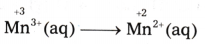
Reduction half equation :
Redox Reactions Questions and Answers AP Inter 1st Year Chemistry Chapter 7-77
Balance O.N. by adding electrons, Mn3+(aq) + e– → Mn2+(aq) ………(2)
Adding eq. (1) and eq. (2), the balanced equation for the disproportionation reaction is
2Mn3+(aq) + 2H2O(l) → MnO2(s) + Mn2+(aq) + 4H+(aq)

Question 22.
Consider the elements : Cs, Ne, I and F
i) Identify the element that exhibits only negative oxidation state.
ii) Identify the element that exhibits only positive oxidation state.
iii) Identify the element that exhibits both positive and negative oxidation states.
iv) Identify the element which exhibits neither the negative nor the positive oxidation state.
Answer:
i) Take F, Fluorine being the most electronegative element shows only a -ve oxidation state of -1.
ii) Take Cs. Alkali metals because of the presence of a single electron in the valence shell, exhibit an oxidation state of +1.
iii) Take I. Because of the presence of seven electrons in the valence shell, I shows an oxidation state of -1 (in compounds of I with more electropositive elements such as H, Na, K, Ca, etc.) or an oxidation state of +1 compounds of I with more electronegative elements, i.e., O, F, etc) and because of the presence of d-orbitals it also exhibits +ve oxidation states of +3, +5 and +7.
iv) Take Ne. It is an inert gas (with high ionization enthalpy and high positive electron gain enthalpy) and hence it neither exhibits -ve nor +ve oxidation states.

Question 23.
Chlorine is used to purify drinking water. Excess of chlorine is harmful. The excess of chlorine is removed by treating with sulphur dioxide. Present a balanced equation for this redox change taking place in water.
Answer:
The skeletal equation is
Cl2(aq) + SO2(aq) + H2O(l) → Cl–(aq) + SO42-(aq)
Reduction half equation : Cl2(aq) → Cl–(aq)
Balance Cl atoms, Redox Reactions Questions and Answers AP Inter 1st Year Chemistry Chapter 7-78
Balance Oxidation number by adding electrons, Cl2(aq) + 2e– → 2Cl– (aq) ………….(i)
Oxidation half equation:
Redox Reactions Questions and Answers AP Inter 1st Year Chemistry Chapter 7-79
Balance O.N. by adding electrons, SO2(aq) → SO42- (aq) + 2e–
Balance charge by adding 4H+ ions, SO2(aq) → SO42-(aq) + 4H+(aq) + 2e–
Balance O atom’s by adding 2H2O,
SO2(aq) + 2H2O(l) → SO42-(aq) + 4H+aq) + 2e– ……………(ii)
Adding eq. (i) and eq. (ii), we have
Cl2(aq) + SO2(aq) + 2H2O(l) → 2Cl–(aq) + SO42- (aq) + 4H+(aq)
This represents the balanced redox reaction.

Question 24.
Refer to the periodic table given in your book and now answer the following questions:
i) Select the possible non-metals that can show disproportionation reaction.
ii) Select three metals that can show disproportionation reaction.
Answer:
i) The taken non-metals are P, Cl and S.
a) P2(s) + 3OH–(aq) + 3H2O(l) → PH3(g) + 3H2PO2–(aq)
b) Redox Reactions Questions and Answers AP Inter 1st Year Chemistry Chapter 7-80 or
3Cl2(g) + 6OH–(aq) → 5Cl–(aq) + ClO3– (aq) + 3H2O(l)
c) S8(s) + 12OH–(aq) → 4S2- (aq) + 2S2O32-(aq) + 6H2O(l)

ii) The taken metals are Cu, Ca, In, Mn, etc.
Redox Reactions Questions and Answers AP Inter 1st Year Chemistry Chapter 7-81

Question 25.
In Ostwald’s process for the manufacture of nitric acid, the first step involves the oxidation of ammonia gas by oxygen gas to give nitric oxide gas and steam. What is the maximum weight of nitric oxide that can be obtained starting only with 10.00 g. of ammonia and 20.00g of oxygen ?
Answer:
The balanced equation for the reaction is: Redox Reactions Questions and Answers AP Inter 1st Year Chemistry Chapter 7-82
Here, 68 g of NH3 will react with = 160 g O2
∴ 10 g of NH3 will react with = \(\frac{160 \mathrm{~g}}{68 \mathrm{~g}}\) × 10 g = 23.52 g O2
But the amount of O2 which is actually available is 20.0 g which is less than the amount
which is needed. Therefore, O2 is the limiting reagent and hence calculations must be based
upon the amount of O2taken and not on the amount of NH3 taken.
From the equation, 160 g of O2 produce NO = 120 g
120
∴ 20 g of O2 will produce NO = \(\frac{120}{160}\) × 20 = 15 g

Question 26.
Using the standard electrode potentials given below, predict if the reaction between the following is feasible :
i) Fe3+(aq) and I–(aq)
ii) Ag+(aq) and Cu(s)
iii) Fe3+(aq) and Cu(s)
iv) Ag(s) and Fe3+(aq)
v) Br2(aq) and Fe2+(aq)
Given,\(\mathbf{E}_{\mathbf{I}_{\mathbf{2}} / \mathbf{I}^{-}}^{\circ}\) = 0.54 V, \(\mathrm{E}_{\mathrm{Br}_2 / \mathrm{Br}^{-}}^{\circ}\) = 1,09 V, \(\mathbf{E}^{\circ}{ }_{\mathrm{Fe}^{3+} / \mathrm{Fe}^{2+}}\) = 0.77 V, \(\mathbf{E}^{\circ}{ }_{\mathrm{Cu}^{2+} / \mathrm{Cu}}\) = 0.34 V \(\mathbf{E}^{\circ}{ }_{\mathbf{A g}^{+} / \mathrm{Ag}}\) = 0.80 V
Answer:
i) The possible, Fe3+(aq) and I– (aq)
Oxidation half reaction: 2I– (aq) → I2(s) + 2e– ; E° = -0.54 V …. (1)
Reduction half reaction: [Fe3+(aq) + e– → Fe2+(aq)] × 2 ; E° = 0.77 V …. (2)

It may be noted that for oxidation reactions, i.e., eq. (1), the sign of the electrode potential is reversed. To get the equation for the overall reaction, the number of electrons lost in eq.(l) and gained in eq. (2) must be cancelled. To do so, eq. (2) is multiplied by 2 and added to eq.(l). Further, it may be noted that whenever any half reaction equation is multiplied by any integer, its electrode potential is not multiplied by that integer. Thus,
Overall reaction : 2Fe3+(aq) + 2I-sup> (aq) → 2Fe2+(aq) + I2(s); E° = +0.23 V
Since the EMF for the above reaction is positive, therefore, the above reaction is feasible.

ii) The possible reaction between Ag+(aq) and Cu(s) is
Cu(s) + 2Ag+(aq) → Cu2+(aq) + 2Ag(s)
The above redox reaction can be split into the following two half reactions. Writing electrode potential for each half reaction, we have
Redox Reactions Questions and Answers AP Inter 1st Year Chemistry Chapter 7-83
Since the EMF of the above reaction comes out to be positive, therefore, the above reaction is feasible.

iii) Suppose the reaction between Fe3+(aq) and Cu(s) occurs according to the following equation.
Cu(s) + Fe3+(aq) → Cu23+(aq) + Fe3+(aq)
The above reaction can be split into the following two half reactions. Writing electrode potential for each half reaction, we have
Redox Reactions Questions and Answers AP Inter 1st Year Chemistry Chapter 7-84
The EMF of the reaction is positive, therefore, the above reaction is feasible.

iv) Suppose the reaction between Ag(s) and Fe3+(aq) occurs according to the following equation.
Ag(s) + Fe3+(aq) → Ag+(aq) + Fe2+(aq)
The above redox reaction can be split into the following two half reactions. Writing electrode potential for each half reaction, we have
Redox Reactions Questions and Answers AP Inter 1st Year Chemistry Chapter 7-85
Since the EMF of the reaction is negative, therefore, the above reaction is not feasible.

v) Suppose the reaction between Br2(s) and Fe2+(aq) occurs according to the following equation.
Br2(s) + 2Fe2+(aq) → 2Br–(aq) + 2Fe3+(aq)
The above redox reaction can be split into the following two half reactions. Writing electrode potential for each half reaction, we have
Redox Reactions Questions and Answers AP Inter 1st Year Chemistry Chapter 7-86
Since the EMF for the above reaction is positive, therefore, this reaction is feasible.

Question 27.
Predict the products of electrolysis in each of the following.
i) An aqueous solution of AgNO3 with silver electrodes
ii) An aqueous solution of AgNO3 with platinum electrodes
iii) A dilute solution of H2SO4 with platinum electrodes
iv) An aqueous solution of CuCl2 with platinum electrodes.
Answer:
i) In aqueous solution, AgNO3 ionises to give Ag+(aq) and NO3–(aq) ions.
AgNO3(aq) → Ag+(aq) + NO3–(aq)
Thus, when electricity is passed, Ag+(aq) ions move towards the cathode while NO3– ions move towards the anode. In other words, at the cathode, either Ag+(aq) ions or
H2O molecules may be reduced. Which of these will actually get discharged would depend upon their electrode potentials which are given below.
Ag+(aq) + e– → Ag(s); E° = +0.8G V (1)
2H2O(l) + 2e– → H2 (g) + 2OH– (aq) ; E° = – 0.83 V
Since the electrode potential (i.e., reduction potential of Ag+(aq) ions is higher than that of H2O molecules, therefore, at the cathode, it is the Ag+(aq) ions (rather than H20 molecules) which are reduced. Similarly, at the anode, either Ag metal of the anode or H2O molecules may be oxidised. Their electrode potentials are,
Ag(s) → Ag+(aq) + e–; E° = -0.80 V (3)
2H2O(l) → O2(g) + 4H+(aq) + 4e–; E° = – 1.23 V
Since the oxidation potential of Ag is much higher than that of H2O, therefore, at the anode, it is the Ag of the silver anode which gets oxidised and not the H2O molecules. It may, however, be mentioned here that the oxidation potential of NO3– ions is even lower than that of H2O. Since more bonds are to be broken during reduction of NO3– ions than those in H2O. Thus, when an aqueous solution of AgNO3 is electrolysed, Ag from Ag anode dissolves while Ag+ (aq) ions present in the solution get reduced and get deposited on the cathode.

ii) If, however, electrolysis of AgNO3 solution is carried out using platinum electrodes, instead of silver electrodes, oxidation of water occurs at the anode since Pt being a noble metal does not undergo oxidation easily. As a result, O2 is liberated at the anode according to equation (4). Thus, when an aqueous solution of AgNO3 is electrolysed using platinum electrodes, Ag+ ions from the solution get deposited on the cathode while O2 is liberated at the anode.

iii) In aqueous solution, H2SO4 ionises to give H+(aq) and SO42-(aq) ions.
H2SO4 (aq) ⇌ 2H+(aq) + SO42- (aq)
Thus, when electricity is passed, H+(aq) ions move towards cathode while SO42-(aq) ions move towards anode. In other words, either H+(aq) ions or H2O molecules are reduced. Their electrode potentials are,
2H+(aq) + 2e– → H2(g) ; E° = 0.0 V
2H2O (aq) + 2e– → H2(g) + 2OH–(aq); E° = -0.83 V
Since the electrode potential (i.e., reduction potential) of H+(aq) ions is higher than that of H2O, therefore, at the cathode, it is H+(aq) ions (rather than H2O molecules) which are reduced to evolve H2 gas. Similarly at the anode, either SO42-(aq) ions or H2O molecules are oxidised. Since the oxidation potential of SO42- is expected to be much lower (since it involved cleavage of many bonds as compared to those in H2O) than that of H2O molecules therefore, at the anode, it is H2O molecules (rather than SO42- ions) which are oxidised to evolve O2 gas. From the above discussion, it follows that during electrolysis of an aqueous solution of H2SO4 only the electrolysis of H2O occurs liberating H2 at the cathode and O2 at the anode.

iv) In aqueous solution, CuCl2 ionises as follows.
CuCl2(aq) ⇌ CuCl2+(aq) + 2Cl–(aq)
On passing electricity, Cu2+(aq) ions move towards cathode and Cl– (aq) ions move
towards anode. Thus, at cathode, either Cu2+(aq) or H2O molecules are reduced. Their electrode potentials are:
Cu2+ + 2e– → Cu(s) ; E° = + 0,34 V
2H2O(l) + 2e– → H2(g) + 2OH– (aq) ; E° = -0.83 V
Since the electrode potential of Cu2+(aq) ions is much higher than that of H2O, therefore, at the cathode, it is Cu2+(aq) ions which are reduced and not H2O molecules. Similarly, at the anode, either Cl(aq) ions or H2O molecules are oxidised. Their oxidation potentials are,
2Cl–(aq) → Cl2(g) + 2e– ; E° = -1.36 V
2H2O(l) → O2(g) + 4H+(aq) + 4e– ; E° = -1.23 V
Although oxidation potential of H2O molecules is higher than that of Cl– ions, nevertheless oxidation of Cl–(aq) ions occurs in preference to H2O since due to over voltage of O2. Much lower potential than -1.36 V is needed for the oxidation of H2O molecules. Thus, when an aqueous solution of CuCl2 is electrolysed, Cu metal is liberated at the cathode while Cl2 gas is evolved at the anode.

Question 28.
Arrange the following metals in the order in which they displace each other from the solution of their salts. A/, Cu, Fe, Mg and Zn.
Answer:
It is based upon the relative positions of these metals in the activity series. The correct order is Mg > Al > Zn > Fe > Cu.

Redox Reactions Questions and Answers AP Inter 1st Year Chemistry Chapter 7

Question 29.
Given the standard electrode potentials,
K+/K = -2.93 V, Ag+/Ag = 0.80 V, Hg2+/Hg = 0.79 V, Mg2+/Mg = -2.37 V, Cr3+/Cr = -0.74 V
Arrange these metals in increasing order of their reducing power.
Answer:
Lower the electrode potential, better is the reducing agent. Since the electrode potentials increases in the order; K+K (-2.93 V), Mg2+ (-2.37 V), Cr3+/Cr (-0.74 V), Hg2+/Hg (0.79 V), Ag+/Ag (0.80 V), therefore, reducing power of metals increases in the order i.e., Ag < Hg < Cr < Mg < K.

Question 30.
Depict the galvanic cell in which the reaction Zn(s) + 2Ag+(aq) → Zn2+(aq) + 2Ag(s)
takes place, Further show :
i) which of the electrode is negatively charged,
ii) the carriers of the current in the cell, and
iii) individual reaction at each electrode.
Answer:
The given redox reaction is Zn(s) + 2Ag+(aq) → Zn2+(aq) + 2Ag(s)
Since Zn gets oxidised to Zn2+ ions and Ag+ gets reduced to Ag metal, therefore, oxidation occurs at the zinc electrode and reduction occurs at the silver electrode. Thus, galvanic cell corresponding to the above redox reaction may be depicted as
Zn | Zn2+(aq) || Ag+(aq) | Ag

i) Since oxidation occurs at the zinc electrode, therefore, electrons accumulate on the zinc electrode and hence zinc electrode is negatively charged.

ii) The ions carry current The electrons flow from Zn to Ag electrode while the current flows from Ag to Zn electrode.

iii) The reaction occurring at the two electrodes are,
At anode :Zn(s) → Zn2+(aq) + 2e–
At cathode: Ag+(aq) + e– → Ag(s)

AP Inter 1st Year Maths Exercise 6d Solutions

Referring to the AP Inter 1st Year Maths Study Material Chapter 6 Permutations and Combinations Exercise 6d Solutions makes it easier to understand complex problems.

AP Inter 1st Year Maths Permutations and Combinations Solutions Exercise 6d

Question 1.
If nC8 = nC2 find nC2.
Solution:
We Know that if nCa = nCb, then a = b or a + b = n
Therefore, nC8 = nC2
⇒ 8 + 2 = n
⇒ n = 10
Hence, nC2 = 10C2
= \(\frac{10!}{2!(10-2)!}=\frac{10!}{2!8!}=\frac{10 \times 9 \times 8!}{2 \times 1 \times 8!}\)
= 5 × 9
= 45

Question 2.
Dterminw n if i) 2nC3 : nC3 = 12 : 1
Solution:
Given that 2nC3 : nC3 = 12 : 1
⇒ \(\frac{{ }^{2 n} C_3}{{ }^n C_3}=\frac{12}{1}\)
AP Inter 1st Year Maths Exercise 6d Solutions 1
⇒ 8n – 4 = 12n – 24
⇒ 4n = 20
⇒ n = 5

ii) 2nC3 : nC3 = 11 : 1
Solution:
2nC3 : nC3 = 11 : 1
AP Inter 1st Year Maths Exercise 6d Solutions 2
⇒ 8n – 4 = 11n – 22
⇒ 3n = 18
⇒ n = 6

Question 3.
How many chords can be drawn though 21 points on a circle ?
Solution:
Number of chords that can be drawn though 21 points on a circle
= Number of ways of selecting 2 points from 21 points = 21C2 = \(\frac{21 \times 20}{2}\) = 210.

AP Inter 1st Year Maths Exercise 6d Solutions

Question 4.
In how many ways can a team of 3 boys and 3 girls be selected from 5 boys and 4 girls ?
Solution:
3 boys out of 5 boys can be selected in 5C3 ways.
3 girls out of 4 girls can be selected in 4C3 ways.
∴ No. of ways in which 3 boys and 3 girls are selected = 5C3 × 4C3
= 10 × 4
= 40 ways.

Question 5.
If nC4 = 210, find n.
Solution:
Given that nC4 = 210
⇒ \(\frac{n(n-1)(n-2)(n-3)}{1 \cdot 2 \cdot 3 \cdot 4}\) = 10 × 21
⇒ n(n – 1) (n – 2) (n – 3) = 10 × 21 × 1 × 2 × 3 × 4
⇒ n(n – 1) (n – 2) (n – 3) = 10 × 7 × 3 × 2 × 3 × 4
⇒ n(n – 1) (n – 2) (n – 3) = 10 × 9 × 8 × 7
⇒ n = 10

Question 6.
If 12Cr = 495, find the possible values of ‘r’.
Solution:
12Cr = 495
= 5 × 99
= 11 × 9 × 5
= \(\frac{12 \times 11 \times 9 \times 5 \times 2}{12 \times 2}=\frac{12 \times 11 \times 10 \times 9}{1 \times 2 \times 3 \times 4}\)
= 12C4 or 12C8
∴ r = 4 or 8

Question 7.
If 10.nC4 = 3. n+1C3, find n.
Solution:
Given that 10.nC2 = 3.n+1C3
⇒ 10 × n(n – 1)1.2 = 3(n + 1)(n – 1)1.2.3
⇒ 10 = n + 1
⇒ n = 9

Question 8.
If 15C2r-1 = 15C2r+4 + 4, find r.
Solution:
Given that 15C2r-1 = 15C2r+4
⇒ 2r – 1 = 2r + 4 or (2r – 1) + (2r + 4) = 15
⇒ (2r – 1) + (2r + 4) = 15
⇒ 4r + 3 = 15
⇒ 4r = 12
⇒ r = 3
∴ r = 3

Question 9.
If 12Cr+1 = 12C3r-5, find r.
Solution:
Given that 12Cr+1 = 12C3r-5
⇒ r + 1 = 3r – 5 or (r + 1) + (3r – 5) = 12
⇒ 1 + 5 = 2r or 4r – 4 = 12
⇒ 2r = 6 or 4r = 16
⇒ r = 3 or r = 4
r = 3 or 4

Question 10.
If nC5 = nC6, then find 13C4.
Solution:
Given that nC5 = nC6
⇒ n = 6 + 5 = 11
⇒ 13Cn = 13C11
= 13C2
= \(\frac{13 \times 12}{1 \times 2}\) = 78

II.

Question 1.
Find the number of ways of selecting 9 balls from 6 red balls, 5 white balls and 5 blue balls if each selection Solution:
The no. of ways of selecting 3 red balls out of 6 red balls = 6C3
The no. of ways of sleeting 3 white balls out of 5 white balls = 5C3
The no. of ways of selecting 3 blue balls out of 5 blue balls = 5C3
The no. of ways of selecting 3 balls of each colour = 6C3 × 5C3 × 5C3
= 20 × 10 × 10
= 2000.

Question 2.
Determine the number of 5 card combinations out of a deck of 52 cards if there is exactly one ace in each combination.
Solution:
One ace will be selected from four aces and four cards will be selected from 52 cards, then 52 – 4 = 48 cards.
If ‘p’ is the required no. of ways, then
⇒ P = 4C1 × 48C4
= 4 × \(\frac{48!}{4!(48-4)!}=\frac{4 \times 48!}{4!44!}\)
= 4 × \(\frac{48 \times 47 \times 46 \times 45 \times 44!}{4 \times 3 \times 2 \times 1 \times 44!}\)
= 778320 ways

Question 3.
In how many ways can one select a cricket team of Eleven from 17 players in which only 5 players can bowl if each cricket team of 11 must include exactly 4 bowlers ?
Solution:
Out of 17 players, 5 players are bowlers. A cricket team of 11 players is to be selected in such away that there are exactly 4 bowlers. 4 bowlers can be selected out of 5 bowlers in 5C4 ways and the remaining 7 players can be selected out of the 12 players in 12C7 ways.
Thus, by multiplication principle, required number of ways of selecting circket team
5C4 × 12C7 = \(\frac{5!}{4!(5-4)!} \times \frac{12!}{7!(12-7)!}=\frac{5 \times 4!}{4!1!} \times \frac{12 \times 11 \times 10 \times 9 \times 8 \times 7}{7!5!}\)
= 5 × 792
= 3960

Question 4.
A bag contains 5 black and 6 red balls. Determine the number of ways in which 2 black and 3 red balls can be selected.
Solution:
There axe 5 black and 6 red balls in the bag.
2 black balls can be selected out of 5 black balls in 5C2 ways and
3 red balls can be selected out of 6 red balls in 6C3 ways.
Thus, by multiplication principle, required number of ways of selecting 2 black and 3 red balls.
5C2 × 6C4
= \(\frac{5!}{2!(5-2)!} \times \frac{6!}{3!(6-3)!}=\frac{5 \times 4 \times 3!}{2!3!}=\frac{6 \times 5 \times 4 \times 3!}{3!3!}\)
= 10 × 20
= 200.

Question 5.
In how many ways can a student choose a programme of 5 courses if 9 courses are available and 2 specific courses are compulsory for every student ?
Solution:
There are 9 courses available out of which, 2 specific courses are compulsory for every student and has to choose 3 courses out of the remaining 7 courses. 2 courses can be selected out of 2 specific courses in 2C2 ways and 3 courses can be selected out of the remaing 7 courses in 7C3 ways.
Thus, the required number of ways of choosing the programme
2C2 × 7C3 = \(\frac{2!}{2!(2-2)!} \times \frac{7!}{3!(7-3)!}=\frac{2!}{2!0!} \times \frac{7 \times 6 \times 5 \times 4!}{3!4!}\)
= 1 × 35
= 35

AP Inter 1st Year Maths Exercise 6d Solutions

Question 6.
Prove that for 3 ≤ r ≤ n.
(n – 3)Cr + 3.(n – 3)C(r – 1) + 3. (n – 3)C(r – 2) + n – 3Cr – 3 = nCr
Solution:
Since nCr – 1 + nCr = n + 1Cr, Given can be taken as
n – 3Cr + n – 3Cr + 2[n – 3Cr – 1 + n – 3Cr – 2] + n Cr – 2 + n – 3Cr – 3
= n – 2Cr + 2.(n – 2)Cr – 1 + n – 2Cr – 2
= n – 1Cr + n – 1Cr – 1
= n – 1 + 1Cr
= nCr

Question 7.
Simp;ify 34C5 + \(\sum_{\mathbf{r}=0}^4\) (38 – r)C4.
Solution:
34C5 + \(\sum_{\mathbf{r}=0}^4\) (38 – r)C4.
AP Inter 1st Year Maths Exercise 6d Solutions 3

Question 8.
In a class there are 30 students. If each student plays a chess game with each of the other student, then find the total number of chess games played by them.
Solution:
Number of students in a class = 30.
Since each student plays a chess game with each of the other students, the total
number of chess games played by them = 30C2 = 435

Question 9.
Find the number of ways of selecting 3 vowels and 2 consonants from the letters of the word EQUATION.
Solution:
The word EQUATION contains 5 vowels and 3 consonants.
The 3 vowels can be selected from 5 vowels in 5C3 = 10 ways.
The 2 consonants can be selected from 3 consonants in 3C2 = 3 ways.
The required number of ways of selecting 3 vowels and 2 consonants = 10 × 3 = 30.

Question 10.
Find the number of diagonals of a polygon with 12 sides.
Solution:
The number of diagonals of a polygon with 12 sides = \(\frac{n(n-3)}{2}=\frac{12(12-3)}{2}\) = 54

Question 11.
If n persons are sitting in a row, find the number of ways of selecting two persons, who are sitting adjacent to each other.
Solution:
The number of ways of selecting 2 persons out of n persons sitting in a row, who are sitting adjacent to each other = n – 1

III.

Question 1.
Prove that \(\frac{{ }^{4 n} C_{2 n}}{{ }^{2 n} C_n}=\frac{1.3 .5 \ldots(4 n-1)}{\{1.3 .5 \ldots(2 n-1)\}^2}\).
Solution:
im-4

Question 2.
If a set A has 12 elements, find the number of subsets of A having
(i) 4 elements
(ii) Atleast 3 elements
(iii) Atmost 3 elements.
Solution:
Number of elements in set A = 12.
i) Number of subsets of A with exactly 4 elements 12C4 = 495.
ii) The required subset contains atleast 3 elements.
The number of subsets of A with exactly 0 elements is 12C0
The number of subsets of A with exactly 1 element is 12C1
The number of subsets of A with exactly 2 elements is 12C2
Total number of subsets of A formed = 212.
Number of subsets of A with atleast 3 elements = (Total number of subsets) – (number of subsets contains 0 or 1 or 2 elements)
= 212 – (12C0 + 12C1 + 12C2)
= 4096 – (1 + 12 + 66)
= 4096 – 79
= 4017

iii) The required subset contains atmost 3 elements.
i.e., it may contain 0 or 1 or 2 or 3 elements.
The number of subsets of A with exactly 0 elements is 12C0.
The number of subsets of A with exactly 1 elements is 12C1
The number of subsets of A with exactly 2 elements is 12C2.
The number of subsets of A with exactly 3 elements is 12C3.
∴ Number of subsets of A with atmost 3 elements = 12C0 + 12C1 + 12C2 + 12C3
= 1 + 12 + 66 + 220
= 299

Question 3.
There are 8 railway stations along a railway line. In how many ways can a train be stopped at 3 of these stations such that no two of them are consecutive ?
Solution:
Number of ways of selecting 3 stations out of 8 = 8C3 = 56.
Number of ways of selecting 3 out of 7 stations such that 3 are consecutive = 6. Number of ways of selecting 3 out of 8 stations such that 2 of them are consecutive = 2 × 5 + 5 × 4
= 10+ 20
= 30
Number of ways for a train to be stopped at 3 or 8 stations such that no two of them are consecutive = 56 – (6 + 30) = 20.

AP Inter 1st Year Maths Exercise 6d Solutions

Question 4.
A question paper is divided into 3 sections A, B, C containing 3, 4, 5 questions respectively. Find the number of ways of attempting 6 questions choosing atleast one from each section.
Solution:
The selection of a question may be of the following
AP Inter 1st Year Maths Exercise 6d Solutions 5
Total No. of ways of attempting 6 questions
= 3C3. 4C2.5C1 + 3C3. 4C1.5C2 + 3C2. 4C3.5C1 + 3C2. 4C2.5C2 + 3C2. 4C1.5C3 + 3C1. 4C4.5C1 + 3C1. 4C3.5C2 + 3C1. 4C2.5C3 + 3C1. 4C1.5C4
= 805

Question 5.
A class contains 4 boys and g girls. Every Sunday, five students with atleast 3 boys go for a picnic. A different group is being sent every week. During the picnic, the class teacher gives each girl in the group a doll. If the total number of dolls distributed is 85, find g.
Solution:
No. of boys = 4, No. of girls = g
Since there should be atleast 3 boys it can be done in 2 ways as shown in the table.
The number of girls in G1 = [4C3 × gC2] × 2
Since each group contains 2 girls.
The number of girls in G2 = [4C4 × gC1] × 1.
Since each group contains 1 girl.

Given no. of dolls distributed = 85
⇒ [4C3 × gC2] × 2 + [4C4 × gC1] × 1
⇒ 4. g(g – 1)2 × 2 + 1.g.1 = 85
⇒ 4g(g – 1) + 17(g – 5) = 0
⇒ (g – 5)(4g + 17) = 0
Since g ≠ –\(\frac{17}{4}\)
∴ g = 5 ⇒ Hence No. of girls = 5

AP Inter 1st Year Maths Exercise 6c Solutions

Referring to the AP Inter 1st Year Maths Study Material Chapter 6 Permutations and Combinations Exercise 6c Solutions makes it easier to understand complex problems.

AP Inter 1st Year Maths Permutations and Combinations Solutions Exercise 6c

I.

Question 1.
If nP3 = 1320, find n.
Solution:
Given that nP3 = 1320
\(\frac{n!}{(n-3)!}\) = 1320
AP Inter 1st Year Maths Exercise 6c Solutions 1
= 132 × 10
⇒ n(n – 1)(n – 2)
= 12 × 11 × 10
Comparing on both sides, we get
∴ n = 12

Question 2.
If nP7 = 42, find n.
Solution:
Given that nP7 = 42. nP5
AP Inter 1st Year Maths Exercise 6c Solutions 2
⇒ (n – 5)(n – 6) = 7 × 6
⇒ n – 5 = 7 or n – 6 = 6

Question 3.
If (n+1)P5 : nP6 = 2 : 7, find n.
Solution:
Given that (n+1)P5 : nP6 = 2 : 7
⇒ \(\frac{(n+1)!}{(n-4)!} \times \frac{(n-6)!}{n!}=\frac{2}{7}\)
AP Inter 1st Year Maths Exercise 6c Solutions 3
⇒ \(\frac{n+1}{(n-4)(n-5)}=\frac{2}{7}\)
⇒ 7n + 7 = 2(n2 – 9n + 20)
⇒ 2n2 – 25n + 33 = 0
⇒ (n – 1) (2n – 3) = 0
⇒ n – 11 = 0 or 2n – 3 = 0
∴ n = 11

Question 4.
If 12P5 + 5. 12P4 = 13Pr, find r.
Solution:
Given that 12P5 + 5. 12P4 = 13Pr
⇒ 13P5 = 13Pr [∵ nPr + r. nPr-1 = (n+1)Pr]
⇒ r = 5 [∵ nPr = nPs ⇒ r = s or r + s = n]

AP Inter 1st Year Maths Exercise 6c Solutions

Question 5.
If 18P(r-1) : 17P(r-1) = 9 : 7, find r.
Solution:
Given that 18P(r-1) : 17P(r-1) = 9 : 7
⇒ \(\frac{{ }^{18} P_{r-1}}{{ }^{17} P_{r-1}}=\frac{9}{7}\)

⇒ \(\frac{18!}{[18-(r-1)]} \times \frac{[17-(r-1)]!}{17!}=\frac{9}{7}\)

⇒ \(\frac{18 \times 17!}{(19-r)!} \times \frac{(18-r)!}{17!}=\frac{9}{7}\)

⇒ \(\frac{18(18-r)!}{(19-r)!}=\frac{9}{7}\)

⇒ \(\frac{18(18-r)!}{(19-r)(18-r)!}=\frac{9}{7}\)

⇒ \(\frac{18}{19-r}=\frac{9}{7}\)
⇒ 19 – r = 14
⇒ r = 19 – 14
⇒ r = 5

Question 6.
Find ‘n’, If n-1P3 : nP4 = 1 : 9
Solution:
Given that \(\frac{{ }^{n-1} P_3}{{ }^n P_4}=\frac{1}{9}\)

⇒ \(\frac{\frac{(n-1)!}{(n-1-3)!}}{\frac{n!}{(n-4)!}}=\frac{1}{9}\)

⇒ \(\frac{(n-1)!}{(n-4)!} \times \frac{(n-4)!}{n!}=\frac{1}{9}\)

⇒ \(\frac{(n-1)!}{n \times(n-1)!}=\frac{1}{9}\)

⇒ \(\frac{1}{n}=\frac{1}{9}\)
⇒ n = 9

Question 7.
Find r, if
i) 5Pr = 2Pr-1 = 2 6Pr-1
Solution:
\(\frac{5!}{(5-r)!}=\frac{2 \times 6!}{(6-r+1)!}\)

⇒ \(\frac{5!}{(5-r)!}=\frac{2 \times 6 \times 5!}{(7-r)!}\)

⇒ \(\frac{5!}{(5-r)!}=\frac{2 \times 6 \times 5!}{(7-r)(6-r)(5-r)!}\)

⇒ 1 = \(\frac{2 \times 6}{(7-r)(6-r)}\)
⇒ (7 – r)(6 – r) = 12
⇒ 42 – 6r – 7r + r2 = 12
⇒ r2 – 13r + 30 = 0
⇒ r2 – 3r – 10r + 30 = 0
⇒ r(r – 3) – 10(r – 3) = 9
⇒ (r – 3)(r – 10) = 0
nPr = \(\frac{n!}{(n-r)!}\) where 0 ≤ r ≤ n
0 ≤ r ≤ 5
∴ r = 3 but r ≠ 10

ii) 5Pr = 6Pr-1
Solution:
⇒ \(\frac{5!}{(5-r)!}=\frac{6!}{(6-r+1)!}\)

⇒ \(\frac{5!}{(5-r)!}=\frac{6 \times 5!}{(7-r)!}\)

⇒ \(\frac{1}{(5-r)!}=\frac{6}{(7-r)(6-r)(5-r)!}\)

⇒ 1 = \(\frac{6}{(7-r)(6-r)}\)
⇒ (7 – r)(6 – r) = 6
⇒ 42 – 7r – 6r + r2 – 6 = 0
⇒ r2 – 13r + 36 = 0
⇒ r2 – 4r – 9r + 36 = 0
⇒ r(r – 4) – 9(r – 4) = 0
⇒ (r – 4)(r – 9) = 0
⇒ r – 4 = 0 or r – 9 = 0
When nPr = \(\frac{n!}{(n-r)!}\) where 0 ≤ r ≤ n,
∴ 0 ≤ r ≤ 5
Hence, r ≠ 9, ∴ r = 4

Question 8.
A man has 4 sons and there are 5 schools within his reach. In how many ways can he admit his sons in the schools so that no two of them will be in the same school.
Solution:
The number of ways of admitting 4 sons into 5 schools if no two of them will be in the same school = 5P4 = 5 × 4 × 3 × 2 = 120

Question 9.
How many 3-digit numbers can be formed by using the digits 1 to 9 if no digit is repeated ?
Solution:
3 digit numbers have to be formed using the digits 1 to 9.
Here, the order of the digit’s matters.
Therefore, there will be as many 3-digit numbers as there are permutations of 9 different digits taken 3 at a time.
So, the required number of 3-digit numbers 9!
= 9P3 = \(\frac{9!}{(9-3)!}=\frac{9!}{6!}=\frac{9 \times 8 \times 7 \times 6!}{6!}\) = 9 × 8 × 7 = 504.

Question 10.
How many 4-digit numbers are there with no-digit repeated ?
Solution:
The thousands place of the 4-digit number is to be filled with any of the digits from 1 to 9 as the digit 6 cannot be included. Therefore, the number of ways in which thousands place can be filled with 1 to 9.
The hundreds, tens and unit places can be filled with any of the digits from 0 to 9.
However, the digits cannot be repeated in the 4-digit numbers and thousands place is already occupied with a digit. The hundred’s, ten’s and unit places are to be filled by the remaining 9 digits.
Therefore, there will be as many such different ways as there are permutations of 9 different digits taken 3 at a time.
So, number of ways to fill remaining 3 places
= 9P3 = \(\frac{9!}{(9-3)!}=\frac{9!}{6!}=\frac{9 \times 8 \times 7 \times 6!}{6!}\)
AP Inter 1st Year Maths Exercise 6c Solutions 4
= 9 × 8 × 7 = 504.
Hence by multiplication principle, the required number of 4-digit numbers is 9 × 504 = 4536.

Question 11.
How many 3-digit even numbers can be made using the digits 1, 2, 3, 4, 6, 7 if no digits is repeated ?
Solution:
3-digit even numbers are to be formed using the given six digits 1, 2, 3, 4, 6 and 7, without repeating the digits.

Then, unit’s digits can be filled in 3 ways with any of the digits 2, 4 or 6.
Since, the digits cannot be repeated in the 3-digit numbers and units place is already occupied with 9.
Therefore, the number of ways in which hundreds and tens place can be filled with the remaining 5 digits is the permutation of 5 different digits taken 2 at a time.
So, number of ways of filling hundreds and tens place.
= 5P2 = \(\frac{5!}{(5-2)!}=\frac{5!}{3!}=\frac{5 \times 4 \times 3!}{3!}\)
= 5 × 4 = 20
Hence, by multiplication principle, the required number of 3 digit even numbers = 3 × 20 = 60.

Question 12.
Find the number of 4 digit numbers that can be formed using the digits 1, 2, 3, 4, 5 if no digit is repeated. How many of these will be even ?
Solution:
4 digit numbers are to be formed using the digits 1, 2, 3, 4 and 5.
There will be as many 4 digit number as there are permutations of 5 different digits taken 4 at a time.
Therefore, required numbers of 4 digit numbers
5P4 = \(\frac{5!}{(5-4)!}=\frac{5!}{1!}=\frac{5 \times 4 \times 3 \times 2 \times 1}{1}\) = 120
Among the 4-digit numbers formed by using the digits 1, 2, 3, 4, 5, even numbers end with either 2 or 4.
The number of ways in which units place is filled with digits is 2.
Since the digits are not repeated and the units place is already occupied with a
digit (which is even) the remaining places are to be filled by the remaining 4 digits.
Therefore, the number of ways in which the remaining places can be filled is the permutation of 4 different digits taken 3 at a time.
Number of ways of filling the remaining places = 4P3 = \(\frac{4!}{(4-3)!}\) = 4 × 3 × 2 × 1 = 24
Thus by multiplication principle, the required number of even numbers is 24 × 2 = 48.

Question 13.
From a committee of 8 persons, in how many ways can we choose a chairman and a vice-chairman assuming one person cannot hold more than one position?
Solution:
From a committee of 8 persons, a chairman and a vice chairman are to be chosen in such a way that one person cannot hold more than one position.
Here, the number of ways choosing a chairman and vice-chairman is the permutation of 8 different objects taken 2 at a time.
Therefore, required number of ways = 8P2 = \(\frac{8!}{(8-2)!}=\frac{8!}{6!}=\frac{8 \times 7 \times 6!}{6!}\) = 56

Question 14.
Find the number of 4-digit numbers that can be formed using the digits 1, 2, 4, 5, 7, 8 when repetition is allowed.
Solution:
The number of 4 digited numbers that can be formed using the digits 1, 2, 4, 5, 7, 8 when repetition is allowed = 64 = 1296.

Question 15.
Find the number of 5 letter words that can be formed using the letters of the word RHYME if each letter can be used any number of times.
Solution:
The number of 5 letter words that can be formed using the letters of the word RHYME if each letter can be used any number of times = 55 = 3125.

Question 16.
Find the number of functions from a set A containing 5 elements into a set B containing 4 elements. (Hint : The total number of functions from set A containing m elements to set B containing n elements is nm.)
Solution:
Set A contains 5 elements. Set B contains 4 elements.
For the image of each of the 5 elements of the set, A has 4 choices.
∴ The number of functions from set A containing 5 elements into a set B containing 4 elements = 4 × 4 × 4 × 4 × 4 (5 times) = 45 = 1024.

Question 17.
Find the number of ways of arranging the letters of the words,
(i) MATHEMATICS
(ii) SINGING
(iii) PERMUTATION
(iv) COMBINATION
(v) INTERMEDIATE
Solution:
(i) MATHEMATICS : The word MATHEMATICS contains 11 letters in which there are 2 M’s are alike, 2 A’s are alike, 2 T’s are alike and rest are different.
∴ The number of required arrangements = \(\frac{11!}{2!2!2!}\)

(ii) SINGING : The word SINGING contains 7 letters in which there are 2 I’s are alike, 2. N’s are alike, 2 G’s are alike and rest is different.
∴ The number of required arrangements = \(\frac{7!}{2!2!2!}\)

(iii) PERMUTATION : The word PERMUTATION contains 11 letters in which there are 2 T’s are alike and rest are different.
∴ The number of required arrangements = \(\frac{11!}{2!}\)

(iv) COMBINATION : The word COMBINATION contains 11 letters in which there are 2 O’s are alike, 2 I’s are alike, 2 N’s are alike and rest are different.
∴ The number of required arrangements = \(\frac{11!}{2!2!2!}\)

(v) INTERMEDIATE : The word INTERMEDIATE contains 12 letters in which there are 2 I’s are alike, 2 Ts are alike, 3 E’s are alike and rest are different.
∴ The number of required arrangements = \(\frac{12!}{2!2!3!}\)

AP Inter 1st Year Maths Exercise 6c Solutions

Question 18.
In how many of the distinct permutations of the letters in MISSISSIPPI do the four I’s not come together ?
Solution:
In the given word MISSISSIPPI, I appear 4 times, S appears 4 times, P appears 2 times, and M appears just once.
Therefore, number of distinct permutation of letters in the given word.
\(\frac{11!}{4!4!2!}=\frac{11 \times 10 \times 9 \times 8 \times 7 \times 6 \times 5 \times 4!}{4!\times 4 \times 3 \times 2 \times 1 \times 2 \times 1}\)
= 11 × 10 × 9 × 7 × 5
= 34650
There are 4 Ts in the given word when they occur together, they are treated as a single object for the time being. This single object Till’ together with the remaining 7 objects will account 8 objects.
These 8 objects in which there 4 ‘S’ and 2 ‘P’ can be arranged in
\(\frac{8!}{4!2!}=\frac{8 \times 7 \times 6 \times 5 \times 4!}{4!\times 2 \times 1}\)
= 840 ways
Number of arrangements where all ‘I’ occur together = 840. Hence, number of distinct permutations of the letter in MISSISSIPI in which four T do not come together = 34650 – 840 = 33810.

Question 19.
If there are 25 railway stations on a railway line, how many types of single second class tickets must be printed, so as to enable a passenger to travel from one station to another.
Solution:
Number of stations on a railway line 25.
∴ The number of single second class tickets must be printed so as to enable a passenger to travel from one station to another 25P2 = 25 × 24 = 600

Question 20.
Find the number of ways of arranging the letters to the word TRIANGLE so that the relative positions of the vowels and consonants are not disturbed.
Solution:
Vowels A, E, I, O, U.
In a given word, the number of vowels is 3, number of consonants is 5
AP Inter 1st Year Maths Exercise 6c Solutions 5
Since the relative positions of the vowels and consonants are not disturbed, the 3 vowels can be arranged in their relative positions in 3! ways and the 5 consonants can be arranged in their relative positions in 5! ways.
∴ The number of required arrangements = (3!) (5!) = 6 × 120 = 720

II.

Question 1.
How many words, with or without meaning can be made from the letters of the word MONDAY, assuming that no letter is repeated, if.
i) 4 letters are used at a time
ii) all letters are used at a time
iii) all letters are used but first letter is a vowel ?
Solution:
The word MONDAY contains 6 different letters.
i) Number of 4 letter words that can be formed from the letters of the word MONDAY, without repetition of letters is the number of permutations of 6 different objects taken 4 at a time is
6P4 = \(\frac{6!}{(6-4)!}=\frac{6!}{2!}\) = 6 × 5 × 4 × 3 = 360.

ii) Number of words that can be formed by using all the letters of word MONDAY at a time is the number of permutations of 6 different objects taken 6 at time is 6P6 = 6! = 720.

iii) In the given word, there are 2 different vowels, which have to occupy the right most place of the words formed in 2 ways only. The letters cannot be repeated and right most place is already occupied with a letter, the remaining five places are to be filled by the remaining 5 letters is 5! ways.
∴ The required number of words that can be formed is 5! × 2 = 120 × 2 = 240.

Question 2.
In how many ways can the letters of the word PERMUTATIONS be arranged if the
i) words start with P and end with S,
ii) vowels are all together
iii) there are always 4 letters between P and S ?
Solution:
i) If P and S are fixed at the extreme ends (P at the left end S at the right end), then 10 letters are left. So in this case, required number of arrangements are
\(\frac{10!}{2!}=\frac{10 \times 9 \times 8 \times 7 \times 6 \times 5 \times 4 \times 3 \times 2!}{2!}\) = 1814400

ii) There are 5 vowels in the given word. Each appearing only once since they have to always occur together, they are treated as a single object for the time being. This single object together with the remaining 7 objects will account for 8 objects.
These 8 objects in which there are 2 ‘T’ can be arranged in a \(\) ways.
Corresponding to each of these arrangements, the 5 different vowels can be arranged in 5! ways. Therefore, the required number of arrangements can be
\(\frac{8!}{2!}\) × 5!
= \(\frac{8 \times 7 \times 6 \times 5 \times 4 \times 3 \times 2!}{2!}\) × 120 = 2419200

iii) The letters have to be arranged in such a way that there are always 4 letters P and S. Therefore, in a way, the places of P and S are fixed. The remaining 10 letters in \(\frac{10!}{2!}\) which there are 2 ‘T’ can be arranged in yyy ways. For the places P and S, there are 7 following cases
P and S can take the position of 1 and 6, P and S can take the position of 2 and 7. P and S can take the position of 3 and 8, P and S can take the position of 4 and 9. P and S can take the position of 5 and 10, P and S can take the position of 6 and 11. P and S can take the position of 7 and 12.
Also the letters P and S can interchange in two ways.
So, the ways to arrange P and S such that there are 4 letters between them in 2 × 7 = 14 ways.
Therefore, by multiplication principle, required number of arrangements in this case is
\(\frac{10!}{2!}\) × 14 = \(\frac{10 \times 9 \times 8 \times 7 \times 6 \times 5 \times 4 \times 3 \times 2!}{2!}\) × 14 = 25401600

Question 3.
Find the sum of all 4 digited numbers that can be formed using the digits 0, 2, 4, 7, 8, without repetition.
Solution:
Here n = 5, r = 4, digits are {0, 2, 4, 7, 8}.
Hence, the sum of all 4 digited numbers that can be formed using the digits {0, 2, 4, 7, 8} without repetition is
(5 – 1)P(4 – 1) × (0 + 2 + 4 + 7 + 8) × (1111) – (5 – 2)P(4 – 2) × (0 + 2 + 4 + 7 + 8) × (111)
= 4P3 (21) × 1111 – 3P2 (21) (111)
= 24 × 21 × 1111 – 6 (21) (111)
= 21 (26664) – 21 (666)
= 21 (26664-666)
= 21 (25998)
= 545958

Question 4.
Find the number of numbers that are greater than 4000 which can be formed using the digits 0, 2, 4, 6, 8 without repetition.
Solution:
While forming any digit number With the given digits, zero cannot be filled in the first place.
We can fill the first place with the remaining 4 digits. The remaining places can be filled with the remaining 4 digits. All the numbers of 5 digits are greater than 4000. In the 4-digit numbers, the number starting with 4 or 6 or 8 are greater than 4000.

The number of 4-digit numbers that begin with 4 or 6 or 8 = 3 × 4P3 = 3 × 24 = 72
The number of 5-digit numbers = 4 × 4! = 4 × 24 = 96
∴ The number of numbers greater than 4000 is 72 + 96 = 168.

III.

Question 1.
Find the number of ways of arranging 10 students A1, A2 …. A10 in a row such that
(i) A1, A2, A3 sit together.
(ii) A1, A2, A3 sit in a specified order.
(iii) A1, A2, A3 sit together in a specified order.
Solution:
A1, A2 …. A10 are the ten students.
i) Consider A1, A2, A3 as one unit and A4, A5, A6, A7, A8, A9, A10 as seven units. These 8 units can be arranged in 8! ways.

The students A1, A2, A3 in one unit can be arranged among themselves in 3! ways. The number of ways arranging 10 students in which A1, A2, A3 sit together = (8!) (3!)

ii) To arrange A1, A2, A3 to sit in a specified order,
A1, A2, A3 can arrange in 10 positions in specific order in \(\frac{{ }^{10} \mathrm{P}_3}{3!}\) ways.

The remaining 7 people can be arranged in the remaining places in 7! ways.
∴ The number of ways of A1, A2, A3 sit in a specific order = \(\frac{10!}{7!3!}\) × 7! = \(\frac{10!}{3!}\)

iii) To arrange A1, A2, A3 sit together in a specified order.

Consider A1, A2, A3 in that order as one unit. Now there are 8 objects, they can be arranged in 8! ways.
∴ The number of ways of A1, A2, A3 sit together in specified order = 8! ways.

Question 2.
Find the sum of all 4 digited numbers that can be formed using the digits 1, 2, 4, 5, 6 without repetition.
Solution:
Here n = 5, r = 4, digits = {1, 2, 4, 5, 6}.
The sum of all 4 digited numbers that can be formed using the digits 1, 2, 4, 5, 6 without repetition is
(5-1)P(4-1) × (1 + 2 + 4 + 5 + 6) × (1111)
= 4P3 (18) (1111)
= 24 × 18 × 1111
= 4,79,952

AP Inter 1st Year Maths Exercise 6c Solutions

Question 3.
9 different letters of an alphabet are given. Find the number of 4 letter words that can be formed using these 9 letters which have
(i) no letter is repeated
(ii) atleast one letter is repeated.
Solution:
The number of 4 letter words that can be formed from 9 different letters of an alphabet when repetition is allowed = 94 = 6561.
i) The number of 4 letter words the can be formed 9 different letters of an alphabet when no letter is repeated = 9P4 = 9 × 8 × 7 × 6 = 3024.
ii) The number of 4 letter words that can be formed from 9 different letter of an alphabet with atleast one letter is repeated.
= 94 – 9P4 = 6561 – 3024 = 3537.

Question 4.
Find the number of 4-digit numbers that can be formed using the digits 0, 1,2, 3, 4, 5 which are divisible by 6 when repetition of the digits is allowed.
Solution:
im-6
5 ways 6ways 7 ways 8 ways
Given digits 0, 1,2, 3, 4, 5 these are consecutive digits.
Total number of 4-digit numbers = 5 × 63.
Among these total numbers some of the numbers are divisible by ‘6’.
By fixing first places with some fixed digits from 1, 2, 3, 4, 5 and 2nd, 3rd places with some fixed digits 0, 1, 2, 3, 4, 5 we get the following consecutive numbers.
a1, a2, a3, 0
a1, a2, a3, 1
a1, a2, a3, 2
a1, a2, a3, 3
a1, a2, a3, 4
a1, a2, a3, 5
We know that out of any 6 consecutive integers exactly 1 is divisble by 6.
∴ \(\frac{1}{6}\)th of these 5 × 63 numbers are divisible by ‘6’.
Hence, required number = \(\frac{1}{6}\) × 5 × 6 = 5 × 36 = 180.

Question 5.
Find the number of ways of arranging the letters of the word ASSOCIATIONS. In how many of them
(i) all the three S’s come together
(ii) The two A’s do not come together
Solution:
The given word ASSOCIATIONS has 12 letters in which there are 2 As are alike, 3 Ss are alike, 2 O’s are alike, 2 I’s are alike and rest are different.
They can be arranged = \(\frac{12!}{2!3!2!2!}\)
i) Treat the 3 S’s as one unit. Then we have 9 + 1 = 10 entities in which there are 2 A’s are alike, 2 O’s are alike, 2 I’s are alike and rest are different.
They can be arranged in \(\frac{(10)!}{2!2!2!}\) ways.
The 3 S’s among themselves can be arranged in \(\frac{3!}{3!}\) = 1 way.
∴ The number of required arrangements = \(\frac{(10)!}{2!2!2!}\)

ii) Since 2 A’s do not come together, first arrange the remaining 10 letters in which there are 3. S’s are alike, 2 O’s are alike 2 I’s are alike and rest are different in \(\frac{(10)!}{3!2!2!}\) Ways.
Then we can find 11 gaps between them. The 2 A’s can be arranged in these 11 gaps in \(\frac{{ }^{11} \mathrm{P}_2}{2!}\) ways.
∴ The number of required arrangements = \(\frac{(10)!}{3!2!2!} \times \frac{{ }^{11} \mathrm{P}_2}{2!}\)