
Referring to the AP Inter 1st Year Maths Study Material Chapter 6 Permutations and Combinations Exercise 6c Solutions makes it easier to understand complex problems.
AP Inter 1st Year Maths Permutations and Combinations Solutions Exercise 6c
I.
Question 1.
If nP3 = 1320, find n.
Solution:
Given that nP3 = 1320
\(\frac{n!}{(n-3)!}\) = 1320
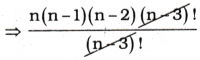
= 132 × 10
⇒ n(n – 1)(n – 2)
= 12 × 11 × 10
Comparing on both sides, we get
∴ n = 12
Question 2.
If nP7 = 42, find n.
Solution:
Given that nP7 = 42. nP5
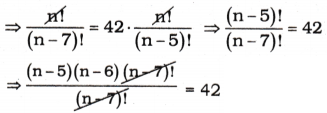
⇒ (n – 5)(n – 6) = 7 × 6
⇒ n – 5 = 7 or n – 6 = 6
Question 3.
If (n+1)P5 : nP6 = 2 : 7, find n.
Solution:
Given that (n+1)P5 : nP6 = 2 : 7
⇒ \(\frac{(n+1)!}{(n-4)!} \times \frac{(n-6)!}{n!}=\frac{2}{7}\)
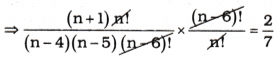
⇒ \(\frac{n+1}{(n-4)(n-5)}=\frac{2}{7}\)
⇒ 7n + 7 = 2(n2 – 9n + 20)
⇒ 2n2 – 25n + 33 = 0
⇒ (n – 1) (2n – 3) = 0
⇒ n – 11 = 0 or 2n – 3 = 0
∴ n = 11
Question 4.
If 12P5 + 5. 12P4 = 13Pr, find r.
Solution:
Given that 12P5 + 5. 12P4 = 13Pr
⇒ 13P5 = 13Pr [∵ nPr + r. nPr-1 = (n+1)Pr]
⇒ r = 5 [∵ nPr = nPs ⇒ r = s or r + s = n]

Question 5.
If 18P(r-1) : 17P(r-1) = 9 : 7, find r.
Solution:
Given that 18P(r-1) : 17P(r-1) = 9 : 7
⇒ \(\frac{{ }^{18} P_{r-1}}{{ }^{17} P_{r-1}}=\frac{9}{7}\)
⇒ \(\frac{18!}{[18-(r-1)]} \times \frac{[17-(r-1)]!}{17!}=\frac{9}{7}\)
⇒ \(\frac{18 \times 17!}{(19-r)!} \times \frac{(18-r)!}{17!}=\frac{9}{7}\)
⇒ \(\frac{18(18-r)!}{(19-r)!}=\frac{9}{7}\)
⇒ \(\frac{18(18-r)!}{(19-r)(18-r)!}=\frac{9}{7}\)
⇒ \(\frac{18}{19-r}=\frac{9}{7}\)
⇒ 19 – r = 14
⇒ r = 19 – 14
⇒ r = 5
Question 6.
Find ‘n’, If n-1P3 : nP4 = 1 : 9
Solution:
Given that \(\frac{{ }^{n-1} P_3}{{ }^n P_4}=\frac{1}{9}\)
⇒ \(\frac{\frac{(n-1)!}{(n-1-3)!}}{\frac{n!}{(n-4)!}}=\frac{1}{9}\)
⇒ \(\frac{(n-1)!}{(n-4)!} \times \frac{(n-4)!}{n!}=\frac{1}{9}\)
⇒ \(\frac{(n-1)!}{n \times(n-1)!}=\frac{1}{9}\)
⇒ \(\frac{1}{n}=\frac{1}{9}\)
⇒ n = 9
Question 7.
Find r, if
i) 5Pr = 2Pr-1 = 2 6Pr-1
Solution:
\(\frac{5!}{(5-r)!}=\frac{2 \times 6!}{(6-r+1)!}\)
⇒ \(\frac{5!}{(5-r)!}=\frac{2 \times 6 \times 5!}{(7-r)!}\)
⇒ \(\frac{5!}{(5-r)!}=\frac{2 \times 6 \times 5!}{(7-r)(6-r)(5-r)!}\)
⇒ 1 = \(\frac{2 \times 6}{(7-r)(6-r)}\)
⇒ (7 – r)(6 – r) = 12
⇒ 42 – 6r – 7r + r2 = 12
⇒ r2 – 13r + 30 = 0
⇒ r2 – 3r – 10r + 30 = 0
⇒ r(r – 3) – 10(r – 3) = 9
⇒ (r – 3)(r – 10) = 0
nPr = \(\frac{n!}{(n-r)!}\) where 0 ≤ r ≤ n
0 ≤ r ≤ 5
∴ r = 3 but r ≠ 10
ii) 5Pr = 6Pr-1
Solution:
⇒ \(\frac{5!}{(5-r)!}=\frac{6!}{(6-r+1)!}\)
⇒ \(\frac{5!}{(5-r)!}=\frac{6 \times 5!}{(7-r)!}\)
⇒ \(\frac{1}{(5-r)!}=\frac{6}{(7-r)(6-r)(5-r)!}\)
⇒ 1 = \(\frac{6}{(7-r)(6-r)}\)
⇒ (7 – r)(6 – r) = 6
⇒ 42 – 7r – 6r + r2 – 6 = 0
⇒ r2 – 13r + 36 = 0
⇒ r2 – 4r – 9r + 36 = 0
⇒ r(r – 4) – 9(r – 4) = 0
⇒ (r – 4)(r – 9) = 0
⇒ r – 4 = 0 or r – 9 = 0
When nPr = \(\frac{n!}{(n-r)!}\) where 0 ≤ r ≤ n,
∴ 0 ≤ r ≤ 5
Hence, r ≠ 9, ∴ r = 4
Question 8.
A man has 4 sons and there are 5 schools within his reach. In how many ways can he admit his sons in the schools so that no two of them will be in the same school.
Solution:
The number of ways of admitting 4 sons into 5 schools if no two of them will be in the same school = 5P4 = 5 × 4 × 3 × 2 = 120
Question 9.
How many 3-digit numbers can be formed by using the digits 1 to 9 if no digit is repeated ?
Solution:
3 digit numbers have to be formed using the digits 1 to 9.
Here, the order of the digit’s matters.
Therefore, there will be as many 3-digit numbers as there are permutations of 9 different digits taken 3 at a time.
So, the required number of 3-digit numbers 9!
= 9P3 = \(\frac{9!}{(9-3)!}=\frac{9!}{6!}=\frac{9 \times 8 \times 7 \times 6!}{6!}\) = 9 × 8 × 7 = 504.
Question 10.
How many 4-digit numbers are there with no-digit repeated ?
Solution:
The thousands place of the 4-digit number is to be filled with any of the digits from 1 to 9 as the digit 6 cannot be included. Therefore, the number of ways in which thousands place can be filled with 1 to 9.
The hundreds, tens and unit places can be filled with any of the digits from 0 to 9.
However, the digits cannot be repeated in the 4-digit numbers and thousands place is already occupied with a digit. The hundred’s, ten’s and unit places are to be filled by the remaining 9 digits.
Therefore, there will be as many such different ways as there are permutations of 9 different digits taken 3 at a time.
So, number of ways to fill remaining 3 places
= 9P3 = \(\frac{9!}{(9-3)!}=\frac{9!}{6!}=\frac{9 \times 8 \times 7 \times 6!}{6!}\)
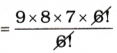
= 9 × 8 × 7 = 504.
Hence by multiplication principle, the required number of 4-digit numbers is 9 × 504 = 4536.
Question 11.
How many 3-digit even numbers can be made using the digits 1, 2, 3, 4, 6, 7 if no digits is repeated ?
Solution:
3-digit even numbers are to be formed using the given six digits 1, 2, 3, 4, 6 and 7, without repeating the digits.
Then, unit’s digits can be filled in 3 ways with any of the digits 2, 4 or 6.
Since, the digits cannot be repeated in the 3-digit numbers and units place is already occupied with 9.
Therefore, the number of ways in which hundreds and tens place can be filled with the remaining 5 digits is the permutation of 5 different digits taken 2 at a time.
So, number of ways of filling hundreds and tens place.
= 5P2 = \(\frac{5!}{(5-2)!}=\frac{5!}{3!}=\frac{5 \times 4 \times 3!}{3!}\)
= 5 × 4 = 20
Hence, by multiplication principle, the required number of 3 digit even numbers = 3 × 20 = 60.
Question 12.
Find the number of 4 digit numbers that can be formed using the digits 1, 2, 3, 4, 5 if no digit is repeated. How many of these will be even ?
Solution:
4 digit numbers are to be formed using the digits 1, 2, 3, 4 and 5.
There will be as many 4 digit number as there are permutations of 5 different digits taken 4 at a time.
Therefore, required numbers of 4 digit numbers
5P4 = \(\frac{5!}{(5-4)!}=\frac{5!}{1!}=\frac{5 \times 4 \times 3 \times 2 \times 1}{1}\) = 120
Among the 4-digit numbers formed by using the digits 1, 2, 3, 4, 5, even numbers end with either 2 or 4.
The number of ways in which units place is filled with digits is 2.
Since the digits are not repeated and the units place is already occupied with a
digit (which is even) the remaining places are to be filled by the remaining 4 digits.
Therefore, the number of ways in which the remaining places can be filled is the permutation of 4 different digits taken 3 at a time.
Number of ways of filling the remaining places = 4P3 = \(\frac{4!}{(4-3)!}\) = 4 × 3 × 2 × 1 = 24
Thus by multiplication principle, the required number of even numbers is 24 × 2 = 48.
Question 13.
From a committee of 8 persons, in how many ways can we choose a chairman and a vice-chairman assuming one person cannot hold more than one position?
Solution:
From a committee of 8 persons, a chairman and a vice chairman are to be chosen in such a way that one person cannot hold more than one position.
Here, the number of ways choosing a chairman and vice-chairman is the permutation of 8 different objects taken 2 at a time.
Therefore, required number of ways = 8P2 = \(\frac{8!}{(8-2)!}=\frac{8!}{6!}=\frac{8 \times 7 \times 6!}{6!}\) = 56
Question 14.
Find the number of 4-digit numbers that can be formed using the digits 1, 2, 4, 5, 7, 8 when repetition is allowed.
Solution:
The number of 4 digited numbers that can be formed using the digits 1, 2, 4, 5, 7, 8 when repetition is allowed = 64 = 1296.
Question 15.
Find the number of 5 letter words that can be formed using the letters of the word RHYME if each letter can be used any number of times.
Solution:
The number of 5 letter words that can be formed using the letters of the word RHYME if each letter can be used any number of times = 55 = 3125.
Question 16.
Find the number of functions from a set A containing 5 elements into a set B containing 4 elements. (Hint : The total number of functions from set A containing m elements to set B containing n elements is nm.)
Solution:
Set A contains 5 elements. Set B contains 4 elements.
For the image of each of the 5 elements of the set, A has 4 choices.
∴ The number of functions from set A containing 5 elements into a set B containing 4 elements = 4 × 4 × 4 × 4 × 4 (5 times) = 45 = 1024.
Question 17.
Find the number of ways of arranging the letters of the words,
(i) MATHEMATICS
(ii) SINGING
(iii) PERMUTATION
(iv) COMBINATION
(v) INTERMEDIATE
Solution:
(i) MATHEMATICS : The word MATHEMATICS contains 11 letters in which there are 2 M’s are alike, 2 A’s are alike, 2 T’s are alike and rest are different.
∴ The number of required arrangements = \(\frac{11!}{2!2!2!}\)
(ii) SINGING : The word SINGING contains 7 letters in which there are 2 I’s are alike, 2. N’s are alike, 2 G’s are alike and rest is different.
∴ The number of required arrangements = \(\frac{7!}{2!2!2!}\)
(iii) PERMUTATION : The word PERMUTATION contains 11 letters in which there are 2 T’s are alike and rest are different.
∴ The number of required arrangements = \(\frac{11!}{2!}\)
(iv) COMBINATION : The word COMBINATION contains 11 letters in which there are 2 O’s are alike, 2 I’s are alike, 2 N’s are alike and rest are different.
∴ The number of required arrangements = \(\frac{11!}{2!2!2!}\)
(v) INTERMEDIATE : The word INTERMEDIATE contains 12 letters in which there are 2 I’s are alike, 2 Ts are alike, 3 E’s are alike and rest are different.
∴ The number of required arrangements = \(\frac{12!}{2!2!3!}\)
Question 18.
In how many of the distinct permutations of the letters in MISSISSIPPI do the four I’s not come together ?
Solution:
In the given word MISSISSIPPI, I appear 4 times, S appears 4 times, P appears 2 times, and M appears just once.
Therefore, number of distinct permutation of letters in the given word.
\(\frac{11!}{4!4!2!}=\frac{11 \times 10 \times 9 \times 8 \times 7 \times 6 \times 5 \times 4!}{4!\times 4 \times 3 \times 2 \times 1 \times 2 \times 1}\)
= 11 × 10 × 9 × 7 × 5
= 34650
There are 4 Ts in the given word when they occur together, they are treated as a single object for the time being. This single object Till’ together with the remaining 7 objects will account 8 objects.
These 8 objects in which there 4 ‘S’ and 2 ‘P’ can be arranged in
\(\frac{8!}{4!2!}=\frac{8 \times 7 \times 6 \times 5 \times 4!}{4!\times 2 \times 1}\)
= 840 ways
Number of arrangements where all ‘I’ occur together = 840. Hence, number of distinct permutations of the letter in MISSISSIPI in which four T do not come together = 34650 – 840 = 33810.
Question 19.
If there are 25 railway stations on a railway line, how many types of single second class tickets must be printed, so as to enable a passenger to travel from one station to another.
Solution:
Number of stations on a railway line 25.
∴ The number of single second class tickets must be printed so as to enable a passenger to travel from one station to another 25P2 = 25 × 24 = 600
Question 20.
Find the number of ways of arranging the letters to the word TRIANGLE so that the relative positions of the vowels and consonants are not disturbed.
Solution:
Vowels A, E, I, O, U.
In a given word, the number of vowels is 3, number of consonants is 5

Since the relative positions of the vowels and consonants are not disturbed, the 3 vowels can be arranged in their relative positions in 3! ways and the 5 consonants can be arranged in their relative positions in 5! ways.
∴ The number of required arrangements = (3!) (5!) = 6 × 120 = 720
II.
Question 1.
How many words, with or without meaning can be made from the letters of the word MONDAY, assuming that no letter is repeated, if.
i) 4 letters are used at a time
ii) all letters are used at a time
iii) all letters are used but first letter is a vowel ?
Solution:
The word MONDAY contains 6 different letters.
i) Number of 4 letter words that can be formed from the letters of the word MONDAY, without repetition of letters is the number of permutations of 6 different objects taken 4 at a time is
6P4 = \(\frac{6!}{(6-4)!}=\frac{6!}{2!}\) = 6 × 5 × 4 × 3 = 360.
ii) Number of words that can be formed by using all the letters of word MONDAY at a time is the number of permutations of 6 different objects taken 6 at time is 6P6 = 6! = 720.
iii) In the given word, there are 2 different vowels, which have to occupy the right most place of the words formed in 2 ways only. The letters cannot be repeated and right most place is already occupied with a letter, the remaining five places are to be filled by the remaining 5 letters is 5! ways.
∴ The required number of words that can be formed is 5! × 2 = 120 × 2 = 240.
Question 2.
In how many ways can the letters of the word PERMUTATIONS be arranged if the
i) words start with P and end with S,
ii) vowels are all together
iii) there are always 4 letters between P and S ?
Solution:
i) If P and S are fixed at the extreme ends (P at the left end S at the right end), then 10 letters are left. So in this case, required number of arrangements are
\(\frac{10!}{2!}=\frac{10 \times 9 \times 8 \times 7 \times 6 \times 5 \times 4 \times 3 \times 2!}{2!}\) = 1814400
ii) There are 5 vowels in the given word. Each appearing only once since they have to always occur together, they are treated as a single object for the time being. This single object together with the remaining 7 objects will account for 8 objects.
These 8 objects in which there are 2 ‘T’ can be arranged in a \(\) ways.
Corresponding to each of these arrangements, the 5 different vowels can be arranged in 5! ways. Therefore, the required number of arrangements can be
\(\frac{8!}{2!}\) × 5!
= \(\frac{8 \times 7 \times 6 \times 5 \times 4 \times 3 \times 2!}{2!}\) × 120 = 2419200
iii) The letters have to be arranged in such a way that there are always 4 letters P and S. Therefore, in a way, the places of P and S are fixed. The remaining 10 letters in \(\frac{10!}{2!}\) which there are 2 ‘T’ can be arranged in yyy ways. For the places P and S, there are 7 following cases
P and S can take the position of 1 and 6, P and S can take the position of 2 and 7. P and S can take the position of 3 and 8, P and S can take the position of 4 and 9. P and S can take the position of 5 and 10, P and S can take the position of 6 and 11. P and S can take the position of 7 and 12.
Also the letters P and S can interchange in two ways.
So, the ways to arrange P and S such that there are 4 letters between them in 2 × 7 = 14 ways.
Therefore, by multiplication principle, required number of arrangements in this case is
\(\frac{10!}{2!}\) × 14 = \(\frac{10 \times 9 \times 8 \times 7 \times 6 \times 5 \times 4 \times 3 \times 2!}{2!}\) × 14 = 25401600
Question 3.
Find the sum of all 4 digited numbers that can be formed using the digits 0, 2, 4, 7, 8, without repetition.
Solution:
Here n = 5, r = 4, digits are {0, 2, 4, 7, 8}.
Hence, the sum of all 4 digited numbers that can be formed using the digits {0, 2, 4, 7, 8} without repetition is
(5 – 1)P(4 – 1) × (0 + 2 + 4 + 7 + 8) × (1111) – (5 – 2)P(4 – 2) × (0 + 2 + 4 + 7 + 8) × (111)
= 4P3 (21) × 1111 – 3P2 (21) (111)
= 24 × 21 × 1111 – 6 (21) (111)
= 21 (26664) – 21 (666)
= 21 (26664-666)
= 21 (25998)
= 545958
Question 4.
Find the number of numbers that are greater than 4000 which can be formed using the digits 0, 2, 4, 6, 8 without repetition.
Solution:
While forming any digit number With the given digits, zero cannot be filled in the first place.
We can fill the first place with the remaining 4 digits. The remaining places can be filled with the remaining 4 digits. All the numbers of 5 digits are greater than 4000. In the 4-digit numbers, the number starting with 4 or 6 or 8 are greater than 4000.
The number of 4-digit numbers that begin with 4 or 6 or 8 = 3 × 4P3 = 3 × 24 = 72
The number of 5-digit numbers = 4 × 4! = 4 × 24 = 96
∴ The number of numbers greater than 4000 is 72 + 96 = 168.
III.
Question 1.
Find the number of ways of arranging 10 students A1, A2 …. A10 in a row such that
(i) A1, A2, A3 sit together.
(ii) A1, A2, A3 sit in a specified order.
(iii) A1, A2, A3 sit together in a specified order.
Solution:
A1, A2 …. A10 are the ten students.
i) Consider A1, A2, A3 as one unit and A4, A5, A6, A7, A8, A9, A10 as seven units. These 8 units can be arranged in 8! ways.
The students A1, A2, A3 in one unit can be arranged among themselves in 3! ways. The number of ways arranging 10 students in which A1, A2, A3 sit together = (8!) (3!)
ii) To arrange A1, A2, A3 to sit in a specified order,
A1, A2, A3 can arrange in 10 positions in specific order in \(\frac{{ }^{10} \mathrm{P}_3}{3!}\) ways.
The remaining 7 people can be arranged in the remaining places in 7! ways.
∴ The number of ways of A1, A2, A3 sit in a specific order = \(\frac{10!}{7!3!}\) × 7! = \(\frac{10!}{3!}\)
iii) To arrange A1, A2, A3 sit together in a specified order.
Consider A1, A2, A3 in that order as one unit. Now there are 8 objects, they can be arranged in 8! ways.
∴ The number of ways of A1, A2, A3 sit together in specified order = 8! ways.
Question 2.
Find the sum of all 4 digited numbers that can be formed using the digits 1, 2, 4, 5, 6 without repetition.
Solution:
Here n = 5, r = 4, digits = {1, 2, 4, 5, 6}.
The sum of all 4 digited numbers that can be formed using the digits 1, 2, 4, 5, 6 without repetition is
(5-1)P(4-1) × (1 + 2 + 4 + 5 + 6) × (1111)
= 4P3 (18) (1111)
= 24 × 18 × 1111
= 4,79,952
Question 3.
9 different letters of an alphabet are given. Find the number of 4 letter words that can be formed using these 9 letters which have
(i) no letter is repeated
(ii) atleast one letter is repeated.
Solution:
The number of 4 letter words that can be formed from 9 different letters of an alphabet when repetition is allowed = 94 = 6561.
i) The number of 4 letter words the can be formed 9 different letters of an alphabet when no letter is repeated = 9P4 = 9 × 8 × 7 × 6 = 3024.
ii) The number of 4 letter words that can be formed from 9 different letter of an alphabet with atleast one letter is repeated.
= 94 – 9P4 = 6561 – 3024 = 3537.
Question 4.
Find the number of 4-digit numbers that can be formed using the digits 0, 1,2, 3, 4, 5 which are divisible by 6 when repetition of the digits is allowed.
Solution:
im-6
5 ways 6ways 7 ways 8 ways
Given digits 0, 1,2, 3, 4, 5 these are consecutive digits.
Total number of 4-digit numbers = 5 × 63.
Among these total numbers some of the numbers are divisible by ‘6’.
By fixing first places with some fixed digits from 1, 2, 3, 4, 5 and 2nd, 3rd places with some fixed digits 0, 1, 2, 3, 4, 5 we get the following consecutive numbers.
a1, a2, a3, 0
a1, a2, a3, 1
a1, a2, a3, 2
a1, a2, a3, 3
a1, a2, a3, 4
a1, a2, a3, 5
We know that out of any 6 consecutive integers exactly 1 is divisble by 6.
∴ \(\frac{1}{6}\)th of these 5 × 63 numbers are divisible by ‘6’.
Hence, required number = \(\frac{1}{6}\) × 5 × 6 = 5 × 36 = 180.
Question 5.
Find the number of ways of arranging the letters of the word ASSOCIATIONS. In how many of them
(i) all the three S’s come together
(ii) The two A’s do not come together
Solution:
The given word ASSOCIATIONS has 12 letters in which there are 2 As are alike, 3 Ss are alike, 2 O’s are alike, 2 I’s are alike and rest are different.
They can be arranged = \(\frac{12!}{2!3!2!2!}\)
i) Treat the 3 S’s as one unit. Then we have 9 + 1 = 10 entities in which there are 2 A’s are alike, 2 O’s are alike, 2 I’s are alike and rest are different.
They can be arranged in \(\frac{(10)!}{2!2!2!}\) ways.
The 3 S’s among themselves can be arranged in \(\frac{3!}{3!}\) = 1 way.
∴ The number of required arrangements = \(\frac{(10)!}{2!2!2!}\)
ii) Since 2 A’s do not come together, first arrange the remaining 10 letters in which there are 3. S’s are alike, 2 O’s are alike 2 I’s are alike and rest are different in \(\frac{(10)!}{3!2!2!}\) Ways.
Then we can find 11 gaps between them. The 2 A’s can be arranged in these 11 gaps in \(\frac{{ }^{11} \mathrm{P}_2}{2!}\) ways.
∴ The number of required arrangements = \(\frac{(10)!}{3!2!2!} \times \frac{{ }^{11} \mathrm{P}_2}{2!}\)