Students must practice these TS Intermediate Maths 1B Solutions Chapter 4 Pair of Straight Lines Ex 4(b) to find a better approach to solving the problems.
TS Inter 1st Year Maths 1B Pair of Straight Lines Solutions Exercise 4(b)
I.
Question 1.
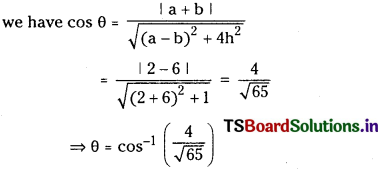
Find the angle between the lines represented by 2x2
2x2 + xy – 6y2 + 7y – 2 = 0. (V.S.A.Q.)
Answer:
Comparing with the general equation
ax2 + 2hxy + by2 + 2gx + 2fy + c = 0 …………………….. (1)
We have a = 2, h = \(\frac{1}{2}\), b = – 6, g = 0, f = \(\frac{7}{2}\), c = – 2.
Also if θ is the angle between pair of lines (1)

Question 2.
Prove that the equation 2x2 + 3xy – 2y2 + 3x + y + 1 = 0 represents a pair of perpendicular lines. (V.S.A.Q.)
Answer:
We have coefficient of x2 = 2 ⇒ a = 2
and coefficient of y2 = – 2 ⇒ b = – 2
Since a + b = 0; the lines are perpendicular.
II.
Question 1.
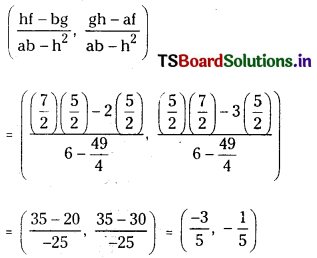
Prove that the equation 3x2 + 7xy + 2y2 + 5x + 5y + 2 = 0 represents a pair of straight lines and find the coordinates of the point of intersection. (S.A.Q.)
Answer:
Comparing the given equation
3x2 + 7xy + 2y2 + 5x + 5y + 2 = 0 with the general equation ax2 + 2hxy + by2 + 2gx + 2fy + c = 0, we get a = 3, h = \(\frac{7}{2}\), b = 2, g = \(\frac{5}{2}\), f = \(\frac{5}{2}\) and c = 2.
∆ = abc + 2fgh – af2 – bg2 – ch2
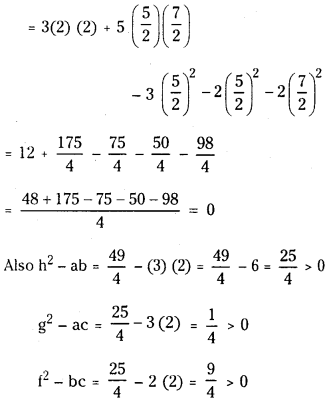
∴ The given equation represents a pair of lines and point of intersection is
Question 2.
Find the value of k, if the equation 2x2 + kxy – 6y2 + 3x + y + 1 = 0 represents a pair of straight lines. Find the point of intersection of the lines and the angle between the straight lines for this value of k. (E.Q.)
Answer:
Comparing
2x2 + kxy – 6y2 + 3x + y + 1 = 0 with the general equation, we get
a = 2, h = \(\frac{\mathrm{k}}{2}\), b = -6, g = \(\frac{3}{2}\), f = \(\frac{1}{2}\), c = 1
The given equation represents a pair of straight lines if abc + 2fgh – af2 – bg2 – ch2 = 0 (necessary condition)
⇒ – 12 + 2\(\left(\frac{1}{2}\right)\left(\frac{3}{2}\right)\left(\frac{k}{2}\right)\) – 2\(\left(\frac{1}{4}\right)\) + 6\(\left(\frac{9}{4}\right)-\frac{k^2}{4}\) = 0
⇒ – 48 + 3k – 2 + 54 – k2 = 0
⇒ – k2 + 3k + 4 = 0 ⇒ k2 – 3k – 4 = 0
⇒ (k – 4) (k + 1) = 0 ⇒ k = 4 or – 1
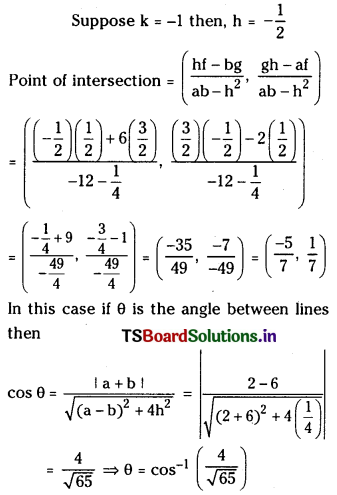
Case (i):
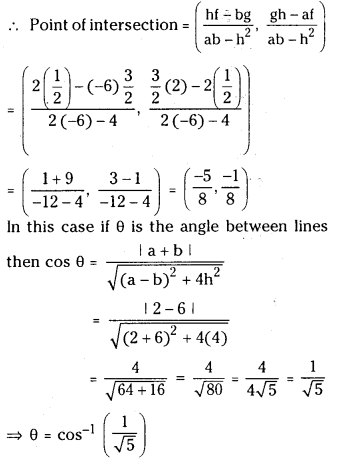
Case (ii):
When k = 4, then h = 2
Question 3.
Show that the equation x2 – y2 – x + 3y – 2 = 0 represents a pair of perpendicular lines and find their equations. (S.A.Q.)
Answer:
First we show that the given equation x2 – y2 – x + 3y – 2 = 0 represents a pair of lines comparing with the general equation
we get a = 1, b = -1, g = \(\frac{-1}{2}\), f = \(\frac{3}{2}\), h = 0, c = -2
∴ abc + 2fgh – af2 – bg2 – ch2
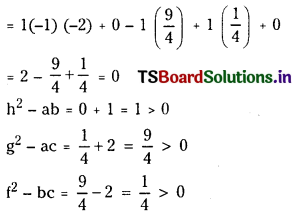
Hence the given equation represents a pair of lines. Coefficient of x2 + coefficient of y2 = 1 – 1 = 0
∴ The given equation represents a pair of perpendicular lines.
Let x2 – y2 – x + 3y – 2
= (x + y + c1) (x – y + c2)
Equating coefficients of x and y both sides
we get c1 + c2 = – 1 and – c1 + c2 = 3
Solving 2c2 = 2 ⇒ c2 = 1
and c1 + c2 = -1 ⇒ c1 = -2
∴ Equations of lines are x + y – 2 = 0 and x – y + 1 = 0.
Question 4.
Show that the lines x2 + 2xy – 35y2 – 4x + 44y – 12 = 0 and 5x + 2y – 8 = 0 are concurrent. (S.A.Q.)
Answer:
Given x2 + 2xy – 35y2 – 4x + 44y – 12 = 0 and comparing this with general equation we get a = 1, h = 1, b = – 35, g = -2, f = 22, c = – 12
Point of intersection
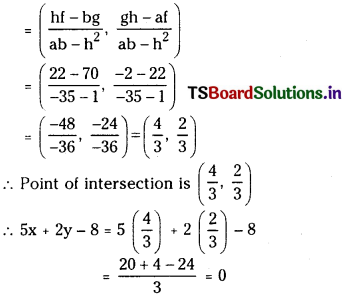
∴ The point of intersection lies on the line 5x + 2y – 8 = 0.
Hence the given lines are concurrent.
Question 5.
Find the distance between the following pairs of parallel straight lines. (V.S.A.Q.)
(i) 9x2 – 6xy + y2 + 18x – 6y + 8 = 0
(ii) x2+ 2√3 xy + 3y2 – 3x – 3√3 y – 4 = 0
Answer:
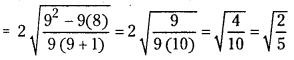
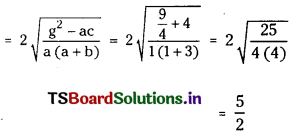
(i) The formula for distance between parallel lines = \(\sqrt{\frac{g^2-a c}{a(a+b)}}\)
(ii) Distance between given parallel lines
Question 6.
Show that the two pairs of lines 3x2 + 8xy – 3y2 = 0 and 3x2 + 8xy – 3y2 + 2x – 4v – 1 = 0 form a square. (S.A.Q.)
Answer:
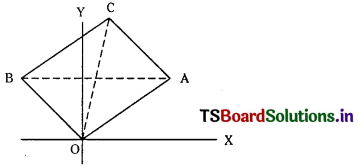
Given equations of lines represented by OA and OB is 3x2 + 8xy – 3y2 = 0
⇒ (x + 3y) (3x – y) = 0
⇒ x + 3y = 0, 3x – y = 0
∴ Equation of OA is 3x – y = 0 ………………… (1)
Equation of OB is x + 3y = 0 ……………… (2)
The combined equation of CA and CB is
3x2 + 8xy – 3y2 + 2x – 4y – 1 = 0 …………….. (3)
Let 3x2 + 8xy – 3y2 + 2x – 4y – 1
= (3x – y + c1) (x + 3y + c2)
Equating the coefficients of x and y on both sides,
and c1 + 3C2 = 2
3c1 – c2 = – 4
Solving
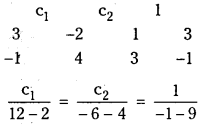
⇒ c1 = – 1, c2 = 1
Equation of BC is 3x – y – 1 = 0 ……………………. (4)
Equation of AC is x + 3y + 1 = 0 …………………… (5)
Equations OA and BC differ by a constant.
⇒ OA is parallel to BC.
Equations OB and CA differ by a constant
⇒ OB is parallel to AC.
Also from equation (3), OACB is a rectangle and a + b = 3 – 3 = 0
OA = Length of the perpendicular from O to
AC = \(\frac{|0+0+1|}{\sqrt{1+9}}=\frac{1}{\sqrt{10}}\)
OB = Length of the perpendicular from O to
BC = \(\frac{|0+0-1|}{\sqrt{9+1}}=\frac{1}{\sqrt{10}}\)
∴ OA = OB and OACB is a rectangle
⇒ OACB is a square.
III.
Question 1.
Find the product of the length of the perpendiculars drawn from (2, 1) upon the lines (E.Q.)
12x2 + 25xy + 12y2 + 10x + 11y + 2 = 0
Answer:
Given equation
12x2 + 25xy + 12y2 + 10x + 11y + 2 = 0
represents the combined equation of AB & AC.
12x2 + 25xy + 12y2
= 12x2 + 16xy + 9xy + 12y2
= 4x (3x + 4y) + 3y (3x + 4y)
= (3x + 4y) (4x + 3y)
Let 12x2 + 25xy + 12y2 + 10x + 11y + 2 = (3x + 4y + c1) (4x + 3y’ + C2)
Equating the coefficients of x and y
4c1 + 3C2 = 10 ………………. (1)
and 3c1 + 4c2 = 11 ………………. (2)
Solving (1) and (2)
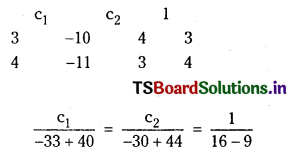
⇒ c1 = 1, c2 = 2
∴ Equation of AB is 3x + 4y + 1 = 0
and equation of AC is 4x + 3y + 2 = 0
PL = Length of the perpendicular from
P(2, 1) on AB = \(\left|\frac{6+4+1}{\sqrt{9+16}}\right|=\frac{11}{5}\)
PM = Length of the perpendicular from
P(2, 1) on AC = \(\left|\frac{8+3+2}{\sqrt{16+9}}\right|=\frac{13}{5}\)
∴ Product of lengths of perpendiculars
= PL × PM = \(\frac{11}{5} \times \frac{13}{5}=\frac{143}{25}\)
Question 2.
Show that the straight lines y2 – 4y + 3 = 0 and x2 + 4xy + 4y2 + 5x + 10y + 4 = 0 form a parallelogram and find the lengths of its sides. (E.Q.)
Answer:
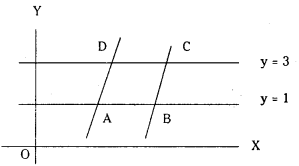
The equation of first pair of lines is y2 – 4y + 3 = 0
⇒ (y – 1) (y – 3) = 0 ⇒ y = 1 ………………….. (1)
and y = 3 ………………….. (2)
∴ AB, CD are parallel.
The equation of second pair of lines is
x2 + 4xy + 4y2 + 5x + 10y + 4 = 0
⇒ (x + 2y)2 + 5 (x + 2y) + 4 = 0
⇒ (x + 2y)2 + 4 (x + 2y) + (x + 2y) + 4 = 0
⇒ (x + 2y) [x + 2y + 4] + 1 [(x + 2y) + 4] = 0
⇒ (x + 2y + 1) (x + 2y + 4) = 0
⇒ x + 2y + 1 = 0, x + 2y + 4 = 0
Equation of AD is x + 2y + 1 = 0 ……………………. (3)
Equation of BC is x + 2y + 4 = 0 ……………………. (4)
∴ AD and BC are parallel.
Solving (1) and (3), x + 2 + 1 = 0
⇒ x = – 3
∴ Co-ordinates of A = (-3, 1)
Solving (2) and (3), x + 6 + 1 = 0 ⇒ x = -7
and coordinates of D = (-7, 3)
Solving (2) and (4) x + 6 + 4 = 0 ⇒ x = -10
∴ Coordinates of C = (-10, 3)
Solving (1) and (4), we get x + 2 + 4 = 0
⇒ x = -6
∴ Coordinates of B = (- 6, 1)
Hence A = (-3, 1), B = (-6, 1), C = (-10, 3), D = (-7, 3)
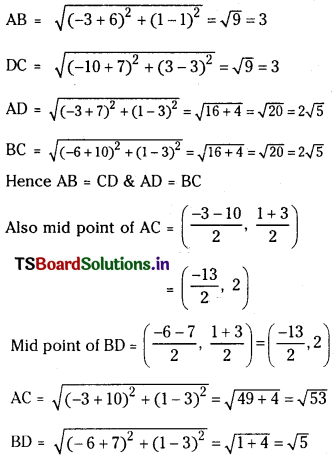
∴ AC ≠ BD
Hence a parallelogram is formed with the
lines y2 – 4y + 3 = 0 and x2 + 4xy + 4y2 + 5x + 10y + 4 = 0.
Question 3.
Show that the product of the perpendicular distances from the origin to the pair of straight lines represented by ax2 + 2hxy +
by2 + 2gx + 2fy + c = 0 is \(\frac{|c|}{\sqrt{(a-b)^2+4 h^2}}\) (E.Q.)
Answer:
Let ax2 + 2hxy + by2 + 2gx + 2fy + c = 0 represent the lines
l1x + m1y + n1 = 0 ……………. (1)
and l2x + m2y + n2 = 0 ……………. (2)
∴ ax2 + 2hxy + by2 + 2gx + 2fy + c
= (l1x + m1y + n1) (l2x + m2y + n2)
∴ l1l2 = a, m1m2 = b, l1m2 + l2m1 = 2h,
l1n2 +l2n1 = 2g, m1n2 + m2n1 = 2f, n1n2 = c
∴ Perpendicular distance from origin to (1) is
= \(\frac{\left|\mathrm{n}_1\right|}{\sqrt{l_1^2+\mathrm{m}_1^2}}\)
Perpendicular distance from origin to (2) is
= \(\frac{\mathrm{n}_2}{\sqrt{l_2^2+\mathrm{m}_2^2}}\)
Product of perpendiculars
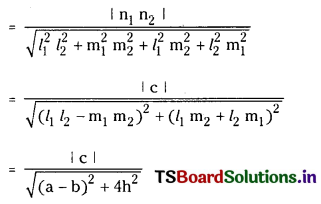
Question 4.
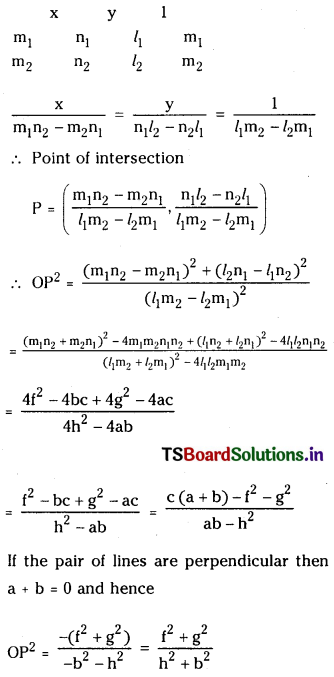
If the equation ax2 + 2hxy + by2 + 2gx + 2fy + c = 0 represent a pair of intersecting lines, then show that the square of the distance of their point of intersection from the origin is \(\). Also show that the square of this distance is \(\frac{f^2+g^2}{h^2+b^2}\) if the given lines are perpendicular. (E.Q.)
Answer:
Let the equation
ax2 + 2hxy + by2 + 2gx + 2fy + c = 0 represent the lines
l1x + m1y + n1 = 0 ………………. (1)
and l2x + m2y + n2 = 0 ……………….. (2)
∴ (l1x + m1y + n1) (l2x + m2y + n2)
= ax2 + 2hxy + by2 + 2gx + 2fy + c
Comparing coefficients
l1l2 = a, m1 m2 = b, n1n2 = c
l1m2 + l2m1 = 2h, l1n2 + l2n1 = 2g and
m1n2 + m2n1 = 2f
From (1) and (2) on solving