
Regular practice with AP Inter 1st Year Physics Study Material Chapter 5 Work, Energy and Power Questions and Answers helps students stay prepared for examinations.
AP Inter 1st Year Physics 5th Lesson Work, Energy and Power Questions and Answers
I. Multiple Choice Questions
Question 1.
A man lifted a box of 50 N weight steadily from a ground to a height of 8 m. Then the workdone by him on the box is [ ]
(1) 25 J
(2) 100 J
(3) 200 J
(4) 400 J
Hint: w = mgh = 50 × 8 = 400 J
Answer:
(4) 400 J
Question 2.
Two masses 2 kg and 8 kg are moving with equal kinetic energies. The ratio of the magnitudes of their linear momenta is
(1) 1 : 4
(2) 4 : 1
(3) 1 : 2
(4) 2 : 1
Hint: KE = \(\frac{\mathrm{p}^2}{2 \mathrm{~m}}\) ⇒ p2 ∝ m => 2m
Answer:
(3) 1 : 2
Question 3.
Internal forces can change
(1) the linear momentum, not kinetic energy.
(2) the kinetic energy, not the linear momentum.
(3) linear momentum as well as kinetic energy.
(4) neither the linear momentum nor the kinetic energy.
Answer:
(2) the kinetic energy, not the linear momentum.
Question 4.
The kinetic energy of a body is 4 times its momentum. Then the speed of the body is [ ]
(1) 8 m/s
(2) 4 m/s
(3) 2 m/s
(4) 10 m/s
Hint: KE = \(\frac{p^2}{2 m}\) ⇒ 4p = \(\frac{\mathrm{p}^2}{2 \mathrm{~m}}\) ⇒ p = 8m ⇒ mv = 8m ⇒ v = 8m/s.
Answer:
(1) 8 m/s
Question 5.
A man increases the speed of his car from 20 m/s to 40 m/s on a smooth road. The ratio of final kinetic energy to the initial kinetic energy is [ ]
(1) 1 : 4
(2) 4 : 1
(3) 1 : 2
(4) 2 : 1
Hint: KE = \(\frac{1}{2}\)mv2 ⇒ \(\frac{\mathrm{KE}_2}{\mathrm{KE}_1}\) = \(\frac{V_2^2}{V_1^2}\) = \(\frac{40^2}{20^2}\) = \(\frac{40 \times 40}{20 \times 20}\) = \(\frac{4}{1}\)
Answer:
(2) 4 : 1
Question 6.
The work energy theorem states that the change in kinetic energy of a body is equal to the network done by [ ]
(1) all conservative and non-conservative forces only
(2) all external and internal forces only
(3) all pseudo forces only
(4) all types of forces
Answer:
(4) all types of forces
Question 7.
A body is falling freely under the action of gravity alone in vacuum. Which of the following quantities remain constant during the fall? [ ]
(1) Kinetic energy
(2) Potential energy
(3) Total mechanical energy
(4) Total linear momentum
Answer:
(3) Total mechanical energy
Question 8.
The work done by weight lifter holding a 150 kg mass steadily on his shoulder in a time of 30 second is [ ]
(1) 450 J
(2) 180 J
(3) 0 J
(4) 50 J
Answer:
(3) 0 J
Question 9.
A person fires a bullet of mass 50 gram with a speed of 200 m/s on a soft plywood of thickness 2cm. The bullet emerges with 10% of its initial kinetic energy. Then its final kinetic energy is
(1) 500 J
(2) 1000 J
(3) 2000 J
(4) 100 J
Answer:
(4) 100 J
Question 10.
The elastic potential energy of a spring of force constant K for an extension x is
(1) Kx
(2) 1/2 K x2
(3) 1/2 Kx
(4) 1/2 K2x
Answer:
(2) 1/2 K x2

Question 11.
The elastic potential energy of a spring of force constant K for an extension x is [ ]
(1) Kx
(2) 1/2 Kx
(3) 1/2 K.x
(4) 1/2 K2x
Answer:
(2) 1/2 Kx
Question 12.
A bob of mass M is suspended by light string of length L. The speed of the bob at the lowest point of vertical circular path is [ ]
(1) \(\sqrt{\mathrm{gL}}\)
(2) \(\sqrt{2 \mathrm{gL}}\)
(3) \(\sqrt{3 \mathrm{gL}}\)
(4) \(\sqrt{5 \mathrm{gL}}\)
Answer:
(4) \(\sqrt{5 \mathrm{gL}}\)
II. Fill in the Blanks
Question 1.
The work done by a conservative force in moving a body aiong a closed path is ____.
Answer:
zero
Question 2.
Kinetic energy is lost in case of ________________ collisions.
Answer:
inelastic
Question 3.
The rate at which work done is called ____.
Answer:
power
Question 4.
5kWh = _____________ joules
Answer:
18 × 106
Question 5.
The power utilized when work of 1000 J is done in 2 seconds is ___.
Answer:
500 watt
Question 6.
The compressed or elongated spring possesses ____ energy.
Answer:
potential
Question 7.
A force f = 5i + 3j +2 k N is applied over a particle which displaces it from its origin to the point r = (3i – 2j) m. The work done on the particle is ___.
Answer:
9J
Question 8.
Sailing ship employ ____ energy of the wind.
Answer:
kinetic
Question 9.
The area under force-displacement curve is ___.
Answer:
work done
Question 10.
When two equal masses undergo oblique elastic collision with one of them at rest, after the collision they will move at ___________ to each other.
Answer:
right angles
Question 11.
1 horse power = ___________ watt.
Answer:
746
III. One Word Answer Questions
Question 1.
When a body of mass M is lifted up through a height h, what is the work done by gravitational force?
Answer:
w = -mgh as gravitational force is downward and displacement is upward.
Example of -ve work
Question 2.
Which physical quantity is conserved in all kinds of collisions?
Answer:
Momentum and Total Energy.
Question 3.
When two bodies undergo perfectly inelastic collision, what is their relative velocity after collision?
Answer:
Zero
Question 4.
A man carrying a bag of sand walks on a horizontal road with uniform velocity. What is the work done by him if the road is smooth?
Answer:
Zero (As Force and displacement are acting 900 with each other)
Question 5.
If two vectors 2\(\hat{\mathbf{i}}\) + 2\(\hat{\mathbf{j}}\) + \(\hat{\mathbf{k}}\) and 3\(\hat{\mathbf{i}}\) – 6\(\hat{\mathbf{j}}\) + n\(\hat{\mathbf{k}}\) are perpendicular to each other then what is the value of n?
Answer:
\(\overline{\mathrm{A}} \bullet \overline{\mathrm{~B}}\) = 0 (condition for vectors perpendicular)
a1b1 + a2b2 + a3b3 = 0 ⇒ (2 × 3) + (2 × (-6)) + n = 0 ⇒ 6 – 12 + n = 0 ⇒ n = 6.
Question 6.
A motor boat is going in a river with a velocity y = 7\(\hat{\mathbf{i}}\) + 2\(\hat{\mathbf{j}}\) – 5\(\hat{\mathbf{k}}\) m/s. If the resisting force due to stream is F = 9\(\hat{\mathbf{i}}\) + 3\(\hat{\mathbf{j}}\) – 3\(\hat{\mathbf{k}}\)N. What is the power of the boat?
Answer:
P = FN = (9 × 7) + (3 × 2) + [(-3) × (-5)] = 63 + 6 + 15 = 84 watts.
Question 7.
Find the angle between F = (\(\hat{\mathbf{i}}\) + 2\(\hat{\mathbf{j}}\) – \(\hat{\mathbf{k}}\))N and displacement d = (-\(\hat{\mathbf{i}}\) + \(\hat{\mathbf{j}}\) – 2\(\hat{\mathbf{k}}\))m.
Answer:

Question 8.
A body is dragged along a horizontal floor by a rope. The rope makes an angle of 60° with the horizontal. If the tension in the rope is 100 N and the body is moved through a distance of 10m, then what is the work done?
Answer:
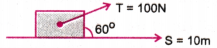
W = FS cosθ = 100 × 10 × cos60° = 500 J
Question 9.
What is the dimensional formula for force constant or spring constant?
Answer:
F = kx ; k = \(\frac{F}{x}\) = \(\frac{\mathrm{MLT}^{-2}}{\mathrm{~L}}\) = [MT-2]
IV. Very Short Answer Questions
Question 1.
State the conditions under which a force does no work.
Answer:
a) When force (F) and displacement (S) are mutually perpendicular then work done is zero.
∴ w = \(\overline{\mathbf{F}} \cdot \overline{\mathbf{S}}\) = |F| |S| cosθ when θ = 90° work W = o
b) Even though force is applied if displacement is zero then work done W = O.
Question 2.
Define Work, Power and Energy. State their S.I. units.
Answer:
Work: The product of force and displacement along the direction of force is called work.
Work done W = \(\overline{\mathrm{F}} \cdot \overline{\mathrm{~S}}\) = |F| |S|cosθ
S.I. unit of work is Joule.; Dimensional formula: ML2T-2.
Power: The rate of doing work is called power.
∴ Power = \(\frac{\text { Work done }}{\text { time }}\) = \(\frac{\mathrm{W}}{\mathrm{t}}\)
S.I. unit: Watt ; D.F. : ML2T-3
Energy : It is the capacity or ability of the body to do work.
- By spending energy we can do work or by doing work energy contentment of the body will increase.
- S.I. unit: Joule
- D.F.: ML2T-2
Question 3.
State the relation between the kinetic energy and momentum of a body.
Answer:
Kinetic energy, K.E. = \(\frac{1}{2}\)mv2 …….(1) and momentum \(\overline{\mathrm{p}}\) = mv ….. (2)
from equation (1) K.E = \(\frac{1}{2}\)mv2 (multiply with (m/m))
K.E. = \(\frac{1}{2} \mathrm{mv}^2\) × \(\frac{m}{m}\) = \(\frac{1}{2} \frac{\left(m^2 v^2\right)}{m}\)
from equation (2) \(\overline{\mathrm{p}}\) = mv, K.E. = \(\frac{1}{2} \cdot \frac{\mathrm{p}^2}{\mathrm{~m}}\)
∴ K.E. = \(\frac{p^2}{2 m}\) (Or) p = \(\sqrt{(\text { K.E. }) 2 \mathrm{~m}}\)
Question 4.
State the sign of work done by a force in the following.
a) Work done by a man in lifting a bucket out of a well by means of a rope tied to the bucket.
b) Work done by gravitational force in the above case.
Answer:
a) When a bucket is lifted out of well work is done against gravity so work done is negative.
b) Work done by gravitational force is positive.
Question 5.
State the sign of work done by a force in the following.
a) work done by friction on a body slid-ing down an inclined plane.
b) work done gravitational force in the above case.
Answer:
a) Work done by friction while sliding down is negative. Because it opposes downward motion of the body.
b) Work done by gravitational force when a body is sliding down is positive.
Question 6.
State the sign of work done by a force In the following.
a) work done by an applied force on a body moving on a rough horizontal plane with uniform velocity.
b) work done by the resistive force of air on a vibrating pendulum in bringing it to rest.
Answer:
a) Work done against the direction of motion of a body moving on a horizontal plane is negative.
b) In pendulum ∝ – y. So work done by air resistance to bring it to rest is considered as positive.
Question 7.
State if each of the following statements is true or false. Give reasons for your answer.
a) Total energy of a system is always conserved, no matter what internal and external forces on the body are present.
b) The work done by earth’s gravitational force in keeping the moon in its orbit for its one revolution is zero.
Answer:
a) Law of conservation of energy states that energy can be neither created nor destroyed. This rule is applicable to internal forces and also for external forces when they are conservative forces.
b) Gravitational forces are conservative forces. Work done by conservative force around a closed path is zero.
V. Short Answer Questions
Question 1.
What is potential energy? Derive an expression for the gravitational potential energy.
Answer:
Potential energy: It is the energy possessed by a body by the virtue of its position.
Ex: Energy stored in water a over head tank, wound spring.
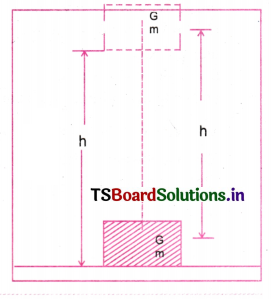
Equation for potential energy: Let a body of mass m is lifted through a height ‘h’ above the ground. Where ground is taken as reference. In this process we are doing some work.
Work done against gravity W = m.g.h.
i.e., Force × displacement along the direction of force applied. This work done is stored in the body in the form
of potential energy. Because work and energy can be interchanged.
∴ Potential Energy P.E. = mgh.
Question 2.
A lorry and a car moving with the same momentum are brought to rest by the application of brakes, which provide equal retarding forces. Which of them will come to rest in shorter time ? Which will come to rest in less distance ?
Answer:
Momentum (\(\bar{P}\) = mv) is same for both lorry and car.
Work done to stop a body = Kinetic energy stored
∴ W = F. S = \(\frac{1}{2}\)mv2 = K.E. But force applied by brakes is same for lorry and car.
Relation between \(\bar{P}\) on K.E. is’ K.E. = \(\frac{p^2}{2 m}\) = F . S or stopping distance S = \(\frac{\overrightarrow{\mathrm{P}^2}}{2 \mathrm{mF}}\)
∵ \(\bar{P}\) and \(\bar{F}\) are same S ∝ \(\frac{1}{m}\)
So lighter body (car) will travel longer distance when P, F are same.
Then mS = constant.
∴ So car travels longer distance than lorry before it is stopped.
Question 3.
Distinguish between conservative and non-conservative forces with one example each.
Answer:
i) Conservative forces : If work done by the force around a closed path is zero and it is independent of the path, then such forces are called conservative forces.
Example :
a) Work done in lifting a body in gravitational field. When the body returns to its original position work done on it is zero. So gravitational forces are conservative forces.
b) Let a charge q’ is moved in an electric field on a closed path then change in its electric potential i.e., static forces are conservative forces.
ii) Non-conservative forces: For non-conservative forces work done by a force around a closed path is not equal to zero and it is dependent on the path.
Ex : Work done to move a body against friction. While taking a body between two points say A & B. We have to do work to move the body from A to B and also work is done to move the body from B to A. As result the work done in moving the body in a closed path is not equals to zero. So frictional forces are non-conservative forces.
Question 4.
Show that two equal masses undergo oblique elastic collision will move at right angles after collision, if the second body initially at rest.
Answer:
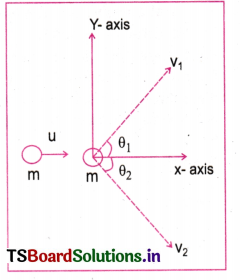
Consider two bodies possess equal mass (m) and they undergo oblique elastic collision.
Let the first body moving with initial velocity u’ collides with the second body at rest.
In elastic collision, momentum is con-served. So, conservation of momentum along X-axis yields, mu = mv1 – cos θ1 + mv2 – cos θ2
(i.e.) u = v1 cos θ1 + v2 cos θ2 …… (1)
along Y-axis
0 = v1 sin θ1 – v2 sin θ2 …… (2)
squaring and adding eq. (1) and (2) we get
u2 = \(\mathrm{v}_1^2\) + \(\mathrm{v}_2^2\) + 2v1v2 cos(θ1 + θ2) …… (3)
As the collision is elastic,
Kinetic Energy (K.E.) is also conserved.
(i.e.) \(\frac{1}{2}\)mu2 = \(\frac{1}{2} \mathrm{mv}_1^2\) + \(\frac{1}{2} \mathrm{mv}_2^2\) ⇒ u2 = \(\mathrm{v}_1^2\) + \(\mathrm{v}_2^2\) …… (4)
From eq. (3) and (4) 2v1v2 cos(θ1 + θ2) = 0
As it is given that v1 = 0 and v2 = 0
∴ cos(θ1 + θ2) = 0 or θ1 + θ2 = 90°.
The two equal masses undergoing oblique elastic collision will move at right angles after collision, if the second body initially at rest.
VI. Long Answer Questions
Question 1.
Develop the notions of work and kinetic energy and show that it leads to work-energy theorem. State the conditions under which a force does no work.
Answer:
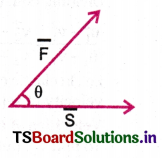
Work : The product of component of force in the direction of displacement and the magnitude of displacement is called work. W = \(\overline{\mathrm{F}} \cdot \overline{\mathrm{~S}}\)
When \(\bar{F}\) and \(\bar{S}\) are parallel W = | \(\bar{F}\) | × | \(\bar{S}\) |
When \(\bar{F}\) and \(\bar{S}\) has some angle θ between them W = \(\overline{\mathrm{F}} \cdot \overline{\mathrm{~S}}\) cos θ
Kinetic energy : Energy possessed by a moving body is called kinetic energy (k)
- The kinetic energy of an object is a measure of the work that an object can do by the virtue of its motion.
- Kinetic energy can be measured with equation K = \(\frac{1}{2}\)mv2
Ex : All moving bodies contain kinetic energy.
Work energy theorem (For variable force) :
- Work done by a variable force is always equal to the change in kinetic energy of the body.
- Work done W = \(\frac{1}{2}\)mv2 – \(\frac{1}{2} \mathrm{mV}_0^2\) = Kf – Ki
Proof : Kinetic energy of a body K = \(\frac{1}{2}\)mv2
The rate of change of kinetic energy is \(\frac{\mathrm{dk}}{\mathrm{dt}}\) = \(\frac{\mathrm{d}}{\mathrm{dt}}\left(\frac{1}{2} \mathrm{mv}^2\right)\) = \(\frac{1}{2} \mathrm{~m} .2 \mathrm{v} \cdot \frac{\mathrm{dv}}{\mathrm{dt}}\) = mv.\(\frac{d v}{d t}\)
But \(\frac{d v}{d t}\) = a
∴ \(\frac{d k}{d t}\) = mav but ma = Force (F)
∴ \(\frac{\mathrm{dk}}{\mathrm{dt}}\) = Fv = F.\(\frac{\mathrm{dx}}{\mathrm{dt}}[latex] ⇒ or dk = F.dx dt dt
When force is conservative force F = F(x)
∴ On integration over initial position (x1) and final position x2
[latex]\int_{\mathrm{i}}^{\mathrm{f}} \mathrm{dk}\) = \(\int_{x_1}^{x_2} F(x) d x\) but \(\int_{x_1}^{x_2} F(x) d x\) = work done
By variable force W ∴ W = \(\int_{\mathrm{i}}^{\mathrm{f}} \mathrm{dk}\) ⇒ W = Kf – Ki
i.e., work done by a conservative force is equal to change in kinetic energy of the body. Condition for Force not to do any work.
When Force \((\overline{\mathrm{F}})\) and displacement \((\overline{\mathrm{S}})\) are perpendicular work done is zero, i.e., when θ = 90° then W = \((\overline{\mathrm{F}})\) . \((\overline{\mathrm{S}})\) = 0
Question 2.
What are collisions ? Explain the possible types of collisions ? Develop the theory of one dimensional elastic collision.
(OR)
What are collisions ? Explain the possible types of collisions ? Show that in the case of one dimensional elastic collision, the relative velocity of approach of two colliding bodies before collision is equal to the relative velocity of separation after collision.
Answer:
A process in which the motion of a system of particles changes but keeping the total momentum conserved is called collision.
Collisions are of two types:
- Elastic and
- Inelastic.
Elastic Collision : The Collision in which momentum, kinetic energy and total energy are con-served is known as ” elastic collision.”
Ex : Collision between nuclei and fundamental particles.
Inelastic Collisions: The collisions in which only momentum and total energy are conserved but not kinetic energy is called “inelastic collision”
Ex : All are collisions we see in daily life.
To show relative velocity of approach before collision is equal to relative velocity of separation after collision.
Let two bodies of masses m1, m2 are moving with velocities u1, u2 along the same line in same direction collided elastically.
Let their velocities after collision are v1 and v2.
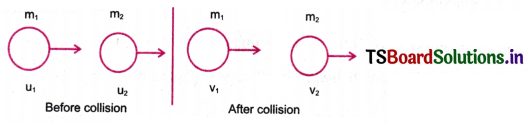
According to the law of conservation of linear momentum
m1u1 + m2u2 = m1v1 + m2v2 or m1 (u1 – v1) = m2(v2 – u2) …… (1)
According to law of conservation of kinetic energy
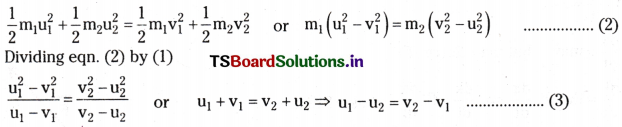
i.e., In elastic collisions relative velocity of approach of the two bodies before collision = relative velocity of separation of the two bodies after collision.
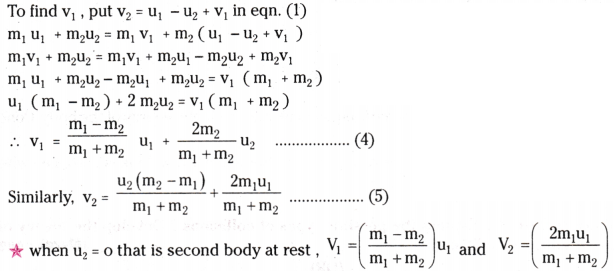
Velocities of two bodies after elastic collision :
Question 3.
State and prove law of conservation of energy in case of a freely falling body.
Answer:
Law of conservation of energy : Energy can neither be created nor destroyed. But it can be converted from one form into the another form so that the total energy will remains constant in a closed system.
Proof: In case of a freely falling body :
Let a body of mass is dropped from a height ‘H’ at point A.
Forces due to gravitational field are conservative forces, so total mechanical energy (E=P.E + K.E.) is constant i.e., neither destroyed nor created.
1. At point H : Velocity of body v = 0
⇒ K = 0
Potential energy (u) = mgH
where H=height above the ground
T.E = u + K = mgH …….. (1)
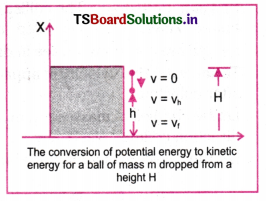
2. At point 0 : i.e., just before touching the ground : A constant force is a special case of specially dependent force F(x) so mechanical energy is conserved.
So energy at H = Energy at 0 = mgH
Proof: At point ‘0’ height h = 0 ⇒ v = \(\sqrt{2 \mathrm{gH}}\) ; u = 0
K0 = \(\frac{1}{2} \mathrm{mv}^2\) = \(\frac{1}{2} \mathrm{~m}(2 \mathrm{gH})\)(2gH) = mgH
Total energy E = mgH + 0 = mgH ………. (2)
3. At any point h: Let height above ground = h
u = mgh, Kh = \(\frac{1}{2} \mathrm{mV}^2\), where V = \(\sqrt{2 g(h-x)}\)
∴ Velocity of the body when it falls through a height (h – x) is \(\sqrt{2 g(h-x)}\)
∴ Total energy = mgh + \(\frac{1}{2}\)m2g(H – h)
⇒ E = mgh + mgH – mgh = mgH ……. (3)
From eq. 1, 2 & 3 total energy at any point is constant.
Hence, law of conservation of energy is proved.
Conditions to apply law of conservation of energy:
- Work done by internal forces is conservative.
- No work is done by external force.
When the above two conditions are satisfied then total mechanical energy of a system will remain constant.
Question 4.
An object is tied to a string and rotated in a vertical circle. Obtain expressions for speeds of the object at the highest and lowest points, when the string becomes slack only at the highest point.
Answer:
- Consider a body of mass m’ tied at the end of a string and whirled in a vertical circle of radius
- Let v1 and v2 be the velocities and T1 and T2 be the tensions in the string at lowest point A and highest point B respectively.
- The velocities of the body at part A and B will be directed along the tangents to the circular point at the points and tension in the string will always be directed towards the centre of rotation ‘O as shown in the figure.
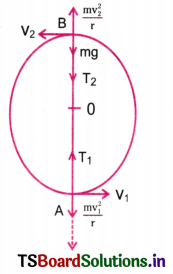
The Forces acting on the body At A.
T1 = mg + \(\frac{\mathrm{mv}_1^2}{\mathrm{r}}\) ……. (1)
At the point ‘B’ the forces acting are
T2 + mg = \(\frac{\mathrm{mv}_2^2}{\mathbf{r}}\) …….. (2)
The body will complete the Vertical circular path only and only if minimum tension at the heighest point. T2 (Minimum) ≥ 0
∴ \(\frac{\mathrm{mv}_2^2}{\mathrm{r}}\) – mg ≥ 0 ⇒ \(\frac{\mathrm{mv}_2^2}{\mathrm{r}}\) ≥ mg ⇒ V2 = \(\sqrt{\mathrm{rg}}\)
So, the minimum velocity at the highest point B to complete the vertical circle is \(\sqrt{\mathrm{rg}}\) (or) \(\sqrt{\mathrm{gr}}\). This is called critical velocity.
From law of conservation energy.
Energy at A = Energy at B.
\(\frac{1}{2} m v_1^2\) = \(\frac{1}{2} \mathrm{mv}_2^2\) + mg(2r) ⇒ \(\mathrm{V}_1^2\) + \(\mathrm{V}_2^2\) + 4gr
But \(\mathrm{v}_2^2\) = gr ∴ \(\mathrm{v}_1^2\) = gr + 4gr = 5gr ⇒ v1 = \(\sqrt{5 \mathrm{gr}}\)
So, to complete vertical circle, the minimum velocity at the lowest point is \(\sqrt{5 \mathrm{gr}}\).
Problems
Question 1.
A machine gun fires 360 bullets per minute and each bullet travels with a velocity of 600 ms-1. If the mass of each bullet is 5 gm, find the power of the machine gun?
Solution:
Number of bullets, (n) = 360 ; Time (t) = 1 minute = 60s
Velocity of the bullet (v) = 600 ms-1, Mass of each bullet (m) = 5gm = 5 × 10⁻³ kg
Power of the machine gun (P) = \(\frac{\mathrm{n}\left(\frac{1}{2} \mathrm{mv}^2\right)}{\mathrm{t}}\) = \(\frac{360\left(\frac{1}{2} \times 5 \times 10^{-3} \times(600)^2\right)}{60}\)
⇒ P = 5400 W = 5.4 KW
Question 2.
Find the useful power used in pumping 3425 m3 of water per hour from a well 8 m deep to the surface, supposing 40% of the horse power during pumping is wasted. What is the horse power of the engine ?
Solution:
Mass of water pumped, m = 3425 m3 = 3425 × 103 kg.; Mass of 1 m3 water = 1000 kg
Depth of well (d) = 8 m., Power wasted = 40%
∴ Efficiency (η) = 60% ; time, t = 1 hour = 3600 sec.
Useful power \(=\frac{\text { Actual work done }}{\text { time × efficiency }}\) = \(\frac{\mathrm{mgd}}{\mathrm{t} \cdot \eta}\) = \(\frac{3425 \times 10 \times 9.8 \times 8 \times 100}{3600 \times 60}\) = 124315 watt
∴ Useful power in H.P. = \(\frac{124315}{746}\) = 166.6 H.P [∵ But 1 H.P. = 746 W]
Question 3.
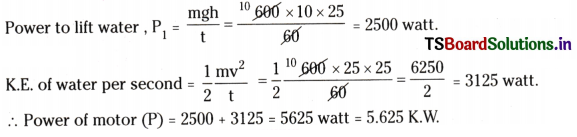
A pump is required to lift 600 kg of water per minute from a well 25m deep and to eject it with a speed of 50 ms-1. Calculate the power required to perform the above task ? (g = 10 m sec-2).
Solution:
Mass of water (m) = 600 kg ; depth = h = 25 m ; Speed of water (v) = 25 m/s; g = 10 m/2, Time t = 1 min = 60 sec.
Power of motor P = Power to lift water (P1) + Kinetic energy of water (K.E) per second.
Question 4.
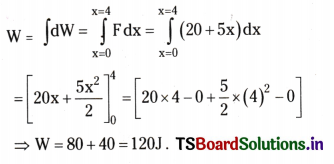
A block of mass 5 kg initially at rest at the origin is acted on by a force along the X-positive direction represented by F = (20 + 5x)N. Calculate the work done by the force during the displacement of the block from x = 0 to x = 4m.
Solution:
Mass of block (m) = 5 kg
Force acting on the block, F = (20 + 5x) N
If ‘w’ is the total amount of work done to displace the block from x = 0 to x = 4m then,
Work, Energy and Power Class 11 NCERT Solutions
Question 1.
The sign of work done by a force on a body is important to understand. State carefully if the following quantities are positive or negative.
(a) the work done by a man in lifting a bucket out of a well by means of a rope tied to the bucket,
(b) the work done by the gravitational force in above case,
(c) work done by friction on a body sliding down an inclined plane,
(d) work done by an applied force on a body moving on a rough horizontal plane with uniform velocity,
(e) work done by resistive force of air on a vibrating pendulum in bringing it to rest.
Answer:
- The work done by a force F in displacing a particle through a distance ‘s’ at an angle θ between \(\vec{F}\) and \(\vec{s}\) is W = Fs cos θ
- If 0 < θ < 90°, the work is positive, if θ = 90°, the work is zero and if 90° < θ < 180°, the work is negative.
(a) In this case, the force applied by man and the displacement are along the same direction so work done by man is positive.
(b) The gravitational force acts vertically downward and displacement of bucket is vertically upward so work done by gravitational force is negative.
(c) The frictional force is opposite to displacement, so work done by friction is negative.
(d) The applied force and displacement are along the same direction, so work done is positive.
(e) The resistive force of air always acts opposite to direction of motion of the pendulum and so the work done by resistive force is negative.
Question 2.
A body of mass 2 kg initially at rest moves under the action of an applied horizontal force of 7 N on a table with coefficient of friction 0.1. Compute the
(a) work done by the applied force in 10 s,
(b) work done by friction in 10 s,
(c) work done by the net force on the body is 10 s,
(d) change in kinetic energy of the body in 10 s.
Answer:
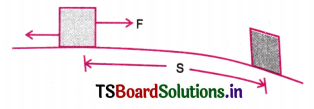
Forward and interpret your results. Applied force, F = 7 N
Backward frictional force, f = μ mg
= 0.1 × 2 × 10N = 2N
Net force, Fnet = F – f = 7 – 2 = 5N
As body moves under net force, then
Acceleration of the body, a = \(\frac{F}{m}\) = \(\frac{5}{2}\) = 2.5 m/s2.
Distance traversed by the body in t = 10 s starting from rest (u = 0)
s = ut + \(\frac{1}{2}\) at2 = 0 + \(\frac{1}{2}\) × 2.5 × (10)2 = 125 m
- Work done by applied force = Fs cos θ° = Fs = 7 × 125 = 875 J
- Work done by frictional force = fs cos 180° = – fs = – 2 × 125 = – 250 J
- Work done by net force = Fnet . s = 5 × 125 = 625 J
- Change in kinetic energy = Work done by the net force = 625 J
Question 3.
Figures show examples of some potential energy functions in one dimension.
The total energy of the particle is indicated by across on the ordinates axis. In each case, specify the regions, if any, in which the particle cannot be found for the given energy. Aslo, indicate the minimum total energy the particle must have in each case.
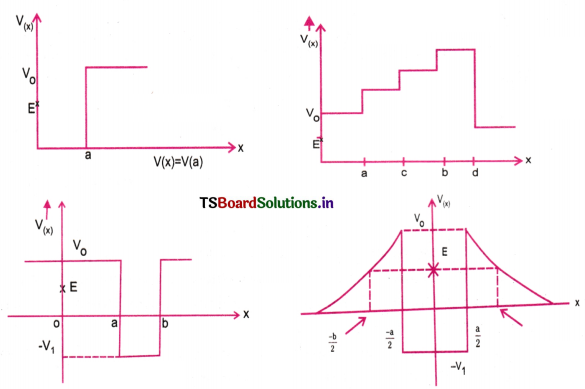
Answer:
- The total (mechanical) energy (E) = Kinetic energy (Ek) + Potential energy (V) Kinetic energy, Ek = E – V.
- The kinetic energy is never negative, so particle cannot exist in region where kinetic energy is negative or where E < V.
(a) For region x > a, E < V0
So, kinetic energy Ek is negative, hence the particle cannot be found in the region x > a.
Minimum total energy, Emin = 0.
(b) For every region E < V0, so a particle cannot exist in region x > 0.
This is the case of increasing potential barrier in steps.
Minimum total energy, Emin = + V1
(c) For region x < a and x > b, E < V0;
So, particle cannot exist in region x < a and x > b. This is the case of finite potential wall lying in region a ≤ x ≤ b.
Minimum total energy, Emin = -V1
(d) For region \(-\frac{b}{2}\) < x < \(-\frac{a}{2}\) and \(\frac{a}{2}\) < x < \(\frac{b}{2}\), E < V0
Question 4.
The potential energy function for a particle executing linear simple harmonic motion is given by V(x) = ½ hx2, where h is the force constant of the oscillator. For h = 0.5 Nm-1, the graph V (x) versus x is shown in the Fig. Show that a particle of total energy 1 J moving under this potential must ‘turn back’ when it reaches x = ± 2m.
Answer:
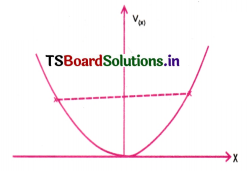
Force, F = \(\frac{d V}{d x}\) = \(-\frac{d}{d x}\left(\frac{1}{2} k x^2\right)\) = -kx
- This means linear restoring force acts on the particle which tends to bring the particle towards origin.
- The particle turns back when its velocity (or kinetic energy) is momentarily zero.
- Total energy E = Ek + V = 0 + \(\frac{1}{2} k x^2\) ⇒ x2 = \(\frac{2 E}{k}\)
Give, E = 1 J and k = 0.5 Nm-1 ⇒ x = \(\sqrt{\frac{2 \times 1}{0.5}}\) = ± 2 m.
Question 5.
Answer the following :
(a) The casing of a rocket in flight burns up due to friction. At whose expense is the heat energy required for burning obtained ? The rocket or the atmosphere?
(b) Comets move around the sun in highly elliptical orbits. The gravitational force on the comet due to the sun is not normal to the comet’s velocity in general. Yet the work done by the gravitational force over every complete orbit of the comet is zero. Why ?
(c) An artificial satellite orbiting the earth in very thin atmosphere loses its energy gradually due to dissipation against atmospheric resistance, however small. Why then does its speed increase progressively as it comes closer and closer to the earth ?
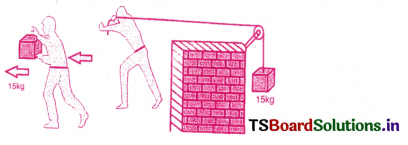
(d) In the Fig. (i) the man walks 2 m carrying a mass of 15 kg on his hands. in Fig.
(ii) he walks the same distance pulling the rope behind him. The rope goes over a pulley, and a mass of 15 kg hands at its other end, In which case is the work done greater ?
Answer:
(a) The heat energy required for burning is obtained at the expense of rocket (due to decrease in its potential energy).
(b) For a conservative force, the work done over a path is negative of the change in potential energy. For a complete orbit of comet, the change in potential energy is zero, so work done is zero, whatever the shape of orbit may be.
(c) When satellite comes closer and closer to earth, (r decreases), its total energy E = \(\frac{\mathrm{GM}_{\mathrm{e}} \mathrm{~m}}{2 \mathrm{r}}\) goes on decreasing due to dissipation against friction.
* its potential energy (V) = \(\frac{\mathrm{GM}_{\mathrm{e}} \mathrm{~m}}{\mathrm{r}}\) also goes on decreasing but kinetic energy Ek = \(-\frac{\mathrm{GM}_e \mathrm{~m}}{2 \mathrm{r}}\) goes on increasing) hence, its speed increases progressively.
(d) The work is greater in the second case; because when man walks, the mass (15 kg) is lifted up and its potential energy increases. The additional work is done for overcoming increase in potential energy of mass.
Question 6.
Underline the correct alternative.
(a) When a conserative force does positive work on a body, the potential energy of the body increases/decreaseslremains unaltered.
(b) Work done by a body against friction always results in a loss of its kinetic/potential energy.
(c) The rate of change of total momentum of a many particle system is proportional to the external force/sum of internal forces on the system.
(d) In an elastic collision of two bodies, the quantities which do not change after the collision are the total kinetic energy/total linear momentum/total energy of the system of two bodies.
Answer:
(a) Work done by a conservative force is equal to loss in potential energy, so for positive work, the potential energy decreases.
(b) Work done by a body against friction always results in a loss of kinetic energy.
(c) The internal forces occur in pairs of equal and opposite force; so net internal force on a system is always zero. As a result, the internal forces cannot change the linear momentum of the system. The correct statement is “The rate of change of total momentum of a many particle system is proportional to the external force impressed on the system’
(d) In an inelastic collision of two bodies, the total linear momentum of system is conserved; but if the system is isolated; the total energy is also conserved.
Question 7.
State if each of the following statements is true or false. Give reason for your answer.
(a) In an elastic collision of two bodies, the momentum and energy of each body is conserved.
(b) Total energy of a system is always conserved, no matter what internal and external forces on the body are present.
(c) Work done in the motion of a body over a closed loop is zero for every force in nature.
(d) In an inelastic collision, the final kinetic energy is always less than the initial kinetic energy of the system.
Answer:
(a) False: The momentum and energy of each body are not conserved separately, but the total momentum and total energy of system (of two bodies) remain conserved.
(b) False : Total energy of a system is conserved only if the forces are conservative. In case of non-conservative forces (like frictional force), the total energy is lost.
(c) False: Work over a closed loop is zero only if forces involved are conservative.
(d) Usually this is true, but in some cases the final kinetic energy may be greater than initial kinetic energy. e.g., explosion of a bomb.
Usually in an elastic collision, the final kinetic energy is less than the initial kinetic energy, because some kinetic energy is dissipated as heat; but in some particular collision where during collision a body explodes, the final kinetic energy becomes more than the initial kinetic energy.
Question 8.
Answer carefully, with reasons:
(a) In an elastic collision of two billiard balls, is the total kinetic energy conserved during the short time of collision of the balls (i.e., when they are in contact)?
(b) Is the total linear momentum conserved during the short time of an elastic collision of two balls?
(c) What are the answers to (a) and (b) for an inelastic collision?
(d) If the potential energy of two billiard balls depends only on the separation distance between their centres, is the collision elastic or inelastic? (Note, we are talking here of potential energy corresponding to the force during collision, not gravitational potential energy).
Answer:
(a) No; during short,time of collision, some kinetic energy is converted into internal energy of molecules of a ball. This internal energy re-appears as kinetic energy when balls separate after the collision.
(b) Yes, the total linear momentum is conserved during short time of collision.
(c) In an elastic collisin, the kinetic energy is not conserved during and after collision; however, the total linear momentum is conserved during and after collision.
(d) The collision is elastic because forces involved are conservative.
Question 9.
A body is initially at rest. It undergoes one dimensional motion with constant acceleration. The power delivered to it at time t is proportional to
(i) t1/2
(ii) t
(iii) t3/2
(iv) t2
Answer:
Given acceleration a = \(\frac{d v}{d t}\) = constant
dv = a dt
Integrating both sides (since a = constant), we get, v = at
Power P = Fv = mav = ma (at) = ma2t
As m and a are constants, therefore, P ∝ t
i.e., power is directly proportional to time t provided the acceleration is constant.
Question 10.
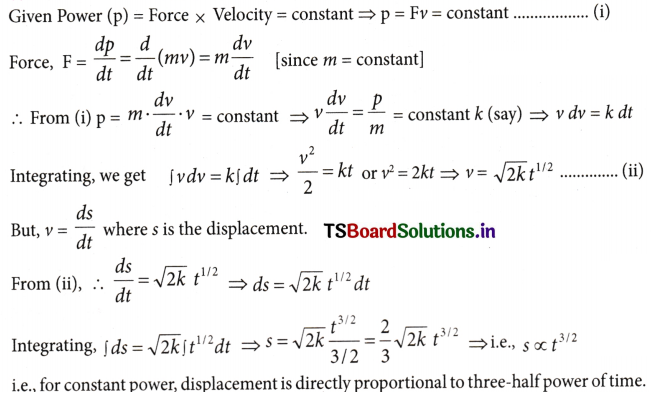
A body is moving unidirectionally under the influence of a source of constant power. Its displacement in time t is proportional to
(i) t1/2
(ii) t
(iii) t3/2
(iv) t2
Answer:
Question 11.
A body constrained to move along the Z -axis of a coordinate system is subjected to a constant force F is given by F = (-\(\hat{\mathbf{i}}\) + 2\(\hat{\mathbf{j}}\) + 3\(\hat{\mathbf{k}}\)) N
where \(\hat{\mathbf{i}}\), \(\hat{\mathbf{j}}\) and \(\hat{\mathbf{k}}\) are unit vectors along the X, Y and Z axes of the system respectively.
What is the work done by this force in moving the body a distance of 4 m along the Z -a xis ?
Answer:
Given force \(\vec{F}\) = (-\(\hat{\mathbf{i}}\) + 2\(\hat{\mathbf{j}}\) + 3\(\hat{\mathbf{k}}\)) N
Displacement is 4m along Z -axis, it may be expressed as \(\vec{S}\) = (4\(\hat{\mathbf{k}}\)) m
∴ Work, W = \(\vec{F} \cdot \vec{S}\) = (-\(\hat{\mathbf{i}}\) + 2\(\hat{\mathbf{j}}\) + 3\(\hat{\mathbf{k}}\)) ⋅ (4\(\hat{\mathbf{k}}\))
As \(\hat{\mathbf{i}}\) . \(\hat{\mathbf{k}}\) = o, \(\hat{\mathbf{j}}\) . \(\hat{\mathbf{k}}\) = 0 and \(\hat{\mathbf{k}}\) ⋅ \(\hat{\mathbf{k}}\) = 1, therefore, we have W = 0 + 0 + 12 = 12J
From kinetic energy relation, K = \(\frac{1}{2} \mathrm{mv}^2\) ⇒ v = \(\sqrt{\frac{2 \mathrm{~K}}{\mathrm{~m}}} \propto \sqrt{\frac{\mathrm{~K}}{\mathrm{~m}}}\)
i.e, speed is directly proportinal to square root of kinetic energy and inversely to square root of mass.
As kinetic energy of proton is 10 times that of electron and mass of proton is \(\frac{m_p}{m_e}\) = \(\frac{1.67 \times 10^{-27}}{9.11 \times 10^{-31}}\) = 1833 times that of electron, hence the electron is faster than proton.
Ratio of speeds, \(\sqrt{\left(\frac{\mathrm{K}_{\mathrm{e}}}{\mathrm{~K}_{\mathrm{p}}}\right) \times\left(\frac{\mathrm{m}_{\mathrm{p}}}{\mathrm{~m}_{\mathrm{e}}}\right)}\) = \(\sqrt{\frac{10}{100} \times 1833}\) = \(\sqrt{183.3}\) = 13.5.
Though kinetic energy of proton is greater than electron, but due ot dominating large mass of proton, the speed of electron is 13.5 times larger than that of proton.
Question 13.
A rain drop of radius 2 mm falls from a height of 500 m above the ground. It falls with decreasing acceleration (due to viscous resistance of air) until at half its original height, it attains its maximum (terminal) speed, and moves with uniform speed thereafter. What is the work done by the gravitational force on the drop in the first and second half of its journey ? What is the work done by the resistive force in the entire journey if its speed on reaching the ground is 10 ms’ ?
Answer:
Radius of drop, (r) = 2 mm = 2 × 10⁻³ m; Density of water, (ρ) = 103 kg m-3
Mass of drop = Volume × Density = \(\frac{4}{3} \pi r^3 \rho\) = \(\frac{4}{3}\) × 3.14 × (2 × 10-3)3 × 103 = 3.35 × 10⁻⁵ kg
- Work done by gravitational force is equal to the loss in gravitational potential energy, which is equal to mgh (same in both parts of journey for same h). Here g = 9.8ms-2,; h = \(\frac{500}{2}\) = 250m; W = mgh = 3.35 × 10-5 × 9.8 × 250 = 0.082J
- From conservation of energy.
- Loss in gravitational potential energy = Gain in kinetic energy + ‘Work done against resistive force]
mgH = \(\frac{1}{2} m v^2\) + Wresistive ⇒ Wresistance = mgH – \(\frac{1}{2} m v^2\)
Here m = 335 × 10-5 kg, H = 500m, v = 10 ms-1 - Wresistance = 3.35 × 10-5 × 9.8 × 500 – \(\frac{1}{2}\) × 3.35 × 10-5 × (10)2 = 0.164 – 0.002 = 0.162 J
- Work done by resistive force = -0.162 J
- Work done by resistive force is negative because resistive force acts upward and displacement is downward.
Question 14.
A molecule in a gas container hits a horizontal wall with speed 200 ms-1 and angle 30° with the normal, and rebounds with the same speed. Is momentum conserved in the collision ? Is the collision elastic or inelastic ?
Answer:
- Initial momentum of molecule is along AB and final momentum is along BC.
- The magnitude of momentum is same.
- Assuming X – axis perpendicular to wall and Y-axis along the wall as shown in Fig. and \(\hat{\mathbf{i}}\), \(\hat{\mathbf{j}}\) unit vectors along X and Y – axes respectively.
- Initial momentum,
\(\overrightarrow{p_1}\) = Mvcos30°\(\hat{i}\) – Mvsin30°\(\hat{j}\) 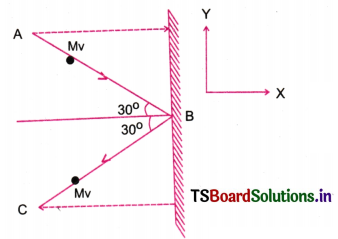
- Thus, change in momentum of molecule (200\(\sqrt{3}\) M) kg ms-1 directed normal to wall towards outgoing molecule.
- The momentum of (molecule + wil) remains constant.
- As wall is too heavier, its momentum is not detected.
- The collision is elastic since kinetic energy remains constant.
Question 15.
A pump on the ground floor of a building can pump up water to fill a tank of volume 30m3 in 15 min. 1f the tank is 40 m above the ground, and the efficiency of the pump is 30%, how much electric power is consumed by the pump?
Answer:
Mass of water lifted, M = Volume × Density = (30 m3) × (103 kg/m3) = 3 × 10⁴ kg
Given, Height h =40 m, Time taken, t = 15 min = 15 × 60 s = 900 s
Work done by pump to fill the tank = Mgh = 3 × 104 × 9.8 × 40 = 1.176 × 10⁷ J
Work done \(=\frac{\text { Work done }}{\text { Time taken }}\) = \(\frac{1.176 \times 10^7}{900}\) W
Output power \(=\frac{\text { Work done }}{\text { Time taken }}\) = \(\frac{1.176 \times 10^7}{900}\)W
Efficiency (η) \(=\frac{\text { Output power }}{\text { Input power }}\) ; Input power = \(\frac{\text { Output power }}{\eta}\)
Given efficiency (η) = 30 % = 0.30
Input power = \(\frac{\left(1.176 \times 10^7 / 900\right)}{0.30}\) = 43.6 × 10³ W.
Input power is electric power, therefore, electric power consumed
= 43.6 × 10³W = 43.6W.
Question 16.
Two identical ball bearings in contact with each other and resting on a frictionless table are hit head-on by another ball bearing of the same mass moving initially with a speed V. If the collision is elastic, which of the following (fig.) is a possible result after collision ?
Answer:
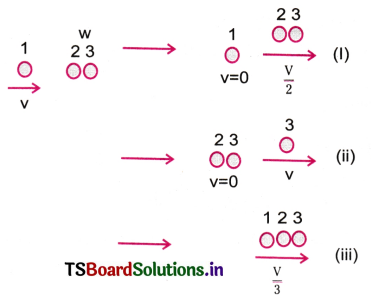
- In a completely elastic collision of bodies of equal masses, the velocities get interchanged.
- When a ball bearing 1 collides, elastically with 2, it transfers its whole velocity to ball bearing 2 and comes to rest.
- Now ball-bearing 2 collides with 3 and transfers its velocity to 3 and comes to rest.
- Thus, finally ball bearings 1 and 2 remain in contact at rest and ball 3 begins to move with speed V. The final situation is as shown in the Fig (ii).
Question 17.
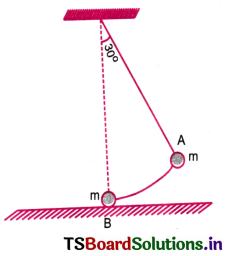
The bob A of a pendulum released from 30° to the vertical hits another bob B of the same mass at rest on the table as shown in fig. How high does the bob A rise after the collision ? Neglect the size of the bobs and assume the collision to be elastic.
Answer:
- When bob A is released, its potential energy is converted into kinetic energy, therefore, the bob A reaching vertically below the point of suspension has a finite velocity.
- The bob ‘A’ now collides with identical bob B, elastically.
- In an elastic collision of bodies of equal masses, the velocities of bodies get interchanged.
- Therefore, when bob A collides with B, it transfers its velocity to bob B and comes to rest.
- That is the bob A does not rise at all after elastic collision with bob ‘B’.
Question 18.
The bob of a pendulum is released from the horizontal position. If the length of the pendulum is 1.5 m, what is the speed with which the bob arrives at the lowermost point, given that it dissipated 5% of the initial energy against air resistance?
Answer:
Initial kinetic energy of bob (Ek)initial = o
Initial potential energy of bob Uinitial = mgl
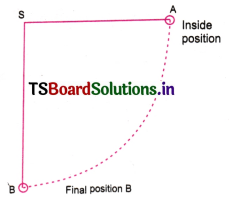
Initial total energy of bob = 0 + mgl = mgl …….. (i)
Final kinetic energy of bob = \(\frac{1}{2}\)mv2
Final potential energy of bob = 0
Final total energy of bob = \(\frac{1}{2}\)mv2 + 0 = \(\frac{1}{2}\)mv2 ……… (ii)
As 5 % of initial energy is dissipated) 95% of initial energy is equal to final energy,
i.e., \(\frac{95}{100}\)mgl = \(\frac{1}{2}\)mv2 ⇒ v = \(\sqrt{0.95 \times 2 g l}\) = \(\sqrt{1.90 \mathrm{gl}}\)
Given l = 1.5m
∴ Speed of bob at lowest position, v = \(\sqrt{1.90 \times 98 \times 1.5}\) 5.3 ms-1
Question 19.
A trolley of mass 30 kg carrying a sandbag of 25 kg is moving uniformly with a speed of 27 km/h on a frictionless track. After a while sand starts leaking out of a hole on the trolley’s floor at the rate of 0.05 kgs’. What is the speed of the trolley after the entire sand bag is empty?
Answer:
In this case, the sand falls on the floor of trolley and remains in the trolley, so mass of system (trolley + sand bag) remains unchanged.
- As there is no external force on the system, the momentum of system remains constant i.e.., p = (M + m) y.
- As momentum p and mass (M + m) remains constant, therefore, velocity of trolley remains constant,
- By conservation of liner momentum (300 + 25) kg × (27 km/h) = (25 kg) × (27 km/h) + 300 v2 ⇒ v2 = 27 km/h i.e., speed of trolley remains unchanged.
Question 20.
A body of mass 0.5 kg travels in a straight line with velocity y = ax3/2 where a = 5 m-1/2 s-1. What is the work done by the net force during its displacement
from x = 0 to x = 2 m?
Answer:
Work done, W = Gain in kinetic energy = \(\frac{1}{2} \mathrm{mv}_2^2\) – \(\frac{1}{2} \mathrm{mv}_1^2\)
Given mass, m = 0.5 kg, a = 5 m-1/2s-1.
Velocity at displacement x v = ax3/2
Velocity at x = 0, v1 = 0
Velocity at x = 2, v2 = a (2)3/2 = 5 × (2)3/2
∴ Work done, W = \(\frac{1}{2} m v_2^2\) – 0 = \(\frac{1}{2}\) × 0.5(5 × 23/2)2 = \(\frac{1}{2}\) × 0.5 × 25 × (2)3 = 50 J.
Question 21.
The blades of a wind mill sweep out of a circle of area A.
(i) If the wind flows at a velocity v perpendicular to the circle, what is the mass of the air passing through it in time?
(ii) What is the kinetic energy of air ?
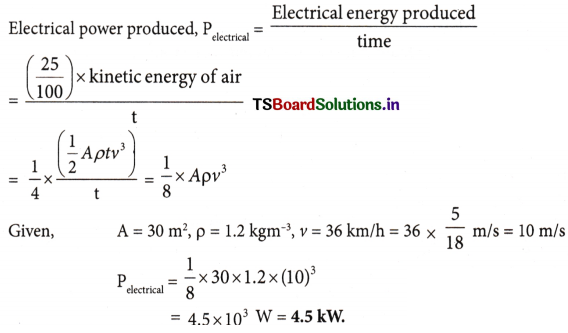
(iii) Assume that the windmill converts 25% of the wind’s energy into electrical energy, and that A = 30 m2, v = 36 km/h and density of air is 1.2 kg m-3. What is the electrical power produced ?
Answer:
(i) Volume of wind passing through blades per second = Av
Volume of wind passing through blades in time t = Avt
If \(\rho\) is density of air;
then mass of air passing through blades in time t = (Avt) \(\rho\)
(ii) Kinetic energy of air = \(\frac{1}{2} m v^2\) = \(\left(\frac{1}{2} A v t \rho\right) v^2\) = \(\frac{1}{2} A \rho t v^3\)
(iii)
Question 22.
A person trying to lose weight (dieter) lifts a 10 kg mass, one thousand times, to a height of 0.5 m each time. Assume that the potential energy lost each time she lowers the mass is dissipated
(a) How much work does she do against the gravitational forces ?
(b) Fat supplies 3.8 × 10⁷ J of energy per kilogram which is conserved into mechanical energy with a 20% efficiency rate. How much fat will the dieter use up ?
Answer:
(a) Work done against gravitational force, W = gain in potential energy = 1000 (mgh) = 1000 × 10 × 9.8 × 0.5 = 4.9 × 10⁴
(b) Mechanical energy supplied by 1 kg fat = \(\frac{20}{100}\) × 3.8 × 10⁷ J = 7.6 × 10⁶ J/kg
Fat used up by dieter = \(\frac{4.9 \times 10^4 \mathrm{~J}}{7.6 \times 10^6 \mathrm{~J} / \mathrm{kg}}\) = 6.45 × 10-3 = 6.45 g.
Question 23.
A family used 8 kW of power.
(a) Direct solar energy is incident on the horizontal surface at average rate of 200 W per square metre. If 20% of this energy can be converted to useful electrical energy, how large an area is needed to supply 8 kW ?
(b) Compare this area to that of the roof of a typical house.
Answer:
(a) If A is area needed for the purpose, then solar power incident on this area = 200 × A
Useful electrical power, Pe = \(\frac{20}{100}\) × 200A = 40 A watt
Given, Pe = 8 kW = 8 × 10³ W
∴ 40 A = 8 × 10³ or A = \(\frac{8 \times 10^3}{40}\) = 200 m2
(b) The roof of a typical large house = 14 × 14 m2 = 196 m2
So, the required area is comparable to the roof of a large house.