TS Inter 1st Year Economics Notes Chapter 2 Theories of Consumer Behaviour

Here students can locate TS Inter 1st Year Economics Notes Chapter 2 Theories of Consumer Behaviour to prepare for their exam.

TS Inter 1st Year Economics Notes Chapter 2 Theories of Consumer Behaviour

→ Utility means wanting satisfying power of a thing, measurement of utility can be two types: 1. Cardinal utility 2. Ordinal utility.

→ Cardinal utility was developed by Alfred Marshall. According to the cardinal utility approach, a utility can be measured in terms of numbers like 1, 2, 3, 4 etc.

TS Inter 1st Year Economics Notes Chapter 2 Theories of Consumer Behaviour

→ Ordinal utility approach was developed by R.J.D. Hicks & Allen. According to this approach, utility is subjective. So, it is not possible to measure in terms of numbers. They are ranked 1st, 2nd, 3rd etc.

→ The law of Diminishing marginal utility was developed by H.H. Gossen in 1854 and later it was popularised by Marshall. This law shows the relationship between the quantity of a thing consumed and its marginal utility. If a consumer goes on consuming a commodity then the satisfaction that derives from its additional units declines.

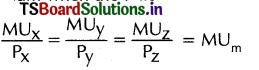
→ The law of Equi-Marginal Utility explains as to how a consumer distributes his limited income among various commodities to get maximum satisfaction. The consumer will be in equilibrium when the following condition is satisfied :
TS Inter 1st Year Economics Notes Chapter 2 Theories of Consumer Behaviour 2

→ Indifference curve is a technique based on the ordinal utility approach. Ic represents the satisfaction of a consumer from two goods.

→ MRS is the rate at which an individual exchanges successive units of one commodity for another.

→ A set of indifference curves drawn for different income levels is called as an indifference map.

→ Consumer equilibrium is a point where the consumer gets maximum satisfaction from two goods.

TS Inter 1st Year Economics Notes Chapter 2 ప్రవర్తనా సిద్ధాంతాలు

→ ఒక వస్తువుకు ఉండే మానవుని కోరికను తీర్చగలిగే శక్తిని ప్రయోజనం అంటారు.

→ వివిధ వస్తువుల నుంచి పొందే ప్రయోజనాలను యుటిల్స్ అనే ఊహాత్మక యూనిట్ల ద్వారా కొలవడానికి వీలుంది. దీనిని అభివృద్ధిపరచినది మార్షల్. 1, 2, 3 మొదలగు సంఖ్యలను కార్డినల్ సంఖ్యలు అంటారు. వీటి ద్వారా వినియోగదారుని ప్రయోజనమును కొలవవచ్చు.

TS Inter 1st Year Economics Notes Chapter 2 Theories of Consumer Behaviour

→ వస్తువు అన్ని యూనిట్ల వినియోగం ద్వారా పొందగలిగే మొత్తం తృప్తిని మొత్తం ప్రయోజనం అంటారు.

→ వినియోగదారుడు అదనంగా వస్తువు యూనిట్ను ఉపయోగించడం వల్ల మొత్తం ప్రయోజనంలో కలిగే మార్పు MO = ΔTU/ΔQ

→ క్షీణోపాంత ప్రయోజన సూత్రంను గాసెన్ మొదటి సూత్రం అంటారు. ఇది వస్తు పరిమాణానికి, ప్రయోజనానికి మధ్య ఉన్న సంబంధాన్ని గూర్చి తెలుపును. ఒకే రకమైన వస్తువును వినియోగదారుడు క్రమంగా ఎక్కువగా వినియోగిస్తూ ఉంటే, మొత్తం ప్రయోజనం ఒక దశ వరకు పెరిగి, ఆ తరువాత తగ్గుతుంది.

→ సమోపాంత ప్రయోజన సూత్రాన్ని గాసెన్ ద్వితీయ సూత్రం అని కూడా అంటారు. వినియోగదారుడు తన పరిమితమైన ఆదాయాన్ని ఖర్చుచేసి ఏ విధంగా గరిష్ట ప్రయోజనం పొందుతాడో తెలియజేసేది.

→ కార్డినల్ విశ్లేషణలో ప్రయోజనం అనేది మానసికపరమైంది. అందువల్ల దాన్ని సంఖ్యా రూపంలో కొలవడానికి సాధ్యం కాదు. అందువల్ల R.J.D. హిక్స్ మరియు అలెన్ ఆర్డినల్ విశ్లేషణ ద్వారా వినియోగదారుని ప్రవర్తనను తెలియజేశారు. ఈ విశ్లేషణలో వినియోదారు తనకు లభ్యమైన వివిధ వస్తు సముదాయాలకు ర్యాంకులు 1, 2, 3 మొదలైనవి ఇవ్వడం ద్వారా వాటన్నిటిని క్రమ పద్ధతిలో ఏర్పరచుకుంటారు.

TS Inter 1st Year Economics Notes Chapter 2 Theories of Consumer Behaviour

→ వినియోగదారుడు కొనుగోలు చేసే రెండు వస్తువుల వివిధ సమ్మేళనాలను తెలియజేసే బిందువులను కలుపగా ఏర్పడే రేఖలను “ఉదాసీనతా వక్రరేఖ” అంటారు. దీని ద్వారా కూడా వినియోగదారుని ప్రయోజనాన్ని కొలవవచ్చు.

TS Inter 1st Year Economics Notes Chapter 1 Introduction to Economics

Here students can locate TS Inter 1st Year Economics Notes Chapter 1 Introduction to Economics to prepare for their exam.

TS Inter 1st Year Economics Notes Chapter 1 Introduction to Economics

→ Economics is a social science. It explains how an economy and different individuals behave while managing their economic activities.

→ The term Economics is originated from greek words ‘OIKOS’ and ‘Nemein’.

→ Economic problem is concerned with economizing scarce resources. Wants, efforts and satisfaction constitute the essence of economics.

  1. Wealth definition – Adam Smith
  2. Welfare definition – Alfred Marshall
  3. Scarcity definition – Lionel Robbins
  4. Growth definition – Samuelson

TS Inter 1st Year Economics Notes Chapter 1 Introduction to Economics

→ Modern economists have divided economic theory into two parts,

  • Micro Economics
  • Macro Economics.

The two terms were first coined and used by ‘Ragnar Frisch’ in 1933. Micro Economics was popularised by Alfred Marshall, and J.M. Keynes popularised Macro Economics. Both approaches are essential for a proper understanding of a problem. The two approaches are interdependent.

→ The method of studying economic phenomena by taking assumptions and deducing conclusions from assumptions is called deduction.

→ Inductive method is the process in which one can arrive generalization on the basis of observed facts.

→ Economic static – analysis where establishing the functional relationship between two variables whose values are related to the same point of time.

→ Economic dynamics is the study of in relation to the preceding and succeeding events.

→ A positive science may be defined as a body of systematized knowledge concerning ‘What it is’.

→ A normative science may be defined as a body of systematized knowledge relating to the object of “What ought to be”?

→ Anything which satisfies human want is good.

→ Goods can be divided into two types: i) Free goods ii) Economic goods.
Economic goods are again divided into three types: i) Consumer goods ii) Capital goods iii) Intermediary Goods.
Semi-finished and under-finished products are called intermediary goods.

→ Wealth means money but in Economics all economic goods including land is treated as wealth. Wealth has three characters.

  1. Utility
  2. Exchange value
  3. Transferability
  4. Scarcity

→ Income is a flow over a period of time. Income flow is circular in character. There are two types of income, i) Money income ii) Real income.

→ Wants satisfying capacity of good is called utility. There are four types of utilities,

  1. Form utility
  2. Place utility
  3. Time utility
  4. Service utility.

→ Value means the exchange value of goods in economics. A good has value in use and value in exchange.

→ The value of a good expressed in terms of money is its price.

TS Inter 1st Year Economics Notes Chapter 1 Introduction to Economics

→ Human wants are starting points of all economic activities. They are unlimited, competitive, complementary, and recur. Wants are classified into necessities, comforts, and luxuries.

→ In Economics welfare means utility of satisfaction. Welfare indicates better living conditions of people in society. Wealth and welfare are closely related to one another.

TS Inter 1st Year Economics Notes Chapter 1 అర్థశాస్త్ర పరిచయం

→ అర్థశాస్త్రం అనే పదం గ్రీకు భాషలోని “Okinomickos” అనే పదం నుంచి ఆవిర్భవించింది.

→ ఆడమ్ స్మిత్ అభిప్రాయం ప్రకారం అర్థశాస్త్రం ప్రధానంగా “సంపదను” గూర్చి చర్చిస్తుంది.

→ మార్షల్ అర్థశాస్త్రంలో సంపద కన్నా శ్రేయస్సుకు ఎక్కువ ప్రాధాన్యత ఇచ్చాడు.

→ రాబిన్స్ ప్రకారం ఆర్థిక సమస్యలన్నింటికి మూలకారణం ‘కొరత’,

→ శామ్యూల్సన్ తన నిర్వచనములో ప్రస్తుత వినియోగానికే కాక భవిష్యత్ వినియోగానికి కూడా ప్రాధాన్యతను ఇచ్చాడు.

→ జేకబ్ వైనర్ ప్రకారం ఆర్థికవేత్తల ప్రశ్నలు వాటికి సంబంధించిన చర్చల ద్వారా అర్థశాస్త్రంను అర్థం చేసుకోవచ్చును.

→ రాగ్నార్ ఫ్రిష్ మొట్టమొదటిసారిగా 1933 సం॥లో సూక్ష్మ స్థూల అర్థశాస్త్రం అనే పదాలను ఉపయోగించడం జరిగింది.

→ సూక్ష్మ అర్థశాస్త్రం వైయుక్తిక యూనిట్లను పరిశీలిస్తుంది. దీనిని ‘ధరల సిద్ధాంతం’ అని కూడా అంటారు.

→ స్థూల అర్థశాస్త్రం ఆర్థిక వ్యవస్థ మొత్తాన్ని ఒకే యూనిట్గా పరిశీలిస్తుంది. దీనిని ‘ఆదాయ ఉద్యోగిత’ సిద్ధాంతం అని కూడా అంటారు.

→ నిగమన పద్ధతి సార్వత్రిక ప్రతిపాదనల నుంచి ఆరంభమై ప్రత్యేక ప్రతిపాదనలకు దారితీస్తుంది.

→ ఆగమన పద్ధతిలో ప్రత్యేక ప్రతిపాదనల నుంచి సార్వజనీన ప్రతిపాదనలు రూపొందిస్తారు.

→ ఆర్థిక నిశ్చలత్వం అనగా కాలంతో సంబంధం లేకుండా ఆర్థిక కార్యకలాపాలను పరిశీలించడం.

→ ఆర్థిక చలనత్వం అనగా కాలంతో పాటు మార్పు చెందే వివిధ చలాంకాల మధ్య ఉన్న సంబంధాన్ని అధ్యయనం చేయడం.

→ ఉనికిలో ఉన్న విషయాలను గురించి ఒక క్రమబద్ధమైన అధ్యయనం చేయడాన్ని నిశ్చయాత్మక అర్థశాస్త్రం అంటారు.

TS Inter 1st Year Economics Notes Chapter 1 Introduction to Economics

→ ‘ఎలా ఉండాలి’ అనే విషయాన్ని గురించి క్రమబద్ధమైన పద్ధతిలో అధ్యయనం చేసేది నిర్ణయాత్మక శాస్త్రం.

→ అర్థశాస్త్రంలో మానవ కోరికను సంతృప్తిపరచగలిగే భౌతిక, అభౌతికాంశాలన్నింటిని వస్తువులుగా పరిగణిస్తారు.

→ ప్రకృతి నుండి ఉచితంగా లభించే వస్తువులను ఉచిత వస్తువులంటారు.

→ మానవులచే ఉత్పత్తి చేయబడే వస్తువులన్నింటిని ఆర్థిక వస్తువులంటారు.

→ మానవ కోరికలను ప్రత్యక్షంగా సంతృప్తిపరిచే వస్తువులన్నింటిని వినియోగ వస్తువులంటారు.

→ ఉత్పత్తి చేయబడిన ఉత్పత్తి కారకాన్ని ఉత్పాదక వస్తువులంటారు.

→ ఉత్పత్తి ప్రక్రియలో పూర్తిగా తయారు కాకుండా ఉన్న ముడి సరుకులను మాధ్యమిక వస్తువులంటారు.

→ అర్థశాస్త్ర పరిభాషలో భూమితోపాటుగా ఆర్థిక వస్తువులన్నింటిని కలిపి సంపదగా పరిగణిస్తారు.

→ ఆదాయం ఒక ప్రవాహం వంటిది. ఈ ప్రవాహానికి మూలం సంపద.

→ మానవుని కోర్కెలను తీర్చగలిగే వస్తు సేవల యొక్క శక్తినే ప్రయోజనం అంటారు. ఇది నాలుగు రకాలు.

  1. ఆకార ప్రయోజనం
  2. స్థాన ప్రయోజనం
  3. కాల ప్రయోజనం
  4. సేవా ప్రయోజనం.

→ అర్థశాస్త్రంలో విలువ భావనను రెండు రకాలుగా వివరిస్తారు.

  1. వినియోగపు విలువ
  2. మారకపు విలువ.

→ వస్తువు యొక్క విలువను ద్రవ్య రూపంలో తెలియజేయటాన్ని ‘ధర’ అంటారు.

→ మానవుని కోర్కెలు అనంతాలు. వనరులు పరిమితం, మానవుని కోర్కెలు ఆర్థిక కార్యకలాపములకు మూలం.

TS Inter 1st Year Economics Notes Chapter 1 Introduction to Economics

→ ఆర్థికపరమైన ఒక విరామస్థితిని సమతౌల్యం అంటారు.

→ ఒక వ్యక్తి లేదా సమాజం సంపద నుండి పొందే సంతృప్తిని తెలియజేస్తుంది సంక్షేమం.

TS Inter 1st Year Economics Notes Chapter 6 Theories of Distribution

Here students can locate TS Inter 1st Year Economics Notes Chapter 6 Theories of Distribution to prepare for their exam.

TS Inter 1st Year Economics Notes Chapter 6 Theories of Distribution

→ Land: Land is a free gift of nature. In economics, land refers to the soil, forests, water, minerals, atmosphere etc.

→ Contract Rent: Contract rent is the reward paid for the services of land, buildings etc., according to an agreement made earlier.

→ Piece Wage: Piece wage is the amount paid for labourers according to the volume of work done by them.

TS Inter 1st Year Economics Notes Chapter 6 Theories of Distribution

→ Time Wage: Time wage is the amount paid to labourers for a fixed period of work, i.e., daily, weekly and monthly etc.

→ Money Wage: Money wage is the reward received by a labourer in cash for his labour.

→ Real Wage: Real wage is the purchasing power of money wages in terms of goods and services.

→ Capital: Capital is that part of wealth other than land which is used for further production.

→ Net Interest: Net interest is the reward for the service of the capital alone.

→ Normal Profit: No profit no loss situation. In this situation, both the firm and industry will be in equilibrium.

→ Supernormal Profit: Supernormal Profit is the total revenue of the firm will be more than the total cost. Only in the short run firm gets these profits.

TS Inter 1st Year Economics Notes Chapter 6 పంపిణీ సిద్ధాంతాలు

→ మొత్తం ఉత్పత్తి విలువ నాలుగు ఉత్పత్తి కారకాల మధ్య ఏవిధంగా పంపిణీ చేయబడుతుందో తెలియ జేసేది పంపిణీ.

→ పంపిణీని ఆదాయ పంపిణీ, వైయక్తిక ఆదాయ పంపిణీ అని రెండు విధాలుగా పరిశీలించవచ్చును.

→ నిశ్చల పరిస్థితిలో ఉద్యమదారునితో సహా ప్రతి ఉత్పత్తి కారకము దాని ఉపాంత ఉత్పాదనకు సమానంగా ప్రతిఫలం పొందుతుందని జె.బి. క్లార్క్ ఉపాంత ఉత్పాదకత సిద్ధాంతాన్ని తెలిపెను.

→ ఉత్పత్తి కారకంగా భూమి అందించే సేవలకు లభించే ప్రతిఫలం భాటకం. భూమికున్న సహజమైన నశింపులేని శక్తులను ఉపయోగించుకున్నందుకుగాను రైతు తన పంటలో భూస్వామికి చెల్లించే భాగం భాటకం.

→ శ్రామికుల సేవలకు ఒప్పందం ప్రకారం, యజమాని ప్రతిఫలంగా ఇచ్చే మొత్తం ద్రవ్యాన్ని వేతనం అంటారు. వేతనాలు నాలుగు రకాలు.

  1. ద్రవ్యవేతనం
  2. వాస్తవిక వేతనం
  3. పనినిబట్టి వేతనం
  4. కాలాన్నిబట్టి వేతనం.

→ ద్రవ్యత్వాభిరుచిని వీడినందుకుగాను ఋణగ్రహీత, ఋణదాతకు చెల్లించే ప్రతిఫలం వడ్డీ అని కీన్స్ అభిప్రాయం.

TS Inter 1st Year Economics Notes Chapter 6 Theories of Distribution

→ ఋణగ్రహీత నుండి ఋణదాత పొందే మొత్తం వడ్డీని స్థూలవడ్డీ అంటారు. కేవలం మూలధనం సేవకిచ్చే ప్రతిఫలం నికర వడ్డీ.

→ ఉత్పత్తిలో అనిశ్చితత్వం భరించినందుకు వ్యవస్థాపనకు వచ్చే ప్రతిఫలం లాభమని ప్రొ నైట్ అభిప్రాయం.

→ మొత్తం రాబడి నుండి వ్యయాన్ని తీసివేస్తే వచ్చేది స్థూలలాభం. కేవలం వ్యవస్థాపకుని సేవకు లభించే ప్రతిఫలం నికర లాభం.

TS Inter 1st Year Maths 1B Solutions Chapter 7 The Plane Ex 7(a)

Students must practice these TS Intermediate Maths 1B Solutions Chapter 7 The Plane Ex 7(a) to find a better approach to solving the problems.

TS Inter 1st Year Maths 1B The Plane 7(a)

I.
Question 1.
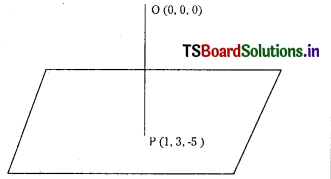
Find the equation of the plane if the foot of the perpendicular from origin to the plane is (1, 3, – 5). (V.S.A.Q.)
Answer:
TS Inter 1st Year Maths 1B Solutions Chapter 7 The Plane Ex 7(a) 1
OP is the normal to the plane and plane is passing through P (1, 3, – 5).
Dr’s of normal OP are (1 – 0, 3 – 0, – 5 – 0)
= 1, 3, – 5
Hence equation of the plane is
⇒ a (x – x1) + b (y – y1) + c (z – z1) = 0
⇒ 1(x – 1) + 3(y – 3) – 5(z + 5) = 0
⇒ x + 3y – 5z – 35 = 0

TS Inter 1st Year Maths 1B Solutions Chapter 7 The Plane Ex 7(a)

Question 2.
Reduce the equation x + 2y – 3z – 6 = 0 of the plane to the normal form. (V.S.A.Q.)
Answer:
Equation of the plane is x + 2y – 3z – 6 = 0
⇒ x + 2y – 3z = 6
Dividing both sides by
\(\sqrt{1^2+2^2+(-3)^2}\) = \(\sqrt{1+4+9}\) = √14
We get
\(\left(\frac{1}{\sqrt{14}}\right) x+\left(\frac{2}{\sqrt{14}}\right) y+\left(\frac{-3}{\sqrt{14}}\right) z=\frac{6}{\sqrt{14}}\)

Question 3.
Find the equation of the plane whose intercepts on X, Y, Z – axes are 1,2,4 respectively. (S.A.Q.) (May 2014)
Answer:
Equation of the plane in the intercepts form x y z is \(\frac{x}{a}+\frac{y}{b}+\frac{z}{c}\) = 1, given a = 1, b = 2, c = 4
We have \(\frac{x}{1}+\frac{y}{2}+\frac{z}{4}\) = 1
⇒ 4x + 2y + z = 4

Question 4.
Find the intercepts of the plane 4x + 3y- 2z + 2 = 0 on the co-ordinate axes. (V.S.A.Q.)
Answer:
Given 4x + 3y – 2z = – 2
⇒ – 2x – \(\frac{3}{2}\)y + z = 1
⇒ \(\frac{x}{-\left(\frac{1}{2}\right)}+\frac{y}{-\left(\frac{2}{3}\right)}+\frac{z}{(1)}\)
∴ x – intercept = – \(\frac{1}{2}\), y – intercept = – \(\frac{2}{3}\) and z – intercept = 1.

Question 5.
Find the d.c’s of the normal to the plane x + 2y + 2z – 4 = 0. (V.S.A.Q.) [Mar. ’13, May ’12]
Answer:
Equation of the plane is x + 2y + 2z – 4 = 0
D.r’s of the normal = 1, 2, 2
∴ \(\sqrt{a^2+b^2+c^2}\) = \(\sqrt{1+4+4}\) = 3
∴ D.c’s of the normal are \(\frac{1}{3}, \frac{2}{3}, \frac{2}{3}\)

Question 6.
Find the equation of the plane passing through the point (-2, 1, 3), and having (3, -5, 4) as d.r’s of its normal. (V.S.A.Q.)
Answer:
D.r’s of normal are 3, -5, 4 and since the plane passes through (- 2, 1, 3), we have equation of the plane is
3(x + 2) – 5 (y – 1) + 4 (z – 3) = 0
⇒ 3x + 6-5y + 5 + 4z – 12 = 0
⇒ 3x – 5y + 4z – 1 = 0

TS Inter 1st Year Maths 1B Solutions Chapter 7 The Plane Ex 7(a)

Question 7.
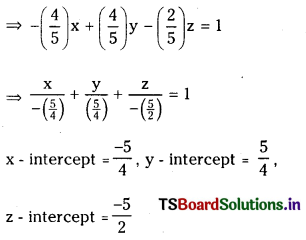
Write the equation of the plane 4x – 4y + 2z + 5 = 0 in the intercept form. (V.S.A.Q.) [March 2012]
Answer:
Equation of the plane is
4x – 4y + 2z + 5 = 0
∴ 4x – 4y + 2z = – 5
TS Inter 1st Year Maths 1B Solutions Chapter 7 The Plane Ex 7(a) 2

Question 8.
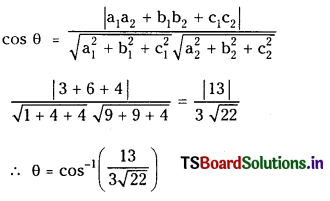
Find the angle between the planes
x + 2y + 2z – 5 = 0 and 3x + 3y + 2z – 8 = 0. (V.S.A.Q.)
Answer:
Equations of the planes are
x + 2y + 2z-5 = 0 ………………. (1)
and 3x + 3y + 2z – 8 = 0 ………………. (2)
If θ is the angle between the planes then by the formula,
TS Inter 1st Year Maths 1B Solutions Chapter 7 The Plane Ex 7(a) 3

II.
Question 1.
Find the equation of the plane passing through the point (1, 1, 1) and parallel to the plane x + 2y + 3z – 7 = 0. (V.S.A.Q.) [May 2011]
Answer:
Equation of the plane parallel to the given plane x + 2y + 3z – 7 = 0 is of the form x + 2y + 3z + k = 0
If this passes through the point (1, 1, 1) then
1 + 2 + 3 + k = 0 k = – 6
So, the equation of the required plane is
x + 2y + 3z – 6 = 0

TS Inter 1st Year Maths 1B Solutions Chapter 7 The Plane Ex 7(a)

Question 2.
Find the equation of the plane passing through (2, 3, 4) and perpendicular to X-axis. (V.S.A.Q.)
Answer:
If the plane is perpendicular to X-axis then X-axis is a normal to the plane and d.c’s of X-axis are 1, 0, 0.
∴ Equation of the plane is of the form x = k.
Since this passes through (2, 3, 4) we have k = 2.
∴ Equation of the required plane is x = 2.

Question 3.
Show that 2x + 3y + 7 = 0 represents a plane perpendicular to XY-plane. (V.S.A.Q.)
Answer:
Equation of the given plane is 2x + 3y + 7 = 0
Equation of the plane perpendicular to XY plane is z = 0
i. e., 0.x + 0.y + 1.z = 0
Since the two planes are perpendicular by the condition a1a2 + b1b2 + c1c2 = 0 we have 2(0) + 3(0) + 0(1) = 0
∴ Plane 2x + 3y + 7 = 0 is perpendicular to XY – plane.

Question 4.
Find the constant k so that the planes x – 2y + kz = 0 and 2x + 5y – z = 0 are at right angles. Find the equation of the plane through (1, -1,-1) and perpendicular to these planes. (S.A.Q.)
Answer:
Equations of the given planes are x – 2y + kz = 0 and 2x + 5y – z = 0
If the planes are perpendicular then
1(2) + (- 2) (5) + k (-1) = 0
⇒ 2 – 10 – k = 0 ⇒ k = – 8
Equation of the plane is
x – 2y – z = 0 …………….. (1)
and 2x + 5y – z = 0 ………………….. (2)
Equation of the plane passing through (1, – 1, – 1) is of the form
a (x – 1) + b (y + 1) + c (z + 1) = 0 …………………. (3)
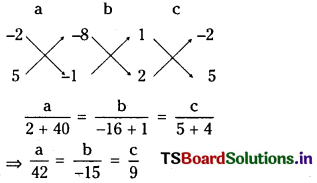
If this plane is perpendicular to (1) and (2) then a – 2b – 8c = 0 and 2a + 5b – c = 0
Solving
TS Inter 1st Year Maths 1B Solutions Chapter 7 The Plane Ex 7(a) 4
∴ From (3), equation of the required plane is 42 (x – 1) – 15 (y + 1) + 9 (z + 1) = 0
⇒ 42x – 15y + 9z – 48 = 0

TS Inter 1st Year Maths 1B Solutions Chapter 7 The Plane Ex 7(a)

Question 5.
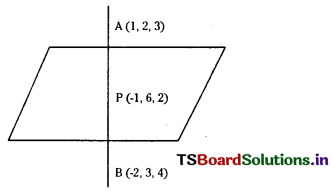
Find the equation of the plane through (- 1, 6, 2) and perpendicular to the join of (1, 2, 3) and (- 2, 3, 4). (S.A.Q.)
Answer:
TS Inter 1st Year Maths 1B Solutions Chapter 7 The Plane Ex 7(a) 5
Let A (1, 2, 3) and B (-2, 3, 4) be the given points.
D.r’s of AB are 3, -1,-1.
The line AB is perpendicular to the plane and passing through the point P (- 1, 6, 2).
Then equation of the plane is
3(x + 1) – 1 (y – 6) – 1 (z – 2) = 0
⇒ 3x – y – z + 11 = 0

Question 6.
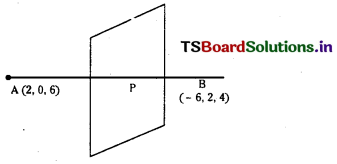
Find the equation of the plane bisecting the line segment joining (2, 0, 6) and (-6, 2, 4) and perpendicular to it. (S.A.Q.)
Answer:
TS Inter 1st Year Maths 1B Solutions Chapter 7 The Plane Ex 7(a) 6
Let A (2, 0, 6) and B(- 6, 2, 4) be the two points.
Then mid point of AB
= \(\left(\frac{2-6}{2}, \frac{0+2}{2}, \frac{6+4}{2}\right)\) = (- 2, 1, 5)
Equation of the plane is perpendicular to AB.
∴ Dr’s of normal to the plane are
2 + 6, 0 – 2, 6 – 4 = 8, – 2, 2
Equation of the required plane is
8(x + 2) – 2(y – 1) + 2 (z – 5) = 0
⇒ 8x – 2y + 2z + 8 = 0

Question 7.
Find the equation of the plane passing through (0,0, – 4) and perpendicular to the line joining the points (1, – 2, 2) and (- 3, 1, – 2). (S.A.Q.)
Answer:
Let A (1, -2, 2) and B (-3, 1, -2) be the given points.
D.r’s of normal to the plane are
(1 + 3, -2 – 1, 2 + 2) = (4, -3, 4)
Equation of the required plane passing through (0, 0 -4) is
4(x – 0) – 3 (y – 0) + 4 (z + 4) = 0
⇒ 4x – 3y + 4z + 16 = 0

Question 8.
Find the equation of the plane through (4, 4, 0) and perpendicular to the planes 2x + y + 2z + 3 = 0 and 3x + 3y + 2z – 8 = 0. (S.A.Q.)
Answer:
The equation of the plane passing through the point (4, 4, 0) is of the form
a (x – 4) + b (y – 4) + c (z – 0) = 0 ………………. (1)
If this is perpendicular to 2x + y + 2z + 3 = 0 and 3x + 3y + 2z – 8 = 0
Then 2a + b + 2c = 0 ……………… (2)
and 3a + 3b + 2c = 0 ……………… (3)
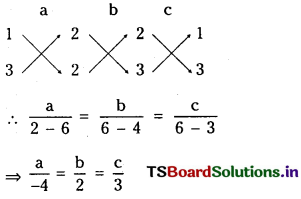
Solving (2) and (3)
TS Inter 1st Year Maths 1B Solutions Chapter 7 The Plane Ex 7(a) 7
∴ From (1) equation of the required plane is
– 4 (x – 4) + 2 (y – 4) + 3 (z – 0) = 0
⇒ – 4x + 2y + 3z + 8 = 0
⇒ 4x – 2y – 3z – 8 = 0

TS Inter 1st Year Maths 1B Solutions Chapter 7 The Plane Ex 7(a)

III.
Question 1.
Find the equation of the plane through the points (2, 2, – 1), (3, 4, 2), (7, 0, 6). (E.Q.)
Answer:
Equation of the plane passing through (2, 2, – 1) is
a (x – 2) + b (y – 2) + c (z + 1) = 0 ………………. (1)
If this passes through (3, 4, 2) then
a (3 – 2) + b (4 – 2) + c (2 + 1) = 0
⇒ a + 2b + 3c = 0 …………………. (2)
Similarly if the plane passing through (7, 0. 6) is
a (7 – 2) + b (0 – 2) + c (6 + 1) = 0
⇒ 5a – 2b + 7c = 0 ………………… (3)
Solving (2) and (3) we get
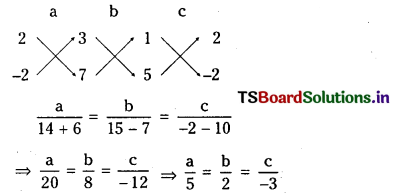
TS Inter 1st Year Maths 1B Solutions Chapter 7 The Plane Ex 7(a) 8
∴ From (1) equation of the required plane is
5 (x – 2) + 2 (y – 2) – 3 (z +1) = 0
⇒ 5x + 2y – 3z – 17 = 0

Question 2.
Show that the points (0, – 1, 0), (2, 1, – 1), (1, 1, 1), (3, 3, 0) are coplanar. (E.Q.)
Answer:
Equation of the plane passing through (0, -1, 0) will be of the form
a (x – 0) + b (y + 1) + c (z – 0) = 0 …………………… (1)
If this passes through (2, 1, – 1) then a (2 – 0) + b (1 + 1) + c (- 1 – 0) = 0
⇒ 2a + 2b – c = 0 …………………… (2)
Similarly if the plane passes through (1, 1, 1) then
a (1 – 0) + b (1 + 1) + c (1 – 0) = 0
⇒ a + 2b + c = 0 ………………….. (3)
Solving (2) and (3),
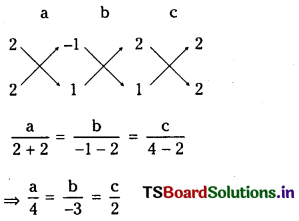
TS Inter 1st Year Maths 1B Solutions Chapter 7 The Plane Ex 7(a) 9
∴ Equation of the plane passing through (0, -1, 0), (2, 1,-1) and (1, 1, 1) is
4 (x – 0) – 3 (y + 1) + 2 (z – 0) = 0 [From (1)]
⇒ 4x – 3y + 2z – 3 = 0 ………………….. (4)
If it passes through (3, 3, 0), then
4(3) – 3(3) + 2 (0) – 3 = 0
Hence the point (3,3,0) also passes through (4) and hence the given points are coplanar.

Question 3.
Find the equation of the plane through (6, -4, 3), (0, 4, -3) and cutting of intercepts whose sum is zero. (E.Q.)
Answer:
Equation of the plane in the intercepts form is \(\frac{x}{a}+\frac{y}{b}+\frac{z}{c}\) = 1.
Given a + b + c = 0
⇒ c = – (a + b)
The plane passes through the points A(6, – 4, 3) and B (0, 4, -3)
Hence, \(\frac{6}{a}-\frac{4}{b}+\frac{3}{c}\) = 1 ……………………. (1)
If this passes through B(0, 4, – 3), then
\(\frac{4}{b}-\frac{3}{c}\) = 1 ……………………….. (2)
Adding (1) and (2); \(\frac{6}{a}\) = 2 ⇒ a = 3
From (2),
\(\frac{4}{b}-\frac{3}{c}\) = 1 ⇒ 4c – 3b = bc
⇒ – 4 (a + b) – 3b = – b (a + b)
⇒ – 4a – 4b – 3b = – ab – b2
⇒ 4a + 7b = ab + b2
Since a = 3 we have 12 + 7b = 3b + b2
⇒ b2 – 4b – 12 = 0 ⇒ (b – 6) (b + 2) = 0

Case – (i): b = 6, then c = -(3 + 6) = – 9
Equation of the plane is \(\frac{x}{3}+\frac{y}{6}-\frac{z}{9}\) = 1
⇒ 6x + 3y – 2z = 18

Case – (ii): b = – 2, then c = -(3 – 2) = – 1
Equation of the plane is \(\frac{x}{3}-\frac{y}{2}+\frac{z}{-1}\) = 1
⇒ \(\frac{x}{3}-\frac{y}{2}+\frac{z}{-1}\) = 1 ⇒ 2x – 3y – 6z = 6

TS Inter 1st Year Maths 1B Solutions Chapter 7 The Plane Ex 7(a)

Question 4.
A plane meets the co-ordinate axes in A, B, C. If the centroid of ∆ABC is (a, b, c). Show that the equation to the plane is \(\frac{x}{a}+\frac{y}{b}+\frac{z}{c}\) = 3. (E.Q.)
Answer:
Suppose α, β, γ be the intercepts of the plane ABC.
Equation of the plane in the intercept form is
\(\frac{x}{\alpha}+\frac{y}{\beta}+\frac{z}{\gamma}\) = 1 ……………… (1)
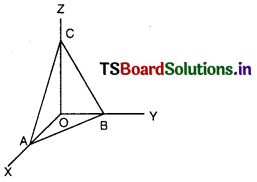
TS Inter 1st Year Maths 1B Solutions Chapter 7 The Plane Ex 7(a) 10
Co-ordinates of A = (α, 0, 0), B = (0, β, 0) and C = (0, 0, γ)
G is the centroid of ∆ABC.
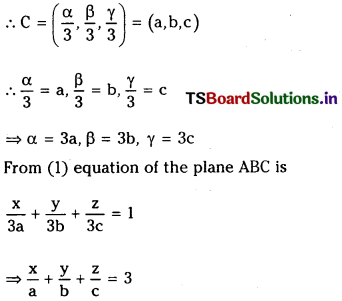
TS Inter 1st Year Maths 1B Solutions Chapter 7 The Plane Ex 7(a) 11

Question 5.
Show that the plane through (1, 1, 1), (1, – 1, 1) and (- 7, – 3, – 5) is parallel to Y – axis. (S.A.Q.)
Answer:
Equation of the plane through A (1, 1, 1) is
a (x – 1) + b (y – 1) + c (z – 1) = 0 ………………… (1)
This plane passes through B (1, – 1, 1) then
0 – 2b + 0 = 0 0 ⇒ b = 0
Equation of XZ plane is y = 0
∴ 0 . x + 1 . y + 0 . z = 0
The required plane is perpendicular to XZ plane and hence parallel to Y – axis.

TS Inter 1st Year Maths 1B Solutions Chapter 7 The Plane Ex 7(a)

Question 6.
Show that the equations ax + by + r = 0, by + cz + p = 0, cz + ax + q = 0 represent planes perpendicular to XY, YZ, ZX planes respectively. (S.A.Q.)
Answer:
Let the equation of the plane be ax + by + c = 0
The d.r’s of normal to the plane are a, b, c Equation of XY plane is z = 0 .-. D.r’s of normal are (0, 0, 1)
∴ a (0) + b (0) + 0 (1) = 0
∴ ax + by + r = 0 represent a plane perpendicular to XY – plane.
Similarly by + cz + p = 0 and cz + ax + q = 0 represent planes perpendicular to YZ – plane, ZX planes respectively.

TS Inter 1st Year Accountancy Notes Chapter 10 Preparation of Final Accounts

Here students can locate TS Inter 1st Year Accountancy Notes Chapter 10 Preparation of Final Accounts to prepare for their exam.

TS Inter 1st Year Accountancy Notes Chapter 10 Preparation of Final Accounts

1. To find out the net profit and true financial position, all expenses relating to the current year whether paid or not, all incomes received or to be received should be taken into account. Some of the income and expenses relating to next year should not include in the current year. The amount to be adjusted in the books is called an adjustment.

TS Inter 1st Year Accountancy Notes Chapter 10 Preparation of Final Accounts

2. Types of adjustments:

  1. Adjustment for closing stock.
  2. Adjustment for outstanding expenses.
  3. Adjustment for prepaid expenses.
  4. Adjustment for income receivable.
  5. Adjustment for income received in advance.
  6. Adjustment for depreciation.
  7. Adjustment for interest on capital.
  8. Adjustment for interest on drawings,
  9. Adjustment for bad debts and Reserve for bad debts.

TS Inter 1st Year Accountancy Notes Chapter 10 ముగింపు లెక్కల తయారీ

1. ఒక వ్యాపార సంస్థ సంవత్సరానికి నికర లాభము / నష్టము, ఆర్థిక పరిస్థితిని తెలుసుకోవడానికి ప్రస్తుత సంవత్సరానికి సంబంధించిన ఖర్చులను చెల్లించినా, చెల్లించవలసినా, అదే విధముగా స్వీకరించిన, రావలసిన ఆదాయాలను లెక్కలోకి తీసుకోవాలి. రాబోయే సంవత్సరానికి చెందిన ఆదాయాలు గాని, వ్యయాలు గాని ప్రస్తుత సంవత్సరములో చేర్చకూడదు. అంకణాలో ఇచ్చిన మొత్తాలకు సంబంధిత మొత్తాలను సర్దుబాటు చేయడాన్ని సర్దుబాట్లు అంటారు.

TS Inter 1st Year Accountancy Notes Chapter 10 Preparation of Final Accounts

2. సర్దుబాట్లలో రకాలు:

  1. ముగింపు సరుకునకు సంబంధించిన సర్దుబాట్లు
  2. చెల్లించవలసిన వ్యయాలకు సర్దుబాట్లు
  3. ముందుగా చెల్లించిన వ్యయాలకు సర్దుబాట్లు
  4. రావలసిన ఆదాయాలకు సర్దుబాట్లు
  5. ముందుగా వచ్చిన ఆదాయాలకు సర్దుబాట్లు
  6. స్థిరాస్తులపై తరుగుదలకు సర్దుబాట్లు
  7. మూలధనముపై వడ్డీకి సర్దుబాట్లు
  8. సొంతవాడకాలపై వడ్డీకి సర్దుబాట్లు
  9. రాని బాకీలకు సర్దుబాట్లు
  10. రాని, సంశయాత్మక బాకీల నిధికి సర్దుబాట్లు