TS Inter 1st Year Accountancy Notes Chapter 10 Preparation of Final Accounts

Here students can locate TS Inter 1st Year Accountancy Notes Chapter 10 Preparation of Final Accounts to prepare for their exam.

TS Inter 1st Year Accountancy Notes Chapter 10 Preparation of Final Accounts

1. To find out the net profit and true financial position, all expenses relating to the current year whether paid or not, all incomes received or to be received should be taken into account. Some of the income and expenses relating to next year should not include in the current year. The amount to be adjusted in the books is called an adjustment.

TS Inter 1st Year Accountancy Notes Chapter 10 Preparation of Final Accounts

2. Types of adjustments:

  1. Adjustment for closing stock.
  2. Adjustment for outstanding expenses.
  3. Adjustment for prepaid expenses.
  4. Adjustment for income receivable.
  5. Adjustment for income received in advance.
  6. Adjustment for depreciation.
  7. Adjustment for interest on capital.
  8. Adjustment for interest on drawings,
  9. Adjustment for bad debts and Reserve for bad debts.

TS Inter 1st Year Accountancy Notes Chapter 10 ముగింపు లెక్కల తయారీ

1. ఒక వ్యాపార సంస్థ సంవత్సరానికి నికర లాభము / నష్టము, ఆర్థిక పరిస్థితిని తెలుసుకోవడానికి ప్రస్తుత సంవత్సరానికి సంబంధించిన ఖర్చులను చెల్లించినా, చెల్లించవలసినా, అదే విధముగా స్వీకరించిన, రావలసిన ఆదాయాలను లెక్కలోకి తీసుకోవాలి. రాబోయే సంవత్సరానికి చెందిన ఆదాయాలు గాని, వ్యయాలు గాని ప్రస్తుత సంవత్సరములో చేర్చకూడదు. అంకణాలో ఇచ్చిన మొత్తాలకు సంబంధిత మొత్తాలను సర్దుబాటు చేయడాన్ని సర్దుబాట్లు అంటారు.

TS Inter 1st Year Accountancy Notes Chapter 10 Preparation of Final Accounts

2. సర్దుబాట్లలో రకాలు:

  1. ముగింపు సరుకునకు సంబంధించిన సర్దుబాట్లు
  2. చెల్లించవలసిన వ్యయాలకు సర్దుబాట్లు
  3. ముందుగా చెల్లించిన వ్యయాలకు సర్దుబాట్లు
  4. రావలసిన ఆదాయాలకు సర్దుబాట్లు
  5. ముందుగా వచ్చిన ఆదాయాలకు సర్దుబాట్లు
  6. స్థిరాస్తులపై తరుగుదలకు సర్దుబాట్లు
  7. మూలధనముపై వడ్డీకి సర్దుబాట్లు
  8. సొంతవాడకాలపై వడ్డీకి సర్దుబాట్లు
  9. రాని బాకీలకు సర్దుబాట్లు
  10. రాని, సంశయాత్మక బాకీల నిధికి సర్దుబాట్లు

TS Inter 1st Year Maths 1B Solutions Chapter 6 Direction Cosines and Direction Ratios Ex 6(b)

Students must practice these TS Intermediate Maths 1B Solutions Chapter 6 Direction Cosines and Direction Ratios Ex 6(b) to find a better approach to solving the problems.

TS Inter 1st Year Maths 1B Direction Cosines and Direction Ratios 6(b)

Question 1.
Find the direction ratios of the line joining the points (3, 4, 0) and (4, 4, 4). (V.S.A.Q.)
Answer:
Let A = (3, 4, 0) and B = (4, 4, 4) be the given points.
Then d.r.’s of AB = ( 4 – 3, 4 – 4, 4 – 0) = (1, 0, 4)

Question 2.
The direction ratios of a line are (-6, 2, 3). Find its direction cosines. (V.S.A.Q.)
Answer:
d.r’s of the line are -6, 2, 3.
∴ \(\sqrt{a^2+b^2+c^2}\) = \(\sqrt{36+4+9}\) = √49 = 7
d.c.’s of the line are \(\frac{-6}{7}, \frac{2}{7}, \frac{3}{7}\).

TS Inter 1st Year Maths 1B Solutions Chapter 6 Direction Cosines and Direction Ratios Ex 6(b)

Question 3.
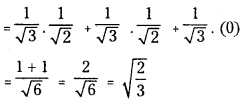
Find the cosine of the angle between the lines whose direction cosines are
\(\left(\frac{1}{\sqrt{3}}, \frac{1}{\sqrt{3}}, \frac{1}{\sqrt{3}}\right)\) and \(\left(\frac{1}{\sqrt{2}}, \frac{1}{\sqrt{2}}, 0\right)\).
Answer:
cos θ = l1 l2 + m1 m2 + n1n2
TS Inter 1st Year Maths 1B Solutions Chapter 6 Direction Cosines and Direction Ratios Ex 6(b) 1

Question 4.
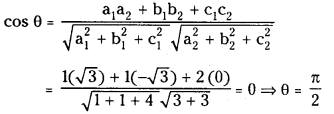
Find the angle between the lines whose d.r.’s are (1, 1, 2), (√3 , – √3, 0). (V.S.A.Q.)
Answer:
We have
TS Inter 1st Year Maths 1B Solutions Chapter 6 Direction Cosines and Direction Ratios Ex 6(b) 2

Question 5.
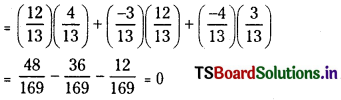
Show that the lines with direction cosines \(\left(\frac{12}{13}, \frac{-3}{13}, \frac{-4}{13}\right)\) and \(\left(\frac{4}{13}, \frac{12}{13}, \frac{3}{13}\right)\) are Perpendicular to each other. (V.S.A.Q.)
Answer:
We have the condition for two lines with d.c.’s (l1, m1, n1) and (l2, m2, n2) to be perpendicular is l1l2 + m1m2 + n1n2 = 0
∴ l1l2 + m1m2 + n1n2
TS Inter 1st Year Maths 1B Solutions Chapter 6 Direction Cosines and Direction Ratios Ex 6(b) 3
∴ The given lines are perpendicular.

Question 6.
O is the origin, P(2, 3, 4) and Q (1, k, 1) are points such that OP ⊥ OQ . Find k.
Answer:
d.r.’s of OP = 2, 3, 4
d.r.’s of OQ = 1, k, 1
OP and OQ are perpendicular.
⇒ a1a2 + b1b2 + c1c2 = 0
⇒ 2 + 3k + 4 = 0 ⇒ 3k + 6 = 0 ⇒ k = – 2

TS Inter 1st Year Maths 1B Solutions Chapter 6 Direction Cosines and Direction Ratios Ex 6(b)

II.
Question 1.
If the direction ratios of a line are (3, 4, 0) find its direction cosines and also the angles made with the coordinate axes. (S.A.Q.)
Answer:
d.c.’s of the line are (3, 4, 0).
\(\sqrt{a^2+b^2+c^2}\) = \(\sqrt{9+16}\) = 5
∴ d.c.’s of the line are
If α, β, γ are angles made by the line with the
coordinate axes then cos α = \(\frac{3}{5}\), cos β = \(\frac{4}{5}\), cos γ = 0
∴ α = cos-1 (3/5), β = cos-1 (4/5), γ = \(\frac{\pi}{2}\)
∴ Angles made with coordinate axes are
cos-1 (3/5), cos-1 (4/5) and \(\frac{\pi}{2}\).

Question 2.
Show that the line through the points (1, -1, 2), (3, 4, -2) is perpendicular to the line through the points (0, 3, 2) and (3, 5, 6). (S.A.Q.)
Answer:
Let A = (1, -1, 2), B = (3, 4, -2), C = (0, 3, 2) and D = (3, 5, 6) be the given points.
d.r.’s of AB = (3 – 1, 4 + 1, -2 – 2) = (2, 5,4)
d.r.’s of CD = (3 – 0, 5 – 3, 6 – 2) = (3, 2, 4)
∴ a1 a2 + b1 b2 + c1 c2 = 2(3) + 5(2) + (-4) (4) = 0
∴ AB and CD are perpendicular.

Question 3.
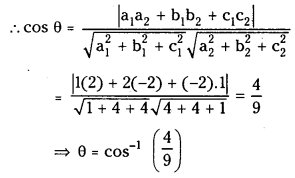
Find the angle between DC and AB where A = (3, 4, 5), B = (4, 6, 3), C = (-1, 2, 4) and D = (1, 0, 5). (S.A.Q.)
Answer:
d.r.’s of AB are (4 – 3, 6 – 4, 3 – 5) = (1, 2, -2)
d.r.’s of CD are (1 + 1, 0 – 2, 5 – 4) = (2, -2, 1)
TS Inter 1st Year Maths 1B Solutions Chapter 6 Direction Cosines and Direction Ratios Ex 6(b) 4

Question 4.
Find the direction cosines of a line which is perpendicular to the lines, whose direction ratios are (1, -1, 2) and (2, 1, -1). (S.A.Q.)
Answer:
Let the d.c.’s of the required line be a, b, c. This is perpendicular to the line whose d.r.’s are (1,-1, 2) and (2, 1, -1).
Then a – b + 2c = 0
and 2a + b – c = 0
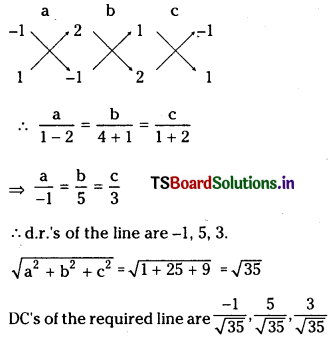
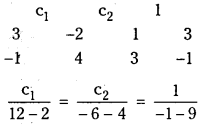
TS Inter 1st Year Maths 1B Solutions Chapter 6 Direction Cosines and Direction Ratios Ex 6(b) 5

TS Inter 1st Year Maths 1B Solutions Chapter 6 Direction Cosines and Direction Ratios Ex 6(b)

Question 5.
Show that the points (2, 3, -4), (1, -2 ,3) and (3, 8, -11) are collinear. (S.A.Q.)
Answer:
Let A = (2, 3, -4), B = (1, -2, 3) and C = (3, 8, -11) be the three given points.
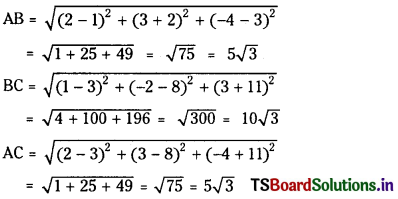
TS Inter 1st Year Maths 1B Solutions Chapter 6 Direction Cosines and Direction Ratios Ex 6(b) 6
∵ AB + AC = 5√3 + 5√3 = 10√3 = BC
We have A, B, C are collinear.

Question 6.
Show that the points (4, 7, 8), (2, 3, 4), (-1, -2, 1), (1, 2, 5) are the vertices of a parallelogram. (S.A.Q.)
Answer:
Let A = (4, 7, 8), B = (2, 3, 4), C = (-1, -2, 1) and D = (1, 2, 5) be the four given points.
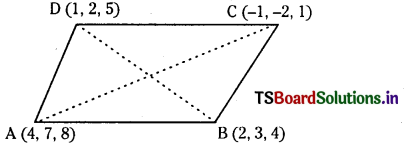
TS Inter 1st Year Maths 1B Solutions Chapter 6 Direction Cosines and Direction Ratios Ex 6(b) 7
d.r.’s of \(\overline{\mathrm{AB}}\) = (2 – 4, 3 – 7, 4 – 8)
= (-2, -4, -4) ………………. (1)
d.r.’s of \(\overline{\mathrm{DC}}\) = (- 1 – 1, – 2 – 2, 1 – 5)
= (-2, -4, -4) ………………… (2)
d.r.’s of \(\overline{\mathrm{AB}}\) = DR’s of \(\overline{\mathrm{DC}}\) we have \(\overline{\mathrm{AB}}\) is parallel to \(\overline{\mathrm{DC}}\).
d.r.’s of \(\overline{\mathrm{AD}}\) = (1 – 4, 2 – 7, 5 – 8)
= (-3, -5, -3) ……………………. (3)
d.r.’s of \(\overline{\mathrm{BC}}\) = (-1 – 2, -2 – 3, 1 – 4)
= (-3, -5, -3) …………………….. (4)
∵ d.r.’s of \(\overline{\mathrm{AD}}\) = d.r.’s of \(\overline{\mathrm{BC}}\), we have \(\overline{\mathrm{AD}}\) is parallel to \(\overline{\mathrm{BC}}\).
From (1) and (3),
(-2) (-3) + (-4) (-5) + (-4) (-3) ≠ 0
From (2) and (4),
(-2) (-3) + (-4) (-5) + (-4) (-3) ≠ 0
We have \(\overline{\mathrm{AD}}\) is not perpendicular to \(\overline{\mathrm{AB}}\) and \(\overline{\mathrm{DC}}\) is not perpendicular to \(\overline{\mathrm{BC}}\).
Also d.r.’s of \(\overline{\mathrm{AC}}\) = (-1 – 4, -2 -7, 1 – 8)
= (-5, -9, -7) ………………….. (5)
d.r.’s of B\(\overline{\mathrm{BD}}\) = (1 – 2, 2 – 3, 5 – 4)
= (-1, -1, 1) ………………….. (6)
From (5) and (6)
(- 5) (- 1) + (- 9) (- 1) + (1) (-7) ≠ 0
Hence diagonals \(\overline{\mathrm{AC}}\) and \(\overline{\mathrm{BD}}\) are not perpendicular. Hence ABCD is a parallelogram.

III.
Question 1.
Show that the lines whose direction cosines are given by l + m + n = 0, 2mn + 3nl – 5lm= 0 are perpendicular to each other.(E.Q.) (March ’12)
Answer:
Given l + m + n = 0 ………………… (1)
and 2mn + 3nl – 5lm = 0 …………………….. (2)
From (1), l = – (m + n)
∴ From (2), 2mn – 3n(m + n) + 5m(m + n) = 0
⇒ 2mn – 3mn – 3n2 + 5m2 + 5mn = 0
⇒ 5m2 + 4mn – 3n2 = 0
⇒ 5\(\left(\frac{m}{n}\right)^2\) + 4\(\left(\frac{m}{n}\right)\) – 3 = 0
This is a quadratic equation in \(\left(\frac{m}{n}\right)\) and let \(\frac{m_1}{n_1}\) and \(\frac{m_2}{n_2}\) be the roots of the quadratic equation.
Then product of roots \(\frac{m_1}{n_1} \cdot \frac{m_2}{n_2}=\frac{-3}{5}\)
⇒ \(\frac{m_1 m_2}{3}=\frac{n_1 n_2}{-5}\) = k (suppose) …………… (3)
From (1), m = – (l + n)
– 2n (l + n) + 3nl + 5l (l + n) = 0
⇒ 5l2 + 6nl – 2n2 = 0
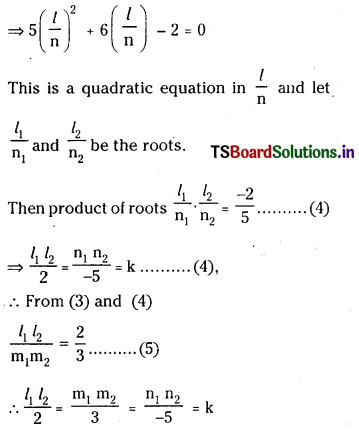
TS Inter 1st Year Maths 1B Solutions Chapter 6 Direction Cosines and Direction Ratios Ex 6(b) 8
∴ l1l2 = 2k, m1m2 = 3k, n1n2 = – 5k
∴ l1l2 + m1m2 + n1n2 = 0
∴ The two lines are perpendicular.

TS Inter 1st Year Maths 1B Solutions Chapter 6 Direction Cosines and Direction Ratios Ex 6(b)

Question 2.
Find the angle between the lines whose direction cosines satisfy the equations l + m + n = 0, l2 + m2 – n2 = 0. (E.Q.) (May 2014, ‘11,2007, Mar. ’13, ’07, June 2004)
Answer:
Given equations are
l + m + n = 0 ………………….. (1) and
l2 + m2 – n2 = 0 …………………… (2)
From (1), l = – (m + n)
From (2), [-(m + n)]2 + m2 – n2 = 0
⇒ m2 + n2 + 2mn + m2 – n2 = 0
⇒ 2m2 + 2mn = 0
⇒ 2m (m + n) = 0
⇒ m = 0 or m = -n

Case (i): If m = 0 then
l(0) + m (1) + n(0) = 0
and l + m + n = 0 ……………… (1)
Solving
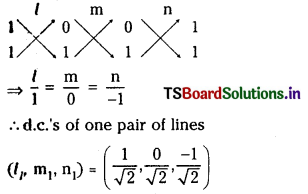
TS Inter 1st Year Maths 1B Solutions Chapter 6 Direction Cosines and Direction Ratios Ex 6(b) 9
∴ d.c.’s of one pair of lines
(l1, m1, n1) = \(\left(\frac{1}{\sqrt{2}}, \frac{0}{\sqrt{2}}, \frac{-1}{\sqrt{2}}\right)\)

Case (ii): If m + n = 0 then
l(0) + m(1) + n(1) = 0
and l + m + n = 0
Solving
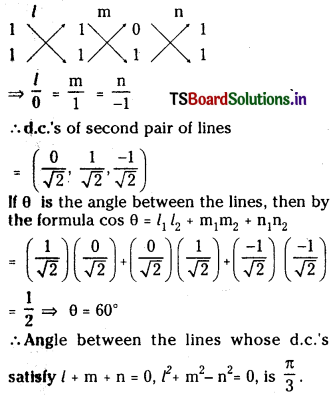
TS Inter 1st Year Maths 1B Solutions Chapter 6 Direction Cosines and Direction Ratios Ex 6(b) 10

TS Inter 1st Year Maths 1B Solutions Chapter 6 Direction Cosines and Direction Ratios Ex 6(b)

Question 3.
If a ray makes angles α, β, γ and δ with the four diagonals of a cube find a cube find cos2 α + cos2 β + cos2 γ + cos2 δ (E.Q.) (March 2005, May 2005)
Answer:
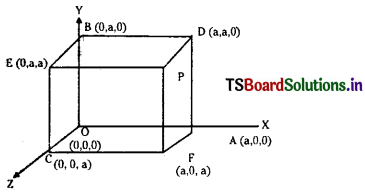
TS Inter 1st Year Maths 1B Solutions Chapter 6 Direction Cosines and Direction Ratios Ex 6(b) 11
Let the side of the cube be of length ‘a’. Let one of the vertices of the cube through the origin ‘O’ and axes be along the three edges \(\overline{\mathrm{OA}}\), \(\overline{\mathrm{OB}}\) and \(\overline{\mathrm{OC}}\). The diagonals of the cube are OP, CD, AE and BF d.r.’s of the diagonals are (a, a, a), (a, a, -a), (-a, a, a) and (a, -a, a) respectively.
Let the d.c.’s of the given ray be l, m, n. If this make angles α, β, γ and δ with the four diagonals of the cube then
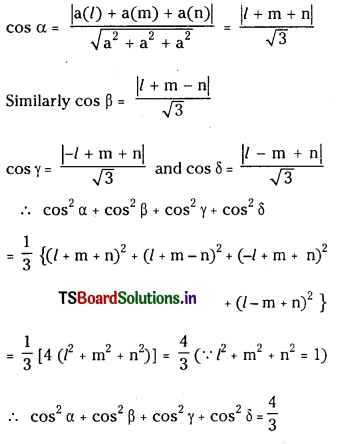
TS Inter 1st Year Maths 1B Solutions Chapter 6 Direction Cosines and Direction Ratios Ex 6(b) 12

Question 4.
If (l1, two intersecting lines. Show that the d.c’s of two lines bisecting the angles between them are proportioned to l1 ± l2, m1 ± m2, n1 ± n2 (E.Q.)
Answer:
Let OA, OB be the given lines and A, B be the points at which distances from 0.
⇒ Coordinates of A = (l1, m1, n1) and B = (l2, m2, n2)
Mid point of AB, is:
P = \(\left(\frac{l_1+l_2}{2}, \frac{m_1+m_2}{2}, \frac{n_1+n_2}{2}\right)\)
∴ OP is the bisector of ∠AOB ⇒ d.r,’s of OP are l1 + l2, m1 + m2, n1 + n2
Now coordinates of B = (-l2, -m2, -n2) and mid point of AB’ is
Q = \(\left(\frac{l_1-l_2}{2}, \frac{m_1-m_2}{2}, \frac{n_1-n_2}{2}\right)\)
∴ OQ is a bisector of ∠AOB ⇒ d.r.’s of OQ are l1 – l2, m1 – m2, n1 – n2

Question 5.
A (-1, 2, -3), B (5, 0, -6), C (0, 4, -1) are three points. Show that the direction cosines of the bisector of ∠BAC are proportional to (25, 8, 5) and (-11, 20, 23). (E.Q.)
Answer:
Given A (-1, 2, -3), B (5, 0, -6) and C (0,4, -1) are three points.
d.r.’s of AB are = (5 + 1, 0 – 2, – 6 + 3) = (6, – 2, – 3)
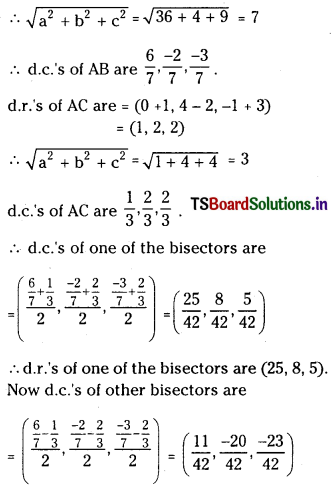
TS Inter 1st Year Maths 1B Solutions Chapter 6 Direction Cosines and Direction Ratios Ex 6(b) 13
Hence d.r.’s of other bisector are (-11, 20, 23) Hence direction cosines of the bisectors of ∠BAC are proportional to (25, 8, 5) and (-11, 20, 23).

TS Inter 1st Year Maths 1B Solutions Chapter 6 Direction Cosines and Direction Ratios Ex 6(b)

Question 6.
If (6, 10, 10), (1, 0, -5), (6, – 10, 0) are vertices of a triangle. Find the direction ratios of its sides. Determine whether it is fight angled or isoceles. (S.A.)
Answer:
Let A (6,10,10), B (1, 0, -5) and C (6, -10, 0) are the vertices of ∆ABC
d.r.’s of AB = (-5, -10, -15) ⇒ (1,2, 3)
d.r.’s of BC = (5, -10, -5) ⇒ (1, -2, 1)
d.r.’s of AC = (0, 20, 10) ⇒ (0, 2, 1)
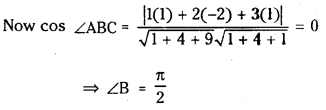
TS Inter 1st Year Maths 1B Solutions Chapter 6 Direction Cosines and Direction Ratios Ex 6(b) 14
∴ The given triangle is a right angled triangle.

Question 7.
The vertices of a triangle are A (1, 4, 2), B (-2, 1, 2), C (2, 3, -4). Find ∠A, ∠B, ∠C. (S.A.Q.)
Answer:
Given A (1, 4, 2), B (-2, 1, 2) and C (2, 3, -4) are the vertices of ABC.
d.r.’s of AB are = 3, 3, 0 i.e., 1, 1, 0
d.r.’s of BC are = -4, -2, 6 i.e., 2, 1,- 3
d.r.’s of AC are – 1, 1, 6
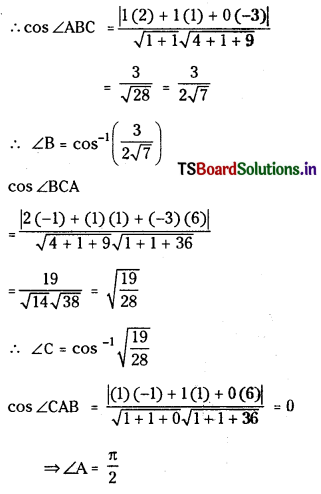
TS Inter 1st Year Maths 1B Solutions Chapter 6 Direction Cosines and Direction Ratios Ex 6(b) 15

Question 8.
Find the angle between the lines whose direction cosines are given by the equation 3l + m + 5n = 0 and 6mn – 2nl + 5lm = 0 (E.Q.) ( May’06, ’12))
Answer:
Given 3l + m + 5n = 0 ……………………. (1)
and 6mn – 2nl + 5lm = 0 ……………………. (2)
From (1), m = – (3l + 5n)
From (2)
– 6n (31 + 5n) – 2n/ – 5/ (31 + 5n) = 0
⇒ – 18nl – 30n2 – 2nl – 15l2 – 25ln = 0
⇒ – 15l2 – 45ln – 30n2 = 0
⇒ l2 + 3ln + 2n2 = 0
⇒ (l + 2n) (l + n) = 0
⇒ l + 2n = 0 or l + n = 0
⇒ l = – n or l = – 2n
If l = -n then m = 3n – 5n = – 2n
⇒ l : m : n = -n : -2n : n
= 1 : 2 : – 1
If l = -2n then m = 6n – 5n = n
⇒ l : m : n = -2n : n : n = 2 : -1 : -1
Hence d.r.’s of two lines are (1, 2, -1) and (2, -1,-1).
If θ is the angle between the two lines then
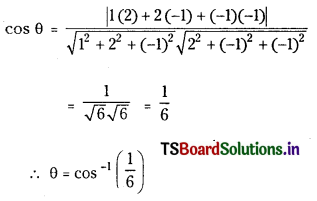
TS Inter 1st Year Maths 1B Solutions Chapter 6 Direction Cosines and Direction Ratios Ex 6(b) 16

TS Inter 1st Year Maths 1B Solutions Chapter 6 Direction Cosines and Direction Ratios Ex 6(b)

Question 9.
If a variable line in two adjacent positions has direction cosines (l, m, n) and (l + δl, m + δm, n + δn), show that the small angle δθ between two positions is given by (δθ)2 = (δl)2 + (δm)2 + (δn)2. (E.Q.)
Answer:
Given direction cosines of a variable line in two adjacent positions are (l, m, n) and (l + δl, m + δm, n + δn)
We have l2 + m2 + n2 = 1 …………………… (1)
and (l + δl)2 + (m + δm)2 + (n + δn)2 = 1 ………………… (2)
From (2) – (1) we have
(l + δl)2 + (m + δm)2 +(n + δn)2 – l2 – m2 – n2 = 0
⇒ 2 (l. δl + m . δm + n . δn) = – [(δl)2 + (δm)2 +(δn)2]
⇒ (δl)2 + (δm)2 + (δn)2 = – 2 (lδl + mδm + nδn) …………………… (3)
Now angle between two adjacent sides
cos δθ = l (l + δl) + m (m + δm) + n (n + δn)
= (l2 + m2 + n2) + l.δl + m.δm + n.δn
= 1 + l.δl + m.δm + n.δn
= 1 – \(\frac{1}{2}\) [(δl)2 + (δm)2 +(δn)2]
∴ (δl)2 + (δm)2 + (δn)2 = (1 – cos δθ)
Since δθ is very small, sin\(\left(\frac{\delta \theta}{2}\right)\) = \(\frac{\delta \theta}{2}\)
∴ (δl)2 + (δm)2 + (δn)2 = 4\(\frac{(\delta \theta)^2}{4}\) = (δθ)2
[∵ 1 – cosθ = 2 sin2\(\frac{\theta}{2}\)]
∴ (δθ)2 = (δl)2 + (δm)2 + (δn)2

TS Inter 1st Year Maths 1B Solutions Chapter 6 Direction Cosines and Direction Ratios Ex 6(a)

Students must practice these TS Intermediate Maths 1B Solutions Chapter 6 Direction Cosines and Direction Ratios Ex 6(a) to find a better approach to solving the problems.

TS Inter 1st Year Maths 1B Direction Cosines and Direction Ratios 6(a)

I.
Question 1.
A line makes angles 90°, 60° and 30° with positive directions of X, Y, Z axes respectively. Find the direction cosines. (V.S.A.Q.)
Answer:
If l, m, n are the d.c.’s of the line
l = cos l = cos 90° = 0, m = cos β = cos 60° = \(\frac{1}{2}\)
n = cos γ = cos 30° = \(\frac{\sqrt{3}}{2}\)
d.c.’s of the line are \(\left(0, \frac{1}{2}, \frac{\sqrt{3}}{2}\right)\)

TS Inter 1st Year Maths 1B Solutions Chapter 6 Direction Cosines and Direction Ratios Ex 6(a)

Question 2.
If a line makes angles α, β, γ with the positive directions of X, Y, Z axes, what is the value of sin2α + sin2β + sin2γ ? (V.S.A.Q.)
Answer:
sin2α + sin2β + sin2γ
= 1 – cos2α + 1 – cos2β + 1 – cos2γ
= 3 – l2 – m2 – n2
= 3 – (l2 + m2 + n2) = 3 – 1 = 2
(cos α = l, cos β = m, cos γ = n are d.c.’s of a line)

Question 3.
If P (√3 , 1, 2√3) is a point in space, find the direction cosines of OP (V.S.A.Q.)
Answer:
Direction ratios of
\(\overrightarrow{\mathrm{OP}}\) = (√3 – 0, 1 – 0, 2√3 – 0) = (√3, 1, 2√3)
∴ a2+ b2 + c2 = 3 + 1+ 12 = 16
⇒ \(\sqrt{a^2+b^2+c^2}\) = 4
∴ Direction cosines of \(\overrightarrow{\mathrm{OP}}\)
TS Inter 1st Year Maths 1B Solutions Chapter 6 Direction Cosines and Direction Ratios Ex 6(a) 1

Question 4.
Find the direction cosines of the line joining the points (-4, 1, 7) and (2, -3, 2). (V.S.A.Q.)
Answer:
Let A = (-4, 1, 7) and B = (2, -3, 2)
d.r.’s of AB = (2 + 4, -3 -1, 2 – 7) = (6, -4, -5)
TS Inter 1st Year Maths 1B Solutions Chapter 6 Direction Cosines and Direction Ratios Ex 6(a) 2

II.
Question 1.
Find the direction cosines of the sides of the triangle whose vertices are (3, 5, -4), (-1, 1, 2) and (-5, -5, -2). (S.A.Q.)
Answer:
Let A (3, 5, -4), B (-1, 1, 2) and C (-5, -5, -2) be the vertices of ∆ABC.
d.r.’s of AB = (-1 – 3, 1 – 5, 2 + 4) = (-4, -4, 6)
TS Inter 1st Year Maths 1B Solutions Chapter 6 Direction Cosines and Direction Ratios Ex 6(a) 3

TS Inter 1st Year Maths 1B Solutions Chapter 6 Direction Cosines and Direction Ratios Ex 6(a)

Question 2.
Show that the lines \(\overleftrightarrow{\mathrm{PQ}}\) and \(\overleftrightarrow{\mathrm{RS}}\) are parallel where P, Q, R, S erne the points (2, 3, 4), (4, 7, 8), (-1, -2, 1) and (1, 2, 5) respectively. (V.S.A.Q.)
Answer:
P (2, 3, 4), Q ( 4, 7, 8), R (-1, -2, 1) and S (1, 2, 5) are the given points.
d.r.’s of \(\overleftrightarrow{\mathrm{PQ}}\) = (4 — 2,7 — 3, 8 – 4) = (2, 4, 4)
d.r.’s of \(\overleftrightarrow{\mathrm{RS}}\) = (1 + 1 , 2 + 2, 5 – 1) = (2, 4, 4)
d.r.’s of \(\overleftrightarrow{\mathrm{PQ}}\) and \(\overleftrightarrow{\mathrm{RS}}\) are proportional. Hence \(\overleftrightarrow{\mathrm{PQ}}\) and \(\overleftrightarrow{\mathrm{RS}}\) are parallel.

III.
Question 1.
Find the direction cosines of two lines which are connected by the relations l – 5m + 3n = 0 and 7l2 + 5m2 – 3n2 = 0 (E.Q.) (June 2009)
Answer:
The given relations are
l – 5m + 3n = 0 …………………….. (1)
7l2 + 5m2 – 3n2 = 0 ………………….. (2)
From (1), l = 5m – 3n ………………….. (3)
∴ From (2),
7(5m – 3n)2 + 5m2 – 3n2 = 0
⇒ 7(25m2 – 30mn + 9n2) + 5m2 – 3n2 = 0
⇒ 175m2 + 63n2 – 210mn + 5m2 – 3n2 = 0
⇒ 180m2 – 210mn + 60n2 = 0
⇒ 6m2 – 7mn + 2n2 = 0
⇒ (3m – 2n) (2m – n) = 0
⇒ 3m = 2n ⇒ m = \(\frac{2 n}{3}\) (or) 2m = n ⇒ m = \(\frac{n}{2}\)

Case (i):
TS Inter 1st Year Maths 1B Solutions Chapter 6 Direction Cosines and Direction Ratios Ex 6(a) 4

Case (ii):
TS Inter 1st Year Maths 1B Solutions Chapter 6 Direction Cosines and Direction Ratios Ex 6(a) 5

TS Inter 1st Year Maths 1B Solutions Chapter 4 Pair of Straight Lines Ex 4(b)

Students must practice these TS Intermediate Maths 1B Solutions Chapter 4 Pair of Straight Lines Ex 4(b) to find a better approach to solving the problems.

TS Inter 1st Year Maths 1B Pair of Straight Lines Solutions Exercise 4(b)

I.
Question 1.
Find the angle between the lines represented by 2x2
2x2 + xy – 6y2 + 7y – 2 = 0. (V.S.A.Q.)
Answer:
Comparing with the general equation
ax2 + 2hxy + by2 + 2gx + 2fy + c = 0 …………………….. (1)
We have a = 2, h = \(\frac{1}{2}\), b = – 6, g = 0, f = \(\frac{7}{2}\), c = – 2.
Also if θ is the angle between pair of lines (1)
TS Inter 1st Year Maths 1B Solutions Chapter 4 Pair of Straight Lines Ex 4(b) 1

TS Inter 1st Year Maths 1B Solutions Chapter 4 Pair of Straight Lines Ex 4(b)

Question 2.
Prove that the equation 2x2 + 3xy – 2y2 + 3x + y + 1 = 0 represents a pair of perpendicular lines. (V.S.A.Q.)
Answer:
We have coefficient of x2 = 2 ⇒ a = 2
and coefficient of y2 = – 2 ⇒ b = – 2
Since a + b = 0; the lines are perpendicular.

II.
Question 1.
Prove that the equation 3x2 + 7xy + 2y2 + 5x + 5y + 2 = 0 represents a pair of straight lines and find the coordinates of the point of intersection. (S.A.Q.)
Answer:
Comparing the given equation
3x2 + 7xy + 2y2 + 5x + 5y + 2 = 0 with the general equation ax2 + 2hxy + by2 + 2gx + 2fy + c = 0, we get a = 3, h = \(\frac{7}{2}\), b = 2, g = \(\frac{5}{2}\), f = \(\frac{5}{2}\) and c = 2.
∆ = abc + 2fgh – af2 – bg2 – ch2
TS Inter 1st Year Maths 1B Solutions Chapter 4 Pair of Straight Lines Ex 4(b) 2
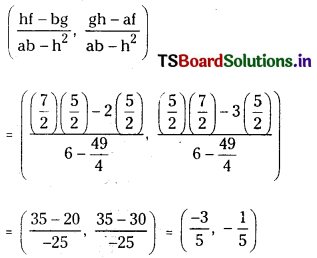
∴ The given equation represents a pair of lines and point of intersection is
TS Inter 1st Year Maths 1B Solutions Chapter 4 Pair of Straight Lines Ex 4(b) 3

Question 2.
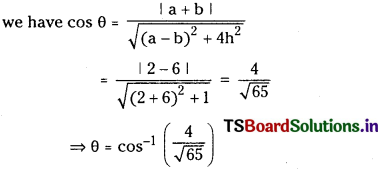
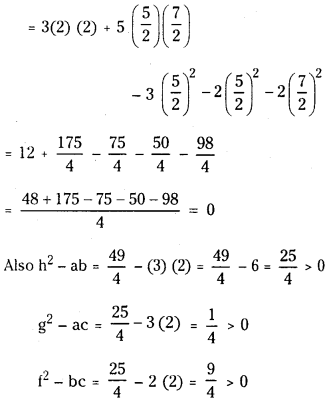
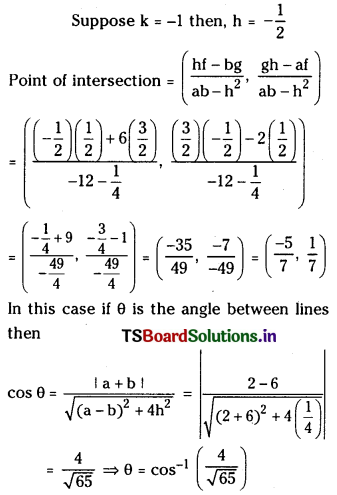
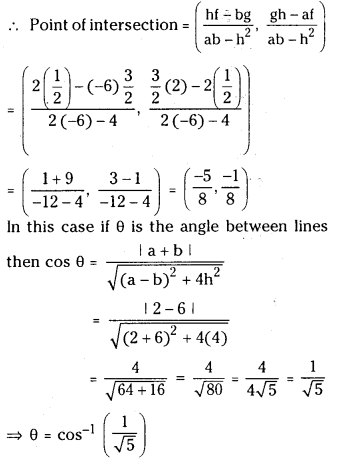
Find the value of k, if the equation 2x2 + kxy – 6y2 + 3x + y + 1 = 0 represents a pair of straight lines. Find the point of intersection of the lines and the angle between the straight lines for this value of k. (E.Q.)
Answer:
Comparing
2x2 + kxy – 6y2 + 3x + y + 1 = 0 with the general equation, we get
a = 2, h = \(\frac{\mathrm{k}}{2}\), b = -6, g = \(\frac{3}{2}\), f = \(\frac{1}{2}\), c = 1
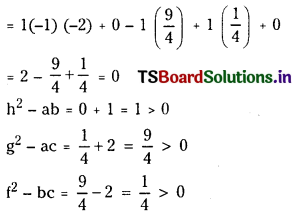
The given equation represents a pair of straight lines if abc + 2fgh – af2 – bg2 – ch2 = 0 (necessary condition)
⇒ – 12 + 2\(\left(\frac{1}{2}\right)\left(\frac{3}{2}\right)\left(\frac{k}{2}\right)\) – 2\(\left(\frac{1}{4}\right)\) + 6\(\left(\frac{9}{4}\right)-\frac{k^2}{4}\) = 0
⇒ – 48 + 3k – 2 + 54 – k2 = 0
⇒ – k2 + 3k + 4 = 0 ⇒ k2 – 3k – 4 = 0
⇒ (k – 4) (k + 1) = 0 ⇒ k = 4 or – 1

Case (i):
TS Inter 1st Year Maths 1B Solutions Chapter 4 Pair of Straight Lines Ex 4(b) 4

Case (ii):
When k = 4, then h = 2
TS Inter 1st Year Maths 1B Solutions Chapter 4 Pair of Straight Lines Ex 4(b) 5

TS Inter 1st Year Maths 1B Solutions Chapter 4 Pair of Straight Lines Ex 4(b)

Question 3.
Show that the equation x2 – y2 – x + 3y – 2 = 0 represents a pair of perpendicular lines and find their equations. (S.A.Q.)
Answer:
First we show that the given equation x2 – y2 – x + 3y – 2 = 0 represents a pair of lines comparing with the general equation
we get a = 1, b = -1, g = \(\frac{-1}{2}\), f = \(\frac{3}{2}\), h = 0, c = -2
∴ abc + 2fgh – af2 – bg2 – ch2
TS Inter 1st Year Maths 1B Solutions Chapter 4 Pair of Straight Lines Ex 4(b) 6
Hence the given equation represents a pair of lines. Coefficient of x2 + coefficient of y2 = 1 – 1 = 0
∴ The given equation represents a pair of perpendicular lines.
Let x2 – y2 – x + 3y – 2
= (x + y + c1) (x – y + c2)
Equating coefficients of x and y both sides
we get c1 + c2 = – 1 and – c1 + c2 = 3
Solving 2c2 = 2 ⇒ c2 = 1
and c1 + c2 = -1 ⇒ c1 = -2
∴ Equations of lines are x + y – 2 = 0 and x – y + 1 = 0.

Question 4.
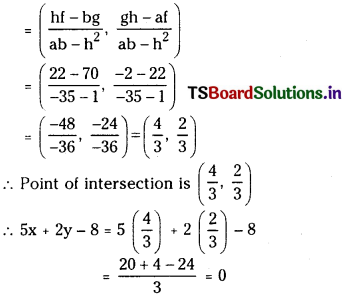
Show that the lines x2 + 2xy – 35y2 – 4x + 44y – 12 = 0 and 5x + 2y – 8 = 0 are concurrent. (S.A.Q.)
Answer:
Given x2 + 2xy – 35y2 – 4x + 44y – 12 = 0 and comparing this with general equation we get a = 1, h = 1, b = – 35, g = -2, f = 22, c = – 12
Point of intersection
TS Inter 1st Year Maths 1B Solutions Chapter 4 Pair of Straight Lines Ex 4(b) 7
∴ The point of intersection lies on the line 5x + 2y – 8 = 0.
Hence the given lines are concurrent.

Question 5.
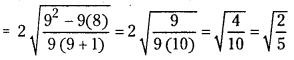
Find the distance between the following pairs of parallel straight lines. (V.S.A.Q.)
(i) 9x2 – 6xy + y2 + 18x – 6y + 8 = 0
(ii) x2+ 2√3 xy + 3y2 – 3x – 3√3 y – 4 = 0
Answer:
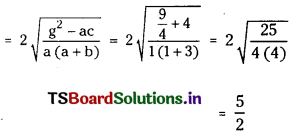
(i) The formula for distance between parallel lines = \(\sqrt{\frac{g^2-a c}{a(a+b)}}\)
TS Inter 1st Year Maths 1B Solutions Chapter 4 Pair of Straight Lines Ex 4(b) 8

(ii) Distance between given parallel lines
TS Inter 1st Year Maths 1B Solutions Chapter 4 Pair of Straight Lines Ex 4(b) 9

TS Inter 1st Year Maths 1B Solutions Chapter 4 Pair of Straight Lines Ex 4(b)

Question 6.
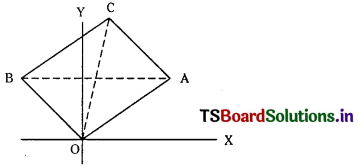
Show that the two pairs of lines 3x2 + 8xy – 3y2 = 0 and 3x2 + 8xy – 3y2 + 2x – 4v – 1 = 0 form a square. (S.A.Q.)
Answer:
TS Inter 1st Year Maths 1B Solutions Chapter 4 Pair of Straight Lines Ex 4(b) 10
Given equations of lines represented by OA and OB is 3x2 + 8xy – 3y2 = 0
⇒ (x + 3y) (3x – y) = 0
⇒ x + 3y = 0, 3x – y = 0
∴ Equation of OA is 3x – y = 0 ………………… (1)
Equation of OB is x + 3y = 0 ……………… (2)
The combined equation of CA and CB is
3x2 + 8xy – 3y2 + 2x – 4y – 1 = 0 …………….. (3)
Let 3x2 + 8xy – 3y2 + 2x – 4y – 1
= (3x – y + c1) (x + 3y + c2)
Equating the coefficients of x and y on both sides,
and c1 + 3C2 = 2
3c1 – c2 = – 4
Solving
TS Inter 1st Year Maths 1B Solutions Chapter 4 Pair of Straight Lines Ex 4(b) 11
⇒ c1 = – 1, c2 = 1
Equation of BC is 3x – y – 1 = 0 ……………………. (4)
Equation of AC is x + 3y + 1 = 0 …………………… (5)
Equations OA and BC differ by a constant.
⇒ OA is parallel to BC.
Equations OB and CA differ by a constant
⇒ OB is parallel to AC.
Also from equation (3), OACB is a rectangle and a + b = 3 – 3 = 0
OA = Length of the perpendicular from O to
AC = \(\frac{|0+0+1|}{\sqrt{1+9}}=\frac{1}{\sqrt{10}}\)
OB = Length of the perpendicular from O to
BC = \(\frac{|0+0-1|}{\sqrt{9+1}}=\frac{1}{\sqrt{10}}\)
∴ OA = OB and OACB is a rectangle
⇒ OACB is a square.

III.
Question 1.
Find the product of the length of the perpendiculars drawn from (2, 1) upon the lines (E.Q.)
12x2 + 25xy + 12y2 + 10x + 11y + 2 = 0
Answer:
Given equation
12x2 + 25xy + 12y2 + 10x + 11y + 2 = 0
represents the combined equation of AB & AC.
12x2 + 25xy + 12y2
= 12x2 + 16xy + 9xy + 12y2
= 4x (3x + 4y) + 3y (3x + 4y)
= (3x + 4y) (4x + 3y)
Let 12x2 + 25xy + 12y2 + 10x + 11y + 2 = (3x + 4y + c1) (4x + 3y’ + C2)
Equating the coefficients of x and y
4c1 + 3C2 = 10 ………………. (1)
and 3c1 + 4c2 = 11 ………………. (2)
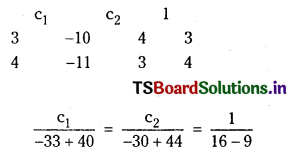
Solving (1) and (2)
TS Inter 1st Year Maths 1B Solutions Chapter 4 Pair of Straight Lines Ex 4(b) 12
⇒ c1 = 1, c2 = 2
∴ Equation of AB is 3x + 4y + 1 = 0
and equation of AC is 4x + 3y + 2 = 0
PL = Length of the perpendicular from
P(2, 1) on AB = \(\left|\frac{6+4+1}{\sqrt{9+16}}\right|=\frac{11}{5}\)
PM = Length of the perpendicular from
P(2, 1) on AC = \(\left|\frac{8+3+2}{\sqrt{16+9}}\right|=\frac{13}{5}\)
∴ Product of lengths of perpendiculars
= PL × PM = \(\frac{11}{5} \times \frac{13}{5}=\frac{143}{25}\)

TS Inter 1st Year Maths 1B Solutions Chapter 4 Pair of Straight Lines Ex 4(b)

Question 2.
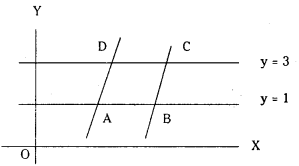
Show that the straight lines y2 – 4y + 3 = 0 and x2 + 4xy + 4y2 + 5x + 10y + 4 = 0 form a parallelogram and find the lengths of its sides. (E.Q.)
Answer:
TS Inter 1st Year Maths 1B Solutions Chapter 4 Pair of Straight Lines Ex 4(b) 13
The equation of first pair of lines is y2 – 4y + 3 = 0
⇒ (y – 1) (y – 3) = 0 ⇒ y = 1 ………………….. (1)
and y = 3 ………………….. (2)
∴ AB, CD are parallel.
The equation of second pair of lines is
x2 + 4xy + 4y2 + 5x + 10y + 4 = 0
⇒ (x + 2y)2 + 5 (x + 2y) + 4 = 0
⇒ (x + 2y)2 + 4 (x + 2y) + (x + 2y) + 4 = 0
⇒ (x + 2y) [x + 2y + 4] + 1 [(x + 2y) + 4] = 0
⇒ (x + 2y + 1) (x + 2y + 4) = 0
⇒ x + 2y + 1 = 0, x + 2y + 4 = 0
Equation of AD is x + 2y + 1 = 0 ……………………. (3)
Equation of BC is x + 2y + 4 = 0 ……………………. (4)
∴ AD and BC are parallel.
Solving (1) and (3), x + 2 + 1 = 0
⇒ x = – 3
∴ Co-ordinates of A = (-3, 1)
Solving (2) and (3), x + 6 + 1 = 0 ⇒ x = -7
and coordinates of D = (-7, 3)
Solving (2) and (4) x + 6 + 4 = 0 ⇒ x = -10
∴ Coordinates of C = (-10, 3)
Solving (1) and (4), we get x + 2 + 4 = 0
⇒ x = -6
∴ Coordinates of B = (- 6, 1)
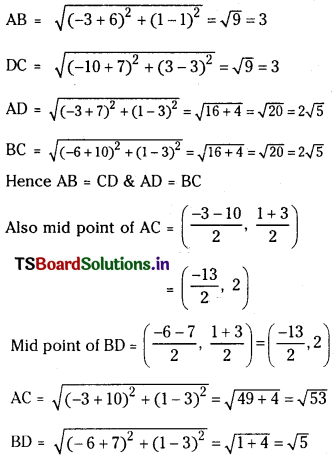
Hence A = (-3, 1), B = (-6, 1), C = (-10, 3), D = (-7, 3)
TS Inter 1st Year Maths 1B Solutions Chapter 4 Pair of Straight Lines Ex 4(b) 15
∴ AC ≠ BD
Hence a parallelogram is formed with the
lines y2 – 4y + 3 = 0 and x2 + 4xy + 4y2 + 5x + 10y + 4 = 0.

TS Inter 1st Year Maths 1B Solutions Chapter 4 Pair of Straight Lines Ex 4(b)

Question 3.
Show that the product of the perpendicular distances from the origin to the pair of straight lines represented by ax2 + 2hxy +
by2 + 2gx + 2fy + c = 0 is \(\frac{|c|}{\sqrt{(a-b)^2+4 h^2}}\) (E.Q.)
Answer:
Let ax2 + 2hxy + by2 + 2gx + 2fy + c = 0 represent the lines
l1x + m1y + n1 = 0 ……………. (1)
and l2x + m2y + n2 = 0 ……………. (2)
∴ ax2 + 2hxy + by2 + 2gx + 2fy + c
= (l1x + m1y + n1) (l2x + m2y + n2)
∴ l1l2 = a, m1m2 = b, l1m2 + l2m1 = 2h,
l1n2 +l2n1 = 2g, m1n2 + m2n1 = 2f, n1n2 = c
∴ Perpendicular distance from origin to (1) is
= \(\frac{\left|\mathrm{n}_1\right|}{\sqrt{l_1^2+\mathrm{m}_1^2}}\)
Perpendicular distance from origin to (2) is
= \(\frac{\mathrm{n}_2}{\sqrt{l_2^2+\mathrm{m}_2^2}}\)
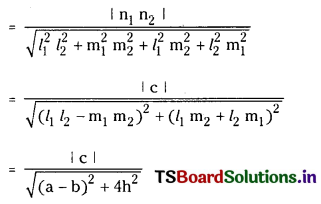
Product of perpendiculars
TS Inter 1st Year Maths 1B Solutions Chapter 4 Pair of Straight Lines Ex 4(b) 16

Question 4.
If the equation ax2 + 2hxy + by2 + 2gx + 2fy + c = 0 represent a pair of intersecting lines, then show that the square of the distance of their point of intersection from the origin is \(\). Also show that the square of this distance is \(\frac{f^2+g^2}{h^2+b^2}\) if the given lines are perpendicular. (E.Q.)
Answer:
Let the equation
ax2 + 2hxy + by2 + 2gx + 2fy + c = 0 represent the lines
l1x + m1y + n1 = 0 ………………. (1)
and l2x + m2y + n2 = 0 ……………….. (2)
∴ (l1x + m1y + n1) (l2x + m2y + n2)
= ax2 + 2hxy + by2 + 2gx + 2fy + c
Comparing coefficients
l1l2 = a, m1 m2 = b, n1n2 = c
l1m2 + l2m1 = 2h, l1n2 + l2n1 = 2g and
m1n2 + m2n1 = 2f
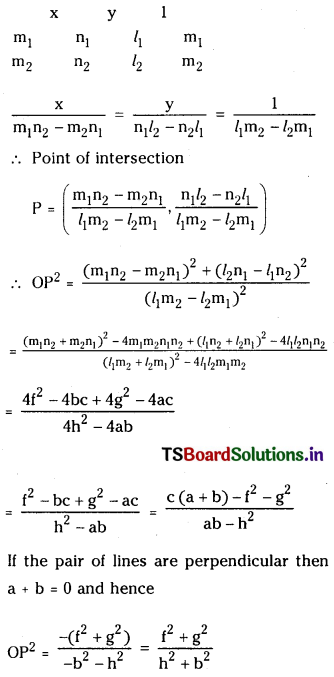
From (1) and (2) on solving
TS Inter 1st Year Maths 1B Solutions Chapter 4 Pair of Straight Lines Ex 4(b) 17

TS Inter 1st Year Accountancy Notes Chapter 6 Bank Reconciliation Statement

Here students can locate TS Inter 1st Year Accountancy Notes Chapter 6 Bank Reconciliation Statement to prepare for their exam.

TS Inter 1st Year Accountancy Notes Chapter 6 Bank Reconciliation Statement

→ Bank Reconciliation Statement is a statement prepared to reconcile the difference between the balance as per the bank column of the cash book and pass book on any given date.

→ There are certain reasons for the difference in the pass book balance and the cash book balance.

→ Favourable balance means debit balance as per cash book and credit balance as per credit balance.

→ Unfavourable balance/overdraft balance means credit balance as per cash book and debit balance as per pass book.

TS Inter 1st Year Accountancy Notes Chapter 6 Bank Reconciliation Statement

TS Inter 1st Year Accountancy Notes Chapter 6 బ్యాంక్ నిల్వల సమన్వయ పట్టిక

→ నిర్ణీత తేదీన నగదు చిట్టి బ్యాంకు వరసల నిల్వ, పాస్బుక్ నిల్వలకు గల తేడాలను సమన్వయపరుస్తూ తయారుచేసే పట్టికను బ్యాంకు నిల్వల సమన్వయ పట్టిక అంటారు.

→ నగదు చిట్టాలోని నిల్వకు, పాస్బుక్లో లోని నిల్వకు గల తేడా చూపడానికి కొన్ని కారణాలున్నవి.

→ నగదు పుస్తకము డెబిట్ నిల్వను, పాస్బుక్ క్రెడిట్ నిల్వను చూపితే దానిని అనుకూల నిల్వ అంటారు.

→ నగదు పుస్తకము క్రెడిట్ నిల్వను, పాస్బుక్ డెబిట్ నిల్వను చూపితే దానిని ప్రతికూల నిల్వ అంటారు.

TS Inter 1st Year Accountancy Notes Chapter 5 Cash Book

Here students can locate TS Inter 1st Year Accountancy Notes Chapter 5 Cash Book to prepare for their exam.

TS Inter 1st Year Accountancy Notes Chapter 5 Cash Book

→ Cash book is a very important subsidiary book. The object of the cash book is to keep a daily record of transactions relating to cash receipts and cash payments. Cash book acts as both journal and a ledger.

TS Inter 1st Year Accountancy Notes Chapter 5 Cash Book

→ There are different kinds of cash books :

  1. Simple cash book.
  2. Two-column cash book with cash and discount columns.
  3. Two-column cash books with Bank and discount columns.
  4. Three-column cash book.
  5. Petty cash book.

→ The entry which appears on both sides of the three-column cash book is known as a contra entry. It is required for transactions relating to cash or cheques deposited into the bank and cash withdrawn for office use.

→ All small payments are recorded in a separate cash book known as the Analytical Petty cash book.

TS Inter 1st Year Accountancy Notes Chapter 5 నగదు పుస్తకము

→ నగదు పుస్తకము చాలా ముఖ్యమైన సహాయక చిట్టా. రోజువారీ నగదు వసూళ్ళు చెల్లింపు వ్యవహారములు నమోదు చేయడమే నగదు పుస్తకము ముఖ్య ఉద్దేశ్యము.

→ నగదు పుస్తకములో దిగువ రకాలు ఉన్నవి;

  1. సాధారణ నగదు చిట్టా,
  2. నగదు, డిస్కౌంటు వరుసలు గల నగదు చిట్టి,
  3. బాంకు, డిస్కౌంటు వరుసలు గల నగదు చిట్టా,
  4. మూడు వరుసలు గల నగదు చిట్టా,
  5. చిల్లర నగదు చిట్టా.

TS Inter 1st Year Accountancy Notes Chapter 5 Cash Book

→ ఒక చిట్టాపద్దును మూడు వరుసలు గల నగదు చిట్టాలో రెండు వైపులా నమోదు చేస్తే దానిని ఎదురు వద్దు అంటారు. ఎదురు పద్దును దిగువ సందర్భాలలో రాయాలి.

  • నగదు లేదా చెక్కులను బాంకులో జమ చేసినపుడు,
  • ఆఫీసు అవసరాలకై బాంకు నుంచి నగదు తీసినపుడు.

→ వివిధ రకాల చిల్లర ఖర్చులను నమోదు చేయడానికి తయారుచేసే ప్రత్యేక నగదు పుస్తకాన్ని చిల్లర నగదు చిట్టా అంటారు.