
Regular practice with AP Inter 1st Year Physics Study Material Chapter 4 Laws of Motion Questions and Answers helps students stay prepared for examinations.
AP Inter 1st Year Physics 4th Lesson Laws of Motion Questions and Answers
I. Multiple Choice Questions
Question 1.
When a bus starts suddenly, the passengers are pushed back. This is an example for [ ]
(1) Newton’s First Law
(2) Newton’s Second Law
(3) Newton’s Third Law
(4) Newton’s law of gravitation
Answer:
(1) Newton’s First Law
Question 2.
Which of the following is an example of centripetal force? [ ]
(1) Pushing door
(2) Mud flying off tire
(3) Planets orbiting the sun
(4) Churning of butter in butter milk
Answer:
(3) Planets orbiting the sun
Question 3.
A non-zero net force exerted on a body does not change its [ ]
(1) Direction of motion
(2) Momentum
(3) Acceleration
(4) Inertia
Answer:
(4) Inertia
Question 4.
The rate of change of momentum is proportional to [ ]
(1) Acceleration
(2) Velocity
(3) Force
(4) Displacement
Answer:
(3) Force
Question 5.
The net force (F) experienced by a body of mass (m) whose displacement is y = ut + \(\frac{1}{2}\)gt2 is [ ]
(1) F = ma
(2) F = mg
(3) F = 0
(4) F≠0
Answer:
(2) F = mg
Question 6.
The linear momentum of a particle as a function of time t is, given by P = a + bt. The force acting oil the particle is [ ]
(1) a
(2) b
(3) a/b
(4) b/a
Hint: Linear momentum of a particle, p = a + bt
We know that force acting on a particle is equal to rate of change of linear momentum.

Answer:
(2) b
Question 7.
The inertia of a moving object depends on
(1) Momentum of the object
(2) Speed of the object
(3) Shape of the object
(4) Mass of the object
Answer:
(4) Mass of the object
Question 8.
A force accelerates a lighter vehicle more easily than a heavier vehicle. Guess the hind this.
(1) Newtons First Law of motion
(2) Newton’s Second Law of motion
(3) Newtons Third Law of motion
(4) Newtons Law of gravitation
Answer:
(2) Newton’s Second Law of motion

Question 9.
Calculate the time needed for a net force of 5N to change the velocity of a 10 kg mass by 2 m/s
(1) 2 sec
(2) 6 sec
(3) 4 sec
(4) 3 sec
Hint : Force, F = 5N, Change in velocity, v – u = 2ms-1, Mass, m = 10 kg
From Newton’s second law of motion,
F = ma = m\(\frac{(v-u)}{t}\) ∴ t = \(\frac{m(v-u)}{F}\) = \(\frac{10 \times 2}{5}\) = 4s
Answer:
(3) 4 sec
II. Fill in the Blanks
Question 1.
Friction opposes the ____ between the surfaces in contact with each other.
Answer:
Relative motion
Question 2.
______________ is required to keep a body in accelerated motion.
Answer:
Non-zero net force
Question 3.
Kinetic friction produces ___ energy.
Answer:
Heat
Question 4.
Powder is sprinkled on a carrom board to _________________ friction between the striker and the board surface.
Answer:
Reduce
Question 5.
To every action there is always an equal and _________________ reaction.
Answer:
Opposite
Question 6.
Impulse is the product of force and time which equals to ___.
Answer:
Change in momentum
Question 7.
_________________ gives the measure of inertia.
Answer:
Mass
Question 8.
The area under F-t graph represents ____.
Answer:
Impulse
Question 9.
The Newton’s Second Law Is consistent with the first law only if ____.
Answer:
F = 0
Question 10.
Sliding friction is _________________ than the limiting value of static friction.
Answer:
less
III. One Word Answer Questions
Question 1.
State Newton’s First Law.
Answer:
1st Law : Every body continues to be In its state of rest or of uniform motion in a straight line unless compelled by some external force.
Question 2.
State Newtons Third Law.
Answer:
Newton’s 3rd Law : For every action there is always an equal and opposite reaction.
action = – reaction
Note : Third Law gives nature of force. It indicates that force never occurs singly in nature. So if reaction is not possible then action is also not possible.
Question 3.
Write the mathematical equation of Newton’s Second Law.
Answer:
2nd Law : The rate of change of momentum of a body is directly proportional to the applied force and takes place in the direction In which the force acts.
Note : Internal forces cannot change the momentum of the body or system.
F ∝ \(\frac{\mathrm{d} \overline{\mathrm{p}}}{\mathrm{dt}}\), here \(\frac{d \bar{p}}{d t}\) = m\(\frac{\mathrm{dv}}{\mathrm{dt}}\) = ma then F ∝ ma ⇒ f = k⋅ ma
Question 4.
State the SI unit of force.
Answer:
Force : Force is that which changes or tries to change the state of a body Force is a vector.
Dimensional Formula = MLT-2, Unit : Newton (N).
Question 5.
Define centripetal force.
Answer:
Centripetal force is the force acting on an object in curvilinear motion directed towards the centre of Curvature. F = \(\frac{\mathrm{mv}^2}{\mathrm{r}}\) = mrw2 (∵ v = rw)
Question 6.
According to Newton’s Third Law every force is accompanied by an equal and opposite force. Then how can a movement ever take place?
Answer:
Generally action and reaction will act on two different systems. So motion is possible.
Ex : When a horse pulls a cart, horse applies force on the cart. Whereas cart applies the reaction on thë ground, so motion is possible.
Question 7.
Why does a heavy rifle not recoil as a strongly as light rifle using the same cartridges?
Answer:
Velocity of recoil v = \(\frac{\mathrm{mv}}{\mathrm{M}}\) i.e., ratio of momentum of bullet to mass of gun. If mass of gun is high then velocity of recoil is less with same cartridge.
IV. Very Short Answer Questions
Question 1.
What is Inertia? What gives the measure of Inertia?
Answer:
The inability of a body to change its state by itself is known as Inertia. Mass of a body is a measure for its Inertia.
Types of inertia:
- Inertia of rest
- Inertia of motion
- Inertia of direction.
Question 2.
When a bullet is fired from a gun, the gun gives a kick in the backward direction. Explain.
Answer:
Firing of a gun is due to internal forces. Internal forces do not change the momentum of the system. Before firing m1u1 = -m2v2 = 0. Since system is at rest after firing m1v1 + m2v2 = 0 (or) m1v1 = -m2v2. So gun and bullet will move in opposite directions to satisfy law of conservation
of linear momentum.
Question 3.
If a bomb at rest explodes into two pieces, the pieces must travel In opposite directions. Explain.
Answer:
Explosion is due to internal forces. From law of conservation of linear momentum internal forces cannot change the momentum of the system. So after explosion m1v1 + m2v2 = 0 or m1v1 = -m2v. According to law of conservation of linear momentum they will fly in opposite directions.
Question 4.
Define force. What are the basic forces in nature?
Answer:
Force is that which changes (or) tries to change the state of a body.
The basic forces in nature are,
- Gravitational forces
- Electromagnetic forces
- Nuclear forces.
Question 5.
State the SI units and dimensions of linear momentum.
Answer:
Momentum \((\overline{\mathbf{p}})\): It is the product of mass (m) and velocity (v) of a body.
Momentum \(\overline{\mathbf{p}}\) = mass × velocity = m \(\overline{\mathrm{V}}\)
It is a vector, unit : kg – m/sec. Dimensional Formula = MLT-1.
Question 6.
State the SI units and dimensions of impulse.
Answer:
Impulse : When force acts between two bodies in contact for a very small time , then the product of the force and the time is defined as hnpulse.
Impulse = Force × time = F.t, ; Impulse = change in momentum
Impulse is a vector. Unit : kg-m/sec.; Dimensional Formula = MLT-1.
Question 7.
Can the coefficient of friction be greater than one? Give the reason.
Answer:
Yes. Generally coefficient of friction between the surfaces is always less than one. But under some special conditions like on extreme rough surfaces coefficient of friction may be greater than one.
Question 8.
Why does the car with a flattened tyre stop sooner than the one with inflated tyres?
Answer:
Due to flattening of tyres, frictional force increases. Because rolling frictional force between the surfaces is proportional to area of contact. Area of contact increases for flattened tyres. So rolling frictional force increases and the car will be stopped quickly.
Question 9.
A horse has to pull harder during the start of the motion than later. Explain.
Answer:
To start motion in a body we must apply force to overcome static friction (Fs = psμg). When once motion is started between the bodies then kinetic frictional force comes into act. Kinetic friction (Fk = μkmg) is always less than static friction. So it is tough to start a body from rest
than to keep it in motion.
Question 10.
What happens to the coefficient of friction if the weight of the body is doubled?
Answer:
When the weight of the body is doubled still then there is no change in coefficient of friction. Because frictional force normal reaction. So when weight of a body is doubled then frictional force and normal reaction will also doubled and coefficient of friction remains constant.
Question 11.
Write the expressions for maximum possible speed of a car moving on
(a) Level road
(b) Banked road
Answer:
(a) Levelroad :VMax = \(\sqrt{\mu_{\mathrm{s}} \mathrm{rg}}\)
(b) Banked road : VMax = \(\sqrt{r g \tan \theta}\)
Where, r = Radius of curved path: μs = Coefficient of static friction
θ = Angle of banking; g = Acceleration due to gravity
V. Short Answer Questions
Question 1.
A stone of mass 0.1kg is thrown vertically upwards. Give the magnitude and direction of the net force on the stone (a) during its upward motion,
(b) during its downward motion,
(c) at the highest point, where it momentarily comes to rest.
Answer:
Mass’of stone, m = 0.1 kg.
a) During upward motion force acts downwards due to acceleration due to gravity.
Magnitude of force F = mg = 0.1 × 9.8 = 0.98 N (↓)
b) During downward motion force acts downwards.
Magnitude of force F = mg = 0.1 × 9.8 = 0.98N (↓)
c) At highest point, velocity v = 0. But still g will act on it only in downward motion so resultant force F = 0.98 N in downward.
Note : In the entire journey of the body force due to gravitational pull acts only in downward direction.
d) If the body is thrown with an angle of 30° with the horizontal then vertical component of gravitational force does not change, hence in this case downward force F = mg = 0.1 × 9.8 = 0. 98 newton.
Question 2.
Define the terms momentum and impulse. State and explain the Law of Conservation of linear momentum. Give examples.
Answer:
Momentum \((\overline{\mathbf{p}})\) : It is the product of mass and velocity of a body.
Momentum \((\overline{\mathbf{p}})\) = mass (m) × velocity (v), ∴ \((\overline{\mathrm{p}})\) = m \(\bar{v}\)
Impulse (I) : When a large force (F) acts on a body for small time (t) then the product of force and time is called Impulse.
Impulse (I) = Force (F) × t ime (t), ∴ Impulse (T) = F × t
Law of conservation of linear momentum : There is no external force act on the system, the total linear momentum of the isolated system remains constant.
Proof : Let two bodies of masses say A and B are moving with initial momenta PA and PB collided with each other. During collision they are in contact for a small time say Δt. During this
time of contact they will exchange their momenta. Let final momenta of the bodies are \(\mathrm{P}_{\mathrm{A}}^1\) and \(\mathrm{P}_{\mathrm{A}}^B\). Let force applied by A on B is FAB and force applied by B on A is FBA.
From Newton’s 3rd Law FAB = -FBA or FAB Δt = -FBA Δt
From 2nd Law FABΔt = A change in momentum of A.
FBA Δt = \(\mathrm{P}_{\mathrm{B}}^1\) – PB change in momentum of B.
∴ \(\mathrm{P}_{\mathrm{A}}^1\) – PA = -(\(\mathrm{P}_{\mathrm{B}}^1\) – PB) or PA + PB = \(\mathrm{P}_{\mathrm{A}}^1\) + \(\mathrm{P}_{\mathrm{B}}^1\)
i.e., sum of momentum before collision is equals to sum of momentum after collision.
Question 3.
Why are shock absorbers used in motorcycles and cars?
Answer:
1. When vehicles are passing over the rough roads with bumps and depressions of a rough road they will collides with them for a very short period. This causes impulse effect.
2. Due to large mass and high speed of the vehicles the magnitude of impulse is also high.
Impulse may cause damage to the car or even to the passengers in it. F ∝ \(\frac{1}{\Delta \mathrm{t}}\)
3. The bad effects of impulse is less if time of contact is more. Impulse J = F.t. For the same magnitude of impulse (change in momentum) if time of contact is high force acting on the vehicle is less. Shock absorbers will absorb the impulse and releases the same force slowly. This is due to large time constant of the springs. So shock absorbers are used in vehicles to reduce impulse effects.
Question 4.
Explain the terms limiting friction, dynamic friction and rolling friction.
Answer:
Limiting friction : Frictional forces always oppose relative motion between the bodies. These forces are self adjusting forces. Their magnitude will increase upto some extent with the value of applied force. The maximum frictional force between the bodies at rest is called “limiting friction”.
Dynamic (or) kinetic friction : When applied force is equal to or greater than limiting friction then the body will move. When once motion is started then frictional force will abruptly falls to a minimum value. Frictional force between moving bodies is called dynamic (or) kinetic friction. Kinetic friction is always less than limiting friction.
Rolling friction : The resistance encountered by a rolling body on a surface is called rolling friction.
Question 5.
Explain advantages and disadvantages of friction.
Answer:
Advantages of friction:
- We are able to walk because of friction.
- It is impossible for a car to move on a slippery road.
- Breaking system of vehicles works with the help of friction.
- Friction between roads and tyres provides the necessary external force to accelerate the car.
- Transmission of power to various parts of a machine through belts is possible by friction.
Disadvantages of friction:
- In many cases we will try to reduce friction because it dissipates energy into heat.
- It causes wear and tear to machine parts which causes frequent replacement of machine parts.
Question 6.
Mention the methods used to decrease friction.
Answer:
Friction: It is a contact force parallel to the surfaces in contact. Friction will always oppose relative motion between the bodies.
Methods to reduce friction:
- Polishing: Friction causes due to surface irregularities. So by polishing friction can be reduced to some extent.
- Lubricants: By using lubricants friction can be reduced. Lubricants will spread as an ultra thin layer between the surfaces in contact and in friction decreases.
- Stream lining: By making front portion of vehicles in a curved shape friction due to air can be reduced.
- Ball bearings: Ball bearings are used to reduce friction between machine parts. Ball bearings will convert sliding motion into rolling motion. As a result friction is reduced.
Question 7.
State the Laws of rolling friction.
Answer:
When a body is rolling over the other, then friction between the bodies is known as rolling friction.
Rolling friction coefficient, µr = \(\frac{\text { Rolling friction }}{\text { Normal reaction }}\) = \(\frac{\mathrm{F}_{\mathrm{r}}}{\mathrm{~N} . \mathrm{R}}\)
Laws of rolling friction:
- Rolling friction will develop a point of contact between the surface and the rolling sphere. For objects like wheels line of contact will develop.
- Rolling friction(fr) has least value for a given normal reaction when compared with static friction (fs) or kinetic friction (fk)
- Rolling friction is directly proportional to normal reaction, fr ∝ N.
- In rolling friction, the surfaces in contact will get momentarily deformed a little.
- Rolling friction depends on area of contact. Due to this reason friction increases when air pressure is less in tyres (Flattened tyres).
- Rolling friction is inversely proportional to radius of rolling body µr = \(\frac{1}{\mathrm{r}}\)
Question 8.
Derive an expression for the maximum possible speed of a car moving on a banked road?
Answer:
Consider a vehicle of mass ‘m’ taking a turn on a smooth banked road of angle of banking ‘θ’.
Let v be its speed and ‘r’ is radius of curvature.
The weight of the vehicle ‘mg’ acts vertically downwards.
The Normal reaction’ N’ exerted by the road on the vehicle is acting normal to the surface. The components of ‘N’
are as shown in the figure.
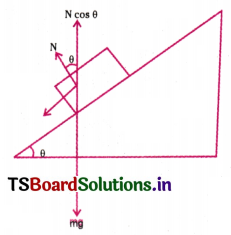
N cos θ = mg ……. (1)
N sin θ provides the necessary centripetal force
N sin θ = \(\frac{\mathrm{mv}^2}{\mathrm{r}}\) …… (2)
\(\frac{2}{1}\) ⇒ tan θ = \(\frac{\mathrm{v}^2}{\mathrm{rg}}\) That is safe maximum speed. v = \(\sqrt{\mathrm{rg} \tan \theta}\)
VI. Long Answer Questions
Question 1.
(a) State Newton’s Second Law of motion. Hence derive the equation of motion F = ma from it.
Answer:
Newton’s 2nd law: The rate of change of momentum of a body is proportional to external force and acts along the direction of force applied.
i.e., \(\frac{d p}{d t}\) ∝ F
Derivation of equation F = ma: According to Newton’s 2nd law.
We know \(\frac{\mathrm{dp}}{\mathrm{dt}}\) ∝ \(\vec{F}\) ⇒ F = k . \(\frac{d p}{d t}\) ….. (1)
But \(\overrightarrow{\mathrm{p}}\) = momentum of the body = m \(\overrightarrow{\mathrm{p}}\) \(\overrightarrow{\mathrm{v}}\)
∴ F = k . \(\frac{\mathrm{d}}{\mathrm{dt}}(\mathrm{~m} \overline{\mathrm{v}})\) ⇒F = km\(\frac{\mathrm{d} \overline{\mathrm{v}}}{\mathrm{dt}}\) …….. (2)
But \(\frac{\mathrm{d} \overline{\mathrm{v}}}{\mathrm{dt}}\) = Rate of change in velocity = acceleration ‘a’.
∴ F = ma ……. (3)
Here, k = constant.
The proportional constant is made equal to one, by properly selecting the unit of force.
∴ F = ma
(b) A body is moving along a circular path such that its speed is always remains constant. Should there be force acting on the body?
Answer:
Force on a body moving in a circular path : Let a body of mass m’ is moving in a circular path of radius ‘r’ with constant speed. The velocity of the body is given by the tangent drawn at that point. Since velocity is changing continuously, the body will have acceleration. So the body will experience some acceleration. This is called normal acceleration (or) centripetal acceleration.
Problems
Question 1.
A force 2i + j – k newton acts on a body which is initially at rest. At the end of 20 seconds the velocity of the body is 4i + 2j – 2k ms-1 What is the mass of the body?
Answer:
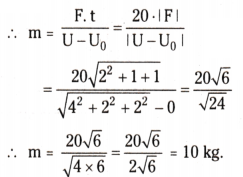
Force F = 2\(\overline{\mathrm{i}}\) + \(\overline{\mathrm{j}}\) – \(\overline{\mathrm{k}}\), time t = 20 sec.; Initial velocity u0 = 0 ; Final velocity U = 4\(\overline{\mathrm{i}}\) + 2\(\overline{\mathrm{j}}\) – 2\(\overline{\mathrm{k}}\)
Mass of the body m = \(\frac{F}{a}\) ; But acceleration a = \(\frac{\mathrm{U}-\mathrm{U}_0}{\mathrm{t}}\)
Question 2.
A ball of mass ‘m’ is thrown vertically upward from the ground and reaches a height h before momentarily coming to rest. If g is acceleration due to gravity, what is the impulse received by the ball due to gravity force during its flight (neglect air resistance)?
Answer:
Impulse, l = force × time ⇒ I = ma × \(\frac{2 \mathrm{u}}{\mathrm{~g}}\); Here, a = g and u = \(\sqrt{2 \mathrm{gh}}\)
Now I = mg × \(\frac{2 \times \sqrt{2 g h}}{g}\) ⇒ I = I = 2m \(\sqrt{2 \mathrm{gh}}\) (or) ∴ Impulse, I = \(\sqrt{8 m^2 g h}\)
Question 3.
A container of mass 200kg rests on the back of an open truck. If the truck accelerates at 1.5 m/s2, what is the minimum coefficient of static friction between the container and the bed of the truck required to prevent the container from sliding off the back of the truck?
Answer:
Mass of the container, m = 200 kg ;
Acceleration of the truck, a = 1.5 ms-2
Coefficient of static friction, μs = \(\frac{a}{g}\) = \(\frac{1.5}{9.8}\) = 0.153
Question 4.
A bomb initially at rest at a height of 40m above the ground suddenly explodes into two identical fragments. One of them starts moving vertically downwards with an initial speed of 10m/s. If acceleration due to gravity is 10m/s2, what is the separation between the fragments 2 sec after the explosion.
Answer:
Case (i): (for downward moving fragment)
Initial velocity, u = 10 ms-1 ; Acceleration, a = +g = 10 ms-2 ; Time, t = 2s
From the equation of motion, s = ut + \(\frac{1}{2}\)at
The distance moved In the downward direction is, s1 = 10 × 2 + \(\frac{1}{2}\) × 10 × (2)2 = 40 m
Case (ii) : (for upward moving fragment)
Given that two fragments are identical hence, after explosion the fragments move in opposite directions. Here the first fragment moves in downward direction, hence, second fragment moves upward direction.
Again from s = ut + \(\frac{1}{2}\)at2 we can write, s2 = -10 × 2 + \(\frac{1}{2}\) × 10 × 4 = -20 + 20 = 0m
∴ Separation between the fragments 2s after the explosion s1 – s2 = 40 – 0 = 40m.
Laws of Motion Class 11 NCERT Solutions
Question 1.
Give the magnitude and the direction of the net force acting on
(a) a drop of rain falling with a constant speed,
(b) a cork of mass 10 g floating on water,
(c) a kite skillfully held stationary in the sky,
(d) a car moving with a constant velocity of 30 km/h on a rough road,
(e) a high speed of electron in the space far from all gravitating objects and free of electric and magnetic fields.
Answer:
(a) As rain drop is falling with a constant speed in vertically downward direction, it is in dynamic equilibrium because its weight is balanced by viscous force of air, so net force on raindrop is zero.
(b) As cork is floating on water, its weight is balanced by upward force of buoyancy, so net force on the cork is zero.
(c) As kite is held stationary, so net force on it is zero.
(d) Car is moving on a rough road with uniform velocity, the force exerted by engine of car is balanced by frictional force; so the net force on the car is zero.
(e) The force on the electron in the space is zero because it is free from all gravitational and electromagnetic forces.
Question 2.
A pebble of mass 0.05 kg is thrown vertically upwards. Give the direction and magnitude of the net force on the pebble.
(a) during its upward motion
(b) during its downward motion
(c) at the highest point where it ¡s momentarily at rest. Do your answer change if the pebble was thrown at an angle of 45° say with the horizontal direction?
Answer:
In all the three cases (a), (b) and (c), the net force on the pebble is the gravitational force exerted by earth on the pebble, i.e.,
F = mg = 0.05 × 10 = 0.5 N, acting vertically downward when pebble is thrown at an angle with the horizontal, the path of the pebble changes, but the net force on the pebble remains same and equal to mg = 0.5 N.
Question 3.
Give the magnitude and direction of the net force on a stone of mass 0.1 kg.
(a) just after it is dropped from the window of a stationary train,
(b) just after it is dropped from the window of a train running at a constant velocity of 36 km/h,
(c) just after it is dropped from the window of a train accelerating with 1 ms-2,
(d) lying on the floor of train which is accelerating at 1 ms-2, the stone being at rest relative to train. Neglect air resistance throughout. (take g = 10 ms-2)
Answer:
(a) Force on stone W = mg = 0.1 × 10 = 1 N.
(b) and (c)
When stone is dropped from a moving train (whether accelerated or unaccelerated) the stone has horizontal velocity equal to instantaneous velocity of train, but the net force still remains mg = 1 N.
(d) When stone lies on the floor of the train, its weight is balanced by normal reaction. But stone is accelerated along with the train, so net force on the train as observed by ground – observer = ma = 0.1 × 1 = 0.1 N.
Question 4.
One end of a string of length l is connected to a particle of mass m and the other to a small peg on a smooth horizontal table. If the particle moves in a circle with speed v, what is the net force on the particle (directed towards the centre) is

(i) T
(ii) T – \(\frac{\mathrm{mv}^2}{\ell}\)
(iii) T + \(\frac{\mathbf{m v}^{\mathbf{2}}}{\ell}\)
(iv) 0
T is the tension in the string. (Choose the correct alternative).
Answer:
The forces acting on the particle are
- weight mg vertically downward
- normal reaction N, vertically upward
- tension T in string towards centre.
For vertical equilibrium N = mg.
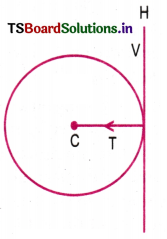
For circular path, tension T provides the necessary centripetal force.
∴ Net force towards the centre = T = \(\frac{m v^2}{\ell}\)
Hence option (i) is correct.
Question 5.
A constant retarding force of 50 N is applied to a body of mass 20 kg moving initially with a speed of 15 ms’. How long does the body take to stop?
Answer:
Retarding force produces retardation according to Newton’s second law and so the body stops.
From Newton’s second law, retardation (a) is given by F = ma ⇒ a = \(\frac{\mathrm{F}}{\mathrm{~m}}\)
Given F = 50 N, m = 20 kg
Retardation, a = \(\frac{50}{20}\) = 2.5 m/s2
Retardation is simply say that negative acceleration, i.e., acceleration a = -2.5 m/s2
If t is the time taken to stop the body, then equation of kinematics y = u + at gives
t = \(\frac{v-u}{a}\) = \(\frac{0-15}{(-2.5)}\) = 6s
Question 6.
A constant force acting on a body of mass 3.0 kg changes its speed from 2.0 ms-1 to 3.5 ms-1 in 25 s. The direction of motion of the body remains unchanged. What is the magnitude and direction of the force?
Answer:
From Newton’s second law,
Force, F = \(\frac{\Delta \mathrm{p}}{\Delta \mathrm{t}}\) = \(\frac{p_2-p_1}{\Delta t}\) = \(\frac{\mathrm{mv}_2-\mathrm{mv}_1}{\Delta \mathrm{t}}\) F = \(\frac{\mathrm{m}\left(\mathrm{v}_2-\mathrm{v}_1\right)}{\Delta \mathrm{t}}\)
Given m = 3.0 kg, v1 = 2.0 ms-1, v2 = 3.5 ms-1 and At = 25
∴ Force F = \(\frac{3.0 \times(3.5-2.0)}{25}\) = \(\frac{3.0 \times 1.5}{25}\) = 0.18 N
As the force increases the speed of the body without changing its direction, therefore the force acts along the direction of motion.
Question 7.
A body of mass 5 kg is acted upon by two perpendicular forces of 8 N and 6 N. Find the magnitude and direction of the acceleration produced in the body.
Answer:
The forces F1 = 8 N and F2 = 6 N acting on the body of mass m = 5 kg are mutually
perpendicular.
Net force on body F = \(\sqrt{F_1^2+F_2^2}\) = \(\sqrt{(8)^2+(6)^2}\) = \(\sqrt{64+36}\) = \(\sqrt{100}\) = 10N
According to Newton’s second law, F = ma
Acceleration of the body, a = \(\frac{F}{m}\) = \(\frac{10}{5}\) = 2 m/s2
The acceleration is in the direction of force.
If θ is the angle made by the net force with the direction of force F1, then
tan θ = \(\frac{F_2}{F_1}\) = \(\frac{6}{8}\) = \(\frac{3}{4}\) ⇒ θ = tan-1\(\frac{3}{4}\) = 37°
Thus, the magnitude of acceleration is 2 m/s2 and its direction is at an angle 37° with the direction of F1 = 8N force.
Question 8.
The driver of a three-wheeler moving with a speed of 36 km/h sees a child standing in the middle of the road and brings his vehicle to rest in 4.0 s just in a time to save the child. What is the average retarding force on the vehicle? The mass of three wheeler is 400 kg and the mass of the driver is 65 kg.
Answer:
Here initial speed u = 36 km/h = 36 × \(\frac{5}{18}\) m/s = 10 m/s
Final speed time v = 0, time t = 4.0 s
The average acceleration a is given by a = \(\frac{v-u}{t}\) = \(\frac{0-10}{4}\) = -2.5 m/s2
Negative sign shown that the motion is retarded.
∴ Retardation, a = 2.5 m/s2
Total mass, M = mass of the three wheeler + mass of the driver = 400 + 65 = 465 kg
∴ Average retarding force, F = ma = 465 × 2.5 = 1.2 × 10³ N.
Question 9.
A rocket with a lift – off mass 20,000 kg is blasted upwards with an initial acceleration of 5.0 ms-2. Find the initial thrust (force) of the blast. (Take g = 10 ms-2)
Answer:

If F is initial thrust on rocket, and rocket is accelerated upward, then
Net force on rocket = F – mg
From Newton’s second law, F – mg = ma
F = m(g + a)
Given m = 20,000 kg, a = 5.0 ms-2, g = 10 ms-2
F = 20,000(10 + 5)
= 20,000 × 15N = 3.0 × 10⁵ N.
Question 10.
A body of mass 0.40 kg moving initially with a constant speed of 10 ms-1 to the north is subjected to a constant force of 8.0 N directed towards the south for 30 s. Take the instant the force is applied to be t = 0 and the position of the particle at that time to be x = 0, predict the position of the particle at t = – 5s, 25s and 100 s.
Answer:
Taking positive direction along north (X-axis), so negative direction will be along south.
Accordingly, u = + 10 ms-1, F = – 8.0 N, m = 0.40 kg
Acceleration of the particle, a = \(\frac{\mathrm{F}}{\mathrm{~m}}\) = \(\frac{-8.0 \mathrm{~N}}{0.40 \mathrm{~kg}}\) = -20 ms-2
As initial velocity is along the north, the acceleration is along the south, so a is infact retardation, Before t = 0 and after t = 30 s, the acceleration (or retardation) is zero.
Position at t = -5 s: Before t = 0, the body with constant velocity (a = 0)
So x = ut + at2 gives x = ut = 10 × (-5) = -50 m
Position at t = 25 s: Between 0 to 25 s, a = -20 ms2, so equation x = ut + \(\frac{1}{2}\)at2 gives
x = 10 × 25 + \(\frac{1}{2}\) × (-20)(25)2 = 250 – 6250 = -6000m = -6 km
Position at t = 100 s : Between 0 to 30 s, the particle has acceleration a = -20 ms-2 and between t = 30 s to 100 s, the particle moves with constant velocity.
For 30 seconds, distance traversed
x1 = ut + \(\frac{1}{2}\)at2 = 10 × 30 + \(\frac{1}{2}\) (-20) × (30)2 = 300 – 9000 = -8700 m
The velocity after 30 seconds is v = u + at = 10 + (-20) × (30) = -590 m/s
For remaining 70 seconds, the body moves with constant velocity -590 m/s, therefore distance traversed in remaining 70 seconds.
x2 = -vt = -590 × 70 = -41300m
Position of the particle at t = 100 s is
x = x1 + x2 = 0 – 8700 – 41300 = -50,000m = -50 km.
Question 11.
A truck starts from rest and accelerates uniformly with 2.0 ms-2. At t = 1os, a stone is dropped by a person standing on the top of the truck (6 m high from the ground). What are the
(a) velocity and
(b) acceleration of the stone at t = 11.0 s (Neglect air resistance).
Answer:
When stone is dropped from a truck, it has same horizontal velocity as the truck. After dropping the stone has constant horizontal velocity and also gains vertical velocity due to gravity.
(a) Given u = 0, a = 2.0 ms-2, t = 10 s
∴ Velocity of truck after t = 10s is v = u + at = 0 + 2.0 × 10 = 20.0 m/s
This is horizontal velocity of stone i.e, vx = 20.0 m/s when stone is dropped, it has acceleration g = 10 ms-2.
At t = 11 s, the stone is in flight
Time taken to fall the stone is given by h = \(\frac{1}{2}\)g (t’)2
t1 = \(\sqrt{\frac{2 h}{g}}\) = \(\frac{2 \times 6}{10}\) = 1.0 s
Therefore vertical component of velocity at t = 11 s i.e., 1 second after dropping
vy = uy + gt = 0 + 10 × 1 = 10m-1
∴ Net velocity of stone, v = \(\sqrt{v_x{ }^2+u_y{ }^2}\) = \(\sqrt{(20)^2+(10)^2}\) = 10\(\sqrt{5}\) m/s = 22.4 m/s
If θ is angle made by velocity with horizontal, then
tan θ = \(\frac{v_y}{v_x}\) ⇒ tan-1\(\left(\frac{v_y}{v_x}\right)\) = tan-1\(\left(\frac{10}{20}\right)\) = tan-1(0.5) = 26.6°.
This is at t = 11 s or 1 second after dropping, the stone has velocity 22.4 m/s, at an angle 26.6° with horizontal.
b) Acceleration of stone is equal to acceleration due to gravity 10 ms-2 vertically downward.
Question 12.
A bob of mass 0.1 kg hung from the ceiling of a room by a string 2 m long is set into oscillation. The speed of the bob at its mean position is 1 ms-1. What ¡s the trajectory of the bob if the string is cut when the bob is (a) at one of its extreme positions
(b) at its mean position.
Answer:
(a) At extreme position the bob is at rest; so when string is cut at any extreme position, the bob will fall freely under gravity, so its trajectory will be vertical straight line.
(b) When bob is at mean position, it has horizontal velocity When string is cut at mean position, the motion of bob will be superposition of two motions.
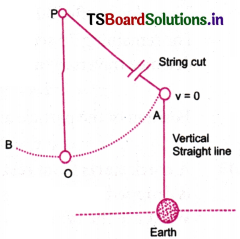
(i) Horizontal motion due to velocity v.
(ii) Vertical motion under gravity. The resultant of these two motions is just like projectile’s motion and the trajectory will be a parabola.
Mathematical analysis : Let (x, y) be the coordinates of bob after time t, assuming O as origin.
Then, x = Vt …… (i)
y = \(\frac{1}{2}\)gt2 ……. (ii)
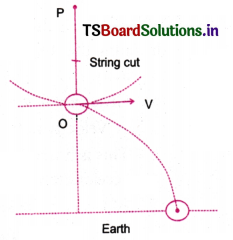
From (i) t = \(\frac{x}{v}\); then (ii) y = \(\frac{1}{2} g\left(\frac{x^2}{v^2}\right)\) or y = \(\frac{g}{2 v^2} x^2\)
This is the equation of a parabola.
Question 13.
A man of mass 70 kg stands on a weighing scale in a lift which is moving
(a) upwards with a uniform speed of 10 ms-1,
(b) downwards with a uniform acceleration of 5 ms-2,
(c) upwards with a uniform acceleration of 5 ms-2, What would be the readings on the scale in each case?
(d) What would be the reading if the lift mechanism failed and it hurtled down freely under gravity?
Answer:
(a) When lift is stationary (a = 0), so only force is force of gravity, therefore
Reading of scale, T = mg = 70 × 10 = 700N = \(\left(\frac{700}{g}\right)\) = 7o kg f
(b) When lift accelerates downwards with a = 5 ms-2, then
mg – T = ma ⇒ T = m(g – a)
T = 70(10 – 5) = 350N = \(\frac{350}{g}\) = 35kgf
(c) When lift accelerates upwards with a = 5 ms-2, then
T – mg = ma ⇒ T = m(g + a) = 70(10 + 5) = 1050N = 105kg f
(d) When lift falls freely, a = g
T = m(g – a) = m(g – g) = 0
∴ T = 0, so scale reading is always zero.
Question 14.
Fig. shows the position-time graph of a particle of mass 4kg. What is the
(a) force on the particle for t < 0, 0 < t < 4s, t > 4s?
(b) impulse at t = 0 and t = 4s?
(Consider one dimensional motion only)
Answer:
(a) The position-time graph is POAB. The part OP is position-time graph for t = 0 part OA of 0 < t < 4s and part AB for t > 4s.
For t < 0, the particle remains at rest, so velocity of particle = 0.
Acceleration of the particle = 0
hence force on the particle = 0
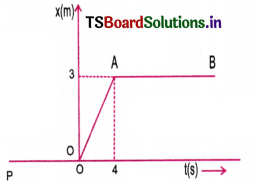
For 0 < t < 4s, the particle moves with constant velocity given by v = \(\frac{x_2-x_1}{t_2-t_1}\) = \(\frac{3-0}{4-0}\) = 0.75 m/s (constant) ∴ Acceleration of the particle = \(\frac{\Delta \mathrm{v}}{\Delta \mathrm{t}}\) = 0 Hence, force on the particle = 0 For t > 4s, the particle’s position is constant, so particle’s velocity and acceleration both are zero; hence force on the particle = 0.
Hence throughout the time interval given, the net force on the particle is zero.
(b) Impulse at t = 0 Before t = 0, the particle is at rest and t = 0 the particle is imparted a constant velocity = 0.75 m/s
So impulse at t = 0, (I)t=0 = mv2 – mv1 = m(v2 – v1) = 4(0.75 – 0) = 3 Ns
Impulse at t = 4s: Before t = 4s, the particle is moving with velocity v1 = 0.75 m/s and after t = 4 s, the particle is at rest, so impulse at t = 4 s,
(I)t=4 = mv2 – mv1 = m (v2 – v1) = 4(0 – 0.75) = -3 Ns.
Question 15.
Two bodies of masses 10 kg and 20 kg respectively kept on a smooth horizontal surface are tied to the ends of a light string, A horizontal force F = 600 N is applied to (i) A (ii) B along the direction of string. What is the tension in the string in each case?
Answer:
To solve the problem, it is required to draw free body diagram and apply Newton’s second law.
(i) When force is applied on B and T is tension in the string, the free body diagrams of A and B are shown in the Fig. Ifa is acceleration of masses, then equations of motion of A and B are
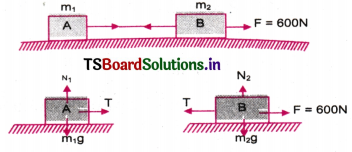
T = m1a …….. (1)
F – T = m2a ……. (2)
Adding (1) and (2)
F = (m1 + m2)a
a = \(\frac{F}{m_1+m_2}\) = \(\frac{600}{10+20}\) = \(\frac{600}{30}\) = 20 ms-2 ….. (3)
(ii) When force is applied on A and T is tension in the string, the free body diagrams of A and B are shown in the Fig. A B H
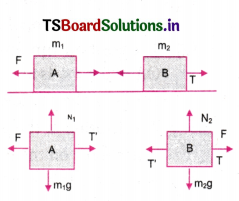
Equations of motion of A and B are now
F – T = m1a ……. (4)
T = m1a ……… (5)
Adding (4) and (5), we get
F = (m1 + m2)a ; a = \(\frac{F}{m_1+m_2}\) = \(\frac{600}{10+20}\) = \(\frac{600}{30}\) = 20 ms-1
Tension in the string T’ m2a = 20 × 20 = 400 N.
Thus the tension in two cases are different, thus answer depends on the mass on which the force is applied.
Question 16.
Two masses 8 kg and 12 kg are connected at the two ends of a light inextensible string and goes over a frictionless pulley. Find the acceleration of masses and the tension in the string when the masses are released. (g = 10 m/s2)
Answer:
Given, M1 = 8 kg, M2 = 12 kg, g = 10 m/s2
Acceleration, a = \(\frac{\mathrm{M}_2-\mathrm{M}_1}{\mathrm{M}_2+\mathrm{M}_1}\) × g = \(\frac{12-8}{12+8}\) × 10 = \(\frac{4}{20}\) × 10 = 2 m/s2
Tension, T = \(\frac{2 \mathrm{M}_1 \mathrm{M}_2}{\mathrm{M}_1+\mathrm{M}_2}\) × g = \(\frac{2 \times 8 \times 12}{8+12}\) × 10 = 96 N.
Question 17.
A nucleus isat rest in the laboratory frame of reference: Show that if it disintegrates into two smaller nuclei, the products must be emitted in opposite directions.
Answer:
As external force on system (nucleus) is zero, the linear momentum of system must remains constant;
Initial momentum of nucleus = Mu = 0 (since u = 0)
If \(\overrightarrow{\mathrm{p}_1}\) and \(\overrightarrow{\mathrm{p}_2}\) are momenta of two parts of disintegrated nucleus, then from conservation of momentum.
⇒ \(\overrightarrow{\mathrm{p}_1}\) + \(\overrightarrow{\mathrm{p}_2}\) = o ⇒ \(\overrightarrow{\mathrm{p}_2}\) = –\(\overrightarrow{\mathrm{p}_1}\)
If m1 and m2 are masses of product particles and \(\overrightarrow{\mathrm{v}_1}\) and \(\overrightarrow{\mathrm{v}_2}\) are their respective velocities, then \(\overrightarrow{\mathrm{P}}_1\) = m1\(\overrightarrow{\mathrm{v}_1}\), \(\overrightarrow{\mathrm{P}}_2\) = m2\(\overrightarrow{\mathrm{v}_2}\)
Clearly \(\overrightarrow{\mathrm{v}_1}\) and \(\overrightarrow{\mathrm{v}_2}\) have opposite directions, i.e., the two products must move in opposite directions.
Question 18.
Two billiard balls each of mass 0.05 kg moving in opposite directions with speed 6 ms-1 collide and rebound with the same speed. What is the impulse imparted to each ball due to the other?
Answer:
Let A and B be two balls moving in opposite directions collide and rebound with the same speed.
Initial momentum of ball A, PA = mvA = 0.05 × 6 = 0.3 kg ms-1
Final momentum of ball A, P’A = -mvA = -0.3 kg ms-1
∴ Impulse imparted to ball A = change in momentum = P’A – PA = -0.3 – (0.3)
= -0.6 kg ms-1 = -0.6 Ns
As balls A and B have same masses and same velocities, so impulse imported to ball B = – 0.6 Ns.
Question 19.
A shell of mass 0.02 kg is fired by a gun of mass 100 kg. If the muzzle speed of the shell is 80 ms-1, what is the recoil speed of the gun?
Answer:
As external force is zero, so linear momentum of system (gun + shell) is constant.
Initial momentum = Final momentum
Initially the shell and gun are at rest; so initial momentum = m1u1 + m2u2 = 0
Final momentum = m1v1 + m2v2 v m1v1 + m2v2 = 0 ⇒ v2 = –\(\frac{m_1}{m_2} v_1\)
Given m1 = mass of the shell = 0.02 kg v1 = velocity of the shell = 80 ms’
m2 = mass of the gun = 100 kg
Velocity of the gun v2 = \(-\frac{\mathrm{m}_1}{\mathrm{~m}_2} \mathrm{v}_1\) = \(-\frac{0.02}{100}\) = -0.016 m/s.
Question 20.
A batsman deflects a ball by an angle 45° without changing its initial speed which is equal to 54 km/h. What is the impulse imparted to the ball ? Mass of the ball is 0.15 kg.
Answer:
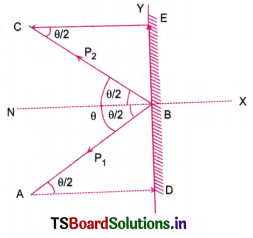
Let u be the initial speed of the ball of mass m. The ball is deflected by an angle θ.
The path of the ball is ABC such that ∠ABC = θ = 45°.
Angle made by the ball with normal is \(\frac{\theta}{2}\) = 22.5°.
The initial and final momenta of the ball can be resolved into two rectangular components along X and Y axes as shown in the Fig.
The components along Y axis are mu sin \(\frac{\theta}{2}\) and mu sin \(\frac{\theta}{2}\) along same direction, while components along X axis are mu cos \(\frac{\theta}{2}\) and – mu cos \(\frac{\theta}{2}\).
Change in momentum along negative X-axis is
mu cos \(\frac{\theta}{2}\) – (-mu cos \(\frac{\theta}{2}\)) = 2 mu cos \(\frac{\theta}{2}\)
Change in momentum along
Y-axis = mu sin\(\frac{\theta}{2}\) – mu sin\(\frac{\theta}{2}\) = 0.
Given m = 0.15kg, u = 54 km/h = 54 × \(\frac{5}{18}\) = 15m/s
\(\frac{\theta}{2}\) = 22.5 ⇒ c0s \(\frac{\theta}{2}\) = cos 22.5° = 0.924
∴ Impulse = 2 × 0.15 × 15 × 0.924 = 4.16 Ns.
Question 21.
A stone of mass 0.25 kg tied to the end of a string is whirled round a circle of radius 1.5 m with a speed of 40 rev/mm in a horizontal plane. What is the tension in the string? What is the maximum speed with which the stone can be whirled around if the string can withstand a maximum tension of 200 N?
Answer:
Given, mass of the stone m = 0.25 kg; radius r = 1.5 m
Angular frequency, n = 40 rev/mm = \(\frac{40}{60}\) rev/s
Angular speed, ω = 2πn = 2π × \(\frac{40}{60}\)rad/s = \(\frac{4}{3}\)π rad/s
Tension in the string = Centripetal force = m r ω2
= 0.25 × 1.5 × \(\left(\frac{4}{3} \pi\right)\) = 0.25 × 1.5 × (\(\frac{4}{3}\) × 3.14)2 = 6.6 N
If vmax is the maximum speed of stone when maximum tolerable strength of string is 200N, then
Fmax = \(\frac{m v_{\max }^2}{r}\) ⇒ 200 = \(\frac{0.25 v_{\max }^2}{1.5}\)
Vmax = \(\sqrt{\frac{200 \times 1.5}{0.25}}\) = 34.6 ms-1
Question 22.
In previous question, the speed of the stone increased beyond the maximum permissible value and the string breaks suddenly; which of the following correctly describes the trajectory of the stone after the string breaks.
(a) the stone moves radially outwards,
(b) the stone flies off tangentially from the instant the string breaks,
(c) the stone flies of at an angle with the tangent whose magnitude depends on the speed of the stone ?
Answer:
At the instant of breaking the string, the stone has tangential velocity, so due to inertia of motion the stone will fly tangentially; so alternative (b) is correct.
[After breaking of string; the stone will be under superposition of two motions.
- constant horizontal tangential velocity.
- motion under gravity, the resulting trajectory will be parabolic.]
Question 23.
Explain why
(a) a horse cannot pull a cart and run in empty space.
(b) Passengers are thrown forward from their seats when a speeding bus stops suddenly.
(c) it is easier to pull a lawn mower than to push it.
(d) a cricketer moves his hands backward while holding a catch.
Answer:
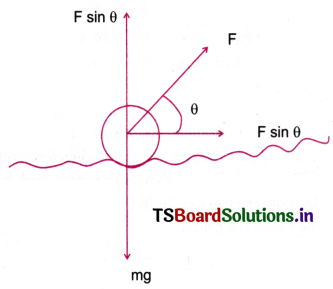
(a) When a horse pulls a cart on the ground, the horse pushes the ground backward at a certain angle. According to Newton’s third law the ground exerts an equal inclined reaction in forward direction. The vertical component of this reaction balances the weight of the horse while the horizontal forward component provides motion to cart. In empty space there is not reaction and hence horse cannot pull the cart and run.
(b) This is due to inertia of motion. When the speeding bus stops suddenly, the lower part of the body in contact with the seats comes to rest immediately, while upper part of the body, due to inertia of motion, continues to move forward; hence the passengers are thrown forward.
(c) Pulling and Pushing of a Lawn Mower: Let a lawn mower of weight w be pushed by a force \(\vec{F}\) making an angle θ with the horizontal (Fig. a). The force \(\vec{F}\) may be resolved into two rectangular components.
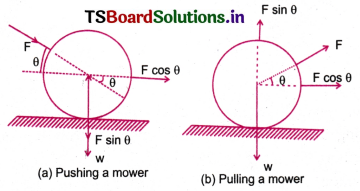
- Horizontal component F cos 0. It makes the roller to move forward.
- Vertical component F sin 0 acts vertically downward, it increases the weight of mower.
Let now the lawn mower be pulled by a force \(\vec{F}\) making an angle with the horizontal (Fig. b). The force \(\vec{F}\) may be resolved into two rectangular components.
- horizontal component F cos θ. It makes the mower to move forward.
- vertical component F sin θ acts vertically upward; it increases the weight of the mower.
Clearly, in both the cases, the force, that makes the mower to move forward is F cos θ; in pulling case the effective weight of the mower is W – F sin θ and in pushing case the effective weight is W + F sin θ.
Hence, it is easier to pull a lawn mower than to push it.
(d) A cricket player, while catching a ball moves his hands backward : Initially the ball is moving with a certain velocity and the player has to apply a retarding force to bring the ball to rest in his hand. As change in momentum Δp = (average force F) × (Duration of contact, Δt) therefore if he catches the ball abruptly (i.e., Δt → 0), he will have to apply a large retarding force, due to this the player gets hurt. On the other hand if he moves his hands backward, he applies the force for a longer time to bring the ball to rest. In this case, he has to apply a small retarding force; hence he would not get hurt.