
Regular practice with AP Inter 1st Year Physics Study Material Chapter 3 Motion in a Plane Questions and Answers helps students stay prepared for examinations.
AP Inter 1st Year Physics 3rd Lesson Motion in a Plane Questions and Answers
I. Multiple Choice Questions
Question 1.
A particle moving with uniform speed in a circular path maintains [ ]
(1) Constant velocity
(2) Constant acceleration
(3) Constant velocity but varying acceleration
(4) Varying velocity and varying acceleration
Answer:
(4) Varying velocity and varying acceleration
Question 2.
The projection or component of the vector 3\(\hat{\mathbf{i}}\) + 4\(\hat{\mathbf{k}}\) on y -axis is [ ]
(1) 7
(2) 5
(3) 4
(4) 0
Answer:
(4) 0
Question 3.
The angle made by the vector  = \(\hat{\mathbf{i}}\) + \(\hat{\mathbf{j}}\) with x-axis is [ ]
(1) 22.5°
(2) 30°
(3) 45°
(4) o
Answer:
(3) 45°
Hint: tanθ = \(\frac{\mathrm{Ay}}{\mathrm{Ax}}\) = 1 , θ = 45 (or) \(\hat{\mathbf{A}}\) = \(\hat{\mathbf{i}}\) + \(\hat{\mathbf{j}}\), |\(\hat{\mathbf{A}}\)| = \(\sqrt{(1)^2+(1)^2}\) = \(\sqrt{2}\)
If θ’ is the angle made by the vector with X-axis then, cosθ = \(\frac{\mathrm{A}_{\mathrm{x}}}{|\overrightarrow{\mathrm{~A}}|}\) ⇒ cosθ = \(\frac{1}{\sqrt{2}}\) ⇒ θ = 45°.
Question 4.
A body is projected into air from the ground at an angle 90° to the horizontal. On reaching the highest point above the ground [ ]
(1) Its velocity is zero, acceleration is not zero
(2) Its acceleration is zero, velocity is not zero
(3) Both the velocity and acceleration are not equal to zero
(4) Both the velocity and acceleration are equal to zero
Answer:
(1) Its velocity is zero, acceleration is not zero
Question 5.
Two balls are projected from the same point in direction 30° and 60° with respect to the horizontal. What is the ratio of their Initial velocities if they attain the same height?
(1) \(\sqrt{3}\) : 1
(2) 1 : \(\sqrt{3}\)
(3) 1 : 1
(4) 3 : 1
Hint:
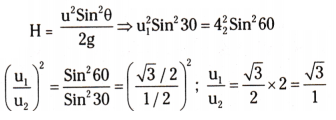
Answer:
(1) \(\sqrt{3}\) : 1
Question 6.
An aeroplane is dropping a bomb while moving horizontally at a constant speed. When air resistance is taken into consideration, then bomb
(1) Falls alongside the plane
(2) Falls on the earth behind the plane
(3) Falls on the earth ahead of the plane
(4) Falls on the earth exacity below the plane
Answer:
(2) Falls on the earth behind the plane
Question 7.
Which of the following is the vector quantity? [ ]
(1) Distance
(2) Speed
(3) Acceleration
(4) Temperature
Answer:
(3) Acceleration
Question 8.
Which of the following is a scalar quantity? [ ]
(1) Momentum
(2) Mass
(3) Velocity
(4) Force
Answer:
(4) Force
Question 9.
Which of the following is not a vector Quantity? [ ]
(1) Weight
(2) Torque
(3) Momentum
(4) Potential energy
Answer:
(4) Potential energy
Question 10.
Which of the following physical quantity can be negative? [ ]
(1) Speed
(2) Mass
(3) Velocity
(4) Distance
Answer:
(3) Velocity
Question 11.
Vector addition obeys [ ]
(1) Commutative law only
(2) Associative law only
(3) Both commutative and associative laws
(4) Neither commutative nor associative laws
Answer:
(3) Both commutative and associative laws
Question 12.
The relation between the time of flight of projection T and the time to reach the maximum heigh tm is
(1) Tf = tm
(2) Tf = 2tm
(3) Tf = tm/2
(4) Tf = \(\sqrt{2} \mathrm{t}_{\mathrm{m}}\)
Answer:
(2) Tf = 2tm
Question 13.
Which of the following is not a projectile motion? [ ]
(1) A stone is thrown horizontally from a building
(2) A bullet fired from a gun at angle 45° w.r.t. ground
(3) The jump of a frog
(4) A car moving in a straight line
Answer:
(4) A car moving in a straight line
Question 14.
A missile is fired for a maximum range with an initial velocity of 30cm/s. If g = 10m/s2, then the range of the missile will be [ ]
(1) 100m
(2) 90m
(3) 80m
(4) 70m
Hint: Rmax = \(\frac{u^2}{g}\) = \(\frac{30 \times 30}{10}\) = 90m
Answer:
(2) 90m
Question 15.
The horizontal range and the maximum height of a projectile are equal. The angle of projection of the projectile is [ ]
(1) θ = 45°
(2) θ = tan-1(1/4)
(3) θ = tan-1(4)
(4) θ = tan-1(2)
Hint:
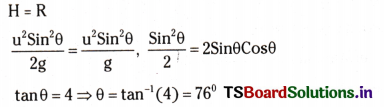
Answer:
(3) θ = tan-1(4)
II. Fill in the Blanks
Question 1.
The dimensional formula for centripetal acceleration in a circular motion is ________________
Answer:
M0L1T2
Question 2.
If θ is the angle of projection, g is the acceleration due to gravity, then maximum height of projectile is ___.
Answer:
U2Sin2θ
Question 3.
The equation for the trajectory of a projectile motion is ____
Answer:
y = ax – bx2
Question 4.
The path of the projectile with respect to the ground is ___.
Answer:
Parabola
Question 5.
The resultant of multiplying the scalar with a vector is a ____.
Answer:
Question 6.
The time required by a projectile to reach its highest point in terms of u and g is ___.
Answer:
u sin π/g
Question 7.
The position of a particle is r = 3.0ti + 2.0t2 j + 5.0k where t is in seconds, the coefficients have
the proper units of r to be in metres, then v(t) = ………..
Answer:
3\(\overline{\mathbf{i}}\) + 4t\(\overline{\mathbf{j}}\)
Hint: r = 3ti + 2t2j + 5k, V = \(\frac{\mathrm{dr}}{\mathrm{dt}}\) = 3i + 4tj
Question 8.
The angle between two vectors A and B with magnitudes \(\sqrt{3}\) and 4 respectively, and \(\overline{\mathrm{A}} . \overline{\mathrm{B}}\) = 2\(\sqrt{3}\) is ____.
Answer:
π/3
Hint: \(\overline{\mathrm{A}} \cdot \overline{\mathrm{~B}}\) = |\(\overline{\mathrm{A}}\)||B|Cosθ = 2\(\sqrt{3}\), (\(\sqrt{3}\))(4)Cosθ = 2\(\sqrt{3}\) ; Cosθ = \(\frac{2 \sqrt{3}}{\sqrt{3} \times 4}\) = \(\frac{1}{2}\), θ = 602 – \(\frac{\pi}{3}\)
III. One Word Answer Questions
Question 1.
When are the two vectors said to be equal vectors ?
Answer:
When two vectors are having same magnitude and same direction, then they are called equal vectors.
Question 2.
Can a vector of zero magnitude have non-zero components ?
Answer:
No
Question 3.
When will the magnitude of sum of two vectors be maximum and minimum ?
Answer:
Maximum = \(\overline{\mathrm{A}}\) + \(\overline{\mathrm{B}}\) (Same direction) ; Minimum = \(\overline{\mathrm{A}}\) – \(\overline{\mathrm{B}}\) (Opposite direction)
Question 4.
At what angle of projection of body with respect to ground, its range is maximum ?
Answer:
θ = 45°
Question 5.
What is the acceleration of a projectile at the top of its trajectory ?
Answer:
‘g’ explanation : At highest point acceleration, a = g. In projectile motion acceleration will always acts towards centre of the earth. It is irrespective of its position, whether it is at highest point or somewhere.
Question 6.
What is the direction of velocity at any point on the path of a circularly moving object ?
Answer:
The tangent drawn at that point will give direction of velocity.
Question 7.
What is the angle between the direction of velocity and acceleration at the highest point of a projectile path ?
Answer:
90° (or) \(\frac{\pi}{2}\).
IV. Very Short Answer Questions
Question 1.
What are scalars and vectors?
Answer:
Vector: A physical quantity which has both magnitude and direction is called as vector.
Ex: Displacement, Velocity, Force, etc.
Scalar: A physical quantity which has only magnitude is called as scalar.
Ex: Distance, Speed, Work, etc.
Question 2.
State Triangle Law of vector addition.
Answer:
Triangle law: If the magnitude and direction of two vectors are represented by two sides of a triangle taken in order, then the third side of the triangle taken in reverse order will give the resultant both in magnitude and direction.
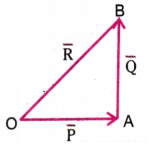
From the above figure, \(\overline{\mathbf{R}}\) = \(\overline{\mathbf{P}}\) + \(\overline{\mathbf{Q}}\) represents vectorial addition of \(\overline{\mathbf{P}}\) and \(\overline{\mathbf{Q}}\).
Question 3.
When two right angled vectors of magnitude 7 units and 24 units combine, what is the magnitude of their resultant?
Answer:
Given \(\overline{\mathbf{P}}\) = 7 units; \(\overline{\mathbf{Q}}\) = 24 units; θ = 90°
∴ \(\sqrt{P^2+Q^2+2 P Q \cos \theta}\) = \(\sqrt{P^2+Q^2}\) ⇒ R = \(\sqrt{P^2+Q^2}\) = \(\sqrt{7^2+24^2}\) = 25 units.
Question 4.
If \(\overline{\mathbf{P}}\) = 2i + 4j + 14k and \(\overline{\mathbf{Q}}\) = 4i +4j + 10k, find the magnitude of \(\overline{\mathbf{P}}\) + \(\overline{\mathbf{Q}}\).
Answer:
Given \(\overline{\mathbf{P}}\) = 2\(\overline{\mathrm{i}}\) + 4\(\overline{\mathrm{j}}\) + 14\(\overline{\mathrm{k}}\) and \(\overline{\mathbf{Q}}\) = 4\(\overline{\mathrm{i}}\) + 4\(\overline{\mathrm{j}}\) + 10\(\overline{\mathrm{k}}\); = 6\(\overline{\mathrm{i}}\) + 8\(\overline{\mathrm{j}}\) + 24\(\overline{\mathrm{k}}\)
Magnitude of |\(\overline{\mathbf{P}}\) + \(\overline{\mathbf{Q}}\)| = \(\sqrt{6^2+8^2+24^2}\) = \(\sqrt{36+64+576}\) = \(\sqrt{676}\) = 26 units.
Question 5.
Can two vectors of unequal magnitudes add up to give the zero vector? Can three unequal vectors add up to give the zero vector?
Answer:
No. Two unequal vectors can never give zero vector by addition. But three unequal vectors when added may give zero vector.
Question 6.
The vertical component of a vector Is equal to its horizontal component. What is the angle made by the vector with X-axis?
Answer:
Let R be a vector.
Vertical component = R sin e; Horizontal component = R cos θ
∴ R sin θ = R cos θ. So sin θ = cos θ ⇒ θ = 45°
Question 7.
Two forces of magnitudes 3 units and 5 units act at 60° with each other. What is the magnitude of their resultant?
Answer:
Given \(\overline{\mathrm{P}}\) = 3 units, \(\overline{\mathrm{Q}}\) = 5 units and θ = 60°
∴ R = \(\sqrt{P^2+Q^2+2 P Q \cos \theta}\) = \(\sqrt{3^2+5^2+2(3)(5) \cos 60^{\circ}}\)
= \(\sqrt{9+25+30 \times \frac{1}{2}}\) = \(\sqrt{49}\) = 7 units.
Question 8.
Why does the vertical component of velocity for a projectile change with time, where the horizontal component of the velocity remains constant in a parabolic path?
Answer:
The vertical component of velocity of a projectile is acted by acceleration due to gravity in the vertically downward direction. Hence it is effected. But acceleration due to gravity has no effect in the horizontal direction.
V. Short Answer Questions
Question 1.
State parallelogram law of vectors. Derive an expression for the magnitude and direction of the resultant vector.
Answer:
Parallelogram Law: If two vectors are represented by the two adjacent sides of a parallelogram, then the diagonal passing through the intersection of given vectors represents their resultant both in direction and magnitude.
Proof : Let \(\overline{\mathrm{P}}\) and \(\overline{\mathrm{Q}}\) be two adjacent vectors ‘θ’ be the angle between them. Construct a parallelogram OACB as shown in figure. Extend the line OA and draw a normal D from C. The diagonal OC = the resultant \(\overline{\mathrm{R}}\) both in direction and magnitude.
In figure, OCD = right angle triangle ⇒ OC2 = OD2 + DC2
But OD = OA + AD = \(\overline{\mathrm{P}}\) + \(\overline{\mathrm{Q}}\) cos θ and CD = Q sin θ and \(\overline{\mathrm{OC}}\) = R
∴ R2 = [P + Q Cos θ]2 + [Q sin θ]2 ; \(\overline{\mathrm{R}}^2\) = \(\overline{\mathrm{P}}^2\) + \(\overline{\mathrm{Q}}^2\) cos2 θ + 2\(\overline{\mathrm{PQ}}\)cosθ + \(\overline{\mathrm{Q}}^2\) sin2 θ
∴ \(\overline{R}^2\) = \(\overline{P}^2\) + \(\overline{Q}^2\) (sin2 θ + cos2 θ) + 2\(\overline{\mathrm{PQ}}\)cosθ.
But sin2θ + cos2θ = 1
∴ R2 = [P2 + Q2 + 2 PQ cos θ
∴ Resultant vector, \(\overline{\mathbf{R}}\) = \(\sqrt{P^2+Q^2+2 P Q \cos \theta}\)
Angle of resultant with adjacent side ‘α’
In triangle OCD, tan α = \(\frac{C D}{O D}\) (∵ OD = OA + AD )
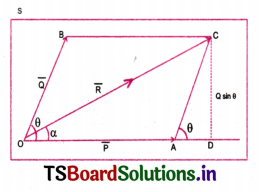
Tan α = \(\frac{\mathrm{CD}}{\mathrm{OA}+\mathrm{AD}}\) = \(\frac{\mathrm{Q} \sin \theta}{\mathrm{P}+\mathrm{Q} \cos \theta}\) (∵ AD = Qcosθ)
Angle of \(\overline{\mathbf{R}}\) with adjacent side, α = tan-1\(\left[\frac{\mathrm{Q} \sin \theta}{\mathrm{P}+\mathrm{Q} \cos \theta}\right]\)
Question 2.
Define unit vector, null vector and position vector.
Answer:
Unit vector: A vector whose magnitude is one unit is called unit vector.
Let \(\bar{a}\) is a given vector then unit vector of \(\bar{a}\) = \(\frac{\overline{\mathrm{a}}}{|\overline{\mathrm{a}}|}\) = \(\hat{a}\)
When \(\bar{a}\) ≠ 0 or \(\frac{\overline{\mathrm{a}}}{|\overline{\mathrm{a}}|}\) = unit vector of \(\bar{a}\). It is denoted by \(\hat{a}\)
Null vector: A vector whose magnitude is zero is called null vector. But it has direction.
For a null vector the origin and terminal point are same.
Ex: Let \(\overline{\mathbf{A}}\) × \(\overline{\mathbf{B}}\) = \(\overline{0}\). Here magnitude of \(\overline{\mathbf{A}}\) × \(\overline{\mathbf{B}}\) = \(\overline{0}\). But still it has direction perpendicular to the plane of A and B.
Position vector: Any vector in space can be represented by the linear combination of i, j and k. Let ‘O’ is the origin then OP is represented as
\(\overline{\mathrm{OP}}\) = x\(\overline{\mathrm{i}}\) + y\(\overline{\mathrm{j}}\) + z\(\overline{\mathrm{k}}\) where x, y and z are magnitudes of \(\overline{\mathrm{OP}}\) along \(\bar{i}\), \(\bar{j}\) and \(\bar{k}\) axis.
Magnitude of \(\overline{\mathrm{OP}}\) = \(\sqrt{x^2+y^2+z^2}\)
Question 3.
If |\(\overrightarrow{\mathbf{a}}+\overrightarrow{\mathbf{b}}\)| = |\(\bar{a}-\bar{b}\)|, prove that the angle between \(\overrightarrow{\mathbf{a}}\) and \(\overrightarrow{\mathbf{b}}\) is 90°.
Answer:
Let \(\overrightarrow{\mathbf{a}}\), \(\overrightarrow{\mathbf{b}}\) are the two vectors.
Sum of vectors = \(\bar{a}+\bar{b}\) = \(\sqrt{a^2+b^2+2 a b \cos \theta}\)
Difference of vectors = \(\bar{a}-\bar{b}\) = \(\sqrt{a^2+b^2-2 a b \cos \theta}\)
Given |\(\overline{\mathrm{a}}+\overline{\mathrm{b}}\)| = |\(\bar{a}-\bar{b}\)| ⇒ \(\sqrt{a^2+b^2+2 a b \cos \theta}\) = \(\sqrt{a^2+b^2-2 a b \cos \theta}\)
by squaring on both sides
∴ 4ab cosθ = 0 or θ = 90°.
So if |\(\overline{\mathrm{a}}+\overline{\mathrm{b}}\)| = |\(\bar{a}-\bar{b}\)| then |\(\overline{\mathrm{a}}-\overline{\mathrm{b}}\)| then angle between \(\overline{\mathrm{a}}\) and \(\overline{\mathrm{b}}\) is 90°.
Question 4.
Show that the trajectory of an object thrown at a certain angle with the horizontal is a parabola.
Answer:
Projectile: A body thrown into the air same angle with the horizontal, (other tan 90°) its motion under the influence of gravity is called projectile. The path followed by it is called trajectory.
Let a body is projected from point O, with velocity u at an angle θ with horizontal. The velocity ‘u’ can be resolved into two rectangular components ux and uy along X-axis and Y-axis.
ux = u cos θ and uy = sin θ
After time t, Horizontal distance travelled
x = u cos θ⋅t ……….. (1)
After a time ‘t’ sec; vertical displacement
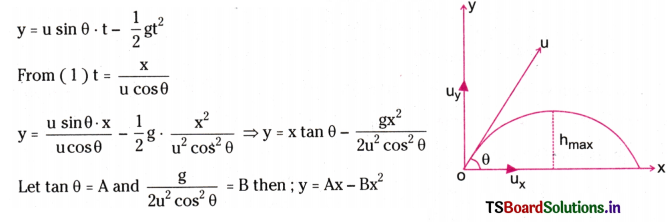
The above equation represents “parabola”. Hence the path of a projectile is a parabola.
Question 5.
Show that the maximum height and range of a projectile are and respectively where the terms have their regular meanings.
Answer:
Let a body is projected with an initial velocity ‘u and with an angle θ to the horizontal.
Initial velocity along x direction, ux = u cos θ
Initial velocity along y direction, uy = u sin θ
Maximum height: The vertical distance covered by the projectile until its vertical component becomes zero.
from equation v2 – u2 = 2as …….. (1)
at maximum height v = 0
u = uy = u sin θ, a = -g, s = H
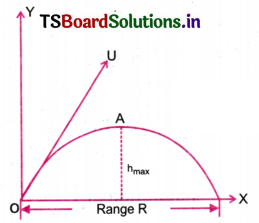
From equation (1) A
02 – u2 sin2 θ = 2(-g)H ; -u2 sin2θ = -2 gH
∴ H = \(\frac{u^2 \sin ^2 \theta}{2 g}\)
Horizontal Range : It is the distance covered by projectile along the horizontal between the point of projection to the point on the ground, where the projectile returns again.
It is denoted by R. The horizontal distance covered by the projectile in the time of flight is called horizontal range.
Therefore, R = u cos θ × t.
R = u cos θ × \(\frac{2 \mathrm{u} \sin \theta}{\mathrm{~g}}\) = \(\frac{\mathrm{u}^2(2 \sin \theta \cos \theta)}{\mathrm{g}}\)
But 2 sin θ cos θ = sin 2θ, ∴ Range (R) = \(\frac{u^2 \sin 2 \theta}{g}\)
Angle of projection for maximum range : For a given velocity of projection, the horizontal range will be maximum, when sin 2θ = 1.
∴ Angle of projection for maximum range is 2θ = 90° or θ = 45°
∴ Rmax = \(\frac{\mathrm{u}^2}{\mathrm{~g}}\)
Question 6.
Show that the maximum height reached by a projectile launched at an angle of 45° is one quarter of its range.
Solution:

Question 7.
If the horizontal ranges described by two projectiles, projected at angles (45° + α) and (45° – α) from the same point and same velocity, then the ratio of horizontal ranges will be?
Answer:

Question 8.
If θ is the angle of projection, R is the range, h the maximum height, T is the time of flight, then show that
(a) tan θ = 4h/R and
(b) h = gT2 / 8
Answer:
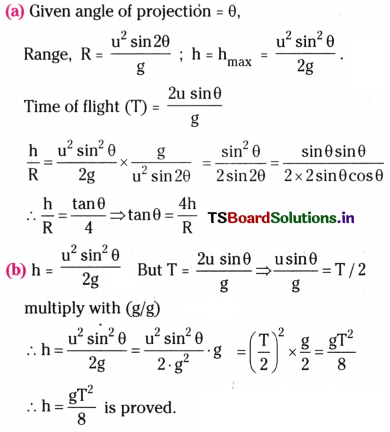
Question 9.
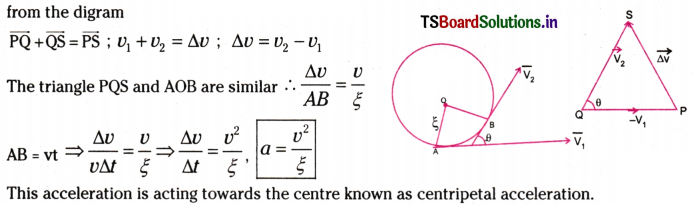
Define centripetal acceleration? Derive an expression for the centripetal acceleration of a particle moving with uniform speed y along a circular path of radius r.
Answer:
When an object follows a circular path at a constant speed, there will be acceleration acting continuously acting towards the center of the circle known as centripetal acceleration.
Derivation:
A body is moving along a circular path of radius ‘\(\xi\)‘ with uniform speed ‘y’. Immediately it is at A and after a time Δt, it is at B. The tangent drawn at that points with given the velocity direction.
from the diagram
Problems
Question 1.
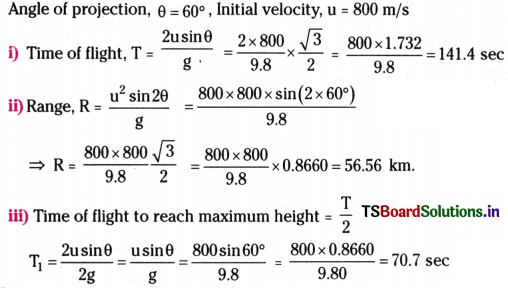
A projectile is fired at an angle of 60° to the horizontal with an initial velocity of 800 m/s.
(i) Find the time of flight of the projectile before it hits the ground.
(ii) Find the distance it travels before it hits the ground (range).
(iii) Find the time of flight for the projectile to reach its maximum height.
Solution:
Question 2.
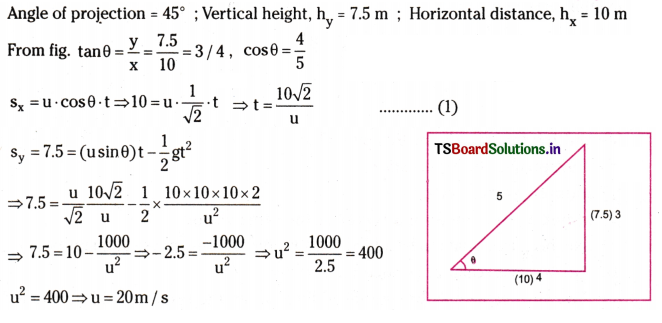
A particle is projected from the ground with some initial velocity making an angle of 45° with the horizontal. It reaches a height of 7.5 m above the ground while it travels a horizontal distance of 10 m from the point of projection. Find the initial speed of projection (g = 10 m/s2).
Solution:
Angle of projection = 45° ; Vertical height, hy = 7.5 m ; Horizontal distance, hx = 10 m
From fig. tanθ = \(\frac{y}{x}\) = \(\frac{7.5}{10}\) = 3 / 4 , cosθ = \(\frac{4}{5}\)
sx = u ⋅cosθ ⋅t ⇒ 10 = u⋅\(\frac{1}{\sqrt{2}}\) t ⇒ t = \(\frac{10 \sqrt{2}}{\mathrm{u}}\) …… (1)
Question 3.
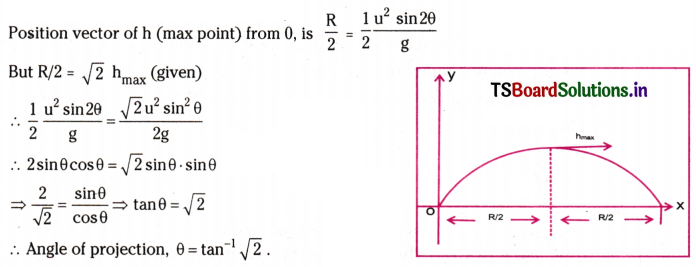
For a particle projected slantwise from the ground, the magnitude of its position vector with respect to the point of projection, when it is at the highest point of the path is found to be \(\sqrt{2}\) times the maximum height reached by It. Show that the angle of projection is tan-1 \(\sqrt{2}\).
Solution:
Motion in a Plane Class 11 NCERT Solutions
Question 1.
State, for each of thé following physical quantities, if it is a scalar or a vector: volume, mass, speed, acceleration, density, number of moles, velocity, angular frequency, displacement, angular velocity.
Answer:
Scalar quantities : Volume, mass, speed, density, number of moles, angular frequency.
Vector quantities : Acceleration, velocity; displacement, angular velocity.
Question 2.
Pick out the only scalar quantity in the following list.
Force, angular momentum, work, current, linear momentum, electric field, average velocity, magnetic moment, relative velocity.
Answer:
In the given list the scalar quantity is work and current.
Question 3.
Pick out the only vector quantity in the following list.
Temperature, pressure, impulse, time, power, total path length, energy, gravitational potential, coefficient of friction, charge.
Answer:
In the given list the only vector quantity is the impulse.
Question 4.
State with reasons, whether the following algebraic operations with scalar and vector physical quantities are meaningful?
(a) adding any two scalars.
(b) adding a scalar to a vector of the same dimensions.
(c) multiplying any vector by any scalar.
(d) multiplying any two scalars.
(e) adding any two vectors.
(f) adding a component of a vector to the same vector.
Answer:
(a) No, because scalars to be added must represent same physical quantity.
(b) No, because scalar to be added to a vector.
(c) Yes, any vector may be multiplied by a scalar, the resultant will be a new vector quantity.
For example, momentum = (mass × velocity) i.e., \(\vec{p}\) = \(m \overrightarrow{\mathrm{v}}\).
(d) Yes, any two scalars may be multiplied.
For example, distance speed × time (i.e., s = vt) and work = power × time (i.e., W = Pt).
(e) No, because only the vectors to he added must represent the same physicafquantity.
(f) No, addition of a component of a vector to the same vector is insignificant.
Question 5.
Read each statement given below carefully and state with reasons, if it is true or false.
(a) The magnitude of a vector is always a scalar.
(b) Each component of a vector is always a scalar.
(c) The total path length is always equal to the magnitude of the displacement vector of the particle.
(d) The average speed of a particle (defined as the total path length divided by the time taken to cover the path) is either greater or equal to the magnitude of average velocity of the particle over the same interval of time.
(e) Three vectors not lying in a plane can never add to give a null vector.
Answer:
(a) True: Because vector = scalar + direction.
For example: magnitude of velocity is speed.
(b) False: Because every component of a vector is always a vector.
(c) False : Total path length = Distance × time.
Total path length = |Displacement| × time is true only if motion is along a straight line without changing direction.
(d) True: Because the total path length is either greater or equal to the magnitude of displacement vector.
(e) True: Because three non-coplanar vectors cannot form a closed triangle.
Question 6.
Establish the following vector inequalities geometrically or otherwise.
(a) \(|\vec{a}+\vec{b}|\) ≤ \(|\overrightarrow{\mathbf{a}}|\) + \(|\overrightarrow{\mathbf{b}}|\)
(b) \(|\overrightarrow{\mathbf{a}}+\overrightarrow{\mathbf{b}}|\) ≥ \(\|\overrightarrow{\mathbf{a}}|-| \overrightarrow{\mathbf{b}}\|\)
(c) \(|\vec{a}-\vec{b}|\) ≤ \(|\vec{a}|+|\vec{b}|\)
(d) \(|\overrightarrow{\mathbf{a}}-\overrightarrow{\mathbf{b}}|\) ≥ \(\|\overrightarrow{\mathbf{a}}|-| \overrightarrow{\mathbf{b}}\|\)
Answer:
(a) Let \(\overrightarrow{O P}\) = \(\vec{a}\) and \(\overrightarrow{P Q}\) = \(|\vec{b}|\)
Then by triangular law of vector addition \(\overrightarrow{O Q}\) = \(\overrightarrow{O P}\) + \(\overrightarrow{P Q}\) = \(\vec{a}+\vec{b}\)
From geometry of triangle, it is known that the sum of any sides of a triangle is always greater than the third side of the triangle.
OP + PQ > OQ ⇒ OQ < OP + PQ ⇒ \(|\vec{a}+\vec{b}|\) < \(|\vec{a}|+|\vec{b}|\) ….. (1)
In the limiting case when angle between the vectors j and is zero, then
\(|\vec{a}+\vec{b}|\) = \(|\vec{a}|+|\vec{b}|\) …….. (2)
So, combining equations (1) and(2), we get \(|\vec{a}+\vec{b}|\) < \(|\vec{a}|+|\vec{b}|\)
(b) The difference of two sides in a triangle is always less than the third side, i.e, In triangle OPQ
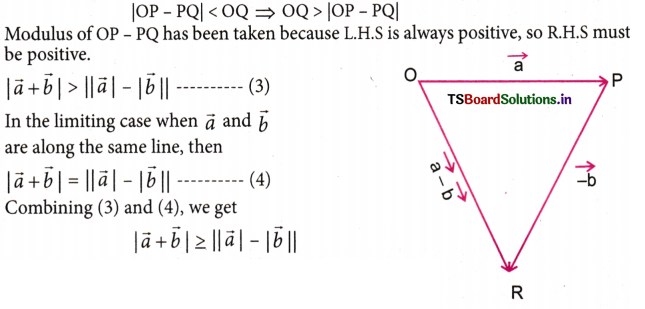
(c) From triangular law of vector addition, \(\overrightarrow{O P}\) = \(\overrightarrow{O P}\) + \(\overrightarrow{P R}\) = \(\vec{a}+(-\vec{b})\) = \(\vec{a}-\vec{b}\) The sum of two sides of a triangle is always greater than the third side. In triangle OPR, OP + PQ > OQ ⇒ OQ < OP + PQ
i.e., \(|\vec{a}-\vec{b}|\) < \(|\vec{a}|+|\vec{b}|\) …….. (5)
In the limiting case when angle between the vectors \(\vec{a}\) and \(\vec{b}\) is 180°, then \(|\vec{a}-\vec{b}|\) = \(|\vec{a}|+|\vec{b}|\) ….. (6)
Combining equations (5) and (6), we get \(|\vec{a}-\vec{b}|\) < \(|\vec{a}|+|\vec{b}|\)
(d) The difference of two sides of a triangle is always less than the third side i.e.,
In triangle, OPR, |OP – PR| < OR
The modulus of (OP – PR) is taken because RHS is always positive and LHS must be positive. (without modulus it may be negative)
or \(\| \vec{a}|-|\vec{b}||\) < \(|\vec{a}-\vec{b}|\) ⇒ \(|\vec{a}-\vec{b}|\) > \(\| \vec{a}|-|\vec{b}||\) …….(7)
In the limiting case when angle between \(\vec{a}\) and \(\vec{b}\) is 180°, we have
\(|\vec{a}-\vec{b}|\) = \(\|\vec{a}|-| \vec{b}\|\) ……. (8)
Combining (7) and (8), we get \(|\vec{a}-\vec{b}|\) ≥ \(\| \vec{a}|-|\vec{b}||\)
Question 7.
Given \(\vec{a}\) + \(\vec{b}\) + \(\vec{c}\) + \(\vec{d}\) = o, which of the following statements are correct?
(a) \(\vec{a}\), \(\vec{b}\), \(\vec{c}\) and \(\vec{d}\) must each be a null vector.
(b) The magnitude of (a + c) equals to magnitudes of (b + d).
(c) The magnitude of \(\vec{a}\) can never be greater than the sum of the magnitudes of b, c and d.
(d) b+c must lie in the plane of \(\vec{a}\) + \(\vec{d}\) if \(\vec{a}\) and \(\vec{d}\) are not collinear and in the line of \(\vec{a}\) and \(\vec{d}\) if they are collinear?
Answer:
(a) \(\vec{a}\) + \(\vec{b}\) + \(\vec{c}\) + \(\vec{d}\) may be equal to zero, if \(\vec{a}\), \(\vec{b}\), \(\vec{c}\) and \(\vec{d}\) each is a null vector but for \(\vec{a}\) + \(\vec{b}\) + E + may be equal to zero in a number of alternate ways, hence for \(\vec{a}\) + \(\vec{b}\) + \(\vec{c}\) + \(\vec{d}\) = 0 it is not necessary that each of \(\vec{a}\), \(\vec{b}\), \(\vec{c}\) and \(\vec{d}\) be a null vector; hence statement is false.
(b) \(\vec{a}\) + \(\vec{b}\) + \(\vec{c}\) + \(\vec{d}\) = o ⇒ \(\vec{a}\) + \(\vec{c}\) = -(\(\vec{b}\) + \(\vec{d}\))
i.e., \(|\vec{a}+\vec{b}|\) = \(|\vec{c}+\vec{d}|\) so statement is correct.
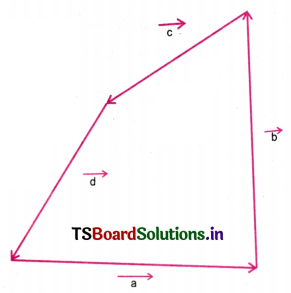
(c) By the law of polygon of vectors \(\vec{a}\) + \(\vec{b}\) + \(\vec{c}\) + \(\vec{d}\) = 0
if they form a closed quadrilateral. In a quadrilateral, the sum of three sides must be greater than the fourth side, so the magnitude of \(\vec{a}\) can never be greater than the sum of magnitudes of \(\vec{b}\), \(\vec{c}\) and \(\vec{d}\); hence the statement is correct.
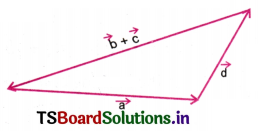
(d) \(\vec{a}\) + \(\vec{b}\) + \(\vec{c}\) + \(\vec{d}\) = 0 ⇒ \(\vec{b}\) + \(\vec{c}\) = -(\(\vec{a}\) + \(\vec{d}\))
If \(\vec{a}\) and \(\vec{d}\) are not collinear, then for \(\vec{a}\) + (\(\vec{b}\) + \(\vec{c}\)) + \(\vec{d}\) will be zero only , if vectors \(\vec{a}\), (\(\vec{b}\) + \(\vec{c}\)) and a form a closed triangle. This is possible only if all three vectors \(\vec{a}\), \(\vec{b}\) + \(\vec{c}\) and all lie in the same plane.
But if \(\vec{a}\) and \(\vec{d}\) are collinear, then (\(\vec{a}\) + \(\vec{d}\)) lie along a line. So (\(\vec{b}\) + \(\vec{c}\)) must be opposite to this line, hence the statement is true.
Question 8.
Three girls skating on a circular ice ground of radius 200 m start from a point P on the edge of the ground and reach a point Q diametrically opposite to P following different paths as shown in the fig. What is the magnitude of the displacement vector for each ? for which girl is this equal to the actual length of the path skate?
Answer:
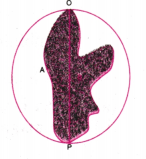
The displacement is the directed distance between initial and final positions. It is independent of path followed.
Initial point of each girl = P
Final point of each girl = Q
∴ Displacement of each girl = \(\overrightarrow{P Q}\)
Magnitude of displacement of each girl,
PQ = diameter of circular ice-ground
= 2 × radius of circular ice-ground
= 2 × 200 = 400 m
For girl B, the actual path followed is straight line P. Therefore, for girl B, the magnitude of displacement is equal to the actual length of the path followed.
Question 9.
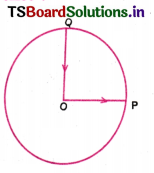
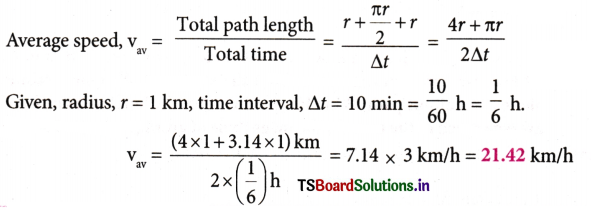
A cyclist starts from the centre O of a circular park of radius 1 km, reaches the edge P of the park, then cycles along the circumference and returns to the centre along QO as shown in the Fig. If the round trip takes 10 mm, what is the
(a) net displacement
(b) average velocity and
(c) average speed of the cyclist ?
Answer:
(a) As initial and final points of journey coincide
Net displacement = zero.
(b)

(c)
Question 10.
600 after every 500 m. Starting from a given turn, specify the displacement of the motorist at the third, sixth and eighth turn. Compare the magnitude of the displacement with the total path length covered by the motorist in each case.
Answer:
In this case, the angle between any two adjacent sides of path = 60°
Number of sides of polygon-path = \(\frac{360^{\circ}}{60^{\circ}}\) = 6
That is the path is regular hexagon, having each side 500 m and centre at O. Let the emotorist start from A; then at third turn he will be at D, so displacement vector = \(\overrightarrow{A D}\).
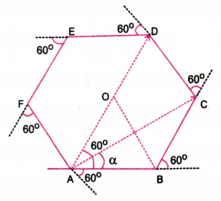
In a regular hexagon, OA = OB = AB etc., = 500 m
∴ Magnitude of displacement = AD = AO + OD = 500 + 500 = 1000 m
Total path length = AB + BC + CD = 500 + 500 + 500 = 1500m
Sixth turn: At sixth turn, the motorist is at A. Therefore, displacement vector is a null vector, having magnitude zero.
Total path length = AB + BC + CD + DE + EF + FA = 6(AB) = 6 × 5oo = 3000 m
Eighth turn : At eighth turn, the motorist is at C.
Displacement = \(\overrightarrow{A C}\)
From triangular law of vector addition, \(\overrightarrow{A C}\) = \(\overrightarrow{A B}\) + \(\overrightarrow{B C}\)
Angle between \(\overrightarrow{A B}\) and \(\overrightarrow{B C}\) is θ = 60°
Also, AB = BC = side of hexagon = 500 m
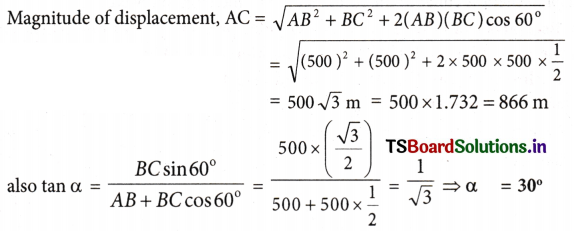
That is displacement vector \(\overrightarrow{A C}\) has magnitude 866 m and is inclined at 30° to AB.
Total path length = AB + BC + CD + DE + EF + FA + AB + BC
= 8(AB) = 8 × 500 = 4000m.
Question 11.
A passenger arriving in a new town wishes to go from the station to a hotel located 10 km away on a straight road from the station. A dishonest cabman takes him along a circuitous path 23 km long and reaches the hotel in 28 min. What is
(a) the average speed of the taxi,
(b) the magnitude of average velocity ? Are the two equal?
Ans.
Total distance = 23 km; Net displacement = 10 km
Time taken, Δt = 28 min = \(\frac{28}{60}\)h = \(\frac{7}{15}\)h
(a) Average speed = \(\frac{\text { Total Distance }}{\text { Total time }}\) = \(\frac{23}{(7 / 15)}\)km/h = 49.3 km/h
(b) Magnitude of average velocity \(=\frac{\text { Net Displacement }}{\text { Total time }}\) = \(\frac{10 \mathrm{~km}}{(7 / 15) \mathrm{h}}\) = 21.4 km/h
Clearly, the two quantities are not equal.
Question 12.
The ceiling of a long hall is 25 m high. What is the maximum horizontal distance that a ball thrown with a speed of 40 mIs can go without hitting the ceiling of the hall?
Ans.
Given, H = 25m, u = 40 m/s,
Let θ be the angle of projection, then H = \(\frac{u^2 \sin ^2 \theta}{2 g}\)
⇒ 25 = \(\frac{(40)^2 \sin ^2 \theta}{2 \times 9.8}\) ⇒ sin2θ = \(\frac{25 \times 2 \times 59.8}{(40)^2}\)
⇒ sinθ = \(\frac{\sqrt{50 \times 9.8}}{40}\) = \(\frac{22.14}{40}\) = 0.5534 ⇒ θ = sin-1 (0.5534) = 33.6°
Range, R = \(\frac{\mathrm{u}^2 \sin 2 \theta}{\mathrm{~g}}\)
= \(\frac{\mathrm{u}^2 \sin 2 \theta}{\mathrm{~g}}\)
= \(\frac{(40)^2 \sin \left(2 \times 33.6^{\circ}\right)}{9.8}\) = \(\frac{(40)^2 \times \sin \left(67.2^{\circ}\right)}{9.8}\) = \(\frac{(40)^2 \times 0.9219}{9.8}\) = 150.5 m
Question 13.
A cricketer can throw a ball to a maximum horizontal distance of 100 m. How much high above the ground can the cricketer throw the same ball ?
Answer:
Maximum distance, θ = 45°, Rmax = \(\frac{u^2(\sin 2 \theta)_{\max }}{g}\) = \(\frac{u^2}{g}\)
Maximum height, θ = 90°, Hmax = \(\frac{u^2\left(\sin ^2 \theta\right)_{\max }}{2 g}\) = \(\frac{u^2}{2 g}\)
Hmax = \(\frac{1}{2}\left(\frac{u^2}{2 g}\right)\) = \(\frac{1}{2}\) × Rmax = \(\frac{1}{2}\) × 100m = 50 m.
Question 14.
A stone tied to the end of a string 80cm long ¡s whirled in a horizontal circle with a constant speed. If the stone makes 14 revolutions in 25 s, what is the magnitude and direction of acceleration of the stone?
Answer:
Given radius of circular path = 80 cm = 0.80 m
Frequency of revolution, n = \(\frac{\text { Number of revolutions }}{\text { Time }}\) = \(\frac{14}{25}\) rev/s
Centripetal acceleration, a = rω2 = r. (2πυ)2 = 4π22
= 4 × (3.14)2 × \(\left(\frac{14}{25}\right)^2\) × 0.80 = 9.9 m/s2
This acceleration is directed towards the centre of circular path.
Question 15.
An aircraft executes a horizontal loop of radius 1.00 km with a steady speed of 900 km/h. Compare the centripetal acceleration with the acceleration due to gravity.
Answer:
Speed of aircraft, υ = 900 km/h = 900 × \(\frac{5}{18}\)m/s = 250 m/s
Radius of loop, r = 1 km = 1000 m
Centripetal acceleration, a = \(\frac{v^2}{r}\) = \(\frac{(250)^2}{1000}\) = 62.5 m/s2
Ratio of centripetal acceleration and acceleration due to gravity \(\frac{\mathrm{a}}{\mathrm{~g}}\) = \(\frac{62.5}{9.8}\) = 6.38
This is centripetal acceleration of aircraft is 6.38 times of the acceleration due to gravity.
Question 16.
Read each statement below carefully and state, with reasons, if it is true or false.
(a) The net acceleration of a particle in circular motion is always along the radius of the circle towards the centre.
(b) The velocity vector of a particle at a point is always along the tangent to the path of the particle at that point.
(c) The acceleration vector of a particle in uniform circular motion averaged over one cycle is a null vector.
Answer:
(a) False ; if speed of particle changes with time, then a particle possess a tangential acceleration along with centripetal acceleration, so resultant is not along the radius of circle towards center. However, if motion is uniform circular motion, then acceleration is necessarily directed along radial direction towards centre.
(b) True ; The velocity vector at a point moving along a curved path is necessarily along the tangent to path at that point.
(c) True ; \(\overrightarrow{\mathrm{a}_{\mathrm{av}}}\) = \(\frac{\overrightarrow{\mathrm{v}_2}(\mathrm{t}+\mathrm{T})-\overrightarrow{\mathrm{v}_1} \mathrm{t}}{\mathrm{~T}}\), where T is time period.
For complete cycle, v2 (t + T) = υ1 (t)
∴ \(\overrightarrow{a_{a v}}\) = \(\overrightarrow{0}\) (null vector).
Question 17.
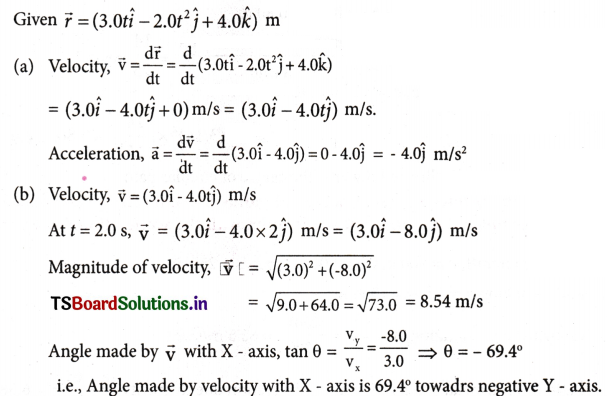
The position of a particle is given by \(\overrightarrow{\mathbf{r}}\) = (3.0t\(\hat{\mathbf{i}}\) -2.0t2\(\hat{\mathbf{j}}\) + 4.0\(\hat{\mathbf{k}}\)) m where t is in seconds and the coefficients have proper units for \(\overrightarrow{\mathbf{r}}\) to be in metres
(a) Find \(\overrightarrow{\mathbf{v}}\) and \(\overrightarrow{\mathbf{a}}\) of the particle.
(b) What is the magnitude and direction of velocity of the particle at t = 2.0 s ?
Answer:
Question 18.
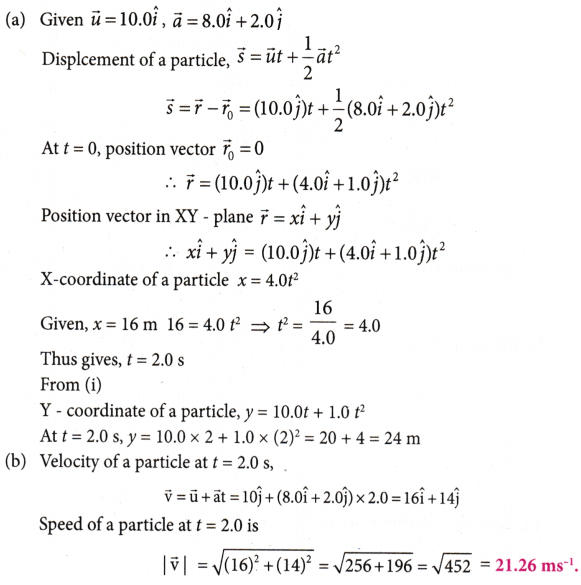
A particle starts from the origin at t = 0 s with a velocity of 10.0\(\hat{\mathbf{j}}\) ms-1 and moves in the XY – plane with a constant acceleration of (8.0\(\hat{\mathbf{i}}\) + 2.0 j) ms-2.
(a) At what time is the X-coordinate of the particle 16m? What is the Y-coordinate of the particle at that time ?
(b) What is the speed of the particle at that time ?
Answer:
Question 19.
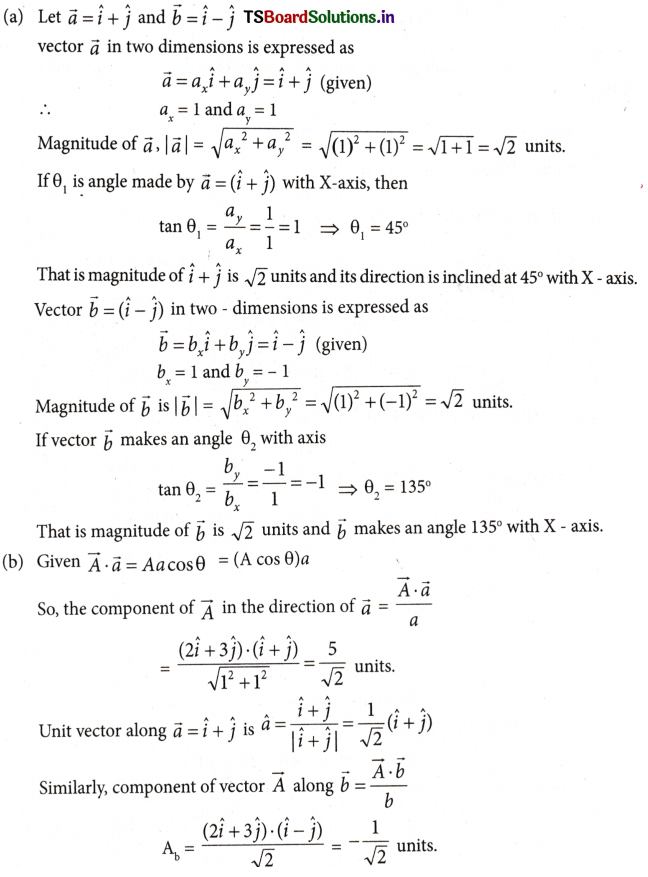
(a) \(\hat{\mathbf{i}}\) and \(\hat{\mathbf{j}}\) are unit vectors along X and Y axes respectively. What is the magnitude and direction of the vectors (\(\hat{\mathbf{i}}\) + \(\hat{\mathbf{j}}\)) and (\(\hat{\mathbf{i}}\) – \(\hat{\mathbf{j}}\)) ?
(b) What are the components of a vector \(\overrightarrow{\mathbf{A}}\) = 2\(\hat{\mathbf{i}}\) + 3\(\hat{\mathbf{j}}\) along the directions (\(\hat{\mathbf{i}}\) + \(\hat{\mathbf{j}}\)) and (\(\hat{\mathbf{i}}\) – \(\hat{\mathbf{j}}\)) ?
Answer:
Question 20.
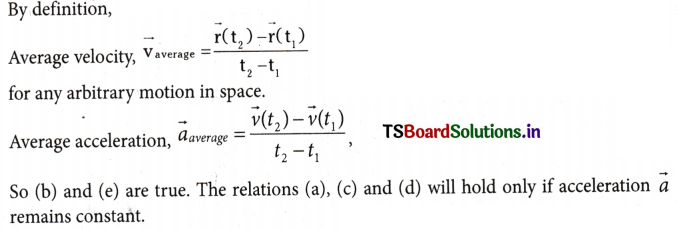
For any arbitrary motion in space, which of the following relations are true?
(a) vaverage = \(\frac{1}{2}\)[v(t1) + v(t2)]
(b) vaverage = \(\frac{\left\{r\left(t_2\right)-r\left(t_1\right)\right\}}{t_2-t_1}\)
(c) v(t) = v(0) + at
(d) r(t) = r(0) + v(0)t + \(\frac{1}{2}\)at2
(e) aaverage = \(\frac{\left\{v\left(t_2\right)-v\left(t_1\right)\right\}}{t_2-t_1}\)
The ‘average’ stands for average of the quantity over the time interval t1 to t2.
Answer:
Question 21.
Read each statement below carefully and state, with reasons and examples, if it is true or false.
A scalar quantity is one that
(a) is conserved in a process
(b) can never take negative values
(c) must be dimensionless
(d) does not vary from one point to another in space
(e) has the same value for observers with different orientations of axes.
Answer:
(a) False ; because kinetic energy being a scalar quantity is not conserved in an inelastic collision.
(b) False ; because temperature being a scalar quantity can take negative values (on celsius scale).
(c) False ; because density being a scalar quantity has dimensions [ML-3] and energy being a scalar quantity has dimensions [ML2T-2].
(d) False ; because gravitational potential, electric potential is different at different points in space.
(e) True ; because the value of scalar does not depend on the orientation of coordinate axes.
Question 22.
An aircraft is flying at a height of 3400 m above the ground. If the angle subtended at a ground observation point 10 s apart is 300, what is the speed of aircraft?
Answer:
Let aircraft traverse with uniform speed y horizontally from A to B in time t = 10 seconds.
The observation point is O. The angle subtended at O is 30°.
Then, AB = vt = v × 10 = 10v
Let C be mid-point of AB, then A
AC = CB = 5v,
H = OC = 3400 m (given)
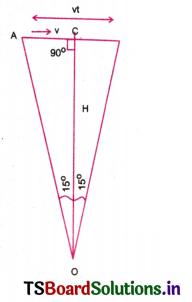
Each part AC and CB will subtend an angle of 15° at observation point O.
Then from Fig.
tan 15° = \(\frac{\mathrm{AC}}{\mathrm{OC}}\) ⇒ tan 15° = \(\frac{5 \mathrm{v}}{\mathrm{H}}\) = \(\frac{5 v}{3400}\)
∴ v = \(\frac{3400 \tan 15^{\circ}}{5}\) = \(\frac{3400 \times 0.268}{5}\) = 680 × 0.268 = 182.2 m/s