TS Inter 1st Year Physics Notes Chapter 6 పని, శక్తి, సామర్ధ్యం

Here students can locate TS Inter 1st Year Physics Notes 6th Lesson పని, శక్తి, సామర్ధ్యం to prepare for their exam.

TS Inter 1st Year Physics Notes 6th Lesson కణాల పని, శక్తి, సామర్ధ్యం

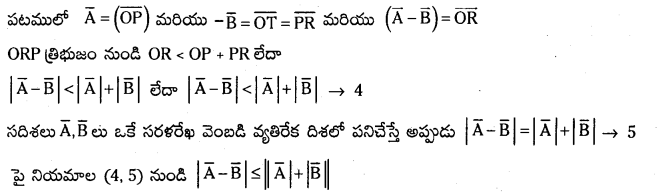
→ అదిశా లబ్ధము : A̅, B̅ అను రెండు సదిశల బిందు లబ్ధము A̅ dot B̅ ను A̅ B̅ గా వ్రాస్తారు.
Ā. B̅ = |Ā|. |B̅| cos θ గా నిర్వచించినారు.
ఇందులో A̅ cos θ అనునది B̅ వెంబడి A యొక్క అంశ లేదా B̅ cos θ అనునది A̅ వెంబడి B̅ యొక్క అంశ
రెండు సదిశల బిందు లబ్ధము అదిశ. దీనికి దిశ ఉండదు.
ఉదా : పని W = F̅. S̅ = F.S cos θ

→ బిందు లబ్ధము ధర్మాలు :

→ బిందు లబ్ధము స్థిత్యంతర న్యాయాన్ని పాటిస్తుంది. అనగా A̅. B̅ = B̅. A̅

→ బిందు లబ్దము విభాగ న్యాయాన్ని పాటిస్తుంది.
అనగా A̅. (B̅ + C̅) = A̅B̅ + A̅.C̅ మరియు A̅. (λB̅) = λ(A̅.B̅)

→ బిందు లబ్ధము సాహచర్య న్యాయాన్ని పాటిస్తుంది.
A̅ + (B̅ + C̅) = (A̅ + B̅) + C̅

→ ఏదైనా సదిశను x, y మరియు z అక్షముల వెంబడి ప్రమాణ సదిశలు i̅, j̅ మరియు k̅ లతో సూచిస్తే సజాతి ప్రమాణ సదిశల బిందు లబ్ధము i̅.i̅ = 1, j̅. j̅ = 1, k̅ . k̅ = 1
విజాతి ప్రమాణ సదిశల బిందు లబ్ధము సున్న
i̅. j̅ – j̅. k̅ = k̅ . i̅ = 0

→ రెండు సదిశలు పరస్పర లంబాలు ఐతే వాటి బిందు లబ్ధము సున్న.

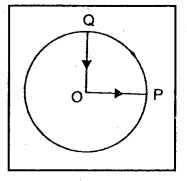
→ పని : ఏదైనా బలం వస్తువు మీద పనిచేసి బలప్రయోగ దిశలో దానిని స్థానభ్రంశం చెందించితే బలం పనిచేసింది అంటారు.
పని W = F.S. (F, S లు ఒకే దిశలో ఉంటే)
లేదా పని W = FS cos θ (‘θ’ బలము F మరియు స్థానభ్రంశము S ల మధ్యకోణము. సదిశలలో పనిని W = F̅.S̅. = FS cos θ గా చెపుతారు. పని అదిశరాశి ప్రమాణము కి.గ్రా.మీ2/సె2 దీనిని జౌల్ (J) అంటారు.
గమనిక : పని ఎల్లప్పుడూ ధనాత్మకమే. బలము, స్థానభ్రంశాలు వ్యతిరేక దిశలో ఉన్నపుడు లేదా వాటి మధ్య కోణము θ > 90 ఐతే పనిని ‘-‘ గుర్తుతో సూచిస్తారు. కాని పని విలువ ధనాత్మకంగానే తీసుకోవాలి.

TS Inter 1st Year Physics Notes Chapter 6 పని, శక్తి, సామర్ధ్యం

→ స్థిరబలం అనేది చాలా అరుదైన భావన. మనం సాధారణంగా చరబలాన్ని లెక్కలోనికి తీసుకుంటాము. చరబలం వల్ల జరిగిన మొత్తం పని
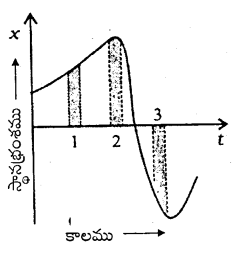
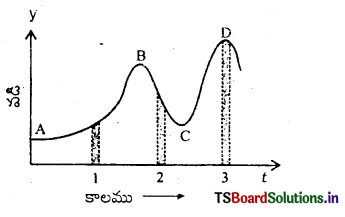
W = \({Lt}_{\Delta x \rightarrow 0} \sum_{\mathbf{x}_1}^{\mathrm{x}_i}\)F(x) Δx = \(\int_{x_1}^{x_i}\)F(x)dx

→ చరబలం చేసిన పని : ఒక స్థిరబలం F(x) వస్తువుపై పనిచేసి దానిని Ax స్థానభ్రంశం చెందించితే అది జరిపిన పని
ΔW = F(x) Δx

→ గతిజశక్తి : గమనంలో ఉన్న వస్తువుకు గల శక్తిని గతిజశక్తి అంటారు.
గతిజశక్తి KE = \(\frac{1}{2}\)mυ2, ప్రమాణము = జౌల్ (J)
ఉదా : కదులుతున్న వస్తువులన్నింటికి గతిజశక్తి ఉంటుంది.
గమనిక : వస్తువులో నిలువ ఉన్న పనినే శక్తి అంటారు. కావున పని, శక్తిలకు మితి ఫార్ములా, ప్రమాణము ఒక్కటే.

→ గతిజశక్తి, ద్రవ్యవేగాల మధ్య సంబంధము :
గతిజశక్తి_KE = \(\frac{1}{2}\)mυ2,
ద్రవ్యవేగము P = mu
∴ KE = \(\frac{1}{2}\)mυ2 = \(\frac{1}{2} \frac{m^2 v^2}{m}=\frac{p^2}{2 m}\)

→ స్థితిజ శక్తి : వస్తువు స్థానం వల్ల గాని, విన్యాసం వల్ల గాని వస్తువులో నిలువ ఉన్న శక్తిని స్థితిజశక్తి అంటారు.
ఉదా : కొంత ఎత్తులో ఉన్న రాయి, సాగదీయబడిన రబ్బరు ముక్క వంటివి. వస్తువు స్థితిశక్తిని PE = mgh అను సమీకరణంతో కొలుస్తారు.
ఏకమితీయ నిత్యత్వ బలానికి స్థితిశక్తి ప్రమేయం υ(X) ను F(x) = \(\frac{d}{d x}\) v(x) లేదా vi – v1 = \(\int_{x_1}^{x_1}\)F(x) dx అని వ్రాస్తారు.

→ పని-శక్తి సిద్ధాంతము : ఒక కణం లేదా వ్యవస్థపై నికర బలం వల్ల జరిగిన పని దాని గతిజశక్తుల భేదమునకు సమానము.
పని-శక్తి సిద్ధాంతపు గణిత రూపం
W = Kf – Ki = \(\frac{1}{2}\)mu2 = F.d

→ నిత్యత్వ బలాలు :

  • వస్తువుపై బలం చేసిన పని వస్తువు పథంపై ఆధారపడకుండా దాని తొలి, తుది స్థానాలపై (xi, xf) మాత్రమే ఆధారపడినపుడు
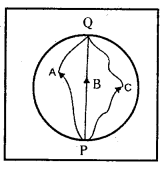
  • వస్తువు అనియత సంవృత పథం వెంబడి ప్రయాణించి మరల ఆరంభ బిందువును చేరినపుడు ఆ వస్తువుపై జరిగిన పని శూన్యమైతే అటువంటి బలాలను నిత్యత్వ బలాలు అంటారు. ఉదా : గురుత్వ క్షేత్రంలో జరిగిన పని.

→ అనిత్యత్వ బలాలు : ఒక వస్తువుపై జరిగిన పని లేదా గతిజ శక్తి లేదా వేగం వస్తువు ప్రయాణించిన ప్రత్యేక పథం వంటి కారకాలపై ఆధారపడితే ఆ బలాన్ని అనిత్యత్వ బలం అంటారు.
ఉదా : ఘర్షణ బలాలకు వ్యతిరేకంగా జరిగిన పని.

→ యాంత్రిక శక్తి నిత్యత్వము : ఒక వ్యవస్థపై పనిచేసే బలాలు నిత్యత్వ బలాలు ఐతే ఆ వ్యవస్థ మొత్తం యాంత్రిక శక్తి నిత్యత్వమవుతుంది.

TS Inter 1st Year Physics Notes Chapter 6 పని, శక్తి, సామర్ధ్యం

→ స్ప్రింగ్ స్థితిజశక్తి : ఆదర్శ స్ప్రింగ్కు బలం (F) స్థానభ్రంశం ‘x’ కి అనులోమానుపాతంలో ఉంటుంది.
Fs = -Kx.
స్ప్రింగ్లో నిలవ ఉన్న స్థితిజ శక్తి = బలం చేసిన పని.
Ws = \(\int_0^{x_m}\)Fsdx = –\(\int_0^{x_m}\)K.x.dx = –\(\frac{1}{2}\)Kxm
ఇందులో xm = స్ప్రింగ్లో సాగుదల, స్ప్రింగ్లో నిలువ ఉన్న శక్తి తొలి, తుది స్థానాల పై ఆధారపడుతుంది. కావున స్ప్రింగ్ ్బలం నిత్యత్వబలం సమతా స్థితి స్థానం వద్ద వడి vm = \(\sqrt{\frac{\mathrm{k}}{\mathrm{m}}}\)xm m స్ప్రింగ్కు తగిలించిన ద్రవ్యరాశి.

→ శక్తినిత్యత్వ నియమము : ఏదైనా వ్యవస్థపై పనిచేసే బలాలు నిత్యత్వ బలాలు ఐతే ఆ వ్యవస్థ మొత్తం యాంత్రిక శక్తి నిత్యత్వమవుతుంది. యాంత్రికశక్తి

  • గమనంపై ఆధారపడే గతిజశక్తిగాను
  • వస్తువు విన్యాసంపై ఆధారపడే స్థితిశక్తిగాను ఉంటుంది.

కావున “ఏదైనా వ్యవస్థపై పనిచేసే బలాలు నిత్యత్వ బలాలు ఐతే వ్యవస్థకు గల మొత్తం శక్తి (స్థితిజ శక్తి + గతిజ శక్తి) స్థిరము. దీనిని సృష్టించడం కాని, నాశనం చేయడంగాని సాధ్యపడదు.”
గమనిక : వ్యవస్థపై అనిత్యత్వ బలాలు పనిచేస్తే కొంత భాగం ఉష్ణం, ధ్వని లేదా కాంతి వంటి రూపాలలో నష్టమవుతుంది.

→ రసాయనిక శక్తి : రసాయనిక చర్యలో పాల్గొనే వేరు వేరు అణువులకు గల బంధన శక్తుల వల్ల రసాయనశక్తి ఏర్పడుతుంది.

→ ఉష్ణమోచక చర్య : చర్యలో పాల్గొనే క్రియాజన్యాల మొత్తం శక్తి కన్నా క్రియాజనకాల శక్తి ఎక్కువ ఐతే ఆ చర్యలో శక్తి విడుదల అవుతుంది. దీనిని ఉష్ణమోచక చర్య అంటారు.

→ ఉష్ణగ్రాహక చర్య : చర్యలో పాల్గొనే క్రియాజన్యాల మొత్తం శక్తి కన్నా క్రియాజనకాల మొత్తం శక్తి తక్కువ ఐతే ఆ చర్యలో ఉష్ణశక్తి గ్రహింపబడుతుంది. దీనిని ఉష్ణగ్రాహక చర్య అంటారు.

→ విద్యుత్ శక్తి : ఎలక్ట్రాన్ల సమూహం ఒక చోట నుండి మరొక చోటుకు ప్రవహించడాన్ని విద్యుత్ ప్రవాహమంటారు. విద్యుత్ ప్రవాహం వల్ల లభించే శక్తిని విద్యుత్ శక్తి అంటారు.

→ ద్రవ్యరాశి-శక్తి తుల్యత లేదా ద్రవ్యరాశి శక్తి తుల్యతా నియమము : ద్రవ్యరాశి మరియు శక్తుల మధ్య సంబంధము E = mc2. దీనిని ఐన్స్టీన్ ప్రతిపాదించినాడు.

→ కేంద్రకశక్తి : కేంద్రక విచ్ఛిత్తి, సంలీన చర్యలలో క్రియాజనకాల మొత్తం ద్రవ్యరాశి కన్నా క్రియాజన్యాల మొత్తం ద్రవ్యరాశి తక్కువ. ఈ ద్రవ్యరాశిలోని తరుగుదల E = mc2 నియమం ప్రకారము శక్తిగా మారుతుంది. కేంద్రక చర్యలలో విడుదల అయిన ఈ శక్తిని కేంద్రకశక్తి అంటారు.

→ అభిఘాతాలు (Collisions) : గమనంలో ఉన్న వస్తువు మరొక వస్తువును ఢీ కొన్నపుడు దాని శక్తిలో మార్పులు సంభవిస్తాయి. ఈ రకమైన భౌతిక ప్రక్రియను అభిఘాతాలు అంటారు. ఇవి రెండు రకాలు.

  • స్థితిస్థాపక అభిఘాతము
  • అస్థితిస్థాపక అభిఘాతము.

→ స్థితిస్థాపక అభిఘాతాలు : స్థితిస్థాపక అభిఘాతాలు

  • ద్రవ్యవేగ నిత్యత్వ నియమాన్ని
  • శక్తి నిత్యత్వ నియమాన్ని పాటిస్తాయి. ఇటువంటి అభిఘాతాలలో శక్తి నష్టము ఉండదు.

TS Inter 1st Year Physics Notes Chapter 6 పని, శక్తి, సామర్ధ్యం

→ అస్థితిస్థాపక అభిఘాతాలు : ఈ రకమైన అభిఘాతాలు ద్రవ్యవేగ నిత్యత్వ నియమాన్ని మాత్రమే పాటిస్తాయి. ఈ విధమైన అభిఘాతాలలో శక్తి నష్టం ఉంటుంది.

→ ప్రత్యవస్థాన గుణకము (e) : అభిఘాతం పిమ్మట వస్తువులు విడిపోయే వేగము (υ2 – υ1) మరియు అభిఘాతము ముందు వస్తువులు పరస్పరం సమీపించే వేగము (u2 – u1) ల నిష్పత్తిని ప్రత్యవస్థాన గుణకముగా నిర్వచించినారు. దీనికి మితులు, ప్రమాణాలు లేవు.
ప్రత్యవస్థాన గుణకము e = \(\frac{v_2-v_1}{u_1-u_2}\)
సంపూర్ణ స్థితిస్థాపక అభిఘాతాలకు e = 1
సంపూర్ణ అస్థితిస్థాపక అభిఘాతాలకు e = 0

→ ఏకమితీయ అభిఘాతాలు : ఒకే సరళరేఖ వెంబడి చలించే వస్తువుల మధ్య గల అభిఘాతాలను ఏకమితీయ అభిఘాతాలు అంటారు. ఇటువంటి అభిఘాతాలలో వస్తువులు అభిఘాతం ముందు, అభిఘాతం తరువాత ఒకే సరళరేఖ వెంబడి చలిస్తున్నట్లు భావిస్తారు. ఇవి రేఖీయ ద్రవ్యవేగ నిత్యత్వ నియమాన్ని పాటిస్తాయి.

→ ద్విమితీయ అభిఘాతాలు : ఒక సమతలంలో చలించే వస్తువు చలనాన్ని పరస్పర లంబదిశలో గల రెండు అక్షముల (x, y) పరంగా వివరిస్తారు. ఒక సమతలంలో చలించే రెండు వస్తువులు అభిఘాతం చెందిన తరువాత కూడా ఆ సమతలంలోనే చలిస్తే అటువంటి అభిఘాతాలను ద్విమితీయ అభిఘాతాలు అంటారు. గమనిక : ద్విమితీయ అభిఘాతాలను వివరించడానికి x-దిశ, y-దిశలలో అంశ వేగాలు కనుగొని రెంటికి విడివిడిగా ద్రవ్యవేగ నిత్యత్వ నియమాన్ని వర్తింపచేసి తుది వేగాలను కనుగొంటారు. ఫలిత వేగాన్ని v = \(\sqrt{v_x^2+v_y^2}\), ద్వారా లెక్కిస్తారు.

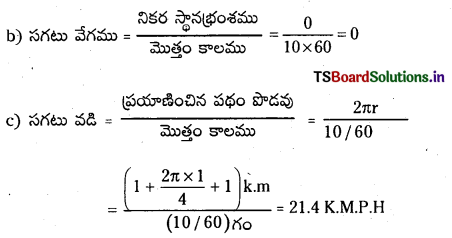
→ సామర్ధ్యము (P) : పని జరిగే రేటును సామర్థ్యము అంటారు.
TS Inter 1st Year Physics Notes Chapter 6 పని, శక్తి, సామర్ధ్యం 1
= ప్రమాణము వాట్. సామర్ధ్యము అదిశరాశి. మితి ఫార్ములా ML2T-3
గమనిక : సామర్థ్యము P = \(\frac{\mathrm{dW}}{\mathrm{dt}}=\overrightarrow{\mathrm{F}} \cdot \frac{\mathrm{dr}}{\mathrm{dt}}=\overline{\mathrm{F}} \cdot \overline{\mathrm{V}}\) అని కూడా చెప్పవచ్చు.

→ కిలోవాట్ గంట (K.W.H.) : సెకనుకు 1000 జౌల్ చొప్పున ఏకధాటిగా ఒక గంటసేపు పని జరిపితే ఆ పని మొత్తాన్ని ఒక కిలోవాట్ గంట అని వ్యవహరిస్తారు. ఇది విద్యుచ్ఛక్తిని కొలవడానికి ప్రమాణము (1 యూనిట్ అని అంటారు).
1 K.W.H. = 1 unit = 1000 × 1 గం. = 1000 × 60 × 60 = 3.6 × 10⁶ జౌల్

→ అశ్వ సామర్థ్యము (H.P.) : 746 వాట్ల ను ఒక అశ్వసామర్థ్యము అంటారు.
1 అశ్వ సామర్థ్యము H.P. = 746 వాట్.

→ పని W = F.S. (F, S లు ఒకే సరళరేఖలో ఉంటే)
పని W = F.S. cos θ (F, S ల మధ్యకోణము ‘9’ ఐతే)
మారుతున్న బలం (చరబలం) పనిచేసినపుడు W = ∫F.dx

→ సామర్థ్యము
TS Inter 1st Year Physics Notes Chapter 6 పని, శక్తి, సామర్ధ్యం 2

→ స్థితిజ శక్తి PE = mgh

→ గతిజశక్తి KE = \(\frac{1}{2}\)mv2

TS Inter 1st Year Physics Notes Chapter 6 పని, శక్తి, సామర్ధ్యం

→ గతిజశక్తి, ద్రవ్యవేగాల మధ్య సంబంధం KE = \(\frac{\mathrm{p}^2}{2 \mathrm{~m}}\) లేదా p = \(\sqrt{2 \mathrm{~m} \cdot \mathrm{KE}}\)

  • పని శక్తి సిద్ధాంత ప్రకారము W = \(\frac{1}{2}\)mv2 – \(\frac{1}{2}\)mu2 = KEf – KEi
  • స్థితిజశక్తిలో మార్పు వస్తే W = mgh2 – mgh1

→ మరతుపాకి లెక్కలలో జరిగిన పని W = n\(\frac{1}{2}\)mv2 (మొత్తం బుల్లెట్ ల గతిజశక్తి)

→ స్థితిస్థాపక అభిఘాతాలలో

  • u1 – u2 = v2 – v1
  • m1u2 + m2 u2 = m1v1 + m2v2
  • m1u12 + m2u22 = m1v12 + m2v22
  • మొదటి వస్తువు తుదివేగము v1 = \(\left[\frac{m_1-m_2}{m_1+m_2}\right]\)u1 + \(\left[\frac{2 m_2}{m_1+m_2}\right]\)u2
  • రెండవ వస్తువు తుది వేగము v2 = \(\left[\frac{2 m_1}{m_1+m_2}\right]\)u1 + \(\left[\frac{m_2-m_1}{m_1+m_2}\right]\)u2

→ సంపూర్ణ అస్థితిస్థాపక అభిఘాతానికి v = \(\frac{\mathrm{m}_1 \mathrm{u}_1+\mathrm{m}_2 \mathrm{u}_2}{\mathrm{~m}_1+\mathrm{m}_2}\)

→ ప్రత్యవస్థాన గుణకము ‘e’
TS Inter 1st Year Physics Notes Chapter 6 పని, శక్తి, సామర్ధ్యం 3

→ వస్తువును h ఎత్తు నుండి కిందికి జారవిడిస్తే

  • వస్తువు భూమిని సమీపించు వేగము u = \(\sqrt{2 g h}\)
  • వస్తువు h1 ఎత్తు నుండి పడి భూమిని తాకి మరల h2 ఎత్తుకు లేస్తే e = \(\sqrt{\frac{\mathrm{h}_2}{\mathrm{~h}_1}}\)
  • వస్తువుకు భూమి నుండి నిగమ వేగము v = – e \(\sqrt{2 \mathrm{gh}}\)
  • n అభిఘాతాల తరువాత పైకి లేచిన ఎత్తు hn = e2nh.

→ ఐన్స్టీన్ ‘ద్రవ్యరాశి – శక్తి నియమము E = mc2

→ సదిశలలో బిందు లబ్ధము A̅. B̅ = |A̅|. |B̅| cos θ

TS Inter 1st Year Physics Notes Chapter 7 కణాల వ్యవస్థలు, భ్రమణ గమనం

Here students can locate TS Inter 1st Year Physics Notes 7th Lesson కణాల వ్యవస్థలు, భ్రమణ గమనం to prepare for their exam.

TS Inter 1st Year Physics Notes 7th Lesson కణాల వ్యవస్థలు, భ్రమణ గమనం

→ ద్రుఢ వస్తువు : పరిపూర్ణమైన, నిర్దిష్టమైన మార్పుచెందని ఆకారం కలిగి ఉండే వస్తువును ఒక ద్రుఢ వస్తువుకు ఆదర్శ నమూనాగా తీసుకుంటారు. ఇటువంటి వస్తువులో కణముల మధ్య దూరము మారదు అని భావిస్తారు.

→ స్థానాంతరణ గమనము : ఈ విధమైన చలనంలో వస్తువు మొత్తం ఒకచోటు నుండి మరొకచోటుకు స్థానభ్రంశం చెందుతుంది.

→ శుద్ధ స్థానాంతరణ గమనంలో ఏ క్షణంలోనైనా వస్తువులోని అన్ని కణాలు ఒకే వేగాన్ని కలిగి ఉంటాయి.

→ భ్రమణాక్షము : వస్తువు స్థానాంతరణ చలనం నిరోధించడానికి దానిని ఒక సరళరేఖపరంగా స్థిరంగా ఉంచాలి. కాని వస్తువు ఇటువంటి సరళరేఖపరంగా తనచుట్టూ తాను తిరిగే అవకాశం ఉంది.
“వస్తువు తన చుట్టూ తాను ఏ సరళరేఖపరంగా చలించుతుందో దానిని భ్రమణాక్షము అంటారు”.

→ భ్రమణ గమనము : ఒక స్థిరమైన అక్షం పరంగా భ్రమణం చెందే ద్రుఢ వస్తువులోని కణాలు భ్రమణ అక్షానికి లంబతలంలో భ్రమణాక్షంపై గల బిందువులను కేంద్రంగా చేసుకొని నియమిత వృత్తాకారమార్గంలో చలిస్తాయి. ఈ విధమైన చలనాన్ని భ్రమణ గమనము అంటారు.

Note :

  • కొన్ని సందర్భాలలో భ్రమణ గమనము స్థిరమైన అక్షం వెంబడి కాకుండా ఒక స్థిర బిందువు ఆధారంగా కూడా ఉండవచ్చు.
  • కీలకంలేని లేదా భ్రమణాక్షం స్థిరంగా బిగించకుండా ఉన్న ద్రుఢ వస్తువు గమనం కేవలం స్థానాంతరణ గమనం లేదా స్థానాంతరణ గమనము మరియు భ్రమణ గమనముల సంయోగాన్ని కలిగి ఉంటుంది. వస్తువును ఏదో విధంగా బిగించితే దానికి భ్రమణ గమనం మాత్రమే ఉంటుంది.

→ ద్రవ్యరాశి కేంద్రము : ఏదైనా వస్తువు లేదా కణ వ్యవస్థ మొత్తం ద్రవ్యరాశి ఒక బిందువు వద్ద కేంద్రీకృతమైనట్లుగా భావిస్తే అటువంటి బిందువును ద్రవ్యరాశి కేంద్రం అంటారు. అన్ని బాహ్యబలాలు ఇటువంటి బిందువు వద్దనే ప్రయోగించినట్లుగా ఆ వస్తువు లేదా వ్యవస్థ గమనంలో ఉంటుంది.

→ గరిమనాభి : వస్తువులోని ఏ బిందువు పరంగా మొత్తం గురుత్వ బలభ్రామకం శూన్యమవుతుందో ఆ బిందువును వస్తువు గరిమనాభిగా నిర్వచించవచ్చు.
గరిమనాభివద్ద నికర బలభ్రామకం τ = Σ(ri × mi) g = 0

→ ద్రవ్యరాశి కేంద్ర నిరూపకాలు : m1, m2 క అను రెండు వస్తువులు ఒక మూల బిందువు నుండి x1, x2 దూరాలలో ఉంటే ఆ వ్యవస్థ ద్రవ్యరాశి కేంద్రము xc = \(\frac{m_1 x_1+m_2 x_2}{m_1+m_2}\)
అనగా ద్రవ్యరాశి కేంద్రము మూలబిందువు నుండి వస్తువులోని అన్నికణముల ద్రవ్యరాశి భ్రామకాల మొత్తము మరియు వస్తువు ద్రవ్యరాశికి గల నిష్పత్తిగా భావించవచ్చు.

Note:

  • సమాన ద్రవ్యరాశులు గల రెండు వస్తువులు m, m లు ‘x’ దూరంలో ఉంటే వాటి ద్రవ్యరాశి కేంద్రం కచ్చితంగా వాటి మధ్య బిందువు వద్ద ఉంటుంది.
  • మూడు సమాన ద్రవ్యరాశులు గల వస్తువులను ఒక త్రిభుజం శీర్షాల వద్ద ఉంచితే ఆ వ్యవస్థ ద్రవ్యరాశి కేంద్రం ఆ త్రిభుజ కేంద్రాభం (centroid) వద్ద ఉంటుంది.
    ద్రవ్యరాశి కేంద్ర నిరూపకాలకు సమీకరణాలు. అనేక వస్తువులు లేదా కణాలు m1, m2, త్రిదిశాత్మకంగా తీసుకుంటే ఆ వ్యవస్థ ద్రవ్యరాశి కేంద్ర x, y మరియు z నిర్దేశకాలు

TS Inter 1st Year Physics Notes Chapter 7 కణాల వ్యవస్థలు, భ్రమణ గమనం 1

TS Inter 1st Year Physics Notes Chapter 7 కణాల వ్యవస్థలు, భ్రమణ గమనం

→ ద్రవ్యరాశి కేంద్ర లక్షణాలు :

  • వ్యవస్థ మొత్తం ద్రవ్యరాశి దాని ద్రవ్యరాశి కేంద్రం వద్దనే కేంద్రీకృతమైనట్లుగా ప్రవర్తిస్తుంది.
  • వ్యవస్థపైగల మొత్తం బాహ్యబలం ద్రవ్యరాశి కేంద్రం వద్దనే ప్రయోగించినట్లుగా వస్తువు ప్రవర్తన ఉంటుంది. బాహ్య = M. ‘a’; ‘a’ ద్రవ్యరాశి కేంద్రత్వరణము.
  • అంతర్గత బలాలు ద్రవ్యరాశి కేంద్ర గమనాన్ని ప్రభావితం చేయలేవు.
  • స్థానాంతరణ మరియు భ్రమణ గమనం కలిగి ఉన్న సంక్లిష్ట చలనాలలో, ద్రవ్యరాశి కేంద్రం స్థానాంతరణ గమనమే. వస్తువు మొత్తం స్థానాంతరణ గమనం అవుతుంది.
  • ఒక కణ వ్యవస్థ మొత్తం ద్రవ్యవేగము ఆ వ్యవస్థ మొత్తం ద్రవ్యరాశి మరియు ద్రవ్యరాశి కేంద్రాల వేగాల లబ్ధానికి సమానము p̅ = MV.
  • ద్రవ్యరాశి కేంద్ర నిరూపకాలు మనం ఎంచుకున్న నిర్దేశచట్రంపై ఆధారపడవు.

→ సదిశల సదిశా లబ్ధము : రెండు సదిశలు ā మరియు b̅ లను మరల సదిశ ఏర్పడేవిధంగా గుణించడాన్ని సదిశల సదిశాలబ్ధము అంటారు. దీనిని ā cross b̅ అని అంటారు.
ā × b̅ = |ā||b̅| sinθ. n̅ ఇందులో n̅ ఇచ్చిన సదిశల తలానికి లంబదిశలో గల ప్రమాణ సదిశ.
Note : సదిశల సదిశా లబ్ధము ā × b̅ ను వజ్రంబ్ధము అని కూడా అంటారు.

సదిశా లబ్ధ నియమాలు :

  • సదిశా లబ్ధము స్థిత్యంతర న్యాయాన్ని పాటించదు. అనగా ā × b̅ + b̅ × ā కాని ā × b̅ = – (b̅ × ā)
  • సదిశా లబ్దము విభాజక న్యాయాన్ని పాటిస్తుంది అనగా ā × (b̅ + c̅) = (a̅ × b̅) + (a̅ × c̅)
  • ఏవైనా సదిశలను i̅, j̅ మరియు K̅ల సంయోగంగా చూపినపుడు సదిశాలబ్ధము కుడిచేతి మర నిబంధనను పాటిస్తుంది.
  • ఒక తలంలో గల రెండు ప్రమాణ సదిశలను సవ్యదిశలో గుణిస్తే అది ఆ తలానికి లంబదిశలో గల వేరొక ప్రమాణ సదిశను ఇస్తుంది.
    అనగా i × j = k, j × k = i మరియు k × i = j
    రెండు ప్రమాణ సదిశలను అపసవ్యదిశలో గుణిస్తే – గుర్తుతో మూడవ ప్రమాణ సదిశను ఇస్తుంది. j × i = -k, k × j = -i, k × t = -j.
  • సమాంతర ప్రమాణ సదిశల సదిశా లబ్ధము సున్న
    అనగా i × i = j × J = k × k = 0

→ కోణీయ స్థానభ్రంశము (θ) : భ్రమణ గమనంలో ఉన్న వస్తువు వృత్త కేంద్రం వద్ద చేసిన కోణాన్ని కోణీయ స్థానభ్రంశము ‘θ’ అంటారు. ప్రమాణము రేడియన్.
కోణీయ వేగము (ω) : కోణీయ స్థానభ్రంశంలోని మార్పు రేటును కోణీయవేగం అంటారు.
కోణీయ వేగములు α = \(\frac{\mathrm{d} \theta}{\mathrm{dt}}\) ప్రమాణము రేడియన్ / సెకను
Note : భ్రమణ గమనంలో ఉన్న వస్తువులోని అన్ని కణాలు ఒకే పరిమాణం గల కోణీయ స్థానభ్రంశము (θ) మరియు కోణీయ వేగము (ω) వంటి రాశులను కలిగి ఉంటాయి.

→ కోణీయ త్వరణము : కోణీయ వేగంలో మార్పు రేటును కోణీయ త్వరణం అంటారు.
కోణీయ త్వరణము α = \(\frac{d \omega}{d t}=\frac{d^2 \theta}{d t^2}\) ప్రమాణము రేడియన్ / సె2

→ బలభ్రామకము లేదా టార్క్ (τ) : మూలబిందువు (0) పరంగా స్థాన సదిశను r̅ కలిగిన ఒక వస్తువు లేదా కణంపై బలము F̅ ను ప్రయోగిస్తే, r̅ మరియు F̅ ల వజ్రలబ్ధాన్ని టార్క్
టార్క్ τ = r̅ × F̅ = |r̅||F|sin θ n̅
టార్క్ సదిశరాశి. దీని దిశ I, F ల తలానికి లంబంగా ఉంటుంది.
టార్క్క ప్రమాణము న్యూటన్ – మీటరు. D.F = ML2 T-2
Note : టార్క్ పని, శక్తిలకు మితిఫార్ములాలు ఒక్కటే.

→ కోణీయ ద్రవ్యవేగము (1) : m ద్రవ్యరాశి గల ఒక కణం ద్రవ్యవేగము మరియు అది మూలబిందువు నుండి 7 దూరంలో ఉంటే P మరియు T ల వజ్ర లబ్దాన్ని కోణీయ ద్రవ్యవేగంగా నిర్వచించినారు.
కోణీయ ద్రవ్యవేగము ‘L’ = r̅ × p̅ = |r̅||p̅|sin θ. n̅ ఇది సదిశరాశి. D.F = ML2T-1

→ L, α ల మధ్య సంబంధము : కోణీయ ద్రవ్యవేగంలోని మార్పురేటు వస్తువుపై ప్రయోగించిన బాహ్య టార్కుక సమానము.
టార్కు τ = \(\frac{d \overline{\mathrm{L}}}{d \mathrm{t}}=\frac{\mathrm{d}}{\mathrm{dt}}\)(r̅ × p̅)

→ కోణీయ ద్రవ్యవేగనిత్యత్వ నియమము : ఏదైనా వస్తువు లేదా కణంపై ప్రయోగించిన బాహ్య టార్క్ సున్న అయితే ఆ వస్తువు కోణీయ ద్రవ్యవేగము స్థిరము.
అనగా బాహ్య టార్క్ సున్న అయితే వ్యవస్థలో గల కణముల కోణీయ ద్రవ్యవేగములలో మొత్తం మార్పు సున్న i.e. τ = 0 అయితే
\(d \bar{L}_1+d \bar{L}_2+\ldots d \bar{L}_n=\sum_{1=1}^n d \bar{L}_1\) = 0
Note : కోణీయ ద్రవ్యవేగ నిత్యత్వ నియమము స్థానాంతరణ గమనంలోని రేఖీయ ద్రవ్యవేగ నిత్యత్వ నియమాన్ని పోలి ఉంటుంది.

→ ద్రుఢ వస్తువుల సమాతాస్థితి : కాలంతోపాటు వస్తువు రేఖీయ మరియు కోణీయ ద్రవ్యవేగాలు మార్పులేకుండా స్థిరంగా ఉంటే ఆ వస్తువుకు రేఖీయ త్వరణము మరియు టార్క్లు సున్న. అటువంటి వస్తువు సమతాస్థితిలో ఉన్నది అంటారు.

TS Inter 1st Year Physics Notes Chapter 7 కణాల వ్యవస్థలు, భ్రమణ గమనం

→ వస్తువు సమతాస్థితికి కావలసిన నియమాలు :

  • ఒక వస్తువుపై ప్రయోగించిన బలాల సదిశా మొత్తము సున్న కావలెను.
    \(\bar{F}_1+\bar{F}_2+\bar{F}_3+\bar{F}_n=\sum_{i=1}^n \bar{F}_i\) = 0 అయితే ఆ వస్తువు స్థానాంతరణ సమతాస్థితిని కలిగి ఉంటుంది.
  • ఏదైనా వస్తువుపై ప్రయోగించిన టార్క్ సదిశా మొత్తం సున్న అయితే ఆ వస్తువు భ్రమణ సమతాస్థితిని పొందుతుంది.
    τ1 + τ2 + …………. + τn = \(\sum_{i=1}^n {τ}_i\) = 0 అయితే ఆ వస్తువు భ్రమణ సమతాస్థితిలో ఉంటుంది.

→ బలభ్రామకముల సూత్రాలు : యాంత్రిక సమతాస్థితిలో ఉన్న ఒక వ్యవస్థ ఆధారం వద్ద కీలకం ప్రతిచర్యా బలం R మరియు బలాలు F1, F2, అయితే
TS Inter 1st Year Physics Notes Chapter 7 కణాల వ్యవస్థలు, భ్రమణ గమనం 2

  • స్థానాంతరణ సమతాస్థితి కోసం R – F1 – F2 = 0 అనగా ఊర్ధ్వదిశలో బలాలు మొత్తం, అధోదిశలో బలాల మొత్తానికి సమానము.
  • భ్రమణ సమతాస్థితి కోసం d1F1 – d2F2 = 0 అనగా ఊర్ధ్వ దిశలో బలభ్రామకాల మొత్తం అధో దిశలో బలభ్రామకాల మొత్తానికి సమానము.

→ యాంత్రిక లాభం : భ్రమణ సమతాస్థితి వద్ద d1F1 = d2F2, లేదా \(\frac{F_1}{F_2}=\frac{d_2}{d_1}\) దీనిని యాంత్రిక లాభం అంటారు. అనగా పెద్ద భారాన్ని చిన్న యత్నబలంతో ఎత్తవచ్చని అర్థము.

→ జడత్వ భ్రామకము (I) : భ్రమణ గమనంలో గల వస్తువు జడత్వాన్ని కొలవడానికి జడత్వ భ్రామకాన్ని వాడతారు. వస్తువు మొత్తం ద్రవ్యరాశి భ్రమణ అక్షం నుండి R దూరంలో ఉన్నదని భావిస్తే భ్రమణ అక్షపరంగా దాని జడత్వ భ్రామకము
I = MR2. ప్రమాణము కి.గ్రా. మీ2, D.F: ML2
Note : వస్తువు ద్రవ్యరాశిలాగా జడత్వ భ్రామకము స్థిరరాశి కాదు.
I విలువ భ్రమణాక్షము, వస్తువు ద్రవ్యరాశి మరియు వస్తువులో ద్రవ్యరాశి వితరణ (distribution) లపై ఆధారపడును.

→ భ్రమణ వ్యాసార్ధము (k) : ఏ బిందువు ద్రవ్యరాశి మొత్తం వస్తువు ద్రవ్యరాశికి సమానమో, ఏ బిందువువరంగా జడత్వభ్రామకం వస్తువు మొత్తం జడత్వ భ్రామకానికి సమానమో, ఆ బిందువు ద్వారా పోయే అక్షానికి, భ్రమణాక్షానికి మధ్య ఉన్న లంబదూరాన్ని ఆ అక్షపరంగా వస్తువు భ్రమణ వ్యాసార్ధంగా నిర్వచించినారు.

→ గతిపాలక చక్రం : వాహనాల వేగంలో హఠాత్తుగా వచ్చే మార్పులు నిరోధించడానికి అత్యధిక జడత్వ భ్రామకం కలిగిన వృత్తాకార బిళ్ళ చక్రాలను వాడతారు. వీటిని గతిపాలక చక్రాలు అంటారు. గతిపాలక చక్రం వేగంలో మార్పులు క్రమేణా కలిగేటట్లు చేసి వాహనాల కుదుపులను తగ్గిస్తుంది.

→ లంబాక్ష సిద్ధాంతము : ఒక పలక తలానికి లంబంగా ఉన్న ఒక అక్షపరంగా జడత్వ భ్రామకం ఆ అక్షంతో అనుషక్తంగా ఉన్న పలక తలంలోని రెండు పరస్పర లంబ అక్షముల పరంగా గల జడత్వ భ్రామకాల మొత్తానికి సమానము.
Iz = Ix + Iy

→ సమాంతరాక్ష సిద్ధాంతము : ఏదైనా ఒక అక్షం పరంగా ఒక వస్తువు జడత్వ భ్రామకం (I’z) ఆ అక్షానికి సమాంతరంగా ఉండి వస్తువు ద్రవ్యరాశి కేంద్రం ద్వారా పోయే అక్షపరంగా వస్తువు జడత్వ భ్రామకం (Iz) మరియు వస్తువు ద్రవ్యరాశి (m) ను అక్షముల మధ్యదూర వర్గం (R2) చేత గుణించి కలుపగా వచ్చు మొత్తానికి సమానము. అనగా I’z = Iz + MR2

→ దొర్లుడు గమనము : దొర్లుడు గమనము అనేది స్థానాంతరణ గమనము మరియు భ్రమణ గమనముల సంయోగము.

→ దొర్లుడు గమనం గతిజశక్తి (R.K.E) : దొర్లుడు గమనంలో ఉన్న వస్తువుకు స్థానాంతరణ గమనం వల్ల గతిజశక్తి (1/2mv2) మరియు భ్రమణ గమనం వల్ల భ్రమణ గతిజశక్తి (\(\frac{1}{2}\)Iω2) ఉంటాయి.
దొర్లుడు గమనంలో వస్తువు మొత్తం గతిజశక్తి K.ER = \(\frac{1}{2}\) mv2 + \(\frac{1}{2}\) Iω2

TS Inter 1st Year Physics Notes Chapter 7 కణాల వ్యవస్థలు, భ్రమణ గమనం

→ రెండు కణాల వ్యవస్థలో ద్రవ్యరాశులు m1, m2, వాటి స్థానాలు x1, మరియు x2 అయితే,
a) ద్రవ్యరాశి కేంద్రం నిరూపకాలు xc = \(\frac{m_1 x_1+m_2 x_2}{m_1+m_2}\)
b) నిరూపక వ్యవస్థ మూలబిందువు m1 తోటి ఏకీభవించితే
Xc = \(\frac{\mathrm{m}_2 \mathrm{x}_2}{\mathrm{~m}_1+\mathrm{m}_2}\) లేక xc = \(\frac{\mathrm{m}_2 \mathrm{x}_2}{\mathrm{~m}_1+\mathrm{m}_2}\) ఇక్కడ.d = m, m, ల మధ్యదూరం
c) ద్రవ్యరాశి కేంద్రం నుండి వస్తువుల దూరాల మధ్య నిష్పత్తి \(\frac{d_1}{d_2}=\frac{m_2}{m_1}\)

→ అనేక కణాల వ్యవస్థకు
TS Inter 1st Year Physics Notes Chapter 7 కణాల వ్యవస్థలు, భ్రమణ గమనం 3
f) ద్రవ్యరాశి కేంద్రం ద్రవ్యవేగం Pc = mvc = \(\sum_{\mathbf{l}=1}^{\mathbf{n}}\)mivi లేదా mvc = m1v1 + m2v2 + …….. + mnvn లేదా \(\overline{\mathrm{P}}_{\mathrm{C}}=\overline{\mathrm{P}}_1+\overline{\mathrm{P}}_2+\ldots . . \overline{\mathrm{P}}_{\mathrm{n}}\)

g) ద్రవ్యరాశి కేంద్రం త్వరణం a = \(\frac{F_C}{M}=\sum_{i=1}^n a_i m_i\)
∴ a = \(\frac{m_1 a_1+m_2 a_2+m_3 a_3+\ldots .+m_n a_n}{m_1+m_2+m_3+\ldots . .+m_n}\)

→ వజ్ర లబ్ధము (లేదా) సదిశా లబ్ధము : Ā × B̅ = |Ā| |B̅| sin θ. n̂ గా నిర్వచించినారు; n̂ ఏకాంక లంబ సదిశ.

→ సజాతి ఏకాంక సదిశల వజ్ర లబ్ధం సున్న. అనగా ī ī = j̅· j̅ = k̅·k̅ = 0
సమాంతర సదిశల మధ్య వజ్ర లబ్ధం శూన్యం.

→ i̅ × j̅ = k̅, j̅ × k̅ =j̅ మరియు k̅ × j̅ = j̅;
TS Inter 1st Year Physics Notes Chapter 7 కణాల వ్యవస్థలు, భ్రమణ గమనం 4

→ Ā = x1 ī + y1 j̅ + z1 k̅ మరియు B = x2 ī + y2 j̅ + z2 k̅ అయితే
Ā × B̅ = \(\left|\begin{array}{ccc}
\mathrm{i} & \mathrm{j} & \mathrm{k} \\
\mathrm{x}_1 & \mathrm{y}_1 & \mathrm{z}_1 \\
\mathrm{x}_2 & \mathrm{y}_2 & \mathrm{z}_2
\end{array}\right|\) = (y1z2 – y2z1) ī – (x1z2 – x2z1) j̅ + (x1y2 − x2y1)k̅

→ కోణీయ వేగం
TS Inter 1st Year Physics Notes Chapter 7 కణాల వ్యవస్థలు, భ్రమణ గమనం 5
ω = \(\frac{\theta}{t}\)
చిన్న కోణములకు ω = \(\frac{\mathrm{d} \theta}{\mathrm{dt}}\); యూనిట్ : రేడియన్ / సె
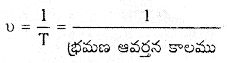
ω = \(\frac{\theta}{t}\) లేదా ω = \(\frac{\mathrm{d} \theta}{\mathrm{dt}}\); లేదా ω = \(\frac{2 \pi n}{t}\) (n = భ్రమణాల సంఖ్య)

→ కోణీయ త్వరణం
TS Inter 1st Year Physics Notes Chapter 7 కణాల వ్యవస్థలు, భ్రమణ గమనం 6
α = \(\frac{\omega_2-\omega_1}{t}\) లేదా α = \(\frac{\mathrm{d} \omega}{\mathrm{dt}}\), యూనిట్ : రేడియన్ / సె2

→ v మరియు ω మధ్య సంబంధము V = rω;

→ త్వరణము a = rα

→ అభికేంద్ర త్వరణము ac = rω2 = vω = \(\frac{\mathrm{v}^2}{\mathrm{r}}\); అపకేంద్ర బలం = \(\frac{\mathrm{mv}^2}{\mathrm{r}}\) = mrω2

→ తిరుగుతున్న గ్రామ్ ఫోన్ రికార్డుపై నాణెము నుంచిన అది జారిపోకుండా ఉండుటకు fs = μsN = mrω2
μsmg = mrω2 ⇒ μs = \(\frac{\mathrm{r} \omega^2}{\mathrm{~g}}\)

TS Inter 1st Year Physics Notes Chapter 7 కణాల వ్యవస్థలు, భ్రమణ గమనం

→ mద్రవ్యరాశి గల వస్తువు క్షితిజతలంలో వృత్తాకారంలో తిరుగుతూ M ద్రవ్యరాశి గల వస్తువు భారాన్ని నిలుపు చేసిన Mg = mrω2 లేదా కోణీయ వేగము ω = \(\sqrt{\frac{M g}{m r}}\)

→ టార్క్ τ = r̅ × F̅ = |r̅||F̅| sin θ. ఇది ఎంత శక్తితో వస్తువు తిప్పబడినదో తెలియజేస్తుంది.

→ బలయుగ్మ భ్రామకము బలము × బలదిశల మధ్య లంబదూరం.

→ జడత్వ భ్రామకము I = \(\sum_{i=1}^n\)miri2 లేదా I = MR2

→ జడత్వ భ్రామకము I = MR2 = MK2 అయిన, K ని భ్రమణ వ్యాసార్ధము అంటారు.

→ సమాంతర అక్ష సిద్ధాంతము నుండి I = IG + MR2

→ లంబ అక్ష సిద్ధాంతము నుండి Iz = Ix + Iy

→ సన్నని కడ్డీ జడత్వ భ్రామకము :
a) సన్నని కడ్డీ మధ్య బిందువు ద్వారా పోతూ పొడవుకు లంబముగా ఉన్న అక్షముపై జడత్వ భ్రామకము
I = \(\frac{\mathrm{M} l^2}{12}\); K = \(\frac{l}{\sqrt{12}}\)
b) కడ్డీ చివర ఉన్న బిందువు ద్వారా పోతూ పొడవుకు లంబంగా ఉన్న అక్షముపై జడత్వ భ్రామకం
I = \(\frac{\mathrm{m} l^2}{3}\); K = \(\frac{l}{\sqrt{3}}\)

→ రింగు జఢత్వ భ్రామకము :
a) రింగు కేంద్రము గుండాపోతూ దాని తలమునకు లంబంగా ఉన్న అక్షం పరంగా జడత్వ భ్రామకం I = MR2, K = R
b) ఏదైనా వ్యాసం పరంగా రింగు జడత్వ భ్రామకం I = \(\frac{\mathrm{MR}^2}{2}\); K = \(\frac{\mathrm{R}}{\sqrt{2}}\)
c) రింగు తలంలోని ఏదైనా స్పర్శరేఖ పరంగా జడత్వ భ్రామకం I = \(\frac{3}{2}\)MR2; K = \(\sqrt{\frac{3}{2}}\)R

→ గుండ్రని పళ్ళెము జడత్వ భ్రామకం :
a) గుండ్రని పళ్ళెం కేంద్రం గుండా పోతూ తలానికి I = \(\frac{\mathrm{MR}^2}{2}\); K = \(\frac{\mathrm{MR}^2}{2}\)
లంబంగా ఉన్న అక్షం పరంగా జడత్వ భ్రామకం
b) పళ్ళెంలోని ఏదైనా వ్యాసం పరంగా జడత్వ భ్రామకం I = \(\frac{\mathrm{MR}^2}{4}\); K = \(\frac{\mathrm{R}}{2}\)
c) పళ్ళెం తలంలోని స్పర్శరేఖ పరంగా జడత్వ భ్రామకం I = \(\frac{5}{4}\)MR2; K = \(\frac{5}{4}\)R

→ సమతల పటలము యొక్క జడత్వ భ్రామకము :
a) సమాంతరంగా మధ్యబిందువు ద్వారా పోయే అక్షం పరంగా I = M\(\sqrt{\frac{l^2+b^2}{12}}\); K = \(\sqrt{\frac{l^2+b^2}{12}}\)
b) పొడవుకు సమాంతరంగా మధ్యబిందువు ద్వారా పోయే అక్షం పరంగా I = \(\frac{\mathrm{Mb}^2}{12}\); K = \(\frac{b}{\sqrt{12}}\)
c) వెడల్పుకు సమాంతరంగా మధ్యబిందువు ద్వారా పోయే అక్షం పరంగా I = \(\frac{b}{\sqrt{12}}\); K = \(\frac{l}{\sqrt{12}}\)

→ ఘనగోళం యొక్క జడత్వ భ్రామకం :
a) వ్యాసం పరంగా జడత్వ భ్రామకం I = \(\frac{2}{5}\)MR2; K = \(\sqrt{\frac{2}{5}}\)R
b) ఏదైనా స్పర్శరేఖ పరంగా I = \(\frac{7}{5}\)MR2; K = \(\sqrt{\frac{7}{5}}\)R

→ గుల్లగోళం యొక్క జడత్వ భ్రామకం :
a) వ్యాసం పరంగా జడత్వ భ్రామకం I = \(\frac{2}{3}\)MR2; K = \(\sqrt{\frac{2}{3}}\)R
b) ఏదైనా స్పర్శరేఖ పరంగా జడత్వ భ్రామకం I = \(\frac{7}{3}\)MR2; K = \(\sqrt{\frac{5}{3}}\)R

→ ఘన స్థూపం జడత్వ భ్రామకం:
a) స్థూపం అక్షం పరంగా జడత్వ భ్రామకం I = \(\frac{\mathrm{MR}^2}{2}\); K = \(\frac{\mathrm{R}}{\sqrt{2}}\)
b) పొడవుకు లంబంగా, కేంద్రం ద్వారా పోయే అక్షం పరంగా జడత్వ భ్రామకం I = M\(\left(\frac{l^2}{12}+\frac{\mathrm{R}^2}{4}\right)\)
K = \(\sqrt{\frac{l^2}{12}+\frac{\mathrm{R}^2}{4}}\)

→ గుల్ల స్థూపము జడత్వ భ్రామకం :
a) స్థూపం అక్షం పరంగా జడత్వ భ్రామకం I = MR2; K = R
b) పొడవుకు లంబంగా, కేంద్రం పోయే అక్షం పరంగా I = M\(\left(\frac{l^2}{12}+\frac{\mathrm{R}^2}{2}\right)\); K = \(\sqrt{\frac{l^2}{12}+\frac{\mathrm{R}^2}{2}}\)

TS Inter 1st Year Physics Notes Chapter 7 కణాల వ్యవస్థలు, భ్రమణ గమనం

→ కోణీయ ద్రవ్యవేగం L̅ = Iω

→ కోణీయ ద్రవ్యవేగం మరియు టార్క్ మధ్య సంబంధం, τ = \(\frac{\mathrm{d} \overline{\mathrm{L}}}{\mathrm{dt}}=\frac{\mathrm{L}_2-\mathrm{L}_1}{\mathrm{t}}\)

→ కోణీయ త్వరణం మరియు టార్క్ మధ్య సంబంధం, τ = Iα.

→ కోణీయ ద్రవ్యవేగ నిత్యత్వ నియమం ప్రకారం
I1ω1 + I2ω2 = స్థిరం (వస్తువుపై బాహ్య టార్క్ పనిచేయనపుడు).

TS Inter 1st Year Maths 1B Solutions Chapter 4 Pair of Straight Lines Ex 4(a)

Students must practice these TS Intermediate Maths 1B Solutions Chapter 4 Pair of Straight Lines Ex 4(a) to find a better approach to solving the problems.

TS Inter 1st Year Maths 1B Pair of Straight Lines Solutions Exercise 4(a)

Question 1.
Find the acute angle between the pair of lines represented by the following equations. (V.S.A.Q.)
(i) x2 – 7xy + 12y2 = 0
Answer:
x2 – 7xy + 12y2 = 0
Comparing with ax2 + 2hxy + by2
We get a = 1, b = 12, h = \(\frac{-7}{2}\)
TS Inter 1st Year Maths 1B Solutions Chapter 4 Pair of Straight Lines Ex 4(a) 1

TS Inter 1st Year Maths 1B Solutions Chapter 4 Pair of Straight Lines Ex 4(a)

(ii) y2 – xy – 6x2 = 0
Answer:
y2 – xy – 6x2 = 0
a = – 6, h = – \(\frac{1}{2}\), b = 1
TS Inter 1st Year Maths 1B Solutions Chapter 4 Pair of Straight Lines Ex 4(a) 2

(iii) (x cos α – y sin α)2 = (x2 + y2) sin2 α
Answer:
(x cos α – y sin α)2 = (x2 + y2) sin2 α
x2 cos2 α + y2 sin2 α – 2xy cos α sin α
= x2 sin2 α + y2 sin2 α
= x2 (cos2 α – sin2 α) – 2xy cos α sin α = 0
⇒ x2 cos 2α – xy sin 2α = 0
Here a = cos 2α, b = 0, h = –\(\frac{1}{2}\) sin 2α
∴ tan θ = \(\left|\frac{2 \sqrt{h^2-a b}}{a+b}\right|\) = \(\left|\frac{2 \sqrt{\frac{1}{4} \sin ^2 2 \alpha}}{\cos 2 \alpha}\right|\)
= tan 2α
∴ θ = 2α

(iv) x2 + 2xy cot α – y2 = 0
Answer:
x2 + 2xy cot α – y2 = 0
Here a = 1, b = – 1, h = cot α
tan θ = \(\left|\frac{2 \sqrt{h^2-a b}}{a+b}\right|\) = \(\left|\frac{2 \sqrt{\cot ^2 \alpha+1}}{0}\right|\) = ∞
∴ θ = \(\frac{\pi}{2}\)

TS Inter 1st Year Maths 1B Solutions Chapter 4 Pair of Straight Lines Ex 4(a)

II.
Question 1.
Show that the following pairs of straight lines have the same set of angular bisectors (that is they are equally inclined to each other) (S.A.Q.)
(i) 2x2 + 6xy + y2 = 0
4x2 + 18xy + y2 = 0
(ii) a2x2 + 2h(a + b)xy + b2y2 = 0
ax2 + 2hxy + by2 = 0, a + b ≠ 0
(iii) ax2 + 2hxy + by2 + λ(x2 + y2) = 0 (λ ∈ R)
ax2 + 2hxy + by2 = 0
Answer:
TS Inter 1st Year Maths 1B Solutions Chapter 4 Pair of Straight Lines Ex 4(a) 3

(i) Given equation 2x2 + 6xy + y2 = 0 represents combined equation of OA and OB.
Equation of pair of bisectors is
3(x2 – y2) = (2 – 1)xy
⇒ 3(x2 – y2) = xy ………………. (1)
Combined equation of OP and OQ is
4x2 + 18xy + y2 = 0
Equation to the pair of bisectors is
9(x2 – y2) = (4 – 1)xy
⇒ 9(x2 – y2) = 3xy
⇒ 3(x2 – y2) = xy ………………… (2)
(1) and (2) denote the same lines.
∴ OA, OB and OP, OQ are inclined to each other. OR and OT are angular bisectors.

(ii) Given equation is a2x2 + 2h(a + b)xy + b2y2 = 0
represents combined equation of OA, OB.
∴ Equation to the pair of bisectors is
h(a + b) (x2 – y2) = (a2 – b2) xy
⇒ h(a + b) (x2 – y2) = (a – b) (a + b) xy
⇒ h(x2 – y2) = (a – b)xy …………………. (1)
Combined equation of OP, OQ is
ax2 + 2hxy + by2 = 0
Equation to the pair of bisectors is
\(\frac{x^2-y^2}{a-b}=\frac{x y}{h}\)
⇒ h(x2 – y2) = (a – b)xy ………………….. (2)
(1), (2) represent the same equation.
Hence the pairs of lines have the same set of angular bisectors.

(iii) Equation to the pair of bisectors of the equation
ax2 + 2hxy + by2 + λ(x2 + y2) = 0
⇒ x2(a + λ) + 2hxy + y2(b + λ) = 0 is
TS Inter 1st Year Maths 1B Solutions Chapter 4 Pair of Straight Lines Ex 4(a) 4
⇒ h(x2 – y2) – xy(a – b) = 0 ………………. (1)
Equation to the pair of bisectors of
ax2 + 2hxy + by2 = 0 is \(\frac{x^2-y^2}{a-b}=\frac{x y}{h}\)
⇒ h(x2 – y2) – xy(a – b) = 0
(1), (2) represent the same equation.
Hence the pairs of lines have the same set of angular bisectors.

TS Inter 1st Year Maths 1B Solutions Chapter 4 Pair of Straight Lines Ex 4(a)

Question 2.
Find the value of h, if the slopes of the lines represented by 6x2 + 2hxy + y2 = 0 are in the ratio 1 : 2. (S.A.Q.)
Answer:
Combined equation of the lines is
6x2 + 2hxy + y2 = 0
Suppose the slopes of two lines represented by the above equation be m1 and m2.
Then m1 + m1 = \(\frac{-2 h}{1}\), m1m2 = 6
Given that m1 : m2 = 1 : 2 ⇒ \(\frac{\mathrm{m}_1}{\mathrm{~m}_2}=\frac{1}{2}\)
⇒ m2 = 2m1
∴ 3m1 = – 2h; 2m12 = 6
TS Inter 1st Year Maths 1B Solutions Chapter 4 Pair of Straight Lines Ex 4(a) 5

Question 3.
If ax2 + 2hxy + by2 = 0 represents two straight lines such that the slope of one line is twice the slope of the other. Prove that 8h2 = 9ab. (S.A.Q.)
Answer:
Combined equation of the lines is
ax2 + 2hxy + by2 = 0 ……………… (1)
Suppose y = m1x and y = m2x are the lines represented by (1).
TS Inter 1st Year Maths 1B Solutions Chapter 4 Pair of Straight Lines Ex 4(a) 6

Question 4.
Show that the equation of the pair of straight lines passing through the origin and making an angle of 30° with the line 3x – y – 1 = 0 is 13x2 + 12xy – 3y2 = 0. (S.A.Q.)
Answer:
TS Inter 1st Year Maths 1B Solutions Chapter 4 Pair of Straight Lines Ex 4(a) 7
Given equation of the straight line is
3x – y – 1 = 0 ………………….. (1)
Let the slope of (1) be m1. Then m1 = 3 Suppose the slope of the line passing through the origin making an angle 30° be ‘m’.
∴ Equation of the line passing through the origin with slope ’m’ is y = mx and
m = \(\frac{\mathrm{y}}{\mathrm{x}}\) …………………… (2)
Suppose angle between lines (1) and (2) be θ then tan θ =
TS Inter 1st Year Maths 1B Solutions Chapter 4 Pair of Straight Lines Ex 4(a) 8
⇒ 9m2 + 6m + 1 = 3m2 – 18m + 27
⇒ 6m2 + 24m – 26 = 0
⇒ 3m2 + 12m – 13 = 0
⇒ \(3\left(\frac{\mathrm{y}}{\mathrm{x}}\right)^2+12\left(\frac{\mathrm{y}}{\mathrm{x}}\right)\) – 13 = 0 [∵ From (2)]
⇒ 3y2 + 12xy – 13x2 = 0
⇒ 13x2 – 12xy – 3y2 = 0

TS Inter 1st Year Maths 1B Solutions Chapter 4 Pair of Straight Lines Ex 4(a)

Question 5.
Find the equation to the pair of straight lines passing through the origin and making an acute angle a with the straight line x + y + 5 = 0. (SA.Q.)
Answer:
Given equation of the line is x + y + 5 = 0 ………………… (1)
TS Inter 1st Year Maths 1B Solutions Chapter 4 Pair of Straight Lines Ex 4(a) 9
Let the slope of the given line be m1 then m1 = – 1. If m is the slope of the line making angle a with the line (1), then the equation of the line passing through the origin is
y = mx ⇒ m = \(\frac{y}{x}\) ………………….. (2)
If α is the angle between the lines (1) ans (2)
TS Inter 1st Year Maths 1B Solutions Chapter 4 Pair of Straight Lines Ex 4(a) 10
⇒ (m2 – 2m + 1)tan2 α = m2 + 2m + 1
⇒ m2(1 – tan2 α) + 2m(1 + tan2 α) + (1 – tan2α)= 0 ……………… (3)
From (2) we have
\(\left(\frac{\mathrm{y}}{\mathrm{x}}\right)^2\) (1 – tan2 α) + 2\(\frac{y}{x}\)(1 + tan2 α)
+ (1 – tan2 α) = 0
⇒ (1 – tan2 α)y2 + 2xy(1 + tan2 α) + x2(1 – tan2 α) = 0 …………….. (4)

Case (i): If α = \(\frac{\pi}{4}\) then from (4)
2xy (1 + 1) = 0
⇒ 4xy = 0 ⇒ xy = 0

Case (ii): If α ≠ \(\frac{\pi}{4}\) then
x2+ 2xy\(\left(\frac{1+\tan ^2 \alpha}{1-\tan ^2 \alpha}\right)\) + y2 = 0
⇒ x2+ 2xy\(\frac{1}{\cos 2 \alpha}\) + y2 = 0
⇒ x2+ 2xy sec 2α + y2 = 0
So if α ≠ \(\frac{\pi}{4}\) then the combined equation of lines is x2 + 2xy sec 2α + y2 = 0 and if α = \(\frac{\pi}{4}\) then the equation is xy = 0.

Question 6.
Show that the straight lines represented by (x + 2a)2 – 3y2 = 0 and x = a form an equilateral triangle. (S.A.Q.)
Answer:
TS Inter 1st Year Maths 1B Solutions Chapter 4 Pair of Straight Lines Ex 4(a) 11
Given equation of pair of lines is
(x + 2a)2 – 3y2 = 0
⇒ (x + 2a + √3 y) (x + 2a – √3y) = 0
Equation of OA is x + √3 y + 2a = 0 ………………. (1)
Equation of OB is x – √3y + 2a = 0 ………………. (2)
Equation of AB is x – a = 0 ………………… (3)
Use the formula for
cos θ = \(\left|\frac{a_1 a_2+b_1 b_2}{\sqrt{a_1^2+b_1^2} \sqrt{a_2^2+b_2^2}}\right|\)
Between (1) and (3) lines
cos ∠OAB = \(\frac{|1+0|}{\sqrt{1+3} \sqrt{1}}=\frac{1}{2}\) = cos 60°
∴ ∠OAB = 60°
Similarly angle between (2) and (3) is
cos ∠OBA = \(\frac{|1+0|}{\sqrt{1+3} \sqrt{1}}=\frac{1}{2}\) = cos 60°
∴ ∠OBA = 60°
∴ ∠AOB = 180° – (∠OBA + ∠OAB)
= 180° – (60° + 60°) = 60°
∴ ∆ AOB is an equilateral triangle.

TS Inter 1st Year Maths 1B Solutions Chapter 4 Pair of Straight Lines Ex 4(a)

Question 7.
Show that the pair of bisectors of the angles between the straight lines (ax + by)2 = c (bx – ay)2, c > 0 are parallel and perpen¬dicular to the line ax + by + k = 0.(S.A.Q.)
Answer:
Combined equation of the given lines is
(ax + by)2 = c(bx – ay)2
⇒ a2x2 + 2abxy + b2y2
= c(b2x2 – 2abxy + a2y2)
⇒ (a2 – cb2)x2 + 2ab(1 + c) xy + (b2 – ca2)y2 = 0 ……………… (1)
Using the standard equation of bisectors,
(x2 – y2)h = xy(a – b)
Equation of bisectors of angles between the lines (1) is
(x2 – y2) ab (1 + c) = (a2 – cb2 – b2 + ca2)xy
= [a2 – b2 + c(a2 – b2)]xy
= (a2 – b2) (1 + c) xy
⇒ ab(x2 – y2) = (a2 – b2)xy
⇒ ab(x2 – y2) – (a2 – b2)xy = 0
⇒ abx2 – aby2 – a2xy + b2xy = 0
⇒ ax(bx – ay) + by (bx – ay) = 0
⇒ (ax + by) (bx – ay) = 0
Hence the equation of bisectors represented by (1) are ax + by = 0 ………………. (2)
bx – ay = 0 ………………….. (3)
Given equation of the line is
ax + by + k = 0 …………………… (4)
ax + by = 0 is parallel to ax + by + k = 0 and bx – ay = 0 is perpendicular to ax + by + k = 0.

Question 8.
The adjacent sides of a parallelogram are 2x2 – 5xy + 3y2 = 0 and one diagonal is x + y + 2 = 0. Find the vertices and the other diagonal. (S.A.Q.)
Answer:
TS Inter 1st Year Maths 1B Solutions Chapter 4 Pair of Straight Lines Ex 4(a) 12
The given equation is
2x2 – 5xy + 3y2 = 0 ……………… (1)
Which represent lines OA and OB respectively in the figure.
Equation of AB is x + y + 2 = 0
⇒ y = – (x + 2) ………………. (2)
∴ From (1)
⇒ 2x2 + 5x(x + 2) + 3(x + 2)2 = 0
⇒ 2x2 + 5x2 + 10x + 3(x2 + 4x + 4) = 0
⇒ 10x2 + 22x +12 = 0
⇒ 5x2 + 11x + 6 = 0
⇒ 5x2 + 5x + 6x + 6 = 0
⇒ 5x(x + 1) + 6(x + 1) = 0
⇒ (x + 1) (5x + 6) = 0
⇒ x = – 1 or x = \(\frac{-6}{5}\)
Also from (2), y = -(x + 2)
x = -1 ⇒ y = – 1
TS Inter 1st Year Maths 1B Solutions Chapter 4 Pair of Straight Lines Ex 4(a) 13

TS Inter 1st Year Maths 1B Solutions Chapter 4 Pair of Straight Lines Ex 4(a)

Question 9.
Find the centroid and the area of the triangle formed by the following lines.
(i) 2y2 – xy – 6x2 = 0, x + y + 4 = 0
(ii) 3x2 – 4xy + y2 = 0, 2x – y = 6 (S.A.Q.)
Answer:
(i)
TS Inter 1st Year Maths 1B Solutions Chapter 4 Pair of Straight Lines Ex 4(a) 14
The equation 2y2 – xy – 6x2 = 0
represents combined equation of OA and OB and equation of AB is x + y + 4 = 0
⇒ y = – (x + 4) …………….. (2)
From (1) 2(x + 4)2 + x(x + 4) – 6x2 = 0
⇒ 2(x2 + 8x + 16) + x2 + 4x – 6x2 = 0
⇒ 3x2 – 20x – 32 = 0
⇒ (3x + 4) (x – 8) = 0
⇒ x = – \(\frac{4}{3}\)

Case (i): x = – \(\frac{4}{3}\)
∴ y = – (x + 4)
= – \(\left(-\frac{4}{3}+4\right)\) = – \(\frac{8}{3}\)
∴ Co-ordinates of A = \(\left(-\frac{4}{3},-\frac{8}{3}\right)\)

Case (ii): x = 8 ⇒ y = – (8 + 4) = – 12
∴ Co-ordinates of B = (8, -12)
Let G be the centroid of ∆OAB
TS Inter 1st Year Maths 1B Solutions Chapter 4 Pair of Straight Lines Ex 4(a) 15

(ii) The equation 3x2 – 4xy + y2 = 0 ……………… (1)
represents pair of lines OA and OB.
Equation of AB is 2x – y = 6
⇒ y = 2x – 6 ……………. (2)
From (1) 3x2 – 4x(2x – 6) + (2x – 6)2 = 0
⇒ 3×22 – 8x2 + 24x + 4x2 – 24x + 36 = 0
⇒ – x2 + 36 = 0 ⇒ x2 – 36 = 0
⇒ (x + 6) (x – 6) = 0 ⇒ x = 6 or – 6
If x = 6 ⇒ y = 12 – 6 = 6
∴ Co-ordinates of A = (6, 6)
x = – 6 ⇒ y = -12 – 6 = -18
∴ Co-ordinates of B = (-6, -18)
∴ Co-ordinates of G = \(\left(\frac{0+6-6}{3}, \frac{0+6-18}{3}\right)\)
= (0, -4)
∴ Area of ∆OAB = \(\frac{1}{2}\) |1y2 – x2yi I
= \(\frac{1}{2}\) |6 (- 18) – (- 6)6|
= \(\frac{1}{2}\) |- 108 + 36| = \(\frac{1}{2}\) (72) = 36 sq. units.

TS Inter 1st Year Maths 1B Solutions Chapter 4 Pair of Straight Lines Ex 4(a)

Question 10.
Find the equation of the pair of lines intersecting at (2, -1) and (S.A.Q.)
(i) Perpendicular to the pair 6x2 – 13xy – 5y2 = 0 and
(ii) Parallel to the pair 6x2 – 13xy – 5y2 = 0
Answer:
Given equation 6x2 – 13xy – 5y2 = 0 represents lines OA and OB.
(i) Equation of the pair of lines through
(x1, y1) and perpendicular to ax2 + 2hxy + by2 = 0 is b(x – x1)2] a(y – y1)2 = 0
⇒ -5(x – 2)2 + 13 (x – 2) (y + 1) + 6(y + 1)2 = 0
⇒ -5(x2 – 4x + 4) + 13 (xy + x – 2y – 2) + 6(y2 + 2y + 1) = 0
⇒ -5x2 + 20x – 20 + 13xy + 13x – 26y – 26 + 6y2 + 12y + 6 = 0
⇒ 5x2 – 13xy – 6y2 – 33x + 14y + 40 = 0

(ii) Equation of the pair of lines through (x1, y1) and parallel to ax2 + 2hxy + by2 = 0 is
a(x – x1)2 + 2h (x – x1) (y – y1) + b(y – y1)2 = 0
⇒ 6(x – 2)2 – 13 (x – 2) (y + 1) – 5(y + 1)2 = 0
⇒ 6(x2 – 4x + 4) – 13 (xy – 2y + x – 2) – 5(y2 + 2y + 1) = 0
⇒ 6x2 – 13xy – 5y2 – 37x + 16y + 45 = 0

Question 11.
Find the equation of the bisector of the acute angle between the lines (S.A.Q.)
3x – 4y + 7 = 0 and 12x + 5y – 2 = 0.
Answer:
Given equations of lines are
3x – 4y + 7 = 0 ……………….. (1)
12x + 5y – 2 = 0 ………………… (2)
The equation of bisectors of angles between
TS Inter 1st Year Maths 1B Solutions Chapter 4 Pair of Straight Lines Ex 4(a) 16
⇒ 13(3x – 4y + 7) ± 5(12x + 5y – 2) = 0
⇒ (39x – 52y + 91) ± (60x + 25y – 10) = 0
∴ (39x – 52y + 91) + (60x + 25y – 10) = 0
⇒ 99x – 27y + 81 = 0
⇒ 11x – 3y + 9 = 0 ………………….. (3)
Also (39x – 52y + 91) – (60x + 25y – 10) = 0
⇒ – 21x – 77y + 101 = 0
⇒ 21x + 77y – 101 = 0 ………………….. (4)
Let θ be the angle between (1) and (4) then
TS Inter 1st Year Maths 1B Solutions Chapter 4 Pair of Straight Lines Ex 4(a) 17
∴ (4) is an obtuse angled bisector then (3) will be the acute angled bisector.
∴ 11x – 3y + 9 = 0 is the acute angled bisector.

Question 12.
Find the equation of the bisector of the obtuse angle between the lines x + y – 5 = 0 and x – 7y + 7 = 0 (S.A.Q.)
Answer:
Given equations of lines are
x + y – 5 = 0 ………………. (1)
and x – 7y + 7 = 0 ………………….. (2)
The equation of bisectors of angles between (1) and (2) is
TS Inter 1st Year Maths 1B Solutions Chapter 4 Pair of Straight Lines Ex 4(a) 18
⇒ 5x + 5y – 25 ± (x – 7y + 7) = 0
(i) (5x + 5y – 25) + (x – 7y + 7) = 0
⇒ 6x – 2y – 18 = 0
⇒ 3x – y – 9 = 0 …………………. (3)
(ii) (5x + 5y – 25) – (x – 7y + 7) = 0
⇒ 4x + 12y – 32 = 0
⇒ x + 3y – 8 = 0 ……………… (4)
Let θ be the angle between (1) and (4)
Then
TS Inter 1st Year Maths 1B Solutions Chapter 4 Pair of Straight Lines Ex 4(a) 19
∴ (4) is an acute angle bisector and hence (3) is an obtuse angle bisector.
∴ 3x – y – 9 = 0 is the obtuse angle bisector.

TS Inter 1st Year Maths 1B Solutions Chapter 4 Pair of Straight Lines Ex 4(a)

III.
Question 1.
Show that the lines represented by (lx + my)2 – 3 (mx – ly)2 = 0 and lx + my + n = 0 form an equilateral triangle with area \(\frac{n^2}{\sqrt{3}\left(l^2+m^2\right)}\). (S.A.Q.)
Answer:
The equation (lx + my)2 – 3(mx – ly)2 = 0 represents combined equation of lines OA and OB.
∴ (l2x2 + m2y2 + 2lmxy) – 3(m2x2 – 2lmxy + l2y2) = 0
⇒ x2(l2 – 3m2) + 8lmxy + (m2 – 3l2)y2 = 0 ……………….. (1)
Angle between lines represented by (1) by the formula cos θ = \(\frac{|a+b|}{\sqrt{(a-b)^2+4 h^2}}\)
TS Inter 1st Year Maths 1B Solutions Chapter 4 Pair of Straight Lines Ex 4(a) 20
∴ θ = 60° which is the angle between OA and OB,
∴ ∠AOB = 60°
Combined equation of the bisectors of OA
and OB is h(x2 – y2) = (a – b)xy
⇒ 4lm(x2 – y2) = (l2 – 3m2 – m2 + 3l2) xy
⇒ 4lm(x2 – y2) = 4 (l2 – m2) xy
⇒ lmx2 – (l2 – m2) xy – lmy2 = 0
⇒ (lx + my) (mx – ly) = 0
⇒ lx + my = 0 and mx – ly = 0
∴ The bisector mx – ly = 0 is perpendicular to AB whose equation is lx + my + n = 0
∴ ∠OBA = 60°
∴ OAB is an equilateral triangle,
p = length of the perpendicular from O to AB.
= \(\frac{|\mathrm{n}|}{\sqrt{l^2+\mathrm{m}^2}}\)
∴ Area of ∆OAB = \(\frac{\mathrm{p}^2}{\sqrt{3}}=\frac{\mathrm{n}^2}{\sqrt{3}\left(l^2+\mathrm{m}^2\right)}\) sq.units

Question 2.
Show that the straight lines represented by 3x2 + 48xy + 23y2 = 0 and 3x – 2y + 13 = 0 form an equilateral triangle of area \(\frac{13}{\sqrt{3}}\) = sq.units. (E.Q.)
Answer:
The equation 3x2 + 48xy + 23y2 = 0 ……………… (1)
represents lines OA, OB.
Equation of AB is 3x – 2y + 13 = 0 — (2)
From (1) we.can express the equation as
(9x2 – 12xy + 4y2) – 3 (4x2 + 9y2 + 12xy) = 0
⇒ (3x – 2y)2 – 3 (2x + 3y)2 = 0
⇒ [(3x – 2y) + √3 (2x + 3y)] [(3x – 2y) – √3 (2x + 3y)] = 0
⇒ [(3 + 2√3)x + (3√3 – 2) y] [(3 – 2√3 ) x – (3√3 + 2) y] = 0
∴ Equation of OA is
(3 – 2√3 ) x + (3√3 – 2) y = 0 ………………… (3)
Equation of OB is
(3 – 2√3) x – (3√3 + 2) y = 0 ……………… (4)
Angle between (2) and (3) is cos θ
TS Inter 1st Year Maths 1B Solutions Chapter 4 Pair of Straight Lines Ex 4(a) 21

TS Inter 1st Year Maths 1B Solutions Chapter 4 Pair of Straight Lines Ex 4(a)

Question 3.
Show that the equation of the pair of lines bisecting the angles between the pair of bisectors of the angles between the pair of lines ax2 + 2hxy + by2 = 0 is (a – b) (x2 – y2) + 4hxy = 0. (S.A.Q.)
Answer:
Equation of the given lines is
ax2 + 2hxy + by2 = 0
Equation of the pair of bisectors is
(x2 – y2) h = (a – b) xy — (1)
hx2 – hy2 – (a – b) xy = 0
Equation to the pair of bisectors of (1) is
– \(\frac{(a-b)}{2}\) (x2 – y2) = (h + h)xy
⇒ (a – b) (x2 – y2) + 4hxy = 0
∴ Equation of the pair of bisectors of the pair of bisectors of lines ax2 + 2hxy + by2 = 0 is (a – b) (x2 – y2) + 4hxy = 0

Question 4.
If one line of the pair of lines ax2 + 2hxy + by2 = 0 bisects the angle be-tween the coordinate axes, prove that (a + b)2 = 4h2. (S.A.Q.) (June ’04)
Answer:
The angular bisectors of the coordinate axes are y = x and y = – x
Case (i) : When y = x is one of the lines of
ax2 + 2hxy + by2 = 0 then
ax2 + 2hx (x) + bx2 = 0
⇒ a + 2h + b = 0 …………………. (1)
Case (ii) : When y = – x is the other line of
ax2 + 2hxy + by2 = 0 then
ax2 + 2hx(-x) + bx2 = 0
⇒ a – 2h + b = 0 ………………… (2)
From (1) and (2)
[(a + b) + 2h] [(a + b) – 2h] = 0
⇒ (a + b)2 – 4h2 = 0
⇒ (a + b)2 = 4h2

Question 5.
If (α, β) is the centroid of the triangle formed by the lines ax2 + 2hxy + by2 = 0 and lx + my = 1, prove that (E.Q.)
\(\frac{\alpha}{b l-h m}=\frac{\beta}{a m-h l}=\frac{2}{3\left(b l^2-2 h l m+a m^2\right)}\)
Answer:
TS Inter 1st Year Maths 1B Solutions Chapter 4 Pair of Straight Lines Ex 4(a) 22
Combined equation of OA and OB is
ax2 + 2hxy + by2 = 0 …………………. (1)
Equation of AB is lx + my = 1 ……………………. (2)
⇒ my = 1 – lx
⇒ y = \(\frac{1-l \mathrm{x}}{\mathrm{m}}\) ……………………… (3)
From (1) ax2 + 2hx \(\left(\frac{1-l x}{m}\right)\) + b\(\left(\frac{1-l x}{m}\right)^2\) = 0
⇒ am2x2 + 2hmx (1 – lx) + b (1 – lx)2 = 0
⇒ (am2 – 2hml + bl2) x2 + 2hmx – 2blx + b = 0
⇒ (am2 – 2hml + bl2) x2 + 2x (hm – bl) + b = 0
Let the coordinates of point of intersection of lines (1) with (2) be A (x1, y1) and B (x2, y2).
Then x1 + x2 = \(\frac{-2(\mathrm{hm}-\mathrm{b} l)}{\mathrm{am}^2-2 \mathrm{hm} l+\mathrm{b} l^2}\)
= \(\frac{2(\mathrm{~b} l-\mathrm{hm})}{\mathrm{am}^2-2 \mathrm{~h} / \mathrm{m}+\mathrm{b} l^2}\) …………………… (4)
A(x1, y1) and B(x2, y2) lies on (2)
∴ lx1 + my1 = 1
lx2 + my2 = 1
⇒ l(x1 + x2) + m (y1 + y2) = 2
⇒ m (y1 + y2) = 2 – l(x1 + x2)
TS Inter 1st Year Maths 1B Solutions Chapter 4 Pair of Straight Lines Ex 4(a) 23

TS Inter 1st Year Maths 1B Solutions Chapter 4 Pair of Straight Lines Ex 4(a)

Question 6.
Prove that the distance from the origin to the orthocentre of the triangle formed by the lines \(\frac{x}{\alpha}+\frac{y}{\beta}\) = 1 and ax2 + 2hxy + by2 = 0 is (α2 + β2)1/2 \(\left|\frac{(a+b) \alpha \beta}{a \alpha^2-2 h \alpha \beta+b \beta^2}\right|\).
Answer:
TS Inter 1st Year Maths 1B Solutions Chapter 4 Pair of Straight Lines Ex 4(a) 24
Let OA and OB be the lines through the origin denoted by ax2 + 2hxy + by2 = 0 given by
l1x + m1y = 0 ………………. (1)
l2x + m2y = 0 ……………… (2)
∴ (l1x + m1y) (l2x + m2y) = ax2 + 2hxy + by2
∴ l1l2 = a, m1m2 = b, l1m2 + l2m1 = 2h
Given line is \(\frac{1}{\alpha}\) x + \(\frac{1}{\beta}\) y = 1
Solving (1) and (3) we get the coordinates of A
TS Inter 1st Year Maths 1B Solutions Chapter 4 Pair of Straight Lines Ex 4(a) 25
Let B be the point of intersection of (2) and (3) Let P be the orthocentre of ∆AOB.
TS Inter 1st Year Maths 1B Solutions Chapter 4 Pair of Straight Lines Ex 4(a) 26
⇒ l2y (l1α – m1β) + αβl1l2
= m2x (l1α – m1β) + αβm1m2
= m2x (l1α – m1β) – l2y (l1α – m1β)
= – αβl1l2 – αβm1m2
TS Inter 1st Year Maths 1B Solutions Chapter 4 Pair of Straight Lines Ex 4(a) 27

TS Inter 1st Year Maths 1B Solutions Chapter 4 Pair of Straight Lines Ex 4(a)

Question 7.
The straight line lx + my + n = 0 bisects an angle between the pair of lines of which one is px + qy + r = 0. Show that the other line is (px + qy + r) (l2 + m2) – 2 (lp + mq) (lx + my + n) = 0. (E.Q.)
Answer:
Let (α, β) be any point on the bisector
lx + my + n = 0 and lα + mβ + n = 0 ……………… (1)
The other line passes through the intersection of px + qy + r = 0 and lx + my + n = 0. This will be of the form p + λq = 0.
⇒ (px + qy + r) + λ(lx + my + n) = 0 ………………. (2)
Given px + qy + r = 0 ………………….. (3)
is one of the lines in pair of lines. If (α, β) is a point on the bisector then its perpendicular distance from lines (2) and (3) are same.
TS Inter 1st Year Maths 1B Solutions Chapter 4 Pair of Straight Lines Ex 4(a) 28
Simplifying and squaring on both sides,
(p + λl)2 + (q + λm)2 = p2 + q2
⇒ (p2 + 2pλl + λ2l2) + (q2 + 2q λm + λ2m2) = p2 + q2
⇒ 2 λ (pi + qm) + λ2 (l2 + m2) = 0
∴ 2λ (pl + qm) = – λ2 (l2 + m2)
⇒ λ = – 2 \(\left(\frac{\mathrm{p} l+\mathrm{qm}}{l^2+\mathrm{m}^2}\right)\)
∴ From equation (2), the equation of other line is (px + qy + r) – \(\frac{2(\mathrm{p} l+\mathrm{qm})}{l^2+\mathrm{m}^2}\) (lx + my + n) = 0
⇒ (px + qy + r) (l2 + m2) – 2 (lp + qm) (lx + my + n) = 0

TS Inter 1st Year Maths 1B Differentiation Important Questions Short Answer Type

Students must practice these Maths 1B Important Questions TS Inter 1st Year Maths 1B Differentiation Important Questions Short Answer Type to help strengthen their preparations for exams.

TS Inter 1st Year Maths 1B Differentiation Important Questions Short Answer Type

Question 1.
Find the derivative of x3 from the first principle. [Mar. ’15 (TS), ’98]
Solution:
Let f(x) = x3 then f(x + h) = (x + h)3
TS Inter First Year Maths 1B Differentiation Important Questions Short Answer Type Q1

Question 2.
Find the derivative of \(\sqrt{x+1}\) from the first principle. [Mar. ’12, ’05]
Solution:
TS Inter First Year Maths 1B Differentiation Important Questions Short Answer Type Q2
TS Inter First Year Maths 1B Differentiation Important Questions Short Answer Type Q2.1

TS Inter First Year Maths 1B Differentiation Important Questions Short Answer Type

Question 3.
Find the derivative of sin 2x from the first principle. [B.P. May ’15 (TS), ’10, ’91; Mar. ’02; Mar. ’18 (AP)]
Solution:
Let f(x) = sin 2x
f(x + h) = sin 2(x + h) = sin 2x + 2h
TS Inter First Year Maths 1B Differentiation Important Questions Short Answer Type Q3
TS Inter First Year Maths 1B Differentiation Important Questions Short Answer Type Q3.1

Question 4.
Find the derivative of cos ax from the first principle. [May ’14; Mar. ’13 (old), ’13, ’11, ’09]
Solution:
Let f(x) = cos ax
f(x + h) = cos a(x + h) = cos(ax + ah)
TS Inter First Year Maths 1B Differentiation Important Questions Short Answer Type Q4

Question 5.
Find the derivative of tan 2x from the first principle. [Mar. ’14, ’13 (old). ’05; May ’13. ’11; May ’15 (AP)]
Solution:
Let f(x) = tan 2x
f(x + h) = tan 2(x + h) = tan (2x + 2h)
TS Inter First Year Maths 1B Differentiation Important Questions Short Answer Type Q5
TS Inter First Year Maths 1B Differentiation Important Questions Short Answer Type Q5.1

Question 6.
Find the derivative of sec 3x from the first principle. [Mar. ’16 (AP), ’12, ’08]
Solution:
Let f(x) = sec 3x
f(x + h) = sec 3(x + h) = sec (3x + 3h)
TS Inter First Year Maths 1B Differentiation Important Questions Short Answer Type Q6
TS Inter First Year Maths 1B Differentiation Important Questions Short Answer Type Q6.1

Question 7.
Find the derivative of x sin x from the first principle. [Mar. ’18, ’15 (AP), ’10; May ’09]
Solution:
Let f(x) = x sin x
f(x + h) = (x + h) sin (x + h)
TS Inter First Year Maths 1B Differentiation Important Questions Short Answer Type Q7
TS Inter First Year Maths 1B Differentiation Important Questions Short Answer Type Q7.1

TS Inter First Year Maths 1B Differentiation Important Questions Short Answer Type

Question 8.
Find the derivative of cos2x from the first principle. [Mar. ’19 (TS); May ’08, ’04]
Solution:
TS Inter First Year Maths 1B Differentiation Important Questions Short Answer Type Q8

Question 9.
Find the derivative of log x from the first principle. [Mar. ’03]
Solution:
Given, f(x) = log x
Now, f(x + h) = log (x + h)
TS Inter First Year Maths 1B Differentiation Important Questions Short Answer Type Q9
∴ f is differentiable at x and f'(x) = \(\frac{1}{x}\)

Question 10.
Prove that \(\frac{d}{d x} \mathbf{u v}=\mathbf{u} \frac{d v}{d x}+v \frac{d u}{d x}\). [May ’97]
(Or)
If f, g are two differentiable functions at x then fg is differentiable at x. then show that (fg)’ (x) = f(x) g'(x) + g(x) f'(x).
Solution:
Since f and g are two differentiable functions at x, f'(x) and g'(x) exist.
TS Inter First Year Maths 1B Differentiation Important Questions Short Answer Type Q10
TS Inter First Year Maths 1B Differentiation Important Questions Short Answer Type Q10.1
= f(x + 0) . g'(x) + g(x) . f'(x)
= f(x) . g'(x) + g(x) . f'(x)
∴ fg is differentiable at x and (fg)’ (x) = f(x) g'(x) + g(x) f'(x).

Question 11.
Prove that \(\frac{d}{d x}\left(\frac{u}{v}\right)=\frac{v \frac{d u}{d x}-u \frac{d v}{d x}}{v^2}\). [May ’04, ’98]
(Or)
If f, g are two differentiable functions at x and g(x) ≠ 0 then \(\frac{f}{g}\) is differentiable at x, then show that \(\left(\frac{f}{g}\right)^{\prime}(x)=\frac{g(x) f^{\prime}(x)-f(x) g^{\prime}(x)}{[g(x)]^2}\)
Solution:
Since f, g are differentiable at x and f'(x), g'(x) exists.
TS Inter First Year Maths 1B Differentiation Important Questions Short Answer Type Q11
TS Inter First Year Maths 1B Differentiation Important Questions Short Answer Type Q11.1

Question 12.
Find the derivative of \(\cos ^{-1}\left(\frac{b+a \cos x}{a+b \cos x}\right)\), (a > 0, b > 0). [May ’09]
Solution:
Let y = \(\cos ^{-1}\left(\frac{b+a \cos x}{a+b \cos x}\right)\)
Differentiating on both sides with respect to ‘r’ to ‘x’
TS Inter First Year Maths 1B Differentiation Important Questions Short Answer Type Q12
TS Inter First Year Maths 1B Differentiation Important Questions Short Answer Type Q12.1

Question 13.
If xy = ex-y, then show that \(\frac{d y}{d x}=\frac{\log x}{(1+\log x)^2}\). [Mar. ’08, ’07, ’96, ’88; May ’00, ’95]
Solution:
Given, xy = ex-y
Taking logarithms on both sides,
log(xy) = log(ex-y)
y log x = (x – y) log e
y log x = x – y
y + y log x = x
y(1 + log x) = x
y = \(\frac{x}{1+\log x}\)
Differentiating on both sides with respect to ‘x’
TS Inter First Year Maths 1B Differentiation Important Questions Short Answer Type Q13

TS Inter First Year Maths 1B Differentiation Important Questions Short Answer Type

Question 14.
If sin y = x sin (a + y), then show that \(\frac{d y}{d x}=\frac{\sin ^2(a+y)}{\sin a}\). [Mar. ’95, May ’87]
Solution:
Given, sin y = x sin (a + y)
x = \(\frac{\sin y}{\sin (a+y)}\)
Differentiating on both sides with respect to ‘x’.
TS Inter First Year Maths 1B Differentiation Important Questions Short Answer Type Q14
TS Inter First Year Maths 1B Differentiation Important Questions Short Answer Type Q14.1

Question 15.
Differentiate \(\tan ^{-1}\left(\frac{2 x}{1-x^2}\right)\) with respect to \(\sin ^{-1}\left(\frac{2 x}{1+x^2}\right)\). [Mar. ’13 (Old); May ’04, ’95]
Solution:
TS Inter First Year Maths 1B Differentiation Important Questions Short Answer Type Q15
TS Inter First Year Maths 1B Differentiation Important Questions Short Answer Type Q15.1

Question 16.
Find the derivative of tan-1(sec x + tan x). [May ’97]
Solution:
TS Inter First Year Maths 1B Differentiation Important Questions Short Answer Type Q16
TS Inter First Year Maths 1B Differentiation Important Questions Short Answer Type Q16.1

Question 17.
If x = a (cos t + t sin t), y = a (sin t – t cos t) then find \(\frac{d \mathbf{y}}{d \mathbf{x}}\). [Mar. ’16 (TS), May ’08, ’00, ’93]
Solution:
Given that x = a(cos t + t sin t)
Differentiating on both sides with respect to ‘t’.
TS Inter First Year Maths 1B Differentiation Important Questions Short Answer Type Q17

Question 18.
If x = a(t – sin t), y = a(1 + cos t) then find \(\frac{d^2 \mathbf{y}}{\mathbf{d x}^2}\). [May ’02]
Solution:
Given, x = a(t – sin t)
Differentiating on both sides with respect to ‘x’.
\(\frac{\mathrm{dx}}{\mathrm{dt}}\) = a(1 – cos t)
y = a(1 + cos t)
Differentiating on both sides with respect to ‘x’.
\(\frac{\mathrm{dy}}{\mathrm{dt}}\) = a(0 – sin t) = -a sin t
TS Inter First Year Maths 1B Differentiation Important Questions Short Answer Type Q18

Question 19.
Find the second order derivative of \(\tan ^{-1}\left(\frac{1+x}{1-x}\right)\). [May ’12]
Solution:
Given, f(x) = \(\tan ^{-1}\left(\frac{1+x}{1-x}\right)\)
Differentiating on both sides with respect to ‘x’.
TS Inter First Year Maths 1B Differentiation Important Questions Short Answer Type Q19
Again differentiating on both sides with respect to ‘x’.
f”(x) = \(-\frac{1}{\left(1+x^2\right)^2}(0+2 x)=\frac{-2 x}{\left(1+x^2\right)^2}\)

TS Inter First Year Maths 1B Differentiation Important Questions Short Answer Type

Question 20.
If y = aenx + be-nx, then prove that y” = n2y. [Mar. ’15 (AP); May ’14]
Solution:
Given y = aenx + be-nx ………(1)
Differentiating on both sides with respect to ‘x’.
y’ = aenx (n) + be-nx (-n)
y’ = n aenx – n be-nx
again differentiating on both sides with respect to ‘x’
y” = na . enx (n) – n be-nx (-n)
= n2 aexnx + n2be-nx
= n2 (aenx + be-nx)
= n2y (∵ from 1)
∴ y” = n2y

Question 21.
If y = axn+1 + bx-n then prove that x2y11 = n(n + 1)y. [May ’10; Mar. ’06]
Solution:
Given, y = axn+1 + bx-n …….(1)
Differentiating on both sides with respect to ‘x’.
y1 = a . (n + 1) xn+1-1 + b(-n) x-n-1
= a(n + 1)xn – bn . x-n-1
Again differentiating on both sides with respect to ‘x’.
TS Inter First Year Maths 1B Differentiation Important Questions Short Answer Type Q21

Question 22.
If y = a cos x + (b + 2x) sin x, then prove that y11 + y = 4 cos x. [May ’07]
Solution:
Given, y = a cos x + (b + 2x) sin x ………(1)
Differentiating on both sides with respect to ‘x’.
y1 = a(-sin x) + (b + 2x) cos x + sin x (0 + 2 . 1)
y1 = -a sin x + (b + 2x) cos x + 2 sin x
Again differentiating of both sides with respect to ‘x’.
y11 = -a cos x + (b + 2x) (-sin x) + cos x (0 + 2 . 1) + 2 cos x
= -a cos x – (b + 2x) sin x + 2 cos x + 2 cos x
= -a cos x – (b + 2x) sin x + 4 cos x
= -[a cos x + (b + 2x) sin x] + 4 cos x
y11 = -y + 4 cos x [∵ from (1)]
y11 + y = 4 cos x

Question 23.
If ax2 + 2hxy + by2 = 1 then prove that \(\frac{d^2 y}{d x^2}=\frac{h^2-a b}{(h x+b y)^3}\). [Mar. ’08; May ’97]
Solution:
Given, ax2 + 2hxy + by2 = 1 ……..(1)
Differentiating on both sides with respect to ‘x’.
TS Inter First Year Maths 1B Differentiation Important Questions Short Answer Type Q23
TS Inter First Year Maths 1B Differentiation Important Questions Short Answer Type Q23.1

TS Inter First Year Maths 1B Differentiation Important Questions Short Answer Type

Question 24.
Find the derivative of cot x from the first principle. [Mar. ’19, ’17 (AP)]
Solution:
TS Inter First Year Maths 1B Differentiation Important Questions Short Answer Type Q24

TS Inter 1st Year Hindi उपवाचक Chapter 5 खेलो तो ऐसा खेलो

Telangana TSBIE TS Inter 1st Year Hindi Study Material उपवाचक 5th Lesson खेलो तो ऐसा खेलो Textbook Questions and Answers.

TS Inter 1st Year Hindi उपवाचक 5th Lesson खेलो तो ऐसा खेलो

अभ्यास

अ. निम्न लिखित प्रश्नों के उत्तर तीन चार वाक्यों में दीजिए :

प्रश्न 1.
ध्यानचंद का संक्षिप्त जीवन परिचय लिखिए ?
उत्तर:
हाँकी के जादूगर मेजर ध्यानचंद सिंह को कौन नहीं जानता है । उनका जन्म 29 अगस्त 1905 को इलाहाब्द में हुआ था । वह भारतीय फील्ड हाँकी के भारत एंव विश्व हाँकी के भुतपुर्व खिलाड़ी व कप्तान थे । उन्हें क्षेत्र में सबसे बेहतरीन खिलाडियों में शुमार किया जाता है । वे तीन बार ओलम्पिक के स्वर्ण पदक जीतनेवाली भारतीय हॉकी टीम के सदस्य रहे हैं ।

इनमें मे 1928 का एम्सटर्डम ओलोम्पिक, 1932 का लॉस एंजेल्स ओलम्पिक और 1936 का बर्लिन ओलम्पिक शामिल है । 3 दिसंबर 1979 को जब उन्होंने दुनिया से विदा ली तो उनके पार्थिव शरीर पर दो हाँकी स्टिक क्रॉस बनाकर रखी गई। ध्यानचंद ने मैदान पर जो ‘जादू’ दिखाए, वे इतिहास में दर्ज है ।

प्रश्न 2.
ध्यानचंद को ‘हाकी का जादूगर’ क्यों कहा जाता है ?
उत्तर:
26 मई 1928 को ध्यानचंद समेत कई खिलाड़ियों की तबीयत खराब थी। लेकिन उनके हौंसलों में किसी तरह की कमी नही थी । वो टीम वर्ल्ड चैम्पियन बन चुकी थी, जो उधार लेकर ओलंपिक खेलने आई थी । बर्लिन ओलंपिक में लोग मेरे हाँकी खेलने के ढंग से इतने प्रभावित हुए कि उन्होंने मुझे हाँकी का जादूगर कहना शुरु कर दिया । इसी ओलंपिक के बाद पहली बार ध्यानचंद के नाम के साथ ‘जादुगर’ शब्द जोडा गया ।

खेलो तो ऐसा खेलो Summary in Hindi

लेखक परिचय

योगराज थानी की गिनती देश के महानतम खेल पत्रकारों में की जाती है । उन्हें खेल पत्रकारिता और खेल साहित्य की विकास यात्रा में अपना विशिष्ट योगदान है । उनका जन्म 1931 में हुआ । बाल साहित्य लेखक के रूप में 1953 से 1964 के बीच अपनी पहचान बनाए । वह लंबे समय तक विभिन्न पत्र, पत्रिकाओं, आकाशवाणी और दूरदर्शन से जुड़े रहे । उनका निधन सन् 2009 में हुआ ।

थानी ने ‘आहार व स्वास्थ्य शिक्षा’, ‘अंतर्राष्ट्रीय खेल और भारत’, ‘एशियाई खेल’, ‘एथलेटिक्स’, ‘बैडमिंटन’, ‘भारत के रत्न खिलाडी’, ‘हाँकी’, ‘लोकप्रिय खेलों के नियम’, ‘शारीरिक शिक्षा और खेल मनो वैज्ञानिक’, ‘स्वास्थ्य शिक्षा और रोग’, ‘पतंगबाज़ी सीखें’, ‘विकलांगों केलिए शारीरिक शिक्षा एंव खेल कूद’, ‘टेबल टेनिस’ जैसी बेश कीमती खेल साहित्य की रचना की।

इसके अतिरिक्त उन्होंने अंग्रेजी में भी रचनाएँ की । थानी की विशिष्ट शैली और उनकी सशक्त भावाभिव्यक्ति ने उन्हें हिंदी खेल पत्रकारिता का एक मूर्धन्य ङस्ताक्षर बना दिया । उनकी इन पुस्तकों की सफलता का रहस्य विश्व प्रसिद्ध खिलाड़ियों से उनकी मित्रता थी । उन्होंने कुश्ती से जुड़ी अनेक पुस्तकें लिखी और इस खेल के विकास में अपना बहुमूल्य योगदान दिया । योगराज थानी की पुस्तकें किसी संजीविनी बूटी से कम नहीं है ।

TS Inter 1st Year Hindi उपवाचक Chapter 5 खेलो तो ऐसा खेलो

योगराज थानी की गिनती देश के महानतम खेल पत्रकारों में की जाती है। उन्हें खेल पत्रकारिता और खेल साहित्य विकास यात्रा में अपना विशिष्ट योगदान है। थानी की विशिष्ट शैली और उनकी सशक्त भावाभिव्यक्ति ने उन्हें हिंदी खेल पत्रकारिता का एक मूर्धन्य हस्ताक्षर बना दिया । योगराज थानी की पुस्तकें किसी संजीविनी बूटी से कम नहीं है ।

प्रस्तुत पाठ में लेखक ने भारत के राष्ट्रीय खेल हॉकी के जादूगर ध्यानचंद के आत्मकथ्य संस्मरणों का सुंदर वर्णन किया है ।

सारांश

ध्यानचंद का जन्म 1905 में प्रयाग के एक साधारण राजपुत परिवार में हुआ। बाद में (झांसी आकर बस गए) ध्यानचंद के पिता सेना में थे, जिस वजह से बार-बार ट्रांसफर के कारण वह छठी क्लास तक ही पढ पाए। वर्ष 1922 में वह 16 की उम्र में ही सेना में भर्ती हो गए । सेना में लोगों को खेलते देख उनके मन में भी खेलने की ख्वाहिश जगी । सूबेदार बाले तिवारी ने उन्हे खेल की बारीकियां सिखाई और फिर एक दिन वह देश के बेस्ट हाँकी खिलाड़ी बन गए ।

ध्यानचंद खेल के मैदान के बारे में इस प्रकार कह रहा है कि खेल के मैदान में धक्का-मुक्की और मारधाड़ की घटनाएँ होती रहती हैं। खेल में तो यह सब चलता ही है। जिन दिनों हम खेला करते थे, उन दिनों भी यह सब चलता था। अपने जीवन की एक दिलचस्प घटना सुना रहे है ! सन् 1933 की बात है । उन दिनों मै पंजाब रेजीमेंट की ओर से खेला करता था । एक दिन पंजाब रेजीमेंट और स्पेंसर एंड माइनर्स टीम के बीच मुकाबला हो रहा था। माइनर्स टीम के खिलाड़ी मुझसे गेंद छीनने की कोशिश करते, लेकिन उन की हर कोशिश बेकार जाती । इतने में एक खिलाड़ी ने गुस्से में आकर हाँकी मेरे सिर पर दे मारी।

मुझे मैदान से बाहर ले जाया गया । थोडी देर बाद मैं पट्टी बँधवाकर फिर मैदान में आ पहुँचा। आते ही मैं ने उस खिलाडी की पीठ पर हाथ रख कर कहा, “तुम चिंता मत करो, मैं इसका बदला ज़रूर लूँगा ।” मेरे इतना कहते ही वह खिलाडी एकदम घबरा गया। अब वह हर समय मुझे ही देखता रहता कि मैं कब उसके सिर पर हाँकी मारने वाला हूँ । उस खिलाड़ी का ध्यान खेल पर न रहकर, मुझ पर है।

मैं ने एक के बाद एक आनन- फानन में छह गोल कर लिए । खेल खत्म होने के बाद मैं ने फिर उस खिलाड़ी की पीठ थपथपाई और कहा, “दोस्त खेल में इतना गुस्सा अच्छा नहीं लगता। मैं ने तो अपना बदला ले ही लिया है। अगर तुम मुझे हाँकी न मारते तो मैं तुम्हे शायद दो ही गोलों से हराता ” । वह खिलाड़ी सचमुच बड़ा शर्मिंदा हुआ । सच मानो बुरा काम करनेवाला आदमी हर समय डरता रहता है कि उसके साथ भी बुराई की जाएगी ।

जहाँ भी जाता हूँ छोटे-छोटे बच्चे अक्सर मुझ घेर लेते है और मुझसे मेरी सफलता का राज़ जानना चाहते हैं । मेरे पास सफलता का कोई गुरुमंत्र तो है नहीं । हर किसी से यही कहता हूँ कि लगन, साधना और खेल – भावना यही सफलता के सबसे बड़े मंत्र है। 1936 ई में बर्लिन ओलंपिक में मुझे टीम का कप्तान बनाया गया । उस समय मैं सेना में लांस नायक था। मेरे हाँकी खेलने के ढंग से इतना प्रभावित हुए कि उन्होंने मुझे हाँकी का जादुगर कहना शुरु कर दिया।

TS Inter 1st Year Hindi उपवाचक Chapter 5 खेलो तो ऐसा खेलो

मेरी तो हमेशा यह कोशिश रहती कि मैं गेंद को गोल के पास ले जाकर अपने किसी साथी खिलाडी को दे दूँ ताकि उसे गोल करने का श्रेय मिल जाए । अपनी उसी खेल भावना के कारण मैंने जर्मनी के तानाशाह हिटलर तक का दिल जीत लिया था। जब हिटलर जी को यह मालूम हुआ कि मैं भारतीय सेना में लांस नायक हूँ तो अपने एक अधिकारी से कहा कि उससे कहो कि वह जर्मनी आ जाए, मै उसे मार्शल बना दूँगा |

बर्लिन में ओलंपिक में हमें स्वर्ण पदक तो मिला ही, लेकिन हिटलर मे अपनी ओर से भी मुझे एक पदक दिया था । इससे बड़ा गौरव किसी खिलाड़ी केलिए और क्या हो सकता है।

अब मैं आपको एक दूसरा संस्मरण सुनाता हूँ। 15 अगस्त, 1936 का दिन स्मरणीय था । सुबह – सुबह हम लोग ड्रेसिंग रूम में एकत्र हुए। अभ्यास मैच की पराजय हर एक के दिल में दहरात बनी हुई थी। फाइनल 14 अगस्त को खेला जाने वाला था, लेकिन उस दिन इतनी बारिश हुई कि मैदान में पानी भर गया । तय हुआ कि फाइनल 15 अगस्त की सुबह खेला जाएगा। टीम के मेनेजर पंकज गुप्ता भी- बहुत चिंतित थे।

टीम का हौंसला बढ़ाने केलिए एक युक्ति गुप्ता जी ने सूझी । सहसा उन्होंने उन खिलाडियों के सामने तिरंगा झंडा दिया और मानो कह दिया, “इसकी लाज़ तुम्हारे हाथ में है” । श्रद्धा से सभी ने उस तिरंगे को शाही सलामी दी और मैदान में उसकी लाजरखने के लिए वीर सैनिकों की तरह उतर पड़े। भारतीय इस खेल की विजयी हुए । इस दिन सचमुच तिरंगे की लाज़ रह गई । उस समय कौन जानता था कि 15 अगस्त ही भारत का स्वतंत्रता दिवस बनेगा ।

विशेषताएँ :
1) 1968 में भारतीय ओलंपिक टीम के कप्तान रहे गुरुबख्श सिंह ने बताया कि 1959 में भी ध्यानचंद 54 साल के हो चले थे भारतीय हाँकी टीम का कोई भी खिलाड़ी बुली में उनसे गेंद छीन नहीं सकता था ।

2) बर्लिन के हाँकी स्टेडियम में उस दिन 40,000 लोग फाइनल देखने केलिए मौजूद थे। देखने वालों में बड़ौदा के महाराजा और भोपल की बेगम के साथ-साथ जर्मन नेत्रुत्व के चोटी के लोग मौजुद थे । ताजुब ये था कि जर्मन खिलाडियों ने भारत की तरह छोटे-छोटे पासों से खेलने की तकनीक अपना रखी थी । हाफ टाइम तक भारत सिर्फ एक गोल से आगे था, इसके बाद ध्यानचंद ने अपने स्पाइक वाले जूते और मोज़े उतारे और नंगे पाँव खेलने लगे । इसके बात तो गोलों की झडी लग गई।

3) ध्यानचंद अपनी जीवन की बहुत सी रोचक घटनाएँ के बारे में हमें बताए ।

खेलो तो ऐसा खेलो Summary in Telugu

సారాంశము

‘खेलो तो ऐसा खेलो’ అను ఈ పాఠ్యాంశమును యోగరాజ్ థానీ గారు రచించినది. ఈ పాఠ్యాంశమునందు వారు జాదూగర్ ధ్యాన్ చంద్ యొక్క ఆత్మకథలోని కొన్ని ముఖ్యమైన విషయాలను తెలియచేశారు. ధ్యానంద్ గారు ఒక సాధారణ రాజపూత్ కుటుంబంలో 1905న ప్రయాగలో జన్మించారు. తరువాత ఝాన్సీ వచ్చి ఉన్నారు. ధ్యాన్ తండ్రి ఆంగ్లేయ సైన్యంలో పనిచేసేవాడు. దాని కారణంగా ట్రాన్స్ఫర్ అవుతుండేది.

TS Inter 1st Year Hindi उपवाचक Chapter 5 खेलो तो ऐसा खेलो

ధ్యాన్ చంద్ 6వ తరగతి వరకు మాత్రమే చదివియున్నారు. 1922 సంవత్సరం ధ్యాన్ చంద్ కూడా సైన్యంలో భర్తీ అయ్యాడు. అప్పుడు అతని వయస్సు 16 సం॥. సైన్యంలో అందరూ ఆడటం చూసి తన మనసులో కూడా ఆడుకోవాలని కోరిక కలిగింది. సుబేదార్ బాలే తివారి గారు హాకీ యందు తనకు మెళుకువలు నేర్పించారు. వారు నేర్పించిన మెళుకువలతో నేను ఒక సమయంలో గొప్ప హాకీ క్రీడాకారుడుగా పేరుతెచ్చుకున్నాను అని ధ్యాన్ చంద్ చెప్పేవారు. ధ్యాన్ చంద్ తన జీవితంలో జరిగిన కొన్ని విషయాలను మనతో చెప్పాలనుకున్నారు. అందులో మొదటిది. ఒక సారి నేను మైదానంలో ఆడుతున్నాను. అప్పుడు నాకు చాలా చోట్ల శరీరంపై దెబ్బలు తగిలాయి. ఆటలలో ఇది సహజం.

1933 సంవత్సరం నాటి విషయం. నేను పంజాబ్ రెజిమెంట్ వైపున ఆడుతున్నాను. ఒక రోజు పంజాబ్ రెజిమెంట్ మరియు స్పెన్సర్ అండ్ మోయినర్స్ టీమ్ మధ్య పోటీ జరుగుతుంది. మోయినర్స్ టీమ్ ఆటగాళ్ళు నా నుండి బంతిని లాగే ప్రయత్నం చేస్తున్నారు. కాని వారి ప్రతి ప్రయత్నాన్ని నేను విఫలం చేశాను. ఇంతలో ఒక ఆటగాడికి కోపం వచ్చి హాకి స్టిక్తో తన తలపై కొట్టాడు. నన్ను మైదానం నుండి బయటకు తీసుకువచ్చారు.

కొద్ది సమయం తర్వాత నా తలపై కట్టు కట్టారు. నన్ను మరల స్టేడియంకి తీసుకువచ్చారు. నేను ఆటలోకి మరల వెళ్ళిపోయాను. ఏ ఆటగాడైతే నన్ను కొట్టాడో ఆ ఆటగాడి వద్దకు వెళ్ళి వీపుపై చేయి వేసి నేను ఈ విధంగా అన్నాను, నేను నీపై తప్పక ప్రతీకారం తీర్చుకుంటాను. ఆ మాట వినగానే అతను భయభ్రాంతుడైనాడు. ఆట ప్రారంభమయ్యింది ఆ ఆటగాడు నావైపు చూస్తూ ఆటను సరిగా ఆడలేకపోతున్నాడు. మా టీమ్ ఆ ఆటలో గెలిచింది. అతని వద్దకు నేను వెళ్ళి నా ప్రతీకారం ఇలా నెరవేరింది అని చెప్పాను. ఆ ఆటగాడు చాలా సిగ్గుపడ్డాడు. నిజం చెప్పాలంటే చెడు పనిచేసే వ్యక్తి ఎల్లప్పుడు భయపడుతూనే ఉంటాడు.

నేను ఎక్కడికి వెళ్ళిన చిన్న- పెద్ద ప్రతి ఒక్కరు నన్ను ఒక ప్రశ్న వేసేవారు. మీ విజయ రహాస్యం ఏమిటి మాకు చెప్పండి అని అడిగేవారు. నా వద్ద అలాంటి మంత్రమే లేదు. శ్రద్ధ, సాధన మరియు ఆటమీద అంకిత భావం ఉంటే విజయం మీ దరి చేరుతుంది అని ప్రతి ఒక్కరికి చెప్పేవాడిని. 1936లో బర్లిన్ ఒలంపిక్స్లో నన్ను టీమ్ చేశారు. ఆ సమయంలో నేను సైన్యంలో లావ్స్ నాయక్. నేను హాకీ ఆడే పద్ధతి చూసి ప్రజలు నన్ను ‘హాకీ మాంత్రికుడు’ అనే బిరుదును ఇచ్చారు.

నేను బంతిని గోల్ వద్దకు తీసుకువెళ్ళి నాతోటి ఆడే ఆటగాడికి ఇచ్చి అతనిని గోల్ చేయమని చెప్పేవాడిని. నా ఈ ఆట కారణంగా జర్మన్ నియంత అయిన హిట్లర్ మనసు నేను గెలుచుకోగలిగాను. నేను భారతీయ సైన్యంలో లాన్స్ నాయక్ అని తెలిసి, నన్ను జర్మనీ రమ్మని చెప్పారు. జర్మనీ వస్తే నన్ను ‘మార్షల్’ (సైన్యంలో గొప్ప హోదా) ఇస్తానని చెప్పారు.

బర్లిన్ ఒలంపిక్స్లో నాకు బంగారు పతకం లభించింది. కాని హిట్లర్ నాకు ఒక పతకం బహూకరించారు. ప్రత్యేకంగా హిట్లర్ లాంటి వ్యక్తులు నాకు పతకం ఇవ్వడం చాలా గర్వంగా అనిపించింది.

ఇప్పుడు నేను మరొక విషయాన్ని మీకు తెలియచేస్తాను. ఆగష్టు 15, 1936వ సంవత్సరం హాకీ ఆటగాళ్ళమైన మేము డ్రస్సింగ్ రూములో కూర్చుని ఉన్నాము. ముందురోజు జరిగిన ట్రయల్ మ్యాచ్లో ఓడిపోయాము. దానితో అందరి ముఖాలలో బాధ ఉంది. ఆగష్టు 14న ఆడవలసిన ఫైనల్ వర్షం కారణంగా ఆగిపోయింది. ఆగష్టు 15 ఉదయం ఫైనల్ మ్యాచ్ ఏర్పాటు చేశారు. టీమ్ మేనేజర్ పంకజగుప్తా చాలా దిగులుగా ఉన్నారు.

TS Inter 1st Year Hindi उपवाचक Chapter 5 खेलो तो ऐसा खेलो

మా అందరిలో ఉత్సాహం నింపడానికి గుప్తాగారు ఒక ఉపాయం ఆలోచించారు. మా అందరి ముందు జాతీయ జెండాను ఉంచారు. దీని గౌరవం దయచేసి కాపాడండి. జెండా గౌరవం మీ చేతిలోనే ఉంది అని చెప్పారు. అందరూ శ్రద్ధతో జెండాకి వందనం చేశారు. ఒక వీర సైనికుడు దేశం కోసం ఏ విధంగా పోరాడతాడో ఆ విధంగా ఆటలో మేమంతా కృషిచేశాము. ఈ మ్యాచ్ భారతీయులైన మేము గెలిచాము. నిజంగా దేశ గౌరవాన్ని కాపాడాము. ఆగష్టు 15 మన స్వాతంత్ర దినోత్సవము అగును అని ఆ రోజున మాకు తెలియదు.

TS Inter 1st Year Hindi उपवाचक Chapter 4 पार नज़र के

Telangana TSBIE TS Inter 1st Year Hindi Study Material उपवाचक 4th Lesson पार नज़र के Textbook Questions and Answers.

TS Inter 1st Year Hindi उपवाचक 4th Lesson पार नज़र के

अभ्यास

अ. निम्न लिखित प्रश्नों के उत्तर तीन चार वाक्यों में दीजिए :

प्रश्न 1.
पृथ्वी के वैज्ञानिक मंगल ग्रह की मिट्टी का अध्ययन करने केलिए क्यों उत्सुक थे ?
उत्तर:
अंतरिक्षयान को पृथ्वी के वैज्ञानिकों ने भेजा था। वे पृथ्वी की तरह मंगल ग्रह पर भी जीव सृष्टि का अस्तित्व है पता लगाना चाहते थे । इसलिए पृथ्वी के वैज्ञानिक मंगलग्रह की मिट्टी का अध्ययन करने केलिए बड़े उत्सुक थे । यह प्रश्न आज भी एक रहस्य है ।

प्रश्न 2.
छोटू को सुरंग में जाने की अनुमति नहीं थी ? क्यों ?
उत्तर:
छोटू को सुरंग में जाने की इज़ाजत इसलिए नहीं थी, क्यों कि वह थोटा था । और यंत्रों की सुरक्षा के बारे में नहीं जानता था । आम व्यक्ति को सुरंग में जाने की मनाही थी। कुछ चुनिंदा लोगों को यह प्रशिक्षण दिया गया था । इस कारण छोटू को सुरंग में जाने की अनुमति नहीं थी ।

पार नज़र के Summary in Hindi

लेखक परिचय

प्रो. जयन्त विष्णु नार्लीकर का जन्म सन् 1938 में कोल्हापूर, महाराष्ट्र में हुआ था । उनके पिता विष्णु वासुदेव नार्लीकर बनारस हिन्दू विश्वविद्यालय में गणित के अध्यापक थे तथा माँ संस्कृत की विदूषी थी । नार्लीकर की पारंभिक शिक्षा वाराणसी में हुई । बनारस हिन्दू विश्वविद्यालय से स्नातक की उपाधि लेने के बाद वे कैम्ब्रिज विश्वविद्यालय चले गये । उन्होंने कैम्ब्रिज से गणित की उपाधि ली और खगोल-शास्त्र एवं खगोल भौतिकी दक्षता प्राप्त की ।

आजकल यह माना जाता है कि बह्माण्ड की उत्पति विशाल विस्फोट के द्वारा हुई थी पर इसके साथ ब्रह्मांड की उत्पति के बारे में एक ओर सिद्धान्त प्रतिपादित है, जिसका नाम स्थायी अवस्था सिद्धान्त (Steady sdab theory) है । इस सिद्धान्त के जनक फेंड हायल है । इसके साथ ही उन्होंने आइंस्टीन के अपेक्षित सिद्धान्त और माक सिद्धान्त को मिलाते हुए हाँयल नार्लीकर सिद्धान्त का प्रतिपादन किया।

TS Inter 1st Year Hindi उपवाचक Chapter 4 पार नज़र के

साहित्य में विज्ञान का तालमेल कठिन कार्य है । किंतु इस कार्य को नार्लीकर ने अपनी लेखनी से सरल बनाया और सामान्य पाठकों को भी विज्ञान की ओर आकर्षित किया । कृष्णविवर और अन्य विज्ञान कक्षाएँ में उनकी चर्चित कहानिया है । ‘कृष्णविवर’, ‘नौलखाहार और ‘धूमकेतु’ भी शामिल है ।

जयंत विष्णु नार्लीकर जी का जन्म 19 जुलाई 1938 में हुआ। वे प्रसिद्ध भौतिकीय वैज्ञानिक है। जिन्होंने विज्ञानको लोकप्रिय बनाने केलिए अंग्रेजी, हिन्दी और मराठी में पुस्तकें लिखी है । उनकी प्रारम्भिक शिक्षा वाराणसी में हुई । बनारस से स्नातक की उपाधि लेने के बाद कैम्ब्रिज विश्वविद्यालय चले गए। वहाँ से उन्होंने गणित, खगोल-शास्त्र व भौतिकी में दक्षता प्राप्त की । 1970 में वे भारत वापस लौट आए । अंग्रेजी में The Returns of Vaman उनके द्वारा लिखित विज्ञान का कल्पित उपन्यास है । वे पद्म भूषण – एडमस पुरस्कार व इंदिरागांधी पुरस्कार से भी सम्मानित हुए ।

सारांश

इसमें एक ऐसी स्थिति की परिकल्पना की गई है, सूर्य अपना ताप और उर्जा देना बंद कर देगा तब लोगों के पृथ्वी के अंदर सुरंग बनाकर यंत्रों के सहारे जीवन बीतना पड़ेगा । एक बार छुट्टी वाले दिन छोटू के पापा घर पर आराम कर रहे थे। तो छोटू उनका सिक्योरिटी पास लेकर सुरंग में चला गया। उसने देखा कि सुरंग का रास्ता ऊपर ज़मीन पर जाता है। छोटू जहाँ रहता था वह जगह ज़मीन के नीचे थी। यह एक मंगलग्रह की कहानी थी। वह बहुत खुश था लेकिन यह मौका जल्द ही उसके हाथ से निकल गया ।

सुरंग में जगह-जगह निरीक्षण यंत्र लगे थे। इतने छोटे बच्चे को देख वहाँ के सिपाहियों ने पकड़ लिया। छोटू अपने पापा की वजह से वहाँ से छूट गाया । उसके पापा उसे समझाते है कि वहाँ आदमी नहीं जा सकते ! क्योंकि वहाँ जाने के लिए एक स्पेस सूट पहना पड़ता है । जिससे ऑक्सीजन मिलती है और साँस ले सकते है । खास किस्म के जूते पहनने होते है । जमीन पर जलने का प्रशिक्षण दिया जाता है। उसके पापा बताते हैं, एक समय या जब उनके पूर्वज जमीन पर रहते थे।

धीरे धीरे वहाँ के वातावरण में सूर्य के कारण परिवर्तन हुआ । सूर्य से ऊर्जा, रोशनी मिलती थी वह बंद हो गई, जिससे जीवों का पोषण होता था । पशु-पक्षी पेड़ पौधे व अन्य जीव मरने लगे। हमारे पूर्वजों ने तकनीकी ज्ञान से जमीन के नीचे घर बना लिए । विभिन्न यंत्रों की मदद से सूर्य शक्ति, रोशनी, गर्मी का प्रयोग करते थे । इसी कारण हम आज धरती के नीचे जीवित है। ये यंत्र ठीक से चलते रहे इसकेलिए सतर्कता की जरुरत है छोटू बड़ा होकर वहाँ जाने की इच्छा प्रकट करता है ।

TS Inter 1st Year Hindi उपवाचक Chapter 4 पार नज़र के

एक दिन एक अदभुत घटना होती है । पता चलता है कि एक अंतरिक्षयान उनकी तरफ बढ़ता दिखाई देता है । एक यान इर्द-गिर्द चक्कर काट रहा है । दूसरा अभी दूर है । सब एक योजना बनाते है । उनके पास इन्हें भस्म करने की पूरी क्षमता है। लेकिन इससे फिर उन्हें उसके बारे में कोई जानकारी नहीं मिलेगी। जैसे ही ये ज़मीन पर उतरे तब उन्हें काबू में करले । तभी खबर आती है कि अंतरिक्षयान धरती पर उतर चुका है । छोटू बहुत खुश है। पापा उसे कंट्रोल रूम लेकर गये थे। वे कहते हैं कि अभी कुछ बताया नहीं जा सकता वे अपना ध्यान केंद्रीत करते है ।

उसके पापा ने उसे एक कंसोल दिखाया जिस पर कई बटन लगे थे। सभी का ध्याना यान पर था तभी एक यांत्रिक हाथ बाहर निकलता है । वह जमीन से मिट्टी लेना चाहता है। छोटू का ध्यान कंसोल पर लगे बटनों पर था, कंसोल एक एसा साधन है, बिलकुल कंप्यूटर जैसा होता है। छोटू बटन दबाने की इच्छा को रोक नहीं पाता । उसके बटन दबाते ही खतरे की घंटी बज़ उठी, जिससे यांत्रिक हाथ रुक गया।

छोटू के पापा उसे मारते है और बटन को पूर्व स्थिति में रखते है । यंत्र बेकार हो जाता है । नासा के वैज्ञानिक इस के बारें में जाँच कर रहे है । यांत्रिक के हाथ को ठीक करने में सफल होते है । मंगल ग्रह की मिट्टी के नमूने लेने आरंभ कर दिये है। मिट्टी के नमूने से ही यह पता लगाया जा सकता है कि मंगल ग्रह पर भी जीव सुष्टि है । परन्तु वाइकिंग मिशन ने इस जिज्ञासा के नकारात्मक उत्तर दिया । यह प्रश्न आज भी एक रहस्य है ।

विशेषताएँ : छोटू के पापा उसे बताते हैं कि पहले उनके मंगल ग्रह पर जन जीवन था । उन्हें किसी यन्त्र विशेष की जरुरत नही थी । लेकिन वातावरण में परिवर्तन के समारण प्राकृतिक संतुलन बिगड़ गया । सूर्य की उष्मा, रोशनी कम हो गई थी जिसके कारण पेड़ – पौधे पशु- पक्षी व अन्य जीव मरने लगें । तकनीकी ज्ञान से उन्होंने जमीन के नीचे घर बनाए व सूर्य की रोशनी व शक्ति प्राप्त की। अंतरिक्षयान को पृथ्वी के वैज्ञानिकों ने भेजा था। वे पृथ्वी की तरह मंगल ग्रह पर भी जीव सृष्टि का अस्तित्व है पता लगाना चाहते थे ।

पार नज़र के Summary in Telugu

సారాంశము

‘पार नज़र के’ అను ఈ కథను శ్రీమతి రేఖా దేశపాండే గారు హిందీలోకి అనువదించిరి. ప్రస్తుతం ఈ కథ మంగళ గ్రహానికి Mars Planeన బంధించినది. మంగళవాసి (Marss.Planet) భూమి అడుగున ఉంటున్నారు. అక్కడే ఒక పిల్లవాడు కూడా నివశిస్తున్నాడు. వాడి పేరు చోటు చోటుకి సైన్సుకి సంబంధించిన అన్ని విషయాలు తెలసుకోవాలనే కోరిక కలుగుతుంది. ఆ కోరిక ఎలా నెరవేరిందో ఇప్పుడు కథ ద్వారా మనం తెలుసుకుందాం.

ఎప్పుడైతే సూర్యుడు తన యొక్క వేడిని మరియు శక్తిని అందించడం ఆపివేస్తాడో అప్పుడు మానవులు భూమి లోపల సొరంగం (సురంగం) Tunnel లో యంత్రాల సహాయంతో జీవితం గడపాలి అనే ఒక స్థితి గురించి పరికల్పన చేశారు. ఒక సెలవు రోజున చోటు వాళ్ళ నాన్న ఇంటిలో విశ్రాంతి తీసుకుంటున్నారు. అప్పుడు చోటు వాళ్ళ నాన్న సెక్యూరిటీ పాస్ తీసుకుని సొరంగం లోనికి వెళ్ళాడు.

TS Inter 1st Year Hindi उपवाचक Chapter 4 पार नज़र के

అప్పుడు అలా వెళుతుంటే అతనికి ఆ దారి సరాసరి భూమిపైకి వెళుతుంది అని అర్థం అయింది. అప్పుడు చోటు చాలా సంతోషించాడు. కాని ఆ సంతోషం ఎక్కువ సేపు లేకుండా పోయింది. సొరంగంలో ప్రతి చోట కెమెరాలు ఏర్పాటు చేశారు. ఇంత చిన్నవాడైన చోటుని సిపాయిలు C.C.T.Vలలో చూసి పట్టుకొన్నారు. తండ్రి కారణంగా ఎలానో బయటకు రాగలిగాడు. అక్కడకి సామాన్యులు వెళ్ళకూడదని చోటు తండ్రి చోటుకి చెప్పాడు. ఎందుకంటే ఆ మార్గం గుండా వెళ్ళడానికి ఒక స్పేస్ సూటు వేసుకుని వెళ్ళాలి దాని ద్వారా ఆక్సిజన్ లభిస్తుంది మరియు గాలి జాగ్రత్తగా పీల్చవచ్చు.

ప్రత్యేకమైన బూట్లు కూడా ఉంటాయి. నేలపై నడవటానికి శిక్షణ కూడా ఇస్తారు. చోటు తండ్రి ఇంకా ఇలా చెబుతారు. ఒకానొక సమయంలో మన పూర్వీకులు భూమిపైన నివశించారు. కాని మెల్లమెల్లగా వాతావరణంలో సూర్యుని కారణంగా మార్పులు సంభవించాయి. సూర్యుని నుండి లభించే వెలుగు, శక్తి తగ్గిపోయాయి. దాని వలన చెట్లు, పశువులు అన్నీ మరణించసాగాయి. మన పూర్వీకులు కొంత టెక్నాలజీతో భూమి లోపల ఇండ్లను ఏర్పాటుచేశారు.

విభిన్న యంత్రాల సహాయంతో సూర్య శక్తిని, వేడిని మనం ఉపయోగించుకుంటున్నాము. ఆ యంత్రాలు ఇప్పటికీ జాగ్రత్తగానే పనిచేస్తున్నాయి. మనం వాడుతున్నాము. చోటు పెద్దవాడై తను అక్కడకు వెళతానని తండ్రికి చెబుతాడు. ఒక రోజు అనుకోకుండా ఒక సంఘటన జరుగుతుంది. ‘ఒక అంతరిక్షనౌక వారి గ్రహంవైపు వస్తుందని తెలుసుకున్నారు. ఆ అంతరిక్షనౌక వారి గ్రహం చుట్టూ పరిభ్రమిస్తూనే ఉన్నది. ఇంకొక నౌక కొద్ది దూరంలో ఉంది.

మంగళ గ్రహ వాసులు ఒక ఉపాయం ఆలోచిస్తారు. వారి వద్ద ఆ నౌకని భస్మం చేసే శక్తి ఉన్నా దానిని నాశనం చేయరు ఎందుకంటే వారు ఆ అంతరిక్షనౌక ఎందుకు వచ్చిందో తెలుసుకోవాలి అని అనుకుంటారు. ఎప్పుడైతే వారి గ్రహంపై ఆగునో అప్పుడు తమ వశం చేసుకోవచ్చని ప్లాన్ వేసుకుంటారు. మంగళ గ్రహంపై అంతరిక్షనౌక వస్తుంది. ఆ రోజు చోటు వాళ్ళ నాన్న తనతో పాటు కంట్రోలు రూమ్కి తీసుకువెళతారు. చోటు తండ్రి తనని విసిగించకుండా జరిగేది చూస్తూ ఉండమని చెబుతారు.

కంప్యూటర్ లాగా ఉండే ఒక కంసోల్ని చోటు తండ్రి చోటుకి చూపిస్తారు. అది ఒక పెద్ద సైజుది. అందరు జాగ్రత్తగా నౌకని చూస్తూ ఉంటారు. అప్పుడే ఒక యంత్ర మానవుడు చేయి బయటకు వస్తుంది. అతడు ఆ గ్రహంపైన ఉన్న మట్టిని తీసుకోవాలి అని అనుకుంటున్నాడు. చోటు ధ్యాస కంసోల్పై ఉన్న ఎర్ర బటన్స్పై పడింది. బటన్ నొక్కాలి అనే కోరిక ఆపుకోలేక బటన్స్ నొక్కుతాడు. ఆ బటన్స్ నొక్కిన వెంటనే ఆపదను తెలియచేసే Bell మ్రోగుతుంది.

TS Inter 1st Year Hindi उपवाचक Chapter 4 पार नज़र के

ఆ యంత్ర మానవుని చేయి ఆగిపోతుంది. చోటు చేసిన పనికి తండ్రి చోటుని కొడతాడు. మరల బటన్స్ని యథాస్థానంలో ఉంచుతారు. నాసో వైజ్ఞానికులు దీని గురించి పరీక్షించి మరల యంత్ర మానవుని చేయి సరిచేస్తారు. యంత్ర మానవుడు మట్టిని తీయడం ప్రారంభిస్తాడు. ఆ మట్టి సహాయంతో భూమిపై ఉండే మన వైజ్ఞానికులు మంగళ గ్రహంపై జీవ సృష్టి ఉందా, లేదా కనుక్కోవాలనే చిన్న ప్రయత్నం చేశారు. కాని ఎటువంటి ఫలితం లేకుండా పోయింది. ఇప్పటికి ఇది ఒక రహస్యంగానే ఉండి పోయింది.

TS Inter 1st Year Accountancy Notes Chapter 3 Subsidiary Books

Here students can locate TS Inter 1st Year Accountancy Notes Chapter 3 Subsidiary Books to prepare for their exam.

TS Inter 1st Year Accountancy Notes Chapter 3 Subsidiary Books

→ Recording transactions of ‘similar nature in separate and special books are known as subsidiary books.

→ Types of subsidiary books are 1. Purchases Book. 2. Purchase Returns Book. 3. Sales Book 4. Sales Return Book. 5. Cash Book 6. Bills Receivable Book 7. Bills Payable Book 8. Journal Proper.

TS Inter 1st Year Accountancy Notes Chapter 3 Subsidiary Books

→ Advantages of subsidiary books are :

  1. Saving of time
  2. Division of work
  3. Easy and fast recording
  4. Improves efficiency
  5. Detection of errors.

TS Inter 1st Year Accountancy Notes Chapter 3 సహాయక చిట్టాలు

→ ఒకే స్వభావము కల వ్యవహారాలను రాయడానికి ఉపయోగించే ప్రత్యేక పుస్తకాలను సహాయక చిట్టాలు అంటారు.

→ సహాయక చిట్టాలు ముఖ్యముగా 8 రకాలు

  1. కొనుగోలు చిట్టి
  2. కొనుగోలు వాపసుల చిట్టా
  3. అమ్మకాల చిట్టా
  4. అమ్మకాల వాపసుల చిట్టా
  5. నగదు చిట్టి
  6. వసూలు హుండీల చిట్టా
  7. చెల్లింపు హుండీల చిట్టి
  8. అసలు చిట్టా

→ సహాయక చిట్టాల వలన ఉపయోగాలు 1. కాలం ఆదా 2 శ్రమ విభజన 3. సులభముగా నమోదు చేయడం 4. తప్పుల పట్టివేత 5. త్వరితముగా నైపుణ్యాలతో నమోదు చేయుట.

→ అసలుచిట్టా 8వ సహాయకచిట్టి. మొదటి 7 సహాయక చిట్టాలలో రాయడానికి వీలుకాని వ్యాపార వ్యవహారములను అసలు చిట్టాలో వ్రాస్తారు.

→ అసలు చిట్టి సాధారణ చిట్టాను పోలి ఉంటుంది. వ్యవహారాలను చిట్టాపద్దుల రూపములో వ్రాస్తారు.

TS Inter 1st Year Accountancy Notes Chapter 3 Subsidiary Books

→ అసలు వ్రాసే ప్రధాన వ్యవహారాలు, ముఖ్యముగా

  • ప్రారంభ పద్దులు
  • అరువుపై ఆస్తుల కొనుగోలు
  • అరువుపై ఆస్తుల అమ్మకము
  • సవరణ పద్దులు
  • సర్దుబాటు పద్దులు
  • ముగింపు పద్దులు
  • బదిలీ పద్దులు
  • ఇతర పద్దులు

TS Inter 1st Year Hindi Study Material Chapter 5 गिल्लू

Telangana TSBIE TS Inter 1st Year Hindi Study Material 5th Lesson गिल्लू Textbook Questions and Answers.

TS Inter 1st Year Hindi Study Material 5th Lesson गिल्लू

दीर्घ समाधान प्रश्न

प्रश्न 1.
गिल्लू किसका नाम है ? उसके बारे में आप क्या जानते हैं ?
उत्तर:
गिल्लू एक ‘गिलहरी’ का नाम है। सोन जूही में लगी पीली कली को देखकर लेखिका के मन में छोटे से जीव गिलहरी की याद आ गई, जिसे वह गिल्लू कहती थी। बचपन में लेखिका गिल्लू को कौओं से बचाती हैं । अपना घर में गिल्लू को रखती थी । गिल्लू केलिए एक हलकी डलिया लेकर, उसके अंदर रूई बिछाकर उसे तार से खिडकी पर लटका दिया । यह रही गिल्लू का घर । गिल्लू डलिया को स्वयं हिलाकर झूलता रहता था ।

गिल्लू की झब्बेदार पूँछ और चंचल चमकीली आँखे सबको विस्मित करते थे । जब लेखिका लिखने बैठती तब पैर तक आकर शोर मचाती थी । लेखिका गिल्लू को लंबे लिफाफे में रख देती थी। दो पंजों और सिर के अतिरिक्त सारा लघुगात लिफाफे के भीतर बंद रहता । बाहर सी गिलहरियों से खेलने जाती थी । लेखिका बाहर जाने के लिए गिल्लू के लिए मार्ग बनाती थी। गिल्लू दो वर्ष तक लेखिका के साथ रहती थी । परंतु एक दिन प्रभात की प्रथम किरण के स्पर्श के साथ ही वह किसी और जीवन में जागने केलिए सो गया। सुबह होते – होते गिल्लू की मृत्यु हो गई ।

TS Inter 1st Year Hindi Study Material Chapter 5 गिल्लू

प्रश्न 2.
महादेवी वर्मा ने गिल्लू की किस प्रकार से सहायता की थी ?
उत्तर:
लेखिका गिलहरी के घायल बच्चे को उठाकर अपने कमरें में ले आई उसका घाव रूई से पोंछा उस पर पेंसिलिन दवा लगाई किर उसके मुँह में दूध डालने की कोशिश की । परन्तु उसका मुँह खुल नही सका, कई घंटे के उपचार के बाद उसने एक बूँद पानी पिया । तीन दिन के बाद उसने आँखे खोली और धीरे – धीरे स्वस्थ हुआ । गिल्लू को अंत तक याने मरण तक लेखिका अपने साथ ही रखी। बडे प्रेम से पालन पोषण किया ।

एक शब्द में उत्तर दीजिए

प्रश्न 1.
‘गिल्लू’ नामक पाठ की लेखिका कौन है ?
उत्तर:
श्रीमती महादेवी वर्मा जी है।

प्रश्न 2.
परिचारिका की भूमिका कौन निभा रहा था ?
उत्तर:
गिल्लू ।

प्रश्न 3.
गिल्लू किसका बच्चा है ?
उत्तर:
गिलहरी का बच्चा है ।

प्रश्न 4.
गिल्लू का प्रिय खाद्य क्या था ?
उत्तर:
काजू ।

TS Inter 1st Year Hindi Study Material Chapter 5 गिल्लू

प्रश्न 5.
लेखिका लिखते समय गिल्लू को कहाँ बंद करके रखता था ?
उत्तर:
लिफाफे में ।
जीव जन्तुओं की करोगे रक्षा तभी होगी पर्यावरण की रक्षा । सच्ची मानवता को जगाओ जीव जंतुओं को बचाओ ।

संदर्भ सहित व्याख्याएँ

प्रश्न 1.
काकद्वय की चोंचों के दो घाव उस लघुप्राण केलिए बहुत थे, अतः वह निश्चेष्ट – सा गमले से चिपटा पड़ा था ।
उत्तर:
संदर्भ : यह वाक्य ‘गिल्लू’ नामक पाठ से दिया गया है । इस पाठ की लेखिका ‘श्रीमती महादेवी वर्मा हैं । आप हिन्दी साहित्य के आधुनिक काल में छायावाद युग की प्रसिद्ध कवइत्री एवं रव्यातिप्राप्त गद्य – लेखिका हैं। आपको ‘आधुनिक मीराबाई’ कहा जाता है। ‘नीहार’, ‘नीरजा’, ‘रश्मी’, ‘सान्ध्यगीत’ आदि आपके काव्य हैं। ‘स्मृति की रखाएँ’, ‘अतीत के चलचित्र’, ‘रटंखला की कडियाँ’ आदि आपकी प्रख्यात गद्य रचनाएँ हैं। आपको ‘यामा’ काव्य पर भारतीय ज्ञानपीठ का पुरस्कार प्राप्त हुआ। प्रस्तुत पाठ में एक छोटी जीव की जीवन का चित्रण करती हैं।

व्याख्या : महादेवी वर्मा के घर में एक दिन बरामदे में (शब्द) तेज आवाज़ आने लगा। तब लेखिका बाहर आकर देखा, दो कौवे एक गमले के चारों और चोंचों से छूआ छुऔवल जैसा खेल खेल रहे हैं। क्यों कि गमले और दीवार की संधि में एक छोटे जीव है। उस छोटे जीव पर लेखिका की दृष्टि पडी। निकट जाकर देखा, गिलहरी का छोटा सा बच्चा है जो संभवतः घोंसले से गिर पड़ा है और अब कौवे जिसमें सुलभ आहार खोज रहे हैं । काकद्वय की चोंचों के दो घाव से उस लघुप्राण भयभीत होकर, गमले से चिपटा पड़ा है। उस छोटे जीव जीवित रहेगी (था) नहीं देखनेवाले सब यही सोच रहे हैं ।

विशेषताएँ :

  1. छोटे लघुप्राण ‘गिल्लू’ है। हमारी लेखिका ने उस को यह नाम दिया ।
  2. किसी भी प्राणी मुसीबत में अपने आप को बचाने केलिए ज़गह ढूँ है । काकद्वय से बचाने केलिए गिल्लू भी गमले से चिपटा पडा है ।

TS Inter 1st Year Hindi Study Material Chapter 5 गिल्लू

प्रश्न 2.
रूई की पतली पत्ती दूध से भिगोकर जैसे- जैसे उसके नन्हें से मुँह में लगाई पर मुँह खुल न सका और दूध की बूँदे दोनों ओर दुलक गई।
उत्तर:
संदर्भ : यह वाक्य ‘गिल्लू’ नामक पाठ से दिया गया है। इस पाठ की लेखिका ‘श्रीमती महादेवी वर्मा है । आप हिन्दी साहित्य के आधुनिक काल में छायावाद युग की प्रसिद्ध कवइत्री एवं ख्यातिप्राप्त गद्य – लेखिका है । आपको ‘आधुनिक मीराबाई’ कहा जाता है । ‘नीहार’, ‘नीरजा’, ‘रश्मी’, ‘सन्ध्यागीत’, आदि आपके काव्य है। ‘स्मृति की रखाएँ’, ‘अतीत के चलचित्र’, ‘रटंखला की कडियाँ’ आदि आपकी प्रख्यात गद्य रचनाएँ हैं । आपको ‘यामा’ काव्य पर भारतीय ज्ञानपीठ का पुरस्कार प्राप्त हुआ । प्रस्तुत पाठ में एक छोटी जीव की जीवन का चित्रण करती हैं।

व्याख्या : महादेवी वर्मा के घर में एक दिन बरामदे से तेज आवाज आने लगा । तब लेखिका बाहर आकर देखती है । दो कौए गिलहरी को खाने का प्रयत्न करते हैं । लेखिका उस छोटे जीव को कौओं से बचाकर घर के अंदर ले आती है। गिलहरी के शरीर पर हुए घावों पर पेंसिलिन मरहम लगाती है । उसे खिलाने या पिलाने की प्रयत्न करती है । दूध पिलाने केलिए रूई को दूध से भिगोकर, उसके नन्हे से मुँह में लगाती है, पर मुँह खुला सका। तब दूध की बूँदे ढुलक जाती है । अंत मैं कई घंटे के बाद उसके मुँह में टपकाया जाता है। गिलहरी को बचाने के लिए बहुत प्रयास करती है ।

विशेषताएँ :

  1. किसी भी प्राणी आपत्ति में रहने पर उसकी सहायता करना हमारा कर्तव्य है ।
  2. छोटे जीवों के प्रती भी लेखिका के मन में करुण भावना है ।
  3. कई घंटे उस छोटी जीव की उपचार करती रही, अंत में सफल हुई ।

गिल्लू Summary in Hindi

लेखिका परिचय

हिन्दी साहित्य में ‘आधुनिक मीरा’ नाम से महादेवी वर्मा का जन्म 1907 ई. में उत्तर प्रदेश के फरुखाबाद में हुआ था । आपके पिता का नाम गोविंदप्रसाद वर्मा था और माता हेमरानी थी। बचपन से आप भारतीय संस्कृति की ओर उन्मुख हुई तथा बाद में दर्शनशास्त्र के अध्ययन ने आपको सर्वागीण प्रतिभाशाली बनाया । आपने अपना सारा श्रम काव्य सृजन के साथ साथ प्रयाग महिला विद्यापीठ के सुयोग्य संचालन में लगाया । आपने संस्कृत तथा दर्शनशास्त्र में एम.ए. की उपाधि हासिल की । तर्कशास्त्र आपका अत्यंत प्रिय विषय था । आपने चाँद मासिक पत्र का संपादन भी किया ।

‘नीहार’, ‘रश्मि’, ‘नीरजा’, सांध्यगीत, ‘दीपशिखा’, ‘यामा’, ‘सप्तपर्णा’ और ‘हिमालय’ आदि आपके काव्य हैं । ‘स्मृति की ‘रखाएँ’ ‘अतीत के चलचित्र’, ‘शृंखला की कडियाँ’, ‘मेरा परिवार’, ‘स्मृतिचित्र ‘ आदि संस्मरण और रेखाचित्र विधाओं से संबंधित रचनाएँ हैं। आपकी एक और गद्य-रचना ‘साहित्यकार की आस्था’ है। ‘यामा’ काव्य संकलम पर आपको भारतीय ज्ञानपीठ पुरस्कार प्राप्त हुआ । भारत सरकार की ओर से ‘पद्मभूषण’ की उपाधि से सम्मानित महादेवी जी का निधन 1988 ई. में हुआ । श्रेष्ठ कवयित्री के अतिरिक्त महादेवी वर्मा गद्य लेखिका के रूप में अपना विशिष्ट स्थान बना चुकी है ।

TS Inter 1st Year Hindi Study Material Chapter 5 गिल्लू

प्रस्तुत पाठ ‘गिल्लू’ की लेखिका श्रीमति महादेवी वर्मा हैं । आप हिन्दी साहित्य के आधुनिक काल में छायावाद युग की प्रसिद्ध कवइत्री एवं ख्यातिप्राप्त गद्य लेखिका हैं। आपको ‘आधुनिक मीराबाई’ कहा जाता है । नीहार’, ‘नीरजा’, ‘रश्मी’, ‘सन्ध्यागीत’ आदि आपके काव्य हैं । ‘स्मृति की ‘रखाएँ’, ‘अतीत के चलचित्र’, ‘शृंखला की कडियाँ’ आदि आपकी प्रख्यात गद्य रचनाएँ हैं। आपको ‘यामा’ काव्य परभारतीय ज्ञानपीठ का पुरस्कार प्राप्त हुआ । प्रस्तुत पाठ में आप एक ‘गिलहरी’ छोटे जीव के बारे में चित्रण करती है ।

सारांश

सोनजुही में आज एक पीली कली लगी है, इसे देखकर अनायास ही उस छोटे जीव का स्मरण हो आया, जो इस लता की सघन हरीतिमा में छिपकर बैठता था और फिर मेरे निकट पहुंचते ही कंधे पर कूदकर मुझे चौंका देता था, तब मुझे कली की खोज रहती थी, पर आज उस लघुप्राण की खोज है, परंतु वह तो अब तक इस सोनजुही की जड़ में मिट्टी होकर मिल गया होगा कौन जाने स्वर्णिम कली के बहाने वही मुझे चौंकाने ऊपर आ गया हो ।

अचानक एक दिन सबेरे कमरे से बरामदे में आकर मैने देखा, दो कौवे एक गमले के चोरों ओर चोचों से छुआ – छुऔवल जैसा खेल रहे हैं । गमले और दीवार की संधि में छिपे एक छोटे – से जीव पर मेरी दृष्टि रफक गई, निकट जाकर देखा, गिलहरी का छोटा बच्चा है जो संभवतः घोंसले से गिर पड़ा है और अब कौवे जिसमें सुलभ आहार खोज रहे हैं।

काकद्वय की चोचों के दो घाव उस लघुप्राण के लिए बहुत थे, अतः वह निश्चेष्ट – सा गमले से चिपटा पड़ा था, सबने कहा, कौए की चोंच का घाव लगने के बाद यह बच नही सकता, अतः इसे ऐसे ही रहने दिया जावे । परंतु मन नही माना- उसे हौंले से उठाकर अपने कमरे में लाई, रुई की पतली बत्री दूध से भिगोकर जैसे तैसें उसके नन्हे मुँह में लगाइ पर मुँह खुल न सका और दूध – की बूँदें दोनों ओर दुल गई ।

उसी बीच मुझे (लेखिका) मोटर दुर्घटना में आहत होकर कुछ दिन अस्पताल में रहना पड़ा, उन दिनों दरवाज़ा खोला जाता तब दूसरों को देखकर अपने घर में जा बैठता । सब उसे काजू दे आते, परंतु अस्पताल से लौटकर जब मैं ने उसके झूले की सफाई की तो उसमें काजू भरे मिले, जिनसे ज्ञात होता था कि वह उन दिनों अपना प्रिय खाहा कितना कम खाता रहा। मेरी अस्वस्थता में वह तकिए पर सिरहाने बैठकर अपने नन्हे – नन्हे पंजों से मेरे सिर और बालों को इतने हौले-हौले सहलाता रहता कि उसका हटना एक परिचारिका के हटने के समान लगता ।

गर्मियों में वह मेरे पास रखी सुराही पर लेट जाता । गिलहरियों के जीवन की अवधि दो वर्ष से अधिक नही होती, अतः गिल्लू की जीवन यात्रा का अंत आ ही गया। एक रात झूले से उतरकर मेरे बिस्तर पर आया और ठंडे पंजों से मेरी वही उंगली पकड़कर हाथ से चिपक गया, जिसे उसने अपने बचपन की मरणासन्न स्थिति में पकड़ा था पंजे इतने ठंडे हो रहे थे कि मैं ने जागकर हीटर जलाया और उसे उष्णता देने का प्रयत्न किया । परंतु प्रभाव की प्रथम किरण के स्पर्श के साथ ही वह किसी और जीवन में जगाने के लिए सो गया। सोनजुही की लता के नीचे गिल्लू की समाधि दी गई है – इसलिए भी कि उसे वह लता सबसे अधिक प्रिय थी ।

TS Inter 1st Year Hindi Study Material Chapter 5 गिल्लू

विशेषताएँ :

  1. सोन जूही में लगी पीली कली को देखकर लेखिका के मन में छोटे से जीव गिलहरी की याद आ गई, जिसे वह गिल्लू कहती थी ।
  2. लेखिका की अस्वस्थता में गिल्लू उनके सिराहने बैठ जाता और नन्हे पंजों से उनके बालों को सहलाता रहता । इस प्रकार वह सच्चे अर्थों मे परिचारिका की भूमिका निभा रहा था ।
  3. कुछ लोग छोटे प्राणियों को भी अपने बच्चों की तरह पालता हैं ।
  4. ‘गिल्लू’ एक ऐसा पाठ है जिसे पढने से मन में आकर्षित भाव पैदा होता है ।
  5.  गिल्लू और लेखिका के बीच की रिश्ता बडी प्रशंसनीय है और सराहनीय है ।

गिल्लू Summary in Telugu

సారాంశము

ప్రస్తుతం మనం చదువుతున్న (ఈ పాఠం) ఇ శ్రీమతి మహాదేవి వర్మగారు రచించిరి. ఆమె ఈ పాఠంలో తను పెంచుకున్న ఒక ఉడుత గురించి ఎంతో చక్కగా వర్ణించిరి.

మన రచయిత్రి ఇంటిలోపల ఉద్యానవనంలో బంతి మొక్కకి ఒక మొగ్గ వచ్చింది. దానిని చూడగానే మన రచయిత్రికి తను పెంచుకున్న ఉడుత జ్ఞాపకం వచ్చింది. ఆ మొక్క క్రింద దాని సమాధి ఉంది. మట్టిలో ఇప్పుడు ఆ ఉడుత పూర్తిగా కలిసిపోయి ఉండవచ్చు. దాని జ్ఞాపకాలను మనతో ఇప్పుడు పంచుకొనుచున్నారు. ఒకరోజు అకస్మాత్తుగా వరండాలో కాకుల శబ్దం విని నేను, చుట్టుప్రక్కల వాళ్ళు వచ్చి చూశాం.

అక్కడ పూలకుండీ మధ్యలో ఒక చిన్నప్రాణి దాని గూటిలో నుండి క్రింద పడిపోయింది. దాన్ని భుజించడానికి కాకులు అరుస్తున్నాయి. దగ్గరకు వెళ్ళి చూడగా ఆ చిన్ని ప్రాణి ఒక ఉడుత పిల్ల. నాకు దానిపై జాలి కలిగి రెండు చేతులతో నెమ్మదిగా పైకి తీసి ఇంటిలోపలికి తీసుకువచ్చాను. కాకులు వాటి ముక్కుతో దీనిని గాయపరిచాయి. గాయపడిన ఉడుత బ్రతకదని అందరూ అన్నారు. కాని నేను ఆ మాటలను వినదలచుకోలేదు.

దాని శరీరంపై రక్తం దూదితో తుడిచి పెన్సిలిన్ మందు పూశాను. దూదిని పాలలో ముంచి నోటి వద్దకు తెచ్చి నోటిలో పడేటట్లు చుక్కలు, చుక్కలుగా పోయడం ప్రారంభించాను. చాలాసేపటి తరువాత రెండు, మూడు చుక్కలు నోటిలోకి వెళ్ళాయి. ఇలా రెండు రోజులు శ్రమపడ్డాను. మూడవ రోజు అది కళ్ళు తెరచి నన్ను చూడటం ప్రారంభించింది. మూడు నెలలకు అది చూడటానికి ఎంతో అందంగా ఉంది.

దాని తోక చాలా ఒత్తుగా, కళ్ళు నీలమణులు లాగా మెరిసిపోతున్నాయి. అది ఉండటానికి పూలబుట్టలో దూదిని ఉంచి, ఆ బుట్టను కిటికీకి తీగతో కట్టాను. దానిలో చక్కగా ఊగుతా ఉండేది. దాని పనులు చూపరులను ఆకర్షించే విధంగా ఉండేవి. నేను వ్రాయడానికి కూర్చోగానే దానిని పట్టించుకోవడం లేదని నాపై నుండి క్రింది వరకు, కట్టెను రాడ్లపై తిరుగుతూ ఉండేది. దానిని పట్టుకొని ఒక్క పెద్ద కవరులో ఉంచేదాన్ని. అలా చాలా సేపు రెండు చిన్ని చిన్న చేతులు, ముఖం బయటకు పెట్టి నన్ను వీక్షిస్తుండేది.

TS Inter 1st Year Hindi Study Material Chapter 5 गिल्लू

ఆకలి వేయగానే చిక్-చిక్ అని శబ్దం చేసేది. నేను అర్ధం చేసుకొని జీడిపప్పు, బిస్కెటు పెట్టేదానిని. దానికి ఇష్టమైన ఆహారం జీడిపప్పు. దానికి ముద్దుగా ‘గిల్లూ’ అని పేరు పెట్టాను. దాని జీవితంలో మొదటి వసంతం వచ్చింది. బయట కిటికీలోంచి ప్రకృత్తిని చూస్తూ ఉండేది. దాని తోటి జీవులు దానిని గ్రహించి కిటికీ వద్దకు వచ్చి శబ్దం చేసేవి. నాకు ‘గిల్లూ’పై జాలి కలిగి కిటికీ చివర తెరను కొంచెం పైకి ఎత్తి ఉంచాను. దాని నుండి బయటకు వెళ్ళి స్నేహితులతో ఆడుకునేది.

చెట్లపై ఎక్కి గెంతులు వేసేది. సాయంత్రమునకు మరల తన ఇంట్లోకి వచ్చేసేది. ఒకసారి నాకు మోటారు ప్రమాదం జరిగింది. చాలా రోజులు ఆసుపత్రిలోనే ఉన్నాను. ఆ సమయంలో ‘గిల్లు’కి ఆహారం ఇవ్వడానికి ఎందరో ప్రయత్నించారు. కాని నాపై ఉన్న ప్రేమ కారణంగా ఏమి తినేది కాదు. తనకు ఇష్టమైన జీడిపప్పు కూడా వదిలేసేది. నేను ఇంటికి తిరిగి వచ్చిన తరువాత నన్ను చూసి సంతోషపడింది. నా మంచం వద్దకు వచ్చి దాని సున్నితమైన చేతులతో నా తలను ఒత్తుతూ ఉండేది. ఒక పనిమనిషి వలె సేవలు చేసేది.

ఎన్ని ప్రాణులు నా వద్ద ఉన్నా ‘గిల్లు’కి ప్రత్యేక స్థానం ఉండేది. కుక్కలు, పిల్లుల నుండి జాగ్రత్తగా ఉండమని చెప్పేదాన్ని. నేను నా (కాగీతాల కోసం) సామగ్రికోసం బయటకు వెళుతూ ఉండేదాన్ని. నేను రచయిత్రిని కావడం వల్ల చాలాసేపు బల్ల వద్ద కూర్చొని వ్రాస్తూ ఉండేదాన్ని. వేసవిలో ఒక కుండ నా బల్ల వద్ద ఉండేది. వేసవి తాపాన్ని భరించలేక ‘గిల్లూ’ దానిపై కూర్చుని ఉండేది. ఎన్నో గంటలు నన్ను చూస్తూ ఉండిపోయేది. ఉడుత జీవితకాలం 2 సంవత్సరాలు మాత్రమే.

ఒకరోజు ప్రొద్దున నుండి ‘గిల్లు’ తిండి తినలేదు, దాని స్నేహితులతో ఆడుకోవడానికి వెళ్ళలేదు. సాయంత్రం కాగానే నావద్దకు వచ్చి దాని చిన్నతనంలో నా ఏ వ్రేలుని పట్టుకుందో ఆ వ్రేలు పట్టుకుంది. దాని మరణం ఆసన్నమయింది అని దానికి తెలిసినట్లుంది. దాని శరీరం చల్లగా అయిపోయింది. నేను వేడికలిగించడానికి చాలా ప్రయత్నం చేశాను. హీటరు కూడా ఆన్ చేశాను.

కాని ‘గిల్లూ’ అప్పటికి ప్రాణం వదిలేసింది. నాకు ఎంతో బాధ కలిగింది. ఈ రోజు దాని సమాధిపై వచ్చిన బంతిపూవు మొగ్గ చూడగానే నాకు దాని జ్ఞాపకం వచ్చింది. నా జీవితంలో ‘గిల్లు’ని మరవలేకపోతున్నాను. “ప్రతి జీవి భగవంతుని సృష్టిలో అద్భుతం.”

कठिन शब्दों के अर्थ

सोनजुही = Sonjuhi flower, బంతిపువ్వు
कली = Bud, blossom, మొగ్గ
स्मरण होना = Memory, Remembrance, గుర్తు తెచ్చుకొనుట.
चौकन्ना / चौंका देना = Alert, watchful, జాగ్రత్తగా ఉండుట
लघुप्राण = Small animal, చిన్నప్రాణి
बरामदे = Veranda, వరండా
कौवे = Crows, కాకులు
पितरपक्ष = Pitru paksha, పితృపక్షం
घाव लगना = Wounds, దెబ్బలు
गमला = Flowerpot, పూలకుండీ
हौला = While waving hands in the air, రెండు చేతులతో పైకి ఎత్తుట.

TS Inter 1st Year Hindi Study Material Chapter 5 गिल्लू

मरहम = Ointment, Lotion, క్రీము
रुई = Cotton, దూది
भिगोना = To drench, తడుపుట
मीले काँच के मोतियाँ = Neelkanth pearls, నీలమణులు
झब्बेदार पूँछ = Thick tail, (లావైన, చిక్కని) తోక
चमकीली = Shining, మెరియుచున్న
डलिया = Small basket, చిన్నబుట్ట
लटकना = Hanging, వేలాడుతున్న
हिलाना = Shake, move, కదిలించుట
समझदारी = Sensibly, తెలివిగల
कालाप = Doing, Activity, action, పనిచేసుకొనుట.
आश्चर्य = Surprise, ఆశ్చర్యం
आकर्षितकरना = To attractive, good looking, ఆకర్షితమైన.
लिफाफे = Cover, కవరు, సంచి
काजू = Cashewnut, జీడిపప్పు
बिस्कुट = Biscuit, బిస్కెట్
कुतरना = Nibble, కొరుకుట.
गंध = Smell, సువాసన.
मुक्तकरना = Let fly, release, విడుదల చేయు
उछलना कूदना = To Jump, to skip, గంతులు వేయుట
झूला = Swing, ఊయల
दुर्घटना = Accident, ప్రమాదం
अस्पताल = Hospital, ఆసుపత్రి
परिचारिका = Servant, పనిమనిషి
सुराही = Pot, కుండ
खोज निकालना = Looking to get, కనిపెట్టుట
उष्णता = Warmth of something is the heat produces, వేడికలిగించు

TS Inter 1st Year Physics Notes Chapter 10 ఘనపదార్ధాల యాంత్రిక ధర్మాలు

Here students can locate TS Inter 1st Year Physics Notes 10th Lesson ఘనపదార్ధాల యాంత్రిక ధర్మాలు to prepare for their exam.

TS Inter 1st Year Physics Notes 10th Lesson ఘనపదార్ధాల యాంత్రిక ధర్మాలు

→ స్థితిస్థాపకత : అనువర్తించిన బాహ్య బలాన్ని తొలగించినపుడు వస్తువు తిరిగి తన ఆకారాన్ని, పరిమాణంలో యథాస్థితిని పొందే వస్తు ధర్మాన్ని స్థితిస్థాపకత అంటారు. వస్తువులో సంభవించే విరూపణను స్థితిస్థాపక విరూపణ అంటారు.
గమనిక : ప్రకృతిలో అన్ని పదార్థాలు కొంత బాహ్య బలం మేరకే స్థితిస్థాపక ధర్మాలు ప్రదర్శిస్తాయి. పరిపూర్ణ స్థితిస్థాపక వస్తువు లేదు,

→ ప్లాస్టిక్ పదార్ధాలు : వస్తువుపై బాహ్య బలాన్ని అనువర్తింపచేసి బలాన్ని తొలగించినప్పటికి, తమ పూర్వ ఆకృతిని పొందలేని పదార్థాలను ప్లాస్టిక్ పదార్థాలు అంటారు. ప్లాస్టిక్ పదార్థాలలో బాహ్యబల ప్రయోగం వల్ల వస్తువు ఆకారంలో వికృతి శాశ్వతంగా ఉండిపోతుంది.
ఉదా : పిండి లేదా మట్టి ముద్దలు.

→ ఘనపదార్థాల స్థితిస్థాపక ప్రవర్తన: ఘనపదార్థంలో అణువులు లేదా పరమాణువులు స్థిరమైన సమతాస్థితి స్థానాలలో అంతర పరమాణుక లేదా అణుబలాలతో స్థిరంగా ఉంటాయి. ఈ పదార్థాలపై బలాన్ని ప్రయోగిస్తే అణువులు లేదా పరమాణువుల మధ్య దూరం పెరుగుతుంది. అనగా అణువులు సమతాస్థితి నుంచి స్థానభ్రంశం పొందుతాయి. అంతర పరమాణుక బలాలు ఈ మార్పును వ్యతిరేకిస్తూ వాటిని యథాస్థానానికి తేవడానికి ప్రయత్నిస్తాయి. ఈ బలాలను పునఃస్థాపక బలాలు అంటారు. ఈ విధంగా ఘన పదార్థాలకు స్థితిస్థాపక ధర్మాలు వస్తాయి.

TS Inter 1st Year Physics Notes Chapter 10 ఘనపదార్ధాల యాంత్రిక ధర్మాలు

→ ప్రతిబలము (σ) : ఏకాంక వైశాల్యంపై పనిచేసే పునఃస్థాపక బలాన్ని ప్రతిబలం అంటారు.
ప్రతిబలము పరిమాణం (σ)
TS Inter 1st Year Physics Notes Chapter 10 ఘనపదార్ధాల యాంత్రిక ధర్మాలు 1
ప్రమాణము Nm-2 లేదా
పాస్కల్ మితి ఫార్ములా = ML-1T-2

→ పునఃస్థాపక బలము : బాహ్యబల ప్రభావాన్ని వ్యతిరేకిస్తూ వస్తువులోని అణువులు లేదా పరమాణువుల సమతాస్థితి స్థానాన్ని కాపాడేందుకు వస్తువులో ఉత్పత్తి అయిన అంతర పరమాణుక లేదా అణుబలాలను పునఃస్థాపక బలాలు అంటారు. ఒక పరిమితి వరకు పునఃస్థాపక బలాలు, బాహ్యబలానికి పరిమాణంలో సమానంగాను వ్యతిరేకంగాను ఉంటాయి.

→ వికృతి : ప్రమాణ పరిమాణం గల వస్తువు ఆకారంలో వచ్చిన మార్పును వికృతి అంటారు.
TS Inter 1st Year Physics Notes Chapter 10 ఘనపదార్ధాల యాంత్రిక ధర్మాలు 2
ఇది నిష్పత్తి. కావున ప్రమాణాలు, మితులు లేవు.

→ ప్రతిబలమునందలి రకాలు :

  • తన్యజ ప్రతిబలము
  • స్పర్శియ ప్రతిబలము
  • ఘనపరిమాణాత్మక ప్రతిబలము

→ తన్యజ ప్రతిబలం (tensile stress) : వస్తువు మధ్యచ్ఛేద వైశాల్యానికి లంబంగా ప్రమాణ వైశాల్యంపై ఉండే పునఃస్థాపక బలాన్ని తన్యజ ప్రతిబలం అంటారు.

→ సంపీడన ప్రతిబలం : తన్యజ ప్రతిబలం కారణంగా వస్తువు సంపీడనానికి (compression) గురి అయితే వస్తువులో ఏకాంక వైశాల్యానికి పనిచేసే పునఃస్థాపక బలాన్ని సంపీడన ప్రతిబలం అంటారు.
గమనిక : తన్యజ ప్రతిబలం లేదా సంపీడన ప్రతిబలాలను అనుదైర్ఘ్య ప్రతిబలం అని కూడా అంటారు.

→ స్పర్శీయ లేదా విమోటన ప్రతిబలము : తలానికి సమాంతరముగా దాని ఉపరితల పొరలో స్థానభ్రంశము కలుగునట్లు బలమును ప్రయోగించిన, ప్రమాణ వైశాల్యములోని పునఃస్థాపక బలమును స్పర్శియ ప్రతిబలము అందురు.
స్పర్శీయ లేదా విమోటన ప్రతిబలము
TS Inter 1st Year Physics Notes Chapter 10 ఘనపదార్ధాల యాంత్రిక ధర్మాలు 3
లేదా విమోటన ప్రతిబలము = \(\frac{F}{A}\)

→ ఘనపరిమాణాత్మక ప్రతిబలము : ఒక వస్తువుపై అన్ని వైపులా లేదా వస్తువు ఘనపరిమాణమంతటా బలమును ప్రయోగించిన, ప్రమాణ వైశాల్యములోని పునఃస్థాపక బలమును ఘనపరిమాణాత్మక ప్రతిబలము అందురు.
ఘనపరిమాణాత్మక ప్రతిబలము
TS Inter 1st Year Physics Notes Chapter 10 ఘనపదార్ధాల యాంత్రిక ధర్మాలు 4
వికృతి నందలి రకాలు : వికృతి మూడు రకములు.

  • అనుదైర్ఘ్య వికృతి
  • స్పర్శీయ లేదా విరూపణ వికృతి
  • ఘనపరిమాణ వికృతి.

→ ఘనపరిమాణాత్మక వికృతి : వస్తువు ఘనపరిమాణంలో మార్పు కలుగునట్లు బలమును ప్రయోగించిన ఘనపరిమాణంలో మార్పుకు తొలి ఘనపరిమాణ మార్పుకు గల నిష్పత్తిని ఘనపరిమాణాత్మక వికృతి అందురు.
TS Inter 1st Year Physics Notes Chapter 10 ఘనపదార్ధాల యాంత్రిక ధర్మాలు 5

→ విరూపణ వికృతి : ఒక వస్తువు తలముపై స్పర్శరేఖ దిశలో బలమును ప్రయోగించిన, దాని ఉపరితలము పొందిన స్థానభ్రంశపు మరియు మొదటి లంబ తలముల మధ్య గల కోణమును విరూపణ వికృతి అంటారు.
విరూపణ వికృతి = θ = \(\left(\frac{\Delta l}{l}\right)\) = tan θ (కోణము చిన్న విలువలకు tan θ = θ)

→ హుక్ నియమము : స్థితిస్థాపక అవధులలో ప్రతిబలము వికృతికి అనులోమానుపాతంలో ఉంటుంది.
TS Inter 1st Year Physics Notes Chapter 10 ఘనపదార్ధాల యాంత్రిక ధర్మాలు 6
ఈ స్థిరాంకమును స్థితిస్థాపక గుణకము అంటారు.

స్థితిస్థాపక గుణకములలోని రకాలు :
→ యంగ్ గుణకము : అనుదైర్ఘ్య ప్రతిబలము, అనుదైర్ఘ్య వికృతిల నిష్పత్తిని యంగ్ గుణకమందురు.
TS Inter 1st Year Physics Notes Chapter 10 ఘనపదార్ధాల యాంత్రిక ధర్మాలు 7
ప్రమాణము : న్యూ / మీద లేదా పాస్కల్ ; D.F. = ML-1T-2
అనుదైర్ఘ్య ప్రతిబలము = \(\frac{\mathrm{F}}{\mathrm{A}}\) =; అనుదైర్ఘ్య వికృతి = \(\frac{\Delta \mathrm{L}}{\mathrm{L}}\)
Y = \(\frac{\mathrm{F} / \mathrm{A}}{\Delta \mathrm{L} / \mathrm{L}}=\frac{\mathrm{F}}{\mathrm{A}} \frac{\mathrm{L}}{\Delta \mathrm{L}}\)

TS Inter 1st Year Physics Notes Chapter 10 ఘనపదార్ధాల యాంత్రిక ధర్మాలు

→ ఆయతన గుణకము (B) : ఘనపరిమాణాత్మక ప్రతిబలము మరియు ఘనపరిమాణాత్మక వికృతిల నిష్పత్తిని ఆయన గుణకము అందురు.
TS Inter 1st Year Physics Notes Chapter 10 ఘనపదార్ధాల యాంత్రిక ధర్మాలు 8

→ విమోటనా గుణకము లేదా దృఢతా గుణకము (G) :
స్పర్శీయ ప్రతిబలము మరియు విరూపణా వికృతిలో నిష్పత్తిని విమోటనా గుణకము అందురు.
TS Inter 1st Year Physics Notes Chapter 10 ఘనపదార్ధాల యాంత్రిక ధర్మాలు 9
గమనిక : అన్ని స్థితిస్థాపక గుణకాలకు ప్రమాణాలు, మితి ఫార్ములాలు ఒక్కటే.

→ ప్వాజూన్ నిష్పత్తి (σ) : సాగదీసిన తీగలో పార్శ వికృతి మరియు అనుదైర్ఘ్య వికృతుల నిష్పత్తిని స్వాజూన్ నిష్పత్తి అంటారు.
ప్వాజూన్ నిష్పత్తి (σ) = ఇది నిష్పత్తి కావున దీనికి మితులు, ప్రమాణాలు లేవు.
గమనిక : ప్వాజూన్ నిష్పత్తి ఉక్కుకు 0.28 నుంచి 0.30 వరకు అల్యూమినియం మిశ్రమ లోహాలకు 0.33 వరకు ఉంటుంది.

→ స్థితిస్థాపక స్థితిజశక్తి : వస్తువులపై ప్రతిబలం పనిచేయడం వల్ల అంతర పరమాణుక బలాలకు వ్యతిరేకంగా పని జరుగుతుంది. ఇది వస్తువులో స్థితిస్థాపక స్థితిజశక్తి రూపంలో నిలువ ఉంటుంది.
స్థితిస్థాపక స్థితిజశక్తి (U) = \(\frac{1}{2}\) × ప్రతిబలము × వికృతి × తీగ ఘనపరిమాణము = \(\frac{1}{2}\)σε

→ అనుపాత అవధి : ప్రతిబలము – వికృతి వక్రరేఖపై OA బిందువుల మధ్య భాగం సరళరేఖ ఈ ప్రాంతంలో ప్రతిబలం వికృతికి అనులోమానుపాతంలో ఉంటుంది. బాహ్య బలం తొలగించగానే వస్తువు సంపూర్ణంగా యథాస్థితి పొందుతుంది. అందువల్ల ‘A’ బిందువును అనుపాత అవధి అంటారు.

→ స్థితిస్థాపక అవధి : ప్రతిబలము – వికృతి వక్రంలోని AB ప్రాంతము వక్రరేఖ. ఈ ప్రాంతంలో ప్రతిబలము, వికృతికి రేఖీయ సంబంధం కలిగి ఉండదు. కాని బాహ్యబలాన్ని తొలగించగానే వస్తువు తన యధాస్థితిని సంపూర్ణంగా పొందుతుంది. అందువల్ల B బిందువును ఈగే బిందువు లేదా స్థితిస్థాపక అవధి అంటారు. గమనిక : ఈగే బిందువును చేరడానికి ప్రయోగించిన బాహ్యబలాన్ని ఈగుడుబలం అంటారు.

→ శాశ్వత స్థితి : ప్రతిబలం – వికృతి వక్రంలో బాహ్యబలాన్ని ‘C’ బిందువు వరకు పెంచి తొలగిస్తే వస్తువు తన పూర్వ స్థితిని సంపూర్ణంగా పొందలేదు. వస్తువులో కొంత వికృతి శాశ్వతంగా మిగిలిపోతుంది. అందువల్ల ‘C’ బిందువును శాశ్వత స్థితి బిందువు అంటారు.

→ విచ్ఛేదన ప్రతిబలము : ప్రతిబలం-వికృతి వక్రంలో వస్తువుపై ప్రతిబలాన్ని ఈగే బిందువు దాటి ప్రయోగిస్తే (E బిందువు వరకు) ప్రతిబలంలో స్వల్ప మార్పుకే వికృతి విపరీతంగా పెరిగి E అను బిందువు వద్ద తీగ సన్నబడి తెగిపోతుంది. తీగ తెగిపోవడానికి అవసరమైన E బిందువు వద్ద గల ప్రతిబలాన్ని విచ్ఛేదన ప్రతిబలం అంటారు.

→ ఎలాస్టోమర్లు : అసలు పొడవు కన్నా ఎక్కువ రెట్లు సాగదీసినప్పటికీ, ప్రతిబలం తొలగించగానే తమ యథాస్థితిని పొందే రబ్బరు వంటి పదార్థాలను ఎలాస్టోమర్లు అంటారు.
ఉదా : రబ్బరు, గుండె భాగంలో గల బృహద్ధమని కణజాలం.

→ ప్రతిబలము
TS Inter 1st Year Physics Notes Chapter 10 ఘనపదార్ధాల యాంత్రిక ధర్మాలు 10
ప్రమాణము : న్యూటన్/మీటరు (లేదా) పాస్కల్.

→ వికృతి
TS Inter 1st Year Physics Notes Chapter 10 ఘనపదార్ధాల యాంత్రిక ధర్మాలు 11
ప్రమాణాలు, మితులు ఉండవు.

TS Inter 1st Year Physics Notes Chapter 10 ఘనపదార్ధాల యాంత్రిక ధర్మాలు

→ హుక్ నియమము : స్థితిస్థాపక అవధిలో ఉన్నంత వరకు ప్రతిబలము ∝ వికృతి
TS Inter 1st Year Physics Notes Chapter 10 ఘనపదార్ధాల యాంత్రిక ధర్మాలు 12
(స్థితిస్థాపక స్థిరాంకము).

→ యంగ్ గుణకము (Y)
TS Inter 1st Year Physics Notes Chapter 10 ఘనపదార్ధాల యాంత్రిక ధర్మాలు 13
సెరల్ పరికరము ప్రయోగములో Y = \(\frac{g L}{\pi r^2} \cdot \frac{M}{e}\)
1) ఒకే పదార్థముతో చేయబడిన రెండు తీగల పొడవులు l1, l2 లు మరియు వ్యాసార్ధములు r1, r2లు అయిన వాటి సాగుదల నిష్పత్తి \(\frac{\mathrm{e}_1}{\mathrm{e}_2}=\frac{l_1}{l_2} \cdot \frac{\mathrm{r}_2^2}{\mathrm{r}_1^2}\)(∵ e ∝ l/r2)

2) ఒకే పదార్థముతో చేయబడిన, ఒకే ఘనపరిమాణము గల రెండు తీగల అడ్డుకోత వైశాల్యములు A1, A2 లు అయి, వాటిపై ఒకే బలమును ప్రయోగించిన వాటి సాగుదల నిష్పత్తి \(\frac{\mathrm{e}_1}{\mathrm{e}_2}\) = r24/r14(∵ e ∝ \(\frac{1}{r^4}\))

3) ఒకే పొడవు, అడ్డుకోత వైశాల్యము గల రెండు తీగలపై ఒకే బలమును ప్రయోగించిన వాటి సాగుదలల నిష్పత్తి e1/e2 = \(\frac{y_2}{y_1}\)(∵ e ∝ \(\frac{1}{y}\))

4) ఒకే పదార్థముతో చేయబడిన రెండు తీగల పొడవులు l1, మరియు l2, ద్రవ్యరాశులు m1 మరియు m2లు అయి, వాటిపై
ఒకే బలమును ప్రయోగించిన వాటి సాగుదలల నిష్పత్తి \(\frac{\mathrm{e}_1}{\mathrm{e}_2}=\frac{l_1^2}{l_2^2} \times \frac{\mathrm{m}_2}{\mathrm{~m}_1}\)(∵ e ∝ \(\frac{l^2}{\mathrm{~m}}\))

→ విమోటన గుణకము G
TS Inter 1st Year Physics Notes Chapter 10 ఘనపదార్ధాల యాంత్రిక ధర్మాలు 14
TS Inter 1st Year Physics Notes Chapter 10 ఘనపదార్ధాల యాంత్రిక ధర్మాలు 15

→ \(\frac{1}{B}\)ని సంపీడ్యతా గుణకము అందురు.

→ ప్వాజూన్ నిష్పత్తి σ
TS Inter 1st Year Physics Notes Chapter 10 ఘనపదార్ధాల యాంత్రిక ధర్మాలు 16

→ ప్వాజూన్ నిష్పత్తి ౮ సైద్ధాంతిక విలువలు – 1 నుండి 0.5 వరకు
ప్వాజూన్ నిష్పత్తి ప్రయోగపు విలువలు 0 నుండి 0.5 వరకు

→ వికృతి శక్తి = \(\frac{1}{2}\) × బలము × సాగుదల = \(\frac{1}{2}\) × F × e

→ ప్రమాణ ఘనపరిమాణానికి వికృతి శక్తి = \(\frac{1}{2}\) × ప్రతిబలము × వికృతి (లేదా)
TS Inter 1st Year Physics Notes Chapter 10 ఘనపదార్ధాల యాంత్రిక ధర్మాలు 17

TS Inter 1st Year Physics Notes Chapter 10 ఘనపదార్ధాల యాంత్రిక ధర్మాలు

→ ఒక వస్తువును వేడిచేసి, దాని వ్యాకోచమును ఆపిన ఆ వస్తువులలో ఉష్టీయ ప్రతిబలము వృద్ధి చెందును.

  • ఉష్ట్రీయ ప్రతిబలము = Y ∝ Δt
  • ఉష్ట్రీయ బలము YA ∝ Δt

TS Inter 1st Year Maths 1B Solutions Chapter 3 Straight Lines Ex 3(e)

Students must practice these TS Intermediate Maths 1B Solutions Chapter 3 Straight Lines Ex 3(e) to find a better approach to solving the problems.

TS Inter 1st Year Maths 1B Straight Lines Solutions Exercise 3(e)

Question 1.
Find the in-centre of the triangle whose vertices are ( 1, √3), ( 2, 0) and (0, 0). (S.A.Q.)
Answer:
Let 0(0, 0), A (1, √3) and B (2, 0) are the vertices of ∆ABC
TS Inter 1st Year Maths 1B Solutions Chapter 3 Straight Lines Ex 3(e) 1
∴ ABC is an equilateral triangle.
Coordinates of in-centre are
TS Inter 1st Year Maths 1B Solutions Chapter 3 Straight Lines Ex 3(e) 2

TS Inter 1st Year Maths 1B Solutions Chapter 3 Straight Lines Ex 3(e)

Question 2.
Find the orthocentre of the triangle whose sides are given by x + y + 10 = 0, x – y – 2 = 0 and 2x + y – 7 = 0
Answer:
TS Inter 1st Year Maths 1B Solutions Chapter 3 Straight Lines Ex 3(e) 3
Equation of AB is x + y + 10 = 0 ………………. (1)
Equation of BC is x – y – 2 = 0 ………………. (2)
Equation of CA is 2x + y – 7 = 0 ………………… (3)
Solving (1) and (2) Coordinates of B are (-4, -6)
Solving (1) and (3) Coordinates of A are (17, -27)
Equation of BC is 2x – y – 2 = 0
AD is perpendicular to BC
Equation of AD is x + y + k = 0
AD passes through A (17, -27)
∴ 17 – 27 + k = 0 ⇒ k = 10
∴ Equation of AB is x + y + 10 = 0 ……………… (1)
Equation of AC is 2x + y – 7 = 0
BE is perpendicular to AC
Equation of DE can be taken as x – 2y = k
BE passes through D(-4 -6); – 4 + 12 = k ⇒ k = 8
Equation of BE is x – 2y = 8 ………………. (2)
x + y = – 10 ……………….. (1)
Solving (1) & (2)
– 3y = 18 ⇒ y = – 6
x + y + 10 = 0 ⇒ x – 6 + 10 = 0 ⇒ x = – 4
∴ Orthocentre of AABC is (- 4, – 6)

Question 3.
Find the orthocentre of the triangle whose sides are given by 4x – 7y + 14 = 0, x + y = 5 and 7x + 4y = 15 (V.S.A.Q.)
Answer:
Equation of sides AB and BC of a ∆ABC are
given by 4x – 7y + 10 = 0 ……………….. (1)
x + y = 5 ……………… (2)
and equation of side AC is
7x + 4y – 15 = 0 ………………. (3)
AB and AC are perpendicular and ∠A = 90°
TS Inter 1st Year Maths 1B Solutions Chapter 3 Straight Lines Ex 3(e) 4
∴ ABC is a right angle triangle with ∠A = 90°and A is the orthocentre.
Solving (1) and (3)
TS Inter 1st Year Maths 1B Solutions Chapter 3 Straight Lines Ex 3(e) 5

TS Inter 1st Year Maths 1B Solutions Chapter 3 Straight Lines Ex 3(e)

Question 4.
Find the circumcentre of the triangle whose sides are x = 1, y = 1 and x + y = 1 (V.S.A.Q.)
Answer:
TS Inter 1st Year Maths 1B Solutions Chapter 3 Straight Lines Ex 3(e) 6
Equation of AB is x = 1
Equation of BC is y = 1
Equation of AC is x + y = 1
AB and BC are perpendicular.
∴ ABC is a right angled triangle ∠B = 90°
Mid point of AC is the circumcentre.
Coordinates of A are (1, 0) and C are (0, 1).
∴ Circumcentre = \(\left(\frac{1}{2}, \frac{1}{2}\right)\)

Question 5.
Find the in-centre of the triangle formed by the lines x = 1, y = 1 and x + y = 1. (V.S.A.Q.)
Answer:
Equation of AB is x = 1
Equation of BC is y = 1
Equation of AC is x + y = 1
Solving these equations we get vertices as
A(1, 0), B(1, 1), C(0, 1)
TS Inter 1st Year Maths 1B Solutions Chapter 3 Straight Lines Ex 3(e) 7

Question 6.
Find the circumcentre of the triangle whose vertices are (1, 0), (-1, 2) and (3, 2).(E.Q.) (March 2012)
Answer:
TS Inter 1st Year Maths 1B Solutions Chapter 3 Straight Lines Ex 3(e) 8
Slope of SE = – 1
Equation of SE is y – 1 = – l(x – 2)
⇒ y – 1 = – x + 2
⇒ x + y – 3 = 0 ………….. (2)
Solving (1) and (2) we get y – 2 = 0 ⇒ y = 2
⇒ Circumcentre S = (1, 2).

TS Inter 1st Year Maths 1B Solutions Chapter 3 Straight Lines Ex 3(e)

Question 7.
Find the values of k, if the angle between the straight lines kx + y + 9 = 0 and 3x – y + 4 = 0 is \(\frac{\pi}{4}\). (S.A.Q.)
Answer:
Equations of the given lines are
kx + y + 9 = 0
3x – y + 4 = 0
TS Inter 1st Year Maths 1B Solutions Chapter 3 Straight Lines Ex 3(e) 9
⇒ (k2 + 1) 10 = 2 (3k – 1)2
⇒ 10k2 + 10 = 2(9k2 – 6k + 1)
⇒ 8k2 – 12k – 8 = 0
⇒ 4k2 – 6k – 4 = 0
⇒ 2k2 – 3k – 2 = 0
⇒ (k – 2) (2k + 1) = 0 – 1
⇒ k = 2 or \(\frac{-1}{2}\)

Question 8.
Find the equation of the straight line passing through the origin and also through the point of intersection of lines 2x – y + 5 = 0 and x + y + 1 = 0. (V.S.A.Q.)
Answer:
Equations of given lines are
L1 = 2x – y + 5 = 0 and L2 = x + y + 1= 0
Equation of any line passing through A is
L1 + k L2 = 0
⇒ (2x – y + 5) + k(x + y + 1) = 0 (1)
This line passes through (0, 0) then
5 + k = 0 ⇒ k = – 5
Substituting in (1) equation of OA is
(2x – y + 5) – 5(x + y + 1) = 0
⇒ – 3x – 6y = 0
⇒ x + 2y = 0

Question 9.
Find the equation of the straight line parallel to the line 3x + 4y = 7 and passing through the point of intersection of the lines x – 2y – 3 = 0 and x + 3y – 6 = 0. (S.A.Q.)
Answer:
Let L1 = x + 3y – 6 = 0 and L2 = x – 2y – 3 = 0 be the given lines.
Equation of any line passing through the intersection is L1 + KL2 = 0
⇒ (x + 3y – 6) + k (x – 2y – 3) = 0 ….. (1)
⇒ x(1 + k) + y (3 – 2k) – (6 + 3k) = 0
This is parallel to 3x + 4y = 7
a1b2 = a2b1
⇒ 4(1 + k) = 3 (3 – 2k)
⇒ 4 + 4k = 9 – 6k
⇒ 10k = 5 ⇒ k = \(\frac{1}{2}\)
∴ From (1) (x + 3y – 6) + \(\frac{1}{2}\) (x – 2y – 3) = 0
⇒ 3x + 4y – 15 = 0
Equation of the required line is 3x + 4y – 15 = 0

TS Inter 1st Year Maths 1B Solutions Chapter 3 Straight Lines Ex 3(e)

Question 10.
Find the equation of the straight line perpendicular to the line 2x + 3y = 0 and passing through the point of intersection of lines x + 3y – 1 = 0 and x – 2y + 4 = 0. (S.A.Q.)
Answer:
Let L1 = x + 3y – 1 = 0
and L2 = x – 2y + 4 = 0
Equation of any line passing through the
point of intersection of L1 = 0, L2 = 0 is L1 + kL2 = 0
⇒ (x + 3y – 1) + k (x – 2y + 4) = 0 (1)
⇒ x(1 + k) + y (3 – 2k) – (1 – 4k) = 0
Slope of the line is –\(\left(\frac{1+\mathrm{k}}{3-2 \mathrm{k}}\right)\)
Slope of the given line 2x + 3y = 0 is \(\frac{-2}{3}\)
∴ Since the lines are perpendicular
\(\left(\frac{1+\mathrm{k}}{3-2 \mathrm{k}}\right)\left(\frac{2}{3}\right)\) = – 1
⇒ 2 + 2k = – 3 (3 – 2k)
= – 9 + 6k
⇒ 4k = 11 ⇒ k = \(\frac{11}{4}\)
Substituting in (1) equation of required line is
(x + 3y – 1) + \(\frac{11}{4}\)(x – 2y + 4) = 0
⇒ 4x + 12y – 4 + 11x – 22y + 44 = 0
⇒ 15x – 10y + 40 = 0
⇒ 3x – 2y + 8 = 0

Question 11.
Find the equation of the straight line making non-zero equal intercepts on the coordinate axes and passing through the point of intersection of the lines 2x – 5y + 1 = 0 and x – 3y – 4 = 0. (S.A.Q.)
Answer:
Equations of the given lines are
L1 = 2x – 5y + 1 = 0
and L2 = x – 3y – 4 = 0
Equation of any line passing through the point of intersection of L1 = 0, L2 = 0 is
L1 + kL2 = 0
⇒ (2x – 5y + 1) + k (x – 3y – 4) = 0 …. (1)
⇒ (2 + k) x – (5 + 3k) y + (1 – 4k) = 0
Intercepts on coordinate axes are equal.
⇒ 2 + k = – 5 – 3k
⇒ 4k = -7 ⇒ k = \(\frac{-7}{4}\)
∴ From (1) (2x – 5y + 1) – \(\frac{-7}{4}\) (x – 3y – 4) = 0
⇒ x + y + 32 = 0

Question 12.
Find the length of the perpendicular drawn from the point of intersection of the lines 3x + 2y + 4 = 0 and 2x + 5y – 1 = 0 to the straight line 7x + 24y – 15 = 0. (S.A.Q.)
Answer:
Equation of the given lines
3x + 2y + 4 = 0
2x + 5y – 1 = 0
Solving
TS Inter 1st Year Maths 1B Solutions Chapter 3 Straight Lines Ex 3(e) 10
⇒ x = – 2, y = 1
Coordinates of point of intersection are (-2, 1)
Equation of the given line is 7x + 24y -15 = 0
∴ Length of the perpendicular from (-2, 1) to 7x + 24y – 15 = 0 is
\(\left|\frac{-14+24-15}{\sqrt{49+576}}\right|=\frac{5}{25}=\frac{1}{5}\)

TS Inter 1st Year Maths 1B Solutions Chapter 3 Straight Lines Ex 3(e)

Question 13.
Find the value of ‘a’ if the distances of the points (2, 3) and (-4, a) from the straight line 3x + 4y – 8 = 0 are equal. (S.A.Q.)
Answer:
Let A (2, 3) and B (-4, a) be the two points.
The distance from (2, 3) to the line 3x + 4y – 8 = 0 is
= \(\left|\frac{3(2)+4(3)-8}{\sqrt{3^2+4^2}}\right|\) = \(\frac{10}{5}\) = 2.
The distance from B(- 4, a) to the line 3x + 4y – 8 = 0
= \(\left|\frac{3(-4)+4 a-8}{\sqrt{3^2+4^2}}\right|\) = \(\frac{|4 a-20|}{5}\)
∴ 2 = \(\frac{|4 a-20|}{5}\)
⇒ |4a – 20| = 10 ⇒ 4a – 20 = ±10
⇒ 4a = 30 or 4a = 10
⇒ a = \(\frac{15}{2}\) or a = \(\frac{5}{2}\)

Question 14.
Find the circumcentre of the triangle formed by the straight lines x + y = 0, 2x + y + 5 = 0 and x – y = 2. (E.Q.)
Answer:
TS Inter 1st Year Maths 1B Solutions Chapter 3 Straight Lines Ex 3(e) 11
Equation of AB is x + y = 0, …………………. (1)
Equation of BC is 2x + y + 5 = 0 ……………………… (2 )
Equation of CA is x – y = 2 ………………………… (3)
Solving (1) and (2), Coordinates of B are (-5, 5)
Solving (2) and (3), Coordinates of C are (-1, -3)
Solving (1) and (3), Coordinates of A are (1, -1)
TS Inter 1st Year Maths 1B Solutions Chapter 3 Straight Lines Ex 3(e) 12
Equation of SE is y + 2 = – 1 (x)
⇒ x + y + 2 = 0 ………………. ( 5 )
Solving (4) and (5) we get coordinates of circumcentre S
TS Inter 1st Year Maths 1B Solutions Chapter 3 Straight Lines Ex 3(e) 13
⇒ x = – 3, y = 1
∴ Coordinates of circumcentre S = (- 3, 1)

Question 15.
If θ is the angle between the lines \(\frac{x}{a}+\frac{y}{b}\) = 1 and \(\frac{x}{b}+\frac{y}{a}\) = 1, find the value of sin θ when a > b. (S.A.Q.)
Answer:
Equation of given lines \(\frac{x}{a}+\frac{y}{b}\) = 1
⇒ bx + ay – ab = 0 ……………….. (1)
TS Inter 1st Year Maths 1B Solutions Chapter 3 Straight Lines Ex 3(e) 14

TS Inter 1st Year Maths 1B Solutions Chapter 3 Straight Lines Ex 3(e)

II.
Question 1.
Find the equation of straight lines passing through the point (- 10, 4) and making an angle 0 with the line x – 2y = 10 such that tan θ = 2. (E.Q.)
Answer:
Equation of BC is x – 2y – 10 = 0
Suppose slope of AB is’m’. AB passes through A (-10, 4)
TS Inter 1st Year Maths 1B Solutions Chapter 3 Straight Lines Ex 3(e) 15
Equation of AB is y – 4 = m(x + 10) = mx + 10m
⇒ mx – y + (10m + 4) = 0 ………………… (1)
TS Inter 1st Year Maths 1B Solutions Chapter 3 Straight Lines Ex 3(e) 16
⇒ (m2 + 1) = (m + 2)2 = m2 + 4m + 4
⇒ 4m + 3 = 0 ⇒ m = -3/4

Case (i): Coefficient of m2 = 0
⇒ one of the roots is ∞.
Hence AC is a vertical line
∴ Equation of AC is x + 10 = 0;
(∵ y – 4 = \(\frac{1}{0}\) (x + 10))

Case (ii) : m = \(\frac{-3}{4}\)
From (1) equation of AB is
\(\frac{-3}{4}\) – y + (latex]\frac{-30}{4}[/latex] + 4) = 0
⇒ \(\frac{-3 x-4 y-14}{4}\) = 0
⇒ 3x + 4y + 14 = 0

Question 2.
Find the equations of the straight lines passing through the point (1,2) and making an angle of 60° with the line √3 x + y + 2 = 0. (Board Model Paper) (E.Q.)
Answer:
TS Inter 1st Year Maths 1B Solutions Chapter 3 Straight Lines Ex 3(e) 17
PQ, PR are two lines passing through P(1, 2) and makes an angle of 60° with QR.
Let slope of PQ is m
Equation of PQ is y – 2 = m (x – 1) = mx – m
∴ mx – y + (2 – m) = 0 …………….. ( 1 )
TS Inter 1st Year Maths 1B Solutions Chapter 3 Straight Lines Ex 3(e) 18
⇒ m2 + 1 = (√3m – 1)2 = 3m2 + 1 – 2√3 m
⇒ 2m2 – 2 √3 m = 0
⇒ 2m (m – √3) = 0 ⇒ m = 0 or √3

Case (i): m = 0
Equation of PQ is – y + 2 = 0 or y – 2 = 0

Case (ii): m = √3
Equation of PQ is √3x – y + (2 – √3) = 0

TS Inter 1st Year Maths 1B Solutions Chapter 3 Straight Lines Ex 3(e)

Question 3.
The base of an equilateral triangle is x + y – 2 = 0 and the opposite vertex is (2, -1). Find the equations of the remaining sides. (E.Q.)
Answer:
TS Inter 1st Year Maths 1B Solutions Chapter 3 Straight Lines Ex 3(e) 19
Equation of BC is x + y – 2 = 0
AB passes through A (2, -1)
Suppose slope of AB is’m’
Equation of AB is y + 1 = m (x – 2) = mx – 2m
⇒ mx – y – (2m + 1) = 0 …………………. (1)
cos 60° = \(\frac{\left|a_1 a_2+b_1 b_2\right|}{\sqrt{a_1^2+b_1^2} \sqrt{a_2^2+b_2^2}}\)
⇒ \(\frac{1}{2}=\frac{|m-1|}{\sqrt{1+1} \sqrt{m^2+1}}\)
⇒ (m2 + 1) (2) = 4(m – 1)2
⇒ 2m2 + 2 = 4(m2 – 2m + 1)
⇒ 2m2 – 8m + 2 = 0
⇒ m2 – 4m + 1 = 0
⇒ m = \(\frac{4 \pm \sqrt{16-4}}{2}\) = \(\frac{4 \pm \sqrt{12}}{2}\) = \(\frac{4 \pm 2 \sqrt{3}}{2}\) = 2 ± √3
Substituting in (1)
Equation of AB is y + 1 = (2 + √3) (x – 2)
Equation of AC is y + 1 = (2 – √3) (x – 2)

Question 4.
Find the orthocentre of the triangle with the following vertices (E.Q.)
(i) (- 2, – 1), (6, – 1) and (2, 5) (March ’07)
(ii) ( 5, – 2 ), ( – 1, 2 ) and ( 1, 4 ) (March ’12)
Answer:
(i) Let A( – 2, – 1), B( 6, – 1), C( 2, 5 ) are the vertices of ∆ABC
TS Inter 1st Year Maths 1B Solutions Chapter 3 Straight Lines Ex 3(e) 20
Slope of BC = \(\frac{5+1}{2-6}=\frac{6}{-4}=\frac{-3}{2}\)
AD is perpendicular to BC
Slope of AD = \(\frac{2}{3}\)
Equation of AD is y + 1 = \(\frac{2}{3}\) (x + 2)
⇒ 2x – 3y + 1 = 0 ………. (1)
Slope of AC = \(\frac{5+1}{2+2}=\frac{6}{4}=\frac{3}{2}\) = 2
BE is perpendicular to AC
Slope of BE = \(\frac{-2}{3}\)
Equation of BE is
y + 1 = \(\frac{-2}{3}\) (x – 6)
⇒ 2x + 3y – 9 = 0 ……………… (2)
Solving (1) and (2)
TS Inter 1st Year Maths 1B Solutions Chapter 3 Straight Lines Ex 3(e) 21
Coordinates of the orthocentre O are \(\left(2, \frac{5}{3}\right)\)

TS Inter 1st Year Maths 1B Solutions Chapter 3 Straight Lines Ex 3(e)

(ii) (5, – 2), (- 1, 2) and (1, 4)
Answer:
TS Inter 1st Year Maths 1B Solutions Chapter 3 Straight Lines Ex 3(e) 22
Let A(5, -2), B (-1, 2) and C(1, 4) be the vertices of ∆ABC.
Slope of BC =\(\frac{2-4}{-1-1}=\frac{-2}{-2}\) = 1
Slope of AD = – 1
Equation of AD is y + 2 = – 1 (x – 5)
⇒ x + y – 3 = 0 …………… (1)
Slope of AC = \(\frac{-2-4}{5-1}=\frac{-6}{4}=\frac{-3}{2}\)
∴ Slope of BE = \(\frac{2}{3}\)
∴ Equation of BE is y – 2 = \(\frac{2}{3}\) (x + 1)
⇒ 3y – 6 = 2x + 2
⇒ 2x – 3y + 8 = 0 ………………. (2)
Solving (1) and (2) we get the coordinates of the orthocentre ‘O’
TS Inter 1st Year Maths 1B Solutions Chapter 3 Straight Lines Ex 3(e) 23
∴ Coordinates of orthocentre O are \(\left(\frac{1}{5}, \frac{14}{5}\right)\)

Question 5.
Find the circumcentre of the triangle whose vertices are given below.
(i) (-2, 3), (2, -1) and (4, 0) (March 2011)
(ii) (1, 3), (0, – 2) and (- 3, 1) (May 2006) (E.Q.)
Answer:
(i) (-2, 3), (2, -1) and (4, 0)
TS Inter 1st Year Maths 1B Solutions Chapter 3 Straight Lines Ex 3(e) 24
Let A(-2, 3), B(2, -1) and C(4, 0) be the vertices of ∆ ABC.
Mid point of side BC; D = \(\left(\frac{4+2}{2}, \frac{-1+0}{2}\right)\)
= \(\left(3,-\frac{1}{2}\right)\)
Slope of BC = \(\frac{-1-0}{2-4}=\frac{1}{2}\)
∴ Slope of SD is – 2.
Equation of SD is y + \(\frac{1}{2}\) = – 2(x – 3)
⇒ 2y + 1 = – 4 (x – 3)
⇒ 4x + 2y – 11 = 0 ……. (2)
E is the mid point of AC Coordinates of E are
⇒ x = \(\frac{12}{8}\) = \(\frac{3}{2}\) and 4\(\left(\frac{3}{2}\right)\) – 2y – 1 = 0
⇒ – 2y + 5 = 0 ⇒ y = \(\frac{5}{2}\)
∴ Coordinates of circumcentre S = \(\left(\frac{3}{2}, \frac{5}{2}\right)\)

(ii) (1, 3), (0, – 2) and (- 3, 1)
TS Inter 1st Year Maths 1B Solutions Chapter 3 Straight Lines Ex 3(e) 25
Let A(1, 3), B(0, -2) and C(-3, 1) be the vertices of ∆ABC. D is the mid point of BC.
TS Inter 1st Year Maths 1B Solutions Chapter 3 Straight Lines Ex 3(e) 26
SE is perpendicular to CA
Slope of SE is -2
Equation of SE is y – 2 = – 2 (x + 1)
⇒ 2x + y = 0 (2)
Solving (1) and (2)
TS Inter 1st Year Maths 1B Solutions Chapter 3 Straight Lines Ex 3(e) 27

TS Inter 1st Year Maths 1B Solutions Chapter 3 Straight Lines Ex 3(e)

Question 6.
Let \(\overline{\text { PS }}\) be the median of the triangle with vertices P( 2, 2 ), Q ( 6, – 1 ) and R ( 7, 3 ). Find the equation of the straight line passing through ( 1, – 1) and parallel to the median PS. (E.Q.)
Answer:
TS Inter 1st Year Maths 1B Solutions Chapter 3 Straight Lines Ex 3(e) 28
Let P (2, 2), Q (6, -1) and R (7, 3) be the vertices of ∆ABC.
S is the mid point of QR.
TS Inter 1st Year Maths 1B Solutions Chapter 3 Straight Lines Ex 3(e) 29
AB is parallel to PS and passes through A(1, – 1)
Equation of AB is y + 1 = \(\frac{-2}{9}\) (x – 1)
⇒ 9y + 9 = – 2x + 2
⇒ 2x + 9y + 7 = 0

III.
Question 1.
Find the orthocentre of the triangle formed by the lines x + 2y = 0, 4x + 3y – 5 = 0 and 3x + y = 0 (E.Q.)
Answer:
TS Inter 1st Year Maths 1B Solutions Chapter 3 Straight Lines Ex 3(e) 30
Equation of AB is x + 2y = 0 …………… (1)
Equation of BC is 4x + 3y – 5 = 0 …………… (2)
Equation of AC is 3x + y = 0 …………………. (3)
Solving (1) and (3) coordinates of A are (0,0)
Solving (1) and (2) we get the coordinates of C
TS Inter 1st Year Maths 1B Solutions Chapter 3 Straight Lines Ex 3(e) 31
Coordinates of C = (-1. 3)
Slope of BC = \(\frac{-1-3}{2+1}\) = \(\frac{-4}{3}\)
∴ Slope of AD = \(\frac{3}{4}\)
∴ Equation of AD is y – 0 = \(\frac{3}{4}\) (x – 0)
⇒ 3x – 4y = 0 ……… (4)
Slope of AC = \(\frac{0-3}{0+1}\) = – 3
∴ Slope of BE = \(\frac{1}{3}\)
∴ Equation of BE is y + 1 = \(\frac{1}{3}\) (x – 2)
⇒ 3y + 3 = x- 2
⇒ x – 3y – 5 = 0 ……………….. (5)
Solving (4) and (5) we get the coordinates of orthocentre.
TS Inter 1st Year Maths 1B Solutions Chapter 3 Straight Lines Ex 3(e) 32
⇒ x = -4, y = -3
∴ Coordinates of orthocentre of ∆ABC is 0(- 4, -3)

TS Inter 1st Year Maths 1B Solutions Chapter 3 Straight Lines Ex 3(e)

Question 2.
Find the circumcentre of the triangle whose sides are given by x + y + 2 = 0; 5x – y – 2 = 0 and x – 2y + 5 = 0 (E.Q.)
Answer:
Given lines are x + y + 2 = 0 ………………….. ( 1 )
5x – y – 2 = 0 ………………….. (2)
x – 2y + 5 = 0 ………………….. (3)
Point of intersection of lines (1) and (2) is A = (0, -2)
Point of intersection of lines (2) and (3) is B = (1, 3)
TS Inter 1st Year Maths 1B Solutions Chapter 3 Straight Lines Ex 3(e) 33
Point of intersection of lines (1) and (3) is C(-3, 1)
D is the mid point of BC;
∴ Coordinates of D = \(\left(\frac{1-3}{2}, \frac{3+1}{2}\right)\)
= (-1, 2)
Slope of BC = \(\frac{3-1}{1+3}=\frac{2}{4}=\frac{1}{2}\)
Slope of SD = -2
Equation of SD is y – 2 = -2 (x + 1)
⇒ 2x + y = 0 …
E is the mid point of AC
(0-3 -2 + 0
∴ Coordinates of E = \(\left(\frac{0-3}{2}, \frac{-2+1}{2}\right)\)
= \(\left(\frac{-3}{2}, \frac{-1}{2}\right)\)
Slope of AC is \(\frac{-2-1}{0+3}\) = – 1
∴ Slope of SE = 1
∴ Equation of SE is y + \(\frac{1}{2}\) = 1 \(\left(x+\frac{3}{2}\right)\)
⇒ 2y + 1 = 2x + 3
⇒ 2x – 2y + 2 = 0
⇒ x – y + 1 = 0 ……………… (5)
Solving (4) and (5) we get the coordinates of circumcentre ‘S’.
TS Inter 1st Year Maths 1B Solutions Chapter 3 Straight Lines Ex 3(e) 34

Question 3.
Find the equation of the straight lines passing through (1, 1) and which are at a distance of 3 units from (- 2, 3). (E.Q.)
Answer:
Let the line passing through A(l, 1) has slope’m’ then equation of the line is y – 1 = m(x – 1)
⇒ mx – y + (1 – m) = 0 …………… (1)
Distance from (-2, 3) to the line = 3
∴ \(\frac{|m(-2)-3+(1-m)|}{\sqrt{m^2+1}}\) = 3
⇒ (3m + 2)2 = 9(m2 + 1)
9m2 + 12m + 4 = 9m2 + 9
⇒ 12m = 5 ⇒ m = \(\frac{5}{12}\)
Coefficient of m2 = 0 ⇒ m = ∞
(i) m = ∞
Equation of the line is y – 1 = \(\frac{1}{0}\) (x – 1)
⇒ x = 1

(ii) m = \(\frac{5}{12}\)
Substitute in (1)
Equation of the line is y – 1 = \(\frac{5}{12}\) (x – 1)
⇒ 12y – 12 = 5x – 5
⇒ 5x – 12y + 7 = 0

TS Inter 1st Year Maths 1B Solutions Chapter 3 Straight Lines Ex 3(e)

Question 4.
If p and q are the lengths of the perpendiculars from the origin to the straight lines x sec α + y cosec α = a and x cos α – y sin α = a cos 2α. Prove that 4p2 + q2 = a2 (E.Q.)
Answer:
Equation of the line is x sec α + y cosec α = α
⇒ \(\frac{x}{\cos \alpha}+\frac{y}{\sin \alpha}\) = a
⇒ x sin α + y cos α = a sin α cos α
⇒ x sin α + y cos α – a sin α, cos α = 0 …….. (1)
p = length of the perpendicular from 0 on the line (1)
= \(\left|\frac{0+0-a \sin \alpha \cos \alpha}{\sqrt{\sin ^2 \alpha+\cos ^2 \alpha}}\right|\)
⇒ a sin α + cos α = p
⇒ 2p = a sin 2 α
Equation of the other given line is
x cos α – y sin α = a cos 2α ………………. ( 2 )
q = length of the perpendicular from 0 on the line (2)
∴ q = \(\left|\frac{a \cos 2 \alpha}{\sqrt{\cos ^2 \alpha+\sin ^2 \alpha}}\right|\)
⇒ a2 cos2 2α = q2
∴ 4p2 + q2 = a2 sin2 2α + a2 cos2
= a2 (sin2 2α + cos2 2α) = a2 (1) = a2

Question 5.
Two adjacent sides of a Parallelogram are given by 4x + 5y = 0 and 7x + 2y = 0 and one diagonal is 1 lx + 7y = 9. Find the equation of the remaining sides and the other diagonal. (E.Q.)
Answer:
TS Inter 1st Year Maths 1B Solutions Chapter 3 Straight Lines Ex 3(e) 35
Let 4x + 5y = 0 ……………….. (1) and
7x + 2y = 0 …………….. (2) respectively
denote the sides \(\overrightarrow{O A}\) and \(\overrightarrow{O B}\) of the parallelogram OABC
Equation of the diagonal AB is 1 lx + 7y -9 =0 .
Solving (1) and (2) we get O = (0, 0)
Solving (1) and (3) we get
TS Inter 1st Year Maths 1B Solutions Chapter 3 Straight Lines Ex 3(e) 36
TS Inter 1st Year Maths 1B Solutions Chapter 3 Straight Lines Ex 3(e) 37
⇒ – 15y + 35 = 12x + 8
⇒ 12x + 15y – 27 = 0
⇒ 4x + 5y – 9 = 0

TS Inter 1st Year Maths 1B Solutions Chapter 3 Straight Lines Ex 3(e)

Question 6.
Find the in – centre of the triangle formed by the following straight lines. (E.Q.)
(i) x + 1= 0, 3x – 4y = 5 and 5x + 12y = 27
(ii) x + y – 7 = 0, x – y + 1 = 0 and x – 3y + 5 = 0
Answer:
(i)x + 1 = 0, 3x – 4y = 5 and 5x + 12y = 27
x + 1 = 0 …………….. (1)
3x – 4y = 5 …………………. (2)
5x + 12y = 27 ………………. (3) are the given equations of lines.
Point of intersection of (1) and (2) is A = (-1,-2)
Point of intersection of (2) and (3) is
TS Inter 1st Year Maths 1B Solutions Chapter 3 Straight Lines Ex 3(e) 38

(ii) x + y – 7 = 0, x – y + 1 = 0 and x – 3y + 5 = 0
Answer:
x + y – 7 = 0 …………….. (1)
x – y + 1 = 0 …………….. (2)
x – 3y + 5 = 0 …………….. (3)
Solving (1) and (2) we get
TS Inter 1st Year Maths 1B Solutions Chapter 3 Straight Lines Ex 3(e) 39
∴ In-center of the triangle formed by the sides x + y – 7 = 0, x – y + 1 = 0 and x – 3y + 5 = 0 is (3√5 + 1)

TS Inter 1st Year Maths 1B Solutions Chapter 3 Straight Lines Ex 3(e)

Question 7.
A triangle is formed by the lines ax + by + c = 0, lx + my + n = 0 and px + qy + r = 0. Given that the triangle is not right angled, show that the straight line \(\frac{a x+b y+c}{a p+b q}\) = \(\frac{l \mathbf{x}+\mathbf{m y}+\mathbf{n}}{l \mathbf{p}+\mathbf{m q}}\) passes through the orthocentre of the triangle. (E.Q.)
Answer:
Given equations of lines are
ax + by + c = 0 ……………… (1)
lx + my + n = 0 ……………. (2)
px + qy + r = 0 ……………… (3)
Equation of the line passing through the point of intersection of (1) and (2) is
(ax + by + c) + k (/x + my + n) = 0 (4)
⇒ (a + kl) x + (b + km) y + (c + nk) = 0
It is perpendicular to (3) then
p(a + kl) + q (b + km) = 0
⇒ k = – \(\left(\frac{\mathrm{ap}+\mathrm{bq}}{l \mathrm{p}+\mathrm{mq}}\right)\)
Substitute in (4) we get
(ax + by + c) – \(\left(\frac{\mathrm{ap}+\mathrm{bq}}{l \mathrm{p}+\mathrm{mq}}\right)\) (lx + my + n) = 0
⇒ \(\frac{\mathrm{ax}+\mathrm{by}+\mathrm{c}}{\mathrm{ap}+\mathrm{bq}}=\frac{l \mathrm{x}+\mathrm{my}+\mathrm{n}}{l \mathrm{p}+\mathrm{mq}}\)
is the required equation of the line line passing through the orthocentre of triangle which represents the altitude through A.

Question 8.
The Cartesian equations of the sides
\(\overleftrightarrow{\mathbf{B C}}, \overleftrightarrow{\mathbf{C A}}\) and \(\overleftrightarrow{\mathbf{A B}}\) 0f a triangle are respectively ur = arx + bry + cr = 0, r = 1, 2, 3. Show that the equation of the straight line passing through A and bisecting the side \(\overline{\mathbf{B C}}\) is
\(\frac{u_3}{a_3 b_1-a_1 b_3}=\frac{u_2}{a_1 b_2-a_2 b_1}\) (E.Q.)
Answer:
A is a point of intersection of lines u2 = 0 and u3 = 0
Equation of the line passing through A is u2 + λu3 = 0
⇒ (a2x + b2y + c2) + λ(a3x + b3y + c3) = 0 …….(1)
⇒ (a2 + λa3)x + (b2 + λb3)y + (c2 + λc3) = 0
If this is parallel to a1x + b1y + c1 = 0 we get
TS Inter 1st Year Maths 1B Solutions Chapter 3 Straight Lines Ex 3(e) 40

TS Inter 1st Year Accountancy Study Material Chapter 5 Cash Book

Telangana TSBIE TS Inter 1st Year Accountancy Study Material 5th Lesson Cash Book Textbook Questions and Answers.

TS Inter 1st Year Accountancy Study Material 5th Lesson Cash Book

Essay Questions:

Question 1.
Explain the importance of Cash book.
Answer:
Cash book is essential to record all cash receipts and cash payments of organization to reveal the cash balance of organization on a particular date.
Cash book provides all information regarding cash position of the business organization for a particular period. So, that effective policy for cash control can be formulated by the management.

The following advantages, regarded as an importance of Cash Book :

  1. It helps to record all cash receipts and payments of organization on daily basis.
  2. It gives the cash and Bank balances of organization at any given period of time.
  3. It helps to verify the actual cash balance with the balance shown by the cash book. If any variation, mistakes and frauds can be detected easily.
  4. It helps to reconcile the bank balance as per the pass book with the balance shown by bank column of cash book.
  5. As cash book acts as Cash account, Preparation of separate cash account is not required. So, it will save the time and efforts.

TS Board Inter First Year Accountancy Study Material Chapter 5 Cash Book

Question 2.
Explain the different types of Cash book.
Answer:
The form of the cash book depends on the need, nature and scope of activities of a business firm. Normally, the cash book is of the following types.

  1. Simple cash book.
  2. Double column cash book.
    i) Containing cash and discount columns.
    ii) Containing Bank and discount columns.
  3. Triple column cash book (cash, bank and discount columns)
  4. Petty cash book.

1. Simple Cash Book :
The simple cash book is maintained, usually, by newly started business firms, where trade activities are limited. Only cash transactions are recorded in this book. So, it is called “Single column cash book”. The balance of the account must be found out as done in other accounts. This book is balanced everyday.

2. Double column cash book :

i) Cash book with cash and discount columns :
The transactions pertaining to cash and cash discounts are also recorded. That is why, it is called “Double column cash book”. Cash discount is the discount allowed by a debtor to creditor as an incentives for prompt payment. When the trader receives some rebate in the form of cash from the creditor. This is treated as cash discount received. In the same way, the rebate given by the creditor is treated as discount allowed. Along with cash column, discount column is maintained on both the debit side and credit side of the cash book.

ii) Cash book with bank and discount columns :
The transactions are usually carried out through banks. The payments and receipts are usually made through cheques. When cash of cheques deposited in the bank are recorded on the debit side and the cheques are drawn are shown on the credit side. The discount received is shown on the credit side and discount allowed is recorded the debit side.

3. Triple column cash book:
All business firms deals largely with the banks, they prepare a cash book containing cash, bank and discount columns. So, this book is called “Triple column cash book”.

4. Petty cash book :
It is a cash book where all petty expenses are recorded. It is maintained by the petty cashier. Petty cashier receives a voucher for every payment be makes. The serial number to all the vouchers are preserve by him for future reference.

TS Board Inter First Year Accountancy Study Material Chapter 5 Cash Book

Question 3.
Draw the format of Triple column cash book and explain the various important points to be noted in preparation of Triple colum cash book.
Answer:
Formate of Triple column cash book :
As the business firms largely deals with the banks, they prepare a cash book containing cash, bank and discount columns. So, this book is called “Triple column cash book”.

The modern organisations, in which the cash transactions are made amounts deal with the banks. The three column cash book is useful to the big trading organisations in the follows ways.

  1. It helps to record cash receipts and receipts through cheques.
  2. It is useful to record cash payments and payments by cheques.
  3. It helps to record large number of cash and bank transactions of different nature.
  4. Interest can be earned by deposting the cash balance in the bank.

TS Inter 1st Year Accountancy Study Material 5th Lesson Cash Book 1

Important points to be noted in preparation of three column cash book :
Points to be followed in the preparation of three column cash book are given below.

  1. Opening cash and bank balances are recorded on the debit side of the cash and bank columns. The opening balances to be written as To Balance b/’d in the particular column.
  2. All cash receipts are entered on the debit side of the cash book in the cash column and payments in cash on the credit side of the cash book in cash column.
  3. Amount paid into bank are recorded on the debit side in the bank column and on the credit side of the cash column. This is a contra entry side of the cash column. This is a contra entry.
  4. All payments made by cheques are entered in the bank column of the cash book credit side.
  5. When the cash is withdrawn from the bank for office use, it is recorded in the cash column on the debit side and bank column on the credit side. This is also a contra entry.
  6. All cheques received are entered first entered in the cash column on the debit side, because cheques received are treated as cash received. Subsequently when these cheques are sent to the bank for collection, they are treated similar to cash deposited in the bank.
  7. If the cheque is received from the customer is sent to the bank for collection on the same day, it is entered in the bank column on the debit side.
  8. If discounts are involved either in cash or bank transactions the amount of discount allowed received are recorded on the debit side or credit side of the discount column in the cash book.

TS Board Inter First Year Accountancy Study Material Chapter 5 Cash Book

Short Answer Questions:

Question 1.
Explain the advantages of Cash book.
Answer:
The following are the advantages of cash book :

  1. It helps to know the amount of cash received and the amount of cash paid by the business firm.
  2. It helps to know the cash and bank balance of the business at any time.
  3. Mistakes and frauds can be detected by verifying the closing balance of the cash book with the actual amount of cash in hand.
  4. Cash books serves as a journal as well as ledger. No separate cash account is needed.

Question 2.
State the characteristics of Cash book.
Answer:
The following are the characteristics of cash book :

  1. The cash book can also be treated as subsidiary book.
  2. Only cash transactions are recorded.
  3. It serves as a cash account.
  4. It records all cash receipts on the debit side and cash payments on the credit s ide.
  5. Cash book will show debit balance only.

TS Board Inter First Year Accountancy Study Material Chapter 5 Cash Book

Question 3.
Distinguish between trade discount and cash discount.
Answer:
The differences between the Trade discount and Cash discount are given below :

Differences between Trade Discount and Cash Discount:

Trade Discount

Cash Discount

1. It is allowed by seller to the buyer at the time of selling the goods.1. It is allowed by the creditor to the debtor at the settlement of due.
2. It is shown in the Invoice or bill.2. It is not shown in the Invoice or bill.
3. It is given to increase the sales volume.3. It is given to get early and prompt payment from the debtor.
4. It is given on the catalogue price of the product.4. It is given on the due amount of the debtor.
5. It is deducted from the catalogue price only. It is not recorded specially in the books of accounts.5. It is specially shown in the books of the accounts.

Question 4.
Draw the format of petty cash book.
Answer:
Format of Analytical Petty Cash Book :
Analytical Petty Cash

TS Inter 1st Year Accountancy Study Material 5th Lesson Cash Book 2

TS Board Inter First Year Accountancy Study Material Chapter 5 Cash Book

Very Short Answer Questions:

Question 1.
Cash Discount.
Answer:

  1. If a debtor clears his debit before or on the date specified he may receive some rebate in the form of cash from the creditor.
  2. This is treated as cash discount received by the debtor. In the same way, the rebate given by the creditor is treated as discount allowed. The discount column is maintained on both sides of the cash book.

Question 2.
Discount Allowed.
Answer:

  1. Discount given or allowed by the trader for settlement of due from his debtors is known as discount allowed.
  2. It is recorded on the debit side in discount column of the cash book.

Question 3.
Discount received.
Answer:

  1. If a debtor pays the amount before or on the due date, he may receive rebate in the form of cash. This is known as discount received.
  2. It is recorded on the credit side discount column of the cash book.

TS Board Inter First Year Accountancy Study Material Chapter 5 Cash Book

Question 4.
Contra Entry.
Answer:

  1. The entry which effects the both sides of Triple column cash book is known as Contra Entry.
  2. Contra Entry is denoted with “C” in L.F column against the entry. Generally, it is indicated with Red ink.
  3. In following cases, Contra Entries will arise, when the cash is deposited or paid into bank, When the cash is withdrawn from the bank for office use, When the cheque is received on one day and deposited on another day.

Question 5.
Imprest System.
Answer:

  1. Under this system, the petty cashier receives from the head cashier at the begining of the month sum money called petty cash imprest.
  2. The petty cashier makes petty cash payments and enters these transactions in the petty cash book.
  3.  At the end of the month, the balances in the book is checked by the head cashier and advance the exact amount which is spent by the petty cashier.

TS Board Inter First Year Accountancy Study Material Chapter 5 Cash Book

Problems:

Question 1.
Prepare Single column cash book of “M/s. MANASVI” Traders from the following particulars.
2019 Jan.
Jan. 1st Business commenced with – ₹ 20,000
Jan. 3rd Sales – ₹ 5,000
Jan. 6th Cash paid into bank – ₹ 2,000
Jan. 10th Purchased machinery – ₹ 1,800
Jan. 14th Advertisement expenses paid – ₹ 600
Jan. 17th Drawings – ₹ 300
Jan. 19th Cash purchases – ₹ 5,000
Jan. 21st Sold goods to Naresh on credit – ₹ 3,000
Jan. 23rd Commission received – ₹ 800
Jan. 25th Paid to Shyam – ₹ 3,500
Jan. 28th Received rent – ₹ 1,200
Solution:

TS Inter 1st Year Accountancy Study Material 5th Lesson Cash Book 3

Note : On 21st 2019 is a credit transaction which is not recorded in cashbook.

Question 2.
Enter the following transactions in Single column cash book of Praveen traders.
2019 April
April 1st Cash balance – ₹ 12,000
April 2nd Purchased goods or cash – ₹ 3,000
April 4th Purchased furniture – ₹ 10,000
April 8th Cash received from Ajay – ₹ 5,500
April 12th Telephone bill – ₹ 600
April 14th Sold goods to Nikhil – ₹ 2,500
April 16th Interest paid – ₹ 300
April 18th Purchased stationery – ₹ 1,200
April 21st Cash sales – ₹ 4,000
April 25th Postage – ₹ 400
April 28th Paid to Tarun – ₹ 3,000
Answer:

TS Inter 1st Year Accountancy Study Material 5th Lesson Cash Book 4

Note:
On April 14th it is a credit transaction which is not recorded in cash book.

TS Board Inter First Year Accountancy Study Material Chapter 5 Cash Book

Question 3.
Prepare Simple cash book as on 31.03.2019.
2019 Mar.
Mar. 1st Brought cash into business – ₹ 14,000
Mar. 3rd Cash Sales – ₹ 2,000
Mar. 6th Cash paid into bank – ₹ 5,000
Mar. 8th Purchased goods from Varun for cash – ₹ 1,500
Mar. 12th Xerox charges – ₹ 500
Mar. 15th Salaries – ₹ 1,400
Mar. 17th Interest received – ₹ 200
Mar. 21st Office expenses – ₹ 400
Mar. 25th Travelling expenses – ₹ 800
Mar. 27th Sold furniture – ₹ 8,500
Mar. 28th Drawings – ₹ 700
Mar. 30th Credit purchases from Raghu – ₹ 4,000
Mar. 31st Purchases – ₹ 3,000
Solution:

TS Inter 1st Year Accountancy Study Material 5th Lesson Cash Book 5

Note:
On 30th March 2019, its a credit transaction. It should not be recorded in cash book.

Question 4.
Record the following transactions in Itoo column cash book.
2018 Aug.
Aug. 1st Cash balance – ₹ 11,000
Aug. 2nd Purchases – ₹ 1,500
Aug. 4th Cash received from Prabhakar – ₹ 1,250
Discount allowed – ₹ 50
Aug. 7th Cash sales – ₹ 2,000
Aug. 10th Sundry expenses – ₹ 800
Aug. 12th Paid to Vamshi – ₹ 1,400
Discount received – ₹ 100
Aug. 14th Sold old machinery – ₹ 5,000
Aug. 16th Received from Anil – ₹ 425
Discount allowed – ₹ 75
Aug. 21st Commission paid – ₹ 300
Aug. 23rd Travelling expenses – ₹ 250
Aug. 25th Received interest – ₹ 125
Solution:

TS Inter 1st Year Accountancy Study Material 5th Lesson Cash Book 6

TS Board Inter First Year Accountancy Study Material Chapter 5 Cash Book

Question 5.
Prepare Double column cash book as on 31.03.2018. 4
2018 Mar.
Mar. 1st Cash in hand – ₹ 7,500
Mar. 3rd Drawings – ₹ 1,250
Mar. 6th Cash Sales – ₹ 6,000
Mar. 7th Paid cash to Swathi – ₹ 1,850
Discount Received – ₹ 150
Mar. 9th Sold goods to Ram on credit – ₹ 3,000
Mar. 10th Cash withdrawn from Bank – ₹ 1,400
Mar. 12th Paid for postage – ₹ 200
Mar. 14th Received cash from Anitha – ₹ 600
Discount allowed – ₹ 100
Mar. 16th Received commission – ₹ 450
Mar. 18th Cash paid to Neeraja – ₹ 2,850
Discount received – ₹ 150
Mar. 20th Paid interest – ₹ 1,200
Mar. 21st Salaries – ₹ 600
Solution:

TS Inter 1st Year Accountancy Study Material 5th Lesson Cash Book 7

Note:
On 2018, March 9th is the credit transaction which is not be recorded in cash book.

Question 6.
Prepare Two column cash book from the following.
2018 April
April 1st Opening balance – ₹ 9,500
April 4th Cash sales – ₹ 2,000
April 6th Printing & Stationery – ₹ 250
April 10th Cash received from Sunitha – ₹ 8,800
Discount allowed – ₹ 200
April 13th Cash deposited into bank – ₹ 5,000
April 14th Paid rent to land lord – ₹ 800
April 19th Bought furniture from Anjali – ₹ 6,000
April 23rd Cash drawn form personal use – ₹ 2,500
April 26th Cash paid to Anjali – ₹ 5,900
In full settlement of her account ₹ 6,000
April 28th Paid for repairs – ₹ 200
Solution:

TS Inter 1st Year Accountancy Study Material 5th Lesson Cash Book 8

Note :
On 19th april 2018, it is a credit transaction which is not be recorded in cash book.

TS Board Inter First Year Accountancy Study Material Chapter 5 Cash Book

Question 7.
Prepare Two column cash books with bank and discount column from the following. Assume that all the cash receipts are deposited in the bank and all payments are made through cheques.
2018 Nov.
Nov. 1st Opening balance – ₹ 6,000
Nov. 3rd Cheque received from Mahesh – ₹ 1,950
Discount allowed – ₹ 50
Nov. 6th Purchases – ₹ 2,500
Nov. 8th Purchased machinery and payment made by cheque – ₹ 3,000
Nov. 11th Paid to Sumanth by Cheque – ₹ 450
In full settlement of his account – ₹ 500
Nov. 13th Sold goods to Reddy and received cheque – ₹ 4,000
Nov. 15th Paid salaries by cheque – ₹ 2,000
Nov. 17th Withdrawn from bank for personal use – ₹ 1,500
Nov. 20th Postal charges – ₹ 800
Nov. 24th Wages paid – ₹ 150
Solution:

TS Inter 1st Year Accountancy Study Material 5th Lesson Cash Book 9

Question 8.
Prepare Triple column cash book.
2018 Dec.
Dec. 1st Cash In hand – ₹ 10,000
Cash at bank – ₹ 8,000
Dec. 3rd Sales – ₹ 4,000
Dec. 6th Cash received from Sunitha – ₹ 6,800
Discount allowed – ₹ 200
Dec. 9th Commission received – ₹ 800
Dec. 10th Cash deposited into bank – ₹ 2,000
Dec. 14th Cheque issued to Murthy – ₹ 9,600
Discount received – ₹ 400
Dec. 17th Withdrawn cash from bank for office use – ₹ 1,800
Dec. 20th Goods purchased from Rohith – ₹ 3,500
Dec. 24th Received cheque from Shyam (Deposited in the bank) – ₹ 3,800
Dec. 31st Salaries – ₹ 1,000
Solution:

TS Inter 1st Year Accountancy Study Material 5th Lesson Cash Book 10

TS Board Inter First Year Accountancy Study Material Chapter 5 Cash Book

Question 9.
Prepare Triple column cash book from the following particulars.
2018 Oct.
Oct. 1st Cash balance – ₹ 14,000
Bank balance – ₹ 12,000
Oct. 3 Purchases – ₹ 2,500
Oct. 4th Paid into bank – ₹ 4,000
Oct. 6th Printing charges – ₹ 600
Oct. 10th Received from Anusha – ₹ 3,900
Discount allowed – ₹ 100
Oct. 13th Cash sales – ₹ 4,800
Oct. 16th Cash drawn from bank for personal use – ₹ 1,000
Oct. 19th Cheque received from Jyothsna – ₹ 5,200
Discount allowed – ₹ 300
Oct. 20th Paid cash to Krishna – ₹ 1,300
Discount received – ₹ 200
Oct. 23rd Jyothsna’s cheque deposited into bank
Oct. 31st Salaries paid by cheque – ₹ 1,800
Solution:

TS Inter 1st Year Accountancy Study Material 5th Lesson Cash Book 11

Question 10.
Prepare cash book with Cash Bank and Discount Columns from the following:
2018 Nov.
Nov. 1st Cash in hand – ₹ 5,900
Bank overdraft – ₹ 10,800
Nov. 3rd Paid for Stationery – ₹ 400
Nov. 5th Deposited into bank – ₹ 4,500
Nov. 8th Received cash from Swapna – ₹ 7,900
Discount allowed – ₹ 100
Nov. 11th Goods sold for cash – ₹ 1,000
Nov. 13th Received cheque from Sravanthi – ₹ 1,100
Discount allowed – ₹ 75 (Deposited into bank)
Nov. 16th Cash withdrawn from bank – ₹ 2,000
Nov. 19th Paid rent – ₹ 250
Nov. 21st Issued cheque to Nikhil – ₹ 2,800
Discount received – ₹ 200
Nov. 23rd Purchased furniture – ₹ 4,000
Solution:

TS Inter 1st Year Accountancy Study Material 5th Lesson Cash Book 12

TS Board Inter First Year Accountancy Study Material Chapter 5 Cash Book

Question 11.
Prepare Three column cash book of Ravi fladers from the following particulars.
2018 Sep.
Sep. 1st Cash balance – ₹ 15,000
Bank balance (Cr.) – ₹ 25,000
Sep. 4th Received cash from Bhasker – ₹ 3,900
In full settlement of his account – ₹ 4,000
Sep. 6th Goods sold to Prakash for cash – ₹ 2,800
Sep. 7th Interest paid – ₹ 500
Sep. 10th Received from Karthik traders
Cash – ₹ 1,800
Cheque – ₹ 4,800
Discount allowed (Cheque sent to bank) – ₹ 400
Sep. 14th Cash deposited into bank – ₹ 4,000
Sep. 16th Purchased goods from Chaitanya and payment made through ‘paytm’ – ₹ 2,500
Sep. 24th Issued cheque to Manohar – ₹ 2,800
Discount received – ₹ 200
Solution:

TS Inter 1st Year Accountancy Study Material 5th Lesson Cash Book 13

Question 12.
2019 Mar.
Mar. 1st Cash in hand – ₹ 4,900
Cash at bank – ₹ 5,000
Mar. 3rd Deposited cash into bank – ₹ 3,000
Mar. 6th Sales – ₹ 9,800
Mar. 10th Received a cheque from Reddy – ₹ 2,500
Mar. 14th Commission received – ₹ 500
Mar. 16th Paid to Vamshi – ₹ 1,600
Discount received – ₹ 400
Mar. 18th Reddy’s cheque deposited into bank
Mar. 20th Paid for transport – ₹ 600
Mar. 22nd Received cash from Srikanth – ₹ 4,700
Discount allowed 300
Mar. 24th Cash Withdrawn from Bank for office use – ₹ 2,000
Mar. 27th Paid to Shyam – ₹ 2,000
Discount received – ₹ 100
Mar. 31st Purchased stationery and paid through ‘debit card – ₹ 1,200
Solution:

TS Inter 1st Year Accountancy Study Material 5th Lesson Cash Book 14

TS Board Inter First Year Accountancy Study Material Chapter 5 Cash Book

Question 13.
Prepare Triple column cash book from the following transactions.
2019 Feb.
Feb. 1st Cash – ₹ 9,350
Bank – ₹ 10,000
Feb. 4th Cash sales – ₹ 2,800
Feb. 7th Sold furniture and received amount through google pay – ₹ 6,000
Feb. 10th Cash deposited into bank – ₹ 4,200
Feb. 14th Cash withdrawn from bank for personal use – ₹ 600
Feb. 17th Cheque Received from Naveen – ₹ 5,800
Discount allowed – ₹ 200
Feb. 21st Audit charges – ₹ 150
Feb. 23rd Naveen’s cheque deposited into bank
Feb. 25th Received cash from Manasa – ₹ 3,700
Discount allowed – ₹ 300
Feb. 27th Paid to Mounika through cheque – ₹ 1,900
In full settlement of her account – ₹ 2,000
Solution:

TS Inter 1st Year Accountancy Study Material 5th Lesson Cash Book 15

Question 14.
Record the following transactions in cash book with Cash, Bank and Discount columns.
2019 April
April 1st Cash balance – ₹ 8,000
Bank balance – ₹ 14,000
April 3rd Issued cheque to Rahul – ₹ 1,450
Discount received – ₹ 50
April 6th Sales through Net banking – ₹ 2,800
April 9th Withdrawn cash from bank – ₹ 2,900
April 11th Received a cheque from Raju – ₹ 1,450
In full settlement of his account – ₹ 1,500 (Cheques sent to bank)
April 16th Purchases through ‘Debit Card’ – ₹ 2,400
April 19th Paid cash into bank – ₹ 800
April 24th Purchased machinery – ₹ 4,000
April 26th Received cash from Shekar – ₹ 350
Discount allowed – ₹ 50
April 28th Salaries – ₹ 650
April 30th Cash withdrawn from bank for personal use – ₹ 2,300
Solution:

TS Inter 1st Year Accountancy Study Material 5th Lesson Cash Book 16

TS Board Inter First Year Accountancy Study Material Chapter 5 Cash Book

Question 15.
Prepare Triple column cash book from the following transactions.
2018 June
June 1st Cash in hand – ₹ 12,500
Cash at bank – ₹ 14,800
June 3rd Cash sales – ₹ 3,000
June 7th Purchased goods from Ashok and paid by cheque – ₹ 5,000
June 10th Cash paid into bank – ₹ 1,800
June 12th Cash paid to Laxmi – ₹ 1,850
Discount received – ₹ 240
June 16th Cash withdrawn from bank for office use – ₹ 2,000
June 19th Sold machinery and amount received through ‘paytm’ – ₹ 2,400
June 25th Advertisement expenses – ₹ 150
June 28th Received cheque from Vishnus – ₹ 1,980
Discount allowed – ₹ 120 (Vishnu’s cheque deposited to bank)
June 30th Salaries paid by cheque – ₹ 3,280
Solution:

TS Inter 1st Year Accountancy Study Material 5th Lesson Cash Book 17

Question 16.
Prepare Three column cash book from the following particulars.
2018 July
July 1st Cash in hand – ₹ 6,000
Cash at bank – ₹ 10,000
July 5th Cash sales – ₹ 1,900
July 7th Issued cheque to D-Mart – ₹ 1,800
Discount received – ₹ 200
July 8th Received cash from Sai Traders – ₹ 1,850
July 14th Cash withdrawn from bank for office use – ₹ 550
July 22nd Cash purchases – ₹ 600
July 29th Paid into bank – ₹ 800
July 30th Salaries paid by cheque – ₹ 2,400
July 31st Bank charges as per bank Pass Book – ₹ 50
Discount allowed – ₹ 150
Solution:

TS Inter 1st Year Accountancy Study Material 5th Lesson Cash Book 18

TS Board Inter First Year Accountancy Study Material Chapter 5 Cash Book

Question 17.
Prepare Triple column cash book.
2019 Feb.
Feb. 1st Cash balance – ₹ 12,000
Bank balance – ₹ 8,ooo
Feb. 3rd Issued cheque to Rama – ₹ 3,950
Discount – ₹ 50 (Cheque deposited with bank)
Feb. 6 Cash sales – ₹ 4,500
Feb. 10th Cash deposited into bank – ₹ 2,500
Feb. 18’s Received cash from Moban – ₹ 2,800
Cheque – ₹ 5,800
Discount – ₹ 400
Feb. 20’s’ Purchases – ₹ 3,400
Feb. 23 Mohans cheque dishonored
Feb. 24th Rent paid by cheque – ₹ 1,000
Feb. 28th Drew from bank for office use – ₹ 1,600
Solution:

TS Inter 1st Year Accountancy Study Material 5th Lesson Cash Book 19

Question 18.
Prepare Triple column cash book.
2019 April
April 1 Cash in hand – ₹ 5,600
Cash at bank (Dr) – ₹ 10,500
April 4th Cash deposited into bank – ₹ 1,500
April 6th Cash sales – ₹ 2,100
April 10th Commission paid through ‘paytm’ – ₹ 1,200
April 13th Received cash from Rajesh – ₹ 4,600
Discount allowed – ₹ 400
April 15th Issued cheque to Shekar – ₹ 2,500
Discount received – ₹ 200
April 18th Purchases – ₹ 2,600
April 23rd Cash withdrawn from hank for office use – ₹ 600
April 25th Sold furniture – ₹ 3,200
April 30th Cheque received from Vaibhav – ₹ 7,500
Discount allowed – ₹ 100
(Cheque deposited Into bank)
Solution:

TS Inter 1st Year Accountancy Study Material 5th Lesson Cash Book 20

TS Board Inter First Year Accountancy Study Material Chapter 5 Cash Book

Question 19.
Prepare Triple column cash book.
2018 Nov.
Nov. 1st Cash in hand – ₹ 10,000
Cash at bank (Dr) – ₹ 5,000
Nov. 5th Sales – ₹ 2,500
Nov. 8th Purchases – ₹ 1,800
Nov. 11th Received from Vineeth – ₹ 4,800
Discount allowed – ₹ 200
Nov. 16th Purchased furnitUre for cash – ₹ 3,500
Nov. 19th Deposited into bank – ₹ 6,000
Nov. 22nd Paid cartage – ₹ 400
Nov. 23rd Cheque Issued to Sudheer – ₹ 3,800
In full settlement of his account – ₹ 4000
Nov. 25th Cash withdrawn from bank for office use – ₹ 2,800
Nov. 27th Wages – ₹ 600
Nov. 30th Received rent through ‘paytm’ – ₹ 200
Solution:

TS Inter 1st Year Accountancy Study Material 5th Lesson Cash Book 21

Question 20.
2019 Jan.
Jan. 1st Cheque received from Head Cashier – ₹ 350
Jan. 3rd Postal charges – ₹ 25
Jan. 6th Tea expenses – ₹ 30
Jan. 7th Speed post charges – ₹ 25
Jan. 9th Wages – ₹ 55
Jan. 11th Refreshments – ₹ 15
Jan. 15th Paid for stationery – ₹ 28
Jan. 20th Unloading charges – ₹ 23
Jan. 21st Carnage – ₹ 32
Solution:
Analytical petty cash book

TS Inter 1st Year Accountancy Study Material 5th Lesson Cash Book 22

TS Board Inter First Year Accountancy Study Material Chapter 5 Cash Book

Question 21.
Prepare Analytical petty cash book.
2019 Feb.
Feb. 1st Advance received from Head cashier – ₹ 400
Feb. 4th Paid railway fare – ₹ 39
Feb. 5th Paid repairs – ₹ 45
Feb. 6th Paid for papers and envelops – ₹ 26
Feb. 9th Stationery paid – ₹ 18
Feb. 10 Paid to Praveen on account – ₹ 50
Feb. 14th Tea expenses – ₹ 40
Feb. 16th Paid for office expenses – ₹ 35
Feb. 19th Paid travelling expenses – ₹ 60
Solution:

TS Inter 1st Year Accountancy Study Material 5th Lesson Cash Book 23

Question 22.
From the following particulars, prepare analytical petty cash bank.
2019 Mar.
Mar. 1st Received from head cashier – ₹ 300
Mar. 2nd Tiffin expenses – ₹ 32
Mar. 5th Auto charges – ₹ 16
Mar. 7th Telegram charges – ₹ 18
Mar. 10th STD Charges – ₹ 21
Mar. 14th Paid for xerox – ₹ 15
Mar. 18th Paid for Advertisement – ₹ 20
Mar. 22nd Carriage paid – ₹ 28
Mar. 24th Wages to office cleaner – ₹ 14
Mar. 26th Paid Miscellaneous expanses – ₹ 25
Mar. 28th Paid for entertainment – ₹ 30
Solution:

TS Inter 1st Year Accountancy Study Material 5th Lesson Cash Book 24

TS Board Inter First Year Accountancy Study Material Chapter 5 Cash Book

Textual Examples:

Question 1.
From the following transactions, prepare a simple cash book in the books of Sampath Traders.
2019
Jan. 1 Balance of cash – ₹ 4,000
Jan. 5 Cash sales – ₹ 17,000
Jan. 8 Cash purchases – ₹ 12,000
Jan. 12 Received commission – ₹ 8,000
Jan. 15 Paid interest – ₹ 2,000
Jan. 20 Paid to Balu – ₹ 4,000
Jan. 22 Received from David – ₹ 18,000
Jan. 24 Paid to Prasad – ₹ 9,000
Jan. 30 Paid office rent – ₹ 2,000
Solution:
In the books of Sampath Traders.

TS Inter 1st Year Accountancy Study Material 5th Lesson Cash Book 25

Question 2.
Enter the following transactions in simple cash book.
2019
Feb. 1 Commenced business with a cash – ₹ 50,000
Feb. 2 Purchased goods – ₹ 28,000
Feb. 5 Received cash from Aruna – ₹ 2,000
Feb. 7 Paid cash to Sanjana – ₹ 2,900
Feb. 10 Paid wages – ₹ 3,000
Feb. 14 Received from Rajeshwari – ₹ 950
Feb. 16 Deposited cash into bank – ₹ 10,000
Feb. 18 Cash sales – ₹ 2,500
Feb. 20 Purchased furniture for cash – ₹ 250
Feb. 23 Paid to Suresh – ₹ 3,900
Feb. 26 Received from Rakesh – ₹ 1,900
Feb. 28 Paid rent – ₹ 2,000
Solution:

TS Inter 1st Year Accountancy Study Material 5th Lesson Cash Book 26

TS Board Inter First Year Accountancy Study Material Chapter 5 Cash Book

Question 3.
Prepare simple cash book from the following transactions.
2019
Feb. 1 Balance of cash – ₹ 7,000
Feb. 10 Bought goods – ₹ 2,500
Feb. 11 Bought goods on credit from Srinu – ₹ 3,000
Feb. 15 Sold goods for cash – ₹ 4,700
Feb. 17 Paid rent – ₹ 1,000
Feb. 18 Withdrawn cash personal use – ₹ 500
Solution:

TS Inter 1st Year Accountancy Study Material 5th Lesson Cash Book 27

Note :
Transactions dated on 11th Feb. is a credit transaction. It should not be recorded in cash book.

TS Board Inter First Year Accountancy Study Material Chapter 5 Cash Book

Question 4.
Prepare cash book with cash and discount columns.
2019
Jan. 1 Balance in hand – ₹ 2,500.
Jan. 5 Purchased goods from Saibabu for cash – ₹ 750.
Jan. 7 Received cash from Bhavana – ₹ 980/- after allowing her discount of ₹ 20/-
Jan. 10 Paid to Raju ? 290/- and received discount of – ₹ 10/-
Jan. 16 Purchased goods for – ₹ 400/-
Jan. 20 Paid to shyam – ₹ 760/- received discount ₹ 30/-
Jan. 21 Sales – ₹ 1,000/-
Jan. 25 Purchased key board for cash ₹ 250/-
Jan. 27 Paid wages – ₹ 50/-
Jan. 28 Paid rent – ₹ 150/-
Jan. 30 Paid to Lingam – ₹ 380/- and received a discount ₹ 20/-
Solution:

TS Inter 1st Year Accountancy Study Material 5th Lesson Cash Book 28

Question 5.
Prepare two column cash book from the following transactions.
2019
Feb. 1 Cash in Hand – ₹ 9,000
Feb. 2 Received cash from Srinidhi – ₹ 5,600
Discount allowed – ₹ 400
Feb. 4 Commission received – ₹ 1,800
Feb. 7 Cash paid to Srikari – ₹ 1,960
Discount allowed by her – ₹ 40
Feb. 12 Paid for stationery – ₹ 800
Feb. 16 Purchased machinery – ₹ 3,200
Feb. 18 Cash deposited in the Andhra Bank a/c – ₹ 1,640
Feb. 21 Received cash from Sridhar – ₹ 4,500
Allowed him discount – ₹ 100
Feb. 25 Paid cash to Srinath – ₹ 3,600
Discount received from him – ₹ 400
Feb. 28 Purchases – ₹ 2,000
Feb. 28 Sold goods for cash – ₹ 4,000
Solution:

TS Inter 1st Year Accountancy Study Material 5th Lesson Cash Book 29

TS Board Inter First Year Accountancy Study Material Chapter 5 Cash Book

Question 6.
Prepare Cash book with Bank and Discount Columns.
2018
Jan. 1 Cash at bank – ₹ 20,000
Jan. 3 Received cheque from Rajesh – ₹ 17,000
Discount allowed – ₹ 1,000
Jan. 6 Cash withdrawn for personal use – ₹ 2,000
Jan. 9 Paid to Rajashekar by ‘paytm’ – ₹ 7,600
Discount received – ₹ 400
Jan. 12 Bought machinery by debit card – ₹ 5,600
Jan. 16 Cheque issued to Ramesh – ₹ 9,000
Discount received – ₹ 1,000
Jan. 20 Received from Sambasiva through ‘google pay1 10,800
Allowed discount – ₹ 1,200
Jan. 25 Paid in to bank – ₹ 4,000
Jan. 28 Bank charges as per pass book – ₹ 400
Jan. 31 Salaries paid by cheque – ₹ 2,500
Solution:

TS Inter 1st Year Accountancy Study Material 5th Lesson Cash Book 30

TS Board Inter First Year Accountancy Study Material Chapter 5 Cash Book

Question 7.
Prepare a cash book with Cash, Bank and Discount columns from the following transactions.
2019
Jan. 1 Cash in hand ₹2,500, Cash at bank ₹ 10,000.
Jan. 2 Paid into bank ₹ 1,000.
Jan. 5 Bought furniture and paid through cheque ₹ 2,000.
Jan. 8 Purchases ₹ 500.
Jan. 12 Received cash from Manoj ₹ 3,900 and
Discount allowed to him ₹ 100.
Jan. 14 Sales ₹ 4,000.
Jan. 16 Paid to Rajani by cheque ₹ 1,950 and discount received from her ₹ 50.
Jan. 19 Paid into Bank ₹ 400.
Jan. 23 withdrawn cash from bank for personal ₹ 600.
Jan. 24 Received cheque from Sal ₹ 1,430 and
allowed him discount ₹ 20.
Jan. 27 Deposited Sais cheque into bank.
Jan. 28 Withdraw cash from bank for office use ₹ 2,000.
Jan. 30 Rent paid cheque ₹ 800.
Solution:

TS Inter 1st Year Accountancy Study Material 5th Lesson Cash Book 31

TS Board Inter First Year Accountancy Study Material Chapter 5 Cash Book

Question 8.
Prepare Triple column cash book from the following transaction.
2019 Jan.
Jan. 1 Cash in hand ₹ 15,000 and Cash at bank ₹ 4,000.
Jan. 4 Purchased machinery and payment made by cheque ₹ 2,000.
Jan. 6 Deposited into bank ₹ 6,000.
Jan. 8 Bought goods for cash ₹ 2,500.
Jan. 10 Paid to Manoj ₹ 850 in full settlement of ₹ 900.
Jan. 14 Received ₹ 1,250 from David and allowed him discount ₹ 40.
Jan. 18 Paid through Debit Card to Satish for ₹ 1,750
Jan. 20 Paid for purchase of goods ₹ 355.
Jan. 25 Used ‘paytm’ for personal use ₹ 800.
Solution:

TS Inter 1st Year Accountancy Study Material 5th Lesson Cash Book 32

Question 9.
Prepare Triple column cash book from the following transactions.
2019
Mar. 1 Balance of cash ₹ 5,000 and Bank overdraft ₹ 10,000.
Mar. 3 Received amount through net banking from Mahesh for ₹ 1,000 and allowed him discount ₹ 130.
Mar. 5 Deposited cash into bank ₹ 6,000.
Mar. 10 Paid to Anil through Debit Card ₹ 320 in full settlement of his account ₹ 350.
Mar. 15 Received from cash sales : Cash ₹ 275 and Cheque ₹ 5,225 Deposited cheque on the same day.
Mar. 19 Purchased goods by Paytm ₹ 645.
Mar. 22 Paid by cheque to Kavya ₹ 725 in full settlement of ₹ 800.
Mar. 25 Cash withdrawn from bank for office use ₹ 1,900 and personal use ₹ 900.
Mar. 27 Paid for advertisement ₹ 245.
Mar. 28 Paid staff salary by crossed cheque ₹ 2,250.
Mar. 29 Paid office rent by cash 400 and house rent by cheque ₹ 375.
Mar. 30 Received crossed cheque of ₹ 580 from Srinivas in Settlement of ₹ 620.
Solution:

TS Inter 1st Year Accountancy Study Material 5th Lesson Cash Book 33

TS Board Inter First Year Accountancy Study Material Chapter 5 Cash Book

Question 10.
From the following transactions, prepare Three column cash book.
2019
Mar. 1 Commenced business with Cash ₹ 10,000 and bank balance ₹ 18,000.
Mar. 4 Received a cheque from Satish ₹ 3,000.
Mar. 6 Paid through ‘Net banking’ for personal ₹ 1,000.
Mar. 12 Satish’s cheque deposited into Bank.
Mar. 15 Satish’s cheque dishonored.
Mar. 28 Received fresh cheque ₹ 3,000 from Satish and deposited in the Bank on the same date.
Mar. 29 Received cash from Ravi ₹ 2,900 discount allowed ₹ 100.
Mar. 29 Salaries paid ₹ 3,900.
Mar. 31 Bank Charges as per pass book ₹ 250.

TS Inter 1st Year Accountancy Study Material 5th Lesson Cash Book 34

Question 11.
Prepare petty cash book from the following details.
2019
Jan. 1 Received cheque from Head Cashier – ₹ 200
Jan. 5 Paid postage – ₹ 15
Jan. 7 Paid carriage – ₹ 10
Jan. 10 PaId telegram – ₹ 12
Jan. 12 Repairs – ₹ 23
Jan. 14 Office cleaning – ₹ 10
Jan. 19 Stationery – ₹ 40
Jan. 20 Paid Manoj on account – ₹ 15
Jan. 24 Sundry expenses – ₹ 20
Jan. 28 Telegram – ₹ 10
Jan. 30 Xerox – ₹ 5
Solution:
Analytical Petty Cash Book

TS Inter 1st Year Accountancy Study Material 5th Lesson Cash Book 35

TS Board Inter First Year Accountancy Study Material Chapter 5 Cash Book

Question 12.
From the following transactions, prepare an analytical petty cash book on imprest methods, Impest amount ₹ 1,000. Balance of previous month ₹ 150.
2019
Feb. 1 Printing charges – ₹ 200
Feb. 4 Postage – ₹ 100
Feb. 9 Tea – ₹ 50
Feb. 14 Auto charges – ₹ 60
Feb. 18 RepaIr of Printer – ₹ 100
Feb. 21 Paid to Naveen on account – ₹ 150
Feb. 28 travelling expenses – ₹ 250
Feb. 28 Cleaning charges – ₹ 50
Solution:
Analytical Petty Cash Book

TS Inter 1st Year Accountancy Study Material 5th Lesson Cash Book 36