TS 6th Class Maths Solutions Chapter 3 Playing with Numbers Ex 3.5

Students can practice TS 6th Class Maths Solutions Chapter 3 Playing with Numbers Ex 3.5 to get the best methods of solving problems.

TS 6th Class Maths Solutions Chapter 3 Playing with Numbers Exercise 3.5

Question 1.
Find the LCM of the following numbers by prime factorisation method.
(i) 12 and 15
Answer:
The given numbers are 12 and 15.
Let us e×press each number as a product of prime factors.
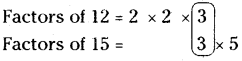
TS 6th Class Maths Solutions Chapter 3 Playing with Numbers Ex 3.5 1
The common factor of both = 3
Take the extra factors of both 12 and 15, (i.e.,) 2, 2 and 5
∴ LCM = 2 × 2 × 5 × 3 = 60

TS 6th Class Maths Solutions Chapter 3 Playing with Numbers Ex 3.5

(ii) 15 and 25
Answer:
The given numbers are 15 and 25.
Let us express each number as the product of prime factors.
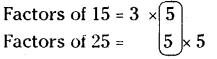
TS 6th Class Maths Solutions Chapter 3 Playing with Numbers Ex 3.5 5
The common factor of both = 5
The extra factors of both = 3 and 5
∴ LCM = 3 × 5 × 5 = 75.

(iii) 14 and 21
Answer:
The given numbers are 14 and 21.
Let us express each number as the product of prime factors.
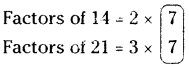
TS 6th Class Maths Solutions Chapter 3 Playing with Numbers Ex 3.5 2
The common factor of both = 7
The extra factors of both = 2 and 3
∴ LCM = 2 × 3 × 7 = 42

(iv) 18 and 27
Answer:
The given numbers are 18 and 27
Let us express each number as the product of prime factors.
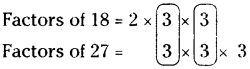
TS 6th Class Maths Solutions Chapter 3 Playing with Numbers Ex 3.5 3
The common factor of both = 3 × 3
The extra factors of both = 2 and 3
∴ LCM = 3 × 3 × 2 × 3 = 54

(v) 48, 56 and 72
Answer:
The given numbers are 48, 56 and 72.
Let us express each number as the product of prime factors.
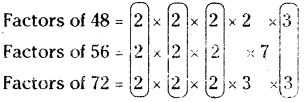
TS 6th Class Maths Solutions Chapter 3 Playing with Numbers Ex 3.5 4
The common factor of the three numbers = 2 × 2 × 2 × 3
The extra factors of the three numbers = 2 × 3 × 7
∴ LCM = 2 × 2 × 2 × 3 × 2 × 3 × 7 = 1008

(vi) 26, 14 and 91
Answer:
The given numbers are 26, 14 and 91
Let us express each number as the product of prime factors
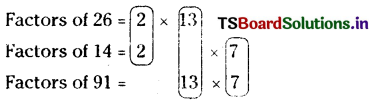
TS 6th Class Maths Solutions Chapter 3 Playing with Numbers Ex 3.5 6
The common factors of the three numbers = 2 × 13 × 7
There are no extra factors of all the numbers.
∴ LCM = 2 × 13 × 7 = 182

Question 2.
Find the LCM of the following numbers by division method,
(i) 84, 112, 196
Answer:
The given numbers are 84, 112 and 196.
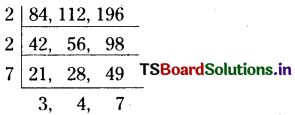
TS 6th Class Maths Solutions Chapter 3 Playing with Numbers Ex 3.5 7
∴ LCM = 2 × 2 × 7 × 3 × 4 × 7 = 2352

TS 6th Class Maths Solutions Chapter 3 Playing with Numbers Ex 3.5

(ii) 102, 119, 153
Answer:
The given numbers are 102, 119 and 153.
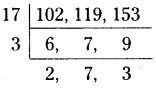
TS 6th Class Maths Solutions Chapter 3 Playing with Numbers Ex 3.5 8
∴ LCM = 17 × 3 × 2 × 7 × 3 = 2142

(iii) 45, 99, 132, 165
Answer:
The given numbers are 45, 99, 132 and 165.
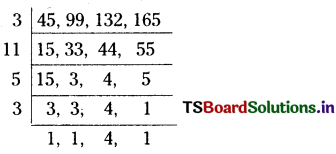
TS 6th Class Maths Solutions Chapter 3 Playing with Numbers Ex 3.5 9
∴ LCM = 3 × 11 × 5 × 3 × 4 = 1980

Question 3.
Find the smelliest number which when added to 5 is exactly divisible by 12, 14 and 18.
Answer:
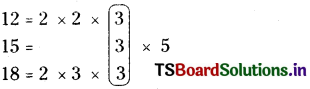
Let us find the LCM of 12, 14 and 18.
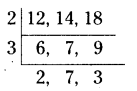
TS 6th Class Maths Solutions Chapter 3 Playing with Numbers Ex 3.5 10
∴ LCM = 2 × 3 × 2 × 7 × 3 = 252
∴ The required smallest number = 252 – 5 = 247

Question 4.
Find the greatest 3 digit number which when divided by 75,45 and 60 leaves:
(i) no remainder
(ii) the remainder 4 in each case.
Answer:
(i) The given numbers are 75, 45 and 60.
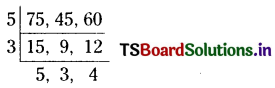
TS 6th Class Maths Solutions Chapter 3 Playing with Numbers Ex 3.5 11
∴ LCM = 5 × 3 × 5 × 3 × 4 = 900
∴The required number with no remainder = 900

(ii) The required number with
remainder 4 in each case = 900 + 4 = 904

TS 6th Class Maths Solutions Chapter 3 Playing with Numbers Ex 3.5

Question 5.
Prasad and Raju met in the market on 1st of this month. Prasad goes to the market every 3rd day and Raju goes every 4th day. On what day of the month will they meet again ?
Answer:
The day on which Prasad and Raju met in the market is 1st of this month.
Prasad goes to the market every 3rd day.
Raju goes to the market every 4th day.
To find the day on which they meet again, we have to find the LCM of 3 and 4.
LCM of 3 and 4 = 3 × 4 = 12
So, Raju and Prasad meet again after 12 days.
(i.e.,) They meet again on 13th day of this month.
TS 10th Class Maths Solutions Chapter 1 Real Numbers Ex 1.4

Students can practice TS 10th Class Maths Solutions Chapter 1 Real Numbers Ex 1.4 to get the best methods of solving problems.

TS 10th Class Maths Solutions Chapter 1 Real Numbers Exercise 1.4

Question 1.
Prove that the following are irrational.

(i) \(\frac{1}{\sqrt{2}}\)
Solution:
\(\frac{1}{\sqrt{2}}\)
Let us assume to the contrary that \(\frac{1}{\sqrt{2}}\) is rational. Then there exist co-prime positive integers ‘a’ and ‘b’ such that 1 a
\(\frac{1}{\sqrt{2}}\) = \(\frac{\mathrm{a}}{\mathrm{b}}\)
\(\sqrt{2}\)a = b
\(\sqrt{2}\) = \(\frac{b}{a}\)
Here ‘a’ and ‘b’ are integers, \(\frac{b}{a}\) is rational.
∴ \(\sqrt{2}\) is rational.
This contradicts the fact that \(\sqrt{2}\) is irrational.
So our assumption is wrong.
Hence \(\frac{1}{\sqrt{2}}\) is irrational.

(ii) \(\sqrt{3}\) + \(\sqrt{5}\)
Solution:
\(\sqrt{3}\) + \(\sqrt{5}\)
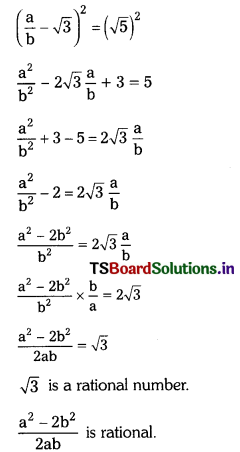
Let us assume to the contrary that \(\sqrt{3}\) + \(\sqrt{5}\) is a rational number.
Then there exist co-prime positive integers ‘a’ and ‘b’ such that
\(\sqrt{3}\) + \(\sqrt{5}\) = \(\frac{a}{b}\)
\(\frac{a}{b}\) – \(\sqrt{3}\) = \(\sqrt{5}\)
S.B.S.
TS 10th Class Maths Solutions Chapter 1 Real Numbers Ex 1.4 1
This contradicts the fact that \(\sqrt{3}\) is irrational.
∴ Hence, \(\sqrt{3}\) + \(\sqrt{5}\) is irrational.

TS 10th Class Maths Solutions Chapter 1 Real Numbers Ex 1.4

(iii) 6 + \(\sqrt{2}\)
Solution:
6 + \(\sqrt{2}\)
Let us assume on the contrary that 6 + \(\sqrt{2}\) is rational. Then there exist co-prime positive integers ‘a’ and ‘b’ such that
6 + \(\sqrt{2}\) = \(\frac{a}{b}\)
⇒ \(\sqrt{2}\) = \(\frac{a-6 b}{b}\)
\(\sqrt{2}\) is rational.
\(\frac{a-6 b}{b}\) is rational.
This contradicts the fact that \(\sqrt{2}\) is irrational, so our assumption is wrong.
∴ 6 + \(\sqrt{2}\) is irrational.

(iv) \(\sqrt{5}\)
Solution:
\(\sqrt{5}\)
Let us assume, to the contrary that \(\sqrt{5}\) is irrational then there exist co-prime positive integers a and b such that
\(\sqrt{5}\) = \(\frac{a}{b}\)
\(\sqrt{5}\) b = a
S.B.S. we get
(\(\sqrt{5}\) b)2 = (a)2
5b2 = a2 ……. (1)
5 divides a2.
Hence 5 divides a.
We can write a = 5c for some integer c.
Substitute a = 5c in (1) we get
5b2 = (5c)2
5b2 = 25c2
b2 = \(\frac{25 c^2}{5}\)
b2 = 5c2
5 divides b2 and 5 divide b.
‘a’ and ‘b’ have atleast as a common factor.
This contradicts the fact that ‘a’ and ‘b’ have no common factor other than 1.
So our assumption is wrong.
∵ \(\sqrt{5}\) is irrational.

(v) 3 + 2\(\sqrt{5}\)
Solution:
3 + 2\(\sqrt{5}\)
Let us assume, to the contrary that 3 + 2\(\sqrt{5}\) is rational. Then there exist co-prime positive integers ‘a’ and ’b’ such that
3 + 2\(\sqrt{5}\) = \(\frac{a}{b}\)
2\(\sqrt{5}\) = \(\frac{a}{b}\) – 3
\(\sqrt{5}\) = \(\frac{a-3 b}{2 b}\)
\(\sqrt{5}\) is rational.
\(\frac{a-3 b}{2 b}\) is rational.
This contradicts the fact that \(\sqrt{5}\) is irrational, so our assumption is wrong.
3 + 2\(\sqrt{5}\) is irrational.

TS 10th Class Maths Solutions Chapter 1 Real Numbers Ex 1.4

Question 2.
Prove that \(\sqrt{p}\) + \(\sqrt{q}\) is an irrational, where p, q are primes.
Solution:
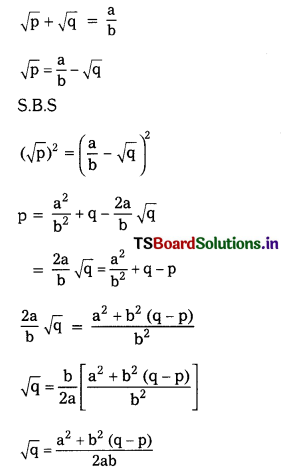
Let us assume to the contrary that \(\sqrt{p}\) + \(\sqrt{q}\) is rational. Then there exist co-prime positive in-tegers ‘a’ and ‘b’.
TS 10th Class Maths Solutions Chapter 1 Real Numbers Ex 1.4 2
We know that square root of any prime number is irrational, we get \(\sqrt{q}\) is rational.
This contradicts the fact that \(\sqrt{q}\) is irrational.
So our assumption is wrong.
∵ \(\sqrt{q}\) is irrational.
∵ \(\sqrt{p}\) + \(\sqrt{q}\) is irrational.

TS 6th Class Maths Solutions Chapter 3 Playing with Numbers Ex 3.4

Students can practice TS 6th Class Maths Solutions Chapter 3 Playing with Numbers Ex 3.4 to get the best methods of solving problems.

TS 6th Class Maths Solutions Chapter 3 Playing with Numbers Exercise 3.4

Question 1.
Find the HCF of the following numbers by prime factorisation and continued division method.
(i) 18, 27, 36
Answer:
The given numbers are
18, 27, 36

Prime factorisation method:
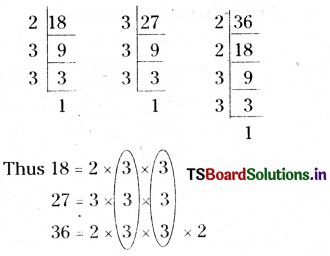
TS 6th Class Maths Solutions Chapter 3 Playing with Numbers Ex 3.4 1
The common factor of 18, 27 and 36 is 3 × 3 = 9
Hence, HCF of 18, 27 and 36 is 9.

Continued division method :
The given numbers are 18, 27 and 36.
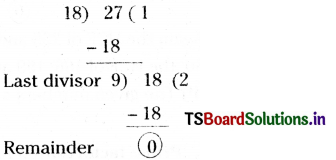
Let us find the HCF of 18 and 27.
TS 6th Class Maths Solutions Chapter 3 Playing with Numbers Ex 3.4 2
∴ HCF of 18 and 27 is 9.
Let us find the HCF of third number and the HCF of first.two numbers.
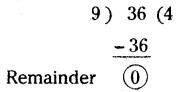
Let us find the HCF of 36 and 9.
TS 6th Class Maths Solutions Chapter 3 Playing with Numbers Ex 3.4 3
HCF of 18, 27 and 36 is 9.

TS 6th Class Maths Solutions Chapter 3 Playing with Numbers Ex 3.4

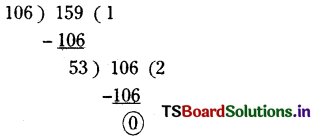
(ii) 106, 159, 265
Answer:
The given numbers are 106, 159 and 265.

Prime factorisation method:
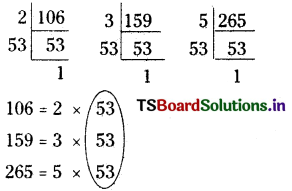
TS 6th Class Maths Solutions Chapter 3 Playing with Numbers Ex 3.4 4
∴ The common factor of 106, 159 and 265 is 53.
Hence, HCF of 106,159 and 265 is 53.

Continued division method:
Let us find the HCF of 106 and 159.
TS 6th Class Maths Solutions Chapter 3 Playing with Numbers Ex 3.4 5
The HCF of 106 and 159 is 53.
Let us find the HCF of 265 and 53.
TS 6th Class Maths Solutions Chapter 3 Playing with Numbers Ex 3.4 6
Again the HCF of 265 and 53 is 53.
So, the HCF of 106, 159 and 265 is 53.

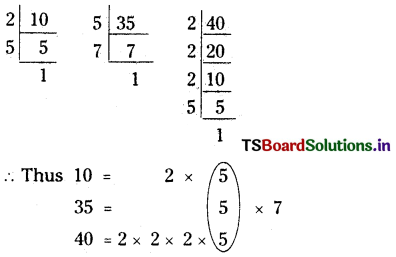
(iii) 10, 35, 40
Answer:
The given numbers are 10, 35 and 40.

Prime factorisation method:
TS 6th Class Maths Solutions Chapter 3 Playing with Numbers Ex 3.4 7
∴ The common factor of 10, 35 and 40 is 5.
Hence, HCF of 10, 35 and 40 is 5.

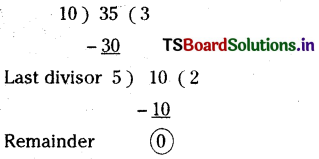
Continued division method:
The given numbers are 10, 35 and 40.
Let us find the HCF of 10 and 35.
TS 6th Class Maths Solutions Chapter 3 Playing with Numbers Ex 3.4 8
∴HCF of 10 and 35 is 5.
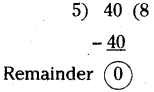
Let us find the HCF of third number and the HCF of first two numbers.
Let us find the HCF of 40 and 5.
TS 6th Class Maths Solutions Chapter 3 Playing with Numbers Ex 3.4 9
∴ HCF of 40 and 5 is 5.
∴ HCF of 10, 35 and 40 is 5.

TS 6th Class Maths Solutions Chapter 3 Playing with Numbers Ex 3.4

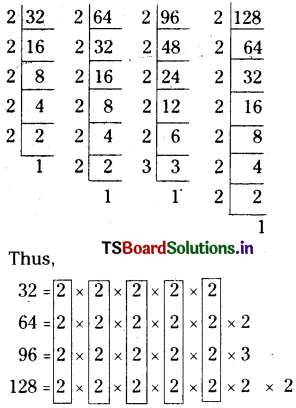
(iv) 32, 64, 96, 128
Answer:
The given numbers are 32, 64, 96 and 128.

Prime factorisation method:
TS 6th Class Maths Solutions Chapter 3 Playing with Numbers Ex 3.4 10
∴ The common factor of 32, 64, 96 and 128 is 2 × 2 × 2 × 2 × 2 = 32
∴ HCF of 32, 64, 96 and 128 is 32.

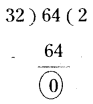
Continued division method:
Let us find the HCF of 32 and 64.
TS 6th Class Maths Solutions Chapter 3 Playing with Numbers Ex 3.4 11
∴ HCF of 32 and 64 is 32.
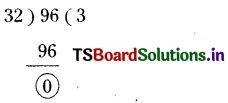
Again find the HCF of 32 and 96.
TS 6th Class Maths Solutions Chapter 3 Playing with Numbers Ex 3.4 12
∴ HCF of 32 and 96 is 32.
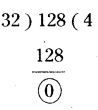
Again find the HCF of 32 and 128.
TS 6th Class Maths Solutions Chapter 3 Playing with Numbers Ex 3.4 13
∴ HCF of 32 and 128 is 32.
∴ The HCF of the given numbers is 32.

Question 2.
Find the largest number which is a factor of each of the numbers 504, 792 and 1080.
Answer:
Largest number which is a factor of the given numbers is HCF.
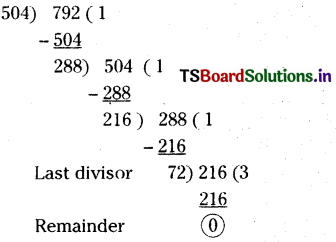
Let us find the HCF of 504 and 792.
TS 6th Class Maths Solutions Chapter 3 Playing with Numbers Ex 3.4 14
∴ HCF of 72 and 1080 is 72.
The HCF of 504, 792 and 1080 is 72.

TS 6th Class Maths Solutions Chapter 3 Playing with Numbers Ex 3.4

Question 3.
The length, breadth and height of a room are 12m, 15m and 18m respectively. Determine the length of longest stick that can measure all the dimensions of the room in exact number of times?
Answer:
The HCF of 12, 15 and 18 will give us the length of the stick which can measure all the three dimensions of the room exactly.
TS 6th Class Maths Solutions Chapter 3 Playing with Numbers Ex 3.4 15
∴ HCF of 12, 15 and 18 is 3.
The length of stick is 3 m.

Question 4.
HCF of co-prime numbers 4 and 15 was found as follows by factorization. 4 = 2 × 2 and 15 = 3 × 5. Since there is no common prime factor, HCE of 4 and 15 is ‘0’. Is the answer correct? If not, what Is the correct HCF?
Answer:
The numbers which have only 1 as the common factor are called co-primes.
In the problem it is given that 4 and 15 are co-prime numbers.
∴ Their common factor is 1.
HCF of 4 and 15 is ‘0’ given in the problem. This is not correct.
The correct HCF is 1.

Question 5.
What is the capacity of the largest vessel which can empty the oil from three vessels containing 32 litres, 24 litres and 48 litres an exact number of times ?
Answer:
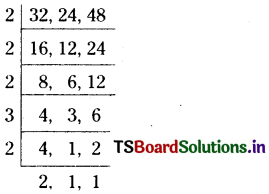
The quantity of oil in three vessels is 32 litres, 24 litres and 48 litres.
TS 6th Class Maths Solutions Chapter 3 Playing with Numbers Ex 3.4 16
∴ LCM = 2 × 2 × 2 × 3 × 2 × 2 = 96
The capacity 4 the largest vessel = 96 litres.

TS 6th Class Maths Solutions Chapter 3 Playing with Numbers Ex 3.2

Students can practice TS 6th Class Maths Solutions Chapter 3 Playing with Numbers Ex 3.2 to get the best methods of solving problems.

TS 6th Class Maths Solutions Chapter 3 Playing with Numbers Exercise 3.2

Question 1.
Write all the factors of the following numbers.
(i) 36
Answer:
The factors of 36 are
1, 2, 3, 4, 6, 9, 12, 18, 36.

TS 6th Class Maths Solutions Chapter 3 Playing with Numbers Ex 3.2

(ii) 23
Answer:
The factors of 23 are 1 and 23.

(iii) 96
Answer:
The factors of 96 are
1, 2, 3, 4, 6, 8, 12, 16, 24, 32, 48, 96

(iv) 115
Answer:
The factors of 115 are 1, 5, 23, 115

Question 2.
Which of the following pairs are co-prime ?
(i) 16 and 35
Answer:
The factors of 18 are 1, 2, 3, 6, 9, 18.
The factors of 35 are 1, 5, 7, 35.
The common factor for both 18 and 35 is 1 only.
∴ 18 and 35 are co-primes.

(ii) 216 and 215
Answer:
The factors of 216 are 1,2,3,4,9,24, 36, 54, 72, 108,216.
The factors of 215 are 1, 5, 43.
The common factor for both 216 and 215 is 1 only.
∴ 216 and 215 are co-primes.

(iii) 30 and 415
Answer:
The factors for 30 are
1, 2, 3, 5, 6, 10, 15, 30.
The factors for 415 are 1, 5, 83.
The common factors for both 30 and 415 are 1, 5.
They have two common factors.
∴ 30 and 415 are not co-primes.

(iv) 17 and 68
Answer:
The factors for 17 are 1,17.
The factors for 68 are 1, 2, 4, 17, 34, 68.
The common factor for both 17 and 68 is 1 only.
∴ 17 and 68 are co-primes.

Question 3.
What is the greatest prime number between 1 and 20 ?
Answer:
The prime numbers between 1 and 20 are 2, 3,5, 7, 11,13, 17, 19.
∴ The greatest prime number is 19.

Question 4.
Find the prime ‘ and composite numbers between 10 and 30 ?
Answer:
The prime numbers between 10 and 30 are 11, 13, 17, 19, 23, 29.
The composite numbers between 10 and 30 are 12, 14, 15, 16, 18, 20, 21, 22, 24, 25, 26, 27, 28.

Question 5.
The numbers 17 and 71 are prime numbers. Both these numbers have same digits 1 and 7. Find 2 more such pairs of prime numbers below 100.
Answer:
13 and 31; 37 and 73 are two pairs of prime numbers.

TS 6th Class Maths Solutions Chapter 3 Playing with Numbers Ex 3.2

Question 6.
Write three pairs of twin primes below 20?
Answer:
(3, 5); (5, 7); (11, 13) are twin primes.

Question 7.
Write two prime numbers whose product is 35.
Answer:
The two prime numbers whose product is 35 are 5 and 7.

Question 8.
Express 36 as the sum of two odd primes.
Answer:
The two odd primes whose sum is 36 are 13 and 23.
∴ 36 = 13 + 23

Question 9.
Write seven consecutive composite numbers less than 100.
Answer:
4, 6, 8, 10, 12, 14 and 16

Question 10.
Express 53 as the sum of three primes.
Answer:
53 = 3 + 19 + 31

Question 11.
Write two prime numbers whose difference is 10.
Answer:
19 and 29. (∵ 29 – 19 = 10)

Question 12.
Write three pairs of prime numbers less than 20 whose sum is divisible by 5?
Answer:
(3, 7), (7, 13), (17, 3)
These pairs of prime numbers are less than 20. The sum of each pair is divisible by 5.

TS 6th Class Maths Solutions Chapter 3 Playing with Numbers Ex 3.1

Students can practice TS 6th Class Maths Solutions Chapter 3 Playing with Numbers Ex 3.1 to get the best methods of solving problems.

TS 6th Class Maths Solutions Chapter 3 Playing with Numbers Exercise 3.1

Question 1.
Which of the following numbers are divisible by 2, by 3 and by 6 ?
(i) 321729
Answer:
The given number is 321729.
Since 9 is in units place, it is not divisible by 2.
Sum of the digits = 3 + 2 + 1 + 7 + 2 + 9 = 24 (a multiple of 3)
So, it is divisible by 3.
∴ The given number is not divisible by 6 as it is not divisible by 2.

TS 6th Class Maths Solutions Chapter 3 Playing with Numbers Ex 3.1

(ii) 197232
Answer:
The given number is 197232.
Since 2 is in units place, it is divisible by 2.
Sum of the digits = l+ 9 + 7 + 2 + 3 + 2 = 24 (a multiple of 3)
So, it is divisible by 3.
∴ The given number is divisible by 6 because it is divisible by both 2 and 3.

(iii) 972132
Answer:
The given number is 972132.
Since 2 is in units place, it is divisible by 2.
Sum of the digits = 9 + 7 + 2 + 1 + 3 + 2 = 24 (a multiple of 3)
So, it is divisible by 3.
∴ The given number is divisible also because it is divisible by both 2 and 3.

(iv) 1790184
Answer:
The given number is 1790184.
Since 4 is in units place, it is divisible by 2.
Sum pf the digits = 1 + 7 + 9 + 0 + 1 + 8 + 4 = 30 (a multiple of 3)
So, it is divisible by 3.
∴The given number is divisible by 6 also because it is divisible by both 2 and 3.

(v) 312792
Answer:
The given number is 312792.
Since 2 is in units place, it is divisible by 2.
Sum of the digits = 3 + 1 + 2 + 7 + 9 + 2 = 24 (a multiple of 3) So, it is divisible by 3.
∴ The given number is divisible by 6 also because it is divisible by both 2 and 3.

(vi) 800552
Answer:
The given number is 800552
Since 2 is in units place, it is divisible by 2.
Sum of the digits = 8 + 0 + 0 + 5 + 5 + 2 = 20 (not a multiple of 3)
∴ The given number is not divisible by 3.
∴ The given number is divisible by 2 but not by 3.
So, it is not divisible by 6.

(vii) 4335
Answer:
The given number is 4335.
Since 5 is in units place, it is not divisible by 2.
Sum of the digits = 4 + 3 + 3 + 5 = 15 (a multiple of 3)
So, it is divisible by 3.
∴ The given number is divisible by 3 but not by 2.
So, it is not divisible by 6.

(viii) 726352
Answer:
The given number is 726352.
Since 2 is in units place, it is divisible by 2.
Sum of the digits = 7 + 2 + 6 +3 + 5 + 2 = 25 (not a multiple of 3)
So, it is not divisible by 3.
∴ The given number is divisible by 2 but not by 3.
So, it is not divisible by 6.

Question 2.
Determine which of the following numbers are divisible by 5 and by 10. 25,125,250,1250,10205,70985,45880. Check whether the numbers that are divisible by 10 are also divisible by 2 and 5.
Answer:
Since ‘5’ or ‘0’ is in units place of the above given numbers, they are divisible by 5.
The numbers having ‘0’ in units place (i.e.,)
250, 1250, 45880 are divisible by 10.
250 is divisible by 2 and also by 5. (∵ If ‘0’ is in units place, it is divisible by 2 and by 5).
So, the other two numbers (i.e.,) 1250 and 45880 are also divisible by 2 and by 5.

TS 6th Class Maths Solutions Chapter 3 Playing with Numbers Ex 3.1

Question 3.
Fill the table using divisibility test for 3 and 9.

NumberSum of the digits in the numberDivisible by
39
72…………………………………………
197…………………………………………
4689…………………………………………
79875…………………………………………
9889749 + 8 + 8 + 9 + 7 + 4 = 45YesYes

Answer:

NumberSum of the digits in the numberDivisible by
39
727 + 2 = 9YesYes
1971 + 9 + 7 = 17NoYes
46894 + 6 + 8 + 9 = 27YesYes
798757 + 9 + 8 + 7 + 5 = 36YesYes
9889749 + 8 + 8 + 9 + 7 + 4 = 45YesYes

Question 4.
Make 3 different 3 digit numbers using 1, 9 and 8, where each digit can be used only once. Check which of these numbers are divisible by 9.
Answer:
The 3 different 3 digit numbers using 1, 9 and 8 are 981, 819, 198
Sum of the digits in 981 = 9 + 8 + 1 = 18
18 is divisible by 9. So the number 981 is also divisible by 9.
Sum of the digits in 819 = 8 + 1 + 9 = 18
Sum of the digits in 198 = 1 + 9 + 8 = 18
So these .two numbers (i.e.,) 819 and 198 are also divisible by 9.
(∵ 18 is divisible by 9)

Question 5.
Which numbers among 2, 3, 5, 6, 9 divides 12345 exactly ?
Write 12345 in reverse order and test now which numbers divide it exactly ?
Answer:
(i) 2 does not divide 12345 exactly.
3 divides 12345 exactly.
(∵ Sum of the digits 1 + 2 + 3 + 4 + 5 = 15isa multiple of ‘3’)
5 divides 12345 exactly.
(∵ 5 is in units place)
6 does not divide 12345 exactly
(∵ 12345 is divisible by 3 but not by 6)
9 does not divide 12345 exactly.
(∵ Sum of the digits (i.e.,) 15 is not divisible by 9)

(ii) 2,5, 6, 9 does not divide 54321 exactly.
(iii) 3 divides 54321 exactly.
∴ Sum of the digits is 5 + 4 + 3 + 2 + 1 = 15 is a multiple of 3.

TS 6th Class Maths Solutions Chapter 3 Playing with Numbers Ex 3.1

Question 6.
Write different 2 digit numbers using digits 3, 4 and 5. Check whether these numbers are divisible by 2, 3, 5, 6 and 9.
Answer:
The two digit numbers formed with 3, 4 and 5 are 34, 35, 45, 43, 53, 54.
34 is divisible by 2. .
35 is divisible by 5.
45 is divisible by 3, 5 and 9.
43 is not divisible by 2, 3, 5, 6 or 9.
53 is not divisible by 2, 3, 5, 6 or 9.
54 is divisible by 2, 3, 6 and 9.

Question 7.
Write the smallest digit and the great-est possible digit in the blank space of each of the following numbers so that the number formed are divisible by 3.
(i) …………………… 6724
(ii) 4765 ……………………. 2
(iii) 7221 …………………….. 5
Answer:
(i) 2 6724 and 56724
(ii) 476532 and 476592
(iii) 722145 and 722175

Question 8.
Find the smallest number that must be added to 123, so that it becomes exactly divisible by 5.
Answer:
The given number is 123.
The digit in ones place should be 5 so that it becomes exactly divisible by 5.
∴ 2 is to be added to 123.
Then the number becomes
123 + 2 = 125, divisible by 5.

TS 6th Class Maths Solutions Chapter 3 Playing with Numbers Ex 3.1

Question 9.
Find the smallest number that has to be subtracted from 256, so that it becomes exactly divisible by 10.
Answer:
The given number is 256.
The digit in units place should be ‘0’ so that it becomes exactly divisible by 10.
6 has to be subtracted from 256. Then the number becomes 256 – 6 = 250 which is exactly divisible by 10.

TS 10th Class Maths Solutions Chapter 1 Real Numbers Ex 1.1

Students can practice TS 10th Class Maths Solutions Chapter 1 Real Numbers Ex 1.1 to get the best methods of solving problems.

TS 10th Class Maths Solutions Chapter 1 Real Numbers Exercise 1.1

Question 1.
Use Euclid’s algorithm to find the HCF of

(i) 900 and 270
Answer:
900 and 270
Euclid Division Lemma
a = bq + r, q > 0 and 0 ≤ r < b
When 900 is divided 270, the remainder is 90 to get 900 = 270 × 3 + 90
Now consider the division of 270 with the remainder 90 in the above and division algorithm to get 270 = 90 × 3 + 0 The remainder is zero, when we cannot proceed further. We conclude that the HCF of (900, 270) = 90

(ii) 196 and 38220
Answer:
196 and 38220
When 38220 is divided 196, the remainder is 0 to get 38220 = 196 × 195 + 0
The remainder is zero, when we cannot proceed further. We conclude that the HCF of (38220, 196) = 196.

TS 6th Class Maths Solutions Chapter 1 Real Numbers Ex 1.1

(iii) 1651 and 2032
Answer:
1651 and 2032
When 2032 is divided by 1651, the remainder is 381 to get 2032 = 1651 × 1 + 381
Now consider the division of 1651 with 381 in the above and division algorithm to get 1651 = 381 × 4 + 127
Now consider the division of 381 with the remainder 127 in the above and division algorithm to get 381 = 127 × 3 + 0
The remainder is zero, when we cannot proceed further we conclude that the HCF (1651, 2032) = 127

Question 2.
Use division algorithm to show that any positive odd integer is ofthe form 6q + 1, or 6 q + 3 or 6 q + 5, where q is some integer.
Answer:
Let ‘a’ be any positive odd integer, we apply the division algorithm with a and b = 6. Since 0 ≤ r ≤ 5, the possible remainders are 0, 1, 2, 3, 4 and 5.
i. e., a can be 6q or 6q + 1 or 6q + 2 or 6q + 3 or 6q + 4 or 6q + 5, where ‘q’ is quotient, However, since ‘a’ is odd, a cannot be 6q, 6q+2, 6q+4 (since they both are divisible by 2)
∴ any odd integer in the form of 6q + 1, (or) 6q + 3 (or) 6q + 5.

Question 3.
Use division algorithm to show that the square of any positive integer is of the form 3p or 3p + 1.
Answer:
Consider ‘a’ be the square of an integer
Applying Euclid’s division lemma with ‘a’ and ‘b’ = 3
0 ≤ r < 3 the possible remainders are 0, 1, 2 a = 3p or 3p + 1 (or) 3p + 2
Any square number is of the form 3p, 3p + 1, or 3p + 2, Where p is the quotient.

Question 4.
Use division algorithm to show that the cube of any positive integer is of the form 9 m, 9m + 1 or 9m + 8.
Answer:
Let ‘a’ be the cube of a positive integer
Applying Euclid’s division lemma for ‘a’ and b = 9 a = bm + r, Where’m’ is quotient r is the remainder where 0 ≤ r < 9 ‘a’ can be of the form
9m, 9m + 1, 9m + 2 ………… or 9m + 8
The cube of any positive integer is of the form 9m, 9m + 1, 9m + 2, ….. or 9m + 8.

TS 6th Class Maths Solutions Chapter 1 Real Numbers Ex 1.1

Question 5.
Show that one and only one out of n, n + 2 or n + 4 is divisible by 3, where n is any positive integer.
Answer:
Given numbers : n; n + 2 and n + 4

Case (i) : ‘n’ is divisible by 3, then n is of the form 3k. Now, n + 2 = 3k + 2 – leaves a remainder 2 when divided by 3. n + 4 = 3k + 4 = (3k + 3) + 1 = 3(k + 1) + 1 leaves a remainder 1 when divided by 3.

Case (ii) : n + 2 is divisible by 3. then n + 2 is of the form 3k.
Now n = 3k – 2 leaves a remainder 1 when divided by 3 and n + 4 = n + 2 + 2
= 3k + 2 leaves a remainder 2 when divided by 3.

Case (iii) : n + 4 is divisible by 3.
Take n + 4 = 3k
Now : n = 3k – 4 = 3(k – 1) + 3 – 4
= 3(k – 1) – 1 leaves a remainder 2 when divided by 3.
Also n + 2 = 3k-2 = 3(k- 1) + 3-2
= 3(k – 1) + 1 leaves a remainder 1 when divided by 3.
In all the above three cases only one out of n, n + 2 and n + 4 is divisible by 3.

TS 10th Class Maths Solutions Chapter 1 Real Numbers Ex 1.3

Students can practice TS 10th Class Maths Solutions Chapter 1 Real Numbers Ex 1.3 to get the best methods of solving problems.

TS 10th Class Maths Solutions Chapter 1 Real Numbers Exercise 1.3

Question 1.
Write the following rational numbers in their decimal form and also state which are terminating and which are non-terminating repeating decimal form.

(i) \(\frac{3}{8}\)
Solution:
\(\frac{3}{8}\) = \(\frac{3}{2.2 .2}\) = \(\frac{3}{2^3}\) (∵ Denominator consists of only 2’s. terminating decimal)
\(\frac{3 \times 5^3}{2^3 \times 5^3}\) = \(\frac{3 \times 125}{10^3}\) = \(\frac{375}{1000}\) = 0.375

(ii) \(\frac{229}{400}\)
Solution:
\(\frac{229}{400}\) = \(\frac{229}{2.2 .2 .2 \times 5 \times 5}\) (∵ Denominator consists of only 2 ‘s.)
= \(\frac{229}{2^4 \cdot 5^2}\) (terminating decimal)
= \(\frac{229 \times 5^2}{2^4 \times 5^2 \times 5^2}\) = \(\frac{229 \times 5^2}{2^4 \times 5^4}\)
= \(\frac{229 \times 25}{(2 \times 5)^4}\) = \(\frac{5725}{10^4}\)
= \(\frac{5725}{10000}\) = 0.5725 (∵ Denominator consists of only 2’s. terminating decimal)

TS 10th Class Maths Solutions Chapter 1 Real Numbers Ex 1.3

(iii) 4\(\frac{1}{5}\)
Solution:
4\(\frac{1}{5}\) = \(\frac{21}{5}\) (terminating decimal)
\(\frac{21}{5}\) = 4.2 (∵ Denominator consists of only 2’s.)

(iv) \(\frac{2}{11}\)
Solution:
\(\frac{2}{11}\) (∵ Denominator doesn’t contain 2s or 5’s or both. Hence it is an non-terminating, repeating decimal) (non-terminating, re-peating decimal because the denomination does not contain power of 2 or power of 5 of both 2 and 5)
\(\frac{2}{11}\) = 0.181818……..
= \(0 . \overline{18}\)

(v) \(\frac{8}{125}\)
Solution:
\(\frac{8}{125}\) = \(\frac{8}{5^3}\) (∵ Denominator does not consists of only 2’s.) (terminating decimal)
= \(\frac{8}{5^3}\) × \(\frac{2^3}{2^3}\) = \(\frac{8 \times 8}{(5 \times 2)^3}\) = \(\frac{64}{1000}\) = 0.064

Question 2.
Without performing division, state whether the following rational numbers will have a terminating decimal form or a non-terminating repeating decimal form.

(i) \(\frac{13}{3125}\)
Solution:
\(\frac{13}{3125}\). It is of the form \(\frac{p}{q}\)
\(\frac{13}{3125}\) = \(\frac{13}{5 \times 5 \times 5 \times 5 \times 5}\) = \(\frac{13}{5^5}\)
∵ q = 55 which is of the form 2n5m (n = 0; m = 5)
Given rational number has a terminating decimal expansion.

(ii) \(\frac{11}{12}\)
Solution:
\(\frac{11}{12}\) it is of the form \(\frac{p}{q}\).
\(\frac{11}{12}\) = \(\frac{11}{2 \times 2 \times 3}\) = \(\frac{11}{2^2 \times 3}\) = 0.916666.
∵ Here q = 22 × 3 which is not of the form 2n × 5m.
∴ Given rational number has a non-termi-nating repeating decimal expansion.

TS 10th Class Maths Solutions Chapter 1 Real Numbers Ex 1.3

(iii) \(\frac{64}{455}\)
Solution:
\(\frac{64}{455}\) It is of the form \(\frac{p}{q}\).
\(\frac{64}{455}\) = \(\frac{64}{5 \times 7 \times 13}\)
∵ q = 5 × 7 × 13 which is not of the form 2n.5m.
∵ Given rational number has a non-terminating, repeating decimal expansion.

(iv) \(\frac{15}{1600}\)
Solution:
\(\frac{15}{1600}\) It is of the form \(\frac{p}{q}\).
\(\frac{15}{1600}\) = \(\frac{3}{320}\) = \(\frac{3}{2^6 \times 5}\)
∵ Here q = 26 × 51 which is of the form 2n.5m (m = 1, n = 6)
∴ Given rational number has a terminating decimal expansion.

(v) \(\frac{29}{343}\)
Solution:
\(\frac{29}{343}\) It is of the form \(\frac{p}{q}\).
\(\frac{29}{343}\) = \(\frac{29}{7 \times 7 \times 7}\) = \(\frac{29}{7^3}\)
∵ Here q = 73 which is not of the form 2n5m.
∴ Given rational number has a non-terminating, repeating decimal expansion.

(vi) \(\frac{23}{2^3 \cdot 5^2}\)
Solution:
\(\frac{23}{2^3 \times 5^2}\) It is of the form \(\frac{p}{q}\).
∵ Here q = 23 × 52 which is of the form of 2n5m (n = 3, m = 2).
∴ Given rational number has a terminating decimal expansion.

(vii) \(\frac{129}{2^2 \cdot 5^7 \cdot 7^5}\)
Solution:
\(\frac{129}{2^2 \times 5^7 \times 7^5}\) It is of the form \(\frac{p}{q}\).
∵ Here q = 22 × 57 × 75 which is not of the form 2n5m.
∴ Given rational number has a non-terminating, repeating decimal expansion.

(viii) \(\frac{9}{15}\) = \(\frac{3}{5}\) It is of the form \(\frac{p}{q}\).
Solution:
\(\frac{9}{15}\) = \(\frac{3}{5}\) It is of the form \(\frac{p}{q}\).
Here q = 51 which is of the form 2n5m (n = 0; m = 1). .
∴ Given rational number has a terminating decimal expansion.

(ix) \(\frac{36}{100}\)
Solution:
\(\frac{36}{100}\) It is of the form \(\frac{p}{q}\).
\(\frac{36}{100}\) = \(\frac{36}{2 \times 2 \times 5 \times 5}\) = \(\frac{36}{2^2 5^2}\)
∵ Here q = 22. 52 which is of the form 2n5m (n = 2, m = 2).
∴ Given rational number has a terminating decimal expansion.

(x) \(\frac{77}{210}\)
Solution:
\(\frac{77}{210}\) it is of the form \(\frac{p}{q}\).
\(\frac{77}{210}\) = \(\frac{11}{30}\) = \(\frac{11}{2 \times 3 \times 5}\)
∵ q = 2 × 3 × 5 which is not of the form 2n5m
∴ Given rational number has non-terminating, repeating decimal expansion.

Question 3.
Write the following rational numbers in decimal form using Theorem 1.4.

(i) \(\frac{13}{25}\)
Solution:
\(\frac{13}{25}\) = \(\frac{13}{5 \times 5}\) = \(\frac{13 \times 2^2}{5^2 \times 2^2}\)
= \(\frac{13 \quad 4}{10^2}\) = \(\frac{52}{100}\) = 0.52

(ii) \(\frac{15}{16}\)
Solution:
\(\frac{15}{16}\) = \(\frac{15}{2 \times 2 \times 2 \times 2}\) = \(\frac{15 \times 5^4}{2^4 \times 5^4}\)
= \(\frac{15 \quad 5^4}{10^4}\) = \(\frac{9375}{10000}\) = 0.9375

TS 10th Class Maths Solutions Chapter 1 Real Numbers Ex 1.3

(iii) \(\frac{23}{2^3 \cdot 5^2}\)
Solution:
\(\frac{23}{2^3 \times 5^2}\) = \(\frac{23 \times 5}{2^3 \times 5^2 \times 5}\)
= \(\frac{115}{10^3}\) = \(\frac{115}{1000}\) = 0.115

(iv) \(\frac{7218}{3^2 .5^2}\)
Solution:
\(\frac{7218}{3^2 \times 5^2}\) = \(\frac{3 \times 3 \times 802}{3^2 \times 5^2}\)
= \(\frac{802 \times 2^2}{5^2 \times 2^2}\) = \(\frac{3208}{100}\) = 32.08

(v) \(\frac{143}{110}\)
Solution:
\(\frac{143}{110}\) = \(\frac{11 \times 13}{11 \times 10}\) = \(\frac{13}{10}\) = 1.3

Question 4.
Express the following decimal numbers in the form of q and write the prime factors of q. What do you observe?
(i) 43.123
Solution:
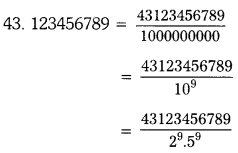
43.123456789
Given decimal expansion terminates. Hence given real number is a rational.
It is in the form of \(\frac{p}{q}\)
TS 10th Class Maths Solutions Chapter 1 Real Numbers Ex 1.3 1
∵ Here q = 29.59 ; q is of the form 2n5m (n = 9; m = 9)

TS 10th Class Maths Solutions Chapter 1 Real Numbers Ex 1.3

(ii) 0.120112001120001…
Solution:
0.120120012000120000 …………
Given decimal expansion is not either ter-minating or non-terminating repeating.
∵ Hence given real number is not rational.

(iii) \(43 . \overline{12}\)
Solution:
\(43 . \overline{123456789}\)
Given decimal expansion is non-terminating, repeating.
Given real number is rational and so of the \(\frac{p}{q}\)
Let x = \(43 . \overline{123456789}\)
x = \(43 . \overline{123456789}\) …… (2)
Multiplying both sides of (1) by 1000000000, we get
x = 43123456789.123456789 ……. (2)
Substracting (1) from (2) we get
999999999 x = 43123456746
x = \(\frac{43123456746}{999999999}\)
x = \(\frac{14374485582}{333333333}\)
q = 333333333 which is not of the form 2n5m.

TS 6th Class Maths Solutions Chapter 3 Playing with Numbers Ex 3.3

Students can practice TS 6th Class Maths Solutions Chapter 3 Playing with Numbers Ex 3.3 to get the best methods of solving problems.

TS 6th Class Maths Solutions Chapter 3 Playing with Numbers Exercise 3.3

Question 1.
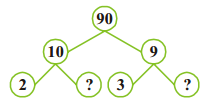
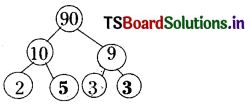
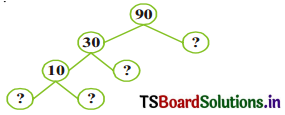
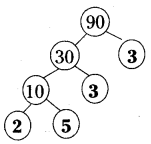
Write the missing numbers in the factor tree for 90.
(i.)
TS 6th Class Maths Solutions Chapter 3 Playing with Numbers Ex 3.3 1
Answer:
TS 6th Class Maths Solutions Chapter 3 Playing with Numbers Ex 3.3 2

TS 6th Class Maths Solutions Chapter 3 Playing with Numbers Ex 3.3

(ii)
TS 6th Class Maths Solutions Chapter 3 Playing with Numbers Ex 3.3 3
Answer:
TS 6th Class Maths Solutions Chapter 3 Playing with Numbers Ex 3.3 4

Question 2.
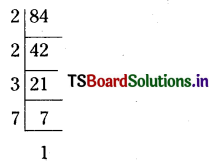
Factorise 84 by division method.
Answer:
TS 6th Class Maths Solutions Chapter 3 Playing with Numbers Ex 3.3 5
∴ 84 = 2 × 2 × 3 × 7 × 1

Question 3.
Write the greatest 4 digit number and express it in the form of it’s prime factors.
Answer:
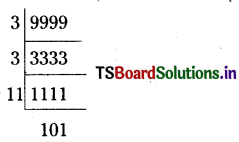
The greatest 4 digit number is 9999
TS 6th Class Maths Solutions Chapter 3 Playing with Numbers Ex 3.3 6
∴ 9999 = 3 × 3 × 11 × 101

TS 6th Class Maths Solutions Chapter 3 Playing with Numbers Ex 3.3

Question 4.
I am the smallest number, having four different prime’ factors. Can you find me ?
Answer:
The smallest number, having four different prime factors is
2 × 3 × 5 × 7
(i.e.) 210.

TS 6th Class Maths Solutions Chapter 1 Knowing Our Numbers Ex 1.2

Students can practice TS 6th Class Maths Solutions Chapter 1 Knowing Our Numbers Ex 1.2 to get the best methods of solving problems.

TS 6th Class Maths Solutions Chapter 1 Knowing Our Numbers Exercise 1.2

Question 1.
Round off the following numbers to the nearest tens.
(i) 89
Answer:
89 is nearer to 90 than 80. So it is rounded off to 90

TS 6th Class Maths Solutions Chapter 1 Knowing Our Numbers Ex 1.2

(ii) 415
Answer:
415 is at equal distance from 410 and 420 but by convention it is rounded off to 420.

(iii) 3951
Answer:
3951 is nearer to 3950 than 3960. So it is rounded off to 3950.

(iv) 4409
Answer:
4409 is nearer to 4410 than 4400. So it is rounded off to 4410.

Question 2.
Round off the following numbers to the nearest hundreds.
(i) 695
Answer:
695 is nearer to 700 than 600. So it is rounded off to 700.

(ii) 36152
Answer:
36152 is nearer to 36200 than 36100. So it is rounded off to 36200.

(iii) 13648
Answer:
13648 is nearer to 13600 than 13700. So it is rounded off to 13600.

(iv) 93618
Answer:
93618 is nearer to 93600 than 93700. So it is rounded off to 93600.

Question 3.
Round off the following numbers to the nearest thousands.
(i) 03415
Answer:
3415 is nearer to 3000 than 4000. So it is rounded off to 3000.

(ii) 70124
Answer:
70124 is nearer to 70000 than 71000. So it is rounded off to 70000.

(iii) 8765
Answer:
8765 is nearer to 9000 than 8000. So it is rounded off to 9000.

(iv)4001
Answer:
4001 is nearer to 4000 than 5000. So it is rounded off to 4000.

Question 4.
Write the numbers in short form.
(i) 3000 + 400 + 7
Answer:
3000 + 400 + 7 = 3407

(ii) 10000 + 2000 + 300 + 50 + 1
Answer:
10000 + 2000 + 300 + 50 + 1 = 12351

(iii) 30000 + 500 + 20 + 5
Answer:
30000 + 500 + 20 + 5 = 30525

(iv) 90000 + 9000 + 900 + 90 + 9
Answer:
90000 + 9000 + 900 + 90 + 9 = 99999

TS 6th Class Maths Solutions Chapter 1 Knowing Our Numbers Ex 1.2

Question 5.
Write the expanded form of the numbers.
(i) 4348
Answer:
4348 = (4 × 1000) + (3 × 100) + (4 × 10) + (8 × 1)
= 4000 + 300 + 40 + 8

(ii) 30214
Answer:
30214 = (3 × 10000) + (2 × 100) + (1 × 10) + (4 × 1)
= 30000 + 200 + 10 + 4

(iii) 22222
Answer:
22222 = (2 × 10000) + (2 × 1000) + (2 × 100) + (2 × 10) + (2 × 1)
= 20000 + 2000 + 200 + 20 + 2

(iv) 75025
Answer:
75025 = (7 × 10000) + (5 × 1000) + (2 × 10) + (5 × 1)
= 70000 + 5000 + 20 + 5

TS 6th Class Maths Solutions Chapter 1 Knowing Our Numbers Ex 1.4

Students can practice TS 6th Class Maths Solutions Chapter 1 Knowing Our Numbers Ex 1.4 to get the best methods of solving problems.

TS 6th Class Maths Solutions Chapter 1 Knowing Our Numbers Exercise 1.4

Question 1.
Write the numbers using commas according to International system of numeration.
(i) 97645315
Answer:
97,645,315

TS 6th Class Maths Solutions Chapter 1 Knowing Our Numbers Ex 1.4

(ii) 20048421
Answer:
20,048,421

(iii) 476356
Answer:
476,356

(iv) 9490026834
Answer:
9,490,026,834

Question 2.
Collect the mobile numbers of your friends and other family members. Write them using commas and read them in International system.
Answer:
1. 9,912,342,343
Nine billion nine hundred twelve mil-lion three hundred forty two thou-sand three hundred forty three.

2. 9,989,857,886
Nine billion nine hundred eighty nine million eight hundred fifty seven thousand eight hundred eighty six.

3. 9,849,258,633
Nine billion eight hundred forty nine million two hundred fifty eight thou-sand six hundred thirty three.

4. 9,032,050,053
Nine billion thirty two million fifty thousand fifty three.

5. 9,490,605,604
Nine billion four hundred ninety million six hundred five thousand six hundred four.

6. 9,440,824,201
Nine billion four hundred forty million eight hundred twenty four thousand two hundred one.

7. 9,949,584,445
Nine billion nine hundred forty nine million five hundred eighty four thousand four hundred forty five.

8. 9,848,212,356
Nine billion eight hundred forty eight million two hundred twelve thousand three hundred fifty six.

9. 9,440,172,042
Nine billion four hundred forty million one hundred seventy two thousand forty two.

10. 9,989,027,829
Nine billion nine hundred eighty nine million twenty seven thousand eight hundred twenty nine.

Question 3.
Write the numbers in words in both Indian and International system.
(i) 123115027
Answer:
Indian system: 12,31,15,027
Twelve crores thirty one lakh fifteen thousand twenty seven.

International system: 123,115,027 One hundred twenty three million one hundred fifteen thousand twenty seven.

(ii) 89643092
Answer:
Indian system: 8,96,43,092
Eight crores ninety six lakh forty three thousand ninety two.

International system: 89,643,092 Eighty nine million six hundred forty three thousand ninety two.

TS 6th Class Maths Solutions Chapter 1 Knowing Our Numbers Ex 1.4

Question 4.
Read the number carefully and answer the following:
302,179,468
(i) The digit in millions place.
Answer:
The digit in millions place is 2.

(ii) The digit in hundreds place.
Answer:
The digit in hundreds place is 4.

(iii) The digit in ten millions place.
Answer:
The digit in ten millions place is 0.

(iv) How many millions are there in the number ?
Answer:
302 millions are there in the number.

TS 6th Class Maths Solutions Chapter 1 Knowing Our Numbers Ex 1.3

Students can practice TS 6th Class Maths Solutions Chapter 1 Knowing Our Numbers Ex 1.3 to get the best methods of solving problems.

TS 6th Class Maths Solutions Chapter 1 Knowing Our Numbers Exercise 1.3

Question 1.
Write the numbers using commas according to place values.
(i) 11245670
Answer:
1,12,45,670

TS 6th Class Maths Solutions Chapter 1 Knowing Our Numbers Ex 1.3

(ii) 22402151
Answer:
2,24,02,151

(iii) 30608712
Answer:
3,06,08,712

(iv) 190308020
Answer:
19,03,08,020

Question 2.
Write the numbers in words.
(i) 34,025
Answer:
34,025

(ii) 7,09,115
Answer:
7,09,115

(iii) 47,60,00,317
Answer:
47,60,00,317

(iv) 6,18,07,000
Answer:
6,18,07,000

Question 3.
Write the numbers in figures.
(i) Four lakh fifty seven thousand four hundred.
Answer:
4,57,400

(ii) Sixty lakh two thousand seven hundred seventy five.
Answer:
60,02,775

(iii) Two crore fifty lakh forty thousand three hundred and three.
Answer:
2,50,40,303

(iv) Sixty crore sixty lakh sixty thou-sand six hundred.
Answer:
60,60,60,600

Question 4.
Write the numbers in the expanded form.
(i) 6,40,156
Answer:
6,40,156 = (6 × 1,00,000) + (4 × 10,000) + (0 × 1,000) + (1 × 100) + (5 × 10) + (6 × 1)
= 60,00,000 + 40,000 + 100 + 50 + 6

(ii) 63,20,500
Answer:
63,20,500 = (6 × 10,00,000) +(3 × 1,00,000) + (2 × 10,000)+ (0 × 1,000) + (5 × 100) + (0 × 10) + (0 × 1)
= 60,00,000 + 3,00,000 + 20,000 + 500

(iii) 1,25,30,275
Answer:
1,25,30,275 = (1 × 1,00,00,000) + (2 × 10,00,000) + (5 × 1,00,000) + (3 × 10,000) + (0 × 1,000) + (2 × 100) + (7 × 10) + (5 × 1)
= 1,00,00,000 + 20,00,000 + 5,00,000 + 30,000 + 200 + 70 + 5

TS 6th Class Maths Solutions Chapter 1 Knowing Our Numbers Ex 1.3

(iv) 75,80,19,202
Answer:
75,80,19,202 = (7 × 10,00,00,000) +(5 × 1,00,00,000) + (8 × 10,00,000) + (0 × 1,00,000) + (1 × 10,000) + (9 × 1,000) + (2 × 100) + (0 × 10) + (2 × 1)
= 70,00,00,000 + 5,00,00,000 + 80,00,000 + 10,000 + 9,000 + 200 + 2

Question 5.
Write the following numbers in short form (standard notation).
(i) 50,00,000 + 4,00,000 + 20,000 + 8,000 + 500 + 20 + 4
Answer:
54,28,524

(ii) 6,00,00,000 + 40,00,000 + 3,00,000 + 20,000 + 500 + 1
Answer:
6,43,20,501

(iii) 3,00,00,000 + 3,00,000 + 7,000 + 800 + 80 + 1
Answer:
3,03,07,881

(iv) 7,00,00,000 + 70,00,000 + 7,000 + 70
Answer:
7,70,07,070

Question 6.
Which is larger between each of these two? Use greater than symbol (>) and write.
(i) 4,67,612 or 18,71,964
Answer:
18,71,964 > 4,67,612
(∵ The number on the left side of the symbol has 7 digits while the number on the right side has only 6 digits)

(ii) 14,35,10,300 or 14,25,10,300
Answer:
14,35,10,300 > 14,25,10,300
(∵ The digits in ten lakhs place of left side number is greater than that of right side number (i.e.) 3 > 2)

Question 7.
Which is smaller between each of these two ? Use less than symbol (<) and write.
(i) 2,00,015 or 99,999
Answer:
99,999 < 2,00,015
(∵ The number on the left side of the symbol has 5 digits while the number on the right side has 6 digits).

(ii) 13,50,050 or 13,49,785
Answer:
13,49,785 < 13,50,050
(∵ The digit In ten thousands place of left side number is less than that of right side number (i.e.) 4 < 5).

TS 6th Class Maths Solutions Chapter 1 Knowing Our Numbers Ex 1.3

Question 8.
Write any ten numbers with digits 5 in crores place, 2 in lakhs place, 1 in ten thousands place, 6 in tens place and 3 in ones place, (keep any digits in the remaining places)
Answer:
5 … 2 1 .. … 6 3 .
The required numbers are
(1) 5,92,18,563
(2) 5,82,17,463
(3) 5,72,16,363
(4) 5,62,15,263
(5) 5,52,14,163
(6) 5,42,13,063
(7) 5,32,11,963
(8) 5,22,10,863
(9) 5,12,09,763
(10) 5,02,08,663