AP Inter 1st Year Maths Exercise 5b Solutions

Referring to the AP Inter 1st Year Maths Study Material Chapter 5 Linear Inequalities Exercise 5b Solutions makes it easier to understand complex problems.

AP Inter 1st Year Maths Linear Inequalities Solutions Exercise 5b

I.

Question 1.
Solve the inequality 2 ≤ 3x – 4 ≤ 5.
Solution:
Given that 2 ≤ 3x – 4 ≤ 5
⇒ 2 + 4 ≤ 3x – 4 + 4 ≤ 5 + 4
⇒ 6 ≤ 3x ≤ 9
⇒ 2 ≤ x ≤ 3
Therefore, all the real numbers x, which are greater than or equal to 2 but less than or equal to 3 are the solutions of the given inequality. The solution set for the given inequality is [2, 3].

Question 2.
Solve the inequality 6 ≤ -3 (2x – 4) ≤ 12.
Solution:
Given that 6 ≤ -3 (2x – 4) ≤ 12
⇒ 2 ≤ – (2x -4)<4
⇒ -2 ≥ 2x – 4 > -4
⇒ 4 – 2 ≥ 2x > -4 + 4
⇒ 2 ≥ 2x > 0
⇒ 1 ≥ x > 0
⇒ 0 < x ≤ 1
Hence, the solution set for the given inequality is (0, 1],

Question 3.
Solve the inequality -3 ≤ 4 – \(\frac{7x}{2}\) < 18.
Solution:
Given that -3 ≤ 4 – \(\frac{7x}{2}\) <18
⇒ -6 ≤ 8 – 7x ≤ 36
⇒ -14 ≤ -7x ≤ 28
⇒ 2 ≥ x ≥ -4
⇒ -4 ≤ x ≤ 2.
Hence, the solution set for the given inequality is [- 4, 2]

AP Inter 1st Year Maths Exercise 5b Solutions

Question 4.
Solve the inequality -15 < \(\frac{3(x-2)}{5}\) ≤ 0.
Solution:
Given that -15 < \(\frac{3(x-2)}{5}\) ≤ 0
⇒ -75 < 3 (x – 2) ≤ 0
⇒ -25 < x-2 ≤ 0
⇒ -25 + 2 < x ≤ 2
⇒ -23 < x ≤ 2
Hence, the solution set for the given inequality is (-23, 2].

Question 5.
Solve the inequality -12 < 4 – \(\frac{3x}{-5}\) ≤ 2
Solution:
Given that -12 < 4 – \(\frac{3x}{-5}\) ≤ 2
⇒ -12-4 < \(\frac{3x}{-5}\) ≤ 2 – 4
⇒ —16 < \(\frac{3x}{-5}\) ≤ -2
⇒ -16 < \(\frac{3x}{-5}\) ≤ -2
⇒ \(\frac{-80}{3}\) < x ≤ \(\frac{-10}{3}\)
Hence, the solution set for the given inequality is \(\left(\frac{-80}{3}, \frac{-10}{3}\right]\)

Question 6.
Solve the inequality 7 ≤ \(\frac{(3 x+11)}{2}\) ≤ 11
Solution:
Given that 7 ≤ \(\frac{(3 x+11)}{2}\) ≤ 11
⇒ 14 ≤ (3x +11) ≤ 22
⇒ 14 – 11 ≤ 3x ≤ 22 – 11
⇒ 3 ≤ 3x ≤ 11
⇒ 1 ≤ x ≤ \(\frac{11}{3}\)
Hence, the solution set for the given inequality is [1, \(\frac{11}{3}\)]

II.

Question 1.
Solve the following inequalities and represent the solution graphically on number line.
5x + 1 > – 24, 5x – 1 < 24
Solution:
Given that 5x + 1 > – 24
⇒ 5x > – 25
⇒ x > -5 ……………..(1)
⇒ 5x – 1 < 24
⇒ 5x < 25
⇒ x < 5 ………(2)
From (1) and (2) it can be concluded that the solution set for the given system of inequalities is (-5, 5).
The solution of the given system of inequalities can be represented on number line as

AP Inter 1st Year Maths Exercise 5b Solutions 1

Question 2.
Solve the following inequalities and represent the solution graphically on number line.
2 (x – 1) < x + 5, 3 (x + 2) > 2 – x
Solution:
Given that 2(x – 1) < x + 5
⇒ 2x – 2 < x + 5
⇒ 2x – x < 5 + 2
⇒ x < 7 ………(1)
⇒ 3(x + 2) > 2 – x
⇒ 3x + 6 > 2 – x
⇒ 3x + x > 2 – 6
⇒ 4x > – 4, x > -1 ………………..(2)
From (1) & (2), it can be concluded that the solution set for the given system of in¬equalities is (-1, 7).
The solution of the given system of inequalities can be represented on number line as

AP Inter 1st Year Maths Exercise 5b Solutions 2

Question 3.
Solve the following inequalities and represent the solution graphically on number line.
3x – 7 > 2 (x – 6), 6 – x > 11- 2x.
Solution:
Given that 3x – 7 > 2 (x – 6)
⇒ 3x – 7 > 2x – 12
⇒ x > -5 (1)
⇒ 6 – x > 11 – 2x
⇒ -x + 2x > 11 – 6
⇒ x > 5 ……………(2)
From (1) & (2) it can be concluded that the solution set for the given system of inequalities is (5, ∞). Because x > 5 is a stricter condition than x > -5. Therefore the solution set is (5, ∞). The solution of the given system of inequalities can be represented on number line as

AP Inter 1st Year Maths Exercise 5b Solutions 3

Question 4.
Solve the following inequalities and represent the solution graphically on number line.
5 (2x – 7) – 3 (2x + 3) ≤ 0, 2x + 19 ≤ 6x + 47
Solution:
Given that 5 (2x -7) – 3 (2x + 3) ≤ 0
⇒ 10x – 35 – 6x – 9 ≤ 0
⇒ 4x – 44 ≤ 0
⇒ 4x ≤ 44
⇒ x ≤ 11 ……….(1)
⇒ 2x + 19 ≤ 6x + 47
⇒ 19 – 47 ≤ 6x – 2x
⇒ -28 ≤ 4x
⇒ -7 ≤ x ………(2)
From (1) & (2), it can be concluded that the solution set for the given system of inequalities is [- 7, 11]. The solution of the given system of inequalities can be represented on number line as

AP Inter 1st Year Maths Exercise 5b Solutions 4

Question 5.
A solution is to be kept between 68°F and 77°F. What is the range in temperature in degree Celsius (C) if the Celsius/ Fahrenheit (F) conversion formula is given by F = \(\frac{9}{5}\) C + 32?
Solution:
Since the solution is to be kept between 68°F and 77°F
68 < F < 77
Putting the value of F, we have
68 < \(\frac{9}{5}\) C + 32 < 77
⇒ 68 – 32 < \(\frac{9}{5}\)C < 77 – 32
⇒ 36 < \(\frac{9}{5}\) C < 45
⇒ \(\frac{36 \times 5}{9}\) < C < \(\frac{45 \times 5}{9}\)
⇒ 20 < C < 25
Hence, the required range of temperature in degree Celsius is between 20°C and 25°C.

Question 6.
IQ of a person is given by the formula IQ = \(\frac{\mathrm{MA}}{\mathrm{CA}}\) 100.
Where MA is mental age and CA is chronological age. If 80 < IQ < 140 for a group of 12 years old children, find the range of their mental age.
Solution:
It is given that for a group of 12 years old children, 80 ≤ IQ ≤ 140 …………(i)
For a group of 12 years old children, (CA =12 years)
Putting this value of IQ in (i), we obtain 80 ≤ \(\frac{\text { MA }}{12}\) × 100 ≤ 140
⇒ 960 ≤ MA × 100 ≤ 1680
⇒ \(\frac{960}{100}\) ≤ MA ≤ \(\frac{1680}{100}\)
⇒ 9.60 ≤ MA ≤ 16.80
Thus, the range of mean age of the group of 12 years old children is 9.60 ≤ MA ≤ 16.80.

AP Inter 1st Year Maths Exercise 5b Solutions

III.

Question 1.
A solution of 8% boric acid is to be diluted by adding a 2% boric acid solution to it. The resulting mixture is to be more than 4% but less than 6% boric acid. If we have 640 litres of the 8% solution, how many litres of the 2% solution will have to be added?
Solution:
Let “x’ litres of 2% boric acid solution is required to be added.
Then the total mixture = (x + 640) litres. This resulting mixture is to be more than 4% boric acid.
⇒ 2%x + 8% of 640 > 4% of (x + 640)
⇒ \(\frac{2}{100}\) x + \(\frac{8}{100}\) x 640 > \(\frac{4}{100}\)(x + 640)
⇒ 2x + 5120 > 4x + 2560
⇒ 5120 – 2560 > 4x-2x
⇒ 2560 > 2x
⇒ 1280 > x …………….. (1)
This resulting mixture is to be less than 6% boric acid.
2%x + 8% of 640 < 6% of (x + 640)
⇒ \(\frac{2}{100}\) x + \(\frac{8}{100}\) x 640 < \(\frac{6}{100}\) (x + 640)
⇒ 2x + 5120 < 6x + 3840
⇒ 5120 – 3840 < 6x – 2x
⇒ 1280 < 4x
⇒ 320 < x ……. (2)
∴ From (1) and (2)
⇒ 320 < x < 1280
Hence, From (1) and (2) the number of litres of 2% of boric acid solution that is to be added will have to be more than 320 litres but less than 1280 litres.

Question 2.
How many litres of water will have to be added to 1125 litres of the 45% solution of acid so that the resulting mixture will contain more than 25% but less than 30% acid content?
Solution:
Let x litres of water is required to be added. Then the total mixture = (x + 1125) litres. It is evident that the amount of acid contained in the resulting mixture is 45% of 1125 litres. This resulting mixture will contain more than 25% but less than 30% acid content.
∴ 25% of (1125 + x) < 45% of 1125 < 30% of (1125 + x)
⇒ \(\frac{25}{100}\)(1125 + x) < \(\frac{45}{100}\) x 1125 < \(\frac{30}{100}\) (1125 + x)
⇒ 25 (1125 + x) < 45 x 1125 < 30(1125 + x)
⇒ 5 (1125 + x) < 9 x 1125 < 6 (1125 + x)
⇒ 5625 + 5x < 10125 < 6750 + 6x
⇒ 5x < 10125 – 5625 < 6750 – 5625 + 6x
⇒ 5x < 4500 < 1125 + 6x
⇒ 5x < 4500 and 4500 < 1125 + 6x
⇒ x < 900 and 3375 < 6x
⇒ x < 900 and 562.5 < x
⇒ 562.5 < x < 900
Thus, the required number of litres of water that is to be added will have to be more than 562.5 but lessthan 900.


AP Inter 1st Year Maths Exercise 5a Solutions

Referring to the AP Inter 1st Year Maths Study Material Chapter 5 Linear Inequalities Exercise 5a Solutions makes it easier to understand complex problems.

AP Inter 1st Year Maths Linear Inequalities Solutions Exercise 5a

I.

Question 1.
Solve 24x < 100, when i) x is a natural number ii) x is an integer
Solution:
Given that 24x < 100
⇒ x < \(\frac{100}{24}\)
⇒ x < \(\frac{25}{6}\)

i) x is a natural number: We know that 1,2,3 and 4 are the only natural numbers less than \(\frac{25}{6}\). Thus, when x is a natural number, the solutions of the given inequality are 1, 2, 3 and 4. Hence in this case the solution set is {1, 2, 3, 4}.

ii) x is an integer : The integers less than \(\frac{25}{6}\) are …………, -3, -2, -1, 0, 1, 2, 3, 4. Hence, in this case, the solution set is {………………, -3, -2, -1,0, 1,2, 3, 4}.

Question 2.
Solve – 12x > 30, when i) x is a natural number ii) x is an integer
Solution:
Given that -12 x > 30
⇒ -x > \(\frac{30}{12}\)
⇒ -x > \(\frac{5}{2}\)
⇒ x < \(\frac{-5}{2}\)

i) x is a natural number : We know that there is no natural number less than -5/2. Thus, when x is a natural number, there is no solution of given inequality.

ii) x is an integer : The integer less than \(\frac{-5}{2}\) are ………….. 5, -4, -3. Thus when x is an
integer, the solutions of the given inequality are …………. -5, -4, -3.
Hence, in this case the solution set is {…………… , -5, -4, -3}.

Question 3.
Solve 5x – 3 < 7, when i) x is an integer ii) x is a real number.
Solution:
Given that 5x – 3 < 7
⇒ 5x < 10
⇒ x < \(\frac{10}{5}\)
⇒ x < 2

i) x is an integer: The integer less than 2 are ……….., -4, -3, -2, -1, 0, 1.
Thus, when x is an integer, the solutions of the given inequality are ……….. -4, -3, -2, -1, 0, 1.
Hence in this case solution set is {………. -4, -3, -2, -1, 0, 1}.

ii) x is a real number: When x is a real number, the solutions of the given inequality are given by x < 2, that is all real numbers of x which are less than 2.
Thus the solution set of the given inequality is x ∈ (- ∞, 2).

AP Inter 1st Year Maths Exercise 5a Solutions

Question 4.
Solve 3x + 8 > 2, when i) x is an integer ii) x is a real number
Solution:
Given that 3x + 8 > 2
⇒ 3x > – 6
⇒ x > \(\frac{-6}{3}\)
⇒ x > -2
i) x is an integer : The integers greater than -2 are -1, 0, 1, 2, Thus, when x
is an integer, the solutions of the given inequality are -1, 0, 1, 2, …………..
The solution set is {-1, 0, 1, 2, …….}.

ii) x is a real number : When x is a real number, the solutions of the given inequality are all the real numbers, which are greater than -2. Thus, in this case, the solution set is (-2, ∞).

Solve the inequalities in Exercises 5 to 12 for real x.

Question 5.
4x + 3 < 5x + 7
Solution:
Givent that 4x + 3 < 5x + 7
⇒ 3 – 7 < 5x – 4x
⇒ – 4 < x.
Thus all real numbers x, which are greater than -4 are the solutions of the given inequality. Hence the solution set of the given inequality is (-4, ∞).

Question 6.
3x – 7 > 5x – 1
Solution:
Given that 3x – 7 > 5x – 1
⇒ 3x – 5x > -1 + 7
⇒ -2x > 6
⇒ x < -3
Thus all real numbers x, which are less than -3 are the solutions of the given inequality. Hence, the solution set of the given inequality is (-∞, -3).

Question 7.
3(x – 1) ≤ 2 (x – 3)
Solution:
Given that 3(x – 1) ≤ 2 (x – 3)
⇒ 3x – 3 ≤ 2x – 6
⇒ x ≤ -3
Thus, all real numbers x, which are less than or equal to -3 are the solutions of the given inequality.
Hence, the solution set of the given inequality is (-∞, -3],.

Question 8.
3(2 – x) ≥ 2(1 – x)
Solution:
Given that 3(2 – x) ≥ 2(1 – x)
⇒ 6 – 3x ≥ 2 – 2x
⇒ 6 – 2 ≥ -2x + 3x
⇒ 4 ≥ x
⇒ x < 4
Thus, all real numbers x which are less than or equal to 4 are the solutions of the given inequality.
Hence, the’solution set of the given inequality is (-∞, 4].

Question 9.
x + \(\frac{x}{2}+\frac{x}{3}\) < 11
Solution:
Given that x + \(\frac{x}{2}+\frac{x}{3}\) < 11
⇒ x(1 + \(\frac{1}{2}+\frac{1}{3}\)) < 11
⇒ x\(\left(\frac{6+3+2}{6}\right)\) < 11
⇒ x < 11 × \(\frac{6}{11}\)
⇒ x < 6
Thus, all real numbers x, which are less than 6 are the solutions of the given inequality.
Hence, the solution set of the given inequality is (-∞, 6).

Question 10.

\(\frac{x}{3}>\frac{x}{2}\) + 1
Solution:
Given that \(\frac{x}{3}-\frac{x}{2}\) > 1
⇒ x\(\left(\frac{2-3}{6}\right)\) > 1
⇒ \(\frac{-1}{6}\)x > 1
⇒ -x > 6
⇒ x < -6
Thus, all real numbers x, which are less than -6 are the solutions of the given inequality.
Hence, the solution set of the given inequality is (-∞, -6).

Question 11.
2(2x + 3) – 10 < 6(x – 2)
Solution:
Given that 2(2x + 3) -10 < 6 (x – 2)
⇒ 4x + 6 – 10 < 6x – 12
⇒ 4x – 4 < 6x – 12
⇒ -2x < -8
⇒ x > 4
Thus, all real numbers x, which are greater than 4, are the solutions of the given inequality.
Hence, the solution set of given inequality is (4, ∞).

Question 12.
37 – (3x + 5) > 9x – 8 (x – 3)
Solution:
Given that 37 – (3x + 5) S 9x – 8 (x – 3)
⇒ 32 – 3x ≥ 9x – 8x + 24
⇒ 32 – 3x ≥ x + 24 8 > 4x
⇒ 4x ≤ 8
⇒ x ≤ 2
Thus, all real numbers x, which are less than or equal to 2 are the solutions of given inequality.
Hence, the solution set of given inequality is (-∞, 2].

AP Inter 1st Year Maths Exercise 5a Solutions

Question 13.
Ravi obtained 70 and 75 marks in first two unit tests. Find the minimum marks he should get in the third test to have an average of at least 60 marks.
Solution:
Let x be the marks obtained by Ravi in the third unit test since the student should have an average of at least 60 marks, so
\(\frac{70+75+x}{3}\) ≥ 60
145 + x ≥ 180
⇒ x ≥ 35
Hence, the student must obtain a minimum of 35 marks to have an average of at least 60 marks.

II. Solve the inequalities in Exercises 1 to 4 for, real x.

Question 1.
\(\frac{3(x-2)}{5} \leq \frac{5(2-x)}{3}\)
Solution:
Given that \(\frac{3(x-2)}{5} \leq \frac{5(2-x)}{3}\)
⇒ \(\frac{3 x-6}{5} \leq \frac{10-5 x}{3}\)

⇒ \(\frac{3 x}{5}-\frac{6}{5} \leq \frac{10}{3}-\frac{5 x}{3}\)

⇒ \(\frac{3 x}{5}+\frac{5 x}{3} \leq \frac{10}{3}+\frac{6}{5}\)

⇒ \(\frac{9 x+25 x}{15} \leq \frac{50+18}{15}\)

⇒ \(\frac{34 x}{15} \leq \frac{68}{15}\)

⇒ 34x ≤ 68
⇒ x ≤ 68
⇒ x ≤ \(\frac{68}{2}\)
⇒ x ≤ 2
Thus, all real numbers x, which are less than or equal to 2 are the solutions of the given inequality.
Hence, the solution set of given inequality is (-∞, 2].

Question 2.
\(\frac{1}{2}\)(\(\frac{3 x}{5}\) + 4) ≥ \(\frac{1}{3}\)(x – 6)
Solution:
Given that \(\frac{1}{2}\)(\(\frac{3 x}{5}\) + 4) ≥ \(\frac{1}{3}\)(x – 6)
⇒ \(\frac{3 x}{10}\) + 2 ≥ \(\frac{x}{3}\) – 2
⇒ \(\frac{3 x}{10}-\frac{x}{3}\) ≥ 2 – 2
⇒ \(\frac{9 x-10 x}{30}\) ≥ -4
⇒ \(\frac{-x}{30}\) ≥ -4
⇒ -x ≥ -120
⇒ x < 120
Thus, all real numbers x, which are less than or equal to 120 are the solutions of the given inequality. Hence, the solution set of the given inequality is (-∞, 120],

Question 3.
\(\frac{x}{4}<\frac{(5 x-2)}{3}-\frac{(7 x-3)}{5}\)
Solution:
Given \(\frac{x}{4}<\frac{(5 x-2)}{3}-\frac{(7 x-3)}{5}\)
⇒ \(\frac{x}{4}<\frac{5 x}{3}-\frac{2}{3}-\frac{7 x}{5}+\frac{3}{5}\)

⇒ \(\frac{x}{4}-\frac{5 x}{3}+\frac{7 x}{5}<\frac{-2}{3}+\frac{3}{5}\)

⇒ \(\frac{15 x-100 x+84 x}{60}<\frac{-10+9}{15}\)

⇒ \(\frac{-x}{60}<\frac{-1}{15}\)

⇒ -x < \(\frac{-60}{15}\)

⇒ x > 4
Thus, all the real numbers x, which are greater than 4 are the solutions of the given inequality.
Hence, the solution set of the given inequality is (4, ∞)

Question 4.
\(\frac{(2 x-1)}{3} \geq \frac{(3 x-2)}{4}-\frac{(2-x)}{5}\)
Solution:
Given that \(\frac{(2 x-1)}{3} \geq \frac{(3 x-2)}{4}-\frac{(2-x)}{5}\)
⇒ \(\frac{(2 x-1)}{3} \geq \frac{(3 x-2)}{4}-\frac{(2-x)}{5}\)

⇒ \(\frac{2 x}{3}-\frac{1}{3} \geq \frac{3 x}{4}-\frac{2}{4}-\frac{2}{5}+\frac{x}{5}\)

⇒ \(\frac{2 x}{3}-\frac{3 x}{4}-\frac{x}{5} \geq-\frac{2}{4}-\frac{2}{5}+\frac{1}{3}\)

⇒ \(\frac{40 x-45 x-12 x}{60} \geq \frac{-30-24+20}{60}\)

⇒ -17x ≥ -34
⇒ -x ≥ -2
⇒ x ≤ 2
Thus, all the real numbers x, which are less than or equal to 2 are the solutions of the given inequality.
Hence the solution set of the given inequality is (-∞, 2).

Solve the inequalities in Exercises 5 to 8 and show the graph of the solution in each case on number line.

Question 5.
3x – 2 < 2x + 1
Solution:
Given that 3x – 2 < 2x + 1
⇒ 3x – 2x < 1 + 2
⇒ x < 3
The graphical representation of the solutions of the given inequality is
AP Inter 1st Year Maths Exercise 5a Solutions 1
Solution set = (-∞, 3).

Question 6.
5x – 3 ≥ 3x – 5
Solution:
Given that 5x – 3 ≥ 3x – 5
⇒ 5x – 3x ≥ -5 + 3
⇒ 2x ≥ -2
⇒ x ≥ -1
The graphical representation of the solutions of the given inequality is as follows.
AP Inter 1st Year Maths Exercise 5a Solutions 2
Solution set = [-1, ∞).

Question 7.
3(1 – x) < 2(x + 4)
Solution:
Given that 3(1 -x) < 2(x + 4)
⇒ 3 – 3x < 2x + 8
⇒ -3x – 2x < 8 -3
⇒ -5x < 5.
⇒ -x < 1
⇒ x > -1
The graphical representation of the solutions of the given inequality is as follows.
x > -1
AP Inter 1st Year Maths Exercise 5a Solutions 3
Solution set = (-1, ∞).

AP Inter 1st Year Maths Exercise 5a Solutions

Question 8.
\(\frac{x}{2} \geq \frac{(5 x-2)}{3}-\frac{(7 x-3)}{5}\)
Solution:
Given that \(\frac{x}{2} \geq \frac{(5 x-2)}{3}-\frac{(7 x-3)}{5}\)
⇒ \(\frac{x}{2} \geq \frac{5 x}{3}-\frac{2}{3}-\frac{7 x}{5}+\frac{3}{5}\)

⇒ \(\frac{x}{2}-\frac{5 x}{3}+\frac{7 x}{5} \geq \frac{-2}{3}+\frac{3}{5}\)

⇒ \(\frac{15 x-50 x+42 x}{30} \geq \frac{-10+9}{15}\)

⇒ \(\frac{7 x}{30} \geq-\frac{1}{15}\)

⇒ x ≥ \(\frac{-2}{7}\)

The graphical representation of the solutions of the given inequality is as follows.
AP Inter 1st Year Maths Exercise 5a Solutions 4
Solution Set = [\(\frac{-2}{7}\), ∞)

Question 9.
To receive Grade ‘A’ in a course, one must obtain an average of 90 marks or more in five examinations (each of 100 marks). If Sunita’s marks in first four examinations are 87, 92, 94 and 95, find minimum marks that Sunita must obtain in fifth examination to get grade ‘A’ in the course.
Solution:
Let x be the marks obtained by Sunita in the fifth examination. In order to receive grade ‘A’ in the course, she must obtain an average of 90 marks or more in fifth examination, therefore,
\(\frac{87+92+94+95+x}{5}\) ≥ 90
⇒ 368 + x ≥ 450
⇒ x ≥ 82
Hence, Sunita must obtain greater than or equal to 82 marks in the fifth examination.

Question 10.
Find all pairs of consecutive odd positive integers both of which are smaller than 10 such that their sum is more than 11.
Solution:
Let x be the smaller of the two consecutive odd positive integers. Then, the other integer is x + 2.
Since both the integers are smaller than 10, therefore
x + 2 < 10
⇒ x < 10 – 2
⇒ x < 8 ………….. (i)
Also the sum of the two integers is more than 11.
∴ x + (x + 2) > 11
⇒ 2x + 2 > 11
⇒ 2x > 11 – 2
⇒ 2x > 9
⇒ x > \(\frac{9}{2}\)
⇒ x > 4.5 ……..(ii)
From (i) and (ii), we obtain that the value of x can be 5, 6 or 7, since x is an odd number, x can take the values 5 and 7. Hence, the required possible pairs of numbers are (5, 7) and (7, 9).

Question 11.
Find all pairs of consecutive even positive integers, both of which are larger than 5 such that their sum is less than 23.
Solution:
Let x be the smaller of the two consecutive even positive integers. Then the other integer is x + 2.
Since both the integers are larger than 5, x > 5 …. (1)
Also, the sum of the two integers is less than 23
x + (x + 2) < 23
⇒ 2x + 2 < 23
⇒ 2x < 23 – 2
⇒ 2x < 21
⇒ x < \(\frac{21}{2}\)
⇒ x < 10.5 ….(2)
From (1) and (2), we obtain 5 < x < 10.5.
Since x is an even number, so x can take the the values, 6, 8 and 10 hence, the required possible pairs are (6, 8), (8, 10) and (10, 12).

Question 12.
The longest side of a triangle is 3 times the shortest side and the third side is 2 cm shorter than the longest side. If the perimeter of the triangle is at least 61 cm, find the minimum length of the shortest side.
Solution:
Let the length of the shortest side of the triangle be x cm.
Then, length of the longest side= 3x cm and the length of the third side = (3x – 2) cm.
Since the perimeter of the triangle is atleast 61 cm
⇒ x + 3x + (3x – 2) ≥ 61
⇒ 7x – 2 ≥ 61
⇒ 7x ≥ 63
⇒ x ≥ 9
Hence, the minimum length of the shortest side is 9 cm.

III.

Question 1.
A man wants to cut three lengths from a single piece of board of length 91 cm. The second length is to be 3 cm longer than the shortest and the third length is to be twice as long as the shortest. What are the possible lengths of the shortest board if the third piece is to be at least 5 cm longer than the second ? [Hint : If x is the length of the shortest board, then x, (x + 3) and 2x are the lengths of the second and third pieces respectively. Thus x + (x + 3) + 2x < 91 and 2x > (x + 3) + 5J.
Solution:
Let the length of the shortest piece be x cm. Then, length of the second piece and the third piece are (x + 3) cm and 2x cm respectively.

Since the three lengths are to be cut from a single piece of board of length 91cm
x + (x + 3) + 2x ≤ 91
⇒ 4x + 3 ≤ 91
⇒ 4x ≤ 91 – 3
⇒ 4x ≤ 88
⇒ x ≤ 22 …………..(1)
Also, the third piece is at least 5 cm longer than the second piece.
∴ 2x ≥ (x + 3) + 5
⇒ 2x ≥ x + 8
⇒ x ≥ 8 ……………(2)
From (1) and (2) we obtain 8 ≤ x ≤ 22
Thus, the possible length of the shortest board is greater than or equal to 8 cm but less than or equal to 22 cm.

AP Inter 1st Year Maths Exercise 4b Solutions

Referring to the AP Inter 1st Year Maths Study Material Chapter 4 Complex Numbers and Quadratic Equations Exercise 4b Solutions makes it easier to understand complex problems.

AP Inter 1st Year Maths Complex Numbers and Quadratic Equations Solutions Exercise 4b

I.

Question 1.
Evaluate : \(\left[i^{18}+\left[\frac{1}{i}\right]^{25}\right]^3\)
Solution:
\(\left[i^{18}+\left[\frac{1}{i}\right]^{25}\right]^3\)
= \(\left[i^{4 \times 4+2}+\frac{1}{i^{4 \times 6+1}}\right]^3=\left[\left[i^4\right]^4 \cdot i^2+\frac{1}{\left(i^4\right)^6 i}\right]^3\)
= \(\left[i^2+\frac{1}{i}\right]^3=\left[-1+\frac{1}{i} \times \frac{i}{i}\right]^3\)
= [-1 – i]2 = (-1)3[1 + i]3
= -[13 + i3 + 3.1.i(1 + i)]
= -[1 + i3 + 3i + 3i2]
= -[1 – i + 3i – 3] = -[-2 + 2i]
= 2 – 2i

Question 2.
For any two complex numbers z1 and z2, prove that
R e (z1 z2) = Rez1 Rez2 – Im z1 Im z2.
Solution:
Let z1 = x1 + iy1 and z2 = x2 + iy2
∴ z1z2 = (x1 + iy1) (x2 + iy2) = x1 (x2 + iy2) + iy2 (x2 + iy2)
= x1x2 + ix1y2 + iy1x2 + i2y1y2 = x1x2 + ix1y2 + iy1x2 – y1y2 = (x1x2 – y1y2) + i (x1y2 + y1x2)
⇒ Re (z1 z2) = x1x2 – y1y2
=> Re (z1z2) = Re z1 Re z2 – Im z1 Im z2
Hence proved.

Question 3.
Reduce \(\frac{1}{2}\) to the standard form.
Solution:
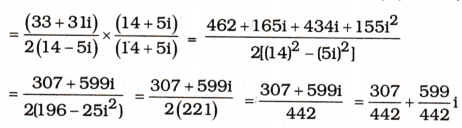
AP Inter 1st Year Maths Exercise 4b Solutions 1
On multiplying the numerator and Denominator by (14 + 5i)
AP Inter 1st Year Maths Exercise 4b Solutions 2
This is the required standard form.

AP Inter 1st Year Maths Exercise 4b Solutions

Question 4.
Let z1 = 2 – i, z1 = -2 + i. Find (i) Re \(\left(\frac{z_1 z_2}{\bar{z}_1}\right)\)
(ii) Im\(\left(\frac{1}{z_1 \bar{z}_1}\right)\)
Solution:
i) It is given that z1 = 2 – i, z2 = -2 + i
z1z2 = (2 – i)(-2 + i)
= -4 + 2i + 2i – i2
= – 4 + 4i – (-1)
= -3 + 4i
Now, z̄1 = 2 + i
Hence, \(\frac{z_1 z_2}{\bar{z}_1}=\frac{-3+4 i}{2+i}\)
On multiplying nummerator and denominator by (2 – i), we obtain
\(\frac{z_1 z_2}{\bar{z}_1}=\frac{(-3+4 i)(2-i)}{(2+i)(2-i)}=\frac{-6+3 i+8 i-4 i^2}{2^2+1}\)
= \(\frac{-6+11 \mathrm{i}-4(-1)}{5}=\frac{-2+11 \mathrm{i}}{5}=\frac{-2}{5}+\frac{11}{5} \mathrm{i}\)
On comparing real parts, we obtain Re\(\left(\frac{z_1 z_2}{\bar{z}_1}\right)=-\frac{2}{5}\)

ii) \(\frac{1}{z_1 \bar{z}_1}=\frac{1}{(2+i)(2-i)}=\frac{1}{(2)^2+(1)}=\frac{1}{5}\)
On comparing imaginary parts, we obtain Im\(\left(\frac{1}{z_1 \bar{z}_1}\right)\) = 0

Question 5.
Find the real numbers x and y if (x – iy) (3 + 5i) is the conjugate of – 6 – 24i
Solution:
Let z = (x – iy) (3 + 5i) = 3x – i3y + i5x – i25y
= 3x + i5x – i3y + 5y
= (3x + 5y) + i(5x – 3y)
Then, z̄ = (3x + 5y) – i(5x – 3y)
It is given that, z̄ = -6 – 24i
Therefore, (3x + 5y) – i(5x – 3y) = -6 – 24i
Equating real and imaginary parts, we obtain
3x + 5y = – 6 ……..(1)
5x – 3y = 24 ……….(2)
Multiplying equation (1) with 3 and equation (2) with 5
we obtain
9x + 15y = -18; 25x – 15y = 120
On adding both the equations we get, 34x = 102
⇒ x = \(\frac{102}{34}\)
⇒ x = 3
Putting the value if x in equation (1) we obtain
3(3) + 5y = – 6
⇒ 5y = -6 – 9
⇒ y = \(\frac{-15}{5}\)
⇒ y = -3
Thus, the values of x = 3 and y = – 3

Question 6.
Find the modulus of \(\frac{1}{2}\).
Solution:
\(\frac{1+i}{1-i}-\frac{1-i}{1+i}=\frac{(1+i)^2-(1-i)^2}{(1-i)(1+i)}=\frac{1+i^2+2 i-1-i^2+2 i}{2}=\frac{4 i}{2}\)
= 2i

Therefore, \(\frac{1+\mathrm{i}}{1-\mathrm{i}}-\frac{1-\mathrm{i}}{1+\mathrm{i}}\) = |2i| = \(\sqrt{2^2}\) = 2

Question 7.
Find the number of ono-zero integral solutions of the equation |1 – i|x = 2x
Solution:
|1 – i|x = 2x
⇒ \(\left(\sqrt{1^2+(-1)^2}\right)^x\) = 2x
⇒ (√2)x = 2x
⇒ 2x/2 = 2x
⇒ \(\frac{x}{2}\) = x
⇒ x = 2x
⇒ 2x – x = 0
⇒ x = 0
Thus, 0 is the only integrak solution of the given equation.
Therefore, the number of non-zero integral solutions of the given equation is 0.

II.

Question 1.
If x – iy = \(\sqrt{\frac{a-i b}{c-i d}}\), prove that (x2 + y2)2 = \(\frac{a^2+b^2}{c^2+d^2}\)
Solution:
x – iy = \(\sqrt{\frac{a-i b}{c-i d}}=\sqrt{\frac{a-i b}{c-i d} \times \frac{c+i d}{c+i d}}=\sqrt{\frac{(a c+b d)+i(a d-b c)}{c^2+d^2}}\)

Squaring on both sides we get
∴ (x – iy)2 = \(\frac{(a c+b d)+i(a d-b c)}{c^2+d^2}\)
⇒ x2 – y2 – 2ixy = \(\frac{(a c+b d)}{c^2+d^2}+i \frac{(a d-b c)}{c^2+d^2}\)

On comparing real and imaginary parts, we obtain
x2 – y2 = \(\frac{a c+b d}{c^2+d^2}\) – 2xy = \(\frac{a d-b c}{c^2+d^2}\) …….. (1)

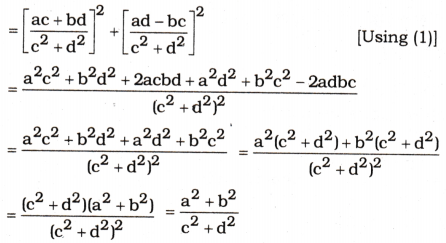
Since (x2 + y2)2 = (x2 – y2)2 + (-2xy)2
AP Inter 1st Year Maths Exercise 4b Solutions 3
Hence Proved.

Question 2.
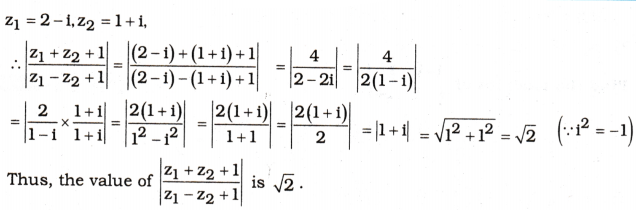
If z1 = 2 – i, z2 = 1 + i, find \(\left|\frac{z_1+z_2+1}{z_1-z_2+1}\right|\)
Solution:
AP Inter 1st Year Maths Exercise 4b Solutions 4

Question 3.
If a + ib = \(\frac{(x+i)^2}{2 x^2+1}\), prove that a2 + b2 = \(\frac{\left(x^2+1\right)^2}{\left(2 x^2+1\right)^2}\)
Solution:
a + ib = \(\frac{(x+i)^2}{2 x^2+1}\)
a + ib = \(\frac{(x+i)^2}{2 x^2+1}=\frac{x^2+i^2+i 2 x}{2 x^2+1}=\frac{x^2-1+i 2 x}{2 x^2+1}=\frac{x^2-1}{2 x^2+1}+i\left(\frac{2 x}{2 x^2+1}\right)\)
On comparing real and imaginary parts
a = \(\frac{x^2-1}{2 x^2+1}\) and b = \(\frac{2 x}{2 x^2+1}\)
Since, a2 + b2 = \(\left(\frac{x^2-1}{2 x^2+1}\right)^2+\left(\frac{2 x}{2 x^2+1}\right)^2\)
= \(\frac{x^4+1-2 x^2+4 x^2}{\left(2 x^2+1\right)^2}=\frac{x^4+1+2 x^2}{\left(2 x^2+1\right)^2}\)

a2 + b2 = \(\frac{\left(x^2+1\right)^2}{\left(2 x^2+1\right)^2}\)
Hence proved.

AP Inter 1st Year Maths Exercise 4b Solutions

Question 4.
If (x + iy)3 = u + iv, then show that \(\frac{1}{2}\) = 4(x2 – y2).
Solution:
It is given that (x + iy)3 = u + iv
⇒ x3 + (iy)3 + 3 × x × iy (x + iy) = u + iv
⇒ x3 + i3y3 + 3x2yi + 3xy2i2 = u + iv
⇒ x3 – iy3 + 3x2yi – 3xy2 = u + iv
⇒ (x3 – 3xy2) + i(3x2y – y3) = u + iv

On equating real and imaginary parts, we obtain u = x3 – 3xy2, v = 3x2y – y3

Therefore, \(\frac{u}{x}+\frac{v}{y}=\frac{x^3-3 x y^2}{x}+\frac{3 x^2 y-y^3}{y}=\frac{x\left(x^2-3 y^2\right)}{x}+\frac{y\left(3 x^2-y^2\right)}{y}\)
= x2 – 3y2 + 3x2 = y2 = 4x2 – y2 = 4(x2 – y2)
Hence, \(\frac{u}{x}+\frac{v}{y}\) = 4(x2 – y2) proved.

Question 5.
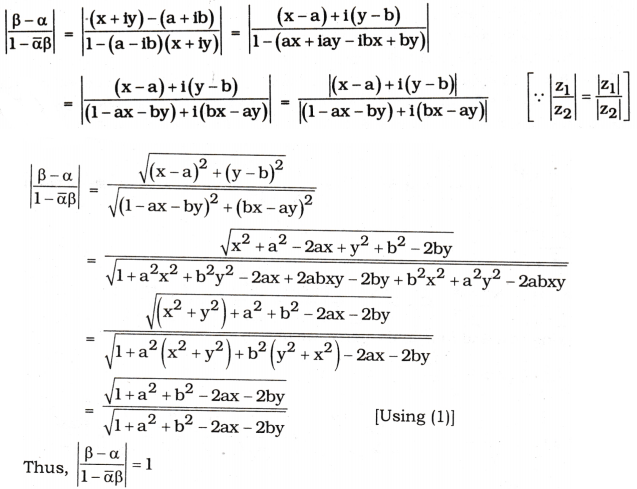
If α and β are different complex numbers with |β| = 1, then find \(\frac{\beta-\alpha}{1-\bar{\alpha} \beta}\).
Solution:
Let α = a + ib and β = x + iy
It is given that, |β| = 1
Therefore, \(\sqrt{x^2+y^2}\) = 1
⇒ x2 + y2 = 1 …………(1)
AP Inter 1st Year Maths Exercise 4b Solutions 5

Question 6.
If (a + ib) (c + id) (e + if) (g + ih) = A + iB, then show that (a2 + b2) (c2 + d2) (e2 + f2) (g2 + h2) = A2 + B2
Solution:
It is given that, (a + ib) (c + id) (e + if) (g + ih) = A + iB
Therefore, |(a + ib) (c + id) (e + if) (g + ih)| = |A + iB|
|(a + ib)| x |(c + id)| x |(e + if )| x |(g + ih)| = |A + iB|
\(\sqrt{a^2+b^2} \times \sqrt{c^2+d^2} \times \sqrt{e^2+f^2} \times \sqrt{g^2+h^2}=\sqrt{A^2+B^2}\)
\(\sqrt{\left(\mathrm{a}^2+\mathrm{b}^2\right)\left(\mathrm{c}^2+\mathrm{d}^2\right)\left(\mathrm{e}^2+\mathrm{f}^2\right)\left(\mathrm{g}^2+\mathrm{h}^2\right)}=\sqrt{\mathrm{A}^2+\mathrm{B}^2}\)
Squaring on both sides, we obtain
(a2 + b2) (c2 + d2) (e2 + f2) (g2 + h2) = A2 + B2
Hence proved.

Question 7.
If \(\left(\frac{1+\mathrm{i}}{1-\mathrm{i}}\right)^{\mathrm{m}}\) = 1, then find the least positive integral value of m.
Solution:
It is given that \(\left(\frac{1+\mathrm{i}}{1-\mathrm{i}}\right)^{\mathrm{m}}\) = 1
⇒ \(\left(\frac{1+\mathrm{i}}{1-\mathrm{i}} \times \frac{1+\mathrm{i}}{1+\mathrm{i}}\right)^{\mathrm{m}}\) = 1

⇒ \(\left(\frac{(1+i)^2}{1^2+1}\right)^{\mathrm{m}}\) = 1

⇒ \(\left(\frac{1^2+i^2+2 i}{2}\right)^m\) = 1

⇒ \(\left(\frac{1-1+2 \mathrm{i}}{2}\right)^{\mathrm{m}}\) = 1

⇒ \(\left(\frac{2 \mathrm{i}}{2}\right)^{\mathrm{m}}\) = 1
⇒ im = 1
⇒ im = 14k
Hence, m = 4k, where k is some integer.
Since, the least positive integer is 1, m = 4 × 1 = 4
Thus, the least positive integral value of m = 4.

Question 8.
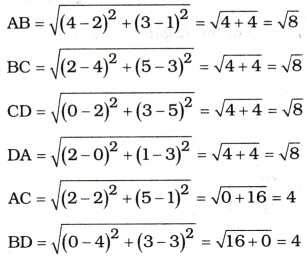
Show that the four points in the Argand plane represented by the complex numbers 2 + i, 4 + 3i, 2 + 5i, 3i are the vertices of a square.
Solution:
Given A = (2 + i) = (2, 1), B = (4 + 3i) = (4, 3), C = (2 + 5i) = (2, 5), D = (3i) = (0, 3)
Distance between two points A(x1, y1) and B(x2, y2) is AB = \(\sqrt{\left(\mathrm{x}_2-\mathrm{x}_1\right)^2+\left(\mathrm{y}_2-\mathrm{y}_1\right)^2}\)
AP Inter 1st Year Maths Exercise 4b Solutions 6
In the square all sides are equal and diagonals are also equal
∴ Given points are the vertices of a square.

Question 9.
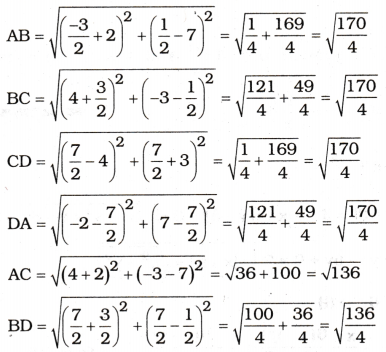
Show that the points in the Argand plane represented by the complex numbers -2 + 7i, – 3i, \(\frac{-3}{2}+\frac{1}{2}\)i, 4 – 3i, \(\frac{7}{2}\)(1+i) are the vertices of a rhombus.
Solution:
A = (-2 + 7i) = (-2, 7)
B = \(\frac{-3}{2}+\frac{1}{2}\)i = (-\(\frac{3}{2}\), \(\frac{1}{2}\)),
C = (4 – 3i) = (4, -3)
D = \(\frac{7}{2}\)(1 + i) = (\(\frac{7}{2}\), \(\frac{7}{2}\))

Distance between two points A(x1, y1) and B(x2, y2) is AB = \(\sqrt{\left(\mathrm{x}_2-\mathrm{x}_1\right)^2+\left(\mathrm{y}_2-\mathrm{y}_1\right)^2}\)
AP Inter 1st Year Maths Exercise 4b Solutions 7
AB = BC = CD = DA and AC ≠ BD
In the rhombus all sides are equal but diagonals are not equal
∴ Given points are the vertices of a rhombus.

Question 10.
The points P, Q denote the complex numbers z1, z2 in the Argand diagram. O is the origin. If z1z̄2 + z̄1z2 = 0 then show that ∠POQ = \(\frac{\pi}{2}\).
Solution:
Let z1 = x1 + iy1, z2 = x2 + iy2 be the points P, Q in the Argand diagram.
z̄1 = x1 – iy1, z̄2 = x2 – iy2
∴ P(x1, y1),Q(x2, y2),O(0,0)
Slope of OP = \(\frac{0-y_1}{0-x_1}=\frac{y_1}{x_1}\)
∵ If A = (x1, y1),B = (x2, y2); Slope of \(\overline{A B}=\frac{y_2-y_1}{x_2-x_1}\)

Slope of OQ= \(\frac{0-y_2}{0-x_2}=\frac{y_2}{x_2}\)
Taking, z1z̄2 + z̄1z2 = 0
⇒ (x1 + iy1) (x2 – iy2) + (x1 – iy1) + (x2 + iy2) = 0
⇒ x1x2 + y1y2 + i(x2y1 – x1y2) + x1x2 + y1y2 + i(x1y2 – x2y1) = 0
⇒ 2(x1x2 + y1y2) = 0
⇒ x1x2 + y1y2 = 0
⇒ y1y2 = -x1x2
⇒ \(\frac{y_1}{x_1} \cdot \frac{y_2}{x_2}\) = -1
Slope of OP × Slope of OQ = -1
⇒ ∠POQ = 90°

AP Inter 1st Year Maths Exercise 4b Solutions

Question 11.
If the complex number z has argument θ, 0 < θ < \(\frac{\pi}{2}\) and satisfy the equation |z – 3i| = 3. Then prove that (cot θ – \(\frac{6}{z}\)) = i
Solution:
Let z = x + iy ⇒ tan θ = \(\frac{y}{x}\) so cot θ = \(\frac{x}{y}\)
Given that |z – 3i| = 3
⇒ |x + iy – 3i| = 3
⇒ |x + i(y – 3)| = 3
⇒ \(\sqrt{x^2+y^2+9-6 y}\) = 3

Squaring both sides
⇒ x2 + y2 – 6y + 9 = 9
⇒ x2 + y2 – 6y = 0 [∵ |x + iy| = \(\sqrt{x^2+y^2}\)]
⇒ x2 + y2 = 6y ……… (1)

Consider (cot θ – \(\frac{6}{z}\)) = \(\frac{x}{y}-\frac{6}{x+i y}=\frac{x}{y}-\frac{6(x-i y)}{x^2+y^2}=\frac{x}{y}-\frac{6(x-i y)}{6 y}\) (∵ from (1))
= \(\frac{6 x-6(x-i y)}{6 y}=\frac{6 i y}{6 y}\) = i

Complex Numbers and Quadratic Equations MCQ AP Inter 1st Year Maths Chapter 4

Practice AP Inter 1st Year Maths Study Material Chapter 4 Complex Numbers and Quadratic Equations MCQ to identify your strengths and weak areas.

AP Inter 1st Year Maths Complex Numbers and Quadratic Equations MCQ

Question 1.
The value of i-999 is
(1) 1
(2) -1
(3) i
(4) -i
Answer:
(3) i

Explanation:
i-999 = \(\frac{1}{i^{999}}=\frac{1}{i^3 i^{996}}=\frac{1}{-i \cdot\left(i^4\right)^{249}}=\frac{-1}{i}\)
= i

Question 2.
The multiplicative inverse of 1 + i is
(1) \(\frac{1}{2}\)(1 – i)
(2) \(\frac{1}{2}\)(1 + i)
(3) 1 – i
(4) i
Answer:
(1) \(\frac{1}{2}\)(1 – i)

Explanation:
Multiplicative inverse of 1 + i = \(\frac{1}{1+i}=\frac{1}{1+i} \times \frac{1-i}{1-i}=\frac{1-i}{1+1}=\frac{1}{2}\)
= \(\frac{1}{2}\)(1 – i)

Complex Numbers and Quadratic Equations MCQ AP Inter 1st Year Maths Chapter 4

Question 3.
The modulus of 5 + 4i is
(1) 41
(2) -41
(3) \(\sqrt{41}\)
(4) \(\sqrt{-41}\)
Answer:
(3) \(\sqrt{41}\)

Explanation:
|5 + 4i| = \(\sqrt{5^2+4^2}=\sqrt{25+16}=\sqrt{41}\)

Question 4.
The value of \(\sqrt{-25}\) \(\sqrt{-9}\) is
(1) 15
(2) -15
(3) 15i
(4) None of these
Answer:
(2) -15

Explanation:
\(\frac{1}{2}\)
= 5i × 3i
= 15i2
= – 15

Question 5.
The Conjugate of \(\frac{2-i}{1-2 i}\) is
(1) \(\frac{4+3 i}{5}\)
(2) 4 – 3i
(3) \(\frac{4-3 i}{5}\)
(4) 1
Answer:
(3) \(\frac{4-3 i}{5}\)

Explanation:
Conjugate of z = z̄; z = \(\frac{2-i}{1-2 i}\)
z̄ = \(\frac{2-i}{1-2 i}=\frac{2+i}{1+2 i}=\frac{2+i}{1+2 i} \times \frac{1-2 i}{1-2 i}\)
= \(\frac{2-4 i+i-2 i^2}{1+4}=\frac{4-3 i}{5}\)

Question 6.
The value of (z + 3)(z̄ + 3) is equivalent to
(1) |z + 3|2
(2) |z – 3|
(3) z2 + 3
(4) None of these
Answer:
(1) |z + 3|2

Explanation:
(z + 3)\((\overline{z+3})\) = |z + 3|2 [∵ z.z̄ = |z|2]

Question 7.
Let x, y ∈ R, then x + iy is a non-real complex number if
(1) x = 0
(2) y = 0
(3) x ≠ 0
(4) None of these
Answer:
(4) None of these

Explanation:
y ≠ 0

Question 8.
If a + ib = c + id then
(1) a2 + c2 = 0
(2) b2 + c2 = 0
(3) b2 + d2 = 0
(4) a2 + b2 = c2 + d2
Answer:
(4) a2 + b2 = c2 + d2

Explanation:
a + ib = c + id
⇒ a = c, b = d
⇒ a2 = c2, b2 = d2
⇒ a2 + b2 = c2 + d2

Question 9.
The sum of the series i + i2 + i3 + ……………. upto 1000 terms is
(1) 1
(2) 0
(3) -1
(4) -2
Answer:
(2) 0

Explanation:
i + i2 + i3 + ……………. upto 1000 terms
= \(\frac{i\left(i^{1000}-1\right)}{i-1}=\frac{i\left(\left(i^4\right)^{250}-1\right)}{i-1}\)
= \(\frac{i(1-1)}{i-1}\) = 0

Complex Numbers and Quadratic Equations MCQ AP Inter 1st Year Maths Chapter 4

Question 10.
The complex number z which satisfies the condition \(\left|\frac{\mathrm{i}+\mathrm{z}}{\mathrm{i}-\mathrm{z}}\right|\) = 1 lies on
1) Circle x2 + y2 = 1
2) The X-axis
3) The Y-axis
4) The line x + y = 1
Answer:
2) The X-axis

Explanation:
Given \(\left|\frac{\mathrm{i}+\mathrm{z}}{\mathrm{i}-\mathrm{z}}\right|\) = 1
⇒ |i + z| = |i – z|
⇒ |x + iy + i| = |i – (x + iy)|
⇒ x2 + (1 + y)2 = x2 + (1 – y)2
⇒ 1 + y2 + 2y = 1 + y2 – 2y
⇒ 4y = 0
⇒ y = 0
Which is the X-axis.
∴ Locus of z lies on the X-axis

AP Inter 1st Year Maths Exercise 4c Solutions

Referring to the AP Inter 1st Year Maths Study Material Chapter 4 Complex Numbers and Quadratic Equations Exercise 4c Solutions makes it easier to understand complex problems.

AP Inter 1st Year Maths Complex Numbers and Quadratic Equations Solutions Exercise 4c

I. Find the modulus and the arguments of each of the complex numbers in Exercises 1 to 2.

Question 1.
z = – 1 – i√3
Solution:
Given that z = -1 – i√3
Let r cos θ = -1 and r sin θ = -√3
Squaring and adding, we obtain (rcos θ)2 + (rsin θ)2 = (-1)2 + (-√3)2
⇒ r2 (cos θ)2 + (rsin θ)2 = (-1)2 + (√3)2
⇒ r2(cos2θ + sin2θ) = 1 + 2
⇒ r2 = 4 [∵ cos2θ + sin2θ = 1]
⇒ r = √4 = 2 [∵ Conventionally, r > 0]
Therefore, Modulus = 2
Hence, 2cos θ = -1 and 2 sin θ = -√3
⇒ cos θ = \(\frac{1}{2}\) and sin θ = –\(\frac{\sqrt{3}}{2}\)
Since both the values of sin 0 and cos 0 are negative in III quadrant.
Argument = -(π – \(\frac{\pi}{3}\)) = \(\frac{-2 \pi}{3}\)
Thus, the modulus and argument of the complex number -1 – i√3 are 2 and \(\frac{-2 \pi}{3}\) respectively.

Question 2.
z = -√3 + i
Solution:
Given that z = -√3 + i
Let r cos θ = -√3 and r sin θ = 1
On squaring and adding, we obtain
r2 cos2θ + r2 sin2θ = (-√3)2 + 12
⇒ r2 = 3 + 1 = 4 [∵ cos2θ + sin2θ = 1]
⇒ r = √4 = 2 [∵ Conventionally, r > 0]
Therefore, Modulus = 2, Hence, 2 cos θ = -√3 and 2 sin θ = 1
⇒ cos θ = \(-\frac{\sqrt{3}}{2}\) and sin θ = \(\frac{1}{2}\)
Since, θ lies in the quadrant II, θ = π – \(\frac{\pi}{6}=\frac{5 \pi}{6}\)
Thus, the modulus and argument of the complex number – √3 + i are 2 and \(\frac{5 \pi}{3}\) respectively.

Convert each of the complex numbers given in exercises 3 to 8 in the polar form.

Question 3.
1 – i
Solution:
Given that z = 1 – i.
Let r cos θ = 1 and r sin θ = -1
On squaring and adding, we obtain
r2 cos2θ + r2 sin2θ = 12 + (-1)2
⇒ r2 (∵ cos2θ + sin2θ) = 1 + 1
⇒ r2 = 2
⇒ r = √2 [∵ Conventionally, r > 0]
Since, 0 lies in the IV quadrant θ = \(\left(\frac{-\pi}{4}\right)\)
Hence, 1 – i = r cos θ + ir sin θ
= √2cos \(\left(\frac{-\pi}{4}\right)\) + i sin\(\left(\frac{-\pi}{4}\right)\)
= √2[cos\(\left(\frac{-\pi}{4}\right)\) + isin\(\left(\frac{-\pi}{4}\right)\)]
Thus, this is the required polar form.

AP Inter 1st Year Maths Exercise 4c Solutions

Question 4.
-1 + i
Solution:
Given that z = -1 + i.
Let r cos θ = -1 and r sin θ = 1
On squaring and adding, we obtain r2 cos2θ + r2 sin2θ = (- 1)2 + 12
⇒ r2(cos2θ + sin2θ) = 1 + 1
⇒ r2 = 2
⇒ r = √2 [∵ Conventionally, r > 0]
Therefore,√2cos θ = -1 and √2 sin θ = 1
⇒ cos θ = –\(\frac{1}{\sqrt{2}}\) and sin θ = \(\frac{1}{\sqrt{2}}\)
Since, θ lies in the II quadrant, θ = π – \(\frac{\pi}{4}=\frac{3 \pi}{4}\)
⇒ r2 (cos2θ + sin2θ) = 1 + 1
Hence, -1 – i = r cos θ + i r sin θ = √2 cos \(\frac{-3 \pi}{4}\) + i √2 sin \(\frac{-3 \pi}{4}\)
= √2(cos \(\frac{-3 \pi}{4}\) + i sin \(\frac{-3 \pi}{4}\))
Thus, this is the required polar form.

Question 5.
-1 -i ,
Solution:
Given that z = -1 – i.
Let r cos θ = – 1 and r sin θ = -1
On squaring and adding, we obtain
r2 cos2 θ + r2 sin2θ = (- 1)2 + (- 1)2
Therefore, √2 cos θ = -1 and √2 sin θ = -1
⇒ cos θ = \(\\frac{-1}{\sqrt{2}}\) and sin θ = \(\frac{-1}{\sqrt{2}}\)
Hence, -1 – i = r cos θ + i r sin θ
= √2 cos \(\frac{-3 \pi}{4}\) + i 2 sin\(\frac{-3 \pi}{4}\)
= √2(cos \(\frac{-3 \pi}{4}\) + is sin \(\frac{-3 \pi}{4}\))
Thus, this is the required polar form.

Question 6.
-3
Solution:
Given that z = -3.
Let r cos θ = -3 and r sin θ = 0
On squaring and adding, we obtain
r2 cos2θ + r2 sin2θ = (- 3)2 + (0)2
⇒ r2 (cos2θ + sin2θ) = 9 + 0
⇒ r2 = 9
⇒ r = 3 [∵ Conventionally, r > 0]
Therefore, 3 cos θ = – 3 and 3 sin θ = 0
⇒ cos θ = – 1 and sin θ = 0.
Since, θ lies in the II quadrant, θ = n
Hence, – 3 = r cos θ + ir sin θ = 3 cos π + i3 sin π = 3(cos π + i sin π)
Thus, this is the required polar form.

Question 7.
√3 + i
Solution:
Given that z = √3 + i
Let r cos θ = √3 and r sin θ = 1
On squaring and adding, we obtain
r2 cos2θ + r2 sin2θ = (^3 )2 + 12
⇒ r2 (cos20 + sin20) = 3+l
⇒ r2 = 4
⇒ r = √4 = 2 [∵ Conventionally, r > 0]
Therefore, 2 cos θ = √3 and 2 sin θ = 1
⇒ cos θ = \(\frac{\sqrt{3}}{2}\) and sin θ = \(\frac{1}{2}\)
Since, θ lies in I quadrant, θ = \(\frac{\pi}{6}\)
Hence, √3+ 1 = r cos θ + ir sin θ = 2cos \(\frac{\pi}{6}\) + i2 sin \(\frac{\pi}{6}\) = 2(cos \(\frac{\pi}{6}\) + isin \(\frac{\pi}{6}\))
Thus, this is the required polar form.

AP Inter 1st Year Maths Exercise 4c Solutions

Question 8.
i
Solution:
Given that z = i
Let r cos θ = 0 and r sin θ = 1
On squaring and adding, we obtain
r2 cos2θ + r2 sin2θ = (√3 )2 + 12
⇒ r2 (cos2θ + sin2θ) = 1
⇒ r2 = 1
⇒ r = √1 =1 [∵ Conventionally, r > 0]
Therefore, cos θ = 0 and sin θ = 1
Since, θ lies in the I quadrant, θ = \(\frac{\pi}{2}\)
Hence, i = r cos θ + ir sin θ = cos \(\frac{\pi}{2}\) + i sin \(\frac{\pi}{2}\)
Thus, this is the required polar form.

AP Inter 1st Year Maths Exercise 4d Solutions

Referring to the AP Inter 1st Year Maths Study Material Chapter 4 Complex Numbers and Quadratic Equations Exercise 4d Solutions makes it easier to understand complex problems.

AP Inter 1st Year Maths Complex Numbers and Quadratic Equations Solutions Exercise 4d

I. Solve each of the following equations.

Question 1.
x2 + 3 = 0
Solution:
The given quadratic equation is x2 + 3 = 0
On comparing the given equation with ax2 + bx + c = 0,
We obtain a = 1, b = 0 and c = 3
Therefore, the discriminant of the given equation is
D = b2 – 4ac = 02 – 4 × 1 × 3 = – 12
Therefore, the required solutions are

Question 2.
2x2 + x + 1 = 0
Solution:
The given quadratic equation is 2x2 + x + 1 = 0
On comparing the given equation with ax2 + bx + c = 0,
We obtain a = 2, b = 1 and c = 1
Therefore, the discriminant of the given equation is
D = b2 – 4ac = 12 – 4 × 2 × 1 × = -7
Therefore, the required solutions are
\(\frac{-b \pm \sqrt{D}}{2 a}=\frac{-1 \pm \sqrt{-7}}{2 \times 2}=\frac{-1 \pm \sqrt{7} i}{4}\) [∵ √-1 = i]

Question 3.
x2 + 3x + 9 = 0
Solution:
The given quadratic equation is x2 + 3x + 9 = 0
On comparing the given equation with ax2 + bx + c = 0,
We obtain a = 1, b = 3 and c = 9
Therefore, the discriminant of the given equation is
D = b2 – 4ac = 32 – 4 × 1 × 9 = -27
Therefore, the required solutions are
\(\frac{-b \pm \sqrt{D}}{2 a}=\frac{-3 \pm \sqrt{-27}}{2 \times 1}=\frac{-3 \pm 3 \sqrt{-3}}{2}=\frac{-3 \pm 3 \sqrt{3} i}{2}\) [∵ √-1 = i]

AP Inter 1st Year Maths Exercise 4d Solutions

Question 4.
-x2 + x – 2 = 0
Solution:
The given quadratic equation is -x2 + x – 2 = 0
On comparing the given equation with ax2 + bx + c = 0,
We obtain a = -1, b = 1 and c = -2
Therefore, the discriminant of the given equation is
D = b2 – 4ac = 12 – 4 × (-1) × (-2) = -7
Hence, the required solutions are
\(\frac{-b \pm \sqrt{D}}{2 a}=\frac{-1 \pm \sqrt{-7}}{2 \times(-1)}=\frac{-1 \pm \sqrt{7} i}{-2}\) [∵ √-1 = i]

Question 5.
x2 + 3x + 5 = 0
Solution:
The given quadratic equation is x2 + 3x + 5 = 0
On comparing the given equation with ax2 + bx + c = 0,
We obtain a = 1, b = 3 and c = 5
Therefore, the discriminant of the given equation is D = b2 – 4ac = 32 – 4 × 1 × 5 = -11
Hence, the required solutions are
\(\frac{-\mathrm{b} \pm \sqrt{\mathrm{D}}}{2 \mathrm{a}}=\frac{-3 \pm \sqrt{-11}}{2 \times 1}=\frac{-3 \pm \sqrt{11} \mathrm{i}}{2}\) [∵ √-1 = i]

Question 6.
x2 – x + 2 = 0
Solution:
The given quadratic equation is x2 – x + 2 = 0
On comparing the given equation with ax2 + bx + c = 0,
We obtain a = 1, b = -1 and c = 2
Therefore, the discriminant of the given equation is
D = b2 – 4ac = (-1)2 – 4 × 1 × 2 = -7
Hence, the requird solutions are
\(\frac{-b \pm \sqrt{D}}{2 a}=\frac{-1(-1) \pm \sqrt{-7}}{2 \times 1}=\frac{1 \pm \sqrt{7} i}{2}\) [∵ √-1 = i]

Question 7.
√2x2 + x + √2 = 0
Solution:
The given quadratic equation is √2x2 + x + √2 = 0
On comparing the given equation with ax2 + bx + c = 0,
We obtain a = 72 , b = 1 and c = 72
Therefore, the discriminant of the given equation is
D = b2 – 4ac = (-1)2 – 4 × √2 × √2 = -7
Hence, the required solutions are
\(\frac{-b \pm \sqrt{D}}{2 a}=\frac{-1 \pm \sqrt{-7}}{2 \times \sqrt{2}}=-\frac{1 \pm \sqrt{7} i}{2 \sqrt{2}}\) [∵ √-1 = i]

Question 8.
√3x2 – √2x + 3√3 = 0
Solution:
The given quadratic equation is √3x2 – √2x + 3√3 = 0
comparing the given equation with ax2 + bx + c = 0,
We obtain a = √3 , b = -√2 and c = 375
Therefore, the discriminant of the given equation is
D = b2 – 4ac = (-√2)2 – 4 × (√3) × (3√3) = -34
Hence, the required solutions are
\(\frac{-\mathrm{b} \pm \sqrt{\mathrm{D}}}{2 \mathrm{a}}=\frac{-(-\sqrt{2}) \pm \sqrt{-34}}{2 \times \sqrt{3}}=\frac{\sqrt{2} \pm \sqrt{34} \mathrm{i}}{2 \sqrt{3}}\) [∵ √-1 = i]

Question 9.
x2 + x + \(\frac{1}{\sqrt{2}}\) = 0
Solution:
This equation can also be written as x2 + x + \(\frac{1}{\sqrt{2}}\)= 0
On comparing the given equation with ax2 + bx + c = 0,
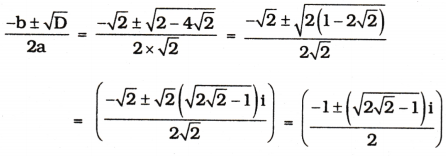
We obtain a = √2 , b = √2 and c = 1
Therefore, the discriminant of the given equation is
D = b2 – 4ac = (√2)2 – 4 × (√5) × 1 = 2 – 4√2
Hence, the required solutions are
AP Inter 1st Year Maths Exercise 4d Solutions 1

AP Inter 1st Year Maths Exercise 4d Solutions

Question 10.
x2 + \(\frac{\mathbf{x}}{\sqrt{2}}\) + 1 = o
Solution:
The given quadratic equation is x2 + \(\frac{\mathbf{x}}{\sqrt{2}}\) + 1 = 0
75
This equation can also be written as x2 + \(\frac{\mathbf{x}}{\sqrt{2}}\) + 1 = o
On comparing the given equation with ax2 + bx + c = 0,
We obtain a = √5, b = 1 and c = √2
Therefore, the discriminant of the given equation is
D = b2 – 4ac = (1)2 – 4 × (√2) × (√2) = 1 – 8 = -7
Hence, the required solutions are
\(\frac{-b \pm \sqrt{D}}{2 a}=\frac{-1 \pm \sqrt{-7}}{2 \times \sqrt{2}}=\frac{-1 \pm \sqrt{7} i}{2 \sqrt{2}}\)

AP Inter 1st Year Maths Exercise 4a Solutions

Referring to the AP Inter 1st Year Maths Study Material Chapter 4 Complex Numbers and Quadratic Equations Exercise 4a Solutions makes it easier to understand complex problems.

AP Inter 1st Year Maths Complex Numbers and Quadratic Equations Solutions Exercise 4a

I. Express each of the complex number given in the exercises 1 to 10 in the form a + ib.

Question 1.
(5i) (-\(\frac{3}{5}\)i)
Solution:
(5i) (-\(\frac{3}{5}\)i)
= -5i × \(\frac{3}{5}\) × i
= -3i2 [∵ i2 = -1]
= -3(-1) = 3
= 3 + i0

Question 2.
i9 + i19
Solution:
i9 + i19
= i9 + i10.i9
= i9[1 + (i2)5]
= i9(1 – 1)
= 0 = 0 + i0

Question 3.
i-39
Solution:
i-39 = i4×(-9)-3
= (i4)-9 × i-3
= (1)-9 × i-3 [∵ i4 = 1]
= \(\frac{1}{i^3}=\frac{1}{-i}\) [∵ i3 = -i]
= \(\frac{-1}{i} \times \frac{i}{i}=-\frac{i}{i^2}=\frac{-i}{-1}\) [∵ i2 = -1]
= i
= 0 + i [∵ i2 = -1]

AP Inter 1st Year Maths Exercise 4a Solutions

Question 4.
3(7 + i7) + i(7 + i7)
Solution:
3(7 + i7) + i(7 + i7)
= 21 + 21i + 7i + 7i2
= 21 + 28i + 7 × (-1)
= 14 + 28i [∵ i2 = -1]

Question 5.
(1 – i) – (-1 + i6)
Solution:
(1 – i) – (-1 + i6)
= 1 – i + 1 – 6i
= 2 – 7i

Question 6.
(\(\frac{1}{5}\) + i\(\frac{2}{5}\)) – (4 + i\(\frac{5}{2}\))
Solution:
(\(\frac{1}{5}\) + i\(\frac{2}{5}\)) – (4 + i\(\frac{5}{2}\))
= \(\frac{1}{5}\) + \(\frac{2}{5}\)i – 4 – \(\frac{5}{2}\)i
= (\(\frac{1}{5}\) – 4) + i(\(\frac{2}{5}\) – \(\frac{5}{2}\))
= \(\left(-\frac{19}{5}\right)\) + i\(\left(-\frac{21}{10}\right)\)
= \(\frac{19}{5}\) – i\(\frac{21}{10}\)

Question 7.
[(\(\frac{1}{3}\) + i\(\frac{7}{3}\)) + (4 + i\(\frac{1}{3}\))] – (-\(\frac{4}{3}\) + i)
Solution:
[(\(\frac{1}{3}\) + i\(\frac{7}{3}\)) + (4 + i\(\frac{1}{3}\))] – (-\(\frac{4}{3}\) + i)
= \(\frac{1}{2}\) + i + 4 + \(\frac{1}{3}\)i + \(\frac{4}{3}\) – i
= (\(\frac{1}{3}\) + 4 + \(\frac{4}{3}\)) + i(\(\frac{7}{3}\) + \(\frac{1}{3}\) – 1)
= \(\frac{17}{3}\) + i\(\frac{5}{3}\)

Question 8.
(1 – i)4
Solution:
(1 – i)4 = [(1 – i)2]2
= [i2 + i2 – 2i]2
= [1 – 1 – 2i]2
= [-2i]2 = 4i2
= -4
= -4 + 0i [∵ i2 = -1]

Question 9.
(\(\frac{1}{3}\) + 3i)3
Solution:
(\(\frac{1}{3}\) + 3i)3 = (\(\frac{1}{3}\))3 + (3i)3 + 3\(\frac{1}{2}\)(3i)(\(\frac{1}{2}\) + 3i)
= \(\frac{1}{27}\) + 27i3 + 3i(\(\frac{1}{3}\) + 3i)
= \(\frac{1}{27}\) + 27(-i) + i + 9i2 (∵ i3 = -i)
= \(\frac{1}{27}\) – 27i + i – 9i (∵ i2 = -1)
= (\(\frac{1}{27}\) – 9) – 26i
= –\(\frac{242}{27}\) – 26i

Question 10.
(-2 – \(\frac{1}{3}\)i)3
Solution:
(-2 – \(\frac{1}{3}\)i)3
= (-1)3 × (2 + \(\frac{1}{3}\)i)3
= -[23 + (\(\frac{i}{3}\))3 + 3(2)(\(\frac{i}{3}\))(2 + \(\frac{i}{3}\))]
= -[8 + \(\frac{1}{2}\) +2i (2 + \(\frac{1}{3}\))]
= -[8 – \(\frac{i}{27}\) + 4i + \(\frac{2}{3}\)i2] [∵ i3 = -1]
= -[8 – \(\frac{1}{27}\) + 4i – \(\frac{2}{3}\)]
= –\(\left[\frac{22}{3}+\frac{107 \mathrm{i}}{27}\right]\)
= –\(\frac{22}{3}\) – i\(\frac{107}{27}\)

Find the multiplicative inverse of each of the complex numbers given in Exercises 11 to 13.

Question 11.
4 – 3i
Solution:
Let z = 4 – 3i .
Then, z̄ = 4 + 3i and |z|2 = 42 + (-3)2 = 16 + 9 = 25
Therefore, the multiplicative inverse of 4 – 3i is given by
z-1 = \(\frac{\bar{z}}{|z|^2}=\frac{4+3 i}{25}\)
= \(\frac{4}{25}\) + i\(\frac{3}{25}\)

Question 12.
√5 + 3i
Solution:
Let z̄ = √5 + 3i
Then, z̄ = √5 – 3i and |z|2 = (√5) + 32 = 5 + 9 = 14
Therefore, the multiplicative inverse of √5 + 3i is given by
z-1 = \(\frac{\bar{z}}{|z|^2}=\frac{\sqrt{5}-3 i}{14}=\frac{\sqrt{5}}{14}-\frac{3}{14} i\)

AP Inter 1st Year Maths Exercise 4a Solutions

Question 13.
-i
Solution:
Let z = -i
Let z = i and |z|2 = 12 = 1.
Therefore the multiplicative inverse of -i is given by, z-1 = \(\frac{\bar{z}}{|z|^2}=\frac{i}{1}\) = 0 + i(1)

II.

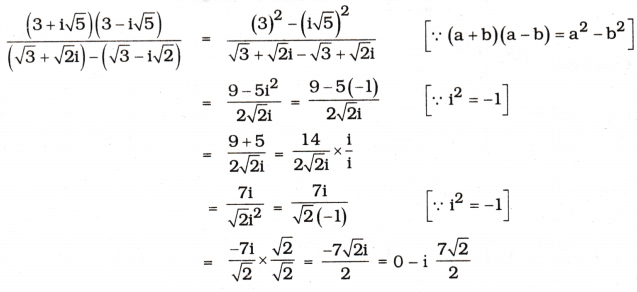
Question 1.
Express the following expression in the form of a + ib.
\(\frac{(3+i \sqrt{5})(3-i \sqrt{5})}{(\sqrt{3}+\sqrt{2} i)-(\sqrt{3}-i \sqrt{2})}\)
Solution:
AP Inter 1st Year Maths Exercise 4a Solutions 1

Statistics MCQ AP Inter 1st Year Maths Chapter 13

Practice AP Inter 1st Year Maths Study Material Chapter 13 Statistics MCQ to identify your strengths and weak areas.

AP Inter 1st Year Maths Statistics MCQ

Question 1.
The range of the following data (marks scored by 10 students in mathematics) is 15, 20, 31, 62, 13, 6, 41, 86, 21, 74 is
1) 68
2) 56
3) 80
4) 71
Answer:
3) 80

Explanation:
Max = 86; Min = 6
Range = Max – Min = 86 – 6 = 80

Question 2.
In a test match two batsmen A and B scored 116, 2 and 76, 138 in two innings respectively. Whose score is more scattered ?
1) A
2) B
3) Can’t say
4) Equal
Answer:
1) A

Explanation:
A’s mean = \(\frac{(116+2)}{2}\) = 59;
B’s mean = \(\frac{(76+138)}{2}\) = 107

⇒ A : deviation from mean = |116 – 59| = 57, |2 – 59| = 57
⇒ B : deviation from mean = |76 – 107| = 31, |138 – 107| = 31
So, A has larger deviation ⇒ more scattered.

Question 3.
The formula \(\frac{1}{N} \sum_{i=1}^n\) fi|xi – x̄| is used to calculate which of the following dispersion?
1) Mean deviation
2) Standard deviation ( 1 )
3) Range
4) Q.D
Answer:
1) Mean deviation

Explanation:
The formula : This formula calculates the Mean Deviation from the mean.

Statistics MCQ AP Inter 1st Year Maths Chapter 13

Question 4.
Which of the following formula is used to measure mean deviation for grouped data about median?
(1) \(\sum_{i=1}^{\mathrm{n}}\)fi|xi – x̄|
(2) \(\frac{1}{N_i} \sum_{i=1}^n\)fi|xi – x̄|
(3) \(\frac{1}{N_i} \sum_{i=1}^n\)fi|xi – M|
(4) \(\frac{1}{N_i} \sum_{i=1}^n\)|xi – M|
Answer:
(3) \(\frac{1}{N_i} \sum_{i=1}^n\)fi|xi – M|

Explanation:
Formula for mean deviation for grouped data about median is
\(\frac{1}{N_i} \sum_{i=1}^n\)fi|xi – M|

Question 5.
Standard deviation of a discrete frequency distribution is meansured by using
(1) \(\frac{1}{N} \sqrt{\sum_{i=1}^n f_i\left(x_i-\bar{x}\right)^2}\)
(2) \(\sqrt{\sum_{i=1}^n\left(x_i-\bar{x}\right)^2}\)
(3) \(\sqrt{\frac{1}{N_1} \sum_{1=1}^n f_1\left(x_1-\bar{x}\right)^2}\)
(4) \(\sqrt{\frac{1}{\mathrm{~N}_{\mathrm{i}}} \sum_{\mathrm{i}=1}^{\mathrm{n}} \mathrm{f}_1\left(\mathrm{x}_{\mathrm{i}}-\overline{\mathrm{x}}\right)}\)
Answer:
(3) \(\sqrt{\frac{1}{N_1} \sum_{1=1}^n f_1\left(x_1-\bar{x}\right)^2}\)

Explanation:
Standard deviation formula: \(\sqrt{\frac{1}{N_1} \sum_{1=1}^n f_1\left(x_1-\bar{x}\right)^2}\)

Question 6.
If each observation is multiplied by a constant k (≠ 0), the variance of the resulting observations becomes times the original variance ( 4 )
1) k (remains unchanged)
2) √k
3) k3
4) k2
Answer:
4) k2

Explanation:
New variance = k2 × original variance

Question 7.
The variance of 20 observations is 5. If each observation is added by 3 then the new variance of the resulting observations.
1) 5
2) 8
3) 15
4) 9
Answer:
1) 5

Explanation:
Adding (or) subtracting a constant doesn’t change variance.

Question 8.
Mean of the squares of the deviations from mean is known as ( 4 )
1) Mean deviation
2) Standard deviation
3) Quartile deviation
4) Variance
Answer:
4) Variance

Explanation:
This is the variance by defintion.

Question 9.
Relation between the Mean deviation and the Standard deviation is ( 2 )
1) σ ≤ MD
2) MD ≤ σ
3) σ ≤ \(\sqrt{MD}\)
4) σ2 ≤ \(\sqrt{MD}\)
Answer:
2) MD ≤ σ

Explanation:
The relation between mean deviation (MD) and Standard Deviation is always MD ≤ a

Statistics MCQ AP Inter 1st Year Maths Chapter 13

Question 10.
The sum of 10 items is 12 and the sum of their squares is 18. The standard deviation is
(a) \(\frac{4}{5}\)
(b) \(\frac{3}{5}\)
(c) \(\frac{2}{5}\)
(d) \(\frac{1}{5}\)
Answer:
Mean x̄ = \(\frac{12}{10}\) = 1.2
Variance : \(\frac{1}{10}\) Σx2= \(\frac{18}{10}\) – (1.2)2
= 1.8 – 1.44
= 0.36.
Standard deviation = \(\sqrt{0.36}\) = 0.6 = \(\frac{3}{5}\),

AP Inter 1st Year Maths Exercise 13c Solutions

Referring to the AP Inter 1st Year Maths Study Material Chapter 13 Statistics Exercise 13c Solutions makes it easier to understand complex problems.

AP Inter 1st Year Maths Statistics Solutions Exercise 13c

Question 1.
The mean and variance of eight observations are 9 and 9.25 respectively. If six of the observations are 6, 7, 10, 12, 12 and 13, find the remaining two observations.
Solution:
Let the remaining two observations be x and y.
Therefore, the observations are 6, 7, 10, 12, 12, 13, x, y
Mean x̄ = \(\frac{6+7+10+12+12+13+x+y}{8}\) = 9
⇒ 60 + x + y = 72
⇒ x + y = 12 ………(1)
Variance = 9.25 = \(\frac{1}{\mathrm{n}} \sum_{\mathrm{i}=1}^8\)(xi – x̄)2
9.25 = \(\frac{1}{8}\)[(-3)2 + (-2)2 + (1)2 + (3)2 + (3)2 + (4)2 + x2 + y2 – 2 × 9(x + y) + 2(9)2]
9.25 = \(\frac{1}{8}\)[9 + 4 + 1 + 9 + 9 + 16 + x2 + y2 – 18(12) + 162] ………..[Using (1)]
9.25= \(\frac{1}{8}\)[48 + x2 + y2 – 216 + 162]
9.25 = \(\frac{1}{8}\)[x2 + y2 – 6]
⇒ x2 + y2 = 80 …. (2)

From (1), we obtain (x + y)2 = (12)2
⇒ x2 + y2 + 2xy = 144
From (2) and (3), we obtain 2xy = 64
Subtracting (4) from (2), we obtain
x2 + y2 – 2xy = 80 – 64 = 16
⇒ x – y = ±4
Therefore, from (1) and (5), we obtain x = 8 and y = 4, when x – y = 4 x = 4 and y = 8, when x – y = – 4 Thus, the remaining observations are 4 and 8.

Question 2.
The mean and variance of 7 observations are 8 and 16, respectively. If five of the observations are 2, 4, 10, 12 and 14. Find the remaining two observations.
Solution:
Let the remaining two observations be x and y.
The observations are 2, 4, 10, 12, 14, x, y.
i.e Mean, x̄ = \(\frac{2+4+10+12+14+x+y}{7}\)
⇒ 56 = 42 + x + y
⇒ x + y = 14 ………..(1)

Variance = 16 = \(\frac{1}{n} \sum_{i=1}^7\left(x_i-\bar{x}\right)^2\)
16 = \(\frac{1}{7}\)[36 + 16 + 4 +16 + 36 + x2 + y2 – 16(x + y) + 2(64)]
16 = \(\frac{1}{7}\) [36 + 16 + 4 + 16 + 36 + x2 + y2 – 16(14) + 2(64)]
16 = \(\frac{1}{7}\)[108 + x2 + y2 – 224 + 128]
16 = \(\frac{1}{7}\)[12 + x2 + y2]
⇒ x2 + y2 = 112 – 12
⇒ x2 + y2 = 100
From (1), we obtain x2 + y2 + 2xy = 196
From (2) and (3), we obtain 2xy = 196 – 100
⇒ 2xy = 96 …. (4)
Subtracting (4) from (2), we obtain x2 + y2 – 2xy = 100 – 96
⇒ (x – y)2 = 4 ⇒ x – y = ±2 ….(5)
Therefore, from (1) and (5), we obtain
x = 8 and y = 6 when x – y = 2; x = 6 and y = 8 when x – y = – 2
Thus, the remaining observations are 6 and 8.

AP Inter 1st Year Maths Exercise 13c Solutions

Question 3.
The mean and standard deviation of six observations are 8 and 4, respectively. If each observation is multiplied by 3, find the new mean and new standard deviation of the resulting observations.
Solution:
Let the observations be x1, x2, x3, x4, x5 and x6
It is given that mean is 8 and standard deviation is 4.
Mean x̄ = \(\frac{x_1+x_2+x_3+x_4+x_5+x_6}{6}\) …. (1)
If each observation is multiplied by 3 and the resulting observation be y., then
yi = 3xi ⇒ xi = \(\frac{1}{3}\)yi, for i = 1 to 6
New Mean ȳ = \(\frac{y_1+y_2+y_3+y_4+y_5+y_6}{6}=\frac{3\left(x_1+x_2+x_3+x_4+x_5+x_6\right)}{6}\)
= 3 × 8 = 24 ……….. [using (1)]
Standard deviation σ = \(\sqrt{\frac{1}{\mathrm{n}} \sum_{\mathrm{i}=1}^6\left(\mathrm{x}_{\mathrm{i}}-\overline{\mathrm{x}}\right)^2}\)
⇒ (4)2 = \(\frac{1}{6} \sum_{i=1}^6\)(xi – x̄)2

From (1) and (2), it can be observed that, ȳ = 3x̄ ⇒ x̄ = \(\frac{1}{3}\) ȳ
Substituting the values of xi and x̄ in (2), we obtain
\(\sum_{i=1}^6\left(\frac{1}{3} y_i-\frac{1}{3} \bar{y}\right)^2\) = 96 ⇒ \(\sum_{\mathrm{l}=1}^6\)(yi – ȳ)2 = 864

Therefore, variance of new observations = (\(\frac{1}{6}\) × 864) = 144
Hence, the standard deviation of new observations is \(\sqrt{144}\) = 12.

Question 4.
Given that x̄ is the mean and σ2 is the variance of n observations x1, x2,…. xn. Prove that the mean and variance of the observations ax1, ax2, ax3 ………….. axn are ax̄ and a2σ2, respectively, (a * 0)
Solution:
The given n observations x1, x1 ….xn.
Mean = x̄; Variance = σ2.
∴ σ2 = \(\frac{1}{n} \sum_{i=1}^n\) yn …………(1)
If each observation is multiplied by a and the new observations be yi, then
yi = axi ⇒ xi = \(\frac{1}{a}\)yi
∴ ȳ = \(\frac{1}{n} \sum_{i=1}^n\)y1
= \(\frac{1}{n} \sum_{i=1}^n\) axi
= \(\frac{a}{n} \sum_{i=1}^n\) xi
= ax

(x̄ = \(\frac{1}{n} \sum_{i=1}^n\)xi)
Therefore, mean of the observations ax1, ax2, ……… axn, is ax̄
Substituting the values of xi and x̄ in (!), we obtain
σ2 = \(\frac{1}{n} \sum_{i=1}^n\left(\frac{1}{a} y_i-\frac{1}{a} \bar{y}\right)^2\)
⇒ a2σ2 = \(\frac{1}{n} \sum_{i=1}^n\)(yi – ȳ)2
Thus, the variance of the observations, ax1, ax2 ……….. axn is a2a2.

Question 5.
The mean and standard deviation of 20 observations are found to be 10 and 2, respectively. On rechecking, it was found that an observation 8 was incorrect. Calculate the correct mean and standard deviation in each of the following cases.
i) If wrong item is omitted
ii) If it is replaced by 12.
Solution:
i) Number of observations (n) = 20
Incorrect mean = 10
Incorrect standard deviation = 2
x̄ = \(\frac{1}{\mathrm{n}} \sum_{\mathrm{i}=1}^{20}\)xi
⇒ 10 = \(\frac{1}{20} \sum_{i=1}^{20}\)xi
⇒ \(\sum_{i=1}^{20}\)xi = 200
That is, incorrect sum of observations = 200
Correct sum of observations = 200 – 8 = 192
∴ Correct mean = \(\frac{\text { correct sum }}{19}=\frac{192}{19}\) = 10.105

Standard deviation σ = \(\sqrt{\frac{1}{n} \sum_{i=1}^n x_i^2-\frac{1}{n^2}\left(\sum_{i=1}^n x_i\right)^2}=\sqrt{\frac{1}{n} \sum_{i=1}^n x_i^2-(\bar{x})^2}\)

⇒ 2 = \(\sqrt{\frac{1}{20} \text { Incorrect } \sum_{i=1}^n x_i^2-(10)^2}\)

⇒ 4 = \(\frac{1}{20}\) Incorrect \(\sum_{i=1}^{\mathrm{n}}\) xi2 – 100

⇒ Incorrect \(\sum_{i=1}^n\) xi = 2080
∴ Correct = \(\sum_{i=1}^n\)xi2 = Incorrect \(\sum_{i=1}^n\)x – (8)2 + (12)2
= 2080 – 64 + 144
= 2016

Corect standard deviation = \(\sqrt{\frac{\text { Correct } \sum x_1^2}{n}-(\text { Correct mean })^2}\)
= \(\sqrt{\frac{2016}{19}-(10.105)^2}\)
= \(=\sqrt{106.105-102.111}\)
= \(\sqrt{3.984}\) = 1.995

ii) When 8 is replaced by 12.
Incorrect sum of observations = 200
∴ Correct sum of observation = 200 – 8 + 12 = 204

Correct mean = \(\frac{\text { Correct sum }}{20}=\frac{204}{20}\) = 10.2
Standard deviation σ = \(\sqrt{\frac{1}{n} \sum_{i=1}^n x_i^2-\frac{1}{n^2}\left(\sum_{i=1}^n x_i\right)^2}=\sqrt{\frac{1}{n} \sum_{i=1}^n x_i^2-(\bar{x})^2}\)
2 = \(\sqrt{\frac{1}{20} \text { Incorrect } \sum_{i=1}^n x_i^2-(10)^2}\)
⇒ 4 = \(\frac{1}{20}\) Incorrect \(\sum_{l=1}^{\mathrm{n}}\) xi2 – 100

Incorrect \(\sum_{l=1}^{\mathrm{n}}\)xi = 2080
Correct Σxi2 = Incorrect \(\sum_{i=1}^{\mathrm{n}}\) i – (8)2 + (12)2
= 2080 – 64 + 144
= 2160

Correct standard deviation
= \(\sqrt{\frac{\text { Correct } \sum x_i^2}{n}-(\text { Correct mean })^2}=\sqrt{\frac{2160}{20}-(10.2)^2}\)
= \(\sqrt{108-104.04}=\sqrt{3.96}\) = 1.98

AP Inter 1st Year Maths Exercise 13c Solutions

Question 6.
The mean and standard deviation of a group of 100 observations were found to be 20 and 3, respectively. Later on it was found that three observations were incorrect, which were recorded as 21, 21 and 18. Find the mean and standard deviation if the incorrect observations are omitted.
Solution:
Number of observations (n) = 100
Incorrect mean (x) = 20 ; Incorrect standard deviation (σ) = 3
20 = \(\frac{1}{100} \sum_{i=1}^{100}\)xi ⇒ \(\sum_{i=1}^{100}\)xi = 20 × 100 = 2,000
Incorrect sum of observations = 2,000

Correct sum of observations = 2000 – 21 – 21 – 18 = 1940
Now \(\frac{1}{2}\)xi2 – (x̄)2
⇒ \(\frac{1}{100}\) Σxi2 – (20)2 = 9
⇒ Σxi2 = 40, 900

Correct mean = \(\frac{1940}{97}\) = 20
Also Σxi2 = incorrect Σxi2 – (21)2 – (21)2 – (18)2
= 40,900 – 441 – 441 – 324
= 39,694

Correct variance = \(\frac{1}{97}\) correct Σxi2 – (correct mean)2
= \(\frac{1}{97}\) × 39,694 – (20)2
= 409.22 – 400 = 9.22
⇒ Correct SD = \(\sqrt{9.22}\) = 3.036

AP Inter 1st Year Maths Exercise 13b Solutions

Referring to the AP Inter 1st Year Maths Study Material Chapter 13 Statistics Exercise 13b Solutions makes it easier to understand complex problems.

AP Inter 1st Year Maths Statistics Solutions Exercise 13b

I.

Question 1.
Find the mean and variance for each of the following data.
a) 6, 7, 10, 12, 13, 4, 8, 12.
b) First ‘n’ natural numbers,
c) First 10 multiples of 3.
Solution:
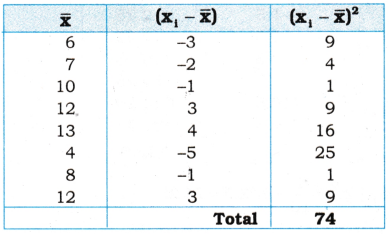
a) Given observations : 6, 7, 10, 12, 13, 4, 8, 12.

Mean, x̄ = \(\frac{\sum_{i=1}^8 x_i}{n}=\frac{6+7+10+12+13+4+8+12}{8}=\frac{72}{8}\) = 9

The following table is obtained for the given data.
AP Inter 1st Year Maths Exercise 13b Solutions 1

Variance (σ2) = \(\frac{1}{n} \sum_{i=1}^n\) (xi – x̄)2
= \(\frac{1}{8}\) × 74
= 9.25

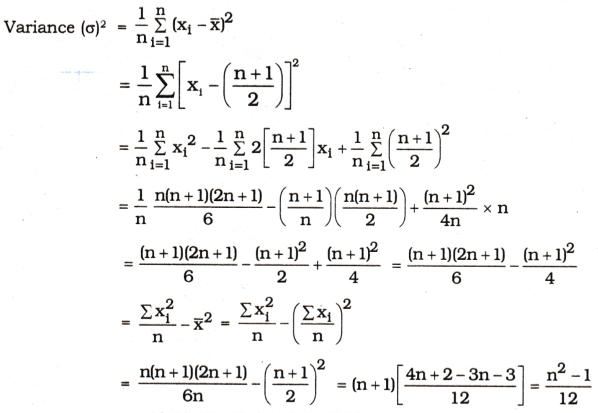
b) The mean of first ‘n’ natural numbers is calculated as follows.
Mean = \(\frac{\text { Sum of all observations }}{\text { No. of observations }}=\frac{n\left(\frac{n+1}{2}\right)}{n}=\frac{n(n+1)}{2 n}=\frac{n+1}{2}\)
AP Inter 1st Year Maths Exercise 13b Solutions 2

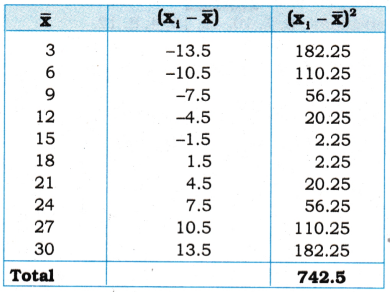
c) The first 10 multiples of ‘3’ are 3, 6, 9, 12, 15, 18, 21, 24, 27, 30.
Here, number of observations, n = 10
Mean, x̄ = \(\frac{\sum_{i=1}^{10} x_i}{10}=\frac{165}{10}\) = 16.5

The following table is obtained for the given data.
AP Inter 1st Year Maths Exercise 13b Solutions 3
Variance (σ2) = \(\frac{1}{\mathrm{n}} \sum_{\mathrm{i}=1}^{10}\)(xi – x̄)2
= \(\frac{1}{10}\) × 742.5
= 74.25

II.

Question 1.
Find the mean and variance for each of the following data.
AP Inter 1st Year Maths Exercise 13b Solutions 4
Solution:
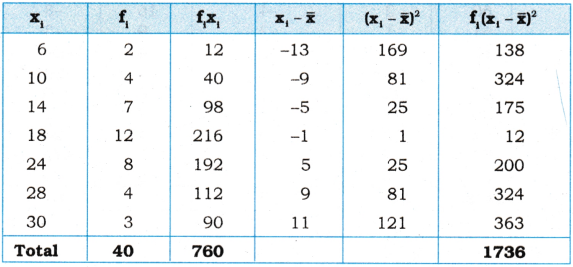
AP Inter 1st Year Maths Exercise 13b Solutions 5
Here, N = 40, \(\sum_{i=1}^7\)fixi = 760
x̄ = \(\frac{\sum_{i=1}^7 f_i x_i}{N}=\frac{760}{40}\) = 19
Variance (σ2) = \(\frac{1}{N} \sum_{i=1}^7\) fi(xi – x̄)2 = \(\frac{1}{40}\) × 1736
= 43.4

AP Inter 1st Year Maths Exercise 13b Solutions 6
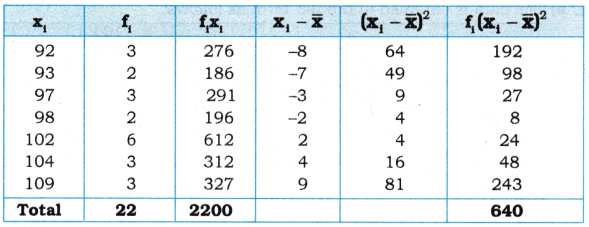
Solution:
The data id obtained in tabular form as follows.
AP Inter 1st Year Maths Exercise 13b Solutions 7
Here, N = 22, \(\frac{1}{2}\)fixi = 2200
∴ x̄ = \(=\frac{1}{N} \sum_{i=1}^7\)fixi

Variance (σ2) = \(\frac{1}{N} \sum_{i=1}^7\) fi(xi – x̄)2 = \(\frac{1}{22}\) × 640 = 29.09

AP Inter 1st Year Maths Exercise 13b Solutions

Question 2.
Find the mean and standard deviation using short-cut method.
AP Inter 1st Year Maths Exercise 13b Solutions 8
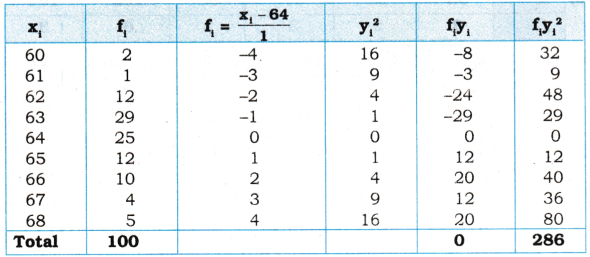
Solution:
The data is obtained in tabular form as follows:
AP Inter 1st Year Maths Exercise 13b Solutions 9
Mean x̄ = A + \(\frac{\sum_{i=1}^9 f_i y_i}{N}\) × h
= 64 + \(\frac{0}{100}\) × 1
= 64 + 0
= 64

Variance (σ2) = \(\frac{h^2}{N^2}\left[N \sum_{i=1}^9 f_i y_i^2-\left(\sum_{i=1}^9 f_i y_i\right)^2\right]\)
= \(\frac{1}{100^2}\)[100 × 286 – 0]
= 2.86

∴ Standard deviation (σ) = \(\sqrt{2.86}\) = 1.69

III.

Question 1.
Find the mean and variance for the following frequency distribution.
AP Inter 1st Year Maths Exercise 13b Solutions 10
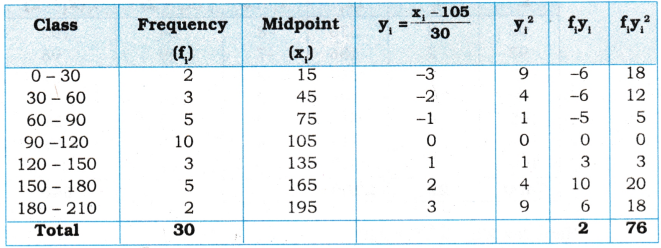
Solution:
The data is obtained in tabular form as follows:
AP Inter 1st Year Maths Exercise 13b Solutions 11
Mean, x̄ = A + \(\frac{\sum_{i=1}^9 f_i y_i}{N}\) × h
= 105 + \(\frac{2}{30}\) × 30
= 105 + 2
= 107

Variance (σ2) = \(\frac{h^2}{N^2}\left[N \sum_{i=1}^9 f_i y_i^2-\left(\sum_{i=1}^9 f_i y_i\right)^2\right]\)
= \(\frac{(30)^2}{(30)^2}\)[30 × 76 – (2)2]
= 2280 – 4
= 2276

AP Inter 1st Year Maths Exercise 13b Solutions 12
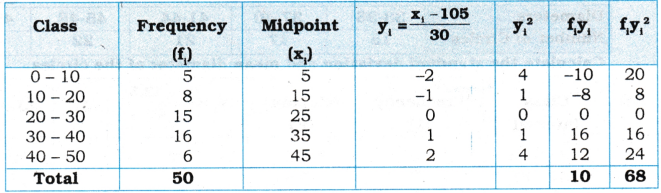
Solution:
The data is obtained in tabular form as follows:
AP Inter 1st Year Maths Exercise 13b Solutions 13
Mean, x̄ = A + \(\frac{\sum_{i=1}^9 f_i y_i}{N}\) × h
= 25 + \(\frac{10}{50}\) × 10
= 25 + 2 = 27

Variance (σ2) = \(\frac{h^2}{N^2}\left[N \sum_{i=1}^9 f_i y_i^2-\left(\sum_{i=1}^9 f_i y_i\right)^2\right]\)
= \(\frac{1}{2}\)[50 × 68 – (10)2]
= \(\frac{1}{25}\)[3400 – 100]
= \(\frac{3300}{25}\) = 132

AP Inter 1st Year Maths Exercise 13b Solutions

Question 2.
Find the mean, variance and standard deviation using short-cut method.
AP Inter 1st Year Maths Exercise 13b Solutions 14
Solution:
The data is obtained in tabular form as follows:
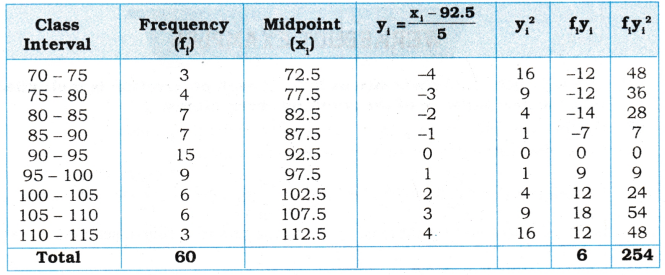
AP Inter 1st Year Maths Exercise 13b Solutions 15
Mean, x̄ = A + \(\frac{\sum_{i=1}^9 f_i y_i}{N}\) × h
= 92.5 + \(\frac{6}{60}\) × 5
= 92.5 + 0.5
= 93

Variance (σ2) = \(\frac{h^2}{N^2}\left[N \sum_{i=1}^9 f_i y_i^2-\left(\sum_{i=1}^9 f_i y_i\right)^2\right]\)
= \(\frac{(5)^2}{(60)^2}\)[60 × 254 – (6)2]
= \(\frac{25}{3600}\)[15240 – 36]
= \(\frac{25}{3600}\)(15204)
= 105.58

∴ Standard deviation (σ) = \(\sqrt{105.58}\) = 10.27

Question 3.
The diameters of circles (in mm) drawn in a design are given below.
AP Inter 1st Year Maths Exercise 13b Solutions 16
Calculate the standard deviation and mean diameter of the circles.
Solution:
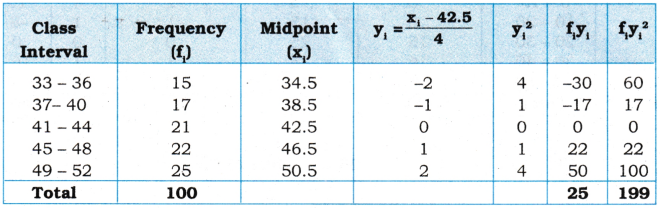
AP Inter 1st Year Maths Exercise 13b Solutions 17
Here, N = 100, h = 4. Let the assumed mean A, be 42.5
Mean, x̄ = A + \(\frac{\sum_{i=1}^9 f_i y_i}{N}\) × h
= 42.5 + \(\frac{25}{100}\) × 4
= 43.5

Variance (σ2) = \(\frac{h^2}{N^2}\left[N \sum_{i=1}^9 f_i y_i^2-\left(\sum_{i=1}^9 f_i y_i\right)^2\right]\)
= \(\frac{16}{10000}\) [100 × 199 – (25)2]
= \(\frac{16}{10000}\) [19900 – 625]
= \(\frac{16}{10000}\) × 19275
= 30.84

∴ Standard deviation (σ) = 5.55

AP Inter 1st Year Maths Exercise 13a Solutions

Referring to the AP Inter 1st Year Maths Study Material Chapter 13 Statistics Exercise 13a Solutions makes it easier to understand complex problems.

AP Inter 1st Year Maths Statistics Solutions Exercise 13a

I.

Question 1.
Find the mean deviation about the mean for the following data.
a) 4, 7, 8, 9, 10, 12, 13, 17
b) 38, 70, 48, 40, 42, 55, 63, 46, 54, 44.
Solution:
a) The given data is 4, 7, 8, 9, 10, 12, 13, 17.
Mean of the data, \(\frac{1}{n} \sum_{i=1}^n x_i\) = x̄ = \(\frac{4+7+8+9+10+12+13+17}{8}=\frac{80}{8}\) = 10
The deviations of the respective observations from the mean x̄ i.e., xi – x̄ are -6, -3, -2, -1, 0, 2, 3, 7.
The required mean deviation about the mean is 8
M.D. (x̄) = \(\frac{\sum_{i=1}^8\left|x_i-\bar{x}\right|}{8}=\frac{6+3+2+1+0+2+3+7}{8}=\frac{24}{8}\) = 3

b) The given data is 38, 70, 48, 40, 42, 55, 63, 46, 54, 44.
Mean of the given data, x̄ = \(\frac{38+70+48+40+42+55+63+46+54+44}{10}=\frac{500}{10}\) = 50
The deviations of the respective observations from the mean Xs i.e.,
xi – x̄ are -12, 20, -2, -10, -8, 5, 13, -4, 4, -6.
\(\sum_{i=1}^{10}\)|xi – x̄| = 12 + 20 + 2 + 10 + 8 + 5 + 13 + 4 + 4 + 6 = 84
The required mean deviation about the mean is
M.D. (x̄) = \(\frac{\sum_{j=1}^{10}\left|x_i-\bar{x}\right|}{10}=\frac{84}{10}\) = 8.4

Question 2.
Find the mean deviation about the median for the following data.
a) 13, 17, 16, 14, 11, 13, 10, 16, 11, 18, 12, 17.
b) 36, 72, 46, 42, 60, 45, 53, 46, 51, 49.
Solution:
a) Here, the number of observations are 12, which is even.
Arranging the data in ascending order, we have,
10, 11, 11, 12, 13, 13, 14, 16, 16, 17, 17, 18.
AP Inter 1st Year Maths Exercise 13a Solutions 1
\(\sum_{i=1}^{12}\)|xi – M| = 3.5 + 2.5 + 2.5 + 1.5 + 0.5 + 0.5 + 0.5 + 2.5 + 2.5 + 3.5 + 3.5 + 4.5 = 28
∴ The required mean deviation about the median is
M.D. (M) = \(\frac{\sum_{i=1}^{12}\left|x_i-M\right|}{12}=\frac{28}{12}\) = 2.33

b) The given data is 36, 72, 46, 42, 60, 45, 53, 46, 51, 49.
Here, the number of observations is 10, which is even.
Arranging the data in an ascending order, we have
36, 42, 45, 46, 46, 49, 51, 53, 60, 72
AP Inter 1st Year Maths Exercise 13a Solutions 2
\(\sum_{i=1}^{10}\)|xi – M| = 11.5 + 5.5 + 2.5 + 1.5 + 1.5 + 1.5 + 3.5 + 5.5 + 12.5 + 24.5 = 70
Thus, the required mean deviation about the median is
M.D (M) = \(\frac{\sum_{i=1}^{10}\left|x_i-M\right|}{10}=\frac{70}{10}\) = 7

AP Inter 1st Year Maths Exercise 13a Solutions

II.

Question 1.
Find the mean deviation about the mean for the following data.
AP Inter 1st Year Maths Exercise 13a Solutions 3
Solution:
We make following table from the given data.
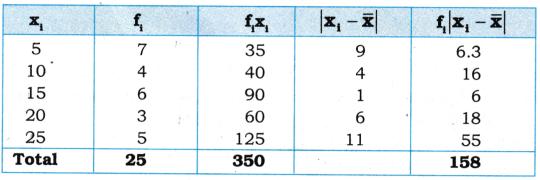
AP Inter 1st Year Maths Exercise 13a Solutions 4
N = \(\sum_{i=1}^5\) fi = 25 and \(\sum_{i=1}^5\)fixi = 350;
∴ x̄ = \(\frac{1}{N_i} \sum_{i=1}^5\) fixi = \(\frac{1}{25}\) × 350 = 14
∴ M.D.(x̄) = \(\frac{1}{2}\) fi |xi – x̄| = \(\frac{1}{25}\) x 158 = 6.32

AP Inter 1st Year Maths Exercise 13a Solutions 5
Solution:
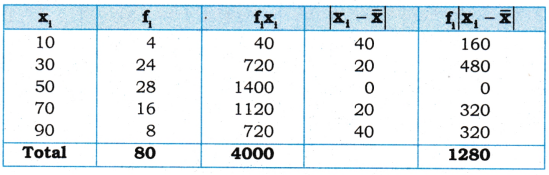
We make following table from the given data.
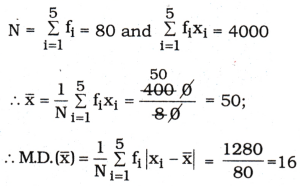
AP Inter 1st Year Maths Exercise 13a Solutions 6
AP Inter 1st Year Maths Exercise 13a Solutions 7

Question 2.
Find the mean deviation about the median for the following data.
AP Inter 1st Year Maths Exercise 13a Solutions 8
Solution:
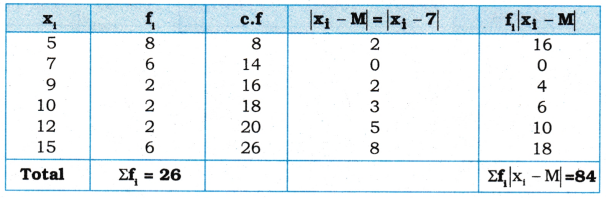
The given observations are already in ascending order. Adding a column corresponding to cumulative frequencies of the given data, we have the following table.
AP Inter 1st Year Maths Exercise 13a Solutions 9
Here, N = 26, which is even. Median is the Mean of 13th and 14th observations. Both of these observations lie in the cumulative frequency 14, for which the corresponding observation is 7.
∴ Median = \(\frac{\left(13^{\text {th }} \text { observation }+14^{\text {th }} \text { observation }\right)}{2}=\frac{7+7}{2}=\frac{14}{2}\)
Median = 7
\(\sum_{i=1}^6\)fi = 26 and \(\sum_{i=1}^6\)fi|xi – M| = 84;
M.D (M) = \(\frac{1}{N_i} \sum_{i=1}^6\)fi|xi – M| = \(\frac{1}{26\) × 84 = 3.23

AP Inter 1st Year Maths Exercise 13a Solutions 10
Solution:
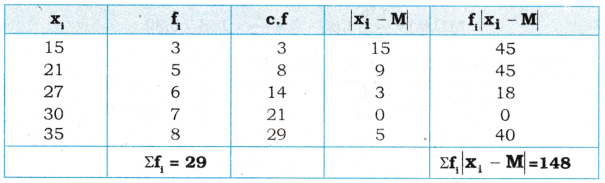
The given observations are already in ascending order. Adding a column corresponding to cumulative frequencies of the given data, we have the following table.
AP Inter 1st Year Maths Exercise 13a Solutions 11
Here, N = 29, which is odd.
Median = \(\left(\frac{29+1}{2}\right)^{\text {th }}\) observation = 15th observation
This observation lies in the cumulative frequency 21, for which the corresponding observation is 30.
M = 30
\(\sum_{i=1}^5\) fi = 29, \(\sum_{i=1}^5\) fi|xi – M| = 148
∴ M.D. (M) = \(\frac{1}{N} \sum_{i=1}^5\)fi|xi – M| = \(\frac{1}{29}\) × 148 = 5.1

III.

Question 1.
Find the mean deviation about the mean for the following data.
AP Inter 1st Year Maths Exercise 13a Solutions 12
Solution:
The following table is formed for the given data.
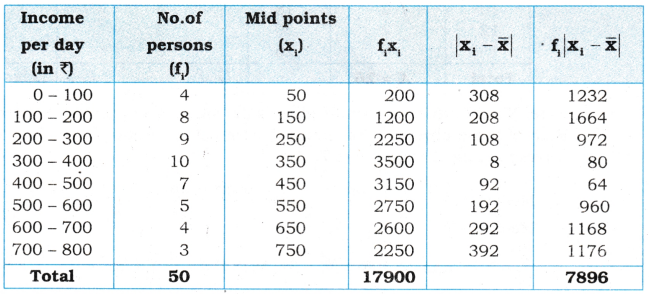
AP Inter 1st Year Maths Exercise 13a Solutions 13
Here, N = \(\frac{1}{2}\) fi = 50 and fixi = 17900
x = \(\frac{1}{2}\)fixi = \(\frac{1}{50}\) × 17900 = 358
and M.D. (x) = \(\frac{1}{N} \sum_{i=1}^8\) fi|xi – x̄| = \(\frac{7896}{50}\) = 157.92

AP Inter 1st Year Maths Exercise 13a Solutions 14
Solution:
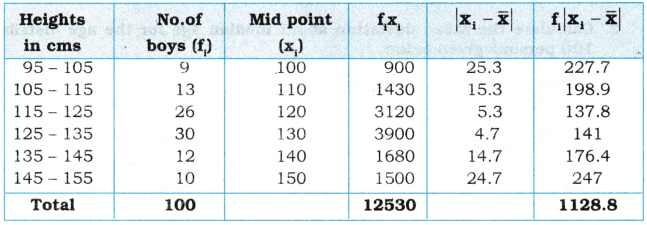
The following table is formed for the given data.
AP Inter 1st Year Maths Exercise 13a Solutions 15
Here, N = \(\sum_{i=1}^6\) fi = 100 and \(\sum_{i=1}^6\) fixi = 12530
x = \(\frac{1}{N_i} \sum_{i=1}^6\)fixi = \(\frac{1}{100}\) × 12530 = 125.3
and M.D (x̄) = \(\frac{1}{N_i} \sum_{i=1}^6\) fi|xi – x̄| = \(\frac{1}{100}\) × 1128.8 = 11.28

AP Inter 1st Year Maths Exercise 13a Solutions

Question 2.
Find the mean deviation about median for the folloeing data:
AP Inter 1st Year Maths Exercise 13a Solutions 16
Solution:
The following table is formed for the given data.
AP Inter 1st Year Maths Exercise 13a Solutions 17
The class interval containing the \(\left[\frac{\mathrm{N}}{2}\right]^{\mathrm{th}}\) or 25th item is 20 – 30.
Therefore, 20 – 30 is the median class. It is known that
Median = l + \(\frac{\frac{\mathrm{N}}{2}-\mathrm{C}}{\mathrm{f}}\) × h
Here, 1= 20, C = 14, f = 14, h = 10 and N = 50
Median = 20 + \(\frac{25-14}{14}\) × 10 = 20 + \(\frac{110}{14}\) = 20 + 7.85 = 27.85
Thus, mean deviation about the median is given by,
M.D. (M) = \(\frac{1}{N_i} \sum_{i=1}^6\)fi|xi – x̄| = \(\frac{1}{50}\) × 517.1 = 10.34

Question 3.
Calculate the mean deviation about median age for the age distribution of 100 persons given below.
AP Inter 1st Year Maths Exercise 13a Solutions 18
Solution:
The given data is not continuous. Therefore, it has to be converted into continuous frequency distribution by subtracting 0.5 from the lower limit and adding 0.5 to the upper limit of each class interval.

The table is formed as follows.
AP Inter 1st Year Maths Exercise 13a Solutions 19
The class interval containing the \(\left[\frac{\mathrm{N}}{2}\right]^{\text {th }}\) or 50th item is 35.5 – 50.5
Therefore, 35.5 – 40.5 is the median class. It is known that
Median (M) = l + \(\frac{\frac{\mathrm{N}}{2}-\mathrm{C}}{\mathrm{f}}\) × h
Here, l = 35.5, C = 37, f = 26, h = 5 and N = 100
∴ Median = 35.5 + \(\frac{50-37}{26}\) × 5 = 35.5 + \(\frac{13 \times 5}{26}\) = 35.5 + 2.5 = 38
Thus, mean deviation about the median is given by,
M.D. (M) = \(\frac{1}{N_i} \sum_{i=1}^8\)fi|xi – x̄| = \(\frac{1}{100}\) × 735 = 7.35