TS Inter 2nd Year Political Science Notes Chapter 10 Smart Governance

Here students can locate TS Inter 2nd Year Political Science Notes Chapter 10 Smart Governance to prepare for their exam.

TS Inter 2nd Year Political Science Notes Chapter 10 Smart Governance

→ SMART stands for Simple, Moral, Accountable, Responsive, and Transparent.

→ E-governance is a pre-condition for good governance.

→ The governance associated with efficient and effective administration within a democratic framework is known as Good Governance.

TS Inter 2nd Year Political Science Notes Chapter 10 Smart Governance

→ E-Governance secures Transparency, Efficiency, and Accountability. It is practiced in the state of Chhattisgarh. By 2017, it will move towards a Paperless Administration.

→ The Right to Information Act came into force on 12th October 2005.

→ In recent times, smart cities became a catchphrase in the political vocabulary of India among various political parties and elected representatives.

TS Inter 2nd Year Political Science Notes Chapter 10 స్మార్ట్ గవర్నెన్స్

→ ఇటీవల కాలంలో ప్రభుత్వ పాలన స్వభావాన్ని పాలన, సుపరిపాలన, ఎలక్ట్రానిక్ పాలన, స్మార్ట్ గవర్నెన్స్ తదితర అనేక రూపాల్లో చర్చించడం జరుగుతుంది.
S= Simple, M = Moral, A = Accountable R = Responsive, T=Transparent.

→ ప్రజాస్వామ్య పాలన పద్ధతిలో పరిపాలనను కార్యసాధకంగా, సమర్థవంతంగా తీర్చిదిద్దే పాలన సహాయకారిగా సుపరిపాలనను నిర్వచించవచ్చు.

→ ప్రతి మంత్రిత్వ శాఖ తనకార్యాలయాల్లో స్మార్ట్ సేవల గుణాత్మకతను పెంపొందించడానికి పౌరసేవ పట్టికను ప్రదర్శిస్తుంది.

→ భారత ప్రభుత్వం పరిపాలన సంస్కరణల సంఘాన్ని 2005లో ఏర్పాటుచేసింది.

→ ఎలక్ట్రానిక్ పాలన అంటే కాగితపు రహితపాలన.

TS Inter 2nd Year Political Science Notes Chapter 10 Smart Governance

→ సమాచార హక్కు చట్టం అక్టోబరు, 2005 నుండి అమలులోకి వచ్చింది.

→ సుపరిపాలనకు పారదర్వకత, జవాబుదారీతనం ప్రధాన లక్షణాలుగా ఉంటాయి.

TS Inter 2nd Year Sanskrit Study Material Poem 5 रुद्रमदेवी

Telangana TSBIE TS Inter 2nd Year Sanskrit Study Material 5th Poem रुद्रमदेवी Textbook Questions and Answers.

TS Inter 2nd Year Sanskrit Study Material 5th Poem रुद्रमदेवी

निबन्ध प्रश्नाः (వ్యాసరూప సమాధాన ప్రశ్నలు) (Essay Questions)

1. रुद्रामदेव्याः विजयं संक्षिपता?
(రుద్రమదేవి యొక్క విజయాన్ని సంక్షిప్తంగా వివరించండి.)
2. देवगिरिनाथः महादेवः रुद्रमाम्बया कथं पराजितः?
(దేవగిరినాథుడు రుద్రమదేవిచేత ఏ విధముగా ఓడింపబడెను ?)
జవాబు:
‘రుద్రమదేవి’ అనే పాఠ్యభాగాన్ని శ్రీ దురిశేటి వెంకట రమణాచార్యులు రచించారు. వీరు రచించిన ‘శిల్పశ్రీ’ అనే కావ్యం నుండి ఈ పాఠ్యభాగం స్వీకరింపబడింది. ఇందులో రుద్రమదేవి పరాక్రమాన్ని, ధైర్యాన్ని చక్కగా వర్ణించారు. కాకతిరాజ్య రాణిగా ఆమె సాధించిన విజయాలను చక్కగా ఆవిష్కరించారు.

కాకతీయ చక్రవర్తులలో గణపతిదేవుడు ప్రసిద్ధుడు. అతడు తన పరాక్రమంతో రాజ్యాన్ని చాలాకాలం పాలించాడు. అతని కుమార్తె రుద్రమదేవి. యుద్ధ విద్యలో ప్రావీణ్యాన్ని సాధించింది. వృద్ధాప్యంతో గణపతిదేవుడు రాజ్యాన్ని పరిపాలించలేకపోతున్నారు. ఇది గమనించిన అతని మంత్రి ఒకరోజు రాజును సమీపించి “రాజా ! తమ కుమార్తె అయిన రుద్రమదేవిని రాణిగా పట్టాభిషేకం చేయండి. తమ సర్వశక్తి సమన్వయురాలు. రాజ్యాన్ని పాలించగల సమర్థురాలు, ఆమె తన పాదాలను శత్రువుల శిరస్సులపై ఉంచి శత్రువులను అణచివేయగల సమర్థురాలు. అందువల్ల మీరు రుద్రమదేవిని రాణిగా పట్టాభిషేకం చేయండి. ప్రజలంతా సంతోషిస్తారు.” అని పలికాడు.

“निजधरां मुदितां कुरु सप्रजाम्”

గణపతిదేవుడు తన మంత్రి మాటలను శ్రద్ధగా విన్నాడు. చాలా సంతోషించాడు. వెంటనే తన రాజ్యంలోని ప్రజలకు తన నిర్ణయాన్ని ప్రకటించాడు. అంతట చాటింపు వేశాడు. ఒక మంచి ముహూర్తంలో పుణ్యనదీజలాలతోను, వేద మంత్రాలతోను, వేద పండితుల ఆశీర్వచనాలతోను రుద్రమదేవికి వైభవంగా పట్టాభిషేకం జరిపించాడు.

రుద్రమదేవి పరాక్రమం తెలిసిన సామంతులందరు ఆమెకు నమస్కరించారు. ఆమె సామ్రాజ్యాధిపత్యాన్ని అంగీకరించారు. సకాలంలో పన్నులు కట్టారు. కాని దేవగిరి రాజ్యాన్ని పరిపాలిస్తున్న హరిహర, మురారి దేవులు మాత్రం రుద్రమదేవి ఆధిపత్యాన్ని అంగీకరించలేదు. ఒక స్త్రీ తమపై పెత్తనం చెలాయించడం ఏమిటని తిరుగుబాటు చేయాలనుకున్నారు. వీరిద్దరు రుద్రమదేవిని ఎదిరించడానికి పన్నాగాలు పన్నారు. చతురంగ బలాలతో యుద్ధానికి బయలుదేరారు. ఆ సమయంలో రుద్రమదేవి పరమేశ్వరుడిని సేవించడానికి బయలుదేరింది. అదనుచూచి శత్రుమూకలు రాజ్యంపై దాడిచేశారు.

समभियान्त्यथ्यो विभियोधियः

తన రాజ్యం శత్రుహస్తగతమైనదనే విషయాన్ని రుద్రమదేవి తెలుసుకుంది. కోపంతో కన్నులు ఎర్రబడినాయి. వెంటనే రుద్రమదేవి పరిమిత సైన్యంతో అపరకాళికవలె, శత్రుసైన్యంపై ఎదురుదాడి చేసింది. సామంతులందరు రుద్రమదేవిని అనుసరించారు. యుద్ధరంగంలో శంఖనాదం చేసింది. శత్రువుల గుండెల్లో భయాన్ని పుట్టించింది. క్షణాల్లో రుద్రమదేవి వీర ఖడ్గాన్ని చేపట్టింది. పగపట్టిన నాగు పామువలె బుసలు కొట్టింది. శత్రువుల తలలను నరుకుతూ యుద్ధరంగంలో వీరవిహారం చేసింది. శత్రుసైన్యం విలవిలలాడారు. దేవాద్రినాథుడిని చూచింది. వెంటనే అంకుశాన్ని ధరించి మదగజంపై ఉన్న మావటివాడిని చంపింది. రథాన్ని ఎక్కి ధనస్సుతో బాణవర్షం కురిపించింది. రథాన్ని నడుపుతున్న సారధిని చంపింది. ఆతని గుర్రాలను చంపింది. చివరకు అతని రథాన్ని, పతాకాన్ని ఖండించింది. శత్రురాజు విరథునిగా చేసింది.

“नृपाणी तं विरथं चकार ”

చివరకు మహేంద్రుడు దిక్కుతోచని స్థితిలో పడ్డారు. తన పరాజయాన్ని అంగీ కరించాడు. శత్రుసైన్యాలు యుద్ధం నుండి పారిపోయారు. స్త్రీలు బలహీనులు అనే మాట తప్పని గ్రహించాడు. గతిలేక మహాదేవుడు కూడా యుద్ధరంగం నుండి పారిపోయాడు. ఈ రకంగా రుద్రమదేవి అసమాన పరాక్రమం చూపించి వీరనారిగా గుర్తింపు పొందింది.

Introduction : The lesson Rudrama Devi was written by Sri D. Venkataramacharya. It is taken from the author’s poem Silpasri. The present lesson describes Rudrama’s victory over Mahadeva, the ruler of Devagiri.

Queen of Kakati Kingdom : When the king of Kakati kingdom became old, his minister advised him to install his daughter Rudrama as the queen. It would make the kingdom along with the subjects pleased. निजधरां मुदितां कुरु सप्रजाम् ।

The king felt happy at that suggestion, and made announcement to that effect. On an auspicious day, Rudrama was made the queen while the priests chanted mantras, and water from holy rivers and oceans was sprinkled on her. The pious queen became successful as people and feudatory lords paid their taxes willingly.

The Jealous Enemies: However, Harihara and Muran became jealous of her success. The king of Devagiri lured them by his crooked ways. He said that a weak woman insulted them. The ruler of Devagiri. who was proud of his army attacked Rudrama.
समभियान्त्यरयो विभियोऽधियः ।

At that time, Rudrama went to worship Siva. On getting the news that the city was under siege, she returned with limited forces to the city. When she blew her conch, the soldiers and feudatory kings understood that it was their queen, and blew their conches.

The Warrior Queen: The queen and her soldiers attacked the enemy from opposite sides. Rudrama threw her sword and killed the mahout of Mahadevas elephant. The king of Devagiri jumped in to another chariot. Rudrama killed the charioteer and the horses, and broke his string and flag. नृपाणी तंविश्यं चकार । The Devagiri ruler and his followers ran away from the battle field. He understood that women were not weak.

सन्दर्भवाक्यानि (సందర్భ వాక్యాలు) (Annotations)

1. निजधरां मुदितां कुरु सप्रजाम् ।
परिचय : एतत् वाक्यं रुद्रमदेवी इति पाठ्यभागात् स्वीकृतम् । अस्य रचयिता श्री डी. वेङ्कटरामाचार्यः ।
सन्दर्भ : काकतीयराजः वृद्धः अभवत् । पलितकेशं तं तस्य सचिवः अवदत् यत् रुद्रमदेवी राज्यं कर्तुम् अर्हति । ताम् अभषेचय । प्रजाः तोषय इति ।
भाव : निजराज्यं प्रजाः च तोषय ।

2. समभियान्त्यरयो विभियोऽधियः ।
परिचय : एतत् वाक्यं रुद्रमदेवी इति पाठ्यभागात् स्वीकृतम् । अस्य रचयिता श्री डी. वेङ्कटरामाचार्यः ।
सन्दर्भ : काकतीयराजः स्वपुत्रीं रुद्रमदेवीम् राज्ये अभिषिक्तवान् । -तदसहमानाः देवगिरिराजादयः वयम् अबलया अवमानिताः इति संचिन्त्य ताम् -अभिययौ ।
भाव : भयहीनाः मूर्खाः शत्रवः अभिद्रवन्ति ।

TS Inter 2nd Year Sanskrit Study Material Poem 5 रुद्रमदेवी

3. नृपाग्रणीं तं विरथं चकार ।
परिचय : एतत् वाक्यं रुद्रमदेवी इति पाठ्यभागात् स्वीकृतम् । अस्य रचयिता श्री डी. वेङ्कटरामाचार्यः ।
सन्दर्भ : रुद्रमदेवी रणे देवगिरिराजस्य हस्तिपकं अहनत् । तदनु तस्य सारथिम्, अश्वान् च हत्वा तं विरथं चकार ।
भाव : सा चक्रवर्तिनं तं रथहीनम् अकारयत् ।

एकपद समाधान प्रश्नाः (ఏక పద సమాధాన ప్రశ్నలు) (One Word Questions)

पश्न 1.
कस्य वचः निशम्य नृपतिः मुदम् अवाप ?
समादान:
सचिवस्य वचः

पश्न 2.
रुद्रमां का सफलां चकार ?
समादान:
शिवदेववाक्

पश्न 3.
रुद्रमया प्रयुक्तः खड्गः कं जघान ?
समादान:
देवगिरिराजस्य हस्तिपकं

कठिन शब्दार्द (కఠిన పదాలు – అర్ధాలు)

1. जरठः = वृध्दः, ముసలివాడు ,
2. धरणीभुक् = राजा, రాజు
3. पुरोधाः = पुरोहितः, పురోహితుడు
4. शत्रुवरुथिनी = शत्रुसेना, శత్రుసేన
5. वाहिनी = सेना, సేన
6. वृषा = इन्द्रः, ఇంద్రుడు
7. उज्ज्वलप्रथनदुर्गमवर्त्म = प्रकाशयुक्तः विस्तृतः दुष्प्राप्यमार्गः ప్రవేశింప వీలుగాని మార్గం
8. पृथुभण्डनपण्डिताः = दुष्टकर्मकुशलाः, చెడుపనులు చేయువారు
9. समीकम् = युद्धम्, యుద్ధము
10. विगतत्रपा = निर्लज्जाः, సిగ్గులేనివారు
11. विभियः = निर्भीकाः, భయంలేనివారు
12. अधियः = मूढाः, మూడులు
13. निकृताः = शठाः, శఠులు
14. अपसमंज्ञा = अपमानः, అవమానం
15. हस्तिपकः = गजनियन्ता, మావటివాఁడు
16. उन्मदद्विपः = मदगजः, మదగజము
17. तुरङ्गः = अश्व:, గుర్రం
18. व्याली = सर्पिणी, పాము

TS Inter 2nd Year Sanskrit Study Material Poem 5 रुद्रमदेवी

19. परीतम् = आक्रान्तम्, ఆక్రమణ
20. पराक्तम् = पराक्रान्तम्, ఇతరులచే పొందబడిన
21. अरातिसैन्यम् = शत्रुसैन्यम्, శత్రుసైన్యం
22. ईक्षा = दृक्, చూపు
23. जिघांसुः = हन्तुम् इच्छति इति जिघांसुः, చంపాలనే కోరిక
24. शरौघम् = शराणां समूहः, బాణాల సమూహం
25. तुमुलम् = कोलाहलमयम्, కోలాహలము
26. परिपन्थिनः = शत्रवः, శత్రువులు

व्याकरणाश (వ్యాకరణాంశాలు)

सन्धयः (సంధులు)

1. सितनिजातपवारणतः + अभितः = सितनिजातपवारणतोऽभितः – विसर्गसन्धिः
2. जरठः + अभवत् = जरठोऽभवत् – विसर्गसन्धिः
3. सचिवः + अवदत् = सचिवोऽवदत् – विसर्गसन्धिः
4. अभूत् + वलयन् = अभूद्वलयन् – जश्त्वसन्धिः
5. निगममन्त्रवचोभिः + अषिच्यत = निगममन्त्रवचोभिरषिच्यत – विसर्गसन्धिः
6. विधिवत् + निजकाम्यया = विधिवन्निजकाम्यया – अनुनासिकसन्धिः
7. हरिहरः + च = हरिहरश्च – श्चुत्व सन्धिः
8. यत् + अभिवीक्ष्य = यदभिवीक्ष्य – जश्त्वसन्धिः
9. पतिः + उज्वलप्रथनदुर्गमवर्त्मनि = पतिरुज्ज्वलप्रथनर्दुर्गमवर्त्मनि – विसर्गसन्धिः
10. विभियः + अधियः = विभियोऽधियः – विसर्गसन्धिः

समासाः (సమాసాలు)

1. पलिताः केशाः यस्य सः – पलितकेशः – बहुव्रीहि
2. शत्रुणां शिरांसि – शत्रुशिरांसि तेषु शत्रुशिरस्सु – षष्ठीतत्पुरुष
3. मित्राणि च ते जनाश्च मित्रजनाः – विशेषणपूर्वपदकर्मधारय
4. सकलाश्च ते मित्रजनाश्च – सकलमित्रजनाः तेषु सकलमित्रजनेषु – विशेषणपूर्वपदकर्मधारयः
5. भयं करोतीति भयङ्करी – उपपदतत्पुरुष
6. निजस्य धरा निजधरा तां निजधराम् – षष्ठीतत्पुरुष
7. प्रजाभिः सह वर्तते इति सप्रजा तां सप्रजाम् – बहुव्रीहि
8. पुलकैः सहितं यथा स्यात् तथा सपुलकं – अव्ययीभाव
9. धरणीं भुङ्क्ते इति धरणीभुक् तेन धरणीभुजा – उपपदतत्पुरुष
10. तनोः जायते इति तनुजा – उपपदतत्पुरुष
11. विगतं मलं यस्याः सा विमला – बहुव्रीहि
12. अविद्यमानं कलुषं यस्याः सा अकलुषा ताम् अकलुषाम् – बहुव्रीहि
13. निजस्य काम्या निजकाम्या – षष्ठीतत्पुरुष
14. मह्याः पतिः महीपतिः – षष्ठीतत्पुरुष

अर्थतात्पर्याणि (Meanings & Substances) (తాత్పర్యములు)

1. अथ स काकतिराजपुरन्दरः सितनिजातपवारणतोऽभितः ।
पटुपराक्रमभानुमरीचिना चिरमुवास भुवं परिपालयन् ॥
అథ స కాకతిరాజ పురందరః సితనిజాతపవాణతో భితః |
పటుపరాక్రమభానుమరీచినా చిరమువాస భువం పరిపాలయన్ ॥

पदच्छेदः – अथ, स, काकतिराजपुरन्दरः, सितनिजातपवारणतः, अभितः, पदुपराक्रमभानुमरीचिना, चिरं, उवास भुवं पालयन् ।

अन्वयक्रमः – अथ, काकतिराजपुरन्दरः, सः, पटुपराक्रमभानुमरीचिना, सितनिजातपवारणतः, भुवं अभितः, पालयन्, चिरं, उवास ।

अर्थाः-
अथ = పిమ్మట
काकतिराजपुरन्दरः = కాకతి రాజ్యమునకు రాజు
सः = ఆ గణపతిదేవుడు;
पटुपराक्रमभानुमरीचिना = పటిష్టమైన పరాక్రమం అనే సూర్యకిరణాలతో;
सितनिजातपवारणतः = తెల్లనైన తన యొక్క గొడుగుతో;
भुवं अभितः = భూమినంతా;
पालयन्, = పాలిస్తూ;
चिरं = చాలాకాలం;
उवास = గడిపాడు.

भावः-
కాకతీయ సామ్రాజ్య చక్రవర్తులలో శ్రేష్ఠుడైన ఆ గణపతి దేవుడు తన పటిష్ఠమైన పరాక్రమంతో, తెల్లనైన తన ఛత్రంతో భూమినంతా చాలా కాలం పాలించాడు.

The king of Kakati lived a long time ruling the earth with his rays of valour spreading on all sides of his royal umbrella.

TS Inter 2nd Year Sanskrit Study Material Poem 5 रुद्रमदेवी

2. बहुतिथे समये सति गच्छति प्रियपिनाकभुजो जरठोऽभवत् ।
पलितकेशममुं शिथिलीभवत्पटुनिजावयवं सचिवोऽवदत् ॥
బహుతిథే సమయే సతీ గచ్ఛతి ప్రియపినాకభుజో జరఠో భవత్ |
పలితకేశమముం శిథిలీభవత్పటునిజావయవం సచివోకెవదత్ ||

पदच्छेदः – बहुतिये, समये, सति, गच्छति, प्रियपिनाक भुजो, जरठः, अभवत्, पलितकेशम्, अमुं शिथिलीभवत्, पटुनिजावयवं सचिवः अवदत् ।

अन्वयक्रमः – बहुतिये समयः गच्छति सति, प्रियपिनाकभुजः, जरठः, अभवत्, पलितकेशम्, शिधिलीभवत्पटुनिजावयवं अमुं, सचिवः अवदत् ।

अर्थाः-
बहुतिये समयः = చాలా కాలము;
गच्छति सति = గడవగానే
प्रियपिनाकभुजः = రాజ్యభారమును వహిస్తున్నవాడైన రాజు;
जरठः = ముసలివాడు,
अभवत् = అయ్యాడు;
पलितकेशम् = తెల్లబడిన కేశములుగల;
शिथिलाभवत्पटु निजावयवम् = శిధిలమైన తన శరీర అవయవములుగల;
अमुम् = ఈ గణపతిదేవిని గూర్చి;
सचिवः = మంత్రి;
अवदत् = పలికాడు.

भावः-
చాలా కాలం గడిచింది. రాజైన గణపతి దేవుడు ముసలివాడుగా అయ్యాడు జుట్టు తెల్లబడింది. అవయవాలు శిథిలమైనాయి. అటువంటి ఈ గణపతి దేవుడిని ఉద్దేశించి అతని మంత్రి పలికాడు.

As many days passed, the king became old. On seeing the king whose hair turned grey and limbs lost their strength, the minister said to him.

3. अयि महन् दुहिता तव रुद्रमा निखिलकाकतिराज्यरमेश्वरी ।
भवितुमर्हति शत्रुशिरस्सु या कृतवती चरणं कमलारुणाम् ॥
అయిమహాన్ దుహితా తవ రుద్రమా నిఖిలకాకతి రాజ్యరమేశ్వరీ |
భువితుమర్హతి శత్రుశిరస్సు యా కృతవతీ చరణం కమలారుణామ్ ||

पदच्छेदः – अयि, महान्, दुहिता, तव, रुद्रमा, निखिलकाकति राज्यरमेश्वरी भवितुं अर्हति, शतृशिरस्सु, सा कृतवती, चरणं, कमलारुणाम् ।

अन्वयक्रमः – अयि महन् तव, दुहिता, रुद्रमा निखिलकाकतिराज्यरमेश्वरी, भवितुं अर्हति, या, शतृशिरस्सु, कमलारुणाम्, चरणं, कृतवती ।

अर्थाः-
अयि महन् = అయ్యా మహానుభావా !;
तव दुहिता = నీ కుమార్తె అయిన;
रुद्रमा = రుద్రమదేవి;
निखिलकाकतिराज्यरमेश्वरी = సమస్త కాకతీయ సామ్రాజ్య లక్ష్మిగా;
भवितुं = రాణిగా అగుటకు;
अर्हति = తగియున్నది;
या = ఏ రుద్రమదేవి ;
शतृशिरस्सु = శత్రువుల శిరస్సులందు;
कमलारुणाम् = కమలమువలె ఎర్రనైన;
चरणं = పాదమును;
कृतवती = ఉంచగలదు.

भावः-
ఓ మహారాజ ! నీ కుమార్తె అయిన రుద్రమదేవి సమస్త కాకతి రాజ్యలక్ష్మిగా అగుటకు యోగ్యురాలుగా ఉంది. ఆమె శత్రురాజుల శిరస్సులపై కమలములవలె ఎర్రనైన తన పాదాలను ఉంచగలదు.

4. सकलमित्रजनेष्वभयङ्करीं निखिलशत्रुजनेषु भयङ्करीम् ।
शिवपरामभिषेचय रुद्रमां निजधरां मुदितां कुरु सप्रजाम् ।
సకల మిత్రజనేష్వభయంకరీ నిఖిల శత్రుజనేషు భయంకరీం |
శివపరామభిషేచయ రుద్రమాం నిజధరాం ముదితాం కురుసప్రజామ్ ॥

पदच्छेदः सकलमित्रजनेषु, अभयंकरी, निखिलशतृजनेषु, भयंकरी, शिवपराम् अभिषेचय, रुद्रमाम्, निजधरां, सप्रजाम्, मुदितां, कुरु

अन्वयक्रमः – सकलमित्रजनेषु, अभयंकरी, निखिलजनेषु भयंकरी, शिवपराम्, रुद्रमां अभिषेचय, स प्रजाम् निजधरां, मुदितां, कुरु

अर्थाः-
सकलमित्रजनेषु = సమస్త మిత్రు జనులయందు;
अभयंकरी = భయంలేనిదిగాను;
निखिलजनेषु = సకల శత్రుజనులయందు;
भयंकरी = భయంకరి అయిన;
शिवपराम् = శివశక్తి సమన్వయరాలైన;
रुद्रमां = రుద్రమదేవిని;
अभिषेचय = అభిషేకించి;
शिवपराम् = ప్రజలతోకూడిన;
सप्रजाम् = నీ భూమిని;
मुदितां = సంతోషించినదానినిగా;
कुरु = చేయుము.

भावः-
రాజా ! ఆశ్రితుల పట్ల అభయాన్ని కల్గించేదియును, శత్రుజనులపట్ల భయాన్ని కల్గించే, శివశక్తి సంపన్నురాలైన రుద్రమదేవిని రాణిగా పట్టాభిషేకం చేయండి. దాంతో రాజ్యమంతా మిక్కిలి ఆనందిస్తుంది.

Crown Rudrama, the devotee of Siva, who removes the fear of all her friends, but who. frightens her enemies. Make the kingdom and the people happy.”

5. इति निशम्य वचः सचिवस्य तन्नृपतिराप मुदं परमां तदा ।
जनपदेषु पुरेषु च घोषणाध्वनिरभूद्वलयन् विदिशो दिशः ॥
ఇతి నిశమ్య వచః సచివస్య తన్నృపతి రాపముదం పరమాం తదా ।
జనపదేషు పురేషు చ ఘోషణా ధ్వనిరభూద్వలయన్ విదిశోదిశః ||

पदच्छेदः – इति, निशम्य वचः अचिवस्य, तत्, नृपतिः, आप, मुदं परमां, तदा, जनपदेषु परेषु, च, घोषणाध्वनिः, अभूत्, वलयन्, विदिशो दिशः

अन्वयक्रमः – इति, सचिवस्य, वचः, निशम्य, नृपतिः, तदा परमां, मुदां, आप, जनपदेषु, च, पुरेषु, दिशः, विदिशः, घोषणाद्वनि:, अभूत्

अर्थाः-
इति = ఈ విధంగా;
सचिवस्य = మంత్రి యొక్క;
वचः = మాటలను;
निशम्य = విని;
नृपतिः = రాజు;
तदा = అప్పుడు;
परमां = మిక్కిలి;
मुदां = ఆనందాన్ని;
आप = పొందాడు;
जनपदेषु = గ్రామాలయందు;
पुरेषु = నగరాలయందు;
दिशः विदिशः = అన్ని దిక్కుల యందు;
घोषणाद्वनि: = చాటింపు;
अभूत् = జరిగెను.

भावः-
గణపతిదేవ మహారాజు తన మంత్రిమాటలను విని మిక్కిలి ఆనందించాడు. రుద్రమదేవి రాణి కాబోతుందన్న విషయాన్ని గ్రామాల్లోను, నగరాల్లోను, అన్ని దిక్కులయందు చాటింపు వేశాడు.

On hearing those words of the minister, the king became happy. Announcement to that effect was made in towns and villages, echoing in the quarters.

6. महितपुण्यसमुद्रनदीजलैः शुभदिने महतां च पुरोधसाम् ।
सपुलकं तनुजा धरणीभुजा निगममन्त्रवचोभिरषिच्यत ॥
మహితపుణ్యసముద్రనదీజలైః శుభదినే మహతాం చ పురోధసాం ।
సపులకం తనుజా ధరణీభుజా నిగమమంత్రవచోభిరషిచ్యత

पदच्छेदः – महितपुण्यसमुद्रनदीजलैः, शुभदिने, महताम्, च, पुरोधसाम् सपुलकं, तनूजा, धरणीभुजा निगममन्त्रवचोभिः अभिषिच्यत ।

अन्वयक्रमः – महितपुण्यसमुद्रनदीजलैः, निगममन्त्रवर्चाभिः महतां, पुरोधसाम्, शुभदिने, धरणीभुजा, सपुलकं तनूजा अभिषित्यत ।

अर्थाः-
महितपुण्यसमुद्रनदीजलैः = మహిమాన్వితమైన పుణ్యప్రదములైన సముద్రనదీ జలాలతోను;
महतां = మహాత్ములైన;
पुरोधसाम् = పురోహితులయొక్క;
निगम-मन्त्रवचोभिः = వేదమంత్రాలతో;
धरणीभुजा = రాజైన గణపతిదేవుడు;
सपुलकं = పులకరించినవాడై;
शुभदिने = శుభదినమందు;
अभिषित्यत = అభిషేకింపచేశాడు.

भावः-
గణపతిదేవుడు ఒక శుభముహూర్తంలో మహిమాన్వితమైన పుణ్యప్రదమైన సముద్రనదీ జలాలలోను, మహాత్ములైన వేదమంత్రాలతోను తన కుమార్తెను కాకతీయ రాణిగా పట్టాభిషేకం చేశాడు.

On an auspicious day, as the priests chanted the Vedic mantras, she was sprinkled with the waters of the holy oceans and rivers.

7. प्रियहिता विमला शिवदेववागकलुषां सफलां च चकार ताम् ।
नतमहीपतयो जनता च यत् करमदुः विधिवन्निजकाम्यया ॥
ప్రియహితా విమలా శివదేవవాగకలుషాం సఫలాం చ చకార తామ్ ।
నతమహీపతయో జనతా చ యత్ కరముదుః విధివన్నిజకామ్యయా ॥

पदच्छेदः प्रियहिता, विमला, शिवदेववाक् तां, अकलुषां, सफलां, च, चकार, ताम्, नतमहीपतयः, जनता, च, यत्, करमदुः, विधिवत्, निजकाम्यया

अन्वयक्रमः प्रियहिता, विमला, शिवदेववाक् तां, अकलुषां, सफलां, चकार, नतमहीपतयः, च, जनता विधिवत्, निजकाम्यया करं, अदुः |

अर्थाः-
प्रियहिता = ప్రియహితకరమైన;
विमला = స్వచ్ఛమైన;
शिवदेववाक् = మంత్రి శివదేవుని వాక్కు;
तां = ఆ రుద్రమదేవిని;
अकलुषां = కలుషత్వం లేనిదానిని గాను;
च = మరియు;
जनता = ప్రజలు;
विधिवत्, = శాస్త్ర విధానాన్ని అనుసరించి;
निजकाम्यया = పూర్తి ఇష్టంతో;
करं = పన్నును;
अदुः = సమర్పించారు.

भावः-
గణపతిదేవుని మంత్రి అయిన శివ దేవుని ప్రియహితమైన, స్వచ్ఛమైన వాక్కు ఆ రుద్రమదేవిని సఫలురాలిగాను, కల్మషంలేనిదానినిగాను చేసింది. సామంత రాజుల, ప్రజలు శాస్త్ర విధానాన్ని అనుసరించి పూర్తి ఇష్టంతో తమ పన్నులను కట్టాడు.

The blessing of Siva made her pious and accomplished. Kings and people payed taxes willingly.

TS Inter 2nd Year Sanskrit Study Material Poem 5 रुद्रमदेवी

8. हरिहरश्च मुरारिमहीपतिः यदभिवीक्ष्य नितान्तमसूयया ।
कलुषितौ चकितौ च तथाभवत् निखिलराष्ट्रमनन्तसमृद्धिमत् ॥
హరిహరశ్చ మురారి మహీపతిః యదభివీక్ష్య నితాంతమసూయసా ।
కలుషీతౌ చకితౌ చ తథాభవత్ నిఖిల రాష్ట్ర మనంత సమృద్ధిమత్

पदच्छेदः – हरिहरः च मुरारिमहीपतिः, यत् अभिवीक्ष्य, नितान्तं, असूयया, कलुषितौ चकितौ च तथाः अभवत् निखिलराष्ट्रम् अनन्तसमृद्विमत् ।

अन्वयक्रमः – हरिहरः, च, मुरारिमहीपतिः, नितान्तं, असूयया, यत् अनन्तसमृद्धिमत्, निखिल राष्ट्र, अभिवीक्ष्य, कलुषितौ चकितौ, तथा, अभवत् ।

अर्थाः-
हरिहरः = హరిహరుడు;
च = మరియు;
मुरारिमहीपतिः = మురారిరాజు;
यत् अनन्तसमृद्धिमत् = మిక్కిలి సమృద్ధితో కూడిన;
निखिलराष्ट्रम् = సమస్త రాష్ట్రాన్ని;
अभिवीक्ष्य = చూచి;
कलुषितौ = కలుషితులుగాను;
चकितौ = ఆశ్చర్యం పొందే విధంగాను;
तथा = ఆ విధంగా;
अभवत् = అయింది.

भावः-
హరిహరుడు మరియు మురారి మిక్కిలి సమృద్ధితో కూడిన కాకతీయ రాష్ట్రాన్ని మిక్కిలి అసూయతో చూడసాగారు. వారు కలుషులు అయ్యే విధంగాను, ఆశ్చర్యం పొందే విధంగాను ఆ రాష్ట్రం మొత్తం అభివృద్ధిని పొందింది.

Harihara and Murari, having enviously observed that the kingdom was prosperous, became scared and frightened.

9. अथ च देवगिरेः पतिरुज्ज्वलप्रथनदुर्गमवर्त्मनि पण्डितः ।
हरिहरं च मुरारिमलोभयत् कुटिलनीतिजितात्महितावुभौ ॥
అథ చ దేవగిరేః పతిరుజ్జ్వల ప్రథన దుర్గమ వర్త్మని, పండితః,
హరిహరం చ మురారిమలోభయత్ కుటిల నీతి జితాత్మాహితావుభౌ

पदच्छेदः – अथ, च, देवगिरेः, पतिज्वलप्रथनदुर्गम वर्त्मनि, पण्डिताः, हरिहरं च, मुरारिम्, अलोभयत्; कुटिलनीतिजितात्महितौ, अभौ ।

अन्वयक्रमः – अथ, देवगिरेः, पतिः, उज्वल प्रथनदुर्गमवर्त्मनि पण्डितः हरिहरं, च, मुरारि, कुटिलनीतिजितात्महितौ उभौ, अलोभयत् ।

अर्थाः-
अथ = పిమ్మట;
उज्वलप्रथनदुर्गमवर्त्मनि = ప్రకాశవంతమైన, విస్తృతమైన ప్రవేశించుటకు యోగ్యముగాని మార్గరచనయందు;
पण्डिताः = నిపుణుడైన;
देवगिरेः पतिः = దేవగిరిరాజు;
हरिहरं = హరిహరుడిని;
च = మరియు;
मुरारिम् = మురారిని ;
कुटिलनीतिजितात्महितौ = కుటిలమైన నీతి చేత జయింపబడిన ఆత్మహితులైన;
उभौ = ఆ ఇద్దరిని;
अलोभयत् = ప్రలోభపెట్టారు.

भावः-
పిమ్మట ప్రకాశవంతమైన, విస్తృతమైన ప్రవేశించుటకు యోగ్యముకాని మార్గమును రచించుటయందు నైపుణ్యంగల దేవగిరిరాజు హరిహరుడిని, మురారిని తన కుటిలనీతితో ప్రలోభపెట్టాడు.

Then the king of Devagiri, the master in bad ways, lured them, who let their welfare won over by crooked mind.

10. अबलया च कयाचिदिमे वयं सुबलिनो बलिनो विगतत्रपाः ।
कलुषिता निकृताः परिपूरिताः मलिनयाऽसितयाऽपसमझया ||
అబలయా చ కయాచిదిమే వయం సుబలినో బలినో విగతత్రపాః ।
కలుషితా నికృతాః పరిపూరితాః మలినయా కాసితయాపసమజ్ఞయా ॥

पदच्छेदः – अबलया, च, कयाचित् इमे वयं सुबलिनः, बलिनः, विगतत्रपाः, कलुषिताः, निकृताः, परिपूरिताः, मलिनया, असितया, असमज्ञया ।

अन्वयक्रमः – सुबलिनः, बलिनः, इमे, चयं, विगतत्रपाः, अबलया, मलिनया, कलुषिताः, असितया निकृताः, असमज्ञया परिपू

अर्थाः-
सुबलिनः = గొప్పబలయుక్తమైన సైన్యబలం కలిగిన;
बलिनः = బలవంతులమైన;
इमे चयं = ఈ మనం;
कयाचित् अबलया = ఒకానొక స్త్రీ చరిత్ర;
विगतत्रपाः = సిగ్గులసహారిమై;
मलिनया = మాలిన్యంతో;
कलुषिताः = కల్మషం పొందినారు;
असितया = నల్లదనముచే, పాపముచే;
निकृताः = కుత్సితులమైనారు;
असमज्ञया = అనాలోచనతో;
परिपूरिताः = పూర్తిగా నిండినవారు అయ్యారు.

भावः-
బలసంపన్నమై సైన్యంతో బలవంతులమైన మనం ఒకానొక స్త్రీచేత సిగ్గువిడినవారం అయినాము. అంతేకాదు వారు మాలిన్యంతో కలుషితులైనారు. నల్లనైన పాపంతో కుత్సితులైనారు. అనాలోచనతో పూర్తిగా మునిగిపోయారు.

‘We, the powerful and fearless, having great army, are sullied with insult by some woman.”

11. इति स देवगिरेः पतिरुन्मदद्विपतुरङ्गमसैनिक गर्वितः ।
अभिययौ पटुकाकतिवाहिनीं शिवबलामबलामिति रुद्रमाम् ॥
ఇతి స దేవగిరేః పతిరున్మదద్విపతురంగమసైనిక గర్వితః |
అభియయౌ పటుకాకతివాహినీం శివబలామబలామితి రుద్రమామ్ ॥

पदच्छेदः – इति, सः, देवगिरेः पतिः, उन्मदद्विपतुरङ्गम सैनिकगर्वितः, अभिययौ, पटुकाकतिवाहिनीम् शिवबलाम्, अबलाम् इति, रुद्रमाम् ।

अन्वयक्रमः – इति, देवगिरेः पतिः, सः, रुन्मदद्विपतुरङ्गम सैनिकगर्वितः, पटुकाकतिवाहिनीं, शिवबलाम् रुद्रमाम्, अबलां, अभिययौ ।

अर्थाः-
इति = అని;
देवगिरेः पतिः = దేవగిరి ప్రభు;
उन्मद = బాగా మదించిన;
द्विपतुरंगम सैनिकगणितः = ఏనుగులు, గుర్రాలు, సైనికుల బలంతో గర్వించినవాడై;
पटुकाकतिवाहिनीं = పటిష్టమైన కాకతీయ సైన్యముగల;
शिवबलाम् = శివబలశక్తితో కూడిన;
रुद्रमाम् = రుద్రమదేవిని;
अबलां = అబలగా భావించి;
अभिययौ = ఎదుర్కొన్నారు ఆక్రమించాడు.

भावः-
బాగా మదించిన గజతురగ సైనిక బలంతో గర్వించిన ఆ దేవగిరి రాజు పటిష్టమైన సైన్య సంపత్తి కలిగిన, శివబల సమన్వితురాలైన రుద్రమదేవిని అబలగా భావించి ఎదుర్కొనడానికి సిద్ధపడినాడు.

Thus, the ruler of Devagiri, proud of his intoxicated elephants, horses and soldiers, attacked the Kakati army thinking that Rudrama, who was blessed by Siva was weak.

12. शशिकलाभरणे निखिलेश्वरे भजनकामनया खलु रुद्रमा ।
गतवती पृथुभण्डनपण्डिताः समभियान्त्यरयो विभियोऽधियः ॥
శశికలాభరణే నిఖిలేశ్వరే భజనకామనయా ఖలు రుద్రమా |
గతవతీ పృధుభండనపండితాః సమభియాంత్యరయో విభియోథియః ॥

पदच्छेदः -. शशिकलाभरणे, निखिलेश्वरे, भजनकामनया, खलु, रुद्रमा, गतवती, पृथुभण्डनपण्डिताः, समभियान्ति, अरयः, विभियः, अधियः ।

अन्वयक्रमः – निखिलेश्वरे, शशिकलाभरणे, भजकामनया, रुद्रमा, गतवती, पृथुभण्डनपण्डिताः, विभियः, अधियः, अरयः समभियान्ति ।

अर्थाः-
निखिलेश्वरे = నిఖిలేశ్వరుడైన;
शशिकलाभरणे, = పరమేశ్వరుడిని;
भजकामनया = సేవింపదలచినదైన;
रुद्रमा = రుద్రమదేవి;
गतवती = వెళ్ళింది;
पृथुभण्डनपण्डिताः = ప్రవేశించడానికి ‘ యోగ్యముగా మార్గమును తెరిసిన;
विभियः = భయములేని ;
अधियः = బుద్ధిలేనివారై;
समभियान्ति = ఆక్రమించారు.

भावः-
రుద్రమదేవి నిఖిలేశ్వరుడైన పరమేశ్వరుడిని సేవించడానికి వెళ్ళింది. ఆ సమయంలో ప్రవేశించడానికి వీలుగాని మార్గమును తెలిసిన, శత్రువులు భయంలేనివారై, బుద్ధిహీనులై నగరాన్ని ఆక్రమించారు.

While Rudrama went to worship the cres-cent ornamental Siva, the foolish enemies, who were experts in wrong deeds attacked.

13. उदन्तमासाद्य नितान्तरोषकषायितारक्तमुखाऽरुणाक्षी ।
निवर्त्य सैन्येन मितेन वेगात् रुद्राम्बिका प्राप पुरं पराक्तम् ॥
ఉదంతమాసాద్య నితాంతరోషకషాయితారక్తముఖాుణాక్షి |
నిర్వర్త్య సైన్యేన మితేన వేగాత్ రుద్రాంబికా ప్రాప పురం పరాక్తమ్ ॥

पदच्छेदः – उदन्तम्, आसाद्य, नितान्तरोषकषायितारक्तमुखी, अरुणाक्षी, निवर्त्य, सैन्येन, मितेन, वेगात्, रुद्राम्बिका, प्राप, पुरं, पराक्तम्

अन्वयक्रमः – उदन्तं, आसाद्य, नितान्तरोषकषायितारक्तमुखी, अरणाक्षी, रुद्रांबिका, मितेन, सैन्येन निर्वर्त्य, वेगात् पराक्तम्, पुरं प्राप

अर्थाः-
उदन्तं = జరిగిన వృత్తాంతాన్ని,
आसाद्य = తెలుసుకొని,
नितान्त = మిక్కిలి;
रोषकषायिता = కోపంతో ఎర్రబడిన;
रक्तमुखी = ఎరుపెక్కిన ముఖము గలదైన;
अरणाक्षी = ఎర్రబారిన కన్నులు గల;
रुद्रांबिका = రుద్రమదేవి ;
मितेन = పరిమితమైన;
सैन्येन = సైన్యంతో;
निर्वर्त्य = వెనుదిరిగి;
वेगात् = వేగంగా;
पराक्तम् = శత్రువులతో ఆక్రమింపబడిన;
पुरं = నగరాన్ని;
प्राप = చేరుకుంది. (పొందింది)

भावः-
రుద్రమదేవి జరిగిన విషయమంతా తెలుసుకుంది. దాంతో ఆమె మిక్కిలి కోపాన్ని పొందింది. ముఖం ఎర్రబడింది. కన్నులు ఎర్రబడినాయి. వెంటనే పరిమిత సైన్యంతో శివాలయం నుండి వెనుదిరిగి, శత్రువులతో ఆక్రమింపబడిన నగరాన్ని చేరుకుంది.

On getting the news, Rudrama, whose eyes and face reddened with great anger, turned back and with limited force approached the city that was under attack.

TS Inter 2nd Year Sanskrit Study Material Poem 5 रुद्रमदेवी

14. व्यालीव निश्वस्य परैः परीतं पुरं समुदीक्ष्य समीपमेत्य ।
दध्मौ स्वशङ्खं युधि चण्डिकेव जिघांसुरीक्षाभिररातिसैन्यम् ॥
వ్యలీవ నిశ్శ్వస్య పరైః పరీతం పురం సముద్వీక్ష్య సమీపమేత్య ।
దధ్మౌ స్వశంఖం యుధి చండికేవ జిఘాంసురీక్షాభిరరాతిసైన్యం ॥

पदच्छेदः – व्यलीव, निश्वस्य, परैः परीतं, पुरं, समुद्वीक्ष्य, समीपं, एत्य, दध्मौ, स्वशंखं, युधि, चण्डिकेव, जिघांसुः, ईक्षाभिः, अरातिसैन्यम् |

अन्वयक्रमः – परैः, परीतं, पुरं, ईक्षाभिः, अरातिसैन्यं, समुद्वीक्ष्य, व्यलीव, निश्वस्य जिघांसुह चण्डिकेव, युधि, स्वशंखं दध्मौ ।

अर्थाः-
परैः = శత్రువుల చేత;
परीतं = ఆక్రమింపబడిన,
पुरं = నగరాన్ని,
ईक्षाभिः = చూపులతో;
समुद्वीक्ष्य = బాగుగా చూచి;
व्यलीव = పామువలె;
निश्वस्य = నిట్టూర్చి;
अरातिसैन्यं = శత్రుసైన్యాన్ని;
जिघांसुह = జయింపదలచినదై;
चण्डिकेव = చండికాదేవి వలె;
स्वशंखं = తన శంఖాన్ని;
युधि = యుద్ధంలో;
दध्मौ = పూరించెను.

भावः-
రుద్రమదేవి శత్రువులతో ఆక్రమింపబడిన నగరాన్ని తన కన్నులతో చూచింది. వారిని సమీపించింది. పామువలె కోపంతో బుసలు కొట్టింది. వారిని జయింప దలచినదై యుద్ధరంగంలో చండికవలె ధ్వని శంఖాన్ని పూరించింది.

Hissing like a serpent, she reached the city under siege of the enemies, and blew her conch, desiring to kill the armies of the enemy like Chandika.

15. आध्मातशंखामधिगम्य राज्ञीं रुद्राम्बिकां दुर्गगता हि योधाः ।
सामन्तभूपाश्च विवृद्धमोदसमृद्धयो दध्मुरतोऽविलम्बम् ॥
ఆధ్మాతశంఖామధిగమ్య రాజ్జీం రుద్రాంబికాం దుర్గగతా హి యోధాః ।
సామంతభూపాశ్చ వివృద్ధమోదసమృద్ధయొ దధ్మురతో కవిలంబమ్ ॥

पदच्छेदः – आध्मातशंखाम्, अधिगम्य, राज्ञीं, रुद्रांबिकां, दुर्गगता, हि, योधाः, सामन्तभूपाः, विवृद्धमोदसमृद्धयः दध्मुः, अतः अविलम्बम्

अन्वयक्रमः – राज्ञीं, रुद्रांबिकां, आध्मातशंखां, अधिगम्य, दुर्गगताः, योधाः, च, सामन्तभूपाः, विवृद्धमोदसमृद्धयः, अविलम्बं, अतः, दध्मुः

अर्थाः-
राज्ञीं = రాణి అయిన,
रुद्रांबिकां = రుద్రమ దేవి,
अधिगम्य = తెలుసుకొని;
दुर्गगताः = దుర్గంలోని;
योधाः = వీరులు;
च = మరియు;
सामन्तभूपाः = సామంత రాజులు;
विवृद्धमोदसमृद्धयः = మిక్కిలి ఆనందముతో కూడినవారై;
अविलम्बं = వెంటనే;
अतः = అక్కడి నుండి;
दध्मुः = శంఖాన్ని పూరించారు.

भावः-
రుద్రమదేవి చేసిన శంఖ ధ్వనిని విని దుర్గంలోని వీరులు మరియు సామంతరాజులు మిక్కిలి ఆనందాన్ని పొందినవారై వెంటనే శంఖాన్ని పూరించారు.

Having understood that it was their queen Rudrama, who blew the conch, the feudatory kings and the soldiers in the city became overjoyed, and they blew their conches.

16. अन्योन्यसंज्ञामधिगम्य सर्वे जजृम्भिरे शत्रुवरूथिनीनाम् ।
पश्चात्पुरस्ताच्च महाभटास्ते दवानला वा चटुलाटवीनाम् ।
అన్యోన్యసంజ్ఞామధిగమ్య సర్వే జజృంభిరే శత్రువరూధినీనామ్ ।
పశ్చాత్పురస్తాచ్చ మహాభటాస్తే దవానలా వా చటులాటవీనామ్ ||

पदच्छेदः – अन्योन्यसंज्ञां, अधिगम्य, सर्वे, जजृंभिरे, शतृवरूथिनीनाम्, पश्चात्, पुरस्तात्, च, महाभटाः, ते, दवानला, वा चतुलाटवीनाम् ।

अन्वयक्रमः – सर्वे, महाभटाः, अन्योन्यसंज्ञां, अधिगम्य, चटुलाटवीनां, दवानला वा, शतृवरूथिनीनाम्, पश्चात्, पुरस्तात्, जजृम्भिरे ।

अर्थाः-
सर्वे ते महाभटाः = ఆ సైనికులందరు;
अन्योन्यसंज्ञां = పరస్పర సంజ్ఞలతో;
अधिगम्य = తెలుసుకొని;
चटुलाटवीनां = చంచలమైన అడవియందు పుట్టిన;
दवानला वा = కారుచిచ్చు వలె;
शतृवरूथिनीनाम् = శత్రుసైన్యముల యొక్క;
पश्चात् = వెనుక ;
पुरस्तात् = ముందు భాగమందు;
जजृम्भिरे = చుట్టుముట్టారు.

भावः-
రుద్రమదేవి సైనికులందరు పరస్పర సంజ్ఞలతో శత్రుసైనికులు వచ్చారనే విషయాన్ని తెలుసుకొని అరణ్యంలో ఏర్పడిన కారుచిచ్చువలె శత్రుసైన్యానికి ముందు, వెనుక భాగాలను చుట్టుముట్టారు.

Receiving signals from one another, they attacked the enemy forces from front and back, just as a forest fire would spread from both ends of a forest.

17. क्षणात्ततो रुद्रमया प्रयुक्तः खड्गः सपक्षश्च फणीव वेगात् ।
देवाद्रिनाथस्य गजे निषण्णं धृताङ्कुशं हस्तिपकं जघान ॥
క్షణాత్తతో రుద్రమయా ప్రయుక్తః ఖడ్గః సపక్షశ్చ ఫణీవ వేగాత్ |
దేవాద్రినాథస్య గజే విషణ్ణం ధృతాంకుశం హస్తిపకం జఘాన ॥

पदच्छेदः – क्षणात्, ततः, रुद्रमया, प्रयुक्तः, खड्गः, सपक्षः, च, फणीव, वेगात्, देवाद्रिनायस्य, गजे, विषण्णं, धृतांकुशं हस्तिपकं जघान ।

अन्वयक्रमः – ततः, रुद्रमया, क्षणात् प्रयुक्तः, स्वइमः, सपक्षः, फणीव, वेगात्, देवाद्रिनाथस्य, गजे, निषण्णं, धृतांकुशं हस्तिपकं, जघान ।

अर्थाः-
ततः = పిమ్మట,
रुद्रमया क्षणात् = క్షణకాలంలో,
प्रयुक्तः = ప్రయోగింపబడిన;
खड्गः = ఖడ్గము;
वेगात् = వేగంగా;
सपक्षः = రెక్కలుగల;
फणीव = పామువలె ;
देवाद्रिनाथस्य = దేవాద్రి ప్రభువు యొక్క,
गजे = ఏనుగు మీద;
विषण्णम् = కూర్చొనియున్న;
धृतांकुशं = అంకుశాన్ని ధరించిన;
हस्तिपकं = మావటివాడిని;
जघान = చంపెను.

भावः-
పిమ్మట రుద్రమదేవి క్షణకాలంలో తన ఖడ్గాన్ని ప్రయోగించింది. అది వేగంగా రెక్కలున్న పామువలె మహేంద్రనాధుని ఏనుగుపై అంకుశాన్ని ధరించియున్న మావటివాడిని చంపింది.

In a flash, like a serpent, the sword thrown by Rudrama killed the Devagiri ruler’s mahout who sat on the elephant holding the hook.

18. पादाभिघातात् कुपितः फणीव श्वसन् महादेवनृपः सवेगम् ।
आरुह्य कस्यापि रथं सचापो वृषेव वर्षं व्यसृजच्छरौघम् ।
పాదాభిఘాతాత్ కుపితః ఫణీవ శ్వసన్ మహాదేవనృపః సవేగమ్ |
ఆరుహ్య కస్యాపి రథం సచాపో వృషేవ వర్షం వ్యసృజచ్ఛరౌఘమ్ ||

पदच्छेदः – पादाभिधातात्, कुपितः, फणीव श्वसन्, महादेवनृपः, सवेगम् आरुह्य, कस्यापि, रथं, सयापः, वृषेव, वर्षं, ज्यसृजत्, शरौधम् ।

अन्वयक्रमः – महादेवनृपः पादाभिघातात्, कुपितः, फणीव, श्वसन्, सवेगम्, कस्यापि, रथं, आरुह्य, सचापः, वृषेव, शरौधं, व्यसृजत् ।

अर्थाः-
महादेवनृपः = మహా దేవరాజు,
पादाभिघातात् = కాలితో తొక్కబడిన,
कुपितः = కోపగించిన;
फणीव = పామువలె;
श्वसन् = నిట్టూర్పు విడుచుచు;
सवेगम् = వేగంగా;
कस्यापि, रथं = ఒకానొక రధాన్ని;
आरुह्य = ఎక్కి;
सचापः = ధనస్సును ధరించినవాడై;
वृषेव = ఇంద్రునివలె;
शरौधं = బాణముల సముదాయాన్ని;
व्यसृजत् = ప్రయోగించాడు.

भावः-
మహాదేవుడు పాదాలచే తొక్కబడిన పామువలె కోపగించినవాడై బుసలు కక్కుతూ, మరొక రథాన్ని ఎక్కి దేవేంద్రునివలె బాణవర్షాన్ని కురిపించాడు.

Angered like a serpent stamped by foot, the king of Devagiri got into someone’s chariot and rained arrows just as Indra would cause showers.

19. निवार्य तं सूतमिषुद्वयेन, षड्भिस्तुरङ्गौ, गुणकेतने च ।
एकैकबाणेन निपात्य, शत्रुं नृपाग्रणीं तं विरथं चकार ॥
నివార్య తం, సూతమిషుద్వయేన, షడ్భిస్తురంగౌ, గుణకేతనే చ |
ఏకైకభాణేన నిపాత్య, శత్రుం నృపాగ్రణీం తం విరథం చకార ||

पदच्छेदः – निवार्य, तं, सूतम्, इक्षुद्वयेन षड्भिः, तुरंगौ गुणकेतने, च, एकैकबाणेन, निपात्य, शतॄं, नृपाग्रणी, तं विरथं, चकार ।

अन्वयक्रमः – तं निवार्य, सूतं, इषुद्वयेन, षट्भिः, तुरंगौ, च, एकैकबाणेन, गुणकेतने, निपात्य, नृपाग्रणीं तं विरथं चकार ।

अर्थाः-
तं = అతడిని;
निवार्य = అడ్డగించి,
सूतं = సారధిని,
इषुद्वयेन = రెండు బాణములతో;
षट्भिः = ఆరు బాణాలతో;
तुरंगौ = గుర్రాలను;
च = మరియు;
एकैकबाणेन = ఒక్కొక్క బాణంతో;
गुणकेतने = అల్లెత్రాడును, పతాకాన్ని;
निपात्य = పడగొట్టి;
शतॄं = శత్రువైన;
तं नृपाग्रणीं = ఆ రాజశ్రేష్ఠుడిని;
विरथं चकार = రథహీనుడిగా చేశాడు.

भावः-
రుద్రమదేవి సారధిని రెండు బాణములతోను, ఆరు బాణములతో గుర్రాలను, ఒక్కొక్క బాణంతో అల్లెత్రాడును, జెండాను పడగొట్టింది. పిమ్మట తన శత్రువైన ఆ రాజును కూడా రథంలేని వాడినిగా చేసింది.

Stopping him, killing the charioteer with two arrows, the two horses with six arrows, and felling the string and the flag with one arrow each, she made him devoid of his chariot.

20. कर्तव्यतामूढमतिस्स राजा ब्रीडाभिभूतं स्वबलं च कुर्वन् ।
पराजितात्माऽपगतः समीकात् स्त्रियोऽबला इत्यनृतं विजज्ञे ॥
కర్తవ్యతామూఢమతిస్స రాజా వ్రీడాభిభూతం స్వబలం చ కుర్వన్ |
పరాజితాత్మాక పగతః సమీకాత్ స్త్రియోక్బలా ఇత్యనృతం విజజ్ఞే ॥

पदच्छेदः – कर्तव्यतामूढमतिः सः, राजा, ब्रीडाभिभूतम्, स्वबलम्, च, कुर्वन्, पराजिततात्मा, अपगतः, समीकात्, स्त्रियः, अबला, इति, अनृतं विजज्ञे ।

अन्वयक्रमः – कर्तव्यतामूढमतिः सः, राजा, स्वबलं, व्रीडाभिभूतं, कुर्वन्, पराजितात्मा, समीकात् अपगतः, स्त्रियः, अबला, इति, अनुतं, विजज्ञे ।

अर्थाः-
कर्तव्यतामूढमतिः = కర్తవ్యమునందు మూఢమైన మనస్సుగల,
सः राजा = ఆ రాజు;
स्वबलं = తన బలమును;
व्रीडाभिभूतं = సిగ్గుపడేదిగా చేసి;
पराजितात्मा = ఓడిపోయినవాడై;
समीकात् = యుద్ధము నుండి;
अपगतः = తొలగిపోయాడు ;
स्त्रियः = స్త్రీలు;
अबला: = బలంలేనివారు;
अनृतं इति = అసత్యము;
इति = అని;
विजज्ञे = తెలుసుకున్నాడు.

भावः-
ఏమిచేయాలో తెలియని మనస్సుగల ఆ రాజు తన సైన్యాన్ని సిగ్గుపడే దానిగా చేశాడు. గత్యంతరం లేక పరాజయాన్ని పొంది యుద్ధం నుండి పారిపోయాడు. అబలలు అనేది అసత్యమని గ్రహించాడు.

Not knowing what to do, the defeated king causing shame to his army ran away from the battlefield. He realized that it was false to say that women were weak.

21. विजृम्भितेऽस्मिन् तुमुले समीके रुद्राम्बया रुद्रबलात्तशक्त्या ।
जिता हि सर्वे परिपन्थिनस्ते पलायनं चक्रुरहो विचित्रम् ॥
విజృంభితేకాస్మిన్ తుములే సమీకే రుద్రాంబయా రుద్రబలాత్తశక్త్యా |
జీతా హి సర్వే పరిపంథినస్తే పలాయనం చక్రురహో విచిత్రమ్ ||

पदच्छेदः – विजृम्भिते, अस्मिन् तुमुले, समीके, रुद्राम्बया, रुद्रबलात्तशक्त्या जिता, हि, सर्वे, परिपन्थिनः, ते पलायनं चक्रुः, अहो, विचित्रम् |

अन्वयक्रमः – विजृम्भिते अस्मिन् तुमुले, समीके रुद्रबलात्तशक्त्या, रुद्राम्बया, सर्वे, परिपन्थिनः, जिता, ते पलायनं चक्रुः, अहो, विचित्रं ।

अर्थाः-
विजृम्भिते = బాగా విజృంభించిన ,
तुमुले अस्मिन् समीके = భీకరయుద్ధమందు;
रुद्रबलात्तशक्त्या = రుద్రబలసంపత్తిగల;
रुद्राम्बया = రుద్రమదేవి చేత;
सर्वे परिपन्थिनः = సమస్త శత్రువులు;
जिता = జయింపబడ్డారు;
पलायनं चक्रुः = పారిపోయారు;
ते = వారు;
अहो = ఆహా !;
विचित्रं = ఆశ్చర్యము.

भावः-
భయంకరంగా జరిగిన ఈ యుద్ధంలో రుద్రశక్తితో కూడిన రుద్రమదేవి . శత్రువులందరిని జయించింది. దాంతో ఈ శత్రువులంతా పలాయనం చేశారు. ఆహా ! ఎంత ఆశ్చర్యము.

In that tumultuous battle, Rudramba, who received strength from Rudra, defeated her enemies, and they ran away.

रुद्रमदेवी Summary in Sanskrit

कवि परिचयः 

‘रुद्रमदेवी’ इत्याख्यः पाठ्यभागोऽयं श्री दुरिशेटि वेङ्कटरामाचार्य – कविना रचितात् ” शिल्पश्रीः ” काव्यात् गृहीतः । श्री मङ्गाम्बा कनकाचार्ययोः सुतोऽयं कविपण्डितः साहित्यविद्याप्रवीणपरीक्षायाम् सर्वप्रथमस्थानम् अलभत । संस्कृतभाषानिबद्धानां काव्यानां पठने पाठने च श्रद्धावान् अयं कविपुङ्गवः तेलुगु- भाषायां ‘“अनार्कलि, अथर्वणाचार्युडु’ इति द्वे काव्ये अरचयत् । कालिदास- रघुवंशकाव्यस्य तेलुगुभाषया “अनार्कलि, अथर्वणाचार्युडु’ इति द्वे काव्ये अरचयत् कालिदास- रघुवंशकाव्यस्य तेलुगुभाषया अनुवादम् अकरोत् । अपि च “शिल्पश्रीः ” इति पञ्चसर्गात्मकं लघुकाव्यमरचयत् । अस्मिन् काव्ये सः काकतीयराजस्य गणपतिदेवस्य, तस्य पुत्र्याः वीरवनितायाः महाराज्ञ्याः रुद्रमाम्बायाः तेलंगाणाराज्ये अत्यन्तं प्रसिद्धस्य रामप्पदेवालयस्य निर्मातुः शिल्पिशिरोमणेः रामोजु पण्डितस्य च चरितम् अवर्णयत् ।

कथा सारांश

काकतिराजपुरन्दरः गणपतिदेवः प्रधानसचिवस्य शिवय्यदेवस्य अभिमत मनुसृत्य स्वपुत्र युद्धविद्यायां प्रजापरिपालने च कुशलिनीं रुद्रमां स्वराज्यस्य परिपालयित्रीं चकार । एतदसहमानौ हरिहरदेव – मुरारिदेवौ अपि च देवगिरिपालको यादवराजा महादेवः अनया सह योद्धुं समागतः । निशम्येदं नितान्तरोषकषायिता रक्तमुखा अरुणाश्री रुद्रमा मितेनैव सैन्येन वेगात् तैस्सह अभियोध्दुं जगाम । राज्ञ्या कृतां शङ्खध्वनिम् अनुसृत्य पराक्रमशीला नैके योधाः सामन्तभूपाश्च शत्रून् पराजेतुं युद्धभूमिं प्रति गताः । युद्धभूमौ शक्तिस्वरूपिण्याः रुद्रमायाः पराक्रमेण भीताः शत्रवः सर्वे पराजयम् अङ्गीकृत्य पलायनं कृतवन्तः ।

TS Inter 2nd Year Sanskrit Study Material Poem 5 रुद्रमदेवी

रुद्रमदेवी Summary in Telugu

కవి పరిచయం

‘రుద్రమదేవి’ అనే పాఠ్యభాగాన్ని శ్రీ దురిశేటి వెంకట రామాచార్యులు రచించారు. వీరు రచించిన ‘శిల్పశ్రీ’ అనే కావ్యం నుండి ఈ పాఠ్యభాగం స్వీకరింపబడింది. వీరి తల్లి పేరు ముగాంబ. తండ్రి పేరు కనకాచార్యులు. వీరు సాహిత్య విద్యా ప్రవీణయందు ప్రథమ శ్రేణిలో కృతార్థులయ్యారు. వీరు సంస్కృతభాషలోని వ్యాసములను చదువుట యందు మిక్కిలి ఆసక్తిని చూపేవారు. వీరు తెలుగు భాషలో “అనార్కలి, అధర్వణాచార్యుడు’ అనే రెండు గ్రంథాలను రచించారు. కాళిదాసు రచించిన ‘రఘువంశం’ అనే కావ్యాన్ని తెలుగులో అనువదించారు. మరియు వీరు రచించిన ‘శిల్పశ్రీః, అనే కావ్యంలో ఐదు సర్గలు ఉన్నాయి. ఇది ఒకే లఘుకావ్యము. ఈ కావ్యంలో కాకతి రాజైన గణపతి దేవుని యొక్క కుమార్తె అయిన రుద్రమదేవి పరాక్రమం గురించి వర్ణింపబడింది. అంతేగాక రామప్పదేవాలయాన్ని నిర్మించిన శిల్పి శిరోమణి అయిన రామోజు పండితుని యొక్క చరిత్రను కూడా వర్ణించాడు.

కథా సారాంశము

కాకతిరాజైన గణపతిదేవుని ప్రధానమంత్రి అయిన శివయ్యదేవుడు వచ్చి రుద్రమను రాణిగా పట్టాభిషేకం చేయమని సూచించాడు. అతని కోరికను అనుసరించి రుద్రమదేవిని రాణిగా పట్టాభిషేకం చేయించాడు. దీన్ని హరిహరదేవుడు, మురారి దేవుడు అనే ఇద్దరు సామంత రాజులు సహించలేకపోయారు. దేవగిరి రాజైన మహాదేవునితో కలసి రుద్రమ దేవితో యుద్ధం చేయడానికి వచ్చారు. ఈ వృత్తాంతాన్ని రుద్రమదేవి గ్రహించింది. కోపంతో ఎర్రబడిన కన్నులతో వేగంగా పరిమిత సైన్యంతో శత్రుసైన్యంపై తిరుగుబాటు చేసింది. కత్తిపట్టి యుద్ధరంగంలో వీరవిహారం చేసింది. శత్రుసైన్యాన్ని ఓడించింది. శత్రువులందరు యుద్ధరంగం నుండి పారిపోయారు. అందరు తమ పరాజయాన్ని అంగీకరించారు. స్త్రీలు అబలలు అనే మాట నిజం కాదని గ్రహించారు.

కాకతీయ రాజులో గణపతిదేవుడు ప్రసిద్ధుడు. అతని కుమార్తె రుద్రమదేవి. గణపతి దేవునికి వృద్ధాప్యం వచ్చింది. రాజపాలన చేయలేకపోతున్నారు. ఆ సమయంలో అతని మంత్రి ఒకరోజు రాజును సమీపించి రుద్రమదేవిని రాణిగా చేయమని సూచిస్తాడు. మంత్రి సలహాను అనుసరించి గణపతిదేవుడు ఒక మంచి సుముహూర్తంలో రుద్రమదేవిని రాణిగా పట్టాభిషేకం చేస్తాడు. సామంతులందరు రుద్రమదేవి నాయకత్వాన్ని అంగీకరిస్తారు. కాని సామంతులలో హరిహర, మురారి దేవులు మాత్రం రుద్రమను అబలగా తలచి ఆమె ఆధిపత్యాన్ని అంగీకరించలేరు. వారిద్దరు కుటిల పన్నాగం పన్నుతారు.

ఒకరోజు రుద్రమదేవి శివాలయానికి వెళ్ళింది. అదే సమయంలో వీరిద్దరు రాజ్యాన్ని ఆక్రమించుకోవాలని ప్రయత్నించి దుర్గంలోకి ప్రవేశించారు. ఈ వార్తను విన్న రుద్రమదేవి మిక్కిలి కోపగించింది. పరిమిత సైన్యంతో వారిద్దరిని ఎదుర్కొంది. భీకర యుద్ధంలో శత్రుపక్షాల సైన్యాన్ని చీల్చి చెండాడింది. దాంతో భయపడిన మహాదేవుడు పరాజయంతో కూడిన అవమానంతో యుద్ధరంగం నుండి పలాయనం చేశాడు.

रुद्रमदेवी Summary in English

Introduction of the Poet

The lesson Rudramadevi is an extract from the poem Silpasri written by Sri D. Venkataramacharya. Silpasri is a poem with five cantos. It describes the story of Queen Rudrama Devi of the Kakatiya Dynasty. Sri Ramacharya authored two kavyas in Telugu namely Anarkali and Atharva Chanakyudu. He translated Raghu- vamsa of Kalidasa into Telugu.

The present lesson describes how Rudrama Devi defeated the king of Devagiri.

TS Inter 1st Year Maths 1B Pair of Straight Lines Important Questions

Students must practice these Maths 1B Important Questions TS Inter 1st Year Maths 1B Pair of Straight Lines Important Questions to help strengthen their preparations for exams.

TS Inter 1st Year Maths 1B Pair of Straight Lines Important Questions

Question 1.
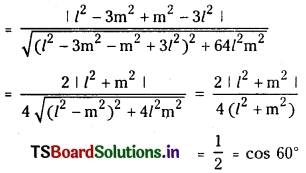
If ‘θ’ is the acute angle between the lines represented by ax2 + 2hxy + by2 = 0 then, show that cos θ = \(\frac{|a+b|}{\sqrt{(a-b)^2+4 h^2}}\). [Mar. ’18 (TS); Mar. ’06; May ’97]
Solution:
Let ax2 + 2hxy + by2 = 0 represent the lines
l1x + m1y = 0 ……..(1)
l2x + m2y = 0 ……..(2)
TS Inter First Year Maths 1B Pair of Straight Lines Important Questions Q1
The combined equation of lines (1) & (2) is
ax2 + 2hxy + by2 = (l1x + m1y)(l2x + m2y)
= l1l2x2 + m1m2xy + l2m1xy + m1m2y2
= l1l2x2 + (l1m2 + l2m1)xy + m1m2y2
Comparing on both sides we get l1l2 = a, l1m2 + l2m1 = 2h, m1m2 = b
If θ is an angle between the lines (1) & (2)
TS Inter First Year Maths 1B Pair of Straight Lines Important Questions Q1.1
TS Inter First Year Maths 1B Pair of Straight Lines Important Questions Q1.2

Question 2.
If the equation ax2 + 2hxy + by2 = 0 represents a pair of lines then prove that the equation of the pair of angular bisectors is h[x2 – y2] = (a – b) xy. [Mar. ’18 (AP); May ’13, ’09, ’96, ’91; Mar. ’13(old), ’09, ’00, ’95. ’92, ’90]
Solution:
Let ax2 + 2hxy + by2 = 0 represent a pair of straight lines
l1x + m1y = 0 ……(1)
l2x + m2y = 0 ……(2)
TS Inter First Year Maths 1B Pair of Straight Lines Important Questions Q2
The combined equation of (1) & (2) is
ax2 + 2hxy + by2 = (l1x + m1y)(l2x + m2y)
= l1l2x2 + l1m2xy + l2m1xy + m1m2y2
= l1l2x2 + (l1m2 + l2m1)xy + m1m2y2
Comparing on both sides we get a = l1l2, 2h = l1m2 + l2m1, b = m1m2
The equation for the bisectors of angles between (1) & (2) is
TS Inter First Year Maths 1B Pair of Straight Lines Important Questions Q2.1
TS Inter First Year Maths 1B Pair of Straight Lines Important Questions Q2.2

TS Inter First Year Maths 1B Pair of Straight Lines Important Questions

Question 3.
Show that the product of the perpendicular distances from a point (α, β) to the pair of straight lines ax2 + 2hxy + by2 = 0 is \(\frac{\left|a \alpha^2+2 h \alpha \beta+b \beta^2\right|}{\sqrt{(a-b)^2+4 h^2}}\). [May ’15 (AP); May ’14, ’13 (Old); ’11, ’08, ’07: Mar. ’08, ’07, ’04, ’01]
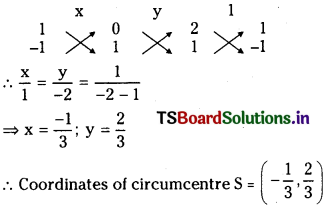
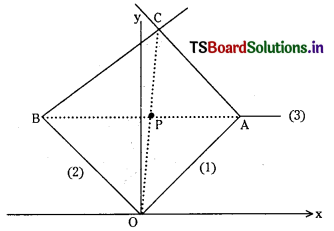
Solution:
Let ax2 + 2hxy + by2 = 0 represents two lines (1)&(2)
l1x + m1y = 0 …..(1), l2x + m2y = 0 ……(2)
TS Inter First Year Maths 1B Pair of Straight Lines Important Questions Q3
The combined equation of (1) & (2) is ax2 + 2hxy + by2
= (l1x + m1y)(l2x + m2y)
= l1l2x2 + l1m2xy + l2m1xy + m1m2y2
= l1l2x2 + (l1m2 + l2m1)xy + m1m2y2
Comparing on both sides we get a = l1l2, 2h = l1m2 + l2m1, b = m1m2
The length of the perpendicular from (α, β) to line (1) is
TS Inter First Year Maths 1B Pair of Straight Lines Important Questions Q3.1
TS Inter First Year Maths 1B Pair of Straight Lines Important Questions Q3.2

Question 4.
Show that the area of the triangle formed by the lines ax2 + 2hxy + by2 = 0 and lx + my + n = 0 is \(\frac{n^2 \sqrt{h^2-a b}}{\left|a m^2-2 h l m+b l^2\right|}\). [Mar. ’13, ’02; May ’15(TS), ’10, ’98, ’94, ’92; B.P; Mar. ’17 (AP & TS); Mar. ’19 (TS)]]
Solution:
Let ax2 + 2hxy + by2 = 0 represents two lines l1x + m1y = 0 …….(1), l2x + m2y = 0 ……..(2)
TS Inter First Year Maths 1B Pair of Straight Lines Important Questions Q4
The combined equation of (1) & (2) is
ax2 + 2hxy + by2 = (l1x + m1y)(l2x + m2y)
= l1l2x2 + l1m2xy + l2m1xy + m1m2y2
= l1l2x2 + (l1m2 + l2m1)xy + m1m2y2
Comparing on both sides we get a = l1l2, 2h = l1m2 + l2m1, b = m1m2
Let the given line be lx + my + n = 0 ……..(3)
Clearly, the origin O is the point of intersection of (1) & (2)
∴ O = (0, 0)
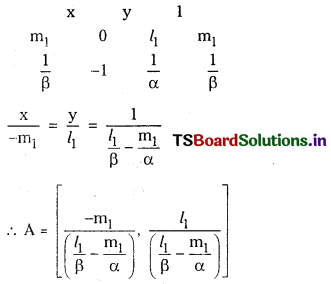
Let A be the point of intersection of (1) & (3)
TS Inter First Year Maths 1B Pair of Straight Lines Important Questions Q4.1
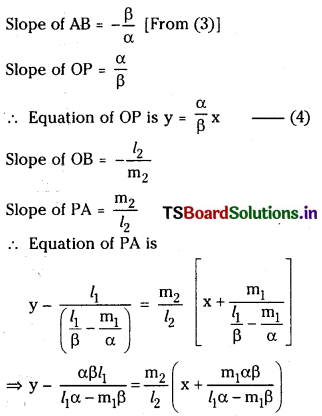
TS Inter First Year Maths 1B Pair of Straight Lines Important Questions Q4.2
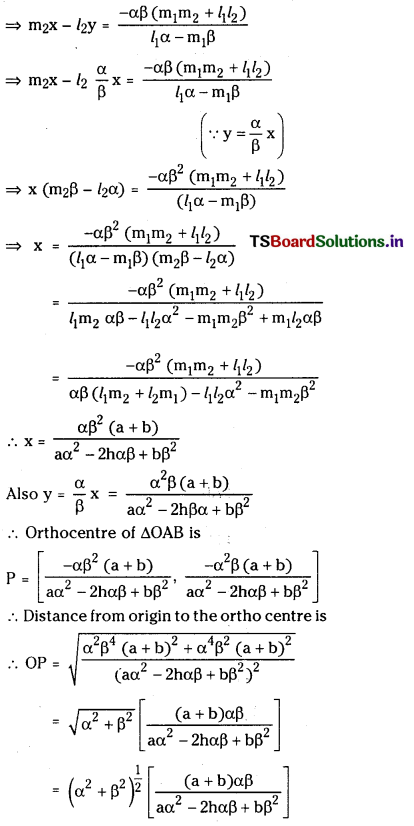
TS Inter First Year Maths 1B Pair of Straight Lines Important Questions Q4.3
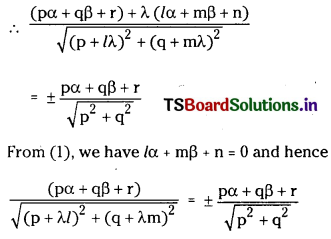
TS Inter First Year Maths 1B Pair of Straight Lines Important Questions Q4.4

Question 5.
Find the centroid and area of the triangle formed by the lines 12x2 – 20xy + 7y2 – 0 and 2x – 3y + 4 = 0. [Mar. ’05, ’90, ’83; May ’87]
Solution:
Given the equation of the pair of lines is
12x2 – 20xy + 7y2 = 0
12x2 – 6xy – 14xy + 7y2 = 0
6x(2x – y) – 7y(2x – y) = 0
(2x – y)(6x – 7y) = 0
2x – y = 0 …….(1), 6x – 7y = 0 ……..(2)
The third equation is 2x – 3y + 4 = 0 ……(3)
∴ Vertex O: The point of intersection of (1) & (2) is O = (0, 0)
TS Inter First Year Maths 1B Pair of Straight Lines Important Questions Q5
TS Inter First Year Maths 1B Pair of Straight Lines Important Questions Q5.1

TS Inter First Year Maths 1B Pair of Straight Lines Important Questions

Question 6.
Show that the lines represented by (lx + my)2 – 3(mx – ly)2 = 0 and lx + my + n = 0 form an equilateral triangle with area \(\frac{n^2}{\sqrt{3}\left(l^2+m^2\right)}\). [Mar. ’15 (TS), ’91]
Solution:
Given equation of the pair of lines is (lx + my)2 – 3(mx – ly)2 = 0
(lx + my)2 – [√3(mx – ly)2] = 0
(lx + my + √3(mx – ly)) (lx + my – √3(mx – ly)) = 0
(lx + my + √3mx – √3ly) (lx + my – √3mx + √3ly) = 0
[(l + √3m)x + (m – √3l)y] [(l – √3m)x + (m + √3l)y] = 0
(l + √3m)x + (m – √3l)y = 0
(l – √3m)x + (m + √3l)y = 0
∴ This equation represents the lines
(l + √3m)x + (m – √3l)y = 0 ……..(1)
(l – √3m)x + (m + √3l)y = 0 ……(2)
Let the given equation of the straight line is lx + my + n = 0 ………(3)
If A is an angle between lines (1) & (3), then
TS Inter First Year Maths 1B Pair of Straight Lines Important Questions Q6
TS Inter First Year Maths 1B Pair of Straight Lines Important Questions Q6.1
B = 60°
If O is the third angle then O = 180° – (60 + 60)
= 180° – 120°
= 60°
∴ A = B = O = 60°
The lines (1), (2), (3) form an equilateral triangle.
Now h = the perpendicular distance from the origin to the straight line lx + my + n = 0
TS Inter First Year Maths 1B Pair of Straight Lines Important Questions Q6.2

Question 7.
Prove that the lines represented by the x2 – 4xy + y2 = 0 and x + y = 3 form an equilateral triangle. [May ’00]
Solution:
Given the equation of the pair of lines is x2 – 4xy + y2 = 0
Comparing with ax2 + 2hxy + by2 = 0, we get a = 1, b = 1, h = -2.
TS Inter First Year Maths 1B Pair of Straight Lines Important Questions Q7
∴ Given equation represents the two lines are \(a x+\left(h \pm \sqrt{h^2-a b}\right) y=0\)
\(1 x+\left(-2 \pm \sqrt{(-2)^2-1 \times 1}\right) y=0\)
x + (-2 ± \(\sqrt{4-1}\))y = 0
x + (-2 ± √3)y = 0
x + (-2 + √3)y = 0, x + (-2 – √3)y = 0
This equation represents the lines
x + (-2 + √3)y = 0 ………(1)
x + (-2 – √3)y = 0 ………(2)
Let the given equation of the straight line is x + y – 3 = 0 ……(3)
Let A is an angle between (1) & (3) then
TS Inter First Year Maths 1B Pair of Straight Lines Important Questions Q7.1
B = 60°
If O is the third angle then
O = 180° – (A + B)
= 180° – (60 + 60)
= 180° – 120°
= 60°
∴ O = A = B = 60°
∴ The lines (1), (2), (3) form an equilateral triangle.

TS Inter First Year Maths 1B Pair of Straight Lines Important Questions

Question 8.
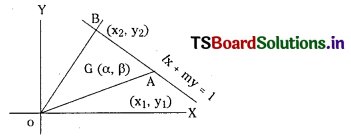
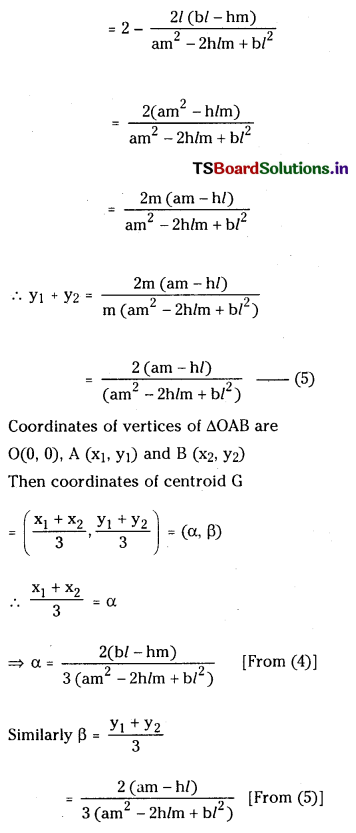
If (α, β) is the centroid of the triangle formed by the lines ax2 + 2hxy + by2 = 0 and lx + my = 1 prove that \(\frac{\alpha}{b l-h m}=\frac{\beta}{a m-h l}=\frac{2}{3\left(b l^2-2 h l m+a m^2\right)}\). [Mar. ’08]
Solution:
Let ax2 + 2hxy + by2 = 0 represents the lines l1x + m1y = 0 …….(1), l2x + m2y = 0 ……(2)
∴ ax2 + 2hxy + by2 = (l1x + m1y)(l2x + m2y)
TS Inter First Year Maths 1B Pair of Straight Lines Important Questions Q8
Comparing on both sides we get l1l2 = a, (l1m2 + l2m1) = 2h, m1m2 = b
Given equation of the straight line is lx + my – 1 = 0 ………(3)
Vertex O: Clearly the origin O is the point of intersection of (1) & (2)
∴ O = (0, 0)
Vertex A: Solving (2) & (3)
TS Inter First Year Maths 1B Pair of Straight Lines Important Questions Q8.1
TS Inter First Year Maths 1B Pair of Straight Lines Important Questions Q8.2
TS Inter First Year Maths 1B Pair of Straight Lines Important Questions Q8.3
TS Inter First Year Maths 1B Pair of Straight Lines Important Questions Q8.4

Question 9.
Find the equation of the pair of lines intersecting at (2, -1) and (i) perpendicular to the pair 6x2 – 13xy – 5y2 = 0 and (ii) parallel to the pair 6x2 – 13xy – 5y2 = 0. [May ’98]
Solution:
Given the equation of the pair of lines is 6x2 – 13xy – 5y2 = 0.
Comparing with ax2 + 2hxy + by2 = 0, we get a = 6, h = \(\frac{-13}{2}\), b = -5
Let the given point A(x1, y1) = (2, -1)
(i) Equation to the pair of lines perpendicular to 6x2 – 13xy – 5y2 = 0 and passing through (2, -1) is
b(x – x1)2 – 2h(x – x1)(y – y1) + a(y – y1)2 = 0
-5(x – 2)2 – 2 × \(\frac{-13}{2}\) (x – 2)(y + 1) + 6(y + 1)2 = 0
-5(x2 + 4 – 4x) + 13(xy + x – 2y – 2) + 6(y2 + 1 + 2y) = 0
-5x2 – 20 + 20x + 13xy + 13x – 26y – 26 + 6y2 + 6 + 12y = 0
-5x2 + 13xy + 6y2 + 33x – 14y – 40 = 0
5x2 – 13xy – 6y2 – 33x + 14y + 40 = 0
(ii) Equation to the pair of a line parallel to 6x2 – 13xy – 5y2 = 0 and passing through (2, -1) is
a(x – x1)2 + 2h(x – x1)(y – y1) + b(y – y1)2 = 0
6(x – 2)2 + 2 × \(\frac{-13}{2}\) (x – 2) (y + 1) – 5(y + 1)2 = 0
6(x2 + 4 – 4x) – 13(xy + x – 2y – 2) – 5(y2 + 1 + 2y) = 0
6x2 + 24 – 24x – 13xy – 13x + 26y + 26 – 5y2 – 5 – 10y = 0
6x2 – 5y2 – 13xy – 37x + 16y + 45 = 0

Question 10.
If ax2 + 2hxy + by2 + 2gx + 2fy + c = 0 represents a pair of lines then prove that
(i) abc + 2fgh – af2 – bg2 – ch2 = 0
(ii) h2 ≥ ab, g2 ≥ ac and f2 ≥ bc. [Mar. ’16 (AP & TS), ’14, ’11, ’96, ’83; May ’95, ’90]
Solution:
Let ax2 + 2hxy + by2 + 2gx + 2fy + c = 0 represent the two lines
l1x + m1y + n1 = 0 ……….(1)
l2x + m2y + n2 = 0 ……….(2)
TS Inter First Year Maths 1B Pair of Straight Lines Important Questions Q10
TS Inter First Year Maths 1B Pair of Straight Lines Important Questions Q10.1
TS Inter First Year Maths 1B Pair of Straight Lines Important Questions Q10.2
TS Inter First Year Maths 1B Pair of Straight Lines Important Questions Q10.3

Question 11.
If the equation ax2 + 2hxy + by2 + 2gx + 2fy + c = 0 represents two parallel lines, then prove that (i) h2 = ab (ii) af2 = bg2 and (iii) the distance between the parallel lines = \(2 \sqrt{\frac{g^2-a c}{a(a+b)}}=2 \sqrt{\frac{f^2-b c}{b(a+b)}}\). [Mar. ’12, ’10, ’98; May ’06, ’01, ’97, ’95, ’91; Mar. ’19 (AP)]
Solution:
Let S = 0 represent the lines
lx + my + n1 = 0 …….(1)
lx + my + n2 = 0 …….(2)
∴ ax2 + 2hxy + by2 + 2gx + 2fy + c = (lx + my + n1)(lx + my + n2)
= l2x2 + lmxy + ln2x + lmxy + m2y2 + mn2y + ln1x + mn1y + n1n2
= l2x2 + 2lmxy + m2y2 + (ln2 + ln1)x + (mn2 + mn1)y + n1n2
Comparing both sides we get
l2 = a, 2lm = 2h, m2 = b, ln1 + ln2 = 2g, mn2 + mn1 = 2f, n1n2 = c, lm = h, l(n1 + n2) = 2g
m(n1 + n2) = 2f
(i) h2 = (lm)2 = l2m2 = ab = R.H.S.
∴ h2 = ab
(ii) \(\frac{2g}{2f}\) = \(\frac{l\left(n_1+n_2\right)}{m\left(n_1+n_2\right)}\)
\(\frac{\mathrm{g}}{\mathrm{f}}=\frac{l}{\mathrm{~m}}\)
gm = lf
Squaring on both sides
g2m2 = l2f2
∴ af2 = bg2
(iii) The distance between two parallel lines
TS Inter First Year Maths 1B Pair of Straight Lines Important Questions Q11
TS Inter First Year Maths 1B Pair of Straight Lines Important Questions Q11.1

TS Inter First Year Maths 1B Pair of Straight Lines Important Questions

Question 12.
Show that the equation 2x2 – 13xy – 7y2 + x + 23y – 6 = 0 represents a pair of straight lines. Also, find the angle between them and the coordinates of the point of intersection of the lines. [May ’12, ’00; Mar. ’03]
Solution:
Given equation is 2x2 – 13xy – 7y2 + x + 23y – 6 = 0.
Comparing the given equation with ax2 + 2hxy + by2 + 2gx + 2fy + c = 0, we get
a = 2, h = \(\frac{-13}{2}\), b = -7, g = \(\frac{1}{2}\), f = \(\frac{23}{2}\), c = -6
Now,
(i) abc + 2fgh – af2 – bg2 – ch2
TS Inter First Year Maths 1B Pair of Straight Lines Important Questions Q12
TS Inter First Year Maths 1B Pair of Straight Lines Important Questions Q12.1
TS Inter First Year Maths 1B Pair of Straight Lines Important Questions Q12.2
TS Inter First Year Maths 1B Pair of Straight Lines Important Questions Q12.3

Question 13.
Find the value of λ for which the equation λx2 – 10xy + 12y2 + 5x – 16y – 3 = 0 represents a pair of straight lines. [May ’09]
Solution:
Given equation is λx2 – 10xy + 12y2 + 5x – 16y – 3 = 0.
Comparing the given equation with ax2 + 2hxy + by2 + 2gx + 2fy + c = 0, we get
a = λ, h = -5, b = 12, g = \(\frac{5}{2}\), f = -8, c = -3
Since the given equation represents a pair of straight lines then
TS Inter First Year Maths 1B Pair of Straight Lines Important Questions Q13

Question 14.
Show that the equation 8x2 – 24xy + 18y2 – 6x + 9y – 5 = 0 represents a pair of parallel straight lines and find the distance between them. [Mar. ’93]
Solution:
Given, equation is 8x2 – 24xy + 18y2 – 6x + 9y – 5 = 0
Comparing the given equation with ax2 + 2hxy + by2 + 2gx + 2fy + c = 0, we get
a = 8, h = -12, b = 18, g = -3, f = \(\frac{9}{2}\), c = -5
(i) h2 = ab
⇒ h2 = (-12)2 = 144
ab = 8 × 18 = 144
∴ h2 = ab
(ii) af2 = \(8\left(\frac{9}{2}\right)^2\)
= 8 × \(\frac{81}{4}\)
= 162
bg2 = 18(-3)2
= 18 × 9
= 162
∴ af2 = bg2
∴ The given equation represents a pair of parallel straight lines.
Now the distance between the parallel lines
TS Inter First Year Maths 1B Pair of Straight Lines Important Questions Q14

Question 15.
Show that the pairs of straight lines 6x2 – 5xy – 6y2 = 0 and 6x2 – 5xy – 6y2 + x + 5y – 1 = 0 form a square. [May ’02, ’98, ’91, ’86: Mar. ’02]
Solution:
Given equations of the pair of lines are
6x2 – 5xy – 6y2 = 0 ……..(1)
6x2 – 5xy – 6y2 + x + 5y – 1 = 0 ………(2)
TS Inter First Year Maths 1B Pair of Straight Lines Important Questions Q15
Now, 6x2 – 5xy – 6y2 = 0
6x2 – 9xy + 4xy – 6y2 = 0
3x(2x – 3y) + 2y(2x – 3y) = 0
(2x – 3y)(3x + 2y) = 0
2x – 3y = 0 …….(3) 3x + 2y = 0 ……..(4)
Equation (1) represents the two lines are 2x – 3y = 0 ……(3), 3x + 2y = 0 …….(4)
Now, 6x2 – 5xy – 6y2 + x + 5y – 1 = (2x – 3y + k) (3x + 2y + l)
Comparing the coefficient of x on both sides we get 2l + 3k = 1
Comparing the coefficient of y on both sides we get -3l + 2k = 5
Solving these two equations
TS Inter First Year Maths 1B Pair of Straight Lines Important Questions Q15.1
Equation (2) represents the lines that are
2x – 3y + 1 = 0
3x + 2y – 1 = 0
∴ The four lines are
2x – 3y = 0 ……(3)
3x + 2y = 0 ……..(4)
2x – 3y + 1 = 0 ……..(5)
3x + 2y – 1 = 0 ………(6)
The equations (3) & (5); (4) & (6) are parallel.
The equations (3) & (4); (5) & (6) are perpendicular.
∴ The four lines form a rectangle.
The distance between the parallel lines (3) & (5) is
\(\frac{\left|c_1-c_2\right|}{\sqrt{a^2+b^2}}=\frac{|0-1|}{\sqrt{2^2+(-3)^2}}=\frac{|-1|}{\sqrt{4+9}}=\frac{1}{\sqrt{13}}\)
The distance between the parallel lines (4) & (6) is
\(\frac{\left|c_1-c_2\right|}{\sqrt{a^2+b^2}}=\frac{|0+1|}{\sqrt{3^2+2^2}}=\frac{1}{\sqrt{9+4}}=\frac{1}{\sqrt{13}}\)
∴ Given lines form a square.

TS Inter First Year Maths 1B Pair of Straight Lines Important Questions

Question 16.
Show that the straight lines y2 – 4y + 3 = 0 and x2 + 4xy + 4y2 + 5x + 10y + 4 = 0 form a parallelogram and find the lengths of its sides. [Mar. ’92]
Solution:
Given equations of the straight lines are
y2 – 4y + 3 = 0 …….(1)
x2 + 4xy + 4y2 + 5x + 10y + 4 = 0 …….(2)
(1) ⇒ y2 – 4y + 3 = 0
y2 – 3y – y + 3 = 0
y(y – 3) – 1(y – 3) = 0
(y – 3) (y – 1) = 0
y – 1 = o ……(3)
y – 3 = 0 ……..(4)
Equation (1) represents the lines y – 1 = 0 & y – 3 = 0.
Now, x2 + 4xy + 4y2 = 0
x2 + 2xy + 2xy + 4y2 = 0
x(x + 2y) + 2y(x + 2y) = 0
(x + 2y) (x + 2y) = 0
x + 2y = 0, x + 2y = 0
x2 + 4xy + 4y2 + 5x + 10y + 4 = (x + 2y + k) (x + 2y + l)
Comparing the coefficients of x on both sides l + k = 5
Comparing the coefficients of y on both sides 2l + 2k = 10
⇒ l + k = 5
Comparing constant terms on both sides
lk = 4
l = \(\frac{4}{k}\)
\(\frac{4}{k}\) + k = 5
4 + k2 = 5k
k2 – 5k + 4 = 0
k2 – 4k – k + 4 = 0
k(k – 4) – 1(k – 4) = 0
(k – 4)(k – 1) = 0
k = 4; k = 1
If k = 4; l = \(\frac{4}{4}\) = 1
If k = 1; l = \(\frac{4}{1}\) = 4
Equations (2) represent the lines that are
x + 2y + 4 = 0 …….(5)
x + 2y + 1 = 0 …….(6)
The equations of the four lines are
y – 1 = 0 ……(3)
y – 3 = 0 ……..(4)
x + 2y + 4 = 0 ……..(5)
x + 2y + 1 = 0 ……..(6)
Clearly, lines (3), (4) & (5), (6) are parallel.
TS Inter First Year Maths 1B Pair of Straight Lines Important Questions Q16
Vertex A: Solving (3) & (6)
From (3), y = 1
From (6), x + 2(1) + 1 = 0
⇒ x + 3 = 0
⇒ x = -3
Vertex A = (-3, 1)
Vertex B: Solving (3) & (5)
From (3), y = 1
From (5), x + 2(1) + 4 = 0
⇒ x + 6 = 0
⇒ x = -6
Vertex B = (-6, 1)
Vertex C: Solving (4) & (5)
From (4), y = 3
From (5), x + 2(3) + 4 = 0
⇒ x + 10 = 0
⇒ x = -10
Vertex C = (-10, 3)
Vertex D: Solving (4) & (6)
From (4), y = 3
From (6), x + 2(3) + 1 = 0
⇒ x + 7 = 0
⇒ x = -7
Vertex D = (-7, 3)
Vertices of a parallelogram are A(-3, 1), B(-6, 1), C(-10, 3) & D(-7, 3)
Now,
TS Inter First Year Maths 1B Pair of Straight Lines Important Questions Q16.1

Question 17.
Show that the product of the perpendicular distances from the origin to the pair of straight lines represented by ax2 + 2hxy + by2 + 2gx + 2fy + c = 0 is \(\frac{|c|}{\sqrt{(a-b)^2+4 h^2}}\). [May ’98, ’93, ’90]
Solution:
ax2 + 2hxy + by2 + 2gx + 2fy + c = 0 represents two lines
l1x + m1y + n1 = 0 ……(1)
l2x + m2y + n2 = 0 …….(2)
ax2 + 2hxy + by2 + 2gx + 2fy + c = (l1x + m1y + n1)(l2x + m2y + n2)
Comparing the coefficients on both sides we get
a = l1l2, 2h = l1m2 + l2m1, 2g = l1n2 + l2n1, 2f = m1n1 + m2n2
The perpendicular distance from the origin to the straight line (1) is
TS Inter First Year Maths 1B Pair of Straight Lines Important Questions Q17
The perpendicular distance from the origin to the straight line (2) is
TS Inter First Year Maths 1B Pair of Straight Lines Important Questions Q17.1
The product of the perpendicular distances
TS Inter First Year Maths 1B Pair of Straight Lines Important Questions Q17.2

Question 18.
Find the angle between the lines joining the origin to the points of intersection of the curve x2 + 2xy + y2 + 2x + 2y – 5 = 0 and the line 3x – y + 1 = 0. [Mar. ’16 (AP), ’13, ’09, ’08, ’07; May ’14, ’13, ’11, ’04, ’80]
Solution:
Given equation of the curve is x2 + 2xy + y2 + 2x + 2y – 5 = 0 …….(1)
TS Inter First Year Maths 1B Pair of Straight Lines Important Questions Q18
The equation of a straight line is
3x – y + 1 = 0
3x – y = -1
-3x + y = 1 ….(2)
Let, A, B are the points of intersection of the given line and the given curve.
Now, Homogenising the equation (1) with the help of (2)
The combined equation of \(\overline{\mathrm{OA}}\) and \(\overline{\mathrm{OB}}\) is
x2 + 2xy + y2 + 2x(1) + 2y(1) – 5(1)2 = 0
x2 + 2xy + y2 + 2x(-3x + y) + 2y(-3x + y) – 5(-3x + y)2 = 0
x2 + 2xy + y2 – 6x2 + 2xy – 6xy + 2y2 – 5(9x2 + y2 – 6xy) = 0
x2 + 2xy + y2 – 6x2 + 2xy – 6xy + 2y2 – 45x2 – 5y2 + 30xy = 0
x2(-5 – 45) + xy(4 – 6 + 30) + y2(1 + 2 – 5) = 0
x2(-50) + xy (+28) + y2(-2) = 0
-50x2 + 28xy – 2y2 = 0
50x2 – 28xy + 2y2 = 0
25x2 – 14xy + y2 = 0
which is the equation of the pairs of lines \(\overline{\mathrm{OA}}\) and \(\overline{\mathrm{OB}}\).
If ‘θ’ is the angle between the lines \(\overline{\mathrm{OA}}\) and \(\overline{\mathrm{OB}}\)
TS Inter First Year Maths 1B Pair of Straight Lines Important Questions Q18.1

TS Inter First Year Maths 1B Pair of Straight Lines Important Questions

Question 19.
Find the value of k, if the lines joining the origin to the point of intersection of the curve 2x2 – 2xy + 3y2 + 2x – y – 1 = 0 and the line x + 2y = k are mutually perpendicular. [Mar. ’17 (AP), ’15 (TS), ’13 (Old) ’11, ’05, ’01; Mar. ’19 (AP & TS); May ’10, ’07, ’06; B.P.]
Solution:
Given the equation of the curve is 2x2 – 2xy + 3y2 + 2x – y – 1 = 0 ………(1)
TS Inter First Year Maths 1B Pair of Straight Lines Important Questions Q19
The equation of a straight line is x + 2y = k
\(\frac{x+2 y}{k}=1\) ……(1)
Let, A B be the points of intersection of the given line and the given curve.
Now, Homogenising the equation (1) with the help of (2)
The combined equation of \(\overline{\mathrm{OA}}\) and \(\overline{\mathrm{OB}}\) is
2x2 – 2xy + 3y2 + 2x(1) – y(1) – 1(1)2 = 0
TS Inter First Year Maths 1B Pair of Straight Lines Important Questions Q19.1
2k2x2 – 2k2xy + 3k2y2 + 2kx2 + 4kxy – kxy – 2ky2 – x2 – 4y2 – 4xy = 0
x2(2k2 + 2k – 1) + xy(-2k2 + 3k – 4) + y2(3k2 – 2k – 4) = 0
which is the equation of the pairs of lines \(\overline{\mathrm{OA}}\) and \(\overline{\mathrm{OB}}\).
Given that the lines \(\overline{\mathrm{OA}}\) and \(\overline{\mathrm{OB}}\) are perpendicular
then, a + b = 0
2k2 + 2k – 1 + 3k2 – 2k – 4 = 0
5k2 – 5 = 0
5k2 = 5
k2 = 1
k = ±1

Question 20.
Show that the lines joining the origin to the points of intersection of the curve x2 – xy + y2 + 3x + 3y – 2 = 0 and the straight line x – y – √2 = 0 are mutually perpendicular. [May ’15 (TS), ’12; Mar. ’15 (AP), ’12, ’08, ’03; Mar. ’18 (TS)]
Solution:
Given equation of the curve is x2 – xy + y2 + 3x + 3y – 2 = 0 ……..(1)
TS Inter First Year Maths 1B Pair of Straight Lines Important Questions Q20
Equation of straight line is x – y – √2 = 0
x – y = √2
\(\frac{x-y}{\sqrt{2}}=1\) …….(2)
Let, A, B be the points of intersection of the given line and the given curve.
Now, Homogenising the equation (1) with the help of (2)
The combined equation of \(\overline{\mathrm{OA}}\) and \(\overline{\mathrm{OB}}\) is
x2 – xy + y2 + 3x(1) + 3y(1) – 2(1)2 = 0
TS Inter First Year Maths 1B Pair of Straight Lines Important Questions Q20.1
which is the equation of the pairs of lines \(\overline{\mathrm{OA}}\) and \(\overline{\mathrm{OB}}\).
Now a + b = 3 – 3 = 0
Since a + b = 0, then the lines \(\overline{\mathrm{OA}}\) and \(\overline{\mathrm{OB}}\) are mutually perpendicular.

Question 21.
Find the condition for the chord lx + my = 1 of the circle x2 + y2 = a2 (whose centre is the origin) to subtend a right angle at the origin. [Mar. ’14, ’13]
Solution:
Given equation of the curve is x2 + y2 = a2 ………(1)
Equation of the straight line is lx + my = 1 ……..(2)
TS Inter First Year Maths 1B Pair of Straight Lines Important Questions Q21
Let A, B be the point of intersection of the given line and the given curve.
Now, Homogenising the equation (1) with the help of (2)
The combined equation of \(\overline{\mathrm{OA}}\) and \(\overline{\mathrm{OB}}\) is
x2 + y2 = a2(1)
x2 + y2 = a2(lx + my)2
x2 + y2 = a2(l2x2 + m2y2 + 2lmxy)
x2 + y2 = a2l2x2 + a2m2y2 + 2a2lmxy
a2l2x2 + a2m2y2 + 2a2lmxy – x2 – y2 = 0
x2(a2l2 – 1) + xy(2a2lm) + y2(a2m2 – 1) = 0
which is the equation of the pairs of lines \(\overline{\mathrm{OA}}\) and \(\overline{\mathrm{OB}}\).
Given that, the lines \(\overline{\mathrm{OA}}\) and \(\overline{\mathrm{OB}}\) are perpendicular.
Then, a + b = 0
a2l2 – 1 + a2m2 – 1 = 0
a2(l2 + m2) – 2 = 0
a2(l2 + m2) = 2
which is the required condition.

Question 22.
Find the condition for the lines joining the origin to the points of intersection of the circle x2 + y2 = a2 and the line lx + my = 1 to coincide. [Mar. ’17 (TS); May ’03]
Solution:
Given, equation of the curve is x2 + y2 = a2 ……….(1)
Equation of the straight line is lx + my = 1 ……….(2)
TS Inter First Year Maths 1B Pair of Straight Lines Important Questions Q22
Let A and B be the point of intersection of the given line and the given curve.
Now, Homogenising the equation (1) with the help of (2)
The combined equation of \(\overline{\mathrm{OA}}\) and \(\overline{\mathrm{OB}}\) is
x2 + y2 = a2(1)
x2 + y2 = a2(lx + my)2
x2 + y2 = a2(l2x2 + m2y2 + 2lmxy)
x2 + y2 = a2l2x2 + a2m2y2 + 2a2lmxy
a2l2x2 + a2m2y2 + 2a2lmxy – x2 – y2 = 0
x2(a2l2 – 1) + xy(2a2lm) + y2(a2m2 – 1) = 0
Which is the equation of the pairs of lines \(\overline{\mathrm{OA}}\) and \(\overline{\mathrm{OB}}\)
Given that the lines \(\overline{\mathrm{OA}}\) and \(\overline{\mathrm{OB}}\) coincide.
Then, h2 = ab
(a2lm)2 = (a2l2 – 1)(a2m2 – 1)
a4l2m2 = a4l2m2 – a2l2 – a2m2 + 1
a2l2 + a2m2 = 1
a2(l2 + m2) = 1
Which is the required condition.

TS Inter First Year Maths 1B Pair of Straight Lines Important Questions

Question 23.
Find the equations of the straight lines bisecting the angles between the lines 7x + y + 3 = 0 and x – y + 1 = 0. [May ’05]
Solution:
Given the equation of the straight lines are
7x + y + 3 = 0 ……..(1)
x – y + 1 = 0 ……..(2)
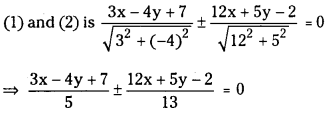
Equations of the bisectors of the angles between the lines (1) & (2) are
TS Inter First Year Maths 1B Pair of Straight Lines Important Questions Q23
7x + y + 3 + 5(x – y + 1) = 0
7x + y + 3 + 5x – 5y + 5 = 0
2x + 6y – 2 = 0
x + 3y – 1 = 0
7x + y + 3 – 5(x – y + 1) = 0
7x + y + 3 – 5x + 5y – 5 = 0
12x – 4y + 8 = 0
3x – y + 2 = 0
∴ The equation of the bisectors of the angle between the lines (1) & (2) is x + 3y – 1 = 0, 3x – y + 2 = 0.

Question 24.
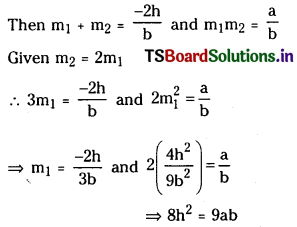
If ax2 + 2hxy + by2 = 0 represents two straight lines such that the slope of one line is twice the slope of the other, prove that 8h2 = 9ab. [May ’96]
Solution:
The given equation of the pair of lines is ax2 + 2hxy + by2 = 0.
Since the slope of one line is twice the slope of the other, then the slopes of the two lines represented by (1) are m, 2m.
TS Inter First Year Maths 1B Pair of Straight Lines Important Questions Q24

Question 25.
If one line of the pair of lines ax2 + 2hxy + by2 = 0 bisects the angle between the coordinate axes, prove that (a + b)2 = 4h2. [May ’04]
Solution:
Given, equation of the pair of lines is ax2 + 2hxy + by2 = 0 ………(1)
The equation of the X-axis is y = 0
The equation of the Y-axis is x = 0
∴ Equations of the bisectors of the angles between the coordinate axes are
\(\frac{\mathrm{a}_1 \mathrm{x}+\mathrm{b}_1 \mathrm{y}+\mathrm{c}_1}{\sqrt{\mathrm{a}_1^2+\mathrm{b}_1^2}}=\pm \frac{\mathrm{a}_2 \mathrm{x}+\mathrm{b}_2 \mathrm{y}+\mathrm{c}_2}{\sqrt{\mathrm{a}_2^2+\mathrm{b}_2^2}}\)
\(\frac{y}{\sqrt{1^2}}=\pm \frac{x}{\sqrt{1^2}}\)
y = ±x
y = x and y = -x
∴ Equations of the bisectors of the angles between the coordinate axes are y = x and y = -x.
Case 1: If one line of the pair of lines ax2 + 2hxy + hy2 = 0 is y = x
Substitute y = x in equation (1), and we get
ax2 + 2hx(x) + b(x)2 = 0
⇒ a + 2h + b = 0
⇒ a + b = -2h ………(2)
Case 2: If one line of the pair of lines is y = -x
Substitute y = -x in equation (1), and we get
ax2 + 2hx(-x) + b(-x)2 = 0
⇒ ax2 – 2hx2 + bx2 = 0
⇒ a – 2h + b = 0
⇒ a + b = 2h ……..(2)
From (2) & (3)
a + b = ±2h
Squaring on both sides
(a + b)2 = 4h2

Some More Maths 1B Pair of Straight Lines Important Questions

Question 26.
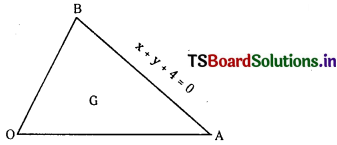
Find the centroid and the area of the triangle formed by the lines 2y2 – xy – 6x2 = 0, x + y + 4 = 0. [May ’03]
Solution:
Given the equation of the pair of lines is 2y2 – xy – 6x2 = 0
2y2 – 4xy + 3xy – 6x2 = 0
2y(y – 2x) + 3x(y – 2x) = 0
(y – 2x) (2y + 3x) = 0
y – 2x = 0 (or) 2y + 3x = 0
2x – y = 0 …….(1), 3x + 2y = 0 ……..(2)
The third equation is x + y + 4 = 0 ………(3)
TS Inter First Year Maths 1B Pair of Straight Lines Important Questions DTP Q1
∴ Vertex O: The point of intersection of (1) & (2) is O = (0, 0)
Vertex A: Solving (1) & (3)
TS Inter First Year Maths 1B Pair of Straight Lines Important Questions DTP Q1.1
Vertex B: Solving (2) & (3)
TS Inter First Year Maths 1B Pair of Straight Lines Important Questions DTP Q1.2
∴ Vertex B = (8, -12)
∴ Vertices of a triangle OAB are O = (0, 0), A(\(\frac{-4}{3}, \frac{-8}{3}\)), B = (8, -12)
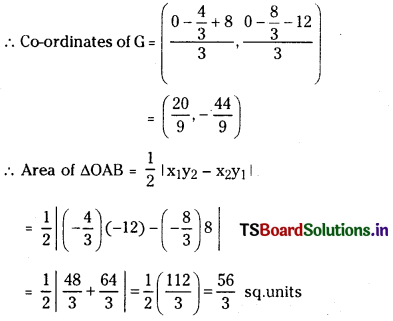
Centroid of triangle
TS Inter First Year Maths 1B Pair of Straight Lines Important Questions DTP Q1.3

TS Inter First Year Maths 1B Pair of Straight Lines Important Questions

Question 27.
Find the centroid and area of the triangle formed by the lines 3x2 – 4xy + y2 = 0, 2x – y = 6.
Solution:
Given the equation of the pair of lines is
3x2 – 4xy + y2 = 0
3x2 – 3xy – xy + y2 = 0
3x(x – y) – y(x – y) = 0
(x – y) (3x – y) = 0
x – y = 0 ……..(1), 3x – y = 0 ………(2)
TS Inter First Year Maths 1B Pair of Straight Lines Important Questions DTP Q2
The third equation is 2x – y – 6 = 0 …….(3)
∴ Vertex O: The point of intersection of (1) & (2) is O = (0, 0)
Vertex A: Solving (1) & (3)
TS Inter First Year Maths 1B Pair of Straight Lines Important Questions DTP Q2.1
x = 6; y = 6
∴ Vertex A = (6, 6)
Vertex B: Solving (2) & (3)
TS Inter First Year Maths 1B Pair of Straight Lines Important Questions DTP Q2.2
x = -6; y = -18
Vertex B = (-6, -18)
∴ Vertices of a triangle OAB are O = (0, 0), A = (6, 6), B = (-6, -18).
Centroid of triangle
TS Inter First Year Maths 1B Pair of Straight Lines Important Questions DTP Q2.3

Question 28.
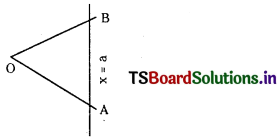
Show that the straight lines represented by (x + 2a)2 – 3y2 = 0 and x = a form an equilateral triangle. [Mar. ’03]
Solution:
TS Inter First Year Maths 1B Pair of Straight Lines Important Questions DTP Q3
Given equation of the pair of lines is (x + 2a)2 – 3y2 = 0
⇒ (x + 2a)2 – (√3y)2 = 0
⇒ (x + 2a + √3y) (x + 2a – √3y) = 0
⇒ x + 2a + √3y = 0, x – √3y + 2a = 0
⇒ x + √3y + 2a = 0, x – √3y + 2a = 0
∴ This equation represents the lines
x + √3y + 2a = 0 ……(1)
x – √3y + 2a = 0 ……….(2)
Let the given equation of the straight line is x = a ………(3)
If A is an angle between (1) & (2) then
TS Inter First Year Maths 1B Pair of Straight Lines Important Questions DTP Q3.1
\(\left|\frac{-2 \sqrt{3}}{-2}\right|=|\sqrt{3}|\)
A = 60°
If B is an angle between lines (2) & (3) then
TS Inter First Year Maths 1B Pair of Straight Lines Important Questions DTP Q3.2
B = 60°
If C is the third angle then C = 180° – (60° + 60°)
= 180° – 120°
= 60°
∴ A = B = C = 60°
∴ The lines (1), (2), (3) form an equilateral triangle.

Question 29.
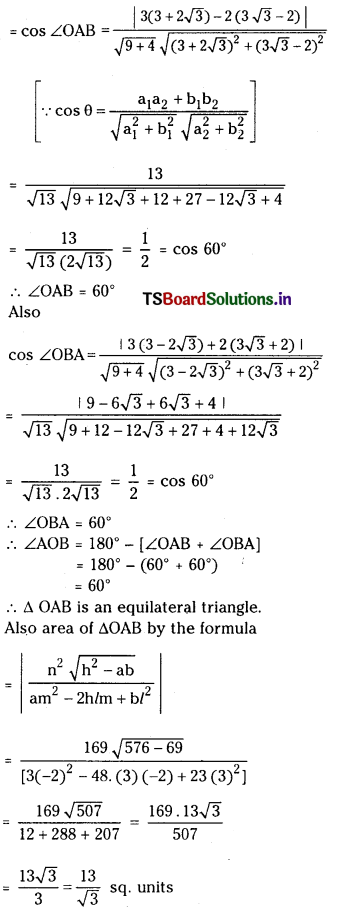
Show that the straight lines represented by 3x2 + 48xy + 23y2 = 0 and 3x – 2y + 13 = 0 form an equilateral triangle of area \(\frac{13}{\sqrt{3}}\) sq. units.
Solution:
Given the equation of the pair of lines is 3x2 + 48xy + 23y2 = 0
Comparing with ax2 + 2hxy + by2 = 0,
we get a = 3, 2h = 48 ⇒ h = 24, b = 23
TS Inter First Year Maths 1B Pair of Straight Lines Important Questions DTP Q4
The given equation represents the two lines that are
TS Inter First Year Maths 1B Pair of Straight Lines Important Questions DTP Q4.1
3x + (24 + √507)y = 0, 3x + (24 – √507)y = 0
∴ This equation represents the lines
3x + (24 + √507)y = 0 ……….(1)
3x + (24 – √507)y = 0 ………..(2)
Let the given equation of the straight line is 3x – 2y + 13 = 0 …….(3)
Let A is an angle between (1) & (3) then
TS Inter First Year Maths 1B Pair of Straight Lines Important Questions DTP Q4.2
∴ A = 60°
If B is an angle between lines (2) & (3) then
TS Inter First Year Maths 1B Pair of Straight Lines Important Questions DTP Q4.3
If O is the third angle then
O = 180° – (A + B)
= 180° – (60° + 60°)
= 180° – 120°
= 60°
∴ O = A = B = 60°
TS Inter First Year Maths 1B Pair of Straight Lines Important Questions DTP Q4.4
∴ The lines (1), (2), (3) form an equilateral triangle.
The length of the altitude of the triangle h = the perpendicular distance from the origin O to the line (3)
TS Inter First Year Maths 1B Pair of Straight Lines Important Questions DTP Q4.5

TS Inter First Year Maths 1B Pair of Straight Lines Important Questions

Question 30.
Prove that the equation 3x2 + 7xy + 2y2 + 5x + 5y + 2 = 0 represents a pair of straight lines and find the coordinates of the point of intersection.
Solution:
Given equation is 3x2 + 7xy + 2y2 + 5x + 5y + 2 = 0
Comparing the given equation with ax2 + 2hxy + by2 + 2gx + 2fy + c = 0, we get
TS Inter First Year Maths 1B Pair of Straight Lines Important Questions DTP Q5
TS Inter First Year Maths 1B Pair of Straight Lines Important Questions DTP Q5.1
TS Inter First Year Maths 1B Pair of Straight Lines Important Questions DTP Q5.2

Question 31.
If x2 + xy – 2y2 + 4x – y + k = 0 represents a pair of straight lines, find k.
Solution:
Given equation is x2 + xy – 2y2 + 4x – y + k = 0
Comparing the given equation with ax2 + 2hxy + by2 + 2gx + 2fy + c = 0, we get
a = 1, h = \(\frac{1}{2}\), b = -2, g = 2, f = \(\frac{-1}{2}\), c = k
Since the given equation represents a pair of lines then abc + 2fgh – af2 – bg2 – ch2 = 0
TS Inter First Year Maths 1B Pair of Straight Lines Important Questions DTP Q6

Question 32.
Find the distance between the pairs of parallel straight lines 9x2 – 6xy + y2 + 18x – 6y + 8 = 0. [May ’03]
Solution:
Given, equation is 9x2 – 6xy + y2 + 18x – 6y + 8 = 0
Comparing the given equation with ax2 + 2hxy + by2 + 2gx + 2fy + c = 0, we get
a = 9, h = -3, b = 1, g = 9, f = -3, c = 8
The distance between the parallel lines
TS Inter First Year Maths 1B Pair of Straight Lines Important Questions DTP Q7

Question 33.
Find the distance between the pairs of parallel straight lines x2 + 2√3xy + 3y2 – 3x – 3√3y – 4 = 0. [May ’03]
Solution:
Given, equation is x2 + 2√3xy + 3y2 – 3x – 3√3y – 4 = 0
Comparing the given equation with ax2 + 2hxy + by2 + 2gx + 2fy + c = 0, we get
a = 1, h = √3, b = 3, g = \(\frac{-3}{2}\), f = \(\frac{-3 \sqrt{3}}{2}\), c = -4
The distance between the parallel lines
TS Inter First Year Maths 1B Pair of Straight Lines Important Questions DTP Q8

Question 34.
Show that the two pairs of lines 3x2 + 8xy – 3y2 = 0 and 3x2 + 8xy – 3y2 + 2x – 4y – 1 = 0 form a square.
Solution:
Given equations of the pair of lines are
3x2 + 8xy – 3y2 = 0 ……..(1)
3x2 + 8xy – 3y2 + 2x – 4y – 1 = 0 ………(2)
TS Inter First Year Maths 1B Pair of Straight Lines Important Questions DTP Q9
Now, 3x2 + 8xy – 3y2 = 0
3x2 + 9xy – xy – 3y2 = 0
3x(x + 3y) – y(x + 3y) = 0
(x + 3y)(3x – y) = 0
x + 3y = 0 (or) 3x – y = 0
Equation (1) represents the two lines that are
x + 3y = 0 ………(3), 3x – y = 0 ………(4)
Now 3x2 + 8xy – 3y2 + 2x – 4y – 1 = (x + 3y + k) (3x – y + l)
Comparing the coefficient of x, on both sides we get l + 3k = 2
Comparing the coefficient of y on both sides we get 3l – k = -4
Solving these two equations we get
TS Inter First Year Maths 1B Pair of Straight Lines Important Questions DTP Q9.1
TS Inter First Year Maths 1B Pair of Straight Lines Important Questions DTP Q9.2
∴ Equation (2) represents the lines that are
x + 3y + 1 = 0 ……..(5)
3x – y – 1 = 0 ……….(6)
∴ The equations of the four lines are
x + 3y = 0 ……….(3)
3x – y = 0 ………..(4)
x + 3y + 1 = 0 ……….(5)
3x – y – 1 = 0 ……….(6)
The equations (3) & (5); (4) & (6) are parallel.
The equations (3) & (4); (5) & (6) are perpendicular.
∴ The four lines form a rectangle.
The distance between the parallel lines (3) & (5) is
\(\frac{\left|c_1-c_2\right|}{\sqrt{a^2+b^2}}=\frac{|0-1|}{\sqrt{1^2+3^2}}=\frac{|-1|}{\sqrt{1+9}}=\frac{1}{\sqrt{10}}\)
The distance between the parallel lines (4) & (6) is
\(\frac{\left|c_1-c_2\right|}{\sqrt{a^2+b^2}}=\frac{|0+1|}{\sqrt{3^2+(-1)^2}}=\frac{1}{\sqrt{9+1}}=\frac{1}{\sqrt{10}}\)
∴ Given lines form a square.

TS Inter First Year Maths 1B Pair of Straight Lines Important Questions

Question 35.
Find the lines joining the origin to the points of intersection of the curve 7x2 – 4xy + 8y2 + 2x – 4y – 8 = 0 with the straight line 3x – y = 2 and also the angle between them. [Mar. ’18 (AP); May ’01, ’98; Mar. ’00]
Solution:
Given the equation of the curve is
7x2 – 4xy + 8y2 + 2x – 4y – 8 = 0 ………(1)
The equation of a straight line is 3x – y = 2
\(\frac{3 x-y}{2}\) = 1 ……..(2)
TS Inter First Year Maths 1B Pair of Straight Lines Important Questions DTP Q10
Let A and B be the points of intersection of the given line and curve.
Now, Homogenising the equation (1) with the help of (2)
The combined equation of \(\overline{\mathrm{OA}}\) and \(\overline{\mathrm{OB}}\) is
7x2 – 4xy + 8y2 + 2x(1) – 4y(1) – 8(1)2 = 0
TS Inter First Year Maths 1B Pair of Straight Lines Important Questions DTP Q10.1
7x2 – 4xy + 8y2 + 3x2 – xy – 6xy + 2y2 – 18x2 – 2y2 + 12xy = 0
x2(7 + 3 – 18) + xy(-4 – 1 – 6 + 12) + y2(8 + 2 – 2) = 0
x2(-8) + xy(1) + y2(8) = 0
-8x2 + xy + 8y2 = 0
8x2 – xy – 8y2 = 0
which is the equation of the pairs of lines \(\overline{\mathrm{OA}}\) and \(\overline{\mathrm{OB}}\).
Here, a = 8, b = -8
Now, a + b = 8 – 8 = 0
Since, a + b = 0, the lines \(\overline{\mathrm{OA}}\) and \(\overline{\mathrm{OB}}\) are mutually perpendicular.
∴ Angle between the lines = 90°

Question 36.
Find the equation of the bisector of the acute angle between the lines 3x – 4y + 7 = 0 and 12x + 5y – 2 = 0.
Solution:
Given equations of the straight lines are
3x – 4y + 7 = 0 ……….(1)
12x + 5y – 2 = 0 ………(2)
Equations of bisectors of the angles between the lines (1) & (2) are
TS Inter First Year Maths 1B Pair of Straight Lines Important Questions Some More Q1
13(3x – 4y + 7) = 5(12x + 5y – 2)
39x – 52y + 91 = 60x + 25y – 10
21x + 77y – 101 = 0
\(\frac{3 x-4 y+7}{5}=\frac{-12 x-5 y+2}{13}\)
39x – 52y + 91 + 60x + 25y – 10 = 0
99x – 27y + 81 = 0
11x – 3y + 9 = 0
∴ The equations of the bisectors of the angles between lines (1) & (2) are
21x + 77y – 101 = 0 ……….(3)
11x – 3y + 9 = 0 ……….(4)
Consider the lines
3x – 4y + 7 = 0 ……..(1)
11x – 3y + 9 = 0 ……..(4)
If θ is the angle between (1) & (4) then
TS Inter First Year Maths 1B Pair of Straight Lines Important Questions Some More Q1.1
∴ 11x – 3y + 9 = 0 is the acute angle bisector.

Question 37.
Show that the equation of the pair of lines bisecting the angle between the pair of bisectors of the angles between the pair of lines ax2 + 2hxy + by2 = 0 is (a – b) (x2 – y2) + 4hxy = 0.
Solution:
Given, equation of the pair of lines is ax2 + 2hxy + by2 = 0 ……(1)
The equation to the pair of bisectors of angles between (1) is
h(x2 – y2) = (a – b)xy
hx2 – hy2 = (a – b)xy
hx2 – (a – b)xy – hy2 = 0 ……….(2)
Now comparing (2) with ax2 + 2hxy + by2 = 0, we get
a = h, h = \(\frac{-(a-b)}{2}\), b = -h
The equation to the pair of bisectors of angles between (2) is
h(x2 – y2) = (a – b)(xy)
\(\frac{-(a-b)}{2}\)(x2 – y2) = (h + h)xy
-(a – b)(x2 – y2) = 4hxy
∴ (a – b)(x2 – y2) + 4hxy = 0

Question 38.
If the pairs of lines represented by ax2 + 2hxy + by2 = 0 and ax2 + 2hxy + by2 + 2gx + 2fy + c = 0 form a rhombus, prove that (a – b)fg + h(f2 – g2) = 0.
Solution:
Given equations o the pair of lines are
ax2 + 2hxy + by2 = 0 ………..(1)
ax2 + 2hxy + by2 + 2gx + 2fy + c = 0 ……..(2)
Let \(\overline{\mathrm{OA}}, \overline{\mathrm{OB}}\) be the pair of straight lines given by (1).
\(\overline{\mathrm{AC}}, \overline{\mathrm{BC}}\) be the pair of lines given by (2).
Since the lines represented by (1) are parallel to the lines represented by (2), then OACB is a parallelogram.
Now, ‘C’ is the point of intersection of (2).
TS Inter First Year Maths 1B Pair of Straight Lines Important Questions Some More Q3
(gh – af)x – (hf – bg)y = 0
Since, ‘A’ is a point on the locus (1) & (2),
the coordinates of A satisfy the equation (1) – (2) = 0.
Similarly, the coordinates of B also satisfy the equation (1) – (2) = 0.
Now, (1) – (2) = 0
⇒ ax2 + 2hxy + by2 – ax2 – 2hxy – by2 – 2gx – 2fy – c = 0
⇒ -(2gx + 2fy + c) = 0
⇒ 2gx + 2fy + c = 0
This is the linear equation in which x and y represent a line.
Hence (1) – (2) is the equation of diagonal \(\overline{\mathrm{AB}}\).
Since OACB is a rhombus, then the diagonals \(\overline{\mathrm{OC}}\) and \(\overline{\mathrm{AB}}\) are perpendicular to each other.
i.e., slope of \(\overline{\mathrm{OC}}\) × slope of \(\overline{\mathrm{AB}}\) = -1
\(\frac{-(g h-a f)}{-(h f-b g)} \times \frac{- 2 g}{2 f}=-1\)
\(\frac{g(g h-a f)}{f(h f-b g)}\) = 1
g(gh – af) = f(hf – bg)
g2h – afg = f2h – bgf
f2h – bfg – g2h + afg = 0
fg(a – b) + h(f2 – g2) which is the required condition.

TS Inter First Year Maths 1B Pair of Straight Lines Important Questions

Question 39.
Find the value of k, if the equation 2x2 + kxy – 6y2 + 3x + y + 1 = 0 represents a pair of straight lines. Find the point of intersection of the lines and the angle between the straight lines for this value of k.
Solution:
Given equation is 2x2 + kxy – 6y2 + 3x + y + 1 = 0.
Comparing the given equation with ax2 + 2hxy + by2 + 2gx + 2fy + c = 0,
we get a = 2, h = \(\frac{k}{2}\), b = -6, g = \(\frac{3}{2}\), f = \(\frac{1}{2}\), c = 1
Since the given equation represents a pair of straight lines then
abc + 2fgh – af2 – bg2 – ch2 = 0
TS Inter First Year Maths 1B Pair of Straight Lines Important Questions Some More Q4
-k2 + 3k + 4 = 0
k2 – 3k – 4 = 0
k2 – 4k + k – 4 = 0
k(k – 4) + 1(k – 4) = 0
(k – 4)(k + 1) = 0
k = 4 or -1
For k = 4, then a = 2, h = 2, b = -6, g = \(\frac{3}{2}\), f = \(\frac{1}{2}\), c = 1
TS Inter First Year Maths 1B Pair of Straight Lines Important Questions Some More Q4.1
TS Inter First Year Maths 1B Pair of Straight Lines Important Questions Some More Q4.2
TS Inter First Year Maths 1B Pair of Straight Lines Important Questions Some More Q4.3

Question 40.
Show that the lines x2 + 2xy – 35y2 – 4x + 44y – 12 = 0 and 5x + 2y – 8 = 0 are concurrent.
Solution:
Given equation is x2 + 2xy – 35y2 – 4x + 44y – 12 = 0
Comparing the given equation with ax2 + 2hxy + by2 + 2gx + 2fy + c = 0, we get
a = 1, h = 1, b = -35, g = -2, f = 22, c = -12
TS Inter First Year Maths 1B Pair of Straight Lines Important Questions Some More Q5
⇒ 0 = 0
∴ The given lines are concurrent.

TS Inter First Year Maths 1B Pair of Straight Lines Important Questions

Question 41.
Write down the equation of the pair of straight lines joining the origin to the points of intersection of line 6x – y + 8 = 0 with the pair of straight lines 3x2 + 4xy – 4y2 – 11x + 2y + 6 = 0. Show that the lines so obtained make equal angles with the coordinate axes. [May ’15 (AP)]
Solution:
Given the equation of the curve is
3x2 + 4xy – 4y2 – 11x + 2y + 6 = 0 ………(1)
Equation of straight line is 6x – y + 8 = 0
⇒ 6x – y = -8
⇒ \(\frac{6 x-y}{-8}\) = 1 ………(2)
TS Inter First Year Maths 1B Pair of Straight Lines Important Questions Some More Q6
Let, A, B are the points of intersection of the given line and the given curve.
Now, Homogenising equation (1) with the help of (2).
The combined equation of \(\overline{\mathrm{OA}}\) and \(\overline{\mathrm{OB}}\) is
3x2 + 4xy – 4y2 – 11x(1) + 2y(1) + 6(1)2 = 0
TS Inter First Year Maths 1B Pair of Straight Lines Important Questions Some More Q6.1
TS Inter First Year Maths 1B Pair of Straight Lines Important Questions Some More Q6.2
x2(468) + y2(-117) = 0
x2(468) – y2(117) = 0
4x2 – y2 = 0
which is the equation of the pair of lines \(\overline{\mathrm{OB}}\) and \(\overline{\mathrm{OB}}\).
Comparing this equation with ax2 + 2hxy + by2 = 0,
a = 4, h = 0, b = -1
The equation to the pair of bisectors of angles between 4x2 – y = 0 is h(x2 – y2) = (a – b)(xy)
0(x2 – y2) – (4 + 1)xy
5xy = 0
xy = 0
x = 0, y = 0
which are the equations of the coordinate axes.
The lines \(\overline{\mathrm{OA}}\) and \(\overline{\mathrm{OB}}\) makes equal angles with the coordinate axes.

TS Inter 2nd Year Political Science Notes Chapter 8 Contemporary Issues in Indian Politics

Here students can locate TS Inter 2nd Year Political Science Notes Chapter 8 Contemporary Issues in Indian Politics to prepare for their exam.

TS Inter 2nd Year Political Science Notes Chapter 8 Contemporary Issues in Indian Politics

→ India attained Independence in 1947 and established a Sovereign, Socialist, Secular, and Democratic Republic in 1950 with the Commencement of a written Constitution.

→ The era of one-party dominance prevailed till the early 1980s. The New era is marked by the emergence of Regional Political Parties and Coalition Politics.

→ The interests of the people of a particular Region expressed before the Political Authority for fulfillment may be termed as Regionalism.

TS Inter 2nd Year Political Science Notes Chapter 8 Contemporary Issues in Indian Politics

→ A Strong and Viable leadership that challenged the leaders at the National level emerged in various regions of India from the 1990s onwards. Ex: Mulayam Singh Yadav and Mayavati in UP Laluprasad Yadav and Nitish Kumar in Bihar, NTR in AF) KCR in Telangana, and so on.

→ Coalition politics among Political Parties happened under two arrangements. They are pre-poll coalitions and post-poll coalitions.

→ Terrorism is the Systematic use of Force (violence) to achieve Political, Religious or ideological goals.

→ The World Bank defines corruption as using “Public Office for Private Profit”.

→ Whistle Blowers are the activists who expose or disclose corruption in public offices and alert people against Corruption.

TS Inter 2nd Year Political Science Notes Chapter 8 భారత రాజకీయాల్లో సమకాలీన అంశాలు

→ భారత ప్రజాస్వామ్మం ప్రపంచ ప్రజాస్వామ్యాలన్నింటిలో అత్యంత విశిష్టమైనదిగా – పెద్దదిగా పేరుగాంచింది.

→ 1980 దశకం వరకు ఏకపార్టీ ఆధిపత్యం ఉండేది.

→ స్వాతంత్ర్యానంతర కాలంలో దేశంలోని కొన్ని ప్రాంతాల్లో తీవ్ర ప్రాంతీయ వాదం వేర్పాటువాద రూపంలో బహిర్గతమైంది.

→ భారతదేశంలో నాలుగో సాధారణ ఎన్నికలు జరిగిన 1967 నుంచి సంకీర్ణ రాజకీయాలు ప్రారంభమయినాయి.

→ రాజకీయ, సిద్దాంత భావజాలం లేదా మతపరమైన లక్ష్యాలు సాధించడానికి – ఒక క్రమపద్దతిలో బలప్రయోగం చేయడాన్ని ఉగ్రవాదంగా పేర్కొనవచ్చు.

TS Inter 2nd Year Political Science Notes Chapter 8 Contemporary Issues in Indian Politics

→ ట్రాన్స్పరెన్సీ ఇంటర్నేషనల్ అనే ఒక ప్రభుత్వేతర సంస్థ ప్రపంచవ్యాప్తంగా కార్పొరేట్ మరియు రాజకీయ అవినీతిని పరిశీలిస్తూ ఉంటుంది.

TS Inter 2nd Year Sanskrit Study Material Poem 6 नृसिंहाविर्भावः

Telangana TSBIE TS Inter 2nd Year Sanskrit Study Material 6th Poem नृसिंहाविर्भावः Textbook Questions and Answers.

TS Inter 2nd Year Sanskrit Study Material 6th Poem नृसिंहाविर्भावः

निबन्ध प्रश्नाः (వ్యాసరూప సమాధాన ప్రశ్నలు) (Essay Questions)

1. नृसिंहस्य आविर्भावं वर्णयत ।
(నృసింహావిర్భావమును వర్ణించండి.)
2. नृसिंहेन कृतं दनुजवधं प्रपञ्चयत ।
(నృసింహుని చేత చేయబడిన రాక్షస వధను వివరించుము.)
జవాబు:
‘నృసింహావిర్భావః’ అనే పాఠ్యభాగాన్ని డా॥ కె. సుధాకరరావుగారు రచించారు. వీరు ఆధునిక సంస్కృత కవులలో ప్రసిద్ధులు – వీరు రచించిన ‘శ్రీ నృసింహనఖకౌముది’ అనే గ్రంథం నుండి ఈ పాఠ్యభాగం స్వీకరింపబడింది. ఇందులో ప్రహ్లాదుని విష్ణుభక్తిని, నృసింహుని ఆవిర్భావాన్ని హిరణ్యకశిపుని వధను, దేవతల సంతోషాన్ని చక్కగా ఆవిష్కరించారు.

రాక్షసరాజైన హిరణ్యకశిపుడు తీవ్రమైన కోపంలో తన కుమారుడైన ప్రహ్లాదునితో పెద్దగా నవ్వుతూ నాయనా ! నీవు శ్రీహరిని స్మరించడం మానుకో ! ప్రతిరోజు నన్నే ఆరాధించు నన్నే స్తుతించు. నేను నిన్ను రక్షిస్తాను. నా వలన నీకు భయం లేదు. సకల భోగాలను అనుభవించు” అని పలికాడు.

“सदा भोगसौख्येषु नूनं रमस्व”

తండ్రి మాటలను వినిన ప్రహ్లాదుడు చిరునవ్వుతో ఓ తండ్రీ ! సకల సృష్టికి కారణమైన శ్రీహరి పాదాలను ఎప్పుడూ నేను స్మరిస్తాను. సర్వపాపములను నశింప చేయగలడు. సకల రాక్షస వంశాన్ని నాశనం చేయగల సమర్థుడు. అందరిచేత పూజింప దగినవాడు. ఆయన మనసులో తలచుకున్నంత మాత్రాన ఈ జగత్తునంతా సృష్టించగలడు. అంతేగాదు తన శక్తితో సమస్తసృష్టిని నశింపచేయగలడు.” అని పలికాడు. ఈ మాటలు హిరణ్యకశిపునికి తీవ్రమైన ఆగ్రహాన్ని కల్గించాయి. తీవ్రమైన కోపంతో నీకు పూజనీయుడ నైన నాకంటే ఆ శ్రీహరే పూజనీయుడు అయ్యాడా ? నా మంచి మాటలను నీవు వినడంలేదు.

నా శత్రువైన విష్ణువును పూజిస్తానని పలుకుతున్నావు. ఓరీ మూర్ఖుడా ! నీవు పెద్ద తప్పు చేశావు. ఈ తప్పుకు తగిన శిక్ష అనుభవించకతప్పదు. నిన్ను ఈ గదతో సంహరిస్తాను. శ్రీహరి వచ్చి ఎలా రక్షిస్తాడో చూస్తాను. నీ శ్రీహరి అన్ని చోట్ల ఉంటాడని చెప్పావు. చూపించరా ! ఈ స్తంభంలో ఉన్నాడా ? ఈ భవనంలో ఉన్నాడా ? ఆ శ్రీహరి.

स्तंबेस्ति श्रीपतिः विष्णुः

తండ్రి మాటలు వినిన ప్రహ్లాదుడు ప్రశాంతమైన మనసుతో ఈ విధంగా పలికాడు. ఓ తండ్రీ ! శ్రీహరి అంతట ఉన్నాడు. అతడు ఇక్కడ ఉన్నాడని ఇక్కడలేడని చెప్పలేము. ఈ లోకంలో ఎక్కడైనా ఉన్నాడు. సింహములలో, పక్షులలో, నీటిలో, నిప్పులో, గాలిలో, ఏనుగులలో, జింక శరీరాలలో ఉన్నాడు. ఆయన లేనిచోటు లేదు” అని పలికాడు.

ఈ మాటలు విని చాలాకోపంతో హిరణ్యకశిపుడు “ఓరీ ! నీవు విష్ణువును చూపించు రా ? ఆ పిరికివాడు ఎక్కడరా. ఈ స్తంభంలో ఉన్నాడా ? ఉంటే ఈ గదతో కొట్టి చంపేస్తాను. నీహరి ఎక్కడికి పారిపోయాడురా ? “అని పెద్దగా అంటాడు. అది విని ప్రహ్లాదుడు తండ్రీ ! శ్రీహరిని చంపడం నీ వల్ల కాదు. నీవు అన్నట్లుగా ఈ స్తంభంలోనే గాదు అంతటా ఉన్నాడు అని పలికాడు.

ప్రహ్లాదుని మాటలు విని హిరణ్యకశిపుడు కోపంతో ఊగిపోయాడు. కోపంతో “ఎక్కడరా నీ శ్రీహరి ? అని పలుకుతూ గదతో ఆ సభలోని స్తంభాన్ని గట్టిగా కొట్టాడు. వెంటనే శంఖచక్రములు ధరించిన శ్రీమహావిష్ణువు సింహం తల, మనిషి రూపంలో పదునై ప్రకాశిస్తున్న గోళ్ళతో మహాబలుడైన నరసింహ రూపంతో ఆవిర్భవించాడు. వెంటనే నృసింహుడు హిరణ్యకశిపుడిని తన తోడలపై కూర్చోపెట్టుకొని గోళ్ళతో చీల్చి వేశాడు. ఆ సమయంలో శ్రీమహావిష్ణువు వెలుగుతున్న అగ్ని వలె, సూర్యునివలె ఉన్నాడు. భీకరంగా హిరణ్యకశిపుడిని చంపడాన్ని దేవతలు చూశారు. మహర్షులు, దేవతలు శ్రీమహావిష్ణువును దర్శించి, భక్తితో స్తుతించారు. పూలతో పూజించారు.

Introduction : The lesson Nrisimhavirbhava is an extract from Nrisimhanakhakaumudi written by Dr. K. Sudhakara Rao. The lesson describes the appearance of Nrisimha from the pillar, and his subsequent killing of Hiranyakasipu, the father of Prahlada. Hiranyakasipu’s Challenge: Hiranyakasipu, the demon king asked his son Prahlada to stop worshipping Vishnu and start worshipping him instead and enjoy pleasures.

Prahlada replied that he worshipped the lotus feet of Hari, which would remove the sins and destroy the demons. The Universe was caused by the will of Vishnu. His power could end it in a moment.

Hiranyakasipu was enraged at the words of Prahlada. He said that by worshipping the enemy of his father, Prahlada committed a grave sin. He would go to hell for that. He said that he would break his head with the blow of the mace. He asked whether Hari would come to his rescue.

Prahlada’s reply: Prahlada calmly replied that Vishnu existed both in the animate and inanimate beings. He dwelled in men, lions, birds, water, fire and air. Hiranyaka who got angrier asked him whether Hari was in the pillar in the palace. If so, he would kill him. Prahlada replied with a smile that it was not possible to kill Hari. He was everywhere. He was in the pillar also. स्तंबेस्ति श्रीपतिः विष्णुः

The appearance of Nrisimha : Hiranyakasipu hit the pillar with the mace. Vishnu appeared in the form of Nrisimha holding conch and disk. He tore Hiranyaka with his sharp nails after dragging him on to his lap. The gods danced with joy and worshipped Vishnu. आराधयामासुरभीष्टदं तम् ।

सन्दर्भवाक्यानि (సందర్భ వాక్యాలు) (Annotations)

1. सदा भोगसौख्येषु नूनं रमस्व ।

परिचय : इदं वाक्यं नृसिंहाविर्भावः इति पाठ्यभागात् स्वीकृतम् । कविः डा. के. सुधाकररावः ।
सन्दर्भ : हिरण्यकशिपुः स्वपुत्रं प्रह्लादम् प्रति एवं अवदत् ।
भाव : हे पुत्र ! विष्णोः पूजं त्यक्त्वा सुखजीवितं यापय ।
विवरणम् : भवान् विष्णोः पूजांत्यज, सः अस्काकं वैरी, भवान् सुखजीवनं यापय ।

TS Inter 2nd Year Sanskrit Study Material Poem 6 नृसिंहाविर्भावः

2. स्तम्भेऽस्ति श्रीपतिर्विष्णुः ।

परिचय : इदं वाक्यं नृसिंहाविर्भावः इति पाठ्यभागात् स्वीकृतम् । कविः डा. के. सुधाकररावः ।
सन्दर्भ : हिरण्यकशिपुः स्वपुत्रं प्रह्लादम् प्रति एवं अवदत् ।
भाव : हे पुत्रः भवता पूजितः हरिः एतत् स्तंभे अस्ति वा ?
विवरणम् : कुमार ! श्रीहरि एतत् स्तंभे अस्ति वा ? अस्तिचेत् प्रदर्शयतु |

3. आराधयामासुः अभीष्टदं तम् ।

परिचय : इदं वाक्यं नृसिंहाविर्भावः इति पाठ्यभागात् स्वीकृतम् । कविः डा. के. सुधाकररावः ।
सन्दर्भ : श्री नृसिंहाविर्भावं दृष्ट्वा इन्द्रादि देवतानां स्पन्दनां एवं वदति । भाव : सर्वमभीष्टदं तं विष्णुं सर्वे देवताः आराधयामासुः ।
विवरणम् : स्तंभात् नृसिंहः आविर्ब भूव तदा सर्वे देवाः देवदेवं दृष्ट्वा आराधनामासुः ।

लघु समाधान प्रश्नाः (స్వల్ప సమాధాన ప్రశ్నలు)

प्रश्न 1.
विष्णोः सङ्कल्पेन शक्त्या च किं किं भविष्यति ?
समादान:
विष्णोः सङ्कल्पेन शक्त्या च विश्वसृष्टिः विनाशः च भविष्यति ।

प्रश्न 2.
राक्षसः हिरण्यकशिपुः किमकरोत् ?
समादान:
राक्षसः हिरण्यकशिपुः स्तम्भोपरि गदाप्रहारं अकरोत् ।

प्रश्न 3.
दैत्यं निहत्य चतुर्भुजः कथं रराज ?
समादान:
दैत्यं निहत्य चतुर्भुजः सायंकालीनः सूर्य इव रराज |

एकपद समाधान प्रश्नाः (ఏక పద సమాధాన ప్రశ్నలు) (One Word Questions)

प्रश्न 1.
मुरारिः कीदृशः इतीरितम् ?
समादान:
मुरारिः सर्वगतः इतीरितम् ।

प्रश्न 2.
स्तम्भात् कः अजायत ?
समादान:
स्तम्भात् नृसिंहः अजायत ।

प्रश्न 3.
नृसिंहः हिरण्यकशिपुं कैः ददार ?
समादान:
नृसिंहः हिरण्यकशिपुं नखैः ददार ।

कठिनशब्दार्थाः (కఠిన పదాలు – అర్ధాలు)

1. सर्वपापौघनाशं = सकलपापसमूहनाशकम्, సకల పాపముల సమూహాన్ని నశింపచేయు
2. क्रोधारुणाम्बक: = कोपेन रक्तनेत्रः, కోపంతో ఎరుపెక్కిన కన్నులు
3. हर्म्यगतः = प्रासादगतः, ఇంటికి వెళ్ళిన
4. रमाधवः = विष्णुः, విష్ణువు
5. विहङ्गमः = पक्षी, పక్షి
6. कुरङ्गगात्रम् = हरिणदेहः, వేడి దేహము
7. मूर्खावतंसः = मूर्खशिरोमणिः, మూర్ఖశిఖామణి
8. प्रखरैर्नखैः = तीक्ष्णैः नखैः, వాడియైన గూళ్ళు
9. दनुजः = राक्षसः, రాక్షసుడు
10. कीलालसिक्तदेहो = रक्तसिक्तशरीरः, రక్తంతో తడిసిన శరీరము
11. सहस्त्राक्षमुखाः = इन्द्रादयः, ఇంద్రాదులు
12. निलिम्पाः = देवाः, దేవతలు

व्याकरणांशाः (వ్యాకరణాంశాలు)

सन्धयः (సంధులు)

1. इत्यादिकं + च = इत्यादिकञ्च – परसवर्णः
2. दैत्यराजः + असौ = दैत्यराजोऽसौ – विसर्गसन्धिः
3. प्रह्लादः + अपि = प्रह्लादोऽपि – विसर्गसन्धिः
4. विश्वसृष्टिः + भविष्यति = विश्वसृष्टिर्भविष्यति. – विसर्गसन्धिः
5. क्रोधारुणाम्बकः + दैत्यः = क्रोधारुणाम्बको दैत्यः- विसर्गसन्धिः
6. शिरः + त्वदीयम् = शिरस्त्वदीयं – विसर्गसन्धिः
7. प्रभवेत् + धरण्याम् = प्रभवेद्धरण्याम् – जश्त्वसन्धिः
8. गतवान् + तव = गतवांस्तव – रुत्वसन्धिः
9. श्रीपतिः + विष्णुः = श्रीपतिर्विष्णुः – विसर्गसन्धिः
10. क्रोधमूर्तिः + महाबलः = क्रोधमूर्तिर्महाबलः – विसर्गसन्धिः
11. प्रखरैः + नखैः = प्रखरैर्नखैः – विसर्गसन्धिः

TS Inter 2nd Year Sanskrit Study Material Poem 6 नृसिंहाविर्भावः

समासाः (సమాసాలు)

1. कोपस्य अतिरेकः – कोपातिरेकः – तस्मात् रौद्रः तेन – कोपातिरेकरौद्रेण – पञ्चमीतत्पुरुषः
2. चरणः एव कमलं – चरणकमलं चरणकमलस्य युग्मं – चरणकमलयुग्मम् – षष्ठीतत्पुरुषः
3. दनुजानां कुलं – दनुजकुलं, तस्य विनाशः तं – दनुजकुलविनाशं – षष्ठीतत्पुरुषः
4. शान्तं चित्तं यस्य सः – शान्तचित्तः – बहुव्रीहिः
5. स्थावराश्च जङ्गमाश्च स्थावरजङ्गमाः तेषु – स्थावरजङ्गमेषु – द्वन्द्व
6. वायोः तरङ्गः – वायुतरङ्गः – तन्मध्ये वायुतरङ्गमध्ये – सप्तमीतत्पुरुषः
7. मूर्खेषु अवतंसः मूर्खावतंसः, तत्सम्बुद्धौ मूर्खावतंसः सप्तमीतत्पुरुषः
8. सर्वं व्याप्नोति इति सर्वव्यापी – उपपदतत्पुरुषः
9. महत् बलं यस्य सः महाबलः – बहुव्रीहिः
10. निशायां चरतीति निशाचरः – बहुव्रीहिः
11. गदायाः प्रहारः गदाप्रहारः, तेन भिन्नं गदाप्रहारभिन्नं, तस्मात् – गदप्रहारभिन्नात् – पञ्चमीतत्पुरुषः
12. शङ्खश्च चक्रञ्च शङ्खचक्रे, ते धरतीति शङ्खचक्रधरः – उपपदतत्पुरुषः
13. कीलालेन सिक्तः देहः यस्य सः कीलालसिक्तदेहः – बहुव्रीहिः
14. चत्वारो भुजाः यस्य सः चतुर्भुजः – बहुव्रीहिः

अर्थतात्पर्याणि (Meanings & Substances) (తాత్పర్యములు)

1. कोपातिरेकरौद्रेण दैत्यभूपतिना तदा |
प्रहस्य वचनं प्रोक्तं दृष्ट्वा प्रह्लादबालकम् ||
కోపాతిరేకరౌద్రేణ దైత్యభూపతినా తదా
ప్రహస్య వచనం ప్రోక్తం దృష్ట్వా ప్రహ్లాదబాలకమ్ ||

पदच्छेदः – कोपातिरेकरैद्रेण, दैत्यभूपतिना, तदा, प्रहस्य, वचनं, प्रोक्तं, दृष्ट्वा, प्रह्लादबालकम् ।

अन्वयक्रमः – तदा, कोपातिरेकरौद्रेण, दैत्यभूपतिना, प्रहस्य, प्रह्लांदबालकम्, दृष्ट्वा, वचनं, प्रोक्तम् |

अर्थाः
तदा = అప్పుడు;
कोपातिरेकरौद्रेण = మిక్కిలి కోపంతో కలిగిన రౌద్రంతోకూడిన;
दैत्यभूपतिना = హిరణ్యకశిపునిచేత;
प्रहस्य = నవ్వి,
प्रह्लांदबालकम् = బాలుడైన ప్రహ్లాద బాలకునిచే;
वचनं = చెప్పబోవు మాటలను;
प्रोक्तम्= పలుకబడినది.

भावः-
హిరణ్యకశిపుడు కోపంతో రౌద్రుడు అయ్యాడు. పిమ్మట పెద్దగా నవ్వి తన కుమారుడైన ప్రహ్లాదునితో ఈ విధంగా పలికాడు.

Then the Demon king, who was very much angry, laughed and said to the boy Prahlada.

2. हरेः पूजनं त्वं परित्यज्य नित्यं ममैवार्चनं स्तोत्रमित्यादिकञ्च ।
कुरुष्वान्तरङ्गे भयं नास्ति पुत्र सदा भोगसौख्येषु नूनं रमस्व ॥
హరేః పూజనం త్వం పరిత్యజ్య నిత్యం మమైవార్చనం స్తోత్రమిత్యాదికంచ |
కురుష్వంతరంగే భయంనాస్తి పుత్ర సదా భోగసౌఖ్యేషు నూనం రమస్వ ॥

पदच्छेदः – हरेः, पूजनं, त्वं परित्यज्य नित्यं ममैव, अर्चनम् स्तोत्रं, इति आदिकञ्च कुरुष्व, अन्तरङ्गे भयं नास्ति, पुत्र, सदा, भोगसौख्येषु नूनं, रमस्व ।

अन्वयक्रमः – पुत्र, हरेः, पूजनं, त्वं परित्यज्य, नित्यं, ममैव, अर्चनं, च, स्तोत्रं, इत्यादिकं, कुरुष्व अन्तरंगे, भयं नास्ति, सदा, भोगसौख्येषु, रमस्व नूनम् ।

अर्थाः
पुत्र = కుమారా!
हरेः = విష్ణువుయొక్క,
पूजनं = పూజను,
परित्यज्य = వదలిపెట్టి;
नित्यं = ఎల్లప్పుడు;
ममैव = నాకు సంబంధించిన;
अर्चनं = పూజను ;
स्तोत्रं = స్తోత్రాన్ని;
इत्यादिकंच = మొదలైనవాటిని;
कुरुष्व = చేయుము;
अन्तरंगे = మనసులో,
भयं = భయము;
नास्ति = లేదు;
सदा = ఎల్లప్పుడు;
भोगसौख्येषु = భోగసౌఖ్యాలయందు;
रमस्व = అనుభవించుము;
नूनम् = నిశ్చయము.

भावः-
ఓయీ ! కుమారా ! శ్రీ మహావిష్ణువును సేవించడం విడిచిపెట్టు. నిత్యం నన్నే అర్చించు. స్తోత్రముచేయుము. నీ మనసులో భయాన్ని వదలిపెట్టు. సకల సౌఖ్యాలను అనుభవించు.

“Abandon the worship of Hari. Start wor-shipping me reciting hymns etc. Have no fear inside. Always en¬joy pleasures and comforts.”

TS Inter 2nd Year Sanskrit Study Material Poem 6 नृसिंहाविर्भावः

3. इत्युक्त्वा दैत्यराजोऽसौ विरराम महाबलः ।
मन्दस्मिताननो बालः प्रह्लादोऽपि तमब्रवीत् ॥
ఇత్యుక్త్వా దైత్యరాజోసౌ విరరామ మహాబలః |
మందస్మితాననో బాలః ప్రహ్లాదోపి

पदच्छेदः इति, उक्त्वा, दैत्यराजः, असौ, विरराम महाबलः, मन्दस्मिताननः, बालः, प्रह्लादः, अपि तं अब्रवीत् ।

अन्वयक्रमः असौ महाबलः दैत्यराजः इति उक्त्वा, विरराम, मन्दस्मितानानः बालः, प्रह्लादः, अपि, तं, अब्रवीत् ।

अर्थाः-
असौ = ఈ,
महाबलः = గొప్ప బలవంతుడైన,
दैत्यराजः = రాక్షసరాజు;
इति + उक्त्वा = అనిపలికి;
विरराम = విశ్రమించాడు;
मन्दस्मितानानः = చిరునవ్వుతో కూడిన ముఖముగల;
बालः = బాలుడైన ;
प्रह्लादः + अपि = ప్రహ్లాదుడు కూడా;
तं = ఆ హిరణ్యకశిపుని గూర్చి;
अब्रवीत् = పలికాడు.

भावः-
రాక్షసరాజైన హిరణ్యకశిపుడు ఈ విధంగా మాట్లాడి ఊరకున్నాడు. పిమ్మట ప్రహ్లాదుడు చిరునవ్వుతో కూడిన ముఖముగలవాడై తండ్రితో ఈ విధంగా పలికాడు.

When the king of the Demons said thus, the boy Prahlada replied him with a smile.

4. जनक सकलसृष्टेर्मूलभूतस्य तस्य
चरणकमलयुग्मं भूपते संस्मरामि ।
विमलमखिलवेद्यं सर्वपापौघनाशं
दनुजकुलविनाशं मानवैः पूजनीयम् ॥

జనక సకల సృష్టేర్మూలభూతస్య తస్య
చరణకమలయుగ్మం భూపతేసంస్మరామి।
విమలమఖిలవేద్యం సర్పపాపౌఘనాశం
దనుజకులవినాశం మానవైః పూజనీయమ్ ||

पदच्छेदः – जनक, सकलसृष्टेः, मूलभूतस्य तस्य चरणकमलयुग्मं, भूपते, संस्मरामि, विमलमखिलवेद्यं सर्वपापौघनाशं, दनुजकुलविनाशं, मान पूजनीयम् ।

अन्वयक्रमः – जनक, सकलसृष्टेः मूलभूतस्य तस्य चरणकमलयुग्मं विमलं, अखिलवेद्यं, सर्व पापौघनाशं, दनुजकुलविनाशं, मानवैः, पूजनीयम्, संस्मरामि ।

अर्थाः-
जनक = తండ్రి,
सकलसृष्टेः = సకల సృష్టికి,
मूलभूतस्य = మూలాధారమైన;
विमलं = పరిశుభ్రమైన;
अखिलवेद्यं = సమస్తము తెలిసిన;
सर्वपापौघनाशं = సకల పాపములను తొలగించునట్టి;
दनुजकुलविनाशं = రాక్షస కుల వినాశమును కల్గించునట్టి;
मानवैः = మానవులచేత;
पूजनीयम् = పూజింపదగిన;
तस्य = ఆ శ్రీహరి యొక్క;
चरणकमलयुग्मं = పాదపద్మములను;
संस्मरामि = స్మరిస్తాను.

भावः-
ఓ తండ్రి ! సకల సృష్టికి మూలభూతమైన, పవిత్రమైన, అంతయు తెలిసిన, సర్వపాపాలను తొలగించునట్టి, రాక్షస వంశాన్ని నాశనం చేయునట్టి, మానవులచే పూజించునట్టి ఆ శ్రీహరి పాద పద్మాలను స్మరిస్తాను.

“Father, I meditate on the lotus feet of the one, who is the cause of this whole universe. Those feet are pious, knowable to all, destroyer of all sins, the annihilator of the Danava dynasty and honourabe to human beings.

5. तस्य सङ्कल्पमात्रेण विश्वसृष्टिर्भविष्यति ।
क्षणमात्रे विनाशोऽपि विष्णोः शक्त्या भविष्यति ॥
తస్య సంకల్పమాత్రేణ విశ్వసృష్టిర్భవిష్యతి |
క్షణమాత్రే వినాశోకాపి విష్ణోః శక్త్యా భవిష్యతి ||

पदच्छेदः – तस्य, संकल्पमात्रेण, विश्वसृष्टिः, भविष्यति, क्षणमात्रे, विनाशः, अपि विष्णोः शक्त्या, भविष्यति ।

अन्वयक्रमः – तस्य, संकल्पमात्रेण, विश्वसृष्टिः, भविष्यति, विष्णोः, शक्त्या, क्षणमात्रे, अपि, विनाशः भविष्यति ।

अर्थाः-
तस्य = ఆ శ్రీహరి యొక్క
विश्वसृष्टि: = సంకల్పమాత్రం చేత,
विश्वसृष्टिः = సమస్త సృష్టి;
भविष्यति = కలుగుతుంది;
विष्णोः = విష్ణువు యొక్క;
शक्त्या = శక్తితో;
विनाशः + भविष्यति = వినాశముకూడా;
क्षणमात्रे = క్షణకాలంలో;
भविष्यति= జరుగగలదు.

भावः-
తండ్రి ! ఆ శ్రీమహావిష్ణువు యొక్క సంకల్పబలంతోనే ఈ సృష్టి ఆవిర్భ వించుచున్నది. ఆ మహనీయుని శక్తి వల్లనే ఈ సృష్టి క్షణకాలంలో నాశనం కలుగుతుంది.

The whole creation happens just by his will. By the power of Vishnu it gets destructed in a moment.”

TS Inter 2nd Year Sanskrit Study Material Poem 6 नृसिंहाविर्भावः

6. एवमुक्त्वा स प्रह्लादो तूष्णी तस्थो महामतिः|
क्रोधारुणाम्बको दैत्यो जगाद वचनं कटु |
ఏవముక్త్వా సప్రహ్లాదో తూస్టీం తస్టౌ మహామతిః,
క్రోధారుణాంబకో దైత్యో జగాద వచనం కటు ॥

पदच्छेदः – एवं, उक्त्वा, सः, प्रह्लादः, तुष्णीं, तस्यौ, महीपतिः, क्रोधरुणाम्बकः, दैत्यः जगाद वचनं, कटु |

अन्वयक्रमः – सः, प्रह्लादः, एवं उक्त्वा, तूष्णीं, तस्यौ, क्रोधारुणांबकः, महीपतिः, दैत्यः, कटु, वचनं जगाद ।

अर्थाः-
सः प्रह्लादः = ఆ ప్రహ్లాదుడు,
एवं = ఈ విధముగా,
उक्त्वा = పలికి,
तूष्णीं = ఊరక,
तस्यौ = ఉండెను
क्रोधारुणांबकः = కోపంతో ఎర్రబడిన కన్నులుగల,
महीपतिः = రాజైన;
दैत्यः = రాక్షసుడై హిరణ్యకశిపుడు;
कटु = పరుషముతో కూడిన;
वचनं = మాటలను;
जगाद = పలికెను.

भावः-
ప్రహ్లాదుడు ఈ విధముగా మాట్లాడి ఊరకుండెను. పిమ్మట రాక్షసరాజైన హరణ్యకశిపుడు కోపగించాడు. దాంతో అతని కన్నులు బాగా ఎర్రబడినాయి. పరుష వచనములతో ప్రహ్లాదునితో ఈ విధంగా పలికాడు.

Having said so, the wise Prahlada re-mained silent. The Danava spoke harshly with eyes reddened with anger.

7. गुरुं तिरस्कृत्य तदीयशत्रुं
हरिं समाराधयता त्वया हि ।
कृतोऽपराधः सुमहान् खलेन
यमालयं गच्छसि मूढबुद्वै ॥

గురుం తిరస్కృత్య తదీయ శత్రుం
హరిం సమారాధాయతా త్వయా హి |
కృతోSపరాథః సుమహాన్ ఖలేన
యమాలయం గచ్ఛతి మూఢబుద్ధే ॥

पदच्छेदः – गुरुं, तिरस्कृत्य तदीयशत्रुं हरिं, समाराधयता, त्वया, हि, कृतः, अपुराधः, सुमहान्, खलेन, यमालयं गच्छति, मूढबुद्धे ।

अन्वयक्रमः – मूढबुद्धे, तदीयशत्रुं, हरि, समाराधयता, खलेन त्वया गुरुं, तिरस्कृत्य, सुमहान् अपराधः कृतः, यमालयं, गच्छति ।

अर्थाः-
मूढबुद्ध = ఓ మూఢబుద్ది కలవాడా,
तदीयशत्रुं = ఆ శత్రువైన,
हरिं = విష్ణువును;
समाराधयता = ఆరాధించుచున్న;
खलेन = నీచుడవైన;
त्वया = నీ చేత;
सुमहान् = పెద్దదైన ;
अपराधः = అపరాధము;
कृतः = చేయబడినది;
यमालयं = నరకానికి;
गच्छति = వెళ్తావు.

भावः-
ఓయీ ! దుర్భుద్ధికలవాడా ! మనకు శత్రువైన శ్రీహరిని ఆరాధిస్తున్నావు దీంతో నీవు పెద్ద తప్పుచేశావు. నీవు నరకానికి వెళ్తావు.

“Rejecting your father, you worship his enemy; thereby you have committed a grave mistake. O fool, you will go to the abode of Yama.

8. गदाप्रहारेण शिरस्त्वदीयं
करोमि भग्नं क्षणमात्रकाले ।
पश्याम्यहं कोऽपि हरिः समेत्य
त्वां रक्षितुं वै प्रभवेद्धरण्याम् ||
గదాప్రహారేణ శిరస్త్వదీయం
కరోమి భగ్నం క్షణమాత్రకాలే |
పశ్యామ్యహం కోలిపి హరిః సమేత్య
త్వాం రక్షితుం వై ప్రభవేద్ధరణ్యామ్

पदच्छेदः – गदाप्रहारेण, शिरः, त्वदीयं करोमि, भग्नं, क्षणमात्रकाले, पश्यामि, अहं, कः अपि, हरिः समेत्य त्वां, रक्षितुं, वै, प्रभवेत्, धरण्याम् ।

अन्वयक्रमः – गदप्रहारेण, त्वदीयं शिरः, क्षणमात्रकाले, भग्नं करोमि, धरण्याम्, कः, अपि, हरिः त्वां समेत्य, रक्षितुं प्रभवेत्, अहं पश्यामि |

अर्थाः-
गदप्रहारेण = గద దెబ్బతో;
त्वदीयं = ఒక్క క్షణ కాలంలో; భూమిపై;
भग्नंकरोमि = ఏ విష్ణువు ;
भग्नं करोमि = పగలగొడతాను;
धरण्याम् = భూమిపై,
कः हरिः = ఏ విష్ణువు,
त्वां = నిన్ను;
समेत्य = సమీపించి;
त्वां = నిన్ను;
समेत्य = సమీపించి;
रक्षितुं = రక్షించుటకు;
प्रभवेत् = సమర్థుడు కాగలడో;
अहं = నేను;
पश्यामि = చూస్తాను.

भावः-
ఓరీ ! ఈ గద యొక్క దెబ్బతో నీ తలను క్షణకాలంలో పగులగొడతాను. లోకంలో ఏ విష్ణువు నిన్ను చేరి రక్షిస్తాడో నేను చూస్తాను.

I will break your head in a moment with the blow of mace. Let me see if any Hari will come to your rescue in this world.

9. हरिश्च ते सर्वगतो मुरारिः
इतीरितं बालक दर्शयाद्य |
स्तम्भेऽस्ति वा हर्म्यगते स विष्णुः
क्व श्रीनिवासः क्व महेन्द्रनीलः ॥
హరిశ్చ తే సర్వగతో మురారిః
ఇతీరితం బాలక దర్శయాద్య ।
స్తంభేస్తి వా హర్మ్యగతే సవిష్ణుః
క్వ శ్రీనివాసః క్వ మహేంద్రనీలః

पदच्छेदः – हरिः, च, ते, सर्वगतः, मुरारिः, इति, ईरितं, बालक, दर्शय, अद्य, स्तम्ये, अस्ति, वा, हर्म्यगते, स, विष्णु क्कं श्रीनिवासः क्व महेन्द्रनीलः

अन्वयक्रमः – बालक, मुरारिः ते, हरिः, सर्वगतः, इति ईरितम्, अद्य, दर्शय, हर्म्यगते, स्तम्भे, सः, विष्णुः अस्ति का श्रीनिवासः, क्व महेन्द्रनीलः क्व |

अर्थाः-
बालक = ఓరీ బాలుడా!,
मुरारिः = మురారి అయిన;
ते = నీ యొక్క,
हरिः = విష్ణువు;
सर्वगतः = అంతట ఉన్నాడు;
इति = అన్ని;
ईरितम्, = పలుకబడినది ;
अध = ఇప్పుడు;
दर्शय = చూపించుము;
हर्म्यगते = ఇంటియందలి;
स्तम्भे = స్తంభమునందు;
सः विष्णुः = ఆ విష్ణువు;
अस्ति वा = ఉన్నాడా;
श्रीनिवासः = శ్రీనివాసుడు;
क्व = ఎక్కడ;
महेन्द्रनीलः = నీలదేహుడు;
क्व = ఎక్కడ.

भावः-
ఓయీ ! మురారి అయిన నీ విష్ణువు అంతట ఉన్నాడని నీవు చెప్పావు గదా ! ఇప్పుడు నాకు చూపించు. ఇంటిలోని ఈ స్తంభంలో ఉన్నాడా ? శ్రీనివాసుడు ఎక్కడ ? నీలదేహుడైన విష్ణువు ఎక్కడ ?

O boy, you say that Hari is everywhere. Show me now whether that Hari in this pillar in the palace. Where is Srinivasa ? Where is that Blue one”.

TS Inter 2nd Year Sanskrit Study Material Poem 6 नृसिंहाविर्भावः

10. तदा तद्वचनं श्रुत्वा राक्षसस्य महामतिः ।
प्रह्लादः शान्तचित्तः सन् अवोचद्वाक्यमुत्तमम् ||
తదా తద్వచనం శ్రుత్వా రాక్షసస్య మహాపతిః |
ప్రహ్లాదః శాంతచిత్తః సన్ అవోచద్వాక్యముత్తమమ్ ॥

पदच्छेदः – तदा, तद्वचनं श्रुत्वा, राक्षसस्य, महापतिः, प्रह्लादः, शान्तचित्तः, सन्, अवोचत्, वाक्यं, उत्तमम् ।

अन्वयक्रमः – तदा, राक्षसस्य, महीपतिः, तद्वचनं श्रुत्वा, प्रह्लादः, शान्तचित्तः, सन् उत्तमं वाक्यं, अवोचत्

अर्थाः-
तदा = అప్పుడు,
राक्षसस्य = రాక్షసులకు,
महीपतिः = రాజైన,
तद्वचनं = మాటలను;
श्रुत्वा = విని;
प्रह्लादः = ప్రహ్లాదుడు;
शान्तचित्तः सन् = శాంతచిత్తుడై ;
उत्तमं = ఉత్తమమైన;
वाक्यं = మాటను;
अवोचत् = పలికాడు.

भावः-
రాక్షసరాజైన హిరణ్యకశిపుని మాటలను ప్రహ్లాదుడు విన్నాడు. ప్రశాంత భావంతో ప్రహ్లాదుడు ఉత్తమమైన మాటలను రాజుతో ఈవిధంగా పలికాడు.

On hearing those words of the Rakshasa, Prahlada, whose mind was calm, replied thus.

11. रमाधवः स्थावरजङ्गमेषु नरेषु सिंहेषु विहङ्गमेषु ।
जलेऽनले वायुतरङ्गमध्ये विराजते हस्तिकुरङ्गगात्रे ॥
రమాధవః స్థావరజంగమేషు నరేషుసింహేషు విహంగమేషు |
జల్వేనలే వాయు తరంగ మధ్యే విరాజతే హస్తికురంగగాత్రే ॥

पदच्छेदः रमाधवः स्यावरजंगमेषु नरेषु, सिंहेषु, विहङ्गमेषु जले, अनले वायुतरंगमध्ये विराजते हस्तिकुरंग गात्रे |

अन्वयक्रमः – रमाधवः, स्थावरजंगमेषु नरेषु, सिंहेषु, विहङ्गमेषु, जले, अनले, वायुतरंगमध्ये, हस्ति – कुरंगगात्रे विराजते ।

अर्थाः-
रमाधवः = విష్ణువు
स्थावरजंगमेषु = కదలని
नरेषु = నరులయందు
सिंहेषु = సింహములయందు;
विहङ्गमेषु = పక్షులయందు;
जले = నీటియందు;
अनले = అగ్నియందు ;
वायुतरंगमध्ये = వాయుతరంగములయందు;
हस्ति = ఏనుగులందు;
कुरंगगात्रे = జింకల శరీరాలయందు;
विराजते = ప్రకాశిస్తున్నాడు.

भावः-
ఓయీ, తండ్రి ! శ్రీ మహావిష్ణువు స్థావర జంగమాదులయందు, నదుల యందు, సింహాలయందు, పక్షులయందు, నీటియందు, అగ్నియందు, వాయు తరంగాలయందు, ఏనుగులయందు, జింకల శరీరాలయందు ప్రకాశిస్తున్నాడు అనగా విష్ణువు ఉన్నాడని భావము.

“The consort of Rama dwells in ani¬mate and inanimate beings, in men, lions, birds, water, fire, wind, waves and in the bodies of elephants and deer.”

12. प्रह्लादवचनं दैत्यः समाकर्ण्य हिरण्यकः ।
क्रोधोन्मत्त उवाचेदं वचनं परुषाक्षरम् ॥
ప్రహ్లాదవచనం దైత్యః సమాకర్ణ్య హిరణ్యకః |
క్రోధోన్మత్త ఉవాచేదం వచనం పరుషాక్షరమ్ ॥

पदच्छेदः प्रह्लादवचनं दैत्यः समाकर्ण्य, हिरण्यकः, क्रोधोन्मत्तः उवाच, इदं वचनं, परुषाक्षरम् |

अन्वयक्रमः- दैत्यः, हिरण्यकः, प्रह्लादवचनं, समाकर्ण्य, क्रोधोन्मत्तः, परुषाक्षरं, इदं वचनं, उवाच ।

अर्थाः-
दैत्यः = రాక్షసుడైన;
हिरण्यकः = హిరణ్యక శివుడు,
प्रह्लादवचनं = ప్రహ్లాదుని మాటలను;
समाकर्ण्य = విని;
क्रोधोन्मत्तः = కోపముతో కూడినవాడై;
परुषाक्षरं = పరుషములైన మాటలతో,
इदं वचनं = ఈ మాటలను;
उवाच = పలికాడు.

भावः-
రాక్షసరాజైన హిరణ్య కశిపుడు ప్రహ్లాదుని మాటలను విన్నాడు. మిక్కిలి కోపంతో కూడినవాడై పరుషంగా ఈ విధంగా పలికాడు.

Hiranyaka, having heard the words of Prahlada, becoming mad with anger, spoke these harsh words.

13. रे मूढ दर्शय हरिं क्व गतः स भीरुः
स्तम्भेऽस्ति वा मुररिपुः क्व गतो रमेशः ।
अद्यैव केशवमहं गदया हनिष्ये
मूर्खावतंस गतवांस्तव कुत्र विष्णुः ||

రే మూఢ దర్శయ హరిం క్వగతః స భీరుః
స్తంభేకాస్తి వా మురరిపుః క్వ గతో రమేశః,
అద్యైవ కేశవమహం గదయా హనిష్యే
మూర్ఖావతంస గతవాంస్తవ కుత్ర విష్ణుః

पदच्छेदः – रे, मूढ, दर्शय, हरि, क्व, गतः, सः, भीरुः, स्तंभे, अस्ति, वा, मुररिपुः, क्व, गतः, रमेशः अद्य, एव, केशवं, अहं, गदथा, हनिष्ये, मूर्खावतंस, गतवान् तव, कुत्र, विष्णुः |

अन्वयक्रमः – रे मूढ, मूर्खावतंस, हरिं दर्शय, भीरुः, सः क्व गतः, मुररिपुः, स्तंभे, अस्ति, वा, रमेशः क्व गतः, अद्यैव, अहं गदया, केशवं, हनिष्ये, तव, विष्णुः, कुत्र, गतवान् ।

अर्थाः-
रे मूढ = ఓ మూఢుడా,
मूर्खावतंस = ఓ ముర్ఖశిఖామణి;
हरिं = విష్ణువును;
दर्शय = చూపించు;
भीरुः = భయస్థుడైన;
सः = ఆ విష్ణువు;
स्तंभे = స్తంభమునందు;
अस्ति वा = ఉన్నాడా;
रमेशः = విష్ణువు;
क्व गतः = ఎక్కడికి వెళ్ళాడు;
अद्यैव = ఈ రోజే;
अहं = నేను;
केशवं = విష్ణువును;
गदथा = గదతో;
हनिष्ये = చంపగలను;
तव = నీ యొక్క;
विष्णुः = విష్ణువు;
कुत्र = ఎక్కడికి;
गतवान् = వెళ్ళాడు.

भावः-
ఓరీ మూఢుడా ! శ్రీ హరిని నాకు చూపించు. భయస్తుడైన ఆ విష్ణువు ఎక్కడికి వెళ్ళాడు ? ఈ స్తంభంలో ఉన్నాడా ? ఎక్కడికి వెళ్ళాడు. ఈ రోజే నా గదతో ఆ విష్ణువును చంపుతాను. నీ విష్ణువు ఎక్కడికి వెళ్ళాడు ?

“Oh fool, Show me Hari. Where has that coward gone? Is he in this pillar? Where has he run away, that Muraripu? I will kill Kesava with the mace now itself. O stupid fellow, where has your Vishnu gone?”

14. तच्छ्रुत्वा वचनं बालः प्रह्लादः स्मितपूर्वकम् ।
जगाद स रमेशस्तु सर्वव्यापी महाबलः ॥
తచ్ఛృత్వా వచనం బాలః ప్రహ్లాదః స్మితపూర్వకమ్ |
జగాద స రమేశస్తు సర్వవ్యాపీ మహాబలః ॥

पदच्छेदः – तत् श्रुत्वा वचनं, बालः, प्रह्लादः, स्मितपूर्वकं, जगाद, स, रमेशः, तु, सर्वव्यापी, महाबलः

अन्वयक्रमः – तत्, वचनं श्रुत्वा, बालः, प्रह्लादः, स्मितपूर्वकं, जगाद, महाबलः, सर्वव्यापी स:, रमेशः, सर्वव्यापी ।

अर्थाः-
तत् वचनं = ఆ రాక్షసేంద్రుని,
वचनं = మాటలను,
श्रुत्वा = విని ,
बालः = బాలుడైన;
प्रह्लादः = ప్రహ్లాదుడు;
स्मितपूर्वकं = చిరునవ్వుతో;
जगाद = పలికాడు;
महाबलः = మహాబలుడైన;
स: रमेशः = ఆ విష్ణువు;
सर्वव्यापी = సర్వ వ్యాపకుడు.

भावः-
బాలుడైన ప్రహ్లాదుడు తన తండ్రి పలికిన మాటలను విని చిరునవ్వుతో మహాబలుడైన ఆ శ్రీ మహావిష్ణువు సర్వవ్యాపకుడు.

On listening those words, Prahlada smil-ingly said that Hari is omnipresent.

15. तस्य संहरणं नैव शक्यं तेऽस्ति निशाचर ।
स्तम्भेऽस्ति श्रीपतिर्विष्णुः वर्तते सर्वगोचरः ||
తస్య సంహరణం నైవ శక్యం తేవ్రాస్తే నిశాచర
స్తంభేకాస్తి శ్రీపతిర్విష్ణుః వర్తతే సర్వగోచరః

पदच्छेदः तस्य, संहरणं, नैव, शक्यं, ते, अस्ति, निशाचर, स्तंभे, अस्ति, श्रीपतिः, विष्णुः वर्तते, सर्वगोचरः,

अन्वयक्रमः – निशाचर, तस्य, संहरणं, ते नैव, शक्यम्, सर्वगोचरः, श्रीपतिः, विष्णुः स्तंभे, वर्तते ।

अर्थाः-
निशाचर = ఓ రాక్షస రాజా!
तस्य = ఆ విష్ణువు యొక్క,
संहरणम् = సంహరణ;
नैव शक्यम् = సాధ్యంకాదు;
सर्वगोचरः = అంతట కన్పించేటువంటి;
श्रीपतिः = లక్ష్మీ దేవికి భర్త అయిన;
विष्णुः = విష్ణువు ;
स्तंभे = స్తంభమునందు;
वर्तते = ఉన్నాడు.

भावः-
తండ్రీ ! ఆ విష్ణువును సంహరించడం నీ వలన సాధ్యం కాదు. సర్వగోచరుడైన విష్ణువు ఈ స్తంభమునందు ఉన్నాడు.

It is impossible to kill him. Vishnu is in this pillar. He can be seen everywhere.

16. तदा हिरण्यकशिपुः क्व हरिस्ते इति ब्रुवन् ।
गदाप्रहारमकरोत् स्तम्भस्योरि राक्षसः ॥
తదా హిరణ్యకశిపుః క్వ హరిస్తే ఇతి బ్రువన్ |
గదాప్రహారమకరోత్ స్తంభస్యోరి రాక్షసః ॥

पदच्छेदः – तदा, हिरण्यकशिपुः क्व, हरिः, वे, इति, ब्रुवन्, गदाप्रहारम्, अकरोत्, स्तम्भस्य, उपरि, राक्षसः ।

अन्वयक्रमः तदा, राक्षसः, हिरण्यकशिपुः, ते हरिः, क्व, इति, ब्रुवन्, स्तम्भस्य, उपरि, गदाप्रहारे, अकरोत् ।

अर्थाः-
तदा = అప్పుడు,
राक्षसः = రాక్షసుడైన,
हिरण्यकशिपुः = హిరణ్యకశిపుడు;
ते = నీ యొక్క;
हरिः = విష్ణువు;
क्व = ఎక్కడ;
इति = అని;
ब्रुवन् = పలుకుతూ;
स्तम्भस्य = స్తంభముయొక్క ;
उपरि = పైన;
गदाप्रहारम् = గదతో కొట్టడాన్ని;
अकरोत् = చేశాడు.

भावः-
రాక్షసుడైన హిరణ్యకశిపుడు ప్రహ్లాదునితో “నీ హరి ఎక్కడున్నాడు ?” అని పలుకుతూ స్తంభంపైన గదతో కొట్టడం చేశాడు.

Then Hiranyakasipu hit the pillar with the mace shouting where your Hari is ?

TS Inter 2nd Year Sanskrit Study Material Poem 6 नृसिंहाविर्भावः

17. गदाप्रहारभिन्नाञ्च स्तम्भात्तस्मादजायत ।
नृसिंह भगवान् विष्णुः क्रोधमूर्तिर्महाबलः ॥
గదాప్రహారభిన్నాచ్చ స్తంభాతస్మాదయత।
నృసింహో భగవాన్ విష్ణుః క్రోధమూర్తిర్మహాబలః

पदच्छेदः – गदाप्रहारभिन्नात् च, स्तम्भात्, तस्मात्, अजायत, नृसिंहः, भगवान् विष्णुः क्रोधमूर्तिः, महाबलः ।

अन्वयक्रमः – गदाप्रहारभिन्नात् तस्मात् स्तम्भात्, क्रोधमूर्तिः, महाबलः, नृसिंहः, भगवान्, विष्णुः, अजायत ।

अर्थाः-
गदाप्रहारभिन्नात् = గదతో కొట్టబడి భిన్నమైన ,
तस्मात् स्तम्भात् = ఆ స్తంభం నుండి;
क्रोधमूर्तिः = కోపముతో కూడిన;
महाबलः = గొప్ప బలవంతుడైన;
नृसिंहः = నృసింహుడైన;
भगवान् = దైవస్వరూపుడైన;
विष्णुः = విష్ణువు;
अजायत: = ఆవిర్భవించాడు.

भावः-
హిరణ్యకశిపుడు గదతో స్తంభాన్ని కొట్టాడు. ఆ స్తంభం నుండి మిక్కిలి కోపంతో కూడిన, మహాబలవంతుడైన, నృసింహమూర్తిగా ఉన్న దైవమైన విష్ణువు ఆవిర్భవించాడు.

From the pillar broken by the blow of the mace appeared Vishnu in the angry form Nrisimha.

18. शङ्खचक्रधरो विष्णुः नृसिंहो प्रखरैर्नखैः ।
अङ्के संस्थाप्य दनुजं ददार पुरुषोत्तमः ॥
శంఖచక్రధరో విష్ణుః నృసింహో ప్రహరైర్నఖైః |
అంకే సంస్థాప్య దనుజం దదార పురుషోత్తమః ॥

पदच्छेदः – शंखचक्रधरः, विष्णुः, नृसिंहः, प्रहरैः, नखैः, अंके, शंस्थाप्य, दनुजं, ददार, पुरुषोत्तमः ।

अन्वयक्रमः – चक्रधरः, पुरुषोत्तमः, नृसिंहः, विष्णुः, दनुजम्, अंके, संस्थाप्य, प्रहरैः, नखैः, ददार ।

अर्थाः-
चक्रधरः = చక్రధరుడైన,
पुरुषोत्तमः = పురుషోత్తముడైన,
नृसिंहः = నృసింహుడైన;
विष्णुः, = విష్ణువు;
दनुजम् = రాక్షసుడైన;
तम् = ఆ హిరణ్యకశిపుడిని;
अंके = ఒడిలో;
संस्थाप्य = కూర్చుండబెట్టుకొని;
प्रहरैः = వాడియైన;
नखैः = గోళ్ళతో;
ददार = చీల్చాడు.

भावः-
చక్రధరుడు, పురుషోత్తముడు, నృసింహుడు అయిన విష్ణువు రాక్షసరాజైన హిరణ్యకశిపుడిని తన ఒడిలో ఉంచుకొని వాడియైన గోళ్ళతో చీల్చి సంహరించాడు.

Vishnu, holding conch and disk, in the form of Nrisimha tore apart with sharp nails the Demon, having dragged him on to his lap.

19. दैत्यं निहत्य कीलालसिक्तदेहो चतुर्भुजः ।
रराज सायंकालीनः यथा सूर्योऽरुणो महान् ॥
దైత్యం నిహత్య కీలాల సిక్తదేహో చతుర్భుజః ।
రరాజ సాయంకాలీనః యథా సూర్యోకుణో మహాన్ ||

पदच्छेदः – दैत्यं, निहत्य, कीलालसिक्तदेहः चतुर्भुजः, रराज, सायंकालीनः, यथा, सूर्यारुणो, महान् ।

अन्वयक्रमः – महान् चतुर्भुजः, दैत्यं निहत्य, कीलालसिक्तदेहः, सायंकालीनः सूर्यारुणः यथा, रराज ।

अर्थाः-
महान् = గొప్పవాడైన,
चतुर्भुजः = విష్ణువు,
दैत्यं = రాక్షసుడైన హిరణ్య కశిపుడిని;
निहत्य = చంపి;
कीलालसिक्तदेहः = రక్తముతో తడిసిన శరీరము గలవాడై;
सायंकालीनः = సాయంకాలమునకు చెందిన;
सूर्यारुणः यथा = సూర్యునివలె;
रराज = ప్రకాశించాడు.

भावः-
మహాత్ముడైన విష్ణువు రాక్షసేంద్రుడైన హిరణ్య కశిపుడిని సంహరించాడు. ఆ సమయంలో నరసింహుడు రక్తముతో తడిసిన శరీరముకలవాడై సాయంకాలపు సూర్యునివలె ప్రకాశించాడు.

Having killed the demon, with his body smeared with blood, Vishnu looked like the red Sun at the time of setting.

20.
दैत्यं नृसिंहेन हतं महोग्रं
ज्ञात्वा सहस्राक्षमुखा निलिम्पाः ।
आनन्दमग्ना ननृतुर्मुकुन्दम्
आराधयामासुरभीष्टदं तम् ॥
దైత్యం నృసింహేన హతం మహోగ్రం
జ్ఞాత్వా సహస్రాక్షముఖా నిలిష్తాః |
ఆనందమగ్నా ననృతుః ముకుందం
ఆరాధయామాసు రభీష్టదం తమ్ ||

पदच्छेदः – दैत्यं, नृसिंहेन, हतं, महोग्रं, ज्ञात्वा सहस्राक्ष मुखाः निलिप्ताः, आनन्दमग्नाः, ननृतुः, मुकुन्दम् आराधायामासुः, अभीष्टं, तम् ।

अन्वयक्रमः – नृसिंहेन, हतं, महोग्रं, दैत्यं, ज्ञात्वा, सहस्राक्षमुखाः, निलिप्ताः, आनन्दमग्नाः ननृतुः, अभीष्टदम्, तम्, मुकुंदम्, आराधयामासुः

अर्थाः-
नृसिंहेन = నరసింహస్వామిచేత,
हतं = చంపబడిన,
महोग्रं = భయంకరుడైన;
दैत्यं = హిరణ్యకశిపుని;
ज्ञात्वा = తెలుసుకొని;
सहस्राक्षमुखाः = దేవేంద్రాదులైన;
निलिप्ताः = దేవతలు ;
तम् मुकुंदम् = నాట్యం చేశాడు;
अभीष्टदम् = కోరికలను ఇచ్చునట్టి;
तम् मुकुंदम् = ఆ విష్ణువును;
अर्च यामासुः: = పూజించారు.

भावः-
నరసింహుడు భీకరుడైన హిరణ్యకశిపుడిని సంహరించాడు. ఈ విషయం తెలుసుకొని ఇంద్రాది దేవతలు ఆనందించారు. సకల కోరికలను అనుగ్రహించునట్టి శ్రీమహా విష్ణువును భక్తితో పూజించారు.

Indra and other gods, on knowing that the demon was killed, danced with joy and worshipped Vishnu, who did favour to them.

नृसिंहाविर्भावः Summary in Sanskrit

कवि परिचयः 

पाठ्यांशोऽयं नृसिंहनखकौमुदी इत्याख्यमहाकाव्यात् गृहीतः । अस्य रचयिता डा. के. सुधाकररावः । संस्कृत-आंग्ल-तेलुगु- कन्नडेत्यादि भाषासु निष्णातः अयं कविपण्डितः आदोनि इत्याख्ये पट्टणे १९६० तमे वर्षे जातः । अस्य पितरौ श्रीअनसूया-तिम्माजिरावौ । बाल्ये श्रीदक्षिणामूर्तिविदुषः सकाशे शंस्कृतम् अभ्यस्तवानयम् । संस्कृते तेलुगुभाषायां च स्नातकोत्तरपरीक्षायाम् उत्तीर्णोऽयं विद्वान् द्विसप्ततिं ग्रन्थान् प्रणीतवान् । एतेषु तेलुगुभाषायां ६९, संस्कृते १५, कन्नडभाषायां १३, हिन्दीभाषायां च ५ ग्रन्थाः सन्ति । अयं २०१७ तमे वर्षे कर्णाटक विश्वविद्यालयात् विद्यावारिधिं अलभत । तन्त्रोपासनादक्षः श्री रावमहोदयः संस्कृते श्रीनृसिंहनखकौमुदी, श्रीलक्ष्मीहयग्रीवसुधा इति महाकाव्यद्वयम् अरचयत् । निरन्तरम् अध्ययने विविधशास्त्राणां परिशोधने च निमग्नोऽयं कविवरः Indian Information Service परीक्षायां १९८७ वर्षे उत्तीर्णतां प्राप्तवान् । इदानीं तेलंगाणाराज्यस्थभाग्यनगरे दूरदर्शनकेन्द्रे वार्ताविभागे निदेशकपदम् अलङ्करोति ।

कथा सारांश

नवसर्गात्मकस्य नृसिंहनखकौमुदी महाकाव्यस्य षष्ठसप्तमसर्गाभ्यां गृहीतोऽयं पाठ्यभागः । अत्र भगवतः नृसिंहस्य आविर्भावः वर्णितः । हिरण्यकशिपुः स्वसुतं प्रह्लादम् अध्ययनार्थम् आश्रमं प्रेषयति । किन्तु सुकृतवशात् प्रह्लादः सर्वदा भगवंतः श्रीहरेः स्मरणं करोति । हिरण्यकशिपुः प्रह्लादं श्रीहरिस्मरणात् निवर्तयितुं बहुधा प्रयतते । श्रीहरितः अहमेव श्रेष्ठः, अतः मामेव स्मरत्वमिति बहुधा वदि सः, तथापि पितृवाक्यम् अविगणय्य प्रह्लादः निरन्तरं श्रीहरिं सेवितुम् इच्छति तेन क्रुद्धः दनुजेन्द्रः प्रह्लादं क्लेशयति । अन्ते सः स्तम्भे श्रीहरिं दर्शयसि वेति पृच्छति, स्तम्भं गदया भिनत्ति च । तस्मात् आविर्भूतः भगवान् नृसिंहः हिरण्यकशि हन्ति ।

TS Inter 2nd Year Sanskrit Study Material Poem 6 नृसिंहाविर्भावः

नृसिंहाविर्भावः Summary in Telugu

కవి పరిచయం

ఈ పాఠ్యభాగం “నృసింహనఖకౌముది” అనే కావ్యం నుండి స్వీకరింపబడింది. ఈ పాఠ్యభాగాన్ని డా॥ కె. సుధాకరరావు సంస్కృతం, ఆంగ్లము, తెలుగు, కన్నడ మొదలైన భాషలయందు గొప్ప పండితుడు. ఈయన ఆదోని అనే పట్టణంలో 1970వ సంవత్సరంలో జన్మించాడు. ఇతని తండ్రి పేరు తిమ్మాజిరావు తల్లి పేరు శ్రీ అనసూయ. బాల్యంలో శ్రీదక్షిణా మూర్తి సమక్షంలో సంస్కృతాన్ని చదివాడు. సంస్కృత భాషల యందు ఉన్నత డిగ్రీలను పొందారు. వీరు 72 గ్రంథాలను రచించారు. వీటిలో తెలుగులో 39, సంస్కృతంలో 15, కన్నడంలో 13, హిందీ భాషలో 5 గ్రంథాలు రచించారు. వీరు 2017వ సంవత్సరంలో కర్ణాటక విశ్వవిద్యాలయం నుండి విద్యావారధి డిగ్రీని పొందారు. సంస్కృతంలో శ్రీనృసింహనఖకౌముది, శ్రీలక్ష్మీహయగ్రీవసుధా అనే గ్రంథాలను రచించారు. వీరు నిరంతరం చదవడంలోను, పరిశోధన చేయడంలోను నిమగ్నమయ్యేవారు. వీరు ఇండియన్ ఇన్ఫర్మేషన్ సర్వీస్ అనే పరీక్షలో 1987వ సంవత్సరంలో ఉత్తీర్ణుడయ్యారు. ప్రస్తుతం వీరు తెలంగాణ రాష్ట్రంలో హైదరాబాద్ లోని దూరదర్శన్ కేంద్రంలో వార్తావిభాగంలో పని చేస్తున్నారు.

కథా సారాంశము

తొమ్మిది సర్గంతో కూడిన ‘నృసింహనఖకౌముది’ అనే గ్రంథంలోని షష్ఠ, సప్తమ సర్గల నుండి ఈ పాఠ్యభాగం స్వీకరింపబడింది. ఇక్కడ భగవంతుడైన నృసింహస్వామి అవతార ఆవిర్భావం గొప్పగా వర్ణింపబడింది. హిరణ్యకశిపుడు తన పుత్రుడైన ప్రహ్లాదుడిని చదివించడంకోసం గురువుల వద్దకు పంపించాడు. దాని పూర్వజన్మ పుణ్యఫలం వల్ల ప్రహ్లాదుడు భగవంతుడైన శ్రీమహావిష్ణువు యొక్క స్మరణ చేస్తుండేవాడు. హిరణ్యకశిపుడు ప్రహ్లాదుడిని శ్రీహరి స్మరణ నుండి నివారింపజేయడానికి అనేక విధములుగా ప్రయత్నిం చాడు. శ్రీమహావిష్ణువు కంటే నేనే శ్రేష్ఠుడిని, అందువల్ల నన్నే స్మరించు అని అనేక విధాలుగా చెప్పాడు.

అయినా ప్రహ్లాదుడు తండ్రి మాటలను లెక్కచేయకుండా ఎల్లప్పుడు శ్రీమహావిష్ణువునే సేవించడానికి ఇష్టపడేవాడు. దీంతో కోపగించిన హిరణ్య కశిపుడు ప్రహ్లాదుడిని ఎన్నో కష్టాలకు గురిచేశాడు. చివరగా హిరణ్యకశిపుడు ప్రహ్లాదునితో ఈ స్తంభంలో విష్ణువును చూపిస్తావా ? అని అడిగాడు. స్తంభాన్ని గదతో గట్టిగా కొట్టాడు. ఆ స్తంభం నుండి శ్రీమహావిష్ణువు నృసింహ రూపంలో ఆవిర్భవించాడు. హిరణ్యకశిపుడిని సంహరించాడు.

ప్రహ్లాదుడు హిరణ్యకశిపుని కుమారుడు ప్రహ్లాదుడు గొప్ప విష్ణుభక్తుడు. హిరణ్య – కశిపుడు విష్ణువైరి. హిరణ్యకశిపుడు ప్రహ్లాదుడిని గురుకులంలో ఉంచాడు. సకలశాస్త్ర విద్యలను బోధింపజేశాడు. అయినా ప్రహ్లాదునిలో హరిపై భక్తి తగ్గలేదు. ఇది గమనించిన హిరణ్యకశిపుడు ప్రహ్లాదునితో, “నాయనా ! మనకు విష్ణువు శత్రువు. అతడిని వదులు సర్వ సుఖాలను అనుభవించు.” అని బోధించాడు. అయినా ప్రహ్లాదునిలో మార్పురాలేదు.

హిరణ్యకశిపుడు ప్రహ్లాదుని తీవ్రంగా మందలించాడు. అనేక కష్టాలను పెట్టాడు. చివరకు ప్రహ్లాదునితో విష్ణువు ఎక్కడుంటాడని, అతడిని నా ముందు చూపమని ఆదేశించాడు. ప్రహ్లాదుడు తండ్రీ ! హరి సర్వత్రా ఉంటాడు. ఎక్కడైనా చూడవచ్చు అని పలికాడు. అది విని హిరణ్యకశిపుడు “ఈ స్తంభంలో ఉన్నాడా ?” అని అడిగాడు. ప్రహ్లాదుని మాటలు విని కోపంతో తన గదతో స్తంభాన్ని కొట్టాడు. స్తంభం నుండి విష్ణువు నృసింహుని రూపంలో ఆవిర్భవించాడు. హిరణ్యకశిపుడిని సంహరించాడు. ఇంద్రాది దేవతలందరూ శ్రీమహావిష్ణువును ప్రార్థించారు.

नृसिंहाविर्भावः Summary in English

Introduction of the Poet

The lesson is an extract from Nrisimhanakhakaumudi written by Dr. K. Sudhakara Rao. Dr. Rao authored many works in Sanskrit, Telugu, Kannada and Hindi. His Sanskrit works included Nrisimhanakhakaumudi and Lakshmihayagrivasudha. Dr. Rao, who belonged to Adoni, Andhra Pradesh was a post graduate in Sanskrit and Telugu. He took doctoral degree from Karnataka University. At present he is working as Director, News Division in Hyderabad Dooradarshan.

The lesson describes the appearance of Nrisimha from the pillar and his subsequent killing of Hiranyakasipu, the father of Prahlada.

TS Inter 1st Year Maths 1B Three-Dimensional Coordinates Important Questions

Students must practice these Maths 1B Important Questions TS Inter 1st Year Maths 1B Three-Dimensional Coordinates Important Questions to help strengthen their preparations for exams.

TS Inter 1st Year Maths 1B Three-Dimensional Coordinates Important Questions

Question 1.
Find the distance between the points (3, 4, -2) and (1, 0, 7). [May ’00]
Solution:
Let A = (3, 4, -2), B = (1, 0, 7) are the given points.
Now,
TS Inter First Year Maths 1B Three-Dimensional Coordinates Important Questions Q1

Question 2.
Show that the points (1, 2, 3), (2, 3, 1) and (3, 1, 2) form an equilateral triangle. [Mar. ’18 (AP); (B.P.)]
Solution:
Let A = (1, 2, 3), B = (2, 3, 1), C = (3, 1, 2) are the given points.
Now,
TS Inter First Year Maths 1B Three-Dimensional Coordinates Important Questions Q2
TS Inter First Year Maths 1B Three-Dimensional Coordinates Important Questions Q2.1
∴ Given points form an equilateral triangle.

TS Inter First Year Maths 1B Three-Dimensional Coordinates Important Questions

Question 3.
Show that the points (1, 2, 3), (7, 0, 1) and (-2, 3, 4) are collinear. [Mar. ’16 (TS); Mar. ’13, May ’19]
Solution:
Let A = (1, 2, 3), B = (7, 0, 1), C = (-2, 3, 4) are the given points.
Now,
TS Inter First Year Maths 1B Three-Dimensional Coordinates Important Questions Q3
AB + CA = 2√11 + √11 = 3√11 = BC
∴ A, B, C are collinear.

Question 4.
Find the ratio in which yz-plane divides the line joining A(2, 4, 5) and B(3, 5, -4). Also, find the point of intersection. [May ’10]
Solution:
A(2, 4, 5), B(3, 5, -4) are the given points.
The ratio in which the yz-plane divides
\(\overline{\mathrm{AB}}\) = -x1 : x2 = -2 : 3
The point divides \(\overline{\mathrm{AB}}\) in the ratio -2 : 3,
then co-ordinates of a point = \(\left[\frac{\mathrm{mx}_2+\mathrm{nx_{1 }}}{\mathrm{m}+\mathrm{n}}, \frac{\mathrm{my_{2 }}+\mathrm{ny_{1 }}}{\mathrm{m}+\mathrm{n}}, \frac{\mathrm{mz_{2 }}+\mathrm{nz_{1 }}}{\mathrm{m}+\mathrm{n}}\right]\)
TS Inter First Year Maths 1B Three-Dimensional Coordinates Important Questions Q4
∴ The point of intersection = (0, 2, 23).

Question 5.
Find the fourth vertex of the parallelogram whose consecutive vertices are (2, 4, -1), (3, 6, -1) and (4, 5, 1). [Mar. ’17 (TS), ’11; May ’03]
Solution:
A(2, 4, -1), B(3, 6, -1), C(4, 5, 1) are the given three vertices.
Let the fourth vertex be D(x, y, z)
TS Inter First Year Maths 1B Three-Dimensional Coordinates Important Questions Q5
3 + x = 6; 6 + y = 9; -1 + z = 0
x = 6 – 3; y = 9 – 6; z = 1
∴ x = 3, y = 3, z = 1
D = (3, 3, 1)
∴ Fourth Vertex D = (3, 3, 1)

Question 6.
Find the coordinates of the vertex ‘c’ of ∆ABC if its centroid is the origin and the vertices A, B are (1, 1, 1) and (-2, 4, 1) respectively. [Mar. ’16 (AP); ’15 (TS); May ’13, ’06]
Solution:
Let A(1, 1, 1), B(-2, 4, 1) are the given points.
Given that, Centroid G = (0, 0, 0)
Let third vertex, C = (x, y, z)
Now, the Centroid of ∆ABC is,
TS Inter First Year Maths 1B Three-Dimensional Coordinates Important Questions Q6
∴ The third vertex C = (1, -5, -2).

TS Inter First Year Maths 1B Three-Dimensional Coordinates Important Questions

Question 7.
If (3, 2, -1), (4, 1, 1) and (6, 2, 5) are three vertices and (4, 2, 2) are the centroid of a tetrahedron, find the fourth vertex. [Mar. ’17, ’15 (AP), ’14, ’13 (old), ’09; May ’15 (AP), ’13, ’11, ’05]
Solution:
A(3, 2, -1), B(4, 1, 1), C(6, 2, 5) are the given points.
Given that, Centroid G = (4, 2, 2)
Let the fourth vertex, D = (x, y, z)
Now, the Centroid of tetrahedron ABCD is,
TS Inter First Year Maths 1B Three-Dimensional Coordinates Important Questions Q7
TS Inter First Year Maths 1B Three-Dimensional Coordinates Important Questions Q7.1
∴ The fourth vertex D = (3, 3, 3).

Question 8.
Show that the points A(3, 2, -4), B(5, 4, -6) and C(9, 8, -10) are collinear and find the ratio in which B divides \(\overline{\mathbf{A C}}\). [Mar. ’04]
Solution:
A = (3, 2, -4), B = (5, 4, -6), C = (9, 8, -10) are the given points.
Now,
TS Inter First Year Maths 1B Three-Dimensional Coordinates Important Questions Q8
Now, AB + BC = √12 + 2√12 = 3√12 = CA
∴ A, B, C are collinear.
TS Inter First Year Maths 1B Three-Dimensional Coordinates Important Questions Q8.1
The ratio in which ‘B’ divides \(\overline{\mathbf{A C}}\) = x1 – x : x – x2
= 3 – 5 : 5 – 9
= -2 : -4
= 2 : 4
= 1 : 2

TS Inter First Year Maths 1B Three-Dimensional Coordinates Important Questions

Question 9.
If A(4, 8, 12), B(2, 4, 6), C(3, 5, 4) and D(5, 8, 5) are four points, show that the lines \(\overline{\mathbf{A B}}\) and \(\overline{\mathbf{CD}}\) intersect. [May ’04]
Solution:
A(4, 8, 12), B(2, 4, 6), C(3, 5, 4) and D(5, 8, 5) are the given points.
The equation of the line passing through A, B is
TS Inter First Year Maths 1B Three-Dimensional Coordinates Important Questions Q9
x – 4 = -2t; y – 8 = -4t; z – 12 = -6t
x = -2t + 4; y = -4t + 8; z = -6t + 12
∴ (x, y, z) = (-2t + 4, -4t + 8, -6t + 12) ……(1)
The equation of the line passing through C, D is
TS Inter First Year Maths 1B Three-Dimensional Coordinates Important Questions Q9.1
x – 3 = 2s; y – 5 = 3s; z – 4 = s
x = 2s + 3; y = 3s + 5; z = s + 4
∴ (x, y, z) = (2s + 3, 3s + 5, s + 4) ………(2)
From (1) &(2)
-2t + 4 = 2s + 3 ⇒ 2t + 2s – 1 = 0 ………(3)
-4t + 8 = 3s + 5 ⇒ 4t + 3s – 3 = 0 ………(4)
-6t + 12 = s + 4 ⇒ 6t + s – 8 = 0 ……….(5)
Solving (3) & (4)
TS Inter First Year Maths 1B Three-Dimensional Coordinates Important Questions Q9.2
TS Inter First Year Maths 1B Three-Dimensional Coordinates Important Questions Q9.3
Substitute the values of (t, s) in equation (5)
6(\(\frac{3}{2}\)) + (-1) – 8 = 0
9 – 9 = 0
0 = 0
∴ Lines \(\overline{\mathrm{AB}} \& \overline{\mathrm{CD}}\) are intersecting lines.
Substitute, t = \(\frac{3}{2}\) in equation (1) or s = -1 in equation (2)
∴ Point of intersection = [-2(\(\frac{3}{2}\)) + 4, -4(\(\frac{3}{2}\)) + 8, -6(\(\frac{3}{2}\)) + 12]
= [-3 + 4, -6 + 8, -9 + 12]
= (1, 2, 3)

Question 10.
Find the point which divides the line joining the points A(2, -3, 1), B(3, 4, -5) in the ratio 1 : 3.
Solution:
A(2, -3, 1), B(3, 4, -5) are the given points.
Let C(x, y, z) be the point which divides the line joining the points A(2, -3, 1), B(3, 4, -5) in the ratio 1 : 3.
TS Inter First Year Maths 1B Three-Dimensional Coordinates Important Questions Q10
TS Inter First Year Maths 1B Three-Dimensional Coordinates Important Questions Q10.1

Question 11.
Find the centroid of the triangle whose vertices are (5, 4, 6), (1, -1, 3) and (4, 3, 2).
Solution:
A(5, 4, 6), B(1, -1, 3), C(4, 3, 2) are the given vertices.
The centroid of the triangle ABC is
TS Inter First Year Maths 1B Three-Dimensional Coordinates Important Questions Q11

TS Inter First Year Maths 1B Three-Dimensional Coordinates Important Questions

Question 12.
Find the centroid of the tetrahedron whose vertices are (2, 3, -4), (-3, 3, -2), (-1, 4, 2), (3, 5, 1).
Solution:
A(2, 3, -4), B(-3, 3, -2), C(-1, 4, 2) and D(3, 5, 1) are the given points.
The centroid of the tetrahedron is
TS Inter First Year Maths 1B Three-Dimensional Coordinates Important Questions Q12

Some More Maths 1B Three-Dimensional Coordinates Important Questions

Question 13.
Find the distance of P(3, -2, 4) from the origin.
Solution:
Let O(0, 0, 0), P(3, -2, 4) are the given points.
∴ Distance from origin to P(3, -2, 4) is
TS Inter First Year Maths 1B Three-Dimensional Coordinates Important Questions DTP Q1

Question 14.
Show that the points A(3, -2, 4), B(1, 1, 1) and C(-1, 4, -2) are collinear.
Solution:
Let A = (3, -2, 4), B = (1, 1, 1), C = (-1, 4, -2) are the given points.
Now,
TS Inter First Year Maths 1B Three-Dimensional Coordinates Important Questions DTP Q2
TS Inter First Year Maths 1B Three-Dimensional Coordinates Important Questions DTP Q2.1
AB + BC = √22 + √22 = 2√22 = AC
∴ A, B, C are collinear.

Question 15.
Show that the points (5, 4, 2), (6, 2, -1) and (8, -2, -7) are collinear. [May ’07]
Solution:
Let A = (5, 4, 2), B = (6, 2, -1), C = (8, -2, -7) are the given points.
TS Inter First Year Maths 1B Three-Dimensional Coordinates Important Questions DTP Q3
Now, AB + BC = √14 + 2√14 = 3√14 = CA
∴ A, B, C are collinear.

Question 16.
Find the ratio in which the xz-plane divides the line joining A(-2, 3, 4) and B(1, 2, 3).
Solution:
A(-2, 3, 4), B(1, 2, 3) are the given points.
xz-plane divides \(\overline{\mathrm{AB}}\) in the ratio = -y1 : y2
= -3 : 2 (3 : 2 externally)

TS Inter First Year Maths 1B Three-Dimensional Coordinates Important Questions

Question 17.
Find the point of intersection of the lines \(\overline{\mathrm{AB}}\) and \(\overline{\mathrm{CD}}\) where A = (7, -6, 1), B = (17, -18, -3), C = (1, 4, -5) and D = (3, -4, 11).
Solution:
A(7, -6, 1), B(17, -18, -3), C(1, 4, -5) and D(3, -4, 11) are the given points.
The equation of the line passing through A, B is
TS Inter First Year Maths 1B Three-Dimensional Coordinates Important Questions DTP Q5
x – 7 = 10t; y + 6 = -12t; z – 1 = 4t
x = 10t + 7; y = -12t – 6; z = -4t + 1
∴ (x, y, z) = (10t + 7, -12t – 6, -4t + 1) ……..(1)
The equation of the line passing through C, D is
TS Inter First Year Maths 1B Three-Dimensional Coordinates Important Questions DTP Q5.1
x – 1 = 2s; y – 4 = -8s; z + 5 = 16s
x = 2s + 1; y = -8s + 4; z = 16s – 5
∴ (x, y, z) = (2s + 1, -8s + 4, 16s – 5) ……….(2)
From (1) & (2)
10t + 7 = 2s + 1
⇒ 10t – 2s + 6 = 0
⇒ 5t – s + 3 = 0 ……..(3)
-12t – 6 = -8s + 4
⇒ 12t – 8s + 10 = 0
⇒ 6t – 4s + 5 = 0 ……..(4)
-4t + 1 = 16s – 5
⇒ 4t + 16s – 6 = 0
⇒ 2t + 8s – 3 = 0 ………(5)
Solving (3) & (4)
TS Inter First Year Maths 1B Three-Dimensional Coordinates Important Questions DTP Q5.2
Substitute the values of t, s in equation (5)
\(2\left(\frac{-1}{2}\right)+8\left(\frac{1}{2}\right)-3=0\)
-1 + 4 – 3 = 0
⇒ 4 – 4 = 0
⇒ 0 = 0
∴ Lines \(\overline{\mathrm{AB}}\) and \(\overline{\mathrm{CD}}\) are intersecting lines.
Substitute t = \(\frac{-1}{2}\) in equation (1) & s = \(\frac{1}{2}\) in equation (2)
∴ Point of intersection = \(\left[10\left(\frac{-1}{2}\right)+7,-12\left(\frac{-1}{2}\right)-6,-4\left(\frac{-1}{2}\right)+1\right]\)
= [-5 + 7, 6 – 6, 2 + 1]
= (2, 0, 3)

Question 18.
Show that the points A(-4, 9, 6), B(-1, 6, 6) and C(0, 7, 10) form a right angled isoscele.
Solution:
Let A = (-4, 9, 6), B = (-1, 6, 6), C = (0, 7, 10) are the given points triangle.
Now,
TS Inter First Year Maths 1B Three-Dimensional Coordinates Important Questions Some More Q1
AB = CA then triangle ABC is isosceles.
AB2 + BC2 = (√18)2 + (√18)2
= 18 + 18
= (√36)2
= AC2
∴ AB2 + BC2 = AC2 then ΔABC is right-angled.
∴ ΔABC is a right-angled isosceles triangle.

TS Inter First Year Maths 1B Three-Dimensional Coordinates Important Questions

Question 19.
Find ‘x’ if the distance between (5, -1, 7) and (x, 5, 1) is 9 units. [Mar. ’19 (AP)]
Solution:
Let A = (5, -1, 7), B = (x, 5, 1) are the given points
Now, Given that, AB = 9
TS Inter First Year Maths 1B Three-Dimensional Coordinates Important Questions Some More Q2
Squaring on both sides
x2 – 10x + 97 = 81
⇒ x2 – 10x + 16 = 0
⇒ x2 – 8x – 2x + 16 = 0
⇒ x(x – 8) – 2(x – 8) = 0
⇒ (x – 8) (x – 2) = 0
⇒ x = 8 or 2

Question 20.
Show that ABCD is a square where A, B, C, D are the points(0, 4, 1), (2, 3, -1), (4, 5, 0), and (2, 6, 2) respectively.
Solution:
A = (0, 4, 1), B = (2, 3, -1), C = (4, 5, 0), and D = (2, 6, 2) are the given points.
Now,
TS Inter First Year Maths 1B Three-Dimensional Coordinates Important Questions Some More Q3
TS Inter First Year Maths 1B Three-Dimensional Coordinates Important Questions Some More Q3.1
∴ Given points from a square.
∴ AB = BC = CD = DA & AC = BD

Question 21.
If (x1, y1, z1) and (x2, y2, z2) are two vertices and (α, β, γ) is the centroid of a triangle, find the third vertex of the triangle.
Solution:
Let A(x1, y1, z1) and B(x2, y2, z2) be the two vertices and C(x, y, z) be the third vertex.
Given G = (α, β, γ) we have
\(\frac{x+x_1+x_2}{3}\) = α, \(\frac{y+y_1+y_2}{3}\) = β, \(\frac{z+z_1+z_2}{3}\) = γ
∴ x = 3α – x1 – x2, y = 3β – y1 – y2, z = 3γ – z1 – z2
∴ The third vertex = (3α – x1 – x2, 3β – y1 – y2, 3γ – z1 – z2)

Question 22.
If M(α, β, γ) is the midpoint of the line segment joining the points A(x1, y1, z1) and B then find B.
Solution:
Let B = (x, y, z) then coordinates of midpoint = \(\left(\frac{x_1+x}{2}, \frac{y_1+y}{2}, \frac{z_1+z}{2}\right)\)
Given (α, β, γ) = \(\left(\frac{x_1+x}{2}, \frac{y_1+y}{2}, \frac{z_1+z}{2}\right)\)
∴ x = 2α – x1, y = 2β – y1, z = 2γ – z1
∴ B = (2α – x1, 2β – y1, 2γ – z1)

Question 23.
If H, G, S, and I respectively denote the orthocentre, centroid, circumcentre, and incentre of a triangle formed by the points (1, 2, 3), (2, 3, 1), and (3, 1, 2) then find H, G, S, I.
Solution:
Let A(1, 2, 3), B(2, 3, 1) and C(3, 1, 2) be three given points.
TS Inter First Year Maths 1B Three-Dimensional Coordinates Important Questions Some More Q6
∴ AB = BC = CA, the triangle formed will be an equilateral triangle.
In this triangle, all the centres H, G, I and S coincide.
∴ Centroid of the triangle (G) = \(\left(\frac{1+2+3}{3}, \frac{2+3+1}{3}, \frac{3+1+2}{3}\right)\) = (2, 2, 2)
Hence G = H = S = I = (2, 2, 2)

TS Inter First Year Maths 1B Three-Dimensional Coordinates Important Questions

Question 24.
Find the incentre of the triangle formed by the points (0, 0, 0), (3, 0, 0), and (0, 4, 0).
Solution:
If A(x1, y1, z1), B(x2, y2, z2) and C(x3, y3, z3) are the vertices of a triangle
and a = BC, b = CA and c = AB are the sides of the triangle then the incentre of the triangle,
TS Inter First Year Maths 1B Three-Dimensional Coordinates Important Questions Some More Q7

Question 25.
Find the distance between the midpoint of the line segment \(\overline{\mathrm{AB}}\) and the point (3, -1, 2) where A = (6, 3, -4) and B = (-2, -1, 2)?
Solution:
Let A = (6, 3, -4), B = (-2, -1, 2) are the given points.
Midpoint of \(\overline{\mathrm{AB}}\) is
TS Inter First Year Maths 1B Three-Dimensional Coordinates Important Questions Some More Q8
Let D = (3, -1, 2) be given point
Now, the distance between C & D
TS Inter First Year Maths 1B Three-Dimensional Coordinates Important Questions Some More Q8.1

TS Inter 1st Year Maths 1B Solutions Chapter 2 Transformation of Axes Ex 2(a)

Students must practice these TS Intermediate Maths 1B Solutions Chapter 2 Transformation of Axes Ex 2(a) to find a better approach to solving the problems.

TS Inter 1st Year Maths 1B Transformation of Axes Solutions Exercise 2(a)

I.
Question 1.
When the origin is shifted to (4, – 5) by the translation of axes, find the coordinates of the following points with reference to new axes. (V.S.A.Q.)
(i) (0, 3)
(ii) (-2, 4)
(iii) (4, -5)
Answer:
(i) (0, 3)
New origin = (4, -5) = (h, k)
Old co-ordinates are (0, 3) = (x, y)
x’ = x – h = 0 – 4 = – 4 and y’ = y – k = 3 + 5 = 8
∴ New coordinates = (- 4, 8)

(ii) (- 2, 4)
New origin = (4, -5) = (h, k)
Old coordinates are (- 2, 4) = (x, y)
x’ = x – h = – 2 – 4 = – 6
y’ = y – k = 4 + 5 = 9
∴ New coordinates = (- 6, 9)

(iii) (4, – 5)
New origin = (4, -5) = (h, k)
Old coordinates are (4, -5) = (x, y)
x’ = x – h = 4 – 4 = 0
y’ = y – k = – 5 + 5 = 0
∴ New coordinates = (0, 0)

TS Inter 1st Year Maths 1B Solutions Chapter 2 Transformation of Axes Ex 2(a)

Question 2.
The origin is shifted to (2,3) by the translation of axes. If the co-ordinates of a point P change as follows, find the co-ordinates of P in the original system. (V.S.A.Q.)
(i) (4, 5)
(ii) (-4, 3)
(iii)(0, 0)
Answer:
(i) (4, 5)
New coordinates (x’,y’) = (4, 5)
origin (h, k) = (2, 3)
Old coordinates of P are x = x’ + h = 4 + 2 = 6
y = y’ + k = 5 + 3 = 8
∴ Old coordinates = (6, 8)

(ii) (- 4, 3)
New coordinates (x’, y’) = (-4, 3)
origin (h, k) = (2, 3)
Old coordinates of P are x = x’ + h = – 4 + 2 = – 2
y = y’ + k = 3 + 3 = 6
∴ Old coordinates = (- 2, 6)

(iii) (0, 0)
New coordinates (x’,y’) = (0, 0)
origin(h, k) = (2, 3)
Old coordinates of P are x = x’ + h = 0 + 2 = 2
y = y’ + k = 0 + 3 = 3
∴ Old co-ordinates = (2, 3)

Question 3.
Find the point to which the origin is to be shifted so that the point (3,0) may change to (2, -3). (V.S.A.Q.)
Answer:
(x, y) = (3, 0)
(x’,y’) = (2,-3)
Let ( h, k ) be the shifted origin,
h = x – x’ = 3 – 2 = 1
k = y – y’ = 0 + 3 = 3
∴ (h, k) = (1, 3)

Question 4.
When the origin is shifted to (-1, 2) by the translation of axes, find the transformed equations of the following.
(i) x2 + y2 + 2x – 4y + 1 = 0
(ii) 2x2 + y2 – 4x + 4y = 0 (V.S.A.Q.)
Answer:
(i) x2 + y2 + 2x – 4y + 1 = 0
The given equation is
x2 + y2 + 2x – 4y + 1 = 0
origin is shifted to (-1, 2)
∴ h = – 1, k = 2
Transformed equations are
x = x’ + h, y = y’+ k
⇒ x = x’ – 1, y = y’ + 2
∴ The new equation is
(x’ – 1)2 + (y’ + 2)2 + 2( x’ – 1) – 4(y’ + 2) + 1 = 0
x’2 + 1 – 2x’ + y’2 + 4y’ + 4 + 2x ‘ – 2 – 4y’- 8 + 1 = 0
⇒ x’2 + y’2 – 4 = 0

(ii) 2x2 + y2 – 4x + 4y = 0
The given equation is
2x2 + y2 – 4x + 4y = 0
By the above transformation we have
x = x’ – 1, y = y’ + 2
∴ 2 (x’ – 1)2 + (y’ + 2)2 – 4(x’ – 1) + 4 (y’ + 2) = 0
⇒ 2 [ x’2 – 2x’ + 1] + y’2 + 4y’ + 4 – 4x’ + 4 + 4 y’ + 8 = 0
⇒ 2 x’2 + y’2 – 8x’ + 8y’ + 18 = 0

TS Inter 1st Year Maths 1B Solutions Chapter 2 Transformation of Axes Ex 2(a)

Question 5.
The point to which the origin is shifted and the transformed equations are given below. Find the original equation.
(i) ( 3, – 4 ) ; x2 + y2 = 4
(ii) (-1, 2 ) ; x2 + 2y2 + 16 = 0 (V.S.A.Q.)
Answer:
(i) ( 3, – 4 ) ; x2 + y2 = 4
Shifted origin = (h, k) = ( 3, – 4)
x’ = x – h
= x – 3
y’ = y – k
= y + 4
The given equation is x2 + y2 = 4
The original equation of 3x’2 + y’2 = 4 is
(x – 3)2 + (y + 4)2 = 4
⇒ x2 – 6x + 9 + y2 + 8y + 16 = 4
⇒ x2 + y2 – 6x + 8y + 21 = 0

(ii) (-1, 2) ; x2 + 2y2 + 16 = 0
Given shifted origin = (h, k) = (- 1, 2)
x’=x + h
= x + 1
y’ = y + k
= y – 2
The original equation of x’2 +2 y’2 + 16 = 0 is
( x + 1)2 + 2 (y – 2)2 + 16 = 0
⇒ x2 + 2x + 1 + 2 ( y2 – 4y + 4) + 16 = 0
⇒ x2 + 2y2 + 2x – 8y + 25 = 0

Question 6.
The point to which the origin is shifted and the transformed equations are given below.
Find the original equation.
(i) (3, – 4); x2 + y2 = 4
(ii) (- 1, 2); x2 + 2y2 + 16 = O (V.S.A.Q.)
Answer:
(3, – 4); x2 + y2 = 4
Shifted origin (h, k) = (3, – 4)
x’ = x – h
= x – 3
y’ = y – k
= y + 4
The given equation is x2 + y2 = 4
The original equation of 3x’2 + y’2 = 4 is
(x – 3)2 + (y + 4)2 = 4
⇒ x2 – 6x + 9 + y2 + 8y + 16 = 4
⇒ x2 + y2 – 6x + 8y + 21 = 0

(ii) (- 1, 2) ; x2 + 2y2 + 16 = 0
Given shifted origin = (h, k) = (- 1, 2)
x’ = x + h
= x + 1

y’ = y + k
= y – 2
The origin equation of x’2 + 2y’2 + 16 = 0 is
(x + 1)2 + 2(y – 2)2 + 16 = 0
⇒ x2 + 2x + 1 + 2 (y2 – 4y + 4) + 16 = 0
⇒ x2 + 2y2 + 2x – 8y + 25 = 0

TS Inter 1st Year Maths 1B Solutions Chapter 2 Transformation of Axes Ex 2(a)

Question 7.
Find the point to which the origin is to be shifted so as to remove the first degree terms from the equation 4x2 + 9y2 – 8x + 36y + 4 =0. (V.S.A.Q.)
Answer:
The given equation is
4x2 + 9y2 – 8x + 36y + 4 = 0
To make first degree terms missing in the equation origin should be shifted to \(\left(\frac{h f-b g}{a b-h^2}, \frac{g h-a f}{a b-h^2}\right)\)
Comparing with
ax2 + 2hxy + by2 + 2gx + 2fy + c = 0 we have
a = 4, b = 9, h = 0, g = – 4, f = 18, c = 4
TS Inter 1st Year Maths 1B Solutions Chapter 2 Transformation of Axes Ex 2(a) 1

Question 8.
When the axes are rotated through an angle 30°, find the new coordinates of the following points. (V.S.A.Q.)
(i) (0, 5)
(ii) (- 2, 4)
(iii) (0, 0)
Answer:
(i) ( 0, 5 )
Given θ = 30° and (x, y) = (0, 5)
We have x’ = x cos θ + y sin θ
= 0 (cos 30°) + 5 ( sin 30°) = 5\(\left(\frac{1}{2}\right)\) = \(\frac{5}{2}\)
y’ = – x sin θ + y cos θ
= – 0 (sin 30°) + 5 cos 30° = \(\frac{5 \sqrt{3}}{2}\)
∴ New coordinates = \(\left(\frac{5}{2}, \frac{5 \sqrt{3}}{2}\right)\)

(ii) (-2, 4)
θ = 30° and (x, y) = (-2, 4)
We have x’= x cos θ + y sin θ
= – 2 cos 30° + 4 sin 30°
= – 2 \(\left(\frac{\sqrt{3}}{2}\right)\) + 4\(\left(\frac{1}{2}\right)\) = – √3 + 2
y’ = – x sin θ + y cos θ
= – (- 2) sin 30° + 4 cos 30°
= 2 sin 30° + 4 cos 30°
= 2 \(\left(\frac{1}{2}\right)\) + 4 \(\left(\frac{\sqrt{3}}{2}\right)\) = 1 + 2√3
∴ New coordinates = (- √3 + 2, 1 + 2√3)

(iii) (0, 0)
θ = 30° and (x, y) = (0, 0)
x’= x cos θ + y sin θ
= 0 cos 30° + 0 sin 30° = 0
y’ = – x sin 0 + y cos 0
= – (0) sin 30° + 0 cos (30°) = 0
∴ New coordinates = (0, 0)

Question 9.
When the axes are rotated through an angle 60°, the new coordinates of three points are the following
(i) (3, 4)
(ii) (- 7, 2)
(iii) (2, 0)
Find their original coordinates. (V.S.A.Q.)
Answer:
Given θ = 60°, (x’, y’) = (3, 4)
We have x = x’ cos θ – y’ sin θ
= 3 cos 60° – 4 sin 60°
TS Inter 1st Year Maths 1B Solutions Chapter 2 Transformation of Axes Ex 2(a) 2

TS Inter 1st Year Maths 1B Solutions Chapter 2 Transformation of Axes Ex 2(a)

(ii) Given θ = 60° and (x’, y’) = (-7, 2)
We have x = x’ cos θ – y’ sin θ
= (- 7) cos 60° – 2 sin 60°
TS Inter 1st Year Maths 1B Solutions Chapter 2 Transformation of Axes Ex 2(a) 3

(iii) Given θ = 60°; (x’, y’) = (2, 0)
We have x = x’ cos θ – y’ sin θ
= 2 cos 60° – 0 sin 60°
= 2\(\left(\frac{1}{2}\right)\) – 0 \(\left(\frac{\sqrt{3}}{2}\right)\) = 1
Also y = x’ sin θ + y’ cos θ
= 2 sin 60° + 0 cos 60° = √3
= 2\(\left(\frac{\sqrt{3}}{2}\right)\) + 0\(\left(\frac{1}{2}\right)\) = √3
∴ Original coordinates of P = (1, √3)

Question 10
Find the angle through which the axes are to be rotated so as to remove the xy term in the equation x2 + 4xy + y2 – 2x + 2y – 6 = 0. (V.S.A.Q.) (June 2004)
Answer:
Comparing the given equation with
ax2 + 2hxy + by2 + 2gx + 2fy + c = 0
We have a = 1, 2h = 4 ⇒ h = 2,
b = 1, 2g = – 2 ⇒ g = – 1
2f = 2 ⇒ f = 1, c = – 6
Let θ be the angle of rotation of axes, then
TS Inter 1st Year Maths 1B Solutions Chapter 2 Transformation of Axes Ex 2(a) 4

II.
Question 1.
When the origin is shifted to the point (2, 3), the transformed equation of a curve is x2 + 3xy – 2y2 + 17x – 7y – 11 = 0. Find the original equation of the curve. (S.A.Q.) (March 2011)
Answer:
Transformed equations are
TS Inter 1st Year Maths 1B Solutions Chapter 2 Transformation of Axes Ex 2(a) 5
Transformed equation is
x’2 + 3x’y’ – 2 y’2 + 17x’ – 7y’ – 11 = 0
Original equation is
(x – 2)2 + 3 (x – 2) (y – 3) – 2 (y – 3)2 – 7 (y – 3) – 11 = 0
⇒ x2 – 4x + 4 + 3 (xy – 2y – 3x + 6) – 2 (y2 – 6y + 9) – 7y + 21 – 11 = 0
⇒ x2 + 3xy – 2y2 + 4x – y – 20 = 0
∴ The original equation of the curve is
x2 + 3xy – 2y2 + 4x – y – 20 = 0

TS Inter 1st Year Maths 1B Solutions Chapter 2 Transformation of Axes Ex 2(a)

Question 2.
When the axes are rotated through an angle 45°, the transformed equation of a curve is 17x2 – 16xy + 17y2 = 225. Find the original equation of the curve. (S.A.Q.) (May 2012)
Answer:
Angle of rotation is θ = 45°
x’ = x cos θ + y sin θ
= x cos 45° + y sin 45°
= x\(\left(\frac{1}{\sqrt{2}}\right)\) + y\(\left(\frac{1}{\sqrt{2}}\right)\) = \(\frac{x+y}{\sqrt{2}}\)
y’ = – x sin θ + y cos θ
= – x sin 45° + y cos 45°
= – \(\frac{x+y}{\sqrt{2}}\)
The original equation of the curve
⇒ 17x2 – 16x’y + 17y’2 = 225 is
TS Inter 1st Year Maths 1B Solutions Chapter 2 Transformation of Axes Ex 2(a) 6
⇒ 17x2 + 17y2 + 34xy – 16y2 + 16x2 + 17x2 + 17y2 – 34xy = 450
⇒ 50x2 + 18y2 = 450
⇒ 25x2 + 9y2 = 225

Question 3.
When the axes are rotated through an angle a, find the transformed equation of x cos α + y sin α = p. (S.A.Q.) (Mar. ’14, May 2007)
Answer:
Given equation is x cos α + y sin α = p and axes are rotated through an angle α.
x = x’ cos α – y’ sin α
y = x’ sin α + y’ cos α
The given equation transformed to
(x’ cos α – y’ sin α) cos α + ( x’ sin α + y’ cos α) sin α = p
⇒ x’ (cos2α + sin2α) = p
⇒ x’ = p
∴ Transformed equation is x = p.

Question 4.
When the axes are rotated through an angle \(\frac{\pi}{6}\), find the transformed equation of x2 + 2 √3 xy – y2 = 2a2. (S.A.Q.) (March 2012, ’07, 04; May 2006 )
Answer:
TS Inter 1st Year Maths 1B Solutions Chapter 2 Transformation of Axes Ex 2(a) 7
⇒ 3x2 – 2√3 + y2 + 6x2 – 2√3 xy + 6√3 xy – 6y2 – x2 – 2√3 xy – 3y2 = 8a2
⇒ 8x2 – 8y2 = 8a2
⇒ x2 – y2 = a2
∴ Required transformed equation is x2 – y2 = a2

TS Inter 1st Year Maths 1B Solutions Chapter 2 Transformation of Axes Ex 2(a)

Question 5.
When the axes are rotated through an angle \(\frac{\pi}{4}\), find the transformed equation of
3x2 + 10xy + 3y2 = 9. (S.A.Q.) (May’14, ’11)
Answer:
Given equation is
3x2 + 10xy + 3y2 = 9 …………… (1)
and angle of rotation θ = \(\frac{\pi}{4}\)
Let (X ,Y) be the new coordinates of (x, y) then x = X cos θ – Y sin θ
TS Inter 1st Year Maths 1B Solutions Chapter 2 Transformation of Axes Ex 2(a) 8
⇒ 3X2 – 6XY + 3Y2 + 10X2 – 10Y2 + 3X2 + 6XY + 3Y2 = 18
⇒ 16X2 – 4Y2 – 18 = 0
⇒ 8X2 – 2Y2 = 9
∴ The transformed equation of the given equation is
8X2 – 2Y2 = 9

TS Inter 1st Year Maths 1B Solutions Chapter 1 Locus Ex 1(a)

Students must practice these TS Intermediate Maths 1B Solutions Chapter 1 Locus Ex 1(a) to find a better approach to solving the problems.

TS Inter 1st Year Maths 1B Locus Solutions Exercise 1(a)

Question 1.
Find the equation of locus of a point which is at a distance 5 from A (4, – 3). (V.S.A.Q)
Answer:
Given A = (4, – 3) and suppose P (x, y) is any other point on the locus.
Then given PA = 5
⇒ PA2 = 25
⇒ (x – 4)2 + (y + 3)2 = 25
⇒ x2 + y2 – 8x + 6y + 25 – 25 = 0
⇒ x2 + y2 – 8x + 6y = 0 ……………… (1)
(If there exists another point Q(x1, y1) such that QA2 = (x1 – 4)2 + (y1 + 3)2
Let Q(x1, y1 satisfy (1) then
x12 + y12 – 8x1 + 6y1 = 0
and QA2 = x12 + y12 – 8x1 + 6y1 + 25
= 0 + 25 = 25
⇒ QA = 5
∴ Q (x1, y1) satisfy the geometric condition (1)
∴ Required equation of locus is x2 + y2 – 8x + 6y = 0
Note : Second part need not follow the problem from the definition of locus.

TS Inter 1st Year Maths 1B Solutions Chapter 1 Locus Ex 1(a)

Question 2.
Find the equation of locus of a point which is equidistant from the points A (-3, 2) and B (0, 4). (V.S.A.Q)
Answer:
Let P (x, y) be any point on the locus. Then from the given geometric condition PA = PB
TS Inter 1st Year Maths 1B Solutions Chapter 1 Locus Ex 1(a) 1
∴ PA2 = PB2
⇒ (x + 3)2 + (y – 2)2 = (x – 0)2 + (y – 4)2
⇒ x2 + y2 + 6x + 9 – 4y + 4 = x2 + y2 – 8y + 16
⇒ 6x + 4y – 3 = 0
⇒ 6x + 4y = 3 is the equation of the locus.

Question 3.
Find the equation of locus of a point P such that the distance of P from the origin is twice the distance of P from A (1, 2).
(V.S.A.Q) (March 2012)
Answer:
Given O (0,0) and A (1,2) are the two points, P (x, y) be any point on the locus. From the given condition OP = 2PA
TS Inter 1st Year Maths 1B Solutions Chapter 1 Locus Ex 1(a) 2
⇒ OP2 = 4 PA2
⇒ x2 + y2 = 4[(x – 1)2 + (y – 2)2]
⇒ x2 + y2 = 4 [(x2 + y2 – 2x – 4y + 1 + 4]
⇒ 4 [x2 + y2 – 2x – 4y + 5]
⇒ 4x2 + 4y2 – 8x – 16y + 20
∴ Equation to the locus of P is
3x2 + 3y2 – 8x – 16y + 20 = 0

Question 4.
Find the equation of locus of a point which is equidistant from the coordinate axes. (V.S.A.Q)
Answer:
Let P (x, y) be any point on the locus.
The distance from P to X – axis is ’y and that of the distance to Y – axis is ‘x’.
Given y = x ⇒ y2 = x2
locus of P (x, y) is x2 – y2 = 0

TS Inter 1st Year Maths 1B Solutions Chapter 1 Locus Ex 1(a)

Question 5.
Find the equation of locus of a point equidistant from A (2, 0) and the Y – axis. (V.S.A.Q)
Answer:
A (2, 0) is the given point and
Let P (x, y) be any point on the locus.
The distance from P to Y – axis is PB = x
Given PA = PB
⇒ PA2 = PB2
⇒ (x – 2)2 + y2 = x2
⇒ x2 – 4x + 4 + y2 = x2
⇒ y2 – 4x + 4 = 0
∴ Locus of P (x, y) is y – 4x + 4 = 0

Question 6.
Find the equation of locus of a point P the square of whose distance from the origin is 4 times its y – coordinate. (V.S.A.Q)
Answer:
Let P (x, y) be any point on the locus. Its distance from origin is OP
Given that OP2 = 4y
⇒ x2 + y2 = 4y
⇒ x2 + y2 – 4y = 0
∴ Equation to the locus of P is
x2 + y2 – 4y = 0

Question 7.
Find the equation of locus of a point P Such that PA2 + PB2 = 2c2 where A = (a, 0), B= (- a, 0) and 0 < |a| < |c| (V.S.A.Q)
Answer:
Let P (x, y) be any point on the locus. Given A = (a, 0) and B = (-a, 0) are two points. Given condition is PA2 + PB2 = 2c2
⇒ (x – a)2 + y2 + (x + a)2 + y2 = 2c2
⇒ x2 – 2ax + a2 + y2 + x2 + 2ax + a2 + y2 = 2c2
⇒ 2x2 + 2y2 = 2c2 – 2a2
∴ x2 + y2 = c2 – a2 is the equation of locus of P.

II.
Question 1.
Find the equation of locus of P, if the line segment joining (2, 3) and (-1,5) subtends a right angle at P. (May ’12, March ’13, ’05) (S.A.Q)
Answer:
TS Inter 1st Year Maths 1B Solutions Chapter 1 Locus Ex 1(a) 3
A = (2, 3), B = (-1, 5) are the given points. P (x, y ) is any point on the locus.
Given condition is ∠APB = 90°
Using pythagorous theorem, AP2 + PB2 = AB2
⇒ (x – 2)2 + (y – 3)2 + (x + 1)2 + (y – 5)2 = ( 2 + 1)2 + ( 3 – 5)2
⇒ x22 – 4x + 4 + y2 – 6y + 9 + x2 + 2x + 1 + y2 – 10y + 25 = 9 + 4
⇒ 2x2 + 2y2 – 2x – 16y + 26 = 0
∴ Locus of P is x2 + y2 – x – 8y + 13 = 0
(x, y) ≠ (2, 3) and (x, y) ≠ (-1,5)

TS Inter 1st Year Maths 1B Solutions Chapter 1 Locus Ex 1(a)

Question 2.
The ends of the hypotenuse of a right angled triangle are (0, 6 ) and ( 6, 0 ). Find the equation of locus of its third vertex. (S.A.Q)
Answer:
The ends of the hypotenuse are given as A (0, 6) and B (6, 0)
Let P (x, y) be the third vertex.
TS Inter 1st Year Maths 1B Solutions Chapter 1 Locus Ex 1(a) 4
Given condition is ∠APB = 90°
∴ By pythagorous theorem
⇒ AP2 + PB2 = AB2
⇒(x – 0)2 + (y – 6)2 + (x – 6)2 + (y – 0)2 = (0 – 6)2 + (6 – 0)2
⇒ 2x2 + 2y2 – 12y – 12x + 36 + 36 = 36 + 36
⇒ 2x2 + 2y2 – 12x – 12y = 0
∴ Locus of P (x, y) is x2 + y2 – 6x – 6y = 0
(x, y) ≠ (0, 6) and (x, y) ≠ (6, 0)

Question 3.
Find the equation of locus of a point the difference of whose distances from (- 5, 0) and (5, 0) is 8. (May 2011,’06, March 2001) (S.A.Q)
Answer:
A (- 5, 0) and B (5, 0) are the given points.
Let P (x, y) be a point on the locus.
From the given condition |PA – PB| = 8 …… (1)
Consider
PA2 – PB2 = [(x + 5)2 + (y – 0)2] – [(x – 5)2 + (y – 0)2]
= (x2 + 10x + 25 + y2) – (x2 – 10x + 25 + y2) = – 20x
∴ (PA + PB) (PA – PB) = 20x
⇒ (PA + PB) (8) = 20x
⇒ PA + PB = \(\frac{5}{2}\) x .
Adding (1) and (2)
2PA = 8 + \(\frac{5 x}{2}\)x
⇒ 4PA = 16 – 5x
⇒ 16 PA = (16 – 5x)2
⇒ 16 [(x + 5)2 + y2] = (16 + 5x)2
⇒ 16 [x2 + y2 + 10x + 25] = (16 + 5x)2
⇒ 16x2 + 16y2 + 160x + 400 = 256 + 160x + 252
⇒ 9x2 + 16y2 + 144 = 0
⇒ 9x2 – 16y2 = 144
⇒ \(\frac{9 x^2}{144}-\frac{16 y^2}{144}\) = 1
⇒ \(\frac{x^2}{16}-\frac{y^2}{9}\) = 1
∴ Equation of locus of P(x, y) is \(\frac{x^2}{16}-\frac{y^2}{9}\) = 1

Question 4.
Find the equation of locus of P, if
A = (4, 0), B = (- 4, 0) and |PA – PB| = 4. (S.A.Q) (May’ 2007)
Answer:
Given that A = (4, 0) and B = (- 4, 0) are two points and let P (x ,y) be any point on the locus.
The given condition is |PA – PB| = 4 ………………. (1)
Consider
PA2 – PB2 = [(x – 4)2 + y2] – [(x + 4)2 + y2]
= (x2 – 8x + 16 + y2) – (x2 + y2 + 8x + 16)
= – 16x
(PA + PB) (PA – PB) = – 16x
⇒ (PA + PB) (4) = -16x
⇒ PA + PB = – 4x ……………….. (2)
Adding (1) and (2)
2PA = 4 – 4x
⇒ PA = 2 – 2x
⇒ PA2 = (2 – 2x)2
⇒ (x – 4)2 + y2 = 4 – 8x + 4x2
⇒ x2 + y2 – 8x + 16 = 4x2 – 8x + 4
⇒ 3x2 – y2 = 12
⇒ \(\frac{x^2}{4}-\frac{y^2}{12}\) = 1
∴ Equation to the locus of P is \(\frac{x^2}{4}-\frac{y^2}{12}\) = 1

TS Inter 1st Year Maths 1B Solutions Chapter 1 Locus Ex 1(a)

Question 5.
Find the equation of locus of a point, the sum of whose distances from (0, 2) and (0, – 2) is 6 . (S.A.Q)
Answer:
Let A = (0, 2) and B = (0, – 2) are the two given points.
Let P (x, y) b.e any point on the locus.
From the given condition, PA + PB = 6 …………….. (1)
Consider
PA2 – PB2 = [(x – 0)2 + (y – 2)2] – [(x – 0)2 + (y + 2)2]
= x2 + y2 – 4y + 4 – x2 – y2 – 4y – 4 = – 8y
∴ (PA + PB) (PA – PB) = – 8y
⇒ 6 (PA – PB) = – 8y
⇒ (PA – PB) = \(\frac{-8 y}{6}=\frac{-4 y}{3}\) ………………… (2)
Adding (1) and (2)
TS Inter 1st Year Maths 1B Solutions Chapter 1 Locus Ex 1(a) 5
⇒ 9x2 + 9y2 + 36 = 81 + 4y2
⇒ 9x2 + 5y2 = 45
⇒ \(\frac{x^2}{5}+\frac{y^2}{9}\) = 1
∴ Equation to the locus of P is \(\frac{x^2}{5}+\frac{y^2}{9}\) = 1

Question 6.
Find the equation of the locus of P, if A = ( 2, 3 ), B = ( 2, -3 ) and PA + PB = 8. (SA.Q)
Answer:
Let P (x, y ) be any point on the locus.
Given condition is PA + PB = 8 (1)
PA2 – PB2 = [(x – 2)2 + (y – 3)2] – [ (x – 2)2 + ( y + 3)2]
= (x – 2)2 + (y – 3)2 – (x – 2)2 – (y + 3)2 = – 12y
(y – 3)2 – (y + 3)2 = – 12y
∴ PA2 – PB2 = – 12y
(PA + PB) (PA – PB) = -12y
⇒ 8 (PA – PB) = – 12y
⇒ PA – PB = \(\frac{-12 y}{8}=\frac{-3 y}{2}\) ……………….. (2)
Adding (1) and (2)
2PA = 8 – \(\frac{3 \mathrm{y}}{2}\) = \(\frac{16-3 y}{2}\)
⇒ 4PA = 16 – 3y
⇒ 16PA2 = (16 – 3y)2
⇒ 16 [(x – 2)2 + (y – 3)2] = (16 – 3y)2
⇒ 16 [x2 + y2 – 4x – 6y + 13] = 256 – 96y + 9y2
⇒ 16x2 + 7y2 – 64x – 48 = 0
∴ Equation to the locus of P is
16x2 + 7y2 – 64x – 48 = 0
(or) 16(x2 – 4x) + 7y2 = 48
⇒ 16 (x2 – 4x + 4) + 7y2 = 112
⇒ 16 (x – 2)2 + 7y2 = 112.
⇒ \(\frac{(x-2)^2}{7}+\frac{y^2}{16}\)

TS Inter 1st Year Maths 1B Solutions Chapter 1 Locus Ex 1(a)

Question 7.
A (5, 3) and B (3, – 2) are two fixed points. Find the equation to the locus of P, so that the area of triangle PAB is 9. (S.A.Q) (March 2006)
Answer:
A (5, 3 ), B (3, -2 ) are the given points.
Let P (x, y ) be any point on the locus. Given condition is that the area of ∆ PAB = 9
⇒ \(\frac{1}{2}\) |[x1 (y2 – y3) + x2 (y3 – y1) + x3 (y1 – y2)[|
= \(\frac{1}{2}\) |[5(- 2 – y) + 3 (y – 3) + x (3 + 2)]| = 9
⇒ 5x – 2y – 19 = ±18
⇒ 5x – 2y – 19 = 18 (or) 5x – 2y – 19 = – 18
⇒ 5x – 2y – 37 = 0 (or) 5x – 2y – 1= 0
∴ Locus of P is (5x – 2y – 37) (5x – 2y – 1) = 0

Question 8.
Find the equation of locus of a point, which forms a triangle of area 2 with the points A (1, 1 ) and B ( – 2, 3 ). (S.A.Q)
Answer:
A ( 1, 1), B(- 2, 3 ) are the two given points and Let P ( x, y ) be any point on the locus.
Given condition is ∆ PAB = 2
⇒ ∴ \(\frac{1}{2}\) |1(3 – y) – 2(y – 1) + x(1 – 3)| = 2
⇒ |3 – y – 2y + 2 – 2x| = 4
⇒ – 2x – 3y + 5 = ±4
⇒ – 2x – 3y + 5 = 4 (or) – 2x – 3y + 5 = – 4
⇒ 2x + 3y – 1 = 0 (or) 2x + 3y – 9 = 0
∴ Locus of P (x, y) is (2x + 3y – 1) (2x + 3y – 9) = 0

Question 9.
If the distance from P to the points (2, 3) and ( 2, – 3 ) are in the ratio 2 : 3 then find the equation of locus of P. (S.A.Q) (May 2014, March 2014)
Answer:
Let P (x, y ) be any point on the locus.
Given points are A (2, 3) and B (2, -3) and given condition is PA : PB = 2: 3
⇒ 3PA = 2PB ⇒ 9PA2 = 4PB2
⇒ 9 [(x – 2)2 + (y – 3)2] = 4 [(x – 2)2 + (y + 3)2]
⇒ 9 [(x2 – 4x + 4 + y2 – 6y + 9)] = 4 [x2 – 4x + 4 + y2 + 6y + 9]
⇒ 5x2 + 5y2 – 20x – 78y + 65 = 0
∴ Equation to the locus of P is
5x2 + 5y2 – 20x – 78y + 65 = 0

Question 10.
A (1, 2 ), B ( 2, – 3) and C (- 2, 3) are three points. A point P moves such that PA2 + PB2 = 2PC2. Show that the equation to the locus of P is 7x – 7y + 4 = 0 (S.A.Q) (May 2007)
Answer:
Let P (x, y) be any point on the locus. Given points are
A = (1, 2) ; B = (2, – 3) and C = (- 2, 3)
Given condition is PA2 + PB2 = 2PC2
⇒[(x – 1)2 + (y – 2)2] + [(x – 2)2 + (y + 3)2]
= 2 [(x + 2)2 + (y – 3)2]
⇒ 2x2 + 2y2 – 6x + 2y + 18
= 2x2 + 2y2 + 8x – 12y + 26
⇒ 14x – 14y + 8 = 0
⇒ 7x – 7y + 4 = 0
∴ Equation to the locus of P is
7x – 7y + 4 = 0

TS Inter 2nd Year Sanskrit Study Material Chapter 1 सोमदत्तचरितम्

Telangana TSBIE TS Inter 2nd Year Sanskrit Study Material 1st Lesson सोमदत्तचरितम् Textbook Questions and Answers.

TS Inter 2nd Year Sanskrit Study Material 1st Lesson सोमदत्तचरितम्

निबन्धप्रश्नौ (Essay Questions) (వ్యాసరూప సమాధాన ప్రశ్నలు)

1. सोमदत्तस्य पराक्रमं वर्णयत ।
(సోమదత్తుని పరాక్రమం గురించి తెలుపండి.)
(Describe the valour of Somadatta)
2. सोमदत्तेन कृतं मत्तकालनिग्रहं विशदयत ।
(Narrate the killing of Mattakala by Somadatta.)
(సోమదత్తుడు మత్తకాలుని వధించిన విధానం రాయండి.)
జవాబు:
‘సోమదత్తచరితం’ అనే పాఠ్యభాగాన్ని మహాకవి దండి రచించాడు. దండి రచించిన ‘దశకుమారచరితం’ అనే గ్రంథం నుండి ఈ సోమదత్తచరితం అనే పాఠ్యభాగం స్వీకరింపబడినది. ఇందులో సోమదత్తుని చరిత్ర అద్భుతముగా వర్ణింపబడింది.

మహాకాలక్షేత్రంలో రాజవాహనుడిని సోమదత్తుడు కలిశాడు. తన వృత్తాంతాన్ని ఈ విధంగా వివరంగా చెప్పాడు. ఓ రాజా ! నేను తమను గురించి అడవిలో తిరుగు తుండగా దప్పికతో నీరు త్రాగడానికి ఒక చెరువును సమీపించాను. అక్కడ ఒక దివ్యరత్నాన్ని చూశాను. తీవ్రమైన ఎండ ఉండటం వల్ల ఒక పాతబడిన శివాలయం దగ్గరకు వెళ్ళాను. అక్కడ కొంతమంది బాలురతో ఉన్న ఒక వృద్ధుడిని చూశాను.

కుశల ప్రశ్నలు అడిగాను. తాను దరిద్రుడనని, భిక్షాటన చేస్తూ తల్లిలేని పిల్లలను రక్షిస్తున్నానని చెప్పాడు. నేను దయతలచి ఆ రత్నాన్ని ఆ వృద్ధునికి ఇచ్చాను. అది విని నేను అతనితో అయ్యా ! ఈ రాజ్యం ఎవరిది ? అతని పేరు ఏమిటి ? అని అడిగాను. దానికి సమాధానంగా ఆ వృద్ధుడు మహాత్మా ! ఈ ప్రాంతాన్ని వీరకేతువు పాలిస్తున్నాడు. అతని కుమార్తె వామలోచన, ఆమెను వివాహం చేసుకోవడానికి లాటదేశాధిపతి అయిన మత్తపాలుడు ఇష్టపడ్డాడు.

కాని అతని కోరికను వీరకేతువు అంగీకరించలేదు. దాంతో మత్తపాలుడు వీరకేతువుపై కోపగించాడు. యుద్ధానికి కూడా సన్నద్ధమయ్యాడు. అయితే భయపడిన వీరకేతువు కుమార్తెను మత్తపాలునికి అప్పగించారు.

‘ఆమెను తన దేశంలో వివాహం చేసుకోవాలని ఆమెతోపాటు బయలుదేరాడు. దారిలో వేటకోసం ప్రయాణం ఆపాడు. ఆ సమయంలో వీరకేతువు కుమార్తెకు రక్షణగా నియమింపబడిన మానపాలుడు అనేవాడు తమ రాజుకు అవమానం కల్గించిన మత్తకాలునిపై దాడిచేయాలనుకొని అదనుకోసం వేచియున్నాడు.

ఈ మాటలు విని నేను ఆ వృద్ధునికి రత్నం ఇచ్చాను. ప్రయాణ బడలికవల్ల నేను అక్కడే నిద్రించాను. ఏదో అలికిడికి నిద్రలేచిన నన్ను చూసి ఆ వృద్ధుడు “ఇతడే దొంగ” అని రాజభటులకు పట్టించాడు. దాంతో రాజభటులు నన్ను బంధించి కారాగృహంలో బంధించారు. “లోపల ఉన్న వాళ్ళు నీవాళ్ళే” అని చెప్పాడు.

यूयं मम वयस्याः इति निर्दिष्टमेतैः

ఆశ్చర్యపడిన నేను “మీరు ఎవరు ? ఇక్కడ ఎందుకున్నారు ?” అని అడిగాను. దానికి సమాధానంగా వారు “అయ్యా ! వీరకేతువు యొక్క మంత్రి మానపాలుని ఆదేశానుసారం మత్తకాలుడిని చంపడానికి సొరంగ మార్గంలో అతని కోటలో ప్రవేశించాము. అక్కడున్న బంగారం, రత్నాలను దొంగిలించి అడవిలోకి వెళ్ళాము. మరుసటిరోజు భటులు. మమ్ములను గమనించి, బంగారాన్ని, రత్నాలను తీసుకున్నారు. దానిలో ఒక రత్నం దొరకలేదని భావించి మమ్ములను ఈ కారాగృహంలో బంధించారు.” అని చెప్పాడు. అది విని నేను నాకు దొరికిన రత్నం ముసలివానికి ఇచ్చినదే అని భావించాను.

నేను వారి గురించి వెతుకుతున్న విషయం చెప్పి, ఏదో మాట్లాడుతూ వారితో స్నేహం చేసి అర్థరాత్రి వారి సంకెళ్ళు తెంపి, నా సంకెళ్ళు తెంపుకొని కారాగృహం నుంచి బయటపడినాను. తరువాత ఎదుట నిద్రపోతున్న కాపలాదారుల ఆయుధాలను తీసుకొని, నగర రక్షకుల నుండి తప్పించుకొని మానపాలుని శరీరంలో ప్రవేశించాము. మానపాలుడు తన సేవకుల ద్వారా నా గురించి తెలుసుకొని నన్ను గౌరవించాడు.

మరుసటి రోజు మత్తకాలునిచే పంపించబడిన సైనికులు మానపాలునిచేరి “ఓ మంత్రీ, రాజమందిరంలోకి సొరంగ మార్గం ద్వారా దొంగచాటుగా ప్రవేశించి, ధనాన్ని అపహరించిన దొంగలు మీ రాజ్యంలో ప్రవేశించారు. వారిని అప్పగించు లేదా నీకు చాలా ప్రమాదం కలుగుతుంది, అని కఠినంగా పలికారు. అది విని కోపంతో మానపాలుడు లాటపతి ఎవరు ? అతనితో స్నేహం ఏమిటి ? ఆ నీచుని వలన మనకు కలిగే ప్రయోజనం ఏమిటి ? అని సైనికులను భయపెట్టాడు.

ललाटपतिः कः ? तेन मैत्री का ?

దానివల్ల కోపగించిన మత్తపాలుడు కొంతమంది సైనికులతో మానపాలునితో యుద్ధం చేయడానికి సిద్ధపడ్డాడు. యుద్ధసన్నద్ధుడైన మానపాలుడు మత్తికాలునితో యుద్ధం చేయడానికి సిద్ధమయ్యాడు. నేను కూడా కవచాన్ని ధరించి అతడిచ్చిన ఆయుధాలతో మంచి సారధితో కూడిన రధంపై ఎక్కి యుద్ధానికి ప్రయాణమయ్యాను. శత్రుసమీపానికి వెళ్ళాను. మత్తకాలుని రధంపై దూకి అతడి కంఠాన్ని ఖండించాను.

శత్రుసంహారంవల్ల సంతోషించిన మంత్రి నన్ను అనేక విధాలుగా సన్మానించాడు. ఈ విషయం విని అనందించిన వీరకేతువు నన్ను బాగా అభినందించాడు. ఒక శుభముహూర్తంలో ఆయన కుమార్తెను నాకు ఇచ్చి వివాహం జరిపించాడు. తరువాత యువరాజుగా బాధ్యతలను తీసుకున్నాను. నేను రాజ్యపాలనలో అతనికి సహకరిస్తూ నా భార్యతో సుఖమయమైన జీవితాన్ని గడుపుతున్నాను.

ఎన్ని సుఖములున్నా తమను విడచి ఉండవలసి ఉన్నందుకు మనసులో దుఃఖ పడుతున్న సమయంలో ఒక సిద్ధపురుషుడు నన్ను చూచి “త్వరలో నీవు నీ మిత్రుడిని కలుసుకొని ఆనందించగలవు, అనే మాట విని మహాకాళక్షేత్ర నివాసుడైన పరమశివుని ఆరాధించుటకు నా భార్యతో కలిసి ఇక్కడికి వచ్చి, మహా శివుని అనుగ్రహంతో మిమ్ములను దర్శించుకున్నాను.” అని సోమదత్తుడు తన వృత్తాంతాన్ని రాజవాహనునికి తెలియజేశాడు.

TS Inter 2nd Year Sanskrit Study Material Chapter 1 सोमदत्तचरितम्

Introduction: The lesson Somadatta Charitam is an extract from Dasakumaracharita written by Dandin. Dandin’s use of graceful words is praised as दण्डिनः पदलालित्यम् । Somadatta, who was separated from his friend Rajavahana tells him his story after meeting him a year later.

Meeting the Old Brahmin: Somadatta told Rajavahana that while searching for his friend, he found in a forest a valuable ruby. He took it and went to the temple of Siva that was nearby to take rest. There he met an old Brahmin, who took care of his many children by begging alms. He told Somadatta about the army camp of Mattakala.

The Story of Mattakala: Mattakala, the king of Lata wanted to marry Vamalochana, the daughter of Viraketu, the ruler of that region. When Viraketu rejected, he attacked him. The frightened Viraketu offered his daughter to Mattakala. Mattakala decided to many Vamalochana at his place, and camped there on the way for hunting. Manapala, the minister of Viraketu, who was appointed as an escort of the princess, also camped nearby, waiting for a chance to kill Mattakala.

The Prisoner: Taking pity on the Brahmin, Somadatta gave the ruby to him. After sometime the Brahmin returned followed by some soldiers and accused Somadatta as a thief. असौ दस्यः The soldiers put Somadatta in a prison. There he learned the other prisoners were followers of Manapala. निर्दिष्ट मेतैः भटैः | They entered the tent of Mattakala at night through the way of a tunnel to kill him. But as he was not there, they had stolen the money that was there. The soldiers caught them the next day, and found a precious ruby missing. During the night, Somadatta freed himself, and escaped along with them and reached the camp of Manapala.

Killing of Mattakala: The next day Mattakala’s men came to Manapala and ordered him to hand over the robbers. Manapala abused Mattakala saying that he did not want Mattakala’s friendship. लाटपतिः कः ? तेन मैत्री का ? The angry Mattakala attacked Manapala. Somadatta also took part in the fight, and driving his chariot to the place where Mattakala was, jumped into his chariot, and killed him with his sword.

Viraketu became happy and married his daughter to him. Following the advice of an ascetic Somadatta, accompanied by his wife came to worship Mahakala Siva, and met Rajavahana.

सन्दर्भ वाक्यानि (సందర్భవాక్యాలు)(Annotations)

1. असौदस्युः

परिचय : इदं वाक्यं सोमदत्तचरितम् इति पाठ्यभागत् स्वीकृतम् कविः दण्डः ग्रन्थः दशकुमारचरितम् ।
सन्दर्भ : सोमदत्त स्वकथां राजवाहनाय एवं अवदत् ।
भाव : सोमदत्तं दर्शचित्वावृद्धः स एव चोर इति अवदत्त ।
विवरणम् : मित्र ! राजभटा तं परित्यज्य मां रज्जुथिः गांढ निशम्य कारागारे न्यक्षिपत्, सः वृद्धः कैश्चनभटैः सह अनुयातः तत्रागत्य मां ” अस दस्युः” इति आदर्शयत् ।

2. यूयं मम वचस्या इति निर्दिष्टमेतैः भटैः

परिचय : इदं वाक्यं सोमदत्तचरितम् इति पाठ्यभागत् स्वीकृतम् कविः दण्डिः ग्रन्थः दशकुमारचरितम् ।
सन्दर्भ : सोमदत्त कारागारस्य भटानां संभाषणे सोमदत्तः अवदत् ।
भाव : हे भटाः ! यूयं मम मित्राणि इतिमया श्रुतं किमिदं सत्यं ? इति अवदत् ।
विवरणम् : ननु पुरुषाः वीरपुरुषाः निमित्तेन केन निर्विशय कारावासदुःखं दुस्तरम् ।

3. ललाटपतिः कः ? तेन मैत्री का ?
परिचय : इदं वाक्यं सोमदत्तचरितम् इति पाठ्यभागत् स्वीकृतम् कविः
दण्डिः ग्रन्थः दशकुमारचरितम् ।
सन्दर्भ : सोमदत्तः भटान् प्रति एवं अवदत् ।
भाव : ललाटपतिः दुर्मार्गः, तस्य सेवया अस्माकं किं प्रयोजनम् ।
विवरणम् : भटाः मानपालं उपेत्य “मत्रिन् ! अस्मदीय राजमन्दिरे सुरंगया बहुधनं अपहृत्य चोरवीराः भवतां कटकं प्राविशन्, ललाटपतिः अत्यन्त नीचः । तस्य सेवया अस्माकं प्रयोजनं नास्ति ।

कठिनशब्दार्थाः (కఠిన పదాలకు అర్ధాలు)

1. अम्बरमणिः = सूर्य:, సూర్యుడు
2. देवतायतनम् = देवालयः, దేవాలయము
3. दस्युः = चोरः, దొంగ
4. अध्वश्रमः = मार्गायासः, మార్గశ్రమ
5. किङ्कराः = सेवकाः, సేవకులు
6. विषण्णाः = दुःखिताः, దుఃఖితులు
7. तुमुलसङ्गरकरं = सङ्कुलं युद्धं कुर्वाणम्, భీకర యుద్ధాన్ని చేయుచున్నవాడి
8. अरातिः. = शत्रु, శత్రువు

व्याकरणांशाः (వ్యాకరణం)

सन्धयः (సంధులు)

1. किञ्चित् + दूरम् = किञ्चिद्दूरम् – जश्त्वसन्धिः
2. अनेकैः + उपायैः = अनेकैरुपायैः – विसर्गसन्धिः
3. तत् + न = तन्न – अनुनासिकसन्धिः
4. तनयैः + सह = तनयैस्सह – विसर्गसन्धिः
5. सुहृत् + जनः = सुहृज्जनः – श्श्रुत्वसन्धिः
6. तत् + श्रुत्वा = तच्छ्रुत्वा – जश्त्वम्सन्धिः
श्श्रुत्वम् – चर्त्वम् – छत्वम्

TS Inter 2nd Year Sanskrit Study Material Chapter 1 सोमदत्तचरितम्

समासाः సమాసాలు

1. दीनम् आननं यस्य सः तं दीनाननम् बहुव्रीहिः
2. बहवश्च ते तनयाश्च, बहुतनयाः तैः समेतः तं, बहुतनयसमेतं – तृतीयातत्पुरुषः
3. अध्वनः श्रमः, तेन खिन्नः, अध्वश्रमखिन्नः – तृतीयातत्पुरुषः
4. कशायाः घातः, तेन चिह्नितं शरीरं यस्य सः, कशाघातचिह्नितशरीरः – बहुव्रीहिः
5. समस्तञ्च तत् वस्तु च तस्य शोधनं, तस्य वेला, तस्यां, समस्तवस्तु शोधनवेलायाम् – षष्ठीतत्पुरुषः
6. न विद्यते अर्घः अस्य इति अनर्घम् । अनर्घञ्च तत् रत्नञ्च, अनर्घरत्नं, तस्य अनर्घरत्नस्य विशेषणपूर्वपदकर्मधारयः
7. रोषेण अरुणिते नेत्रे यस्य सः, रोषारुणितनेत्रः – बहुव्रीहिः
8. रणस्य निश्चयः, रणनिश्चयः सः कृतः येन सः कृतरणनिश्चयः – बहुव्रीहिः
9. सन्नद्धाः यधाः येन सः, सन्नद्धयोधः – बहुव्रीहिः
10. चतुरश्च असौ सारथिश्च चतुरसारथिः तेन युक्तः तं चतुरसारथियुक्तम् – तृतीयातत्पुरुषः
11. परमश्च असौ आनन्दश्च परमानन्दः तेन सम्भृतः परमानन्दसम्भृतः – तृतीयतत्पुरुषः
12. राज्यस्य सुखं राज्यसुखं, नैकविधञ्चं तत् राज्यसुखं, नैकविधराज्यसुखम् – विशेषणपूर्वपदकर्मधारयः
13. भवतः विरहः भवद्विरहः, तस्य वेदना, तया विकलः हृदयः यस्य सः – तं भवद्विरहवेदनाविकलहृदयं – बहुव्रीहिः

सोमदत्तचरितम् Summary in Sanskrit

कविपरिचयः

‘सोमदत्तचरितम्’ नाम पाठ्यांशोऽयं दण्डिमहाकविना विरचितात् दशकुमारचरितात् गृहीतः । ” त्रयो दण्डिप्रबन्धाश्च त्रिषु लोकेषु विश्रुताः” इति राजशेखरकविना उक्तप्रकारेण दण्डिमहाकविः “अवन्तिसुन्दरी कथा, दशकुमारचरितम्, काव्यादर्शः ” इति त्रीन् ग्रन्थान् अरचयत् इति ज्ञायते । अवन्तिसुन्दरीकथायाः प्रस्तावनायाम् उक्तानुसारं दण्डी गौरीवीरदत्तयोः पुत्र इति भारबिमहाकवेः प्रपौत्रः इति च अवगम्यते । अपि चायं कविः प्रायः सप्तम शताब्दौ आसीदिति साहित्येतिहासग्रन्थकर्तारः अभिप्रयन्ति । दशकुमारचरिते दण्डिनः गद्यशैली सरसा सरला सुबोधा च । दशकुमारचरितस्य गद्यं न श्लोषाद्यलङ्कारैः संकीर्णम् । न वा दीर्घसमासैः विषमीकृतम् । अर्थस्य स्पष्टता, सुमधुरभावाभिव्यक्तिः ललितपदप्रयोगश्च सर्वत्र दृश्यन्ते । अत एव “दण्डिनः पदलालित्यम्’ इति प्रशंसन्ति पण्डिताः ।

सारांश

दशकुमारचरितं पूर्वपीठिका उत्तरपीठिका चेति भागद्वयात्मकं प्रथते । पूर्वपीठिकायां पञ्च उच्छ्वासाः उत्तरपीठिकायां च अष्टौ उच्छ्वासाः विद्यन्ते । प्रस्तुतपाठ्यभागः सोमदत्तचरितं तृतीयोच्छासे वर्णितम् अस्ति । मगधराज्यस्य राजा राजहंसः आसीत् । तस्य पुत्रः राजवाहनः । राजवाहनस्य अपि च तस्य मित्राणां चरितम् अस्मिन् ग्रन्थे चित्रितमस्तीति कृत्वा अस्य दशकुमारचरितम् इति नाम निश्चितम् ।

सोमदत्तः विन्ध्यारण्ये राजवाहनम् अन्विष्यन् कदाचित् पिपासाकुलो भूत्वा जलं पातुं नदीं प्रति याति । तत्र उज्ज्वलाकारं रन्नमेकं पश्यति । तन्नीत्वा सूर्यस्य तापकारणात् देवतायतनं गत्वा तत्र स्थिताय वृद्धाय तद्रन्नं ददाति । किन्तु स वृद्धः राजभटैः बद्धो भूत्वा तान् तत्रानीय सोमदत्तं दर्शयन् असौ दस्युः इति कथयति । तत्पूर्वमेव ‘“मत्तकालो नाम लाटदेशराजः अस्मद्राज्ञः वीरकेतोः तनयां वामलोचनां परिणेतुम् इच्छति । वीरकेतुः तन्नाङ्गीकरोति ।

क्रुद्धों मत्तकालः वीरकेतुं युद्धे विजित्य वामलोचनां नीत्वा स्वदेशम्प्रति गच्छन् अस्मिन् वने विश्राम्यति’ इत्यादिं कथां विवृणोति स वृद्धः । एतत् श्रुत्वा सोमदत्तः वीरकेतोः सचिवस्य मानपालस्य साहाय्येन मत्तकालं हन्ति । वीरकेतुरपि सोमदत्तस्य शौर्यं विदित्वा स्वीयां तनयां वामलोचनां तस्मै ददाति विवाहादिकं च निर्वहति । ततश्च सोमदत्तः भार्यया सह महाकालक्षेत्रं गत्वा तत्र राजवाहनेन मिलति ।

सोमदत्तचरितम् Summary in English

Introduction

Introduction: The Lesson Somadattacharitam is an extract from Dasakumaracharita written by Dandin. Rajasekhara praised Dandin saying that his three works wére well known in the three worlds. Those works are — Avantisundarikatha, Dasakumaracharita and Kavyadarsa. According to the introduction in Avantisundarikatha, Dandin was the great grandson of Bharavi. Dandin belonged to the seventh century AD. He was praised for the use of graceful words. दण्डिनः पदलालित्यम् इति ।

सोमदत्तचरितम् Summary in Telugu

కవి పరిచయం

‘సోమదత్తచరితం’ అనే పాఠ్యభాగాన్ని మహాకవి దండి రచించాడు. ఆ మహాకవి రచించిన ‘దశకుమారచరితం’ నుండి ఈ పాఠం స్వీకరింపబడింది. “దండి యొక్క మూడు ప్రబంధాలు లోకంలో విశేష కీర్తిని పొందాయి’. అని అనే రాజశేఖరుని మాటలను అనుసరించి ఈ దండి మహాకవి అవంతిరాజసుందరీకథాః, దశకుమారచరితం, కావ్యాదర్శః అనే మూడు గ్రంథాలను రచించాడని తెలుస్తున్నది. అవంతీసుందరీ కథ యొక్క ప్రస్తావనలో చెప్పిన దానిని అనుసరించి దండి గౌరీ, వీరదత్తుల కుమారుడని, భారవికి ముని మనుమడని తెలుస్తున్నది. మరియు ఈ దండి కవి క్రీ.శ. 7వ శతాబ్దంలో ఉన్నట్లుగా సాహిత్యకారుల అభిప్రాయము.

దశకుమారచరితంలో దండి మహాకవి శైలి సరశంగాను, సుబోధకంగాను ఉంటుంది. ఈ దశకుమారచరితంలోని గద్యశైలి శ్లేషాది అలంకారాలతో కూడి ఉంటుంది. మరీ అంత పెద్ద సమాసభూయిష్ట వాక్యాలు ఉండవు. అర్ధస్పష్టత, సుమధుర భావాభివ్యక్తీకరణ, లలితపదప్రయోగం అన్నింట కన్పిస్తుంది. అందువల్లనే ‘దండినః పదలాలిత్యం’ అనే ప్రశంస ఏర్పడింది.

TS Inter 2nd Year Sanskrit Study Material Chapter 1 सोमदत्तचरितम्

సారాంశము

‘దశకుమారచరితం’ అనే గ్రంథంలో పూర్వపీఠిక, ఉత్తరపీఠికా అనే రెండు భాగాలు ఉన్నాయి. వాటిలో పూర్వపీఠికయందు ఐదు ఉచ్ఛ్వాసాలు ఉన్నాయి. ఉత్తర పీఠిక యందు ఎనిమిది ఉచ్ఛ్వాసాలు ఉన్నాయి. ప్రస్తుత పాఠ్యభాగమైన సోమదత్తచరితం పూర్వపీఠికలోని తృతీయోచ్ఛ్వాసము నుండి స్వీకరింపబడినది.

మగధ దేశానికి రాజు రాజహంసుడు. అతని పుత్రుడు రాజవాహనుడు రాజ వాహనుని యొక్క మిత్రుల చరిత్ర కూడా ఈ గ్రంథంలో వర్ణింపబడింది. అందుకే ఈ గ్రంథానికి ‘దశకుమారచరితం’ అనే పేరు వచ్చింది.

సోమదత్తుడు వింధ్యారణ్యంలో రాజవాహనుడిని వెతుకుతూ ఒకచోట దప్పికకల్గి నీటిని త్రాగడానికి ఒక నది దగ్గరకు వెళ్ళాడు. అక్కడ బాగా ప్రకాశిస్తున్న ఒక రత్నాన్ని చూచాడు. దానిని తీసికొని ఎండవేడిమిని తప్పించుకోవడానికి ఒక శివాలయం చేరాడు. అక్కడున్న ఒక వృద్ధునికి ఆ రత్నాన్ని ఇచ్చాడు. అయితే ఆ వృద్ధుడు రాజభటులతో బంధింపబడినవాడై తిరిగి సోమదత్తుడిని సమీపించి “ఇతడే దొంగ” అని పలికాడు.

దానికి ముందే మత్తకాలుడు అనే పేరుగల లాటదేశాధిపతి మారాజైన వీర కేతువు యొక్క కుమార్తెను వివాహం చేసుకోవాలనుకున్నాడు. కాని వీరకేతువు దానికి అంగీకరించలేదు. కోపగించిన మత్తకాలుడు వీరకేతువుపై యుద్ధం ప్రకటించాడు. భయపడిన వీరకేతువు కుమార్తెను అతనికి అర్పించాడు. దాంతో మత్తకాలుడు వామ లోచనను తీసుకొని వెళ్తూ ఈ అరణ్యంలో విశ్రమించాడు, అనే కథను వృద్ధుడు వివరించాడు.

ఇదంతా విని సోమదత్తుడు వీరకేతువు తండ్రియైన మానపాలుని సహాయంతో మత్తకాలుడిని చంపాడు. వీరకేతువు కూడా సోమదత్తుని పరాక్రమాన్ని గూర్చి తెలుసుకొని ఆనందించాడు. తన కుమార్తెను వామలోచనను సోమదత్తునికి ఇచ్చి వివాహం చేశాడు. ‘ పిమ్మట సోమదత్తుడు భార్యతో కలిసి మహాకాళక్షేత్రానికి వెళ్ళి అక్కడ రాజవాహనుడిని
కలిశారు.

మగధ రాజ్యానికి రాజు రాజహంసుడు. అతని కుమారుడు రాజవాహనుడు. సోమదత్తుడు విధ్యారణ్యంలో రాజవాహనుడిని వెతుకుతు ఒకసారి దప్పికతో కూడి ఒక నదిని గూర్చి వెళ్తాడు. అక్కడ బాగా ప్రకాశిస్తున్న ఒక రత్నాన్ని చూచాడు. దానిని తీసుకొని ఎండ వేడిమిని తగ్గించుకోవడానికి ఒక దేవాలయానికి వెళ్ళాడు. అక్కడ ఉన్నట్టి ఒక వృద్ధునికి ఆ రత్నాన్ని ఇచ్చాడు. అయితే ఆ వృద్ధుడిని రాజభటులు పట్టుకొని బంధించి తిరిగి సోమదత్తుని వద్దకు తీసుకొని వచ్చారు. సోమదత్తుడిని చూపిస్తూ “ఇతడే దొంగ” అని చెప్పాడు.

వానికి ముందే మత్తకాలుడు అనే పేరు గల లాటదేశరాజు మారాజైన వీరకేతువు యొక్క కుమార్తె అయిన వామలోచనను వివాహం చేసికొనుటకు ఇష్టపడతాడు. వీరకేతువు అంగీకరించలేదు. కోపగించిన మత్తకాలుడుకి వీరకేతువు భయపడి కుమార్తెను అతనికి అప్పగించాడు. అతడు వామలోచనను తీసుకొని తన దేశానికి వెళ్తూ ఈ వనంలో విశ్రమించియున్నాడు, అనే ఆ కథను ఆ వృద్ధుడు విన్నాడు.

ఇదంతా విని సోమదత్తుడు వీర కేతువు మంత్రి అయిన మానపాలుని సహాయంతో మత్తకాలుడిని చంపుతారు. వీరకేతువు కూడా సోమదత్తుని పరాక్రమాన్ని తెలుసుకొని స్వయంగా తన కుమార్తె అయిన వామలోచనను అతనికిచ్చి వివాహం చేస్తాడు. పిమ్మట సోమదత్తుడు భార్యతో కలిసి మహాకాళక్షేత్రమునకు వెళ్ళి అక్కడ రాజవాహనుడిని కలిశాడు.

अनुवादः (అనువాదములు) (Translations)

कस्मिंश्चित् ग्रामान्ते स्वप्रभुणा राजवाहनेन समागतः सोमदत्तः तस्मै स्ववृत्तान्तम् एवमकथयत् – “देव, भवच्चरणकमलसेवाभिलाषी अहं भ्रमन्नेकस्मिन् वने पिपासाकुलः लतापरिवृतं शीतलं नदसलिलं पिबन् तत्र उज्ज्वलाकारं रत्नमेकम् अपश्यम् । तद्गृहीत्वा किञ्चिद्दूरं गत्वा अम्बरमणेः अत्युष्णतया गन्तुमक्षमः तस्मिन्नेव वने स्थितं देवतायतनं प्रविष्टवान् । तत्र दीनाननं बहुतनयसमेतं कञ्चन वृद्धम् अवलोक्य कुशलम् अपृच्छम् |

ఒకానొక గ్రామంలో తన ప్రభువైన రాజవాహనునితో కలసిన సోమదత్తుడు తన వృత్తాంతాన్ని ఈ విధంగా చెప్పాడు – దేవా ! నీ పాదపద్మ సేవను కోరు నేను ఒకానొక అరణ్య ప్రదేశమున సంచరించుచు దప్పికగొని లతలచే కప్పబడిన చల్లని నదీ జలమును త్రాగుచు, అచట ప్రకాశించు ఆకారముగల ఒక రత్నమును కనుగొంటిని దానిని తీసుకొని బయలుదేరి కొంతమార్గమును నడచి, సూర్యుని వేడి ఎక్కువగుటచే నడవడానికి శక్తిలేనివాడనై ఒక వనమందలి దేవాలయములో ప్రవేశించి, దీనవదనుడు, బహుపుత్ర సమేతుడు అగు ఒక వృద్ధ బ్రాహ్మణుని చూచి, దయపుట్టి కుశలప్రశ్నలను అడిగాను.

Somadatta, who met Rajavahana near a village, told his story thus:

My lord, desirous of serving your feet, while wandering every where, one day, when overcome by thirst as I was drinking from a stream surrounded by creepers in a forest, I found a bright gem. I took it. ‘Unable to walk further in the scorching heat of the sun, I went into a small temple to rest, and saw there a poor brahman with a number of children. I asked about his welfare.

चिन्ताकुलः स वृद्धः मामेवम् अवोचत् – “महाभाग, मातृहीनान् सुतानेतान् अनेकैरुपायैः रक्षन्निदानीम् अस्मिन् कुदेशे भैक्ष्यं सम्पाद्य तेनैव एतान् पोषयन् शिवालयेऽस्मिन् निवसामि इति । “भूदेव, एतत्कटकाधिपती राजा कस्य देशस्य ? किं नामधेयः ? अस्य अत्रागमनकारणं किम् ?” इति पृष्टः एवम् अभाषत सः-

“सौम्य, मत्तकालो नाम लाटेश्वरः देशस्यास्य पालयितुः वीरकेतोः तनयां वामलोचनानाम्नीं परिणेतुम् ऐच्छत् । किन्तु वीरकेतुः तन्नाङ्गीचकार । तेन क्रुद्धः मत्तकालः अस्योपरि युद्धं प्रकटीचकार । दुष्टेन तेन भीतः वीरकेतुः महदुपायनमिव स्वतनयां मत्तकालायादात् । हृष्टः सः निजपुरे एवैनां परिणेष्यामि इति निश्चित्य स्वदेशं गच्छन् सम्प्रति मृगयादरेणात्र सैन्यवासमकारयत् । कन्यानुसरणे नियुक्तः मानपालो नाम वीरकेतुमन्त्री निजनायावमानखिन्नः स्वसैन्येन सह अन्यत्र शिबिरं विरच्य मत्तकालं प्रतिरोद्धुम् अनुकूलमवसरं निरीक्षमाणः तिष्ठति” इति ।

విచారగ్రస్తుడైన ఆ వృద్ధుడు నాతో ఈవిధంగా పలికాడు. ఓ మహానుభావా ! మాతృహీనులైన ఈ కుమారులను అనేక ఉపాయములతో రక్షిస్తూ ఈ పాడు దేశమునందు భిక్షను సంపాదించి వీరికి పెట్టుచు ఈ శివాలయమునందు నివసించుచున్నాను.” అని పలికెను. ఓ బ్రాహ్మణుడా ! ఈ శిబిరమునకు అధిపతి ఏ దేశమునకు రాజు ? అతని పేరు ఏమి ? ఇచ్చటకు అతని రాకకు గల కారణం ఏమిటి ? అని అడుగబడినవాడై ఇట్లు పలికెను.

ఓ సౌమ్యుడా ! మత్తకాలుడు అనే పేరు గల లాటదేశపు రాజు ఈ దేశపాలకుడగు వీరకేతుని కుమార్తెయగు వామలోచనను వివాహం చేసుకోవాలనుకున్నాడు. కాని దానికి వీరకేతువు అంగీకరించలేదు. దాంతో కోపగించిన మత్తకాలుడు వీరకేతునిపై యుద్ధం ప్రకటించాడు. వీరకేతువు భయపడినవాడై తన కూతురును గొప్ప కానుకగా మత్తకాలునికి అప్పగించాడు. యువతి లభించడంతో సంతోషించిన చిత్తముగల లాటదేశాధిపతి తన పురమునందే పెళ్ళి చేసుకోవాలి అని నిశ్చయించుకొని, స్వదేశమును గూర్చి వెళ్ళుచూ వేటయందలి ఆదరముతో ఈ అరణ్యమునందు సైన్య శిబిరాన్ని ఏర్పాటు చేశాడు. కన్యయే సర్వస్వమైన వీరకేతునిచే నియోగింపబడిన మానధనుడైన మానపాలుడును వీరకేతు మంత్రి చతురంగ బలములతో కూడినవాడై మరొకచోట శిబిరాన్ని ఏర్పాటుచేసి, ‘మత్తకాలుడిని ఎదిరించడానికి అనుకూలమైన సమయంకోసం నిరీక్షిస్తూ ఉన్నాడు.

Overcome by grief, the Brahmin said, “O great one, I have been somehow taking care of these motherless children by begging alms in this poor place, and staying in this temple of Siva”. I asked him “The ruler of which kingdom has camped nearby ? What is his name ? Why has he come here ?” He answered thus.

“The Lord of Lata, Mattakala by name, hearing again and again of the great beauty of Vamalochana, daughter of Viraketu, ruler of this country, wanted to marry her. But Viraketu rejected. The enraged Mattakala attacked him. Viraketu became afraid and offered his daughter to him as a gift. Mattakala, who was happy, decided to marry her after returning to his own country. He camped here for the pleasure of hunting. Manapala, the minister of Viraketu, who was appointed as the escort of the damsel, became indignant at the insult meted out to his king, and was waiting for an opportune moment to overpower Mattakala, and he camped elsewhere.”

ततः निर्धनाय तस्मै विप्राय तं रत्नमदाम्, सोऽपि तत् गृहीत्वा कुत्रचित् तनयैस्सह अगच्छत् । अध्वश्रमखिन्नोऽहं तत्रैव किञ्चिन्निद्रासुखं प्राप्तवान् । तदनु कशाघातचिह्नितशरीरः स वृद्धः कैश्चन भटैस्सह अनुयातः तत्रागत्य माम् ‘असौ दस्युः’ इत्यदर्शयत् । तदा राजभटाः तं परित्यज्य मां रज्जुभिः गाढं नियम्य कारागारे न्यक्षिपन् | कारागारे स्थितान् अन्यान् पुरुषान् दृष्ट्वा एकम् अपृच्छम् – ननु पुरुषाः वीरपुरुषाः, निमित्तेन केन निर्विशथ कारावासदुःखं दुस्तरम् ? यूयं मम वयस्या इति निर्दिष्टमेतैः भटैः, किमिदम् ? इति ।

పిమ్మట నిర్ధనుడైన ఆ బ్రాహ్మణునికి ఆ రత్నాన్ని ఇచ్చాను. అతడు కూడా ఆ రత్నాన్ని తీసుకొని కుమారునితో కలిసి ఎక్కడికో వెళ్ళాడు. మార్గశ్రమతో బడలికను పొందిన నేను అక్కడే కొద్దిగా నిద్రను పొందాను. పిమ్మట వెనుకకు మరల్చి కట్టబడిన బాహుయుగళము కల్గి, కొరడా దెబ్బల గుర్తులు గల, ఆ బ్రాహ్మణుడు అనేకమంది ఖడ్గదారులచే అనుసరించబడి నన్ను చేరి ఇతడే దొంగ అని చూపించెను. పిమ్మట రాజభటులు అతడిని వదలి, నన్ను తాళ్ళతో గట్టిగా బంధించి కారాగారంలో పడవేశారు. కారాగారంలో ఉన్నట్టి ఇతర పురుషులను చూచి ఒకడిని ప్రశ్నించాను. “ఓయీ ! వీర పురుషులారా ! ఏ కారణముచేత దుస్తరమైన కారాగారవాస దుఃఖమును అనుభవించు చున్నారు .? మీరు స్నేహితులని వీరిచే నిర్దేశింపబడినది ఇది ఏమి ? అని.

Then I offered the jewel to the poor Brahmin. He took it and went away along with his children. I slept there, as I was tired. Later, the brahman came with marks of whip lashes on his body, followed by some soldiers. On seeing me, he called out, “He is the thief.” Thereupon the soldiers let him go, and, seizing me, and having put fetters on my feet, thrust me into a dungeon. I asked one of the fellow prisoners there, “O warriors, for what reason do you experience the suffering of prison stay? Why do they say that you are my friends?”

तदा तैरेवमुक्तम् – “महाभाग, वीरकेतुमन्त्रिणो मानपालस्य किङ्करा वयम् । तदाज्ञया लाटेश्वरमारणाय रात्रौ सुरङ्गद्वारेण तदागारं प्रविश्य तत्र राजाभावेन विषण्णा भूत्वा तत्रस्थं धनमपहृत्य महाटवीं प्राविशाम । अपरेद्युः मत्तकालस्य भटाः अस्मान् अभ्येत्य, दृढं बद्ध्वा निकटमानीय समस्तवस्तुशोधन वेलायाम् एकस्य अनर्घरत्नस्याभावात् अस्मान् हन्तुं कारागारेऽस्मिन् शृङ्खलाभिः बद्ध्वा न्यक्षिपन्” ।

తరువాత వారిచే పలుకబడినది ఓ మహాభాగ ? మేము వీరకేతు మంత్రియగు మానపాలుని సేవకులము. ‘అతని అనుమతితో లలాటపతిని చంపుటకై రాత్రియందు సురంగమార్గమును అతని నిలయమును ప్రవేశించి, అచ్చట రాజు కనబడకపోవుటచే దుఃఖితులమై, గొప్ప ధనమును దొంగిలించి, మహారణ్యంలో ప్రవేశించాము. మరుసటిరోజు మత్తకాలుని సేవకులు మమ్ములను సమీపించి దొంగిలించిన ధనముతోనున్న మమ్ములను చుట్టుముట్టి మిక్కిలి దృఢముగా బంధించి కటకమునకు తీసుకొనివచ్చి, సమస్త వస్తువులను పరిశీలించు సమయంలో ఒక అమూల్య రత్నము కనిపించకపోవుటతో మమ్ములను చంపుటకు ఈ కారాగారంలో గొలుసులతో బంధించి పడవేశారు.

Then they said, “We are the followers of Manapala, the minister of Viraketu. On his order in order to assassinate the king of Lata, we entered his tent through the way of a tunnel. But we became dejected at not finding him there, and having stolen all the money there entered in to the dense forest. The next morning the soldiers of Mattakala caught us and having bound us brought to the camp, and while checking all the items, found that one valuable jewel was missing. They chained us and jailed us to kill us.”

तदा “इदं तदेव माणिक्यं यदहं तस्मै वृद्धाय दत्तवान्” इति निश्चित्य, आत्मनो जन्म नामधेयं युष्मदन्वेषणपर्यटनप्रकारं च तान् प्रत्याभाष्य, समयोचितं संलापं कुर्वन् तैस्सह मैत्रीम् अकार्षम् । ततः अर्धरात्रे तेषां मम च शृङ्खलाबन्धनं निर्भिद्य, बहिरागत्य, कारागारस्य द्वारे निद्रावस्थायां स्थितानां भटानाम् आयुधजालानि आदाय, अभिमुखे आगतान् पुररक्षान् अभिद्राव्य, मानपालस्य शिबिरं प्राविशम् | मानपालः स्वकिङ्करेभ्यः मम वृत्तान्तं तत्कालीनं मम पराक्रमं च निशम्य माम् आर्चयत् ।

అప్పుడు “ఇదే ఆ మాణిక్యము, దీనినే ఆ వృద్ధునికి ఇచ్చాను” అని నిశ్చయించుకొని తన యొక్క జన్మను, పేరును మిమ్ము అన్వేషించుచు తిరిగిన విధమును సమయోచిత సంభాషణములతో స్నేహమును చేశాను. పిమ్మట అర్ధ రాత్రమున వారి యొక్క, నాయొక్క సంకెళ్ళ బంధమును ఛేదించి, వారితో అనుసరింపబడి, నిద్రించిన ద్వారపాలక సమూహపు ఆయుధగణము తీసుకొని, ఎదురై తాకిన నగర రక్షకులను గొప్ప పరాక్రమ లీలచే పార ద్రోలి మానపాలుని శిబిరమును ప్రవేశించాను. మానపాలుడును తన భృత్యుల వలన నా కులాభిమాన వృత్తాంతమును తాత్కాలిక పరాక్రమమును విని నిన్ను అర్పించెను.

I understood that it was the same ruby, which I gave to the Brahmin, and told them about myself, and searching for you, and made friendship with them speaking to them according to the occasion. At midnight, I broke my fetters and theirs, came out, took the weapons of the guards sleeping at the jail gate, and overpowering the camp guards, reached the camp of Manapala. Having heard from his men my story and the valour I showed at that time, Manapala honoured me.

परेद्युः मत्तकालेन प्रेषिताः केचन भटाः मानपालमुपेत्य “मन्त्रिन्, अस्मदीयराजमन्दिरे सुरङ्गया बहुधनम् अपहृत्य चोरवीराः भवतां कटकं प्राविशन् । तानर्पय, नोचेत् महाननर्थः सम्भविष्यति” इति क्रूरतरं वाक्यम् अब्रुवन् । तन्निशम्य रोषारुणितनेत्रः मानपालः “लाटपतिः कः ? तेन मैत्री का ? पुनः अस्य वराकस्य सेवया किं लभ्यम् ?” इति तान् निरभर्त्सयत् ।

तेन कुपितः मत्तकालः कैश्चन भटैस्सहितः मानपालेन योद्धुम् अभ्यागात् । पूर्वमेव कृतरणनिश्चयः मानी मानपालः सन्नद्धयोधः तेन योद्धुं निरगात् । अहमपि तेन दत्तानि रणसमुचितानि आयुधानि दृढतरं कवचं च गृहीत्वा चतुरसारथियुक्तं स्थम् अधिरुह्य योद्धुं निर्गतः । ततः तुमुलसङ्गरकरम् उभयसैन्यम् अतिक्रम्य वेगेन मद्रथं तन्निकटं नीत्वा शीघ्रं रथस्योपरि समुल्लङ्घ्य अरातेः शिरः कर्तनम् अकरबम् । शत्रोः हननेन परमानन्दसम्भृतः मन्त्री मम अनेकविधां सम्भावनाम् अकार्षीत् ।

మరుసటిరోజు మత్తకాలునిచే పంపించబడిన కొంతమంది భటులు మానపాలుడిని సమీపించి “మంత్రీ, మా రాజమందిరంలో సురంగ మార్గంలో చాలా ధనాన్ని దొంగిలించి మా కటకంలో ప్రవేశించారు. వారిని మాకు అప్పగించండి. లేకపోతే గొప్ప అనర్ధం కలుగుతుంది” అని కఠినంగా పలికాడు. దానిని విని కోపంతో ఎర్రబడిన కన్నులుగల మానపాలుడు ఎవడు లలాటరాజు ? అతనితో మైత్రి ఏమి ? ఆ నీచుని సేవచే ఏమి లభ్యమగును ? అని వారిని బెదిరించాడు”.

దాంతో కోపగించిన మత్తకాలుడు కొంతమంది సైనికులతో కలసి మానపాలునితో యుద్ధం చేయడానికి వచ్చాడు. గతంలోవలె యుద్ధానికి సిద్ధపడిన అభిమానవంతుడైన మానపాలుడును సంసిద్ధులైన యోధులు గలవాడై, యుద్ధకాముడై నిశ్శంకముగా బయలుదేరాడు. నేను కూడా అతని చేత ఇవ్వబడిన ఆయుధాలను గట్టి కవచాన్ని కూడా తీసుకొని నైపుణ్యంగల సారధితో కూడిన రధాన్ని ఎక్కి యుద్ధం చేయడానికి వెళ్ళాను. పరస్పర మాత్సర్యముతో సంకుల సమరము సాగించు ఉభయసైన్యములను అతిక్రమించి ప్రకాశించు భుజబలగర్వముతో బాణవర్షమును వారి అవయవాల పై కురిపించుచు శత్రువులను సంహరించాను. త్వరితలంఘనముచేత అతని రధాన్ని ఉంచుకొని నేను శత్రువు శిరస్సును ఖండించితిని. శత్రువు మరణించడం వలన మిక్కిలి ఆనందాన్ని పొందిన మంత్రి నాకు బహువిధమైన గౌరవాన్ని ఇచ్చాడు.

The next day, some men sent by Mattakala came to Manapala, and said “Some robbers, who entered our camp through a tunnel way, make good their escape after stealing a lot of money, and have entered your place. Give them up immediately, or it will be the worse for you.” On hearing that, Manapala, his eyes red with anger, abused them saying, “Who is the King of Lata, what is friendship with him? What will be gained by serving that one?”

Enraged by this Mattakala, followed but by few men, came to fight Manapala. However, Manapala, who decided beforehand to fight with him, came out to attack him. I received from him weapons useful for battle, and a strong armour and having got in to a chariot guided by a skillful charioteer went forth to fight. Having found my way through the tumultuously fighting army, I brought my chariot close to his, and jumping into it, cut off his head. Becoming overjoyed at the death of the enemy, the minister honoured me in many ways.

TS Inter 2nd Year Sanskrit Study Material Chapter 1 सोमदत्तचरितम्

ततः मानपालप्रेषितात् अनुचरात् एतत्सर्वम् आकर्ण्य सन्तुष्टमनाः राजा वीरकेतुः मां बहुधा अभिनन्द्य कस्मिंश्चन शुभदिने समहोत्सवं स्वतनयां वामलोचनां मह्यम् अदात् । तदनन्तरं यौवराज्याभिषिक्तोऽहं राज्यपालने तं सहकुर्वन् वामलोचनया सह नैकविधराज्युखम् अनुभवन्नासम् ।

एकस्मिन् दिवसे भवद्विरहवेदनाविकलहृदयं मां वीक्ष्य कश्चन सिद्धपुरुषः सुहृज्जनविलोकनफलम् अवाप्स्यसि शीघ्रमेवेति अवोचत् । तच्छ्रुत्वा महाकालक्षेत्र निवासिनः परमेश्वरस्य आराधनाय पत्नीसमेतः अत्र समागतोऽस्मि, अपि च भक्तवत्सलस्य गौरीपतेः कारुण्येन त्वत्पादारविन्दसन्दर्शनानन्दं प्राप्तवान् इति सोमदत्तः राजवाहनम्प्रति स्वेतिवृत्तम् अकथयत् ।

పిమ్మట మానపాలునిచే పంపబడిన అనుచరుని వలన ఈ సమస్త వృత్తాంతమును విని సంతుష్ఠ మనస్కుడైన మహారాజు ఎదురుగా వచ్చి, నా పరాక్రమమునకు విస్మయము చెందినవాడై నన్ను బాగా అభినందించి, ఒకానొక మంచిరోజు తన కుమార్తెయగు వామలోచనను నాకు ఇచ్చాడు. పిమ్మట యువరాజ పట్టాభిషిక్తుడనైన నేను రాజ్య పాలనలో అతనికి సహకరిస్తూ వామలోచనతో కలిసి అనేక విధములైన రాజ్యసుఖాలను అనుభవిస్తూ ఉన్నాను.

ఒకరోజు మా ఎడబాటు వలన కలిగిన బాధ అనెడి శల్యముచే వికలత చెందిన హృదయము గలవాడనై ఒక సిద్ధుని ఆనతి ప్రకారం మహాకాల నివాసియగు పరమేశ్వరుని ఆరాధించుట కొరకు ధర్మపత్నీ సమేతముగా మిత్రదర్శనము ఫలముగా గల ఈ ప్రదేశమునకు వచ్చితిని. భక్తులయందు వాత్సల్యము గల పార్వతీపతి దయతో మీ పాదపద్మములను దర్శించుట వలన కలిగిన ఆనందాతిశయము నాకు లభించింది.” అని సోమదత్తుడు .రాజవాహనునికి తన వృత్తాంతాన్ని చెప్పాడు.

Having received an account of this from the messenger sent by Manapala, king Viraketu, who became happy, congratulated me and on an auspicious day gave his daughter in marriage to me amidst celebrations. Later, I was made the crown prince, and helping the king in administration, enjoyed royal pleasures with Vama- lochana.

One day an ascetic told me, who was agitated because of not seeing you that I would get the fruit of meeting my friend shortly. Having heard that I came here accompanied by my wife to worship Lord Siva. By the grace of Siva, I got the pleasure of seeing your feet again.” Thus, Somadatta told his story to Rajavahana.

TS Inter 2nd Year Commerce Notes Chapter 10 Functions of Management

Here students can locate TS Inter 2nd Year Commerce Notes Chapter 10 Functions of Management to prepare for their exam.

TS Inter 2nd Year Commerce Notes Chapter 10 Functions of Management

→ Management of every individual activity depends on the goods set by an organization. In order to set the goals, the manager undergoes several stages of the thinking process. These processes are termed as functions of management like planning, organizing, staffing, and controlling.

→ Planning involves setting objectives and developing appropriate courses of action to achieve these objectives.

TS Inter 2nd Year Commerce Notes Chapter 10 Functions of Management

→ Planning is deciding in advance what to do, how to do it, when to do it and who is to it. Planning bridges the gap from where we are to where we want to go.

→ Planning have limitations that are uncertain future, expensive, capital invested in the firm is a very powerful internal constraint on planning.

→ Organising involves the grouping of activities to achieve goals of the organization.

→ The process of organization consists

  • of identification and Division of work
  • Departmentalization
  • Assignment of Duties
  • Establishing reporting relationships.

→ Staffing has been described as the managerial function of fulling and keeping filled, positions in the organization structure.

→ Direction embraces those activities, which are related to guiding and supervising subordinates.

→ Controlling is the process of ensuring that actual activities conform to planned activities.

→ Reporting is keeping those to whom the executive is responsible informed as to what is going on, which thus includes keeping himself and his subordinates informed through records, research and inspection.

→ Budgeting goes in the form of planning, accounting, and control.

TS Inter 2nd Year Commerce Notes Chapter 10 నిర్వహణ – విధులు

→ ప్రణాళికీకరణ: ధ్యేయాలను, లక్ష్యాలను నిర్ధారణ చేసి, వాటి సాధన కోసం కార్యాచరణ ప్రణాళికను రూపొందించడం.

→ ప్రణాళికలు రెండు రకాలు. అవి:
ఎ) వ్యూహాత్మక ప్రణాళికీకరణ బి) కార్యరూప ప్రణాళిక.
ఎ) వ్యూహాత్మక ప్రణాళికీకరణ: వ్యాపార రంగంలో ఏర్పడుతున్న వాతావరణ మార్పులను బట్టి దీర్ఘకాలిక ఏకీకృత ప్రణాళికలను రూపొందించవలసి ఉంటుంది. ఇవి లక్ష్యాలను సాధించే వ్యూహరచన చేయబడతాయి.
బి) కార్యరూప ప్రణాళిక: ఇవి స్వల్పకాలం రచన చేయడంతో దీర్ఘకాలానికి ఉపయోగపడే విధంగా ఉంటాయి.

→ వ్యవస్థీకరణ: మానవ ప్రయత్నాలు సమన్వయపరిచి, వనరులను ఏకంచేసి ప్రత్యేకంగా రూపొందించిన లక్ష్యాలను సాధించడానికి ఏర్పరిచే ప్రక్రియ వ్యవస్థీకరణ.

TS Inter 2nd Year Commerce Notes Chapter 10 Functions of Management

→ సిబ్బందీకరణ: సిబ్బందీకరణ అంటే వ్యక్తులను వివిధ స్థాయిలలోని ఉద్యోగాలలో నియమించడం.

→ నిర్దేశన చేయడం: నిర్దేశ విధానంలో క్షేత్రస్థాయి సిబ్బందికి సూచనల ద్వారా ఆజ్ఞాపిస్తూ చేయబోయే పనుల్లో తగ్గిన విధానాల వల్ల అవగాహనను కల్పిస్తూ మార్గదర్శకత్వం చేస్తారు.

→ నియంత్రణ చేయడం: అనగా ఒక సంస్థ ఏర్పరచిన నియమనిబంధనల మేరకు ప్రతి కార్యాచరణ తగిన విధంగా నడిచేటట్లు పరిశీలించడం.

TS Inter 2nd Year Commerce Notes Chapter 9 Principles of Management

Here students can locate TS Inter 2nd Year Commerce Notes Chapter 9 Principles of Management to prepare for their exam.

TS Inter 2nd Year Commerce Notes Chapter 9 Principles of Management

→ Generally management has been defined as getting things done through others.

→ According to Peter F Drucker, management is a multipurpose organ that manages a business and manages managers and manages workers and work.

→ F.W. Taylor defines, management is the art of knowing what you want to do and then seeing that it is done in the best and cheapest way.

→ Henry Fayol defines, to manage is to forecast and to plan, to organize, to command, to co-ordinate and to control.

TS Inter 2nd Year Commerce Notes Chapter 9 Principles of Management

→ Management have organizational objectives, social objectives and personal objectives.

→ Management is some part of art and some part of science. So it is art and science.

→ Management have three levels they are top level, middle level and lower level.

→ Henry Fayol is the father of management.

→ Fayol derived 14 principles of management.

→ Fayol principles are:

  1. Division of labour
  2. Parity of authority & responsibility
  3. Discipline
  4. Unity of command
  5. Unity of direction
  6. Subordination of individual to general interest
  7. Remuneration of personnel
  8. Centralization
  9. Scalar chain
  10. Order
  11. Equity
  12. Stability of tenure of personnel
  13. Initiative
  14. Esperit-de-corps

TS Inter 2nd Year Commerce Notes Chapter 9 నిర్వహణ సూత్రాలు

→ నిర్వహణ అనగా ‘ఇతరుల సహాయంచే చేపట్టిన పనిని పూర్తి చేసుకోవడం” అని నిర్వచించవచ్చు.

→ హెన్రీ ఫేయల్ ప్రకారం నిర్వహించడం అంటే “ప్రణాళీకరించడం, భావి సూచన చేయడం, వ్యవస్థీకరించడం, ఆదేశించడం, సమన్వయపరచడం, నియంత్రించడం” అని అర్ధం.

→ EW. టేలర్ ప్రకారం “నిర్వహణ అనగా” నీవు చేయదలచుకున్న పనిని అత్యంత విజయవంతంగా, స్వల్ప వ్యయంతో పూర్తి చేసుకొనే దృష్టిని ఏర్పరచుకునే కళా”.

→ నిర్వహణ ఒక ఆర్థిక కార్యకలాపం, సృజనాత్మక ప్రక్రియ, లక్ష్యాల ఆధారితమైనది మరియు క్రమశిక్షణ కలిగినది.

→ నిర్వహణ లక్ష్యాలు:

  • వ్యవస్థీకరణ లక్ష్యాలు
  • సాంఘిక లక్ష్యాలు
  • వ్యక్తిగత లక్ష్యాలు.

→ నిర్వహణ కళ మరియు శాస్త్రము.

TS Inter 2nd Year Commerce Notes Chapter 9 Principles of Management

→ నిర్వహణలో మూడు స్థాయిలు ఉంటాయి.
అవి: 1) ఉన్నతస్థాయి 2) మధ్యస్థాయి 3) క్షేత్రస్థాయి.

→ ఒక సంస్థ లక్ష్యాలను సాధించడానికి ఏర్పరచే యోచన విధానాన్ని పరిపాలన అంటారు.

→ హెన్రీ ఫేయల్ 14 నిర్వహణ సూత్రాలను రూపొందించారు. అందువల్ల అతన్ని “నిర్వహణ పితామహుడు” అని పిలుస్తారు.