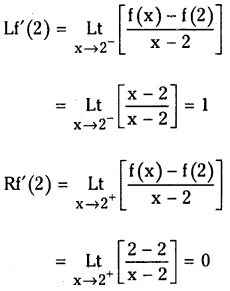
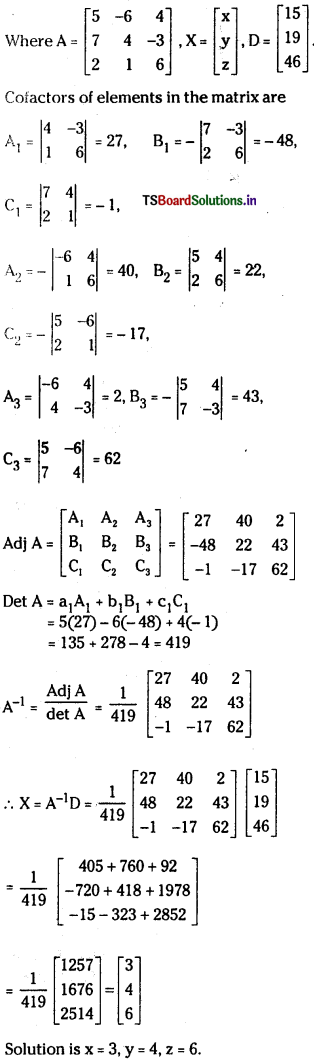
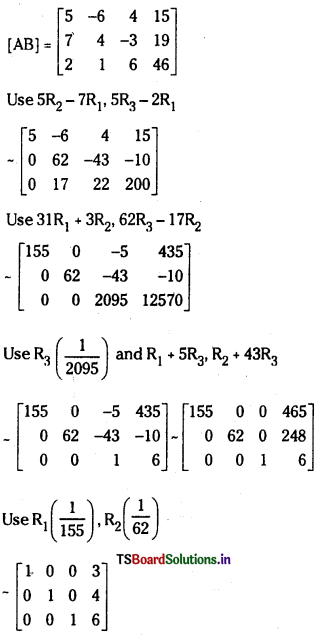
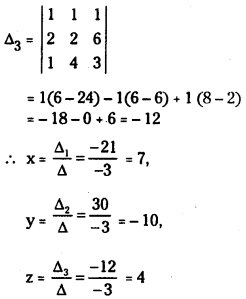
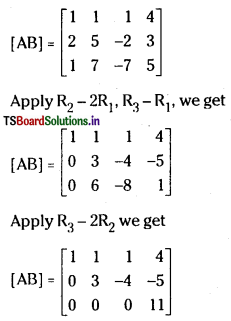
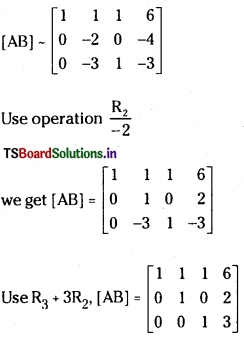
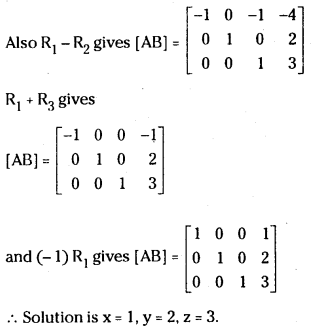
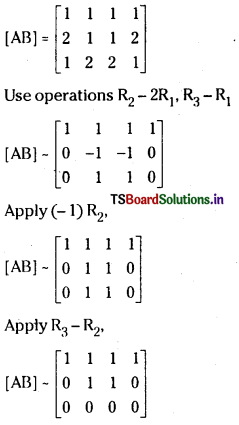
TS Inter 1st Year Maths 1A Solutions Chapter 3 Matrices Ex 3(a)

Students must practice these TS Intermediate Maths 1A Solutions Chapter 3 Matrices Ex 3(a) to find a better approach to solving the problems.

TS Inter 1st Year Maths 1A Matrices Solutions Exercise 3(a)

Question 1.
Write the following as a single matrix.
(i) [2 1 3] + [0 0 0]
Answer:
[2 1 3] + [0 0 0] = [2 + 0 1 + 0 3 + 0]
= [2 1 3]

TS Inter 1st Year Maths 1A Solutions Chapter 3 Matrices Ex 3(a)

(ii) \(\left[\begin{array}{r}
0 \\
1 \\
-1
\end{array}\right]+\left[\begin{array}{r}
-1 \\
1 \\
0
\end{array}\right]\)
Answer:
\(\left[\begin{array}{r}
0 \\
1 \\
-1
\end{array}\right]+\left[\begin{array}{r}
-1 \\
1 \\
0
\end{array}\right]\) = \(\left[\begin{array}{r}
0-1 \\
1+1 \\
-1+0
\end{array}\right]\) = \(\left[\begin{array}{r}
-1 \\
2 \\
-1
\end{array}\right]\)

(iii) \(\left[\begin{array}{ccc}
3 & 9 & 0 \\
1 & 8 & -2
\end{array}\right]+\left[\begin{array}{ccc}
4 & 0 & 2 \\
7 & 1 & 4
\end{array}\right]\)
Answer:
TS-Inter-1st-Year-Maths-1A-Solutions-Chapter-3-Matrices-Ex-3a-1

(iv) \(\left[\begin{array}{rr}
-1 & 2 \\
1 & -2 \\
3 & -1
\end{array}\right]+\left[\begin{array}{rr}
0 & 1 \\
-1 & 0 \\
-2 & 1
\end{array}\right]\)
Answer:
TS-Inter-1st-Year-Maths-1A-Solutions-Chapter-3-Matrices-Ex-3a-2

TS Inter 1st Year Maths 1A Solutions Chapter 3 Matrices Ex 3(a)

Question 2.
If A = \(\left[\begin{array}{cc}
-1 & 3 \\
4 & 2
\end{array}\right]\), B = \(\left[\begin{array}{cc}
2 & 1 \\
3 & -5
\end{array}\right]\), X = \(\left[\begin{array}{ll}
\mathbf{x}_1 & \mathbf{x}_2 \\
\mathbf{x}_3 & \mathbf{x}_4
\end{array}\right]\) and A + B = X then find the values of x1, x2, x3 and x4.
Answer:
A + B = X
TS-Inter-1st-Year-Maths-1A-Solutions-Chapter-3-Matrices-Ex-3a-3
⇒ x1 = 1, x2 = 4, x3 = 7, x4 = – 3.

Question 3.
If A = \(\left[\begin{array}{ccc}
-1 & -2 & 3 \\
1 & 2 & 4 \\
2 & -1 & 3
\end{array}\right]\) B = \(\left[\begin{array}{ccc}
1 & -2 & 5 \\
0 & -2 & 2 \\
1 & 2 & -3
\end{array}\right]\) and C = \(\left[\begin{array}{ccc}
-2 & 1 & 2 \\
1 & 1 & 2 \\
2 & 0 & 1
\end{array}\right]\) then find A + B + C.
Answer:
A + B + C =
TS-Inter-1st-Year-Maths-1A-Solutions-Chapter-3-Matrices-Ex-3a-4

Question 4.
If A = \(\left[\begin{array}{ccc}
3 & 2 & -1 \\
2 & -2 & 0 \\
1 & 3 & 1
\end{array}\right]\), B = \(\left[\begin{array}{ccc}
-3 & -1 & 0 \\
2 & 1 & 3 \\
4 & -1 & 2
\end{array}\right]\) and X = A + B then find X.
Answer:
X = A + B
TS-Inter-1st-Year-Maths-1A-Solutions-Chapter-3-Matrices-Ex-3a-5

TS Inter 1st Year Maths 1A Solutions Chapter 3 Matrices Ex 3(a)

Question 5.
If \(\left[\begin{array}{cc}
x-3 & 2 y-8 \\
z+2 & 6
\end{array}\right]\) = \(\left[\begin{array}{cc}
5 & 2 \\
-2 & a-4
\end{array}\right]\) then find the values of x, y, z and a. [May 2006, Mar. 14]
Answer:
Given \(\left[\begin{array}{cc}
x-3 & 2 y-8 \\
z+2 & 6
\end{array}\right]\) = \(\left[\begin{array}{cc}
5 & 2 \\
-2 & a-4
\end{array}\right]\)
We have x – 3 = 5, 2y – 8 = 2, z + 2 = – 2, a – 4 = 6
⇒ x = 8, y = 5, z = – 4, a = 10

II.
Question 1.
If \(\left[\begin{array}{ccc}
x-1 & 2 & 5-y \\
0 & z-1 & 7 \\
1 & 0 & a-5
\end{array}\right]\) = \(\left[\begin{array}{lll}
1 & 2 & 3 \\
0 & 4 & 7 \\
1 & 0 & 0
\end{array}\right]\) then find the values x, y, z and a.
Answer:
Given \(\left[\begin{array}{ccc}
x-1 & 2 & 5-y \\
0 & z-1 & 7 \\
1 & 0 & a-5
\end{array}\right]\) = \(\left[\begin{array}{lll}
1 & 2 & 3 \\
0 & 4 & 7 \\
1 & 0 & 0
\end{array}\right]\)
we have x – 1 = 1, 5 – y = 3, z – 1 = 4,
a – 5 = 0
⇒ x = 2, y = 2, z = 5, a = 5

Question 2.
Find the trace of \(\left[\begin{array}{ccc}
1 & 3 & -5 \\
2 & -1 & 5 \\
1 & 0 & 1
\end{array}\right]\)
Answer:
Trace of the given matrix
= 1 – 1 + 1 = sum of the diagonal elements
= 1

TS Inter 1st Year Maths 1A Solutions Chapter 3 Matrices Ex 3(a)

Question 3.
If A = \(\left[\begin{array}{ccc}
0 & 1 & 2 \\
2 & 3 & 4 \\
4 & 5 & -6
\end{array}\right]\) and B = \(\left[\begin{array}{ccc}
-1 & 2 & 3 \\
0 & 1 & 0 \\
0 & 0 & -1
\end{array}\right]\) find A – B and 4A – 5B.
Answer:
TS-Inter-1st-Year-Maths-1A-Solutions-Chapter-3-Matrices-Ex-3a-6

Question 4.
If A = \(\left[\begin{array}{lll}
1 & 2 & 3 \\
3 & 2 & 1
\end{array}\right]\) and B = \(\left[\begin{array}{lll}
3 & 2 & 1 \\
1 & 2 & 3
\end{array}\right]\) find 3B – 2A.
Answer:
TS-Inter-1st-Year-Maths-1A-Solutions-Chapter-3-Matrices-Ex-3a-7

TS Inter 1st Year Maths 1A Solutions Chapter 1 Functions Ex 1(c)

Students must practice these TS Intermediate Maths 1A Solutions Chapter 1 Functions Ex 1(c) to find a better approach to solving the problems.

TS Inter 1st Year Maths 1A Functions Solutions Exercise 1(c)

I.
Question 1.
Find the domains of the following real valued functions. (May 2014, Mar. 14)
(i) f(x) = \(\frac{1}{\left(x^2-1\right)(x+3)}\)
Answer:
Domain of f is the value of all real x for which (x2 – 1) (x + 3) ≠ 0
⇔ (x + 1) (x – 1) (x + 3) ≠ 0
⇔ x ≠ – 1, 1, -3
∴ Domain of f is, R – {-1, 1, – 3}

(ii) f(x) = \(\frac{2 x^2-5 x+7}{(x-1)(x-2)(x-3)}\)
Answer:
Here (x – 1) (x – 2) (x – 3) + 0
⇔ x ≠ 1, x ≠ 2, x ≠ 3.
Domain of f is, R – {1, 2, 3}

(iii) f(x) = \(\frac{1}{\log (2-x)}\)
Answer:
f(x) = \(\frac{1}{\log (2-x)}\) ∈ R
⇔ log (2 – x) ≠ 0 and 2 – x > 0
⇔ 2 – x ≠ 1 and 2 > x
⇔ x ≠ 1 and x < 2
⇔ x ∈ (-∞, 1) U (1, 2)
(or) x ∈ (-∞, 2) – {1}
Domain of f = x ∈ {∞, 2} – {1}

(iv) f(x) = |x – 3|
Answer:
f(x) = |x – 3| ∈ R
⇔ x ∈ R
∴ Domain of f = R

(v) f(x) = \(\sqrt{4 x-x^2}\). (May 2005)
Answer:
f(x) = \(\sqrt{4 x-x^2}\) ∈ R
⇔ 4x – x2 ≥ 0
⇔ x(4 – x) ≥ 0
⇔ x ∈ [0, 4]
∴ Domain of f = [0, 4]

(vi) f(x) = \(\frac{1}{\sqrt{1-x^2}}\)
Answer:
f(x) = \(\frac{1}{\sqrt{1-x^2}}\) ∈ R
⇔ 1 – x2 > 0
⇔ (1 – x)(1 – x) > 0
⇔ x ∈ (-1, 1)
∴ Domain of f = {x/x ∈ (-1, 1)}

(vii) f(x) = \(\frac{3^x}{x+1}\)
Answer:
f(x) = \(\frac{3^x}{x+1}\) ∈ R
⇔ 3x ∈ R, ∀ x ∈ R and x + 1 ≠ 0
⇔ x ≠ – 1
∴ Domain of f = R – {-1}

(viii) f(x) = \(\sqrt{x^2-25}\) (May 2012)
Answer:
f(x) = \(\sqrt{x^2-25}\) ∈ R
⇔ x2 – 25 ≥ 0
⇔ (x + 5)(x – 5) ≥ 0
⇔ x ∈ (-∞, -5] ∪ [5, ∞)
⇔ x ∈ R – (-5, 5)
∴ Domain of f is R – (-5, 5)

(ix) f(x) = \(\sqrt{x-[\mathrm{x}]}\)
Answer:
f(x) = \(\sqrt{x-[\mathrm{x}]}\) ∈ R
⇔ x – [x] ≥ 0
⇔ x ≥ [x]
⇔ x ∈ R
∴ Domain of f is R

(x) f(x) = \(\sqrt{[\mathbf{x}]-\mathbf{x}}\)
Answer:
f(x) = \(\sqrt{[\mathbf{x}]-\mathbf{x}}\) ∈ R
⇔ [x] – x ≥ 0
⇔ [x] ≥ x
⇔ x ≤ [x]
⇔ x ∈ z
∴ Domain of f is Z (Set of injection)

Question 2.
Find the ranges of the following real valued functions,
(i) log |4 – x2|
Answer:
Let y = f(x) = log |4 – x2| ∈ R
⇔ 4 – x2 ≠ 0 ⇒ x ≠ ± 2
y = log|4 – x2|
⇒ |4 – x2| = ey
ey > 0 ∀ y ∈ R
∴ Range of f is R.

(ii) \(\sqrt{[\mathbf{x}]-\mathbf{x}}\)
Answer:
Let y = f(x) = \(\sqrt{[\mathbf{x}]-\mathbf{x}}\) ∈ R
⇔ [x] – x > 0
⇔ [x] ≥ x ⇔ x ≤ [x]
∴ Domain of f is z
Then Range of f is {0}
∴ The Range of f = [1, ∞]

(iii) \(\frac{\sin \pi[x]}{1+[x]^2}\)
Answer:
Let y = f(x) = \(\frac{\sin \pi[x]}{1+[x]^2}\) ∈ R
⇔ x ∈ R
∴ Domain of f is R
For x ∈ R, [x] is an integer and sin n [x]= 0 ∀ n ∈ R Range of f is {0}

(iv) \(\frac{x^2-4}{x-2}\)
Answer:
Let y = f(x) = \(\frac{x^2-4}{x-2}\) = (x + 2) ⇔ x – 2 ≠ 0
∴ Domain of f is R – {2}
Then y = x + 2 ∴ x ≠ 2, we have y ≠ 4
∴ Range of f is R – {4}.

(v) \(\sqrt{9+x^2}\)
Answer:
Let y = \(\sqrt{9+x^2}\) f(x) ∈ R
Domain of f is R.
When x = 0, f (0) = √9 = ± 3, But when f(0) = 3,
For all values of x e R – {0}, f (x) > 3
Range of f = {3, ∞).

TS Inter 1st Year Maths 1A Solutions Chapter 1 Functions Ex 1(c)

Question 3.
If f and g are real valued functions defined by f(x) – 2x – 1 and g(x) = x2, then find
(i) (3f – 2g)(x)
Answer:
(3f – 2g) (x) = 3 f(x) – 2 g(x)= 3 (2x – 1) – 2(x2)
= -2x2 + 6x – 3

(ii) (fg) (x)
Answer:
(fg)(x) = f(x) g(x) = (2x – 1)(x2) = 2x3 – x2

(iii) \(\left(\frac{\sqrt{f}}{g}\right)\)(x)
Answer:
\(\frac{\sqrt{f(x)}}{g(x)}=\frac{\sqrt{2 x-1}}{x^2}\)

(iv) (f + g + 2)(x)
Answer:
(f + g + 2) (x) = f(x) + g(x) + 2
= 2x – 1 + x2 + 2
= x2 + 2x + 1 = (x + 1)2

Question 4.
If f = {(1, 2), (2, -3), (3, -1)}, then find
(i) 2f
(ii) 2 + f
(iii) f2
(iv) √f
[May 2012, May 2008]
Answer:
Given f = {(1, 2), (2, -3), (3, -1)} we have f(1) = 2, f(2) = -3 and f(3) = -1
(i) 2f = {(1, 2 x 2), (2, 2 (-3), (3, 2(-1))}
= {(1. 4). (2, – 6). (3, -2)}

(ii) 2 + f = {(1, 2+2), (2, 2+(-3), (3, 2+(-1))}
= {(1, 4), (2, -1), (3. 1)}

(iii) f2 = {(1, 22), (2, (-3)2), (3, (-1)2)]
= {(1, 4), (2, 9), (3, 1)}

(iv) √f = {(1, √2)| (∵ √-3 and √-1 are not real)

II.
Question 1.
Find the domains of the following real valued functions
(i) f(x)= \(\sqrt{x^2-3 x+2}\)
Answer:
f(x) = \(\sqrt{x^2-3 x+2}\) ∈ R
Domain of f is x2 -3x + 2 > 0
⇒ (x – 2) (x – 1) > 0
⇒ x ∈ [-∞, 1] u [2, ∞]
∴ Domain of f = R – [1, 2]

(ii) f (x) = log (x2 – 4x + 3)
Answer:
f(x) = log (x2 – 4x + 3) ∈ R
⇔ x2 – 4x + 3 > 0
⇔ (x – 3) (x – 1) > 0
x ∈ (-∞, 1) ∪ (3, ∞)
Domain f = R – (1, 3)

(iii) f(x) = \(\frac{\sqrt{2+x}+\sqrt{2-x}}{x}\)
Answer:
f(x) = \(\frac{\sqrt{2+x}+\sqrt{2-x}}{x}\) ∈ R
⇔ 2 + x > 0 2 – x > 0, x ≠ 0
⇔ x > -2, x < 2 x ≠ 0
⇔ -2 < x < 2, x ≠ 0 Domain of f is [-2, 2] – {0}

(iv) f(x) = \(\frac{1}{\sqrt[3]{x-2} \log (4-x)^{10}}\)
Answer:
f(x) = \(\frac{1}{\sqrt[3]{x-2} \log (4-x)^{10}}\) ∈ R
⇔ 4 – x > 0, 4 – x ≠ 1 and x – 2 ≠ 0
⇔ x < 4, x ≠ 3, x ≠ 2
Domain of f is [-∞, 4] – {2, 3}

(v) f(x) = \(\sqrt{\frac{4-x^2}{[x]+2}}\)
Answer:
f(x) = \(\sqrt{\frac{4-x^2}{[x]+2}}\) ∈ R
⇔ 4 – x > 0, [x] + 2 > 0 or
4 – x2 < 0 and [x] > + 2 < 0
When 4 – x2 > 0, and [x] + 2 > 0
we have (2 – x) (2 + x) > 0 and [x] > – 2
⇔ x ∈ [-2, 2] and x ∈ [-1, ∞)
⇔ x ∈ [-1, 2] …………….(1)
When 4 – x2 < 0, and [x] + 2 < 0
⇔ (2 + x) (2 – x) < 0 and [x] + 2 < 0
⇔ x ∈ [-∞, -2] ∪ [2, ∞] and [x] < – 2
⇔ x ∈ [- ∞, -2] ∪ [2, ∞] and x ∈ (- ∞,-2)
⇔ x ∈ [-∞, -2] ………………(2)
∴ from (1) and (2)
∴ Domain of f is [-∞, -2] ∪ {-1, 2}

(vi) f(x) = \(\sqrt{\log _{0.3}\left(x-x^2\right)}\)
Answer:
f(x) = \(\sqrt{\log _{0.3}\left(x-x^2\right)}\) ∈ R
⇔ log0.3 (x – x2) > 0 .
⇒ x – x2 < (0.3) 0
⇒ x – x2 < 1
⇒ -x2 + x < 1
⇒ -x2 + x – 1 < 0
⇒ x2 – x + 1 > 0
This is true for all x ∈ R …..(1)
and x – x2 > 0
⇒ x2 – x < 0
⇒ x (x – 1) < 0
⇒ x ∈ (0, 1) ……….(2)
∴ Domain of f is R n (0, 1) = (0, 1)
∴ Domain of f = (0, 1)

(vii) f(x) = \(\frac{1}{x+|\mathrm{x}|}\)
Answer:
f(x) = \(\frac{1}{x+|\mathrm{x}|}\) ∈ R
⇔ x + |x| ≠ 0 ⇒ x ∈ (0, ∞)
(∵ |x| = x if x ≥ 0
= -x if x < 0)
∴ Domain of f = (0, ∞)

Question 2.
Prove that the real valued function f(x) = \(\frac{x}{e^x-1}+\frac{x}{2}+1\) is an even function on R – {0} –
Answer:
f (x) ∈ R, ex – 1 ≠ 0
⇒ ex ≠ 1 ⇒ x ≠ 0
TS-Inter-1st-Year-Maths-1A-Solutions-Chapter-1-Functions-Ex-1c-1
Since f(-x) = f(x), the function f is even function on R – {0}.

TS Inter 1st Year Maths 1A Solutions Chapter 1 Functions Ex 1(c)

Question 3.
Find the domain and range of the following functions.
(i) f(x) = \(\frac{\tan \pi[x]}{1+\sin \pi[x]+\left[x^2\right]}\)
Answer:
f(x) = \(\frac{\tan \pi[x]}{1+\sin \pi[x]+\left[x^2\right]}\) ∈ R
⇔ x ∈ R; since [x] is an integar so that tan π [x] and sin π [x] are zero. ∀ x ∈ R
Domain of f is R and Range = {0}

(ii) f(x) = \(\frac{x}{2-3 x}\)
Answer:
f(x) = \(\frac{x}{2-3 x}\) ∈ R
⇔ 2 – 3x ≠ 0 ⇒ x ≠ \(\frac{2}{3}\)
∴ Domain of f = R – {\(\frac{2}{3}\)}

Let y = f(x) = \(\frac{x}{2-3 x}\)
⇒ 2y – 3xy = x
⇒ 2y = x(1 + 3y)
⇒ x = \(\frac{2 \mathrm{y}}{1+3 \mathrm{y}}\)
∴ x ∈ R – {\(\frac{2}{3}\)}, 1 + 3y ≠ 0
⇒ y ≠ \(\frac{-1}{3}\)
∴ Range of f = R – {\(\frac{-1}{3}\)}

(iii) f(x) = |x| + |1 + x|
Answer:
f(x) ∈ R ⇔ x ∈ R
Domain of f = R
∴ |x| = x if x > 0
= – x if x < 0 |1 + x| = 1 + x if 1 + x > 0 ie., x > -1
= – (1 + x) if 1 + x < 0 ie., x < – 1
For x = 0, f(0) = 1,
x= 1, f(1) = |1| + |1 + 1| = 3
x = 2, f(2) = |2| + |1 + 2| = 2 + 3 = 5
x = -2, f(-2) = |-2| + |1 +(-2)| = 2 + 1 = 3
x = -1, f(-1) = |-1| + |1 + (-1)| = 1

TS Inter 1st Year Maths 1A Solutions Chapter 1 Functions Ex 1(b)

Students must practice these TS Intermediate Maths 1A Solutions Chapter 1 Functions Ex 1(b) to find a better approach to solving the problems.

TS Inter 1st Year Maths 1A Functions Solutions Exercise 1(b)

I.
Question 1.
If f(x) = ex, and g(x) = logex, then show that fog = gof and find f-1 and g-1.
Answer:
Given f(x) = ex and g(x) = logex
Now (fog) (x) = f[g(x)] = f [logex]
= elogex = x
(gof) (x) = g [f(x)] = g [ex] = logeex = x
fog = gof
given f(x) = ex = y
then x = f-1 (y) and y = ex ⇒ x = logey
f-1(y) = logey ⇒ f-1 (x) = logex
similarly y = g(x) = logex
then x = g-1 (y) and y = logex
⇒ x = ey
g-1 (y) = ey ⇒ g-1(x) = ex

Question 2.
If f(y) = \(\frac{y}{\sqrt{1-y^2}}\), g(y) = \(\frac{y}{\sqrt{1+y^2}}\) then show that (fog)(y) = y.
Answer:
TS-Inter-1st-Year-Maths-1A-Solutions-Chapter-1-Functions-Ex-1b-1
∴ (fog) (y) = y

TS Inter 1st Year Maths 1A Solutions Chapter 1 Functions Ex 1(b)

Question 3.
If R → R; g : R → R are defined by . f(x) = 2x2 + 3 and g(x) = 3x – 2, then find
(i) (fog) (x)
(ii) (gof) (x)
(iii) (fof)(0)
(iv) go (fof) (3)
Answer:
f; R → R; g : R → R and
f(x) = 2x2 + 3, g(x) = 3x – 2 then
(i) (fog) (x) = f [g (x)] = f (3x – 2)
= 2 [(3x – 2)2] + 3 (∵ f (x) = 2x2 + 3)
= 2 [9x2 – 12x + 4] + 3
= 18x2 – 24x + 11

(ii) (gof) (x) = g [f (x)] = g (2x2 + 3)
= 3 (2x2 + 3) -2 = 6x2 + 7

iii) (fof) (0) = f [f (0)] = f [3] = 2(3)2 + 3 = 21

iv) go (fof) (3)
= go [f (f (3))] (v f (x) = 2x2 + 3)
= go [f (2(3)2 + 3)]
= go [f (21)]
= g [2 (21)2 + 3]
= g [2 (441) + 3]
= g [885]
= 3 (885) – 2 = 2653 (∵ g(x) = 3x – 2)

TS Inter 1st Year Maths 1A Solutions Chapter 1 Functions Ex 1(b)

Question 4.
If f:R → R, g:R → R are defined by f(x) = 3x – 1, g(x) = x2 + 1, then find
(i) (fof) (x2 + 1)
(ii) (fog) (2) (March 2012)
(iii) (gof)(2a – 3)
Answer:
Given f: R → R and g : R → R defined by f (x) = 3x – 1, g (x) = x2 + 1
(i)(fof) (x2 + 1 ) = f [f (x2 + 1)]
= f [3 (x2 + 1) – 1]
⇒ f [3x2 + 2] (∵ f (x) = 3x – 1)
= 3 (3×2 + 2) – 1 = 9×2 + 5

(ii) (fog) (2) = f [g (2)] = f [22 + 1] = f [5]
= 3(5) – 1 = 14

(iii) (gof ) (2a – 3)
=g[f(2a – 3)]
= g[3(2a – 3) – 1] (∵ f(x) = 3x- 1)
= g [6a – 10]
= (6a – 10)2 + 1 (∵ g(x)=x2 + 1)
= 36a2 – 120a + 101

Question 5.
If f(x) = \(\frac{1}{x}\), g(x) = √x ∀ x ∈ (0, ∞) then find (gof)(x).
Answer:
(gof)(x) = g[f(x)] = g\(\left[\frac{1}{x}\right]\)
= \(\frac{1}{\sqrt{x}}\) (∵ g(x) = x)

Question 6.
f(x) = 2x – 1, g(x) = \(\frac{x+1}{2}\) ∀ x ∈ R, find (gof)(x).
Answer:
(gof)(x) = g[f(x)] = g(2x – 1)
= \(\frac{2 x-1+1}{2}\) = x (∵ g(x) = \(\frac{2 x-1+1}{2}\))

Question 7.
If f(x) = 2, g(x) = x2, h(x) = 2x ∀ x ∈ R, then find [fo(goh) (x)].
Answer:
[fo(goh)] (x)= fog [h(x)]
= fog [2x]
= f [g(2x)]
= f [ (2x)2 ] = f (4x2) = 2
∴ [fo(goh)] (x) = 2

Question 8.
Find the inverse of the following functions.
(i) a, b ∈ R, f: R → R, defined by f(x) = ax + b, (a ≠ 0).
Answer:
a, b ∈ R, f : R → R and f(x) = ax + b
⇒ y = ax + b = f(x)
⇒ x = f-1(y)
= \(\frac{y-b}{a}\)
∴ f-1(x) = \(\frac{x-b}{a}\)

(ii) f: R → (0, ∞) defined by 5x (March 2011)
Answer:
f: R→ (0, ∞) and f(x) = 5x
Let y = f (x) = 5x ⇒ x = f-1(y)
and x = log5y
∴ f-1(y) = log5y ⇒ f-1(x) = log5x

(iii) f : (0, ∞) → R defined by f(x) = log2x
Answer:
Gii’en f: (0, ∞) → R defined by f(x) = log2x
Let y = f (x) = log2x then x = f1 (y)
y = log2x ⇒ x = 2y
∴ f-1(y) = 2y ⇒ f-1(x) = 2x

Question 9.
If f(x) = 1 + x + x2 + ………….. for |x| < 1, then show that f-1(x) = \(\frac{x-1}{x}\)
Answer:
Given f(x) = 1 + x + x2 + ………. for |x| < 1
TS-Inter-1st-Year-Maths-1A-Solutions-Chapter-1-Functions-Ex-1b-2

Question 10.
If f : [1, ∞] → [1, ∞] defined by f(x) = 2x(x – 1), then find f-1(x)
Answer:
Given f : [1, ∞] → [1, ∞] defined by f(x) = 2x(x – 1)
Let y = f(x) then x = f-1(y)
Also y = 2x(x – 1) ⇒ x(x – 1) = log2y
⇒ x2 – x – log2y = 0
TS-Inter-1st-Year-Maths-1A-Solutions-Chapter-1-Functions-Ex-1b-3

TS Inter 1st Year Maths 1A Solutions Chapter 1 Functions Ex 1(b)

II.
Question 1.
If f(x) = \(\frac{x-1}{x+1}\), x ≠ ±1, then verify (fof-1)(x) = x
Answer:
Given f(x) = \(\frac{x-1}{x+1}\), (x ≠ ±1)
and Let y = f(x) ⇒ x = f-1(x)
TS Inter 1st Year Maths 1A Solutions Chapter 1 Functions Ex 1(b) 4

Question 2.
If A = (1, 2, 3), B = (α, β, γ), C = (p, q, r) and f : A → B, g : B → C are defined by f = {(1, α), (2, γ), (3, β)}, g = {(α, q), (β, r), (γ, p)}
then show that f and g are bijective functions and (gof)-1 = f-1og-1.
Answer:
Given A = {1, 2, 3}, B = (α, β, γ), c = {p, q, r) and f : A → B, g : B → C defined by f ={(1, α) (2, γ), (3, β)}and g = {(a, q), (β, r), (γ, p)}
From the definitions of f and g f (1) = α, f (2) = γ, f (3) = β and g (α) = q, g (β) = r, g (γ) = p
Distinct elements of A have distinct imagine in B. Hence f is an Injection. Also, range of f = (a, y, P) and f is a surjection.
∴ f is abijection = B similarly distinct elements of B have distinct images in c and g is an Injection.
Also range of ‘g’ = {q, γ, p} = C;
∴ g is a surjection.
Hence g is a bijection.
∴ f and g are bijective functions.
Also gof = {(1, q), (2, r), (3, p)}
and (gof-1) = {(q, 1), (r, 2), (p, 3)} …………….(1)
f-1 = {(α, 1), (γ, 2), (β, 3)}
and g-1 = {(q, α), (r, β), (p, γ)}
∴ f-1og-1 ={(q, 1), (r, 2), (p, 3)} ………………(2)
∴ From (1) and (2), (gof-1) = f-1og-1

Question 3.
If f:R → R; g:R → R defined by f(x) = 3x – 2, g(x) = x2 + 1, then find
(i) (gof-1) (2)
(ii)(gof)(x – 1) (March 2008, May 2006)
Answer:
Given f: R → R, g : R → R defined by f(x) = 3x – 2, g(x) = x2 + 1
et y = f (x) then x = f-1 (y)
y = 3x – 2 ⇒ 3x = y + 2
⇒ x = \(\frac{y+2}{3}\)
∴ f-1(y) = \(\frac{3+2}{3}\) ⇒ f-1(x) = \(\frac{x+2}{3}\)
∴ (i)(gof-1) (2) = g[f-1(2)] = g\(\left[\frac{4}{3}\right]\)
= \(\left(\frac{4}{3}\right)^2\) + 1 = \(\frac{16}{9}\) + 1 = \(\frac{25}{9}\)

(ii)(gof) (x – 1) = g [f (x – 1)
= g [3 (x – 1) – 2] = g [3x – 5]
= (3x – 5)2 + 1
= 9x2 – 30x + 26
(∵ g(x) = x2 + 1)

Question 4.
Let f = {(1, a), (2, c), (4, d), (3, b)} and g-1 = {(2, a) (4, b), (1, c), (3, d)} then show that (gof)-1 = f-1o g-1
Answer:
Given f = {(1, a), (2, c), (4, d), (3, b)} and g-1 = {(2, a), (4, b), (1, c), (3, d)}
∴ g = {(a, 2), (b, 4), (c, 1), (d, 3)} gof = {(1, 2), (2, 1), (4, 3), (3, 4)}
∴ (gof)-1 = {(2, 1), (1, 2), (3, 4), (4, 3)}
f-1 = {(a, 1) (c, 2), (d, 4), (b, 3)}
g-1 = {(2, a), (4, b), (1, c), (3, d)}
f(x) = 3x – 2, g(x) = x2 + 1
Let y = f (x) then x = f” (y)
∴ f-1o g-1 = {(2, 1), (1, 2), (4, 3), (3, 4)}
(gof)-1 = f-1o g-1

Question 5.
Let f:R → R; g:R → R be defined by f(x) = 2x – 3, g(x) = x3 + 5 then find (fog)-1(x)
Answer:
We have from the formula
(fog)-1(x) = (g-1of-1) …………..(1)
where f: R → R and g : R → R are defined by
f(x) = 2x – 3 and g(x) = x3 + 5
Let y = f(x) = 2x – 3 : Then x = f-1(y)
and 2x – 3 = y ⇒ x = \(\frac{y+3}{2}\)
f-1(x)\(\frac{x+3}{2}\) ………..(2)

Let y = g(x) = x3 + 5. Then x = g-1(y) and x3 + 5 = y
⇒ x = (y – 5)1/3
g-1(y) = (y – 5)1/3
g-1(x) = (x – 5)1/3 ……….(3)

From (1), (g-1of-1)(x)
TS Inter 1st Year Maths 1A Solutions Chapter 1 Functions Ex 1(b) 5

Question 6.
Let f(x) = x2,g(z) = 2x. Then solve the equation (fog) (x) = (gof) (x)
Answer:
Given f(x) = x2 and g(x) = 2x
(fog) (x) = f [g(x)] = f [2x] = (2x)2 = 22x ……………(1)
and (gof)(x) = g[f(x)] = g[x2] = 2x2
∴ from (1) and (2), 22x = 2x2
⇒ x2 – 2x = 0
⇒ x(x – 2) =0
⇒ x = 0, 2

Question 7.
If f(x) = \(\frac{x+1}{x-1}\),(x ≠ ±1),then find(fofof)(x) and (fofofof) (z)
Answer:
Given f(x) = \(\frac{x+1}{x-1}\), (x ≠ ± 1)
then (fofof) (x) = fof(f(x)]
TS-Inter-1st-Year-Maths-1A-Solutions-Chapter-1-Functions-Ex-1b-6

TS Inter 1st Year Maths 1A Solutions Chapter 1 Functions Ex 1(a)

Students must practice these TS Intermediate Maths 1A Solutions Chapter 1 Functions Ex 1(a) to find a better approach to solving the problems.

TS Inter 1st Year Maths 1A Functions Solutions Exercise 1(a)

I.
Question 1.
If the function f is defined by
TS Inter 1st Year Maths 1A Solutions Chapter 1 Functions Ex 1(a) 1
then find the values of
(i) f(3)
(ii) f(0)
(iii) f(-1.5)
(iv) f(2) + f(- 2)
(v) f(- 5)
Answer:
(i) f(3), For x > 1; f(x) = x + 2
f(3) = 3 + 2 = 5

(ii) f(0), For – 1 ≤ x ≤ 1; f(0) = 2

(iii) f(-1.5), For – 3 < x < – 1; f(x) = x – 1
∴ f(-1.5) = -1.5- 1 = – 2.5

(iv) f(2) + f(-2); For x > 1, f(x) = x + 2
∴ f(2) = 2 + 2 = 4
For – 3 < x < – 1;
f(x) = x – 1
f(-2) = -2 – 1 = -3
f(2) + f (-2) = 4 – 3 = 1

(v) f(-5); is not defined such domain of ‘f’ is {x / x > – 3].

Question 2.
If f : R {0} → R defined by f(x) = x3 – \(\frac{1}{x^3}\), then show that f(x) + f\(\left(\frac{1}{x}\right)\) = 0.
Answer:
Given f(x) = x3 – \(\frac{1}{x^3}\)
TS Inter 1st Year Maths 1A Solutions Chapter 1 Functions Ex 1(a) 2

Question 3.
If f: R → R defined by f(x) = \(\frac{1-x^2}{1+x^2}\), then show that f(tan θ) = cos 2θ
Answer:
Given f(x) = \(\frac{1-x^2}{1+x^2}\) ∀ x ∈ R
TS-Inter-1st-Year-Maths-1A-Solutions-Chapter-1-Functions-Ex-1a-3
= cos 2θ

TS Inter 1st Year Maths 1A Solutions Chapter 1 Functions Ex 1(a)

Question 4.
If f: R – (±1) → R is defined by f(x) = log\(\left|\frac{1+x}{1-x}\right|\), then show that f\(\left(\frac{2 x}{1+x^2}\right)\) = 2f(x).
Answer:
Given f: R – (±1) → R defined by f(x) = log\(\left|\frac{1+x}{1-x}\right|\)
TS-Inter-1st-Year-Maths-1A-Solutions-Chapter-1-Functions-Ex-1a-4

Question 5.
If A = (-2, -1, 0, 1, 2) and f : A → B is a surjection defined by f(x) = x2 + x + 1, then find B. (May 2014)
Answer:
A = {-2,-1,0,1,2} and f: A → B is a surjection and f(x) = x2 + x + 1;
∴ f(-2) = (-2)2 + (-2) + 1=3,
f(-1) = (-1)2 + (-1) + 1 = 1
f(0) = 02 + 0 + 1 = 1
f(1) =12 + 1 + 1 = 3
f(2) = 22 + 2 + 1 = 7
∴ B = f(A) = (1, 3, 7)

Question 6.
If A = {1, 2, 3, 4} and f: A → R is a function defined by f(x) = \(\frac{x^2-x+1}{x+1}\), then find the range of f.
Answer:
Given A = {1, 2, 3, 4} and f(x) = \(\frac{x^2-x+1}{x+1}\)
TS Inter 1st Year Maths 1A Solutions Chapter 1 Functions Ex 1(a) 5

Question 7.
If f (x + y) = f (xy) ∀ x, y ∈ R, then prove that f is a constant function.
Answer:
Given f (x + y) = f(x y) ∀ x, y ∈ R Suppose x = y = 0 then
f(0 + 0) = f(0 x 0)
⇒ f(0) = f(0) ………………..(1)
Suppose x = 1, y = 0 then then f (1 + 0) = f(1 x 0)
⇒ f(D = f (0) ……………(2)
Suppose x = 1, y = 1 then f (1 + 1) = f(1 x 1)
⇒ f(2) = f(1) …………….. (3)
f(0) = f(1) = f(2)
= f(0) = f(2)
Similarly f(3) = f(0), f(4) = f(0) …………. f(n) = f(0)
∴ f is a constant function.

II.
Question 1.
If A = {x / – 1 ≤ x ≤ 11, f(x) = x2, g(x) = x3 Which of the following are surjections
(i) f : A → A
(ii) g : A → A.
Answer:
i) Given A {x / – 1 ≤ x ≤ 1}, f(x) = x2
and f : A → A
Suppose y ∈ A
then x2 = y ⇒ x = ± √y
If x = √y and if y = – 1 then x = √-1 ∈ A
f : A → A is not a surjection.

ii) Given A = {x/-1 ≤ x ≤ 1), g(x) = x3
and g : A → A
Suppose ye A then x2 = y ⇒ x = \(\sqrt[3]{y}\) ∈ A
If y = -1 then x = -1 ∈ A
y = 0 then x = 0 ∈ A
y = 1 then x = 1 ∈ A
g : A → A is a surjection.

TS Inter 1st Year Maths 1A Solutions Chapter 1 Functions Ex 1(a)

Question 2.
Which of the following are injections or surjections or Bisections ? Justify your answers.
i) f : R → R defined by f(x) = \(\frac{2 x+1}{3}\)
Answer:
Given f(x) = \(\frac{2 x+1}{3}\)
Let a1, a2 ∈ R
∴ f(a1) = f(a2)
⇒ \(\frac{2 \mathrm{a}_1+1}{3}=\frac{2 \mathrm{a}_2+1}{3}\)
⇒ 2a1 + 1 = 2a2 + 1
⇒ a1 = a2
f(a1) = f(a2) ⇒ a1 = a2 ∀ a1, a2 ∈ R
f(x) = \(\frac{2 x+1}{3}\) is an injection.

Suppose y ∈ R (codomain of f) then
y = \(\frac{2 x+1}{3}\) ⇒ x = \(\frac{3 y-1}{2}\)
Then f(x) = f\(\left(\frac{3 y-1}{2}\right)=\frac{\frac{2(3 y-1)}{2}+1}{3}\) = y
f is a surjection f: R → R defined by f(x) = \(\frac{2 x+1}{3}\) is a bijection.

ii) f : R → (0, ∞) defined by f(x) = 2x
Answer:
Let a1, a2 ∈ R then f(a1) = f(a2)
⇒ 2a1 = 2a2
⇒ a1 = a2 ∀ a1, a2 ∈ R
f(x) = 2x, f: R → (0, ∞) is injection.
Let y ∈ (0, ∞) and y = 2x ⇒ x = log2 y
then f(x) = 2x = 2 log2y = y
∴ f is a surjection.
Since f is injection and surjection, f is a bijection.

iii) f : (0, ∞) → R defined by f(x) = logex.
Answer:
Let x1, x2 ∈ (0, ∞)and = logex. then f(x1) = f(x2)
⇒ logex1 = logex2 ⇒ x1 = x2
∴ f(x1) = f(x2)
x1 = x2 and f is injection.

Let y ∈ R then y = logex ⇒ x = ey
f(x) = logex = logeey = y and f is a surjection.
Since f is both injective and surjective, f is a bijection.

iv) f : [0, ∞) → [0, ∞) defined by f(x) = x2
Answer:
Let x1, x1 ∈ [0, ∞) given f(x) = x2
f(x1) = f(x2)
⇒ x1 = x2
x1 = x2 (∵ x1, x2 > 0)
f(x) = x2,
∴ f: [0, ∞) → [0, ∞) is an injection.

Let y ∈ [0, ∞)then y = x2 ⇒ x = √y (∵ y > 0)
f(x) = x2 = (√y)2 = y
and f is a surjection
∴ f is a bijection.

v) f : R → [0, ∞) defined by f(x) = x2
Answer:
Let x1 x2 ∈ R and f(x) = x2
∴ f(x1) = f(x2)
⇒ x12 = x22
⇒ x1 = ±x2 (∵ x1, x2 ∈ R)
f is not an injection
Let y ∈ [0, ∞] then y = x2 ⇒ x = ±√y
where y ∈ [0, ∞] then f(x) = x2 = (√y )2 = y.
∴ f is a surjection.
Since f is not injective and only surjective, we say that f is not a bijection.

vi) f : R → R defined by f(x) = x2
Answer:
Let x1 x2 ∈ R then f(x1) = f(x2)
⇒ x12 = x22
⇒ x1 = ± x2 (∵ x1, x2 ∈ R)
f(x) is not an injection.
Let y ∈ R then y = x2
⇒ x = ±√y
For elements that belong to (-∞, 0).
codomain R of f has no pre-image in f.
∴ f is not a surjection.
Hence f is not a bijection.

Question 3.
If g = 1(1,1), (2, 3), (3, 5), (4, 7)) is a function from A = {1, 2, 3, 4} to B = {1, 3, 5, 7}. If this is given by the formula g(x) = ax + b then find a and b.
Answer:
A = {1, 2, 3, 4}, B = {1, 3, 5, 7}
g = {(1, 1), (2, 3), (3, 5), (4, 7)}
∵ g(1) = 1, g(2) = 3, g(3) = 5, g(4) = 7
Hence for an element a ∈ A f ∃ b ∈ B such that g : A → B is a function.
Given g(x) = ax + b ∀ x ∈ A
g(1) = a + b = 1
g(2) = 2a + b = 3
solving a = 2, b = -1

TS Inter 1st Year Maths 1A Solutions Chapter 1 Functions Ex 1(a)

Question 4.
If the function f : R → R defined by f(x) = \(\frac{3^x+3^{-x}}{2}\), then show that f (x+y) + f (x-y) = 2 f(x) f(y).
Answer:
TS-Inter-1st-Year-Maths-1A-Solutions-Chapter-1-Functions-Ex-1a-6

Question 5.
If the function f : R → R defined by f(x) = \(\frac{4^x}{4^x+2}\), then show that f (1 – x) = 1 – f(x) and hence reduce the value of f\(\left(\frac{1}{4}\right)\) + 2f\(\left(\frac{1}{2}\right)\) + f\(\left(\frac{3}{4}\right)\).
Answer:
TS-Inter-1st-Year-Maths-1A-Solutions-Chapter-1-Functions-Ex-1a-7

Question 6.
If the function f : {-1, 1} → {0, 2} defined by f(x) = ax + b is a suijection, then find a and b.
Answer:
Since f: {-1, 1} → {0, 2} and f(x) = ax + b is a surjection.
Given f (-1) = 0, f (1) = 2 (or) f (-1) = 2, f (1)=0
Case I : f (-1) = 0, f (1) = 2
∴ – a + b = 0, a + b = 2
Solving b =1 , a = 1

Case II : f (-1) = 2, and f (1) = 0
then – a + b = 2 and a + b = 0
Solving b = 1, a = -1
Hence a = + 1 and b = 1

TS Inter 1st Year Maths 1A Solutions Chapter 1 Functions Ex 1(a)

Question 7.
If f(x) = cos (log x), then show that f\(\left(\frac{1}{x}\right)\) f\(\left(\frac{1}{y}\right)\) – \(\left(\frac{1}{2}\right)\)[f\(\left(\frac{x}{y}\right)\) + f(xy)] = 0
Answer:
Given f(x) = cos(log x)
then f\(\left(\frac{1}{x}\right)\) = cos(log\(\left(\frac{1}{x}\right)\))
= cos(-log x) = cos(log x) (∵ log 1 = 0)
Similarly f\(\left(\frac{1}{x}\right)\) = cos(log y)
f\(\left(\frac{x}{y}\right)\) = cos(log\(\left(\frac{x}{y}\right)\)) = cos(log x – log y)
f(xy) = cos (log xy) = cos [log x + log y]
f\(\left(\frac{x}{y}\right)\) + f(x y) = cos(log x – log y) + cos (log x + log y)
= 2 cos (log x) cos (log y) (∵ cos (A – B) + cos (A + B))
= 2 cos A cos B
f\(\left(\frac{1}{x}\right)\) f\(\left(\frac{1}{y}\right)\) – \(\left(\frac{1}{2}\right)\)[f\(\left(\frac{x}{y}\right)\) + f(xy)] = cos (log x) cos (log y) – \(\frac{1}{2}\) [2cos (log x) cos (logy)]
= 0

TS Inter 1st Year Physics Study Material Chapter 3 సరళరేఖాత్మక గమనం

Telangana TSBIE TS Inter 1st Year Physics Study Material 3rd Lesson సరళరేఖాత్మక గమనం Textbook Questions and Answers.

TS Inter 1st Year Physics Study Material 3rd Lesson సరళరేఖాత్మక గమనం

అతిస్వల్ప సమాధాన ప్రశ్నలు

ప్రశ్న 1.
గమన, నిశ్చల స్థితులు సాపేక్షం. వివరించండి.
జవాబు:
పరిసరాలతో పోల్చినపుడు వస్తువు స్థానం కాలంతోపాటు మారితే అది గమనంలో ఉన్నది అంటారు. దాని స్థానం మారకపోతే ఆ వస్తువు నిశ్చలంగా ఉంది అంటారు. కాబట్టి గమనము లేదా నిశ్చలత్వము అనేది సాపేక్ష భావన మాత్రమే!

ప్రశ్న 2.
సగటు వేగం ఏవిధంగా తత్కాల వేగంతో విభేదిస్తుంది?
జవాబు:
సగటు వేగము వస్తువు యొక్క మొత్తము స్థానభ్రంశము మరియు మొత్తం కాలవ్యవధుల నిష్పత్తి. తత్కాల వేగము ఇచ్చిన క్షణంలో వస్తువుకు గల వేగము. మొత్తం కాలవ్యవధిని At వ్యవధి గల చిన్న చిన్న అంశాలుగా భావించి ఆ కాలాలలో గల తత్కాల వేగాల మొత్తమునకు, మొత్తం కాలమునకు గల నిష్పత్తిని సగటు వేగంగా భావిస్తారు. అనగా కొన్ని క్షణాలలో తత్కాల వేగం సగటు వేగం కన్నా ఎక్కువగా లేక తక్కువగా ఉండే అవకాశం ఉంది.

ప్రశ్న 3.
ఒక వస్తువు వేగం శూన్యమై దాని త్వరణం శూన్యం కాని సందర్భానికి ఒక ఉదాహరణ ఇవ్వండి.
జవాబు:
వస్తువు వేగం శూన్యమైనప్పటికీ దాని త్వరణం సున్న కానవసరం లేదు. ఉదా : నిట్టనిలువుగా పైకి విసిరిన వస్తువుకు గరిష్ఠ స్థానం వద్ద వేగము సున్న కానీ త్వరణం సున్న కాదు.

TS Inter 1st Year Physics Study Material Chapter 3 సరళరేఖాత్మక గమనం

ప్రశ్న 4.
ఒక వాహనం ప్రయాణించిన దూరం L లో సగం దూరం వడి v1 తోనూ, రెండవ సగం దూరం వడి v2 ప్రయాణించింది. ఆ వాహనం సగటు వడి ఎంత?
జవాబు:
మొత్తం ప్రయాణానికి పట్టిన కాలము t = \(\frac{L}{2 v_1}+\frac{L}{2 v_2}=\frac{\left(v_2+v_1\right) L}{2 v_1 v_2}\)
∴ సగటు వేగము v = \(\frac{L}{t}=\frac{L}{\left(v_1+v_2\right) L} 2 v_1 v_2=\frac{2 v_1 v_2}{\left(v_1+v_2\right)}\)

ప్రశ్న 5.
కింది దిశలో ప్రయాణిస్తూ ఒక లిఫ్టుభూ అంతస్తు (ground floor) కు చేరబోతున్నది. భూ అంతస్తును మూల బిందువుగానూ, ఊర్ధ్వ దిశను ధన దిశగానూ అన్ని రాశులకూ ఎంపిక చేసుకొంటే కింద ఇచ్చినవాటిలో ఏది సరియైనది?
a) x < 0, v < 0, a > 0
c) x > 0, v < 0, a > 0
b) x > 0, v < 0, a < 0
d) x > 0, v > 0, a > 0
జవాబు:
దత్తాంశం నుండి భూ అంతస్తు మూలబిందువు ⇒ x = 0; ఊర్ధ్వ దిశ ధనాత్మకము అనగా అధోదిశకు v’ – ve’ ⇒ x < 0, v < 0 మరియు a < 0 లిఫ్ట్ భూమికి చేరబోతుంది. ఈ సందర్భంలో x < 0, v > 0 మరియు a < 0 అన్న నియమాలు వర్తిస్తాయి. కావున ఇచ్చిన వాటిలో (a) x < 0, v < 0, a > 0 అన్నది సరియైన సమాధానము.

ప్రశ్న 6.
ఏకరీతి (సమరీతి) గమనం గల ఒక క్రికెట్ బంతి చాలా స్వల్పకాలం పాటు ఒక బ్యాట్తో కొట్టగా వెనుకకు మరలింది. తిరోదిశలో త్వరణాన్ని ధనాత్మకంగా తీసుకొని కాలంపరంగా త్వరణంలో మార్పుకు గ్రాఫు గీయండి.
జవాబు:
సమవేగంతో చలించే వస్తువుకు త్వరణము సున్న. బంతి, బ్యాటు కలిసి ఉన్న క్షణంలో బ్యాటు వలన బంతి గమనదిశకు వ్యతిరేకంగా కొంత త్వరణం ప్రయోగించబడింది. ఇది త్వరణం కాలం గ్రాఫ్ పటంలో చూపినట్లు ఉంటుంది.
TS Inter 1st Year Physics Study Material Chapter 3 సరళరేఖాత్మక గమనం 1

ప్రశ్న 7.
ధన x − దిశలో అక్షం వెంబడి ఏకమితీయ గమనాన్ని కలిగి ఉండి, ఆవర్తకంగా నిశ్చలస్థితికి వచ్చి ముందుకు పోతూ ఉండే ఒక కణం గమనానికి ఉదాహరణ ఇవ్వండి.
జవాబు:
లోలకం పొడవు బాగా ఎక్కువగా ఉండి కంపన పరిమితి తక్కువగా ఉన్న సందర్భంలో లోలకం చలనం సరళరేఖ వెంబడి జరుగుతున్నట్లు భావించవచ్చు. గరిష్ఠ స్థానభ్రంశ బిందువు వద్ద లోలకం వేగం సున్న కాని దాని త్వరణం సున్న కాదు. ఈ రకమైన చలనం నిర్ణీత కాలవ్యవధి తరువాత పునరావృతమవుతుంది.

TS Inter 1st Year Physics Study Material Chapter 3 సరళరేఖాత్మక గమనం

ప్రశ్న 8.
ఒక (ద్రవంలో) ప్రవాహిలో పతనం చెందే ఒక వస్తువు a = g – bv త్వరణం కలిగి ఉందని పరిశీలించడం జరిగింది. ఇక్కడ g గురుత్వ త్వరణం, b ఒక స్థిరాంకం. కొంతకాలం తరువాత వస్తువు స్థిర వేగంతో పతనం చెందుతుందని తెలుసుకొన్నారు. ఆ స్థిరవేగం విలువ ఎంతై ఉండవచ్చు?
జవాబు:
స్థిరవేగము అనగా త్వరణము a = 0. ఇచ్చిన సమీకరణం a = g – bv నుండి 0 = g – bv ⇒ v = \(\frac{\mathrm{g}}{\mathrm{b}}\) మీ/సె.

ప్రశ్న 9.
ఒక నిర్దేశ చట్రం పరంగా ఒక వస్తువు గమన పథం పరావలయం. ఈ నిర్దేశ చట్రం పరంగా స్థిర వేగంతో గమనంలో ఉన్న వేరొక నిర్దేశ చట్రం పరంగా వస్తువు గమన పథం పరావలయం అవుతుందా? కాకపోతే మరేమై ఉండవచ్చు?
జవాబు:
ఒక నిర్దేశ చట్రం పరంగా వస్తువు గమన పథం పరావలయము: ఈ నిర్దేశ చట్రం పరంగా రెండవ చట్రం స్థిరవేగంతో చలిస్తున్నది అంటే ఆ రెండు చట్రాలు జడత్వ నిర్దేశక చట్రాలే. కావున మొదటి చట్రంలో కనిపించిన పరావలయ గమన పథమే రెండవ దానిలో కూడా కనిపిస్తుంది.

ప్రశ్న 10.
ఒక స్ప్రింగు ఒక కొనను దృఢ ఆధారానికి బిగించి, రెండో కొనకు ఒక ద్రవ్యరాశిని వేలాడదీసి, లాగి వదిలారు. ఎప్పుడు త్వరణం పరిమాణం గరిష్ఠంగా ఉంటుంది?
జవాబు:
వ్రేలాడదీసిన స్ప్రింగ్ చివర బరువు తగిలించి లాగి వదిలితే అది సరళహరాత్మక చలనం చేస్తుంది. దత్తాంశం నుండి
F ∝ r. ఈ సందర్భంలో a = \(\frac{\mathrm{F}}{\mathrm{m}}=-\frac{\mathrm{K}}{\mathrm{m}} \mathrm{r}\) r. (r = స్థానభ్రంశము) గరిష్ఠ స్థానభ్రంశ బిందువుల వద్ద త్వరణము గరిష్ఠము.

స్వల్పసమాధాన ప్రశ్నలు

ప్రశ్న 1.
త్వరణం కాలంతోపాటు మారుతూ ఉన్నప్పుడు శుద్ధగతిశాస్త్రంలోని సమీకరణాలను ఉపయోగించవచ్చా? ఉపయోగించ వీలులేకపోతే ఆ సమీకరణాలు ఏ రూపాన్ని సంతరించుకొంటాయి?
జవాబు:
త్వరణం కాలంతోపాటు మారుతున్నది. అనగా వస్తువు అసమ త్వరణాన్ని కలిగి ఉంది. కావున గతి శాస్త్ర సమీకరణాలు ఇటువంటి సందర్భానికి వాడరాదు.

గతి శాస్త్ర సమీకరణాలు 1) v = vo + at 2) x = vot + \(\frac{1}{2}\)at2 3) v2 – v02 = 2ax లలో ప్రతి సమీకరణంలోను త్వరణము ‘a’ ఉంది. ఇక్కడ ‘a’ సమత్వరణము కావున గతిశాస్త్ర సమీకరణాలను అసమత్వరణంతో చలించే వస్తువుకు వాడరాదు. అందువలన ఈ సమీకరణాలు ఏ రూపం సంతరించుకుంటాయి అన్న ప్రశ్న ఉండదు.

TS Inter 1st Year Physics Study Material Chapter 3 సరళరేఖాత్మక గమనం

ప్రశ్న 2.
ఒక కణం ఒక సరళరేఖ వెంబడి సమత్వరణంతో గమనంలో ఉంది. t = 0 వద్ద కణం వేగం vp, t = t వద్ద వేగం v2, ఆ కణం సగటు వేగం, ఈ కాలవ్యవధిలో (v1+v2)/2 అని తెలిపితే, అది సరియైనదేనా? మీ సమాధానానికి తగిన వివరణ ఇవ్వండి.
జవాబు:
t = 0 వద్ద వేగము v1 మరియు t = t వద్ద వేగము v2 అయినపుడు సగటు వేగము v = \(\frac{v_1+v_2}{2}\) అన్న సమీకరణం సరియైనది.
వివరణ : దత్తాంశం నుండి కాలము t1 = 0 మరియు t2 = t. ల వద్ద వేగము v1 మరియు v2
TS Inter 1st Year Physics Study Material Chapter 3 సరళరేఖాత్మక గమనం 2
అనగా సగటు వేగము v = \(\frac{v_1+v_2}{2}\) సరియైనది అని నిరూపించబడినది.

ప్రశ్న 3.
ఒక కణం వేగ దిశ, కణ త్వరణ దిశతో పోల్చితే వేరుగా ఉండవచ్చా? అవును అయితే ఉదాహరణ ఇవ్వండి.
జవాబు:
వస్తువు వేగము మరియు త్వరణములు వేరు వేరు దిశలలో ఉండవచ్చును.

ఉదా :

  1. ప్రక్షేపకాలలో క్షితిజ లంబదిశలో తొలి వేగము uy = u sinθ. ఇది ఊర్ధ్వ దిశలో ఉంటుంది. కాని గురుత్వ త్వరణం అధోదిశలో ఉంటుంది. అనగా వేగము, త్వరణాలు వ్యతిరేక దిశలో ఉన్నాయి.
  2. ప్రక్షేపకాలలో క్షితిజ సమాంతర దిశలో వేగము X అక్షము వెంబడి ఉంటుంది. కాని త్వరణము y- అక్షము వెంబడి ఉంటుంది. అనగా వేగము, త్వరణాలు పరస్పర లంబదిశలో ఉన్నాయి.

పై ఉదాహరణల నుండి వేగము, త్వరణాలు వేరువేరు దిశలలో ఉండవచ్చును అని తెలుస్తోంది.

TS Inter 1st Year Physics Study Material Chapter 3 సరళరేఖాత్మక గమనం

ప్రశ్న 4.
ఎగురుతూ ఉన్న విమానం నుంచి పారాచూట్ సహాయంతో ఒక వ్యక్తి భూమి నుండి 3 km ఎత్తు నుంచి దూకాడు. అతడు భూమి నుంచి 1 km ఎత్తులో ఉన్నప్పుడు పారాచూట్ను పూర్తిగా విప్పాడు. అతడి గమనాన్ని వివరించండి.
జవాబు:
ఎ) పారాచూట్ తెరచుకోవడానికి ముందు కిందికి దిగిన దూరము h1 = 2 km 2000 మీ.
∴ భూమి నుండి 1km ఎత్తు వద్ద వేగము v = \(\sqrt{2 \mathrm{gh}_1}=\sqrt{2 \times 10 \times 2000}\)
= \(\sqrt{40,000}\) = 200 మీ/సె.
2 km కిందికి దిగటానికి పట్టిన కాలము t = \(\sqrt{\frac{2 \mathrm{~h}_1}{\mathrm{~g}}}=\sqrt{\frac{2 \times 2000}{10}}\)
t = \(\sqrt{400}\) = 20 సె.

బి) పారాచూట్ తెరచుకున్న తరువాత అది భూమిని దాదాపు సున్న వేగంతో తాకుతుంది.
TS Inter 1st Year Physics Study Material Chapter 3 సరళరేఖాత్మక గమనం 3
కావున తుది వేగము v = 0; తొలివేగము vo = 200 మీ/సె,
తుదివేగము vo = 0, x = h = 1000 మీ.
పారాచూట్ త్వరణము v2 – vo2 = 2ax నుండి
a = \(\frac{0^2-200^2}{2 \times 1000}=\frac{-40000}{2000}\) = – 20 మీ/సె.
కాలము t = \(\frac{v_0}{a}=\frac{200}{-20}\) = 10 సె.
ఈ సందర్భములో v – t వక్రము ఆకృతి

ప్రశ్న 5.
ఒక పక్షి తన ముక్కున ఒక పండు కరుచుకుని భూమికి సమాంతరంగా ఎగురుతున్నది. ఒకానొక ఎత్తున అది పండును జారవిడిచింది. (ఎ) పక్షి పరంగానూ (బి) భూమిపై నిలబడిన వ్యక్తి పరంగానూ కింద పడుతున్న పండు గమన పథాన్ని వివరించండి.
జవాబు:
పక్షి భూమికి సమాంతరంగా ఎగురుతున్నది. కావున దాని నోటి నుండి జారిపడిన పండు తొలివేగం (V0) క్షితిజ సమాంతరంగా ఉంటుంది. నోటి నుండి జారిన తరువాత పండు పై గురుత్వ త్వరణం ‘g’ పనిచేస్తుంది. కాని పక్షి మరియు పండు ఒకే క్షితిజ సమాంతర వేగం కలిగి ఉండడం వల్ల పక్షికి పండు నిట్టనిలువుగా క్రిందికి పడినట్లు కనిపిస్తుంది.

భూమిపై నిలబడి పరిశీలించిన వ్యక్తికి పండుకు గల క్షితిజ సమాంతర మరియు గురుత్వ త్వరణం వలన కలిగిన క్షితిజ లంబ అంశ వేగాల ఫలితమైన పరావలయ మార్గం కనిపిస్తుంది.

TS Inter 1st Year Physics Study Material Chapter 3 సరళరేఖాత్మక గమనం

ప్రశ్న 6.
ఒకడు ఎత్తయిన భవన ఉపరితలంపై పరిగెడుతూ, పక్కనే కొద్దిగా తక్కువ ఎత్తున్న ఇంకొక భవనం పైకి క్షితిజ సమాంతరంగా దూకాడు. అతడి వేగం 9 m s-1, రెండు భవనాల మధ్య దూరం 10 m, భవనాల ఎత్తులలో తేడా 9 m అయితే అతడు రెండవ భవనం పైకి దూకగలడా? (g = 10 m s-2)
జవాబు:
తొలివేగము V0 = 9 మీ/సె. భవనాల ఎత్తులలో తేడా = 9 మీ. భవనముల మధ్య క్షితిజ సమాంతర దూరము x = 10 మీ. ఆ వ్యక్తి సురక్షితంగా రెండవ భవనం మీదకు దూకడానికి అతని క్షితిజ సమాంతర వ్యాప్తి భవనముల మధ్య దూరము ‘x’ కన్నా ఎక్కువ ఉండాలి.
క్షితిజ సమాంతర వ్యాప్తి R = V0 \(\sqrt{\frac{2 \mathrm{~h}}{\mathrm{~g}}}=9 \cdot \sqrt{\frac{2 \times 9}{10}}=9 \sqrt{1.8}\)
∴ R = 9 × 1.341 = 12.069
∵ R > x అతను సురక్షితంగా రెండవ భవనం మీదకు దూకుతాడు.

ప్రశ్న 7.
ఒక ఎత్తయిన భవనంపై నుంచి ఒక బంతిని జారవిడిచారు. అదే క్షణంలో అక్కడి నుంచే, ఇంకొక బంతిని కొంత వేగంతో క్షితిజ సమాంతరంగా విసిరారు. ఏ బంతి మొదటగా భూమిని చేరుతుంది? మీ సమాధానాన్ని వివరించండి.
జవాబు:
జారవిడిచిన బంతికి దిశలో తొలివేగం సున్న ⇒ Vov = 0
క్షితిజ సమాంతరంగా విసరబడిన బంతికి ‘y’ దిశలో తొలివేగము సున్న ⇒ Voy = 0
రెండు వస్తువులు కిందికి దిగిన దూరం ‘y’కు సమానము.
పైనుంచి వస్తువు కింద పడటానికి పట్టిన కాలము t = \(\sqrt{\frac{2 \mathrm{y}}{\mathrm{g}}}\)
రెండు వస్తువులకు స్త్రీ సమానము. ఎత్తు = సమానము కావున ఆ రెండు వస్తువులు ఒకేసారి క్రింద పడతాయి. గమనిక : వస్తువు కిందకు పడటానికి పట్టిన కాలము క్షితిజ సమాంతర దిశలో వేగంపై ఆధారపడదు.

ప్రశ్న 8.
ఒక భవనంపై నుంచి ఒక బంతిని జారవిడిచారు. అదే క్షణంలో ఇంకొక బంతిని నిట్టనిలువుగా పైకి కొంత వేగంతో విసిరారు. ఆ బంతుల సాపేక్ష వేగాలలో మార్పును కాలం ప్రమేయంగా వివరించండి.
జవాబు:
భవనంపై నుంచి జారవిడిచిన బంతికి తొలివేగము Vo = 0; ఏదైనా క్షణంలో దాని వేగము V1 = Vo + gt = gt ……………….. (1)
నిట్టనిలువుగా పైకి విసిరిన బంతికి తొలివేగము Vo = u అనుకోండి.
వస్తువుకు ఏదైనా క్షణంలో వేగము V2 = Vo – gt = u – gt ……………….. (2)
ఈ వస్తువులు వ్యతిరేక దిశలో చలించడం వల్ల వాటి సాపేక్ష వేగము VR = V2 + V1 = u – gt + gt = u.
ఈ సందర్భంలో వాటి మధ్య సాపేక్ష వేగము ‘u’. ఇది కాలంతో పాటు మారదు. ఎందుకనగా మొదటి వస్తువు వేగం ఎంత పెరిగితే పైకి విసిరిన వస్తువు వేగం అదే కాలంలో అంతే తగ్గుతుంది కావున.

TS Inter 1st Year Physics Study Material Chapter 3 సరళరేఖాత్మక గమనం

ప్రశ్న 9.
ఒకానొక వర్ష బిందువు వ్యాసం 4 mm. భూమి నుంచి 1 km ఎత్తున గల మేఘం నుంచి ఆ వర్ష బిందువు జారిపడితే అది భూమిని ఎంత ద్రవ్యవేగంతో తాకుతుంది?
జవాబు:
వర్షపు బిందువు వ్యాసము D = 4 మి.మీ. ⇒ వ్యాసార్ధము r = 2 మి.మీ. = 2 × 10⁻³m.
వర్షపు బిందు ద్రవ్యరాశి m = ఘ.ప. x సాంద్రత = \(\frac{4}{3}\) πг3 × 1000
(∵ నీటి సాంద్రత d = 1000 kg/m3 కావున)
∴ m = \(\frac{4}{3}\) × \(\frac{22}{7}\) × (2 × 10⁻³)3 ×1000 = \(\frac{4}{3}\) × \(\frac{22}{7}\) × 8 × 10-9 × 103
= 33.52 × 10⁻⁶ Kg
ఎత్తు h = 1 కి.మీ. 1000 మీ.; g = 9.8 మీ/సె2
నేలను తాకుటకు ముందు వేగము V = \(\sqrt{2 \mathrm{gh}}=\sqrt{2 \times 9.8 \times 1000}\)
= \(\sqrt{19600}\) = 140 మీ/సె.
∴ నీటి బిందువు ద్రవ్యరాశి వేగము \(\overline{\mathrm{p}}\) = m V = 33.52 × 10-6 × 140
= 4.693 × 10⁻³ Kg-m

ప్రశ్న 10.
క్షితిజంతో 45° కోణంతో ప్రక్షిప్తం చేసిన ప్రక్షేపకం చేరే గరిష్ఠ ఎత్తు దాని వ్యాప్తిలో నాలుగో వంతు ఉంటుందని చూపండి.
జవాబు:
ప్రక్షేపకాలలో వ్యాప్తి R = \(\frac{u^2 \sin 2 \theta}{\mathrm{g}}\)
గరిష్లోన్నతి hmax = \(\frac{\mathrm{u}^2 \sin ^2 \theta}{2 \mathrm{~g}}\)
ప్రక్షేపకోణము θ = 45°;
sin45 = \(\frac{1}{\sqrt{2}}\)
TS Inter 1st Year Physics Study Material Chapter 3 సరళరేఖాత్మక గమనం 4

TS Inter 1st Year Physics Study Material Chapter 3 సరళరేఖాత్మక గమనం

అదనపు ప్రశ్నలు

ప్రశ్న 1.
వేగ – కాల వక్రాలు అనగానేమి? వివిధ రకాలైన వేగ – కాల వక్రాల ఆకృతులు, వాటి ఉపయోగాలు తెలుపండి.
జవాబు:
వేగ – కాల వక్రాలు (V-t గ్రాఫ్) : వేగము Vని Y- అక్షం మీద, కాలము t ని X- అక్షం మీద తీసుకొని గీచిన రేఖా పటాన్ని వేగ ‘కాల వక్రము అంటారు. వేగ కాలవక్రాలలో
a) సమవేగంతో చలించే వస్తువు వేగ – కాల వక్రం X- అక్షానికి సమాంతరంగా గల సరళరేఖ.
b) నిశ్చలస్థితి నుండి బయలుదేరి సమత్వరణంతో చలించే వస్తువు వేగ – కాల వక్రం మూల బిందువు గుండా పోవు సరళరేఖ.
c) తొలివేగం ‘V0‘ తో బయలుదేరి సమత్వరణంతో చలించు వస్తువు వేగ – కాల వక్రం కొంత Y అంతరఖండం కలిగి X- అక్షంతో కొంత కోణం చేయు సరళరేఖ. దీని Y అంతర ఖండం తొలివేగం ‘V0‘ ను ఇస్తుంది.
d) వేగ – కాల వక్రం వాలు వస్తువు సమత్వరణం ‘a’ ను ఇస్తుంది.
e) వేగ – కాల వక్రం కింద గల వైశాల్యం వస్తువు మొత్తం స్థానభ్రంశం ‘s’ ను తెలియజేస్తుంది.
f) వేగ – కాల వక్రాల నుండి గతి శాస్త్ర సమీకరణములు V = V0 + at, X = V0t + \(\frac{1}{2}\)at2, V2 – V02 = 2ax లను ఉత్పాదించవచ్చు.
TS Inter 1st Year Physics Study Material Chapter 3 సరళరేఖాత్మక గమనం 5

ప్రశ్న 2.
వేగ – కాల వక్రాల నుండి గతిశాస్త్ర ప్రాథమిక సమీకరణాలు ఉత్పాదించండి.
జవాబు:
తొలివేగము ‘V0‘ తో బయలుదేరి సమత్వరణము ‘a’ తో చలించు వస్తువు వేగ – కాల వక్రము పటంలో చూపినట్లు ఉంటుంది.
1) V = V0 + at ఉత్పాదన :
వేగకాల వక్రం వాలు \(\frac{\mathrm{dy}}{\mathrm{dx}}\) వస్తువు త్వరణము
TS Inter 1st Year Physics Study Material Chapter 3 సరళరేఖాత్మక గమనం 6
‘a’ ను సూచిస్తుంది.
పటంలో AC = dx = t
BC = DB – DC = V – V0 = dy
∴ త్వరణము \(\frac{\mathrm{dy}}{\mathrm{dx}}\) = a = \(\frac{V-V_0}{t}\)
⇒ at = V – V0 లేదా V = V0 + at

2) X = V0t + \(\frac{1}{2}\) at2 ఉత్పాదన :
వేగ – కాల వక్రాల కింద గల వైశాల్యము మొత్తం స్థానభ్రంశాన్ని సూచిస్తుంది.
∴ మొత్తం స్థానభ్రంశము x = OABD వైశాల్యము = దీర్ఘచతురస్రము
OACD వైశాల్యము + త్రిభుజము ABC వైశాల్యము ……………. (1)
OACD వైశాల్యము = OA × OD = Vo × t …………….. (2)
త్రిభుజము ABC వైశాల్యము = \(\frac{1}{2}\) × AC × CD = \(\frac{1}{2}\)t(V – V0)
కాని V – V0 = at
∴ త్రిభుజ వైశాల్యము = \(\frac{1}{2}\)t at = \(\frac{1}{2}\)at2 …………….. (3)
1, 2, 3 సమీకరణాల నుండి x = V0t + \(\frac{1}{2}\) at2

TS Inter 1st Year Physics Study Material Chapter 3 సరళరేఖాత్మక గమనం

3) V2 – V02 = 2ax ఉత్పాదన :
వస్తువు మొత్తం స్థానభ్రంశము X = సగటువేగము × కాలము
సగటు వేగము = \(\frac{V+V_0}{2}\) మరియు కాలము t = \(\frac{V-V_0}{2}\)
∴ x = \(\left(\frac{\mathrm{V}+\mathrm{V}_0}{2}\right)\left(\frac{\mathrm{V}-\mathrm{V}_0}{\mathrm{a}}\right)=\frac{\mathrm{V}^2-\mathrm{V}_0^2}{2 \mathrm{a}}\) లేదా V2 – V02 = 2ax

లెక్కలు

ప్రశ్న 1.
ఒకడు ఒక తిన్నని రోడ్డు వెంట తన ఇంటి నుంచి 2.5 km దూరాన ఉన్న మార్కెట్కు 5 km h-1 వడితో నడిచాడు. మార్కెట్ మూసి ఉండటం గమనించి, వెంటనే వెనుదిరిగి ఇంటికి 7.5 km ho వేగంతో చేరాడు. 0 నుండి 50 నిమిషాల కాలవ్యవధిలో అతడి (a) సగటు వేగ పరిమాణం, (b) సగటు వడి ఎంత?
సాధన:
TS Inter 1st Year Physics Study Material Chapter 3 సరళరేఖాత్మక గమనం 7

ప్రశ్న 2.
ఒక కారు మొదటి మూడు వంతుల దూరాన్ని 10 kmph వేగంతోనూ, రెండవ మూడువంతుల దూరాన్ని 20 kmph వేగంతోనూ, చివరి మూడు వంతుల దూరాన్ని 60 kmph వేగంతోనూ ప్రయాణిస్తే, మొత్తం దూరాన్ని పూర్తి చేయడంలో కారు సగటు వడి ఎంత? (మే 2014)
సాధన:
మొత్తము దూరము = s;
ప్రయాణించిన దూరము, s1 = \(\frac{s}{3}\) ; వేగము, v1 = 10 kmph
దూరము, s2 = \(\frac{s}{3}\) వేగము, v2 = 20 kmph
దూరము, s3 = \(\frac{s}{3}\) వేగము, v3 = 60 kmph
TS Inter 1st Year Physics Study Material Chapter 3 సరళరేఖాత్మక గమనం 8

ప్రశ్న 3.
ఒక తుపాకి గుండు 150 m s-1 వడితో ప్రయాణిస్తూ చెట్టును తాకి 3.5 cm దూరం దూసుకొని పోయి ఆగిపోయింది. చెట్టు కాండంలో గుండు ఋణత్వరణం పరిమాణం, చెట్టును తాకిన తరువాత గుండు ఆగిపోవడానికి పట్టిన కాలం ఎంత?
సాధన:
బుల్లెట్ తొలి వేగము, u = 150 m/s; తుది వేగము, v = 0
ప్రయాణించిన దూరము, s = 3.5 cm = 3.5 × 10⁻² m,
a) త్వరణము, a = \(\frac{\mathrm{v}^2-\mathrm{u}^2}{2 \mathrm{~s}}=\frac{0^2-150^2}{2 \times 3.50 \times 10^{-2}}=\frac{22500}{7 \times 10^{-2}}\) = 3.214 × 10⁵ m / sec2
(−గుర్తు ఋణత్వరణము)
b) ఆగిపోవుటకు పట్టిన కాలము, t = \(\frac{\mathrm{v}-\mathrm{u}}{\mathrm{a}}=\frac{-150}{-3.214 \times 10^5}\) = 4.67 × 10⁻⁴ sec.

TS Inter 1st Year Physics Study Material Chapter 3 సరళరేఖాత్మక గమనం

ప్రశ్న 4.
ఒక మోటారు వాహకుడు మోటారును 30 నిమిషాలపాటు 85 km/h వేగంతో ఉత్తర దిశగా నడిపి 15 నిమిషాలపాటు ఆగిపోయాడు. తరువాత ఉత్తర దిశలోనే ప్రయాణించి 2 గంటలలో 130 km దూరం వెళ్ళాడు. అతడి మొత్తం స్థానభ్రంశం, సగటు వేగం ఎంత?
సాధన:
మొదటి భాగములో :
వేగము, v1 = 85 kmph
కాలము, t1 = 30 ని.
ప్రయాణించిన దూరము
s1 = v1 t1 = 85 × \(\frac{30}{60}\) = 42.5 km
రెండవ భాగములో :
ప్రయాణించిన దూరము, s2 = 0
కాలము, t2 = 15.0 ని.
మూడవ భాగములో :
ప్రయాణించిన దూరము, s3 = 130 km కాలము, t3 = 120 ని. = 2 గం.
a) ప్రయాణించిన మొత్తం దూరము, s = s1 + s2 + s3 = 42.5 + 0 + 130 = 172.5 km
b) ప్రయాణించిన మొత్తం కాలము, t = t1 + t2 + t3 = 30 + 15 + 120 = 165 ని. = 2 గం. 45 నిమిషాలు
TS Inter 1st Year Physics Study Material Chapter 3 సరళరేఖాత్మక గమనం 9
= 2 \(\frac{3}{4}\) గంటలు = \(\frac{11}{4}\) గంటలు
∴ సగటు వేగము, vavg = \(\frac{172.5}{\frac{11}{4}}\) = 62.7 kmph.

ప్రశ్న 5.
ఒక భవనం పైకప్పు నుంచి బంతి Aని జారవిడిచిన క్షణంలోనే, అలాంటిదే బంతి B ను భూమిపై నుంచి నిట్టనిలువుగా పైకి విసిరారు. బంతులు ఢీకొట్టుకున్న క్షణంలో బంతి A వడి, బంతి B వడికి రెట్టింపు ఉంది. బంతులు అభిఘాతం జరుపుకొన్న ఎత్తు, భవనం ఎత్తులో ఎన్నో వంతు ఉంటుంది?
సాధన:
దత్తాంశం నుండి వస్తువులు ఢీ కొనేటప్పుడు A వస్తువు వేగము VA = 2 × VB (B వేగము)
‘A’ ను h ఎత్తు నుంచి జారవిడిచినారనుకొనుము. రెండు వస్తువులు భూమి నుండి x ఎత్తులో ఢీకొన్నవి అనుకొనుము.
జారవిడిచిన వస్తువుకు SA = h – x = \(\frac{1}{2}\) gt2 ………….. (1)
పైకి విసిరిన వస్తువుకు SB = x = ut – \(\frac{1}{2}\) gt2 ………….. (2)
x వద్ద జారవిడిచిన వస్తువు వేగము VA = 0 + gt = gt …………….. (3)
పైకి విసిరిన వస్తువుకు x వద్ద వేగము VB = u – gt ………………. (4)
కాని VA = 2 × VB ⇒ gt = 2 (u – gt) లేదా u = \(\frac{3 \mathrm{gt}}{2}\) …………… (5)
TS Inter 1st Year Physics Study Material Chapter 3 సరళరేఖాత్మక గమనం 10
TS Inter 1st Year Physics Study Material Chapter 3 సరళరేఖాత్మక గమనం 11
అనగా మొత్తం ఎత్తులో వస్తువులు ఢీకొన్న సమయంలోని ఎత్తు భాగము = \(\frac{2}{3}\)

TS Inter 1st Year Physics Study Material Chapter 3 సరళరేఖాత్మక గమనం

ప్రశ్న 6.
16 m ఎత్తు గల ఒక భవనం పై కప్పు నుంచి క్రమ కాలవ్యవధులలో నీటి బిందువులు పడుతున్నాయి. మొదటి నీటి బిందువు భూమిని తాకిన క్షణంలో, అయిదవ నీటి బిందువు పైకప్పును వదిలింది. వరుస నీటి బిందువుల మధ్య దూరం కనుక్కోండి.
సాధన:
భూమి నుండి ఇంటి పైకప్పు ఎత్తు, h = 16 m
నీటి బిందువు భూమిని చేరుటకు పట్టు కాలము, t = \(\sqrt{\frac{2 h}{g}}\)
∴ t = \(\sqrt{\frac{2 \times 16}{9.8}}=\sqrt{\frac{32}{9.8}}=\sqrt{3.26}\)= 1.8 సెం.
మొత్తం బిందువుల సంఖ్య, n = 5
కాల వ్యవధుల సంఖ్య = n – 1 = 5 – 1 = 4
ఒక్కొక్క బిందువు మధ్య కాలవ్యవధి = \(\frac{1.8}{4}\) = 0.45 సె.
మొదటి బిందువు ప్రయాణించిన కాలము t1 = 4 × 0.45 = 1.8 సె.
∴ ప్రయాణించిన దూరము
S1 = \(\frac{1}{2}\)gt12 = \(\frac{1}{2}\) × 9.8 × 1.8 ×1.8 = 16 m
రెండవ నీటి బిందువు విషయంలో t2 = 3 × 3t1 = 3 × 0.45 = 1.35 sec.
ప్రయాణించిన దూరము S2 = \(\frac{1}{2}\)gt22
∴ S2 = \(\frac{1}{2}\) × 9.8 × 1.352 = 4.9 × 1.822 = 9m
మూడవ బిందువు విషయంలో, t3 = 2 × 0.45 = 0.9 sec.
ప్రయాణించిన దూరము, S3 = \(\frac{1}{2}\)gt32 = \(\frac{1}{2}\) × 9.8 × 0.92 = 3.97 ≃ 4m
నాల్గవ బిందువు విషయంలో. t4 = 1 × 0.45 = 0.45 sec
ప్రయాణించిన దూరము S4 = \(\frac{1}{2}\)gt42 = \(\frac{1}{2}\) × 9.8 × (0.45)2 ≃ 1 m
ఐదవ బిందువు విషయంలో t5 = 0 × 0.45 = 0 sec.
దూరము S5 = \(\frac{1}{2}\)gt52 = 0 m
TS Inter 1st Year Physics Study Material Chapter 3 సరళరేఖాత్మక గమనం 12
1వ మరియు 2వ బిందువుల మధ్య దూరము S11 = S1 – S2 = 16 – 9 = 7 m
2వ మరియు 3వ బిందువుల మధ్య దూరము S21 = S2 – S3 = 9 – 4 = 5 m
3వ మరియు 4వ బిందువుల మధ్య దూరము S31 = S3 – S4 = 4 – 1 = 3 m
4వ మరియు 5వ బిందువుల మధ్య దూరము S41 = S4 – S5 = 1 – 0 = 1 m
∴ వరుస బిందువుల మధ్య దూరములు 7m, 5m, 3m మరియు 1m.

ప్రశ్న 7.
ఒక వేటగాడు తనకు కొంత దూరంలో ఉన్న చెట్టు నుంచి వేలాడుతున్న ఒక కోతికి తుపాకీ గురిపెట్టాడు. వేటగాడు తుపాకీ పేల్చిన క్షణాన, గుండు తగలకుండా తప్పించుకోవాలని కోతి కొమ్మను విడిచి జారిపడింది. కోతిది తప్పుడు నిర్ణయం అని వివరించండి.
సాధన:
బుల్లెట్ను ప్రక్షిప్తం చేసిన కోణం α అనుకొనుము.
వేటగాని నుండి కోతికి గల దూరము = x అనుకొనుము.
కోతిని ఖచ్చితంగా గురిపెట్టినపుడు sy = v sinα t = h
గురుత్వ త్వరణం వలన h1 = u sin α t – \(\frac{1}{2}\) gt2 = h – \(\frac{1}{2}\) gt2 ………………… (1)
కనుక కోతి క్రింద నుండి బుల్లెట్ పోయిన దూరము = \(\frac{1}{2}\) gt2
అయితే కోతి స్వేచ్ఛగా క్రిందకు పడుతున్నప్పుడు t సెకనులలో ప్రయాణించిన దూరము t = \(\frac{1}{2}\) gt2
అయిన కొత్త దూరము h2 = h – \(\frac{1}{2}\) gt2 …………. (2)
∴ సమీకరణము (1) మరియు (2)ల నుండి h1 = h2 ఋజువైనది. కనుక కోతి చేతులు వదిలివేసి జారటం వల్ల బుల్లెట్ ఖచ్చితంగా దానికి తాకింది. అనగా ఆ కోతి పొరపాటు పడింది.

TS Inter 1st Year Physics Study Material Chapter 3 సరళరేఖాత్మక గమనం

ప్రశ్న 8.
భూమి నుంచి 500 m ఎత్తున 360 kmph వడితో క్షితిజ సమాంతర దిశలో ప్రయాణిస్తున్న విమానం నుంచి ఆహారపు పొట్లాన్ని జారవిడిచారు. (i) పొట్లం అవరోహణ కాలం, (ii) జారవిడిచిన బిందువు నుండి క్షితిజ సమాంతరంగా ఎంత దూరంలో పొట్లం భూమిని చేరుతుందో కనుక్కోండి.
సాధన:
విమానం వేగము V = 360 kmph = 360 × \(\frac{5}{18}\) = 100 మీ/సె.
భూమి నుండి ఎత్తు h = 500 మీ; g = 10 మీ/సె2
i) భూమిని చేరటానికి పట్టిన కాలం = పలాయన కాలం t = \(\sqrt{\frac{2 h}{g}}=\sqrt{\frac{2 \times 500}{10}}=\sqrt{100}\) = 10 సెకనులు
ii) జారవిడిచిన బిందువు నుండి భూమి లంబ పాదాన్ని తాకే దూరం = వ్యాప్తి (R).
∴ వ్యాప్తి (R) = u \(\sqrt{\frac{2 \mathrm{~h}}{\mathrm{~g}}}=100 \sqrt{\frac{2 \times 500}{10}}=100 \sqrt{100}\) = 1000 మీ.

ప్రశ్న 9.
ఒక భవనం కిటికీ నుంచి, క్షితిజానికి 20° కిందగా, 8 ms-1 వేగంతో ఒక బంతిని విసిరారు. బంతి భూమిని 3s తరువాత తాకింది. బంతిని ఎంత ఎత్తు నుంచి విసిరారు? భవనం పునాది నుంచి ఎంత దూరంలో బంతి భూమిని తాకుతుంది?
సాధన:
తొలివేగము u = 8 మీ/సె;
ప్రక్షిప్త కోణము θ = 20° ;
భూమిని చేరుటకు పట్టు కాలము t = 3 సె.
క్షితిజ సమాంతర తొలివేగము ux = u. cos θ = 8 cos 20° = 8 × 0.94 = 7.52 మీ/సె
నిలువుతులం దిశలో తొలివేగము vy = u sin θ = 8 sin 20° = 8 × 0.342 = 2.786 మీ/సె
a) t సెకనులలో క్షితిజ సమాంతరంగా ప్రయాణించిన దూరము X = uxt = 7.52 × 3 = 22.56 మీ

b) బంతిని విసిరిన ఎత్తు h = -uyt + \(\frac{1}{2}\)gt2
h = -2.786 × 3 + \(\frac{1}{2}\) × 9.8 × 32 = -8.208 + 44.1 = 35.9 మీ.

c) 10 మీ క్రింద ఉన్న బిందువును చేరటానికి పట్టిన కాలము లెక్కించుట
h1 = 10m
uy = 2.786 = 2.8 m/s, t1 = ?
h1 = -uyt1 + \(\frac{1}{2}\)gt12 ⇒ 10 = -2.8 × t1 + \(\frac{1}{2}\) × 10 × t12
∴ 10 = -2.8t1 + 5t12 ⇒ 2.8 t – 10 = 0
t = \(\frac{2.8 \pm \sqrt{2.8^2-(4 \times 5 \times(-10))}}{2 \times 5}=\frac{2.8 \pm 14.42}{10}\)
⇒ t = 1.722 సె.

ప్రశ్న 10.
క్షితిజంతో 30°, 60° చేసే దిశలలో, ఒకే బిందువు నుంచి రెండు బంతులను ప్రక్షిప్తం చేశారు. ఆ రెండు బంతులూ (a) ఒకే ఎత్తును చేరితే, (b) ఒకే వ్యాప్తిని కలిగి ఉంటే వాటి తొలివేగాల నిష్పత్తి ఎంత?
సాధన:
మొదటి బంతి ప్రక్షేప కోణము θ1 = 30°
రెండవ బంతి ప్రక్షేప కోణము θ2 = 60°
బ వేగాలు u1 మరియు u2 అనుకుందాం.
(a) దత్తాంశం నుండి అవి ఒకే గరిష్ఠ ఎత్తును చేరాయి అనగా hmax 1 = hmax 2
TS Inter 1st Year Physics Study Material Chapter 3 సరళరేఖాత్మక గమనం 13
∴ వాటి తొలివేగాల నిష్పత్తి 3:1

TS Inter 1st Year Physics Study Material Chapter 3 సరళరేఖాత్మక గమనం

(b) దత్తాంశం నుండి వాటి వ్యాప్తి సమానము.
వ్యాప్తి R = \(\frac{u^2 \sin 2 \theta}{g} \Rightarrow \frac{u_1^2 \sin 60^{\circ}}{g}=\frac{u_2^2 \sin 120^{\circ}}{g}\)
⇒ \(\frac{u_1^2}{u^2}=\frac{\sin 120^{\circ}}{\sin 60^{\circ}}=\frac{\cos 30^{\circ}}{\sin 60^{\circ}}=\frac{\sqrt{3} / 2}{\sqrt{3} / 2}\) = 1 (∵ sin 120° = cos 30°)
∴ వేగాల నిష్పత్తి u1 : u2 = 1 : 1

ముఖ్యమైన ఉదాహరణ లెక్కలు

ప్రశ్న 1.
ఒక కారు ఒక సరళరేఖ వెంబడి, OP అనుకుందాం, గమనంలో ఉన్నది. అది 18sలో 0 నుంచి P బిందువును చేరి మరల P నుంచి బిందువు ను 6.08 లలో చేరింది. (a) O నుంచి P ను చేరినప్పుడు, (b) O నుంచి P ను, అటు నుంచి వెనుదిరిగి Q ను చేరినప్పుడు వస్తువు సగటు వేగం, సగటు వడి విలువలేమిటి?
సాధన:
TS Inter 1st Year Physics Study Material Chapter 3 సరళరేఖాత్మక గమనం 14

ప్రశ్న 2.
x- అక్షం వెంబడి గమనంలో ఉన్న ఒక వస్తువు స్థానం x = a + bt2 గా ఇవ్వడమైంది. ఇక్కడ a = 8.5m, b = 2.5ms-2, t ను సెకండ్లలో కొలిచారు. t = 0s,t = 2.0 s వద్ద వేగం ఎంత? t = 2.0 s, t = 4.0 s మధ్య సగటు వేగం ఎంత?
సాధన:
వేగము v = \(\frac{d x}{d t}=\frac{d}{d t}\) (a + bt2) = 2bt = 5.0tms-1
t = 0 s వద్ద v = 0 ms-1, t = 2.0s వద్ద v=10 ms-1
సగటు వేగం \(\frac{x_2-x_1}{t_2-t_1}=\frac{x(4.0)-x(2.0)}{4.0-2.0}\)
= \(\frac{a+16 b-a-4 b}{2.0}\) = 6.0 × b = 6.0 × 2.5 = 15 ms-1

ప్రశ్న 3.
ఉత్తర – దక్షిణ దిశలో రెండు సమాంతర రైలు మార్గాలున్నాయి. రైలు A 54 km h-1 వడితో ఉత్తరం వైపు, రైలు B 90 km h-1 వడితో దక్షిణంవైపు ప్రయాణిస్తున్నాయి. (a) A పరంగా B వేగం ఎంత? (b) B పరంగా భూమి వేగం ఎంత? (c) రైలు A పైకప్పుపై 18km h-1 వేగంతో రైలు వేగానికి వ్యతిరేక దిశలో పరుగెడుతున్న కోతి సాపేక్ష వేగం భూమిపై నిల్చున్న పరిశీలకుడి పరంగా ఎంత?
సాధన:
దక్షిణం నుండి ఉత్తరంవైపు ధన x – అక్షం దిశగా ఎంచుకొందాం. అప్పుడు,
VA = +54 kmh-1 = 15 ms-1
VB = -90 kmh-1 = -25ms-1
A పరంగా B సాపేక్ష వేగం = vB – vA = -40ms-1, అంటే రైలు A పరంగా రైలు B 40m s-1 వడితో ఉత్తరం నుంచి దక్షిణంవైపు ప్రయాణిస్తున్నట్లు అనిపిస్తుంది.
రైలు B పరంగా భూమి సాపేక్ష వేగం = 0 – vB = 25 ms-1
భాగం (c) లో భూమి పరంగా కోతి వేగం vM అనుకొందాం. రైలు A పరంగా కోతి సాపేక్ష వేగం
VMA = VM – VA = -18 kmh-1 = -5ms-1. అందువల్ల VM = (15 – 5)ms-1 =10m s-1

TS Inter 1st Year Physics Study Material Chapter 3 సరళరేఖాత్మక గమనం

ప్రశ్న 4.
ఒక బహుళ అంతస్థు పైభాగం నుంచి ఒక బంతిని నిట్టనిలువుగా పైకి 20 m s-1 వేగంతో విసిరారు. బంతిని విసిరిన బిందువు భూమి నుంచి 25.0m ఎత్తున ఉంది. (a) బంతి ఎంత ఎత్తుకు ఎగురుతుంది? (b) విసిరిన తరువాత బంతి భూమిని తాకడానికి ఎంత కాలము పడుతుంది? g = 10 ms-2 గా తీసుకోండి (g నిజ విలువ 9.8 ms-2).
సాధన:
తొలివేగము vo = 20 m / s; గురుత్వత్వరణము g = 10m/s2
భవనం ఎత్తు = yo = 25 మీ; తుదివేగము v = 0
(a) బంతి చేరిన ఎత్తు భవనం నుండి = y – yo
v2 – vo2 = 2a(y – yo) నుండి 0 – 202 = 2 × 10(y – yo)
y – yo = \(\frac{0-20^2}{20}\) = 20 మీ.

(b)బంతి నేలను తాకటానికి పట్టిన కాలము t = ?
ఈ సందర్భానికి y = yo + vot + \(\frac{1}{2}\)at2 ను వాడవలెను.
ఇందులో yo = 25మీ, vo = 20 మీ/సె. g = -10మీ/సె2
మొత్తం స్థానభ్రంశము y = 0 (భూమి నుండి)
∴ 0 = 25 + 20t – \(\frac{1}{2}\) 10t2 ⇒ -5t2 + 20t + 25 = 0
లేదా t2 – 4t – 5t2 = 0 దీనిని సాధించగా
(t – 5)(t + 1) = 0 అనగా t = 5 సె లేదా t = -1 సె కాలము ‘ఋణాత్మకం’ కాదు కావున రాయి భూమిని చేరుటకు పట్టినకాలము t = 5 సె.

అదనపు లెక్కలు.

ప్రశ్న 1.
కింద ఇచ్చిన గమన సంబంధ ఉదాహరణలలో దేనిలో వస్తువును బిందు వస్తువుగా ఉజ్జాయింపు చేయవచ్చు.
a) రెండు స్టేషన్ల మధ్య కుదుపులు లేకుండా ప్రయాణించే రైలు కారేజ్.
b) వృత్తాకార మార్గంలో సైకిల్ తొక్కే వ్యక్తి తలపై కూర్చున్న కోతి.
c) స్పిన్ తిరుగుతూ భూమిని తాకి హఠాత్తుగా మలుపు తిరిగిన క్రికెట్ బంతి.
d) టేబుల్ అంచు నుంచి జారిపడి అటూ ఇటూ దొర్లుతున్న బీకర్.
సాధన:
a) స్టేషన్ల మధ్య దూరంతో పోలిస్తే రైలు క్యారేజ్ పరిమాణం చాలా చిన్నది. కావున దీన్ని బిందు పరిమాణ వస్తువుగా భావించవచ్చు.

b) వృత్తాకార మార్గ వ్యాసార్ధం బాగా ఎక్కువగా ఉంటే కోతిని బిందు పరిమాణ వస్తువుగా భావించవచ్చు.

c) బంతి, భూమిని తాకి ఉన్న పరిమాణంతో పోలిస్తే బంతి పరిమాణం పెద్దది కావున దీనిని బిందు పరిమాణ వస్తువుగా భావించలేము.

d) బల్ల ఎత్తుతో పోల్చితే బీకరు పరిమాణాన్ని విస్మరించలేము కావున దీనిని బిందు పరిమాణ వస్తువుగా భావించలేము.

TS Inter 1st Year Physics Study Material Chapter 3 సరళరేఖాత్మక గమనం

ప్రశ్న 2.
ఇద్దరు పిల్లలు A, B లు వారి స్కూలు () నుంచి వారి ఇళ్ళు P,Q లకు తిరిగి ప్రయాణమయ్యే సందర్భంలో వారి గమనాన్ని సూచించే స్థానం – కాలం (x – t) గ్రాఫు చూపడం జరిగింది. కింద ఇచ్చిన బ్రాకెట్లలో సరియైన
ఎంపికచేయండి.
a) (A/B) స్కూలుకు (B/A) కంటే దగ్గరగా ఉంటాడు.
b) (A/B) స్కూలుకు (B/A) కంటే ముందుగా బయలుదేరుతాడు.
c) (A/B), (B/A) కంటే వేగంగా నడుస్తాడు.
d) A, B లు ఇంటికి (ఒకే సమయంలో / వేరు వేరు సమయాలలో) చేరుతారు.
e) (A/B) ప్రయాణంలో (B/A) ను (ఒకసారి/రెండుసార్లు) దాటి వెళతాడు.
TS Inter 1st Year Physics Study Material Chapter 3 సరళరేఖాత్మక గమనం 15
సాధన:
a) P బిందువు Q కన్నా దగ్గరగా ఉంది. OP < OQ కావున A ఇల్లు B ఇంటి కన్నా దగ్గర.

b) A విషయంలో t = 0 వద్ద x = 0. కాని B విషయంలో t = 0 వద్ద x ≠ 0 కావున B కన్న A ముందుగా స్కూల్ నుండి బయలుదేరతాడు.

c) x – t గ్రాఫ్ వాలు సమవేగాన్ని ఇస్తుంది. పటంలో A ప్రయాణించిన వక్రం వాలుకన్నా B స్థానభ్రంశ రేఖ వాలు ఎక్కువ. అనగా B ఎక్కువ వేగంతో ప్రయాణిస్తాడు.
TS Inter 1st Year Physics Study Material Chapter 3 సరళరేఖాత్మక గమనం 16
d) పటంలో P, Q రేఖల నుండి x- అక్షానికి సమాంతర రేఖలు గీస్తే అవి A, B లకు చెందిన రేఖాపటాలను ఒకే కాల వ్యవధి వద్ద ఖండిస్తాయి. అనగా A, B లు ఇద్దరు ఒకేసారి ఇంటికి చేరతారు.

e) ఇచ్చిన రేఖాపటం నుండి A, B రేఖలు ఒకేసారి ఖండించుకున్నాయి. అనగా వారు మార్గంలో ఒకసారి మాత్రమే కలుసుకుంటారు.

ప్రశ్న 3.
ఒక స్త్రీ ఇంటి వద్ద 9 am కు బయలుదేరి, కాలి నడకన 5km h-1 వడితో తిన్నని రోడ్డుపై 2.5 km దూరంలో ఉ న్న కార్యాలయానికి చేరి, 5pm వరకు అక్కడ ఉండిపోయి, ఆటోలో 25 km h-1 వడితో తిరిగి ఇంటికి చేరింది. తగిన స్కేలు తీసుకొని ఆ స్త్రీ గమనానికి సంబంధించి x – t గ్రాఫు గీయండి.
సాధన:
TS Inter 1st Year Physics Study Material Chapter 3 సరళరేఖాత్మక గమనం 17
ఆమె 9.00 గం.ల నుండి 9.30 గం.ల వరకు చలనంలోను, 9.30 గం.ల నుండి సాయంత్రం 5 గం.ల వరకు స్థిరంగాను, మరలా 5.00 గం.ల నుండి 5 గం. 6 నిమిషాల వరకు చలనంలోను ఉంది. ఆమె స్థానభ్రంశ కాలవక్రము పై గ్రాఫులో చూపిన విధంగా ఉంటుంది.

TS Inter 1st Year Physics Study Material Chapter 3 సరళరేఖాత్మక గమనం

ప్రశ్న 4.
ఒక వ్యక్తి సన్నని వీధిలో 5 అడుగులు ముందుకు, 3 అడుగులు వెనక్కి మరల 5 అడుగులు ముందుకు, 3 అడుగులు వెనక్కి ఇలా నడిచాడు. ప్రతి అడుగులో అతడు 1 m దూరం, 1 సెకనులో ప్రయాణిస్తే, అతని గమనానికి x-t గ్రాఫు గీయండి. వ్యక్తి తాగినవాడైతే బయలుదేరిన చోటు నుంచి 13 m దూరంలో ఉన్న గుంతలో పడడానికి ఎంత సమయం పడుతుందో గ్రాఫు ద్వారా కనుక్కోండి.
సాధన:
5 అడుగులు ముందుకు నడిస్తే 3 అడుగులు వెనుకకు నడిచాడు. అనగా 8 అడుగులలో నికరస్థానభ్రంశం = 5 – 3 = 2
ఒక అడుగు దూరంలో నడిచినది = 1 మీ.
∴ 8 అడుగులలో నికర స్థానభ్రంశం = 2 మీ.
గుంట దూరము = 13 మీ.
ఒక యత్నంలో ముందుకు వెళ్ళిన దూరం = 5 మీ.
ముందుకు, వెనుకకు నడుస్తూ వెళ్ళవలసినది = 13 – 5 = 8 మీ.
∴ 8 మీ. కొరకు నడవవలసిన అడుగులు = \(\frac{8}{2}\) × 8 = 32
32 అడుగుల తరువాత 5 అడుగులు ముందుకు నడిస్తే అతడు గుంటలో పడిపోతాడు. కాబట్టి గుంటలో పడటానికి వేసిన అడుగులు 32+5=37: ఒక అడుగుకు సమయం = 1 సె.
∴ గుంటలో పడటానికి పట్టిన కాలం 37 × 1 = 37 సె. (బయలుదేరినప్పటి నుండి)

ప్రశ్న 5.
500 km h-1 వడితో పోతున్న ఒక జెట్ విమానం పరంగా దాని నుంచి దగ్ధం చెందిన ఇంధన వాయువులు 1500 km h-1 వడితో వెలువడుతున్నాయి. భూమిపై నుంచి పరిశీలించిన వ్యక్తికి వాయువులు ఎంత వడితో వెలువడుతున్నట్లు అనిపిస్తుంది?
సాధన:
విమానం వేగము V = 500 kmph
వాయువుల సాపేక్ష వేగము VPA = 1500 kmph వ్యతిరేక దిశలో
VPA = VP – VA = – 1500 ⇒ VP = 500 – 1500 = -1000 kmph
∴ భూమి నుంచి చూస్తే వాయువుల వేగము VP = 1000 kmph .
– గుర్తు వాయువులు విమాన గమన దిశకు వ్యతిరేకము అని చెపుతుంది.

TS Inter 1st Year Physics Study Material Chapter 3 సరళరేఖాత్మక గమనం

ప్రశ్న 6.
ఒక తిన్నని రహదారి వెంట ఒక కారు 126 km h-1 వడిలో ప్రయాణిస్తూ 200m దూరంలో నిశ్చలస్థితిలోకి వచ్చింది. కారు ఋణ త్వరణం (త్వరణం సమరీతి త్వరణం అని భావించండి) ఎంత? నిశ్చలస్థితికి రావడానికి కారు తీసుకొన్న సమయం ఎంత?
సాధన:
తొలివేగము Vo = 126 kmph = 126 × \(\frac{5}{18}\) = 35 మీ/సె.
తుదివేగము V = 0, ఆగిపోవుటకు పట్టిన దూరము x = 200 మీ.
V2 – Vo2 = 2ax నుండి a = \(\frac{-35^2}{2 \times 200}=\frac{-35 \times 35}{2 \times 200}=\frac{-49}{16}\) = -3.06 మీ/సె2
ఆగిపోవుటకు పట్టిన కాలము t = ?
V = Vo + at నుండి
0 = 35 + \(\frac{49}{16}\) × t
⇒ t = \(\frac{35 \times 16}{49}=\frac{80}{7}\) = 11.43 సె.

ప్రశ్న 7.
400 m పొడవున్న రెండు రైళ్ళు A, B లు రెండు సమాంతర రైలు మార్గాలపై 72 km h-1 సమవడితో ఒకే దిశలో ప్రయాణిస్తున్నాయి. రైలు A, రైలు B కంటే ముందు ఉన్నది. రైలు B డ్రైవరు, రైలు Aని దాటిపోవాలని నిర్ణయించి తన రైలుకు 1 m s-2 త్వరణం కలిగించాడు. 50s తరువాత రైలు Bలోని గార్డు, రైలు A డ్రైవరును దాటితే రెండు రైళ్ళ మధ్య ఉన్న అసలు దూరం ఎంత?
సాధన:
A రైలు పొడవు A, = 200 మీ. ; వేగము Vo = 72kmph = \(\frac{72 \times 5}{18}\) = 20 మీ/సె.
త్వరణము a = 0, కాలము t = 50 సె.
X = Vot + \(\frac{1}{2}\)at2 నుండి XA = 20 × 50 + 0 = 1000 మీ.
B రైలుకు తొలివేగము Vo = 72kmph = 72 × \(\frac{5}{18}\) = 20 మీ/సె.
త్వరణము a = 1 మీ/సె2; కాలము t = 50 సె.
X = Vot + \(\frac{1}{2}\)at2 నుండి XB = 20 × 50 + \(\frac{1}{2}\) × 1 × 50 × 50
= 1000 + \(\frac{2500}{2}\) = 1000 + 1250 = 2250 మీ.
రైలు B, రైలు A ను దాటడానికి ప్రయాణించవలసిన దూరము
S = రైళ్ళమధ్య దూరము x + A రైలు పొడవు Ao + B రైలుపొడవు Bo
∴ S = x + 400 + 400 కానీ రైళ్ళు ప్రయాణించిన దూరము ‘S’ వాటి సాపేక్ష దూరమునకు సమానము.
∴ S = XB – XA = 2250 – 1000 = 1250
∴ 1250 = x + 800
రైళ్ళమధ్య తొలిదూరము x = 1250 – 800 = 450 మీ.

TS Inter 1st Year Physics Study Material Chapter 3 సరళరేఖాత్మక గమనం

ప్రశ్న 8.
రెండు వరుసలున్న (two-lane) రోడ్డుపై కారు A 36 km h-1 వడితో పోతున్నది. రెండు కార్లు B, C లు వ్యతిరేక దిశల్లో 54kmh-1 వడితో A వైపు ప్రయాణిస్తున్నాయి. ఒకానొక క్షణాన, దూరాలు AB, AC లు 1km కు సమానమైనప్పుడు, C కంటే ముందుగా A ని దాటిపోవాలని B నిర్ణయించడం జరిగింది. ప్రమాదాన్ని నివారించడానికి కారు B కి ఉండాల్సిన కనీస త్వరణం ఎంత?
సాధన:
కారు A వేగము 36 kmph = 36 × \(\frac{5}{18}\) =10 మీ/సె.
B మరియు C కార్ల వేగము = 54 kmph = 54 × \(\frac{5}{18}\) = 15 మీ/సె.
A తో పోల్చితే B సాపేక్ష వేగము = 15 – 10 = 5 మీ/సె.
A తో పోల్చితే C సాపేక్ష వేగము = 15 + 10 = 25 మీ/సె. (ఎదురు దశ కావున)
A నుండి B మరియు C ల దూరాలు AB = AC = 1km = 1000 మీ.
C లేదా B కి అందుబాటులో గల కాలవ్యవధి \(\frac{1000}{25}\) = 40 సె.
‘C’ కారు సమీపించే లోపల B అను కారు A ను దాటాలంటే
తొలివేగము Vo = 5 మీ/సె. కాలము t = 40 సె. దూరము x = 1000 మీ.
∴ త్వరణము a = ?; S = Vot + \(\frac{1}{2}\)at2 నుండి
1000 = 5 × 40 + \(\frac{1}{2}\) a × 40 × 40 ⇒ 1000 – 200 + 800a
∴ 800a = 1000 – 200 = 800 లేదా a = 1 మీ/సె2

ప్రశ్న 9.
రెండు పట్టణాలు A, B ల నుంచి ప్రతి T నిమిషాలకు రెండు దిశల్లోనూ బస్సులు బయలుదేరేటట్లు రవాణా సౌకర్యంతో వాటిని సంధానించారు. A నుంచి Bకు 20 km h-1 వడితో సైకిల్పై ప్రయాణించే వ్యక్తిని, అతని గమన దిశలో, ప్రతి 18 నిమిషాలకు ఒక బస్సు దాటుతుంది. వ్యతిరేక దిశలో ప్రతి 6 నిమిషాలకు ఒక బస్సు దాటుతుంది. రవాణా వ్యవస్థలో రెండు వరుస బస్సుల మధ్య కాలవ్యవధి T, బస్సుల వడి (స్థిర వడిగా భావించండి) ఎంత?
సాధన:
A.B పట్టణాల మధ్య బస్సుల సమవడి = V kmph అనుకోండి.
సైక్లిస్ట్ వేగము = 20 kmph
T కాలంలో బస్ ప్రయాణించిన దూరము = VT
బస్ సాపేక్ష వేగము VR = (V – 20) kmph
18 ని. ఒక బస్సు వెనుక నుంచి దాటింది అనగా \(\frac{\mathrm{VT}}{\mathrm{V}-20}\) = 18 ⇒ VT = 18(V – 20) → (1)
ఎదురు దిశలో 6 ని. ఒక బస్సు దాటింది అనగా \(\frac{\mathrm{VT}}{\mathrm{V}+20}\) = 6 ⇒ VT= 6(V + 20) → (2)
1, 2 సమీకరణాల నుండి 18(V – 20) = 6(V + 20)
⇒3V – 60 = V + 20 ⇒ 3V – V = 20 + 60
∴ 2V = 80 or V = 40kmph దీనిని సమీకరణం 1 లో రాయగా
40T = 18(40 – 20) ⇒ T = \(\frac{18 \times 20}{40}\) = 9 ని.
∴ బస్సు వేగము V=40kmph
బస్సుల మధ్య కాలవ్యవధి = 9 ని.

TS Inter 1st Year Physics Study Material Chapter 3 సరళరేఖాత్మక గమనం

ప్రశ్న 10.
ఒక క్రీడాకారుడు ఒక బంతిని 29.4 m s-1 తొలివేగంతో నిట్టనిలువుగా విసిరాడు.
a) బంతి ఊర్ధ్వ దిశలో గమనంలో ఉన్న కాలంలో త్వరణం దిశ ఏమిటి?
b) బంతి గరిష్ఠ ఎత్తు వద్ద గల బిందువును చేరినప్పుడు బంతి వేగం, త్వరణాల విలువలు ఎంతెంత?
c) బంతి గరిష్ఠ ఎత్తు వద్ద x = 0 m, t = 0 s గా స్థానం, కాలం విలువలను ఎన్నుకొని, నిమ్నదిశను ధన x- దిశగా భావించి, స్థానం, వేగం, త్వరణం సంజ్ఞలను బంతి ఊర్ధ్వ దిశలో గమనంలో ఉన్నప్పుడు, నిమ్న దిశలో గమనంలో ఉన్నప్పుడు ఎలా ఉంటాయో తెలుపండి.
d) బంతి ఎంత ఎత్తుకు చేరుతుందో, ఎంత కాలం తరవాత క్రీడాకారుని చేతిలోకి తిరిగి వస్తుందో తెలుపండి. ( g = 9.8 ms-2 గాను, గాలి నిరోధం లేనట్లుగానూ భావించండి)
సాధన:
a) వస్తువు గురుత్వాకర్షణ క్షేత్రంలో చలిస్తున్నది కాబట్టి దానిపై త్వరణము ఎల్లపుడు అధోదిశలో ఉంటుంది.
b) గరిష్ఠ స్థానభ్రంశ బిందువు వద్ద వేగము v = 0. కాని త్వరణము a = g = 9.8 మీ/సె. అధోదిశలో

c) గరిష్ఠ స్థానభ్రంశ బిందువు వద్ద x = 0 మరియు t = 0 గా, అధోదిశను X- ధన అక్షంగా తీసుకుంటే అధోదిశలో చలించే వస్తువుకు దాని దిశ ధనాత్మకము, వస్తువు వేగము ధనాత్మకము, త్వరణము ధనాత్మకము.

d) తొలివేగము v0 = -29.4 మీ/సె. a = 9.8 మీ/సె2 v = 0. చేరగల గరిష్ఠ ఎత్తు ‘y’ = ? v2 – v02 = 2ay నుండి
02 – (29.4)2 = 2 × 9.8y ⇒ y = \(\frac{-29.4 \times 29.4}{2 \times 9.8}\) = 44.1 మీ.
గరిష్ఠ ఎత్తు చేరటానికి పట్టిన కాలము t = ? v = v0 + at నుండి 0 = – 29.4 + 9.8t
∴ పైకి పోవుటకు కాలము t = \(\frac{29.4}{-9.8}\) = 3 సె.
వస్తువు మరల చేతిలోనికి రావటానికి పట్టిన కాలము T = 3 + 3 = 6 సె.

ప్రశ్న 11.
కింది వాక్యాలను జాగ్రత్తగా చదివి, అవి తప్పో, ఒప్పో తెలిపి తగిన కారణాలను, ఉదాహరణలను పేర్కొనండి. ఒక కణం ఏకమితీయ గమనంలో ఉంది.
a) ఒకానొక క్షణంలో దాని వడి శూన్యమై, ఆ క్షణంలో త్వరణం శూన్యేతర విలువ కలిగి ఉండవచ్చు.
b) దాని వడి శూన్యమై, వేగం శూన్యేతర విలువ కలిగి ఉండవచ్చు.
c) అది స్థిరవడి కలిగి ఉండి తప్పక త్వరణం శూన్యమై ఉండి తీరాలి.
(d) దాని త్వరణం విలువ ధనాత్మకమై తప్పక వడి వృద్ధి కలిగి ఉండాలి.
సాధన:
a) ఈ వాక్యము నిజమైనది. పైకి విసిరిన వస్తువుకు గరిష్ఠ స్థానభ్రంశ బిందువు వద్ద వడి ‘సున్న’ కాని త్వరణము సున్న కాదు.

b) ఈ వాక్యము తప్పు. వడి సున్న అయినపుడు వేగము సున్న కాకుండా ఉండటానికి వీలులేదు. వడి మరియు వేగముల మధ్య భేదము దిశ ఒక్కటే. కాని పరిమాణము సమానము.

c) ఈ వాక్యము నిజమైనది. వడి స్థిరంగా ఉండి వస్తువు సరళరేఖామార్గంలో ప్రయాణిస్తే దాని త్వరణము తప్పకుండా సున్న అవుతుంది.

d) ఈ వాక్యము నిజమా కాదా అన్నది మనము తీసుకున్న మూల బిందువు నుండి గల దిశపై ఆధారపడుతుంది. వడికి దిశ లేదు. కాబట్టి త్వరణము ఉన్న వస్తువుకు వడి వృద్ధి ఉంటుంది. కాని వస్తువు గమనదిశకు వ్యతిరేకంగా త్వరణదిశ ఉంటే వడిలో వృద్ధి ఉండదు. అనగా వడిలో వృద్ధి ఉండడమా లేదా అన్నది మనం తీసుకున్న నిర్దేశక వ్యవస్థపై ఆధారపడుతుంది.

TS Inter 1st Year Physics Study Material Chapter 3 సరళరేఖాత్మక గమనం

ప్రశ్న 12.
90 m ఎత్తు నుంచి ఒక బంతిని నేలపైకి జారవిడిచారు. నేలతో అభిఘాతం జరిపిన ప్రతిసారి బంతి తన వేగంలో 10వ వంతు కోల్పోతుంది. t = 0,12s మధ్య బంతి గమనానికి సంబంధించి వడి-కాలం గ్రాఫును గీయండి.
సాధన:
తొలివేగము V = 0
త్వరణము a = g = 10 మీ/సె2
స్థానభ్రంశము y = 90 మీ.
వస్తువు భూమిని తాకటానికి పట్టిన కాలము t = \(\sqrt{\frac{2 \mathrm{y}}{\mathrm{g}}}=\sqrt{\frac{2 \times 90}{10}}=\sqrt{18}\) = 4.24 సె.
భూమిని తాకుటకు ముందు వేగము V =?
V2 – V02 = 2gy నుండి
V = \(\sqrt{2 g y}=\sqrt{2 \times 10 \times 90}=30 \sqrt{2}\) మీ/సె.
ప్రతి అభిఘాతంలో వేగ నష్టము = 10% అనగా V1 = \(\frac{9}{10}\) v
∴ V1 = \(\frac{9}{10} \times 30 \sqrt{2}=27 \sqrt{2}\) మీ/సె.
TS Inter 1st Year Physics Study Material Chapter 3 సరళరేఖాత్మక గమనం 18
మరల పైకి పోవుటకు పట్టిన కాలము t1 = \(\frac{\mathrm{V}^1}{\mathrm{a}}=\frac{27 \sqrt{2}}{10}=2.7 \sqrt{2}\) = 3.81
మొత్తం కాలము = 4.24 + 3.81 = 8.05 సె.
వస్తువు మరల 3.81 సెకనులకు కిందపడుతుంది. అనగా మరల 8.05 + 3.81 = 11.86 సెకనులకు నేలను తాకును.
2వ అభిఘాతము పిమ్మట వేగము V11 = \(\frac{9}{10}\) V1 = \(\frac{9}{10}\)27 \(\sqrt{2}\) = 24.3\(\sqrt{2}\) మీ/సె
అనగా వస్తువు జారవిడిచిన పిమ్మట 4.24 సె.లకు 30\(\sqrt{2}\) మీ/సె వేగంతో నేలకు తాకి 27\(\sqrt{2}\) మీ/సె వేగంతో పైకి లేచి 8.05 సెకనులకు గరిష్ఠ ఎత్తుకు చేరి మరల 11.86 సె. మరల భూమిని తాకుతుంది. ఈ చలనానికి గ్రాఫ్ పై విధంగా ఉంటుంది.

ప్రశ్న 13.
పటంలో ఒక కణం ఏకమితీయ గమనానికి x – t గ్రాఫు చూపడం జరిగింది. గ్రాఫు ద్వారా t < 0 అయినప్పుడు కణం సరళరేఖా మార్గంలో గమనంలో ఉన్నదనీ, t > 0 అయినప్పుడు పరావలయ పథంలో గమనంలో ఉన్నదనీ అనడం సరియైనదేనా? ఒకవేళ సరికాకపోతే, గ్రాఫు సూచించే తగిన భౌతిక సందర్భాన్ని తెలపండి.
సాధన:
కణం సరళరేఖామార్గంలో ఉండదు. ఇచ్చిన స్థానభ్రంశకాల వక్రము సమత్వరణంతో చలించే వస్తువు స్థానభ్రంశాన్ని సూచిస్తుంది. ఈ రేఖాపటము పై నుండి’ స్వేచ్ఛగా కిందికి పడే వస్తువు స్థానభ్రంశ, కాల వక్రాన్ని చూపిస్తుంది.
TS Inter 1st Year Physics Study Material Chapter 3 సరళరేఖాత్మక గమనం 19

TS Inter 1st Year Physics Study Material Chapter 3 సరళరేఖాత్మక గమనం

ప్రశ్న 14.
రహదారిపై 30 km h-1 వడితో గమనంలో ఉన్న పోలీసు వ్యాను నుంచి అదే దిశలో 192 km h-1 వడితో కారులో పారిపోతున్న దొంగలపైకి తుపాకీ గుండ్లను పేల్చారు. తుపాకి నుండి వెలువడిన గుండ్ల వడి 150 ms-1 అయితే, ఎంత వడితో తుపాకి గుండు దొంగల కారును తాకుతుంది? (గమనిక : దొంగల కారుకు హాని చేకూర్చే వడిని రాబట్టండి).
సాధన:
బుల్లెట్ వడి VB = 150 మీ/సె = 150 × \(\frac{18}{5}\) = 540 kmph
పోలీసు వ్యాన్ వేగము VP = 30kmph
దొంగ ప్రయాణించే కారు వేగము VT = 192kmph
చలిస్తున్న కారు నుండి కాల్చడం వల్ల బుల్లెట్ ఫలిత వడి = VR = VB + VP
VR = 540 + 30 = 570 kmph
దొంగ ప్రయాణించే కారుతో బుల్లెట్ సాపేక్ష వేగము VBT = VB – VT
= 570 – 192 = 378 kmph = \(\frac{378 \times 5}{18}\) = 105m/s.
బుల్లెట్ దొంగల కారును తాకు వేగము = 378 kmph లేదా 105 మీ/సె.

ప్రశ్న 15.
ఒక కణం యొక్క ఏకమితీయ గమనానికి x – t గ్రాఫులో చూపించారు. మూడు వేరు వేరు సమాన కాలవ్యవధులను సూచించారు. ఏ కాలవ్యవధిలో సగటు వడి గరిష్ఠం, ఏ కాలవ్యవధిలో సగటు వడి కనిష్టం? ప్రతి కాలవ్యవధిలో సగటు వేగపు సంజ్ఞను తెలపండి.
సాధన:
స్థానభ్రంశ కాలపు వక్రం వాలు ఇచ్చిన వ్యవధిలో వస్తువుకు గల సగటు వేగాన్ని తెలియజేస్తుంది. ఇచ్చిన పటంలో 3వ కాల వ్యవధి వద్ద రేఖాపటము వాలు గరిష్ఠము కావున దానికి వేగము గరిష్ఠము. ఇది ‘-ve’ గుర్తు కలిగి ఉంటుంది.
TS Inter 1st Year Physics Study Material Chapter 3 సరళరేఖాత్మక గమనం 20
కాలవ్యవధి రెండు వద్ద వాలు అతి తక్కువ కావున ఈ వ్యవధిలో వేగము అతి తక్కువ. ఈ వేగము ధన దిశ కలిగి ఉంది. కాల వ్యవధి ఒకటి వద్ద వేగము ధనాత్మకము. దాని విలువ 2వ వ్యవధి కన్నా ఎక్కువ. కాని 3వ వ్యవధి వేగం కన్నా తక్కువ.

TS Inter 1st Year Physics Study Material Chapter 3 సరళరేఖాత్మక గమనం

ప్రశ్న 16.
స్థిరమైన (ఒకే) దిశ వెంబడి గమనంలో ఉన్న ఒక కణం గమనానికి వడి – కాలం గ్రాఫును పటంలో చూపించారు. మూడు సమాన కాలవ్యవధులు చూపించారు. ఏ కాలవ్యవధిలో సగటు త్వరణం పరిమాణం గరిష్ఠం? ఏ కాలవ్యవధిలో సగటు వడి గరిష్ఠం? (స్థిర దిశ గల) గమన దిశను ధన దిశగా ఎంచుకుని, v, a ల సంజ్ఞలను మూడు కాలవ్యవధులలోనూ తెలపండి. A, B, C, D బిందువుల వద్ద త్వరణాలు ఏమిటి?
సాధన:
వడి-కాలం యొక్క రేఖాపటపు వాలు కాలవ్యవధిలో వస్తువుకు
గల సమత్వరణాన్ని సూచిస్తుంది. ఇచ్చిన పటంలో
1వ అంతరము వద్ద వడి-కాల వక్రం వాలు ధనాత్మకము కావున త్వరణము ధనాత్మకము మరియు వస్తువు వడి ధనాత్మకము.
2వ కాలవ్యవధి వద్ద వడి కాలము రేఖ వాలు ఋణాత్మకము కావున త్వరణము ఋణాత్మకము కానీ వడి దిశ ధనాత్మకము. (ఎందుకనగా వస్తువు గమన దిశ ‘x+ve’ ను ధనాత్మకంగా
తీసుకున్నాం కావున)
TS Inter 1st Year Physics Study Material Chapter 3 సరళరేఖాత్మక గమనం 21
3వ కాలవ్యవధిలో వడి-కాల వక్రం వాలు చాలా ఎక్కువ కావున ఈ అవధిలో త్వరణము గరిష్ఠము వాలు ధనాత్మకం కావున త్వరణము ధనాత్మకము, వడి ధనాత్మకము.
A, B, C, D బిందువులు X- అక్షానికి సమాంతరంగా ఉన్నాయి. కావున ఈ బిందువుల వద్ద త్వరణము a = 0.

ప్రశ్న 17.
నిశ్చలంగా ఉన్న పైకప్పు లేని లిఫ్ట్ లో నిలబడిన ఒక బాలుడు ఒక బంతిని నిట్టనిలువుగా అతడు విసరగలిగిన గరిష్ఠ తొలి వడి 49 m s-1 తో విసిరాడు. అతని చేతిలోకి తిరిగి చేరడానికి బంతికి ఎంత సమయం పడుతుంది? లిఫ్టు, సమవడి 5 m s-1 తో పై దిశలో కదులుతూ ఉన్నప్పుడు తిరిగి ఆ బాలుడు అతడు విసరగలిగిన గరిష్ఠ వడితో (49 ms -1 ) బంతిని పైకి విసిరితే అతని చేతిలోకి తిరిగి చేరడానికి బంతి తీసుకొనే సమయం ఎంత?
సాధన:
నిట్టనిలువుగా పైకి చలించే దిశను ‘X + ve’ దిశగా తీసుకుంటే
a) లిఫ్ట్ స్థిరంగా ఉన్నపుడు తొలివేగము Vo = 49 మీ/సె. a = -9.8m/s2 X – Xo = S = 0 కావున S = Vot + \(\frac{1}{2}\) gt2
నుండి 0 = 49t + \(\frac{1}{2}\)(-9.8)t2 లేదా 4.9t2 = 49t అనగా t = \(\frac{49}{4.9}\) = 10 సె.

b) లిఫ్ట్ సమ వేగంతో చలిస్తుంటే త్వరణము a = 0 కావున లిప్పై ఫలితత్వరణము ‘శ్రీ’ కి సమానము. తొలివేగము vo = 49 మీ/సె, a = g = – 9.8 మీ/సె2. కావున ఈ సందర్భంలో కూడా బంతిని పైకి విసిరితే మరలా 10 సెకనులకు చేతిలో పడటం జరుగుతుంది.

TS Inter 1st Year Physics Notes Chapter 4 సమతలంలో చలనం

Here students can locate TS Inter 1st Year Physics Notes 4th Lesson సమతలంలో చలనం to prepare for their exam.

TS Inter 1st Year Physics Notes 4th Lesson సమతలంలో చలనం

→ సదిశ : దిశ, పరిమాణము ఉన్న భౌతిక రాశులను సదిశలు అంటారు.
ఉదా : స్థానభ్రంశము, వేగము, బలము వంటివి.
సదిశలు త్రిభుజ నియమము లేదా సమాంతర చతుర్భుజ సంకలన న్యాయాన్ని పాటించాలి.

→ అదిశ : కేవలం పరిమాణము మాత్రమే ఉండి దిశ లేని రాశులను అదిశలు అంటారు. ఉదా : ద్రవ్యరాశి, వడి, దూరము వంటివి.

→ సదిశల సమానత్వము : రెండు సదిశలు A̅, B̅ లు దిశలోను, పరిమాణంలోను సమానంగా ఉంటే వాటిని సమాన సదిశలు అంటారు.

→ వాస్తవ సంఖ్యలతో సదిశాగుణకారాలు : సదిశలను ఒక ధన సంఖ్య λ చేత గుణించగా లేదా భాగించగా వచ్చే ఫలితం మరల సదిశ అవుతుంది. దాని దిశ మారదు కాని పరిమాణం మారుతుంది.
ఉదా : λ > 0 అయినప్పుడు |λA̅| = λ|A̅|
అనగా A̅ పరిమాణం λ రెట్లు పెద్దది. ఇదే విధంగా
\(\left|\frac{\vec{A}}{\lambda}\right|=\frac{1}{\lambda}|\bar{A}|\) అనగా A̅ పరిమాణం λ రెట్లు చిన్నది.

→ సదిశా సంకలనము : ఒకే తలంలో ఉన్న రెండు సదిశలు A̅, B̅ లను ఒకదాని తల మరొక దాని తోకతో ఏకీభవించే విధంగా జరిపితే అవి ఒక సరళరేఖ వెంబడి లేదా ఒక తలంలో ఉంటాయి.
a) ఒకే సరళరేఖ వెంబడి ఒకే దిశలో ఉంటే ఫలిత సదిశ
R̅ = A̅ + B̅
TS Inter 1st Year Physics Notes Chapter 4 సమతలంలో చలనం 1
b) ఒకే సరళరేఖ వెంబడి వ్యతిరేక దిశలో ఉంటే ఫలిత సదిశ
TS Inter 1st Year Physics Notes Chapter 4 సమతలంలో చలనం 2
c) ఒకే తలంలో A, B లు ఉంటే త్రిభుజ నియమం లేదా సమాంతర చతుర్భుజ నియమం ద్వారా సంకలనం,
వ్యవకలనం చేయవచ్చు.

TS Inter 1st Year Physics Notes Chapter 4 సమతలంలో చలనం

→ త్రిభుజ నియమము : రెండు సదిశలను దిశలోను, పరిమాణంలోను ఒక త్రిభుజం యొక్క రెండు భుజాలుగా క్రమపద్ధతిలో సూచిస్తే ఆ త్రిభుజాన్ని పూర్తి చేయడానికి అవసరమైన మూడవ భుజాన్ని వ్యతిరేకదిశలో తీసుకుంటే అది ఫలిత సదిశను దిశలోను, పరిమాణంలోను సూచిస్తుంది.
TS Inter 1st Year Physics Notes Chapter 4 సమతలంలో చలనం 3

→ సదిశా సంకలన నియమాలు :
1) సదిశా సంకలనము స్థిత్యంతర న్యాయాన్ని పాటిస్తుంది. అనగా A̅ + B̅ = B̅ + A̅
2) సదిశా సంకలనము సహచర న్యాయాన్ని పాటిస్తుంది.
అనగా (A̅ + B̅) + C̅ = A̅ + (B̅ + C̅)

→ ప్రమాణ సదిశ : ఏదైనా సదిశ పరిమాణము ఏకాంకమైతే (1 యూనిట్) దానిని ఏకాంక సదిశ అంటారు.
ప్రమాణ సదిశకు \(\frac{\overline{\mathrm{A}}}{|\overrightarrow{\mathrm{A}}|}\) = 1
Note : ఒక సమతలంలోని X, Y అక్షాల వెంబడి ప్రమాణ దిశలను i̅ మరియు j̅ లతోను, అంతరాళంలోని x, y, z అక్షాల దిశలలోని ప్రమాణ సదిశలను i̅, j̅ మరియు k̅ లతోను సూచిస్తారు.

→ శూన్య సదిశ : పరిమాణము శూన్యమై కేవలం దిశ మాత్రమే కలిగిన రాశిని శూన్య సదిశ అంటారు. దీనిని గె అని సూచిస్తారు.

ఉదా : A̅ – Ā = 0̅ అనగా |0̅| = 0, ఏదైనా సదిశను సున్నతో గుణిస్తే అది శూన్య సదిశ అవుతుంది. Ā × 0 = 0̅

→ స్థాన సదిశ : ఒక సమతలంలోని ఏదైనా సదిశను A̅ = Axi̅ + Ayj̅ అని, అంతరాళంలో ఏదైనా సదిశను Ā = Axī + Ayī + Azk అని సూచిస్తారు. వీటిని స్థాన సదిశలు అంటారు.

→ సమదిశల విభేదనము (Resolution of Vectors) : ప్రతి సదిశను రెండు సదిశలుగా విభేదనం (Resolve) చేయవచ్చు. ఈ మూడు సదిశలు ఒకే సమతలంలో ఉంటాయి. ఈ విభజన ప్రాథమిక త్రికోణమితి నియమాల ఆధారంగా జరుగుతుంది.
TS Inter 1st Year Physics Notes Chapter 4 సమతలంలో చలనం 4
ఉదా : A̅ అను సదిశ X-అక్షంతో ‘θ’ అను కోణం చేస్తుంది.
\(\overline{\mathrm{OB}}\) = Ax = A̅ cos θ;
\(\overline{\mathrm{OC}}=\overrightarrow{\mathrm{B} A}\) = BA = A̅y = A̅ sin θ

Note : Ax, Ay లను ఇస్తే ఫలిత సదిశ
A̅ = \(\sqrt{A_x^2+A_y^2}\) ఫలిత సదిశ X-అక్షంతో
చేసే కోణము tan θ = \(\frac{A_y}{A_x}\) లేదా θ = tan-1\(\left[\frac{A_y}{A_x}\right]\)

→ సమాంతర చతుర్భుజ నియమము : ఒక బిందువు వద్ద ఏకకాలంలో పనిచేసే రెండు సదిశలను దిశలోను, పరిమాణంలోను ఒక సమాంతర చతుర్భుజం యొక్క రెండు ఆసన్న భుజాలుగా చూపి ఆ సమాంతర చతుర్భుజాన్ని పూర్తిచేస్తే ఇచ్చిన సదిశల ఖండన బిందువు గుండా పోవు కర్ణము ఫలిత సదిశను దిశలోను,. పరిమాణంలోను సూచిస్తుంది.
ద్విమితీయ చలనము లేదా సమతలంలో చలనము :

→ ద్విమితీయ చలనంలో వస్తువుకు ఏక కాలంలో X-అక్షం వెంబడి మరియు Y-అక్షం వెంబడి చలనం ఉంటుంది. ఏదైనా క్షణంలో వస్తువు యొక్క మొత్తం చలనం X, Y-అక్షములు వెంబడి గల చలన సదిశల మొత్తంగా భావిస్తారు. ఉదా : వస్తువు మొత్తం స్థానభ్రంశము S̅ = S̅x + S̅y లేదా r̅ = xi̅ + yj̅

→ వస్తువు గమన పథంపై ఏ బిందువు వద్ద అయినా దాని వేగం అక్కడ గీసిన స్పర్శరేఖ (Tangent) వెంబడి ఉంటుంది.

→ ఏకమితీయ చలనంలో వస్తువు వేగం, త్వరణం ఎల్లపుడూ ఒకే సరళరేఖ వెంబడి సమాంతరంగా కాని లేక వ్యతిరేకంగా కాని ఉంటాయి. కాని ద్విమితీయ చలనంలో వేగము, త్వరణముల మధ్యకోణము 0° నుండి 180° మధ్య ఎంత అయినా ఉండవచ్చు.

→ ద్విమితీయ చలనాన్ని, ఏకకాలంలో రెండు లంబదిశలలో స్థిర వేగము లేదా స్థిర త్వరణము గల రెండు ఏకమితీయ, ఏకకాల చలనాలుగా భావించవచ్చు.

→ ప్రక్షేపకము : ఏదైనా వస్తువును గాలిలోనికి కొంత కోణంతో విసరితే (θ ≠ 90°) దానిని ప్రక్షేపకము అంటారు. ప్రక్షేపకము గమన పథము పరావలయము.
Note : ప్రక్షేపకం గమన పథము y = ax – bx2 అనే రెండవ ఘాత రూపంలో ఉంటుంది. ఇటువంటి సమీకరణ గమన పథము పరావలయము.

→ గరిష్టోన్నతి : ప్రక్షేపకం గమన పథం మొత్తంలో క్షితిజ లంబదిశ (y-దిశ) లో గల అత్యధిక స్థానభ్రంశాన్ని గరిపోన్నతి (hmax) అంటారు.
ప్రక్షేపకం గరిష్ఠ ఎత్తు చేరడానికి పట్టే కాలము T = \(\frac{V_0 \sin \theta}{g}\)
గరిష్టాన్నతి hmax = \(\frac{V_0^2 \sin ^2 \theta}{2 g}\)

→ పలాయన కాలము లేదా ప్రక్షేపకం గాలిలో ఉన్న కాలము : వస్తువును గాలిలోనికి విసరిన క్షణం నుండి మరల అది నేలను తాకు వరకు పట్టిన కాలాన్ని పలాయన కాలము లేదా గాలిలో ఉన్న కాలము అంటారు.
పలాయన కాలము T = 2 × గరిష్టోన్నతి కాలము = \(\frac{2 V_0 \sin \theta}{\mathrm{g}}\)

TS Inter 1st Year Physics Notes Chapter 4 సమతలంలో చలనం

→ క్షితిజ సమాంతర వ్యాప్తి (Range) : వస్తువును గాలిలోనికి ప్రక్షిప్తం చేసిన బిందువు (x + y = 0) నుండి మరల అది క్షితిజ సమాంతర తలాన్ని (y = 0) తాకిన బిందువుకి మధ్యగల దూరాన్ని క్షితిజ సమాంతర వ్యాప్తి అంటారు.
వ్యాప్తి R = \(\frac{2 V_0^2 \sin 2 \theta}{g}\)

→ ఏకరీతి వృత్తాకార చలనము : ఏదైనా వస్తువు స్థిరవడితో వృత్తాకార మార్గం వెంబడి చలిస్తుంటే దానిని ఏకరీతి వృత్తాకార చలనం అంటారు. ఏకరీతి వృత్తాకార చలనంలో వస్తువు వేగం, దిశ నిరంతరం మారుతుంటుంది. కాబట్టి ఆ వస్తువుపై త్వరణం నిరంతరం పని చేస్తుంది.

→ వృత్తాకారచలనంలో వస్తువు వేగము V ఎల్లపుడు వ్యాసార్ధము r కి లంబంగా ఉంటుంది.

→ వృత్తాకారచలనంలో వస్తువుపై V2/R పరిమాణం గల త్వరణం నిరంతరం వృత్త కేంద్రంవైపు పనిచేస్తుంది. దీనిని అభిలంబ త్వరణము అంటారు.
అభిలంబ త్వరణము a = V2/R లేదా a = ω2R

→ వస్తువు వృత్తాకార మార్గంలో తిరగడానికి ఒక బలం నిరంతరం వృత్త కేంద్రంవైపు పనిచేయాలి. దీనిని అభికేంద్రం బలం అంటారు. అభికేంద్ర బలం = mV2/R

→ భ్రమణ ఆవర్తన కాలము (T) = స్థిరవడితో వృత్త పరిధిపై ఒకసారి పూర్తి భ్రమణం చేయడానికి పట్టిన కాలాన్ని భ్రమణ ఆవర్తన కాలము ‘T’ అంటారు.
Note : పౌనఃపున్యము
TS Inter 1st Year Physics Notes Chapter 4 సమతలంలో చలనం 5
కోణీయ వేగము ω = 2πυ, రేఖీయ వేగము V = 2πυR.

→ ఒకే దిశలో ఉన్న P, Q అను సమాంతర సదిశల ఫలిత సదిశ R = P + Q

→ వ్యతిరేక దిశలో ఉన్న P, Q అను సమాంతర సదిశల ఫలిత సదిశ R = P – Q
Ā అను ఒక సదిశను అంశ సదిశలుగా విభజిస్తే A̅y = Ā cos θ
y = A̅ sin θ. ఇందులో ‘θ’ X-అక్షంతో A̅ చేయు కోణము.

→ సమాంతర చతుర్భుజ నియమం నుండి P, Q అను అనుషక్త సదిశల ఫలిత సదిశ R̅ = \(\sqrt{\overline{\mathrm{P}}^2+\overline{\mathrm{Q}}^2+2 \overline{\mathrm{P}} \overline{\mathrm{Q}} \cos \theta}\)
ఫలిత సదిశ (R̅)X-అక్షంతో చేయు కోణము a = tan-1\(\left[\frac{\overline{\mathrm{Q}} \sin \theta}{\overline{\mathrm{P}}+\overline{\mathrm{Q}} \cos \theta}\right]\)
P̅, Q̅ సదిశల బేధము = Rdiff = \(\sqrt{\overline{\mathrm{P}}+\overline{\mathrm{Q}}-2 \overline{\mathrm{P}} \overline{\mathrm{Q}} \cos \theta}\)

→ a̅, b̅ అను రెండు సదిశలను ఒక త్రిభుజం యొక్క రెండు ఆసన్న భుజాలుగా క్రమపద్ధతిలో
చూపితే ఫలిత సదిశ c̅ = a̅ + b̅
TS Inter 1st Year Physics Notes Chapter 4 సమతలంలో చలనం 6

→ రెండు వస్తువులు (A, B) ఒకే దిశలో VA, VB వేగాలతో చలిస్తే వాటి సాపేక్ష వేగము VR = VA – VB

→ రెండు వస్తువులు (A. B) వ్యతిరేక దిశలలో VA, VB వేగాలతో చలిస్తే సాపేక్ష వేగము = VR = VA + VB

→ నదిని అతి తక్కువ దూరంలో దాటడం : నదిని అతి తక్కువ దూరంలో దాటాలంటే ప్రవాహవేగానికి ఎదురుదిశలో
పడవ నడపవలసిన కోణము θ = sin-1\(\left[\frac{v_{\mathrm{WE}}}{\mathrm{v}_{\mathrm{BW}}}\right]\)
VWA : నేల దృష్ట్యా నీటి వేగము ; VBE : నేల దృష్ట్యా బోటు వేగము

→ నేల దృష్ట్యా బోటు వేగము VBE = \(\sqrt{\mathrm{V}_{\mathrm{BW}}^2-\mathrm{V}_{\mathrm{WE}}^2}\)
VBE = నదిలోని నీటితో పోల్చితే బోటు వేగము

TS Inter 1st Year Physics Notes Chapter 4 సమతలంలో చలనం

→ నదిని దాటడానికి పట్టిన కాలము t
TS Inter 1st Year Physics Notes Chapter 4 సమతలంలో చలనం 7

→ నదిని అతి తక్కువ కాలంలో దాటడం :
నదిని దాటడానికి పట్టిన కాలము
TS Inter 1st Year Physics Notes Chapter 4 సమతలంలో చలనం 8
VBE = ప్రవాహంతో పోలిస్తే బోటు వేగము

→ బోటు ఫలిత వేగము VR = \(\sqrt{\mathrm{v}_{\mathrm{BW}}^2-\mathrm{v}_{\mathrm{WE}}^2}\)

→ ప్రవాహదిశతో బోటు చేయు కోణము θ = tan-1\(\left[\frac{V_{\mathrm{WE}}}{\mathrm{V}_{\mathrm{BE}}}\right]\)

→ ప్రక్షేపకాలలో
ఒక వస్తువును క్షితిజ సమాంతర దిశతో ‘θ’ కోణం చేస్తూ ప్రక్షేపించబడిన, ప్రక్షేపకం యొక్క వేగం క్షితిజ సమాంతర అంశం ux = u cos θ. ux విలువ, చలనం అంతటా స్థిరంగా ఉండిపోతుంది.

→ వేగం యొక్క లంబ అంశము uy = u sin θ. ఈ అంశము కాలముతో పాటు మారుతుంది.

→ ప్రయాణకాలం T = \(\frac{2 \mathrm{u} \sin \theta}{\mathrm{g}}\), గరిష్ఠ ఎత్తు Hmax = \(\frac{\mathrm{u}^2 \sin ^2 \theta}{2 \mathrm{~g}}\), క్షితిజ సమాంతర వ్యాప్తి R = \(\frac{\mathrm{u}^2 \sin 2 \theta}{\mathrm{g}}\)

→ t సెకనుల తరువాత, ప్రక్షేపక వేగం v = \(\sqrt{v_x^2+v_y^2}\); vx = ux = u cos θ మరియు vx = u sin θ – gt

→ వేగ సదిశ ‘v’ క్షితిజ సమాంతరంతో చేయు కోణం α = tan-1\(\left[\frac{v_y}{v_x}\right]\) vy = u sin θ – gt మరియు vx = u cos θ.

→ ప్రక్షిప్త కోణాలు θ మరియు (90- θ) లకు క్షితిజ సమాంతర వ్యాప్తి సమానము. θ = 45° అయిన వ్యాప్తి గరిష్ఠము.
Rmax = \(\frac{u^2}{\mathrm{~g}}\) మరియు hmax = \(\frac{\mathrm{u}^2}{4 \mathrm{~g}}\)

→ Rmax మరియు hmax ల మధ్య సంబంధము Rmax = 4 hmax

→ పూరక కోణాల ఎత్తులు h1 మరియు h2 అయిన h1 + h2 = \(\frac{u^2}{4 \mathrm{~g}}\); R = 4\(\sqrt{\mathrm{h}_1 \mathrm{~h}_2}\); Rmax = 2(h1 + h1)

→ క్షితిజ సమాంతర ప్రక్షేపకం యొక్క అవరోహణ కాలం t = \(\sqrt{\frac{2 \mathrm{~h}}{\mathrm{~g}}}\)

→ క్షితిజ సమాంతర ప్రక్షేపకం యొక్క వ్యాప్తి R = u × t = u\(\sqrt{\frac{2 \mathrm{~h}}{\mathrm{~g}}}\).

TS Inter 1st Year Physics Notes Chapter 4 సమతలంలో చలనం

→ కాలం ‘t’ సెకనుల తరువాత ప్రక్షేపకం వేగము v = \(\sqrt{v_x^2+v_y^2}\)
ఇందులో vx = ux : vx = gt
v = \(\sqrt{\mathrm{u}^2+\mathrm{g}^2 \mathrm{t}^2}\)

→ వేగ సదిశ ‘v’, x-అక్షముతో చేయు కోణం α = tan-1\(\left[\frac{v_y}{v_x}\right]\) కాని vx = u, vy = gt
∴ α = tan-1\(\left[\frac{\mathrm{gt}}{\mathrm{u}}\right]\)

TS Inter 1st Year Accountancy Notes Chapter 10 Preparation of Final Accounts

Here students can locate TS Inter 1st Year Accountancy Notes Chapter 10 Preparation of Final Accounts to prepare for their exam.

TS Inter 1st Year Accountancy Notes Chapter 10 Preparation of Final Accounts

1. To find out the net profit and true financial position, all expenses relating to the current year whether paid or not, all incomes received or to be received should be taken into account. Some of the income and expenses relating to next year should not include in the current year. The amount to be adjusted in the books is called an adjustment.

TS Inter 1st Year Accountancy Notes Chapter 10 Preparation of Final Accounts

2. Types of adjustments:

  1. Adjustment for closing stock.
  2. Adjustment for outstanding expenses.
  3. Adjustment for prepaid expenses.
  4. Adjustment for income receivable.
  5. Adjustment for income received in advance.
  6. Adjustment for depreciation.
  7. Adjustment for interest on capital.
  8. Adjustment for interest on drawings,
  9. Adjustment for bad debts and Reserve for bad debts.

TS Inter 1st Year Accountancy Notes Chapter 10 ముగింపు లెక్కల తయారీ

1. ఒక వ్యాపార సంస్థ సంవత్సరానికి నికర లాభము / నష్టము, ఆర్థిక పరిస్థితిని తెలుసుకోవడానికి ప్రస్తుత సంవత్సరానికి సంబంధించిన ఖర్చులను చెల్లించినా, చెల్లించవలసినా, అదే విధముగా స్వీకరించిన, రావలసిన ఆదాయాలను లెక్కలోకి తీసుకోవాలి. రాబోయే సంవత్సరానికి చెందిన ఆదాయాలు గాని, వ్యయాలు గాని ప్రస్తుత సంవత్సరములో చేర్చకూడదు. అంకణాలో ఇచ్చిన మొత్తాలకు సంబంధిత మొత్తాలను సర్దుబాటు చేయడాన్ని సర్దుబాట్లు అంటారు.

TS Inter 1st Year Accountancy Notes Chapter 10 Preparation of Final Accounts

2. సర్దుబాట్లలో రకాలు:

  1. ముగింపు సరుకునకు సంబంధించిన సర్దుబాట్లు
  2. చెల్లించవలసిన వ్యయాలకు సర్దుబాట్లు
  3. ముందుగా చెల్లించిన వ్యయాలకు సర్దుబాట్లు
  4. రావలసిన ఆదాయాలకు సర్దుబాట్లు
  5. ముందుగా వచ్చిన ఆదాయాలకు సర్దుబాట్లు
  6. స్థిరాస్తులపై తరుగుదలకు సర్దుబాట్లు
  7. మూలధనముపై వడ్డీకి సర్దుబాట్లు
  8. సొంతవాడకాలపై వడ్డీకి సర్దుబాట్లు
  9. రాని బాకీలకు సర్దుబాట్లు
  10. రాని, సంశయాత్మక బాకీల నిధికి సర్దుబాట్లు

TS Inter 1st Year Maths 1B Solutions Chapter 6 Direction Cosines and Direction Ratios Ex 6(b)

Students must practice these TS Intermediate Maths 1B Solutions Chapter 6 Direction Cosines and Direction Ratios Ex 6(b) to find a better approach to solving the problems.

TS Inter 1st Year Maths 1B Direction Cosines and Direction Ratios 6(b)

Question 1.
Find the direction ratios of the line joining the points (3, 4, 0) and (4, 4, 4). (V.S.A.Q.)
Answer:
Let A = (3, 4, 0) and B = (4, 4, 4) be the given points.
Then d.r.’s of AB = ( 4 – 3, 4 – 4, 4 – 0) = (1, 0, 4)

Question 2.
The direction ratios of a line are (-6, 2, 3). Find its direction cosines. (V.S.A.Q.)
Answer:
d.r’s of the line are -6, 2, 3.
∴ \(\sqrt{a^2+b^2+c^2}\) = \(\sqrt{36+4+9}\) = √49 = 7
d.c.’s of the line are \(\frac{-6}{7}, \frac{2}{7}, \frac{3}{7}\).

TS Inter 1st Year Maths 1B Solutions Chapter 6 Direction Cosines and Direction Ratios Ex 6(b)

Question 3.
Find the cosine of the angle between the lines whose direction cosines are
\(\left(\frac{1}{\sqrt{3}}, \frac{1}{\sqrt{3}}, \frac{1}{\sqrt{3}}\right)\) and \(\left(\frac{1}{\sqrt{2}}, \frac{1}{\sqrt{2}}, 0\right)\).
Answer:
cos θ = l1 l2 + m1 m2 + n1n2
TS Inter 1st Year Maths 1B Solutions Chapter 6 Direction Cosines and Direction Ratios Ex 6(b) 1

Question 4.
Find the angle between the lines whose d.r.’s are (1, 1, 2), (√3 , – √3, 0). (V.S.A.Q.)
Answer:
We have
TS Inter 1st Year Maths 1B Solutions Chapter 6 Direction Cosines and Direction Ratios Ex 6(b) 2

Question 5.
Show that the lines with direction cosines \(\left(\frac{12}{13}, \frac{-3}{13}, \frac{-4}{13}\right)\) and \(\left(\frac{4}{13}, \frac{12}{13}, \frac{3}{13}\right)\) are Perpendicular to each other. (V.S.A.Q.)
Answer:
We have the condition for two lines with d.c.’s (l1, m1, n1) and (l2, m2, n2) to be perpendicular is l1l2 + m1m2 + n1n2 = 0
∴ l1l2 + m1m2 + n1n2
TS Inter 1st Year Maths 1B Solutions Chapter 6 Direction Cosines and Direction Ratios Ex 6(b) 3
∴ The given lines are perpendicular.

Question 6.
O is the origin, P(2, 3, 4) and Q (1, k, 1) are points such that OP ⊥ OQ . Find k.
Answer:
d.r.’s of OP = 2, 3, 4
d.r.’s of OQ = 1, k, 1
OP and OQ are perpendicular.
⇒ a1a2 + b1b2 + c1c2 = 0
⇒ 2 + 3k + 4 = 0 ⇒ 3k + 6 = 0 ⇒ k = – 2

TS Inter 1st Year Maths 1B Solutions Chapter 6 Direction Cosines and Direction Ratios Ex 6(b)

II.
Question 1.
If the direction ratios of a line are (3, 4, 0) find its direction cosines and also the angles made with the coordinate axes. (S.A.Q.)
Answer:
d.c.’s of the line are (3, 4, 0).
\(\sqrt{a^2+b^2+c^2}\) = \(\sqrt{9+16}\) = 5
∴ d.c.’s of the line are
If α, β, γ are angles made by the line with the
coordinate axes then cos α = \(\frac{3}{5}\), cos β = \(\frac{4}{5}\), cos γ = 0
∴ α = cos-1 (3/5), β = cos-1 (4/5), γ = \(\frac{\pi}{2}\)
∴ Angles made with coordinate axes are
cos-1 (3/5), cos-1 (4/5) and \(\frac{\pi}{2}\).

Question 2.
Show that the line through the points (1, -1, 2), (3, 4, -2) is perpendicular to the line through the points (0, 3, 2) and (3, 5, 6). (S.A.Q.)
Answer:
Let A = (1, -1, 2), B = (3, 4, -2), C = (0, 3, 2) and D = (3, 5, 6) be the given points.
d.r.’s of AB = (3 – 1, 4 + 1, -2 – 2) = (2, 5,4)
d.r.’s of CD = (3 – 0, 5 – 3, 6 – 2) = (3, 2, 4)
∴ a1 a2 + b1 b2 + c1 c2 = 2(3) + 5(2) + (-4) (4) = 0
∴ AB and CD are perpendicular.

Question 3.
Find the angle between DC and AB where A = (3, 4, 5), B = (4, 6, 3), C = (-1, 2, 4) and D = (1, 0, 5). (S.A.Q.)
Answer:
d.r.’s of AB are (4 – 3, 6 – 4, 3 – 5) = (1, 2, -2)
d.r.’s of CD are (1 + 1, 0 – 2, 5 – 4) = (2, -2, 1)
TS Inter 1st Year Maths 1B Solutions Chapter 6 Direction Cosines and Direction Ratios Ex 6(b) 4

Question 4.
Find the direction cosines of a line which is perpendicular to the lines, whose direction ratios are (1, -1, 2) and (2, 1, -1). (S.A.Q.)
Answer:
Let the d.c.’s of the required line be a, b, c. This is perpendicular to the line whose d.r.’s are (1,-1, 2) and (2, 1, -1).
Then a – b + 2c = 0
and 2a + b – c = 0
TS Inter 1st Year Maths 1B Solutions Chapter 6 Direction Cosines and Direction Ratios Ex 6(b) 5

TS Inter 1st Year Maths 1B Solutions Chapter 6 Direction Cosines and Direction Ratios Ex 6(b)

Question 5.
Show that the points (2, 3, -4), (1, -2 ,3) and (3, 8, -11) are collinear. (S.A.Q.)
Answer:
Let A = (2, 3, -4), B = (1, -2, 3) and C = (3, 8, -11) be the three given points.
TS Inter 1st Year Maths 1B Solutions Chapter 6 Direction Cosines and Direction Ratios Ex 6(b) 6
∵ AB + AC = 5√3 + 5√3 = 10√3 = BC
We have A, B, C are collinear.

Question 6.
Show that the points (4, 7, 8), (2, 3, 4), (-1, -2, 1), (1, 2, 5) are the vertices of a parallelogram. (S.A.Q.)
Answer:
Let A = (4, 7, 8), B = (2, 3, 4), C = (-1, -2, 1) and D = (1, 2, 5) be the four given points.
TS Inter 1st Year Maths 1B Solutions Chapter 6 Direction Cosines and Direction Ratios Ex 6(b) 7
d.r.’s of \(\overline{\mathrm{AB}}\) = (2 – 4, 3 – 7, 4 – 8)
= (-2, -4, -4) ………………. (1)
d.r.’s of \(\overline{\mathrm{DC}}\) = (- 1 – 1, – 2 – 2, 1 – 5)
= (-2, -4, -4) ………………… (2)
d.r.’s of \(\overline{\mathrm{AB}}\) = DR’s of \(\overline{\mathrm{DC}}\) we have \(\overline{\mathrm{AB}}\) is parallel to \(\overline{\mathrm{DC}}\).
d.r.’s of \(\overline{\mathrm{AD}}\) = (1 – 4, 2 – 7, 5 – 8)
= (-3, -5, -3) ……………………. (3)
d.r.’s of \(\overline{\mathrm{BC}}\) = (-1 – 2, -2 – 3, 1 – 4)
= (-3, -5, -3) …………………….. (4)
∵ d.r.’s of \(\overline{\mathrm{AD}}\) = d.r.’s of \(\overline{\mathrm{BC}}\), we have \(\overline{\mathrm{AD}}\) is parallel to \(\overline{\mathrm{BC}}\).
From (1) and (3),
(-2) (-3) + (-4) (-5) + (-4) (-3) ≠ 0
From (2) and (4),
(-2) (-3) + (-4) (-5) + (-4) (-3) ≠ 0
We have \(\overline{\mathrm{AD}}\) is not perpendicular to \(\overline{\mathrm{AB}}\) and \(\overline{\mathrm{DC}}\) is not perpendicular to \(\overline{\mathrm{BC}}\).
Also d.r.’s of \(\overline{\mathrm{AC}}\) = (-1 – 4, -2 -7, 1 – 8)
= (-5, -9, -7) ………………….. (5)
d.r.’s of B\(\overline{\mathrm{BD}}\) = (1 – 2, 2 – 3, 5 – 4)
= (-1, -1, 1) ………………….. (6)
From (5) and (6)
(- 5) (- 1) + (- 9) (- 1) + (1) (-7) ≠ 0
Hence diagonals \(\overline{\mathrm{AC}}\) and \(\overline{\mathrm{BD}}\) are not perpendicular. Hence ABCD is a parallelogram.

III.
Question 1.
Show that the lines whose direction cosines are given by l + m + n = 0, 2mn + 3nl – 5lm= 0 are perpendicular to each other.(E.Q.) (March ’12)
Answer:
Given l + m + n = 0 ………………… (1)
and 2mn + 3nl – 5lm = 0 …………………….. (2)
From (1), l = – (m + n)
∴ From (2), 2mn – 3n(m + n) + 5m(m + n) = 0
⇒ 2mn – 3mn – 3n2 + 5m2 + 5mn = 0
⇒ 5m2 + 4mn – 3n2 = 0
⇒ 5\(\left(\frac{m}{n}\right)^2\) + 4\(\left(\frac{m}{n}\right)\) – 3 = 0
This is a quadratic equation in \(\left(\frac{m}{n}\right)\) and let \(\frac{m_1}{n_1}\) and \(\frac{m_2}{n_2}\) be the roots of the quadratic equation.
Then product of roots \(\frac{m_1}{n_1} \cdot \frac{m_2}{n_2}=\frac{-3}{5}\)
⇒ \(\frac{m_1 m_2}{3}=\frac{n_1 n_2}{-5}\) = k (suppose) …………… (3)
From (1), m = – (l + n)
– 2n (l + n) + 3nl + 5l (l + n) = 0
⇒ 5l2 + 6nl – 2n2 = 0
TS Inter 1st Year Maths 1B Solutions Chapter 6 Direction Cosines and Direction Ratios Ex 6(b) 8
∴ l1l2 = 2k, m1m2 = 3k, n1n2 = – 5k
∴ l1l2 + m1m2 + n1n2 = 0
∴ The two lines are perpendicular.

TS Inter 1st Year Maths 1B Solutions Chapter 6 Direction Cosines and Direction Ratios Ex 6(b)

Question 2.
Find the angle between the lines whose direction cosines satisfy the equations l + m + n = 0, l2 + m2 – n2 = 0. (E.Q.) (May 2014, ‘11,2007, Mar. ’13, ’07, June 2004)
Answer:
Given equations are
l + m + n = 0 ………………….. (1) and
l2 + m2 – n2 = 0 …………………… (2)
From (1), l = – (m + n)
From (2), [-(m + n)]2 + m2 – n2 = 0
⇒ m2 + n2 + 2mn + m2 – n2 = 0
⇒ 2m2 + 2mn = 0
⇒ 2m (m + n) = 0
⇒ m = 0 or m = -n

Case (i): If m = 0 then
l(0) + m (1) + n(0) = 0
and l + m + n = 0 ……………… (1)
Solving
TS Inter 1st Year Maths 1B Solutions Chapter 6 Direction Cosines and Direction Ratios Ex 6(b) 9
∴ d.c.’s of one pair of lines
(l1, m1, n1) = \(\left(\frac{1}{\sqrt{2}}, \frac{0}{\sqrt{2}}, \frac{-1}{\sqrt{2}}\right)\)

Case (ii): If m + n = 0 then
l(0) + m(1) + n(1) = 0
and l + m + n = 0
Solving
TS Inter 1st Year Maths 1B Solutions Chapter 6 Direction Cosines and Direction Ratios Ex 6(b) 10

TS Inter 1st Year Maths 1B Solutions Chapter 6 Direction Cosines and Direction Ratios Ex 6(b)

Question 3.
If a ray makes angles α, β, γ and δ with the four diagonals of a cube find a cube find cos2 α + cos2 β + cos2 γ + cos2 δ (E.Q.) (March 2005, May 2005)
Answer:
TS Inter 1st Year Maths 1B Solutions Chapter 6 Direction Cosines and Direction Ratios Ex 6(b) 11
Let the side of the cube be of length ‘a’. Let one of the vertices of the cube through the origin ‘O’ and axes be along the three edges \(\overline{\mathrm{OA}}\), \(\overline{\mathrm{OB}}\) and \(\overline{\mathrm{OC}}\). The diagonals of the cube are OP, CD, AE and BF d.r.’s of the diagonals are (a, a, a), (a, a, -a), (-a, a, a) and (a, -a, a) respectively.
Let the d.c.’s of the given ray be l, m, n. If this make angles α, β, γ and δ with the four diagonals of the cube then
TS Inter 1st Year Maths 1B Solutions Chapter 6 Direction Cosines and Direction Ratios Ex 6(b) 12

Question 4.
If (l1, two intersecting lines. Show that the d.c’s of two lines bisecting the angles between them are proportioned to l1 ± l2, m1 ± m2, n1 ± n2 (E.Q.)
Answer:
Let OA, OB be the given lines and A, B be the points at which distances from 0.
⇒ Coordinates of A = (l1, m1, n1) and B = (l2, m2, n2)
Mid point of AB, is:
P = \(\left(\frac{l_1+l_2}{2}, \frac{m_1+m_2}{2}, \frac{n_1+n_2}{2}\right)\)
∴ OP is the bisector of ∠AOB ⇒ d.r,’s of OP are l1 + l2, m1 + m2, n1 + n2
Now coordinates of B = (-l2, -m2, -n2) and mid point of AB’ is
Q = \(\left(\frac{l_1-l_2}{2}, \frac{m_1-m_2}{2}, \frac{n_1-n_2}{2}\right)\)
∴ OQ is a bisector of ∠AOB ⇒ d.r.’s of OQ are l1 – l2, m1 – m2, n1 – n2

Question 5.
A (-1, 2, -3), B (5, 0, -6), C (0, 4, -1) are three points. Show that the direction cosines of the bisector of ∠BAC are proportional to (25, 8, 5) and (-11, 20, 23). (E.Q.)
Answer:
Given A (-1, 2, -3), B (5, 0, -6) and C (0,4, -1) are three points.
d.r.’s of AB are = (5 + 1, 0 – 2, – 6 + 3) = (6, – 2, – 3)
TS Inter 1st Year Maths 1B Solutions Chapter 6 Direction Cosines and Direction Ratios Ex 6(b) 13
Hence d.r.’s of other bisector are (-11, 20, 23) Hence direction cosines of the bisectors of ∠BAC are proportional to (25, 8, 5) and (-11, 20, 23).

TS Inter 1st Year Maths 1B Solutions Chapter 6 Direction Cosines and Direction Ratios Ex 6(b)

Question 6.
If (6, 10, 10), (1, 0, -5), (6, – 10, 0) are vertices of a triangle. Find the direction ratios of its sides. Determine whether it is fight angled or isoceles. (S.A.)
Answer:
Let A (6,10,10), B (1, 0, -5) and C (6, -10, 0) are the vertices of ∆ABC
d.r.’s of AB = (-5, -10, -15) ⇒ (1,2, 3)
d.r.’s of BC = (5, -10, -5) ⇒ (1, -2, 1)
d.r.’s of AC = (0, 20, 10) ⇒ (0, 2, 1)
TS Inter 1st Year Maths 1B Solutions Chapter 6 Direction Cosines and Direction Ratios Ex 6(b) 14
∴ The given triangle is a right angled triangle.

Question 7.
The vertices of a triangle are A (1, 4, 2), B (-2, 1, 2), C (2, 3, -4). Find ∠A, ∠B, ∠C. (S.A.Q.)
Answer:
Given A (1, 4, 2), B (-2, 1, 2) and C (2, 3, -4) are the vertices of ABC.
d.r.’s of AB are = 3, 3, 0 i.e., 1, 1, 0
d.r.’s of BC are = -4, -2, 6 i.e., 2, 1,- 3
d.r.’s of AC are – 1, 1, 6
TS Inter 1st Year Maths 1B Solutions Chapter 6 Direction Cosines and Direction Ratios Ex 6(b) 15

Question 8.
Find the angle between the lines whose direction cosines are given by the equation 3l + m + 5n = 0 and 6mn – 2nl + 5lm = 0 (E.Q.) ( May’06, ’12))
Answer:
Given 3l + m + 5n = 0 ……………………. (1)
and 6mn – 2nl + 5lm = 0 ……………………. (2)
From (1), m = – (3l + 5n)
From (2)
– 6n (31 + 5n) – 2n/ – 5/ (31 + 5n) = 0
⇒ – 18nl – 30n2 – 2nl – 15l2 – 25ln = 0
⇒ – 15l2 – 45ln – 30n2 = 0
⇒ l2 + 3ln + 2n2 = 0
⇒ (l + 2n) (l + n) = 0
⇒ l + 2n = 0 or l + n = 0
⇒ l = – n or l = – 2n
If l = -n then m = 3n – 5n = – 2n
⇒ l : m : n = -n : -2n : n
= 1 : 2 : – 1
If l = -2n then m = 6n – 5n = n
⇒ l : m : n = -2n : n : n = 2 : -1 : -1
Hence d.r.’s of two lines are (1, 2, -1) and (2, -1,-1).
If θ is the angle between the two lines then
TS Inter 1st Year Maths 1B Solutions Chapter 6 Direction Cosines and Direction Ratios Ex 6(b) 16

TS Inter 1st Year Maths 1B Solutions Chapter 6 Direction Cosines and Direction Ratios Ex 6(b)

Question 9.
If a variable line in two adjacent positions has direction cosines (l, m, n) and (l + δl, m + δm, n + δn), show that the small angle δθ between two positions is given by (δθ)2 = (δl)2 + (δm)2 + (δn)2. (E.Q.)
Answer:
Given direction cosines of a variable line in two adjacent positions are (l, m, n) and (l + δl, m + δm, n + δn)
We have l2 + m2 + n2 = 1 …………………… (1)
and (l + δl)2 + (m + δm)2 + (n + δn)2 = 1 ………………… (2)
From (2) – (1) we have
(l + δl)2 + (m + δm)2 +(n + δn)2 – l2 – m2 – n2 = 0
⇒ 2 (l. δl + m . δm + n . δn) = – [(δl)2 + (δm)2 +(δn)2]
⇒ (δl)2 + (δm)2 + (δn)2 = – 2 (lδl + mδm + nδn) …………………… (3)
Now angle between two adjacent sides
cos δθ = l (l + δl) + m (m + δm) + n (n + δn)
= (l2 + m2 + n2) + l.δl + m.δm + n.δn
= 1 + l.δl + m.δm + n.δn
= 1 – \(\frac{1}{2}\) [(δl)2 + (δm)2 +(δn)2]
∴ (δl)2 + (δm)2 + (δn)2 = (1 – cos δθ)
Since δθ is very small, sin\(\left(\frac{\delta \theta}{2}\right)\) = \(\frac{\delta \theta}{2}\)
∴ (δl)2 + (δm)2 + (δn)2 = 4\(\frac{(\delta \theta)^2}{4}\) = (δθ)2
[∵ 1 – cosθ = 2 sin2\(\frac{\theta}{2}\)]
∴ (δθ)2 = (δl)2 + (δm)2 + (δn)2

TS Inter 1st Year Maths 1A Solutions Chapter 2 Mathematical Induction Ex 2(a)

Students must practice these TS Intermediate Maths 1A Solutions Chapter 2 Mathematical Induction Ex 2(a) to find a better approach to solving the problems.

TS Inter 1st Year Maths 1A Mathematical Induction Solutions Exercise 2(a)

Using Mathematical Induction prove each of the following statement for all n ∈ N.

Question 1.
12 + 22 + 32 + …………. + n2 = \(\frac{n(n+1)(2 n+1)}{6}\)
Answer:
Let S(n) be the given statement
12 + 22 + 32 + …………. + n2 = \(\frac{n(n+1)(2 n+1)}{6}\)
Since 12 = \(\frac{1(1+1)(2+1)}{6}\)
⇒ 1 = 1; the statement is true for n = 1
Suppose the statement is true for n = k then
(12 + 22 + 32 + ………….. + k2) + \(\frac{k(k+1)(2 k+1)}{6}\)
We have to prove that the statement is true for n = k + 1 also then
(12 + 22 + 32 + …………… + k2) + (k + 1)2
TS-Inter-1st-Year-Maths-1A-Solutions-Chapter-2-Mathematical-Induction-Ex-2a-1
∴ The statement is true for n = k + 1 also.
∴ By the principle of Finite Mathematical Induction S(n) is true for all n ∈ N.
i.e., 12 + 22 + 32 + ……….. + n2 = \(\frac{\mathrm{n}(\mathrm{n}+1)(2 \mathrm{n}+1)}{6}\), ∀ n ∈ N

TS Inter 1st Year Maths 1A Solutions Chapter 2 Mathematical Induction Ex 2(a)

Question 2.
2.3 + 3.4 + 4.5 + ………………. upto n terms = \(\frac{n\left(n^2+6 n+11\right)}{3}\) (March 13, May 06)
Answer:
Let S(n) be the statement.
The nth term of 2.3 + 3.4 + 4.5 + …………… is (n + 1) (n + 2)
∴ 2 . 3 + 3 . 4 + 4 . 5 + …………….. + (n + 1) (n + 2)
= \(\frac{n\left(n^2+6 n+11\right)}{3}\)
Now S(1) = 2 . 3 = \(\frac{1\left(1^2+6+11\right)}{3}\) = 6
∴ The statement is true for n = 1.
Suppose that the statement is true for n = k, then 2.3 + 3.4 + 4.5 + …………….. + (k + 1) (k + 2)
= \(\frac{k\left(k^2+6 k+11\right)}{3}\)
Adding (k + 1) th term of L.H.S both sides
S(k + 1) = 2.3 + 3.4 + 4.5 + ……………. + k (k + 1) (k + 2) + (k + 2) (k + 3)
TS-Inter-1st-Year-Maths-1A-Solutions-Chapter-2-Mathematical-Induction-Ex-2a-2
∴ S(k + 1) = \(\frac{1}{3}\) (k + 1) [k2 + 2k + 1 + 6 (k + 1) + 11]
= \(\frac{1}{3}\) (k + 1) [(k + 1)2 + 6(k + 1) + 11]
∴ The statement is true for n = k + 1
So by the principle of Finite Mathematical Induction S(n) is true ∀ n ∈ N
∴ 2 . 3 + 3 . 4 + 4 . 5 + ……………. + (n + 1) (n + 2) = \(\frac{n\left(n^2+6 n+11\right)}{3}\)

Question 3.
\(\frac{1}{1 \cdot 3}+\frac{1}{3 \cdot 5}+\frac{1}{5 \cdot 7}\) + ……………. + \(\frac{1}{(2 n-1)(2 n+1)}\) = \(\frac{n}{2 n+1}\) (May 2014)
Answer:
Let Sn be the statement
\(\frac{1}{1 \cdot 3}+\frac{1}{3 \cdot 5}+\frac{1}{5 \cdot 7}\) + ……………. + \(\frac{1}{(2 n-1)(2 n+1)}\)
Then S(1) = \(\frac{1}{1 \cdot 3}=\frac{1}{2(1)+1}=\frac{1}{3}\)
∴ S(1) is true.
Suppose the statement is true for n = k, then
S(K) = \(\frac{1}{1 \cdot 3}+\frac{1}{3 \cdot 5}+\frac{1}{5 \cdot 7}+\ldots .+\frac{1}{(2 k-1)(2 k+1)}\) = \(\frac{\mathbf{k}}{2 \mathbf{k}+1}\)
We have to show that the statement is true for n = k + 1 also,
TS-Inter-1st-Year-Maths-1A-Solutions-Chapter-2-Mathematical-Induction-Ex-2a-3
The statement S(n) is true for n = k + 1
∴ By the principle of Mathematical Induction S(n) is true for all n ∈ N.
∴ \(\frac{1}{1 \cdot 3}+\frac{1}{3 \cdot 5}+\frac{1}{5 \cdot 7}\) + ……………. + \(\frac{1}{(2 n-1)(2 n+1)}\) = \(\frac{n}{2 n+1}\)

TS Inter 1st Year Maths 1A Solutions Chapter 2 Mathematical Induction Ex 2(a)

Question 4.
43 + 83 + 123 + ………… + upto n terms = 16n2 (n + 1)2
Answer:
4, 8, 12, are in A.P. and nth term of A.P. is = a + (n – 1) d
= 4 + (n – 1) 4 = 4n
Let S(n) be the statement
43 + 83 + 123 + ……………… + (4n)3 = 16n2 (n + 1)2
Let n = 1, then
S(1) = 43 = 16 (1 + 1)2 = 64
∴ The statement is true for n = 1 also.
Suppose the statement is true for n = k then
43 + 83 + 123+ ……………… + (4k)3 = 16k2 (k + 1)2
We have to prove that the result is true for n = k + 1 also. Adding (k + 1) th term
= [4 (k + 1)]3 = [4k + 4]3 both sides
43 + 83 + 123 + ……………….. + (4k)3 + (4k + 4)3
= 16k3 (k + 1)2 + [4 (k + 1)]3
= 16 (k + 1)2 [k2 + 4k + 4]
= 16 (k + 1)2 (k + 2)2
= 16 (k + 1)2 [(k + 1) + 1]2
Hence the result is true for n = k + 1.
∴ By the principle of Mathematical Induction S(n) is true ∀ n ∈ N.
∴ 43 + 83 + 123 + ……………….. + (4n)3 = 16n2 (n + 1)2

Question 5.
a + (a + d) + (a + 2d) + ……………… upto n terms = \(\frac{n}{2}\) [2a + (n – 1) d]
Answer:
Let S(n) be the statement
a + (a + d) + (a + 2d) + + [a + (n – 1) d] = \(\frac{n}{2}\) [2a + (n – 1) d]
Now S(1) is a = \(\frac{1}{2}\) [2a + 0 (d)] = a
∴ S(1) is true.
Assume that the statement is true for n = k
∴ S(k) = a + (a + d) + (a + 2d) + ……………….. + [a + (k – 1) d]
= \(\frac{k}{2}\) [2a + (k – 1) d]
We have to prove that the statement is true for n = k + 1 also.
Adding a + kd both sides
a + (a + d) + ……………. + [a + (k – 1) d] + [a + kd]
TS-Inter-1st-Year-Maths-1A-Solutions-Chapter-2-Mathematical-Induction-Ex-2a-4
∴ The statement is true for n = k + 1 also
∴ By the principle of Mathematical Induction.
S(n) is true for all n ∈ N
∴ a + (a + d) + (a + 2d) + + [a + (n – 1) d] = \(\frac{n}{2}\) [2a + (n -1) d]

TS Inter 1st Year Maths 1A Solutions Chapter 2 Mathematical Induction Ex 2(a)

Question 6.
a + ar + ar2 + ………………… + n terms = \(\frac{a\left(r^n-1\right)}{r-1}\), r ≠ 1 (March 2011)
Answer:
Let S(n) be the statement
a + ar + ar2 + ………….. + arn – 1 = \(\frac{\left(\mathrm{r}^{\mathrm{n}}-1\right)}{\mathrm{r}-1}\), r ≠ 1
Then S(1) = a = \(\frac{a\left(r^1-1\right)}{r-1}\) = a
∴ The result is true for n = 1
Suppose the statement is true for n = k then
a + ar + ar2 + …………… + ar = \(\frac{a\left(r^k-1\right)}{r-1}\), r ≠ 1
We have to prove that the result is true for n = k + 1 also.
Adding ark both sides
(a + ar + ar2 + ………….. + ark – 1 + ark)
TS-Inter-1st-Year-Maths-1A-Solutions-Chapter-2-Mathematical-Induction-Ex-2a-5
∴ The statement is true for n = k + 1 also
∴ By the principle of Mathematical Induction p(n) is true for all n ∈ N
a + ar + ar2 + ………………… + n terms = \(\frac{a\left(r^n-1\right)}{r-1}\), r ≠ 1

Question 7.
2 + 7 + 12 + ………. + (5n – 3) = \(\frac{n(5 n-1)}{2}\)
Answer:
Let S(n) be the statement
2 + 7 + 12 + ………. + (5n – 3) = \(\frac{n(5 n-1)}{2}\) = \(\frac{1(5-1)}{2}\) = 2,
Since S(1) = 2,
S(1) is true.
Suppose the statement is true for n k then
(2 + 7 + 12 + ………….. + (5k – 3) = \(\frac{k(5 k-1)}{2}\)
We have to show that S(n) is true for n = k + 1 also.
Adding (k + 1)th term 5 (k + 1) – 3 = 5k + 2 both sides
[2 + 7 + 12 + ……. + 5k – 3)] + (5k + 2)
TS-Inter-1st-Year-Maths-1A-Solutions-Chapter-2-Mathematical-Induction-Ex-2a-6
∴ S(n) is true for n = k + 1 also
∴ By the principal of Mathematical Induction
S(n) is true ∀ n ∈ N
∴ 2 + 7 + 12 + …………… + (5n – 3) = \(\frac{n(5 n-1)}{2}\).

TS Inter 1st Year Maths 1A Solutions Chapter 2 Mathematical Induction Ex 2(a)

Question 8.
\(\left(1+\frac{3}{1}\right)\left(1+\frac{5}{4}\right)\left(1+\frac{7}{9}\right) \ldots \ldots \ldots\left(1+\frac{2 n+1}{n^2}\right)\) = (n + 1)2 (March 2015-A.P)
Answer:
Let Sn be the statement
TS-Inter-1st-Year-Maths-1A-Solutions-Chapter-2-Mathematical-Induction-Ex-2a-7
∴ S(n) is true for n = 1
Suppose Sn is true for n = k then
\(\left(1+\frac{3}{1}\right)\left(1+\frac{5}{4}\right)\left(1+\frac{7}{9}\right) \ldots \ldots\left(1+\frac{2 \mathrm{k}+1}{\mathrm{k}^2}\right)\)
= (k + 1)2 ………………. (1)
We have to prove that the statement is true for n = k + 1 also
(k + 1) th term is
TS-Inter-1st-Year-Maths-1A-Solutions-Chapter-2-Mathematical-Induction-Ex-2a-8
= k2 + 4k + 4
= (k + 2)2
∴ S(n) is true for n = k + 1 also
∴ By the principal of Mathematical Induction S(n) is true for ∀ n ∈ N

Question 9.
(2n + 1) < (n + 3)2
Answer:
Let S(n) be the statement
When n = 1, then 9 < 16
∴ S(n) is true for n = 1
Suppose S(n) is true for n = k
then(2k + 7) < (k + 3)2 …………….. (1)
We have to prove that the result is true for n = k + 1
i.e., 2(k + 1) + 7 < (k + 4)2
∴ 2 (k + 1) + 7 = 2k + 2 + 7 = (2k + 7) + 2 < (k + 3)2 + 2 (From (1))
= k2 + 6k + 9 + 2
= k2 + 6k + 11 < (k2 + 6k + 11) + (2k + 5)
= k2 + 8k + 16
= (k + 4)2
∴ S(n) is true for n = k + 1 also
By principle of Mathematical Induction
S(n) is true ∀ n ∈ N

TS Inter 1st Year Maths 1A Solutions Chapter 2 Mathematical Induction Ex 2(a)

Question 10.
12 + 22 + ……………. + n2 > \(\frac{n^3}{3}\)
Answer:
Let S(n) be the statement
When n = 1, then 1 > \(\frac{1}{3}\)
∴ S(n) is true for n = 1
Assume S(n) to be true for n = k then
12 + 22 + ……………. + k2 > \(\frac{k^3}{3}\)
We have to prove that the result is true for n = k + 1 also.
TS-Inter-1st-Year-Maths-1A-Solutions-Chapter-2-Mathematical-Induction-Ex-2a-9
∴ S(n) is true for n = k + 1 also
∴ By principle of Mathematical Induction.
S(n) is true ∀ n ∈ N

Question 11.
4n – 3n – 1 is divisible by 9
Answer:
Let S(n) be the statement,
4n – 3n – 1 is divisible by 9
For n = 1, 4 – 3 – 1 = 0 is divisible by 9
∴ Statement S(n) is true for n = 1.
Suppose the statement S(n) is true for n = k
Then 4k – 3k – 1 is divisible by 9.
∴ 4k – 3k – 1 = 9t for t ∈ N ……………. (1)
We have to show that statement is true for n = k + 1 also.
From (1), 4k = 9t + 3k + 1
∴ 4k + 1 – 3 (k + 1) – 1 = 4 . 4k – 3 (k + 1) – 1
= 4 (9t + 3k + 1) – 3k – 3 – 1
= 4 (9t) + 9k
= 9 (4t + k) divisible by 9
(∵ 4t + k is an integer)
Hence, S(n) is true for n = k + 1 also.
∴ 4k + 1 – 3 (k + 1) – 1 is divisible by 9
∴ The statement is true for n = k + 1
∴ By the principle of Mathematical Induction.
S(n) is true for all n e K
∴ 4n – 3n – 1 is divisible by 9

Question 12.
3.52n + 1 + 23n + 1 is divisible by 17 (May 2012, 2008)
Answer:
Let Sn be the statement
3.52n + 1 + 23n + 1 is divisible by 17
S(1) is 3 . 52(1) + 1 + 23 (1) + 1
= 3 . 53 + 24 = 3 (125) + 16
= 375 + 16 = 391 is divisible by 17
Hence, S(n) is true for n = 1.
Suppose that the statement is true for n = k, then
3.52k + 1 + 23k + 1 is divisible by 17 and
3.52k + 1 + 23k + 1 = 17t for t ∈ N
then we have to show that the result is true for n = k + 1 also
Consider 3.52(k + 1) + 1 + 23(k + 1) + 1
= 3.52k + 1 . 52 + 23(k + 1) . 2
= (17t – 23k + 1) 52 + 23k + 3 . 2
= 17t (25) – 23k (50) + 23k (16)
= 17 t (25) + 23k (16 – 50)
= 17 t (25) – 34 23k
= 17 [25t – 23k + 1
25t – 23k + 1 is an integer.
∴ 3.52(k + 1) + 1 + 23 (k + 1) + 1 is divisible by 17.
∴ The statement S(n) is true for n = k + 1 also.
∴ By the principle of Mathematical induction S(n) is true for ∀n ∈ N
∴ 3.52n + 1 + 23n + 1 is divisible by 17

TS Inter 1st Year Maths 1A Solutions Chapter 2 Mathematical Induction Ex 2(a)

Question 13.
1.2.3 + 2.3.4 + 3.4.5 + ……………. upto n terms = \(\frac{n(n+1)(n+2)(n+3)}{4}\). (March 2015-T.S) (Mar. 08)
Answer:
The nth term of the given series is n (n + 1) (n + 2) and let Sn be the statement.
1.2.3 + 2.3.4 + 3.4.5 + ……………. + n (n + 1) (n + 2)
= \(\frac{n(n+1)(n+2)(n+3)}{4}\)
For n = 1
S(1) = 1.2.3 = 6
= \(\frac{1(1+1)(1+2)(1+3)}{4}\)
= \(\frac{2(3)(4)}{4}\) = 6
∴ S(n) is true for n = 1
Let S(n) is true for n = k then
1.2.3 + 2.3.4 + 3.4.5 + ……………. + k (k + 1) (k + 2)
= \(\frac{\mathrm{k}(\mathrm{k}+1)(\mathrm{k}+2)(\mathrm{k}+3)}{4}\) …………….. (1)
We have to prove that the result is true for n = k + 1 also.
Adding (k + 1) th term, (k + 1) (k + 2) (k + 3) both sides we get
1.2.3 + 2.3.4 + 3.4.5 + ……………. + k(k + 1)(k + 2) + (k + 1) (k + 2) (k + 3)
TS-Inter-1st-Year-Maths-1A-Solutions-Chapter-2-Mathematical-Induction-Ex-2a-10
∴ S(n) is true for n = k + 1 also.
Hence by the principle of Mathematical Induction.
S(n) is true for ∀n ∈ N
∴ 1.2.3 + 2.3.4 + 3.4.5 + ……………. + n (n + 1) (n + 2) = \(\frac{n(n+1)(n+2)(n+3)}{4}\)

Question 14.
\(\frac{1^3}{1}+\frac{1^3+2^3}{1+3}+\frac{1^3+2^3+3^3}{1+3+5}\) + ……………… upto n terms = \(\frac{n}{24}\) (2n2 + 9n + 13). (Mar. 14, 04, 05)
Answer:
The nth term of the given series is
TS-Inter-1st-Year-Maths-1A-Solutions-Chapter-2-Mathematical-Induction-Ex-2a-11

TS Inter 1st Year Maths 1A Solutions Chapter 2 Mathematical Induction Ex 2(a)

Question 15.
12 + (12 + 22) + (12 + 22 + 32) + ……………. upto n terms = \(\frac{n(n+1)^2(n+2)}{12}\). (March 2012)
Answer:
Let S(n) be the statement and
nth term of series is 12 + 22 + 32 + ……………… + n2
∴ S(n) = 12 + (12 + 22) + (12 + 22 + 32) + ……… + (12 + 22 + 32 + ………………. + n2)
TS Inter 1st Year Maths 1A Solutions Chapter 2 Mathematical Induction Ex 2(a) 12
∴ S(n) is true for n = 1.
Suppose S(n) is true for n = k then
12 + (12 + 22) + (12 + 22 + 32) + ……… + (12 + 22 + 32 + ………………. + k2) = \(\frac{k(k+1)^2(k+2)}{12}\)
Now we have to prove that S(k + 1) is true.
So 12 + (12 + 22) + (12 + 22 + 32) + ……… + (12 + 22 + 32 + ………………. + k2) + (12 + 22 + 32 + ……………. + k2 + (k + 1)2
TS-Inter-1st-Year-Maths-1A-Solutions-Chapter-2-Mathematical-Induction-Ex-2a-13
∴ The statement S(n) hold for n = k + 1 also
∴ By the principle of Mathematical Induction S(n)is true ∀n ∈ N.
∴ 12 + (12 + 22) + (12 + 22 + 32) + (12 + 22 + 32 + …………… + n2) = \(\frac{\mathrm{n}(\mathrm{n}+1)^2(\mathrm{n}+2)}{12}\)

TS Inter 1st Year Maths 1B Solutions Chapter 6 Direction Cosines and Direction Ratios Ex 6(a)

Students must practice these TS Intermediate Maths 1B Solutions Chapter 6 Direction Cosines and Direction Ratios Ex 6(a) to find a better approach to solving the problems.

TS Inter 1st Year Maths 1B Direction Cosines and Direction Ratios 6(a)

I.
Question 1.
A line makes angles 90°, 60° and 30° with positive directions of X, Y, Z axes respectively. Find the direction cosines. (V.S.A.Q.)
Answer:
If l, m, n are the d.c.’s of the line
l = cos l = cos 90° = 0, m = cos β = cos 60° = \(\frac{1}{2}\)
n = cos γ = cos 30° = \(\frac{\sqrt{3}}{2}\)
d.c.’s of the line are \(\left(0, \frac{1}{2}, \frac{\sqrt{3}}{2}\right)\)

TS Inter 1st Year Maths 1B Solutions Chapter 6 Direction Cosines and Direction Ratios Ex 6(a)

Question 2.
If a line makes angles α, β, γ with the positive directions of X, Y, Z axes, what is the value of sin2α + sin2β + sin2γ ? (V.S.A.Q.)
Answer:
sin2α + sin2β + sin2γ
= 1 – cos2α + 1 – cos2β + 1 – cos2γ
= 3 – l2 – m2 – n2
= 3 – (l2 + m2 + n2) = 3 – 1 = 2
(cos α = l, cos β = m, cos γ = n are d.c.’s of a line)

Question 3.
If P (√3 , 1, 2√3) is a point in space, find the direction cosines of OP (V.S.A.Q.)
Answer:
Direction ratios of
\(\overrightarrow{\mathrm{OP}}\) = (√3 – 0, 1 – 0, 2√3 – 0) = (√3, 1, 2√3)
∴ a2+ b2 + c2 = 3 + 1+ 12 = 16
⇒ \(\sqrt{a^2+b^2+c^2}\) = 4
∴ Direction cosines of \(\overrightarrow{\mathrm{OP}}\)
TS Inter 1st Year Maths 1B Solutions Chapter 6 Direction Cosines and Direction Ratios Ex 6(a) 1

Question 4.
Find the direction cosines of the line joining the points (-4, 1, 7) and (2, -3, 2). (V.S.A.Q.)
Answer:
Let A = (-4, 1, 7) and B = (2, -3, 2)
d.r.’s of AB = (2 + 4, -3 -1, 2 – 7) = (6, -4, -5)
TS Inter 1st Year Maths 1B Solutions Chapter 6 Direction Cosines and Direction Ratios Ex 6(a) 2

II.
Question 1.
Find the direction cosines of the sides of the triangle whose vertices are (3, 5, -4), (-1, 1, 2) and (-5, -5, -2). (S.A.Q.)
Answer:
Let A (3, 5, -4), B (-1, 1, 2) and C (-5, -5, -2) be the vertices of ∆ABC.
d.r.’s of AB = (-1 – 3, 1 – 5, 2 + 4) = (-4, -4, 6)
TS Inter 1st Year Maths 1B Solutions Chapter 6 Direction Cosines and Direction Ratios Ex 6(a) 3

TS Inter 1st Year Maths 1B Solutions Chapter 6 Direction Cosines and Direction Ratios Ex 6(a)

Question 2.
Show that the lines \(\overleftrightarrow{\mathrm{PQ}}\) and \(\overleftrightarrow{\mathrm{RS}}\) are parallel where P, Q, R, S erne the points (2, 3, 4), (4, 7, 8), (-1, -2, 1) and (1, 2, 5) respectively. (V.S.A.Q.)
Answer:
P (2, 3, 4), Q ( 4, 7, 8), R (-1, -2, 1) and S (1, 2, 5) are the given points.
d.r.’s of \(\overleftrightarrow{\mathrm{PQ}}\) = (4 — 2,7 — 3, 8 – 4) = (2, 4, 4)
d.r.’s of \(\overleftrightarrow{\mathrm{RS}}\) = (1 + 1 , 2 + 2, 5 – 1) = (2, 4, 4)
d.r.’s of \(\overleftrightarrow{\mathrm{PQ}}\) and \(\overleftrightarrow{\mathrm{RS}}\) are proportional. Hence \(\overleftrightarrow{\mathrm{PQ}}\) and \(\overleftrightarrow{\mathrm{RS}}\) are parallel.

III.
Question 1.
Find the direction cosines of two lines which are connected by the relations l – 5m + 3n = 0 and 7l2 + 5m2 – 3n2 = 0 (E.Q.) (June 2009)
Answer:
The given relations are
l – 5m + 3n = 0 …………………….. (1)
7l2 + 5m2 – 3n2 = 0 ………………….. (2)
From (1), l = 5m – 3n ………………….. (3)
∴ From (2),
7(5m – 3n)2 + 5m2 – 3n2 = 0
⇒ 7(25m2 – 30mn + 9n2) + 5m2 – 3n2 = 0
⇒ 175m2 + 63n2 – 210mn + 5m2 – 3n2 = 0
⇒ 180m2 – 210mn + 60n2 = 0
⇒ 6m2 – 7mn + 2n2 = 0
⇒ (3m – 2n) (2m – n) = 0
⇒ 3m = 2n ⇒ m = \(\frac{2 n}{3}\) (or) 2m = n ⇒ m = \(\frac{n}{2}\)

Case (i):
TS Inter 1st Year Maths 1B Solutions Chapter 6 Direction Cosines and Direction Ratios Ex 6(a) 4

Case (ii):
TS Inter 1st Year Maths 1B Solutions Chapter 6 Direction Cosines and Direction Ratios Ex 6(a) 5

TS Inter 1st Year Physics Study Material Chapter 2 ప్రమాణాలు, కొలత

Telangana TSBIE TS Inter 1st Year Physics Study Material 2nd Lesson ప్రమాణాలు, కొలత Textbook Questions and Answers.

TS Inter 1st Year Physics Study Material 2nd Lesson ప్రమాణాలు, కొలత

అతిస్వల్ప సమాధాన ప్రశ్నలు

ప్రశ్న 1.
యథార్థత, ఖచ్చితత్వాల మధ్య తేడాను రాయండి.
జవాబు:
యథార్థత (Accuracy) : మనం కొలిచిన విలువ మనం కొలవవలసిన భౌతికరాశి నిజమైన విలువకు ఎంత దగ్గరగా ఉన్నదో తెలియజేయు కొలమానాన్ని యథార్థత అంటారు.

ఖచ్చితత్వము (Precision) : ఖచ్చితత్వము అనేది మనం ఒక పరికరంతో ఎంత కనిష్ఠ అవధి వరకు ఇచ్చిన భౌతికరాశిని కొలవగలమో తెలియజేస్తుంది.
మనం కొలవగలిగిన కనిష్ఠ అవధి ఎంత తక్కువ ఐతే ఆ పరికరం ఖచ్చితత్వం అంత ఎక్కువ.

ప్రశ్న 2.
కొలతలో వచ్చే వివిధ రకాల దోషాలు ఏవి ?
జవాబు:
భౌతిక రాశుల కొలతలలో సంభవించగల దోషాలు రెండు రకాలు.

  1. క్రమదోషాలు,
  2. యాదృచ్ఛిక దోషాలు.

క్రమదోషాలను మరల 1) స్థిర దోషాలు, 2) వ్యక్తిగత దోషాలు, 3) పరిసర సంబంధిత దోషాలు, 4) ప్రయోగ విధాన కౌశలం లేక ప్రయోగ పద్ధతిలోని అసమగ్రత వలన కలుగు దోషాలుగా విభజించినారు.

ప్రశ్న 3.
క్రమదోషాలను ఏ విధంగా కనిష్ఠం చేయవచ్చు లేదా తొలగించవచ్చు ? (మార్చి 2014)
జవాబు:
1) ప్రయోగ టెక్నిక్లలను మెరుగుపరచుకొని, 2) శ్రేష్ఠమైన పరికరాలను వాడి, 3) అనేక రీడింగులను తీసుకొని కొలతలో సంభవించగల క్రమదోషాలను అంచనా వేసి తగిన సవరణ చేయడం వల్ల క్రమదోషాలను తగ్గించవచ్చు.

TS Inter 1st Year Physics Study Material Chapter 2 ప్రమాణాలు, కొలత

ప్రశ్న 4.
కొలత ఫలితాన్ని అందులో ఉండే దోషాన్ని సూచిస్తూ ఏ విధంగా నివేదిస్తారో ఉదాహరణలతో వివరించండి.
జవాబు:
కొలతల ఫలితాలను నివేదించే పద్ధతి : సాధారణ మీటరు స్కేలుతో 1 మి.మీ. వరకు కొలత ఖచ్చితంగా కొలవగలము. ఇటువంటి స్కేలుతో ఒక కడ్డీ పొడవు 62.5 సెం.మీ. అని కొలిచామనుకోండి. ఈ కొలతను 62.5 ± 0.1 అని చూపాలి. అంటే మన కొలత 0.1 సెం.మీ. లేదా 1 మి.మీ. వరకు ఖచ్చితమైనది అని తెలుపుతుంది.

ఇదే విధంగా లఘులోలకం ప్రయోగంలో డోలనావర్తన కాలము 2 సెకనులుగా కొలిస్తే దానిని 2.0 ± 0.1 గా చూపితే ఇందులో 0.1 మనం వాడిన ఆపు గడియారం కనీసపు కొలతను సూచిస్తూ మన ప్రయోగ విలువ మొదటి దశాంశము వరకు నమ్మదగినది అని తెలుపుతుంది.

ప్రశ్న 5.
సార్థక సంఖ్యలంటే ఏవి ? ఒక కొలత ఫలితాన్ని నివేదించేటప్పుడు అవి ఏమి సూచిస్తాయి ?
జవాబు:
ప్రయోగంలో నమోదు చేసిన కొలతల ఫలితం ఒక సంఖ్య. ఈ సంఖ్యలో మనం ప్రయోగం ద్వారా పొందిన నమ్మదగిన అంకెలతో పాటు అనిశ్చితత్వాన్ని తెలియజేసే మరొక సంఖ్యను కూడా కలిపి సార్థక సంఖ్యలు అంటారు.

ప్రయోగ ఫలితంలో సార్థక సంఖ్యల కన్నా ఎక్కువ అంకెల వల్ల ప్రయోజనం లేకపోగా అవి ఖచ్చితత్వానికి సంబంధించి తప్పుడు అభిప్రాయం కలుగచేస్తాయి.

ప్రశ్న 6.
ప్రాథమిక ప్రమాణాలు, ఉత్పన్న ప్రమాణాల మధ్య తేడాలు రాయండి. (మే 2014)
జవాబు:
ప్రాథమిక లేక మూల రాశులను కొలిచే ప్రమాణాలు ప్రాథమిక ప్రమాణాలు.
ఉదా : పొడవు – మీటరు, ద్రవ్యరాశి → కి.గ్రా.
ఉత్పన్న రాశులను కొలిచే ప్రమాణాలను ఉత్పన్న ప్రమాణాలు అంటారు. ఉత్పన్న ప్రమాణాలు ప్రాథమిక ప్రమాణాల కలయిక వల్ల ఏర్పడతాయి. ఉదా : వేగము మీటరు / సెకను

ప్రశ్న 7.
ఒకే భౌతికరాశికి వేరువేరు ప్రమాణాలు ఎందుకు ఉంటాయి ?
జవాబు:
భౌతిక రాశుల పరిమాణము అత్యల్ప విలువల నుండి అత్యధిక విలువల వరకు విస్తృత పరిధిలో మారే అవకాశం ఉండటం వల్ల ఒక రాశిని ఖచ్చితంగా కొలవడానికి వేరు వేరు ప్రమాణాలు అవసరమవుతాయి.

ఉదా : పరమాణువుల మధ్య దూరాన్ని కొలవడానికి ఆంగ్జామ్ యూనిట్ను వాడతారు. 1 Å = 10-8 m. సుదూర నక్షత్రాల మధ్య దూరాలను కొలవడానికి కాంతి సంవత్సరాన్ని ప్రమాణంగా వాడతారు.

TS Inter 1st Year Physics Study Material Chapter 2 ప్రమాణాలు, కొలత

ప్రశ్న 8.
మితీయ విశ్లేషణ అంటే ఏమిటి ?
జవాబు:
భౌతిక రాశుల మధ్య ప్రవర్తన వివరించడానికి (1) ఒకే మితులు కలిగిన భౌతిక రాశులను కలపడం లేదా వ్యవకలనం చేయడం జరుగుతుంది. (2) భౌతిక రాశుల మధ్య నిర్దిష్ట సంబంధాలు రాబట్టడానికి, ఆ సమీకరణాల యథార్థత పరిశీలించడానికి మితుల ఆధారంగా ఉపయోగించే పద్ధతులను మితి విశ్లేషణ అంటారు.

ప్రశ్న 9.
కేంద్రకం వ్యాసార్ధంతో పోలిస్తే పరమాణు వ్యాసార్ధం పరిమాణ క్రమాలలో ఎంత ఎక్కువగా ఉంటుంది ?
జవాబు:
పరమాణు పరిమాణము 10-10 m స్థాయిలో ఉంటుంది.
కేంద్రక పరిమాణము 10-14 m స్థాయిలో ఉంటుంది.
కావున పరమాణు పరిమాణము, కేంద్రక పరిమాణ క్రమాల విలువ 10-10 ÷ 10-14 = 104.
అనగా పరమాణు పరిమాణం, కేంద్రక పరిమాణము కన్నా సుమారు 104 రెట్లు ఎక్కువ.

ప్రశ్న 10.
ఏకీకృత పరమాణు ద్రవ్యరాశి ప్రమాణాన్ని కి.గ్రా.లో వ్యక్తం చేయండి.
జవాబు:
ఏకీకృత పరమాణు ప్రమాణము (1 a.m.u.) కర్బన ఐసోటోపు ఐన \({ }_6^{12} \mathrm{C}\) పరమాణు ద్రవ్యరాశిలో \(\frac{1}{12}\)వ సమానము.
1 a.m.u. = \(\frac{1}{12}\) \({ }_6^{12} \mathrm{C}\) = 1.66 × 10⁻²⁷ కి.గ్రా.

స్వల్ప సమాధాన ప్రశ్నలు

ప్రశ్న 1.
ఒక పరికరం వెర్నియర్ స్కేలు 50 విభాగాలు కలిగి ఉంది. ఇవి ప్రధాన స్కేలుపై ఉండే 49 విభాగాలతో ఏకీభవిస్తాయి. ప్రధాన స్కేలులోని ప్రతి విభాగం విలువ 0.5 mm. అయితే ఈ పరికరంతో కొలిచే దూరంలో కనిష్ఠ యథార్థతారాహిత్యం ఎంత ఉంటుంది ?
జవాబు:
వెర్నియర్ కాలిపర్స్ కొలవగల కనీస కొలత L.C. = \(\frac{\mathrm{S}}{\mathrm{N}}\)
ప్రధాన స్కేలు విభాగాల మధ్య దూరము S = 0.5 మి.మీ.
వెర్నియర్ స్కేలు విభాగాల సంఖ్య N = 50
∴ వెర్నియర్ కాలిపర్స్ కనీస కొలత L.C. = \(\frac{\mathrm{S}}{\mathrm{N}}=\frac{0.5}{50}=\frac{0.1}{10}=\frac{1}{100}\) మి.మీ.

TS Inter 1st Year Physics Study Material Chapter 2 ప్రమాణాలు, కొలత

ప్రశ్న 2.
ప్రమాణాల ఒక వ్యవస్థలో బలానికి ప్రమాణం 100 N, పొడవుకు ప్రమాణం 10m, కాలానికి ప్రమాణం 100s. ఈ వ్యవస్థలో ద్రవ్యరాశికి ఉండే ప్రమాణం ఏది ?
జవాబు:
బలము (F) కు మితి ఫార్ములా F = MLT-2 → 1
బల ప్రమాణము F = 100 N, పొడవు L = 10 మీ., కాలము T = 100 సె.
1వ సమీకరణము నుండి M = \(\frac{\mathrm{F}}{\mathrm{LT}^{-2}}\)
ద్రవ్యరాశి ప్రమాణము = \(=\frac{\mathrm{F}}{\mathrm{LT}^{-2}}\) = 105 కి. గ్రా.

ప్రశ్న 3.
భూమి నుంచి ఒక గెలాక్సీ దూరం 1025 m ల క్రమంలో ఉంది. గెలాక్సీ నుంచి కాంతి మనల్ని చేరేందుకు పట్టే కాలం పరిమాణక్రమాన్ని గణించండి.
జవాబు:
గెలాక్సీ దూరము d = 1025 మీ., కాంతివేగము C = 3 × 10⁸ మీ/సె
కాంతి ప్రయాణించిన కాలము t = \(\frac{\mathrm{d}}{\mathrm{c}}=\frac{10^{25}}{3 \times 10^8}=\frac{1}{3}\) × 1017 = 0.333 × 10¹⁷ సెకనులు
కాలం క్రమం నిర్ణయించడంలో ’10’ యొక్క ఘాతం విలువ మాత్రమే లెక్కలోనికి తీసుకుంటారు.
∴ కాలం పరిమాణక్రమం = 1017.

ప్రశ్న 4.
భూమి-చంద్రుల మధ్య దూరం భూవ్యాసార్ధానికి సుమారు 60 రెట్లు. చంద్రుడి నుంచి చూస్తే భూమి వ్యాసం సుమారుగా ఎంత ఉంటుంది ?
జవాబు:
భూమి, చంద్రుల మధ్య దూరము D = 60 × భూమి వ్యాసార్ధము = 60r
భూమి వ్యాసము D = 2r
TS Inter 1st Year Physics Study Material Chapter 2 ప్రమాణాలు, కొలత 1
చంద్రుని నుంచి చూసినపుడు పారలాక్టిక్ కోణము θ = TS Inter 1st Year Physics Study Material Chapter 2 ప్రమాణాలు, కొలత 2
∴ చంద్రుని పరిమాణము = \(\frac{2 \mathrm{r}}{60 \mathrm{r}}=\frac{1}{30}\) రేడియన్ లేదా θ \(\frac{57^{\circ} 30^{\prime}}{30}\) ≃ 2°

ప్రశ్న 5.
లోలకం 20 డోలనాలకు పట్టే కాలానికి వచ్చిన మూడు కొలతలు వరుసగా t1 = 39.6s, t2 = 39.9s, t3 = 39.5s. కొలతల్లోని ఖచ్చితత్వం ఎంత ? కొలతల్లోని యథార్థత ఎంత ?
జవాబు:
ఖచ్చితత్వము పరికరం కనీస కొలతపై ఆధారపడుతుంది. ఈ సందర్భంలో ఖచ్చితత్వము ± 0.1 సెకను. ఎందుకనగా కొలతలలోని చివరి అంకెలో మాత్రమే అనిశ్చితత్వం ఉంటుంది.
కొలతలలోని యథార్థత :
కొలతల సగటు విలువ = \(\frac{39.6+39.9+39.5}{3}=\frac{119}{3}\) = 39.67
ప్రతి కొలతలో దోషము ∆a1 = 39.67 – 39.6 = 0.07
∆a2 = 39.9 – 39.67 = 0.23
∆a3 = 39.67 – 39.5= 0.17
∆аసగటు = \(\frac{0.07+0.23+0.17}{3}\) = 0.156
∆аసగటు ను సార్థక సంఖ్యల వరకు సవరించగా = 0.156 ను 0.2 గా సవరించినాము.
±0.2 కొలతలోని యథార్థత.
పరిశీలనల యథార్థత 39.67 ± 0.2, దీనిని సార్థక సంఖ్యలకు సవరించగా 39.7 ± 0.2 సెకనులు.

TS Inter 1st Year Physics Study Material Chapter 2 ప్రమాణాలు, కొలత

ప్రశ్న 6.
1 కెలోరి = 4.2J, 1J = 1 kg m2s2. ద్రవ్యరాశికి ప్రమాణం α kg గా, పొడవుకు ప్రమాణం βm గా, కాలం ప్రమాణం γs గా ఉండే ఒక ప్రమాణ వ్యవస్థను వాడినపుడు, కొత్త వ్యవస్థలో కెలోరికి ఉండే పరిమాణం 4.2 α-1 β2 γ2 అని చూపండి.
జవాబు:
1 కెలోరి = 4.2 J
= 4.2 kg m2 / s2 → (1); ద్రవ్యరాశి నూతన ప్రమాణం= α kg
∴ 1 kg = \(\frac{1}{\alpha}\) కొత్త ప్రమాణాలు = α-1 కొత్త ప్రమాణము
ఇదే విధంగా మీటరు కొత్త ప్రమాణము 1 m = β-1; కాలము కొత్త ప్రమాణము 1s = γ-1
ఈ విలువలు సమీకరణం (1) లో రాయగా
1 కెలోరి = 4.2 (α-1) (β-1)2-1)-2
శక్తి నూతన ప్రమాణము = 4.2 α-1β-2γ2

ప్రశ్న 7.
శూన్యంలో కాంతి వడి 1 ms-2 అయ్యేవిధంగా పొడవుకు ఒక కొత్త ప్రమాణాన్ని ఎంచుకొన్నారు. సూర్యుడి నుంచి కాంతి భూమిని చేరేందుకు పట్టే కాలం 8 నిమిషాల 20 సెకన్లయితే కొత్త ప్రమాణాల్లో సూర్యుడు – భూమి మధ్య దూరం ఎంత ?
జవాబు:
శూన్యంలో కాంతి వడికి కొత్త ప్రమాణము C = 1 N.U./Sec.
కాంతి భూమిని చేరడానికి పట్టిన కాలము t = 8 ని. 20 సె.
= (8 × 60) + 20 = 500 సె
సూర్యుని నుంచి భూమి దూరము X = C × t
= 1 N.U. × 500 = 500 కొత్త ప్రమాణాలు

ప్రశ్న 8.
100 ఆవర్ధనం ఉండే సూక్ష్మదర్శినిని ఉపయోగించి ఒక విద్యార్థి మానవుడి వెంట్రుక మందాన్ని కొలుస్తున్నాడు. 20 పరిశీలనల వల్ల వెంట్రుకల సగటు మందాన్ని (సూక్ష్మదర్శినిలో చూసినదాని దృష్ట్యా) 3.5 mm గా కనుక్కొన్నాడు. అంచనాకు వచ్చే మందం ఎంత ?
జవాబు:
TS Inter 1st Year Physics Study Material Chapter 2 ప్రమాణాలు, కొలత 3

TS Inter 1st Year Physics Study Material Chapter 2 ప్రమాణాలు, కొలత

ప్రశ్న 9.
కొలవగలిగే నాలుగు రాశులు a, b, c, d లతో X అనే భౌతిక రాశి కింది విధంగా సంబంధాన్ని కలిగి ఉంది. X = a2b3 c5/2 d-2. a, b, c, d లను కొలవడంలో దోష శాతాలు వరుసగా 1%, 2%, 3%, 4% అయితే X లో దోషశాతం ఎంత ?
జవాబు:
దత్తాంశము X = a2b3 c5/2 d-2
\(\frac{\Delta \mathrm{a}}{\mathrm{a}}\) × 100 = 1%, \(\frac{\Delta \mathrm{b}}{\mathrm{b}}\) × 100 = 2%; \(\frac{\Delta \mathrm{c}}{\mathrm{c}}\) × 100 = 3%, \(\frac{\Delta \mathrm{d}}{\mathrm{d}}\) × 100 = 4%
\(\frac{\Delta \mathrm{X}}{\mathrm{X}}=\pm\left[2\left(\frac{\Delta \mathrm{a}}{\mathrm{a}}\right)+3\left(\frac{\Delta \mathrm{b}}{\mathrm{b}}\right)+\frac{5}{2}\left(\frac{\Delta \mathrm{c}}{\mathrm{c}}\right)+2\left(\frac{\Delta \mathrm{d}}{\mathrm{d}}\right)\right]\)
= ±[2(1%) + 3(2%) + \(\frac{5}{2}\) (3%) + 2(4%)] = ± 23.5%
‘X’ లో దోషశాతము = ± 23.5%

ప్రశ్న 10.
ఒక వస్తువు వేగం v = At2 + Bt + C అని ఇవ్వడమైంది. v, t లను SI ప్రమాణాల్లో వ్యక్తం చేస్తే A, B, C లకు ప్రమాణాలు రాయండి.
జవాబు:
మితుల సజాతీయతను అనుసరించి At2, Bt మరియు C ల మితి ఫార్ములాల వేగము ‘v’ మితి ఫార్ములాకు సమానము.
∴ V = వేగము = LT-1
∴ LT-1 = A [T2], ∴ A = \(\frac{\mathrm{LT}^{-1}}{\mathrm{~T}^2}\) = LT3. కావున A ప్రమాణము మీ/సె3
LT-1 = BT ⇒ B = LT-2 కావున B ప్రమాణము మీ/సె2
LT-1 = C కావున C ప్రమాణము మీ/సె.

లెక్కలు

ప్రశ్న 1.
P = E l2 m-5 G-2 అనే సమాసంలో E, l, m, G లు వరుసగా శక్తి, కోణీయ ద్రవ్యవేగం, ద్రవ్యరాశి, గురుత్వ స్థిరాంకాలను సూచిస్తే P ఒక మితిరహిత రాశి అని చూపండి.
సాధన:
దత్తాంశము, P = El2m-5G-2
= [M L2T-2][M L2T-1]2 [M]-5 [M-1L3T-2]-2
= M1+2-5+2 L2+4-6 T-2-2+4 = [M0 L0 T0]
P = [M0 L0 T0] అనగా P మితులు లేని రాశి.

TS Inter 1st Year Physics Study Material Chapter 2 ప్రమాణాలు, కొలత

ప్రశ్న 2.
కాంతివేగం C, ప్లాంక్ స్థిరాంకం h, విశ్వగురుత్వ స్థిరాంకం G లను ప్రాథమిక రాశులుగా తీసుకొంటే, ఈ రాశుల మితుల్లో ద్రవ్యరాశి, పొడవు, కాలాలను రాయండి.
సాధన:
దత్తాంశము నుండి c = [LT-1]; h = [ML2T-1]; G = [M-1L3T-2]
m = cxhyGz → (1)
⇒ [M1L0T0] = (LT-1)x (M L2T-1)y (M-1L3T-2)z
⇒ [M1L0T0] = My-zLx+2y+2z T-x-y-2z
సదిశల సజాతీయతా నియమం నుండి
y – z = 1 → (2)
x + 2y + 3z = 0 → (3)
-x – y – 2z = 0 → (4)
సమీకరణములు (2), (3), (4) లను కలుపగా
2y = 1 ⇒ y = \(\frac{1}{2}\)
సమీ. (2) నుండి z = y – 1 = \(\frac{1}{2}\) – 1 = \(\frac{-1}{2}\)
సమీ. (4) నుండి x = -y – 2z = \(\frac{-1}{2}\) + 1 = \(\frac{1}{2}\)
x, y మరియు Z విలువలు సమీ. (1) లో రాయగా
m = c\(\frac{1}{2}\) h\(\frac{1}{2}\) G\(\frac{-1}{2}\) ;
⇒ m = \(\sqrt{\frac{\mathrm{ch}}{\mathrm{G}}}\)
m ను కనుక్కునే విధంగా సమీకరణాలు సాధిస్తే
L = \(\sqrt{\frac{\mathrm{hG}}{\mathrm{c}^3}}\) మరియు T = \(\sqrt{\frac{\mathrm{hG}}{\mathrm{c}^5}}\) అను సమీకరణాలు వస్తాయి.

ప్రశ్న 3.
M ద్రవ్యరాశి, R వ్యాసార్ధం కలిగి ఉండే గ్రహం చుట్టూ వ్యాసార్ధం ఉన్న వృత్తాకార కక్ష్యలో ఒక కృత్రిమ ఉపగ్రహం పరిభ్రమిస్తుంది. మితీయ విశ్లేషణ ఆధారంగా ఉపగ్రహ కక్ష్యావర్తన కాలం
T = \(\frac{k}{R} \sqrt{\frac{\mathrm{r}^3}{\mathrm{g}}}\) అని చూపండి. ఇక్కడ k మితిరహిత స్థిరాంకం, g గురుత్వ త్వరణం.
సాధన:
దత్తాంశం నుండి
T2 ∝ r3 or T ∝ r3/2 మరియు కాలము T గురుత్వ త్వరణము ‘g’, కక్ష్యా వ్యాసార్ధము R లపై ఆధారపడును.
T ∝ r3/2 ga Rb ఇందులో a, bల మితులు g మరియు R ల మితులకు సమానము అనుకోండి.
(లేదా) T = k r3/2 ga Rb → (1)
ఇందులో k మితులు లేని స్థిరాంకము.
(1) వ సమీకరణం నుండి
[M0L0T1] = L3/2(LT-2)a (L)b = M0La+b+\(\frac{3}{2}\) T-2a
మితుల సజాతీయతా నియమం నుండి
a + b + \(\frac{3}{2}\) = 0 → (2),
-2a = 1 ⇒ a = \(\frac{-1}{2}\)
1వ సమీకరణం నుండి \(\frac{-1}{2}\) + b + \(\frac{3}{2}\) = 0 ⇒ b = -1
‘a’ మరియు ‘b’ విలువలు సమీ. (1) లో రాయగా
T = k r3/2 g-1/2 R-1
∴ ఉపగ్రహం కక్ష్యావర్తనకాలము T = \(\frac{k}{R} \sqrt{\frac{r^3}{g}}\)

TS Inter 1st Year Physics Study Material Chapter 2 ప్రమాణాలు, కొలత

ప్రశ్న 4.
క్రింది సంఖ్యల్లో సార్థక సంఖ్యలు ఎన్ని ఉన్నాయో తెలపండి.
a) 6729
b) 0.024
c) 0.08240
d) 6.032
e) 4.57 × 10⁸
సాధన:
a) 6729 ఇందులో అన్ని సంఖ్యలు సార్థక సంఖ్యలే. కావున సార్థక సంఖ్యలు నాలుగు.
b) 0.024 ఇందులో దశాంశ స్థానానికి మొదటి సున్న కాని అంకెకు మధ్య గల సున్నలు సార్థక సంఖ్యలు కావు.
∴ సార్థక సంఖ్యలు రెండు.
c) 0.08240 ఇందులో సార్థక సంఖ్యల సంఖ్య నాలుగు. (చివరల గల సున్న సార్థక సంఖ్య కావున)
d) 6.032 రెండు సున్న కాని అంకెల మధ్య గల సున్న సార్థక సంఖ్య కావున సార్థక సంఖ్యలు నాలుగు.
e) 4.57 × 10⁸ ఫలితాన్ని 10 ఘాత రూపంలో రాసేటపుడు ఫలితాన్ని కనీస సార్థక సంఖ్యల వరకే తెలపాలి. కావున సార్థక సంఖ్యలు మూడు.

ప్రశ్న 5.
రెండు కర్రల పొడవులు వరుసగా 12.132 సెం.మీ., 12.4 సెం.మీ. ఈ కర్రలను ఒకదాని చివర మరొకదాని చివరకు తాకునట్లు అమర్చితే మొత్తం పొడవు ఎంత ? రెండింటిని ఒకదాని పక్క మరొకటి అమర్చితే పొడవుల్లో వ్యత్యాసం ఎంత?
సాధన:
పొడవు l1 = 12.132 సెం.మీ., l2 = 12.4 సెం.మీ. ఈ రెంటిలో దశాంశము తరువాత కనీస సార్థక సంఖ్య ఒకటి.
TS Inter 1st Year Physics Study Material Chapter 2 ప్రమాణాలు, కొలత 4
a) రెండు కర్రలను పక్కపక్కన పెడితే మొత్తం పొడవు 1 = l1 + l2
∴ l1 + l2 = 12.132 + 12.4 = 24.532 సెం.మీ.
సంకలనములో ఫలితాన్ని దశాంశ స్థానము పిమ్మట కనీస సార్థక సంఖ్యలకు సవరించాలి. కావున 24.532 ను సవరించగా 24.5 సెం.మీ.

b) కర్రల పొడవులో భేడము l = l1 – l2 ⇒ l = 12.4 – 12.132 = 0.268 సెం.మీ.
వ్యవకలనములో తుది జవాబును కనీస సార్థక సంఖ్యలకు సవరించగా 0.268 ని దశాంశ స్థానము పిమ్మట ఒక సార్థక సంఖ్యకు సవరించగా l1 – l2 = 0.3 సెం.మీ. అవుతుంది.

TS Inter 1st Year Physics Study Material Chapter 2 ప్రమాణాలు, కొలత

ప్రశ్న 6.
సమ ఘనం భుజం పొడవు 7.203 మీ. (i) ఘనం ఉపరితల వైశాల్యం, (ii) ఘనం ఘనపరిమాణాలను తగిన సార్థక సంఖ్యలకు లెక్కించండి.
సాధన:
ఘనము యొక్క ఒక భుజము a = 7.203 మీ. ఇందులో సార్థక సంఖ్యలు నాలుగు.

  1. ఘనము ఉపరితల వైశాల్యము = 6a2 = 6 × 7.203 × 7.203 = 311.299
    దీనిని నాలుగు సార్థక సంఖ్యలకు సవరించగా 311.3 m2
  2. ఘన పరిమాణము V = a3 = (7.203)3 = 373.714
    దీనిని నాలుగు సార్థక సంఖ్యలకు సవరించగా V = 373.7 m3.

ప్రశ్న 7.
ఒక వస్తువు ద్రవ్యరాశి 2.42 g, ఘనపరిమాణం 4.7 cm3. వాటిలోని దోషాలు వరుసగా 0.01 g, 0.1 cm3 అయితే వస్తువు సాంద్రతలో గరిష్ట దోషాన్ని కనుక్కోండి.
సాధన:
ద్రవ్యరాశి m = 2.42 g;
ఘనపరిమాణము, V = 4.7 cm3,
దోషము, ∆m = 0.01 g.
దోషము, ∆V = 0.1 cc.
ద్రవ్యరాశి m లో దోషశాతము = \(\frac{\Delta \mathrm{m}}{\mathrm{m}}\) × 100 = \(\frac{0.01}{2.42}\) × 100 = \(\frac{1}{2.42}\)
ఘ.ప.లో దోషశాతము = \(\frac{0.1}{4.7}\) × 100 = \(\frac{10}{4.7}\) ;
సాంద్రత = TS Inter 1st Year Physics Study Material Chapter 2 ప్రమాణాలు, కొలత 5
సాంద్రతలో గరిష్ఠ దోషశాతము = m లో దోషశాతము + V లో దోషశాతము
∴ సాంద్రతలో గరిష్ఠ దోషశాతము = \(\frac{1}{2.42}\) + \(\frac{10}{4.7}\) = 0.413 + 2.127 = 2.54 %

TS Inter 1st Year Physics Study Material Chapter 2 ప్రమాణాలు, కొలత

ప్రశ్న 8.
గోళం వ్యాసార్ధం కొలవడంలో దోషం 1% అయితే గోళం ఘనపరిమాణం కొలవడంలో దోషం ఎంత ?
సాధన:
వ్యాసార్ధంలో దోషశాతము 1% = \(\frac{\Delta \mathrm{r}}{\mathrm{r}}\) × 100
గోళము ఘ.ప. V ∝ r3 ⇒ ∆V = 3r2∆r ⇒ \(\frac{\Delta \mathrm{V}}{\mathrm{V}}=\frac{3 \mathrm{r}^2 \Delta \mathrm{r}}{\mathrm{r}^3}\)
ఘనపరిమాణంలో దోషశాతము \(\frac{\Delta \mathrm{V}}{\mathrm{V}}=3\left(\frac{\Delta \mathrm{r}}{\mathrm{r}}\times 100\right)\) = 3 × 1 = 3%

ప్రశ్న 9.
ద్రవ్యరాశి, వడిలో దోష శాతాలు వరుసగా 2%, 3% అయితే గతిజ శక్తిలో గరిష్ఠ దోష శాతం ఎంత ?
సాధన:
ద్రవ్యరాశిలో దోషశాతము = \(\frac{\Delta \mathrm{m}}{\mathrm{m}}\) × 100 = 2% ; వడిలో దోషశాతము = \(\frac{\Delta \mathrm{v}}{\mathrm{v}}\) × 100 = 3%
కాని గతిశక్తి K.E = \(\frac{1}{2}\) mv2
గతిశక్తిలో దోషశాతము = 1 ( ద్రవ్యరాశిలో దోషశాతము ) + 2 ( వడిలో దోషశాతము )
∴ గతిశక్తిలో దోషశాతము = 1(\(\frac{\Delta \mathrm{m}}{\mathrm{m}}\) × 100) + 2(\(\frac{\Delta \mathrm{v}}{\mathrm{v}}\) × 100) = 1 × 2 + 2 × 3 = 8%

ప్రశ్న 10.
ప్రామాణిక ఉష్ణోగ్రతా పీడనాల వద్ద ఒక మోల్ ఆదర్శవాయువు 22.4L (మోలార్ ఘనపరిమాణం) ఘనపరిమాణం ఆక్రమిస్తుంది. హైడ్రోజన్ అణు పరిమాణం సుమారుగా 1 Å, అయితే హైడ్రోజన్ మోలార్ ఘనపరిమాణానికి, పరమాణు ఘనపరిమాణానికి మధ్య నిష్పత్తి ఎంత ?
సాధన:
హైడ్రోజన్ పరమాణు పరిమాణము ≃ 1 Å = 10-10 మీ = 10-8 సెం.మీ.
V1 = పరమాణు ఘనపరిమాణము = అణువుల సంఖ్య × పరమాణు ఘ.ప.
ఒక మోల్ వాయువులో అణువుల సంఖ్య = అవగాడ్రో సంఖ్య, n = 6.022 × 10²³
V1 = \(\frac{4}{3}\)πr3 × n = \(\frac{4}{3}\) × \(\frac{22}{7}\) × [10-8]3 × 6.022 × 1023 = 25.23 × 10⁻¹ (లేదా) 2.523 సెం.మీ 3
V2 = ఒక మోల్ వాయువు ఘ.ప. = 22.4 లీ = 2.24 × 10⁴ సెం.మీ3
∵ 1 లీ = 1000 సెం.మీ3
∴ వాయు మోలార్ ఘ.ప.కు, అణువుల ఘ.ప.కు గల నిష్పత్తి = V2 : V1
= 2.24 × 10⁴ : 2.523 = 104.

ముఖ్యమైన అదనపు లెక్కలు

ప్రశ్న 1.
ఖాళీలను పూరించండి.
a) 1 cm భుజం పొడవు ఉండే సమఘనం ఘనపరిమాణం …………………. m3
b) 2.0cm : వ్యాసార్ధం, 10.0 cm ఎత్తు ఉండే ఘన స్థూపం ఉపరితల వైశాల్యం …………… (mm)2
c) 18 km h-1వడితో చలిస్తున్న వాహనం 1 s లో ప్రయాణించే దూరం …………. m
d) సీసం సాపేక్ష సాంద్రత 11.3 అయితే దాని సాంద్రత …………. g cm-3 లేదా ………… kg m-3.
సాధన:
a) భుజము పొడవు L = 1 సెం.మీ. = 10-2 సెం.మీ.
ఘనము ఘనపరిమాణము = L3 = (10-2 మీ)3 = 10-6 మీ3

TS Inter 1st Year Physics Study Material Chapter 2 ప్రమాణాలు, కొలత

b) ఇందులో, r = 2.0 సెం.మీ. = 20 మి.మీ., h = 10.0 సెం.మీ. = 100 మి.మీ.
స్థూపము ఉపరితల వైశాల్యము = (2πr) h = 2 × \(\frac{22}{7}\) × 20 × 100 మి.మీ.2 = 1.26 × 10⁴ మి.మీ.2

c) వడి v = 18 km h-1 = TS Inter 1st Year Physics Study Material Chapter 2 ప్రమాణాలు, కొలత 6 = 5 మీ/సె -1
∴ 1 సెకనులో ప్రయాణించిన దూరము = 5 మీ.

d) సాపేక్ష సాంద్రత = 11.3
∴ సాంద్రత = 11.3 g/cc = \(\frac{11.3 \times 10^{-3} \mathrm{~kg}}{\left(10^{-2} \mathrm{~m}\right)^3}\) = 11.2 × 10³ kgm-3

ప్రశ్న 2.
ప్రమాణాలను తగురీతిలో పరివర్తన చేయడం ద్వారా ఖాళీలను పూరించండి.
a) 1 kg m2 s-2 = ………… g cm2 s-2
b) 1 m = ………… ly (కాంతి సంవత్సరాలు)
c) 3.0 m s-2 = ………… km h-2
d) G = 6.67 × 10⁻¹¹ N m2 (kg)-2 = ……….. (cm)3 s-2 g-1.
సాధన:
a) 1 kg m2 s-2 = 1 × 10³ g (102 cm) 2 s-2 = 107 g cm2 s-2

b) ఒక కాంతి సంవత్సరము = 9.46 × 10¹⁵ m
∴ 1m = \(\frac{1}{9.46 \times 10^{15}}\) కాంతి సంవత్సరం
= 1.053 × 10⁻¹⁶ కాంతి సంవత్సరము

c) 3ms-2 = 3 × 10⁻³km(\(\frac{1}{60 \times 60}\)h)-2 = = 3 × 10-3 × 3600 × 3600 km h-2 = 3.888 × 10⁴ km h-2

d) G = 6.67 × 10⁻¹¹ Nm2 kg-2= 6.67 × 10⁻¹¹ (kg ms-2)m2 kg-2
= 6.67 × 10⁻¹¹m3s-2kg-1
= 6.67 × 10⁻¹¹(100 cm)3 s-2 (1000g)-1
= 6.67 × 10⁻⁸cm-2s-2g-1

TS Inter 1st Year Physics Study Material Chapter 2 ప్రమాణాలు, కొలత

ప్రశ్న 3.
క్రింది ప్రవచనాన్ని స్పష్టంగా వివరించండి :
“పోలికకు అవసరమయ్యే ప్రామాణికాన్ని నిర్దేశించకుండా మితీయరాశిని పెద్దది లేదా చిన్నది అని పిలవడం అర్థరహితం.” దీన్ని దృష్టిలో ఉంచుకొని కింది ప్రవచనాలను అవసరమైన చోట సరిచేసి తిరిగి రాయండి.
a) పరమాణువులు అతిచిన్న వస్తువులు.
b) జెట్ విమానం ఎక్కువ వడితో చలిస్తుంది.
c) బృహస్పతి ద్రవ్యరాశి చాలా ఎక్కువ.
d) ఈ గదిలోని గాలి అధిక సంఖ్యలో అణువులను కలిగి ఉంది.
e) ఎలక్ట్రాన్ కంటే ప్రోటాన్ ద్రవ్యరాశి చాలా ఎక్కువ.
f) కాంతి వేగం కంటే ధ్వని వేగం చాలా తక్కువ.
సాధన:
ప్రవచనము సరియైనది. ఎందుకనగా పోలికకు అవసరమైన ప్రమాణం లేకుండా ఒక భౌతిక రాశి పరిమాణం పెద్దది లేదా చిన్నది అని నిర్ణయించలేము.
a) సూది మొనతో పోలిస్తే పరమాణువులు అతిచిన్న వస్తువులు అన్న ప్రవచనము సరియైనది.
b) రైలుకన్న జెట్ విమానం ఎక్కువ వడితో చలిస్తుంది అన్న ప్రవచనము సరియైనది.
c) భూమి కన్నా బృహస్పతి ద్రవ్యరాశి ఎక్కువ అన్న ప్రవచనము సరియైనది.
d) ఒక మోల్ వాయువులో గల అణువు కన్నా గదిలో గల వాయు అణువుల సంఖ్య ఎక్కువ అన్న ప్రవచనము సరియైనది.
e) ఇచ్చిన ప్రవచనము సరియైనది.
f) ఇచ్చిన ప్రవచనము సరియైనది.

ప్రశ్న 4.
పొడవును కొలవడానికి కింది వాటిలో ఏది చాలా ఖచ్చితమైన పరికరం ?
a) కదిలే స్కేలుపై 20 వెర్నియర్ విభాగాలు 19 ప్రధాన స్కేలు విభాగాలకు సమానంగా ఉండే కాలిపర్స్.
b) 1 mm పిచ్, 100 తలస్కేలు విభాగాలు ఉండే స్క్రూగేజి.
c) కాంతి తరంగదైర్ఘ్య విలువకు తక్కువ/సమానం వరకు పొడవును కొలిచే దృక్ సాధనం.
సాధన:
అతి తక్కువ కనీస కొలత గల పరికరం ఖచ్చితమైనది.
a) వెర్నియర్ కాలిపర్స్ సున్నితత్వము = 1 MSD – 1 VSD
కనీసపు కొలత = 1 MSD – \(\frac{19}{20}\) = \(\frac{1}{20}\) = 0.05 mm
(గమనిక : 1 MSD = 1 m.m అని భావించడమైనది.)
TS Inter 1st Year Physics Study Material Chapter 2 ప్రమాణాలు, కొలత 7
∴ కనీసపు కొలత = 0.01 మి.మీ.

c) కాంతి తరంగదైర్ఘ్యము 10-5 cmలలో ఉంటుంది.
దీనిని కొలవడానికి కనీసం 10-5 cm కనీస కొలత గల పరికరం కావాలి.
పైన చెప్పిన పరికరాలలో కాంతి తరంగ దైర్ఘ్యం కొలవ గల పరికరం అన్నిటికన్నా సున్నితమైనది.

TS Inter 1st Year Physics Study Material Chapter 2 ప్రమాణాలు, కొలత

ప్రశ్న 5.
క్రింది వాటికి సమాధానం వ్రాయండి.
a) నీకు ఒక దారం, మీటరు స్కేలును ఇస్తే దారం వ్యాసాన్ని ఏ విధంగా అంచనా వేస్తావు ?
b) ఒక స్క్రూగేజి పిచ్ 1.0 mm వృత్తాకార స్కేలుపై విభాగాలు 200. వృత్తాకార స్కేలుపై విభాగాల సంఖ్యను అనియతంగా పెంచడం ద్వారా స్క్రూగేజి యథార్థతను పెంచడం సాధ్యమని నీవు అనుకొంటున్నావా ?
c) వెర్నియర్ కాలిపర్స్ సహాయంతో పలుచని ఇత్తడి కడ్డీ సగటు వ్యాసాన్ని నిర్ణయించవలసి ఉంది. 5 కొలతల సమితి కంటే 100 కొలతల సమితితో వచ్చే అంచనా విలువ ఎక్కువ నమ్మదగినదని మనమెందుకు ఆశిస్తాం ?
సాధన:
a) దారము వ్యాసము చాలా తక్కువ కావున మామూలు స్కేలుతో కొలవలేము. ఇచ్చిన దారాన్ని స్కేలుపై ఒకదాని పక్కన ఒకటి ఆనుకొని ఉండే విధంగా ‘n’ చుట్లు చుట్టి ఆ చుట్ట పొడవు ‘l’ కొలవండి.
దారము వ్యాసము d = \(\frac{1}{n}\) అవుతుంది.
b) స్క్రూగేజి కనీసపు కొలత L.C. = TS Inter 1st Year Physics Study Material Chapter 2 ప్రమాణాలు, కొలత 8
తలస్కేలు విభాగాలు పెంచితే కనీసపు కొలత తగ్గి సున్నితత్వం పెరుగుతుంది. కాని తలపరిమాణం దృష్ట్యా దానిపై ఒక పరిమితికి మించి విభాగాల సంఖ్య పెంచితే రీడింగులు ఖచ్చితంగా కొలవడం సాధ్యపడదు.

c) పరిశీలనల సంఖ్య పెంచితే కొలతలలో దోషానికి సంభావ్యత తక్కువ. ఫలితంగా 100 రీడింగుల (సగటు) అంకమధ్యమపు విలువ, 5 రీడింగుల అంకమధ్యమపు విలువ కన్నా ఖచ్చితమైనది. అందువలన రీడింగుల సంఖ్య పెరిగినకొలది సగటు విలువ ఎక్కువగా విశ్వసింపదగినదిగా ఉంటుంది.

ప్రశ్న 6.
35 mm స్లైడుపై ఒక ఇంటి ఛాయాచిత్రం వైశాల్యం 1.75 cm2. ఆ స్లైడును తెరపై ప్రాజెక్ట్ చేసినపుడు ఇంటి వైశాల్యం 1.55 m2 గా ఉంది. ప్రొజెక్టర్-తెర అమరిక రేఖీయ ఆవర్ధనం ఎంత ?
సాధన:
ప్రతిబింబ వైశాల్యము = 1.55 మీ2 = 1.55 × 10⁴ సెం.మీ.2
ఛాయా చిత్ర వైశాల్యము = 1.75 సెం.మీ2
TS Inter 1st Year Physics Study Material Chapter 2 ప్రమాణాలు, కొలత 9

ప్రశ్న 7.
క్రింద ఇచ్చిన వాటిలో సార్థక సంఖ్యలు ఎన్ని ఉన్నాయి ?
a) 0.007 m2
b) 2.64 × 1024 kg
c) 0.2370 g cm-3
d) 6.320 J
e) 6.032 Nm-2
f) 0.0006032 m2
సాధన:
a) 0.007 m2 లో సార్థక సంఖ్య ఒకటి.
b) 2.64 × 1024 kg లో సార్థక సంఖ్యలు మూడు.
c) 0.2370 g cm-3 లో సార్థక సంఖ్యలు నాలుగు.
d) 6.320 J లో సార్థక సంఖ్యలు నాలుగు.
e) 6.032 Nm2 లో సార్థక సంఖ్యలు నాలుగు.
f) 0.0006032 m3 లో సార్థక సంఖ్యలు నాలుగు.

TS Inter 1st Year Physics Study Material Chapter 2 ప్రమాణాలు, కొలత

ప్రశ్న 8.
దీర్ఘచతురస్రాకార లోహ పలక పొడవు, వెడల్పు, మందాలు వరుసగా 4.234 m, 1.005 m, 2.01 cm లు సరైన సార్థక సంఖ్యల వరకు ఆ పలక వైశాల్యం, ఘనపరిమాణాలను రాయండి.
సాధన:
పొడవు, 1 = 4.234 m
వెడల్పు, b = 1.005 m
మందము, t = 2.01 cm = 2.01 × 10⁻² m
పలక వైశాల్యము = 2 (l × b + b × t + t × l) = 2(4.234 × 1.005 + 1.005 × 0.0201 + 0.0201 × 4.234)
= 2(4.3604739) = 8.7209478 m2
పై కొలతలలో కనీస సార్థక సంఖ్యలు మూడు కావున తుది జవాబులో మూడు సార్థక సంఖ్యలు మాత్రమే ఉండాలి.
వైశాల్యము = 8.72 m2.
ఘనపరిమాణము = l × b × t
V = 4.234 × 1.005 × 0.0201 = 0.0855289 = 0.0855 m3 (మూడు సార్థక సంఖ్యలకు సవరించగా)

ప్రశ్న 9.
ఒక పెట్టెను కిరాణా షాపుదారు వాడే త్రాసుతో తూస్తే వచ్చిన ద్రవ్యరాశి 2.300 kg. ఇప్పుడు ఈ పెట్టెకు 20.15g, 20.17g ద్రవ్యరాశులు గల రెండు బంగారు ముక్కలను కలిపారు. (a) పెట్టె మొత్తం ద్రవ్యరాశి, (b) ముక్కల ద్రవ్యరాశుల్లో వ్యత్యాసాన్ని సరైన సార్థక సంఖ్యల వరకు రాయండి.
సాధన:
పెట్టె ద్రవ్యరాశి_m = 2.3 kg
1వ బంగారు ముక్క ద్రవ్యరాశి m1 = 20.15 g = 0.02015 kg
2వ బంగారు మొత్తం ద్రవ్యరాశి m2 = 20.17 g = 0.02017 kg
a) మొత్తం ద్రవ్యరాశి = m + m1 + m2 = 2.3 + 0.02015 + 0.02017 = 2.34032 kg.
మొత్తం ద్రవ్యరాశి = 2.3 kg

b) ముక్కల ద్రవ్యరాశులలో భేదము = m2 – m1 = 20.17 – 20.15 = 0.02 g.

TS Inter 1st Year Physics Study Material Chapter 2 ప్రమాణాలు, కొలత

ప్రశ్న 10.
P అనే భౌతికరాశి a, b, c, d అనే నాలుగు పరిశీలించగలిగే రాశులతో కింది విధమైన సంబంధాన్ని కలిగి ఉంది:
P = a3b2/(\(\sqrt{c}\)d)
a, b, c, d ల కొలతల్లోని దోషశాతాలు వరుసగా 1%, 3%, 4%, 2% అయితే P లోని దోషశాతం ఎంత ? పై సంబంధం ఉపయోగించి లెక్కించిన P విలువ 3.763 అయితే, ఫలితాన్ని నీవు ఏ విలువ వరకు సవరిస్తావు ?
సాధన:
TS Inter 1st Year Physics Study Material Chapter 2 ప్రమాణాలు, కొలత 10
(ఇందులో సార్థక సంఖ్యలు రెండు) తుది జవాబు 3.763 ను రెండు సార్థక సంఖ్యలకు సర్దగా 3.8 అవుతుంది.

ప్రశ్న 11.
ముద్రణా దోషాలు అనేకంగా ఉండే పుస్తకంలో ఒక నిర్దిష్ట ఆవర్తన చలనం చేస్తున్న కణం స్థానభ్రంశానికి నాలుగు భిన్న ఫార్ములాలు ఉన్నాయి. అవి :
a) y = a sin 2 πt/T
b) y = a sin vt
c) y = (a/T) sin t/a
d) y = (a\(\sqrt{2}\)) (sin 2πt / T + cos 2πt / T)
(a = కణం పొందే గరిష్ఠ స్థానభ్రంశం, v = కణం వడి, T = ఆవర్తన కాలం) మితుల దృష్ట్యా తప్పు అయిన ఫార్ములాలను కొట్టి వేయండి.
సాధన:
త్రికోణమితి ప్రమేయాలలో ఆర్గుమెంట్ (ωt) పదం కోణాన్ని సూచిస్తుంది. ఇది మితి లేని రాశి.
(i) \(\frac{2 \pi \mathrm{t}}{\mathrm{T}}=\frac{\mathrm{T}}{\mathrm{T}}\) = 1= M0L0T0) ……………. మితి రహితము
(ii) vt= = (LT-1)(T) = L=[M0 L1 T0) ………….. ఈ సమీకరణ మితి రహితము కాదు
(iii) \(\frac{\mathrm{t}}{\mathrm{a}}=\frac{\mathrm{T}}{\mathrm{L}}\) = [L-1T-1] ……………….. ఈ సమీకరణ మితి రహితము కాదు
(iv) \(\frac{2 \pi \mathrm{t}}{\mathrm{T}}=\frac{\mathrm{T}}{\mathrm{T}}\) = 1 = [M0 L0 T0] ……………. మితి రహితము
∴ కావున ఇచ్చిన ఫార్ములాలలో (ii), (iii) సరియైనవి కావు.

ముఖ్యమైన ఉదాహరణ లెక్కలు

ప్రశ్న 1.
కోణాలు a) 1° (డిగ్రీ) b) 1′ (చాపం యొక్క నిమిషం లేదా ఆర్కిమిన్), c) 1″ (చాపం యొక్క సెకను, లేదా ఆర్క్ సెకను) రేడియన్లలో లెక్కించండి. 360 ° = 2π rad, 1° = 60′, 1′ = 60″ లను ఉపయోగించండి.
సాధన:
a) 360° = 2. rad నుంచి
1° = (π/180) rad = 1.745 × 10⁻² rad
b) 1° = 60′ = 1,745 × 10-2 rad
1′ = 2.908 × 10 rad; 2.91 × 10⁻⁴ rad
c) 1′ = 60″ = 2.908 × 10⁻⁴ rad
1″ = 4.847 × 10⁻⁶ rad; 4.85 × 10⁻⁶ rad

TS Inter 1st Year Physics Study Material Chapter 2 ప్రమాణాలు, కొలత

ప్రశ్న 2.
భూమి వ్యాసంపై ఉండే రెండు వ్యతిరేక బిందువులు A, B ల నుంచి, చంద్రుడిని పరిశీలించారు. చంద్రుడి వద్ద రెండు పరిశీలనా దిశలు ఏర్పరిచే కోణం θ విలువ 1° 54′. భూమి వ్యాసం సుమారుగా 1.276 × 10⁷ m అయితే, భూమి నుంచి చంద్రుని దూరాన్ని లెక్కించండి.
సాధన:
దత్తాంశం నుంచి
θ = 1°54′ = 114′ = (114 × 60)” × (4.85 × 10⁻⁶) rad
1″ = 4.85 × 10⁻⁶ rad కాబట్టి,
θ = 3.32 × 10⁻² rad,
అంతేగాక, b = AB = 1.276 × 10⁷m
కాబట్టి, D = \(\frac{b}{\theta}\) సమీకరణం నుంచి భూమి-చంద్రుల మధ్య దూరం
= \(\frac{1.276 \times 10^7}{3.32 \times 10^{-2}}\) = 3.84 × 10⁸ m.

ప్రశ్న 3.
సూర్యుడి కోణీయ వ్యాసం 1920″ అని కొలిచారు. భూమి నుంచి సూర్యుడి దూరం D విలువ 1.496 × 10¹¹ m. అయితే సూర్యుడి వ్యాసం ఎంత ?
సాధన:
సూర్యుడి కోణీయ వ్యాసం, α = 1920″ = 1920 × 4.85 × 10-6 rad = 9.31 × 10⁻³ rad
సూర్యుడి వ్యాసం,
d = αaD
= (9.31 × 10-3) × (1.496 × 1011) m
= 1.39 x 10⁹m.

ప్రశ్న 4.
థర్మామీటరుతో రెండు వస్తువుల ఉష్ణోగ్రతలను t1 = 20 °C ± 0.5 °C, t2 = 50 °C ± 0.5 °C గా కొలిచారు. వాటి ఉష్ణోగ్రతా భేదాన్ని, దానిలోని దోషాన్ని లెక్కించండి.
సాధన:
t’ = t2 – t1 = (50 °C ± 0.5 °C) – (20 °C ± 0.5 °C) t’ = 30 °C ± 1 °C

TS Inter 1st Year Physics Study Material Chapter 2 ప్రమాణాలు, కొలత

ప్రశ్న 5.
నిరోధం R = V/I, ఇందులో V = (100 ± 5)V, I = (10 ± 0.2)A. అయితే R లోని దోష శాతాన్ని కనుక్కోండి.
సాధన:
V లోని దోష శాతం 5, అలాగే I లో దోష శాతం 2. కాబట్టి R లో మొత్తం దోషం 5 + 2 = 7%.

ప్రశ్న 6.
లఘులోలకం డోలనావర్తన కాలం T = 2π \(\sqrt{L / g}\).1 mm తెలిసిన యథార్థతతో కొలచిన L విలువ 20.0 cm. 100 డోలనాలకు పట్టిన కాలాన్ని 18 పృథక్కరణం ఉన్న చేతి గడియారంతో 90s అని కనుక్కొన్నారు. అయితే g విలువను నిర్ణయించడంలో యథార్థత ఎంత ?
సాధన:
g = 4π2L/T2
ఇక్కడ T = \(\frac{t}{n}\), ΔΤ = \(\frac{\Delta t}{n}\) కాబట్టి \(\frac{\Delta \mathrm{T}}{\mathrm{T}}=\frac{\Delta \mathrm{t}}{\mathrm{t}}\). ఈ L, t రెండింటిలోని దోషాలు కనీసపు కొలత దోషాలు. కాబట్టి
(Δg/g) = (ΔL/L) + 2(ΔT/T)
= \(\frac{0.1}{20.0}+2\left(\frac{1}{90}\right)\) = 0.027
అందువల్ల g లోని దోషశాతం
100 (Δg/g) = 100(ΔL/L) + 2 × 100 (ΔT/T)
= 3%.

ప్రశ్న 7.
ఒక ఘనం యొక్క ఒక్కొక్క భుజం పొడవును 7.203 mగా కొలిచారు. దాని మొత్తం ఉపరితల వైశాల్యం, ఘనపరిమాణాల విలువలను తగిన సార్థక సంఖ్యల వరకు, కనుక్కోండి.
సాధన:
కొలచిన పొడవులో నాలుగు సార్థక సంఖ్యలు ఉండటం వల్ల మనం లెక్కించే వైశాల్యం, ఘనపరిమాణాలను కూడా నాలుగు సార్థక సంఖ్యల వరకే సవరించవలసి ఉంటుంది.
ఘనం ఉపరితల వైశాల్యం = 6(7.203)2m2
= 311.299254 m2
= 311.3 m2
ఘనం ఘనపరిమాణం = (7.203)3 m3
= 373.714754 m3
= 373.7 m3

TS Inter 1st Year Physics Study Material Chapter 2 ప్రమాణాలు, కొలత

ప్రశ్న 8.
5.74 g పదార్థం 1.2 cm3 ఘనపరిమాణం ఆక్రమిస్తుంది. సార్థక సంఖ్యలను దృష్టిలో ఉంచుకొని దాని సాంద్రత విలువను వ్యక్తపరచండి.
సాధన:
కొలచిన ద్రవ్యరాశిలో మూడు సార్థక సంఖ్యలు ఉంటే కొలచిన ఘనపరిమాణంలో రెండే సార్ధక సంఖ్యలు ఉన్నాయి కాబట్టి, సాంద్రత విలువను 2 సార్థక సంఖ్యల వరకు మాత్రమే వ్యక్తపరచాలి.
సాంద్రత = \(\frac{5.74}{1.2}\) g cm-3
= 4.8 g cm-3.