TS Inter 1st Year Maths 1A Solutions Chapter 3 Matrices Ex 3(c)

Students must practice these TS Intermediate Maths 1A Solutions Chapter 3 Matrices Ex 3(c) to find a better approach to solving the problems.

TS Inter 1st Year Maths 1A Matrices Solutions Exercise 3(c)

Question 1.
If A = \(\left[\begin{array}{rrr}
2 & 0 & 1 \\
-1 & 1 & 5
\end{array}\right]\) and B = \(\left[\begin{array}{rrr}
-1 & 1 & 0 \\
0 & 1 & -2
\end{array}\right]\) then find (AB’)’
Answer:
We have (AB)’ = B’A’
and (AB’)’ = (B’)’ A’ = BA’ (∵ (B )’ = B)
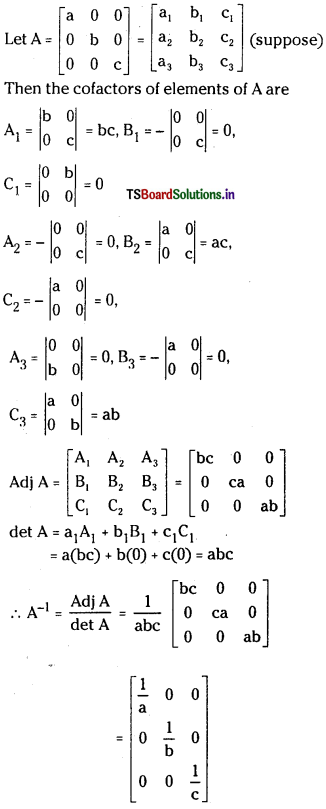
TS Inter 1st Year Maths 1A Solutions Chapter 3 Matrices Ex 3(c) 1

Question 2.
If A = \(\left[\begin{array}{rr}
-2 & 1 \\
5 & 0 \\
-1 & 4
\end{array}\right]\) and B = \(\left[\begin{array}{rrr}
-2 & 3 & 1 \\
4 & 0 & 2
\end{array}\right]\) then find 2A + B’ and 3B’ – A.
Answer:
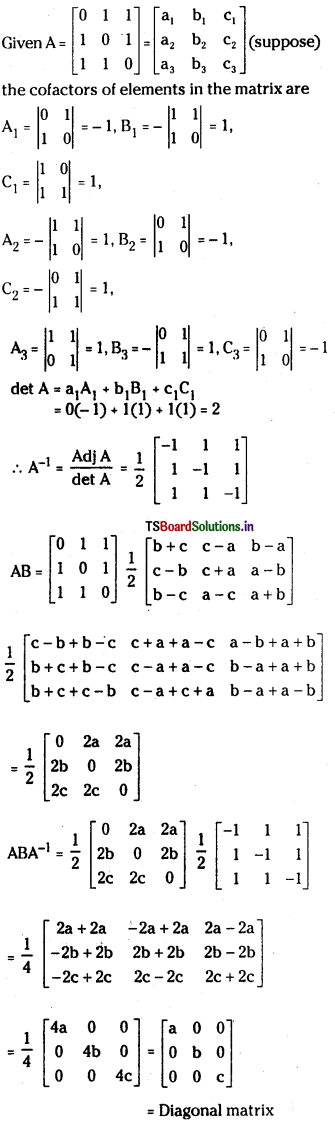
TS Inter 1st Year Maths 1A Solutions Chapter 3 Matrices Ex 3(c) 2

TS Inter 1st Year Maths 1A Solutions Chapter 3 Matrices Ex 3(c)

Question 3.
If A = \(\left[\begin{array}{cc}
2 & -4 \\
-5 & 3
\end{array}\right]\) then find A + A’ and A. A’ (May 2007) (Board Model Paper)
Answer:
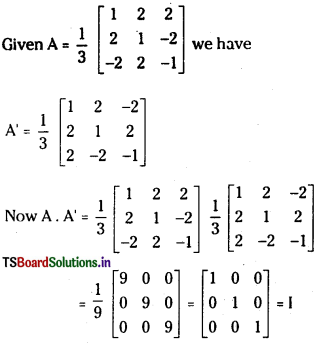
TS Inter 1st Year Maths 1A Solutions Chapter 3 Matrices Ex 3(c) 3

Question 4.
If A = \(\left[\begin{array}{ccc}
-1 & 2 & 3 \\
2 & 5 & 6 \\
3 & x & 7
\end{array}\right]\) is a symmetric matrix then find x.
Answer:
A matrix ‘A’ is said to be symmetric if A’ = A
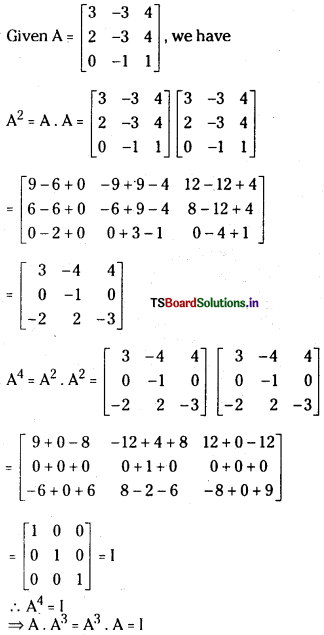
TS Inter 1st Year Maths 1A Solutions Chapter 3 Matrices Ex 3(c) 4

Question 5.
If A = \(\left[\begin{array}{ccc}
0 & 2 & 1 \\
-2 & 0 & -2 \\
-1 & x & 0
\end{array}\right]\) is a skew symmetric matrix, find x. (May 2014, 11)
Answer:
A matrix A is said to be skew symmetric if A’ = – A
\(\left[\begin{array}{ccc}
0 & -2 & -1 \\
2 & 0 & \mathrm{x} \\
1 & -2 & 0
\end{array}\right]=\left[\begin{array}{ccc}
0 & -2 & -1 \\
2 & 0 & 2 \\
1 & -\mathrm{x} & 0
\end{array}\right]\)
from equality of matrix x = 2

Question 6.
Is \(\left[\begin{array}{ccc}
0 & 1 & 4 \\
-1 & 0 & 7 \\
-4 & -7 & 0
\end{array}\right]\) a symmetric or skew symmetric?
Answer:
Let A = \(\left[\begin{array}{ccc}
0 & 1 & 4 \\
-1 & 0 & 7 \\
-4 & -7 & 0
\end{array}\right]\) then A is symmetric if A’ = A and skew symmetric if A’ = – A
i.e., A’ = \(\left[\begin{array}{ccc}
0 & -1 & -4 \\
1 & 0 & -7 \\
4 & 7 & 0
\end{array}\right]=\left[\begin{array}{ccc}
0 & 1 & 4 \\
-1 & 0 & 7 \\
-4 & -7 & 0
\end{array}\right]\) = -A
∴ The matrix A is a skew symmetric matrix.

TS Inter 1st Year Maths 1A Solutions Chapter 3 Matrices Ex 3(c)

II.
Question 1.
If A = \(\left[\begin{array}{cc}
\cos \alpha & \sin \alpha \\
-\sin \alpha & \cos \alpha
\end{array}\right]\), show that A . A’ = A’ . A = I2. (March 2007)
Answer:
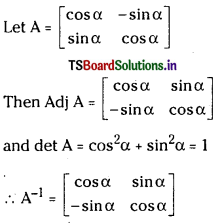
TS Inter 1st Year Maths 1A Solutions Chapter 3 Matrices Ex 3(c) 5

Question 2.
If A = \(\left[\begin{array}{ccc}
1 & 5 & 3 \\
2 & 4 & 0 \\
3 & -1 & -5
\end{array}\right]\) and B = \(\left[\begin{array}{ccc}
2 & -1 & 0 \\
0 & -2 & 5 \\
1 & 2 & 0
\end{array}\right]\), then find 3A – 4B’.
Answer:
TS Inter 1st Year Maths 1A Solutions Chapter 3 Matrices Ex 3(c) 6

Question 3.
If A = \(\left[\begin{array}{rr}
7 & -2 \\
-1 & 2 \\
5 & 3
\end{array}\right]\) and B = \(\left[\begin{array}{rr}
-2 & -1 \\
4 & 2 \\
-1 & 0
\end{array}\right]\) then find AB’ and BA’.
Answer:
TS Inter 1st Year Maths 1A Solutions Chapter 3 Matrices Ex 3(c) 7

Question 4.
For any square matrix A; show that A A’ is symmetric. (March 2015-A.P)
Answer:
By definition a matrix is said to be symmetric if A’ = A.
∴(A A’)’ = (A’)’ A’ = A A’
[(∵ (AB)’ = B’A’ and (A’)’ = A]
Hence AA’ is a symmetric matrix.

TS Inter 1st Year Maths 1A Solutions Chapter 3 Matrices Ex 3(b)

Students must practice these TS Intermediate Maths 1A Solutions Chapter 3 Matrices Ex 3(b) to find a better approach to solving the problems.

TS Inter 1st Year Maths 1A Matrices Solutions Exercise 3(b)

I.
Question 1.
Find the following products wherever possible.
i) [-1 4 2]\(\left[\begin{array}{l}
5 \\
1 \\
3
\end{array}\right]\)
Answer:
It is a product of 1 × 3 and 3 × 1 matrices and the resulting is an 1 × 1 matrix.
[-1 4 2]\(\left[\begin{array}{l}
5 \\
1 \\
3
\end{array}\right]\)
= [-1 × 5 + 4 × 1 + 2 × 3]1 × 1 = [5]1 × 1

ii) \(\left[\begin{array}{lll}
2 & 1 & 4 \\
6 & -2 & 3
\end{array}\right]\left[\begin{array}{l}
1 \\
2 \\
1
\end{array}\right]\)
Answer:
It is a product of 2 × 3 and 3 × 1 matrices and the resulting is an 2 × 1 matrix.
TS Inter 1st Year Maths 1A Solutions Chapter 3 Matrices Ex 3(b) 1

iii) \(\left[\begin{array}{cc}
3 & -2 \\
1 & 6
\end{array}\right]\left[\begin{array}{cc}
4 & -1 \\
2 & 5
\end{array}\right]\)
Answer:
Product of 2 × 2 and 2 × 2 matrices and the resulting is an 2 × 2 matrix.
TS Inter 1st Year Maths 1A Solutions Chapter 3 Matrices Ex 3(b) 2

iv) \(\left[\begin{array}{lll}
2 & 2 & 1 \\
1 & 0 & 2 \\
2 & 1 & 2
\end{array}\right]\left[\begin{array}{ccc}
-2 & -3 & 4 \\
2 & 2 & -3 \\
1 & 2 & -2
\end{array}\right]\)
Answer:
Product of 3 × 3 and 3 × 3 matrices and the resulting is an 3 × 3 matrix.
TS Inter 1st Year Maths 1A Solutions Chapter 3 Matrices Ex 3(b) 3

TS Inter 1st Year Maths 1A Solutions Chapter 3 Matrices Ex 3(b)

v) \(\left[\begin{array}{ccc}
3 & 4 & 9 \\
0 & -1 & 5 \\
2 & 6 & 12
\end{array}\right]\left[\begin{array}{lll}
13 & -2 & 0 \\
0 & 4 & 1
\end{array}\right]\)
Answer:
Product of A3 × 3 and B2 × 3 matrices. Matrix multiplication is not confirmable since the number of columns of A ≠ number of rows of B.

vi) \(\left[\begin{array}{c}
1 \\
-2 \\
1
\end{array}\right]\left[\begin{array}{lll}
2 & 1 & 4 \\
6 & -2 & 3
\end{array}\right]\)
Answer:
Product of A3 × 1 and B2 × 3 matrices. Matrix multiplication is not confirmable since the number of coloumn of A ≠ number of rows of B.

vii) \(\left[\begin{array}{rr}
1 & -1 \\
-1 & 1
\end{array}\right]\left[\begin{array}{ll}
1 & 1 \\
1 & 1
\end{array}\right]\)
Answer:
Product of 2 × 2 and 2 × 2 matrices and the resulting is an 2 × 2 matrix.
TS Inter 1st Year Maths 1A Solutions Chapter 3 Matrices Ex 3(b) 4

viii) \(\left[\begin{array}{ccc}
0 & c & -b \\
-c & 0 & a \\
b & -a & 0
\end{array}\right]\left[\begin{array}{ccc}
a^2 & a b & a c \\
a b & b^2 & b c \\
a c & b c & c^2
\end{array}\right]\)
Answer:
Product of 3 × 3 and 3 × 3 matrices and the resulting matrix is an 3 × 3 matrix.
TS Inter 1st Year Maths 1A Solutions Chapter 3 Matrices Ex 3(b) 5

Question 2.
If A = \(\left[\begin{array}{rrr}
1 & -2 & 3 \\
-4 & 2 & 5
\end{array}\right]\) and B = \(\left[\begin{array}{ll}
2 & 3 \\
4 & 5 \\
2 & 1
\end{array}\right]\) do AB and BA exist ? If they exist find them. Do A and B commute with respect to
multiplication.
Answer:
Given A = \(\left[\begin{array}{rrr}
1 & -2 & 3 \\
-4 & 2 & 5
\end{array}\right]\) and B = \(\left[\begin{array}{ll}
2 & 3 \\
4 & 5 \\
2 & 1
\end{array}\right]\)
We have the product of A2×3 and B3×2 matrices and resulting AB is a product matrix of order 2 × 2. Similarly the product of B3×2 and A2×3 matrices results a product matrix BA of order 3 × 3.
TS Inter 1st Year Maths 1A Solutions Chapter 3 Matrices Ex 3(b) 6
Since AB ≠ BA, we have A and B are not com¬mutative with respect to multiplication of matrices.

Question 3.
Find A2 where A = \(\left[\begin{array}{cc}
4 & 2 \\
-1 & 1
\end{array}\right]\)
Answer:
TS Inter 1st Year Maths 1A Solutions Chapter 3 Matrices Ex 3(b) 7

Question 4.
If A = \(\left[\begin{array}{ll}
\mathrm{i} & 0 \\
0 & \mathrm{i}
\end{array}\right]\) find A2.
Answer:
TS Inter 1st Year Maths 1A Solutions Chapter 3 Matrices Ex 3(b) 8

Question 5.
If A = \(\left[\begin{array}{cc}
\mathrm{i} & 0 \\
0 & -\mathrm{i}
\end{array}\right]\); B = \(\left[\begin{array}{cc}
0 & -1 \\
1 & 0
\end{array}\right]\) and C = \(\left[\begin{array}{ll}
0 & \mathrm{i} \\
\mathrm{i} & 0
\end{array}\right]\) and I is the unit matrix of order 2, then show that
i) A2 = B2 = C2 = – I
Answer:
TS Inter 1st Year Maths 1A Solutions Chapter 3 Matrices Ex 3(b) 9

ii) AB = – BA = – C (March 2008)
Answer:
TS Inter 1st Year Maths 1A Solutions Chapter 3 Matrices Ex 3(b) 10

TS Inter 1st Year Maths 1A Solutions Chapter 3 Matrices Ex 3(b)

Question 6.
If A = \(\left[\begin{array}{ll}
2 & 1 \\
1 & 3
\end{array}\right]\) and B = \(\left[\begin{array}{lll}
3 & 2 & 0 \\
1 & 0 & 4
\end{array}\right]\) find AB. Find BA if it exists.
Answer:
Given A = \(\left[\begin{array}{ll}
2 & 1 \\
1 & 3
\end{array}\right]\) and B = \(\left[\begin{array}{lll}
3 & 2 & 0 \\
1 & 0 & 4
\end{array}\right]\) are matrices of 2 × 2 and 2 × 3. The resulting matrix AB is of the form 2 × 3.
TS Inter 1st Year Maths 1A Solutions Chapter 3 Matrices Ex 3(b) 11

Question 7.
If A = \(\left[\begin{array}{cc}
2 & 4 \\
-1 & K
\end{array}\right]\) and A2 = 0 then find the value of K. (May 2011, Mar. ’14, ’05)
Answer:
TS Inter 1st Year Maths 1A Solutions Chapter 3 Matrices Ex 3(b) 12

II.
Question 1.
If A = \(\left[\begin{array}{lll}
3 & 0 & 0 \\
0 & 3 & 0 \\
0 & 0 & 3
\end{array}\right]\) there find A4.
Answer:
TS Inter 1st Year Maths 1A Solutions Chapter 3 Matrices Ex 3(b) 13

Question 2.
If A = \(\left[\begin{array}{ccc}
1 & 1 & 3 \\
5 & 2 & 6 \\
-2 & -1 & -3
\end{array}\right]\) then Find A3.
Answer:
TS Inter 1st Year Maths 1A Solutions Chapter 3 Matrices Ex 3(b) 14

Question 3.
If A = \(\left[\begin{array}{rrr}
1 & -2 & 1 \\
0 & 1 & -1 \\
3 & -1 & 1
\end{array}\right]\) then find A3 – 3A2 – A – 3I, where I is a unit matrix of order 3. (March 2011)
Answer:
TS Inter 1st Year Maths 1A Solutions Chapter 3 Matrices Ex 3(b) 15

Question 4.
If I = \(\left[\begin{array}{ll}
1 & 0 \\
0 & 1
\end{array}\right]\) and E = \(\left[\begin{array}{ll}
0 & 1 \\
0 & 0
\end{array}\right]\) show that (aI + bE) = a3I + 3a2bE, where I is a unit matrix of order 2. (Mar. 2015-A.P)(May ’05)|
Answer:
TS Inter 1st Year Maths 1A Solutions Chapter 3 Matrices Ex 3(b) 16

III.
Question 1.
If A = diag[a1 a2 a3] then for any Integer n ≥ 1 show that An = diag\(\left[\mathrm{a}_1^{\mathrm{n}}, \mathrm{a}_2^{\mathrm{n}}, \mathrm{a}_3^{\mathrm{n}}\right]\)
Answer:
TS Inter 1st Year Maths 1A Solutions Chapter 3 Matrices Ex 3(b) 17
We prove this result by using mathematical induction suppose n = 1 then
A’ = \(\left[\begin{array}{ccc}
\mathrm{a}_1 & 0 & 0 \\
0 & \mathrm{a}_2 & 0 \\
0 & 0 & \mathrm{a}_3
\end{array}\right]\) = A
The result is true for n = 1.
Suppose the result for n = k then
TS Inter 1st Year Maths 1A Solutions Chapter 3 Matrices Ex 3(b) 18
The result is true for n = k + 1.
So by the principle of mathematical induc-tion the statement is true ∀ n ∈ N.

Question 2.
If θ – Φ = \(\frac{\pi}{2}\), then show that \(\left[\begin{array}{cc}
\cos ^2 \theta & \cos \theta \sin \theta \\
\cos \theta \sin \theta & \sin ^2 \theta
\end{array}\right]\left[\begin{array}{cc}
\cos ^2 \phi & \cos \phi \sin \phi \\
\cos \phi \sin \phi & \sin ^2 \phi
\end{array}\right]\) = 0
Answer:
TS Inter 1st Year Maths 1A Solutions Chapter 3 Matrices Ex 3(b) 19

TS Inter 1st Year Maths 1A Solutions Chapter 3 Matrices Ex 3(b)

Question 3.
If A = \(\left[\begin{array}{rr}
3 & -4 \\
1 & -1
\end{array}\right]\), then show that An = \(\left[\begin{array}{cc}
1+2 n & -4 n \\
n & 1-2 n
\end{array}\right]\) for any integer n ≥ 1, by using mathematical induction.
Answer:
We shall prove the result by mathematical induction.
TS Inter 1st Year Maths 1A Solutions Chapter 3 Matrices Ex 3(b) 20
∴ The given result is true for n = k + 1
∴ By Mathematical induction the given result is true for all positive integral values of n.

Question 4.
Given examples of two square matrices A and B of the same order for which AB = 0 but BA ≠ 0.
Answer:
TS Inter 1st Year Maths 1A Solutions Chapter 3 Matrices Ex 3(b) 21

Question 5.
A trust fund has to invest Rs. 30,000 in two different types of bonds. The first bond pays 5% interest per year, and the second bond pays 7% interest per year. Using matrix multiplication determine how to divide Rs. 30,000 among the two types of bonds, if the trust fund must obtain an annual total interest of (a) Rs. 1800 and (b) Rs. 2,000.
Answer:
Let the first bond be ‘x’, then the second bond will be 30,000 – x.
Rate of interest are 5% and 7% means 0.05 and 0.07.
a) [x 30,000 – x]\(\left[\begin{array}{l}
0.05 \\
0.07
\end{array}\right]\) = [1800]
⇒ 0.05x + 0.07 (30,000 – x) = 1800
⇒ – 0.02x + 0.07 (30,000) = 1800
⇒ – 0.02x + 2100 = 1800
⇒ – 0.02x = – 300
⇒ x = \(\frac{300}{0.02}\) = 300 × \(\frac{100}{2}\) = 15, 000
First bond = 15, 000
Second bond = 30,000 – x
= 30,000 – 15,000 = 15,000

(b) [x 30,000 – x]\(\left[\begin{array}{l}
0.05 \\
0.07
\end{array}\right]\) = [2000]
⇒ 0.05x + 0.07 (30,000 – x) = 2000
⇒ – 0.02x + 0.07 (30,000) = 2000
⇒ – 0.02x + 2100 = 2000
⇒ x = \(\frac{100}{0.02}\) = 5, 000
∴ Second bond = 30,000 – x
= 30,000 – 5,000
= 25,000

TS Inter 1st Year Economics Notes Chapter 5 Market Analysis

Here students can locate TS Inter 1st Year Economics Notes Chapter 5 Market Analysis to prepare for their exam.

TS Inter 1st Year Economics Notes Chapter 5 Market Analysis

→ Market: The market is a mechanism where the activities of selling and purchasing of goods and services take place.

→ Perfect Competition: Perfect competition is a market where a large number of buyers and sellers exist. All goods are homogeneous and sold at the same price.

→ Monopoly: A monopoly is a market with a single producer and the product will not have any close substitutes.

TS Inter 1st Year Economics Notes Chapter 5 Market Analysis

→ Monopolistic Competition: It is a market where several firms will produce the same commodity with small differences. Here advertisement takes place.

→ Product differentiation: Small differences exist between the products of different firms. Their cross elasticity of demand is more.

→ Selling Costs: Firms will spend on advertisements to increase their sales. These expenses are called selling costs.

→ Oligopoly: Oligopoly is a market where a few firms produce the goods. The price of a good is decided independently or collectively by the firms.

→ Duopoly: Duopoly is a market where only two producers exist in the market. It is a limited form of oligopoly.

→ Equilibrium Price: Equilibrium Price is that price where demand and supply are equal in the market.

→ Equilibrium of a Firm: A firm is said to be in equilibrium at a point where it has no desire either to expand or to contract its output.

TS Inter 1st Year Economics Notes Chapter 5 మార్కెట్ విశ్లేషణ

→ వస్తు సేవల కొనుగోళ్ళు, అమ్మకాలు జరిగే ప్రదేశాన్ని మార్కెట్ అంటారు.

→ మార్కెట్ను విస్తీర్ణం, కాలవ్యవధి, పోటీని బట్టి వివిధ రకాలుగా వర్గీకరించవచ్చును.

→ విస్తీర్ణం ఆధారంగా మార్కెట్ను స్థానిక మార్కెట్, జాతీయ మార్కెట్, అంతర్జాతీయ మార్కెట్ అని మూడు రకాలుగా విభజిస్తారు.

→ కాల వ్యవధి ఆధారంగా మార్కెట్ను అతిస్వల్పకాలిక మార్కెట్, స్వల్పకాలిక మార్కెట్, దీర్ఘకాలిక మార్కెట్గా విభజిస్తారు.

→ పోటీ ఆధారంగా పరిపూర్ణ పోటీ మార్కెట్, అపరిపూర్ణ పోటీ మార్కెట్ అని రెండు రకాలుగా మార్కెట్ను విభజిస్తారు.

TS Inter 1st Year Economics Notes Chapter 5 Market Analysis

→ అనేకమంది అమ్మకందార్లు, కొనుగోలుదార్లు ఉండటం, సజాతీయమైన వస్తువు ఉత్పత్తి, సంస్థల స్వేచ్ఛా ప్రవేశం, నిష్క్రమణ, ఉత్పత్తి కారకాల గమనశీలత, రవాణా ఖర్చులు లేకుండుట, మార్కెట్లో ఒకే ధర ఉండటం అనేవి పరిపూర్ణ పోటీ లక్షణాలు.

→ కొనుగోలుదార్ల మధ్యకాని, అమ్మకందార్ల మధ్యకాని సంపూర్ణ పోటీ లేనటువంటి దానిని అసంపూర్ణ పోటీ అంటారు. దీనిలో ధర విచక్షణ ఉంటుంది.
ఈ అపరిపూర్ణ పోటీ మార్కెట్ ముఖ్యంగా నాలుగు రకాలు:

  1. ఏకస్వామ్యం
  2. ద్విస్వామ్యం
  3. పరిమితస్వామ్యం
  4. ఏకస్వామ్య పోటీ మార్కెట్

TS Inter 1st Year Economics Notes Chapter 4 Production Analysis

Here students can locate TS Inter 1st Year Economics Notes Chapter 4 Production Analysis to prepare for their exam.

TS Inter 1st Year Economics Notes Chapter 4 Production Analysis

→ Production: Production is the process that converts inputs into output. By using resources in the production process consumption goods or capital goods will be produced.

→ Production function: The production function shows the relationship between the inputs used and the output produced by a firm.

→ Factors of production: Factors that help in the production are called factors of production. These are land, labour, capital and organization.

TS Inter 1st Year Economics Notes Chapter 4 Production Analysis

→ Short period: Short period is a period in which a producer can’t change land, capital and organization. Labour can be changed.

→ Long period: It is a period in which all factors of production can be changed by the producer to increase or decrease output.

→ Average product: Average product can be obtained by dividing total product by the number of labourers.

→ Marginal product: Marginal product is the additional production by employing an additional unit of a labourer.

→ Fixed factors: Land, capital and entrepreneurship are the fixed factors of production in the short run. We cannot change them.

→ Variable factors: Factors of production which can be changed. Labour is a variable factor in the short run. In the long run all the factors of production are variable.

→ Change in the scale of Production: Change in the scale of production relates to the changes in the production due to the changes in the combination of factors of production in long run.

→ Internal economies: Internal economies refer to the benefits accrued to individual firms due to the expansion of their production activity.

→ External economies: These refer to the returns accrued to all thb firms in the industry as a result of the expansion of the industry as a whole.

TS Inter 1st Year Economics Notes Chapter 4 Production Analysis

→ Supply: Supply is the quantity of a good offered by the producer for sale at the given prices during a certain period.

→ Supply function: Supply function shows the relationship between the determinants of supply and the supply of a good.

→ Opportunity cost: It denotes the foregone production when a factor is shifted from one use to another use.

→ Total cost: Total cost can be obtained by adding the payments made to the fixed and variable factors in the short run.

→ Fixed costs: Fixed costs are payments made to the fixed factors by a firm in the short run. These costs are fixed and will not change along with the changes in the output.

→ Variable costs: Variable costs are the payments made to the variable factors in the short run. These will change along with the changes in the output.

→ Average cost: Production cost per unit of a good production can be obtained by dividing the total cost by the total number of goods.

→ Marginal cost: Marginal cost is the change in total cost when we produce an additional unit of a commodity.

→ Total revenue: Total revenue is the amount earned by a firm by selling goods in the market. By multiplying the price by the number of goods sold, we get the total revenue.

→ Average revenue: Average revenue can be obtained by dividing the total revenue by number of goods sold.

→ Marginal revenue: Marginal revenue is the additional revenue earned by selling an additional unit of the good.

TS Inter 1st Year Economics Notes Chapter 4 Production Analysis

TS Inter 1st Year Economics Notes Chapter 4 ఉత్పత్తి విశ్లేషణ

→ ఉత్పత్తి అనగా ప్రయోజనాల సృష్టి.

→ ఉత్పత్తిలో పాల్గొనే కారకాలను ఉత్పత్తి కారకాలంటారు. అవి నాలుగు: 1. భూమి. 2. శ్రమ. 3. మూలధనం 4. వ్యవస్థాపన.

→ భౌతిక ఉత్పత్తి సాధనాలకు, భౌతిక ఉత్పత్తికి మధ్య గల సంబంధంను ఉత్పత్తి ఫలం అంటారు.

→ స్వల్పకాలం అనగా ఉత్పత్తి ప్రక్రియలో చర సాధనాలను మాత్రమే మార్చి, ఉత్పత్తిలో మార్పులు చేపట్టగలిగే కాలపరిధి.

→ చరానుపాత సూత్రం స్వల్ప కాలానికి చెందినది. ఈ సూత్రం ప్రకారం కొన్ని ఉత్పత్తి కారకాలను స్థిరంగా ఉంచి చర ఉత్పత్తి సాధనం పరిమాణంలో మార్పు చేస్తూ ఉన్నప్పుడు ఉత్పత్తి ఏ అనుపాతంలో మారుతుందో తెలియజేస్తుంది.

→ దీర్ఘకాలంలో అన్ని ఉత్పత్తి సాధనాలు చర అనుపాతంలో మారినపుడు ఉత్పత్తి ఏ అనుపాతంలో మార్పు చెందుతుందో తెలియజేసే దానిని తరహాననుసరించి ప్రతిఫలాలు అంటారు.

→ ఒక నిర్ణీత ధర వద్ద, నిర్ణీతకాలంలో, మార్కెట్లో విక్రయానికి సిద్ధంగా ఉన్న వస్తు పరిమాణాన్ని సప్లయ్ అంటారు. ఇతర పరిస్థితులు మారనంత వరకు ఒక వస్తువు ధర తగ్గితే సప్లయ్ తగ్గుతుంది. ధర పెరిగితే సప్లయ్ పెరుగుతుంది.

TS Inter 1st Year Economics Notes Chapter 4 Production Analysis

→ ఒక ఉత్పత్తిదారుడు ఉత్పత్తికి వెచ్చించే మొత్తాన్ని “ఉత్పత్తి వ్యయం” అంటారు. వ్యయాలు రెండు రకాలు:

  1. సాధారణ వ్యయాలు
  2. ఆర్థిక వ్యయాలు.

TS Inter 1st Year Economics Notes Chapter 3 Demand Analysis

Here students can locate TS Inter 1st Year Economics Notes Chapter 3 Demand Analysis to prepare for their exam.

TS Inter 1st Year Economics Notes Chapter 3 Demand Analysis

→ Demand: The desire backed up by willingness and ability to pay a sum of money for some quantity of a good or service.

→ Demand function: It is the functional relationship between the quantity demanded for a good and all the quantitative factors which determine the demand.

→ Demand schedule: It is the table that shows the relation between the prices and quantities demanded.

TS Inter 1st Year Economics Notes Chapter 3 Demand Analysis

→ Individual demand: It is the quantity demanded by a single consumer in the market.

→ Market demand: It is the total demand for the commodities in the market.

→ Substitute goods: Substitutes are those goods that satisfy the same want.

→ Complementary goods: Complementaries are those goods that satisfy the same want jointly.

→ Price demand: It refers to the functional relationship between the price of the good and the quantity demanded.

→ Superior goods: In case of superior goods, quantity demanded increases when there is an increase in the income of consumers. There exists a positive relationship between income and quantity demanded.

→ Inferior goods: Quantity demanded of inferior goods decreases with the increase in income of the consumers. There exists an inverse relationship between income and quantity demanded.

→ Elasticity: Elasticity is the ratio between the proportional change of one variable and the proportional change of another variable.

→ Price Elasticity of demand: It Is the percentage or proportional change in quantity demanded of a commodity as a result of percentage change in price of that commodity; other things like income, tastes, prices of related goods etc., remain constant.

→ Income elasticity of demand: It is the percentage change in the quantity demanded of a commodity as a result of the percentage change in the income of the consumer.

→ Cross elasticity of demand: It is the percentage change in the quantity demanded of a commodity as a result of a proportional change in the price of a related commodity.

TS Inter 1st Year Economics Notes Chapter 3 Demand Analysis

→ Unitary elastic demand: In such case, the elasticity of demand is equal to one and the demand curve will be in the shape of a ‘rectangular hyperbola’.

TS Inter 1st Year Economics Notes Chapter 3 డిమాండ్ విశ్లేషణ

→ ఒక నిర్ణీత కాలంలో, నిర్ణీతమైన ధర వద్ద కొనుగోలుకు సిద్ధంగా ఉన్న వస్తువు పరిమాణాన్ని ఆ వస్తువుకు ఉన్న డిమాండ్ అంటారు.

→ ఒక వస్తువు డిమాండ్ పరిమాణానికి, దానిని నిర్ణయించే కారకాలకు మధ్యగల సంబంధాన్ని తెలియజేసేది డిమాండ్ ఫలం. దీనిని Dx = f(Px, Py, ………….. Px-1, Y, T) అనే సమీకరణం ద్వారా తెలియజేయవచ్చు.

→ ఒక వస్తువు ధర, వినియోగదారుని ఆదాయాలు, వినియోగదారుల అలవాట్లు, అభిరుచులు మొదలైన అంశాలు వస్తువు డిమాండ్ను నిర్ణయిస్తాయి.

→ ఇతర పరిస్థితులు మారకుండా స్థిరంగా ఉన్నప్పుడు ఒక నిర్ణీత కాలంలో ఒక వస్తువు ధర తగ్గితే డిమాండ్ పెరుగుతుంది. ధర పెరిగితే డిమాండ్ తగ్గుతుందని డిమాండ్ సూతం నిర్వచించును.

→ ఇతర అంశాలు స్థిరంగా ఉన్నప్పుడు ధర పెరిగితే డిమాండ్ తగ్గుతుంది, ధర తగ్గితే డిమాండ్ పెరుగుతుంది. ధరకు, డిమాండ్కు మధ్య ఉన్న సంబంధాన్ని తెలిపేది ధర డిమాండ్.

→ ఆదాయానికి, కొనుగోలు చేసే వస్తు పరిమాణానికి మధ్య ఉన్న సంబంధాన్ని ఆదాయ డిమాండ్ అంటారు. ఇతర అంశాలు స్థిరంగా ఉండి ఆదాయం పెరిగితే డిమాండ్ పెరుగుతుంది, ఆదాయం తగ్గితే డిమాండ్ తగ్గుతుంది. ఆదాయ డిమాండ్ను బట్టి వస్తువులను మేలురకం మరియు నాసిరకం వస్తువులుగా గుర్తించవచ్చు.

→ ప్రత్యామ్నాయ పూరక వస్తువుల ధరకు, ఒక వస్తువు డిమాండ్కు మధ్య ఉన్న సంబంధాన్ని జాత్యంతర డిమాండ్ అంటారు.

→ ఒక వస్తువు ధరలో మార్పు కలిగినప్పుడు ఏ మేరకు డిమాండ్లో ప్రతిస్పందన వస్తుందో తెలియజేసేదే డిమాండ్ వ్యాకోచత్వం.

→ వ్యాకోచత్వాలు మూడు రకాలు. 1) ధర డిమాండ్ వ్యాకోచత్వం 2) ఆదాయ డిమాండ్ వ్యాకోచత్వం 3) జాత్యంతర డిమాండ్ వ్యాకోచత్వం.

→ ధర డిమాండ్ వ్యాకోచత్వం ఐదు రకాలు.

  1. పూర్తి వ్యాకోచత్వం
  2. పూర్తి అవ్యాకోచత్వం
  3. ఏకత్వ వ్యాకోచత్వం
  4. సాపేక్ష వ్యాకోచత్వం
  5. సాపేక్ష అవ్యాకోచత్వం.

TS Inter 1st Year Economics Notes Chapter 3 Demand Analysis

→ ఆదాయంలో వచ్చే మార్పు వల్ల వస్తువు డిమాండ్లో వచ్చే పరిమాణాత్మక మార్పును ఆదాయ డిమాండ్ వ్యాకోచత్వం అంటారు.

→ ఒక వస్తువు ధరలో వచ్చిన మార్పు వల్ల దాని పత్యామ్నాయ లేదా పూరక సంబంధమైన వస్తువు డిమాండ్లో వచ్చిన పరిమాణాత్మకమైన మార్పును తెలియజేసేది జాత్యంతర డిమాండ్ వ్యాకోచత్వం.

TS Inter 1st Year Economics Notes Chapter 2 Theories of Consumer Behaviour

Here students can locate TS Inter 1st Year Economics Notes Chapter 2 Theories of Consumer Behaviour to prepare for their exam.

TS Inter 1st Year Economics Notes Chapter 2 Theories of Consumer Behaviour

→ Utility means wanting satisfying power of a thing, measurement of utility can be two types: 1. Cardinal utility 2. Ordinal utility.

→ Cardinal utility was developed by Alfred Marshall. According to the cardinal utility approach, a utility can be measured in terms of numbers like 1, 2, 3, 4 etc.

TS Inter 1st Year Economics Notes Chapter 2 Theories of Consumer Behaviour

→ Ordinal utility approach was developed by R.J.D. Hicks & Allen. According to this approach, utility is subjective. So, it is not possible to measure in terms of numbers. They are ranked 1st, 2nd, 3rd etc.

→ The law of Diminishing marginal utility was developed by H.H. Gossen in 1854 and later it was popularised by Marshall. This law shows the relationship between the quantity of a thing consumed and its marginal utility. If a consumer goes on consuming a commodity then the satisfaction that derives from its additional units declines.

→ The law of Equi-Marginal Utility explains as to how a consumer distributes his limited income among various commodities to get maximum satisfaction. The consumer will be in equilibrium when the following condition is satisfied :
TS Inter 1st Year Economics Notes Chapter 2 Theories of Consumer Behaviour 2

→ Indifference curve is a technique based on the ordinal utility approach. Ic represents the satisfaction of a consumer from two goods.

→ MRS is the rate at which an individual exchanges successive units of one commodity for another.

→ A set of indifference curves drawn for different income levels is called as an indifference map.

→ Consumer equilibrium is a point where the consumer gets maximum satisfaction from two goods.

TS Inter 1st Year Economics Notes Chapter 2 ప్రవర్తనా సిద్ధాంతాలు

→ ఒక వస్తువుకు ఉండే మానవుని కోరికను తీర్చగలిగే శక్తిని ప్రయోజనం అంటారు.

→ వివిధ వస్తువుల నుంచి పొందే ప్రయోజనాలను యుటిల్స్ అనే ఊహాత్మక యూనిట్ల ద్వారా కొలవడానికి వీలుంది. దీనిని అభివృద్ధిపరచినది మార్షల్. 1, 2, 3 మొదలగు సంఖ్యలను కార్డినల్ సంఖ్యలు అంటారు. వీటి ద్వారా వినియోగదారుని ప్రయోజనమును కొలవవచ్చు.

TS Inter 1st Year Economics Notes Chapter 2 Theories of Consumer Behaviour

→ వస్తువు అన్ని యూనిట్ల వినియోగం ద్వారా పొందగలిగే మొత్తం తృప్తిని మొత్తం ప్రయోజనం అంటారు.

→ వినియోగదారుడు అదనంగా వస్తువు యూనిట్ను ఉపయోగించడం వల్ల మొత్తం ప్రయోజనంలో కలిగే మార్పు MO = ΔTU/ΔQ

→ క్షీణోపాంత ప్రయోజన సూత్రంను గాసెన్ మొదటి సూత్రం అంటారు. ఇది వస్తు పరిమాణానికి, ప్రయోజనానికి మధ్య ఉన్న సంబంధాన్ని గూర్చి తెలుపును. ఒకే రకమైన వస్తువును వినియోగదారుడు క్రమంగా ఎక్కువగా వినియోగిస్తూ ఉంటే, మొత్తం ప్రయోజనం ఒక దశ వరకు పెరిగి, ఆ తరువాత తగ్గుతుంది.

→ సమోపాంత ప్రయోజన సూత్రాన్ని గాసెన్ ద్వితీయ సూత్రం అని కూడా అంటారు. వినియోగదారుడు తన పరిమితమైన ఆదాయాన్ని ఖర్చుచేసి ఏ విధంగా గరిష్ట ప్రయోజనం పొందుతాడో తెలియజేసేది.

→ కార్డినల్ విశ్లేషణలో ప్రయోజనం అనేది మానసికపరమైంది. అందువల్ల దాన్ని సంఖ్యా రూపంలో కొలవడానికి సాధ్యం కాదు. అందువల్ల R.J.D. హిక్స్ మరియు అలెన్ ఆర్డినల్ విశ్లేషణ ద్వారా వినియోగదారుని ప్రవర్తనను తెలియజేశారు. ఈ విశ్లేషణలో వినియోదారు తనకు లభ్యమైన వివిధ వస్తు సముదాయాలకు ర్యాంకులు 1, 2, 3 మొదలైనవి ఇవ్వడం ద్వారా వాటన్నిటిని క్రమ పద్ధతిలో ఏర్పరచుకుంటారు.

TS Inter 1st Year Economics Notes Chapter 2 Theories of Consumer Behaviour

→ వినియోగదారుడు కొనుగోలు చేసే రెండు వస్తువుల వివిధ సమ్మేళనాలను తెలియజేసే బిందువులను కలుపగా ఏర్పడే రేఖలను “ఉదాసీనతా వక్రరేఖ” అంటారు. దీని ద్వారా కూడా వినియోగదారుని ప్రయోజనాన్ని కొలవవచ్చు.

TS Inter 1st Year Economics Notes Chapter 1 Introduction to Economics

Here students can locate TS Inter 1st Year Economics Notes Chapter 1 Introduction to Economics to prepare for their exam.

TS Inter 1st Year Economics Notes Chapter 1 Introduction to Economics

→ Economics is a social science. It explains how an economy and different individuals behave while managing their economic activities.

→ The term Economics is originated from greek words ‘OIKOS’ and ‘Nemein’.

→ Economic problem is concerned with economizing scarce resources. Wants, efforts and satisfaction constitute the essence of economics.

  1. Wealth definition – Adam Smith
  2. Welfare definition – Alfred Marshall
  3. Scarcity definition – Lionel Robbins
  4. Growth definition – Samuelson

TS Inter 1st Year Economics Notes Chapter 1 Introduction to Economics

→ Modern economists have divided economic theory into two parts,

  • Micro Economics
  • Macro Economics.

The two terms were first coined and used by ‘Ragnar Frisch’ in 1933. Micro Economics was popularised by Alfred Marshall, and J.M. Keynes popularised Macro Economics. Both approaches are essential for a proper understanding of a problem. The two approaches are interdependent.

→ The method of studying economic phenomena by taking assumptions and deducing conclusions from assumptions is called deduction.

→ Inductive method is the process in which one can arrive generalization on the basis of observed facts.

→ Economic static – analysis where establishing the functional relationship between two variables whose values are related to the same point of time.

→ Economic dynamics is the study of in relation to the preceding and succeeding events.

→ A positive science may be defined as a body of systematized knowledge concerning ‘What it is’.

→ A normative science may be defined as a body of systematized knowledge relating to the object of “What ought to be”?

→ Anything which satisfies human want is good.

→ Goods can be divided into two types: i) Free goods ii) Economic goods.
Economic goods are again divided into three types: i) Consumer goods ii) Capital goods iii) Intermediary Goods.
Semi-finished and under-finished products are called intermediary goods.

→ Wealth means money but in Economics all economic goods including land is treated as wealth. Wealth has three characters.

  1. Utility
  2. Exchange value
  3. Transferability
  4. Scarcity

→ Income is a flow over a period of time. Income flow is circular in character. There are two types of income, i) Money income ii) Real income.

→ Wants satisfying capacity of good is called utility. There are four types of utilities,

  1. Form utility
  2. Place utility
  3. Time utility
  4. Service utility.

→ Value means the exchange value of goods in economics. A good has value in use and value in exchange.

→ The value of a good expressed in terms of money is its price.

TS Inter 1st Year Economics Notes Chapter 1 Introduction to Economics

→ Human wants are starting points of all economic activities. They are unlimited, competitive, complementary, and recur. Wants are classified into necessities, comforts, and luxuries.

→ In Economics welfare means utility of satisfaction. Welfare indicates better living conditions of people in society. Wealth and welfare are closely related to one another.

TS Inter 1st Year Economics Notes Chapter 1 అర్థశాస్త్ర పరిచయం

→ అర్థశాస్త్రం అనే పదం గ్రీకు భాషలోని “Okinomickos” అనే పదం నుంచి ఆవిర్భవించింది.

→ ఆడమ్ స్మిత్ అభిప్రాయం ప్రకారం అర్థశాస్త్రం ప్రధానంగా “సంపదను” గూర్చి చర్చిస్తుంది.

→ మార్షల్ అర్థశాస్త్రంలో సంపద కన్నా శ్రేయస్సుకు ఎక్కువ ప్రాధాన్యత ఇచ్చాడు.

→ రాబిన్స్ ప్రకారం ఆర్థిక సమస్యలన్నింటికి మూలకారణం ‘కొరత’,

→ శామ్యూల్సన్ తన నిర్వచనములో ప్రస్తుత వినియోగానికే కాక భవిష్యత్ వినియోగానికి కూడా ప్రాధాన్యతను ఇచ్చాడు.

→ జేకబ్ వైనర్ ప్రకారం ఆర్థికవేత్తల ప్రశ్నలు వాటికి సంబంధించిన చర్చల ద్వారా అర్థశాస్త్రంను అర్థం చేసుకోవచ్చును.

→ రాగ్నార్ ఫ్రిష్ మొట్టమొదటిసారిగా 1933 సం॥లో సూక్ష్మ స్థూల అర్థశాస్త్రం అనే పదాలను ఉపయోగించడం జరిగింది.

→ సూక్ష్మ అర్థశాస్త్రం వైయుక్తిక యూనిట్లను పరిశీలిస్తుంది. దీనిని ‘ధరల సిద్ధాంతం’ అని కూడా అంటారు.

→ స్థూల అర్థశాస్త్రం ఆర్థిక వ్యవస్థ మొత్తాన్ని ఒకే యూనిట్గా పరిశీలిస్తుంది. దీనిని ‘ఆదాయ ఉద్యోగిత’ సిద్ధాంతం అని కూడా అంటారు.

→ నిగమన పద్ధతి సార్వత్రిక ప్రతిపాదనల నుంచి ఆరంభమై ప్రత్యేక ప్రతిపాదనలకు దారితీస్తుంది.

→ ఆగమన పద్ధతిలో ప్రత్యేక ప్రతిపాదనల నుంచి సార్వజనీన ప్రతిపాదనలు రూపొందిస్తారు.

→ ఆర్థిక నిశ్చలత్వం అనగా కాలంతో సంబంధం లేకుండా ఆర్థిక కార్యకలాపాలను పరిశీలించడం.

→ ఆర్థిక చలనత్వం అనగా కాలంతో పాటు మార్పు చెందే వివిధ చలాంకాల మధ్య ఉన్న సంబంధాన్ని అధ్యయనం చేయడం.

→ ఉనికిలో ఉన్న విషయాలను గురించి ఒక క్రమబద్ధమైన అధ్యయనం చేయడాన్ని నిశ్చయాత్మక అర్థశాస్త్రం అంటారు.

TS Inter 1st Year Economics Notes Chapter 1 Introduction to Economics

→ ‘ఎలా ఉండాలి’ అనే విషయాన్ని గురించి క్రమబద్ధమైన పద్ధతిలో అధ్యయనం చేసేది నిర్ణయాత్మక శాస్త్రం.

→ అర్థశాస్త్రంలో మానవ కోరికను సంతృప్తిపరచగలిగే భౌతిక, అభౌతికాంశాలన్నింటిని వస్తువులుగా పరిగణిస్తారు.

→ ప్రకృతి నుండి ఉచితంగా లభించే వస్తువులను ఉచిత వస్తువులంటారు.

→ మానవులచే ఉత్పత్తి చేయబడే వస్తువులన్నింటిని ఆర్థిక వస్తువులంటారు.

→ మానవ కోరికలను ప్రత్యక్షంగా సంతృప్తిపరిచే వస్తువులన్నింటిని వినియోగ వస్తువులంటారు.

→ ఉత్పత్తి చేయబడిన ఉత్పత్తి కారకాన్ని ఉత్పాదక వస్తువులంటారు.

→ ఉత్పత్తి ప్రక్రియలో పూర్తిగా తయారు కాకుండా ఉన్న ముడి సరుకులను మాధ్యమిక వస్తువులంటారు.

→ అర్థశాస్త్ర పరిభాషలో భూమితోపాటుగా ఆర్థిక వస్తువులన్నింటిని కలిపి సంపదగా పరిగణిస్తారు.

→ ఆదాయం ఒక ప్రవాహం వంటిది. ఈ ప్రవాహానికి మూలం సంపద.

→ మానవుని కోర్కెలను తీర్చగలిగే వస్తు సేవల యొక్క శక్తినే ప్రయోజనం అంటారు. ఇది నాలుగు రకాలు.

  1. ఆకార ప్రయోజనం
  2. స్థాన ప్రయోజనం
  3. కాల ప్రయోజనం
  4. సేవా ప్రయోజనం.

→ అర్థశాస్త్రంలో విలువ భావనను రెండు రకాలుగా వివరిస్తారు.

  1. వినియోగపు విలువ
  2. మారకపు విలువ.

→ వస్తువు యొక్క విలువను ద్రవ్య రూపంలో తెలియజేయటాన్ని ‘ధర’ అంటారు.

→ మానవుని కోర్కెలు అనంతాలు. వనరులు పరిమితం, మానవుని కోర్కెలు ఆర్థిక కార్యకలాపములకు మూలం.

TS Inter 1st Year Economics Notes Chapter 1 Introduction to Economics

→ ఆర్థికపరమైన ఒక విరామస్థితిని సమతౌల్యం అంటారు.

→ ఒక వ్యక్తి లేదా సమాజం సంపద నుండి పొందే సంతృప్తిని తెలియజేస్తుంది సంక్షేమం.

TS Inter 1st Year Physics Study Material Chapter 4 సమతలంలో చలనం

Telangana TSBIE TS Inter 1st Year Physics Study Material 4th Lesson సమతలంలో చలనం Textbook Questions and Answers.

TS Inter 1st Year Physics Study Material 4th Lesson సమతలంలో చలనం

అతిస్వల్ప సమాధాన ప్రశ్నలు

ప్రశ్న 1.
ఒక సదిశ నిలువు అంశం దాని క్షితిజ సమాంతర అంశానికి సమానం. ఆ సదిశ x-అక్షంతో చేసే కోణం ఎంత ?
జవాబు:
ఒక సదిశ Ā నిలువు అంశం Ā = Ā sin θ.
క్షితిజ సమాంతర అంశం A|| = Ā cos θ
A = A|| అయితే వాటి మధ్య కోణము tan θ = \(\frac{\mathrm{A}_{\perp}}{\mathrm{A}_{\|}}\) = 1
అనగా θ = 45°

ప్రశ్న 2.
ఒక సదిశ V క్షితిజ సమాంతరంతో రికోణం చేస్తుంది. ఆ సదిశను ఆ కోణం భ్రమణం చెందించడమైంది. ఈ భ్రమణం సదిశ V లో మార్పు తెస్తుందా ?
జవాబు:
నిర్దేశక అక్షాలను త్రిప్పినంత మాత్రాన సదిశ పరిమాణం మారదు. ఇచ్చిన సదిశ పరిమాణము = V
క్షితిజ సమాంతర అక్షంతో కోణము = θ (అనుకొనుము)
నిరూపకాక్షాలను త్రిప్పిన కోణము = e అయితే, క్షితిజ సమాంతరంతో కోణము θ + e అవుతుంది.
ఇప్పుడు క్షితిజ సమాంతరాంశం = Vx = V Cos (θ + e), క్షితిజ లంబ అంశం Vy = V sin (θ + e)
ఇచ్చిన సదిశ పరిమాణము V = \(\sqrt{v_x^2+v_y^2}\) = V \(\left(\sqrt{\cos ^2(e+\theta)+\sin ^2(e+\theta)}\right)=\) = V
కావున అక్షాన్ని భ్రమణం చెందించటం వల్ల సదిశ పరిమాణం మారదు.

ప్రశ్న 3.
3 ప్రమాణాలు, 5 ప్రమాణాల పరిమాణం ఉన్న రెండు బలాలు ఒకదానితో ఒకటి 60° కోణంలో పనిచేస్తున్నాయి. వాటి ఫలిత పరిమాణం ఎంత ?
జవాబు:
సదిశల పరిమాణాలు 3 యూనిట్లు, 5 యూనిట్లు. వాటి మధ్య కోణము = θ
∴ ఫలిత సదిశ R = \(\sqrt{3^2+5^2+2 \times 3 \times 5 \cos 60^{\circ}}=\sqrt{9+25+15}=\sqrt{49}\) = 7 యూనిట్లు.

TS Inter 1st Year Physics Study Material Chapter 4 సమతలంలో చలనం

ప్రశ్న 4.
\(\overrightarrow{\mathrm{A}}=\overrightarrow{\mathrm{i}}+\overrightarrow{\mathrm{j}}\) . ఈ సదిశ x-అక్షంతో చేసే కోణం ఎంత ?
జవాబు:
\(\overrightarrow{\mathrm{A}}=\overrightarrow{\mathrm{i}}+\overrightarrow{\mathrm{j}}\) స్థాన సదిశ పటంలో చూపినట్లు ఉంటుంది.
TS Inter 1st Year Physics Study Material Chapter 4 సమతలంలో చలనం 1
పటం నుండి tan θ = \(\frac{y}{x}\) = -1
∴ θ = 45° (సవ్యదిశలో అనగా 4వ పాదంలో ఉంటుంది.)

ప్రశ్న 5.
యూనిట్లు, 24 యూనిట్లు పరిమాణం ఉన్న రెండు లంబ సదిశలు సంయోగం చెందినట్లైతే ఫలిత సదిశ పరిమాణం ఎంత ?
జవాబు:
దత్తాంశం నుండి \(\overline{\mathrm{P}}\) = 7 యూనిట్లు; \(\overline{\mathrm{Q}}\) = 24 యూనిట్లు; వాటి మధ్య కోణము θ = 90°
∴ ఫలిత సదిశ \(\overline{\mathrm{R}}=\sqrt{\overline{\mathrm{P}}^2+\overline{\mathrm{Q}}^2+2 \mathrm{PQ} \cos \theta}=\sqrt{\overline{\mathrm{P}}^2+\overline{\mathrm{Q}}^2}\) (∵ cos 90° = 0)
∴ \(\overline{\mathrm{R}}=\sqrt{7^2+24^2}=\sqrt{49+576}=\sqrt{625}\) = 25 యూనిట్లు.

ప్రశ్న 6.
P = 2i + 4j + 14k, Q = 4i + 4j + 10k అయితే P + Q పరిమాణం కనుక్కోండి.
జవాబు:
TS Inter 1st Year Physics Study Material Chapter 4 సమతలంలో చలనం 2

ప్రశ్న 7.
శూన్య పరిమాణం కలిగిన సదిశకు శూన్యం కాని అంశాలు ఉంటాయా ?
జవాబు:
శూన్య సదిశ యొక్క అంశాలు శూన్యేతర పరిమాణమును కలిగి ఉండవు. ఎందుకనగా \(\overline{\mathrm{V}}=\sqrt{\mathrm{V}_{\mathrm{x}}^2+\mathrm{V}_{\mathrm{y}}^2}\) కావున \(\overline{\mathrm{V}}\) = (0) కావాలంటే తప్పనిసరిగా Vx2 మరియు Vy2 సున్న కావలెను. అనగా Vx = Vy = 0 కావలెను.

TS Inter 1st Year Physics Study Material Chapter 4 సమతలంలో చలనం

ప్రశ్న 8.
ప్రక్షేపకం యొక్క ప్రక్షేప పథం అగ్రభాగంలో దాని త్వరణం ఎంత ?
జవాబు:
ప్రక్షేపకం అగ్రభాగంలో త్వరణము గురుత్వత్వరణము g = 9.8 మీ/సె2. ఇది భూమి కేంద్రంవైపు పనిచేస్తుంది.

ప్రశ్న 9.
రెండు అసమ పరిమాణం వున్న సదిశల సంకలన మొత్తం శూన్య సదిశను ఇవ్వగలదా ? మూడు అసమాన సదిశలు కలిసి శూన్య సదిశను ఇవ్వగలవా ?
జవాబు:
శూన్యం కాదు. రెండు అసమాన సదిశల ఫలిత సదిశ శూన్యం కాదు. కాని ఒకే సమతలంలో గల మూడు అసమాన సదిశల ఫలిత సదిశ శూన్యం కావచ్చును.

స్వల్ప సమాధాన ప్రశ్నలు

ప్రశ్న 1.
సదిశల సమాంతర చతుర్భుజ నియమాన్ని పేర్కొనండి. ఫలిత సదిశ పరిమాణం, దిశలకు సమీకరణం రాబట్టండి.
జవాబు:
సమాంతర చతుర్భుజ నియమం : “ఒక బిందువు వద్ద, ఏక కాలంలో పనిచేసే రెండు సదిశలను పరిమాణంలోను, దిశలోను సమాంతర చతుర్భుజం యొక్క రెండు ఆసన్న భుజాలతో సూచిస్తే అదే బిందువు గుండా పోయే కర్ణం రెండు సదిశల ఫలిత సదిశను పరిమాణం మరియు దిశలోను సూచిస్తుంది.”

P, Q అను రెండు అనుషక్త సదిశలు ‘O’ వద్ద పనిచేయుచున్నవి. OA, OB భుజాలు ఆ రెండు సదిశల పరిమాణం మరియు దిశను సూచిస్తాయి. OA, OB ల మధ్యకోణం ‘θ’ అనుకొనుము. OA, OB లను ఆసన్న భుజాలుగా తీసుకొని సమాంతర చతుర్భుజం OACB ని నిర్మించండి.

OA ని పొడిగించి, దానిపై C నుండి లంబం గీస్తే ఆ లంబం OAని D వద్ద కలుస్తుంది. ODC లంబ కోణ త్రిభుజం కనుక, OC2 = OD2 + DC2
కాని OD = OA + AD, ∴ OC2 = (OA + AD)2 + DC2 = OA2 + 2 (OA) (AD) + AD2 + DC2
కాని AD2 + DC2 = AC2 = OB2 (ADC లంబకోణ త్రిభుజం కనుక)
∴ OC2 = OA2 + 2 (OA) (AD) + OB2
\(\frac{\mathrm{AD}}{\mathrm{AC}}\) = cos θ కనుక
OC2 = OA2 + 2(OA) (AC) cos θ + OB2
∴ \(\overline{\mathrm{R}}^2\) = OC2 = OA2 + 2 (OA)(OB)cosθ + OB2
= P2 + 2PQ cos θ + Q2
∴ R = \(\sqrt{\mathrm{P}^2+\mathrm{Q}^2+2 \mathrm{PQ} \cos \theta}\) ఇది రెండు సదిశల ఫలిత విలువ Rని తెలియచేస్తుంది.
R ఫలిత సదిశ OA తో α కోణం చేస్తుంది అనుకుంటే,
TS Inter 1st Year Physics Study Material Chapter 4 సమతలంలో చలనం 3
ఇక్కడ α ఫలిత సదిశ ఆసన్న భుజంతో చేయు కోణమును తెలియజేస్తుంది.

TS Inter 1st Year Physics Study Material Chapter 4 సమతలంలో చలనం

ప్రశ్న 2.
సాపేక్ష చలనం అంటే ఏమిటి ? వివరించండి.
జవాబు:
సాపేక్ష వేగము : గమనం ఉన్న రెండు వస్తువులు A, B ల వేగాలను ఒకదానితో పోల్చి వేరొకదాని వేగాన్ని వివరించడాన్ని సాపేక్ష వేగము అంటారు. అనగా ఇటువంటి చలనంలో A పరంగా B వేగాన్ని (VBA) లేదా B పరంగా A వేగాన్ని (VAB) వివరించడాన్ని సాపేక్ష వేగం అంటారు.

వివరణ : రెండు వస్తువులు A, B లు ఒకే అక్షం వెంబడి VA మరియు VB అను సగటు వేగంతో చలిస్తున్నాయనుకోండి. కాలము t = 0 వద్ద వాటి స్థానాలు XA = XB = 0 అనుకుందాం. t కాలం తరువాత వాటి స్థానాలు వరుసగా XA (t) మరియు XB (t) అనుకుంటే
XA (t) = XA (0) + VAt
XB (t) = XB (0) + VBt అవుతాయి..
ఇప్పుడు A నుంచి B స్థానభ్రంశం XBA (t) = XB (t) – XA (t)
లేదా XBA (t) = XB (0) + VB t – XA (0) – VAt
XBA (t) = XB (0) – XA (0) + (VB – VA) t
XA, XB ల తొలిస్థానాలు సున్న అని భావిస్తే XBA (t) = (VB – VA) t
A పరంగా B సాపేక్ష వేగము = \(\frac{X_{B A}(t)}{t}\) VB – VA = VBA
అనగా రెండు వస్తువులు ఒకే దిశలో చలిస్తే వాటి సాపేక్ష వేగము ఆ వస్తువుల విడివిడి వేగాల బేధానికి సమానము.
ఇదే విధంగా B పరంగా A వస్తువు సాపేక్ష వేగము VAB = VA + VB.
అనగా సాపేక్ష వేగాలలో VAB = -VBA
A, B లు వ్యతిరేక దిశలలో చలిస్తుంటే VAB = VA + VB.
అనగా వ్యతిరేక దిశలలో చలించే వస్తువుల సాపేక్ష వేగము వాటి విడివిడి వేగాల మొత్తమునకు సమానము.

ప్రశ్న 3.
కనిష్ఠ కాలంలో నదిని దాటడానికి నావ నది నీటితో కొంత కోణం చేస్తూ ప్రయాణం చేయాలని చూపండి.
జవాబు:
ఒక పడవ నిశ్చలమైన నీటిలో ఒడ్డు దృష్ట్యా VbE అను వేగంతో చలించగలదు అనుకొనుము. ఈ పడవను ఉపయోగించి ఒడ్డు దృష్ట్యా VwE వేగంతో చలిస్తున్న నదీ ప్రవాహాన్ని దాటవలెను. నది వెడల్పు W అనుకోండి.

నదిని అతి తక్కువ కాలంలో దాటడం :
నదిని అతి తక్కువ కాలంలో దాటడానికి పట్టిన కాలము
TS Inter 1st Year Physics Study Material Chapter 4 సమతలంలో చలనం 4
నదిని కనీసకాలంలో దాటాలంటే పడవ ఎల్లపుడు నది వెడల్పు దిశలోనే చలించాలి. అనగా పడవ ఒడ్డుకు లంబంగా (θ = 90°) చలించాలి. ఎందుకంటే మనం దాటడానికి కావలసిన అతి తక్కువ దూరం నది వెడల్పు W కావున.

ఈ సందర్భంలో పడవ వేగము VbE మరియు నది వేగము VwE లు పరస్పర లంబము కావున పడవ నది వెంబడి కొంతదూరము ప్రయాణిస్తుంది. పడవ ఫలిత ప్రయాణ మార్గం పటంలో చూపినట్లు AC దిశలో ఉంటుంది. కాని ఒడ్డుతో పోల్చితే పడవ ఎల్లపుడు లంబంగా (θ = 90°) చలించవలెను.

TS Inter 1st Year Physics Study Material Chapter 4 సమతలంలో చలనం

ప్రశ్న 4.
ప్రమాణ సదిశ, శూన్య సదిశ, స్థానాంతర సదిశలను నిర్వచించండి.
జవాబు:
ప్రమాణ సదిశ : ఏకాంక పరిమాణం గల సదిశను ఏకాంక సదిశ లేక ప్రమాణ సదిశ అంటారు.
ఇచ్చిన సదిశను \(\overline{\mathrm{a}}\) అనుకొన్నపుడు \(\overline{\mathrm{a}}\) యొక్క ప్రమాణ సదిశ \(\hat{a}=\frac{\bar{a}}{|\bar{a}|}\) గా నిర్వచించినారు.

శూన్య సదిశ : ఏదైనా సదిశ పరిమాణం శూన్యమైతే దానిని శూన్య సదిశ అంటారు. శూన్య సదిశకు ఆరంభ బిందువు అంత్య బిందువులు ఒకదానితో ఒకటి ఏకీభవిస్తాయి. అటువంటి సదిశ దిశను నిర్ణయించలేము.
ఉదా : \(\overline{\mathrm{A}} \times \overline{\mathrm{B}}\) = 0 అయితే దానిని \(\overrightarrow{\mathrm{O}}\) శూన్య సదిశగా వ్యవహరిస్తారు.
స్థాన సదిశ : అంతరాళంలో గల ఏదైనా బిందువును \(\overline{\mathrm{i}}, \overline{\mathrm{j}}\) మరియు \(\overline{\mathrm{k}}\) ప్రమాణ సదిశల రేఖీయ సంయోగంగా తెలుపవచ్చును. మూలబిందువు ‘0’ అయినపుడు P బిందువును \(\overrightarrow{\mathrm{OP}}\) తో సూచిస్తారు.
\(\overrightarrow{\mathrm{OP}}=x \bar{i}+y \bar{j}+z \bar{k}\) గా సూచిస్తారు. దీనిని P బిందువు స్థాన సదిశ అంటారు.
ఇందులో x, y మరియు 2 లు నిరూపకాక్షాలు \(\overline{\mathrm{i}}, \overline{\mathrm{j}}\) మరియు \(\overline{\mathrm{k}}\) ల వెంబడి గల పరిమాణాలను తెలుపుతాయి
\(\overrightarrow{\mathrm{OP}}\) పరిమాణాన్ని \(\overrightarrow{\mathrm{OP}}=\sqrt{\mathrm{x}^2+\mathrm{y}^2+\mathrm{z}^2}\) ద్వారా లెక్కగడతారు.

ప్రశ్న 5.
\(|\overrightarrow{\mathrm{a}}+\overrightarrow{\mathrm{b}}|=|\overrightarrow{\mathrm{a}}-\overrightarrow{\mathrm{b}}|\) అయితే, \(\overrightarrow{\mathrm{a}}, \overrightarrow{\mathrm{b}}\) ల మధ్య కోణం 90° అని చూపండి.
జవాబు:
|a|,|b| లు రెండు అనుషక్త సదిశలు అనుకోండి.
సదిశల మొత్తం పరిమాణము
TS Inter 1st Year Physics Study Material Chapter 4 సమతలంలో చలనం 5
కాని |a|, |b| లు సున్న కావు కావున cos θ = 0 కావలెను. అనగా θ = 90° అనగా |a|, |b| ల మధ్య కోణము θ = 90°

TS Inter 1st Year Physics Study Material Chapter 4 సమతలంలో చలనం

ప్రశ్న 6.
క్షితిజ సమాంతర దిశకు కొంత కోణం చేస్తూ విసిరిన వస్తువు (ప్రక్షిప్త) పథం పరావలయం అని చూపండి. (మే 2014)
జవాబు:
క్షితిజ సమాంతర తలంలో θ కోణం చేయునట్లు u వేగంతో ఒక వస్తువుని పైకి విసిరామనుకుందాము. ప్రక్షేపకము ప్రయాణించిన మార్గాన్ని ప్రక్షేపకపు గమన పథము అంటారు. ప్రక్షేపకాలలో వస్తువుపై గురుత్వ త్వరణం g మాత్రమే పనిచేస్తుంది. ఇది ఎల్లప్పుడూ నిలువుగా క్రిందికి ఉంటుంది. వస్తువుకి క్షితిజ సమాంతరంగా త్వరణం ఉండదు. కావున ప్రక్షేపకాలలో క్షితిజ సమాంతర వేగము మారదు.
OX దిశలో వేగాంశం = u cos θ. (ఇది మారదు
OY దిశలో వేగాంశం = u sin θ. ఇది గురుత్వ త్వరణం వలన మారుతూ ఉంటుంది.
t కాలం తరువాత క్షితిజ సమాంతరంగా పయనించిన దూరం = x = (x-దిశలో వేగాంశం) (కాలం)
TS Inter 1st Year Physics Study Material Chapter 4 సమతలంలో చలనం 6
y = Ax – Bx2
ఇది ‘పరావలయ సమీకరణము.
అందువలన క్షితిజ సమాంతర దిశకు కొంత కోణంతో విసరిన వస్తువు పథం పరావలయం.

ప్రశ్న 7.
సగటు వేగం, తాక్షణిక వేగం పదాలను వివరించండి. ఈ రెండు ఎప్పుడు సమానం అవుతాయి ?
జవాబు:
సగటు వేగము : వస్తువు స్థానభ్రంశానికి, ఆ స్థాన భ్రంశానికి పట్టిన కాలవ్యవధికి గల నిష్పత్తిని వస్తువు సరాసరి లేదా సగటు వేగము అంటారు.
సగటు వేగము V = \(\frac{\Delta r}{\Delta t}=\frac{\Delta x \bar{i}+\Delta y \hat{j}}{\Delta t}\)
∴ సగటు వేగము \(\frac{\Delta \mathrm{x}_{\mathbf{i}}}{\Delta \mathrm{t}}+\frac{\Delta \mathrm{yj}}{\Delta \mathrm{t}}\)
తాక్షణిక వేగము : కాలవ్యవధి అతితక్కువగా ఉన్నపుడు అనగా శూన్యాన్ని సమీపించేటంత చిన్నదైనపుడు వస్తువు స్థానభ్రంశం మరియు కాలముల నిష్పత్తిని తాక్షణిక వేగం అంటారు.
\({Lt}_{\Delta \mathrm{t} \rightarrow 0} \frac{\Delta \mathrm{r}}{\Delta \mathrm{t}}=\frac{\mathrm{dr}}{\mathrm{dt}}\) = V తాక్షణిక వేగము
కాలవ్యవధులు అత్యల్పంగా తీసుకొనినపుడు వస్తువు తాక్షణిక వేగము మరియు ఆ కాలంలో సగటు వేగము సమానమవుతాయి.

TS Inter 1st Year Physics Study Material Chapter 4 సమతలంలో చలనం

ప్రశ్న 8.
ప్రక్షేపకం యొక్క గరిష్టోన్నతి మరియు గరిష్ఠ వ్యాప్తులు వరుసగా \(\frac{u^2 \sin ^2 \theta}{2 g}\) మరియు \(\frac{\mathrm{u}^2 \sin 2 \theta}{g}\) అని చూపండి. ఇక్కడ వాడిన పదాలు సాధారణంగా ఉపయోగించే అర్థంలోనే వాడాము.
గమనిక : ఈ ప్రశ్నను ఇంగ్లీషు మీడియమ్ టెక్స్ట్బుక్ ప్రకారం ఇవ్వడం జరిగింది. తెలుగు మీడియమ్ ప్రశ్న వేరే విధంగా ఉంది.
జవాబు:
ఏదైనా వస్తువును ‘u’ అను తొలివేగంతో క్షితిజ సమాంతరానికి ‘θ’ అను కోణంతో గాలిలోనికి విసరినామనుకొనుము. తొలివేగము ux = u cos θ ; y-దిశలో తొలివేగము uy = u sin θ
గరిష్లోన్నతి (hmax) : ప్రక్షిప్త వస్తువు క్షితిజ లంబవేగాంశము సున్న అయ్యేవరకు వస్తువు పైకి పోయిన ఎత్తును దాని గరిస్త్రోన్నతిగా నిర్వచించినారు.
త్వరణము a = − g
తొలి వేగము uy = u sin θ
v2 – u2 = 2as అను సమీకరణం నుండి
0 – u2 sin2 θ = – 2 ghmax
∴ గరిష్లోన్నతి hmax = \(\frac{u^2 \sin ^2 \theta}{2 g}\)
TS Inter 1st Year Physics Study Material Chapter 4 సమతలంలో చలనం 7
క్షితిజ సమాంతర వ్యాప్తి (R) :
వస్తువు పలాయన కాలం (T) లో ప్రయాణించిన క్షితిజ సమాంతర దూరాన్ని వ్యాప్తిగా నిర్వచించినారు.
x-దిశలో తొలివేగము ux = u cos θ;
పలాయన కాలము T = \(\frac{2 u \sin \theta}{g}\)
xదిశలో వేగము మారదు కావున వ్యాప్తి R = ux × T = \(\frac{u \cos \theta \cdot 2 u \sin \theta}{g}=\frac{u^2 2 \sin \theta \cos \theta}{g}=\frac{u^2 \sin 2 \theta}{g}\)
∴ క్షితిజ సమాంతర వ్యాప్తి R = \(\frac{\mathrm{u}^2 \sin 2 \theta}{\mathrm{g}}\)

ప్రశ్న 9.
ఒక నిర్దేశ చట్రంలో వస్తువు ప్రక్షిప్త పథం పరావలయం అయితే, ఈ నిర్దేశ చట్రంతో సాపేక్షంగా స్థిరవేగంతో -కదులుతున్న మరొక నిర్దేశ చట్రంలో కూడా వస్తువు పథం పరావలయ ఆకృతిలో ఉంటుందా ? ఒకవేళ ప్రక్షేపక పథం పరావలయం కాకపోతే అది ఏ ఆకృతిలో ఉంటుంది ?
జవాబు:
దత్తాంశం నుండి ఒక నిర్దేశ చట్రంలో వస్తువు గమనపథము పరావలయము.

రెండవ నిర్దేశ చట్రము మొదటి దానితో సాపేక్షంగా స్థిరవేగంతో చలిస్తున్నది. అనగా ఆ రెండు చట్రముల మధ్య త్వరణము సున్న. కేవలం ఆ రెంటి మధ్య కొంత దశాబేధం ఉంటే వుండవచ్చు. ఈ పరిస్థితులలో ఆ రెండు చట్రాలు ఒకేరకమైన నిర్దేశ చట్రాలను కలిగి ఉంటాయి. ఆ రెండు (1) జడత్వ నిర్దేశ చట్రంలో ఉండవచ్చు లేదా ఆ రెండు (2) సమానమైన త్వరణ నిర్దేశచట్రంలో ఉండవచ్చు. ఎందుకనగా సాపేక్ష త్వరణము సున్నకావున.

పై వివరణను బట్టి ఆ రెండు వ్యవస్థలు ఒకే రకమైన నిర్దేశ చట్రంలో వున్నాయి. తుల్యతా నియమం ప్రకారము ఒకేరకమైన వ్యవస్థలో జరిపిన ప్రయోగాలు ఒకేరకమైన ఫలితాన్ని ఇస్తాయి. కావున మొదటి నిర్దేశక చట్రంలో వస్తువు గమనము పరావలయమైతే రెండవ నిర్దేశ చట్రంలో కూడా దాని గమనపథము పరావలయమే అవుతుంది.

TS Inter 1st Year Physics Study Material Chapter 4 సమతలంలో చలనం

ప్రశ్న 10.
నిశ్చలస్థితిలో ఉన్న వస్తువుపై 2i + j – k న్యూటన్ల బలం పనిచేస్తుంది. 20 సెకనుల చివర వస్తువు వేగం 4i + 2j – 2k ms-1 అయితే ఆ వస్తువు ద్రవ్యరాశి ఎంత ?
జవాబు:
బలము F = 2i + j – k, కాలము t = 20
తొలి వేగము Vo = 0
తుది వేగము V = 4i + 2j – 2k
∴ త్వరణము a = \(\frac{\mathrm{V}-\mathrm{V}_0}{\mathrm{t}}=\frac{4 \mathrm{i}+2 \mathrm{j}-2 \mathrm{k}}{20}=\frac{2(2 \mathrm{i}+\mathrm{j}-\mathrm{k})}{10}\)
వస్తువు ద్రవ్యరాశి m = \(\frac{F}{a}=\frac{2 i+j-k}{(2 i+j-k) / 10}\) = 10 కి.గ్రా.

లెక్కలు

ప్రశ్న 1.
ఓడ B కి ఓడ A పశ్చిమ దిశలో 10 km దూరంలో ఉంది. ఓడ A నేరుగా ఉత్తర దిక్కువైపు 30 km/h వడితో వెళు తుంటే, ఓడ B ఉత్తర దిశతో పడమరవైపు 60° కోణం చేస్తూ 20 km/h వడితో వెళుతుంది.
(i) ఓడ A కి సాపేక్షంగా ఓడ B వేగ పరిమాణాన్ని, దిశను కనుక్కోండి.
(ii) రెండింటి మధ్య అత్యంత సమీప దూరం (closest approach) ఎంత ?
సాధన:
A వేగము = 30 kmph ఉత్తరం వైపు ∴VA = 30j
B వేగము = 20 kmph 60° పశ్చిమ దిశ నుండి ఉత్తరం వైపు
∴ VB = -20sin60° + 20 cos 60° = \(10 \sqrt{3} \hat{\mathrm{i}}+10 \hat{\mathrm{j}}\)
A తో పోల్చితే B వేగము = VB – VA = -10\(\sqrt{3} \hat{\mathrm{i}}+10 \hat{\mathrm{j}}-30 \hat{\mathrm{j}}\)
= -10\(\sqrt{3} \hat{\mathrm{i}}-20 \hat{\mathrm{j}}\)
VR = | VB – VA|= \(\sqrt{100 \times 3+400}\) = 10\(\sqrt{7}\) kmph.
TS Inter 1st Year Physics Study Material Chapter 4 సమతలంలో చలనం 8
అతి తక్కువ దూరము :
త్రిభజం ABN నుండి అతి తక్కువ దూరము AN = AB sin θ
కాని AB = 10 km
∴ AN = 10 × \(\frac{20}{10 \sqrt{7}}=\frac{20}{\sqrt{7}}\) = 7.56 km

TS Inter 1st Year Physics Study Material Chapter 4 సమతలంలో చలనం

ప్రశ్న 2.
ప్రక్షేపక కోణం Q, వ్యాప్తి R, గరిష్ఠ ఎత్తు h, ప్రయాణ కాలం T అయితే
a) tan α = 4h/R,
(b) h = gT2 / 8 అని చూపండి.
సాధన:
(a) ప్రక్షేపక కోణము = θ, వ్యాప్తి, R = \(\frac{\mathrm{u}^2 \sin 2 \theta}{\mathrm{g}}\)
TS Inter 1st Year Physics Study Material Chapter 4 సమతలంలో చలనం 9

ప్రశ్న 3.
క్షితిజ సమాంతరంతో 60° కోణం చేస్తూ 800 m/s తొలి వేగంతో ఒక ప్రక్షేపకాన్ని పేల్చారు :
(i) భూమిని తాకే ముందు ప్రక్షేపకం ప్రయాణ కాలం కనుక్కోండి.
(ii) అది భూమిని తాకే ముందు ప్రయాణించిన దూరాన్ని (వ్యాప్తి) కనుక్కోండి.
(iii) గరిష్ఠ ఎత్తుకు చేరుకోడానికి పట్టే ప్రయాణ కాలాన్ని కనుక్కోండి.
సాధన:
ప్రక్షేపక కోణము θ = 60°, తొలివేగము, U = 800 m/s
TS Inter 1st Year Physics Study Material Chapter 4 సమతలంలో చలనం 10
iii) గరిష్టోన్నతి చేరటానికి పట్టిన కాలము = \(\frac{\mathrm{T}}{2}\)
T1 = \(\frac{2 \mathrm{u} \sin \theta}{2 \mathrm{~g}}=\frac{\mathrm{u} \sin \theta}{\mathrm{g}}=\frac{800 \sin 60^{\circ}}{9.8}\)
= \(\frac{800 \times 0.8660}{9.80}\) = 70.7 sec

TS Inter 1st Year Physics Study Material Chapter 4 సమతలంలో చలనం

ప్రశ్న 4.
భూమికి ఏటవాలుగా ప్రక్షిప్తం చేసిన కణం తన పథంలో గరిష్ఠ బిందువు దగ్గర ఉన్నప్పుడు ప్రక్షేపణ బిందువు దృష్ట్యా దాని స్థాన సదిశ పరిమాణం అది చేరుకొనే గరిష్ఠ ఎత్తుకు \(\sqrt{2}\) రెట్లు ఉన్నట్లయితే ప్రక్షేపక కోణం tan-1(2) అని చూపండి.
సాధన:
TS Inter 1st Year Physics Study Material Chapter 4 సమతలంలో చలనం 11

ప్రశ్న 5.
భూమికి 20 m ఎత్తున ఉన్న శిఖరంపై నుంచి వస్తువును క్షితిజ సమాంతరానికి 30° కోణంతో 30m/s తొలివేగంతో ప్రయోగించారు. భూమిపై దిగే ముందు క్షితిజ సమాంతరంగా వస్తువు ఎంత దూరం ప్రయాణిస్తుంది ? (g = 10 m/s2)
సాధన:
శిఖరం ఎత్తు = 20m
ప్రక్షేపక కోణము, θ = 30°
ప్రక్షేపక వేగము, u = 30 m/s
క్షితిజ సమాంతరదిశలో ప్రయాణించిన మొత్తం దూరము = OC = OB’ + B’C
(a)కాని OB’ = AB = వ్యాప్తి R = \(\frac{\mathrm{u}^2 \sin 2 \theta}{\mathrm{g}}\)
∴ R = \(\frac{30 \times 30 \sin 60^{\circ}}{10}=90 \frac{\sqrt{3}}{2}=45 \sqrt{3}\) …………… (1)
TS Inter 1st Year Physics Study Material Chapter 4 సమతలంలో చలనం 12
(b)దూరము B’C = క్షితిజ సమాంతర ప్రక్షేపకం వ్యాప్తి
∴ వ్యాప్తి = u cos θ t
u. cos θ = 30 . \(\frac{\sqrt{3}}{2}=15 \sqrt{3}\)
భూమిని తాకుటకు పట్టినకాలము, t = ?
దత్తాంశం నుండి Sy = 20, uy = u sin θ = 30 sin 30° = 15 m/s
∴ Sy = 20 = 15 t + \(\frac{10}{2}\) t2 ⇒ 5t2 + 15t – 20 = 0
లేదా t2 + 3t – 4 = 0 లేదా (t + 4) (t – 1) = 0
∴ t = – 4 లేదా t = 1 ∴ t ఋణాత్మకంగా ఉండదు కావున t = 1 అగును.
∴ వ్యాప్తి = 4 . cos θ . t = 15\(\sqrt{3}\) …………… (2)
భూమిపై దిగే ముందు క్షితిజ సమాంతరంగా వస్తువు ప్రయాణించిన మొత్తం దూరం = 45\(\sqrt{3}\) + 15\(\sqrt{3}\) = 60\(\sqrt{3}\) m.

TS Inter 1st Year Physics Study Material Chapter 4 సమతలంలో చలనం

ప్రశ్న 6.
నేలపై ౦ బిందువును మూల బిందువుగా తీసుకోవడమైంది. ఒక వస్తువు ముందు ఈశాన్య (North-East) దిశలో 10\(\sqrt{2}\) m స్థానభ్రంశాన్ని, ఆ తరవాత ఉత్తర దిశలో 10 m, పిమ్మట 10\(\sqrt{2}\) m వాయువ్య దిశలో పొందింది. మూల బిందువు నుంచి అది ఎంత దూరంలో ఉంది ?
సాధన:
a) 10\(\sqrt{2}\) m ఈశాన్య దిశ
b) 10m ఉత్తర దిశ
c) 10\(\sqrt{2}\) m వాయువ్య దిశ
TS Inter 1st Year Physics Study Material Chapter 4 సమతలంలో చలనం 13
పటములో మూలబిందువు ‘O’ నుండి మొత్తం స్థానభ్రంశము = OC
కాని OC = OA’ + A’B’ + B’C = 10 + 10 + 10 = 30m.

ప్రశ్న 7.
భూమిపై ఒక బిందువు నుంచి తొలి వేగం తో కణాన్ని క్షితిజ సమాంతర వ్యాప్తి గరిష్ఠం అయ్యే విధంగా ప్రక్షిప్తం చేశారు. దాని ఆరోహణ క్రమంలో (ascent) ఉండే సగటు వేగం పరిమాణాన్ని కనుక్కోండి.
సాధన:
ప్రక్షేపక వేగము : = u.
వ్యాప్తి గరిష్ఠము ⇒ θ = 45°
ఆరోహణ కాలంలో అనగా h = hmax ⇒ ux = vx = u . cos θ
సగటు వేగము, VA = \(\sqrt{v_{\mathrm{x}}^2+v_{\mathrm{y}}^2}\)
Vx = x-దిశలో సగటు వేగము = \(\frac{\mathrm{u} \cdot \cos \theta+\mathrm{u} \cos \theta}{2}\)
vx = u . cos θ = u – cos 45° = u/\(\sqrt{2}\) …………….. (1)
y-దిశలో సగటు వేగము = \(\frac{\mathrm{u}_{\mathrm{y}}+\mathrm{v}_{\mathrm{y}}}{2}\)
uy = u sinθ = u/latex]\sqrt{2}[/latex], vy = 0 (hmax వద్ద)
∴ vy = \(\frac{u / \sqrt{2}}{2}=\frac{u}{2 \sqrt{2}}\) …………….. (2)
ఆరోహణ కాలంలో సగటు వేగము = \(\sqrt{\left(\frac{u}{\sqrt{2}}\right)^2+\left(\frac{u}{2 \sqrt{2}}\right)^2}\)
సరాసరి వేగము = \(\sqrt{\frac{u^2}{2}+\frac{u^2}{4 \times 2}}=\sqrt{\frac{4 u^2+u^2}{8}}=\frac{u \sqrt{5}}{2 \sqrt{2}}\)

TS Inter 1st Year Physics Study Material Chapter 4 సమతలంలో చలనం

ప్రశ్న 8.
భూమిపై నుంచి ఒక కణాన్ని కొంత తొలివేగంతో క్షితిజ సమాంతరానికి 45° కోణంతో ప్రక్షిప్తం చేశారు. అది క్షితిజ సమాంతరంగా 10m దూరం ప్రయాణించేంతలో, భూమి నుండి 7.5 m ఎత్తుకు చేరుతుంది. ప్రక్షేపకం తొలి వడి ఎంత? (g = 10 m/s2)
సాధన:
ప్రక్షేపక కోణము = 45°
నిలువు దిశలో ఎత్తు, hy = 7.5 m
క్షితిజ సమాంతర దూరము, hx = 10 m
TS Inter 1st Year Physics Study Material Chapter 4 సమతలంలో చలనం 14
u2 = 400 ⇒ u = 20m/s

ప్రశ్న 9.
దక్షిణ దిశ నుంచి 5 ms-1 వేగంతో గాలి వీస్తుంది. ఒక సైకిల్ తొక్కే వ్యక్తికి అది 5 ms-1 వేగంతో తూర్పు దిశ నుంచి వీస్తుందనిపిస్తుంది. సైకిల్ తొక్కే వ్యక్తి ఈశాన్య దిశలో 5\(\sqrt{2}\) ms-1 వేగంతో ప్రయాణిస్తున్నాడని చూపించండి.
సాధన:
TS Inter 1st Year Physics Study Material Chapter 4 సమతలంలో చలనం 15

  1. గాలి వేగము పక్షిణం నుండి ఉత్తరం వైపు 5 m/s
  2. వ్యక్తి భావించిన వేగము = సాపేక్ష వేగము = 5 m/s తూర్పు నుండి
  3. సైకిలిష్ట్ వేగము కనుక్కోవటానికి ఫలిత సదిశను వెనుకకు తిప్పి మరల ఫలిత సదిశ కనుక్కోవలె.
    ∴ సైకిలిష్ట్ వేగము = \(\sqrt{5^2+5^2+0}\) = 5\(\sqrt{2}\) m/s

TS Inter 1st Year Physics Study Material Chapter 4 సమతలంలో చలనం

ప్రశ్న 10.
4m/s తో నడుస్తున్న మనిషి వాన బిందువులు ఏటవాలుగా తన ముఖంపై 4 m/s వడితో నిట్టనిలువుగా 30° కోణం చేస్తూ పడుతున్నాయని గమనించాడు. వాన బిందువు వాస్తవ వడి 4 m/s అని చూపండి.
సాధన:
మనిషి వేగము = 4 m/sec
వాన చినుకులను గమనించిన వేగము = 4 m/sec
క్షితిజలంబముతో 30°. ఇది సాపేక్ష వేగము
a) మనిషి వేగము = \(4 \hat{\mathrm{i}}\)
వాన చినుకుల వేగము = 4 m/s, 30° (లంబముతో)
∴ ఈ వేగాన్ని = – 4 sin 30 i – 4 . cos 30° \(\hat{\mathrm{j}}\) తో సూచిస్తారు.
= -4\(\frac{1}{2} \hat{\mathrm{i}}+4 \frac{\sqrt{3}}{2}\) అనుకోండి. VR = -2\(\hat{\mathrm{i}}+2 \sqrt{3} \hat{\mathrm{j}}\)
కాని VR = VB – VA ఇందులో VB వాన చినుకుల నిజవేగము
VB – VA + VA = VB = –\(2 \hat{\mathrm{i}}+2 \sqrt{3} \hat{\mathrm{j}}+4 \hat{\mathrm{i}}=2 \hat{\mathrm{i}}+2 \sqrt{3} \hat{\mathrm{j}}\)
|VB|= \(\sqrt{4+4 \times 3}=\sqrt{16}\) = 4 m/s

ముఖ్యమైన ఉదాహరణ లెక్కలు

ప్రశ్న 1.
35 ms-1 వడితో వాన నిట్టనిలువుగా పడుతోంది. కొంతసేపటి తరువాత 12 ms-1 వడితో గాలి తూర్పు నుంచి పడమర దిశగా వీచడం ప్రారంభించింది. బస్ స్టాప్లో వేచి ఉన్న బాలుడు వాన మీద పడకూడదు అంటే గొడుగును ఏ దిశలో పట్టుకోవాలి ?
TS Inter 1st Year Physics Study Material Chapter 4 సమతలంలో చలనం 16
సాధన:
పటంలో వాన, గాలి వేగ సదిశలను వరుసగా vr, vw లతో సమస్యలో ఇచ్చిన దిశలో చూపించడమైనది. సదిశల సంకలన నియమం ద్వారా vr, v2 ల ఫలిత సదిశ R పటంలో చూపిన విధంగా ఉంటుంది. R పరిమాణాన్ని కింది విధంగా లెక్కించవచ్చు.
R = \(\sqrt{v_{\mathrm{r}}^2+v_w^2}=\sqrt{35^2+12^2}\) ms-1 = 37 ms-1
నిట్టనిలువుతో ఫలిత సదిశ R చేసే కోణం 9 ను కింది విధంగా రాయవచ్చు.
tan θ = \(\frac{v_w}{v_r}=\frac{12}{35}\) = 0.343
లేదా θ. = tan-1 (0.343) = 19°
కాబట్టి, నిట్టనిలువు తలంలో తూర్పుదిశకు 19° చేసే విధంగా గొడుగు పట్టుకొని నిలబడాలి.

TS Inter 1st Year Physics Study Material Chapter 4 సమతలంలో చలనం

ప్రశ్న 2.
ఒక మోటారు బోటు ఉత్తర దిశవైపు 25 km/h వేగంతో దూసుకుపోతోంది. అక్కడ నీటి ప్రవాహం 10 km/h వేగం కలిగి దక్షిణం దిశతో 60° కోణం చేస్తూ తూర్పువైపుకు ఉంది. బోటు ఫలితవేగాన్ని కనుక్కోండి.
సాధన:
మోటారు బోటు వేగాన్ని vb తో, నీటి ప్రవాహవేగాన్ని vc/sub> తో సమస్యలో ఇచ్చిన దిశలలో పటంలో చూపించడమైంది.
సమాంతర చతుర్భుజ సంకలన నియమం ప్రకారం ఫలిత సదిశ R దిశ పటంలో చూపించిన విధంగా ఉంటుంది. కొసైన్ల న్యాయం ప్రకారం R పరిమాణాన్ని కింది విధంగా రాబట్టవచ్చు.
TS Inter 1st Year Physics Study Material Chapter 4 సమతలంలో చలనం 17

ప్రశ్న 3.
ఒక కణం స్థానాన్ని \(3.0 t \hat{i}+2.0 t^2 \hat{j}+5.0 \hat{k}\) సూచిస్తుంది. ఇక్కడ t సెకనులలో, మీటర్లలో ఉండే విధంగా గుణకాలు సరైన ప్రమాణాలను కలిగి ఉన్నాయి. కణం యొక్క (a) v(t), a(t) లను కనుక్కోండి. (b) t = 1.0 s వద్ద v(t) పరిమాణం, దిశను కనుక్కోండి.
సాధన:
TS Inter 1st Year Physics Study Material Chapter 4 సమతలంలో చలనం 18

TS Inter 1st Year Physics Study Material Chapter 4 సమతలంలో చలనం

ప్రశ్న 4.
కాలం t = 0 వద్ద మూలబిందువు దగ్గర నుంచి బయలుదేరిన కణం 5.0\(\hat{\mathrm{i}}\)m/s వేగంతో x-y తలంలో ప్రయోగించిన బలం వల్ల స్థిర త్వరణం (\(3.0 \hat{\mathrm{i}}+2.0 \hat{\mathrm{j}}\))m/s2 పొంది చలిస్తుంది. (a) x-నిరూపకం 84 m అయినప్పుడు కణం y-నిరూపకం ఎంత ? ఈ కాలం వద్ద కణం వడి ఎంత ?
సాధన:
కణం స్థానాన్ని కింది విధంగా రాయవచ్చు.
r (t) = vot + \(\frac{1}{2}\) at2
= \(5.0 \hat{\mathrm{i}} \mathrm{t}+(1 / 2)(3.0 \hat{\mathrm{i}}+2.0 \hat{\mathrm{j}}) \mathrm{t}^2\)
= \(\left(5.0 \mathrm{t}+1.5 \mathrm{t}^2\right) \hat{\mathrm{i}}+1.0 \mathrm{t}^2 \hat{\mathrm{j}}\)
కాబట్టి, x(t) = 5.0 t + 1.5 t2
y(t) = + 1.0t2
x(t) = 84 m గా ఇచ్చారు. అప్పుడు, t = ?
5.0 t + 1.5 t2 = 84 ⇒ t = 6s
t = 6 s అయినప్పుడు, y = 1.0 (6)2 = 36.0 m
ఇప్పుడు వేగం v = \(\frac{\mathrm{dr}}{\mathrm{dx}}\) (5.0 + 3.0 t) \(\hat{\mathrm{i}}+2.0 \mathrm{t} \hat{\mathrm{j}}\)
t = 6 s అయినపుడు, v = 23.0 \(23.0 \hat{\mathrm{i}}+12.0 \hat{\mathrm{j}}\)
వడి = | v | = \(\sqrt{23^2+12^2}\) ≅ 26 ms-1.

ప్రశ్న 5.
వాన నిట్టనిలువుగా 35 ms-1 వడితో పడుతోంది. ఒక మహిళ 12 ms-1 వేగంతో తూర్పు నుండి పశ్చిమ దిశలో సైకిల్పై వెళుతుంది. ఆమె ఏ దిశలో గొడుగును పట్టుకోవాలి ?
సాధన:
పటంలో vr వాన వేగాన్ని, vb మహిళ తొక్కుతున్న సైకిల్ వేగాన్ని సూచిస్తాయి. ఈ రెండు వేగాలు కూడా భూమి దృష్ట్యానే. మహిళ సైకిల్ తొక్కుతుంది. కాబట్టి, ఆమె దృష్ట్యా వాన వేగం, అంటే సైకిల్ వేగానికి సాపేక్షంగా వాన వేగం అని అర్థం. అంటే vrb = vr – vb
TS Inter 1st Year Physics Study Material Chapter 4 సమతలంలో చలనం 19
ఈ సాపేక్ష వేగం సదిశ పటంలో చూపినట్లు నిట్టనిలువుతో θ కోణం చేస్తుంది.
tan θ = \(\frac{\mathrm{v}_{\mathrm{b}}}{\mathrm{v}_{\mathrm{r}}}=\frac{12}{35}\) = 0.343
లేదా θ ≅ 19°
అంటే మహిళ పడమర దిశలో నిట్టనిలువుతో 19° కోణం చేస్తూ గొడుగును పట్టుకోవాలి.

ప్రశ్న 6.
భూమికి 490 m ఎత్తున ఉన్న శిఖరం పైనుంచి ఒక పర్వతారోహకుడు రాయిని 15 m s-1 తొలివేగంతో క్షితిజ సమాంతరంగా విసిరాడు. గాలి నిరోధాన్ని ఉపేక్షించి, రాయి నేలను తాకేందుకు పట్టే కాలాన్ని, అది నేలను తాకే వేగాన్ని కనుక్కోండి. (g = 9.8 m s-2 గా తీసుకోండి).
సాధన:
శిఖర శీర్షాన్ని మూల బిందువుగా తీసుకొని x-, y-అక్షాలను ఊహించండి. రాయిని t = 0 s వద్ద విసిరాడు అనుకొందాం. తొలి వేగం దిశలో ధన X అక్షం దిశ, నిట్టనిలువు ఊర్ధ్వదిశలో ధన y అక్షం దిశ ఉందనుకొందాం. x-, y-చలన అంశాలను స్వతంత్ర అంశాలుగా పరిగణించవచ్చు. ఇప్పుడు చలన సమీకరణాలు :
x(t) = x0 + v0xt
y(t) = y0 + voyt + (1/2)ayt2
ఇక్కడ, x0 = y0 = 0, v0y = 0, ay = -g = -9.8 ms-2
v0x = 15 ms-1.
y(t) = -490 m అయినప్పుడు రాయి నేలను తాకుతుంది.
– 490 m = – (1/2) (9.8) t2. దీనిని సాధించగా, t = 10 s,
వేగాంశాలు vx = v0x, vy = v0y – g t
రాయి నేలను తాకే సందర్భంలో :
v0x = 15 m s-1 ; v0y = 0 – 9.8 × 10 = -98 m s-1
కాబట్టి, నేలను రాయి తాకే వడి
\(\sqrt{v_{\mathrm{x}}^2+v_{\mathrm{y}}^2}=\sqrt{15^2+98^2}\) = 99 ms-1

TS Inter 1st Year Physics Study Material Chapter 4 సమతలంలో చలనం

ప్రశ్న 7.
క్షితిజ సమాంతరంతో 30° కోణం చేస్తూ ఒక క్రికెట్ బంతిని 28 m s-1 వేగంతో విసిరారు. కింది వాటిని లెక్కించండి. (a) గరిష్ఠ ఎత్తు, (b) బంతి తిరిగి అదే స్థాయికి రావడానికి పట్టే కాలం, (c) బంతి విసిరిన స్థానం నుంచి బంతి తిరిగి అదే స్థాయికి చేరిన స్థానానికి మధ్య దూరం.
సాధన:
(a) గరిష్ఠ ఎత్తు
hm = \(\frac{\left(\mathrm{v}_0 \sin \theta_0\right)^2}{2 \mathrm{~g}}=\frac{\left(28 \sin 30^{\circ}\right)^2}{2(9.8)} \mathrm{m}\)
= \(\frac{14 \times 14}{2 \times 9.8}\) = 10.0 m

(b) బంతి తిరిగి అదే స్థాయికి రావడానికి పట్టిన కాలం (2 v0 sin θ0)/g = (2 × 28 × sin 30°) / 9.8
= 28/9.8s = 2.9s
TS Inter 1st Year Physics Study Material Chapter 4 సమతలంలో చలనం 32
ఏకరీతి వృత్తాకార చలనంలో వున్న వస్తువు వేగం, త్వరణం. కాలవ్యవధి ∆t (a) నుంచి (c) వరకు తగ్గుతూ వచ్చి c వద్ద శూన్యం అయింది. పథంలో ప్రతి బిందువు దగ్గర వున్న త్వరణం వృత్త కేంద్రం వైపు వుంటుంది.

(c) బంతి విసిరిన స్థానం నుంచి బంతి తిరిగి అదే స్థాయికి చేరిన స్థానానికి మధ్య దూరం
R = \(\frac{\left(v_{\mathrm{o}}^2 \sin 2 \theta_{\mathrm{o}}\right)}{g}=\frac{28 \times 28 \times \sin 60^{\circ}}{9.8}\) = 69 m

TS Inter 1st Year Physics Study Material Chapter 4 సమతలంలో చలనం

ప్రశ్న 8.
12cm వ్యాసార్ధం ఉన్న వృత్తాకార గాడిలో ఇరుక్కొన్న కీటకం 100s కాలంలో నిలకడగా 7 పరిభ్రమణాలు పూర్తి చేసింది. (a) కీటకం కోణీయ వడి, రేఖీయ వడి ఎంత ? (b) త్వరణం సదిశ స్థిర సదిశేనా ? దాని పరిమాణం ఎంత ?
సాధన:
ఏకరీతి వృత్తాకార చలనానికి ఇది ఒక ఉదాహరణ.
ఇక్కడ R = 12 cm. కోణీయ వడి ప ని ఇలా రావయచ్చు.
ω = 2πT = 2π × 7/ 100 = 0.44 rad/s
రేఖీయ వడి v :
v = ωR = 0.44s-1 × 12 cm = 5.3 cm s-1
వేగ సదిశ V వృత్తంపై ప్రతీ బిందువు వద్ద స్పర్శరేఖ దిశలో ఉంటుంది. త్వరణం వృత్తకేంద్రం వైపు ఉంటుంది. ఇక్కడ త్వరణం దిశ నిరంతరం మారుతుంది కాబట్టి స్థిర సదిశ కాదు. త్వరణం పరిమాణం మాత్రం స్థిరం.
a = ω2R = (0.44s-1)2 (12 cm) = 2.3 cm s-2

అదనపు లెక్కలు

ప్రశ్న 1.
కింద ఇచ్చిన రాశులు సదిశలా లేదా అదిశలా తెలపండి. ఘనపరిమాణం, ద్రవ్యరాశి, వడి, త్వరణం, సాంద్రత మోల్ల సంఖ్య, వేగం, కోణీయ పౌనఃపున్యం, స్థానభ్రంశం, కోణీయ వేగం.
సాధన:
అదిశ రాశులు : ఘనపరిమాణము, ద్రవ్యరాశి, వడి, సాంద్రత, మోల్ల సంఖ్య, కోణీయ పౌనఃపున్యము.
సదిశ రాశులు : త్వరణము, వేగము, స్థానభ్రంశము, కోణీయ వేగము.

ప్రశ్న 2.
కింద ఇచ్చిన జాబితాలో రెండు అదిశరాశులను ఎంపిక చేయండి. బలం, కోణీయ ద్రవ్యవేగం, పని, విద్యుత్ ప్రవాహం, రేఖీయ ద్రవ్యవేగం, విద్యుత్ క్షేత్రం, సగటు వేగం, అయస్కాంత భ్రామకం, సాపేక్ష వేగం.
సాధన:
ఇచ్చిన వాటిలో పని మరియు విద్యుత్ ప్రవాహము అదిశరాశులు.

ప్రశ్న 3.
కింద ఇచ్చిన జాబితాలో సదిశరాశి ఉన్నది. దానిని ఎంపిక చేయండి. ఉష్ణోగ్రత, పీడనం, ప్రచోదనం, కాలం, సామర్థ్యం, మొత్తం పథం పొడవు, శక్తి, గురుత్వ పొటెన్షియల్, ఘర్షణ గుణకం, విద్యుదావేశం.
సాధన:
ఇచ్చిన వాటిలో సదిశరాశి ప్రచోదనము. ఇది బలము మరియు కాలముల లబ్ధము. ఇది ద్రవ్యవేగంలో మార్పుకు సమానము కావున సదిశరాశి.

ప్రశ్న 4.
కింది ఇచ్చిన సదిశ, అదిశ రాశుల మధ్య జరిగే బీజగణిత పరిక్రియలు అర్థవంతమైనవో, కావో కారణాలతో వివరించండి.
(a) ఏవైనా రెండు అదిశల సంకలనం,
(b) ఒకే మితులు ఉన్న అదిశను సదిశకు సంకలనం చేయడం,
(c) ఏదైనా సదిశను ఏదైనా అదిశతో గుణించడం,
(d) ఏవైనా రెండు అదిశలను గుణించడం,
(e) ఏవైనా రెండు సదిశలను సంకలనం చేయడం,
(f) ఒక సదిశ అంశాన్ని అదే సదిశకు సంకలనం చేయడం.
సాధన:
a) సరి అయినది కాదు. ఎందుకనగా ఒకే మితి కలిగిన అదిశలను మాత్రమే సంకలనము చేయవలెను.

b) సరి అయినది కాదు. అదిశలను సదిశలకు కలపడం సాధ్యపడదు. ఎందుకనగా సంకలనం సజాతిరాశుల మధ్య మాత్రమే జరుగును.

c) సరి అయినది. సదిశలను అదిశతో గుణించవచ్చు.
ఉదా : త్వరణము × ద్రవ్యరాశి = బలము

d) సరి అయినది. రెండు అదిశలను గుణించడం సరి అయినది.
ఉదా : పని = సామర్థ్యము × కాలము

e) సరి అయినది కాదు : కేవలం ఒకే మితి గల సదిశలను మాత్రమే సంకలనం చేయగలము.

f) సరి అయినది. ఎందుకనగా రెండు సదిశలు ఒకే మితిని కలిగి ఉన్నాయి కావున.

TS Inter 1st Year Physics Study Material Chapter 4 సమతలంలో చలనం

ప్రశ్న 5.
కింద ఇచ్చిన ప్రవచనాలను జాగ్రత్తగా చదివి కారణాలతో అవి తప్పా లేదా ఒప్పా తెలియచేయండి.
(a) సదిశ పరిమాణం ఎప్పుడూ అదిశే,
(b) సదిశ ప్రతీ అంశం ఎప్పుడూ అదిశే,
(c) మొత్తం పథం పొడవు ఎప్పుడూ కణం స్థానభ్రంశ సదిశ పరిమాణానికి సమానం,
(d) కణం సగటు వడి (మొత్తం పథ దూరాన్ని ఆ పథాన్ని పూర్తిచేయడానికి పట్టేకాలంతో భాగించగా వచ్చే రాశి) అదే కాలవ్యవధిలో కణం సగటు వేగం పరిమాణం కంటే ఎక్కువ లేదా సమానంగా ఉంటుంది.
(e) ఒకే తలంలో లేని మూడు సదిశలు కలిసి ఎప్పుడూ శూన్య సదిశను ఇవ్వలేవు.
సాధన:
a) సరి అయినది. ఎందుకనగా పరిమాణం ఒక సంఖ్య మాత్రమే.
b) సరి అయినది కాదు. ఎందుకనగా సదిశ ప్రతి అంశం మరల సదిశ కావున.
c) నిజమైనది. ఇచ్చిన వస్తువు సరళరేఖ వెంబడి అదే దిశలో చలిస్తుంది. ఈ ప్రవచనము సరి అయినది.
d) నిజమైనది. పథం పొడవు స్థానభ్రంశానికన్నా ఎక్కువ లేదా సమానంగా ఉండవచ్చు.
e) నిజమైనది. ఎందుకనగా ఈ మూడు సదిశలు కలసి ఒక సమతలంలో గల త్రిభుజాన్ని ఏర్పరచలేవు కావున.

ప్రశ్న 6.
రేఖాచిత్ర పట పద్ధతి లేదా ఇతర పద్ధతిలో కింద ఇచ్చిన సదిశా అసమానతలను రుజువు చేయండి :
a) \(|\overrightarrow{\mathrm{A}}+\overrightarrow{\mathrm{B}}| \leq|\overrightarrow{\mathrm{A}}|+|\overrightarrow{\mathrm{B}}|\)
b) \(|\overrightarrow{\mathrm{A}}+\overrightarrow{\mathrm{B}}| \geq|| \overrightarrow{\mathrm{A}}|-| \overrightarrow{\mathrm{B}} \mid\)
c) \(|\overrightarrow{\mathbf{A}}+\overrightarrow{\mathrm{B}}| \geq\|\overrightarrow{\mathrm{A}}|-| \overrightarrow{\mathrm{B}}\|\)
d) \(|\overrightarrow{\mathrm{A}}-\overrightarrow{\mathrm{B}}| \geq|| \overrightarrow{\mathrm{A}}|-| \overrightarrow{\mathbf{B}} \|\)
ఏ సందర్భంలో సమానత గుర్తు వర్తిస్తుంది ?
సాధన:
a) \(|\overrightarrow{\mathrm{A}}+\overrightarrow{\mathrm{B}}| \leq|\overrightarrow{\mathrm{A}}|+|\overrightarrow{\mathrm{B}}|\)అని చూపుట :
TS Inter 1st Year Physics Study Material Chapter 4 సమతలంలో చలనం 21

TS Inter 1st Year Physics Study Material Chapter 4 సమతలంలో చలనం

b) \(|\overrightarrow{\mathrm{A}}+\overrightarrow{\mathrm{B}}| \geq|| \overrightarrow{\mathrm{A}}|-| \overrightarrow{\mathrm{B}} \mid\) అని చూపుట :
∆OPS నుండి OS + PS > OP లేదా OS > |OP – PS| లేదా
OS > |OP – OQ| → 1 (∵ PS = OQ)
పై సమీకరణలో OS ఎల్లపుడు ధనాత్మకము కాని OP – OQ ధనాత్మకం లేదా ఋణాత్మకం కావచ్చు. OP < PS లేదా OQ అయినపుడు ∴ \(|\mathrm{OS}|=|\overline{\mathrm{A}}+\overline{\mathrm{B}}|>|\overline{\mathrm{A}}|-|\overline{\mathrm{B}}|\) → 2
\(\overline{\mathrm{A}}\) మరియు \(\overline{\mathrm{B}}\) లు వ్యతిరేక దిశలో ఒకే సరళరేఖ వెంబడి పనిచేస్తే \(|\overline{\mathrm{A}}+\overline{\mathrm{B}}|=|\overline{\mathrm{A}}|-|\overline{\mathrm{B}}|\) → 3
1, 2, 3 సమీకరణాలను కలిపితే \(|\overline{\mathrm{A}}+\overline{\mathrm{B}}| \geq|| \overline{\mathrm{A}}|-| \overline{\mathrm{B}}||\)

c) \(|\overrightarrow{\mathrm{A}}+\overrightarrow{\mathrm{B}}| \geq\|\overrightarrow{\mathrm{A}}|-| \overrightarrow{\mathrm{B}}\|\) అని చూపుట :
TS Inter 1st Year Physics Study Material Chapter 4 సమతలంలో చలనం 22

d) \(|\overrightarrow{\mathrm{A}}-\overrightarrow{\mathrm{B}}| \geq|| \overrightarrow{\mathrm{A}}|-| \overrightarrow{\mathrm{B}} \|\) అని చూపుట :
పటములోని OPR త్రిభుజం నుండి OR + PR > OP లేదా
OR > |OP – PR| లేదా OR > | OR – OT| → 6 (∵ OT= PR)
పై సమీకరణలో L.H.S. వైపు గల OP ధనాత్మకము కాని OP – OT
ధనాత్మకము లేదా ఋణాత్మకము
∴ \(\overline{\mathrm{OR}}=|\overline{\mathrm{A}}-\overline{\mathrm{B}}|>|\overline{\mathrm{A}}|-\mid \overline{\mathrm{B}} \|\)→ 7
సదిశలు \(\overline{\mathrm{A}}\) మరియు \(\overline{\mathrm{B}}\) లు ఒకే సరళరేఖ వెంబడి ఒకే దిశలో పనిచేస్తే \(|\overline{\mathrm{A}}-\overline{\mathrm{B}}| \geq|| \overline{\mathrm{A}}|-| \overline{\mathrm{B}}||\)
6, 7 నియమాల నుండి \(|\overline{\mathrm{A}}-\overline{\mathrm{B}}| \geq|| \overline{\mathrm{A}}|-| \overline{\mathrm{B}}||\)

ప్రశ్న 7.
a + b + c + d = 0 అని ఇచ్చారు. కింది ప్రవచనాలలో ఏది సరియైనది :
a) a, b, c, d లలో ప్రతీది శూన్య సదిశ,
b) (a + c) పరిమాణం (b + d) పరిమాణానికి సమానం,
c) సదిశ a పరిమాణం ఎప్పుడూ b, c, d ల మొత్తం పరిమాణం కంటె అధికం కాదు.
d) a, d లు ఏకరేఖీయాలు కానప్పుడు b + c, a, d ఉండే తలంలోనే ఉండాలి. అవి ఏక రేఖీయాలు అయితే a, d లకు రేఖీయంగా ఉండాలి.
సాధన:
a) సరి అయినది కాదు. ఎందుకనగా \(\overline{\mathrm{a}}+\overline{\mathrm{b}}+\overline{\mathrm{c}}+\overline{\mathrm{d}}\) లను ఇచ్చిన ప్రవచనం ప్రకారమే కాకుండా అనేక విధాలుగా సున్నకు సమానం చేయవచ్చు.

b) సరి అయినది. ఎందుకనగా \(\overline{\mathrm{A}}+\overline{\mathrm{B}}+\overline{\mathrm{C}}+\overline{\mathrm{D}}\) = 0 ఐతే \(\overline{\mathrm{A}}+\overline{\mathrm{C}}=-\overline{\mathrm{B}}+\overline{\mathrm{D}}\) లేదా \(|\overline{\mathrm{A}}+\overline{\mathrm{C}}|=(\overline{\mathrm{B}}+\overline{\mathrm{D}})\)

c) సరి అయినది. ఎందుకనగా \(\overline{\mathrm{A}}+\overline{\mathrm{B}}+\overline{\mathrm{C}}+\overline{\mathrm{D}}\) = 0 ఐతే \(\overline{\mathrm{A}}=-(\overline{\mathrm{B}}+\overline{\mathrm{C}}+\overline{\mathrm{D}})\) అనగా \(\overline{\mathrm{A}}\) పరిమాణము మిగిలిన సదిశల పరిమాణమునకు సమానము. కాని \(\overline{\mathrm{A}}\) పరిమాణము \(\overline{\mathrm{B}}+\overline{\mathrm{C}}+\overline{\mathrm{D}}\) ల మొత్తం కన్న ఎక్కువ కాదు.

d) సరి అయినది. ఎందుకనగా \(\overline{\mathrm{A}}+\overline{\mathrm{B}}+\overline{\mathrm{C}}+\overline{\mathrm{D}}\) = 0 అనగా \(\overline{\mathrm{A}}+(\overline{\mathrm{B}}+\overline{\mathrm{C}})+\overline{\mathrm{D}}\) = 0 కావున B, C, D ల పరిమాణం \(\overline{\mathrm{A}}\) కి సమానము. మూడు సదిశల ఫలిత పరిమాణం సున్న కావలెనంటే అవి ఒకే తలంలో ఉండాలి. ఒకవేళ \(\overline{\mathrm{A}}\) మరియు \(\overline{\mathrm{D}}\) లు ఏకరేఖీయాలైతే అపుడు రెండు సదిశల ఫలిత సదిశ శూన్యం కావాలంటే అవి ఏకరేఖీయాలు కావాలి. అనగా \(\overline{\mathrm{A}}, \overline{\mathrm{D}}\) లు ఏకరేఖీయాలైతే \(\overline{\mathrm{B}}, \overline{\mathrm{C}}\) కూడా ఏక రేఖీయాలే.

TS Inter 1st Year Physics Study Material Chapter 4 సమతలంలో చలనం

ప్రశ్న 8.
ముగ్గురు బాలికలు 200 m వృత్తాకార మంచు ఆటస్థలంలో ఆటస్థలం అంచు వెంబడి ఉన్న P బిందువు నుండి స్కేటింగ్ చేసుకుంటూ బయలుదేరి P కి వ్యాసీయంగా ఎదురుగా ఉన్న Q బిందువు వద్దకు వేరు వేరు మార్గాలలో పటంలో చూపిన విధంగా చేరుకొన్నారు. ప్రతి ఒక్కరి స్థానభ్రంశం సదిశ పరిమాణం ఎంత ? ఇది ఏ బాలిక తీసుకొన్న మార్గం పొడవుకు సమానం ?
TS Inter 1st Year Physics Study Material Chapter 4 సమతలంలో చలనం 23
సాధన:
ప్రతి బాలిక స్థానభ్రంశము \(\overline{\mathrm{PQ}}\) కి సమానము. PQ = 2 × 200 = 400. B అను బాలికకు మాత్రమే స్థానభ్రంశము మరియు మార్గం పొడవు సమానము.

ప్రశ్న 9.
1 km, వ్యాసార్ధం ఉన్న పార్క్ కేంద్రం నుంచి సైకిల్పై బయలుదేరిన ఒక వ్యక్తి వృత్త అంచు P కి చేరుకుని, వృత్త పరిధిపై సైకిల్ తొక్కుతూ తిరిగి వృత్త కేంద్రాన్ని పటంలో చూపిన OQ రేఖ వెంబడి చేరుకొన్నాడు. పూర్తి తిరుగు ప్రయాణానికి 10 నిమిషాలు తీసుకొంటే (a) ఫలిత స్థానభ్రంశం ఎంత ?, (b) సగటు వేగం, (c) సైకిల్ తొక్కే వ్యక్తి సగటు వడి ఎంత ?
TS Inter 1st Year Physics Study Material Chapter 4 సమతలంలో చలనం 24
సాధన:
a) ఫలిత స్థానభ్రంశము సున్న.
TS Inter 1st Year Physics Study Material Chapter 4 సమతలంలో చలనం 25

ప్రశ్న 10.
కొత్తగా పట్టణానికి వచ్చిన ప్రయాణీకుడు స్టేషన్ నుండి నేరుగా ఉన్న రోడ్డుపై 10 km దూరంలో ఉండే హోటలు చేరుకోవాలనుకున్నాడు. మోసగాడు అయిన ఒక టాక్సీ కారు డ్రైవరు అతనిని మెలికల మార్గాల గుండా తిప్పుతూ 23 km దూరాన్ని 28 నిమిషాలపాటు తిప్పి హోటల్కు తీసుకొని వచ్చాడు. అయితే (a) టాక్సీ సగటు వడి ఎంత ? (b) సగటు వేగం పరిమాణం ఎంత ? (c) ఈ రెండూ సమానమేనా ?
సాధన:
ప్రయాణ మార్గం పొడవు S = 23 k.m. స్థానభ్రంశము = 10 k.m.
కాలము = 28 ని = \(\frac{28}{60}\) గం.
TS Inter 1st Year Physics Study Material Chapter 4 సమతలంలో చలనం 26
ఈ సందర్భంలో సగటు వేగము మరియు సగటు వడి సమానం కాదు.

ప్రశ్న 11.
30 ms-1 వడితో వర్షం నిట్టనిలువుగా పడుతోంది. ఒక మహిళ 10 ms-1 వడితో ఉత్తరం నుంచి దక్షిణ దిశకు సైకిలు తొక్కుతోంది. ఏ దిశలో ఆమె గొడుగును పట్టుకోవాలి ?
సాధన:
పటం నుండి వర్షం 30 మీ॥ సె వడితో OA దిశలో పడుతున్నది.
మహిళ 10 మీ/సె వేగంతో OS దిశలో చలిస్తున్నది.
TS Inter 1st Year Physics Study Material Chapter 4 సమతలంలో చలనం 27
వాన నుండి రక్షించుకోవడానికి ఆమె సాపేక్ష వేగానికి వ్యతిరేక దిశలో గొడుగు పట్టుకోవాలి.
సాపేక్ష వేగం కనుక్కోవడానికి మహిళ వేగాన్ని వ్యతిరేక దిశలో తీసుకొని ఫలిత వేగం కనుక్కోవాలి.
పటంలో సమాంతర చతుర్భుజము OADC లో కర్ణము OD ఫలిత వేగము (సాపేక్ష వేగం) ను ఇస్తుంది.
దాని దిశను tan θ = \(\frac{\mathrm{AD}}{\mathrm{OA}}=\frac{\mathrm{OC}}{\mathrm{OA}}=\frac{10}{30}\) = 0.3333 = tan 18°26′
అనగా గొడుగు పట్టుకోవలసిన దిశ క్షితిజలంబం నుండి 18°26′ కోణంతో మహిళ నడిచేవైపు పట్టుకోవాలి.

ప్రశ్న 12.
నిలకడగా ఉన్న నీటిలో ఒక వ్యక్తి 4.0 km/h వడితో ఈదగలడు. 1.0km వెడల్పు ఉండి 3.0 km/h సమవడితో ప్రవహిస్తున్న నదిని ప్రవాహ దిశకు లంబంగా ఈదుతూ ఎంత కాలంలో దాటగలడు ? రెండో ఒడ్డుకు చేరేటప్పటికి అతడు నదిలో ఎంత కిందకు ప్రయాణిస్తాడు ?
సాధన:
నది వెడల్పు = 1 k.m., వ్యక్తి వేగము = 4 KMPH
నదిని దాటడానికి పట్టిన కాలము
TS Inter 1st Year Physics Study Material Chapter 4 సమతలంలో చలనం 28

TS Inter 1st Year Physics Study Material Chapter 4 సమతలంలో చలనం

ప్రశ్న 13.
పెద్ద హాలు లోకప్పు 25 m ఎత్తు ఉంది. 40ms వడితో విసిరిన బంతి హాలు లోకప్పును తాకకుండా వెళ్ళే గరిష్ఠ క్షితిజ సమాంతర దూరం ఎంత ?
సాధన:
తొలి వేగము vo = 40 మీ/సె. కప్పు ఎత్తు H = 25 మీ.
కప్పును తాకుతూ వెళ్ళడానికి ప్రక్షేపక కోణము ‘θ’ అనుకోండి.
TS Inter 1st Year Physics Study Material Chapter 4 సమతలంలో చలనం 29

ప్రశ్న 14.
ఒక క్రికెటర్ బంతిని గరిష్ఠంగా 100 m దూరం విసరగలడు. అదే బంతిని భూమికి ఎంత ఎత్తు వరకు అతడు విసరగలడు?
సాధన:
ప్రక్షేపక వేగం v0 అనుకోండి. గరిష్ఠ వ్యాప్తి Rmax = \(\frac{v_0^2}{g}\) = 100 మీ.
∴ ప్రక్షేపక కోణము θ = 45°
అదే వేగం v0 తో నిట్టనిలువుగా పైకి విసరితే అది చేరగల ఎత్తు
y = y0 + v0t + \(\frac{1}{2}\)at2
ఇందులో y0 = 0,
కాలము t = \({\mathrm{v}_0}{\mathrm{~g}}\)
∴ y = 0 + v0 . \({\mathrm{v}_0}{\mathrm{~g}}\) – \(\frac{1}{2} \mathrm{~g}\left(\frac{v_0}{g}\right)^2\)
⇒ y = \(\frac{\mathrm{v}_0^2}{\mathrm{~g}}-\frac{1}{2} \frac{\mathrm{v}_0^2}{\mathrm{~g}}\)
= 100 – \(\frac{1}{2}\) × 100 = 50
∴ నిట్టనిలువుగా పైకి చేరగల ఎత్తు y = 50 మీ.

ప్రశ్న 15.
80 cm పొడవు ఉన్న తాడుకు ఒక కొన వద్ద రాయిని కట్టి స్థిర వడితో క్షితిజ సమాంతర వృత్తంలో తిప్పారు. రాయి 25 s లలో 14 భ్రమణాలు చేస్తే, రాయి త్వరణం పరిమాణం, దిశను కనుక్కోండి.
సాధన:
తాడు పొడవు = వ్యాసార్ధము r = 80 సెం.మీ. = 0.8 మీ; భ్రమణాల సంఖ్య = 14 ; కాలము t = 25 సె.
ω = భ్రమణ వేగము = \(\frac{14}{25}\) భ్రమణాలు/సె.
ω = \(\frac{14 \times 2 \times 22}{25 \times 7}=\frac{88}{25}\) రే/సె.
అభిలంబ త్వరణము a = ω2r = \(\frac{88}{25} \times \frac{88}{25}\) × 0.8 = 9.90 మీ/సె2

ప్రశ్న 16.
ఒక విమానం స్థిర వడి 900 km/h తో 1.00 km వ్యాసార్ధం వున్న క్షితిజ సమాంతర వలయాన్ని పూర్తిచేసింది. దాని అభికేంద్ర త్వరణాన్ని గురుత్వ త్వరణంతో పోల్చండి.
సాధన:
విమానం వడి = 900 KMPH = \(\frac{900 \times 5}{18}\) = 250 మీ/సె
వ్యాసార్ధము r = 1 k.m. = 1000 మీ.
అభిలంబ త్వరణము a = \(\frac{v^2}{r}=\frac{250 \times 250}{1000}\) = 62.5 మీ/సె2
అభిలంబత్వరణము, గురుత్వ త్వరణాల నిష్పత్తి \(\frac{62.5}{9.8}\) = 6.38

TS Inter 1st Year Physics Study Material Chapter 4 సమతలంలో చలనం

ప్రశ్న 17.
కింది ప్రచవనాలను జాగ్రత్తగా చదివి తప్పొప్పుల కారణాలను ఇవ్వండి :
a) వృత్తాకార చలనంలో ఉన్న కణం ఫలిత త్వరణం ఎప్పుడూ వ్యాసార్ధం వెంబడి వృత్తకేంద్రంవైపు ఉంటుంది.
b) ఏదైనా బిందువు వద్ద కణం వేగ సదిశ ఆ బిందువు వద్ద పథం స్పర్శరేఖ వెంబడి ఉంటుంది.
c) ఏకరీతి వృత్తాకార చలనంలో ఒక పూర్తి భ్రమణంలో కణం సగటు త్వరణం ఒక శూన్య సదిశ.
సాధన:
a) ప్రవచనం తప్పు. ఏకరీతి వృత్తాకార చలనంలో మాత్రమే ఫలిత త్వరణం వృత్త వ్యాసార్ధం వెంబడి ఉంటుంది.
b) ప్రవచనం సరి అయినది. ఎందుకనగా వస్తువు వృత్తాకార మార్గం వదిలేటపుడు ఆ బిందువు వద్ద గల స్పర్శరేఖ వెంబడి ప్రయాణిస్తుంది.
c) ప్రవచనం సరి అయినది. ఒక పూర్తి భ్రమణానికి వేగ సదిశలలో ఫలిత మార్పు సున్న కావున కణం త్వరణము సున్న.

ప్రశ్న 18.
ఒక కణం స్థానం కింది విధంగా ఉంది.
r = \(3.0 \mathrm{t} \hat{\mathrm{i}}-2.0 \mathrm{t}^2 \hat{\mathrm{j}}+4.0 \hat{\mathrm{k}}\)
ఇక్కడ t (కాలం) సెకనులో, ప్రమాణాలు మీటర్లలో ఉండే విధంగా ఇతర గుణకాల ప్రమాణాలు ఉన్నాయి. (a) కణం యొక్క v, a లను కనుక్కోండి, (b) t = 2.0 s వద్ద కణం వేగం పరిమాణం, దిశ ఏమిటి ?
సాధన:
TS Inter 1st Year Physics Study Material Chapter 4 సమతలంలో చలనం 30
= – tan 69.5° అనగా దాని దిశ x- అక్షానికి కింది వైపు x-అక్షంతో 69.5° కోణం చేస్తుంది.

ప్రశ్న 19.
అంతరాళంలో ఏదైనా యాదృచ్ఛిక చలనానికి కింద ఇచ్చిన ఏ సంబంధాలు ఒప్పు :
(a) vaverage = (1/2) (v(t1) + v(t2))
(b) vaverage = [r(t2) – r(t1)] / (t2 – t1)
(c) v (t) = v (0) + at
(d) r(t) = r(0) + v(0) t + (1/2) a t2
(e) aaverage = [v (t2) – vt1)] / t2 – t1)
(ఇక్కడ ‘average’ పదం t1 నుంచి t2 మధ్య ఉన్న కాలవ్యవధిలో ఆయా రాశుల సగటు విలువను తెలియచేస్తుంది.)
సాధన:
పైన ఇచ్చిన వాటిలో b, e సంబంధాలు సరి అయినవి. ఎందుకనగా అవి సగటు వేగము, సగటు త్వరణముల గణిత శాస్త్రరూపాలు. మిగిలిన a, c, d అను నియమాలు సమత్వరణంతో చలించే వస్తువులకు వర్తిస్థాయి. యాదృచ్ఛిక చలనం సమత్వరణం కలిగి ఉండాలి అన్న కచ్చితమైన నిబంధన లేనందువల్ల a, c, d లు సరి అయినవి కావు.

TS Inter 1st Year Physics Study Material Chapter 4 సమతలంలో చలనం

ప్రశ్న 20.
కింది ప్రవచనాలను జాగ్రత్తగా చదివి కారణాలు, ఉదాహరణలలో తప్పొప్పులను వివరించండి :
అదిశ రాశి అనేది
(a) ఇచ్చిన ప్రక్రియలో నిత్యత్వమయ్యేది.
(b) ఎప్పుడూ రుణ విలువలను తీసుకోదు.
(c) మితులు ఉండవు.
(d) అంతరాళంలో ఒక బిందువు నుంచి మరొక బిందువుకు దాని విలువ మారదు.
(e) పరిశీలకులు వివిధ దిగ్విన్యాసాలతో కూడిన అక్షాలలో ఉన్నా దాని విలువ ఒకే విధంగా ఉంటుంది.
సాధన:
a) అబద్ధము. ఎందుకనగా అస్థితి స్థాపక అభిఘాతాలలో శక్తి నిత్యత్వము కాదు (శక్తి అదిశరాశి).
b) అబద్ధము. ఎందుకనగా ఉష్ణోగ్రత ఋణాత్మకంగా కూడా ఉండవచ్చు (ఉష్ణోగ్రత అదిశరాశి).
c) అబద్ధము. ఎందుకనగా సాంద్రతకు మితులు కలవు. సాంద్రత అదిశరాశి.
d) అబద్ధము. ఎందుకనగా అంతరాళంలో ఒకచోట నుండి మరొకచోటుకు గురుత్వ పొటెన్షియల్ (ఇది అదిశరాశి) మారుతుంది కావున.
e) నిజమైనది. ఎందుకనగా అదిశ పరిమాణము పరిశీలకుల దృగ్విన్యాసంతో మారదు కావున.

ప్రశ్న 21.
భూమికి 3400 m ఎత్తున ఒక విమానం ఎగురుతోంది. భూమిపై ఉన్న పరిశీలన బిందువు వద్ద ఆ విమానం 10.0 s కాలవ్యవధిలో 30° కోణం చేస్తే వడి ఎంత ?
సాధన:
పటంలో ‘O’ అనేది భూమిపై పరిశీలన బిందువు. A, B అను బిందువులు ‘O’ వద్ద చేసే కోణము ∠AOB = 30°. A, B లకు గీసిన మధ్య లంబరేఖ OC = 3400. ∠AOC = ∠COB = 15°.
A నుండి Bకి విమానం ప్రయాణించిన కాలము t = 10 సె.
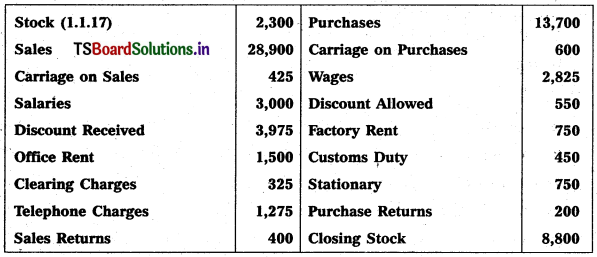
పటంలో AC = OC tan 15° = 3400 × 0.2679 = 910.86 మీ.
AB = AC + BC – 910.86 + 910.86 = 1821.7 మీ.
TS Inter 1st Year Physics Study Material Chapter 4 సమతలంలో చలనం 31

ప్రశ్న 22.
ఒక సదిశకు పరిమాణం, దిశ ఉన్నాయి. దానికి అంతరాళంలో స్థానం ఉంటుందా ? అది కాలంతో మారుతుందా ? అంతరాళంలో వివిధ స్థానాల దగ్గర ఉన్న రెండు సమాన సదిశలు a, bలు సర్వసమాన భౌతిక ప్రభావాలను చూపించవలసిన ఆవశ్యకత ఉందా ? మీ సమాధానానికి మద్దతుగా ఉదాహరణలివ్వండి.
సాధన:

  1. ఒక సదిశ యొక్క దిశ, పరిమాణం మారకుండా దానిని ఎక్కడికైనా జరపవచ్చు. కావున సదిశకు అంతరాళంలో నియమతస్థానం ఉండదు.
  2. సదిశ పరిమాణం కాలంతో పాటు మారవచ్చు. ఉదా : త్వరణం కలిగిన వస్తువు వేగం నిరంతరం మారుతుంది.
  3. అంతరాళంలో రెండు వేరు వేరు ప్రదేశాలలో ఉన్న సమాన సదిశలు ఒకే ప్రభావం చూపవలసిన అవసరం లేదు.
    ఉదా : ఒక వస్తువు మీద వ్యతిరేక దిశలో వేరు వేరు బిందువుల వద్ద పనిచేసే బలాలు ఒకే రకమైన టార్క్ను ఉత్పత్తి చేయవు.

TS Inter 1st Year Physics Study Material Chapter 4 సమతలంలో చలనం

ప్రశ్న 23.
ఒక సదిశకు పరిమాణం, దిశ ఉన్నాయి. అంటే దిశ, పరిమాణం ఉన్న ప్రతీది సదిశ కావలసిన ఆవశ్యకత ఉందా? వస్తువు భ్రమణాన్ని దాని భ్రమణాక్షం దిశ, భ్రమణ కోణంతో వ్యక్తపరచవచ్చు. అంటే ప్రతి భ్రమణం సదిశ అవుతుందా?
సాధన:
దిశ, పరిమాణం ఉన్న ప్రతీది సదిశ కానవసరం లేదు. సదిశలు తప్పనిసరిగా సంకలన నియమాలు పాటించాలి.
ఉదా : కాంతి వేగము. ఇది సదిశ కాదు.

వస్తువును భ్రమణ అక్షపరంగా భ్రమణం చెందించితే అది సదిశ కానవసరం లేదు. ఎందుకనగా అది సదిశల సంకలన నియమాల వంటి నియమాలను పాటించదు. కాని భ్రమణ కోణము 9 చిన్నదైతే అది సదిశల సంకలన నియమాలను పాటిస్తుంది కాబట్టి అటువంటి సందర్భంలో భ్రమణాన్ని సదిశగా భావిస్తారు.

ప్రశ్న 24.
కింది వాటితో సదిశలను జతచేయవచ్చా ? వివరించండి. (a) ఉచ్చు (loop) ఆకారంలో వంచిన తీగ పొడవు (b) ఒక తల వైశాల్యం, (c) గోళం.
సాధన:
a) ఉచ్చు ఆకారంలో వంచిన తీగతో సదిశను జతచేయలేదు.
b) సమతలంతో ఒక సదిశను జత చేయవచ్చు. ఇటువంటి దానిని విస్తీర్ణ సదిశ అంటారు. తలానికి గీసిన లంబదిశలో దీన్ని సూచిస్తారు.
c) గోళ ఘనపరిమాణంతో సదిశను జత చేయలేము కాని గోళ ఉపరితల వైశాల్యంతో సదిశను జతచేయవచ్చు.

ప్రశ్న 25.
క్షితిజ సమాంతరానికి 30° కోణంతో పేల్చిన బుల్లెట్ 3.0 km దూరంలో భూమిని తాకింది. దాని ప్రక్షేపక కోణాన్ని సరిచేసి 5.0 km దూరంలో ఉన్న లక్ష్యాన్ని గురికొట్టవచ్చని ఎవరైనా ఆశించవచ్చా ? వడి స్థిరం అని, గాలి నిరోధాన్ని ఉపేక్షించడమైంది అని అనుకోండి.
సాధన:
కోణము θ = 30° ప్రయాణించిన దూరము = వ్యాప్తి = 3కి.మీ. 3000 మీ.
g = 10 మీ/సె2
వ్యాప్తి R = \(\frac{\mathrm{u}^2 \sin 2 \theta}{\mathrm{g}}\) ⇒ 3 = \(\frac{\mathrm{u}^2}{\mathrm{~g}}\) sin60° ⇒ 3 = \(\frac{u^2}{g} \frac{\sqrt{3}}{2} \Rightarrow \frac{u^2}{g}=\frac{3}{\sqrt{3 / 2}}=2 \sqrt{3}\) k.m. = 3.464 km.
కాని గరిష్ఠ వ్యాప్తి \(\frac{\mathrm{u}^2}{\mathrm{~g}}\) = 3.464 k.m కావున ఆ బులెట్లో 5k.m. లక్ష్యాన్ని తాకలేము.

TS Inter 1st Year Maths 1B Solutions Chapter 10 Applications of Derivatives Ex 10(h)

Students must practice this TS Inter 1st Year Maths 1B Study Material Chapter 10 Applications of Derivatives Ex 10(h) to find a better approach to solving the problems.

TS Inter 1st Year Maths 1B Applications of Derivatives Solutions Exercise 10(h)

I.
Question 1.
Find the points of local extrema (if any) and local extrema values of the following functions each of whose domain is shown against the function.
(i) f(x) = x2, ∀ x ∈ ℛ. (V.S.A.Q.)
Answer:
f'(x) = 2x
For maximum or minimum we must have
f’ (x) = 0 ⇒ 2x = 0 ⇒ x = 0
and f’ (x) = 2 > 0
∴ f has minimum at x = 0
∴ Point of local minimum is x = 0
and local minimum value is = 0

(ii) f(x) = sin x, [0, 4π] (E.Q.)
Answer:
f'(x) = cos x
For extremum, we have f'(x) = 0
⇒ cos x = 0 ⇒ x = (2n + 1) \(\frac{\pi}{2}\), n ∈ Z+
∴ x = \(\frac{\pi}{2}, \frac{3 \pi}{2}, \frac{5 \pi}{2}, \frac{7 \pi}{2}\) are to be considered in [0, 4π]
f'(x) = -sin x

i) f’\(\left(\frac{\pi}{2}\right)\) = -sin\(\frac{\pi}{2}\) = -1 < 0 ∴ f(x) = sin \(\frac{\pi}{2}\) = 1 Hence point of local maximum = \(\frac{\pi}{2}\) and local maximum value = 1 ii) f’\(\left(\frac{3 \pi}{2}\right)\) = – sin \(\frac{3 \pi}{2}\) = 1 > 0
and f\(\left(\frac{3 \pi}{2}\right)\) = sin \(\frac{3 \pi}{2}\) = -1
∴ Point of local minimum is \(\frac{3 \pi}{2}\)
and local minimum value is -1

ii) f’\(\left(\frac{5 \pi}{2}\right)\) = -sin\(\frac{5 \pi}{2}\) = -1 < 0 and f\(\left(\frac{5 \pi}{2}\right)\) = sin\(\frac{5 \pi}{2}\) = 1 ∴ f has local maximum at \(\frac{5 \pi}{2}\) and local maximum value is 1 iv) f’\(\left(\frac{7 \pi}{2}\right)\) = -sin\(\left(\frac{7 \pi}{2}\right)\) = 1 > 0
and f\(\left(\frac{7 \pi}{2}\right)\) = sin\(\left(\frac{7 \pi}{2}\right)\) = -1
∴ f has local minimum at x = \(\frac{7 \pi}{2}\)
and local minimum value is -1

iii) f(x) = x3 – 6x2 + 9x + 15 ∀ x ∈ ℛ (E.Q.)
Answer:
f(x) = 3x2 – 12x + 9
and f”(x) = 6x – 12
For extremum values of the function T,
we must have f’ (x) = 0
3x2 – 12x + 9 = 0
⇒ x2 – 4x + 3 = 0
⇒ (x – 3) (x – 1) = 0
⇒ x = 1 or x = 3
When x = 1, f” (1) = 6 – 12 = -6 < 0 and f(1) = 1-6 + 9 + 15 = 19
∴ f has maximum value at x = 1
and the maximum value of f is 19
Similarly at x = 3, f” (3) = 18 – 12 = 6 > 0
and f has a minimum value at x = 3
∴ Minimum value of f is f(3) = 33 – 6(3)2 + 9(3) + 15
= 27 – 54 + 27 + 15 = 15
∴ f has minimum value at x = 3
and the minimum value is 15

iv) f(x) = x\(\sqrt{1-\mathrm{x}}\), ∀ x ∈ (0, 1) (E.Q)
Answer:
TS Inter 1st Year Maths 1B Solutions Chapter 10 Applications of Derivatives Ex 10(h) 1

v) f(x) = \(\frac{1}{x^2+2}\), ∀ x ∈ R (S.A.Q)
Answer:
TS Inter 1st Year Maths 1B Solutions Chapter 10 Applications of Derivatives Ex 10(h) 2
For maximum and minimum values of the function ‘f’ we have f’ (x) = 0
⇒ \(\frac{-2 x}{\left(x^2+2\right)^2}\) = 0 ⇒ x = 0
∴ f”(0) = \(\frac{2(0-2)}{(0+2)^3}=\frac{-1}{2}\) < 0
∴ f has maximum value at x = 0
and local maximum value at x = 0
∴ Local maximum value f(0) = \(\frac{1}{0^2+2}=\frac{1}{2}\)

TS Inter 1st Year Maths 1B Solutions Chapter 10 Applications of Derivatives Ex 10(h)

vi) f(x) = x3 – 3x, ∀ x ∈ ℛ. (V.S.A.Q.)
Sol.
f'(x) = 3x2 – 3
For maximum and minimum values of f, we must have f’ (x) = 0
⇒ 3x2 – 3 = 0
⇒ x = ±1
f”(x) = 6x
At x = 1, f”(1) = 6 > 0
f has a local minimum at x = 1 and the minimum value is f(1) = 1 – 3 = – 2
At x = – 1 f”(- 1) = – 6 < 0
f has a local maximum at x = – 1
and the maximum value is f (- 1) = (- 1)3 – 3 (- 1) = 2

vii) f(x) = (x – 1) (x + 2)2 ∀ x ∈ ℛ. (S.A.Q.)
Answer:
f (x) = (x – 1) 2 (x + 2) + (x + 2)2
= (x + 2) [2x – 2 + x + 2]
= (x + 2) (3x)
f” (x) = (x + 2)3 + 3x = 6x + 6
For maximum and minimum values of f, we must have
f’ (x) = 0 => 3x (x + 2) = 0
⇒ x = 0 or x = -2
At x = 0, f’ (0) = 6 > 0 ; so the function f has minimum at x = 0
Minimum value of f is f(0) = (- 1) (2)2
= – 4
At x = – 2, f’ (-2) = – 12 + 6 = – 6 < 0
So f has maximum value at x = – 2
Maximum value of f is
f (-2) = (-2 – 1) (- 2 + 2)2 = 0

viii) f(x) = \(\frac{x}{2}+\frac{2}{x}\) ∀ x ∈ (0, ∞) (S.A)
Answer:
f ‘(x) = \(\frac{1}{2}-\frac{2}{x^2}\)
For maximum and minimum values of f, we must have
f'(x) = 0 ⇒ \(\frac{2}{x^2}=\frac{1}{2}\)
⇒ x2 = 4 ⇒ x = ±2
f”(x) = \(\frac{4}{x^3}\)
At x = 2, f”(2) = \(\frac{4}{8}=\frac{1}{2}\) >0
f has minimum value at x = 2
and minimum value of f is f (2) = \(\frac{2}{2}+\frac{2}{2}\) = 2
[At x = – 2, f”(- 2) = \(\frac{4}{-8}=\frac{-1}{2}\) < 0
f has maximum value at x = – 2
and maximum value of f at x = – 2 is
f(-2) = \(-\frac{2}{2}+\frac{2}{-2}\) = -2]
But we require the extremum in (0, °° )
Hence there exists only minimum value at x = 2 and minimum value is 2 only.

ix) f(x) = -(x – 1)3 (x + 1)2 ∀ x ∈ ℛ (E.Q.)
Answer:
Given f(x) = – (x – 1)3 (x + 1)2 ∀ x ∈ ℛ
f’ (x) = – [(x- 1)3 2(x + 1) + ( x + 1)2 3 (x – 1)2]
= – (x – 1)2 [2 (x2 – 1) + 3 (x2 + 2x + 1)]
= -(x – 1)2 [5x2 + 6x + 1]
= -(x – 1)2 [5x + 1] [x + 1]
= (x + 1) (x – 1)2 (- 1 – 5x)
f”(x) = (x + 1) (x – 1)2 (- 5) + (x – 12) (- 1 – 5x) = (x + 1) (- 1 – 5x) 2 (x – 1)
For maximum or minimum values of f,
we must have f’ (x) = 0 => x = – 1 or x = 1
or x = – 7
f “(1) = 0
∴ At x = 0, f has a critical value
f”(-1) =(1 + 1)2 (-1 + 5) = 4 (4) = 16 > 0
∴ f has minimum at x = – 1

∴ Minimum value of f is
TS Inter 1st Year Maths 1B Solutions Chapter 10 Applications of Derivatives Ex 10(h) 3

(x) f(x) = x2 e3x ∀ x ∈ ℛ. (S.A.Q.)
Answer:
f'(x) = 3x2 e3x + 2x e3x
= e3x(3x2 + 2x) . xe3x (3x + 2)
For maximum or minimum values f’(x) = 0
⇒ x = 0, x = \(\frac{-2}{3}\)
e3x = 0 solution is not feasible.
f”(x) = xe3x(3) + e3x(3x+2) + x(3x.2)3e3x
= e3x[3x + 3x + 2 + 3x (3x + 2)]
= e3x [9x2 + 12x + 2]
When x = 0 ⇒ f'(0) = 2 > 0
f has minimum value at x = 0 given by
f(0) = 0
when x = \(\frac{-2}{3}\) we have
TS Inter 1st Year Maths 1B Solutions Chapter 10 Applications of Derivatives Ex 10(h) 4

TS Inter 1st Year Maths 1B Solutions Chapter 10 Applications of Derivatives Ex 10(h)

Question 2.
Prove that the following functions do not have absolute maximum and absolute minimum. (V.S.A.Q.)
(i) ex in ℛ.
Answer:
f(x) = ex and f'(x) = ex, f”(x) = ex
For maxima or minima, f'(x) = 0 ⇒ ex = 0
x value is not admissible.
∴ Hence f has no maxima or minima.

ii) log x in (0, ∞)
Answer:
Let f(x) = log x defined over (0, ∞)
Then f'(x) = \(\frac{1}{x}\) and f”(x) = \(\frac{-1}{x^2}\)
For maxima or minima,
f’ (x) = 0 ⇒ x value is not admissible
⇒ f(x) has no maxima or minima.

iii) x3 + x2 + x + 1 in ℛ.
Answer:
Let f (x) = x3 + x2 + x + 1
Then f'(x) = 3x2 + 2x + 1
f'(x) = 0 ⇒ 3x2 + 2x + 1 = 0
Since b2 – 4ac < 0 Equation has imaginary roots.
⇒ It has no maxima or minima.

II.
Question 1.
Find the absolute maximum value and absolute minimum value of the following functions on the domain specified against the function. (S.A.Q.)
i) f(x) = x3 on [-2, 2]
Answer:
The given function f(x) = x3 is continuous over [-2, 2]
f'(x) = 0 ⇒ 3x2 = 0 ⇒ x = 0;
so x = 0 is a minimum local point.
Local minimum value is ‘O’.
Hence out of f(-2), f(0), f(2)
i.e., – 8, 0, 8 the maximum value 8 is the
absolute maximum for ‘f
Similarly out of – 8, 0, 8, the absolute minimum is – 8.

ii) f(x) = (x – 1)2 + 3 on [-3, 1]
Answer:
f’ (x) = 2(x – 1) and f’ (x) = 2
f'(x) = 0 ⇒ x = 1 and f (1) = 2 > 0
Hence the minimum value is f(1) = 3
Similarly, f(-3) = (-3 – 1)2 + 3 = 16 + 3 = 19
∴ Absolute maximum value =19
Absolute minimum value = 3

iii) f(x) = 2|x| on [-1, 6]
Answer:
f’ (x) = \(\frac{2|\mathrm{x}|}{\mathrm{x}}\) and for max. or min. we have x
f’ (x) = 0 ⇒ |x| = 0 ⇒ x = 0 is a point of minimum
∴ f(0) = 0 is a minimum value.
Also f(- 1) = 2|(-1)| = 2 and
f(6) = 2|6| =12
∴ Absolute maximum value = 12
Absolute minimum value = 0

iv) f(x) = sin x + cos x on [ 0, π]
Answer:
We have f’ (x) = cos x – sin x
For maximum or minimum f'(x) = 0
⇒ cosx – sinx = 0
⇒ tan x = 1 ⇒ x = \(\frac{\pi}{4}\)
Also f”(x) = -sin x – cos x
and f”\(\left(\frac{\pi}{4}\right)\) = -sin\(\frac{\pi}{4}\) – cos\(\frac{\pi}{4}\)
= \(-\frac{2}{\sqrt{2}}\) = -√2 < 0
∴ f has maximum at x = \(\frac{\pi}{4}\) and
maximum value is f\(\left(\frac{\pi}{4}\right)\) = sin\(\frac{\pi}{4}\) + cos\(\frac{\pi}{4}\) = √2
Also f (0) = 1 and f (π) = – 1
∴ Absolute minimum value of f is – 1
Absolute maximum value of f is √2

v) f(x) = x + sin 2x on [0, π]
Answer:
f’ (x) = 1 + 2 cos 2x
and f”(x) = -4 sin2x
For maximum or minimum we have
f (x) = 0 ⇒ 1 + 2 cos 2x = 0
⇒ cos 2x = –\(\frac{1}{2}\)
⇒ 2x = 2nπ ± \(\frac{2 \pi}{3}\)
⇒ x = nπ ± \(\frac{\pi}{3}\)
The values of x lies in [0, π] are
TS Inter 1st Year Maths 1B Solutions Chapter 10 Applications of Derivatives Ex 10(h) 5
Out of all above values the absolute maximum value = \(\frac{\pi}{3}+\frac{\sqrt{3}}{2}\)
and absolute minimum value is \(\frac{2 \pi}{3}-\frac{\sqrt{3}}{2}\)

Question 2.
Use the first derivative test to find local extrema of f(x) = x3 – 12x on R. (S.A.Q.)
Answer:
If f is differentiable in (a, b) and c ∈ (a, b) is the local minimum or maximum of f then
f’ (c) = 0. This is the first derivative test.
f(x) = x3 – 12x
⇒ f'(x) = 3x2 – 12
f’ (x) = 6x ;
For max. or min. 3x2 – 12 = 0
⇒ x = ± 2
Consider [- 2, 2] for f(x) = x3 – 12x
f'(-2.1) = 3(-2.1)2 – 12 = 1.23 > 0
and f'(-1.9) = 3(-1.9)2 – 12 = -1.17 < 0
Derivative changes sign from positive to negative f” (-2) < 0.
Hence there exists maximum at – 2.
Max. value is f (- 2) = (- 2)3 – 12 (- 2)
= – 8 + 24 = 16
Similarly f (1.9) = – 1.17 < 0 and f (24) = 1.23 > 0
The derivative changes sign from negative to positive and f”(2) > 0.
Hence there exists minimum value at x = 2 and minimum value is f(2) = 8 – 24 = -16
∴ Local point of minimum is x = 2
Local minimum value is = – 16
Local point of maximum is x = – 2
Local maximum value is = 16

TS Inter 1st Year Maths 1B Solutions Chapter 10 Applications of Derivatives Ex 10(h)

Question 3.
Use the first derivative test to find local extrema of f(x) = x2 – 6x + 8 on H. (S.A.Q.)
Answer:
Given f(x) = x2 – 6x + 8
f’ (x) = 2x – 6 and f” (x) = 2
Also f’ (x) = 0 ⇒ 2x – 6 = 0 ⇒ x = 3
Consider the behaviour of f’ (x) in the nbd of ‘3’.
When x = 2.9 we have f’ (2.9) = 2 (2.9) – 6
= 5.8 – 6 < 0 and when x = 3.1 we have f’ (3-1) = 2 (3.1) – 6 > 0
Hence derivative changes sign from
negative to positive and f”(x) > 0
∴ f has only local minimum at x = 3
and the local minimum value is f(3) = 32 – 6(3) + 8 = – 1

Question 4.
Use the second derivative test to find local extrema of the function f(x) = x3 – 9x2 – 48x + 72 on R.
Answer:
As per the second derivative test f is twice differentiable at ’c’ such that
i) f’ (c) = 0, f’ (c) < 0 theft f has maximum at ’c’ and maximum value is f(c).
ii) f’ (c) = 0, f’ (c) > 0 then f has minimum at ‘c’ and minimum value is f(c).
Given f(x) = x3 – 9x2 – 48x + 72
∴ f (x) = 3x2 – 18x – 48 = 3 (x2 – 6x – 16)
f'(x) = 0 ⇒ 3 (x – 8) (x + 2) = 0
⇒ stationary points are – 2 and 8.
f”(x) = 6x – 18 = 6(x – 3)
At x = – 2
f”(-2) = 6(-2 – 3) < 0
Hence f has maximum at x = – 2
and maximum value is f(- 2) = – 8 – 9 (- 2)2 – 48 (- 2) + 72
= -8-36 + 96 + 72
= 124
Also f”(8) =6 (8 – 3) = 30 > 0
Hence f has minimum at x = 8 and
minimum value is
f(8) = 83 – 9(8)2 – 48 (8) + 72
= 512 – 576 – 384 + 72 = – 376
∴ Local minimum = – 376
Local maximum = 124

Question 5.
Use the second derivative test to find the local extrema of the function f(x) = – x3 + 12x2 – 5 on ℛ. (S.A.Q.)
Answer:
Let f(x) = – x3 + 12x2 – 5
Then for max. or min. we must have f'(x) – 0
⇒ – 3x2 + 24x = 0
⇒ – 3x (x – 8) = 0
So the stationary points are x = 0, x = 8
f”(x) = -6x + 24
∴ f”(0) = 24 > 0,
Hence f has a minimum at x = 0 .
and minimum value is f(0) = – 5
Also f”(8) = -48 + 24 = -24 < 0,
Hence f has a maximum at x = 8
Maximum value is f(8) = – 83 + 12 (8)2 – 5
= – 512 + 768 – 5
= 251
∴ Local minimum = – 5
Local maximum = 251

Question 6.
Find the local maximum or local minimum of f(x) = -sin 2x – x defined on \(\left[-\frac{\pi}{2}, \frac{\pi}{2}\right]\) (S.A.Q)
Answer:
f(x) = – sin 2x – x defined on \(\left[-\frac{\pi}{2}, \frac{\pi}{2}\right]\)
f’ (x) = -2 cos 2x – 1
and f’ (x) = 4 sin 2x
For maximum or minimum values,
f’ (x) = 0 ⇒ 2 cos 2x + 1 = 0
⇒ cos 2x = –\(\frac{1}{2}\)
⇒ 2x = 2nπ ± \(\frac{2 \pi}{3}\)
⇒ x = nπ ± \(\frac{\pi}{3}\)

Values of x to be considered in \(\left[-\frac{\pi}{2}, \frac{\pi}{2}\right]\) are \(\frac{\pi}{3}\) and –\(\frac{\pi}{3}\) respectively
TS Inter 1st Year Maths 1B Solutions Chapter 10 Applications of Derivatives Ex 10(h) 6

TS Inter 1st Year Maths 1B Solutions Chapter 10 Applications of Derivatives Ex 10(h)

Question 7.
Find the absolute maximum and absolute minimum of f(x) = 2x3 – 3x2 – 36x + 2 on the interval [0, 5]. (S.A.Q.)
Answer:
Given f(x) = 2x3 – 3x2 – 36x + 2
We have f’ (x) = 6x2 – 6x – 36 and f’ (x) = 12x – 6
f'(x) = 0 ⇒ 6x2 – 6x – 36 = 0
⇒ x2 – x – 6 = 0
⇒ (x – 3) (x + 2) = 0
Stationary values of f are – 2 and 3.
The value x = – 2 is not admissible since -2 ∉ [0, 5]
At x = 0, we have f”(0) = -6 < 0 At x = 5, we have f “(5) = 12 (5) – 6 = 54 > 0
At x = 3 we have f”(3) = 12 (3) – 6 = 30 > 0
The absolute maximum value of f is f(0) = 2
and absolute minimum value out of minimum values is – 79
[f(3) = 2 (3)3 – 3 (3)2 – 36 (3) + 2
= 54 – 27 – 108 + 2 = – 79
f(5) = 2 (5)3 – 3 (5)2 – 36 (5) + 2 = – 3]
∴ Absolute minimum = – 79
Absolute maximum = 2

Question 8.
Find the absolute extremum of
f(x) = 4x – \(\frac{x^2}{2}\) on [-2, \(\frac{9}{2}\)] (S.A.Q)
Answer:
f(x) = 4x – \(\frac{x^2}{2}\)
f (x) = 4 – \(\frac{2 x}{2}\)
For extremum we have
4 – x = 0 ⇒ x = 4
f”(x) = -1 < 0
f has maximum value at x = 4
1(4) = 16 – \(\frac{16}{2}\) = 8
-2 ≤ x ≤ \(\frac{9}{2}\) we have
f (- 2) = – 8 – 2 = – 10
Absolute minimum = – 10
and Absolute maximum = 8

Question 9.
Find the maximum profit that a company can make if the profit function is given by P(x) = -41 + 72x – 18x2. (S.A.Q.)
P(x) = -41 + 72x – 18x2
Answer:
P'(x)= 0 ⇒ 72 – 36x = 0 ⇒ x = 2
Since P”(x) = – 36 < 0
P(x) has maximum
for x = 2 and the maximum profit
P(2) = – 41 + 72 (2) – 18(4)
= – 41 + 144 – 72 = 31

Question 10.
The profit function P(x) of a company selling x items is given by P(x) = – x3 + 9x2 – 15x – 13 where x represents thousands of units. Find the absolute maximum profit if the company can manufacture a maximum of 6000 units. (S.A.Q.)
Answer:
P(x) = – x3 + 9x2 – 15x – 13 and p’ (x) = – 3x2 + 18x – 15
For maximum or minimum p’ (x) = 0
⇒ – 3x2 + 18x- 15 = 0
⇒ x2 – 6x + 5 = 0
⇒ (x – 5) (x – 1) = 0
⇒ x = 1, 5
Also p”(x) = -6x + 18
P”(1) = 12 >0, P”(5) = -12 < 0
P(x) has maximum when x = 5
and maximum profit is P(5) = – 53 + 9(5)2 – 15 (5) – 13
= -125 + 225 – 75 – 13 = 12
∴ Maximum profit = 12

III.
Question 1.
The profit function P(x) of a company selling x items per day is given by P(x) = (150 – x) x – 1000. Find the number of items that the company should manufac-ture to get maximum profit. Also find the maximum profit. (E.Q.)
Answer:
Given that the profit function is
P(x) = (150 – x) x – 1000
For extremum, we have p’ (x) = 0
⇒ 150 – 2x = 0 ⇒ x = 75
P”(x) = – 2 < 0 ;
P(x) has maximum at x = 75
∴ The profit is maximum for x = 75
The number of items that the company should manufacture to get maximum profit = 75 and the maximum profit = (150 – 75)75 – 1000 = 4625

Question 2.
Find the absolute maximum and absolute minimum of f(x) = 8x3 + 81x2 – 42x – 8 on [- 8, 2]. (E.Q.)
Answer:
Given f(x) = 8x3 + 81x2 – 42x – 8 on [ – 8, 2]
For extrema we have f'(x) = 0
⇒ 24x2 + 162x – 42 = 0
⇒ 4x2 + 27x – 7 = 0
⇒ 4x2 + 28x – x – 7 = 0
⇒ 4x(x + 7)-l(x + 7) = 0
⇒ (4x – 1) (x + 7) = 0
⇒ x = – or x = – 7
f'(x) = 48x + 162
f”\(\left(\frac{1}{4}\right)\) = 48\(\left(\frac{1}{4}\right)\) + 162 = 12 + 162 = 174 > 0
f has a minimum at x = \(\frac{1}{4}\)
Minimum value is
TS Inter 1st Year Maths 1B Solutions Chapter 10 Applications of Derivatives Ex 10(h) 7

TS Inter 1st Year Maths 1B Solutions Chapter 10 Applications of Derivatives Ex 10(h)

Question 3.
Find two positive integers whose sum is 16 and the sum of whose squares is minimum. (E.Q.)
Answer:
Suppose x and y are two positive integers and given that
x + y = 16 and x2 + y2 = f(x, y) is to be minimised,
f (x, y) = x2 + y2
⇒ f(x) = x2 + (16 – x)2
For extremum we have f'(x) = 0
⇒ 2x – 2(16 – x) = 0
⇒ x – 16 + x = 0
⇒ 2x- 16 = 0
⇒ x = 8
Since f”(8) = 4 > 0
f(x) has minimum at x = 8
∴ y = 16 – x = 16 – 8 = 8
∴ The two positive integers are 8 and 8

Question 4.
Find two positive integers x and y such that x + y = 60 and xy3 is maximum. (E.Q.) (May 2014)
Answer:
Given x + y = 60
⇒ y = 60 – x (1)
and f(x, y) = xy3
f(x) = x (60 – x)3 …………..(2)
For extrema, f’ (x) = 0
⇒ x(3) (60 – x)2 (-1) + (60 – x)3
= (60 – x)2 [60 – x – 3x]
= (60 – x)2 (60 – 4x)
x = 60 and x = 15
x = 60 is not admissible. So we take x = 15
r (x) = (60 – x)2 (- 4) + (60 – 4x) 2 (60 – x) (- 1)
and f” (15) < 0
∴ f has maximum at x = 15
∴ From (1) y = 45
The required two positive integers are x = 15 and y = 45.

Question 5.
From a rectangular sheet of dimensions 30 cm x 80 cm four equal squares of side x cm are removed at the corners and the sides are then turned up so as to form an open rectangular box. Find the value of x so that the volume of the box is the greatest. (March 2014) (E.Q.)
Answer:
TS Inter 1st Year Maths 1B Solutions Chapter 10 Applications of Derivatives Ex 10(h) 8
Length of the box = 80 – 2x = l
Breadth of the box = 30 – 2x = b
Height of the box = x = h
Volume of the box V = lbh
∴ f(x) = (80 – 2x) (30 – 2x) x
= x (2400 – 220 x + 4x2)
= 4x3 – 220 x2 + 2400 x

∴ f'(x) = 12x2 – 440 x + 2400
= 4[3x2 – 110x + 600]
∴ f'(x) = 0 ⇒ 3x2 – 110x + 600
TS Inter 1st Year Maths 1B Solutions Chapter 10 Applications of Derivatives Ex 10(h) 9
When x = 30, then f”(x) = 24x – 440
and f”(30) = 24 × 30 – 440
= 720 – 440 = 280 > 0
∴ f has a minimum or least at x = 30
When x = \(\frac{20}{3}\) then
f”\(\left(\frac{20}{3}\right)\) = 24\(\left(\frac{20}{3}\right)\) – 440 = 160 – 440 = -280 < 0
f has maximum at x = \(\frac{20}{3}\)
In order the volume of the box is the greatest the value of x must be \(\frac{20}{3}\)cm.

Question 6.
A window is in the shape of a rectangle surrounded by a semicircle. If the perimeter of the window is 20 feet, find the maximum area. (E.Q.)
Answer:
TS Inter 1st Year Maths 1B Solutions Chapter 10 Applications of Derivatives Ex 10(h) 10
Let the length of the window be 2x and breadth be y so that the radius of the semicircle is x
∴ Perimeter = 2x + 2y + π. x = 20
⇒ 2y = 20 – 2x – πx
∴ y = 10 – x – \(\frac{\pi x}{2}\)
Area = 2xy + \(\frac{\pi}{2}\) x2
f(x) = x (20 – 2x – 7ix) + \(\frac{\pi}{2}\) x2
⇒ f'(x) = x (- 2 – π) + (20 – 2x – πx) + πx
= – 2x + 20 – 2x – πx = 20 – 4x – πx
For maximum or minimum f'(x) = 0
⇒ 20 – (4 + π)x = 0
⇒ x = \(\frac{20}{\pi+4}\)
f” (x) = – 4 – π < 0
⇒ f has maximum at x = \(\frac{20}{\pi+4}\)
TS Inter 1st Year Maths 1B Solutions Chapter 10 Applications of Derivatives Ex 10(h) 11

Question 7.
If the curved surface of a right circular cylinder inscribed in a sphere of radius r is maximum, show that the height of the cyliner is √2r. (IPE May ’11 Mar. 13, ’08, 04, June 2004)
Answer:
TS Inter 1st Year Maths 1B Solutions Chapter 10 Applications of Derivatives Ex 10(h) 12
Let the radius of the cylinder be R’ and height be ‘h’
From ΔOAB we have
OA2 = AB2 + OB2
⇒ r2 = R2 + \(\frac{h^2}{4}\)
⇒ R2 = r2 – \(\frac{h^2}{4}\)

Curved surface area = 2πrh
TS Inter 1st Year Maths 1B Solutions Chapter 10 Applications of Derivatives Ex 10(h) 13
Hence f has maximum at h = √2r
Height of the cylinder = √2r

TS Inter 1st Year Maths 1B Solutions Chapter 10 Applications of Derivatives Ex 10(h)

Question 8.
A wire of length l is cut into two parts which are bent respectively in the form of a square and a circle. What are the lengths of the pieces of the wire respectively so that the sum of the areas is the least ? (E.Q) (BIE New Model Paper)
Answer:
Let x be the side of the square and r be the radius of the circle.
Given 4x + 2π r = l
TS Inter 1st Year Maths 1B Solutions Chapter 10 Applications of Derivatives Ex 10(h) 14
So when the wire is cut into two pieces, Sum of the areas of square and circle will be the least and their lengths are
\(\frac{\pi l}{\pi+4}\) and \(\frac{4 l}{\pi+4}\) respectively.

TS Inter 1st Year Economics Notes Chapter 6 Theories of Distribution

Here students can locate TS Inter 1st Year Economics Notes Chapter 6 Theories of Distribution to prepare for their exam.

TS Inter 1st Year Economics Notes Chapter 6 Theories of Distribution

→ Land: Land is a free gift of nature. In economics, land refers to the soil, forests, water, minerals, atmosphere etc.

→ Contract Rent: Contract rent is the reward paid for the services of land, buildings etc., according to an agreement made earlier.

→ Piece Wage: Piece wage is the amount paid for labourers according to the volume of work done by them.

TS Inter 1st Year Economics Notes Chapter 6 Theories of Distribution

→ Time Wage: Time wage is the amount paid to labourers for a fixed period of work, i.e., daily, weekly and monthly etc.

→ Money Wage: Money wage is the reward received by a labourer in cash for his labour.

→ Real Wage: Real wage is the purchasing power of money wages in terms of goods and services.

→ Capital: Capital is that part of wealth other than land which is used for further production.

→ Net Interest: Net interest is the reward for the service of the capital alone.

→ Normal Profit: No profit no loss situation. In this situation, both the firm and industry will be in equilibrium.

→ Supernormal Profit: Supernormal Profit is the total revenue of the firm will be more than the total cost. Only in the short run firm gets these profits.

TS Inter 1st Year Economics Notes Chapter 6 పంపిణీ సిద్ధాంతాలు

→ మొత్తం ఉత్పత్తి విలువ నాలుగు ఉత్పత్తి కారకాల మధ్య ఏవిధంగా పంపిణీ చేయబడుతుందో తెలియ జేసేది పంపిణీ.

→ పంపిణీని ఆదాయ పంపిణీ, వైయక్తిక ఆదాయ పంపిణీ అని రెండు విధాలుగా పరిశీలించవచ్చును.

→ నిశ్చల పరిస్థితిలో ఉద్యమదారునితో సహా ప్రతి ఉత్పత్తి కారకము దాని ఉపాంత ఉత్పాదనకు సమానంగా ప్రతిఫలం పొందుతుందని జె.బి. క్లార్క్ ఉపాంత ఉత్పాదకత సిద్ధాంతాన్ని తెలిపెను.

→ ఉత్పత్తి కారకంగా భూమి అందించే సేవలకు లభించే ప్రతిఫలం భాటకం. భూమికున్న సహజమైన నశింపులేని శక్తులను ఉపయోగించుకున్నందుకుగాను రైతు తన పంటలో భూస్వామికి చెల్లించే భాగం భాటకం.

→ శ్రామికుల సేవలకు ఒప్పందం ప్రకారం, యజమాని ప్రతిఫలంగా ఇచ్చే మొత్తం ద్రవ్యాన్ని వేతనం అంటారు. వేతనాలు నాలుగు రకాలు.

  1. ద్రవ్యవేతనం
  2. వాస్తవిక వేతనం
  3. పనినిబట్టి వేతనం
  4. కాలాన్నిబట్టి వేతనం.

→ ద్రవ్యత్వాభిరుచిని వీడినందుకుగాను ఋణగ్రహీత, ఋణదాతకు చెల్లించే ప్రతిఫలం వడ్డీ అని కీన్స్ అభిప్రాయం.

TS Inter 1st Year Economics Notes Chapter 6 Theories of Distribution

→ ఋణగ్రహీత నుండి ఋణదాత పొందే మొత్తం వడ్డీని స్థూలవడ్డీ అంటారు. కేవలం మూలధనం సేవకిచ్చే ప్రతిఫలం నికర వడ్డీ.

→ ఉత్పత్తిలో అనిశ్చితత్వం భరించినందుకు వ్యవస్థాపనకు వచ్చే ప్రతిఫలం లాభమని ప్రొ నైట్ అభిప్రాయం.

→ మొత్తం రాబడి నుండి వ్యయాన్ని తీసివేస్తే వచ్చేది స్థూలలాభం. కేవలం వ్యవస్థాపకుని సేవకు లభించే ప్రతిఫలం నికర లాభం.

TS Inter 1st Year Maths 1B Solutions Chapter 7 The Plane Ex 7(a)

Students must practice these TS Intermediate Maths 1B Solutions Chapter 7 The Plane Ex 7(a) to find a better approach to solving the problems.

TS Inter 1st Year Maths 1B The Plane 7(a)

I.
Question 1.
Find the equation of the plane if the foot of the perpendicular from origin to the plane is (1, 3, – 5). (V.S.A.Q.)
Answer:
TS Inter 1st Year Maths 1B Solutions Chapter 7 The Plane Ex 7(a) 1
OP is the normal to the plane and plane is passing through P (1, 3, – 5).
Dr’s of normal OP are (1 – 0, 3 – 0, – 5 – 0)
= 1, 3, – 5
Hence equation of the plane is
⇒ a (x – x1) + b (y – y1) + c (z – z1) = 0
⇒ 1(x – 1) + 3(y – 3) – 5(z + 5) = 0
⇒ x + 3y – 5z – 35 = 0

TS Inter 1st Year Maths 1B Solutions Chapter 7 The Plane Ex 7(a)

Question 2.
Reduce the equation x + 2y – 3z – 6 = 0 of the plane to the normal form. (V.S.A.Q.)
Answer:
Equation of the plane is x + 2y – 3z – 6 = 0
⇒ x + 2y – 3z = 6
Dividing both sides by
\(\sqrt{1^2+2^2+(-3)^2}\) = \(\sqrt{1+4+9}\) = √14
We get
\(\left(\frac{1}{\sqrt{14}}\right) x+\left(\frac{2}{\sqrt{14}}\right) y+\left(\frac{-3}{\sqrt{14}}\right) z=\frac{6}{\sqrt{14}}\)

Question 3.
Find the equation of the plane whose intercepts on X, Y, Z – axes are 1,2,4 respectively. (S.A.Q.) (May 2014)
Answer:
Equation of the plane in the intercepts form x y z is \(\frac{x}{a}+\frac{y}{b}+\frac{z}{c}\) = 1, given a = 1, b = 2, c = 4
We have \(\frac{x}{1}+\frac{y}{2}+\frac{z}{4}\) = 1
⇒ 4x + 2y + z = 4

Question 4.
Find the intercepts of the plane 4x + 3y- 2z + 2 = 0 on the co-ordinate axes. (V.S.A.Q.)
Answer:
Given 4x + 3y – 2z = – 2
⇒ – 2x – \(\frac{3}{2}\)y + z = 1
⇒ \(\frac{x}{-\left(\frac{1}{2}\right)}+\frac{y}{-\left(\frac{2}{3}\right)}+\frac{z}{(1)}\)
∴ x – intercept = – \(\frac{1}{2}\), y – intercept = – \(\frac{2}{3}\) and z – intercept = 1.

Question 5.
Find the d.c’s of the normal to the plane x + 2y + 2z – 4 = 0. (V.S.A.Q.) [Mar. ’13, May ’12]
Answer:
Equation of the plane is x + 2y + 2z – 4 = 0
D.r’s of the normal = 1, 2, 2
∴ \(\sqrt{a^2+b^2+c^2}\) = \(\sqrt{1+4+4}\) = 3
∴ D.c’s of the normal are \(\frac{1}{3}, \frac{2}{3}, \frac{2}{3}\)

Question 6.
Find the equation of the plane passing through the point (-2, 1, 3), and having (3, -5, 4) as d.r’s of its normal. (V.S.A.Q.)
Answer:
D.r’s of normal are 3, -5, 4 and since the plane passes through (- 2, 1, 3), we have equation of the plane is
3(x + 2) – 5 (y – 1) + 4 (z – 3) = 0
⇒ 3x + 6-5y + 5 + 4z – 12 = 0
⇒ 3x – 5y + 4z – 1 = 0

TS Inter 1st Year Maths 1B Solutions Chapter 7 The Plane Ex 7(a)

Question 7.
Write the equation of the plane 4x – 4y + 2z + 5 = 0 in the intercept form. (V.S.A.Q.) [March 2012]
Answer:
Equation of the plane is
4x – 4y + 2z + 5 = 0
∴ 4x – 4y + 2z = – 5
TS Inter 1st Year Maths 1B Solutions Chapter 7 The Plane Ex 7(a) 2

Question 8.
Find the angle between the planes
x + 2y + 2z – 5 = 0 and 3x + 3y + 2z – 8 = 0. (V.S.A.Q.)
Answer:
Equations of the planes are
x + 2y + 2z-5 = 0 ………………. (1)
and 3x + 3y + 2z – 8 = 0 ………………. (2)
If θ is the angle between the planes then by the formula,
TS Inter 1st Year Maths 1B Solutions Chapter 7 The Plane Ex 7(a) 3

II.
Question 1.
Find the equation of the plane passing through the point (1, 1, 1) and parallel to the plane x + 2y + 3z – 7 = 0. (V.S.A.Q.) [May 2011]
Answer:
Equation of the plane parallel to the given plane x + 2y + 3z – 7 = 0 is of the form x + 2y + 3z + k = 0
If this passes through the point (1, 1, 1) then
1 + 2 + 3 + k = 0 k = – 6
So, the equation of the required plane is
x + 2y + 3z – 6 = 0

TS Inter 1st Year Maths 1B Solutions Chapter 7 The Plane Ex 7(a)

Question 2.
Find the equation of the plane passing through (2, 3, 4) and perpendicular to X-axis. (V.S.A.Q.)
Answer:
If the plane is perpendicular to X-axis then X-axis is a normal to the plane and d.c’s of X-axis are 1, 0, 0.
∴ Equation of the plane is of the form x = k.
Since this passes through (2, 3, 4) we have k = 2.
∴ Equation of the required plane is x = 2.

Question 3.
Show that 2x + 3y + 7 = 0 represents a plane perpendicular to XY-plane. (V.S.A.Q.)
Answer:
Equation of the given plane is 2x + 3y + 7 = 0
Equation of the plane perpendicular to XY plane is z = 0
i. e., 0.x + 0.y + 1.z = 0
Since the two planes are perpendicular by the condition a1a2 + b1b2 + c1c2 = 0 we have 2(0) + 3(0) + 0(1) = 0
∴ Plane 2x + 3y + 7 = 0 is perpendicular to XY – plane.

Question 4.
Find the constant k so that the planes x – 2y + kz = 0 and 2x + 5y – z = 0 are at right angles. Find the equation of the plane through (1, -1,-1) and perpendicular to these planes. (S.A.Q.)
Answer:
Equations of the given planes are x – 2y + kz = 0 and 2x + 5y – z = 0
If the planes are perpendicular then
1(2) + (- 2) (5) + k (-1) = 0
⇒ 2 – 10 – k = 0 ⇒ k = – 8
Equation of the plane is
x – 2y – z = 0 …………….. (1)
and 2x + 5y – z = 0 ………………….. (2)
Equation of the plane passing through (1, – 1, – 1) is of the form
a (x – 1) + b (y + 1) + c (z + 1) = 0 …………………. (3)
If this plane is perpendicular to (1) and (2) then a – 2b – 8c = 0 and 2a + 5b – c = 0
Solving
TS Inter 1st Year Maths 1B Solutions Chapter 7 The Plane Ex 7(a) 4
∴ From (3), equation of the required plane is 42 (x – 1) – 15 (y + 1) + 9 (z + 1) = 0
⇒ 42x – 15y + 9z – 48 = 0

TS Inter 1st Year Maths 1B Solutions Chapter 7 The Plane Ex 7(a)

Question 5.
Find the equation of the plane through (- 1, 6, 2) and perpendicular to the join of (1, 2, 3) and (- 2, 3, 4). (S.A.Q.)
Answer:
TS Inter 1st Year Maths 1B Solutions Chapter 7 The Plane Ex 7(a) 5
Let A (1, 2, 3) and B (-2, 3, 4) be the given points.
D.r’s of AB are 3, -1,-1.
The line AB is perpendicular to the plane and passing through the point P (- 1, 6, 2).
Then equation of the plane is
3(x + 1) – 1 (y – 6) – 1 (z – 2) = 0
⇒ 3x – y – z + 11 = 0

Question 6.
Find the equation of the plane bisecting the line segment joining (2, 0, 6) and (-6, 2, 4) and perpendicular to it. (S.A.Q.)
Answer:
TS Inter 1st Year Maths 1B Solutions Chapter 7 The Plane Ex 7(a) 6
Let A (2, 0, 6) and B(- 6, 2, 4) be the two points.
Then mid point of AB
= \(\left(\frac{2-6}{2}, \frac{0+2}{2}, \frac{6+4}{2}\right)\) = (- 2, 1, 5)
Equation of the plane is perpendicular to AB.
∴ Dr’s of normal to the plane are
2 + 6, 0 – 2, 6 – 4 = 8, – 2, 2
Equation of the required plane is
8(x + 2) – 2(y – 1) + 2 (z – 5) = 0
⇒ 8x – 2y + 2z + 8 = 0

Question 7.
Find the equation of the plane passing through (0,0, – 4) and perpendicular to the line joining the points (1, – 2, 2) and (- 3, 1, – 2). (S.A.Q.)
Answer:
Let A (1, -2, 2) and B (-3, 1, -2) be the given points.
D.r’s of normal to the plane are
(1 + 3, -2 – 1, 2 + 2) = (4, -3, 4)
Equation of the required plane passing through (0, 0 -4) is
4(x – 0) – 3 (y – 0) + 4 (z + 4) = 0
⇒ 4x – 3y + 4z + 16 = 0

Question 8.
Find the equation of the plane through (4, 4, 0) and perpendicular to the planes 2x + y + 2z + 3 = 0 and 3x + 3y + 2z – 8 = 0. (S.A.Q.)
Answer:
The equation of the plane passing through the point (4, 4, 0) is of the form
a (x – 4) + b (y – 4) + c (z – 0) = 0 ………………. (1)
If this is perpendicular to 2x + y + 2z + 3 = 0 and 3x + 3y + 2z – 8 = 0
Then 2a + b + 2c = 0 ……………… (2)
and 3a + 3b + 2c = 0 ……………… (3)
Solving (2) and (3)
TS Inter 1st Year Maths 1B Solutions Chapter 7 The Plane Ex 7(a) 7
∴ From (1) equation of the required plane is
– 4 (x – 4) + 2 (y – 4) + 3 (z – 0) = 0
⇒ – 4x + 2y + 3z + 8 = 0
⇒ 4x – 2y – 3z – 8 = 0

TS Inter 1st Year Maths 1B Solutions Chapter 7 The Plane Ex 7(a)

III.
Question 1.
Find the equation of the plane through the points (2, 2, – 1), (3, 4, 2), (7, 0, 6). (E.Q.)
Answer:
Equation of the plane passing through (2, 2, – 1) is
a (x – 2) + b (y – 2) + c (z + 1) = 0 ………………. (1)
If this passes through (3, 4, 2) then
a (3 – 2) + b (4 – 2) + c (2 + 1) = 0
⇒ a + 2b + 3c = 0 …………………. (2)
Similarly if the plane passing through (7, 0. 6) is
a (7 – 2) + b (0 – 2) + c (6 + 1) = 0
⇒ 5a – 2b + 7c = 0 ………………… (3)
Solving (2) and (3) we get
TS Inter 1st Year Maths 1B Solutions Chapter 7 The Plane Ex 7(a) 8
∴ From (1) equation of the required plane is
5 (x – 2) + 2 (y – 2) – 3 (z +1) = 0
⇒ 5x + 2y – 3z – 17 = 0

Question 2.
Show that the points (0, – 1, 0), (2, 1, – 1), (1, 1, 1), (3, 3, 0) are coplanar. (E.Q.)
Answer:
Equation of the plane passing through (0, -1, 0) will be of the form
a (x – 0) + b (y + 1) + c (z – 0) = 0 …………………… (1)
If this passes through (2, 1, – 1) then a (2 – 0) + b (1 + 1) + c (- 1 – 0) = 0
⇒ 2a + 2b – c = 0 …………………… (2)
Similarly if the plane passes through (1, 1, 1) then
a (1 – 0) + b (1 + 1) + c (1 – 0) = 0
⇒ a + 2b + c = 0 ………………….. (3)
Solving (2) and (3),
TS Inter 1st Year Maths 1B Solutions Chapter 7 The Plane Ex 7(a) 9
∴ Equation of the plane passing through (0, -1, 0), (2, 1,-1) and (1, 1, 1) is
4 (x – 0) – 3 (y + 1) + 2 (z – 0) = 0 [From (1)]
⇒ 4x – 3y + 2z – 3 = 0 ………………….. (4)
If it passes through (3, 3, 0), then
4(3) – 3(3) + 2 (0) – 3 = 0
Hence the point (3,3,0) also passes through (4) and hence the given points are coplanar.

Question 3.
Find the equation of the plane through (6, -4, 3), (0, 4, -3) and cutting of intercepts whose sum is zero. (E.Q.)
Answer:
Equation of the plane in the intercepts form is \(\frac{x}{a}+\frac{y}{b}+\frac{z}{c}\) = 1.
Given a + b + c = 0
⇒ c = – (a + b)
The plane passes through the points A(6, – 4, 3) and B (0, 4, -3)
Hence, \(\frac{6}{a}-\frac{4}{b}+\frac{3}{c}\) = 1 ……………………. (1)
If this passes through B(0, 4, – 3), then
\(\frac{4}{b}-\frac{3}{c}\) = 1 ……………………….. (2)
Adding (1) and (2); \(\frac{6}{a}\) = 2 ⇒ a = 3
From (2),
\(\frac{4}{b}-\frac{3}{c}\) = 1 ⇒ 4c – 3b = bc
⇒ – 4 (a + b) – 3b = – b (a + b)
⇒ – 4a – 4b – 3b = – ab – b2
⇒ 4a + 7b = ab + b2
Since a = 3 we have 12 + 7b = 3b + b2
⇒ b2 – 4b – 12 = 0 ⇒ (b – 6) (b + 2) = 0

Case – (i): b = 6, then c = -(3 + 6) = – 9
Equation of the plane is \(\frac{x}{3}+\frac{y}{6}-\frac{z}{9}\) = 1
⇒ 6x + 3y – 2z = 18

Case – (ii): b = – 2, then c = -(3 – 2) = – 1
Equation of the plane is \(\frac{x}{3}-\frac{y}{2}+\frac{z}{-1}\) = 1
⇒ \(\frac{x}{3}-\frac{y}{2}+\frac{z}{-1}\) = 1 ⇒ 2x – 3y – 6z = 6

TS Inter 1st Year Maths 1B Solutions Chapter 7 The Plane Ex 7(a)

Question 4.
A plane meets the co-ordinate axes in A, B, C. If the centroid of ∆ABC is (a, b, c). Show that the equation to the plane is \(\frac{x}{a}+\frac{y}{b}+\frac{z}{c}\) = 3. (E.Q.)
Answer:
Suppose α, β, γ be the intercepts of the plane ABC.
Equation of the plane in the intercept form is
\(\frac{x}{\alpha}+\frac{y}{\beta}+\frac{z}{\gamma}\) = 1 ……………… (1)
TS Inter 1st Year Maths 1B Solutions Chapter 7 The Plane Ex 7(a) 10
Co-ordinates of A = (α, 0, 0), B = (0, β, 0) and C = (0, 0, γ)
G is the centroid of ∆ABC.
TS Inter 1st Year Maths 1B Solutions Chapter 7 The Plane Ex 7(a) 11

Question 5.
Show that the plane through (1, 1, 1), (1, – 1, 1) and (- 7, – 3, – 5) is parallel to Y – axis. (S.A.Q.)
Answer:
Equation of the plane through A (1, 1, 1) is
a (x – 1) + b (y – 1) + c (z – 1) = 0 ………………… (1)
This plane passes through B (1, – 1, 1) then
0 – 2b + 0 = 0 0 ⇒ b = 0
Equation of XZ plane is y = 0
∴ 0 . x + 1 . y + 0 . z = 0
The required plane is perpendicular to XZ plane and hence parallel to Y – axis.

TS Inter 1st Year Maths 1B Solutions Chapter 7 The Plane Ex 7(a)

Question 6.
Show that the equations ax + by + r = 0, by + cz + p = 0, cz + ax + q = 0 represent planes perpendicular to XY, YZ, ZX planes respectively. (S.A.Q.)
Answer:
Let the equation of the plane be ax + by + c = 0
The d.r’s of normal to the plane are a, b, c Equation of XY plane is z = 0 .-. D.r’s of normal are (0, 0, 1)
∴ a (0) + b (0) + 0 (1) = 0
∴ ax + by + r = 0 represent a plane perpendicular to XY – plane.
Similarly by + cz + p = 0 and cz + ax + q = 0 represent planes perpendicular to YZ – plane, ZX planes respectively.