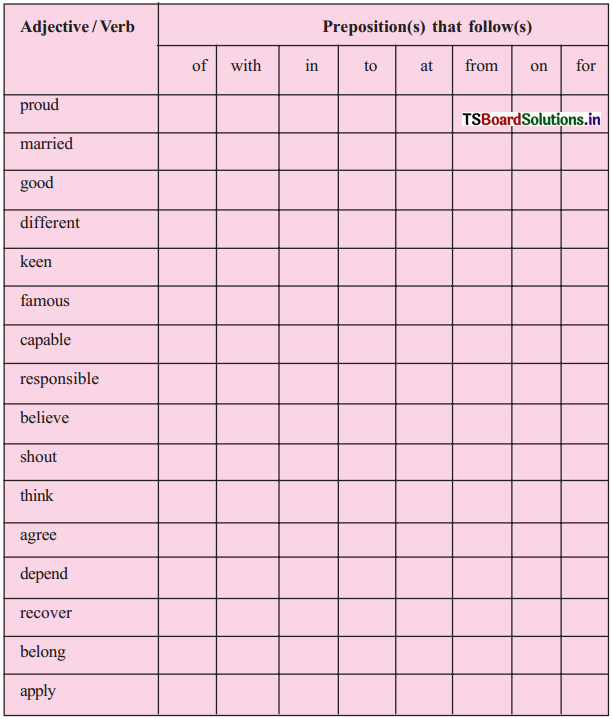
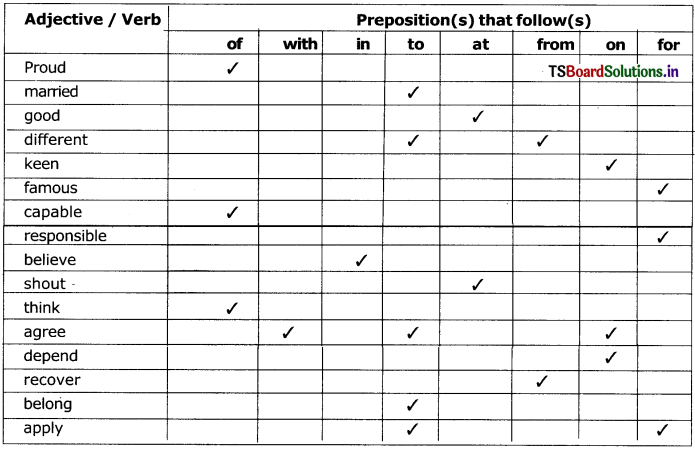
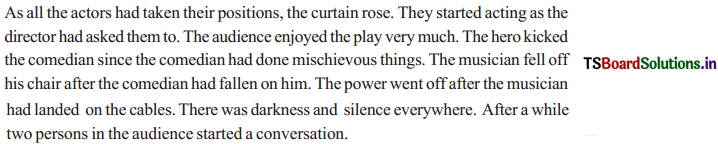
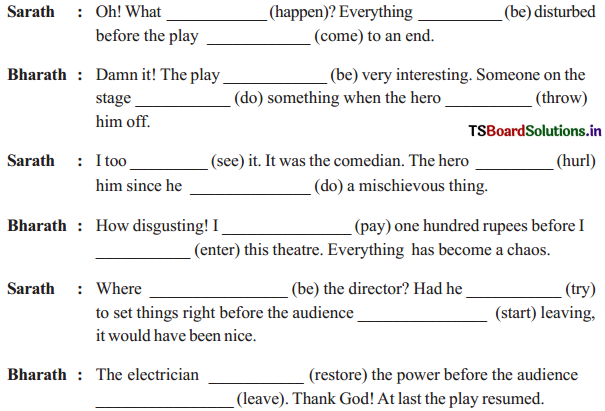
Telangana SCERT TS 10th Class English Guide Pdf Unit 5B The Storeyed House – II Textbook Questions and Answers.
TS 10th Class English Guide Unit 5B The Storeyed House – II
Comprehension:
L Answer the following Questions:
Question 1.
How did Kondiba oppose Bayaji’s idea of building a storeyed house? In what way did he warn Bayaji? How did Bayaji change his plan?
Answer:
Kondiba Patil who was the owner of only storeyed in the village was a high-caste person. He could not tolerate the idea of the untouchable creature, Bayaji’s building a storeyed house. Kondiba warned him not to lose his head to aspire an equal status with the upper-caste people. He told Bayaji that the poofshould remain content with their cottage.
He advised Bayaji to build a small house with three convenient portions, a veranda in the front and at the back and the living section in the middle. He opined that it was unnecessary spending money on a storeyed house. He finally warned Bayaji that he would be thrown out of the village if he went in for a storeyed house. Out of fear, Bayaji abandoned his plans for the storeyed house. He changed his plan and wanted to build the conventional three-portioned house.

Question 2.
Kondiba Patil and his friends felt uneasy at the sight of Bayaji’s new house because ……………..
a) Bayaji built the house beautifully.
b) the house was not built properly.
c) the rooms were unclean.
d) they felt that Bayaji should not be in the village.
Answer:
(a) Bayaji built the house beautifully.
Question 3.
Patil gave back the customary betel leaves offered by Bayaji because
a) they were bad.
b) it was their custom.
c) he felt that they were unnecessary.
d) he did not want to accept them from an untouchable.
Answer:
(d) he did not want to accept them from an untouchable.
Question 4.
What was the intention of Kondiba and his companions, When they eyed each other?
Answer:
The intention of Kondiba and his companions is to destroy or kill him immediately. It was revengeful and malicious. They decided to teach him a lesson by doing something harm to him. So they burnt the new house which resulted in the death of Bayaji.
Question 5.
“And then the undreamt-of-incident took place.” What was it? Who do you think responsible for it?
Answer:
It was the Bayaji’s new house had suddenly flared up and caught fire from all sides. Kondiba Patil and his companions were responsible for it. No one would ever dream or hope any new house burn down to ashes before the house-warming ceremony was over. It was the undreamt-incident.
Question 6.
‘Bayaji’s death was the result of an accident due to petromax flare-up/ was their conclusion. Do you accept it? If not, what do you think is the truth?
Answer:
I don’t accept the conclusion of the village officers and witnesses that Bayaji’s death was the result of an accident due to petromax flare-up. I think that Kondiba Patil and his companions are responsible for this incident. They felt jealous on seeing the impressive new house and the crowd of smiling faces. So they planned to burn the house.
Question 7.
Comment on Bayaji’s last wish: ‘Sons, I want you to build a storeyed house’.
Answer:
Bayaji’s last words are like a mantra suggestive of the rise of Dalit empowerment. Digging the foundation of a regular storeyed-house symbolises the Dalit digging into the foundation of the villain of the tragedy, the caste system.
Question 8.
‘We’re starting on a house, not one with a concealed first floor but a regular two-storeyed house.’ What is the significance of this sentence?
Answer:
The significance of this sentence is to start the work (fight) against the caste discrimination or social injustice. As their father (Bayaji) wanted them to build a storeyed house, the sons of Bayaji started the house, not one with a concealed first floor but a regular two¬storeyed house. This sentence revealed their courage to start another new house for the peace of their father’s soul. It signifies the determination of all the six sons to build a two-storeyed house. It also signifies the determination of all the downtrodden to over come all the difficulties in their way of achieving social and financial equality.
Question 9.
“The Storeyed House is a powerful symbol of Dalit empowerment in India.’ Comment.
Answer:
“The Storeyed House” is a powerful symbol of Dalit awakening in India. It contributes greatly to the dynamics of Dalit emancipation. This portrays not only the worst scene of the caste system, but a powerful enrichment of Dalits from nowhere, a view of hope prevailing within them. Here the cast-wicked society is depicted very well.
Kondiba Patil and his companions felt uneasy at the sight of Bayaji’s brand new house, the impressive pandal and the crowd of smiling faces. They wanted to teach him a lesson. They could not bear the idea that an untouchable like Bayaji building a storeyed house. With jealousy, he set the new house on fire and burnt it along with Bayaji. Bayaji’s last words made his sons begin a new storeyed house.
Digging the foundation of the new storeyed house, not a concealed one but a regular one, is a powerful symbol of the Dalit digging into the foundations of the villain of the tragedy, the caste system. It tells us that Dalits would go forward with great determination to get a right place in the society. The new¬found courage and confidence would help them to get rid of the problems faced by Dalits because of the caste system. Thus, this short story is a powerful symbol of Dalit empowerment in India.
Question 10.
What, according to you, are the major social problems in India?
Answer:
Some of the major social problems are the caste system, the gender discrimination, the racial discrimination, the religious differences, the corruption, the population growth, the dowry system, the unemployment problem, social and economical inequality, and communalism.
Question 11.
What is the conflict in the story? Which is the turning point?
Answer:
The conflict in the story is between the ambitious wicked upper class and righteous down trodden dalits. The caste discrimination is the conflict in the story. The turning point is to burning the house in flames and another turning point is to build a storeyed house. Finally Bayaji’s sons were starting the foundation work to build two-storeyed house.
Question 12.
What is the point of view of the writer? Pick out evidence from the story in support of your answer.
Answer:
The point of view of the writer is that Dalits should bravely face the ill-effects of caste system without losing self-respect and determination. He sends all the Dalits a message through the characters of Bayaji’s sons that they should not lose hope and look forward for a bright future.
The last scene in the story is the best evidence in support of the writer’s point of view.
The last scene :
All of a sudden the undreamt of incident happened. Bayaji’s new house had caught fire and flared up. His enemy had taken revenge on him. He climbed up to save the pictures of great men on the wall. Suddenly the stairs crumbled down. Bayaji was trapped by flames all around and in no time, Bayaji fell down along with the upper storey. He was burnt all over. He was still wailing- “my house”, “my house”. He expressed his last wish that his sons should build a storeyed house and with those words his head collapsed.
His old mother wept bitterly that both her husband and her son passed away without giving her a funeral. His wife was sobbing her heart out. The house was burning and Bayaji was in ashes instead of enjoying the comforts of a retired life. The guests who had come to celebrate the house-warming had the misfortune to attend the funeral of the host.
The next morning the village officers reported that Bayaji’s death was caused by an accident due to a petromax flare-up. In the end we see the sons of Bayaji, instead of mourning, digging the foundation of a regular storeyed-house, not a concealed one. The final act of the sons symbolizes the Dalit digging the foundation of the villain of the tragedy, the caste system.
Question 13.
The sons decided to build a storeyed house soon after the death of their father. What does this act of the sons signify?
Answer:
Bayaji’s sons decided to build a storeyed house soon after the death of their father. This act of the sons signifies the Dalit digging the foundation of the villain of the tragedy, the caste system. It also signifies the self-respect and the determination of Dalits. It signifies the importance of Dalit empowerment.
Question 14.
What according to you is the underlying theme of the story, ‘The Storeyed House’? Substantiate your view point with instances quoting from the story.
Answer:
The underlying theme of the story The Storeyed House’, is nothing but the age old Cast Discrimination which was prevailing in the Indian Society for a long time. It portrays the worst scene of the caste system, but a powerful enrichment of Dalits from nowhere, a view of hope prevailing within them.
Vocabulary:
I. Compound Adjectives:
A compound adjective is made by joining two or more than two adjectives before a noun. The meaning of the compound adjective may be different from the meanings of its components. Compound adjectives may have a hyphen (-) between them as in ‘three- portioned house’ or house-warming ceremony’.
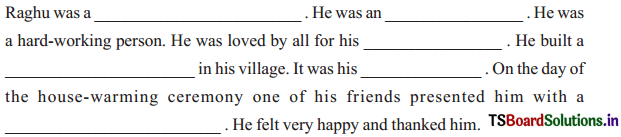
(A) Fill in the blanks below with the appropriate compound adjectives + noun from the box.

Answer:
Raghu was a thirty-five year old man. He was an open-minded person. He was a hard-working person. He was loved by all for his soft-spoken words. He built a two-storeyed house in his village. It was his life-time desire. On the day of the house-warming ceremony one of his friends presented him with a water-proof watch. He felt very happy and thanked him.
II. Phrasal Verbs:
In class IX you have learnt that a phrasal verb is a verb followed by a preposition or an adverbial particle. Phrasal Verbs give us a single independent unit of meaning.
Here are a few examples.
(a) Give out (to come to an end; to be completely used up)
After a month their food supplies gave out.
(b) Set aside (to save something for future needs)
She set aside money for her future needs.
There are two types of phrasal verbs.
1) Inseparable phrasal verbs:
Inseparable phrasal verbs as in sentence (a), the lexical part of the verb cannot be separated from the preposition that accompanies it.
For example: She takes after her mother.
2) Separable phrasal verbs:
The object may come after the lexical part of the verb or it may come after the phrasal verb.
For example.
i) He brought his son up. (or) He brought up his son.
ii) She filled up her form. (or) She filled her form up.
iii) He burnt him up.
Note:-
As you can see in sentence (iii) above, if the verb ¡n a phrasal verb is followed by a pronoun, the participle can change its position.
A. Guess the meaning of the following phrasal verbs and then check them with the help of dictionary. Rewrite the sentences that followed using the phrasal verbs.

1) The farmer threatened to make his dogs set on us.
2) I went to the air-port to see off my uncle.
3) We had to hang around near the office until it was opened.
4) I dropped off by the end of the film off.
5) New schools are beginning to spring up now.
6) We decided to wind up the work by 5 p.m.
7) His shoes have become very thin. They are worn out.
8) She dashed off the meeting quickly to pick up her daughter.
9) The wedding is put off to the next month.
10) The bus knocked down him and he fell down on the road.
A. Meanings of the given phrasal verbs:
Wear out = to become or make something become thin or weak and useless.
Wind up = to stop a business, company etc. and close ¡t.
Spring up = to appear, grow, develop etc. suddenly
Drop off = to fall into a light sleep
Dash off = leave somewhere quickly
See off = to say good bye.
Knock down = to hit some body and make them fall to the ground.
Set on = to make a person or an animal attack somebody suddenly.
Put off = to stop in order to allow somebody to leave, to postpone something.
Hang around = to wait or to slay near a place.
Answer:
1) The farmer threatened to make his dogs set on us.
2) I went to the air-port to see off my uncle.
3) We had to hang around near the office until it was opened.
4) I dropped off by the end of the film off.
5) New schools are beginning to spring up now.
6) We decided to wind up the work by 5 p.m.
7) His shoes have become very thin. They are worn out.
8) She dashed off the meeting quickly to pick up her daughter.
9) The wedding is put off to the next month.
10) The bus knocked down him and he fell down on the road.
B. Fill in the blanks in the following sentences with appropriate phrasal verbs given below. Make necessary changes in the verb forms if necessary.

Question 1.
Ramesh made a mistake for which his officer __________ an explanation.
Answer:
called for
Question 2.
You must __________ your expenses, otherwise you will be in trouble.
Answer:
cut down
Question 3.
There is no doubt, he will __________ the examination as he has worked hard for all these days.
Answer:
get through
Question 4.
I am unable to __________ what they are saying because I don’t know Tamil.
Answer:
make out
Question 5.
The gang of terrorists __________ to the army after a long exchange of fire.
Answer:
gave in
Question 6.
We took a car for rent for our forest trip. In the middle of the forest it __________.
Answer:
broke down
Question 7.
The Olympic Flame is usually __________ after completion of all the events.
Answer:
put out
Question 8.
In spite of his repeated promises, he did not __________.
Answer:
turn up
Question 9.
The TV is making a terrible noise. Please __________ a mechanic to repair it.
Answer:
send for
Question 10.
Everybody says that Gopi __________ his father.
Answer:
takes after
Some other phrasal verbs-Meanings & Examples.
1. abide by: obey
e.g.: All the members have to abide by the head’s decision.
2. account for: explain, give a reason.
e.g.: The officer asked him to account for his movements that night.
3. amount to : 1) reach, 2) be equivalent to (equal when they are added)
e.g.: The employees strike amounts to ten crores of loss to APSRTC.
4. answer back: reply rudely
e.g.: Rahul answered his father back when his father asked him why he was late.
5. answer for: (1) be responsible for something,
(2) speak on behalf of someone.
e.g.: 1) Gavaskar said that Dunkan Fletcher must answer for recent Indian team’s poor performance. 2) I agree, but I can’t answer for my associate.
6. appeal to : 1) plead, 2) be attractive or interesting
e.g.: 1) Appealing to the referee doesn’t often result in a decision being changed. 2) This programme appeals to the youth.
7. arrive at: reach (an agreement/a decision)
e.g.: After much discussion, they arrived at a decision.
8. ask after: enquire about someone’s well-being,
e.g.: Raju asked after you when I met him.
9. back away: move backwards in fear or dislike
e.g.: He backed away from her with a menacing look on his face.
10. back down : withdraw, concede defeat,
e.g.: Their opponents have finally backed down.
11. Break away : escape from captivity.
e.g.: The notorious criminal broke away from the prison.
12. Break down : stop functioning, lose control of one’s emotions,
e.g.: (i) The bus broke down near market.
(ii) Miss Ramya broke down when she heard the sad news of her mother’s death.
13. Break off: stop, speaking.
e.g. : She broke off in the middle of her speech.
14. Break up : come to an end.
e.g. They broke up after a year.
15. bring on: to make something bad or unpleasant happen.
e.g.: Stress can bring on a heart attack.
16. bring up: care for (a child)
e.g.: His grandparents brought him up as he had lost his parents in an accident.
17. brush upon: improve
e.g.: He must brush upon his English before he joins his job.
18. build up : to increase or become larger or stronger
e.g.: Tension is building up between the two communities.
19. burn out: the inside of something is destroyed by fire
e.g.e.g.: The house was completely burnt out.
20. call back : return a phone call
e.g.: She says that she will call him back as soon as possible.
21. call off: cancel
e.g.: The employees called off their strike.
22. call on: visit
e.g.: We called on the collector yesterday, carry on: continue.
23. carry on: continue
e.g.: Please carry on washing clothes.
24. carry out: do something as specified
e.g.: A survey is now being carried out nationwide.
25. carry over: postpone until later
e.g. : Some of the problems they are facing are a carryover from the previous government’s policies.
26. catch upon: acquire information one has missed
e.g.: When I met my friend after a long time, I caught upon the latest events, catch up with : reach the same stage as someone else.
27. catch up with : reach the same satge as someone else
e.g.: Sunitha has missed a lot of classes ; she has to work hard to catch up with the others.
28. close down: stop operating (company, cinema, etc.)
e.g.: The toy-company was closed down on Sunday, come across : find by chance.
29. come across : find by chance.
e.g.: I came across my old friend Subhash when I went to Delhi,
30. come down with: become ill with
e.g.: He was absent from school as he came down with Cholera,
31. deal with: handle
e.g.: Please deal with it smoothly,
32. dig into : 1) try to find about something unknown
2) start to do something
e.g.: 1) He had been digging into her past.
2) I am going to dig into my savings again,
33. dig up : 1) break up the soil
2) discover or reveal information
e.g.: 1) Raju dug up the tree by its roots !
2) The Inspector dug up the information related to Rao’s death,
34. do away with : get rid of
e.g.: He thinks that it’s time to do away with monarchy,
35. do over: clean
e.g.: We have to do over our parlour ; it’s very dirty,
36. do up: fasten
e.g.: Do up your coat or you’ll get cold,
37. drag on : last longer than expected
e.g.: The trial dragged on for years.
38. drag out:
1) make something longer than necessary
2) make someone reveal or give information unwillingly
e.g.: 1) We shouldn’t drag out this discussion.
2) The police finally dragged out a confession from the suspect.
39. dress up : 1) wear elegant clothes
2) disguise oneself
e.g.: 1) He dressed up to attend the concert.
2) They dress up and dance in the party.
40. drop behind : fall into a position behind others
e.g.: Their sales dropped behind those of their opponent.
41. drop in: visit
e.g.: I dropped in my uncle on my way home.
42. drop off: 1) deliver someone or something
2) fall asleep
e.g.: 1) He drops her off at the market.
2) She is dropping off when her boss calls her.
43. drop out: leave school without finishing
e.g.: Prashanth dropped out from school while he was studying in VII class.
44. end in : finish in a certain way, result in
e.g.: Their marriage ended in divorce,
45. end up : finally reach a state, place or action
e.g.: I wondered where the pictures would end up after the auction.
46. fall through: does not occur
e.g.: Our trip to Andaman fell through because of the storm.
47. figure out: find the answer
e.g.: If I have the map, I will figure it out.
48. fill in for: temporarily substitute for another person
e.g.: As Rani is on leave, Vani is going to fill in for her.
49. fill out: complete (an application)
e.g.: Fill out the application carefully.
50. freak out: panic or go crazy
e.g.: He nearly freaked out when he had to sleep alone.
51. fuss over : pay excessive attention to
e.g.: He is always fussing over his son.
52. get away : escape
e.g.: The thief got away very quickly.
53. get down to: start to actually do something
e.g.: It’s time to get down to a new business.
54. get in/into: enter
e.g.: He got into the house when she was not at home.
55. get off: 1) leave (bus, train, plane, etc.)
2) remove from something
e.g.: 1) He got off the train and walked away speedily.
2) She is trying to get off the airport.
56. get on: board (bus, train, plane, etc.)
e.g.: He got on the ship.
57. get on with: 1) make progress, continue to do something
2) have a good relationship with
e.g.: 1) Sekhar got on with his work neatly.
2) She got on very well with her mother-in-law.
58. get out:leave
e.g.: He got out of the office an hour ago.
59. get out of: 1) leave
2) avoid doing something
e.g.: 1) How did the thief get out of the room?
2) He usually got out of household chores.
60. get over: recover from
e.g.: He has been gradually getting over after his heart-attack.
61. get rid of: eliminate
e.g.: I have to get rid of this old chest of drawers.
62. get together: meet one-another.
e.g.: We will get together for dinner tomorrow.
63. get up: wake up
e.g.: She gets up at 5 a.m. every day.
64. hang on (to): keep a hold on something
e.g.: Hang on its back tightly; otherwise you may fall down.
65. hang out: spend time in a particular place or with a group of friends
e.g.: He hanged out with his friends all the day.
66. hang up: end a telephone conversation
e.g. He has hanged up just now.
67. head off: start to go somewhere
e.g.: The army ¡s heading off towards the opponent’s hiding place.
68. head for: move in a certain direction
e.g.: The ship was heading for the icy Atlantic.
69. hold on: 1)wait
2) grip tightly
e.g.: 1) Please hold on for something.
2) Hold on it tightly and ride slowly.
70. hold up : show as an example
e.g.: He held up his dissection for all to see.
71. idle away: waste time doing nothing
e.g.: Don’t idle away your valuable time.
72. join in: participate
e.g.: He has joined in the archery competitions.
73. join up : 1) engage in, become a member of
2) meet and unite with
e.g.: 1) Vasu joined up army as soon as he passed SSC.
2) South Korea joins up with North Korea after a long time.
74. keep up: to continue doing something
e.g.: I don’t think I can’t keep this up any longer.
75. keep back: force to stay back
e.g.: They kept back the audience by arranging a barrier.
76. keep on: continue doing something
e.g.: Joe kept on making noise though his teacher warned him not to do.
77. keep up with : stay at the same level as someone
e.g: It becomes very difficult for me to keep up with my grandpa.
78. kickoff: begin
e.g.e.g.: The cricket match kicked off at 2 p.m.
79. knock down: strike someone or something to the ground
e.g.: He knocked Razak down in the boxing bout.
80. knock out: cause someone to fall unconscious
e.g.: David knocked him out within five minutes.
81. lay off: dismiss
e.g.: He was laid off from his job for he was dishonest.
82. leak out: become known
e.g.: No sooner did the news leak out than my friend arrived.
83. look after : take care of
e.g.: He is looking after his disabled wife.
84. look back on : remember the past
e.g.: I am very unhappy when I look back on those days.
85. look down on : consider as inferior
e.g.: She usually looks down on the poor.
86. look into: investigate
e.g.: The Inspector is looking into the matter.
87. look for: try to find something
e.g.: She is looking for her purse.
88. look forward to : await with pleasure
e.g.: We are looking forward to meeting my cousin.
89. look up to: admire
e.g.: I have always looked up to Sudha for her courage, determination and dedication.
90. make off with : steal and hurry away
e.g..: The burglars made off with gold and jewellery.
91. make up : invent (excuse, story, etc.)
e.g..: He made up a story to make them believe.
92. make up (with) : end a quarrel
e.g..: They made up with their quarrel and lived with peace.
93. put on : (1) wear
(2) switch on e.g.: (1) put on a blue shirt.
(2) Please put on the light.
94. put out: extinguish
e.g.: The fire men put the fire out.
95. put through: connect two people (on the telephone)
e.g.: I will put you through to Mr. Ramu.
96. put up: accommodate
e.g.: He was put up at the college hostel.
97. put up with: tolerate
e.g.: I can’t put up with your actions anymore.
98. vie with: compete
e.g.: Ten teams vied with each other to get to the finals.
99. watch out: be careful
e.g.: Watch out! The bus is speeding towards us.
100. wear out: (1) become unusable (2) become very tired
e.g.: (1) Her shoes were worn out.
(2) He wore out after a long day’s hard work.
III. Idioms:
‘I only wish to build a shelter for my family. Then I shall be free to breathe my last.’ Bayaji answered.
In the sentence above ‘breathe one’s last’ is an idiomatic expression which means ‘to die’.
We have already learnt that an idiom is a mode of expression peculiar to a language. It is a group of words in a fixed order that has a particular meaning that is different from the meanings of each word understood on its own. Idioms cannot be translated word for word. They have become fixed through regular use with their figurative meanings. They should be used in their correct forms without dropping, adding or replacing any word. We cannot say ‘breathe one’s first’ to mean ‘to take birth’ or’unbreathe one’s last’ in the sense of’not to die’ etc. Hence we should consult a standard dictionary and learn to use them as they are.
(A) Choose the correct words from the brackets to complete the following idioms in the sentences.
Question 1.
When I arrived here I felt like a _______ out of water, (prawn, fish, crab)
Answer:
fish
Question 2.
He is an outspoken man. He _______ a spade a spade, (calls, says, pronounces)
Answer:
calls
Question 3.
The parents got their daughter married. Now they are ________ free. (house, residence,home)
Answer:
home
Question 4.
Don’t tell me a cock and _______ story. (hen, bull, cat)
Answer:
bull
Question 5.
You are a bit of a ________ horse. (quiet, dark, black)
Answer:
dark
B. Match the idioms in Column A with their meanings in Column B. Write the idioms in your own sentences.
| Column – A | Column -B |
| 1. bite the bullet | a) a state of confusion or disarray |
| 2. lose heart | b) to accept something unpleasant without corn plainning |
| 3. let the cat out of the bag | c) bribe somebody |
| 4. at sixes and sevens | d) something that is very difficult to do or needs a lot of determination |
| 5. grease one’s palm | e) be discouraged |
| 6. an uphill battle | f) try very hard |
| 7. move heaven and earth | g) reveal a secret |
Answer:
1 – b
2 – e
3 – g
4 – a
5 – c
6 – d
A. Own Sentences:
1. bite the bullet : She had to bite the bullet; there is no choice.
2. lose heart : I lost heart when I heard about the sad news.
3. let the cat out of the bag : Ramya didn’t want to let the cat out of the bag she wanted to maintain secrecy.
4. at sixes and sevens : They were still at sixes and sevens when our officers arrived.
5. grease one’s plam : He greased the cleark’s palms to get his bill prepared.
6. an uphill battle : Though it was an uphill battle he finally achieved.
7. move heaven and earth : She moved heaven and earth and finally succeeded in getting the trasfer.
Some other Idioms and their meanings:
1. a hot potato : speak of an issue which many people are talking about and which is usually disputed.
2. a penny for your thoughts : a way of asking what someone ¡s thinking.
3. actions speak loader : people’s intentions can be judged better by what they do than words than what they say.
4. add isult to injury : to further a loss with mockery or indignity.
5. an arm and a leg : very expensive
6. at the drop of a hat : without any hesitation, instantly.
7. back to the drawing board : when an attempt fails and it’s time to start all over.
8. ball is in your court : it is up to you to make the next decision or step.
9. barking up the wrong true : accusing the worng person
10. be glad to see the back of : be happy when a person leaves.
11. beat around the bush : avoiding the main topic
12. best of both worlds : all the advantages.
13. best thing since sliced bread : a good innovation or invention.
14. bite off more than you can chew : to take on a task that is way to big.
15. blessing in disguise : something good that is not recognized at first.
16. burn the mid night oil : to work late into the night.
17. can’t judge a book by it’s cover : can’t judge something primarily on appearance.
18. caught between two stools : When someone finds it difficult to choose between two alternatives.
19. cut corners : when something is done badly to save money
20. cut the mustard : to meet a required standard, to succeed.
21. don’t count your chickens before they hatch out : don’t make plans for something that might not happen
22. dropping like flies : to fall down ill or to die in large numbers
23. dances to the tune : to always do what someone tells you to do
24. dragging its feet : delaying in decision
25. don’t throw bricks when you live in a glass house : don’t call others out on actions that you, yourself do
26. eat my hat : being almost sure about something
27. every cloud has a silver lining : to be optimistic even in difficult times
28. end in smoke : to bear no result
29. eat humble pie : to apologize humbly
30. fish out of water : someone being in a situation that they are unfamiliar or unsuited for
31. fit as a fiddle : to be in perfect health
32. feel a bit under the weather : feeling slightly ill
33. face the music : to accept punishment for something you have done
34. fall on your own sword : to be cheated by someone you trust
35. feather in one’s cap : something that you achieve and proud of
36. French leave : absent without permission
37. fingers and thumbs : being clumsy and not very skilled with your hands
38. fool’s paradise : a false sense of happiness or success
39. fortune smiles on somebody : to be lucky and advantageous for somebody
40. full steam ahead : with all your energy and enthusiasm
41. give a man a fish : it is better to teach a person how to do something than to do that something for them
42. greased lightning : very fast or quick
43. give the benefit of the doubt : believe someone’s statement without proof
44. get off the hook : free from all obligations
45. get a raw deal : not treated equally
46. go bananas : wild with excitement, anxiety or worry
47. gounder the hammer : that is sold in an auction
48. hard pill to swallow : something that is difficult to accept
49. head over heels : falling deeply in love with another person
50. hear it on the grapevine : to hear rumours
51. hit the nail on the head : do or say something exactly right
52. hit the sack : to go to bed
53. hold one’s horse : be patient
54. have clean hands : be guiltless
55. have an egg on the face : be embarrassed
56. hit the bull’s eye : exactly right about something or achieve the best result possible
57. in the heat of the moment : overwhelmed by what is happening in the moment
58. in the red : losing money, being in debt in
59. in dribs and drabs : small amounts at a time
60. in the blues : low spirited
61. in the dog house : in disgrace and very unpopular
62. jack of all trades but master of none : having suitable skill in multiple things, but not being an expert in any of them
63. jaws of death : being in a dangerous situation
64. jump on the bandwagon : join a popular trend or activity
65. keep something at bay : keep something away
66. kill two birds with one stone : to accomplish two different things at the same time
67. keep your eyes peeled : to be watchful
68. know your socks off : to be taken by surprise
69. know the ropes : having a familiarity
70. last straw : the final problem in a series of problems
71. miss the boat : missing one’s chance
72. not a spark of decency : no manners
73. not playing with a full deck : someone who lacks intelligence
74. no if ands, or buts : finishing a task without making any excuses
75. on cloud nine : having strong feelings of happiness or satisfaction
76. on the ball : understands the situation well
77. once in a blue moon : happens very rarely
78. piece of cake put wool over : easy task
79. other people’s eye : to deceive someone into thinking well of them
80. put a sock in it : asking someone to be quiet
81. raining cats and dogs : when it is raining heavily
82. see eye to eye : agreeing on something.
83. sit on the fence : doesn’t want to choose or make a decision.
84. steal someone’s thunder : to take the credit for something someone else did.
85. take with a grain of salt : not to take what someone says too seriously.
86. taste of your own medicine : something happen to you, or is done to you, that you have done to someone else.
87. to hear something straight from the horse’s mouth : to hear something from the authoritative source.
88. whole nine yards : everything
89. wag the dog : adversion away from something of greater importance,
90. wild and wooly : uncultured and without laws
91. wine and dine : when somebody is treated to an expensive meal,
92. you are what you eat : in order to stay healthy you must eat healthy food.
93. your good is as good as mine : I have no idea
94. when pigs fly : something that will never ever happen,
95. you can’t take it with you : enjoy what you have
96. zero tolerance : no crime or law breaking big or small will be overlooked.
Gramamr:
I. Adverbial Clauses:
Study the following examples from the story.
1. As he reached Kadam’s house, he saw Bhujaba coming towards him.
2. When she heard of Bayaji’s arrival, her heart swelled.
3. Baiju, you shouldn’t lose your head simply because you’ve set aside some money.
4. You may go in for a storeyed house only if you don’t wish to stay in this village.
In all the above sentences there are two clauses. The underlined part is the adverbial clause.
There are several types of adverbial clauses
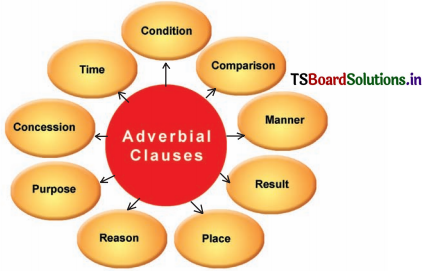
A. Identify the adverbial clauses in the following sentences.
Question 1.
As Bayaji neared Buddha Vihar, the children caine running to him.
Answer:
As Bayaji neared Budha Vihar,
Question 2.
Since they knew that Bayaji was coming home for good, the elder son in service and the two daughters were already home to greet him.
Answer:
Since they knew that Bayaji was coming home for good.
Question 3.
Bayaji was amused that his daughters thought in this childish manner even after they had children of their own.
Answer:
that his daughters thought in this childish manner.
Question 4.
Bhujaba didn’t respect Bayaji because the latter was a Mahar.
Answer:
because the latter was Mahar.
Question 5.
If you want to live happily, you must quit the idea of building a storeyed house.
Answer:
If you want to live happily.
B. Combine the pairs of sentences to make one using the words given in brackets.
Question 1.
He forgot his position as a Hindu. He turned a Buddhist, (because)
Answer:
He forget his position as a Hindu, because he turned a Buddhist (or) a Buddhist.
Question 2.
Bayaji came home. His wife felt very happy, (as)
Answer:
As Bayaji came home, his wife felt very happy, (or)
Bayaji’s wife felt very happy as he come home.
Question 3.
Bayaji’s children came home. Bayaji returned, (since)
Answer:
Since Bayaji returned, the children came home, (or)
Bayaji’s children came home since Bayaji’s returned.
Question 4.
You may not attend the class. You don’t want to come again, (if)
Answer:
If you don’t want to come again, you may not attend the class, (or)
You may not attend the class if you don’t want to come again.
Question 5.
Bayaji was about to come down the stairs. Then it crumbled down in flames.(when)
Answer:
When Bayaji was about to come down the stairs, it crumbled down in flames, (or)
It crumbled down in flames when Bayaji was about to come down the staired.
Explainatory notes about Adverbial clauses :
1. Adverbial Clauses of Time :
Adverbial Clauses of Time are introduced by the subordinating conjunctions whenever, since, after, before, while, as etc.
Eg: (1) He tumbled down as he came downstairs.
(2) Since it was a holiday, she woke up late.
2. Adverbial Clauses of Place :
Adverbial Clauses of place are introduced by the subordinating conjuctions where and whereas.
Eg: (1) He went to a new place where he got a job.
(2) His method is very effective where as yours is wrong.
3. Adverbial Clauses of Reason :
Adverbial Clauses of Reason are introduced by the subordinating conjuctions because, that, as, since.
Eg: (1) He was absent because he didn’t feel well.
(2) I am very happy that I have heard the news of my getting the job.
4. Adverbial clauses of Manner :
Adverbial Clauses of Manner are introduced by the subordinating conjunctions like, as, as if.
Eg: (1) He behaved as if he were the king.
(2) It looked like a jungle.
5. Adverbial Clauses of Purpose:
Adverbial Clauses of Purpose are introduced by the subordinating conjuctions so that, in order that and lest.
Eg: (1) Take umbrella so that you may not get wet.
(2) Work hard lest you should fail.
6. Adverbial Clauses of Condition :
Adverbial Clauses of Condition are introduced by the subordinating conjuctions. if, whether, unless.
Eg: (1) Unless you study well, you can’t pass.
(2) If he walks fast, he will catch the bus.
7. Adverbial Clauses of Consequence :
Adverbial Clasues of Consequence are introduced by the subordinating conjuction that.
Eg: I can’t believe that he’s only.
8. Adverbial Clauses of Comparison :
Adverbial Clauses of Comparison of Degree are introduced by the subordinating conjunction than, or by the Relative Adverb as …. as
Eg: (1) He is taller than Ravi.
(2) He is not as tall as me.
9. Adverbial Clauses of Concession :
Adverbial Clauses of Concession are introduced by the subordinating conjunctions through, although, even if.
Eg: (1) Though he studied well, he failed.
(2) It will be very difficult for him to get a job even if he is clever.
Writing:
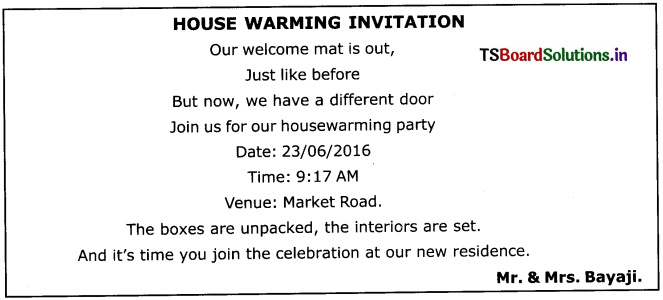
A. Prepare an Invitation on the occasion of housewarming ceremony of Bayyji’s new house. Check the following indicators in your Invitation.
Heading, Occasion, Date & Time, Invitee’s Address
Answer:
B. In the morning the village officers and witnesses visited the place to record the facts of the accident. ‘Bayaji’s death was the result of an accident due to a petromax flare up’ was their conclusion.
In fact, everyone in Bayaji’s family knew the truth. Suppose the eldest son wanted to make a complaint against the person who was responsible for it to the police inspector. You, on behalf of the eldest son, write a letter of complaint.
Answer:
Buddha Vihar,
Ramghad,
23rd April, 2015.
From,
K. Subbaji,
S/o, Bayaji,
Ramghad,
Nagpur,
Maharashtra.
To,
The Sub-inspector of Police.
I Town Police Station.
Nagpur,
Maharashtra.
Sir,
Sub:- Complaint against the role of Kondiba and his companions behind my father’s (Bayaji’s) death.
I am the eldest son of deceased person. My name is Subbaji. I am an eye witness to this incident. Here, I am making a complaint against the person who is responsible for it.
Actually my father’s death is not the result of an accident due to a petromax flare up. My father was a Mahar by caste. Being a Mahar he was ill-treated by the higher-caste people of my village. My father wanted to build a storeyed house for our family and he wanted to lead his rest of life in peace in it. It is his dreaming project. After his retirement, he shared his opinion with somebody. This news spread over to the higher-caste people. Immediately they came to my father and warned him not to build the storeyed house. Particularly a person named Kondiba Patil objected the proposal of constructing the storeyed house and abused my father. Because there was only one storeyed house in the village that belonged to Kondiba Patil. A storeyed house is the symbol of the higher-caste people whereas a cottage is the symbol of the poor or lower-caste people.
So Kondiba Patil came along with his companions and severely warned my father against constructing the house. Out of fear, my father has changed his plans for the storeyed house. He constructed the conventional three-portioned house. My father invited all the guests along with Kondiba Patil and his companions for the house-warming ceremony. Kondiba Patil and his companions got jealousy by the sight of this beautiful house. My father offered them customary betel leaves without knowing their intention. But simply they gave them back as it was the offer made by an untouchable. They also said, “This untouchable man has swollen head. He needs proper handling”. Saying those words, they left our house seriously. Within the few minutes after they had left the house, it caught fire from all sides and all this led to my father’s death.
I strongly believe that Kondiba Patil and his companions are responsible for my father’s death. Hence, I request you to investigate into the case and reveal the facts behind our father’s death. I hope that justice will be done to us.
Thanking you Sir.
Yours faithfully,
K. Subbaji.
(B) Read the newspaper reports given below and identify their features. The following tips may help you.
- What is the report about?
- When did the incident happen?
- Where did the incident happen?
- How did the incident happen?
- What are the other details?
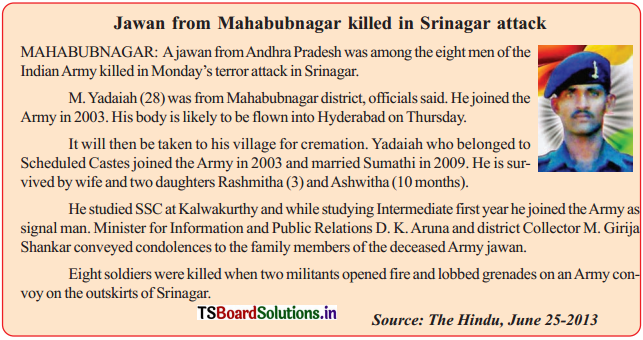
What is the structure of the first report?
Headline: It is brief, simple and catchy. It says what the news is about.
Place of the news report: Mahabubnagar
First Sentence: It is the summary of the event. It talks about who, what, where, and when.
Next Sentences: They lead from the topic sentence or the first sentence to further details. They give the details of the person and the incident.
Report – 1
Jawan from Mahabubnagar killed in Srinagar attack
Report – 2
AP jawan killed in Srinagar attack
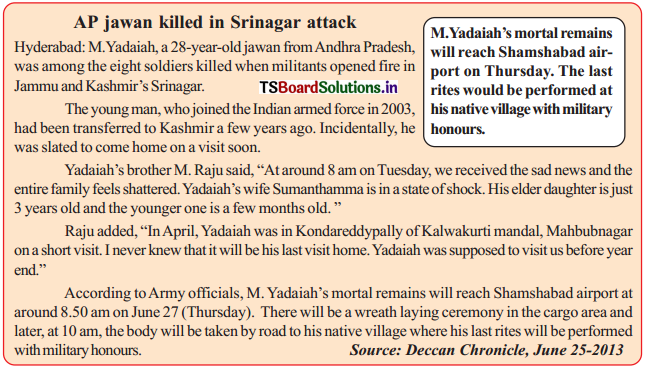
Now study the second report about the same incident but from another newspaper and analyze the structure of it clearly.
Answer:
Headline : The headline is at the top of the report. It is brief, simple and catchy. It says what the news is about:
Place of the news report: Hyderabad
First sentence : It is the summary of the event. By reading it the reader can
understand who is the victim, what is happened to him, where the incident takes place and when it is happened.
Next sentences : They lead from the topic sentence to further details. They tell us
about the victim’s details such as, ’employment’, family1, ‘the family members’ opinions’, ‘death ceremony’ etc. In a separate box on the right top corner of the news report, the details of the last rites.
Write a newspaper report on Bayaji’s death.
REPORT
RETIRED DALIT EMPLOYEE KILLED IN A FIRE ACCIDENT
Nagpur : Bayaji (61), a dalit was burnt alive when his newly built storeyed house had caught fire yesterday at about 3 o’clock in the morning in Ramghad village.
Bayaji, the victim, who came to his native village after his retirement from his services at Bombay dockyard, built a new storeyed house with his retirement benefits. At 3 o’clock in the morning, when the celebrations were in full swing with bhajans and songs, the new house had caught fire from all sides all of sudden. Bayaji has an old mother, a wife, six sons and two daughters.
Bayaji’s youngest son said, “At about 20’clock in the morning, when the programme was in great momentum, suddenly the house had caught fire from all sides and flared up “The village head man said, “It is really a ghastly incident”. According to the enquiry made by the officers, “Bayaji’s death was due to a petromax flare-up”.
It was suspected that some high-caste people are behind this incident. The dead body of Bayaji was taken mortuary for post-mortem and it is decided that the cremation will take place tomorrow.
April 24, 2015.
Study Skills:
Here are the words of Dr. B.R. Ambedkar on caste system. Read the text carefully and make notes on it. Suggest a suitable title.
There are other special features of the Caste System which have their evil effects and which militate against Democracy. One such special feature of the Caste System lies in its being accompanied by what is called “Graded Inequality”. Castes are not equal in their status.
They are standing one above another. They are jealous of one another. It is an ascending and descending scale of contempt. This feature of the Caste System has most pernicious consequences. It destroys willing and helpful co-operation.
Caste and class differ in the fact that in the class there is no complete isolation as there is in the Caste System. This is the second evil effect in the Caste System accompanied by inequality. This manifests itself in the fact that the stimulus and response between two castes is only one-sided. The higher caste act in one recognized way and the lower caste must respond in established way.
It means that when there is no equitable opportunity to receive the stimulus from and to return the response from different caste, the result is that the influence which educates some into masters, educates others into slaves. The experience of each party loses its meaning when the free interchange of varying modes of life experience is arrested. It results into a separation of society, into a privileged and a subject class. Such a separation prevents endosmosis.
There is a third characteristic of the Caste System which depicts the evils there of which cuts at the very roots of democracy. It is that one caste is bound to one occupation. Society is no doubt stably organized when each individual is doing that for which he has aptitude by nature in such a way as to be useful to others; and that it is the business of society to discover these aptitudes and progressively to train them for social use.
But there is in a man an indefinite pluralities of capacities and activities which may characterize an individual. Stratification is stunting of the growth of the individual and deliberate stunting is deliberate denial of democracy.
You can follow the following steps for note-making.
- Read the passage thoroughly.
- Underline the key points during the second reading.
- Note only the most important information.
- Condense the information.
- Omit examples and illustrations.
- Organize the condensed information in a suitable format.
- Represent the points systematically.
- Suggest a suitable title.
Answer:
Title
EVIL EFFECTS OF THE CASTE SYSTEM.
Notes :
1. Graded inequality.
(a) All castes are not equal.
(b) The caste system has most precious consequences.
(c) It destroys willing and helpful co-operation.
2. The caste system
(a) There is no equitable opportunity.
(b) It educates some into masters and others into slaves.
(c) It results into a separation of society.
3. One caste is bound to one occupation.
(a) It cuts at the very roots of democracy.
(b) The society has to discover the attitudes of people and train them for social use.
(c) Stratification leads to the denial to democracy.
Evil effect of the Caste system
There are some special features in the caste system. They have their evil effect on the public and militate against the Democracy. One of them is ‘Graded Inequality’. This is the first evil effect in the caste system. Castes are not equal in their status in this system. This system has most pernicious consequences. It destroys willing and helpful co-operation among the people.
The second evil effect is the difference in the caste system. In the class system, there is no complete isolation. But there is complete isolation in the caste system. This is evil effect in the caste system accompanied by inequality. In this system, the higher caste acts in one recognised way and the lower caste must respond in established way. As a result, the separation came into society. Such separation prevents endosmosis.
The third evil effect is “One caste is bond to one occupation”. No doubt, the Society is organised when each individual is doing his own occupation for the use or benefit of others. Society itself finds these aptitudes and trais them for the social use. Stratification is preventing the growths of the individual as well as democracy.
Listening:
I. Listen to an extract from a speech made by Martin Luther King Jr. and answer the following questions.
I. Choose the right answer from the choices given below.
Question 1.
The speaker addressed the listeners as ________ in his speech.
a) friends
b) gentlemen
c) brothers
Answer:
a) friends
Question 2.
The speaker wanted _________.
a) slavery
b) freedom and justice
c) injustice and oppression
Answer:
b) freedom and justice
II. Say whether the following statements are true or false.
Question 1.
This is a speech made against racial discrimination.
Answer:
True
Question 2.
This speech is addressed to the white people.
Answer:
False
Question 3.
The speaker is a black man.
Answer:
True
Question 4.
The speaker wanted equality.
Answer:
True
Question 5.
His dream was to destroy white people.
Answer:
False
Question 6.
He had a dream that his children should not be judged by their colour.
Answer:
True
Question 7.
He believed in the domination of the black people over the white people.
Answer:
False
Oral Activity:
I. In the above speech Martin Luther King Jr. spoke about putting an end to racial discrimination in America. Imagine that you are observing ‘Caste Eradication Week’. Make a speech on caste discrimination in India.
The following tips may help you.
- Be confident and pay attention to your posture and body language
- Introduce yourself
- Keep the objective in your mind
- Organize your ideas
- Maintain eye contact with the audience
- Maintain voice modulation
- Use illustrations and examples
Hints:- Caste system in India-age old-discrimination- low-caste people-ill-treated-need for change people-government – work together for putting an end to this evil.
Answer:
My dear friends, Good morning/evening everybody. I feel very happy to meet you on this special occasion to speak about “The caste system in India”. Before going to our topic. I would like to introduce myself. I am Vijay Kumar, from Hyderabad. Now, I am studying Tenth class in Indian Gems Public School. I belong to Backward class. I was born 15 years ago in a poor peasant family. Today, I have a great opportunity to speak to you about the caste system in India.
First of all, it is a very difficult subject to speak over it. There are several castes in India. At present caste system is discouraged in India. Its root was very strong in ancient India. The ancient Aryans started this caste system in India. They divided the society into four castes such as Brahmana, Kshatriya, Vaisya and Sudhra. This division was made on the basis of the work which the Aryans did. At that time society needed the work of all these castes. There was no interference of one caste in another. There were moral values among the people. Generally, each caste people would like and respect the other caste people.
There were human values in the society. The Brahmana worshipped Gods and Goddesses. The Kshatriya guarded the entire community against enemies. They acted as soldiers. The Vaisyas did the trade and commerce. The Shudras were allotted the duty of serving the above three castes. When all the castes did their respective works, harmony was established in the society. The caste system became very rigid in later period. The feeling of inferiority and superiority arose among the castes.
The people belonging to high-caste hated the people of low-caste. Gradually one caste was again divided into sub-castes. Today, much social tension is created due to the ugly feeling of caste system. Once we found social order in all castes which were in a village. So there was no need to go to another village in order to get things. The Brahmins or Kshatriyas did not do the trade and commerce. Thus there was no disputes regarding trade. But gradually the Brahmins impose their superiority on other castes. The Kshatriya also did the works of trade and commerce. The Shudra were neglected and the odd job holders were treated as untouchables. They were also exploited by other castes. Thus the social order was affected.
At present castes are no equal in their status. So its affects lies on each caste. It destroys willing and helpful co-operation among the people. Always low-caste people are ill – treated by high-caste people. There were so many fighting incidents that took place all over the country. So many persons also lost their lives. Such fightings took place between higher and lower caste peoples.
There is a great need to change this caste system. So many social reformers just like Gandhi and Ambedkar fought against this caste system in India. Gandhi called the low-caste people as the children of God. The Indian Govt, also has taken many steps to improve the condition of the low-caste people. It also provided the Provision of reservation of jobs for them. Inter caste marriages are also encouraged today. Thus the caste system is gradually losing its strength in our country.
Thank you one and all for giving me this opportunity.
II. Group work:
Having been in a developing nation we have observed several social evils in India like caste system, corruption, population growth, gender discrimination etc. Discuss any such problems in groups and present the information before the class.
Answer:
Group A:
Next to China, India is the second largest populated country in the world. In 2001, India became the second country after China to cross the one million mark. The current population is around 1 – 20 billion. India occupies only 2.4% of the world’s land area but it has over 15% of the world’s population.
Group B :
Our population since 1961 has been increasing at an average annual rate of over two percent. There has been only a moderate decline in birth rate over this period.
Group C :
The population of our country is increasing at an alarming rate. If population growth rate goes on increasing and remains unchecked then it may cross 1400 million (1.400 billion) marks by the end of 2020 A.D. and will become the world’s first country in population as compared to China. This population explosion is needed to be controlled in order to avoid its adverse effects on the country’s economical, social and environmental aspects.
Group D :
The main reason for population explosion is the lack of education and awareness among the poor in developing and undeveloped countries. Most of the rural population have no information and awareness about population control mechanisms. Also for the poor man, an additional offspring means an additional helping hand to take him out of poverty in the future.
Group E :
Previously the growth of population was limited because there used to be high death rate due to epidemics, famines and other natural calamities like floods, earthquakes etc. But now-a-days the death rate has sharply decreased due to improvement in health services in the fields of maternity and child health, school, health services, and control of most of the communicable diseases.
Group F :
As population increases the country’s natural resources get depleted fast. The governments of respective countries can’t cope up with the ever-increasing demand for man-made resources like houses, electricity, services like trensport, health, education etc. The result of this widening gap between demand and supply is clearly visible in most developing nations with excess population. The cities are crowded and filthy. The share of poor people is very high and services are inadequate.
Group H :
There is a ray of hope that we would definitely be able to put a check on population growth in the coming years. Increased government and non-governmental efforts have led to more awareness among people about population control and in many places, these measures have yielded great success. Government’s measures like two- child policy, taxing people for an additional child, one or none motto and rewarding people who adopt family planning measures would be of a great help in controlling population.
PRESENTATION
Population growth is one of the social problem in India. The population of our country is increasing at ag alarming rate and according to population studies, India has become the second largest country in the world, accounting for 15% of the world’s population with only 2.4% of the world’s land area. For centuries of human existence on this planet, our population has remained in proportion to the natural resources available and the other species that have existed. But there has been a rapid increase in human population in the past century. The population growth is threatening the very existence of the earth.
Next to China, India is the second largest populated country in the world. In 2001, India became the second country after China to cross the one million mark. Our population since 1961 has been increasing at an average annual rate of over two percent. There has been only a moderate decline in birth rate over this period. The population of our country is increasing at an alarming rate.
If it grows on increasing and remains unchecked then it may cross 1.400 billion marks by the end of 2020 A.D. and will become the world’s first country in population as compared to China. The population explosion is needed to be controlled in order to avoid its adverse effects on the country’s economical social and environmental aspects. Previously the growth of population was limited because there used to be high death rate due to epidemics, famines and other natural calamities like floods, earthquakes etc.
But now-a-days the death rate has sharply decreased due to improvement in health services in the fields of maternity and child health, school health services, and control of most of the communicable diseases. The main reason for population explosion is the lack of education and awareness among the poor in developing and undeveloped countries. Most of the rural population have no information and awareness about population control mechanisms. Also for the poor man, an additional offspring (child) means an additional helping hand to take him out of poverty in the future.
The rapid growth of population has very effect on the economy, food, housing, education, health and unemployment problems of the nation. As population increases the country’s natural resources get depleted fast. The economy of the country will go on receiving setbacks with the rapid growth of population. The prices would rise further. When the population grows, there are more people and all of them need houses to live in. Thus the housing problem arises.
Similarly in the field of education also, the growing population has an adverse impact. Government would not be able to spend the required amount of money on education. Health is an utmost concern to all citizens. In a poor country like ours there is already a great shortage of medical facilities. With the growing population, these facilities will further fall short people will not be able to get nutritions food and so their health would deteriorate. There is already large scale unemployment in our country and with the growth in the population, there is bound to be more demand for employment. Therefore, we must check the population growth.
There is a ray of hope that we would definitely be able to put a check on population growth in the coming years. Increased government and non-governmental efforts have led to more awareness among people about population control and in many places, these measures have yielded great success. Government’s measures like two-child policy, taxing people for an additional child, one or none motto and rewarding people who adopt family planning measures would be of a great help in controlling population.
The Storeyed House – II Summary in English
Bayaji was a Mehar by caste. Previously he worked in dockyard in Bombay. After he had retired from his service, he came to his native village to spend his rest of life in peace. He wanted to build a storeyed house for his family out of his earnings.
But Bayaji was storongly opposed by the high-caste people of the village. In their opinion, the low-caste people shouldn’t live in a storyed house. So, Bayaji was strongly objected by Kondiba Patil, a high-caste person of the village, who owned the only storeyed house in that village. He gave Bayaji a severe warning that he might go in for a storeyed house only if he didn’t wish to stay in that village. Other ruffians in the village too threatened Bayaji not to construct the storeyed house.
Bayaji changed his plans out of fear and the conventional three-portioned house was taken up. But, Bayaji secretly began to build a storeyed house. The construction was completed and Bayaji invited all his relatives, friends and others for the traditional house warming ceremony. Bayaji put up a fine pandal in front of the house. His sons had worked for two full days on the decorations. The well-known singers came with their troupes. Four petromax lights were hung in the four corners of the pandal. The guests were absorbed in conversation.
Kondiba patil and his companions were soon there. They felt uneasy at the sight of the brand new house, impressive pandal and the crowds of smiling faces. Bayaji took them to the upstairs and kondiba and his companions were jealous of witnessing such a beautiful house. Bayaji offered them the customary betel leaves. They accepted the leaves but immediately gave them back to Bayaji. Their eyes seemed that they determined to teach the untouchable a good lesson.
As the programme gathered momentum, people moved their heads in appreciation. All of a sudden, the new house had caught fire from all sides. The women folk who were infront of the veranda screamed in confusion.
The women screamed in confusion. Bayaji was frantic. He ran around crying his enemy had taken revenge on him. He climbed up, pulled the pictures and hurled them down. Suddenly the stairs crumbled down. The stair case was collapsed and Bayaji was surrounded by flames. The upper storey came down with a crash along with Bayaji.
He was pulled out. He was burnt all over. He was still wailing, “My house”, “My house”. He was in great pain. He expressed his last wish that his sons should build a storeyed house. Then he passed away. His mother wept bitterly. She was mad with grief. Bayaji’s wife was sobbing her heart out. The entire family was shocked by the great disaster.
The next morning the village officers reported that Bayaji’s death was the result of an accident due to a petromax flare-up. Bayaji was in ashes instead of enjoying the comforts of a retired life. After the funeral, people returned hanging their heads. They were all sorrowful. Then it happened; Bayaji’s children started digging the foundation of a two-storeyed house to fulfil their father’s last wish. They said that their father’s soul could not rest in peace unless they did that.
About the author:
Waman Govind Hoval (born in 1938) is a well known Marathi writer for his concern for Dalits, who are the victims of social justice. He is known for his rustic style, crisp dialogues and the tongue-in-cheek humour that often startles the readers. Yelkot (1982) and Varasdar (1986) are his collections of short stories.
Glossary:
trenches (n) = ditches dug in the ground ;
ventured (v) = took the risk of;
faltered (v) = spoke in hesitating manner ;
ruffian (n) = violent, cruel men ;
troupes (n) = companies of actors or singers ;
engrossed (adj) = gave all attention to something, absorbed ;
thug (n) = violent criminal;
seasoned (adj) = having a lot of experience of doing something ;
ambience (n) = environment, atmosphere;
swayed (vv) = moved ;
refuge (n) = shelter or protection ;
frantic (adj) = wildly excited with pain or anxiety ;
agony(n) = great pain or suffering ;
collapsed (v) = fell down ;
calamity (n) = great and serious misfortune or disaster ;
dampened (v) = made sad or dull, to make wet;
set aside (Phr.v) = to save something for future needs ;
rove (v) = roam, to travel from one place to another place;
aspire (v) = wish or want ;
abandon(v) = leave, give up ;
engross (v) = occupy ;
emancipation (n) = the action of setting somebody free ;
rival (n) = a person who competes with another in sport or business etc. ;
dizzy (adj) = feeling as if everything is spinning around you and that you are unable to balance ;
to turn somebody’s head = to make a person feel to proud ;
breathe one’s last = to die ;
refuge (n) = shelter, protection from danger ;
flare up (phr. v) = to burn suddenly more intensely ;
gulped down (phr. v) = to stop yourself showing your emotions by swallowing hard ;
screamed (v) = gave a loud high-pitched cry of fear ;
surge (v) = to move quickly ;
scorched (v) = burnt completely ;
howling (v) = the loud cry of a person expressing pain, anger, amusement;
shattered (adj) = very shocked and upset,
burn to cinders = completely burnt
sullen (adj) = angry and silent
cemetery (n) = an area of land used for burying dead people.
a spade (n) = a tool for digging, with a long handle and a broad metal blade
a pick axle (n) = a large heavy tool consisting of a curved iron bar with sharp ends fixed at the centre to a wooden handle. It is used for breaking rocks, hard ground etc. ;
concealed (v) = hidden ;
tumble down (phr.v) = to fall downwards ;
a hole (n) = a garden tool with a long handle and a blade, used for breaking-up the soil and removing plants which are not wanted;