
Practice AP Inter 2nd Year Maths Study Material Chapter 9 Differential Equations MCQ to identify your strengths and weak areas.
AP Inter 2nd Year Maths Differential Equations MCQ
I. Select the correct option from the given choices.
Question 1.
The degree of the differential equation \(\left(\frac{d^2 y}{d x^2}\right)^3+\left(\frac{d y}{d x}\right)^2+\sin \left(\frac{d y}{d x}\right)+1=0\) is
1) 3
2) 2
3) 1
4) not defined
Solution:
4) not defined
Given D.E is not a polynomial equation in its derivatives. Its degree is not defined.
Question 2.
The order of the differential equation \(2 x^2 \frac{d^2 y}{d x^2}-3 \frac{d y}{d x}+y=0\) is
1) 2
2) 1
3) 0
4) not defined
Solution:
1) 2
Highest order derivative present in the given D.E is \(\frac{d^2 y}{d x^2}\). Its order is two.

Question 3.
The number of arbitrary constants in the general solution of a differential equation of fourth order is
1) 0
2) 2
3) 3
4) 4
Solution:
4) 4
Number of constants in the GS= Order
Number of constants in the general solution of D.E of order n is equal to its order.
The number of constants in fourth order differential equation is 4.
Question 4.
The number of arbitrary constants in the particular solution of a differential equation of third order is
1) 3
2) 2
3) 1
4) 0
Solution:
4) 0
In a particular solution of a differential equation, there are no arbitrary constants.
Question 5.
The general solution of the differential equation \(\frac{d y}{d x}=e^{x+y}\) is
1) ex + e-y = C
2) ex + ey = C
3) e-x + ey = C
4) e-x + e-x = C
Solution:
1) ex + e-y = C
Given D.E is \(\frac{d y}{d x}\) = ex+y = ex.ey ⇒ \(\frac{d y}{e^y}\) = ex dx ⇒ e-y dy = ex dx
x ∫e-y dy = ∫ex dx ⇒ -e-y = ex + k ⇒ ex + e-y = -k ⇒ ex + e-y = C
Question 6.
A homogeneous differential equation of the from \(\frac{d x}{d y}=h\left(\frac{x}{y}\right)\) can be solved by making the substitution.
1) y = vx
2) v = yx
3) x = vy
4) x = v
Solution:
3) x = vy
For solving homogeneous equation of form \(\frac{d x}{d y}=h\left(\frac{x}{y}\right)\), we need to make substitution as x = vy
Thus, the correct option is C.
Question 7.
Which of the following is a homogeneous differential equation?
1) (4x + 6y + 5) dy – (3y + 2x + 4) dx = 0
2) (xy) dx – (x3 + y3) dy = 0
3) (x3 + 2y2) dx + 2xy dy = 0
4) y2 dx + (x2 – xy – y2) dy = 0
Solution:
4) y2 dx + (x2 – xy – y2) dy = 0
F(x,y) is homogeneous function of degree n, if F (λx, λy) = λF\(x, y)
Consider D.E in (D) y2dx + (x2 – xy2 – y2)dy = 0 ⇒ \(\frac{d y}{d x}=\frac{y^2}{y^2+x y^2-x^2}\) F(x, y) = \(\frac{y^2}{y^2+x y^2-x^2}\)
F(λx, λy) = \(\frac{(\lambda y)^2}{(\lambda y)^2+(\lambda x)(\lambda y)^2-(\lambda x)^2}=\frac{\lambda^2 y^2}{\lambda^2\left(y^2+x y^2-x^2\right)}=\lambda^2\left(\frac{y^2}{y^2+x y^2-x^2}\right)\) = λ°F(x, y)
Differential equation given in D is a homogeneous equation
Question 8.
The Integrating Factor of the differential equation \(\frac{d y}{d x}-y=2 x^2\) is
1) e-x
2) e-y
3) \(\frac{1}{\mathrm{x}}\)
4) x
Solution:
3) \(\frac{1}{\mathrm{x}}\)
Given D.E is \(x \frac{d y}{d x}-y=2 x^2 \Rightarrow \frac{d y}{d x}-\frac{y}{x}=2 x\) This is in the \(\frac{d y}{d x}+P y=Q\) form
where, P = \(-\frac{1}{x}\) and Q = 2x ∴ IF = \(e^{-\int \frac{1}{x} d x}=e^{-\log x}=e^{\log \left(x^{-1}\right)}=x^{-1}=\frac{1}{x}\)
Question 9.
The Integrating Factor of the D.E (1 – y2)\(\frac{d x}{d y}\) + yx = ay, (-1 < y < 1) is
1) \(\frac{1}{y^2-1}\)
2) \(\frac{1}{\sqrt{y^2-1}}\)
3) \(\frac{1}{1-y^2}\)
4) \(\frac{1}{\sqrt{1-y^2}}\)
Solution:
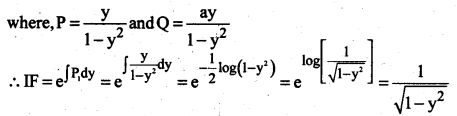
4) \(\frac{1}{\sqrt{1-y^2}}\)
Given D.E is (1 – y2)\(\frac{d x}{d y}\) + yx = ay ⇒ \(\frac{d x}{d y}+\frac{y x}{1-y^2}=\frac{a y}{1-y^2}\) This is in the \(\frac{d y}{d x}+P y=Q\) form
Question 10.
The general solution of the differential equation \(\frac{y d x-x d y}{y}=0\) is
1) xy = C
2) x = Cy2
3) y = Cx
4) y = Cx2
Solution:
3) y = Cx
Given D.E. is \(\frac{y d x-x d y}{y}=0 \Rightarrow \frac{y d x-x d y}{x y}=0 \Rightarrow \frac{1}{x} d x-\frac{1}{y} d y=0\)
⇒ log |x| = log |y| = log k ⇒ \(\log \left|\frac{x}{y}\right|=\log k \Rightarrow \frac{x}{y}=k \Rightarrow y=\frac{1}{k} x \Rightarrow y=C x\) (where, C = \(\frac{1}{k}\))
Question 11.
The general solution of a D.E of the type \(\frac{d x}{d y}+P_1 x=Q_1\) (P1, Q1 are functions of y) is
1) \(y e^{\int P_1 d y}=\int\left(Q_1 e^{\int P_1 d y}\right) d y+C\)
2) \(y . e^{\int P_1 d x}=\int\left(Q_1 e^{\int P_1 d x}\right) d x+C .\)
3) \(x e^{\int P_1 d y}=\int\left(Q_1 e^{\int P_1 d y}\right) d y+C\)
4) \(x e^{\int P_1 d x}=\int\left(\mathbf{Q}_1 e^{\int \mathbf{P}_1 d \mathrm{x}}\right) \mathrm{dx}+\mathbf{C}\)
Solution:
3) \(x e^{\int P_1 d y}=\int\left(Q_1 e^{\int P_1 d y}\right) d y+C\)
IF for \(\frac{d x}{d y}+P_1 x=Q_1^{\prime} \text { is } e^{\int P_1 d y} \Rightarrow x(\text { I.F. })=\left(\int Q_1 \times \text { IF }\right) d y+C \Rightarrow x . e^{\int P_1 d y}=\int\left(Q_1 e^{\int P_1 d y}\right) d y+C\)
Question 12.
The general solution of the differential equation ex dy + (y ex + 2x) dx = 0 is
1) x ey + x2 = C
2) x ey + y2 = C
3) y ex + x2 = C
4) y ey + x2 = C
Solution:
3) y ex + x2 = C
Given D.E is ex dy + (yex + 2x)dx = 0 ⇒ ex\(\frac{d y}{d x}\) + yex + 2x = 0 ⇒ \(\frac{d y}{d x}\) + y = \(\frac{2 x}{e^x}\) = 0
⇒ \(\frac{d y}{d x}\) + y = 2xe-x = 0 ⇒ \(\frac{d y}{d x}\) + y = -2xe-x
This is a Linear D.E form \(\frac{d y}{d x}\) + Py = Q where, P = I and Q = -2xe-x
Now, IF = \(\mathrm{e}^{\int \mathrm{Pdx}}=\mathrm{e}^{\int \mathrm{dx}}=\mathrm{e}^{\mathrm{x}} \Rightarrow \overline{\mathrm{y}}(\mathrm{IF})=\int(\mathrm{Q} \times \mathrm{IF}) \mathrm{dx}+\mathrm{C}\)
∴ yex = \(\int\left(-2 x e^{-x} \cdot e^x\right) d x+C \Rightarrow y e^x=-\int 2 x d x+C\) ⇒ yex = -x2 + C ⇒ yex + x2 = C
Question 13.
General solution of the differential equation \(\log \left(\frac{d y}{d x}\right)\) = 2x + y is
1) \(e^{-y}=\frac{1}{2} e^{2 x}+C\)
2) \(\frac{1}{e^y}+\frac{1}{2} e^{2 x}=C\)
3) \(-e^{-y}=\frac{1}{2} e^{2 x}+C\)
4) \(e^y=\frac{1}{2} e^{2 x}+C\)
Solution:
3) \(-e^{-y}=\frac{1}{2} e^{2 x}+C\)
\(\log _{\mathrm{e}}\left[\frac{\mathrm{dy}}{\mathrm{dx}}\right]\) = 2x + y \(\frac{d y}{d x}\) = e2x+y ⇒ \(\frac{d y}{d x}\) = e2x.ey \(\frac{1}{e^y}\)dy = e2x dx
Integrating \(\int e^{-y} d y=\int e^{2 x} d x \Rightarrow-e^{-y}=\frac{e^{2 x}}{2}+c\)
Question 14.
General solution of differential equation \(\frac{d y}{d x}=\frac{y}{x}\) is
1) log y = Cx
2) y = Cx
3) xy = C
4) y = C log x
Solution:
2) y = Cx
\(\frac{d y}{d x}=\frac{y}{x} \Rightarrow \frac{d y}{y}=\frac{d x}{x} \Rightarrow \int \frac{1}{y} d y=\int \frac{1}{x} d x\) ⇒ log |y| = log |x| + log |c| ⇒ log |y| = log |cx| ⇒ y = cx.
Question 15.
The degree of the differential equation \(\left(1+\frac{d y}{d x}\right)^3=\left(\frac{d y}{d x}\right)^2\) is
1) 1
2) 2
3) 3
4) 4
Solution:
3) 3
order = 1; degree = 3
Question 16.
The degree of the differential equation \(\frac{d^2 y}{d x^2}+3\left(\frac{d y}{d x}\right)^2=x^2 \log \left(\frac{d^2 y}{d x^2}\right)\) is
1) 1
2) 2
3) 4
4) not defined
Solution:
4) not defined
The given equation is not a polynomial equation in \(\left(\frac{\mathrm{dy}}{\mathrm{dx}}\right)\).
Here, its degree is not defined. Hence, degree not defined
Question 17.
Order of differential equation corresponding to family of curves y = Ae2x + Be-2x is
1) 2
2) 1
3) 3
4) 4
Solution:
1) 2
y = Ae2x + Be-2x arbitary constants = 2
∴ Order of D.E is ‘2’
Question 18.
The general solution of differential equation \(\frac{d y}{d x}=e^{x-y}\) is
1) ey = ex + C
2) ex + ey = C
3) ex+y = C
4) ex-y = C
Solution:
1) ey = ex + C
\(\frac{d y}{d x}=e^x \cdot e^{-y} \Rightarrow \frac{1}{e^{-y}} d y=e^x d x \Rightarrow e^y d y=e^x d x \Rightarrow \int e^y d y=\int e^x d x \Rightarrow e^y=e^x+c\)
Question 19.
The order and degree of the differential equation \(\frac{d y}{d x}=\left(\frac{d^2 y}{d x^2}+2\right)^{1 / 2}+\frac{d^2 y}{d x^2}+5\) are respectively
1) 2, 1
2) 2, 4
3) 2, 2
4) 2, 3
Solution:
3) 2, 2
Transposing the terms properly and squaring on both sides we get \(\left[\left(\frac{d y}{d x}\right)-\left(\frac{d^2 y}{d x^2}\right)-5\right]^2=\frac{d^2 y}{d x^2}+2\)
∴ order = 2 ; degree = 2
Question 20.
The differential equation for which ax + by = 1 is general solution (a, b are arbitrary constants) is
1) \(\frac{d y}{d x}=x+C\)
2) \(y \frac{d^2 y}{d x^2}+x=1\)
3) \(\frac{d^2 y}{d x^2}=0\)
4) \(\frac{d^3 y}{d x^3}=0\)
Solution:
3) \(\frac{d^2 y}{d x^2}=0\)
Given ax + by = 1 ⇒ a(1) + b\(\left(\frac{\mathrm{dy}}{\mathrm{dx}}\right)\) = 0 Again diff w.r.t ‘x’, 0 + b\(\left(\frac{\mathrm{d}^2 \mathrm{y}}{\mathrm{dx}^2}\right)=0 \Rightarrow \frac{\mathrm{~d}^2 \mathrm{y}}{\mathrm{dx}^2}=0\)