
Practice AP Inter 2nd Year Maths Study Material Chapter 8 Application of Integrals MCQ to identify your strengths and weak areas.
AP Inter 2nd Year Maths Application of Integrals MCQ
I. Select the correct option from the given choices.
Question 1.
Area lying in the first quadrant and bounded by the circle x2 + y2 = 4 and the lines x = 0 and x = 2 is
1) π
2) \(\frac{\pi}{2}\)
3) \(\frac{\pi}{3}\)
4) \(\frac{\pi}{4}\)
Solution:
1) π
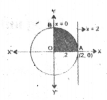
Area(OAB) = \(\int_0^2 \mathrm{ydx}=\int_0^2 \sqrt{4-\mathrm{x}^2} \mathrm{dx}=\left[\frac{\mathrm{x}}{2} \sqrt{4-\mathrm{x}^2}+\frac{4}{2} \sin ^{-1} \frac{\mathrm{x}}{2}\right]_0^2=2\left(\frac{\pi}{2}\right)\) = π sq. units
Question 2.
Area of the region bounded by the curve y2 = 4x, y-axis and the line y = 3 is
1) 2
2) \(\frac{9}{4}\)
3) \(\frac{9}{3}\)
4) \(\frac{9}{2}\)
Solution:
2) \(\frac{9}{4}\)
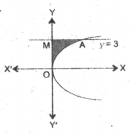
Area (OAM) = \(\int_0^3 x d y=\int_0^3 \frac{y^2}{4} d y=\frac{1}{4}\left[\frac{y^3}{3}\right]_0^3=\frac{1}{12}(27)=\frac{9}{4} \text { sq.units }\)

Question 3.
Area bounded by the curve y = x3, the x-axis and the ordinates x = – 2 and x = 1 is
1) -9
2) \(\frac{-15}{4}\)
3) \(\frac{15}{4}\)
4) \(\frac{17}{4}\)
Solution:
4) \(\frac{17}{4}\)
Required area = \(-\int_{-2}^0 y d x+\int_0^1 y d x\)
= \(-\int_{-2}^0 x^3 d x+\int_0^1 x^3 d x=-\left[\frac{x^4}{4}\right]_{-2}^0+\left[\frac{x^4}{4}\right]_0^1=-\left[0-\frac{(-2)^4}{4}\right]+\left[\frac{1}{4}-0\right]=\left(4+\frac{1}{4}\right)=\frac{17}{4} \text { sq.units }\)
Question 4.
The area bounded by the curve y = x |x| , x-axis and the ordinates x = – 1 and x = 1 is given by [Hint: y = x2 if x > 0 and y = -x2 if x < 0|
1) 0
2) \(\frac{1}{3}\)
3) \(\frac{2}{3}\)
4) \(\frac{4}{3}\)
Solution:
3) \(\frac{2}{3}\)
Required area = \(\int_{-1}^1 y d x=\int_{-1}^1 x|x| d x=-\int_{-1}^0 x^2 d x+\int_0^1 x^2 d x\)
= \(\left[\frac{x^3}{3}\right]_{-1}^0+\left[\frac{x^3}{3}\right]_0^1=-\left(-\frac{1}{3}\right)+\frac{1}{3}=\frac{2}{3} \text { sq.units }\)
Question 5.
Area under the curve y = \(\sqrt{a^2-x^2}\) included between the lines x = 0 and x = a is
1) \(\frac{\pi \mathrm{a}^2}{2}\)
2) \(\frac{\pi \mathrm{a}^2}{4}\)
3) \(\frac{\pi \mathrm{a}}{2}\)
4) \(\frac{\pi \mathrm{a}}{4}\)
Solution:
1) \(\frac{\pi \mathrm{a}^2}{2}\)
Area \(\int_0^a \sqrt{a^2-x^2} d x\) = Area of the circle x2 + y2 = a2 in 1st quadrant = \(\frac{1}{4}\)(πa2)
Question 6.
The area bounded by y = sin2x the x – axis and the lines x = \(\frac{\pi}{2}\) and x = \(\frac{3\pi}{4}\) is
1) 1sq units
2) 2sq. units
3) 4sq. units
4) \(\frac{3}{2}\)sq. units
Solution:
1) 1sq units
y = sin2x ⇒ y > 0 if x < 2x < π; i.e., 0 < x <\(\frac{\pi}{2}\) and y < 0 if π < 2x < 2π; i.e., \(\frac{\pi}{2}\) < x < π
A = \(\int_{\pi / 4}^{3 \pi / 4} \sin (2 x) d x=\int_{\pi / 4}^{\pi / 2} \sin (2 x) d x-\int_{\pi / 2}^{3 \pi / 4} \sin (2 x) d x=-\left[\frac{\cos (2 x)}{2}\right]_{\pi / 4}^{\pi / 2}-\left[-\frac{\cos (2 x)}{2}\right]_{\pi / 2}^{3 \pi / 4}\)
= \(-\frac{1}{2}\left[\cos \pi-\cos \frac{\pi}{2}\right]+\frac{1}{2}\left[\cos \left(\frac{3 \pi}{2}\right)-\cos \pi\right]=-\frac{1}{2}[-1-0]+\frac{1}{2}[0-(-11)]=\frac{1}{2}+\frac{1}{2}(1)=1 \text { sq.units }\)
Question 7.
The area bounded by the curve y = x2 – 4, and the lines y = 0 and y = 5 is
1) \(\frac{38}{3}\)
2) \(\frac{76}{3}\)
3) \(\frac{16}{3}\)
4) \(\frac{8}{3}\)
Solution:
2) \(\frac{76}{3}\)
Given y = x2 – 4 ⇒ x2 = y + 4 ⇒ x = \(\sqrt{y+4}\)
Required Area A = \(2\left[\int_0^5 \mathrm{xdx}\right]=2\left[\int_0^5 \sqrt{\mathrm{y}+4} \mathrm{dy}\right]=2\left[\frac{2}{3}(\mathrm{y}+4) \sqrt{\mathrm{y}+4}\right]_0^5\)
= \(\frac{4}{3}[9 \sqrt{9}-(4 \sqrt{4})]=\frac{4}{3}[27-8]=\frac{4 \times 19}{3}=\frac{76}{3} \text { sq.units }\)
Question 8.
The area of the region bounded by parabola y2 = 8x and latus rectum is
1) \(\frac{4}{3}\)
2) \(\frac{16}{3}\)
3) \(\frac{32}{3}\)
4) \(\frac{8}{3}\)
Solution:
3) \(\frac{32}{3}\)
y2 = 8x y = \(\sqrt{8 x}=2 \sqrt{2 x}\)
Area = \(2 \int_0^2(y) d x=2\left[\int_0^2 2 \times 2 \sqrt{x} d x\right]=2 \times 2 \sqrt{2}\left(\frac{2}{3} x \sqrt{x}\right)_0^2=\frac{8 \sqrt{2}}{3}(2 \sqrt{2}-0)=\frac{16 \times 2}{3}=\frac{32}{3} \text { sq.units }\)
Question 9.
The area bounded by the curve y = 2x – x2 and the line y = -x is
1) \(\frac{7}{2}\)
2) 7
3) \(\frac{9}{2}\)
4) 9
Solution:
3) \(\frac{9}{2}\)
Given y = 2x – x2 ………..(1) (Upper curve) y = -x …….(2) (Lower curve)
Solving (1) and (2)
-x = 2x – x2 ⇒ x2 – x – 2x = 0 ⇒ x2 – 3x = 0 ⇒ x(x – 3) = 0 ⇒ x = 0 x = 3
Area = \(\int_0^3\left(2 x-x^2\right)-(-x) d x=\int_0^3\left(3 x-x^2\right) d x=\left(3 \frac{x^2}{2}-\frac{x^3}{3}\right)_0^3\)
= \(\frac{3}{2} \times 9-\frac{27}{3}-(0)=\frac{27}{2}-\frac{27}{3}=27\left(\frac{1}{6}\right)=\frac{9}{2} \text { sq.units }\)
Question 10.
The area enclosed between the graph of y = x3 and the lines x = 0, y = 1, y = 8 is
1) 7
2) 14
3) \(\frac{45}{4}\)
4) \(\frac{54}{4}\)
Solution:
3) \(\frac{45}{4}\)
y = x3
x = 0 (y-axis), y = 1 , y =8
A = \(\int_1^8(x) d x=\int_1^8 y^{\frac{1}{3}} d x=\left(\frac{y^{\frac{1}{3}}+1}{\frac{1}{3}+1}\right)_1^8=\frac{3}{4}\left(y^{\frac{4}{3}}\right)_1^8=\frac{3}{4}\left[2^4-1\right]=\frac{3 \times 15}{4}=\frac{45}{4} \text { sq.units }\)
Question 11.
The area of the region bounded by the curve y2 = x, the Y-axis and between y = 2 and y = 12.
1) \(\frac{52}{2}\)
2) \(\frac{54}{3}\)
3) \(\frac{56}{3}\)
4) \(\frac{58}{3}\)
Solution:
3) \(\frac{56}{3}\)
y2 = x; y-axis(x = 0), y = 2, y = 4
Area = \(\int_2^4(x) d x=\int_2^4 y^2 d x=\left[\frac{y^3}{3}\right]_2^4=\frac{1}{3}[64-8]=\frac{1}{3}[56]=\frac{56}{3} \text { sq.units }\)
Question 12.
Area of the region bounded by the curve y = cos x between x – 0 and x = π and the X-axis is
1) 1
2) 2
3) 3
4) 4
Solution:
2) 2
y = cos x, x = 0 (y-axis), x = π, x-axis (y = 0)
Required Area = \(2 \int_0^{\pi / 2}(y) d x=2 \int_0^{\pi / 2} \cos x d x=2[\sin x]_0^{\pi / 2}=2\left[\sin 90^{\circ}-\sin 0^{\circ}\right]=2[1-0]=2\)
Question 13.
Area of the region bounded by the curve x = 2y + 3, the Y-axis and between y = -1 and y = 1 is
1) 6
2) 4
3) 8
4) 3/2
Solution:
1) 6
Given x = 2y + 3
Area A = \(\int_{-1}^1(x) d y=\int_{-1}^1(2 y+3) d y=\left(\frac{2 y^2}{2}+3 y\right)_{-1}^1\) = 1 + 3 – [1 – 3] = 4 – (-2) = 6 sq. units
Question 14.
The area bounded by the curve y = x3, X-axis and two ordinates x = 1 and x = 2 is
1) \(\frac{15}{2}\)
2) \(\frac{15}{4}\)
3) \(\frac{17}{2}\)
4) \(\frac{17}{4}\)
Solution:
2) \(\frac{15}{4}\)
y = x3 x – axis (y = 0) x = 1, x = 2
Area = \(\int_1^2(y) d x=\int_1^2 x^3 d x=\left(\frac{x^4}{4}\right)_1^2=\frac{16}{4}-\frac{1}{4}=\frac{15}{4} \text { sq.units }\)
Question 15.
The area bounded by the curves y2 = 4x and y = x is equal to
1) \(\frac{1}{3}\)
2) \(\frac{8}{3}\)
3) \(\frac{35}{6}\)
4) \(\frac{7}{3}\)
Solution:
2) \(\frac{8}{3}\)
y2 = 4x ⇒ y = 2\(\sqrt{x}\) …(1) (Upper curve) y = x ……(2) (Lower curve)
Solving (1) and (2) y2 = 4y y(y – 4) = 0 y = 0; y = 4
Area = \(\int_1^4(2 \sqrt{x}-x) d x=2 \int_1^4 \sqrt{x} d x=\int_1^4 x d x=2 \frac{2}{3}(x \sqrt{x})_0^4-\left(\frac{x^4}{2}\right)_0^4=\frac{4}{3}[4 \sqrt{4}]-\frac{1}{2}\)
= \(\frac{32}{3}-\frac{16}{2}=\frac{32}{3}-8=\frac{32-24}{3}=\frac{8}{3} \text { sq.units }\)