TS Inter 1st Year Maths 1B Limits and Continuity Important Questions Short Answer Type

Students must practice these Maths 1B Important Questions TS Inter 1st Year Maths 1B Limits and Continuity Important Questions Short Answer Type to help strengthen their preparations for exams.

TS Inter 1st Year Maths 1B Limits and Continuity Important Questions Short Answer Type

Question 1.
Is the function f, defined by f(x) = \(\left\{\begin{array}{l}
x^2 \text { if } x \leq 1 \\
x \text { if } x>1
\end{array}\right.\), continuous on R. [May ’15 (AP), ’11]
Solution:
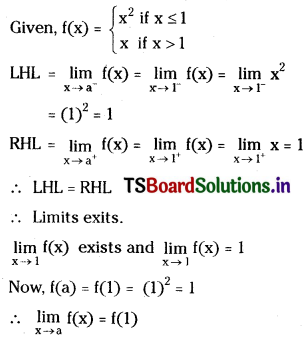
We find the limit at a = 1
TS Inter First Year Maths 1B Limits and Continuity Important Questions Short Answer Type Q1
∴ f is continuous at x = 1
Hence f is continuous on R.

Question 2.
Is f defined by f(x) = \(\begin{cases}\frac{\sin 2 x}{x} & \text { if } x \neq 0 \\ 1, & \text { if } x=0\end{cases}\), continuous on ‘0’? [May ’12, ’10, ’04; Mar. ’05]
Solution:
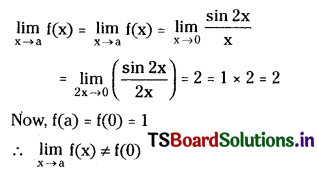
Given, f(x) = \(\begin{cases}\frac{\sin 2 x}{x} & \text { if } x \neq 0 \\ 1, & \text { if } x=0\end{cases}\)
Take a = 0
TS Inter First Year Maths 1B Limits and Continuity Important Questions Short Answer Type Q2
∴ f is discontinuous at x = 0.

TS Inter First Year Maths 1B Limits and Continuity Important Questions Short Answer Type

Question 3.
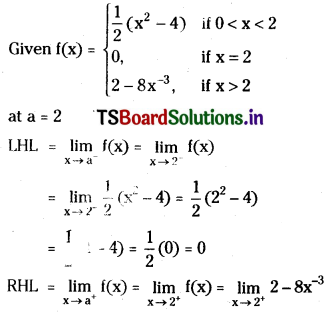
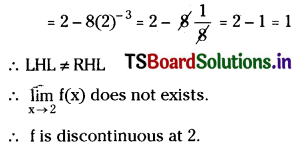
Check the continuity of the following function at 2.
f(x) = \(\begin{cases}\frac{1}{2}\left(x^2-4\right) & \text { if } 0<x<2 \\ 0, & \text { if } x=2 \\ 2-8 x^{-3}, & \text { if } x>2\end{cases}\). [Mar. ’19 (TS): Mar. ’17 (AP): May ’15 (TS), ’08]
Solution:
TS Inter First Year Maths 1B Limits and Continuity Important Questions Short Answer Type Q3
TS Inter First Year Maths 1B Limits and Continuity Important Questions Short Answer Type Q3.1

Question 4.
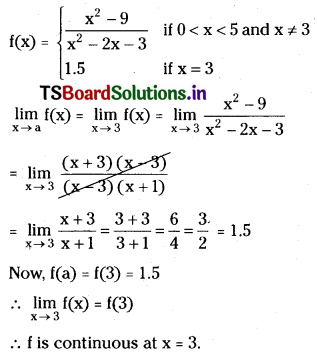
Check the continuity of f given by f(x) = \(f(x)= \begin{cases}\frac{x^2-9}{x^2-2 x-3} & \text { if } 0<x<5 \text { and } x \neq 3 \\ 1.5 & \text { if } x=3\end{cases}\) at the point 3. [Mar. ’15 (AP), ’14, ’13, ’02; May ’04]
Solution:
TS Inter First Year Maths 1B Limits and Continuity Important Questions Short Answer Type Q4

Question 5.
Prove that the functions sin x and cos x are continuous on R. [May ’08]
Solution:
(i) Let f(x) = sin x and a ∈ R
\(\lim _{x \rightarrow a} f(x)=\lim _{x \rightarrow a} \sin x\) = sin a = f(a)
∴ \(\lim _{x \rightarrow a} f(x)\) = f(a)
∴ f is continuous at x = a
∴ Since a is arbitrary, f is continuous on R.
(ii) Let g(x) = cos x and a ∈ R
\(\lim _{x \rightarrow a} g(x)=\lim _{x \rightarrow a} \cos x\) = cos a = g(a)
∴ \(\lim _{x \rightarrow a} g(x)\) = g(a)
∴ g is continuous at x = a
∴ since a is arbitrary, g is continuous on R.

Question 6.
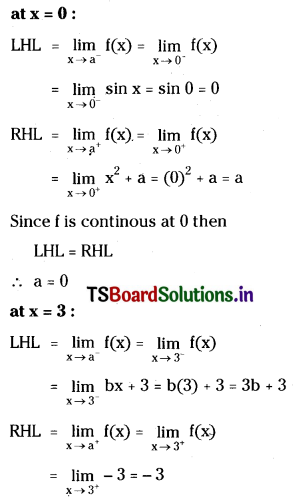
Find real constants a, b so that the function f is given by f(x) = \(\begin{cases}\sin x & \text { if } x \leq 0 \\ x^2+\mathbf{a} & \text { if } 0<x<1 \\ \mathbf{b x}+3 & \text { if } 1 \leq x \leq 3 \\ -3 & \text { if } x>3\end{cases}\) is continuous on R. [Mar. ’18 (AP & TS); May ’13]
Solution:
Given, f(x) = \(\begin{cases}\sin x & \text { if } x \leq 0 \\ x^2+\mathbf{a} & \text { if } 0<x<1 \\ \mathbf{b x}+3 & \text { if } 1 \leq x \leq 3 \\ -3 & \text { if } x>3\end{cases}\)
Since f is continuous on R.
f is continuous at 0, 3.
TS Inter First Year Maths 1B Limits and Continuity Important Questions Short Answer Type Q6
Since f is continuous at x = 3 then
LHL = RHL
3b + 3 = -3
3b = -3 – 3
b = -2
∴ a = 0, b = -2

TS Inter First Year Maths 1B Limits and Continuity Important Questions Short Answer Type

Question 7.
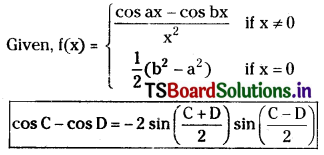
Show that f(x) = \(\left\{\begin{array}{cl}
\frac{\cos a x-\cos b x}{x^2} & \text { if } x \neq 0 \\
\frac{1}{2}\left(b^2-a^2\right) & \text { if } x=0
\end{array}\right.\) where a and b are real constants, is continuous at ‘0’. [Mar. ’17 (TS), ’13(old), ’09; May ’14; B.P.]
Solution:
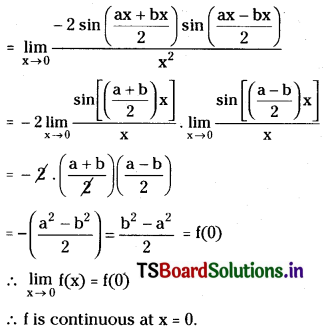
TS Inter First Year Maths 1B Limits and Continuity Important Questions Short Answer Type Q7
TS Inter First Year Maths 1B Limits and Continuity Important Questions Short Answer Type Q7.1

Some More Maths 1B Limits and Continuity Important Questions Short Answer Type

Question 8.
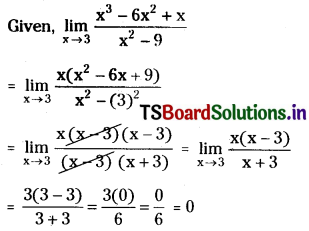
Find \(\lim _{x \rightarrow 3} \frac{x^3-6 x^2+x}{x^2-9}\)
Solution:
TS Inter First Year Maths 1B Limits and Continuity Important Questions Short Answer Type Some More Q1

Question 9.
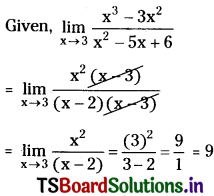
Find \(\lim _{x \rightarrow 3} \frac{x^3-3 x^2}{x^2-5 x+6}\)
Solution:
TS Inter First Year Maths 1B Limits and Continuity Important Questions Short Answer Type Some More Q2

Question 10.
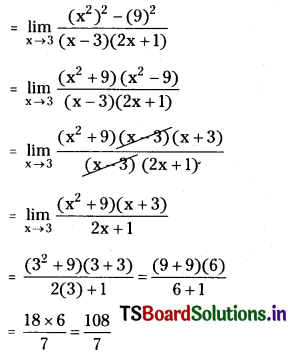
Compute \(\lim _{x \rightarrow 3} \frac{x^4-81}{2 x^2-5 x-3}\)
Solution:
Given, \(\lim _{x \rightarrow 3} \frac{x^4-81}{2 x^2-5 x-3}\)
TS Inter First Year Maths 1B Limits and Continuity Important Questions Short Answer Type Some More Q3

Question 11.
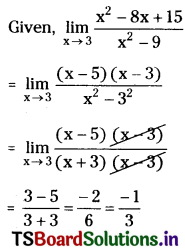
Compute \(\lim _{x \rightarrow 3} \frac{x^2-8 x+15}{x^2-9}\). [Mar. ’16 (AP & TS)]
Solution:
TS Inter First Year Maths 1B Limits and Continuity Important Questions Short Answer Type Some More Q4

Question 12.
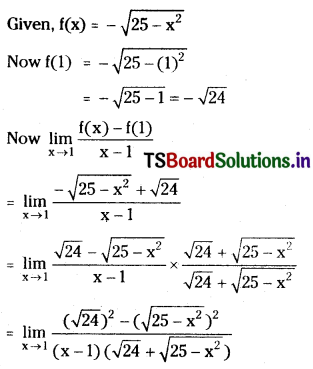
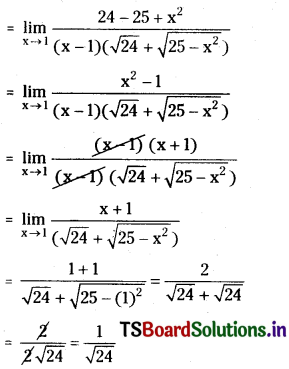
If f(x) = \(-\sqrt{25-x^2}\) then find \(\lim _{x \rightarrow 1} \frac{f(x)-f(1)}{x-1}\)
Solution:
TS Inter First Year Maths 1B Limits and Continuity Important Questions Short Answer Type Some More Q5
TS Inter First Year Maths 1B Limits and Continuity Important Questions Short Answer Type Some More Q5.1

TS Inter First Year Maths 1B Limits and Continuity Important Questions Short Answer Type

Question 13.
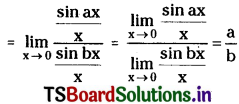
Compute \(\lim _{x \rightarrow 0} \frac{\sin a x}{\sin b x}\), b ≠ 0, a ≠ b. [Mar. ’18 (TS)]
Solution:
Given, \(\lim _{x \rightarrow 0} \frac{\sin a x}{\sin b x}\)
Now dividing the numerator and denominator by x, we get
TS Inter First Year Maths 1B Limits and Continuity Important Questions Short Answer Type Some More Q6

Question 14.
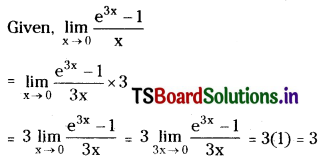
Compute \(\lim _{x \rightarrow 0} \frac{e^{3 x}-1}{x}\). [Mar. ’18 (AP); May ’15 (TS)]
Solution:
TS Inter First Year Maths 1B Limits and Continuity Important Questions Short Answer Type Some More Q7

Question 15.
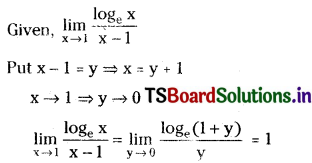
Evaluate \(\lim _{x \rightarrow 1} \frac{\log _e x}{x-1}\).
Solution:
TS Inter First Year Maths 1B Limits and Continuity Important Questions Short Answer Type Some More Q8

Question 16.
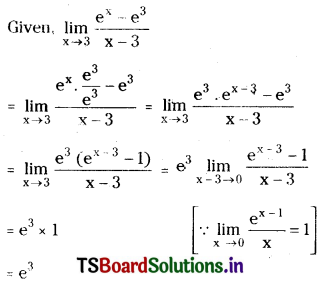
Compute \(\lim _{x \rightarrow 3} \frac{e^x-e^3}{x-3}\)
Solution:
TS Inter First Year Maths 1B Limits and Continuity Important Questions Short Answer Type Some More Q9

Question 17.
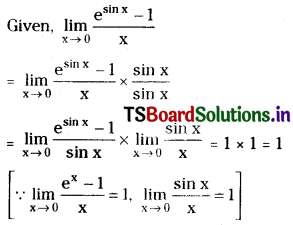
Compute \(\lim _{x \rightarrow 0} \frac{e^{\sin x}-1}{x}\)
Solution:
TS Inter First Year Maths 1B Limits and Continuity Important Questions Short Answer Type Some More Q10

TS Inter First Year Maths 1B Limits and Continuity Important Questions Short Answer Type

Question 18.
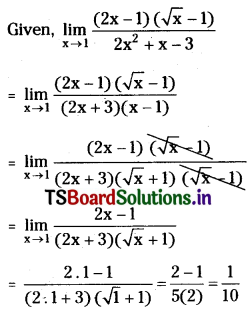
Compute \(\lim _{x \rightarrow 1} \frac{(2 x-1)(\sqrt{x}-1)}{2 x^2+x-3}\)
Solution:
TS Inter First Year Maths 1B Limits and Continuity Important Questions Short Answer Type Some More Q11

Question 19.
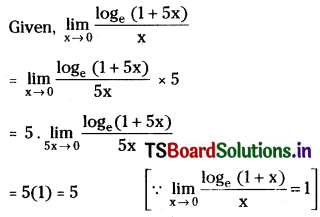
Compute \(\lim _{x \rightarrow 0} \frac{\log _e(1+5 x)}{x}\)
Solution:
TS Inter First Year Maths 1B Limits and Continuity Important Questions Short Answer Type Some More Q12

Question 20.
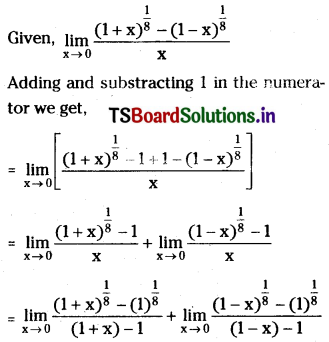
Compute \(\lim _{x \rightarrow 0} \frac{(1+x)^{\frac{1}{8}}-(1-x)^{\frac{1}{8}}}{x}\)
Solution:
TS Inter First Year Maths 1B Limits and Continuity Important Questions Short Answer Type Some More Q13
TS Inter First Year Maths 1B Limits and Continuity Important Questions Short Answer Type Some More Q13.1

Question 21.
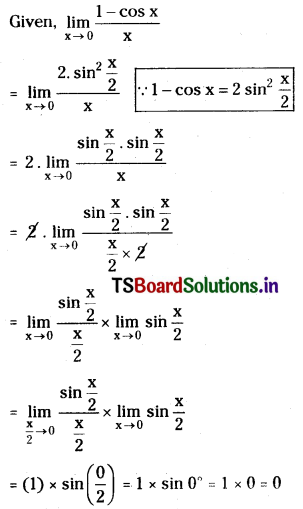
Compute \(\lim _{x \rightarrow 0} \frac{1-\cos x}{x}\)
Solution:
TS Inter First Year Maths 1B Limits and Continuity Important Questions Short Answer Type Some More Q14

Question 22.
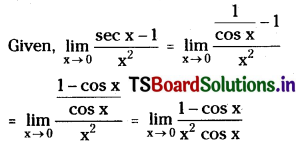
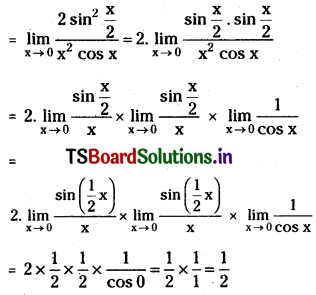
Compute \(\lim _{x \rightarrow 0} \frac{\sec x-1}{x^2}\)
Solution:
TS Inter First Year Maths 1B Limits and Continuity Important Questions Short Answer Type Some More Q15
TS Inter First Year Maths 1B Limits and Continuity Important Questions Short Answer Type Some More Q15.1

TS Inter First Year Maths 1B Limits and Continuity Important Questions Short Answer Type

Question 23.
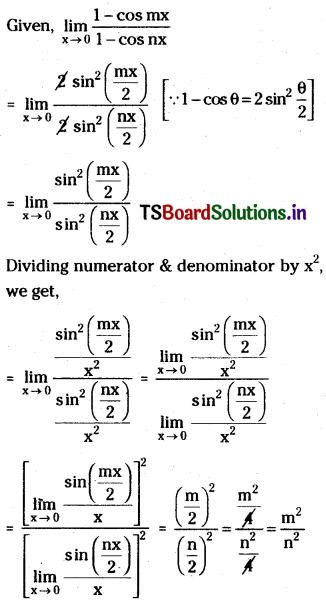
Compute \(\lim _{x \rightarrow 0} \frac{1-\cos m x}{1-\cos n x}\), n ≠ 0.
Solution:
TS Inter First Year Maths 1B Limits and Continuity Important Questions Short Answer Type Some More Q16

Question 24.
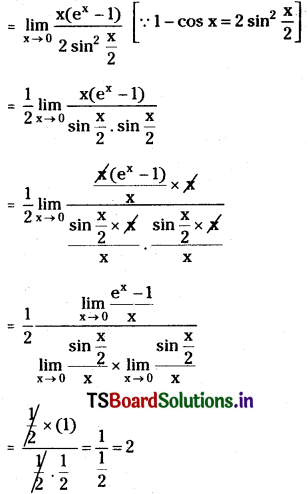
Compute \(\lim _{x \rightarrow 0} \frac{x\left(e^x-1\right)}{1-\cos x}\). [May ’14]
Solution:
Given, \(\lim _{x \rightarrow 0} \frac{x\left(e^x-1\right)}{1-\cos x}\)
TS Inter First Year Maths 1B Limits and Continuity Important Questions Short Answer Type Some More Q17

Question 25.
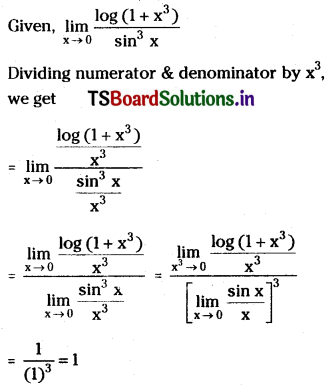
Compute \(\lim _{x \rightarrow 0} \frac{\log \left(1+x^3\right)}{\sin ^3 x}\)
Solution:
TS Inter First Year Maths 1B Limits and Continuity Important Questions Short Answer Type Some More Q18

Question 26.
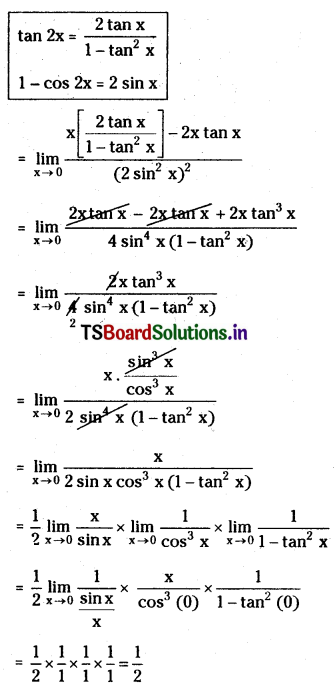
Compute \(\lim _{x \rightarrow 0} \frac{x \tan 2 x-2 x \tan x}{(1-\cos 2 x)^2}\)
Solution:
Given, \(\lim _{x \rightarrow 0} \frac{x \tan 2 x-2 x \tan x}{(1-\cos 2 x)^2}\)
TS Inter First Year Maths 1B Limits and Continuity Important Questions Short Answer Type Some More Q19

Question 27.
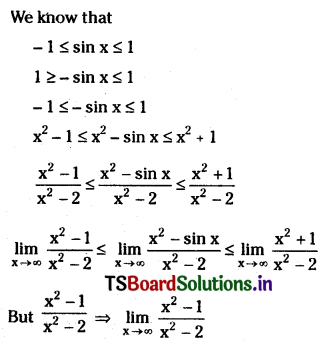
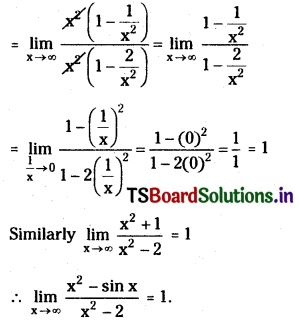
Compute \(\lim _{x \rightarrow \infty} \frac{x^2-\sin x}{x^2-2}\). [May ’16 (AP)]
Solution:
TS Inter First Year Maths 1B Limits and Continuity Important Questions Short Answer Type Some More Q20
TS Inter First Year Maths 1B Limits and Continuity Important Questions Short Answer Type Some More Q20.1

Question 28.
Compute \(\lim _{x \rightarrow 3} \frac{x^2+3 x+2}{x^2-6 x+9}\). [Mar. ’19 (AP)]
Solution:
TS Inter First Year Maths 1B Limits and Continuity Important Questions Short Answer Type Some More Q21

TS Inter First Year Maths 1B Limits and Continuity Important Questions Short Answer Type

Question 29.
Compute \(\lim _{x \rightarrow \infty} \frac{3 x^2+4 x+5}{2 x^3+3 x-7}\). [May ’15 (AP)]
Solution:
TS Inter First Year Maths 1B Limits and Continuity Important Questions Short Answer Type Some More Q22

Question 30.
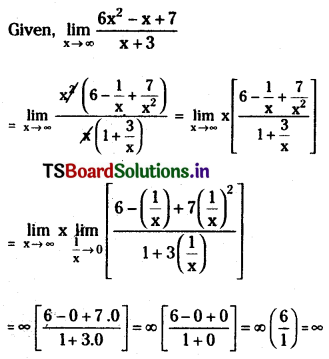
Compute \(\lim _{x \rightarrow \infty} \frac{6 x^2-x+7}{x+3}\).
Solution:
TS Inter First Year Maths 1B Limits and Continuity Important Questions Short Answer Type Some More Q23

Question 31.
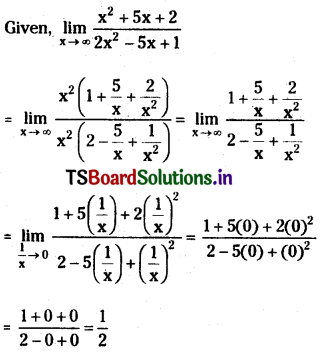
Compute \(\lim _{x \rightarrow \infty} \frac{x^2+5 x+2}{2 x^2-5 x+1}\). [May ’14; Mar. ’17 (AP)]
Solution:
TS Inter First Year Maths 1B Limits and Continuity Important Questions Short Answer Type Some More Q24

Question 32.
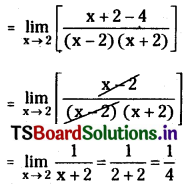
Compute \(\lim _{x \rightarrow 2}\left[\frac{1}{x-2}-\frac{4}{x^2-4}\right]\)
Solution:
TS Inter First Year Maths 1B Limits and Continuity Important Questions Short Answer Type Some More Q25
TS Inter First Year Maths 1B Limits and Continuity Important Questions Short Answer Type Some More Q25.1

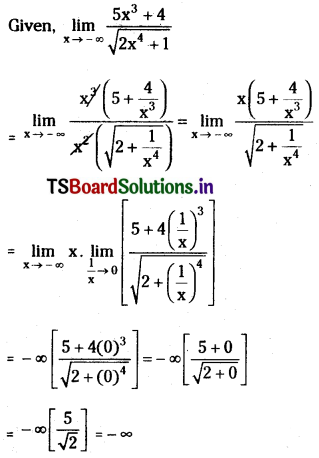
Question 33.
Compute \(\lim _{x \rightarrow-\infty} \frac{5 x^3+4}{\sqrt{2 x^4+1}}\)
Solution:
TS Inter First Year Maths 1B Limits and Continuity Important Questions Short Answer Type Some More Q26

TS Inter First Year Maths 1B Limits and Continuity Important Questions Short Answer Type

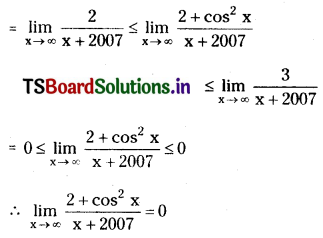
Question 34.
Compute \(\lim _{x \rightarrow \infty} \frac{2+\cos ^2 x}{x+2007}\)
Solution:
Given, \(\lim _{x \rightarrow \infty} \frac{2+\cos ^2 x}{x+2007}\)
We know that
-1 ≤ cos x ≤ 1
0 ≤ cos2x ≤ 1
2 + 0 ≤ 2 + cos2x ≤ 2 + 1
2 ≤ 2 + cos2x ≤ 3
\(\frac{2}{x+2007} \leq \frac{2+\cos ^2 x}{x+2007} \leq \frac{3}{x+2007}\)
TS Inter First Year Maths 1B Limits and Continuity Important Questions Short Answer Type Some More Q27

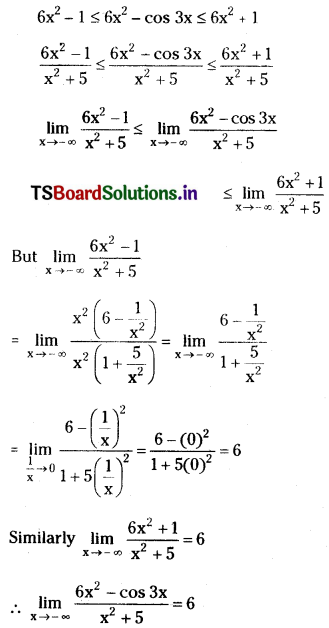
Question 35.
Compute \(\lim _{x \rightarrow-\infty} \frac{6 x^2-\cos 3 x}{x^2+5}\)
Solution:
We know that
-1 ≤ cos x ≤ 1
-1 ≥ cos 3x ≥ 1
1 ≥ -cos 3x ≥ -1
-1 ≤ -cos 3x ≤ 1
TS Inter First Year Maths 1B Limits and Continuity Important Questions Short Answer Type Some More Q28

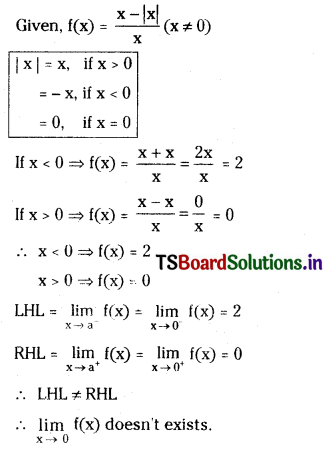
Question 36.
Show that f, given by f(x) = \(\frac{\mathbf{x}-|\mathbf{x}|}{\mathbf{x}}\) (x ≠ 0), is continuous on R – {0}.
Solution:
TS Inter First Year Maths 1B Limits and Continuity Important Questions Short Answer Type Some More Q29
∴ f is discontinuous at x = 0.
∴ Hence f is continuous on R – {0}.

Question 37.
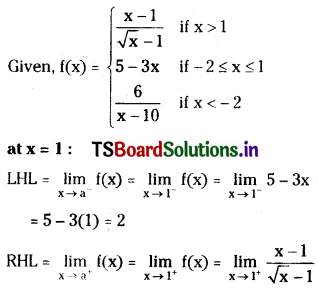
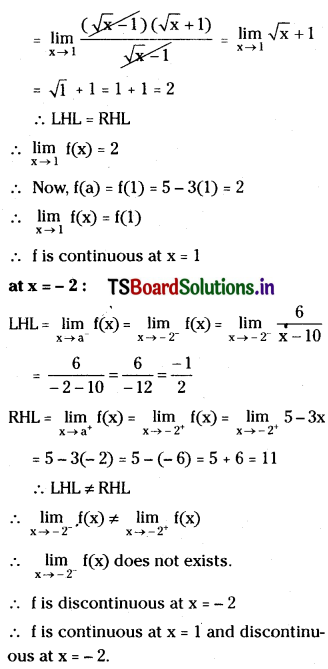
If f is a function defined by f(x) = \(\begin{cases}\frac{x-1}{\sqrt{x}-1} & \text { if } x>1 \\ 5-3 x & \text { if }-2 \leq x \leq 1 \\ \frac{6}{x-10} & \text { if } x<-2\end{cases}\) then discuss the continuity of ‘f’.
Solution:
TS Inter First Year Maths 1B Limits and Continuity Important Questions Short Answer Type Some More Q30
TS Inter First Year Maths 1B Limits and Continuity Important Questions Short Answer Type Some More Q30.1

TS Inter First Year Maths 1B Limits and Continuity Important Questions Short Answer Type

Question 38.
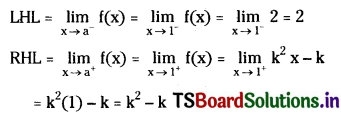
If f, given by f(x) = \(\begin{cases}\mathbf{k}^2 x-k & \text { if } \mathbf{k} \geq 1 \\ 2 & \text { if } x<1\end{cases}\) is a continuous function on R, then find the values of k. [Mar. ’15 (TS)]
Solution:
Given, \(\begin{cases}\mathbf{k}^2 x-k & \text { if } \mathbf{k} \geq 1 \\ 2 & \text { if } x<1\end{cases}\)
∴ f is continuous on R
∴ f is continuous at x = 1
at x = 1, LHL = RHL = f(1) ………(1)
TS Inter First Year Maths 1B Limits and Continuity Important Questions Short Answer Type Some More Q31
From (1), LHL = RHL
⇒ 2 = k2 – k
⇒ k2 – k – 2 = 0
⇒ k2 – 2k + k – 2 = 0
⇒ k(k – 2) + 1(k – 2) = 0
⇒ (k – 2)(k + 1) = 0
⇒ k – 2 = 0 (or) k + 1 = 0
⇒ k = 2 (or) k = -1

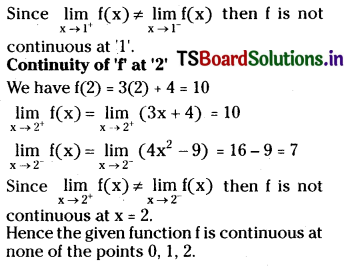
Question 39.
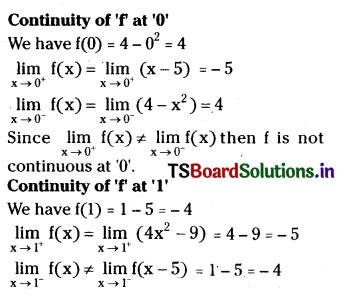
Check the continuity of ‘f’ given by f(x) = \(\left\{\begin{array}{rlr}
4-x^2, & \text { if } & x \leq 0 \\
\mathbf{x}-5, & \text { if } & 0 4 x^2-9, & \text { if } & 1<x<2 \\
3 x+4, & \text { if } & x \geq 2
\end{array}\right.\) at points x = 0, 1, 2. [Mar. ’16 (TS)]
Solution:
TS Inter First Year Maths 1B Limits and Continuity Important Questions Short Answer Type Some More Q32
TS Inter First Year Maths 1B Limits and Continuity Important Questions Short Answer Type Some More Q32.1

TS Inter 1st Year Chemistry Notes Chapter 8 హైడ్రోజన్ – దాని సమ్మేళనాలు

Here students can locate TS Inter 1st Year Chemistry Notes 8th Lesson హైడ్రోజన్ – దాని సమ్మేళనాలు to prepare for their exam.

TS Inter 1st Year Chemistry Notes 8th Lesson హైడ్రోజన్ – దాని సమ్మేళనాలు

→ జగత్తులో అత్యధిక సమృద్ధిగా దొరికేది హైడ్రోజన్. దీనిని శక్తికి మూలస్థానంలో వాడుకోవచ్చు. దీనినే డై హైడ్రోజన్ అని కూడా అంటారు.

→ ఆవర్తన పట్టికలో హైడ్రోజన్ యొక్క స్థానం చర్చనీయాంశం.

→ హైడ్రోజన్ IA గ్రూపులోని క్షార లోహలతోను, VII A గ్రూపులోని హాలోజన్లతోను పోలికలు కలిగి ఉంటుంది.

→ హైడ్రోజన్ కు మూడు సమస్థానీయాలున్నాయి. అవి ప్రోటియమ్, డ్యూటీరియమ్, ట్రైటియమ్.

→ ట్రెటియమ్ మాత్రమే రేడియోధార్మిక పదార్ధం. ఇది అల్పశక్తి కల B-కణాలను ఉద్గారం చేస్తుంది.

→ డై హైడ్రోజన్ను వివిధ పద్ధతులలో తయారుచేస్తారు.

→ హైడ్రోజన్ హాలోజన్లతో హాలైడ్లను, ఆక్సిజన్లో నీటిని, నైట్రోజన్తో అమ్మోనియాను, లోహలతో హైడ్రైడ్లను ఏర్పరుస్తుంది.

TS Inter 1st Year Chemistry Notes Chapter 8 హైడ్రోజన్ – దాని సమ్మేళనాలు

→ హైడ్రోజను అమ్మోనియా సంశ్లేషణలో, నూనెల హైడ్రోజనీకరణంలో, కర్బన రసాయనాల తయారీలో, వెల్డింగ్ మరియు కటింగ్ చేయటానికి, రాకెట్లలో ఇంధనంగా మరియు విద్యుత్ శక్తిని ఉత్పత్తి చేయటంలో వాడతారు.

→ మిగిలిన మూలకాలతో హైడ్రోజన్ ఏర్పరచే ద్విగుణాత్మక సమ్మేళనాలను హైడ్రేడ్లు అంటారు. వీటిని మూడు రకాలుగా వర్గీకరించారు. అయానిక హైడ్రైడ్లు, కోవలెంట్ హైడ్రైడ్లు, నాన్-స్టాయికియోమెట్రిక్ హైడ్రైడ్లు.

→ అన్ని జీవరాశులలోను ఎక్కువ భాగం నీరు ఉంటుంది. ఇది రంగు, రుచిలేని ద్రవం. జలాణువుల మధ్య విస్తృతమైన హైడ్రోజన్ బంధాలు ఉంటాయి. ఇది ద్విస్వభావ ప్రవృత్తిని కలిగి ఉంటుంది.

→ సబ్బుతో నురగను ఇవ్వని నీటిని కఠినజలం అంటారు. నీటిలో కరిగి ఉన్న Ca+2 మరియు Mg+2 లవణాలు నీటి కాఠిన్యానికి కారణాలు.

→ మరిగించటం ద్వారాగాని, క్లార్క్ పద్ధతి, కాల్గన్ పద్ధతి, అయాన్ వినిమయ పద్ధతి, సంశ్లేషిత రెజిన్ల పద్ధతి ద్వారా గాని నీటి కాఠిన్యాన్ని తొలగించవచ్చు.

→ D2O ను భారజలం అంటారు. న్యూక్లియర్ రియాక్టర్లలో మోడరేటు చర్యా విధానాల అధ్యయనంలో వినిమయ కారకంగా D2O ను ఉపయోగిస్తారు.

→ 50% H2SO ను విద్యుద్విశ్లేషణం చేయటం ద్వారా H2O2 తయారు చేస్తారు. H2O2, తెరిచిన పుస్తకాకృతిని కలిగి ఉంటుంది. 30% \(\left(\frac{w}{v}\right)\)H2O ను పెరై డ్రోల్ అంటారు.

TS Inter 1st Year Chemistry Notes Chapter 6 ఉష్ణగతిక శాస్త్రం

Here students can locate TS Inter 1st Year Chemistry Notes 6th Lesson ఉష్ణగతిక శాస్త్రం to prepare for their exam.

TS Inter 1st Year Chemistry Notes 6th Lesson ఉష్ణగతిక శాస్త్రం

→ ఉష్ణగతికశాస్త్ర అధ్యయనంలో మనం విశ్వం అంతటినీ ఊహాత్మకంగా రెండు ఖండాలుగా విభజిస్తాం. దాన్ని వ్యవస్థ అంటారు. మిగిలిన ఖండాన్ని అనియతంగా భావించి, పరిసరాలు అంటారు.

→ వ్యవస్థలను మూడు రకాలుగా వివృత (తెరిచిన) సంవృత (మూసి వుంచిన) వివక్త వ్యవస్థలు అంటాం.

→ వ్యవస్థ ధర్మాలను సౌలభ్యం కోసం గహన (ద్రవ్యం పరిమాణం మీద ఆధారపడినవి) విస్తార (ద్రవ్యం పరిమాణంపై ఆధారపడనివి)లను ఉష్ణగతిక శాస్త్రం ధర్మాలు అని వర్గీకరిస్తాం.

→ ఉష్ణగతికశాస్త్ర ధర్మాలు అంతరిక శక్తి (E), ఎంథాల్పి (H), గిబ్స్ శక్తి (G), ఎంట్రోపి (S), పని (w) మొ॥

→ శూన్య నియమం, రెండు వస్తువుల మధ్య ఉష్ణ సమతాస్థితికి సంబంధించింది. మొదటి నియమం శక్తి నిత్యత్వానికి సంబంధించింది. రెండవ నియమం ప్రక్రియ అయత్నీకృత స్వభావానికి సంబంధించింది. మూడవ నియమం పరమ శూన్య ఉష్ణోగ్రత వద్ద ఉష్ణ మార్పుకు సంబంధించింది.

→ రసాయన చర్యలకు ఉష్ణగతికశాస్త్ర మొదటి నియమ అనువర్తనమే ఉష్ణరసాయనశాస్త్రం,

TS Inter 1st Year Chemistry Notes Chapter 6 ఉష్ణగతిక శాస్త్రం

→ ఈ విభాగంలో భిన్న చరరాశుల పరంగా ఉష్ణశక్తి మార్పులను పరిమాణాత్మకంగా పరిశీలిస్తాం.

→ ఇవి సంశ్లేషణ, బంధ వియోజన, దహనం, తటస్థీకరణ, పరమాణీకరణ ఉత్పతన, ప్రావస్థ మార్పు అయనీకరణ విలీన ఉష్ణాలు.

→ ఉష్ణం మార్పులను కాలరీ మీటర్ల ద్వారా నిర్ణయిస్తారు.

→ ΔG = ΔH – TDS అయత్నీకృత చర్యలను ΔG ఋణ విలువలో వుంటుంది. అయత్నీకృత చర్యలకు ఇదే ధనవిలువలో వుంటుంది. సమతాస్థితి చర్యలకు ఇది సున్నగా వుంటుంది.

→ ఎంట్రోపి (S) ఉష్ణగతికశాస్త్ర ధర్మాన్ని, ఒక వ్యవస్థ క్రమ రాహిత్యాన్ని తెలపడానికి ప్రవేశపెట్టారు.

TS Inter 1st Year Maths 1B Limits and Continuity Important Questions Very Short Answer Type

Students must practice these Maths 1B Important Questions TS Inter 1st Year Maths 1B Limits and Continuity Important Questions Very Short Answer Type to help strengthen their preparations for exams.

TS Inter 1st Year Maths 1B Limits and Continuity Important Questions Very Short Answer Type

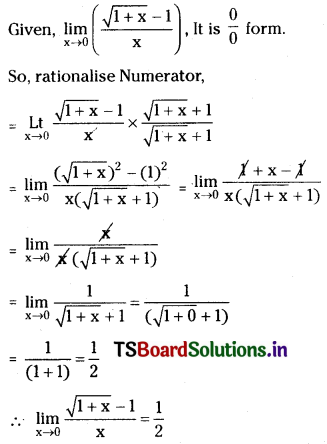
Question 1.
Find \(\lim _{x \rightarrow 0} \frac{\sqrt{1+x}-1}{x}\). [Mar. ’14, ’07, ’04; May ’10]
Solution:
TS Inter First Year Maths 1B Limits and Continuity Important Questions Very Short Answer Type Q1

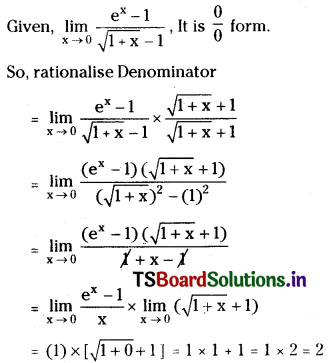
Question 2.
Compute \(\lim _{x \rightarrow 0}\left[\frac{e^x-1}{\sqrt{1+x}-1}\right]\). [Mar. ’15 (TS), ’13 (0ld), ’09]
Solution:
TS Inter First Year Maths 1B Limits and Continuity Important Questions Very Short Answer Type Q2

TS Inter First Year Maths 1B Limits and Continuity Important Questions Very Short Answer Type

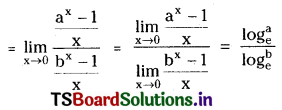
Question 3.
Compute \(\lim _{x \rightarrow 0} \frac{\mathbf{a}^x-1}{\mathbf{b}^x-1}\), (a > 0), (b > 0), (b ≠ 1). [Mar. ’19 (TS); Mar. ’15 (AP), ’13, ’08, ’02; May ’02]
Solution:
Given \(\lim _{x \rightarrow 0} \frac{\mathbf{a}^x-1}{\mathbf{b}^x-1}\)
Now dividing Numerator and Denominator by x, we get
TS Inter First Year Maths 1B Limits and Continuity Important Questions Very Short Answer Type Q3

Question 4.
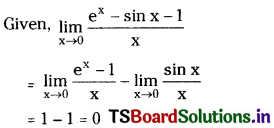
Compute \(\lim _{x \rightarrow 0} \frac{e^x-\sin x-1}{x}\). [Mar. ’16 (TS), ’13]
Solution:
TS Inter First Year Maths 1B Limits and Continuity Important Questions Very Short Answer Type Q4

Question 5.
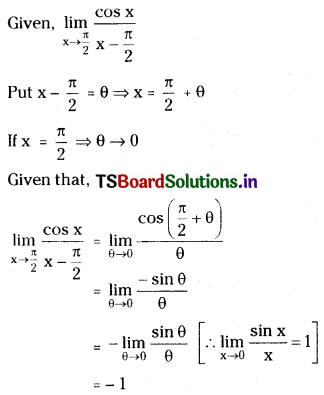
Compute \(\lim _{x \rightarrow \frac{\pi}{2}} \frac{\cos x}{\left(x-\frac{\pi}{2}\right)}\). [Mar. ’18 (TS); May ’13 (old), ’05; Mar. ’08]
Solution:
TS Inter First Year Maths 1B Limits and Continuity Important Questions Very Short Answer Type Q5

Question 6.
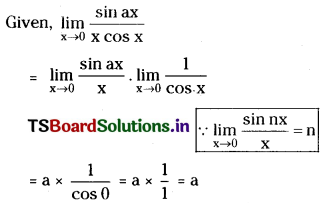
Compute \(\lim _{x \rightarrow 0} \frac{\sin a x}{x \cos x}\). [Mar. ’03, ’02]
Solution:
TS Inter First Year Maths 1B Limits and Continuity Important Questions Very Short Answer Type Q6

TS Inter First Year Maths 1B Limits and Continuity Important Questions Very Short Answer Type

Question 7.
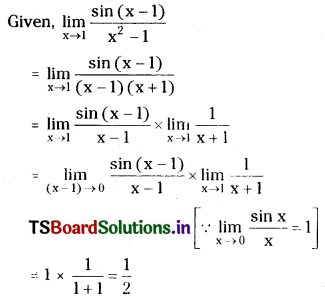
Compute \(\lim _{x \rightarrow 1} \frac{\sin (x-1)}{x^2-1}\). [May ’06, ’02]
Solution:
TS Inter First Year Maths 1B Limits and Continuity Important Questions Very Short Answer Type Q7

Question 8.
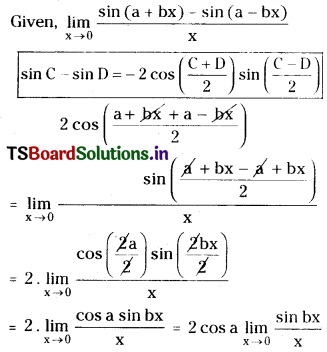
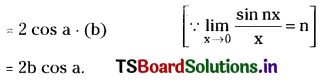
Compute \(\lim _{x \rightarrow 0} \frac{\sin (a+b x)-\sin (a-b x)}{x}\). [Mar. ’12, ’08, ’05; May ’09]
Solution:
TS Inter First Year Maths 1B Limits and Continuity Important Questions Very Short Answer Type Q8
TS Inter First Year Maths 1B Limits and Continuity Important Questions Very Short Answer Type Q8.1

Question 9.
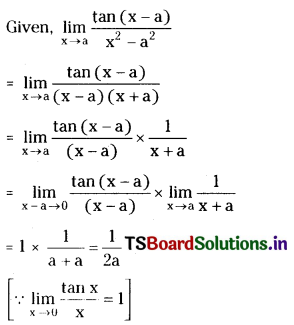
Compute \(\lim _{x \rightarrow a} \frac{\tan (x-a)}{x^2-a^2}\) (a ≠ 0) [May ’04, Mar. ’15 (TS)]
Solution:
TS Inter First Year Maths 1B Limits and Continuity Important Questions Very Short Answer Type Q9

Question 10.
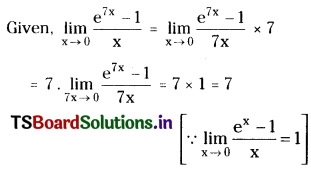
Compute \(\lim _{x \rightarrow 0} \frac{e^{7 x}-1}{x}\). [Mar. ’17 (AP); May ’13]
Solution:
TS Inter First Year Maths 1B Limits and Continuity Important Questions Very Short Answer Type Q10

Question 11.
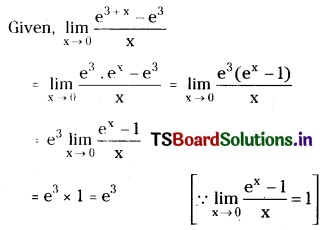
Compute \(\lim _{x \rightarrow 0} \frac{e^{3+x}-e^3}{x}\). [Mar. ’19 (AP); B.P.]
Solution:
TS Inter First Year Maths 1B Limits and Continuity Important Questions Very Short Answer Type Q11

TS Inter First Year Maths 1B Limits and Continuity Important Questions Very Short Answer Type

Question 12.
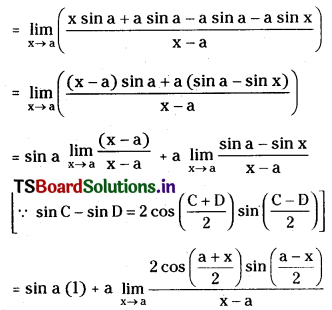
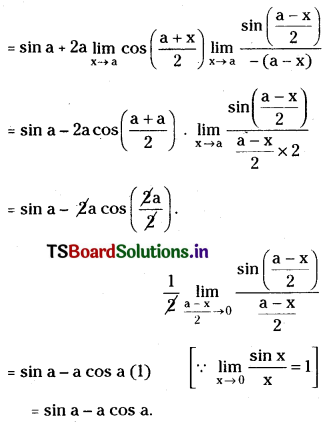
Compute \(\lim _{x \rightarrow a} \frac{x \sin a-a \sin x}{x-a}\). [Mar. ’11; Mar. ’19 (AP); Mar. ’16 (AP)]
Solution:
Given \(\lim _{x \rightarrow a} \frac{x \sin a-a \sin x}{x-a}\)
Adding and subtracting, a sin a, in the numerator, We get
TS Inter First Year Maths 1B Limits and Continuity Important Questions Very Short Answer Type Q12
TS Inter First Year Maths 1B Limits and Continuity Important Questions Very Short Answer Type Q12.1

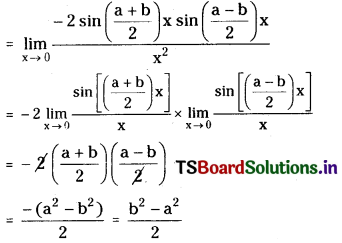
Question 13.
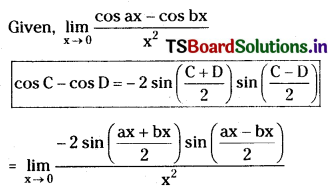
Compute \(\lim _{x \rightarrow 0} \frac{\cos a x-\cos b x}{x^2}\). [May ’11; Mar. ’07, ’04]
Solution:
TS Inter First Year Maths 1B Limits and Continuity Important Questions Very Short Answer Type Q13
TS Inter First Year Maths 1B Limits and Continuity Important Questions Very Short Answer Type Q13.1

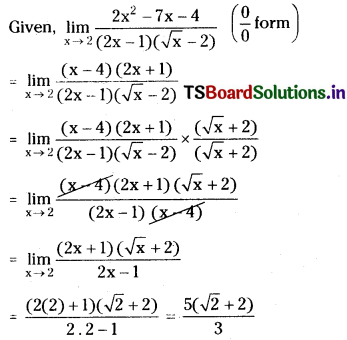
Question 14.
Compute \(\lim _{x \rightarrow 2} \frac{2 x^2-7 x-4}{(2 x-1)(\sqrt{x}-2)}\). [May ’12, ’07]
Solution:
TS Inter First Year Maths 1B Limits and Continuity Important Questions Very Short Answer Type Q14

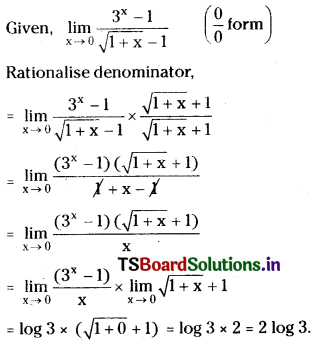
Question 15.
Compute \(\lim _{x \rightarrow 0} \frac{3^x-1}{\sqrt{1+x}-1}\). [Mar. ’05]
Solution:
TS Inter First Year Maths 1B Limits and Continuity Important Questions Very Short Answer Type Q15

TS Inter First Year Maths 1B Limits and Continuity Important Questions Very Short Answer Type

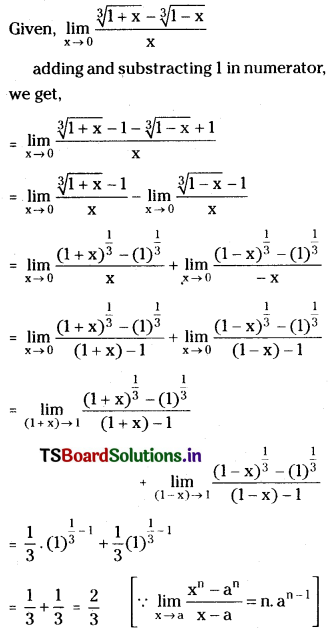
Question 16.
Compute \(\lim _{x \rightarrow 0} \frac{\sqrt[3]{1+x}-\sqrt[3]{1-x}}{x}\). [May ’15 (AP), ’06, ’97, ’02; Mar. ’93]
Solution:
TS Inter First Year Maths 1B Limits and Continuity Important Questions Very Short Answer Type Q16

Question 17.
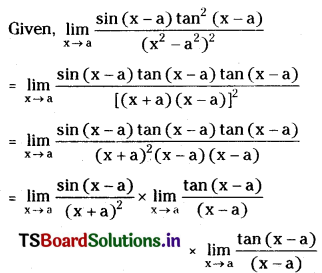
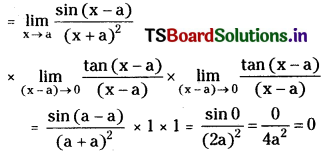
Compute \(\lim _{x \rightarrow a} \frac{\sin (x-a) \tan ^2(x-a)}{\left(x^2-a^2\right)^2}\). [Mar. ’06]
Solution:
TS Inter First Year Maths 1B Limits and Continuity Important Questions Very Short Answer Type Q17
TS Inter First Year Maths 1B Limits and Continuity Important Questions Very Short Answer Type Q17.1

Question 18.
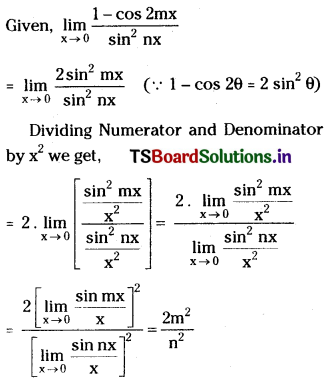
Compute \(\lim _{x \rightarrow 0} \frac{1-\cos 2 m x}{\sin ^2 n x}\). [Mar. ’10; May ’15 (TS)]
Solution:
TS Inter First Year Maths 1B Limits and Continuity Important Questions Very Short Answer Type Q18

Question 19.
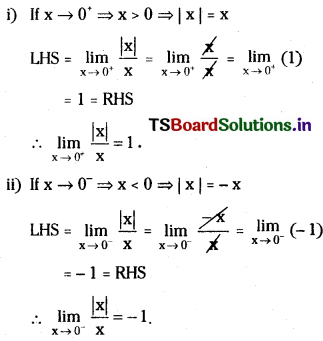
Show that \(\lim _{\mathbf{x} \rightarrow 0^{-1}} \frac{|\mathbf{x}|}{\mathbf{x}}=1\) and \(\lim _{\mathbf{x} \rightarrow 0^{+1}} \frac{|\mathbf{x}|}{\mathbf{x}}=-1\). [Mar. ’93, ’85; May ’86, ’83]
Solution:
TS Inter First Year Maths 1B Limits and Continuity Important Questions Very Short Answer Type Q19

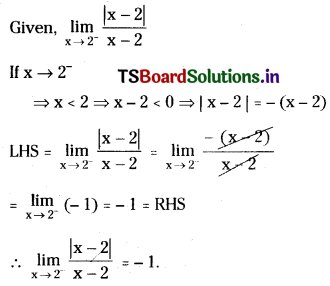
Question 20.
Show that \(\lim _{x \rightarrow 2^{-}} \frac{|x-2|}{x-2}=-1\). [May ’04]
Solution:
TS Inter First Year Maths 1B Limits and Continuity Important Questions Very Short Answer Type Q20

TS Inter First Year Maths 1B Limits and Continuity Important Questions Very Short Answer Type

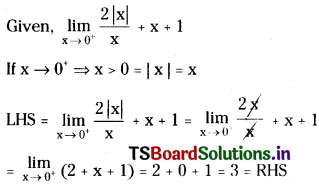
Question 21.
Show that \(\lim _{x \rightarrow 0^{+}} \frac{2|x|}{x}\) + x + 1 = 3. [Mar. ’15 (AP); May ’08; B.P.]
Solution:
TS Inter First Year Maths 1B Limits and Continuity Important Questions Very Short Answer Type Q21

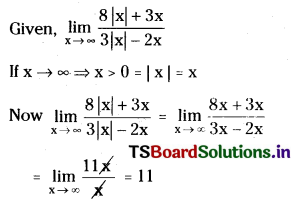
Question 22.
Compute \(\lim _{x \rightarrow \infty} \frac{8|x|+3 x}{3|x|-2 x}\). [Mar. ’17 (TS), ’12; May ’10, ’09]
Solution:
TS Inter First Year Maths 1B Limits and Continuity Important Questions Very Short Answer Type Q22

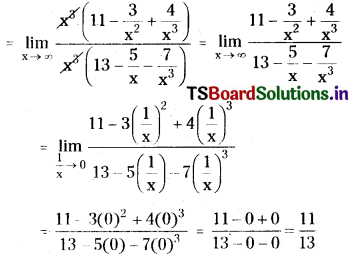
Question 23.
Compute \(\lim _{x \rightarrow \infty} \frac{11 x^3-3 x+4}{13 x^3-5 x^2-7}\). [Mar. ’18 (AP); Mar. ’14; May ’07]
Solution:
Given \(\lim _{x \rightarrow \infty} \frac{11 x^3-3 x+4}{13 x^3-5 x^2-7}\)
TS Inter First Year Maths 1B Limits and Continuity Important Questions Very Short Answer Type Q23

Question 24.
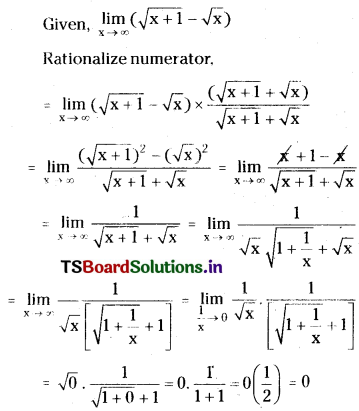
Compute \(\lim _{x \rightarrow \infty}(\sqrt{x+1}-\sqrt{x})\). [May ’13]
Solution:
TS Inter First Year Maths 1B Limits and Continuity Important Questions Very Short Answer Type Q24

TS Inter First Year Maths 1B Limits and Continuity Important Questions Very Short Answer Type

Question 25.
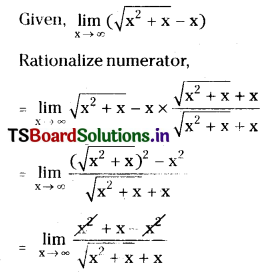
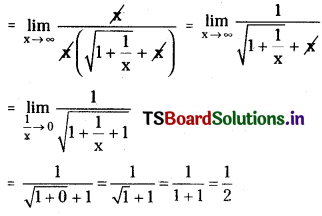
Compute \(\lim _{x \rightarrow \infty}\left(\sqrt{x^2+x}-x\right)\). [Mar. ’11, ’10, ’09, ’08]
Solution:
TS Inter First Year Maths 1B Limits and Continuity Important Questions Very Short Answer Type Q25
TS Inter First Year Maths 1B Limits and Continuity Important Questions Very Short Answer Type Q25.1

Question 26.
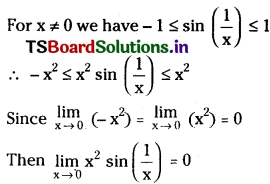
Compute \(\lim _{x \rightarrow 0} x \sin \left(\frac{1}{x}\right)\). [Mar. ’17 (TS)]
Solution:
TS Inter First Year Maths 1B Limits and Continuity Important Questions Very Short Answer Type Q26

TS Inter 1st Year Commerce Notes Chapter 1 Introduction to Business

Here students can locate TS Inter 1st Year Commerce Notes Chapter 1 Introduction to Business to prepare for their exam.

TS Inter 1st Year Commerce Notes Chapter 1 Introduction to Business

→ Human activities are divided into economic and non-economic activities.

→ Economic activities related to the production and distribution of goods and services.

→ Non-economic activities are those which are undertaken without economic consideration.

→ The activities which involve the production of goods and services with the object of selling them for a profit is called business.

TS Inter 1st Year Commerce Notes Chapter 1 Introduction to Business

→ Professions are those occupations that involve rendering a personal service of a specialized and expert nature.

→ If a person undertake to work for another under a contract is called employment.

→ Objects of business can be classified as :
a) Economic objectives b) Social objectives c) Human objectives d) National objectives

→ Obligations to owners, employees, suppliers, consumers, government and to society are the social responsibilities of the business.

→ Profit is essential for the survival, growth, expansion and diversification of the business.

TS Inter 1st Year Commerce Notes Chapter 1 వ్యాపార భావన – పరిచయం

→ ప్రతి వ్యక్తి తన కోర్కెలను సంతృప్తిపరుచుకొనడానికి నిరంతరము శ్రమిస్తాడు. ఫలితముగా మానవ కార్యకలాపాలు ఏర్పడతాయి. వీటిని ఆర్థిక కార్యకలాపాలు అని, ఆర్థికేతర కార్యకలాపాలు అని విభజించవచ్చు.

→ ఆర్థిక కార్యకలాపాలు వృత్తి, ఉద్యోగము, వ్యాపారము. సమర్థవంతమైన వ్యక్తిగత సేవలను అందించే పనులను వృత్తులు అంటారు. ఒప్పందము ప్రకారము యజమాని చెప్పిన పనులను నిర్వహించడాన్ని ఉద్యోగము అంటారు. లాభాన్ని సంపాదించే ఉద్దేశముతో వస్తుసేవల ఉత్పత్తి, వినిమయము, పంపిణీలతో ఉండే వ్యాపకాన్ని వ్యాపారము అంటారు.

→ వ్యాపార లక్షణాలలో ప్రయోజనాల కల్పన, వస్తుసేవలతో సంబంధము, పునరావృతము కాకపోవడం, లాభార్జన, నష్టభయం, అనిశ్చిత పరిస్థితి, కళ అనేవి ఉంటాయి.

→ ప్రతి వ్యాపారానికి ఆర్థిక, సామాజిక, మానవ సంబంధిత, జాతీయ ఉంటాయి.

→ ఆర్థిక లక్ష్యాలలో లాభాల సంపాదన, ఖాతాదారుల సృష్టి, నవకల్పన ఉన్నాయి.

→ సామాజిక లక్ష్యాలలో సరైన వస్తువులను సరైన ధరలకు సప్లయి చేయడము, ఉద్యోగులకు చాలినంత ప్రతిఫలం అందజేయడము, సాంఘిక సంక్షేమము, ప్రభుత్వానికి సహకారము, సహజ వనరుల సక్రమ వినియోగము ఉన్నవి.

→ మానవ సంబంధిత లక్ష్యాలలో మానవ వనరుల అభివృద్ధి, ప్రజాస్వామ్య నిర్వహణ, శ్రామిక యజమానుల సహకారము ఉన్నాయి.

→ జాతీయ లక్ష్యాలలో వనరుల గరిష్ఠ వినియోగము, జాతీయ గౌరవం, చిన్నతరహా పరిశ్రమల వృద్ధి వెనుకబడిన ప్రాంతాల అభివృద్ధి అనేది ఉంటాయి.

TS Inter 1st Year Commerce Notes Chapter 1 Introduction to Business

→ వ్యాపారము సమాజములో అంతర్భాగము అయినందున లాభార్జనతో పాటు సామాజిక సంక్షేమాన్ని గురించి కూడా వ్యాపార సంస్థలు ఆలోచించాలి. దీనినే సామాజిక బాధ్యత అంటారు. యజమానులకు, ఉద్యోగులకు, సప్లయిదారులకు, ప్రభుత్వానికి, సమాజానికి సంబంధించి వ్యాపార సంస్థలకు వేర్వేరు బాధ్యతలు ఉంటాయి.

TS Inter 1st Year Chemistry Notes Chapter 5 స్టాయికియోమెట్రీ

Here students can locate TS Inter 1st Year Chemistry Notes 5th Lesson స్టాయికియోమెట్రీ to prepare for their exam.

TS Inter 1st Year Chemistry Notes 5th Lesson స్టాయికియోమెట్రీ

→ ద్రవ్యనిత్యత్వ నియమం : ఒక రసాయన చర్యలో పదార్థాన్ని కొత్తగా ఏర్పరచడంగానీ, నాశనం చేయడంగానీ జరగదు.

→ స్థిరానుపాత నియమం : ఒక నిర్దిష్ట సంయోగ పదార్థంలో ఒకే మూలకాలు స్థిరభార నిష్పత్తిలో కలిసి ఉంటాయి.

→ బహ్వానుపాత నియమం : రెండు మూలకాలు రసాయనికంగా సంయోగం చెంది రెండు లేదా అంతకన్నా ఎక్కువ సమ్మేళనాలను ఏర్పరిస్తే వాటిల్లో స్థిర భారం గల మూలకంతో కలిసే రెండవ మూలకం భారాలు సరళ పూర్ణ నిష్పత్తిలో ఉంటాయి.

→ అవగాడ్రో సంఖ్య : ఒక గ్రాము పరమాణు భారం గల పదార్థంలో ఎన్ని పరమాణువులు ఉంటాయో దానినే అవగాడ్రో సంఖ్య అంటారు. దీని విలువ 6.023 × 10²³

→ తుల్యాంక భారం : భారాత్మకంగా 1 భాగం హైడ్రోజన్తో లేక 8 భాగాలు ఆక్సిజన్ లేక 35.5 భాగాల క్లోరిన్తో సంయోగం చెందే (లేక) తొలగించే మూలకపు భారభాగాల సంఖ్యను ఆ మూలకం తుల్యభారం అంటారు.

→ స్థాయికియోమెట్రీ: రసాయన చర్యలలో క్రియాజనకాలు, క్రియాజన్యాల మధ్య గల పరిమాణాత్మక సంబంధాన్ని స్టాయికియోమెట్రీ అంటారు.

→ రిడాక్స్ చర్యలు : ఏ రసాయన చర్యలలో ఆక్సీకరణం మరియు క్షయకరణం రెండూ జరుగుతాయో అట్టి చర్యలను రిడాక్స్ చర్యలు అంటారు.

TS Inter 1st Year Chemistry Notes Chapter 5 స్టాయికియోమెట్రీ

→ రిడాక్స్ చర్యలలో రకాలు : ఇవి 5 రకాలు

  • సంయోగ చర్యలు
  • వియోగ చర్యలు
  • స్థానభ్రంశ చర్యలు
  • అననుపాత చర్యలు
  • సహానుపాత చర్యలు,

→ సాపేక్ష పరమాణు ద్రవ్యరాశులను నిర్ణయించడానికి C – 12 ను ప్రమాణంగా తీసుకుంటారు.

→ C -12 ద్రవ్యరాశిలో \(\frac{1}{12}\)వ వంతు ద్రవ్యరాశిని పరమాణు ద్రవ్యరాశి ప్రమాణం (a.mu.) అంటారు.

→ am.u. విలువ 1.66 × 10⁻²⁴ gms. దీనిని ఆవోగ్రామ్ అంటారు.

→ అణుభారం విలువను గ్రామ్లలో తెలియజేస్తే దానిని గ్రామ్ అణుభారం (లేక) గ్రామ్ మోల్ అంటారు.

→ ఒక గ్రామ్ అణుభారం పదార్థంలో ఉన్న పరమాణువుల లేక అణువుల సంఖ్యను అవగాడ్రో సంఖ్య అంటారు. దీనిని N తో సూచిస్తారు. దీని విలువ 6.023 × 10²³.

→ ఒక గ్రామ్ అణుభారం గల వాయువు STP వద్ద ఆక్రమించే ఘనపరిమాణాన్ని గ్రామ్ మోలార్ ఘ.ప. అంటారు. దీని విలువ 22.4 లీటర్లు (లేక) 22,400 CC. దీనిని GMV తో సూచిస్తారు.

→ S.I. యూనిట్లలో ఒక పదార్థం యొక్క ద్రవ్యరాశిని మోల్లో వ్యక్తపరుస్తారు.

→ అవగాడ్రో సంఖ్య పరమాణువులు లేక అణువులు లేక అయాన్లు ఎంత పదార్థంలో ఉంటాయో దానినే మోల్ అంటారు.

→ సంయోగస్థితిలో ఉన్న పరమాణువు ప్రదర్శించే దృశ్య ఆవేశాన్ని ఆ పరమాణువు యొక్క ఆక్సీకరణ సంఖ్య అంటారు. ఆక్సీకరణ సంఖ్య ధనాత్మకం (లేక) ఋణాత్మకం (లేక) భిన్నాంకంగా ఉండవచ్చు.

→ ఫ్లోరిన్ ఎల్లపుడు ఋణ ఆక్సీకరణ స్థితి విలువను మాత్రమే ప్రదర్శిస్తుంది.

→ ఏ చర్యలో ఎలక్ట్రాన్లు తీసివేయబడతాయో దానిని ఆక్సీకరణ చర్య అంటారు.

→ ఏ చర్యలో ఎలక్ట్రాన్లు గ్రహింపబడతాయో దానిని క్షయకరణ చర్య అంటారు. * ఎలక్ట్రాన్లను గ్రహించే పదార్థాన్ని ఆక్సీకరణి అంటారు.

→ ఎలక్ట్రాన్లను పోగొట్టుకునే పదార్థాన్ని క్షయకరణి అంటారు.

→ ఏ రసాయన చర్యలో ఆక్సీకరణం మరియు క్షయకరణం జరుగుతాయో అట్టి చర్యను రిడాక్స్ చర్య అంటారు.

→ రిడాక్స్ చర్యలను
(a) అయాన్ ఎలక్ట్రాన్ పద్ధతి ద్వారా
(b) ఆక్సీకరణ సంఖ్య పద్ధతి ద్వారా తుల్యం చేస్తారు.

TS Inter 1st Year Chemistry Notes Chapter 5 స్టాయికియోమెట్రీ

→ తుల్యం చేయబడిన రసాయన చర్య ద్వారా తెలియజేయబడే పదార్థాల ద్రవ్యరాశుల సాపేక్ష నిష్పత్తిని స్థాయికియోమెట్రీ అంటారు.

→ ఒక మూలకం యొక్క భారానికి ఆ మూలకం కలిగి ఉన్న సమ్మేళనం యొక్క భారానికి గల భార నిష్పత్తికి 100 రెట్లును ఆ మూలకం యొక్క సంఘటన శాతం అంటారు.

→ ఒక అణువు పదార్థంలోని అంతర్గత మూలకాల పరమాణువులు సరళ నిష్పత్తిని తెలియజేసే ఫార్ములాను అనుభావిక ఫార్ములా అంటారు.

→ ఒక అణువు పదార్థంలోని అంతర్గత మూలకాల ఖచ్చితమైన పరమాణువుల సంఖ్యను తెలియజేసే ఫార్ములాను అణు ఫార్ములా అంటారు.

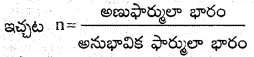
→ అణుఫార్ములా = అనుభావిక ఫార్ములా xn
TS Inter 1st Year Chemistry Notes Chapter 5 స్టాయికియోమెట్రీ 1

→ ఆక్సీకరణ సంఖ్యలో పెరుగుదలను ప్రదర్శించే చర్యను ఆక్సీకరణ చర్య అని, ఆక్సీకరణ సంఖ్యలో తగ్గుదలను ప్రదర్శించే చర్యను క్షయకరణ చర్య అని అంటారు.

TS Inter 1st Year Accountancy Study Material Chapter 4 Preparation of Subsidiary Books

Telangana TSBIE TS Inter 1st Year Accountancy Study Material 4th Lesson Preparation of Subsidiary Books Textbook Questions and Answers.

TS Inter 1st Year Accountancy Study Materia 4th Lesson Preparation of Subsidiary Books

Short Answer Questions:

Question 1.
Record the following transactions in the purchases book.
2019 March
March 1st Purchased goods from Anil – ₹ 2,000
March 3rd Bought goods from Raju – ₹ 4,000
March 7th Purchased goods from Srikanth – ₹ 5,000 (Trade discount 10%)
March 13th Goods purchased from Venkat – ₹ 1,600
March 18th Purchased goods from Mahesh – ₹ 1,400
March 24th Purchases – ₹ 3,000
March 26th Purchased goods from Ashok – ₹ 2,500
Solution:
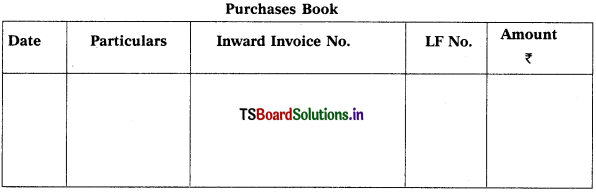
Purchases Book
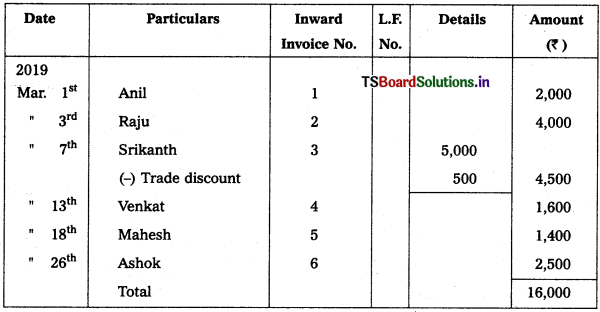
TS Inter 1st Year Accountancy Study Material 4th Lesson Preparation of Subsidiary Books 1

Working Notes :
1. On March 7th Trade discount = Amount × \(\frac{\text { Rate }}{100}\)
= 5,000 × \(\frac{10}{100}\) = 500

2. On 24th March it is cash transaction so, it should not be recorded in purchases book.

Question 2.
Prepare purchases book from the following :
2018 April
1st Purchased goods from Shekar – ₹ 4,000
4th Cash purchases – ₹ 2,000
8th Bought goods from Shyam – ₹ 8,000 (Trade discount 5%)
12th Goods purchased from Karthik – ₹ 2,400
18th Purchased goods from Naresh – ₹ 3,000
25th Purchased furniture from Aakash – ₹ 6,000
Solution:
Purchases Book
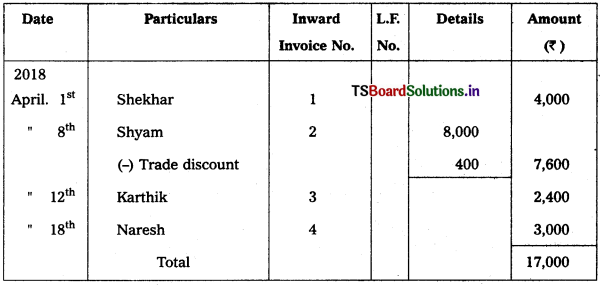
TS Inter 1st Year Accountancy Study Material 4th Lesson Preparation of Subsidiary Books 2

Working Notes :
1. On 4th April it is cash purchases so, it should not be recorded in purchases book.
2. On 8th April Trade discount = 8,000 × \(\frac{5}{100}\) = 400.
3. On 25th April Asset purchased so, it is not to be recorded.

TS Board Inter First Year Accountancy Study Material Chapter 4 Preparation of Subsidiary Books

Question 3.
Prepare purchases Book.
2018 December
December 1st Purchased goods from Pallavi – ₹ 4,200
December 5th Goods purchased from Teja – ₹ 8,000
December 10th Bought goods from Vedhagni – ₹ 3,800
December 14th Purchased goods from Sudha – ₹ 6,000 (Trade discount ₹ 600)
December 18th Purchased goods from Ramya – ₹ 2,000
Solution:
Purchases Book
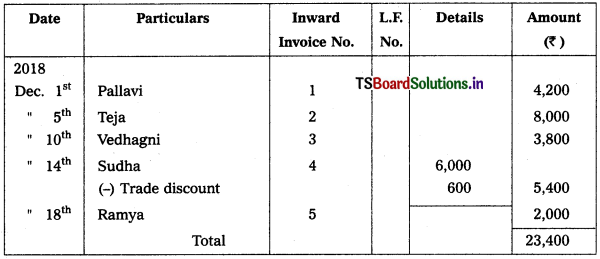
TS Inter 1st Year Accountancy Study Material 4th Lesson Preparation of Subsidiary Books 3

Question 4.
Enter the following transactions in the purchases book.
2018 November
November 1st Goods purchased from Chaitanya ₹ 5,000 as per Invoice No. 250.
November 12th Goods purchased from Ravi ₹ 1,000 on Credit Invoice No. 300.
November 18th Purchased goods from Sathish for ₹ 3,000 as per Invoice No. 105.
November 23rd Purchased goods from Pavan for cash ₹ 2,500 as per Invoice No. 410,
Solution:
Purchases Book
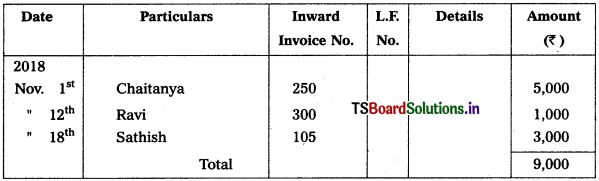
TS Inter 1st Year Accountancy Study Material 4th Lesson Preparation of Subsidiary Books 4

Working Notes :
On 23rd November it is cash transactions so, it should not be recorded in purchases book.

TS Board Inter First Year Accountancy Study Material Chapter 4 Preparation of Subsidiary Books

Question 5.
Enter the following transactions in purchases book and purchase returns book.
2018 Aug.
Aug. 1st Purchased goods from Krishna – ₹ 6,000
Aug. 4th Goods purchased from Mallesh – ₹ 3,500
Aug. 8th Returned goods to Krishna – ₹ 600
Aug. 13th Bought goods from Naveen – ₹ 2,000
Aug. 16th Goods returned to Mallesh – ₹ 400
Aug. 22nd Purchased goods from Ravi – ₹ 4,400
Solution:
Purchases Book
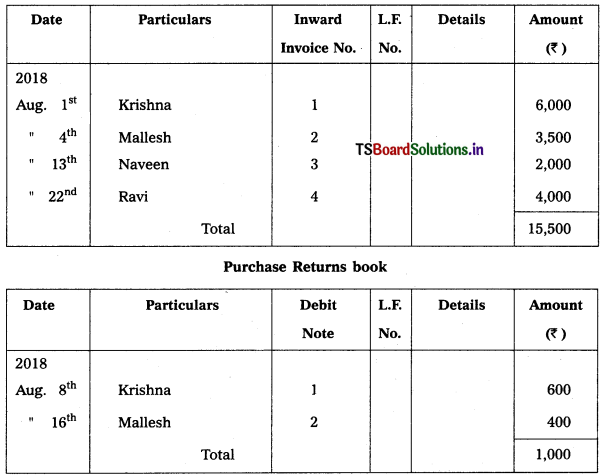
TS Inter 1st Year Accountancy Study Material 4th Lesson Preparation of Subsidiary Books 5

Question 6.
Enter the following transactions in the proper subsidiary books.
2018 June
June 1st Purchased goods from Arun – ₹ 2,500
June 3rd Purchased goods from Prakash – ₹ 7,000
June 6th Return outwards to Arun – ₹ 800
June 14th Purchased goods from Nagaraj – ₹ 10,000 (Trade discount 10%)
June 19th Goods purchased from Nikhil for Cash – ₹ 4,000
June 25th Goods returned to Nagaraj – ₹ 1,200
June 28th Bought goods from Vishal – ₹ 1,500
Solution:
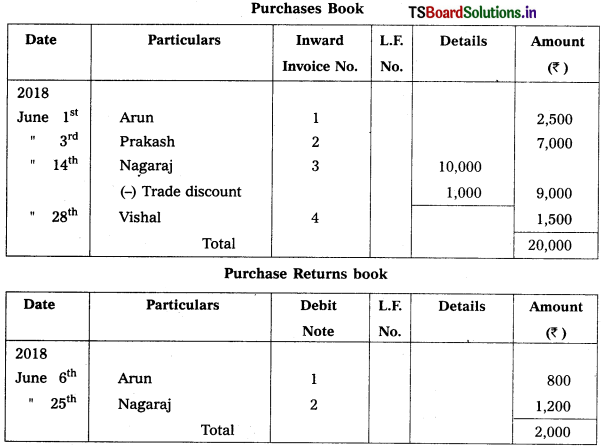
TS Inter 1st Year Accountancy Study Material 4th Lesson Preparation of Subsidiary Books 6

Working Notes :
1. On 14th June Trade discount = Amount × \(\frac{\text { Rate }}{100}\)
= 10,000 × \(\frac{10}{100}\) = 1,000

2. On 19th June it is cash purchases so, it should not ne recorded in purchases book.

TS Board Inter First Year Accountancy Study Material Chapter 4 Preparation of Subsidiary Books

Question 7.
Enter the following transactions in the Sales book.
2019 Feb
Feb 1st Sales goods to Sampath – ₹ 2,250
Feb 6th Sold goods to Manohar – ₹ 2,000
Feb 10th Cash sales – ₹ 1,800
Feb 16th Sold goods to Murali – ₹ 5,000 (Trade discount 5%)
Feb 20th Goods sold to Shankar on Credit – ₹ 2,500
Solution:
Purchases Book
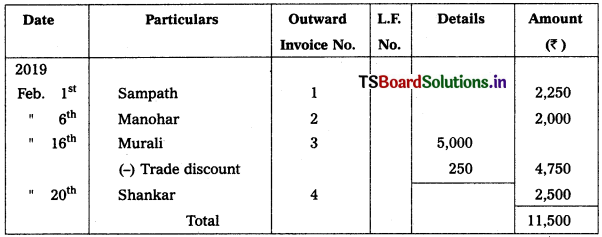
TS Inter 1st Year Accountancy Study Material 4th Lesson Preparation of Subsidiary Books 7

Working Notes :
1. On 10th February cash sales so, it should not to be taken
2. On 16th Feb : Trade discount = 5,000 × \(\frac{5}{100}\) = 250.

Question 8.
Prepare Sales book from the following particulars.
2018 May
May 1st Sold goods to Kiran – ₹ 10,000
May 8th Sold goods to Kalyan – ₹ 6,000 (Trade discount 10%)
May 12th Goods sold to Sanjeev for Cash – ₹ 3,000
May 18 Sold goods to Jeevan – ₹ 4,600
May 24th Sold old Machinery to Sandeep – ₹ 2,500
May 26th Goods sold to Vasu – ₹ 8,000
Solution:
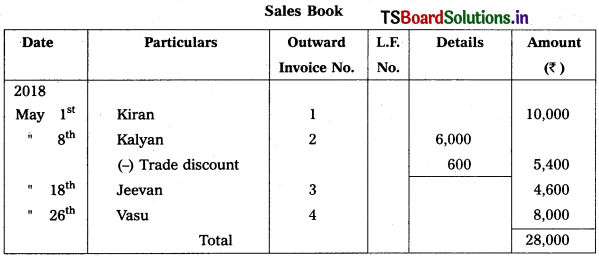
TS Inter 1st Year Accountancy Study Material 4th Lesson Preparation of Subsidiary Books 8

Working Notes :
1. On 12th May it’s cash sales so, it not to recorded.
2. On 8th May : Trade discount = 6,000 × \(\frac{10}{100}\) = 600
3. On 24th May: Machinery sold to Sandeep. We are not record the sale of Assets in Sales book.

TS Board Inter First Year Accountancy Study Material Chapter 4 Preparation of Subsidiary Books

Question 9.
Prepare the sales book.
2018 July
July 1st Sold goods to Nikhil ₹ 7,500 as per Invoce No. 410
July 3rd Sold goods to Ruthwik on credit ₹ 5,500 as per Invoice No. 101
July 12th Goods sold to Jairam ₹ 4,000 as per Invoice No. 370 (Trade discount 10%)
July 18th Sold goods to Sharma for Cash ₹ 8,000
July 24th Goods sold to Arun ₹ 6,400, Invoice No. 220
Solution:
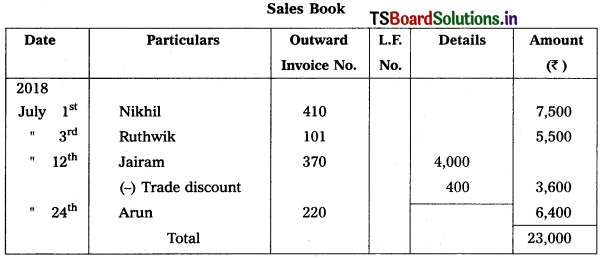
TS Inter 1st Year Accountancy Study Material 4th Lesson Preparation of Subsidiary Books 9

Working Notes :
1. On 12 July : Trade discount = Amount × \(\frac{\text { Rate }}{100}\)
= 4,000 × \(\frac{10}{100}\) = 400
2. On 18th July : Cash items should not be taken.

Question 10.
Record the following transactions in Sales Book and Sales Returns Book.
2018 Sept.
Sept. 1st Sold goods to Satyam – ₹ 2,500
Sept. 5th Sold goods to Ajay – ₹ 7,200
Sept. 7th Goods sold to Varun – ₹ 2,800
Sept. 10th Satya returned goods – ₹ 300
Sept. 14th Sold goods to Akhila – ₹ 4,000
Sept. 16th Returns inwards from Varun – ₹ 200
Sept. 25th Goods sold to Karthik for Cash – ₹ 3,000
Solution:
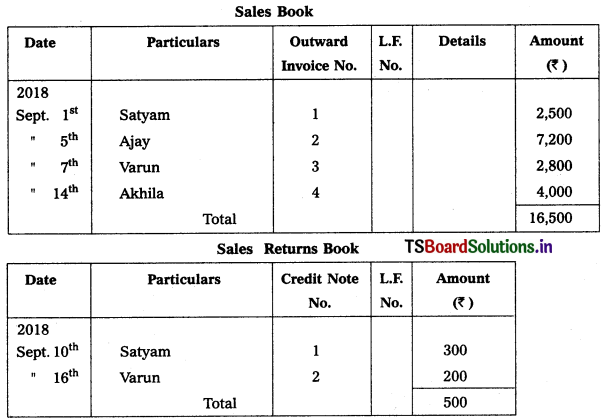
TS Inter 1st Year Accountancy Study Material 4th Lesson Preparation of Subsidiary Books 10

Working Note :
On 25th September it is cash sales so, it should not be taken in sales book.

TS Board Inter First Year Accountancy Study Material Chapter 4 Preparation of Subsidiary Books

Question 11.
Prepare Sales Book and Sales Returns Book from the following Information. [Mar. 2018]
2017 May
May 1st Sold goods to Rahul – ₹ 6,500
May 3rd Sold goods to Manish – ₹ 6,000
May 8th Returned goods by Rahul – ₹ 700
May 11th Sold goods to Raj Kumar – ₹ 12,000
May 14th Sold goods to Bharath – ₹ 11,000
May 17th Returned goods from Raj Kumar – ₹ 2,000
May 21st Sold goods to Anand – ₹ 9,000
Solution:
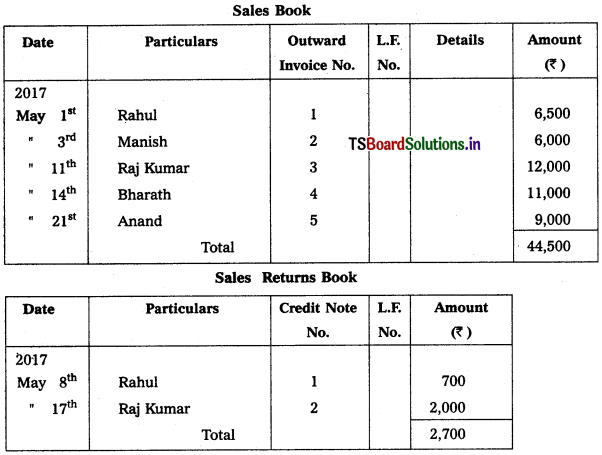
TS Inter 1st Year Accountancy Study Material 4th Lesson Preparation of Subsidiary Books 11

Question 12.
Record the following transactions in proper subsidiary books.
2017 Oct.
Oct. 1st Sold goods to Archana – ₹ 10,000
Oct. 4th Goods purchased from Divya – ₹ 6,000
Oct. 8th Purchased goods from Manasvi – ₹ 8,000
Oct. 10th Goods returned by Archana – ₹ 500
Oct. 14th Goods sold to Shivani – ₹ 3,000
Oct. 16th Returned goods to Divya – ₹ 300
Oct. 18th Purchased goods from Madhuri – ₹ 4,000
Oct. 20th Shivani returned goods – ₹ 200
Oct. 21st Return outwards to Manasvi – ₹ 400
Oct. 25th Goods sold to Sharanya on Credit – ₹ 7,000
Solution:
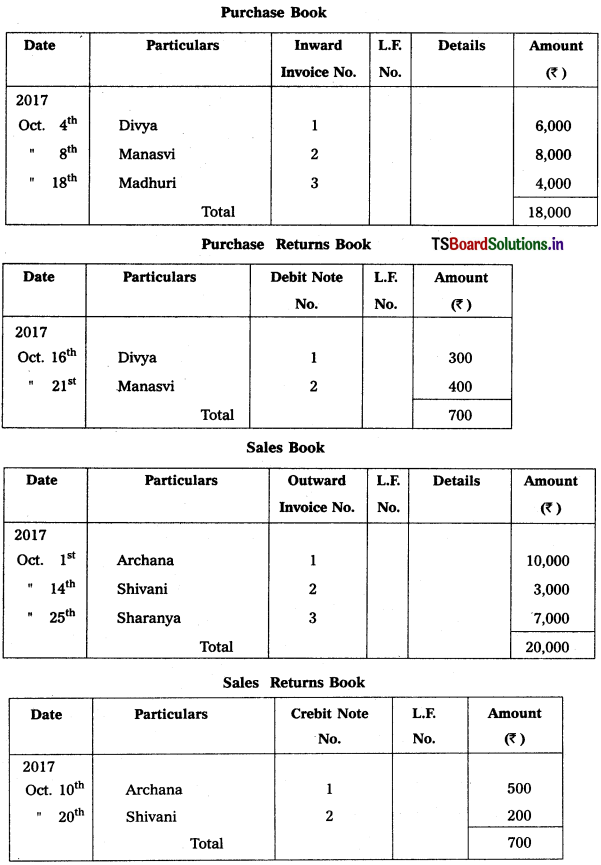
TS Inter 1st Year Accountancy Study Material 4th Lesson Preparation of Subsidiary Books 12

TS Board Inter First Year Accountancy Study Material Chapter 4 Preparation of Subsidiary Books

Question 13.
Prepare proper subsidiary books from the following particulars.
2018 Oct.
Oct. 1st Purchased goods from Amar – ₹ 2,000
Oct. 4th Goods sold to Payan – ₹ 3,500
Oct. 8th Goods returned to Amar – ₹ 200
Oct. 12th Sold goods to Srujan – ₹ 8,000 (Trade discount 5%)
Oct. 15th Goods returned from Payan – ₹ 100
Oct. 17th Purchased Machinery from Raju – ₹ 5,000
Oct. 19th Goods purchased from Vaibhav – ₹ 2,500
Oct. 21st Returned goods from Srujan – ₹ 150
Oct. 24th Sold goods to Ramesh for cash – ₹ 4,000
Oct. 26th Purchased goods from Vmeeth – ₹ 8,500
Oct. 28th Sold goods to Vamshi on credit – ₹ 6,500
Oct. 29th Goods returned to Vaibhav – ₹ 250
Oct. 30th Vanishi returned goods – ₹ 500
Solution:
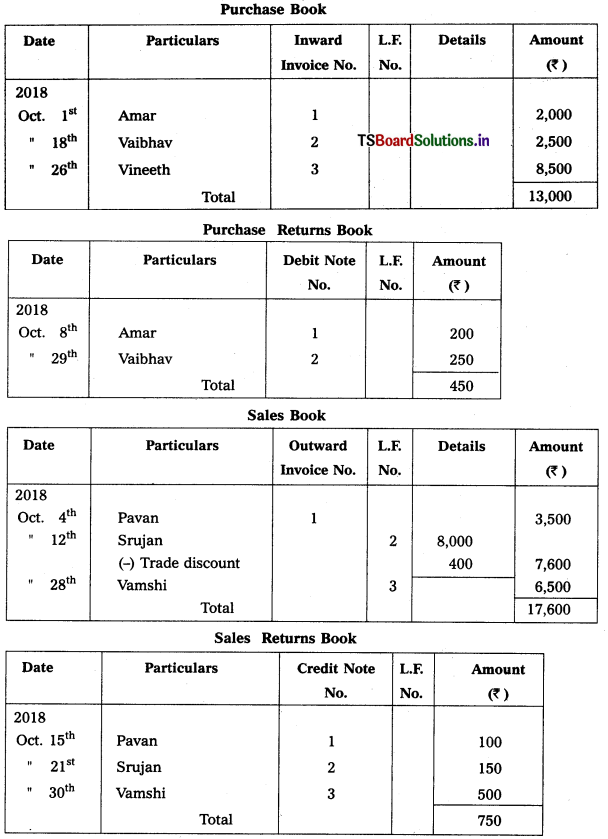
TS Inter 1st Year Accountancy Study Material 4th Lesson Preparation of Subsidiary Books 13

Working Notes :
1. On 17th Oct Assets purchases are not taken in purchases book.
2. On 24th Oct Cash sales should not be taken in sales book.

TS Board Inter First Year Accountancy Study Material Chapter 4 Preparation of Subsidiary Books

Question 14.
Prepare purchase book and post them in Ledger.
2019 Mar.
Mar. 1st Goods purchased from Praveen – ₹ 7,500
Mar. 4th Purchased goods from Jagan – ₹ 6,000
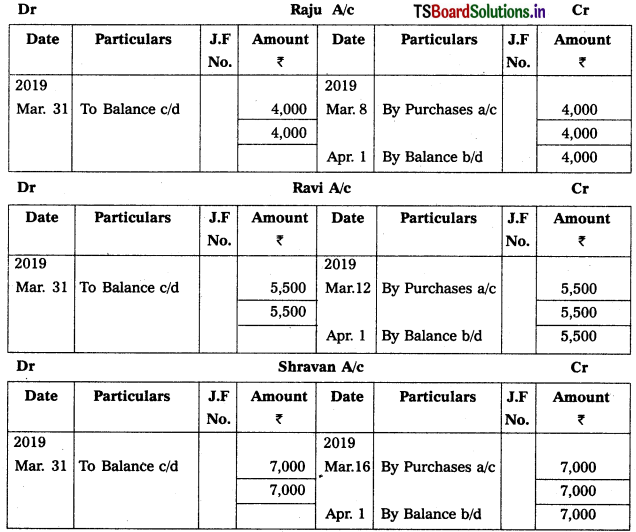
Mar. 8th Purchased goods from Raju – ₹ 4,000
Mar. 12th Goods purchased from Ravi – ₹ 5,500
Mar. 16th Purchased furniture from Aslsh – ₹ 2,000
Mar. 20th Goods purchased from Shravan – ₹ 7,000
Solution:
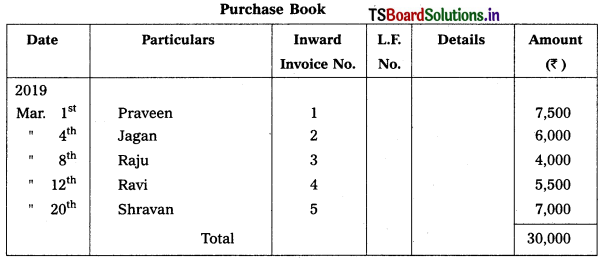
TS Inter 1st Year Accountancy Study Material 4th Lesson Preparation of Subsidiary Books 14

Working Notes :
On 16th March Assets purchases are not taken in Purchases book.

Ledger Posting:
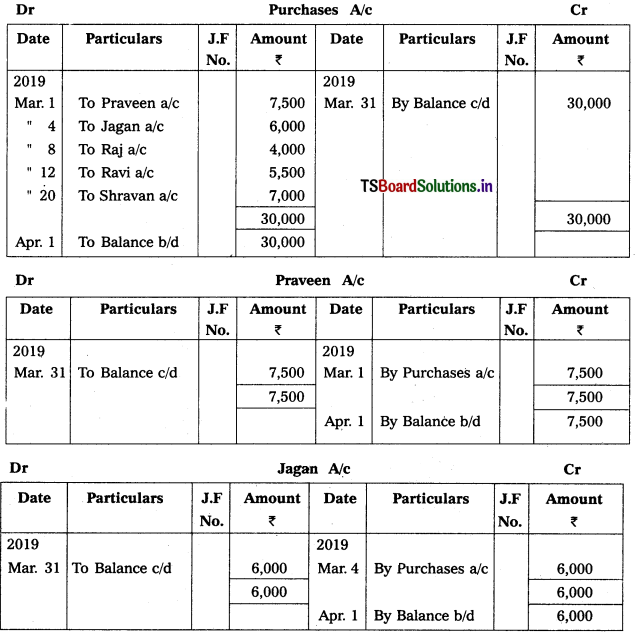
TS Inter 1st Year Accountancy Study Material 4th Lesson Preparation of Subsidiary Books 15

TS Inter 1st Year Accountancy Study Material 4th Lesson Preparation of Subsidiary Books 16

TS Board Inter First Year Accountancy Study Material Chapter 4 Preparation of Subsidiary Books

Question 15.
Prepare Sales Book from the following transactions and prepare Ledger.
2019 April
April 1st Goods sold to Damodhar – ₹ 8,000
April 3rd Sold goods to Murthy – ₹ 6,300
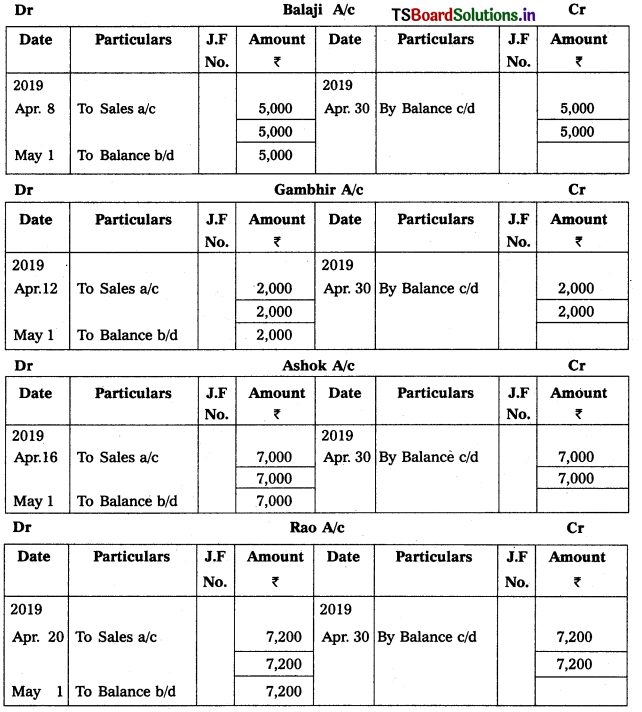
April 8th Sold goods to Balaji – ₹ 5,000
April 12th Goods sold to Gambhir – ₹ 2,000
April 16th Sold goods to Ashok – ₹ 7,000
April 18th Sold old furniture to Kishore – ₹ 5,000
April 20th Goods sold to Rao – ₹ 8,000 (Trade discount 10%)
Solution:
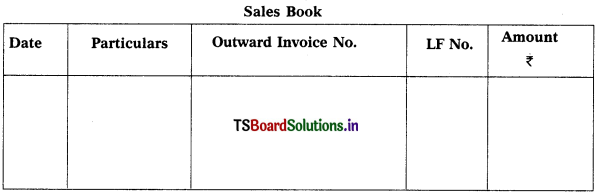
Sales Book
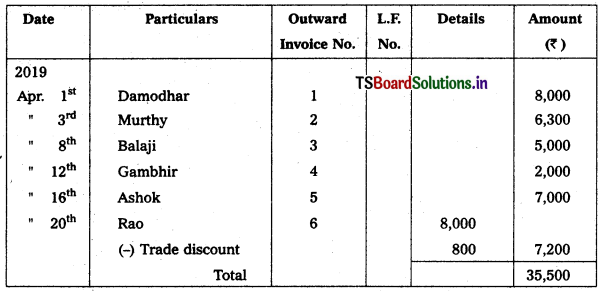
TS Inter 1st Year Accountancy Study Material 4th Lesson Preparation of Subsidiary Books 17

Working Notes :
1. On 18th April sale of Assets are not taken in Sales Book.
2. On 20th April: Trade discount = Amount × \(\frac{\text { Rate }}{100}\)
= 8,000 × \(\frac{10}{100}\) = 800

Ledger Posting:
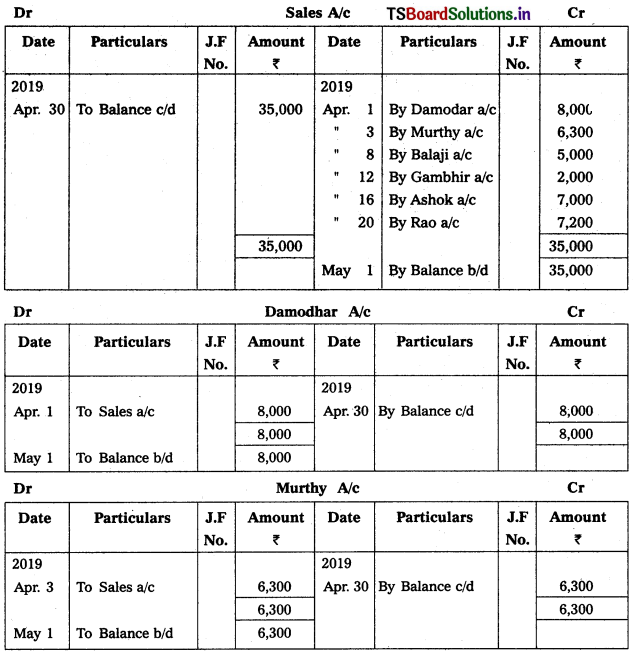
TS Inter 1st Year Accountancy Study Material 4th Lesson Preparation of Subsidiary Books 18

TS Inter 1st Year Accountancy Study Material 4th Lesson Preparation of Subsidiary Books 19

TS Board Inter First Year Accountancy Study Material Chapter 4 Preparation of Subsidiary Books

Very Short Answer Questions:

Question 1.
Write the opening entry as on 1st Jan. 2018 from the following. Total Assets of the firm is ₹ 1,00,000 and total of Liabilities of the firm is ₹ 20,000.
Solution:
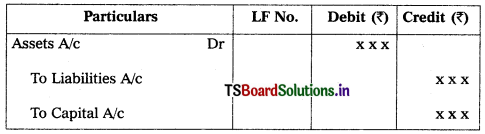
Opening Entry as on 1 Jan. 2018
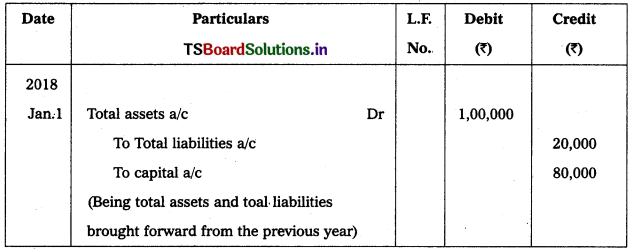
TS Inter 1st Year Accountancy Study Material 4th Lesson Preparation of Subsidiary Books 20

Question 2.
Write the opening entry as on 1st Jan. 2019 in the books of Karthik from the following.
Cash in hand – ₹ 4,000
Furniture – ₹ 15,000
Bank overdraft – ₹ 6,000
Sundry Debtors – ₹ 21,000
Stock – ₹ 10,000
Bills payable – ₹ 4,000
Solution:
In the books of Karthik Opening Entry as on 1 Jan. 2019
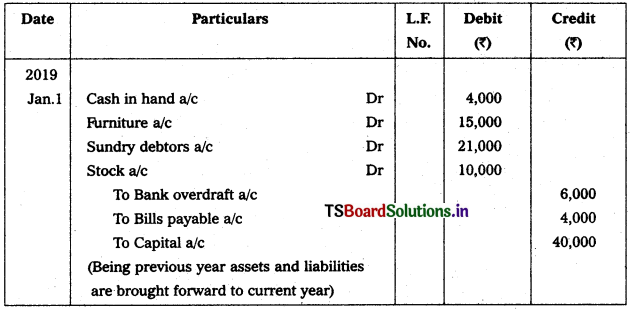
TS Inter 1st Year Accountancy Study Material 4th Lesson Preparation of Subsidiary Books 21

TS Board Inter First Year Accountancy Study Material Chapter 4 Preparation of Subsidiary Books

Question 3.
Record the opening entry from the following Assets and Liabilities on 1st May 2019.
Machinery – ₹ 16,000
Bank – ₹ 12,000
Bills receivable – ₹ 14,000
Sundry Creditors – ₹ 10,000
Trade Marks – ₹ 8,000
Cash – ₹ 10,000
Solution:
Opening Entity as on 1 May 2019
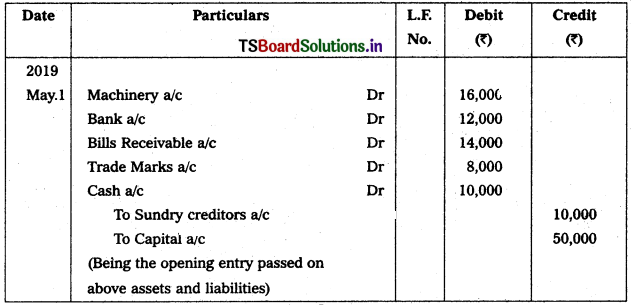
TS Inter 1st Year Accountancy Study Material 4th Lesson Preparation of Subsidiary Books 22

Question 4.
Record the opening entry as on 1st April 2019 from the following particulars.
Buildings – ₹ 24,000
Patents – ₹ 18,000
Fixtures & Fittings – ₹ 6,000
Bills payable – ₹ 4,000
Machinery – ₹ 10,000
Creditors – ₹ 4,000
Solution:
Opening Entry as on 1 April 2019
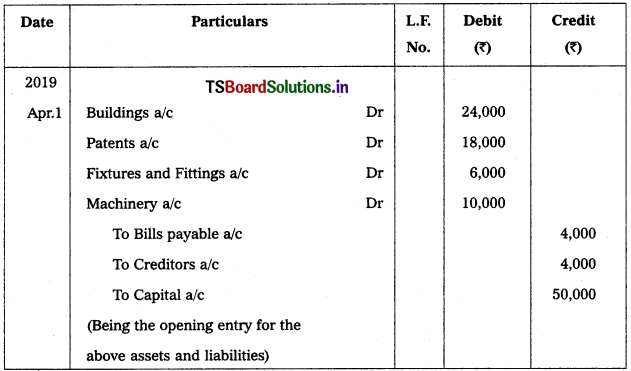
TS Inter 1st Year Accountancy Study Material 4th Lesson Preparation of Subsidiary Books 23

TS Board Inter First Year Accountancy Study Material Chapter 4 Preparation of Subsidiary Books

Question 5.
Write opening Journal entry as on 1st Jan. 2019 from the following.
Debtors – ₹ 18,000
Furniture – ₹ 10,000
Bank balance – ₹ 20,000
Loan from Pavan – ₹ 10,000
Bills payable – ₹ 5,000
Land and Buildings – ₹ 12,000
Solution:
Opening Entry as on 1st Jan. 2019
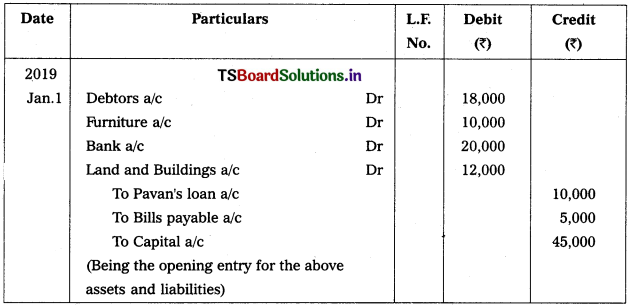
TS Inter 1st Year Accountancy Study Material 4th Lesson Preparation of Subsidiary Books 24

Question 6.
Write the opening Journal entry as on 1st April 2019 from the following.
Debtors – ₹ 16,000
Creditors – ₹ 12,000
Bills receivable – ₹ 8,500
Furniture – ₹ 4,500
Bank overdraft – ₹ 5,000
Business premises – ₹ 30,000
Solution:
Opening Entry as on 1st April 2019
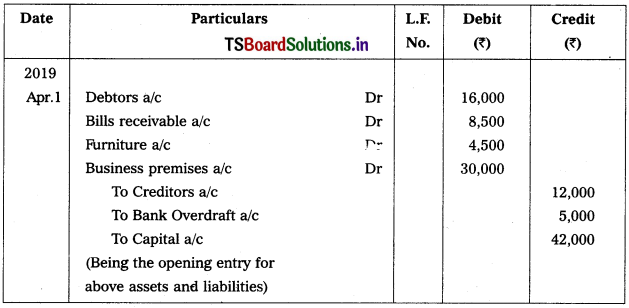
TS Inter 1st Year Accountancy Study Material 4th Lesson Preparation of Subsidiary Books 25

TS Board Inter First Year Accountancy Study Material Chapter 4 Preparation of Subsidiary Books

Question 7.
Write closing entries from the following Ledger balances of Balaji.
Opening stock – ₹ 60,000
Purchases – ₹ 15,000
Carriage outwards – ₹ 1,000
Wages – ₹ 4,000
Solution:
Closing Entries in the books of Balaji
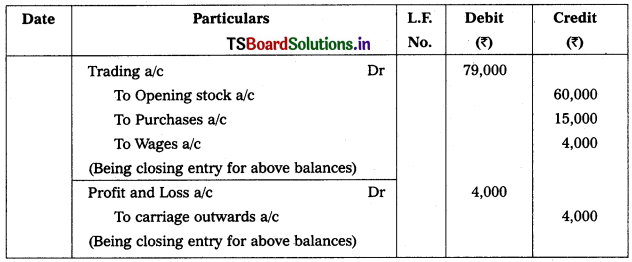
TS Inter 1st Year Accountancy Study Material 4th Lesson Preparation of Subsidiary Books 26

Question 8.
Record the closing entries from the Ledger balances of “Suhas” books.
Salaries – ₹ 5,000
Discount allowed – ₹ 2,000
Rent – ₹ 1,000
Discount received – ₹ 2,000
Interest received – ₹ 2,000
Solution:
Closing Entries in the books of Suhas
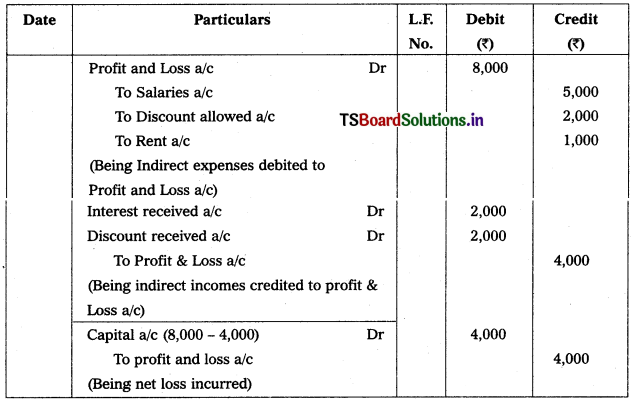
TS Inter 1st Year Accountancy Study Material 4th Lesson Preparation of Subsidiary Books 27

TS Board Inter First Year Accountancy Study Material Chapter 4 Preparation of Subsidiary Books

Question 9.
Rectify the following entries dated on 31st Mar. 2019.
1. Wages paid to accountant Mallesh ₹ 10,000, debited to his personal a/c.
2. Furniture sold ₹ 20,000, wrongly credited to Sales a/c.
Solution:
Rectification Entries
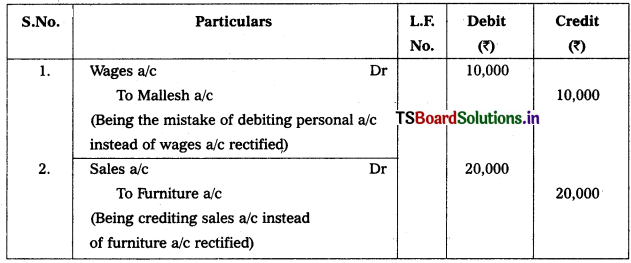
TS Inter 1st Year Accountancy Study Material 4th Lesson Preparation of Subsidiary Books 28

Question 10.
Rectify the following entries dated on 31st Mar. 2019.
1. Commission paid ₹ 4,000 wrongly debited to Interest paid a/c.
2. Rent paid to Reddy ₹ 5,000, wrongly debited to wages a/c.
Solution:
Rectification Entries
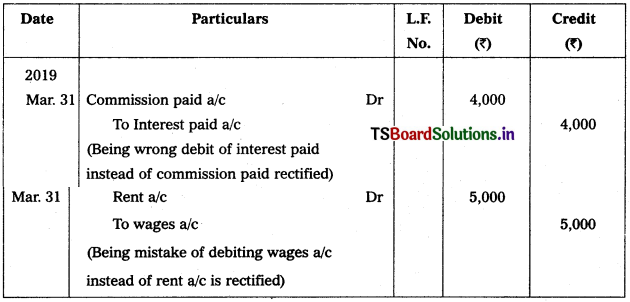
TS Inter 1st Year Accountancy Study Material 4th Lesson Preparation of Subsidiary Books 29

TS Board Inter First Year Accountancy Study Material Chapter 4 Preparation of Subsidiary Books

Question 11.
Pass adjustment Journal entries for the following.
1. Accrued Interest ₹ 200.
2. Provide depreciation @ 5% on Furniture, value of Furniture is ₹ 8,000.
Solution:
Adjustment Journal Entries
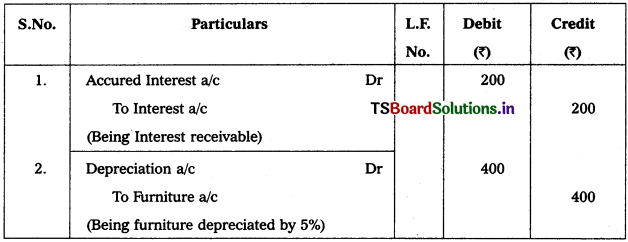
TS Inter 1st Year Accountancy Study Material 4th Lesson Preparation of Subsidiary Books 30

Question 12.
Pass adjustment Journal entries for the following.
1. Provide reserve for bad debts @ 10% on Debtors. Debtors value is ₹ 10,000.
2. Closing stock ₹ 30,000.
Solution:
Adjustment Journal Entries
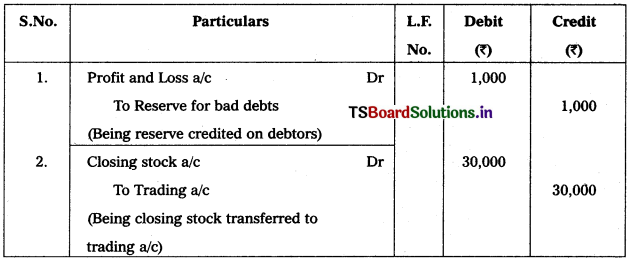
TS Inter 1st Year Accountancy Study Material 4th Lesson Preparation of Subsidiary Books 31

TS Board Inter First Year Accountancy Study Material Chapter 4 Preparation of Subsidiary Books

Textual Examples:

Question 1.
Prepare purchases book from the following transactions.
2019 Jan.
Jan. 1 Purchased goods from Nithya ₹ 6,000
Jan. 5 Purchased goods from Anuhya ₹ 4,000 (Trading discount ₹ 200)
Jan. 10 Goods purchased from Lathika ₹ 10,000 (Trading discount 10%)
Jan. 15 Varsha sold goods to us ₹ 5,000
Jan. 20 Purchased goods from Srinidhi for cash ₹ 5,000
Solution:
Purchases Book
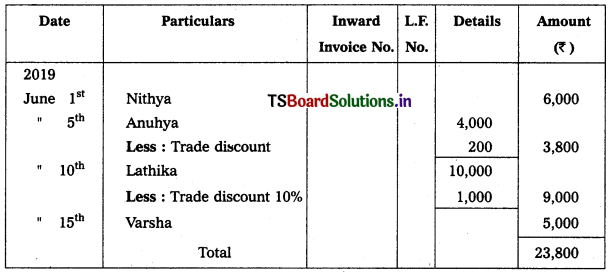
TS Inter 1st Year Accountancy Study Material 4th Lesson Preparation of Subsidiary Books 32

Note :
The transaction dated on January 20, 2019 is not recorded in Purchases Journal because, it is cash transaction of purchases.

Question 2.
Prepare purchases book from the following transactions and prepare purchase account. –
2018 Dec.
Dec. 2 Purchased goods from Manoj – ₹ 5,000
Dec. 6 Goods bought from Arun – ₹ 10,000 (Trade discount 10%)
Dec. 7 Bought 10 boxes of goods ₹ 600 each from Deva raju – ₹ 6,000
Dec. 10 Purchased office table from Rajender furnitures – ₹ 10,000
Dec. 20 Cash purchases – ₹ 5,000
Solution:
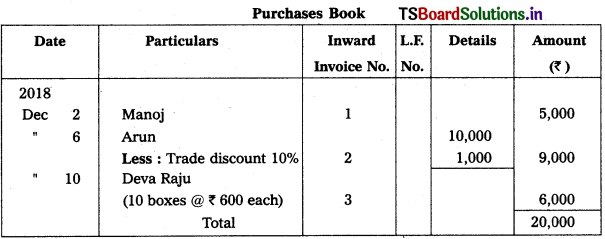
TS Inter 1st Year Accountancy Study Material 4th Lesson Preparation of Subsidiary Books 33

Note :
Transactions dated on December 10 and December 20 are not recorded as they are purchase of assets and cash purchases of goods respectively.
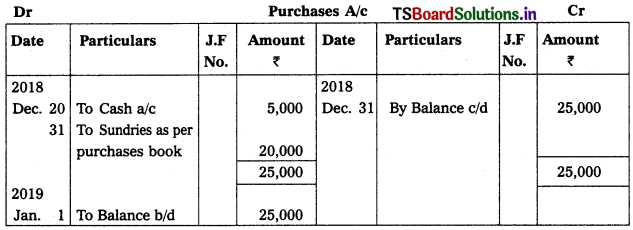
TS Inter 1st Year Accountancy Study Material 4th Lesson Preparation of Subsidiary Books 34

TS Board Inter First Year Accountancy Study Material Chapter 4 Preparation of Subsidiary Books

Question 3.
Prepare purchases book from the following transactions and post them in ledger.
2019 Jan.
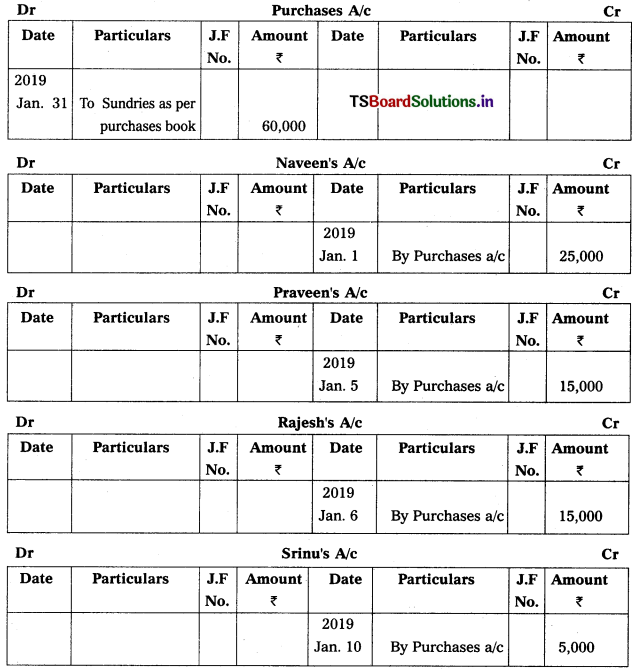
Jan. 1 Purchased goods from Naveen ₹ 25,000
Jan. 5 Purchased goods from Praveen ₹ 15,000
Jan. 6 Goods purchased from Rajesh ₹ 15,000
Jan. 10 Srinu sold goods to us ₹ 5,000
Solution:
Purchases Book
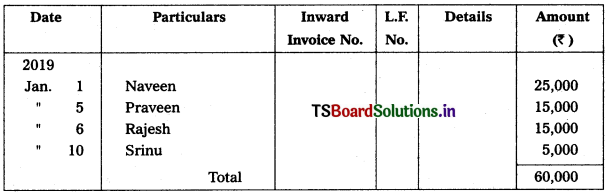
TS Inter 1st Year Accountancy Study Material 4th Lesson Preparation of Subsidiary Books 35

Ledger Posting :

TS Inter 1st Year Accountancy Study Material 4th Lesson Preparation of Subsidiary Books 36

TS Board Inter First Year Accountancy Study Material Chapter 4 Preparation of Subsidiary Books

Question 4.
Prepare Sales book from the following in the books of Balaji Rao.
2019 Feb.
Feb. 1 Sold goods to Rajani ₹ 10,000
Feb. 5 Goods sold to Mahalaxmi ₹ 20,000
Feb. 10 Sales to Balalaxmi ₹ 15,000
Feb. 15 Sold goods to Dhanalaxmi ₹ 5,000 on credit
Feb. 20 Sales to Varalaxmi ₹ 5,000 (Trade discount ₹ 100)
Solution:
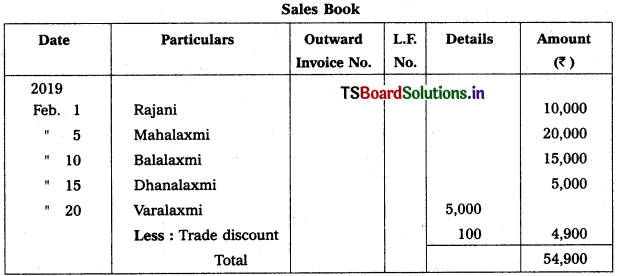
TS Inter 1st Year Accountancy Study Material 4th Lesson Preparation of Subsidiary Books 37

Question 5.
Enter the following transactions in the sales book and prepare sales account
2019 Jan.
Jan. 1 Sold goods to Murthy on credit ₹ 6,000
Jan. 5 Cash sales ₹ 10,000
Jan. 10 Goods sold to Sravan ₹ 3,000
Jan. 15 Sold old furniture to Karthik ₹ 20,000
Jan. 20 Sold 100 cases of goods @ ₹ 50/- each to Naveen
Jan. 25 Sold goods to Shyam (Trade discount 10%) ₹ 5,000
Solution:
Sales Book
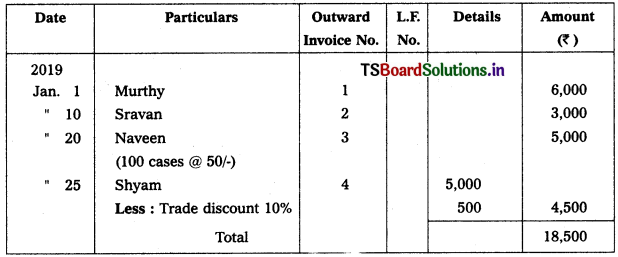
TS Inter 1st Year Accountancy Study Material 4th Lesson Preparation of Subsidiary Books 38

Notes :
1. Transaction dated January 5 cash sales ₹ 10,000 is not recorded in sales book. It is entered in Cash book.
2. Transaction dated on January 15 sold old furniture to karthik ₹ 20,000 is not recorded in the sales book as it is recorded in Journal proper.
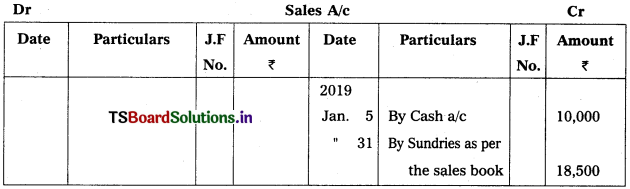
TS Inter 1st Year Accountancy Study Material 4th Lesson Preparation of Subsidiary Books 39

TS Board Inter First Year Accountancy Study Material Chapter 4 Preparation of Subsidiary Books

Question 6.
From the following transactions, prepare sales book of Sandeep Saree stores and post them to relevant accounts.
2019 Feb.
Feb. 1 Sold on credit to Raju and Co. Kamareddy 20 sarees at ₹ 300/- each, trade discount 10%
Feb. 11 Sold for cash to Rani and Co. Nizamabad 10 sarees at ₹ 3,000 each.
Feb. 16 Sold on credit to Madhu and Co. Karimnagar 10 sarees at ₹ 1,500 each, trade discount 10%
Feb. 28 Sold on credit to Prasad Hardware 2 old computers at ₹ 5,000 each.
Solution:
Sales Book
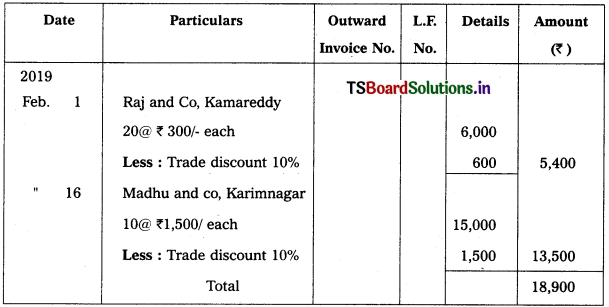
TS Inter 1st Year Accountancy Study Material 4th Lesson Preparation of Subsidiary Books 40

Note :
Transactions dated Feb. 11 and 28 should not be recorded in sales book.
Because Feb. 11 transactions is cash sales and Feb 28 transaction is not related to goods.

Ledger Posting :
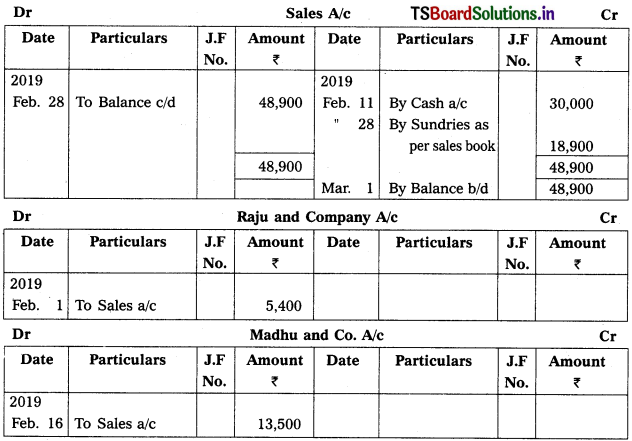
TS Inter 1st Year Accountancy Study Material 4th Lesson Preparation of Subsidiary Books 41

Question 7.
Enter the following transactions in purchase returns book and prepare purchases returns account.
2019 Jan.
Jan. 5 Returned goods to Ramesh, Hyderabad ₹ 2,000
Jan. 10 Returned goods to Soujanya, Bangalore ₹ 1,000
Jan. 15 Returned goods to Suresh, Bombay ₹ 2,000
Jan. 20 Returned goods to Raghu, Vizag ₹ 1,000
Solution:
Purchase Returns Book
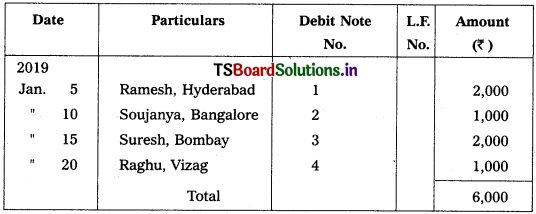
TS Inter 1st Year Accountancy Study Material 4th Lesson Preparation of Subsidiary Books 42

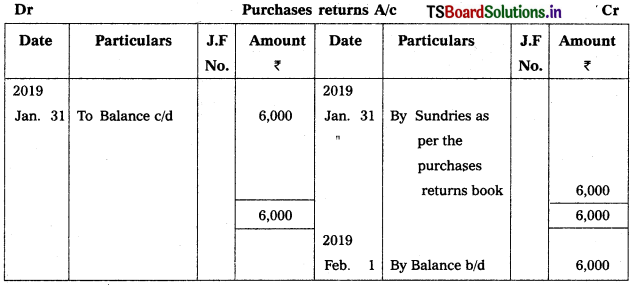
Ledger Posting :

TS Inter 1st Year Accountancy Study Material 4th Lesson Preparation of Subsidiary Books 60

TS Board Inter First Year Accountancy Study Material Chapter 4 Preparation of Subsidiary Books

Question 8.
Prepare purchase returns book from the following transactions and post them to ledger.
2019 Jan.
Jan. 5 Returned goods to Sai ₹ 2,500, trade discount at 10%, debit note no. 25, ledger folio – 10
Jan. 10 Returned goods to Sampath ₹ 3,000, trade discount at 10%, debit note no. 26, ledger folio – 20
Jan. 25 Returned goods to Suman ₹ 4,000, trade discount at 10%, debit note no. 27, ledger folio – 30
Solution:
Purchases Returns Book
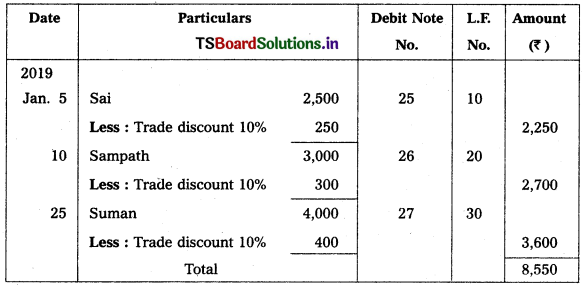
TS Inter 1st Year Accountancy Study Material 4th Lesson Preparation of Subsidiary Books 43

Ledger Posting :

TS Inter 1st Year Accountancy Study Material 4th Lesson Preparation of Subsidiary Books 44

Question 9.
Enter the following transactions in the sales returns book and prepare Sales returns account.
2019 Jan.
Jan. 1 Shyam returned goods to us ₹ 2,000
Jan. 5 Murthy returned goods to us ₹ 3,000
Jan. 10 Vasu returned goods to us ₹ 4,000
Jan. 15 Goods returned by Ravi ₹ 1,000
Solution:
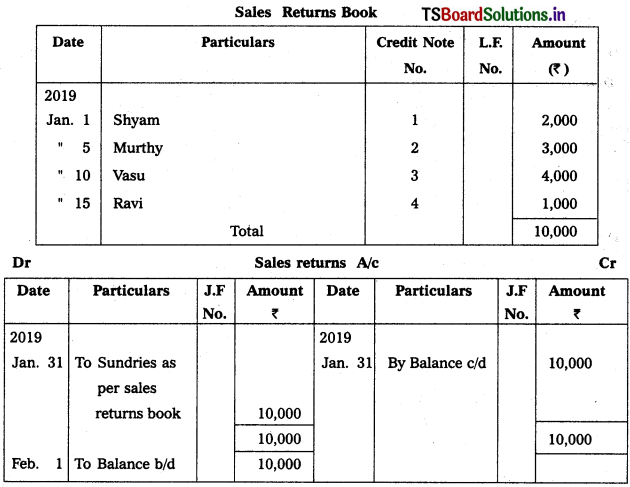
TS Inter 1st Year Accountancy Study Material 4th Lesson Preparation of Subsidiary Books 45

TS Board Inter First Year Accountancy Study Material Chapter 4 Preparation of Subsidiary Books

Question 10.
Prepare sales returns book from the following and post them into ledger.
2019 Jan.
Jan. 1 Returned goods by Nagaraju ₹ 2,475
Jan. 5 Returned goods by Krishna ₹ 3,120
Jan. 15 Returned goods by Satyam ₹ 675
Solution:
Sales Returns Book
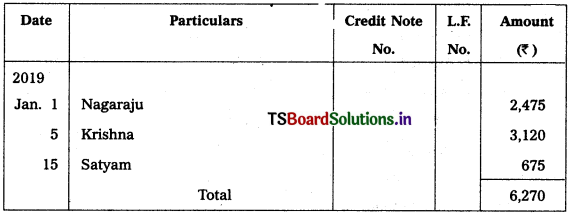
TS Inter 1st Year Accountancy Study Material 4th Lesson Preparation of Subsidiary Books 46

Ledger Posting :

TS Inter 1st Year Accountancy Study Material 4th Lesson Preparation of Subsidiary Books 47

TS Board Inter First Year Accountancy Study Material Chapter 4 Preparation of Subsidiary Books

Question 11.
Enter the following transactions into respective subsidiary book.
2019 Jan.
Jan. 1 Purchased goods from Pranay, Palamuru – ₹ 900
Jan. 2 Sold goods to Sanjana, Sathupally – ₹ 1,000
Jan. 4 Sold goods to Vinoda, Vikarabad – ₹ 2,000
Jan. 10 Bought goods from Ravi, Rani gunj – ₹ 1,500
Jan. 14 Bought goods from Mohan, Mehidipatnam – ₹ 3,000
Jan. 19 Sanjana returned goods to us – ₹ 200
Jan. 21 Returned goods to Pranay – ₹ 200
Jan. 25 Returned goods to Mohan – ₹ 500
Jan. 28 Sold goods to Nagesh, Nizamabad worth subjected to a trade discount of 10% – ₹ 5000
Jan. 29 Vinoda recorded goods to us – ₹ 300
Solution:
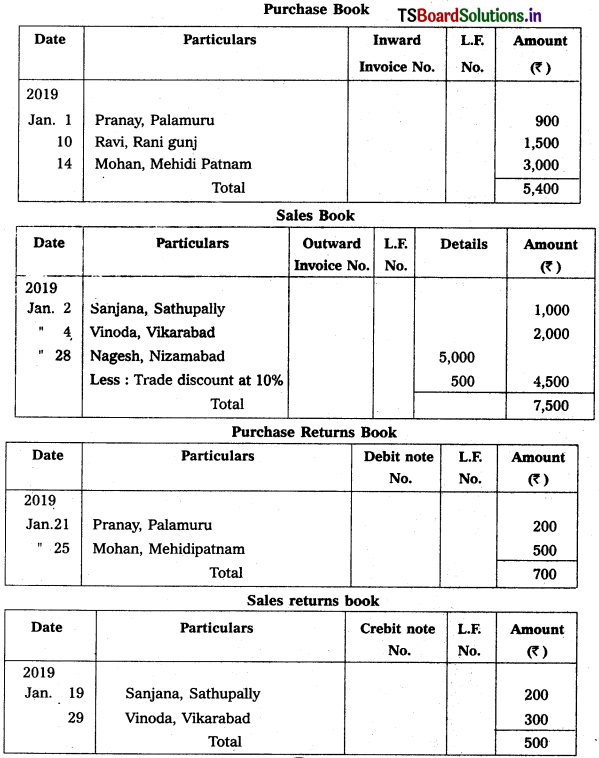
TS Inter 1st Year Accountancy Study Material 4th Lesson Preparation of Subsidiary Books 48

TS Board Inter First Year Accountancy Study Material Chapter 4 Preparation of Subsidiary Books

Question 12.
Prepare sales book and Sales Returns book from the following :
2019 Mar.
Mar. 1 Sold goods to Ramesh – ₹ 6,000
Mar. 3 Sold goods to Mahesh – ₹ 6,000
Mar. 8 Returned goods by Mahesh – ₹ 700
Mar. 11 Sold goods to Ram Murthy – ₹ 12,000
Mar. 14 Sold goods to Sampath Kumar – ₹ 11,000
Mar. 17 Returned goods from Ramesh – ₹ 1,300
Solution:
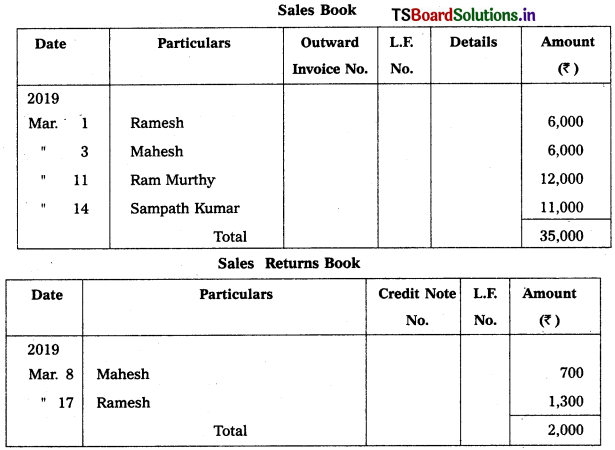
TS Inter 1st Year Accountancy Study Material 4th Lesson Preparation of Subsidiary Books 49

Question 13.
Enter the following transactions in the proper subsidiary books.
2019 Jan.
Jan. 1 Purchased goods from Anuhya – ₹ 10,000
Jan. 2 Purchased goods from Nithya – ₹ 4,000
Jan. 5 Returned goods to Anuhya – ₹ 300
Jan. 8 Purchased goods from Varsha – ₹ 2,000
Jan. 10 Returned goods to Nithya – ₹ 500
Solution:
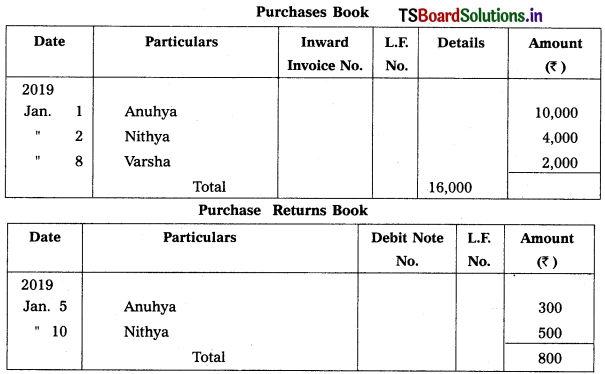
TS Inter 1st Year Accountancy Study Material 4th Lesson Preparation of Subsidiary Books 50

TS Board Inter First Year Accountancy Study Material Chapter 4 Preparation of Subsidiary Books

Question 14.
Maruthi commenced business on April 1, 2019 with cash ₹ 5,000, stock ₹ 10,000, furniture ₹ 10,000 and buildings ₹ 50,000. Pass opening entry.
Solution:
In the books of Maruthi Journal Proper
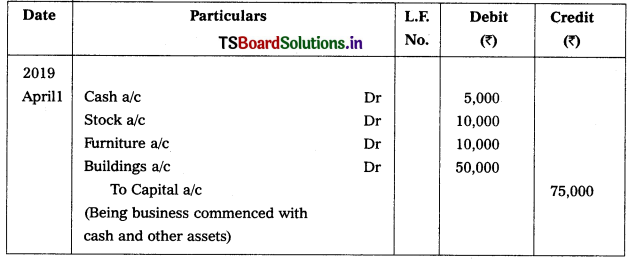
TS Inter 1st Year Accountancy Study Material 4th Lesson Preparation of Subsidiary Books 51

Question 15.
The following balances stated in the books of Supreeth as on 31-12-2018.
Cash in hand – ₹ 10,000
Cash at Bank – ₹ 14,000
Stock of goods – ₹ 16,000
Plant – ₹ 20,000
Creditors – ₹ 10,000
Record above balances in the books of Supreeth on Jan 1, 2019.
Solution:
In the books of Supreeth Journal Proper
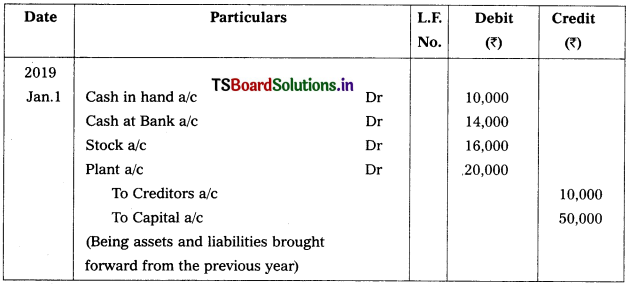
TS Inter 1st Year Accountancy Study Material 4th Lesson Preparation of Subsidiary Books 52

TS Board Inter First Year Accountancy Study Material Chapter 4 Preparation of Subsidiary Books

Question 16.
Write opening entry on Jan 1st 2019 from the following Balance Sheet of Rajeswar Rao.
Balance sheet of Rajeswar Rao as on 31/12/2018
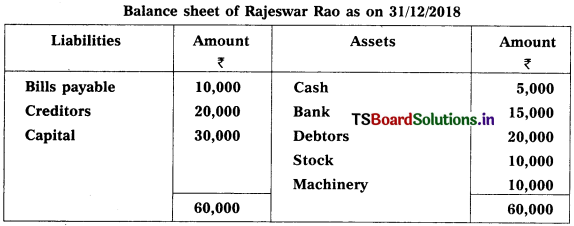
TS Inter 1st Year Accountancy Study Material 4th Lesson Preparation of Subsidiary Books 53

Solution:
In the books of Rajeshwar Rao Journal Proper
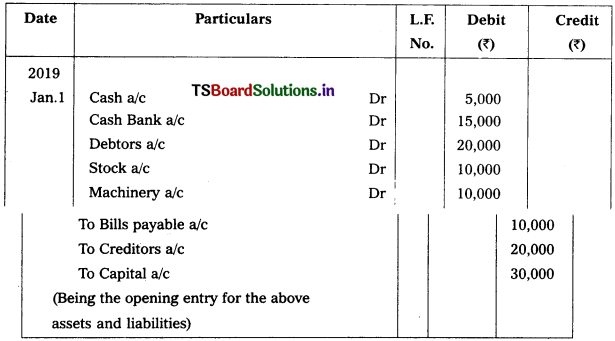
TS Inter 1st Year Accountancy Study Material 4th Lesson Preparation of Subsidiary Books 54

Question 17.
Pass necessary closing entries for the following balances in the books of Rajender.
Purchases – ₹ 14,000
Sales – ₹ 46,000
Purchase returns – ₹ 2,000
Sales returns – ₹ 1,000
Opening stock – ₹ 10,000
Wages – ₹ 3,000
Salaries – ₹ 5,000
Rent received – ₹ 4,000
Commission – ₹ 1,500
Discount allowed – ₹ 800
Discount received – ₹ 1,200
Carriage on purchases – ₹ 1,000
Closing stock – ₹ 12,000
Office expenses – ₹ 2,500
Solution:
In the books of Rajender Journal Proper
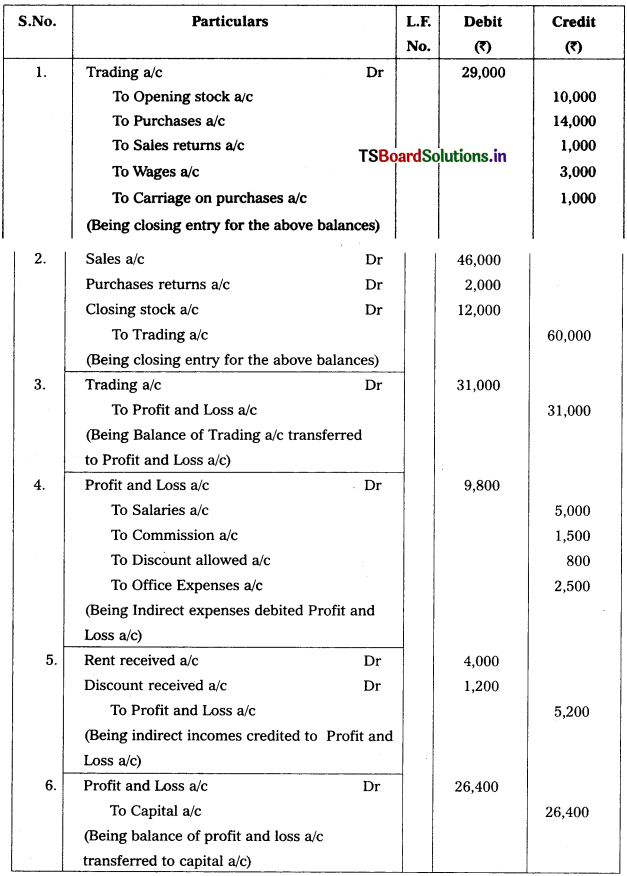
TS Inter 1st Year Accountancy Study Material 4th Lesson Preparation of Subsidiary Books 55

TS Board Inter First Year Accountancy Study Material Chapter 4 Preparation of Subsidiary Books

Question 18.
Value of Machinery ₹ 1,00,000. Depreciation to be provided on Machinery @ 10% on 31/12/2018. Pass entry.
Solution:
Journal Proper
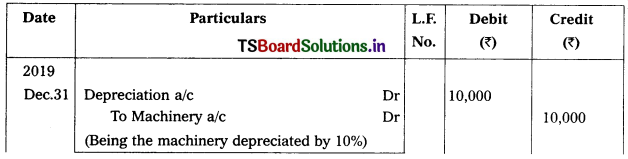
TS Inter 1st Year Accountancy Study Material 4th Lesson Preparation of Subsidiary Books 56

Question 19.
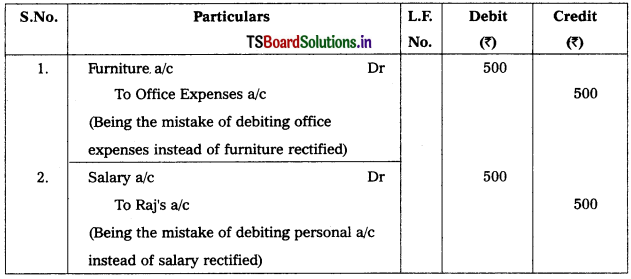
Pass the rectification entries for the following errors.
1. ₹ 500 paid for new furniture was charged to offices expenses account.
2. Salary paid to Mr. Raj ₹ 500 wrongly debited to his personal account.
Solution:
Journal Proper
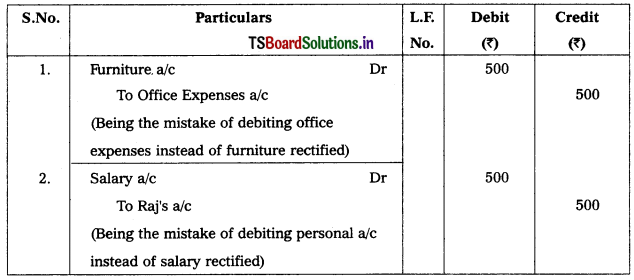
TS Inter 1st Year Accountancy Study Material 4th Lesson Preparation of Subsidiary Books 57

TS Board Inter First Year Accountancy Study Material Chapter 4 Preparation of Subsidiary Books

Question 20.
1. The net profit of the business for the year is ₹ 1,10,000. It is decided to transfer ₹ 10,000 to General Reserve.
2. Goods taken by the proprietor for his personal use ₹ 2,000.
Solution:
Journal Proper

TS Inter 1st Year Accountancy Study Material 4th Lesson Preparation of Subsidiary Books 58

TS Inter 1st Year Chemistry Notes Chapter 4 పదార్ధం స్థితులు : వాయువులు, ద్రవాలు

Here students can locate TS Inter 1st Year Chemistry Notes 4th Lesson పదార్ధం స్థితులు : వాయువులు, ద్రవాలు to prepare for their exam.

TS Inter 1st Year Chemistry Notes 4th Lesson పదార్ధం స్థితులు : వాయువులు, ద్రవాలు

→ ఒక పదార్థంలోని కణాలైన పరమాణువులు లేదా అణువుల మధ్య ఉండే ఆకర్షణ, వికర్షణ బలాలను అంతర అణుబలాలు అంటారు.

→ అంతర అణు ఆకర్షణ బలాలను వాండర్ వాల్స్ బలాలు అంటారు. అవి లండన్ విక్షేపణ బలాలు, ద్విధ్రువ ద్విధ్రువ బలాలు, ద్విధ్రువ – ప్రేరిత ద్విధ్రువ బలాలు. ఈ బలాలే కాక బలమైన ద్విధ్రువ-ద్విధృవ బలాలైన హైడ్రోజన్ బంధం.

→ పదార్థపు అణువుల ఉష్ణశక్తి, అంతర అణు బలాల మధ్యగల ఆధిక్యత పదార్థ భౌతిక స్థితుల మార్పుకు కారణమవుతుంది. ఉష్ణోగ్రతను తగ్గించినపుడు ఉష్ణశక్తి తగ్గి వాయువులు సులభంగా ద్రవీకరణం చెందుతాయి. వాయువులు అధికంగా సంపీడనం చెందుతాయి. వాయువులు ఘన, ద్రవపదార్థాల కంటే తక్కువ సాంద్రతను కలిగి ఉంటాయి.

→ వాయు ధర్మాలైన పీడనం, ఘనపరిమాణం, ఉష్ణోగ్రత, ద్రవ్యరాశిల మధ్య ఉండే సంబంధాలకు వాయు నియమాలు వర్తిస్తాయి.

→ స్థిర ఉష్ణోగ్రత వద్ద నియమిత ద్రవ్యరాశిగల వాయువు ఘనపరిమాణం దాని పీడనానికి విలోమానుపాతంలో ఉంటుంది. ఇది బాయిల్ నియమం.

→ స్థిర పీడనం వద్ద నిర్దిష్ట ద్రవ్యరాశి గల ఒక వాయువు 0°C వద్ద ఉండే ఘనపరిమాణం, ప్రతి 1°C ఉష్ణోగ్రత పెరుగుదలకు \(\frac{\mathrm{V}_0}{273.15}\) వంతున పెరుగుతుంది.

→ ఛార్లెస్ నియమం : స్థిరపీడనం వద్ద నియమిత ద్రవ్యరాశి గల వాయువు ఘనపరిమాణం పరమ ఉష్ణోగ్రతకు అనులోమానుపాతంలో ఉంటుంది.

→ అవొగాడ్రో నియమం : ఒకే ఉష్ణోగ్రత, పీడనాలలో సమాన ఘనపరిమాణాలున్న విభిన్న వాయువులు సమాన సంఖ్యలో అణువులను కలిగి ఉంటాయి.

→ ప్రమాణ ఉష్ణోగ్రతా పీడనాలు అంటే 273.15 K (0°C) ఉష్ణోగ్రత, 1 బార్ (10 Pa) పీడనం STP వద్ద ఒక ఆదర్శవాయువు మోలార్ ఘనపరిమాణం 22.71098L mol-1

TS Inter 1st Year Chemistry Notes Chapter 4 పదార్ధం స్థితులు : వాయువులు, ద్రవాలు

→ బాయిల్, ఛార్లెస్, అవగాడ్రో నియమాలను కచ్చితంగా పాటించే వాయువును ఆదర్శవాయువు అంటారు.

→ ఆదర్శవాయు సమీకరణం PV = nRT

→ సంయుక్త వాయు సమీకరణం

→ R = 8,314 JK-1 mol-1
R = 0.08314 bar L K-1 mol-1
R = 8.314 JK-1 mol-1

→ 273.15K, ఒక అట్మాస్ఫియర్ పీడనం వద్ద R = 8.20578 × 10⁻² L atm. K-1 mol-1

→ గ్రాహం నియమం : ఇచ్చిన పీడనం, ఉష్ణోగ్రతల వద్ద నియమిత ద్రవ్యరాశి గల వాయువు వ్యాపన రేటు దాని సాంద్రత యొక్క వర్గమూలానికి విలోమానుపాతంలో ఉంటుంది.

→ వాయు మిశ్రమం కలుగ చేసే పీడనం అందులోని ఘటక వాయువుల వ్యక్తిగత పీడనాల మొత్తానికి సమానం. రసాయనికంగా చర్య పొందని వాయు మిశ్రమాలకే ఇది వర్తిస్తుంది. దీనిని డాల్టన్ పాక్షిక పీడనాల నియమం అంటారు.

→ వాయు అణువులు పాత్ర గోడల పై కలుగచేసే తొడనాలే పీడనానికి కారణం.

→ వాయు అణువుల సగటు గతిజ శక్తి పరమ ఉష్ణోగ్రతకు అనులోమానుపాతంలో ఉంటుంది.

→ చలద్వాయు సమీకరణం PV = \(\frac{1}{3}\) mnurms2

→ వాయువుల గతిజశక్తి Ek = n.\(\frac{3}{2}\)RT; ఇచ్చట n = వాయుమోల్ల సంఖ్య

→ స్థిర ఉష్ణోగ్రత వద్ద P – V రేఖా పటాలను (isotherms) సమోష్ణోగ్రతా వక్రాలు అంటారు.

→ వాయువుల వేగాల నిష్పత్తి
Urms : Uav : Ump =1 : 1.128: 1.224

→ ఒక వాయు అణు స్థిరాంకం బోల్ట్మన్ స్థిరాంకం.
K = 1.38 × 10⁻¹⁶ erg K-1 molecule-1
K = 1.38 × 10⁻²³ JK-1 molecule-1

→ బాయిల్ ఉష్ణోగ్రత : విస్తృత పీడనాల్లో ఏ ఉష్ణోగ్రత వద్దనైతే నిజవాయువు ఆదర్శవాయు నియమాన్ని పాటిస్తుందో ఆ ఉష్ణోగ్రతను బాయిల్ ఉష్ణోగ్రత అంటారు.

→ అధిక పీడనాలు, అల్ప ఉష్ణోగ్రతల వద్ద వాయువులు ఆదర్శ ప్రవర్తన నుండి విచలనాన్ని చూపుతాయి.

→ సంపీడ్యతా గుణకం Z = \(\frac{\mathrm{PV}}{\mathrm{nRT}}\) లేదా
TS Inter 1st Year Chemistry Notes Chapter 4 పదార్ధం స్థితులు వాయువులు, ద్రవాలు 1

→ ఏ ఉష్ణోగ్రత కన్నా అధిక ఉష్ణోగ్రత వద్ద అధిక పీడనాన్ని ఉపయోగించినప్పటికీ, వాయువులను ద్రవీకరింప- చేయలేమో ఆ ఉష్ణోగ్రతను సందిగ్ధ ఉష్ణోగ్రత అంటారు. CO2 సందిగ్ధ ఉష్ణోగ్రత 30.98°C

→ సందిగ్ధ ఉష్ణోగ్రత ఎక్కువగా ఉండే వాయువులలో అంతర అణు ఆకర్షణ బలాలు అధికం. అటువంటి వాటిని సులభంగా ద్రవీకరణం చెందించవచ్చు.

→ 1 బార్ పీడనం వద్ద ద్రవం మరిగే ఉష్ణోగ్రతను ప్రమాణ బాష్పీభవన స్థానం అంటారు.

TS Inter 1st Year Chemistry Notes Chapter 4 పదార్ధం స్థితులు : వాయువులు, ద్రవాలు

→ సాధారణంగా ద్రవం ప్రమాణ బాష్పీభవన స్థానం, సాధారణ బాష్పీభవన స్థానం కంటే కొంచెం తక్కువ. దీనికి కారణం 1 బార్ పీడనం, 1 అట్మాస్ఫియర్ కంటే తక్కువ కావటమే.

→ ద్రవం ఉపరితలంపై గీసిన రేఖకు లంబ దిశలో ఏకాంక పొడవుపై పనిచేసే బలాన్ని తలతన్యత అంటారు. SI ప్రమాణాలు Nm-1

→ ఏకాంక స్పర్శా వైశాల్యం, ఏకాంక వేగ ప్రవీణత గల ద్రవ ప్రవాహపు పొరపై పనిచేసే బలాన్ని స్నిగ్ధతా గుణకం అంటారు.

TS Inter 1st Year Commerce Notes Chapter 2 Business Activities

Here students can locate TS Inter 1st Year Commerce Notes Chapter 2 Business Activities to prepare for their exam.

TS Inter 1st Year Commerce Notes Chapter 2 Business Activities

→ Business activities may be broadly classified into industry and commerce.

→ Industry refers to the production of wealth or value.

→ Industries are classified into

  1. Primary industry
  2. Genetic industry
  3. Extractive industry
  4. Manufacturing industry
  5. Construction industry
  6. Service industry.

→ Commerce is an organized system for the exchange of goods between the members of the industrial world.

→ There are several hindrances in the process of the exchange of goods and services.

→ Traders like wholesalers and retailers remove the hindrances of persons.

→ Transport removes hindrances of place.

→ Warehouses remove the hindrances of time.

TS Inter 1st Year Commerce Notes Chapter 2 Business Activities

→ Banks remove hindrances of finance.

→ Advertising removes hindrances of information.

→ The activities of buying and selling are called trade.

→ Trade is divided into Home trade and Foreign trade.

→ Home trade refers to sale and exchange of goods within the boundaries of a country.

→ When trade takes place between two or more countries, it is called foreign or international trade.

→ Home trade is divided into wholesale trade and retail trade.

→ Foreign trade is divided into export trade, import trade and entrepot trade.

→ Transport, warehousing, insurance, banking, advertising and communication are aids to trade.

TS Inter 1st Year Chemistry Notes Chapter 7 రసాయనిక సమతాస్థితి, అమ్లాలు – క్షారాలు

Here students can locate TS Inter 1st Year Chemistry Notes 7th Lesson రసాయనిక సమతాస్థితి, అమ్లాలు – క్షారాలు to prepare for their exam.

TS Inter 1st Year Chemistry Notes 7th Lesson రసాయనిక సమతాస్థితి, అమ్లాలు – క్షారాలు

→ ద్విగత చర్యలు సమతాస్థితిని పొందుతాయి. పురోగామి, తిరోగామి చర్యల వేగం సమానంగా ఉండే స్థితిని సమతాస్థితి అంటారు. సమతాస్థితి వద్ద క్రియాజనకాల, క్రియాజన్యాల గాఢతలు స్థిరంగా ఉంటాయి.

→ భౌతిక ప్రక్రియలలో సమతాస్థితి :

  • ఘనపదార్థం ⇌ ద్రవం
  • ద్రవం ⇌ వాయువు
  • ఘనపదార్థం ⇌ వాయువు

→ నిర్దిష్ట ఉష్ణోగ్రత వద్ద మూసి ఉన్న వ్యవస్థలలో మాత్రమే సమతాస్థితి ఏర్పడుతుంది.

→ పరస్పరం వ్యతిరేకించే రెండు చర్యలు ఒకే వేగంతో జరుగుతాయి. కాబట్టి గతిక సమతాస్థితి ఏర్పడుతుంది.

→ వ్యవస్థ కొలవడానికి వీలుండే అన్ని ధర్మాలు సమతాస్థితి వద్ద స్థిరంగా వుంటాయి.

→ ద్రవ్యరాశి క్రియానియమం : ఏ క్షణం వద్దనైనా, నిర్దిష్ట ఉష్ణోగ్రత వద్ద రసాయన చర్యావేగం ఆ క్షణం వద్ద ఉండే క్రియాజనకాల క్రియాశీల ద్రవ్యరాశుల అంకగణిత లబ్ధానికి అనులోమానుపాతంలో ఉంటుంది.
A + B ⇌ C + D చర్యకు
సమతాస్థితి స్థిరాంకం Kc = \(\frac{[C][D]}{[A][B]}\)

→ 2HI (వా) ⇌ H2 (వా) + I2 (వా)
సమతాస్థితి స్థిరాంకం Kc = \(\frac{\left[\mathrm{H}_2\right]\left[\mathrm{I}_2\right]}{[\mathrm{HI}]^2}\)
ఈ గాఢతలు సమతాస్థితి వద్ద గాఢతలు.

TS Inter 1st Year Chemistry Notes Chapter 7 రసాయనిక సమతాస్థితి, అమ్లాలు – క్షారాలు

→ రసాయన సమతాస్థితి నియమం : నిర్దిష్ట ఉష్ణోగ్రత వద్ద, తుల్యం చేయబడిన రసాయన సమీకరణంలోని, క్రియాజన్యాల గాఢతా పదాలకు స్టాయికియోమెట్రిక్ గుణకాలను ఘాతాలుగా వ్రాసి ఏర్పడిన గాఢత పదాల విలువలను, సమీకరణంలోని క్రియాజనకాల గాఢతలను సూచించే పదాలకు వాటి గుణకాలను ఘాతాలుగా రాసి, ఏర్పడిన గాఢత పదాల అంకగణిత విలువతో భాగిస్తే వచ్చే స్థిరవిలువను రసాయన సమతాస్థితి నియమం అంటారు.

→ సమతాస్థితిలో క్రియాజన్యాల మోలార్ గాఢతల లబ్ధానికి క్రియాజనకాల మోలార్ గాఢతల లబ్దానికి గల నిష్పత్తిని సమతాస్థితి స్థిరాంకం K అంటారు.
aA + bB ⇌ cC + dD
Kc = \(\frac{[\mathrm{CC}]^{\mathrm{c}} \cdot[\mathrm{D}]^d}{[\mathrm{~A}]^a \cdot[\mathrm{B}]^b}\)

→ ఒక సమతాస్థితి Kc విలువ x అయితే వ్యుతమ విలువకు Kc’ = \(\frac{1}{x}\)
తిరోగామి దిశలో జరిగే చర్య సమతాస్థితి స్థిరాంకం విలువ, పురోగామి దిశలో జరిగే అదే చర్య సమతాస్థితి స్థిరాంకం విలువ యొక్క విలోమ విలువగా ఉంటుంది.

→ సమతాస్థితి స్థిరాంకం ఉష్ణోగ్రత స్థిరంగా ఉన్నంతవరకు స్థిరంగా ఉంటుంది.

→ సజాతి వ్యవస్థలలో క్రియాజనకాలు, క్రియాజన్యాలు అన్నీ కూడా సజాతి ప్రావస్థలో ఉంటాయి.
N2 (వా) + 3H2 (వా) = 2NH3 (వా)
CH3 COOC2H5 (జల)+ H2O (ద్ర) ⇌ CH3COOH (జల) + C2H5OH (జల)

→ వాయుస్థితి సమతాస్థితికి మోలార్ గాఢతల బదులు పాక్షిక పీడనాలు రాసినపుడు సమతాస్థితి స్థిరాంకాన్ని Kp అంటారు.
H2 (వా) + Ic (వా) ⇌ 2HI (వా)
Kp = \(\frac{\mathrm{p}_{\mathrm{HI}}^2}{\mathrm{p}_{\mathrm{H}_2} \cdot \mathrm{p}_{\mathrm{l}_2}}\)

→ Kp = Kc(RT)Δn
Δn = వాయుస్థితిలోని క్రియాజన్యాల మోల్ల సంఖ్య – వాయుస్థితిలోని క్రియాజనకాల మోత్ల సంఖ్య

→ ఒకటి కంటే ఎక్కువ సంఖ్యలో ప్రావస్థలు కలిగినటువంటి వ్యవస్థ సమతాస్థితిని, విజాతి సమతాస్థితి అంటారు.
CaCO3 (ఘ) ⇌ CaO(ఘ) + CO2 (వా)
H2O (ద్ర) ⇌ H2O (వా)

→ విజాతి సమతాస్థితిలో శుద్ధ ఘనపదార్థాలు, శుద్ధ ద్రవపదార్థాలు ఉంటాయి. శుద్ధ ఘనపదార్థం, లేదా శుద్ధ ద్రవపదార్థం మోలార్ గాఢత స్థిరంగా వుంటుంది.
CaCO3 (ఘ) ⇌ CaO(ఘ) + CO2 (వా)
Kc = [CO2 (వా)]
Kp = PCO2

→ చర్యాభాగఫల స్థిరాంకం Q విలువను సమతాస్థితి స్థిరాంకాన్ని లెక్కించినట్లే లెక్కించవచ్చు కాని ఆ సమీకరణంలో రాసే గాఢతలు సమతాస్థితి గాఢతలు కావు.

→ aA + bB ⇌ cC + dD

  • Qc = [C]c [D]d / [A]a. [B]b
  • Qc > Kc అయితే క్రియాజనకాల వైపుగా పోయే దిశలో పురోగమిస్తుంది. (ఉత్రమ చర్య)
  • Qc < Kc అయితే చర్య క్రియాజన్యాలు వైపుకు పోయే దిశలో పురోగమిస్తుంది. (పురోగామి చర్య)
  • Qc = Kc అయితే చర్యా మిశ్రమం సమతాస్థితిలో ఉంటుంది.
  • Qc < Kc అయితే నికచర్య ఎడమవైపు నుంచి కుడివైపుకు పోతుంది.
  • Qc > Kc అయితే నికరచర్య కుడివైపు నుండి ఎడమవైపుకు పోతుంది.
  • Qc = Kc అయితే నికర చర్య జరగదు.

→ గిబ్స్ శక్తి ΔG. రుణవిలువలో ఉంటే ఆ చర్య అయత్నకృతంగా పురోగామి దిశలో జరుగుతుంది.

TS Inter 1st Year Chemistry Notes Chapter 7 రసాయనిక సమతాస్థితి, అమ్లాలు – క్షారాలు

→ గిబ్స్ శక్తి ΔG ధనవిలువలో ఉంటే ఆ చర్య అయత్నకృతంగా జరగదు. కాబట్టి క్రియాజన్యాలు క్రియాజనకాలుగా మారే చర్య జరుగుతుంది.
A ΔG = 0 అయితే, చర్య సమతాస్థితిని చేరుకుంటుంది.
ΔG = ΔG° + RT/nQ
G° = ప్రమాణ గిబ్స్ శక్తి
సమతాస్థితి వద్ద ΔG = 0 ; Q = K
ΔG = ΔG + RT/nK = 0
K = e-ΔG /RT

→ సమతాస్థితిని నియంత్రించే అంశాలలో – దేనినైనా మార్పుచెందిస్తే ఆ మార్పును తగ్గించే విధంగా పూర్తిగా ప్రతిఘటించే విధంగా, లేదా తటస్థపరిచే విధంగా వ్యవస్థ వ్యవహరిస్తుంది. దీనినే లీచాట్లెయర్ సూత్రం

→ బ్రాన్టేడ్ సిద్ధాంతం ప్రకారం, ప్రోటాన్ దాత ఆమ్లం, ప్రోటాన్ స్వీకర్త క్షారం.

→ లూయీ సిద్ధాంతం ప్రకారం ఎలక్ట్రాన్ జంట దాత క్షారం. ఎలక్ట్రాన్ జంట స్వీకర్త ఆమ్లం.

→ ఆమ్ల క్షారాల మధ్య ప్రోటాన్ మాత్రమే భేదం అయితే ఆ జంటను సంయుగ్మ ఆమ్ల క్షార జంట అంటారు.

→ జలద్రావణంలో గాని, నీటిలోగాని, [H+], [OH] అయాన్ల గాఢతల లబ్ధాన్ని నీటి అయానిక లబ్ధం అంటారు.
Kw = [H+] [OH]
25°C వద్ద దీని విలువ 1.0 × 10⁻¹⁴ మోల్స్2 / లీటర్2

→ pH = – log10 [H ]

→ బలహీన ఆమ్ల ద్రావణం pH = \(\frac{1}{2}\)pKa – \(\frac{1}{2}\)logC

→ రెండు (లేదా అంతకంటే ఎక్కువ) చర్యలను సంకలనం చేసినపుడు లభించే నికరచర్య యొక్క సమతాస్థితి స్థిరాంకాన్ని వ్యక్తిగత చర్యల సమతాస్థితి స్థిరాంక విలువల అంకగణిత లబ్దంగా రాయవచ్చు.
Kనికర = K1 × K2 ……

→ ఆనయాన్ జలవిశ్లేషణలో పాల్గొంటే ద్రావణానికి క్షార లక్షణం కలుగుతుంది.
CH3COO + H2O (ద్ర) ⇌ CH3COOH (జల) + OH (జల)
జలవిశ్లేషణ స్థిరాంకం Kh = \(\frac{K_w}{K_a}\)

→ కేటయాన్ జలవిశ్లేషణలో పాల్గొంటే ద్రావణం ఆమ్ల లక్షణాన్ని చూపుతుంది.
NH4+ (జల) + H2O (ద్ర) ⇌ NH3 (జల) + H3O+ (జల)
జలవిశ్లేషణ స్థిరాంకం Kh = \(\frac{K_w}{K_b}\)

→ బలహీన, ఆమ్ల-క్షారాల, బలహీన విద్యుద్విశ్లేష్యాల అయనీకరణం ఉమ్మడి అయాన్ సమక్షంలో అణచబడుతుంది. దీనినే ఉభయసామాన్య అయాను ప్రభావం అంటారు.

→ ద్రావణాలను విలీనం చేసినపుడు లేదా వాటికి స్వల్ప పరిమాణంలో ఆమ్లాలను లేదా క్షారాలను కలిపినపుడు వాటి pH లో కలిగే మార్పును నిరోధించే శక్తి గల ద్రావణాలను బఫర్ ద్రావణాలు అంటారు.

→ ఆమ్ల బఫర్ pH
TS Inter 1st Year Chemistry Notes Chapter 7 రసాయనిక సమతాస్థితి, అమ్లాలు – క్షారాలు

TS Inter 1st Year Chemistry Notes Chapter 7 రసాయనిక సమతాస్థితి, అమ్లాలు – క్షారాలు

→ సంతృప్త ద్రావణంలో అయాన్ల గాఢతల లబ్ధాన్ని ద్రావణీయత లబ్ధి స్థిరాంకము అంటారు.
MxXy ⇌ x MP+ (జల) + yXq- (జల)
Ksp = [MP+] [xq-)y

TS Inter 1st Year Accountancy Study Material Chapter 3 Subsidiary Books

Telangana TSBIE TS Inter 1st Year Accountancy Study Material 3rd Lesson Subsidiary Books Textbook Questions and Answers.

TS Inter 1st Year Accountancy Study Materia 3rd Lesson Subsidiary Books

Short Answer Questions:

Question 1.
Explain various types of Subsidiary Books.
Answer:
All day – to – day transactions are first recorded in the journal. In a small business unit, it is possible to record all business transactions in one book. But in a big organisation where the transactions are large in number, it is c ficult to record all business transactions in one place.

Hence, in big organisations, there is need to sub divide journal into special journals. Each journal is meant for recording the transactions of separate category and of repetitive nature. These special journals are called ‘Subsidiary Books’ or Day Books.

Types of Subsidiary Books:
Keep in view the nature and need of the business transactions, the subsidiary books are classified as follows.

1.Purchases Book :
Only credit purchases of goods are recorded in this book. Cash purchases and purchase of assets are not recorded in this book. The recording of entries in this book is based on the invoices and bills received by the firm from the suppliers.

2. Sales Book :
The credit sale of the goods are recorded in sales book. Cash sales and sale of assets are not recorded in this book. The recording of entries in this book is based on the outward invoices or bills prepared by the trader on the customer.

3. Purchase Returns Book :
Sometimes, goods purchased are returned to the suppliers for various reasons such as the goods are not of the required quality or defective, not matching to the specifications, price difference etc., such return of goods is recorded in the purchase returns book. For every return, a debit note is prepared and send it to the supplier.

4. Sales Return Book :
This book is used to record the return of the goods by the customers. Sometimes, customers return a part of the goods purchased from the trader. On receipt of goods from the customer, credit note is prepared.

5. Cash Book :
The cash book is maintained to record all cash transactions. All cash receipts are debited and all cash payments are credited in this book.

6. Bills Receivable Book :
The bill on which the amount is yet to be received and promissory note drawn by the seller or creditor are recorded in bills receivable book.

7. Bills Payable Book:
All bills and promissory note accepted by the buyer or debtor are recorded in the bills payable book.

8. Journal Proper:
This book is used to record only those transactions which cannot be recorded in any of the above mentioned subsidiary books.

TS Board Inter First Year Accountancy Study Material Chapter 3 Subsidiary Books

Question 2.
State advantages of subsidiary books.
Answer:
The following are the advantages of subsidiary books.

  1. No need of writing journal entries. The transactions are entered directly into their respective journals.
  2. Ledger accounts can be prepared on the basis of subsidiary books.
  3. Recording of transactions is very fast and easy. .
  4. By entrusting different subsidiary books to different persons, division of work principle can be implemented.
  5. Accounting work will be done efficiently by allotting work to different experts who prepare the special books.
  6. Labour involved and time can be saved.
  7. Since separate books are maintained to record a particular set of transactions, errors can be easily detected.
  8. Information relating to similar types of transactions will be available at one place.
    E.g. Relating to sales, purchases, cash etc.

Question 3.
Explain about purchases and sales book draw the formats.
Answer:
Purchases book :
In this book, all credit purchases of goods are recorded i.e. cash purchases of goods and purchase of assets are not recorded.
The recording of entries in this book is based on the invoices or bills received by the firm from the suppliers.

Proforma of purchases :

TS Inter 1st Year Accountancy Study Material 3rd Lesson Subsidiary Books 1

Sales Book:
The credit sale of the goods are recorded in sales book. Cash sales and sale of assets are not recorded in this book. The recording of entries in the book is based on the outward invoices or bills prepared by the trader on the customer.

TS Inter 1st Year Accountancy Study Material 3rd Lesson Subsidiary Books 2

TS Board Inter First Year Accountancy Study Material Chapter 3 Subsidiary Books

Question 4.
What is Journal Proper ? Write any five items which are recorded in Journal Proper.
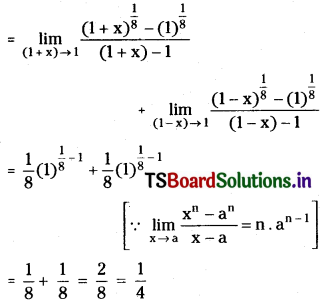
Answer:
All business transactions are recorded in different subsidiary books according to their nature. But there are certain transactions which occassionally happen and these are not recorded in any of the subsidiary books.

However, they are recorded in a special book known as ‘Journal Proper’. That is, the transactions which are not recorded is the respective subsidiary books are recorded in the journal proper.

The following transactions are recorded in the journal proper.

1. Opening entries :
Opening entries are used to record at the beginning of the financial year to open the books by recording assets, liabilities and capital appearing in the Balance Sheet.

TS Inter 1st Year Accountancy Study Material 3rd Lesson Subsidiary Books 3

2. Closing entries :
Closing entries are used at the end of the accounting year for closing all accounts relating to expenses and revenues. These accounts are closed by transfer-ring their balances to Trading account and Profit and Loss account.

3. Purchase and sale of assets on credit:
Every organisation purchase the assets or sell the assets either on cash basis or on credit basis. When they are purchased or sold on credit basis, they are recorded in journal proper.

4. Rectification entries :
While recording the transactions in the books of accounts, some errors may arise due to negligence of the clerk or due to ignorance of fundamental principle of accounts. In such cases profit or loss cannot be determined correctly. So, necessary rectification entries are passed in journal proper.

5. Adjustment entries :
There are certain incomes and expenses are not recorded even at the date of closing the accounts. If they are not taken into account, correct profit or loss cannot be ascertained. So, necessary adjustment entries with regarding to those expenses and incomes are recorded in journal proper.

6. Transfer entries :
These entries in the journal proper for transferring an item from one account to another account.
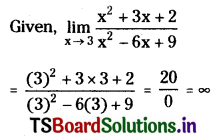
Ex : Transfer of profit to reserve fund, transfer of drawings a/c to capital a/c.

7. In addition to the above, some transactions like loss of goods due to fire, Dishonour of cheques or bills of exchange, Goods sent on consignment are recorded in journal proper.

Very Short Answer Questions:

Question 1.
What is Debit Note ?
Answer:

  1. It is a document sent to the supplier while returning the goods purchased on credit from him.
  2. It intimating that his account is debited to the extent of goods returned and the reasons for returning them. It is prepared by the purchaser.

Question 2.
What is Credit Note ?
Answer:

  1. It is a note (document)prepared and sent to the customer to inform that his account is credited with the amount of the goods returned by him.
  2. It is a common to make it in red ink. It contain name and address of customs, value of goods returned and reasons for return of goods.

Question 3.
What is Invoice ?
Answer:

  1. It is a statement sent by the supplier along with the goods or in advance, to the trader, stating that the goods are supplied along with the price, discount offered and other terms and conditions.
  2. The document is called ‘Inward Invoice”, as it is received by the trader from the supplier.

Question 4.
Trade Discount.
Answer:

  1. The rebate offered by the supplier on the catalogue price is known as trade discount.
  2. If trade discount is given, it is to be deducted from the purchase price and only net amount is to be recorded in the books.

Question 5.
Journal Proper.
Answer:

  1. Journal proper is also known as “Journal Residual” or “General Journal”.
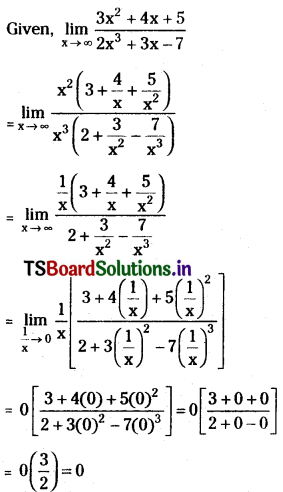
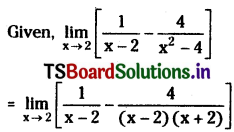
  2. This book is used to record only those transactions which cannot recorded in purchase book or sales book or cash book, purchase returns or sales return book, Bills Receivable or Bills Payable book.
  3. E.g. When a firm purchased machinery on credit.