TS Inter 1st Year Accountancy Study Material Chapter 1 Book Keeping and Accounting

Telangana TSBIE TS Inter 1st Year Accountancy Study Material 1st Lesson Book Keeping and Accounting Textbook Questions and Answers.

TS Inter 1st Year Accountancy Study Materia 1st Lesson Book Keeping and Accounting

Short Answer Questions:

Question 1.
State any 5 advantages of accounting.
Answer:
Advantages of Accounting : The following are the main advantages of Accounting :

1. Net Result of Business Operations:
Accounting provides the operational result (Profit and Loss) of business for a given period of time.

2. Ascertainment of Financial Position :
The proprietor requires a full picture of his financial position to plan for the next year’s business. Balance sheet provides the financial status of the business.

3. Facilitates Comparative Study:
Accounting provides the facility of comparative study of the various aspects of the business with that of previous year and helps the business man to take necessary decisions.

4. Control over Assets :
In the course of business, the proprietor acquires various assets like building, machinery, furniture etc., which are well protected by generating records.

5. Helps Management :
Accounting helps management on important issues like ascertainment of cost and price fixation of goods and services.

6. Evidence :
Accounting records act as an approved evidence in legal matters.

TS Board Inter First Year Accountancy Study Material Chapter 1 Book Keeping and Accounting

Question 2.
Give limitations of accounting.
Answer:
Limitations of Accounting : The following are the limitations of Accounting :

1. Records only monetary transactions :
Accounting considers monetary transactions only, non-monetary transactions like skills of human resources, quality, organization culture, units of production sales etc., are ignored in accounting.

2. Historical in nature :
Accounting considers only historical transactions, i.e., transactions which have occurred in the past only recorded in accounting books. Transactions relating to future estimations or forecasts are not considered in accounting.

3. Price level changes are not considered :
Accounting does not consider price level changes which may occur from time to time, thus, it doesn’t reflect the current position.

4. Does not provide realistic information :
Accounting may not provide realistic information which in turn affects the overall results of the business concern.

TS Board Inter First Year Accountancy Study Material Chapter 1 Book Keeping and Accounting

Question 3.
State any 5 basic differences between Book-keeping and Accounting.
Answer:
The following are the differences between Book-keeping and Accounting.

Basis of differenceBook – Keeping

Accounting

1. ScopeIt is concerned with recording business transactions only.It is concerned with not only recording of transactions but also classifying, analysing interpreting the results of the business.
2. ObjectiveThe objective is to maintain systematic records of the business.The objective is to ascertain the profitability and financial position of the business.
3. NatureThis is routine and clerical in nature.It is analytical and executive in nature.
4. ResponsibilityA book-keep is responsible for recording business transactions only.An accountant is responsible for preparation of final accounts and revealing the net results of the business.
5. Staff InvolvedBook-keeping is done by junior level staff in accounting department.Senior staff or an accountant performs the accounting work.
6. SupervisionA book-keeper does not supervise the work of an accountant.An accountant can check and supervise the work of the book¬keeper.

TS Board Inter First Year Accountancy Study Material Chapter 1 Book Keeping and Accounting

Question 4.
Explain the steps involved in Accounting process.
Answer: Accounting process involves the following steps :
1. Identifying :
Identifying the business transaction from the source document.

2. Recording :
The next step of accounting process is to keep a systematic record of all business transactions, in orderly manner, soon after their occurence in the journal or subsidary books.

3. Classifying :
This is concerned with the classification of the recorded business transactions so as to group the similar transactions at one place i.e., in ledger by extracting the balance or total of accounts.

4. Summarising:
It is the process of finding the total of balances of all accounts so as to prepare trial balance.

5. Reporting :
The information from the trial balance is used to prepare profit and loss account and a balance sheet in a manner useful to uses of accounting information.

6. Analysing:
It establishes the relationship between the items of profit and loss account and balance sheet. The purpose of analysing is to identify the financial strength and weakness of. the business enterprise.

7. Interpreting :
It is concerned with explaining the meaning and significance of the relationship so established by the analysis. Interpretation should be useful to the users, so as enable them to take correct decisions.

TS Board Inter First Year Accountancy Study Material Chapter 1 Book Keeping and Accounting

Question 5.
State the objectives of accounting.
Answer:
The main objectives of accounting are :

  1. To maintain accounting records.
  2. To find out the result of operations.
  3. To ascertain the financial position.
  4. To communicate the information to users.

Question 6.
State the general features of IFRS.
Answer: IFRS :
1. International Financial Reporting Standards (IFRS) are the standards issued by IFRS Foundation and the International Accounting Standards Board (IASB).
2. It provides a common / uniform global language for business affairs, so that the company accounts are understood and compared across international boundaries.
3. IFRS Standards have been steadily replacing the accounting standards of many countries. At present 160 countries are implementing IFRS.
4. The General Features of IFRS include :

  1. Fair presentation and compliance with IFRS.
  2. Going concern.
  3. Accrual basis of accounting.
  4. Materiality and aggregation.
  5. Off-setting allowed only under specific conditions.
  6. Frequency of reporting.
  7. Compare the information.
  8. Consistancy of presentation.

TS Board Inter First Year Accountancy Study Material Chapter 1 Book Keeping and Accounting

Question 7.
Briefly explain any 5 concepts of accounting. –
Answer:
The term concept means an idea or thought. Basic Accounting concepts are the fundamental ideas or basic assumptions underlying the theory and practice of financial accounting. These concepts are termed as Generally Accepted Accounting Principles.

1. Business Entity Concept :
Business is treated separate from the proprietor. All the transactions are recorded in the books of business but not in the books of proprietor. The proprietor is also treated as creditor of the business. When he contributes capital he is treated as a person who has invested his amount in the business. Therefore, capital appears on the liabilities side of the balance sheet of the business.

2. Going Concern Concept:
The concept relates with the long life of the business. The assumption is that business will continue to exist for unlimited period unless it is dissolved due to some reason or other. When the final accounts are prepared, recording is made for outstanding expenses and prepaid expenses because of the assumption that business will continue.

3. Cost Concept:
According to this concept, an asset is recorded at cost i.e., the price which is paid at the time of acquiring it, in the books of account. In Balance Sheet, these assets appear not at cost price every year but depreciation is deducted and they appear at the amount which is cost less depreciation. Under this concept, all such events are ignored which affect the business but no cost. Ex. Death of a director.

4. Accounting Period Concept :
Every business man wants to know the result of his investment and efforts after a certain period. Usually one year period is regarded as ideal for this purpose. It may be 6 months or 2 years also. This period is called accounting period.

It depends upon the nature of business and object of the proprietor of business. From taxation point of view one year period is necessary as income tax is payable every year.

5. Duel Aspect Concept:
Under this concept, every transaction has got a two fold aspect,
i) Receiving the benefit and ii) Giving of that benefit. For instance, when a firm acquires an asset, (receiving the benefit) it must pay cash (giving of that benefit).

Therefore, two accounts are to be passed in the books of accounts, one for receiving the benefit and other for giving the benefit. Thus, there will be a double entry for every transaction – debit for receiving the benefit and credit for giving the benefit.

TS Board Inter First Year Accountancy Study Material Chapter 1 Book Keeping and Accounting

Question 8.
Briefly explain accounting conventions.
Answer:
Accounting conventions are customs or traditions guiding the preparation of accounts. They are adopted to make financial statements clear and meaningful.

The following are the four accounting conventions :
1. Convention of disclosure:
Accounting statements should disclosefully and completely all the significant information, based on which decisions are taken by various interest parties. It involves proper classification and explanation of accounting information which are published in financial statements.

2. Convention of materiality :
According to this conventions only those events should be recorded which have a significant bearing and insignificant things should be ignored. The avoidence of insignificant. Things will not materially affect the records of the business.

3. Convention of consistency :
The convention of consistency facilitates comparison of performance of a business unit from one accounting period to another is possible when the accounting principles followed by the firm are consistently applied over the years. Ex.: An organisation should not change the method of depreciation or valuation of stocks every year.

4. Convention of conservatism:
According to this convention, the principle of anticipate no profit but provide for all possible losses” should be applied. The principle of conservatism requires that in the situation of uncertainly of doubt, the business – transactions should be recorded in such a manner that the profits and assets are not overstated and the losses and liabilities are not understated.

Question 9.
Write a brief note on accounting standards.
Answer:

  1. To promote world-wide uniformity in published accounts, the International Accounting Standards Committee (IASQ has been set up in June 1973 with nine nations as founder members. The purpose of this committee is to formulate and publish in public interest, standards to be observed in the presentation of audited financial statements and to promote their world-wide acceptance and observance.
  2. In our country, the Institute of Chartered Accountants of India (ICAI) has constituted Accounting Standard Board (ASB) in 1977. The ASB has been empowered to formulate and issue accounting standards that should be followed by all business concerns in India.
  3. Accounting Standard is a principle that guides and standardizes accounting practices. Accounting standards ensures uniformity in presentation of financial statements and facilitates interfirm comparison within the industry. They also ensure creditability and reliability of financial statements.,
  4. At present there are 35 Indian. Accounting Standards (IAS) and are mandatory and to be complied with from the date from which they come into force in presenting audited financial statements.

TS Board Inter First Year Accountancy Study Material Chapter 1 Book Keeping and Accounting

Very Short Answer Questions:

Question 1.
What is transaction ?
Answer:
Transactions :

  1. Transactions are those activities of a business, which involve transfer of money or goods or services between two persons or two accounts.
  2. For example, purchase of goods, sale of goods, borrowing from bank etc.
  3. Transactions are of two types namely cash and credit transactions. Every transaction brings about change in the financial position of business.

Question 2.
What is Book-keeping ?
Answer:

  1. Book-keeping is the art of recording business transactions in regular and systematic manner.
  2. According to Carter “Book-keeping is the science and art of correctly recording the books of accounts all those business transactions that result in transfer of money or money’s worth.

Question 3.
Define Accounting.
Answer:

  1. Accounting is called as the “Language of Business”.
  2. The American Institute of Public Accountants defined accounting as “the art of recording, classifying and summerising in significant manner and interms of money transactions and events which are in part, atleast of financial character and interpreting the results thereof.

TS Board Inter First Year Accountancy Study Material Chapter 1 Book Keeping and Accounting

Question 4.
What is Accounting cycle ?
Answer:

  1. An accounting cycle is a complete sequence of accounting process that begins with the recording of business transactions and ends with the preparation of final accounts.
  2. These include journal, ledger, trial balance and financial statements such as trading account, profit and loss account and balance sheet.

Question 5.
What is an Accounting Standard ?
Answer:

  1. Accounting Standard is a principle that guides and standardises accounting practices.
  2. Accounting Standards are necessary so that the financial statements are meaningful across wide variety of businesses, otherwise, the accounting rules of different companies would make comparison almost impossible.
  3. At present there are 35 Indian Accounting Standards.

Question 6.
What is IFRS ?
Answer:

  1. nternational Financial Reporting Standards (IFRS) are the standards issued by IFRS Foundation and the International Accounting Standards Board (IASB).
  2. It provides a common / uniform global language for business affairs, so that the company accounts are understood and compared across international boundaries.
  3. IFRS Standards have been steadily replacing the accounting standards of many countries. At present 160 countries are implementing of IFRS.

TS Board Inter First Year Accountancy Study Material Chapter 1 Book Keeping and Accounting

Question 7.
What is GAAP ?
Answer:

  1. Generally accepted Accounting Principles (GAAP) defined as those rules of action / conduct which are derived from experience and practice.
  2. Generally Accepted Accounting Principle (GAAP) should be Relevance, . Reliable and should ensure feasibility.

Question 8.
What is an accounting concept ?
Answer:

  1. Accounting Concepts are the necessary assumptions, conditions or postulates upon which the accounting is based.
  2. They are developed to facilitate communication of the accounting and financial information to all the users of the financial statements.
  3. Some of the Accounting Concepts are: Business, entity concept, dual aspect concept, going concern concept, money measurement concept etc.

Question 9.
What is an accounting convention ?
Answer:
1. Accounting conventions are the customs or traditions guiding the preparation of accounts.
2. They are adopted to make financial statements clear and meaningful.
3. Following are the four accounting conventions :

  1. Convention of Disclosure.
  2. Convention of Materiality.
  3. Convention of Consistency; and
  4. Convention of Conservatism.

TS Board Inter First Year Accountancy Study Material Chapter 1 Book Keeping and Accounting

Question 10.
Explain convention of conservatism.
Answer:

  1. According to this convention, the principle of anticipate no profit but provide for all possible losses should be applied.
  2. The principle of conservatism requires that in the situation of uncertainity of doubt, the business transactions should be recorded in such a manner that the profits and assets are not overstated and the losses and liabilities are not understated.

Question 11.
Explain convention of consistency.
Answer:

  1. The convention of consistency facilitates comparison of performance of a business firm from one accounting period to another is possible when the accounting principles followed by the firm are consistently applied over the years.
  2. Ex: An organisation should not change the method of depreciation or valuation of stocks every year.

Question 12.
What is Matching concept ?
Answer:

  1. Matching the revenues earned during an accounting period with the cost associated with the period to ascertain the result of the business concern is called the Matching concept.
  2. According to this concept, incomes are to be identified with their corresponding expenses or vice versa in a given period of time.

TS Board Inter First Year Accountancy Study Material Chapter 1 Book Keeping and Accounting

Question 13.
Explain business entity concept of accounting.
Answer:

  1. Business is treated separate from the’proprietor. All the transactions are recorded in the books of business but not in the books of proprietor.
  2. The proprietor is also treated as creditor of the business. When he contributes capital he is treated as a person who has invested his amount in the business. Therefore, capital appears on the liabilities side of the balance sheet of the business.

Question 14.
Explain money measurement concept
Answer:

  1. Only those transactions are recorded in accounting which can be expressed interms of money. The transactions which cannot be expressed in money is beyond the scope of accounting.
  2. Receipt of income, payment of expenses, purchase of assets etc., are monetary transactions that are recorded in the books of account. Where as in the event of breakdown of machinery is not recorded because it has no monetary value.

TS Board Inter First Year Accountancy Study Material Chapter 1 Book Keeping and Accounting

Additional Questions:

Question 1.
What is Double entry system and explain its features.
Answer:
Every business transaction involves a transfer and as such consists of two aspects.

  1. The receiving aspect
  2. The giving aspect. It is necessary to note that these aspects go together, because receiving necessarily implies giving and vice-versa. The record of any business transaction will be complete only when both these aspects are recorded. The recording of the two aspects of each transaction is known as “Double entry system of book-keeping”.

Features :

  1. Every transaction has two aspects i.e., receiving the benefit and giving the benefit.
  2. Every transaction affects two accounts.
  3. Double entry system is based upon the principles and concepts of accounting.
  4. It helps in the preparation of trial balance which is a test arithmetical accuracy in accounts.
  5. If facilitates the preparation of final accounts with the help of trial balance.

Question 2.
Explain the advantages of Double entry system.
Answer:
The following are the advantages of Double entry system of book-keeping.

  1. The system maintains a complete record of all the business transactions, as it records both the aspects of the transaction.
  2. It provides a check on the arithmatical accuracy of accounts with the help of trial balance.
  3. Errors and frauds can be detected under this system. So, it reduces the chance of committing errors and frauds.
  4. It reveals the results of the operations i.e., Profit or loss, by preparing and loss a/c.
  5. The financial position of the business can be ascertained through the preparation of the balance sheet.
  6. It is a scientific system and permits the accounts to be kept in a detailed form and provides sufficient information for the purpose of control.
  7. The results of one year can be compared with the results of the previous year and reasons for the changes are known.
  8. It provides accounting information readily to the management for making decisions.

TS Board Inter First Year Accountancy Study Material Chapter 1 Book Keeping and Accounting

Question 3.
Explain Double entry system.
Answer:

  1. The procedure of recording both the receiving and giving aspects of the transaction is called Double entry system of book-keeping.
  2. The fundamental rule in double entry is that for every debit there must be a corresponding value of credit.

TS Inter 1st Year Maths 1B Direction Cosines and Direction Ratios Important Questions

Students must practice these Maths 1B Important Questions TS Inter 1st Year Maths 1B Direction Cosines and Direction Ratios Important Questions to help strengthen their preparations for exams.

TS Inter 1st Year Maths 1B Direction Cosines and Direction Ratios Important Questions

Question 1.
Find the direction cosines of two lines that are connected by the relations l + m + n = 0 and mn – 2nl – 2lm = 0. [Mar. ’17 (TS), ’11, ’04; May ’15 (TS)]
Solution:
Given that, l + m + n = 0 …….(1)
mn – 2nl – 2lm = 0 ……….(2)
From (1), l = -m – n
Substituting (l) in (2),
mn – 2n(-m – n) – 2(-m – n)m = 0
mn + 2mn + 2n2 + 2m2 + 2mn = 0
2m2 + 5mn + 2n2 = 0
2m2 + 4mn + mn + 2n2 = 0
2m(m + 2n) + n(m + 2n) = 0
(m + 2n)(2m + n) = 0
m + 2n = 0 ……..(3)
2m + n = 0 ………(4)
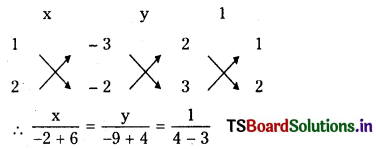
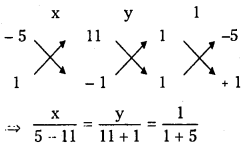
Solving (1) & (3)
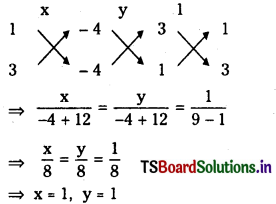
TS Inter First Year Maths 1B Direction Cosines and Direction Ratios Important Questions Q1
TS Inter First Year Maths 1B Direction Cosines and Direction Ratios Important Questions Q1.1
TS Inter First Year Maths 1B Direction Cosines and Direction Ratios Important Questions Q1.2

TS Inter First Year Maths 1B Direction Cosines and Direction Ratios Important Questions

Question 2.
Find the direction cosines of two lines that are connected by the relations l – 5m + 3n = 0 and 7l2 + 5m2 – 3n2 = 0. [Mar. ’18 (AP); Mar. ’16 (TS); May ’09]
Solution:
Given that,
l – 5m + 3n = 0 ……….(1)
7l2 + 5m2 – 3n2 = 0 …………(2)
From (1), l = 5m – 3n
Substituting ‘l’ in (2)
7(5m – 3n)2 + 5m2 – 3n2 = 0
7(25m2 + 9n2 – 30mn) + 5m2 – 3n2 = 0
175m2 + 63n2 – 210mn + 5m2 – 3n2 = 0
180m2 – 210mn + 60n2 = 0
6m2 – 7mn + 2n2 = 0
2m(3m – 2n) – n(3m – 2n) = 0
(3m – 2n) (2m – n) = 0
3m – 2n = 0 ………(3)
2m – n = 0 ………. (4)
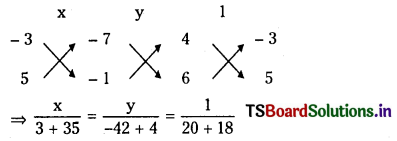
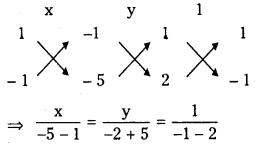
Solving (1) & (3)
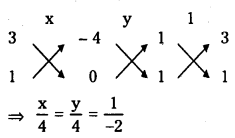
TS Inter First Year Maths 1B Direction Cosines and Direction Ratios Important Questions Q2
TS Inter First Year Maths 1B Direction Cosines and Direction Ratios Important Questions Q2.1

Question 3.
Show that the lines whose direction cosines are given by l + m + n = 0, 2mn + 3nl – 5lm = 0 are perpendicular to each other. [Mar. ’16 (AP); ’12]
Solution:
Given that, l + m + n = 0 ……….(1)
2mn + 3nl – 5lm = 0 ……….(2)
From (1), l = -m – n
Substituting in (2)
2mn + 3n(-m – n) – 5(-m – n)m = 0
2mn – 3mn – 3n2 + 5m2 + 5mn = 0
5m2 + 4mn – 3n2 = 0
If ax2 + 2hxy + by2 = 0 represents a pair of straight lines then the two lines are
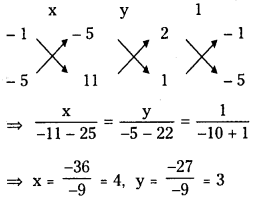
TS Inter First Year Maths 1B Direction Cosines and Direction Ratios Important Questions Q3
TS Inter First Year Maths 1B Direction Cosines and Direction Ratios Important Questions Q3.1
Direction ratio’s of 2nd line are (a2, b2, c2) = (-3 – √19, -2 + √19, 5)
Now, a1a2 + b1b2 + c1c2 = (-3 + √19) (-3 – √19) + (-2 – √19)(-2 + √19) + 5(5)
= (-3)2 – (√19)2 + (-2)2 – (√19)2 + 25
= 9 – 19 + 4 – 19 + 25
= 38 – 38
= 0
∴ The two lines are perpendicular to each other.

Question 4.
Find the angle between the lines whose direction cosines satisfy the equations l + m + n = 0, l2 + m2 – n2 = 0. [Mar. ’17 (AP), ’13, ’07 ; May ’14, ’13 (Old), ’11, ’07, ’04; Mar. ’19 (AP&TS)]
Solution:
Given that
l + m + n = 0 ……….(1)
l2 + m2 – n2 = 0 ……….(2)
From (1), l = -m – n
Substituting in (2)
(-m – n)2 + m2 – n2 = 0
m2 + n2 + 2mn + m2 – n2 = 0
2m2 + 2mn = 0
2m(m + n) = 0
2m = 0
m = 0 ………(3)
m + n = 0 ……….(4)
Solving (1) & (3)
TS Inter First Year Maths 1B Direction Cosines and Direction Ratios Important Questions Q4
∴ The direction ratios of 1st line are (a1, b1, c1) = (-1, 0, 1).
Solving (1) & (4)
TS Inter First Year Maths 1B Direction Cosines and Direction Ratios Important Questions Q4.1
∴ The direction ratios of the 2nd line are (a2, b2, c2) = (0, -1, 1).
Now, if ‘θ’ is the angle between these two lines then
TS Inter First Year Maths 1B Direction Cosines and Direction Ratios Important Questions Q4.2
∴ θ = 60°

TS Inter First Year Maths 1B Direction Cosines and Direction Ratios Important Questions

Question 5.
Find the angle between the lines whose direction cosines are given by the equations 3l + m + 5n = 0 and 6mn – 2nl + 5lm = 0. [Mar. ’12, ’10, ’06; May ’15 (AP); ’10]
Solution:
Given that,
3l + m + 5n = 0 ……….(1)
6mn – 2nl + 5lm = 0 ………..(2)
From (1), m = -3l – 5n
Substituting in (2)
6n(-3l – 5n) – 2ln + 5l(-3l – 5n) = 0
-18ln – 30n2 – 2ln – 15l2 – 25ln = 0
-15l2 – 45ln – 30n2 = 0
l2 + 3ln + 2n2 = 0
l2 + 2ln + ln + 2n2 = 0
(l + n)(l + 2n) = 0
l + 2n = 0 ………(3)
l + n = 0 ……….(4)
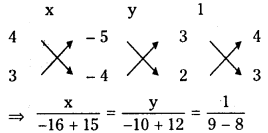
Solving (1) & (3)
TS Inter First Year Maths 1B Direction Cosines and Direction Ratios Important Questions Q5
∴ Direction ratio s of 1st line are (a1, b1, c1) = (2, -1, -1)
Solving (1) & (4)
TS Inter First Year Maths 1B Direction Cosines and Direction Ratios Important Questions Q5.1
∴ Direction ratio’s of 2nd line are (a2, b2, c2) = (1, 2, -1)
Now, if ‘θ’ is the angle between these two lines then
TS Inter First Year Maths 1B Direction Cosines and Direction Ratios Important Questions Q5.2

Question 6.
If a ray makes angles α, β, γ, δ with the four diagonals of a cube, find cos2α + cos2β + cos2γ + cos2δ. [Mar. ’08, ’05; May ’05; B.P.]
Solution:
TS Inter First Year Maths 1B Direction Cosines and Direction Ratios Important Questions Q6
Let one vertex of the cube as origin ‘O’ and 3 co-terminus edges OA, OB, OC as the coordinate axes.
Let ‘A’ be the edge of the cube. Then the coordinates of the vertices of the cube are O(0, 0, 0), A(a, 0, 0), B(0, a, 0), C(0, 0, a), D(a, 0, a), E (a, a, 0), F(a, a, a), G (0, a, a)
The four diagonals are \(\overline{\mathrm{OF}}, \overline{\mathrm{CE}}, \overline{\mathrm{AG}}, \overline{\mathrm{BD}}\).
Direction Ratios of \(\overline{\mathrm{OF}}\) are (x2 – x1, y2 – y1, z2 – z1)
= (a – 0, a – 0, a – 0)
= (a, a, a)
Direction cosines of \(\overline{\mathrm{OF}}\) are
TS Inter First Year Maths 1B Direction Cosines and Direction Ratios Important Questions Q6.1
Direction ratios of \(\overline{\mathrm{CE}}\) are (x2 – x1, y2 – y1, z2 – z1)
= (a – 0, a – 0, 0 – a)
= (a, a, -a)
Direction cosines of \(\overline{\mathrm{CE}}\) are
TS Inter First Year Maths 1B Direction Cosines and Direction Ratios Important Questions Q6.2
Direction ratios of \(\overline{\mathrm{AG}}\) are (x2 – x1, y2 – y1, z2 – z1)
= (0 – a, a – 0, a – 0)
= (-a, a, a)
Direction cosines of \(\overline{\mathrm{AG}}\) are
TS Inter First Year Maths 1B Direction Cosines and Direction Ratios Important Questions Q6.3
Direction ratios of \(\overline{\mathrm{BD}}\) are (x2 – x1, y2 – y1, z2 – z1)
= (a – 0, 0 – a, a – 0)
= (a, -a, a)
Direction cosines of \(\overline{\mathrm{BD}}\) are
TS Inter First Year Maths 1B Direction Cosines and Direction Ratios Important Questions Q6.4
Let (l, m, n) be the direction cosines of the line which makes angles α, β, γ, δ with the four diagonals \(\overline{\mathrm{OF}}, \overline{\mathrm{CE}}, \overline{\mathrm{AG}}, \overline{\mathrm{BD}}\) of the cube.
Similarly,
TS Inter First Year Maths 1B Direction Cosines and Direction Ratios Important Questions Q6.5
TS Inter First Year Maths 1B Direction Cosines and Direction Ratios Important Questions Q6.6

Question 7.
Find the angle between two diagonals of a cube. [Mar. ’18 (TS); Mar. ’15 (AP); May ’13]
Solution:
TS Inter First Year Maths 1B Direction Cosines and Direction Ratios Important Questions Q7
Let one vertex of the cube as origin ‘O’ and 3 co-terminus edges OA, OB, OC as the coordinate axes.
Let ‘A’ be the edge of the cube. Then the coordinates of the vertices of the cube are O(0, 0, 0), A(a, 0, 0), B(0, a, 0), C(0, 0, a), D(a, 0, a), E (a, a, 0), F(a, a, a), G (0, a, a)
Direction ratios of \(\overline{\mathrm{OF}}\) are (x2 – x1, y2 – y1, z2 – z1)
= (a – 0, a – 0, a – 0)
= (a, a, a)
Direction ratios of \(\overline{\mathrm{BD}}\) are (x2 – x1, y2 – y1, z2 – z1)
= (a – 0, 0 – a, a – 0)
= (a, -a, a)
If ‘θ’ is the angle between diagonals \(\overline{\mathrm{OF}}\) & \(\overline{\mathrm{BD}}\) then,
cos θ = \(\frac{\left|\mathrm{a}_1 \mathrm{a}_2+\mathrm{b}_1 \mathrm{~b}_2+\mathrm{c}_1 \mathrm{c}_2\right|}{\sqrt{\mathrm{a}_1^2+\mathrm{b}_1^2+\mathrm{c}_1^2} \sqrt{\mathrm{a}_2^2+\mathrm{b}_2^2+\mathrm{c}_2^2}}\)
TS Inter First Year Maths 1B Direction Cosines and Direction Ratios Important Questions Q7.1
Similarly, the angle between any pair of diagonals can be found to be \(\cos ^{-1}\left(\frac{1}{3}\right)\).

TS Inter First Year Maths 1B Direction Cosines and Direction Ratios Important Questions

Question 8.
The vertices of a triangle are A(1, 4, 2), B(-2, 1, 2), C(2, 3, -4). Find ∠A, ∠B, ∠C.
Solution:
A(1, 4, 2), B(-2, 1, 2), C(2, 3, -4) are the given vertices of a triangle.
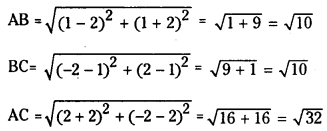
TS Inter First Year Maths 1B Direction Cosines and Direction Ratios Important Questions Q8
Direction ratios of \(\overline{\mathrm{AB}}\) are (-2 – 1, 1 – 4, 2 – 2) = (-3, -3, 0) = (1, 1, 0)
Direction ratios of \(\overline{\mathrm{BC}}\) are (2 + 2, 3 – 1, -4 – 2) = (4, 2, -6) = (2, 1, -3)
Direction ratios of \(\overline{\mathrm{CA}}\) are (1 – 2, 4 – 3, 2 + 4) = (-1, 1, 6)
If A is the angle between the sides \(\overline{\mathrm{AB}}\), \(\overline{\mathrm{CA}}\) then,
TS Inter First Year Maths 1B Direction Cosines and Direction Ratios Important Questions Q8.1
∴ A = 90°
If B is the angle between the sides \(\overline{\mathrm{AB}}\), \(\overline{\mathrm{BC}}\) then,
cos B = \(\left|\frac{1(2)+1(1)+0(-3)}{\sqrt{1^2+1^2+0^2} \sqrt{2^2+1^2+(-3)^2}}\right|\)
TS Inter First Year Maths 1B Direction Cosines and Direction Ratios Important Questions Q8.2
If c is the angle between the sides \(\overline{\mathrm{BC}}\), \(\overline{\mathrm{CA}}\) then,
TS Inter First Year Maths 1B Direction Cosines and Direction Ratios Important Questions Q8.3

Question 9.
If P(2, 3, -6), Q(3, -4, 5) are two points, find the direction cosines of \(\overline{\mathbf{O P}}, \overline{\mathbf{Q O}}\) and \(\overline{\mathbf{P Q}}\) where ‘O’ is the origin. [Mar. ’00]
Solution:
O(0, 0, 0), P(2, 3, -6), Q(3, -4, 5) are the given points.
Direction ratios of \(\overline{\mathbf{OP}}\) are (x2 – x1, y2 – y1, z2 – z1)
= (2 – 0, 3 – 0, -6 – 0)
= (2, 3, -6)
= (a, b, c)
Direction cosines of \(\overline{\mathbf{OP}}\) are
TS Inter First Year Maths 1B Direction Cosines and Direction Ratios Important Questions Q9
Direction ratios of \(\overline{\mathbf{OQ}}\) are (x2 – x1, y2 – y1, z2 – z1)
= (-3 + 0, +4 + 0, -5 + 0)
= (-3, +4, -5)
= (a, b, c)
Direction cosines of \(\overline{\mathbf{OQ}}\) are
TS Inter First Year Maths 1B Direction Cosines and Direction Ratios Important Questions Q9.1
Direction ratios of \(\overline{\mathbf{PQ}}\) are (x2 – x1, y2 – y1, z2 – z1)
= (3 – 2, -4 – 3, 5 + 6)
= (1, -7, 11)
= (a, b, c)
Direction cosines of \(\overline{\mathbf{PQ}}\) are
TS Inter First Year Maths 1B Direction Cosines and Direction Ratios Important Questions Q9.2

Question 10.
A ray makes angles \(\frac{\pi}{3}, \frac{\pi}{3}\) with \(\overline{\mathbf{OX}}\) and \(\overline{\mathbf{OY}}\) respectively. Find the angle made by it with \(\overline{\mathbf{OZ}}\). [May ’02]
Solution:
Let α, β, γ be the angles made by the line with the positive x, y, z axis respectively.
Given that, α = 60°, β = 60°
But, cos2α + cos2β + cos2γ = 1
cos260° + cos260° + cos260° = 1
TS Inter First Year Maths 1B Direction Cosines and Direction Ratios Important Questions Q10
γ = 45° (or) γ = 135°

TS Inter First Year Maths 1B Direction Cosines and Direction Ratios Important Questions

Question 11.
Find the direction cosines of the line joining the points (-4, 1, 7) and (2, -3, 2). [May ’02]
Solution:
Let A = (-4, 1, 7), B = (2, -3, 2) are the given points.
Direction ratios of \(\overline{\mathrm{AB}}\) are (x2 – x1, y2 – y1, z2 – z1)
= (2 + 4, -3 – 1, 2 – 7)
= (6, -4, -5)
= (a, b, c)
Direction cosines of \(\overline{\mathrm{AB}}\) are
TS Inter First Year Maths 1B Direction Cosines and Direction Ratios Important Questions Q11

Question 12.
Find the direction ratios and direction cosines of the line joining the points (4, -7, 3), (6, -5, 2). [Mar’ 00]
Solution:
Let A = (4, -7, 3), B = (6, -5, 2) are the given points.
Direction ratios of \(\overline{\mathrm{AB}}\) are (x2 – x1, y2 – y1, z2 – z1)
= (6 – 4, -5 + 7, 2 – 3)
= (2, 2, -1)
= (a, b, c)
Direction cosines of \(\overline{\mathrm{AB}}\) are
TS Inter First Year Maths 1B Direction Cosines and Direction Ratios Important Questions Q12

Question 13.
Show that the line joining the points A(2, 3, -1) and B(3, 5, -3) is perpendicular to the lines joining C(1, 2, 3) and D(3, 5, 7). [Mar. ’03]
Solution:
A = (2, 3, -1), B = (3, 5, -3), C = (1, 2, 3), D = (3, 5, 7) are the given points.
Direction ratios of \(\overline{\mathrm{AB}}\) are (x2 – x1, y2 – y1, z2 – z1)
= (3 – 2, 5 – 3, -3 + 1)
= (1, 2, -2)
= (a1, b1, c1)
Direction ratios of \(\overline{\mathrm{CD}}\) are (x2 – x1, y2 – y1, z2 – z1)
= (3 – 1, 5 – 2, 7 – 3)
= (2, 3, 4)
= (a2, b2, c2)
Now, a1a2 + b1b2 + c1c2 = 1(2) + 2(3) + (-2) 4
= 2 + 6 – 8
= 8 – 8
= 0
∴ \(\overline{\mathrm{AB}}\) is perpendicular to \(\overline{\mathrm{CD}}\).

Question 14.
Find the angle between the lines whose direction ratio’s are (1, 1, 2) (√3, -√3, 0).
Solution:
Given that, the direction ratios of two lines are (a1, b1, c1) = (1, 1, 2) and (a2, b2, c2) = (√3, -√3, 0)
If ‘θ’ is the angle between these two lines then
cos θ = \(\frac{\left|a_1 a_2+b_1 b_2+c_1 c_2\right|}{\sqrt{a_1^2+b_1^2+c_1^2} \sqrt{a_2^2+b_2^2+c_2^2}}\)
TS Inter First Year Maths 1B Direction Cosines and Direction Ratios Important Questions Q14

TS Inter First Year Maths 1B Direction Cosines and Direction Ratios Important Questions

Question 15.
Find the angle between \(\overline{\mathrm{DC}}\) and \(\overline{\mathrm{AB}}\) where A = (3, 4, 5), B = (4, 6, 3), C = (-1, 2, 4) and D = (1, 0, 5). [Mar. ’06]
Solution:
A = (3, 4, 5), B = (4, 6, 3), C = (-1, 2, 4), D = (1, 0, 5) are the given points.
Direction ratios of \(\overline{\mathrm{AB}}\) are (x2 – x1, y2 – y1, z2 – z1)
= (4 – 3, 6 – 4, 3 – 5)
= (1, 2, -2)
= (a1, b1, c1)
Direction ratios of \(\overline{\mathrm{DC}}\) are (x2 – x1, y2 – y1, z2 – z1)
= (1 + 1, 0 – 2, 5 – 4)
= (2, -2, 1)
= (a2, b2, c2)
If ‘θ’ is the angle between the lines \(\overline{\mathrm{AB}}\) & \(\overline{\mathrm{DC}}\) then,
TS Inter First Year Maths 1B Direction Cosines and Direction Ratios Important Questions Q15

Some More Maths 1B Direction Cosines and Direction Ratios Important Questions

Question 1.
Find the direction cosines of a line that makes equal angles with the axes.
Solution:
If α, β, γ be the angles made by the line with the axis.
Since the line is equally inclined to the axis, then α = β = γ then
cos α = cos β = cos γ
We know that,
cos2α + cos2β + cos2γ = 1
cos2α + cos2α + cos2α = 1
3 cos2α = 1
cos2α = \(\frac{1}{3}\)
cos α = \(\pm \frac{1}{\sqrt{3}}\)
∴ The direction cosines of the lines are \(\left(\pm \frac{1}{\sqrt{3}}, \pm \frac{1}{\sqrt{3}}, \pm \frac{1}{\sqrt{3}}\right)\)
The number of lines that are equally inclined to the axes is equal to the no.of different combinations of signs with l, m, n are possible = 4.

TS Inter First Year Maths 1B Direction Cosines and Direction Ratios Important Questions

Question 2.
If the directions of a line are \(\left(\frac{1}{\mathrm{c}}, \frac{1}{\mathrm{c}}, \frac{1}{\mathrm{c}}\right)\), find ‘c’.
Solution:
Given that, the direction cosines of a line are (l, m, n) = \(\left(\frac{1}{\mathrm{c}}, \frac{1}{\mathrm{c}}, \frac{1}{\mathrm{c}}\right)\)
We know that,
l2 + m2 + n2 = 1
\(\frac{1}{c^2}+\frac{1}{c^2}+\frac{1}{c^2}\)
\(\frac{3}{\mathrm{c}^2}\) = 1
c2 = 3
c = ±√3

Question 3.
If a line makes angles α, β, γ with the positive directions of x, y, and z-axes, what is the value of sin2α + sin2β + sin2γ?
Solution:
Since α, β, γ are the angles made by a line with the positive direction of co-ordinates axes, then
cos2α + cos2β + cos2γ = 1
Now, sin2α + sin2β + sin2γ
= (1 – cos2α) + (1 – cos2β) + (1 – cos2γ)
= 3 – (cos2α + cos2β + cos2γ)
= 3 – 1
= 2

Question 4.
Show that the line joining the points P(0, 1, 2) and Q(3, 4, 8) is parallel to the line joining the points R(-2, \(\frac{3}{2}\), -3) and S(\(\frac{5}{2}\), 6, 6).
Solution:
P = (0, 1, 2), Q = (3, 4, 8), R = (-2, \(\frac{3}{2}\), -3), S = (\(\frac{5}{2}\), 6, 6) are the given points.
Direction ratios of \(\overline{\mathrm{PQ}}\) are (x2 – x1, y2 – y1, z2 – z1)
= (3 – 0, 4 – 1, 8 – 2)
= (3, 3, 6)
= (a1, b1, c1)
Direction ratios of \(\overline{\mathrm{RS}}\) are (x2 – x1, y2 – y1, z2 – z1)
TS Inter First Year Maths 1B Direction Cosines and Direction Ratios Important Questions Some More Q4
∴ \(\overline{\mathrm{PQ}}\) is parallel to \(\overline{\mathrm{RS}}\).

Question 5.
A(1, 8, 4), B(0, -11, 4), C(2, -3, 1) are three points and D is the foot of the perpendicular from A to BC. Find the coordinates of D.
Solution:
A(1, 8, 4), B(0, -11, 4), C(2, -3, 1) are the given points.
D is the foot of the perpendicular from A to BC.
Suppose D divides \(\overline{\mathrm{BC}}\) in the ratio m : n then the co-ordinate of D.
TS Inter First Year Maths 1B Direction Cosines and Direction Ratios Important Questions Some More Q5
TS Inter First Year Maths 1B Direction Cosines and Direction Ratios Important Questions Some More Q5.1
TS Inter First Year Maths 1B Direction Cosines and Direction Ratios Important Questions Some More Q5.2

TS Inter First Year Maths 1B Direction Cosines and Direction Ratios Important Questions

Question 6.
‘O’ is the origin, P(2, 3, 4) and Q(1, k, 1) are points such that \(\overline{\mathrm{OP}} \perp \overline{\mathbf{O Q}}\). Find k.
Solution:
O(0, 0, 0), P(2, 3, 4), Q(1, k, 1) are the given points.
Direction ratio’s of \(\overline{\mathrm{OP}}\) are (x2 – x1, y2 – y1, z2 – z1)
= (2 – 0, 3 – 0, 4 – 0)
= (2, 3, 4)
= (a1, b1, c1)
Direction ratio’s of \(\overline{\mathrm{OQ}}\) are (x2 – x1, y2 – y1, z2 – z1)
= (1 – 0, k – 0, 1 – 0)
= (1, k, 1)
= (a2, b2, c2)
Since \(\overline{\mathrm{OP}} \perp \overline{\mathbf{O Q}}\) then,
a1a2 + b1b2 + c1c2 = 0
2(1) + 3(k) + 4(1) = 0
2 + 3k + 4 = 0
6 + 3k = 0
3k = -6
k = -2

Question 7.
If (l1, m1, n1), (l2, m2, n2) are the direction cosines of two intersecting lines, show that the direction cosines of two lines bisecting the angles between them are proportional to l1 ± l2, m1 ± m2, n1 ± n2.
Solution:
TS Inter First Year Maths 1B Direction Cosines and Direction Ratios Important Questions Some More Q7
Let the two lines intersect at the origin ‘O’.
Let A and C be two different points on one line and B be a point on the other line such that
OA = OB = OC = 1
The co-ordinates of A, B, C are A(l1, m1, n1), B(l2, m2, n2), C(-l1, -m1, n1)
Let P, Q be the midpoints of \(\overline{\mathrm{AB}} \& \overline{\mathrm{BC}}\) respectively.
Then OP & OQ are the required bisectors.
Since, P is the midpoint of \(\overline{\mathrm{AB}}\) then
TS Inter First Year Maths 1B Direction Cosines and Direction Ratios Important Questions Some More Q7.1
TS Inter First Year Maths 1B Direction Cosines and Direction Ratios Important Questions Some More Q7.2
∴The directions of the bisectors are proportional to (l1 ± l2, m1 ± m2, n1 ± n2)

TS Inter 1st Year Maths 1B Pair of Straight Lines Important Questions

Students must practice these Maths 1B Important Questions TS Inter 1st Year Maths 1B Pair of Straight Lines Important Questions to help strengthen their preparations for exams.

TS Inter 1st Year Maths 1B Pair of Straight Lines Important Questions

Question 1.
If ‘θ’ is the acute angle between the lines represented by ax2 + 2hxy + by2 = 0 then, show that cos θ = \(\frac{|a+b|}{\sqrt{(a-b)^2+4 h^2}}\). [Mar. ’18 (TS); Mar. ’06; May ’97]
Solution:
Let ax2 + 2hxy + by2 = 0 represent the lines
l1x + m1y = 0 ……..(1)
l2x + m2y = 0 ……..(2)
TS Inter First Year Maths 1B Pair of Straight Lines Important Questions Q1
The combined equation of lines (1) & (2) is
ax2 + 2hxy + by2 = (l1x + m1y)(l2x + m2y)
= l1l2x2 + m1m2xy + l2m1xy + m1m2y2
= l1l2x2 + (l1m2 + l2m1)xy + m1m2y2
Comparing on both sides we get l1l2 = a, l1m2 + l2m1 = 2h, m1m2 = b
If θ is an angle between the lines (1) & (2)
TS Inter First Year Maths 1B Pair of Straight Lines Important Questions Q1.1
TS Inter First Year Maths 1B Pair of Straight Lines Important Questions Q1.2

Question 2.
If the equation ax2 + 2hxy + by2 = 0 represents a pair of lines then prove that the equation of the pair of angular bisectors is h[x2 – y2] = (a – b) xy. [Mar. ’18 (AP); May ’13, ’09, ’96, ’91; Mar. ’13(old), ’09, ’00, ’95. ’92, ’90]
Solution:
Let ax2 + 2hxy + by2 = 0 represent a pair of straight lines
l1x + m1y = 0 ……(1)
l2x + m2y = 0 ……(2)
TS Inter First Year Maths 1B Pair of Straight Lines Important Questions Q2
The combined equation of (1) & (2) is
ax2 + 2hxy + by2 = (l1x + m1y)(l2x + m2y)
= l1l2x2 + l1m2xy + l2m1xy + m1m2y2
= l1l2x2 + (l1m2 + l2m1)xy + m1m2y2
Comparing on both sides we get a = l1l2, 2h = l1m2 + l2m1, b = m1m2
The equation for the bisectors of angles between (1) & (2) is
TS Inter First Year Maths 1B Pair of Straight Lines Important Questions Q2.1
TS Inter First Year Maths 1B Pair of Straight Lines Important Questions Q2.2

TS Inter First Year Maths 1B Pair of Straight Lines Important Questions

Question 3.
Show that the product of the perpendicular distances from a point (α, β) to the pair of straight lines ax2 + 2hxy + by2 = 0 is \(\frac{\left|a \alpha^2+2 h \alpha \beta+b \beta^2\right|}{\sqrt{(a-b)^2+4 h^2}}\). [May ’15 (AP); May ’14, ’13 (Old); ’11, ’08, ’07: Mar. ’08, ’07, ’04, ’01]
Solution:
Let ax2 + 2hxy + by2 = 0 represents two lines (1)&(2)
l1x + m1y = 0 …..(1), l2x + m2y = 0 ……(2)
TS Inter First Year Maths 1B Pair of Straight Lines Important Questions Q3
The combined equation of (1) & (2) is ax2 + 2hxy + by2
= (l1x + m1y)(l2x + m2y)
= l1l2x2 + l1m2xy + l2m1xy + m1m2y2
= l1l2x2 + (l1m2 + l2m1)xy + m1m2y2
Comparing on both sides we get a = l1l2, 2h = l1m2 + l2m1, b = m1m2
The length of the perpendicular from (α, β) to line (1) is
TS Inter First Year Maths 1B Pair of Straight Lines Important Questions Q3.1
TS Inter First Year Maths 1B Pair of Straight Lines Important Questions Q3.2

Question 4.
Show that the area of the triangle formed by the lines ax2 + 2hxy + by2 = 0 and lx + my + n = 0 is \(\frac{n^2 \sqrt{h^2-a b}}{\left|a m^2-2 h l m+b l^2\right|}\). [Mar. ’13, ’02; May ’15(TS), ’10, ’98, ’94, ’92; B.P; Mar. ’17 (AP & TS); Mar. ’19 (TS)]]
Solution:
Let ax2 + 2hxy + by2 = 0 represents two lines l1x + m1y = 0 …….(1), l2x + m2y = 0 ……..(2)
TS Inter First Year Maths 1B Pair of Straight Lines Important Questions Q4
The combined equation of (1) & (2) is
ax2 + 2hxy + by2 = (l1x + m1y)(l2x + m2y)
= l1l2x2 + l1m2xy + l2m1xy + m1m2y2
= l1l2x2 + (l1m2 + l2m1)xy + m1m2y2
Comparing on both sides we get a = l1l2, 2h = l1m2 + l2m1, b = m1m2
Let the given line be lx + my + n = 0 ……..(3)
Clearly, the origin O is the point of intersection of (1) & (2)
∴ O = (0, 0)
Let A be the point of intersection of (1) & (3)
TS Inter First Year Maths 1B Pair of Straight Lines Important Questions Q4.1
TS Inter First Year Maths 1B Pair of Straight Lines Important Questions Q4.2
TS Inter First Year Maths 1B Pair of Straight Lines Important Questions Q4.3
TS Inter First Year Maths 1B Pair of Straight Lines Important Questions Q4.4

Question 5.
Find the centroid and area of the triangle formed by the lines 12x2 – 20xy + 7y2 – 0 and 2x – 3y + 4 = 0. [Mar. ’05, ’90, ’83; May ’87]
Solution:
Given the equation of the pair of lines is
12x2 – 20xy + 7y2 = 0
12x2 – 6xy – 14xy + 7y2 = 0
6x(2x – y) – 7y(2x – y) = 0
(2x – y)(6x – 7y) = 0
2x – y = 0 …….(1), 6x – 7y = 0 ……..(2)
The third equation is 2x – 3y + 4 = 0 ……(3)
∴ Vertex O: The point of intersection of (1) & (2) is O = (0, 0)
TS Inter First Year Maths 1B Pair of Straight Lines Important Questions Q5
TS Inter First Year Maths 1B Pair of Straight Lines Important Questions Q5.1

TS Inter First Year Maths 1B Pair of Straight Lines Important Questions

Question 6.
Show that the lines represented by (lx + my)2 – 3(mx – ly)2 = 0 and lx + my + n = 0 form an equilateral triangle with area \(\frac{n^2}{\sqrt{3}\left(l^2+m^2\right)}\). [Mar. ’15 (TS), ’91]
Solution:
Given equation of the pair of lines is (lx + my)2 – 3(mx – ly)2 = 0
(lx + my)2 – [√3(mx – ly)2] = 0
(lx + my + √3(mx – ly)) (lx + my – √3(mx – ly)) = 0
(lx + my + √3mx – √3ly) (lx + my – √3mx + √3ly) = 0
[(l + √3m)x + (m – √3l)y] [(l – √3m)x + (m + √3l)y] = 0
(l + √3m)x + (m – √3l)y = 0
(l – √3m)x + (m + √3l)y = 0
∴ This equation represents the lines
(l + √3m)x + (m – √3l)y = 0 ……..(1)
(l – √3m)x + (m + √3l)y = 0 ……(2)
Let the given equation of the straight line is lx + my + n = 0 ………(3)
If A is an angle between lines (1) & (3), then
TS Inter First Year Maths 1B Pair of Straight Lines Important Questions Q6
TS Inter First Year Maths 1B Pair of Straight Lines Important Questions Q6.1
B = 60°
If O is the third angle then O = 180° – (60 + 60)
= 180° – 120°
= 60°
∴ A = B = O = 60°
The lines (1), (2), (3) form an equilateral triangle.
Now h = the perpendicular distance from the origin to the straight line lx + my + n = 0
TS Inter First Year Maths 1B Pair of Straight Lines Important Questions Q6.2

Question 7.
Prove that the lines represented by the x2 – 4xy + y2 = 0 and x + y = 3 form an equilateral triangle. [May ’00]
Solution:
Given the equation of the pair of lines is x2 – 4xy + y2 = 0
Comparing with ax2 + 2hxy + by2 = 0, we get a = 1, b = 1, h = -2.
TS Inter First Year Maths 1B Pair of Straight Lines Important Questions Q7
∴ Given equation represents the two lines are \(a x+\left(h \pm \sqrt{h^2-a b}\right) y=0\)
\(1 x+\left(-2 \pm \sqrt{(-2)^2-1 \times 1}\right) y=0\)
x + (-2 ± \(\sqrt{4-1}\))y = 0
x + (-2 ± √3)y = 0
x + (-2 + √3)y = 0, x + (-2 – √3)y = 0
This equation represents the lines
x + (-2 + √3)y = 0 ………(1)
x + (-2 – √3)y = 0 ………(2)
Let the given equation of the straight line is x + y – 3 = 0 ……(3)
Let A is an angle between (1) & (3) then
TS Inter First Year Maths 1B Pair of Straight Lines Important Questions Q7.1
B = 60°
If O is the third angle then
O = 180° – (A + B)
= 180° – (60 + 60)
= 180° – 120°
= 60°
∴ O = A = B = 60°
∴ The lines (1), (2), (3) form an equilateral triangle.

TS Inter First Year Maths 1B Pair of Straight Lines Important Questions

Question 8.
If (α, β) is the centroid of the triangle formed by the lines ax2 + 2hxy + by2 = 0 and lx + my = 1 prove that \(\frac{\alpha}{b l-h m}=\frac{\beta}{a m-h l}=\frac{2}{3\left(b l^2-2 h l m+a m^2\right)}\). [Mar. ’08]
Solution:
Let ax2 + 2hxy + by2 = 0 represents the lines l1x + m1y = 0 …….(1), l2x + m2y = 0 ……(2)
∴ ax2 + 2hxy + by2 = (l1x + m1y)(l2x + m2y)
TS Inter First Year Maths 1B Pair of Straight Lines Important Questions Q8
Comparing on both sides we get l1l2 = a, (l1m2 + l2m1) = 2h, m1m2 = b
Given equation of the straight line is lx + my – 1 = 0 ………(3)
Vertex O: Clearly the origin O is the point of intersection of (1) & (2)
∴ O = (0, 0)
Vertex A: Solving (2) & (3)
TS Inter First Year Maths 1B Pair of Straight Lines Important Questions Q8.1
TS Inter First Year Maths 1B Pair of Straight Lines Important Questions Q8.2
TS Inter First Year Maths 1B Pair of Straight Lines Important Questions Q8.3
TS Inter First Year Maths 1B Pair of Straight Lines Important Questions Q8.4

Question 9.
Find the equation of the pair of lines intersecting at (2, -1) and (i) perpendicular to the pair 6x2 – 13xy – 5y2 = 0 and (ii) parallel to the pair 6x2 – 13xy – 5y2 = 0. [May ’98]
Solution:
Given the equation of the pair of lines is 6x2 – 13xy – 5y2 = 0.
Comparing with ax2 + 2hxy + by2 = 0, we get a = 6, h = \(\frac{-13}{2}\), b = -5
Let the given point A(x1, y1) = (2, -1)
(i) Equation to the pair of lines perpendicular to 6x2 – 13xy – 5y2 = 0 and passing through (2, -1) is
b(x – x1)2 – 2h(x – x1)(y – y1) + a(y – y1)2 = 0
-5(x – 2)2 – 2 × \(\frac{-13}{2}\) (x – 2)(y + 1) + 6(y + 1)2 = 0
-5(x2 + 4 – 4x) + 13(xy + x – 2y – 2) + 6(y2 + 1 + 2y) = 0
-5x2 – 20 + 20x + 13xy + 13x – 26y – 26 + 6y2 + 6 + 12y = 0
-5x2 + 13xy + 6y2 + 33x – 14y – 40 = 0
5x2 – 13xy – 6y2 – 33x + 14y + 40 = 0
(ii) Equation to the pair of a line parallel to 6x2 – 13xy – 5y2 = 0 and passing through (2, -1) is
a(x – x1)2 + 2h(x – x1)(y – y1) + b(y – y1)2 = 0
6(x – 2)2 + 2 × \(\frac{-13}{2}\) (x – 2) (y + 1) – 5(y + 1)2 = 0
6(x2 + 4 – 4x) – 13(xy + x – 2y – 2) – 5(y2 + 1 + 2y) = 0
6x2 + 24 – 24x – 13xy – 13x + 26y + 26 – 5y2 – 5 – 10y = 0
6x2 – 5y2 – 13xy – 37x + 16y + 45 = 0

Question 10.
If ax2 + 2hxy + by2 + 2gx + 2fy + c = 0 represents a pair of lines then prove that
(i) abc + 2fgh – af2 – bg2 – ch2 = 0
(ii) h2 ≥ ab, g2 ≥ ac and f2 ≥ bc. [Mar. ’16 (AP & TS), ’14, ’11, ’96, ’83; May ’95, ’90]
Solution:
Let ax2 + 2hxy + by2 + 2gx + 2fy + c = 0 represent the two lines
l1x + m1y + n1 = 0 ……….(1)
l2x + m2y + n2 = 0 ……….(2)
TS Inter First Year Maths 1B Pair of Straight Lines Important Questions Q10
TS Inter First Year Maths 1B Pair of Straight Lines Important Questions Q10.1
TS Inter First Year Maths 1B Pair of Straight Lines Important Questions Q10.2
TS Inter First Year Maths 1B Pair of Straight Lines Important Questions Q10.3

Question 11.
If the equation ax2 + 2hxy + by2 + 2gx + 2fy + c = 0 represents two parallel lines, then prove that (i) h2 = ab (ii) af2 = bg2 and (iii) the distance between the parallel lines = \(2 \sqrt{\frac{g^2-a c}{a(a+b)}}=2 \sqrt{\frac{f^2-b c}{b(a+b)}}\). [Mar. ’12, ’10, ’98; May ’06, ’01, ’97, ’95, ’91; Mar. ’19 (AP)]
Solution:
Let S = 0 represent the lines
lx + my + n1 = 0 …….(1)
lx + my + n2 = 0 …….(2)
∴ ax2 + 2hxy + by2 + 2gx + 2fy + c = (lx + my + n1)(lx + my + n2)
= l2x2 + lmxy + ln2x + lmxy + m2y2 + mn2y + ln1x + mn1y + n1n2
= l2x2 + 2lmxy + m2y2 + (ln2 + ln1)x + (mn2 + mn1)y + n1n2
Comparing both sides we get
l2 = a, 2lm = 2h, m2 = b, ln1 + ln2 = 2g, mn2 + mn1 = 2f, n1n2 = c, lm = h, l(n1 + n2) = 2g
m(n1 + n2) = 2f
(i) h2 = (lm)2 = l2m2 = ab = R.H.S.
∴ h2 = ab
(ii) \(\frac{2g}{2f}\) = \(\frac{l\left(n_1+n_2\right)}{m\left(n_1+n_2\right)}\)
\(\frac{\mathrm{g}}{\mathrm{f}}=\frac{l}{\mathrm{~m}}\)
gm = lf
Squaring on both sides
g2m2 = l2f2
∴ af2 = bg2
(iii) The distance between two parallel lines
TS Inter First Year Maths 1B Pair of Straight Lines Important Questions Q11
TS Inter First Year Maths 1B Pair of Straight Lines Important Questions Q11.1

TS Inter First Year Maths 1B Pair of Straight Lines Important Questions

Question 12.
Show that the equation 2x2 – 13xy – 7y2 + x + 23y – 6 = 0 represents a pair of straight lines. Also, find the angle between them and the coordinates of the point of intersection of the lines. [May ’12, ’00; Mar. ’03]
Solution:
Given equation is 2x2 – 13xy – 7y2 + x + 23y – 6 = 0.
Comparing the given equation with ax2 + 2hxy + by2 + 2gx + 2fy + c = 0, we get
a = 2, h = \(\frac{-13}{2}\), b = -7, g = \(\frac{1}{2}\), f = \(\frac{23}{2}\), c = -6
Now,
(i) abc + 2fgh – af2 – bg2 – ch2
TS Inter First Year Maths 1B Pair of Straight Lines Important Questions Q12
TS Inter First Year Maths 1B Pair of Straight Lines Important Questions Q12.1
TS Inter First Year Maths 1B Pair of Straight Lines Important Questions Q12.2
TS Inter First Year Maths 1B Pair of Straight Lines Important Questions Q12.3

Question 13.
Find the value of λ for which the equation λx2 – 10xy + 12y2 + 5x – 16y – 3 = 0 represents a pair of straight lines. [May ’09]
Solution:
Given equation is λx2 – 10xy + 12y2 + 5x – 16y – 3 = 0.
Comparing the given equation with ax2 + 2hxy + by2 + 2gx + 2fy + c = 0, we get
a = λ, h = -5, b = 12, g = \(\frac{5}{2}\), f = -8, c = -3
Since the given equation represents a pair of straight lines then
TS Inter First Year Maths 1B Pair of Straight Lines Important Questions Q13

Question 14.
Show that the equation 8x2 – 24xy + 18y2 – 6x + 9y – 5 = 0 represents a pair of parallel straight lines and find the distance between them. [Mar. ’93]
Solution:
Given, equation is 8x2 – 24xy + 18y2 – 6x + 9y – 5 = 0
Comparing the given equation with ax2 + 2hxy + by2 + 2gx + 2fy + c = 0, we get
a = 8, h = -12, b = 18, g = -3, f = \(\frac{9}{2}\), c = -5
(i) h2 = ab
⇒ h2 = (-12)2 = 144
ab = 8 × 18 = 144
∴ h2 = ab
(ii) af2 = \(8\left(\frac{9}{2}\right)^2\)
= 8 × \(\frac{81}{4}\)
= 162
bg2 = 18(-3)2
= 18 × 9
= 162
∴ af2 = bg2
∴ The given equation represents a pair of parallel straight lines.
Now the distance between the parallel lines
TS Inter First Year Maths 1B Pair of Straight Lines Important Questions Q14

Question 15.
Show that the pairs of straight lines 6x2 – 5xy – 6y2 = 0 and 6x2 – 5xy – 6y2 + x + 5y – 1 = 0 form a square. [May ’02, ’98, ’91, ’86: Mar. ’02]
Solution:
Given equations of the pair of lines are
6x2 – 5xy – 6y2 = 0 ……..(1)
6x2 – 5xy – 6y2 + x + 5y – 1 = 0 ………(2)
TS Inter First Year Maths 1B Pair of Straight Lines Important Questions Q15
Now, 6x2 – 5xy – 6y2 = 0
6x2 – 9xy + 4xy – 6y2 = 0
3x(2x – 3y) + 2y(2x – 3y) = 0
(2x – 3y)(3x + 2y) = 0
2x – 3y = 0 …….(3) 3x + 2y = 0 ……..(4)
Equation (1) represents the two lines are 2x – 3y = 0 ……(3), 3x + 2y = 0 …….(4)
Now, 6x2 – 5xy – 6y2 + x + 5y – 1 = (2x – 3y + k) (3x + 2y + l)
Comparing the coefficient of x on both sides we get 2l + 3k = 1
Comparing the coefficient of y on both sides we get -3l + 2k = 5
Solving these two equations
TS Inter First Year Maths 1B Pair of Straight Lines Important Questions Q15.1
Equation (2) represents the lines that are
2x – 3y + 1 = 0
3x + 2y – 1 = 0
∴ The four lines are
2x – 3y = 0 ……(3)
3x + 2y = 0 ……..(4)
2x – 3y + 1 = 0 ……..(5)
3x + 2y – 1 = 0 ………(6)
The equations (3) & (5); (4) & (6) are parallel.
The equations (3) & (4); (5) & (6) are perpendicular.
∴ The four lines form a rectangle.
The distance between the parallel lines (3) & (5) is
\(\frac{\left|c_1-c_2\right|}{\sqrt{a^2+b^2}}=\frac{|0-1|}{\sqrt{2^2+(-3)^2}}=\frac{|-1|}{\sqrt{4+9}}=\frac{1}{\sqrt{13}}\)
The distance between the parallel lines (4) & (6) is
\(\frac{\left|c_1-c_2\right|}{\sqrt{a^2+b^2}}=\frac{|0+1|}{\sqrt{3^2+2^2}}=\frac{1}{\sqrt{9+4}}=\frac{1}{\sqrt{13}}\)
∴ Given lines form a square.

TS Inter First Year Maths 1B Pair of Straight Lines Important Questions

Question 16.
Show that the straight lines y2 – 4y + 3 = 0 and x2 + 4xy + 4y2 + 5x + 10y + 4 = 0 form a parallelogram and find the lengths of its sides. [Mar. ’92]
Solution:
Given equations of the straight lines are
y2 – 4y + 3 = 0 …….(1)
x2 + 4xy + 4y2 + 5x + 10y + 4 = 0 …….(2)
(1) ⇒ y2 – 4y + 3 = 0
y2 – 3y – y + 3 = 0
y(y – 3) – 1(y – 3) = 0
(y – 3) (y – 1) = 0
y – 1 = o ……(3)
y – 3 = 0 ……..(4)
Equation (1) represents the lines y – 1 = 0 & y – 3 = 0.
Now, x2 + 4xy + 4y2 = 0
x2 + 2xy + 2xy + 4y2 = 0
x(x + 2y) + 2y(x + 2y) = 0
(x + 2y) (x + 2y) = 0
x + 2y = 0, x + 2y = 0
x2 + 4xy + 4y2 + 5x + 10y + 4 = (x + 2y + k) (x + 2y + l)
Comparing the coefficients of x on both sides l + k = 5
Comparing the coefficients of y on both sides 2l + 2k = 10
⇒ l + k = 5
Comparing constant terms on both sides
lk = 4
l = \(\frac{4}{k}\)
\(\frac{4}{k}\) + k = 5
4 + k2 = 5k
k2 – 5k + 4 = 0
k2 – 4k – k + 4 = 0
k(k – 4) – 1(k – 4) = 0
(k – 4)(k – 1) = 0
k = 4; k = 1
If k = 4; l = \(\frac{4}{4}\) = 1
If k = 1; l = \(\frac{4}{1}\) = 4
Equations (2) represent the lines that are
x + 2y + 4 = 0 …….(5)
x + 2y + 1 = 0 …….(6)
The equations of the four lines are
y – 1 = 0 ……(3)
y – 3 = 0 ……..(4)
x + 2y + 4 = 0 ……..(5)
x + 2y + 1 = 0 ……..(6)
Clearly, lines (3), (4) & (5), (6) are parallel.
TS Inter First Year Maths 1B Pair of Straight Lines Important Questions Q16
Vertex A: Solving (3) & (6)
From (3), y = 1
From (6), x + 2(1) + 1 = 0
⇒ x + 3 = 0
⇒ x = -3
Vertex A = (-3, 1)
Vertex B: Solving (3) & (5)
From (3), y = 1
From (5), x + 2(1) + 4 = 0
⇒ x + 6 = 0
⇒ x = -6
Vertex B = (-6, 1)
Vertex C: Solving (4) & (5)
From (4), y = 3
From (5), x + 2(3) + 4 = 0
⇒ x + 10 = 0
⇒ x = -10
Vertex C = (-10, 3)
Vertex D: Solving (4) & (6)
From (4), y = 3
From (6), x + 2(3) + 1 = 0
⇒ x + 7 = 0
⇒ x = -7
Vertex D = (-7, 3)
Vertices of a parallelogram are A(-3, 1), B(-6, 1), C(-10, 3) & D(-7, 3)
Now,
TS Inter First Year Maths 1B Pair of Straight Lines Important Questions Q16.1

Question 17.
Show that the product of the perpendicular distances from the origin to the pair of straight lines represented by ax2 + 2hxy + by2 + 2gx + 2fy + c = 0 is \(\frac{|c|}{\sqrt{(a-b)^2+4 h^2}}\). [May ’98, ’93, ’90]
Solution:
ax2 + 2hxy + by2 + 2gx + 2fy + c = 0 represents two lines
l1x + m1y + n1 = 0 ……(1)
l2x + m2y + n2 = 0 …….(2)
ax2 + 2hxy + by2 + 2gx + 2fy + c = (l1x + m1y + n1)(l2x + m2y + n2)
Comparing the coefficients on both sides we get
a = l1l2, 2h = l1m2 + l2m1, 2g = l1n2 + l2n1, 2f = m1n1 + m2n2
The perpendicular distance from the origin to the straight line (1) is
TS Inter First Year Maths 1B Pair of Straight Lines Important Questions Q17
The perpendicular distance from the origin to the straight line (2) is
TS Inter First Year Maths 1B Pair of Straight Lines Important Questions Q17.1
The product of the perpendicular distances
TS Inter First Year Maths 1B Pair of Straight Lines Important Questions Q17.2

Question 18.
Find the angle between the lines joining the origin to the points of intersection of the curve x2 + 2xy + y2 + 2x + 2y – 5 = 0 and the line 3x – y + 1 = 0. [Mar. ’16 (AP), ’13, ’09, ’08, ’07; May ’14, ’13, ’11, ’04, ’80]
Solution:
Given equation of the curve is x2 + 2xy + y2 + 2x + 2y – 5 = 0 …….(1)
TS Inter First Year Maths 1B Pair of Straight Lines Important Questions Q18
The equation of a straight line is
3x – y + 1 = 0
3x – y = -1
-3x + y = 1 ….(2)
Let, A, B are the points of intersection of the given line and the given curve.
Now, Homogenising the equation (1) with the help of (2)
The combined equation of \(\overline{\mathrm{OA}}\) and \(\overline{\mathrm{OB}}\) is
x2 + 2xy + y2 + 2x(1) + 2y(1) – 5(1)2 = 0
x2 + 2xy + y2 + 2x(-3x + y) + 2y(-3x + y) – 5(-3x + y)2 = 0
x2 + 2xy + y2 – 6x2 + 2xy – 6xy + 2y2 – 5(9x2 + y2 – 6xy) = 0
x2 + 2xy + y2 – 6x2 + 2xy – 6xy + 2y2 – 45x2 – 5y2 + 30xy = 0
x2(-5 – 45) + xy(4 – 6 + 30) + y2(1 + 2 – 5) = 0
x2(-50) + xy (+28) + y2(-2) = 0
-50x2 + 28xy – 2y2 = 0
50x2 – 28xy + 2y2 = 0
25x2 – 14xy + y2 = 0
which is the equation of the pairs of lines \(\overline{\mathrm{OA}}\) and \(\overline{\mathrm{OB}}\).
If ‘θ’ is the angle between the lines \(\overline{\mathrm{OA}}\) and \(\overline{\mathrm{OB}}\)
TS Inter First Year Maths 1B Pair of Straight Lines Important Questions Q18.1

TS Inter First Year Maths 1B Pair of Straight Lines Important Questions

Question 19.
Find the value of k, if the lines joining the origin to the point of intersection of the curve 2x2 – 2xy + 3y2 + 2x – y – 1 = 0 and the line x + 2y = k are mutually perpendicular. [Mar. ’17 (AP), ’15 (TS), ’13 (Old) ’11, ’05, ’01; Mar. ’19 (AP & TS); May ’10, ’07, ’06; B.P.]
Solution:
Given the equation of the curve is 2x2 – 2xy + 3y2 + 2x – y – 1 = 0 ………(1)
TS Inter First Year Maths 1B Pair of Straight Lines Important Questions Q19
The equation of a straight line is x + 2y = k
\(\frac{x+2 y}{k}=1\) ……(1)
Let, A B be the points of intersection of the given line and the given curve.
Now, Homogenising the equation (1) with the help of (2)
The combined equation of \(\overline{\mathrm{OA}}\) and \(\overline{\mathrm{OB}}\) is
2x2 – 2xy + 3y2 + 2x(1) – y(1) – 1(1)2 = 0
TS Inter First Year Maths 1B Pair of Straight Lines Important Questions Q19.1
2k2x2 – 2k2xy + 3k2y2 + 2kx2 + 4kxy – kxy – 2ky2 – x2 – 4y2 – 4xy = 0
x2(2k2 + 2k – 1) + xy(-2k2 + 3k – 4) + y2(3k2 – 2k – 4) = 0
which is the equation of the pairs of lines \(\overline{\mathrm{OA}}\) and \(\overline{\mathrm{OB}}\).
Given that the lines \(\overline{\mathrm{OA}}\) and \(\overline{\mathrm{OB}}\) are perpendicular
then, a + b = 0
2k2 + 2k – 1 + 3k2 – 2k – 4 = 0
5k2 – 5 = 0
5k2 = 5
k2 = 1
k = ±1

Question 20.
Show that the lines joining the origin to the points of intersection of the curve x2 – xy + y2 + 3x + 3y – 2 = 0 and the straight line x – y – √2 = 0 are mutually perpendicular. [May ’15 (TS), ’12; Mar. ’15 (AP), ’12, ’08, ’03; Mar. ’18 (TS)]
Solution:
Given equation of the curve is x2 – xy + y2 + 3x + 3y – 2 = 0 ……..(1)
TS Inter First Year Maths 1B Pair of Straight Lines Important Questions Q20
Equation of straight line is x – y – √2 = 0
x – y = √2
\(\frac{x-y}{\sqrt{2}}=1\) …….(2)
Let, A, B be the points of intersection of the given line and the given curve.
Now, Homogenising the equation (1) with the help of (2)
The combined equation of \(\overline{\mathrm{OA}}\) and \(\overline{\mathrm{OB}}\) is
x2 – xy + y2 + 3x(1) + 3y(1) – 2(1)2 = 0
TS Inter First Year Maths 1B Pair of Straight Lines Important Questions Q20.1
which is the equation of the pairs of lines \(\overline{\mathrm{OA}}\) and \(\overline{\mathrm{OB}}\).
Now a + b = 3 – 3 = 0
Since a + b = 0, then the lines \(\overline{\mathrm{OA}}\) and \(\overline{\mathrm{OB}}\) are mutually perpendicular.

Question 21.
Find the condition for the chord lx + my = 1 of the circle x2 + y2 = a2 (whose centre is the origin) to subtend a right angle at the origin. [Mar. ’14, ’13]
Solution:
Given equation of the curve is x2 + y2 = a2 ………(1)
Equation of the straight line is lx + my = 1 ……..(2)
TS Inter First Year Maths 1B Pair of Straight Lines Important Questions Q21
Let A, B be the point of intersection of the given line and the given curve.
Now, Homogenising the equation (1) with the help of (2)
The combined equation of \(\overline{\mathrm{OA}}\) and \(\overline{\mathrm{OB}}\) is
x2 + y2 = a2(1)
x2 + y2 = a2(lx + my)2
x2 + y2 = a2(l2x2 + m2y2 + 2lmxy)
x2 + y2 = a2l2x2 + a2m2y2 + 2a2lmxy
a2l2x2 + a2m2y2 + 2a2lmxy – x2 – y2 = 0
x2(a2l2 – 1) + xy(2a2lm) + y2(a2m2 – 1) = 0
which is the equation of the pairs of lines \(\overline{\mathrm{OA}}\) and \(\overline{\mathrm{OB}}\).
Given that, the lines \(\overline{\mathrm{OA}}\) and \(\overline{\mathrm{OB}}\) are perpendicular.
Then, a + b = 0
a2l2 – 1 + a2m2 – 1 = 0
a2(l2 + m2) – 2 = 0
a2(l2 + m2) = 2
which is the required condition.

Question 22.
Find the condition for the lines joining the origin to the points of intersection of the circle x2 + y2 = a2 and the line lx + my = 1 to coincide. [Mar. ’17 (TS); May ’03]
Solution:
Given, equation of the curve is x2 + y2 = a2 ……….(1)
Equation of the straight line is lx + my = 1 ……….(2)
TS Inter First Year Maths 1B Pair of Straight Lines Important Questions Q22
Let A and B be the point of intersection of the given line and the given curve.
Now, Homogenising the equation (1) with the help of (2)
The combined equation of \(\overline{\mathrm{OA}}\) and \(\overline{\mathrm{OB}}\) is
x2 + y2 = a2(1)
x2 + y2 = a2(lx + my)2
x2 + y2 = a2(l2x2 + m2y2 + 2lmxy)
x2 + y2 = a2l2x2 + a2m2y2 + 2a2lmxy
a2l2x2 + a2m2y2 + 2a2lmxy – x2 – y2 = 0
x2(a2l2 – 1) + xy(2a2lm) + y2(a2m2 – 1) = 0
Which is the equation of the pairs of lines \(\overline{\mathrm{OA}}\) and \(\overline{\mathrm{OB}}\)
Given that the lines \(\overline{\mathrm{OA}}\) and \(\overline{\mathrm{OB}}\) coincide.
Then, h2 = ab
(a2lm)2 = (a2l2 – 1)(a2m2 – 1)
a4l2m2 = a4l2m2 – a2l2 – a2m2 + 1
a2l2 + a2m2 = 1
a2(l2 + m2) = 1
Which is the required condition.

TS Inter First Year Maths 1B Pair of Straight Lines Important Questions

Question 23.
Find the equations of the straight lines bisecting the angles between the lines 7x + y + 3 = 0 and x – y + 1 = 0. [May ’05]
Solution:
Given the equation of the straight lines are
7x + y + 3 = 0 ……..(1)
x – y + 1 = 0 ……..(2)
Equations of the bisectors of the angles between the lines (1) & (2) are
TS Inter First Year Maths 1B Pair of Straight Lines Important Questions Q23
7x + y + 3 + 5(x – y + 1) = 0
7x + y + 3 + 5x – 5y + 5 = 0
2x + 6y – 2 = 0
x + 3y – 1 = 0
7x + y + 3 – 5(x – y + 1) = 0
7x + y + 3 – 5x + 5y – 5 = 0
12x – 4y + 8 = 0
3x – y + 2 = 0
∴ The equation of the bisectors of the angle between the lines (1) & (2) is x + 3y – 1 = 0, 3x – y + 2 = 0.

Question 24.
If ax2 + 2hxy + by2 = 0 represents two straight lines such that the slope of one line is twice the slope of the other, prove that 8h2 = 9ab. [May ’96]
Solution:
The given equation of the pair of lines is ax2 + 2hxy + by2 = 0.
Since the slope of one line is twice the slope of the other, then the slopes of the two lines represented by (1) are m, 2m.
TS Inter First Year Maths 1B Pair of Straight Lines Important Questions Q24

Question 25.
If one line of the pair of lines ax2 + 2hxy + by2 = 0 bisects the angle between the coordinate axes, prove that (a + b)2 = 4h2. [May ’04]
Solution:
Given, equation of the pair of lines is ax2 + 2hxy + by2 = 0 ………(1)
The equation of the X-axis is y = 0
The equation of the Y-axis is x = 0
∴ Equations of the bisectors of the angles between the coordinate axes are
\(\frac{\mathrm{a}_1 \mathrm{x}+\mathrm{b}_1 \mathrm{y}+\mathrm{c}_1}{\sqrt{\mathrm{a}_1^2+\mathrm{b}_1^2}}=\pm \frac{\mathrm{a}_2 \mathrm{x}+\mathrm{b}_2 \mathrm{y}+\mathrm{c}_2}{\sqrt{\mathrm{a}_2^2+\mathrm{b}_2^2}}\)
\(\frac{y}{\sqrt{1^2}}=\pm \frac{x}{\sqrt{1^2}}\)
y = ±x
y = x and y = -x
∴ Equations of the bisectors of the angles between the coordinate axes are y = x and y = -x.
Case 1: If one line of the pair of lines ax2 + 2hxy + hy2 = 0 is y = x
Substitute y = x in equation (1), and we get
ax2 + 2hx(x) + b(x)2 = 0
⇒ a + 2h + b = 0
⇒ a + b = -2h ………(2)
Case 2: If one line of the pair of lines is y = -x
Substitute y = -x in equation (1), and we get
ax2 + 2hx(-x) + b(-x)2 = 0
⇒ ax2 – 2hx2 + bx2 = 0
⇒ a – 2h + b = 0
⇒ a + b = 2h ……..(2)
From (2) & (3)
a + b = ±2h
Squaring on both sides
(a + b)2 = 4h2

Some More Maths 1B Pair of Straight Lines Important Questions

Question 26.
Find the centroid and the area of the triangle formed by the lines 2y2 – xy – 6x2 = 0, x + y + 4 = 0. [May ’03]
Solution:
Given the equation of the pair of lines is 2y2 – xy – 6x2 = 0
2y2 – 4xy + 3xy – 6x2 = 0
2y(y – 2x) + 3x(y – 2x) = 0
(y – 2x) (2y + 3x) = 0
y – 2x = 0 (or) 2y + 3x = 0
2x – y = 0 …….(1), 3x + 2y = 0 ……..(2)
The third equation is x + y + 4 = 0 ………(3)
TS Inter First Year Maths 1B Pair of Straight Lines Important Questions DTP Q1
∴ Vertex O: The point of intersection of (1) & (2) is O = (0, 0)
Vertex A: Solving (1) & (3)
TS Inter First Year Maths 1B Pair of Straight Lines Important Questions DTP Q1.1
Vertex B: Solving (2) & (3)
TS Inter First Year Maths 1B Pair of Straight Lines Important Questions DTP Q1.2
∴ Vertex B = (8, -12)
∴ Vertices of a triangle OAB are O = (0, 0), A(\(\frac{-4}{3}, \frac{-8}{3}\)), B = (8, -12)
Centroid of triangle
TS Inter First Year Maths 1B Pair of Straight Lines Important Questions DTP Q1.3

TS Inter First Year Maths 1B Pair of Straight Lines Important Questions

Question 27.
Find the centroid and area of the triangle formed by the lines 3x2 – 4xy + y2 = 0, 2x – y = 6.
Solution:
Given the equation of the pair of lines is
3x2 – 4xy + y2 = 0
3x2 – 3xy – xy + y2 = 0
3x(x – y) – y(x – y) = 0
(x – y) (3x – y) = 0
x – y = 0 ……..(1), 3x – y = 0 ………(2)
TS Inter First Year Maths 1B Pair of Straight Lines Important Questions DTP Q2
The third equation is 2x – y – 6 = 0 …….(3)
∴ Vertex O: The point of intersection of (1) & (2) is O = (0, 0)
Vertex A: Solving (1) & (3)
TS Inter First Year Maths 1B Pair of Straight Lines Important Questions DTP Q2.1
x = 6; y = 6
∴ Vertex A = (6, 6)
Vertex B: Solving (2) & (3)
TS Inter First Year Maths 1B Pair of Straight Lines Important Questions DTP Q2.2
x = -6; y = -18
Vertex B = (-6, -18)
∴ Vertices of a triangle OAB are O = (0, 0), A = (6, 6), B = (-6, -18).
Centroid of triangle
TS Inter First Year Maths 1B Pair of Straight Lines Important Questions DTP Q2.3

Question 28.
Show that the straight lines represented by (x + 2a)2 – 3y2 = 0 and x = a form an equilateral triangle. [Mar. ’03]
Solution:
TS Inter First Year Maths 1B Pair of Straight Lines Important Questions DTP Q3
Given equation of the pair of lines is (x + 2a)2 – 3y2 = 0
⇒ (x + 2a)2 – (√3y)2 = 0
⇒ (x + 2a + √3y) (x + 2a – √3y) = 0
⇒ x + 2a + √3y = 0, x – √3y + 2a = 0
⇒ x + √3y + 2a = 0, x – √3y + 2a = 0
∴ This equation represents the lines
x + √3y + 2a = 0 ……(1)
x – √3y + 2a = 0 ……….(2)
Let the given equation of the straight line is x = a ………(3)
If A is an angle between (1) & (2) then
TS Inter First Year Maths 1B Pair of Straight Lines Important Questions DTP Q3.1
\(\left|\frac{-2 \sqrt{3}}{-2}\right|=|\sqrt{3}|\)
A = 60°
If B is an angle between lines (2) & (3) then
TS Inter First Year Maths 1B Pair of Straight Lines Important Questions DTP Q3.2
B = 60°
If C is the third angle then C = 180° – (60° + 60°)
= 180° – 120°
= 60°
∴ A = B = C = 60°
∴ The lines (1), (2), (3) form an equilateral triangle.

Question 29.
Show that the straight lines represented by 3x2 + 48xy + 23y2 = 0 and 3x – 2y + 13 = 0 form an equilateral triangle of area \(\frac{13}{\sqrt{3}}\) sq. units.
Solution:
Given the equation of the pair of lines is 3x2 + 48xy + 23y2 = 0
Comparing with ax2 + 2hxy + by2 = 0,
we get a = 3, 2h = 48 ⇒ h = 24, b = 23
TS Inter First Year Maths 1B Pair of Straight Lines Important Questions DTP Q4
The given equation represents the two lines that are
TS Inter First Year Maths 1B Pair of Straight Lines Important Questions DTP Q4.1
3x + (24 + √507)y = 0, 3x + (24 – √507)y = 0
∴ This equation represents the lines
3x + (24 + √507)y = 0 ……….(1)
3x + (24 – √507)y = 0 ………..(2)
Let the given equation of the straight line is 3x – 2y + 13 = 0 …….(3)
Let A is an angle between (1) & (3) then
TS Inter First Year Maths 1B Pair of Straight Lines Important Questions DTP Q4.2
∴ A = 60°
If B is an angle between lines (2) & (3) then
TS Inter First Year Maths 1B Pair of Straight Lines Important Questions DTP Q4.3
If O is the third angle then
O = 180° – (A + B)
= 180° – (60° + 60°)
= 180° – 120°
= 60°
∴ O = A = B = 60°
TS Inter First Year Maths 1B Pair of Straight Lines Important Questions DTP Q4.4
∴ The lines (1), (2), (3) form an equilateral triangle.
The length of the altitude of the triangle h = the perpendicular distance from the origin O to the line (3)
TS Inter First Year Maths 1B Pair of Straight Lines Important Questions DTP Q4.5

TS Inter First Year Maths 1B Pair of Straight Lines Important Questions

Question 30.
Prove that the equation 3x2 + 7xy + 2y2 + 5x + 5y + 2 = 0 represents a pair of straight lines and find the coordinates of the point of intersection.
Solution:
Given equation is 3x2 + 7xy + 2y2 + 5x + 5y + 2 = 0
Comparing the given equation with ax2 + 2hxy + by2 + 2gx + 2fy + c = 0, we get
TS Inter First Year Maths 1B Pair of Straight Lines Important Questions DTP Q5
TS Inter First Year Maths 1B Pair of Straight Lines Important Questions DTP Q5.1
TS Inter First Year Maths 1B Pair of Straight Lines Important Questions DTP Q5.2

Question 31.
If x2 + xy – 2y2 + 4x – y + k = 0 represents a pair of straight lines, find k.
Solution:
Given equation is x2 + xy – 2y2 + 4x – y + k = 0
Comparing the given equation with ax2 + 2hxy + by2 + 2gx + 2fy + c = 0, we get
a = 1, h = \(\frac{1}{2}\), b = -2, g = 2, f = \(\frac{-1}{2}\), c = k
Since the given equation represents a pair of lines then abc + 2fgh – af2 – bg2 – ch2 = 0
TS Inter First Year Maths 1B Pair of Straight Lines Important Questions DTP Q6

Question 32.
Find the distance between the pairs of parallel straight lines 9x2 – 6xy + y2 + 18x – 6y + 8 = 0. [May ’03]
Solution:
Given, equation is 9x2 – 6xy + y2 + 18x – 6y + 8 = 0
Comparing the given equation with ax2 + 2hxy + by2 + 2gx + 2fy + c = 0, we get
a = 9, h = -3, b = 1, g = 9, f = -3, c = 8
The distance between the parallel lines
TS Inter First Year Maths 1B Pair of Straight Lines Important Questions DTP Q7

Question 33.
Find the distance between the pairs of parallel straight lines x2 + 2√3xy + 3y2 – 3x – 3√3y – 4 = 0. [May ’03]
Solution:
Given, equation is x2 + 2√3xy + 3y2 – 3x – 3√3y – 4 = 0
Comparing the given equation with ax2 + 2hxy + by2 + 2gx + 2fy + c = 0, we get
a = 1, h = √3, b = 3, g = \(\frac{-3}{2}\), f = \(\frac{-3 \sqrt{3}}{2}\), c = -4
The distance between the parallel lines
TS Inter First Year Maths 1B Pair of Straight Lines Important Questions DTP Q8

Question 34.
Show that the two pairs of lines 3x2 + 8xy – 3y2 = 0 and 3x2 + 8xy – 3y2 + 2x – 4y – 1 = 0 form a square.
Solution:
Given equations of the pair of lines are
3x2 + 8xy – 3y2 = 0 ……..(1)
3x2 + 8xy – 3y2 + 2x – 4y – 1 = 0 ………(2)
TS Inter First Year Maths 1B Pair of Straight Lines Important Questions DTP Q9
Now, 3x2 + 8xy – 3y2 = 0
3x2 + 9xy – xy – 3y2 = 0
3x(x + 3y) – y(x + 3y) = 0
(x + 3y)(3x – y) = 0
x + 3y = 0 (or) 3x – y = 0
Equation (1) represents the two lines that are
x + 3y = 0 ………(3), 3x – y = 0 ………(4)
Now 3x2 + 8xy – 3y2 + 2x – 4y – 1 = (x + 3y + k) (3x – y + l)
Comparing the coefficient of x, on both sides we get l + 3k = 2
Comparing the coefficient of y on both sides we get 3l – k = -4
Solving these two equations we get
TS Inter First Year Maths 1B Pair of Straight Lines Important Questions DTP Q9.1
TS Inter First Year Maths 1B Pair of Straight Lines Important Questions DTP Q9.2
∴ Equation (2) represents the lines that are
x + 3y + 1 = 0 ……..(5)
3x – y – 1 = 0 ……….(6)
∴ The equations of the four lines are
x + 3y = 0 ……….(3)
3x – y = 0 ………..(4)
x + 3y + 1 = 0 ……….(5)
3x – y – 1 = 0 ……….(6)
The equations (3) & (5); (4) & (6) are parallel.
The equations (3) & (4); (5) & (6) are perpendicular.
∴ The four lines form a rectangle.
The distance between the parallel lines (3) & (5) is
\(\frac{\left|c_1-c_2\right|}{\sqrt{a^2+b^2}}=\frac{|0-1|}{\sqrt{1^2+3^2}}=\frac{|-1|}{\sqrt{1+9}}=\frac{1}{\sqrt{10}}\)
The distance between the parallel lines (4) & (6) is
\(\frac{\left|c_1-c_2\right|}{\sqrt{a^2+b^2}}=\frac{|0+1|}{\sqrt{3^2+(-1)^2}}=\frac{1}{\sqrt{9+1}}=\frac{1}{\sqrt{10}}\)
∴ Given lines form a square.

TS Inter First Year Maths 1B Pair of Straight Lines Important Questions

Question 35.
Find the lines joining the origin to the points of intersection of the curve 7x2 – 4xy + 8y2 + 2x – 4y – 8 = 0 with the straight line 3x – y = 2 and also the angle between them. [Mar. ’18 (AP); May ’01, ’98; Mar. ’00]
Solution:
Given the equation of the curve is
7x2 – 4xy + 8y2 + 2x – 4y – 8 = 0 ………(1)
The equation of a straight line is 3x – y = 2
\(\frac{3 x-y}{2}\) = 1 ……..(2)
TS Inter First Year Maths 1B Pair of Straight Lines Important Questions DTP Q10
Let A and B be the points of intersection of the given line and curve.
Now, Homogenising the equation (1) with the help of (2)
The combined equation of \(\overline{\mathrm{OA}}\) and \(\overline{\mathrm{OB}}\) is
7x2 – 4xy + 8y2 + 2x(1) – 4y(1) – 8(1)2 = 0
TS Inter First Year Maths 1B Pair of Straight Lines Important Questions DTP Q10.1
7x2 – 4xy + 8y2 + 3x2 – xy – 6xy + 2y2 – 18x2 – 2y2 + 12xy = 0
x2(7 + 3 – 18) + xy(-4 – 1 – 6 + 12) + y2(8 + 2 – 2) = 0
x2(-8) + xy(1) + y2(8) = 0
-8x2 + xy + 8y2 = 0
8x2 – xy – 8y2 = 0
which is the equation of the pairs of lines \(\overline{\mathrm{OA}}\) and \(\overline{\mathrm{OB}}\).
Here, a = 8, b = -8
Now, a + b = 8 – 8 = 0
Since, a + b = 0, the lines \(\overline{\mathrm{OA}}\) and \(\overline{\mathrm{OB}}\) are mutually perpendicular.
∴ Angle between the lines = 90°

Question 36.
Find the equation of the bisector of the acute angle between the lines 3x – 4y + 7 = 0 and 12x + 5y – 2 = 0.
Solution:
Given equations of the straight lines are
3x – 4y + 7 = 0 ……….(1)
12x + 5y – 2 = 0 ………(2)
Equations of bisectors of the angles between the lines (1) & (2) are
TS Inter First Year Maths 1B Pair of Straight Lines Important Questions Some More Q1
13(3x – 4y + 7) = 5(12x + 5y – 2)
39x – 52y + 91 = 60x + 25y – 10
21x + 77y – 101 = 0
\(\frac{3 x-4 y+7}{5}=\frac{-12 x-5 y+2}{13}\)
39x – 52y + 91 + 60x + 25y – 10 = 0
99x – 27y + 81 = 0
11x – 3y + 9 = 0
∴ The equations of the bisectors of the angles between lines (1) & (2) are
21x + 77y – 101 = 0 ……….(3)
11x – 3y + 9 = 0 ……….(4)
Consider the lines
3x – 4y + 7 = 0 ……..(1)
11x – 3y + 9 = 0 ……..(4)
If θ is the angle between (1) & (4) then
TS Inter First Year Maths 1B Pair of Straight Lines Important Questions Some More Q1.1
∴ 11x – 3y + 9 = 0 is the acute angle bisector.

Question 37.
Show that the equation of the pair of lines bisecting the angle between the pair of bisectors of the angles between the pair of lines ax2 + 2hxy + by2 = 0 is (a – b) (x2 – y2) + 4hxy = 0.
Solution:
Given, equation of the pair of lines is ax2 + 2hxy + by2 = 0 ……(1)
The equation to the pair of bisectors of angles between (1) is
h(x2 – y2) = (a – b)xy
hx2 – hy2 = (a – b)xy
hx2 – (a – b)xy – hy2 = 0 ……….(2)
Now comparing (2) with ax2 + 2hxy + by2 = 0, we get
a = h, h = \(\frac{-(a-b)}{2}\), b = -h
The equation to the pair of bisectors of angles between (2) is
h(x2 – y2) = (a – b)(xy)
\(\frac{-(a-b)}{2}\)(x2 – y2) = (h + h)xy
-(a – b)(x2 – y2) = 4hxy
∴ (a – b)(x2 – y2) + 4hxy = 0

Question 38.
If the pairs of lines represented by ax2 + 2hxy + by2 = 0 and ax2 + 2hxy + by2 + 2gx + 2fy + c = 0 form a rhombus, prove that (a – b)fg + h(f2 – g2) = 0.
Solution:
Given equations o the pair of lines are
ax2 + 2hxy + by2 = 0 ………..(1)
ax2 + 2hxy + by2 + 2gx + 2fy + c = 0 ……..(2)
Let \(\overline{\mathrm{OA}}, \overline{\mathrm{OB}}\) be the pair of straight lines given by (1).
\(\overline{\mathrm{AC}}, \overline{\mathrm{BC}}\) be the pair of lines given by (2).
Since the lines represented by (1) are parallel to the lines represented by (2), then OACB is a parallelogram.
Now, ‘C’ is the point of intersection of (2).
TS Inter First Year Maths 1B Pair of Straight Lines Important Questions Some More Q3
(gh – af)x – (hf – bg)y = 0
Since, ‘A’ is a point on the locus (1) & (2),
the coordinates of A satisfy the equation (1) – (2) = 0.
Similarly, the coordinates of B also satisfy the equation (1) – (2) = 0.
Now, (1) – (2) = 0
⇒ ax2 + 2hxy + by2 – ax2 – 2hxy – by2 – 2gx – 2fy – c = 0
⇒ -(2gx + 2fy + c) = 0
⇒ 2gx + 2fy + c = 0
This is the linear equation in which x and y represent a line.
Hence (1) – (2) is the equation of diagonal \(\overline{\mathrm{AB}}\).
Since OACB is a rhombus, then the diagonals \(\overline{\mathrm{OC}}\) and \(\overline{\mathrm{AB}}\) are perpendicular to each other.
i.e., slope of \(\overline{\mathrm{OC}}\) × slope of \(\overline{\mathrm{AB}}\) = -1
\(\frac{-(g h-a f)}{-(h f-b g)} \times \frac{- 2 g}{2 f}=-1\)
\(\frac{g(g h-a f)}{f(h f-b g)}\) = 1
g(gh – af) = f(hf – bg)
g2h – afg = f2h – bgf
f2h – bfg – g2h + afg = 0
fg(a – b) + h(f2 – g2) which is the required condition.

TS Inter First Year Maths 1B Pair of Straight Lines Important Questions

Question 39.
Find the value of k, if the equation 2x2 + kxy – 6y2 + 3x + y + 1 = 0 represents a pair of straight lines. Find the point of intersection of the lines and the angle between the straight lines for this value of k.
Solution:
Given equation is 2x2 + kxy – 6y2 + 3x + y + 1 = 0.
Comparing the given equation with ax2 + 2hxy + by2 + 2gx + 2fy + c = 0,
we get a = 2, h = \(\frac{k}{2}\), b = -6, g = \(\frac{3}{2}\), f = \(\frac{1}{2}\), c = 1
Since the given equation represents a pair of straight lines then
abc + 2fgh – af2 – bg2 – ch2 = 0
TS Inter First Year Maths 1B Pair of Straight Lines Important Questions Some More Q4
-k2 + 3k + 4 = 0
k2 – 3k – 4 = 0
k2 – 4k + k – 4 = 0
k(k – 4) + 1(k – 4) = 0
(k – 4)(k + 1) = 0
k = 4 or -1
For k = 4, then a = 2, h = 2, b = -6, g = \(\frac{3}{2}\), f = \(\frac{1}{2}\), c = 1
TS Inter First Year Maths 1B Pair of Straight Lines Important Questions Some More Q4.1
TS Inter First Year Maths 1B Pair of Straight Lines Important Questions Some More Q4.2
TS Inter First Year Maths 1B Pair of Straight Lines Important Questions Some More Q4.3

Question 40.
Show that the lines x2 + 2xy – 35y2 – 4x + 44y – 12 = 0 and 5x + 2y – 8 = 0 are concurrent.
Solution:
Given equation is x2 + 2xy – 35y2 – 4x + 44y – 12 = 0
Comparing the given equation with ax2 + 2hxy + by2 + 2gx + 2fy + c = 0, we get
a = 1, h = 1, b = -35, g = -2, f = 22, c = -12
TS Inter First Year Maths 1B Pair of Straight Lines Important Questions Some More Q5
⇒ 0 = 0
∴ The given lines are concurrent.

TS Inter First Year Maths 1B Pair of Straight Lines Important Questions

Question 41.
Write down the equation of the pair of straight lines joining the origin to the points of intersection of line 6x – y + 8 = 0 with the pair of straight lines 3x2 + 4xy – 4y2 – 11x + 2y + 6 = 0. Show that the lines so obtained make equal angles with the coordinate axes. [May ’15 (AP)]
Solution:
Given the equation of the curve is
3x2 + 4xy – 4y2 – 11x + 2y + 6 = 0 ………(1)
Equation of straight line is 6x – y + 8 = 0
⇒ 6x – y = -8
⇒ \(\frac{6 x-y}{-8}\) = 1 ………(2)
TS Inter First Year Maths 1B Pair of Straight Lines Important Questions Some More Q6
Let, A, B are the points of intersection of the given line and the given curve.
Now, Homogenising equation (1) with the help of (2).
The combined equation of \(\overline{\mathrm{OA}}\) and \(\overline{\mathrm{OB}}\) is
3x2 + 4xy – 4y2 – 11x(1) + 2y(1) + 6(1)2 = 0
TS Inter First Year Maths 1B Pair of Straight Lines Important Questions Some More Q6.1
TS Inter First Year Maths 1B Pair of Straight Lines Important Questions Some More Q6.2
x2(468) + y2(-117) = 0
x2(468) – y2(117) = 0
4x2 – y2 = 0
which is the equation of the pair of lines \(\overline{\mathrm{OB}}\) and \(\overline{\mathrm{OB}}\).
Comparing this equation with ax2 + 2hxy + by2 = 0,
a = 4, h = 0, b = -1
The equation to the pair of bisectors of angles between 4x2 – y = 0 is h(x2 – y2) = (a – b)(xy)
0(x2 – y2) – (4 + 1)xy
5xy = 0
xy = 0
x = 0, y = 0
which are the equations of the coordinate axes.
The lines \(\overline{\mathrm{OA}}\) and \(\overline{\mathrm{OB}}\) makes equal angles with the coordinate axes.

TS Inter 1st Year Maths 1B Three-Dimensional Coordinates Important Questions

Students must practice these Maths 1B Important Questions TS Inter 1st Year Maths 1B Three-Dimensional Coordinates Important Questions to help strengthen their preparations for exams.

TS Inter 1st Year Maths 1B Three-Dimensional Coordinates Important Questions

Question 1.
Find the distance between the points (3, 4, -2) and (1, 0, 7). [May ’00]
Solution:
Let A = (3, 4, -2), B = (1, 0, 7) are the given points.
Now,
TS Inter First Year Maths 1B Three-Dimensional Coordinates Important Questions Q1

Question 2.
Show that the points (1, 2, 3), (2, 3, 1) and (3, 1, 2) form an equilateral triangle. [Mar. ’18 (AP); (B.P.)]
Solution:
Let A = (1, 2, 3), B = (2, 3, 1), C = (3, 1, 2) are the given points.
Now,
TS Inter First Year Maths 1B Three-Dimensional Coordinates Important Questions Q2
TS Inter First Year Maths 1B Three-Dimensional Coordinates Important Questions Q2.1
∴ Given points form an equilateral triangle.

TS Inter First Year Maths 1B Three-Dimensional Coordinates Important Questions

Question 3.
Show that the points (1, 2, 3), (7, 0, 1) and (-2, 3, 4) are collinear. [Mar. ’16 (TS); Mar. ’13, May ’19]
Solution:
Let A = (1, 2, 3), B = (7, 0, 1), C = (-2, 3, 4) are the given points.
Now,
TS Inter First Year Maths 1B Three-Dimensional Coordinates Important Questions Q3
AB + CA = 2√11 + √11 = 3√11 = BC
∴ A, B, C are collinear.

Question 4.
Find the ratio in which yz-plane divides the line joining A(2, 4, 5) and B(3, 5, -4). Also, find the point of intersection. [May ’10]
Solution:
A(2, 4, 5), B(3, 5, -4) are the given points.
The ratio in which the yz-plane divides
\(\overline{\mathrm{AB}}\) = -x1 : x2 = -2 : 3
The point divides \(\overline{\mathrm{AB}}\) in the ratio -2 : 3,
then co-ordinates of a point = \(\left[\frac{\mathrm{mx}_2+\mathrm{nx_{1 }}}{\mathrm{m}+\mathrm{n}}, \frac{\mathrm{my_{2 }}+\mathrm{ny_{1 }}}{\mathrm{m}+\mathrm{n}}, \frac{\mathrm{mz_{2 }}+\mathrm{nz_{1 }}}{\mathrm{m}+\mathrm{n}}\right]\)
TS Inter First Year Maths 1B Three-Dimensional Coordinates Important Questions Q4
∴ The point of intersection = (0, 2, 23).

Question 5.
Find the fourth vertex of the parallelogram whose consecutive vertices are (2, 4, -1), (3, 6, -1) and (4, 5, 1). [Mar. ’17 (TS), ’11; May ’03]
Solution:
A(2, 4, -1), B(3, 6, -1), C(4, 5, 1) are the given three vertices.
Let the fourth vertex be D(x, y, z)
TS Inter First Year Maths 1B Three-Dimensional Coordinates Important Questions Q5
3 + x = 6; 6 + y = 9; -1 + z = 0
x = 6 – 3; y = 9 – 6; z = 1
∴ x = 3, y = 3, z = 1
D = (3, 3, 1)
∴ Fourth Vertex D = (3, 3, 1)

Question 6.
Find the coordinates of the vertex ‘c’ of ∆ABC if its centroid is the origin and the vertices A, B are (1, 1, 1) and (-2, 4, 1) respectively. [Mar. ’16 (AP); ’15 (TS); May ’13, ’06]
Solution:
Let A(1, 1, 1), B(-2, 4, 1) are the given points.
Given that, Centroid G = (0, 0, 0)
Let third vertex, C = (x, y, z)
Now, the Centroid of ∆ABC is,
TS Inter First Year Maths 1B Three-Dimensional Coordinates Important Questions Q6
∴ The third vertex C = (1, -5, -2).

TS Inter First Year Maths 1B Three-Dimensional Coordinates Important Questions

Question 7.
If (3, 2, -1), (4, 1, 1) and (6, 2, 5) are three vertices and (4, 2, 2) are the centroid of a tetrahedron, find the fourth vertex. [Mar. ’17, ’15 (AP), ’14, ’13 (old), ’09; May ’15 (AP), ’13, ’11, ’05]
Solution:
A(3, 2, -1), B(4, 1, 1), C(6, 2, 5) are the given points.
Given that, Centroid G = (4, 2, 2)
Let the fourth vertex, D = (x, y, z)
Now, the Centroid of tetrahedron ABCD is,
TS Inter First Year Maths 1B Three-Dimensional Coordinates Important Questions Q7
TS Inter First Year Maths 1B Three-Dimensional Coordinates Important Questions Q7.1
∴ The fourth vertex D = (3, 3, 3).

Question 8.
Show that the points A(3, 2, -4), B(5, 4, -6) and C(9, 8, -10) are collinear and find the ratio in which B divides \(\overline{\mathbf{A C}}\). [Mar. ’04]
Solution:
A = (3, 2, -4), B = (5, 4, -6), C = (9, 8, -10) are the given points.
Now,
TS Inter First Year Maths 1B Three-Dimensional Coordinates Important Questions Q8
Now, AB + BC = √12 + 2√12 = 3√12 = CA
∴ A, B, C are collinear.
TS Inter First Year Maths 1B Three-Dimensional Coordinates Important Questions Q8.1
The ratio in which ‘B’ divides \(\overline{\mathbf{A C}}\) = x1 – x : x – x2
= 3 – 5 : 5 – 9
= -2 : -4
= 2 : 4
= 1 : 2

TS Inter First Year Maths 1B Three-Dimensional Coordinates Important Questions

Question 9.
If A(4, 8, 12), B(2, 4, 6), C(3, 5, 4) and D(5, 8, 5) are four points, show that the lines \(\overline{\mathbf{A B}}\) and \(\overline{\mathbf{CD}}\) intersect. [May ’04]
Solution:
A(4, 8, 12), B(2, 4, 6), C(3, 5, 4) and D(5, 8, 5) are the given points.
The equation of the line passing through A, B is
TS Inter First Year Maths 1B Three-Dimensional Coordinates Important Questions Q9
x – 4 = -2t; y – 8 = -4t; z – 12 = -6t
x = -2t + 4; y = -4t + 8; z = -6t + 12
∴ (x, y, z) = (-2t + 4, -4t + 8, -6t + 12) ……(1)
The equation of the line passing through C, D is
TS Inter First Year Maths 1B Three-Dimensional Coordinates Important Questions Q9.1
x – 3 = 2s; y – 5 = 3s; z – 4 = s
x = 2s + 3; y = 3s + 5; z = s + 4
∴ (x, y, z) = (2s + 3, 3s + 5, s + 4) ………(2)
From (1) &(2)
-2t + 4 = 2s + 3 ⇒ 2t + 2s – 1 = 0 ………(3)
-4t + 8 = 3s + 5 ⇒ 4t + 3s – 3 = 0 ………(4)
-6t + 12 = s + 4 ⇒ 6t + s – 8 = 0 ……….(5)
Solving (3) & (4)
TS Inter First Year Maths 1B Three-Dimensional Coordinates Important Questions Q9.2
TS Inter First Year Maths 1B Three-Dimensional Coordinates Important Questions Q9.3
Substitute the values of (t, s) in equation (5)
6(\(\frac{3}{2}\)) + (-1) – 8 = 0
9 – 9 = 0
0 = 0
∴ Lines \(\overline{\mathrm{AB}} \& \overline{\mathrm{CD}}\) are intersecting lines.
Substitute, t = \(\frac{3}{2}\) in equation (1) or s = -1 in equation (2)
∴ Point of intersection = [-2(\(\frac{3}{2}\)) + 4, -4(\(\frac{3}{2}\)) + 8, -6(\(\frac{3}{2}\)) + 12]
= [-3 + 4, -6 + 8, -9 + 12]
= (1, 2, 3)

Question 10.
Find the point which divides the line joining the points A(2, -3, 1), B(3, 4, -5) in the ratio 1 : 3.
Solution:
A(2, -3, 1), B(3, 4, -5) are the given points.
Let C(x, y, z) be the point which divides the line joining the points A(2, -3, 1), B(3, 4, -5) in the ratio 1 : 3.
TS Inter First Year Maths 1B Three-Dimensional Coordinates Important Questions Q10
TS Inter First Year Maths 1B Three-Dimensional Coordinates Important Questions Q10.1

Question 11.
Find the centroid of the triangle whose vertices are (5, 4, 6), (1, -1, 3) and (4, 3, 2).
Solution:
A(5, 4, 6), B(1, -1, 3), C(4, 3, 2) are the given vertices.
The centroid of the triangle ABC is
TS Inter First Year Maths 1B Three-Dimensional Coordinates Important Questions Q11

TS Inter First Year Maths 1B Three-Dimensional Coordinates Important Questions

Question 12.
Find the centroid of the tetrahedron whose vertices are (2, 3, -4), (-3, 3, -2), (-1, 4, 2), (3, 5, 1).
Solution:
A(2, 3, -4), B(-3, 3, -2), C(-1, 4, 2) and D(3, 5, 1) are the given points.
The centroid of the tetrahedron is
TS Inter First Year Maths 1B Three-Dimensional Coordinates Important Questions Q12

Some More Maths 1B Three-Dimensional Coordinates Important Questions

Question 13.
Find the distance of P(3, -2, 4) from the origin.
Solution:
Let O(0, 0, 0), P(3, -2, 4) are the given points.
∴ Distance from origin to P(3, -2, 4) is
TS Inter First Year Maths 1B Three-Dimensional Coordinates Important Questions DTP Q1

Question 14.
Show that the points A(3, -2, 4), B(1, 1, 1) and C(-1, 4, -2) are collinear.
Solution:
Let A = (3, -2, 4), B = (1, 1, 1), C = (-1, 4, -2) are the given points.
Now,
TS Inter First Year Maths 1B Three-Dimensional Coordinates Important Questions DTP Q2
TS Inter First Year Maths 1B Three-Dimensional Coordinates Important Questions DTP Q2.1
AB + BC = √22 + √22 = 2√22 = AC
∴ A, B, C are collinear.

Question 15.
Show that the points (5, 4, 2), (6, 2, -1) and (8, -2, -7) are collinear. [May ’07]
Solution:
Let A = (5, 4, 2), B = (6, 2, -1), C = (8, -2, -7) are the given points.
TS Inter First Year Maths 1B Three-Dimensional Coordinates Important Questions DTP Q3
Now, AB + BC = √14 + 2√14 = 3√14 = CA
∴ A, B, C are collinear.

Question 16.
Find the ratio in which the xz-plane divides the line joining A(-2, 3, 4) and B(1, 2, 3).
Solution:
A(-2, 3, 4), B(1, 2, 3) are the given points.
xz-plane divides \(\overline{\mathrm{AB}}\) in the ratio = -y1 : y2
= -3 : 2 (3 : 2 externally)

TS Inter First Year Maths 1B Three-Dimensional Coordinates Important Questions

Question 17.
Find the point of intersection of the lines \(\overline{\mathrm{AB}}\) and \(\overline{\mathrm{CD}}\) where A = (7, -6, 1), B = (17, -18, -3), C = (1, 4, -5) and D = (3, -4, 11).
Solution:
A(7, -6, 1), B(17, -18, -3), C(1, 4, -5) and D(3, -4, 11) are the given points.
The equation of the line passing through A, B is
TS Inter First Year Maths 1B Three-Dimensional Coordinates Important Questions DTP Q5
x – 7 = 10t; y + 6 = -12t; z – 1 = 4t
x = 10t + 7; y = -12t – 6; z = -4t + 1
∴ (x, y, z) = (10t + 7, -12t – 6, -4t + 1) ……..(1)
The equation of the line passing through C, D is
TS Inter First Year Maths 1B Three-Dimensional Coordinates Important Questions DTP Q5.1
x – 1 = 2s; y – 4 = -8s; z + 5 = 16s
x = 2s + 1; y = -8s + 4; z = 16s – 5
∴ (x, y, z) = (2s + 1, -8s + 4, 16s – 5) ……….(2)
From (1) & (2)
10t + 7 = 2s + 1
⇒ 10t – 2s + 6 = 0
⇒ 5t – s + 3 = 0 ……..(3)
-12t – 6 = -8s + 4
⇒ 12t – 8s + 10 = 0
⇒ 6t – 4s + 5 = 0 ……..(4)
-4t + 1 = 16s – 5
⇒ 4t + 16s – 6 = 0
⇒ 2t + 8s – 3 = 0 ………(5)
Solving (3) & (4)
TS Inter First Year Maths 1B Three-Dimensional Coordinates Important Questions DTP Q5.2
Substitute the values of t, s in equation (5)
\(2\left(\frac{-1}{2}\right)+8\left(\frac{1}{2}\right)-3=0\)
-1 + 4 – 3 = 0
⇒ 4 – 4 = 0
⇒ 0 = 0
∴ Lines \(\overline{\mathrm{AB}}\) and \(\overline{\mathrm{CD}}\) are intersecting lines.
Substitute t = \(\frac{-1}{2}\) in equation (1) & s = \(\frac{1}{2}\) in equation (2)
∴ Point of intersection = \(\left[10\left(\frac{-1}{2}\right)+7,-12\left(\frac{-1}{2}\right)-6,-4\left(\frac{-1}{2}\right)+1\right]\)
= [-5 + 7, 6 – 6, 2 + 1]
= (2, 0, 3)

Question 18.
Show that the points A(-4, 9, 6), B(-1, 6, 6) and C(0, 7, 10) form a right angled isoscele.
Solution:
Let A = (-4, 9, 6), B = (-1, 6, 6), C = (0, 7, 10) are the given points triangle.
Now,
TS Inter First Year Maths 1B Three-Dimensional Coordinates Important Questions Some More Q1
AB = CA then triangle ABC is isosceles.
AB2 + BC2 = (√18)2 + (√18)2
= 18 + 18
= (√36)2
= AC2
∴ AB2 + BC2 = AC2 then ΔABC is right-angled.
∴ ΔABC is a right-angled isosceles triangle.

TS Inter First Year Maths 1B Three-Dimensional Coordinates Important Questions

Question 19.
Find ‘x’ if the distance between (5, -1, 7) and (x, 5, 1) is 9 units. [Mar. ’19 (AP)]
Solution:
Let A = (5, -1, 7), B = (x, 5, 1) are the given points
Now, Given that, AB = 9
TS Inter First Year Maths 1B Three-Dimensional Coordinates Important Questions Some More Q2
Squaring on both sides
x2 – 10x + 97 = 81
⇒ x2 – 10x + 16 = 0
⇒ x2 – 8x – 2x + 16 = 0
⇒ x(x – 8) – 2(x – 8) = 0
⇒ (x – 8) (x – 2) = 0
⇒ x = 8 or 2

Question 20.
Show that ABCD is a square where A, B, C, D are the points(0, 4, 1), (2, 3, -1), (4, 5, 0), and (2, 6, 2) respectively.
Solution:
A = (0, 4, 1), B = (2, 3, -1), C = (4, 5, 0), and D = (2, 6, 2) are the given points.
Now,
TS Inter First Year Maths 1B Three-Dimensional Coordinates Important Questions Some More Q3
TS Inter First Year Maths 1B Three-Dimensional Coordinates Important Questions Some More Q3.1
∴ Given points from a square.
∴ AB = BC = CD = DA & AC = BD

Question 21.
If (x1, y1, z1) and (x2, y2, z2) are two vertices and (α, β, γ) is the centroid of a triangle, find the third vertex of the triangle.
Solution:
Let A(x1, y1, z1) and B(x2, y2, z2) be the two vertices and C(x, y, z) be the third vertex.
Given G = (α, β, γ) we have
\(\frac{x+x_1+x_2}{3}\) = α, \(\frac{y+y_1+y_2}{3}\) = β, \(\frac{z+z_1+z_2}{3}\) = γ
∴ x = 3α – x1 – x2, y = 3β – y1 – y2, z = 3γ – z1 – z2
∴ The third vertex = (3α – x1 – x2, 3β – y1 – y2, 3γ – z1 – z2)

Question 22.
If M(α, β, γ) is the midpoint of the line segment joining the points A(x1, y1, z1) and B then find B.
Solution:
Let B = (x, y, z) then coordinates of midpoint = \(\left(\frac{x_1+x}{2}, \frac{y_1+y}{2}, \frac{z_1+z}{2}\right)\)
Given (α, β, γ) = \(\left(\frac{x_1+x}{2}, \frac{y_1+y}{2}, \frac{z_1+z}{2}\right)\)
∴ x = 2α – x1, y = 2β – y1, z = 2γ – z1
∴ B = (2α – x1, 2β – y1, 2γ – z1)

Question 23.
If H, G, S, and I respectively denote the orthocentre, centroid, circumcentre, and incentre of a triangle formed by the points (1, 2, 3), (2, 3, 1), and (3, 1, 2) then find H, G, S, I.
Solution:
Let A(1, 2, 3), B(2, 3, 1) and C(3, 1, 2) be three given points.
TS Inter First Year Maths 1B Three-Dimensional Coordinates Important Questions Some More Q6
∴ AB = BC = CA, the triangle formed will be an equilateral triangle.
In this triangle, all the centres H, G, I and S coincide.
∴ Centroid of the triangle (G) = \(\left(\frac{1+2+3}{3}, \frac{2+3+1}{3}, \frac{3+1+2}{3}\right)\) = (2, 2, 2)
Hence G = H = S = I = (2, 2, 2)

TS Inter First Year Maths 1B Three-Dimensional Coordinates Important Questions

Question 24.
Find the incentre of the triangle formed by the points (0, 0, 0), (3, 0, 0), and (0, 4, 0).
Solution:
If A(x1, y1, z1), B(x2, y2, z2) and C(x3, y3, z3) are the vertices of a triangle
and a = BC, b = CA and c = AB are the sides of the triangle then the incentre of the triangle,
TS Inter First Year Maths 1B Three-Dimensional Coordinates Important Questions Some More Q7

Question 25.
Find the distance between the midpoint of the line segment \(\overline{\mathrm{AB}}\) and the point (3, -1, 2) where A = (6, 3, -4) and B = (-2, -1, 2)?
Solution:
Let A = (6, 3, -4), B = (-2, -1, 2) are the given points.
Midpoint of \(\overline{\mathrm{AB}}\) is
TS Inter First Year Maths 1B Three-Dimensional Coordinates Important Questions Some More Q8
Let D = (3, -1, 2) be given point
Now, the distance between C & D
TS Inter First Year Maths 1B Three-Dimensional Coordinates Important Questions Some More Q8.1

TS Inter 1st Year Maths 1B Solutions Chapter 2 Transformation of Axes Ex 2(a)

Students must practice these TS Intermediate Maths 1B Solutions Chapter 2 Transformation of Axes Ex 2(a) to find a better approach to solving the problems.

TS Inter 1st Year Maths 1B Transformation of Axes Solutions Exercise 2(a)

I.
Question 1.
When the origin is shifted to (4, – 5) by the translation of axes, find the coordinates of the following points with reference to new axes. (V.S.A.Q.)
(i) (0, 3)
(ii) (-2, 4)
(iii) (4, -5)
Answer:
(i) (0, 3)
New origin = (4, -5) = (h, k)
Old co-ordinates are (0, 3) = (x, y)
x’ = x – h = 0 – 4 = – 4 and y’ = y – k = 3 + 5 = 8
∴ New coordinates = (- 4, 8)

(ii) (- 2, 4)
New origin = (4, -5) = (h, k)
Old coordinates are (- 2, 4) = (x, y)
x’ = x – h = – 2 – 4 = – 6
y’ = y – k = 4 + 5 = 9
∴ New coordinates = (- 6, 9)

(iii) (4, – 5)
New origin = (4, -5) = (h, k)
Old coordinates are (4, -5) = (x, y)
x’ = x – h = 4 – 4 = 0
y’ = y – k = – 5 + 5 = 0
∴ New coordinates = (0, 0)

TS Inter 1st Year Maths 1B Solutions Chapter 2 Transformation of Axes Ex 2(a)

Question 2.
The origin is shifted to (2,3) by the translation of axes. If the co-ordinates of a point P change as follows, find the co-ordinates of P in the original system. (V.S.A.Q.)
(i) (4, 5)
(ii) (-4, 3)
(iii)(0, 0)
Answer:
(i) (4, 5)
New coordinates (x’,y’) = (4, 5)
origin (h, k) = (2, 3)
Old coordinates of P are x = x’ + h = 4 + 2 = 6
y = y’ + k = 5 + 3 = 8
∴ Old coordinates = (6, 8)

(ii) (- 4, 3)
New coordinates (x’, y’) = (-4, 3)
origin (h, k) = (2, 3)
Old coordinates of P are x = x’ + h = – 4 + 2 = – 2
y = y’ + k = 3 + 3 = 6
∴ Old coordinates = (- 2, 6)

(iii) (0, 0)
New coordinates (x’,y’) = (0, 0)
origin(h, k) = (2, 3)
Old coordinates of P are x = x’ + h = 0 + 2 = 2
y = y’ + k = 0 + 3 = 3
∴ Old co-ordinates = (2, 3)

Question 3.
Find the point to which the origin is to be shifted so that the point (3,0) may change to (2, -3). (V.S.A.Q.)
Answer:
(x, y) = (3, 0)
(x’,y’) = (2,-3)
Let ( h, k ) be the shifted origin,
h = x – x’ = 3 – 2 = 1
k = y – y’ = 0 + 3 = 3
∴ (h, k) = (1, 3)

Question 4.
When the origin is shifted to (-1, 2) by the translation of axes, find the transformed equations of the following.
(i) x2 + y2 + 2x – 4y + 1 = 0
(ii) 2x2 + y2 – 4x + 4y = 0 (V.S.A.Q.)
Answer:
(i) x2 + y2 + 2x – 4y + 1 = 0
The given equation is
x2 + y2 + 2x – 4y + 1 = 0
origin is shifted to (-1, 2)
∴ h = – 1, k = 2
Transformed equations are
x = x’ + h, y = y’+ k
⇒ x = x’ – 1, y = y’ + 2
∴ The new equation is
(x’ – 1)2 + (y’ + 2)2 + 2( x’ – 1) – 4(y’ + 2) + 1 = 0
x’2 + 1 – 2x’ + y’2 + 4y’ + 4 + 2x ‘ – 2 – 4y’- 8 + 1 = 0
⇒ x’2 + y’2 – 4 = 0

(ii) 2x2 + y2 – 4x + 4y = 0
The given equation is
2x2 + y2 – 4x + 4y = 0
By the above transformation we have
x = x’ – 1, y = y’ + 2
∴ 2 (x’ – 1)2 + (y’ + 2)2 – 4(x’ – 1) + 4 (y’ + 2) = 0
⇒ 2 [ x’2 – 2x’ + 1] + y’2 + 4y’ + 4 – 4x’ + 4 + 4 y’ + 8 = 0
⇒ 2 x’2 + y’2 – 8x’ + 8y’ + 18 = 0

TS Inter 1st Year Maths 1B Solutions Chapter 2 Transformation of Axes Ex 2(a)

Question 5.
The point to which the origin is shifted and the transformed equations are given below. Find the original equation.
(i) ( 3, – 4 ) ; x2 + y2 = 4
(ii) (-1, 2 ) ; x2 + 2y2 + 16 = 0 (V.S.A.Q.)
Answer:
(i) ( 3, – 4 ) ; x2 + y2 = 4
Shifted origin = (h, k) = ( 3, – 4)
x’ = x – h
= x – 3
y’ = y – k
= y + 4
The given equation is x2 + y2 = 4
The original equation of 3x’2 + y’2 = 4 is
(x – 3)2 + (y + 4)2 = 4
⇒ x2 – 6x + 9 + y2 + 8y + 16 = 4
⇒ x2 + y2 – 6x + 8y + 21 = 0

(ii) (-1, 2) ; x2 + 2y2 + 16 = 0
Given shifted origin = (h, k) = (- 1, 2)
x’=x + h
= x + 1
y’ = y + k
= y – 2
The original equation of x’2 +2 y’2 + 16 = 0 is
( x + 1)2 + 2 (y – 2)2 + 16 = 0
⇒ x2 + 2x + 1 + 2 ( y2 – 4y + 4) + 16 = 0
⇒ x2 + 2y2 + 2x – 8y + 25 = 0

Question 6.
The point to which the origin is shifted and the transformed equations are given below.
Find the original equation.
(i) (3, – 4); x2 + y2 = 4
(ii) (- 1, 2); x2 + 2y2 + 16 = O (V.S.A.Q.)
Answer:
(3, – 4); x2 + y2 = 4
Shifted origin (h, k) = (3, – 4)
x’ = x – h
= x – 3
y’ = y – k
= y + 4
The given equation is x2 + y2 = 4
The original equation of 3x’2 + y’2 = 4 is
(x – 3)2 + (y + 4)2 = 4
⇒ x2 – 6x + 9 + y2 + 8y + 16 = 4
⇒ x2 + y2 – 6x + 8y + 21 = 0

(ii) (- 1, 2) ; x2 + 2y2 + 16 = 0
Given shifted origin = (h, k) = (- 1, 2)
x’ = x + h
= x + 1

y’ = y + k
= y – 2
The origin equation of x’2 + 2y’2 + 16 = 0 is
(x + 1)2 + 2(y – 2)2 + 16 = 0
⇒ x2 + 2x + 1 + 2 (y2 – 4y + 4) + 16 = 0
⇒ x2 + 2y2 + 2x – 8y + 25 = 0

TS Inter 1st Year Maths 1B Solutions Chapter 2 Transformation of Axes Ex 2(a)

Question 7.
Find the point to which the origin is to be shifted so as to remove the first degree terms from the equation 4x2 + 9y2 – 8x + 36y + 4 =0. (V.S.A.Q.)
Answer:
The given equation is
4x2 + 9y2 – 8x + 36y + 4 = 0
To make first degree terms missing in the equation origin should be shifted to \(\left(\frac{h f-b g}{a b-h^2}, \frac{g h-a f}{a b-h^2}\right)\)
Comparing with
ax2 + 2hxy + by2 + 2gx + 2fy + c = 0 we have
a = 4, b = 9, h = 0, g = – 4, f = 18, c = 4
TS Inter 1st Year Maths 1B Solutions Chapter 2 Transformation of Axes Ex 2(a) 1

Question 8.
When the axes are rotated through an angle 30°, find the new coordinates of the following points. (V.S.A.Q.)
(i) (0, 5)
(ii) (- 2, 4)
(iii) (0, 0)
Answer:
(i) ( 0, 5 )
Given θ = 30° and (x, y) = (0, 5)
We have x’ = x cos θ + y sin θ
= 0 (cos 30°) + 5 ( sin 30°) = 5\(\left(\frac{1}{2}\right)\) = \(\frac{5}{2}\)
y’ = – x sin θ + y cos θ
= – 0 (sin 30°) + 5 cos 30° = \(\frac{5 \sqrt{3}}{2}\)
∴ New coordinates = \(\left(\frac{5}{2}, \frac{5 \sqrt{3}}{2}\right)\)

(ii) (-2, 4)
θ = 30° and (x, y) = (-2, 4)
We have x’= x cos θ + y sin θ
= – 2 cos 30° + 4 sin 30°
= – 2 \(\left(\frac{\sqrt{3}}{2}\right)\) + 4\(\left(\frac{1}{2}\right)\) = – √3 + 2
y’ = – x sin θ + y cos θ
= – (- 2) sin 30° + 4 cos 30°
= 2 sin 30° + 4 cos 30°
= 2 \(\left(\frac{1}{2}\right)\) + 4 \(\left(\frac{\sqrt{3}}{2}\right)\) = 1 + 2√3
∴ New coordinates = (- √3 + 2, 1 + 2√3)

(iii) (0, 0)
θ = 30° and (x, y) = (0, 0)
x’= x cos θ + y sin θ
= 0 cos 30° + 0 sin 30° = 0
y’ = – x sin 0 + y cos 0
= – (0) sin 30° + 0 cos (30°) = 0
∴ New coordinates = (0, 0)

Question 9.
When the axes are rotated through an angle 60°, the new coordinates of three points are the following
(i) (3, 4)
(ii) (- 7, 2)
(iii) (2, 0)
Find their original coordinates. (V.S.A.Q.)
Answer:
Given θ = 60°, (x’, y’) = (3, 4)
We have x = x’ cos θ – y’ sin θ
= 3 cos 60° – 4 sin 60°
TS Inter 1st Year Maths 1B Solutions Chapter 2 Transformation of Axes Ex 2(a) 2

TS Inter 1st Year Maths 1B Solutions Chapter 2 Transformation of Axes Ex 2(a)

(ii) Given θ = 60° and (x’, y’) = (-7, 2)
We have x = x’ cos θ – y’ sin θ
= (- 7) cos 60° – 2 sin 60°
TS Inter 1st Year Maths 1B Solutions Chapter 2 Transformation of Axes Ex 2(a) 3

(iii) Given θ = 60°; (x’, y’) = (2, 0)
We have x = x’ cos θ – y’ sin θ
= 2 cos 60° – 0 sin 60°
= 2\(\left(\frac{1}{2}\right)\) – 0 \(\left(\frac{\sqrt{3}}{2}\right)\) = 1
Also y = x’ sin θ + y’ cos θ
= 2 sin 60° + 0 cos 60° = √3
= 2\(\left(\frac{\sqrt{3}}{2}\right)\) + 0\(\left(\frac{1}{2}\right)\) = √3
∴ Original coordinates of P = (1, √3)

Question 10
Find the angle through which the axes are to be rotated so as to remove the xy term in the equation x2 + 4xy + y2 – 2x + 2y – 6 = 0. (V.S.A.Q.) (June 2004)
Answer:
Comparing the given equation with
ax2 + 2hxy + by2 + 2gx + 2fy + c = 0
We have a = 1, 2h = 4 ⇒ h = 2,
b = 1, 2g = – 2 ⇒ g = – 1
2f = 2 ⇒ f = 1, c = – 6
Let θ be the angle of rotation of axes, then
TS Inter 1st Year Maths 1B Solutions Chapter 2 Transformation of Axes Ex 2(a) 4

II.
Question 1.
When the origin is shifted to the point (2, 3), the transformed equation of a curve is x2 + 3xy – 2y2 + 17x – 7y – 11 = 0. Find the original equation of the curve. (S.A.Q.) (March 2011)
Answer:
Transformed equations are
TS Inter 1st Year Maths 1B Solutions Chapter 2 Transformation of Axes Ex 2(a) 5
Transformed equation is
x’2 + 3x’y’ – 2 y’2 + 17x’ – 7y’ – 11 = 0
Original equation is
(x – 2)2 + 3 (x – 2) (y – 3) – 2 (y – 3)2 – 7 (y – 3) – 11 = 0
⇒ x2 – 4x + 4 + 3 (xy – 2y – 3x + 6) – 2 (y2 – 6y + 9) – 7y + 21 – 11 = 0
⇒ x2 + 3xy – 2y2 + 4x – y – 20 = 0
∴ The original equation of the curve is
x2 + 3xy – 2y2 + 4x – y – 20 = 0

TS Inter 1st Year Maths 1B Solutions Chapter 2 Transformation of Axes Ex 2(a)

Question 2.
When the axes are rotated through an angle 45°, the transformed equation of a curve is 17x2 – 16xy + 17y2 = 225. Find the original equation of the curve. (S.A.Q.) (May 2012)
Answer:
Angle of rotation is θ = 45°
x’ = x cos θ + y sin θ
= x cos 45° + y sin 45°
= x\(\left(\frac{1}{\sqrt{2}}\right)\) + y\(\left(\frac{1}{\sqrt{2}}\right)\) = \(\frac{x+y}{\sqrt{2}}\)
y’ = – x sin θ + y cos θ
= – x sin 45° + y cos 45°
= – \(\frac{x+y}{\sqrt{2}}\)
The original equation of the curve
⇒ 17x2 – 16x’y + 17y’2 = 225 is
TS Inter 1st Year Maths 1B Solutions Chapter 2 Transformation of Axes Ex 2(a) 6
⇒ 17x2 + 17y2 + 34xy – 16y2 + 16x2 + 17x2 + 17y2 – 34xy = 450
⇒ 50x2 + 18y2 = 450
⇒ 25x2 + 9y2 = 225

Question 3.
When the axes are rotated through an angle a, find the transformed equation of x cos α + y sin α = p. (S.A.Q.) (Mar. ’14, May 2007)
Answer:
Given equation is x cos α + y sin α = p and axes are rotated through an angle α.
x = x’ cos α – y’ sin α
y = x’ sin α + y’ cos α
The given equation transformed to
(x’ cos α – y’ sin α) cos α + ( x’ sin α + y’ cos α) sin α = p
⇒ x’ (cos2α + sin2α) = p
⇒ x’ = p
∴ Transformed equation is x = p.

Question 4.
When the axes are rotated through an angle \(\frac{\pi}{6}\), find the transformed equation of x2 + 2 √3 xy – y2 = 2a2. (S.A.Q.) (March 2012, ’07, 04; May 2006 )
Answer:
TS Inter 1st Year Maths 1B Solutions Chapter 2 Transformation of Axes Ex 2(a) 7
⇒ 3x2 – 2√3 + y2 + 6x2 – 2√3 xy + 6√3 xy – 6y2 – x2 – 2√3 xy – 3y2 = 8a2
⇒ 8x2 – 8y2 = 8a2
⇒ x2 – y2 = a2
∴ Required transformed equation is x2 – y2 = a2

TS Inter 1st Year Maths 1B Solutions Chapter 2 Transformation of Axes Ex 2(a)

Question 5.
When the axes are rotated through an angle \(\frac{\pi}{4}\), find the transformed equation of
3x2 + 10xy + 3y2 = 9. (S.A.Q.) (May’14, ’11)
Answer:
Given equation is
3x2 + 10xy + 3y2 = 9 …………… (1)
and angle of rotation θ = \(\frac{\pi}{4}\)
Let (X ,Y) be the new coordinates of (x, y) then x = X cos θ – Y sin θ
TS Inter 1st Year Maths 1B Solutions Chapter 2 Transformation of Axes Ex 2(a) 8
⇒ 3X2 – 6XY + 3Y2 + 10X2 – 10Y2 + 3X2 + 6XY + 3Y2 = 18
⇒ 16X2 – 4Y2 – 18 = 0
⇒ 8X2 – 2Y2 = 9
∴ The transformed equation of the given equation is
8X2 – 2Y2 = 9

TS Inter 1st Year Sanskrit Grammar धातुरूपाणि

Telangana TSBIE TS Inter 1st Year Sanskrit Study Material Grammar धातुरूपाणि Questions and Answers.

TS Inter 1st Year Sanskrit Grammar धातुरूपाणि

धातवः कालवाचकाः अवस्थावाचकाश्चेति द्वेधा वर्तन्ते । ये धातवः भूत-भविष्यत्-वर्तमानादिकं कालं बोधयन्ति ते कालवाचकाः । ये धातवः विधि- आशिष् निमन्त्रण- आमन्त्रणाद्यवस्थां बोधयन्ति ते अवस्थावाचकाः । संस्कृते कालवाचकाः अवस्थावाचकाः धातवः आहत्य दश विद्यन्ते । ते च लकारा इति नाम्ना व्यवह्रियन्ते । प्रकृते च अस्माकं दशसु लकारेषु पञ्चैव पाठयभागे निर्दिष्टाः । ते च क्रमेण –
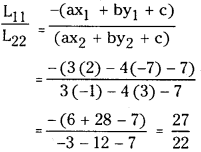
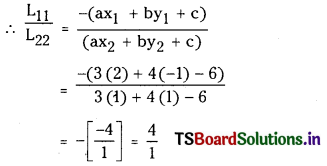
  1. वर्तमाने लट्
  2. विध्यादिषु लोट्
  3. अनद्यतनभूते लङ्
  4. विधिलिङ्
  5. भविष्यति लृट्

एतेषु पञ्चसु वर्तमाने लट् अनद्यतनभूते लङ् भविष्यति लृट् इति त्रयः कालवाचकाः । विध्यादिषु लोट् विधि लिङ् इति द्वौ प्रकारबोधक । सर्वेषु लकारेषु त्रयः पुरुषाः भवन्ति । ते च –

  1. प्रथमपुरुषः
  2. मध्यमपुरुषः
  3. उत्तमपुरुषः

1. एकवचनम्
2. द्विवचनम्
3. बहुवचनम्
पुरुषास्त्रयः वचनानि त्रीणि आहत्य लकारे नव रूपाणि भवन्ति ।

In Sanskrit there are six Tenses (काला) and four Moods (अर्थाः:). They were given a special technical name by the master grammarian Panini. All these ten verbs together are called लकाण: (Lakaras).

‘సుప్’ అనే ప్రత్యాహారము నామ విభక్తులకు సంజ్ఞయైన విధంగా, తిజ్ అనే ప్రత్యాహారము క్రియావిభక్తులకు సంజ్ఞ. తిఙంతమనగా క్రియారూపమును పొందిన ‘ధాతువు’ అని పేరు. ‘సుప్’ ప్రత్యయము చేరని నామము కానీ, తిజ్ ప్రత్యయము చేరని ధాతువు కానీ వాక్యములో ప్రయోగమునకనర్హములు.

TS Inter 1st Year Sanskrit Grammar धातुरूपाणि

సంస్కృత భాషలో కాలబోధకములు ఆరు, అర్థబోధకములు నాలుగు కలవు. వీటినన్నింటిని కలిపి ‘లకారము’లని అందురు.

వర్తమాన కాలము ఒకటి (లట్), భవిష్యత్ కాలములు రెండు (లుట్, లట్), భూతకాలములు మూడు (లజ్, లిట్, లుజ్)

ఇవి మొత్తం ఆరు కాలబోధకములు.

The tenses and moods are as follows:

1. वर्तमानकालः – (Present) వర్తమానకాలము – लट् (technical name)
2. भूतकालः – (1st Past) భూతకాలము – लुङ्
3. अनध्यतन भूतकालः – (Imperfect 2ndPast) అనద్యతన భూతకాలము – लङ्
4. परोक्ष भूतकालः – (Perfect 3rdPast) పరోక్ష భూతకాలము – लिट्
5. अनध्यतन भविष्यत् कालः – (1st Future) అనద్యతన భవిష్యత్కాలము – लुट्
6. भविष्यत् कालः – (2nd) భవిష్యత్ కాలము – लृट्

అర్ధబోధకములు (Moods)

1. आज्ञा – ఆజ్ఞార్థకము – लेट्
2. विधि – విధ్యర్థకము – विधि लिड्
3. आशीः – ఆశీరర్ధకము – आशीर्लिङ्
4. संकेत – సంకేతార్థకము – लृङ्

The लेट् or Subjunctive is used in the Veda only.

In Sanskrit the verbs are classified as आत्मनेपदी and परस्मैपदी based on whether the fruit of the action rests with the doer (आत्मने) or others (परस्मै) sometime it is called (उभयपदी) as conjugated with both terminations.

All the roots in Sanskrit are grouped into ten classes called गण s. They are called by the name of the first root of that class. For example, भू + आदि भू – etc. roots are found in भ्वादि class, अद् etc.
roots in अदादि and likewise.

As with Sabdas, here also tables are prepared as models. Almost all the roots of a cluster that matter but there are found many variations and irregular conjugations, which we need not know now.

TS Inter 1st Year Sanskrit Grammar धातुरूपाणि

ఈ పది లకారములు కాక లేట్ (लोट्) అని ఇంకొక అర్థకము వేదభాషలో కలదు. సంస్కృతంలో ధాతువులు పరస్మైపదులు, ఆత్మనేపదులు, ఉభయపదులు అని మూడు విధములుగా విభజింపబడినవి. క్రియాఫలము కర్తకు కాక ఇతరులకు చెందుతూ ఉంటే అది పరస్మైపది ధాతువు. క్రియాఫలము కర్తకే చెందుతూ ఉంటే అది ఆత్మనేపదము. కొన్ని ధాతువులు పరస్మైపది మరియు ఆత్మనేపదులలో ఉండును. వానిని ఉభయపదులు అని అందురు.

ఈ ధాతువులన్నియునూ 10 గణములుగా విభజింపబడినవి. అవన్నియునూ గణములోని మొదటి ధాతువుచే చెప్పబడుచుండును. భ్వాది గణము అనగా (भू + आदि) भू – ధాతువు మొదటిగాయున్న ధాతువులు గణము. అదే విధంగా అదాదులు (अद् + अदादि) మొదలైనవి.

శబ్దములకు వలెనే దీనియందు కూడా పట్టికలు తెలియజేయబడినవి. దాదాపు పరస్మైపది ధాతువులు (ఒకే గణములోని) ఒక విధముగాను, ఆత్మనేపది ధాతువులన్నియు ఒక విధముగాను ఉండును.

ధాతువులకు కేవలము అయిదు లకారములు మాత్రమే పరీక్షకు నిర్దేశింపబడినవి.

  1. వర్తమానకాలము – लट्
  2. అనద్యనత భూతకాలము – लङ्
  3. ఆజ్ఞార్ధకము – लोट्
  4. విధ్యర్ధకము – लिङ्
  5. భవిష్యత్ కాలము – लृट्

ధాతువులు – వాని అర్థములు (Meanings of the Conjucations)

Ex : पठ् to read – परस्मैपद root.

ఉదా : ఆర్ధే (చదువుట) – పరస్మైపది ధాతువు

1. लट् – (Present tense) (వర్తమాన కాలము)
TS Inter 1st Year Sanskrit Grammar धातुरूपाणि 1
TS Inter 1st Year Sanskrit Grammar धातुरूपाणि 2
TS Inter 1st Year Sanskrit Grammar धातुरूपाणि 3

TS Inter 1st Year Sanskrit Grammar धातुरूपाणि

2. लङ् (భూతకాలము)
TS Inter 1st Year Sanskrit Grammar धातुरूपाणि 4

Similarly in 2. लङ् – (Past tense)
अपठत् (He) read अपठताम् (they two) read etc.

3. लोट् – (Impetative) (ఆశీరర్థకము)
पठतु He must read etc.
पठतु – చదువును గాక
(మిగిలినవన్నియు ఇదే విధముగా అర్థము చేసికొనవలయును)

4. विधिलिड – (Potential) (విధ్యర్ధకము)
पठेतु He may read etc.
पठेतु – చదువవలయును

5. लृट् – (Future) (భవిష్యత్ కాలము)
पठिष्यति He will read etc.
पठिष्यति – చదువును

At this stage we study these five varieties only. For roots also the meanings should be understood in the same way.

TS Inter 1st Year Sanskrit Grammar धातुरूपाणि

ఈ విధముగానే అన్ని పట్టికలకు అర్థమును చెప్పుకొనవలయును. ఈ పట్టికలను కూడా విద్యార్థులు కంఠస్థము చేయవలయును.

परस्मैपदिधातवः

1. भू – सत्तायाम् (to be) భూ – సత్తాయామ్

वर्तमाने लट् – వర్తమానే లట్
TS Inter 1st Year Sanskrit Grammar धातुरूपाणि 5

विध्यादिषु लोट् – విధ్యాదిషు లోట్
TS Inter 1st Year Sanskrit Grammar धातुरूपाणि 6

अनद्यतनभूते लङ् – అనధ్యతనభూతే లజ్
TS Inter 1st Year Sanskrit Grammar धातुरूपाणि 7

विधि लिङ् – విధి లిజ్
TS Inter 1st Year Sanskrit Grammar धातुरूपाणि 8

TS Inter 1st Year Sanskrit Grammar धातुरूपाणि

भविष्यति लृट् – భవిష్యతి లృట్
TS Inter 1st Year Sanskrit Grammar धातुरूपाणि 9

2. अस् – भुवि (to finish) అస్ – భూవి

TS Inter 1st Year Sanskrit Grammar धातुरूपाणि 10
TS Inter 1st Year Sanskrit Grammar धातुरूपाणि 11

3. पठ् – पठने (to read) పఠ్ – పఠనే

वर्तमाने लट् – వర్తమానే లట్
TS Inter 1st Year Sanskrit Grammar धातुरूपाणि 12

विध्यादिषु लोट् – విధ్యాదిషు లోట్
TS Inter 1st Year Sanskrit Grammar धातुरूपाणि 13

TS Inter 1st Year Sanskrit Grammar धातुरूपाणि

अनद्यतनभूते लङ् – అనధ్యతనభూతే లజ్
TS Inter 1st Year Sanskrit Grammar धातुरूपाणि 14

विधि लिङ् – విధి లిజ్
TS Inter 1st Year Sanskrit Grammar धातुरूपाणि 15

भविष्यति लृट् – భవిష్యతి లృట్
TS Inter 1st Year Sanskrit Grammar धातुरूपाणि 16

4. लिख – लेखने (to write) లిఖ్ – లేఖనే

वर्तमाने लट् – వర్తమానే లట్
TS Inter 1st Year Sanskrit Grammar धातुरूपाणि 17

विध्यादिषु लोट् – విధ్యాదిషు లోట్
TS Inter 1st Year Sanskrit Grammar धातुरूपाणि 18

TS Inter 1st Year Sanskrit Grammar धातुरूपाणि

अनद्यतनभूते लङ् – అనధ్యతనభూతే లజ్
TS Inter 1st Year Sanskrit Grammar धातुरूपाणि 19

विधि लिङ् – విథి లిజ్
TS Inter 1st Year Sanskrit Grammar धातुरूपाणि 20

भविष्यति लृट् – భవిష్యతి లృట్
TS Inter 1st Year Sanskrit Grammar धातुरूपाणि 21

5. गम्ल – गती (to go) గమ్ల – గతీ

वर्तमाने लट् – వర్తమానే లట్
TS Inter 1st Year Sanskrit Grammar धातुरूपाणि 22

विध्यादिषु लोट् – విధ్యాదిషు లోట్
TS Inter 1st Year Sanskrit Grammar धातुरूपाणि 23

TS Inter 1st Year Sanskrit Grammar धातुरूपाणि

अनद्यतनभूते लङ् – అనధ్యతనభూతే లజ్
TS Inter 1st Year Sanskrit Grammar धातुरूपाणि 24

विधि लिङ् – విథి లిజ్
TS Inter 1st Year Sanskrit Grammar धातुरूपाणि 25

भविष्यति लृट् – భవిష్యతి లృట్
TS Inter 1st Year Sanskrit Grammar धातुरूपाणि 26

6. दा – दाने (to give) దా – దానే

TS Inter 1st Year Sanskrit Grammar धातुरूपाणि 27

TS Inter 1st Year Sanskrit Grammar धातुरूपाणि

7. खाद् खादने (to eat) ఖాద్ – ఖాదనే

वर्तमाने लट् – వర్తమానే లట్
TS Inter 1st Year Sanskrit Grammar धातुरूपाणि 28

विध्यादिषु लोट् – విధ్యాదిషు లోట్
TS Inter 1st Year Sanskrit Grammar धातुरूपाणि 29

अनद्यतनभूते लङ् – అనధ్యతనభూతే లజ్
TS Inter 1st Year Sanskrit Grammar धातुरूपाणि 30

विधि लिङ् – విథి లిజ్
TS Inter 1st Year Sanskrit Grammar धातुरूपाणि 31

TS Inter 1st Year Sanskrit Grammar धातुरूपाणि

भविष्यति लृट् – భవిష్యతి లృట్
TS Inter 1st Year Sanskrit Grammar धातुरूपाणि 32

8. पा पाने (to drink) పా – పానే

वर्तमाने लट् – వర్తమానే లట్
TS Inter 1st Year Sanskrit Grammar धातुरूपाणि 33

विध्यादिषु लोट् – విధ్యాదిషు లోట్
TS Inter 1st Year Sanskrit Grammar धातुरूपाणि 34

TS Inter 1st Year Sanskrit Grammar धातुरूपाणि

अनद्यतनभूते लङ् – అనధ్యతనభూతే లజ్
TS Inter 1st Year Sanskrit Grammar धातुरूपाणि 35

विधि लिङ् – విథి లిజ్
TS Inter 1st Year Sanskrit Grammar धातुरूपाणि 36

भविष्यति लृट् – భవిష్యతి లృట్
TS Inter 1st Year Sanskrit Grammar धातुरूपाणि 37

9. हस् – हसने (to smile) హస్ – హసనే

TS Inter 1st Year Sanskrit Grammar धातुरूपाणि 38

TS Inter 1st Year Sanskrit Grammar धातुरूपाणि

10. धाव धावने (to run) ధావ – ధావనే

वर्तमाने लट् – వర్తమానే లట్
TS Inter 1st Year Sanskrit Grammar धातुरूपाणि 39

विध्यादिषु लोट् – విధ్యాదిషు లోట్
TS Inter 1st Year Sanskrit Grammar धातुरूपाणि 40

अनद्यतनभूते लङ् – అనధ్యతనభూతే లజ్
TS Inter 1st Year Sanskrit Grammar धातुरूपाणि 41

विधि लिङ् – విథి లిజ్
TS Inter 1st Year Sanskrit Grammar धातुरूपाणि 42

भविष्यति लृट् – భవిష్యతి లృట్
TS Inter 1st Year Sanskrit Grammar धातुरूपाणि 43

TS Inter 1st Year Sanskrit Grammar धातुरूपाणि

11. दुशिर – प्रक्षण ताने (to see) దృశిర – ప్రక్షణ తానే

वर्तमाने लट् – వర్తమానే లట్
TS Inter 1st Year Sanskrit Grammar धातुरूपाणि 44

विध्यादिषु लोट् – విధ్యాదిషు లోట్
TS Inter 1st Year Sanskrit Grammar धातुरूपाणि 45

अनद्यतनभूते लङ् – అనధ్యతనభూతే లజ్
TS Inter 1st Year Sanskrit Grammar धातुरूपाणि 46

TS Inter 1st Year Sanskrit Grammar धातुरूपाणि

विधि लिङ् – విథి లిజ్
TS Inter 1st Year Sanskrit Grammar धातुरूपाणि 47

भविष्यति लृट् – భవిష్యతి లృట్
TS Inter 1st Year Sanskrit Grammar धातुरूपाणि 48

12. डुकृञ् – करणे (to do)

TS Inter 1st Year Sanskrit Grammar धातुरूपाणि 49

TS Inter 1st Year Sanskrit Grammar धातुरूपाणि

13. शृ – क्षवणे (to listan)

TS Inter 1st Year Sanskrit Grammar धातुरूपाणि 50

TS Inter 1st Year Sanskrit Grammar धातुरूपाणि

14. कथ् – वाक्यप्रबन्धे (to tell)

TS Inter 1st Year Sanskrit Grammar धातुरूपाणि 51

आत्मनेपदधातवः (ఆత్మనేపధాతవః:)

15. बन्द – अभिवादनस्तुतयो (to salute, to praise) వన్ద – అభివాదనస్తుత్యో

वर्तमाने लट् – వర్తమానే లట్
TS Inter 1st Year Sanskrit Grammar धातुरूपाणि 52

विध्यादिषु लोट् – విధ్యాదిషు లోట్
TS Inter 1st Year Sanskrit Grammar धातुरूपाणि 53

TS Inter 1st Year Sanskrit Grammar धातुरूपाणि

अनद्यतनभूते लङ् – అనధ్యతనభూతే లజ్
TS Inter 1st Year Sanskrit Grammar धातुरूपाणि 54

विधि लिङ् – విథి లిజ్
TS Inter 1st Year Sanskrit Grammar धातुरूपाणि 55

भविष्यति लृट् – భవిష్యతి లృట్
TS Inter 1st Year Sanskrit Grammar धातुरूपाणि 56

TS Inter 1st Year Sanskrit Grammar धातुरूपाणि

16. लभ्- प्राप्त (to get) లభ్ – ప్రాప్త

वर्तमाने लट् – వర్తమానే లట్
TS Inter 1st Year Sanskrit Grammar धातुरूपाणि 57

विध्यादिषु लोट् – విధ్యాదిషు లోట్
TS Inter 1st Year Sanskrit Grammar धातुरूपाणि 58

अनद्यतनभूते लङ् – అనధ్యతనభూతే లజ్
TS Inter 1st Year Sanskrit Grammar धातुरूपाणि 64

विधि लिङ् – విథి లిజ్
TS Inter 1st Year Sanskrit Grammar धातुरूपाणि 60

TS Inter 1st Year Sanskrit Grammar धातुरूपाणि

भविष्यति लृट् – భవిష్యతి లృట్
TS Inter 1st Year Sanskrit Grammar धातुरूपाणि 61

17. वृधु – वृद्धौ (to develop)

TS Inter 1st Year Sanskrit Grammar धातुरूपाणि 62

TS Inter 1st Year Sanskrit Grammar धातुरूपाणि

18. सेव् – सेवने ( to serve)

TS Inter 1st Year Sanskrit Grammar धातुरूपाणि 63

TS Inter 1st Year Maths 1B Solutions Chapter 10 Applications of Derivatives Ex 10(a)

Students must practice this TS Inter 1st Year Maths 1B Study Material Chapter 10 Applications of Derivatives Ex 10(a) to find a better approach to solving the problems.

TS Inter 1st Year Maths 1B Applications of Derivatives Solutions Exercise 10(a)

I.
Question 1.
Find Ay and dy for the following functions for the values of x and Ax which are shown against each of the functions. ((V.S.A.Q.)
(i) y = x2 + 3x + 6, x = 10, Δx = 0.01 (March 2014, ’11, ’05)
Answer:
f(x) = x2 + 3x + 6
Δy = f(x + Δx) – f(x)
= (x + Δx)2 + 3(x + Δx) + 6 – x2 – 3x – 6
= 2x Δx + (Δx)2 + 3
Δx = 2 (10) (0.01) + (0.01)2 + 3 (0.01)
= 0.2 + 0.0001 + 0.03 = 0.2301
dy = f’ (x) Δx = (2x + 3) Δx
= [2(10) + 3] (0.01)
= (23) × (0.01) = 0.23

(ii) y = ex + x, x = 5 and Δx = 0.02.
Answer:
Δy = f(x + Δx) – f(x)
= f (5 + 0.02) – f (5)
= f (5.02) – f(5)
= e5.02 + 5.02 – e5 – 5
= e5 e0.02 – e5 + 0.02
= e5 (e0.02 – 1) + 0.02
dy = f’ (x). Δx = (ex + 1) Δx
= (e5 + 1) (0.02)

iii) y = 5x2 + 6x + 6, x = 2 and Ax = 0.001.
Answer:
Δy = f(x + Δx) – f(x)
= f (2 + 0.001) – f(2)
= f (2.001) – f(2)
= 5 (2.001)2 + 6 (2.001) + 6 – [5(2)2 +. 6(2) + 6]
= 5 (2.001)2 + 6 (2.001) – 20 – 12
= 5 (2.001)2 + 6 (2.001) – 32
= 20.0200 + 12.0060 – 32
= 0.026005 dy = f'(x) Δx = (10x + 6) Δx = 26 (0.001) = 0.026

iv) y = \(\frac{1}{x+2}\), x = 8 and Δx = 0.02.
Answer:
Δy = f(x + Δx) – f(x)
= f (8 + 0.02) – f(8)
= f(8.02) – f (8)
= \(\frac{1}{8.02+2}-\frac{1}{8+2}\)
= \(\frac{1}{10.02}-\frac{1}{10}\)
= 0.0998003992 – 0.1000 = – 0.0001996
dy = f'(x)Δx = \(-\frac{1}{(x+2)^2}\)Δx = –\(-\frac{1}{100}\) (0.02)
= – 0.0002

v) y = cos x, x = 60° and Δx = 1°.
Answer:
Δy = f(x + Δx) – f(x)
= cos (x + Δx) – cos x
= cos (60 + 1°) – cos 60°
= 0.4848 – \(\frac{1}{2}\) = 0.4848 – 0.5 = – 0.0152
dy = f’ (x) Δx = – sin x (Δx)
= – sin60° (1°) = \(-\frac{\sqrt{3}}{2}\)(0.0174)
= -(0.8660) (0.0174) = – 0.0151

TS Inter 1st Year Maths 1B Solutions Chapter 10 Applications of Derivatives Ex 10(a)

II.
Question 1.
Find the approximations of the following. ((V.S.A.Q.) (March 2013)
(i) \(\sqrt{82}\)
Answer:
82 = 81 + 1= 81 (1 + \(\frac{1}{81}\))
x = 81, Δx = 1, f(x) = √x
dy= f’ (x). Δx = \(\frac{1}{2 \sqrt{x}}\). Δx = \(\frac{1}{2 \sqrt{81}}\)(1)
= \(\frac{1}{18}\)(1) = 0.0555
f(x + Δx) – f(x) = dy
f(x + Δx) = f(x) + dy
= \(\sqrt{81}\) + 0.0555 = 9.0555 = 9.056

ii) \(\sqrt[3]{65}\) (Board Model Paper)
Answer:
TS Inter 1st Year Maths 1B Solutions Chapter 10 Applications of Derivatives Ex 10(a) 2
iii) \(\sqrt{25.001}\)
Answer:
Let x = 25, Δx = 0.001, f(x) = √x
f(x + Δx) ≈ f(x) + f'(x)Δx
= √x + \(\frac{1}{2 \sqrt{x}}\)Δx
= 5 + \(\frac{1}{10}\) (0.001) = 5.0001

(iv) \(\sqrt[3]{7.8}\)
Answer:
x = 8, Δx = -0.2, f(x) = \(\sqrt[3]{x}\)
f(x + Δx) ≈ f(x) + f'(x) Δx
TS Inter 1st Year Maths 1B Solutions Chapter 10 Applications of Derivatives Ex 10(b) 1

(v) sin 62°
Answer:
Let x = 60°, Δx = 2°, f(x) = sin x
∴ f(x + Δx) = f(x) + f'(x) Δx
= sin x + cos x Δx
= sin 60° + cos 60°. (2°)
= \(\frac{\sqrt{3}}{2}+\frac{1}{2}\)(2°)
= 0.8660 + 0.0174 = 0.8834

(vi) cos (60° 5′)
Answer:
x = 60°, Δx = 5′ = \(\frac{5}{60} \times \frac{\pi}{180}=\frac{\pi}{2160}\) = 0.001453
f(x) = cos x
∴ f(x + Δx) – f(x) + f'(x) Δx
= cos x – sin x Δx
= cos60° – sin60° (0.001453)
= 0.5 – 0.8660 (0.001453)
= 0.5 – 0.001258 = 0.4987

vii) \(\sqrt[4]{17}\)
Answer:
Let x =16, Δx = 1, f(x) = \(\frac{1}{4}\) = x1/4
.-. f(x + Δx) = f (x) + f’(x) Δx
= x\(\frac{1}{4}\) + \(\frac{1}{4}\)x\(\frac{-3}{4}\)
= 16\(\frac{1}{4}\) + \(\frac{1}{4}\)16\(\frac{-3}{4}\) Δx
= 2 + \(\frac{1}{32}\)(1)
= 2 + 0.0312 ≈ 2.0312

TS Inter 1st Year Maths 1B Solutions Chapter 10 Applications of Derivatives Ex 10(a)

Question 2.
If the increase in the side of a square is 4% then find the approximate percentage of increase in the area of the square. (S.A.Q.) (May 2014)
Answer:
Let x be the side of the square and given
= \(\frac{\Delta \mathrm{x}}{\mathrm{x}}\) × 100
Area of square A = x2
Error ΔA = 2x Δx
Relative error = \(\frac{\Delta \mathrm{A}}{\mathrm{A}}=\frac{2 \mathrm{x} \Delta \mathrm{x}}{\mathrm{x}^2}=2 \cdot \frac{\Delta \mathrm{x}}{\mathrm{x}}\)
% error in area of the square
= 2. \(\frac{\Delta x}{x}\) × 100 = 2 × 4 = 8

Question 3.
The radius of a sphere is measured as 14 cm. Later it was found that there is an error of 0.02 cm in measuring the radius. Find the approximate error in surface area of the sphere. (S.A.Q.)
Answer:
Let r be the radius of sphere = 14
Also given Δr = 0.02
We have surface area of the sphere A = 4πr2
Approximate error in surface area of sphere
∴ ΔA = 8πr Δr = 8π × 14 × 0.02 = 2.24 π
= (2.24) (3.14) = 7.0336

Question 4.
The diameter of a sphere is measured to be 40 cm. If an error of 0.02 cm is made in it then find approximate errors in volume and surface area of the sphere. (SA.Q.)
Answer:
Let V be the volume of sphere
Then V = \(\frac{4}{3}\)πr3 = \(\frac{4}{3} \pi\left(\frac{\mathrm{d}}{2}\right)^3=\frac{\pi \mathrm{d}^3}{6}\)
Approximate error in volume ΔV = \(\frac{\pi}{6}\)3d2 Δd
= \(\frac{\pi}{2}\)d2 Δd
Given Δd = 0.02, d = 40
∴ ΔV= \(\frac{\pi}{2}\)(40)2 (0.02)
= π (1600) (0.01) = 16π
Surface Area S = 4πr2
= 4π \(\left(\frac{\mathrm{d}}{2}\right)^2\) = πd2

Approximate error in surface area
ΔS = π 2d . Δd = 2π (40) (0.02) = 1.6 π

TS Inter 1st Year Maths 1B Solutions Chapter 10 Applications of Derivatives Ex 10(a)

Question 5.
The time’t’ of a complete oscillation of a simple pendulum of length l is given by t = 271 y g , where g is gravitational constant. Find the approximate percentage in error of t when the percentage error in l is 1 %. (S.A.Q.)
Answer:
Given t = 2π\(\sqrt{\frac{l}{g}}\)
log t = log 2π + \(\frac{1}{2}\) [log l – log g]
\(\frac{\Delta \mathrm{t}}{\mathrm{t}}=\frac{1}{2} \frac{\Delta l}{l}\) (∵ 2π; g are constants)
Given \(\frac{\Delta l}{l}\) × 100 = 1
∴ Approximate percentage error of t is
\(\frac{\Delta t}{t}\) × 100 = \(\frac{1}{2} \frac{\Delta l}{l}\) × 100
= \(\frac{1}{2}\)(1) = \(\frac{1}{2}\)

TS Inter 1st Year Maths 1B Solutions Chapter 1 Locus Ex 1(a)

Students must practice these TS Intermediate Maths 1B Solutions Chapter 1 Locus Ex 1(a) to find a better approach to solving the problems.

TS Inter 1st Year Maths 1B Locus Solutions Exercise 1(a)

Question 1.
Find the equation of locus of a point which is at a distance 5 from A (4, – 3). (V.S.A.Q)
Answer:
Given A = (4, – 3) and suppose P (x, y) is any other point on the locus.
Then given PA = 5
⇒ PA2 = 25
⇒ (x – 4)2 + (y + 3)2 = 25
⇒ x2 + y2 – 8x + 6y + 25 – 25 = 0
⇒ x2 + y2 – 8x + 6y = 0 ……………… (1)
(If there exists another point Q(x1, y1) such that QA2 = (x1 – 4)2 + (y1 + 3)2
Let Q(x1, y1 satisfy (1) then
x12 + y12 – 8x1 + 6y1 = 0
and QA2 = x12 + y12 – 8x1 + 6y1 + 25
= 0 + 25 = 25
⇒ QA = 5
∴ Q (x1, y1) satisfy the geometric condition (1)
∴ Required equation of locus is x2 + y2 – 8x + 6y = 0
Note : Second part need not follow the problem from the definition of locus.

TS Inter 1st Year Maths 1B Solutions Chapter 1 Locus Ex 1(a)

Question 2.
Find the equation of locus of a point which is equidistant from the points A (-3, 2) and B (0, 4). (V.S.A.Q)
Answer:
Let P (x, y) be any point on the locus. Then from the given geometric condition PA = PB
TS Inter 1st Year Maths 1B Solutions Chapter 1 Locus Ex 1(a) 1
∴ PA2 = PB2
⇒ (x + 3)2 + (y – 2)2 = (x – 0)2 + (y – 4)2
⇒ x2 + y2 + 6x + 9 – 4y + 4 = x2 + y2 – 8y + 16
⇒ 6x + 4y – 3 = 0
⇒ 6x + 4y = 3 is the equation of the locus.

Question 3.
Find the equation of locus of a point P such that the distance of P from the origin is twice the distance of P from A (1, 2).
(V.S.A.Q) (March 2012)
Answer:
Given O (0,0) and A (1,2) are the two points, P (x, y) be any point on the locus. From the given condition OP = 2PA
TS Inter 1st Year Maths 1B Solutions Chapter 1 Locus Ex 1(a) 2
⇒ OP2 = 4 PA2
⇒ x2 + y2 = 4[(x – 1)2 + (y – 2)2]
⇒ x2 + y2 = 4 [(x2 + y2 – 2x – 4y + 1 + 4]
⇒ 4 [x2 + y2 – 2x – 4y + 5]
⇒ 4x2 + 4y2 – 8x – 16y + 20
∴ Equation to the locus of P is
3x2 + 3y2 – 8x – 16y + 20 = 0

Question 4.
Find the equation of locus of a point which is equidistant from the coordinate axes. (V.S.A.Q)
Answer:
Let P (x, y) be any point on the locus.
The distance from P to X – axis is ’y and that of the distance to Y – axis is ‘x’.
Given y = x ⇒ y2 = x2
locus of P (x, y) is x2 – y2 = 0

TS Inter 1st Year Maths 1B Solutions Chapter 1 Locus Ex 1(a)

Question 5.
Find the equation of locus of a point equidistant from A (2, 0) and the Y – axis. (V.S.A.Q)
Answer:
A (2, 0) is the given point and
Let P (x, y) be any point on the locus.
The distance from P to Y – axis is PB = x
Given PA = PB
⇒ PA2 = PB2
⇒ (x – 2)2 + y2 = x2
⇒ x2 – 4x + 4 + y2 = x2
⇒ y2 – 4x + 4 = 0
∴ Locus of P (x, y) is y – 4x + 4 = 0

Question 6.
Find the equation of locus of a point P the square of whose distance from the origin is 4 times its y – coordinate. (V.S.A.Q)
Answer:
Let P (x, y) be any point on the locus. Its distance from origin is OP
Given that OP2 = 4y
⇒ x2 + y2 = 4y
⇒ x2 + y2 – 4y = 0
∴ Equation to the locus of P is
x2 + y2 – 4y = 0

Question 7.
Find the equation of locus of a point P Such that PA2 + PB2 = 2c2 where A = (a, 0), B= (- a, 0) and 0 < |a| < |c| (V.S.A.Q)
Answer:
Let P (x, y) be any point on the locus. Given A = (a, 0) and B = (-a, 0) are two points. Given condition is PA2 + PB2 = 2c2
⇒ (x – a)2 + y2 + (x + a)2 + y2 = 2c2
⇒ x2 – 2ax + a2 + y2 + x2 + 2ax + a2 + y2 = 2c2
⇒ 2x2 + 2y2 = 2c2 – 2a2
∴ x2 + y2 = c2 – a2 is the equation of locus of P.

II.
Question 1.
Find the equation of locus of P, if the line segment joining (2, 3) and (-1,5) subtends a right angle at P. (May ’12, March ’13, ’05) (S.A.Q)
Answer:
TS Inter 1st Year Maths 1B Solutions Chapter 1 Locus Ex 1(a) 3
A = (2, 3), B = (-1, 5) are the given points. P (x, y ) is any point on the locus.
Given condition is ∠APB = 90°
Using pythagorous theorem, AP2 + PB2 = AB2
⇒ (x – 2)2 + (y – 3)2 + (x + 1)2 + (y – 5)2 = ( 2 + 1)2 + ( 3 – 5)2
⇒ x22 – 4x + 4 + y2 – 6y + 9 + x2 + 2x + 1 + y2 – 10y + 25 = 9 + 4
⇒ 2x2 + 2y2 – 2x – 16y + 26 = 0
∴ Locus of P is x2 + y2 – x – 8y + 13 = 0
(x, y) ≠ (2, 3) and (x, y) ≠ (-1,5)

TS Inter 1st Year Maths 1B Solutions Chapter 1 Locus Ex 1(a)

Question 2.
The ends of the hypotenuse of a right angled triangle are (0, 6 ) and ( 6, 0 ). Find the equation of locus of its third vertex. (S.A.Q)
Answer:
The ends of the hypotenuse are given as A (0, 6) and B (6, 0)
Let P (x, y) be the third vertex.
TS Inter 1st Year Maths 1B Solutions Chapter 1 Locus Ex 1(a) 4
Given condition is ∠APB = 90°
∴ By pythagorous theorem
⇒ AP2 + PB2 = AB2
⇒(x – 0)2 + (y – 6)2 + (x – 6)2 + (y – 0)2 = (0 – 6)2 + (6 – 0)2
⇒ 2x2 + 2y2 – 12y – 12x + 36 + 36 = 36 + 36
⇒ 2x2 + 2y2 – 12x – 12y = 0
∴ Locus of P (x, y) is x2 + y2 – 6x – 6y = 0
(x, y) ≠ (0, 6) and (x, y) ≠ (6, 0)

Question 3.
Find the equation of locus of a point the difference of whose distances from (- 5, 0) and (5, 0) is 8. (May 2011,’06, March 2001) (S.A.Q)
Answer:
A (- 5, 0) and B (5, 0) are the given points.
Let P (x, y) be a point on the locus.
From the given condition |PA – PB| = 8 …… (1)
Consider
PA2 – PB2 = [(x + 5)2 + (y – 0)2] – [(x – 5)2 + (y – 0)2]
= (x2 + 10x + 25 + y2) – (x2 – 10x + 25 + y2) = – 20x
∴ (PA + PB) (PA – PB) = 20x
⇒ (PA + PB) (8) = 20x
⇒ PA + PB = \(\frac{5}{2}\) x .
Adding (1) and (2)
2PA = 8 + \(\frac{5 x}{2}\)x
⇒ 4PA = 16 – 5x
⇒ 16 PA = (16 – 5x)2
⇒ 16 [(x + 5)2 + y2] = (16 + 5x)2
⇒ 16 [x2 + y2 + 10x + 25] = (16 + 5x)2
⇒ 16x2 + 16y2 + 160x + 400 = 256 + 160x + 252
⇒ 9x2 + 16y2 + 144 = 0
⇒ 9x2 – 16y2 = 144
⇒ \(\frac{9 x^2}{144}-\frac{16 y^2}{144}\) = 1
⇒ \(\frac{x^2}{16}-\frac{y^2}{9}\) = 1
∴ Equation of locus of P(x, y) is \(\frac{x^2}{16}-\frac{y^2}{9}\) = 1

Question 4.
Find the equation of locus of P, if
A = (4, 0), B = (- 4, 0) and |PA – PB| = 4. (S.A.Q) (May’ 2007)
Answer:
Given that A = (4, 0) and B = (- 4, 0) are two points and let P (x ,y) be any point on the locus.
The given condition is |PA – PB| = 4 ………………. (1)
Consider
PA2 – PB2 = [(x – 4)2 + y2] – [(x + 4)2 + y2]
= (x2 – 8x + 16 + y2) – (x2 + y2 + 8x + 16)
= – 16x
(PA + PB) (PA – PB) = – 16x
⇒ (PA + PB) (4) = -16x
⇒ PA + PB = – 4x ……………….. (2)
Adding (1) and (2)
2PA = 4 – 4x
⇒ PA = 2 – 2x
⇒ PA2 = (2 – 2x)2
⇒ (x – 4)2 + y2 = 4 – 8x + 4x2
⇒ x2 + y2 – 8x + 16 = 4x2 – 8x + 4
⇒ 3x2 – y2 = 12
⇒ \(\frac{x^2}{4}-\frac{y^2}{12}\) = 1
∴ Equation to the locus of P is \(\frac{x^2}{4}-\frac{y^2}{12}\) = 1

TS Inter 1st Year Maths 1B Solutions Chapter 1 Locus Ex 1(a)

Question 5.
Find the equation of locus of a point, the sum of whose distances from (0, 2) and (0, – 2) is 6 . (S.A.Q)
Answer:
Let A = (0, 2) and B = (0, – 2) are the two given points.
Let P (x, y) b.e any point on the locus.
From the given condition, PA + PB = 6 …………….. (1)
Consider
PA2 – PB2 = [(x – 0)2 + (y – 2)2] – [(x – 0)2 + (y + 2)2]
= x2 + y2 – 4y + 4 – x2 – y2 – 4y – 4 = – 8y
∴ (PA + PB) (PA – PB) = – 8y
⇒ 6 (PA – PB) = – 8y
⇒ (PA – PB) = \(\frac{-8 y}{6}=\frac{-4 y}{3}\) ………………… (2)
Adding (1) and (2)
TS Inter 1st Year Maths 1B Solutions Chapter 1 Locus Ex 1(a) 5
⇒ 9x2 + 9y2 + 36 = 81 + 4y2
⇒ 9x2 + 5y2 = 45
⇒ \(\frac{x^2}{5}+\frac{y^2}{9}\) = 1
∴ Equation to the locus of P is \(\frac{x^2}{5}+\frac{y^2}{9}\) = 1

Question 6.
Find the equation of the locus of P, if A = ( 2, 3 ), B = ( 2, -3 ) and PA + PB = 8. (SA.Q)
Answer:
Let P (x, y ) be any point on the locus.
Given condition is PA + PB = 8 (1)
PA2 – PB2 = [(x – 2)2 + (y – 3)2] – [ (x – 2)2 + ( y + 3)2]
= (x – 2)2 + (y – 3)2 – (x – 2)2 – (y + 3)2 = – 12y
(y – 3)2 – (y + 3)2 = – 12y
∴ PA2 – PB2 = – 12y
(PA + PB) (PA – PB) = -12y
⇒ 8 (PA – PB) = – 12y
⇒ PA – PB = \(\frac{-12 y}{8}=\frac{-3 y}{2}\) ……………….. (2)
Adding (1) and (2)
2PA = 8 – \(\frac{3 \mathrm{y}}{2}\) = \(\frac{16-3 y}{2}\)
⇒ 4PA = 16 – 3y
⇒ 16PA2 = (16 – 3y)2
⇒ 16 [(x – 2)2 + (y – 3)2] = (16 – 3y)2
⇒ 16 [x2 + y2 – 4x – 6y + 13] = 256 – 96y + 9y2
⇒ 16x2 + 7y2 – 64x – 48 = 0
∴ Equation to the locus of P is
16x2 + 7y2 – 64x – 48 = 0
(or) 16(x2 – 4x) + 7y2 = 48
⇒ 16 (x2 – 4x + 4) + 7y2 = 112
⇒ 16 (x – 2)2 + 7y2 = 112.
⇒ \(\frac{(x-2)^2}{7}+\frac{y^2}{16}\)

TS Inter 1st Year Maths 1B Solutions Chapter 1 Locus Ex 1(a)

Question 7.
A (5, 3) and B (3, – 2) are two fixed points. Find the equation to the locus of P, so that the area of triangle PAB is 9. (S.A.Q) (March 2006)
Answer:
A (5, 3 ), B (3, -2 ) are the given points.
Let P (x, y ) be any point on the locus. Given condition is that the area of ∆ PAB = 9
⇒ \(\frac{1}{2}\) |[x1 (y2 – y3) + x2 (y3 – y1) + x3 (y1 – y2)[|
= \(\frac{1}{2}\) |[5(- 2 – y) + 3 (y – 3) + x (3 + 2)]| = 9
⇒ 5x – 2y – 19 = ±18
⇒ 5x – 2y – 19 = 18 (or) 5x – 2y – 19 = – 18
⇒ 5x – 2y – 37 = 0 (or) 5x – 2y – 1= 0
∴ Locus of P is (5x – 2y – 37) (5x – 2y – 1) = 0

Question 8.
Find the equation of locus of a point, which forms a triangle of area 2 with the points A (1, 1 ) and B ( – 2, 3 ). (S.A.Q)
Answer:
A ( 1, 1), B(- 2, 3 ) are the two given points and Let P ( x, y ) be any point on the locus.
Given condition is ∆ PAB = 2
⇒ ∴ \(\frac{1}{2}\) |1(3 – y) – 2(y – 1) + x(1 – 3)| = 2
⇒ |3 – y – 2y + 2 – 2x| = 4
⇒ – 2x – 3y + 5 = ±4
⇒ – 2x – 3y + 5 = 4 (or) – 2x – 3y + 5 = – 4
⇒ 2x + 3y – 1 = 0 (or) 2x + 3y – 9 = 0
∴ Locus of P (x, y) is (2x + 3y – 1) (2x + 3y – 9) = 0

Question 9.
If the distance from P to the points (2, 3) and ( 2, – 3 ) are in the ratio 2 : 3 then find the equation of locus of P. (S.A.Q) (May 2014, March 2014)
Answer:
Let P (x, y ) be any point on the locus.
Given points are A (2, 3) and B (2, -3) and given condition is PA : PB = 2: 3
⇒ 3PA = 2PB ⇒ 9PA2 = 4PB2
⇒ 9 [(x – 2)2 + (y – 3)2] = 4 [(x – 2)2 + (y + 3)2]
⇒ 9 [(x2 – 4x + 4 + y2 – 6y + 9)] = 4 [x2 – 4x + 4 + y2 + 6y + 9]
⇒ 5x2 + 5y2 – 20x – 78y + 65 = 0
∴ Equation to the locus of P is
5x2 + 5y2 – 20x – 78y + 65 = 0

Question 10.
A (1, 2 ), B ( 2, – 3) and C (- 2, 3) are three points. A point P moves such that PA2 + PB2 = 2PC2. Show that the equation to the locus of P is 7x – 7y + 4 = 0 (S.A.Q) (May 2007)
Answer:
Let P (x, y) be any point on the locus. Given points are
A = (1, 2) ; B = (2, – 3) and C = (- 2, 3)
Given condition is PA2 + PB2 = 2PC2
⇒[(x – 1)2 + (y – 2)2] + [(x – 2)2 + (y + 3)2]
= 2 [(x + 2)2 + (y – 3)2]
⇒ 2x2 + 2y2 – 6x + 2y + 18
= 2x2 + 2y2 + 8x – 12y + 26
⇒ 14x – 14y + 8 = 0
⇒ 7x – 7y + 4 = 0
∴ Equation to the locus of P is
7x – 7y + 4 = 0

TS Inter 1st Year Sanskrit Grammar संवित्परीक्षा

Telangana TSBIE TS Inter 1st Year Sanskrit Study Material Grammar संवित्परीक्षा Questions and Answers.

TS Inter 1st Year Sanskrit Grammar संवित्परीक्षा

गतानुगतिको लोकः

पुरा कश्चन सन्यासी स्वेन आर्जितं धनम् एकस्मिन् ताम्रभाजने निक्षिप्य अरक्षत् । सः एकदा मकर संक्रान्तिपर्वदिने पर्वस्नानार्थं नदीम् अगच्छत् । धनपूर्ण ताम्रघटं कुटीरे त्यक्तुं भीतः सः तं गृहीत्वैव अगच्छत् । नद्याः तीरे गर्तं कृत्वा धनघटं तस्मिन् निक्षिप्य गर्तं पूरितवान् । अभिज्ञानार्थं तस्य उपरि सैकतलिङ्गम् एकं विन्यस्य स्त्रानार्थम् अगच्छत् । तं दृष्ट्वा इतरे जनाः तस्मिन् तीर्थे सैकतलिङ्गस्य पूजा समुदाचारः स्यात् इति अमन्यन्त । अतः ते अपि तथैव अकुर्वन् । स्नात्वा प्रत्यागतः सन्न्यासी नदीतीरं सैकतलिङ्गमयम् अपश्यत् । तेषां लिङ्गानां मध्ये आत्मना न्यस्तम् अभिज्ञानलिङ्गं ज्ञातुम्
नीतिः गतानुगतिको लोकः न लोकः पारमार्थिकः ।

Once upon a time a saint hid all the money he earned in a bronze trunk. On the auspicious day of Makara Sankranti, he went to take a bath in the river. He was afraid of losing the trunk with the money. So he took the trunk with him to the river. He dug a hole in the banks of the river and hid. the trunk in it. To recognize the spot, he built a Shiva Lingam with sand on it and he went off to take the bath. Seeing that all the others who came to.take a bath in the river thought that it was a tradition to make a Shiva Lingam and worship it. So everyone built a Shiva Lingam and when the saint returned from the bath he saw that the whole place was filled with Shiva Lingams. He was disappointed as the wasn’t able to recognize his Lingam amidst of all those Shiva Lingams.

Moral of the story: People don’t think on their own and end , up following what others did mindlessly.

TS Inter 1st Year Sanskrit Grammar संवित्परीक्षा

పూర్వం ఒక సన్యాసి ఉండేవాడు. అతడు సంపాదించిన డబ్బును ఒక రాగి పెట్టెలో దాచి ఉంచేవాడు. మకర సంక్రాంతి పండుగ రోజు అతడు సంక్రమణ స్నానం చెయ్యడానికి నదికి వెళ్ళాడు. డబ్బుతో నిండిన రాగి బిందెను వదిలి పెట్టడానికి భయపడి ఆ సన్యాసి తన వెంటే ఉంచుకొని బయలుదేరాడు. నది ఒడ్డున ఒక గుంట తీసి ‘డబ్బు బిందెను ఆ గుంటలో పెట్టి గుంటను పూడ్చాడు. మళ్ళీ గుర్తుపట్టడానికి ఇసుకతో శివలింగం చేసి అక్కడ పెట్టి స్నానానికి వెళ్ళాడు. దాన్ని మిగిలిన వాళ్ళు చూసి పుణ్యక్షేత్రంలో ఇసుక లింగ పూజ ఆచారమేమో అని అనుకున్నారు. అందువల్ల మిగిలిన వాళ్ళు కూడా అలాగే చేశారు. స్నానం చేసి వచ్చిన సన్యాసి నది ఒడ్డు మొత్తం ఇసుక లింగాలతో నిండిపోవడం చూశాడు. వాటి మధ్యలో తాను పెట్టిన లింగాన్ని గుర్తుపట్టలేక నిరాశ చెందాడు.

నీతి : లోకంలో ప్రజలు స్వంత ఆలోచన లేకుండా ఇతరులు నడచిన దారిలోనే నడుస్తారు.

प्रश्नाः

प्रश्न 1.
सन्न्यासी स्वेन आर्जितं धनं कथम् अरक्षत् ?
उत्तर:
सन्यासी स्वेन आर्जितं धनं एकस्मिन् ताम्रभाजने निक्षिप्य अस्क्षत् ।

प्रश्न 2.
सन्न्यासी कदा किमर्थं च नदीम् अगच्छत् ?
उत्तर:
सन्न्यासी मकरसंक्रान्तिपर्वदिने पर्वस्नानार्थं नदीम अगच्छत् ।

प्रश्न 3.
नद्याः तीरे सन्न्यासी किम् अकरोत् ?
उत्तर:
नद्याः तीरे सन्न्यासी गर्तं कृत्वा धनघटं तस्मिन निक्षिप्य गर्तं पूरितवान् ।

प्रश्न 4.
इतरे जनाः किमिति अमन्यन्त ?
उत्तर:
“तस्मिन् तीर्थे सैकतलिङ्गस्य पूजा समुदाचारः स्यात्” इति इतरे जनाः अमन्यन्त ।

प्रश्न 5.
अस्याः कथायाः का नीतिः ?
उत्तर:
“गतानुगतिको लोकः न लोकः पारमार्थिकः” इति अस्याः कथायाः नीतिः ।

परानुकारी गर्दभः

पुरा कस्यचन वणिजः गृहे एकः वृषभः गर्दभः च आस्ताम् । एकदा सः गर्दभस्य पृष्ठे तूलं, वृषभपृष्ठे लवणगोणीं च निधाय विपणिं प्रति अगच्छत् । मार्गे काचित् नदी आसीत् । तां नदीं तरन् वृषभः भाराक्रान्तः सन् जले अपतत् । प्रवाहेण क्लिन्नं लवणम् अद्रवत् । तेन वृषभस्य भारः न्यूनः अभवत् । वृषभं दृष्ट्वा गर्दभः अपि स्वयं जले अपतत् । जले क्लिन्नस्य तूलस्य भारः द्विगुणः अजायत । वणिक् अपि गर्दभम् अताडयत् ।

नीतिः अविचार्य परानुकरणं सन्तापकारणं भवति ।

TS Inter 1st Year Sanskrit Grammar संवित्परीक्षा

There once lived a businessman who owned an ox and a donkey. He would load a sack of cotton on the donkey and a sack of salt on the ox and sell it in the town. On the way they had to cross a river. Due to the heavy weight on its back, the ox fell into the river and the salt melted in the water. As a result, the burden on the ox reduced. Seeing that the donkey also jumped into the river. But the cotton’s weight doubled in the water and the businessman also bet the donkey.

Moral of the story: Following someone thoughtlessly causes grief.

పూర్వకాలములో ఒక వ్యాపారికి ఒక ఎద్దు, ఒక గాడిద ఉండెను. అతడు గాడిద వీపుమీద దూది, ఎద్దువీపు మీద ఉప్పు గోతమును ఉంచి అమ్ముటకు వెళ్ళెను. దారిలో ఒక నది ఉండెను. ఆ నదిని దాటుచూ ఎద్దు బరువుచేత నీటిలో పడెను. నీటిలో మునిగిన ఉప్పు కరిగిపోయెను. ఆ కారణము చేత ఎద్దు వీపు మీద ఉన్న బరువు తగ్గెను. ఎద్దును చూచిన గాడిద కూడా నీటిలో మునిగెను. నీటిలో మునిగిన దూది బరువు రెట్టింపు అయ్యెను. వ్యాపారి కూడా గాడిదను కొట్టెను.

నీతి : ఆలోచించకుండా ఇతరులను అనుసరించినవారు దుఃఖానికి కారణం అవుతారు.

प्रश्नाः

प्रश्न 1.
वणिक् ऐकदा कुत्र अगच्छत् ?
उत्तर:
वणिक् एकदा विपणिं प्रति अगच्छत् ।

प्रश्न 2.
वृषभः भाराक्रान्तः सन् किम् अकरोत् ?
उत्तर:
वृषभः भाराक्रान्तः सन् जले अपतत् ।

प्रश्न 3.
वृषभं दृष्ट्वा गर्दभः किम् अकरोत् ?
उत्तर:
वृषभं दृष्टवा गर्दभः अपि जले अपतत् ।

प्रश्न 4.
कस्य भारः द्विगुणः अजायत ?
उत्तर:
गर्दभस्य भारः द्विगुणः अजायत ।

TS Inter 1st Year Sanskrit Grammar संवित्परीक्षा

प्रश्न 5.
अस्याः कथायाः का नीतिः ?
उत्तर:
अविचार्य परानुकरणं सन्तापकारणं भवति ।

लुब्धः कर्षकः

पुरा धारानगर्यां कश्चित् कर्षकः एकाम् अद्भुतां कुक्कुटीम् अपालयत् । सा कुक्कुटी प्रतिदिनं एकैकं सुवर्णमयम् अण्डं ददाति स्म । तेन सः कर्षकः अतीव धनवान् अजायत । प्रतिदिनं सुवर्णं प्राप्नुवतः अपि तस्य लोभः अतीव अवर्धत । एकदा सः अचिन्तयत् दिने दिने स्वल्पमात्रस्य सुवर्णस्य प्राप्त्या प्रयोजनं नास्ति । अतः कुक्कुट्याः उदरात् सर्वमपि सुवर्णम् एकदैव ग्रहीष्यामि । तथा निश्चित्य कर्षकः कुक्कुटी हत्वा तस्याः उदरम् अपाटयत् । तस्मिन् तु एकम् अण्डम् अपि न आसीत् । कर्षकस्य अतिलोभेन स्वर्णदायिनी कुक्कुटी विनष्टा

नीति : अतिलोभात् जनः विनश्यति ।

Once in a village called Dharanagara there was a farmer who had a wonderful hen that laid a golden egg daily. The farmer became very rich due to the hen. He became greedy. One day he thought that instead of taking some gold every day he would rather have all the gold in the hen at once. So he cut up the hen and found nothing in its stomach. Due to the farmer’s greed the hen that laid golden eggs was dead.

Moral of the story : Greed causes human’s destruction.

పూర్వం ధారానగరమందు ఒక వ్యవసాయదారుడు ఒక అద్భుతమైన కోడిని పెంచెను. ఆ కోడి ప్రతిరోజూ ఒక్క బంగారు గుడ్డును ఇచ్చుచుండెను. ఆ కారణము చేత ఆ రైతు గొప్ప ధనవంతుడు అయ్యెను. రోజూ బంగారమును తీసుకొనుచున్న అతనికి దురాశ ఎక్కువ అయ్యెను. ఒక రోజు అతడు ఈ విధముగా ఆలోచించెను. రోజూ కొంచెము కొంచెము బంగారం తీసుకొనుట వలన ప్రయోజనము లేదు. అందువలన కోడి పొట్టలో ఉన్న బంగారం మొత్తం ఒకేసారి తీసుకొందును అని ఆలోచించి ఆ రైతు ఆ కోడిని చంపి పొట్టను చీల్చెను. దాని పొట్టలో ఒక గుడ్డు కూడా లేదు. రైతు యొక్క దురాశ వలన బంగారమును ఇచ్చు కోడి చనిపోయెను.

నీతి : దురాశ వలన మనుషులు వినాశమును పొందుదురు.

प्रश्ना:

प्रश्न 1.
कर्षकः काम् अपालयत् ?
उत्तर:
कर्षकः एकाम अद्भुतां कक्कुटीम् अपालयत् ।

प्रश्न 2.
कुक्कुटी प्रतिदिनं किं ददाति स्म ?
उत्तर:
कुक्कुटी प्रतिदिनं एकैकं सुवर्णमयं अण्डं ददाति स्म ।

प्रश्न 3.
तथा निश्चित्य कर्षकः किम् अकरोत् ?
उत्तर:
तथा निशिचत्य कर्षकः कुक्कुटी हत्वा तस्याः उदरम् अपाटयत् ।

TS Inter 1st Year Sanskrit Grammar संवित्परीक्षा

प्रश्न 4.
केन कुक्कुटी विनष्टा ?
उत्तर:
कर्षकस्य अतिलोभेने कुक्कुटी विनष्ट ।

प्रश्न 5.
अस्याः कथायाः का नीतिः ?
उत्तर:
’अतिलोभात् जनः विनस्यति’ इति अस्याः कथाथाः नीतिः ।

बिडालस्य गले घण्टा

एकस्मिन् गृहे बहवः मूषिकाः आसन् । ते गृहे धान्यादीनि सर्वाणि खादित्वा तद्गृहस्वामिनः महतीं हानिं अकुर्वन् । तेन विषण्णः गृहस्वामी बिडालंम् एकम् आनीतवान् । सः बिडालः च प्रत्यहं मूषिकानां ग्रहणे खादने एव च लग्नः अभवत् । ते च मूषिकाः स्वजातेः संक्षयं दृष्ट्वा भीताः तस्य वधोपायं चिन्तयितुं महतीं सभाम् अकुर्वन् । दूरदूरात् आगताः माहन्तः मूषिकाः तस्य बिडालस्य वधोपायं अचिन्तयन् । कश्चन मूषिकयुवा असूचयत् । बिडालस्य गले एका घण्टा बध्यते चेत् वयं तस्य आगमनं ज्ञात्वा अप्रमत्ताः भवेम इति । तत् श्रुत्वा सर्वे हर्षेण निर्तितुम् आरभन्त । तदा कश्चित् वृद्धमूषिकः अग्रे आगत्य युष्मासु कः बिडालस्य गले घण्टां बद्धुं प्रभविष्यति इति अपृच्छत् । तत् श्रुत्वा सर्वे मूषिकाः निरुतराः अजायन्त ।

नीतिः जनः निरर्थकानि कार्याणि न कुर्यात् ।

There were a lot of mice in a household. They were eating all the rice grains causing the house owner a huge loss. So the owner brought a cat. The cat hunted the mice and ate them every day. Seeing this, the mice were afraid of their clan’s destruction and organized a meeting to plan for killing the cat. A lot of great mice came to attend this meeting from faraway places. One young mouse said that if they tied a bell around the cat’s neck, they would be able to know his movements. And that they can escape the cat. All the mice were happy about the solution. Then an old mouse came up and asked who would go to the cat to tie the bell. All the mice fell silent on hearing that.

Moral of the story : People should never do useless work.

ఒకరి ఇంట్లో ఎలుకలు ఎక్కువగా ఉన్నవి. ఆ ఇంటిలో ఉన్న ధాన్యం మొత్తం తిని ఆ ఇంటి యజమానికి నష్టము కలిగించెను. ఆ కారణము చేత బాధపడిన యజమాని ఒక పిల్లిని తెచ్చెను. ఆ పిల్లి ప్రతిరోజు ఎలుకలను పట్టి తినుచుండెను. ఆ కారణము చేత ఎలుకలు తమ జాతి నశించిపోవుట చూచి ఆ పిల్లిని చంపు ఉపాయమును ఆలోచించుటకు సభను ఏర్పాటు చేసెను. చాలా దూర ప్రదేశముల నుండి వచ్చిన గొప్ప గొప్ప ఎలుకలు ఆ పిల్లిని చంపుటకు ఉపాయమును ఆలోచించినవి. ఒక యువ ఎలుక ఈ విధముగా చెప్పెను. “పిల్లి మెడలో గంటను కట్టినట్లైతే మనము దాని రాకను గమనించి జాగ్రత్తపడగలము” అని చెప్పెను. ఆ మాటను విని ఎలుకలన్నియు సంతోషించినవి. అప్పుడు ఒక వృద్ధ ఎలుక ముందుకు వచ్చి మీలో ఎవరు పిల్లి మెడలో గంట కట్టడానికి ముందుకు వస్తారు అని అడిగెను. అది విని ఎలుకలన్నియు సమాధానము లేనివి అయ్యెను.

TS Inter 1st Year Sanskrit Grammar संवित्परीक्षा

నీతి : ప్రజలకు పనికి రాని పనులను చేయకూడదు.

प्रश्नाः

प्रश्न 1.
बिडालः कस्मिन् लग्नः अभवत् ?
उत्तर:
बिडालः प्रत्यहं मूषिकानां ग्रहणे खादने एव लग्नः अभवत् ।

प्रश्न 2.
के बिडालस्य वधोपायम् अचिन्तयन् ?
उत्तर:
मूषिकाः बिडालस्य वधोपायम् अचिन्तयन् ।

प्रश्न 3.
मूषिक युवा किमिति असूचयत् ?
उत्तर:
बिडालस्य गले एका घण्डा बध्यते येत् वयं तस्य आगनमं ज्ञात्वा अप्रमत्ताः भवेम इति मूषिक युवा असूचयत् ।

प्रश्न 4.
वृद्धमूषिकः किमिति अपृच्छत् ?
उत्तर:
युष्मासु कः बिडालस्य गले घण्टां बद्धुं प्रभविष्यति इति वृद्धमूषिकः अपृच्छत् ।

प्रश्न 5.
अस्याः कथायाः का नीति ?
उत्तर:
जनः निरर्थकानि कार्याणि न कुर्यात् । इति अस्याः कथायाः नीति ।

मूर्खस्य नास्त्यौषधम्

पुरा दश मूर्खाः तीर्थयात्रार्थं प्रातिष्ठन् । मार्गे कापि नदी आगता । तां तीर्त्वा तेषां नायकः सर्वे आगताः वा न वा इति ज्ञातुम् आत्मानम् अगणयित्वा अन्यान् अगणयत् । तेन तेषां संख्या नव अजायत । तेन पर्याकुलेषु तेषु एकैकः आत्मानं विहाय अवशिष्टान् अगणयन् । इत्थं दशवारं ते नव संख्यामेव अगणयन् । स्वेषु एकः नद्यां निमग्नः इति सम्भाव्य ते मुर्खाः उच्चैः रोदितुम् आरभन्त । कश्चन सन्यासी तत्र आगत्य तेषां दुःखस्य कारणं ज्ञात्वा स्वयं तान् अगणयत् । तेन तैषां संख्या दश अजायत । ते च आत्मनां प्रमादं ज्ञात्वा लज्जिताः अभवन् ।

नीतिः सर्वस्य औषधम् अस्ति । किन्तु मुर्खस्य औषधं नास्ति ।

TS Inter 1st Year Sanskrit Grammar संवित्परीक्षा

Once ten fools started on a pilgrimage together. On the way they had to cross a river. To know if everyone crossed the river safely or not their leader started counting them. He counted everyone excluding himself, due to which the count came up as 9. To that, all the distressed fools started counting everyone excluding themselves. They got only 9 members how many ever times they counted. So they thought one of them fell into the river and started crying loudly. A saint came there and asked the reason for their sadness. As he started counting them himself all the ten members were there. The fools realized their mistake and were ashamed.

Moral of the story : Everything has a medicine. But foolishness doesn’t have any medicine.

పూర్వకాలములో పదిమంది మూర్ఖులు కలిసి తీర్థయాత్రకు బయలుదేరిరి. దారిలో ఒక నది వచ్చెను. దానిని (ఆ నదిని) దాటి వారి నాయకుడు అందరూ వచ్చారా ? లేదా ? అని తెలుసుకొనుటకు తనను వదిలిపెట్టి అందరిని లెక్కించెను. అందువలన అతనికి లెక్కకు 9 మంది మాత్రమే వచ్చుచుండిరి. దానితో వ్యాకులపడిన వారు తమను విడిచిపెట్టి మిగిలిన అందరిని లెక్కించసాగిరి. ఈ విధముగా పదిసార్లు లెక్కించినను 9 మంది మాత్రమే లెక్కకు వచ్చుచుండిరి. దానితో వారు వారిలో ఒకడు నదిలో మునిగిపోయెనని తలచి ఆ మూర్ఖులు పెద్దగా ఏడ్వసాగిరి. ఒక సన్యాసి అక్కడకు వచ్చి వారి దుఃఖమునకు కారణమును తెలుసుకొని తానే స్వయముగా వారిని లెక్కించగా పదిమంది ఉండిరి. వారు తమ తప్పును తెలుసుకొని సిగ్గుపడిరి.

నీతి : అందరికి మందు ఉంటుంది., కాని మూర్ఖులకు మందు ఉండదు.

प्रश्नाः

प्रश्न 1.
नदीं तीर्त्वा मुर्खाणां नायकः किम् अकरोत् ?
उत्तर:
नदीं तीर्त्वा मूर्खाणां नायकः सर्वे आगताः वा न वा इति ज्ञातुम् आत्मानम् अगणयित्वा अन्यान अगणयत् ।

प्रश्न 2.
मूर्खाः किमिति सम्भाव्य रोदितुम् आरभन्त ?
उत्तर:
एकः नद्यां निमग्नः इति सम्भाव्य रोदितुम् आरभन्त ।

प्रश्न 3.
सन्यासी तत्र आगत्य किम् अकरोत् ?
उत्तर:
सन्यासी तत्र आगत्य तेषां दुःखस्य कारणम् ज्ञात्वा स्वयं तान् अगणयत् ।

प्रश्न 4.
ते कं ज्ञात्वा लज्जिताः अभवन् ?
उत्तर:
ते आत्मनां प्रमादं ज्ञात्वा लज्जिताः अभवन् ।

TS Inter 1st Year Sanskrit Grammar संवित्परीक्षा

प्रश्न 5.
अस्याः कथायाः का नीतिः ?
उत्तर:
सर्वस्य औषधम् अस्ति । किन्तु मूर्खस्य औषधं नास्ति ।

हितोपदेशो मूर्खाय

गोदावरीतीरे महान् वटवृक्षः आसीत् । तस्मिन् बहवः शुकाः नीडानि निर्माय वसन्ति स्म । एकदा महती वृष्टिः आसीत् । तदा केचन मर्कटाः आपादमस्तकं क्लिन्नाः तं वृक्षम् आश्रयन्त । तान् दृष्ट्वा जातानुकम्पाः शुकाः भो युष्माकं मनुष्याणाम् इवं पाणिपादम् अस्ति खलु । तत् किं युयं कुलायानि न निर्माथ ? अस्मान् पश्यत । नीडवन्तः वयं वर्षु अपि सुखेन जीवामः इति अवदन् । तत् श्रुत्वा मर्कटाः शुकाः आत्मनः उपहसन्ति इति अमन्यन्त । ततः क्रुद्धाः ते शुकानां कुलायानि सर्वाणि उच्छिद्य अधः पातयामासुः ।

नीतिः मूर्खाणां हितोपदेशः अपि प्रकोपाय भवति न तु शान्तये ।

On the banks of river Godavari there was a big Banyan tree. A lot of parrots built their nest and lived on that tree. One day there was heavy rain. Some monkeys were drenched in the rain and came to that tree for shelter. Looking at them the parrots said – “Sir,! Even you have hands and legs like humans then why didn’t you build shelters for yourself ? Look at us. Due to these nests we are happy and safe even during the storm.” Listening to this the monkeys thought that the parrots made fun of them. Then the angry monkeys destroyed all the parrot’s nests and throw them down.

Morals: Advice to a foolish person causes more anguish than peace.

గోదావరీ తీరమునందు పెద్ద మట్టివృక్షము ఉండెను. దాని యందు అనేక, చిలుకలు గూళ్ళు కట్టుకొని నివసించుచుండెను. ఒకప్పుడు పెద్ద వాన కురిసెను. అప్పుడు కొన్ని కోతులు పూర్తిగా తడిసిపోయి ఆ వృక్షము వద్దకు వచ్చియున్నవి. వాటిని చూచి బాధపడిన చిలకలు అయ్యా ! మీకు కూడా మానవుల వలె చేతులు, కాళ్ళు ఉన్నవి కదా ! మరి మీరు ఎందుకు గూడును నిర్మించుకోలేదు ? మమ్ములను చూడండి. గూడు ఉండుట చేత మేము వర్షములో కూడ సుఖముగా ఉన్నాము అని చెప్పెను. అది విని కోతులు, చిలుకలు తమను ఎగతాళి చేసెనని తలచెను. దానితో కోపించిన కోతులు ఆ చిలుకల గూళ్ళను అన్నింటిని పాడుచేసి క్రింద పడవేసెను.

నీతి : మూర్ఖులకు మంచిని చెప్పినా అది వారికి కోపము కలిగించును కాని శాంతిని కలుగచేయదు.

प्रश्नाः

प्रश्न 1.
वटवृक्षे शुकाः लथं वसन्ति स्म ।
उत्तर:
वटवृक्षे शुकाः नीडानि निर्माय वसन्ति स्म ।

प्रश्न 2.
मर्कटाः कथम्भुताः वटवुक्षम् आश्रयन्त ?
उत्तर:
मर्कटाः आपादमस्तकं क्लिन्नाः वटवृक्षं आश्रयन्त ।

प्रश्न 3.
मर्कटाः किमिति अमन्यन्त
उत्तर:
मर्कटाः आत्मनः उपहसन्ति इति अमन्यन्त ।

TS Inter 1st Year Sanskrit Grammar संवित्परीक्षा

प्रश्न 4.
क्रुद्धाः मर्कटाः किम् अकुर्वन् ?
उत्तर:
क्रुद्धाः मर्कटाः शुकानां कुलायानि सर्वाणि उच्छिद्य अधः पातयामासुः ।

प्रश्न 5.
अस्याः कथायाः का नीतिः ?
उत्तर:
मूर्खाणां हितोपदेशः अपि प्रकोपाय भवति न तु शान्तये ।

TS Inter 1st Year Sanskrit Grammar अनुवादवाक्यानि

Telangana TSBIE TS Inter 1st Year Sanskrit Study Material Grammar अनुवादवाक्यानि Questions and Answers.

TS Inter 1st Year Sanskrit Grammar अनुवादवाक्यानि

1. Let your mother be your God.
తల్లిని దైవము వలె పూజించుము.
मातृदेवो भव ।

2. Let your father be your God.
తండ్రిని దైవము వలె పూజించుము.
पितृदेवो भव ।

3. Let your teacher be your God.
గురువును దైవము వలె భావించుము.
आचार्यदेवो भव ।

4. Dharma protects when protected.
ధర్మమును రక్షించితే అది మనల్ని రక్షిస్తుంది.
धर्मो रक्षति रक्षितः ।

5. Tree protects when protected.
వృక్షాన్ని రక్షించితే అది మనల్ని రక్షిస్తుంది.
वृक्षो रक्षति रक्षितः ।

6. India is the land of work.
భారతదేశము కర్మభూమి.
भारतदेशः कर्मभूमिः ।

TS Inter 1st Year Sanskrit Grammar अनुवादवाक्यानि

7. Excellence in action is Yoga.
పనులయందు సామర్థ్యము కలిగియుండుటయే యోగము.
योगः कर्मसु कौशलम् ।

8. Speech is the ornament.
అలంకారమే నిజమైన అలంకారం.
वाग्भूषणं भूषणम् ।

9. Truth alone wins.
సత్యము ఎల్లప్పుడు జయించును.
सत्यमेव जयते ।

10. The Universe is one family
ఈ భూమి ఒక చిన్న కుటుంబం.
वसुधैक कुटुम्बकम् ।

11. scholar is worshipped everywhere.
పండితుడు అన్ని చోట్ల పూజింపబడును.
विद्वान् सर्वत्र पूज्यते ।

12. Education gives humility.
విద్య వినయమును ఇచ్చును.
विद्या ददाति विनयम् ।

TS Inter 1st Year Sanskrit Grammar अनुवादवाक्यानि

13. No Goddess other than mother.
అమ్మను మించిన దైవము లేదు.
न मातुः परं दैवतम् ।

14. Speak truth.
సత్యమును పలుకుము.
सत्यं वद ।

15. Be righteous.
ధర్మమును ఆచరించుము.
धर्मं चर ।

16. Boy studies Sanskrit.
బాలుడు సంస్కృతం చదువుతున్నాడు.
बालकः संस्कृतं पठति ।

17. Student salutes teacher.
విద్యార్థి గురువును నమస్కరిస్తున్నాడు.
छात्रः गुरुं वन्दते ।

18. I am going to college.
నేను పాఠశాలకు వెళ్ళుచున్నాను.
अहं कलाशालां गच्छामि ।

19. Warrior protects the country.
సైనికుడు దేశాన్ని రక్షించును.
सैनिकः देशं रक्षति ।

20. Leader rules the state.
నాయకుడు రాష్ట్రమును పాలించును.
नायकः राष्ट्रं पालयति ।

21. Character is the ultimate ornament.
శీలం గొప్పతనం అలంకారము.
शीलं परं भूषणम् ।

TS Inter 1st Year Sanskrit Grammar अनुवादवाक्यानि

22. Helping others is the merit.
ఇతరులకు ఉపకారము చేయడం పుణ్యం.
परोपकारः पुण्याय ।

23. Paining others is the demerit
ఇతరులను భాదించడం పాపం.
पापाय परपीडनम् ।

24. Motherland excells even heaven.
జన్మభూమి స్వర్గము కంటె మిన్న.
जन्मभूमिः स्वर्गादपि गरीयसी ।

25. Let all the worlds be safe.
లోకములన్నీ స్వర్గముగా ఉండు గాక !
लोकाः समस्ताः सुखिनो भवन्तु ।

TS Inter 1st Year Sanskrit Grammar सन्धयः

Telangana TSBIE TS Inter 1st Year Sanskrit Study Material Grammar सन्धयः Questions and Answers.

TS Inter 1st Year Sanskrit Grammar सन्धयः

Sandhi is defined as extreme proximity of letters. परः सन्निकर्षा ।

When two vowels or consonants come together a Sandhi is formed. Visarga also plays a role in making a Sandhi. Based on whether vowels, consonants or visarga take part in making Sandhi, the Sandhi is divided into three categories, namely उच् सन्धिः, हल् सन्धिः and विसर्गसन्धिः |

The important उच् सन्धि varieties are: सवर्णदीर्घसन्धिः, गुणसन्धिः, वृद्धिसन्धिः, यणादेशसन्धिः and अयवायावसन्धिः।
The हल् सन्धि varieties are श्चुत्वसन्धिः, ष्टुत्वसन्धिः, जश्त्वसन्धिः and अनुनासिकसन्धिः ।
The visarga sandhi is one, but has different forms.
The syllabus for I year Intermediate includes only the 3 सन्धि varieties.

రెండు పదములు వ్యవధానము లేకుండా ఉచ్చరింపబడునప్పుడు మొదటి పదము యొక్క చివరి అక్షరమునకు, రెండవ పదము యొక్క మొదటి అక్షరమునకు అత్యంత సాన్నిహిత్యమేర్పడును. దీనినే ‘సంహిత’ లేక ‘సంధి’ అని అందురు. అట్టి సాన్నిహిత్యం ఏర్పడినపుడు ఆ రెండక్షరములలో ఒకదానికి గానీ లేక రెండింటికి గానీ మార్పులు సంభవించును. ఆ మార్పులకే సంధి కార్యములని పేరు. ఆ విధములైన మార్పులనాధారముగా చేసుకొని సంధులను మూడు విధములుగా విభజించినారు.

  1. स्वरसन्धिः లేదా अच् सन्धिः అచ్చులకే స్వరములని పేరు. రెండు అచ్చుల మధ్య జరుగు సంధి కార్యములను స్వరసంధులు లేక అచ్ సంధులని పిలుచుదురు.
  2. व्यज्जनसन्धिः లేదా हलसन्धिः హల్లులకే వ్యంజనములని పేరు. రెండు హల్లుల మధ్యగాని, హల్లునకు అచ్చుతో గానీ జరుగు సంధి కార్యములకు हलसन्धिः లేక व्यज्जनसन्धिः అని పిలుచుదురు.
  3. विसर्गसन्धिः : విసర్గ తరువాత ఉండు అచ్చుతో కానీ, హల్లుతో గానీ సంభవించు సంధి కార్యములను ‘విసర్గసంధి’ అని పిలుచుదురు.

TS Inter 1st Year Sanskrit Grammar सन्धयः

I. अच् सन्धिः (అచ్ సంధి)
రెండు అచ్చుల మధ్య సంభవించు సంధి కార్యములను ‘అచ్’ సంధులని పిలుచుదురు. ఇవి అయిదు విధములు.

  1. सवर्णदीर्घसन्धिः,
  2. गुणसन्धिः
  3. वृद्धिसन्धिः
  4. यणादेशसन्धिः
  5. अयवायावसन्धिः

1. सवर्णदीर्घसन्धिः (సవర్ణదీర్ఘసంధి )

सूत्रम् : अकः सवर्णे दीर्घ: When a short or long vowel is followed by a homogeneous vowel, the long of it is substituted for both. A homogeneous vowel is the same vowel.
Thus अ or आ + अ or आ = आ,
इor ई + इ or ई = ई,
उ or ऊ + उ or ऊ = ऊ,
ऋ + ऋ = ॠ
Ex: राम + अनुजः = रामानुजः
देव + आलय: = देवालयः

సూత్రము : అ, ఇ, ఉ, ఋ లకు సవర్ణములైన అచ్చులు పరమగునపుడు వానికి దీర్ఘము ఏకాదేశమగును.

సంస్కృత వ్యాకరణ పండితుడైన పాణిని మహర్షి దీనికి ‘अकः सवर्णे दीर्घः’ అను సూత్రములు చెప్పెను.

‘అక్’ లకు (अ, इ, उ, ऋ) సవర్ణములైన అచ్చులు పరములైనపుడు (సవర్ణమూలనగా మరల అవే అచ్చులు పరమైనపుడు) దీర్ఘము ఏకాదేశమగును.
ఉదా : 1. गुण + आश्रयः – गुणाश्रयः

ఇచ్చట ‘गुण’ అను పదము యొక్క చివర ‘ अ’ అను అచ్చు ఉన్నది (गुण + अ). దానికి మరల ‘आ’ అను అచ్చు పరమైనది. अ మరియు आ సవర్ణములైన అచ్చులు. కావున దీనికి आ అను దీర్ఘాచ్చు వచ్చును.
गुण् अ + आश्रयः – गुणाश्रयः

మరికొన్ని ఉదాహరణలు :
2. दैत्य + अरिः → दैत्यारिः इतीव (अ + अ → आ )
3. इति + इव → इतीव (इ + इ → ई)
4. भानु + उदयः → भानूदयः (उ + उ→ ऊ)

TS Inter 1st Year Sanskrit Grammar सन्धयः

2. गुणसन्धिः (గుణ సంధి)

सूत्रम् : आद्गुणः If short or long अ is followed by short or long इ, उ, ऋ, ऌ then ए, ओ, अर्, अल् are substituted for both respectively. Thus अ or आ + इ or ई = ए.
अ or आ + उ or ऊ = ओ,
अ or आ + ऋ = अर्,
अ or आ + ऌ = अल्
Ex : गज + इन्द्रः = गजेन्द्रः
नर + ईश = नरेशः

సూత్రము : ‘अ’ లేక ‘आ’ इ, उ, ऋ, लृ లు పరమైనచో వరుసగా ए, ओ, अर्, अल् లు వచ్చును.
పాణిని సూత్రము आद्गुणः
‘आत्’ అనగా ‘अ’, ‘आ’, इ, उ, ऋ, लृ లు పరమైనపుడు గుణము ए, ओ, अर्, अल् లు వచ్చును.
ఉదా :
1. सह + उदरः → सहोदरः (अ + उ → ओ)
దీని యందు ‘सह’ అను పదము యొక్క చివరి భాగమునందున్న ‘अ’ కు उदरः అను పదములో ముందున్న ‘उ’ పరమైనది. కావున ఈ రెండింటి స్థానములో ‘ओ’ వచ్చును.
2. माता + इव → मातेव (आ + इ → ए)
3. सप्त + ऋषयः → सप्तर्षयः (अ + ऋ → अर्)
4. तव + लृकारः → तवल्कारः (अ + लृ → अल्)

3. वृद्धिसन्धिः (వృద్ధిసంధి)

सूत्रम् : वृद्धिरेचि। If short or long अ is followed by ए/ऐ or ओ / औ then ऐ or औ will be the respective substitute for both.
Thus अ or आ + ए or ऐ = ऐ and अ or आ + ओ or औ = औ
Ex: एक + एकः = एकैक:
वसुधा + एव = वसुधैव

సూత్రము : అకారమునకు (अ లేదా आ) ए, ऐలు పరమైనచో ” కారమును, ओ, औ లు పరమైనచో औ కారమును వచ్చును.
పాణిని సూత్రము : वुद्धिरेचि
అవర్ణమునకు एच् పరమైనప్పుడు (ए, ऐ, ओ, औ) వృద్ధి (ऐ, औ) లు ఏకాదేశమగును.
ఉదా :
1. तथा + एव तथैव (आ + ए → ऐ)
దీని యందు ‘तथा’ అను పదములోని ‘आ’ కారమునకు ए పరమైనది. కావున ऐ వచ్చినది.
तथ् + आ + एव → तथ् + ऐ व – तथैव
2. यथा + औषधम् → यथौषधम् (आ + औ → औ)
3. परम + ओषधिः → परमौषधिः (अ + ओ → औ)

TS Inter 1st Year Sanskrit Grammar सन्धयः

4. यणादेशसन्धिः (యణాదేశసంధి )

सूत्रम् : इको यणचि If short or long इ, उ, ऋ and ऌ are followed by a non-homogeneous letter, then य्, व्, र् and ल् come in their place.
Thus : इ or ई + non-homogeneous letter = य् + non-homogeneous letter.
उ or ऊं + non-homogeneous letter = व् + non-homogeneous letter.
ऋor ऋ + non-homogeneous letter = र् + non-homogeneous letter.
ऌ or ऌ + non-homogeneous letter = ल् + non-homogeneous letter.
Ex : प्रति + अक्षम् = प्रत्यक्षम्
इति + आदरः = इत्यादरः

సూత్రము : इ, उ, ऋ, ऌ లకు అసవర్ణములైన అచ్చులు పరములైనప్పుడు य्, व्, र्, ल् లు వరుసగా వచ్చును.
పాణిని సూత్రము : इकोयणचि
‘इक्’ (इ, उ, ऋ, ऌ) లకు అసవర్ణములైన అచ్చులు పరములైనప్పుడు 4, (य्, व्, र्, ल्)లు వచ్చును.
ఉదా :
1. इति + उवाच → इत्युवाच (కై + उ → य् + उ → यु)
ఇతి + ఉవాచ → ఇత్యువాచ (ఇ + ఉ → య్ + ఉ → యు)
ఇచ్చట ‘ इति’ అను పదములోని చివరియందున్న ‘इ’ కి తరువాత పదము ముందున్న ‘उ’ పరమైనది. కావున ‘इ’ స్థానములో ‘य्’ వచ్చినది.
इत् इ उ वाच
इत् य् उ वाच
इत्य् + उवाच – इत्युवाच

2. प्रति + उपकारः → प्रत्युपकारः
ప్రతి + ఉపకారః → ప్రత్యుపకారః
3. मधु + अरिः →मध्वरिः
మధు + అరిః → మధ్వరిః
4. अपि + एवम् → अप्येवम्
అపి + ఏవమ్ → అప్యేవమ్

5. अयवायावसन्धिः (एचोयवायावः)

सूत्रम् : एचोऽयवायावः If ए, ऐ, ओ and औ are followed by a vowel, then अय्, आय्, अव् and आव् come in their place.
Thus ए + vowel = अय् + vowel,
Ex :
ऐ + vowel = आय् + vowel,
ओ + vowel = अव् + vowel,
औ + vowel = आव् + vowel.
Ex : हरे + ए = हरये
भानो + ए = भानवे

ए, ऐ, ओ, औ లకు అచ్చు పరమైనప్పుడు వరుసగా अय्, आय्, अव्, आव् ల ए, ऐ, ओ, औ ల స్థానములో వచ్చును. अयवायाव – अय्, आय्, अव्, आव्
हरे + ए అనునప్పుడు హరే అను పదములో చివరి భాగమునందు ఏ కారము ఉన్నది. దానికి ఏ అను అచ్చు పరమైనది. కాబట్టి ఏ స్థానములో అయ్ అనునది వచ్చినది.
हरे + ए → हर् + ए + ए → हर् + आय् + ए → हरय् + ए = हरये
ఉదా : भानो + ए → भानवे (ओ + ए → अवे)
नै + अकः → नायकः (ऐ + अ → आय)

TS Inter 1st Year Sanskrit Grammar सन्धयः

6. पूर्वरूपसन्धिः (एडः पदान्तादति)

सूत्रम्: एडः पदान्तादति When a short अ follows ए or ओ at the end of a word, the previous form (पूर्वरुप) is substituted in place of both.

Example: हरे + अव. Here ए is followed by अ. So in the place of ए and अ, the previous form ए is substituted. So we get the form हरेव । However in order to indicate that it is not Guna sandhi but Purvarupa sandhi we place the Avagraha mark ऽ in the place of अ as हरेऽव.
Note: This sutra prohibits the application of Ayavayava as per the rule पूर्वत्रासिद्धम्, which is advanced grammar.
Ex : वृक्षे + अपि = वृक्षेऽपि
ते + अपि = तेऽपि

పదాంతమునందున్న ए, ओ (एडः) అకు హ్రస్వ అకారము పరమైనప్పుడు పూర్వరూపము వచ్చును. అనగా పూర్వపదములోనున్న ఏ, ఓ లే మిగులునని భావము.

ఉదా : हरे + अव అనునప్పుడు పూర్వ పదము యొక్క చివరి భాగమునందు ఏ కారమునకు అనగా एडः నకు అవ అనునప్పుడు హ్రస్వ అకారము పరమైనది కాబట్టి ఇచ్చట పూర్వరూపమైన ఏ కారము వచ్చి హరేనవ (हरेऽव) అను రూపము సిద్ధించును. ఇదే విధంగా విష్ణో + అత్ర (विष्णो + अत्र) – అనునప్పుడు పూర్వ పదము యొక్క చివరి భాగమునందు ఓ కారమునకు అనగా एडः నకు అత్ర అనునప్పుడు హ్రస్వ అకారము పరమైనది కాబట్టి ఇచ్చట పూర్వరూపమైన ఓ కారము వచ్చి విష్ణో త్ర (विष्णोऽत्र) అను రూపము సిద్ధించును.

ఉదా : वृक्षे + अपि → वृक्षेऽपि (ए + अ → एऽ)
ते + अपि → तेऽपि (ए + अ → एऽ)
विष्णो + अव → विष्णोऽव (ओ + अ → ओऽ)

7. पररूपसन्धिः (शकन्ध्वादिषु पररूपं)

सूत्रम् : शकन्ध्वादिषु पररूपं वाच्यम् । For the words mentioned in the Sakandhu group, the later form is substituted in the place of the former and the later.
Ex : शक + अन्धुः = शकन्धुः (शक् अ + अन्धुः = शक् अन्धुः = शकन्धुः)
Here instead of Dirgha by savarnadirgha sandhi, the pararupa, the short अ is substituted. So we get अ in the place of both the अ s.
Ex : लाङ्गल + ईषा = लाङ्गलीषा
हल + ईषा = हलीषा

TS Inter 1st Year Sanskrit Grammar सन्धयः

శకంధు మున్నగు శబ్దములతో ప్రారంభింపబడిన పదములయందు పరరూపమే शक + अन्धुः = शकन्धुः (శక + అన్దు: – శకన్దు: )ఇచ్చట సవర్ణదీర్ఘసంధి రావలసియుండగా దానిని నిషేధించి ఇచ్చట పరరూపమే వచ్చునని నిపతించినాడు. ఈ విధంగా విభిన్నమైన సంధులు రావలసిన వాటినన్నింటినీ నిషేధించి ఆ పదాలనన్నింటినీ ఒక గణంగా కూర్చి దానికి పరరూపాన్ని పాణిని మహర్షి నిపతించినాడు.
ఉదా : लाङ्गल + ईषा → लाङ्गलीषा
हल + ईषा → हलीष

1. सवर्णदीर्घसन्धिः – अकः सवर्णे दीर्घः

(अ + अ = आ) शुभ + अङ्गः = शुभाङ्गः
(अ + आ = आ) गज + आननः = गजाननः
(आ + अ = आ) विद्या + अर्थी = विद्यार्थी
(आ + आ = आ) विद्या + आलयः = विद्यालयः
(इ + इ = ई) कवि + इन्द्रः = कवीन्द्रः
(इ + ई = ई) कपि + ईश्वरः = कपीश्वरः
(ई + इ = ई) शशी + इव = शशीव
(ई + ई = ई) वाणी + ईशः = वाणीशः
(उ + उ = ऊ) गुरु + उपदेशः = गुरुपदेशः
(उ + ऊ = ऊ) साधु + ऊचुः = साधूचुः
(ऊ + उ = ऊ) वधू + उक्तिः = वधूक्तिः
(ऊ + ऊ = ऊ) वधू + ऊह = वधूहः
(ऋ + ऋ = ऋ) धातृ + ऋणम् = धातॄणम्

2. गुणसन्धिः – आदगुणः

(अ + इ = ए) नर + इन्द्रः = नरेन्द्र:
(अ + ईं = ए) परम + ईश: = परमेशः
(आ + इ = ए) गङ्गा + इति = गङ्गेति
(आ + ई = ए) यूथा + ईप्सितम् = यथोप्सितम्
(आ + ई = ए) माता + ईदृशी = मादृशी
(अ + उ = ओ) गुण + उत्तमः = गुणोत्तमः
(अ + ऊ = ओ) मम + ऊहः = ममोहः
(आ + उ = ओ) महा + उत्सवः = महोत्सवः
(अ + ओ = अर्) गङ्गा + ऊर्मि: = गङ्गोर्मिः
(अ + ऋ = अर्) राज + ऋषिः = राजर्षिः
(अ + ऋ = अर्) वसन्त + ऋतुः = वसन्तर्तु
(अ + ऋ = अर्) महा + ऋषभः = महर्षभः
(अ + लू = अल्) तव + लूकार = तलल्कारः

TS Inter 1st Year Sanskrit Grammar सन्धयः

3. वृद्धिसन्धिः वुध्दिरेचि

(अ + ए = ऐ) मम + एव = ममैव
(अ + ए = ऐ) तथा + एव = तथैव
(अ + ऐ = ऐ) परम + ऐश्वर्यम् = परमैश्वर्यम्
(आ + ऐ = ऐ) महा + ऐक्यता = महैक्यता
(अ + ओ = औ) दिवा + ओकसः = दिवौकसः
(आ + ओ = औ) नव + औषधम् = नवौषधम्
(अ + ओ = औ) महा + औषधिः = महौषधिः

4. यणादेशसन्धिः – इको यणचि

(इ + अ = य) प्रति + अहम् = प्रत्यहम्
(इ + अ = य) इति + अन्वयः = इत्यन्वयः
(इ + आ = या) प्रति + आगमनम् = प्रत्यागमनम्
(इ + आ = या) अभि + आगतः = अभ्यागतः
(इ + उ = य) प्रति + उपकारः = प्रत्युपकारः
(इ + उ = य) अभि + उन्नतिः = अभ्युन्नतिः
(इ + ए = ये) यदि + एवम् = यद्येवम्
(ई + अ = य) गौरी + अनुरागः = गौर्यनुरागः
(ई + अ = य) देवी + उवाच = देव्युवाच
(इ + ए = ये) वाणी + एका = वाण्येका
(उ + अ = व) अनु + अगच्छत् = अन्वगच्छत्
(उ + अ = वा) सु + आगतम् = स्वागतम्
(उ + इ = वि) साधु + इति = साध्विति
(उ + ई = वी) अनु + ईक्षणम् = अन्वीक्षणम्
(उ + ए = वे) ननु + एषः = नन्वेष:
(ऋ + अ = र) धातृ + अश: = धात्रंशः
(ऋ + आ = रा) मातृ + आज्ञा = मात्राज्ञा

TS Inter 1st Year Sanskrit Grammar सन्धयः

5. अयंवायावदेशसन्धिः – एचोऽयवायावः

(ए + ए = अये) हरे + ए = हरये
(ओ + ए = अवे) गुरो + ए = गुरवे
(ऐ + अ = आय) गै + अक: = गायक:
(औ + अ = आव) तौ + अत्र = तावत्र
(औ + इ = अवि) वागर्थौ + इव = वागर्थाविव
(औ + इ = आवु) पादौ + उपगृह = पादावृपगृह्य
(औ + ए = आवे) गावौ + एते = गावावेते

6. पूर्वरूपसन्धिः – एड़: पदान्तादति

(ए + अ = एऽ) उदरे + अर्भकम् = उदरेऽर्भकम्
(ए + अ = एऽ) गते + अपि = गतेऽपि
(ए + अ = एऽ) के + अपि = केऽपि
(ओ + अ = ओऽ) गुरो + अव = गुरोऽव
(ओ + अ = ओऽ) भानो + अत्र = भानोऽत्र