Parts of Speech Inter 1st Year English Grammar

For systematic learning, students can include AP Inter 1st Year English Grammar with Answers and Parts of Speech in English Inter 1st Year in their daily study routine.

AP Inter 1st Year English Parts of Speech with Answers

There are eight parts of speech. They are

  1. Noun,
  2. Pronoun,
  3. Verb,
  4. Adjective,
  5. Adverb,
  6. Preposition,
  7. Conjunction and
  8. Interjection.

Noun

A noun is a word for a person, place, thing, or idea. Nouns are often used with an article (the, a, an), but not always. Proper nouns always start with a capital letter; common nouns do not. Nouns can be singular or plural, concrete or abstract. Nouns show possession by adding’s. Nouns can function in different roles within a sentence; for example, a noun can be a subject, direct object, indirect object, subject complement, or object of a preposition.

నామవాచకం అనేది ఒక వ్యక్తి, స్థలం, వస్తువు లేదా ఆలోచనను సూచించే పదం. నామవాచకాలు తరచుగా ఒక article (the, a, an)తో ఉపయోగించబడతాయి, కానీ ఎల్లప్పుడూ కాదు. సరైన నామవాచకాలు ఎల్లప్పుడూ capital అక్షరంతో ప్రారంభమవుతాయి. సాధారణ నామవాచకాలు అలా చేయవు. నామవాచకాలు ఏకవచనం లేదా బహువచనం, కాంక్రీటు లేదా వియుక్తంగా ఉండవచ్చు. నామవాచకాలు ‘s ని జోడించడం ద్వారా possession ని చూపుతాయి. నామవాచకాలు ఒక వాక్యంలో వేర్వేరు పాత్రలలో పనిచేయగలవు; ఉదాహరణకు, ఒక నామవాచకం ఒక కర్త, ప్రత్యక్ష వస్తువు, పరోక్ష వస్తువు, కర్త యొక్క వస్తువు కావచ్చు.

Common Nouns : man, mountain, state, ocean, country, building, cat, airline, etc.

Proper Nouns: Himalayas, Andhra Pradesh, Atlantic Ocean, Australia, Vijayawada, Moon, Sun, Ram, Raghu, Sita, etc. Abstract Nouns: temperature, wealth, happiness, pride, fear, religion, belief, history, communication, fever, headache, heat, etc.

Concrete Nouns: stone, water, wood, iron, glass, grass, bird, photograph, banana, hands, dog, suitcase, flowers, etc. Countable Nouns: coin, bed, cat, movie, train, country, book, phone, match, speaker, clock, pen, pencil, violin, etc.

Uncountable Nouns : money, milk, rice, snow, rain, water, food, music, oil, sugar, hair, etc.

Compound Nouns : headmaster, handkerchief, tablecloth, eyeglasses, seabird, classmate, daughter-in-law, pigtails, sunlight, snowfall, playground, doorbell, etc.

Collective Nouns: bunch, audience, flock, team, group, family, band, bundle, socks, trousers, herd, flock, group, procession, staff, jury, etc.

Parts of Speech Inter 1st Year English Grammar

Pronoun

A pronoun is a word used in place of a noun. A pronoun is usually substituted for a specific noun. Pronouns are further defined by type: personal pronouns refer to specific persons or things; possessive pronouns indicate ownership; reflexive pronouns are used to emphasize another noun or pronoun; relative pronouns introduce a subordinate clause; and demonstrative pronouns identify, point to, or refer to nouns.

సర్వనామం అనేది నామవాచకం స్థానంలో ఉపయోగించే పదం. సర్వనామం సాధారణంగా ఒక నిర్దిష్ట నామవాచకానికి ప్రత్యామ్నాయంగా ఉంటుంది, దీనిని, ఆమె అనే సర్వనామం యొక్క పూర్వపదం అమ్మాయి. వ్యక్తిగత సర్వనామాలు నిర్దిష్ట వ్యక్తులు లేదా వస్తువులను సూచిస్తాయి.

Personal Pronouns:

PersonNominativeObjectivePossessivePossessiveReflexive
FirstI

We

me

us

my

our

mine

ours

myself

ourselves

SecondYou

You

you

you

you

your

yours

yours

yourself

yourselves

ThirdHe

She

It

They

him

her

it

them

his

her

its

their

his

hers

its

theirs

himself

herself

itself

themselves

Demonstrative Pronouns : This, that, these, those.

  • This is a book.
  • That is a book.
  • These are my books.
  • Those are your books.

Indefinite Pronouns : Anyone, something, all, some, both. Anyone can do it.

  • Anybody can do it.
  • Someone can do it.
  • Somebody can do it.
  • All can do it.
  • Both are my sisters.

Interrogative Pronouns: What, whom, whose, who, which. What happened?

  • With whom did you come ?
  • Whose are these books?
  • Who do you want?
  • Which is your pen?

Distributive Pronouns : Each, everyone, either, neither. Each one of you will get a chance.

  • Everyone of you will get a chance.
  • Either of you can get a chance.
  • Neither of you will get a chance.

Verb

The verb in a sentence expresses action or being. There is a main verb and sometimes one or more helping verbs. (“She can sing.” Sing is the main verb; can is the helping verb.) A verb must agree with its subject in number (both are singular or both are plural). Verbs also take different forms to express tense.

ఒక వాక్యంలోని క్రియ చర్య లేదా ఉనికిని వ్యక్తపరుస్తుంది. ఒక ప్రధాన క్రియ మరియు కొన్నిసార్లు ఒకటి లేదా అంతకంటే ఎక్కువ సహాయ క్రియలు ఉంటాయి. (“ఆమె పాడగలదు.” sing అనేది ప్రధాన క్రియ; can అనేది సహాయ క్రియ.) ఒక క్రియ దాని కర్తతో ఏకీభవించాలి (రెండూ ఏకవచనం లేదా రెండూ బహువచనం). క్రియలు కూడా కాలాన్ని వ్యక్తీకరించడానికి వేర్వేరు రూపాలను తీసుకుంటాయి.

  • Action verbs : go, come, sit, stand, walk, jump, take, drive, do, drink, clean, cut, drive, eat, fly, go, live, make, play, read, run, shower, sleep, smile, stop, sweep, swim, think, throw, trip, wash, work, write etc. (There are thousands of these verbs.)
  • Being verbs : am, is, are, was, were (be, been).
  • Possessive verbs : have, has, had.
  • Helping verbs : Am, is, are, was, were, have, has, had, will, would, shall, should, can, could, may, might, need, dare, ought, used, and must.

Adjective

An adjective is a word used to modify or describe a noun or a pronoun. It usually answers the question of which one, what kind, or how many. (Articles [a, an, the] are usually classified as adjectives.)
Examples : homeless, adorable, delightful, homely, adventurous, horrible, aggressive, determined, hungry, real, agreeable, etc.

విశేషణం అనేది నామవాచకం లేదా సర్వనామాన్ని సవరించడానికి లేదా వివరించడానికి ఉపయోగించే పదం. ఇది సాధారణంగా ఏది, ఏ రకం లేదా ఎన్ని అనే ప్రశ్నకు సమాధానం ఇస్తుంది. (articles [a, an, the] ను సాధారణంగా విశేషణాలుగా వర్గీకరిస్తారు.)

Kinds of adjectives:

a. Quantitative Adjectives : Quantitative adjectives provide information about the quantity of the nouns / pronouns. This type belongs to the question category of ‘how much’ and ‘how many.’
Examples:

I have just 200 rupees in my purse. (How much)
They have three children. (How many)
You should have completed the whole task. (How much)
There are a few students in the class. (How many)

b. Descriptive Adjectives : Descriptive adjectives are words which describe nouns and pronouns. Most of the adjectives belong to this type. These adjectives provide information and attribute to the nouns/pronouns they modify or describe. Descriptive adjectives are also called qualitative adjectives.

Examples:

  • I have a fast car which can be used in races.
  • I am hungry so let us go to any hotel.
  • The mischievous children are making a lot of noise.
  • I saw a flying Eagle.
  • He bought an expensive old silver mirror.
  • He gave me four fresh yellow roses.
  • I want to buy a diamond ring.

Parts of Speech Inter 1st Year English Grammar

c. Proper Adjectives: Proper adjectives are the adjective form of proper nouns. When proper nouns modify or describe other nouns/pronouns, they become proper adjectives. ‘Proper’ means ‘specific.’
Example:

  • American cars are comparatively very strong.
  • Chinese people are hard workers but their leaders are cunning.
  • KFC restaurants are found only in big cities.
  • Marxist philosophers don’t like capitalism.
  • He belongs to the Communist party of India.
  • Indian culture is getting diluted.

d. Demonstrative Adjectives: Demonstrative adjectives directly refer to something or someone. Demonstrative adjectives include the words: this, that, these, those.

Examples:

  • These books are borrowed from our college library.
  • This house is ours.
  • That problem needs a very good solution.
  • Those bridges were built by the British.

e. Possessive adjectives : Possessive adjectives indicate possession or ownership. It suggests the belongingness of something to someone/something. Some of the most used possessive adjectives are my, his, her, our, their, your.

Examples:

  • Your cycle was stolen yesterday.
  • We all liked his performance.
  • The students of class submitted their assignments.
  • I could not understand her intentions.
  • My mind stops working when I think about the problem.
  • Our intention is not to hurt anyone’s feelings.

f. Interrogative Adjectives : Interrogative adjectives ask a question. An interrogative adjective must be followed by a noun or a pronoun. The interrogative adjectives are: which, what, whose. These words will not be considered as adjectives if a noun does not follow right after them. ‘Whose’ also belongs to the possessive adjective type.

Examples:

  • Whose book was that?
  • Which pen do you like more?
  • What books are you buying today?
  • Which team scored the higher in the last match?
  • What curry do you like on Sundays?
  • Which song are you listening to?

g. Indefinite Adjectives : Indefinite adjective describes or modifies a noun unspecifically. They provide indefinite/ unspecific information about the noun. The common indefinite adjectives are few, many, much, most, all, any, each, every, either, nobody, several, some, etc.

Examples:

  • I gave some ice cream to my friend.
  • I want a few moments to take a decision.
  • Several writers wrote about the recent incidents.
  • Each student will have to submit homework tomorrow.

Adverb

An adverb describes or modifies a verb, an adjective, or another adverb, but never a noun. It usually answers the questions of when, where, how, why, under what conditions, or to what degree. Adverbs often end in ‘ly’.

ఒక క్రియా విశేషణం ఒక క్రియ, విశేషణం లేదా మరొక క్రియా విశేషణాన్ని వర్ణిస్తుంది లేదా మారుస్తుంది, కానీ ఎప్పుడూ నామవాచకంగా ఉండదు. ఇది సాధారణంగా ఎప్పుడు, ఎందుకు, ఎలా, ఎందుకు, ఏ పరిస్థులలో, లేదా ఎంతవరకు అనే ప్రశ్నలకు సమాధానం ఇస్తుంది. క్రియా విశేషణాలు తరుచుగా ly తో ముగుస్తాయి.

Adverbs of questions : How, when, where, why.
How did they do it ?
When did they do it ?
Where did they do it ?

Adverbs of Time : today, yesterday, later, now, then, last year, all day, for a while, sometimes,

Adverbs of Frequency: hourly, daily, weekly, monthly, yearly, every, second, once a minute, twice a year, once, twice, once or twice, three times, always, constantly, ever, frequently, generally, never, normally, occasionally, often, rarely, regularly, seldom, sometimes, usually, annually, daily, fortnightly, hourly, monthly, nightly, quarterly, weekly, yearly, yes, no, not, so, too, very, etc.

Parts of Speech Inter 1st Year English Grammar

Preposition

A preposition is a word placed before a noun or pronoun to form a phrase modifying another word in the sentence. Therefore a preposition is always part of a prepositional phrase. The prepositional phrase almost always functions as an adjective or as an adverb.

సర్వనామం ముందు ఉంచిన పదం, వాక్యంలోని మరొక పదాన్ని సవరించి విభక్తి ప్రత్యయము ఒక పదబంధాన్ని ఏర్పరుస్తుంది. అందువల్ల, విభక్తి ప్రత్యయము రెండు పదాల మధ్య బంధాన్ని ఏర్పరుస్తుంది.

Examples: aboard, about, above, across, after, against, ahead of, along, amid, amidst, among, around, as, as far as, as of, aside from, at, athwart, atop barring, before, behind, below, beneath, beside, besides, between, beyond, but, by, despite, down, during, except, excluding, for, from, in, minus, near, next to, of, off, on, opposite, out, outside, over, since, through, till, to, toward, towards, under, underneath, unlike, until, up, upon, with, within, without, etc.

Conjunction

A conjunction joins words, phrases, or clauses, and indicates the relationship between the elements joined.

Coordinating conjunctions connect grammatically equal elements: and, but, or, nor, for, so, yet.

Subordinating conjunctions connect clauses that are not equal: because, although, while, since, etc.

There are other types of conjunctions as well.

ఒక సంయోగం పదాలు,పదబంధాలు లేదా నిబంధనలను కలుపుతుంది మరియు జతచేయబడిన elements మధ్య సంబంధాన్ని సూచిస్తుంది. సమన్వయ సంయోగాలు వ్యాకరణపరంగా సమాన అంశాలను కలుపుతాయి: and, but, or, nor, for, so, yet. సబార్డినేటింగ్ సంయోగాలు సమానం కానీ నిబంధనలు కలుపుతాయి: because, although, while, since, etc. ఇతర రకాల సంయోగాలు కూడా ఉన్నాయి.

Subordinating conjunctions: though, although, even though, even if, as, since, because, for, after, as if, as long as, as much as, as soon, as though, before, even if, if, lest, than, that, till, unless, until, when, where, how, what, why, whenever, wherever, while etc.

Coordinating conjunctions: but, yet, still, so, therefore, that’s why, and or, otherwise, then, either………… or, neither………… nor, not only……… but also etc.

Interjection

An interjection is a word used to express emotion. It is often followed by an exclamation point (!).

భావోద్వేగానికి వ్యక్తీకరించడానికి ఉపయోగించే పదం దాని తర్వాత తరచుగా ఆశ్చర్యార్థంకంగా గుర్తు (!) ఉంటుంది.

Example: Aha! Ahh! Ahoy! Alas! Boo! Bravo! Congratulations! Eh! Eureka! Goodbye! Goodness! Hey! Hurray! Oh! Oops! Ouch! Phew! uhhuh!

Wahoo! Wow! Yeah!, etc.

Parts of Speech Inter 1st Year English Grammar

Examples

Question 1.
Match the underlined words of the sentences under Section A with their respective Parts of Speech under Section B.

Section ASection B
1. The cat climbed the tree to escape the barking dog.a) Noun
2. She loves reading books in her free time.b) Pronoun
3. The children played happily in the park.c) Verb
4. The sunset painted the sky in a beautiful shade of orange.d) Adverb
5. He drove his car carefully on the icy road.e) Adjective
6. The book is on the table near the window.f) Interjection
g) Preposition
h) Conjunction

Answer:

Section ASection B
1. The cat climbed the tree to escape the barking dog.a) Noun
2. She loves reading books in her free time.b) Pronoun
3. The children played happily in the park.c) Verb
4. The sunset painted the sky in a beautiful shade of orange.e) Adjective
5. He drove his car carefully on the icy road.d) Adverb
6. The book is on the table near the window.g) Preposition

Question 2.
Match the underlined words of the sentences under Section A with their respective Parts of Speech under Section B.

Section ASection B
1. The train was delayed, but we eventually reached our destination.a) Noun
2. Wow! That was an incredible performance!b) Pronoun
3. They are planning a surprise party for their friend.c) Verb
4. The soldier fought bravely in the battle.d) Adverb
5. After the movie, we went out for dinner.e) Adjective
6. The team celebrated their victory with a loud cheer.f) Interjection
g) Preposition
h) Conjunction

Answer:

Section ASection B
1. The train was delayed, but we eventually reached our destination.h) Conjunction
2. Wow! That was an incredible performance!f) Interjection
3. They are planning a surprise party for their friend.b) Pronoun
4. The soldier fought bravely in the battle.e) Adjective
5. After the movie, we went out for dinner.d) Adverb
6. The team celebrated their victory with a loud cheer.a) Noun

(Note : In sentence 5, ‘out’ modifies the verb ‘went’ by indicating direction or movement away from a place, which is typical of an adverb of place.)

Parts of Speech Inter 1st Year English Grammar

Exercises For Practice

Question 1.
Match the underlined words of the sentences under Section A with their respective Parts of Speech under Section B.

Section ASection B
1. He drank a glass of water.a) Noun
2. She walked gracefully down the stairs.b) Pronoun
3. I won’t go unless you join me.c) Verb
4. The books are inside the drawer.d) Adverb
5. The funny joke made everyone laugh.e) Adjective
6. He drank a glass of water.f) Interjection
g) Preposition
h) Conjunction

Answer:

Section ASection B
1. He drank a glass of water.a) Noun
2. She walked gracefully down the stairs.d) Adverb
3. I won’t go unless you join me.h) Conjunction
4. The books are inside the drawer.g) Preposition
5. The funny joke made everyone laugh.e) Adjective
6. He drank a glass of water.c) Verb

Question 2.
Match the underlined words of the sentences under Section A with their respective Parts of Speech under Section B.

Section ASection B
1. The cold wind made us shiver.a) Noun
2. He watched a movie together.b) Pronoun
3. The dog ran through the tunnel.c) Verb
4. Courage is needed to face challenges.d) Adverb
5. You should stay until the rain stops.e) Adjective
6. He replied politely to the teacher.f) Interjection
g) Preposition
h) Conjunction

Answer:

Section ASection B
1. The cold wind made us shiver.e) Adjective
2. He watched a movie together.c) Verb
3. The dog ran through the tunnel.g) Preposition
4. Courage is needed to face challenges.a) Noun
5. You should stay until the rain stops.h) Conjunction
6. He replied politely to the teacher.d) Adverb

Parts of Speech Inter 1st Year English Grammar

Question 3.
Match the underlined words of the sentences under Section A with their respective Parts of Speech under Section B.

Section ASection B
1. They kept talking even though it was late.a) Noun
2. The old house had a mysterious charm.b) Pronoun
3. The school is opposite the bank.c) Verb
4. Success requires hard work.d) Adverb
5. She cooked dinner for the family.e) Adjective
6. He waited nervously for the test results.f) Interjection
g) Preposition
h) Conjunction

Answer:

Section ASection B
1. They kept talking even though it was late.h) Conjunction
2. The old house had a mysterious charm.e) Adjective
3. The school is opposite the bank.g) Preposition
4. Success requires hard work.a) Noun
5. She cooked dinner for the family.c) Verb
6. He waited nervously for the test results.d) Adverb

Question 4.
Match the underlined words of the sentences under Section A with their respective Parts of Speech under Section B.

Section ASection B
1. He looked at her kindly.a) Noun
2. The car stopped at the red light.b) Pronoun
3. The warm blanket kept her cozy.c) Verb
4. I will visit you whenever I get time.d) Adverb
5. Patience is necessary in difficult situations.e) Adjective
6. They listen to music every evening.f) Interjection
g) Preposition
h) Conjunction

Answer:

Section ASection B
1. He looked at her kindly.d) Adverb
2. The car stopped at the red light.g) Preposition
3. The warm blanket kept her cozy.e) Adjective
4. I will visit you whenever I get time.h) Conjunction
5. Patience is necessary in difficult situations.a) Noun
6. They listen to music every evening.c) Verb

Question 5.
Here’s a day from the life of Padmini. Can you identify at least 15 nouns from the given paragraph ?

Last weekend, Padmini visited the museum with her friends. They admired the paintings and marvelled at the sculptures in the art gallery. Later, they had lunch at a cozy cafe, where Padmini ordered a delicious sandwich and a cup of coffee. The group talked about their plans for the upcoming holiday and shared their ideas for a fun trip. Everyone enjoyed the afternoon, and they decided to visit the museum again next month.
Answers:

  1. weekend
  2. museum
  3. friend
  4. paintings
  5. sculptures
  6. gallery
  7. lunch
  8. cafe
  9. sandwich
  10. cup
  11. coffee
  12. group
  13. plans
  14. holiday
  15. ideas
  16. trip
  17. afternoon
  18. month

Parts of Speech Inter 1st Year English Grammar

Question 6.
Fill in the blanks with correct plural form of the nouns given in the brackets.

1. The park was full of playful ___________. (child)
Answer:
children

2. We ran several ___________. (diagnosis)
Answer:
diagnoses

3. He explained the ___________ (focus) of the study.
Answer:
foci

4. My ___________ (foot) were sore after the run.
Answer:
feet

5. My dentist says I have healthy ___________. (tooth)
Answer:
teeth

6. A flock of ___________ (goose) flew across the sky.
Answer:
geese

7. All my ___________ (brother-in-law) are teachers.
Answer:
brothers-in-law

Question 7.
Fill in the blanks with appropriate Pronouns to complete the story.

One day, a young boy named Sam went to the park with ___________ (1) sister. ___________ (2) both loved playing on the swings and running around. While Sam was climbing a tree, ___________ (3)
saw a bird’s nest. ___________ (4) called out to ___________ (5) sister, “Look! There’s a nest up here!” ___________ (6) sister looked up and said. “Be careful, Sam. Don’t scare the birds!” Sam carefully climbed down and joined ___________ (7) on the bench. Together, ___________ (8) decided to draw the birds in ___________ (9) notebooks. When ___________ (10) finished, ___________ (11) showed the drawings to ___________ (12) parents, who were very impressed.
Answers:
1. his
2. They
3. he
4. He
5. his
6. His
7. her
8. they
9. their
10. they
11. they
12. their

Parts of Speech Inter 1st Year English Grammar

Question 8.
Read each sentence carefully and underline or highlight the Adjectives.

1. The beautiful garden was filled with vibrant flowers.
Answer:
The beautiful garden was filled with vibrant flowers.

2. She wore a red dress and carried a small bag.
Answer:
She wore a red dress and carried a small bag.

3. The tall building cast a long shadow on the street.
Answer:
The tall building cast a long shadow on the street.

4. We had a delicious meal at the new restaurant.
Answer:
We had a delicious meal at the new restaurant.

5. His quick decision helped to avoid a serious mistake.
Answer:
His quick decision helped to avoid a serious mistake.

6. The young boy found a golden key in the ancient chest.
Answer:
The young boy found a golden key in the ancient chest.

7. It was a cold night with a bright moon in the sky.
Answer:
It was a cold night with a bright moon in the sky.

8. The teacher gave us a challenging yet interesting assignment.
Answer:
The teacher gave us a challenging yet interesting assignment.

9. I love my cozy, little home in the peaceful countryside.
Answer:
I love my cozy, little home in the peaceful countryside.

10. The angry crowd demanded immediate action from the authorities:
Answer:
The angry crowd demanded immediate action from the authorities.

Parts of Speech Inter 1st Year English Grammar

Question 9.
Identify the Adverbs in the following sentences.

1. She sings melodiously during every performance.
Answer:
melodiously

2. The train arrived late because of the storm.
Answer:
late

3. He quickly finished his homework before heading out.
Answer:
quickly

4. The team played extremely well in the finals.
Answer:
extremely, well

5. They are always kind to their neighbours.
Answer:
always

6. The baby slept peacefully in her crib.
Answer:
peacefully

7. We will visit the museum tomorrow.
Answer:
tomorrow

8. He spoke very softly during the meeting.
Answer:
very, softly

9. The cat crept silently across the room.
Answer:
silently

10. I have never seen such a beautiful sunset.
Answer:
never

Question 10.
Underline the Conjunctions in the following sentences.

1. She wanted to go to the party, but she was feeling unwell.
Answer:
She wanted to go to the party, but she was feeling unwell.

2. I will call you when I reach home.
Answer:
I will call you when I reach home.

3. He likes both cats and dogs, but he cannot decide which to adopt.
Answer:
He likes both cats and dogs, but he cannot decide which to adopt.

4. They left early because they had a train to catch.
Answer:
They left early because they had a train to catch.

5. You can stay here or you can go with them.
Answer:
You can stay here or you can go with them.

Parts of Speech Inter 1st Year English Grammar

Exercises

Question 1.
Match the underlined words of the sentences under Section A with their respective Parts of Speech under Section B.

Section ASection B
1. He drove his car carefully on the icy road.a) Noun
2. The children played happily in the park.b) Pronoun
3. She loves reading books in her free time.c) Verb
4. The sunset painted the sky in a beautiful shade of orange.d) Adverb
5. The cat climbed the tree to escape the barking dog.e) Adjective
6.  I saw him at the station.f) Interjection
g) Preposition
h) Conjunction

Answer:

Section ASection B
1. He drove his car carefully on the icy road.d) Adverb
2. The children played happily in the park.c) Verb
3. She loves reading books in her free time.b) Pronoun
4. The sunset painted the sky in a beautiful shade of orange.e) Adjective
5. The cat climbed the tree to escape the barking dog.a) Noun
6. I saw him at the station.g) Preposition

Question 2.
Match the underlined words of the sentences under Section A with their respective Parts of Speech under Section B.

Section ASection B
1. The train was delayed, but we eventually reached our destination.a) Noun
2. Wow ! That was an incredible performance !b) Pronoun
3. They are planning a surprise party for their friend.c) Verb
4. The soldier fought bravely in the battle.d) Adverb
5. The soldiers walked through the forest.e) Adjective
6. The team celebrated their victory with aloud cheer.f) Interjection
g) Preposition
h) Conjunction

Answer:

Section ASection B
1. The train was delayed, but we eventually reached our destination.h) Conjunction
2. Wow ! That was an incredible performance !f) Interjection
3. They are planning a surprise party for their friend.b) Pronoun
4. The soldier fought bravely in the battle.d) Adverb
5. The soldiers walked through the forest.g) Preposition
6. The team celebrated their victory with aloud cheer.a) Noun

Question 3.
Match the underlined words of the sentences under Section A with their respective Parts of Speech under Section B.

Section ASection B
1. The beautiful sunset painted the sky orange.a) Noun
2. We walked slowly through the quiet park.b) Pronoun
3. She always reads before going to bed.c) Verb
4. Happiness is the key to a peaceful life.d) Adverb
5. He worked in this office for 20 yearse) Adjective
6. She left because it was too noisy.f) Interjection
g) Preposition
h) Conjunction

Answer:

Section ASection B
1. The beautiful sunset painted the sky orange.e) Adjective
2. We walked slowly through the quiet park.d) Adverb
3. She always reads before going to bed.c) Verb
4. Happiness is the key to a peaceful life.a) Noun
5. He worked in this office for 20 yearsg) Preposition
6. She left because it was too noisy.h) Conjunction

Parts of Speech Inter 1st Year English Grammar

Question 4.
Match the underlined words of the sentences under Section A with their respective Parts of Speech under Section B.

Section ASection B
1. The tiny kitten hid under the chair.a) Noun
2. He sang his favourite song at the concert.b) Pronoun
3. She finished her homework quickly.c) Verb
4. I stayed home since it was raining.d) Adverb
5. The cat jumped over the fence.e) Adjective
6. Friendship makes life more meaningful.f) Interjection
g) Preposition
h) Conjunction

Answer:

Section ASection B
1. The tiny kitten hid under the chair.e) Adjective
2. He sang his favourite song at the concert.c) Verb
3. She finished her homework quickly.d) Adverb
4. I stayed home since it was raining.h) Conjunction
5. The cat jumped over the fence.g) Preposition
6. Friendship makes life more meaningful.a) Noun

Question 5.
Match the underlined words of the sentences under Section A with their respective Parts of Speech under Section B.

Section ASection B
1. She spoke softly to calm the baby.a) Noun
2. The delicious cake was baked by my mother.b) Pronoun
3. I will go if you come with me.c) Verb
4. Freedom is something we all cherish.d) Adverb
5. They built a treehouse in their backyard.e) Adjective
6. She placed the keys beside the vase.f) Interjection
g) Preposition
h) Conjunction

Answer:

Section ASection B
1. She spoke softly to calm the baby.d) Adverb
2. The delicious cake was baked by my mother.e) Adjective
3. I will go if you come with me.h) Conjunction
4. Freedom is something we all cherish.a) Noun
5. They built a treehouse in their backyard.c) Verb
6. She placed the keys beside the vase.g) Preposition

Question 6.
Match the underlined words of the sentences under Section A with their respective Parts of Speech under Section B.

Section ASection B
1. I won’t leave unless you are ready.a) Noun
2. The famous actor signed autographs.b) Pronoun
3. She sat between her two best friends.c) Verb
4. He drives to work every morning.d) Adverb
5. Love can make people do amazing things.e) Adjective
6. We arrived early at the airport.f) Interjection
g) Preposition
h) Conjunction

Answer:

Section ASection B
1. I won’t leave unless you are ready.h) Conjunction
2. The famous actor signed autographs.e) Adjective
3. She sat between her two best friends.g) Preposition
4. He drives to work every morning.c) Verb
5. Love can make people do amazing things.a) Noun
6. We arrived early at the airport.d) Adverb

Parts of Speech Inter 1st Year English Grammar

Question 7.
Match the underlined words of the sentences under Section A with their respective Parts of Speech under Section B.

Section ASection B
1. The tall man reached the top shelf.a) Noun
2. The ball rolled under the couch.b) Pronoun
3. He waited patiently for his turn.c) Verb
4. They write letters to each other often.d) Adverb
5. Music brings joy to many people.e) Adjective
6. She didn’t go out although it was sunnyf) Interjection
g) Preposition
h) Conjunction

Answer:

Section ASection B
1. The tall man reached the top shelf.e) Adjective
2. The ball rolled under the couch.g) Preposition
3. He waited patiently for his turn.d) Adverb
4. They write letters to each other often.c) Verb
5. Music brings joy to many people.a) Noun
6. She didn’t go out although it was sunnyh) Conjunction

Question 8.
Match the underlined words of the sentences under Section A with their respective Parts of Speech under Section B.

Section ASection B
1. He spoke clearly during the presentation.a) Noun
2. The brave soldier returned home.b) Pronoun
3. She bought a new dress yesterday.c) Verb
4. She hid the letter behind the books.d) Adverb
5. Wisdom comes with experience.e) Adjective
6. We will start after the guests arrive.f) Interjection
g) Preposition
h) Conjunction

Answer:

Section ASection B
1. He spoke clearly during the presentation.d) Adverb
2. The brave soldier returned home.e) Adjective
3. She bought a new dress yesterday.c) Verb
4. She hid the letter behind the books.g) Preposition
5. Wisdom comes with experience.a) Noun
6. We will start after the guests arrive.h) Conjunction

Parts of Speech Inter 1st Year English Grammar

Question 9.
Match the underlined words of the sentences under Section A with their respective Parts of Speech under Section B.

Section ASection B
1. The children played outside the house.a) Noun
2. I will stay as long as you need me.b) Pronoun
3. Peace is what the world needs.c) Verb
4. He ran happily across the field. d) Adverb
5. They choose to travel by train.e) Adjective
6. The soft pillow felt comfortable.f) Interjection
g) Preposition
h) Conjunction

Answer:

Section ASection B
1. The children played outside the house.g) Preposition
2. I will stay as long as you need me.h) Conjunction
3. Peace is what the world needs.a) Noun
4. He ran happily across the field.d) Adverb
5. They choose to travel by train.c) Verb
6. The soft pillow felt comfortable.e) Adjective

Question 10.
Match the underlined words of the sentences under Section A with their respective Parts of Speech under Section B.

Section ASection B
1. The bright stars lit up the night sky.a) Noun
2. She danced gracefully at the party.b) Pronoun
3. We can leave before it gets dark.c) Verb
4. The restaurant is near the park.d) Adverb
5. He answered the question honestly.e) Adjective
6. Truth is important in any relationship.f) Interjection
g) Preposition
h) Conjunction

Answer:

Section ASection B
1. The bright stars lit up the night sky.e) Adjective
2. She danced gracefully at the party.c) Verb
3. We can leave before it gets dark.b) Pronoun
4. The restaurant is near the park.g) Preposition
5. He answered the question honestly.d) Adverb
6. Truth is important in any relationship.a) Noun

Question 11.
Match the underlined words of the sentences under Section A with their respective Parts of Speech under Section B.

Section ASection B
1. The narrator grows increasingly concerned.a) Noun
2. After that, he sat down and wrote.b) Pronoun
3. “Get away from the door, all of you,” he commanded.c) Verb
4. The room was there as they had left it.d) Adverb
5. “Hush !” said Mr Adams, raising his trembling hand.e) Adjective
6. Being only a chemist hampers me.f) Preposition
g) Conjunction
h) Interjection

Answer:

Section ASection B
1. The narrator grows increasingly concerned.d) Adverb
2. After that, he sat down and wrote.g) Conjunction
3. “Get away from the door, all of you,” he commanded.f) Preposition
4. The room was there as they had left it.g) Conjunction
5. “Hush !” said Mr Adams, raising his trembling hand.h) Interjection
6. Being only a chemist hampers me.c) Verb

Parts of Speech Inter 1st Year English Grammar

Question 12.
Match the underlined words of the sentences under Section A with their respective Parts of Speech under Section B.

Section ASection B
1. The gentle breeze cooled the summer evening.a) Noun
2. I won’t go out unless you come with me.b) Pronoun
3. She painted a beautiful landscape.c) Verb
4. The keys were hidden beneath the cushion.d) Adverb
5. Kindness is a virtue.e) Adjective
6. He finished his work cheerfully.f) Interjection
g) Preposition
h) Conjunction

Answer:

Section ASection B
1. The gentle breeze cooled the summer evening.e) Adjective
2. I won’t go out unless you come with me.g) Preposition
3. She painted a beautiful landscape.c) Verb
4. The keys were hidden beneath the cushion.f) Interjection
5. Kindness is a virtue.a) Noun
6. He finished his work cheerfully.d) Adverb

AP Inter 1st Year Maths Exercise 8e Solutions

Referring to the AP Inter 1st Year Maths Study Material Chapter 8 Sequences and Series Exercise 8e Solutions makes it easier to understand complex problems.

AP Inter 1st Year Maths Sequences and Series Solutions Exercise 8e

I. Find the sum to n terms of each of the series in Exercises 1 to 7.

Question 1.
1 × 2 + 2 × 3 + 3 × 4 + 4 × 5 + …
Solution:
The given series is 1 × 2 + 2 × 3 + 3 × 4 + 4 × 5 + … n terms
Hence, an = n(n + 1)
Therefore, Sn = \(\sum_{\mathrm{k}=1}^{\mathrm{n}}\) ak = \(\sum_{\mathrm{k}=1}^{\mathrm{n}}\) k(k + l) = \(\sum_{\mathrm{k}=1}^{\mathrm{n}}\) k2 + \(\sum_{\mathrm{k}=1}^{\mathrm{n}}\) k

= \(\frac{\mathrm{n}(\mathrm{n}+1)(2 \mathrm{n}+1)}{6}+\frac{\mathrm{n}(\mathrm{n}+1)}{2}=\frac{\mathrm{n}(\mathrm{n}+1)}{2}\left(\frac{2 \mathrm{n}+1}{3}+1\right)\)

= \(\frac{\mathrm{n}(\mathrm{n}+1)}{2}\left(\frac{2 \mathrm{n}+4}{3}\right)\)

= \(\frac{\mathrm{n}}{3}\)(n + 1)(n + 2)

Question 2.
1 × 2 × 3 + 2 × 3 × 4 + 3 × 4 × 5 + …
Solution:
The given series is 1 × 2 × 3 + 2 × 3 × 4 + 3 × 4 × 5 + … n terms
Hence, an = n(n + 1) (n + 2) = (n2 + n) (n + 2) = n3 + 3n2 + 2n
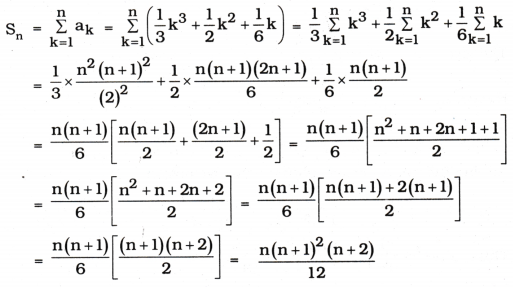
Therefore, Sn = \(\sum_{k=1}^n\) ak = \(\sum_{k=1}^n\)(k3 + 3k2 + 2k) = \(\sum_{k=1}^n\) k3 + 3 \(\sum_{k=1}^n\) k2 + 2 \(\sum_{k=1}^n\) k
AP Inter 1st Year Maths Exercise 8e Solutions 1

Question 3.
3 × 12 + 5 × 22 + 7 × 32 + …
Solution:
The given series is 3 × 12 + 5 × 22 + 7 × 32 + …. n terms
Hence, an = (2n + 1) n2 = 2n3 + n2
Therefore, Sn = \(\sum_{\mathrm{k}=1}^{\mathrm{n}}\) ak = \(\sum_{\mathrm{k}=1}^{\mathrm{n}}\) (2k3 + k2) = 2\(\sum_{\mathrm{k}=1}^{\mathrm{n}}\)k3 + \(\sum_{\mathrm{k}=1}^{\mathrm{n}}\) k2

= 2\(\left[\frac{\mathrm{n}(\mathrm{n}+1)}{2}\right]^2\) + \(\frac{\mathrm{n}(\mathrm{n}+1)(2 \mathrm{n}+1)}{6}\)

= \(\frac{\mathrm{n}^2(\mathrm{n}+1)^2}{2}+\frac{\mathrm{n}(\mathrm{n}+1)(2 \mathrm{n}+1)}{6}\)

= \(\frac{\mathrm{n}(\mathrm{n}+1)}{2}\left(\mathrm{n}(\mathrm{n}+1)+\frac{2 \mathrm{n}+1}{3}\right)\)

= \(\frac{n(n+1)}{2}\left[\frac{3 n^2+3 n+2 n+1}{3}\right]\)

= \(\frac{n(n+1)}{2}\left[\frac{3 n^2+5 n+1}{3}\right]\)

= \(\frac{n}{6}\)(n + 1)(3n + 5n + 1)

AP Inter 1st Year Maths Exercise 8e Solutions

Question 4.
\(\frac{1}{1 \times 2}+\frac{1}{2 \times 3}+\frac{1}{3 \times 4}\) + ………..
Solution:
The given series is \(\frac{1}{1 \times 2}+\frac{1}{2 \times 3}+\frac{1}{3 \times 4}\) + ……….. n terms
Hence, an = \(\frac{1}{n(n+1)}=\frac{1}{n}-\frac{1}{n+1}\)
∴ a1 = \(\frac{1}{1}-\frac{1}{2}\), a2 = \(\frac{1}{2}-\frac{1}{3}\), a3 = \(\frac{1}{3}-\frac{1}{4}\), …………….., an = \(\frac{1}{n}-\frac{1}{n+1}\),

Adding the above terms column wise, we obtain
a2 + a2 + …… + an = \(\left[\frac{1}{1}+\frac{1}{2}+\frac{1}{3}+\ldots+\frac{1}{\mathrm{n}}\right]-\left[\frac{1}{2}+\frac{1}{3}+\frac{1}{4}+\ldots+\frac{1}{\mathrm{n}+1}\right]\)

Thus, Sn = 1 – \(\frac{1}{n+1}=\frac{n+1-1}{n+1}=\frac{n}{n+1}\)

Question 5.
52 + 62 + 72 + ………. +202
Solution:
The given series is 52 + 62 + 72 + ………. +202
Hence, an = (n + 4)2 = n2 + 8n + 16

Therefore, Sn = \(\sum_{k=1}^n\)ak = \(\sum_{k=1}^n\)(k2 + 8k + 16)

Sn = \(\sum_{k=1}^n\)k2 + 8\(\sum_{k=1}^n\)k + \(\sum_{k=1}^n\) 16

= \(\frac{\mathrm{n}(\mathrm{n}+1)(2 \mathrm{n}+1)}{6}+\frac{8 \mathrm{n}(\mathrm{n}+1)}{2}\) + 16n

Since, 16th term is (16 + 4)2 = (20)2

Then, Sn = \(\frac{16(16+1)(2(16)+1)}{6}+\frac{8(16)(16+1)}{2}\)+ 16(16)

= \(\frac{(16)(17)(33)}{6}+\frac{(128)(17)}{2}\) + 256

= 1496 + 1088 + 256 = 2840

Thus, 52 + 62 + 72 + ………. +202 = 2840

Question 6.
3 × 8 + 6 × 11 + 9 × 14 + …………..
Solution:
The given series is 3 × 8 + 6 × 11 + 9 × 14 + ………….. n terms
Hence, an = (nth term of 3, 6, 9, ………..) × (nth term of 8, 11, 14 ……)
= (3n)(3n + 5)
= 9n2 + 15n

Therefore, Sn = \(\sum_{k=1}^n\) ak = \(\sum_{k=1}^n\) (9k2 + 15k)

= 9 \(\sum_{k=1}^n\) k2 + 15\(\sum_{k=1}^n\)k

= 9 × \(\frac{\mathrm{n}(\mathrm{n}+1)(2 \mathrm{n}+1)}{6}\) + 15 × \(\frac{\mathrm{n}(\mathrm{n}+1)}{2}\)

= \(\frac{3 \mathrm{n}(\mathrm{n}+1)(2 \mathrm{n}+1)}{2}+\frac{15 \mathrm{n}(\mathrm{n}+1)}{2}\)

= \(\frac{3 \mathrm{n}(\mathrm{n}+1)}{2}\)(2n + 1 + 5)

= \(\frac{3 \mathrm{n}(\mathrm{n}+1)}{2}\)(2n + 6)

= 3n(n + 1)(n + 3)

Question 7.
12 + (12 + 22) + (12 + 22 + 32) + ………..
Solution:
The given series is 12 + (12 + 22) + (12 + 22 + 32) + ……….. n terms

Hence, an = (12 + 22 + 32 + …… + n2) = \(\frac{n}{2}\)(n + 1)(2n + 1)
= \(\frac{n}{6}\) (2n2 + 3n + 1)
= \(\frac{1}{3}\)n3 + \(\frac{1}{2}\)n2 + \(\frac{1}{6}\)n

Therefore,
AP Inter 1st Year Maths Exercise 8e Solutions 2

II. Find the sum to n terms of the series in Exercises 1 to 3 whose nth terms is given by

Question 1.
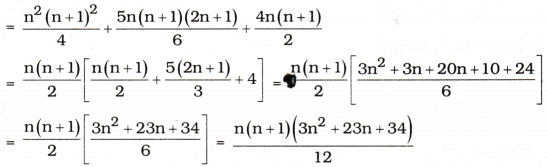
n(n + 1) (n + 4).
Solution:
The given n* term is an = n(n + 1) (n + 4)
Hence, an = n(n + 1) (n + 4) = n(n2 + 5n + 4) = n3 + 5n2 + 4n
Therefore, Sn = \(\sum_{k=1}^n\) ak = \(\sum_{k=1}^n\)k3 + 5 \(\sum_{k=1}^n\) k2 + 4 \(\sum_{k=1}^n\) k
AP Inter 1st Year Maths Exercise 8e Solutions 3

Question 2.
n2 + 2n
Solution:
The given nth term is an = n2 + 2n
Hence, Sn = \(\sum_{\mathrm{k}=1}^{\mathrm{n}}\)k2 + 2k

= \(\sum_{\mathrm{k}=1}^{\mathrm{n}}\)k2 + \(\sum_{\mathrm{k}=1}^{\mathrm{n}}\)2k …………..(1)
Consider \(\sum_{\mathrm{k}=1}^{\mathrm{n}}\) 2k = 21 + 22 + 23 +…

The above series 21 + 22 + 23 + … is a G.P with both the first term and common ratio equal to 2.
\(\sum_{\mathrm{k}=1}^{\mathrm{n}}\) 2k = \(\frac{1}{2}\) = 2(2n – 1) …………..(2)

From (1) and (2) we obtain
Sn = \(\sum_{\mathrm{k}=1}^{\mathrm{n}}\)k2 + \(\sum_{\mathrm{k}=1}^{\mathrm{n}}\) 2k
= \(\frac{n}{6}\)(n + 1)(2n + 1) + 2(2n – 1)

AP Inter 1st Year Maths Exercise 8e Solutions

Question 3.
(2n – 1)2
Solution:
The given nth term is an = (2n – 1)2
Hence, an = (2n – 1)2 = 4n2 – 4n + 1

Therefore, Sn = \(\sum_{\mathrm{k}=1}^{\mathrm{n}}\) a = \(\sum_{\mathrm{k}=1}^{\mathrm{n}}\) (4k2 – 4k + 1)

= 4\(\sum_{\mathrm{k}=1}^{\mathrm{n}}\)k2 – 4\(\sum_{\mathrm{k}=1}^{\mathrm{n}}\) k + \(\sum_{\mathrm{k}=1}^{\mathrm{n}}\) 1

= \(\frac{4 \mathrm{n}(\mathrm{n}+1)(2 \mathrm{n}+1)}{6}-\frac{4 \mathrm{n}(\mathrm{n}+1)}{2}\) + n

= \(\frac{2 \mathrm{n}(\mathrm{n}+1)(2 \mathrm{n}+1)}{3}\) – 2n(n + 1) + n

= n[\(\frac{2\left(2 n^2+3 n+1\right)}{3}\) – 2(n + 1) + 1]

= n\(\left[\frac{4 n^2+6 n+2-6 n-6+3}{3}\right]\) = n\(\left[\frac{4 \mathrm{n}^2-1}{3}\right]\)

= \(\frac{\mathrm{n}}{3}\) (2n + 1)(2n – 1)

AP Inter 1st Year Maths Exercise 7a Solutions

Referring to the AP Inter 1st Year Maths Study Material Chapter 7 Binomial Theorem Exercise 7a Solutions makes it easier to understand complex problems.

AP Inter 1st Year Maths Binomial Theorem Solutions Exercise 7a

I. Expand each of the expressions in Exercises 1 to 8.

Question 1.
(1 – 2x)5
Solution:
By using Binomial theorem, the expression (1 – 2x)5 can be expanded as
5C0(1)5(-2x)0 + 5C1(1)4(-2x)1 + 5C2 (1)3 (-2x)2 + 5C3(1)2(-2x)3 + 5C4(1)1 (-2x)4 + 5C5(1)° (-2x)5
= 1 – 5(2x) + 10(4x2) – 10(8x3) + 5(16x4) – (32x5)
= 1 – 10x + 40x2 – 80x3 + 80x4 – 32x5.

Question 2.
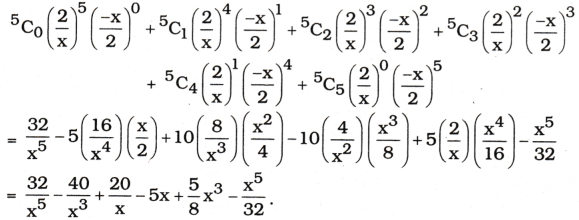
\(\left(\frac{2}{x}-\frac{x}{2}\right)^5\)
Solution:
By using Binomial theorem, the expression \(\left(\frac{2}{x}-\frac{x}{2}\right)^5\) can be expanded as
AP Inter 1st Year Maths Exercise 7a Solutions 1

Question 3.
(2x – 3)6
Solution:
By using Binomial theorem, the expression (2x – 3)6 can be expanded as 6C0 (2x)6 (-3)° + 6C1 (2x)5 (-3)1 + 6C2 (2x)4 (-3)2 + 6C3 (2x)3 (-3)3 + 6C4 (2x)2 (-3)4 + 6C5 (2x)1 (-3)5 + 6C6 (2x)0 (-3)6
= 64x6 – 6(32x5) (3) + 15(16x4)(9) – 20(8x3)(27) + 15(4x2)(81) – 6(2x)(243) + 729
= 64x6 – 576x5 + 2160x4 – 4320x3 + 4860x2 – 2916x + 729

Question 4.
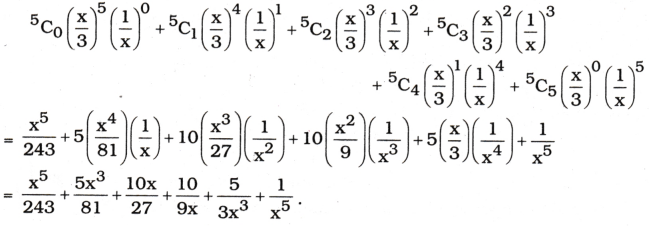
\(\left(\frac{x}{3}+\frac{1}{x}\right)^5\)
Solution:
By using Binomial theorem, the expression \(\left(\frac{x}{3}+\frac{1}{x}\right)^5\) can be expanded as
AP Inter 1st Year Maths Exercise 7a Solutions 2

Question 5.
\(\left(x+\frac{1}{x}\right)^6\)
Solution:
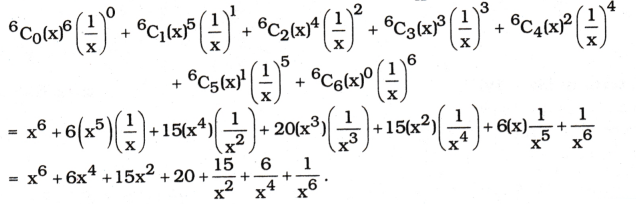
By using Binomial theorem, the expression \(\left(x+\frac{1}{x}\right)^6\) can be expanded as
AP Inter 1st Year Maths Exercise 7a Solutions 3

AP Inter 1st Year Maths Exercise 7a Solutions

Question 6.
(4x + 5y)7
Solution:
By using Binomial theorem,
(4x + 5y)7 = 7C0 (4x)7 (5y)0 + 7C1 (4x)6 (5y)1 + 7C2 (4x)5 (5y)2 + 7C3 (4x)4 (5y)3 + 7C4 (4x)3 (5y)4 + 7C5 (4x)2 (5y)5 + 7C6 (4x)1 (5y)6 + 7C7 (4x)° (5y)7
= \(\sum_{r=0}^7\) 7Cr (4x)7-r (5y)r

Question 7.
\(\left(\frac{2}{3} x+\frac{7}{4} y\right)^5\)
Solution:
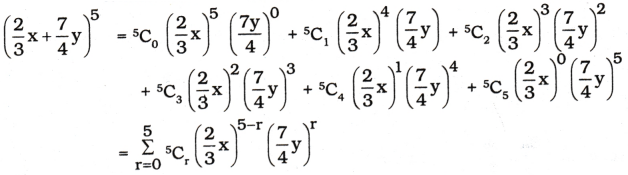
By using Binomial theorem, we have
AP Inter 1st Year Maths Exercise 7a Solutions 4

Question 8.
\(\left(\frac{2 p}{5}-\frac{3 q}{7}\right)^6\)
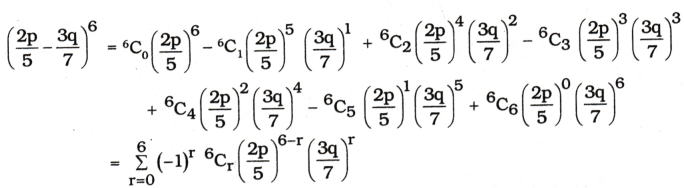
Solution:
AP Inter 1st Year Maths Exercise 7a Solutions 5

Question 9.
Write down and simplify.
i) 6th term in \(\left(\frac{2 x}{3}+\frac{3 y}{2}\right)^9\)
Solution:
Given that \(\left(\frac{2 x}{3}+\frac{3 y}{2}\right)^9\)
The general term in \(\left(\frac{2 x}{3}+\frac{3 y}{2}\right)^9\) is
Tr+1 = 9Cr \(\left(\frac{2 x}{3}\right)^{9-r}\left(\frac{3 y}{2}\right)^r\)
If r = 5
T6 = 9C5\(\frac{1}{2}\)
= 9C5\(\frac{1}{2}\)
= 9C4\(\frac{1}{2}\) x4y5
= \(\frac{1}{2}\). x4y5
= 189 x4y5

ii) 7th term in (3x – 4y)10.
Solution:
Given that (3x – 4y)10
The general term in (3x – 4y)10 is Tr+1 = (-1)r 10Cr (3x)10-r (4y)r
If r = 6 ⇒ T7 = (-1)6 10C6 (3x)4 (4y)6
= 2C43446x4y6
= \(\frac{10 \times 9 \times 8 \times 7}{1 \times 2 \times 3 \times 4}\). 34.46. x4. y6
= 280 (12)5x4y6 (∵ nCr = nCn-r)

iii) 10th term in \(\left(\frac{3 p}{4}-5 q\right)^{14}\)
Solution:
Given that \(\left(\frac{3 p}{4}-5 q\right)^{14}\)
The general term in \(\left(\frac{3 p}{4}-5 q\right)^{14}\) is Tr+1 = (-1)r 14Cr \(\left(\frac{3 \mathrm{p}}{4}\right)^{14-\mathrm{r}}\) (5q)r
If r = 9
T10 = (-1)9 14C9\(\left(\frac{3 p}{4}\right)^5\) (5q)9
= – 14C5\(\left(\frac{3}{4}\right)^5\) 59.p5.q9 (∵ nCr = nCn-r)
= \(-\frac{14 \times 13 \times 12 \times 11 \times 10}{1 \times 2 \times 3 \times 4 \times 5} \cdot \frac{3^5}{4^5}\).59.p5.q9
= \(\frac{-(2002) 3^5 \cdot 5^9}{4^5}\)p5.q9

iv) rth term in \(\left(\frac{3 a}{5}+\frac{5 b}{7}\right)^8\) (1 ≤ r ≤ 8)
Solution:
Given that \(\left(\frac{3 a}{5}+\frac{5 b}{7}\right)^8\)
The general term in \(\left(\frac{3 a}{5}+\frac{5 b}{7}\right)^8\) is Tr+1 = 8Cr \(\left(\frac{3 a}{5}\right)^{8-r}\left(\frac{5 b}{7}\right)^r\)
Replace r by r – 1, then
Tr = 8C(r-1)\(\left(\frac{3 a}{5}\right)^{8-r+1}\left(\frac{5 b}{7}\right)^{r-1}\)
= 8C(r-1)\(\left(\frac{3 a}{5}\right)^{9-r}\left(\frac{5 b}{7}\right)^{r-1}\) (1 ≤ r ≤ 8)

v) Middle term in \(\left(3-\frac{x^3}{6}\right)^7\)
Solution:
Given that \(\left(3-\frac{x^3}{6}\right)^7\)

The expression contains 8 terms. Thus T4 and T5 are middle terms.
T4 = T3+1 = 7C3 (3)7-3\(\left(-\frac{x^3}{6}\right)^3=\frac{35 \times 3^4(-x)^9}{6^3}=-\frac{105}{8}\)x9.

T5 = T4+1 = 7C4 (3)7-4\(\left(-\frac{x^3}{6}\right)^4=\frac{35 \times 3^3 x^{12}}{6^4}=\frac{35}{48}\)x12

Thus, the middle terms in the expansion of \(\left(3-\frac{x^3}{6}\right)^7\) are \(-\frac{105}{8}\) x9 and \(\frac{35}{48}\)x12

AP Inter 1st Year Maths Exercise 7a Solutions

vi) Middle term in \(\left(\frac{x}{3}+9 y\right)^{10}\)
Solution:
Given that \(\left(\frac{x}{3}+9 y\right)^{10}\)
The number of terms in the given expansion is 11. Thus T6 is the middle term.
T6 = T5+1 = 10C5 \(\frac{1}{2}\) (9y)5
= \(\frac{1}{2}\) 310.x5y5
= 252 × 35 x5.y5
= 61236 x5y5

vii) 4th term in (x – 2y)12
Solution:
Given that (x – 2y)12
General term in the expansion of (x + y)n is Tr+ x = nCr Xn_r (Y)r
Here, X = x, Y = -2y, and n = 12; Tr+1 = 12Cr (x)12-r (-2y)r
Putting r = 3, ,
T3+1 = 12C3x12-3 (-2y)3
T4 = \(\frac{12 \times 11 \times 10}{6}\) x9(-2)3y3
= 2 × 11 × 10x9(-8)y3
= 220 × (-8)x9y3
= -1760 x9y3

viii) 13th term in \(\left(9 x-\frac{1}{3 \sqrt{x}}\right)^{18}\), x ≠ 0
Solution:
The general term in the expansion of (X + Y)n is Tr+1 = nCr Xn-rYr

Here X = 9x, Y = –\(\frac{1}{3 \sqrt{x}}\), and n = 18

The General term in the expansion of \(\frac{1}{2}\) is Tr = 18Cr (9x)18-r\(\left(\frac{-1}{3 \sqrt{x}}\right)^r\)
Putting r = 12
T12+1 = 18C12 (9x)6 \(\left(\frac{-1}{3 \sqrt{x}}\right)^{12}\)
= 18C12 96 × x6\(\frac{1}{3^{12}(\sqrt{x})^{12}}\) (∵ nCr = nCn-r)
= \(\frac{18 \times 17 \times 16 \times 15 \times 14 \times 13}{6 \times 5 \times 4 \times 3 \times 2 \times 1} \times \frac{3^{12} \times x^6}{3^{12} \times x^6}\)
= 18564

Question 10.
Find the number of terms in the expansion of
i) \(\left(\frac{3 a}{4}+\frac{b}{2}\right)^9\)
Solution:
The number of terms in (x + a)n is (n + 1), where n is a positive integer.
Hence number of terms in \(\left(\frac{3 a}{4}+\frac{b}{2}\right)^9\) are 9 + 1 = 10

ii) (3p + 4q)14
Solution:
The number of terms in (x + a)n is (n + 1), where n is a positive integer.
Hence number of terms in (3p + 4q)14 are 14 + 1 = 15

II. Using binomial theorem, evaluate each of the following.

Question 1.
(96)3
Solution:
96 can be expressed as the sum or difference of two numbers whose powers are easier to calculate and then, Binomial theorem can be applied, it can be written that, 96 = 100 – 4
Therefore, (96)3 = (100 – 4)3
= 3C0 (100)3 (-4)0 + 3C1 (100)2 (-4)1 + 3C2 (100)1 (-4)2 + 3C3 (100)° (-4)3
= (100)3 – 3(100)2(4) + 3(100)(4)2 – (4)3
= 1000000 – 120000 + 4800 – 64
= 884736

Question 2.
(102)5
Solution:
102 can be expressed as the sum or difference of two numbers whose powers are
easier to calculate and then, Binomial theorem can be applied.
It can be written that, 102 = 100 + 2.
Therefore, (102)5 = (100 + 2)5
= 5C0 (100)5 (2)° + 5C1 (100)4 (2)1 + 5C2 (100)3 (2)2 + 5C3 (100)2 (2)3 + 5C4 (100)1 (2)4 + 5C5 (100)° (2)5
= (100)5 + 5(100)4 (2) + 10(100)3(2)2 + 10(100)2(2)3 + 5(100) × (2)4 + (2)5
= 10000000000 + 1000000000 + 40000000 + 800000 + 8000 + 32
= 11040808032

Question 3.
(101)4
Solution:
101 can be expressed as the sum or difference of two numbers whose powers are easier to calculate and then, Binomial theorem can be applied.
It can be written that, 101 = 100+ 1.
(101)4 = (100 + 1)4 = 4C0 (100)4(1)°+ 4C1 (100)3 (1)1 + 4C2 (100)2 (1)2 + 4C3 (100)1 (1)3 + 4C4 (100)° (1)4
= (100)4 + 4(100)3 + 6(100)2 + 4(100)1 + 1
= 100000000 + 4000000 + 60000 + 400 + 1
= 104060401

Question 4.
(99)5
Solution:
99 can be written as the sum or difference of two numbers whose powers are easier to calculate and then, Binomial theorem can be applied.
It can be written that 99 = 100 – 1
=> (99)5 = (100 – 1)5
= 5C0(100)5(-1)° + 5C1(100)4(-1)1 + 5C2(100)3(-1)2 + 5C3(100)2(-1)3 + 5C4(100)1(-1)4 + 5C5(100)°(-1)5
= (100)5 – 5(100)4 + 10(100)3 – 10(100)2 + 5(100) – 1
= 10000000000 – 500000000 + 10000000 – 100000 + 500 – 1
= 10010000500 – 500100001
= 9509900499

Question 5.
Using Binomial theorem, indicate which number is larger (1.1)10000 0r 1000.
Solution:
By splitting 1.1 and then applying Binomial theorem, the first few terms of (1.1)10000 can be obtained as (1.1)10000
= (1 + 0.1)10000
= 10000C0 + 10000C1(0.1)1 + other positive terms
= 1 + 10000 × 0.1 + other positive terms
= 1001 + other positive terms > 1000
Hence, (1.1)10000 > 1000

Question 6.
Find (a + b)4 – (a – b)4, hence evaluate (√3 + √2)4 – (√3 – √2)4
Solution:
Using Binomial theorem, the expression, (a + b)4 – (a – b)4, can be expanded as (a + b)4 – (a – b)4
= 4C0a4b° + 4C1b1 + 4C2a2b2 + 4C3b3 + 4C4a°b4 – [4C0a4b° – 4C1a3b1 + 4C2a2b2 – 4C3a1b3 + 4C4a°b4]
= 2[4C1a3b1 + 4C3a1b3]
= 2[4a3b + 4ab3]
= 8ab(a2 + b2)

Now putting a = √3 and b = √2 , we have
(√3 + √2)4 – (√3 – √2)4 = 8(√3)(√2) [(√3)2 +(√2)2]
= 8√6(3 + 2)
= 40√6

AP Inter 1st Year Maths Exercise 7a Solutions

Question 7.
Find (x + 1)6 + (x – 1)6. Hence or otherwise evaluate (√2 + 1) + (√2 – 1)
Solution:
Using Binomial theorem, the expression, (x + 1)6 + (x – 1)6, can be expanded as (x + 1)6 + (x – 1)6
= 6C0x610 + 6C1511 + 6C2x412 + 6C3x313 + 6C4x214 + 6C5x115 + 6C6x°16 + 6C0x61°- 6C1x511 + 6C2x412 – 6C3x313 + 6C4x214 – 6C5x115 + 6C6x°16
= 2[6C0x6 + 6C2x4 + 6C4x2 + 6C6x0]
= 2(x6 + 15x4 + 15x2 + 1)
Now putting x = √2 , we have (√2)6 + (√2)6
= 2[(√2)6 + 15(√2)4 + 15(√2)2 + 1]
= 2(8 + 60 + 30 + 1)
= 198

Question 8.
Show that 9n +1 – 8n – 9 is divisible by 64, whenever n is a positive integer.
Solution:
Using Binomial theorem,
(1 + x)n+1 = n+1C0 x° + n+1C1 x1 + n+1C2 x2 + …………. + n+1Cn+1 xn+1
Now putting x = 8, we have
(1+8)n+1 = n+1C0 8° + n+1C1 81 + n+1C2 82 + n+1Cn+1 8n+1
⇒ 9n+1 = 1 + (n + 1)(8) + 82[n+1C2 + …….. + n+1Cn+1 8n-1]
⇒ 9n+1 – 1 – 8(n+1) = 64[n+1C2 + + n+1Cn+1 8n-1]
⇒ 9n+1 – 8n – 9 = 64 [n+1C2 + …. + n+1Cn+1 8n-1]
Now, RHS is divisible by 64 for all positive integers n. So, LHS is also divisible by 64. Hence, 9n+1 – 8n – 9 is divisible by 64, whenever n is a positive interger.

Question 9.
Prove that \(\sum_{r=0}^n\)3rnCr = 4n.
Solution:
LHS = \(\sum_{r=0}^n\)3rnCr = 30nC0 + 31nC1 + 32nC2 + …………… 3n-1 nCn-1 + nCn+1. 3n

= nC0 3° + nC1 31 + nC2 32 + …. + 3n-1 + nCn.3n
= (1 + 3)n = 4n = RHS

Question 10.
Using the binomial theorem, prove that 50” – 49n – 1 is divisible by 492 for all positive integers n.
Solution:
Given 50n – 49n – 1 = (49 + 1)n – 49n – 1
= nC0(49)n + nC1(49)n-1 + nC2(49)n-2 + … + nCn 2(49)2 + nCn-1(49) + nCn(49)° – 49n – 1
= (49)n + nC1(49)n-1 + nC2(49)n-2 + … + nCn-2(49)2 + (n) (49) + 1 – 49n – 1
= (49)2 [(49)n-2 + nC2 (49)n-3 + nC2(49)n-4 + … + nCn-2]
= (49)2 [a positive integer]
∴ 50n – 49n – 1 is divisible by 492 for all positive integers of n.

Sequences and Series MCQ AP Inter 1st Year Maths Chapter 8

Practice AP Inter 1st Year Maths Study Material Chapter 8 Sequences and Series MCQ to identify your strengths and weak areas.

AP Inter 1st Year Maths Sequences and Series MCQ

Question 1.
Which of the following is finite sequence ?
1) 48, 24, 12, ………..
2) 1, 2, 3, …….
3) 2, 4, 6, 8, 10 ………..
4) 2, 3, 5, 7, 11, 13, …….
Answer:
3) 2, 4, 6, 8, 10 ………..

Explanation:
2, 4, 6, 8, 10 is a finite sequence.

Question 2.
Which of the following relation gives Fibonacci sequence ?
1) an = an-1 + an-2, n > 2
2) an-1 = an + an-2, n > 2
3) an-2 = an + an-1, n> 2
4) an = an+1 + an-2, n > 2
Answer:
1) an = an-1 + an-2, n > 2

Explanation:
Relation of fibonacci sequence is an = an-1 + an-2, n > 2

Question 3.
The first term of Fibonacci sequence is
1) 0
2) 1
3) 2
4) 3
Answer:
2) 1

Explanation:
The first term of fibonacci sequence is “1”.

Question 4.
If an = 4n + 6, then 15th term of the sequence is
1) 6
2) 10
3) 60
4) 66
Answer:
4) 66

Explanation:
an = 4n + 6
a15 = 4(15) + 6
= 60 + 6 = 66

Sequences and Series MCQ AP Inter 1st Year Maths Chapter 8

Question 5.
A series can also be denoted by the symbol …………
1) πan
2) Σan
3) Φan
4) θan
Answer:
2) Σan

Explanation:
Series denoted by Σan

Question 6.
The sum of first five terms of series 2 + 4 + 6 + ….. is
1) 14
2) 16
3) 20
4) 30
Answer:
4) 30

Explanation:
Given series 2 + + 6 + ………..
Sum of even number Sn = n(n + 1)
S5 = 5(5 + 1) = 5.(6) = 30

Question 7.
\(\sum_{n=1}^4\) 2n + 3 = ……….
1) 5
2) 12
3) 21
4) 32
Answer:
4) 32

Explanation:
\(\sum_{n=1}^4\) 2n + 3, If n = 1, 2, 3, 4; Series is 5, 7, 9, 11 …… ; S4 = 5 + 7 + 9 + 11 = 32

Question 8.
If an+1 = an. r then the sequence is called
1) Arithmetic progression
2) Geometric progression
3) Harmonic progression
4) Special progression
Answer:
2) Geometric progression

Explanation:
an+1 = an. r is G.P.

Question 9.
The nth term of G.P. is ( 3 )
1) an = a + (n – 1) d
2) an = a + nd
3) an = a . rn-1
4) an = arn
Answer:
3) an = a . rn-1

Explanation:
nth term of G.P. is an = a . rn-1

Sequences and Series MCQ AP Inter 1st Year Maths Chapter 8

Question 10.
If r = 1 in G.P. then the sum of first n terms is
1) na
2) a/n
3) (n – 1) a
4) (n + 1) a
Answer:
1) na

Explanation:
If r = 1, the sum of first n terms = na

Question 11.
If 4, 8, 16, 32 are in G.P. then the sum upto 5th term is
1) 16
2) 64
3) 128
4) 124
Answer:
4) 124

Explanation:
4, 8, 16, 32, are in G.P; a = 4, r = 2
S5 = \(\frac{4\left(2^5-1\right)}{2-1}=\frac{4(32-1)}{1}\) = 4(31) = 124

Question 12.
The Sum of series 1 + \(\frac{1}{2}+\frac{1}{4}\) + …….. upto 6 terms is
1) \(\frac{63}{32}\)
2) \(\frac{32}{63}\)
3) \(\frac{26}{53}\)
4) \(\frac{53}{26}\)
Answer:
1) \(\frac{63}{32}\)

Explanation:
Series 1 + \(\frac{1}{2}+\frac{1}{4}\) + …….. upto 6 terms
Sum of 6 terms = \(\frac{\left(1-\left(\frac{1}{2}\right)^6\right)}{1-\frac{1}{2}}\)
= 2(1 – \(\frac{1}{64}\))
= 2 – \(\frac{1}{32}=\frac{64-1}{32}=\frac{63}{32}\)

Question 13.
The geometric mean of 3 and 12 is ………….
1) 4
2) 6
3) 9
4) 12
Answer:
2) 6

Explanation:
Geometric mean of 3 and 12 = \(\sqrt{3 \times 12}=\sqrt{36}\)
= 6

Question 14.
If A.M of two numbers is \(\frac{15}{2}\) and their G.M is 6 then the two numbers are
1) 6 and 8
2) 12 and 3
3) 24 and 6
4) 27 and 3
Answer:
2) 12 and 3

Explanation:
Let the two numbers be and b
A.M = \(\frac{15}{2} \Rightarrow \frac{a+b}{2}=\frac{15}{2}\)
⇒ a + b = 15 ……….(1)

G. M = 6 ⇒ \(\sqrt{\mathrm{ab}}\)
⇒ ab = 36

a – b = \(\sqrt{(a+b)^2-4 a b}=\sqrt{225-144}=\sqrt{81}\)
a – b = 9 …(2)
(1) + (2) ⇒ a = 12, b = 3

Question 15.
If A means arithmetic mean and G means geometric mean then which of the following is true ?
1) A > G
2) A ≥ G
3) G > A
4) G ≥ A
Answer:
2) A ≥ G

Explanation:
A ≥ G

Sequences and Series MCQ AP Inter 1st Year Maths Chapter 8

Question 16.
The ratio of A.M. and G.M of two positive numbers a and b is 5 : 3. Then the ratio of a to b is ( 1 )
1) 9 : 1
2) 3 : 5
3) 1 : 9
4) 3 : 1
Answer:
\(\frac{A \cdot M}{G \cdot M}=\frac{5}{3} \Rightarrow \frac{a+b}{2 \sqrt{a b}}=\frac{5}{3}\)
⇒ 9(a + b)2 = 25 (4ab)
⇒ 9a2 + 18ab + 9b2 = 100 ab
⇒ 9a2 – 82ab + 9b2 = 0
⇒ (9a – b) (a – 9b) = 0
9a-b = 0
9a = b
\(\frac{a}{b}=\frac{1}{9}\)

a – 9b = 0
a = 9b
\(\frac{a}{b}=\frac{9}{1}\)
∴ a : b = 9 : 1 (∵ a > b)

AP Inter 1st Year Maths Exercise 7b Solutions

Referring to the AP Inter 1st Year Maths Study Material Chapter 7 Binomial Theorem Exercise 7b Solutions makes it easier to understand complex problems.

AP Inter 1st Year Maths Binomial Theorem Solutions Exercise 7b

I.

Question 1.
If a and b are distinct integers, prove that a – b is a factor of an – bn, whenever n is a positive integer. [Hint : Write an = (a – b + b)n and expand]
Solution:
Here, an = (a – b + b)n = [(a – b) + b)n
By using Binomial theorem, the expression [(a – b) + b]n can be expanded as
nC0(a- b)n b0 + nC1(a- b)n-1 b1 + nC2(a- b)n-2 b2 + …. + nCn-1(a – b)bn-1 + nCn(a- b)0bn
= (a – b)n + nC1(a – b)n-1 b + nC2(a – b)n-2 bn + ………….. + nCn-1(a – b)bn-1] + bn
⇒ an = (a – b)[(a – b)n-1 + nC1(a – b)n-2 b + nC2(a – b)n-3 b2 + nCn-1bn-1] + bn
⇒ an – bn = (a – b)[(a – b)n-1 + nC1(a – b)n-2 b + nC2(a – b)n-3 b2 + ……. + nCn-1bn-1]
now, a – b is a factor of R.H.S, so, a – b is also a factor of L.H.S hence, a – b is a factor of an – bn, whenever n is a positive integer.

Question 2.
Evaluate (√3 + √2)6 – (√3 – √2)6
Solution:
(√3 + √2)6 – (√3 – √2)6
= 6C0(√3)6 + 6C1(√3)5(√2) + 6C2(√3)4(√2)2 + 6C3(√3)3(√2)3 + 6C4(√3)2(√2)4
+ 6C5(√3)1(√2)5 + 6C6(√2)6 – [6C0(√3)6 – 6C1(√3 )5(√2) + 6C2(√3)4(√2)2 – 6C3(√3)3(√2)3 + 6C4(√3)2(√2)4 – 6C5(√3)1(√2 )5 + 6C6(√2)6]
= 2[6C1(√3)5(√2) + 6C3(√3)3(√2)3 + 6C2(√3)1(√2)5]
= 2[6 × 9√6 + 20 × 6√6 + 6 × 4√5]
= 2[54 + 120 + 24]√6
= 396√6

Question 3.
Find the value of (a2 + \(\sqrt{a^2-1}\))4 + (a2 – \(\sqrt{a^2-1}\))4
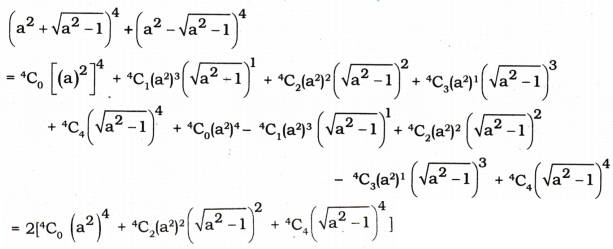
Solution:
AP Inter 1st Year Maths Exercise 7b Solutions 1
= 2(a8 + 6a4(a2 – 1) + (a2 – 1)2]
= 2[a8 + 6a6 – 6a4 + a4 + 1 – 2a2]
= 2[a8 + 6a6 – 5a4 – 2a2 + 1]
= 2a8 + 12a6 – 10a4 – 4a2 + 2

II.

Question 1.
Find an approximation of (0.99)5 using the first three terms of its expansion.
Solution:
0.99 can be written as the sum or difference of two numbers whose powers are easier to calculate and then Binomial theorem can be applied. It can be written that, 0.99 = 1 – 0.01
Therefore, (0.99)5 = (1 – 0.01)5
= 5C0(-0.01)° + 5C1(-0.01)1 + 5C2 (-0.01)2 + ………………..
= 1 – 5(0.01) + 10(0.0001) + …………
= 1 – 0.05 + 0.001
= 0.951

Question 2.
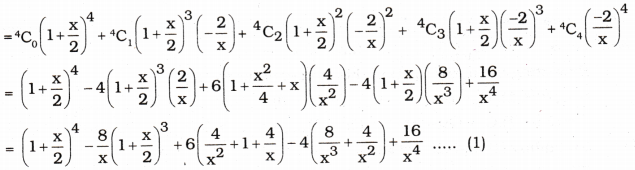
Expand (1 + \(\frac{x}{2}-\frac{2}{x}\))4 using Binomial theorem,
Solution:
Here (1 + \(\frac{x}{2}-\frac{2}{x}\))4 = [(1 + \(\frac{x}{2}\)) – \(\frac{2}{x}\)]4
Using Binomial theorem, the expression (1 + \(\frac{x}{2}-\frac{2}{x}\))4 can be expressed as
AP Inter 1st Year Maths Exercise 7b Solutions 2
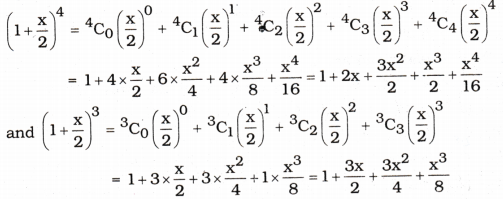
Again applying Binomial theorem, we have
AP Inter 1st Year Maths Exercise 7b Solutions 3

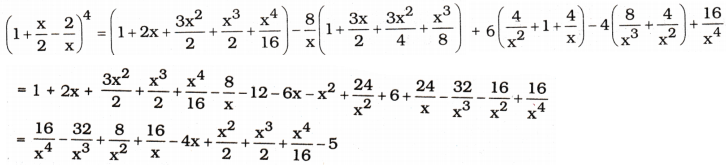
Now putting the value of (1 + \(\frac{x}{2}\))4 and (1 + \(\frac{x}{3}\))3 in (1) we have
AP Inter 1st Year Maths Exercise 7b Solutions 4

AP Inter 1st Year Maths Exercise 7b Solutions

Question 3.
Find the expansion of (3x2 – 2ax + 3a2)3 using binomial theorem.
Solution:
Here, (3x2 – 2ax + 3a2)3 = ((3x2 – 2ax) + 3a2)3
Using Binomial theorem, the expression [(3x2 – 2ax) + 3a2)3 can be expressed as
3C0(3x2 – 2ax)3 + 3Cj(3x2 – 2ax)2 (3a2) + 3C2(3x2 – 2ax)1 (3a2)2 + 3C3(3a2)3 = (3x2 – 2ax)3 + 3(9x4 + 4a2x2 – 12ax3)(3a2) + 3(3x2 – 2ax) (9a4) + (27a6)
= (3x2 – 2ax)3 + 81a2x4 + 36a4x2 – 108a3x3 + 81a4x2 – 54a5x + 27a6

Again applying Binomial theorem, we have
(3x2 – 2ax)3 = 3C0(3x2)3 + 3C1(3x2)2 (-2ax)1 + 3C2(3x2) (-2ax)2 + 3C3(-2ax)3
= 27x6 – 3 × 18ax5 + 3 × 12a2x4 – 8a3x3
= 27x6 – 54ax5 + 36a2x4 – 8a3x3

Now putting the value of (3x2 – 2ax)3, we have
= 27x6 – 54ax5 + 36a2x4 – 8a3x3 + 81a2x4 + 36a4x2 – 108a3x3 + 81a4x2 – 54a5x + 27a6
= 27x6 – 54ax5 + 117a2x4 – 116a3x3 + 117a4x2 – 54a5x + 27a6

Question 4.
Prove that C0 + 3.C1 + 5.C2 + … + (2n + 1). Cn = (2n + 2). 2n-1
Solution:
Let S = C0 + 3.C1 + 5.C2 + … + (2n + 1).Cn ……….. (1)
By writing the terms in (1) in the reverse order we get
S = (2n + 1). Cn + (2n – 1) . Cn-1 + (2n – 3).Cn-2 + …….. + 3.C1 + 1.C0
= (2n + 1).C0 + (2n – 1).C1 + (2n – 3).C2 + ……… + 3.Cn-1 + 1.Cn …………. (2)
On adding (1) and (2), we get
2S = (2n + 2).C0 + (2n + 2).C1 + … + (2n + 2).Cn-1 + (2n + 2) . Cn
= (2n + 2) (C0 + C1 + C2 + … + Cn) = (2n + 2).2n Therefore, S = (2n + 2) 2n-1

Question 5.
Prove that, for any real numbers a, d,
a.C0 + (a + d) . C2 + (a + 2d) . C2 + … + (a + nd) . Cn = (2a + nd) . 2n-1
Solution:
Let S = a.C0 + (a + d) . C2 + (a + 2d) . C2 + … + (a + nd) . Cn ….. (1)
∴ S = (a + nd) . Cn + [a + (n – 1) d] . Cn-1 + … aC0
⇒ S = (a + nd) . C0 + [a + (n – 1)d]. + [a + (n – 2)d].C2 + … + a . Cn ……….. (2)
(1) + (2) => 2S = (2a + nd) C0 + (2a + nd) C1 + (2a + nd) C2 + … + (2a + nd) Cn
= (2a + nd) (C0 + C1 + C2 + … + Cn)
= (2a + nd) 2n ⇒ S = (2a + nd) 2n – 1.

Question 6.
If n is a positive integer, then prove that
C0 + \(\frac{C_1}{2}+\frac{C_2}{3}\) + …… + \(\frac{C_n}{n+1}=\frac{2^{n+1}-1}{n+1}\)
Solution:
Let S = C0 + \(\frac{C_1}{2}+\frac{C_2}{3}\) + …… + \(\frac{C_n}{n+1}=\frac{2^{n+1}-1}{n+1}\)
Now multiplying on both sides with (n + 1), we get
(n + 1) S = (n + 1)nC0 + \(\frac{1}{2}\) (n + 1)nC1 + —(n + 1)nC2 + … + nCn
= (n +1) + \(\frac{(\mathrm{n}+1) \mathrm{n}}{1 \cdot 2}+\frac{(\mathrm{n}+1) \mathrm{n}(\mathrm{n}-1)}{1 \cdot 2 \cdot 3}\) + … + 1
= (n+1)C1 + (n+1)C2 + (n+1)C3 + ……… + (n+1)Cn+1
= (n+1)C1 + (n+1)C1 + (n+1)C2 + (n+2)C3 ……… + (n+1)Cn+1 – (n+1)C0
= 2n+1 -1
⇒ S = \(\frac{2^{n+1}-1}{n+1}\)
C0 + \(\frac{C_1}{2}+\frac{C_2}{3}\) + …… + \(\frac{C_n}{n+1}=\frac{2^{n+1}-1}{n+1}\)

Question 7.
If n is a positive integer and x is any non-zero real number, then prove that
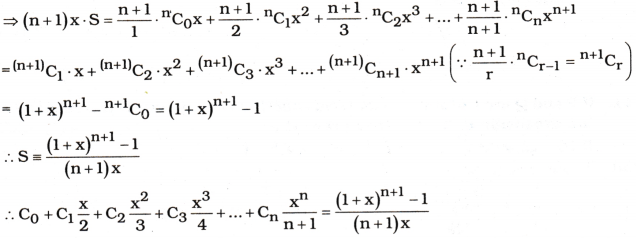
C0 + C1.\(\frac{x}{2}\) + C2.\(\frac{x^2}{3}\) + C3.\(\frac{x^3}{4}\) + ……….. + Cn.\(\frac{x^n}{n+1}=\frac{(1+x)^{n+1}-1}{(n+1) x}\)
Solution:
Let S ≡ C0 + C1.\(\frac{x}{2}\) + C2.\(\frac{x^2}{3}\) + C3.\(\frac{x^3}{4}\) + ……….. + Cn.\(\frac{x^n}{n+1}\)

Multiplying both sides with be ‘x’
AP Inter 1st Year Maths Exercise 7b Solutions 5

Question 8.
Prove that 2.C0 + 5.C1 + 8.C2 + ……….. + (3n + 2) Cn = (3n + 4)2n-1
Solution:
Let S = 2.C0 + 5.C1 + 8.C2 + ……….. + (3n – 1) Cn-1 + (3n + 2) Cn ……(1)
S = (3n + 2) C0 + (3n – 1)C1 + (3n – 4) C2 + + 5Cn-1 + 2.Cn … (2)
(∵ Cn = C0.Cn-1 = Ci…)
Adding (1) 86 (2) we get 2S = (3n + 4)C0 + (3n + 4)Cj + (3n + 4)C2 + … + (3n + 4) Cn = (3n + 4) (C0 + Cj + C2 + … + Cn) = (3n + 4)2n
S = (3n + 4) . 2n-1

Question 9.
Prove tnat C0 +2C1 + 4.C2 + 8.C3 + ……….. + 2n.Cn = 3n
Solution:
We know that,
(1 + x)n = C0 + C1x + C2x2 + C3x2 + ………… + Cnxn
Put x = 2 in equation (1) we get,
(1 + 2)n = C0 + C1(2) + C2(2)2 + C3(2)3 + ………. + Cn(2)n
∴ C0 +2C1 + 4.C2 + 8.C3 + ……….. + 2n.Cn = 3n

Question 10.
If (1 + x + x2)n = a0 + a1x + a2x2 + ………… + a2nx2n, then prove that
i) a0 + a1 + a2 + ………… + a2n = 3n
Solution:
(1 + x + x2)n = a0 + a1x + a2x2 + ………… + a2nx2n
Put x = 1 ⇒ a0 + a1 + a2 + ………… + a2n = (1 + 1 + 1)n = 3n …….(1)
Put x = -1 ⇒ a0 – a1 + a2 + ………. + a2n = (1 – 1 + 1)n = 1 ………. (2)

a0 + a1 + a2 + ………… + a2n = 3n

ii) a0 + a2 + a4 + ………… + a2n = \(\frac{3^n+1}{2}\)
Solution:
(1) + (2) ⇒ 2(a0 + a2 + a4 + ………… + a2n) = 3n + 1
⇒ ∴ a0 + a2 + a4 + ………… + a2n = \(\frac{3^n+1}{2}\)

iii) a1 + a3 + a5 + ….. + a2n-1 = \(\frac{3^n-1}{2}\)
Solution:
(1) – (2) ⇒ 2(a1 + a3 + a5 + ….. + a2n-1) = 3n – 1
⇒ ∴ a1 + a3 + a5 + ….. + a2n-1 = \(\frac{3^n-1}{2}\)

iv) a0 + a3 + a6 + a9 + ………… + a2n = 3n-1
Solution:
Put x = 1
⇒ a0 + a3 + a6 + a9 + ………… + a2n = 3n …(a)
Put x = ω
a0 + a1ω + a2ω2 + a3ω3 + ………… + a2nω2n = 0
Hint: 1 + ω + ω2 = 0; ω3 = 1 ……………. (b)
Put x = ω2
⇒ a0 + a1ω2 + a2ω4 + a3ω6 + ………… + a2nω4n = 0 …..(c)
Adding (a), (b), (c)
∴ 30 + a1(1 + ω + ω2) + a2(1 + ω3 + ω6) + ……… + a2n(1 + ω2n + ω4n) = 3n
⇒ 3a0 + a1(0) + a2(0) + 3a3 + ……. = 3n
∴ a0 + a3 + a6 + ……… = \(\frac{3^{\mathrm{n}}}{3}\) = 3n-1

Question 11.
If P and Q Me the sum of odd terms and the sum of even terms respectively in the expansion of (x + a)n then prove that
i) P2 – Q2 = (x2 – a2)n
ii) 4PQ = (x + a)2n – (x – a)2n
Solution:
We know that (x + a)n = nC0xn + nC1xn-1a + nC2 xn-2a2 + ………………
(x + a)n = T1 + T2 + T3 + T4 + T5 + T6 + …………….
Given that P = (T1 + T3 + T5 + T7 + …) and Q = (T2 + T4 + T6 + ………….)
⇒ (x + a)n = P + Q …………(1) and (x – a)n = P – Q ………….(2)

i) P2 – Q2 = (P + Q) (P – Q) = (x + a)n (x – a)n = [(x + a) (x – a)]n = (x2 – a2)n

ii) 4PQ = (P + Q)2 – (P – Q)2
= [(x + a)n]2 – [(x – a)n]2
= (x + a)2n – (x – a)2n

Question 12.
If (1 + 3x – 2x2)10 = a0 + a1x + a2x2 + … + a20x20, then prove that
i) a0 + a1 + a2 + … + a20 = 210
ii) a0 – a1 + a2 – a3 + … + a20 = 410
Solution:
(1 + 3x – 2x2)10 = a0 + a1x + a2x2 + … + a20x20 ………….. (1)

i) Put x = 1 in eq. (1)
(1 + 3 – 2)10 = a0 + a1 + a2 + … + a20
∴ a0 + a1 + a2 + … + a20 = 210

ii) Put x = -1 in eq (1)
(1 – 3 – 2)10 = a0 – a1 + a2 – a3 + … + a20
∴ a0 – a1 + a2 – a3 + … + a20 = (-4)10 = 410

AP Inter 1st Year Maths Exercise 7b Solutions

Question 13.
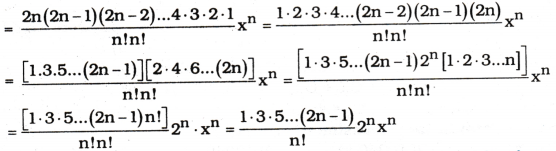
Show that the middle term in the expansion of (1 + x)2n is \(\frac{1 \cdot 3 \cdot 5 \ldots(2 n-1)}{n!}\) 2n . xn, where n is a positive integer.
Solution:
As 2n is even, the middle term of the expansion (1 + x)2n is i.e., (n + 1)th term
Now Tn+1 = 2nCn (1)2n-n (x)n = 2nCn xn = \(\frac{(2 \mathrm{n})!}{\mathrm{n}!\mathrm{n}!}\)xn
AP Inter 1st Year Maths Exercise 7b Solutions 6

Question 14.
The second, third and fourth terms in the binomial expansion (x + a)n are 240, 720, 1080 respectively. Find the value of x, a and n.
Solution:
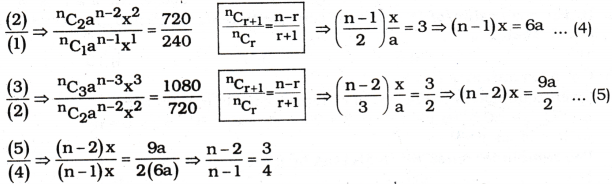
Given expression is (a + x)n. General term Tr+1 = nCr an-r xr
T2 = T1+1 = nC1 an-1 x1 = 240 … (1)
T3 = T2+1 = nC2 an-2 x2 = 720 … (2)
T4 = T3+1 = nC3 an-3 x3 = 1080 … (3)
AP Inter 1st Year Maths Exercise 7b Solutions 7
⇒ 4n – 8 = 3n – 3
⇒ 4n – 3n = -3 + 8
∴ n = 5

Substitute n = 5 in (4) ⇒ 4x = 6a ⇒ x = 3a/2
Substitute x, n values in (1)
⇒ 5 a4\(\left(\frac{3 \mathrm{a}}{2}\right)\) = 240
⇒ a5 = \(\frac{240 \times 2}{15}\) = 32
⇒ a5 = 25
⇒ a = 2

Substitute the values of n = 5 and a = 2 in (6)
⇒ x = \(\frac{3(2)}{2}\) = 3
∴ a = 2, x = 3, n = 5

Motion in a Straight Line Questions and Answers AP Inter 1st Year Physics Chapter 2

Regular practice with AP Inter 1st Year Physics Study Material Chapter 2 Motion in a Straight Line Questions and Answers helps students stay prepared for examinations.

AP Inter 1st Year Physics 2nd Lesson Motion in a Straight Line Questions and Answers

I. Multiple Choice Questions

Question 1.
The velocity of a body depends on time according to the equation V = 10 + 2t2. The body undergoing
(1) uniform acceleration
(2) uniform retardation
(3) non-uniform acceleration
(4) zero acceleration
Answer:
(3) non-uniform acceleration

Question 2.
Which of the following is true?
(1) Speed is always equal to magnitude of velocity.
(2) Speed is always greater than the magnitude of velocity.
(3) Velocity is always greater than the speed.
(4) Speed in general is either equal to or greater than the magnitude of velocity.
Answer:
(1) Speed is always equal to magnitude of velocity.

Question 3.
A bullet is dropped from the same time another bullet is fired horizontally. They will hit the ground
(1) one after the other
(2) simultaneously
(3) depends on the observer
(4) depends on the velocity of the fired bullet
Answer:
(2) simultaneously

Question 4.
If a car is moving with a uniform velocity of 60 km/h. Then its acceleration is
(1) 0km / h2
(2) 10km / h2
(3) 20km / h2
(4) 30km / h2
Answer:
(1) 0km / h2

Question 5.
A ball is thrown vertically upward with an initial velocity of 50 m/s. Its maximum height is (take g = 10/s2)
(1) 125m
(2) 250 m
(c) 500 m
(d) 1000 m
Answer:
(1) 125m

Question 6.
A particle moves in a straight line with an initial velocity of 10m/s and a constant acceleration of 2m/s2. Its displacement after 5 seconds will be
(1) 50 m
(2) 75 m
(3) 150 m
(4) 200 m
Answer:
A = ut + \(\frac{1}{2}\)at2 (or) x = v0t + \(\frac{1}{2}[latex]at2, ∴ x = (10 × 5) + [latex]\frac{1}{2}\)(2) × 52 = 50 + 25 = 75 m

Question 7.
A body starts from rest and moves with a uniform acceleration of 2m / s2. Its velocity after 10 seconds will be
(1) 5 m/s
(2) 10 m/s.
(3) 15 m/s
(4) 20 m/s
Answer:
(4) 20 m/s
V = u + at = 0 + (2 × 10) = 20m/s

Question 8.
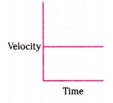
For the motion with uniform velocity, the slope of the velocity-time graph is equal to
(1) 1 m/s
(2) zero
(3) initial velocity
(4) final velocity
Answer:
(2) zero

Question 9.
If a cyclist takes two minutes to complete half revolution on a circular path of 120 m radius, what is the average speed?
(1) 1 m/s
(2) 2 m/s
(3) 3.14 m/s
(4) 4.14 m/s
Answer:
(3) 3.14 m/s
Average Speed = \(\frac{\text { Total distance }}{\text { Total Time }}=\frac{\pi \mathrm{r}}{2 \times 60}=\frac{3.14 \times 120}{2 \times 60}\) = 3.14 m/s

Question 10.
In a particular time, the net displacement travelled by the body is equal to
(1) the area which v -1 graph encloses with displacement axis
(2) the area which x -1 graph encloses with the time axis
(3) the area which v -1 graph encloses with time axis
(4) the area which a -1 graph encloses with displacement axis
Answer:
(3) the area which v -1 graph encloses with time axis

Question 11.
A particle moves along a straight line. At a time t, the distance x of the particle from the origin given by x = 20 + 12t – t3 where x is in meters and t in sec, the time taken for the particle fo coming to rest is
(1) 1 s
(2) 2 s
(3) 4 s
(4) 6 s
Answer:
(2) 2 s
x = 20 + 12t – t3, \(\frac{d x}{d t}\) = 12 – 3t2 = V, 12 – 3t2 = 0 ⇒ 3t2 = 12 ⇒ t2 = 4, t = 2s

Question 12.
A car travels half of the distance with speed v and the remaining distance with speed 2v. Its average speed is
(1) \(\frac{4 v}{3}\)
(2) \(\frac{3 v}{3}\)
(3) \(\frac{v}{3}\)
(4) \(\frac{2 v}{3}\)
Answer:
(1) \(\frac{4 v}{3}\)
Average Speed = \(\frac{2 u v}{u+v}=\frac{2 \times(v)(2 v)}{v+2 v}=\frac{2 \times v \times 2}{3}=\frac{4}{3} v\)

Question 13.
A car runs at constant speed on a circular track of radius 100 m, taking 62.8 seconds for every circular lap. The average velocity and average speed of each circular lap respectively is
(1) 10 m/s, 0 m/s
(2) 0m/s. 0 m/s
(3) 0 m/s, 10 m/s
(4) 10 m/s, 10 m/s
Answer:
(3) 0 m/s, 10 m/s
Hint: Average Velocity = 0
Average Speed = \(\frac{2 \pi \mathrm{r}}{62.8}=\frac{2 \times 3.14 \times 100}{62.8}=\frac{6.28 \times 100}{62.8}\) = 10m/s

Question 14.
The motion of the particle is given by the equation S = (2t3 + 5t2 + 16t + 8)m. The value of acceleration of the particle at t = 1 sec is
(1) 20 m/s2
(2) 22 m/s2
(3) 24 m/s2
(4) 26 m/s2
Answer:
(2) 22 m/s2
S = 2t3 + 5t2 + 16t + 8, v = \(\frac{\mathrm{ds}}{\mathrm{dt}}\) = 6t2 + 10t + 16; a = \(\frac{\mathrm{dv}}{\mathrm{dt}}\) = 12t + 10
at t = 1, a = 12 + 10 = 22m/s2

Question 15.
The ratio of distances travelled by a freely falling body in the 1st, 2nd, 3rd, 4th second
(1) 1:2:3:4
(2) 1:4:9:16
(3) 1:3:5:7
(4) 1:1:1:1
Answer:
(3) 1:3:5:7
Sn = u + \(\frac{\mathrm{a}}{2}\)(2n – 1), S1 = \(\frac{\mathrm{g}}{2}\)(2(1) – 1) = \(\)
S2 = \(\frac{\mathrm{g}}{2}\)(2(2)- 1) = \(\frac{\mathrm{3g}}{2}\), S3 = \(\frac{\mathrm{g}}{2}\)(2(3) – 1) = \(\frac{\mathrm{5g}}{2}\) ⇒ S1 : S2: S3 : S4 = 1 : 3 : 5 : 7

Question 16.
A stone falls freely under gravity. It covers distances h1, h2 and h3 in the first 5 seconds, the next 5 seconds and the next 5 seconds respectively. The relation between h1, h2 and h3 is
(1) h2 = 3h1 and h3 = 3h2
(2) h1 = h2 = h3
(3) h1 = 2h2 = 3 h3
(4) h1 = \(\frac{\mathrm{h}_2}{3}=\frac{\mathrm{h}_3}{5}\)
Answer:
(4) h1 = \(\frac{\mathrm{h}_2}{3}=\frac{\mathrm{h}_3}{5}\)
h1 = \(\frac{1}{2}\)g(52) = \(\frac{1}{2}\)g(25), x1 = \(\frac{1}{2}\)g(102) = \(\frac{1}{2}\)g(100)
h2 = x1 – h1 = \(\frac{1}{2}\)g (100 – 25) = \(\frac{1}{2}\)g(75), x2 = \(\frac{1}{2}\)g (152) = \(\frac{1}{2}\)g(225)
h3 = x2 – x1 = \(\frac{1}{2}\)g(225 – 100) = \(\frac{1}{2}\)g(125), h, = \(\frac{\mathrm{h}_2}{3}=\frac{\mathrm{h}_3}{5}\) (or) 1:3:5:7

II. Fill in the Blanks

Question 1.
________ deals with the study of motion of objects without taking into account, factors which cause the motion.
Answer:
Kinematics

Question 2.
The shortest path travelled by a moving object in a given time from initial to final position is called _______.
Answer:
displacement

Question 3.
The distance covered by a body along a semicircular path of radius r is _______ .
Answer:
πr

Question 4.
The slope of velocity-time graph gives _______.
Answer:
acceleration

Question 5.
The slope of displacement-time graph gives _______.
Answer:
velocity

Question 6.
The area under acceleration-time graph gives _____.
Answer:
change in velocity

Question 7.
The acceleration of a body moving with uniform velocity is ________.
Answer:
zero

Question 8.
The velocity of a body at any instant of time is called _______.
Answer:
instantaneous velocity

Question 9.
The value of an acceleration of a freely falling body is ________.
Answer:
g = 9.8 m/s2]

Question 10.
The ratio of distances travelled by a freely falling body from the rest in the first three seconds is ______.
Answer:
1 : 3 : 5

III. One Word Answer Questions

Question 1.
What is uniform motion ?
Answer:
If an object moving along a straight line covers equal displacement in equal intervals of time, said to be in uniform motion along a straight line.

Question 2.
What is acceleration ?
Answer:
The rate of change of velocity is called acceleration.

Question 3.
What is average speed ?
Answer:
The ratio of total distance travelled by a body to total time is called average speed.

Question 4.
What is instantaneous velocity ?
Answer:
The velocity of a particle at a particular instant is called instantaneous velocity.

Question 5.
Draw position – time graph for an object at rest.
Answer:
Motion in a Straight Line Questions and Answers AP Inter 1st Year Physics Chapter 2-1

Question 6.
What represents the area under the cure of velocity – time graph ?
Answer:
Area = v × t = displacement.

Question 7.
What is the maximum height reached by a body when it is vertically projected up with an initial velocity ‘u’ ?
Answer:
Hmax = \(\frac{u^2}{2 g}\)

Question 8.
Mention one similarity between speed and velocity.
Answer:
Having same units and dimensions.

Question 9.
Draw velocity-time graph for a particle moving with uniform velocity.
Answer:
Motion in a Straight Line Questions and Answers AP Inter 1st Year Physics Chapter 2-2

Question 10.
What is the time taken by the body, when it is freely dropped from a height “h” ?
Answer:
h = \(\frac{1}{2}\)gt2; t2 = \(\frac{2 h}{g} \Rightarrow t=\sqrt{\frac{2 h}{g}}\)

IV. Very Short Answer Questions

Question 1.
The states of motion and rest are relative. Explain. [dlarch – 2026]
Answer:
REST: If the position of a body does not change with respect to surroundings, it is said to be at “Rest”.

MOTION : If the position of a body changes with respect to surroundings, it is said to be in “Motion”. By definitions, rest and motion are relative with respect to surroundings.

Question 2.
Is it necessary that the direction of acceleration and velocity of a body should be the same? Give an example.
Answer:
No. For a decelerating body velocity is in forward direction and acceleration will be in opposite direction.

Question 3.
Is it possible for a body to have acceleration but zero velocity? Give an example.
Answer:
In case of vertically projected body at maximum height its velocity v = 0. But acceleration due to gravity ‘g’ is not zero.
So even though velocity v = 0 ⇒ acceleration is not zero.

Question 4.
Which is greater, a velocity of 72kmph or 25m/s ?
Answer:
V1 = 72 × \(\frac{5}{18}\) = 20m/s; V2 = 25m/s ∴ 25m/s is greater than 72kmph.

Question 5.
Give an example of one-dimensional motion where a particle moving along a straight line comes to rest and moves backward.
Answer:

  1. A body projected vertically upwards.
  2. When the length of pendulum is high and amplitude is less then its motion is along a straight line. The pendulum will come to a stop at extreme position and moves back in forward direction (‘x’ + ve) periodically.

Question 6.
A vehicle travels half the distance L with speed Vj and the other half with speed v2. What is the average speed ?
Answer:
The average speed of a vehicle for the two equal parts \(\frac{\mathrm{L}}{2}, \frac{\mathrm{~L}}{2}\) is
Vavg = \(\frac{\text { Total distance }}{\text { Total time }}=\frac{\frac{\mathrm{L}}{2}+\frac{\mathrm{L}}{2}}{\mathrm{t}_1+\mathrm{t}_2}\)
Vavg = \(\frac{\mathrm{L}}{\left(\frac{\frac{\mathrm{~L}}{2}}{\mathrm{~V}_1}+\frac{\frac{\mathrm{L}}{2}}{\mathrm{~V}_2}\right)}=\frac{\mathrm{L}}{\frac{\mathrm{~L}}{2}\left(\frac{1}{\mathrm{~V}_1}+\frac{1}{\mathrm{~V}_2}\right)}=\frac{1}{\frac{1}{2}\left(\frac{\mathrm{~V}_1+\mathrm{V}_2}{\mathrm{~V}_1 \mathrm{~V}_2}\right)}\) (∵ t = \(\frac{\mathrm{L} / 2}{\mathrm{~V}}\)) ⇒ Vavg = \(\frac{2 V_1 V_2}{V_1+V_2}\)

Question 7.
A body covers a distance of 5m along a semicircular path from its one end to another end. What is the ratio of its distance covered to its displacement ?
Answer:
πr = 5; r = 5/π
Motion in a Straight Line Questions and Answers AP Inter 1st Year Physics Chapter 2-3
\(\frac{\text { Distance }}{\text { Displacement }}=\frac{\pi \mathrm{r}}{2 \mathrm{r}}=\frac{\pi}{2}=\frac{22}{7 \times 2}=\frac{11}{7}\)

Question 8.
Displacement travelled by a body is given by S = 2t + 5t2 m. What is the acceleration of that body ?
Answer:
S = 2t + 5t2; V = \(\frac{\mathrm{ds}}{\mathrm{dt}}\) = 2 + 10t; a= \(\frac{\mathrm{dv}}{\mathrm{dt}}\) = 10m/s2

Question 9.
An object falling through a fluid is observed to have an acceleration given by a = g – bv where g is the gravitational acceleration and b is a constant. After a long time it is observed to fall with a constant velocity. What would be the value of this constant velocity ?
Answer:
Acceleration, a- = g – bv when moving with constant velocity, a = 0 ⇒ 0 = g – bv
∴ Constant velocity, v = \(\frac{\mathrm{g}}{\mathrm{~b}}\) m/sec.

Question 10.
Under what circumstances is the relationship s = vt valid ?
Answer:
Body moving with uniform velocity (a = 0).

V. Short Answer Questions

Question 1.
Can the equations of kinematics be used when the acceleration varies with time ? If not, what form would these equations take ?
Answer:
The equations of motion are 1) v =u + at 2) s = ut + 1/2at2 and 3) v2 – u2 = 2as. All these three equations applicable to a body moves with uniform acceleration ‘a’.

No, the equations are not applicable when the acceleration varies with time.

Question 2.
A particle moves in a straight line with uniform acceleration. Its velocity at time t = 0 is V1 and at time t = t is v2. The average velocity of the particle in this time interval is (v1 + v2) / 2. Is this correct ? Substantiate your answer.
Answer:
t1 = 0 ⇒ u = v1 ; t2 = t ⇒ v = v2; Average velocity = \(\frac{u+v}{2}=\frac{v_1+v_2}{2}\)

Question 3.
Can the velocity of an object be in a direction other than the direction of acceleration of the object ? If so, give an example.
Answer:
Yes. Velocity of a body and its acceleration may be in different directions.
Ex :
1) In case of vertically projected body ⇒ velocity of body is in the upward direction and acceleration is in downward direction.
2) When brakes are applied the velocity of body before coming to rest is opposite to retarding acceleration.

Question 4.
Obtain the equation of motion x = ut + \(\frac{1}{2}\)at2 for constant acceleration using graphical method.
Answer:
The velocity – time graph of a body moving with initial velocity ‘u’ and with uniform acceleration ‘a’ as shown. Let V be the velocity of the body after a time t.
In v – t graph, area of velocity-time graph = total displacement travelled by it. Area under velocity – time graph = area of OABCD
∴ Area of Rectangular part OACD = Area of OACD + Area of ABC.
A1 = OA × OD = ut …..(1)
Area of triangle ABC = A2
A2 = \(\frac{1}{2}\) × Base × height = \(\frac{1}{2}\) × AC × (BC) = \(\frac{1}{2}\)t(u – v)
But v – u = at; ∴ A2 = \(\frac{1}{2}\)t. at = \(\frac{1}{2}\)at2
∴ Total area under graph = s = A1+ A2; s(n) = ut + \(\frac{1}{2}\)at2.
∴ s = ut + \(\frac{1}{2}\)at2 is graphically proved.
Motion in a Straight Line Questions and Answers AP Inter 1st Year Physics Chapter 2-4

Question 5.
Explain the terms the average velocity and instantaneous velocity. When are they equal?
Answer:
Average velocity : It is the ratio of total displacement to total time taken. It is independent of path of the body.
∴ Average velocity = \(\frac{\mathrm{s}_2-\mathrm{s}_1}{\mathrm{t}_2-\mathrm{t}_1}\) (Or) Vavg = \(\frac{\mathrm{ds}}{\mathrm{dt}}\)
Velocity of a particle at a particular instant of time is known as instantaneous velocity. Here time interval is very small. V = \(\frac{\mathrm{dx}}{\mathrm{dt}}\)
Only in uniform motion, instantaneous velocity = average velocity. For all other cases instantaneous velocity may differ from average velocity.

Problems

Question 1.
A man walks on a straight road from his home to a market 2.5 km away with a speed of km h-1. Finding the market closed, he instantly turns and walks back home with a speed of 7.5 km h-1. What is the (a) magnitude of average velocity mid (b) average speed of the man over the time interval 0 to 50 minutes ?
Solution:
Time taken by man to go from his home to market, t1 = \(\frac{\text { distance }}{\text { speed }}=\frac{2.5}{5}=\frac{1}{2} \mathrm{~h}\)
Time taken by man to go from market to his home, t1 = \(\frac{2.5}{7.5}=\frac{1}{3} h\)
∴ Total time taken = t1 + t2 = \(\frac{1}{2}+\frac{1}{3}=\frac{5}{6} h\) = 50min.
In time interval 0 to 50 min,
Total distance travelled = 2.5 + 2.5 = 5 km.; Total displacement = zero.

  1. Average velocity = \(\frac{\text { displacement }}{\text { time }}\) = 0
  2. Average speed = \(\frac{\text { distance }}{\text { time }}=\frac{5}{5 / 6}\) = 6 km/h

Question 2.
A car travels the first third of a distance with a speed of 10 kmph, the second third at 20 kmph and the last third at 60 kmph. What is its mean speed over the entire distance ?
Solution:
Total distance = s; distance travelled, S1 = \(\frac{s}{3}\); velocity, v1 = 10 kmph ; distance, s2 = \(\frac{s}{3}\) velocity, v2 = 20 kmph; distance, s3 = \(\frac{s}{3}\); velocity, v3 = 60 kmph
Average velocity = \(\frac{\text { total distance }}{\text { total time }}\)
Motion in a Straight Line Questions and Answers AP Inter 1st Year Physics Chapter 2-5

Question 3.
A bullet moving with a speed of 150 m s-1 strikes a tree and penetrates 3.5 cm before stopping. What is the magnitude of its retardation in the tree and the time taken for it to stop after striking the tree?
Solution:
Velocity of bullet, u = 150 m/s; Final velocity, v = 0 ; Distance travelled, s = 3.5 cm = 3.5 × 10⁻² m,
a) Acceleration, a = \(\frac{v^2-u^2}{2 s}=\frac{0^2-150^2}{2 \times 3.50 \times 10^{-2}}=\frac{-22500}{7 \times 10^{-2}}\)
= -3.214 × 10⁵ m/sec2 (-ve sign for retardation)

b) Time taken to stop, t = \(\frac{v-u}{a}=\frac{-150}{-3.214 \times 10^5}\) = 4.67 × 10⁻⁴ sec.

Question 4.
A motorist drives north for 30 min at 85 km/h and then stops for 15 min. He continues travelling north and covers 130 km in 2 hours. What is his total displacement and average velocity ?
Solution:
In first part:
Velocity, v1 = 85 kmph ; Time, t1 = 30 min ; Distance travelled, s1 = v1 t1 = 85 × \(\frac{30}{60}\) = 42.5 km

In second part:
Distance travelled, s2 = 0 ; Time, t2 = 15.0 min.

In third part:
Distance travelled, s3 = 130 km ; Time, t3 = 2 hours = 120 min.
a) Total distance of the motorist, s = s1 + s2 + s3 = 42.5 + 0 + 130 = 172.5 km

b) Total time travelled,
t = t1 + t2 + t3 = 30 + 15 + 120 = 165 minutes = 2 hrs 45 minutes = 2\(\frac{3}{4}\) hrs. = \(\frac{11}{4}\) hrs.
∴ Average velocity, vavg = \(\frac{\text { total displacement }}{\text { total time }}=\frac{172.5}{(11 / 4)}\) = 62.7 kmph.

Question 5.
A ball A is dropped from the top of a building and at the same time an identical ball B is thrown vertically upward from the ground. When the balls collide the speed of A is twice that of B. At what fraction of the height of the building did the collision occur ?
Solution:
Given at time of collision velocity of A = VA = 2 × VB (velocity of B)
Let the body be dropped from a height ‘h’. Let the two stones collide at x from the ground.
For the body dropped, s = h – x = \(\frac{1}{2}\)gt2 → (1); For the body thrown up, x = ut – \(\frac{1}{2}\)gt2 → (2)
For the body dropped, v = u + at ⇒ VA = gt → (3)
For the body thrown up, v = u – gt ⇒ VB = u – gt → (4)
Given VA = 2VB ⇒ gt = 2 (u – gt) or u = \(\frac{3gt}{2}\) → (5)
Divide equation (1) with equation (2)
Motion in a Straight Line Questions and Answers AP Inter 1st Year Physics Chapter 2-6
∴ Fraction of height of collision = \(\frac{2}{3}\)

Question 6.
Drops of water fall at regular intervals from the roof of a building of height 16 m. The first drop strikes the ground at the same moment as the fifth drop leaves the roof. Find the distances between successive drops.
Solution:
Height of building, h = 16 m
∴ Time taken to reach the ground, t = \(\sqrt{\frac{2 h}{g}}\)
∴ Time taken to fall, t = \(\sqrt{\frac{2 \times 16}{9.8}}=\sqrt{\frac{32}{9.8}}=\sqrt{3.26}\) = 1.80
Motion in a Straight Line Questions and Answers AP Inter 1st Year Physics Chapter 2-7
Number of drops, n = 5
∴ Number of intervals = n – 1 = 5 – 1 = 4
Time interval between drops = \(\frac{1.8}{4}\) = 0.45 sec
Time of travel of 1st drop, t1 = 4 × 0.45 = 1.8
∴ Distance travelled by
1st drop, S1 = \(\frac{1}{2}\)gt12 = \(\frac{1}{2}\) × 9.8 × 1.8 × 1.8 = 16 m

For 2nd drop, t2 = 3 × 0.45 = 1.35 sec., S2 = \(\frac{1}{2}\)gt22 ;
∴ S2 = \(\frac{1}{2}\) × 9.8 × 1.352 = 4.9 × 1.822 = 8.9278 ≅ 9m

For 3rd drop, t3 = 2 × 0.45 = 0.9 sec.
Distance, S3 = \(\frac{1}{2}\)gt32 = \(\frac{1}{2}\) × 9.8 × 0.92 = 3.97 ≅ 4m

For 4th drop, t4 = 1 × 0.45 = 0.45 sec.
Distance travelled, S4 = \(\frac{1}{2}\)gt42 = \(\frac{1}{2}\) × 9.8 × (0.45)2 ≅ 1

For 5 th drop, t5 = 0 ⇒ S5 = 0
Distance between 1st and 2nd drop S1, 2 = S1 – S2 = 16 – 9 = 7m
Distance between 2nd and 3rd drop S2, 3 = S2 – S3 = 9 – 4 = 5 m
Distance between 3rd and 4th drop S3, 4 = S3 – S4 = 4 – 1 = 3m
Distance between 4th and 5th drop S4, 5 = S4 – S5 = 1 – 0 = 1 m
∴ Distances between successive drops are 7m, 5m, 3m and 1m.

Question 7.
A food packet is dropped from an aeroplane, moving with a speed of 360 kmph in a horizontal direction, from a height of 500m. Find (i) its time of descent (ii) the horizontal distance between the point at which the food packet reaches the ground and the point above which it was dropped.
Solution:
Velocity of plane, V = 360 kmph = 360 × \(\frac{5}{18}\) = 100 m/s.
Height above the ground, h = 500 m; g = 10 m/s2

i) Time of descent, t = \(\) = 10sec.

ii) Horizontal distance between point of dropping and point where it reaches the ground = Range R.
∴ R = u \(\sqrt{\frac{2 \mathrm{~h}}{\mathrm{~g}}}\) = 100 \(\sqrt{\frac{2 \times 500}{10}}\) = 100 x 10 = 1000 m.

Motion in a Straight Line Class 11 NCERT Solutions

Question 1.
In which of the following examples of motion, can the body be considered approximately point object.
(a) a railway carriage moving without jerks between two stations.
(b) a monkey sitting on the top of a man cycling smoothly on a circular track.
(c) a spinning cricket ball that turns sharply on hitting the ground.
(d) a tumbling beaker that has slipped off the edge of a table.
Answer:
(a) A railway carriage can be considered as a point object because the size of carriage is much smaller than the distance between the two stations.

(b) A monkey sitting on the top of the cyclist can be considered as a point object if the cyclist describes a circular path of radius which is sufficiently larger than the size of monkey.

(c) A spinning cricket ball cannot be considered as a point object because the size of ball is not negligible as compared to the distance through which the ball may turn on hitting the ground.
Remark: The spinning motion of cricket ball is due to its size. A point mass cannot have spin motion.

(d) A beaker slipping off the edge of a table cannot be considered as a point object because the size of beaker is not negligible as compared to the height of the table.

Question 2.
The position – time (x – t) graphs for two children A and B returning from their school O to their homes P and Q respectively as the shown in Fig.
Choose the correct entries in the brackets below :
Motion in a Straight Line Questions and Answers AP Inter 1st Year Physics Chapter 2-8
(a) (A/B) lives closer to the school than (B/A).
(b) (A/B) starts from the school earlier than (B/A).
(c) (A/B) walks faster than (B/A).
(d) A and B reach home at the (same/different) time.
(e) (A/B) overtakes (B/A) on the road (once/twice).
Answer:
(a) As OP < OQ ; A lives closer to school than B.
(b) For A, x = 0 at t = 0 and for B, x = 0 at t = t0 (let)
This implies that A starts from the school earlier than B.
(c) The speed = slope of x – t graph. As slope of B is greater than the slope of A, therefore, B walks faster than Answer:
(d) From graph, it is clear that the positions P and Q are attained at the same time, this implies that both A and B reach home at the same time.
(e) x – t graphs for A and B intersect each other only once, so B overtakes A on the road once.

Question 3.
A woman starts from her home at 9.00 am, walks with a speed of 5 kmh-1 on a straight road upto her office 2.5 km away, stays at the office upto 5.00 pm and returns home by an auto with a speed of 25 kmh-1. Choose suitable scales and plot the x-t graph of her motion.
Answer:
For motion from home to office :
Time to which woman leaves the office = 09.00 am
Speed = 5 km/h, distance traversed, s = 2.5 km
Time taken, t1 = \(\frac{\text { Distance traversed }}{\text { Speed }}=\frac{2.5}{5}\) = 0.5 h = 30 min.
Time at which woman reaches office
= 9.00 am + 0.30 = 9.30 am
Stay at office : 9.30 am – 5.00 pm (position fixed)
Motion in a Straight Line Questions and Answers AP Inter 1st Year Physics Chapter 2-9
For motion from office to home :
Time at which she leaves office = 5.00 pm
Speed of auto = 25 km/h, distance = 2.5 km
Time spent, t2 = \(\frac{\text { Distance }}{\text { Speed }}=\frac{2.5}{25}\) = 0.1 h = 0.1 × 60 min = 6 min
Time at which she reaches home = 5.06 pm
The position-time (x – t) graph of motion of woman is as shown in the Fig.

Question 4.
A drunkard walking in a narrow lane takes 5 steps forward and 3 steps backward, followed again by 5 steps forward and 3 steps backward, and so on. Each step is 1 m long and requires 1 s. Plot the x – t graph of his motion. Determine graphically and otherwise how long the drunkard takes to fall in a pit 13 m away from the start.
Answer:
The drunkard takes 5 steps forward and 3 steps backward. Each step is of 1 m length and takes 1 second. Therefore, the displacement of drunkard as a function of time is as shown below.

t (seconds)05813162124293237
x (m)055 – 3 = 22 + 5 = 77 – 3 = 44 + 5 = 99 – 3 = 66 + 5 = 1111 – 3 = 88 + 5 = 13

Motion in a Straight Line Questions and Answers AP Inter 1st Year Physics Chapter 2-10
The position – time graph of motion of drunkard is as shown in the Fig.
From graph, it is clear that the drunkard will fall into the pit 37 seconds after the beginning.

Question 5.
A car moving along a straight highway with a speed of 126 kmir1 is brought to a stop within a distance of 200 m. What is the retardation of the car (assumed uniform); and how long does it take for the car to stop ?
Answer:
Initial speed of car, u = 126 km/h
1 km/h = \(\frac{1000 \mathrm{~m}}{3600 \mathrm{~s}}=\frac{5}{18}\) m/s ; u = 126 × \(\frac{5}{18}\) = 35 m/s
Final speed of car, v = 0, Distance traversed, s = 200 m
Using the formula v2 = u2 + 2as, we get
0 = (35)2 + 2a × 200 ⇒ -400a = (35)2 ⇒ a = \(\frac{(35)^2}{400}\) = -3.06 ms-2
Retardation of Car = 3.06 ms-2
If t is the time taken, then formula v = u + at gives
0 = 35 – 3.06 t ⇒ 3.06t = 35 ⇒ t = \(\frac{35}{3.06}\) = 11.4 s

Question 6.
A player throws a ball upwards with an initial speed of 29.4 ms1.
(a) What is the direction of acceleration during the upward motion of the ball ?
(b) What are the velocity and acceleration of the ball at the highest point of its motion ?
(c) Choose the x = 0 m and t = 0 s to be the location and time of the ball at its highest point, vertically downward direction to be the positive direction of x-axis and give the signs of position, velocity and acceleration of the ball during its upward and downward motion.
(d) To what height does the ball rise and after how long does the ball return to the player’s hands ?[Take g = 9.8 ms-2 and neglect air resistance].
Answer:
(a) The ball moves under gravity throughout its motion. The acceleration due to gravity is always directed vertically downward. So, the direction of acceleration during the upward motion of the ball is vertically downward.
(b) At the highest point of motion, the velocity of ball is zero and the acceleration is 9.8 ms-2 directed vertically downward.
(c) As the ball remains between highest point and earth, so during upward and downward motion of ball, x > 0 (or x is positive).
During vertically upward direction v is negative (v < 0) and during vertically downward direction v is positive (v > 0).
Acceleration is always g = + 9.8 ms-2 (positive).
(d) Using formula v2 = u2 + 2as, we have
a = + g = 9.8 ms-2, s = – H, v = 0 (at highest point)
u = – 29.4 ms-1 (given)
0 = (-29.4)2 – 2 × 9.8 × H ⇒ H = \(\frac{(29.4)^2}{2 \times 9.8}\) m = 44.1 m
Also from relation, s = ut + \(\frac{1}{2}\)at2,
we have s = 0, u = -29.4 m/s, a = 98m/s2
0 = -29.4 t + \(\frac{1}{2}\) × 9.8t2 or \(\frac{1}{2}\) 9.8t2 = 29.4 t ⇒ t = \(\frac{29.4}{4.9}\) = 6s.
∴ Height, (H) = 44.1m and time taken (t) = 6s.

Question 7.
Read each statement below carefully and state with reasons and examples, if it is true or false.
A particle in one-dimensional motion
(a) with zero speed at an instant may have non-zero acceleration at that instant.
(b) with zero speed may have non-zero velocity,
(c) with constant speed must have zero acceleration,
(d) with positive value of acceleration must be speeding up.
Answer:
(a) True; at highest point of particle thrown in vertically upward direction, the speed is zero but acceleration is g = 9.8 ms-2 vertically downward.
(b) False; because velocity = speed + direction. As speed is zero, velocity must be zero.
(c) True; as v = constant; acceleration a = \(\frac{d v}{d t}\) = 0
(d) False, when a body is thrown upward its speed decreases, but gravitational acceleration is downward (assumed positive direction).
However, if body continues to move along a straight line on a smooth horizontal surface, then positive acceleration will necessarily imply speeding up.

Question 8.
A ball is dropped from a height of 90 m on a floor. At each collision with the floor, the ball loses one-tenth of its speed. Plot the speed-time graph of its motion between t = 0 to 12 s.
Answer:
Let t1 be the time taken by the ball to hit the floor.
Given, u = 0, h = 90 m, g = 9.8 m/s2
Formula, h = ut + \(\frac{1}{2}\)gt2 gives
90 = 0 + \(\frac{1}{2}\)9.8t12 ⇒ t12 = \(\frac{90}{4.9}=\frac{900}{49}\) ⇒ t1 = \(\frac{30}{7}\) = 4.3 s.
The speed of the ball when it hits the floor first time is given by
v1 = u + gt1 = 0 + 9.8 × \(\frac{30}{7}\) = 42 m/s
Now the ball bounces upward after collision. As the ball loses one-tenth of speed during collision, therefore, upward speed of ball just after collision
v2 = \(\frac{9}{10}\) × 42 = 37.8 m/s
The ball now starts moving upward with retardation g = 9.8 m/s2. The speed of ball at any instant t will be (u1 = v2 = 37.8 m/s).
∴ v = u1 – gt = 37.8 – 9.8 t
The speed of ball becomes zero at highest point after time t21 is given by
0 = 37.8 – 9.8 t21 ⇒ t21 = \(\frac{37.8}{9.8}\) = 3.85 s
Now the ball begins to fall downward and attains a speed of 37.8 m/s just before collision with the floor. As time of ascent = time of descent.
Motion in a Straight Line Questions and Answers AP Inter 1st Year Physics Chapter 2-11
∴ Time taken by ball to hit the floor
t211 = 3.85 s
Total time upto this instant
T = t2 + t21 + t211 = 4.3 + 3.85 + 3.85 = 12 s
The speed of ball just after second collision
v3 = \(\frac{9}{10}\) × 37.8 ≅ 34m/s
The graph of speed and time is as shown in the Fig.
Remark: Speed is never negative.

Question 9.
Explain clearly, with examples, the distinction between
a) magnitude of displacement (sometimes called distance) over an interval of time and the total length of the path covered by a particle over the same interval.
b) magnitude of average velocity over an interval of time, and the average speed over the same interval. [Average speed of a particle over an interval of time is defined as the total paths length divided by the time interval].
Show in both (a) and (b) that the second quantity is either greater than or equal to the first. When is the equality sign true ? [For simplicity, consider one-dimensional motion only].
Answer:
For simplicity we suppose one-dimensional motion, where an object traverses from A to B and then returns back in total time t where AB = s.
(a) Displacement = 0 and total path length = AB + AB = 2s.
(b) Average velocity = \(\frac{\text { Displacement }}{\text { Time }}=\frac{0}{t}\) = 0
Average speed = \(\frac{\text { Total path length }}{\text { Time }}=\frac{2 \mathrm{~s}}{\mathrm{t}}\)
Motion in a Straight Line Questions and Answers AP Inter 1st Year Physics Chapter 2-12
In both the cases (a) and (b), the second quantity (i.e., total path length and speed) turns out to be greater than the first (i.e., magnitude of displacement and velocity respectively). However, if the motion takes place along a straight line without change in direction, then equality sign will be true.
That is then, magnitude of displacement = Total path length
(i.e., motion along a straight line in one direction) and magnitude of velocity = Speed.

Question 10.
A man walks on a straight road from his home to a market 2.5 km away with a speed of 5 kmh-1. Finding the market closed, he instantly turns and walks back home with a speed of 7.5 kmh ‘. What is the
(a) Magnitude of average velocity, and
(b) The average speed of the man over the interval of time
(i) 0 to 30 min,
(ii) 0 to 50 min,
(iii) 0 to 40 min ?
Answer:
Distance of market from home = 2.5 km; Speed of man from home to market = 5 km/h
Time taken by man to reach market, t =Speed of man, while returning from the market = 7.5 km/h
∴ Time taken by man to return the home, t1 = \(\frac{\text { Distance }}{\text { Speed }}=\frac{2.5}{5}=\frac{1}{2} \mathrm{~h}\) = 20 min
Speed of man, while returning from the market = 7.5 km/h
Time taken by man to return the home, t2 = \(\frac{2.5}{7.5}=\frac{1}{3} h\) = 20 min
Total time of man returning to his home = 30 min + 20 min = 50 min

(i) Over the interval 0 to 30 min :
During this time, man goes from home to market; therefore, displacement, s = 2.5 km
Average velocity = \(\frac{\text { Displacement }}{\text { Time }}=\frac{2.5}{1 / 2}\) = 5km/h
Average speed = \(\frac{\text { Distance }}{\text { Time }}=\frac{2.5}{1 / 2}\) = 5 km/h
Clearly, during motion along a straight line (without turn), the average speed and average velocity are equal in magnitude.

(ii) Over the interval 0 to 50 min :
In 50 min the man goes from home to market and returns back to home.
Net displacement = zero
Average velocity = \(\frac{\text { Net displacement }}{\text { Total time }}=\frac{0}{50}\)
Average speed = \(\frac{\text { Total distance }}{\text { Total time }}=\frac{2.5 \mathrm{~km}+2.5 \mathrm{~km}}{(50 \mathrm{~min})}+\frac{5 \mathrm{~km}}{50 \times \frac{1}{60} \mathrm{~h}}\) = 6 km/h.

(iii) Over the interval 0 to 40 min :
During first 30 min man goes from home to market covering a distance of 2.5 km; in next 10 min the man is in path from market to home and covers a distance
= (75 km/h) × \(\left(\frac{10}{60} h\right)\) = 1.25 km
Displacement = 2.5 – 1.25 = 1.25 km
Distance = 2.5 + 1.25 = 3.75 km
Average velocity = \(\frac{\text { Displacement }}{\text { Time }}=\frac{1.25}{40 \times \frac{1}{60} \mathrm{~h}}\) = 1.875 km/h
Average speed = \(\frac{\text { Distance }}{\text { Time }}=\frac{3.75 \mathrm{~km}}{40 \times \frac{1}{60} \mathrm{~h}}\) = 5.625 km/h

Question 11.
In problems 9 and 10, we have carefully distinguished between average speed and magnitude of average velocity. No such distinction is necessary when we consider instantaneous speed and magnitude of velocity. The instantaneous speed is always equal to the magnitude of instantaneous velocity. Why ?
Answer:
Instantaneous velocity, v = \(\frac{\mathrm{ds}}{\mathrm{dt}}\)
Where ds is infinitesimal displacement in infinitesimal time interval.
For infinitesimal interval of time there is no change in direction so the magnitude of displacement is equal to the length of the path; hence magnitude of instantaneous velocity = instantaneous speed.

Question 12.
Look at the graphs (a) to (d) carefully and state, with reasons, which of these cannot possibly represent one-dimensional motion of a particle.
Motion in a Straight Line Questions and Answers AP Inter 1st Year Physics Chapter 2-13
Answer:
(a) It does not represent one-dimensional motion because according to this graph particle has two positions at the same time, which is impossible.

(b) It does not represent one dimensional motion because according to this graph the particle have equal positive and negative velocity at the same time, which is impossible.

(c) It cannot represent one-dimensional motion because according to graph speed is negative at certain instants, which is impossible (speed can never be negative).

(d) It cannot represent one-dimensional motion because according to this graph after a certain time the total path length begins to decrease with increase of time, which is impossible (total path length will always increase with increase of time).

Question 13.
Fig. shows the x – t graph of one-dimensional motion of a particle. Is it correct to say from the graph that the particle moves in a straight line for t < 0 and on a parabolic path for t > 0 ? If not suggest a suitable physical context for this graph.
Answer:
For t < 0, the particle is at rest; since, its position remains at x = 0. For t > 0, x – t graph is parabolic, it is possible if motion of particle is uniformly accelerated since x = ut + \(\frac{1}{2}\)at2
If u = 0, x = \(\frac{1}{2}\)at2 or x ∝ t2 (parabola)

Thus, it is not correct to say that the particle moves in a straight line for t < 0, because during t < 0, the particle does not move at all. However, for t > 0, the trajectory is parabolic which is possible if particle moves along a straight line with uniform acceleration. It is again not correct to say that particle moves on parabolic path for t > 0.

Physical context: The graph may represent the motion of a particle released from the top of a hill or tower.

Question 14.
Suggest a suitable physical situation for each of the following graphs.
Motion in a Straight Line Questions and Answers AP Inter 1st Year Physics Chapter 2-14

Answer:
(a) The given x – t graph shows that initially x = 0, then ball gains constant velocity which then reverses in direction and finally its velocity becomes zero.
Physical situation : The ball is initially at rest on a smooth floor. It is kicked and given a constant velocity. Then, it strikes a wall, rebounds with reduced speed and strikes the opposite wall which stops it.

(b) The given velocity – time graph (v – t) shows that the velocity changes sign again and again with the passage of time and each time, it loses some speed.
Physical situation : A ball thrown up with some initial velocity rebounding from the floor with reduced speed after each collision.

(c) The given a – t graph shows that initially acceleration of object is zero. It gains acceleration for a very short duration and immediately it is decelerated and again, its acceleration is zero.
Physical situation: A cricket ball moving with a uniform speed is hit back with a bat for a very short duration.

Question 15.
Fig. gives the x – t plot of a particle executing one-dimensional simple harmonic motion. Give the signs of position velocity and acceleration variables of the particle at t = 0.3 s, 1.2 s and – 1.2 s.
Answer:
Position is positive when particle is above t – axis and negative if particle is below t – axis. Velocity is positive, when x increases with increase of time and velocity is negative when x decreases with increase of time. Acceleration is positive when the slope of x – t curve increases and negative when slope of x – t curve decreases.
Motion in a Straight Line Questions and Answers AP Inter 1st Year Physics Chapter 2-15
At 0.3 s, x is negative, v is negative and a is positive.
At 1.2 s, x is positive, v is positive and a is negative.
At – 1.2 s, x is negative, v is positive and a is positive.

Question 16.
Fig. shows x – t plot of a particle in one-dimensional motion. Three different equal intervals of time are shown. In which interval is the average speed greatest, and in which is it the least ? Give the sign of average velocity for each interval.
Motion in a Straight Line Questions and Answers AP Inter 1st Year Physics Chapter 2-16
Answer:
The average speed inx-t graph is equal to the slope of line joining the initial and final points in that interval. From the graph the slope is greatest in interval 3 and least in interval 2. Therefore, average speed is greatest in interval 3 and average speed is least in interval 2. Slope is positive in intervals 1 and 2 and negative in interval 3, so the average velocity is positive during intervals 1 and 2 and negative during interval 3.

Question 17.
Fig. shows a speed – time graph of a particle in motion along a constant direction. Three equal intervals of time are shown. In which intervals is the average acceleration greatest in magnitude ? In which interval is the average speed greatest ? Choosing the positive direction as the constant direction of motion, give the signs of v and a in the three intervals. What are the accelerations at the points A, B, C and D ?
Motion in a Straight Line Questions and Answers AP Inter 1st Year Physics Chapter 2-17
Answer:
The average acceleration is given by the slope of line joining the two points onv-f graph for given interval of time. From the graph, out of three intervals the slope is maximum in interval (2) but it is negative. Therefore, the magnitude of average acceleration is greatest in interval 2.
Average speed in a given interval = \(\frac{v_1+v_2}{2}\)
From the graph, it is clear that the magnitudes of v1 and v2 are maximum in interval 3, so average speed is maximum in interval 3.

Signs of v: The speed v is always positive. Therefore, it is positive in all the three intervals.
Signs of a: In interval T slope at v -1 graph is positive, therefore, acceleration is positive. In interval 2, the slope of v – t graph is negative, therefore, the acceleration is negative. In interval 3, the slope of v – t graph is positive, therefore, the acceleration is positive.

The instantaneous acceleration is equal to the slope of tangent on v – t graph at given instant. The tangents drawn on given v – t curve at points A, B, C and D are parallel to time axis, so slope is zero.
Hence, acceleration at points A, B, C and D are zero.

Question 18.
A police van moving on a highway with a speed of 30 km/h fires a bullet at a thief’s car speeding away in the same direction with a speed of 192 km/h, if the muzzle speed of the bullet is 150 m/s, with what speed does the bullet hit the thief’s car ?
(Note : Obtain that speed which is relevant for damaging thief’s car ?)
Answer:
Let vp be the velocity of police van, vT be the velocity of thief’s car and uBP the muzzle velocity of bullet. Muzzle velocity means the velocity with respect to gun (or police van).
Given, vP = 30 km/h = 30 × \(\frac{1100 \mathrm{~m}}{(60 \times 60) \mathrm{s}}=\frac{25}{3} \mathrm{~m} / \mathrm{s}\)
vT = 192 km/h = 192 x \(\frac{1100 \mathrm{~m}}{(60 \times 60) \mathrm{s}}=\frac{160}{3} \mathrm{~m} / \mathrm{s}\)
uB = 150 m/s
All velocities are in same direction, therefore, if uB is the velocity of bullet with respect to earth, the velocity of bullet with respect to police van
uBP = uB + vP = 150 + \(\frac{25}{3}=\frac{475}{3}\)m/s
Relative velocity of bullet with respect to thief’s car
uBT = uB – vT = \(\frac{475}{3}-\frac{160}{3}=\frac{315}{3}\)= 105 m/s.

Equilibrium Questions and Answers AP Inter 1st Year Chemistry Chapter 6

Regular practice with AP Inter 1st Year Chemistry Study Material Chapter 6 Equilibrium Questions and Answers helps students stay prepared for examinations.

AP Inter 1st Year Chemistry 6th Lesson Equilibrium Questions and Answers

I. Multiple Choice Questions

Question 1.
The pH of a solution of hydrochloric acid is 4. The molarity of the solution is :
1) 4.0 M
2) 0.4 M
3) 0.0001 M
4) 0.04 M
Answer:
3) 0.0001 M
If [H+] = 0.0001M (Molarity), then
pH = -log10 [H+] = -log 0.0001 = -log 10-4 = 4.

Question 2.
The strong conjugate base in the following is
1) NO3–
2) Cl–
3) SO42-
4) CH3COO–
Answer:
4) CH3COO–
Strong conjugate base is CH3COO–, which is obtaining from weak acid.

Question 3.
When NH4Cl is added to NH4OH solution the dissociation of ammonium hydroxide is reduced. It is due to
1) common ion effect
2) hydrolysis
3) oxidation
4) reduction
Answer:
1) common ion effect
Due to common ion effect dissociation of NH4OH is reduced.

Question 4.
The following reaction is at equilibrium.
Fe3+(aq) + SCN–(aq) ⇌ [Fe(SCN)]2+(aq)
In the above reaction, colour intensity of red colour can be increased by
l) addition of oxalic acid which reacts with Fe3+ ions.
2) addition of Hg2+ ions which reacts with SCN– ions.
3) addition of KSCN.
4) red colour intensity cannot be changed.
Answer:
3) addition of KSCN.
\(\mathrm{Fe}_{(\mathrm{aq})}^{+3}+\mathrm{SCN}_{(\mathrm{aq})}^{-} \rightleftharpoons[\mathrm{Fe}(\mathrm{SCN})]_{(\mathrm{aq})}^{+2}\)
on adding KSCN colour intensity of red colour increased.

Question 5.
Ksp of a sparingly soluble salt AB2 is 4 × 10-12. The solubility of the salt is
1) 2 × 10⁻⁶M
2) 4 × 10⁻⁴M
3) 1 × 10-12
4) 1 × 10⁻⁴M
Solution:
4) 1 × 10⁻⁴M
For AB2 type of salt, Ksp = 4s3 ⇒ s2 = \(\frac{\mathrm{K}_{\mathrm{sp}}}{4}\)
⇒ s = \(\sqrt[3]{\frac{\mathrm{K}_{\mathrm{sp}}}{4}}=\sqrt[3]{\frac{4 \times 10^{-12}}{4}}\) = 10-4m

Equilibrium Questions and Answers AP Inter 1st Year Chemistry Chapter 6

Question 6.
An aqueous solution of ammonia consists of
1) H+ only
2) OH– only
3) NH4+ only
4) NH4+ and OH–
Answer:
Aqueous solution of ammonia contains NH4+ and OH– ions.
NH4OH(aq) → NH4+ + OH–

Question 7.
The pH of a 0.05 M of H2SO4 solution is
1) 0.05
2) 1
3) -1
4) 1.3010
Answer:
2) 1
For 0.05M of H2SO4
[H+] = 2 × 0.05(Di basic H2SO4) = 0.1
pH = -log10[H+] = -log 0.1 = -log 10-1 = 1

Question 8.
If the molar solubility of Zirconium phosphate Zr3(PO4)4 is ‘S’. Solubility product Ksp of Zirconium phosphate is
1) 6912 (S)5
2) 6912 (S)7
3) 108 (S)7
4) 27 (S)5
Answer:
2) 6912 (S)7

Equilibrium Questions and Answers AP Inter 1st Year Chemistry Chapter 6 1

Question 9.
For a reversible reaction, if the concentration of reactants is increased, the equilibrium constant of the reaction
1) Increases
2) Remains constant
3) Decreases
4) Depends on amount of reactant
Answer:
Equilibrium constant remains constant on increasing the concentration of reactants.

Question 10.
The pKa of acetic acid and pKb of ammonium hydroxide are 4.76 and 4.75 respectively.
1) 6.098
2) 7.005
3) 8
4) 5.0
Answer:
2) 7.005
CH3COONH4 is the salt formed by weak acid and weak base
∴ pH = 7 + — (PKa – PKb) = 7 + \(\frac{1}{2}\) (4.76 – 4.78) = 7 × \(\frac{1}{2}\) × 0.01 = 7.005

Question 11.
Which among the following salt solutions is basic in nature?
1) Ammonium chloride
2) Ammonium sulphate
3) Ammonium nitrate
4) Sodium acetate
Answer:
4) Sodium acetate
Sodium acetate is the salt obtained from sodium hydroxide (Strong base) and acetic acid (weak acid). So aq. CH3COONa is in basic nature.

Question 12.
Observe the following equilibrium at T (Kelvin)
H2(g) + I2(g) ⇌ HI(g)
Which one of the following does not disturb the above equilibrium at constant volume?
1) Addition of H2(g)
2) Removal of HI(g)
3) Addition of I2(g)
4) Addition of He(g)
Answer:
4) Addition of He(g)
He is a Noble gas, it is chemically inert, so by adding inertgas the equilibrium does not disturbed.

Question 13.
Solution of 0.1 N NH4OH and 0.1 N NH4Cl has pH 9.25. Find out pKb of NH4OH.
1) 9.25
2) 4.75
3) 3.75
4) 8.25
Solution:
2) 4.75
POH = PKb + log \(\frac{[\text { salt }]}{[\text { base }]}\) (basic buffer)
pH + POH = 14 ⇒ POH = 14 – 9.25 = 4.75
4.75 = PKb + log \(\frac{0.1}{0.1}\) ⇒ PKb = 4.75

Equilibrium Questions and Answers AP Inter 1st Year Chemistry Chapter 6

Question 14.
For the following process, the expression for the Kc
Ni(s) + 4CO(g) ⇌ Ni(CO)4(g)
1) Kc = \(\frac{\left[\mathrm{Ni}(\mathrm{CO})_4\right]^2}{[\mathrm{Ni}][\mathrm{CO}]^4}\)
2) Kc = \(\frac{\left[\mathrm{Ni}(\mathrm{CO})_4\right]}{[\mathrm{CO}]^4}\)
3) Kc = \(\frac{[\mathrm{Ni}][\mathrm{CO}]^4}{\left[\mathrm{Ni}(\mathrm{CO})_4\right]^{2-}}\)
4) Kc = \(\frac{[\mathrm{CO}]^4}{\left[\mathrm{Ni}(\mathrm{CO})_4\right]^2}\)
Answer:
2) Kc = \(\frac{\left[\mathrm{Ni}(\mathrm{CO})_4\right]}{[\mathrm{CO}]^4}\)
Kc = \(\frac{\text { Molar concentrations of products }(\mathrm{g})}{\text { Molar concentrations of reactants }(\mathrm{g})}\) ⇒ Kc = \(\frac{\left[\mathrm{Ni}(\mathrm{CO})_4\right]}{[\mathrm{CO}]^4}\)

Question 15.
K1 and K2 are equilibrium constants for reactions (i) & (ii). Then the relation between
K1 and K2
(i) H2(g) + I2(g) ⇌ 2HI(g)
(ii) HI(g) ⇌ 1/2 H2(g) + 1/2 I2(g)
1) K1 = K22
2) K1 = \(\frac{1}{\mathrm{~K}_2}\)
3) K1 = K20
4) K1 = \(\frac{1}{K_2^2}\)
Solution:
4) K1 = \(\frac{1}{K_2^2}\)
H2(g) + I2(g) ⇌ 2HI(g) …………… (1)
HI(g) ⇌ \(\frac{1}{2}\) H2(g) + \(\frac{1}{2}\) I2(g) ………… (2)
K1 = Equilibrium constant
K2 = Equilibrium constant
K2 = \(\frac{1}{\sqrt{\mathrm{~K}_1}}\) [eq.(2) is reverse reaction and halved]
Squaring on both sides, \(\mathrm{K}_2^2=\frac{1}{\mathrm{~K}_1}\)
⇒ K1 = \(\frac{1}{K_2^2}\)

II. Fill in the Blanks

Question 1.
Acidity of BF3 can be explained on the basis of __________ theory of acids and bases.
Answer:
Lewis acid base theory

Question 2.
The nature of aqueous solution of ammonium chloride (NH4Cl) is ______.
Answer:
NH4Cl is the salt of weak base (NH4OH) and strong acid (HCl).
So aq. solution of NH4Cl is acidic.

Question 3.
Kp for the following equation: ______.
CaCO3(s) ⇌ CaO(s) + CO2(g)
Answer:
Kp = PCO2

Question 4.
The molarity of pure water is ______.
Answer:
Molarity of pure water is = 55.5.M
M = \(\frac{\mathrm{W}}{\mathrm{GMW}} \times \frac{1000}{\mathrm{~V}(\mathrm{ml})}=\frac{1000}{18} \times \frac{1000}{1000}\) = 55.5 M

Question 5.
If K is in the range of ________ appreciable concentrations of both reactants and products are present.
Answer:
10-3 to 103

III. One Word Answer Questions

Question 1.
What is a bronsted base?
Answer:
The substance which can accept a proton is said to be bronsted base. Eg : Cl–, HCO3–.

Question 2.
What is Lewis acid?
Answer:
Lewis acid is the substance which can accept a pair of electrons and form a coordinate covalent bond. Eg : BF3, H+.

Question 3.
What is the value of Kw at 25°C? What are its units ?
Answer:
Ionic product of water Kw = 1 × 10-14 ; Units are mole2/lit2.

Equilibrium Questions and Answers AP Inter 1st Year Chemistry Chapter 6

Question 4.
What is conjugate acid-base pair?
Answer:
An acid-base pair which differ by proton (H+) is called a conjugate acid base pair.
Eg : HCl and Cl–.

Question 5.
Write the relation between Gibbs energy and equilibrium constant.
Answer:
∆G° : – 2.303 RT log Kc
R = gas constant ; T= temperature ; Kc = Equilibrium constant

IV. Very Short Answer Questions

Question 1.
State law of chemical equilibrium.
Answer:
The ratio of product of molar concentrations of products to the product of molar concentrations of reactants is a constant value. This constant is called equilibrium constant and this is called law of chemical equilibrium.
Eg : aA + bB ⇌ cc + dD (or) Equilibrium constant (Kc) = \(\frac{[\mathrm{C}]^{\mathrm{c}}[\mathrm{D}]^{\mathrm{d}}}{[\mathrm{~A}]^{\mathrm{a}}[\mathrm{~B}]^{\mathrm{b}}}\)
Eg : H2(g) + I2(g) ⇌ (Kc) = \(\frac{[\mathrm{HI}]^2}{\left[\mathrm{H}_2\right]\left[\mathrm{I}_2\right]}\)

Question 2.
What is homogeneous equilibrium? Give two examples.
Answer:
The equilibrium in which all the substances are present in the same phase is known as homogeneous equilibrium.
Eg: N2 (g) + 3H2 (g) ⇌ 2NH3 (g)
CH3COOH (l) + C2H5OH (l) ⇌ CH3COO C2H5 (l) + H2O (l)

Question 3.
What is heterogeneous equilibrium? Give two examples.
Answer:
The equilibrium in which the substances involved are present in different phases is called heterogeneous equilibrium.
CaCO3 (s) ⇌ CO(s) + CO2 (g) and H2O (l) ⇌ H2O (g)

Question 4.
What is meant by dynamic equilibrium?
Answer:
A state in a reversible reaction where the forward and backward reaction continue to takes place with same rate is known as dynamic equilibrium.

Question 5.
Give two chemical equilibrium reactions for which Kp > Kc
Answer:
In order that Kp > Kc, ∆n should be +ve
1) PCl5 (g) ⇌ PCl3 (g) + Cl2(g); ∆n = (2 – 1)
2) N2O4(g) ⇌ 2NO2 (g) ; ∆n = (2 – 1)

Question 6.
Give two chemical equilibrium reactions for which Kp <Kc.
Answer:
In order that Kp <Kc, ∆n should be -ve
1) N2 (g) + 3H2 (g) ⇌ 2NH3(g) ; ∆n = (2 – 4)
2) 2SO2 (g) + O2 (g) ⇌ 2SO3(g) ; ∆n = (2 – 3)

Question 7.
Write the equations for the conversion of Kc to Kp for the following reaction
CO(g) + H2O(g) ⇌ CO2(g) + H2(g)
Answer:
CO(g) + H2O(g) ⇌ CO2(g) + H2(g)
Kp = Kc (RT)∆n
∆n = (1+1) – (1 + 1) = O
Kp = Kp (RT)
Kp = Kc

Question 8.
What are the factors which influence the chemical equilibrium?
Answer:
Molar concentration, temperature and pressure influence the equilibrium.

Question 9.
What is meant by ionic product of water?
Answer:
The product of concentration of H+ and OH– ions in aqueous solution (or) in pure water is called ionic product of water.

Question 10.
Give two examples of salts whose aqueous solutions are acidic.
Answer:
NH4Cl (Ammonium Chloride); Cu2SO4 (copper sulphate) and (NH4)2SO4 (Ammonium sulphate) .
These aqueous solutions are acidic in nature.

V. Short Answer Questions

Question 1.
Derive the relation between Kp and Kc for the equilibrium reaction.
N2(g) + 3H2(g) ⇌ 2NH3(g)
Answer:
N2(g) + 3H2(g) ⇌ 2NH3(g)
Kc = \(=\frac{\left[\mathrm{NH}_3\right]^2}{\left[\mathrm{~N}_2\right]\left[\mathrm{H}_2\right]^3}\) ; Kp = \(\frac{P_{\mathrm{NH}_3}^2}{P_{\mathrm{N}_2} \times \mathrm{P}_{\mathrm{H}_2}^3}\)
Partial pressures of PN2, PH2 and PNH3 can be written as
PN2 = \(\frac{\mathrm{n}_{\mathrm{N}_2} \mathrm{RT}}{\mathrm{~V}}\) = CN2RT ; PH2 = \(\frac{\mathrm{n}_{\mathrm{H}_2} \mathrm{RT}}{\mathrm{~V}}\) = CH2RT and PNH3 = \(\frac{\mathrm{n}_{\mathrm{NH}_3} \mathrm{RT}}{\mathrm{~V}}\) = CNH3
Substituting these values in Kp equation, Kp = \(\frac{\left(\mathrm{C}_{\mathrm{NH}_3}\right)^2}{\left(\mathrm{C}_{\mathrm{N}_2}\right)\left(\mathrm{C}_{\mathrm{H}_2}\right)^3}\) × [RT]-2
∴ Kp = Kc[RT]-2 [∵ \(\frac{\mathrm{C}_{\mathrm{NH}_3}^2}{\left(\mathrm{C}_{\mathrm{N}_2}\right)\left(\mathrm{C}_{\mathrm{H}_2}\right)^3}\) = Kc]

Equilibrium Questions and Answers AP Inter 1st Year Chemistry Chapter 6

Question 2.
State Le Chateliers’s Principle. Discuss the application of Le Chatelier’s principle for the industrial synthesis of Ammonia by Haber’s process.
Answer:
Le Chatelier’s principle : If a chemical reaction at equilibrium is subjected to a change in temperature, pressure or concentration that govern the chemical equilibrium, the equilibrium position shifts in the direction in which the change is reduced or nullified.
Application of Le Chatelier’s principle to by Haber’s process :
N2(g) + 3H2(g) ⇌ 2NH3(g); ∆H = -92 kJ

Effect of pressure :
Increase of external pressure on the reaction at equilibrium favours the reaction in the direction in which the volume or the number of molecules decreases.
In the above reaction of formation of ammonia forward reaction involves decrease in volume or number of molecules. So high pressure is favourable for the formation of ammonia. Hence ammonia is manufactured at 200 atm pressure.

Effect of temperature :
In a reversible reaction, if the forward reaction is exothermic, the backward reaction will be endothermic.
High temperature favours the endothermic reaction while low temperature favours the exothermic reaction.

  • Since the formation of ammonia is exothermic reaction, low temperature is favourable for the manufacture of ammonia.
  • But at low temperature, the reaction is slow. So an optimum temperature of about 725 – 775 K is used.

Effect of catalyst:

  • To increase the rate of formation of ammonia iron powder mixed with molybdenum powder is used as catalyst.
  • Molybdenum acts as promoter to iron catalyst.

Effect of concentration :

  • Increase in concentrations of reactants increases the rate of forward reaction.
  • Removal of the products from reaction mixture decreases the rate of backward reaction.
  • So more ammonia can be obtained by increasing the concentration of N2 and H2 and removing the NH3 formed at regular intervals.
  • Optimum conditions for the synthesis of ammonia are
    Pressure = 200 atm
    Temperature = 725 – 775 K
    Catalyst = Fe
    Promoter = Mo

Question 3.
State Le Chateliers’s Principle. Discuss the application of Le Chatelier’s principle for the manufacture of SO3 by contact process.
Answer:
Le Chatelier’s principle : If a chemical reaction at equilibrium is subjected to a change in temperature, pressure or concentration that govern the chemical equilibrium, the equilibrium position shifts in the direction in which the change is reduced or nullified.

Application of Le Chatelier’s principle by contact process :
2SO2(g) + O2(g) ⇌ 2SO3(g) + Heat; ∆H = -189 kJ

Effect of pressure :

  • Increase of external pressure on the reaction at equilibrium favours the reaction in the direction in which the volume or the number of molecules decreases.
  • Formation of SO3 in the above reaction involves decrease in volume.
  • According to Le Chatelier’s principle high pressure is favourable for the formation of SO3.
  • So, SO3 is prepared at a pressure of 1.5 to 1.7 atmospheres.

Effect of temperature :

  • In a reversible reaction if the forward reaction is exothermic, the backward reaction is endothermic.
  • High temperatures are favourable for the endothermic reaction, while the low temperatures are favourable for the exothermic reactions.
  • Since the formation of SO3 is exothermic reaction, low temperatures are favourable. So, SO3 is prepared at a temperature of about 673 K.
    Effect of catalyst: To increase the rate of formation of SO3 catalyst like V2O5 or platinised asbestos is used.

Effect of concentration :

  • Increase in the concentration of the reactants, increase the rate of forward reaction.
  • Removal of products from reaction mixture decreases the rate of backward reaction.
  • So more SO3 can be obtained by increasing the concentrations of SO2 and O2 and by removing, the SO3 is formed at regular intervals.
    Optimum conditions for the synthesis of ammonia are
    Pressure : 1.5 – 1.7 atmospheres Temperature : 673 K
    Catalyst: V2O5 (Vanadium pentoxide) or Platinised asbestos.

Equilibrium Questions and Answers AP Inter 1st Year Chemistry Chapter 6

Question 4.
The species H2O, HCO3–, HSO4– and NH3 can act as both bronsted acids and bases. Give the corresponding conjugate acid and base for each of them.
Answer:

SubstanceConjugate AcidConjugate base
H2OH3O+OH–
HCO3–H2CO3CO3-2
HSO4–H2SO4SO42
NH3NH4+NH2–

Question 5.
Write notes on
(i) Common ion effect.
(ii) Solubility product
Answer:
i) Common ion Effect : The decrease in the dissociation of the aq. solution of weak electrolyte by adding another strong electrolyte having one common ion is called common ion effect. Eg : To the saturated solution of AgCl, electrolyte NaCl is added to decrease the dissociation.
ii) Solubility Product (Ksp) : The solubility product is the product of molar equilibrium concentrations of cation and anion at a particular temperature in a saturated solution of sparingly soluble salt.
Applying the concept at equilibrium, AxBy(s) ⇌ xAy+ + yBx-
Applying the concept at equilibrium, Ksp = [Ay+]x [Bx-]y
AgCl ⇌ Ag+ + Cl–
Ksp = [Ag+] [Cl–]
⇒ Ksp = s × s [where s is the solubility]
⇒ Ksp = s2
Solubility s = \(\sqrt{\mathrm{K}_{\mathrm{sp}}}\)

Question 6.
Explain the concept of Bronsted-Lowry acids and bases. Illustrate with suitable examples.
Answer:
Bronsted – Lowry theory : Any substance that can lose a proton or protons is an acid.
Eg : HCl, H2SO4, H3PO4, CH3COOH.

  • Any substance that can gain a proton or protons is a base. Eg : NH3, H2O, OH– etc.
  • When an acid react with base neutralization takes place. As per Bronsted – Lowry theory proton transfer from an acid to a base is called neutralization.
    Eg : HCl + H2O ⇌ H3O+ + Cl–
  • The above reaction is reversible. In this reaction,
    1. HCl donates proton to water. So it is a bronsted acid.
    2. H2O gains the proton. So it is a bronsted base.
    3. H2O+ donates a proton to Cl–. So it is bronsted acid.
    4. Cl– can gain a proton. So it is a bronsted base.
  • The acid base pair which differ by a single proton is said to be conjugate acid-base pair.
  • In the above reaction HCl & Cl– and H3O+ and H2O are conjugate acid-base pairs.
  • Every bronsted acid has its conjugate base and every bronsted base has a conjugate protonic acid.
  • According to bronsted – Lowry theory greater the tendency to donate proton stronger is the acid. Higher the tendency of the base to accept protons, stronger is the base.
  • In the above reaction, HCl gives proton easily than H3O+. So HCl is stronger acid than H20. H20 accepts the proton more easily than Cl–. So H2O is a stronger base than NH3
  • In all acid – base reactions, the reaction takes place in the direction of formation of weaker acid and a weaker base.
  • A stronger acid has a weaker conjugate base and a stronger base has a weaker conjugate acid.

Advantages of Bronsted – Lowry theory :

  • This theory explains the behaviour of acids and bases in both aqueous and non-aqueous solvents.
  • It explains the behaviour of NH3, CaO, etc. as bases and CO2, SO2, etc. as acids.

Drawbacks of Bronsted – Lowry theory :

  • Proton donation or acceptance happens only in the presence of other substances.
  • It could not explain the behaviour of electron deficient molecules like AlCl3, BCl3, etc. as acids.

Question 7.
Explain Lewis acids and bases with suitable examples. Classify the following species into Lewis acids and Lewis bases.
a) OH–
b) F–
c) H+
d) BCl3.
Answer:
Lewis acid : The substance which can accept an electron pair to form a coordinate covalent bond is called Lewis acid.
Types of Lewis acids :
1) All +vely charged metal ions or cations act as Lewis acids.
Eg : Ag+, CO+3, Cu+2, Fe+3, etc.
2) Electron deficient compounds whose central atom has an incomplete octet, possessing an empty orbital acts as Lewis acid. Eg : BF3, BCl3, AlCl3, FeCl3.
3) Compounds in which central atom has vacant’d’ orbitals and which can expand its octet. Eg : SiF4, SnCl4, SF4, TeF4, FeCl3.
4) Molecules having multiple bonds between atoms of different electronegativities.
Eg : CO2, SO2, SO3, NO2, Cl2O7, P4O10.
5) Elements with an electron sextet. Eg : S, O.

Lewis base : The substance which donates electron pair to form a coordinate covalent bond is called Lewis base.
Types of Lewis bases :
1) All anions will act as Lewis bases. Eg : Cl–, OH–, CN–, NH2–, F–, SCN–.
2) Molecules with one or two lone pairs on the central atom.
Eg : H2O, NH3, R – OH, R – NH2,
R-O-R, C5H5N.
3) Molecules with multiple bonds. Eg : CO, NO, HC ☰ CH, H2C ☰ CH2
a) OH– is Lewis base, b) F– is Lewis base, c) H+ is Lewis acid, d) BCl3 is Lewis acid.

Question 8.
Calculate the pH of
a. 10-3 M of HCl
b. 10-3 M of H2SO4 [log 2 = 0.3010]
Solution:
a) 10-3M of HCl [H+] = 10-3M
pH = – log [H+] = – Log 10-3 = 3 log 10 = 3

b) 10-3 M of H2SO4
[H+] = 2 × 10⁻³
pH = -log [H+] = -log 2 × 10-3 = – log 2 – log 10-3
= – log 2 + 3 log 10 = -log 2 + 3
= 3 – log 2
= 3 – 0.3010 = 2.6990

Question 9.
Calculate the pH for
a. 0.001 M of NaOH
b. 0.01 M of Ca(OH)2
Solution:
a) 0.001 M of NaOH
[OH+] = 0.001M
POH = -log [OH–] = – log 10-3 = 3 log 10 = 3
pH + POH =14
pH = 14 – 3 = 11.
∴ pH = 11

b) 0.01 M of Ca(OH)2
[OH–] = 0.01 × 2 = 2 × 10⁻²
POH = – log [OH–]
= – log 2 × 10-2
= – log 2 – log 10-2 = – log2 + 2 log 10
= 2 – log2 = 2 – 0.3010 = 1.6990
pH + POH = 14
pH = 14 – 1.699 = 12.3010

Question 10.
The pH of 0.1M solution of weak mono protic acid is 4.0. Calculate its [H+] and Ka.
Solution:
HA ⇌ H+ + A–
pH = 4 ; [H+] = 10-4
Ka = \(\frac{c \alpha^2}{1-\alpha}=\frac{(0.1)\left(10^{-4}\right)^2}{1}\) [Neglecting α in the denominator]
Ka = 10-7

Question 11.
One litre of buffer solution contains 0.1 mole of acetic acid and 1 mole of sodium acetate. Find its pH if pKa of CH3COOH is 4.8.
Solution:
Henderson’s Equation, pH = PKa + log \(\frac{[\text { Salt }]}{[\text { Acid }]}\)
Given [Salt] = 1M; [Acid] = 0.1M; PKa = 4.8
= 4.8 + log \(\frac{1}{0.1}\)
= 4.8 + log 10
= 4.8 +1 = 5.8

VI. Long Answer Questions

Question 1.
What are equilibrium processes? Explain equilibrium in Physical and Chemical processes with examples.
Answer:

  • In a reversible process, a state will be attained such that the rate of forward reaction is equal to the rate of backward reaction.
  • Such a state is known as equilibrium state.
  • Equilibrium processes are of two types. They are

1. Physical equilibrium process : In such a process, equilibrium occurs in a phase transformation process.
Ex: Solid ⇌ Liquid
Solid ⇌ Vapour
Vapour ⇌ Liquid

2. Chemical equilibrium process: If there exists an equilibrium in between reactants and products, such reactions are said to be chemical equilibrium process.
1) N2(g) + 3H2(g) ⇌ 2 NH3(g)
2) 2SO2(g) + O2(g) ⇌ 2SO3(g)

Equilibrium Questions and Answers AP Inter 1st Year Chemistry Chapter 6

Question 2.
What is meant by dynamic equilibrium? Explain with suitable examples.
Answer:

  • In a reversible process, a state will be attained such that the rate of forward reaction is equal to the rate of backward reaction. Such a state is known as equilibrium state.
  • At equilibrium we find no change in the concentration of either reactants (or) products then we may feel that the reaction has stopped. But actually the reaction will be going on. Such a state of reaction is called dynamic equilibrium.

Equilibrium processes are of two types. They are :
1. Physical equilibrium process : In such a process, equilibrium occurs in a phase transformation process.
Ex : Solid ⇌ liquid
Solid ⇌ vapour
Vapour ⇌ liquid

2. Chemical equilibrium process: If there exists an equilibrium in between reactants and products, such reactions are said to be chemical equilibrium process.
1) N2(g) + 3H2(g) ⇌ 2 NH3(g)
2) 2SO2(g) + O2(g) ⇌ 2SO3(g)

The forward and backward reactions of a reversible reaction continuously takes place with equal rates simultaneously at the equilibrium stage also. Hence the equilibrium is called dynamic equilibrium.

At this stage, the reaction appears to be stopped.

All chemical equilibrium processes are dynamic equilibriums in nature.

Question 3.
What are the important features of equilibrium constant? Discuss any two applications of equilibrium constant.
Answer:

  • The equilibrium constant has a definite value for every chemical reaction at a particular temperature. The value of equilibrium constant is independent of initial concentrations of reacting species.
  • The value of equilibrium constant K changes with change in temperature.
  • For a reversible reaction, the equilibrium constant for the backward reaction is inverse of the equilibrium constant for the forward reaction.
  • The equilibrium constant is independent of the presence of catalyst.
  • The equilibrium constant is expressed in terms of concentration, it has different units for different reactions.
  • When addition of two equilibria leads to another equilibrium then the product of their equilibrium constants gives the equilibrium constant of the resultant equilibrium.
    Eg : N2 + O2 ⇌ 2NO ; K1
    2NO + O2 + O2 ⇌ 2NO2; K2
    N2 + 2O2 ⇌ 2NO2; K3
    K = K1 × K2 × K3

Applications of equilibrium constant:
i) Predicting of extent of reaction: The magnitude of equilibrium constant tells us about the extent to which the reactants are converted into the products before the equilibrium is attained.

ii) Predicting the direction of the reaction : From the knowledge of equilibrium con¬stant it is possible to predict the direction in which the net reaction is taking place at a given concentrations or partial pressures of reactants and products.

  • If Qc > Kc the reaction taking place in backward direction is more.
  • If Qc < Kc the reaction taking place in forward direction is more.
  • If Qc = Kc the reaction is at equilibrium. No reaction taking place.

Question 4.
What is Le Chatelier’s principle? Discuss briefly the factors which can influence the equilibrium.
Answer:
Le Chatelier’s principle : If a chemical reaction at equilibrium is subjected to a change in temperature, pressure or concentration that govern the chemical equilibrium, the equilibrium position shifts in the direction in which the change is reduced or nullified.
1) Effect of pressure : ,

  • Pressure is inversely proportional to volume.
  • When pressure is increased the equilibrium shifts in such a direction where the decrease in volume is observed.
  • Similarly when pressure is decreased, the equilibrium shifts in such a direction where increase in volume is observed. This is applicable exclusively for gaseous reactions.

2) Effect of temperature :

  • When temperature is increased, equilibrium shift in such a direction where the temperature change is nullified or equilibrium shifts towards the direction in which temperature is decreased or heat is absorbed. That is endothermic reaction is favoured.
  • When temperature is decreased equilibrium shifts in such a direction where temperature is increased or heat is liberated. That is exothermic reaction is favoured.

3) Effect of concentration :

  • Increase in concentration of the reactants favours forward reaction and decrease in concentration of the reactants favours the backward reaction.
  • When products are added to the equilibrium reaction the concentration of the products increases and reaction proceeds in backward direction.
  • Removal of products leads to decrease in concentration of the products and leads to forward reaction.

Question 5.
Describe the effect of:
a) addition of H2
b) addition of CH3OH
c) removal of CO
d) removal of CH3OH on the equilibrium of the reaction 2H2 (g) + CO (g) ⇌ CH3OH (g)
Answer:
a) According to Le Chatelier’s principle increase in the concentration of reactant increase the forward reaction.
So the addition of H2 results in the formation of more amount of CH3OH.

b) According to Le Chatelier’s principle increase in the concentration of the product, shift the equilibrium in the backward direction. So the addition of CH3OH (product) results in the decrease in concentration and CH3OH and increase in the concentration of H2 and CO.

c) According to Le Chatelier’s principle the decrease in the concentration of reactant equilibrium shift in the backward direction. So removal of CO (reactant) the equilibrium shift in the backward direction. So formation of CH3OH decreases.

d) According to Le Chatelier’s principle the decrease in concentration of product shifts the equilibrium in the forward direction. So the removal of CH3OH (product) shift the equilibrium in the forward direction. Thus more amount of CH3OH is formed.

Equilibrium Questions and Answers AP Inter 1st Year Chemistry Chapter 6

Question 6.
What is degree of ionization in respect of weak acids and weak bases? Derive the relationship between degree of ionization (α) and ionization constant (Ka) for the weak acid HX.
Answer:
Degree of ionization : It can be defined as the fraction of acid (a) base that undergoes ionization per one mole of acid or base. For strong acids or bases degree of ionization (a) is equal to ‘1’.
Let’s consider a weak acid HX with concentration ‘c’. It undergoes partial ionization.
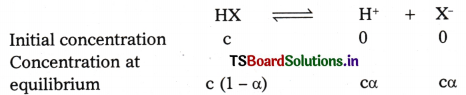
Equilibrium Questions and Answers AP Inter 1st Year Chemistry Chapter 6 2
where α is degree of ionization
Ionization constant Ka = \(\frac{\left[\mathrm{H}^{+}\right]\left[\mathrm{X}^{-}\right]}{[\mathrm{HX}]}\)
⇒ Ka = \(\frac{(\mathrm{c} \alpha)(\mathrm{c} \alpha)}{\mathrm{c}(1-\alpha)}\) for weak acids α < < 1, so α is negligible.
⇒ Ka = \(\frac{c^2 \alpha^2}{c}\) ⇒ α = \(\sqrt{\frac{K_a}{c}}\)

Question 7.
Define pH. What is buffer solution? Derive Henderson – Hasselbalch equation for calculating the pH of an acid buffer solution.
Answer:
The pH of a solution may be defined as negative logarithm of the activity of hydrogen ion [H+]
pH = – log [H+]
Buffer solution : A buffer solution is the solution which can resist the change in pH on
addition of small amount of acid or base. The ability of a solution to resist change in pH on
addition of small amount of acid or base is called buffer solution.
Henderson – Hasselbalch equation :
HA + H2 ⇌ H3O+ + A– Partial ionisation.
NaA → Na+ + A– Complete ionisation
Ka = \(\frac{\left[\mathrm{H}_3 \mathrm{O}^{+}\right]\left[\mathrm{A}^{-}\right]}{[\mathrm{HA}]}\)
Since HA is weakly dissociated, the conc. HA ion solution can be taken equal to the initial conc. of the acid.
Since NaA is completely dissociated, conc. of A- can be taken equal to the conc. of NaA (salt)
Ka = \(\frac{\left[\mathrm{H}_3 \mathrm{O}^{+}\right][\text {Salt }]}{[\text { Acid }]}\)
H3O+ = \(\frac{\mathrm{K}_{\mathrm{a}} \text { [Acid] }}{[\text { Salt }]}\)
-log [H3O+] = – logKa – log\(\frac{\text { [Acid] }}{[\text { Salt }]}\)
pH = pKa + log \(\frac{\text { [Salt] }}{[\text { Acid }]}\)

Equilibrium Questions and Answers AP Inter 1st Year Chemistry Chapter 6

Question 8.
Write notes on
(i) Common ion effect.
(ii) The relation between Ksp and solubility (S) of a sparingly soluble salt BaSO4.
Answer:
i) Common ion effect: The solubility of an electrolyte in water decreases by the addition of another electrolyte which has one ion common with the electrolyte.

  • For example the solubility of NaCl decreases on addition of HCl to the solution of NaCl in water which is known as salting out of water.
  • Acetic acid is weak acid and it undergoes partial ionization as follows.
    CH3COOH ⇌ CH3COO– + H+
  • In case of such electrolytes there exists an equilibrium in between ions and molecular form. In such a condition, the addition of electrolyte with common ions shifts the equilibrium in backward direction which causes the decrease in solubility.

Significance :
1) Common ion effect is an important phenomenon in qualitative analysis.
2) The common ion effect principle is also used in controlling the H+ ion concentration in buffer solution.

ii) The relation between K and solubility (S) of a sparingly soluble salt BaSO4 : The sparingly soluble salt like BaSO4, when added to water form saturated solution. There exists an equilibrium between undissolved solid and the ions in saturated solution.
BaSO4 ⇌ Ba2+ + SO42-
The equilibrium constant, K = \(\frac{\left[\mathrm{Ba}^{2+}\right]\left[\mathrm{SO}_4^{2-}\right]}{\left[\mathrm{BaSO}_4\right]}\)
K = \(\frac{\left[\mathrm{Ba}^{2+}\right]\left[\mathrm{SO}_4^{2-}\right]}{\mathrm{K}_1}\) (∴ Activity of solid BaSO4 is constant)

K × K1 = [Ba2+][SO2-] or Ksp = [Ba2+][SO42-]
The new constant Ksp is called solubility product.

If S moles lit-1 is the solubility of BaSO4.
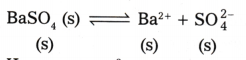
Equilibrium Questions and Answers AP Inter 1st Year Chemistry Chapter 6 3
Ksp = s × s = s2
or solubility of BaSO4 is s = \(\sqrt{\mathrm{K}_{\mathrm{sp}}}\) .

Equilibrium Class 11 NCERT Solutions

Question 1.
A liquid is in equilibrium with its vapour in a sealed container at a fixed temperature.
The volume of the container is suddenly increased.
i) What is the initial effect of the change on vapour pressure ?
ii) How do rates of evaporation and condensation change initially ?
iii) What happens when equilibrium is restored finally and what will be the final vapour pressure ?
Answer:
i) The vapour pressure will decrease due to increase in volume.
ii) Since, the temperature is fixed, the rate of evaporation will remain constant. However, the rate of condensation will be low initially due to lesser number of molecules per unit volume in the vapour phase.
iii) When equilibrium is restored, the final vapour pressure will be the same as original vapour pressure because at equilibrium the rates of evaporation and condensation are equal.

Question 2.
W hat is Kc for the following equilibrium when the equilibrium concentration of each substance is : [SO2] = 0.60 M, [O2] = 0.82 M and [SO3] = 1.90 M ?
2SO2(g) + O2(g) ⇌ 2SO3(g)
Answer:
Kc = \(\frac{\left[\mathrm{SO}_3(\mathrm{~g})\right]^2}{\left[\mathrm{SO}_2(\mathrm{~g})\right]^2\left[\mathrm{O}_2(\mathrm{~g})\right]}=\frac{(1.90)^2}{(0.60)^2 \times(0.82)}\) = 12.229 L mol-1

Question 3.
At a certain temperature and a total pressure of 105 Pa, iodine vapour contains 40% by volume of I atoms.
I2(g) ⇌ 2I(g)
Calculate Kp, for the equilibrium.
Answer:
Partial pressure of I atom (pI1) = \(\frac{40}{100}\) × 105
Partial pressure of I2 (pI2) = \(\frac{(100-40)}{100}\) × 105
∴ Kp = \(\frac{\mathrm{p}_{\mathrm{I}}^2}{\mathrm{p}_{\mathrm{I}_2}}=\frac{\left(4.0 \times 10^4\right)^2}{6.0 \times 10^4}\)
= 2.67 × 10⁴ Pa

Equilibrium Questions and Answers AP Inter 1st Year Chemistry Chapter 6

Question 4.
Write the expression for the equilibrium constant, Kc for each of the following reactions.
i) 2NOCl(g) ⇌ 2NO(g) + Cl2(g)
ii) 2Cu(NO3)2(s) ⇌ 2Cu0(s) + 4NO2(g) + O2(g)
iii) CH3COOC2H5(aq) + H2O(l) ⇌ CH3COOH(aq) + C2H5OH(aq)
iv) Fe3+(aq) + 3OH–(aq) ⇌ Fe(OH)3(s)
v) I2(s) + 5F2(g) ⇌ 2IF5(g)
Answer:
i) Kc = \(\frac{[\mathrm{NO}(\mathrm{~g})]^2\left[\mathrm{Cl}_2(\mathrm{~g})\right]}{[\mathrm{NOCl}(\mathrm{~g})]^2}\)
ii) Kc = [NO2(g)]4[O2(g)] {∵ [CuO(s) = [Cu(NO3)2(s)] = 1}
iii) Kc = \(\frac{\left[\mathrm{CH}_3 \mathrm{COOH}(\mathrm{aq})\right]\left[\mathrm{C}_2 \mathrm{H}_5 \mathrm{OH}(\mathrm{aq})\right]}{\left[\mathrm{CH}_3 \mathrm{COOC}_2 \mathrm{H}_5(\mathrm{aq})\right]}\) (∵ [H2O(l)] = 1)
iv) Kc = \(\frac{1}{\left[\mathrm{Fe}^{3+}(\mathrm{aq})\right]\left[\mathrm{OH}^{-}(\mathrm{aq})\right]^3}\) (∵ [Fe(OH)3(s)] = 1)
v) Kc = \(\frac{\left[\mathrm{IF}_5\right]^2}{\left[\mathrm{~F}_2\right]^5}\) (∵ [I2(s) = 1)

Question 5.
Find out the value of Kc for each of the following equilibria from the value of Kp.
i) 2NOCl(g) ⇌ 2NO(g) + Cl2(g) ;Kp = 1.8 × 10⁻² at 500 K
ii) CaCO3(s) ⇌ CaO(s) + CO2(g); Kp = 167 at 1073 K
Answer:
i) For the reaction, 2NOCl(g) ⇌ 2NO(g) + Cl2(g) ; ∆n = (2 + 1) – 2 = 1
Kp = Kc (RT)∆n
∴ Kc = \(\frac{\mathrm{K}_{\mathrm{p}}}{(\mathrm{RT})^{\Delta \mathrm{n}}}=\frac{1.8 \times 10^{-2}}{(0.0831 \times 500)}\) = 4.33 × 10⁻⁴ (∵ R = 0.0831 L bar mol-1K-1)

ii) For the reaction, CaCO3(s) ⇌ CaO(s) + CO2(g) ; ∆n = 1 – 0 = 1
∵ Kc = \(\frac{\mathrm{K}_{\mathrm{p}}}{(\mathrm{RT})^{\mathrm{An}}}=\frac{167}{(0.0831 \times 1073)}\) = 1.873

Question 6.
For the following equilibrium, Kc = 6.3 × 10¹⁴ at 1000 K.
NO(g) + O3(g) ⇌ NO2(g) + O2(g)
Both the forward and reverse reactions in the equilibrium are elementary bimolecular reactions. What is Kc, for the reverse reactions ?
Answer:
Kc(reverse) = \(\frac{1}{\mathrm{~K}_{\mathrm{c}(\text { forward })}}\) = \(\frac{1}{3.3 \times 10^{14}}\) = 1.59 × 10⁻¹⁵

Question 7.
Explain why pure liquids and solids can be ignored while writing the equilibrium constant expression ?
Answer:
[Pure solid] or [Pure liquid] = \(\frac{\text { No.of moles }}{\text { Volume (in } \mathrm{L})}\) = \(\frac{\text { Mass } / \text { molecular mass }}{\text { Volume }}\)
= \(\frac{\text { Density }}{\text { Molecular mass }}\) = Constant
(The density of a pure solid or a pure liquid is constant at constant temperature)

Question 8.
Reaction between N2 and O2 takes place as follows.
2N2(g) + O2(g) ⇌ 2N2O(g)
If a mixture of 0.482 mol of N2 and 0.933 mol of O2 is placed in a 10L reaction vessel and allowed to form N2O at a temperature for which Kc = 2.0 × 10-37, determine the composition of equilibrium mixture.
Answer:
Suppose x moles of N2 react till equilibrium is attained.
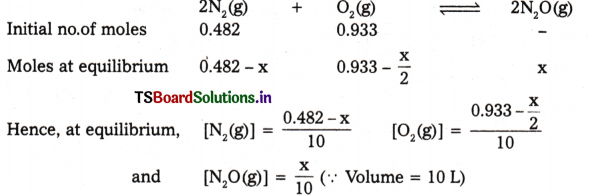
Equilibrium Questions and Answers AP Inter 1st Year Chemistry Chapter 6 4
Since, the value of Kc for the reaction (Kc = 2.0 × 10-37) is very small, the value of x must be very small. Therefore,
[N2(g)] = \(=\frac{0.482-x}{10}=\frac{0.482}{10}\) = 0.0482 mol L-1
[O2(g)] = \(\frac{0.933-x / 2}{10}=\frac{0.933}{10}\frac{0.933-x / 2}{10}=\frac{0.933}{10}\) = 0.0933 mol L-1 and [N2O(g)] = \(\frac{\mathrm{x}}{10}\)
From Kc = \(\frac{\left[\mathrm{N}_2 \mathrm{O}(\mathrm{~g})\right]^2}{\left[\mathrm{~N}_2(\mathrm{~g})\right]^2\left[\mathrm{O}_2(\mathrm{~g})\right]}\)
We have, 2.0 × 10-37 = \(\frac{(x / 10)^2}{(0.0482)^2 \times 0.0933}\)
Which gives, x = 6.6 × 10⁻²⁰
∴ [N2O(g)] = \(\frac{x}{10}=\frac{6.6 \times 10^{-20}}{10}\) = 6.6 × 10⁻²¹

Question 9.
Nitric oxide reacts with Br2 and gives nitrosyl bromide as per reaction given below.
2NO(g) + Br2(g) ⇌ 2NOBr(g)
When 0.087 mol of NO and 0.0437 mol of Br2 are mixed in a closed container at constant temperature, 0.0518 mol of NOBr is obtained at equilibrium. Calculate equilibrium amount of NO and Br2.
Answer:

Equilibrium Questions and Answers AP Inter 1st Year Chemistry Chapter 6 5
Given that x = 0.0518
No. of moles of NO(g) at equilibrium = 0.087 – x = 0.087 – 0.518 = 0.0352
and number of moles of Br2(g) at equilibrium = 0.0437 – \(\frac{\mathrm{x}}{2}\) = 0.0437 – \(\frac{0.0518}{2}\) = 0.0178

Question 10.
At 450 K, Kp = 2.0 × 10¹⁰ bar for the given reaction at equilibrium.
2SO2(g) + O2(g) ⇌ 2SO3(g)
What is Kc at this temperature ?
Answer:
For the given reaction, ∆n = 2 – (2 + 1) = -1
Kp = Kc(RT)∆n
⇒ Kc = \(\frac{\mathrm{K}_{\mathrm{p}}}{(\mathrm{RT})^{\Delta \mathrm{n}}}=\frac{2.0 \times 10^{10}}{(0.0831 \times 450)^{-1}}\) L mol-1, (∵ R = 0.0831 L bar K-1 mol-1)
= 2.0 × 1010 × 0.831 × 450 L mol-1
= 7.48 × 10¹¹ L mol-1

Question 11.
A sample of HI(g) is placed in a flask at a pressure of 0.2 atm. At equilibrium the partial pressure of HI(g) is 0.04 atm. What is Kp for the given equilibrium ?
2HI(g) ⇌ H2(g) + I2(g)
Answer:

Equilibrium Questions and Answers AP Inter 1st Year Chemistry Chapter 6 6
[∵ (0.2 – 0.04) is the decrease in the pressure of HI]
Kp = \(\frac{\mathrm{p}_{\mathrm{H}_2} \times \mathrm{p}_{\mathrm{I}_2}}{\mathrm{p}_{\mathrm{HI}}^2}=\frac{0.08 \times 0.08}{(0.04)^2}\) = 4.0

Question 12.
A mixture of 1.57 mol of N2, 1.92 mol of H2 and 8.13 mol of NH3 is introduced into a 20 L reaction vessel at 500 K. At this temperature, the equilibrium constant, Kc for the reaction
N2(g) + 3H2(g) ⇌ 2NH3(g) is 1.7 × 10². Is the reaction mixture at equilibrium ? If not, what is the direction of the net reaction ?
Answer:
N2(g) + 3H2(g) ⇌ 2NH3(g)
Qc = \(\frac{\left[\mathrm{NH}_3(\mathrm{~g})\right]^2}{\left[\mathrm{~N}_2(\mathrm{~g})\right]\left[\mathrm{H}_2(\mathrm{~g})\right]^3}=\frac{(8.13 / 20)^2}{\left(\frac{1.57}{20}\right) \times\left(\frac{1.92}{20}\right)^3}\) = 2.38 × 10³ (V = 20 L)
Given that Kc = 1.7 × 10²
Obviously, Qc ≠ Kc
Therefore, the reaction is not in equilibrium because Qc ≠ Kc. It will proceed in the reverse direction.

Question 13.
The equilibrium constant expression for a gas reaction is, Kc = \(\frac{\left[\mathrm{NH}_3\right]^4\left[\mathrm{O}_2\right]^5}{[\mathrm{NO}]^4\left[\mathrm{H}_2 \mathrm{O}\right]^6}\)
Write the balanced chemical equation corresponding to this expression.
Answer:
4NO(g) + 6H2O(g) ⇌ 4NH3(g) + 5O2(g)

Equilibrium Questions and Answers AP Inter 1st Year Chemistry Chapter 6

Question 14.
One mole of H2O and one mole of CO are taken in 10 L vessel and heated to 725 K. At equilibrium, 40% of water (by mass) reacts with CO according to the equation,
H2O(g) + CO(g) ⇌ H2(g) + CO2(g)
Calculate the equilibrium constant for the reaction.
Answer:
The given reaction is H2O(g) + CO(g) ⇌ H2(g) + CO2(g)
Initial number of moles of H2O(g) = 1
Number of moles of H2O(g) (reacted) = \(\frac{1 \times 40}{100}\) = 0.4
∴ Number of moles of H2O(g) left (unreacted) = 1 – 0.4 = 0.6
From the given equation it is clear that 0.4 moles of H2O(g) react with 0.4 moles of CO(g) to form 0.4 moles of H2(g) and 0.4 moles of CO2(g). The total volume is 10 litres.
∴ At equilibrium,
[H2O(g)] = \(\frac{1-0.4}{10}\) = \(\frac{0.6}{10}\) = 0.06 mol L-1 ; [CO(g)] = \(\frac{1-0.4}{10}\) = \(\frac{0.6}{10}\) = 0.06 mol L-1
[H2(g)] = \(\frac{0.4}{10}\) = 0.04 mol L-1 ; [CO2(g)] = \(\frac{0.4}{10}\) = 0.04 mol L-1
Hence, K = \(\frac{\left[\mathrm{H}_2(\mathrm{~g})\right]\left[\mathrm{CO}_2(\mathrm{~g})\right]}{\left[\mathrm{H}_2 \mathrm{O}(\mathrm{~g})\right][\mathrm{CO}(\mathrm{~g})]}=\frac{0.04 \times 0.04}{0.06 \times 0.06}\) = 0 44

Question 15.
At 700 K, equilibrium constant for the reaction :
H2(g) + I2(g) ⇌ 2HI(g)
is 54.8. If 0.5 mol L_1 of HI(g) js present at equilibrium at 700 K, what are the concentration of H2(g) and I2(g) assuming that we initially started with HI(g) and allowed it to reach equilibrium at 700 K ?
Answer:
The given reaction can be written as 2HI(g) ⇌ H2(g) + I2(g)
For this reaction, K = \(\frac{1}{54.8}\) = 1.82 × 10⁻² (∵ because for the reverse reaction, K = 54.8)
As the number of moles of H2 and N2 are equal, their concentrations at equilibrium will also be equal.
Suppose [H2(g)] = [I2(g)] = x mol L-1
Given that [HI(g)] = 0.5 mol L-1
K = \(\frac{\left[\mathrm{H}_2(\mathrm{~g})\right]\left[\mathrm{I}_2(\mathrm{~g})\right]}{[\mathrm{HI}(\mathrm{~g})]^2}\) ⇒ 1.82 × 10-2 = \(\frac{x \times x}{(0.5)^2}\) ⇒ x = [1.82 × 10-2 × (0.5)2]1/2 = 0.068 mol L-1
Hence, at equilibrium, [H2(g)] = [I2(g)] = 0.068 mol L-1

Question 16.
What is the equilibrium concentration of each of the substances in the equilibrium when the initial, concentration of ICl was 0.78 M ?
2ICl(g) ⇌ I2(g) + Cl2(g); Kc = 0.14
Answer:
Suppose at equilibrium, [I2(g)] = [Cl2(g>] = x mol L-1

Equilibrium Questions and Answers AP Inter 1st Year Chemistry Chapter 6 7
Given that, Kc = 0.14
Kc = \(\frac{\left[\mathrm{I}_2(\mathrm{~g})\right]\left[\mathrm{Cl}_2(\mathrm{~g})\right]}{[\mathrm{ICl}(\mathrm{~g})]^2}\)
⇒ 0.14 = \(\frac{x \times x}{(0.78-2 x)^2}\) ⇒ x2 = 0.14(0.78 -2x)2
⇒ x = \(\sqrt{0.14}\) (0.78 – 2x) = 0.374(0.78 – 2x)
⇒ x = 0.292 – 0.748 x
⇒ 1.748 x = 0.292
x = \(\frac{0.292}{1.748}\) = 0.167
Hence, equilibrium concentrations will be as follows.
[I2(g)] – [Cl2(g)] = x = 0.167 M
[ICl(g)] = 0.78 – 2x = 0.78 – (2 × 0.167) = 0.446 M

Question 17.
Kp = 0.04 atm at 899 K for the equilibrium shown below. What is the equilibrium concentration of C2H6 when it is placed in a flask at 4.0 atm pressure and allowed to come to equilibrium?
C2H6(g) ⇌ C2H4(g) + H2(g)
Answer:
Suppose the partial pressure of C2H6 decreases by p atm till equilibrium is attained.

Equilibrium Questions and Answers AP Inter 1st Year Chemistry Chapter 6 8
Kp = \(\frac{\mathrm{p}_{\mathrm{C}_2 \mathrm{H}_4} \cdot \mathrm{p}_{\mathrm{H}_2}}{\mathrm{p}_{\mathrm{C}_2 \mathrm{H}_6}}\) = \(\frac{\mathrm{p} \times \mathrm{p}}{4.0-\mathrm{p}}\) ⇒ 0.04 = \(\frac{\mathrm{p}^2}{4.0-\mathrm{p}}\) = 0.16 – 0.04 p ⇒ p2 + 0.04 p – 0.16 = 0
p = \(\frac{-0.04 \pm \sqrt{(0.04)^2-4 \times 1 \times(-0.16)}}{2 \times 1}=\frac{-0.04 \pm 0.801}{2}\)
Taking positive value, p = 0.38
∴ [C2H6(g)]eq = 4.0 – p = 4.0 – 0.38 = 3.62 atm

Question 18.
Ethyl acetate is formed by the reaction between ethanol and acetic acid and the equilibrium is represented as,
CH3COOH(l) + C2H5OH(l) ⇌ CH3COOC2H5(l) + H2O(l)
i) Write the concentration ratio (reaction quotient), Qc, for this reaction (note : water is not in excess and is not a solvent in this reaction)
ii) At 293 K, if one starts with 1.00 mol of acetic acid and 0.18 mol of ethanol, there is 0.171 mol of ethyl acetate in the final equilibrium mixture. Calculate the equilibrium constant.
iii) Starting with 0.5 mol of ethanol and 1.0 mol of acetic acid and maintaining it at 293 K, 0.214 mol of ethyl acetate is found after sometime. Has equilibrium been reached?
Answer:
i) Qc = \(\frac{\left[\mathrm{CH}_3 \mathrm{COOC}_2 \mathrm{H}_5(l)\right]\left[\mathrm{H}_2 \mathrm{O}(l)\right]}{\left[\mathrm{CH}_3 \mathrm{COOH}(l)\right]\left[\mathrm{C}_2 \mathrm{H}_5 \mathrm{OH}(l)\right]}\)

ii)

Equilibrium Questions and Answers AP Inter 1st Year Chemistry Chapter 6 9
If the volume of the reaction mixture is V L, we have at equilibrium,
[CH3COOH(l)] = \(\frac{0.829}{\mathrm{V}}\) mol L-1 ; [C2H5OH(l)] = \(\frac{0.009}{\mathrm{V}}\) mol L-1
[CH3COOC2H5(l)] = \(\frac{0.171}{\mathrm{V}}\) mol L-1 ; [H2O(l)] = \(\frac{0.171}{\mathrm{V}}\) mol L-1
Kc = \(\frac{\left[\mathrm{CH}_3 \mathrm{COOC}_2 \mathrm{H}_5(l)\right]\left[\mathrm{H}_2 \mathrm{O}(l)\right]}{\left[\mathrm{CH}_3 \mathrm{COOH}(l)\right]\left[\mathrm{C}_2 \mathrm{H}_5 \mathrm{OH}(l)\right]}=\frac{\frac{0.171}{\mathrm{~V}} \times \frac{0.171}{\mathrm{~V}}}{\frac{0.829}{\mathrm{~V}} \times \frac{0.009}{\mathrm{~V}}}=\frac{0.171 \times 0.171}{0.829 \times 0.009}\) = 3.92

iii)

Equilibrium Questions and Answers AP Inter 1st Year Chemistry Chapter 6 10
∴ Qc = \(\frac{\frac{0.214}{V} \times \frac{0.214}{V}}{\frac{0.786}{V} \times \frac{0.286}{V}}\) = 0.204
Since, Qc < Kc, equilibrium has not been reached.

Question 19.
A sample of pure PCl5, was introduced into an evacuated vessel at 473 K. After equilibrium was attained, concentration of PCl5 was found to be 0.5 × 10⁻¹ mol L-1. If value of Kc is 8.3 × 10⁻⁵ what are the concentrations of PCl3 and Cl2 at equilibrium ?
PCl5(g) ⇌ PCl3(g) + Cl2(g)
Answer:
PCl5(g) ⇌ PCl3(g) + Cl2(g)
Since, the number of moles of PCl3(g) and Cl2(g) are equal, their concentrations at equilibrium will also be equal.
Suppose, at equilibrium, [PCl3(g)] = [Cl2(g)] = x mol L-1
Given that at equilibrium, [PCl5] = 0.5 × 10⁻¹ mol L-1
∴ Kc = \(\frac{\left[\mathrm{PCl}_3(\mathrm{~g})\right]\left[\mathrm{Cl}_2(\mathrm{~g})\right]}{\left[\mathrm{PCl}_5(\mathrm{~g})\right]}\) ⇒ 8.3 × 10-3 = \(\frac{\mathrm{x} \times \mathrm{x}}{0.5 \times 10^{-1}}\)
⇒ x = (8.3 × 10-3 × 0.5 × 10-1)1/2 = 0.02
Hence, [PCl3(g)] = [Cl2(g)] = 0.02 mol L-1.

Question 20.
One of the reaction that takes place in producing steel from iron ore is the reduction of iron (II) oxide by carbon monoxide to give iron metal and CO2.
FeO(s) + CO(g) ⇌ Fe(s) + CO2(g); Kp = 0.265 atm at 1050 K
What are the equilibrium partial pressures of CO and CO2 at 1050 K if the initial partial pressures are : P CO = 1.4 atm and PCO2 = 0.80 atm?
Answer:

Equilibrium Questions and Answers AP Inter 1st Year Chemistry Chapter 6 11
Qp = \(\frac{\mathrm{P}_{\mathrm{CO}_2}}{\mathrm{P}_{\mathrm{CO}}}=\frac{0.80}{1.4}\) = 0.571
Since, Qp > Kp, the reaction will proceed in the reverse direction. On account of this partial pressure of CO2 will decrease while that of CO will increase.
Suppose, the decrease in the partial pressure of CO2 is p atm.
∴ At equilibrium, PCO2 = (0.80 – p) atm and PCO = (1.4 + p) atm
∵ Kp = \(\frac{\mathrm{P}_{\mathrm{CO}_2}}{\mathrm{P}_{\mathrm{CO}}}\), we have
0.265 = \(\frac{0.80-\mathrm{p}}{1.4+\mathrm{p}}\) ⇒ 0.265 (1.4 + p) = 0.80 – p
⇒ 0.371 + 0.265 p = 0.80 – p
⇒ 1.265 p = 0.429 ⇒ p = \(\frac{0.429}{1.265}\) = 0.339 atm
∴ P CO at equilibrium = 1.4 + 0.339 = 1.739 atm.
and PCO2 at equilibrium = 0.80 – 0.339 = 0.461 atm.

Equilibrium Questions and Answers AP Inter 1st Year Chemistry Chapter 6

Question 21.
Equilibrium constant, Kc for the reaction
N2(g) + 3H2(g) ⇌ 2NH3(g) at 500 K is 0.061 At a particular time, the analysis shows that composition of the reaction mixture is 3.0 mole L-1 N2(g) 2.0 mol L-1 H2 and 0.5 mol L-1 NH3. Is the reaction at equilibrium ? If not in which direction does the reaction tend to proceed to reach equilibrium ?
Answer:
N2(g) + 3H2(g) ⇌ 2NH3(g) ; Kc = 0.061
For the given set of conditions, Qc = \(\frac{\left[\mathrm{NH}_3(\mathrm{~g})\right]^2}{\left[\mathrm{~N}_2(\mathrm{~g})\right]\left[\mathrm{H}_2(\mathrm{~g})\right]^3}=\frac{(0.5)^2}{(3.00) \times(2.00)^3}\) = 0.0104
Since, Qc < Kc, the reaction is not at equilibrium. It will proceed in the forward direction.

Question 22.
Bromine monochioride, BrCl decomposes into bromine and chlorine and reaches the equilibrium:
2BrCl(g) ⇌ Br2(g) + Cl2(g)
for which Kc = 32 at 500 K. If initially pure BrCl is present at a concentration 3.3 × 10⁻³ mol L-1, what is its molar concentration in the mixture at equilibrium?
Answer:

Equilibrium Questions and Answers AP Inter 1st Year Chemistry Chapter 6 12
Kc = \(\frac{\left[\mathrm{Br}_2(\mathrm{~g})\right]\left[\mathrm{C} l_2(\mathrm{~g})\right]}{[\mathrm{BrCl}(\mathrm{~g})]^2}\) ⇒ 32 = \(\frac{\frac{x}{2} \times \frac{x}{2}}{\left(3.30 \times 10^{-3}-x\right)^2}\)
Taking square root on both sides, we get
5.66 = \(\frac{\frac{x}{2}}{3.30 \times 10^{-3}-x}=\frac{x}{2\left(3.30 \times 10^{-3}-x\right)}\)
⇒ 0.037 – 11.32 x = x ⇒ (1 + 11.32)x = 0.037 ⇒ x = \(\frac{0.037}{1+11.32}\) = 3.0 × 10⁻³
∴ Equilibrium centration of BrCl = 3.30 × 10⁻³ – x
= 3.30 × 10⁻³ – 3.0 × 10-3
= 3.0 × 10⁻⁴ mol L-1

Question 23.
At 1127 K and 1 atm pressure, a gaseous mixture of CO and CO2 in equilibrium with solid carbon has 90.55% CO by mass, C(s) + CO2(g) ⇌ 2CO(g)
Calculate Kc for this reaction at the above temperature.
Answer:
If the total mass of the gaseous mixture at equilibrium is 100 g then
mass of CO(g) = 90.55 g
and mass of CO2(g) = 100 – 90.55 = 9.45 g
Number of moles of COg) = \(\frac{90.55}{28}\) = 3.234,
(∵ molar mass of CO = 28 g/mol, molar mass of CO2 = 44 g/mol)
and number of moles of CO2(g) = \(\frac{9.45}{44}\) = 0.215
Total number of gaseous moles = 3.234 + 0.2 15 = 3.449
∴ PCO = \(\frac{3.234}{3.449}\) × 1 = 0.938 atm (∵ Partial pressure = \(\frac{\text { No.of moles }}{\text { Total no.of moles }}\) × Total pressure)
and PCO2 = \(\frac{0.215}{3.449}\) × 1 = 0.062 atm
Hence, for the reaction C(s) + CO2(g) ⇌ 2CO(g)
Kp = \(\frac{\mathrm{p}{\mathrm{CO}}^2}{\mathrm{p}{\mathrm{CO}_2}}=\frac{(0.938)^2}{0.062}\) = 14.19
For the above reaction, ∆n = 2 – 1 = 1
Kp = Kp(RT)∆n ⇒ Kc = \(\frac{\mathrm{K}_{\mathrm{p}}}{(\mathrm{RT})^{\mathrm{An}}}=\frac{14.19}{(0.0821 \times 1127)^1}\) = 0.153

Question 24.
Calculate (i) ∆G° and (ii) the equilibrium constant for the formation of NO2 from NO and O2 at 298
NO(g) + 1/2O2(g) ⇌ NO2(g)
where ∆fG°(NO2) = 52.0 kJ/mol ; ∆fG°(NO) = 87,0 kJ/mol ; ∆fG°(O2) = 0 kJ/mol
Answer:
i) ∆rG° = ∆fG° (products) – ∆fG° (reactants)
or = ∆rG° [NO2] – {∆fG° [NO] + ½∆fG° [O2])
or ∆r = 52.0 – (87.0 + 0) = -35.0 kJ mol -1

ii) ∆rG° = -2.303 RT log10K
⇒ log10K = –\(\frac{\Delta_{\mathrm{r}} G^{\circ}}{2.303 \mathrm{RT}}\) = \(\frac{(-35.0)}{-2.303 \times 8.314 \times 10^{-3} \times 298}\) = 6.1341
(∵ R = 8.314 × 10⁻³ kJ K-1 mol-1)
⇒ K = antilog106.134l = 1.362 × 10⁶

Question 25.
Does the number of moles of reaction products increase, decrease or remain same when each of the following equilibria is subjected to a decrease In pressure by increasing the volume?
i) PCl5(g) ⇌ PCl3(g) + Cl2(g)
ii) CaO(s) + CO2(g) ⇌ CaCO3(s)
iii) 3Fe(s) + 4H2O(g) ⇌ Fe3O4(s) + 4H2(g)
Answer:
According to Le Chateliers principle, if the pressure on the system is decreased, then the equilibrium shifts in the direction in which the number of moles of gases is more.
i) No.of moles of products will increase on decreasing pressure as the forward reaction will be favoured.
ii) No.of moles of products will decrease as the backward reaction will be favoured.
iii) No.of moles of products will remain the same as the number of moles of gaseous substances is the same on both the sides.

Question 26.
Which of the following reactions will get affected by increasing the pressure ? Also, mention whether change will cause the reaction to go into forward or backward direction.
i) COCl2(g) ⇌ CO(g) + Cl2(g)
ii) CH4(g) + 2S2(g) ⇌ CS2(g) + 2H2S(g)
iii) CO2(g) + C(s) ⇌ 2C0(g)
iv) 2H2(g) + CO(g) ⇌ CH3OH(g)
v) CaCO3(s) ⇌ CaO(s) + CO2(g)
vi) 4NH3(g) + 5O2(g) ⇌ 4NO(g) + 6H2O(g)
Answer:
i) Reaction will go in the backward direction as nP > nR
ii) Reaction will remain unaffected as nP = nR.
iii) Reaction will go in the backward direction as nP > nR
iv) Reaction will go in the forward direction as nP < nR
v) Reaction will go in the backward direction as nP > nR
vi) Reaction will go in the backward direction as nP > nR.

Question 27
The equilibrium constant for the following reaction is 1.6 × 10⁵ at 1024 K
H2(g) + Br2(g) ⇌ 2HBr(g)
Find the equilibrium pressure of all gases if 10.0 bar of HBr is introduced into a sealed container at 1024 K.
Answer:
For the reaction

Equilibrium Questions and Answers AP Inter 1st Year Chemistry Chapter 6 13
For the above reaction, K = \(\frac{1}{1.6 \times 10^5}\) = 6.25 × 10⁻⁶
Further, K = K = 6.25 × 10⁻⁶ ⇒ Kp = \(\frac{\mathrm{p}{\mathrm{H}_2} \cdot \mathrm{p}{\mathrm{Br}2}}{\mathbf{p}{\mathrm{HBr}}^2}\)
Hence, 6.25 × 10-6 = \(\frac{\frac{\mathrm{p}}{2} \cdot \frac{\mathrm{p}}{2}}{(10.0-\mathrm{p})^2}\)
Taking square mot on both sides, we have, 2.5 × 10-3 = \(\frac{\frac{p}{2}}{10.0-p}=\frac{p}{2(10.0-p)}\)
⇒ 0.05 – 5.0 × 10⁻³ p ⇒ p = p(1 +5.0 × 10⁻³)= 0.05 ⇒ p = \(\frac{0.05}{1+5.0 \times 10^{-3}}\) = 4.98 × 10⁻² bar
Hence, at equilibrium, PH2 = PBr2 = \(\frac{p}{2}=\frac{4.98 \times 10^{-2}}{2}\) = 2.49 × 10⁻² bar
and PHBr = (10.0 – p) = 10.0 – 4.98 × 10-2 = 9.95 bar

Question 28.
Dihydrogen gas ¡s obtained from natural gas by partial oxidation with steam as per following endothermic reaction:
CH4(g) + H2O(g) ⇌ CO(g) + 3H2(g)
i) Write an expression for Kp for the above reaction.
ii) How will the values of Kp and composition of equilibrium mixture be affected by
a) increasing the pressure b) increasing the temperature c) using a catalyst?
Answer:
i) Kp = \(\frac{\mathrm{p}{\mathrm{CO}} \times \mathrm{p}{\mathrm{H}2}^3}{\mathrm{p}{\mathrm{CH}4} \times \mathrm{p}{\mathrm{H}_2 \mathrm{O}}}\)
ii) a) Equilibrium will shift in the backward direction as np > nR.

b) Equilibrium will shift in the forward direction because the reaction is endothermic.

c) Composition of equilibrium mixture will remain unchanged. However, the equilibrium will be attained earlier,
The value of Kp will remain unchanged in (a) and (C). Kp will increase in (b).

Question 29.
Describe the effect of:
i) addition of H2
ii) addition of CH3OH
iii) removal of CO
iv) removal of CH3OH
on the equilibrium of the reaction:
2H2(g) + CO(g) ⇌ CH3OH(g)
Answer:
i) Equilibrium will shift in the forward direction.
ii) Equilibrium will shift in the backward direction.
iii) Equilibrium will shift in the backward direction.
iv) Equilibrium will shift in the forward direction.

Question 30.
At 473 K, equilibrium constant Kc for decomposition of phosphorus pentachioride, PCl5 is 8.3 × 10⁻³. If decomposition is depicted as,
PCl5(g) ⇌ PCl3(g) + Cl2(g); ∆rH° = 124.0 kJ mol-1
i) Write an expression for Kc for the reaction.
ii) What is the value of Kc for the reverse reaction at the same temperature?
iii) What would be the effect on Kc if (a) more PCl5 is added (b) pressure is increased (c) the temperature is increased?
Answer:
i) Kc = \(\frac{\left[\mathrm{PCl}_3(\mathrm{~g})\right]\left[\mathrm{Cl}_2(\mathrm{~g})\right]}{\left[\mathrm{PCl}_5(\mathrm{~g})\right]}\)
ii) K’ = \(\frac{1}{K_c}=\frac{1}{8.3 \times 10^{-3}}\) = 120.48
iii) a) M constan temperature, the value of Kc is not affected by addition of reactants.
Therefore, Kc will remain unchanged.
b) Kc will remain unchanged.
c) Since, Kc = \(\frac{K_1}{K_2}\), an increase in temperature will favour the forward reaction as the reaction is endothermic. Thus, K1 will Increase. Hence, the value of Kc will increase or increasing temperature.

Equilibrium Questions and Answers AP Inter 1st Year Chemistry Chapter 6

Question 31.
Dihydrogen gas used in Haber’s process is produced by reacting methane from natural gas with high temperature steam. The first stage of two stage reaction involves the formation of CO and H2. In second stage, CO formed in first stage is reacted with more steam in water gas shift reaction,
CO(g) + H2O(g) ⇌ CO2(g) + H2(g)
If a reaction vessel at 4000 C is charged with an equimolar mixture of CO and steam such that pCO = pH2O = 4.0 bar, what will be the partial pressure of H2 at equilibrium? Kp = 10.1 at 400°C.
Answer:
Suppose the partial pressure of H2 at equilibrium is p bar.

Equilibrium Questions and Answers AP Inter 1st Year Chemistry Chapter 6 14
∴ Kp = \(\frac{\mathrm{p}_{\mathrm{CO}_2} \cdot \mathrm{p}_{\mathrm{H}_2}}{\mathrm{p}_{\mathrm{CO}} \cdot \mathrm{p}_{\mathrm{H}_2 \mathrm{O}}}\)
⇒ 10.1 = \(\frac{p \times p}{(4.0-p) \times(4.0-p)}=\left(\frac{p}{4.0-p}\right)^2\) ⇒ \(\frac{p}{4.0-p}\) = \(\sqrt{10.1}\) = 3.178
⇒ p = 3.178 (40 – p) ⇒ p = 12.712 – 3.178 p ⇒ 3.178 + p = 12.712 bar
∴ p = 12.712/4.178 bar
p = 3.04 bar

Question 32.
Predict which of the following reaction will have appreciable concentration of reactants and products.
i) Cl2(g) ⇌ 2Cl(g) ; Kc = 5 × 10-39
ii) Cl2(g) + 2NO(g) ⇌ 2NOCl(g) ; Kc = 3.7 × 10⁸
iii) Cl2(g) + 2NO2(g) ⇌ 2NO2Cl(g) ; Kc = 1.8
Answer:
i) For reaction (a), Kc is very low. Therefore, the concentration of products will be very low.
ii) For reaction (b), Kc is quite high. Therefore, the reaction will proceed almost to completion and there will be no appreciable concentrations of reactants.
iii) The reaction (c) has a moderate value of Kc and will have appreciable concentrations of both reactants and products.

Question 33.
The value of Kc for the reaction 3O2(g) ⇌ 2O3(g) is 2.0 × 10-50 at 25°C. If the equilibrium concentration of O2 in air at 25°C is 1.6 × 10⁻², what is the concentration of O3 ?
Answer:
Kc = \(\frac{\left[\mathrm{O}_3(\mathrm{~g})\right]^2}{\left[\mathrm{O}_2(\mathrm{~g})\right]^3}\) ⇒ 2.0 × 10-30 = \(\frac{\left[\mathrm{O}_3(\mathrm{~g})\right]^2}{\left(1.6 \times 10^{-2}\right)^3}\)
⇒ [O3(g)]2 = 2.0 × 10-50 × (1.6 × 10-2)3 = 8.192 × 10-56
∴ [O3(g)] = (8.192 × 10-56)10 = 2.86 × 10⁻²⁸ M

Question 34.
The reaction, CO(g) + 3H2(g) ⇌ CH4(g) + H2O(g) is at equilibrium at 1300 K in a 1 L flask. It also contain 0.30 mol of CO, 0.10 mol of H2 and 0.02 mol of H2O and an unknown amount of CH4 in the flask. Determine the concentration of CH4 in the mixture. The equilibrium constant, Kc for the reaction at the given temperature is 3.90.
Answer:
Kc = \(\frac{\left[\mathrm{CH}_4(\mathrm{~g})\right]\left[\mathrm{H}_2 \mathrm{O}(\mathrm{~g})\right]}{[\mathrm{CO}(\mathrm{~g})]\left[\mathrm{H}_2(\mathrm{~g})\right]^3}\)
∴ 3.90 = \(\frac{\left[\mathrm{CH}_4(\mathrm{~g})\right] \times 0.02}{0.30 \times(0.10)^3}\) (V = 1 L)
⇒ [CH4(g)] = \(\frac{3.90 \times 0.30 \times(0.10)^3}{0.02}\) = 0.0585 = 5.85 × 10⁻² mol L-1

Question 35.
What is meant by the conjugate acid-base pair ? Find the conjugate acid/base for the following species.
HNO2, CN–, HClO4, F–, OH–, \(\mathrm{CO}_3^2\) and S2-
Answer:
A conjugate acid-base pair that differs only by one proton. Conjugate pairs of the given species are NO2–, HCN, ClO4–, HF, H2O, HCO3– and HS– respectively.

Question 36.
Which of the followings are Lewis acids ? H2O, BF3, H+, and \(\mathrm{NH}_4^{+}\)?
Answer:
BF3, H+ and \(\mathrm{NH}_4^{+}\).

Question 37.
What will be the conjugate bases for the Bronsted acids : HF, H2SO4 and \(\mathrm{HCO}_3^{-}\) ?
Answer:
F–, HSO4– and CO32-
(Conjugate base = Conjugate acid – H+)

Question 38.
Write the conjugate acids for the following Bronsted bases : NH2–, NH3 and HCO3–.
Answer:
NH3, NH4+, HCOOH (Conjugate acid = Conjugate base + H+)

Equilibrium Questions and Answers AP Inter 1st Year Chemistry Chapter 6

Question 39.
The species : H2O, HCO3–, HS4– and NH3 can act both as Bronsted acids and bases. For each case give the corresponding conjugate acid and base.
Answer:

SubstanceConjugate AcidConjugate base
H2OH3O+OH–
HCO3–H2CO3CO32-
HSO4–H2SO4SO42-
NH3NH4+NH2–

Question 40.
Classify the following species into Lewis acids and Lewis bases and show these act as Lewis acid/base :
(a) OH–
(b) F–
(c) H+
(d) BCl3.
Answer:
a) OH– is a Lewis base because it can donate an electron pair.
b) F– is a Lewis base because it can donate electron pair.
c) H+ is a Lewis acid because it can accept an electron pair.
d) BCl3 is a Lewis acid because it is an electron deficient molecule and can accept an electron pair.

Question 41.
The concentration of hydrogen ion in a sample of soft drink is 3.8 × 10⁻³ M. What is its pH?
Answer:
pH = -log10(H+) = -log10(3.8 × 10⁻³) = 2.42

Question 42.
The pH of a sample of vinegar is 3.76. Calculate the concentration of hydrogen ion in it.
Answer:
log10[H+] = -3.76
[H+] = antilog10(-3.76) = antilog10\(\overline{4} .24\) = 1.74 × 10⁻⁴ M

Question 43.
The ionization constant of HF, HCOOH and HCN at 298 K are 6.8 × 10⁻⁴, 1.8 × 10⁻⁴ and 4.8 × 10⁻⁹ respectively. Calculate the ionization constants of the corresponding conjugate base.
Answer:
i) The conjugate base of HF is F–. It will react with water as follows.
F– + H2O ⇌ HF + OH–
Obviously, this is the equation of hydrolysis of a salt of HF with a strong base. Hence,
KF = Kh = \(\frac{\mathrm{K}_{\mathrm{w}}}{\mathrm{~K}_{\mathrm{a}}}=\frac{1.0 \times 10^{-14}}{6.8 \times 10^{-4}}\) = 1.5 × 10⁻¹¹

ii) Similarly, for HCOOH, KHCOO– = Kh = \(\frac{\mathrm{K}_{\mathrm{w}}}{\mathrm{~K}_{\mathrm{a}}}=\frac{1.0 \times 10^{-14}}{1.8 \times 10^{-9}}\) = 5.6 × 10⁻¹¹

iii) For HCN, KCN– = Kh = \(\frac{K_w}{K_a}=\frac{1.0 \times 10^{-14}}{4.8 \times 10^{-9}}\) = 2.1 × 10⁻⁶

Question 44.
The ionization constant of phenol is 1.0 × 10⁻¹⁰. What is the concentration of phenolate ion is 0.05 M solution of phenol ? What will be its degree of ionization if the solution is also 0.01M in sodium phenolate ?
Answer:

Equilibrium Questions and Answers AP Inter 1st Year Chemistry Chapter 6 15
∴ Ka = \(\frac{\left[\mathrm{C}_6 \mathrm{H}_5 \mathrm{O}^{-}\right]\left[\mathrm{H}^{+}\right]}{\left[\mathrm{C}_6 \mathrm{H}_5 \mathrm{OH}\right]}=\frac{\mathrm{x} . \mathrm{x}}{0.05-\mathrm{x}}\) = 1.0 × 10⁻¹⁰(given)
⇒ \(\frac{x^2}{0.05-x}\) = 1.0 × 10⁻¹⁰
Since, phenol is not much dissociated, 0.05 – x ≈ 0.05.
Hence, \(\frac{x^2}{0.05}\) = 1.0 × 10⁻¹⁰ ⇒ x = (0.05 × 1.0 × 10-10)1/2 = 2.24 × 10⁻⁶
Hence, [C6H5O–] in solution = x = 2.24 × 10⁻⁶ M

In the presence of 0.01 M of C6H5ONa :
Suppose y is the amount of phenol dissociated. Therefore, at equilibrium
[C6H5OH] – 0.05 – y, [C6H5O–] = 0.01 + y and [H+] = y
∴ Ka = \(\frac{(0.01+\mathrm{y})(\mathrm{y})}{(0.05-\mathrm{y})}\) = 1.0 × 10⁻¹⁰ (given)
Since, in the presence of sodium phenolate, the dissociation of phenol will get further suppressed we can take
0.01 + y ≈ 0.01 and 0.05 – y ≈ 0.05
Hence, \(\frac{0.01+\mathrm{y}}{0.05}\) = 1.0 × 10⁻¹⁰ ⇒ y = \(\frac{1.0 \times 10^{-10} \times 0.05}{0.01}\) = 5.0 × 10⁻¹⁰
Hence, degree of dissociation of phenol
α = \(\frac{\text { Number of moles dissociated }}{\text { Total no.of moles initially taken }}=\frac{5.0 \times 10^{-10}}{0.05}\) = 1.0 × 10⁻¹⁰

Question 45.
The first ionization constant of H2S is 9.1 × 10⁻⁸. Calculate the concentration of HS– ion in its 0.1 M solution. How will this concentration be affected if the solution is 0.1 M in HCl also? If the second dissociation constant of H2S is 1.2 × 10⁻¹³, calculate the concentration of Sounder both conditions.
Answer:
Calculation of [HS–]
H2S ionises in two stages. The first stage of ionisation is as follows.

Equilibrium Questions and Answers AP Inter 1st Year Chemistry Chapter 6 16
Ka1 = 9.1 × 10⁻⁸ (given)
According to the law of equilibrium, Ka1 = \(\)
⇒ 9.1 × 10-8 = \(\frac{x \cdot x}{0.1-x}\) = \(\frac{x^2}{0.1}\) (as x is very small so 0.1 – x = 0.1)
⇒ x = (9.1 × 10-8 × 0.1)1/2 = 9.54 × 10⁻⁵
Hence, [HS–] in 0.1 M solution = x = 9.54 × 10⁻⁵.
In the presence of 0.1 M HCl, suppose H2S dissociates to an extent of y M.
Therefore, [H2S] = 0.1 – y ≈ 0.1M, [H+] = y + 0.1 ≈ 0.1M and [HS–] = y M
(Since, in the presence of HCl, the dissociation of H2S will further get suppressed)
∴ Ka1 = \(\frac{0.1 \times \mathrm{y}}{0.1}\) = 9.1 × 10⁻⁸ ⇒ y = 9.1 × 10⁻⁸M
Hence, in the presence of 0.1 M of HCl,
[HS–] = y = 9.1 × 10⁻⁸M
Calculation of [S2-]

Equilibrium Questions and Answers AP Inter 1st Year Chemistry Chapter 6 17
The overall dissociation can be expressed as follows.
H2S ⇌ 2H+ + S2-
Ka = \(\frac{\left[\mathrm{H}^{+}\right]^2\left[\mathrm{~S}^{2-}\right]}{\left[\mathrm{H}_2 \mathrm{~S}\right]}\)
Ka = Ka1 × Ka2 = 9.1 × 10-8 × 1.2 × 10-13 = 1.1 × 10⁻²⁰

In the absence of 0.1 M of HCl:

Equilibrium Questions and Answers AP Inter 1st Year Chemistry Chapter 6 18
⇒ x’ = \(\left(\frac{1.1 \times 10^{-20} \times 0.1}{4}\right)^{1 / 3}\) = 6.5 × 10⁻⁸ M
Hence, [S2-] in the absence of 0.1 M of HCl = 6.5 × 10⁻⁸ M

In the presence of 0.1 M of HCl:
Suppose H2S dissociates to an extent of y’ M
∴ [H2S] = 0.1M – y’ ≈ 0.1 M, [H+] = 2y’ + 0.1 ≈ 0.1 M and [S2-] = y
∴ Ka = \(\frac{(0.1)^2 \times y^{\prime}}{0.1}\) = 1.1 × 10⁻²⁰ ⇒ y’ = \(\frac{1.1 \times 10^{-20}}{0.1}\) = 1.1 × 10⁻¹⁹ M
Hence, [S2-] in the presence of 0.1 M of HCl = 1.1 × 10⁻¹⁹ M

Question 46.
The ionization constant of acetic acid is 1.74 × 10⁻⁵. Calculate the degree of dissociation of acetic acid in its 0.05 M solution. Calculate the concentration of acetate ion in the solution and its pH.
Answer:

Equilibrium Questions and Answers AP Inter 1st Year Chemistry Chapter 6 19
According to the law of equilibrium,
⇒ K = \(\frac{\left[\mathrm{CH}_3 \mathrm{COO}^{-}\right]\left[\mathrm{H}^{+}\right]}{\left[\mathrm{CH}_3 \mathrm{COOH}\right]}\) ⇒ 1.74 × 10-5 = \(\frac{x . x}{0.05-x}=\frac{x^2}{0.05}\) (∵ x is very small)
⇒ x = (1.74 × 10-5 × 0.05)1/2 = 9.33 × 10⁻⁴ M
[CH3COO–] = x = 9.33 × 10⁻⁴ mol L-1
[H+] = x = 9.33 × 10⁻⁴ mol L-1
∴ pH = -log10[H+] = -log10(9.33 × 10⁻⁴) = 3.03

Question 47.
It has been found that the pH of a 0.01 M solution of an organic acid is 4.15. Calculate the concentration of the anion, the ionization constant of the acid and its pKa.
Answer:
Suppose the organic acid is HA. HA ⇌ H+ + A–
pH = -log10[H+]
4.15 = -log10[H+]
∴ [H+] = antilog10(-4.15) = 7.08 × 10⁻⁵ M
[A] = [H+] = 7.08 × 10⁻⁵ M
∴ Ka = \(\frac{\left[\mathrm{H}^{+}\right]\left[\mathrm{A}^{-}\right]}{[\mathrm{HA}]}\)
Ka = \(\frac{7.08 \times 10^{-5} \times 7.08 \times 10^{-5}}{0.01}\) = 5.01 × 10⁻⁷ (∵ Dissociation of the acid is very low)
pKa = -log10 Ka = -log10(5.01 × 10⁻⁷) = 6.3002

Question 48.
Assuming complete dissociation, calculate the pH of the following solutions :
i) 0.003 M HCl
ii) 0.005 M NaOH
iii) 0.002 M HBr
iv) 0.002 M KOH
Answer:
i) [H3O+] = [HCl] – 0.003 mol L-1
∴ pH = -log10[H3O+] = -log10 (0.003) = 2.52

ii) [OH–] = [NaOH] = 0.005
∴ [H3O+] = \(\frac{\mathrm{K}_{\mathrm{w}}}{\left[\mathrm{OH}^{-}\right]}=\frac{1.0 \times 10^{-14}}{0.005}\) = 20 × 10-12
pH = -log10[H3O+] = -log10(2.0 × 10⁻¹²) = 11.7

iii) [H3O+] = [HBr] = 0.002 mol L-1
∴ pH = -log10[H3O+] = -log10(0.002) = 2.70

iv) [OH–] = [KOH] = 0.002 mol L-1
∴ [H3O+] = \(\frac{\mathrm{K}_{\mathrm{w}}}{\left[\mathrm{OH}^{-}\right]}=\frac{1.0 \times 10^{-14}}{0.002}\) = 5.0 × 10⁻¹²
pH = -log10[H3O+] = -log10(5.0 × 10⁻¹²) = 11.3

Question 49.
Calculate the pH of the following solutions.
i) 2 g of TlOH dissolved in water to give 2 litres of solution.
ii) 0.3 g of Ca(OH)2 dissolved in water to give 500 mL of solution.
iii) 0.3 g of NaOH dissolved in water to give 200 mL of solution.
iv) 1 mL of 13.6 M HCl is diluted with water to give 1 litre of solution,
Answer:
i)
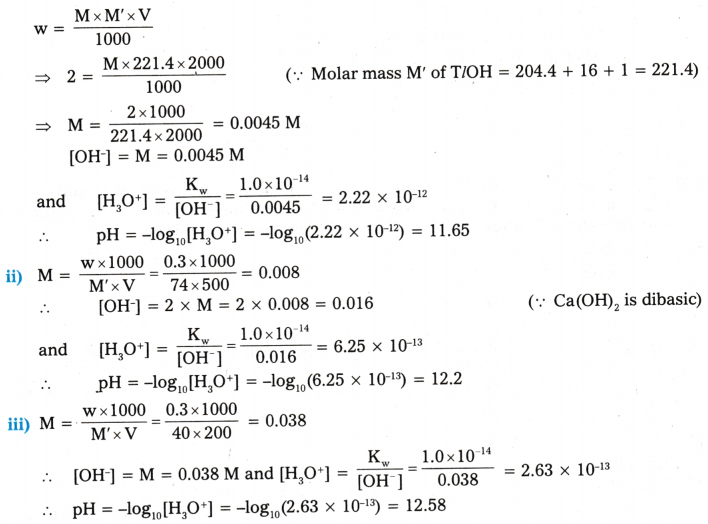
Equilibrium Questions and Answers AP Inter 1st Year Chemistry Chapter 6 20
iv) Suppose the molarity of the diluted solution is M’.
M1V1 = M’V’ ⇒ 13.6 × 1 = M’ × 1000
⇒ M’ = \(\frac{13.6 \times 1}{1000}\) = 1.36 × 10⁻²
∴ [H3O+] = 1.36 × 10⁻² M
pH = -log10[H3O+] = -log10(1.36 × 10⁻²) = 1.87

Equilibrium Questions and Answers AP Inter 1st Year Chemistry Chapter 6

Question 50.
The degree of ionization of a 0.1 M bromoacetic acid solution is 0.132. Calculate the pH of the solution and the PK. of bromoacetic acid.
Answer:

Equilibrium Questions and Answers AP Inter 1st Year Chemistry Chapter 6 21
∴ Ka = \(\frac{\left[\mathrm{BrCH}_2 \mathrm{COO}^{-}\right]\left[\mathrm{H}^{+}\right]}{\left[\mathrm{BrCH}_2 \mathrm{COOH}\right]}=\frac{(0.1 \times 0.132) \times(0.1 \times 0.132)}{0.1(1-0.132)}\) = 2.01 × 10⁻³
pKa = -log10Ka = -log10(2.01 × 10⁻³) = 2.70
[H+] = 0.1 × 0.132 = 0.0132 = 1.32 × 10⁻²
pH = -log10[H+] = – log10(1.32 × 10⁻²) = 1.88

Question 51.
The pH Of 0.005 M codeine (C18H21NO3) solution is 9.95. Calculate its ionization constant as pKb.
Answer:
Codeine is a base, therefore, it is expected to ionise in solution as follows.
Codeine + H2 ⇌ Codeine H+ + OH–
Given, pH = 9.95
∴ POH = 14 – 9.95 = 4.05
i.e., -log10[OH–] = 4.05
[OH–] = antilog10(-4.05) = 8.91 × 10⁻⁵
[Codeine H+] = [OH–] = 8.91 × 10⁻⁵
[Codeine] = 0.005 M
Kb = \(\frac{\left[\text { Codeine } \mathrm{H}^{+}\right]\left[\mathrm{OH}^{-}\right]}{[\text {Codeine }]}=\frac{\left(8.91 \times 10^{-5}\right) \times\left(8.91 \times 10^{-5}\right.}{0.005}\) = 1.587 × 10⁻⁵
[Codeine W] [OH ]
and pKb = -log10Kb = -log10(1.587 × 10⁻⁶) = 5.8

Question 52.
What is the pH of 0.001 M aniline solution ? The ionization constant of aniline can be taken as 4.27 × 10⁻¹⁰. Calculate the degree of ionization of aniline in the solution. Also calculate the ionization constant of the conjugate acid of aniline.
Answer:
Kb for aniline = 4.27 × 10⁻¹⁰
C6H5NH2 + H3O+ ⇌ C6H5NH3+ + OH–
Kb = \(\frac{\left[\mathrm{C}_6 \mathrm{H}_5 \mathrm{NH}_3^{+}\right]\left[\mathrm{OH}^{-}\right]}{\left[\mathrm{C}_6 \mathrm{H}_5 \mathrm{NH}_2\right]}\)
Since, [C6H5NH3+] = [OH–] and dissociation of aniline is not much, we have
and
[OH–] = {Kb[C6H5NH2]}1/2 = (4.27 × 10-10 × 0.00)1/2 = 6.53 × 10⁻⁷ M
∴ POH = -log10(6.53 × 10⁻⁷) = 6.185
and pH = 14 – 6.185 = 7.815

Equilibrium Questions and Answers AP Inter 1st Year Chemistry Chapter 6 22
∴ Kb = \(\frac{0.001 \alpha \times 0.001 \alpha}{0.001(1-\alpha)}=\frac{0.001 \alpha^2}{1-\alpha}\) = 0.001 α2 (Since, α is very small, 1 – α = 1)
Thus, 0.001 α2 = 4.27 × 10⁻¹⁰ ⇒ α = \(\left(\frac{4.27 \times 10^{-10}}{0.001}\right)^{1 / 2}\) = 6.53 × 10⁻⁴
For a pair of conjugate acid and base,
pKb + pKa = 14 ⇒ pKa = 14 – pKb = 14 – (-log10 4.27 × 10⁻¹⁰) = 14 – 9.37 = 4.63
Hence, the ionisation constant of the conjugate acid.
Ka = antilog10(-pKa) (∵ pKa = -log10Ka)
= antilog10 (-4.63) = 2.34 × 10⁻⁵

Question 53.
Calculate the degree of ionization of 0.05 M acetic acid if its pKa value is 4.74. How is the degree of dissociation affected when its solution also contains
i) 0.01 M
ii) 0.1 M of HCl?
Answer:
pKa = -log10Ka = 4.74
∴ Ka = antilog10(-4.74) = 1.82 × 10⁻⁵
For a weak electrolyte, α = \(\sqrt{\frac{K_a}{c}}\); For acetic acid, α = \(\sqrt{\frac{\mathrm{K}_{\mathrm{a}}}{\mathrm{c}}}=\sqrt{\frac{1.82 \times 10^{-5}}{0.05}}\) = 1.908 × 10⁻²
In the presence of HCl, the dissociation of acetic acid will be suppressed due to common ion effect.

i) When the solution contains 0.01 M of HCl also : Suppose the concentration of CH3COOH decreases by x.

Equilibrium Questions and Answers AP Inter 1st Year Chemistry Chapter 6 23
Ka = \(\frac{\left[\mathrm{CH}_3 \mathrm{COO}^{-}\right]\left[\mathrm{H}^{+}\right]}{\left[\mathrm{CH}_3 \mathrm{COOH}\right]}\) ⇒ 1.80 × 10-5 = \(\frac{x(x+0.01)}{(0.05-x)}=\frac{0.01 x}{0.05}\)
(∵ Since, x is very small, x + 0.01 = 0.01 and 0.05 – x = 0.05)
⇒ x = \(\frac{1.82 \times 10^{-5} \times 0.05}{0.01}\) = 9.1 × 10⁻⁵
Degree of dissociation (α) = \(\frac{\text { Amount dissociated }}{\text { Initial amount }}=\frac{9.1 \times 10^{-5}}{0.05}\) = 1.85 × 10⁻⁵

ii) When the solution contains 0.1 M of HCl:
Proceeding as above, we have, α’ = \(\frac{1.82 \times 10^{-5} \times 0.05}{0.1}\) = 9.1 × 10⁻⁴ and
α’ = \(\frac{9.1 \times 10^{-6}}{0.05}\) = 1.82 × 10⁻⁴

Question 54.
The ionization constant of dimethylamine is 5.4 × 10⁻⁴. Calculate its degree of ionization in its 0.02 M solution. What percentage of dimethylamine is ionized if the solution is also 0.11 in NaOH?
Answer:
Dimethylamine is weak base. For a weak base, α = \(\sqrt{\frac{K_b}{c}}\)
Therefore, for dimethylamine, α = \(\sqrt{\frac{5.4 \times 10^{-4}}{0.02}}\) = 0.164
In presence of 0.1 M of NaOH, its dissociation will get suppressed.

Equilibrium Questions and Answers AP Inter 1st Year Chemistry Chapter 6 24
∴ Ka = \(\frac{x(x+0.1)}{0.02-x}=\frac{0.1 x}{0.02}\) (∵ x is very small, x + 0.1 ≈ 0.1 and 0.02 – x ≈ 0.02)
⇒ 5.4 × 10-4 = \(\frac{0.1 x}{0.02}\) ⇒ x = \(\frac{5.4 \times 10^{-4} \times 0.02}{0.1}\) = 1.08 × 10⁻⁴
∴ Percent ionisation of dimethylamine = \(\frac{\text { Amount dissociated }}{\text { Total amount }}\) × 100
= \(\frac{x \times 100}{0.02}=\frac{1.08 \times 10^{-4}}{0.02}\) × 100 = 0.57%

Question 55.
Calculate the hydrogen ion concentration in the following biological fluids whose pH are given below.
i) Human muscle-fluid, 6.83
iii) Human blood, 7.38
ii) Human stomach fluid, 1.2
iv) Human saliva, 6.4
Answer:
Given, pH = -log10[H3O+]
[H3O+] = antilog10(-pH)
i) [H3O+] in human muscle fluid = antilog10(-6.83) = 1.47 × 10⁻⁷ mol L-1
ii) [H3O+] in stomach fluid = antilog10(-1.2) = 6.3 × 10⁻² mol L-1
iii) [H3O+] in human blood = antilog10(-7.38) = 4.1 × 10⁻⁸ mol L-1
iv) [H3O+] in human saliva = antilog10(-6.4) = 3.98 × 10⁻⁷ mol L-1

Question 56.
The pH of milk, black coffee, tomato juice, lemon juice and egg white are 6.8, 5.0, 4.2, 2.2 and 7.8 respectively. Calculate the corresponding hydrogen ion concentration in each.
Answer:
[H+] = [H3O+]
= = antilog10(-pH) = antilog10(-6.8) = 1.58 × 10⁻⁷ mol L-1
[H3O+] in milk = antilog10(-5.0) = 1.0 × 10⁻⁵ mol L-1
[H3O+] in black coffee = antilog10(-4.2) =1.0 × 10⁻⁵ mol L-1
[H3O+] in tomato juice = antilog10(-2.2) = 6.31 × 10⁻⁵ mol L-1
[H3O+] in lemon juice = antilog10(-7.8) = 6.31 × 10⁻³ mol L-1
[H3O+] in egg white = antilog10(-7.8) = 1.58 × 10⁻⁸ mol L-1

Equilibrium Questions and Answers AP Inter 1st Year Chemistry Chapter 6

Question 57.
If 0.561 g of KOH is dissolved in water to give 200 mL of solution at 298 K. Calculate the concentrations of potassium, hydrogen and hydroxyl ions. What is its pH ?
Answer:
Molarity of a solution is given by w = \(\frac{\mathrm{M} \times \mathrm{M}^{\prime} \times \mathrm{V}}{1000}\)
∴ 0.561 = \(\frac{\mathrm{M} \times 56 \times 200}{1000}\) (mol. mass of KOH = 56)
⇒ M = \(\frac{0.561 \times 1000}{56 \times 200}\) = 0.05 M
Since, KOH dissociates completely in the solution, KOH → K+ + OH–
∴ [K+] = [OH–] = Molarity of KOH = 0.05 M
and [H+] = \(\frac{K_w}{\left[\mathrm{OH}^{-}\right]}=\frac{1.0 \times 10^{-14}}{0.05}\) = 2.0 × 10⁻¹³ M
Now, pH = -log10[H+] = -log10(2 × 10-13) = -log102 + 13 log 10 = -0.3010 + 13 = 12.70

Question 58.
The solubility of Sr(OH)2 at 298 K is 19.23 g/L of solution. Calculate the concentrations of strontium and hydroxyl ions and the pH of the solution.
Answer:
Molecular mass of Sr(OH)2 = 87.6 + 2 × (16 + 1) = 121.6
Solubility of Sr(OH)2 = 19.23 g/L = \(\frac{19.23}{121.6}\) mol/L-1 = 0.1581 mol L-1
Sr(OH)2 ⇌ Sr2+ + 2OH–
If Sr(OH)2 is assumed to be completely ionised, we have
[Sr2+] = 0.1581 mol L-1
and [OH–] = 2 × 0.1581 = 0.3162 mol L-1
∴ [H3O+] = \(\) = 3.16 × 10⁻¹⁴
and pH = -log10[H3O+] = -log10(3.16 × 10⁻¹⁴) = 13.50

Question 59.
The ionization constant of propanoic acid is 1.32 × 10⁻⁵. Calculate the degree of ionization of the acid in its 0.05 M solution and also its pH. What will be its degree of ionization if the solution is 0.01 M in HCl also ?
Answer:

Equilibrium Questions and Answers AP Inter 1st Year Chemistry Chapter 6 25
∴ Ka = \(\frac{\left[\mathrm{CH}_3 \mathrm{CH}_2 \mathrm{COO}^{-}\right]\left[\mathrm{H}^{+}\right]}{\left[\mathrm{CH}_3 \mathrm{CH}_2 \mathrm{COOH}\right]}\)
or 1.32 × 10-5 = \(\frac{0.05 \alpha \times 0.05 \alpha}{0.05(1-\alpha)} \approx \frac{(0.05 \alpha)^2}{0.05}=\frac{0.05 \alpha^2}{1}\)
α = 1.63 × 10⁻²
Then, [H3O+] = 0.05α = 0.05 × 1.63 × 10-2 = 8.15 × 10⁻⁴ M
∴ pH = 3.09
In the presence of 0.1 M of HCl, let ‘α’ be the degree of ionization.
Then, [H3O+] = 0.01; [A–] = 0.05 α’ ; [HA] = 0.05
Ka = \(\frac{0.01 \times 0.05 \alpha^{\prime}}{0.05}\) ⇒ 1.32 × 10-5 = 0.01 α’
⇒ α’ = 1.32 × 10⁻³

Question 60.
The pH of 0.1 M solution of cyanic acid (HCNO) is 2.34. Calculate the ionization constant of the acid and its degree of ionization in the solution.
Answer:
Suppose the degree of ionisation of HCNO is α.

Equilibrium Questions and Answers AP Inter 1st Year Chemistry Chapter 6 26
Given that pH of the solution is 2.34.
∴ -log10(0.1 × α) = 2.34
⇒ log10(0.1 × α) = -2.34 ⇒ 0.1 × α = antilog10(-2.34) = 0.00457 = \(\frac{0.00457}{0.1}\) = 0.0457
Ka = \(\frac{\left[\mathrm{H}^{+}\right]\left[\mathrm{CNO}^{-}\right]}{[\mathrm{HCNO}]}=\frac{(0.1 \times \alpha) \times(0.1 \times \alpha)}{0.1(1-\alpha)}\)
= \(\frac{(0.1 \times \alpha)^2}{0.1}=\frac{(0.1 \times 0.0457)^2}{0.1}\) = 2.09 × 10⁻⁴

Question 61.
The ionization constant of nitrous acid is 4.5 × 10⁻⁴. Calculate the pH of 0.04 M sodium nitrite solution and also its degree of hydrolysis.
Answer:
Sodium nitrite is a salt of a strong base and a weak acid. For such a salt,
pH = \(\frac{1}{2}\)pKw + \(\frac{1}{2}\)pKa + \(\frac{1}{2}\)log10c
= \(\frac{1}{2}\) × (-log101.0 × 10-14) + \(\frac{1}{2}\) × (-log104.5 × 10-4) + \(\frac{1}{2}\) × log100.04
= 7.0 + 1.673 – 0.698 = 7.975
The degree of hydrolysis of such a salt is given by
h = \(\sqrt{\frac{K_w}{K_a \cdot c}}=\sqrt{\frac{1.0 \times 10^{-14}}{4.5 \times 10^{-4} \times 0.04}}\) = 2,36 × 10⁻⁵

Question 62.
A 0.02 M solution of pyridinium hydrochloride has pH = 3.44. Calculate the ionization constant of pyridine.
Answer:
Pyridinium hydrochloride is the salt of a weak base (pyridine) and a strong acid (HCl). For the salt of a weak base and strong acid.
pH = \(\frac{1}{2}\)pKw + \(\frac{1}{2}\)pKa + \(\frac{1}{2}\)log10c
Substituting the values, we have
3.44 = [-\(\frac{1}{2}\)log101.0 × 10-14 – \(\frac{1}{2}\) × (- log10 Kb) – \(\frac{1}{2}\) × log10 0.02
⇒ 3.44 = – \(\frac{1}{2}\) × (-14) + \(\frac{1}{2}\)log10 Kb – \(\frac{1}{2}\) × (-1.699)
⇒ 3.44 = 7 + \(\frac{1}{2}\)log10Kb + 0.849
log10Kb = (3.44 – 7 – 0.849) × 2 = -8.82
⇒ Kb = anti log10(-8.82) = 1.5 × 10⁻⁹

Question 63.
Predict if the solutions of the following salts are neutral, acidic or basic.
NaCl, KBr, NaCN, NH4NO3, NaNO2 and KF
Answer:
Neutral solutions : NaCl, KBr.
Acidic solutions : NH4NO3.
Basic solutions : NaCN, NaNO2, KF.

Equilibrium Questions and Answers AP Inter 1st Year Chemistry Chapter 6

Question 64.
The ionization constant of chloroacetic acid is 1.35 × 10⁻³. What will be the pH of 0.1 M acid and its 0.1 M of sodium salt solution ?
Answer:
pH of 0.1 M acid :
Suppose the degree of ionisation of chloroacetic acid is α.

Equilibrium Questions and Answers AP Inter 1st Year Chemistry Chapter 6 27
∴ Ka = \(\frac{\left[\mathrm{Cl} \mathrm{CH}_2 \mathrm{COO}^{-}\right]\left[\mathrm{H}^{+}\right]}{\left[\mathrm{ClCH}{ }_2 \mathrm{COOH}\right]}\)
⇒ 1.35 × 10-3 = \(\frac{0.1 \alpha \times 0.1 \alpha}{0.1(1-\alpha)}\) ≈ \(\frac{(0.1 \alpha)^2}{0.1}\) ⇒ α = \(\left(\frac{1.35 \times 10^{-3} \times 0.1}{(0.1)^2}\right)^{1 / 2}\) = 0.116
∴ [H+] = 0.1 × α = 0.1 × 0.116 = 0.0116
and pH = -log10[H+] = -log10(0.0116) = 1.94
pH of 0.1 M of sodium salt:
The sodium salt of chloroacetic acid is the salt of a weak acid and a strong base.
For such as salt
pH = \(\frac{1}{2}\)pKw + \(\frac{1}{2}\)pKa + \(\frac{1}{2}\)log10c
= \(\frac{1}{2}\)(-log101.0 × 10-14) + \(\frac{1}{2}\)(-log101.35 × 10-3) + \(\frac{1}{2}\) × log100.1
= 7.0 + 1.435 + (-0.5) = 7.94

Question 65.
Ionic product of water at 310 K is 2.7 × 10⁻¹⁴. What is the pH of neutral water and temperature?
Answer:
In neutral water, [H3O+] = [OH–]
Kw = [H3O+] [OH–] = [H3O+]2
⇒ [H3O+]2 = Kw = 2.7 × 10⁻¹⁴
[H3O+] = (2.7 × 10⁻¹⁴)12 = 1.64 × 10⁻⁷
Hence, pH = -log10[H3O+] = -log10(1.64 × 10⁻⁷) = 6.78

Question 66.
Calculate the pH of the resultant mixtures.
i) 10 mL Of 0.2 M of Ca(OH)2 + 25 mL of 0.1 M of HCl
ii) 10 mL Of 0.01 M of H2SO4 + 10 mL of 0.01 M of Ca(OH)2
iii) 10 mL of 0.1 M of H2SO4 + 10 mL of 0.1 M of KOH
Answer:
i) Normality of Ca(OH)2 solution = 0.2 × 2 = 0.4 N
and normality of HCl solution = 0.1 × 1 = 0.1 N
Gram equivalents of is taken as = \(\frac{\mathrm{N} \times \mathrm{V}}{1000}=\frac{0.4 \times 10}{1000}\) = 0.004
Gram equivalents of HCl is taken as = \(\frac{N \times V}{1000}=\frac{0.1 \times 25}{1000}\) = 0.0025
0.0025 gram eq. of HCl would neutralise 0.0025 gram eq. of Ca(OH)2.
∴ Amount of left unreacted = 0.004 – 0.0025 = 0.0015 gram equivalents
Total volume of the mixture = 10 + 25 = 35 mL
Suppose the normality of the resultant solution is N’.
No.of gram eq. = \(\frac{\mathrm{N}^{\prime} \times \mathrm{V}}{1000}\)
⇒ 0.0015 = \(\frac{\mathrm{N}^{\prime} \times 35}{1000}\)
⇒ N’ = \(\frac{0.0015 \times 1000}{35}\) = 0.0429
∴ [OH–] = N’ = 0.042
∴ [H3O+] = \(\frac{\mathrm{K}_{\mathrm{w}}}{\left[\mathrm{OH}^{-}\right]}=\frac{1.0 \times 10^{-14}}{0.0429}\) = 2.331 × 10⁻¹³
pH = -log10[H3O+] = -log102.331 × 10-13 = 12.63

ii) 10 mL of 0.01 M of H2SO4 would exactly neutralise 10 mL of 0.01 M Ca(OH)2 and resultant solution would be neutral.
Hence, pH of the resultant mixture = 7.00

iii) Normality of H2SO4 = 0.1 × 2 = 0.2 N and Normality of KOH = 0.1 × 1 = 0.1 N
Gram equivalents of H2SO4 = \(\frac{\mathrm{N} \times \mathrm{V}}{1000}=\frac{0.2 \times 10}{1000}\) = 0.002
Gram equivalents of NaOH = \(\frac{\mathrm{N} \times \mathrm{V}}{1000}=\frac{0.1 \times 10}{1000}\) = 0.001
0.001 gram equation of NaOH would neutralise 0.001 gram equation of H2SO4.
Total volume of the mixture = 10 + 10 = 20 mL. If the normality of the resultant solution is N’.
0.001 = \(\frac{\mathrm{N}^{\prime} \times 20}{1000}\) ⇒ \(\frac{0.001 \times 1000}{20}\) = 0.05
∴ [H3O+] = N’ = 0.05
pH = -log10[H3O+] = -log100.05 = 1.30

Question 67.
Determine the solubilities of silver chromate, barium chromate, ferric hydroxide, lead chloride and mercurous iodide at 298 K from their solubility product constants given. Determine also the molarities of individual ions.
Given, Ksp Ag2CrO4 = 1.1 × 10⁻¹², Ksp BaCrO4 = 1.2 × 10⁻¹⁰
Ksp = 1.0 × 10-38, Ksp PbCl2 = 1.6 × 10⁻⁵,
Ksp Hg2I2 = 4.5 × 10⁻²⁹
Answer:
i) For silver chromate (Ag2CrO4) :
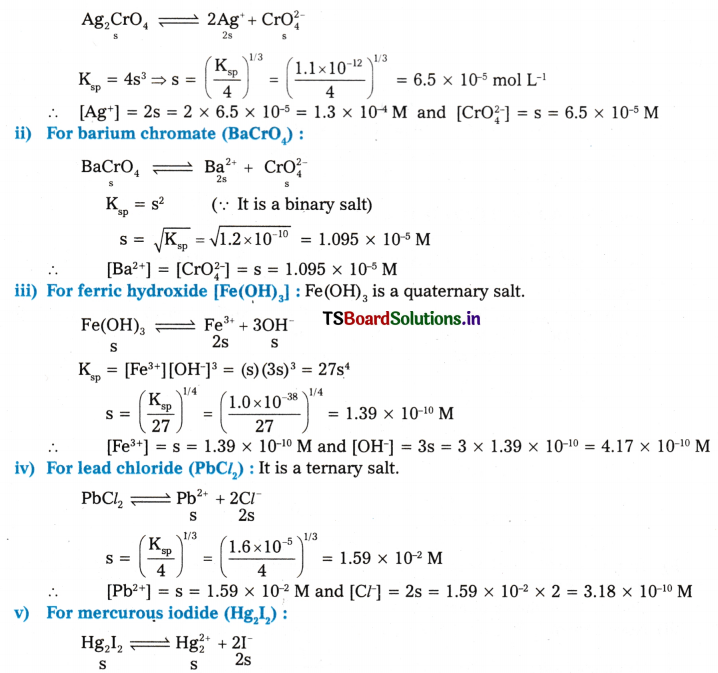
Equilibrium Questions and Answers AP Inter 1st Year Chemistry Chapter 6 281
s = \(\) = \(\) = 2.24 × 10⁻¹⁰ M
and [Hg22+] = s = 2.2 × 10⁻¹⁰ M and [I–] = 2s = 2.24 × 10-10 × 2 = 4.48 × 10⁻¹⁰ M

Question 68.
The solubility product constant of Ag2CrO4 and AgBr are 1.1 × 10⁻² and 5.0 × 10⁻¹⁵ respectively. Calculate the ratio of the molarities of their saturated solutions.
Answer:
For Ag2CrO4 (a ternary salt), s = \(\left(\frac{\mathrm{K}_{\mathrm{sp}}}{4}\right)^{1 / 3}\) = \(\left(\frac{1.1 \times 10^{-12}}{4}\right)^{1 / 3}\) = 6.5 × 10⁻⁵ M
For AgBr (a binary salt), s’ = \(\sqrt{\mathrm{K}_{\mathrm{sp}}}\) = \(\sqrt{5.0 \times 10^{-13}}\) = 7.1 × 10⁻⁷ M
Ratio of molarities of their saturated solutions = \(\frac{\mathrm{s}}{\mathrm{~s}^{\prime}}\) = \(\frac{6.5 \times 10^{-5}}{7.1 \times 10^{-7}}\) = 91.5

Question 69.
Equal volumes of 0.002 M solutions of sodium iodate and cupric chlorate are mixed together. Will it lead to precipitation of copper iodate? (For cupric iodate Ksp = 7.4 × 10⁻⁸).
Answer:
[I\(\mathrm{O}_3^{-}\) = 0.002 M and [Cu2+] = 0.002 M
Cu2+ + 2I\(\mathrm{O}_3^{-}\) → Cu(IO3)2
K,sub.sp Cu(IO3)2 = [Cu2+][I\(\mathrm{O}_3^{-}\)]2 = 7.4 × 10⁻⁸ (given)
On mixing equal volumes, the concentration gets halved.
[Cu2+][I\(\mathrm{O}_3^{-}\)]2 = \(\left(\frac{0.002}{2}\right)\) × \(\left(\frac{0.002}{2}\right)^2\) = 1.0 × 10⁻⁹
Since, the ionic product is less than the solubility product, precipitation will not take place.

Equilibrium Questions and Answers AP Inter 1st Year Chemistry Chapter 6

Question 70.
The ionization constant of benzoic acid is 6.46 × 10⁻⁵ and Ksp for silver benzoate is 2.5 × 10⁻¹³. How many times is silver benzoate more soluble in a buffer of pH 3.19 compared
to its solubility in pure water?
Answer:
C6H5COOAg \(\text { ⇌ }\) C6H5COO– + Ag+
Solubility in water : s = \(\sqrt{\mathrm{K}_{\mathrm{sp}}}\) = \(\sqrt{2.5 \times 10^{-13}}\) = 5.0 × 10⁻⁷ mol L-7
Solubility in a buffer of pH = 3.19:
In a buffer of pH = 3.19, -log10[H+] = 3.19
∴ [H+] = antilog10(-3.19) = 6.457 × 10⁻⁴ mol L-1.
The H+ ions present in buffer solution will combine with C6H5COO– ions to form C6H5COOH but (H+) in the solution will remain unchanged because the solution is a buffer solution.
C6H5COOH \(\text { ⇌ }\) C6H5COO– + H+
∴ Ka = \(\frac{\left[\mathrm{C}6 \mathrm{H}_5 \mathrm{COO}^{-}\right]\left[\mathrm{H}^{+}\right]}{\left[\mathrm{C}_6 \mathrm{H}_5 \mathrm{COOH}\right]}\) ⇒ \(\frac{\left[\mathrm{C}_6 \mathrm{H}_5 \mathrm{COOH}\right]}{\left[\mathrm{C}_6 \mathrm{H}_5 \mathrm{COO}^{-}\right]}\) = \(\frac{\left[\mathrm{H}^{+}\right]}{\mathrm{K}{\mathrm{a}}}\) = \(\frac{6.457 \times 10^{-4}}{6.46 \times 10^{-5}}\) = 9.995 ….. (i)
Suppose the solubility of silver benzoate in the buffer is s’ mol L-1.
Since, almost all the C6H5COO– ions get converted to benzoic acid which remains almost unionised, we have
s’ = [Ag+] = [C6H5COO-] + [C6H5COOH]
= [C6H5COO–] + 9.995 × [C6H5COO–] (From eq. (i))
∴ [C6H5COO-] = \(\frac{\mathrm{s}^{\prime}}{10.995}\)
Ksp = [C6H5COO–][Ag+]
⇒ 2.5 × 10-13 = \(\frac{\mathrm{s}^{\prime}}{10.995}\) × s’ = s‘2 = 2.5 × 10-13 × 10.995
⇒ s’ = \(\sqrt{2.5 \times 10^{-13} \times 10.995}\) = 1.657 × 10⁻⁶ mol L-1
∴ \(\frac{s^{\prime}}{s}\) = \(\frac{1.657 \times 10^{-6}}{5.0 \times 10^{-7}}\) = 3.314

Question 71.
What is the maximum concentration of equlmolar solutions of ferrous sulphate and sodium sulphide so that when mixed in equal volumes, there is no precipitation of iron sulphide? (For an iron sulphide, Ksp = 6.3 × 10⁻¹⁸).
Answer:
Suppose the required concentration is x M. On mixing equal volumes, concentration gets halved. Therefore, [Fe2+] = \(\frac{\mathbf{x}}{2}\) and [S2-] = \(\frac{\mathbf{x}}{2}\)
For the state of no precipitation, [Fe2+] [S2-] = Ksp
⇒ \(\frac{x}{2} \cdot \frac{x}{2}[latex] 6.3 × 10⁻¹⁸ ⇒ x = (6.3 × 10-18 × 4)1/2 = 5.02 × 10⁻⁹ mol L-1

Question 72.
What is the minimum volume of water required to dissolve 1 g of calcium sulphate at 298 K? (For calcium sulphate, Ksp is 9.1 × 10⁻⁸). V
Answer:
For a binary salt, s = [latex]\sqrt{K_{s p}}\)
∴ For CaSO4, S = 1\(\sqrt{9.1 \times 10^{-6}}\) = 3.0 × 10⁻³ mol L-1
Solubility of CaSO4 in g/L = 3.0 × 10-3 × 136 = 0.41 gL-1
(Mol. mass of CaSO4 = 40 + 32 + 64 = 136 g/mol)
Thus, a saturated solution of CaSO4 contains 0.41 g of the salt in 1 L.
Hence, the volume of water required to dissolve 1 g of CaSO4 = \(\frac{1}{0.41}\) = 2.44 L

Question 73.
The concentration of suiphide ion in 0.1 M HCl solution saturated with hydrogen sulphide is 1.0 × 10⁻¹⁹M. If 10 ml. of this is added to 5 mL of 0.04 M solution of the following FeSO4, MnCl2, ZnCl2 and CdCl2. In which of these solutions precipitation will take place?
Answer:
Precipitation takes only when the ionic product exceeds the solubility product.
Since 10 mL of the solution containing S2- ion is mixed with 5 mL of the different metal salt solutions, volume of the mixture after mixing in each case = 10 + 5 = 15 mL.
∴ [S2-] = 1.0 × 10⁻¹⁹ × \(\frac{10}{15}\) = 6.67 × 10⁻²⁰M
and M2+ = [Fe2+] = [Mn2+] = [Zn2+] = [Cd2+] = 0.04 × \(\frac{5}{15}\) = 1.33 × 10⁻² M
Therefore, in each case
Ionic product = [M2+][S2+] = (1.33 × 10-2) × (6.67 × 10-20) = 8.87 × 10⁻²²
This ionic product is greater than the solubility product of ZnS and CdS. Hence, precipitation will take place only in ZnCl2 and CdCl2 solutions.

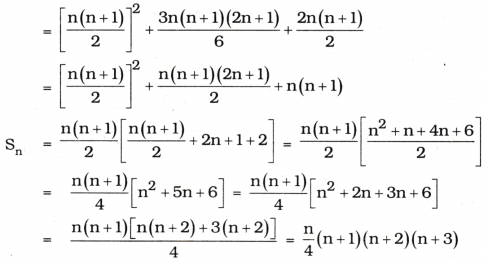
Dialogue Writing Skills Inter 1st Year English Grammar

For systematic learning, students can include Inter 1st Year English Grammar with Answers and Dialogue Writing Skills in English Inter 1st Year in their daily study routine.

AP Inter 1st Year English Dialogue Writing Skills with Answers

Conversation forms the basis of communication skills. Regular practice is required to equip oneself with this essential skill. Greetings, courtesies, polite way of agreement or otherwise, etc. form an important component of conversation. Learning to use them properly is, therefore, of great help.

In the Public Examination, an incomplete dialogue usually with four blanks is given. Four appropriate words or phrases are also provided. The student is required to understand the given part and respond to fill in the blanks suitably. Careful observation of the part given before and after the blank and a little bit of common sense will help the student answer this question correctly. There may be more than one possible way of filling in the given blank. One should not worry about this as long as the completed dialogue sounds meaningful. Study the following dialogues.

Examples

1. Read the dialogue given below regarding a complaint over a phone call and All the blanks with the suitable dialogues given below.

Making a Complaint – a faulty Television Set

Shopkeeper : ___________ (1) ___________
Customer : Yes please! I have a complaint regarding with television set.
Shopkeeper : ___________ (2)___________
Customer : Oh, it s SM004 – NEW. I bought this television here about three months ago, but the sound and picture quality are not so good.
Shopkeeper : Can you explain in more detail ?
Customer : ___________ (3) ___________ there’s a dark line down the left – hand side of the screen.
Shopkeeper : Do you have an outdoor antenna ?
Customer : Yes, I do.
Shopkeeper : ___________ (4) ___________
Customer : Several times.
Shopkeeper : ___________ (5) ___________
Customer : I am not so happy with the television set. I want a refund.
Shopkeeper : I’m afraid it isn’t our policy to give refunds, sir.
Customer : ___________ (6) ___________

Choose the correct dialogue from the following to make the above conversation meaningful.

a) Well then, I want to talk to the manager.
b) I’ll get our engineers to have a look at it.
c) Have you tried adjusting the antenna ?
d) Good afternoon, can 1 halp you ?
e) May I know the model number of it ?
f) Oh, yes, of course, the picture is always flickering and there’s an annoying hissing sound in the background.
Answers:
1) Good afternoon, can I help you ?
2) May I know the model number of it ?
3) Oh, yes, of course, the picture is always flickering and there is an annoying hissing sound in the background.
4) Have you tried adjusting the antenna ?
5) I’ll get our engineers to have a look at it.
6) Well then, I want to talk to the manager.

Dialogue Writing Skills Inter 1st Year English Grammar

2. Choose the appropriate dialogue from the given options to make the conversation below meaningful.
(Sita dropped a glass on the floor. Naturally, her mother asks for an explanation.)

Mother : What was that terrible noise ? ___________ (1) ___________ anything ?
Sita : I’m sorry, mom. ___________ (2) ___________ and it broke.
Mother : Were you hurt ?
Sita : No, but I’m really sorry.
Mother : I’m glad that you aren’t hurt ! It was ___________ (3) ___________ on your 1st birthday!
Sita : I feel bad for breaking the glass.
Mother : Haven’t I told you to handle glassware carefully ?
Sita : The glass was too slippery.
Mother : It’s okay, but you’ve ___________ (4) ___________.
Sita : Sure, Mom. ___________ (5) ___________ again.

a) I dropped a glass on the floor.
b) a gift from your aunt Meena
c) got to be cautious next time!
d) I’ll not let it happen
e) Did you drop
Answers:
a) Did you drop
b) I dropped a glass on the floor
c) a gift from your aunt
d) Meena got to be cautious next time!
e) I’ll not let it happen

Exercises For Practice

I. what happened, mind, see, slowly recuperating

Mahesh : Hi, Suresh. Why didn’t you turn up to college yesterday?
Suresh : Hello, Mahesh. I wasn’t feeling well yesterday.
Mahesh : ___________ (1) ___________ ?
Suresh : I had a severe stomach ache.
Mahesh : How are you now? Are you okay ?
Suresh : Yes, I’m ___________ (2) ___________ now.
Mahesh : Did you ___________ (3) ___________ the doctor ?
Suresh : Yes, I have seen the doctor. He told me to avoid fast food and have my meals on time.
Mahesh : I’ve seen you skip meals for a plate of pani poori many times.
Suresh : I love pani poori. But now, I’ve made up my mind not to have them.
Mahesh : Thank God. That must have been a terrible pain. Good that you changed your ___________ (4) ___________.
Answers:
1. What happened?
2. slowly recuperating
3. see
4. mind

Dialogue Writing Skills Inter 1st Year English Grammar

II. sure, hungry, else you need, replace

Victor : Excuse me, I ordered pasta, but this is noodles.
Waiter : I’m terribly sorry, sir. Let me ___________ (1) ___________ this immediately.
Victor : Thank you. Please ensure it’s vegetarian, as I requested earlier.
Waiter : ___________ (2) ___________, sir. I’ll double-check your order and bring it back soon.
Victor : I hope it doesn’t take too long. I’m quite ___________ (3) ___________.
Waiter : It won’t take long, sir. Thank you for your patience.
Victor : I appreciate your quick response.
Waiter : You’re welcome. Please let me know if there’s anything ___________ (4) ___________.
Answers:
1. replace
2. Sure
3. hungry
4. else you need

III. resolved, sure, hours, phone number

Rahul : Excuse me, my internet hasn’t been working for two days now.
Support Agent : I’m sorry to hear that, sir. Could you please provide your ___________(1)___________?
Rahul : Sure, it’s 9876543210. Can you fix this by today ?
Support Agent : I’ll escalate the issue right away. You should have it resolved within a few ___________ (2) ___________.
Rahul : Thank you. I really need it for an important online meeting.
Support Agent : I understand, sir. We’ll prioritize your request.
Rahul : Will you notify me once the issue is resolved ?
Support Agent : ___________ (3) ___________, sir. You’ll receive a confirmation message once it’s ___________ (4) ___________.
Answers:
1. phone number
2. hours
3. Sure
4. resolved

Exercises

Read each set of dialogues below and complete the blanks with appropriate words or phrases from the word bank provided.

I. expensive / iPhones / budget phones / tough

Ramu : I’m thinking of buying a mobile phone. I really like the iPhone.
Charan : ___________ (1) ___________ are amazing, no doubt!
Ramu : Many of my school friends have bought one.
Charan : Yeah, some of my friends have it too. But………… do you have the money ? It’s pretty expensive.
Ramu : It is ___________ (2) ___________. I know. That’s why I’m planning to ask my mom.
Charan : You know, the price of an iPhone is like two months of your mom’s salary. It might be tough for her.
Ramu : Hmm, you’re right. It is ___________ (3) ___________ for her. I didn’t think of her difficulties. Now, I think a budget phone will be enough for me. I’ll get a budget phone.
Charan : Exactly! These days, ___________ (4) ___________ have almost all the features we need. It’s better not to trouble our parents unnecessarily, especially just to follow what others are doing.
Answers:
1. iPhones
2. expensive
3. tough
4. budget phones

II. homemade food / for both of us / I’m hungry / let’s go

Sowmya : I’m famished. Shall we go out to eat something?
Navya : ___________ (1) ___________ too, but I want homemade food.
Sowmya : Homemade food isn’t tasty. At least I want something spicy and tasty.
Navya : Sure, but ___________ (2) ___________ is healthy. And we can cook our
Sowmya : But we have neither the energy nor the patience, not even the skill to cook.
Navya : You are correct.
Sowmya : I will pay for both of us. Shall we go out?
Navya : Sure, but you will pay ___________ (3) ___________
Sowmya : Let’s go out!
Navya : ___________ (4) ___________
Answers:
1. I’m hungry
2. homemade food
3. for both of us
4. Let’s go.

Dialogue Writing Skills Inter 1st Year English Grammar

III. having fun / photos / social media / memories

Tinnu : Why are you always clicking ___________ (1) ___________ ? We are here to enjoy the trip, not to take photos.
Bannu : But I want to make memories. Lots of memories.
Tinnu : ___________ (2) ___________ of taking photos? If you don’t really enjoy, you can’t make real memories. First, let’s have some fun.
Bannu : Fun ? I’m all in our ___________ (3) ___________. But don’t you think others need to know that we are having fun ?
Tinnu : We need to share our happiness, not our photos. By sharing our photos, we are just making others jealous.
Bannu : I think we are just inspiring them. It depends on how you look at it. I don’t want to blame social media.
Tinnu : Even I won’t blame ___________ (4) __________. But social media just increases our fears. So please keep your camera away.
Bannu : Sure. Come here, one more selfie.
Answers:
1. photos
2. Memories
3. having fun
4. social media

IV. deep breath /nothing / do you / shout

Rahim : Hey, I didn’t understand what our teacher said. I have a doubt.
Raju : __________ (1) __________ ? Then ask him. He’ll explain.
Rahim : But, I’m afraid. What if he shouts?
Raju : Why will he __________ (2) __________ at you? He won’t do such things. He will explain. Trust me.
Rahim : But what if others laugh at me? What if they think I know nothing?
Raju : Knowing __________ (3) __________ is not a problem. Not learning is a problem. Even others will learn something through your question. Take a deep breath.
Rahim : Ok, I’ll ask the doubt myself. Let me take a __________ (4) __________.
Raju : All the best. I know you’ll rock!
Answers:
1. Do you
2. shout
3. nothing
4. deep breath

V. our parents / greedy / everything / exams

Gita : Why do you always study so much? You are too greedy.
Madhu : I’m not __________ (1) __________. I just want to learn as much as I can. I don’t want to leave anything to chance.
Gita : But that’s too much. If I get some 50%, that’s enough for me. If I get less than that, I have to face the anger of my parents.
Madhu : I don’t think we should read for __________(2) __________. I read it because I love it.
Gita : But those questions won’t be asked in the exam.
Madhu : We shouldn’t read for the sake of __________ (3) __________. Imagine you go to a doctor with a strange problem, and the doctor says that your problem wasn’t asked in her exam. How would you feel?
Gita : I don’t go to such doctors. I want my doctor to know everything.
Madhu : It’s good thinking. But isn’t it fair? You expect others to know __________ (4) __________ but you don’t learn everything? W’e all should do our best.
Answers:
1. Thank you
2. cold and cough
3. That’s very nice
4. 200 rupees

Dialogue Writing Skills Inter 1st Year English Grammar

VI. the train to Delhi / you ‘re welcome / on time / excuse me

Doctor : Please take your seat.
Patient : __________ (1) __________
Doctor : Please tell me, how can I help you?
Patient : Sir, I have been suffering from fever for the last two days.
Doctor : Ok. Do you have a cold, cough, or anything else?
Patient : I have __________ (2) __________. Please give me medicine, doctor. I don’t want an injection.
Doctor : Don’t worry. I’m not giving you an injection. These medicines are enough.
Patient : __________ (3) __________ of you. How much is the fee?
Doctor : The fee is __________ (4) __________. Please pay it at the counter.
Answers:
1. Thank you
2. cold and cough
3. That’s very nice
4. 200

VII. the train to Delhi / you ‘re welcome / on time / excuse me

Customer : ___________, on which platform will the train to Delhi arrive?
Enquiry : __________ (2) __________ will arrive on platform number four.
Customer : When will it arrive? Is it on time?
Enquiry : The train will arrive in fifteen minutes, and yes, it is __________ (3) __________
Customer : Thank you for the information.
Enquiry : __________ (4) __________. Do you need any more information?
Customer : No, that’s all. Thank you for the help once again.
Answers:
1. Excuse me
2. The train to Delhi
3. on times
4. You’re welcome

VIII. thank you / good morning/hear that / studies

Principal : Good morning, Mr Anil. Welcome to the parent-teacher meeting.
Mr Anil : __________ (1) __________. Sir.
Principal : Please take a seat.
Mr Anil : __________ (2) __________. Sir. I am eager to know about my son’s progress.
Principal : Of course, your son is doing well in __________ (3) __________.
Mr Anil : It’s nice to __________ (4) __________. The whole credit goes to your staff.
Principal : It’s our duty to bring the best out of the students. I thank you for visiting.
Answers:
1. Good morning
2. Thank you
3. studies
4. hear that

IX. neglecting / just an exam / a movie / completing

Arjun : Hi! I am planning to go for a movie. Will you accompany me?
Karthik : __________ (1) __________! Are you even thinking? Tomorrow we have an exam.
Arjun : It’s __________ (2) __________ I’m very eager to see the first day first show.
Karthik : Bro, it’s not just an exam. You are __________ (3) __________ your studies. It’s not good on your part.
Karthik : Exams can’t be written the other day. But you can go to the movie after the exam. Even heroes don’t skip their schedules. movie after __________ (4) __________ the exam.
Karthik : That’s a good idea.
Answers:
1. A movie
2. just an exam
3. neglecting
4. completing

X. be completed / harm / microplastics / playing

Mom : Will you please stop playing games on your mobile phone?
Son : Mom, I’m not __________ (1) __________ games. I’m watching a video.
Mom : Whatever, it’s not good for your eyes to keep looking at the screen for hours together.
Son : Mom, I’ve got a project to __________ (2) __________ by this weekend. I’m watching a video related to that.
Mom : What’s the project about?
Son : It’s about microplastics.
Mom : __________ (3) __________. What is it?
Son : Just like plastic, there are very tiny particles that can cause harm to the Earth.
Mom : How do they cause __________ (4) __________ to the Earth?
Son : The usage of plastic has become a part of our life. When we dispose of any plastic object, it doesn’t degrade in the soil. Moreover, it pollutes our air, soil, and water too.
Mom : Interesting. Tell me more about microplastics once you complete your project.
Son : Sure, Mom.
Answers:
1. Playing
2. be completed
3. Microplastics
4. harm

XI. Read the following dialogue and fill the blanks with the words given below.

for you / thank you very much /your bill/ please wait

Sophia : Excuse me, I believe there’s been a msitake in my bill.
Manager : I’m sorry to hear that. Could you please show me __________ (1) __________ ?
Sophia : Here it is. I was charged for two desserts, but I only had one.
Manager : Let me check this for you. __________ (2) __________ while I verify it.
Sophia : Sure, I’ll wait. Thank you for looking into it.
Manager : You’re right. There was an error. I’ll fix it and issue a new bill right away.
Sophia : __________ (3) __________. Mistakes happen, but it’s great to see such prompt service.
Manager : Thank you for your understanding. Here’s your corrected bill. Please let us know if there’s anything else we can do __________ (4) __________.
Sophia : Thank you. Everything else was perfect. I’ll definitely visit again.
Answers:
1. your bill
2. Please wait
3. Thank you very much
4. for you

XII. Read the following dialogue and fill the blanks with the words given below.

have / hoped / advance / thank you very much

Elsa : Hi, Mia. I’m so sorry I couldn’t come to your party last night.
Mia : It’s okay, Elsa. But I really __________ (1) __________ you would be there.
Elsa : I know, and I feel terrible about it. Something urgent came up at home.
Mia : I understand. But next time, please let me know in __________ (2) __________.
Elsa : Absolutely. I’ll make it up to you with a coffee treat soon!
Mia : That sounds good ! But next time, you really __________ (3) __________ to make it.
Elsa : I promise. Your party pictures looked amazing!
Mia : __________(4) __________! It was a great evening. I hope to
see you at the next one.
Answers:
1. hoped
2. advance
3. have
4. Thank you very much

AP Inter 1st Year Maths Exercise 7c Solutions

Referring to the AP Inter 1st Year Maths Study Material Chapter 7 Binomial Theorem Exercise 7c Solutions makes it easier to understand complex problems.

AP Inter 1st Year Maths Binomial Theorem Solutions Exercise 7c

Find the coefficient of

Question 1.
x5 in (x + 3)8
Solution:
The general term Tr+1 of the binomial expansion (a + b)n is given by Tr+1 = nCr an-rbr
Here x5 is the Tr+1 term so a = x, b = 3 and n = 8
Tr+1 = 8Crx8-r3r ………..(1)
To find out the coefficient of x5, We have to equate x5 = x8-r =>r = 3
Putting the value of r in (1), we get T3+1 = 8C3 × x8-3 33
T4 = \(\frac{8!}{3!5!}\) × x5 × 27 = 1512 x5
Hence the coefficient of x5 = 1512

Question 2.
a5b7 in (a – 2b)12.
Solution:
The general term Tr+ t of the binomial expansion (a + b)n is given by Tr+1 = nCr an-rbr
Here a = a, b = -2b & n = 12
Substituting above values, we get Tr+1 = 12Cr a12-r (-2b)r … (1)
To find out the coefficient of a5, We equate a12-r = a5, r = 7
Putting r = 7 in (1) ⇒ Tg = 12C7 a5(-2b)7
T8 = \(\frac{12!}{7!5!}\) × a5 × (-2)7b7
= -101376 a5b7
Hence, the coefficient of a5b7 = -101376.

AP Inter 1st Year Maths Exercise 7c Solutions

Write the general term in the expansion of

Question 3.
(x3 – y)6
Solution:
The general term Tr+1 of the binomial expansion (a + b)n is given by Tr+1 = nCra”-b’… (1)
Here, a = x2, n = 6 and b = – y
Putting above values in (1)
Tr+1 = 6Cr x2(6-r) (-1)r yr
= 6Cr x12-2r x (-1)r X yr
= (-1)r 6Cr x12-2r yr

Question 4.
(x2 – yx)12, x ≠ 0.
Solution:
The general term Tr+x of the binomial expansion (a + b)n is given by Tr+1 = nCr an-r br
Here n = 12, a = x2 and b = -y x
Substituting the above values, we get
Tr+1 = 12Cr x2(12-r) (-1)r yrxr = (-1)r 12Cr x24-2r yr xr
= (-1)r 12Cr x24-r. yr

Question 5.
In the expansion of (1 + a)m+n, prove that the coefficients of am and an are equal.
Solution:
We know that the general term Tr+1 of the binomial expansion (a + b)n is given by
Tr+1 = nCr an-r br
Here n = m + n, a = 1 and b = a
Substituting the values in the general term
Tr+1 = m+nC. 1m+n-rar = m+nCr ar ………..(1)
Now, we have the general term for the expression is, Tr+1 = m+nCr ar
Now, for coefficient of am, Tm+1 = m+nCm am
Hence, for the coefficient of m, the value of r = m
So, the coefficient is m+nCm
Similarly, the coefficient of an is m+nCn
m+nCm = \(\frac{(\mathrm{m}+\mathrm{n})!}{\mathrm{m}!\mathrm{n}!}\) And also, m+nCn = \(\frac{(\mathrm{m}+\mathrm{n})!}{\mathrm{m}!\mathrm{n}!}\)
The coefficient of am and an are same that is \(\frac{(\mathrm{m}+\mathrm{n})!}{\mathrm{m}!\mathrm{n}!}\)

Question 6.
The coefficients of the (r – 2)th, rth and (r + 2)th terms in the expansion of (x + 1)n are in the ratio 1:3:5. Find n and r.
Solution:
The general term Tr+1 of the binomial expansion (a + b)n is given by Tr+1 = nCr an-r br
Here, the binomial is (1 + x)n where a = 1, b = x and n = n

The (r + 1)th term is given by
Tr+1 = nCr 1n-r xr ⇒ T(r + 1) = nCr xr
The coefficient of (r + 1)th term is nCr

The rth term is given by (r – 1)th term
T(r – 1 – 1) = nCr-1
⇒ Tr = nCr – 1xr-1
∴ The coefficeint of (r – 1)th term is nCr – 1

For (r – 1)th term, we will take (r – 2)th term
Tr – 2 + 1 = nCr-2 xr-2
Tr-1 = nCr-2xr-2
∴ The coefficeint of (r – 1)th term is nCr – 2

Given that the coefficient of (r – 1)th, rth and r + 1th term are in ratio 1: 3 : 5
Therefore,
\(\frac{\text { Coefficient of }(\mathrm{r}-1)^{\text {th }} \text { term }}{\text { Coefficient of } \mathrm{r}^{\text {th }} \text { term }}=\frac{1}{3}\)

\(\frac{{ }^n C_{r-2}}{{ }^n C_{r-1}}=\frac{1}{3} \Rightarrow \frac{\frac{n!}{(r-2)!(n-r+2)!}}{\frac{n!}{(r-1)(n-r+1)!}}=\frac{1}{3}\)

On rearrangement, we get
\(\frac{n!}{(r-2)!(n-r+2)!} \times \frac{(r-1)!(n-r+1)!}{n!}=\frac{1}{3}\)

By multiplying
⇒ \(\frac{(\mathrm{r}-1)(\mathrm{r}-2)!(\mathrm{n}-\mathrm{r}+1)!}{(\mathrm{r}-2)!(\mathrm{n}-\mathrm{r}+2)!}=\frac{1}{3} \Rightarrow \frac{(\mathrm{r}-1)(\mathrm{n}-\mathrm{r}+1)!}{(\mathrm{n}-\mathrm{r}+2)(\mathrm{n}-\mathrm{r}+1)!}=\frac{1}{3}\)

On simplifying we get,
⇒ \(\frac{(\mathrm{r}-1)}{(\mathrm{n}-\mathrm{r}+2)}=\frac{1}{3}\)
⇒ 3r – 3 = n – r + 2
⇒ n – 4r + 5 = 0 …. (1)

Also, \(\frac{\text { the coefficient of } r^{\text {th }} \text { term }}{\text { coefficient of } r+1^{\text {th }} \text { term }}=\frac{3}{5} \Rightarrow \frac{\frac{n!}{(r-1)!(n-r+1)!}}{\frac{n!}{r!(n-r)!}}=\frac{3}{5}\)

On rearranging we get,
⇒ \(\frac{n!}{(r-1)!(n-r+1)!} \times \frac{r!(n-r)!}{n!}=\frac{3}{5}\)

By multiplying
⇒ \(\frac{r(r-1)!(n-r)!}{r-1)!(n-r+1)!}=\frac{3}{5} \Rightarrow \frac{r(n-r)!}{(n-r+1)!}=\frac{3}{5} \Rightarrow \frac{r(n-r)!}{(n-r+1)(n-r)!}=\frac{3}{5}\)

On simplifying we get,
⇒ \(\frac{r}{(n-r+1)}=\frac{3}{5}\)
⇒ 5r = 3n – 3r + 3
⇒ 8r – 3n – 3 = 0 … (2)
We have 1 and 2 as
n – 4r + 5 = 0 …(1)
8r – 3n – 3 = 0 …(2)
Multiplying equation (1) by number (2)
2n – 8r + 10 = 0 …(3)
Adding equations (2) and (3)
2n – 8r + 10 = 0
⇒ -3n – 8r – 3 = 0
⇒ -n = -7
⇒ n = 7 and r = 3

AP Inter 1st Year Maths Exercise 7c Solutions

Question 7.
Prove that the coefficient of xn in the expansion of (1 + x)2n is twice the of xn in the expansion of (1 + x)2n-1.
Solution:
The general term Tr+1, of the binomial expansion (a + b)n is given by Tr+1 = nCr+1 an-rbr
The general term for binomial (1 + x)2n is
T(r+1) = 2nCrxr …(1)
To find the coefficient of xn, r = n
Tn+1 = 2nCnxn
The coefficeint of xn = 2nCn

The general term for binomial (1 + x)2n-1 is
Tr+1 = 2n-1Cr xr

To find the co-efficient of xn
Putting r = n
Tr+1 = 2n-1Cr xr
The coefficient of xn = 2n-1Cn
We have to prove
Coefficient of xn in (1 + x)2n = 2 coefficient of xn in (1 + x)2n-1
Consider LHS = 2nCn = \(\frac{2 n!}{n!(2 n-n)!}=\frac{2 n!}{n!(n)!}\)
Again consider RHS = 2 × 2n-1Cn
= 2 × \(\frac{(2 n-1)!}{n!(2 n-1-n)!}=2 \times \frac{(2 n-1)!}{n!(n-1)!}\)
Now multiplying and dividing by n we get, 2 × \(\frac{(2 n-1)!}{n!(n-1)!} \times \frac{n}{n}=\frac{2 n(2 n-1)!}{n!n(n-1)!}=\frac{2 n!}{n!n!}\)
From above equation LHS = RHS.
Hence proved.

Question 8.
Find a positive value of m for which the coefficient of x2 in the expansion (1 + x)m is 6.
Solution:
The general term Tr+1 of the binomial expansion (a + b)n is given by Tr+1 = nCr an-r br
Here, a = 1, b = x and n = m
Putting above values, Tr+1 = mCr 1n-r xr = mCr xr
We need the coefficient of x2
Putting r = 2, T2+1 = mC2 x2
The coefficient of x2 = mC2
Given that coefficient of x2 = mC2 = 6
⇒ \(\frac{\mathrm{m}!}{2!(\mathrm{m}-2)!}\) = 6
⇒ \(\frac{\mathrm{m}(\mathrm{~m}-1)(\mathrm{m}-2)!}{2 \times 1 \times(\mathrm{m}-2)!}\) = 6
⇒ m(m – 1) = 12
⇒ m2 – m – 12 = 0
⇒ m2 – 4m + 3m – 12 = 0
⇒ m(m – 4) + 3(m – 4) = 0
⇒ (m + 3) (m – 4) = 0
⇒ m = -3, 4
We need the positive value of m, so m = 4.

Common Errors Inter 1st Year English Grammar

For systematic learning, students can include AP Inter 1st Year English Grammar with Answers and Common Errors in English Inter 1st Year in their daily study routine.

AP Inter 1st Year English Common Errors with Answers

(A) USAGE OF ARTICLES (A, An, The) :

Rule 1 : Don’t use the’ before material nouns used in general sense.
(పదార్ధాల పేర్ల ముందు ‘the‘ నుపయోగింపరాదు.)
e.g. : 1. The gold is a precious metal. (Wrong)
Gold is a precious metal. (Right)

Rule 2 : No article is used before the branches of knowledge.
(విద్యలేక జ్ఞాన సంబంధ వాక్యాలముందు ఏ విధమైన Article నుపయోగింపరాదు.)
2. The Geology is an interesting subject. (W)
Geology is an interesting subject. (R)

Rule 3 : No article is used before the names of days, months and seasons.
(దినముల, నెలల, ఋతువుల పేర్ల ముందు ఏ Article నుపయోగింపరాదు.)
e.g. : 3. Sunday is a holiday. (not the Sunday)
4. If winter comes, can spring be far behind. (not ‘the winter’, not the spring)
5. May is the hottest month. (not the May)

Rule 4 : Don’t use any article before nouns in certain phrases.
(కొన్ని phrases లోని నామవాచకాల ముందు ఏ విధమైన Article నుపయోగింపరాదు.)
e.g. : 6. by air, by sea, over hill and dale etc.

Rule 5 : Don’t use ‘the’ before the names of games.
(ఆటల పేర్ల ముందు, ‘the’ నుపయోగింపరాదు.)
e.g. : 7. I play hockey. (not ‘the hockey’ )
8. Chess is a fine game. (not ‘the chess’)

Rule 6 : No article is used before a Common Noun used in the vocative case.
(సంబోధనాత్మక సాధారణ నమాచకాల ముందు ఎట్టి Article నుపయోగింపరాదు.)
e.g. : 9. Friend, I have news to tell you. (not ‘the friend’)
10. Can you help me, brother ? (not ‘the brother’)

Rule 7 : Article is omitted when a noun indicates rank, titles, occupation etc.
(బిరుదు, వృత్తి, హూదాలను తెలిపేటపుడు Article నుపయోగింపరాదు.)
e.g. : 11. King Arthur. (not ‘the King Arthur’)
12. General Kaul. (not ‘the General Kaul’)

Rule 8 : No article is used before Collective Nouns like mankind, people, society, company etc.
(సామూహిక నామవాచకాల ముందు ఏ Article నుపయోగింపరాదు.)
e.g. : 13. We are members of society, (not ‘the society’)

Rule 9 : In certain phrases consisting of a preposition, no article is placed.
(కొన్ని phrases లో విభక్తి ప్రత్యయముల ముందు ఏ విధమైన Article నుపయోగింపరాదు.)
e.g. : 14. on demand (not ’on the demand’)
15. at home (not ‘at the home’ or ‘at a home’)

Rule 10 : Don’t put any article before names of meal when used in general sense.
(భోజన పదాలముందు ఏ Article నుపయోగింపరాదు.)
e.g.: 16. The lunch is at eleven o’ clock. (W)
Lunch is at eleven o’ clock. (R)

Common Errors Inter 1st Year English Grammar

Rule 11 : ‘A’ is used before words beginning with a consonant sound.
e.g.: 17. Frank is an European. (W)
Frank is a European. (R)

18. Here is an one-rupee note. (W)
Here is a one-rupee note. (R)

Rule 12 : ‘An’ is used before words with a vowel sound.
e.g. : 19. Brutus is a honest man. (W)
Brutus is an honest man. (R)

Rule 13 : ‘The’ is used in the following cases :
e.g. : 20. Rajahmundry is on Godavari. (W)
Rajahmundry is on the Godavari. (R)

21. My sister lives in U.K. (W)
My sister lives in the U.K. (R)

22. The higher you climb colder you get. (W)
The higher you climb the colder you get. (R)

Rule 14 : No article is used before Proper Nouns.
(పేర్లకుముందు ఏ విధమైన Article నుపయోగింపరాదు.)
23. The Delhi is the capital of India. (W)
Delhi is the capital of India. (R)

(B) USAGE OF PREPOSITIONS:

Rule 15 : ‘Since’ denotes point of time. ‘For’ denotes period of time.
e.g. : 24. She has been typing since two hours. (W)
She has been typing for two hours. (R)

25. They have been living here for 1990. (W)
They have been living here since 1990. (R)

Rule 16 : ‘At’ is used for small places and villages. ‘In’ is used in the case of towns, cities and countries.
e.g. : 26. He was born in Pamarru. (W)
He was born at Pamarru. (R)

27. He was born at Sweden. (W)
He was born in Sweden. (R)

Rule 17 : ‘Beside’ means by ‘the side of nr ‘next to’.
‘Besides’ means ‘in addition to’:
e.g. : 28. His house is besides the temple. (W)
His house is beside the temple. (R)

29. Beside Rama, Krishna was also injured. (W)
Besides Rama, Krishna was also injured. (R)

Common Errors Inter 1st Year English Grammar

(C) USAGE OF NOUNS :

Rule 18 : Some uncountable nouns are generally used in the Singular Number. They have no Plural form.
e.g. : information luggage news furniture
machinery poetry alphabet scenery
bedding clothing bread soap advice paper etc.

ఫై పదాలకు బహువచన రూపం ఉండదు. వాటిని ఎల్లప్పుడు ఏక వచనంగానే భావించాలి.వాటి ముందు a గాని an గాని, ఉపయోగింపరాదు.

furnitures (Wrong) ………………………… furniture (Right)
alphabets (Wrong) ………………….. alphabet (Right)

30. I know the alphabets. (W)
I know the alphabet. (R)

31. He gave me wrong advices. (W)
He gave me wrong advice. (R)

32. We heard a good news. (W)
We heard good news. (R)

Rule 19 : పైన పేర్కొనబడ్డ uncountable Nouns Subject గా వాడబడినప్పుడు క్రియాపదము ఏకవచనంలో ఉండాలి.
e.g. : 33. Where are my luggages? (W)
Where is my luggage? (R)

34. The news are true. (W)
The news is true. (R)

35. The news of the air crash are shocking. (W)
The news of the air crash is shocking. (R)

Rule 20 : Some nouns appear plural in form but they are used as singular.
(కొన్ని నామవాచకాలు బహువచనాలుగా కన్పించినా వాటిని ఏకవచనంగానే ప్రయోగించాలి.)
Branches of learning: Mathematics, Physics, Civics, Politics, Statistics, Mechanics etc.
Diseases : Measles, Mumps
Games : Billiards, Draughts, Gymnastics.
Other words : premises, innings, summons, wages, gallows etc.

e.g. : 36. Mathematics are his favourite subject. (W)
Mathematics is his favourite subject. (R)

37. Measles have broken out in the city. (W)
Measles has broken out in the city. (R)

38. Summons are served on him. (W)
Summons is served on him. (R)

39. Billiards are interesting. (W)
Billiards is interesting. (R)

40. The first innings are over. (W)
The first innings is over. (R)

Rule 21 : Some nouns are always used in plural.
(ఈ క్రింది నామవాచకాలను ఎల్లపుడు బహువచన రూపంలోనే వాడాలి)
Articles of dress : shoes, trousers etc.
Instruments: scissors, spectacles, bellows, tongs etc.
Other nouns : alms, ashes, annals, assets, thanks, proceeds, savings, spirits, riches, contents etc.
(ఈ పాదాలన్నింటిని బహువచనంలోనే వాడాలి. బహువచన క్రియనే ఉపయోగించాలి.)

e.g : 41. These scissors is very sharp. (W)
These scissors are very sharp. (R)

42. This is my spectacles. (W)
These are my spectacles. (R)

43. Father bought a bag of rices. (W)
Father bought a bag of rice. (R)

Exception: (మినహాయింపు)
A pair వాడబడినప్పుడు ఏకవచన క్రియనే వాడాలి.
e.g. : 44. A pair of shoes are all I want. (W)
A pair of shoes is all I want. (R)

Common Errors Inter 1st Year English Grammar

Rule 22 : Plurals of compound words are formed by adding ‘s’ to the main word.
e.g. : 45. I have two brother-in-laws. (W)
I have two brothers-in-law. (R)

Rule 23 : The following words do not take plural when preceded by a numerical.
(ఈ క్రింది పదాల ముందు సంఖ్యారూపక పదమున్నపుడు ఆ పదాలను బహువచనంలో వ్రాయరాదు)
hundred, dozen, thousand, lakh, million etc.
e.g. : 46. I need five hundreds rupees. (W)
I need five hundred rupees. (R)

Rule 24 : The meaning of brother or sister is included in the word ’cousin’. So don’t add ‘brother’ or ‘sister’ after ‘cousin’.
(Cousin అను పదము తర్వాత brother గాని sister అను పదము గాని ప్రయోగింపరాదు)
e.g. : 47. Radha is my cousin sister. (W)
Radha is my cousin. (R)

Rule 25 : Running is not used with age.
(వయస్సు గురించి చెప్పేటప్పుడు running ప్రయోగించరాదు.)
e.g. : 48. Gopal is running sixteen. (W)
Gopal is sixteen. (R)

Rule 26 : The words ‘male’, ‘female’ are used as Adjectives but not as Nouns. ‘Men’ and ‘Women’ are used as Nouns.
(male, female అను పదాలను విశేషణాలుగా ప్రయోగిస్తారు. అవి నామవాచకాలు కావు. నామవాచకాలుగా male, female ప్రయోగించాలి.)

e.g. : 49. There are twenty females working here. (W)
There are twenty women working here. (R)

50. Five hundred males attended the meeting. (W)
Five hundred men attended the meeting. (R)

Rule 27 : When two nouns are in apposition ‘s’ is added to the second word.
e.g. : 51. It is my sister’s Kamala’s house. (W)
It is my sister Kamaia’s house. (R)

(D) USAGE OF PRONOUNS :

Rule 28 : To the word yours apostrophe is not added.
e.g. : 52. Your’s faithfully. (W)
Yours faithfully. (R)

53. This book is your’s. (W)
This book is yours. (R)

Rule 29 : The first person comes last. The second person is placed before the third.
e.g. : 54. I and Gopal went to the Zoo. (W)
Gopal and I went to the Zoo. (R)

55. Ravi invited me and you to dinner. (W)
Ravi invited you and me to dinner. (R)

Rule 30 : When a personal pronoun is used as the object of a verb, it is placed in the objective case.
e.g. : 56. I accused she of theft. (W)
I accused her of theft. (R)

57. How long did you wait for myself? (W)
How long did you wait for me? (R)

58. Besides he, many others voted for me. (W)
Besides him, many others voted for me. (R)

59. It is me that scored the goal. (W)
It is I that scored the goal. (R)

Rule 31 : If a pronoun stands for a collective noun singular verb is used. If it stands for separate Individuals plural verb is used.
(కొన్ని సామూహిక పద నామవాచకాలు గుంపును నిర్దేశిస్తే క్రియ ఏకవచనంలో ఉండాలి లేక ఆ నామవాచకం వేర్వేరు వ్యక్తులను నిర్దేశిస్తే క్రియ బహువచనంలో ఉండాలి.)
e.g. : 60. The fleet, after it had served, were withdrawn. (W)
The fleet, after it had served, was withdrawn. (R)

61. The committee was divided in their opinion. (W)
The committee were divided in their opinion. (R)

Rule 32 : The verbs ‘enjoy’, ‘avail’ take Reflexive pronouns.
e.g. : 62. He enjoyed during the holidays. (W)
He enjoyed himself during the holidays. (R)

63. We avail the opportunity. (W)
We avail ourselves of the opportunity. (R)
avail + …………. self + of + sth

Rule 33 : A relative pronoun agrees with its antecedent in gender, number and person.
e.g. : 64. It is I who is to blame. (W)
It is I who am to blame. (R)

65. He is one of the Directors who has served the company. (W)
He is one of the Directors who have served the company. (R)

Rule 34 : ‘Who’ is used for persons. ‘Which’ is used for animals and lifeless objects.
e.g. : 66. A triangle who has three sides equal is called an equilateral triangle. (W)
A triangle which has three sides equal is called an equilateral triangle. (R)

Rule 35 : Each, every, anybody, nobody, everybody, either, neither should always be treated as singular.
(Each, every, anybody, nobody మొదలగు పదాలను ఎల్లప్పుడూ ఏకవచన పదాలుగా పరిగణించాలి)
e.g. : 67. Each of these rooms are well ventilated. (W)
Each of these rooms is well ventilated. (R)

68. Neither John nor Henry are Indians. (W)
Neither John nor Henry is an Indian. (R)

69. Every boy are given a prize. (W)
Every boy is given a prize. (R)

70. Either Sekhar or his brother do the work. (W)
Either Sekhar or his brother does the work. (R)

71. None of these students are here. (W)
None of these students is here. (R)

Rule 36 : Use ‘each other’ for two, ‘one another’ for more than two.
e.g. : 72. The two girls hated one another. (W)
The two girls hated each other. (R)

73. The four thieves accused each other. (W)
The four thieves accused one another. (R)

Common Errors Inter 1st Year English Grammar

(E) USAGE OF ADJECTIVES :

Rule 37 : Double Comparatives or double Superlatives are not used:
e.g. : 74. Sita is more prettier than Kamala. (W)
Sita is prettier than Kamala. (R)

75. Raju is the most tallest boy. (W)
Raju is the tallest boy. (R)

Rule 38 : Comparatives like prefer, preferable ………………… superior, inferior, junior, senior, prior, exterior, interior are followed by ‘to’ but not ‘than’.
eg. : 76. Sarala is junior than Kamala. (W)
Sarala is junior to Kamala. (R)

77. This cloth is inferior than that cloth. (W)
This cloth is inferior to that cloth. (R)

78. Coffee is preferable than tea.(W)
Coffee is preferable to tea. (R)

79. I prefer reading stories than seeing TV. (W)
I prefer reading stories to seeing TV. (R)

Rule 39 : ‘Some’ is used in the affirmative. ‘Any’ is used in the negative.
e.g. : 80. I am hungry, I want any food. (W)
I am hungry, I want some food. (R)

81. The plate does not have some fresh cake. (W)
The plate does not have any fresh cake. (R)

Much is used in case of uncountables. Many is used in case of countables.

82. There are much plans before me. (W)
There are many plans before me. (R)

83. There is many work for me to do. (W)
There is much work for me to do. (R)

Rule 40 : ‘Many’ is followed by plural verb. ‘Manya’ is followed by singular verb.

eg. : 84. Many a passenger are hurt. (W)
Many a passenger is hurt. (R)

85. Many passengers is hurt. (W)
Many passengers are hurt. (R)

Rule 41 : ‘Elder’ means the one above. ‘Older’ means more aged.
eg. : 86. Prakash is my older brother. (W)
Prakash is my elder brother. (R)

87. Prakash is elder than Raghu. (W)
Prakash is older than Raghu. (R)

Rule 42 : Superlative Degree cannot be used when the comparison is only between two.
e.g. : 88. This short story is the best of the two. (W)
This short story is the better of the two. (R)

Rule 43 : Some Adjectives have no degrees of comparison. They are perfect, unique, eternal, round etc.
e.g. : 89. It is the most unique work. (W)
It is unique work. (R)

Rule 44 : In certain comparisons ‘that of’ should be used.
e.g. : 90. The climate of Bangalore is better than Hyderabad. (W)
The climate of Bangalore is better than that of Hyderabad. (R)

Rule 45 : Farther = more distance; further = beyond.
e.g. : 91. He wants to study farther. (W)
He wants to study further. (R)

92. Let us not walk any further. (W)
Let us not walk any farther. (R)

Rule 46 : When ‘both’ is used as an adjective it should be followed by ‘the’.
e.g. : 93. We were present on both days. (W)
We were present on both the days. (R)

Common Errors Inter 1st Year English Grammar

(F) USAGE OF ADVERBS :

e.g. : 94. It is a bitter cold today. (W)
It is a bitterly cold today. (R)

95. She is so rich. (W)
She is very rich. (R)

96. Drinking is quite harmful for health. (W)
Drinking is very harmful for health. (R)

97. He spoke fluent. (W)
He spoke fluently. (R)

98. It is so hot to go out. (W)
It is too hot to go out. (R)

99. He is too weak that he cannot walk. (W)
He is too weak to walk. (R)
(or)
He is so weak that he cannot walk. (R)

100. The boy sat alonely. (W)
The boy sat alone. (R)

101. He comes late often to school. (W)
He often comes late to school. (R)

102. He only married her for her money. (W)
He married her only for her money. (R)

103. Last night you returned lately. (W)
Last night you returned late. (R)

104. He is enough wise to understand the problem. (W)
He is wise enough to understand the problem. (R)

105. I met him three weeks before. (W)
I met him three weeks ago. (R)

106. His daughter is working hardly. (W)
His daughter is working hard. (R)

107. I came directly to my house. (W)
I came direct to my house. (R)

108. She bore cheerfully her miseries. (W)
She bore her miseries cheerfully. (R)

Common Errors Inter 1st Year English Grammar

(G) USAGE OF VERB FORMS :

Rule 47 : Simple Present Tense is used to express a habit.
e.g. : 109. She is drinking milk daily. (W)
She drinks milk daily. (R)

Rule 48 : The Present Perfect Continuous Tense is used with ‘since’ and ‘for’.
e.g. : 110. They are working here for six years. (W)
They have been working here for six years. (R)

111. She is typing from 2 p.m. (W)
She has been typing since 2 p.m. (R)

Rule 49 : Some words like taste, hear, smell, feel, love, like, have, own, belong etc., are not used in the continuous tense form.
e.g. : 112. I am having two Maruthi cars. (W)
I have two Maruthi cars. (R)

113. This house is belonging to Ravi. (W)
This house belongs to Ravi. (R)

114. It is tasting good. (W)
It tastes good. (R)

Rule 50 : Past Tense is used after ‘It is time’ …………………
e.g. : 115. It is time you leave this place. (W)
It is time you left this place. (R)

Rule 51 : Simple Past is used to denote past action.
e.g. : 116. Last year my grandfather had died. (W)
Last year my grandfather died. (R)

Rule 52 : Present Perfect Tense is used to denote actions just completed.
e.g. : 117. The postman just came. (W)
The postman has just come. (R)

118. I just received the telegram. (W)
I have just received the telegram. (R)

Rule 53 : Use Simple Present to denote universal truths.
119. The earth was round. (W)
The earth is round. (R)

120. The sun rose in the east. (W)
The sun rises in the east. (R)

121. Honesty will be the best policy. (W)
Honesty is the best policy. (R)

When two past actions are mentioned, the earlier. (W)
I have just received the telegram. (R)

Rule 54 : When two past actions are mentioned, the earlier action should be in Past Perfect Tense :
(రెండు జరిగిన పనులను తెలిపేటప్పుడు ముందు జరిగిన పనిని Past Perfect Tense లో చెప్పాలి.)
122. The patient died before the doctor arrived. (W)
The patient had died before the doctor arrived.(R)

123. She took her supper before she went to bed. (W)
She had taken her supper before she went to bed. (R)

Rule 55 : Future Tense is not used after some conjunctions like until, when, before, after etc.
124. She will come when she will be ready. (W)
She will come when she is ready. (R)

125. I shall call on you when the doctor will be ready. (W)
I shall call on you when the doctor is ready. (R)

Rule 56 : Don’t use ‘will’ in First Person in questions.

126. Will I get you coffee ? (W)
Shall I get you coffee ? (R)

Rule 57 : ‘Could’ means capacity. ‘Was able’ denotes actual performance.
e.g. : 127. As he was a good batsman, he could score a century. (W)
As he was a good batsman, he was able to score a century. (R)

128. I knew he was able to do it. (W)
I knew he could do it. (R)

Rule 58 : ‘Lay’ means to place. ‘Lie’ means in a resting position.
e.g. : 129. You are tired. Lay here. (W)
You are tired. Lie here. (R)

130. She lies here books on the table. (W)
She lays her books on the table. (R)

Rule 59 : ‘Hanged’ means ‘Caused death’. Hung means ‘to display’.
e.g. : 131. She hanged her saree here. (W)
She hung her saree here. (R)

132. The murderer was hung. (W)
The murderer was hanged. (R)

Rule 60 : ‘Ing’ form is used after certain verbs and phrases like avoid, imagine, enjoy, finish, practise, with a view to, can’t help, look forward to etc.
e.g. : 133. I avoid to speak to her. (W)
I avoid speaking to her. (R)

134. She went to Mysore with a view to see Brindavan Gardens. (W)
She went to Mysore with a view to seeing Brindavan Gardens. (R)

135. She looks forward to help me. (W)
She looks forward to helping me. (R)

Rule 61 : ‘To’ infinitive is used after certain verbs like allow, order, command, wish, request, permit, encourage etc.
e.g. 136. He ordered me wait. (W)
He ordered me to wait. (R)

137. I allowed him read my essay. (W)
I allowed him to read my essay. (R)

Rule 62 : In Interrogative sentences the helping verb is placed before the subject.
e.g. : 138. Where you will go ? (W)
Where will you go ? (R)

Rule 63 : In a phrase like ‘Being a ……………’ it is placed before it.
e.g. : 139. Being a hot day, we stayed indoors. (W)
It being a hot day, we stayed indoors. (R)

Rule 64 : Lest is followed by should :
e.g. : 140. He ran away lest he might be caught. (W)
He ran away lest he should be caught. (R)

Rule 65 : The verb must agree with the subject in all aspects.
e.g. : 141. She wash her clothes. (W)
She washes her clothes. (R)

142. One of my friends have gone to the Andamans. (W)
One of my friends has gone to the Andamans. (R)

Rule 66 : Errors of Proximity:
e.g. : 143. The cost of all things have gone up. (W)
The cost of all things has gone up. (R)

144. The state of affairs are causing anxiety. (W)
The state of affairs is causing anxiety. (R)

Common Errors Inter 1st Year English Grammar

Rule 67 : When the subject is the formal ‘There’, the verb agrees with the real subject that follows it.
e.g. : 145. There has been many difficulties. (W)
There have been many difficulties. (R)

146. There are nothing to fear. (W)
There is nothing to fear. (R)

Rule 68 : When two subjects are connected with ‘not only ……………… but also’ the verb agrees with the latter subject.
e.g. : 147. Not only the master but also his servants is at work. (W)
Not only the master but also his servants are at work. (R)

148. Not only the soldiers but also their captain have been captured. (W)
Not only the soldiers but also their captain has been captured. (R)

Rule 69 : In a sentence when two nouns as subjects refer to the same thing or person, the verb must be singular.
e.g. : 149. Rice and curry are his favourite dish. (W)
Rice and curry is his favourite dish. (R)

150. The poet and dramatist are honoured. (W)
The poet and dramatist is honoured. (R)

Rule 70 : When the subject consists of two nouns or pronouns joined with ‘with’, or ‘as well as’ the verb agrees with the first subject.
(ఒక వాక్యంలో రెండు నామవాచకాలు గాని సర్వనామాలు గాని కర్తలుగా ఉన్నట్లయితే ఆ వాక్యంలోని క్రియ మొదటి కర్త వచనం బట్టి ఉంటుంది)

e.g. : 151. Good students as well as good staff is necessary to show good results. (W)
Good students as well as good staff are necessary to show good results. (R)

152. The Minister with all the guests have arrived. (W)
The Minister with all the guests has arrived. (R)

Exercises

1. Read the following sentences, correct the underlined part of each sentence, and rewrite them correctly. The entire sentence must be written in exams.

Question 1.
Khyati is one of my best friend.
Answer:
Khyati is one of my best friends.

Question 2.
The sceneries of Araku Valiey are beautiful.
Answer:
The scenery of Araku Valley is beautiful.

Question 3.
The news are false.
Answer:
The news is false.

Question 4.
The audience were impressed by the magic show.
Answer:
The audience was impressed by the magic show.

Question 5.
The scissor is are very sharp.
Answer:
The scissors are very sharp.

Question 6.
He has two brother-in-laws.
Answer:
He has two brothers-in-law.

Question 7.
Myself is Gulshan from Kashmir.
Answer:
I am Gulshan from Kashmir.

Question 8.
We should avail the opportunity.
Answer:
We should avail ourselves of the opportunity.

Question 9.
I am loving my country.
Answer:
I love my country.

Question 10.
We have submitted our project an hour ago.
Answer:
We submitted our project an hour ago.

Question 11.
Chitra has a sweet voice, isn’t it ?
Answer:
Chitra has a sweet voice, doesn’t she?

Common Errors Inter 1st Year English Grammar

Question 12.
It’s time you start preparation for the examinations.
Answer:
It’s time you started preparation for the examinations.

Question 13.
Before we reached the theatre, the movie began already.
Answer:
Before we reached the theatre, the movie had already begun.

Question 14.
I was studied in this college.
Answer:
I studied in this college. OR I was a student in this college.

Question 15.
The soldiers along with the major was wounded in the war.
Answer:
The soldiers along with the major were wounded in the war.

Question 16.
The two first chapters of the novel are very boring.
Answer:
The first two chapters of the novel are very boring.

Question 17.
Mihira wore a red Bengal cotton gorgeous sari.
Answer:
Mihira wore a gorgeous red Bengal cotton sari.

Question 18.
Vivek is too intelligent.
Answer:
Vivek is very intelligent.

Question 19.
Teja drives car very fastly.
Answer:
Teja drives car very fast.

Question 20.
He considers her as his guide.
Answer:
He considers her his guide.

Question 21.
He has been reading the novel since three hours.
Answer:
He has been reading the novel for three hours.

Question 22.
I met an European yesterday.
Answer:
I met a European yesterday.

Question 23.
Although he had a fever, but he attended the meeting.
Answer:
Although he had a fever, he attended the meeting.

Common Errors Inter 1st Year English Grammar

Question 24.
This is the most perfect answer to the given question.
Answer:
This is the perfect answer to the given question.

Question 25.
She is the most tallest girl of the class.
Answer:
She is the tallest girl of the class.

Question 26.
This is the best of the two designs.
Answer:
This is the better of the two designs.

Question 27.
The climate of Visakhapatnam is better than Guntur.
Answer:
The climate of Visakhapatnam is better than that of Guntur.

Question 28.
Veeru is junior than Indraneel.
Answer:
Veeru is junior to Indraneel.

Question 29.
He is elder than all other boys in the class.
Answer:
He is older than all other boys in the class.

Question 30.
Teacher’s Day is celebrated on September 5th in India.
Answer:
Teacher’s Day is celebrated on the 5th of September in India.

Question 31.
That was a blunder mistake by him.
Answer:
That was a blunder by him. OR That was a mistake by him.

Question 32.
Ananya returned back from Bangalore.
Answer:
Ananya returned from Bangalore.

Question 33.
I was late why because I had missed the bus.
Answer:
I was late because I had missed the bus.

Question 34.
Meera is good in English.
Answer:
Meera is good at English.

Question 35.
Abhigna listens melodious songs.
Answer:
Abhigna listens to melodious songs.

Question 36.
We watched the film in TV.
Answer:
We watched the film on TV.

Common Errors Inter 1st Year English Grammar

Question 37.
We should pray God.
Answer:
We should pray to God.

Question 38.
The little boy is suffering with fever.
Answer:
The little boy is suffering from fever.

Question 39.
They discussed about films.
Answer:
They discussed films.

Question 40.
We are awaiting for the results.
Answer:
We are awaiting the results.

Question 41.
Videep was elected as general secretary.
Answer:
Videep was elected general secretary.

Question 42.
Vihan is my cousin brother.
Answer:
Vihan is my cousin.

Question 43.
I go to the post office by walk.
Answer:
I go to the post office on foot.

Question 44.
We had better to wake up early.
Answer:
We had better wake up early.

Question 45.
She is running twenty-five.
Answer:
She is twenty-five years old.

Question 46.
The exam has been preponed to tomorrow.
Answer:
The exam has been postponed to tomorrow.

Question 47.
The students should pay their fees to the concerned clerk.
Answer:
The students should pay their fees to the clerk concerned.

Question 48.
Corrupted officers should be punished severely.
Answer:
Corrupt officers should be punished severely.

Question 49.
According to me, there is no short cut to success.
Answer:
In my opinion, there is no short cut to success.

Question 50.
May I know your good name ?
Answer:
May I know your name?

Common Errors Inter 1st Year English Grammar

2. Rewrite the following sentences correcting the underlined part. The entire sentence must be written underlining the corrected part.

Question 1.
The rose is smelling sweet.
Answer:
The rose smells sweet.

Question 2.
Laahiri has seen him long ago.
Answer:
Laahiri saw him long ago.

Question 3.
Mathematics are hard subject.
Answer:
Mathematics is a hard subject.

Question 4.
Hardly he saw the tiger when he ran away.
Answer:
Hardly had he seen the tiger when he ran away.

Question 5.
He entered into the hall late.
Answer:
He entered the hall late.

3. Rewrite the following sentences correcting the underlined part. The entire sentence must be written underlining the corrected part.

Question 1.
Raghu has three brother-in-laws.
Answer:
Raghu has three brothers-in-law.

Question 2.
Her both sons are married.
Answer:
Both her sons are married.

Question 3.
Kittu has finished his homework yesterday.
Answer:
Kittu finished his homework yesterday.

Common Errors Inter 1st Year English Grammar

Question 4.
We discussed about Grammar.
Answer:
We discussed Grammar.

Question 5.
I met an university professor in the meeting.
Answer:
I met a university professor in the meeting.

Units and Measurements Questions and Answers AP Inter 1st Year Physics Chapter 1

Regular practice with AP Inter 1st Year Physics Study Material Chapter 1 Units and Measurements Questions and Answers helps students stay prepared for examinations.

AP Inter 1st Year Physics 1st Lesson Units and Measurements Questions and Answers

I. Multiple Choice Questions

Question 1.
Pascal is the unit of
(1) power
(2) pressure
(3) potential energy
(4) pressure gradient
Answer:
(2) pressure

Question 2.
When the number 0.046508 is reduced to four significant figures then it becomes
(1) 0.04651
(2) 4650
(3) 4.651
(4) 4.650
Answer:
(1) 0.04651

Question 3.
Which of the following physical quantity has no dimensions?
(1) Angular Velocity
(2) Angular Acceleration
(3) Angular Displacement
(4) Stress
Answer:
(3) Angular Displacement

Question 4.
Mention same dimensions in the dimensional formula of torque and angular momentum.
(1) mass, time
(2) time, length
(3) mass, length
(4) mass
Answer:
(3) mass, length

Question 5.
The velocity of an object varies with time as v = At2 + Bt + C. If v and t are expressed in SI,
what are the units of A, B and C ?
(1) LT-1
(2) LT-2
(3) LT-3
(4) LT4
Answer:
(1) LT-1
V = At2 + Bt + C, From principal of Homogeneity. V = [LT-1]

Question 6.
Which of the following equation is dimensionally correct?
(1) \(\frac{1}{2}\)mV2 = mgh
(2) V = ut + at
(3) s = ut + at3
(4) t = s + uv
Answer:
(1) \(\frac{1}{2}\)mV2 = mgh

Question 7.
The velocity (V) of sound with air pressure (P) and density (d) of air are related as V ∝ Pxdy. The value of x and y are.
(1) 1, 1/2
(2) -1/2, 1/2
(3) 1/2, -1/2
(4) 1/2, 1/2
Answer:
(3) 1/2, -1/2
V = Pxdy → LT-1 = [ML-1T-2]x [ML-3]y.
equality powers of M → x + y = 0 ……….(1), L → 1 = -x – 3y ….(2)
1 = y – 3y ⇒ -2y = 1 ⇒ y = -1/2, x = 1/2

Question 8.
The velocity of a body is given by V = At2 + Bt + C. If V and t are expressed in SI units, then unit of A is
(1) m/s
(2) m/s2
(3) m/s3
(4) ms
Answer:
(3) m/s3
From principle of homogeneity, V = At2 → A = \(\frac{\mathrm{v}}{\mathrm{t}^2}=\frac{\mathrm{LT}^{-1}}{\mathrm{~T}^2}\) = [LT3]

Question 9.
The dimensional formula for product of two physical quantities P and Q is ML2 T-2 and dimensional formula of P/ Q is MT-2 then P is
(1) force
(2) displacement
(3) acceleration
(4) velocity
Answer:
(1) force
P × Q = ML2T-2 ………(1), \(\frac{P}{Q}\) = mT2 …(2)
(1) × (2), P2 M2L2T-2 × MT-2 = M2L2T-4 ⇒ P = MLT-2 = Force.

Question 10.
E, M, L and G denote energy, mass, angular momentum and gravitational constant respectively. Then the dimension of EL2M-5G-2 is
(1) angle
(2) length
(3) mass
(4) time
Answer:
(1) angle

II. Fill in the Blanks

Question 1.
Plane angle is the ratio of length of arc to ________.
Answer:
Radius

Units and Measurements Questions and Answers AP Inter 1st Year Physics Chapter 1

Question 2.
The unit of plane angle is ________.
Answer:
Radian

Question 3.
The SI unit of luminous intensity is ______.
Answer:
Candela

Question 4.
The dimensional formula for the coefficient of viscosity is _______.
Answer:
ML-1T-1

Question 5.
The number of significant figures in 0.02308 is _____.
Answer:
4

Question 6.
If F, M and T are the force, mass and time, then FM-1T2 denotes _____.
Answer:
Length
FM-1T2 = MLT-2 M-1T2 = [L]

Question 7.
A number 2.735 is rounded off to three significant figures is _______.
Answer:
2.74

Question 8.
Planck’s constant and ______ have same dimensions.
Answer:
angular momentum

Question 9.
The dimensional formula of angular impulse is ________.
Answer:
ML2T-1

Question 10.
A force is represented by F = Ax2 + Bt2, where x = distance and t = time then the dimensions of ‘A’ ________.
Answer:
ML-1T2
Principle of Homogeneity:
F = Ax2 ⇒ A = \(\frac{\mathrm{F}}{\mathrm{x}^2}=\frac{\mathrm{MLT}^{-2}}{\mathrm{~L}^2}\), A = [ML-1T-2]

III. One Word Answer Questions

Question 1.
What is fundamental physical quantity?
Answer:
Fundamental Quantity : A fundamental quantity is one which is unique and freely existing. It does not depend on any other physical quantity.
Ex : Length (L), Time (T), Mass (M) etc.

Question 2.
What is derived physical quantity?
Answer:
Derived quantity: A derived quantity is produced by the combination of fundamental quanti¬ties (i.e., by division or by multiplication of fundamental quantities).
Ex: Velocity = \(\frac{\text { displacement }}{\text { time }}=\frac{\mathrm{L}}{\mathrm{~T}}\) or LT-1
Acceleration = \(\frac{\text { change in velocity }}{\text { time }}=\frac{\mathrm{LT}^{-1}}{\mathrm{~T}}\) = LT-2 etc.

Question 3.
What is the SI unit of solid angle?
Answer:
Steradian (SI)

Question 4.
Write any one physical constant that is having dimensions.
Answer:
Planck’s constant (D.F : M1 L2 T-1), Gravitational Constant (G) : M-1L3T-2

Question 5.
Which physical quantity has negative dimensions in mass?
Answer:
Universal Gravitational Constant (G) = [M-1 L3 T-2]

Question 6.
Which physical quantity is represented by gR, where R is the radius of the Earth?
Answer:
\(\sqrt{\mathrm{gR}}=\sqrt{\mathrm{LT}^{-2} \times \mathrm{L}}\) = [LT-1 ] = Velocity

Question 7.
Which physical quantity is represented by PV, where P is pressure and V is volume?
Answer:
PV = M1L1T-2 × L3 = [ML2T-2] = Work

Question 8.
Name atleast one physical quantity whose SI unit is Nm .
Answer:
Pressure = force/area \(\frac{\mathrm{MLT}^{-2}}{\mathrm{~L}^2}\)
= [M1L1T-2]; Nm-2 (or) Pascal

IV. Very Short Answer Questions

Question 1.
What are significant figures and what do they represent when reporting the result of a measurement ?
Answer:
Significant figures represent all practically measured digits plus one uncertain digit at the end. When a result is reported in this way we can know up to what extent the value is reliable and also the amount of uncertainty in that reported value.

Question 2.
Distinguish between fundamental units and derived units.
Answer:
The units of fundamental physical quantities are called fundamental units.
Ex : Kg, m, sec, etc.,
The units of derived physical quantities are called derived units.
Ex: m/sec, J, m/sec2 etc.

Question 3.
What are the two fundamental physical quantities used to measure angle ?
Answer:
Plane angle (θ) = Radian.
Solid angle (ω) = Steradian.

Question 4.
Why do we have different units for the same physical quantity ?
Answer:
To measure the same physical quantity we use different units because sometimes the magnitude of the measured quantity value may be very big or very small.
Ex:
1. To measure astronomical distances, we will use light year.
1 light year = 9.468 × 10¹⁵m.
2. To measure atomic distances, we will use Angstrom A (or) Fermi.

Units and Measurements Questions and Answers AP Inter 1st Year Physics Chapter 1

Question 5.
Define plane angle.
Answer:
Plane angle is the ratio of length of arc ‘dS’ to the radius “r”.
Units and Measurements Questions and Answers AP Inter 1st Year Physics Chapter 1-1

Question 6.
What is meant by dimension of a physical quantity?
Answer:
Dimension : The power of a fundamental quantity in the given derived quantity is called dimension.
Ex : Force dimensional formula MLT-2.
Here dimensions of Mass → 1, Length → 1, Time → 2.

Question 7.
What is meant by dimensional formula?
Answer:
Dimensional formula : It is a mathematical expression giving relation between various funda-mental quantities of a derived physical quantity.
Ex : Momentum (\(\overline{\mathrm{P}}\)) MLT-1, Energy (E) ML2T-2 etc.

Question 8.
Write the physical quantities that are having J m-1 and J m-2 as their units.
Answer:
Force and Surface Tension.

V. Short Answer Questions

Question 1.
In a system of units, the unit of force is 100N, unit of length is 10m and the unit of time is 100s. What is the unit of mass in this system ?
Answer:
Here, F = MLT-2 = 100 N → (1) ; L = 10 m ; T = 100s
∴ From equation (1)
M × (10) × (100)-2 = 100 ⇒ M × 10-3 = 100 ⇒ M = \(\frac{100}{10^{-3}}\) ⇒ M = 105 kg.

Question 2.
1 calorie = 4.2 J where 1J = 1 kg m2 s-2. Suppose we employ a system of units in which the unit of mass is α kg, the unit of length is β in and the unit of time γs, show that a calorie has a magnitude 4.2 α-1 β-2 γ2 term of new units.
Answer:
Here, 1 calorie = 4.2 J = 4.2 kg m2 / s2 → (1)
As new unit of mass = α kg
∴ 1 kg = \(\frac{1}{\alpha}\) new unit of mass ⇒ α-1 new unit of mass
Similarly lm = β-1new unit of length and Is = γ-1 new unit of time
Putting these values in (1) we get
1 calorie = 4.2 (α-1 new unit of mass) (β-1 new unit of length)2 (γ-1 new unit of time)-2
= 4.2 α-1β-2γ2 new unit of energy, which was proved.

Question 3.
The velocity of a body is given by v = At2 + Bt + C. If v and t are expressed in SI, what are the units of A, B and C ?
Answer:
From principle of Homogeneity the terms At2, Bt and C must have same dimensional formula of velocity ‘v’.
v = Velocity = LT-1 ⇒ LT-1 = A [ T2 ]
∴ A = \(\frac{\mathrm{LT}^{-1}}{\mathrm{~T}^2}\) = LT-3. So unit of A is m/sec3
LT-1 = BT ⇒ B = LT-2 So unit of B is m/sec2
LT-1 = C So unit of C is m/sec.

Question 4.
What are fundamental quantities? State their units in SI system.
Answer:
(i) Fundamental unit: The units of the fundamental quantities are called the “fundamental units”.
Ex : Length → Meter (m), Mass → Kilogram (kg), Time → Second (s) etc.
Basic units or fundamental units of SI system :

Type of Unit Fundamental UnitsQuantityUnitSymbol
1.LengthMetrem
2.Masskilogramkg
3.Timeseconds
4.Electric currentAmpereA
5.Thermodynamic temperatureKelvinK
6.Luminous intensity of a sourcecandelacd
7.Amount of a substancemolemol
Supplementary UnitsAngle Solid Angleradian steradianrad sr

Question 5.
Explain the uses of Dimensional methods with examples.
Answer:
Uses of dimensional methods :

  1. To convert units from one system to another system.
  2. To check the validity of given physical equations. For this purpose, we will use homogeneity of dimensions on L.H.S and on R.H.S.
  3. To derive new relations between various physical quantities.

Question 6.
What are the rules for arithmetic operations with significant figures ?
Answer:
Rules for arithmetic operations with significant figures
1. In multiplication or division, the final result should retain as many significant figures as there in the original number with the least significant figures.
Ex: In the division \(\frac{4.237}{2.51}\) the significant figures are 4 and 3, so least significant figures are ‘3’.
∴ \(\frac{4.237}{2.51}\) = 1.69 i.e., final answer must have only ‘3’ significant digits.

2. In addition or subtraction, the final result should retain as many decimal places are there in the number with the least decimal places.
Ex : 436.26g + 227.2 g Here least number of significant figures after decimal point is one.
∴ 436.26 + 272.2 = 708.46 must be expressed as 708.5 (after rounding off the last digit).

Question 7.
What is the rounding off a number and what are the rules to be followed in it?
Answer:
Rounding off the uncertain digits
Rules for rounding off procedure : In rounding off the numbers to the required number of significant digits the following rules are followed.

  1. The preceding significant digit is raised by one if the first non-significant digit is more than 5.
  2. The preceding significant digit is left unchanged if the first non-significant digit is less than 5.
  3. If the first non-significant figure is 5, then
    • If the preceding significant figure is an odd number, then add one to it.
    • If the preceding significant figure is an even number, then it is unchanged and 5 is discarded.

Problems

Question 1.
If the velocity of light (c). Planck’s constant (h) and the gravitational constant (G) are taken as fundamental quantities; then express mass, length and time in terms of dimensions of these quantities.
Solution:
Here, c = [L T-1] ; h = [M L2T-1] ; G = [M-1L3T-2]
∴ E = hv, h = \(\frac{\mathrm{E}}{v}\) ; G = \(\left(\frac{\mathrm{Fd}^2}{\mathrm{~m}_1 \mathrm{~m}_2}\right)\)
Let mass (M) = cxhyGz → (1)
⇒ [M1L0T0]=(LT-1 )x (M L2T-1)y (M-1L3T-2 )z
⇒ [M1L0T0] = My-zLx+2y+3zT-x-y-2z
Applying the principle of homogeneity of dimensions, we get
y – z = 1 → (2) ; x + 2y + 3z = 0 → (3) ; – x – y – 2z = 0 → (4)
Adding eq. (2), eq. (3) and eq. (4),
∴ From eq. (2) z = y – 1 = \(\frac{1}{2}\) – 1 = \(\frac{-1}{2}\), From eq. (4) x = -y – 2z = \(\frac{-1}{2}\) + 1 = \(\frac{1}{2}\)
Substituting the values of x, y & z in eq. (1), we get ⇒ M = c1/2 h1/2 G1/2 ⇒ M = \(\sqrt{\frac{\mathrm{ch}}{\mathrm{G}}}\)
Proceeding as above we can show that L = \(\sqrt{\frac{\mathrm{hG}}{\mathrm{c}^3}} \text { and } \mathrm{T}=\sqrt{\frac{\mathrm{hG}}{\mathrm{c}^5}}\)

Question 2.
An artificial satellite is revolving around a planet of mass M and radius R. in a circular orbit of radius r. Using dimensional analysis show that the period of the satellite“where k is a dimensionless constant and g is acceleration due to gravity.
Solution:
Given that, T2 ∝ r3 or T ∝ r3/2. Also T is a function of g and R.
Let T ∝ r3/2 ga Rb where a, b are the dimensions of g and R. (or) T = k r3/2 ga Rb → (1)
where k is a dimensionless constant of proportionality
From equation (1) [M0L0T1] = L3/2 (LT-2)a (L)b = M0La+b+\(\frac{3}{2}\)T-2a Applying the principle of homogeneity of dimensions, we get
a + b + \(\frac{3}{2}\) = 0 → (2)
∴ -2a = 1 ⇒ a = \(\frac{-1}{2}\)
From eq (1), \(\frac{-1}{2}\) + b + \(\frac{3}{2}\) = 0 ⇒ b = -1
Substituting the values of ‘a’ and ‘b’ in eq. (1), we get
∴ T = k r3/2 g-1/2 R-1 = \(\frac{k}{R} \sqrt{\frac{r^3}{g}}\) This is the required relation.

Question 3.
State the number of significant figures in the following.
a) 6729
b) 0.024
c) 0.08240
d) 6.032
Solution:
a) In 6729 all are significant figures.
∴ Number of significant figures are Four.

b) In 0.024 the zeros to the left of 1st non-zero digit of a number less than one are not significant.
∴ Number of significant figures are Two.

c) 0.08240 – Significant figures are Four.

d) In 6.032 the zero between two non-zero digits is significant.
So, number of significant figures in 6.032 are 4.

e) 4.57 × 10⁸– Significant figures are Three.
[In the representation of powers of Ten our rule is only significant figures must be given].

Question 4.
A stick has a length of 12.132 cm and another has a length of 12.4 cm. (a) If the two sticks are placed end to end what is the total length ? (b)If the two sticks are placed side by side, what is the difference in their lengths?
Solution:
a) When placed end to end total length is l = l1 + l2
Units and Measurements Questions and Answers AP Inter 1st Year Physics Chapter 1-2
l1 = 12.132 cm and l2 = 12.4 cm.
∴ l1 + l2 = 12.132 + 12.4 = 24.532 cm.
In addition final answer must have least number of significant numbers in that addition, i.e., one after decimal point. So our answer is 24.5 cm.

b) For difference use, l1 – l2 ⇒ 12.4 – 12.132 = 0.268 cm.
In subtraction, final answer must be adjusted to least number of significant figures in that operation.
Here least number is one digit after decimal. By applying round off procedure our answer is 0.3 cm.

Question 5.
Each side of a cube is measured to be 7.203 m. What is
(i) the total surface area and
(ii) the volume of the cube, to appropriate significant figures ?
Solution:
Side of cube, a = 7.203 m.
So number of significant figures are Four.
i) Surface area of a cube = 6a2 = 6 × 7.203 × 7.203 = 311.299
But our final answer must be rounded to least number of significant figures is four digits.
So surface area of a cube = 311.3 m2

ii) Volume of a cube, .
V = a3 = (7.203)3 = 373.147
But the answer must be limited to Four significant figures.
∴ Volume of a cube, V = 373.1 m3.

Units and Measurements Class 11 NCERT Solutions

Question 1.
Fill in the blanks.
(a) The volume of a cube of side 1 cm is equal to m3.
(b) The surface area of a solid cylinder of radius 2.0 cm and height 10.0 cm is equal to ________ (mm)2.
(c) A vehicle moving with a speed of 18 km h-1 covers ______ m in 1 s.
(d) If the relative density of lead is 11.3. Its density is _________ g cm-3 or _______ kg m-3.
Answer:
(a) Volume of a cube = l3
1 cm = 10-2 m
Side of a cube, l = 1 cm = 10-2 m
Volume of a cube of side ‘l’ is V = l3 = (10-2)3 = 10-6 m3.

(b) Surface area of a solid cylinder of radius r and length l is A = 2πrl + 2πr2
Here, r = 2.0 cm, l = 10 cm ; As 1 cm = 10 mm; r = 2.0 × 10 mm = 20 mm
l = 10.0 × 10 mm = 100 mm
A = 2πrl + 2πr2 = 2πr (l + r)
= 2 × 3.14 × 20(100 + 20) = 125.6 (120) = 15072 mm2 = 1.5 x 104 mm2 .

(c) Distance = Velocity × Time ⇒ 1 km/h = \(\frac{1000}{3600}\) m/s = \(\frac{5}{18}\)m/s.
Given velocity of vehicle, v = 18 km/h = 18 × \(\frac{5}{18}\) m/s = 5 m/s.
Distance traversed = velocity × time = 5 × 1 = 5 m.

(d) Units and Measurements Questions and Answers AP Inter 1st Year Physics Chapter 1-3
Density, (p) = Relative Density × Density of water = 11.3 × 1 g cm-3 = 11.3 g cm-3
But 1 g cm-3 = 1000 kg m-3; p = 11.3 × 1000 kg/m3 = 1.13 × 10⁴ kgm-3.

Units and Measurements Questions and Answers AP Inter 1st Year Physics Chapter 1

Question 2.
Fill in the blanks by suitable conversion of units.
(a) 1 kg m2 s-2 = g cm2 s-2.
(b) 1 m = _______ light years.
(c) 3 ms-2 = _________ km h-2.
(d) G = 6.67 × 10⁻¹¹ Nm2kg-2 = g-1 cm3 s-2.
Ans .
(a) 1 kg = 1000 g, 1 m = 100 cm
1 kg m2 s-2 = 1000 g (100 cm)2 s-2 = 107 g cm2s-2
1 kg m2 s-2 = 107 g cm2 s-2

(b) 1 light year = 9.46 × 10¹⁵ m
1m = \(\frac{1}{9.46 \times 10^{15}}\) light year = 1.057 × 10⁻¹⁶ light year.

(c) 1 km = 1000m ⇒ 1 m = \(\frac{1}{1000}\)km
1 h = 3600s ⇒ 1s = \(\frac{1}{3600}\) h
3 ms-2 = 3 × \(\left(\frac{1}{1000} \mathrm{~km}\right) \times\left(\frac{1}{3600} \mathrm{~h}\right)^{-2}=3 \times \frac{1}{1000} \times(3600)^2 \mathrm{~km} \mathrm{~h}^{-2}\)
= 3.888 × 10⁴ km h-2.

(d) 1 N = 1 kg ms-2
G = 6.67 × 10⁻¹¹ Nm2 kg-2
= 6.67 × 10⁻¹¹(kg ms-2) m2kg-2
= 6.67 × 10⁻¹¹kg-1 m3 s-2
= 6.67 × 10⁻¹¹ × \(\frac{1}{1000}\) × (10)6 g-1 cm3s-2 = 6.67 × 10⁻⁸ g-1 cm3 s-2

Question 3.
A calorie is a unit of heat (energy in transit) and it equals about 4.2 J, where 1 J = 1 kg m2 s-2. Suppose we employ a system of units in which the unit of mass equals α kg, the unit of length equals β m and the unit of time is γ s. Show that a calorie has a magnitude 4.2 α-1 β-2 γ2 in terms of new units.
Answer:
Dimension of energy are [ML2T-2]
n1[u1] = m2[u2]
n1[M1L12T1-2] = n2[M2L22T2-2] ………(i)
In SI system, n1 = 4.2 J, M1 = 1 kg, L1 = 1 m, T1 = 1 s
In new system, M2 = α kg, L2 = β m, T2 = γ s
So equation (i), gives
n2 = n1 \(\left(\frac{\mathrm{M}_1}{\mathrm{M}_2}\right) \cdot\left(\frac{\mathrm{L}_1}{\mathrm{~L}_2}\right)^2 \cdot\left(\frac{\mathrm{~T}_1}{\mathrm{~T}_2}\right)^{-2}\) = 4.2 \(\left(\frac{1 \mathrm{~kg}}{\alpha \mathrm{~kg}}\right) \cdot\left(\frac{1 \mathrm{~m}}{\beta \mathrm{~m}}\right)^2 \cdot\left(\frac{1 \mathrm{~s}}{\gamma \mathrm{~s}}\right)^{-2}\) = 4.2 α-1 β-2 γ2
i.e., 1 calorie = 4.23 J = 4.2 α-1 β-2 γ2.

Question 4.
Explain this statement clearly :
“To call a dimensional quantity ‘large’ or ‘small’ is meaningless without specifying a standard for comparison”. In view of this, reframe the following statements wherever necessary.
(a) atoms are very small objects.
(b) a jet plane moves with great speed.
(c) the mass of Jupiter is very large.
(d) the air inside this room contains a large number of molecules.
(e) a proton is much more massive than an electron.
(f) the speed of sound is much smaller than the speed of light.
Answer:
The statement is true; it is meaningless to say that Meerut is a big city because it is bigger as compared to Bijnor and smaller as compared to Calcutta. Hence, to call a dimensionless quantity larger or small it is essential to specify a standard for comparison.
(a) Atoms are very small objects as compared to edge of a sharp blade.
(b) The jet plane moves with greater speed than that of a superfast train.
(c) The mass of Jupiter is very large as compared to that of the Earth.
(d) The air inside a room contains more number of molecules than the Avogadro number.

(e) Mass of proton = 1.67 × 10⁻²⁷ kg; Mass of electron = 9.1 × 10⁻³¹ kg
\(\frac{\text { Mass of proton }}{\text { Mass of electron }}=\frac{1.67 \times 10^{-27} \mathrm{~kg}}{9.1 \times 10^{-31} \mathrm{~kg}} \approx 1836 .\)
Hence, the given statement is correct.

(f) Speed of sound in air, v = 332 m/s; Speed of light, c = 3 × 10⁸ m/s
\(\frac{v}{c}=\frac{332}{3 \times 10^8} \approx 10^{-6}\)
Hence, the statement is correct.

Question 5.
A new unit of length is chosen such that the speed of light in vacuum is unity. What
is the distance between the Sun and the Earth in terms of the new unit of light takes 8 min and 20 s to cover this distance ?
Answer:
Given, c = 1 un s-1 where un is new unit
Time, t = 8 min 20 s = 8 × 60 + 20 = 500 s
Distance between the Sun and the Earth
x = ct = 1 un s-1 × 500 un = 500 new unit of length.

Question 6.
Which of the following is the most precise device for measuring length ?
(a) a vernier callipers with 20 divisions on the sliding scale.
(b) a screw gauge of pitch 1 mm and 100 divisions on the circular scale.
(c) an optical instrument that can measure length to within a wavelength of light ?
Answer:
The most precise measurement is that in which least count of the measuring instrument is minimum.
(a) Least count of Vernier callipers = \(\frac{s}{n}=\frac{\text { Value of one part of main scale }(s)}{\text { Number of divisions on Vernier scale }}\)
= \(\frac{0.1 \mathrm{~cm}}{20}=\frac{1}{200} \mathrm{~cm}\) = 0.005 cm

(b) Least count of screw guage \(=\frac{\text { Pitch }}{\text { Number of divisions on circular scale }}\)
= \(\frac{1 \mathrm{~mm}}{100}\) = 0.01 mm = 0.001 cm

(c) Least count of optical instrument = Wavelength of visible light = 5 × 10⁻⁷ m
Clearly, the least count of optical instrument is minimum, hence optical instrument is more precise device for measuring length.

Question 7.
A student measures the thickness of a human hair by looking at it through a microscope magnification 100. He makes 20 observations and finds that the average width of the hair in the field of view of the microscope 3.5 mm. What is the estimate on the thickness of hair?
Answer:
Magnification of microscope, m = \(\frac{\text { Size of image (I) }}{\text { Size of object (O) }}\)
The thickness of hair will contain two significant figures as given in average width
∴ Size of object, O = \(\frac{\text { Size of image (I) }}{\text { Magnification (m) }}\)
Given magnification = 100, size of image = 3.5 mm
∴ Size of object = \(\frac{3.5}{100}\)mm = 0.035 mm = 35 pm (two significant figures)
That is, average thickness of human hair = 35 µm.

Question 8.
Answer the following.
(a) You are given a thread and a metre scale. How will you estimate the diameter of the thread ?
(b) A screw gauge has a pitch of 1.0 mm and 200 divisions on the circular scale. Do you think it is possible to increase the accuracy of the screw gauge arbitrarily by increasing the number of divisions on the circular scale ?
(c) The mean diameter of a thick brass rod is to be measured by vernier callipers. Why is a set of 100 measurements of the diameter expected to yield a more reliable estimate that a set of 5 measurements only ?
Answer:
(a) The diameter of thread is so small that it cannot be measured directly by a metre scale. For this, we measure the length of the thread by metre scale; fold the thread along its length repeatedly for a known number of times and place all the lengths fold touching one another. The thickness is measured by the metre scale. The diameter of thread will be equal to the fold thickness divided by the number of folds.

(b) Least count of screw gauge = \(=\frac{\text { Pitch }(\mathrm{P})}{\text { Number of divisions on circular scale }(\mathrm{N})}\)
Obviously, by increasing the number of divisions on a circular scale, the least count would decrease and hence, accuracy will increase. But it can be done arbitrarily due to low resolution of the eye. Hence the number of turns on the circular scale may be increased upto a certain limit.

(c) The accuracy of a measurement increases with the increase in number of observations; so a set of 100 measurements will give more accurate results then a set of 5 measurements.
Analytically accuracy ∝ \(\sqrt{N}\)
where N is the number of measurements.

Question 9.
The photograph of a house occupies an area of 1.75 cm2 on a 35 mm slide. The slide is projected onto a screen and the area of house on the screen is 1.55 m2. What is the linear magnification of the projector-screen arrangement ?
Answer:
Significant figures in given areas in an object and image is 3, number of significant figures
in magnifications must be 3.
Area of house on the slide = 1.75 cm2 = 1.75 × 10⁻⁴ m2
Area of house projected on the screen = 1.55 m2
Areal magnification = \(\frac{\text { Area of image (of house) }}{\text { Area of an object (house) }}=\frac{1.55}{1.75 \times 10^{-4}}=0.8857 \times 10^4\)
Linear magnification, m = \(\sqrt{\text { Areal magnification }}=\sqrt{0.8857 \times 10^4}=94.1\)
∴ m = 94.1 (three significant figures).

Question 10.
State the number of significant figures in the following.
(a) 0.007 m2
(b) 2.64 × 1024 kg
(c) 0.2370 g cm-3
(d) 6.320 J
(e) 6.032 Nm-2
(f) 0.0006032 m2
Answer:
(a) The number of significant figures in the measurement 0.007 m2 is 1 (zeros on left are not counted).
(b) The number of significant figures in the measurement 2.64 × 1024 kg is 3 (powers of 10 are not counted).
(c) The number of significant figures in 0.2370 g cm-3 is 4 (zeros on right having a decimal place are counted).
(d) The number of significant figures in 6.320 J is 4.
(e) The number of significant figures in 6.032 Nm-2 is 4.
(f) The number of significant figures in 0.0006032 is 4 (zeros on left are not counted).

Question 11.
The length, breadth and thickness of a rectangular metallic sheet are 4.234 m, 1.005m and 2.01 cm respectively, Give the area and volume of the sheet to correct significant figures.
Answer:
Given, length, l = 4.234 (4 significant figures)
breadth, b = 1.005 m (4 significant figures)
thickness, t = 2.01 cm = 2.01 × 10⁻² m (3 significant figures)
A rectangular sheet has six faces, out of which parallel faces have equal areAnswer:
Area of sheet, A = 2 (lb + bt + lt)
= 2(4.234 × 1.005 + 1.005 × 2.01 × 10-2 + 4.234 × 2.01 × 10-2)
= 2(4.25517 + 0.0202005 + 0.0851034)
= 2 (4.3604739) = 8.7209478 m2
According to an idea of significant figures, there should be three significant figures in area; so Area of sheet, A = 8.72 m2.
Volume, V = lbt = 4.234 × 1.005 × 2.01 × 10-2 = 8.5528917 × 10⁻² m3
According to idea of significant figures, there should be 3 significant figures in volume.
∴ Volume, V = 8.55 × 10⁻² m3

Question 12.
The mass of a box measured by a grocer’s balance is 2.30 kg. Two gold pieces of masses 20.15 g and 20.17 g are added to the box, what is
(a) Total mass of the box,
(b) The difference in the masses of the pieces of correct significant figures ?
Answer:
Mass of empty box, m0 = 2.30 kg (two decimal places)
If m1 and m2 are masses of pieces, then
m1 = 20.15 g = 20.15 × 10⁻³ kg = 0.02015 kg (5 decimal places)
m2 = 20.17 g = 20.17 × 10⁻³ kg = 0.02017 kg (5 decimal places)

(a) Total mass, M = m0 + m1 + m2 = 2.30 + 0.02015 + 0.02017 = 2.34032 kg.
In the sum, the result must contain minimum number of decimal places. In the first measurement there are two decimal places, therefore, only two figures after the decimal point is retained.
Total mass, M = 2.34 kg (upto 1 decimal place)

(b) Difference of masses = m2 – m1
= 20.17 g – 20.15 g (Each has two decimal places)
= 0.02 g (Two decimal places)

Question 13.
A famous relation in physics relates ‘moving mass’ m to the ‘rest mass’ m0 of a particle terms of its speed v and the speed of light c. (This relation first arose as a consequence special relativity due to Albert Einstein). A boy recalls the relation almost correctly but forgets where to put the constant c. He writes : m = \(\frac{m_0}{\left(1-v^2\right)^{1 / 2}}\)
Guess where to put the missing c.
Answer:
Given relation is m = \(\frac{m_0}{\left(1-v^2\right)^{1 / 2}}\)
From the principle of homogeneity, the dimensions of two sides must be equal. For (1 – v2)1/2 should be dimensionless. As v and c both are velocities, therefore for (1 – v2)1/2 to dimensionless, v must be replaced by \(\frac{\mathrm{v}}{\mathrm{c}}\), i.e.,

Question 14.
The unit of length convenient on the atomic scale is known as an angstrom and is denoted by A0. 1 A0 = 10-10 m. The size of the hydrogen atom is about 0.5 A0. What is the total atomic volume in m3 of a mole of the hydrogen atoms ?
Answer:
Volume of a spherical hydrogen atom is \(\frac{4}{3}\)πR3. The number of significant figures in volume must be 1 as given in size.
Radius (size) of the hydrogen atom, R = 0.5 A = 0.5 × 10⁻¹⁰ m,.
Volume of the hydrogen atom = \(\frac{4}{3}\)πR3
= \(\frac{4}{3}\) × 3.14 × (0.5 × 10-10 m)3
= 5.233 × 10⁻³¹ m3
Number of hydrogen atoms in 1 mole of hydrogen = Avogadro number = 6.023 × 10²³ Volume of atoms in mole of hydrogen = 6.023 × 1023 × 5.233 × 10-31 = 3.15 × 10⁻⁷ m3 As given, size of H – atom contains 1 significant figure, so volume must contain 1 significant figure; therefore, volume of H – atom = 3 × 10⁻⁷ m3.

Question 15.
One mole of an ideal gas at standard temperature and pressure occupies 22.4 L (molar volume). What is the ratio of molar volume to the atomic volume of a mole of hydrogen ? (Take the size of hydrogen molecule to be about 1Å). Why is this ratio so large ?
Answer:
Molar volume, V = 22.4 litres ⇒ Molar volume, Vmolar = 22.4 × 10⁻³ m3
molar
Size of hydrogen molecule, r = 1 Å = 10-10 m
Volume of one hydrogen molecule, V = \(\frac{4}{3}\)πr3
= \(\frac{4}{3}\) × 3.14 × (10-10)3
= 4.2 × 10⁻³⁰m3
Atomic volume of a mole of hydrogen,
vatomic = Volume of one molecule × Avogadro Number
= 4.2 × 10-30 × 6.02 × 1023 ≈ 25 × 10-7 m3
\(\frac{\text { Molar Volume }}{\text { Atomic Volume }}=\frac{22.4 \times 10^{-3}}{25 \times 10^{-7}}\) ≈ 104
This means that the intermolecular separation in hydrogen at S.T.P. is much larger than the size of a molecule.

Units and Measurements Questions and Answers AP Inter 1st Year Physics Chapter 1

Question 16.
Explain this common observation clearly : If you look out of the window of a fast moving train, the nearby trees, houses etc. seem to move rapidly in a direction opposite to the train’s motion, but the distant objects (hill tops, Moon, the stars etc.) seem to be stationary. (In fact, since you are aware that you are moving, these distant objects seem to move with you).
Answer:
The line joining the object to the eye is called the line of sight. When a train moves fast, the angular change in line of sight of nearby objects (e.g., tree, house), is large, therefore, the nearby objects appear to move in the opposite direction. On the other hand the angular change in line of sight of distant objects (e.g., hill tops, moon, etc.) is negligibly small, hence, distant objects appear stationary.

Question 17.
The Sun is a hot plasma (ionized matter) with its inner core at a temperature exceeding 107 K, and its outer surface at a temperature of about 6000 K. At these high temperatures, no substance remains in a solid or liquid phase. In what range do you expect the mass density of the Sun to be, in the range of densities of solids and liquids or gases ? Check if your guess is correct from the following data : mass of the Sun = 2.0 × 1030 kg, radius of the Sun = 7.0 × 10⁸ m.
Answer:
At high temperatures no substance can remain in solid or liquid phase. Therefore, at a first thought it is expected that the density of sun plasma should be in the range of gases.
Given, mass of Sun, M = 2.0 × 1030 kg ; Radius of Sun, R = 7.0 × 10⁸ m
Density = \(\frac{\text { Mass }}{\text { Volume }}\)
= \(\frac{\mathrm{M}}{\frac{4}{3} \pi \mathrm{R}^3}=\frac{3 \mathrm{M}}{4 \pi \mathrm{R}^3}\)
= \(\frac{3 \times 2.0 \times 10^{30}}{4 \times 3.14 \times\left(7 \times 10^8\right)^3}=1.39 \times 10^3 \mathrm{~kg} / \mathrm{m}^3\)
This is the order of density of solids and liquids and not of gases. The reason is that the ionised particles in the Sun are very close to one another as in the case of solids and liquids due to enormous gravitational attraction.