
Referring to the AP Inter 1st Year Maths Study Material Chapter 8 Sequences and Series Exercise 8c Solutions makes it easier to understand complex problems.
AP Inter 1st Year Maths Sequences and Series Solutions Exercise 8c
I.
Question 1.
Find the 20th term of the series 2 × 4 + 4 × 6 + 6 × 8 + … + n terms.
Solution:
Given 2 × 4 + 4 × 6 + 6 × 8 + … + n terms
Therefore the nth term, an = 2n (2n + 2) = 4n2 + 4n
a20 = 4(20)2 + 4(20)
= 4(400) + 80
= 1600 + 80
= 1680
Therefore, 1680 is the 20th term.
Question 2.
The sum of some terms of G.P. is 315 whose first term and the common ratio are 5 and 2 respectively. Find the last term and the number of terms.
Solution:
Let the sum of n terms of the G.P be 315. It is known that Sn = \(\frac{1}{2}\)
It is given that a = 5 and common ratio r = 2
Hence, 315 = \(\frac{1}{2}\)
⇒ 2n – 1 = 63
⇒ 2n = 64 = (2)6
⇒ n = 6
Therefore, last term of the G.P. is 6th term
a6 = ar6-1 = ar5
= 5 × (2)5
= 5 × 32
= 160

Question 3.
The first term of a G.P. is 1. The sum of the third term and fifth term is 90. Find the common ratio of G.P.
Solution:
Let a and r be the first term and common ratio of the G.P respectively.
Hence, a = 1 ⇒ a3 = ar2 = r2
⇒ a5 = ar4 = r4
Therefore, r2 + r4 = 90
r2 + r4 – 90 = 0
⇒ r2 = \(\frac{-1 \pm \sqrt{1+360}}{2}\)
= \(\frac{-1 \pm \sqrt{361}}{2}=\frac{-1 \pm 19}{2}\) = -10 or 9
r2 = 9 [Taking real roots]
r = ±3
Thus, the common ratio of the G.P is ±3.
II.
Question 1.
The sum of three consecutive terms in a G.P. is 56. If we subtract 1, 7, 21 from these numbers in that order, we obtain an arithmetic progression. Find the numbers.
Solution:
Let the three numbers in G.P. be a, ar and ar2.
From the given condition, a + ar + ar2 = 56
⇒ a(1 + r + r2) = 56 ………….. (1)
Now, (a – 1), (ar – 7), (ar2 – 21) forms an A.P.
Therefore, (ar – 7) – (a – 1) = (ar2 – 21) – (ar – 7)
⇒ ar – a – 6 = ar2 – ar – 14
⇒ ar2 – 2ar + a = 8
⇒ a(r2 + 1 r 2r) = 8
⇒ 7a(r2 – 2r + 1) = 56 ………….(2)
From (1) and (2), we get
⇒ 7(r2 – 2r + 1) – (1 + r + r2)
⇒ 7r2 – 14r + 7 – 1 – r – r2 = 0
⇒ 6r2 -15r + 6 = 0
⇒ 2r2 – 5r + 2 = 0
⇒ 2r2 -4r – r + 2 = 0
⇒ 2r(r – 2) – 1 (r – 2) = 0
⇒ (2r – 1) (r – 2) = 0
⇒ r = \(\frac{1}{2}\), 2
Case I :
Substituting r = 2 in (1), we obtain a(1 + 2 + 22) = 56
⇒ 7a = 56
⇒ a = 8
Hence, the three numbers in G.P are 8, 16 and 32.
Case II :
Substituting r = \(\frac{1}{2}\) in (1), we obtain a(1 + \(\frac{1}{2}\) + \(\left(\frac{1}{2}\right)^2\)) = 56
⇒ \(\frac{1}{2}\)a = 56
a = 32
Hence, the three numbers in G.P are 32, 16 and 8.
Therefore, from case (i) and case (ii), the three required numbers are 8, 16 and 32.
Question 2.
A G.P. consists of an even number of terms. If the sum of all the terms is 5 times the sum of terms occupying odd places, then find its common ratio.
Solution:
Let the G.P be T1, T2, T3, T4, … T2n. According to the question,
⇒ T1 + T2 + T3 + T4 + … + T2n = 5[T1 + T3 + T5 +… + T2n-1]
⇒ T1 + T2 + T3 + T4 +… + T2n – 5 [T1 + T3 + T5 +… + T2n-1] = 0
⇒ T2 + T4 + ………. + T2n = 4[T1 + T3 + ………. + T2n-1]
Let the G.P be a, ar, ar2,
\(\frac{\operatorname{ar}\left(\mathrm{r}^{\mathrm{n}}-1\right)}{\mathrm{r}-1}=\frac{4 \times \mathrm{a}\left(\mathrm{r}^{\mathrm{n}}-1\right)}{\mathrm{r}-1}\)
⇒ ar = 4a
⇒ r = 4
Thus, the common ratio of the G.P is 4.
Question 3.
If \(\frac{a+b x}{a-b x}=\frac{b+c x}{b-c x}=\frac{c+d x}{c-d x}\) (x ≠ 0), then show that a, b, c and d are in G.P.
Solution:
It is given that = \(\frac{a+b x}{a-b x}=\frac{b+c x}{b-c x}=\frac{c+d x}{c-d x}\) (x ≠ 0)
⇒ \(\frac{a+b x}{a-b x}=\frac{b+c x}{b-c x}\) = (a + bx) (b – cx) = (b + cx) (a – bx)
⇒ ab – acx + b2x – bcx2 = ab – b2x + acx — bcx2
⇒ 2b2x = 2acx
⇒ b2 = ac
⇒ \(\frac{b}{a}=\frac{c}{b}\) (1)
Also, ⇒ \(\frac{b+c x}{b-c x}=\frac{c+d x}{c-d x}\)
⇒ (b + cx)(c – dx) = (b – cx)(c + dx)
⇒ bc – bdx + c2x – cdx2 = bc + bdx – c2x – cdx2
⇒ 2c2x = 2bdx
⇒ c2 = bd
⇒ \(\frac{c}{b}=\frac{d}{c}\) …(2)
From Equations (1) and (2), we obtain \(\frac{b}{a}=\frac{c}{b}=\frac{d}{c}\)
Thus, a, b, c and d are in G.P.
Question 4.
Let S be the sum, P be the product and R be the sum of reciprocals of n terms in a G.P. Prove that P2Rn = Sn.
Solution:
Let the G.P be a, ar, ar2, ar3 … arn-1
According to the given information; Sum of the n terms, S = \(\frac{\mathrm{a}\left(\mathrm{r}^{\mathrm{n}}-1\right)}{\mathrm{r}-1}\)
Product of the n terms P = an × r1 + 2 + 3 + …. n-1
= anr\(\frac{\mathrm{n}(\mathrm{n}-1)}{2}\) [∵ Sum of first n natural numbers = n\(\frac{(\mathrm{n}+1)}{2}\)
Sum of reciprocals of n terms R = \(\frac{1}{2}\)
\(\frac{r^{n-1}+r^{n-2}+\ldots+r+1}{a r^{n-1}}=\frac{1\left(r^n-1\right)}{(r-1)} \times \frac{1}{a r^{n-1}}=\frac{r^n-1}{a r^{n-1}(r-1)}\) [∵ 1, r, ……….. rn-1 forms a G.P]
Therefore, P2Rn = a2nrn(n-1)\(\frac{\left(r^n-1\right)^n}{a^n r^{n(n-1)}(r-1)^n}=\frac{a^n\left(r^n-1\right)^n}{(r-1)^n}=\left[\frac{a\left(r^n-1\right)}{(r-1)}\right]^n\) = Sn
Hence, P2Rn = Sn proved.
Question 5.
If a, b, c, d are in G.P., prove that (an + bn), (bn + cn), (cn + dn) are in G.P.
Solution:
It is given that a, b, c, d are in G.P.
Therefore, b2 = ac ………. (1)
c2 = bd … (2)
ad = bc … (3)
We need to prove (an + bn), (bn + cn), (cn + dn) are in G.P i.e.,
(bn + cn)2 = (an + bn) . (cn + dn)
Consider (bn + cn)2 = b2n + 2bncn + c2n
= (b2)n + 2bncn + (c2)n = (ac)n + 2bncn + (bd)n [Using (1) and (2)]
= cn (an + bn) + dn (an + bn) = (an + bn) (cn + dn)
Hence, (bn + cn)2 = (an + bn) . (cn + dn)
Thus, (an + bn), (bn + cn), (cn + dn) are in G.P.
Question 6.
If a and b are the roots of x2 – 3x + p * 0 and c, d are the roots of x2 – 12x + q = 0, where a, b, c, d form a G.P. Prove that (q + p) : (q – p) = 17 : 15.
Solution:
It is given that a and b are the roots of x2 – 3x + p = 0
Therefore, a + b = 3, ab = p
Also, c and d are the roots of x2 – 12x + q = 0; c + d = 12, cd = q
It is given that a, b, c, d form a G.P.
Let a = x, b = xr, c = xr2, d = xr3
From (1) and (2), we obtain, ⇒ x + xr = 3
⇒ x(1 + r) = 3
⇒ xr2 + xr3 = 12
⇒ xr2 (1 + r) = 12 … (4)
On dividing (4) by (3), we obtain \(\frac{\mathrm{xr}^2(1+\mathrm{r})}{\mathrm{x}(1+\mathrm{r})}=\frac{12}{3}\)
⇒ r2 = 4 ⇒ r = ±2
Case I:
When r = 2, x = 1 ⇒ ab = x2r = 2 & cd = x2r5 = 32
Therefore, ⇒ \(\frac{q+p}{q-p}=\frac{32+2}{32-2}=\frac{34}{30}=\frac{17}{15}\)
⇒ (q + p) : (q – p) = 17 : 15
Case II: when r = -2, x = -3
⇒ ab = x2r = -18 & cd = x2r5 = -288
Therefore, ⇒ \(\frac{q+p}{q-p}=\frac{-288-18}{-288+18}=\frac{-306}{-270}=\frac{17}{15}\)
Thus, (q + p) : (q – p) = 17 : 15 is proved.
Question 7.
The ratio of the A.M and G.M. of two positive numbers a and h, is m : n. Show that a : b = (m +\(\sqrt{m^2-n^2}\)):(m – \(\sqrt{m^2-n^2}\)).
Solution:
Let the two numbers be a and b. A.M = \(\frac{a+b}{2}\), G.M = \(\sqrt{a b}\)
Adding (1) and (2), we obtain \(\frac{a+b}{2 \sqrt{a b}}=\frac{m}{n} \Rightarrow \frac{(a+b)^2}{4 a b}=\frac{m^2}{n^2}\)
⇒ (a + b)2 = \(\frac{4 \mathrm{abm}^2}{\mathrm{n}^2}\)
⇒ (a + b) = \(\frac{2 \mathrm{~m} \sqrt{\mathrm{ab}}}{\mathrm{n}}\) .. (1)
Using this in the identity (a – b)2 = (a + b)2 – 4ab, we obtain
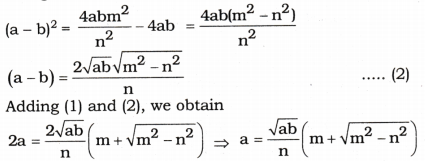
Substituting the value of a in (1), we obtain
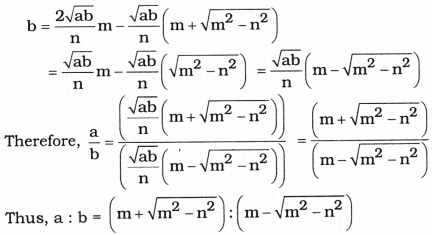
III.
Question 1.
Find the sum of the following series upto n terms.
(i) 5 + 55 + 555 + …
Solution:
Given that 5 + 55 + 555 + …
Let Sn = 5 + 55 + 555 + … n terms
Sn = \(\frac{5}{9}\)[9 + 99 + 999 + …n terms] = \(\frac{5}{9}\) (10 – 1) + (102 – 1) + (103 – 1) + …nterms
= \(\frac{5}{9}\)[(10 + 102 + 103 + ……………. n terms) – (1 + 1 + ….. n terms)]
= \(\frac{5}{9}\)[\(\frac{10\left(10^{\mathrm{n}}-1\right)}{10-1}\) – n]
= \(\frac{5}{9}\)[\(\frac{10\left(10^{\mathrm{n}}-1\right)}{9}\) – n]
= \(\frac{50}{81}\)(10n – 1) – \(\frac{5n}{9}\)
(ii) .6 + .66 + .666 + …
Solution:
Sn = .6 + .66 + .666 + … n terms
= 6[.1 + .11 + .111 + …… upto nterms] = \(\frac{6}{9}\)[0.9 + 0.99 + 0.999 + upto n terms]
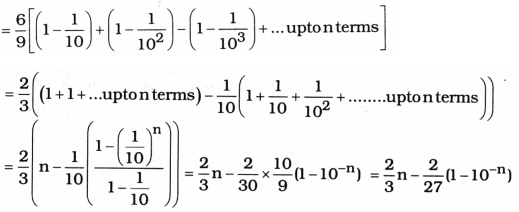
Therefore, the sum of n terms of the given series is \(\frac{2}{3}\) n – \(\frac{2}{27}\)(1 – 10-n)
Question 2.
If f is a function satisfying f(x + y) = f(x) . f(y) for all x, y ∈ N such that f(1) = 3 and \(\sum_{x=1}^n\) f(x) = 120. And the value of n.
Solution:
f(x + y) = f(x) . f(y) for all x, y ∈ N and f(1) = 3
Taking x = y = 1 in the given function, we obtain f(x + y) = f(x) . f(y) ⇒ f(l + 1) = f(1) f(1) f(2) = 3 x 3 = 9
Similarly, f(x + y) = f(x) . f(y) ⇒ f(1 + 2) = f(1) f(2) ⇒ f(3) = 3 x 9 = 27
Also, f(x + y) = f(x) . f(y) ⇒ f(1 + 3) = f(1) f(3) ⇒ f(4) = 3 x 27 = 81
Therefore, f(1), f(2), f(3) i.e., 3, 9, 27, 81 forms a G.P. with both the first term and common ratio equal to 3.
It is known that Sn = \(\frac{\mathrm{a}\left(\mathrm{r}^{\mathrm{n}}-1\right)}{\mathrm{r}-1}\). It is given that \(\sum_{x=1}^n\) f(x) = 120
⇒ 120 = \(\frac{3\left(3^{\mathrm{n}}-1\right)}{3-1}\)
⇒ 120 = \(\frac{3}{2}\)(3n – 1)
⇒ 3n – 1 = 80
⇒ 3n = 34
⇒ n = 4
Thus, the value of n = 4.
Question 3.
A fanner buys a used tractor for ₹ 12000. He pays ₹ 6000 cash and agrees to pay the balance in annual installments of ₹ 500 plus 12% interest on the unpaid amount. How much will the tractor cost him ?
Solution:
Given, the farmer pays ₹ 6000 in cash.
So, the unpaid amount = ₹ 12000 – ₹ 6000 = ₹ 6000
From the question, the interest paid annually will be 12% of 6000, 12% of 5500, 12% of 5000, … , 12% of 500
Hence, the total interest to be paid = 12% of 6000 + 12% of 5500 + 12% of 5000 + … + 12% of 500 = 12% of (6000 + 5500 + 5000 + … + 500)
= 12% of (500 + 1000 + 1500 + … + 6000)
It’s seen that the series 500, 1000, 1500 … 6000 is an A.P. with the first term and common difference both are equal to 500.
Let’s take the number of terms of the A.P to be n.
So, 6000 = 500 + (n – 1) 500
⇒ 1 + (n – 1) = 12
⇒ n = 12
Now, The sum of the series in A.P = \(\frac{12}{2}\) [2(500) + (12 – 1) (500)]
= 6[1000 + 5500]
= 6(6500)
= 39000
Hence, the total interest to be paid = 12% of (500 + 1000 + 1500 +
= 12% of 39000 = ₹4680
Therefore, the tractor will cost the farmer = (₹ 12000 + ₹ 4680) = ₹ 16680
Question 4.
Shamshad Ali buys a scooter for ₹ 22000. He pays ₹ 4000 cash and agrees to pay the balance in annual installment of? 1000 plus 10% interest on the unpaid amount. How much will the scooter cost him ?
Solution:
It is given that Shamshad Ali buys a scooter for ₹ 22000 and pays ₹ 4000 in cash. Hence, unpaid amount ₹ = 22000 – 4000 = 18000
According to the given condition, the interest paid annually will be (10% of 18000), (10% of 17000), (10% of 16000), … (10% of 1000)
Thus, total interest to be paid = (10% of 18000) + (10% of 17000) + … + (10% of 1000) = 10% of (18000 + 17000 + … + 1000) = 10% of (1000 + 2000 + … + 18000)
Now, the series 1000 + 2000 + … + 18000 forms an A.P. with a and d both equal to 1000.
Let the number of terms of the A.P. be n.
⇒ an = a + (n – 1) d
⇒ 18000 = 1000 + (n – 1) (1000)
⇒ 18000 – 1000 = 1000 (n – 1)
⇒ n – 1 = \(\frac{17000}{1000}\)
⇒ n = 17 + 1
⇒ n = 18
Now, total cost of scooter in ₹ = 22000 + 17100 = 39100
Thus, the scooter will cost him ₹ 39100.
Question 5.
A person writes a letter to four of his friends. He asks each one of them to copy the letter and mail to four different persons with instruction that they move the chain similarly. Assuming that the chain is not broken and that it costs 50 paise to mail one letter, find the amount spent on the postage when the 8th set of letters is mailed.
Solution:
The number of letters mailed forms a G.P : 4, 42, ……….. , 48; Here a = 4, n = 8
Hence, S = \(\frac{\mathrm{a}\left(\mathrm{r}^{\mathrm{n}}-1\right)}{\mathrm{r}-1}\)
S8 = \(\frac{4\left(4^8-1\right)}{4-1}=\frac{4(65536-1)}{3}=\frac{4 \times 65535}{3}\)
= 4 × 21845
= 87380
It is given that the cost to mail one letter is 50 paisa.
Therefore, cost in ₹ for mailing 87380 letters = \(\frac{50}{100}\) × 87380 = 43690
Thus, ₹ 43690 is the amount on the postage when 8th set of letters is mailed.
Question 6.
A man deposited ₹ 10000 in a bank at the rate of 5% simple interest annually. Find the amount in 15th year since he deposited the amount, also calculate the total amount after 20 years.
Solution:
It is given that the man deposited ₹ 10000 in a bank at the rate of 5% simple interest annually. Hence, annual interest received in ₹ = \(\frac{50}{100}\) × 10000 = 500
Amount in ₹ at the end of first year = 10000 + 500 = 10500
Amount in ₹ at the end of second year = 10500 + 500 = 11000
Amount in ₹ at the end of third year = 11000 + 500 = 11500
Therefore, 10000, 10500, 11000, … is an A.P.
Hence, the amount in the 15th year,
a15 = 10000 + (15 – 1) (500) = 10000 + 7000 = 17000
Amount after 20 years
a21 = 10000 + (21 – 1) (500) = 10000 + 10000 = 20000
Thus, the amount in 15th year is ₹ 17000 and after 20 years amount is ₹ 20000.
Question 7.
A manufacturer reckons that the value of a machine, which costs him ₹ 15625, will depreciate each year by 20%. Find the estimated value at the end of 5 years.
Solution:
Cost of a machine is ₹ 15625. Machine depreciates by 20% every year.
∴ Its value after every year is 80% of the original cost i.e., 4/5 of the original cost.
Value at the end of 5 years =
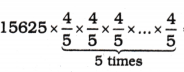
= 15628 × \(\left(\frac{4}{5}\right)^5\)
= 5 × 1024
= 5120
Thus, value of the machine at the end of 5 years is ₹ 5120.
Question 8.
150 workers were engaged to finish a job in a certain number of days. 4 workers dropped out on second day, 4 more workers dropped out on third day and so on. It took 8 more days to finish the work. Find the number of days in which the work was completed.
Solution:
Let x be the number of days in which 150 workers finish the work.
According to the given information, 150x = 150 + 146 + 142 + … (x + 8) terms
Here, 150 + 146 + 142 + … (x + 8) terms forms an A.P. with a = 150, d = – 4, n = (x + 8)
Therefore 150x = \(\frac{(x+8)}{2}\)[2(150) + (x + 8 -1)(-4)]
⇒ 150x – (x + 8) [150 + (x + 7) (-2)]
⇒ 150x = (x + 8) (150 – 2x – 14)
⇒ 150x = (x + 8) (136 – 2x)
⇒ 75x – (x + 8) (68 – x)
⇒ 75x – 68x – x2 + 544 – 8x
⇒ x2 + 15x – 544 = 0
⇒ x2 + 32x – 17x – 544 = 0
⇒ x(x + 32) – 17(x + 32) = 0
⇒ (x – 17) (x + 32) = 0
⇒ x = 17, – 32
However, x cannot be negative, hence, x = 17
∴ The number of days in which the work was completed is (17 + 8) = 25 days. Thus, the work was completed in 25 days.