Straight Lines MCQ AP Inter 1st Year Maths Chapter 9

Practice AP Inter 1st Year Maths Study Material Chapter 9 Straight Lines MCQ to identify your strengths and weak areas.

AP Inter 1st Year Maths Straight Lines MCQ

Question 1.
The equation of the straight line making an intercept of 3 units on the Y -axis and inclined at 45° to the X -axis is
1) y = x – 1
2) y = x + 3
3) 45x + 3
4) y = x + 45
Answer:
2) y = x + 3

Explanation:
θ = 45° (inclined) m = tan 45° = 1;c = 3 ⇒ y = x + 3

Question 2.
The angle made by the line segment joining (5, 2), (6, -15) at (0, 0) is
1) \(\frac{\pi}{6}\)
2) \(\frac{\pi}{4}\)
3) \(\frac{\pi}{2}\)
4) π
Answer:
3) \(\frac{\pi}{2}\)

Explanation:
Let O(0, 0), P(5, 2), Q(6, -15)
m1 = slope of OP = \(\frac{2}{5}\), m2 = slope of OQ = \(\frac{-15}{6}=\frac{-5}{2}\), m1m2 = -1 ⇒ θ = \(\frac{\pi}{2}\)

Question 3.
The lines 2x + 3y = 6, 2x + 3y = 8 cut the X – axis at A, B respectively. A line T drawn through the point (2, 2) meets the X- axis at ‘C’ in such a way that abscissae A,B,C are in arithmetic progression then the equation of the line T is
1) 2x + 3y = 10
2) 3x + 2y = 10
3) 2x – 3y = 10
4) 3x – 2y = 10
Answer:
1) 2x + 3y = 10

Explanation:
A = (3, 0), B = (4, 0) and let C = (a, 0)
⇒ \(\frac{a+3}{2}\) = 4
⇒ a = 5 (∵ A, B, C are in A.P)
∴ Equation of l is y – 2 = \(\frac{-2}{3}\) (x – 2)

Question 4.
The area (in sq.m) of the triangle formed by the lines x = 0; y = 0 and 3x + 4y = 12 is
1) 3
2) 4
3) 6
4) 12
Answer:
3) 6

Explanation:
\(\frac{C^2}{2|a b|}=\frac{144}{24}\) = 6

Question 5.
The area of the triangle formed by the axes and the line x cos a + y sec a = 2
1) 4
2) 3
3) 2
4) 1
Answer:
3) 2

Explanation:
\(\frac{\mathrm{C}^2}{2|\mathrm{ab}|}=\frac{4}{2|\cos \alpha \cdot \sec \alpha|}\) = 2

Question 6.
If the area of the triangle formed by the lines x =0, y = 0; 3z + 4y = a(a > O) is 1; then a =
1) √6
2) 2√6
3) 4√6
4) 6√2
Answer:
2) 2√6

Explanation:
\(\frac{1}{2}\) = 1
⇒ a = ± \(\sqrt{24}\)
⇒ a = 2√6

Straight Lines MCQ AP Inter 1st Year Maths Chapter 9

Question 7.
EquatIon of the straight line passing through the Image of (3. 6) in the line 2x – y = 5 and perpendlcular to the line 3z +4y = 15 is
1) 4x -3y = 10
2) 4x – 3y = 7
3) 4x – 3y = 5
4) 4x – 3y = 16
Answer:
4) 4x – 3y = 16

Explanation:
Image of (3, 6) is (7, 4)
⇒ Equation of straight line y – y1 = m(x – x1) ⇒ 4x – 3y – 16 = 0.

Question 8.
A straight line passing through the point A (3, 4) is such that its Intercept. between the axes bisected at A its equation is
1) 4x+ 3y = 24
2) 3x + 4y = 25
3) x + y = 7
4) 3x – 4y + 7 = 0
Answer:
1) 4x+ 3y = 24

Explanation:
\(\frac{x}{x_1}+\frac{y}{y_1}\) = 2
⇒ \(\frac{x}{3}+\frac{y}{4}\) = 2
⇒ 4x + 3y = 24

Question 9.
If the straight lines y = 4 – 3x; ay = x + 10 and 2y + bx +9 = 10 represet the three consective sides of a rectangle, then ab =
1) 18
2) -3
3) \(\frac{1}{2}\)
4) –\(\frac{1}{3}\)
Answer:
1) 18

Explanation:
m1 = -3, m2 = \(\frac{1}{a}\), m3 = –\(\frac{b}{2}\)
m1m2 = -1
⇒ \(\frac{-3}{a}\) = 1
⇒ a = 3;
⇒ m2 × m3 = -1
\(\left(\frac{1}{3}\right)\left(\frac{-\mathrm{b}}{2}\right)\) = -1
⇒ b = 6
∴ ab = (3) (6) = 18

Question 10.
The ends of a rod of length ‘1’ moves on the co-ordinate axes the locus of the point on the rod which divides It In the ratIo 1 : 2 is ( 3 )
1) 36x2 + 9y2 = 4l2
2) 36x2 + 9y2 = l2
3) 9x2 + 36y2 = 4l2
4) 9x2 + 36y2 = l2
Answer:
3) 9x2 + 36y2 = 4l2

Explanation:
Let A(a, 0), B(0, b) be the end points of the rod.
AB = 1 ⇒ a2 + b2 = 12 …………… (1)
Let (α, β) divides \(\overrightarrow{\mathrm{AB}}\) in the ratio 1: 2.
∴ (α, β) = \(\left(\frac{2 \mathrm{a}}{3}, \frac{\mathrm{~b}}{3}\right)\)
⇒ a = \(\frac{3 \alpha}{2}\), b = 3β
(1) ⇒ \(\left(\frac{3 \alpha}{2}\right)\)2 + (3β)2 = l2
∴ Locus of P(a, 13) is 9x2 + 36y2 = 4l2

Question 11.
Two equal sldes of an isoceles triangle are 7x – y + 3 = 0, x + y – 3 = 0 and its third side passes through the point (1, -10) the equation of the third side is
1) 3x + y + 7 = 0
2) x – 3y + 29 = 0
3) 3x + y + 3 = 0
4) 3x + y – 3 = 0
Answer:
1) 3x + y + 7 = 0

Explanation:
By verification (1, -10) satisfies 3x + y + 7 = 0

Question 12.
The perpendicular distance from (1, 2) to this straight line 12x + 5y = 7 is
1) \(\frac{15}{13}\)
2) \(\frac{12}{13}\)
3) \(\frac{5}{13}\)
4) \(\frac{7}{13}\)
Answer:
1) \(\frac{15}{13}\)

Explanation:
\(\frac{|12+10-7|}{13}=\frac{15}{13}\)

Question 13.
If p and q are the perpendicular distances from the origin to the straight lines x sec θ – y cosec θ = a and x cos θ + y sin θ = a cos 2θ then
1) 4p2 + q2 = a2
2) p2 + q2 = a2
3) p2 + 2q2 = a2
4) 4p2 + q2 = 2a2
Answer:
1) 4p2 + q2 = a2

Explanation:
Result only 4p2 + q2 = a2

Question 14.
The equation of the line parallel to 5x + 12y = 1 and at distance of 3 units from (1, 0) is
1) 5x + 12y + 34 = 0
2) 12x – 5y + 34 = 0
3) 12x – 5y – 44 = 0
4) 5x + 12y + 44 = 0
Answer:
1) 5x + 12y + 34 = 0

Explanation:
By verification (1) and (4) are parallel to the given line
(1) ⇒ \(\frac{|5+0+34|}{13}=\frac{39}{13}\) = 3
⇒ 5x + 12y + 34 = 0 is parallel line which is at a distance of 3 units.

Question 15.
The area (in sq. units) of the circle which touches the lines 4x + 3y = 15 and 4x + 3y = 5 is
1) 4π
2) 3π
3) 2π
4) π
Answer:
4) π

Explanation:
r = \(\frac{1}{2}\left(\frac{\left|\mathrm{c}_1-\mathrm{c}_2\right|}{\sqrt{\mathrm{a}^2+\mathrm{b}^2}}\right)=\frac{1}{2}\left(\frac{|-15+5|}{5}\right)=\frac{1}{2}\)(2) = 1
Area = π(1)2 = π

Straight Lines MCQ AP Inter 1st Year Maths Chapter 9

Question 16.
If A (2, -1) and B (6, 5) are two points, the ratio in which the foot of the perpendicular from (4, 1) to AB divides It in
1) 8 : 15
2) 5 : 8
3) -5 : 8
4) -8 : 5
Answer:
2) 5 : 8

Explanation:
Slope of AB = and Slope of the line ⊥r to \(\overline{\mathrm{AB}}=-\frac{2}{3}\)
Equation is y – 1 = (x – 4) ⇒ 2x + 3y – 11 = 0
Ratio = \(\frac{-(4-3-11)}{(12+15-11)}=\frac{10}{16}=\frac{5}{8}\) = 5 : 8

Question 17.
A straight line which makes equal intercepts on positive X and Y axes and which is at a distance 1 unit from the origin intersects the straight line
y = 2x + 3 + √2 at (x0, y0) then 2x0 + y0 =
1) 3 + √2
2) √2 – 1
3) 1
4) 0
Answer:
2) √2 – 1

Explanation:
Let 1 be the line y- a.
Perpendicular distance from origin is 1 ⇒ \(\frac{|\mathrm{a}|}{\sqrt{2}}\) = 1 a = √2
Now equation is x + y = √2 …………. (1) and Given line y = 2x + 3 + √2 …………. (2)
From (1) and (2) we get x = -1 and y = √2 + 1;
x0 = -1, y0 = √2 + 1 2x0 + y0 = -2 + √2 = √2 – 1

Question 18.
If a, b, c are in AP, the line ax + by + c = 0 passes through the fixed point
1) (1, 2)
2) (-1, 2)
3) (1, -2)
4) (-1, -2)
Answer:
3) (1, -2)

Explanation:
If a, b, c are in AP then \(\frac{\mathrm{a}+\mathrm{c}}{2}\) = b
a – 2b + c = 0 →, ax + by + c = 0; (x, y) = (1, -2)

Question 19.
If a, b, c are in AP then the line ax + by + c = 0
1) passes through a fixed point
2) form an equilateral triangle
3) form a rhombus
4) form a square
Answer:
1) passes through a fixed point

Explanation:
From (18) the line passing through fixed point.

Question 20.
The point on the line 2x – 3y = 5 which is equidistant from (1, 2) and (3, 4) is
1) (2, 3)
2) (4, 1)
3) (1, -1)
4) (4, 6)
Answer:
2) (4, 1)

Explanation:
By verification option (2) and (3) satisfies the 2x – 3y = 5 and distance from (4, 1) is
\(\sqrt{9+1}=\sqrt{10}\) and \(\sqrt{1+9}=\sqrt{10}\)
Option (2) satisfies.

Tenses Inter 1st Year English Grammar

For systematic learning, students can include AP Inter 1st Year English Grammar with Answers and Tenses in English Inter 1st Year in their daily study routine.

AP Inter 1st Year English Tenses with Answers

VERB:

A verb is a word that tells about an action, a state of being or existence, possession, or a change in state.

ఒక పనిని గురించి గాని, ఒక స్థితి గురించి గాని యాజమాన్యం గురించి గాని, స్థితిలో మార్పు గురించి గాని, తెలిపేది

e.g. : The boy cried.
I have a watch.
She is a nurse.
He became weak.

పై వాక్యాలలోని cried, have, is, became అను పదాలు పనిని గాని స్థితి గాని తెలుపుతున్నాయి. అందుచే అవి verbs.

TENSE

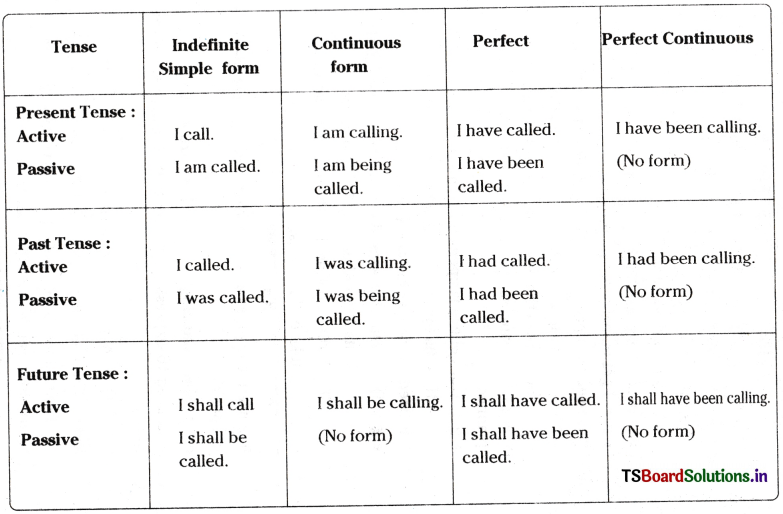
Tense : Tense is the form of the verb. It shows the time of the action or event. There are three tenses. They are :

  1. Present Tense
  2. Past Tense
  3. Future Tense

Tenses Inter 1st Year English Grammar 1

The Use of the Tenses:

1. Simple Present Or Present Indefinite Tense :
i) It is used to express what actually happens at the time of speaking.
e.g.: Here comes John.

ii) It is used to express habitual action :
e.g. : I get up early in the morning.

iii) It is used to express general or universal truths :
e.g. : The earth is round. Stars twinkle.
Honesty is the best policy. Sugar is sweet.

iv) It is used to express future action that has already been planned :
e.g. : Our college reopens on 16th June.
He sails for England next Monday.

v) It is used to express historic present :
e.g.: i) Sivaji now sees the danger and immediately kills Afzul Khan with his lion-claws.
ii) Birbal now seizes the chance and cracks a joke on his rivals.

Tenses Inter 1st Year English Grammar

2. Present Continuous Tense :

i) It is used to express an action that is going on at the time of speaking :
e.g.: She is dancing – They are writing.
ii) It is used to express an action that will happen in the future.
e.g.: 1) I am going to Mysore tomorrow.

Note : The following verbs are not generally used in the Continuous Tense :
(ఈ క్రింది Verbs ను సామాన్యంగా Continuous Tense లో ఉపయోగించరాదు.)

  • Verbs of sense of perception : hear, see, smell, notice, recognise, taste, feel.
  • Verbs of appearing : look, seem, appear.
  • Verbs of thinking : suppose, think, believe, realise, understand, know, imagine, mean, agree, consider, trust, remember, forget, expect, recall.
  • Verbs of emotions : want, wish, desire, feel, like, love, hate, prefer, hope, refuse.

Miscellaneous :
own, possess, keep, concern, matter, owe, etc.
e.g. :He is looking fine. (Wrong)
He looks fine. (Correct)
I am believing you. (Wrong)
I believe you. (Correct)
She is understanding me. (Wrong)
She understands me. (Correct)
1 am hating you. (Wrong)
I hate you. (Correct)

3. Present Perfect Tense :
i) It is used to denote an action that has just been completed.
e.g.: The train has arrived.
They have finished the work.

ii) It is used to express a past action the result of which continues,
e.g.: I have not seen Ravi for many months.
He has been ill since Monday.

iii) It is used to refer to a past action in a more general way :
e.g.: Have you ever been to Simla ?

iv) A few adverbs or adverbial phrases are used with the Present Perfect Tense :
just, never, ever, so far, till, yet, already, since, today, this week, etc.
e.g.: I have just posted the letter.
So far he has not come.
He has not received the money yet.
This week there have been no rains.

4. Present Perfect Continuous Tense :

It is used to refer to an action that begins in the past and continues through a given period of time up to the present moment.
e.g. : I have been waiting here for Ramu for two hours.
I have been waiting here for Ramu since 3 p.m.
Note : ‘For’ denotes period of time.
Since’ denotes point of time.

Observe the following sentences :
i) He has been painting the door for 2 p.m. (Wrong)
He has been painting the door since 2 p.m. (Correct)

ii) The workers have been demanding more wages since ten days. (Wrong)
The workers have been demanding more wages for ten days. (Correct)

5. Simple Past Or Past Indefinite Tense :
i) It is used to express the action completed in the past. Adverbs and adverbial phrases expressing Past time are often used with this tense.
(భూతకాలంలో పని పూర్తయినట్లయితే దానిని తెలుపుటకు Simple Past లేక Past Indefinite Tense ను వాడెదరు. భూతకాలాన్ని తెలిపే క్రియ విశేషణ పదాలు యీ tense లో ప్రయోగింపబడతాయి.)
e.g.: She met me yesterday.
The clerk did his work hurriedly.

ii) It is used to express a habitual action in the past.
(భూతకాలంలో అలవాటుగా చేసే పనులను విశదపరచుటకు Simnple Past Tense వాడెదరు.)
e.g.: People performed child marriages in olden days. While I was in Chennai, 1 spoke to others in Tamil.

Tenses Inter 1st Year English Grammar

6. Past Continuous Tense :
It is used to express an action that was still going on in the past time.
(భూతకాలంలో పని కొనసాగింపును Past Continuous Tense తెలుపును.)
e.g. : I met Raghu while he was standing at the college gate.
We noticed some birds which were flying.

7. Past Perfect Tense :
It is used to express an action which had been completed at some point in the past time before another action was started.
(భూతకాలంలో ముందు జరిగిన పనిని Past Perfect Tense లోను రెండవ పనిని Simple Past Tense లోను చెప్పాలి.)
e.g.: The train had left before they reached the station.
I had finished my work when Alfred came in.
(పై వాక్యాలలోని మొదటి పనిని ఉదాహరణంగా తీసుకుందాం. ఇందులో జరిగిన రెండు పనులు సూచింపబడ్డాయి. The train left. They reached the station. ఇందులో ముందు జరిగినది The train left. దీనిని Past Perfect Tense లో చెప్పాలి. అప్పుడు వాక్యం The train had left before they reached the station అయింది.)

8. Past Perfect Continuous Tense :
It is used to show an action that had begun in the past and continued till some point of time in the past.
(భూతకాలంలోని ఒక పనిని ఎప్పుడో ప్రారంభించి, అదే పని కొంత కాలం వరకు కొనసాగుతున్నదని Past Perfect Continuous Tense లో తెలపాలి.)
e.g. : I had been watching TV for an hour when my uncle came to see me.
We had been playing hockey for three hours when it rained.
She had been passing the information for a long time before she was caught.

9. Simple Future Or Future Indefinite Tense:
It is used to express an action that will take place in future.
(భవిష్యత్తు కాలంలో జరగబోయే పనిని Simple Future Tense తెలుపును.)
e.g.: I shall meet you tomorrow.

10. Future Continuous Tense :
It is used to express an action going on at some point in future.
(భవిష్యత్తు కాలంలో కొనసాగే పనిని Future Continuous Tense తెలుపును.)
e.g.: She will be sleeping then.
We will be playing the match at this time tomorrow.
I shall be writing the examination at this time on Monday.

11. Future Perfect Tense :
It is used to express an action that will be completed at some point in future.
(భవిష్యత్తులో ఒక నిర్ణితాకాలానికి పని Future Perfect Tense పూర్తగునని విశదపరుచును
e.g. : I shall have done my work before you come.

12. Future Perfect Continuous Tense :
It is used to refer to an action that will be in progress at a point in the future after continuing for a given period.
e.g.: I shall have been completing thirty years of service by next March.
I shall have been writing the examination for two hours by this time on Monday.

Tenses Inter 1st Year English Grammar

→ Tenses in Conditional Clauses :

Clauses that show conditions are called conditional clauses. Sentences with conditional clauses use fixed patterns of Tenses.

Conditions are of three types :

  1. Real conditions
  2. Unreal or improbable conditions and
  3. Past unfulfilled conditions.

The tense forms used in a sentence are determined by the type of the condition in that sentence.

Look at the following examples:

  1. If it rains, I will not come to your home.
    (Real condition – Simple present in the conditional clause and Simple Future in the main clause)
  2. If I were a bird, I would fly high in the sky.
    (Unreal condition – Simple Past (were-even with I) in the conditional clause and would +V’ in the main clause)
  3. If he had worked hard, he would have passed the examination.
    (Past unfulfilled condition – Past Perfect in the conditional clause and would + have + Past Participle of verb in the main clause).

The information may easily be noted in the table form.

Type of conditionTense in Conditional clauseTense in Main clause
1. RealSimple Present
Ex : If you come early,
Simple Future
we will go to our friends’ house.
2. UnrealSimple Past
If I were you,
would + V
I wouldn’t do that.
3. Past UnfulfilledPast Perfect
If she had started early,
would + have + pp of verb
she would have caught the train.

Exercises For Practice

1. Fill in the blanks with the correct form of the verb given in the brackets.

Question 1.
She usually __________ (cook) for the entire family.
Answer:
cooks

Question 2.
My brother often __________ (read) comics.
Answer:
reads

Question 3.
Students __________ (study) in the library daily.
Answer:
study

Question 4.
We __________ (go) to the market every Saturday.
Answer:
go

Question 5.
Raman __________ (go) to Tirupathi twice a year.
Answer:
goes

Question 6.
The hostelers __________ (watch) a movie every month.
Answer:
watch

Question 7.
Water __________ (boil) at 100°C.
Answer:
boils

Question 8.
__________ birds (fly) in the sky?
Answer:
Do, fly

Tenses Inter 1st Year English Grammar

2. Fill in the blanks with the correct form of the verb given in the brackets.

Question 1.
I __________ (wait) for the bus right now.
Answer:
am waiting

Question 2.
Hark ! The cuckoo __________ (sing) beautifully.
Answer:
is singing

Question 3.
Don’t disturb! She __________ (study) for her ensuing exams this week.
Answer:
is studying

Question 4.
Look ! They __________ (practise) dance for the upcoming performance.
Answer:
are practising

Question 5.
See! He __________ (ride) a bullock cart while holding a stick.
Answer:
is riding

Question 6.
I __________ (study) to become a doctor. Don’t disturb me.
Answer:
am studying

Question 7.
Hurry up! The train __________ (move) while the kids are playing.
Answer:
is moving

Question 8.
The birds __________ (fly) in the sky now.
Answer:
are flying

Tenses Inter 1st Year English Grammar

3. Fill in the blanks with the correct form of the verb given in the brackets.

Question 1.
I __________ already __________ (finish) my homework.
Answer:
have, finished

Question 2.
She __________ (visit) Paris three times.
Answer:
has visited

Question 3.
Gita’s English __________ (improve) since she joined college.
Answer:
has improved

Question 4.
Pavan __________ (meet) with an accident twice.
Answer:
has met

Question 5.
She __________ (be) to Delhi lately.
Answer:
has been

Question 6.
I __________ not __________ (see) him since last week.
Answer:
have, seen

Question 7.
The rain __________ not __________ (stop) yet.
Answer:
has, stopped

Question 8.
Rishi __________ just __________ (go) out to get something to eat.
Answer:
has, gone

Tenses Inter 1st Year English Grammar

4. Fill in the blanks with the correct form of the verb given in the brackets.

Question 1.
I ___________ (learn) English for five years.
Answer:
have been learning

Question 2.
She __________ (work) at this company since last year.
Answer:
has been working

Question 3.
They __________ (wait) for the bus for over an hour.
Answer:
have been waiting

Question 4.
Jaya __________ (draw) a picture for two hours.
Answer:
has been drawing

Question 5.
I __________ (water) the plants in the garden and I am tired now.
Answer:
have been watering

Question 6.
Jaya __________ (teach) English since she joined the profession.
Answer:
has been teaching

Question 7.
How long she __________ (practise) music?
Answer:
has been practising

Question 8.
Where you __________ (live) all these years?
Answer:
have been living

Tenses Inter 1st Year English Grammar

5. Fill in the blanks with the correct form of the verb given in the brackets.

Question 1.
I __________ (visit) my grandmother last weekend.
Answer:
visited

Question 2.
She __________ (finish) her homework before lunch.
Answer:
finished

Question 3.
Madhu __________ (go) to the beach yesterday.
Answer:
went

Question 4.
When _____ he __________ (write) the exam last year?
Answer:
did, write

Question 5.
__________ they __________ (plan) the meeting last month?
Answer:
Did, plan

Question 6.
They __________ (travel) to Japan two years ago.
Answer:
traveled

Question 7.
He __________ (forget) his wallet at home this morning.
Answer:
forgot

Question 8.
We __________ (talk) on the phone for thirty minutes last night.
Answer:
talked

Tenses Inter 1st Year English Grammar

6. Fill in the blanks with the correct form of the verb given in the brackets.

Question 1.
I __________ (cook) dinner when the phone rang.
Answer:
was cooking

Question 2.
She __________ (talk) to her father at this time yesterday.
Answer:
was talking

Question 3.
__________ you __________ (study) for the exam at 7 PM yesterday?
Answer:
Were, studying

Question 4.
They __________ (play) golf when it started raining.
Answer:
were playing

Question 5.
He __________ (work) on his project all afternoon yesterday.
Answer:
was working

Question 6.
Padmini __________ (watch) TV when the power was off.
Answer:
was watching

Question 7.
At midnight, we __________ still __________ (drive) through the desert that day.
Answer:
were, driving

Question 8.
When John __________ (sleep), someone stole his car.
Answer:
was sleeping

7. Fill in the blanks with the correct form of the verb given in the brackets.

Question 1.
By the time I arrived, they __________ already __________ (leave).
Answer:
had (already) left

Question 2.
We __________ never __________ (see) such a beautiful sunset before I went to Kochi.
Answer:
had (never) seen

Question 3.
After they __________ (eat), they went for a walk.
Answer:
had eaten

Question 4.
Only she understood the movie because she __________ (read) the book.
Answer:
had read

Question 5.
If I __________ (buy) lemons, I would have made lemon rice.
Answer:
had bought

Question 6.
I __________ (dream) of becoming an IAS officer, but I became a teacher.
Answer:
had dreamed

Question 7.
After they __________ (watch) the movie, they talked about it for hours.
Answer:
had watched

Question 8.
They __________ (vacate) the house before the owner came.
Answer:
had vacated

Tenses Inter 1st Year English Grammar

8. Fill in the blanks with the correct form of the verb given in the brackets.

Question 1.
I __________ (wait) for the bus for over 30 minutes when it finally arrived.
Answer:
had been waiting

Question 2.
By the time I called her, she (work) on the project for hours.
Answer:
had been working

Question 3.
They __________ (run) for an hour before they took a break.
Answer:
had been running

Question 4.
She __________ (study) all night for the exam and was exhausted.
Answer:
had been studying

Question 5.
He __________ (try) to fix the car for hours when I arrived.
Answer:
had been trying

9. Fill in the blanks with the correct form of the verb given in the brackets.

Question 1.
She __________ (buy) a new car next month.
Answer:
will buy

Question 2.
They __________ (start) the meeting at 10 AM tomorrow.
Answer:
will start

Question 3.
He __________ (finish) his homework after dinner.
Answer:
will finish

Question 4.
The team __________ (play) the championship match next month.
Answer:
will play

Question 5.
I __________ (help) you with your project later?
Answer:
Shall / Will, help

Question 6.
They __________ (build) a new library in the city next year.
Answer:
will build

Question 7.
She __________ (visit) her grandparents during the holidays.
Answer:
will visit

Question 8.
The weather forecast says it __________ (rain) tomorrow.
Answer:
will rain

Tenses Inter 1st Year English Grammar

10. Fill in the blanks with the correct form of the verb given in the brackets.

Question 1.
At this time tomorrow, I __________ (work) on my project.
Answer:
will be working

Question 2.
We __________ (have) dinner with friends at 7 PM tomorrow.
Answer:
will be having

Question 3.
He __________ (play) football in the park at this time next week.
Answer:
will be playing

Question 4.
I __________ (watch) TV when she arrives tonight.
Answer:
will be watching

Question 5.
She __________ (work) on her project all evening tomorrow.
Answer:
will be working

Question 6.
They __________ (wait) for us at the station when we arrive.
Answer:
will be waiting

11. Fill in the blanks with the correct form of the verb given in the brackets.

Question 1.
By next year, she __________ (complete) her degree in psychology.
Answer:
will have completed

Question 2.
By the time we arrive, the movie __________ (start).
Answer:
will have started

Question 3.
He __________ (travel) to five different countries by the end of summer.
Answer:
will have traveled

Question 4.
By the end of the week, we __________ (move) into our new house.
Answer:
will have moved

Question 5.
You __________ (save) enough money for your trip by next month.
Answer:
will have saved

Tenses Inter 1st Year English Grammar

12. Fill in the blanks with the correct form of the verb given in the brackets.

Question 1.
By next year, she __________ (study) at the university for three years.
Answer:
will have been studying

Question 2.
They __________ (wait) for us for over an hour by the time we arrive.
Answer:
will have been waiting

Question 3.
By 2035, scientists __________ (work) on space exploration for decades.
Answer:
will have been working

Question 4.
I __________ (train) for the marathon for two months by the end of the year.
Answer:
will have been training

Question 5.
By 10 PM, we __________ (celebrate) his birthday for several hours.
Answer:
will have been celebrating

13. Fill in the blanks with the correct form of the verb given in the brackets.

Question 1.
If we pay the bills, she __________ (go) home.
Answer:
will go

Question 2.
If you __________ (be) hungry, you may order online.
Answer:
are

Question 3.
If I have money, I __________ (visit) America.
Answer:
will visit

Question 4.
If Raju __________ (like) something, he will do anything.
Answer:
likes

14. Fill in the blanks with the correct form of the verb given in the brackets.

Question 1.
If I were the president, I __________ (declare) every Saturday a holiday.
Answer:
would declare

Question 2.
If they __________ (tire), they would take rest.
Answer:
were tired

Question 3.
If we had more time, we __________ (study) more.
Answer:
would study

Question 4.
If you __________ (play) the game before, you would be skilled.
Answer:
had played

Tenses Inter 1st Year English Grammar

15. Fill in the blanks with the correct form of the verb given in the brackets.

Question 1.
If we had paid more attention in class, we __________ (understand) the lesson.
Answer:
would have understood

Question 2.
If I __________ (see) him at the meeting, I would have asked him.
Answer:
had seen

Question 3.
If he had tried well, he __________ (get) the first rank.
Answer:
would have got

Question 4.
If she __________ (take) care of herself, the problem would never have been raised.
Answer:
had taken

Exercises

1. Fill in the blanks with the suitable forms of the verbs given in the brackets.

Question 1.
By the time you arrive, I __________ (finish) my homework.
Answer:
will have finished

Question 2.
Don’t disturb! She __________ (study) for exams.
is studynig

Answer:
Question 3.
Right now, they __________ watch a movie.
Answer:
are watching

Question 4.
Hurry up! We __________ (go) to watch a film.
Answer:
are going

Question 5.
By next year, I __________ (graduate) from college.
Answer:
will have graduated

Question 6.
When I was in college, I __________ (write) articles for the school newspaper.
Answer:
wrote

Question 7.
They __________ (work) on the project all week.
Answer:
have been working

Question 8.
I __________ (not / like) this food since I was a child.
Answer:
have not liked

Question 9.
He __________ already __________ (leave) by the time they called.
Answer:
had, left

Question 10.
By the time we reach the station, the train __________ (leave).
Answer:
will have left

Question 11.
He __________ (be) my friend for over 10 years now.
Answer:
has been

Question 12.
I __________ (try) to fix the car when the mechanic arrived.
Answer:
was trying

Tenses Inter 1st Year English Grammar

Question 13.
They __________ ( build) the bridge in 2020.
Answer:
built

Question 14.
She _____ (wait) for me for over an hour now.
Answer:
has been waiting

Question 15.
At this time tomorrow, I __________ (fly) to New York.
Answer:
will be flying

Question 16.
Venkat __________ (win) the medal last month.
Answer:
won

Question 17.
I __________ (eat) dinner when you called last night.
Answer:
was eating

Question 18.
She __________ (call) me as soon as she finishes the meeting.
Answer:
will call

Question 19.
He __________ (not / come) to the party if he had known about it.
Answer:
would not have come

Question 20.
I __________ (learn) Spanish for three months now.
Answer:
have been learning

Question 21.
I __________ never __________ (meet) anyone like her before.
Answer:
have, met

Question 22.
He __________ (wait) for an hour before the train arrived.
Answer:
had been waiting

Question 23.
We often __________ (finish) our projects in time.
Answer:
often finish

Question 24.
My father __________ (buy) a bike for me next month.
Answer:
will buy

Question 25.
I __________ (study) every evening.
Answer:
study

Question 26.
The movie __________ (begin) when we arrived.
Answer:
had begun

Question 27.
I __________ (not / see) her in the office this week.
Answer:
have not seen

Question 28.
When we were kids, we __________ (go) to the beach every summer.
Answer:
went

Question 29.
She always __________ (get) up late.
Answer:
gets

Question 30.
The bell __________ just __________ (strike).
Answer:
has, struck

Tenses Inter 1st Year English Grammar

2. Fill in the blanks with suitable forms of the verbs given in the brackets:

Question 1.
She never __________ (take) coffee.
Answer:
takes

Question 2.
Ramani __________ (buy) the painting long ago.
Answer:
bought
were sleeping

Question 3.
Yesterday, when I went home, my kids __________ (sleep).
Answer:
has been learning

Question 4.
She _______ (learn) classical music for a long time.
Answer:

Question 5.
If you had asked him, he __________ (help) you.
Answer:
would have helped

3. Fill in the blanks with suitable forms of the verbs given in the brackets:

Question 1.
Right now, I __________ (work) on a project.
Answer:
am working

Question 2.
She __________ (be) always my best friend.
Answer:
has been

Question 3.
Sujatha __________ (go) to her native place tomorrow.
Answer:
is going

Question 4.
At this time tomorrow, she __________ (write) the exam.
Answer:
will be writing

Question 5.
If I were a bird, I __________ (fly) v
Answer:
would fly

AP Inter 1st Year Maths Exercise 8b Solutions

Referring to the AP Inter 1st Year Maths Study Material Chapter 8 Sequences and Series Exercise 8b Solutions makes it easier to understand complex problems.

AP Inter 1st Year Maths Sequences and Series Solutions Exercise 8b

I.

Question 1.
Find the 20th and nth terms of the G.P. \(\frac{5}{2}, \frac{5}{4}, \frac{5}{8}\) ………………
Solution:
Given series is \(\frac{5}{2}, \frac{5}{4}, \frac{5}{8}\) ………….
Here, the first term a = \(\frac{5}{2}\) and the common ratio r = \(\frac{\frac{5}{4}}{\frac{5}{2}}=\frac{2}{4}=\frac{1}{2}\)

an = arn-1
⇒ a20 = ar19
= \(\left(\frac{5}{2}\right)\left(\frac{1}{2}\right)^{19}=\frac{5}{2^{20}}\) and

an = arn-1
= \(\left(\frac{5}{2}\right)\left(\frac{1}{2}\right)^{\mathrm{n}-1}=\frac{5}{2^{\mathrm{n}}}\)

Question 2.
Find the 12th term of a G.P. whose 8th term is 192 and the common ratio is 2.
Solution:
Common ratio, r = 2, let a be the first term of the G.P.
∴ a8 = ar8-1 = ar7
⇒ ar7 = 192
⇒ a(2)7 = (2)6(3)
⇒ a = \(\frac{2^6 \times 3}{2^7}=\frac{3}{2}\)
Therefore, a12 = ar11
211 = 3 × 210 = 3072

AP Inter 1st Year Maths Exercise 8b Solutions

Question 3.
The 5th, 8th and 11th terms of a G.P are p,q and s, respectively. show that q2 = ps.
Solution:
Let a be the first term and r be the common ratio of the G.P
According to the given condition,
a5 = a5-1 = ar4 = p …………..(1)
a8 = a8-1 = ar7 = p …………..(2)
a11 = a11-1 = ar10 = p …………..(3)
Now, multiplying Eqs. (1) and (3)
ar4 . ar10 = ps
⇒ a2r14 = ps
⇒ (ar7)2 = ps
⇒ q2 = ps [∵ from (2)]

Question 4.
The 4th term of a G.P. is square of its second term, and the first term is -3. Determine its 7th term.
Solution:
Let a be the first term and r be the common ratio of the G.P. ∴ a = -3
Given a4 = (a2)2 ⇒ ar3 = (ar)2 ⇒ ar3 = a2r2 ⇒ r = a ⇒ r = -3
Therefore, a7 = ar7-1 = ar6 = (-3)(-3)6 = -(3)7 = -2187
Hence, the seventh term of the G.P. is -2187.

Question 5.
Which term of the following sequences,
a) 2, 2 √2 ,4…is 128 ?
Solution:
Given that 2, 2√2 ,4…
Here, a = 2 and r = \(\frac{1}{2}\) = √2
Let an = 128
⇒ arn-1 = 128
⇒ 2(√2)n-1 = 26
⇒ 2\(\frac{1}{2}\) = 26
⇒ \(\frac{n-1}{2}\) = 6
⇒ n = 13
Hence, the 13th term of the given sequence is 128.

b) √3, 3, 3√3 …. is 729 ?
Solution:
√3, 3, 3√3 ….
Given that √3, 3, 3√3 …. 729
Here, a = √3 & r = \(\frac{3}{\sqrt{3}}\) = √3
Let an = 729
⇒ arn-1 = 729
⇒ √3(√3)n-1 = 36
⇒ (√3)n = 36
⇒ (3)\(\frac{n}{2}\) = 36
⇒ \(\frac{n}{2}\) = 6
⇒ n = 12
Hence, the 12th term of the given sequence is 729.

c) \(\frac{1}{3}, \frac{1}{9}, \frac{1}{27}\), ……… is \(\frac{1}{19683}\)?
Solution:
\(\frac{1}{3}, \frac{1}{9}, \frac{1}{27}\), ………
Given \(\frac{1}{3}, \frac{1}{9}, \frac{1}{27}\), ………

Here, a = \(\frac{1}{3}\) and r = \(\frac{\frac{1}{9}}{\frac{1}{3}}=\frac{3}{9}=\frac{1}{3}\)

Let an = \(\frac{1}{19683}\)

⇒ arn-1 = \(\frac{1}{19683}\)

⇒ \(\frac{1}{3}\left(\frac{1}{3}\right)^{\mathrm{n}-1}=\left(\frac{1}{3}\right)^9\)

⇒ \(\left(\frac{1}{3}\right)^{\mathrm{n}}=\left(\frac{1}{3}\right)^9\)

⇒ n = 9
Hence, the 9th term of the given sequence is \(\frac{1}{19683}\)

Question 6.
For what values of x, the numbers –\(\frac{2}{7}\), x, –\(\frac{7}{2}\) are in G.P. ?
Solution:
Here, –\(\frac{2}{7}\), x, –\(\frac{7}{2}\) are in G.P.
⇒ \(\frac{x}{\frac{2}{-7}}=\frac{\frac{-7}{2}}{x}\)
⇒ x2 = \(\frac{2}{7} \times \frac{7}{2}\) = 1
⇒ x = ± 1
Hence, for x = ± 1, the given numbers will be in GP.

II. Find the sum to indicated number of terms in each of the G.P in Exercises 1 to 4 :

Question 1.
0.15, 0.015, 0.0015, … 20 terms.
Solution:
Here, a = 0.15 and r = \(\frac{0.015}{0.15}\) = 0.1;
Sn = \(\frac{\mathrm{a}\left(1-\mathrm{r}^{\mathrm{n}}\right)}{1-\mathrm{r}}\)
⇒ 0.1 < 1 and n = 20
⇒ S20 = \(\frac{0.15\left[1-(0.1)^{20}\right]}{1-0.1}=\frac{0.15\left[1-(0.1)^{20}\right]}{0.9}=\frac{1}{6}\)[1 – (0.1)20]

Question 2.
√7, √21, 3√7 , …. n terms.
Solution:
Here, a = √7 and r = \(\frac{\sqrt{21}}{\sqrt{7}}\) = √3; Sn = \(\frac{\mathrm{a}\left(1-\mathrm{r}^{\mathrm{n}}\right)}{1-\mathrm{r}}\) [∵ r > 1]
⇒ Sn = \(\frac{\sqrt{7}\left[(\sqrt{3})^{\mathrm{n}}-1\right]}{\sqrt{3}-1}=\frac{\sqrt{7}\left[(\sqrt{3})^{\mathrm{n}}-1\right]}{\sqrt{3}-1} \times \frac{\sqrt{3}+1}{\sqrt{3}+1}\)

\(\frac{\sqrt{7}(\sqrt{3}+1)\left[3^{\frac{\mathrm{n}}{2}}-1\right]}{2}=\frac{\sqrt{7}}{2}\)(√3 + 1)[3\(\frac{\mathrm{n}}{2}\) – 1]

Question 3.
1, -a, a2, -a3, ….. n terms (if a ≠ -1).
Solution:
Here, a = 1 and r = \(\frac{1}{2}\) = -a;
⇒ Sn = a\(\left(\frac{1-\mathrm{r}^{\mathrm{n}}}{1-\mathrm{r}}\right)\)

⇒ Sn = \(\frac{\left[1-(-a)^n\right]}{1-(-a)}=\frac{1-(-a)^n}{1+a}\)

AP Inter 1st Year Maths Exercise 8b Solutions

Question 4.
x3, x5, x7, …………. n terms (if x ≠ 1).
Solution:
Here, a = x3 and r = \(\frac{x^5}{x^3}\) = x2;
⇒ Sn = \(\frac{\mathrm{a}\left[1-\mathrm{r}^{\mathrm{n}}\right]}{1-\mathrm{r}}\)
Sn = \(\frac{x^3\left[1-\left(x^2\right)^n\right]}{1-x^2}=\frac{x^3\left[1-x^{2 n}\right]}{1-x^2}\)

Question 5.
Evaluate \(\sum_{k=1}^{11}\)(2 + 3k)
Solution:
\(\sum_{k=1}^{11}\)(2 + 3k) = (2 + 31) + (2 + 32) + (2 + 33) + ………….. + (2 + 311)
= 2 × 11 + (31 + 32 + 33 + ………… + 311)
= 22 + \(\frac{3\left(3^{11}-1\right)}{3-1}\)
= 22 + \(\frac{3}{2}\)(311 – 1)

Question 6.
The sum of first three terms of a G.P. is and their product is 1. Find the common ratio and the terms.
Solution:
Let a, ar and ar2 be three terms of a GP.
According to the question, sum of first three terms a + ar + ar2 = \(\frac{39}{10}\) …………. (1)
Product of terms a × ar × ar2 = 1
⇒ a3r3 = 1
⇒ ar = 1 ………. (2)
Dividing equation (1) by (2), we have
\(\frac{a+a r+a r^2}{a r}=\frac{39}{10}\)

⇒ \(\frac{1+r+r^2}{r}=\frac{39}{10}\)

⇒ 10 + 10r + 10r2 = 39r
⇒ 10r2 – 29r + 10 = 0
⇒ 10r2 – 25r – 4r + 10 = 0
⇒ 5r(2r – 5) – 2(2r – 5) = 0
⇒ (5r – 2) (2r – 5) = 0
⇒ r = \(\frac{2}{5}\) (or) \(\frac{5}{2}\)

If r = \(\frac{2}{5}\), from (2), we have a × \(\frac{2}{5}\) = 1
⇒ a = \(\frac{5}{2}\)

Therefore, the three terms are \(\frac{5}{2}\), 1, \(\frac{2}{5}\)

If r = \(\frac{5}{2}\) from (2) we have a = \(\frac{2}{5}\).
The three terms are \(\frac{2}{5}\), 1, \(\frac{5}{2}\)

Question 7.
How many terms of G.P. 3, 32, 33, …. are needed to give the sum 120 ?
Solution:
The given G.P. is 3, 32, 33, ….
Here a = 3 and r = \(\frac{3^2}{3}\) = 3 3
Let n terms of this G.P. be required to obtain the sum as 120.
⇒ Sn = \(\frac{3\left(3^n-1\right)}{3-1}\) = 120
⇒ 3(3n – 1) = 240
⇒ 3n – 1 = 80
⇒ 3n = 81
⇒ 3n = 34
⇒ n = 4
Hence, four terms of the given G.P. are required to obtain the sum as 120.

Question 8.
The sum of first three terms of a G.P. is 16 and the sum of the next three terms is 128. Determine the first term, the common ratio and the sum of n terms of the GP.
Solution:
Let the G.P. be a, ar, ar2, ar3 ………….
Given a + ar + ar2 = 16
⇒ a(1 + r + r2) = 16 ……….. (1)
ar3 + ar4 + ar5 = 128
⇒ ar3(1 + r + r2) = 128 …………. (2)

Dividing equation (2) by (1), we obtain \(\frac{1}{2}\)
⇒ r3 = 8
⇒ r = 2

Putting the value of r in equation (1), we have
a(1 + 2 + 22) = 16
⇒ 7a = 16
⇒ a = \(\frac{16}{7}\)

Now, Sn = \(\frac{\mathrm{a}\left(\mathrm{r}^{\mathrm{n}}-1\right)}{\mathrm{r}-1}\)

⇒ Sn = \(\frac{\frac{16}{7}\left(2^n-1\right)}{2-1}=\frac{16}{7}\)(2n – 1)

Question 9.
Given a G.P, with a = 729 and 7th term 64, Determine S7
Solution:
Given that a = 729 and 7th term 64
⇒ a7 = ar7-1 = 64
⇒ r6 = \(\frac{64}{729}\)
⇒ r6 = \(\left(\frac{2}{3}\right)^6\)
⇒ r = \(\frac{2}{3}\) < 1

now Sn = \(\frac{a\left(1-r^n\right)}{1-r}\)

⇒ Sn = \(\frac{729\left[1-\left(\frac{2}{3}\right)^7\right]}{1-\frac{2}{3}}=\frac{729\left[1-\left(\frac{2}{3}\right)^7\right]}{\frac{1}{3}}\)

= 729 × 3[1 – \(\frac{128}{2187}\)]

= 2187\(\left[\frac{2187-128}{2187}\right]\)
= 2187 – 128
= 2059

Question 10.
Find a G.P. for which sum of the first two terms is -4 and the fifth term is 4 times the third term.
Solution:
Let the first term of a given G.P is a and the common ratio is r.
Sum of the first two terms is -4, therefore, a1 + a2 = -4
⇒ a + ar = -4 ……… (1)
The fifth term is 4 times to the third term, therefore,
a5 = 4a3
⇒ ar4 = 4 x ar
⇒ r2 = 4
⇒ r = ± 2
If r = 2, from (1), we have a + a × 2 = -4
⇒ 3a = -4
⇒ a = \(-\frac{4}{3}\)
Therefore, the required GP : a, ar, ar2, …. is given by \(-\frac{4}{3},-\frac{4}{3} \times 2,-\frac{4}{3} \times 2^2\) ….. or \(-\frac{4}{3},-\frac{8}{3},-\frac{16}{3}\) …………..
If r = -2, from (1), we have a + a × (-2) = -4 ⇒ -a = -4 ⇒ a = 4
Therefore, the required GP : a ar ar2, ……… is given by 4, 4 × (-2), 4 × (-2)2, …….. or 4, -8, 16 …………

AP Inter 1st Year Maths Exercise 8b Solutions

Question 11.
If the 4th, 10th and 16th terms of a G.P. are x, y and z, respectively. Prove that x, y, z are in G.P.
Solution:
According to the given condition,
a4 = ar3 = x ……….. (1)
a10 = ar9 = y ………..(2)
a16 = ar15 = z …… (3)
Now multiplying eq (1) by (3) ⇒ ar3 . ar15 = x × z
⇒ a2r18 = xz
⇒ (ar9)2 = xz ⇒ y2 = xz [∵ from (2)]
∴ x, y, z are .in G.P

Question 12.
Find the sum of n terms of the sequence, 8, 88, 888, 8888 ….
Solution:
The given sequence is 8, 88, 888, 8888 …………..
This sequence is not a G.P. However, it can be changed to G.P. by writing the terms as
Sn = 8 + 88 + 888 +8888 + ………… to n terms
⇒ \(\frac{8}{9}\) [9 + 99 + 999 + 9999 + …. to n terms]
⇒ \(\frac{8}{9}\) [(10 – 1) + (100 – 1) + (1000 – 1) + (10000 – 1) + ………… to n terms]
⇒ \(\frac{8}{9}\) [(10 + 102 + 103 + 104 + …… + 10n) – (1 + 1 + 1 + 1 + ……….. to n terms]
⇒ \(\frac{8}{9}\) [(101 + 102 + 103 + 104 + ………. + 10n) – n]

⇒ \(\frac{8}{9}\left[\frac{10\left(10^n-1\right)}{10-1}-n\right]=\frac{8}{9}\left[\frac{10\left(10^n-1\right)}{9}\right]-\frac{8}{9}\)n = \(\frac{80}{81}\)(10n – 1) – \(\frac{8}{9}\)n

Question 13.
Find the sum of the products of the corresponding terms of the two sequences
2. 4, 8, 16, 32 and 128, 32, 8, 2, ½.
Solution:
Given sequences are 2, 4, 8, 16, 32 … (1)
128, 32, 8, 2, \(\frac{1}{2}\) … (2)
Multiplying the eq (1) and (2), we get 256, 128, 64, 32, 16
Let Sn = 256 + 128 + 64 +32 + 16,
Here a = 256, r = \(\frac{1}{2}\) < 1,
Now, Sn = \(\frac{a\left(1-r^n\right)}{1-r}\)
Sn = \(\frac{256\left[1-\left(\frac{1}{2}\right)^5\right]}{1-\frac{1}{2}}=\frac{256\left[1-\frac{1}{32}\right]}{\frac{1}{2}}\)
= 512\(\left[\frac{32-1}{32}\right]\)
= 16 × 31
= 496

Question 14.
Show that the products of the corresponding terms of the sequences a, ar, ar2 ………… arn-1 and A, AR, AR2, ‚……………, ARn-1 form a GP. and find the common ratio.
Solution:
Given sequences are a, ar, ar2, ……. arn-1 …………….. (1)
and A, AR1, AR2 … ARn-1 ……….. (2)
Now multiplying the corresponding terms of eq (1) and (2), we get
aA, arAR1, ar2AR2 ……. arn-1 . ARn-1
Common ratio = \(\frac{\text { Second term }}{\text { First term }}=\frac{\mathrm{aArR}}{\mathrm{aA}}\) = rR

III.

Question 1.
Find tour numbers forming a geometric progression in which the third term is greater than the first term by 9, and the second term is greater than the 4th by 18.
Solution:
Let a be the first term and r be the common ratio of the G.P.
a1 = a, a2 = ar, a3 = ar2, a4 = ar3
Bythe given condition, a3 = a1 + 9 ar2 = a + 9 …………. (1)
and a2 = a4 + 18 = ar = ar3 + 18 ………. (2)
From (1) & (2), we have a(r2 – 1) = 9 …………… (3)
ar(1 – r2) = 18 ……….. (4)
Dividing (4) by (3), we have \(\frac{a r\left(1-r^2\right)}{a\left(r^2-1\right)}=\frac{18}{9}\)
⇒ -r = 2
⇒ r = -2
Substituting the value of r in (1), we obtain 4a = a + 9
⇒ 3a = 9
⇒ a = 3
Hence, the first four numbers of the GP are 3, 3(-2).3(-2)2 and 3(-2) i.e. 3, -6, 12 & -24.

Question 2.
If the pth, qth and rth terms of a G.P. are a, b and c respectively. Prove that aq-r br-p cp-q = 1.
Solution:
Let A be the first term and R be the common ratio of the GP.
According to the question, ap = ARp-1 = a …………(1)
aq = ARq-1 = b ………(2)
ar = ARr-1 = c ………..(3)
Now, LHS = aq-rbr-pcp-q = (ARp-1)q-r(ARq-1)r-p(ARr-1)p-q
= Aq-rR(p – 1)(q – r)Ar – pR(q-1)(r-p)Ap-qR(r – 1)(P – 1)
= Aq – r + r – p + p – q × R(p – 1)(q – r) + (q – 1)(r – p) + (r – 1)(p – q)
= A0 × Rpq-pr-q+r+qr-pq-r+p+pr-qr-p+q
= A°R° = 1 = RHS

Question 3.
If the first and the nth term of a G.P. are a and b respectively, and if P is the product of n terms, prove that P2 = (ab)n.
Solution:
Here, a is the first term, let the common ratio be r.
According to the problem, b = arn-1
Now, P = a × ar × ar2 × ………. × arn-1 = an × (r.r2.r3…rn-1)
= anr1+2+3+….+(n-1)
= anr\(\frac{\mathrm{n}-1}{2}\)[2 × 1 + [(n-1)-1)1]
⇒ P = anr\(\frac{\mathrm{n}(\mathrm{n}-1)}{2}\)

Therefore, P2 = [anr\(\frac{(\mathrm{n}-1) \mathrm{n}}{2}\)]2 = a2n. rn(n-1)
= an. an. rn(n-1)
= an . (a . rn-1)n
= anbn = (ab)n

AP Inter 1st Year Maths Exercise 8b Solutions

Question 4.
Show that the ratio of the sum of first n terms of a G.P. to the sum of terms from (n + 1)th to (2n)th term is
Solution:
Let a be the first term and the common ratio be r. Now, the ratio of the sum of first
n terms of a GP to the sum of terms from (n+ 1)th to (2)th term is given by
\(\frac{S_n}{S_{2 n}-S_n}=\frac{\frac{a\left(r^{11}-1\right)}{r-1}}{\frac{a\left(r^{2 n}-1\right)}{r-1}-\frac{a\left(r^n-1\right)}{r-1}}\)

\(\frac{r^n-1}{\left(r^{2 n}-1\right)-\left(r^n-1\right)}=\frac{r^n-1}{r^{2 n}-r^n}\) \(\frac{\mathrm{r}^{\mathrm{n}}-1}{\mathrm{r}^{\mathrm{n}}\left(\mathrm{r}^{\mathrm{n}}-1\right)}=\frac{1}{\mathrm{r}^{\mathrm{n}}}\)

Question 5.
If a,b, c and d are in G.P. showthat(a2 + b2 + c2)(b2 + c2 + d2) = (ab + bc + cd)2.
Solution:
Let the common ratio be r. According to the question, b = ar, c = ar2 and d = ar3
LHS = (a2 + b2 + c2) (b2 + c2 + d2) = [a2 + (ar)2 + (ar2)2][(ar)2 + (ar2)2 + (ar3)2]
= [a2 + a2r2 + a2r4] [a2r2 + a2r4 + a2r6] — [a2[1 + r2 + r4] = a2r2[1 + r2 + r4] = a4r2[1 + r2 + r4]2 ……………. (1)
RHS = (ab + bc + cd)2 = [a(ar) + (ar)(ar2) + (ar2)(ar3)]2 = [ar + a2r3 + a2r5]2
= [a2r(1 + r2 + r4)]2 = a4r2[1 + r2 + r4]2 ………. (2)
From (1) and (2), we have (a2 + b2 + c2) (b2 + c2 + d2) = (ab + bc + cd)2

Question 6.
Insert two numbers between 3 and 81 so that the resulting sequence is G.P.
Solution:
Let G1 & G2 be two numbers between 3 & 81 such that the series 3, G1, G2, 81 forms a G.P.
Let a be the first term and r be the common ratio of the G.P.
∴ 81 = 3.r3 = r3 = 27
∴ r = 3 (Taking real roots only)
If r = 3, G1 = ar = (3)(3) = 9 & G2 = ar2 = (3)(3)2 = 27.
Thus, the required two numbers are 9 & 27.

Question 7.
Find the value of n so that \(\frac{a^{n+1}+b^{n+1}}{a^n+b^n}\) may be the geometric mean between a and b.
Solution:
According to the question, \(\frac{a^{n+1}+b^{n+1}}{a^n+b^n}=\sqrt{a b}\)
⇒ \(\frac{a^{n+1}+b^{n+1}}{a^n+b^n}\) = a½b½
⇒ an+1 + bn+1 = a½b½(an + bn)
⇒ an+1 + bn+1 = an+½b½ + a½bn+½ = 0
⇒ an+1 – an+½b½ + bn+1 – a½bn+½ = 0
⇒ an+½(a½ – b½) – bn+½(a½ – b½) = 0
⇒ (a½ – b½)(an+½ – bn+½) = 0
⇒ (an+½ – bn+½) = 0
⇒ an+½ = bn+½
⇒ \(\frac{a^{n+1 / 2}}{b^{n+1 / 2}}\) = 1
⇒ \(\left(\frac{a}{b}\right)^{n+1 / 2}\) = 1
⇒ \(\left(\frac{a}{b}\right)^0\)
∴ n + \(\frac{1}{2}\) = 0
⇒ n = –\(\frac{1}{2}\)

Question 8.
The sum of two numbers is 6 times their geometric mean, show that numbers are in the ratio (3 + 2√2): (3 – 2√2).
Solution:
Let a and b are the two numbers whose geometric mean is √ab .
According to the question, a + b = 6√ab ……..(1)
⇒ (a + b)2 = 36ab
⇒ a2 + b2 + 2ab = 36ab
⇒ a2 + b2 = 34ab
⇒ a2 + b2 – 2ab = 32ab
⇒ (a – b)2 = 32ab
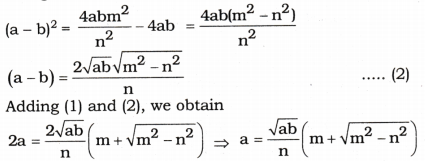
⇒ a – b = 4 √2√ab ………….. (2)
Adding equations (1) & (2) we have,
2a = 6√ab + 4√2 √ab
AP Inter 1st Year Maths Exercise 8b Solutions 1
⇒ a = (3 + 2√2)√ab ……….. (3)
Subtracting equations (1) and
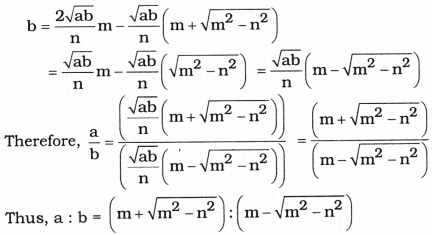
2b = 6√ab – 4√2√ab
AP Inter 1st Year Maths Exercise 8b Solutions 2
⇒ b = (3 – 2√2)√ab ………(4)
From the eq (3) and (4),
∴ \(\frac{a}{b}=\frac{(3+2 \sqrt{2}) \sqrt{a b}}{(3-2 \sqrt{2}) \sqrt{a b}}=\frac{3+2 \sqrt{2}}{3-2 \sqrt{2}}\)

Question 9.
If A and G be A.M. and G.M., respectively between two positive numbers, prove that the numbers are A ± \(\sqrt{(\mathrm{A}+\mathrm{G})(\mathrm{A}-\mathrm{G})}\)
Solution:
It is given that A & G are AM & GM between two positive numbers.
Let these two positive numbers be a & b.
AM = A = \(\frac{1}{2}\) ⇒ a + b = 2A ……… (1)
GM = G = √ab ⇒ ab = G2 ……… (2)
Substituting the values of (a + b) and (ab) from (1) & (2) in the identity
(a – b)2 = (a + b)2 – 4ab, we have (a – b)2 = 4A2 – 4G2 = 4(A2 – G2) = 4(A – G)(A + G)
⇒ a – b = 2\(\sqrt{(\mathrm{A}-\mathrm{G})(\mathrm{A}+\mathrm{G})}\) ……….. (3)
Adding (1) & (3) we have 2a = 2A + 2\(\sqrt{(\mathrm{A}-\mathrm{G})(\mathrm{A}+\mathrm{G})}\)
⇒ a = A + \(\sqrt{(\mathrm{A}-\mathrm{G})(\mathrm{A}+\mathrm{G})}\)
Substituting the value of a in (1) we have
A + \(\sqrt{(\mathrm{A}-\mathrm{G})(\mathrm{A}+\mathrm{G})}\) + b = 2A
⇒ b = A – \(\sqrt{(\mathrm{A}-\mathrm{G})(\mathrm{A}+\mathrm{G})}\)
Hence, the two numbers a & b are A ± \(\sqrt{(\mathrm{A}-\mathrm{G})(\mathrm{A}+\mathrm{G})}\)

Question 10.
The number of bacteria in a certain culture doubles every hour. If there were 30 bacteria present In the culture originally, how many bacteria will be present at the end of 2 hour, 4th hour and nth hour?
Solution:
It is given that the no. of bacteria doubles every hour therefore, the no. of bacteria after every hour will form a G.P.
Here, a = 30 & r = 2
∴ a3 = ar2 = (30)(2)2 = 120,
a5 = ar4 = (30) (2)4 = 30 × 16 = 480
Therefore, the no. of bacteria at the end of 2nd hour will be 120.
Therefore, the no. of bacteria at the end of 4th hour will be 480.
an+1 = arn = (30) 2n.
Hence, no. of bacteria at the end of nth hour will be (30)2n.

Question 11.
What will Rs. 500 amounts in 10 years after its deposit in a bank which pays annual interest rate of 10% compounded annually ?
Solution:
The amount deposited in the bank is Rs. 500.
At the end of first year, amount
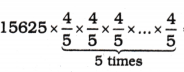
At the end of 2nd year, amount = ₹ 500 (1.1) (1.1)
At the end of 3rd year, amount = ₹ 500 (1.1) (1.1) (1.1) and so on
∴ Amount at the end of 10 years = ₹ 500 (1.1) (1.1) …. (10 times)

AP Inter 1st Year Maths Exercise 8b Solutions

Question 12.
If AM and GM of roots of a quadratic equation are 8 and 5, respectively, then obtain the quadratic equation.
Solution:
Let the roots of the quadratic equation be a & b.
According to the question, AM = \(\frac{1}{2}\) = 8
⇒ a + b = 16 …….(1)
GM = \(\frac{1}{2}\) = 5 ⇒ ab = 25 ………….(2)
The quadratic equation is given by
x2 – x (sum of roots) + (product of roots) = 0
⇒ x2 – x(a+b) + (ab) = 0
⇒ x2 – 16x + 25 = 0 [Using (1) 8s (2)]
Therefore, the required quadratic equation is x2 – 16x + 25 = 0.

AP Inter 1st Year Maths Exercise 8a Solutions

Referring to the AP Inter 1st Year Maths Study Material Chapter 8 Sequences and Series Exercise 8a Solutions makes it easier to understand complex problems.

AP Inter 1st Year Maths Sequences and Series Solutions Exercise 8a

I. Write the first five terms of each of the sequences in Exercises 1 to 6 whose nth terms are given.

Question 1.
an = n(n + 2)
Solution:
Given that an = n(n + 2).
Substituting n = 1, 2, 3, 4 and 5, we have
a1 = 1(1 + 2) = 3; a2 = 2(2 + 2) = 8; a3 = 3(3 + 2) = 15; a4 = 4(4 + 2) = 24; a5 = 5(5 + 2) = 35
Hence, the required terms are 3, 8, 15, 24 and 35.

Question 2.
an = \(\frac{\mathrm{n}}{\mathrm{n}+1}\)
Solution:
Given that an = \(\frac{\mathrm{n}}{\mathrm{n}+1}\)
Substituting n = 1, 2, 3, 4 and 5 we have,
a1 = \(\frac{1}{1+1}=\frac{1}{2}\); a2 = \(\frac{2}{2+1}=\frac{2}{3}\); a3 = \(\frac{3}{3+1}=\frac{3}{4}\); a4 = \(\frac{4}{4+1}=\frac{4}{5}\); a5 = \(\frac{5}{5+1}=\frac{5}{6}\)
Hence, the required terms are \(\frac{1}{2}, \frac{2}{3}, \frac{3}{4}, \frac{4}{5}\) & \(\frac{5}{6}\).

Question 3.
an = 2n
Solution:
Given that an = 2n
Substituting n = 1, 2, 3, 4 and 5 we have
a1 = 21 = 2, a2 = 22 = 4, a3 = 23 = 8, a4 = 24 = 16, a5 = 25 = 32
Hence, the required terms are 2, 4, 8, 16 and 32.

Question 4.
an = \(\frac{2 n-3}{6}\)
Solution:
Given that an = \(\frac{2 n-3}{6}\)
Substituting n = 1, 2, 3, 4 and 5 we have
a1 =(-1)1-1.51+1 = (-1)0.52 = 25,
a2 =(-1)2-1.52+1 = (-1)1.53 = 25,
a3 =(-1)3-1.53+1 = (-1)2.54 = 25,
a4 =(-1)4-1.54+1 = (-1)3.55 = 25,
a5 =(-1)5-1.55+1 = (-1)4.56 = 25,
Hence, the required terms are 25, -125, 625, -3125 & 15625

AP Inter 1st Year Maths Exercise 8a Solutions

Question 6.
an = n\(\frac{n^2+5}{4}\)
Solution:
Given that an = n\(\frac{n^2+5}{4}\)
Substituting n = 1, 2, 3, 4 and 5 we have
a1 = 1 × \(\left[\frac{1^2+5}{4}\right]\) = 1 × \(\left[\frac{2^2+5}{4}\right]\)

a2 = 2 × \(\left[\frac{3^2+5}{4}\right]\) = 1 × \(\frac{9}{4}=\frac{9}{2}\)

a3 = 3 × \(\left[\frac{4^2+5}{4}\right]\) = 1 × \(\frac{14}{4}=\frac{21}{2}\)

a4 = 4 × \(\left[\frac{5^2+5}{4}\right]\) = 1 × \(\frac{21}{4}\) = 21

a5 = 5 × \(\left[\frac{5^2+5}{4}\right]\) = 1 × \(\frac{30}{4}=\frac{75}{2}\)
Hence, the required terms are \(\frac{3}{2}, \frac{9}{2}, \frac{21}{2}\), 21 and \(\frac{75}{2}\)

Find the indicated terms in each of the sequences In Exercises 7 to 10 whose nth terms are given.

Question 7.
an = 4n – 3;(a17, a24)
Solution:
Given that an = 4n – 3
Substituting n = 17, we have a17 = 4(17) – 3 = 68 – 3 = 65
Substituting n = 24, we have a24 = 4(24) – 3 = 96 – 3 = 93

Question 8.
an = \(\frac{\mathrm{n}^2}{2^{\mathrm{n}}}\), a7.
Solution:
Given that an = \(\frac{\mathrm{n}^2}{2^{\mathrm{n}}}\).
Substituting n = 7,we have a7 = \(\frac{7^2}{2^7}=\frac{49}{128}\)

Question 9.
an = (-1)n-1n3, a9
Solution:
Given that an = \(\frac{\mathrm{n}(\mathrm{n}-2)}{\mathrm{n}+3}\)
Substituting n = 9, we have, a9 = (-1)9-1. 93 = (-1)8 . 93 = 93 = 729

Question 10.
an = \(\frac{n(n-2)}{n+3}\);a20
Solution:
Given that a = \(\frac{n(n-2)}{n+3}\)
Substituting n = 20, we have a20 = \(\frac{20(20-2)}{20+3}=\frac{20 \times 18}{23}=\frac{360}{23}\)

II. Write the first five terms of each of the sequences in Exercises 11 to 13 and obtain the corresponding series.

Question 1.
a1 = 3, an = 3an-1 + 2 for all n > 1
Solution:
Given that a1 = 3, an = 3an-1 + 2 for all n> 1
Substituting n = 2, 3, 4 and 5, we have
a2 = 3a2-1 + 2 = 3a1 + 2 = 3 × 3 + 2 = 11,
a3 = 3a3-1 + 2 = 3a2 + 2 = 3 × 11 + 2 = 11,
a4 = 3a4-1 + 2 = 3a3 + 2 = 3 × 35 + 2 = 11,
a5 = 3a5-1 + 2 = 3a4 + 2 = 3 × 10⁷ + 2 = 11,
Therefore, the required terms are 3, 11, 35, 107 and 323.
Hence, the corresponding series is 3 + 11 +35 + 107 + 323 + ………..

Question 2.
a1 = -1, an = \(\frac{a_{n-1}}{n}\); n ≥ 2
Solution:
Given that a1 = -1, an = \(\frac{\mathrm{a}_{\mathrm{n}-1}}{\mathrm{n}}\), n ≥ 2

Substituting n = 2, 3, 4 and 5 we have,
a2 = \(\frac{a_{2-1}}{2}=\frac{a_1}{2}=-\frac{1}{2}\)

a3 = \(\frac{a_{3-1}}{3}=\frac{a_2}{3}=\frac{-\frac{1}{2}}{3}=\frac{-1}{6}\)

a4 = \(\frac{a_{4-1}}{4}=\frac{a_3}{4}=\frac{-\frac{1}{6}}{4}=\frac{-1}{24}\)

a5 = \(\frac{a_{5-1}}{5}=\frac{a_4}{5}=\frac{-\frac{1}{24}}{5}=\frac{-1}{120}\)

Hence, the required terms are -1, \(-\frac{1}{2},-\frac{1}{6},-\frac{1}{24}\) & \(-\frac{1}{120}\)

Hence, the corresponding series is -1 + \(\left(-\frac{1}{2}\right)+\left(-\frac{1}{6}\right)+\left(-\frac{1}{24}\right)+\left(\frac{-1}{120}\right)+\ldots \ldots\)

Question 3.
a1 = a2 = 2; an = an-1 – 1, n > 2
Solution:
Given that a1 = a2 = 2; an = an-1 – 1, n > 2
Substituting n = 3, 4 and 5 we have
a3 = a3-1 – 1 = a2 – 1 = 2 – 1 = 1
a4 = a4-1 – 1 = a3 – 1 = 1 – 1 = 1
a5 = a5-1 – 1 = a4 – 1 = 0 – 1 = 1
Hence, the required terms are 2, 2, 1,0 and -1
Hence, the corresponding series is 2 + 2+ 1 + 0 + (-1) ….

AP Inter 1st Year Maths Exercise 8a Solutions

Question 4.
The Fibonacci sequence is defined by 1 = a1 = a2 and an = an-1 + an-2, n > 2.
Find \(\frac{a_{n+1}}{a_n}\), for n = 1, 2, 3, 4, 5.
Solution:
Given that 1 = a1 = a2 and an = an-1 + an-2

Substituting n = 3, 4 and 5, we have
a3 = a3-1 + a3-2 = a2 + a1 = 1 + 1 = 2
a4 = a4-1 + a4-2 = a3 + a2 = 2 + 1 = 2
a5 = a5-1 + a5-2 = a4 + a3 = 3 + 2 = 2
a6 = a6-1 + a6-2 = a5 + a4 = 5 + 3 = 2

Putting n = 1 in \(\frac{a_{n+1}}{a_n}\), we have \(\frac{a_{1+1}}{a_1}=\frac{a_2}{a_1}=\frac{1}{1}\) = 1

Putting n = 2 in \(\frac{a_{n+1}}{a_n}\), we have \(\frac{a_{2+1}}{a_2}=\frac{a_3}{a_2}=\frac{2}{1}\) = 2

Putting n = 3 in \(\frac{a_{n+1}}{a_n}\), we have \(\frac{a_{3+1}}{a_3}=\frac{a_4}{a_3}=\frac{3}{2}\)

Putting n = 4 in \(\frac{a_{n+1}}{a_n}\), we have \(\frac{a_{4+1}}{a_4}=\frac{a_5}{a_4}=\frac{5}{3}\)

Putting n = 5 in \(\frac{a_{n+1}}{a_n}\), we have \(\frac{a_{5+1}}{a_5}=\frac{a_6}{a_5}=\frac{8}{5}\)

Synonyms and Antonyms Inter 1st Year English Grammar

For systematic learning, students can include AP Inter 1st Year English Grammar with Answers and Synonyms and Antonyms in English Inter 1st Year in their daily study routine.

AP Inter 1st Year English Synonyms and Antonyms with Answers

Synonyms and antonyms are vital tools for expanding vocabulary, improving writing, and enhancing communication. Synonyms provide alternative words with similar meanings, while antonyms offer words with opposite meanings. Understanding and using them effectively allows for more precise and varied expression, enriching both written and spoken language.

ఎవరైనా ఫలానా వ్యక్తికి ఇంగ్లీషు బాగా వచ్చు, అని అంటే, ఆ వ్యక్తికి వివిధ రకాల వాక్యనిర్మాణం, పదాలకి అర్ధాలు, వాటి సమానార్ధాలు మరియు వాటి వ్యతిరేకార్ధాలు బాగా తెలుసన్నమాట. ఎన్ని ఎక్కువ పదాలు మనకి తెలిస్తే మరియు వాటిని వాక్యాలలో ఉపయోగించగలిగితే మనకి అంత ఇంగ్లీషు వచ్చన్నమాట. వాటిని ఇక్కడ నేర్చుకోండి.

WordSynonymsAntonyms
1. acquisitionaddition, gainloss, failure
2. commencebegin, starthalt, end
3. despairgloom, depressiondelight, joy
4. glancelook, watchcontemplate, scrutinize
5. idlycasually, lazilyactively, dynamically
6. listlessnesslethargy, boredomvitality, enthusiasm
7. ploddrudge, toillaze, lounge
8. reflectmirror, imitateabsorb, retain
9. wrathfury, ragecalmness, glee
10. menacerisk, threatsafety, soothe
11. prowesstalent, masteryinability, incompetence
12. treasonbetrayal, cheatloyalty, honesty
13. hopewish, desiredoubt, disbelief
14. claritydirectness, accuracyconfusion, obscurity
15. meekgentle, docilebossy, bold
16. symmetrybalance, equilibriumimbalance, dissimilarity
17. mutilatedamage, distortmend, cure
18. pugnacityaggression, combativenesssubmission, peacefulness
19. skirmishargument, quarrelharmony, agreement
20. sparsescarce, scantyabundant, plentiful
21. slacksluggish, laxactive, lively
22. timidfrightened, nervousbold, brave
23. awfuldepressing, gruesomepleasant, delightful
24. dogmadoctrine, convictiondoubt, open-mindedness
25. fascinatingcaptivating, charmingrepellent, repulsive
26. scaryalarming, creepynormal, calming
27. sedatecalm, tranquilexcited, lively
28. preciousprized, treasuredcheap, worthless
29. contemptdisrespect, malicerespect, esteem
30. quaverfalter, oscillatebalanced, composed
31. throttlecontrol, stranglelet go, encourage
32. sterilizedisinfect, pasteurizeadulterate, corrupt
33. deliriumhallucination, hysteriacoherence, collectedness
34. remitdispatch, forwardhold, retain
35. revokeabolish, dismissapprove, permit
36. blotblemish, smudgecleanliness, honour
37. crestheight, peakbottom, nadir

Synonyms and Antonyms Inter 1st Year English Grammar

Exercises for Practice

Question 1.
Fill in the blanks with the synonyms and antonyms of ‘Strength’.

Read the passage below and fill in the blanks with the correct words from the box.
Word Bank: (power, weakness, might, frailty, vigor, resilience, fragility, endurance)

To overcome challenges in life, one must rely on both physical and mental ____(1)____. However, there are times when ____(2)____ can hold us back, making it difficult to achieve our goals. People with great ____(3))____ are often admired for their ability to face hardships with courage.

On the other hand, ____(4)____ and ____(5)____ can make even simple tasks seem daunting. Developing ____(6)____ and ____(7)____ can help us stay strong during tough times. Remember, true strength is not just about ____(8)____; it is also about having the wisdom to adapt and persist.
Answer:
1. vigour
2. weakness
3. resilience
4. frailty
5. fragility
6. endurance
7. might
8. power

Question 2.
i) Choose the option that is a synonym of the given word or the key word.

1. glance
a) study
b) laze
c) look
Answer:
c) look

2. commence
a) begin
b) mirror
c) halt
Answer:
a) begin

3. acquisition
a) enthusiasm
b) imitate
c) gain
Answer:
c) gain

4. reflect
a) note
b) imitate
c) hinder
Answer:
b) imitate

5. wrath
a) rage
b) calmness
c) slow
Answer:
a) rage

ii) Choose the option that is an antonym of the given word the key word.

1. plod
a) endeavour
b) lounge
c) loss
Answer:
b) lounge

2. despair
a) gloom
b) struggle
c) joy
Answer:
c) joy

3. listlessness
a) enthusiasm
b) boredom
c) hopelessness
Answer:
a) enthusiasm

4. idly
a) casually
b) satisfy
c) actively
Answer:
c) actively

5. prowess
a) incompetence
b) brave
c) combativeness
Answer:
a) incompetence

Synonyms and Antonyms Inter 1st Year English Grammar

Question 3.
Add suitable prefixes to the words given below and form their antonyms.

1. interested
Answer:
uninterested

2. visible
Answer:
invisible

3. sane
Answer:
insane

4. important
Answer:
unimportant

5. usual
Answer:
unusual

6. available
Answer:
unavailable

7. legible
Answer:
illegible

8. responsible
Answer:
irresponsible

9. possible
Answer:
impossible

10. trust
Answer:
distrust

Synonyms and Antonyms Inter 1st Year English Grammar

11. qualified
Answer:
unqualified

12. appropriate
Answer:
inappropriate

Exercises

Question 1.
Choose the option that is a synonym of the given word.

1. symmetry
a) imbalance
b) equilibrium
c) indifference
Answer:
b) equilibrium

2. sparse
a) sprint
b) strong
c) scarce
Answer:
c) scarce

3. scary
a) calming
b) creepy
c) corrupt
Answer:
b) creepy

4. precious
a) cleanliness
b) treasured
c) liking
Answer:
b) treasured

5. revoke
a) repellent
b) approve
c) dismiss
Answer:
c) dismiss

6. crest
a) peak
b) aversion
c) brave
Answer:
a) peak

7. quaver
a) gruesome
b) prized
c) falter
Answer:
c) falter

8. dogma
a) adulterate
b) dignified
c) doctrine
Answer:
c) doctrine

9. meek
a) gentle
b) strangle
c) tranquil
Answer:
a) gentle

10. fascinating
a) alarming
b) charming
c) cheap
Answer:
b) charming

11. skirmish
a) harmony
b) bottom
c) quarrel
Answer:
c) quarrel

12. pugnacity
a) malice
b) nadir
c) combativeness
Answer:
c) combativeness

13. throttle
a) control
b) permit
c) esteem
Answer:
a) control

14. blot
a) hold
b) trust
c) blemish
Answer:
c) blemish

15. Slack
a) lax
b) brave
c) cure
Answer:
a) lax

Synonyms and Antonyms Inter 1st Year English Grammar

2. Choose the option that is an antonym of the given word.

1. awful
a) pleasant
b) noisy
c) slow
Answer:
a) pleasant

2. hope
a) stain
b) talent
c) disbelief
Answer:
c) disbelief

3. clarity
a) accuracy
b) obscurity
c) mastery
Answer:
b) obscurity

4. mutilate
a) mend
b) tough
c) distort
Answer:
a) mend

5. slack
a) active
b) glee
c) lax
Answer:
a) active

6. sedate
a) abolish
b) malice
c) lively
Answer:
c) lively

7. contempt
a) disrespect
b) respect
c) retain
Answer:
b) respect

8. sterilize
a) adulterate
b) charming
c) ambiguity
Answer:
a) adulterate

9. delirium
a) slow
b) coherence
c) bottom
Answer:
b) coherence

10. remit
a) captivating
b) nadir
c) hold
Answer:
c) hold

11. blot
a) honour
b) aversion
c)encourage
Answer:
a) honour

12. throttle
a) possible
b) encourage
c) sane
Answer:
b) encourage

13. meek
a) desire
b) docile
c) bossy
Answer:
c) bossy

14. quaver
a) interested
b) composed
c) qualified
Answer:
b) composed

15. precious
a) worthless
b) calm
c) visible
Answer:
a) worthless

Synonyms and Antonyms Inter 1st Year English Grammar

Question 3.
a) Choose the option that is a synonym of the given word.

1. dart
a) linger
b) dash
c) alarming
Answer:
b) dash

2. distort
a) alter
b) lax
c) smudge
Answer:
a) alter

3. acquisition
a) enthusiasm
b) imitate
c) gain
Answer:
c) gain

4. crest
a) peak
b) aversion
c) brave
Answer:
a) peak

b) Choose the option that is an antonym of the given word.

1. present
a) here
b) absent
c) light
Answer:
b) absent

2. plump
a) short
b) lean
c) fat
Answer:
b) lean

3. despise
a) like
b) need
c) hate
Answer:
a) like

4. sedate
a) abolish
b) malice
c) lively
Answer:
c) lively

Synonyms and Antonyms Inter 1st Year English Grammar

Question 4.
a) Choose the option that is a synonym of the given word.

1. timid
a) frightened
b) bold
c) sober
Answer:
a) frightened

2. menace
a) safety
b) risk
c) week
Answer:
b) risk

3. slack
a) honesty
b) esteem
c) sluggis
Answer:
c) sluggis

4. precious
a) prized
b) cheap
c) steady
Answer:
a) prized

b) Choose the option that is an antonym of the given word.

1. throttle
a) encourage
b) control
c) dismiss
Answer:
a) encourage

2. remit
a) forward
b) retain
c) nadir
Answer:
b) retain

3. awful
a) gruesome
b) creepy
c) pleasant
Answer:
c) pleasant

4. revoke
a) abolish
b) approve
c) aversion
Answer:
b) approve

Silent Letters Inter 1st Year English Grammar

For systematic learning, students can include AP Inter 1st Year English Grammar with Answers and Silent Letters in English Inter 1st Year in their daily study routine.

AP Inter 1st Year English Silent Letters with Answers

Silent letters are a peculiar feature of English spelling. Letters are used in writing but the corresponding sounds are not uttered in pronunciation. This poses problems to learners both in spelling and pronunciation. A study says that 60% of the English words have silent letters!

Careful observation of both the spelling and pronunciation is the only way out to overcome this problem. There are, however, some generalizations about silent letters that will help learners understand this feature to some extent.

In the Intermediate Public Examination, normally, the words that appear in the prescribed selections with a silent consonant letter are set under this question.

Some Guidelines:

  • ‘b’ before word-final ’t’ is silent – doubt debt.
  • ‘b’ in final mb’ clusters is also silent. – comb womb tomb
  • g’ before word final ’n’ is silent. – sign resign foreign campaign reign sovereign
  • g’ in most ‘ough’, ‘augh’ combinations is silent. – though taught through thorough
    (But in some words with ’augh’ it may sound as /f/ as in ’laughter’)
  • ‘h’ in word beginning position (not always) is silent. – honest honour
  • ‘k’ in word beginning followed by n’ is silent. – knowledge know knit knee knave knuckle
  • ‘l’ before word final ‘m’ is silent. – calm palm (but in realm – ‘l’ is not silent)
  • Word final n’ preceded by m’ is silent, condemn column autumn
  • ‘p’ in word beginning position followed by ‘s’ is silent, psychology psalm pseudo
  • ‘p’ in words like receipt is also silent.
  • ‘r’ followed by a consonant letter is silent, world card
  • ‘t’ is silent in clusters like ‘astle’, ‘isten’, istle’ as in castle whistle listen
  • w’ is silent in words like – write wrap know fawn lawn

(These guiding principles are by no way exhaustive. They help the learner to a great extent in identifying the silent letters. About vowels – the problem is not this simple or unambiguous. So no generalisation is given here.)

Silent Letters Inter 1st Year English Grammar

Some More Examples

Silent LetterExample Words
ahead, bread, deaf, meant
bdebt, lamb, bomb, tomb
cmuscle, blackguard, yacht, indict
dWednesday, handkerchief, handbag
ggnaw, gnome, phlegm
hhonour, heir, ghost, night
kknow, knee, knock
ltalk, folk, salmon, colonel
mmnemonic
nhymn, solemn, damn


Silent LetterExample Words
oleopard, jeopardy
Ppsalm, psychology, pneumatic, cupboard, receipt
q(u)lacquer
rmyrrh, catarrh
sisle, aisle, viscount, mess
toften, thistle, castle, fasten, mortgage
ubuild, guild, plague
wwhole, write, sword
zrendezvous
ghsigh, high, daughter
Silent consonantExample Words
1. bcomb, climb, debt, plumber, tomb,
subtle, dumb, bomb, doubt, numb, thumb, womb.
2. cacquire, acquit, blackguard, czar, muscle, scissors
3. dhandkerchief, Wednesday (commonly said Wensday)
4. fhalfpenny
5. galign, alight, champagne, diaphram, gnaw, high, light, reign
6. ghright, drought, eight, weigh
7. hchoir, exhaust, hour, honour, honest, herb, rhyme, rhythm
8. kknee, knife, know
9.  lcalm, folk, salmon, talk, walk, could, should; would, folk, half, calf.
10. mmnemonic.
11. nautumn, chimney, column, damn, damn, government, solemn.
12. pcupboard, pneumonia, psalm
13. rbutter, finger, surprise
14. saisle, island, debris, isle
15. tChevrolet, depot, listen, whistle, wrestle, apostle
16. wwho, whole, write, wrong, two, sword, wrist, answer

Silent Letters Inter 1st Year English Grammar

Exercises

1. Identify the silent consonants in the following words.

1. thumb – b
2. thirst – r
3. muscle – c
4. iron – r
5. write – w
6. vehicle – h
7. numb – b
8. yolk – l
9. clutch – t
10. campaign – g
11. aisle – s
12. neighbour – gh
13. scent – c
14. almond – l
15. World – r
16. tackle – c
17. wrinkle – w
18. knot – k
19. bright – gh
20. journey – o
21. chalk – l
22. limb – b
23. weight – gh
24. wrath – w
25. folk – l
26. discipline – c
27. mortgage – t
28. fascinate – c
29. design – g
30. balm – l

Silent Letters Inter 1st Year English Grammar

31. thigh – gh
32. rustlings – t
33. knob – k
34. slaughter – gh
35. yacht – ch
36. heir – h
37. answer – w
38. cupboard – p
39. palm – l
40. thorn – r
41. Christmas – t
42. pledge – d
43. wrong – w
44. sword – w
45. knew – k
46. psychology – p
47. scene – c
48. debris – s
49. depot – t
50. alms – l
51. hour – h
52. salmon – l
53. knee – k
54. castle – t
55. Wednesday – d
56. wreath – w
57. judge – d
58. knock – k
59. honourable – h
60. rapport – t

Silent Letters Inter 1st Year English Grammar

2. Identify the silent consonants in the following words.

1. subtle – b
2. handsome – d
3. resign – g
4. knead – k
5. wreck – w
6. psyche – p

3. Identify the silent consonants in the following words.

1. soften – t
2. cupboard – p
3. honour – h
4. kneel – k
5. surprise – r
6. pneumonia – p

Prepositions Inter 1st Year English Grammar

For systematic learning, students can include AP Inter 1st Year English Grammar with Answers and Prepositions in English Inter 1st Year in their daily study routine.

AP Inter 1st Year English Prepositions with Answers

A preposition is placed before nouns, pronouns, noun equivalents, noun phrases, or noun clauses. It shows its relation to some other word or words in the sentence.

(ఒక నామవాచకము, సర్వనామము, నామవాచక సమానాలు, నామవాచక పదసముదాయం లేక నామవాచక ఉపన్యాసాల ముందు విభక్తి ప్రత్యయం (preposition) ఉంటుంది. ఇది వాక్యంలోని ఇతర పదము లేక పదాలతో ఆ నామవాచకము యొక్క సంబంధాన్ని తెలుపుతుంది.)

e.g.: i) She is fond of sweets,
ii) He jumped into the river.

USING PREPOSITIONS:

A) In :

  1. To denote place : in Canada; in a village.
  2. To indicate time : in the morning.
  3. To indicate position : in intensive care, in a jovial mood.
  4. To indicate dress : in blue frock, in uniform.
  5. To indicate surroundings : in open space, in prison.

B) At :

  1. To denote state : India and Pakistan were at war in the early sixties.
  2. To indicate a point of time : I shall meet you at 5 p.m.
  3. To denote degree or price : We bought these apples at forty rupees a dozen.
  4. To denote a place : She was at school then.
  5. To tell the sense of being engaged : All the students are at play.
  6. To denote aim : The hunter fired his gun at the bird.
  7. With the names of small villages and towns : She lives at Kondapalli.

C) By:

  1. To show nearness : There is a house by the stream.
  2. To mean ‘during’ : By night or by day, he is a nuisance.
  3. To mean ‘measure’ : He is taller by an inch.
  4. To mean in the name of : I swore in the court by God.

D) On :

  1. Place : My pen is on the table.
  2. Time : I was on time to the examination.
  3. Position : Sarala is on probation.
  4. Concern : This is a book on law.
  5. Objective : I am bent on visiting Mysore this summer.

E) Of :

  1. Relationship : The results of S.S.C. are published today.
  2. Phrases : A man of principles, a story of adventure.
  3. Division : He took one metre of this cloth.
  4. Subjective relation : The love of mother can never be repaid.
  5. Cause : He died of sun-stroke.
  6. Source : She comes of a rich family.
  7. Quality : Shylock was a man of cruel character.
  8. Contents : I received a bag full of gifts.
  9. Peculiar constructions : How nice of you!

F) For:

  1. In place of : Dalda is used for ghee.
  2. On account of: We entered slowly for the fear of disturbing the baby.
  3. Purpose : Let us pray for peace.
  4. Destination : I am leaving for Chennai.
  5. Period of time : They have been working for the last three hours.

Prepositions Inter 1st Year English Grammar

G) After:

  1. Resemblance : Sivaji takes after his mother.
  2. Next : The dog ran after the hare.
  3. Time : I usually return home after 5 p.m.

The following are some of the uses of prepositions of place:

Prepositions Inter 1st Year English Grammar 1 : waiting at a bus stop, at the station, at the traffic lights, at a party, at a conference

Prepositions Inter 1st Year English Grammar 2 : a spider on the wall, on the ceiling, on the road, on the floor, on the river.

Prepositions Inter 1st Year English Grammar 3 : swimming in the river, in the bag, in the room, in Hyderabad, in the sky.

Prepositions Inter 1st Year English Grammar 4 : to the station, to school, to the bank, to hospital, to my house.

Prepositions Inter 1st Year English Grammar 5 : from the station, from school, from the bank, from home.

Prepositions Inter 1st Year English Grammar 6 : into the house, into the room, into the bank, into the kitchen.

Prepositions Inter 1st Year English Grammar 7 : out of the house, out of the room, out of the bank, out of the kitchen.

Prepositions Inter 1st Year English Grammar 8 : over the head, over the building, over the house, over the tree.

Prepositions Inter 1st Year English Grammar 9 : through the window, through glass, through the village.

Prepositions Inter 1st Year English Grammar 10 : along the road, along the bridge, along the river.

Prepositions Inter 1st Year English Grammar 11 : across the road, across the river, across the building.

Differences in using Prepositions

1. At, in

a) At… small villages She lives at Pendurthi.

b) At… inside or outside. She is at the station.

In … cities and countries.
She lives in Visakhapatnam.
She lives in the U.K.In … inside only.
She is in the Cafeteria.
2. On, upon

On denotes things at rest. He sat on a chair.

Upon denotes things in motion.
The tiger jumped upon the deer.
3. Between, among

Between refers to two :

a) Choose between these two pens.

b) The two thieves divided the money between themselves.

Among refers to ‘more than two’.
Choose one among these ribbons.The four thieves divided the money among themselves.
4. Beside, besides:

‘Beside‘ means next to, at the side of, near to.

a) My house is beside the post office.

b) Ravikant sits beside me.

Besides means “in addition to”

I take bread besides biscuits.

She speaks German besides French.

5. For, since

‘For’ denotes period of time.

a) We have been working for four hours.

b) She has been staying here for six months.

‘Since‘ denotes point of time.
We have been working since 8 a.m.She has been staying here since April.

Prepositions Inter 1st Year English Grammar

Commonly Used Prepositional Combinations

1. abide by: The students should abide by the college rules.
2. accuse of: The police have accused him of theft.
3. act up : Children usually act up at functions as they feel bored.
4. addicted to: Sheela is addicted to social media.
5. afraid of: Saritha is afraid of cockroaches.
6. agree to : Do you agree to the terms and conditions?
7. agree with : We all agree with the picnic proposal.
8. angry with (a person) : My father is angry with me.
9. angry at (something) : The principal is angry at the student’s rude behaviour.
10. apologise to (a person for something) : I apologised to my friend for forgetting her birthday.
11. apply to (a person for something) : Have you applied to the manager for a job?
12. ask for: The students asked the teacher for detailed notes.
13. averse to : I am averse to spicy food.
14. aware of: One should be aware of one’s strengths as well as weaknesses.
15. believe in : I believe in God.

Prepositions Inter 1st Year English Grammar

16. beware of: Beware of pickpockets in crowded areas.
17. boast of: Do not boast of your wealth.
18. carry out: Many young persons come forward to carry out the older man’s plans for their village development.
19. congratulate on : I congratulate my brother on his success.
20. deal with: The new police officer initiated steps to deal with the deteriorating law and order situation.
21. depend on : You can always depend on your family.
22. die of: He died of a heart attack.
23. differ with (a person) : I differ with my colleague on that issue.
24. differ in (opinion) : The two experts differ in their opinion.
25. differ from : Southern India differs from Northern India in many ways.
26. famous for : The actor became famous for his role as Superman.
27. fond of: My sister is fond of classical music.
28. good at: She is good at solving puzzles.
29. grateful to : I am extremely grateful to my parents for their support.
30. guarantee for : There is no guarantee for this electronic device.
31. guilty of : The company was found guilty of environmental pollution.
32. inferior to : No one is inferior to anyone.
33. interest in : She has a keen interest in photography.
34. jealous of : Don’t be jealous of your friend’s success.
35. laugh at: Don’t laugh at people who are less fortunate.
36. listen to : Children should listen to their parents’ advice.
37. look after: Our English teacher looks after all our needs.
38. married to: She is married to her childhood friend.
39. pleased with : 1 am very pleased with the service at this hotel.
40. prefer to: I prefer reading books to watching TV.
41. prevent from: We should prevent children from playing with sharp objects.
42. proud of: Kavya is proud of her accomplishments.
43. rely on : You can rely on me to help you in an emergency.
44. response to : I received a positive response to my job application.
46. responsible to : The CEO is responsible to the board of directors.
47. search for: The police are searching for clues to solve the crime.
48. see off: We all went to the airport to see my son off, who was leaving for the U.S.

Prepositions Inter 1st Year English Grammar

49. set up: My brother wants to set up his own business after he completes his MBA.
50. similar to : His writing style is similar to that of his favourite author.
51. succeed in : He succeeded in landing him in dream job.
52. suffer from : The patient is suffering from pneumonia.
53. superior to : Your design is superior to mine.
54. surprised at: We were surprised at the unexpected turn of events.
55. take off : The plane took off exactly at 7:05 AM.
56. thirst for: The girl has a great thirst for knowledge.
57. tolerance for: One should have tolerance for other cultures and religions.
58. turn off: All the machines were turned off as there was some technical problem.
59. worthy of : The film is worthy of a National Award.
60. yield to : Weak minds quickly yield to temptations, while strong minds never yield to any pressures.

Exercises for Practice

Question 1.
Fill in the blanks either with ‘since’ or ‘for’.

Raaji has had a number of job opportunities _____(1)_____ she left school. She worked in a fashion designing company _____(2)_____ two years. Then she went abroad. She is in Paris at this moment. She has been there _____(3)_____ 2009. She started a boutique, which has been running successfully _____(4)_____ ten years.
Answers:
1. since
2. for
3. since
4. for

Question 2.
Look at the picture given on Page No. 141 in the textbook and complete the sentences using ‘behind, opposite, next, in front of.

A serene lake lies _____(1)_____ them, its calm water reflecting the surrounding mountains. A dense forest stretches out _____(2)_____ them, its trees towering above. A village is situated _____(3)_____ the lake. An old-world little cafe is located _____(4)_____ to the village, offering a warm welcome to the tourists.
Answers:
1. in front of
2. behind
3. opposite
4. next

Question 3.
Fill in the blanks with prepositions of movement or place.

1. There is a fence ___________ (over/ around/ into) the garden.
Answer:
around

2. The park is ___________ (away/ on/ below) from here.
Answer:
away

3. He jumped ___________ (around/ through/into) the swimming pool.
Answer:
into

4. The plane flew ___________ (over/ in/ to) the mountains.
Answer:
over

5. The book is ___________ (on / in / down) the shelf.
Answer:
on

6. They walked ___________ (through / along / above) along the beach.
Answer:
along

7. The train passes ___________ (through / in / over) the tunnel.
Answer:
through

8. The car is parked ___________ (above / into / in front) of the crowd.
Answer:
in front of

9. The cafe is ___________ (among / between / on) the library and the bookstore.
Answer:
between

10. The Daintine is placed ___________ (above / UD / atonal the fireplace.
Answer:
above

Prepositions Inter 1st Year English Grammar

11. Siya sat ___________ (over / beside / besides) Tia in the cinema hall.
Answer:
beside

12. She climbed ___________ (under / into / up) the stairs.
Answer:
up

13. The child hid ___________ (on / down / behind) the curtain.
Answer:
behind

14. She swam ___________ (into / on / across) the river.
Answer:
across

Question 4.
Choose the correct prepositions for the blanks.

1. She is proud ___________ (with / of / at) her wealth.
Answer:
of

2. I am very pleased ___________ (with / at / by) his behaviour.
Answer:
with

3. Himanish is married ___________ (by / to / with) Geethika.
Answer:
to

4. I am not jealous ___________ (of / on / to) his good luck.
Answer:
of

5. He was found guilty ___________ (for / of / at) his crime.
Answer:
of

6. Dheeraj is not afraid ___________ (of / for / to) failures.
Answer:
of

7. She is fond ___________ (for / of / to) traditional food.
Answer:
of

8. The painting was created ___________ (by / for / with) a local artist.
Answer:
by

Prepositions Inter 1st Year English Grammar

9. The furniture was made ___________ (in / of / through) rose wood.
Answer:
of

Exercises

Question 1.
Choose the correct preposition from the options in brackets and fill in the blanks.

1. The principal congratulated the girl ___________ (on / for / to) her success.
Answer:
on

2. He is suffering ___________ (with / of / from) malaria.
Answer:
from

3. I prefer tea ___________ (for / over / to) coffee.
Answer:
to

4. He is angry ___________ (at / with / on) his son.
Answer:
with

5. Visakhapatnam is famous ___________ (of / for / with) beautiful beaches.
Answer:
for

6. Do you agree ___________ (with / to / at) this proposal?
Answer:
with

7. Don’t laugh ___________ (on / at / to) others’ mistakes.
Answer:
at

8. I am grateful ___________ (for / to / of) my professor for her invaluable guidance.
Answer:
to

9. Greeshmika is not interested ___________ (in / to / of) online games.
Answer:
in

10. I believe ___________ (at / in / with) hard work rather than luck.
Answer:
in

11. Nanny is very good ___________ (in / at / with) telling stories.
Answer:
at

12. My father always listens ___________ (of / off / to) Ilayaraja’s songs.
Answer:
to

13. MLAs and MPs must be responsible ___________ (for / of / to) the people who elected them.
Answer:
to

Prepositions Inter 1st Year English Grammar

14. My parents got married ___________ (in / on / since) May.
Answer:
in

15. I had dinner ___________ (for / at / in) 7 PM.
Answer:
at

16. I’ve been playing ___________ (since / for / in) morning.
Answer:
since

17. I’m heading out ___________ (to / for / on) lunch.
Answer:
for

18. The park is ___________ (besides / between / among) the two buildings.
Answer:
between

19. She’s a great singer, ___________ (beside / besides / for) a good dancer.
Answer:
besides

20. The party’s ___________ (in / on / at) Friday night.
Answer:
on

21. The bridge was constructed ___________ (on / from / across) the river.
Answer:
across

22. I received a gift ___________ (from / to / on) my brother.
Answer:
from

23. The lights flickered ___________ (during / on / from) the storm.
Answer:
during

24. The swimmer dived ___________ (in / on / into) the pool for the race.
Answer:
into

25. The plane took ___________ (of / off / up) exactly on time.
Answer:
off

26. The meeting is scheduled from 2 pm ___________ (to / since / at) 3 pm.
Answer:
to

27. The new policy has sparked debate ___________ (among / between / in) the experts in the field of economics.
Answer:
among

28. She has been waiting ___________ (since / from / for) three hours for the flight in the airport.
Answer:
for

29. National Youth Day is observed ___________ (in / on / from) 12th January.
Answer:
on

30. The shops ___________ (along / over / under) the main road (on / across / from) the impact of social media on society.
Answer:
along

Prepositions Inter 1st Year English Grammar

31. A stunning view of the city stretched ___________ (on / across / from) the horizon.
Answer:
across

32. She wrote a thought-provoking article ___________ (from / at / about) the impact of social media on society.
Answer:
about

33. Christ, the Redeemer statue is located ___________ (in / at / on) Brazil.
Answer:
in

34. The hikers made their way ___________ (over / through / at) the dense forest.
Answer:
through

35. The car was going ___________ (behind / under / over) the truck on the highway.
Answer:
behind

2. Fill in each blank with the correct preposition from options provided.

1. It closed its mouth ___________ (of / in / from) a death grin.
Answer:
in

2. I will not take ___________ (up / of / on) your time.
Answer:
up

3. But I will tell you what is not the matter ___________ (from / about / with) me.
Answer:
with

4. ___________ (In / On / At) a Thursday, the young man appeared at the eastern gate.
Answer:
On

5. Your buggy’s waiting ___________ (at / for / on) you, ain’t it ?
Answer:
for

6. Others have navigated ___________ (at / in / through) tough times.
Answer:
through

Prepositions Inter 1st Year English Grammar

3. Fill in each blank with the correct preposition from the options provided.

1. The police arrived ___________ (at / in / from) the right moment.
Answer:
at

2. Always check your bill ___________ (after / before / during) paying money.
Answer:
before

3. The shop has been closed ___________ (from / for / since) two weeks.
Answer:
for

4. Children like ice creams ___________ (beside / besides / after) chocolates.
Answer:
besides

5. We go ___________ (to / for / from) market every Sunday.
Answer:
to

6. The chocolates are distributed ___________ (among / in / between) the children.
Answer:
among

Odd Sounds Inter 1st Year English Grammar

For systematic learning, students can include AP Inter 1st Year English Grammar with Answers and Odd Sounds in English Inter 1st Year in their daily study routine.

AP Inter 1st Year English Odd Sounds with Answers

A set of three words are given. One or two letters which are common in all the three words are underlined. The underlined letter stands for one sound in two of the given words and for a different sound in the other word. The word with a different sound is to be written as the response.

Exercise For Pracitce

1. thickthinthisthis
2. sugarsupersuppersugar
3. chalkchangechoirchoir
4. aboutappleamazeapple
5. horseworstcourseworst
6. beatheatheadhead
7. agenthugesinglesingle
8. gathergingergeneralgather
9. angelimagineangleangle
10. jigsawslogandangerdanger
11. gadgetengagegorgeousengage
12. citizencarrotcementcarrot
13. decidedecoratedecadedecide
14. recentbecauserecipebecause
15. unclefencebankfence
16. bringtonicsingtonic
17. amongjunkmindmind
18. shrinkpenguinpanicpanic
19. Alphaphoneemptyempty
20. receiptraspberryhyperhyper
21. corpscorpsegipsygipsy
22. amphibianpsychologypneumoniaamphibian
23. forkalgebrabirdalgebra
24. thornlibrarydoctorlibrary
25. suretreasuremissiontreasure
26. issuesugarsuitsuit
27. hasobservevisionvision
28. pleasurepressuremeasurepressure
29. conscioustissueleisureleisure
30. professorpresidentphysicsphysics
31. assureclosureinsureclosure
32. usualdecisionbesidebeside
33. xeroxexcelaffixxerox
34. exhaustexquistiteexampleexquisite
35. puzzlefrizzypizzapizza
36. freezeseizureamazeseizure
37. seizsneezeazureazure
38. legalaboutangryangry
39. animalarrangeambulancearrange
40. harshmatchcabinharsh
41. exaltawarddramadrama
42. adoreantiqueapartantique
43. earneditearthearth
44. eggentereraera
45. peertweetsteertweet
46. engineeacheagerengine
47. beastbreathbeanbreath
48. seerweedcreepseer
49. eclipseequalexcuseequal
50. smilepricenoticenotice
51. imageignoreivyivy
52. acidagilealienagile
53. fieldvisitimpactfield
54. quietfiberexistexist
55. briefyieldillill
56. clockpotatohotelclock
57. oldoveronceonce
58. honeyroseovenhoney
59. lemonoffenceobeyobey
60. movementoccasionowlmovement
61. wolfwomanwombwomb
62. observeoccurorangeorange
63. foolhookbookfool
64. moonfoottoolfoot
65. moodfoodfloodflood
66. cookstoodcoolcool
67. schoolwoodwoolschool
68. uglyunitupperunit
69. adultacuteamuseadult
70. fullruleputrule
71. valueannualsupersuper
72. futurenaturestudentstudent

Odd Sounds Inter 1st Year English Grammar

Exercises

Question 1.
Find the odd words in the given words keeping the underlined parts of the words.

1. cancercancelcircuscircus
2. spacefancyscopescope
3. dynamicabeyancehyphenabeyance
4. styleanalysistypeanalysis
5. ownermaniactrunktrunk
6. daintytrendymanglemangle
7. implyvipercupboardcupboard
8. amplepsalmexpelpsalm
9. sightstudiosignstudio
10. irritateisolateinterestisolate
11. ificeideaif
12. minoralibipilotalibi
13. optionradiooldoption
14. coldoutownout
15. thanksthanthusthanks
16. themetherapythemthem
17. cheapchanceacheache
18. complexionexamexactlycomplexion
19. axistaxexampleexample
20. eczemawizarddozeneczema
21. quartzbuzzquizquartz
22. ableapronavoidavoid
23. moralmadamchampmoral
24. begineruptedibleedible
25. echoepiceasyeasy
26. JunedutyhugeJune
27. crudetrueputput
28. uniqueuniverseumbrellaumbrella
29. choicecharcoalcharactercharacter
30. melancholymonarchbeachbeach

Odd Sounds Inter 1st Year English Grammar

Question 2.
Identify the odd words from the following words in respect of their underlined sounds and write them.

1. fullruleputrule
2. oldoveronceonce
3. fieldvisitimpactfield
4. ableapronavoidavoid
5. choicecharcoalcharactercharacter

Question 3.
Identify the odd words from the following words in respect of their underlined sounds and write them.

1. aboutappleamazeapple
2. hasobservevisionvision
3. seizesneezeazureazure
4. unclefencebankuncle
5. alphaphoneemptyempty

AP Inter 1st Year Maths Exercise 8d Solutions

Referring to the AP Inter 1st Year Maths Study Material Chapter 8 Sequences and Series Exercise 8d Solutions makes it easier to understand complex problems.

AP Inter 1st Year Maths Sequences and Series Solutions Exercise 8d

Find the sum to infinity in each of the following Geometric Progression.

Question 1.
1, \(\frac{1}{3}, \frac{1}{9}\), …………..
Solution:
Let S = 1, \(\frac{1}{3}, \frac{1}{9}\), …………..; Here, a = 1 and r = \(\frac{1}{3}\)
So, S∞ = \(\frac{a}{1-r}=\frac{1}{1-\frac{1}{3}}=\frac{1}{2 / 3}=\frac{3}{2}\) = 1.5

Question 2.
6, 1.2, 0.24, …………………
Solution:
Let S = 6 + 1.2 + 0.24 + ………………….; Here, a = 6 and r = 0.2
So, S∞ = \(\frac{a}{1-r}=\frac{6}{1-(0.2)}=\frac{6}{0.8}\) = 7.5

Question 3.
5, \(\frac{20}{7}, \frac{80}{49}\) ………..
Solution:
Let S = 5, \(\frac{20}{7}, \frac{80}{49}\), ………….; Here a = 5, r = \(\frac{4}{7}\)
So, S∞ = \(\frac{a}{1-r}=\frac{5}{1-\frac{4}{7}}=\frac{35}{3}\)

AP Inter 1st Year Maths Exercise 8d Solutions

Question 4.
\(\frac{-3}{4}, \frac{3}{16}, \frac{-3}{64}\) ………….
Solution:
Let S = \(\frac{-3}{4}, \frac{3}{16}, \frac{-3}{64}\) ………….; Here, a = \(\frac{-3}{4}\) and r = \(\frac{-1}{4}\)

S∞ = \(\frac{a}{1-r}=\frac{-3 / 4}{1-\left(\frac{-1}{4}\right)}=\frac{-3 / 4}{1+\frac{1}{4}}=\frac{-3}{4} \times \frac{4}{5}=\frac{-3}{5}\)

Question 5.
Prove that 3\(\frac{1}{2}\) × 3\(\frac{1}{4}\) × 3\(\frac{1}{8}\) × ……. = 3
Solution:
LHS = 3\(\frac{1}{2}\) × 3\(\frac{1}{4}\) × 3\(\frac{1}{8}\) × ……. = 3\(\frac{1}{2}+\frac{1}{4}+\frac{1}{8}+\ldots \ldots .\);
Here a = \(\frac{1}{2}\) and r = \(\frac{1}{2}\)
∴ S∞ = 3\(\left(\frac{a}{1-r}\right)\)
= 3\(\left(\frac{1 / 2}{1-1 / 2}\right)\)
= 3\(\left(\frac{1 / 2}{1 / 2}\right)\)
= 31
= 3 = R.H.S. [using S∞ = \(\frac{a}{1-r}\)]

Question 6.
Let x = 1 + a + a2 + …….. and y = 1 + b + b2 + ….. where |a| < 1 and |b| < 1.
Prove that 1 + ab + a2b2 + ….. = \(\frac{x y}{x+y-1}\)
Solution:
Here, x = 1 + a + a2 + ……………… = \(\frac{1}{1-a}\) [using S∞ = \(\frac{a}{1-r}\)]

And y = 1 + b + b2 + ………… = \(\frac{1}{1-b}\)

LHS = 1 + ab + a2b2 + ……. = \(\frac{1}{1-ab}\) …………(1)

RHS = \(\frac{x y}{x+y-1}=\frac{\left(\frac{1}{1-a}\right)\left(\frac{1}{1-b}\right)}{\left(\frac{1}{1-a}\right)+\left(\frac{1}{1-b}\right)-1}=\frac{\frac{1}{(1-a)(1-b)}}{\frac{1-b+1-a-(1-a)(1-b)}{(1-a)(1-b)}}\)

= \(\frac{1}{(1-a)(1-b)} \times \frac{(1-a)(1-b)}{2-a-b-1+a+b-a b}=\frac{1}{1-a b}\) ……. (2)

From (1) and (2), 1 + ab + a2b2 + ………… = \(\frac{x y}{x+y-1}\)

AP Inter 1st Year Maths Exercise 8c Solutions

Referring to the AP Inter 1st Year Maths Study Material Chapter 8 Sequences and Series Exercise 8c Solutions makes it easier to understand complex problems.

AP Inter 1st Year Maths Sequences and Series Solutions Exercise 8c

I.

Question 1.
Find the 20th term of the series 2 × 4 + 4 × 6 + 6 × 8 + … + n terms.
Solution:
Given 2 × 4 + 4 × 6 + 6 × 8 + … + n terms
Therefore the nth term, an = 2n (2n + 2) = 4n2 + 4n
a20 = 4(20)2 + 4(20)
= 4(400) + 80
= 1600 + 80
= 1680
Therefore, 1680 is the 20th term.

Question 2.
The sum of some terms of G.P. is 315 whose first term and the common ratio are 5 and 2 respectively. Find the last term and the number of terms.
Solution:
Let the sum of n terms of the G.P be 315. It is known that Sn = \(\frac{1}{2}\)
It is given that a = 5 and common ratio r = 2
Hence, 315 = \(\frac{1}{2}\)
⇒ 2n – 1 = 63
⇒ 2n = 64 = (2)6
⇒ n = 6
Therefore, last term of the G.P. is 6th term
a6 = ar6-1 = ar5
= 5 × (2)5
= 5 × 32
= 160

AP Inter 1st Year Maths Exercise 8c Solutions

Question 3.
The first term of a G.P. is 1. The sum of the third term and fifth term is 90. Find the common ratio of G.P.
Solution:
Let a and r be the first term and common ratio of the G.P respectively.
Hence, a = 1 ⇒ a3 = ar2 = r2
⇒ a5 = ar4 = r4
Therefore, r2 + r4 = 90
r2 + r4 – 90 = 0
⇒ r2 = \(\frac{-1 \pm \sqrt{1+360}}{2}\)
= \(\frac{-1 \pm \sqrt{361}}{2}=\frac{-1 \pm 19}{2}\) = -10 or 9
r2 = 9 [Taking real roots]
r = ±3
Thus, the common ratio of the G.P is ±3.

II.

Question 1.
The sum of three consecutive terms in a G.P. is 56. If we subtract 1, 7, 21 from these numbers in that order, we obtain an arithmetic progression. Find the numbers.
Solution:
Let the three numbers in G.P. be a, ar and ar2.
From the given condition, a + ar + ar2 = 56
⇒ a(1 + r + r2) = 56 ………….. (1)
Now, (a – 1), (ar – 7), (ar2 – 21) forms an A.P.
Therefore, (ar – 7) – (a – 1) = (ar2 – 21) – (ar – 7)
⇒ ar – a – 6 = ar2 – ar – 14
⇒ ar2 – 2ar + a = 8
⇒ a(r2 + 1 r 2r) = 8
⇒ 7a(r2 – 2r + 1) = 56 ………….(2)
From (1) and (2), we get
⇒ 7(r2 – 2r + 1) – (1 + r + r2)
⇒ 7r2 – 14r + 7 – 1 – r – r2 = 0
⇒ 6r2 -15r + 6 = 0
⇒ 2r2 – 5r + 2 = 0
⇒ 2r2 -4r – r + 2 = 0
⇒ 2r(r – 2) – 1 (r – 2) = 0
⇒ (2r – 1) (r – 2) = 0
⇒ r = \(\frac{1}{2}\), 2

Case I :
Substituting r = 2 in (1), we obtain a(1 + 2 + 22) = 56
⇒ 7a = 56
⇒ a = 8
Hence, the three numbers in G.P are 8, 16 and 32.

Case II :
Substituting r = \(\frac{1}{2}\) in (1), we obtain a(1 + \(\frac{1}{2}\) + \(\left(\frac{1}{2}\right)^2\)) = 56
⇒ \(\frac{1}{2}\)a = 56
a = 32
Hence, the three numbers in G.P are 32, 16 and 8.
Therefore, from case (i) and case (ii), the three required numbers are 8, 16 and 32.

Question 2.
A G.P. consists of an even number of terms. If the sum of all the terms is 5 times the sum of terms occupying odd places, then find its common ratio.
Solution:
Let the G.P be T1, T2, T3, T4, … T2n. According to the question,
⇒ T1 + T2 + T3 + T4 + … + T2n = 5[T1 + T3 + T5 +… + T2n-1]
⇒ T1 + T2 + T3 + T4 +… + T2n – 5 [T1 + T3 + T5 +… + T2n-1] = 0
⇒ T2 + T4 + ………. + T2n = 4[T1 + T3 + ………. + T2n-1]
Let the G.P be a, ar, ar2,
\(\frac{\operatorname{ar}\left(\mathrm{r}^{\mathrm{n}}-1\right)}{\mathrm{r}-1}=\frac{4 \times \mathrm{a}\left(\mathrm{r}^{\mathrm{n}}-1\right)}{\mathrm{r}-1}\)
⇒ ar = 4a
⇒ r = 4
Thus, the common ratio of the G.P is 4.

Question 3.
If \(\frac{a+b x}{a-b x}=\frac{b+c x}{b-c x}=\frac{c+d x}{c-d x}\) (x ≠ 0), then show that a, b, c and d are in G.P.
Solution:
It is given that = \(\frac{a+b x}{a-b x}=\frac{b+c x}{b-c x}=\frac{c+d x}{c-d x}\) (x ≠ 0)
⇒ \(\frac{a+b x}{a-b x}=\frac{b+c x}{b-c x}\) = (a + bx) (b – cx) = (b + cx) (a – bx)
⇒ ab – acx + b2x – bcx2 = ab – b2x + acx — bcx2
⇒ 2b2x = 2acx
⇒ b2 = ac
⇒ \(\frac{b}{a}=\frac{c}{b}\) (1)
Also, ⇒ \(\frac{b+c x}{b-c x}=\frac{c+d x}{c-d x}\)
⇒ (b + cx)(c – dx) = (b – cx)(c + dx)
⇒ bc – bdx + c2x – cdx2 = bc + bdx – c2x – cdx2
⇒ 2c2x = 2bdx
⇒ c2 = bd
⇒ \(\frac{c}{b}=\frac{d}{c}\) …(2)
From Equations (1) and (2), we obtain \(\frac{b}{a}=\frac{c}{b}=\frac{d}{c}\)
Thus, a, b, c and d are in G.P.

Question 4.
Let S be the sum, P be the product and R be the sum of reciprocals of n terms in a G.P. Prove that P2Rn = Sn.
Solution:
Let the G.P be a, ar, ar2, ar3 … arn-1
According to the given information; Sum of the n terms, S = \(\frac{\mathrm{a}\left(\mathrm{r}^{\mathrm{n}}-1\right)}{\mathrm{r}-1}\)
Product of the n terms P = an × r1 + 2 + 3 + …. n-1
= anr\(\frac{\mathrm{n}(\mathrm{n}-1)}{2}\) [∵ Sum of first n natural numbers = n\(\frac{(\mathrm{n}+1)}{2}\)

Sum of reciprocals of n terms R = \(\frac{1}{2}\)
\(\frac{r^{n-1}+r^{n-2}+\ldots+r+1}{a r^{n-1}}=\frac{1\left(r^n-1\right)}{(r-1)} \times \frac{1}{a r^{n-1}}=\frac{r^n-1}{a r^{n-1}(r-1)}\) [∵ 1, r, ……….. rn-1 forms a G.P]
Therefore, P2Rn = a2nrn(n-1)\(\frac{\left(r^n-1\right)^n}{a^n r^{n(n-1)}(r-1)^n}=\frac{a^n\left(r^n-1\right)^n}{(r-1)^n}=\left[\frac{a\left(r^n-1\right)}{(r-1)}\right]^n\) = Sn
Hence, P2Rn = Sn proved.

Question 5.
If a, b, c, d are in G.P., prove that (an + bn), (bn + cn), (cn + dn) are in G.P.
Solution:
It is given that a, b, c, d are in G.P.
Therefore, b2 = ac ………. (1)
c2 = bd … (2)
ad = bc … (3)
We need to prove (an + bn), (bn + cn), (cn + dn) are in G.P i.e.,
(bn + cn)2 = (an + bn) . (cn + dn)
Consider (bn + cn)2 = b2n + 2bncn + c2n
= (b2)n + 2bncn + (c2)n = (ac)n + 2bncn + (bd)n [Using (1) and (2)]
= cn (an + bn) + dn (an + bn) = (an + bn) (cn + dn)
Hence, (bn + cn)2 = (an + bn) . (cn + dn)
Thus, (an + bn), (bn + cn), (cn + dn) are in G.P.

AP Inter 1st Year Maths Exercise 8c Solutions

Question 6.
If a and b are the roots of x2 – 3x + p * 0 and c, d are the roots of x2 – 12x + q = 0, where a, b, c, d form a G.P. Prove that (q + p) : (q – p) = 17 : 15.
Solution:
It is given that a and b are the roots of x2 – 3x + p = 0
Therefore, a + b = 3, ab = p
Also, c and d are the roots of x2 – 12x + q = 0; c + d = 12, cd = q
It is given that a, b, c, d form a G.P.
Let a = x, b = xr, c = xr2, d = xr3
From (1) and (2), we obtain, ⇒ x + xr = 3
⇒ x(1 + r) = 3
⇒ xr2 + xr3 = 12
⇒ xr2 (1 + r) = 12 … (4)

On dividing (4) by (3), we obtain \(\frac{\mathrm{xr}^2(1+\mathrm{r})}{\mathrm{x}(1+\mathrm{r})}=\frac{12}{3}\)
⇒ r2 = 4 ⇒ r = ±2

Case I:
When r = 2, x = 1 ⇒ ab = x2r = 2 & cd = x2r5 = 32
Therefore, ⇒ \(\frac{q+p}{q-p}=\frac{32+2}{32-2}=\frac{34}{30}=\frac{17}{15}\)
⇒ (q + p) : (q – p) = 17 : 15

Case II: when r = -2, x = -3
⇒ ab = x2r = -18 & cd = x2r5 = -288
Therefore, ⇒ \(\frac{q+p}{q-p}=\frac{-288-18}{-288+18}=\frac{-306}{-270}=\frac{17}{15}\)
Thus, (q + p) : (q – p) = 17 : 15 is proved.

Question 7.
The ratio of the A.M and G.M. of two positive numbers a and h, is m : n. Show that a : b = (m +\(\sqrt{m^2-n^2}\)):(m – \(\sqrt{m^2-n^2}\)).
Solution:
Let the two numbers be a and b. A.M = \(\frac{a+b}{2}\), G.M = \(\sqrt{a b}\)
Adding (1) and (2), we obtain \(\frac{a+b}{2 \sqrt{a b}}=\frac{m}{n} \Rightarrow \frac{(a+b)^2}{4 a b}=\frac{m^2}{n^2}\)
⇒ (a + b)2 = \(\frac{4 \mathrm{abm}^2}{\mathrm{n}^2}\)
⇒ (a + b) = \(\frac{2 \mathrm{~m} \sqrt{\mathrm{ab}}}{\mathrm{n}}\) .. (1)

Using this in the identity (a – b)2 = (a + b)2 – 4ab, we obtain
AP Inter 1st Year Maths Exercise 8c Solutions 1
Substituting the value of a in (1), we obtain
AP Inter 1st Year Maths Exercise 8c Solutions 2

III.

Question 1.
Find the sum of the following series upto n terms.
(i) 5 + 55 + 555 + …
Solution:
Given that 5 + 55 + 555 + …
Let Sn = 5 + 55 + 555 + … n terms
Sn = \(\frac{5}{9}\)[9 + 99 + 999 + …n terms] = \(\frac{5}{9}\) (10 – 1) + (102 – 1) + (103 – 1) + …nterms
= \(\frac{5}{9}\)[(10 + 102 + 103 + ……………. n terms) – (1 + 1 + ….. n terms)]
= \(\frac{5}{9}\)[\(\frac{10\left(10^{\mathrm{n}}-1\right)}{10-1}\) – n]

= \(\frac{5}{9}\)[\(\frac{10\left(10^{\mathrm{n}}-1\right)}{9}\) – n]

= \(\frac{50}{81}\)(10n – 1) – \(\frac{5n}{9}\)

(ii) .6 + .66 + .666 + …
Solution:
Sn = .6 + .66 + .666 + … n terms
= 6[.1 + .11 + .111 + …… upto nterms] = \(\frac{6}{9}\)[0.9 + 0.99 + 0.999 + upto n terms]
AP Inter 1st Year Maths Exercise 8c Solutions 3
Therefore, the sum of n terms of the given series is \(\frac{2}{3}\) n – \(\frac{2}{27}\)(1 – 10-n)

Question 2.
If f is a function satisfying f(x + y) = f(x) . f(y) for all x, y ∈ N such that f(1) = 3 and \(\sum_{x=1}^n\) f(x) = 120. And the value of n.
Solution:
f(x + y) = f(x) . f(y) for all x, y ∈ N and f(1) = 3
Taking x = y = 1 in the given function, we obtain f(x + y) = f(x) . f(y) ⇒ f(l + 1) = f(1) f(1) f(2) = 3 x 3 = 9
Similarly, f(x + y) = f(x) . f(y) ⇒ f(1 + 2) = f(1) f(2) ⇒ f(3) = 3 x 9 = 27
Also, f(x + y) = f(x) . f(y) ⇒ f(1 + 3) = f(1) f(3) ⇒ f(4) = 3 x 27 = 81
Therefore, f(1), f(2), f(3) i.e., 3, 9, 27, 81 forms a G.P. with both the first term and common ratio equal to 3.
It is known that Sn = \(\frac{\mathrm{a}\left(\mathrm{r}^{\mathrm{n}}-1\right)}{\mathrm{r}-1}\). It is given that \(\sum_{x=1}^n\) f(x) = 120

⇒ 120 = \(\frac{3\left(3^{\mathrm{n}}-1\right)}{3-1}\)
⇒ 120 = \(\frac{3}{2}\)(3n – 1)
⇒ 3n – 1 = 80
⇒ 3n = 34
⇒ n = 4
Thus, the value of n = 4.

Question 3.
A fanner buys a used tractor for ₹ 12000. He pays ₹ 6000 cash and agrees to pay the balance in annual installments of ₹ 500 plus 12% interest on the unpaid amount. How much will the tractor cost him ?
Solution:
Given, the farmer pays ₹ 6000 in cash.
So, the unpaid amount = ₹ 12000 – ₹ 6000 = ₹ 6000
From the question, the interest paid annually will be 12% of 6000, 12% of 5500, 12% of 5000, … , 12% of 500
Hence, the total interest to be paid = 12% of 6000 + 12% of 5500 + 12% of 5000 + … + 12% of 500 = 12% of (6000 + 5500 + 5000 + … + 500)
= 12% of (500 + 1000 + 1500 + … + 6000)
It’s seen that the series 500, 1000, 1500 … 6000 is an A.P. with the first term and common difference both are equal to 500.
Let’s take the number of terms of the A.P to be n.
So, 6000 = 500 + (n – 1) 500
⇒ 1 + (n – 1) = 12
⇒ n = 12
Now, The sum of the series in A.P = \(\frac{12}{2}\) [2(500) + (12 – 1) (500)]
= 6[1000 + 5500]
= 6(6500)
= 39000
Hence, the total interest to be paid = 12% of (500 + 1000 + 1500 +
= 12% of 39000 = ₹4680
Therefore, the tractor will cost the farmer = (₹ 12000 + ₹ 4680) = ₹ 16680

AP Inter 1st Year Maths Exercise 8c Solutions

Question 4.
Shamshad Ali buys a scooter for ₹ 22000. He pays ₹ 4000 cash and agrees to pay the balance in annual installment of? 1000 plus 10% interest on the unpaid amount. How much will the scooter cost him ?
Solution:
It is given that Shamshad Ali buys a scooter for ₹ 22000 and pays ₹ 4000 in cash. Hence, unpaid amount ₹ = 22000 – 4000 = 18000
According to the given condition, the interest paid annually will be (10% of 18000), (10% of 17000), (10% of 16000), … (10% of 1000)
Thus, total interest to be paid = (10% of 18000) + (10% of 17000) + … + (10% of 1000) = 10% of (18000 + 17000 + … + 1000) = 10% of (1000 + 2000 + … + 18000)
Now, the series 1000 + 2000 + … + 18000 forms an A.P. with a and d both equal to 1000.
Let the number of terms of the A.P. be n.
⇒ an = a + (n – 1) d
⇒ 18000 = 1000 + (n – 1) (1000)
⇒ 18000 – 1000 = 1000 (n – 1)
⇒ n – 1 = \(\frac{17000}{1000}\)
⇒ n = 17 + 1
⇒ n = 18
Now, total cost of scooter in ₹ = 22000 + 17100 = 39100
Thus, the scooter will cost him ₹ 39100.

Question 5.
A person writes a letter to four of his friends. He asks each one of them to copy the letter and mail to four different persons with instruction that they move the chain similarly. Assuming that the chain is not broken and that it costs 50 paise to mail one letter, find the amount spent on the postage when the 8th set of letters is mailed.
Solution:
The number of letters mailed forms a G.P : 4, 42, ……….. , 48; Here a = 4, n = 8
Hence, S = \(\frac{\mathrm{a}\left(\mathrm{r}^{\mathrm{n}}-1\right)}{\mathrm{r}-1}\)
S8 = \(\frac{4\left(4^8-1\right)}{4-1}=\frac{4(65536-1)}{3}=\frac{4 \times 65535}{3}\)
= 4 × 21845
= 87380
It is given that the cost to mail one letter is 50 paisa.
Therefore, cost in ₹ for mailing 87380 letters = \(\frac{50}{100}\) × 87380 = 43690
Thus, ₹ 43690 is the amount on the postage when 8th set of letters is mailed.

Question 6.
A man deposited ₹ 10000 in a bank at the rate of 5% simple interest annually. Find the amount in 15th year since he deposited the amount, also calculate the total amount after 20 years.
Solution:
It is given that the man deposited ₹ 10000 in a bank at the rate of 5% simple interest annually. Hence, annual interest received in ₹ = \(\frac{50}{100}\) × 10000 = 500
Amount in ₹ at the end of first year = 10000 + 500 = 10500
Amount in ₹ at the end of second year = 10500 + 500 = 11000
Amount in ₹ at the end of third year = 11000 + 500 = 11500
Therefore, 10000, 10500, 11000, … is an A.P.
Hence, the amount in the 15th year,
a15 = 10000 + (15 – 1) (500) = 10000 + 7000 = 17000
Amount after 20 years
a21 = 10000 + (21 – 1) (500) = 10000 + 10000 = 20000
Thus, the amount in 15th year is ₹ 17000 and after 20 years amount is ₹ 20000.

Question 7.
A manufacturer reckons that the value of a machine, which costs him ₹ 15625, will depreciate each year by 20%. Find the estimated value at the end of 5 years.
Solution:
Cost of a machine is ₹ 15625. Machine depreciates by 20% every year.
∴ Its value after every year is 80% of the original cost i.e., 4/5 of the original cost.
Value at the end of 5 years =
AP Inter 1st Year Maths Exercise 8c Solutions 4
= 15628 × \(\left(\frac{4}{5}\right)^5\)
= 5 × 1024
= 5120
Thus, value of the machine at the end of 5 years is ₹ 5120.

Question 8.
150 workers were engaged to finish a job in a certain number of days. 4 workers dropped out on second day, 4 more workers dropped out on third day and so on. It took 8 more days to finish the work. Find the number of days in which the work was completed.
Solution:
Let x be the number of days in which 150 workers finish the work.
According to the given information, 150x = 150 + 146 + 142 + … (x + 8) terms
Here, 150 + 146 + 142 + … (x + 8) terms forms an A.P. with a = 150, d = – 4, n = (x + 8)
Therefore 150x = \(\frac{(x+8)}{2}\)[2(150) + (x + 8 -1)(-4)]
⇒ 150x – (x + 8) [150 + (x + 7) (-2)]
⇒ 150x = (x + 8) (150 – 2x – 14)
⇒ 150x = (x + 8) (136 – 2x)
⇒ 75x – (x + 8) (68 – x)
⇒ 75x – 68x – x2 + 544 – 8x
⇒ x2 + 15x – 544 = 0
⇒ x2 + 32x – 17x – 544 = 0
⇒ x(x + 32) – 17(x + 32) = 0
⇒ (x – 17) (x + 32) = 0
⇒ x = 17, – 32
However, x cannot be negative, hence, x = 17
∴ The number of days in which the work was completed is (17 + 8) = 25 days. Thus, the work was completed in 25 days.

Phonetic Transcription Inter 1st Year English Grammar

For systematic learning, students can include AP Inter 1st Year English Grammar with Answers and Phonetic Transcription in English Inter 1st Year in their daily study routine.

AP Inter 1st Year English Phonetic Transcription with Answers

Meaningful speech sounds are the basic raw material for any language. These sounds are represented by symbols in writing. We refer to these symbols as the alphabet.

Most of the Indian languages have a fixed relationship between the sounds and their symbols. In other words, one symbol always stands for one sound and vice versa. Therefore, we find absolutely no problem while reading or writing Indian languages once we learn the alphabet of that language.

The same is not the case with English. One letter may stand for many sounds. Example c as / k / in car, as / s/ in century as /t ʃ/ in change. One sound is also represented by various letters.
Ex: / f / is represented by ph’ in philosophy, by ‘f in fan, by gh’ in rough. This results in a lot of problems for the learners, particularly for foreign learners in writing the spelling and pronouncing the written words.

A way out of this probelm is a set of forty-four symbols, called phonetic symbols. Each of these symbols stands for one sound only. Learning these symbols arms us with the necessary weapons to war against the problems in pronunciation and spelling.

Study the following forty four phonetic symbols carefully and learn to identify and use them. Phonetic symbols are always placed between two Slant lines.

Vowels

1) / i: / as in see
2) /ɪ/ as in sit
3) /e/ as in ten
4) / æ / as in bat
5) /ɑː/ as in arm
6) / ɒ/ as in got
7) /ɔː/ as in saw
8) /u/ as in put
9) /u:/ as in too
10) /ʌ/ as in cup
11) /ɜː/ as in fur
12) /ə/ as in ago
13) /eɪ/ as in page
14) /əʊ/ as in home
15) /aɪ/ as in five
16) /aʊ/ as in cow
17) /ɔɪ/ as in boil
18) /ɪə/ as in near
19) /eə/ as in hair
20) /ʊə/ as in poor

Phonetic Transcription Inter 1st Year English Grammar

Consonants

1) / p / as in pen
2) / b / as in bin
3) /t / as in tea
4) / d / as in dog
5) / k/ as in cat
6) / g / as in goat
7) /t ʃ/ as in change
8) / d ʒ / as in July
9) / f / as in fall
10) /v/ as in voice
11) /θ/ as in thin
12) /ð/ as in then
13) / s / as in so
14) / z / as in zoo
15) / ʃ / as in she
16) / ʒ / as in vision
17) / h / as in how
18) / n / as in may
19) / n / as in now
20) / ŋ / as in sing
21) /l/ as in long
22) / r / as in ring
23) /j/ as in yes
24) /w / as in wall

Writing the symbols that represent the sounds in a word is called phonetic transcript. In many examinations phonetic transcription is given and the examinee is asked to write the spelling of those words.

Phonetic Transcription Inter 1st Year English Grammar

Look at the following words and their phonetic transcription and you will certainly have an idea of it:

Word – Transcription

1. almond – /ɑːmənd/
2. asthma – /ˈæsmə/
3. business – /ˈbɪznɪs/
4. bury – /ˈber.i/
5. cache – /kæʃ/
6. colonel – /ˈkɜːnl/
7. coupon – /ˈkuːpɒn/
8. chassis – /ˈʃæsɪ/
9. chaos – /ˈkeɪɒs/
10. choir – /ˈkwaɪər/
11. cucumber – /ˈkjuːkʌm.bər/
12. data – /ˈdeɪ.tə/
13. dengue – /ˈdɛŋɡi/
14. determine – /dɪˈtɜːmɪn/
15. debris – /ˈdeɪb.riː/
16. discretion – /dɪˈskrɛʃᵊn/
17. epitome – /ɪˈpɪtəmi/
18. extempore – /eksˈtempərɪ/
19. etc./ et cetera – /ɪtˈsɛt.ər.ə/
20. flour – /flaʊə/
21. forte – /ˈfɔːteɪ/
22. gauge – /ɡeɪʤ/
23. genre – /ˈʒɒn.rə/
24. iron – /aɪən/
25. itinerary – /aɪˈtɪnərəri/
26. jewellery – /ˈʤuːəlri/
27. mischievous – /ˈmɪsʧɪvəs/
28. photography – /fəˈtɒɡrəfi/
29. picture – /ˈpɪkʧər/
30. plumber – /ˈplʌm.ər/
31. poem – /ˈpəʊɪm/
32. police – /pəˈliːs/
33. pizza – /ˈpiːt.sə/
34. receipt – /rɪˈsiːt/
35. saloon – /səˈluːn/
36. sour – /ˈsaʊər/
37. status – /ˈstaeɪ.təs/
38. subtle – /ˈsʌtl/
39. suite – /swiːt/
40. vehicle – /ˈviə.kəl/
41. vegetable – /ˈveʤɪtəbəl/
42. violence – /ˈvaɪə.ləns/
43. vineyard – /ˈvɪnjɑːd/
44. Wednesday – /ˈwɛnz.deɪ/
45. women – /ˈwɪm.ɪn/

Phonetic Transcription Inter 1st Year English Grammar

Exercises

Study the following phonetic transcriptions and write them in ordinary spelling.

1. Exercise from UNIT – 1

Question 1.
/kəˈmɛns/
Answer:
commence

Question 2.
/ˈfænsi/
Answer:
fancy

Question 3.
/ˈeɪlmənt/
Answer:
ailment

Question 4.
/dɪˈspeə(r)/
Answer:
despair

Question 5.
/ɡlɑːns/
Answer:
glance

Question 6.
/plʌnʤ/
Answer:
plunge

Question 7.
/fɪəs/
Answer:
fierce

Question 8.
/ˈblʌʤənɪŋ/
Answer:
bludgeoning

Question 9.
/ˈhæmpə(r)/
Answer:
hamper

Question 10.
/ˈsɜːkəmstɑːns/
Answer:
circumstance

Phonetic Transcription Inter 1st Year English Grammar

2. Exercise from UNIT – 2

Question 1.
/pʌɡˈnæsəti/
Answer:
pugnacity

Question 2.
/ɪˈlæbərəɪt/
Answer:
elaborate

Question 3.
/ˈʤɒsl/
Answer:
jostle

Question 4.
/ˈɜːrʧɪn/
Answer:
urchin

Question 5.
/skɜːʤ/
Answer:
scourge

Question 6.
/ˈmʌŋɡrəl/
Answer:
mongrel

Question 7.
/ˈtrɛbəl/
Answer:
treble

Question 8.
/ˈmjuːtɪleɪt/
Answer:
mutilate

Question 9.
/slæk/
Answer:
Slack

Question 10.
/ˈpɛrɪʃ/
Answer:
perish

Phonetic Transcription Inter 1st Year English Grammar

3. Exercise from UNIT – 3

Question 1.
/ˈslɔːtər/
Answer:
slaughter

Question 2.
/ˈθɪkɪt/
Answer:
thicket

Question 3.
/ˈvænɪʃ/
Answer:
vanish

Question 4.
/ˈænsɛstə(r)/
Answer:
ancestor

Question 5.
/ˈæŋɡwɪʃ/
Answer:
anguish

Question 6.
/ˈpænɪk/
Answer:
panic

Question 7.
/rɪˈtriːvd/
Answer:
retrieved

Question 8.
/ˈsɛntəns/
Answer:
sentence

Question 9.
/ˈprəʊtɛst/
Answer:
protest

Question 10.
/vɔːlt/
Answer:
vault

Phonetic Transcription Inter 1st Year English Grammar

4. Study the following phonetic transcriptions and write ANY FIVE of them in their ordinary spelling.

Question 1.
/ˈʤiːniəli/
Answer:
genially

Question 2.
/rɛtrɪˈbjuːʃən/
Answer:
retribution

Question 3.
/ʌnˈkɒŋkərəbəl/
Answer:
unconquerable

Question 4.
/ˈkæpʃən ɒv maɪ səʊl/
Answer:
caption of my soul

Question 5.
/səʊl/
Answer:
soul

Question 6.
/kənˈtɛmpt/
Answer:
contempt

Question 7.
/ˈpreəri/
Answer:
prairie

Question 8.
/bɪˈfɔːl/
Answer:
befall

Question 9.
/kəˈlɪɡrəfi/
Answer:
calligraphy

Question 10.
/’endəskəʊp/
Answer:
endoscope

Phonetic Transcription Inter 1st Year English Grammar

5. Study the following phonetic transcriptions and write ANY FIVE of them in their ordinary spelling.

Question 1.
/əˈblaɪʤ/
Answer:
oblige

Question 2.
/skɜː(r)ʤ/
Answer:
scourge

Question 3.
/ˈeɪlmənt/
Answer:
ailment

Question 4.
/ɪnˈdjuːs/
Answer:
induce

Question 5.
/spɑːrs/
Answer:
sparse

Question 6.
/ˈʤɒsəl/
Answer:
jostle

Question 7.
/ˈɪnəsəns/
Answer:
innocence

Question 8.
/ˈbɜːnɪŋ/
Answer:
burning

Phonetic Transcription Inter 1st Year English Grammar

Question 9.
/kənˈvʌlʃən/
Answer:
convulsion

Question 10.
/ˈθrɒtl/
Answer:
throttle