
Referring to the AP Inter 1st Year Maths Study Material Chapter 8 Sequences and Series Exercise 8e Solutions makes it easier to understand complex problems.
AP Inter 1st Year Maths Sequences and Series Solutions Exercise 8e
I. Find the sum to n terms of each of the series in Exercises 1 to 7.
Question 1.
1 × 2 + 2 × 3 + 3 × 4 + 4 × 5 + …
Solution:
The given series is 1 × 2 + 2 × 3 + 3 × 4 + 4 × 5 + … n terms
Hence, an = n(n + 1)
Therefore, Sn = \(\sum_{\mathrm{k}=1}^{\mathrm{n}}\) ak = \(\sum_{\mathrm{k}=1}^{\mathrm{n}}\) k(k + l) = \(\sum_{\mathrm{k}=1}^{\mathrm{n}}\) k2 + \(\sum_{\mathrm{k}=1}^{\mathrm{n}}\) k
= \(\frac{\mathrm{n}(\mathrm{n}+1)(2 \mathrm{n}+1)}{6}+\frac{\mathrm{n}(\mathrm{n}+1)}{2}=\frac{\mathrm{n}(\mathrm{n}+1)}{2}\left(\frac{2 \mathrm{n}+1}{3}+1\right)\)
= \(\frac{\mathrm{n}(\mathrm{n}+1)}{2}\left(\frac{2 \mathrm{n}+4}{3}\right)\)
= \(\frac{\mathrm{n}}{3}\)(n + 1)(n + 2)
Question 2.
1 × 2 × 3 + 2 × 3 × 4 + 3 × 4 × 5 + …
Solution:
The given series is 1 × 2 × 3 + 2 × 3 × 4 + 3 × 4 × 5 + … n terms
Hence, an = n(n + 1) (n + 2) = (n2 + n) (n + 2) = n3 + 3n2 + 2n
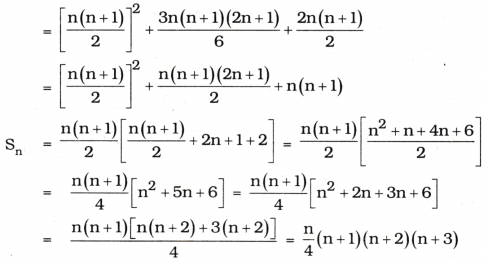
Therefore, Sn = \(\sum_{k=1}^n\) ak = \(\sum_{k=1}^n\)(k3 + 3k2 + 2k) = \(\sum_{k=1}^n\) k3 + 3 \(\sum_{k=1}^n\) k2 + 2 \(\sum_{k=1}^n\) k
Question 3.
3 × 12 + 5 × 22 + 7 × 32 + …
Solution:
The given series is 3 × 12 + 5 × 22 + 7 × 32 + …. n terms
Hence, an = (2n + 1) n2 = 2n3 + n2
Therefore, Sn = \(\sum_{\mathrm{k}=1}^{\mathrm{n}}\) ak = \(\sum_{\mathrm{k}=1}^{\mathrm{n}}\) (2k3 + k2) = 2\(\sum_{\mathrm{k}=1}^{\mathrm{n}}\)k3 + \(\sum_{\mathrm{k}=1}^{\mathrm{n}}\) k2
= 2\(\left[\frac{\mathrm{n}(\mathrm{n}+1)}{2}\right]^2\) + \(\frac{\mathrm{n}(\mathrm{n}+1)(2 \mathrm{n}+1)}{6}\)
= \(\frac{\mathrm{n}^2(\mathrm{n}+1)^2}{2}+\frac{\mathrm{n}(\mathrm{n}+1)(2 \mathrm{n}+1)}{6}\)
= \(\frac{\mathrm{n}(\mathrm{n}+1)}{2}\left(\mathrm{n}(\mathrm{n}+1)+\frac{2 \mathrm{n}+1}{3}\right)\)
= \(\frac{n(n+1)}{2}\left[\frac{3 n^2+3 n+2 n+1}{3}\right]\)
= \(\frac{n(n+1)}{2}\left[\frac{3 n^2+5 n+1}{3}\right]\)
= \(\frac{n}{6}\)(n + 1)(3n + 5n + 1)

Question 4.
\(\frac{1}{1 \times 2}+\frac{1}{2 \times 3}+\frac{1}{3 \times 4}\) + ………..
Solution:
The given series is \(\frac{1}{1 \times 2}+\frac{1}{2 \times 3}+\frac{1}{3 \times 4}\) + ……….. n terms
Hence, an = \(\frac{1}{n(n+1)}=\frac{1}{n}-\frac{1}{n+1}\)
∴ a1 = \(\frac{1}{1}-\frac{1}{2}\), a2 = \(\frac{1}{2}-\frac{1}{3}\), a3 = \(\frac{1}{3}-\frac{1}{4}\), …………….., an = \(\frac{1}{n}-\frac{1}{n+1}\),
Adding the above terms column wise, we obtain
a2 + a2 + …… + an = \(\left[\frac{1}{1}+\frac{1}{2}+\frac{1}{3}+\ldots+\frac{1}{\mathrm{n}}\right]-\left[\frac{1}{2}+\frac{1}{3}+\frac{1}{4}+\ldots+\frac{1}{\mathrm{n}+1}\right]\)
Thus, Sn = 1 – \(\frac{1}{n+1}=\frac{n+1-1}{n+1}=\frac{n}{n+1}\)
Question 5.
52 + 62 + 72 + ………. +202
Solution:
The given series is 52 + 62 + 72 + ………. +202
Hence, an = (n + 4)2 = n2 + 8n + 16
Therefore, Sn = \(\sum_{k=1}^n\)ak = \(\sum_{k=1}^n\)(k2 + 8k + 16)
Sn = \(\sum_{k=1}^n\)k2 + 8\(\sum_{k=1}^n\)k + \(\sum_{k=1}^n\) 16
= \(\frac{\mathrm{n}(\mathrm{n}+1)(2 \mathrm{n}+1)}{6}+\frac{8 \mathrm{n}(\mathrm{n}+1)}{2}\) + 16n
Since, 16th term is (16 + 4)2 = (20)2
Then, Sn = \(\frac{16(16+1)(2(16)+1)}{6}+\frac{8(16)(16+1)}{2}\)+ 16(16)
= \(\frac{(16)(17)(33)}{6}+\frac{(128)(17)}{2}\) + 256
= 1496 + 1088 + 256 = 2840
Thus, 52 + 62 + 72 + ………. +202 = 2840
Question 6.
3 × 8 + 6 × 11 + 9 × 14 + …………..
Solution:
The given series is 3 × 8 + 6 × 11 + 9 × 14 + ………….. n terms
Hence, an = (nth term of 3, 6, 9, ………..) × (nth term of 8, 11, 14 ……)
= (3n)(3n + 5)
= 9n2 + 15n
Therefore, Sn = \(\sum_{k=1}^n\) ak = \(\sum_{k=1}^n\) (9k2 + 15k)
= 9 \(\sum_{k=1}^n\) k2 + 15\(\sum_{k=1}^n\)k
= 9 × \(\frac{\mathrm{n}(\mathrm{n}+1)(2 \mathrm{n}+1)}{6}\) + 15 × \(\frac{\mathrm{n}(\mathrm{n}+1)}{2}\)
= \(\frac{3 \mathrm{n}(\mathrm{n}+1)(2 \mathrm{n}+1)}{2}+\frac{15 \mathrm{n}(\mathrm{n}+1)}{2}\)
= \(\frac{3 \mathrm{n}(\mathrm{n}+1)}{2}\)(2n + 1 + 5)
= \(\frac{3 \mathrm{n}(\mathrm{n}+1)}{2}\)(2n + 6)
= 3n(n + 1)(n + 3)
Question 7.
12 + (12 + 22) + (12 + 22 + 32) + ………..
Solution:
The given series is 12 + (12 + 22) + (12 + 22 + 32) + ……….. n terms
Hence, an = (12 + 22 + 32 + …… + n2) = \(\frac{n}{2}\)(n + 1)(2n + 1)
= \(\frac{n}{6}\) (2n2 + 3n + 1)
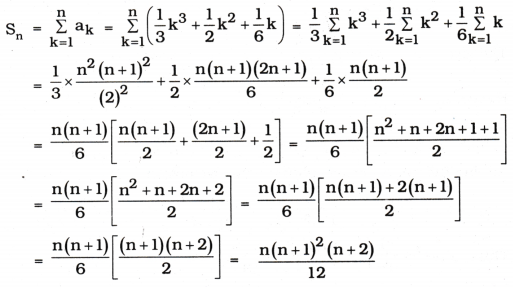
= \(\frac{1}{3}\)n3 + \(\frac{1}{2}\)n2 + \(\frac{1}{6}\)n
Therefore,
II. Find the sum to n terms of the series in Exercises 1 to 3 whose nth terms is given by
Question 1.
n(n + 1) (n + 4).
Solution:
The given n* term is an = n(n + 1) (n + 4)
Hence, an = n(n + 1) (n + 4) = n(n2 + 5n + 4) = n3 + 5n2 + 4n
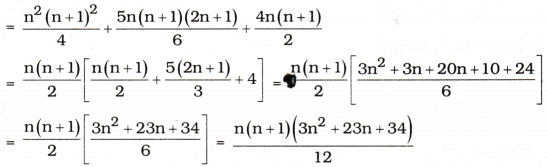
Therefore, Sn = \(\sum_{k=1}^n\) ak = \(\sum_{k=1}^n\)k3 + 5 \(\sum_{k=1}^n\) k2 + 4 \(\sum_{k=1}^n\) k
Question 2.
n2 + 2n
Solution:
The given nth term is an = n2 + 2n
Hence, Sn = \(\sum_{\mathrm{k}=1}^{\mathrm{n}}\)k2 + 2k
= \(\sum_{\mathrm{k}=1}^{\mathrm{n}}\)k2 + \(\sum_{\mathrm{k}=1}^{\mathrm{n}}\)2k …………..(1)
Consider \(\sum_{\mathrm{k}=1}^{\mathrm{n}}\) 2k = 21 + 22 + 23 +…
The above series 21 + 22 + 23 + … is a G.P with both the first term and common ratio equal to 2.
\(\sum_{\mathrm{k}=1}^{\mathrm{n}}\) 2k = \(\frac{1}{2}\) = 2(2n – 1) …………..(2)
From (1) and (2) we obtain
Sn = \(\sum_{\mathrm{k}=1}^{\mathrm{n}}\)k2 + \(\sum_{\mathrm{k}=1}^{\mathrm{n}}\) 2k
= \(\frac{n}{6}\)(n + 1)(2n + 1) + 2(2n – 1)
Question 3.
(2n – 1)2
Solution:
The given nth term is an = (2n – 1)2
Hence, an = (2n – 1)2 = 4n2 – 4n + 1
Therefore, Sn = \(\sum_{\mathrm{k}=1}^{\mathrm{n}}\) a = \(\sum_{\mathrm{k}=1}^{\mathrm{n}}\) (4k2 – 4k + 1)
= 4\(\sum_{\mathrm{k}=1}^{\mathrm{n}}\)k2 – 4\(\sum_{\mathrm{k}=1}^{\mathrm{n}}\) k + \(\sum_{\mathrm{k}=1}^{\mathrm{n}}\) 1
= \(\frac{4 \mathrm{n}(\mathrm{n}+1)(2 \mathrm{n}+1)}{6}-\frac{4 \mathrm{n}(\mathrm{n}+1)}{2}\) + n
= \(\frac{2 \mathrm{n}(\mathrm{n}+1)(2 \mathrm{n}+1)}{3}\) – 2n(n + 1) + n
= n[\(\frac{2\left(2 n^2+3 n+1\right)}{3}\) – 2(n + 1) + 1]
= n\(\left[\frac{4 n^2+6 n+2-6 n-6+3}{3}\right]\) = n\(\left[\frac{4 \mathrm{n}^2-1}{3}\right]\)
= \(\frac{\mathrm{n}}{3}\) (2n + 1)(2n – 1)