AP Inter 1st Year Maths Exercise 5b Solutions

Referring to the AP Inter 1st Year Maths Study Material Chapter 5 Linear Inequalities Exercise 5b Solutions makes it easier to understand complex problems.

AP Inter 1st Year Maths Linear Inequalities Solutions Exercise 5b

I.

Question 1.
Solve the inequality 2 ≤ 3x – 4 ≤ 5.
Solution:
Given that 2 ≤ 3x – 4 ≤ 5
⇒ 2 + 4 ≤ 3x – 4 + 4 ≤ 5 + 4
⇒ 6 ≤ 3x ≤ 9
⇒ 2 ≤ x ≤ 3
Therefore, all the real numbers x, which are greater than or equal to 2 but less than or equal to 3 are the solutions of the given inequality. The solution set for the given inequality is [2, 3].

Question 2.
Solve the inequality 6 ≤ -3 (2x – 4) ≤ 12.
Solution:
Given that 6 ≤ -3 (2x – 4) ≤ 12
⇒ 2 ≤ – (2x -4)<4
⇒ -2 ≥ 2x – 4 > -4
⇒ 4 – 2 ≥ 2x > -4 + 4
⇒ 2 ≥ 2x > 0
⇒ 1 ≥ x > 0
⇒ 0 < x ≤ 1
Hence, the solution set for the given inequality is (0, 1],

Question 3.
Solve the inequality -3 ≤ 4 – \(\frac{7x}{2}\) < 18.
Solution:
Given that -3 ≤ 4 – \(\frac{7x}{2}\) <18
⇒ -6 ≤ 8 – 7x ≤ 36
⇒ -14 ≤ -7x ≤ 28
⇒ 2 ≥ x ≥ -4
⇒ -4 ≤ x ≤ 2.
Hence, the solution set for the given inequality is [- 4, 2]

AP Inter 1st Year Maths Exercise 5b Solutions

Question 4.
Solve the inequality -15 < \(\frac{3(x-2)}{5}\) ≤ 0.
Solution:
Given that -15 < \(\frac{3(x-2)}{5}\) ≤ 0
⇒ -75 < 3 (x – 2) ≤ 0
⇒ -25 < x-2 ≤ 0
⇒ -25 + 2 < x ≤ 2
⇒ -23 < x ≤ 2
Hence, the solution set for the given inequality is (-23, 2].

Question 5.
Solve the inequality -12 < 4 – \(\frac{3x}{-5}\) ≤ 2
Solution:
Given that -12 < 4 – \(\frac{3x}{-5}\) ≤ 2
⇒ -12-4 < \(\frac{3x}{-5}\) ≤ 2 – 4
⇒ —16 < \(\frac{3x}{-5}\) ≤ -2
⇒ -16 < \(\frac{3x}{-5}\) ≤ -2
⇒ \(\frac{-80}{3}\) < x ≤ \(\frac{-10}{3}\)
Hence, the solution set for the given inequality is \(\left(\frac{-80}{3}, \frac{-10}{3}\right]\)

Question 6.
Solve the inequality 7 ≤ \(\frac{(3 x+11)}{2}\) ≤ 11
Solution:
Given that 7 ≤ \(\frac{(3 x+11)}{2}\) ≤ 11
⇒ 14 ≤ (3x +11) ≤ 22
⇒ 14 – 11 ≤ 3x ≤ 22 – 11
⇒ 3 ≤ 3x ≤ 11
⇒ 1 ≤ x ≤ \(\frac{11}{3}\)
Hence, the solution set for the given inequality is [1, \(\frac{11}{3}\)]

II.

Question 1.
Solve the following inequalities and represent the solution graphically on number line.
5x + 1 > – 24, 5x – 1 < 24
Solution:
Given that 5x + 1 > – 24
⇒ 5x > – 25
⇒ x > -5 ……………..(1)
⇒ 5x – 1 < 24
⇒ 5x < 25
⇒ x < 5 ………(2)
From (1) and (2) it can be concluded that the solution set for the given system of inequalities is (-5, 5).
The solution of the given system of inequalities can be represented on number line as
AP Inter 1st Year Maths Exercise 5b Solutions 1

Question 2.
Solve the following inequalities and represent the solution graphically on number line.
2 (x – 1) < x + 5, 3 (x + 2) > 2 – x
Solution:
Given that 2(x – 1) < x + 5
⇒ 2x – 2 < x + 5
⇒ 2x – x < 5 + 2
⇒ x < 7 ………(1)
⇒ 3(x + 2) > 2 – x
⇒ 3x + 6 > 2 – x
⇒ 3x + x > 2 – 6
⇒ 4x > – 4, x > -1 ………………..(2)
From (1) & (2), it can be concluded that the solution set for the given system of in¬equalities is (-1, 7).
The solution of the given system of inequalities can be represented on number line as
AP Inter 1st Year Maths Exercise 5b Solutions 2

Question 3.
Solve the following inequalities and represent the solution graphically on number line.
3x – 7 > 2 (x – 6), 6 – x > 11- 2x.
Solution:
Given that 3x – 7 > 2 (x – 6)
⇒ 3x – 7 > 2x – 12
⇒ x > -5 (1)
⇒ 6 – x > 11 – 2x
⇒ -x + 2x > 11 – 6
⇒ x > 5 ……………(2)
From (1) & (2) it can be concluded that the solution set for the given system of inequalities is (5, ∞). Because x > 5 is a stricter condition than x > -5. Therefore the solution set is (5, ∞). The solution of the given system of inequalities can be represented on number line as
AP Inter 1st Year Maths Exercise 5b Solutions 3

Question 4.
Solve the following inequalities and represent the solution graphically on number line.
5 (2x – 7) – 3 (2x + 3) ≤ 0, 2x + 19 ≤ 6x + 47
Solution:
Given that 5 (2x -7) – 3 (2x + 3) ≤ 0
⇒ 10x – 35 – 6x – 9 ≤ 0
⇒ 4x – 44 ≤ 0
⇒ 4x ≤ 44
⇒ x ≤ 11 ……….(1)
⇒ 2x + 19 ≤ 6x + 47
⇒ 19 – 47 ≤ 6x – 2x
⇒ -28 ≤ 4x
⇒ -7 ≤ x ………(2)
From (1) & (2), it can be concluded that the solution set for the given system of inequalities is [- 7, 11]. The solution of the given system of inequalities can be represented on number line as
AP Inter 1st Year Maths Exercise 5b Solutions 4

Question 5.
A solution is to be kept between 68°F and 77°F. What is the range in temperature in degree Celsius (C) if the Celsius/ Fahrenheit (F) conversion formula is given by F = \(\frac{9}{5}\) C + 32?
Solution:
Since the solution is to be kept between 68°F and 77°F
68 < F < 77
Putting the value of F, we have
68 < \(\frac{9}{5}\) C + 32 < 77
⇒ 68 – 32 < \(\frac{9}{5}\)C < 77 – 32
⇒ 36 < \(\frac{9}{5}\) C < 45
⇒ \(\frac{36 \times 5}{9}\) < C < \(\frac{45 \times 5}{9}\)
⇒ 20 < C < 25
Hence, the required range of temperature in degree Celsius is between 20°C and 25°C.

Question 6.
IQ of a person is given by the formula IQ = \(\frac{\mathrm{MA}}{\mathrm{CA}}\) 100.
Where MA is mental age and CA is chronological age. If 80 < IQ < 140 for a group of 12 years old children, find the range of their mental age.
Solution:
It is given that for a group of 12 years old children, 80 ≤ IQ ≤ 140 …………(i)
For a group of 12 years old children, (CA =12 years)
Putting this value of IQ in (i), we obtain 80 ≤ \(\frac{\text { MA }}{12}\) × 100 ≤ 140
⇒ 960 ≤ MA × 100 ≤ 1680
⇒ \(\frac{960}{100}\) ≤ MA ≤ \(\frac{1680}{100}\)
⇒ 9.60 ≤ MA ≤ 16.80
Thus, the range of mean age of the group of 12 years old children is 9.60 ≤ MA ≤ 16.80.

AP Inter 1st Year Maths Exercise 5b Solutions

III.

Question 1.
A solution of 8% boric acid is to be diluted by adding a 2% boric acid solution to it. The resulting mixture is to be more than 4% but less than 6% boric acid. If we have 640 litres of the 8% solution, how many litres of the 2% solution will have to be added?
Solution:
Let “x’ litres of 2% boric acid solution is required to be added.
Then the total mixture = (x + 640) litres. This resulting mixture is to be more than 4% boric acid.
⇒ 2%x + 8% of 640 > 4% of (x + 640)
⇒ \(\frac{2}{100}\) x + \(\frac{8}{100}\) x 640 > \(\frac{4}{100}\)(x + 640)
⇒ 2x + 5120 > 4x + 2560
⇒ 5120 – 2560 > 4x-2x
⇒ 2560 > 2x
⇒ 1280 > x …………….. (1)
This resulting mixture is to be less than 6% boric acid.
2%x + 8% of 640 < 6% of (x + 640)
⇒ \(\frac{2}{100}\) x + \(\frac{8}{100}\) x 640 < \(\frac{6}{100}\) (x + 640)
⇒ 2x + 5120 < 6x + 3840
⇒ 5120 – 3840 < 6x – 2x
⇒ 1280 < 4x
⇒ 320 < x ……. (2)
∴ From (1) and (2)
⇒ 320 < x < 1280
Hence, From (1) and (2) the number of litres of 2% of boric acid solution that is to be added will have to be more than 320 litres but less than 1280 litres.

Question 2.
How many litres of water will have to be added to 1125 litres of the 45% solution of acid so that the resulting mixture will contain more than 25% but less than 30% acid content?
Solution:
Let x litres of water is required to be added. Then the total mixture = (x + 1125) litres. It is evident that the amount of acid contained in the resulting mixture is 45% of 1125 litres. This resulting mixture will contain more than 25% but less than 30% acid content.
∴ 25% of (1125 + x) < 45% of 1125 < 30% of (1125 + x)
⇒ \(\frac{25}{100}\)(1125 + x) < \(\frac{45}{100}\) x 1125 < \(\frac{30}{100}\) (1125 + x)
⇒ 25 (1125 + x) < 45 x 1125 < 30(1125 + x)
⇒ 5 (1125 + x) < 9 x 1125 < 6 (1125 + x)
⇒ 5625 + 5x < 10125 < 6750 + 6x
⇒ 5x < 10125 – 5625 < 6750 – 5625 + 6x
⇒ 5x < 4500 < 1125 + 6x
⇒ 5x < 4500 and 4500 < 1125 + 6x
⇒ x < 900 and 3375 < 6x
⇒ x < 900 and 562.5 < x
⇒ 562.5 < x < 900
Thus, the required number of litres of water that is to be added will have to be more than 562.5 but lessthan 900.

AP Inter 1st Year Physics Study Material

AP Intermediate 1st Year Physics Textbook Solutions

Physics Inter 1st Year

  • Chapter 1 Units and Measurements Questions and Answers
  • Chapter 2 Motion in a Straight Line Questions and Answers
  • Chapter 3 Motion in a Plane Questions and Answers
  • Chapter 4 Laws of Motion Questions and Answers
  • Chapter 5 Work, Energy and Power Questions and Answers
  • Chapter 6 System of Particles and Rotational Motion Questions and Answers
  • Chapter 7 Gravitation Questions and Answers
  • Chapter 8 Mechanical Properties of Solids Questions and Answers
  • Chapter 9 Mechanical Properties of Fluids Questions and Answers
  • Chapter 10 Thermal Properties of Matter Questions and Answers
  • Chapter 11 Thermodynamics Questions and Answers
  • Chapter 12 Kinetic Theory Questions and Answers
  • Chapter 13 Oscillations Questions and Answers
  • Chapter 14 Waves Questions and Answers

AP Inter 1st Year Physics Weightage BluePrint 2026-2027

AP Inter 1st Year Physics Weightage BluePrint 2026-2027

AP Inter 1st Year Study Material

AP Inter 1st Year Maths Exercise 5a Solutions

Referring to the AP Inter 1st Year Maths Study Material Chapter 5 Linear Inequalities Exercise 5a Solutions makes it easier to understand complex problems.

AP Inter 1st Year Maths Linear Inequalities Solutions Exercise 5a

I.

Question 1.
Solve 24x < 100, when i) x is a natural number ii) x is an integer
Solution:
Given that 24x < 100
⇒ x < \(\frac{100}{24}\)
⇒ x < \(\frac{25}{6}\)

i) x is a natural number: We know that 1,2,3 and 4 are the only natural numbers less than \(\frac{25}{6}\). Thus, when x is a natural number, the solutions of the given inequality are 1, 2, 3 and 4. Hence in this case the solution set is {1, 2, 3, 4}.

ii) x is an integer : The integers less than \(\frac{25}{6}\) are …………, -3, -2, -1, 0, 1, 2, 3, 4. Hence, in this case, the solution set is {………………, -3, -2, -1,0, 1,2, 3, 4}.

Question 2.
Solve – 12x > 30, when i) x is a natural number ii) x is an integer
Solution:
Given that -12 x > 30
⇒ -x > \(\frac{30}{12}\)
⇒ -x > \(\frac{5}{2}\)
⇒ x < \(\frac{-5}{2}\)

i) x is a natural number : We know that there is no natural number less than -5/2. Thus, when x is a natural number, there is no solution of given inequality.

ii) x is an integer : The integer less than \(\frac{-5}{2}\) are ………….. 5, -4, -3. Thus when x is an
integer, the solutions of the given inequality are …………. -5, -4, -3.
Hence, in this case the solution set is {…………… , -5, -4, -3}.

Question 3.
Solve 5x – 3 < 7, when i) x is an integer ii) x is a real number.
Solution:
Given that 5x – 3 < 7
⇒ 5x < 10
⇒ x < \(\frac{10}{5}\)
⇒ x < 2

i) x is an integer: The integer less than 2 are ……….., -4, -3, -2, -1, 0, 1.
Thus, when x is an integer, the solutions of the given inequality are ……….. -4, -3, -2, -1, 0, 1.
Hence in this case solution set is {………. -4, -3, -2, -1, 0, 1}.

ii) x is a real number: When x is a real number, the solutions of the given inequality are given by x < 2, that is all real numbers of x which are less than 2.
Thus the solution set of the given inequality is x ∈ (- ∞, 2).

AP Inter 1st Year Maths Exercise 5a Solutions

Question 4.
Solve 3x + 8 > 2, when i) x is an integer ii) x is a real number
Solution:
Given that 3x + 8 > 2
⇒ 3x > – 6
⇒ x > \(\frac{-6}{3}\)
⇒ x > -2
i) x is an integer : The integers greater than -2 are -1, 0, 1, 2, Thus, when x
is an integer, the solutions of the given inequality are -1, 0, 1, 2, …………..
The solution set is {-1, 0, 1, 2, …….}.

ii) x is a real number : When x is a real number, the solutions of the given inequality are all the real numbers, which are greater than -2. Thus, in this case, the solution set is (-2, ∞).

Solve the inequalities in Exercises 5 to 12 for real x.

Question 5.
4x + 3 < 5x + 7
Solution:
Givent that 4x + 3 < 5x + 7
⇒ 3 – 7 < 5x – 4x
⇒ – 4 < x.
Thus all real numbers x, which are greater than -4 are the solutions of the given inequality. Hence the solution set of the given inequality is (-4, ∞).

Question 6.
3x – 7 > 5x – 1
Solution:
Given that 3x – 7 > 5x – 1
⇒ 3x – 5x > -1 + 7
⇒ -2x > 6
⇒ x < -3
Thus all real numbers x, which are less than -3 are the solutions of the given inequality. Hence, the solution set of the given inequality is (-∞, -3).

Question 7.
3(x – 1) ≤ 2 (x – 3)
Solution:
Given that 3(x – 1) ≤ 2 (x – 3)
⇒ 3x – 3 ≤ 2x – 6
⇒ x ≤ -3
Thus, all real numbers x, which are less than or equal to -3 are the solutions of the given inequality.
Hence, the solution set of the given inequality is (-∞, -3],.

Question 8.
3(2 – x) ≥ 2(1 – x)
Solution:
Given that 3(2 – x) ≥ 2(1 – x)
⇒ 6 – 3x ≥ 2 – 2x
⇒ 6 – 2 ≥ -2x + 3x
⇒ 4 ≥ x
⇒ x < 4
Thus, all real numbers x which are less than or equal to 4 are the solutions of the given inequality.
Hence, the’solution set of the given inequality is (-∞, 4].

Question 9.
x + \(\frac{x}{2}+\frac{x}{3}\) < 11
Solution:
Given that x + \(\frac{x}{2}+\frac{x}{3}\) < 11
⇒ x(1 + \(\frac{1}{2}+\frac{1}{3}\)) < 11
⇒ x\(\left(\frac{6+3+2}{6}\right)\) < 11
⇒ x < 11 × \(\frac{6}{11}\)
⇒ x < 6
Thus, all real numbers x, which are less than 6 are the solutions of the given inequality.
Hence, the solution set of the given inequality is (-∞, 6).

Question 10.
\(\frac{x}{3}>\frac{x}{2}\) + 1
Solution:
Given that \(\frac{x}{3}-\frac{x}{2}\) > 1
⇒ x\(\left(\frac{2-3}{6}\right)\) > 1
⇒ \(\frac{-1}{6}\)x > 1
⇒ -x > 6
⇒ x < -6
Thus, all real numbers x, which are less than -6 are the solutions of the given inequality.
Hence, the solution set of the given inequality is (-∞, -6).

Question 11.
2(2x + 3) – 10 < 6(x – 2)
Solution:
Given that 2(2x + 3) -10 < 6 (x – 2)
⇒ 4x + 6 – 10 < 6x – 12
⇒ 4x – 4 < 6x – 12
⇒ -2x < -8
⇒ x > 4
Thus, all real numbers x, which are greater than 4, are the solutions of the given inequality.
Hence, the solution set of given inequality is (4, ∞).

Question 12.
37 – (3x + 5) > 9x – 8 (x – 3)
Solution:
Given that 37 – (3x + 5) S 9x – 8 (x – 3)
⇒ 32 – 3x ≥ 9x – 8x + 24
⇒ 32 – 3x ≥ x + 24 8 > 4x
⇒ 4x ≤ 8
⇒ x ≤ 2
Thus, all real numbers x, which are less than or equal to 2 are the solutions of given inequality.
Hence, the solution set of given inequality is (-∞, 2].

AP Inter 1st Year Maths Exercise 5a Solutions

Question 13.
Ravi obtained 70 and 75 marks in first two unit tests. Find the minimum marks he should get in the third test to have an average of at least 60 marks.
Solution:
Let x be the marks obtained by Ravi in the third unit test since the student should have an average of at least 60 marks, so
\(\frac{70+75+x}{3}\) ≥ 60
145 + x ≥ 180
⇒ x ≥ 35
Hence, the student must obtain a minimum of 35 marks to have an average of at least 60 marks.

II. Solve the inequalities in Exercises 1 to 4 for, real x.

Question 1.
\(\frac{3(x-2)}{5} \leq \frac{5(2-x)}{3}\)
Solution:
Given that \(\frac{3(x-2)}{5} \leq \frac{5(2-x)}{3}\)
⇒ \(\frac{3 x-6}{5} \leq \frac{10-5 x}{3}\)

⇒ \(\frac{3 x}{5}-\frac{6}{5} \leq \frac{10}{3}-\frac{5 x}{3}\)

⇒ \(\frac{3 x}{5}+\frac{5 x}{3} \leq \frac{10}{3}+\frac{6}{5}\)

⇒ \(\frac{9 x+25 x}{15} \leq \frac{50+18}{15}\)

⇒ \(\frac{34 x}{15} \leq \frac{68}{15}\)

⇒ 34x ≤ 68
⇒ x ≤ 68
⇒ x ≤ \(\frac{68}{2}\)
⇒ x ≤ 2
Thus, all real numbers x, which are less than or equal to 2 are the solutions of the given inequality.
Hence, the solution set of given inequality is (-∞, 2].

Question 2.
\(\frac{1}{2}\)(\(\frac{3 x}{5}\) + 4) ≥ \(\frac{1}{3}\)(x – 6)
Solution:
Given that \(\frac{1}{2}\)(\(\frac{3 x}{5}\) + 4) ≥ \(\frac{1}{3}\)(x – 6)
⇒ \(\frac{3 x}{10}\) + 2 ≥ \(\frac{x}{3}\) – 2
⇒ \(\frac{3 x}{10}-\frac{x}{3}\) ≥ 2 – 2
⇒ \(\frac{9 x-10 x}{30}\) ≥ -4
⇒ \(\frac{-x}{30}\) ≥ -4
⇒ -x ≥ -120
⇒ x < 120
Thus, all real numbers x, which are less than or equal to 120 are the solutions of the given inequality. Hence, the solution set of the given inequality is (-∞, 120],

Question 3.
\(\frac{x}{4}<\frac{(5 x-2)}{3}-\frac{(7 x-3)}{5}\)
Solution:
Given \(\frac{x}{4}<\frac{(5 x-2)}{3}-\frac{(7 x-3)}{5}\)
⇒ \(\frac{x}{4}<\frac{5 x}{3}-\frac{2}{3}-\frac{7 x}{5}+\frac{3}{5}\)

⇒ \(\frac{x}{4}-\frac{5 x}{3}+\frac{7 x}{5}<\frac{-2}{3}+\frac{3}{5}\)

⇒ \(\frac{15 x-100 x+84 x}{60}<\frac{-10+9}{15}\)

⇒ \(\frac{-x}{60}<\frac{-1}{15}\)

⇒ -x < \(\frac{-60}{15}\)

⇒ x > 4
Thus, all the real numbers x, which are greater than 4 are the solutions of the given inequality.
Hence, the solution set of the given inequality is (4, ∞)

Question 4.
\(\frac{(2 x-1)}{3} \geq \frac{(3 x-2)}{4}-\frac{(2-x)}{5}\)
Solution:
Given that \(\frac{(2 x-1)}{3} \geq \frac{(3 x-2)}{4}-\frac{(2-x)}{5}\)
⇒ \(\frac{(2 x-1)}{3} \geq \frac{(3 x-2)}{4}-\frac{(2-x)}{5}\)

⇒ \(\frac{2 x}{3}-\frac{1}{3} \geq \frac{3 x}{4}-\frac{2}{4}-\frac{2}{5}+\frac{x}{5}\)

⇒ \(\frac{2 x}{3}-\frac{3 x}{4}-\frac{x}{5} \geq-\frac{2}{4}-\frac{2}{5}+\frac{1}{3}\)

⇒ \(\frac{40 x-45 x-12 x}{60} \geq \frac{-30-24+20}{60}\)

⇒ -17x ≥ -34
⇒ -x ≥ -2
⇒ x ≤ 2
Thus, all the real numbers x, which are less than or equal to 2 are the solutions of the given inequality.
Hence the solution set of the given inequality is (-∞, 2).

Solve the inequalities in Exercises 5 to 8 and show the graph of the solution in each case on number line.

Question 5.
3x – 2 < 2x + 1
Solution:
Given that 3x – 2 < 2x + 1
⇒ 3x – 2x < 1 + 2
⇒ x < 3
The graphical representation of the solutions of the given inequality is
AP Inter 1st Year Maths Exercise 5a Solutions 1
Solution set = (-∞, 3).

Question 6.
5x – 3 ≥ 3x – 5
Solution:
Given that 5x – 3 ≥ 3x – 5
⇒ 5x – 3x ≥ -5 + 3
⇒ 2x ≥ -2
⇒ x ≥ -1
The graphical representation of the solutions of the given inequality is as follows.
AP Inter 1st Year Maths Exercise 5a Solutions 2
Solution set = [-1, ∞).

Question 7.
3(1 – x) < 2(x + 4)
Solution:
Given that 3(1 -x) < 2(x + 4)
⇒ 3 – 3x < 2x + 8
⇒ -3x – 2x < 8 -3
⇒ -5x < 5.
⇒ -x < 1
⇒ x > -1
The graphical representation of the solutions of the given inequality is as follows.
x > -1
AP Inter 1st Year Maths Exercise 5a Solutions 3
Solution set = (-1, ∞).

AP Inter 1st Year Maths Exercise 5a Solutions

Question 8.
\(\frac{x}{2} \geq \frac{(5 x-2)}{3}-\frac{(7 x-3)}{5}\)
Solution:
Given that \(\frac{x}{2} \geq \frac{(5 x-2)}{3}-\frac{(7 x-3)}{5}\)
⇒ \(\frac{x}{2} \geq \frac{5 x}{3}-\frac{2}{3}-\frac{7 x}{5}+\frac{3}{5}\)

⇒ \(\frac{x}{2}-\frac{5 x}{3}+\frac{7 x}{5} \geq \frac{-2}{3}+\frac{3}{5}\)

⇒ \(\frac{15 x-50 x+42 x}{30} \geq \frac{-10+9}{15}\)

⇒ \(\frac{7 x}{30} \geq-\frac{1}{15}\)

⇒ x ≥ \(\frac{-2}{7}\)

The graphical representation of the solutions of the given inequality is as follows.
AP Inter 1st Year Maths Exercise 5a Solutions 4
Solution Set = [\(\frac{-2}{7}\), ∞)

Question 9.
To receive Grade ‘A’ in a course, one must obtain an average of 90 marks or more in five examinations (each of 100 marks). If Sunita’s marks in first four examinations are 87, 92, 94 and 95, find minimum marks that Sunita must obtain in fifth examination to get grade ‘A’ in the course.
Solution:
Let x be the marks obtained by Sunita in the fifth examination. In order to receive grade ‘A’ in the course, she must obtain an average of 90 marks or more in fifth examination, therefore,
\(\frac{87+92+94+95+x}{5}\) ≥ 90
⇒ 368 + x ≥ 450
⇒ x ≥ 82
Hence, Sunita must obtain greater than or equal to 82 marks in the fifth examination.

Question 10.
Find all pairs of consecutive odd positive integers both of which are smaller than 10 such that their sum is more than 11.
Solution:
Let x be the smaller of the two consecutive odd positive integers. Then, the other integer is x + 2.
Since both the integers are smaller than 10, therefore
x + 2 < 10
⇒ x < 10 – 2
⇒ x < 8 ………….. (i)
Also the sum of the two integers is more than 11.
∴ x + (x + 2) > 11
⇒ 2x + 2 > 11
⇒ 2x > 11 – 2
⇒ 2x > 9
⇒ x > \(\frac{9}{2}\)
⇒ x > 4.5 ……..(ii)
From (i) and (ii), we obtain that the value of x can be 5, 6 or 7, since x is an odd number, x can take the values 5 and 7. Hence, the required possible pairs of numbers are (5, 7) and (7, 9).

Question 11.
Find all pairs of consecutive even positive integers, both of which are larger than 5 such that their sum is less than 23.
Solution:
Let x be the smaller of the two consecutive even positive integers. Then the other integer is x + 2.
Since both the integers are larger than 5, x > 5 …. (1)
Also, the sum of the two integers is less than 23
x + (x + 2) < 23
⇒ 2x + 2 < 23
⇒ 2x < 23 – 2
⇒ 2x < 21
⇒ x < \(\frac{21}{2}\)
⇒ x < 10.5 ….(2)
From (1) and (2), we obtain 5 < x < 10.5.
Since x is an even number, so x can take the the values, 6, 8 and 10 hence, the required possible pairs are (6, 8), (8, 10) and (10, 12).

Question 12.
The longest side of a triangle is 3 times the shortest side and the third side is 2 cm shorter than the longest side. If the perimeter of the triangle is at least 61 cm, find the minimum length of the shortest side.
Solution:
Let the length of the shortest side of the triangle be x cm.
Then, length of the longest side= 3x cm and the length of the third side = (3x – 2) cm.
Since the perimeter of the triangle is atleast 61 cm
⇒ x + 3x + (3x – 2) ≥ 61
⇒ 7x – 2 ≥ 61
⇒ 7x ≥ 63
⇒ x ≥ 9
Hence, the minimum length of the shortest side is 9 cm.

III.

Question 1.
A man wants to cut three lengths from a single piece of board of length 91 cm. The second length is to be 3 cm longer than the shortest and the third length is to be twice as long as the shortest. What are the possible lengths of the shortest board if the third piece is to be at least 5 cm longer than the second ? [Hint : If x is the length of the shortest board, then x, (x + 3) and 2x are the lengths of the second and third pieces respectively. Thus x + (x + 3) + 2x < 91 and 2x > (x + 3) + 5J.
Solution:
Let the length of the shortest piece be x cm. Then, length of the second piece and the third piece are (x + 3) cm and 2x cm respectively.

Since the three lengths are to be cut from a single piece of board of length 91cm
x + (x + 3) + 2x ≤ 91
⇒ 4x + 3 ≤ 91
⇒ 4x ≤ 91 – 3
⇒ 4x ≤ 88
⇒ x ≤ 22 …………..(1)
Also, the third piece is at least 5 cm longer than the second piece.
∴ 2x ≥ (x + 3) + 5
⇒ 2x ≥ x + 8
⇒ x ≥ 8 ……………(2)
From (1) and (2) we obtain 8 ≤ x ≤ 22
Thus, the possible length of the shortest board is greater than or equal to 8 cm but less than or equal to 22 cm.

మంచి ముత్యాలు Questions and Answers Summary Inter 1st Year Telugu

Regular practice with AP Inter 1st Year Telugu Study Material పద్యభాగం 3rd Poem మంచి ముత్యాలు Questions and Answers Summary helps students stay prepared for examinations.

AP Inter 1st Year Telugu మంచి ముత్యాలు Questions and Answers

అభ్యాసం

I. వ్యాసరూప సమాధాన ప్రశ్నలు

ప్రశ్న 1.
‘మంచి ముత్యాలు’ పాఠ్యభాగ సారాంశాన్ని తెలపండి.
జవాబు:
నీరు త్రాగే గుఱ్ఱాన్నీ, కొవ్వుతో చెలరేగుతున్న మదపుటేనుగునూ, ఎద వట్టిన గోవు వద్ద నున్న ఆబోతునూ, విద్యా విహీనుడైన నీచబుద్ధి కలవానిని చేరకూడదు.

భార్యతో ఏనాడూ తగవులాడరాదు. ఆమెలో లేని దోషం ఉన్నదని ఏనాడూ ఆరోపించకూడదు. ఏ యింటిలో స్త్రీ దుఃఖంతో కన్నీరు కార్చవలసి వస్తుందో ఆ యింటిలో సంపద ఉండదు.

పాముకి విషం శిరస్సులోని నోట్లో మాత్రమే ఉంటుంది. తేలుకి తోక చివర మాత్రమే ఉంటుంది. దుష్టునికి శరీరమంతా విషం ఉంటుంది.

మానవుడు తనకిష్టమైన మంచి పనిని చేసేటప్పుడు ఒక నీచుడు ఆ పనిలోని మంచిని గ్రహించలేక, కాదంటే, వాని మాటల కోసం ఆ పనిని ఆపాలని అనుకోడు. చక్కని భోజనం చేసే సమయంలో ఆహారపదార్థాల మీద ఈగ వాలినంత మాత్రాన, ఆ వంటకాన్ని మానవుడు తినకుండా ఉండడం నేర్పరితనం అవుతుందా ! కాదు గద!

ఎంత గొప్ప కార్యాన్నైనా తీర్చిదిద్దడానికి, దృఢమైన బలంతో ఎదిగిన ఒక వ్యక్తి చాలు. అసంఖ్యాకులైన కౌరవులు గోగ్రహణం చేస్తే, అర్జునుడొక్కడే గోవులను వాళ్ళ వశం కానివ్వకుండా వారి బలమైన సైన్యాన్ని అనేక బాణాలతో ధ్వంసం చేసి విజయాన్ని సాధించలేదా ?

నీ స్థాయికి తగని నీచులతో కలిసి మెలిసి తిరిగితే లోకం నిన్ను గౌరవహీనుని గానే చూస్తుంది. ఎలాగంటే తాటిచెట్టు క్రింద నిలబడి పాలు తాగితే, కల్లు తాగావని లోకం నిందిస్తుంది.

నీటితో నిండియున్న నదులు గంభీరంగా నిలచి పారుతున్నాయి. చిన్న సెలయేళ్ళు పైకి పొర్లుతూ వేగంగా ప్రవహిస్తున్నాయి. చెడు గుణములు కలవారు మాటలాడి నంతటి తొందరగా మంచి గుణములు కలవారు మాట్లాడరు. బుద్ధిహీనుడైనవాడు ఎన్ని విద్యలు నేర్చినా, అతడి అల్పత్వంతో పోయి గొప్పవాడవుతాడా ? ఎక్కడైన పరిమళ ద్రవ్యాల మూటను గాడిద మోసినంత మాత్రాన గొప్పది అవుతుందా ?

నిందించినా, ప్రశంసించినా, సంపదలు వచ్చినా, తొలగిపోయినా, మరణమిప్పుడే వచ్చినా, కల్పాంతమందు వచ్చినా ధీరులైనవారు న్యాయమార్గాన్ని దాటి ఒక్క అడుగైనా ముందుకు పెట్టరు.

మోక్ష సంపదలనే భూషణాలతో ప్రకాశించే వాడా ! దుష్టులను సంహరించినవాడా! పాపాలను నశింప చేసేవాడా ! ధర్మపురిలో నివసించు ఓ నరసింహా! పుట్టేటప్పుడు ధనమెవ్వరూ తీసుకొనిరారు. పోయేటప్పుడు తన వెంటరాదు. ఎంత గొప్ప ధనికుడైనా ఉప్పుతో కూడిన అన్నమే తింటాడు కాని, బంగారు ముద్దలు మ్రింగలేడు. డబ్బు గడించి పొగరుబోతుతనాన్ని పెంచుకోవటమే గాని, ఆ సొమ్ములు అనుభవానికి రాదు. కూడబెట్టిన సొమ్ము దొంగల పాలవుతుందో, దొరల పాలవుతుందో తెలియదు. తేనెటీగలు తేనెను కూడబెట్టి బాటసారులకిస్తున్నాయి కదా !

ప్రశ్న 2.
శతక ప్రక్రియ విశిష్టతను తెలపండి.
జవాబు:
తెనుగు సాహిత్యంలో ప్రత్యేకత కలిగినది శతక రచన. ఇది పండితులు, పామరులు, బాలురు, వృద్ధులందరినీ రంజింప చేసే శక్తివంతమైన ప్రక్రియ. ప్రసిద్ధ కవుల నుంచి ఎందరో మహామహులు శతక రచన చేసి తరించిన వారే. అందుకే తెలుగులో వేలాదిగా శతకాలున్నాయి. శతకాలు కథా ప్రధానాలు కవు. వర్ణనా ప్రధానాలు కావు. వీటిని ముక్తకాలు అంటారు. ఏ పద్యానికదే స్వతంత్రంగా ఉంటాయి కనుక ముక్తకాలు అని అంటారు. సులభ శైలిలో ఉంటాయి. కవి ఆత్మానుభవం ఈ శతకాలలో వ్యక్తమవుతుంది.

ఈ శతక పద్యాలు 100 కాని 108 కాని ఉండాలి. శతకంలో ప్రతి పద్యంలో ఒకే విధమైన “మకుటం” ఉండాలి. ఈ మకుటం ఒక పదం గాని, ఒక వాక్యం గాని లేదా రెండు పాదాలు గాని వ్రాయవచ్చును.

II. సంక్షిప్త రూప సమాధాన ప్రశ్నలు

ప్రశ్న 1.
సుమతి శతక కర్త తెలిపిన నీతిని రాయండి.
జవాబు:
నీరు త్రాగే గుఱ్ఱాన్నీ, బలిసియున్న మదపుటేనుగును, ఎద వట్టిన గోవు వద్ద నున్న ఆబోతును, విద్యలేని నీచబుద్ధి కలవాడితో స్నేహము చేయరాదు. చేరరాదు. భార్యతో ఏనాడూ తగవులాడరాదు. ఆమెలో దోషం లేదని తెలిసి కూడా దోషాన్ని ఆపాదించకూడదు. ఏ ఇంటిలో స్త్రీ దుఃఖంతో కన్నీరు కార్చవలసి వస్తుందో ఆ యింటిలో సంపదలుండవు.

పాముకి విషం శిరస్సులోను, తేలుకు తోకలోను ఉంటుంది. కాని దుష్టునికి శరీరమంతా ఉంటుంది.

ప్రశ్న 2.
భాస్కర శతక కర్త బోధలను తెలపండి.
జవాబు:
మానవుడు తనకిష్టమైన మంచి పనిని చేసేటప్పుడు ఒక నీచుడు ఆ పనిలోని మంచిని గ్రహించలేక కాదంటే వాని మాటల కోసం ఆ పనిని ఆపాలని అనుకోడు. చక్కని భోజనం చేసే సమయంలో ఆహారపదార్థాల మీద ఈగ వాలినంత మాత్రాన, ఆ వంటకాన్ని మానవుడు తినకుండా ఉండడం నేర్పరితన మవ్వదు.

ఎంత గొప్ప కార్యాన్నైనా తీర్చిదిద్దడానికి, దృఢమైన బలంతో ఎదిగిన ఒక వ్యక్తి చాలు. అసంఖ్యాకులైన కౌరవులు గోగ్రహణం చేస్తే, అర్జునుడొక్కడే గోవులను వాళ్ళ వశం కానివ్వకుండా వారి బలమైన సైన్యాన్ని అనేక బాణాలతో ధ్వంసం చేసి విజయాన్ని సాధించలేదా ?

ప్రశ్న 3.
వేమన పద్యాల సారాన్ని తెలపండి.
జవాబు:
నీ స్థాయికి తగని నీచులతో కలసిమెలసి తిరిగితే లోకం నిన్ను గౌరవ హీనునిగానే చూస్తుంది. ఎలాగంటే తాటిచెట్టు క్రింద నిలబడి పాలు తాగితే, కల్లు తాగావని లోకం నిందిస్తుంది.

నీటితో నిండియున్న నదులు గంభీరంగా నిలిచిపారుతున్నాయి. చిన్న సెలయేళ్ళు పైకి పొర్లుతూ, వేగంగా ప్రవహిస్తున్నాయి. చెడు గుణములు కలవారు మాటలాడి నంతటి తొందరగా మంచి గుణములు కలవారు మాట్లాడరు.

బుద్ధిహీనుడైనవాడు ఎన్ని విద్యలు నేర్చినా, అతడి అల్పత్వంతో పోయి గొప్పవాడవుతాడా ? ఎక్కడైన పరిమళ ద్రవ్యాల మూటను గాడిదమోసినంత మాత్రాన గొప్పది అవుతుందా ?

ప్రశ్న 4.
ఏనుగు లక్ష్మణకవి సుభాషిత సారాన్ని రాయండి.
జవాబు:
నిందించినా, ప్రశంసించినా, సంపదలు వచ్చినా, తొలగిపోయిన, మరణ మిప్పుడే వచ్చినా, కల్పాంతమందు వచ్చినా ధీరులైన వారు న్యాయమార్గాన్ని దాటి ఒక్క అడుగైనా ముందుకు పెట్టరు.

మంచి ముత్యాలు Questions and Answers Summary Inter 1st Year Telugu

ప్రశ్న 5.
శేషప్ప కవి తెలిపిన హితోక్తులను రాయండి.
జవాబు:

  1. పుట్టేటప్పుడు ధనమెవ్వరూ తీసుకొనిరారు.
  2. పోయేటప్పుడు సంపదలు తన వెంటరావు.
  3. ఎంత గొప్ప ధనికుడైనా ఉప్పుతో కూడిన అన్నమే తింటాడు గాని, బంగారు ముద్దలను మ్రింగడు.
  4. ధనమును పొంది పొగరుబోతుతనాన్ని పెంచుకోవడమే కాని, ఆ సొమ్ము అనుభవానికి రాదు.
  5. కూడబెట్టిన సొమ్ము దొంగల పాలవుతుందో, దొరల పాలవుతుందో తెలియదు.
  6. తేనెటీగలు తేనెను కూడబెట్టి బాటసారులకిస్తున్నాయి.

III. ఏక వాక్య పద రూప సమాధాన ప్రశ్నలు

ప్రశ్న 1.
సుమతీ శతకాన్ని రచించింది ఎవరు ?
జవాబు:
సుమతీ శతకాన్ని రచించింది బద్దెన

ప్రశ్న 2.
భాస్కర శతక కర్త ఎవరు ?
జవాబు:
భాస్కర శతక కర్త మారద వెంకయ్య

ప్రశ్న 3.
దుర్యోధనాదులను ఎదుర్కొన్న ఒక్కడెవరు ?
జవాబు:
అర్జునుడు

ప్రశ్న 4.
మనిషికి విషం ఎక్కడుంటుంది ?
జవాబు:
మనిషికి నిలువెల్లా విషం ఉంటుంది.

ప్రశ్న 5.
చనిపోయినప్పుడు వెంటరానిదేది ?
జవాబు:
చనిపోయినప్పుడు వెంట రానిది సంపద.

ప్రశ్న 6.
తేనెటీగల కష్టం ఎవరికి స్వంతమవుతుంది ?
జవాబు:
బాటసారులకు

IV. సందర్భ సహిత వ్యాఖ్యలు

ప్రశ్న 1.
ఒక్కఁడె చాలు నిశ్చల బలోన్నతుఁడు
జవాబు:
పరిచయము : మారద వెంకయ్య రచించిన భాస్కర శతకము నుండి గ్రహింప
బడిన ‘మంచి ముత్యాలు’ అను పాఠంలోనిది.
సందర్భము : ఉత్తర గోగ్రహణం చేసిన కౌరవులను, అర్జునుడు ఒక్కడే వారందరిని జయించాడని చెప్తూ కవి పల్కిన సందర్భము.
భావము : దృఢ చిత్తం కలవాడు ఒక్కడే చాలు. ఎంతటి పనినైనా నెరవేర్చ గలడని భావము.
వ్యాఖ్య : దుర్యోధనాదులు గొప్ప సైన్యంతో విరాటుని ఆవుల మందని తోలుకు పోతుంటే అర్జునుడు ఒక్కడే వారిని జయించి ఆవులమందని తిరిగి తెచ్చాడు. అంటే వీరుడు, ధీరుడు అయినవాడు దృఢచిత్తంతో ఏ పనినైనా సాధించగలరని వివరించాడు.

ప్రశ్న 2.
తాటి క్రింద పాలు త్రాగిన చందమౌ
జవాబు:
పరిచయము : ఈ వాక్యము వేమన రచించిన వేమన శతకము నుండి గ్రహింపబడిన ‘మంచి ముత్యాలు’ అను పాఠంలోనిది.
సందర్భము : గౌరవంలేని నీచునితో స్నేహం చేయరాదని విశ్లేషిస్తూ వేమన పల్కిన సందర్భము.
భావము : తాటిచెట్టు క్రింద నిలబడి పాలు తాగితే లోకం కల్లు త్రాగాడనే చెప్పుకుంటారు.
వ్యాఖ్య : మహాపురుషులు అల్పులతో స్నేహం చేయరాదని వివరిస్తూ, తాటి చెట్టు క్రింద నిలబడి పాలు త్రాగినా కల్లు త్రాగాడనే లోకం అంటుంది. కనుక అల్పులతో స్నేహం మంచిది కాదని విశ్లేషింపబడింది.

ప్రశ్న 3.
అల్పుడాడు రీతి నధికుండు నాడునా
జవాబు:
పరిచయము : ఈ వాక్యము వేమన రచించిన వేమన శతకము నుండి గ్రహింపబడిన ‘మంచి ముత్యాలు’ అను పాఠంలోనిది.
సందర్భము : నీచుడు ప్రవర్తించినట్లు సత్పురుషుడు తన ఉనికిని పోగొట్టుకోడని వివరిస్తూ వేమన పల్కిన సందర్భము.
భావము : నీచుడు పల్కిన విధంగా సత్పురుషులు మాట్లాడరు.
వ్యాఖ్య : నీచుడు ఎప్పుడూ దుర్మార్గాలను చేస్తూంటాడు. కాని సత్పురుషులు ఆ విధంగా మాట్లాడక గౌరవప్రదంగా ప్రవర్తిస్తారని విశ్లేషింపబడింది.

మంచి ముత్యాలు Questions and Answers Summary Inter 1st Year Telugu

ప్రశ్న 4.
తేనె జుంటీఁగ లియ్యవా తెరువరులకు !
జవాబు:
పరిచయము : ఈ వాక్యము శేషప్ప రచించిన “నరసింహ శతకము” నుండి గ్రహింపబడిన ‘మంచి ముత్యాలు’ అను పాఠంలోనిది.
సందర్భము : దానధర్మాలు చేయని పిసినిగొట్టు కూడపెట్టిన సొమ్ము దొంగలపాలో లేదా దొరలపాలవుతుందని విశ్లేషిస్తూ కవి పల్కిన సందర్భము.
భావము : కష్టపడి తేనెటీగలు సంపాదించిన తేనె బాటసారుల పాలవుతుంది.
వ్యాఖ్య : కష్టపడి తేనెటీగలు సంపాదించిన తేనె బాటసారుల పాలవుతుంది. అదేవిధంగా పిసినిగొట్టు కూడబెట్టిన సొమ్ము దొంగల పాలవుతుంది లేదా దొరల పాలవుతుంది. కనుక ధనాన్ని సంపాదించాలి. సంపాదించిన సొమ్మును దానధర్మాల్ని చేస్తూ తాను అనుభవించాలని వ్యాఖ్య.

V. సంధులు

1. కన్నీరొలికిన
జవాబు:
కన్నీరు + ఒలికిన – ఉత్త్వసంధి
సూత్రము : ఉత్తునకచ్చు పరంబగునపుడు సంధియగు.

2. ధీరోత్తములు
జవాబు:
ధీర + ఉత్తములు – గుణసంధి
సూత్రము : సంస్కృతమున అకారమునకు అసవర్ణములైన ఇ-ఉ-ఋ లు పరంబులగునపుడు క్రమంగా ఏ-ఓ-అర్ అనునవి ఏకాదేశమగును.

3. యుగాంతం
జవాబు:
యుగ + అంతం – సవర్ణదీర్ఘ సంధి
సూత్రము : సంస్కృతమున అ,ఇ,ఉ,ఋ, ఇ లను అచ్చులకు సవర్ణములైన అచ్చులు పరంబులగునపుడు క్రమంగా వాని దీర్ఘము ఏకాదేశమగును.

4. దొంగలకిత్తురో
జవాబు:
దొంగలకు + ఇత్తురో – ఉత్త్వసంధి
సూత్రము : ఉత్తునకచ్చు పరంబగునపుడు సంధియగు.

5. బలోన్నతుడు
జవాబు:
బల + ఉన్నతుడు – గుణసంధి
సూత్రము : సంస్కృతమున అకారమునకు అసవర్ణములైన ఇ-ఉ-ఋలు పరంబులగునపుడు క్రమంగా ఏ-ఓ-అర్ అనునవి ఏకాదేశమగును.

6. నిలువెల్ల
జవాబు:
నిలువు + ఎల్ల – ఉత్త్వసంధి
సూత్రము : ఉత్తునకచ్చు పరంబగునపుడు సంధియగు.

VI. సమాసములు

1. ధేనుకోటులు
జవాబు:
దేనువు యొక్క కోటలు – షష్ఠీ తత్పురుష సమాసము

2. కలకంఠకంఠి
జవాబు:
కలకంఠము (కోకిల) వంటి కంఠము కలది – బహువ్రీహి సమాసము

3. నిండునదులు
జవాబు:
నిండైన నదులు విశేషణ పూర్వపద కర్మధారయము

మంచి ముత్యాలు Questions and Answers Summary Inter 1st Year Telugu

4. దానధర్మములు
జవాబు:
దానములును, ధర్మములును – ద్వంద్వ సమాసము

VII. కఠిన పదాలకు అర్థాలు

  1. మొదవు = ఆవు
  2. కులకాంత = భార్య
  3. ఖలుడు = దుర్మార్గుడు (మానవుడు)
  4. తెరువరులు = బాటసారులు
  5. వదరుపోతు = ఊరక మాట్లాడేవారు

మంచి ముత్యాలు Summary in Telugu

కవి కాలాదులు

1 నుండి 3 పద్యాలు:

పాఠ్యభాగము : మంచి ముత్యాలు
గ్రహింపబడిన గ్రంథం : సుమతీ శతకము
కవి : బద్దెన భూపాలుడు
కాలము : 13వ శతాబ్దము
బిరుదు : కావ్య చతుర్ముఖుడు
రచనలు : నీతిశాస్త్ర ముక్తావళి, సుమతీ శతకము

విశిష్టత : భద్ర భూపాలుడు, బద్ధి భూపతి, బద్ధి నృపాలుడు, బద్ది నరేంద్రుడు మొదలగు 19 బిరుదు పేర్లతో కవి తన్ను చెప్పుకున్నాడు. ఇతని శైలి చక్కగా ఉంటుంది. తిక్కన, నన్నెచోడు రచనా శిల్పముంది

4, 5 పద్యాలు :

పాఠ్యభాగము : మంచి ముత్యాలు
గ్రహింపబడిన గ్రంథం : భాస్కర శతకము
కవి : మారద వెంకయ్య
కాలము : 16వ శతాబ్దము
రచన : భాస్కర శతకము

విశిష్టత : మారన వెంకయ్య, మారవి కవి అనే నామాంత రాలు కలవు. అరసవిల్లి శ్రీసూర్య నారాయణ స్వామి భక్తుడు. ఈయన ప్రతి పద్యంలో మొదటి పాదాలలో ఒక సత్యం చెప్పి, దానిని సమర్థించ టానికి కడపటి పాదాలలో ఒక దృష్టాంతం చెప్పాడు.

6, 7, 8 పద్యాలు :

పాఠ్యభాగము : మంచి ముత్యాలు
గ్రహింపబడిన గ్రంథం : వేమన శతకము
కవి : వేమన
కాలము : 17వ శతాబ్దము

విశిష్టత : వేమన కవిత్వం మనోహరమైనది. ఈతడు ఆటవెలది ప్రియుడు. యౌవనంలో ఆటవెలది ప్రియుడై గడిపి, విరాగియై సర్వసంగ పరిత్యాగియై వేదాంత బోధ చేసేటప్పుడు “ఆటవెలది” ప్రియుడే అయినాడు. భావ పునరావృత్తి, వైరుధ్యం ఇతని కవితలో ఉంటుంది.

వేమన మూఢులకు, కొంచెం జ్ఞాన వంతులకు అభ్యాస స్థితిలో ఉన్న జ్ఞానికి, సంపూర్ణ సిద్ధునకు అందరికీ ఉపయోగపడే ధర్మాలను ఉపదేశించాడు. వేమనకు ఒక జాతిపై గాని, కులముపై గాని, ఒక ఆచారంపై గాని, ధర్మంపై గాని ద్వేషం లేదు. మానవులందరూ ఆత్మజ్ఞానులై, అద్వైత సిద్ధి పొందాలని, తరించాలని అతని కోరిక.

మంచి ముత్యాలు Questions and Answers Summary Inter 1st Year Telugu

9వ పద్యము :

పాఠ్యభాగము : మంచి ముత్యాలు
గ్రహింపబడిన గ్రంథం : భర్తృహరి సుభాషిత రత్నావళి
కవి : ఏనుగు లక్ష్మణకవి
కాలము : 18వ శతాబ్దము
రచనలు : 1. రామేశ్వర మాహాత్మ్యము 2. జాహ్నవీ మాహాత్మ్యము 3. రామవిలాసము 4. సంస్కృత సూర్య శతకము 5. విశ్వేశ్వరోదాహరణము 6. కొన్ని దండకాలు, స్తుతులు 7. సుభాషిత రత్నావళి
సమకాలికుడు : కూచి మంచి తిమ్మనకవి

విశిష్టత : ఈయన పండిత కుటుంబానికి చెందినవాడు. తిమ్మకవి పేరమాంబల పుత్రుడు. వీరు పెద్దాపుర సంస్థాన ప్రభువులైన వత్సవాయ గజపతుల ఆస్థాన కవులు. కవి పూర్వీకుల అసలు ఇంటి పేరు పైడిపాటి వారట. వీరి పూర్వులలో జంపాలా మాత్యుడనే ఆయన వత్సవాయ ప్రభువు నుంచి ఏనుగును బహుమానంగా తీసుకున్నాడట. అప్పటి నుంచి వీరి ఇంటి పేరు ఏనుగు వారుగా మారినట్లు తెలుస్తున్నది. ఈ రచనలలో ‘సుభాషిత రత్నావళి’ చివరిదని పండిత అభిప్రాయం. ఈ గ్రంథంలో ఈయన కవిత్వ శైలి నిగ్గుదేరి మనోహరంగా ఉంది.

10వ పద్యము :

పాఠ్యభాగము : మంచి ముత్యాలు
గ్రహింపబడిన గ్రంథం : నరసింహ శతకము
కవి : జగిత్యాల జిల్లాలోని ధర్మపురికి చెందిన శేషప్ప కవి. వీరి అసలు పేరు ధర్మపురి శేషాచల కవి.
స్వస్థలం : ధర్మపురి
కాలము : 18వ శతాబ్దము
రచనలు : 1. ధర్మపురి రామాయణము 2. నరసింహ శతకము 3. నరహరి శతకము (ధర్మపురీ నృకేసరీ శతకము)

విశిష్టత : ఇతని రచన సలక్షణంగా నిరాడంబరంగా సుందరంగా ఉంటుంది. ధర్మపురిలోని నృసింహ స్వామిపైన చెప్పిన శతకం. “భూషణ వికాస శ్రీ ధర్మపుర నివాస, దుష్ట సంహార నరసింహ దురిత దూర” అనే మకుటంతో ఉంది. శైలి మృదు మధురం. భాష అంతగా లక్షణోపేతమైనది కాదు.

శతకము : కావ్య ప్రక్రియలలో ఒకటి. ప్రాకృత, సంస్కృత ప్రక్రియల ననుసరించే తెలుగు శతక రచన మొదలైనట్లు కొందరి అభిప్రాయమున్నా, ఈ ప్రక్రియ తెలుగులో స్వతంత్రమైనదై విశిష్ట మర్యాదను పొందినది.

స్వర్గబంధము లేనిదీ కావ్యము. దీనిని భామహుడు అని బద్ధ కావ్యంగా పేర్కొన్నాడు. శతకములను అసర్గబంధములుగా, ఉపకావ్యములుగా విద్యానాథుడు భావించాడు. కాని శతకాన్ని ఒక ప్రత్యేక ప్రక్రియగా “శతేన శతకం ప్రోక్తమ్” అని శ్లోక సంఖ్యలననుసరిస్తూ అమృతానంద యోగి తన అలంకార సార సంగ్రహంలో స్పష్టం చేశాడు.

విన్నకోట పెద్దన శతక లక్షణం చెబుతూ “శతకమున నొప్పుమరి పద్య శతము గూడ” అన్నాడు. కావ్యాలంకార చూడామణిలో శతక ప్రక్రియను గూర్చిన చర్చ ఉంది.

  1. నూరుకాని, నూట ఎనిమిది కాని పద్యాలుండటం.
  2. మకుటంగానూ, నిర్మకుటంగానూ పద్యాలుండటం.
  3. ఒకే రకమైన పద్యాలైనా, భిన్నమైన పద్యాలైనా 100 నుంచి 108 వరకు ఉండటం.
  4. వీర, శృంగార, కరుణ, హాస్యాది రసాలలో ఏదైనా ఒక రసాన్ని పోషిస్తూ రచించటం.
  5. విషయం ఏ పద్యానికాపద్యమే పరిమితంగానూ, లేదా సూత్రబద్ధంగానూ ఉండటం శతక లక్షణాలు.

ఆంధ్ర శతక వాఙ్మయం 12వ శతాబ్దం నుంచి ఇప్పటి వరకు క్రమ పరిణామంలో పరిపుష్టిని పొంది ఒక శాఖగా స్థిరత్వాన్ని కూర్చుకొన్నది. ఆంధ్ర, శతక సాహిత్య వికాసరీతులను పరిశీలించి వర్గీకరిస్తే వీనిలో భక్తి, నీతి, శృంగార, వైరాగ్య, అధిక్షేప, తత్త్వ, చారిత్రక, కథాత్మక, శాస్త్ర, సంకీర్ణ, సంకలన ప్రహేళికాది వివిధ వస్తుకమైనవే కాక, అనూదితములు కూడా ఉన్నాయి.

తెలుగులో భాస్కర, కాళహస్తీశ్వర, కుమారీ, సుమతి, వేమన, కృష్ణ, ప్రసన్న రాఘవ, తాడిమళ్ళ రాజగోపాల, నరసింహ శతకాలు ప్రసిద్ధాలు. భర్తృహరి సుభాషిత త్రిశతి తెలుగులో నీతి, శృంగార, వైరాగ్య శతకాలుగా ప్రసిద్ధికెక్కింది.

పాఠ్యభాగ సారాంశం

నీరు త్రాగే గుఱ్ఱాన్నీ, కొవ్వుతో చెలరేగుతున్న మదపుటేనుగునూ, ఎద వట్టిన గోవు వద్ద నున్న ఆబోతునూ, విద్యా విహీనుడైన నీచబుద్ధి కలవానిని చేరకూడదు.

భార్యతో ఏనాడూ తగవులాడరాదు. ఆమెలో లేని దోషం ఉన్నదని ఏనాడూ ఆరోపించకూడదు. ఏ యింటిలో స్త్రీ దుఃఖంతో కన్నీరు కార్చవలసి వస్తుందో ఆ యింటిలో సంపద ఉండదు.

పాముకి విషం శిరస్సులోని నోట్లో మాత్రమే ఉంటుంది. తేలుకి తోక చివర మాత్రమే ఉంటుంది. దుష్టునికి శరీరమంతా విషం ఉంటుంది.

మానవుడు తనకిష్టమైన మంచి పనిని చేసేటప్పుడు ఒక నీచుడు ఆ పనిలోని మంచిని గ్రహించలేక, కాదంటే, వాని మాటల కోసం ఆ పనిని ఆపాలని అనుకోడు. చక్కని భోజనం చేసే సమయంలో ఆహారపదార్థాల మీద ఈగ వాలినంత మాత్రాన, ఆ వంటకాన్ని మానవుడు తినకుండా ఉండడం నేర్పరితనం అవుతుందా ! కాదు గద!

ఎంత గొప్ప కార్యాన్నైనా తీర్చిదిద్దడానికి, దృఢమైన బలంతో ఎదిగిన ఒక వ్యక్తి చాలు. అసంఖ్యాకులైన కౌరవులు గోగ్రహణం చేస్తే, అర్జునుడొక్కడే ఆ గోవులను వాళ్ళ వశం కానివ్వకుండా వారి బలమైన సైన్యాన్ని అనేక బాణాలతో ధ్వంసం చేసి విజయాన్ని సాధించలేదా ?

నీ స్థాయికి తగని నీచులతో కలిసి మెలిసి తిరిగితే లోకం నిన్ను గౌరవహీనుని గానే చూస్తుంది. ఎలాగంటే తాటిచెట్టు క్రింద నిలబడి పాలు తాగితే, కల్లు తాగావని లోకం నిందిస్తుంది.

నీటితో నిండియున్న నదులు గంభీరంగా నిలిచి పారుతున్నాయి. చిన్న సెలయేళ్ళు పైకి పొర్లుతూ వేగంగా ప్రవహిస్తున్నాయి. చెడు గుణములు కలవారు మాటలాడి నంతటి. తొందరగా మంచి గుణములు కలవారు మాట్లాడరు.

బుద్ధిహీనుడైనవాడు ఎన్ని విద్యలు నేర్చినా, అతడి అల్పత్వంతో పోయి గొప్పవాడవుతాడా ? ఎక్కడైన పరిమళ ద్రవ్యాల మూటను గాడిద మోసినంత మాత్రాన గొప్పది అవుతుందా ?

నిందించినా, ప్రశంసించినా, సంపదలు వచ్చినా, తొలగిపోయినా, మరణమిప్పుడే వచ్చినా, కల్పాంతమందు వచ్చినా ధీరులైనవారు. న్యాయమార్గాన్ని దాటి ఒక్క అడుగైనా ముందుకు పెట్టరు.

మోక్ష సంపదలనే భూషణాలతో ప్రకాశించే వాడా ! దుష్టులను సంహరించిన వాడా! పాపాలను నశింప చేసేవాడా ! ధర్మపురిలో నివసించు ఓ నరసింహా! పుట్టేటప్పుడు ధనమెవ్వరూ తీసుకొనిరారు. పోయేటప్పుడు తన వెంటరాదు. ఎంత గొప్ప ధనికుడైనా ఉప్పుతో కూడిన అన్నమే తింటాడు కాని, బంగారు ముద్దలు మ్రింగలేడు. డబ్బు గడించి పొగరుబోతుతనాన్ని పెంచుకోవటమే గాని, ఆ సొమ్ములు అనుభవానికి రాదు. కూడబెట్టిన సొమ్ము దొంగల పాలవుతుందో, దొరల పాలవుతుందో తెలియదు. తేనెటీగలు తేనెను కూడబెట్టి బాటసారులకిస్తున్నాయి కదా !

మంచి ముత్యాలు Questions and Answers Summary Inter 1st Year Telugu

పద్యాలు – ప్రతిపదార్థాలు – తాత్పర్యాలు

1వ పద్యం :

కం॥ ఉదకముఁ ద్రావెడు హయమును
మదమున నుప్పొంగుచుండు మత్తేభంబున్
మొదవుకడ నున్న వృషభము
జదువని యీ నీచుకడకు జనకుర సుమతీ !

ప్రతిపదార్థం:

సుమతీ = మంచి బుద్ధి కలవాడా !
ఉదకమున్ = నీటిని
త్రావెడు = త్రాగుతున్న
హయమును = గుఱ్ఱాన్నీ
మదమునన్ = క్రొవ్వుతో
ఉప్పొంగుచున్ + ఉండు = ఉప్పొంగుచుండు = విజృంభిస్తున్న
మత్త + ఇభంబున్ = మత్తేభంబున్ = మదపుటేనుగునూ
మొదవుకడన్ = (ఎద వోయిన) గోవు వద్ద
ఉన్న = నిలిచిన
వృషభమున్
చదువని = విద్య నేర్వని
ఆ నీచున్ = ఆ కారణం చేత నీచబుద్ధి కలవానిని
చేరన్ + చనకుర = చేరఁజనకుర = సమీపించటానికి పోవద్దయ్యా

తాత్పర్యం : సుమతీ ! నీరు త్రాగే గుఱ్ఱాన్నీ, కొవ్వుతో చెలరేగుతున్న మదపుటేనుగునూ, ఎదవట్టిన గోవు వద్ద నున్న ఆబోతునూ, విద్యాహీనుడైన కారణం చేత నీచబుద్ధి కలవానినీ చేరవద్దు.

2వ పద్యం :

కులకాంత తోడ నెప్పుడుఁ
గలహింపకు వట్టి తప్పు ఘటియింపకుమీ
కలకంఠ కంఠి కన్నీ
రొలికిన సిరి యింటనుండ నొల్లదు సుమతీ !

ప్రతిపదార్థం :

సుమతీ ! = మంచి బుద్ధి కలవాడా !
కులకాంత తోడన్ = భార్యతో
ఎప్పుడున్ = ఏనాడు
కలహింపకు = జగడమాడవద్దు (తగవులాడకూడదు)
వట్టి తప్పు = లేని దోషం
ఘటియింపకుమీ = అంటగట్టకు సుమా !
కలకంఠ కంఠి = స్త్రీ యొక్క
కన్ను + నీరు = కన్నీరు = కన్నీళ్ళు
ఒలికినన్ = రాలిన పక్షంలో
ఇంటన్ = ఆ యింటిలో
సిరి = లక్ష్మీదేవి; (సంపద)
ఉండన్ + ఒల్లదు = ఉండనొల్లదు = నివసించటానికి ఇష్టపడదు

తాత్పర్యం : సుమతీ ! భార్యతో ఏనాడూ జగడమాడవద్దు. ఆమెలో లేని దోషం ఉన్నదని ఎన్నడూ ఆరోపించవద్దు. ఏ యింటిలో స్త్రీ దుఃఖంతో కన్నీరు కార్చవలసి వస్తుందో ఆ యింటిలో సంపద ఉండదు.

విశేషం: కలకంఠం అంటే కోకిల. అవ్యక్తమధుర స్వరం కలది అని అర్థం. దాని స్వరం వంటి స్వరం కలది కలకంఠ కంఠి. కంఠం మధురంగా ఎప్పుడుంటుంది? సంతోషంగా ఉన్నప్పుడు. సంతోషం ఎప్పుడుంటుంది ? ప్రేమ ఉన్నప్పుడు. అట్టి ఆమెకు కన్నీరు వచ్చిందంటే, అవన్నీ పోవటానికి దారి ఏర్పడిందన్నమాట.

3వ పద్యం :

కం॥ తలనుండు విషము ఫణికిని
వెలయంగాఁ దోఁకనుండు వృశ్చికమునకున్
దల తోఁక యనక యుండును
ఖలునకు నిలువెల్ల విషము గదరా సుమతీ !

ప్రతిపదార్థం:

సుమతీ = మంచిబుద్ధి కలవాడా !
విషము = గరళము
ఫణికిని = పడగ గల పాముకు
తలన్ = శిరస్సు భాగమైన నోటిలో
ఉండున్ = ఉంటుంది
వృశ్చికమునకున్ = తేలుకు
వెలయన్ + కాన్ = వెలయంగాన్ = స్పష్టమయ్యేటట్లుగా
తోకన్ = తోకలో
ఉండున్ = ఉంటుంది
ఖలునకున్ = దుష్టునికి (నీచునికి)
తల-తోక+అనక = తల తోకయనక = శిరస్సు, పుచ్ఛం అనే భేదం లేకుండా
నిలువు + ఎల్లన్ = నిలువెల్లన్ = ఆకృతీ రూపం శరీరం అంతటా
విషము = విషముంటుంది
కదరా ! = కదయ్యా !

తాత్పర్యం : సుమతీ ! విషం పాముకి శిరస్సులోని నోట్లో మాత్రమే ఉంటుంది. తేలుకి తోక చివర మాత్రమే ఉంటుంది. దుష్టునికి నోట్లోనూ తోక చివరా అనే హద్దు లేకుండా శరీరం అంతటా విషం ఉంటుంది.

విశేషము : విషం అంటే ప్రాణం తీస్తుంది. పాముకు నోట్లోను, తేలుకు తోక చివర మాత్రమే ఉంటుంది. కాని నీచునికి (దుర్మార్గుడు) శరీరమంతా ఉంటుంది. దుర్మార్గుడు చేసే ఆలోచనలు కాని, చేసే పనులు కాని సమాజానికి అపకారం కల్గిస్తాడు. కనుక వీనికి దూరంగా ఉండటమే శ్రేయస్కరము.

మంచి ముత్యాలు Questions and Answers Summary Inter 1st Year Telugu

4వ పద్యం :

ఉ ॥ మానవుఁడాత్మకిష్టమగు మంచి ప్రయోజన మాచరించుచో
గానక యల్పుడొక్కఁ డది గాదని పల్కిన వాని పలుకై
మానఁగజూడఁ డా పని సమంచిత భోజనవేళ నీఁగ కా
లూనిన వంటకంబు దినకుండఁగ నేర్పగునోటు భాస్కరా

ప్రతిపదార్థం :

భాస్కరా = ఓ సూర్యుడా !
మానవుడు = మనుష్యుడు
ఆత్మకున్ + ఇష్టము + అగు = ఆత్మకిష్టమగు = తన మనస్సునకు నచ్చిన
మంచి ప్రయోజనము = సత్కార్యం
ఆచరించుచోన్ = చేసే సమయంలో
కానక = ఆ పనిలోని మంచిని గ్రహించక
అల్పుడు + ఒక్కడు = అల్పుడొక్కడు = ఒక నీచుడు
అదికాదు + అని = అదికాదని = అది తగదని
పల్కినన్ = పలికితే
వాని పల్కుకు + ఐ = వాని పల్కుకై = వాని మాట కోసం
ఆ పని = ఆ కార్యాన్ని
మానగన్ + చూడడు మానఁగఁజూడఁడు = మానివేయాలని అనుకోడు
సమంచిత భోజనవేళన్ = చక్కగా భోజనం చేసే సమయంలో
ఈఁగకాలు + ఊనినన్ = ఈఁగకాలూనినన్ = ఈగ కాలు మోపినట్లయితే
వంటకంబున్ = ఆ ఆహార పదార్థాన్ని
తినక + ఉండగన్ = తినకుండగన్ = తినకుండ ఉండడం
నేర్పు + అగునోటు = నేర్పగునోటు = నేర్పరితనం అవుతుందా ?

తాత్పర్యం : భాస్కరా ! మానవుడు తన కిష్టమైన మంచి పనిని చేసేటప్పుడు ఒక నీచుడు ఆ పనిలోని మంచిని గ్రహించలేక, కాదంటే వాని మాటల కోసం ఆ పనిని ఆపాలని అనుకోడు. చక్కని భోజనం చేసే సమయంలో ఆహారపదార్థాల మీద ఈగ వాలినంత మాత్రాన, ఆ వంటకాన్ని మానవుడు తినకుండా ఉండడం నేర్పరితనం అవుతుందా ? కాదు గదా !

5వ పద్యం :

ఉ ॥ ఒక్కఁడె చాలు నిశ్చల బలోన్నతుఁ డెంతటి కార్యమైనఁ దాఁ
జక్క నొనర్పఁ గౌరవు లసంఖ్యులు పట్టిన ధేనుకోటులం
జిక్కఁగ నీక తత్ప్రబలసేన ననేక శిలీముఖంబులన్
మొక్కవడంగఁ జేసి తుద ముట్టఁడె యొక్క కిరీటి భాస్కరా

ప్రతిపదార్థం :

భాస్కరా ! = ఓ సూర్యుడా !
ఎంతటి కార్యము + ఐనన్ = ఎంతటి కార్యమైనన్ = ఎంతటి గొప్ప పని అయినా
చక్కన + ఒనర్పన్ = చక్కనొనర్పన్ = బాగుగా చేయడానికి
బల + ఉన్నతుడు = బలోన్నతుడు = చలింపని బలం చేత గొప్పవాడు
తాన్ + ఒక్కడె చాలున్ = తానొక్కడెచాలున్ = తానొక్కడే సమర్థుడు
అసంఖ్యులు కౌరవులు = లెక్కించరాని దుర్యోధనాది కౌరవులు
పట్టిన = పట్టుకొన్న
ధేనుకోటులన్ = ఆలమందలను
ఒక్క కిరీటి = అర్జునొక్కడే
చిక్కగన్ + ఈక = చిక్కగనీక = వారి వంశం కానీయకుండ
అనేక శిలీముఖంబులన్ = ఆ పెక్కు బాణాలతో
తత్ + ప్రబల సేనన్ = తత్ప్రబలసేనన్ = ఆ కౌరవుల గొప్ప సైన్యాన్ని
మొక్క+పడంగన్+చేసి = మొక్కవడంగఁజేసి = భంగపరిచి
తుదముట్టఁడె = నాశనం చెయ్యలేదా !

తాత్పర్యం : భాస్కరా ! ఎంత గొప్ప కార్యాన్నైనా తీర్చిదిద్దడానికి, దృఢమైన బలంతో ఎదిగిన ఒక వ్యక్తి చాలు. అసంఖ్యాకులైన కౌరవులు గోగ్రహణం చేస్తే, అర్జునుడొక్కడే ఆ గోవులను వాళ్ళ వశం కానివ్వకుండా వారి బలమైన సైన్యాన్ని అనేక బాణాలతో ధ్వంసం చేసి విజయాన్ని సాధించలేదా ?

విశేషం : బలవంతుడైన వాడొక్కడే ఎంత కార్యాన్నైనా చక్క పెట్టగలడు. బలహీనులు అసంఖ్యాకంగా ఉన్నా ప్రయోజనం ఉండదు. అంటే గణం కాదు. గుణమే ప్రధానమని కవి చాటుతున్నాడు.

6వ పద్యం :

ఆ ॥ కాని వానితోడ కలసి మెలగుచున్న
కాని వానిగానె కాంతురవని
తాటి క్రింద పాలు త్రాగిన చందమౌ
విశ్వదాభిరామ ! వినురవేమ !

ప్రతిపదార్థం :

విశ్వద + అభిరామ ! = విశ్వదాభిరామ = ప్రపంచానికి ఇష్టమైనవాడా !
వేమ = వేమనా !
వినుర = వినుము
కానివానితోడన్ = చెడ్డవానితో
కలసిమెలగుచు+ఉన్నన్ = కలసిమెలగుచున్నన్ = కూడి మాడి ఉంటే
కాని వాని + కానె = కాని వాని గానె = ఎందుకు పనికిరాని వాడుగనే
అవని = భూమిలో
కాంతురు = చూస్తారు
తాటిక్రింద = తాటిచెట్టు క్రింద
పాలు = పాలను
త్రాగిన+చందము+ఔ = త్రాగిన చందమౌ = తాగిన విధంగా

తాత్పర్యం : వేమనా ! నీ స్థాయికి తగని నీచుతో కలిసి మెలిసి తిరిగితే నీ గుణం మంచిదైనా లోకంలో నీ గౌరవం నశిస్తుంది. ఎలాగంటే తాటిచెట్టు కింద కూర్చొని పాలు తాగినా కల్లు తాగావనే లోకులు భావిస్తారు.

మంచి ముత్యాలు Questions and Answers Summary Inter 1st Year Telugu

7వ పద్యం :

ఆ ॥ నిండు నదులు పాఱు నిలచి గంభీరమై
వెర్రి వాగు పాఱు వేగ పొర్లి
అల్పుడాడు రీతి నధికుండు నాడునా
విశ్వదాభిరామ ! వినురవేమ !

ప్రతిపదార్థం :

విశ్వద + అభిరామా ! = విశ్వదాభిరామా ! = ప్రపంచానికి ఇష్టమైనవాడా !
వేమా = వేమనా !
వినుము = వినవలసింది
నిండు నదులు = నదులు నిండు నీటితో
నిలచి = నిలచి
గంభీరము + ఐ = గంభీరమై = బలంగా
పారు = పారుచుండును
వెఱవాగు = చిన్న చిన్న కాలువలు
వేగ = తొందరగా
పొర్లి = పైకి పొర్లి
పారు = పారుచుండును
అల్పుడు = చెడు గుణములు కలవాడు
ఆడురీతి = మాటలాడు విధంగా
అధికుండు = మంచి గుణములు కలవాడు
ఆడునా = మాటలాడునా ?

తాత్పర్యం : ఓ వేమా ! నీటితో నిండియున్న నదులు గంభీరంగా నిలచి పారుచుండును. చిన్న సెలయేరులు పైకి పొర్లి వేగంగా ప్రవహించుచుండును. చెడు గుణములు కలవారు మాటలాడినంతటి తొందరగా మంచి గుణములు కలవారు మాట్లాడరు.

8వ పద్యం :

ఆ ॥ హీనుడెన్ని విద్య లిలను నేర్చినగాని
ఘనుడు కాడు హీన జనుడె కాని
పరిమళములు మోయ ఖరము తా గజమౌనె
విశ్వదాభిరామ ! వినురవేమ !

ప్రతిపదార్థం :

విశ్వద + అభిరామా ! = విశ్వదాభిరామా ! = ప్రపంచానికి ఇష్టమైన వాడా !
వేమ ! = వేమా !
వినుము = వినవలసినది
హీనుడు = బుద్దిహీనుడు
ఎన్ని విద్యలు = అనేకములైన విద్యలను
ఇలన్ = ఈ భూమిపైన
నేరినన్ + కాని = అభ్యసించినప్పటికి
ఘనుడున్ + కాడు = ఘనుడుగాడు = గొప్పవాడు కాదు
హీనుజనుడె కాని = అల్పత్వం పోయి గొప్పవాడవుతాడా ?
పరిమళములన్ = సుగంధ ద్రవ్యాలను
గార్దభము = గాడిద
మోయ = మూటలు మోస్తే
ఘనము + ఔనె = ఘనమౌనె = గొప్పది అవుతుందా !

తాత్పర్యం : బుద్దిహీనుడైనవాడు ఎన్ని విద్యలు నేర్చినా అతడి అల్పత్వం పోయి గొప్పవాడవుతాడా ? ఎక్కడైనా పరిమళ ద్రవ్యాల మూటలు మోసే గాడిద ప్రశస్థమైన జంతువుగా మారుతుందా ? అని అంటున్నాడు వేమన.

విశేషాంశం : “విశ్వదాభిరామ ! వినుర వేమ !” ఈ మకుటంలో అనేక అర్థాలున్నాయని విశ్లేషకులు చెబుతున్నారు.

విశ్వద = ఈ పేరు గల వేశ్యకి ;
అభిరామ = ఇష్టుడు అనే అర్థం చెబుతున్నారు.
విశ్వదుడు = సమస్తాన్ని ఇచ్చేవాడు. భగవంతుడు అతనికి ;
అభిరామ = ఇష్టుడైన ;
వేమా = వేమనా ! వినుర ! = వినవయ్యా ! ఈ అర్థాన్ని రాళ్ళపల్లి వారు చెప్పారు.
ఇదే భావాన్ని “Listen o vemana Dear to the Lord of all” అని అంగ్లంలో బ్రౌన్ చెప్పాడు.

9వ పద్యం :

నీతిప్రౌఢవిహారులైన నిపుణుల్ నిందింపనీ మెచ్చనీ
ఖ్యాతింజెందిన సంపదల్ నిలువనీ గాఢంబుగా సాగనీ
ఘాతం బప్పుడ పొందనీ నియతిమైఁ గానీ యుగాంతంబునన్
నీతిశ్లాఘ్యపదంబు దప్పరుగదా నిత్యంబు ధీరోత్తముల్

ప్రతిపదార్థం:

నీతి = న్యాయము నందు
ప్రౌఢ, విహారులు + ఐన = ప్రౌఢ విహారులైన = ప్రౌఢమైన సంచారము కలవారైన (అనగా నీతిశాస్త్రము నందు మంచి ప్రావీణ్యము గలవారైన)
నిపుణుల్ = సమర్థులు
నిందింపనీ = నిందింతురు గాక
మెచ్చనీ = మెత్తురుగాక
ఖ్యాతిన్ + చెందిన = ఖ్యాతింజెందిన = ప్రసిద్ధి పొందిన
సంపదల్ = సంపదలు
నిలువనీ = నిలుచుగాక
గాఢంబుగా = యథేచ్ఛగా
సాగనీ = సాగిపోవును గాక
ఘాతంబు = మరణమును
అప్పుడు + అ = అప్పుడ = అప్పుడే
పొందనీ = పొందుగాక
నియతిమైన్ = భాగ్యము వలన
యుగ + అంతమునన్ = యుగాంతమునన్ = యుగాంతమున
కానీ = కానిమ్ము
ధీర+ఉత్తముల్ = ధీరోత్తముల్ = ఉత్తములైన ధీరులు
నిత్యంబు = ఎల్లప్పుడు
నీతి = నీతి చేత
శ్లాఘ్య = కొనియాడదగిన
పదంబు = మార్గమును
తప్పరు కదా = దాటరు కదా !

తాత్పర్యం: నిందించినా, ప్రశంసించినా, సంపదలు వచ్చినా, తొలగిపోయినా, మరణమిప్పుడే వచ్చినా, కల్పాంత మందు వచ్చినా ధీరులైన వారు న్యాయమార్గాన్ని దాటి ఒక అడుగైనా ముందుకు పెట్టరు.

మంచి ముత్యాలు Questions and Answers Summary Inter 1st Year Telugu

10వ పద్యం :

సీ॥ | తల్లి గర్భమునుండి ధనముఁ దేఁడెవ్వఁడు
వెళ్ళిపోయెడినాడు వెంటరాదు
లక్షాధికారైన లవణ మన్నమె కాని,
మెఱుఁగు బంగారంబు మ్రింగఁబోఁడు
విత్తమార్జనఁజేసి విఱ్ఱవీఁగుటె గాని
కూడఁబెట్టిన సొమ్ముఁ గుడువఁబోడు
పొందుగా మఱుఁగైన భూమిలోపలఁబెట్టి
దానధర్మము లేక దాఁచి దాఁచి

తే॥ తుదకు దొంగల కిత్తురో ? దొరల కవునొ ?
తేనె జుంటీఁగ లియ్యవా తెరువరులకు !
భూషణవికాస ! శ్రీధర్మపుర నివాస !
దుష్టసంహార ! నరసింహ! దురితదూర!

ప్రతిపదార్థం :

భూషణవికాసా = భూషణాలతో ప్రకాశించేవాడా !
దుష్టసంహారా = దుష్టులను సంహరించినవాడా !
దురితదూర ! = పాపములను నశింప చేయువాడా !
శ్రీధర్మపుర నివాస ! = ధర్మపురిలో నివసించు
నరసింహ = ఓ నరసింహస్వామీ !
ఎవ్వఁడు = ఎవ్వరైనా
తల్లి గర్భము నుండి = పుట్టేటప్పుడు
ధనమున్ = సంపదను
తేఁడు = తీసుకొనిరాడు
లక్ష + అధికారి + ఐన = లక్షాధికారైన = ఎంత గొప్ప ధనికుడైనా
లవణము + అన్నము + ఎ – కాని
లవణ మన్నమెకాని = ఉప్పన్నమే కాని (తింటాడు కాని)
మెఱుఁగు బంగారంబు = ప్రకాశించే బంగారాన్ని
మ్రింగన్ + పోఁడు = మ్రింగఁబోఁడు = మింగడు కదా !
విత్తము + ఆర్జన చేసి = విత్తమార్జన చేసి = ధనాన్ని గడించి
విఱ్ఱవీగుటె గాని = పొగరుబోతు తనాన్ని పెంచుకోవటమే అవుతుంది.
పొందుగా = స్థిరంగా
మఱుగు + ఐన = మఱుగైన = రహస్యంగా
భూమిలోపలన్ + పెట్టి = భూమిలోపలఁబెట్టి = భూమిలో దాచిపెట్టి
దాన ధర్మము లేక = దాన ధర్మాలు చేయక
దాచి దాచి = రహస్యంగా దాచితే
తుదకు = చివరకు
దొంగలకు + ఇత్తురు + ఓ = దొంగలకిత్తురో = దొంగల పాలవుతాయో
దొరలకు అవును + ఒ = దొరలకవునొ = దొరల పాలవుతాయె
తేనె = తేనె
జుంటి + ఈగలు = జుంటీగలు = తేనెటీగలు
తెరువరులకు = బాటసారులకు
ఇయ్యవా = ఇయ్యటం లేదా ?

తాత్పర్యం : సంపదలనే భూషణాలతో ప్రకాశించే వాడా ! దుష్టులను సంహరించిన వాడా ! పాపాలను నశింప చేసేవాడా ! ధర్మపురిలో నివసించు నరసింహా! పుట్టెటప్పుడు ధనమెవ్వరూ తీసుకొనిరారు. చనిపోయేనాడు ఏదీ తన వెంటరాదు. ఎంత గొప్ప ధనికుడైన ఉప్పన్నమే తింటాడు గాని బంగారు ముద్దలు మ్రింగలేడు. డబ్బు గడించి పొగరుబోతుతనాన్ని పెంచుకోవటమే గాని, ఆ సొమ్ములు అనుభవానికి రాదు. కూడబెట్టిన సొమ్ము దొంగలపాలౌతుందో, దొరల పాలౌవుతుందో తెలియదు. తేనెటీగలు తుట్టెల్లో తేనెని కూడబెట్టి బాటసారులకిస్తున్నాయి కదా ! అదే విధంగా దాచిన సొమ్ము కూడా అంతే.


రుద్రపశుపతి కథ Questions and Answers Summary Inter 1st Year Telugu

Regular practice with AP Inter 1st Year Telugu Study Material పద్యభాగం 2nd Poem రుద్రపశుపతి కథ Questions and Answers Summary helps students stay prepared for examinations.

AP Inter 1st Year Telugu రుద్రపశుపతి కథ Questions and Answers

అభ్యాసం

I. వ్యాసరూప సమాధాన ప్రశ్నలు

ప్రశ్న 1.
శివుడు విషం తాగాడని రుద్రపశుపతి ఎలా దుఃఖించాడు ?
జవాబు:
పురాణ కాలక్షేపానికి వెళ్ళిన రుద్రపశుపతి, క్షీరసాగర మథనంలో పుట్టిన హాలాహలం అనే లోకనాశక విషానికి సమస్త జీవరాశులు, దేవతలు తట్టుకోలేక మహాదేవుణ్ని ప్రార్థించగా శివుడు వచ్చి ఆ విషాన్నంతా ఒక ఉండలా చేసి కంఠంలో ఉంచుకున్నాడని పౌరాణికుడు చెప్పగా బెంబేలుపడిన రుద్రపశు పతి తట్టుకోలేని దుఃఖంతో పరమేశ్వరా ! నిన్నెలా విషం తాగనిచ్చారయ్యా ! నీవు ఏ మాత్రం ఆలోచించక ఎందుకు తాగావయ్యా ! నీ అర్ధాంగి పార్వతీదేవి ఎలా అంగీకరించిందయ్యా ! అంటూ రోదిస్తూ మూర్ఛిల్లాడు. కొంతసేపటికి తెప్పరిల్లి నా దిక్కు నీవేనయ్యా ! నీవు విషం తాగితే నాకు దిక్కెవరు అంటూ శివుణ్ని కాపాడమనీ అందరినీ ప్రార్ధించాడు.

ప్రశ్న 2.
రుద్రపశుపతి ముగ్ధభక్తిని వివరించండి.
జవాబు:
రుద్రపశుపతిది కల్మషం లేని ముగ్ధభక్తి. స్వచ్ఛమైన వాత్సల్యం. ప్రేమాను రాగాలను పరమాత్మకు పంచిన నిర్మలుడు. పారవశ్యంతో కూడిన భక్తి భావం మరియు వెన్న వంటి హృదయం కలవాడు. శివుడంటే ఎనలేని భక్తి విశ్వాసములు కలవాడు. శివుణ్ని చూసినంతనే ఆప్తునిలా సేవించి, లాలించి, ప్రాణాలనైనా ఇవ్వడానికి వెనుదీయని భక్తుడు.

II. సంక్షిప్త రూప సమాధాన ప్రశ్నలు

ప్రశ్న 1.
విషం తాగిన శివుణ్ణి కాపాడమని రుద్రపశుపతి ఎవరెవరిని కోరాడు ?
జవాబు:
విషం తాగిన శివుణ్ని కాపాడమని పార్వతిని, ప్రమథగణాలను, పరమాప్తులను, శతరుద్రులను, వీరభద్రుణ్ని మున్నగువారిని రుద్రపశుపతి కోరాడు.

ప్రశ్న 2.
శివుడు రుద్రపశుపతికి ఇచ్చిన వరమేమిటి ?
జవాబు:
శివుడు రుద్రపశుపతిని తన తొడపై కూర్చుండబెట్టుకుని కంఠము నుండి విషం జారకుండా చూడమని వరమిచ్చెను.

ప్రశ్న 3.
పాల్కురికి సోమన గురించి సంగ్రహంగా తెలపండి.
జవాబు:
పాల్కురికి సోమన 12వ శతాబ్దపు కవి. ఈయన బసవపురాణమును ద్విపద కావ్యాన్ని రచించాడు. శివభక్తుడు, శైవ కథలనే వ్రాశాను.

III. ఏక వాక్య / పద రూప సమాధాన ప్రశ్నలు

ప్రశ్న 1.
సముద్ర మథనంలో ముందుగా వచ్చింది ఏమిటి ?
జవాబు:
హాలాహలం

ప్రశ్న 2.
రుద్రపశుపతికి ప్రత్యక్షమైనది ఎవరు ?
జవాబు:
పార్వతీ సమేతుడైన శివుడు

ప్రశ్న 3.
శివునికి ఎవరు లేరని రుద్రపశుపతి బాధపడ్డాడు ?
జవాబు:
శివునికి తల్లి లేదని బాధ పడ్డాడు.

ప్రశ్న 4.
శివుడు దేనిని తన కంఠంలో ఉంచాడు ?
జవాబు:
విషము (హాలాహలం)

రుద్రపశుపతి కథ Questions and Answers Summary Inter 1st Year Telugu

ప్రశ్న 5.
రుద్రపశుపతికి శివుడు అప్పజెప్పిన బాధ్యత ఏమిటి ?
జవాబు:
రుద్రపశుపతిని శివుడు తన తొడపైన కూర్చుండబెట్టుకుని కంఠం నుండి విషం జారకుండా చూడమనే బాధ్యతను అప్పగించాడు.

ప్రశ్న 6.
పాల్కురికి సోమన ఎవరి అవతారమని భక్తుల విశ్వాసం ?
జవాబు:
పాల్కురికి సోమన శివుని ప్రమథ గణాలలోని భృంగి అవతారమని వీర శైవుల విశ్వాసము.

IV. సందర్భ సహిత వ్యాఖ్యలు

ప్రశ్న 1.
గరళంబు మ్రింగె శ్రీకఱ కంఠుఁడనిన
జవాబు:
పరిచయము : పాల్కురికి సోమన రచించిన “బసవపురాణం” అనే ద్విపద కావ్యం తృతీయాశ్వాసం నుండి గ్రహింపబడిన “రుద్రపశుపతి కథ” లోనిది.
సందర్భము : దేవతలు, రాక్షసులు కలసి క్షీరసాగరమథనం చేయగా ముందుగా హాలాహలం పుట్టింది. లోక రక్షణకై శివుడు మ్రింగెనని చెబుతూ బసవన్న, చెన్న బసవన్నకు చెప్పిన సందర్భము.
భావము : శివుడు విషాన్ని మ్రింగెను.
వ్యాఖ్య : క్షీరసాగర మథనాన్ని పౌరణికుడు చెబుతుండగా రుద్రపశుపతి వినెను. ఈ కథను బసవన్న చెన్న బసవన్నకు చెప్పిన సందర్భము.

ప్రశ్న 2.
ముక్కంటి ! నాకింక దిక్కెవ్వరయ్య !
జవాబు:
పరిచయము : పాల్కురికి సోమన రచించిన “బసవపురాణం” అనే ద్విపద కావ్యం తృతీయాశ్వాసం నుండి గ్రహింపబడిన “రుద్రపశుపతి కథ” లోనిది.
సందర్భము : క్షీరసాగర మథనంలో ముందుగా హాలాహలం పుట్టింది. లోక రక్షణకై దానిని శివుడు మ్రింగాడు. ఈ కథను విన్న రుద్రపశుపతి మిక్కిలి బాధతో తనలో అనుకున్న సందర్భము.
భావము : శివుడు విషం త్రాగితే నాకు దిక్కు ఎవరు ?
వ్యాఖ్య : క్షీరసాగర మథనంలో ముందుగా హాలాహలం పుట్టింది. లోక రక్షణకై శివుడు మ్రింగాడు. ఈ కథను విన్న ముగ్ధ భక్తుడైన “రుద్ర పశుపతి” అమితంగా బాధపడుతూ, శివుడే విషాన్ని మ్రింగితే నాకింక దిక్కు ఎవరు అని అన్నాడు. విషం అంటే ప్రాణాలను తీస్తుంది కనుక శివుడు విషం తాగితే ఇంక బ్రతకడు కనుక శివుడే పోతే నాకింక దిక్కెవ్వరని ముగ్ధభక్తితో అంటున్నాడు.

ప్రశ్న 3.
అణుమాత్ర నా కంఠమందుఁ జిక్కినది.
జవాబు:
పాల్కురికి సోమన రచించిన “బసవపురాణం” అనే ద్విపద కావ్యం తృతీయాశ్వాసం నుండి గ్రహింపబడిన “రుద్రపశుపతి కథ” లోనిది.
సందర్భము : విషము మ్రింగిన శివునితో రుద్రపశుపతి – విషాన్ని ఉమ్మి వేయుము. అణుమాత్రమందైన విషాన్ని ఉమ్మి వేయటానికి నీకు లెక్క కాదు అని పల్కిన సందర్భము.
భావము : అణుమాత్రమంత విషం కంఠంలో ఉన్నది.
వ్యాఖ్య : రుద్రపశుపతి పల్కిన మాటలు ఇవి. శివా ! విషం మింగితే నువ్వు ఉంటావా ? నువ్వు లేకపోతే నాకు దిక్కెవ్వరు ? అని బాధపడుచుండెను. లోకాలన్నీ అంధకారంలో మునిగిపోతుంది. కనుక నువ్వు అణుమాత్రమైన విషం ముద్దను బయటకు ఉమ్మివేయుము.

V. సంధులు

1. విశ్వేశుడు
జవాబు:
విశ్వ + ఈశుడు – గుణసంధి
సూత్రము : సంస్కృతమున అకారానికి అసవర్ణములైన ఇ-ఉ-ఋలను అచ్చులు పరంబగునపుడు క్రమంగా ఏ-ఓ-అర్ అనునవి ఏకాదేశమగును.

2. ప్రత్యక్షము
జవాబు:
ప్రతి + అక్షము – యణాదేశ సంధి
సూత్రము : సంస్కృతమున ఇ-ఉ-ఋలను అచ్చులకు అసవర్ణములైన అచ్చులు పరంబులగునపుడు య-వ-ర లనునవి ఏకాదేశమగును.

3. కడుపుసొచ్చినను
జవాబు:
కడుపు + చొచ్చినను – గసడదవాదేశ సంధి
సూత్రము : ప్రథమ మీది పరుషములకు గసడదవలగు.

4. పరమాప్తులు
జవాబు:
పరమ + ఆప్తులు – సవర్ణదీర్ఘ సంధి
సూత్రము : సంస్కృతమున అ, ఇ, ఉ, ఋ, ఇ లకు సవర్ణములైన అచ్చులు పరంబులగునపుడు క్రమంగా వాని దీర్ఘము ఏకాదేశమగును.

5. ఏమిసేయుదును
జవాబు:
ఏమి + చేయుదును – గసడదవాదేశ సంధి
సూత్రము : ప్రథమమీది పరుషములకు గసడదవలగు.

6. దిక్కెవ్వరు
జవాబు:
దిక్కు + ఎవ్వరు – ఉత్త్వసంధి
సూత్రము : ఉత్తునకచ్చు పరంబగునపుడు సంధియగు.

7. ప్రాణేశుడు
జవాబు:
ప్రాణ + ఈశుడు – గుణసంధి
సూత్రము : సంస్కృతమున అకారమునకు అసవర్ణములైన ఇ-ఉ-ఋలను అచ్చులు పరంబగునపుడు క్రమంగా ఏ-ఓ-అర్ అనునవి ఏకాదేశమగును.

8. నేలఁబడి
జవాబు:
నేలన్ + పడి సరళాదేశ సంధి
సూత్రము : ద్రుత ప్రకృతికము మీది పరుషములకు సరళములగును.

VI. సమాసములు

(విగ్రహవాక్యం రాసి, సమాసనామము రాయండి.)

1. ముక్కంటి
జవాబు:
మూడు కన్నులు కలవాడు – బహువ్రీహి సమాసము

2. పదాబ్జములు
జవాబు:
అబ్జముల వంటి పాదములు – ఉపమాన ఉత్తరపద కర్మధారయము

3. కమలాక్షుడు
జవాబు:
కమలముల వంటి అక్షులు కలవాడు – బహువ్రీహి సమాసము

4. సురాసురులు
జవాబు:
సురలును, అసురులును – ద్వంద్వ సమాసము

5. దశదిశలు
జవాబు:
పది సంఖ్య గల దిశలు – ద్విగు సమాసము

VII. కఠిన పదాలకు అర్థాలు

  1. కఱకంఠుడు = శివుడు
  2. భర్గుడు = శివుడు
  3. వెండి = మరియు, మరల
  4. ఒగి = క్రమంగా
  5. కాలకూటము = కాలకూటము అనే పేరు కలిగిన విషం
  6. నిష్ఠించి = ఉమ్మి వేసి
  7. వలపలి = కుడి
  8. నెమ్మి = క్షేమం
  9. పినాకి = శివుడు

VIII. వ్యుత్పత్త్యర్థాలు

  1. మృడుడు = భక్తులను సంతోషపెట్టేవాడు.

రుద్రపశుపతి కథ Summary in Telugu

కవి కాలాదులు

పాఠ్యభాగము : రుద్రపశుపతి కథ
గ్రహింపబడిన గ్రంథం : “బసవ పురాణం”లోని తృతీయాశ్వాసం నుండి గ్రహింపబడింది.
కవి : పాల్కురికి సోమనాథుడు
కాలము : 12వ శతాబ్దము
నివాసము : వరంగల్ జిల్లా జనగామ తాలూకాలోని “పాలకురికి”

రచనలు : 1. బసవపురాణము 2. పండితారాధ్య చరిత్ర 3. వృషాధిప శతకము 4. బసవోదాహరణమ 5. అనుభవసారము 6. చెన్నమల్లు సీసములు 7. చతుర్వేదసారము 8. బసవరగడ (కన్నడం) 9. బసవనస్తోత్రము 10. బసవాష్టకం (సం) 11. అక్షరాంక గద్య (సం) 12. నమస్కార గద్య (సం) 13. పంచప్రకార గద్య (సం) 14. సోమనాథస్తవము 15. వృషభాష్టకము 16. సోమనాథభాష్యమ్ (సం) 17. రుద్రభాష్యమ్ (సం) 18. బసవాఢ్యరగడ (కన్నడం) 19. సద్గురు రగడ (కన్నడం) 20. గంగోత్పత్తి రగడ (కన్నడం) 21. బసవోదాహరణమ్ (సం)

విశిష్టత : ఈయన దేశిమార్గ రీతులకు చెందిన ద్విపద కవిత్వానికే కాక, శివ సమూహానికి, వీరశైవ సిద్దాంతాలకు కూడా గురుపీఠమని చెప్పదగిన వాడు. శివునిగాని, బసవేశ్వరునిగాని వర్ణించే టప్పుడు ఇతని రచన ఆవేశపూరితమై గంగా ప్రవాహం వలె ప్రవహిస్తుంది. కొన్ని ద్విపదలలో ప్రాసయతిని వాడాడు.

పాఠ్యభాగ నేపథ్యం

తెలుగు సాహిత్య చరిత్రలో పాల్కురికి సోమనాథుడు “బసవపురాణం” మనే దేశి పురాణంను వ్రాశాడు. ఈయన అన్యమతస్థులను తీవ్రంగా ద్వేషించి, వీరశైవ సిద్ధాంతాలను, మత ప్రచారాన్ని తన సాహిత్యం ద్వారా ప్రజలకు తెలిపి, ప్రజలను చైతన్యవంతులుగా చేశాడు. సాహిత్యం ద్వారా వీరశైవ మత ప్రచారం చేసిన కవులలో ఇతడు అగ్రగణ్యుడు.

పాఠకుల ఆలోచనకు ఏ విషయాన్ని విడిచిపెట్టక ప్రతి విషయాన్ని విస్తృతంగా వర్ణించి చెప్పాడు. శివునిగాని, బసవేశ్వరునిగాని వర్ణించేటప్పుడు ఇతని రచన ఆవేశ పూరితమై గంగా ప్రవాహంవలె ప్రవహిస్తుంది.
ఈ బసవపురాణంలో బసవేశ్వరుని కంటే పురాతనమైన శివభక్తుల కథలు, బసవని సమకాలీన శివభక్తుల కథలున్నాయి.

ప్రస్తుత పాఠ్యాంశం రుద్రపశుపతి కథ. ఈ కథను బసవన్న, చెన్న బసవన్నకు చెప్పాడు. రుద్రపశుపతి పురాణ కాలక్షేపానికి వెళ్ళాడు. అక్కడ పౌరాణికుడు క్షీరసాగర మథనాన్ని అనే ఘట్టాన్ని చెబుతున్నాడు. ఆ సముద్ర మథనంలో ముందుగా హాలాహలం పుట్టింది. దాని సకల లోకాల్లోనున్న జీవులు, దేవతలు తట్టుకోలేక శివుణ్ని ప్రార్థించారు. వెంటనే శివుడు వచ్చి ఆ హాలాహలాన్ని ఒక ముద్ద చేసి మ్రింగాడు. ఈ ఘట్టాన్ని విన్న రుద్రపశుపతి ముగ్ధభక్తితో దుఃఖిస్తూ, వ్యధ చెందుతున్న సందర్భం.

పాఠ్యభాగ సారాంశం

రుద్రపశుపతి గొప్ప ముగ్ధభక్తుడు. పుణ్యకాలక్షేపానికి వెళ్ళాడు. దేవతలు, రాక్షసులు కలసి క్షీరసాగర మథనం చేస్తున్నారని పౌరాణికుడు చెబుతున్న గాథ. అపుడు ముందుగా హాలాహలం పుట్టిందనియు, లోకాలను రక్షించేందుకు శివుడు దాని మ్రింగాడు అని చెబుచుండెను. అపుడు రుద్రపశుపతి విని తట్టుకోలేక అనేక విధాలుగా బాధపడ్డాడు.

పరమేశా ! నీవు విషం తాగితే ఎలా ఉండగలవు ? నాకు దిక్కెవరు అంటూ భయంకరంగా ఏడ్వసాగాడు.

పరమేశ్వరా ! ఈ విషాన్ని మ్రింగకుండా ఉమ్మివేయుము. నిన్ను ప్రార్థిస్తున్నాను. అమ్మా ! పార్వతీ ! నీవెట్లా సహించావు తల్లీ ! అయ్యో ! ప్రమథాది గణములార ! పరమాప్తులార ! శతరుద్రులార ! శివుణ్ని రక్షించండి. తల్లి ఉంటే శివుణ్ని విషాన్ని త్రాగనిస్తుందా ? శివుడు పోతే నాకు దిక్కెవరు ? భయంకరమైన నీటి మడుగులో పడి నేను మరణిస్తాను అని రుద్ర పశుపతి పరిపరి విధాల తలంచాడు.

పార్వతీ సహితుడై శివుడు తన ప్రమథ రుద్రాది గణాలతో, రుద్ర పశుపతికి ప్రత్యక్షమై భక్తా ! శాంతించు. నీకేమి వరము కావాలో కోరుకొనుమని పల్కాడు. కాని నాకేమి వద్దు స్వామీ ! ముందు నీవు తాగిన విషాన్ని కక్కివేయుము అని రుద్రపశు పతి పల్కాడు.

తనకేమీ కాదని శివుడు ఎంత చెప్పినా రుద్రపశుపతి వినలేదు. చివరికి శివుడు రుద్రపశుపతిని తన తొడపైన కూర్చుండబెట్టుకొని, నాయనా ! నా కంఠంలో నున్న విషము క్రిందకు జారకుండా చూస్తూ ఉండమని చెప్పాడు. ఈ నాటికీ రుద్రపశు పతి శివుణ్ని కంటికి రెప్పలా కాస్తున్నాడని శివభక్తుల విశ్వాసము. కనుక శివభక్తుల మూఢభక్తి అంత గొప్పది.

రుద్రపశుపతి కథ Questions and Answers Summary Inter 1st Year Telugu

కఠిన పదాలు – అర్ధాలు

1 నుండి 20 పంక్తులు :

వ్యక్తం బెఱుంగవే యయ్యళయూర
భక్తుండు మును రుద్ర పశుపతి నాఁగఁ
బ్రథిత మౌ నాదిపురాణమం దబ్ధి
మథనావసర మొక్క కథకుండు సదువఁ
గమలజ కమలాక్షు లమిత దైత్యాదు
లమరులు సెడి పాఱ నం దుద్భవించి
పొరి నజాండములెల్ల దరికొని కాల్చు
గరళంబు మ్రింగె శ్రీకఱకంఠుఁ డనిన
నా రుద్రపశుపతి యాలించి ‘భర్గుఁ
డారగించుట నిక్కమా విషం’ ? బనుడు
‘ననుమానమా ! త్రావె హరుఁడు విషంబు
బనుగొన నటమీఁది పను లెఱుంగ’ మన
విని యుల్కిపడి వీఁపువిఱిగి “హా ! చెడితి”
నని నేలఁ బడి పొర్లి “యక్కటా ! నిన్ను
వెఱిఁ జేసిరిగాక ! విశ్వేశ ! యెట్టి
వెఱివా రైనను విషముఁ ద్రావుదురె ?
బ్రదుకుదురె ? విషమ్ముపాలైన వార ?
లిది యెట్టు వినవచ్చు; నేమి సేయుదును ?
నిక్క మెవ్విధమున నిన్నెకా కెఱుఁగ;
ముక్కంటి ! నా కింక దిక్కెవ్వరయ్య ?

అర్థాలు :

ఎఱుంగుట = తెలిసికొనుట
నాగ = పెద్ద
ప్రథితము = ప్రసిద్ధిపొందినది
అబ్ధి = సముద్రము
కథకుడు = పురాణం చెప్పువాడు
కమల + అక్షులు = కమలాక్షులు = పద్మము వంటి కన్నులు కలవారు
దైత్యాదులు = దితి సంతానము (రాక్షసులు)
అమరులు = మరణము లేనివారు (దేవతలు)
పొరి = చంపుట
అజ + అండము = అజాండము = బ్రహ్మాండమ
ఉద్భవించుట = పుట్టుట
గరళము = విషము
భర్గుడు = శివుడు
ఆరగించుట = త్రాగుట
నిక్కము = నిజము
హరుడు = శివుడు
ఆ + కటా ! = అక్కటా ! = అయ్యో !
విశ్వ + ఈశుడు = విశ్వేశుడు = శివుడు (ప్రపంచానికి ప్రభువు)
ముక్కంటి = మూడు కన్నులు కలవాడు – శివుడు

తాత్పర్యం : రుద్రపశుపతి గొప్ప భక్తుడు. పురాణ కాలక్షేపానికి వెళ్ళాడు. దేవతలు, రాక్షసులు పాల సముద్రాన్ని మథించగా ముందుగా విషం పుట్టింది. దానిని శివుడు మ్రింగాడు. ఈ గాథ విన్న రుద్రపశుపతి తట్టుకోలేక నీవెందుకు తాగావయ్య ! నాకు దిక్కు ఎవరు ? అని బాధపడ్డాడు.

21 నుండి 42 పంక్తులు :

నాకొఱకై నఁ బినాకి ! యివ్విషము
చేకొన కుమియవే నీకు మ్రొక్కెదను;
గటకటా ! మేన సగంబున నుండి
యెట వోయితవ్వ ! నీ వెఱుఁగవే గౌరి !
ప్రమథగణములార ! పరమాప్తులార!
సమసిన వెండి మీశక్యమే కావ ?
శతరుద్రులార ! యసంఖ్యాతులార !
క్షితిధరకన్యకాపతిఁ గావరయ్య !
వీరభద్రయ్యరో ! విషముఁ బ్రాణేశుఁ
డారగించె నిఁ కెట్టు లవునో కదయ్య !
యోపురాతనులార ! యొడయుండు బ్రదుక
నోపు నొకో ! విషం బొగి నారగించెఁ;
జావు దప్పింపరే సద్గురునాథు;
దీవన లీయరే కావరే శివునిఁ;
దల్లిలేని ప్రజలఁ దలఁతురే యొరులు ?
తల్లి యున్న విషముఁ ద్రావ నేలిచ్చు !
పరమేశుఁ డీబారి బ్రదికెనేనియును
మరణంబు లేదువో మఱి యెన్నఁటికిని.”
నని ప్రలాపింపుచుఁ బనవుచు నొండు
వినఁజాలఁ బ్రాణము ల్విడుతు నే ననుచుఁ
దడయక ఘనజలాంతరమున నుఱుకఁ
బడకుండ నారుద్రపశుపతిఁ బట్టి

అర్థాలు :

పినాకి = శివుడు
చేకొనక = తీసుకోకుండా
ఉమియవే = ఉమ్మివేయుము
గౌరి = పార్వతి (గిరి కుమార్తె)
పరమ + ఆప్తులు = పరమాప్తులు = గొప్పవారైన ఆత్మీయులు
క్షితిధర కన్యకాపతి = హిమవంతుని కుమార్తె అయిన పార్వతి భర్త = శివుడు
ప్రాణ + ఈశు = ప్రాణేశు = భర్త
అనవుచు = అని పల్కుచు
తడయక = ఆలస్యం చేయకుండా
ఘన-జల+అంతరమున = ఘనజలాంతరమున = గొప్పదైన నీటి మధ్యలో

తాత్పర్యం : పరమేశ్వరా ! ఈ విషాన్ని మ్రింగకుండా ఉమ్మివేయుము. నిన్ను ప్రార్థిస్తాను. అమ్మా ! పార్వతీ ! నీ వెట్లా సహించావు. ప్రమథ గణములార ! పరమాప్తులారా ! శతరుద్రులారా ! శివుణ్ని రక్షించండి. తల్లి ఉంటే శివుణ్ని విషాన్ని త్రాగనిస్తుందా ? శివుడు పోతే నాకు దిక్కెవరు ? భయంకరమైన నీటి మడుగులో పడి నేను మరణిస్తాను అని రుద్రపశుపతి తలంచాడు.

రుద్రపశుపతి కథ Questions and Answers Summary Inter 1st Year Telugu

43 నుండి 66 పంక్తులు :

పార్వతీసహితుఁడై ప్రమథరుద్రాది
సర్వసురాసుర సంఘంబు గొలువ
హరుఁడు ప్రత్యక్షమై “యడుగుము నీకు
వర మిత్తు నెయ్యది వాంఛితం” బనుడుఁ-
గడుసంభ్రమంబున మృడుపదాబ్జములఁ
బడి రుద్రపశుపతి భట్టారకుండు
“ఏమియు నే నొల్ల; నీవిష సేవ
నేమేమి పుట్టునో యే వినఁజాల;
గ్రక్కున నుమియవే కాలకూటంబు
నిక్కంబు నా కెక్కెనీయీవి.” యనిన
దశనకాంతులు దశదిశలఁ బర్వంగఁ
బశుపతి యారుద్రపశుపతి కనియెః
“నిట లోకములలోన నెన్ననే కాక
యట మ్రింగ నుమియంగ నది యెంత పెద్ద ?
యణుమాత్ర నా కంఠమందుఁ జిక్కినది;
గణుతింప నున్నదే కాలకూటంబు
ఇంత సంతాపింప నేల నీ ?” కనుచు
వింతనవ్వొలయంగ సంతరించుడును-
“నమ్మంగఁ జాలఁ బినాకి ! యివ్విషము
గ్రమ్మన నొక్కింత గడుపు సొచ్చినను
బెద్దయుఁ బుట్టునో పిమ్మటివార్త
దద్దయు విన నోపఁ దా మున్న చత్తు
సమయని మ్మొండేనిఁ జావనీవేని
యుమియు మివ్విషమొండె నొండు సెప్పకుము

అర్థాలు :

పార్వతీ సహితుడు + ఐ = పార్వతీ సహితుడై = పార్వతితో కూడిన శివుడు
సుర + అసురులు = సురాసురలు = దేవతలు, రాక్షసులు
ప్రతి + అక్షము = ప్రత్యక్షము = దర్శనమిచ్చుట
సంభ్రమము = ఆశ్చర్యము
కాలకూటము = విషము
సంతాపింపనేల = బాధపడనేల
పినాకి = శివుడు

తాత్పర్యం : పార్వతీ సహితుడై శివుడు తన ప్రమథ రుద్రాది గణాలతో రుద్ర పశుపతికి ప్రత్యక్షమై వరము కోరుకొనుమని పల్కాడు. నాకేమి వద్దు స్వామీ ! నీవు త్రాగిన విషాన్ని కక్కివేయుము అని రుద్రపశుపతి పల్కెను.

67 నుండి 88 పంక్తులు :

తక్కినమాటలు దనకింప” వనుచు
నిక్కంబుతెగువమై నిష్ఠించి పలుక;
‘నుమియ కుండినఁ జచ్చునో ముగ్ధ” యనుచు
నుమబోటి యాత్మలో నుత్తలపడఁగ
“నుమిసినఁ గొని కాల్చునో తమ్ము” ననుచుఁ
గమలాక్షముఖ్యులు గడగడ వడఁకఁ
బ్రమథు లాతని ముగ్ధభక్తికి మెచ్చి
యమితమహెూత్సవులై చూచుచుండ
నొక్కింత నవ్వుచు నుడురాజధరుఁడు
గ్రక్కున లేనెత్తి కౌఁగిటఁ జేర్చి,
“ప్రమథులయాన నీపాదంబులాన
సమయ నివ్విషమున సత్యమిట్లనిన
నమ్మవే వలపలి నాతొడ యెక్కి
నెమ్మిఁ జూచుచునుండు నీలకంఠంబు”
నని యూరుపీఠంబునందు ధరించె.
మును గుఱియున్నదే ముగ్దత్వమునకు
నదిగాక కుత్తుక హాలాహలంబు
కదలినంతటనే చచ్చెదఁగాక ! యనుచుఁ
దనకరవాలు తొమ్మున దూసి మోపి
కొని కుత్తకయ చూచుచును తెప్ప లిడక
పశుపతితొడమీఁదఁ బాయక రుద్ర
పశుపతి నేఁడును బాయకున్నాఁడు.

అర్థాలు :

తెగువ = సాహసము
నిష్ఠించు = శ్రద్ధవహించు
ఉమియకుండిన = ఉమ్మివేయకుండా
ముగ్ధ = అమాయకుడు
ఉడురాజధరుడు = నక్షత్రాలకు ప్రభువైన చంద్రుణ్ని ధరించిన వాడు – శివుడు
నీలకంఠంబు = నల్లనైన కంఠము కలవాడు – శివుడు
ఊరు = తొడ
కుత్తుక = గొంతు
హాలాహలము = విషము
కరవాలు = చెయ్యి
పాయక = వదలిపెట్టక
ఱొమ్ము = వక్షఃస్థలము

తాత్పర్యం : తనకేమి కాదని శివుడు ఎంత చెప్పినా రుద్రపశుపతి వినలేదు. చివరకు శివుడు రుద్రపశుపతిని తన తొడపైన కూర్చుండ బెట్టుకుని నాయనా ! నా కంఠంలోనున్న విషము క్రిందకు జారకుండా చూస్తూ ఉండమని చెప్పాడు. ఈనాటికీ రుద్రపశుపతి శివుణ్ని కంటికి రెప్పలా కాపలా కాస్తున్నాడని శివభక్తుల విశ్వాసము. శివభక్తుల మూఢభక్తి అంత గొప్పది.

AP Inter 1st Year Chemistry Study Material

AP Intermediate 1st Year Chemistry Textbook Solutions

Chemistry Inter 1st Year

AP Inter 1st Year Chemistry Weightage BluePrint 2026-2027

AP Inter 1st Year Chemistry Weightage BluePrint 2026-2027

AP Inter 1st Year Study Material

AP Inter 1st Year Maths Exercise 4b Solutions

Referring to the AP Inter 1st Year Maths Study Material Chapter 4 Complex Numbers and Quadratic Equations Exercise 4b Solutions makes it easier to understand complex problems.

AP Inter 1st Year Maths Complex Numbers and Quadratic Equations Solutions Exercise 4b

I.

Question 1.
Evaluate : \(\left[i^{18}+\left[\frac{1}{i}\right]^{25}\right]^3\)
Solution:
\(\left[i^{18}+\left[\frac{1}{i}\right]^{25}\right]^3\)
= \(\left[i^{4 \times 4+2}+\frac{1}{i^{4 \times 6+1}}\right]^3=\left[\left[i^4\right]^4 \cdot i^2+\frac{1}{\left(i^4\right)^6 i}\right]^3\)
= \(\left[i^2+\frac{1}{i}\right]^3=\left[-1+\frac{1}{i} \times \frac{i}{i}\right]^3\)
= [-1 – i]2 = (-1)3[1 + i]3
= -[13 + i3 + 3.1.i(1 + i)]
= -[1 + i3 + 3i + 3i2]
= -[1 – i + 3i – 3] = -[-2 + 2i]
= 2 – 2i

Question 2.
For any two complex numbers z1 and z2, prove that
R e (z1 z2) = Rez1 Rez2 – Im z1 Im z2.
Solution:
Let z1 = x1 + iy1 and z2 = x2 + iy2
∴ z1z2 = (x1 + iy1) (x2 + iy2) = x1 (x2 + iy2) + iy2 (x2 + iy2)
= x1x2 + ix1y2 + iy1x2 + i2y1y2 = x1x2 + ix1y2 + iy1x2 – y1y2 = (x1x2 – y1y2) + i (x1y2 + y1x2)
⇒ Re (z1 z2) = x1x2 – y1y2
=> Re (z1z2) = Re z1 Re z2 – Im z1 Im z2
Hence proved.

Question 3.
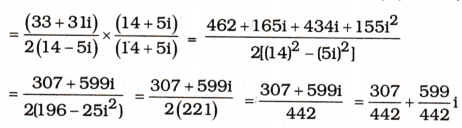
Reduce \(\frac{1}{2}\) to the standard form.
Solution:
AP Inter 1st Year Maths Exercise 4b Solutions 1
On multiplying the numerator and Denominator by (14 + 5i)
AP Inter 1st Year Maths Exercise 4b Solutions 2
This is the required standard form.

AP Inter 1st Year Maths Exercise 4b Solutions

Question 4.
Let z1 = 2 – i, z1 = -2 + i. Find (i) Re \(\left(\frac{z_1 z_2}{\bar{z}_1}\right)\)
(ii) Im\(\left(\frac{1}{z_1 \bar{z}_1}\right)\)
Solution:
i) It is given that z1 = 2 – i, z2 = -2 + i
z1z2 = (2 – i)(-2 + i)
= -4 + 2i + 2i – i2
= – 4 + 4i – (-1)
= -3 + 4i
Now, z̄1 = 2 + i
Hence, \(\frac{z_1 z_2}{\bar{z}_1}=\frac{-3+4 i}{2+i}\)
On multiplying nummerator and denominator by (2 – i), we obtain
\(\frac{z_1 z_2}{\bar{z}_1}=\frac{(-3+4 i)(2-i)}{(2+i)(2-i)}=\frac{-6+3 i+8 i-4 i^2}{2^2+1}\)
= \(\frac{-6+11 \mathrm{i}-4(-1)}{5}=\frac{-2+11 \mathrm{i}}{5}=\frac{-2}{5}+\frac{11}{5} \mathrm{i}\)
On comparing real parts, we obtain Re\(\left(\frac{z_1 z_2}{\bar{z}_1}\right)=-\frac{2}{5}\)

ii) \(\frac{1}{z_1 \bar{z}_1}=\frac{1}{(2+i)(2-i)}=\frac{1}{(2)^2+(1)}=\frac{1}{5}\)
On comparing imaginary parts, we obtain Im\(\left(\frac{1}{z_1 \bar{z}_1}\right)\) = 0

Question 5.
Find the real numbers x and y if (x – iy) (3 + 5i) is the conjugate of – 6 – 24i
Solution:
Let z = (x – iy) (3 + 5i) = 3x – i3y + i5x – i25y
= 3x + i5x – i3y + 5y
= (3x + 5y) + i(5x – 3y)
Then, z̄ = (3x + 5y) – i(5x – 3y)
It is given that, z̄ = -6 – 24i
Therefore, (3x + 5y) – i(5x – 3y) = -6 – 24i
Equating real and imaginary parts, we obtain
3x + 5y = – 6 ……..(1)
5x – 3y = 24 ……….(2)
Multiplying equation (1) with 3 and equation (2) with 5
we obtain
9x + 15y = -18; 25x – 15y = 120
On adding both the equations we get, 34x = 102
⇒ x = \(\frac{102}{34}\)
⇒ x = 3
Putting the value if x in equation (1) we obtain
3(3) + 5y = – 6
⇒ 5y = -6 – 9
⇒ y = \(\frac{-15}{5}\)
⇒ y = -3
Thus, the values of x = 3 and y = – 3

Question 6.
Find the modulus of \(\frac{1}{2}\).
Solution:
\(\frac{1+i}{1-i}-\frac{1-i}{1+i}=\frac{(1+i)^2-(1-i)^2}{(1-i)(1+i)}=\frac{1+i^2+2 i-1-i^2+2 i}{2}=\frac{4 i}{2}\)
= 2i

Therefore, \(\frac{1+\mathrm{i}}{1-\mathrm{i}}-\frac{1-\mathrm{i}}{1+\mathrm{i}}\) = |2i| = \(\sqrt{2^2}\) = 2

Question 7.
Find the number of ono-zero integral solutions of the equation |1 – i|x = 2x
Solution:
|1 – i|x = 2x
⇒ \(\left(\sqrt{1^2+(-1)^2}\right)^x\) = 2x
⇒ (√2)x = 2x
⇒ 2x/2 = 2x
⇒ \(\frac{x}{2}\) = x
⇒ x = 2x
⇒ 2x – x = 0
⇒ x = 0
Thus, 0 is the only integrak solution of the given equation.
Therefore, the number of non-zero integral solutions of the given equation is 0.

II.

Question 1.
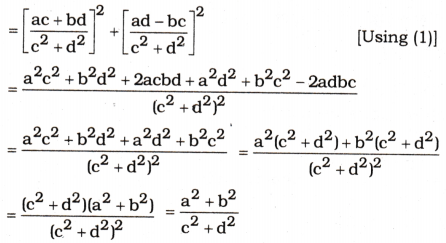
If x – iy = \(\sqrt{\frac{a-i b}{c-i d}}\), prove that (x2 + y2)2 = \(\frac{a^2+b^2}{c^2+d^2}\)
Solution:
x – iy = \(\sqrt{\frac{a-i b}{c-i d}}=\sqrt{\frac{a-i b}{c-i d} \times \frac{c+i d}{c+i d}}=\sqrt{\frac{(a c+b d)+i(a d-b c)}{c^2+d^2}}\)

Squaring on both sides we get
∴ (x – iy)2 = \(\frac{(a c+b d)+i(a d-b c)}{c^2+d^2}\)
⇒ x2 – y2 – 2ixy = \(\frac{(a c+b d)}{c^2+d^2}+i \frac{(a d-b c)}{c^2+d^2}\)

On comparing real and imaginary parts, we obtain
x2 – y2 = \(\frac{a c+b d}{c^2+d^2}\) – 2xy = \(\frac{a d-b c}{c^2+d^2}\) …….. (1)

Since (x2 + y2)2 = (x2 – y2)2 + (-2xy)2
AP Inter 1st Year Maths Exercise 4b Solutions 3
Hence Proved.

Question 2.
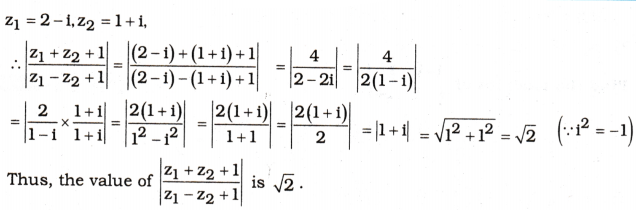
If z1 = 2 – i, z2 = 1 + i, find \(\left|\frac{z_1+z_2+1}{z_1-z_2+1}\right|\)
Solution:
AP Inter 1st Year Maths Exercise 4b Solutions 4

Question 3.
If a + ib = \(\frac{(x+i)^2}{2 x^2+1}\), prove that a2 + b2 = \(\frac{\left(x^2+1\right)^2}{\left(2 x^2+1\right)^2}\)
Solution:
a + ib = \(\frac{(x+i)^2}{2 x^2+1}\)
a + ib = \(\frac{(x+i)^2}{2 x^2+1}=\frac{x^2+i^2+i 2 x}{2 x^2+1}=\frac{x^2-1+i 2 x}{2 x^2+1}=\frac{x^2-1}{2 x^2+1}+i\left(\frac{2 x}{2 x^2+1}\right)\)
On comparing real and imaginary parts
a = \(\frac{x^2-1}{2 x^2+1}\) and b = \(\frac{2 x}{2 x^2+1}\)
Since, a2 + b2 = \(\left(\frac{x^2-1}{2 x^2+1}\right)^2+\left(\frac{2 x}{2 x^2+1}\right)^2\)
= \(\frac{x^4+1-2 x^2+4 x^2}{\left(2 x^2+1\right)^2}=\frac{x^4+1+2 x^2}{\left(2 x^2+1\right)^2}\)

a2 + b2 = \(\frac{\left(x^2+1\right)^2}{\left(2 x^2+1\right)^2}\)
Hence proved.

AP Inter 1st Year Maths Exercise 4b Solutions

Question 4.
If (x + iy)3 = u + iv, then show that \(\frac{1}{2}\) = 4(x2 – y2).
Solution:
It is given that (x + iy)3 = u + iv
⇒ x3 + (iy)3 + 3 × x × iy (x + iy) = u + iv
⇒ x3 + i3y3 + 3x2yi + 3xy2i2 = u + iv
⇒ x3 – iy3 + 3x2yi – 3xy2 = u + iv
⇒ (x3 – 3xy2) + i(3x2y – y3) = u + iv

On equating real and imaginary parts, we obtain u = x3 – 3xy2, v = 3x2y – y3

Therefore, \(\frac{u}{x}+\frac{v}{y}=\frac{x^3-3 x y^2}{x}+\frac{3 x^2 y-y^3}{y}=\frac{x\left(x^2-3 y^2\right)}{x}+\frac{y\left(3 x^2-y^2\right)}{y}\)
= x2 – 3y2 + 3x2 = y2 = 4x2 – y2 = 4(x2 – y2)
Hence, \(\frac{u}{x}+\frac{v}{y}\) = 4(x2 – y2) proved.

Question 5.
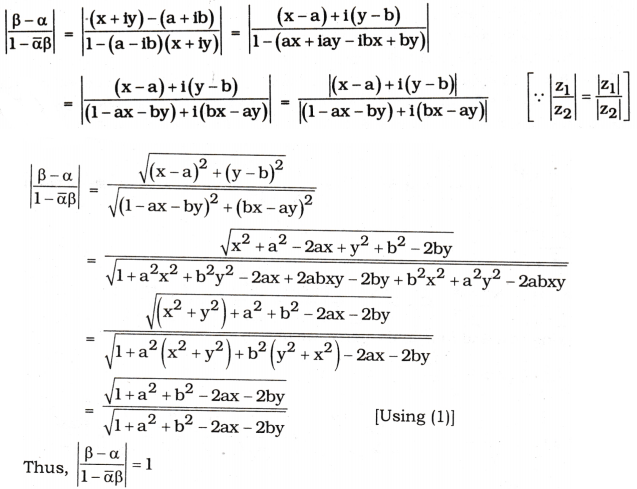
If α and β are different complex numbers with |β| = 1, then find \(\frac{\beta-\alpha}{1-\bar{\alpha} \beta}\).
Solution:
Let α = a + ib and β = x + iy
It is given that, |β| = 1
Therefore, \(\sqrt{x^2+y^2}\) = 1
⇒ x2 + y2 = 1 …………(1)
AP Inter 1st Year Maths Exercise 4b Solutions 5

Question 6.
If (a + ib) (c + id) (e + if) (g + ih) = A + iB, then show that (a2 + b2) (c2 + d2) (e2 + f2) (g2 + h2) = A2 + B2
Solution:
It is given that, (a + ib) (c + id) (e + if) (g + ih) = A + iB
Therefore, |(a + ib) (c + id) (e + if) (g + ih)| = |A + iB|
|(a + ib)| x |(c + id)| x |(e + if )| x |(g + ih)| = |A + iB|
\(\sqrt{a^2+b^2} \times \sqrt{c^2+d^2} \times \sqrt{e^2+f^2} \times \sqrt{g^2+h^2}=\sqrt{A^2+B^2}\)
\(\sqrt{\left(\mathrm{a}^2+\mathrm{b}^2\right)\left(\mathrm{c}^2+\mathrm{d}^2\right)\left(\mathrm{e}^2+\mathrm{f}^2\right)\left(\mathrm{g}^2+\mathrm{h}^2\right)}=\sqrt{\mathrm{A}^2+\mathrm{B}^2}\)
Squaring on both sides, we obtain
(a2 + b2) (c2 + d2) (e2 + f2) (g2 + h2) = A2 + B2
Hence proved.

Question 7.
If \(\left(\frac{1+\mathrm{i}}{1-\mathrm{i}}\right)^{\mathrm{m}}\) = 1, then find the least positive integral value of m.
Solution:
It is given that \(\left(\frac{1+\mathrm{i}}{1-\mathrm{i}}\right)^{\mathrm{m}}\) = 1
⇒ \(\left(\frac{1+\mathrm{i}}{1-\mathrm{i}} \times \frac{1+\mathrm{i}}{1+\mathrm{i}}\right)^{\mathrm{m}}\) = 1

⇒ \(\left(\frac{(1+i)^2}{1^2+1}\right)^{\mathrm{m}}\) = 1

⇒ \(\left(\frac{1^2+i^2+2 i}{2}\right)^m\) = 1

⇒ \(\left(\frac{1-1+2 \mathrm{i}}{2}\right)^{\mathrm{m}}\) = 1

⇒ \(\left(\frac{2 \mathrm{i}}{2}\right)^{\mathrm{m}}\) = 1
⇒ im = 1
⇒ im = 14k
Hence, m = 4k, where k is some integer.
Since, the least positive integer is 1, m = 4 × 1 = 4
Thus, the least positive integral value of m = 4.

Question 8.
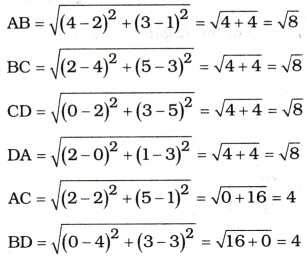
Show that the four points in the Argand plane represented by the complex numbers 2 + i, 4 + 3i, 2 + 5i, 3i are the vertices of a square.
Solution:
Given A = (2 + i) = (2, 1), B = (4 + 3i) = (4, 3), C = (2 + 5i) = (2, 5), D = (3i) = (0, 3)
Distance between two points A(x1, y1) and B(x2, y2) is AB = \(\sqrt{\left(\mathrm{x}_2-\mathrm{x}_1\right)^2+\left(\mathrm{y}_2-\mathrm{y}_1\right)^2}\)
AP Inter 1st Year Maths Exercise 4b Solutions 6
In the square all sides are equal and diagonals are also equal
∴ Given points are the vertices of a square.

Question 9.
Show that the points in the Argand plane represented by the complex numbers -2 + 7i, – 3i, \(\frac{-3}{2}+\frac{1}{2}\)i, 4 – 3i, \(\frac{7}{2}\)(1+i) are the vertices of a rhombus.
Solution:
A = (-2 + 7i) = (-2, 7)
B = \(\frac{-3}{2}+\frac{1}{2}\)i = (-\(\frac{3}{2}\), \(\frac{1}{2}\)),
C = (4 – 3i) = (4, -3)
D = \(\frac{7}{2}\)(1 + i) = (\(\frac{7}{2}\), \(\frac{7}{2}\))

Distance between two points A(x1, y1) and B(x2, y2) is AB = \(\sqrt{\left(\mathrm{x}_2-\mathrm{x}_1\right)^2+\left(\mathrm{y}_2-\mathrm{y}_1\right)^2}\)
AP Inter 1st Year Maths Exercise 4b Solutions 7
AB = BC = CD = DA and AC ≠ BD
In the rhombus all sides are equal but diagonals are not equal
∴ Given points are the vertices of a rhombus.

Question 10.
The points P, Q denote the complex numbers z1, z2 in the Argand diagram. O is the origin. If z1z̄2 + z̄1z2 = 0 then show that ∠POQ = \(\frac{\pi}{2}\).
Solution:
Let z1 = x1 + iy1, z2 = x2 + iy2 be the points P, Q in the Argand diagram.
z̄1 = x1 – iy1, z̄2 = x2 – iy2
∴ P(x1, y1),Q(x2, y2),O(0,0)
Slope of OP = \(\frac{0-y_1}{0-x_1}=\frac{y_1}{x_1}\)
∵ If A = (x1, y1),B = (x2, y2); Slope of \(\overline{A B}=\frac{y_2-y_1}{x_2-x_1}\)

Slope of OQ= \(\frac{0-y_2}{0-x_2}=\frac{y_2}{x_2}\)
Taking, z1z̄2 + z̄1z2 = 0
⇒ (x1 + iy1) (x2 – iy2) + (x1 – iy1) + (x2 + iy2) = 0
⇒ x1x2 + y1y2 + i(x2y1 – x1y2) + x1x2 + y1y2 + i(x1y2 – x2y1) = 0
⇒ 2(x1x2 + y1y2) = 0
⇒ x1x2 + y1y2 = 0
⇒ y1y2 = -x1x2
⇒ \(\frac{y_1}{x_1} \cdot \frac{y_2}{x_2}\) = -1
Slope of OP × Slope of OQ = -1
⇒ ∠POQ = 90°

AP Inter 1st Year Maths Exercise 4b Solutions

Question 11.
If the complex number z has argument θ, 0 < θ < \(\frac{\pi}{2}\) and satisfy the equation |z – 3i| = 3. Then prove that (cot θ – \(\frac{6}{z}\)) = i
Solution:
Let z = x + iy ⇒ tan θ = \(\frac{y}{x}\) so cot θ = \(\frac{x}{y}\)
Given that |z – 3i| = 3
⇒ |x + iy – 3i| = 3
⇒ |x + i(y – 3)| = 3
⇒ \(\sqrt{x^2+y^2+9-6 y}\) = 3

Squaring both sides
⇒ x2 + y2 – 6y + 9 = 9
⇒ x2 + y2 – 6y = 0 [∵ |x + iy| = \(\sqrt{x^2+y^2}\)]
⇒ x2 + y2 = 6y ……… (1)

Consider (cot θ – \(\frac{6}{z}\)) = \(\frac{x}{y}-\frac{6}{x+i y}=\frac{x}{y}-\frac{6(x-i y)}{x^2+y^2}=\frac{x}{y}-\frac{6(x-i y)}{6 y}\) (∵ from (1))
= \(\frac{6 x-6(x-i y)}{6 y}=\frac{6 i y}{6 y}\) = i

AP Inter 1st Year Study Material – AP Board Solutions Class 11

AP Board Solutions Inter 1st Year

AP Intermediate 1st Year Textbooks Solutions

Complex Numbers and Quadratic Equations MCQ AP Inter 1st Year Maths Chapter 4

Practice AP Inter 1st Year Maths Study Material Chapter 4 Complex Numbers and Quadratic Equations MCQ to identify your strengths and weak areas.

AP Inter 1st Year Maths Complex Numbers and Quadratic Equations MCQ

Question 1.
The value of i-999 is
(1) 1
(2) -1
(3) i
(4) -i
Answer:
(3) i

Explanation:
i-999 = \(\frac{1}{i^{999}}=\frac{1}{i^3 i^{996}}=\frac{1}{-i \cdot\left(i^4\right)^{249}}=\frac{-1}{i}\)
= i

Question 2.
The multiplicative inverse of 1 + i is
(1) \(\frac{1}{2}\)(1 – i)
(2) \(\frac{1}{2}\)(1 + i)
(3) 1 – i
(4) i
Answer:
(1) \(\frac{1}{2}\)(1 – i)

Explanation:
Multiplicative inverse of 1 + i = \(\frac{1}{1+i}=\frac{1}{1+i} \times \frac{1-i}{1-i}=\frac{1-i}{1+1}=\frac{1}{2}\)
= \(\frac{1}{2}\)(1 – i)

Complex Numbers and Quadratic Equations MCQ AP Inter 1st Year Maths Chapter 4

Question 3.
The modulus of 5 + 4i is
(1) 41
(2) -41
(3) \(\sqrt{41}\)
(4) \(\sqrt{-41}\)
Answer:
(3) \(\sqrt{41}\)

Explanation:
|5 + 4i| = \(\sqrt{5^2+4^2}=\sqrt{25+16}=\sqrt{41}\)

Question 4.
The value of \(\sqrt{-25}\) \(\sqrt{-9}\) is
(1) 15
(2) -15
(3) 15i
(4) None of these
Answer:
(2) -15

Explanation:
\(\frac{1}{2}\)
= 5i × 3i
= 15i2
= – 15

Question 5.
The Conjugate of \(\frac{2-i}{1-2 i}\) is
(1) \(\frac{4+3 i}{5}\)
(2) 4 – 3i
(3) \(\frac{4-3 i}{5}\)
(4) 1
Answer:
(3) \(\frac{4-3 i}{5}\)

Explanation:
Conjugate of z = z̄; z = \(\frac{2-i}{1-2 i}\)
z̄ = \(\frac{2-i}{1-2 i}=\frac{2+i}{1+2 i}=\frac{2+i}{1+2 i} \times \frac{1-2 i}{1-2 i}\)
= \(\frac{2-4 i+i-2 i^2}{1+4}=\frac{4-3 i}{5}\)

Question 6.
The value of (z + 3)(z̄ + 3) is equivalent to
(1) |z + 3|2
(2) |z – 3|
(3) z2 + 3
(4) None of these
Answer:
(1) |z + 3|2

Explanation:
(z + 3)\((\overline{z+3})\) = |z + 3|2 [∵ z.z̄ = |z|2]

Question 7.
Let x, y ∈ R, then x + iy is a non-real complex number if
(1) x = 0
(2) y = 0
(3) x ≠ 0
(4) None of these
Answer:
(4) None of these

Explanation:
y ≠ 0

Question 8.
If a + ib = c + id then
(1) a2 + c2 = 0
(2) b2 + c2 = 0
(3) b2 + d2 = 0
(4) a2 + b2 = c2 + d2
Answer:
(4) a2 + b2 = c2 + d2

Explanation:
a + ib = c + id
⇒ a = c, b = d
⇒ a2 = c2, b2 = d2
⇒ a2 + b2 = c2 + d2

Question 9.
The sum of the series i + i2 + i3 + ……………. upto 1000 terms is
(1) 1
(2) 0
(3) -1
(4) -2
Answer:
(2) 0

Explanation:
i + i2 + i3 + ……………. upto 1000 terms
= \(\frac{i\left(i^{1000}-1\right)}{i-1}=\frac{i\left(\left(i^4\right)^{250}-1\right)}{i-1}\)
= \(\frac{i(1-1)}{i-1}\) = 0

Complex Numbers and Quadratic Equations MCQ AP Inter 1st Year Maths Chapter 4

Question 10.
The complex number z which satisfies the condition \(\left|\frac{\mathrm{i}+\mathrm{z}}{\mathrm{i}-\mathrm{z}}\right|\) = 1 lies on
1) Circle x2 + y2 = 1
2) The X-axis
3) The Y-axis
4) The line x + y = 1
Answer:
2) The X-axis

Explanation:
Given \(\left|\frac{\mathrm{i}+\mathrm{z}}{\mathrm{i}-\mathrm{z}}\right|\) = 1
⇒ |i + z| = |i – z|
⇒ |x + iy + i| = |i – (x + iy)|
⇒ x2 + (1 + y)2 = x2 + (1 – y)2
⇒ 1 + y2 + 2y = 1 + y2 – 2y
⇒ 4y = 0
⇒ y = 0
Which is the X-axis.
∴ Locus of z lies on the X-axis

AP Inter 1st Year Maths Exercise 4c Solutions

Referring to the AP Inter 1st Year Maths Study Material Chapter 4 Complex Numbers and Quadratic Equations Exercise 4c Solutions makes it easier to understand complex problems.

AP Inter 1st Year Maths Complex Numbers and Quadratic Equations Solutions Exercise 4c

I. Find the modulus and the arguments of each of the complex numbers in Exercises 1 to 2.

Question 1.
z = – 1 – i√3
Solution:
Given that z = -1 – i√3
Let r cos θ = -1 and r sin θ = -√3
Squaring and adding, we obtain (rcos θ)2 + (rsin θ)2 = (-1)2 + (-√3)2
⇒ r2 (cos θ)2 + (rsin θ)2 = (-1)2 + (√3)2
⇒ r2(cos2θ + sin2θ) = 1 + 2
⇒ r2 = 4 [∵ cos2θ + sin2θ = 1]
⇒ r = √4 = 2 [∵ Conventionally, r > 0]
Therefore, Modulus = 2
Hence, 2cos θ = -1 and 2 sin θ = -√3
⇒ cos θ = \(\frac{1}{2}\) and sin θ = –\(\frac{\sqrt{3}}{2}\)
Since both the values of sin 0 and cos 0 are negative in III quadrant.
Argument = -(π – \(\frac{\pi}{3}\)) = \(\frac{-2 \pi}{3}\)
Thus, the modulus and argument of the complex number -1 – i√3 are 2 and \(\frac{-2 \pi}{3}\) respectively.

Question 2.
z = -√3 + i
Solution:
Given that z = -√3 + i
Let r cos θ = -√3 and r sin θ = 1
On squaring and adding, we obtain
r2 cos2θ + r2 sin2θ = (-√3)2 + 12
⇒ r2 = 3 + 1 = 4 [∵ cos2θ + sin2θ = 1]
⇒ r = √4 = 2 [∵ Conventionally, r > 0]
Therefore, Modulus = 2, Hence, 2 cos θ = -√3 and 2 sin θ = 1
⇒ cos θ = \(-\frac{\sqrt{3}}{2}\) and sin θ = \(\frac{1}{2}\)
Since, θ lies in the quadrant II, θ = π – \(\frac{\pi}{6}=\frac{5 \pi}{6}\)
Thus, the modulus and argument of the complex number – √3 + i are 2 and \(\frac{5 \pi}{3}\) respectively.

Convert each of the complex numbers given in exercises 3 to 8 in the polar form.

Question 3.
1 – i
Solution:
Given that z = 1 – i.
Let r cos θ = 1 and r sin θ = -1
On squaring and adding, we obtain
r2 cos2θ + r2 sin2θ = 12 + (-1)2
⇒ r2 (∵ cos2θ + sin2θ) = 1 + 1
⇒ r2 = 2
⇒ r = √2 [∵ Conventionally, r > 0]
Since, 0 lies in the IV quadrant θ = \(\left(\frac{-\pi}{4}\right)\)
Hence, 1 – i = r cos θ + ir sin θ
= √2cos \(\left(\frac{-\pi}{4}\right)\) + i sin\(\left(\frac{-\pi}{4}\right)\)
= √2[cos\(\left(\frac{-\pi}{4}\right)\) + isin\(\left(\frac{-\pi}{4}\right)\)]
Thus, this is the required polar form.

AP Inter 1st Year Maths Exercise 4c Solutions

Question 4.
-1 + i
Solution:
Given that z = -1 + i.
Let r cos θ = -1 and r sin θ = 1
On squaring and adding, we obtain r2 cos2θ + r2 sin2θ = (- 1)2 + 12
⇒ r2(cos2θ + sin2θ) = 1 + 1
⇒ r2 = 2
⇒ r = √2 [∵ Conventionally, r > 0]
Therefore,√2cos θ = -1 and √2 sin θ = 1
⇒ cos θ = –\(\frac{1}{\sqrt{2}}\) and sin θ = \(\frac{1}{\sqrt{2}}\)
Since, θ lies in the II quadrant, θ = π – \(\frac{\pi}{4}=\frac{3 \pi}{4}\)
⇒ r2 (cos2θ + sin2θ) = 1 + 1
Hence, -1 – i = r cos θ + i r sin θ = √2 cos \(\frac{-3 \pi}{4}\) + i √2 sin \(\frac{-3 \pi}{4}\)
= √2(cos \(\frac{-3 \pi}{4}\) + i sin \(\frac{-3 \pi}{4}\))
Thus, this is the required polar form.

Question 5.
-1 -i ,
Solution:
Given that z = -1 – i.
Let r cos θ = – 1 and r sin θ = -1
On squaring and adding, we obtain
r2 cos2 θ + r2 sin2θ = (- 1)2 + (- 1)2
Therefore, √2 cos θ = -1 and √2 sin θ = -1
⇒ cos θ = \(\\frac{-1}{\sqrt{2}}\) and sin θ = \(\frac{-1}{\sqrt{2}}\)
Hence, -1 – i = r cos θ + i r sin θ
= √2 cos \(\frac{-3 \pi}{4}\) + i 2 sin\(\frac{-3 \pi}{4}\)
= √2(cos \(\frac{-3 \pi}{4}\) + is sin \(\frac{-3 \pi}{4}\))
Thus, this is the required polar form.

Question 6.
-3
Solution:
Given that z = -3.
Let r cos θ = -3 and r sin θ = 0
On squaring and adding, we obtain
r2 cos2θ + r2 sin2θ = (- 3)2 + (0)2
⇒ r2 (cos2θ + sin2θ) = 9 + 0
⇒ r2 = 9
⇒ r = 3 [∵ Conventionally, r > 0]
Therefore, 3 cos θ = – 3 and 3 sin θ = 0
⇒ cos θ = – 1 and sin θ = 0.
Since, θ lies in the II quadrant, θ = n
Hence, – 3 = r cos θ + ir sin θ = 3 cos π + i3 sin π = 3(cos π + i sin π)
Thus, this is the required polar form.

Question 7.
√3 + i
Solution:
Given that z = √3 + i
Let r cos θ = √3 and r sin θ = 1
On squaring and adding, we obtain
r2 cos2θ + r2 sin2θ = (^3 )2 + 12
⇒ r2 (cos20 + sin20) = 3+l
⇒ r2 = 4
⇒ r = √4 = 2 [∵ Conventionally, r > 0]
Therefore, 2 cos θ = √3 and 2 sin θ = 1
⇒ cos θ = \(\frac{\sqrt{3}}{2}\) and sin θ = \(\frac{1}{2}\)
Since, θ lies in I quadrant, θ = \(\frac{\pi}{6}\)
Hence, √3+ 1 = r cos θ + ir sin θ = 2cos \(\frac{\pi}{6}\) + i2 sin \(\frac{\pi}{6}\) = 2(cos \(\frac{\pi}{6}\) + isin \(\frac{\pi}{6}\))
Thus, this is the required polar form.

AP Inter 1st Year Maths Exercise 4c Solutions

Question 8.
i
Solution:
Given that z = i
Let r cos θ = 0 and r sin θ = 1
On squaring and adding, we obtain
r2 cos2θ + r2 sin2θ = (√3 )2 + 12
⇒ r2 (cos2θ + sin2θ) = 1
⇒ r2 = 1
⇒ r = √1 =1 [∵ Conventionally, r > 0]
Therefore, cos θ = 0 and sin θ = 1
Since, θ lies in the I quadrant, θ = \(\frac{\pi}{2}\)
Hence, i = r cos θ + ir sin θ = cos \(\frac{\pi}{2}\) + i sin \(\frac{\pi}{2}\)
Thus, this is the required polar form.

AP Inter 1st Year Maths Exercise 4d Solutions

Referring to the AP Inter 1st Year Maths Study Material Chapter 4 Complex Numbers and Quadratic Equations Exercise 4d Solutions makes it easier to understand complex problems.

AP Inter 1st Year Maths Complex Numbers and Quadratic Equations Solutions Exercise 4d

I. Solve each of the following equations.

Question 1.
x2 + 3 = 0
Solution:
The given quadratic equation is x2 + 3 = 0
On comparing the given equation with ax2 + bx + c = 0,
We obtain a = 1, b = 0 and c = 3
Therefore, the discriminant of the given equation is
D = b2 – 4ac = 02 – 4 × 1 × 3 = – 12
Therefore, the required solutions are

Question 2.
2x2 + x + 1 = 0
Solution:
The given quadratic equation is 2x2 + x + 1 = 0
On comparing the given equation with ax2 + bx + c = 0,
We obtain a = 2, b = 1 and c = 1
Therefore, the discriminant of the given equation is
D = b2 – 4ac = 12 – 4 × 2 × 1 × = -7
Therefore, the required solutions are
\(\frac{-b \pm \sqrt{D}}{2 a}=\frac{-1 \pm \sqrt{-7}}{2 \times 2}=\frac{-1 \pm \sqrt{7} i}{4}\) [∵ √-1 = i]

Question 3.
x2 + 3x + 9 = 0
Solution:
The given quadratic equation is x2 + 3x + 9 = 0
On comparing the given equation with ax2 + bx + c = 0,
We obtain a = 1, b = 3 and c = 9
Therefore, the discriminant of the given equation is
D = b2 – 4ac = 32 – 4 × 1 × 9 = -27
Therefore, the required solutions are
\(\frac{-b \pm \sqrt{D}}{2 a}=\frac{-3 \pm \sqrt{-27}}{2 \times 1}=\frac{-3 \pm 3 \sqrt{-3}}{2}=\frac{-3 \pm 3 \sqrt{3} i}{2}\) [∵ √-1 = i]

AP Inter 1st Year Maths Exercise 4d Solutions

Question 4.
-x2 + x – 2 = 0
Solution:
The given quadratic equation is -x2 + x – 2 = 0
On comparing the given equation with ax2 + bx + c = 0,
We obtain a = -1, b = 1 and c = -2
Therefore, the discriminant of the given equation is
D = b2 – 4ac = 12 – 4 × (-1) × (-2) = -7
Hence, the required solutions are
\(\frac{-b \pm \sqrt{D}}{2 a}=\frac{-1 \pm \sqrt{-7}}{2 \times(-1)}=\frac{-1 \pm \sqrt{7} i}{-2}\) [∵ √-1 = i]

Question 5.
x2 + 3x + 5 = 0
Solution:
The given quadratic equation is x2 + 3x + 5 = 0
On comparing the given equation with ax2 + bx + c = 0,
We obtain a = 1, b = 3 and c = 5
Therefore, the discriminant of the given equation is D = b2 – 4ac = 32 – 4 × 1 × 5 = -11
Hence, the required solutions are
\(\frac{-\mathrm{b} \pm \sqrt{\mathrm{D}}}{2 \mathrm{a}}=\frac{-3 \pm \sqrt{-11}}{2 \times 1}=\frac{-3 \pm \sqrt{11} \mathrm{i}}{2}\) [∵ √-1 = i]

Question 6.
x2 – x + 2 = 0
Solution:
The given quadratic equation is x2 – x + 2 = 0
On comparing the given equation with ax2 + bx + c = 0,
We obtain a = 1, b = -1 and c = 2
Therefore, the discriminant of the given equation is
D = b2 – 4ac = (-1)2 – 4 × 1 × 2 = -7
Hence, the requird solutions are
\(\frac{-b \pm \sqrt{D}}{2 a}=\frac{-1(-1) \pm \sqrt{-7}}{2 \times 1}=\frac{1 \pm \sqrt{7} i}{2}\) [∵ √-1 = i]

Question 7.
√2x2 + x + √2 = 0
Solution:
The given quadratic equation is √2x2 + x + √2 = 0
On comparing the given equation with ax2 + bx + c = 0,
We obtain a = 72 , b = 1 and c = 72
Therefore, the discriminant of the given equation is
D = b2 – 4ac = (-1)2 – 4 × √2 × √2 = -7
Hence, the required solutions are
\(\frac{-b \pm \sqrt{D}}{2 a}=\frac{-1 \pm \sqrt{-7}}{2 \times \sqrt{2}}=-\frac{1 \pm \sqrt{7} i}{2 \sqrt{2}}\) [∵ √-1 = i]

Question 8.
√3x2 – √2x + 3√3 = 0
Solution:
The given quadratic equation is √3x2 – √2x + 3√3 = 0
comparing the given equation with ax2 + bx + c = 0,
We obtain a = √3 , b = -√2 and c = 375
Therefore, the discriminant of the given equation is
D = b2 – 4ac = (-√2)2 – 4 × (√3) × (3√3) = -34
Hence, the required solutions are
\(\frac{-\mathrm{b} \pm \sqrt{\mathrm{D}}}{2 \mathrm{a}}=\frac{-(-\sqrt{2}) \pm \sqrt{-34}}{2 \times \sqrt{3}}=\frac{\sqrt{2} \pm \sqrt{34} \mathrm{i}}{2 \sqrt{3}}\) [∵ √-1 = i]

Question 9.
x2 + x + \(\frac{1}{\sqrt{2}}\) = 0
Solution:
This equation can also be written as x2 + x + \(\frac{1}{\sqrt{2}}\)= 0
On comparing the given equation with ax2 + bx + c = 0,
We obtain a = √2 , b = √2 and c = 1
Therefore, the discriminant of the given equation is
D = b2 – 4ac = (√2)2 – 4 × (√5) × 1 = 2 – 4√2
Hence, the required solutions are
AP Inter 1st Year Maths Exercise 4d Solutions 1

AP Inter 1st Year Maths Exercise 4d Solutions

Question 10.
x2 + \(\frac{\mathbf{x}}{\sqrt{2}}\) + 1 = o
Solution:
The given quadratic equation is x2 + \(\frac{\mathbf{x}}{\sqrt{2}}\) + 1 = 0
75
This equation can also be written as x2 + \(\frac{\mathbf{x}}{\sqrt{2}}\) + 1 = o
On comparing the given equation with ax2 + bx + c = 0,
We obtain a = √5, b = 1 and c = √2
Therefore, the discriminant of the given equation is
D = b2 – 4ac = (1)2 – 4 × (√2) × (√2) = 1 – 8 = -7
Hence, the required solutions are
\(\frac{-b \pm \sqrt{D}}{2 a}=\frac{-1 \pm \sqrt{-7}}{2 \times \sqrt{2}}=\frac{-1 \pm \sqrt{7} i}{2 \sqrt{2}}\)