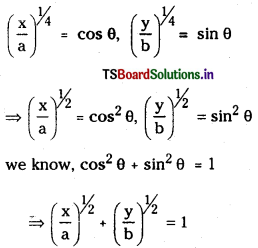
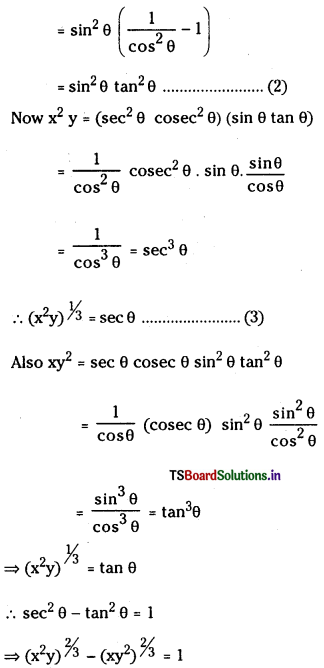
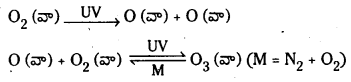
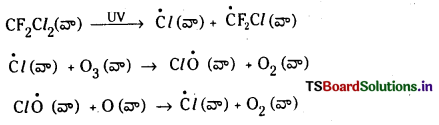
TS Inter 1st Year Maths 1B Rate Measure Important Questions

Students must practice these Maths 1B Important Questions TS Inter 1st Year Maths 1B Rate Measure Important Questions to help strengthen their preparations for exams.

TS Inter 1st Year Maths 1B Rate Measure Important Questions

Question 1.
The distance-time formula for the motion of a particle along a straight line is s = t3 – 9t2 + 24t – 18. Find when and where the velocity is zero. [Mar. ’19 (AP); Mar. ’12; May ’96]
Solution:
Given, s = t3 – 9t2 + 24t – 18
Velocity, v = \(\frac{\mathrm{ds}}{\mathrm{dt}}\)
= 3t2 – 9(2t) + 24(1) – 0
= 3t2 – 18t + 24
Given, the particle comes to rest then the velocity = 0
3t2 – 18t + 24 = 0
t2 – 6t + 8 = 0
t2 – 4t – 2t + 8 = 0
t(t – 4) – 2(t – 4) = 0
(t – 4) (t – 2) = 0
t – 4 = 0 (or) t – 2 = 0
t = 4 (or) t = 2
t = 2, 4
The velocity is zero when t = 2 sec and 4 sec.
Case 1:
If t = 2 sec, then s = t3 – 9t2 + 24t – 18
= (2)3 – 9(2)2 + 24(2) – 18
= 8 – 36 + 48 – 18
= 2 units
Case 2:
If t = 4 sec, then s = (4)3 – 9(4)2 + 24(4) – 18
= 64 – 144 + 96 – 18
= 160 – 162
= -2 units
∴ The particles are at a distance of two units from the starting point ‘0’ on either side.

TS Inter First Year Maths 1B Rate Measure Important Questions

Question 2.
The displacement s of a particle travelling in a straight line in ‘t’ seconds is given by s = 45t + 11t2 – t3, finding the time when the particle comes to rest. [May ’13 (Old), ’06; Mar. ’07]
Solution:
Given, s = 45t + 11t2 – t3
Velocity, v = \(\frac{\mathrm{ds}}{\mathrm{dt}}\)
= 45(1) + 11(2t) – 3t2
= 45 + 22t – 3t2
The particle comes to rest then velocity, v = 0
45 + 22t – 3t2 = 0
3t2 – 22t – 45 = 0
3t2 – 27t + 5t – 45 = 0
3t(t – 9) + 5(t – 9) = 0
(t – 9) (3t + 5) = 0
t – 9 = 0 (or) 3t + 5 = 0
t = 9 (or) t = \(\frac{-5}{3}\)
t = 9 Since t is positive then t = 9
∴ The particle comes to rest when t = 9 sec.

Question 3.
A particle is moving in a straight line so that after t seconds its distance is s (in cms) from a fixed point on the line given by s = f(t) = 8t + t3. Find
(i) the velocity at time t = 2 sec [Mar. ’17, ’15 (AP)]
(ii) the initial velocity
(iii) acceleration at t = 2 sec [May ’12; B.P.]
Solution:
The distance s and time t are connected by the relation s = f(t) = 8t + t3
Velocity, v = \(\frac{\mathrm{ds}}{\mathrm{dt}}\)
= 8(1) + 3t2
= 8 + 3t2
(i) Velocity at t = 2 sec, then,
v = \(\left(\frac{\mathrm{ds}}{\mathrm{dt}}\right)_{\mathrm{t}=2}\)
= 8 + 3(2)2
= 8 + 12
= 20 cm/sec
acceleration, a = \(\frac{\mathrm{dv}}{\mathrm{dt}}\)
= 0 + 3(2t)
= 6t
(ii) Initial velocity (t = 0) is v = \(\left(\frac{\mathrm{ds}}{\mathrm{dt}}\right)_{\mathrm{t}=0}\)
= 8 + 3(0)2
= 8 cm/sec
(iii) The acceleration at t = 2 sec, then
a = \(\left(\frac{\mathrm{dv}}{\mathrm{dt}}\right)_{\mathrm{t}=2}\)
= 6(2)
= 12 cm/sec2

Question 4.
A container is in the shape of an inverted cone and has a height of 8 cm and a radius of 6 m at the top. If it is filled with water at the rate of 2 m3/minute, how fast height of the water change when the level is 4m? [Mar. ’19 (TS): May ’13. ’11, ’09; Mar. ’08, ’06]
Solution:
Let h be the height, r be the radius of the water level and V be the volume of the water in the container at the time ‘t’.
Given that, \(\frac{d v}{d t}\) = 2m3/min.
TS Inter 1st Year Maths 1B Rate Measure Important Questions Q4
TS Inter 1st Year Maths 1B Rate Measure Important Questions Q4.1
∴ The height of the water changes at a rate of \(\frac{2}{9 \pi}\) m/min.
TS Inter First Year Maths 1B Rate Measure Important Questions

Question 5.
The volume of a cube is increasing at a rate of 9 cubic centimeters per second. How fast is the surface area increasing when the length of the edge is 10 centimeters? [Mar. ’17 (TS), ’16 (AP), ’13; May ’15 (TS)]
Solution:
Let x be the length of the edge of the cube.
V is its volume and S is its surface area.
Given that rate of change of volume
\(\frac{\mathrm{dv}}{\mathrm{dt}}\) = 9 cm3/sec
x = 10 cm
The volume of a cube, V = x3
Differentiating v with respect to ‘t’, we get
TS Inter 1st Year Maths 1B Rate Measure Important Questions Q5

Question 6.
A point P is moving on the curve y = 2x2. The x coordinate of P is increasing at the rate of 4 units per second. Find the rate at which the y-coordinate is increasing when the point is at (2, 8). [Mar. ’16 (TS), ’13; May ’08]
Solution:
Let P(x, y) be any point on the curve y = 2x2
Given, \(\frac{\mathrm{dx}}{\mathrm{dt}}\) = 4 units/sec
Given point (x, y) = (2, 8)
Now, y = 2x2
Differentiating on both sides with respect to ‘t’
\(\frac{\mathrm{dy}}{\mathrm{dt}}=2(2 \mathrm{x}) \cdot \frac{\mathrm{dx}}{\mathrm{dt}}\)
= 4(2) . 4
= 32 units/sec
∴ The y-coordinate is increasing at the rate of 32 units/sec.

Some More Maths 1B Rate Measure Important Questions

Question 7.
A container in the shape of an inverted cone has a height of 12 cm and a radius of 6 cm at the top. If it is filled with water at the rate of 12 cm3/sec. What is the rate of change in the height of the water level when the tank is filled 8 cm?
Solution:
Let h be the height, r be the radius of the water level and v be the volume of water in the container at a time ‘t’.
TS Inter 1st Year Maths 1B Rate Measure Important Questions DTP Q1
Given, \(\frac{\mathrm{dV}}{\mathrm{dt}}\) = 12 cm3/sec
height, h = 8 cm
In triangle OAB, OCD are similar, then
TS Inter 1st Year Maths 1B Rate Measure Important Questions DTP Q1.1
TS Inter 1st Year Maths 1B Rate Measure Important Questions DTP Q1.2
Hence the rate of change of water level is \(\frac{3}{4 \pi}\) cm/sec when the water level of the tank is 8 cm.

TS Inter First Year Maths 1B Rate Measure Important Questions

Question 8.
The volume of a cube is increasing at the rate of 8 cm3/sec. How fast is the surface area increasing when the length of an edge is 12 cm?
Solution:
Let x be the length of the edge of the cube, V be its volume and S be its surface area.
Given that, the rate of change in volume \(\frac{\mathrm{dV}}{\mathrm{dt}}\) = 8 cm3/sec
x = 12 cm
The volume of a cube V = x3
Differentiating V on with respect to ‘t’, we get
TS Inter 1st Year Maths 1B Rate Measure Important Questions DTP Q2

Question 9.
A particle moving along straight has the relation s = t3 + 2t + 3, connecting the distance s described by the particle in time t. Find the velocity and acceleration of the particle at t = 4 seconds.
Solution:
Given, s = t3 + 2t + 3
velocity, v = \(\frac{\mathrm{ds}}{\mathrm{dt}}\)
= 3t2 + 2 + 0
= 3t2 + 2
velocity at t = 4 sec, then, v = \(\left(\frac{\mathrm{ds}}{\mathrm{dt}}\right)_{t=4}\)
= 3(4)2 + 2
= 50 units/sec
acceleration, a = \(\frac{\mathrm{dv}}{\mathrm{dt}}\)
= 3(2t) + 0
= 6t
acceleration at t = 4, then
a = \(\left(\frac{\mathrm{dv}}{\mathrm{dt}}\right)_{\mathrm{t}=4}\)
= 6(4)
= 24 units/sec2

Question 10.
A particle is moving along a line according to s = f(t) = 4t3 – 3t2 + 5t – 1 where s is measured in metres and t is measured in seconds. Find the velocity and acceleration at time t. At what time the acceleration is zero? [Mar. ’18 (AP); Mar. ’18, ’15 (TS)]
Solution:
Given, s = f(t) = 4t3 – 3t2 + 5t – 1
velocity, v = \(\frac{\mathrm{ds}}{\mathrm{dt}}\)
= 4(3t2) – 3(2t) + 5(1) – 0
= 12t2 – 6t + 5
acceleration, a = \(\frac{d v}{d t}\)
= 12(2t) – 6(1) + 0
= 24t – 6
∴ Acceleration is 0 if 24t – 6 = 0
24t = 6
t = \(\frac{1}{4}\) sec
∴ Acceleration of particle is 0 at t = \(\frac{1}{4}\) sec

TS Inter First Year Maths 1B Rate Measure Important Questions

Question 11.
A stone is dropped into a quiet lake and ripples move in circles at speed of 5 cm/sec. At the instant when the radius of the circular ripple is 8 cm, how fast is the enclosed area increased?
Solution:
Let A be the area of the circle with radius ‘r’.
Given, radius, r = 8 cm
\(\frac{\mathrm{dr}}{\mathrm{dt}}\) = 5 cm/sec
Area of the circle, A = πr2
Differentiating on A with respect to ‘t’
\(\frac{\mathrm{dA}}{\mathrm{dt}}=\pi .2 \mathrm{r}, \frac{\mathrm{dr}}{\mathrm{dt}}\)
= 2π (8) (5)
= 80π cm2/sec

Question 12.
The radius of a circle is increasing at the rate of 0.7 cm/sec. What is the rate of increase in its circumference?
Solution:
Let r be the radius and P be the circumference of a circle.
Given, \(\frac{\mathrm{dr}}{\mathrm{dt}}\) = 0.7 cm/sec
Circumference of a circle, P = 2πr
Differentiating P on both sides with respect to ‘t’
\(\frac{\mathrm{dp}}{\mathrm{dt}}=2 \pi \cdot \frac{\mathrm{dr}}{\mathrm{dt}}\)
= 2π(0.7)
= 1.4π cm/sec
∴ Rate of increase of circumference of circle = 1.4π cm/sec.

Question 13.
A balloon, which always remains spherical on inflation, is being inflated by pumping in 900 cubic cm of gas per sec. Find the rate at which the radius of the balloon increases when the radius is 15 cm.
Solution:
Let r be the radius and V be the volume of the spherical balloon.

Given, \(\frac{\mathrm{dV}}{\mathrm{dt}}\) = 900 cu.cm/sec
radius, r = 15 cm
Volume of the spherical balloon, V = \(\frac{4}{3} \pi r^3\)
Differentiating on both sides with respect to ‘t’
TS Inter 1st Year Maths 1B Rate Measure Important Questions Some More Q5
∴ Rate of increase of radius of the balloon \(\frac{\mathrm{dr}}{\mathrm{dt}}=\frac{1}{\pi}\) cm/sec

TS Inter First Year Maths 1B Rate Measure Important Questions

Question 14.
The radius of an air bubble is increasing at the rate of \(\frac{1}{2}\) cubic. cm/sec. At what rate is the volume of the bubble increasing when the radius is 1 cm?
Solution:
Let r be the radius and V be the volume of an air bubble.
Given, \(\frac{\mathrm{dr}}{\mathrm{dt}}=\frac{1}{2}\) cm/sec
radius, r = 1 cm
Volume of a air bubble, V = \(\frac{4}{3} \pi r^3\)
Differentiating on both sides with respect to ‘t’
TS Inter 1st Year Maths 1B Rate Measure Important Questions Some More Q6
∴ The volume of the air bubble increasing at r = 1 cm is 2π cu. cm/sec.

Question 15.
Let a kind of bacteria grow in such a way that at time t sec. There are \(\mathbf{t}^{3 / 2}\) bacteria. Find the rate of growth at time t = 4 hours.
Solution:
Let g be the amount of growth of bacteria at t sec.
Let g(t) = \(\mathbf{t}^{3 / 2}\)
TS Inter 1st Year Maths 1B Rate Measure Important Questions Some More Q7
TS Inter 1st Year Maths 1B Rate Measure Important Questions Some More Q7.1

Question 16.
Let a kind of bacteria grow by t3 (t in sec). At what time the rate of growth of the bacteria is 300 bacteria per sec?
Solution:
Let g be the amount of growth of bacteria at t sec.
Then g(t) = t3
Now, the growth rate at time ‘t’ is g'(t) = 3t2
Given, the rate of growth of the bacteria is 300 per sec.
3t2 = 300
t2 = 100
t = 10 sec.
∴ After t = 10 sec, the growth rate of bacteria should be 300 bacteria/sec.

Question 17.
Suppose we have a rectangular aquarium with dimensions of length 8m, width 4m, and height 3m. Suppose we are filling the tank with water at a rate of 0.4 m3/sec. How fast is the height of water changing when the water level is 2.5 m?
Solution:
Let h be the height of the water level in the aquarium at the time t.
Given that length, l = 8 m
breadth (or) width, b = 4 cm
height, h = 3 m
Volume of the aquarium, V = lbh
V = 8 . 4 . 3 = 96 cu.m.
Given, \(\frac{\mathrm{dV}}{\mathrm{dt}}\) = 0.4 cu.m/sec
height, h = 2.5 m
volume of aquarium, V = lbh
log V = log(lbh)
log V = log l + log b + log h
Differentiating with respect to ‘t’
TS Inter 1st Year Maths 1B Rate Measure Important Questions Some More Q9
TS Inter 1st Year Maths 1B Rate Measure Important Questions Some More Q9.1
(Or)
Let h be the height of the water level in the aquarium at the volume of the aquarium,
V = lbh = 8 . 4 . h = 32h …….(1)
Given that, \(\frac{\mathrm{dV}}{\mathrm{dt}}\) = 0.4 cu.cm/sec
height, h = 2.5 m
Differentiating on both sides with respect to ‘t’
TS Inter 1st Year Maths 1B Rate Measure Important Questions Some More Q9.2
The weight of water changes at the rate of \(\frac{1}{80}\) m.sec.

TS Inter First Year Maths 1B Rate Measure Important Questions

Question 18.
The total cost c(x) in rupees associated with the production of x units of an item is given by c(x) = 0.007x3 – 0.003x2 + 15x + 4000. Find the marginal cost when 17 units are produced.
Solution:
Let M represent the marginal cost.
Given, c(x) = 0.007x3 – 0.003x2 + 15x + 4000
The rate of change of total cost is M = \(\frac{\mathrm{dc}}{\mathrm{dx}}\)
= (0.007)(3x2) – 0.003(2x) + 15(1) + (0)
= 0.021x2 – 0.006x + 15
∴ The marginal cost at x = 17 is \(\left(\frac{d c}{d x}\right)_{x=17}\)
= (0.021)(17)2 – 0.006(17) + 15
= (0.021)(289) – 0.102 + 15
= 20.967

Question 19.
The total cost c(x) in rupees associated with the production of x units of an item is given by c(x) = 0.005x3 – 0.02x2 + 30x + 500. Find the marginal cost when 3 units are produced (marginal cost is the rate of change of total cost). [May ’15 (AP)]
Solution:
Given relation c(x) = 0.005x3 – 0.02x2 + 30x + 500
\(\frac{\mathrm{dc}}{\mathrm{dx}}\) = (0.005)(3x2) – 0.02(2x) + 30(1)
= (0.015)x2 – 0.04x + 30
∴ Marginal cost = \(\left(\frac{\mathrm{dc}}{\mathrm{dx}}\right)_{\mathrm{x}=3}\)
= (0.015) (3)2 – 0.04(3) + 30
= (0.015) (9) – 0.04 (3) + 30
= 0.135 – 0.12 + 30
= 30.015

TS Inter 1st Year Maths 1A Solutions Chapter 3 Matrices Ex 3(g)

Students must practice these TS Intermediate Maths 1A Solutions Chapter 3 Matrices Ex 3(g) to find a better approach to solving the problems.

TS Inter 1st Year Maths 1A Matrices Solutions Exercise 3(g)

I.
Examine whether the following systems of equations are consistent or inconsistent and if consistent find the complete solutions,
Question 1.
x + y + z = 4
2x + 5y – 2z = 3
x + 7y – 7z = 5
Answer:
Augmented matrix of the above system is
TS Inter 1st Year Maths 1A Solutions Chapter 3 Matrices Ex 3(g) 1
Rank of the matrix ρ(A) = 2 and ρ(AB) = 3.
Since ρ(A) ≠ ρ(AB), the given system of equa¬tions are inconsistent.

Question 2.
x + y + z = 6
x – y + z = 2
2x – y + 3z = 9
Answer:
Augmented matrix [AB] = \(\left[\begin{array}{rrrr}
1 & 1 & 1 & 6 \\
1 & -1 & 1 & 2 \\
2 & -1 & 3 & 9
\end{array}\right]\)
Apply operations R2 – R1, R3 – 2R1, we get
TS Inter 1st Year Maths 1A Solutions Chapter 3 Matrices Ex 3(g) 2
Here ρ(A) = 3 and ρ(AB) = 3
Since ρ(A) = ρ(AB), the given system is consistent and has a unique solution.
TS Inter 1st Year Maths 1A Solutions Chapter 3 Matrices Ex 3(g) 3

TS Inter 1st Year Maths 1A Solutions Chapter 3 Matrices Ex 3(g)

Question 3.

x + y + z = 1
2x + y + z = 2
x + 2y + 2z = 1 (March 2015-T.S)
Answer:
Augmented matrix of the system is
TS Inter 1st Year Maths 1A Solutions Chapter 3 Matrices Ex 3(g) 4
ρ(AB) = 2 and ρ(A) = 2 and ρ(A) = ρ(AB) < 3
The given system of equations is consis¬tent and has infinitely many solutions.
The given system is equivalent to x + y + z = 1 and y + z = 0.
Solution set is
TS Inter 1st Year Maths 1A Solutions Chapter 3 Matrices Ex 3(g) 5

Question 4.
x + y + z = 9
2x + 5y + 7z = 52
2x + y – z = 0
Answer:
Augmented matrix of the system
TS Inter 1st Year Maths 1A Solutions Chapter 3 Matrices Ex 3(g) 6
Here ρ(A) = ρ(AB) = 3; and the system of given equations is consistent; and has a unique solution.
Also x = 1, y = 3, z = 5 form the solution.

Question 5.
x + y + z = 6
x + 2y + 3z = 10
x + 2y + 4z = 1
Answer:
Augmented matrix of the system is
TS Inter 1st Year Maths 1A Solutions Chapter 3 Matrices Ex 3(g) 7

Question 6.
x – 3y – 8z = – 10
3x + y – 4z = 0
2x + 5y + 6z = 13
Answer:
The augmented matrix of the above system is
TS Inter 1st Year Maths 1A Solutions Chapter 3 Matrices Ex 3(g) 8
Since ρ(A) = 2 = ρ(AB) < 3, given system of equations is consistent with infinitely many solutions.
The given system is equivalent to
x – 3y – 8z = – 10,
y + 2z = 3
Put z = t then y = 3 – 2t
∴ x = – 10 + 3(3 – 2t) + 8t
= -10 + 9 – 6t + 8t
= 2t – 1
Hence the solutions are given by
x = 2t – 1, y = 3 – 2t and z = t
Where t is any scalar.

Question 7.
2x + 3y + z = 9
x + 2y + 3z = 6
3x + y + 2z = 8
Answer:
Augmented matrix of the above system is
TS Inter 1st Year Maths 1A Solutions Chapter 3 Matrices Ex 3(g) 9
ρ(A) = ρ(AB) = 3; system is consistent and has a unique solution given by
x = \(\frac{35}{18}\), y = \(\frac{29}{18}\), z = \(\frac{5}{18}\)

TS Inter 1st Year Maths 1A Solutions Chapter 3 Matrices Ex 3(g)

Question 8.
x + y + 4z = 6
3x + 2y – 2z = 9
5x + y + 2z = 13
Answer:
Augmented matrix of the system
TS Inter 1st Year Maths 1A Solutions Chapter 3 Matrices Ex 3(g) 10
ρ(A) = ρ(AB) = 3;
Hence the system is consistent and has a unique solution given by
x = 2, y = 2, z = \(\frac{1}{2}\).

TS Inter 1st Year Maths 1B Solutions Chapter 8 Limits and Continuity Ex 8(e)

Students must practice these TS Inter 1st Year Maths 1B Study Material Chapter 8 Limits and Continuity Ex 8(e) to find a better approach to solving the problems.

TS Inter 1st Year Maths 1B Limits and Continuity 8(e)

Question 1.
Is the function f, defined by
TS Inter 1st Year Maths 1B Solutions Chapter 8 Limits and Continuity Ex 8(e) 1
continuous on R? (V.S.A.Q.) (May 2011)
Answer:
TS Inter 1st Year Maths 1B Solutions Chapter 8 Limits and Continuity Ex 8(e) 2
The function is continuous at ‘1’ hence at continuous on R.

TS Inter 1st Year Maths 1B Solutions Chapter 8 Limits and Continuity Ex 8(e)

Question 2.
Is f defined by
TS Inter 1st Year Maths 1B Solutions Chapter 8 Limits and Continuity Ex 8(e) 3
continuous at ‘0’ (V.S.A.Q.) (May 2012)
Answer:
Given f(0) = 1
TS Inter 1st Year Maths 1B Solutions Chapter 8 Limits and Continuity Ex 8(e) 4
Hence f is continuous at ‘0’.

Question 3.
Show that the function
f(x) = [cos(x10 + 1)]\(\frac{1}{3}\); x ∈ ℛ is a continuous function. (V.S.A.Q.)
Answer:
Since cos x is continuous for every x ∈ R, we have f(x) = [cos (x10 + 1)]1/3 is also continuous over R.

II.
Question 1.
Check the continuity of the following function at 2. (S.A.Q.)
TS Inter 1st Year Maths 1B Solutions Chapter 8 Limits and Continuity Ex 8(e) 5
Answer:
Given f(2) = 0
TS Inter 1st Year Maths 1B Solutions Chapter 8 Limits and Continuity Ex 8(e) 6
Hence f(x) is not continuous at x = 2.

TS Inter 1st Year Maths 1B Solutions Chapter 8 Limits and Continuity Ex 8(e)

Question 2.
Check the continuity of f given by (S.A.Q.) (Mar. ’14, ’13)
TS Inter 1st Year Maths 1B Solutions Chapter 8 Limits and Continuity Ex 8(e) 7
Answer:
Given f(3) = 1.5 and
TS Inter 1st Year Maths 1B Solutions Chapter 8 Limits and Continuity Ex 8(e) 8
Since \(\lim _{x \rightarrow 3}\) f(x) = f(3) we have f is continuous at the point ‘3’.

Question 3.
Show that f given by f(x) = \(\frac{\mathbf{x}-|\mathbf{x}|}{\mathbf{x}}\) (x ≠ 0) is continuous on R – {0}. (S.A.Q.)
Answer:
TS Inter 1st Year Maths 1B Solutions Chapter 8 Limits and Continuity Ex 8(e) 9
In both the cases \(\lim _{x \rightarrow a}\) f(x) = f(a)
But if a = 0 then f(0) is not defined f(x) is not continuous at ‘0’.
Hence f(x) is continuous on R – {0}

TS Inter 1st Year Maths 1B Solutions Chapter 8 Limits and Continuity Ex 8(e)

Question 4.
If f is a function defined by (S.A.Q.)
TS Inter 1st Year Maths 1B Solutions Chapter 8 Limits and Continuity Ex 8(e) 10
then discuss the continuity of f.
Answer:
TS Inter 1st Year Maths 1B Solutions Chapter 8 Limits and Continuity Ex 8(e) 11

Question 5.
If f is given by
TS Inter 1st Year Maths 1B Solutions Chapter 8 Limits and Continuity Ex 8(e) 12
is a continuous function on R, then find the values of ‘k’. (S.A.Q.)
Answer:
TS Inter 1st Year Maths 1B Solutions Chapter 8 Limits and Continuity Ex 8(e) 13
Given that f is continuous on R, then it is continuous at ‘1’.
∴ k2 – k = 2 ⇒ k2 – k – 2 = 0
⇒ (k – 2) (k + 1) = 0
⇒ k = 2 or k = – 1

TS Inter 1st Year Maths 1B Solutions Chapter 8 Limits and Continuity Ex 8(e)

Question 6.
Prove that the function ‘sin x’ and ‘cos x’ are continuous on R. (S.A.Q.)
Answer:
(i) Let f(x) = sin x
If f is continuous at a point ‘a’ then
\(\lim _{x \rightarrow \mathrm{a}}\) f(x) = f(a)
∴ \(\lim _{x \rightarrow \mathrm{a}}\) (sin x) = sin a = f(a)
(or) by definition we have for ∈ > 0, ∃ a δ > 0
such that |sin x – sin a| < E for |x – a| < δ
TS Inter 1st Year Maths 1B Solutions Chapter 8 Limits and Continuity Ex 8(e) 14
Hence f(x) = sin x is continuous at ‘a’
Hence f is continuous over R.

(ii) f(x) = cos x
Let a ∈ R,
∴ \(\lim _{x \rightarrow a}\) f(x) = \(\lim _{x \rightarrow a}\) (cos x) = cos a = f(a)
∴ f is continuous at ‘a’
Hence f is continuous over R.

III.
Question 1.
Check the continuity of f given by
TS Inter 1st Year Maths 1B Solutions Chapter 8 Limits and Continuity Ex 8(e) 15
at the point 0, 1 and 2.
Answer:
TS Inter 1st Year Maths 1B Solutions Chapter 8 Limits and Continuity Ex 8(e) 16

TS Inter 1st Year Maths 1B Solutions Chapter 8 Limits and Continuity Ex 8(e)

Question 2.
Find real constants a, b so that the function f given by
TS Inter 1st Year Maths 1B Solutions Chapter 8 Limits and Continuity Ex 8(e) 17
is continuous on R
Answer:
Given f is continuous over R ⇒ f is continuous at 0, 1 and 3.
If f is continuous at ‘0’ then
TS Inter 1st Year Maths 1B Solutions Chapter 8 Limits and Continuity Ex 8(e) 18
∴ In all cases if f is continuous at 0, 1, 3 and continuous over R.
The values are a = 0,
b = – 2.

Question 3.
Show that
TS Inter 1st Year Maths 1B Solutions Chapter 8 Limits and Continuity Ex 8(e) 19
where a and b are real constants, is continuous at ‘0’. (Board New Model Paper) (E.Q.)
Answer:
TS Inter 1st Year Maths 1B Solutions Chapter 8 Limits and Continuity Ex 8(e) 20

TS Inter 1st Year Maths 1B Solutions Chapter 8 Limits and Continuity Ex 8(d)

Students must practice these TS Inter 1st Year Maths 1B Study Material Chapter 8 Limits and Continuity Ex 8(d) to find a better approach to solving the problems.

TS Inter 1st Year Maths 1B Limits and Continuity 8(d)

Compute the following limits.

Question 1.
\(\lim _{x \rightarrow 3}\left(\frac{x^2+3 x+2}{x^2-6 x+9}\right)\) (V.S.A.Q.)
Answer:
TS Inter 1st Year Maths 1B Solutions Chapter 8 Limits and Continuity Ex 8(d) 1

Question 2.
\(\lim _{x \rightarrow 1}\left(\frac{1+5 x^3}{1-x^2}\right)\) (V.S.A.Q.)
Answer:
TS Inter 1st Year Maths 1B Solutions Chapter 8 Limits and Continuity Ex 8(d) 2

TS Inter 1st Year Maths 1B Solutions Chapter 8 Limits and Continuity Ex 8(d)

Question 3.
\(\lim _{x \rightarrow \infty}\left(\frac{3 x^2+4 x+5}{2 x^3+3 x-7}\right)\) (V.S.A.Q.)
Answer:
TS Inter 1st Year Maths 1B Solutions Chapter 8 Limits and Continuity Ex 8(d) 3

Question 4.
\(\lim _{x \rightarrow \infty}\left(\frac{6 x^2-x+7}{x+3}\right)\) (V.S.A.Q.)
Answer:
TS Inter 1st Year Maths 1B Solutions Chapter 8 Limits and Continuity Ex 8(d) 4

Question 5.
\(\lim _{x \rightarrow \infty}\) (e-x2 (V.S.A.Q.)
Answer:
TS Inter 1st Year Maths 1B Solutions Chapter 8 Limits and Continuity Ex 8(d) 5

Question 6.
\(\lim _{x \rightarrow \infty}\left(\frac{\sqrt{x^2+6}}{2 x^2-1}\right)\) (V.S.A.Q.)
Answer:
TS Inter 1st Year Maths 1B Solutions Chapter 8 Limits and Continuity Ex 8(d) 6

II.
Question 1.
\(\lim _{x \rightarrow \infty} \frac{8|x|+3 x}{3|x|-2 x}\) (S.A.Q.) [March 2012]
Answer:
TS Inter 1st Year Maths 1B Solutions Chapter 8 Limits and Continuity Ex 8(d) 7

TS Inter 1st Year Maths 1B Solutions Chapter 8 Limits and Continuity Ex 8(d)

Question 2.
\(\lim _{x \rightarrow \infty}\left(\frac{x^2+5 x+2}{2 x^2-5 x+1}\right)\) (May 2014) (S.A.Q.)
Answer:
TS Inter 1st Year Maths 1B Solutions Chapter 8 Limits and Continuity Ex 8(d) 8

Question 3.
\(\lim _{x \rightarrow-\infty}\left(\frac{2 x^2-x+3}{x^2-2 x+5}\right)\) (S.A.Q.)
Answer:
TS Inter 1st Year Maths 1B Solutions Chapter 8 Limits and Continuity Ex 8(d) 9

Question 4.
\(\lim _{x \rightarrow \infty}\left(\frac{11 x^3-3 x+4}{13 x^3-5 x^2-7}\right)\) (V.S.A.Q.)
Answer:
TS Inter 1st Year Maths 1B Solutions Chapter 8 Limits and Continuity Ex 8(d) 10

Question 5.
\(\lim _{x \rightarrow 2}\left(\frac{1}{x-2}-\frac{4}{x^2-4}\right)\) (S.A.Q.)
Answer:
TS Inter 1st Year Maths 1B Solutions Chapter 8 Limits and Continuity Ex 8(d) 11

Question 6.
\(\lim _{x \rightarrow-\infty} \frac{5 x^3+4}{\sqrt{2 x^4+1}}\) (S.A.Q.)
Answer:
TS Inter 1st Year Maths 1B Solutions Chapter 8 Limits and Continuity Ex 8(d) 12

TS Inter 1st Year Maths 1B Solutions Chapter 8 Limits and Continuity Ex 8(d)

Question 7.
\(\lim _{x \rightarrow \infty}\) (√x + 1 – √x) (S.A.Q.)
Answer:
TS Inter 1st Year Maths 1B Solutions Chapter 8 Limits and Continuity Ex 8(d) 13

Question 8.
\(\lim _{x \rightarrow \infty}\) (\(\sqrt{x^2+x}\) – x) (S.A.Q.) [March 2011]
Answer:
TS Inter 1st Year Maths 1B Solutions Chapter 8 Limits and Continuity Ex 8(d) 14

III.
Question 1.
\(\lim _{x \rightarrow-\infty}\left(\frac{2 x+3}{\sqrt{x^2-1}}\right)\) (S.A.Q.)
Answer:
TS Inter 1st Year Maths 1B Solutions Chapter 8 Limits and Continuity Ex 8(d) 15

Question 2.
\(\lim _{x \rightarrow \infty}\left(\frac{2+\sin x}{x^2+3}\right)\) (E.Q.)
Answer:
\(\lim _{x \rightarrow \infty} \frac{2+\sin x}{x^2+3}\)
We have – 1 ≤ sin x ≤ 1
⇒ 2 – 1 ≤ 2 + sin x ≤ 2 + 1
⇒ 1 ≤ 2 + sin x ≤ 3
TS Inter 1st Year Maths 1B Solutions Chapter 8 Limits and Continuity Ex 8(d) 16

TS Inter 1st Year Maths 1B Solutions Chapter 8 Limits and Continuity Ex 8(d)

Question 3.
\(\lim _{x \rightarrow \infty}\left(\frac{2+\cos ^2 x}{x+2007}\right)\) (E.Q.)
Answer:
TS Inter 1st Year Maths 1B Solutions Chapter 8 Limits and Continuity Ex 8(d) 17

Question 4.
\(\lim _{x \rightarrow \infty}\left(\frac{6 x^2-\cos 3 x}{x^2+5}\right)\) (V.S.A.Q.)
Answer:
TS Inter 1st Year Maths 1B Solutions Chapter 8 Limits and Continuity Ex 8(d) 18

TS Inter 1st Year Maths 1B Solutions Chapter 8 Limits and Continuity Ex 8(d)

Question 5.
\(\lim _{x \rightarrow \infty}\left(\frac{\cos x+\sin ^2 x}{x+1}\right)\) (E.Q.)
Answer:
We know that – 1 ≤ cos x ≤ 1 and 0 ≤ sin2 x ≤ 1
∴ – 1 + 0 ≤ cos x + sin2 x ≤ 2
TS Inter 1st Year Maths 1B Solutions Chapter 8 Limits and Continuity Ex 8(d) 19

TS Inter 1st Year Economics Notes Chapter 8 Theories of Employment and Public Finance

Here students can locate TS Inter 1st Year Economics Notes Chapter 8 Theories of Employment and Public Finance to prepare for their exam.

TS Inter 1st Year Economics Notes Chapter 8 Theories of Employment and Public Finance

→ Aggregate Supply Price: Aggregate supply is the total supply of goods and services in the economy. Aggregate supply price refers to the minimum total income that the entrepreneurs in the economy expect to receive from the sale of the total output.

→ Aggregate Demand Price: Aggregate demand is the total demand for the goods and services in the economy. Aggregate demand price refers to the amount that is expected to be spent on the total output. This is also called the total expenditure (Aggregate Demand = Consumption expenditure + Investment).

TS Inter 1st Year Economics Notes Chapter 8 Theories of Employment and Public Finance

→ Effective Demand: Effective demand is that aggregate demand which becomes equal to the aggregate supply. This refers to the aggregate demand at equilibrium.

→ Wage-Cut Policy: This is the policy advocated by A.C. Pigou (classical economist) to reduce unemployment in the economy. It suggests that the wages of the labour should be reduced so that the unemployed can be employed.

→ Budget: Budget is the annual statement of the estimated receipts (income) and the estimated expenditure of the government for the ensuing financial year (April 1 to March 31).

→ Vote on Account: Vote – on the account is an interim budget presented for a few months pending the presentation of the regular budget.

→ Surplus Budget: Surplus budget refers to the budget in which the total receipts exceed the total expenditure.

→ Deficit Budget: Deficit budget refers to the budget in which the total expenditure exceeds total receipts.

→ Balanced Budget: Balanced budget is a budget in which the total receipts and total expenditures are equal.

→ Budget Deficit: A budget deficit is the difference between the total receipts and the total expenditure in the budget.

→ Revenue Deficit: Revenue deficit is the difference between the revenue receipts and the revenue expenditure.

→ Fiscal Deficit: It is the budget deficit plus the market borrowings.

→ Primary Deficit: It is the fiscal deficit minus the interest payments.

→ Redemption of Debt: It means repayment of public debt.

→ Public Finance: It deals with the income and expenditure of the public authorities (central, state and local governments).

→ Capital levy: It is a once – for – all tax imposed on capital assets and estates.

→ Federal Finance: It means divisions and coordinations of different heads of income and expenditure between central, state, and local governments.

→ Finance Commission: This was established in the year 1951 by the president of India under Article 280 of the Indian constitution with a duration of five years. It recommends the distribution of financial resources between the center and the state. So far, fifteen Finance Commissions have been constituted in India.

TS Inter 1st Year Economics Notes Chapter 8 Theories of Employment and Public Finance

TS Inter 1st Year Economics Notes Chapter 8 ఉద్యోగిత సిద్ధాంతాలు మరియు ప్రభుత్వ విత్తం

→ సాంప్రదాయ ఆర్థికవేత్తలయిన ఆడమస్మిత్, రికార్డో, మాల్డస్, J. B. సే మొదలగు ఆర్థికవేత్తలు రూపొందించిన ఉద్యోగితా సిద్ధాంతాన్నే సాంప్రదాయ సిద్ధాంతం అంటారు.

→ ఈ సిద్ధాంతంలో ప్రభుత్వ జోక్యం ఉండదు. సంపూర్ణ పోటీ ఉద్యోగిత, వేతనాల సరళత్వం మొదలగు ప్రమేయాలపై ఆధారపడింది.

→ సంపూర్ణ ఉద్యోగితా స్థాయిని పొందక ముందే సమిష్టి సప్లై, సమిష్టి డిమాండ్ సమానమైన సమతౌల్యాన్ని సాధించడం జరుగుతుందని కీన్స్ అభిప్రాయం. ఆర్థిక వ్యవస్థలో కొంత మంది నిరుద్యోగులు ఉంటారు. ఈ స్థితినే అల్ప ఉద్యోగితా సమతౌల్యం అని అంటారు.

→ ఆర్థిక వ్యవస్థలో మొత్తం వస్తురాశికుండే డిమాండ్ సమిష్టి డిమాండ్.

→ ఆర్థిక వ్యవస్థలో మొత్తం వస్తురాశి సప్లైని తెలియజేయునది సమిష్టి సప్లై, సమిష్టి డిమాండ్. సప్లై సమానమైన స్థితిని సార్థక డిమాండ్ అంటారు.

→ ప్రభుత్వం ఆదాయ, వ్యయాలను గురించి వీటి మధ్య సర్దుబాట్లకు సంబంధించిన విషయాలను అధ్యయనం చేసేదే ‘ప్రభుత్వ విత్తశాస్త్రం.

TS Inter 1st Year Economics Notes Chapter 8 Theories of Employment and Public Finance

→ ప్రభుత్వ ఆదాయ వ్యయాల పట్టికను బడ్జెట్ అంటారు. కొన్ని సందర్భాలలో ప్రభుత్వాలు పూర్తి బడ్జెట్ను సమర్పించే వీలు లేనప్పుడు ‘ఓట్ ఆన్ అకౌంట్’ బడ్జెట్ను తాత్కాలికంగా కొన్ని నెలల కోసం సమర్పిస్తుంది.

TS Inter 1st Year Economics Notes Chapter 7 National Income Analysis

Here students can locate TS Inter 1st Year Economics Notes Chapter 7 National Income Analysis to prepare for their exam.

TS Inter 1st Year Economics Notes Chapter 7 National Income Analysis

→ National Income: National income is the market value of goods and services produced annually in a country.

→ Gross National Product (GNP): Gross national product is the current monetary value of goods and services produced in a year in a country and to this net income from abroad has to be added.

→ Depreciation: Depreciation is the wear and tear of machines or replacement cost.

→ Net National Product (NNP): Depreciation has to be deducted from the gross national product to arrive at NNR.

TS Inter 1st Year Economics Notes Chapter 7 National Income Analysis

→ Gross Domestic Product (GDP): Gross domestic, the product is the current monetary value of goods and services produced in a year in a country by their own factors of production. Net income from abroad is not included in gross domestic product.

→ Transfer Payments: Payments made in the form of pensions, unemployment allowances etc., which need not be returned.

→ Subsidies: When a producer sells his product at the price less than its cost he incurs loss and this will be paid by the government to the producer in the form of subsidies.

→ Per Capita Income: Per capita income is the average income of people in a country in a particular year. It can be arrived at by dividing national income with population.

→ Disposable Income: Disposable income is the part of personal income which is left with the individual after payment of direct taxes.

TS Inter 1st Year Economics Notes Chapter 7 జాతీయాదాయ విశ్లేషణ

→ ఒక దేశంలో ఒక సంవత్సర కాలంలో ఉత్పత్తి అయిన వస్తు సేవల మొత్తం నికర విలువ.

→ ఫిషర్ నిర్వచనం: వినియోగదారులు మానవ వనరుల నుండి లేదా భౌతిక వనరుల నుండి పొందే వస్తు సేవల సముదాయమే జాతీయాదాయం.

→ జాతీయాదాయాన్ని ప్రకృతి వనరులు, శ్రమ, మూలధనం, వ్యవస్థాపన, ఇతర కారకాలు నిర్ణయిస్తాయి.

→ స్థూల జాతీయోత్పత్తి, స్థూల దేశీయోత్పత్తి, నికర జాతీయోత్పత్తి, ఉత్పత్తి కారకాల ఖరీదు దృష్ట్యా జాతీయాదాయం, వ్యష్టి ఆదాయం, వ్యయార్హ ఆదాయం, తలసరి ఆదాయం మొదలైనవి జాతీయాదా యానికి సంబంధించిన వివిధ భావనలు.


→ వినియోగం, స్థూల దేశీయ పెట్టుబడి, ప్రభుత్వ వ్యయం, నికర దేశీయ పెట్టుబడి మొదలగునవి జాతీయ ఆదాయంలోని వివిధ భాగాలు.

→ జాతీయాదాయ మదింపు మూడు పద్ధతుల ద్వారా లెక్కించవచ్చు.

  1. ఉత్పత్తి మదింపు పద్ధతి
  2. వ్యయాల మదింపు పద్ధతి
  3. ఆదాయాల మదింపు పద్ధతి.

→ ద్రవ్య రూపంలో కొన్ని వస్తువుల విలువను చెప్పలేకపోవటం, కొన్ని సంస్థలలో లెక్కలు సరిగా లేకపోవటం, ప్రభుత్వ ఖర్చులు, పన్నులు మొదలైన వాటి లెక్కల సమగ్ర సేకరణ జరగకపోవటం, మనదేశంలో వృత్తుల ప్రత్యేకీకరణ లేకపోవటం మొదలైన అనేక సమస్యలు ఉన్నాయి.

TS Inter 1st Year Economics Notes Chapter 7 National Income Analysis

→ ఉత్పత్తి కారకాల మధ్య పంపిణీ సంవత్సర కాలంలో ఉత్పత్తియైన వస్తురాశిని అంచనా వేయటం, జీవన ప్రమాణ స్థాయిని తెలుసుకోవటం, వివిధ దేశాల అభివృద్ధిని గుర్తించటం, ఆర్థిక సమస్యలను గుర్తించటం, ఆర్థిక ప్రణాళికల రూపకల్పన, వినియోగ వ్యయం, పొదుపు మొదలగు అంశాల అంచనాకు జాతీయాదాయ లెక్కలు తోడ్పడతాయి.

TS Inter 1st Year Maths 1A Solutions Chapter 3 Matrices Ex 3(d)

Students must practice these TS Intermediate Maths 1A Solutions Chapter 3 Matrices Ex 3(d) to find a better approach to solving the problems.

TS Inter 1st Year Maths 1A Matrices Solutions Exercise 3(d)

I.
Question 1.
Find the determinants of the following matrices.
(i) \(\left[\begin{array}{cc}
2 & 1 \\
1 & -5
\end{array}\right]\)
Answer:
Let A = \(\left[\begin{array}{cc}
2 & 1 \\
1 & -5
\end{array}\right]\) then determinant A
= det A = |A| = 2(-5) – 1(1)
= -10 – 1
= -11

(ii) \(\left[\begin{array}{cc}
4 & 5 \\
-6 & 2
\end{array}\right]\)
Answer:
Let A = \(\left[\begin{array}{cc}
4 & 5 \\
-6 & 2
\end{array}\right]\) then
det A = 4(2) – 5(-6)
= 8 + 30 = 38

(iii) \(\left[\begin{array}{cc}
\mathrm{i} & 0 \\
0 & -\mathrm{i}
\end{array}\right]\)
Answer:
Let A = \(\left[\begin{array}{cc}
\mathrm{i} & 0 \\
0 & -\mathrm{i}
\end{array}\right]\) then
det A = i(-1) – 0 = -i2 = 1 (∵ i2 = -1)

(iv) \(\left[\begin{array}{lll}
0 & 1 & 1 \\
1 & 0 & 1 \\
1 & 1 & 0
\end{array}\right]\)
Answer:
TS Inter 1st Year Maths 1A Solutions Chapter 3 Matrices Ex 3(d) 1

(v) \(\left|\begin{array}{rrr}
1 & 4 & 2 \\
2 & -1 & 4 \\
-3 & 7 & 6
\end{array}\right|\)
Answer:
Let A = \(\left[\begin{array}{rrr}
1 & 4 & 2 \\
2 & -1 & 4 \\
-3 & 7 & 6
\end{array}\right]\)
Then det A = 1\(\left|\begin{array}{rr}
-1 & 4 \\
7 & 6
\end{array}\right|\) – 4\(\left|\begin{array}{ll}
-2 & 4 \\
-3 & 6
\end{array}\right|\) + 2\(\left|\begin{array}{rr}
2 & -1 \\
-3 & 7
\end{array}\right|\)
= 1(-6 – 28) – 4(12 + 12)+ 2(14 – 3)
= 1 (- 34) – 4(24) + 2(11)
= -34 – 96 + 22
= -108

TS Inter 1st Year Maths 1A Solutions Chapter 3 Matrices Ex 3(d)

(vi) \(\left[\begin{array}{rrr}
2 & -1 & 4 \\
4 & -3 & 1 \\
1 & 2 & 1
\end{array}\right]\)
Answer:
Let A = \(\left[\begin{array}{rrr}
2 & -1 & 4 \\
4 & -3 & 1 \\
1 & 2 & 1
\end{array}\right]\)
Then det A = 2\(\left|\begin{array}{rr}
-3 & 1 \\
2 & 1
\end{array}\right|\) + 1\(\left|\begin{array}{ll}
4 & 1 \\
1 & 1
\end{array}\right|\) + 4\(\left|\begin{array}{rr}
4 & -3 \\
1 & 2
\end{array}\right|\)
= 2(- 3 – 2)+ 1(4 – 1) + 4(8 + 3)
= 2(-5) + 3 + 4(11)
= – 10 + 3 + 44
= 37

(vii) \(\left[\begin{array}{rrr}
1 & 2 & -3 \\
4 & -1 & 7 \\
2 & 4 & -6
\end{array}\right]\)
Answer:
Let A = \(\left[\begin{array}{rrr}
1 & 2 & -3 \\
4 & -1 & 7 \\
2 & 4 & -6
\end{array}\right]\)
Then det A = 1\(\left|\begin{array}{rr}
-1 & 7 \\
4 & -6
\end{array}\right|\) – 2\(\left|\begin{array}{rr}
4 & 7 \\
2 & -6
\end{array}\right|\) – 3\(\left|\begin{array}{rr}
4 & -1 \\
2 & 4
\end{array}\right|\)
= 1(6 – 28) – 2(- 24 – 14) – 3(16 + 2)
= -22 + 76 – 54 = 0
[Note : Since R1 and R2 are proportional, we have det A = 0.]

(viii) \(\left[\begin{array}{lll}
a & h & g \\
h & b & f \\
g & f & c
\end{array}\right]\)
Answer:
Let A = \(\left[\begin{array}{lll}
a & h & g \\
h & b & f \\
g & f & c
\end{array}\right]\)
Then det A = a\(\left|\begin{array}{ll}
b & f \\
f & c
\end{array}\right|\) – h\(\left|\begin{array}{ll}
\mathrm{h} & \mathrm{f} \\
\mathrm{g} & \mathrm{c}
\end{array}\right|\) – g\(\left|\begin{array}{ll}
h & b \\
g & f
\end{array}\right|\)
= a(bc – f2) – h(ch – fg) + g(fh – bg)
= abc – af2 – ch2 + fgh + fgh – bg2
= abc + 2fgh – af2 – bg2 – ch2

(ix) \(\left[\begin{array}{lll}
a & b & c \\
b & c & a \\
c & a & b
\end{array}\right]\)
Answer:
Let A = \(\left[\begin{array}{lll}
a & b & c \\
b & c & a \\
c & a & b
\end{array}\right]\)
Then det A = 1\(\left|\begin{array}{ll}
c & a \\
a & b
\end{array}\right|\) – b\(\left|\begin{array}{ll}
b & a \\
c & b
\end{array}\right|\) – c\(\left|\begin{array}{ll}
b & \mathrm{c} \\
\mathrm{c} & \mathrm{a}
\end{array}\right|\)
= a(bc – a2) – b(b2 – ac) + c(ab – c2)
= 3abc – a3 – b3 – c3

TS Inter 1st Year Maths 1A Solutions Chapter 3 Matrices Ex 3(d)

(x) \(\left[\begin{array}{ccc}
1^2 & 2^2 & 3^2 \\
2^2 & 3^2 & 4^2 \\
3^2 & 4^2 & 5^2
\end{array}\right]\)
Answer:
Let A = \(\left[\begin{array}{ccc}
1^2 & 2^2 & 3^2 \\
2^2 & 3^2 & 4^2 \\
3^2 & 4^2 & 5^2
\end{array}\right]=\left[\begin{array}{ccc}
1 & 4 & 9 \\
4 & 9 & 16 \\
9 & 16 & 25
\end{array}\right]\)
Then det A = 1(225 – 256) – 4(100 – 144) + 9(64 – 81)
= -31 + 176 – 153 = -8

Question 2.
If A = \(\left[\begin{array}{rrr}
1 & 0 & 0 \\
2 & 3 & 4 \\
5 & -6 & x
\end{array}\right]\) and det A = 45 then find x.
Answer:
det A = 45
⇒ \(\left|\begin{array}{rrr}
1 & 0 & 0 \\
2 & 3 & 4 \\
5 & -6 & x
\end{array}\right|\) = 45
⇒ 1(3x + 24) = 45
⇒ 3x = 21
⇒ x = 7

II.
Question 1.
Show that \(\left|\begin{array}{lll}
\mathrm{b c} & \mathrm{b}+\mathrm{c} & 1 \\
\mathrm{c a} & \mathrm{c}+\mathrm{a} & 1 \\
\mathrm{a b} & \mathrm{a}+\mathrm{b} & 1
\end{array}\right|\) = (a – b)(b – c)(c – a).
Answer:
Operating R2 – R1, R3 – R1, on the given determinant
LHS = \(\left|\begin{array}{ccc}
b c & b+c & 1 \\
c(a-b) & a-b & 0 \\
b(a-c) & a-c & 0
\end{array}\right|\)
= (a – b)(a – c)\(\left|\begin{array}{ccc}
b c & b+c & 1 \\
c & 1 & 0 \\
b & 1 & 0
\end{array}\right|\)
= (a – b)(a – c)(1)(c – b)
= (a – b)(b – c)(c – a) (exponding on 3rd column)
= RHS

Question 2.
Show that \(\left|\begin{array}{ccc}
b+c & c+a & a+b \\
a+b & b+c & c+a \\
a & b & c
\end{array}\right|\) = a2 + b2 + c2 – 3abc (Mar. 2008; May 2007)
Answer:
TS Inter 1st Year Maths 1A Solutions Chapter 3 Matrices Ex 3(d) 2
= (a + b + c) [(c – b) (c – a) – (a – b) (b – a)]
= (a + b + c) [c2 – bc – ac + ab + a2 – 2ab + b2]
= (a + b + c) [a2 + b2 + c2 – ab – bc – ca]
= a2 + b2 + c2 – 3abc

Question 3.
Show that \(\left|\begin{array}{ccc}
\mathrm{y}+\mathrm{z} & \mathrm{x} & \mathrm{x} \\
\mathrm{y} & \mathrm{z}+\mathrm{x} & \mathrm{y} \\
\mathrm{z} & \mathrm{z} & \mathrm{x}+\mathrm{y}
\end{array}\right|\) = 4xyz.
Answer:
R1 – (R2 + R3) on the given determinant gives
TS Inter 1st Year Maths 1A Solutions Chapter 3 Matrices Ex 3(d) 3
= 2[z(xy) – y(-xz)]
= 2[2xyz] = 4xyz = RHS

Question 4.
If \(\left|\begin{array}{ccc}
a & a^2 & 1+a^3 \\
b & b^2 & 1+b^3 \\
c & c^2 & 1+c^3
\end{array}\right|\) = 0 and \(\left|\begin{array}{ccc}
\mathrm{a} & \mathrm{a}^2 & 1 \\
\mathrm{b} & \mathrm{b}^2 & 1 \\
\mathrm{c} & \mathrm{c}^2 & 1
\end{array}\right|\) ≠ 0, then show that abc = -1. (Mar. ’14)
Answer:
TS Inter 1st Year Maths 1A Solutions Chapter 3 Matrices Ex 3(d) 4
⇒ abc + 1 = 0
⇒ abc = -1

TS Inter 1st Year Maths 1A Solutions Chapter 3 Matrices Ex 3(d)

Question 5.
Without expanding the determinant, prove that
(i) \(\left|\begin{array}{lll}
\mathrm{a} & \mathrm{a}^2 & \mathrm{b c} \\
\mathrm{b} & \mathrm{b}^2 & \mathrm{c a} \\
\mathrm{c} & \mathrm{c}^2 & \mathrm{a b}
\end{array}\right|=\left|\begin{array}{ccc}
1 & \mathrm{a}^2 & \mathrm{a}^3 \\
1 & \mathrm{b}^2 & \mathrm{b}^3 \\
1 & \mathrm{c}^2 & \mathrm{c}^3
\end{array}\right|\)
Answer:
TS Inter 1st Year Maths 1A Solutions Chapter 3 Matrices Ex 3(d) 5

(ii) \(\left|\begin{array}{ccc}
\mathrm{a x} & \mathrm{b y} & \mathrm{c z} \\
\mathrm{x}^2 & \mathrm{y}^2 & \mathrm{z}^2 \\
1 & 1 & 1
\end{array}\right|=\left|\begin{array}{ccc}
\mathrm{a} & \mathrm{b} & \mathrm{c} \\
\mathrm{x} & \mathrm{y} & \mathrm{z} \\
\mathrm{y z} & \mathrm{z x} & \mathrm{x y}
\end{array}\right|\)
Answer:
TS Inter 1st Year Maths 1A Solutions Chapter 3 Matrices Ex 3(d) 6

(iii) \(\left|\begin{array}{lll}
1 & b c & b+c \\
1 & c a & c+a \\
1 & a b & a+b
\end{array}\right|=\left|\begin{array}{lll}
1 & a & a^2 \\
1 & b & b^2 \\
1 & c & c^2
\end{array}\right|\) (Board Model Paper)
Answer:
TS Inter 1st Year Maths 1A Solutions Chapter 3 Matrices Ex 3(d) 7
(∵ R2 – R1; R3 – R1)
= (b – a) (c2 – a2) – (c – a) (b2 – a2)
= (b – a) (c – a) (c + a) – (c – a) (b – a) (b + a)
= (b – a) (c – a) (c + a – b – a)
= (b – a) (c – a) (c – b)
= (a – b) (b – c) (c – a)
LHS = RHS

Question 6.
If Δ1 = \(\left|\begin{array}{ccc}
\mathrm{a}_1^2+\mathrm{b}_1+c_1 & \mathrm{a}_1 \mathrm{a}_2+\mathrm{b}_2+c_2 & \mathrm{a}_1 \mathrm{a}_3+\mathrm{b}_3+c_3 \\
\mathrm{b}_1 \mathrm{b}_2+c_1 & \mathrm{b}_2^2+\mathrm{c}_2 & \mathrm{b}_2 \mathrm{b}_3+\mathrm{c}_3 \\
\mathrm{c}_3 c_1 & \mathrm{c}_3 \mathrm{c}_2 & \mathrm{c}_3^2
\end{array}\right|\) and Δ2 = \(\left|\begin{array}{lll}
\mathrm{a}_1 & \mathrm{b}_1 & \mathrm{c}_1 \\
\mathrm{a}_2 & \mathrm{b}_2 & \mathrm{c}_2 \\
\mathrm{a}_3 & \mathrm{b}_3 & \mathrm{c}_3
\end{array}\right|\), then find the value of \(\frac{\Delta_1}{\Delta_2}\).
Answer:
TS Inter 1st Year Maths 1A Solutions Chapter 3 Matrices Ex 3(d) 8

TS Inter 1st Year Maths 1A Solutions Chapter 3 Matrices Ex 3(d)

Question 7.
If Δ1 = \(\left|\begin{array}{ccc}
1 & \cos \alpha & \cos \beta \\
\cos \alpha & 1 & \cos \gamma \\
\cos \beta & \cos \gamma & 1
\end{array}\right|\) and Δ2 = \(\left|\begin{array}{ccc}
0 & \cos \alpha & \cos \beta \\
\cos \alpha & 0 & \cos \gamma \\
\cos \beta & \cos \gamma & 0
\end{array}\right|\) and Δ1 = Δ2 then show that cos2α + cos2β + cos2γ = 1.
Answer:
Given \(\left|\begin{array}{ccc}
1 & \cos \alpha & \cos \beta \\
\cos \alpha & 1 & \cos \gamma \\
\cos \beta & \cos \gamma & 1
\end{array}\right|\)
= (1 – cos2γ) – cos α (cos α – cos β cos γ) + cos β (cos α cos γ – cos β)
= 1 – cos2γ – cos2α + cos β cos α cos γ + cos α cos β cos γ – cos2β
= 1 – (cos2α + cos2β + cos2γ) + 2 cos α cos β cos γ

Δ2 = \(\left|\begin{array}{ccc}
0 & \cos \alpha & \cos \beta \\
\cos \alpha & 0 & \cos \gamma \\
\cos \beta & \cos \gamma & 0
\end{array}\right|\)
= – cos α (0 – cos γ cos β) + cos β (cos α cos γ)
= cos α cos β cos γ + cos α cos β cos γ
= 2cos α cos β cos γ
Also given Δ1 = Δ2
⇒ 1 – (cos2α + cos2β + cos2γ) + 2 cos α cos β cos γ
= 2 cos α cos β cos γ
⇒ 1 – (cos2α + cos2β + cos2γ) = 0
∴ cos2α + cos2β + cos2γ = 1

III.
Question 1.
Show that
\(\left|\begin{array}{ccc}
a+b+2 c & a & b \\
c & b+c+2 a & b \\
c & a & c+a+2 b
\end{array}\right|\) = 2(a + b + c)3
Answer:
TS Inter 1st Year Maths 1A Solutions Chapter 3 Matrices Ex 3(d) 9

Question 2.
Show that \(\left|\begin{array}{lll}
a & b & c \\
b & c & a \\
c & a & b
\end{array}\right|^2\) = \(\left|\begin{array}{ccc}
2 b c-a^2 & c^2 & b^2 \\
c^2 & 2 a c-b^2 & a^2 \\
b^2 & a^2 & 2 a b-c^2
\end{array}\right|\) = (a3 + b3 + c3 – 3abc)2. (May 2014, Mar. 01′)
Answer:
Let Δ = \(\left|\begin{array}{lll}
a & b & c \\
b & c & a \\
c & a & b
\end{array}\right|\) = a(bc – a2) – b(b2 – ac) + c(ab – c2)
= abc – a3 – b3 + abc + abc – c3
= – (a3 + b3 + c3 – 3abc)
⇒ Δ2 = (a3 + b3 + c3 – 3abc)2 …………..(1)
TS Inter 1st Year Maths 1A Solutions Chapter 3 Matrices Ex 3(d) 10
From (1) and (2) the result is proved.

Question 3.
Show that \(\left|\begin{array}{ccc}
a^2+2 a & 2 a+1 & 1 \\
2 a+1 & a+2 & 1 \\
3 & 3 & 1
\end{array}\right|\) = (a – 1)3. (March 2007)
Answer:
Apply operations R1 – R2 and R2 – R3 we get
TS Inter 1st Year Maths 1A Solutions Chapter 3 Matrices Ex 3(d) 11

TS Inter 1st Year Maths 1A Solutions Chapter 3 Matrices Ex 3(d)

Question 4.
Show that \(\left|\begin{array}{ccc}
\mathrm{a} & \mathrm{b} & \mathrm{c} \\
\mathrm{a}^2 & \mathrm{b}^2 & \mathrm{c}^2 \\
\mathrm{a}^3 & \mathrm{b}^3 & \mathrm{c}^3
\end{array}\right|\) = abc(a – b)(b – c)(c – a)
Answer:
LHS = abc\(\left|\begin{array}{ccc}
1 & 1 & 1 \\
a & b & c \\
a^2 & b^2 & c^2
\end{array}\right|\)
= abc\(\left|\begin{array}{ccc}
0 & 0 & 1 \\
a-b & b-c & c \\
a^2-b^2 & b^2-c^2 & c^2
\end{array}\right|\) (Use operations C1 – C2, C2 – C3)
= abc [(a – b) (b2 – c2) – (b – c) (a2 – b2)]
= abc [(a – b) (b – c) (b + c) – (b – c) (a – b) (a + b)]
= abc (a – b) (b – c) [b + c – a – b]
= abc (a – b) (b – c) (c – a)

Question 5.
Show that \(\left|\begin{array}{ccc}
-2 a & a+b & c+a \\
a+b & -2 b & b+c \\
c+a & c+b & -2 c
\end{array}\right|\) = 4(a + b)(b + c)(c + a)
Answer:
TS Inter 1st Year Maths 1A Solutions Chapter 3 Matrices Ex 3(d) 12
= 0 (∵ R1 & R3 are similar)
∴ (a + b) is a factor of Δ.
Similarly putting b + c = 0 and c + a = 0 we shall find that b + c and c + a are also factors of Δ.
∵ Δ is a 3rd degree expression in a, b, c.

Let Δ = k (a + b) (b + c) (c + a)
Where k ≠ 0 is a scalar.
Put a = 1, b = 1, c = 1 then
= k(1 + 1) (1 + 1) (1 + 1)
= 8k -2(4 – 4) – 2(-4 – 4) + 2(4 + 4)
= 8k
⇒ -16 + 16 = 8k ⇒ k = 4
Δ = 4(a + b) (b + c) (c + a)
Here \(\left|\begin{array}{ccc}
-2 a & a+b & c+a \\
a+b & -2 b & b+c \\
c+a & c+b & -2 c
\end{array}\right|\) = 4(a + b)(b + c)(c + a)

Question 6.
Show that \(\left|\begin{array}{lll}
\mathrm{a}-\mathrm{b} & \mathrm{b}-\mathrm{c} & \mathrm{c}-\mathrm{a} \\
\mathrm{b}-\mathrm{c} & \mathrm{c}-\mathrm{a} & \mathrm{a}-\mathrm{b} \\
\mathrm{c}-\mathrm{a} & \mathrm{a}-\mathrm{b} & \mathrm{b}-\mathrm{c}
\end{array}\right|\) = 0
Answer:
R1 + (R2 + R3) given
\(\left|\begin{array}{ccc}
0 & 0 & 0 \\
b-c & c-a & a-b \\
c-a & a-b & b-c
\end{array}\right|\)
= 0 (∵ If one row or column elements of a square matrix are zeroes then the value of the determinant of that matrix is equal to zero)
= RHS.

Question 7.
Show that \(\left|\begin{array}{lll}
1 & a & a^2-b c \\
1 & b & b^2-c a \\
1 & c & c^2-a b
\end{array}\right|\) = 0
Answer:
Make operations R2 – R1, R3 – R1 then the given determinant.
TS Inter 1st Year Maths 1A Solutions Chapter 3 Matrices Ex 3(d) 13

TS Inter 1st Year Maths 1A Solutions Chapter 3 Matrices Ex 3(d)

Question 8.
Show that \(\left|\begin{array}{lll}
x & a & a \\
a & x & a \\
a & a & x
\end{array}\right|\) = (x + 2a)(x – a)2.
Answer:
TS Inter 1st Year Maths 1A Solutions Chapter 3 Matrices Ex 3(d) 14

TS Inter 1st Year Maths 1B Tangent and Normal Important Questions

Students must practice these Maths 1B Important Questions TS Inter 1st Year Maths 1B Tangent and Normal Important Questions to help strengthen their preparations for exams.

TS Inter 1st Year Maths 1B Tangent and Normal Important Questions

Question 1.
Find the slope of the tangent to the curve y = 5x2 at the point (-1, 5). [May ’04]
Solution:
Given, the equation of the curve is y = 5x2
Differentiating on both sides with respect to ‘x’
\(\frac{\mathrm{dy}}{\mathrm{dx}}\) = 5(2x) = 10x
∴ Slope of the tangent at P(-1, 5) is m = \(\left(\frac{d y}{d x}\right)_P\)
= 10(-1)
= -10

Question 2.
Find the equations of the tangent and the normal to the curve y = 5x4 at the point (1, 5). [May ’15 (AP), ’10, ’07]
Solution:
Given, the equation of the curve is y = 5x4
Differentiating on both sides with respect to ‘x’
\(\frac{\mathrm{dy}}{\mathrm{dx}}\) = 5 . 4x3 = 20x3
Slope of tangent at P(1, 5) is m = \(\left(\frac{d y}{d x}\right)_P\)
= 20(1)3
= 20
The equation of the tangent at P is y – y1 = m(x – x1)
y – 5 = 20(x – 1)
y – 5 = 20x – 20
20x – y – 15 = 0
The equation of normal at P is y – y1 = \(\frac{-1}{m}\) (x – x1)
y – 5 = \(\frac{-1}{20}\) (x – 1)
20y – 100 = -x + 1
x + 20y – 101 = 0

TS Inter First Year Maths 1B Tangent and Normal Important Questions

Question 3.
Find the equations of the tangent and the normal to the curve y4 = ax3 at (a, a). [May ’13]
Solution:
Given the equation of the curve is y4 = ax3
Differentiating on both sides with respect to ‘x’
TS Inter 1st Year Maths 1B Tangent and Normal Important Questions Q3
Equation of tangent at P(a, a) is y – y1 = m(x – x1)
y – a = \(\frac{3}{4}\)(x – a)
4y – 4a = 3x – 3a
3x – 4y + a = 0
Equation of normal at P (a, a) is y – y1 = \(\frac{-1}{m}\) (x – x1)
y – a = \(\frac{-1}{\frac{3}{4}}\) (x – a)
3y – 3a = 4x + 4a
4x + 3y – 7a = 0

Question 4.
II Show that the tangent at any point ‘θ’ on the curve x = c sec θ, y = c tan θ is y sin θ = x – c cos θ. [Mar. ’19 (TS)]
Solution:
Given that x = c sec θ
Differentiating on both sides with respect to ‘θ’.
\(\frac{d x}{d \theta}\) = c sec θ tan θ
and y = c tan θ
Differentiating on both sides with respect to ‘θ’
\(\frac{d y}{d \theta}\) = c sec2θ
Now,
TS Inter 1st Year Maths 1B Tangent and Normal Important Questions Q4
TS Inter 1st Year Maths 1B Tangent and Normal Important Questions Q4.1
y sin θ cos θ – c sin2θ = x cos θ – c
y sin θ cos θ – c sin2θ + c = x cos θ
y sin θ cos θ + c(1 – sin2θ) = x cos θ
y sin θ cos θ + c cos2θ = x cos θ
y sin θ + c cos θ = x
y sin θ = x – c cos θ

Question 5.
Find the equations of tangent and the normal to the curve y = x2 – 4x + 2 at the point (4, 2).
Solution:
Given equation of the curve is y = x2 – 4x + 2 ……….(1)
Let given point be P(x, y) = (4, 2)
Differentiating (1) on both sides with respect to ‘x’
\(\frac{d y}{d x}\) = 2x – 4
Slope of the tangent at P is m = \(\left(\frac{\mathrm{d} y}{\mathrm{dx}}\right)_{\mathrm{P}}\)
m = 2(4) – 4 = 4
The equation of the tangent at P is y – y1 = m(x – x1)
y – 2 = 4(x – 4)
y – 2 = 4x – 16
4x – y – 14 = 0
Equation of normal at P is y – y1 = \(\frac{-1}{m}\) (x – x1)
y – 2 = \(\frac{-1}{m}\) (x – 4)
4y – 8 = -x + 4
x + 4y – 12 = 0

TS Inter First Year Maths 1B Tangent and Normal Important Questions

Question 6.
Show that the length of the subnormal at any point on the curve y2 = 4ax is a constant. [Mar. ’13 (Old), ’11, ’05; May ’09]
Solution:
Given, the equation of the curve is y2 = 4ax
Differentiating on both sides with respect to ‘x’
TS Inter 1st Year Maths 1B Tangent and Normal Important Questions Q6
∴ The length of the subnormal at any point (x, y) on the curve is a constant.

Question 7.
Show that the length of the subtangent at any point on the curve y = ax (a > 0) is a constant.
Solution:
Given, the equation of the curve is y = ax
Differentiating on both sides with respect to ‘x’
\(\frac{\mathrm{dy}}{\mathrm{dx}}\) = ax log a
The slope of the tangent at any point P(x, y) is
TS Inter 1st Year Maths 1B Tangent and Normal Important Questions Q7
∴ The length of the subtangent at any point P(x, y) on the curve is a constant.

Question 8.
Show that the square of the length of sub tangent at any point on the curve by2 = (x + a)3 (b ≠ 0) varies with the length of the subnormal at that point.
Solution:
Given, equation of the curve is by2 = (x + a)3
Differentiating on both sides with respect to ‘x’
TS Inter 1st Year Maths 1B Tangent and Normal Important Questions Q8
TS Inter 1st Year Maths 1B Tangent and Normal Important Questions Q8.1
∴ (length of subtangent)2 ∝ (length of the subnormal).

Question 9.
Find the lengths of sub tangent and subnormal at a point on the curve y = b sin(\(\frac{x}{a}\)). [Mar. ’16 (TS); May ’05]
Solution:
Given equation of the curve is y = b sin(\(\frac{x}{a}\))
Differentiating on both sides with respect to ‘x’
TS Inter 1st Year Maths 1B Tangent and Normal Important Questions Q9

Question 10.
Show that at any point (x, y) on the curve y = \(b e^{x / a}\), the length of the subtangent is a constant and the length of the subnormal is \(\frac{\mathbf{y}^2}{a}\). [Mar. ’18 (TS); May ’12; Mar. ’10]
Solution:
Given equation of the curve is y = \(b e^{x / a}\)
Differentiating on both sides with respect to ‘x’
TS Inter 1st Year Maths 1B Tangent and Normal Important Questions Q10
TS Inter 1st Year Maths 1B Tangent and Normal Important Questions Q10.1

TS Inter First Year Maths 1B Tangent and Normal Important Questions

Question 11.
Find the lengths of normal and subnormal at a point on the curve y = \(\frac{a}{2}\left[e^{\frac{x}{a}}+e^{\frac{-x}{a}}\right]\). [Mar. ’13]
Solution:
Given equation of the curve is y = \(\frac{a}{2}\left[e^{\frac{x}{a}}+e^{\frac{-x}{a}}\right]\)
y = a cosh(\(\frac{x}{a}\))
Differentiating on both sides with respect to ‘x’
TS Inter 1st Year Maths 1B Tangent and Normal Important Questions Q11

Question 12.
Show that the tangent at P(x1, y1) on the curve √x + √y = √a is \(\mathrm{y}_1 \mathrm{y}^{-1 / 2}+\mathrm{xx}_1^{-1 / 2}\) = \(a^{1 / 2}\). [May ’15 (AP), ’04]
Solution:
Given the equation of the curve is √x + √y = √a ……….(1)
Since the point P(x1, y1) lies on the curve (1) then √x1 + √y1 = √a ……….(2)
Differentiating (1) on both sides with respect to ‘x’
TS Inter 1st Year Maths 1B Tangent and Normal Important Questions LAQ Q1
TS Inter 1st Year Maths 1B Tangent and Normal Important Questions LAQ Q1.1
Which is a required equation of a tangent.

Question 13.
If the tangent at any point on the curve \(x^{2 / 3}+y^{2 / 3}=a^{2 / 3}\) intersects the coordinate axes in A and B, then show that the length AB is a constant. [Mar. ’19 (TS); Mar. ’15 (TS), ’14, ’13, ’08, ’07, ’05, ’03; May ’10]
Solution:
Given equation of the curve is \(x^{2 / 3}+y^{2 / 3}=a^{2 / 3}\)
Differentiating on both sides with respect to ‘x’
TS Inter 1st Year Maths 1B Tangent and Normal Important Questions LAQ Q2
TS Inter 1st Year Maths 1B Tangent and Normal Important Questions LAQ Q2.1
AB2 = a2
⇒ AB = a (constant)
∴ The length AB is a constant.

Question 14.
If the tangent at any point P on the curve xm yn = am+n (mn ≠ 0) meets the coordinate axes in A, B, then show that AP : BP is a constant. [Mar. ’10; May ’08, ’06]
Solution:
Given the equation of the curve is xm yn = am+n
Differentiating on both sides with respect to ‘x’
TS Inter 1st Year Maths 1B Tangent and Normal Important Questions LAQ Q3
TS Inter 1st Year Maths 1B Tangent and Normal Important Questions LAQ Q3.1
TS Inter 1st Year Maths 1B Tangent and Normal Important Questions LAQ Q3.2

Question 15.
At any point, ‘t’ on the curve x = a (t + sin t), y = a(1 – cos t), find the lengths of a tangent, normal, subtangent, and subnormal. [Mar. ’18 (AP)]
Solution:
Given that x = a(t + sin t)
Differentiating on both sides with respect to ‘t’
TS Inter 1st Year Maths 1B Tangent and Normal Important Questions LAQ Q4
TS Inter 1st Year Maths 1B Tangent and Normal Important Questions LAQ Q4.1
TS Inter 1st Year Maths 1B Tangent and Normal Important Questions LAQ Q4.2

TS Inter First Year Maths 1B Tangent and Normal Important Questions

Question 16.
(i) Find the angle between the curves xy = 2 and x2 + 4y = 0. [Mar. ’17 (AP); May ’13, ’11]
(ii) Define the angle between the curves. [May ’11]
Solution:
(i) Given, the equations of the curves are
xy = 2 …….(1)
x2 + 4y = 0 ………(2)
From (1), y = \(\frac{2}{x}\)
Substituting in equation (2)
TS Inter 1st Year Maths 1B Tangent and Normal Important Questions LAQ Q5
TS Inter 1st Year Maths 1B Tangent and Normal Important Questions LAQ Q5.1
(ii) Angle between two curves: If two curves intersect at a point P and the tangents at P for both curves exists then the angle between the tangents at P is called the angle between the curves at P.

Question 17.
Show that the curves y2 = 4(x + 1) and y2 = 36(9 – x) intersect orthogonally. [Mar. ’13 (old), ’11, ’09, ’08, ’06, ’02; May ’15 (AP), ’05]
Solution:
Given curves are
y2 = 4(x + 1) ………(1)
y2 = 36(9 – x) ……..(2)
From (1) and (2)
4(x + 1) = 36(9 – x)
x + 1 = 81 – 9x
10x = 80
x = 8
If x = 8,
y2 = 4(8 + 1) = 4(9) = 36
y = ±6
∴ Required points are P(8, 6), Q(8, -6)
Differentiating (1) on both sides with respect to ‘x’
TS Inter 1st Year Maths 1B Tangent and Normal Important Questions LAQ Q6
Now, m1m2 = \(\frac{-1}{3}\)(3) = -1
∴ m1m2 = -1
Since, m1m2 = -1, the two curves cut each other orthogonally.

Question 18.
Find the angle between the curves y2 = 4x and x2 + y2 = 5. [Mar. ’16 (AP), ’12; May ’07]
Solution:
Given, the equations of the curves are
y2 = 4x ……..(1)
x2 + y2 = 5 ……..(2)
Substitute equation (1) with equation (2)
x2 + 4x = 5
x2 + 4x – 5 = 0
x2 + 5x – x – 5 = 0
x(x + 5) – 1(x + 5) = 0
(x + 5) (x – 1) = 0
x + 5 = 0 (or) x – 1 = 0
x = -5 (or) x = +1
If x = -5, from (1)
y2 = 4(-5)
y2 = -20 ∉ R
If x = 1, from (1)
y2 = 4(1)
y2 = 4
y = √4 = ±2
∴ Required point are P(1, 2), Q(1, -2)
TS Inter 1st Year Maths 1B Tangent and Normal Important Questions LAQ Q7
TS Inter 1st Year Maths 1B Tangent and Normal Important Questions LAQ Q7.1

TS Inter First Year Maths 1B Tangent and Normal Important Questions

Question 19.
Find the angle between the curves x2 + 3y = 3 and x2 – y2 + 25 = 0. [May ’03]
Solution:
Given, the equations of the curves are
x2 + 3y = 3 …….(1)
x2 – y2 + 25 = 0 …….(2)
From (1),
x2 + 3y = 3
x2 = 3 – 3y
Substituting in equation (2)
3 – 3y – y2 + 25 = 0
-y2 – 3y + 28 = 0
y2 + 3y – 28 = 0
y2 + 7y – 4y – 28 = 0
y(y + 7) – 4(y + 7) = 0
(y + 7)(y – 4) = 0
y + 7 = 0 (or) y – 4 = 0
y = -7 (or) y = 4
If y = -7,
x2 = 3 – 3(-7)
= 3 + 21
x2 = 24
x = ±2√6
If y = 4,
x2 = 3 – 3(4)
= 3 – 12
= -9 ∉ R
∴ Required points are P(2√6, -7), Q(-2√6, -7)
Differentiating (1) on both sides with respect to ‘x’
TS Inter 1st Year Maths 1B Tangent and Normal Important Questions LAQ Q8
TS Inter 1st Year Maths 1B Tangent and Normal Important Questions LAQ Q8.1
TS Inter 1st Year Maths 1B Tangent and Normal Important Questions LAQ Q8.2

Question 20.
Find the angle between the curves 2y2 – 9x = 0 and 3x2 + 4y = 0 (in the 4th quadrant). [May ’09]
Solution:
Given, the equations of the curves are
2y2 – 9x = 0 ……..(1)
3x2 + 4y = 0 ………(2)
From (1), 2y2 = 9x
x = \(\frac{2 y^2}{9}\)
Substituting in equation (2)
TS Inter 1st Year Maths 1B Tangent and Normal Important Questions LAQ Q9
TS Inter 1st Year Maths 1B Tangent and Normal Important Questions LAQ Q9.1

Question 21.
Find the angle between the curves y2 = 8x and 4x2 + y2 = 32. [Mar. ’18 (AP); May ’12]
Solution:
Given, the equations of the curves are
y2 = 8x ……..(1)
4x2 + y2 = 32 ………(2)
Substituting y2 = 8x in equation (2)
4x2 + 8x = 32
4x2 + 8x – 32 = 0
x2 + 2x – 8 = 0
x2 + 4x – 2x – 8 = 0
x(x + 4) – 2(x + 4) = 0
(x + 4) (x – 2) = 0
x + 4 = 0 (or) x – 2 = 0
x = -4 (or) x = 2
If x = -4,
y2 = 8(-4) = -32 ∉ R
If x = 2,
y2 = 8(2) = 16
y = ±4
∴ Required point are P(2, 4), Q(2, -4).
Differentiating (1) on both sides with respect to ‘x’
2y . \(\frac{d y}{d x}\) = 8
y . \(\frac{d y}{d x}\) = 4
\(\frac{d y}{d x}=\frac{4}{y}\)
Differentiating (2) on both sides with respect to ‘x’
4(2x) + 2y . \(\frac{d y}{d x}\) = 0
8x + 2y . \(\frac{d y}{d x}\) = 0
TS Inter 1st Year Maths 1B Tangent and Normal Important Questions LAQ Q10
TS Inter 1st Year Maths 1B Tangent and Normal Important Questions LAQ Q10.1

Question 22.
Show that the curves 6x2 – 5x + 2y = 0 and 4x2 + 8y2 = 3 touch each other at \(\left(\frac{1}{2}, \frac{1}{2}\right)\). [Mar. ’15 (AP), ’10; May ’13 (old)]
Solution:
Given, the equations of the curves are
6x2 – 5x + 2y = 0 ……….(1)
4x2 + 8y2 = 3 ………(2)
Let the given point P = \(\left(\frac{1}{2}, \frac{1}{2}\right)\)
Differentiating (1) on both sides with respect to ‘x’
TS Inter 1st Year Maths 1B Tangent and Normal Important Questions LAQ Q11
TS Inter 1st Year Maths 1B Tangent and Normal Important Questions LAQ Q11.1
∴ m1 = m2
∴ The curves 6x2 – 5x + 2y = 0, 4x2 + 8y2 = 3 touch each other.

Some More Maths 1B Tangent and Normal Important Questions

Question 23.
Find the equations of the tangents to the curve y = 3x2 – x3, where it meets the X-axis.
Solution:
Given, equation of the curve is y = 3x2 – x3 ………(1)
Given that the curve meets at X-axis then y = 0
∴ 3x2 – x3 = 0
x2(3 – x) = 0
x2 = 0 or 3 – x = 0
x = 0 or x = 3
∴ P(0, 0), Q(3, 0)
Differentiating (1) on both sides with respect to ‘x’.
\(\frac{d y}{d x}\) = 3(2x) – 3x2 = 6x – 3x2
at P(0, 0):
Slope of the tangent at P(0, 0) is
m = \(\left(\frac{d y}{d x}\right)_P\)
= 6(0) – 3(0)2
= 0
Equation of tangent at P(0, 0) is y – y1 = m(x – x1)
y – 0 = 0(x – 0)
y = 0
at Q(3, 0):
Slope of tangent at Q(3, 0) is m = \(\left(\frac{d y}{d x}\right)_Q\)
= 6(3) – 3(3)2
= 18 – 27
= -9
∴ Equation of the tangent at Q(3, 0) is y – y1 = m(x – x1)
y – 0 = -9(x – 3)
y = -9x + 27
9x + y – 27 = 0
∴ The required equations of the tangents are y = 0, 9x + y – 27 = 0.

Question 24.
Show that the area of the triangle formed by the tangent at any point on the curve xy = c (c ≠ 0), with the coordinate axes is constant.
Solution:
Given, the equation of the curve is xy = c
Differentiating on both sides with respect to ‘x’
TS Inter 1st Year Maths 1B Tangent and Normal Important Questions Some More Q2
\(\frac{x}{2 x_1}+\frac{y}{2 y_1}\) = 1
∴ x-intercept, a = 2x1, y-intercept, b = 2y1
∴ The area of the triangle formed by this tangent and the coordinate axes = \(\frac{1}{2}\) |ab|
= \(\frac{1}{2}\) |2x1 . 2y1|
= 2|x1y1|
= 2c (constant) (∵ P(x1, y1) lies on curve, x1y1 = c)

TS Inter First Year Maths 1B Tangent and Normal Important Questions

Question 25.
Show that the equation of the tangent to the curve is \(\left(\frac{x}{a}\right)^n+\left(\frac{y}{b}\right)^n\) = 2 (a ≠ 0, b ≠ 0) at the point (a, b) is \(\frac{\mathbf{x}}{\mathbf{a}}+\frac{\mathbf{y}}{\mathbf{b}}\) = 2. [Mar. ’18 (TS)]
Solution:
Given, equation of the curve is \(\left(\frac{x}{a}\right)^n+\left(\frac{y}{b}\right)^n\) = 2
Differentiating on both sides with respect to ‘x’
TS Inter 1st Year Maths 1B Tangent and Normal Important Questions Some More Q3
∴ The equation of the tangent to the curve at the point (a, b) is y – y1 = m(x – x1)
y – b = \(\frac{-b}{a}\) (x – a)
ay – ab = -bx + ab
bx + ay = 2ab
\(\frac{b x}{a b}+\frac{a y}{a b}=2\)
\(\frac{x}{a}+\frac{y}{b}=2\)

Question 26.
Find the slope of the tangent to the curve y = \(\frac{x-1}{x-2}\) at x = 10.
Solution:
Given, equation of the curve is y = \(\frac{x-1}{x-2}\)
Differentiating on both sides with respect to ‘x’
TS Inter 1st Year Maths 1B Tangent and Normal Important Questions Some More Q4

Question 27.
Find the slope of the tangent to the curve y = x3 – x + 1 at the point whose x-coordinate is 2.
Solution:
Given, equation of curve is y = x3 – x + 1
Differentiating on both sides with respect to ‘x’
\(\frac{\mathrm{dy}}{\mathrm{dx}}=\frac{\mathrm{d}}{\mathrm{dx}}\)(x3 – x + 1) = 3x2 – 1
Slope of tangent at x = 2 is m = \(\left(\frac{d y}{d x}\right)_{x=2}\)
= 3(2)2 – 1
= 12 – 1
= 11

Question 28.
Find the slope of the tangent to the curve y = x3 – 3x + 2 at the point whose x-coordinate is 3.
Solution:
Given, equation of curve is y = x3 – 3x + 2
Differentiating on both sides with respect to ‘x’
\(\frac{d y}{d x}=\frac{d}{d x}\left(x^3\right)-3 \frac{d}{d x}(x)+\frac{d}{d x}(2)\)
= 3x2 – 3 + 0
= 3x2 – 3
Slope of tangent at x = 3 is m = \(\left(\frac{\mathrm{dy}}{\mathrm{dx}}\right)_{\mathrm{x}=3}\)
= 3(3)2 – 3
= 27 – 3
= 24

TS Inter First Year Maths 1B Tangent and Normal Important Questions

Question 29.
Find the slope of the normal to the curve x = a cos3θ, y = a sin3θ at θ = \(\frac{\pi}{4}\).
Solution:
Given, x = a cos3θ
Differentiating on both sides with respect to ‘θ’
TS Inter 1st Year Maths 1B Tangent and Normal Important Questions Some More Q7

Question 30.
Find the point on the curve y = x3 – 11x + 5 at which the tangent is y = x – 11.
Solution:
Given, the equation of the curve is y = x3 – 11x + 5
Differentiating on both sides with respect to ‘x’
\(\frac{d y}{d x}=\frac{d}{d x}\left(x^3\right)-11 \frac{d}{d x}(x)+\frac{d}{d x}(5)\) = 3x2 – 11
The slope of the tangent at any point P(x, y) is m = \(\left(\frac{\mathrm{dy}}{\mathrm{dx}}\right)_{\mathrm{P}}\) = 3x2 – 11
Given the equation of the tangent is y = x – 11
Slope of the tangent is m = \(\frac{-\mathrm{a}}{\mathrm{b}}=\frac{-1}{-1}\) = 1
∴ 3x2 – 11 = 1
3x2 = 12
x2 = 4
x = 2
If x = 2, y = 2 – 11 = -9
∴ The required point is (2, -9).

Question 31.
Find the equations of tangent and normal to the curve y = x4 – 6x3 + 13x2 – 10x + 5 at the point (0, 5).
Solution:
Given, equation of the curve is y = x4 – 6x3 + 13x2 – 10x + 5 ……..(1)
Let the given point P(x, y) = (0, 5)
Differentiating (1) on both sides with respect to ‘x’
\(\frac{d y}{d x}=\frac{d}{d x}\left(x^4\right)-6 \frac{d}{d x}\left(x^3\right)+13 \frac{d}{d x}\left(x^2\right)\) – \(10 \frac{d}{d x}(x)+\frac{d}{d x}(5)\)
= 4x3 – 18x2 + 26x – 10
Slope of the tangent at P is m = \(\left(\frac{\mathrm{dy}}{\mathrm{dx}}\right)_{\mathrm{P}}\)
= 4(0)3 – 18(0)2 + 26(0) – 10
= -10
The equation of the tangent at P is y – y1 = m(x – x1)
y – 5 = -10(x – 0)
y – 5 = -10x
10x + y – 5 = 0
The equation of the normal at P is y – y1 = \(\frac{-1}{m}\) (x – x1)
y – 5 = \(\frac{-1}{-10}\) (x – 10)
10y – 50 = x
x – 10y + 50 = 0

Question 32.
Find the equations of tangent and normal to the curve x = cos t, y = sin t at t = \(\frac{\pi}{4}\).
Solution:
Given, x = cos t
Differentiating on both sides with respect to ‘t’.
\(\frac{\mathrm{dx}}{\mathrm{dt}}\) = -sin t
Now, y = sin t
Differentiating on both sides with respect to ‘t’
\(\frac{\mathrm{dy}}{\mathrm{dt}}\) = cos t
TS Inter 1st Year Maths 1B Tangent and Normal Important Questions Some More Q10

Question 33.
Find the equations of tangent and normal to the curve y = \(\frac{1}{1+x^2}\) at the point (0, 1).
Solution:
Given, equation of the curve is y = \(\frac{1}{1+x^2}\)
Differentiating on both sides with respect to ‘x’
TS Inter 1st Year Maths 1B Tangent and Normal Important Questions Some More Q11
The equation of the tangent at P is y – y1 = m(x – x1)
y – 1 = 0(x – 0)
y – 1 = 0
Equation of normal at P is y – y1 = \(\frac{-1}{m}\) (x – x1)
y – 1 = \(\frac{-1}{-0}\) (x – 0)
0(y – 1) = -x + 0
0 = -x
x = 0

TS Inter First Year Maths 1B Tangent and Normal Important Questions

Question 34.
Find the equations of tangent and normal to the curve xy = 10 at (2, 5). [Mar. ’17 (AP)]
Solution:
Given, the equation of the curve is xy = 10
y = \(\frac{10}{x}\) …….(1)
Let given point be P(x1, y1) = (2, 5)
Differentiating on both sides with respect to ‘x’
TS Inter 1st Year Maths 1B Tangent and Normal Important Questions Some More Q12
The equation of the tangent at P is y – y1 = m(x – x1)
y – 5 = \(\frac{-5}{2}\) (x – 2)
2y – 10 = -5x + 10
5x + 2y – 20 = 0
Equation of normal at P is y – y1 = \(\frac{-1}{m}\) (x – x1)
y – 5= \(\frac{-1}{\frac{-5}{2}}(x-2)\)
y – 5 = \(\frac{2}{5}\) (x – 2)
5y – 25 = 2x – 4
2x – 5y + 21 = 0

Question 35.
Find the equations of tangent and normal to the curve y = x3 + 4x2 at (-1, 3). [May ’15 (TS), ’14]
Solution:
Given, the equation of the curve is y = x3 + 4x2 …….(1)
Let the given point P(x1, y1) = (-1, 3)
Differentiating (1) on both sides with respect to ‘x’
\(\frac{d y}{d x}\) = 3x2 + 8x
Slope of tangent at P is m = \(\left(\frac{\mathrm{dy}}{\mathrm{dx}}\right)_{\mathrm{P}}\)
= 3(-1)2 + 8(-1)
= 3 – 8
= -5
The equation of the tangent at P is y – y1 = m(x – x1)
y – 3 = -5(x + 1)
y – 3 = -5x – 5
5x + y + 2 = 0
Equation of normal at P is y – y1 = \(\frac{-1}{m}\) (x – x1)
y – 3 = \(\frac{-1}{-5}\) (x + 1)
5y – 15 = x + 1
x – 5y + 16 = 0

Question 36.
If the slope of the tangent to the curve y = x log x at a point on it is \(\frac{3}{2}\), then find the equations of tangent and normal at the point.
Solution:
Given, the equation of the curve is y = x log x
Differentiating on both sides with respect to ‘x’
TS Inter 1st Year Maths 1B Tangent and Normal Important Questions Some More Q14
TS Inter 1st Year Maths 1B Tangent and Normal Important Questions Some More Q14.1
TS Inter 1st Year Maths 1B Tangent and Normal Important Questions Some More Q14.2

Question 37.
Show that the curves x2 + y2 = 2 and 3x2 + y2 = 4x have a common tangent at the point (1, 1).
Solution:
Given the equation of the first curve is x2 + y2 = 2
Differentiating on both sides with respect to ‘x’
2x + 2y . \(\frac{\mathrm{dy}}{\mathrm{dx}}\) = 0
x + y . \(\frac{\mathrm{dy}}{\mathrm{dx}}\) = 0
y \(\frac{\mathrm{dy}}{\mathrm{dx}}\) = -x
\(\frac{\mathrm{dy}}{\mathrm{dx}}=\frac{-\mathrm{x}}{\mathrm{y}}\)
Slope of the tangent at P(1, 1) is m = \(\left(\frac{d y}{d x}\right)_P=\frac{-1}{1}\) = -1
The equation of the tangent at P is y – y1 = m(x – x1)
y – 1 = -1(x – 1)
y – 1 = -x + 1
x + y – 2 = 0
Given the equation of the second curve is 3x2 + y2 = 4x
Differentiating on both sides with respect to ‘x’
TS Inter 1st Year Maths 1B Tangent and Normal Important Questions Some More Q15
The equation of the tangent at P is y – y1 = m(x – x1)
y – 1 = -1(x – 1)
y – 1 = -x + 1
x + y – 2 = 0
∴ The curves x2 + y2 = 2 and 3x2 + y2 = 4x have a common tangent at the point (1, 1).

TS Inter First Year Maths 1B Tangent and Normal Important Questions

Question 38.
At a point (x1, y1) on the curve x3 + y3 = 3axy, show that the tangent is (\(x_1^2\) – ay1)x + (\(y_1^2\) – ax1)y = ax1y1. [Mar. ’17 (TS)]
Solution:
Given, equation of the curve is x3 + y3 = 3axy ……..(1)
Since P(x1, y1) lies on the curve (1). Then
TS Inter 1st Year Maths 1B Tangent and Normal Important Questions Some More Q16
TS Inter 1st Year Maths 1B Tangent and Normal Important Questions Some More Q16.1
Which is the required equation of tangent.

Question 39.
Show that the length of the subnormal at any point on the curve xy = a2 varies as the cube of the ordinate of the point.
Solution:
Given the equation of the curve is xy = a2
Differentiating on both sides with respect to ‘x’
x . \(\frac{d y}{d x}\) + y . 1 = 0
x \(\frac{d y}{d x}\) = -y
\(\frac{d y}{d x} = \frac{-y}{x}\)
Let P(x, y) be any point on the curve.
The slope of the tangent at P is m = \(\left(\frac{d y}{d x}\right)_P=\frac{-y}{x}\)
Length of the sub-normal = |y1m|
TS Inter 1st Year Maths 1B Tangent and Normal Important Questions Some More Q17
∴ Length of the sub-normal ∝ y3. (Cube of ordinate)

Question 40.
Find the value of k so that the length of the subnormal at any point on the curve xyk = ak+1 is a constant.
Solution:
Given the equation of the curve is xyk = ak+1
Differentiating on both sides with respect to ‘x’
TS Inter 1st Year Maths 1B Tangent and Normal Important Questions Some More Q18
∴ Length of the subnormal at any point is constant then k + 2 = 0
∴ k = -2.

Question 41.
Find the value of k, so that the length of the subnormal at any point on the curve y = a1-k xk is a constant.
Solution:
Given, the equation of the curve is y = a1-k xk
Differentiating on both sides with respect to ‘x’
TS Inter 1st Year Maths 1B Tangent and Normal Important Questions Some More Q19
The length of subnormal at any point is constant then 2k – 1 = 0
2k = 1
k = \(\frac{1}{2}\)

TS Inter First Year Maths 1B Tangent and Normal Important Questions

Question 42.
Find the lengths of sub tangent, and subnormal at a point ‘t’ on the curves x = a(cos t + t sin t), y = a(sin t – t cos t). [Mar. ’17 (TS); May ’15 (TS), ’14]
Solution:
Given that, x = a(cos t + t sin t)
Differentiating on both sides with respect to ‘t’
\(\frac{\mathrm{dx}}{\mathrm{dt}}\) = a[(-sin t) + t(cos t) + sin t (1)]
= a[-sin t + t cos t + sin t]
= at cos t
y = a(sin t – t cos t)
Differentiating on both sides with respect to ‘t’
\(\frac{\mathrm{dy}}{\mathrm{dt}}\) = a[cos t – (t(-sin t) + cos t (1)]
= a[cos t + t sin t – cos t]
= at sin t
\(\frac{d y}{d x}=\frac{\frac{d y}{d t}}{\frac{d x}{d t}}=\frac{\not t \sin t}{\not t \cos t}=\tan t\)
Slope of tangent at any point t is m = \(\left(\frac{d y}{d x}\right)_t\) = tan t
Length of the sub tangent = \(\left|\frac{y_1}{m}\right|\)
= \(\left|\frac{\mathrm{a}(\sin \mathrm{t}-\mathrm{t} \cos \mathrm{t})}{\tan \mathrm{t}}\right|\)
= |a(sin t – t cos t) . cot t|
Length of the subnormal = |y1 . m| = |a (sin t – t cos t) . tan t|

Question 43.
Show that the condition for the orthogonality of the curves ax2 + by2 = 1 and a1x2 + b1y2 = 1 is \(\frac{1}{a}-\frac{1}{b}=\frac{1}{a_1}-\frac{1}{b_1}\). [Mar. ’19 (AP); Mar. ’16 (TS); May ’14]
Solution:
Given, curves are
ax2 + by2 = 1 ……..(1)
a1x2 + b1y2 = 1 ……….(2)
Let the curves intersect at P(x1, y1) then
\(\mathrm{ax}_1^2+\mathrm{by}_1^2=1, \mathrm{a}_1 \mathrm{x}_1{ }^2+\mathrm{b}_1 \mathrm{y}_1{ }^2=1\)
Differentiating (1) on both sides with respect to ‘x’
TS Inter 1st Year Maths 1B Tangent and Normal Important Questions Some More Q21
TS Inter 1st Year Maths 1B Tangent and Normal Important Questions Some More Q21.1
TS Inter 1st Year Maths 1B Tangent and Normal Important Questions Some More Q21.2

Question 44.
Find the angle between the curves x + y + 2 = 0 and x2 + y2 – 10y = 0. [Mar. ’14]
Solution:
Given equations of the curves are
x + y + 2 = 0 ………(1)
x2 + y2 – 10y = 0 ……….(2)
From (1), x = -y – 2
Substitute in (2)
(-y – 2) + y2 – 10y = 0
y2 + 4 + 4y + y2 – 10y = 0
2y2 – 6y + 4 = 0
y2 – 3y + 2 = 0
y2 – 2y – y + 2 = 0
y(y – 2) – 1(y – 2) = 0
(y – 2) (y – 1) = 0
y- 2 = 0 (or) y – 1 = 0
y = 2 (or) y = 1
If y = 2, x = -2 – 2 = -4
If y = 1, x = -1 – 2 = -3
Required points are P(-4, 2), Q(-3, 1)
Differentiating (1) on both sides with respect to ‘x’
1 + \(\frac{\mathrm{dy}}{\mathrm{dx}}\) + 0 = 0
\(\frac{\mathrm{dy}}{\mathrm{dx}}\) = -1
Differentiating (2) on both sides with respect to ‘x’
TS Inter 1st Year Maths 1B Tangent and Normal Important Questions Some More Q22
TS Inter 1st Year Maths 1B Tangent and Normal Important Questions Some More Q22.1

TS Inter First Year Maths 1B Tangent and Normal Important Questions

Question 45.
Find the equation of tangent and normal to the curve y = \(\text { 2. } \mathrm{e}^{-\mathrm{x} / 3}\) at the point where the curve meets the y-axis. [Mar. ’16 (TS)]
Solution:
Equation of the curve is y = \(\text { 2. } \mathrm{e}^{-\mathrm{x} / 3}\)
The equation of the y-axis is x = 0
y = 2
Required point = (0, 2)
Also \(\frac{\mathrm{dy}}{\mathrm{dx}}=\frac{-2}{3} \cdot \mathrm{e}^{\frac{-\mathrm{x}}{3}}\)
and slope m = \(\frac{-2}{3} \cdot \mathrm{e}^{\frac{-0}{3}}=\frac{-2}{3}\)
Equation tangent at p(0, 2) is y – y1 = m(x – x1)
y – 2 = \(\frac{-2}{3}\)(x – 0)
3y – 6 = 2x
2x + 3y – 6 = 0
Equation of the normal is y – y1 = \(\frac{-1}{m}\) (x – x1)
y – 2 = \(\frac{3}{2}\) (x – 0)
2y – 4 = 3x
3x – 2y + 4 = 0

TS Inter 1st Year Accountancy Study Material Chapter 8 Rectification of Errors

Telangana TSBIE TS Inter 1st Year Accountancy Study Material 8th Lesson Rectification of Errors Textbook Questions and Answers.

TS Inter 1st Year Accountancy Study Material 8th Lesson Rectification of Errors

Essay Questions:

Question 1.
What are the various types of errors ? Explain with suitable examples.
Answer:
In accountancy errors are not rectified by striking off the wrong figures and replacing it by correct one. It is better to pass an appropriate entry for rectification of mistake to neutralise the effect of error and to bring correct position.

Errors are classified into two types.

  1. Error of principle
  2. Clerical errors.

1. Error of principle :
Error of principle occurs where errors are made to defective knowledge of accounting principles. These errors may arise, when distinction is not made between capital and revenue nature items. Ex : Salaries paid to staff debited to their personal accounts purchase of furniture debited to purchases A/c. These errors are not disclosed by the trial balance because one error is compensated by the other.

2. Clerical errors :
When mistake is committed while recording them either in the books of original entry or posting them in the ledger. These errors are of three types. They are :
a) Errors of omission
b) Errors of commission
c) Compensating errors

a) Errors of omission :
These errors in the books due to omission of some transactions in any subsidiary books or posting them into ledger. Complete omission of a transactions does not effect trial balance. Ex: Credit purchases made not recorded in the purchases book. Paid cash to Suresh not entered in the cash book.

b) Errors of commission :
These are clerical errors. These errors arises because of mistakes in calculations, totalling, carry forward or balancing. There may be wrong postings or posting twice into the ledger and wrong entries in the original books. Such errors may or may not effect the trial balance. Ex : Instead of posting purchases with ^ 1,000 posted ₹ 100 in the Account.

c) Compensating errors :
These errors arise as one error is compensated by the other error. The effect of one error is cancelled with the effect of other error or errors.
Ex: Excess debit compensated with excess credit. This type of errors are not disclosed by the trial balance.

TS Board Inter First Year Accountancy Study Material Chapter 8 Rectification of Errors

Question 2.
What are the errors disclosed by Trial Balance and not disclosed by Trial Balance ?
Answer:
Errors may be classified as

  1. Errors not disclosed by Trial Balance
  2. Errors disclosed by Trial Balance

1. Errors not disclosed by Trial Balance :
This type of errors cannot be traced out in the preparation of trial balance, because these errors cannot affect the agreement of the trial balance.

  1. Errors of principle, Ex : Repairs to machinery debited to machinery a/c.
  2. Errors of omission, Ex : Sales made are not recorded in the sales book.
  3. Errors of commission, Ex : Purchase Book overcast by ₹ 1000.
  4. Compensating errors, Ex: Amount paid to Ram ₹ 5,000 recorded as ₹ 5,500 and amount received from Shyam ₹ 10,000 recorded as ₹ 9,500.
  5. Posting wrong entry in the subsidiary books.
  6. Posting to correct side in a wrong account.
  7. Recording a transaction in books of account in twice.

2. Errors disclosed by Trial Balance :
The errors which are revealed by trial balance are known as Errors disclosed by trial balance.

  1. Posting a transaction to wrong side of an account. Ex : Discount allowed posted to credit side discount account.
  2. Posting a wrong amount in account. Ex : Sales ₹ 25,000 posted to sales a/c as ₹ 2,500.
  3. Errors in totally Ex : Sales return book is overcast by ₹ 100.
  4. Errors made in carrying forward. Ex : Purchases book total is carried forward ₹ 1,500 instead of ₹ 150.
  5. Omission to post an amount from the subsidiary book to ledger. Ex : Sold goods to Hari ₹ 1,000 not entered in Hari’s account.
  6. Recording one aspect twice. Ex : Paid salaries ? 1,000 debited to salaries account twice.
  7. Omission to enter a balance or wrong balancing in ledger account.

TS Board Inter First Year Accountancy Study Material Chapter 8 Rectification of Errors

Question 3.
What do you mean by Suspense Account ? Explain it briefly.
Answer:
When the trial balance does not agree, an effort is made to locate the errors and rectify them. But if the errors cannot be located easily and quickly and at the same time, if the final accounts are to be prepared urgently, the difference in the trial balance is made good by writing it to smaller side of the trial balance under the name suspense account’ such temporary suspense account is closed later when once errors are located and rectified.

The suspense account is an imaginary account opened temporarily for the purpose of just tallying trial balance. Ex: if the ‘debit side of the trial balance exceeds credit side, then the difference put on the credit side and the suspense account shows credit balance. If the credit side of the trial balance exceeds debit side, then the difference is put on the debit side and suspense account shows debit balance.

The difference in trial balance are due to one side errors and not due to other errors. The errors which involve both the accounts permits the trial balance to agree and therefore they do not give rise to sus: pense account. The balance of suspense account is shown on the balance sheet either on liabilities or assets side, depending upon whether the suspense account has a credit or debit balance.

Question 4.
Distinguish between partial omission and complete omission with suitable illustra¬tions.
Answer:

Basic differenceError of Complete OmissionError of Partial Omission
1. MeaningThis error arises when a transaction        is totally omitted in the books of accounts.This error arises when onlyone aspect of the transaction either debit or credit is recorded.
2. ExampleFurniture purchased from Saketh & Co. Completely not recorded.A credit sale of goods to Sunder is recorded in sales book but not posted in Sunder’s account.
3. Effect on Trial BalanceThis error does not affect the trial balance.This error affects the trial balance.

TS Board Inter First Year Accountancy Study Material Chapter 8 Rectification of Errors

Short Answer Questions:

Question 1.
What is of Errors of Omission.
Answer:
These errors arise in the books due to omission of some transactions in any subsidiary book or posting into ledger account.
Ex :

  1. When no entry is made for a transaction in any subsidiary book or in journal.
  2. Omission of posting some entry in ledger.

Question 2.
Explain the errors of commission with two examples.
Answer:
These are clerical errors. These errors arise due to mistakes in calculations, totalling, carry forward or balancing.
Ex :

  1. Instead of posting purchases worth ₹ 1,000 posted ₹ 100 in the account.
  2. Instead of debiting Prasad account wrongly debited to Pratap account.

Question 3.
Explain the errors of principle with two examples.
Answer: Errors of principle occurs when errors are made due to defective knowledge of account¬ing principles. These errors arise when correct distinction between capital items is not made.
Ex :

  1. Purchase of furniture debited to purchases account.
  2. Paid salary to manager is debited to manager account.

TS Board Inter First Year Accountancy Study Material Chapter 8 Rectification of Errors

Question 4.
What do you mean by compensating error.
Answer:
These errors arises as one error is compensated by the other error. The effect of one error is cancelled with the effect of other errors.
Ex : Amount paid to Ram ₹ 5,000 recorded as ₹ 4,500 ana amount received from syam ₹ 10,000 recorded as ₹ 9,500.

Question 5.
Define suspense account.
Answer:

  1. If the trial balance not agree, then difference between the debit and credit totals should be transferred to an account called suspense account.
  2. Suspense account is an imaginary account, opened and used as a temporary measure to make the two sides of the trial balance agree.
  3. As and when the errors which causes the disagreement in trial balance is detected, rectification entries should be passed through suspense account.

TS Board Inter First Year Accountancy Study Material Chapter 8 Rectification of Errors

Problems:

Question 1.
Rectify the following errors.
a) A sale of goods to Adithya for ₹ 2,500 was passed through the purchases book.
b) Salary of ₹ 800 paid to Sandeep was wrongly debited to his personal account.
c) Furniture purchased on credit from Sekhar for ₹ 1,000 was entered in the purchases book.
d) ₹ 5,000 spent on the extension of buildings was debited to buildings repairs account.
e) Goods returned by Shailesh ₹ 1,200 were entered in the return outwards book.
Solution:
Rectification entries

TS Inter 1st Year Accountancy Study Material 8th Lesson Rectification of Errors 1

TS Board Inter First Year Accountancy Study Material Chapter 8 Rectification of Errors

Question 2.
Rectify the following errors :
a) Furniture purchased for ₹ 10,000 wrongly debited to purchase account.
b) Machinery purchased on credit from Ramana for ₹ 10,000 was recorded through purchases book.
c) Repairs on machinery ₹ 1,400 debited to machinery account.
d) Repairs on overhauling of second hand machinery purchased ₹ 2,000 was debited to repairs account.
e) Sale of old machinery at book value of ₹ 3,000 was credited to sales account.
Solution:
Rectification entries

TS Inter 1st Year Accountancy Study Material 8th Lesson Rectification of Errors 2

TS Board Inter First Year Accountancy Study Material Chapter 8 Rectification of Errors

Question 3.
Pass journal entries to rectify the following errors :
a) Machinery purchased for ₹ 5,000 has been debited to purchases account.
b) ₹ 700 paid to Ruchira as legal charges were debited to his personal account.
c) ₹ 10,000 paid to Escorts Company for machinery purchased stand debited to Escorts company account.
d) Typewriter purchased for ₹ 6,000 was wrongly passed through purchase book.
e) ₹ 20,000 paid for the purchase of Motor-Cycle for proprietor has been charged to ‘General Expenses’ account.
f) ₹ 15,000 paid for the purchase of ‘Gas engine’ were debited to ‘Purchases’ account.
g) Cash paid to Saritha ₹ 400 was debited to the account of Amani.
Solution:
Rectification entries

TS Inter 1st Year Accountancy Study Material 8th Lesson Rectification of Errors 3

TS Board Inter First Year Accountancy Study Material Chapter 8 Rectification of Errors

Question 4.
Give rectification entries for the following errors :
a) Wages payable to furniture maker ₹ 670 debited to Wages account.
b) A credit sale of ₹ 150 to Srinivas debited to Shiva Ram.
c) Payment of salary to Varshini not passed through book at all ₹ 1,000.
d) A credit purchase of ₹ 140 to Harshini, recorded in the books as ₹ 410.
Solution:
Rectification entries

TS Inter 1st Year Accountancy Study Material 8th Lesson Rectification of Errors 4

TS Board Inter First Year Accountancy Study Material Chapter 8 Rectification of Errors

Question 5.
Pass journal entries-to rectify the following errors :
a) The purchases book of the trader is overadded by ₹ 200 (Overcast by)
b) Old furniture sold for ₹ 100 was wrongly credited to sales account.
c) ₹ 100 paid on account of interest was debited to commission a/c.
d) An amount of ₹ 125 received from Soni was wrongly credited to his account as ₹ 152.
Solution:
Rectification entries

TS Inter 1st Year Accountancy Study Material 8th Lesson Rectification of Errors 5

Question 6.
Rectify the following errors :
a) Purchases of furniture costing ₹ 1,200 have been recorded in purchases book.
b) Repairs to machinery ₹ 200 were debited to machinery account.
c) A credit sale of ₹ 200 to Ramesh through properly entered in the sales book has been credited to his account.
d) The total of purchases book, was overcast by ₹ 200.
e) Salary ₹ 2,000 paid to manager debited to his personal account.
Solution:
Rectification entries

TS Inter 1st Year Accountancy Study Material 8th Lesson Rectification of Errors 6

TS Board Inter First Year Accountancy Study Material Chapter 8 Rectification of Errors

Question 7.
Rectify the following errors :
a) Sale of old machinery ₹ 500 has been entered in the sales book.
b) Rakesh pays ₹ 300. This amount has been credited to Rajesh.
c) A sale of ₹ 250 to Shah & Co., has been debited to them as ? 520.
d) Returns to Ramanuji ₹ 350 have not been posted to his account.
e) Salary of ₹ 1,500 paid to Ramana has been debited to his account.
f) A purchase of ₹ 700 from Gupta & Co. has been entered in the sales book.
Solution:
Rectification entries

TS Inter 1st Year Accountancy Study Material 8th Lesson Rectification of Errors 7

TS Board Inter First Year Accountancy Study Material Chapter 8 Rectification of Errors

Question 8.
Rectify the following errors :
a) An amount of ₹ 100 paid for the repairs of furniture was debited to furniture account.
b) Sales book total was overcast by ₹ 500.
c) Expenses ₹ 1,500 were posted in the ledger as ₹ 150.
d) A sale of ₹ 200 to Mr. S was wrongly debited to the account of Mr. V.
e) Old furniture sold has been credited to sales account ₹ 500.
Solution:
Rectification entries

TS Inter 1st Year Accountancy Study Material 8th Lesson Rectification of Errors 8

Question 9.
Write the entries for the rectification of the following errors :
a) Sales book was overcast by ₹ 300.
b) Sales of ₹ 100 to Madhavi was wrongly debited to account of Sharath.
c) General expenses of ₹ 200 were posted in the general ledger as ₹ 300.
d) ₹ 300 received from Shankar was debited to Sandhya.
e) Legal expenses ₹ 200 paid to Saritha was debited to her personal account.
f) An amount of ₹ 200 paid of Ramesh is not posted to his account.
Solution:
Rectification entries

TS Inter 1st Year Accountancy Study Material 8th Lesson Rectification of Errors 9

TS Board Inter First Year Accountancy Study Material Chapter 8 Rectification of Errors

Question 10.
Pass journal entries to rectification of the following errors :
a) The total of purchases book was under cast by ₹ 200.
b) A credit purchase from Vaishnavi for ₹ 1,000 has been wrongly passed through the sales book.
c) Wages paid ₹ 200 was wrongly debited to salaries account.
d) ₹ 100 received on account interest stands wrongly credited to commission account.
e) Salary of ₹ 500 paid to manager Mr. Krishna is debited to his personal account.
Solution:
Rectification entries

TS Inter 1st Year Accountancy Study Material 8th Lesson Rectification of Errors 10

Question 11.
Rectify the following errors before preparation of trial balance :
a) Purchase book was undercast by ₹ 2,000.
b) Rent paid ₹ 350 was debited to that account as ₹ 530.
c) Discount received from Rama & Co. ₹ 250 was not posted to their account.
d) Interest paid ₹ 89 was wrongly credited to that account as ₹ 98.
e) Sales book was overcast by ₹ 1,700.
f) Purchase returns book undercast by ₹ 275.
Solution:
Rectification entries :
a) Purchase a/c is debited with ₹ 2,000.
b) Rent account is credited with ₹ 180.
c) Rama & Co. a/c Dr 250.
To Discount a/c 250 (Being error of omission is retified)
Note :
In transaction ‘c’, it not posted to their account, i.e. it’s a complete omission so we write the omission entry)
d) Interest a/c is debited with ₹ 187(89 + 98).
e) Sales a/c is debited with ₹ 1,700.
f) Purchase returns a/c is credited with ₹ 275.

TS Board Inter First Year Accountancy Study Material Chapter 8 Rectification of Errors

Question 12.
Rectify the following errors discovered before preparation of the trial balance.
a) The sales book has been total ₹ 1,000 short.
b) Sale of old furniture ₹ 4,000 was credited to sales account.
c) ₹ 250 paid towards interest was debited to commission account.
d) ₹ 125 paid by Sandeep but was entered in his account ₹ 152.
e) The purchase account was overcast by ₹ 750.
f) ₹ 4,500 salary paid to Mr. Shekar heard clerk stands debited to his personal account.
Solution:
Rectification entries

TS Inter 1st Year Accountancy Study Material 8th Lesson Rectification of Errors 11

Question 13.
Rectify the following errors discovered before preparation of the trial balance :
a) Furniture purchased ₹ 3,500 has been entered in the purchases book.
b) The returns inward book was overcast by ₹ 250.
c) ₹ 800 paid for repairs to machinery was debited to machinery account.
d) A sale of ₹ 750 made to Sriman Narayana was entered in sales book but was credited to his account
e) A purchase of ₹ 760 made from Radhika was credited to his account ₹ 670.
Solution:

TS Inter 1st Year Accountancy Study Material 8th Lesson Rectification of Errors 12

TS Board Inter First Year Accountancy Study Material Chapter 8 Rectification of Errors

Question 14.
Rectify the following errors before preparation of trial balance.
a) ₹ 250 paid for proprietors medical bill was debited to sundry expenses account.
b) Sale of goods to Sandhya & Co. for ₹ 2,900 was entered through the purchase book.
c) Sale of old machinery ₹ 5,000 was posted to the credit of sales account.
d) The total of purchases book was overcast by ₹ 2,000.
e) Salary of ₹ 4,500 paid to Kittu has been debited to his account.
Solution:
Rectification entries

TS Inter 1st Year Accountancy Study Material 8th Lesson Rectification of Errors 13

Question 15.
Pass necessary entries to rectify the following errors. After the preparation of trial balance.
a) ₹ 1,500 received from Gopal has been wrongly credited to Chandu’s account.
b) The purchase book was undercast by ₹ 1,000.
c) Repairs to machinery ₹ 800 were debited to machinery account.
d) Discount allowed to Chiru ₹ 200 correctly entered in cash book, has not been posted to his account.
e) Bills payable from Mr.Gopichand ₹ 1,000 was entered in the bills payables book.
Solution:
Rectification entries

TS Inter 1st Year Accountancy Study Material 8th Lesson Rectification of Errors 14

TS Board Inter First Year Accountancy Study Material Chapter 8 Rectification of Errors

Textual Examples:

Question 1.
Rectify the following errors.
a) Salary paid to Pavan ₹ 1,200 has been debited to his account.
b) Paid rent to owner of the house Mr. Murali ₹ 5,000, has been debited to his account.
c) ₹ 2,000 paid for the repairs of building was debited to building a/c.
d) ₹ 850 used by proprietor for his personal use has been debited to Trade Expenses a/c.
e) Goods amounting to ₹ 235 returned by Ramesh were taken into stock, but no entry was made in the books.
Solution:
Rectification entries

TS Inter 1st Year Accountancy Study Material 8th Lesson Rectification of Errors 15

Question 2.
Rectify the following through passing Journal Entries :
a) Office Furniture bought for ₹ 7,200 wrongly debited to Office Expenses a/c.
b) A credit sale ₹ 1,500 to Pradeep has been passed through purchases book.
c) Received cheque for amount ₹ 1,600 from Venkat is dishonoured and wrongly entered in Sales Return Book.
d) Goods sold to Sudha ₹ 4,000. not recorded in the Books.
e) ₹ 2,000 received from Sudheer has been wrongly credited to Sandeep’s a/c.
Solution:
Rectification Entries

TS Inter 1st Year Accountancy Study Material 8th Lesson Rectification of Errors 16

TS Board Inter First Year Accountancy Study Material Chapter 8 Rectification of Errors

Question 3.
The following errors were found in the books of Laxminarayana & Sons. Give the necessary entries to correct them.
a) ₹ 500 paid for furniture purchased has been charged to ordinary purchases a/c.
b) Repairs made to building were debited to Building a/c for ₹ 50.
c) ₹ 1000 paid for rent debited to Landlord’s a/c.
d) ₹ 100 received from Shah & Co., has been wrongly entered as from Shan & Co.,
e) An amount of ₹ 1150 withdrawn by the proprietor for his personal use had been debited to travelling expenses a/c.
f) ₹ 1,500 paid for the purchase of a typewriter was charged to office expenses a/c.
Solution:
Rectification entries

TS Inter 1st Year Accountancy Study Material 8th Lesson Rectification of Errors 17

TS Board Inter First Year Accountancy Study Material Chapter 8 Rectification of Errors

Question 4.
Pass journal entries to rectify the following errors discovered while preparing the trial balance.
a) Commission of ₹ 200 received was wrongly credited to interest account.
b) Return outwards book was undercast by ₹ 500.
c) Furniture worth ₹ 600 purchased was debited to Purchases a/c.
d) An amount of ₹ 300 received from Sri Bhima Raju was wrongly credited to the account of Sri Rama Raju.
Solution:
Rectification Entries

TS Inter 1st Year Accountancy Study Material 8th Lesson Rectification of Errors 18

Question 5.
The following errors, affecting the accounts were detected in the books of Varun Bros., Warangal.
a) Sale of Old Furniture ₹ 1,500 treated as sale of goods.
b) Receipt of ₹ 500 from Ram credited to Shyam.
c) Goods worth ₹ 1,000 bought of Mohan have remained unrecorded.
d) A return of goods ₹ 120 from Mukesh posted to debit of his account.
e) Rent of proprietor’s residence ₹ 600 debited to Rent a/c.
f) A payment of ₹ 215 to Rafi posted to his credit as ₹ 125.
g) Sales book added ₹ 400 short.
h) The total of bills receivable book ₹ 1,500 left un posted.
Solution:
Rectification entries

TS Inter 1st Year Accountancy Study Material 8th Lesson Rectification of Errors 19

TS Board Inter First Year Accountancy Study Material Chapter 8 Rectification of Errors

Question 6.
Rectify the following errors with the help of Suspense Account.
a) Credit sales to Mohan ₹ 7,000 were posted to Srinu as ₹ 5,000.
b) Credit purchases from Sarath ₹ 9,000 were posted to the debit of Kiran as ₹ 10,000.
c) Goods returned to Sailaja ₹ 4,000 were posted to the credit of Pavani as ₹ 3,000.
d) Goods returned by Ratnaji ₹ 1,000 were posted to debit of Sandhya’s account as ₹ 2,000.
e) Cash sales of ₹ 2,000 were posted to commission account as ₹ 200.
Solution:
Rectification entries

TS Inter 1st Year Accountancy Study Material 8th Lesson Rectification of Errors 22

Question 7.
Rectify the following errors.
a) Received cash from Lalitha ₹ 200 has been posted to her account as ₹ 180.
b) Goods sold to Ashok ₹ 75 were omitted to be entered in his account.
c) Credit side of Hari’s account was overcast by ₹ 200.
d) Goods returned from Ramesh ₹ 650 were not posted to his account.
e) Sales book under cast by ₹ 500.
Solution:
Rectification entries

TS Inter 1st Year Accountancy Study Material 8th Lesson Rectification of Errors 20

TS Board Inter First Year Accountancy Study Material Chapter 8 Rectification of Errors

Question 8.
Rectify the following errors with the help of Suspense a/c.
a) Purchases book overcast by ₹ 650.
b) Purchases returns book under cast ₹ 250.
c) Received ? 222 from Amala has been entered in her account ₹ 2,222.
d) Sold goods to Rajesh ₹ 296 in his account posted as ₹ 269.
e) Received ₹ 350 from Sharath was posted on the Debit side of his account.
Solution:
Rectification retries

TS Inter 1st Year Accountancy Study Material 8th Lesson Rectification of Errors 21

Question 9.
The books of Mahendra traders did not agree. They found the difference of ₹ 1,130 in the trial balance. The difference was placed on the credit side of suspense a/c. Later, the following errors were discovered, you are required to rectify them and show the Suspense a/c.
a) Purchased goods from Vinay ₹ 800 recorded correctly in purchases book but wrongly debited to his account.
b) Sales book was overcast by ₹ 600.
c) ₹ 115 paid for general expenses but entered in account as ₹ 150.
d) Cash discount allowed to Amar ₹ 225 entered in cash book but not posted to her personal account.
Solution:
Rectification Entries

TS Inter 1st Year Accountancy Study Material 8th Lesson Rectification of Errors 23

TS Board Inter First Year Accountancy Study Material Chapter 8 Rectification of Errors

Question 10.
The Trial balance of a firm is out by ₹ 750 (excess debit) and the amount was put to the credit side of Suspense a/c, following errors are detected. You are asked to rectify them and prepare the Suspense a/c.
a) An amount of ₹ 250 received from Rajesh was wrongly debited to his personal account.
b) Sold goods to Mahesh ₹ 540 but is entered in Sales book as ₹ 450.
c) Discount received ₹ 150 entered in cash book but not entered in discount account.
d) Purchases returns amount ₹ 50 has been debited to purchases account.
e) Repairs to machinery ₹ 370 but wrongly debited to repairs account as ₹ 170,
f) Sales book under cast by ₹ 200.
Solution:
Rectification Entries

TS Inter 1st Year Accountancy Study Material 8th Lesson Rectification of Errors 24

TS Board Inter First Year Accountancy Study Material Chapter 8 Rectification of Errors

Question 11.
Rectify the following errors.
a) Received cash from Anand ₹ 188 has been posted to his a/c as ₹ 180.
b) Goods sold to Vardhan ₹ 75 were omitted to be entered in his account.
c) Credit side of Dikshith account was overcast by ₹ 20.
d) Goods returned by Radhika ₹ 35 was not posted to her account.
Solution:
Rectification entries

TS Inter 1st Year Accountancy Study Material 8th Lesson Rectification of Errors 25

Question 12.
Rectify the following errors with the help of Suspense a/c.
a) Purchases book overcast by ₹ 400.
b) Purchases returns book undercast ₹ 260.
c) ? 660 received from Sunder has been entered in his account ₹ 1,160.
d) Goods sold to Param for ₹ 550 was posted to his account as ₹ 450.
e) ₹ 1050 received from Kiran were posted to the debit side of his account.
Solution:
Rectification Entries

TS Inter 1st Year Accountancy Study Material 8th Lesson Rectification of Errors 26

TS Board Inter First Year Accountancy Study Material Chapter 8 Rectification of Errors

Question 13.
An accountant could not tally the Trial balance. The difference of ₹ 5,180 was temporarily placed to the credit of suspense account for preparing the final accounts. The following errors were later located.
a) Commission of ₹ 500 paid, was posted twice, once to discount allowed account and once to commission account.
b) The sales book was undercast by ₹ 1,000.
c) A credit sale of t 2,780 to Sudha though correctly entered in sales book, was posted wrongly to her account as ₹ 3,860.
d) A credit purchase from Nataraj of ₹ 1,500, though correctly entered in purchases book, was wrongly debited to his personal account.
e) Discount column of the payments side of the cash book was wrongly added as ₹ 2,800 instead of ₹ 2,400.
You are required to pass necessary rectifying entries and prepare suspense account.
Solution:
Rectification Entries

TS Inter 1st Year Accountancy Study Material 8th Lesson Rectification of Errors 27

TS Board Inter First Year Accountancy Study Material Chapter 8 Rectification of Errors

Question 14.
The following errors affecting the account for the year 2018 were detected in the books of Sheshu & Brothers, Warangal.
a) Sale of old furniture ₹ 1,500 treated as sale of goods.
b) Receipt of ₹ 5,000 from Sairam credited to Ramsai.
c) Goods worth ₹ 1,200 brought from Pavan Kumar have remained unrecorded so far
d) Rent of proprietor’s residence ₹ 7,500 debited to rent a/c.
e) Repairs made were debited to building account for ? 600.
You are required to pass the necessary rectifying entries.
Solution:
Rectification Entries

TS Inter 1st Year Accountancy Study Material 8th Lesson Rectification of Errors 28

Question 15.
Rectify the following errors.
a) Purchases book overcast by ₹ 2,500.
b) Sales book undercast by ₹ 4,200.
c) Purchases return book overcast by ₹ 1,450.
d) Sales return book undercast by ₹ 3,500.
Solution:

Nature of Mistake

Effect of Mistake

Rectification

1. Over casting of Purchases bookExcess debit in Purchases a/cCredit the Purchases a/c
2. Under casting of Sales bookShort credit in Sales a/cGive further credit to Sales a/c
3. Over casting of Purchases return bookExcess credit in Purchases Return a/cDebit Purchases Return a/c
4. Under casting of Sales return bookShort debit in Sales Return a/cGive further debit to Sales Return a/c

To rectify the errors :
i) Credit – Purchases a/c with ₹ 2,500.
ii) Credit – Sales a/c with ₹ 4,200.
iii) Debit – Purchases return a/c with ₹ 1,450.
iv) Debit – Sales return a/c with ₹ 3,500.

TS Inter 1st Year Maths 1B Errors and Approximations Important Questions

Students must practice these Maths 1B Important Questions TS Inter 1st Year Maths 1B Errors and Approximations Important Questions to help strengthen their preparations for exams.

TS Inter 1st Year Maths 1B Errors and Approximations Important Questions

Question 1.
If y = x2 + 3x + 6, find ∆y and dy when x = 10, ∆x = 0.01. [Mar. ’15 (TS), ’14, ’11, ’05; May ’15 (AP)]
Solution:
Let y = f(x) = x2 + 3x + 6, x = 10, ∆x = 0.01
∆y = f(x + ∆x) – f(x)
= (x + ∆x)2 + 3(x + ∆x) + 6 – (x2 + 3x + 6)
= x2 + (∆x)2 + 2 . x . ∆x + 3x + 3(∆x) + 6 – x2 – 3x – 6
= (∆x)2 + 2 . x . ∆x + 3 . ∆x
= (2x + 3) ∆x + (∆x)2
= (2.10 + 3) (0.01) + (0. 01)2
= (23)(0.01) + 0.0001
= 0.23 + 0.0001
= 0.2301
dy = \(\frac{d y}{d x}\) × ∆x
= (2x + 3) ∆x
= (2.10 + 3)(0.01)
= 23(0.01)
= 0.23

TS Inter First Year Maths 1B Errors and Approximations Important Questions

Question 2.
Find ∆y and dy for the function y = ex + x when x = 5, ∆x = 0.02. [May ’13]
Solution:
Let y = f(x) = ex + x, x = 5, ∆x = 0.02
∆y = f(x + ∆x) – f(x)
= e(x+∆x) + (x + ∆x) – (ex + x)
= ex+∆x + x + ∆x – ex – x
= ex+∆x + ∆x – ex
= e5+0.02 + 0.02 – e5
dy = \(\frac{d y}{d x}\) × ∆x
= (ex + 1) × ∆x
= (e5 + 1) 0.02

Question 3.
Find the approximate value of √82. [Mar. ’13; May ’09]
Solution:
f(x) = √x, x = 81, ∆x = 1
∆f = df = \(\frac{d f}{d x}\) . ∆x
= \(\frac{1}{2 \sqrt{81}} \cdot 1\)
= \(\frac{1}{18}\)
= 0.05556
Now, √82 = f(x + ∆x) = ∆f + f(x)
= 0.05556 + 9
= 9.05556

Question 4.
Find the approximate value of \(\sqrt[3]{65}\).
Solution:
Let f(x) = \(\sqrt[3]{65}\), x = 64, ∆x = 1
TS Inter First Year Maths 1B Errors and Approximations Important Questions Q4
f(x) = \(\sqrt[3]{x}\) = \(\sqrt[3]{64\) = 4
Now, \(\sqrt[3]{65}\) = f(x + ∆x) = ∆f + f(x)
= 4 + 0.02083
= 4.02083

TS Inter First Year Maths 1B Errors and Approximations Important Questions

Question 5.
If the increase in the side of a square is 2% then find the approximate percentage of increase in its area. [Mar. ’18 (TS); Mar. ’12, ’08; May ’05]
Solution:
TS Inter First Year Maths 1B Errors and Approximations Important Questions Q5
Let x be the side and A be the area of a square.
Given, that % error in x = 2
\(\frac{\Delta \mathrm{x}}{\mathrm{x}}\) × 100 = 2
The area of a square, A = x2
TS Inter First Year Maths 1B Errors and Approximations Important Questions Q5.1
∴ % error in area = 4.

Question 6.
The diameter of a sphere is measured to be 40 cm. If an error of 0.02 cm is made in it, then find approximate errors in the volume and surface area of the sphere. [Mar. ’13(old), ’09; May ’03]
Solution:
TS Inter First Year Maths 1B Errors and Approximations Important Questions Q6
Let r, d, s, v be the radius, diameter, surface area, and volume of a sphere.
Given, diameter, d = 40 cm,
radius, r = 20 cm
error in diameter, ∆d = 0.02 cm
error in radius, ∆r = 0.01 cm
(i) Volume of a sphere, V = \(\frac{4}{3}\)πr3
error in V = ∆V = \(\frac{\mathrm{dV}}{\mathrm{dr}}\) . ∆r
= \(\frac{4}{3}\)π(3r2) . ∆r
= 4πr2 . ∆r
= 4π(20)2 (0.01)
= 16π cu. cm
(ii) Surface area of a sphere, s = 4πr2
error in surface area of a sphere ∆s = \(\frac{\mathrm{ds}}{\mathrm{dr}}\) ∆dr
= 4π(2r) . ∆r
= 8π(20)(0.01)
= 1.6π sq. cm
∴ Approximate error in the volume of sphere = 16π cu. cm.
∴ Approximate error in the area of sphere = 1.6π sq. cm.

Some More Maths 1B Errors and Approximations Important Questions

Question 7.
If y = 5x2 + 6x + 6, find ∆y and dy when x = 2, ∆x = 0.001.
Solution:
Let y = f(x) = 5x2 + 6x + 6, x = 2, ∆x = 0.001
∆y = f(x + ∆x) – f(x)
= 5(x + ∆x)2 + 6(x + ∆x) + 6 – (5x2 + 6x + 6)
= 5(x2 + (∆x)2 + 2 . x . ∆x) + 6x + 6(∆x) + 6 – 5x2 – 6x – 6
= 5x2 + 5(∆x)2 + 10 . x . ∆x + 6(∆x) – 5x2
= [5(∆x) + 10x + 6)] ∆x
= [5(0.001) + 10(2) + 6] (0.001)
= [0.005 + 20 + 6] 0.001
= 0.026005
dy = \(\frac{\mathrm{dy}}{\mathrm{dx}}\) × ∆x
= (5(2x) + 6) ∆x
= (10x + 6) ∆x
= (10 . 2 + 6) 0.001
= (26) 0.001
= 0.026

TS Inter First Year Maths 1B Errors and Approximations Important Questions

Question 8.
Find the approximate value of \(\sqrt{\mathbf{25.001}}\).
Solution:
Let f(x) = √x, x = 25, ∆x = 0.001
TS Inter First Year Maths 1B Errors and Approximations Important Questions DTP Q2
f(x) = √x = √25 = 5
Now, \(\sqrt{\mathbf{25.001}}\) = f(x + ∆x)
= ∆f + f(x)
= 0.0001 + 5
= 5.0001

Question 9.
If the increase in the side of a square is 4% then find the approximate percentage of increase in the area of the square.
Solution:
Let x be the side and A be the area of a square.
Given, that % error in the side = 4
∴ \(\frac{\Delta x}{x}\) × 100 = 4
Area of a square, A = x2
∆A = 2x . ∆x (∵ ∆A = \(\frac{\mathrm{dA}}{\mathrm{dx}}\) . ∆x)
Now, % error in area = \(\frac{\Delta \mathrm{A}}{\mathrm{A}}\) × 100
= \(\frac{2 \mathrm{x} \cdot \Delta \mathrm{x}}{\mathrm{x}^2}\) × 100
= \(\frac{2 \cdot \Delta x}{x}\) × 100
= 2 × 4
= 8
∴ % error in area = 8

Question 10.
Find dy and ∆y of y = f(x) = x2 + x, at x = 10 when ∆x = 0.1. [Mar. ’16 (TS), ’15 (AP); May ’15 (TS); Mar. ’17 (AP & TS)]
Solution:
Given, y = f(x) = x2 + x, x = 10, ∆x = 0.1
∆y = f(x + ∆x) – f(x)
= (x + ∆x)2 + x + ∆x – (x2 + x)
= x2 + (∆x)2 + 2 . x . ∆x + x + ∆x – x2 – x
= (∆x)2 + 2 . x . ∆x + ∆x
= (2x + 1) ∆x + (∆x)2
= (2 . 10 + 1) 0.1 + (0.1)2
= (21) (0.1) + 0.01
= 2.1 + 0.01
= 2.11
dy = \(\frac{\mathrm{dy}}{\mathrm{dx}}\) × ∆x
= (2x + 1) ∆x
= (2 . 10 + 1) 0.1
= (21) (0.1)
= 2.1

TS Inter First Year Maths 1B Errors and Approximations Important Questions

Question 11.
Find ∆y and dy of y = \(\frac{1}{x+2}\), x = 8 and ∆x = 0.02.
Solution:
Let y = f(x) = \(\frac{1}{x+2}\), x = 8, ∆x = 0.02
∆y = f(x + ∆x) – f(x)
TS Inter First Year Maths 1B Errors and Approximations Important Questions Some More Q2
TS Inter First Year Maths 1B Errors and Approximations Important Questions Some More Q2.1

Question 12.
Find ∆y and dy of y = cos x, x = 60°, and ∆x = 1°. [Mar. ’19 (TS)]
Solution:
Let y = f(x) = cos x, x = 60°,
∆x = 1° = 1(0.01745) = 0.01745
∆y = f(x + ∆x) – f(x)
= cos(x + ∆x) – cos x
= cos (60° + 1°) – cos 60°
= cos 61° – cos 60°
= 0.4848 – \(\frac{1}{2}\)
= 0.4848 – 0.5
= -0.0152
dy = \(\frac{\mathrm{dy}}{\mathrm{dx}}\) . ∆x
= -sin x . ∆x
= -sin 60° . (0.01745)
= \(\frac{-\sqrt{3}}{2}\) . (0.01745)
= -(0.8660)(0.01745)
= -0.015

Question 13.
Find the approximate value of \(\sqrt[3]{999}\). [Mar. ’19 (AP)]
Solution:
TS Inter First Year Maths 1B Errors and Approximations Important Questions Some More Q4

Question 14.
Find the approximate value of \(\sqrt[3]{7.8}\).
Solution:
TS Inter First Year Maths 1B Errors and Approximations Important Questions Some More Q5

Question 15.
Find the approximate value of sin 62°.
Solution:
Let y = f(x) = sin x, x = 60°,
∆x = 2° = 2(0.01745) = 0.03490
∆f = df = \(\frac{d f}{d x}\) . ∆x
= cos x . ∆x
= cos 60° (0.03490)
= \(\frac{0.03490}{2}\)
= 0.01745
f(x) = sin x = sin 60° = 0.8660
Now, sin 62° = f(x + ∆x) = f(x) + ∆f
= 0.8660 + 0.01745
= 0.88345

TS Inter First Year Maths 1B Errors and Approximations Important Questions

Question 16.
Find the approximate value of cos(60°5′).
Solution:
Let y = f(x) = cos x, x = 60°,
∆x = 5′ = \(\left(\frac{5}{60}\right)^{\circ}=\left(\frac{1}{12}\right)^{\circ}\)
= \(\frac{1}{12}\)(0.01745)
= 0.001454
∆f = df = \(\frac{\mathrm{df}}{\mathrm{dx}}\) . ∆x
= -sin x . ∆x
= -sin 60° . (0.001454)
= -0.8660 . (0.001454)
= -0.001259
f(x) = cos x = cos 60° = 0.5
Now, cos(60° 5′) = f(x + ∆x) = f(x) + ∆x
= 0.5 – 0.001259
= 0.498741

Question 17.
Find the approximate value of \(\sqrt[4]{17}\).
Solution:
TS Inter First Year Maths 1B Errors and Approximations Important Questions Some More Q8

Question 18.
The radius of a sphere is measured as 14 cm. Later it was found that there is an error of 0.02 cm in measuring the radius. Find the approximate error in the surface area of the sphere.
Solution:
Let r be the radius and s be the surface area of the sphere.
Given, radius, r = 14 cm
error in radius, ∆r = 0.02 cm
the surface area of a sphere, s = 4πr2
error in surface area of sphere = ∆s
= \(\frac{\mathrm{ds}}{\mathrm{dr}}\) . ∆r
= 4π(2r) . ∆r
= 8π(14)(0.02)
= 2.24π
= 2.24(3.14)
= 7.03356 or 7.04 sq.cm.

Question 19.
The side of a square is increased from 3 cm to 3.01 cm. Find the approximate increase in the area of the square.
Solution:
Let x be the side and A be the area of a square.
Given that x = 3, ∆x = 0.01
Area of a square, A = x2
error in area = ∆A = \(\frac{\mathrm{dA}}{\mathrm{dx}}\) . ∆x
= 2x . ∆x
= 2.3(0.01)
= 6(0.01)
= 0.06 sq. cm

TS Inter First Year Maths 1B Errors and Approximations Important Questions

Question 20.
If the radius of a sphere is increased from 7 cm to 7.02 cm then find the approximate increase in the volume of the sphere.
Solution:
Ler r be the radius of a sphere and V be its volume.
Given that, radius r = 7 cm, ∆r = 0.02 cm
Volume of the sphere, V = \(\frac{4}{3} \pi r^3\)
error in volume = ∆V = \(\frac{\mathrm{dV}}{\mathrm{dr}}\) . ∆r
TS Inter First Year Maths 1B Errors and Approximations Important Questions Some More Q11

Question 21.
If y = f(x) = kxn then show that the approximate relative error (or increase) in y is n times the relative error (or increase) in x where n and k are constants.
Solution:
Given that y = f(x) = k . xn
error in y = ∆y = \(\frac{d y}{d x}\) . ∆x
= k . n . xn-1 . ∆x
relative error in y = \(\frac{\Delta \mathrm{y}}{\mathrm{y}}\)
TS Inter First Year Maths 1B Errors and Approximations Important Questions Some More Q12
∴ The relative error in y is n times the relative error in x.

Question 22.
The time t, of a complete oscillation of a simple pendulum of length l, is given by t = \(2 \pi \sqrt{\frac{l}{g}}\), where g is gravitational constant. Find the approximate percentage of error in ‘t’ when the percentage of error in l is 1%.
Solution:
TS Inter First Year Maths 1B Errors and Approximations Important Questions Some More Q13

TS Inter 1st Year Chemistry Study Material Chapter 5 స్టాయికియోమెట్రీ

Telangana TSBIE TS Inter 1st Year Chemistry Study Material 5th Lesson స్టాయికియోమెట్రీ Textbook Questions and Answers.

TS Inter 1st Year Chemistry Study Material 5th Lesson స్టాయికియోమెట్రీ

అత్యంత లఘు సమాధాన ప్రశ్నలు

ప్రశ్న 1.
540 గ్రాముల గ్లూకోజ్లో ఎన్ని మోల్ల గ్లూకోజ్ ఉంది?
జవాబు:
TS Inter 1st Year Chemistry Study Material Chapter 5 స్టాయికియోమెట్రీ 1

ప్రశ్న 2.
0.1 మోల్ సోడియం కార్బొనేటు భారాన్ని లెక్క కట్టండి.
జవాబు:
భారం = మోల్ల సంఖ్య × గ్రా. అణుభారం = 0.1 × 106 = 10.6 గ్రా.

TS Inter 1st Year Chemistry Study Material Chapter 5 స్టాయికియోమెట్రీ

ప్రశ్న 3.
5.23 గ్రా.ల గ్లూకోజ్లో ఎన్ని అణువులు ఉంటాయి?
జవాబు:
అణువుల సంఖ్య = మోల్ల సంఖ్య × 6.023 × 1023
= \(\frac{5.23}{180}\) × 6.023 × 1023
= 1.75 × 10²² అణువులు

ప్రశ్న 4.
S.T.P. వద్ద 1.12 × 10⁻⁷ CC ల వాయువులో ఉండే అణువుల సంఖ్యను లెక్కించండి.
జవాబు:
అణువుల సంఖ్య = \(\frac{1.12 \times 10^{-7}}{22.4 \times 10^3}\) × 6.023 × 1023
= \(\frac{11.2}{22.4}\) × 6.023 × 1022 × 10-3 × 10-7
= 3.01 × 10¹² మోల్ ల
గమనిక : మోల్ల సంఖ్య =
TS Inter 1st Year Chemistry Study Material Chapter 5 స్టాయికియోమెట్రీ 2

ప్రశ్న 5.
ఒక సమ్మేళనం అనుభావిక ఫార్ములా CH2O. దాని అణుభారం 90. ఆ సమ్మేళనం అణు ఫార్ములాను కనుక్కోండి.
జవాబు:
అనుభావిక ఫార్ములా భారం = 12 +2+16=30
TS Inter 1st Year Chemistry Study Material Chapter 5 స్టాయికియోమెట్రీ 3
అణుఫార్ములా = 3 × అనుభావిక ఫార్ములా
= 3 × CH2O = C3H6O3

ప్రశ్న 6.
కింది సమీకరణాన్ని ఆక్సిడేషన్ సంఖ్య పద్ధతిలో తుల్యం చేయండి. (March 2013)
జవాబు:
TS Inter 1st Year Chemistry Study Material Chapter 5 స్టాయికియోమెట్రీ 4
ఆక్సీకరణ ప్రక్రియ TS Inter 1st Year Chemistry Study Material Chapter 5 స్టాయికియోమెట్రీ 5 లో మార్పు 3 యూనిట్లు క్షయకరణ ప్రక్రియ [(pb+2 → Pb0)] లో మార్పు 2 యూనిట్లు. ఆక్సీకరణ ప్రక్రియలో ఆక్సీకరణ సంఖ్య యూనిట్లలో మార్పు, క్షయకరణ ప్రక్రియలో వచ్చిన ఆక్సీకరణ సంఖ్య యూనిట్లలో మార్పుకు సమానం చేయాలి. తగిన సంఖ్యలతో గుణించాలి.
2Cr + 3Pb(NO3)2(ag) → 2Cr(NO3)3(ag) + 3Pb(s)

ప్రశ్న 7.
0.795 గ్రా.ల CuO ని Cu, H2O లుగా క్షయకరణం చేయడానికి STP వద్ద ఘ.ప. H2 అవసరం అవుతుంది.
జవాబు:
CuO, H2 ల మధ్య చర్య CuO + H2 → Cu + H2O
TS Inter 1st Year Chemistry Study Material Chapter 5 స్టాయికియోమెట్రీ 6
0.01 మోల్ల CuO ను క్షయకరణం చేయడానికి 0.01 మోల్ల H2 అవసరం.
STP వద్ద ఘనపరిమాణం = మోల్ల సంఖ్య × 22.4 లీ. = 0.01 × 22.4 లీ. = 0.224 లీ.

ప్రశ్న 8.
100 ml ల ఎసిటిలీన్ ని పూర్తిగా దహనం చేయడానికి కావలసిన O2 ఘనపరిమాణాన్ని STP వద్ద లెక్కకట్టండి.
జవాబు:
TS Inter 1st Year Chemistry Study Material Chapter 5 స్టాయికియోమెట్రీ 7
22,400 మి.లీ. ఎలిటిలీన్ ను దహనం చేయడానికి STP వద్ద అవసరమయ్యే ఆక్సిజన్ \(\frac{5}{2}\) × 22,400 మి.లీ.
100mlల ఎసిటిలీన్ (STP వద్ద) దహనం చేయడానికి అవసరమయ్యే ఆక్సిజన్ = \(\frac{100 \mathrm{ml}}{22,400 \mathrm{ml}}\) × \(\frac{5}{2}\) × 22,400 మి.లీ.
= \(\frac{500}{2}\) మి.లీ. = 250 మి.లీ.

TS Inter 1st Year Chemistry Study Material Chapter 5 స్టాయికియోమెట్రీ

ప్రశ్న 9.
ప్రస్తుత కాలంలో ఎలక్ట్రాన్ సాంద్రత తగ్గుదలను ఆక్సీకరణం అనీ, ఎలక్ట్రాన్ సాంద్రత పెరగడాన్ని క్షయకరణం అనీ అంటారు. దీనిని మీరు సమర్ధించండి.
జవాబు:
H2 + Cl2 → 2Hcl ఈ చర్యలో ఎలక్ట్రాన్ బదిలీ లేదు. కానీ క్లోరిన్ అధిక ఋణవిద్యుదాత్మకత వల్ల క్లోరిన్ వద్ద ఎలక్ట్రాన్ సాంద్రత పెరుగుతుంది. హైడ్రోజన్ వద్ద ఎలక్ట్రాన్ సాంద్రత తగ్గుతుంది. అందువల్ల క్లోరిన్ క్షయకరణం చెందినట్టు, హైడ్రోజన్ ఆక్సీకరణం చెందినట్టు పరిగణించవచ్చు.

ప్రశ్న 10.
ఆక్సీకరణ – క్షయకరణ భావం అంటే ఏమిటి? ఉదాహరణ ఇవ్వండి.
జవాబు:
CuSO4 (జ. ద్రా.) + Zn (ఘ) → Zn SO4 (ద్ర) Cu (ఘ) (లేదా) Cu++ + Zn → Zn++ + Cu
ఈ చర్యలో Cu++ ఆక్సీకరణ సంఖ్య “+2” నుండి “0” కు తగ్గింది. “Zn” అక్సీకరణ సంఖ్య “0” నుండి “+2” కి పెరిగింది. ఆక్సీకరణ సంఖ్యలో పెరుగుదలను ఆక్సీకరణమనీ, తగ్గుదలను క్షయకరణమనీ భావిస్తారు.
ఈ చర్యలో “Zn” Zn++. గా ఆక్సీకరణ చెందింది.
Cu++, Cu గా క్షయకరణం చెందింది.

ప్రశ్న 11.
సోడియమ్ సల్ఫేట్ (Na2SO4) లోని వివిధ మూలకాల ద్రవ్యరాశి శాతాలను గణించండి.
జవాబు:
Na2 SO4 అణుభారం = 2 (23) + 32 + 16(4) = 46 + 32 + 64 = 142 gms
సోడియం ద్రవ్యరాశి శాతం = \(\frac{100}{142}\) × 46 = 32.38%
సల్ఫర్ ద్రవ్యరాశి శాతం = \(\frac{100}{142}\) × 32 = 22.54%
ఆక్సిజన్ ద్రవ్యరాశి శాతం = \(\frac{100}{142}\) × 64 = 45.08%

ప్రశ్న 12.
సార్థక అంకెలు అంటే మీరు ఏమి చెబుతారు?
జవాబు:
ప్రాయోగిక లేదా సిద్ధాంత రీత్యా రాబట్టిన విలువల్లో అనిశ్చితత్వం ఉంటుంది. దానిని సార్థక అంకెలతో సూచిస్తారు. ఖచ్చితంగా తెలిసిన అర్థవంతమైన అంకెలను సార్థక అంకెలు అంటారు. ఒక సంఖ్యలోని అనిశ్చితత్వాన్ని దానికి కొన్ని అంకెలు రాసిన తర్వాత చివరి అంకె అనిశ్చితమై ఉంటుంది. ఈ విధంగా ఒక ప్రయోగ విలువను 11.2ml అని రాస్తే అందులో పదకొండు నిశ్చయంగా తెలిసింది. చివరి అంకె రెండు అనిశ్చితమైనది. ఇందులో అనిశ్చితత్వం ±1 ఉంటుంది. ప్రత్యేకించి చెబితే తప్ప ఆఖరి అంకెలో అనిశ్చితత్వం ±1 ఉంటుందని అర్థం చెప్పుకోవాలి.

ప్రశ్న 13.
కాంతివేగం 3.0 × 10⁸m.s-1 అయితే 2 నానో సెకండ్లలో అది ప్రయాణించే దూరాన్ని లెక్కించండి.
జవాబు:
కాంతి ప్రయాణించిన దూరం = కాంతివేగం × ప్రయాణించిన కాలం
= 3 × 108 × 2 × 10-9 = 0.6 మీటర్లు
కావున కాంతి 2 నానో సెకండ్లలోనూ 0.6 మీటర్ల దూరం ప్రయాణిస్తుంది.

లఘు సమాధాన ప్రశ్నలు

ప్రశ్న 14.
సోడియంకార్బొనేట్ తయారీ నెలకు సుమారు 424 × 106 g. మిథైల్ ఆల్కహాల్ 320 × 106 g. అయితే ఏది ఎక్కువ మోల్లు తయారవుతుంది?
జవాబు:
నెలలో తయారైన సోడియం కార్బొనేట్ మోల్ సంఖ్య = \(\frac{424 \times 10^6}{106}\) = 4 × 10⁶
నెలలో తయారైన మిథైల్ ఆల్కహాల్ మోత్ల సంఖ్య = \(\frac{320 \times 10^6}{32}\) = 107
కావున తయారయ్యే మిథైల్ ఆల్కహాల్ మోల్ల సంఖ్య ఎక్కువ.

ప్రశ్న 15.
1.5 atm పీడనం, 1270ల C వద్ద 0.112 లీటర్ల O2 పూర్తిగా చర్య జరిపి CO2 ఏర్పడడానికి STP వద్ద CO ఘనపరిమాణం కనీసం ఎంత కావాలి?
జవాబు:
TS Inter 1st Year Chemistry Study Material Chapter 5 స్టాయికియోమెట్రీ 8
సమీకరణం ప్రకారం
కావల్సిన CO ఘనపరిమాణం 2 × O2 ఘనపరిమాణం = 114.66 × 2 = 229.32 మిల్లీ లీటర్లు.

ప్రశ్న 16.
కర్బన సమ్మేళనంలోని మూలకాల రసాయన విశ్లేషణ చేశారు. భారాత్మకంగా వాటి సంఘటన శాతాలు కింది విధంగా ఉన్నాయి. కార్బన్ 10.06%, హైడ్రోజన్ = 0.84%, క్లోరిన్ = 89.10% సమ్మేళనం అనుభావిక ఫార్ములాను కనుక్కోండి.
జవాబు:
TS Inter 1st Year Chemistry Study Material Chapter 5 స్టాయికియోమెట్రీ 9
అనుభావిక ఫార్ములా = CHCl3

ప్రశ్న 17.
ఒక కర్బన సమ్మేళనాన్ని విశ్లేషించగా కింది సంఘటన శాతాలను ఇచ్చింది. కార్బన్ 14.5%, హైడ్రోజన్ 1.8%, క్లోరిన్ 64.46%, ఆక్సిజన్ 19.24% అయితే సమ్మేళనం అనుభావిక ఫార్ములా కనుక్కోండి.
జవాబు:
TS Inter 1st Year Chemistry Study Material Chapter 5 స్టాయికియోమెట్రీ 10
అనుభావిక ఫార్ములా = C2H3Cl3O2

ప్రశ్న 18.
కింది సంఘటన శాతం ఉన్న సమ్మేళనపు అనుభావిక ఫార్ములాను కనుక్కోండి. పొటాషియం K = 26.57%, క్రోమియం Cr = 35.36%, ఆక్సిజన్ (O) 38.07% [K, Cr, O ల పరమాణు భారాలు వరుసగా 39, 52, 16 ఉంటాయి ] అనుభావిక ఫార్ములా కనుక్కోండి.
జవాబు:
TS Inter 1st Year Chemistry Study Material Chapter 5 స్టాయికియోమెట్రీ 11
అనుభావిక ఫార్ములా = K2 Cr2 O7

ప్రశ్న 19.
ఒక కర్బన సమ్మేళనం 12.8% కార్బన్, 2.1% హైడ్రోజన్, 85.1% బ్రోమీన్ ఉంటాయి. దాని అణుభారం 187.9 అణుఫార్ములాను కనుక్కోండి.
జవాబు:
TS Inter 1st Year Chemistry Study Material Chapter 5 స్టాయికియోమెట్రీ 12
అనుభావిక ఫార్ములా = CH2Br
అనుభావిక ఫార్ములా భారం = 12 + 2 × 1 + 80 = 94
TS Inter 1st Year Chemistry Study Material Chapter 5 స్టాయికియోమెట్రీ 13
అణుఫార్ములా = అనుభావిక ఫార్ములా × n = CH2 Br × 2 = C2H4Br2

TS Inter 1st Year Chemistry Study Material Chapter 5 స్టాయికియోమెట్రీ

ప్రశ్న 20.
ఒక కార్బనిక సమ్మేళనం అనుభావిక ఫార్ములా CH2 Br. O. 188 g ల సమ్మేళనం 14 °C ఉష్ణోగ్రత వద్ద, 752 mm ల పీడనం వద్ద 24.2 c.cల గాలిని స్థానభ్రంశం చేసింది. అయితే సమ్మేళనం అణుఫార్ములాను కనుక్కోండి. (జలబాష్ప పీడనం 14°C వద్ద 12mm )
జవాబు:
పొడివాయువు పీడనం = వాయువు పీడనం – నీటి ఆవిరి సంతృప్తి పీడనం ‘
= 752 – 12 = 740 mm
PV = nRT ఆదర్శ వాయు సమీకరణము
PV = \(\frac{\mathrm{W}}{\mathrm{M}}\)RT
W = 0.188 V = \(\frac{24.2}{1000}\)Lt
P = \(\frac{740}{760}\) T = 273 + 14 = 287K
M = ?
M = \(\frac{0.188 \times 0.0821 \times 287 \times 760 \times 1000}{740 \times 24.2}\) = 188
అనుభావిక ఫార్ములా = CH2Br
అనుభావిక ఫార్ములా భారం = 12 + 2 + 80 = 94
TS Inter 1st Year Chemistry Study Material Chapter 5 స్టాయికియోమెట్రీ 14
అణుఫార్ములా = అనుభావిక ఫార్ములా × 2
= CH2Br × 2 = C2H4Br2

ప్రశ్న 21.
420 Kg ల Hclని తయారు చేయడానికి 90% H2SO4 ఎంత అవసరమవుతుంది?
జవాబు:
2NaCl + H2SO4 → Na2SO4 + 2Hcl
Hcl మోల్ల సంఖ్య = \(\frac{420 \times 10^3}{36.5}\) = 11.5 × 10³
రెండు మోల్ల Hcl తయారు చేయడానికి అవసరమైన H2SO4 మోల్ల సంఖ్య =1
11.5 × 10³ మోల్లు తయారు చేయడానికి అవసరమయ్యే
H2SO4 మోల్ల సంఖ్య = \(\frac{11.5 \times 10^3}{2}\) = 5.75 × 10³
H2SO4 భారం = మోల్ల సంఖ్య × 98 = 5.75 × 103 × 98 = 563.5 Kg
H2SO,4 90% కావున, H2SO4 భారం = \(\frac{563.5 \times 100}{90}\) = 627 Kg

ప్రశ్న 22.
ఒక అంతరిక్ష ప్రయాణీకుడికి 34g ల సుక్రోజ్ను దహనం చేయడం వల్ల వచ్చే శక్తి తన శరీరానికి ఒక గంటకు అవసరమవుతుంది. ఒక రోజుకు తనకు కావలసిన శక్తి కోసం అతడు ఎంత ఆక్సిజన్ను తనతో తీసుకుపోవాలి?
జవాబు:
ఒకరోజుకు అవసరమయ్యే సుక్రోజ్ భారం 34 × 24 = 816 గ్రా.
సుక్రోజ్ మోత్ల సంఖ్య = \(\frac{\mathrm{W}}{\mathrm{M} \cdot \mathrm{Wt}}\) = \(\frac{816}{342}\) = 2.385
TS Inter 1st Year Chemistry Study Material Chapter 5 స్టాయికియోమెట్రీ 15
1 మోల్ సుక్రోజ్ను దహనం చేయడానికి కావలసిన ఆక్సిజన్ 12 మోల్లు.
2.385 మోల్లకు కావలసిన 02 = \(\frac{2.355 \times 12}{1}\) = 28.63
ఆక్సిజన్ భారం = మోల్ల సంఖ్య × అణుభారం
= 28.63 × 32 = 916.2 గ్రా.

ప్రశ్న 23.
4 గ్రా. CaCO3ని వేడిచేస్తే STP వద్ద వెలువడే CO2 ఘ.ప. ఎంత?
జవాబు:
TS Inter 1st Year Chemistry Study Material Chapter 5 స్టాయికియోమెట్రీ 16
100 గ్రా. CaCO3 వేడిచేయడం వల్ల వెలువడే CO2 ఘ.ప. STP వద్ద 22.4 Lt
4 గ్రా. CaCO3 వేడిచేయడం వల్ల వెలువడే CO2 ఘ.ప. STP వద్ద 22.4 Lt
\(\frac{4 \times 22.4}{100}\) = 0.896 Lt

ప్రశ్న 24.
50 గ్రా. గంధక నమూనా(S) గాలిలో మండిస్తే 4% నమూనా మిగిలిపోయింది. STP వద్ద 21% ఆక్సిజన్ ఘ.ప. గల గాలి ఘ.ప. లెక్కించండి.
జవాబు:
సల్ఫర్ నమూనా భారం = 50 గ్రా. ; మిగిలిన సల్ఫర్ భారం = 2 గ్రా.; చర్యపొందిన సల్ఫర్ = 50 – 2 = 48 గ్రా.
S + O2 → SO2
సల్ఫర్ మోల్ల సంఖ్య = \(\frac{48}{32}\) = 1.5
ఆక్సిజన్ మోల్ల సంఖ్య = 1.5
STP వద్ద ఆక్సిజన్ ఘ.ప. = 22.4 × 1.5 = 33.6 Lit
గాలి ఘ.ప. = \(\frac{33.6 \times 100}{21}\) = 160 లీ.

ప్రశ్న 25.
20°C, 770mm Hg పీడనం వద్ద 10 cc మీథేనన్ను పూర్తిగా దహనం చేయడానికి STP పరిస్థితిలో కావలసిన ఆక్సిజన్ ఘన పరిమాణాన్ని లెక్కించండి.
జవాబు:
మీథేన్ దహనం CH4 + 2O2 → CO2 + 2H2O
CH4 మోల్ల సంఖ్య = \(\frac{\mathrm{PV}}{\mathrm{RT}}\) = \(\frac{770}{760} \times \frac{10}{82.1 \times 293}\) = 4 × 10⁻⁴
ఆక్సీజన్ మోల్లు = 2 × 4 × 10-4 = 8 × 10⁻⁴
STP వద్ద O2 ఘ.ప. = 8 × 10-4 × 22,400 = 18.88 cc
మరొక పద్ధతి :
STP వద్ద మీథేన్ ఘ.ప. లెక్కించాలి.
\(\frac{P_1 V_1}{T_1}\) = \(\frac{\mathrm{P}_2 \mathrm{~V}_2}{\mathrm{~T}_2}\)
V2 = \(\frac{770 \times 10}{293} \times \frac{273}{760}\) = 9.44 cc
STP వద్ద O2, ఘ. ప. = 2 × CH4 ఘ. ప.
= 2 × 9.44 = 18.88 cc

ప్రశ్న 26.
27°C, 760mm Hg పీడనం వద్ద 0.6 గ్రా. మెగ్నీషియంపై అధిక సజల Hcl సమక్షంలో వెలువడే H2 ఘ.ప. గణించండి.
జవాబు:
Mg + 2Hcl → MgCl2 + H2
Mg మోల్ల సంఖ్య = \(\frac{0.6}{24}\) = 0.025
సమీకరణం ప్రకారం
1 మోల్ Mg – 1 మోల్ H2 ను ఇస్తుంది.
0.025Mg – 0.0025 H2 ను ఇస్తుంది.
PV = nRT
P = 760 mm = 1 atm n = 0.025
T = 27 + 273 = 300K R = 0.0821
V = \(\frac{\mathrm{nRT}}{\mathrm{P}}\) = \(\frac{0.025 \times 0.0821 \times 300}{1}\) = 0.615L

ప్రశ్న 27.
అంశమాపక పద్ధతిలో గాల్వనో ఘటంలో రిడాక్స్ చర్యల పాత్రను వివరించండి.
జవాబు:
ఒక ద్రావణానికి మరియొక ద్రావణాన్ని వాటి మధ్య చర్య పూర్తి అయ్యే వరకు కలపడాన్ని అంశమాపనం అంటారు. చర్య పూర్తయ్యే స్థానాన్ని ‘అంతిమస్థానం’ అంటారు. కొన్ని అంశమాపన చర్యలలో ఎలక్ట్రాన్ బదిలీ జరిగి, ఆక్సీకరణ – క్షయకరణ మార్పులు జరుగుతాయి. ఇటువంటి చర్యలలో అంతిమ స్థానాన్ని రంగు మార్పు ద్వారా గుర్తించవచ్చు.
ఉదా : 1) KMnO4 పాల్గొనే చర్యలలో అంతిమస్థానం వద్ద గులాబి రంగు ఏర్పడుతుంది.
2) కొన్ని చర్యలలో రిడాక్స్ సూచికల రంగు మార్పు ద్వారా అంతిమస్థానాన్ని గుర్తిస్తారు.
డైక్రోమేటుతో జరిగే చర్యలలో డైఫినైల్ ఎమీన్ సూచిక ఆక్సీకరణం చెంది గాఢమైన నీలిరంగుని ఇస్తుంది.
3) అయోడోమెట్రీ అంశమాపనంలో Cut ను లెక్కించుట.
TS Inter 1st Year Chemistry Study Material Chapter 5 స్టాయికియోమెట్రీ 17
ఏర్పడిన అయొడిన్ స్టార్చ్ నీలిరంగునిస్తుంది.
రిడాక్స్ అంశమాపనాలలో \(\mathrm{MnO}_4^{-}\), \(\mathrm{Cr}_2 \mathrm{O}_7^{2-}\) ఆక్సీకరణకారకాలుగాను, \(\mathrm{S}_2 \mathrm{O}_3^{2-}\) క్షయకరణ కారకం గాను పనిచేస్తాయి.

గాల్వనిక్ ఘటాలలో రిడాక్స్ చర్యల పాత్ర
కాపర్సల్ఫేటు ద్రావణంలో జింక్ పలకను ఉంచితే రిడాక్స్ చర్య జరుగుతుంది.
TS Inter 1st Year Chemistry Study Material Chapter 5 స్టాయికియోమెట్రీ 18
ఇదే చర్యను గాల్వానిక్ ఘటంలో జరుపుతారు. రసాయనశక్తిని విద్యుత్ శక్తిగా మార్చే విద్యుత్ రసాయన ఘటాన్ని గాల్వానిక్ ఘటం అంటారు.
TS Inter 1st Year Chemistry Study Material Chapter 5 స్టాయికియోమెట్రీ 19

  1. జింక్ (ఆనోడ్)
  2. రాగి (కాథోడ్)
  3. లవణవారధి
  4. అమ్మీటరు
  5. రియోస్టాట్

ఎడమవైపు ZnSO4 ద్రావణంలో జింక్ పలక ఉంచబడినది. కుడివైపు CuSO, ద్రావణంలో Cu పలక ఉంచబడినది. ఎడమవైపు ఆక్సీకరణ చర్య జరుగుతుంది.
Zn → Zn++ + 2e
ఈ చర్యలో విడుదలయిన ఎలక్ట్రాన్లు తీగగుండా ప్రవహించి Cu++ ను Cu గా క్షయకరణం చేస్తాయి.
Cu++ + 2e → Cu
ఈ విధంగా రెండు బీకర్లలోను రిడాక్స్ చర్యలు జరుగుతాయి. రెండు బీకర్లలోను ఉన్న Zn/Zn++ Cu++/Cu లను రిడాక్స్ జంటలు అంటారు. ఈ జంటల వల్ల ఎలక్ట్రిక్ పొటెన్షియల్ ఏర్పడుతుంది. తీగల ద్వారా ఎలక్ట్రాన్ ప్రవాహం వల్ల విద్యుత్ ప్రవాహం ఏర్పడుతుంది. రెండు అర్థఘటాలను లవణ వారధి కలుపుతుంది.

ప్రశ్న 28.
మోలార్ ద్రవ్యరాశిని నిర్వచించి వివరించండి.
జవాబు:
పరమాణువులు, అణువులు, కణాలు, ఎలక్ట్రానులు అయాన్ లు మొదలైన వాటికి మోల్ భావనను వాడతారు. SI పద్ధతిలో మోల్ (mol) ఒక పదార్థపు మౌలికమైన భౌతిక పరిమాణాన్ని చెప్పడానికి ప్రవేశపెట్టబడింది.
ఖచ్ఛితంగా 12g (లేదా 0.012 కి.గ్రా) ల 12C ఐసోటోపులో ఉండే పరమాణువులకు సమాన సంఖ్యలో కణాలు లేదా వస్తువులు ఉన్న పదార్థ పరిమాణాన్ని ఒక మోల్ అంటారు. ఒక మోల్ కార్బన్ భారం 12 గ్రా. దానిలో ఉండే పరమాణువుల సంఖ్య = 6.0221367 × 10²³ mol-1

మోలార్ ద్రవ్యరాశి : ఒక మోల్ పదార్థం ద్రవ్యరాశిని గ్రాములలో చెబితే అది మోలార్ ద్రవ్యరాశి అవుతుంది.
నీటి మోలార్ ద్రవ్యరాశి = 18.02 గ్రా.
నీటి అణు ద్రవ్యరాశి = 18.02 amu.
మోలార్ ద్రవ్యరాశి సంఖ్యాత్మకంగా పరమాణు ద్రవ్యరాశి లేదా అణుద్రవ్యరాశి లేదా ఫార్ములా ద్రవ్యరాశికి సమానం.
వాటి యూనిట్ ‘u’.
సోడియం క్లోరైడ్ అణుద్రవ్యరాశి = 58.5amu.

TS Inter 1st Year Chemistry Study Material Chapter 5 స్టాయికియోమెట్రీ

ప్రశ్న 29.
అసౌష్ఠవ విఘటన చర్యలు (అననుపాత చర్యలు) (డిస్ ప్రపోర్షనేషన్ చర్యలు) ఏవి? ఉదాహరణలివ్వండి.
జవాబు:
కొన్ని చర్యలలో ఒకే మూలకం ఒకేసారి ఆక్సీకరణ – క్షయకరణ చర్యలకు లోనవుతుంది. ఈ చర్యలను అననుపాత చర్యలు అంటారు.
ఉదా :
TS Inter 1st Year Chemistry Study Material Chapter 5 స్టాయికియోమెట్రీ 20
ఈ చర్యలో పెరాక్సైడ్లోని ఆక్సిజన్ -1 స్థితిలో ఉంటుంది. దాని స్థితి O2లో సున్నకు పెరుగుతుంది. H2O లో -2కు తగ్గుతుంది. ఈ చర్యలో ఆక్సిజన్ అననుపాత చర్యకు గురి అయినది.
TS Inter 1st Year Chemistry Study Material Chapter 5 స్టాయికియోమెట్రీ 21
హాలోజన్లు క్షారాలతో చర్యలో అననుపాత విఘటన చర్య జరుగుతుంది.
పై చర్యలో క్లోరిన్ \(\mathrm{ClO}_3^{-}\) గా ఆక్సీకరణం చెందినది. అదే సమయంలో Cl గా క్షయకరణం కూడా చెందినది.

ప్రశ్న 30.
కంప్రపోర్షనేషన్ (సహానుపాత) చర్యలను ఉదాహరణలతో వివరించండి.
జవాబు:
ఒకే మూలకం వేరు వేరు ఆక్సీకరణ స్థితులలో ఆక్సీకరణ – క్షయకరణ చర్యకు లోనై ఒకే ఉత్పన్నాన్ని ఏర్పరుస్తుంది. ఈ చర్యలో మూలకస్థితి మధ్యంతర ఆక్సీకరణ స్థితిలో ఉంటుంది.
TS Inter 1st Year Chemistry Study Material Chapter 5 స్టాయికియోమెట్రీ 22

ప్రశ్న 31.
69.9% Fe, 30.1% O2 గల ఐరన్ ఆక్సైడ్ అనుభావిక ఫార్ములా కనుక్కోండి.
జవాబు:
TS Inter 1st Year Chemistry Study Material Chapter 5 స్టాయికియోమెట్రీ 23
అనుభావిక ఫార్ములా = Fe2O3

ప్రశ్న 32.
82.0245 గ్రా.మోల్’ మోలార్ ద్రవ్యరాశి గల సోడియం ఎసిటేట్ 500 ml 0.375 మోలార్ జల ద్రావణాన్ని తయారుచేయడానికి కావలసిన సోడియం ఎసిటేటు ద్రవ్యరాశిని గణించండి.
జవాబు:
ద్రావిత భారం = మోలారిటి × ఘ.ప. లీటర్లలో × గ్రా. అణుభారం
= 0.375 × \(\frac{500}{1000}\) × 82.0245 గ్రా
CH3COONa భారం = 15.375 గ్రాములు.
∴ 500 mL 0.375M సోడియం ఎసిటేటు ద్రావణాన్ని తయారుచేయడానికి కావలసిన సోడియం ఎసిటేటు ద్రవ్యరాశి 15.375 గ్రాములు.

ప్రశ్న 33.
20 గ్రా. షుగర్ (C12H22O11) ని 2L నీటిలో కరిగిస్తే వచ్చే గాఢత ఎంత?
జవాబు:
TS Inter 1st Year Chemistry Study Material Chapter 5 స్టాయికియోమెట్రీ 24

ప్రశ్న 34.
ఈ క్రింది వాటిలో ఎన్ని సార్థక అంకెలు ఉన్నాయో తెలపండి.
(i) 0.0025
జవాబు:
0.0025లో సార్థక సంఖ్యలు 2

(ii) 208
జవాబు:
208లో సార్థక సంఖ్యలు 3

(iii) 5005
జవాబు:
5005లో సార్థక సంఖ్యలు 4

(iv) 1,26,000
జవాబు:
1,26,000లో సార్థక సంఖ్యలు 6

(v) 500.0
జవాబు:
500.0లో సార్థక సంఖ్యలు 4

(vi) 2.0034
జవాబు:
2.0034 లో సార్థక సంఖ్యలు 5

ప్రశ్న 35.
ఈ క్రింది వాటిని మూడు సార్థక అంకెల వరకు సరిదిద్దండి.
(i) 34.216
(ii) 10.4107
(iii) 0.04597
(iv) 2808
జవాబు:
(i) 34.216 సరిచేయగా 34.2
(ii) 10.4107 సరిచేయగా 10.4
(iii) 0.04597 సరిచేయగా 0.046
(iv) 2808 సరిచేయగా 2.81 × 10³

ప్రశ్న 36.
0.040 మోల్ భాగం ఉన్న ఇథనోల్ జల ద్రావణంలో ఇథనోల్ మొలారిటీని గణించండి (నీటి సాంద్రతను ఒకటిగా తీసుకోండి)
జవాబు:
ఇథనోల్ మోల్ల సంఖ్య = 0.04. నీటి మోల్ల సంఖ్య = 1 – 0.04 = 0.996.
మోల్ల సంఖ్య × గ్రాము అణుభారము = 0.996 × 18 గ్రాములు. (నీటి సాంద్రత ఒకటిగా తీసుకోవడమైనది)
నీటి ఘనపరిమాణం = 0.996 × 18 మిల్లీలీటర్లు. (నీటి
మొలారిటీ = మోల్ల సంఖ్య + ఘనపరిమాణం లీటర్లలో
= మోల్ల సంఖ్య × 1000/ఘ.ప. మి.లీ
= 0.04 × 1000/0.996 × 18 మి.లీ.
= 2.223 M

ప్రశ్న 37.
కింది పట్టికలోని దత్తాంశాలనుపయోగించి ప్రకృతి సిద్ధంగా లభించే ఆర్గాన్ ఐసోటోప్ల మోలార్ ద్రవ్యరాశిని గణించండి.
TS Inter 1st Year Chemistry Study Material Chapter 5 స్టాయికియోమెట్రీ 25
జవాబు:
ఆర్గాన్ మోలార్ ద్రవ్యరాశి :
= \(\frac{(35.96755 \times 0.337)+(37.96272 \times 0.063)+(39.9624 \times 99.6)}{100}\)
= 39.947

ప్రశ్న 38.
వెల్డింగ్ చేసే వాయు ఇంధనంలో కార్బన్, హైడ్రోజన్ మాత్రమే ఉంటాయి. కొద్ది నమూనాను ఆక్సిజన్ సమక్షంలో మండిస్తే 3.38g కార్బన్ డై ఆక్సైడ్, 0.690g నీరు ఏర్పడ్డాయి. మరి ఏ యితర ఉత్పన్న పదార్థం రాలేదు. 10.0L (STP వద్ద కొలిచిన) ఈ వెల్డింగ్ వాయువు 11.6g బరువు ఉన్నది. దాని
(i) అనుభావిక ఫార్ములా
(ii) వాయువు ద్రవ్యరాశి
(iii) అణుఫార్ములా గణించండి.
జవాబు:
CO2 మోల్ ల సంఖ్య = \(\frac{3.38}{44}\) = 0.07682; H2O మోల్ల సంఖ్య = \(\frac{0.69}{18}\) = 0.03833
CO2, H2Oల మోల్ల నిష్పత్తి 0.07682; 0.03833 = 2 : 1
కార్బన్, హైడ్రోజన్ పరమాణువుల నిష్పత్తి = 1 : 1
అణుభావిక ఫార్ములా = CH
పది లీటర్ల వాయువు భారం STP వద్ద 11.6 గ్రాములు.
STP వద్ద 22.4 లీటర్ల వాయువు భారాన్ని అణుభారంగా తీసుకోవచ్చు.
∴ అణుభారం = \(\frac{22.4 \times 11.6}{10}\) = 26
అణుభావిక ఫార్ములా భారం = 12 + 1 = 13
TS Inter 1st Year Chemistry Study Material Chapter 5 స్టాయికియోమెట్రీ 26

ప్రశ్న 39.
కాల్షియం కార్బొనేట్ సజల Hclతో చర్య జరిపి Cacl2ను, CO2ను ఇచ్చే రసాయన చర్య,
CaCO3(ఘ) + 2Hcl(జల) → CaCl2 (జల) + CO2(వా) + H2O(ద్ర).
25mlల 0.75M Hcl సజల ద్రావణంతో పూర్తిగా చర్య జరగడానికి కావలసిన CaCO3 ద్రవ్యరాశి ఎంత?
జవాబు:
CaCO3 ద్రవ్యరాశి = మోల్ల సంఖ్య ×100 గ్రా.
సమీకరణం ప్రకారం, CaCO3 మోత్ల సంఖ్య
= TS Inter 1st Year Chemistry Study Material Chapter 5 స్టాయికియోమెట్రీ 27
Hcl మోల్ల సంఖ్య = మోలారిటి × ఘ.ప. లీటర్లలో
= M × V లీ.
= 0.75 × \(\frac{25}{1000}\) = 0.01875
CaCO3 మోల్ల సంఖ్య = \(\frac{0.01875}{2}\) = 0.009375
CaCO3 భారం = 0.009375 × 100 = 0.9375 గ్రా.

TS Inter 1st Year Chemistry Study Material Chapter 5 స్టాయికియోమెట్రీ

ప్రశ్న 40.
50ml 0.1N సోడియం కార్బొనేట్ ద్రావణానికి 150ml నీటిని కలిపితే వచ్చిన ద్రావణం నార్మాలిటీని గణించండి.
జవాబు:
విలీనానికి ముందు నార్మాలిటి విలీనానికి తరువాత నార్మాలిటి
N1 V1 = N2V2
50 × 0.1 = N2 × 200
N2 = \(\frac{50 \times 0.1}{200}\) = 0.025 N

ప్రశ్న 41.
200 mL 0.2N NaOH ద్రావణాన్ని తటస్థీకరించడానికి కావలసిన 0.1N సల్ఫ్యూరిక్ ఆమ్లం ఘనపరిమాణాన్ని
జవాబు:
ఆమ్ల తుల్యాంకాలు = క్షార తుల్యాంకాలు
N1V1 = N2V2
0.1 × V1 = 0.2 × 200ml
V1 = \(\frac{0.2 \times 200}{0.1}\)
= 2 × 200 = 400m L

ప్రశ్న 42.
250 mL ల 0.2 N NaOHని తటస్థీకరించడానికి ఎంత నార్మాలిటీ గల 50 mL H2SO4 కావాలి?
జవాబు:
ఆమ్ల తుల్యాంకాలు = క్షార తుల్యాంకలు
ఆమ్ల మిల్లీ తుల్యాంకాలు – క్షార మిల్లీ తుల్యాంకాలు
N1V1 = N2V2
N1.50mL = 0.2 × 250ml
N1 = \(\frac{0.2 \times 250}{50}\) = 1N
గమనిక : మిల్లీ మోల్ల సంఖ్య = మిల్లీ లీటర్లు × మోలారిటి
మిల్లీ తుల్యాంకాలు = మిల్లీ లీటర్లు × నార్మాలిటి
మోల్ల సంఖ్య = మొలారిటీ × లీటర్లలో ఘ.ప.

ప్రశ్న 43.
100 mL ల 0.1 M H2C2O42H2O ద్రావణంతో సల్ఫ్యూరిక్ ఆమ్లం సమక్షంలో చర్య జరపడానికి కావలసిన 0.1 M KMnO4 ద్రావణం ఘనపరిమాణాన్ని గణించండి.
జవాబు:
2KMnO4 + 3H2SO4 + 5H2C2O4 → K2SO4 + 2MnSO4 + 8H2O + 10CO2
\(\frac{\mathrm{M}_1 \mathrm{~V}_1}{\mathrm{n}_1}\) = \(\frac{\mathrm{M}_2 \mathrm{~V}_2}{\mathrm{n}_2}\)
M1 = ఆగ్జాలికామ్లం మొలారిటి M2 = KMnO4 మొలారిటి
V1 = ఆగ్జాలికామ్లం ఘ. ప. V2 = ?
n1 = ఆగ్జాలికామ్లం మోల్ ల సంఖ్య n2 = ?
\(\frac{0.1 \times 100}{5}\) = \(\frac{0.1 \times V_2}{2}\)
V2 = \(\frac{0.1 \times 100 \times 2}{5 \times 0.1}\) = 40ml

ప్రశ్న 44.
కింది పదార్థాల్లో కింద గీతతో చూపించిన మూలకాల ఆక్సీకరణ స్థితులు వ్రాయండి.
(a) NaH2PO4
(b) NaHSO4
(c) H4P2O7
(d) K2MnO4
(e) CaO2
(f) NaBH4
(g) H2S2O7
(h) KAl(sO4)2.12H2O
జవాబు:
(a) NaH2PO4
+1+2+x+8 = 0
x-5= 0 x = +5
ఫాస్పరస్ ఆక్సీకరణ సంఖ్య = +5

(b) NaHSO4
1+1+x-8 = 0
x-6 = 0 x=+6
సల్ఫర్ ఆక్సీకరణ సంఖ్య = +6

(c) H4P2O7
+4+2x+-14 = 0
2x – 10 = 0 x = \(\frac{10}{2}\) = +5
H4P2O7 P ఆక్సీకరణ సంఖ్య = +5

(d) K2MnO4
Mn ఆక్సీకరణ సంఖ్య = x అనుకొనుము.
+2+x-8 = 0
x-6 = 0 x=+6
K2MnO4 Mn ఆక్సీకరణ సంఖ్య = +6

(e) CaO2
(Ca) క్షార మృత్తిక లోహాల ఆక్సీకరణ స్థితి = +2
‘O’ ఆక్సీకరణ స్థితి = x
+2 + 2x = 0 2x = -2 x = -1
CaO2 లో O ఆక్సీకరణ స్థితి = -1

(f) NaBH4
+ 1+x+-4 = 0
x-3= 0 x=+3
NaBH4 లో బోరాన్ ఆక్సీకరణ సంఖ్య = +3

(g) H2S2O7
+2+2x-14= 0
2x-12= 0 2x= +12 x=+6
H2S2O7 లో ‘S’ ఆక్సీకరణ సంఖ్య = +6

(h) KAl(sO4)2.12H2O
\(\mathrm{SO}_4^{–}\) లో ‘S’ ఆక్సీకరణ సంఖ్య ఇచ్చిన పదార్థంతో ‘S’ ఆక్సీకరణ సంఖ్య = +6
x-8=-2
x=+6

ప్రశ్న 45.
కింది పదార్థాల్లో కింద గీతతో చూపించిన మూలకాల ఆక్సీకరణ స్థితులను వివరించండి. మీరిచ్చిన ఆక్సీకరణ స్థితులను ఎలా వివరిస్తారు?
a) KI3
b) H2S4O6
c) Fe3O4
జవాబు:
a) Kl3 → K+ + \(\mathrm{l}_3^{-}\)
\(\mathrm{l}_3^{-}\) ion I మరియు I2 ల కలయిక వల్ల ఏర్పడుతుంది.
I ఆక్సీకరణస్థితి-1. I2 ఆక్సీకరణ స్థితి 0.

b) H2S4O6
TS Inter 1st Year Chemistry Study Material Chapter 5 స్టాయికియోమెట్రీ 28
S2, S3 ల ఆక్సీకరణ సంఖ్యలు సున్న.
S1, S4ల ఆక్సీకరణ సంఖ్యలు +5.
సరాసరి ఆక్సీకరణ సంఖ్య = \(\frac{10}{4}\) = +2.5

c) Fe3O4 లో FeO, Fe2O3లు ఉంటాయి.
FeO లో Fe ఆక్సీకరణ స్థితి = +2
Fe2O3 లో Fe ఆక్సీకరణ స్థితి = +3
సరాసరి ఆక్సీకరణ సంఖ్య = \(\frac{+2-2 \times 3}{3}\) = \(\frac{8}{3}\) = 2.67 3

ప్రశ్న 46.
కింది ఆక్సీకరణ – క్షయకరణ చర్యలను వివరించండి.
a) Cuo(ఘ) + H2(వా) → Cu(ఘ) + H2O(వా)
b) Fe2O3(ఘ) + 3CO(వా) → 2 Fe(ఘ) + 3CO2(వా)
c) 4Bcl3 (వా) + 3Li AlH4 → 2B2H6(వా) + 3 Lic (ఘ) + 3AlCl3
d) 2K(ఘ) + F2(వా) → 2K+F(ఘ)
e) 4NH3 (వా) + 5O2 (వా) → 4NO (వా) + 6H2O(వా)
జవాబు:
a) Cu+2 → Cu0 – క్షయకరణం
\(\mathrm{H}_2^0\) → 2H+ – ఆక్సీకరణం
∴ ఇది రిడాక్స్ చర్య.

b) Fe+3 → Fe క్షయకరణం
C+2 → C+4 – ఆక్సీకరణం
∴ ఇది రిడాక్స్ చర్య

c) ఈ చర్యలో ఏ పరమాణువుకు ఆక్సీకరణ సంఖ్యలో మార్పులేదు.
∴ ఇది రిడాక్స్ చర్య కాదు.

d) K0 → K+ – ఆక్సీకరణం
F0 → F – క్షయకరణం
∴ ఇది రిడాక్స్ చర్య.

e) N-3 → N+2 – ఆక్సీకరణం
O0 → O-2 – క్షయకరణం
∴ ఇది రిడాక్స్ చర్య.

ప్రశ్న 47.
ఫ్లోరిన్ మంచుతో చర్య జరిపి కింది మార్పును ఇస్తుంది. H2O(ఘ) + F2(వా) → 2HF(వా) + HOF(వా) దీనిని రిడాక్సు చర్యగా చూపండి.
జవాబు:
H2O లోని O–H బంధంలో ఆక్సిజన్ వద్ద ఎలక్ట్రాన్ సాంద్రత కన్నా OF బంధంలో -0- వద్ద ఎలక్ట్రాన్ సాంద్రత తక్కువ. అందువల్ల 0 – ఆక్సీకరణం చెందుతుంది. F2 లో F ఎలక్ట్రాన్ సాంద్రత కన్నా HOF లో F వద్ద ఎలక్ట్రాన్ సాంద్ర” పెరుగుతుంది. ఇది క్షయకరణం. కనుక ఈ చర్య క్షయకరణం.
O-2 → O0 – ఆక్సీకరణం
F → F – క్షయకరణం
∴ ఇది రిడాక్స్ చర్య.

TS Inter 1st Year Chemistry Study Material Chapter 5 స్టాయికియోమెట్రీ

ప్రశ్న 48.
H2SO5, Cr2, \(\mathrm{O}_7^{2-}\) లలో \(\mathrm{NO}_3^{-}\) లలో S, Cr, N ల ఆక్సీకరణ సంఖ్యలను, నిర్మాణాలను వ్రాయండి.
జవాబు:
H2SO5 దీనిని H2SO3.(O2)
ఆక్సీకరణ సంఖ్య +2+x-6-2 = 0
TS Inter 1st Year Chemistry Study Material Chapter 5 స్టాయికియోమెట్రీ 29
x = +6
కనుక H2SO5 లో పెరాక్సీ బంధం ఉంటుంది.

(ii)
Cr2\(\mathrm{O}_7^{-}\)
Cr ఆక్సీకరణ సంఖ్య = x
O ఆక్సీకరణ సంఖ్య = -2
2x – 14 = -2 (అయాన్ పై ఆవేశం)
2x = 14 – 2 = 12
x = \(\frac{12}{2}\) = +6
క్రోమియం ఆక్సీకరణ సంఖ్య = +6
TS Inter 1st Year Chemistry Study Material Chapter 5 స్టాయికియోమెట్రీ 30

(iii) N\(\mathrm{O}_3^{-}\)
నైట్రోజన్ ఆక్సీకరణ స్థితి = x
ఆక్సిజన్ ఆక్సీకరణ స్థితి = -2
x-6 = -1
x = +5
TS Inter 1st Year Chemistry Study Material Chapter 5 స్టాయికియోమెట్రీ 31

ప్రశ్న 49.
కింది సంయోగ పదార్థాల ఫార్ములాలు వ్రాయండి.
a) మెర్క్యూరీ (II) క్లోరైడు
b) నికెల్ (II) సల్ఫేటు
c) టిన్ (IV) ఆక్సైడ్
d) థాలియం (I) సల్ఫేటు
e) ఐరన్ (III) సల్ఫేటు
f) క్రోమియం (III) ఆక్సైడ్
జవాబు:
a) Hg+2.Cl
ఫార్ములా HgCl2

b) Ni+2S \(\mathrm{O}_4^{2-}\)
ఫార్ములా NiSO4

c) Sn-4.O-2 Sn2O4
లేదా SnO2

d) Tl+1.S\(\mathrm{O}_4^{-2}\)
ఫార్ములా Tl2.SO4

e) Fe+3S\(\mathrm{O}_4^{-2}\)
ఫార్ములా Fe2(SO4)3

f) Cr+3.O-2
ఫార్ములా Cr2.O3

ప్రశ్న 50.
కార్బన్ –4 నుంచి + 4 వరకు నైట్రోజన్ -3 నుండి + 5 వరకు ఆక్సీకరణ స్థితులు చూపే పదార్థాల పట్టిక ఇవ్వండి.
జవాబు:
కింది పదార్థాలలో -4 నుండి + 4 వరకు ఆక్సీకరణ సంఖ్యలను కార్బన్ ప్రదర్శిస్తుంది.
TS Inter 1st Year Chemistry Study Material Chapter 5 స్టాయికియోమెట్రీ 32
నైట్రోజన్ (-3 నుండి +5)
TS Inter 1st Year Chemistry Study Material Chapter 5 స్టాయికియోమెట్రీ 33

ప్రశ్న 51.
SO2, H2O2 లు ఆక్సీకరణులుగాను, క్షయకరణులుగాను పనిచేస్తాయి. కాని HNO3 కేవలం ఆక్సీకరణిగానే పనిచేస్తుంది. ఎందువల్ల ?
జవాబు:
SO2లో సల్ఫర్ ఆక్సీకరణ స్థితి +4. సల్ఫర్కు ఆక్సీకరణ స్థితిని +6 వరకు పెంచుకొనగలదు. అందువల్ల అది క్షయకరణిగా పనిచేయగలదు. అంతేగాక దాని ఆక్సీకరణ సంఖ్య 0 లేదా -2 వరకు తగ్గవచ్చు. కనుక ఆక్సీకరణి గా కూడా పనిచేయగలదు. అదేవిధంగా హైడ్రోజన్ పెరాక్సైడ్ ఆక్సిజన్ ఆక్సీకరణ స్థితి -1. ఈ ఆక్సీకరణ స్థితి ( కు పెరగవచ్చు లేదా -2కు తగ్గవచ్చు. ఈ విధంగా SO2 మరియు H2O,లు ఆక్సీకరణులుగాను మరియు క్షయకరణులుగాను కూడా పనిచేస్తాయి.

HNO3లో నైట్రోజన్ ఆక్సీకరణస్థితి +5. ఇది నైట్రోజన్ యొక్క గరిష్ఠ ఆక్సీకరణ స్థితి. కనుక దాని ఆక్సీకరణ స్థితి పెరిగే అవకాశం లేదు. కాబట్టి HNO3 క్షయకరణిగా పనిచేయలేదు.
ఆక్సీకరణ స్థితి తగ్గే అవకాశం ఉన్నందువల్ల ఆక్సీకరణిగా మాత్రమే పనిచేయగలదు.

ప్రశ్న 52.
a) 6CO2 (వా) +6H2O(ద్ర) → C6H12O6(జల) + 6O2(వా)
b) O3(వా) + H2O2(ద్ర) → H2O(ద్ర) + 2O2(వా)
పైన ఇచ్చిన చర్యలను కింది విధంగా రాస్తే ఇంకా ఎక్కువ అర్థవంతంగా ఉంటుంది. ఎందువల్ల?
a) 6CO2 (వా) + 12H2O(ద్ర) → C6H12O6(జల) + 6H2O(ద్ర) + 6O2 (వా)
b) O3(వా) + H2O2(ద్ర) → H2O(ద్ర) + O2(వా) + O2(వా)
(a), (b) చర్యాగతుల శోధనకు సాంకేతిక ప్రక్రియలను వివరించండి.
జవాబు:
మొక్కలు, గాలిలోని CO2ను, భూమి నుండి నీరును సూర్యరశ్మి, క్లోరోఫిల్లల సమక్షంలో గ్రహించి కార్బోహైడ్రేటులను సంశ్లేషిస్తాయి. ఈ చర్యలో ఆక్సిజన్ విడుదల అవుతుంది. ఆక్సిజన్ నీటి నుండి విడుదలవుతుంది. CO2 నుండి కాదు. చర్య (a) లో 6H2O అణువులు 3O2 అణువులను మాత్రమే విడుదల చేయగలవు. కావున పై సమీకరణం కన్నా కింది విధంగా వ్రాయుట అర్థవంతం.
6CO2 (వా) + 12H2O (ద్ర) → C6H12O6(జల) + 6H2O (ద్ర) → 618O2(వా)
O18 ఐసోటోప్ గల నీరు ఈ విషయాన్ని స్పష్టం చేస్తుంది
6CO2 (వా) + 12H2O18 (ద్ర) → C6H12O6(జల) + 6H2O (ద్ర) + 618O2(వా)
ఈ చర్య H2O18 వాడినపుడు \(\mathrm{O}_2^{18}\) విడుదల అవుతుంది

(b)
O3 → O2 + (O)
TS Inter 1st Year Chemistry Study Material Chapter 5 స్టాయికియోమెట్రీ 34
ఈ చర్యలో ఒక ఆక్సిజెన్ నుండి మరియొకటి నుండి విడుదల అవుతుంది ఈ విషయాన్ని ద్వారా నిరూపితమవుతుంది.

ప్రశ్న 53.
AgF2 చాలా అస్థిరమైనది. అది ఏర్పడితే ఒక బలమైన ఆక్సీకరణిగా పనిచేస్తుంది ఎందువల్ల?
జవాబు:
AgF2 అనేది అస్థిరమైనది. దీనిలో Ag, Ag+2 స్థితిలో ఉన్నది. ఇది స్థిరమైన Ag+ గా మారుతుంది. అందువల్ల అది అస్థిరమైనది. AgF గాను, మరియు F గాను విఘటనం చెందుతుంది. విడుదలయిన ఫ్లోరిన్ బలమైన ఆక్సీకరణి. కనుక AgF2 బలమైన ఆక్సీకరణిగా పనిచేస్తుంది.
2AgF2 → 2AgF + F2

ప్రశ్న 54.
ఒక ఆక్సీకరణి, ఒక క్షయకరణిల మధ్య చర్య జరిగితే క్షయకరణి అధికంగా ఉన్నపుడు తక్కువ ఆక్సీకరణ స్థితి సంయోగ పదార్థం, ఆక్సీకరణి అధికంగా ఉంటే ఎక్కువ ఆక్సీకరణ స్థితి సంయోగ పదార్థం ఏర్పడతాయి. దీనిని కనీసం మూడు ఉదాహరణలతో వివరించండి.
జవాబు:
HgCl2 మరియు SnCl2 చర్యలో, HgCl2 ఆక్సీకరణిగాను SnCl2 క్షయకరణిగాను పనిచేస్తాయి. SnCl2 అధికంగా ఉన్నపుడు ఏర్పడిన ఉత్పన్నం అల్ప ఆక్సీకరణ స్థితిలో ఉంటుంది. కాని HgCl2 అధికంగా ఉన్నపుడు ఏర్పడిన ఉత్పన్నంలో Hg అధిక ఆక్సీకరణ స్థితిలో ఉంటుంది.

1.
TS Inter 1st Year Chemistry Study Material Chapter 5 స్టాయికియోమెట్రీ 35

2. ఫాస్పరస్, క్లోరిన్ల చర్యలో ఫాస్పరస్ క్షయకరణి, క్లోరిన్ ఆక్సీకరణి. క్లోరిన్ స్వల్ప పరమాణంలో ఉన్నప్పుడు ఏర్పడే ఉత్పన్నం PCl5 కాని క్లోరిన్ అధికంగా ఉన్నప్పుడు PCl5 ఉత్పన్నంగా ఏర్పడుతుంది.
P4 + 6Cl2 → 4PCl3
P4 + 10Cl2 → 4PCl5

a) CuO(ఘ) + H2(వా) → Cu(ఘ) + H2O(వా)
ఈ చర్యలో Cu ఆక్సీకరణ సంఖ్య + 2 నుంచి 0కు తగ్గింది. H2 ఆక్సీకరణ స్థితి 0 నుండి +1 కు పెరిగింది. అందువల్ల ఇది రీడాక్సు చర్య.

b) Fe2O3(ఘ) + 3CO(వా) → 2Fe(ఘ) +3CO2(వా)
ఈ చర్యలో Fe ఆక్సీకరణ స్థితి +3 నుండి 0 కు తగ్గింది. కార్బన్ ఆక్సీకరణ స్థితి + 2 నుండి +4కు పెరిగింది. అందువల్ల రీడాక్సు చర్య.

c) 4BCl3 (వా) + 3LiAlH4(ఘ) → 2B2H6(వా) + 2LiCl(ఘ) + 3AlCl3 (ఘ)
LiAlH4లో Hydrogen H ion గా ఉంటుంది. B2H6 లో కూడా హైడ్రోజన్ మీద కొంత ఋణావేశం ఉంటుంది. అందువల్ల ఎలక్ట్రాన్ సాంద్రత H వద్ద తగ్గుతుంది. కనుక ఆక్సీకరణం.
BCl3 నుండి B2H6కు B వద్ద ఎలక్ట్రాన్ సాంద్రత పెరుగుతుంది. అందువల్ల క్షయకరణం. అందువల్ల ఇది ఒక రిడాక్సు చర్య.

d) 2K(s) + F2(వా) → 2K+F(s)
ఈ చర్యలో K ఎలక్ట్రాన్ కోల్పోతుంది. కనుక ఆక్సీకరణం.
F ఎలక్ట్రాను గ్రహిస్తుంది. కనుక క్షయకరణం. K → K+ ఆక్సీకరణం F2 → 2Fక్షయకరణం.

e) 4NH3 (వా) + 502 (వా) → 4NO (వా) + 6H2O(వా)
NH3 → NO లో N ఆక్సీకరణ స్థితి – 3 నుండి +2 గా మారుతుంది. కనుక ఆక్సీకరణం O2 → H2O చర్యలో O ఆక్సీకరణ స్థితి సున్న నుండి -2కు తగ్గింది.
3. అధికంగా ఉన్న ద్రవ సల్ఫర్ లోనికి క్లోరినన్ను పంపించినపుడు సల్ఫర్ మోనోక్లోరైడు ఏర్పడుతుంది. కాని అధికంగా క్లోరిన్ ఉన్నప్పుడు సల్ఫర్ డై క్లోరైడ్ ఏర్పడుతుంది.
TS Inter 1st Year Chemistry Study Material Chapter 5 స్టాయికియోమెట్రీ 36

ప్రశ్న 55.
కింది వాటిని ఏ విధంగా వివరిస్తారు?
a) క్షారీకృత KMnO4 అమ్లీకృత KMnO4లు ఆక్సీకరణులైనా టోలీన్ నుంచి బెంజోయిక్ ఆమ్లం తయారీలో ఆల్కహాలిక్ KMnO4 ను ఆక్సీకరణిగా వాడతారు. ఎందువల్ల? చర్యకు తుల్య ఆక్సీకరణ – క్షయకరణ సమీకరణం రాయండి.
b) మూలక రసాయన మిశ్రమంలో క్లోరైడ్ ఉంటే దానికి గాఢ సల్ఫ్యూరిక్ ఆమ్లం కలిపినపుడు ఘాటైన వాసన గల HCl వాయువు వెలువడుతుంది. ఐతే మిశ్రమంలో బ్రోమైడ్ లవణం ఉంటే ఎర్రటి బ్రోమిన్ వస్తుంది. ఎందువల్ల?
జవాబు:
a) ఆమ్లీకృత KMnO4 కర్బన పదార్థాలను CO2 మరియు నీరుగా ఆక్సీకరణం చేస్తుంది. క్షారయుత పెర్మాంగనేటు, కర్బన పదార్థాలను ఆల్డిహైడ్లుగాను, ఆమ్లాలుగానూ ఆక్సీకరణం చేస్తుంది. ఈ కారణం వల్ల టోలీన్ నుండి బెంజాయిక్ ఆమ్లం తయారీలో క్షారయుత పెర్మాంగనేటును ఉపయోగిస్తారు.
TS Inter 1st Year Chemistry Study Material Chapter 5 స్టాయికియోమెట్రీ 37

b) అల్పబాష్పశాలి ఆమ్లాలు లవణాలతో చర్యపొందినపుడు అధిక బాష్పశీలి ఆమ్లాలు ఏర్పడతాయి. క్లోరైడు, బ్రోమైడ్ లవణాలు గాఢ H2SO4 తో చర్య జరిపినపుడు అధిక భాష్పశీలి Hcl మరియు HBr లు ఏర్పడతాయి. అయితే HCl, Cl2 గా ఆక్సీకరణం చెందదు. కాని HBr ను H2SO4, Br2 గా ఆక్సీకరణం చెందిస్తుంది.
కనుక H2SO4, HBrను ఎరుపురంగు Br2 గా ఆక్సీకరణం చేస్తుంది.
2Nacl + H2SO4 → Na2SO4 + 2Hcl
2KBr + H2SO4 → K2SO4 + 2HBr
2HBr + H2SO4 → 2H2O + SO2 + Br2

TS Inter 1st Year Chemistry Study Material Chapter 5 స్టాయికియోమెట్రీ

ప్రశ్న 56.
కింది చర్యలలో ఆక్సీకరణి, క్షయకరణి, ఆక్సీకరణం చెందిన పదార్థం, క్షయకరణం చెందిన పదార్థం తెలపండి.
a) 2AgBr(ఘ) + C6H6O2 → 2Ag(ఘ) + 2HBr(జల) + C6H4O2(జల)
b) HCHO(ద్ర) + 2[Ag(NH3)2]+ (జల) + 30H (జల) → 2Ag(ఘ) + HCOO (జల) + 4NH3 (జల) + 2H2O(ద్ర)
c) HCHO(ద్ర) + 2Cu++ (జల) + 50H (జల) → Cu2O(ఘ) +HCOO (జల) + 3H2O(ద్ర)
d) N2H4(ద్ర) + 2H2O2(ద్ర) → N2(వా) + 4H2O(ద్ర)
e) Pb(ఘ) + PbO2(ఘ) + 2H2SO4(జల) → PbSO4 (ఘ) + 2H2O(ద్ర)
జవాబు:
ఆక్సీకరణం చెందే పదార్థం క్షయకరణి. క్షయకరణం చెందే పదార్థం ఆక్సీకరణి.
a) ఈ చర్యలో Ag+ → Ag గా మారింది. క్షయకరణం చెందింది. అందువల్ల Ag+ ఆక్సీకరణి. C6H6O2 లోని C ఆక్సీకరణం చెందింది. C6H6O2 క్షయకరణి.

b) HCHO → HCOO గా ఆక్సీకరణం చెందింది. అందువల్ల HCHO క్షయకరణి. అమ్మోనికల్ సిల్వర్ నైట్రేటులో Ag+ గా Ag క్షయకరణం చెందింది. అందువల్ల (Ag(NH3)2]+ ఆక్సీకరణి.
Cu++ → Cu2O గా క్షయకరణం చెందినది.

c) HCHO → HCOO గా ఆక్సీకరణం చెందినది.
కావున Cu++ ఆక్సీకరణి. HCHO క్షయకరణి.

d) N2H4(ద్ర) + 2H2O2(ద్ర) → N2 (వా) + 4H2O(ద్ర)
N2H4 → N2 ; ఆక్సీకరణ చర్య
2H2O2 → 2H2O; క్షయకరణ చర్య
N2H4 క్షయకరణి. H2O2 ఆక్సీకరణి

e) Pb ఆక్సీకరణం చెందుతుంది. కనుక క్షయకరణి. PbO2 → PbSO4 గా క్షయకరణం చెందుతుంది. కావున PbO2 ఆక్సీకరణి.

ప్రశ్న 57.
2S2\(\mathrm{O}_3{ }^{2-}\)(జల) + I2(ఘ) → S4\(O_6^{2-}\)(జల) + 2I (జల)
S2\(\mathrm{O}_3^{2-}\)(జల) + 2Br2(ద్ర) → 5H2O(ద్ర) → 2S\(\mathrm{O}_4^{2-}\) (జల) + 4Br (జల) + 10H+ (జల)
లలో Br2, I2లు వేరు వేరు విధానాల్లో చర్య జరుపుతున్నాయి. ఎందువల్ల?
జవాబు:
అయోడిన్ బలహీన ఆక్సీకరణి కాగా బ్రోమీన్ బలమైన ఆక్సీకరణి. అందువల్ల అయోడిన్ చర్యలో సల్ఫర్ ఆక్సీకరణ స్థితి S2\(\mathrm{O}_3{ }^{2-}\) లో + 2 నుండి S4\(\mathrm{O}_6{ }^{2-}\) లో +2.5కు మారుతుంది. కాని Br2 బలమైన ఆక్సీకరణి కనుక సల్ఫర్ను అత్యధిక ఆక్సీకరణ స్థితికి +6 కు ఆక్సీకరణం చేస్తుంది. S2\(\mathrm{O}_3{ }^{2-}\), S\(\mathrm{O}_4{ }^{2-}\) మారేవరకు చర్య జరుగుతుంది.

ప్రశ్న 58.
హాలోజన్లలో ఫ్లోరిన్ బలమైన ఆక్సీకరణి. హైడ్రోహాలిక్ సంయోగ పదార్థాలలో హైడ్రో అయోడిక్ ఆమ్లం బలమైన క్షయకరణి వివరించండి.
జవాబు:
హాలోజన్ల ఆక్సీకరణ సామర్థ్యం ఫ్లోరిన్ నుండి అయోడిన్క తగ్గుతుంది.
Fl2 > Cl2 > Br2 > I2
దీనికి కారణం, F2, నుండి I2 కు ఋణ విద్యుదాత్మకతలు మరియు ఎలక్ట్రాన్ గ్రాహ్య ఎంథాల్పీలు క్రమంగా తగ్గడమే. హాలైడులను హాలోజన్లుగా F2 ఆక్సీకరణం చేస్తుంది.
2Kcl + F2 → 2KF + Cl2
2kBr + F2 → 2KF + Br2
2KI + F2 → 2KF + I2
క్లోరిన్ Brను, Iను మాత్రమే స్థానభ్రంశం చెందించగలదు.
2kBr + Cl2 → 2Kcl + Br2
2KI + Cl2 → 2Kcl + I2
అదేవిధంగా I ను I2గా Br2 ఆక్సీకరణం చెందిస్తుంది.
2KI + Br2 → 2KBr + I2
అయొడిన్ హాలైడులను స్థానభ్రంశం చేయలేదు.
హైడ్రోజన్ హాలైడులలో క్షయకరణ సామర్థ్యం HF నుండి HI కు పెరుగుతుంది. దీనికి కారణం హైడ్రోజన్ హాలైడ్లలో బంధ దూరం పెరుగుదలతో ఉష్ణ స్థిరత్వం తగ్గడమే. అందువల్ల HF ను ఆక్సీకరణం చేయటం కష్టం. HI ను సులభంగా ఆక్సీకరణం చెందించవచ్చు. ఈ కారణంగా HI బలమైన క్షయకరణి.

ప్రశ్న 59.
కింది చర్య ఎందుకు జరుగుతుంది?
Xe\(\mathrm{O}_6^{4-}\) (జల) + 2F (జల) + 6H+ (జల) → XeO3(వా) + F2(వా) + 3H2O(ద్ర)
ఈ చర్య నుంచి Na4 XeO6 అనే పదార్థం (దీనిలో Xe\(O_6^{4-}\) ఒక విభాగం) గురించి ఏమని నిర్ధారించవచ్చు.
జవాబు:
Xe\(\mathrm{O}_6^{4-}\) అయాన్ చాలా బలమైన ఆక్సీకరణి. F2 కన్నా బలమైనది. అందువల్ల అది F ను ఆమ్లయానకంలో F2 గా ఆక్సీకరణం చేయగలదు. Na4 XeO6 అయానిక పదార్థం.

ప్రశ్న 60.
క్రింది చర్యలను పరిశీలించండి.
a) H3PO2(జల) + 4AgNO3(జల) + 2H2O(ద్ర) → H3PO4(జల) + 4Ag(ఘ) + 4HNO3
b) H3PO2(జల) + 2CuSO4 (జల) + 2H2O(ద్ర) → H3PO4 (జల) + 2Cu(ఘ) + 2H2SO4(జల)
c) C6H5CHO(ద్ర) + 2[Ag\(\left(\mathrm{NH}_3\right)_2{ }^{+}\) (జల) + 3OH (జల) → C6H5COO (జల) + 2Ag(ఘ) + 4NH3(జల) + 2H2O(ద్ర)
d) C6H5CHO(ద్ర) + 2Cu2+ (జల) 5OH (జల) → మార్పులేదు.
ఈ చర్యల గురించి Ag+, Cu++ల ప్రవృత్తి గురించి మీరు ఏమని నిర్ధారించగలరు.
జవాబు:
ఆమ్లయానకంలో A+, Cu++ ఒకే రకమైన పై చర్యలలో ఆక్సీకరణ సామర్ధ్యాన్ని ప్రదర్శిస్తాయి. క్షారయానకంలో Ag+ బలమైన ఆక్సీకరణి. Cu++ బెంజాల్ డిహైడ్ ను క్షారయానకంలో ఆక్సీకరణం చెందించుట లేదు. అందువల్ల బలహీనమైన ఆక్సీకరణి.

ప్రశ్న 61.
కింది ఆక్సీకరణ – క్షయకరణ చర్యలను అయాన్-ఎలక్ట్రాన్ పద్ధతి ద్వారా తుల్యం చేయండి.
a) Mn\(\mathrm{O}_4^{-}\) (జల) + I(జల) → MnO2(ఘ) + I2(ఘ) (క్షార యానకంలో)
b) Mn\(\mathrm{O}_4^{-}\) (జల) + SO2 (వా) → Mn2+(జల) + HS\(\mathrm{O}_4^{-}\) (జల) (ఆమ్ల ద్రావణంలో)
c) H2O2(జల) + Fe2+(జల) → Fe3+ (జల) + H2O(ద్ర) (ఆమ్ల ద్రావణంలో)
d) Cr2\(\mathrm{O}_7^{2-}\) + SO2(వా) → Cr3+ (జల) + S\(\mathrm{O}_4^{2-}\) (జల) (ఆమ్ల ద్రావణంలో)
జవాబు:
a) Mn\(\mathrm{O}_4^{-}\) (జల) + I (జల) → MnO2(ఘ) + I2 (మ) (క్షార యానకంలో)
1వ దశ : మొదట సంక్షిప్త అయానిక సమీకరణాన్ని రాయండి.
Mn\(\mathrm{O}_4^{-}\) (జల) + I (జల) → MnO2(ఘ) + I2(ఘ)
2వ దశ : రెండు అర్ధ చర్యలను వ్రాయండి.
ఆక్సీకరణ అర్ధ చర్య :
TS Inter 1st Year Chemistry Study Material Chapter 5 స్టాయికియోమెట్రీ 38
క్షయకరణ అర్ధ చర్య :
TS Inter 1st Year Chemistry Study Material Chapter 5 స్టాయికియోమెట్రీ 39
3వ దశ : I పరమాణువులను తుల్యం చేయాలి.
2I (జల) → I2(ఘ)
4వ దశ : చర్య క్షార యానకంలో జరుగుతుంది కాబట్టి O పరమాణువులను తుల్యం చేయడానికి క్షయకరణ అర్ధ చర్యలో OH అయాన్లను తగిన సంఖ్యలో కలపాలి.
Mn\(\mathrm{O}_4^{-}\)(జల) → MnO2(ఘ) + 2OH(ద్ర)
H పరమాణువులను తుల్యం చేయడానికి ఎడమ ప్రక్కన రెండు H2O అణువులను కలపాలి.
Mn\(\mathrm{O}_4^{-}\) (జల) + 2H2O (జల) → MnO2(ఘ) + 2OH
H, O పరమాణువులను దాగుడుమూతల పద్ధతిలో తుల్యం చేయాలి.
Mn\(\mathrm{O}_4^{-}\) (జల) + 2H2O(జల) → MnO2(ఘ) + 4OH(జల)
5వ దశ : రెండు అర్ధచర్యలలోని ఆవేశాలను తుల్యం చేయాలి.
2I(జల) → I2(ఘ) + 2e
Mn\(\mathrm{O}_4^{-}\) (జల) + 2H2O(ద్ర ) +3e → MnO2 (ఘ) + 4OH(జల)
విడుదలయిన ఎలక్ట్రాన్ల సంఖ్య, గ్రహించిన ఎలక్ట్రాన్ల సంఖ్యను తుల్యం చేయాలి. ఆక్సీకరణ అర్ధచర్యను 3 పెట్టి క్షయకరణ అర్ధ చర్యను 2 పెట్టి హెచ్చవేయాలి.
6I(జల) → 3I2(ఘ) + 6e
2Mn\(\mathrm{O}_4^{-}\) (జల) + 4H,O(ద్ర) + 6e → 2MnO2(ఘ) + 80H(జల)
6వ దశ : రెండు అర్ధ చర్యలను కలిపితే మొత్తం మీది చర్య వస్తుంది. రెండు వైపుల ఎలక్ట్రాన్లను కొట్టివేయాలి.
6I(జల) + 2Mn\(\mathrm{O}_4^{-}\) (జల) + 4H2O(ద్ర) → 3I2 (ఘ) + 2MnO2(ఘ) + 8OH(జల)
7వ దశ : చివరగా సమీకరణాన్ని పరమాణువులు, ఆవేశాల పరంగా సరిచూసుకోవాలి.

b) Mn\(\mathrm{O}_4^{-}\) (జల) + SO2(వా) → Mn2+(జల) + HS\(\mathrm{O}_4^{-}\) (జల) (ఆమ్ల ద్రావణంలో)
1వ దశ : మొదటగా సంక్షిప్త అయానిక సమీకరణాన్ని రాయండి.
2వ దశ : రెండు అర్ధ చర్యలను రాయండి.
ఆక్సీకరణం చర్య : TS Inter 1st Year Chemistry Study Material Chapter 5 స్టాయికియోమెట్రీ 40
క్షయకరణం చర్య : TS Inter 1st Year Chemistry Study Material Chapter 5 స్టాయికియోమెట్రీ 41
3వ దశ : O2 పరమాణువులను ఆక్సీకరణ అర్ధ చర్యలో తుల్యం చేయడానికి ఎడమవైపు 2H2O రాయాలి.
SO2 + 2H2O → HSO
H పరమాణువులను తుల్యం చేయడానికి H+లు కలపాలి.
SO2 + 2H2O → HS\(\mathrm{O}_4^{-}\) + 3H+
క్షయకరణ అర్ధ చర్యలో O, H లను తుల్యం చేయాలి.
Mn\(\mathrm{O}_4^{-}\) → Mn++ + 4H2O
చర్య ఆమ్ల యానకంలో జరుగుతున్నది. కాబట్టి H+ లను ఉపయోగించి Hలను తుల్యం చేయాలి.
Mn\(\mathrm{O}_4^{-}\) + 8H+ → Mn++ + 4H2O
4వ దశ : రెండు చర్యలలోని విద్యుదావేశాలను తుల్యం చేయాలి.
SO2 + 2H2O → HSO4 + 3H+ + 2e
Mn\(\mathrm{O}_4^{-}\) + 8H+ + 5e → Mn++ + 4H2O
5వ దశ : ఎలక్ట్రాన్లను తుల్యం చేయడానికి ఆక్సీకరణ అర్ధ చర్యను 5 చేత, క్షయకరణ అర్ధ చర్యను 2 చేత గుణించాలి.
5SO2 + 10H2O → 5HS\(\mathrm{O}_4^{-}\) + 15H+ + 10e
2Mn\(\mathrm{O}_4^{-}\) + 16H+ + 10e → 2Mn++ + 8H2O
6వ దశ : పై రెండు అర్ధ చర్యలను కలపాలి.
5SO2 + 2Mn\(\mathrm{O}_4^{-}\) + 2H2O + H+ → 5HS\(\mathrm{O}_4^{-}\) + 2Mn++

c) H2O2(జల) + Fe++(జల) → Fe3+ (జల) + H2O(ద్ర) (ఆమ్ల ద్రావణంలో)
1వ దశ : ఆక్సీకరణ అర్ధ చర్య : Fe2+ (జల) → Fe3+ (జల)
క్షయకరణ అర్ధ చర్య : H2\(\mathrm{O}_2^{-1}\) (జల) → H2O-2
2వ దశ : ‘O’ పరమాణువులను తుల్యం చేయాలి.
H2O2 → H2O + H2O
H2O2 → 2H2O
‘H’ పరమాణువులను తుల్యం చేయాలి.
H2O2 + 2H+ → 2H2O
3వ దశ : విద్యుదావేశాలను తుల్యం చేయాలి.
Fe2+(జల) → Fe3+(జల) + e
H2O2 + 2H+ + 2e → 2H2O
4వ దశ : ఎలక్ట్రాన్లను తుల్యం చేయాలి.
2Fe2+ → 2Fe3+ + 2e
H2O2 + 2H+ + 2e → 2H2O
5వ దశ : పై తుల్య చర్యలను కలపాలి.
2Fe2+ + H2O2 + 2H+ → 2 Fe3+ + 2H2O

d) Cr2\(\mathrm{O}_7^{2-}\) + SO2(వా) → Cr3+ + \(\mathrm{SO}_4{ }^{2-}\) (ఆమ్ల ద్రావణంలో)
1వ దశ :
ఆక్సీకరణ అర్ధ చర్య : SO2 → S\(\mathrm{O}_4^{2-}\)
క్షయకరణ అర్ధ చర్య: Cr2\(\mathrm{O}_7^{2-}\) → Cr3-
2వ దశ : O, H మినహా ఇతర పరమాణువులను తుల్యం చేయాలి.
TS Inter 1st Year Chemistry Study Material Chapter 5 స్టాయికియోమెట్రీ 42

ప్రశ్న 62.
కింది సమీకరణాలను క్షార యానకంలో అయాన్-ఎలక్ట్రాన్ పద్ధతి ద్వారా, ఆక్సీకరణ సంఖ్యా పద్ధతి ద్వారా తుల్యం చేసి, ఆక్సీకరణ కారకాన్ని, క్షయకరణ కారకాన్ని గుర్తించండి.
a) P4(ఘ) + OH(జల) → PH3(వా) + HP\(\mathrm{O}_2^{-}\) (జల)
b) N2H4(ద్ర) + ClO3 (జల) → NO (వా) + Cl(వా)
c) Cl2O7(వా) + H2O2 → CI\(\mathrm{O}_2^{-}\)(జల) + O2(వా) + H+
జవాబు:
a)
P4(ఘ) + OH (జల) → PH3(వా) + H3P\(\mathrm{O}_2^{-}\) (జల)
అయాన్-ఎలక్ట్రాన్ పద్ధతి :
1వ దశ : ఆక్సీకరణ సంఖ్యలను గుర్తించుట.
TS Inter 1st Year Chemistry Study Material Chapter 5 స్టాయికియోమెట్రీ 43
2వ దశ : P4 → PH3 క్షయకరణ అర్ధ చర్య
P4 → H2P\(\mathrm{O}_2^{-}\) ఆక్సీకరణ అర్ధ చర్య
3వ దశ : P పరమాణువులను తుల్యం చేయాలి.
P4 → 4PH3
P4 → 4H2P\(\mathrm{O}_2^{-}\)
4వ దశ : ఆక్సిజన్లను తుల్యం చేయాలి, ఆక్సిజన్ తక్కువగా ఉన్నవైపు H2O లు వ్రాయాలి.
P4 + 8H2O → 4H2P\(\mathrm{O}_2^{-}\)
5వ దశ : Hలను తుల్యం చేయాలి. చర్య క్షార యానకంలో జరుగుతున్నది కాబట్టి H2O మరియు OH అయానులను కలపాలి. హైడ్రోజన్లు తక్కువగా ఉన్న వైపు ఎన్ని తక్కువగా ఉన్నాయో అన్ని H2O లను, వ్యతిరేక వైపు సమాన సంఖ్య
OH లను కలపాలి.
TS Inter 1st Year Chemistry Study Material Chapter 5 స్టాయికియోమెట్రీ 44

1వ దశ : ఈ చర్యలో ఫాస్ఫరస్ ఆక్సీకరణం మరియు క్షయకరణం చెందుతుంది.
TS Inter 1st Year Chemistry Study Material Chapter 5 స్టాయికియోమెట్రీ 45
ఆక్సీకరణ సంఖ్యలో మార్పులను సమం చేయాలి.
P4 + OH → PH3 + 3H2P\(\mathrm{O}_2^{-}\)

2వ దశ :

a) H, O లను తుల్యం చేయాలి. ఇందుకోసం హైడ్రోజన్ పరమాణువుల కొరత ఉన్న వైపు చర్య ఆమ్లయానకంలో జరిగినట్లైతే H+ అయాన్లని, క్షార యానకంలో జరిగినట్లయితే H2O ని తగిన సంఖ్యలో కలపాలి.
b) ఆక్సిజన్ పరమాణువుల కొరత ఉన్న వైపున చర్య ఆమ్ల యానకంలో జరిపితే H2O ని క్షారయానకంలో జరిగితే OH ని తగిన సంఖ్యలో కలపాలి.
P4 + 3OH + 3H2O → PH3 + 3H2P\(\mathrm{O}_2^{-}\)
తుల్య సమీకరణం P4 + 3OH + 3H2O → PH3 + 3H2P\(\mathrm{O}_2^{-}\)

b) N2H2(ద్ర) + ClO (జల) → NO(వా) + Cl(వా)
ఆక్సీకరణ అర్ధ చర్యను, క్షయకరణ అర్ధ చర్యను గుర్తించాలి.
1వ దశ :
N2H4(ద్ర) → NO(ద్ర) ఆక్సీకరణ అర్ధ చర్య
Cl\(\mathrm{O}_3^{-}\)(వా) → Cl(వా)

2వ దశ : O, H నినహా మిగిలిన వాటిని తుల్యం చేయాలి.
N2H4(ద్ర) → 2NO

3వ దశ : చర్య క్షారయానకంలో జరుగుతున్నది. హైడ్రోజన్ తుల్యంచేయడానికి H2Oలను, OH లను ఉపయోగించాలి. ముందుగా ఆక్సిజన్రను తుల్యం చేయాలి. అందుకోసం ఆక్సిజన్ తక్కువగా ఉన్నవైపు H2Oలను వ్రాయాలి.
TS Inter 1st Year Chemistry Study Material Chapter 5 స్టాయికియోమెట్రీ 46
ఆక్సీకరణ సంఖ్యా పద్ధతి : 1వ దశ : ఆక్సీకరణ సంఖ్యలో మార్పును గుర్తించాలి.
TS Inter 1st Year Chemistry Study Material Chapter 5 స్టాయికియోమెట్రీ 47
3వ దశ : ఆక్సీకరణ సంఖ్యలో పెరుగుదలను, తగ్గుదలను సమం చేయాలి. N2H4 ను 3 చేత, Cl\(\mathrm{O}_3^{-}\) ను 2చేత గుణించాలి.
3N2H4 + 4Cl\(\mathrm{O}_3^{-}\) → 6NO + 4Cl

4వ దశ : H, O లు మిగిలిన పరమాణువులను తుల్యం చేయాలి. పై సమీకరణంలో అవి తుల్యం అయినవి.

5వ దశ : O, H లను తుల్యం చేయడానికి OH, H2O లను వ్రాయాలి.
3N2H4 + 4Cl\(\mathrm{O}_3^{-}\) → 6NO + 4Cl + 6H2O

c) Cl2O7(వా) + H2O2 → Cl\(\mathrm{O}_2^{-}\) (జల) + O2(వా) + H+ అయాన్ ఎలక్ట్రాన్ పద్ధతి లేదా అర్థ చర్యా పద్ధతి

1వ దశ :
Cl2O7 + H2O2 → Cl\(\mathrm{O}_2{ }^{-}\) + O2 + H+ ఆక్సీకరణ అర్ధ చర్యను, క్షయకరణ అర్ధ చర్యను విడివిడిగా వ్రాయాలి.
TS Inter 1st Year Chemistry Study Material Chapter 5 స్టాయికియోమెట్రీ 48

2వ దశ : పరమాణువులను (O, Hమినహా) తుల్యం చేయాలి.
TS Inter 1st Year Chemistry Study Material Chapter 5 స్టాయికియోమెట్రీ 49
ఆక్సీకరణ సంఖ్య పద్ధతి : ఆక్సీకరణ సంఖ్యలో పెరుగుదలను తగ్గుదలను గుర్తించాలి.
TS Inter 1st Year Chemistry Study Material Chapter 5 స్టాయికియోమెట్రీ 50

2వ దశ : ఆక్సీకరణ సంఖ్య పెరుగుదలను, తగ్గుదలను సమం చేయాలి. H2O2 ను 4 చే గుణించాలి.
Cl2O7 + 4H2O2 → 2Cl\(\mathrm{O}_2^{-}\) + O2 + H+

3వ దశ : O, H లను తుల్యం చేయాలి. దాగుడు మూతల పద్ధతిలో H2O2 OH లను చేర్చాలి.
TS Inter 1st Year Chemistry Study Material Chapter 5 స్టాయికియోమెట్రీ 51

TS Inter 1st Year Chemistry Study Material Chapter 5 స్టాయికియోమెట్రీ

ప్రశ్న 63.
ఈ కింది చర్య ద్వారా ఏమి తెలుస్తోంది. (CN)2(వా) + 2OH(జల) → CN(జల) + CNO (జల) + H2O(ద్ర)
జవాబు:
ఈ చర్యలో సయనోజన్ వాయువు క్షారయానకంలో అననుపాత చర్యకు లోనవుతోంది. ఈ చర్యలో CN ప్రాతిపదిక ఆక్సీకరణ సంఖ్య CN ఏర్పడుటలో -1కి తగ్గుతుంది. CNO లో +1 కి పెరుగుతుంది.

ప్రశ్న 64.
Mn3+ అయాన్ ద్రావణంలో అస్థిరంగా ఉండి, అననుపాతం చెంది Mn2+, MnO2, H+ అయాన్లను ఇస్తుంది. ఈ చర్యకు తుల్య అయానిక సమీకరణాన్ని రాయండి.
జవాబు:
Mn3+ + 2H2O → MnO2 + Mn++ + 4H+
2Mn3+ + 2H2O → MnO2 + Mn++ + 4H+

ప్రశ్న 65.
a) ఋణ ఆక్సీకరణస్థితిని మాత్రమే ప్రదర్శించే మూలకం ఏది ?
b) ధన అక్సీకరణస్థితిని మాత్రమే ప్రదర్శించే మూలకం ఏది ?
c) ధన, ఋణ ఆక్సీకరణ స్థితులు రెండింటినీ ప్రదర్శించే మూలకం ఏది ?
d) ధన, ఋణ అక్సీకరణ స్థితులలో దేనిని కూడా ప్రదర్శించని మూలకం ఏది ?
జవాబు:
a) ఫ్లోరిన్ F ఋణ ఆక్సీకరణస్థితిని మాత్రమే ప్రదర్శిస్తుంది. అది అధిక ఋణ విద్యుదాత్మకత గల మూలకం. ఫ్లోరిన్ కన్నా అధిక ఋణ విద్యుదాత్మకత కలిగిన మూలకము మరియొకటి లేదు. కనుక అది ఎల్లప్పుడు ఋణ ఆక్సీకరణస్థితి (-1) మాత్రమే చూపుతుంది.

b) CS అత్యధిక ధన విద్యుదాత్మకత గల మూలకము. అది ధన ఆక్సీకరణస్థితి (+1) ని మాత్రమే చూపుతుంది.

c) అయోడిన్ | ధన ఋణ ఆక్సీకరణ స్థితులను చూపగలదు. ఉదా : ICl3 లో I ఆక్సీకరణస్థితి HNal లో దాని అక్సీకరణ స్థితి -1.

d) నియాన్ Ne జడవాయువు. అది రసాయన చర్యలలో పాల్గొనదు. కనుక అది ధన లేదా ఋణ చూపదు.

ప్రశ్న66.
తాగునీటిని శుద్ధిచేయటానికి క్లోరినన్ను వాడతారు. అధిక క్లోరిన్ హానికరమైనది. అధికంగా ఉన్న క్లోరినన్ను సల్ఫర్ డై ఆక్సైడ్తో చర్య నొందించి తొలగిస్తారు. నీటిలో జరిగే ఈ ఆక్సీకరణ క్షయకరణ మార్పుకు తుల్య సమీకరణాన్నివ్వండి.
జవాబు:
SO2 + Cl2 + 2H2O → H2SO4 + 2HCl

ప్రశ్న67.
మీ పుస్తకంలో ఇచ్చిన ఆవర్తనపట్టికను పరిశీలించి, కింది ప్రశ్నలకు జవాబు ఇవ్వండి.
a) అననుపాత చర్యలను ప్రదర్శించే అలోహాలను ఎంపిక చేయండి.
b) అననుపాత చర్యలను ప్రదర్శించే మూడు లోహాలను ఎంపిక చేయండి.
జవాబు:
a) ఫాస్ఫరస్, సల్ఫర్, క్లోరిన్, బ్రోమిన్, అయోడిన్
b) క్రోమియం, మాంగనీస్, లెడ్

ప్రశ్న68.
ఆస్వాల్డ్ పద్ధతిలో నత్రికామ్లం తయారుచేసే చర్యల్లో మొదటి అంచెలో అమ్మోనియా ఆక్సిజన్తో ఆక్సీకరణం చెంది నైట్రిక్ ఆక్సైడ్, నీటి ఆవిరి వస్తాయి. చర్యను 10.0 గ్రా. అమ్మోనియా, 20.0 గ్రా. ఆక్సిజన్ జరిపితే గరిష్ఠంగా ఎంత నైట్రిక్ ఆక్సైడ్ వస్తుంది.
జవాబు:
ఆస్వార్డు పద్ధతిలో NH3 ఆక్సీకరణం చెంది నైట్రిక్ ఆక్సైడ్గా మారుతుంది.
4NH3 + 5O2 → 4NO + 6H2O
స్థాయికియోమెట్రీ
TS Inter 1st Year Chemistry Study Material Chapter 5 స్టాయికియోమెట్రీ 52
10 గ్రా అమ్మోనియాతో చర్యపొందే ఆక్సిజన్ భారం = \(\frac{10}{68}\) × 160 = 23.529 గ్రా

తగినంత ఆక్సిజన్ లేకపోవుట వలన 10గ్రా. అమ్మోనియా చర్య పొందలేదు. అందువల్ల 20 గ్రా. ఆక్సిజన్ మాత్రమే చర్యలో పాల్గొన్నప్పుడు NO ఏర్పడుతుంది.
160 గ్రా. ఆక్సిజన్ నుండి 120 గ్రా. NO ఏర్పడుతుంది.
20 గ్రా. ఆక్సిజన్ నుండి ?
NO భారం = \(\frac{20}{160}\) × 120 = 15 గ్రా.
[20 గ్రా. O2 తో చర్య పొందే అమ్మోనియా
160 గ్రా. O2 తో చర్య పొందే అమ్మోనియా 68 గ్రా.
20 గ్రా. ౦ తో చర్య పొందే అమ్మోనియా = \(\frac{20 \times 68}{160}\) = 8.5 గ్రా. NH3
68 గ్రా. అమ్మోనియా నుండి ఏర్పడే NO 120 గ్రా.
8.5 గ్రా. అమ్మోనియా నుండి ఏర్పడే NO = \(\frac{8.5}{68}\) × 120 = 15 గ్రా
∴ 10 గ్రా. అమ్మోనియా 20 గ్రా. ఆక్సిజన్తో చర్య పొందినపుడు 15 గ్రా. NO ఏర్పడుతుంది.

ప్రశ్న 69.
క్రింది లోహాలను వాటి లవణాల నుంచి ఒకదానితో ఒకటి స్థానభ్రంశం చెందించే క్రమంలో అమర్చండి.
Al, Cu, Fe, Mg, Zn.
జవాబు:
విద్యుత్ రసాయన శ్రేణిలో ఎక్కువ ఋణ క్షయకరణ పొటెన్షియల్ గల మూలకం దాని క్రింద నున్న మూలకాన్ని దాని లవణ ద్రావణం నుండి స్థానభ్రంశం చెందిస్తుంది.
ఉదా : CuSO4 + Zn → 2nSO4 + Cu
Zn++/Zn క్షయకరణ పొటెన్షియల్ -0.762 Cu++/Cu +0/337. జింక్కు ఎలక్ట్రానులను విడుదల చేసే స్వభావం ఎక్కువ. అందువల్ల Cu++ ను Cu గా క్షయకరణం చేస్తుంది.
TS Inter 1st Year Chemistry Study Material Chapter 5 స్టాయికియోమెట్రీ 84
పై టేబుల్ నుండి స్థానభ్రంశ క్రమం క్రింది విధంగా ఉంటుంది.
Mg > Al > Zn > Fe > Cu

దీర్ఘ సమాధాన ప్రశ్నలు

ప్రశ్న 70.
క్షార యానకంలో పర్మాంగనేట్ అయాన్, అయొడైడ్ (I) అయానన్ను ఆక్సీకరణం చేసి, అయొడిన్ (I2), మాంగనీస్ డై ఆక్సైడ్ (MnO2) ఇచ్చే చర్యకు తుల్య అయానిక సమీకరణాన్ని రాయండి.
జవాబు:
TS Inter 1st Year Chemistry Study Material Chapter 5 స్టాయికియోమెట్రీ 85
TS Inter 1st Year Chemistry Study Material Chapter 5 స్టాయికియోమెట్రీ 53

ప్రశ్న71.
ఆమ్ల యానకంలో పర్మాంగనేట్, సల్ఫైట్ అయాన్లను సల్ఫేట్ అయాన్లుగా ఆక్సీకరణ చేసే చర్యకు తుల్య సమీకరణాన్ని రాబట్టండి.
జవాబు:
TS Inter 1st Year Chemistry Study Material Chapter 5 స్టాయికియోమెట్రీ 54

ప్రశ్న72.
ఆమ్లయానకంలో ఆక్జాలిక్ ఆమ్లం, పర్మాంగనేట్ అయాన్తో Mn”tగా అక్సీకరించబడుతుంది. అయాన్ – ఎలక్ట్రాన్ పద్ధతిలో తుల్యం చేయండి.
జవాబు:
TS Inter 1st Year Chemistry Study Material Chapter 5 స్టాయికియోమెట్రీ 55
TS Inter 1st Year Chemistry Study Material Chapter 5 స్టాయికియోమెట్రీ 56

ప్రశ్న 73.
ఫాస్ఫరసు NaOH ద్రావణంలో వేడి చేస్తే ఫాస్ఫేన్ PH3, H2P\(\mathrm{O}_2^{-}\) లను ఇస్తుంది. తుల్య సమీకరణాన్ని వ్రాయండి.
జవాబు:
TS Inter 1st Year Chemistry Study Material Chapter 5 స్టాయికియోమెట్రీ 57

TS Inter 1st Year Chemistry Study Material Chapter 5 స్టాయికియోమెట్రీ

ప్రశ్న 74.
కింది సమీకరణాన్ని తుల్యం చేయండి.
TS Inter 1st Year Chemistry Study Material Chapter 5 స్టాయికియోమెట్రీ 58
జవాబు:
TS Inter 1st Year Chemistry Study Material Chapter 5 స్టాయికియోమెట్రీ 59
TS Inter 1st Year Chemistry Study Material Chapter 5 స్టాయికియోమెట్రీ 60

ప్రశ్న 75.
క్రింది సమీకరణాన్ని ఆక్సీకరణ సంఖ్య పద్ధతిలో తుల్యం చేయండి.
Mn\(\mathrm{O}_4^{-2}\) + Cl2 → Mn\(\mathrm{O}_4^{-}\) + Cl
జవాబు:
మొదటిదశ : Mn\(\mathrm{O}_4^{-2}\) + Cl2 → Mn\(\mathrm{O}_4^{-}\) + Cl
రెండవదశ : ఆక్సీకరణ సంఖ్యలలో మార్పులను గుర్తించాలి.
TS Inter 1st Year Chemistry Study Material Chapter 5 స్టాయికియోమెట్రీ 61
మూడవదశ : ఆక్సీకరణ సంఖ్యలో తగ్గుదల, పెరుగుదల సమానంగానే ఉన్నాయి.
నాల్గవదశ : O, H మినహా మిగిలిన పరమాణువులను తుల్యం చేయాలి.
Mn\(\mathrm{O}_4^{-2}\) + Cl2 → Mn\(\mathrm{O}_4^{-}\) + 2Cl
ఐదవదశ : విద్యుదావేశాన్ని తుల్యం చేయాలి.
2Mn\(\mathrm{O}_4^{-2}\) + Cl2 → Mn\(\mathrm{O}_4^{-}\) + 2Cl

ప్రశ్న 76.
వివిధ రకాల ఆక్సీకరణ, క్షయకరణ (రెడాక్స్) చర్యలను వివరించండి.
జవాబు:
ఆక్సీకరణం : ఒక కణం ఆక్సీకరణ సంఖ్య ఇచ్చిన చర్యలో పెరగడం ఆ కణం అక్సీకరణం అంటారు. క్షయకరణం : ఒక కణం ఆక్సీకరణ సంఖ్య ఇచ్చిన చర్యలో తగ్గడం ఆ కణం క్షయకరణం అంటారు.
ఆక్సీకరణ – క్షయకరణ చర్యలు : ఏక కాలంలో ఒక కణం ఆక్సీకరణం చెంది, వేరొక కణం క్షయకరణం చెందడం జరిగే రసాయన చర్యలను ఆక్సీకరణ-క్షయకరణ చర్యలు అంటారు. కాబట్టి పరస్పరం చర్య జరిపే కణాల అక్సీకరణ సంఖ్యలలో మార్పులను తీసుకువచ్చే చర్యలు ఆక్సీకరణ క్షయకరణ చర్యలు.
1. సంకలన చర్య : A + B → C
ఇందులో A గాని B గాని లేదా A, B లు రెండూ గాని మూలకస్థితిలో ఉంటే ఆక్సీకరణ క్షయకరణ చర్య జరుగుతుంది. ఇవన్నీ సంయోగచర్యలే.
ఉదా :
TS Inter 1st Year Chemistry Study Material Chapter 5 స్టాయికియోమెట్రీ 62
2. విఘటన చర్య :
సంకలన చర్యకు వ్యతిరేకంగా జరిగే చర్యను విఘటన చర్య అంటారు.
ఉదా :
TS Inter 1st Year Chemistry Study Material Chapter 5 స్టాయికియోమెట్రీ 63

3. స్థానభ్రంశ చర్యలు : స్థానభ్రంశ చర్యలు 2 రకాలు. 1. లోహ స్థానభ్రంశ చర్యలు. 2. అలోహ స్థానభ్రంశ చర్యలు.
X + YZ → XZ + Y
1. లోహ స్థానభ్రంశ చర్యలు : సమ్మేళనంలోని లోహాన్ని వేరొక లోహంతో స్థానభ్రంశం చెందించవచ్చు. ఈ చర్యలలో క్షయకరణం చేసే లోహం క్షయీకృతం అయ్యే లోహంకంటే బలమైన క్షయకారిణి. దీనిని బట్టి క్షయకరణికి ఎలక్ట్రాన్లను వదులుకొనే శక్తి క్షయకరణం చెందే లోహం కంటే ఎక్కువ అని తెలుస్తుంది.
TS Inter 1st Year Chemistry Study Material Chapter 5 స్టాయికియోమెట్రీ 64
1. అలోహ స్థానభ్రంశ చర్యలు : అలోహాన్ని స్థానభ్రంశం చేసే చర్యలలో హైడ్రోజన్ స్థానభ్రంశం అరుదుగా జరిగే ఆక్సిజన్ స్థానభ్రంశం ఉంటాయి.
క్షార లోహాలన్నీ, కొన్ని క్షార మృత్తిక లోహాలు (Ca, Sr, Ba) చాలా బలమైన క్షయకరణులు. అవి చల్లని నీటి నుంచి హైడ్రోజన్ను స్థాన భ్రంశం చేస్తాయి.
TS Inter 1st Year Chemistry Study Material Chapter 5 స్టాయికియోమెట్రీ 65
సాపేక్షంగా తక్కువ చర్యాశీలతగల లోహాలు (మెగ్నీషియమ్, ఐరన్ వంటివి) నీటి ఆవిరితో చర్యలో హైడ్రోజన్ని స్థానభ్రంశం చేస్తాయి.
TS Inter 1st Year Chemistry Study Material Chapter 5 స్టాయికియోమెట్రీ 66
నీటి ఆవిరితో కూడా చర్య జరపని లోహాలు
TS Inter 1st Year Chemistry Study Material Chapter 5 స్టాయికియోమెట్రీ 67
ఫ్లోరిన్ చాలా చురుకైన మూలకం. ద్రావణాల నుంచి క్లోరైడ్, బ్రోమైడ్, అయోడైడ్లు అయాన్లను స్థానభ్రంశం చేస్తుంది. వాస్తవానికి ఫ్లోరిన్ నీటి నుంచి ఆక్సిజనిని స్థానభ్రంశం చేయగలిగేటంత చర్యాశీలత గలది.
TS Inter 1st Year Chemistry Study Material Chapter 5 స్టాయికియోమెట్రీ 68

4. అసౌష్టవ విఘటన చర్యలు (అననుపాత చర్యలు) :
అసౌష్ఠవ విఘటన చర్యలలో నిర్ధిష్ట కణంలోని మూలకం ఒక ఆక్సీకరణ స్థితిలో ఉంటుంది. అది ఒకే సమయంలో ఆక్సీకరణం, క్షయకరణం కూడా చెందుతుంది. అననుపాతం చెందే క్రియా జనకాల్లో ఒకదాంట్లోని మూలకం ఒకటి కనీసం మూడు ఆక్సీకరణ స్థితులలో ఉండగలదు. క్రియాజన్యంలో ఆ మూలకం మూడు ఆక్సీకరణ స్థితులలోని మధ్యస్థ స్థితిలో ఉంటుంది. దానికి పై ఆక్సీకరణ స్థితి కింది ఆక్సీకరణ స్థితి ఉన్న క్రియాజన్యాలు ఏర్పడతాయి. ఈ విధమైన చర్యకు హైడ్రోజన్ పెరాక్సైడ్ విఘటనం మనకు పరిచయమైన ఉదాహరణ. ఇందులో ఆక్సిజన్ అసౌష్ఠవ విఘటనం
చెందుతుంది.
TS Inter 1st Year Chemistry Study Material Chapter 5 స్టాయికియోమెట్రీ 69
ఈ చర్యలో పెరాక్సైడ్లోని ఆక్సిజన్ -1 స్థితిలో ఉంటుంది. దాని స్థితి O2 లో సున్నా అక్సీకరణ స్థితికి పెరగడం, H2O లో -2 ఆక్సీకరణ స్థితికి తగ్గడం జరుగుతుంది.
ఫాస్ఫరస్, సల్ఫర్, కోర్లిన్లు క్షార యానకంలో ఈ అననుపాత చర్యలను జరుపుతాయి.
TS Inter 1st Year Chemistry Study Material Chapter 5 స్టాయికియోమెట్రీ 70

ప్రశ్న 77.
స్థిరానుపాత నియమాన్ని తెలపండి ఒక సమస్యను సాధనచేయడం ద్వారా ఈ నియమాన్ని విశదీకరించండి.
జవాబు:
జోసెఫ్ ప్రౌస్ట్ (Joseph Proust) అనే ఫ్రెంచి రసాయన శాస్త్రవేత్త ఈ నియమాన్ని చెప్పాడు. “ఒక నిర్దిష్ట సమ్మేళనంలో అవే మూలకాలు భారాత్మకంగా ఒకే నిష్పత్తిలో కలిసి ఉంటాయి.” అని చెప్పాడు.
ప్రౌస్ట్ రెండు నమూనాలు క్యూప్రక్ కార్బొనేట్తో పని చేశాడు. ఒక నమూనా సహజ సిద్ధమైంది. రెండోది కృత్రిమంగా తయారు చేయబడింది. ఈ రెండు నమూనాల సంఘటనం ఒక్కటిగానే ఉంటుంది.
TS Inter 1st Year Chemistry Study Material Chapter 5 స్టాయికియోమెట్రీ 71
ఈ విధంగా ప్రాప్తి స్థానంతో సంబంధం లేకుండా ఒక నిర్దిష్ట సమ్మేళనంలో ఘటక మూలకాలు భారాత్మకంగా అదే నిష్పత్తిలో సంయోగం చెంది ఉంటాయి.

ప్రశ్న 78.
క్రింది చర్యల అంశమాపనంలో అంతిమ స్థానాలను ఎట్లా గుర్తిస్తారు.
(i) Mn\(\mathrm{O}_4{ }^{2-}\) తో Fe2+ ను ఆక్సీకరించుట.
(ii) Cr2\(\mathrm{O}_7^{2-}\) తో Fe+ ను ఆక్సీకరించుట.
(iii) Cu2+ తో I ను ఆక్సీకరించుట.
జవాబు:
(i) 2Mn\(\mathrm{O}_4^{-}\) తో Fe2+ పర్మాంగనేటు ఫెర్రస్ను ఫెర్రిక్గా ఆమ్లయానకంలో ఆక్సీకరణం చేస్తుంది. ఈ చర్యలో పర్మాంగనేట్ వివర్ణం అవుతుంది. అందువల్ల అంతిమ స్థానం వద్ద చర్య పొందని పర్మాంగనేట్ వల్ల ద్రావణానికి కలిగే గులాబి రంగు ద్వారా అంతిమ స్థానాన్ని గుర్తించవచ్చు. ఈ చర్యలో పర్మాంగనేట్ స్వయం సూచిక. Fe++ అంతయూ F+++ గా మారిన తరువాత పర్మాంగనేట్ వల్ల ద్రావణానికి గులాబి రంగు కలుగుతుంది.

(ii) Cr2\(\mathrm{O}_7{ }^{2-}\) తో Fe++ ను ఆక్సీకరించుట : అంత్యస్థానము వద్ద స్వయం మార్పు ఖచ్చితంగా లేకపోతే అంత్యస్థానాన్ని తెలుసుకోవడం కోసం సూచికలను వాడతారు. Cr2\(\mathrm{O}_7^{2-}\) స్వయం సూచిక కాదు. కాని తుల్య స్థానం దాటిన వెంటనే డైఫినైల్ ఎమీన్ సూచికను శాశ్వతంగా ఆక్సీకరణం చేస్తుంది. ఫలితంగా ముదురు నీలిరంగు వస్తుంది. ఇది అంత్యస్థానాన్ని సూచిస్తుంది.
Cr2\(\mathrm{O}_7^{2-}\)తో Fe++ ను అంశమాపనం చేయడంలో డైఫినైల్ ఎమీన్ సూచికను వాడతారు. అంతిమస్థానం వద్ద ముదురు నీలిరంగు ఏర్పడుతుంది.

(iii) Cu++ తో I ను ఆక్సీకరించుట : Cu++ అయాన్ను అయోడైడ్ అయానుతో జరిపే చర్యలో అయొడీన్ ను విడుదల చేస్తుంది. 2Cu++(జల) + 4l(జల) → Cu2l2(ఘ) + I2(జల). ఈ అంశమాపనంలో విడుదలైన అయొడిన్ న్ను థయోసల్ఫేట్ అంశమాపనం చేస్తారు.
I2(జల) + 2S2\(\mathrm{O}_3{ }^{2-}\)(జల) → 21(జల) + S4\(\mathrm{O}_6^{2-}\) (జల). ఇపుడు స్టార్చిని కలిపితే ముదురు నీలి రంగు వస్తుంది. అయొడిన్తో థయోసల్ఫేట్ అయానులు పూర్తిగా చర్య పొందినపుడు ఈ రంగు పోతుంది. ఈ విధంగా అంత్య స్థానాన్ని తేలికగా తెలుసుకోవచ్చు.

ప్రశ్న 79.
కింది చర్యలలో వెలువడే కార్బన్ డై ఆక్సైడ్ భారాన్ని లెక్కకట్టండి.
1. గాలిలో ‘ఒక మోల్ కార్బన్ను మండించినప్పుడు
2. 16 గ్రా. డైఆక్సిజన్లో 2 మోల్ల కార్బన్ను మండించినపుడు
జవాబు:
1.
TS Inter 1st Year Chemistry Study Material Chapter 5 స్టాయికియోమెట్రీ 72
ఒక మోల్ కార్బన్ను మండించినపుడు 44 గ్రా. CO2 విడుదలవుతుంది.

2. 16 గ్రా. డైఆక్సిజన్లో 2 మోల్ల కార్బన్ను మండించినపుడు
TS Inter 1st Year Chemistry Study Material Chapter 5 స్టాయికియోమెట్రీ 73
64 గ్రా. ఆక్సిజన్లో మండే కార్బన్ 24 గ్రా.
16 గ్రా. ఆక్సిజన్లో మండే కార్బన్ ?
= \(\frac{16}{64}\) × 24 = 6గ్రా.
కనుక 6 గ్రా. కార్బన్ మాత్రమే చర్యపొంది CO2 ను ఇస్తుంది. 12 గ్రా. కార్బన్ 32 గ్రా. ఆక్సిజన్తో చర్య పొందుతుంది. కనుక 6 గ్రా. కార్బన్ 16 గ్రా. ఆక్సిజన్తో చర్య పొందుతుంది.
TS Inter 1st Year Chemistry Study Material Chapter 5 స్టాయికియోమెట్రీ 74

ప్రశ్న 80.
కింది రసాయన సమీకరణాన్ని అనుసరించి, డైనైట్రోజన్ డైహైడ్రోజన్ ఒకదానితో ఒకటి చర్య జరిపినప్పుడు అమ్మోనియా ఏర్పడుతుంది.
N2(వా) + 3H2(వా) + 2NH3(వా)
(i) 2.00 × 10³గ్రా. డైనైట్రోజన్, 1.00 × 10³ గ్రా. డై హైడ్రోజన్తో చర్య జరిపినప్పుడు ఏర్పడే అమ్మోనియా భారాన్ని లెక్కించండి.
(ii) రెండు క్రియాజనకాలలో ఏదైనా చర్య జరపకుండా మిగిలిపోతుందా?
(iii) అయితే ఏ క్రియాజనకం మిగిలిపోతుంది. దాని భారం ఎంత?
జవాబు:
(i) నైట్రోజన్ మోత్ల సంఖ్య = \(\frac{2 \times 10}{28}\) = 71.4 మోల్లు
హైడ్రోజన్ మోత్ల సంఖ్య = \(\frac{1 \times 10^3}{2}\) = 500 మోల్లు
సమీకరణం ప్రకారం
TS Inter 1st Year Chemistry Study Material Chapter 5 స్టాయికియోమెట్రీ 75
తగినంత హైడ్రోజన్ ఉన్నది కనుక 71.4 మోల్లు నైట్రోజన్ చర్య పొందుతుంది.
71.4 మోల్ నైట్రోజన్ 2 × 71.4 మోల్ల అమ్మోనియాను ఇస్తుంది.
∴ ఏర్పడే అమ్మోనియా భారం 2 × 71.4 × 17గ్రా. = 247.6 గ్రా.

ii) ఈ చర్యలో అధికంగా ఉన్న హైడ్రోజన్ మిగిలిపోతుంది.

iii) మిగిలిన ఆక్సిజన్ = 500 – 214.2 = 285.8 మోల్స్
ఆక్సిజన్ భారం = 285.8 × 2 గ్రా = 571.6 గ్రా.

ప్రశ్న 81.
కింది సమ్మేళనపు అణువులలో కింద గీతలో చూపించిన మూలకాల ఆక్సీకరణ సంఖ్యలను తెలపండి.
a) NaH2PO4
b) NaHSO4
c) H4P2O7
d) K2MnO4
e) CaO2
f) NaBH4
g) H2S2O7
h) KAl(SO4)2.12H2O
జవాబు:
(a) NaH2PO4
+1+2+x-8=.0
x-5 = 0 x=+5
ఫాస్పరస్ ఆక్సీకరణ సంఖ్య = +5

b) NaHSO4
1+1+x-8=0
x-6= 0 x=+6
సల్ఫర్ ఆక్సీకరణ సంఖ్య = +6

c) H4P2O7
+4+2x+-14 = 0
2x-10= 0 x = \(\frac{10}{2}\) = +5
H2P2O7 P ఆక్సీకరణ సంఖ్య = +5

d) K2MnO4
Mn ఆక్సీకరణ సంఖ్య = x అనుకొనుము.
+2+x-8 = 0
x-6 = 0
x=+6
K2MnO4 Mn ఆక్సీకరణ సంఖ్య = +6

e) CaO2
(Ca) క్షార మృత్తిక లోహాల ఆక్సీకరణ స్థితి = +2
‘O’ ఆక్సీకరణ స్థితి = X
+2+2x = 0 2x = -2 x = -1
CaO2 లో O ఆక్సీకరణ స్థితి = -1

TS Inter 1st Year Chemistry Study Material Chapter 5 స్టాయికియోమెట్రీ

f) NaBH4
+1 +x+-4 = 0
x-3= 0 x=+3
NaBH4 లో బోరాన్ ఆక్సీకరణ సంఖ్య = +3

g) H2S2O7
+2+2x-14 = 0
2x-12= 0 2x= +12 x=+6
H2S2O7 లో ‘S’ ఆక్సీకరణ సంఖ్య = +6

(h) KAI(SO4)2.12H2O
\(\mathrm{SO}_4^{–}\) లో ‘S’ ఆక్సీకరణ సంఖ్య ఇచ్చిన పదార్థంతో,
‘S’ ఆక్సీకరణ సంఖ్య = +6
x-8=-2 x=+6

ప్రశ్న 82.
కింది వాటిలో కింద గీత చూపించిన మూలకాల ఆక్సీకరణ సంఖ్యలు లెక్క కట్టండి. మీరు ఆ ఫలితాలను ఎలా సమర్థించుకుంటారు?
జవాబు:
a) H2S4O6
TS Inter 1st Year Chemistry Study Material Chapter 5 స్టాయికియోమెట్రీ 76
S1, S2ల ఆక్సీకరణ సంఖ్యలు సున్న
S1, S4 ల ఆక్సీకరణ సంఖ్యలు +5
సరాసరి విలువ = \(\frac{10}{4}\) = 2.5

b) Fe3O4
Fe3O4 లో FeO మరియు Fe3O4 ఉంటాయి.
FeO లో Fe ఆక్సీకరణ స్థితి = +2
Fe2O3 లో Fe ఆక్సీకరణ స్థితి = + 3
సరాసరి ఆక్సీకరణ స్థితి = \(\frac{+2+2(+3)}{3}\) = \(\frac{8}{3}\) = 2.67

c) CH3-CH2-OH
CH3 సమూహంలోని కార్బన్ ఆక్సీకరణ స్థితి = -3
CH2OH లో కార్బన్ ఆక్సీకరణ స్థితి = -1
TS Inter 1st Year Chemistry Study Material Chapter 5 స్టాయికియోమెట్రీ 77

d) CH3COOH
CH3 లో C ఆక్సీకరణ స్థితి -3
COOH లో C ఆక్సీకరణ స్థితి +3

అదనపు ప్రశ్నలు

ప్రశ్న 1.
16 గ్రా. మీథేన్ను మండిస్తే తయారయ్యే నీటి పరిమాణాన్ని గణించండి.
జవాబు:
మీథేన్ దహనక్రియకు తుల్య సమీకరణం
TS Inter 1st Year Chemistry Study Material Chapter 5 స్టాయికియోమెట్రీ 78
∴ 16 గ్రా. మీథేన్ ను మండిస్తే తుల్య సమీకరణాన్ని అనుసరించి, 36 గ్రా. నీరు ఏర్పడుతుంది.

ప్రశ్న 2.
దహన చర్యలో 22 గ్రా. CO2 ని ఏర్పరచడానికి ఎన్ని మోల్ల మీథేన్ కావాలి.
జవాబు:
TS Inter 1st Year Chemistry Study Material Chapter 5 స్టాయికియోమెట్రీ 79
∴ 22 గ్రా. CO2 ను ఏర్పరచడానికి 8 గ్రా. మీథేన్ అనగా \(\frac{8}{16}\) గ్రా. = 0.5 గ్రా. మోల్ల మీథేన్ కావలెను.

ప్రశ్న 3.
పరిమిత కారకం అంటే ఏమిటి?
జవాబు:
సమతుల రసాయన చర్యకు ఉండవలసిన క్రియాజనకాల పరిమాణాల కంటే తక్కువ పరిమాణంలో కొన్ని క్రియాజనకాలు ఉన్నప్పుడు ఒక క్రియాజనకం మరొక క్రియాజనకం కన్నా అధికంగా ఉంటుంది. తక్కువగా ఉన్న క్రియాజనకం కొంత చర్య జరిగిన తరువాత పూర్తిగా ఖర్చు అయిపోతుంది. దాని తరువాత రెండో క్రియాజనకం ఎంత ప్రమాణంలో ఉన్నప్పటికి చర్య జరగదు. కాబట్టి ఖర్చు అయిపోయిన క్రియాజనకం ఏర్పడే క్రియాజన్యం పరిమాణాన్ని పరిమితం చేస్తుంది. అందువల్ల దానిని పరిమిత కారకం అంటారు.

ప్రశ్న 4.
50 కేజీల N2(వా), 10 కేజీల H2(వా) ని కలిపి NH3 (వా) ను తయారుచేస్తారు. ఏర్పడిన NH3(వా)ని లెక్కించండి. ఈ పరిస్థితులలో NH3(వా)ని తయారు చేయడానికి ఏదైనా పరిమిత కారకం ఉంటే దానిని గుర్తించండి.
జవాబు:
50 Kg ల N2 మోల్ సంఖ్య = \(\frac{50 \times 10^3}{28}\) = 17.86 × 10² మోల్.
10 Kg ల H2 మోల్ సంఖ్య = \(\frac{10 \times 10^3}{2.016}\) = 4.96 × 10³ మోల్.
TS Inter 1st Year Chemistry Study Material Chapter 5 స్టాయికియోమెట్రీ 80
17.86 × 10² మోల్ 3 × 17.8 × 102 మోల్ 2 × 17.86 × 102 మోల్
17.86 × 10² మోల్ల N2 తో చర్య జరపడానికి అవసరమయ్యే H2 = 5.36 × 10³ మోల్
కాని 4.96 × 10³ మోల్ H2 మాత్రమే ఉంది.
కాబట్టి హైడ్రోజన్ పరిమిత కారకం అవుతుంది.
3 మోల్ల హైడ్రోజన్ – 2 మోల్ NH3 ను ఇస్తుంది.
4.96 × 10³ మోల్ హైడ్రోజన్ నుండి ఏర్పడే NH3
= \(\frac{4.96 \times 10^3}{3}\) × 2 = 3.30 × 10³ మోల్.
NH3 భారం గ్రాములలో = 3.30 × 103 × 17 గ్రా. = 56.1 × 10³గ్రా. = 56.1 Kgలు.

ప్రశ్న 5.
2 గ్రా. ‘A’ ని 18 గ్రా. నీటిలో కలిపి ద్రావణాన్ని తయారుచేస్తారు. ద్రావితం ద్రవ్యరాశిని, శాతాన్ని లెక్కించండి.
జవాబు:
TS Inter 1st Year Chemistry Study Material Chapter 5 స్టాయికియోమెట్రీ 81

ప్రశ్న 6.
4 గ్రా. NaOH ని తగినంత నీటిలో కరిగించి 250 మి.లీ. ద్రావణం చేయగా దాని మొలారిటీని లెక్కించండి.
జవాబు:
TS Inter 1st Year Chemistry Study Material Chapter 5 స్టాయికియోమెట్రీ 82

ప్రశ్న 7.
500 మి.లీ.ల ద్రావణంలో 6.3 గ్రా. H2C2O4. 2H2O ఉంటే దాని నార్మాలిటి ఎంత?
జవాబు:
ఆక్సాలిక్ ఆమ్లం H2C2O4.2H2O
అణుభారం = 126
తుల్యభారం = \(\frac{126}{2}\) = 63
TS Inter 1st Year Chemistry Study Material Chapter 5 స్టాయికియోమెట్రీ 83

TS Inter 1st Year Chemistry Study Material Chapter 5 స్టాయికియోమెట్రీ

ప్రశ్న 8.
250 మోల్ల 0.5 N ద్రావణాన్ని తయారుచేయడానికి కావలసిన Na2CO3 ద్రవ్యరాశిని కనుక్కోండి.
జవాబు:
ద్రావణపు నార్మాలిటి = 0.5N
Na2CO3 తుల్యభారం = \(\frac{106}{2}\) = 53
ఘనపరిమాణం = 250mL = \(\frac{250}{1000}\)L
ద్రావిత భారం = నార్మాలిటి × ఘ.ఫ.లీ × గ్రాము. తుల్యభారం
= 0.5 × \(\frac{250}{1000}\) × 53 = \(\frac{53}{8}\) = 6.62 గ్రా.

ప్రశ్న 9.
ఇవ్వబడిన చర్యలలో ఆక్సీకరణం – క్షయకరణం చెందే పదార్థాలను గుర్తించండి.
(i) H2S(వా) + Cl2(వా) → 24Cl(వా) + S(ఘ)
(ii) 3Fe3O4(ఘ) + 8Al(ఘ) → 9Fe(ఘ) + 4Al2O2(ఘ)
(iii) 2Na(ఘ) + H2(వా) → 2NaH(ఘ)
జవాబు:
(i) H2S ఆక్సీకరణం చెందింది. అధిక ఋణ విద్యుదాత్మకత గల క్లోరిన్ని హైడ్రోజన్ సంకలనం చేయబడింది. క్లోరిన్ క్షయకరణం చెందింది. దాని ఆక్సీకరణస్థితి 0 నుండి (-1) కి తగ్గింది.
సల్ఫర్ ఆక్సీకరణస్థితి -2 నుండి 0 కు పెరుగుతుంది. అందువల్ల ‘S’ ఆక్సీకరణం చెందింది.

(ii) 3Fe3O4 + 8Al → 9Fe + 4Al2O3 Fe+++, Fe గా క్షయకరణం చెందింది. దాని ఆక్సీకరణస్థితి + 3 నుండి ‘0’కు తగ్గింది. Al ఆక్సీకరణ స్థితి 0 నుండి +3కు పెరిగింది. కనుక ఆక్సీకరణం చెందింది.

(iii) Na అక్సీకరణ స్థితి నుండి 0 నుండి +1 కు పెరిగింది. కనుక ఆక్సీకరణం. H ఆక్సీకరణ స్థితి 0 నుండి -1కి తగ్గింది. కనుక క్షయకరణం.