TS Inter 1st Year Political Science Notes Chapter 6 Rights and Duties

Here students can locate TS Inter 1st Year Political Science Notes Chapter 6 Rights and Duties to prepare for their exam.

TS Inter 1st Year Political Science Notes Chapter 6 Rights and Duties

→ Rights are essential for the all-round development of the individual and the progress of society.

→ Every individual must recognize and respect the rights of l1 fellow individuals.

→ Rights are broadly classified into three categories namely Natural (ii) Moral and (iii) Legal.

→ Legal Rights are of three types, (i) Civil Rights (ii) Political Rights (iii) Economic Rights.

→ Civil life is possible through civil rights, whereas political life is possible through political rights and economic life is possible through economic rights.

TS Inter 1st Year Political Science Notes Chapter 6 Rights and Duties

→ Civil rights include the right to life, right to liberty, right to equality, right to property, right to family, right to religion, the right to contract, right to education, right form associations and unions, and right to constitutional remedies.

→ Political rights include the right to vote, the right to contest in elections, the right to hold public offices, the right to petition and the right to criticism.

→ Economic rights include the right to work, the right to adequate wages, the right to reasonable hours of work, the right to compensation and the right to self-government in industry.

→ Safeguards of rights include democratic rule, written and rigid constitution, constitutional incorporation, separation of powers, decentralization of powers, rule of law, independent and impartial judiciary, independent press, social and economic equalities, and eternal vigilance.

→ Human rights are the amenities required for the basic existence of human beings.

→ Magna Carta in England is the First step towards the realization of human rights.

→ Human rights are broadly classified into two categories (i) Civil and Political Rights (ii) Economic, Social and Cultural rights.

→ The Constitution of India incorporated many of the human rights, mentioned in the U.N. declaration of human Rights. Especially articles 19 to 28 of part – III on fundamental rights are in consonance with the human rights of individuals.

→ Responsibilities are the obligations of individuals towards others residing in society.

→ Responsibilities are moral, legal, positive, and negative.

TS Inter 1st Year Political Science Notes Chapter 6 హక్కులు – విధులు

→ రాజనీతిశాస్త్ర అధ్యయనంలో హక్కుల భావనకు చాలా ప్రాముఖ్యత ఉంది.

→ వ్యక్తుల సంపూర్ణ వికాసానికి అత్యంత అవసరమైన నియమాలే హక్కులు.

→ ‘వ్యక్తులు ఆదర్శవంతమైన, బాధ్యతాయుతమైన పౌరులుగా తీర్చిదిద్దబడటానికి అవసరమైన పరిస్థితులను శ్రద్ధతో కల్పించేవే హక్కులు’ అని లాస్కీ మహాశయుడు పేర్కొన్నాడు.

→ మానవులు జన్మతః అనుభవించే హక్కులే సహజ హక్కులు. “నైతిక హక్కులు” సమాజంలోని నైతిక సూత్రాల ప్రాతిపదికగా రూపొందింపబడినాయి.

→ రాజ్యం చేత గుర్తించబడి ప్రభుత్వం ద్వారా అమలయ్యే వాటిని ‘చట్టబద్ధమైన హక్కులు’ అంటారు.

→ నాగరిక సమాజానికి పౌరహక్కులు అత్యంత అవసరం.

→ రాజ్యానికి సంబంధించిన రాజకీయ వ్యవహారాలలో పాల్గొనేందుకు పౌరులకు అవకాశాలు కల్పించే హక్కులను ‘రాజకీయ హక్కులు’ అంటారు.

TS Inter 1st Year Political Science Notes Chapter 6 Rights and Duties

→ వ్యక్తులు ఆర్థిక వ్యవహారాలలో పాల్గొనేందుకు తోడ్పడే హక్కులను ‘ఆర్థిక హక్కులు’ అంటారు.

→ ‘పౌర హక్కులన్నింటిలో ప్రాణరక్షణ హక్కు అత్యంత ప్రధానమయినది అని టి.హెచ్. గ్రీన్ మహాశయుడు పేర్కొన్నాడు.

→ సమాజంలోని నివసించే వ్యక్తులు ఇతర వ్యక్తుల పట్ల నిర్వర్తించే అంశాలనే బాధ్యతలు అంటారు.

→ ప్రతి పౌరుడు తాను నివసించే రాజ్యం పట్ల, ప్రభుత్వం పట్ల, చట్టాల పట్ల సంపూర్ణ విశ్వాసాన్ని, విధేయతను కలిగి ఉండాలి.

TS Inter 1st Year Maths 1A Solutions Chapter 3 Matrices Ex 3(e)

Students must practice these TS Intermediate Maths 1A Solutions Chapter 3 Matrices Ex 3(e) to find a better approach to solving the problems.

TS Inter 1st Year Maths 1A Matrices Solutions Exercise 3(e)

I.
Question 1.
Find the adjoint and inverse of the following matrices. (March 2002)
i) \(\left[\begin{array}{rr}
2 & -3 \\
4 & 6
\end{array}\right]\)
Answer:
If A = \(\left[\begin{array}{ll}
a & b \\
c & d
\end{array}\right]\) then adj A = \(\left[\begin{array}{rr}
\mathrm{d} & -\mathrm{b} \\
-\mathrm{c} & \mathrm{a}
\end{array}\right]\)
TS Inter 1st Year Maths 1A Solutions Chapter 3 Matrices Ex 3(e) 1

ii) \(\left[\begin{array}{cc}
\cos \alpha & -\sin \alpha \\
\sin \alpha & \cos \alpha
\end{array}\right]\)
Answer:
TS Inter 1st Year Maths 1A Solutions Chapter 3 Matrices Ex 3(e) 2

iii) Find the adjoint and inverse of the matrix \(\left[\begin{array}{lll}
1 & 0 & 2 \\
2 & 1 & 0 \\
3 & 2 & 1
\end{array}\right]\).
Answer:
Find cofactors of elements in the matrix as
TS Inter 1st Year Maths 1A Solutions Chapter 3 Matrices Ex 3(e) 3

TS Inter 1st Year Maths 1A Solutions Chapter 3 Matrices Ex 3(e)

iv) \(\left|\begin{array}{lll}
2 & 1 & 2 \\
1 & 0 & 1 \\
2 & 2 & 1
\end{array}\right|\)
Answer:
TS Inter 1st Year Maths 1A Solutions Chapter 3 Matrices Ex 3(e) 4

Question 2.
If A = \(\left[\begin{array}{cc}
\mathrm{a}+\mathrm{i b} & \mathrm{c}+\mathrm{i d} \\
-\mathrm{c}+\mathrm{i d} & \mathrm{a}-\mathrm{i b}
\end{array}\right]\), a2 + b2 + c2 + d2 = 1
Answer:
det A = (a + ib) (a – ib) – (c + id) (- c + id)
= (a2 – i2 b2) – (- c2 + i2d2)
= a2 + b2 + c2 + d2 (∵ i2 = -1)
= 1
Adj A = \(\left[\begin{array}{cc}
a-i b & -c-i d \\
c-i d & a+i b
\end{array}\right]\)
A-1 = \(\frac{{Adj} A}{{det} A}=\left[\begin{array}{cc}
a-i b & -c-i d \\
c-i d & a+i b
\end{array}\right]\)

Question 3.
If A = \(\left[\begin{array}{ccc}
1 & -2 & 3 \\
0 & -1 & 4 \\
-2 & 2 & 1
\end{array}\right]\), then find (A’)-1. (Board Model Paper)
Answer:
TS Inter 1st Year Maths 1A Solutions Chapter 3 Matrices Ex 3(e) 5

Question 4.
If A = \(\left[\begin{array}{rrr}
-1 & -2 & -2 \\
2 & 1 & -2 \\
2 & -2 & 1
\end{array}\right]\), then show that the adjoint of A = 3A, find A-1
Answer:
TS Inter 1st Year Maths 1A Solutions Chapter 3 Matrices Ex 3(e) 6

Question 5.
If abc ≠ 0; find the inverse of \(\left[\begin{array}{lll}
\mathrm{a} & 0 & 0 \\
0 & b & 0 \\
0 & 0 & c
\end{array}\right]\) (May 2006)
Answer:
TS Inter 1st Year Maths 1A Solutions Chapter 3 Matrices Ex 3(e) 7

TS Inter 1st Year Maths 1A Solutions Chapter 3 Matrices Ex 3(e)

II.
Question 1.
If A = \(\left[\begin{array}{lll}
\mathrm{b}+\mathrm{c} & \mathrm{c}-\mathrm{a} & \mathrm{b}-\mathrm{a} \\
\mathrm{c}-\mathrm{b} & \mathrm{c}+\mathrm{a} & \mathrm{a}-\mathrm{b} \\
\mathrm{b}-\mathrm{c} & \mathrm{a}-\mathrm{c} & \mathrm{a}+\mathrm{b}
\end{array}\right]\) and B = \(\frac{1}{2}\left[\begin{array}{lll}
\mathrm{b}+\mathrm{c} & \mathrm{c}-\mathrm{a} & \mathrm{b}-\mathrm{a} \\
\mathrm{c}-\mathrm{b} & \mathrm{c}+\mathrm{a} & \mathrm{a}-\mathrm{b} \\
\mathrm{b}-\mathrm{c} & \mathrm{a}-\mathrm{c} & \mathrm{a}+\mathrm{b}
\end{array}\right]\), then show that ABA-1 is a diagonal matrix.
Answer:
TS Inter 1st Year Maths 1A Solutions Chapter 3 Matrices Ex 3(e) 8

Question 2.
If 3A = \(\left[\begin{array}{ccc}
1 & 2 & 2 \\
2 & 1 & -2 \\
-2 & 2 & -1
\end{array}\right]\), then show that A-I = A’.
Answer:
TS Inter 1st Year Maths 1A Solutions Chapter 3 Matrices Ex 3(e) 9
∴ A.A’ = I and by definition A’ = A-1
similarly A’.A = I

Question 3.
If A = \(\left[\begin{array}{rrr}
3 & -3 & 4 \\
2 & -3 & 4 \\
0 & -1 & 1
\end{array}\right]\), then show that A-1 = A3
Answer:
TS Inter 1st Year Maths 1A Solutions Chapter 3 Matrices Ex 3(e) 10
So, the multiplicative inverse of A exists and it is A3.
∴ A-1 = A3

Question 4.
If AB = I or BA = I, then prove that A is invertible and B = A-1.
Answer:
Given AB = I
⇒ |AB| = |I|
⇒ |A| |B| = 1
⇒ |A| ≠ 0
∴ A is a non-singular matrix.
Also BA = I
⇒ |B| |A| = |I|
⇒ |A| |B| = 1
⇒ |A| *0
∴ A is a non-singular matrix.
⇒ A is invertible
⇒ A-1 exists AB = I
⇒ A-1 AB = A-1I
⇒ (A-1 A) B = A-1I
⇒ IB = A-1I
⇒ B = A-1.

TS Inter 1st Year Economics Notes Chapter 10 Basic Statistics for Economics

Here students can locate TS Inter 1st Year Economics Notes Chapter 10 Basic Statistics for Economics to prepare for their exam.

TS Inter 1st Year Economics Notes Chapter 10 Basic Statistics for Economics

→ Economics is that branch of social science that studies the economic behavior of human beings.

→ In Economics, measures are known as policies. So a number of analyses of economic problems would be possible without data.

→ Statistics means numerical facts systematically collected.

→ Statistics is used in finding the relationship between the cause and effect of an economic problem.

→ Collection of data is classified into two types.

  1. Primary data
  2. Secondary data

TS Inter 1st Year Economics Notes Chapter 10 Basic Statistics for Economics

→ There are various kinds of diagrams in common use.

  1. Geometric diagram
  2. Frequency diagram
  3. Line graphs diagram

→ ‘Bar’ diagram and ‘Pie’ diagram come in the category of geometric diagrams.

→ The Bar diagrams are of three types:

  1. Simple bar diagram 2. Multiple bar diagram 3. Subdivided bar diagram.

→ Height and length rectangular bars for each class of data.

→ It is used for comparing two or more sets of data.

→ These diagrams are used to represent various parts of the total.

→ The circle is divided into as many parts as components by drawing straight lines from the centre.

→ The measures of central tendency is a way of summarizing the data in the form of typical values. There are three most commonly used averages:

  1. Arithmetic Mean
  2. Median
  3. Mode

→ It is the quotient of the sum of all the items divided by the number of items.

→ Mean calculation: under ungrouped data
TS Inter 1st Year Economics Notes Chapter 10 Basic Statistics for Economics 6

→ Mean calculating under grouped data:
TS Inter 1st Year Economics Notes Chapter 10 Basic Statistics for Economics 7
Using the symbol S for summation we get
TS Inter 1st Year Economics Notes Chapter 10 Basic Statistics for Economics 8

→ Shortcut or Step deviation method for a mean of grouped data:
TS Inter 1st Year Economics Notes Chapter 10 Basic Statistics for Economics 9

TS Inter 1st Year Economics Notes Chapter 10 Basic Statistics for Economics

→ Median is the middle element when the data set is arranged in order of magnitude.
TS Inter 1st Year Economics Notes Chapter 10 Basic Statistics for Economics 10

→ Mode is the most frequently observed value in the data with the highest frequency is called the mode of data.

→ Relationship among Mean, Median, and Mode:
There exist an empirical relation among mean, median, and mode.
So, Mode = 3 Median – 2 Mean

TS Inter 1st Year Economics Notes Chapter 10 అర్థశాస్త్రంలో ప్రాథమిక గణాంక శాస్త్ర భావనలు

→ గణాంక శాస్త్రాన్ని ఆంగ్లంలో ‘స్టాటిస్టిక్స్’ అని పిలుస్తారు. దీనిని రెండు అర్థాలలో వాడుతారు. ఏకవచనంలో దీనిని ‘గణాంక శాస్త్రం’ అంటారు. బహువచనంలో “సాంఖ్యా దత్తాంశం” అంటారు.

→ గణాంకశాస్త్ర పరిధిలోకి ముఖ్యంగా వచ్చే అంశాలు దత్తాంశాన్ని సేకరించడం, సమర్పించడం, విశ్లేషణ చేయడం, విపులీకరించడం మొదలగునవి.

→ అర్థశాస్త్ర అధ్యయనంలో గణాంక శాస్త్ర పరిజ్ఞానం అవసరమని J.S. మిల్, జీవాన్స్, కీన్స్ లాంటి వారు పేర్కొన్నారు. అర్థశాస్త్ర విశ్లేషణ అంతా గణాంక దత్తాంశంపై పూర్తిగా ఆధారపడి ఉంటుంది. పేదరికం, నిరుద్యోగం, ధరలు మొదలగువాటి స్వరూప, స్వభావాలు తెలుసుకొనుటకు దీనిని ఉపయోగిస్తారు.

→ గణాంక ఫలితాలు తేలికగా అవగాహన చేసుకొనుటకు చిత్రపటాలు ఉపయోగపడతాయి. అవి. ముఖ్యంగా 5 రకాలు.

  1. ఏకపరిమాణ చిత్రాలు
  2. ద్విపరిమాణ చిత్రాలు
  3. త్రిపరిమాణ చిత్రాలు
  4. పిక్టోగ్రాములు
  5. కార్టోగ్రాములు

→ i) సాధారణ బార్ చిత్రాన్ని ఒక చలనరాశిలో మార్పు చూపడానికి ఉపయోగిస్తారు.
ii) ఉప విభాజిత బార్పటం మొత్తం దత్తాంశంలోని భాగాలు బార్లో చూపించవచ్చు.
iii) బహుళ బారటం అంతర సంబంధమున్న దత్తాంశం ఒక పటంలో చూపడానికి ఉపయోగిస్తారు.
iv) దత్తాంశంలో మార్పులు సులభంగా గమనించడానికి శాతపు బార్ ఉపయోగిస్తారు.

TS Inter 1st Year Economics Notes Chapter 10 Basic Statistics for Economics

→ శ్రేణులలో ఉన్న అంశాల మొత్తాన్ని అంశాల సంఖ్యతో భాగిస్తే ఉత్పన్నమయ్యే సంఖ్య అంకమధ్యమం.
A. వ్యక్తిగత శ్రేణుల మూడు పద్ధతులు:
TS Inter 1st Year Economics Notes Chapter 10 Basic Statistics for Economics 1
B. విచ్చిన్న శ్రేణులు:
TS Inter 1st Year Economics Notes Chapter 10 Basic Statistics for Economics 2
C. అవిచ్చిన్న శ్రేణులు:
TS Inter 1st Year Economics Notes Chapter 10 Basic Statistics for Economics 3

→ విభాజనాన్ని ఏ విలువ రెండు సమభాగాలుగా విభజిస్తుందో దానిని “మధ్యగతం” అంటారు.
TS Inter 1st Year Economics Notes Chapter 10 Basic Statistics for Economics 4

TS Inter 1st Year Economics Notes Chapter 10 Basic Statistics for Economics

→ శ్రేణులలో ఉన్న అంశాలలో ఏ విలువ అతి తరచుగా వస్తుందో ఆ విలువను బాహుళకం అంటారు.
A. వ్యక్తిగత శ్రేణి: Z = ఎక్కువ పర్యాయాలు వచ్చేది.
B. విచ్ఛిన్న శ్రేణి : Z = ఎక్కువ పర్యాయాలు వచ్చేది.
TS Inter 1st Year Economics Notes Chapter 10 Basic Statistics for Economics 5

TS Inter 1st Year Physics Study Material Chapter 6 పని, శక్తి, సామర్ధ్యం

Telangana TSBIE TS Inter 1st Year Physics Study Material 6th Lesson పని, శక్తి, సామర్ధ్యం Textbook Questions and Answers.

TS Inter 1st Year Physics Study Material 6th Lesson పని, శక్తి, సామర్ధ్యం

అతిస్వల్ప సమాధాన ప్రశ్నలు

ప్రశ్న 1.
బలం వల్ల పని జరగని పరిస్థితులను తెలపండి.
జవాబు:
1) టగ్ ఆఫ్ వార్ పోటీలో ఇద్దరు వ్యక్తులు తాడు మీద సమాన బలం F ప్రయోగిస్తే తాడులోని తన్యత T = F కు సమానము. ఎందుకనగా ఒక వ్యక్తి ప్రయోగించిన బలాన్ని తాడుకు కట్టిన ఆధారంగా భావించాలి. ఆధారం లేని తాడులో మనం తన్యత కలిగించలేము. ఈ స్థితిలో స్థానభ్రంశము S = 0, కావున జరిగిన పని సున్న.

2) బలము F మరియు స్థానభ్రంశము \(\bar{S}\) లు పరస్పర లంబాలైతే ఆ బలం జరిపిన పని W = 0 ఎందుకనగా W = F. \(\bar{S}=|\bar{F}||\bar{S}|\) cos θ. ఇందులో cos 90° = 0.

ప్రశ్న 2.
పని, సామర్థ్యం, శక్తులను నిర్వచించండి. వాటి SI ప్రమాణాలు తెలియచేయండి.
జవాబు:
పని : ఏదైనా బలం వస్తువు మీద పనిచేసి బలప్రయోగ దిశలో దానిని స్థానభ్రంశం చెందించితే బలం పనిచేసింది అంటారు.
పని W = F.S. (F, S లు ఒకే దిశలో ఉంటే) ; లేదా పని W = FS cos θ
శక్తి : పని చేయుటకు కావలసిన దారుఢ్యము లేదా స్థోమతను శక్తి అంటారు. ప్రమాణము జౌల్.
సామర్థ్యము (P) : పని జరిగే రేటును సామర్థ్యము అంటారు.
TS Inter 1st Year Physics Study Material Chapter 6 పని, శక్తి, సామర్ధ్యం 1

ప్రశ్న 3.
గతిజ శక్తి, ద్రవ్యవేగాల మధ్య సంబంధాన్ని తెలియచేయండి.
జవాబు:
గతిజశక్తి, ద్రవ్యవేగాల మధ్య సంబంధము :
గతిజశక్తి KE = \(\frac{1}{2}\) mv2 ,
ద్రవ్యవేగము P = mv
∴ KE = \(\frac{1}{2} m v^2=\frac{1}{2} \frac{m^2 v^2}{m}=\frac{p^2}{2 m}\)
TS Inter 1st Year Physics Study Material Chapter 6 పని, శక్తి, సామర్ధ్యం

ప్రశ్న 4.
కింది సందర్భాల్లో బలం చేసిన పని సంజ్ఞను తెలియచేయండి.
ఎ) బకెటు బిగించిన తాడు సహాయంతో బావిలో నుంచి బకెట్ను తీసే సందర్భంలో మనిషి చేసిన పని
బి) పై సందర్భంలో గురుత్వ బలం చేసిన పని
జవాబు:
ఎ) బావి నుండి నీటిని పైకి తోడడంలో మనిషి చేసిన పని ధనాత్మకము. ఎందుకనగా బలం, స్థానభ్రంశము ఒకే దిశలో ఉన్నాయి కావున.

బి) బకెట్ను పైకి లాగునపుడు గురుత్వాకర్షణ బలం చేసిన పని ఋణాత్మకము. ఎందుకనగా గురుత్వాకర్షణ బలం, స్థానభ్రంశం వ్యతిరేక దిశలో ఉన్నాయి కావున.

ప్రశ్న 5.
కింది సందర్భాల్లో ఒక బలం చేసిన పని సంజ్ఞను తెలియచేయండి.
ఎ) ఒక వస్తువు వాలు తలంపై కిందికి జారుతున్నప్పుడు ఘర్షణ చేసిన పని
బి) పై సందర్భంలో గురుత్వ బలం చేసిన పని
జవాబు:
ఎ) వస్తువు క్రిందికి జారునపుడు ఘర్షణ చేసిన పని ఋణాత్మకము. కారణము ఘర్షణ బలం ఎల్లప్పుడూ స్థానభ్రంశానికి వ్యతిరేకము.

బి) కంపిస్తున్న లోలకాన్ని విరామస్థితికి తేవడానికి గాలి నిరోధక బలం చేసిన పని ఋణాత్మకము. కారణం నిరోధక బలం స్థానభ్రంశానికి వ్యతిరేకము.

ప్రశ్న 6.
కింది సందర్భాల్లో ఒక బలం చేసిన పని సంజ్ఞను తెలియచేయండి.
ఎ) ఒక వస్తువు సమవేగంతో ఘర్షణ ఉన్న క్షితిజ సమాంతర తలంపై చలిస్తూ ఉంటే అనువర్తించిన బలం చేసిన పని
బి) కంపిస్తున్న లోలకాన్ని విరామస్థితిలోకి తేవడానికి గాలి నిరోధక బలం చేసే పని
జవాబు:
ఎ) ఘర్షణ బలాన్ని ఎదిరిస్తూ స్థిర వేగంతో వస్తువు చలించడానికి అనువర్తన బలం జరిపిన పని దిశ ధనాత్మకము.
కారణం : అనువర్తిత బలం, వస్తువు స్థానభ్రంశం ఒకే దిశలో ఉన్నాయి.

బి) కంపిస్తున్న లోలకాన్ని సమతాస్థితికి తేవడానికి గాలి నిరోధకబలం చేసిన పని ధనాత్మకము.
కారణం : లోలకంలో F ∝ -x. గాలి నిరోధక బలం బాహ్య బలానికి వ్యతిరేకము కావున గాలి నిరోధక బలం, లోలకం స్థానభ్రంశం ఒకే దిశలో ఉన్నాయి.

TS Inter 1st Year Physics Study Material Chapter 6 పని, శక్తి, సామర్ధ్యం

ప్రశ్న 7.
కింద ఇచ్చిన వివరణలు సరియైనవా ? కాదా ? మీ సమాధానాలకు కారణాలు ఇవ్వండి.
ఎ) ఏ అంతర్బలాలు, బాహ్య బలాలు పనిచేస్తున్నప్పటికి ఒక వ్యవస్థ మొత్తం శక్తి నిత్యత్వంగా ఉంటుంది.
బి) చంద్రుడు భూమి చుట్టూ ఒక భ్రమణం చేయడానికి భూమి గురుత్వ బలం చేసిన పని శూన్యం.
జవాబు:
ఎ) నిజమే, శక్తినిత్యత్వ నియమము బాహ్య బలాలు మరియు అంతర బలాలకు కూడా వర్తిస్తుంది.
బి) నిజమే, గురుత్వాకర్షణ బలాలు నిత్యత్వ బలాలు కావున ఒక సంవృత పథంలో జరిపిన పని సున్న.

ప్రశ్న 8.
కింది సందర్భాల్లో ఏ భౌతికరాశి స్థిరంగా ఉంటుంది ?
ఎ) స్థితిస్థాపక అభిఘాతంలో
బి) అస్థితిస్థాపక అభిఘాతంలో
జవాబు:
ఎ) స్థితిస్థాపక అభిఘాతాలలో వ్యవస్థ యొక్క మొత్తం, ద్రవ్యవేగము, వ్యవస్థ మొత్తం శక్తి స్థిరము.
బి) అస్థితిస్థాపక అభిఘాతాలలో వ్యవస్థ యొక్క మొత్తం ద్రవ్యవేగము స్థిరము.

ప్రశ్న 9.
‘h’ ఎత్తు నుంచి స్వేచ్ఛగా కిందకు పడిన ఒక వస్తువు చదునైన నేలను తాకిన తరువాత h/2 ఎత్తుకు పైకి లేస్తే ఆ వస్తువుకు, నేలకు మధ్య ప్రత్యావస్థాన గుణకం ఎంత ?
జవాబు:
వస్తువు h, ఎత్తు నుండి కిందపడి h, ఎత్తు పైకి లేస్తే ప్రత్యవస్థాన గుణకం
e = \(\sqrt{\frac{\mathrm{h}_2}{\mathrm{~h}_1}}\) కాని h2 = \(\frac{\mathrm{h}_1}{2}\)
∴ e = \(\sqrt{\frac{1}{1 / 2}}=\frac{1}{\sqrt{2}}\)

TS Inter 1st Year Physics Study Material Chapter 6 పని, శక్తి, సామర్ధ్యం

ప్రశ్న 10.
స్వేచ్ఛగా కొంత ఎత్తు నుంచి భూమిపై పడ్డ వస్తువు అనేకసార్లు అదేచోట పడి లేచిన తరువాత అభిఘాతాలు ఆగిపోయే లోపు దాని మొత్తం స్థానభ్రంశం ఎంత ? వస్తువుకు, భూమికి మధ్య ప్రత్యావస్థాన గుణకం ‘e’ అనుకోండి.
జవాబు:
కొంత ఎత్తు (h) నుండి జారవిడిచిన వస్తువు అనేకసార్లు భూమితో అభిఘాతాలు జరిపి పైకి లేచి మరల, మరల క్రింద పడి ఆగిపోవు లోపల దాని మొత్తం స్థానభ్రంశం దాని తొలి ఎత్తు (h) కి సమానము.

స్వల్ప సమాధాన ప్రశ్నలు

ప్రశ్న 1.
స్థితిజ శక్తి అంటే ఏమిటి ? గురుత్వ స్థితిజ శక్తికి సమాసాన్ని రాబట్టండి.
జవాబు:
స్థితిజశక్తి : ఏదైనా వస్తువుకు దాని స్థానం వలన కొంత శక్తి సంప్రాప్తిస్తే దానిని స్థితిశక్తి అంటారు.
ఉదా : కొంత ఎత్తులో గల వస్తువులు, చుట్టబడిన గడియారపు స్ప్రింగ్.

స్థితిశక్తికి సమీకరణం ఉత్పాదించుట : m ద్రవ్యరాశి గల ఒక వస్తువును గురుత్వాకర్షణ బలానికి వ్యతిరేకంగా h ఎత్తు పైకి జరిపినామనుకొనుము. వస్తువును పైకి జరుపుటలో చేసిన పని
W = F.S = maS.
కాని a = – g కావున W =-mgh (- గుర్తు వ్యతిరేక దిశ వల్ల) వస్తువును పైకి ఎత్తుటలో జరిపిన పని వస్తువులో స్థితిశక్తిగా నిలువ ఉంటుంది.
TS Inter 1st Year Physics Study Material Chapter 6 పని, శక్తి, సామర్ధ్యం 2
∴ వస్తువులో గల స్థితిశక్తి_P.E. = mgh.

ప్రశ్న 2.
ఒకే ద్రవ్యవేగం కలిగి ఉన్న ఒక లారీ, కార్లను విరామస్థితికి తీసుకొని రావడానికి ఒకే బ్రేక్ బలాన్ని ఉపయోగించారు. ఏ వాహనం తక్కువ కాలంలో విరామ స్థితికి వస్తుంది ? ఏ వాహనం తక్కువ దూరంలో ఆగుతుంది ?
జవాబు:
ద్రవ్యవేగము : P = mv. ఇది లారీ మరియు కారులకు సమానము.
గతిశక్తి K.E. మరియు ద్రవ్యవేగము P ల మధ్య సంబంధము : K.E. = \(\frac{\mathrm{P}^2}{2 \mathrm{~m}}\)
వస్తువును ఆపుటలో జరిపిన పని W = గతిజ శక్తులలోని భేదము
∴ F.S.= \(\frac{\mathrm{P}^2}{2 \mathrm{~m}}\) లేదా ఆగుటకు ముందు వస్తువు కదిలిన దూరము S = \(\frac{\mathrm{P}^2}{2 \mathrm{~m}}\)
ఈ సందర్భంలో \(\overline{\mathrm{P}}\) మరియు \(\overline{\mathrm{F}}\) లు సమానము కావున ms స్థిరము అనగా తక్కువ బరువు గల వస్తువు ఎక్కువ దూరం వెళ్ళి ఆగుతుంది.
∴ లారీ తక్కువ దూరం ప్రయాణించి ఆగుతుంది. కారు ఎక్కువ దూరం ప్రయాణించి ఆగుతుంది.

TS Inter 1st Year Physics Study Material Chapter 6 పని, శక్తి, సామర్ధ్యం

ప్రశ్న 3.
నిత్యత్వ, అనిత్యత్వ బలాల మధ్య తేడాలను రాయండి. వాటికి ఒక్కొక్క ఉదాహరణ కూడా రాయండి.
జవాబు:
నిత్యత్వ బలాలు (Conservative forces) : ఏ సంవృతపథం వెంబడి ఐనా వస్తువు మీడ బలం చేసిన పని మొత్తం విలువ సున్న ఐతే అటువంటి బలాలను నిత్యత్వ బలాలు అంటారు.

ఉదా :

  1. ఏదైనా వస్తువును నిట్టనిలువుగా పైకి విసిరినపుడు అది తిరిగి విసిరిన బిందువును చేరేసరికి దాని గతిజశక్తిలో మార్పు సున్న. కావున పని-శక్తి సిద్ధాంతం ప్రకారము జరిగిన పని సున్న.
  2. విద్యుత్ క్షేత్రంలో Q అను ఆవేశాన్ని ఒక సంవృత పథంలో జరిపితే దానిపై చేసిన మొత్తం పని సున్న.

అనిత్యత్వ బలాలు (Non-conservative forces) : ఏదైనా సంవృత పథం వెంబడి వస్తువు మీద బలం చేసిన మొత్తం పని విలువ సున్న కాకపోతే అటువంటి బలాలను అనిత్యత్వ బలాలు అంటారు. అనిత్యత్వ బలాల వల్ల వస్తువును సంవృత పథంలో జరిపినప్పటికి మొత్తం పని సున్న కాదు.

ఉదా : వస్తువుల చలనానికి వ్యతిరేకంగా ఘర్షణ బలాలు జరిపిన పని. అనిత్యత్వ బలం వల్ల వస్తువుపై జరిపిన పని వస్తువు ప్రయాణించిన మార్గంపై ఆధారపడుతుంది. వస్తువును ఏ దిశలో కదిల్చినప్పటికి ఘర్షణ బలం వల్ల కొంత పని వ్యర్థమవుతుంది. వస్తువును ఘర్షణ బలానికి వ్యతిరేకంగా సంవృతపథంలో జరిపినప్పటికి మొత్తం పని సున్న కాదు. కావున ఘర్షణ బలాలు అనిత్యత్వ బలాలు.

ప్రశ్న 4.
ఏకమితీయ స్థితిస్థాపక అభిఘాతంలో అభిఘాతానికి ముందు రెండు వస్తువుల అభిగమన సాపేక్ష వేగం అభిఘాతం తరువాత వాటి నిగమన సాపేక్ష వేగానికి సమానం అని చూపండి.
జవాబు:
m1, m2 ద్రవ్యరాశులు గల రెండు వస్తువులు u1, u2. అను వేగాలతో ఒకే సరళరేఖ వెంబడి చలిస్తూ ముఖాముఖి స్థితిస్థాపక అభిఘాతం చెందినవనుకొనుము.
అభిఘాతం పిమ్మట వాటి వేగాలు v1, v2 అనుకొనుము.
స్థితిస్థాపక అభిఘాతాలు ద్రవ్యవేగ నిత్యత్వనియమాన్ని, గతిజశక్తి నిత్యత్వనియమాన్ని పాటిస్తాయి.
TS Inter 1st Year Physics Study Material Chapter 6 పని, శక్తి, సామర్ధ్యం 3
ద్రవ్యవేగ నిత్యత్వనియమం ప్రకారము
m1u1 + m2u2 = m1v1 + m2v2 లేదా m1 (u1 – v1) = m2 ( v2 – u2) …………… (1)
శక్తి నిత్యత్వనియమం ప్రకారము
\(\frac{1}{2}\)m1u12 + \(\frac{1}{2}\) m2u22 = \(\frac{1}{2}\)m1v12 + \(\frac{1}{2}\)m2v22 లేదా m1 (u12 – v12) = m2 (v22 – u22) …………. (2)
2వ సమీకరణాన్ని 1వ సమీకరణంచే భాగించగా
\(\frac{u_1^2-v_1^2}{u_1-v_1}=\frac{v_2^2-u_2^2}{v_2-u_2}\) లేదా \(\frac{\left(u_1-v_1\right)\left(u_1+v_1\right)}{\left(u_1-v_1\right)}=\frac{\left(v_2-u_2\right)\left(v_2+u_2\right)}{\left(v_2-u_2\right)}\)
u1 + v1 = v2 + u2 లేదా u1 – u2 = v2 – v1 …………….. (3)
అనగా అభిఘాతానికి ముందు వస్తువులు సమీపించు సాపేక్ష వేగము, అభిఘాతం పిమ్మట వస్తువులు విడిపోవు సాపేక్ష వేగమునకు సమానము అని నిరూపించబడినది.

TS Inter 1st Year Physics Study Material Chapter 6 పని, శక్తి, సామర్ధ్యం

ప్రశ్న 5.
రెండు సమాన ద్రవ్యరాశులు ఏటవాలు స్థితిస్థాపక అభిఘాతం చెందినప్పుడు అభిఘాతం తరువాత అవి ఒకదానికొకటి లంబంగా చలిస్తాయని చూపండి.
జవాబు:
రెండు సమాన ద్రవ్యరాశులు (m, m) కల వస్తువులు ఏటవాలు స్థితిస్థాపక అభిఘాతం చెందాయి అనుకోండి. మొదట వస్తువు ‘u’ అను తొలివేగంతో చలిస్తూ నిశ్చల స్థితిలో ఉన్న రెండవ వస్తువును ఢీకొన్నది అనుకోండి. అభిఘాతం పిమ్మట ఆ రెండు వస్తువులు X – అక్షంతో θ1 మరియు θ2 కోణాలతో చలిస్తే స్థితిస్థాపక అభిఘాతాలు ద్రవ్యవేగ నిత్యత్వనియమాన్ని పాటిస్తాయి. కావున X – అక్షం వెంబడి
TS Inter 1st Year Physics Study Material Chapter 6 పని, శక్తి, సామర్ధ్యం 4
mu = mv1 cos θ1 + mv2 cos θ2 లేదా
u= v1 cos θ1 + v2 cos θ2 …………….. (1)
ఇదే విధంగా y-అక్షం వెంబడి
0 = v1 sin θ1 – v2 sin θ2 ………… (2) (ఎందుకనగా y దిశలో తొలివేగం సున్న)
సమీ. (1) మరియు (2) లను వర్గీకరించి కలుపగా
u2 = v12 + v22 + 2v1v2 cos (θ1 + θ2) ……….. (3)
స్థితిస్థాపక అభిఘాతాలు శక్తి నిత్యత్వనియమాన్ని పాటిస్తాయి.
∴ \(\frac{1}{2}\)mu2 = \(\frac{1}{2}\)mv12 + \(\frac{1}{2}\)mv22 లేదా . u2 = v12 + v22 ……………… (4)
3, 4 సమీకరణాల నుండి 2 v1, v2 cos (θ1 + θ2) = 0
కాని v1, v2 లు సున్న కాదు కావున cos (θ1 + θ2) = 0
cos (θ1 + θ2) = 0 అనగా θ1 + θ2 = 90°
కావున సమాన ద్రవ్యరాశులు గల వస్తువులు కొంత కోణంతో అభిఘాతం చెందితే అభిఘాతం పిమ్మట అవి పరస్పర లంబ దిశలలో విడిపోతాయి.

ప్రశ్న 6.
కొంత ఎత్తు నుంచి స్వేచ్ఛగా కిందికి పడిన వస్తువు భూమితో ‘n’ అభిఘాతాలు చెందిన తరువాత అది పొందిన ఎత్తుకు సమీకరణాన్ని ఉత్పాదించండి.
జవాబు:
ఏదైనా బంతిని ‘h’ ఎత్తు నుండి భూమి మీదకు జారవిడిచినామనుకొనుము. భూమిని ఢీకొన్న తరువాత అది మరల ‘h1‘ అన్న ఎత్తు పైకి లేచినది అనుకొనుము.
భూమిని తాకుటకు ముందు వేగము u1 = \(\sqrt{2 \mathrm{gh}}\)
మొదటి అభిఘాతం తరువాత విడిపోవు వేగము v1 = \(\sqrt{2 \mathrm{gh}_1}\)
అభిఘాతం ముందు, అభిఘాతం తరువాత భూమి వేగము సున్న.
కావున u2 = 0 మరియు v2 = 0
TS Inter 1st Year Physics Study Material Chapter 6 పని, శక్తి, సామర్ధ్యం 5
∴ h1 = e2h
∴ మొదటిసారి అభిఘాతం వల్ల పైకి లేచిన ఎత్తు h1 = e2h
2వ సారి అభిఘాతం వల్ల పైకి లేచిన ఎత్తు h2 = e2h1 = e2e2h = e4h
3వ సారి అభిఘాతం వల్ల పైకి లేచిన ఎత్తు h3 = e2h2 = e2e4h = e6h
∴ nవ సారి అభిఘాతం వల్ల పైకి లేచిన ఎత్తు hn = e2nh.

TS Inter 1st Year Physics Study Material Chapter 6 పని, శక్తి, సామర్ధ్యం

ప్రశ్న 7.
శక్తి నిత్యత్వ నియమాన్ని వివరించండి.
జవాబు:
“ఏదైనా వ్యవస్థపై పనిచేసే బలాలు నిత్యత్వ బలాలు ఐతే వ్యవస్థకు గల మొత్తం శక్తి (స్థితిజ శక్తి + గతిజ శక్తి) స్థిరము. దీనిని సృష్టించడం కాని, నాశనం చేయడంగాని సాధ్యపడదు.”

వివరణ : ఒక వస్తువు నిత్యత్వ బలాల వల్ల ∆x అను స్వల్ప దూరం స్థానభ్రంశం పొందింది అనుకోండి. పని-శక్తి సిద్ధాంతం ప్రకారము KE లో మార్పు = జరిగిన పని
∴ ∆KE = F(x). ∆x ……………….. (1) కాని స్థితిజ శక్తిలో మార్పు
∆V = – F(x) . ∆x ………………… (2)
1, 2 సమీకరణాల నుండి ∆K – ∆V లేదా
∆K + ∆V = 0. అనగా మొత్తం శక్తిలో మార్పు సున్న.
కావున వ్యవస్థకు గల మొత్తం గతిజశక్తి KE మరియు స్థితిజశక్తి PE స్థిరము. కావున శక్తి నిత్యత్వ నియమము నిరూపించబడినది.

దీర్ఘ సమాధాన ప్రశ్నలు

ప్రశ్న 1
పని, గతిజశక్తి భావనలను అభివృద్ధి పరచి ఇది పని శక్తి సిద్ధాంతానికి దారితీస్తుందని చూపండి. (మార్చి 2014)
జవాబు:
స్థితిజశక్తి:
పని : ఏదైనా బలం వస్తువు మీద పనిచేసి బలప్రయోగ దిశలో దానిని స్థానభ్రంశం చెందించితే బలం పనిచేసింది అంటారు.
పని W = F.S. (F. S లు ఒకే దిశలో ఉంటే)
లేదా పని W = FS cos θ (‘θ’ బలము F మరియు స్థానభ్రంశము S ల మధ్యకోణము. సదిశలలో పనిని
W = \(\overline{\mathrm{F}} . \overline{\mathrm{S}}\) = FS cos θ గా చెపుతారు. పని అదిశరాశి ప్రమాణము కి.గ్రా.మీ2/సె2 దీనిని జౌల్ (J) అంటారు.
గతిజశక్తి : వస్తువులు చలనంలో ఉండటం వల్ల వాటికి సంప్రాప్తించే శక్తిని గతిజశక్తి అంటారు. గతిజశక్తి KE = \(\frac{1}{2}\) mv2
ఉదా : గమనంలో ఉన్న అన్ని వస్తువులకు గతిజశక్తి ఉంటుంది.

ఎ) గతిజశక్తి = \(\frac{1}{2}\) mv2 ఉత్పాదన :
m ద్రవ్యరాశి గల వస్తువు వేగంతో గమనంలో ఉందనుకుందాము. గమనానికి వ్యతిరేకంగా F బలం వస్తువుపై ప్రయోగించినపుడు ఆ వస్తువు S దూరం ప్రయాణం చేసి విరామస్థితికి వచ్చిందనుకుందాము.
తొలివేగము u = v, తుది వేగము V = 0, ప్రయాణించిన దూరము = S
TS Inter 1st Year Physics Study Material Chapter 6 పని, శక్తి, సామర్ధ్యం 6
v2 – u2 = 2aS అను సమీకరణం నుండి
∴ 0 – v2 = 2as
∴ త్వరణము a = \(\frac{-v^2}{2 s}\)
∴ నిరోధక బలం F = ma = \(\frac{m v^2}{2 \mathrm{~s}}\)
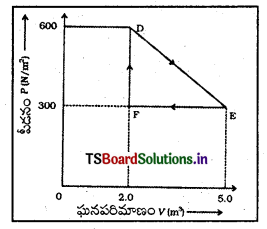
∴ వస్తువును విరామస్థితికి తేవడానికి జరిగిన పని W = FS
∴ W = \(\frac{m v^2}{2 s} \times \mathrm{S}=\frac{1}{2} m v^2\)
వస్తువును ఆపడానికి చేసిన పని ఆ వస్తువులో గల గతిజశక్తికి సమానము.
∴ గతిజశక్తి = \(\frac{1}{2}\) mv2
పని-శక్తి సిద్ధాంతం: “ఒక నిత్యత్వ ఫలితబలం వస్తువుపై పనిచేయునపుడు ఆ వస్తువుపై జరిగిన పని దాని గతిజశక్తిలోని మార్పునకు సమానం.”

నిరూపణ : m ద్రవ్యరాశి గల వస్తువుపై F బలం ప్రయోగించినపుడు దాని వేగం u నుంచి v కి మారిందనుకుందాము. వేగం U నుండి V కి మారునంతలో వస్తువు స్థానభ్రంశం S అనుకుందాము.
తొలివేగము = u, తుదివేగము = v, స్థానభ్రంశము = S కాని స్థానభ్రంశము = S = సగటు వేగం × కాలం
∴ S = \(\frac{(u+v)}{2}\)t, త్వరణం = \(\frac{v-u}{t}\) = a
వస్తువుపై బలం, F= = ma = m\(\left(\frac{v-u}{t}\right)\)
∴ వస్తువుపై జరిగిన పని W = FS
∴ W = m\(\frac{(v-u)}{t} \cdot \frac{(u+v)}{2} t=m \frac{\left(v^2-u^2\right)}{2}=\frac{1}{2} m v^2-\frac{1}{2} m u^2\) = KE2 – KE1
అంటే, వస్తువుపై జరిగిన పని వస్తువు గతిజశక్తిలోని మార్పుకి సమానం.

TS Inter 1st Year Physics Study Material Chapter 6 పని, శక్తి, సామర్ధ్యం

ప్రశ్న 2.
అభిఘాతాలు అంటే ఏమిటి ? వాటిలో సాధ్యమయ్యే రకాలను వివరించండి. ఏకమితీయ స్థితిస్థాపక అభిఘాతాల సిద్ధాంతాన్ని వివరించండి. (మే 2014)
జవాబు:
అభిఘాతాలు (Collisions) : గమనంలో ఉన్న వస్తువు మరొక వస్తువును ఢీకొన్నపుడు దాని శక్తిలో మార్పులు సంభవిస్తాయి. ఈ రకమైన భౌతిక ప్రక్రియను అభిఘాతాలు అంటారు. ఇవి రెండు రకాలు. 1) స్థితిస్థాపక అభిఘాతము 2) అస్థితిస్థాపక అభిఘాతము.

స్థితిస్థాపక అభిఘాతాలు : స్థితిస్థాపక అభిఘాతాలు 1) ద్రవ్యవేగ నిత్యత్వ నియమాన్ని 2) శక్తి నిత్యత్వ నియమాన్ని పాటిస్తాయి. ఇటువంటి అభిఘాతాలలో శక్తి నష్టము ఉండదు.

అస్థితిస్థాపక అభిఘాతాలు: ఈ రకమైన అభిఘాతాలు ద్రవ్యవేగ నిత్యత్వ నియమాన్ని మాత్రమే పాటిస్తాయి. ఈ విధమైన అభిఘాతాలలో శక్తి నష్టం ఉంటుంది.

స్థితిస్థాపక అభిఘాతానికి గురైన రెండు వస్తువుల తుది వేగాలకు సమీకరణాలు :
m1, m2 ద్రవ్యరాశులు గల రెండు వస్తువులు u1, u2 అను వేగాలతో ఒకే సరళరేఖ వెంబడి చలిస్తూ ముఖాముఖి స్థితిస్థాపక అభిఘాతం చెందినవనుకొనుము.
అభిఘాతం పిమ్మట వాటి వేగాలు v1, v2 అనుకొనుము.
స్థితిస్థాపక అభిఘాతాలు ద్రవ్యవేగ నిత్యత్వనియమాన్ని, గతిజశక్తి నిత్యత్వనియమాన్ని పాటిస్తాయి.
TS Inter 1st Year Physics Study Material Chapter 6 పని, శక్తి, సామర్ధ్యం 7
ద్రవ్యవేగ నిత్యత్వనియమం ప్రకారము
m1u1 + m2u2 = m1v1 + m2v2 లేదా m1 (u1 – v1) = m2 (v2 – u2) ……………….. (1)
శక్తి నిత్యత్వనియమం ప్రకారము
\(\frac{1}{2}\)m1u12 + \(\frac{1}{2}\) m2u22 = \(\frac{1}{2}\)m1v12 + \(\frac{1}{2}\)m2v22 లేదా m1 (u12 – v12) = m2 (v22 – u22) …………. (2)
2వ సమీకరణాన్ని 1వ సమీకరణంచే భాగించగా
\(\frac{u_1^2-v_1^2}{u_1-v_1}=\frac{v_2^2-u_2^2}{v_2-u_2}\) లేదా \(\frac{\left(u_1-v_1\right)\left(u_1+v_1\right)}{\left(u_1-v_1\right)}=\frac{\left(v_2-u_2\right)\left(v_2+u_2\right)}{\left(v_2-u_2\right)}\)
u1 + v1 = v2 + u2 లేదా u1 – u2 = v2 – v1 …………….. (3)
అనగా అభిఘాతానికి ముందు వస్తువులు సమీపించు సాపేక్ష వేగము, అభిఘాతం పిమ్మట వస్తువులు విడిపోవు సాపేక్ష వేగమునకు సమానము. అనగా వాటి ప్రత్యవస్థాన గుణకము e = 1 కి సమానము.
v1 విలువ కనుక్కోవడానికి v2 = u1 – u2 + v1 ను సమీకరణం (1) లో ప్రతిక్షేపించగా
m1u1 + m2u2 = m1v1 + m2( u1 – u2 + v1)
∴ m1u1 + m2u1 = m1v1 + m2u1 – m2u2 + m2v1
m1u1 + m2u2 – m2u1 + m2u2 = v1 (m1 + m2 )
∴ u1 ( m1 – m2) + 2 m2u2 = v1 (m1 + m2 )
∴ మొదటి వస్తువు తుదివేగము v1 = \(\frac{\mathrm{u}_1\left(\mathrm{~m}_1-\mathrm{m}_2\right)}{\mathrm{m}_1+\mathrm{m}_2}+\frac{2 \mathrm{~m}_2 \mathrm{u}_2}{\mathrm{~m}_1+\mathrm{m}_2}\) ……………… (4)
ఇదేవిధంగా v2 కనుక్కోవడానికి v1 = v2 – u1 + u2 ను సమీకరణం (1) లో ప్రతిక్షేపించగా
రెండవ వస్తువు తుదివేగము v2 = \(\frac{\mathrm{u}_2\left(\mathrm{~m}_2-\mathrm{m}_1\right)}{\mathrm{m}_1+\mathrm{m}_2}+\frac{2 \mathrm{~m}_1 \mathrm{u}_1}{\mathrm{~m}_1+\mathrm{m}_2}\) …………….. (5)

TS Inter 1st Year Physics Study Material Chapter 6 పని, శక్తి, సామర్ధ్యం

ప్రశ్న 3.
శక్తినిత్యత్వ నియమాన్ని తెలిపి, స్వేచ్ఛగా కిందికి పడే వస్తువు విషయంలో దీనిని నిరూపించండి.
గమనిక : ఈ ప్రశ్న తెలుగుమీడియం టెక్స్ట్బుక్లో లేదు. కాని ఇంగ్లీషు మీడియంలో ఉంది. అందువలన ఈ ప్రశ్నను అదనంగా ఇవ్వడం జరిగింది. సౌలభ్యం కోసం పాత టెక్స్ట్బుక్ విధానంలో వివరించటం జరిగింది.
జవాబు:
శక్తినిత్యత్వ నియమము : శక్తిని సృష్టించడము కాని, నాశనం చేయడము కాని చేయలేము. కాని శక్తిని ఒక రూపం నుండి మరొక రూపానికి మార్చవచ్చును.

స్వేచ్ఛగా క్రిందికి పడుచున్న వస్తువు విషయంలో శక్తి నిత్యత్వ సూత్రం నిరూపించుట :
m ద్రవ్యరాశి గల వస్తువు h ఎత్తులో ఉన్న A బిందువు నుండి
స్వేచ్ఛగా జారవిడచినామనుకొనుము.
1) A బిందువు వద్ద అనగా వస్తువును జారవిడచిన క్షణంలో
A వద్ద భూమి నుండి ఎత్తు = h; ∴ స్థితిశక్తి = mgh
వేగము u = 0 గతిజశక్తి = 0 (u = 0 కనుక)
∴ A వద్ద మొత్తం శక్తి = స్థితిశక్తి + గతిజశక్తి
= mgh + 0 = mgh ……………….. (1)
TS Inter 1st Year Physics Study Material Chapter 6 పని, శక్తి, సామర్ధ్యం 8
2) B బిందువు వద్ద అనగా భూమి నుండి ‘x’ ఎత్తులో ఉన్నపుడు
B వద్ద, వేగం v1 అనుకుందాము. A నుండి B కి క్రిందకి పడిన దూరం = x.
v2 – u2 = 2as కనుక v12 – 0 = 2gx; . v12 = 2gx
∴ B వద్ద గతిజశక్తి = \(\frac{1}{2}\) mv12 = \(\frac{1}{2}\) m 2gx = mgx
B నేలనుండి (h – x) ఎత్తులో ఉంది. ∴ B వద్ద స్థితిశక్తి = mg(h-x)
∴ B వద్ద మొత్తం శక్తి = స్థితిశక్తి + గతిజశక్తి = mg (h – x) + mgx
= mgh ……………… (2)

TS Inter 1st Year Physics Study Material Chapter 6 పని, శక్తి, సామర్ధ్యం

3) C బిందువు వద్ద అనగా భూమిని తాకబోవు క్షణంలో C వద్ద, అది నేలను చేరింది కనుక h = 0
∴ స్థితిశక్తి = mg (h) = 0;
C వద్ద వేగం V అనుకుంటే, v2 – u2 = 2 as నుండి
v2 – 0 = 2gh; ∴ v2 = 2gh;
∴ గతిజశక్తి = \(\frac{1}{2}\) mv2 = \(\frac{1}{2}\) m (2gh) = mgh
∴ C వద్ద మొత్తం శక్తి = స్థితిశక్తి + గతిజశక్తి = 0 + mgh = mgh ……………….. (3)
పై సమీకరణముల నుండి వస్తువు ఏ స్థానంలో ఉన్నా మొత్తం శక్తి స్థిరంగా ఉంటుంది. కాని తొలి స్థితిశక్తి అంతా నేలను చేరునపుడు గతిజశక్తిగా మారింది. మార్గమధ్యంలో వస్తువుకు కొంత స్థితిశక్తి, కొంత గతిశక్తి ఉంది కాని మొత్తం శక్తి స్థిరము. అనగా శక్తి నిత్యత్వనియమం నిరూపించబడినది.

లెక్కలు

ప్రశ్న 1.
10 గ్రా. ద్రవ్యరాశి కలిగిన పరీక్ష నాళికలో కొంత ఈథర్ ఉంది. ఈ పరీక్షనాళికను 1 గ్రా. ద్రవ్యరాశి కలిగిన కార్లో మూయడమైంది. పరీక్షనాళికను వేడిచేసినప్పుడు ఈథర్ వాయువు కలిగించే పీడనం వల్ల కార్క్ ఎగిరిపోతుంది. 5 సెం.మీ. పొడవు ఉన్న దృఢమైన భారరహిత కడ్డీ నుంచి ఈ పరీక్ష నాళికను క్షితిజ సమాంతరంగా వేలాడదీశారు. పరీక్షనాళిక ౧ బిందువు పరంగా నిలువు వృత్తంలో తిరగాలంటే ఎంత కనీస వేగంతో కార్క్ పరీక్షనాళిక నుంచి ఎగిరిపోవాలి ? (ఈథర్ ద్రవ్యరాశిని పరిగణనలోనికి తీసుకోవద్దు)
సాధన:
కడ్డీ పొడవు ! = 5 సెం.మీ. = \(\frac{5}{100}\) మీ.;
g = 10 మీ/సె2
పరీక్ష నాళిక నుండి కార్క్ బయటకు రాకూడదు అంటే అపకేంద్ర బలం పూర్తిగా అభికేంద్రబలం వల్ల రద్దు కావాలి. ఈ స్థితిలో నిమ్నతమ బిందువు వద్ద కనీస వేగము v = \(\sqrt{5 g l}\) . ఇది కార్క్ బయటకు రాకుండా ఉండగల గరిష్ఠ వేగము
∴ V = \(\sqrt{5 \times \frac{5}{100} \times 10}=\frac{5}{10} \sqrt{10} \mathrm{~m} / \mathrm{s}=0.5 \sqrt{10}\) మీ/సె.

ప్రశ్న 2.
ఒక మర తుపాకి నిమిషానికి 360 బుల్లెట్లు పేల్చగలదు. వెలువడే ప్రతి బుల్లెట్ వేగం 600 మీ/సె-1. ప్రతి బుల్లెట్ ద్రవ్యరాశి 5 గ్రా. అయితే మరతుపాకి సామర్థ్యం ఎంత ? (మార్చి 2014)
సాధన:
బుల్లెట్ల సంఖ్య n = 360;
కాలము = t = 1 ని = 60 సె.
బుల్లెట్ వేగము v = 600 మీ/సె ;
బుల్లెట్ ద్రవ్యరాశి m = 5 గ్రా= 5 × 10⁻³ కి.గ్రా.
TS Inter 1st Year Physics Study Material Chapter 6 పని, శక్తి, సామర్ధ్యం 9

TS Inter 1st Year Physics Study Material Chapter 6 పని, శక్తి, సామర్ధ్యం

ప్రశ్న 3.
8 మీ. లోతు ఉన్న బావి నుంచి గంటకు 3425 మీ” నీటిని పైకి తోడుతున్నప్పుడు అశ్వసామర్థ్యంలో 40% వృధా అయితే ఇంజను సామర్ధ్యాన్ని అశ్వసామర్థ్యాలలో రాబట్టండి.
సాధన:
తోడబడిన నీటి ఘనపరిమాణము v = 3425 మీ3
∴ పైకి తోడిన నీటి ద్రవ్యరాశి m = 3425 × 103 కి.గ్రా.
(1m3 నీటి ద్రవ్యరాశి = 103 కి.గ్రా.)
బావిలోతు d = 8 మీ.; కాలము t = 1 గం = 60 × 60 = 3600 సె.
వ్యర్థమైన సామర్థ్యము = 40%
∴ ఉపయోగపడిన సామర్థ్యము η = 60%
వాస్తవంగా జరిగిన పని W = mgh = 3425 × 103 × 10 × 8 = 897000 జౌల్
యంత్రము మొత్తం సామర్థ్యము = \(\frac{\mathrm{W}}{\mathrm{t}} \times \frac{100}{\eta}=\frac{897000 \times 100}{3600 \times 60}\)
= 124315 వాట్, కాని 1 అశ్వ సామర్థ్యము = 746 వాట్
∴ P = \(\frac{124315}{746}\) = 166.6 H.P

ప్రశ్న 4.
ఒక పంపు 25 మీ. లోతు ఉన్న బావి నుంచి నిమిషానికి 600 కి.గ్రా.ల నీటిని పైకి తోడి 50 మీ/సె-1 వడితో బయటకు వదలాలి. దీనికి అవసరమయ్యే సామర్థ్యాన్ని లెక్కించండి.
సాధన:
ద్రవ్యరాశి m = 600 కి.గ్రా.
కాలము t = 1ని = 60 సె.
లోతు d = 25 మీ.
నీటి వేగము v = 50 మీ/సె
TS Inter 1st Year Physics Study Material Chapter 6 పని, శక్తి, సామర్ధ్యం 10
నీటి గతిజశక్తి KE = \(\frac{1}{2}\) mv2 = \(\frac{1}{2}\) 600 × 50 × 50 = 750000
స్థితిశక్తిలో మార్పు = నీటిని తోడడంలో జరిగినప పని = mgh
= 600 × 9.8 × 25 = 147000
మొత్తం పని W = 147000 + 75000 = 897000 జౌల్
యంత్రం సామర్థ్యము P = \(\frac{\mathrm{W}}{\mathrm{t}}=\frac{897000}{60}\) = 14950 = 14.95 కి.వా.

TS Inter 1st Year Physics Study Material Chapter 6 పని, శక్తి, సామర్ధ్యం

ప్రశ్న 5.
తొలుత నిశ్చల స్థితిలో ఉండి మూల బిందువు నుంచి బయలుదేరిన 5 కి.గ్రా. ద్రవ్యరాశి ఉన్న దిమ్మెపై ధన X-అక్షఁ వెంట F = (20 + 5x) N అనే బలం పనిచేస్తుంది. దిమ్మె x = 0 నుంచి x = 4m కు స్థానభ్రంశం చెందినపుడు ఆ బలఁ చేసిన పనిని లెక్కించండి.
సాధన:
దిమ్మె ద్రవ్యరాశి m = 5 కి.గ్రా.;
దిమ్మెపై బలం F = (20 + 5x) న్యూ
వస్తువును ‘0’ నుండి ‘4’ మీటర్ల వరకు స్థానభ్రంశం చెందించడంలో జరిగిన పని
W = \(\int \mathrm{dW}=\int_{\mathrm{x}=0}^{\mathrm{x}=4} \mathrm{~F}(\mathrm{x}) \cdot \mathrm{dx}=\int_{\mathrm{x}=0}^4(20+5 \mathrm{x}) \mathrm{dx}=\left[20 \mathrm{x}+\frac{5 \mathrm{x}^2}{2}\right]_0^4=80+\frac{5 \times 4 \times 4}{2}\)
= 80 + 40 = 120 జౌల్

ప్రశ్న 6.
పటంలో చూపినట్లు 5 కి.గ్రా. ద్రవ్యరాశి ఉన్న దిమ్మె ఘర్షణ లేని వాలుతలంపై నుంచి జారుతుంది. వాలు తలం అడుగు భాగాన 600 N/m బల స్థిరాంకం కలిగిన స్ప్రింగ్ను ఏర్పాటు చేశారు. దిమ్మె వేగం గరిష్ఠమయిన క్షణంలో స్ప్రింగ్లో కలిగే సంపీడనాన్ని కనుక్కోండి.
TS Inter 1st Year Physics Study Material Chapter 6 పని, శక్తి, సామర్ధ్యం 11
సాధన:
దిమ్మె ద్రవ్యరాశి m = 5 కి.గ్రా. ;
బల స్థిరాంకము K = 600 న్యూ.
పటం నుండి sin θ = \(\frac{3}{5}\)
వాలుతలం వెంబడి బలం F = mg sinθ
∴ F = 5 × 10 × \(\frac{3}{5}\)
= 30 న్యూ
బల స్థిరాంకము K \(\frac{\mathrm{F}}{\mathrm{K}}\)
x = \(\frac{\mathrm{F}}{\mathrm{K}}=\frac{30}{600}\) = 0.05 మీ. = 5 సెం.మీ.

ప్రశ్న 7.
X-అక్షం వెంట ఒక కణంపై F = –\(\frac{K}{x^2}\) (x ≠ 0) బలం పనిచేస్తుంది. కణం x = +a నుంచి x = + 2a కి స్థానభ్రంశం చెందినప్పుడు బలం చేసిన పనిని కనుక్కోండి. K ని ధన స్థిరాంకంగా తీసుకోండి.
సాధన:
ఇచ్చిన కణంపై బలము F = \(\frac{K}{x^2}\)
వస్తువు స్థానభ్రంశము = + a నుండి + 2a వరకు
TS Inter 1st Year Physics Study Material Chapter 6 పని, శక్తి, సామర్ధ్యం 12

TS Inter 1st Year Physics Study Material Chapter 6 పని, శక్తి, సామర్ధ్యం

ప్రశ్న 8.
ఒక కణంపై పనిచేసే బలం F, కణ స్థానం x తో గ్రాఫ్లో చూపించిన విధంగా మారుతుంది. x = -4 నుంచి x = + 2 కి కణం స్థానభ్రంశం చెందినపుడు బలం చేసిన పనిని కనుక్కోండి.
TS Inter 1st Year Physics Study Material Chapter 6 పని, శక్తి, సామర్ధ్యం 13
సాధన:
ఇచ్చిన కణంపై పనిచేయు సగటు బలము F = \(\frac{-\mathrm{b}+2 \mathrm{~b}}{2}=\frac{\mathrm{b}}{2}\)
వస్తువు స్థానభ్రంశము = – a నుండి + 2a వరకు
జరిగిన పని W = \(\int\) F dx
= \(\int_{x=-a}^{x=2 a} \frac{b}{2} d x=\frac{b}{2}[x]_{-a}^{2 a}\)
∴ W = \(\frac{\mathrm{b}}{2}\)(2a – (-a) = \(\frac{\mathrm{b}}{2}\) (3a) = \(\frac{3}{2}\) ab

ప్రశ్న 9.
ఒక బంతిని 20 మీ. ఎత్తు నుంచి క్షితిజ సమాంతర నేల మీదకు 20 మీ/సె తొలి వేగంతో కిందికి విసిరారు. నేలను తాకిన తరువాత బంతి అంతే ఎత్తుకు పైకిలేచింది. ఈ అభిఘాతంలో బంతికి, నేలకు మధ్య ప్రత్యావస్థాన గుణకం కనుక్కోండి. (g = 10 మీ/సె2)
సాధన:
తొలి వేగము u1 = 20 మీ/సె. ;
ఎత్తు h = 20 మీ. ;
g = 10 మీ/సె2
నేలను సమీపించు వేగము u2 = u12 + 2gh
= 202 + 2 × 20 × 10
= 400 + 400
∴ u = \(\sqrt{800}\) = 20\(\sqrt{2}\)
పైకి లేచిన ఎత్తు h = 20 మీ.
∴ నేలను విడిపోవు వేగము v = \(\sqrt{2 \mathrm{gh}}=\sqrt{2 \times 10 \times 20}=\sqrt{400}\) = 20 మీ/సె.
ప్రత్యవస్థాన గుణకము
TS Inter 1st Year Physics Study Material Chapter 6 పని, శక్తి, సామర్ధ్యం 14

TS Inter 1st Year Physics Study Material Chapter 6 పని, శక్తి, సామర్ధ్యం

ప్రశ్న 10.
స్వేచ్ఛగా 10 మీ. ఎత్తు నుంచి దృఢమైన క్షితిజ సమాంతర తలంపై పడిన బంతి అనేకసార్లు అదేచోట పడిలేచిన తరువాత నిశ్చల స్థితికి వచ్చేలోగా బంతి ప్రయాణించిన మొత్తం దూరం ఎంత ? బంతికి, తలానికి మధ్య ప్రత్యావస్థాన గుణకం \(\frac{1}{\sqrt{2}}\) అనుకోండి.
సాధన:
బంతిని జారవిడచిన స్థానం ఎత్తు h = 20 మీ.
బంతి ప్రత్యవస్థాన గుణకము e = \(\frac{1}{\sqrt{2}}\)
బంతి ఆగిపోవు లోపల దాని మొత్తం స్థానభ్రంశము d
d = h \(\left[\frac{\left(1+\mathrm{e}^2\right)}{\left(1-\mathrm{e}^2\right)}\right] \frac{\mathrm{h}\left(1+\frac{1}{2}\right)}{\left(1-\frac{1}{2}\right)}=10\left(\frac{1.5}{0.5}\right)\)
= 30 మీ.

ముఖ్యమైన ఉదాహరణ లెక్కలు

ప్రశ్న 1.
F = \((3 \hat{i}+4 \hat{j}-5 \hat{k})\) ప్రమాణాలు. స్థానభ్రంశం d = \((5 \hat{i}+4 \hat{j}+3 \hat{k})\) ప్రమాణాలు అయితే వాటి మధ్య కోణాన్ని, d సదిశ దిశలో F విక్షేపాన్ని కనుక్కోండి.
సాధన:
F.d = Fxdx = Fydy + Fzdz
= 3(5) + 4(4) + (-5) (3) = 16 ప్రమాణాలు
∴ F.d = F d cos.θ = 16 ప్రమాణాలు
ఇప్పుడు r.F = F2 = Fx2 + Fy2 + Fz2
= 9 + 16 + 25 = 50 ప్రమాణాలు
d.d = d2 = dx2 + dy2 + dz2
= 25 + 16 + 9 = 50 ప్రమాణాలు
∴ cos θ = \(\frac{16}{\sqrt{50} \sqrt{50}}=\frac{16}{50}\) = 0.32,
∴ θ = cos-1 0.32
d దిశలో F విక్షేపం = F cos θ
= 50 × \(\frac{16}{50}\) = 16 ప్రమాణాలు

ప్రశ్న 2.
వాన నీటి బిందువులు పడేటప్పుడు కిందకు పనిచేసే గురుత్వాకర్షణ బలం, దీన్ని వ్యతిరేకించే నిరోధక బలాల ప్రభావం ఉంటుందని మనకు బాగా తెలుసు. నిరోధక బలం వాన నీటి బిందువు వేగానికి అనులోమానుపాతంలో ఉంటుంది. దీని గురించి నిర్ధారించవలసి ఉంది. 1.00 గ్రా. ద్రవ్యరాశి ఉన్న నీటి బిందువు 1.00 కి.మీ. ఎత్తు నుంచి కిందకు పడుతుందనుకోండి. అది 50.0 మీ/సె-1 వడితో నేలను తాకింది. దానిపై ఎ) గురుత్వాకర్షణ బలం వల్ల జరిగిన పని ఎంత ? బి) తెలియని నిరోధక బలం వల్ల జరిగిన పని ఎంత ?
సాధన:
ఎ) నీటి బిందువు గతిజశక్తిలో మార్పు
∆K = \(\frac{1}{2}\)mv2 – 0
= \(\frac{1}{2}\) × 10-3 × 50 × 50 = 1.25 జౌల్
ఇక్కడ నీటి బిందువు ప్రారంభంలో నిశ్చలస్థితిలో ఉందని ఊహించడమైంది.
g విలువ 10 మీ/సె2 తో స్థిరంగా ఉంటుందని ఊహిస్తే, గురుత్వాకర్షణ బలం వల్ల జరిగిన పని
Wg = mgh
= 10-3 × 10 × 103 = 10.0 జౌల్

TS Inter 1st Year Physics Study Material Chapter 6 పని, శక్తి, సామర్ధ్యం

బి) పని-శక్తి సిద్ధాంతం నుంచి
∆K = Wg + Wr
ఇక్కడ Wr అనేది వాన నీటి బిందువుపై నిరోధక బలం వల్ల జరిగిన పని
Wr = ∆K – Wg = 1.25 – 10 = – 8.75 జౌల్
Wr విలువ రుణాత్మకం.

ప్రశ్న 3.
సైకిల్పై ప్రయాణిస్తున్న వ్యక్తి, బ్రేకు వేసినప్పుడు 10 మీ. దూరం జారుతూ ఆగాడు. ఈ ప్రక్రియలో రోడ్డు వల్ల సైకిల్ గమనానికి వ్యతిరేక దిశలో, సైకిల్పై పనిచేసే బలం 200 N.
ఎ) సైకిల్పై రోడ్డు ఎంత పనిచేస్తుంది ?
బి) రోడ్డుపై సైకిల్ ఎంత పని చేస్తుంది ?
సాధన:
రోడ్డు సైకిల్పై చేసిన పని అంటే రోడ్డు వల్ల కలిగే నిరోధక బలం (ఘర్షణ బలం) చేసిన పని అవుతుంది.
ఎ) నిరోధక బలం, స్థానభ్రంశాలు ఒకదానితో ఒకటి చేసే కోణం 180° (π రేడియన్లు) కాబట్టి రోడ్డు వల్ల జరిగిన పని,
Wr = Fd cos θ
200 × 10 × cоs л = -2000 J
ఈ రుణ పనివల్లనే పని-శక్తి సిద్ధాంతం ప్రకారం సైకిల్ ఆగుతుంది.

బి) న్యూటన్ మూడవ గమన నియమం ప్రకారం సైకిల్ వల్ల సమానం, వ్యతిరేక బలం రోడ్డుపై పనిచేస్తుంది. దీని పరిమాణం 200 N. కాని రోడ్డు ఎటువంటి స్థానభ్రంశం పొందలేదు కాబట్టి రోడ్డుపై సైకిల్ చేసే పని శూన్యం అవుతుంది.

ఉదాహరణ నుంచి తెలిసే అంశమేమంటే A పై B కలగచేసే బలానికి సమానం, వ్యతిరేక దిశలో B పై A కలగచేసే బలం ఉన్నప్పటికీ (న్యూటన్ మూడవ గమన నియమం) B వల్ల A పై జరిగిన పనికి, B పై A వల్ల జరిగే పని సమానం, వ్యతిరేక దిశలో ఉండనవసరం లేదు.

ప్రశ్న 4.
ప్రక్షేపణాల ప్రదర్శనలో ఒక పోలీసు అధికారి 50.0 గ్రా. ద్రవ్యరాశి ఉన్న బుల్లెట్ను 200 మీ/సె-1 వడితో 2.00 సెం.మీ. మందం ఉన్న ప్లైవుడ్లోకి పేల్చాడు. తొలి గతిజశక్తిలో కేవలం 10% తో మాత్రమే బుల్లెట్ బయటకు వెలువడింది. బయటకు వెలువడిన బుల్లెట్ వడి ఎంత ?
సాధన:
బుల్లెట్ తొలి గతిజశక్తి = mv2/2 = 1000 J. దాని తుది గతిజశక్తి 0.1 × 1000 = 100 J.
బయటకు వెలువడిన బుల్లెట్ వడి vf అయితే,
\(\frac{1}{2}\) mv12 = 100J
vf = \(\sqrt{\frac{2 \times 100 \mathrm{~J}}{0.05 \mathrm{~kg}}}\) = 63.2 ms-1
వడి దాదాపు 68% తగ్గింది (90% కాదు).

TS Inter 1st Year Physics Study Material Chapter 6 పని, శక్తి, సామర్ధ్యం

ప్రశ్న 5.
ద్రవ్యరాశి m = 1కి.గ్రా. ఉన్న దిమ్మె క్షితిజ సమాంతర తలంపై vi = 2 ms-1 వడితో కదులుతూ x = 0.10 m నుంచి x = 2.01 m వరకు విస్తరించి ఉన్న గరుకు ప్రదేశంలోకి ప్రవేశించింది. ఈ వ్యాప్తిలో చలనానికి వ్యతిరేకంగా పనిచేసే బలం Fr, x కు విలోమానుపాతంలో ఉంటుంది.
Fr = \(\frac{-k}{x}\) 0.1 < x < 2.01 m వద్ద
= 0 x < 0.1m, x > 2.01 m వద్ద
ఇక్కడ k = 0.5 J గరుకు ప్రదేశాన్ని దాటిన తరువాత దిమ్మె తుది గతిజశక్తి, వడి vf ఎంత ?.
సాధన:
TS Inter 1st Year Physics Study Material Chapter 6 పని, శక్తి, సామర్ధ్యం 15
ఇక్కడ ln, e ఆధారం కలిగిన సహజ సంవర్గమానం. అంతేకాని 10 ఆధారం కలిగిన సంవర్గమానం కాదు అని గుర్తించాలి. [ln X = loge X = 2.303 log10 X].

ప్రశ్న 6.
కారు ప్రమాదాలను పోలి ఉండే విధంగా కారు తయారీదార్లు వివిధ స్ప్రింగ్ స్థిరాంకాలు కలిగిన స్ప్రింగ్ తో గమనంలో ఉన్న కార్ల అభిఘాతాలను అధ్యయనం చేస్తారు. అలాంటి ఒక పోలికను పరిగణిద్దాం. 1000 కి.గ్రా. ద్రవ్యరాశి కలిగిన కారు 18.0 km/h వడితో నున్నటి రోడ్డుపై చలిస్తూ 6.25 × 10³ Nm-1 స్ప్రింగ్ స్థిరాంకం ఉన్న క్షితిజ సమాంతరంగా తగిలించిన స్ప్రింగ్ను ఢీకొంది. స్ప్రింగ్ చెందే గరిష్ఠ సంపీడనం ఎంత ?
సాధన:
స్ప్రింగ్ గరిష్ఠ సంపీడనం చెందినప్పుడు కారు గతిజశక్తి పూర్తిగా స్ప్రింగ్ స్థితిజ శక్తిగా మారుతుంది.
గమనంతో ఉన్న కారు గతిజ శక్తి
K = \(\frac{1}{2}\) mv2 = \(\frac{1}{2}\) × 103 × 5 × 5
K = 1.25 × 10⁻⁴ J
ఇక్కడ 18 km h-1ను 5 ms-1 గా మార్చడమైంది. (36kmh-1 = 10ms-1 అని గుర్తుంచుకోవడం ఉపయోగకరం). యాంత్రిక శక్తి నిత్యత్వ నియమం ప్రకారం స్ప్రింగ్ గరిష్ఠ సంపీడనం xm వద్ద స్ప్రింగ్ స్థితిజ శక్తి V గమనంలో ఉన్న కారు గతిజశక్తి K కి సమానం.
V = \(\frac{1}{2}\) kxm2 = 1.25 × 10⁴ J
దీని నుంచి
xm = 2.00 m వస్తుంది.
ఇక్కడ మనం స్ప్రింగ్ను ద్రవ్యరాశి లేనిదిగా, తలానికి ఉపేక్షించదగిన ఘర్షణ ఉందని పరిగణించడమైంది. ఇది ఒక ఆదర్శ పరిస్థితి అని గమనించవచ్చు.

ముఖ్యమైన అదనపు లెక్కలు

ప్రశ్న 1.
వస్తువుపై బలం చేసిన పని సంజ్ఞ గురించి అర్థం చేసుకోవడం చాలా ముఖ్యమైంది. కింది భౌతికరాశులు, ధనాత్మకమా? రుణాత్మకమా ? జాగ్రత్తగా తెలియచేయండి.
ఎ) బకెటు బిగించిన తాడు సహాయంతో బావి నుంచి బకెట్ను తీసే సందర్భంలో మనిషి చేసిన పని
బి) పై సందర్భానికి గురుత్వ బలం చేసిన పని
సి) ఒక వస్తువు వాలు తలంపై జారుతున్నప్పుడు ఘర్షణ బలం చేసిన పని
డి) ఘర్షణ ఉన్న (గరుకు) క్షితిజ సమాంతర తలంపై వస్తువు సమవేగంతో చలిస్తున్నప్పుడు అనువర్తించిన బలం చేసిన పని
ఇ) కంపిస్తున్న లోలకాన్ని విరామస్థితిలోకి తేవడానికి గాలి నిరోధక బలం చేసే పని
సాధన:ఎ
ఎ) బకెట్ను పైకి లాగడానికి దాని భారమునకు సమానమైన బలం ప్రయోగించాలి. ఈ సందర్భంలో బలం, స్థానభ్రంశము ఒకే దిశలో ఉండటం వలన పని ధనాత్మకము.

బి) బకెట్ పైకి పోతున్నపుడు గురుత్వ బలం చేసిన పని ఋణాత్మకము. కారణం స్థానభ్రంశము మరియు గురుత్వ బలాలు వ్యతిరేకదిశలలో ఉండటము.

సి) ఘర్షణ బలం వస్తువు కదిలే దిశకు వ్యతిరేకము కావున ఘర్షణ బలం చేసిన పని ఋణాత్మకము.

డి) వస్తువు సమవేగంతో గరుకు తలంపై బలం ప్రయోగిస్తే బలం మరియు స్థానభ్రంశం ఒకే దిశలో ఉంటాయి. కావున పని ధనాత్మకము.

ఇ) గాలి నిరోధక బలం గమన దిశకు వ్యతిరేకంగా ఉండటం వల్ల పని ఋణాత్మకము.
గమనిక : పని W = \(\overline{\mathrm{F}} \cdot \overline{\mathrm{S}}\) = F.S. cos θ ఇది అదిశరాశి. పని ఎల్లపుడూ ధనాత్మకమే. \(\overline{\mathrm{F}} \cdot \overline{\mathrm{S}}\) లు ఒకే దిశలో ఉంటే పనిని ధనాత్మకంగాను, \(\overline{\mathrm{F}} \cdot \overline{\mathrm{S}}\) లు వ్యతిరేక దిశలలో ఉంటే ఋణాత్మకంగాను భావిస్తారు. అంతేగాని పని ఋణాత్మకం కాదు.

TS Inter 1st Year Physics Study Material Chapter 6 పని, శక్తి, సామర్ధ్యం

ప్రశ్న 2.
గతిక ఘర్షణ గుణకం 0.1 కలిగిన బల్లపై నిశ్చల స్థితిలో ఉన్న 2కి.గ్రా. ద్రవ్యరాశి ఉన్న వస్తువు 7 న్యూ క్షితిజ సమాంతర బలం వల్ల చలిస్తూ ఉంది. కింది రాశులను లెక్కించండి.
ఎ) 10 సె. కాలంలో అనువర్తిత బలం చేసిన పని
బి) 10 సె. కాలంలో ఘర్షణ బలం చేసిన పని
సి) 10 సె. కాలంలో నికర బలం చేసిన పని
డి) 10 సె. కాలంలో వస్తువు గతిజ శక్తిలోని మార్పు
మీ ఫలితాలను వివరించండి.
సాధన:
ద్రవ్యరాశి m = 2 కి.గ్రా. ; తొలి వేగము u = 0; బలము F = 7 న్యూ ; ఘర్షణ గుణకము μ = 0.1
ఎ) 10 సెకనులలో బలం చేసిన పని W = μF.S.
త్వరణము a1 = \(\frac{\mathrm{F}}{\mathrm{m}}=\frac{7}{2}\) = 3.5 మీ/సె2
ఘర్షణ బలం వలన వ్యతిరేక దిశలో త్వరణము
TS Inter 1st Year Physics Study Material Chapter 6 పని, శక్తి, సామర్ధ్యం 16
a2 = \(\frac{\mu \mathrm{mg}}{\mathrm{m}}\) = 0.1 × 9.8 = 0.98 మీ/సె2
ఫలిత త్వరణము a = a1 – a2 = 3.5 – 0.98 = 2.52 మీ/సె2
వస్తువు కదిలిన దూరము s = ut + \(\frac{1}{2}\) at2 = 0 + \(\frac{1}{2}\) × 2.52 × 10 × 10 = 126 మీ.
బలం జరిపిన పని W1 = F.S. = 7 × 126 = 882 J

బి) ఘర్షణ బలం జరిపిన పని W2 = Fs × S = -1.96 × 126 = -246.9 J

సి) ఫలితబలం చేసిన పని W3 = (F – Fs) S = (7 – 1.96) 126 = 635 J

డి) v = u + at నుండి V = 0 + 2.52 × 10 = 25.2 మీ/సె.
∴ తుది గతిజశక్తి \(\frac{1}{2}\) mv2 = \(\frac{1}{2}\) × 2 × (25.2)2 = 635.J
తొలి గతిజశక్తి = \(\frac{1}{2}\) mu2
∴ గతిజశక్తిలో మార్పు = 635 – 0 = 635 J

ప్రశ్న 3.
పటంలో కొన్ని ఏకమితీయ స్థితిజ శక్తి ప్రమేయాలకు ఉదాహరణలు ఇవ్వడమైంది. కణం మొత్తం శక్తిని ద్వితీయ నిరూపక అక్షం (y – అక్షం) పై క్రాస్ సూచించడమైంది. ఇచ్చిన శక్తికి, కణాన్ని కనుక్కోలేని ప్రాంతం ఏదైనా ఉంటే ఆ ప్రాంతాన్ని ప్రతి సందర్భానికి వివరించండి. ప్రతి సందర్భంలో కణానికి ఉండవలసిన మొత్తం కనీస శక్తిని కూడా సూచించండి. ఈ స్థితిజ శక్తి ఆకారాలకు సంబంధించిన సరళమైన భౌతిక సందర్భాలను ఆలోచించండి.
TS Inter 1st Year Physics Study Material Chapter 6 పని, శక్తి, సామర్ధ్యం 17
సాధన:
మొత్తం శక్తి E = P.E. + K.E. లేదా K.E. = E-P.E. ఇందులో K.E. విలువ ఋణాత్మకం కాదు.

  1. x > a ఐతే P.E. (V0) > E అనగా K.E. ఋణాత్మకం కావలెను. ఇది సాధ్యం కాదు కాబట్టి వస్తువు x > a ప్రాంతంలో ఉండదు.
  2. x < a మరియు x > b ప్రాంతంలో P.E. (V0) > E.
    అనగా KE ఋణాత్మకము. ఇది సాధ్యం కాదు. కాబట్టి వస్తువు X < a మరియు x > b ప్రాంతంలో ఉండదు.
  3. ఈ పటంలోని ఏ ప్రాంతంలోను మనం కణాన్ని కనుక్కోలేము. ఎందుకనగా దాని P.E. > E (మొత్తం శక్తి)
  4. వస్తువుకు – b/2 < x < a/2 మరియు a/2 < x < b/2 ప్రాంతంలో వస్తువు P.E.7 మొత్తం శక్తి E కావున KE ఋణాత్మకంగా ఉండాలి. అనగా ఈ ప్రాంతంలో ఇచ్చిన కణం ఉండే అవకాశం లేదు.

TS Inter 1st Year Physics Study Material Chapter 6 పని, శక్తి, సామర్ధ్యం

ప్రశ్న 4.
రేఖీయ సరళహరాత్మక చలనం చేస్తున్న కణం స్థితిజ శక్తి ప్రమేయం V(x) = kx2 / 2 గా ఇవ్వడమైంది. ఇక్కడ k డోలకం బల స్థిరాంకం. k = 0.5 N m-1 విలువకు V(x), ౫ ల మధ్య గ్రాఫ్ పటంలో చూపించడమైంది. ఈ పొటెన్షియల్లో చలించే 1J మొత్తం శక్తి కలిగిన కణం x = ± 2m కే చేరినపుడు అది వెనుకకు మరలుతుందని చూపండి.
TS Inter 1st Year Physics Study Material Chapter 6 పని, శక్తి, సామర్ధ్యం 23
సాధన:
ఏదైనా క్షణంలో సరళ హరాత్మక చలనం చేస్తున్న కణం మొత్తం శక్తి = KE + PE = \(\frac{1}{2}\) mu2 + \(\frac{1}{2}\) kx2
వస్తువు వేగము u = (0 వద్ద వెనుకకు మరలుతుంది. అనగా గరిష్ఠ స్థానభ్రంశ బిందువు వద్ద u = 0 ⇒ KE = 0
∴ మొత్తం శక్తి E = \(\frac{1}{2}\) kx2 కాని E = 1, k = \(\frac{1}{2}\)
∴ 1 = \(\frac{1}{2}\) kx2 కావున 1 = \(\frac{1}{2}\) × \(\frac{1}{2}\) x2 లేదా x2 = 4 ⇒ x = ± 2 మీ.

ప్రశ్న 5.
క్రింది వాటికి సమాధానాలివ్వండి:
ఎ) రాకెట్ గమనంలో ఉన్నపుడు దాని చుట్టూ ఉన్న కప్పు ఘర్షణ వల్ల కాలిపోతుంది. కాలిపోవడానికి అవసరమయ్యే ఉష్ణ శక్తి రాకెట్ నుంచి లభ్యమవుతుందా ? లేదా వాతావరణం నుంచి లభ్యమవుతుందా ?
బి) అధిక దీర్ఘాక్ష దీర్ఘ వృత్తాకార కక్ష్యల్లో తోకచుక్కలు సూర్యుని చుట్టూ తిరుగుతూ ఉంటాయి. సూర్యుని వల్ల తోకచుక్కపై పనిచేసే గురుత్వ బలం సాధారణంగా తోకచుక్క వేగానికి లంబంగా ఉండదు. కాని తోకచుక్క ప్రతి పూర్తి భ్రమణానికి గురుత్వ బలం చేసిన పని శూన్యమవుతుంది. ఎందుకు ?
సి) పలుచని వాతావరణంలో భూమి చుట్టూ తిరుగుతున్న కృత్రిమ ఉపగ్రహం వాతావరణ నిరోధం వల్ల క్రమంగా చాలా స్వల్ప మోతాదులో శక్తిని కోల్పోతుంది. అయితే అది భూమిని దగ్గరగా సమీపిస్తున్న కొద్దీ దాని వడి ఎందుకు క్రమంగా పెరుగుతుంది ?
TS Inter 1st Year Physics Study Material Chapter 6 పని, శక్తి, సామర్ధ్యం 18
డి) పటం (i) లో ఒక మనిషి 15 కి.గ్రా. ద్రవ్యరాశిని తన చేతులతో తీసుకొని వెళ్తూ 2 మీ. దూరం నడిచాడు. పటం (ii) లో అతను తన వెనుక ఉన్న తాడును లాగుతూ అంతే దూరాన్ని నడిచాడు. కప్పీ మీదగా వెళ్తున్న తాడుకు రెండవ చివర 15 కి.గ్రా. ద్రవ్యరాశి వేలాడదీయడమైంది. ఏ సందర్భంలో జరిగిన పని ఎక్కువ ?
సాధన:
ఎ) రాకెట్ పై భాగం కాలడానికి అవసరమైన శక్తి రాకెట్ నుండి లభ్యమవుతుంది. వాతావరణం నుండి కాదు. రాకెట్ మొత్తం శక్తి E = P.E. + K.E. = mgh + \(\frac{1}{2}\) mv2. రాకెట్ పైకి పోవు కొలది దాని ద్రవ్యరాశి తగ్గుతుంది. (ఇంధనం మండటంవల్ల) ఫలితంగా దాని శక్తి తగ్గుతుంది. ఈ తగ్గిన శక్తి రాకెట్ పైభాగం కాలిపోవడానికి ఉపయోగపడుతుంది.
బి) గురుత్వాకర్షణ బలాలు నిత్యత్వ బలాలు. కావున ఒక సంవృత వలయంలో జరిగిన పని సున్నకు సమానము అనగా తోకచుక్క ప్రతి పరిభ్రమణంలో జరిగిన పని = 0.

సి) ఉపగ్రహం భూమిని సమీపిస్తుంటే దాని ఎత్తు తగ్గుతుంది. కాబట్టి స్థితిశక్తి PE తగ్గును. మొత్తంశక్తి PE + KE స్థిరముగా ఉండడంవల్ల స్థితిశక్తి తగ్గితే ఉపగ్రహం వేగం పెరుగుతుంది. ఈ ప్రక్రియలో వాతావరణంలో రాపిడి వల్ల అతి స్వల్ప మొత్తంలో శక్తి నష్టం ఉంటుంది.

డి) (i) పటంలో మనిషి ప్రయోగించిన బలం మరియు వస్తువు స్థానభ్రంశం పరస్పరం లంబంగా ఉన్నాయి.
∴ θ = 90°
జరిగిన పని W = F s cos θ

(ii) ఈ పటంలో బలము, స్థానభ్రంశం ఒకే దిశలో ఉన్నాయి. ∴ θ = 0
జరిగిన పని W = F s cos θ = mg s cos θ
దత్తాంశం నుండి m = = 15 కి.గ్రా. ; స్థానభ్రంశం = 2మీ.
W = 15 × 9.8 × 2 = 294 జౌల్

TS Inter 1st Year Physics Study Material Chapter 6 పని, శక్తి, సామర్ధ్యం

ప్రశ్న 6.
సరైన ప్రత్యామ్నాయం కింద గీత గీయండి.
ఎ) వస్తువుపై నిత్యత్వ బలం చేసిన పని ధనాత్మకమయితే, వస్తువు స్థితిజ శక్తి పెరుగుతుంది/తగ్గుతుంది/మారకుండా ఉంటుంది.
బి) ఘర్షణకు వ్యతిరేకంగా వస్తువు పనిచేయడం వల్ల ఎప్పుడు గతిజ/స్థితిజ శక్తి నష్టం జరుగుతుంది.
సి) అనేక కణ వ్యవస్థ యొక్క మొత్తం ద్రవ్యవేగంలోని మార్పురేటు బాహ్యబలం / వ్యవస్థలోని అంతర బలాల మొత్తానికి అనులోమానుపాతంలో ఉంటుంది.
డి) రెండు వస్తువుల మధ్య జరిగిన అస్థితి స్థాపక అభిఘాతంలో, అభిఘాతం తరువాత వ్యవస్థ మొత్తం గతిజశక్తి / మొత్తం రేఖీయ ద్రవ్యవేగం / మొత్తం శక్తి మారకుండా స్థిరంగా ఉంటుంది.
సాధన:
ఎ) నిత్యత్వ బలాలు పనిచేస్తే వస్తువు స్థితిజశక్తి తగ్గుతుంది. ఎందుకనగా స్థితిజశక్తి వస్తువులో దాచిపెట్టబడిన పని.

బి) ఘర్షణకు వ్యతిరేకంగా పని జరిగినపుడు వస్తువు గతిజశక్తి తగ్గుతుంది. కారణం ఘర్షణకు వ్యతిరేకంగా జరిపిన పని గతిజశక్తి నుండి సమకూరడమే.

సి) ద్రవ్యవేగంలోని మార్పు బాహ్యబలం నుండీ సమకూరుతుంది. కారణం అంతర్గత మార్చలేవు.

డి) అస్థితి స్థాపక అభిఘాతాలలో వ్యవస్థ ద్రవ్యవేగం స్థిరము. బలాలు వ్యవస్థ ద్రవ్య వేగాన్ని

ప్రశ్న 7.
క్రింద ఇచ్చిన ప్రతిపాదనలు సరి అయినవా ? కావా ? మీ సమాధానాలకు కారణాలు రాయండి.
ఎ) రెండు వస్తువుల మధ్య జరిగే స్థితిస్థాపక అభిఘాతంలో ప్రతి వస్తువు యొక్క ద్రవ్యవేగం, శక్తి నిత్యత్వంగా ఉంటుంది.
బి) వస్తువుపై ఎటువంటి అంతర, బాహ్యబలాలు పనిచేసినప్పటికీ వ్యవస్థ మొత్తం శక్తి ఎప్పుడూ నిత్యత్వంగా ఉంటుంది.
సి) ఒక సంవృత ఉచ్చు వెంబడి చలనంలో ఉన్న వస్తువుపై ప్రకృతిలోని ప్రతి బలం చేసే పని శూన్యం.
డి) అస్ధితిస్థాపక అభిఘాతంలో వ్యవస్థ తొలి గతిజ శక్తి కంటె తుది గతిజ శక్తి ఎప్పుడూ తక్కువగా ఉంటుంది.
సాధన:
ఎ) ప్రతిపాదన సరియైనది కాదు. స్థితిస్థాపక అభిఘాతాలలో వ్యవస్థ మొత్తం శక్తి, ద్రవ్యవేగాలు స్థిరము. విడివిడిగా ప్రతి వస్తువుకు ఈ నియమం వర్తించదు.

బి) ప్రతిపాదన సరియైనది కాదు. బాహ్యబలం వల్ల వ్యవస్థ మొత్తం శక్తి మారవచ్చు.

సి) ప్రతిపాదన సరియైనది కాదు. నిత్యత్వ బలాలకు మాత్రమే సంవృత మార్గంలో జరిపిన మొత్తం పని సున్న. అనిత్యత్వ బలాలకు ఈ నియమం వర్తించదు.

డి) నిజమే. అస్థితిస్థాపక అభిఘాతాలలో కొంత శక్తి నష్టం జరుగుతుంది.

TS Inter 1st Year Physics Study Material Chapter 6 పని, శక్తి, సామర్ధ్యం

ప్రశ్న 8.
తగిన కారణాలతో జాగ్రత్తగా సమాధానమివ్వండి :
ఎ) రెండు బిలియర్డ్ బంతుల స్థితిస్థాపక అభిఘాతంలో బంతుల మధ్య అభిఘాతం జరుగుతున్న స్వల్ప కాలంలో (ఒక దానితో ఒకటి స్పర్శించుకొన్నప్పుడు) మొత్తం గతిజ శక్తి నిత్యత్వంగా ఉంటుందా ?
బి) స్వల్ప కాలవ్యవధిలో రెండు బంతుల మద్య జరిగిన స్థితిస్థాపక అభిఘాతంలో రేఖీయ ద్రవ్యవేగం మొత్తం నిత్యత్వంగా ఉంటుందా ?
సి) అస్ధితిస్థాపక అభిఘాతానికి (ఎ), (బి) లకు సమాధానాలు ఏమిటి ?
డి) రెండు బిలియర్డ్ బంతుల స్థితిజ శక్తి, వాటి కేంద్రాల మధ్య దూరంపై మాత్రమే ఆధారపడితే ఆ అభిఘాతం స్థితిస్థాపకమా లేదా అస్థితిస్థాపకమా ? (సూచన : అభిఘాత సమయమప్పుడు ఉండే బలానికి సంబంధించిన స్థితిజ శక్తి గురించి మాట్లాడుతున్నాం కాని గురుత్వ స్థితిజ శక్తిని గురించి కాదు.)
సాధన:
ఎ) ప్రతిపాదన సరియైనది కాదు. అస్థితిస్థాపక అభిఘాతాలలో అభిఘాతానికి ముందు వ్యవస్థ KE అభిఘాతం తరువాత వ్యవస్థ KE కి సమానము. వాస్తవంగా జరిగేది ఏమిటంటే అభిఘాత సమయంలో గతిజశక్తి స్థితిజశక్తిగా మారుతుంది.

బి) నిజమే. స్థితిస్థాపక అభిఘాతాలలో వస్తువులు కలిసి ఉన్న స్వల్ప వ్యవధిలో వాటి మధ్య ద్రవ్యవేగ వినిమయం జరుగుతుంది.

సి) అస్థితిస్థాపక ఏక అభిఘాతాలలో గతిజశక్తి స్థిరంగా ఉండదు. కాని వ్యవస్థకు గల ద్రవ్యవేగము స్థిరము.

డి) ఈ అభిఘాతం స్థితిస్థాపక అభిఘాతం. ఎందుకనగా ఇందులో పాల్గొనిన బలాలు నిత్యత్వ బలాలు.

ప్రశ్న 9.
నిశ్చల స్థితి నుంచి బయలుదేరిన ఒక వస్తువు స్థిర త్వరణంతో ఏకమితీయ చలనం కలిగి ఉంది. t కాలంలో దానికి అందచేసిన సామర్థ్యం కింది వాటికి అనులోమానుపాతంలో ఉంటుంది.
(i) t1/2
(ii) t
(iii) t3/2
(iv) t2
సాధన:
v = u + at నుండి v = 0 + at = సామర్థ్యము P = F × v
∴ P = mav = m.a.a.t = ma2t
m, a లు స్థిరం కావున p ∝ t

ప్రశ్న 10.
స్థిర సామర్థ్యాన్ని అందించే జనకం ప్రభావం వల్ల ఒక వస్తువు ఏక దిశాత్మకంగా చలిస్తుంది. t కాలంలో కలిగిన స్థానభ్రంశం కింది వాటికి అనులోమానుపాతంలో ఉంటుంది.
(i) t1/2
(ii) t
(iii) t3/2
(iv) t2
సాధన:
సామర్థ్యము P = బలం × వేగము
∴ P = [MLT-2][LT-1] = [ML2T-3]
వస్తువు స్థిర సామర్థ్యముతో కదులుతున్నపుడు m, p లు స్థిరము
కావున L2T-3 స్థిరము లేదా \(\frac{\mathrm{L}^2}{\mathrm{~T}^3}\) = స్థిరరాశి
అనగా L2 ∝ T3 లేదా L ∝ T3/2

TS Inter 1st Year Physics Study Material Chapter 6 పని, శక్తి, సామర్ధ్యం

ప్రశ్న 11.
ఒక నిరూపక వ్యవస్థలో Z- అక్షం వెంట చలనానికి పరిమితం అయిన వస్తువుపై
\(\overrightarrow{\mathrm{F}}=-\hat{\mathrm{i}}+2 \hat{\mathrm{j}}+3 \hat{\mathrm{k}}\)N
అనే స్థిర బలం పనిచేస్తుంది. ఇక్కడ X-, Y-, Z- అక్షాల వెంట ప్రమాణ సదిశలు వరుసగా \(\hat{\mathrm{i}}, \hat{\mathrm{j}}, \hat{\mathrm{k}}\). Z- అక్షంపై 4 మీ. దూరం చలించడానికి ఈ బలం చేసిన పని ఎంత ?
సాధన:
దత్తాంశం నుండి \(\overrightarrow{\mathrm{F}}=-\hat{\mathrm{i}}+2 \hat{\mathrm{j}}+3 \hat{\mathrm{k}}\) న్యూ, \(\overrightarrow{\mathrm{s}}=4 \hat{\mathrm{k}}\) మీ.
జరిగిన పని _ W = \(\overrightarrow{\mathrm{F}} \cdot \overrightarrow{\mathrm{S}}\)
= \((-\hat{\mathrm{i}}+2 \hat{\mathrm{j}}+3 \hat{\mathrm{k}}) \cdot(4 \hat{\mathrm{k}})=12 \hat{\mathrm{k}} \cdot \hat{\mathrm{k}}\) = 12J

ప్రశ్న 12.
విశ్వకిరణాల ప్రయోగంలో 10 keV, 100 keV శక్తి గల ఎలక్ట్రాన్, ప్రోటాన్లను కనుక్కొన్నారు. వీటిలో వేగవంతం అయినది ఏది ? ఎలక్ట్రాన్ లేదా ప్రోటాన్ ? వాటి వడుల నిష్పత్తిని రాబట్టండి. (ఎలక్ట్రాన్ ద్రవ్యరాశి = 9.11 × 10-31 = కి.గ్రా., ప్రోటాన్ ద్రవ్యరాశి 1.67 × 10⁻²⁷ కి.గ్రా., 1 eV = 1.60 × 10⁻¹⁹ J).
సాధన:
ఎలక్ట్రాన్ గతిజశక్తి KE1 = 10 KeV = 10 × 1.6 × 10-16 J
ఫోటాన్ గతిజశక్తి KE2 = 100 KeV = 100 × 1.6 × 10-16 J
ఎలక్ట్రాన్ ద్రవ్యరాశి me = 9.11 × 10⁻³¹ ; ప్రోటాన్ ద్రవ్యరాశి mp = 1.67 × 10⁻²⁷
\(\frac{1}{2}\) meve2 : \(\frac{1}{2}\) mpvp2 = 10 : 100 = 1 : 10 ⇒ \(\frac{v_{\mathrm{e}}}{\mathrm{v}_{\mathrm{p}}}=\sqrt{\frac{1}{10} \frac{\mathrm{m}_{\mathrm{p}}}{\mathrm{m}_{\mathrm{e}}}}\)
∴ \(\frac{\mathrm{v}_{\mathrm{e}}}{\mathrm{v}_{\mathrm{p}}}=\frac{1}{10} \sqrt{\frac{1.67 \times 10^{-27}}{10 \times 9.11 \times 10^{-31}}}=10^2 \sqrt{\frac{1.67}{91.1}}\) = 13.53

ప్రశ్న 13.
500 మీ. ఎత్తు నుంచి 2 మి.మీ. వ్యాసార్ధం ఉన్న వాన నీటి బిందువు నేలపై పడుతుంది. సగం ఎత్తువరకు తగ్గుతున్న త్వరణం (గాలి స్నిగ్ధతా నిరోధం వల్ల) కలిగి గరిష్ఠ (అంత్య) వడిని పొందుతుంది. ఆ తరువాత అది ఏకరీతి వడితో కిందికి చలిస్తుంది. వాన నీటి బిందువు ప్రయాణంలో, మొదటి, రెండవ సగంలో గురుత్వ బలం చేసిన పని ఎంత ? 10 మీ/సె-1 వడితో నేలను చేరినట్లైతే దాని పూర్తి ప్రయాణంలో నిరోధక బలం చేసిన పని ఎంత ?
సాధన:
నీటి బిందువు వ్యాసార్ధము r = 2 మి.మీ. = 2 × 10⁻³ మీ.
మొత్తం ప్రయాణించిన దూరము = 500 మీ.
సగం దూరము = 250 మీ.
నీటిసాంద్రత ρ = 103 కి.గ్రా./మీ3 ; నీటి బిందువు ద్రవ్యరాశి = v × ρ
∴ m = v.ρ = \(\frac{4}{3}\) πr3 × ρ = \(\frac{4}{3}\) × \(\frac{22}{7}\) (2 × 10⁻³)3 × 103 = 3.35 × 10⁻⁵ కి.గ్రా.
నిరోధక బలం పనిచేసినా చేయకపోయినా వస్తువు స్థితిశక్తిలో మార్పు
E1 = mgh = 3.35 × 10-5 × 10 × 500 = 0.164J
నేలను తాకినపుడు నీటి బిందువు వేగము v = 10 మీ/సె.
∴ గతిజశక్తి E2 = \(\frac{1}{2}\)mv2 = \(\frac{1}{2}\) × 3.35 × 10⁻⁵ (10)2 = 1.675 × 10⁻³ J.
నిరోధక బలం జరిపిన పని W = మొత్తం శక్తి – గతిజశక్తి
= 0.164 – 1.675 × 10-3 = 0.1623 J

TS Inter 1st Year Physics Study Material Chapter 6 పని, శక్తి, సామర్ధ్యం

ప్రశ్న 14.
పాత్రలో ఉన్న వాయువులోని అణువు, 200 మీ/సె-1 వడితో, లంబంతో 30 కోణం చేస్తున్న దిశలో క్షితిజ సమాంతర (పాత్ర) గోడను ఢీకొని అంతే వడితో వెనుకకు మరలింది. ఈ అభిఘాతంలో ద్రవ్యవేగం నిత్యత్వంగా ఉంటుందా ? ఈ అభిఘాతం స్థితిస్థాపకమా లేదా అస్థితిస్థాపకమా ?
సాధన:
అభిఘాతాలలో ద్రవ్యవేగం స్థిరము; వాయు అణువు తొలి వేగము V1 = 200 మీ/సె;
తొలి గతిజశక్తి పరిశీలిస్తే వాయు అణువుకు KE = \(\frac{1}{2}\) mv12 = \(\frac{1}{2}\) m(200)2 …………….. (1)
TS Inter 1st Year Physics Study Material Chapter 6 పని, శక్తి, సామర్ధ్యం 19
గోడకు K.E. = \(\frac{1}{2}\) mv12 = 0 (కదలలేదు కావున)
అభిఘాతం పిమ్మట గోడ గతిజశక్తి = \(\frac{1}{2}\) m(0)2 = 0
తుది వేగము V2 = 200 మీ/సె.
∴ KE = \(\frac{1}{2}\) m(200)2 …………….. (2)
సమీ. (1), (2) నుండి అభిఘాతం ముందు గతిజశక్తి = అభిఘాతం తరువాత గతిజశక్తి
అనగా ఈ అభిఘాతంలో శక్తి నిత్యత్వం జరిగింది.

ప్రశ్న 15.
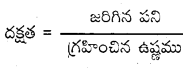
భవనం నేల అంతస్తుపై ఉన్న పంప్ (మోటార్) 300 మీ3 ఘనపరిమాణం ఉన్న టాంకును 15 నిమిషాలలో నింపగలదు. పంప్ దక్షత 30% కలిగి ఉండి, టాంక్ నేలపై నుంచి 40 మీ. ఎత్తులో ఉంటే పంప్ ఎంత విద్యుత్ సామర్థ్యం వినియోగించుకొంటుంది ?
సాధన:
నీటి ఘనపరిమాణము V = 30 m3;
1 m3 నీటి ద్రవ్యరాశి = 1000 కి.గ్రా.
కాలము t = 15 ని. = 15 × 60 = 900 సె.; ఎత్తు h = 40 మీ
దక్షత η = 30%;
నీటి ద్రవ్యరాశి = 30 × 103 కి.గ్రా.
వాస్తవంగా జరిగిన పని W = mgh = 30 × 103 × 9.8 × 40
వాస్తవ సామర్థ్యము = \(\frac{\mathrm{P}}{\mathrm{t}}==\frac{30 \times 10^3 \times 9.8 \times 40}{900}\) = 13070 వాట్
యంత్రం మొత్తం సామర్థ్యము pt = \(\frac{P \times 100}{\eta}=\frac{13070 \times 100}{30}\) = 43.567 కి.వాట్

ప్రశ్న 16.
ఘర్షణ లేని బల్లపై రెండు సర్వసమాన బాలే బేరింగ్లు ఒకదానితో ఒకటి స్పర్శించుకొంటూ నిశ్చలంగా ఉన్నాయి. అంతే ద్రవ్యరాశి ఉన్న వేరొక బాల్బేరింగు, V తొలి వడితో వీటిని సూటిగా ఢీకొంది. ఇది స్థితిస్థాపక అభిఘాతమయితే, అభిఘాతం తరువాత పక్క వాటిలో (పటంలో) ఏది సాధ్యమయ్యే ఫలితమవుతుంది ?
TS Inter 1st Year Physics Study Material Chapter 6 పని, శక్తి, సామర్ధ్యం 20
సాధన:
ప్రతి బంతి ద్రవ్యరాశి m అనుకోండి. మూడవ బంతి వేగము = v; ద్రవ్యరాశి = m
అభిఘాతం ముందు వ్యవస్థ మొత్తం K.E. = \(\frac{1}{2}\)mv2 + 0
(మిగిలిన బంతులు నిశ్చలంగా ఉన్నవి కావున)
అభిఘాతం పిమ్మట 1వ సందర్భములో v1 = v2. (బొమ్మ నుండి)
∴ KE1 = \(\frac{1}{2}\) (2m) \(\left(\frac{\mathrm{V}}{2}\right)^2\) = \(\frac{1}{4}\) mv2
2వ సందర్భంలో తుదివేగము = v, ద్రవ్యరాశి = m,
∴ KE2 = \(\frac{1}{2}\) mv2
3వ సందర్భంలో ద్రవ్యరాశి = 3m, వేగము \(\frac{\mathrm{v}}{3}\)
KE3 = \(\frac{1}{2}\) = (3m)(v/3)2 = \(\frac{1}{6}\) mv2
పై సందర్భాలలో కేవలం 2వ సందర్భంలోనే గతిశక్తి నిత్యత్వం పాటించబడును.

TS Inter 1st Year Physics Study Material Chapter 6 పని, శక్తి, సామర్ధ్యం

ప్రశ్న 17.
క్షితిజ లంబానికి 30° కోణం చేస్తూ ఉన్న లోలక గోళం A ని వదిలితే అది బల్లపై నిశ్చలస్థితిలో ఉన్న అంతే ద్రవ్యరాశి కలిగిన B గోళాన్ని పటంలో చూపినట్లు ఢీకొంది. అభిఘాతం తరువాత A గోళం ఎంత ఎత్తుకు లేస్తుంది ? అభిఘాతం స్థితిస్థాపకం అని ఊహించి, గోళాల పరిమాణాలను ఉపేక్షించండి.
TS Inter 1st Year Physics Study Material Chapter 6 పని, శక్తి, సామర్ధ్యం 21
సాధన:
రెండు సమాన ద్రవ్యరాశులు గల వస్తువుల మధ్య అభిఘాతం జరిగితే అవి వాటి వేగాలను పరస్పరం మార్చుకుంటాయి.
B గోళం నిశ్చలంగా ఉంది కావున అబిఘాతం పిమ్మట A గోళం నిశ్చలస్థితికి వస్తుంది. పైకి లేవదు.

ప్రశ్న 18.
ఒక లోలక గోళాన్ని క్షితిజ సమాంతర స్థానం నుంచి విడిచిపెట్టారు. గాలి నిరోధం వల్ల తొలి శక్తిలో 5% దుర్వ్యయమయితే గోళం అత్యంత నిమ్నతమ బిందువును ఎంత వడితో చేరుతుంది ? లోలకం పొడవు 1.5 మీ.
TS Inter 1st Year Physics Study Material Chapter 6 పని, శక్తి, సామర్ధ్యం 22
సాధన:
ఎత్తు = h, శక్తి నష్టము = 5%, తుది పొడవు l = 1.5 మీ.
క్షితిజ సమాంతర బిందువు నుండి వదిలితే PEW లో మార్పు = mgl = mgh
B పొందిన గతిజశక్తి = mgh లో 95% = \(\frac{95}{100}\) mgh = \(\frac{1}{2}\) mv2
∴ v = \(\sqrt{\frac{95}{100} \times \mathrm{gh}}=\sqrt{\frac{19}{20} \times 9.8 \times 1.5}\)
= 5.28 మీ/సె.

ప్రశ్న 19.
25 కి.గ్రా. ద్రవ్యరాశి ఉన్న ఇసుక సంచిని మోస్తున్న 300 కి.గ్రా. ద్రవ్యరాశి కలిగిన ట్రాలీ ఘర్షణ లేని బాటలో 27 km/h ఏకరీతి వడితో చలిస్తూ ఉంది. కొంతసేపటి తరువాత సంచికి కలిగిన రంధ్రం ద్వారా 0.05కి.గ్రా./సె. రేటుతో ఇసుక ట్రాలీ తలంపై లీకు అవుతూ ఉంది. ఇసుక సంచి ఖాళీ అయిన తరువాత ట్రాలీ వడి ఎంత ?
సాధన:
ఏకరీతి వడితో చలిస్తున్నది. అనగా త్వరణము a = 0
∴ వ్యవస్థపై బాహ్య బలము F = ma = (0)
ట్రాలీ నుంచి కారుతున్న ఇసుక వ్యవస్థ అంతర్గత బలము కావున ఇది ట్రాలీ వడిని మార్చజాలదు.

TS Inter 1st Year Physics Study Material Chapter 6 పని, శక్తి, సామర్ధ్యం

ప్రశ్న 20.
0.5 కి.గ్రా. ద్రవ్యరాశి ఉన్న వస్తువు సరళరేఖా మార్గంలో v = ax3/2 వేగంతో ప్రయాణిస్తుంది. ఇక్కడ a = 5m-1/2 s-1. అది x = 0 నుంచి x = 2 m కి స్థానభ్రంశం చెందినపుడు ఫలిత బలం చేసిన పని ఎంత ?
సాధన:
దత్తాంశం నుండి m = 0.5కి.గ్రా.;
వేగము V = ax3/2,
a = 5 మీ/సె2;
తొలి వేగము అనగా x = 0 వద్ద, v1 = 0
x = 2 వద్ద తుదివేగము v1 = 5 × 23/2
జరిగిన పని W = \(\frac{1}{2}\) m (v22 – v12) = \(\frac{1}{2}\) × 0.5 [(5 × 23/2)2]
∴ W = \(\frac{0.5 \times 5 \times 5 \times 2 \times 2 \times 2}{2}\) = 50 J

ప్రశ్న 21.
ఒక గాలిమర రెక్కలు A వైశాల్యం ఉన్న వృత్తాన్ని చిమ్ముతున్నాయి. (ఎ) ఈ వృత్తానికి లంబంగా v వేగంతో గాలి ప్రవహిస్తుంటే, దీని ద్వారా ! కాలంలో వెళ్ళే గాలి ద్రవ్యరాశి ఎంత ? (బి) గాలి గతిజశక్తి ఎంత ? (సి) గాలి మర, గాలి శక్తిలో 25% శక్తిని విద్యుత్ శక్తిగా మారుస్తుందని ఊహించండి. A = 30 m2, u = 36 km/h, గాలి సాంద్రత 1.2kg m-3, ఉత్పత్తి అయ్యే విద్యుత్ సామర్థ్యం ఎంత ?
సాధన:
a) ఒక సెకనులో వీచిన గాలి ఘ.ప. = A v
గాలి ద్రవ్యరాశి / సె. = A v ρ
(ρ = గాలి సాంద్రత)
t సెకనులలో వీచిన గాలి ద్రవ్యరాశి = Avρt

b) గాలి గతిజశక్తి K.E = \(\frac{1}{2}\) mv2 = \(\frac{1}{2}\) Avρtv2 = \(\frac{1}{2}\) Av3ρt

c) ఉత్పత్తి అయిన విద్యుచ్ఛక్తి = దక్షత × గాలి గతిజశక్తి
దక్షత η = 25%
∴ ఉత్పత్తి అయిన విద్యుచ్ఛక్తి = \(\left(\frac{25}{100}\right) \times \frac{1}{2}\) Av3ρt
విద్యుదుత్పాదక యంత్ర సామర్థ్యము
TS Inter 1st Year Physics Study Material Chapter 6 పని, శక్తి, సామర్ధ్యం 24
దత్తాంశం నుండి A = 30 మీ2, v = 36 kmph = \(\frac{36 \times 5}{18}\) = 10 మీ/సె
గాలి సాంద్రత ρ = 1.2 కి.గ్రా/మీ3
∴ P = \(\frac{1}{8}\) × 30 × 103 × 1.2 = 4500 వాట్ = 4.5 కి.వాట్

TS Inter 1st Year Physics Study Material Chapter 6 పని, శక్తి, సామర్ధ్యం

ప్రశ్న 22.
బరువు తగ్గాలనుకొనే వ్యక్తి (dieter) 10 కి.గ్రా. ద్రవ్యరాశిని ప్రతిసారి 0.5 మీ. ఎత్తుకు లేపుతూ వెయ్యిసార్లు పైకి ఎత్తాడు. అతడు ప్రతిసారి ద్రవ్యరాశిని కిందకు దించేటప్పుడు నష్టపోయిన స్థితిజ శక్తి దుర్వ్యయమవుతుందని ఊహించండి. ఎ) గురుత్వ బలానికి వ్యతిరేకంగా అతడు చేసిన పని ఎంత ? బి) ప్రతి కిలోగ్రాముకు 3.8 × 10⁷ జౌల్ శక్తిని కొవ్వు అందిస్తుంది. ఇది, 20% దక్షతతో యాంత్రిక శక్తిగా మారుతుంది. బరువు తగ్గాలనుకొనే వ్యక్తి ఎంత కొవ్వును ఉపయోగించినట్లు ?
సాధన:
దత్తాంశం నుండి m = 10 కి.గ్రా., h = 0.5 మీ., n = 1000; η = 20%
ఎ) గురుత్వ త్వరణానికి వ్యతిరేకంగా జరిగిన పని W = n (mgh)
W = 1000 (10 × 9.8 × 0.5) = 49000 J

బి) ఒక కిలో కొవ్వు అందించిన యాంత్రిక శక్తి = వాస్తవంగా కొవ్వు అందించిన శక్తి × దక్షత
దేహానికి 1 కిలో కొవ్వు ఇచ్చిన వాస్తవ శక్తి = 3.8 × 10⁷ × \(\frac{20}{100}\) = 0.76 × 10⁷ జౌల్/కి.గ్రా.
బరువు తగ్గాలనుకున్న వ్యక్తి వాడిన కొవ్వు = \(\frac{1}{0.76 \times 10^7}\) × 49000 = 6.45 × 10⁻² కి.గ్రా.

ప్రశ్న 23.
ఒక కుటుంబం 8 కి. వాట్ విద్యుత్ సామర్థ్యాన్ని ఉపయోగిస్తుంది. ఎ) సౌరశక్తి నేరుగా క్షితిజ సమాంతర తలంపై సగటున ప్రతి చదరపు మీటరుకు 200 వాట్ రేటున పతనమవుతుంది. ఈ శక్తిలో 20% విద్యుత్ శక్తిగా ఉపయోగపడితే, 8 కి.వాటిని సరఫరా చేయడానికి ఎంత పెద్ద వైశాల్యం ఉన్న తలం అవసరమవుతుంది ? (బి) దీన్ని ఒక మాదిరి ఇంటి పై కప్పు వైశాల్యంతో పోల్చండి.
సాధన:
ఉపరితల వైశాల్యము A అనుకుంటే దానిపై పతనం చెందిన సౌరశక్తి E = 200 A జౌల్ ; దక్షత = 20%
అవసరమైన విద్యుత్ శక్తి = 8 KW = 8000 W
ఒక సెకనుకు ఉత్పత్తి అయిన ఉపయోగపడిన విద్యుత్ శక్తి = 200A × η
= 200 A . \(\frac{20}{100}\) = 40 A
TS Inter 1st Year Physics Study Material Chapter 6 పని, శక్తి, సామర్ధ్యం 25
A = \(\frac{8000}{40}\) = 200 చ.మీ.
ఇది దాదాపు ఒక పెద్ద ఇంటి పై కప్పు వైశాల్యానికి సమానము.

TS Inter 1st Year Maths 1A Solutions Chapter 3 Matrices Ex 3(f)

Students must practice these TS Intermediate Maths 1A Solutions Chapter 3 Matrices Ex 3(f) to find a better approach to solving the problems.

TS Inter 1st Year Maths 1A Matrices Solutions Exercise 3(f)

I.
Find the rank of each of the following matrices.

Question 1.
\(\left[\begin{array}{ll}
1 & 0 \\
0 & 0
\end{array}\right]\)
Answer:
Let A = \(\left[\begin{array}{ll}
1 & 0 \\
0 & 0
\end{array}\right]\) and det A = 1
∴ ρ(A) = Rank of the matrix A = 1.

Question 2.
\(\left[\begin{array}{ll}
1 & 0 \\
0 & 1
\end{array}\right]\)
Answer:
Let A = \(\left[\begin{array}{ll}
1 & 0 \\
0 & 1
\end{array}\right]\) and det A = 1 ≠ 0.
∴ ρ(A) = 2

TS Inter 1st Year Maths 1A Solutions Chapter 3 Matrices Ex 3(f)

Question 3.
\(\left[\begin{array}{ll}
1 & 1 \\
0 & 0
\end{array}\right]\)
Answer:
Let A = \(\left[\begin{array}{ll}
1 & 1 \\
0 & 0
\end{array}\right]\) and det A = 0
∴ ρ(A) = 1

Question 4.
\(\left[\begin{array}{ll}
1 & 1 \\
1 & 0
\end{array}\right]\)
Answer:
Let A = \(\left[\begin{array}{ll}
1 & 1 \\
1 & 0
\end{array}\right]\) and det A = -1 ≠ 0.

Question 5.
\(\left[\begin{array}{rrr}
1 & 0 & -4 \\
2 & -1 & 3
\end{array}\right]\)
Answer:
Let A = \(\left[\begin{array}{rrr}
1 & 0 & -4 \\
2 & -1 & 3
\end{array}\right]\)
The determinant of a submatrix of order 2 × 2 of A = \(\left|\begin{array}{ll}
1 & -4 \\
2 & 3
\end{array}\right|\) = 3 + 8 = 11 ≠ 0
∴ ρ(A) = 2

Question 6.
\(\left[\begin{array}{lll}
1 & 3 & 6 \\
2 & 4 & 3
\end{array}\right]\)
Answer:
Let A = \(\left[\begin{array}{lll}
1 & 3 & 6 \\
2 & 4 & 3
\end{array}\right]\)
The determinant of a submatrix order 2 × 2 of A is = \(\left|\begin{array}{ll}
1 & 3 \\
2 & 4
\end{array}\right|\) = -2 ≠ 0

II.
Question 1.
\(\left[\begin{array}{lll}
1 & 0 & 0 \\
0 & 1 & 0 \\
0 & 0 & 1
\end{array}\right]\)
Answer:
Let A = \(\left[\begin{array}{lll}
1 & 0 & 0 \\
0 & 1 & 0 \\
0 & 0 & 1
\end{array}\right]\) and det A = 1(1 – 0) = 1 ≠ 0
∴ ρ(A) = 3

Question 2.
\(\left[\begin{array}{ccc}
1 & 4 & -1 \\
2 & 3 & 0 \\
0 & 1 & 2
\end{array}\right]\)
Answer:
Let A = \(\left[\begin{array}{ccc}
1 & 4 & -1 \\
2 & 3 & 0 \\
0 & 1 & 2
\end{array}\right]\)
and det A = 1(6) – 4(4) – 1(2)
= 6 – 16 – 12 = -12 ≠ 0
∴ ρ(A) = 3

Question 3.
\(\left[\begin{array}{lll}
1 & 2 & 3 \\
2 & 3 & 4 \\
0 & 1 & 2
\end{array}\right]\) (March 2015 T.S)
Answer:
Let A = \(\left[\begin{array}{lll}
1 & 2 & 3 \\
2 & 3 & 4 \\
0 & 1 & 2
\end{array}\right]\)
and det A = 1(6 – 4) – 2(4) + 3(2)
= 2 – 8 + 6 = 0
The determinant of submatrix of order 2 × 2 of A = \(\left|\begin{array}{ll}
2 & 3 \\
3 & 4
\end{array}\right|\) = 8 – 9 = – 1 ≠ 0
Hence ρ(A) = 2

TS Inter 1st Year Maths 1A Solutions Chapter 3 Matrices Ex 3(f)

Question 4.
\(\left[\begin{array}{lll}
1 & 1 & 1 \\
1 & 1 & 1 \\
1 & 1 & 1
\end{array}\right]\)
Answer:
Let A = \(\left[\begin{array}{lll}
1 & 1 & 1 \\
1 & 1 & 1 \\
1 & 1 & 1
\end{array}\right]\) and
det A = 1(0) – 1(0) + 1(0) = 0
The determinant of submatrix of order 2 × 2 of A is \(\left|\begin{array}{ll}
1 & 1 \\
1 & 1
\end{array}\right|\) = 0
Hence ρ(A) = 1

Question 5.
\(\left[\begin{array}{rrrr}
1 & 2 & 0 & -1 \\
3 & 4 & 1 & 2 \\
-2 & 3 & 2 & 5
\end{array}\right]\)
Answer:
Consider 3 × 3 submatrix of above matrix
|A| = \(\left|\begin{array}{ccc}
1 & 2 & 0 \\
3 & 4 & 1 \\
-2 & 3 & 2
\end{array}\right|\)
= 1(8 – 3) – 2(9 + 8)
= 5 – 34 = -29 ≠ 0
∴ ρ(A) = 3

Question 6.
\(\left[\begin{array}{rrrr}
0 & 1 & 1 & -2 \\
4 & 0 & 2 & 5 \\
2 & 1 & 3 & 1
\end{array}\right]\)
Answer:
Let A = \(\left[\begin{array}{rrrr}
0 & 1 & 1 & -2 \\
4 & 0 & 2 & 5 \\
2 & 1 & 3 & 1
\end{array}\right]\) and
Consider a submatrix B of order 3 × 3 of above matrix ‘A’.
Then |B| = \(\left|\begin{array}{lll}
0 & 1 & 1 \\
4 & 0 & 2 \\
2 & 1 & 3
\end{array}\right|\)
= -1(12 – 4) + 1(4)
= -8 + 4 = -4
Hence ρ(A) = 3

TS Inter 1st Year Physics Study Material Chapter 5 గమన నియమాలు

Telangana TSBIE TS Inter 1st Year Physics Study Material 5th Lesson గమన నియమాలు Textbook Questions and Answers.

TS Inter 1st Year Physics Study Material 5th Lesson గమన నియమాలు

అతిస్వల్ప సమాధాన ప్రశ్నలు

ప్రశ్న 1.
జడత్వం అంటే ఏమిటి ? జడత్వ కొలతను ఏది ఇస్తుంది (మార్చి 2014)
జవాబు:
జడత్వం అంటే మార్పుకు నిరోధం. వస్తువు తనంతట తానుగా తన స్థితిని మార్చుకోజాలని వస్తు ధర్మాన్ని జడత్వం అంటారు. వస్తువు జడత్వాన్ని ద్రవ్యరాశి ‘m’ తో కొలుస్తారు.

ప్రశ్న 2.
న్యూటన్ మూడవ గమన నియమం ప్రకారం ప్రతి బలం సమానం, వ్యతిరేక బలాలతో కూడా ఉన్నప్పుడు గమనం అనేది ఏ విధంగా సాధ్యమవుతుంది?
జవాబు:
న్యూటన్ మూడవ నియమం ప్రకారము బలాలు ఎప్పుడూ జంటగానే ఏర్పడతాయి. చర్య = – ప్రతిచర్య.
సాధారణంగా చర్య, ప్రతిచర్యలు వేరు వేరు వ్యవస్థలపై పని చేయడం వల్ల చలనం సాధ్యపడుతుంది.

ప్రశ్న 3.
ఒక తుపాకి నుంచి బుల్లెట్ను పేల్చినప్పుడు, తుపాకినీ వెనుకకు నెట్టివేసినట్లు అనిపిస్తుంది. వివరించండి.
జవాబు:
తుపాకి పేల్చటం అంతర్గత చర్య. అంతర్గత బలాలు వస్తువు ద్రవ్యవేగాన్ని మార్చలేవు. కావున m1u1 + m2u2 = 0. (తుపాకి పేలకముందు అవి విరామస్థితిలో ఉన్నవి కావున)
∴ m1u1 = -m2u2 కావున తుపాకి గుండు ముందుకు, తుపాకి వెనుకకు పోవడం ద్రవ్యవేగ నిత్యత్వ నియమం ప్రకారం జరుగుతుంది.

TS Inter 1st Year Physics Study Material Chapter 5 గమన నియమాలు

ప్రశ్న 4.
ఒకే గుళ్లను ఉపయోగించినా బరువుగా ఉన్న రైఫిల్ తేలిక రైఫిల్ కంటే తక్కువ వేగంతో వెనకకు వస్తుంది. ఎందువల్ల?
జవాబు:
తుపాకి వెనుకకు తన్నే వేగం v1 = \(\frac{\mathrm{mv}}{\mathrm{M}}\) తుపాకి వేగము బులెట్ ద్రవ్యవేగానికి (mv), తుపాకి బరువుకు గల నిష్పత్తి. mv స్థిరంగా ఉన్నప్పటికి తుపాకి బరువు తగ్గితే దాని వెనుకకు తన్నే వేగం పెరుగుతుంది.

ప్రశ్న 5.
విరామస్థితిలో ఉన్న ఒక బాంబు రెండు ముక్కలుగా పేలితే దాని ముక్కలు వ్యతిరేకదిశలో చలిస్తాయి. వివరించండి.
జవాబు:
విరామ స్థితిలో ఉన్న బాంబుకు తొలి ద్రవ్యవేగం m1v1 + m2v2 = 0 బాంబు పేలిన తరువాత దాని ముక్కల ద్రవ్యవేగాల మొత్తం (ద్రవ్యవేగ నిత్యత్వ నియమం ప్రకారం ‘సున్న.)
∴ m1u1 + m2u2 = 0 లేదా m1v1 + m2v2 (- గుర్తు వ్యతిరేక దిశ) అనగా ఆ రెండు ముక్కలు వ్యతిరేక దిశలో చలిస్తాయి.

ప్రశ్న 6.
బలాన్ని నిర్వచించండి. ప్రకృతిలోని ప్రాథమిక బలాలను పేర్కొనండి.
జవాబు:
ఒక వస్తువు యొక్క స్థితిని మార్చునది లేక మార్చుటకు ప్రయత్నించే భౌతికరాశిని బలంగా నిర్వచించారు. ఇది సదిశరాశి.
ప్రకృతిలో ప్రాథమిక బలాలు : 1) గురుత్వాకర్షణ బలాలు, 2) విద్యుదయస్కాంత బలాలు, 3) ప్రబల కేంద్రక బలాలు, 4) దుర్బల కేంద్రక బలాలు.

ప్రశ్న 7.
ఘర్షణ గుణకం విలువ ఒకటి కంటె ఎక్కువగా ఉంటుందా ?
జవాబు:
అవును. సాధారణంగా ఘర్షణ గుణకం ఒకటి కంటే తక్కువగా ఉంటుంది. కాని కొన్ని ప్రత్యేక సందర్భాలలో ‘i’ కంటె ఎక్కువగా ఉండవచ్చు.

TS Inter 1st Year Physics Study Material Chapter 5 గమన నియమాలు

ప్రశ్న 8.
గాలి నిండిన టైర్లు ఉన్న కారు కంటే గాలి లేని టైర్లు ఉన్న కారు తొందరగా ఆగుతుంది. ఎందుకు ?
జవాబు:
టైర్లలోని గాలి తక్కువగా ఉన్నపుడు అవి ఎక్కువ భాగము సమాంతరముగా మారి భూమిని తాకుతాయి. దానివలన ఘర్షణ బలం పెరుగుతుంది. దొర్లుడు ఘర్షణ బలం వస్తువుల మధ్య ఉన్న స్పర్శతలం వైశాల్యంపై ఆధారపడుతుంది. కాబట్టి కారు త్వరగా నిశ్చల స్థితికి వస్తుంది.

ప్రశ్న 9.
గుర్రం చలనంలో ఉన్నప్పటికంటే, అది బయలుదేరడం ప్రారంభించే సమయంలో ఎక్కువ బలాన్ని ఎందుకు ఉపయోగిస్తుంది ?
జవాబు:
వస్తువు చలనంలోనికి రావటానికి సీమాంత ఘర్షణ బలాన్ని అధిగమించాలి. (Fs = μsmg). కాని ఒకసారి చలనములోనికి ఉండ వచ్చిన తరువాత గతిక ఘర్షణ బలం పనిచేస్తుంది. గతిక ఘర్షణ బలం సీమాంత ఘర్షణ బలం కంటే తక్కువ. కావున వలన చలనం ఆరంభంలో గుర్రం ఎక్కువ బలంతో బండిని లాగవలసి ఉంటుంది.

ప్రశ్న 10.
వస్తువు భారాన్ని రెట్టింపు చేస్తే ఘర్షణ గుణకం ఏమవుతుంది ? (మే 2014)
జవాబు:
వస్తువు భారాన్ని రెట్టింపు చేసినప్పటికి ఘర్షణ గుణకం విలువ మారదు. ఎందుకనగా ఘర్షణ బలం లంబ ప్రతిచర్య కావున భారం రెండింతలైన, లంబ ప్రతిచర్య, ఘర్షణ బలం కూడా రెట్టింపు అవుతాయి. కాని ఘర్షణ గుణకం విలువ మారదు.

స్వల్ప సమాధాన ప్రశ్నలు

ప్రశ్న 1.
0.1 kg ద్రవ్యరాశి ఉన్న ఒక రాయిని నిలువుగా పైకి విసిరారు. కింది సందర్భాలలో రాయిపై పనిచేసే నికర బలం పరిమాణం, దిశను తెలపండి. ఎ) నిలువుగా పైకి ప్రయాణిస్తున్నప్పుడు, బి) క్రిందికి ప్రయాణిస్తున్నప్పుడు, సి) గరిష్ఠ ఎత్తు వద్ద, (ఎక్కడైతే క్షణం పాటు రాయి విరామస్థితికి వస్తుందో)
జవాబు:
రాయి ద్రవ్యరాశి m = 0.1 kg.
ఎ) రాయి పైకి పోవునపుడు దానిపై పనిచేసే బలం గురుత్వాకర్షణ బలము.
∴ F = mg = 0.1 × 9.8 = 0.98 న్యూ.

బి) రాయి క్రిందికి పడునపుడు దానిపై పనిచేసే బలం F = గురుత్వాకర్షణ బలము
∴ F = mg = 0.1 ×: 9.8 = 0.98 .న్యూ.

సి) రాయి గరిష్టోన్నతి స్థానం వద్ద ఉన్నపుడు దాని వేగం సున్న కాని అధోదిశలో గురుత్వాకర్షణ బలం పనిచేస్తుంది.
∴ ఫలిత బలము = mg = 0.1 × 9.8 = 0.98 న్యూ.
గమనిక : రాయి యొక్క మొత్తం ప్రయాణమార్గంలో గురుత్వాకర్షణ బలం అధోదిశలోనే పనిచేస్తుంది.

TS Inter 1st Year Physics Study Material Chapter 5 గమన నియమాలు

ప్రశ్న 2.
ద్రవ్యవేగం, ప్రచోదనాలను నిర్వచించండి. రేఖీయ ద్రవ్యవేగ నిత్యత్వ నియమాన్ని నిర్వచించి, వివరించండి. ఉదాహరణలు ఇవ్వండి.
జవాబు:
ద్రవ్యవేగం (\(\overline{\mathrm{p}}\)) : వస్తువు యొక్క ద్రవ్యరాశిని దాని వేగంతో గుణించగా వచ్చు లబ్ధాన్ని ద్రవ్యవేగంగా నిర్వచించినారు.
ద్రవ్యవేగం (\(\overline{\mathrm{p}}\)) = ద్రవ్యరాశి × వేగము ∴ \(\overline{\mathrm{p}}\) = mv. ఇది సదిశరాశి.
ప్రమాణము : కి.గ్రా. మీ/సె.; మితిఫార్ములా : MLT-1
ప్రచోదనము (J): వస్తువుపై ఎక్కువ బలం స్వల్పకాలంపాటు పనిచేస్తే బలము మరియు కాలముల లబ్దాన్ని ప్రచోదనము అంటారు.
ప్రచోదనము (J) = F × t, ఇది సదిశరాశి. ప్రమాణము : న్యూటన్ – సెకను; మితిఫార్ములా : MLT-1
ప్రచోదనము = ద్రవ్యవేగంలో మార్పు అని చూపుట :
నిర్వచనం ప్రకారము ప్రచోదనము (J) = బలము × కాలము = F × t
కాని బలము F = ma ఇందులో a = \(\left(\frac{\mathrm{v}-\mathrm{u}}{\mathrm{t}}\right)\)
ప్రచోదనము J = m\(\left(\frac{\mathrm{v}-\mathrm{u}}{\mathrm{t}}\right)\) × t = mv – mu. = ద్రవ్యవేగంలోని మార్పు.
అనగా ప్రచోదనము J = mv – mu ద్రవ్యవేగంలో మార్పు.

ప్రశ్న 3.
మోటారు సైకిళ్ళు, కార్లకు షాక్ అబ్సార్బర్లను ఎందుకు ఉపయోగిస్తారు ?
జవాబు:
వాహనాలు వేగంగా చలించేటపుడు రోడ్డుపై గల ఎగుడు దిగుడు గుంటలపై గుండా వెళ్ళినపుడు అవి ప్రచోదనానికి లోనవుతాయి.
ద్రవ్యవేగంలో మార్పు సమానమైనప్పటికి కాలవ్యవధి ఎక్కువ ఐతే ప్రచోదనం దుష్ప్రభావం చూపదు. ప్రచోదనము
J = F.dt = (mv – mu). బలము F = \(\frac{m v-m u}{\Delta t}\) ఇందులో ∆t చిన్నదైతే ద్రవ్యవేగంలో మార్పు సమానమైనప్పటికి బలము ఎక్కువ, కాలవ్యవధి ∆t పెద్దదైతే బలము F విలువ తక్కువ. కావున కాలవ్యవధి పెరిగితే ఒకే విధమైన ప్రచోదనానికి మనపై పనిచేసే బలం తక్కువ. ప్రచోదనంలో కాలవ్యవధిని పెంచడానికి వాహనాలకు షాక్ అబ్జార్బర్లు వాడతారు.

షాక్ అబ్జార్బర్లు ప్రచోదనం వల్ల వచ్చిన బలం ఉపయోగించుకొని వాటిలో గల స్ప్రింగ్లను సంపీడనం చెందిస్తాయి. ఈ స్ప్రింగ్లకు కాలస్థిరాంకము ఎక్కువగా ఉండేటట్లు చేయడం వల్ల స్ప్రింగ్ గ్రహించిన బలాన్ని నిదానంగా విడుదల చేస్తుంది. ఫలితంగా మనపై ప్రచోదన ప్రభావం తగ్గటం వల్ల ప్రయాణం సుఖవంతంగా ఉంటుంది.

TS Inter 1st Year Physics Study Material Chapter 5 గమన నియమాలు

ప్రశ్న 4.
సీమాంత ఘర్షణ, గతిక ఘర్షణ, దొర్లుడు ఘర్షణలను వివరించండి.
జవాబు:
స్థితిక ఘర్షణ : విరామ స్థితిలో గల వస్తువుల మధ్య ఘర్షణను స్థితిక ఘర్షణ లేదా సీమాంత ఘర్షణ అంటారు. ఇది వస్తువుల మధ్య జరగబోయే చలనాన్ని వ్యతిరేకిస్తుంది.

వస్తువుపై అనువర్తిత బలం ప్రయోగించినపుడు మాత్రమే స్థితిక ఘర్షణ బలం పనిచేయడం ప్రారంభిస్తుంది. ఈ బలాలు అనువర్తిత బలంతో పాటు ఒక సీమాంత విలువ వరకు పెరుగుతాయి. గరిష్ఠ స్థితిక ఘర్షణ (fs) విలువ అభిలంబ ప్రతిచర్య (N) కు అనులోమానుపాతంలో ఉంటుంది.
(fs) max = μkN

గతిక ఘర్షణ : గమనంలోకి వచ్చిన తరువాత స్పర్శ తలాల మధ్య సాపేక్ష చలనాన్ని నిరోధించే బలాన్ని గతిక ఘర్షణ
బలం అంటారు.
fk = μkN
గతిక ఘర్షణ గుణకం μk విలువ స్థితిక ఘర్షణ గుణకం μs కన్నా తక్కువ.

దొర్లుడు ఘర్షణ : వస్తువుల మధ్య దొర్లుడు చలనం ఉన్నపుడు దొర్లుడు చలనాన్ని వ్యతిరేకిస్తూ స్పర్శ తలాలకు సమాంతరంగా పనిచేసే బలాన్ని దొర్లుడు ఘర్షణ అంటారు.
ఘర్షణ బలాలన్నింటిలో కన్న దొర్లుడు ఘర్షణ బలం విలువ అతి తక్కువ.

ప్రశ్న 5.
ఘర్షణ వల్ల కలిగే లాభాలు, నష్టాలను వివరించండి.
జవాబు:
లాభాలు :

  1. ఘర్షణ బలాలు మన నిత్యజీవనంలో ముఖ్యమైన పాత్రను పోషిస్తాయి. నడిచేటప్పుడు భూమికి, చెప్పులకు మధ్య గల ఘర్షణ బలం జారిపడిపోకుండా ఆపుతుంది.
  2. ఘర్షణ బలాలు యంత్రాలలో చలనాన్ని ఒక చక్రము నుండి రెండవ దానికి బెల్టుల ద్వారా అందించుటలో ఉపయోగపడతాయి.
  3. బ్రేకులు వేసినపుడు వాహనాలు నిశ్చలస్థితికి రావటానికి ఘర్షణ బలాలు అవసరం.
  4. ఘర్షణ బలాలు లేకున్నచో తాడుతో వస్తువులను బంధించలేము.
  5. ఘర్షణ బలాలు కారణంగానే మేకులు, బోల్టులు చెక్కలను కలిపి ఉంచుతాయి.

నష్టాలు :

  1. ఘర్షణ వలన చాలా శక్తి వృధా అవుతుంది.
  2. యంత్ర భాగాలు త్వరగా అరిగిపోతాయి.
  3. ఘర్షణ వలన ఉష్ణం జనించి, యంత్ర పదార్థాల బలం తగ్గిపోతుంది

TS Inter 1st Year Physics Study Material Chapter 5 గమన నియమాలు

ప్రశ్న 6.
ఘర్షణను తగ్గించే పద్ధతులను పేర్కొనండి. (మార్చి 2014, మే 2014)
జవాబు:
ఘర్షణను తగ్గించు పద్ధతులు:

  1. నునుపు చేయుట :.ఘర్షణ ముఖ్యముగా తలములోని హెచ్చుతగ్గుల వలన వస్తుంది. కాబట్టి తలములను నునుపు చేయుట ద్వారా ఘర్షణ తగ్గించవచ్చు. కాని బాగా ఎక్కువగా నునుపు చేసినచో మరల ఘర్షణ పెరుగుతుంది.
  2. స్నేహకాలు ఉపయోగించుట : గ్రీజు, నూనె మొదలగు పదార్థములను ఉపయోగించి యంత్ర భాగాల మధ్య ఘర్షణను తగ్గించవచ్చు.
  3. బాల్ బేరింగులు ఉపయోగించుట : చిన్నవి, గుండ్రనైన ఇనుపగోళాలు ఉపయోగించి రెండు తలాల మధ్య గల జారుడు చలనాన్ని దొర్లుడు చలనంగా మార్చవచ్చు. ఇలా చేయుట వలన ఘర్షణ తగ్గుతుంది.
  4. స్ట్రీమ్ లైనింగ్ : గాలిలో ప్రయాణించే విమానాలకు, గాలి వలన ఘర్షణ ఉంటుంది. అదే విధంగా నీటిలో ప్రయాణించే ఓడలకు, నీటికి మధ్య ఘర్షణ ఉంటుంది. ఈ రకమైన ఘర్షణను తగ్గించటాన్కి, విమానాలు, ఓడలు ఒక ప్రత్యేకమైన ఆకారంలో తయారుచేస్తారు. దీనిని స్ట్రీమ్ లైనింగ్ అంటారు.

ప్రశ్న 7.
దొర్లుడు ఘర్షణ నియమాలను తెలపండి.
జవాబు:
ఒక వస్తువు వేరొక తలంపై దొర్లుతున్నపుడు, వాటి మధ్య గల ఘర్షణను దొర్లుడు ఘర్షణ అంటారు.
దొర్లుడు ఘర్షణ గుణకం
TS Inter 1st Year Physics Study Material Chapter 5 గమన నియమాలు 1
దొర్లుడు ఘర్షణ సూత్రాలు :

  1. దొర్లుడు ఘర్షణ విలువ స్పర్శలోనున్న తలాల వైశాల్యంపై ఆధారపడుతుంది.
  2. దొర్లే వస్తువు, దొర్లుతున్న తలం ఆకారాన్ని మార్పు చేస్తుంది. అందువలన తలంలోని పదార్థం దొర్లుడును వ్యతిరేకిస్తుంది.
  3. దొర్లుడు ఘర్షణ, దొర్లుతున్న వస్తువు వ్యాసార్ధముపై ఆధారపడుతుంది. వ్యాసార్ధము ఎక్కువైన దొర్లుడు ఘర్షణ తక్కువగా ఉంటుంది. fr ∝ \(\frac{1}{r}\)
  4. దొర్లుడు ఘర్షణ, లంబ ప్రతిచర్యకు అనులోమానుపాతంలో ఉంటుంది Fr ∝ R.

TS Inter 1st Year Physics Study Material Chapter 5 గమన నియమాలు

ప్రశ్న 8.
లాన్ రోలర్ను నెట్టడం కంటే లాగడం తేలిక. ఎందుకు ?
జవాబు:
గడ్డిని చదునుచేయు రోలరు లేదా రోడ్డు రోలరును F అనే బలం క్షితిజ సమాంతరంతో ‘θ’ కోణం చేస్తూ ముందుకు లాగుతున్నదనుకొనుము. ఈ బలమును రెండు లంబ అంశములుగా విడదీయవచ్చు.

  1. క్షితిజ సమాంతర అంశ F cos θ – ఇది రోలరును లాగుటకు ఉపయోగపడుతుంది.
  2. లంబ అంశ F sin θ – ఇది భారానికి వ్యతిరేకంగా పనిచేస్తూ, లంబ ప్రతిచర్యను తగ్గిస్తుంది.
    ∴ లంబ ప్రతిచర్య R = mg – F sin θ
    ఘర్షణ బలం f = μ . R
    = [μ (mg – F sin θ)] ………………. (1)
    TS Inter 1st Year Physics Study Material Chapter 5 గమన నియమాలు 2

కాని రోలరును ‘F’ బలము క్షితిజంతో ‘θ’ కోణం చేస్తూ నెట్టుచున్నచో ఈ సందర్భంలో పటములో చూపినట్లు లంబ అంశము ‘F sin θ’ భారం వలెనే కిందకు పని చేయుచూ లంబ ప్రతిచర్య విలువను పెంచుతుంది. అనగా R = mg + F sin θ
కావున ఘర్షణ బలం f = μ (mg + F sin θ) ………………. (2)
(1) మరియు (2) ల నుండి నెట్టుటలో ఘర్షణ బలం ఎక్కువగా నున్నది కావున నెట్టుట, లాగుట కంటే కష్టము.

దీర్ఘ సమాధాన ప్రశ్నలు

ప్రశ్న 1.
ఎ) న్యూటన్ రెండవ గమన నియమాన్ని తెలపండి. దాని నుంచి గమన సమీకరణం F= ma ను రాబట్టండి. బి) ఒక వస్తువు వృత్త పథంలో ఎప్పుడూ సమవడితో చలిస్తూ ఉంటే దాని మీద బలం పనిచేస్తుందా ?
జవాబు:
న్యూటన్ రెండవ నియమము: వస్తువు ‘ద్రవ్యవేగంలోని మార్పురేటు వస్తువుపై ప్రయోగించిన బాహ్యబలానికి అనులోమానుపాతంలో ఉండి, బాహ్యబలం పనిచేసే దిశలోనే పనిచేస్తుంది.
అనగా \(\frac{\mathrm{d} \overline{\mathrm{p}}}{\mathrm{d} \mathrm{t}}\) ∝ F లేదా F = k . \(\frac{\mathrm{d} \overline{\mathrm{p}}}{\mathrm{d} \mathrm{t}}\) లేదా F = k.ma
ఇందులో k విలువ ఒకటి అగునట్లుగా బలప్రమాణాన్ని నిర్వచించినారు.
కావున F = \(\frac{\mathrm{d} \overline{\mathrm{p}}}{\mathrm{d} \mathrm{t}}\) లేదా F = ma

F = ma సమీకరణ ఉత్పాదన :
న్యూటన్ రెండవ నియమం నుండి ఏదైనా వస్తువు యొక్క ద్రవ్యవేగంలోని మార్పురేటు బాహ్యబలానికి అనులోమానుపాతంలో ఉంటుంది.
అనగా \(\frac{\mathrm{d} \overline{\mathrm{p}}}{\mathrm{d} \mathrm{t}}\) ∝ F లేదా F= k . \(\frac{\mathrm{d} \overline{\mathrm{p}}}{\mathrm{d} \mathrm{t}}\) ఇందులో \(\overline{\mathrm{p}}\) = వస్తువు ద్రవ్యవేగము = mv.
∴ F = k . \(\frac{\mathrm{d}}{\mathrm{dt}}(\mathrm{m} \overline{\mathrm{v}})\)
⇒ k.m. \(\frac{\mathrm{dv}} {\mathrm{dt}}\)
కాని \(\frac{\mathrm{dv}} {\mathrm{dt}}\) = వస్తువు వేగంలోని మార్పురేటు. దీనిని త్వరణము ‘a’ అంటారు.
∴ F = k . m. a ఇందులో k ఒక స్థిరాంకము.

ప్రమాణ బలము (Unit force) : ప్రమాణ ద్రవ్యరాశి గల వస్తువులో ప్రమాణ త్వరణం కలిగించడానికి కావలసిన బలాన్ని ప్రమాణ బలంగా నిర్వచించినారు.
అనగా ద్రవ్యరాశి m = 1 యూనిట్, త్వరణము a = 1 యూనిట్ ఐతే బలము F = 1 యూనిట్ అవుతుంది.
∴ F = kma లో m = 1, a = 1, F = 1 అని వ్రాస్తే k = 1 అవుతుంది.
ప్రమాణబలం నిర్వచనం ప్రకారము F = kma = ma
∴ F = ma
ఒక వస్తువు వృత్త పథంలో ఎప్పుడూ సమవడితో చలిస్తుంటే దాని మీద బలం : m ద్రవ్యరాశి గల ఒక వస్తువు ‘r’ వ్యాసార్ధం గల వృత్తాకార మార్గంలో సమవడితో చలించుచున్నదనుకొనుము. ఏదైనా బిందువు వద్ద వృత్తానికి గీసిన స్పర్శరేఖ వస్తువుకు ఆ బిందువు వద్ద గల వేగాన్ని తెలుపుతుంది. వస్తువుకు గల వేగదిశ అనుక్షణం మారుతుండటం వల్ల వస్తువుకు త్వరణం ఉంటుంది. వృత్తకేంద్రం వైపు పనిచేసే ఈ త్వరణాన్ని అభిలంబత్వరణము అంటారు.

TS Inter 1st Year Physics Study Material Chapter 5 గమన నియమాలు

ప్రశ్న 2.
ఘర్షణ కోణం, విశ్రామ కోణాలను నిర్వచించండి. గరుకు వాలుతలం విషయంలో ఘర్షణ కోణం, విశ్రామ కోణానికి సమానమని చూపండి. గరుకు క్షితిజ సమాంతర తలంపై 4కి.గ్రా. ద్రవ్యరాశి ఉన్న ఒక చెక్క దిమ్మె విరామస్థితిలో కలదు. దిమ్మెపై 30 N క్షితిజ సమాంతర బలాన్ని ప్రయోగిస్తే అది కదలడానికి సిద్ధం అయ్యింది. g = 10 m/s2 అయితే, దిమ్మెపై ఆ తలం ప్రయోగించే మొత్తం స్పర్శా బలాన్ని కనుక్కోండి.
జవాబు:
గరుకు వాలుతలంపై ‘m’ ద్రవ్యరాశి గల వస్తువును ఉంచినారనుకొనుము. వాలుతలం క్షితిజ సమాంతరంతో చేసే కోణం ‘θ’ ను పెంచుతూ పోతే, ఒక ప్రత్యేక కోణం θ = α వద్ద దానిపై ఉంచిన వస్తువు త్వరణం లేకుండా తలం వెంబడి కిందకు జారటం మొదలవుతుంది. వాలుతలం చేసే ఈ కోణంను ప్రశాంతత కోణం అంటారు. ఈ విధంగా జారుతున్నపుడు వస్తువు త్వరణం ‘సున్న’ ఉంటుంది.

వస్తువు భారం ‘mg’ నిలువుగా కిందకు పని చేస్తుంది. దీనిని రెండు లంబ అంశాలుగా విడదీయవచ్చు.
TS Inter 1st Year Physics Study Material Chapter 5 గమన నియమాలు 3
1) ‘mg sin θ’ వాలుతలం వెంబడి కిందకు పనిచేస్తూ వస్తువు కిందకు జరుగునట్లు చేస్తుంది. కాని దీని విలువ, ఘర్షణ బలం fk కు సమానంగా ఉంటుంది.
∴ fk = mg sin θ

2) రెండవ అంశ ‘mg cos θ’ తలానికి లంబంగా పనిచేస్తుంది. దీనికి సమానంగా వ్యతిరేక దిశలో లంబ ప్రతిచర్య పనిచేస్తుంది.
∴ R = mg sin θ
∴ గతిక ఘర్షణ గుణకం μk = \(\frac{\mathrm{f}_{\mathrm{k}}}{\mathrm{R}}=\frac{\mathrm{mg} \sin \theta}{\mathrm{mg} \cos \theta}\) = tan θ
కాని ఇందులో θ = α
∴ μk = tan α
కావున ప్రశాంతత కోణం టాంజెంట్ విలువ ఘర్షణ గుణకంనకు సమానం.
లెక్క ; క్షితిజ సమాంతర తలంపై విరామ స్థితిలో ఉన్న వస్తువుపై పనిచేయు బలాలు
TS Inter 1st Year Physics Study Material Chapter 5 గమన నియమాలు 4

  1. అభిలంబ చర్య (N)
  2. వస్తువు భారము (mg)
  3. క్షితిజ సమాంతర దిశలో బాహ్యబలము (30N)
  4. స్థితిక ఘర్షణ బలము fs

సమతా స్థితిలో అభిలంబ బలమును వస్తువు భారం తుల్యం చేస్తుంది.
బాహ్యబలము f విలువ స్థితిక ఘర్షణ బలానికి సమానమైతే అది సమతాస్థితిలో ఉంటుంది.
కావున క్షితిజ సమాంతర దిశలో స్పర్శబలము = ఘర్షణ బలం = 30 న్యూ.

TS Inter 1st Year Physics Study Material Chapter 5 గమన నియమాలు

లెక్కలు

ప్రశ్న 1.
ఒక కణం రేఖీయ ద్రవ్యవేగం, కాలం (t) ప్రమేయంగా p = a + bt గా ఇచ్చారు. a, b లు ధనాత్మక స్థిరాంకాలు అయితే, కణంపై పనిచేసే బలం ఏమిటి ?
సాధన:
వస్తువు ద్రవ్యవేగము \(\overline{\mathrm{p}}\) = a + bt
వస్తువుపై బలము \(\overline{\mathrm{F}}=\frac{\mathrm{d} \overline{\mathrm{p}}}{\mathrm{dt}}=\frac{\mathrm{d}}{\mathrm{dt}}\) (a + bt)
∴ F = \(\frac{\mathrm{d}}{\mathrm{dt}}\) (a) + \(\frac{\mathrm{d}}{\mathrm{dt}}\) (bt) = 0 + b
∴ వస్తువుపై బలము = b

ప్రశ్న 2.
10 kg ద్రవ్యరాశి ఉన్న వస్తువు వేగంలో 2 m/s మార్పు కలిగించడానికి 5N బలాన్ని ఎంత కాలం ప్రయోగించాలి ?
సాధన:
బలము F = 5 న్యూ;
వేగంలో మార్పు = v – u = 2 మీ/సె.
ద్రవ్యరాశి m = 10 kg
బలము F = ma, కాలము t = ?
బలము F = m \(\frac{(v-u)}{t}\)
⇒ t = \(\frac{\mathrm{m}(\mathrm{v}-\mathrm{u})}{\mathrm{F}}=\frac{10 \times 2}{5}\) = 4 సె.

ప్రశ్న 3.
m ద్రవ్యరాశి ఉన్న ఒక బంతిని భూమిపై నుంచి నిట్టనిలువుగా పైకి విసిరితే అది క్షణకాలంపాటు విరామస్థితికి వచ్చేలోపు ‘h’ ఎత్తుకు చేరుకొంది. గురుత్వ త్వరణం ‘g’ అనుకోండి. బంతి తన ప్రయాణ కాలంలో గురుత్వాకర్షణ బలం వల్ల పొందే ప్రచోదనం ఎంత ? (గాలి నిరోధాన్ని విస్మరించండి)
సాధన:
ప్రచోదనము J = బలము × కాలము = F × t; వస్తువుపై బలము = భారము = mg
పైకి విసిరిన వస్తువు గాలిలో ఉన్న కాలము t = \(\frac{2 \mathrm{u}}{\mathrm{g}}\). ఇందులో u = \(\sqrt{2 \mathrm{gh}}\)
∴ J = mg × \(\frac{2 \mathrm{u}}{\mathrm{g}}\) = mg × \(\frac{2 \times \sqrt{2 \mathrm{gh}}}{\mathrm{g}}\) = \(\sqrt{8 \mathrm{~m}^2 \mathrm{gh}}\)

TS Inter 1st Year Physics Study Material Chapter 5 గమన నియమాలు

ప్రశ్న 4.
ఒక స్థిర బలాన్ని 3.0 kg ద్రవ్యరాశి ఉన్న వస్తువుపై 25 s కాలంపాటు ప్రయోగిస్తే, ఆ వస్తువు వేగం 2.0 m s-1 నుంచి 3.5 m s-1 కు మారింది. వస్తువు వేగ దిశలో మాత్రం ఎలాంటి మార్పు లేదు. బలం పరిమాణాన్ని, బలఁ ప్రయోగించిన దిశను కనుక్కోండి.
సాధన:
వస్తువు ద్రవ్యరాశి m = 3 kg; తొలి వేగము t = 2.0 మీ/సె.;
కాలము t = 25 సె. ;
తుదివేగము v = 3.5 మీ/సె.
బలము F = ma = \(\frac{\mathrm{m}(\mathrm{v}-\mathrm{u})}{\mathrm{t}}=\frac{3(3.5-2)}{25}\) = 0.18 న్యూ.

ప్రశ్న 5.
ఒక లిఫ్ట్ గురుత్వ త్వరణంలో 1/3వ వంతు ఏకరీతి త్వరణంతో పైకి చలిస్తున్నప్పుడు లిఫ్ట్ లో ఉన్న వ్యక్తి దృశ్య భారం. W. అదే లిఫ్ట్ గురుత్వ త్వరణంలో 1/2వ వంతు ఏకరీతి త్వరణంతో కిందికి చలిస్తున్నప్పుడు అతడి దృశ్యభారం ఎంత?
సాధన:
మనిషి దృశ్యభారము = W, త్వరణము = a = \(\frac{\mathrm{g}}{3}\)
వైకి పోవునపుడు లిఫ్ట్లో దృశ్యభారము W = m (g + a) = m(g + \(\frac{\mathrm{g}}{3}\)) = \(\frac{4}{3}\) mg = \(\frac{4}{3}\) N [∵ N = mg]
లేదా అభిలంబ చర్య N = \(\frac{3}{4}\) W
లిఫ్ట్ కిందికి దిగునపుడు త్వరణము a = g/2
కిందికి దిగునపుడు దృశ్యభారము W1 = m (g – a) = m (g – g/2) = m \(\frac{\mathrm{g}}{2}\)
∴ కిందికి దిగునపుడు దృశ్యభారము = W1 = \(\frac{\mathrm{mg}}{2}=\frac{3}{4} \frac{1}{2} \mathrm{~W}=\frac{3 \mathrm{~W}}{8}\)

ప్రశ్న 6.
ఒక తెరచిన ట్రక్కు వెనుక వైపు 200 kg ద్రవ్యరాశి ఉన్న ఒక పెద్ద పెట్టె విరామస్థితిలో కలదు. ట్రక్కు 1.5 m/s2 త్వరణంతో ప్రయాణిస్తున్నప్పుడు ట్రక్కులోని పెట్టె జారిపోకుండా ఉండటానికి ట్రక్కు తలానికి, పెట్టెకు మధ్య ఉండవలసిన కనిష్ఠ స్థితిక ఘర్షణ గుణకం ఎంత ?
సాధన:
పెట్టె బరువు m = 200 kg;
ట్రక్కు త్వరణము a = 1.5 మీ/సె2
పెట్టెలో కలిగిన త్వరణము స్థితిక ఘర్షణ వలన కావున ma = fs ≤ μsN = μsmg (పెట్టె విరామంలో ఉంది కావున)
⇒ a ≤ μsg లేదా μs = \(\frac{\mathrm{a}}{\mathrm{g}}=\frac{1.5}{9.8}\) = 0.153

TS Inter 1st Year Physics Study Material Chapter 5 గమన నియమాలు

ప్రశ్న 7.
భూమికి 40 m ఎత్తున తొలుత విరామస్థితిలో ఉన్న ఒక బాంబు అకస్మాత్తుగా పేలి, సర్వసమానం అయిన రెండు ముక్కలుగా పేలింది. వాటిలో ఒకటి 10m/s తొలి వేగంతో నిట్టనిలువుగా కిందికి చలిస్తున్నది. బాంబు పేలిన 2 సెకన్ల తరువాత ఆ రెండు ముక్కల మధ్య దూరం ఎంత? (గురుత్వ త్వరణం 10m/s2).
సాధన:
బాంబు రెండు సర్వసమానమైన ముక్కలుగా విభజింపబడటం వల్ల రెండు ముక్కలకు వేగం సమానము. మొదటి ముక్క అధో దిశలో చలిస్తే రెండవది అదే సరళరేఖ వెంబడి ఊర్ధ్వ దిశలో చలిస్తుంది.
కాలము t = 2 సె.
గురుత్వ త్వరణము g = 10 మీ/సె2
1) క్రిందకు చలించిన ముక్క స్థానభ్రంశము s = ut + \(\frac{1}{2}\) gt2
తొలి వేగము u = 20 మీ/సె
∴ s1 = 10 × 2 + \(\frac{1}{2}\) × 10 × 2 × 2 = 40 మీ.

2) ఊర్ధ్వ దిశలో చలించిన ముక్క స్థానభ్రంశము s2 = ut – \(\frac{1}{2}\) gt2 ; తొలివేగం u = 10 మీ/సె
∴ s2 = 10 × 2 – \(\frac{1}{2}\) × 10 × 2 × 2 = 0
ఆ రెండు ముక్కల మధ్య దూరము d – s1 – s2 = 40 – 0 = 40 మీ.

ప్రశ్న 8.
స్థిరంగా బిగించిన ఒక నునుపైన కప్పీ మీదుగా తేలికైన దారాన్ని అమర్చి, దారానికి ఒక వైపు 4 kg ద్రవ్యరాశి, మరొక వైపు 3 kg ద్రవ్యరాశిని వేలాడదీశారు. ఈ 3 kg ద్రవ్యరాశికి మరొక తేలిక దారంతో అదనంగా మరో 3 kg ద్రవ్యరాశి వేలాడదీశారు. విరామస్థితి నుంచి ఆ వ్యవస్థను లాగి వదిలితే, ఆ వ్యవస్థ ఉమ్మడి త్వరణం ఎంత ? (g = 10 m/s2)
TS Inter 1st Year Physics Study Material Chapter 5 గమన నియమాలు 5
సాధన:
ఒక వైపు మొత్తం ద్రవ్యరాశి m1 = 3 + 3 = 6 kg
రెండవవైపు ద్రవ్యరాశి m2 = 4 kg; g = 10 మీ/సె2
ఆ వ్యవస్థ త్వరణము a = \(\left(\frac{m_1-m_2}{m_1+m_2}\right) g=\left(\frac{6-4}{6+4}\right)\) × 10 = 2 మీ/సె2

ప్రశ్న 9.
క్షితిజ సమాంతర తలంతో 30° కోణం చేస్తున్న ఒక వాలుతలంపై 2 kg ద్రవ్యరాశి ఉన్న దిమ్మె జారుతుంది. దిమ్మెకు, వాలు తలానికి మధ్య ఘర్షణ గుణకం \(\frac{\sqrt{3}}{2}\).
TS Inter 1st Year Physics Study Material Chapter 5 గమన నియమాలు 6
ఎ) దిమ్మె ఎలాంటి త్వరణం లేకుండా కిందికి కదలాలంటే, దిమ్మెపై ఎంత బలాన్ని ప్రయోగించాలి ?
బి) దిమ్మె ఎలాంటి త్వరణం లేకుండా పైకి కదలాలంటే, దిమ్మెపై ఎంత బలాన్ని ప్రయోగించాలి ?
జవాబు:
దిమ్మె ద్రవ్యరాశి m = 2 కి.గ్రా.; వాలు కోణము θ = 30°
వాలు తలము, దిమ్మెల మధ్య ఘర్షణ గుణకము u = \(\frac{\sqrt{3}}{2}\)
1) వాలుతలంపై త్వరణం లేకుండా దిమ్మె క్రిందికి దిగటానికి కావలసిన బలం
F = mg (sin θ – μk cos θ) = 2 × 9.8 (sin 30° – \(\frac{\sqrt{3}}{2}\) × cos 30°)
= 2 × 9.8 \(\left(\frac{1}{2}-\frac{\sqrt{3}}{2} \times \frac{\sqrt{3}}{2}\right)\) = 4.9 న్యూ
TS Inter 1st Year Physics Study Material Chapter 5 గమన నియమాలు 7
2) దిమ్మను వాలుతలంపైకి త్వరణం లేకుండా లాగడానికి కావలసిన బలం
F = mg (sin θ + μk cos θ)
F = 2 × 9.8 (sin 30° + \(\frac{\sqrt{3}}{2}\) cos 30°)
= 2 × 9.8 \(\left(\frac{1}{2}-\frac{\sqrt{3}}{2} \times \frac{\sqrt{3}}{2}\right)\) = 24.5 న్యూ

TS Inter 1st Year Physics Study Material Chapter 5 గమన నియమాలు

ప్రశ్న 10.
y = x2/20 అదే సమీకరణం సూచించే పరావలయ ఆకారంలో ఉన్న ఒక నునుపు తలంపై పటంలో చూపినట్లు ఒక దిమ్మెను ఉంచారు. μs = 0.5 అయితే, ఆ దిమ్మె జారిపోకుండా ఉండాలంటే, భూమి నుంచి ఎంత ఎత్తులో ఆ దిమ్మెను నునుపు తలంపై అమర్చాలి ? (tan θ = μk = \(\frac{\mathrm{dy}}{\mathrm{dx}}\))
TS Inter 1st Year Physics Study Material Chapter 5 గమన నియమాలు 8
సాధన:
దత్తాంశం నుండి y = \(\frac{x^2}{20}\) ;
∴ వాలు \(\frac{\mathrm{dy}}{\mathrm{dx}}=\frac{\mathrm{d}}{\mathrm{dt}}\left(\frac{\mathrm{x}^2}{20}\right)=\frac{2 \mathrm{x}}{10}\)
tan θ = వాలు \([latex]\frac{\mathrm{dy}}{\mathrm{dx}}\)=\frac{x}{10}[/latex] కాని \([latex]\frac{\mathrm{dy}}{\mathrm{dx}}\)[/latex] = tan θ = μs = 0.5 దత్తాంశం నుండి
∴ x = 10 tan θ = 10 μ = 10 × 0.5 = 5
వస్తువు జారకుండా వీలైనంత గరిష్ఠ ఎత్తు వద్ద ఉంచాలంటే
x = 5 అయినపుడు y లెక్కగట్టాలి.
∴ y = \(\frac{x^2}{20}=\frac{5 \times 5}{20}=\frac{25}{20}\) = 1.25 మీ.

ప్రశ్న 11.
ఒక క్షితిజ సమాంతర టేబుల్పై 2 kg ద్రవ్యరాశి ఉన్న ఒక లోహపు దిమ్మెను ఘర్షణలేని కప్పి మీదుగా అమర్చిన దారం సహాయంతో 0.45 kg మరొక ద్రవ్యరాశికి కలిపారు. 0.45 kg ల ద్రవ్యరాశి కిందపడటం వల్ల లోహపు దిమ్మెపై క్షితిజ సమాంతర బలం పనిచేస్తుంది. టేబుల్, దిమ్మెకు మధ్య గతిక ఘర్షణ గుణకం 0.2 అయితే,
ఎ) తొలి త్వరణం, బి) దారంలో తన్యత, సి) దిమ్మె కదిలిన 2 సెకన్ల తరువాత దారం తెగిపోతే, దారం తెగిన తరువాత దిమ్మె కదిలే దూరం కనుక్కోండి.
TS Inter 1st Year Physics Study Material Chapter 5 గమన నియమాలు 9
సాధన:
మొదటి దిమ్మె ద్రవ్యరాశి m1 = 0.45 కి.గ్రా.;
రెండవ దిమ్మె ద్రవ్యరాశి m2 = 2 కి.గ్రా.
బల్ల, దిమ్మెల మధ్య ఘర్షణ గుణకము μ = 0.2

ఎ) తొలి త్వరణము a = \(\left(\frac{m_1-\mu m_2}{m_1+m_2}\right) g\) (చలనానికి ముందు μs లెక్కలోకి తీసుకోవాలి.)
∴ a = \(\left(\frac{0.45-2 \times 0.2}{0.45+2}\right) \times 9.8=\frac{0.05 \times 9.8}{2.45}\) = a = 0.2 మీ/సె2

TS Inter 1st Year Physics Study Material Chapter 5 గమన నియమాలు

బి) దారంలో తన్యత = T; పటం నుండి T – f = m = a
బలము f = μsmg = 0.2 × 2 × 9.8 = 3.92 న్యూ
∴ T – 3.92 = 2 × 0.2 (లేదా) T = 0.4 + 3.92 = 4.32 న్యూ

సి) కదిలిన తరువాత దారం తెగటానికి పట్టిన కాలము t = 2 సె.
తొలివేగం u = 0 ; త్వరణము a = 0.2 మీ/సె2
తుదివేగము v = u + at = 0 + 0.2 × 2 = 0.4 మీ/సె.
దిమ్మె ప్రయాణించిన దూరము s = \(\frac{\mathrm{v}^2-\mathrm{u}^2}{2 \mu \mathrm{g}}=\frac{0.4 \times 0.4-0}{2 \times 0.2 \times 9.8}\)
∴ s = \(\frac{0.16}{0.4 \times 9.8}\) = 0.0408 మీ. లేదా 4.1 సెం.మీ.

ప్రశ్న 12.
ఒక నునుపైన క్షితిజ సమాంతర తలం మీద 10 కి.గ్రా. ద్రవ్యరాశి ఉన్న A అనే దిమ్మెను ఉంచారు. 5 కి.గ్రా. ద్రవ్యరాశి ఉన్న B అనే మరొక దిమ్మెను పటంలో చూపినట్లు A దిమ్మెపై ఉంచారు. రెండు దిమ్మెల మధ్య ఘర్షణ గుణకం 0.4. కింది దిమ్మెపై 30 N క్షితిజ సమాంతర బలం ప్రయోగించారు. రెండు దిమ్మెల మధ్య ఉన్న ఘర్షణ బలం కనుక్కోండి. (g = 10 m/s2 గా తీసుకోండి)
TS Inter 1st Year Physics Study Material Chapter 5 గమన నియమాలు 10
సాధన:
దిమ్మె A ద్రవ్యరాశి mA = 10 కి.గ్రా.
దిమ్మె B ద్రవ్యరాశి mB = 5 కి.గ్రా.; g = 10 మీ/సె2
బలము F = 30 న్యూ; ఘర్షణ గుణకము μ = 0.4
AB ల మధ్య ఘర్షణ బలము f = μmg = 0.4 × 5 × 10 = 20 న్యూ
దిమ్మె B పై ఫలిత బలము = F – f = 30 – 20 = 10 న్యూ.

ముఖ్యమైన అదనపు లెక్కలు

ప్రశ్న 1.
క్రింది వాటిపై పనిచేసే నికర బలం పరిమాణం, దిశను తెలపండి.
ఎ) స్థిర వడితో కిందికి పడుతున్న ఒక వర్షపు బిందువు
బి) నీటిలో తేలియాడుతున్న 10 గ్రా. ద్రవ్యరాశి ఉన్న కార్క్
సి) ఆకాశంలో నైపుణ్యంతో విరామస్థితిలో ఉంచిన గాలిపటం
డి) ఒక గరుకు రోడ్డుపై 30 km/h వేగంతో ప్రయాణిస్తున్న కారు
ఇ) అన్ని ద్రవ్యాత్మక వస్తువులకు చాలా దూరంగా, విద్యుత్ అయస్కాంత క్షేత్రాల ప్రభావానికి లోనుకాకుండా అంతరాళంలో అత్యధిక వేగంతో చలిస్తున్న ఎలక్ట్రాన్
సాధన:
ఎ) స్థిర వడితో పడునపుడు a = 0 కావున బలం F = ma = 0.
బి) కార్కు నీటిపై తేలుతున్నది అనగా అది సమతా స్థితిలో ఉంది. సమతా స్థితిలో ఫలిత బలం F = 0.
సి) ఆకాశంలో స్థిరంగా ఉన్న గాలిపటం మీద ఫలిత బలం F= 0.
డి) స్థిర వడితో ప్రయాణిస్తున్న కారుకు త్వరణం a = 0 కావున బలం F = 0.
ఇ) అన్ని బలాలకు దూరంగా అనగా దానిపై బాహ్యబల ప్రభావం లేదు కావున F = 0.

ప్రశ్న 2.
0.05కి.గ్రా. ద్రవ్యరాశి ఉన్న ఒక గులకరాయిని నిట్టనిలువుగా పైకి విసిరారు. ఆ గులకరాయిపై పనిచేసే నికర బలం పరమాణాన్ని, దిశను కింది సందర్భాలలో తెలియచేయండి.
ఎ) నిలువుగా పైకి ప్రయాణిస్తున్నప్పుడు
బి) కిందికి ప్రయాణిస్తున్నప్పుడు
సి) గరిష్ఠ ఎత్తువద్ద క్షణకాలంపాటు విరామస్థితిలో ఉన్నప్పుడు. ఒకవేళ గులకరాయిని క్షితిజ సమాంతర దిశతో 45° కోణంలో విసిరితే, మీ సమాధానాలు మారతాయా ? (గాలి నిరోధాన్ని విస్మరించండి)
సాధన:
రాయి ఎ) నిలువుగా పైకి వెళుతున్నపుడు బి) క్రిందికి ప్రయాణిస్తున్నపుడు సి) గరిష్ఠ ఎత్తు వద్ద విరామంలో ఉన్నపుడు. ఈ అన్ని సందర్భాలలోను దాని త్వరణం a = g అధోదిశలో ఉంటుంది.
కావున దానిపై బలం F = mg = 0.05 × 10 = 0.5 న్యూ.
రాయిని గాలిలోనికి 45° కోణంతో విసిరినప్పటికి ఈ మూడు స్థానాలలో దానిపై పనిచేసే బలం పరిమాణం మారదు. ఎందుకనగా భారం (mg) ఎల్లపుడు అధో దిశలోనే ఉంది. కావున.

TS Inter 1st Year Physics Study Material Chapter 5 గమన నియమాలు

ప్రశ్న 3.
0.1కి.గ్రా. ద్రవ్యరాశి ఉన్న ఒక రాయిపై పనిచేసే నికర బలం పరిమాణం, దిశను కింది సందర్భాలలో తెలపండి.
ఎ) విరామస్థితిలో ఉన్న రైలు కిటికీ నుంచి బయటికి విసిరిన వెంటనే
బి) 36 km/h స్థిర వేగంతో ప్రయాణిస్తున్న రైలు కిటికీ నుంచి బయటికి విసిరిన వెంటనే
సి) 1 ms-2 త్వరణంతో ప్రయాణిస్తున్న రైలు కిటికీ నుంచి బయటికి విసిరిన వెంటనే
డి) 1 ms-2 త్వరణంతో ప్రయాణిస్తున్న రైలు అడుగు తలంపై ఉన్నప్పుడు. రైలుతో సాపేక్షంగా రాయి విరామస్థితిలో ఉంది.
పై అన్ని సందర్భాలలో గాలి నిరోధాన్ని విస్మరించండి.
సాధన:
దత్తాంశం నుండి m = 0.1 కి.గ్రా.; g = 10 మీ/సె2
ఎ) కిటికీలోనుంచి వదలిన వెంటనే F = mg = 0.1 × 10 = 1 న్యూ.

బి) రైలు స్థిరవేగం 36 k.mpH తో చలిస్తుంటే దాని త్వరణము a = 0 కావున కిటికీ నుంచి రాయిని జారవిడిస్తే
F = mg = 0.1 × 10 = 1 న్యూ.

సి) రైలు 1 మీ/సె2 త్వరణంతో చలిస్తున్నా కిటికీ నుంచి జారవిడిస్తే దానిపై రైలు త్వరణం ప్రభావం ఉండదు.
∴ రాయిపై బలము F = mg = 0.1 × 10 = 1 న్యూ.

డి) రైలు అడుగుభాగంలో రాయి ఆనుకొని ఉంటే దానిపై బలము
F = ma ‘a’ రైలు త్వరణము = 1 మీ/సె2
∴ బలము F = 0.1 × 1 = 0.1 న్యూ.

ప్రశ్న 4.
నునుపైన క్షితిజ సమాంతర బల్ల మీద l పొడవున్న దారం ఒక చివర m ద్రవ్యరాశి ఉన్న కణాన్ని, మరొక చివర చిన్న మేకుకు కలిపారు. కణం v వడితో వృత్తాకార మార్గంలో చలిస్తే, ఆ కణంపై పనిచేసే నికర బలం (వృత్తకేంద్రంవైపు పని చేసే బలం)
(i) T,
(ii) T – \(\frac{m v^2}{l}\)
(iii) T + \(\frac{m v^2}{l}\)
(iv) 0
T దారంలోని తన్యత. సరైన సమాధానాన్ని ఎంచుకోండి.
సాధన:
వస్తువు వృత్తాకార మార్గంలో చలించడానికి కావలసిన బలం దారంలోని తన్యత T వలన లభిస్తుంది. కావున (i) సరియైనది.

ప్రశ్న 5.
20 కి.గ్రా. ద్రవ్యరాశి కలిగి, 15 మీ/సె-1 తొలి వేగంతో ప్రయాణిస్తున్న వస్తువుపై 50 N స్థిర అపత్వరణ బలాన్ని ప్రయోగిస్తే, ఎంత కాలం తర్వాత అది ఆగిపోతుంది ?
సాధన:
ద్రవ్యరాశి m = 20 కి.గ్రా.
తొలివేగము u = 15 మీ/సె2
తుది వేగము υ = 0
బలము F = -50 న్యూ.
త్వరణము a = \(\frac{F}{m}=-\frac{50}{20}\) = -2.5 మీ/సె2
v = u + at నుండి 0 = 15 + (-2.5) t
కాలము t = \(\frac{15}{2.5}\) = 6 సె.

TS Inter 1st Year Physics Study Material Chapter 5 గమన నియమాలు

ప్రశ్న 6.
ఒక స్థిర బలాన్ని 3.0 కి. గ్రా. ద్రవ్యరాశి ఉన్న వస్తువుపై 25 సెకన్లపాటు ప్రయోగిస్తే, ఆ వస్తువు వేగం 2.0 మీ/సె నుంచి 3.5 మీ/సె-1 మారింది. వస్తువు వేగదిశలో మాత్రం ఎలాంటి మార్పులేదు. బలం పరిమాణాన్ని, బలం ప్రయోగించిన దిశను కనుక్కోండి.
సాధన:
ద్రవ్యరాశి m = 300 కి.గ్రా.;
తొలివేగము u = 2 మీ. సె.
తుది వేగము υ = 3.5 మీ/సె.
కాలము t = 25 సె.; F = ?
బలము F = ma = \(\frac{\mathrm{m}(\mathrm{v}-\mathrm{u})}{\mathrm{t}}=\frac{3(3.5-2)}{25}=\frac{3 \times 1.5}{25}\)
F = \(\frac{4.5}{25}\) = 0.18 న్యూ.

ప్రశ్న 7.
ఒకదానికి ఒకటి లంబంగా ఉన్న 8N, 6N పరిమాణం గల రెండు బలాలను 5 కి.గ్రా. ద్రవ్యరాశి ఉన్న వస్తువుపై ప్రయోగించారు. వస్తువు త్వరణం పరిమాణాన్ని, దిశను తెలపండి.
సాధన:
ద్రవ్యరాశి = m
F1 = \(\overrightarrow{\mathrm{OA}}\) = 8 న్యూ.
F2 = \(\overrightarrow{\mathrm{OB}}\) = 6 న్యూ.
OA, OB లు లంబాలు కావున ఫలిత బలం FR = \(\sqrt{\mathrm{F}_1^2+\mathrm{F}_2^2}=\sqrt{64+36}\)
∴ F = \(\sqrt{100}\) = 10 న్యూ.

ప్రశ్న 8.
ఒక ఆటో డ్రైవర్ రోడ్డు మధ్యలో ఉన్న బాలుని చూసి, ఆ బాలుణ్ణి కాపాడటానికి 36 km/h వేగంతో పోతున్న తన ఆటోకు బ్రేకులు వేస్తే 4.0 s కాలంలో ఆగింది. ఆటోపై ప్రయోగించిన సరాసరి నిరోధ బలం ఎంత ? ఆటో ద్రవ్యరాశి 400 కి.గ్రా. డ్రైవర్ ద్రవ్యరాశి 65 కి.గ్రా.
సాధన:
తొలివేగము u = 36 kmph = 36 × \(\frac{5}{18}\) = 10 మీ/సె.
తుదివేగము V = 0; కాలము t = 4 సె.
ఆటో ద్రవ్యరాశి m1 = 400 కి.గ్రా., డ్రైవర్ ద్రవ్యరాశి m2 = 65 కి.గ్రా.
మొత్తం ద్రవ్యరాశి m = m1 + m2 = 400 + 65 = 465 కి.గ్రా.
నిరోధక బలం F = ma = \(\frac{\mathrm{m}(\mathrm{v}-\mathrm{u})}{\mathrm{t}}=\frac{465(0-10)}{4}\) = – 1162.5 న్యూ.

ప్రశ్న 9.
20,000 కి.గ్రా. ద్రవ్యరాశి ఉన్న ఒక రాకెట్ను ఊర్ధ్వ దిశలో పేల్చితే అది 5.0 మీ/సె2 తొలి త్వరణంతో ఆకాశంలోకి వెళ్ళిపోయింది. పేల్చినప్పుడు ప్రయోగించిన తొలి అభిబలం కనుక్కోండి.
సాధన:
రాకెట్ ద్రవ్యరాశి m = 20,000 కి.గ్రా.
తొలి త్వరణము a = 5 మీ/సె2 ఊర్ధ్వ దిశలో
నికర త్వరణం = g + a = 9.8 + 5 = 14.8
ఆరంభ బలం F = ma = 20,000 × 14.8 = 2.96 × 10⁵ న్యూ.

TS Inter 1st Year Physics Study Material Chapter 5 గమన నియమాలు

ప్రశ్న 10.
ప్రారంభంలో 10 మీ/సె-1 స్థిరవేగంతో ఉత్తరం దిశలో ప్రయాణిస్తున్న 0.40 కి.గ్రా. ద్రవ్యరాశి ఉన్న వస్తువుపై 8.0 న్యూ స్థిరబలాన్ని దక్షిణం దిశలో 30 సెకన్లపాటు ప్రయోగించారు. బలం ప్రయోగించిన క్షణ కాలం వద్ద t = 0 అని, ఆ క్షణకాలం వద్ద వస్తువు స్థానం .x = 0 అని అనుకోండి. t = – 5s, 25s, 100s ల వద్ద వస్తువు స్థానాన్ని
ఊహించండి.
సాధన:
ద్రవ్యరాశి m = 0.4 కి.గ్రా.;
తొలివేగము u = 10 మీ/సె. ఉత్తర దిశలో
బలము F = -8 న్యూ (- గుర్తు వ్యతిరేక దిశ)
త్వరణము a = \(\frac{\mathrm{F}}{\mathrm{m}}=\frac{-8.0}{0.4}\) = -20 మీ/సె2 (0 ≤ t ≤ 30 సె. అయినపుడు)
1) కాలము t = -5 సె. అయినపుడు స్థానభ్రంశము s = ?
ఆరంభంలో స్థిరవేగము అనగా t = 0 వద్ద t = -5 కావున (t = -5 నుండి t = 0 వరకు) వేగము స్థిరము.
∴ s = ut = 5 × (-10) = -50 మీ.

2) కాలము t = 25 సె. వద్ద స్థానభ్రంశము s = ut + \(\frac{1}{2}\) at2 నుండి
s = 10 × 25 + \(\frac{1}{2}\) (-20) × 252 = 250 – \(\frac{20}{2}\) × 25 × 25
= -6000 మీ.

3) t = 100 సె. అయినపుడు బలము 30 సెకనులు పనిచేసింది.
కావున 30 సె. తరువాత వస్తువుకు స్థిరవేగం ఉంటుంది.
∴ S = s1 + s2 ఇందులో s1 కు ut1 + \(\frac{1}{2}\) at12 మరియు
s2 = vt2 వాడాడు.
ఇందులో t2 = 30 సె., t2 = 70 సె., v = u + at నుండి
v = 10 + (-20) × 30 = 10 – 600 = – 590 మీ/సె
S1 = ut1 + \(\frac{1}{2}\) at12 నుండి S1 = 10 × 30 + \(\frac{1}{2}\) (-20) × 30 × 30
S1 = 300 – \(\frac{1}{2}\) × 20 × 30 × 30 = 300 – 9000 = -8700 మీ.
S2 = vt2 = -590 × 70 = -41300 మీ.
మొత్తం స్థానభ్రంశము = S = s1 + s2 = -8700 – 41300 = -50000 మీ. = 50 కి.మీ.

ప్రశ్న 11.
ఒక ట్రక్ విరామస్థితితో నుంచి బయలుదేరి 2.0 మీ/సె2 ఏకరీతి త్వరణంతో ప్రయాణిస్తుంది. t = 10 సె. తరువాత ట్రక్ పై కప్పుపై నిల్చొని ఉన్న వ్యక్తి ఒక రాయిని జారవిడిచాడు. (ట్రక్ పైకప్పు భూమి నుంచి 6 మీ.ల ఎత్తులో కలదు). 11 సె. వద్ద ఆ రాయి ఎ) వేగం, బి) త్వరణం కనుక్కోండి. (గాలి నిరోధాన్ని విస్మరించండి.)
సాధన:
తొలివేగము u = 0, త్వరణము a = 2 మీ/సె2,
కాలము t = 10 సె.
రాయి వేగము (జారవిడచిన క్షణంలో) v = u + at
v = 0 + 2 × 10 = 20 మీ/సె.
రాయి క్షితిజ సమాంతర వేగము vx = v = 20 మీ/సె ……………… (1)
TS Inter 1st Year Physics Study Material Chapter 5 గమన నియమాలు 11
క్షితిజ లంబ దిశలో uy = 0, a = g = 10 మీ/సె2
t = 11 సెకనులు అనగా y దిశలో ప్రయాణించిన కాలము t2 = 11 – 10 = 1 సె.
0°.vy = gt = 10 × 1 = 10 మీ/సె ……………. (2)
11వ సెకనులో వేగము v = \(\sqrt{v_x^2+v_y^2}=\sqrt{20^2+10^2}=\sqrt{500}\) = 22.4 మీ/సె2.

బి) రాయిని జారవిడచిన తరువాత దానిమీద త్వరణము గురుత్వ త్వరణము g = 10 మీ/సె2

TS Inter 1st Year Physics Study Material Chapter 5 గమన నియమాలు

ప్రశ్న 12.
0.1కి.గ్రా. ద్రవ్యరాశి ఉన్న ఒక గోళాన్ని 2 మీ. పొడవు ఉన్న దారంతో ఒక గదిలోని లోకప్పుకు వేలాడదీశారు. గోళం డోలనాలు చేయడం ప్రారంభిస్తే, మాధ్యమిక స్థానం వద్ద గోళం వడి 1 ms-1. ఒకవేళ దారాన్ని తెంపితే గోళం ప్రయాణించే పథం కింది సందర్భాలలో ఎలా ఉంటుంది ? ఎ) ఏదైనా ఒక గరిష్ఠ స్థానం వద్ద, బి) మాథ్యమిక స్ధానం వద్ద.
సాధన:
ఎ) గరిష్ఠ స్థానం వద్ద గోళం వేగము v = 0. ఇక్కడ దారాన్ని తెంపితే అది గురుత్వాకర్షణ బలం వల్ల నిట్టనిలువుగా కిందికి పడుతుంది.
బి) మాధ్యమిక స్థానం వద్ద వేగము v = 1 మీ/సె. ఇక్కడ దారాన్ని తెంపితే లోలకం మాధ్యమిక స్థానం వద్ద గీసిన స్పర్శ రేఖ వెంబడి వేగం ఉంటుంది. గోళం క్షితిజ సమాంతర ప్రక్షేపకం వలె పరావలయ పదాన్ని కలిగి ఉంటుంది.

ప్రశ్న 13.
ఒక వ్యక్తి ద్రవ్యరాశి 70 కి.గ్రా. ఇతడు లిఫ్ట్లో అమర్చిన బరువులు తూచే యంత్రంపై నిల్చొని ఉన్నాడు. ఆ లిఫ్ట్
ఎ) 10 ms-1 ఏకరీతి వేగంతో పైకి,
బి) 5 ms-2 ఏకరీతి త్వరణంతో కిందికి,
సి) 5 ms-2 ఏకరీతి త్వరణంతో పైకి చలిస్తుంది. ప్రతీ సందర్భంలో యంత్రం చూపే రీడింగ్ ఎంత ?
డి) ఒకవేళ లిఫ్ట్ను నడిపే యంత్రం పనిచేయక, భూమ్యాకర్షణ బలం వల్ల స్వేచ్ఛగా కిందికి పడిపోయినట్లయితే యంత్రం చూపే రీడింగ్ ఎంత ?
సాధన:
వ్యక్తి ద్రవ్యరాశి m = 70 కి.గ్రా., గురుత్వ త్వరణము g = 10 మీ/సె2
ఎ) 10 m/s ఏకరీతి వేగంతో చలిస్తుంటే త్వరణము a = 1
∴ దృశ్యభారము వాస్తవ భారము W = mg కి సమానము.
∴ W = mg = 70 × 10 = 700 న్యూ.

b) 5 మీ/సె2 ఏకరీతి త్వరణంతో కిందికి దిగితే
దృశ్యభారము W1 = m(g – a) = 70(10 – 5) = 350 న్యూ.

c) 5 మీ/సె2 ఏకరీతి త్వరణంతో పైకి వెళుతుంటే
దృశ్యభారము . W1 = m (g + a) = 70 (10 + 5) = 1050 న్యూ.

d) లిఫ్ట్ స్వేచ్ఛగా కిందికి పడిపోతే a = g కావున
దృశ్యభారము W = m (g – a) = m(g – g) = 0

TS Inter 1st Year Physics Study Material Chapter 5 గమన నియమాలు

ప్రశ్న 14.
4కి.గ్రా. ద్రవ్యరాశి ఉన్న ఒక కణం స్థానం – కాలం వక్రం పటంలో చూపడమైంది.
ఎ) t < 0, t > 4s, 0 < t < 4s కాలాల వద్ద కణంపై పనిచేసే బలం ఎంత ?
బి) t = 0, t = 4 s ల వద్ద ప్రచోదనం ఎంత ? (ఏకమితీయ గమనం మాత్రమే తీసుకోండి)
సాధన:
ఎ)

  1. ఇచ్చిన రేఖాపటం నుండి t < 0 వద్ద స్థానభ్రంశము A = 0 నిశ్చలంగా ఉంది కావున బలం F = 0.
    TS Inter 1st Year Physics Study Material Chapter 5 గమన నియమాలు 12
  2. t > 4 సె అయినపుడు వస్తువు స్థానభ్రంశ – వక్రరేఖ x సమాంతరము. ఇది నిశ్చలస్థితిని చూపిస్తుంది కావున a = 0 మరియు బలము F= 0.
  3. 0 < t < 4 సెకనుల వద్ద వస్తువు స్థానభ్రంశ-కాల వక్రము OB సరళరేఖ దీని వాలు వస్తువు సమవేగాన్ని ఇస్తుంది.
    ∴ a = 0 కావున బలము F = ma = 0

బి)

  1. t < 0 తొలి వేగము u = 0 కావున ప్రచోదనము = 0
    TS Inter 1st Year Physics Study Material Chapter 5 గమన నియమాలు 13
  2. t > 4 సె. వద్ద వస్తువు వేగము సున్న. ప్రచోదనము J = 0
  3. 0 < t < 4 సెకనుల వద్ద వస్తువుకు సమవేగము ఉంది.
    తొలి వేగము u = 0 ;
    తుదివేగము v = \(\frac{3}{4}\) మీ/సె. (గ్రాఫ్ నుండి)
    ద్రవ్యరాశి m = 4కి.గ్రా.
    ∴ ప్రచోదనము J = mv – mu = 4(\(\frac{3}{4}\) – 0) = 4 కి.గ్రా. – మీ/సె.

ప్రశ్న 15.
నునుపైన క్షితిజ సమాంతర తలంపై 10 కి.గ్రా., 20 కి.గ్రా. ద్రవ్యరాశులు ఉన్న A, B అనే రెండు వస్తువులను వరుసగా అమర్చి రెండింటిని తేలికైన దారంతో కలిపారు. F= 600 N క్షితిజ సమాంతర బలాన్ని దారం వెంబడి i) A, ii) B ల మీద ప్రయోగించారు. ప్రతీ సందర్భంలో దారంలో తన్యత ఎంత ?
సాధన:
బలము F = 600 న్యూ. A ద్రవ్యరాశి m1 = 10కి.గ్రా., B ద్రవ్యరాశి m2 = 20 కి.గ్రా.
TS Inter 1st Year Physics Study Material Chapter 5 గమన నియమాలు 14

  1. బలం Aమీద ప్రయోగిస్తే తన్యత T = m2a = 20 × 20 = 400 న్యూ
  2. బలం B మీద ప్రయోగిస్తే తన్యత T = m1a = 10 × 20 = 200 న్యూ.

TS Inter 1st Year Physics Study Material Chapter 5 గమన నియమాలు

ప్రశ్న 16.
8 కి.గ్రా., 12 కి.గ్రా. ద్రవ్యరాశులను ఘర్షణ లేని కప్పి మీదుగా అమర్చిన తేలికైన, సాగని దారం సహాయంతో కలిపారు. ఆ వస్తువులను వదిలినప్పుడు ఆ వస్తువుల త్వరణాలను, దారంలోని తన్యతను కనుక్కోండి.
సాధన:
TS Inter 1st Year Physics Study Material Chapter 5 గమన నియమాలు 15

ప్రశ్న 17.
ప్రయోగశాల నిర్దేశ చట్రంలో ఒక కేంద్రకం విరామస్థితిలో కలదు. ఒకవేళ ఆ కేంద్రకం రెండు చిన్న కేంద్రకాలుగా విఘటనం చెందితే, ఆ రెండు కేంద్రకాలు వ్యతిరేక దిశలలో ప్రయాణిస్తాయని చూపండి.
సాధన:
కేంద్రకం విభజించబడటం వల్ల వచ్చిన ముక్కల ద్రవ్యరాశులు m1, m2 మరియు వేగాలు v1, v2 అనుకోండి. పేలకముందు వ్యవస్థ మొత్తం ద్రవ్యవేగము ‘0’ ఎందుకనగా కేంద్రకం విరామంలో ఉంది కావున.
∴ ద్రవ్యవేగ నిత్యత్వ నియమం నుండి m1v1 + m2v2 = 0
లేదా m1v1 = – m2v2 – గుర్తు వ్యతిరేక దిశను తెలియజేస్తుంది. కావున కేంద్రక విచ్ఛిత్తి తరువాత
ఆ ముక్కలు వ్యతిరేక దిశలలో చలిస్తాయి.

ప్రశ్న 18.
0.05కి.గ్రా. ద్రవ్యరాశి ఉన్న రెండు బిలియర్డ్స్ బంతులు 6 ms-1 వేగంతో వ్యతిరేక దిశలలో ప్రయాణిస్తూ అభిఘాతం చెంది, ఆ తరువాత అంతే వేగంతో వెనుకకు తిరిగి వచ్చాయి. ప్రతి బంతికి, రెండవ బంతి వల్ల అందే ప్రచోదనం కనుక్కోండి.
సాధన:
ఒక్కొక్క బంతి ద్రవ్యరాశి m = 0.05కి.గ్రా.
వేగము v1 = 6 మీ/సె; వేగము v2 = -6 మీ/సె. (వ్యతిరేక దిశ)
అభిఘాతం పిమ్మట వ్యతిరేక దిశలో వెనుదిరిగితే అభిఘాతం వల్ల ఒక్కొక్కదాని ద్రవ్యవేగంలో మార్పు J = m(v – u)
= 0.05 (-6 – 6) = -0.05 × 12 = -0.6కి.గ్రా. -మీ/సె.

TS Inter 1st Year Physics Study Material Chapter 5 గమన నియమాలు

ప్రశ్న 19.
100 కి.గ్రా. ద్రవ్యరాశి ఉన్న తుపాకీని పేల్చినప్పుడు 0.020కి.గ్రా. ద్రవ్యరాశి ఉన్న బుల్లెట్ బయటికి వెలువడింది. తుపాకీ గొట్టం నుంచి బుల్లెట్ 80 ms-1 వడితో వెలువడితే, ఆ తుపాకి ప్రత్యావర్తన వడి ఎంత ?
సాధన:
బుల్లెట్ ద్రవ్యరాశి m = 0.02 కి.గ్రా.
వేగము vB = 80 మీ/సె.
తుపాకి బరువు m = 100 కి.గ్రా.
తుపాకి వెనుకకు మరలు వేగము vG = ?
పేలకముందు వ్యవస్థ మొత్తం ద్రవ్యవేగము = 0
ద్రవ్యవేగ నిత్యత్వ నియమం నుండి mvB + MvG = 0
∴ vG = –\(\frac{\mathrm{m} \cdot \mathrm{v}_{\mathrm{B}}}{\mathrm{M}}=\frac{0.02 \times 80}{100}\) = 0.016 మీ/సె.

ప్రశ్న 20.
ఒక బ్యాట్స్మన్ 54 km/h తొలి వేగంతో ప్రయాణిస్తున్న బంతిని 45 కోణంతో తొలి వడిలో మార్పు లేకుండా అనువర్తనం చెందించాడు. బంతికి అందిన ప్రచోదనం ఎంత ? (బంతి ద్రవ్యరాశి 0.15 కి.గ్రా.)
సాధన:
బంతి ద్రవ్యరాశి m = 0.15కి.గ్రా.
వేగము = 54 km/h = 54 × \(\frac{5}{18}\) = 15 మీ/సె.
TS Inter 1st Year Physics Study Material Chapter 5 గమన నియమాలు 16
అభిఘాతం పిమ్మట బంతి దిశలో మార్పు θ = 45°
బంతి వేగాన్ని x, y దిశలలో విభజించగా
ux = u. cos θ, vx = -u.cos θ
y దిశలో uy = u sin θ, vy = v sin θ
y దిశలో అంశలు పరస్పరం రద్దు చేసుకుంటాయి.
∴ ఫలితము = 0
∴ బంతిపై ప్రచోదనం = mv – mu
m(-ux cos θ – ux cos θ) = 0.15 (-2ux cos θ) = 0.15 (-2 × 15 cos 22.5°)
బంతి ప్రచోదనము J = 0.15 × 30 × 0.9239 = 4.16కి.గ్రా.మీ/సె.

ప్రశ్న 21.
0.25 కి.గ్రా. ద్రవ్యరాశి ఉన్న రాయిని దారం ఒక చివర కట్టి, 1.5 మీ.ల వ్యాసార్ధం ఉన్న క్షితిజ సమాంతర వృత్తాకార పథంలో 40 rev./min వడితో తిప్పారు. దారంలో ఏర్పడే తన్యత ఎంత ? దారం భరించగల గరిష్ఠ తన్యత 200 N అయితే, రాయిని ఎంత గరిష్ఠ వడితో తిప్పగలం ?
సాధన:
ద్రవ్యరాశి m = 0.25 కి.గ్రా.,
భ్రమణాల సంఖ్య n = 40 r.p.m.
వ్యాసార్ధము r = 1.5 మీ.
కోణీయ వేగము ω = \(\frac{40 \times 2 \pi}{60}=\frac{4}{3} \pi\) రే/సె
గరిష్ఠ తన్యత T = 200 న్యూ
దారంలో తన్యత T = m ω2r = 0.25 × \(\frac{4}{3}\) × \(\frac{4}{3}\)π2 × 1.5 = 6.6 న్యూ
బి) గరిష్ఠ తన్యత T = 200 న్యూ = \(\frac{m v_{\max }^2}{r}\)
∴ vmax2 = \(\frac{200 \times 1.5}{0.25}\) = 1200
⇒ v = \(\sqrt{1200}\) = 34.6 మీ/సె.

TS Inter 1st Year Physics Study Material Chapter 5 గమన నియమాలు

ప్రశ్న 22.
ఒకవేళ, పై లెక్కలో రాయి వేగాన్ని గరిష్ఠ వేగాన్ని అధిగమించేటట్లు పెంచితే, హఠాత్తుగా దారం తెగుతుంది. దారం తెగిన తరువాత, కింది వాటిలో ఏది రాయి ప్రయాణించే పథాన్ని తెలియచేస్తుంది ?
ఎ) రాయి వ్యాసార్ధం వెంబడి వెలుపలికి ప్రయాణిస్తుంది.
బి) దారం తెగిన క్షణంలో, స్పర్శారేఖ దిశలో రాయి ఎగిరిపోతుంది.
సి) స్పర్శా రేఖకు కొంత కోణంలో ఎగిరిపోతుంది. ఆ కోణం పరిమాణం రాయి వడిపై ఆధారపడి ఉంటుంది.
సాధన:
పై లెక్కలో (21లో) రాయి వేగము గరిష్ఠ వేగాన్ని మించితే తీగ తెగిపోతుంది. తీగ తెగిన క్షణంలో ద్రవ్యరాశి ఆ బిందువు వద్ద గీసిన స్పర్శరేఖ వెంబడి ఎగిరిపోతుంది.
కావున ‘బి’ సరయిన జవాబు.

ప్రశ్న 23.
ఎందుకో వివరించండి.
ఎ) శూన్యాంతరాళంలో గుర్రం బండిని లాగలేదు, పరిగెత్తలేదు.
బి) వేగంగా ప్రయాణిస్తున్న బస్సును హఠాత్తుగా ఆపితే, బస్సులో కూర్చున్న ప్రయాణీకులు, వాళ్ళు కూర్చున్న స్థలం నుంచి ముందుకు తూలుతారు.
సి) లాన్ రోలర్ను నెట్టడం కంటె లాగడం తేలిక.
డి) క్రికెటర్ బంతిని క్యాచ్ పట్టుకొనేటప్పుడు తన చేతులను వెనుకకు లాగుతాడు.
సాధన:
ఎ) శూన్యంలో గుర్రంబండి ప్రతిచర్య జరిపే అవకాశం లేదు. అందువల్ల చర్య కూడా సాధ్యపడదు. అందువల్ల గుర్రం బండిని లాగలేదు.

బి) వేగంగా వెళుతున్న బస్సును హఠాత్తుగా ఆపితే ప్రయాణీకులు ముందుకు పడటానికి కారణం నిశ్చలస్థితిలోని జడత్వము.

సి) లాన్ రోలర్ను నెట్టినపుడు ప్రయోగించిన బలం (F) లోని ఒక అంశ F sin θ రోలర్ను భూమివైపుకి బలంగా నెట్టుతుంది. కాని అదే బలం F తో లాగితే బల అంశ F sin 9θ రోలర్ను గురుత్వాకర్షణకు వ్యతిరేక దిశలో పైకి లాగుతుంది. అందువల్ల లాన్ రోలర్ను నెట్టడం కన్నా తోయడం తేలిక.

డి) బంతిని క్యాచ్ పట్టుకునేందుకు చేతిని వెనుకకు లాగడం వల్ల బంతి ఆగిపోవడానికి పట్టిన కాలం పెరుగుతుంది. ఫలితంగా చేయి మీద ప్రచోదన ప్రభావం తగ్గును.

ప్రశ్న 24.
0.04 కి.గ్రా. ద్రవ్యరాశి ఉన్న ఒక వస్తువు స్థానం-కాలం వక్రం పటంలో ఇవ్వడమైంది. ఈ గమనానికి తగిన భౌతిక సందర్భాన్ని సూచించండి. వస్తువు పొందిన రెండు వరుస ప్రచోదనాల మధ్య కాలం ఎంత ? ప్రతీ ప్రచోదనం పరిమాణం ఎంత ?
TS Inter 1st Year Physics Study Material Chapter 5 గమన నియమాలు 17
సాధన:
వస్తువు ద్రవ్యరాశి m = 0.04 కి.గ్రా.
పటం నుండి వస్తువు 2 సెకన్లలో ‘0’ నుండి 2 సెం.మీ. వరకు స్థానభ్రంశం పొందింది.
∴ వస్తువు వేగము = వాలు \(\frac{\mathrm{dy}}{\mathrm{dx}}=\frac{2}{2}\)
= 1 సెం.మీ./సె. = 10-2 మీ/సె.
మరల తరువాత రెండు సెకన్లలో 2 నుంచి ‘0’ కి స్థానభ్రంశం పొందింది. ఈ దిశలో వేగము v = -1 సెం.మీ/సె.
వస్తువు రెండు సెకనులకొకసారి వేగ దిశ మార్చుకోవడానికి దానిపై కొంత ప్రచోదనబలం పనిచేయాలి.
ప్రచోదనం J = m(v – u) = 0.04 (-1-1) × 10-2 = -0.08 × 10-2
= 8 × 10⁻⁴ కి.గ్రా. మీ/సె.

TS Inter 1st Year Physics Study Material Chapter 5 గమన నియమాలు

ప్రశ్న 25.
పటంలో చూపినట్లు 1 ms-2 త్వరణంతో తిరుగుతున్న క్షితిజ సమాంతర కన్వేయర్ బెల్ట్ప ఒక వ్యక్తి. బెల్ట్కు సాపేక్షంగా విరామస్థితిలో నిల్చొని ఉన్నాడు. ఆ వ్యక్తిపై నికర బలం ఎంత ? వ్యక్తి బూట్లకు, బెల్ట్కు మధ్య నైతిక ఘర్షణ గుణకం 0.2 అయితే, బెల్ట్ త్వరణం ఏ విలువ వరకు బెల్ట్కు సాపేక్షంగా ఆ వ్యక్తి అదే విధంగా విరామస్థితిలో కొనసాగుతాడు ?
(వ్యక్తి ద్రవ్యరాశి = 65కి.గ్రా.)
TS Inter 1st Year Physics Study Material Chapter 5 గమన నియమాలు 18
సాధన:
ఎ) బెల్టు త్వరణము a = 1 మీ/సె2
కన్వేయర్ బెల్ట్ పరంగా మనిషి స్థిరంగా ఉండటం వల్ల అతని త్వరణము a = 1 మీ/సె.
మనిషి ద్రవ్యరాశి m = 65 కి.గ్రా.; నికరబలం F = ma = 65 × 1 = 65 న్యూ.

బి) సీమాంత ఘర్షణ బలం μmg ఇందులో μ – 0.2
∴ F = 0.2 mg
మనిషి కదలకుండా ఉండటానికి గరిష్ఠ త్వరణము a’ = \(\frac{\mu \mathrm{mg}}{\mathrm{m}}\)
a’ = μg = 0.2 × 9.8 = 1.96 మీ/సె2

ప్రశ్న 26.
దారం ఒక చివర కట్టిన m ద్రవ్యరాశి ఉన్న రాయి R వ్యాసార్ధం ఉన్న నిలువు వృత్త పథంలో పరిభ్రమిస్తుంది. ఆ వృత్త నిమ్నతమ, ఊర్ధ్వతమ బిందువుల వద్ద నిట్టనిలువుగా కిందికి పనిచేసే నికర బలాలు (సరియైన సమాధానం ఎన్నుకోండి)
TS Inter 1st Year Physics Study Material Chapter 5 గమన నియమాలు 19
T1, v1 లు నిమ్నతమ బిందువు వద్ద తన్యత, వడిని సూచిస్తాయి. T2, v2 లు ఊర్ధ్వతమ బిందువు వద్ద తన్యత, వడిని సూచిస్తాయి.
సాధన:
నిమ్నతమ బిందువు (L) వద్ద ఫలిత బలము FL = (mg – T1),
గరిషోన్నతి బిందువు (H) వద్ద ఫలిత తన్యత FH = mg + T2
కావున (a) సరియైన ఎంపిక.

ప్రశ్న 27.
100 కి.గ్రా. ద్రవ్యరాశి ఉన్న ఒక హెలికాప్టర్ 15 ms-2 నిలువు త్వరణంతో పైకిలేస్తుంది. హెలికాప్టర్ నడిపే వ్యక్తి, అందులోని ప్రయాణీకుల భారం 300 కి.గ్రా. కింది వివిధ సందర్భాలలో పనిచేసే బలం పరిమాణాన్ని, దిశను తెలియచేయండి.
ఎ) హెలికాప్టర్ నడిపే వ్యక్తి, ప్రయాణీకుల వల్ల హెలికాప్టర్ అడుగు తలంపై పనిచేసే బలం
బి) హెలికాప్టర్ రోటర్ దాని పరిసరాలలోని గాలిపై జరిపే చర్య
సి) పరిసరాలలో ఉన్న గాలి, హెలికాప్టర్పై ప్రయోగించే బలం.
సాధన:
హెలికాప్టర్ ద్రవ్యరాశి m = 1000 కి.గ్రా.
ప్రయాణీకులు + సిబ్బంది బరువు m2 = 300 కి.గ్రా.
∴ మొత్తం బరువు M = 1000 + 300 = 1300 కి.గ్రా.
ఊర్ధ్వదిశలో త్వరణము a = 15 మీ/సె2, g = 10 మీ/సె2

ఎ) హెలికాప్టర్ నేలపై సిబ్బంది వల్ల బలము F = m (g + a)
F = 300 (10 + 15) = 300 × 25 = 7500 న్యూ.

బి) రోటరు బ్లేడ్ల వల్ల పరిసరాలపై ప్రతిచర్య అధో దిశలో ఉంటుంది. (హెలికాప్టర్ పైకి వెళ్ళింది కనుక) పైకి లేవడానికి హెలికాప్టర్ రోటర్ ల వల్ల మొత్తం బలం
F = (m1 + m2) (g + a)
F= 1300 (10 + 15) = 32500 న్యూ.

సి) పరిసరాల గాలివల్ల హెలికాప్టర్పై ప్రతిచర్య = హెలికాప్టర్
ఇంజన్ పరిసరాలపై ప్రయోగించిన బలము = 32500 న్యూ.
(చర్య = – ప్రతిచర్య కావున)

TS Inter 1st Year Physics Study Material Chapter 5 గమన నియమాలు

ప్రశ్న 28.
10-2m2 మధ్యచ్ఛేద వైశాల్యం ఉన్న ఒక పైపు ద్వారా నీటి ప్రవాహం 15 ms-1 వేగంతో క్షితిజ సమాంతరంగా ప్రయాణిస్తూ బయటకు చిమ్మి, దగ్గరగా ఉన్న నిలువు గోడను తాకింది. గోడపై పతనం అయిన నీరు వెనుకకు తిరిగి రాదని భావిస్తే నీటి వల్ల గోడపై కలిగే బలం ఎంత ?
సాధన:
నీటివేగము u = 15 మీ/సె. ;
సెకనులో బయటకు వచ్చిన గొట్టం అడ్డుకోత a1 = 10-2 మీ2
నీటి పరిమాణము = a1 × v1 = 10-2 × 15 మీ3/సె
నీటి వేగము v1 = 15 మీ/సె.
నీటి సాంద్రత d = 1000 కి.గ్రా./మీ3
1 సెకన్లో గోడను తాకిన నీటి ద్రవ్యరాశి a1 v1 d
= 10-2 × 15 × 1000 = 150 కి.గ్రా.
నీరు వెనుకకు మరల లేదని భావిస్తే నీటి వల్ల గోడపై బలము F = \(\frac{\mathrm{d} \overline{\mathrm{p}}}{\mathrm{dt}}=\frac{\mathrm{mu}}{\mathrm{t}}=\frac{150 \times 15}{1}\) = 2250 న్యూ.

ప్రశ్న 29.
రూపాయి నాణేలను పదింటిని ఒకదానిమీద ఒకటిగా ఒక బల్లపై ఉంచారు. ప్రతి నాణెం ద్రవ్యరాశి m. కింది ప్రతి సందర్భంలో ‘బల పరిమాణం, దిశను తెలపండి.
ఎ) క్రింది నుంచి 7వ నాణెం మీద, పైనున్న నాణేల వల్ల బల పరిమాణం, దిశ
బి) 8వ నాణెం వల్ల 7వ నాణెం మీద పనిచేసే బలపరిమాణం, దిశ
సి) 6వ నాణెం వల్ల 7వ నాణెం మీద ప్రతిచర్య పరిమాణం, దిశ
సాధన:
ఎ) 7వ నాణెంపై బలము = దానిపై గల 3 నాణెముల భారము
∴ F = 3 mg న్యూ

బి) 8వ నాణెంపై ప్రతిచర్య 8వ నాణెం 7వ నాణెంపై ప్రయోగించిన బలానికి సమానము.
∴ F = 3 mg
వివరణ : 8వ నాణెం భారము mg, దానిపై గల 9, 10 నాణెంల భారము 2 mg. మొత్తం 3 mg. ఈ మొత్తం భారాన్ని 8వ నాణెం 7వ నాణెంపై ప్రయోగిస్తుంది.

ప్రశ్న 30.
ఒక విమానం 720 km/h వడితో క్షితిజ సమాంతర వలయం ఆకారంలో ప్రయాణించింది. విమానం రెక్కల గట్టు కోణం 15°. ఆ వలయం వ్యాసార్ధం ఎంత ?
సాధన:
రెక్కల గట్టు కోణము θ = 15°;
వేగము v = 720 kmph = 720 × \(\frac{5}{18}\) = 200మీ/సె
g = 9.8 మీ/సె2
గట్టు కట్టినపుడు tan θ = \(\frac{\mathrm{v}^2}{\mathrm{rg}}\)
∴ వంపు వ్యాసార్ధము r = \(\frac{\mathrm{v}^2}{\mathrm{~g} \tan \theta}=\frac{200 \times 200}{9.8 \times \tan 15^{\circ}}\)
= 15232 మీ. లేదా 15.232 కి.మీ.

TS Inter 1st Year Physics Study Material Chapter 5 గమన నియమాలు

ప్రశ్న 31.
ఒక రైలు 54 km/h వడితో 30 మీ. వ్యాసార్ధం ఉన్న గట్టుకట్టని వృత్తాకార రైలు మార్గం గుండా ప్రయాణిస్తుంది. రైలు ద్రవ్యరాశి 106 కి.గ్రా. ఇంజన్, బోగీలు ఈ రెండింటిలో ఏది రైలుకు కావలసిన అభికేంద్ర బలాన్ని సమకూరుస్తుంది. పట్టాలు అరిగిపోకుండా ఉండాలంటే, ఎంత కోణంలో గట్టు కట్టాలి ?
సాధన:
వ్యాసార్ధము r = 30 మీ.
వడి = v = 54 kmph = 54 × \(\frac{5}{18}\) = 15 మీ/సె.
రైలు ద్రవ్యరాశి m = 106 కి.గ్రా.
రైలుకు కావలసిన అభికేంద్ర బలాన్ని ఎత్తుగా నిర్మించిన వెలుపలి పట్టా అందజేస్తుంది. గట్టు కట్టకపోతే ఈ పట్టాకు అరుగుదల ఎక్కువ.
ఏటవాలు గట్టుకోణము tan θ = \(\frac{\mathrm{v}^2}{\mathrm{rg}}=\frac{15 \times 15}{30 \times 9.8}\) = 0.76
∴ tan θ = 0.76 ⇒ θ = tan-1 0.76 = 37.4°

ప్రశ్న 32.
సర్కస్ గ్లోబులో మోటారు సైకిల్ను నిలువు వృత్తంలలో వివిధ రకాల భంగిమలలో అబ్బురపరిచే విన్యాసాలను అతి సులువుగా ప్రదర్శించడం మనం చూస్తూనే ఉంటాం. (ఆ గ్లోబు గోళాకారంగా ఉండి, బయట నుంచి మనం చూడటానికి వీలుగా రంధ్రాలు కలిగి ఉంటుంది) గ్లోబులో మోటారు సైకిల్పై నిలువు వృత్తంలో పరిభ్రమించే ప్రదర్శకునికి కింది నుంచి ఎలాంటి ఆధారం లేకున్నా ఊర్ధ్వతమ బిందువు వద్ద ఉన్నప్పుడు పడిపోకుండా ఉండటానికి కారణమేమిటో వివరించండి. నిలువు వృత్తంలో ఊర్ధ్వతమ స్థానం వద్ద మోటారు సైకిల్పై గమనం పూర్తిచేయడానికి, నిమ్నతమ బిందువు వద్ద ఉండవలసిన కనిష్ఠ వేగం ఎంత ? గ్లోబు వ్యాసార్ధం 25 మీ.
సాధన:
ఊర్ధ్వతమ బిందువు వద్ద R + mg = \(\frac{\mathrm{mv}^2}{\mathrm{r}}\) ఇందులో R. మోటారిస్ట్ అభిలంబచర్య
R = 0 అయితే అతని వేగము అతి తక్కువ
∴ mg = \(\frac{\mathrm{mv}^2}{\mathrm{r}}\) లేదా బావిలో అతని కనిష్ఠ వేగము v = \(\sqrt{\mathrm{gr}}\)
∴ v = \(\sqrt{10 \times 25}=\sqrt{250}\) = 15.8 మీ/సె.

TS Inter 1st Year Physics Study Material Chapter 5 గమన నియమాలు

ప్రశ్న 33.
3 మీ. వ్యాసార్ధం ఉన్న ఒక బోలు స్థూపాకార డ్రమ్ దాని నిలువు అక్షంపరంగా, 200 rev/min వడితో పరిభ్రమిస్తుంది. 70 కి.గ్రా. ద్రవ్యరాశి ఉన్న ఒక వ్యక్తి డ్రమ్ లోపలి గోడలకు తాకుతూ నిల్చొని ఉన్నాడు. వ్యక్తి బట్టలకు, డ్రమ్ గోడకు మధ్య ఘర్షణ గుణకం 0.గత్. అడుగు తలాన్ని హఠాత్తుగా తొలగించినప్పుడు, ఆ వ్యక్తి లోపలి గోడలకు అదే విధంగా తాకుతూ పడిపోకుండా ఉండాలంటే స్థూపాకార డ్రమ్కు ఉండాల్సిన కనిష్ఠ భ్రమణ వడి
ఎంత?
సాధన:
ద్రవ్యరాశి m = 70 కి.గ్రా.
వ్యాసార్ధము r = 3 మీ.
n = 200 r.p.m. = \(\frac{200}{60}\) × r.p.s.; ఘర్షణ గుణకము μ = 0.15; మనిషి పడిపోకుండా ఉండటానికి డ్రమ్కు ఉండవలసిన కనీస భ్రమణ వడి w = ?
ఈ సందర్భంలో మనిషి భారము mg = μ.mrw2 కావలెను
w2 = \(\frac{\mathrm{mg}}{\mu \mathrm{mr}} \Rightarrow \mathrm{w}=\sqrt{\frac{\mathrm{g}}{\mu \mathrm{r}}}=\sqrt{\frac{10}{0.15 \times 3}}\) = 4.7 రేడియన్/సె.

TS Inter 1st Year Accountancy Study Material Chapter 9 Final Accounts of Sole Trading Concerns

Telangana TSBIE TS Inter 1st Year Accountancy Study Material 9th Lesson Final Accounts of Sole Trading Concerns Textbook Questions and Answers.

TS Inter 1st Year Accountancy Study Material 9th Lesson Final Accounts of Sole Trading Concerns

Essay Questions:

Question 1.
Define final accounts and explain various stages in their preparation.
Answer:
Final Accounts :

  1. To know the business results and financial position at the end of the period, the business prepares various statement which are called as “Final Accounts”.
  2. These final accounts of a sole trader are prepared based on the nature of the business establishments.
  3. If the business organization is trading concern it has to prepare Trading Account, profit & loss account and Balance sheet, if the concern is manufacturing entities they prepare manufacturing account, trading account, profit and loss account and Balance sheet.

Various stages in Financial Accounts :
1. Trading account:

  • Preparation of Trading Account is the first stage in final accounts. It is prepared to find the “Gross Profit” or “Gross Loss”, which is transferred to profit and loss account.
  • Trading account is a “nominal account” in nature. All the trading expenses should be debited and trading incomes should be credited to this trading account.

2. Profit & Loss account:

  • The second stage of the preparation of final account is the preparation of profit & loss account. Profit & loss account is prepared to find out the Net Profit or Net Loss of the business. This is a nominal account.
  • The balance of profit and loss account is transfered to capital account in Balance sheet.

3. Balance Sheet:
Balance sheet is the statement prepared to find out financial position i.e., assets and liabilities of a concern on a given date. In preparing Balance Sheet, liabilities and capital are shown on the left hand side and the assets are shown on the right hand side.

TS Board Inter First Year Accountancy Study Material Chapter 9 Final Accounts of Sole Trading Concerns

Question 2.
Describe various types of expenses and incomes with suitable examples.
Answer:
In the preparation of final accounts, clear distinction is made between capital and revenue items. The allocation of expenditure and incomes between capital and revenue plays a vital role in the preparation of correct and true financial statements of the business concerns.
Business expenditure of a concern can be broadly classified into :

  1. Capital expenditure,
  2. Revenue expenditure,
  3. Deferred revenue expenditure.

1. Capital Expenditure :
Capital expenditure is the expenditure which is normally incurred for acquiring fixed assets which increases the earning capacity of the business. Benefits of capital expenditure extends over number of years. Examples of capital expenditure are purchase of fixed assets like plant, building, installation of machinery and their improvement. These are shown as assets in Balance Sheet.

2. Revenue Expenditure :
Revenue expenditure is the expenditure which is incurred in normal course of the business activities. The benefit of revenue expenditure is limited to only one accounting year. Examples of revenue expenditure are payment of salaries, rent, carriage, advertisement etc. These are debited to profit and loss account.

3. Deferred Revenue Expenditure :
Any amount of revenue expenditure spent in huge sums and its benefits spread over more than one year is called deferred revenue expen-diture. It includes the expenses like preliminary expenses, discount on issue of shares and debentures, heavy amount spent of advertisement, shifting of business premises etc.

Incomes are divided into capital receipts and revenue receipts :
1. Capital Receipts / Capital Income :
Amount received as investment by the owners, raised by way of loans and sale proceeds of fixed assets is called capital receipts (or) capital income. Ex. Capital, sale of machinery. All the capital receipts are recorded as liability in the Balance Sheet.

2. Revenue Receipts / Revenue Income :
Amount received in the normal course of business is called revenue receipts and includes sale of goods, interest, discount, commission etc. These incomes are credited to profit and loss a/c.

3. Deferred Income :
This consists of income which spreads over several years is called deferred income. Ex. Rent or interest received for more than one year.

TS Board Inter First Year Accountancy Study Material Chapter 9 Final Accounts of Sole Trading Concerns

Question 3.
Write the differences between trading account and profit & loss account.
Solution:

BasisTrading accountProfit & Loss account
1. Meaning & objectTrading account is prepared to findout the Gross profit / Gross loss of the business.Profit & loss account is prepared to find out the Net profit / Net loss of the business.
2. TimingTrading account is prepared before the profit and loss a/c.Profit & loss account is prepared after the trading account.
3. AccountsIn the trading account, the direct expenses and direct incomes are posted.In profit and loss account, the accounts related to the indirect expenses and indirect incomes are posted.
4. Trasfer of BalanceThe balance of trading account is transferred to profit & loss a/c.The balance of profit & loss account is transferred to capital account in balance sheet.
5. StageTrading account is the first stage of the final accounts.Profit & loss account is the second stage of the final accounts.

Question 4.
Present the main features, advantages and limitations of final accounts.
Answer:
Features :

  1. Final accounts consider monetary transactions only.
  2. Final accounts considers only those transactions which are of historical nature, i.e., the transactions which are already taken place.
  3. Preparation of final accounts is a legal requirement.
  4. Final accounts are used by internal and external users for their decision making.

Advantages :

  1. Business profit or loss can be known to the trader through the trading account and profit and loss account (Income statements).
  2. Financial position can be revealed by the preparation of Balance Sheet.
  3. Final accounts are important source of finance information and this help the trader or management to plan the financial activities of the business concern for any period or time.
  4. Financial statement help the trader to take business decisions by comparing current year results with the results of the previous year statements.
  5. As the profit & loss account discloses either profit or loss, based on which a trader prepares himself to pay the taxes correctly.
  6. Tax authorities also needs financial statements to determine the account of tax exactly.
  7. As financial statements reveals the solvency position of the organization, the banks and other lending organizations may con v r for extending the loan facility.

Limitations :

  1. Do not reflect the current prices as they are based on the historical costs. *
  2. Do not consider qualitative data, such as, qualLy, efficiency of workforce, employee and employer relationship, motivation level of employees, value of human resources etc.
  3. Do not reveal the accurate picture of the business, as certain values of assets and some expenses and income items are based on the judgement of the management, who may have prejudice.

TS Board Inter First Year Accountancy Study Material Chapter 9 Final Accounts of Sole Trading Concerns

Short Answer Questions:

Question 1.
Give the objectives of final accounts.
Answer:
The main objectives of preparation of final accounts are :

  1. To ascertain the profit or loss of the business for a particular period. (By preparing Trading and Profit & Loss Account.)
  2. To find out the financial position of the business concern on a specified date or period. (By preparing the Balance Sheet).

Question 2.
Write the features of Trading Account.
Answer:
Features :

  1. It is the first stage of final accounts.
  2. Trading account is a Nominal account.
  3. It helps to find the Gross Profit or Gross Loss.
  4. It records only the net sales and direct cost of goods sold.
  5. The balance of trading account is transferred to profit and loss account.

TS Board Inter First Year Accountancy Study Material Chapter 9 Final Accounts of Sole Trading Concerns

Question 3.
Explain the meaning and main characteristics of profit & loss account
Answer:
After preparing the trading account, profit and loss account is prepared to find out the net profit or net loss of the business. This is also a nominal account. So, all the expenses and losses should be debited and all the incomes and gains to be credited to profit and loss account.

The balance of profit and loss account is either net profit or net loss and the same is added or deducted from the capital account in the balance sheet.

Characteristics of Profit and Loss Account :

  1. Profit & Loss account is a Nominal account.
  2. It is prepared at end of the financial year.
  3. It records all current year indirect expenses and incomes.
  4. It reveals net profit or net loss.
  5. Net profit ratio can be calculated.
  6. Current year administration expenses and other expenses can be compared with the previous years expenses.
  7. It facilitates for the preparation of Balance Sheet.

Question 4.
Briefly explain various types of assets.
Answer:
Assets :
Property of any description belonging to a person or business organization can be named as an asset. Assets are the ‘ownings’ of a business and they may be classified as follows :

1. Fixed Assets :
The assets permanent in nature and not intended for the re-sale, but are used to carry the business continuously are called fixed assets. They earn profit or gain to the business.
Ex : Land and buildings, machinery, furniture etc. These assets are recorded in the balance sheet after deducting depreciation if any.

Fixed Assets can be further classified as :
a) Tangible Assets – which can be seen and touched, e.g., Furniture, Machinery etc.
b) Intangible assets – which can neither be seen nor touched, e.g., Patents, Goodwill etc.

2. Current Assets :
These assets are held for resale or can be converted into cash on a later date. These are also known as floating or circulating assets. Cash, Stock, Debtors, Bank balance etc., are the examples of these assets.

TS Board Inter First Year Accountancy Study Material Chapter 9 Final Accounts of Sole Trading Concerns

Question 5.
Define Manufacturing Account and give it contents.
Answer:
Manufacturing Account:
A trader or a business concern who undertakes the job of manufacturing or production of goods will prepare this account.

As trading account it is also a nominal account. Hence, all the expenses incurred on goods and factory will be considered and rec orded at debit side of it and in progress and sale of scrap etc., are recorded at creuit side and the difference debit and credit will be termed as ‘Cost of Production’, wnieh will be transferred to the debit side of the trading account.

This accovnt may be prepared either on horizontal form or on vertical form.

Horizontal form Proforma:

TS Inter 1st Year Accountancy Study Material 9th Lesson Final Accounts of Sole Trading Concerns Rectification of Errors 1

Vertical form Proforma:

Manufacturing Account of XYZ Co., for the year ending XX, XX, XXX

TS Inter 1st Year Accountancy Study Material 9th Lesson Final Accounts of Sole Trading Concerns Rectification of Errors 2

TS Board Inter First Year Accountancy Study Material Chapter 9 Final Accounts of Sole Trading Concerns

Very Short Answer Questions:

Question 1.
Define deferred expenditure.
Answer:
The Deferred Expenditure consists of revenue and capital items. Benefits from these expenses are spread over several years. In other words, the expenses which are incurred in one accounting year but benefits of the same accrue in the future years are called as Deferred Expenses.
Ex : amount of expenditure on advertisement in the initial years, expenditure incurred on research and development, innovation etc.

Question 2.
Define current assets & current liabilities.
Answer:
a. Current Assets:
Current assets are those assets which are for resale or can be converted into in short period, usually within one year. These are also known as floating or circulating assets.
Ex.: Cash in hand, Cash at bank, Sundry debtors, Stock-in-trade etc.

b. Current Liabilities :
These liabilities are payable by the business organisation within one accounting period. These are short term liabilities as they are repayable in not more than 12 months from the date of acquiring them.
Ex.: Bills payable, Sundry creditors, Bank overdraft etc.

TS Board Inter First Year Accountancy Study Material Chapter 9 Final Accounts of Sole Trading Concerns

Question 3.
Give examples of intangible assets.
Answer:
Intangible assets are those which cannot be seen and touched.
Ex.: Patents, Goodwill etc.

Question 4.
Write accounting equation.
Answer:

  1. The relationship of assets with liabilities and owners equity in the equation form is known as “Accounting Equation”.
  2. Accounting Equation: Assets = Liabilities + Capital
  3. The complete picture of the balance sheet in manner of accounting equation.

Question 5.
Write a short note on Opening Stock & Closing stock.
Answer:
a) Opening Stock :
The opening stock is the first item to be shown on the debit side of trading account. The closing stock of the preceeding year is the opening stock of the current year.

b) Closing Stock :
It is the unsold stock left with the organization on the last day of the accounting year. The closing stock of the current year becomes the opening stock of the next year.

If the closing stock is given in the adjustments, record it in the trading account on credit side and also in Balance Sheet on assets side.

TS Board Inter First Year Accountancy Study Material Chapter 9 Final Accounts of Sole Trading Concerns

Additional Questions:

Question 1.
Capital expenditure.
Answer:

  1. Capital expenditure is the expenditure which is normally incurred for acquiring fixed assets or assets which increase the earning capacity of the business. Benefits of capital expenditure are extended over a number of years.
  2. Ex. : Purchase of fixed assets like machinery, building, furniture etc.

Question 2.
Revenue expenditure
Answer:

  1. Revenue expenditure is the expenditure incurred in the normal course of the business activities. The benefit of revenue expenditure is restricted to only one accounting year.
  2. Ex: Office expenses such as rent, salaries, selling expenses like carriage outwards, advertisement expenses.

Question 3.
Capital income.
Answer:

  1. Any amount received as investment by the owners, raised by way of loans and income received on sale of fixed assets is called capital income.
  2. Ex.: Capital, sale of machinery.

TS Board Inter First Year Accountancy Study Material Chapter 9 Final Accounts of Sole Trading Concerns

Problems:

Question 1.
Prepare Trading Account of Srikanth Traders for the year ended 31.12.2015.

TS Inter 1st Year Accountancy Study Material 9th Lesson Final Accounts of Sole Trading Concerns Rectification of Errors 3

Solution:

TS Inter 1st Year Accountancy Study Material 9th Lesson Final Accounts of Sole Trading Concerns Rectification of Errors 4

Question 2.
Prepare Trading Account from the following particulars for the year ended 31.03.2017 :

TS Inter 1st Year Accountancy Study Material 9th Lesson Final Accounts of Sole Trading Concerns Rectification of Errors 5

Solution:

TS Inter 1st Year Accountancy Study Material 9th Lesson Final Accounts of Sole Trading Concerns Rectification of Errors 6

TS Board Inter First Year Accountancy Study Material Chapter 9 Final Accounts of Sole Trading Concerns

Question 3.
Prepare Trading Account:

TS Inter 1st Year Accountancy Study Material 9th Lesson Final Accounts of Sole Trading Concerns Rectification of Errors 7

Solution:

TS Inter 1st Year Accountancy Study Material 9th Lesson Final Accounts of Sole Trading Concerns Rectification of Errors 8

Question 4.
Prepare Trading Account of Hyderabad Traders as on 31,12.2017 :

TS Inter 1st Year Accountancy Study Material 9th Lesson Final Accounts of Sole Trading Concerns Rectification of Errors 9

Solution:

TS Inter 1st Year Accountancy Study Material 9th Lesson Final Accounts of Sole Trading Concerns Rectification of Errors 10

Note :
Manufacturing expenses given twice so, 2nd one is not taken into problem.

TS Board Inter First Year Accountancy Study Material Chapter 9 Final Accounts of Sole Trading Concerns

Question 5.
From the following particulars, prepare Profit & Loss a/c as on 31.03.2019 :

TS Inter 1st Year Accountancy Study Material 9th Lesson Final Accounts of Sole Trading Concerns Rectification of Errors 11

Solution:

TS Inter 1st Year Accountancy Study Material 9th Lesson Final Accounts of Sole Trading Concerns Rectification of Errors 12

Note :
Stationary is given twice so we take 1st one and ignore 2nd one.

Question 6.
Prepare Profit & Loss a/c from the following particulars :

TS Inter 1st Year Accountancy Study Material 9th Lesson Final Accounts of Sole Trading Concerns Rectification of Errors 13

Solution:

TS Inter 1st Year Accountancy Study Material 9th Lesson Final Accounts of Sole Trading Concerns Rectification of Errors 14

TS Board Inter First Year Accountancy Study Material Chapter 9 Final Accounts of Sole Trading Concerns

Question 7.
From the following particulars, prepare Trading and Profit & Loss a/c as on 31.12.2018.

TS Inter 1st Year Accountancy Study Material 9th Lesson Final Accounts of Sole Trading Concerns Rectification of Errors 15

Solution:

TS Inter 1st Year Accountancy Study Material 9th Lesson Final Accounts of Sole Trading Concerns Rectification of Errors 16

Question 8.
Prepare Trading a/c & Profit & Loss a/c of Suresh Traders for the year ending 31.12.2017.

TS Inter 1st Year Accountancy Study Material 9th Lesson Final Accounts of Sole Trading Concerns Rectification of Errors 17

Solution:

TS Inter 1st Year Accountancy Study Material 9th Lesson Final Accounts of Sole Trading Concerns Rectification of Errors 18

TS Board Inter First Year Accountancy Study Material Chapter 9 Final Accounts of Sole Trading Concerns

Question 9.
From the following Trial Balance, prepare Trading a/c, and Profit & Loss a/c of Ms. Veena Reddy for the year ended 31.12.2018.

TS Inter 1st Year Accountancy Study Material 9th Lesson Final Accounts of Sole Trading Concerns Rectification of Errors 19

Solution:

TS Inter 1st Year Accountancy Study Material 9th Lesson Final Accounts of Sole Trading Concerns Rectification of Errors 20

Question 10.
Prepare Trading Account and Profit & Loss a/c (amounts in rupees).

TS Inter 1st Year Accountancy Study Material 9th Lesson Final Accounts of Sole Trading Concerns Rectification of Errors 21

Solution:

TS Inter 1st Year Accountancy Study Material 9th Lesson Final Accounts of Sole Trading Concerns Rectification of Errors 22

TS Board Inter First Year Accountancy Study Material Chapter 9 Final Accounts of Sole Trading Concerns

Question 11.
Prepare Balance Sheet from the following details of Yadagiri as on 31.12.2016.

TS Inter 1st Year Accountancy Study Material 9th Lesson Final Accounts of Sole Trading Concerns Rectification of Errors 23

Solution:
Balance Sheet of Yadagiri as on 31.12.16

TS Inter 1st Year Accountancy Study Material 9th Lesson Final Accounts of Sole Trading Concerns Rectification of Errors 24

Question 12.
Prepare Balance Sheet of Karnakar Reddy Traders from the following as on 31.12.2017.

TS Inter 1st Year Accountancy Study Material 9th Lesson Final Accounts of Sole Trading Concerns Rectification of Errors 25

Solution:
Balance Sheet of Karnakar Reddy as on 31.12.2017

TS Inter 1st Year Accountancy Study Material 9th Lesson Final Accounts of Sole Trading Concerns Rectification of Errors 26

TS Board Inter First Year Accountancy Study Material Chapter 9 Final Accounts of Sole Trading Concerns

Question 13.
Prepare Balance Sheet of Madhavi Traders for the year ended on 31.12.2016.

TS Inter 1st Year Accountancy Study Material 9th Lesson Final Accounts of Sole Trading Concerns Rectification of Errors 27

Solution:
Balance Sheet of Madhavi Traders as on 31.12.16

TS Inter 1st Year Accountancy Study Material 9th Lesson Final Accounts of Sole Trading Concerns Rectification of Errors 28

Question 14.
From the following Trial Balance, prepare Trading, P & L Account and Balance Sheet.

TS Inter 1st Year Accountancy Study Material 9th Lesson Final Accounts of Sole Trading Concerns Rectification of Errors 29

Solution:

TS Inter 1st Year Accountancy Study Material 9th Lesson Final Accounts of Sole Trading Concerns Rectification of Errors 30

Balance Sheet

TS Inter 1st Year Accountancy Study Material 9th Lesson Final Accounts of Sole Trading Concerns Rectification of Errors 31

TS Board Inter First Year Accountancy Study Material Chapter 9 Final Accounts of Sole Trading Concerns

Question 15.
From the following trial balances prepare final accounts for the year ending 31.03.2015.

TS Inter 1st Year Accountancy Study Material 9th Lesson Final Accounts of Sole Trading Concerns Rectification of Errors 32

Solution:

TS Inter 1st Year Accountancy Study Material 9th Lesson Final Accounts of Sole Trading Concerns Rectification of Errors 33

Balance Sheet

TS Inter 1st Year Accountancy Study Material 9th Lesson Final Accounts of Sole Trading Concerns Rectification of Errors 34

TS Board Inter First Year Accountancy Study Material Chapter 9 Final Accounts of Sole Trading Concerns

Textual Questions:

Question 1.
From the following information, prepare Trading Account of Shylaja Traders for the year ending 31.12.2018:

TS Inter 1st Year Accountancy Study Material 9th Lesson Final Accounts of Sole Trading Concerns Rectification of Errors 35

Solution:

TS Inter 1st Year Accountancy Study Material 9th Lesson Final Accounts of Sole Trading Concerns Rectification of Errors 36

Question 2.
From the following information, prepare Trading Account of Swamy as on 31.12.2018 :

TS Inter 1st Year Accountancy Study Material 9th Lesson Final Accounts of Sole Trading Concerns Rectification of Errors 37

Solution:

TS Inter 1st Year Accountancy Study Material 9th Lesson Final Accounts of Sole Trading Concerns Rectification of Errors 38

TS Board Inter First Year Accountancy Study Material Chapter 9 Final Accounts of Sole Trading Concerns

Question 3.
Prepare Trading Account of Ayyappa Traders for the year ending 31.12.2018.

TS Inter 1st Year Accountancy Study Material 9th Lesson Final Accounts of Sole Trading Concerns Rectification of Errors 39

Solution:

TS Inter 1st Year Accountancy Study Material 9th Lesson Final Accounts of Sole Trading Concerns Rectification of Errors 40

Question 4.
From the following particulars, prepare Profit & Loss a/c of Sathwlka for the year ending 31.12.2018 :

TS Inter 1st Year Accountancy Study Material 9th Lesson Final Accounts of Sole Trading Concerns Rectification of Errors 41

Solution:

TS Inter 1st Year Accountancy Study Material 9th Lesson Final Accounts of Sole Trading Concerns Rectification of Errors 42

TS Board Inter First Year Accountancy Study Material Chapter 9 Final Accounts of Sole Trading Concerns

Question 5.
Prepare Profit & Loss a/c of Naveen Kumar Traders as on 31.03.2018.

TS Inter 1st Year Accountancy Study Material 9th Lesson Final Accounts of Sole Trading Concerns Rectification of Errors 43

Solution:

TS Inter 1st Year Accountancy Study Material 9th Lesson Final Accounts of Sole Trading Concerns Rectification of Errors 44

Question 6.
From the following balances, prepare Profit & Loss a/C of Harini for the year ended 31.12.2018.

TS Inter 1st Year Accountancy Study Material 9th Lesson Final Accounts of Sole Trading Concerns Rectification of Errors 45

Solution:

TS Inter 1st Year Accountancy Study Material 9th Lesson Final Accounts of Sole Trading Concerns Rectification of Errors 46

TS Board Inter First Year Accountancy Study Material Chapter 9 Final Accounts of Sole Trading Concerns

Question 7.
Prepare leading Account and Profit & Loss a/c from the following particulars.

TS Inter 1st Year Accountancy Study Material 9th Lesson Final Accounts of Sole Trading Concerns Rectification of Errors 47

Solution:

TS Inter 1st Year Accountancy Study Material 9th Lesson Final Accounts of Sole Trading Concerns Rectification of Errors 48

TS Board Inter First Year Accountancy Study Material Chapter 9 Final Accounts of Sole Trading Concerns

Question 8.
Prepare Balance Sheet of Srinivas from the following particulars as on 31.12.2017 :

TS Inter 1st Year Accountancy Study Material 9th Lesson Final Accounts of Sole Trading Concerns Rectification of Errors 49

Solution:
Balance Sheet of Srinivas as on 31.12.2018

TS Inter 1st Year Accountancy Study Material 9th Lesson Final Accounts of Sole Trading Concerns Rectification of Errors 50

TS Inter 1st Year Accountancy Study Material Chapter 10 Preparation of Final Accounts

Telangana TSBIE TS Inter 1st Year Accountancy Study Material 10th Lesson Preparation of Final Accounts Textbook Questions and Answers.

TS Inter 1st Year Accountancy Study Material 10th Lesson Preparation of Final Accounts

Essay Questions:

Question 1.
Describe the various types of adjustments with suitable examples.
Ans.
The following are the various adjustments :
1. Outstanding expenses:
Outstanding expenses are the expenses relating to the current year but unpaid during the year and are to be paid in the next year is known as outstanding expenses. E.g. Salary or rent for the month of March is due but not paid. These expenses are added to the concerned expenditure either in trading or profit and loss account debit side. These expenses are again shown as liability in balance sheet.

2. Prepaid expenses :
Prepaid expenses are the expenses relating to the next year but paid during the year. E.g. Insurance or taxes are paid for the next year. These expenses are deducted from the concerned expenditure either in trading or profit and loss account debit side. These expenses are shown as assets in the balance sheet.

3. Income to be received :
It is also known as accured income. It is the income relating to the current year which is not received but to be received in the next year. These incomes are added to the concerned income in profit and loss account credit side. These incomes are shown as assets in the balance sheet.

4. Income received in advance:
Income relating to the next year but received in advance during the current year. These incomes are deducted from the concerned income in profit and loss account credit side. These incomes are shown as liability on the Balance Sheet.

5. Depreciation on fixed assets:
The value of fixed assets like machinery, plant, buildings will decrease year after year due to reasons like wear and tear, obsolescence etc. Such decline is called as depreciation. It is considered as an expense and generally calculated as a percentage on the value of asset. It is debited to profit and loss account and again deducted from the asset on the balance sheet.

6. Interest on capital :
Interest paid on the owners capital is treated as expenditure is debited profit and loss account. It is added to the capital on the liabilities side of the balance sheet.

7. Interest on drawings :
The amount of cash or goods taken for personal use are known as drawings. Interest on such drawings is credited to profit and loss a/c and again it should be deducted from capital in balance sheet.

8. Closing stock :
If the closing stock is given as adjustment, it is credited to trading a/c and shown as an asset in the balance sheet.

9. Bad debts :
The debts which cannot be recovered are called as bad debts.
i) If the bad debts are given in the trial balance. It is debited to profit and loss account only.
ii) If the bad debts are given as adjustment, they should be debited to profit and loss account and deducted from the sundry debtors on the asset side of the balance sheet.

10. Provision for bad debts :
Some of the debts of a year may or may not be recovered in the next year. These are known as doubtful debts. So, the trader create some amount on current year to meet the doubtful debts of the next year which is called provision for bad and doubtful debts when the provision is given as an adjustment, the amount so calculated on debtors is debited to profit and loss a/c. It is again deducted from the debtors on the asset side of the balance sheet.

11. When provision for doubtful debts is given in the trial balance and also in adjustments. The provision given in the trial balance is created in the last year, is the old reserve. If the new provision is more than the old provision the difference is debited to profit and loss account, and the new provision is deducted from the debtors in the balance sheet.

On the other hand, if the new provision is less than old provision. The difference is credited to profit and loss account. New provision only deducted form sundry debtors in the balance sheet.

TS Board Inter First Year Accountancy Study Material Chapter 10 Preparation of Final Accounts

Short Answer Questions:

Question 1.
What do you mean by Adjustments ? State the importance of Adjustments.
Answer:
On the date of preparing the final accounts, all the expenses whether paid or not and all incomes whether received or not should be taken, similarly, expenses and incomes relating to next year should not taken. All these items are to be adjustment in final accounts by way of adjustments entries. Addition or subtraction of the amounts from revenue items is called adjustment.

Importance of adjustments :

  1. Expenses or incomes relating to the accounting period can be ascertained accurately.
  2. Profit or loss can be calculated accurately.
  3. True value of assets and liabilities can be ascertained easily.
  4. Unrecorded transactions can be brought into the books of accounts.

Question 2.
Write the following :
a) Interest on capital.
b) Interest on Drawings.
Answer:
a) Interest on capital :
It is the amount of interest payable on owner’s capital by the business firm. It is an expenditure.

Adjustment entry :
Interest on capital a/c Dr
To Capital a/c (Being the interest payable capital)

Calculate interest on capital at a given percentage and is debited to profit and loss account. Interest on capital is added to capital on the liabilities side of balance sheet.

b) Interest on drawings:
The amount of cash or goods taken by the proprietor for personal use is called drawings. Interest should be calculated at a given rate and it is credited to profit and loss account as it is income to business. The interest on drawings is deducted from the capital on the liabilities side of balance sheet.

Interest on Drawings entry :
Capital / Drawings a/c Dr
To Interest on Drawings a/c (Being interest receivable on drawings).

TS Board Inter First Year Accountancy Study Material Chapter 10 Preparation of Final Accounts

Question 3.
Briefly explain about the following.
a) Depreciation
b) Loss of stock by Fire.
Answer:
a) Depreciation :
The value of fixed assets such as Buildings, Machinery, Furniture, Loose tools etc., will decrease year after year due to various reasons, such as wear and tear, obsolescence etc. Such decline in the value of fixed asses is called “Depreciation”.

Depreciation may be defined as “the gradual decrease in the value of an asset”. Depreciation should be considered as a business expense and is to be charged to the Profit and Loss Account. Generally depreciation is calculated as a percentage on the value of the asset given in Trial Balance.

Adjustment Entry :
Depreciation a/c Dr XX
To Asset a/c (individually) XX
(Being the depreciation provided on asset)

b) Loss of stock by Fire Accident:
Sometimes business stock may be lost due to fire accident. A provision has to be made for such loss. Stock lost by fire accident is an abnormal loss and hence it should be treated properly in the final accounts. Firstly, the total loss of stock by fire should be shown on credit side of the Trading Account. Again, it should be treated according to the following situations :
a) When Stock is fully insured.
b) When Stock is partly insured.
c) When Stock is not insured at all.

a) When Stock is fully insured and full claim is admitted by the Insurance Company : Adjustment Entries
i) Loss of Stock by Fire Accident a/c …………. Dr XX
To Trading a/c XX
(Being loss of stock by fire accident)

ii) Insurance company a/c …………. Dr XX
To Loss of stock by Fire Accident a/c XX
(Being claim admitted by the Insurance Company)

b) When stock is partly insured and Insurance company admits a part of the claim :
i) Loss of Stock by Fire Accident a/c …………. Dr XX
To Trading a/c XX
(Being loss of stock by fire accident)

ii) Insurance company a/c …………. Dr XX
Profit and Loss a/c …………. Dr XX
To Loss of stock by fire accident a/c XX
(Being part of the claim admitted by the Insurance Company and remaining loss transferred to P & L a/c)

c) When Stock is not insured at all:
i) Loss of Stock by Fire Accident a/c …………. Dr XX
To Trading a/c XX
(Being loss of stock by Fire Accident)

ii) Profit and Loss a/c …………. Dr XX
To Loss of Stock by Fire Accident a/c XX
(Being loss of stock transferred to P & L a/c).

TS Board Inter First Year Accountancy Study Material Chapter 10 Preparation of Final Accounts

Question 4.
Explain the treatment of Adjustment on Debtors in Final accounts.
Answer:
In final accounts, Bad Debts, Provision for Bad and Doubtful Debts and Provision for Discount on Debtors may be given as adjustments relating to Debtors.

I. Bad Debts :
When goods are sold on credit basis, some cf the customers may not pay die amount. The debts which are not collected and irreco\s ole are known as Bad Debts which are a loss.

After preparing the Trial Balance, the trader may notice some amounts are irrecoverable debts. These bad debts are called Further Bad Debts or Additional Bad Debts.

Adjustment Entry :
Bad Debts a/c Dr XX
To Sundry Debtors a/c XX
(Being bad debts written off)

Accounting Treatment in Final Accounts :

a) When bad debts are given only in the adjustments :
Accounting Treatment :

  1. Bad Debts are to be shown on debit side of the Profit and Loss Account.
  2. Bad Debts should be deducted from the debtors on the assets side of the Balance Sheet.

If the Bad debts are given in Trial Balance only, it should be shown on debit side of the Profit & Loss Account as a loss and need not be shown in Balance sheet.

b) When Bad Debts are given in both Trial Balance and Adjustments :
Accounting Treatment in Final Accounts :

  1. Both the bad debts (Bad debts given in Trial Balance and given in adjustment) are ~ to be shown on debit side of the Profit and Loss Account.
  2. Bad debts given only in the adjustments are to be deducted from debtors on the assets side of the Balance Sheet.

II. Provision for Bad and Doubtful Debts :
According to the principle of Conservatism, anticipated losses must be provided. Therefore, the trader creates some provision on the basis of some percentage which is fixed on the basis of past experience. Such provision is called as Provision for Bad and Doubtful Debts. It is also termed as Reserve for Bad and Doubtful Debts.

TS Board Inter First Year Accountancy Study Material Chapter 10 Preparation of Final Accounts

a) When provision is given as an adjustment:
Adjustment entry:
Profit and Loss a/c Dr XX
To provision for Bad and Doubtful Debts a/c XX
(Being provision for bad and doubtful debts created on debtors)

Accounting Treatment in Final Accounts :

  1. Provision for Bad and Doubtful Debts should be shown on debit side of the Profit and Loss Account.
  2. It will be deducted from the Debtors on the assets side of the Balance Sheet.

When Provision for Bad and Doubtful Debts is give in the Trial Balance, it should be deducted from the Debtors on the assets side of the Balance Sheet and need not be shown in the Profit and Loss Account.

b) When provision for doubtful debts is given in Trial Balance and also in adjustments :
The provision for doubtful debts given in Trial Balance is created as created in the last year and is known as the old provision or existing provision.

The provision for doubtful debts given in the adjustments is treated as to be created in the current year and is known as the new provision or provision required.

Accounting Treatment in Final Accounts :
1. Compare the old provision (given in trial balance) with new provision (given in the adjustments), if the new provision for doubtful debts is more than the old provision for doubtful debts, the difference amount (New provision – old provision) should be debited to the Profit and Loss Account.

On the other hand, new provision for doubtful debts is less than the old provision for doubtful debts, the difference amount (old provision – new provision) should be recorded on the credit side of the Profit & Loss Account.

2. Deduct only the amount of new provision for bad and doubtful debts from sundry debtors on the assets side of the Balance Sheet.

c) If tne bad debts are given both in trial balance and in adjustments, and also provision for bad and doubtful debts given in adjustments:

Accounting Treatment in Final Accounts :
1. Firstly, calculate the provision for Bad and Doubtful Debts as per the percentage given in the adjustments after deducting the further bad debts given in the adjustments from the debtors. Then both the Bad Debts (given in Trial Balance and in adjustments) and provision for Bad and Doubtful Debts should be shown on debit side of the Profit and Loss Account.

2. Further, Bad Debts given in the adjustments and Provision for Bad and Doubtful Debts should be deducted from the Debtors on the assets side of the Balance Sheet.

III. Provision for Discount on Debtors :
When a customer (debtor) pays the amount of sales within certain period, trader normally allows certain percentage of discount. The provision created towards the discount on debtors is called as “Provision for Discount on Debtor”.

Adjustment Entry :
Profit and Loss a/c Dr XX
To provision for Discount on Debtor a/c X X
(Being provision for discount on debtors created)

Accounting Treatment in Final Accounts :

  1. Provision for Discount on Debtors is shown on debit side of the Profit and Loss Account.
  2. It will be again shown by way of deduction from the Debtors on the assets side of the Balance Sheet.

However, if Provision for Discount on Debtors is given in the Trial Balance, it should be deducted directly from the Debtors on the assets side of the Balance Sheet.

TS Board Inter First Year Accountancy Study Material Chapter 10 Preparation of Final Accounts

Question 5.
Describe the following.
a) Goods Distributed as Free Samples.
b) Accrued Income.
Answer:
a) Goods Distributed as Free Samples :
With a view to promote the sales, some of the goods are distributed among customers at free of cost. These free samples are treated as advertisement expenses.

Adjustment Entry:
Advertisement a/c …………. Dr XX
To Purchases a/c XX
(Being goods distributed as free samples)

Accounting Treatment in Final Accounts :
1. Goods distributed as Free Samples should be deducted from the purchases on debit side of the Trading Account.
2. These Free Sample should be treated as Advertisement Expense and is to be shown on debit side of the Profit and Loss a/c. No need to be shown in the Balance Sheet.

b) Accrued Income :
The income which is earned but not received during the accounting year is called Accrued Income or Income Receivable.
Adjustment Entry :
Accrued Income a/c Dr X X
To Income a/c XX
(Being the income receivable)

Accounting Treatment in Final Accounts :

  1. Accrued Income should be added to the concerned income on credit side of the Profit and Loss Account.
  2. It will be shown on the assets side of the Balance Sheet.
    If Accrued income is given in the Trial Balance, the amount should be shown only once on the assets side of the Balance Sheet, i.e., need not be shown in the Profit & Loss a/c.

TS Board Inter First Year Accountancy Study Material Chapter 10 Preparation of Final Accounts

Very Short Answer Questions:

Question 1.
What is the meaning of Adjustment ?
Answer:
On the date of preparing the final accounts, all the expenses whether paid or not and all incomes whether received or not should be taken, similarly, expenses and incomes relating to next year should not taken. All these items are to be adjustment in final accounts by way of adjustments entries. Addition or substraction of the amounts from revenue items is called adjustment.

Question 2.
Explain the importance of Adjustment.
Answer:Importance of adjustments :

  1. Expenses or incomes relating to the accounting period can be ascertained accurately.
  2. Profit or loss can be calculated accurately.
  3. True value of assets and liabilities can be ascertained easily.
  4. Unrecorded transactions can be brought into the books of accounts.

Question 3.
Give the meaning of bad debts.
Answer:

  1. The trader sells the goods on credit to some of the customers. The customer who has taken the credit may not pay the amount. These debts which are not collected and irrecoverable are known as bad debts.
  2. Bad debts is a loss to the business. It shown in debit side of the Profit & Loss a/c.

TS Board Inter First Year Accountancy Study Material Chapter 10 Preparation of Final Accounts

Question 4.
Describe provision for Discount on Creditors.
Answer:
When the payment is made to creditors within the scheduled period, the discount is likely to be earned. Such discount on creditors is an anticipated profit. The reserve created on creditors is known as Reserve for Discount on Creditors.

Adjustment Entry :
Reserve for Discount on Creditors a/c …………. Dr XX
To Profit and Loss a/c XX
(Being reserve for discount on creditor created)

Question 5.
Explain the accounting treatment of Manager’s Commission.
Answer:
Manager’s Commission: In order to encourage the manager to work more and to increase the profits, manager may be given commission on net profits of the business. It can be given at a certain percentage on the net profits in any of the following two ways :

Manager’s Commission paid on :
a) Net Profit before charging such commission.
b) Net Profit after charging such commission.

Adjustment Entry :
Profit and Loss a/c ………… Dr XX
To Commission Payable a/c XX
(Being commission payable to manager).

TS Board Inter First Year Accountancy Study Material Chapter 10 Preparation of Final Accounts

Problems:

Question 1.
From the following Trial Balance, prepare final accounts of SathishTraders as on 31-12-2013.

TS Inter 1st Year Accountancy Study Material 10th Lesson Preparation of Final Accounts 1

Adjustments :
1) Closing Stock : ₹ 2,100
2) Outstanding Stationery : ₹ 600
3) Depreciationof Machinery : 10%
4) Bad Debts : ₹ 500
5) Prepaid Wages : ₹ 500
Solution:

TS Inter 1st Year Accountancy Study Material 10th Lesson Preparation of Final Accounts 2

TS Inter 1st Year Accountancy Study Material 10th Lesson Preparation of Final Accounts 3

TS Board Inter First Year Accountancy Study Material Chapter 10 Preparation of Final Accounts

Question 2.
From the following particulars, prepare final accounts of Godrej Traders for the year ending 31.12.2018:

TS Inter 1st Year Accountancy Study Material 10th Lesson Preparation of Final Accounts 4

Solution:

TS Inter 1st Year Accountancy Study Material 10th Lesson Preparation of Final Accounts 5

TS Inter 1st Year Accountancy Study Material 10th Lesson Preparation of Final Accounts 6

TS Board Inter First Year Accountancy Study Material Chapter 10 Preparation of Final Accounts

Question 3.
From the following Trial Balance, prepare final accounts of Sachin Trader’s for the year ended 31-3-2019.

TS Inter 1st Year Accountancy Study Material 10th Lesson Preparation of Final Accounts 7

Adjustments :
1) Outstanding Salaries : ₹ 500
2) Closing Stock : ₹ 4,500
3) Prepaid Insurance : ₹ 400
4) Outstanding Wages : ₹ 300
5) Depreciation on Machinery : 10%.
Solution:

TS Inter 1st Year Accountancy Study Material 10th Lesson Preparation of Final Accounts 8

TS Inter 1st Year Accountancy Study Material 10th Lesson Preparation of Final Accounts 9

TS Board Inter First Year Accountancy Study Material Chapter 10 Preparation of Final Accounts

Question 4.
From the following Trial Balance of M/s Manoj & Son’s Trader’s prepare Trading, Profit & Loss a/c and Balance Sheet for the year ended 31-3-2018.

TS Inter 1st Year Accountancy Study Material 10th Lesson Preparation of Final Accounts 10

1) Closing Stock : ₹ 9,000
2) Outstanding Salaries : ₹ 1,000
3) Prepaid insurance : ₹ 100
4) Create 5% Provision for Bad Debts
5) Depreciation on Furniture : 200 and on Machinery : 600
6) Outstanding Wages : ₹ 1,200.
Solution:

TS Inter 1st Year Accountancy Study Material 10th Lesson Preparation of Final Accounts 11

TS Inter 1st Year Accountancy Study Material 10th Lesson Preparation of Final Accounts 12

TS Board Inter First Year Accountancy Study Material Chapter 10 Preparation of Final Accounts

Question 5.
From the following particulars of Anasuya Traders, prepare final accounts for the year ended 31-12-2018.

TS Inter 1st Year Accountancy Study Material 10th Lesson Preparation of Final Accounts 13

Adjustments :
1) Closing Stock : ₹ 15,500
2) Interest on Capital: 6%
3) Write off ₹ 2,000 as Bad Debt and provide 5% Reserve for Doubtful Debts
4) Outstanding Wages : ₹ 1,000
5) Depreciation on Furniture : 10%.
Solution:

TS Inter 1st Year Accountancy Study Material 10th Lesson Preparation of Final Accounts 14

TS Inter 1st Year Accountancy Study Material 10th Lesson Preparation of Final Accounts 15

TS Board Inter First Year Accountancy Study Material Chapter 10 Preparation of Final Accounts

Question 6.
Prepare Final Accounts from the Trial Balance of Brindavan Business for the year ended 31-3-2019.

TS Inter 1st Year Accountancy Study Material 10th Lesson Preparation of Final Accounts 16

Adjustments :
1) Outstanding Wages : ₹ 2,000.
2) Outstanding Salaries : ₹ 1,000.
3) Prepaid Insurance: ₹ 50.
4) Create 5% Reserve for Bad Debts on Debtors.
5) Depreciation on Furniture ₹ 150 and on Machinery ₹ 500.
6) Closing Stock ₹ 11,000.
Solution:

TS Inter 1st Year Accountancy Study Material 10th Lesson Preparation of Final Accounts 17

TS Inter 1st Year Accountancy Study Material 10th Lesson Preparation of Final Accounts 18

TS Board Inter First Year Accountancy Study Material Chapter 10 Preparation of Final Accounts

Question 7.
Prepare Final Accounts of Pawan Enterprises for the ending 31-3-2018.

TS Inter 1st Year Accountancy Study Material 10th Lesson Preparation of Final Accounts 19

Adjustments :
1) Closing Stock : ₹ 6,800.
2) Depreciation of Motor Van : 5%.
3) Reserve for Bad & Doubtful Debts : 6%.
4) Outstanding Rent: ₹ 500
5) Prepaid Insurance ₹ 300
6) Create Reserve for Discount on Creditors : 3%.
Solution:

TS Inter 1st Year Accountancy Study Material 10th Lesson Preparation of Final Accounts 20

TS Inter 1st Year Accountancy Study Material 10th Lesson Preparation of Final Accounts 21

Working Note :
Accounting for Reserve for Bad & Doubtful Debts :
Old Reserve for Bad & Doubtful Debts 200
New Reserve for Bad & Doubtful Debts [10,000 × \(\frac{6}{100}\)] = 600
New RBD is > Old RBD
⇒ 600 – 200 = 400

Accounting Treatment :
1. Debit the difference (New Reserve – Old Reserve) to the Profit & Loss a/c
2. Deduct new provision for bad debts from debtors on assets side of Balance Sheet.

TS Board Inter First Year Accountancy Study Material Chapter 10 Preparation of Final Accounts

Question 8.
Prepare Final Accounts from the following Trial Balance of Mamaji Trader’s for the year ended 31-12-2018.

TS Inter 1st Year Accountancy Study Material 10th Lesson Preparation of Final Accounts 22

Adjustments :
1) Closing Stock (31-12-2018) : ₹ 2,500.
2) Outstanding Stationary : ₹ 600
3) Depreciation on Buildings : 10%.
4) Bad Debts : ₹ 500 and Provision for Bad and Doubtful Debts : 5%
5) Prepaid Wages : ₹ 500
6) Interest on Drawings : 6%.
Solution:

TS Inter 1st Year Accountancy Study Material 10th Lesson Preparation of Final Accounts 23

TS Inter 1st Year Accountancy Study Material 10th Lesson Preparation of Final Accounts 24

Working Note :
i) Accounting Related with Debtors :
Calculation of Provision for Bad and Doubtful Debts = (Debtors – New Bad Debts) (Rate of PBD / 100)
= (12,500 – 500) \(\frac{5}{100}\)
= 12,000 × \(\frac{5}{100}\) = 600
∴ PB & DD = 600.

TS Board Inter First Year Accountancy Study Material Chapter 10 Preparation of Final Accounts

Question 9.
From the following Trial Balance of Vinayaka Enterprises, prepare Final Accounts for the year ending 31-12-2018.

TS Inter 1st Year Accountancy Study Material 10th Lesson Preparation of Final Accounts 25

Adjustments :
1) Closing Stock : ₹ 10,500.
2) Bad Debts : ₹ 1,500 and Provide Reserve for Doubtful Debts : 5%.
3) Outstanding Factory Rent: ₹ 400.
4) Depreciation of Furniture : 10%.
5) Interest received in advance : ₹ 500.
6) Stock worth of: 10,000 destroyed in fire and Insurance Co. admitted a claim of ? 7,500.
Solution:

TS Inter 1st Year Accountancy Study Material 10th Lesson Preparation of Final Accounts 26

TS Inter 1st Year Accountancy Study Material 10th Lesson Preparation of Final Accounts 27

Working Note:
1) Renne for Doubtfùl Debts = (Debtors – New Bad debts) (RDD Rate / 100)
= (13,500 – 1,500) × \(\frac{5}{100}\)
= 12000 × \(\frac{5}{100}\)
∴ RDD = 600.

2) Calculation of actual loss on stock destroyed by fire :
Value of stock destroyed = 10,000
(-) Insurance claim = (-) 7,500

TS Inter 1st Year Accountancy Study Material 10th Lesson Preparation of Final Accounts 28

Actual loss = 2,500 (Transfer to P & L a/c).

TS Board Inter First Year Accountancy Study Material Chapter 10 Preparation of Final Accounts

Question 10.
Prepare Final Accounts of Raghavendra Trader’s for the year ended 31-12-2019.

TS Inter 1st Year Accountancy Study Material 10th Lesson Preparation of Final Accounts 29

Adjustments :
1) Closing Stock Value : ₹ 7,500.
2) Depreciation on Machinery : 10%
3) Commission Received in Advance: ₹ 1,000.
4) Outstanding Salaries : ₹ 1,500.
5) Further Bad Debts : ₹ 400 and Provision for Bad & Doubtful Debts : 5%
6) Good worth of ₹ 5,000 withdrawn by the owner for his personal use.
Solution:

TS Inter 1st Year Accountancy Study Material 10th Lesson Preparation of Final Accounts 25

TS Inter 1st Year Accountancy Study Material 10th Lesson Preparation of Final Accounts 31

Working Note :
Accounting treatment for provision for Bad & Doubtful debts (PB & DD) :
i) Calculation of new PB & DD = (Debtors – Bad debts) (Rate of PB & DD / 100)
= (40,000 – 400) × \(\frac{5}{100}\)
= 39,600 × \(\frac{5}{100}\) = 1,980

ii) Accounting : Old PB & DD (2,500) > New PB & DD (1,980)
Difference is record on Cr. side of P & L a/c [i.e., 2,500 – 1,980 = 520]
Deduct new PB & DD from Debtors in Balance Sheet [i.e., 1,980].

TS Board Inter First Year Accountancy Study Material Chapter 10 Preparation of Final Accounts

Question 11.
Prepare final accounts of Yadadri Trader’s as on 31-12-2018.

TS Inter 1st Year Accountancy Study Material 10th Lesson Preparation of Final Accounts 32

Adjustments :
1) Closing Stock : ₹ 6,500.
2) Prepaid Salaries & Wages : ₹ 400
3) Create 6% for Provision for Bad & Doubtful Debts.
4) Depreciation on Machinery : 10%.
5) Interest on Capital: 6%
6) MD’s Commission on Net Profit is 10% before charging such commission.
Solution:

TS Inter 1st Year Accountancy Study Material 10th Lesson Preparation of Final Accounts 33

TS Inter 1st Year Accountancy Study Material 10th Lesson Preparation of Final Accounts 34

TS Board Inter First Year Accountancy Study Material Chapter 10 Preparation of Final Accounts

Working Note :
Calculation of MD’s Commission :
M.D’s commission on Net profit before charging commission
= Net profit before commission × (Rate of commission / 100)
= 5,900 × \(\frac{10}{100}\)
∴ M.D’s Commission = 590.

Question 12.
Prepare Veena Enterprises Final Accounts for the year ended 31-12-2018.

TS Inter 1st Year Accountancy Study Material 10th Lesson Preparation of Final Accounts 35

Adjustments :
1) Closing Stock Value : ₹ 8,300.
2) Reserve for Bad Debts : 5%
3) Depreciation on Patents 10%
4) Outstanding Rent: ₹ 600
5) Commission Receivable : ₹ 400
6) Interest on Capital: 6%.
Solution:

TS Inter 1st Year Accountancy Study Material 10th Lesson Preparation of Final Accounts 36

TS Inter 1st Year Accountancy Study Material 10th Lesson Preparation of Final Accounts 37

TS Board Inter First Year Accountancy Study Material Chapter 10 Preparation of Final Accounts

Question 13.
Prepare Final Accounts of Srivasthava Traders as on 31-12-2018.

TS Inter 1st Year Accountancy Study Material 10th Lesson Preparation of Final Accounts 38

Adjustments :
1) Closing Stock Value : ₹ 6,000
2) Outstanding Salary : ₹ 450
3) Interest on Drawings : 10%
4) Provide Reserve for Doubtful Debts : 5% and Create Provision for Discount on Debtors 2%.
5) Depreciation on Buildings : 10%
6) Goods worth of ₹ 2,000 distributed as free samples.
Solution:

TS Inter 1st Year Accountancy Study Material 10th Lesson Preparation of Final Accounts 39

TS Inter 1st Year Accountancy Study Material 10th Lesson Preparation of Final Accounts 40

Working Note :
Treatment of Reserve for Doubtful Debts :
Old RDD = 2,000
NewRDD = 15,000 = 750
Old RDD > New RDD

Accounting Treatment :
Difference of Old & New RDD record on Cr. side in profit and loss a/c New RDD deduct from Debtors in Balance Sheet.

TS Board Inter First Year Accountancy Study Material Chapter 10 Preparation of Final Accounts

Question 14.
From the following Trial Balance, prepare Final Accounts for the year ended 31-03-2019.

TS Inter 1st Year Accountancy Study Material 10th Lesson Preparation of Final Accounts 41

Adjustments :
1) Closing Stock Value : ₹ 17,800
2) Outstanding Wages : ₹ 400
3) Prepaid Rent & Taxes : ₹ 380
4) Provide Reserve for Bad & Doubtful Debts on Sundry Debtors 5%.
5) Depreciation on Furniture : 10%
6) Reserve for Discount on Creditors : 5%
Solution:

TS Inter 1st Year Accountancy Study Material 10th Lesson Preparation of Final Accounts 42

TS Inter 1st Year Accountancy Study Material 10th Lesson Preparation of Final Accounts 43

Working Note :
Calculation of New Reserve for Bad & Doubtful Debts (RB & DD) :
New RB & DD = Debtors × RB & DD Rate / 100
= 10,400 × \(\frac{5}{100}\) = 520.

Accounting Treatment :
Old RB & DD <800) > New RB & DD (520)
∴ → Credit the difference (i.e., 800 – 520 = 280) in Profit & Loss a/c.
→ Deduct New RB & DD from Debtors in Balance Sheet.

TS Board Inter First Year Accountancy Study Material Chapter 10 Preparation of Final Accounts

Question 15.
From the following Trial Balance of Sudheer Trader’s prepare Final Accounts for the year ended 31-03-2018.

TS Inter 1st Year Accountancy Study Material 10th Lesson Preparation of Final Accounts 44

Adjustments :
1) Closing Stock Value : ₹ 16,400.
2) Depreciation on Furniture : 5%, on Machinery : 10%
3) Outstanding Wages : ₹ 500.
4) Write off ₹ 600 as Bad Debts and create Provision for Bad & Doubtful Debts : 6%
5) Interest on Drawings : 5%
6) Stock worth of ₹ 12,000 destroyed by fire and Insurance Company admitted a cliam of ₹ 8,500.
Solution:

TS Inter 1st Year Accountancy Study Material 10th Lesson Preparation of Final Accounts 45

TS Inter 1st Year Accountancy Study Material 10th Lesson Preparation of Final Accounts 46

Working Note :
Calculation of Actual loss of goods by fire :
Value of goods/stock destroyed by fire = 12,000
(-) Insurance claim = (-) 8,500
Actual loss = 3,500

TS Inter 1st Year Accountancy Study Material 10th Lesson Preparation of Final Accounts 47

Accounting Treatment :
→ Deduct total loss from purchases in trading a/c (i.e., 12,000)
→ Debit actual loss (ie 3,500) in Profit & Loss a/c.

TS Board Inter First Year Accountancy Study Material Chapter 10 Preparation of Final Accounts

Question 16.
Prepare Final Accounts for the year ended 31-03-2018.

TS Inter 1st Year Accountancy Study Material 10th Lesson Preparation of Final Accounts 48

Adjustments :
1) Closing Stock Value : ₹ 53,000.
2) Outstanding Salaries : ₹ 5,000.
3) Bad Debts : ₹ 2,000, Create Reserve for Bad Debts : 5% and Provision for Discount on Debtors : 2%.
4) Depreciation on Machinery : 5%
5) Lighting : Factory ₹ 4,000 and Office ₹ 2,000.
6) Manager’s Commission is 10% on Net Profit after charging such commission.
Solution:

TS Inter 1st Year Accountancy Study Material 10th Lesson Preparation of Final Accounts 49

TS Inter 1st Year Accountancy Study Material 10th Lesson Preparation of Final Accounts 50

Working Note :
1. Calculation of Manager’s commission on net profit after charging such commission:
Manager s commission = Net profit before commission × (Rate of commission / (100 + Rate of commission))
= 1,54,330 × \(\frac{10}{100+10}\)
= l,54,330 × \(\frac{10}{110}\) = 14,030.

2. Accounting treatment for RDD :
Old RDD (1000) < New RDD (4500)
→ Debit the difference (3,500) on Profit & Loss a/c.
→ Deduct New RDD (4,500) from Debtors in Balance Sheet.

TS Board Inter First Year Accountancy Study Material Chapter 10 Preparation of Final Accounts

Question 17.
From the following Trial Balance and additional information of Lalitha, prepare Trading and Profit and Loss Account for the year ended 31st Dec. 2018 and Balance Sheet as on that date.

TS Inter 1st Year Accountancy Study Material 10th Lesson Preparation of Final Accounts 51

Adjustments :
1) Closing Stock : ₹ 28,800.
2) Depreciate 10% on Machinery and 20% on Patents.
3) Outstanding Salaries : ₹ 3,600.
4) Unexpired Insurance : ₹ 230.
5) Create 5% Provision for Bad Debts on Debtors.
6) Create 3% Resere for Discount on Creditors.
Solution:
Trading and Profit & Loss a/c of Lalitha as on 31.12.2018.

TS Inter 1st Year Accountancy Study Material 10th Lesson Preparation of Final Accounts 52

TS Inter 1st Year Accountancy Study Material 10th Lesson Preparation of Final Accounts 53

TS Board Inter First Year Accountancy Study Material Chapter 10 Preparation of Final Accounts

Question 18.
From the following Trial Balance of Mallikaijuna Trader’s prepare the Trading, Profit and Loss Account and Balance Sheet for the year ended 31-12-2018.

TS Inter 1st Year Accountancy Study Material 10th Lesson Preparation of Final Accounts 54

Adjustments :
1) Closing Stock : ₹ 32,500.
2) Outstanding Salaries : ₹ 5,300.
3) Depreciate Plant and Machinery by 5%.
4) Prepaid Insurance ₹ 1,800.
5) 5% Provision is to be made for Bad and Doubtful Debts.
6) Goods worth of ₹ 3,000 used by Owner for his personal use.
Solution:
Trading and Profit & Loss a/c of Mallikaijuna Trader’s as on 31.12.2018

TS Inter 1st Year Accountancy Study Material 10th Lesson Preparation of Final Accounts 55

TS Inter 1st Year Accountancy Study Material 10th Lesson Preparation of Final Accounts 56

TS Board Inter First Year Accountancy Study Material Chapter 10 Preparation of Final Accounts

Question 19.
From the following Trial Balance, prepare final accounts of Sri Raja Rajeshwara Traders as on 31-3-2019.

TS Inter 1st Year Accountancy Study Material 10th Lesson Preparation of Final Accounts 57

Adjustments :
1) Closing Stock : ₹ 7,500.
2) Outstanding Wages : ₹ 400.
3) Accrued Interest: ₹ 600
4) Interest on Capital: 6%.
5) Write off ₹ 1,000 as Bad Debts and create 6% Provision for Bad & Doubtful Debts
6) Depreciation on Furniture : 10%.
Solution:
Trading and Profit & Loss a/c of Sri Raja Rajeswara Trader’s as on 31.3.2019

TS Inter 1st Year Accountancy Study Material 10th Lesson Preparation of Final Accounts 58

TS Inter 1st Year Accountancy Study Material 10th Lesson Preparation of Final Accounts 59

Working Note :
Calculation of New provision for Bad & Doubtful Debts (PB&DD)
New PB & DD = (Debtors – Bad debts) × (Rate of PB&DD / 100)
= (10,000 – 1,000) \(\frac{6}{100}\)
= 9000 × \(\frac{4}{4}\) = 540.

Accounting Treatment:
Old PB & DD (300) < New PB & DD (540)
→ Debit the difference (540 – 300 = 240) in profit & loss a/c.
→ Deduct New PB & DD (540) from Debtors in Balance Sheet.

TS Board Inter First Year Accountancy Study Material Chapter 10 Preparation of Final Accounts

Question 20.
From the Trial Balance of M/s Sathyam Trader’s, prepare Trading and Profit & Loss Account and Balance Sheet for the year ended 31-3-2018.

TS Inter 1st Year Accountancy Study Material 10th Lesson Preparation of Final Accounts 60

Adjustments :
1) Closing Stock : ₹ 34,500.
2) Outstanding Salaries : ₹ 5,500.
3) Depreciation on Machinery : 5%.
4) Prepaid Insurance : ₹ 1,500.
5) Provide for Bad Debts : 5%.
Solution:
Trading and Profit & Loss a/c of M/s Sathyam Trader’s as on 31.3.2018

TS Inter 1st Year Accountancy Study Material 10th Lesson Preparation of Final Accounts 61

TS Inter 1st Year Accountancy Study Material 10th Lesson Preparation of Final Accounts 6

Working Note :
1. Calculation of Depreciation on Machinery = 80,000 × \(\frac{5}{100}\) = 4,000.
2. Calculation of Bad Debts = 50,000 × \(\frac{5}{100}\) = 2,500.

TS Board Inter First Year Accountancy Study Material Chapter 10 Preparation of Final Accounts

Textual Examples:

Question 1.
From the following trial balance of Mahindra Traders, prepare final accounts for the year ended 31.12.2018.

TS Inter 1st Year Accountancy Study Material 10th Lesson Preparation of Final Accounts 63

Adjustments :
(1) Value of Closing Stock ₹ 2,500
(2) Prepaid Insurance ₹ 250
(3) Outstanding Salaries ₹ 300
Solution:

TS Inter 1st Year Accountancy Study Material 10th Lesson Preparation of Final Accounts 64

TS Inter 1st Year Accountancy Study Material 10th Lesson Preparation of Final Accounts 65

TS Board Inter First Year Accountancy Study Material Chapter 10 Preparation of Final Accounts

Question 2.
Prepare Final Accounts of Telangana Traders for the year ended 31.12.2018.

TS Inter 1st Year Accountancy Study Material 10th Lesson Preparation of Final Accounts 66

Solution:

TS Inter 1st Year Accountancy Study Material 10th Lesson Preparation of Final Accounts 67

TS Inter 1st Year Accountancy Study Material 10th Lesson Preparation of Final Accounts 68

TS Board Inter First Year Accountancy Study Material Chapter 10 Preparation of Final Accounts

Question 3.
From the following trial balance, prepare Mahesh Trader’s final accounts for the year ended 31.03.2018 :

TS Inter 1st Year Accountancy Study Material 10th Lesson Preparation of Final Accounts 69

Adjustments :
1) Values of Closing Stock : ₹ 5,400
2) Prepaid Wages : ₹ 300
3) Outstanding Rent: ₹ 400
4) Depreciation on Machinery : 5%, Depreciation on Furniture : 10%.
Solution:

TS Inter 1st Year Accountancy Study Material 10th Lesson Preparation of Final Accounts 70

TS Inter 1st Year Accountancy Study Material 10th Lesson Preparation of Final Accounts 71

TS Board Inter First Year Accountancy Study Material Chapter 10 Preparation of Final Accounts

Question 4.
From the following Trial Balance of Warangal Trader’s, prepare final accounts for the year ended 31.12.2018.

TS Inter 1st Year Accountancy Study Material 10th Lesson Preparation of Final Accounts 72

Adjustments :
1) Closing Stock ₹ 15,000.
2) Outstanding Wages ₹ 600; Accrued Interest ₹ 1,000.
3) Unexpired Insurance ₹ 200.
4) Depreciation on Plant & Machinery is 10%.
5) Bad Debts to written off ₹ 1,000 and provide 5% for Bad and Doubtful Debts.
6) Create 2% Provision for Discount on Debtors and on Creditors.
Solution:

TS Inter 1st Year Accountancy Study Material 10th Lesson Preparation of Final Accounts 73

TS Inter 1st Year Accountancy Study Material 10th Lesson Preparation of Final Accounts 74

TS Board Inter First Year Accountancy Study Material Chapter 10 Preparation of Final Accounts

Question 5.
From the following trial balance, and adjustments, prepare final accounts of Revanth Traders as on 31.03.2019.

TS Inter 1st Year Accountancy Study Material 10th Lesson Preparation of Final Accounts 75

Adjustments :
1) Closing Stock : 15,000.
2) Reserve for Bad Debts : 5%.
3) Goods worth of ₹ 1,000 withdrawn by owner for his personal use.
4) Stock destroyed by fire ₹ 6,000 and Insurance company admitted a claim to the extent of ₹ 4,500.
5) Manager’s Commission is 5% on net profit after charging such commission.
6) Goods worth of ₹ 300 distributed as free samples.
Solution:

TS Inter 1st Year Accountancy Study Material 10th Lesson Preparation of Final Accounts 76

TS Inter 1st Year Accountancy Study Material 10th Lesson Preparation of Final Accounts 77

TS Board Inter First Year Accountancy Study Material Chapter 10 Preparation of Final Accounts

Question 6.
Prepare final accounts of Mahathi Trader for the year ending 31.03.2018.

TS Inter 1st Year Accountancy Study Material 10th Lesson Preparation of Final Accounts 78

Adjustments :
1) Closing Stock : ₹ 6,000
2) Reserve for Bad and Doubtful Debts : 5%
3) Interest on Capital: 5%
4) Outstanding Wages : ₹ 300
5) Depreciation on Machinery : 5%.
Solution:

TS Inter 1st Year Accountancy Study Material 10th Lesson Preparation of Final Accounts 79

TS Inter 1st Year Accountancy Study Material 10th Lesson Preparation of Final Accounts 80

TS Board Inter First Year Accountancy Study Material Chapter 10 Preparation of Final Accounts

Question 7.
From the following trial balance, prepare final accounts of Shankari Traders for the year ending 31.12.2018.

TS Inter 1st Year Accountancy Study Material 10th Lesson Preparation of Final Accounts 81

Adjustments :
1) Closing Stock : ₹ 6,500
2) Prepaid Salaries : ₹ 600
3) Accrued Interest: ₹ 200
4) Write off Bad Debts : ₹ 1,000, Provision for Bad and Doubtful Debts : 5% and Provision for Discount on Debtors : 2%.
5) Reserve for Discount of Creditors : 2%.
6) Stock of worth ₹ 3,000 destroyed in Fire and Insurance Company admitted a claim of ₹ 1,500
Solution:

TS Inter 1st Year Accountancy Study Material 10th Lesson Preparation of Final Accounts 82

TS Inter 1st Year Accountancy Study Material 10th Lesson Preparation of Final Accounts 83

Question 8.
From the following trial balance of Mahishmathi Traders, prepare final accounts for the year ended 31.03.2019.
Trial Balance as on 31.03.2019

TS Inter 1st Year Accountancy Study Material 10th Lesson Preparation of Final Accounts 84

Adjustments :
1) Closing stock : ₹ 12,000
2) Interest on capital : 5%
3) Bad Debts : 1000 and Reserve for Bad Debts : 5%
4) Depreciation on Machinery : 10%
5) Manager’s Commission is 5% on net profit before charging such commission.
6) Reserve for Discount on Creditors : 3%
Solution:

TS Inter 1st Year Accountancy Study Material 10th Lesson Preparation of Final Accounts 85

TS Inter 1st Year Maths 1B Solutions Chapter 9 Differentiation Ex 9(a)

Students must practice these TS Inter 1st Year Maths 1B Study Material Chapter 9 Differentiation Ex 9(a) to find a better approach to solving the problems.

TS Inter 1st Year Maths 1B Differentiation 9(a)

I.
Question 1.
Find the derivatives of the following functions f(x). (V.S.A.Q.)
(i) √x + 2x3/4 + 3x5/6 (x > 0)
Answer:
TS Inter 1st Year Maths 1B Solutions Chapter 9 Differentiation Ex 9(a) 1

TS Inter 1st Year Maths 1B Solutions Chapter 9 Differentiation Ex 9(a)

(ii) \(\sqrt{2 x-3}+\sqrt{7-3 x}\)
Answer:
TS Inter 1st Year Maths 1B Solutions Chapter 9 Differentiation Ex 9(a) 2

(iii) (x2 – 3) (4x3 + 1)
Answer:
y = (x2 – 3) (4x3 + 1)
\(\frac{\mathrm{dy}}{\mathrm{dx}}\) = (x2 – 3) \(\frac{\mathrm{d}}{\mathrm{dx}}\) (4x3 + 1) + (4x3 + 1) \(\frac{\mathrm{d}}{\mathrm{dx}}\) (x2 – 3)
= (x2 – 3) (12x2) + (4x3 + 1) (2x)
= 12x4 – 36x2 + 8x4 + 2x = 20x4 – 36x2 + 2x

(iv) (√x – 3x) (x + \(\frac{1}{x}\))
Answer:
TS Inter 1st Year Maths 1B Solutions Chapter 9 Differentiation Ex 9(a) 3

(v) (√x + 1) (x2 – 4x + 2) (x > 0)
Answer:
y = (√x + 1) (x2 – 4x + 2)
\(\frac{d y}{d x}\) = (√x + 1) \(\frac{d}{d x}\) (x2 – 4x + 2) + (x2 – 4x + 2) \(\frac{d}{d x}\) (√x + 1)
= (√x + 1) (2x – 4) + (x2 – 4x + 2) \(\left(\frac{1}{2 \sqrt{x}}\right)\)
= (√x + 1) (2x – 4) + \(\frac{x^2-4 x+2}{2 \sqrt{x}}\)

(vi) (ax + b)n (cx + d)m
Answer:
Let y = (ax + b)n (cx + d)m
\(\frac{d y}{d x}\) = (ax + b)n . m(cx + d)m – 1(c) + (cx + d)m n (ax + b)n – 1 (a)
= (ax + b)n (cm (cx + d)m – 1] + (cx + d)m [an(ax + b)n – 1]
= (ax + b)n – 1 (cx + d)m – 1 [cm (ax + b) + an(cx + d)]
= (ax + b)n (cx + d)m \(\left[\frac{a n}{a x+b}+\frac{c m}{c x+d}\right]\)

(vii) 5 sin x + ex log x
Answer:
y = 5 sin x + ex log x
TS Inter 1st Year Maths 1B Solutions Chapter 9 Differentiation Ex 9(a) 4

TS Inter 1st Year Maths 1B Solutions Chapter 9 Differentiation Ex 9(a)

(viii) 5x + log x + x3 ex
Answer:
y = 5x + log x + x3 ex
∴ \(\frac{\mathrm{dy}}{\mathrm{dx}}\) = 5x log 5 + \(\frac{1}{x}\) + [x3ex + 3x2ex]

(ix) ex + sin x cos x
Answer:
y = ex + sin x cos x
\(\frac{\mathrm{dy}}{\mathrm{dx}}\) = ex + sin x (- sin x) + cos x (cos x) dx
= ex + cos2 x – sin2 x = ex + cos 2x

(x) \(\frac{p x^2+q x+r}{a x+b}\) (|a| + |b| ≠ 0)
Answer:
TS Inter 1st Year Maths 1B Solutions Chapter 9 Differentiation Ex 9(a) 5

(xi) log7(log x) (x > 0)
Answer:
y = log7(log x)
TS Inter 1st Year Maths 1B Solutions Chapter 9 Differentiation Ex 9(a) 6

(xii) \(\frac{1}{a x^2+b x+c}\) (|a| + |b| + |c| ≠ 0)
Answer:
TS Inter 1st Year Maths 1B Solutions Chapter 9 Differentiation Ex 9(a) 7

(xiii) e2x log (3x + 4) (x > – 4/3)
Answer:
y = e2x log (3x + 4) (x > – 4/3)
TS Inter 1st Year Maths 1B Solutions Chapter 9 Differentiation Ex 9(a) 8

TS Inter 1st Year Maths 1B Solutions Chapter 9 Differentiation Ex 9(a)

(xiv) (4 + x2) e2x
Answer:
y = (4 + x2) e2x
∴ \(\frac{\mathrm{dy}}{\mathrm{dx}}\) = (4 + x2) \(\frac{\mathrm{d}}{\mathrm{dx}}\) (e2x) + e2x . \(\frac{\mathrm{d}}{\mathrm{dx}}\) (4 + x2)
= (4 + x2) (2e2x) + e2x (2x)
= 2e2x (x2 + x + 4)

(xv) \(\frac{a x+b}{c x+d}\) (|c| + |d| ≠ 0) (May 2022)
Answer:
y = \(\frac{a x+b}{c x+d}\)
TS Inter 1st Year Maths 1B Solutions Chapter 9 Differentiation Ex 9(a) 9

(xvi) ax.ex2 (Board New Model Paper)
Answer:
y = ax.ex2
Then
\(\frac{\mathrm{dy}}{\mathrm{dx}}\) = ax . \(\frac{\mathrm{d}}{\mathrm{dx}}\) (ex2) + \(\frac{\mathrm{d}}{\mathrm{dx}}\) (ax)
= ax (2x) ex2 + ex2 . ax logea
= ax ex2 (2x + logea)
= y (2x + logea)

Question 2.
If f(x) = (1 + x + x2 + …… + x100) then find f ‘(1). (V.S.A.Q.)
Answer:
f(x) = (1 + x + x2 + ……. + x100)
Then f(x) = 1 + 2x+ 3x2 + …………….. + 100x99
and f’(1) = 1 + 2 + 3 + ………………. + 100
= \(\frac{100(100+1)}{2}\) = 101 × 50 = 5050
(∵ Σn = \(\frac{\mathrm{n}(\mathrm{n}+1)}{2}\))

Question 3.
If f(x) = 2x + 3x – 5 then prove that f ‘(0) + 3f ‘( -1) = 0. (V.S.A.Q.)
Answer:
Given f(x) = 2x2 + 3x – 5
Then f'(x) = 4x + 3
∴ f(0) + 3f (- 1) = 3 + 3 [4 (- 1) + 3] = 3 – 3 = 0

TS Inter 1st Year Maths 1B Solutions Chapter 9 Differentiation Ex 9(a)

II.
Question 1.
Find the derivatives of the following functions from the first principle. (S.A.Q.)
(i) x3
Answer:
Let f(x) = x3 then
TS Inter 1st Year Maths 1B Solutions Chapter 9 Differentiation Ex 9(a) 10

(ii) x4 + 4
Answer:
let f(x) = x4 + 4
TS Inter 1st Year Maths 1B Solutions Chapter 9 Differentiation Ex 9(a) 11

(iii) ax2 + bx + c
Answer:
Let f(x) = ax2 + bx + c
TS Inter 1st Year Maths 1B Solutions Chapter 9 Differentiation Ex 9(a) 12

TS Inter 1st Year Maths 1B Solutions Chapter 9 Differentiation Ex 9(a)

(iv) √x + 1
Answer:
Let f(x) = √x + 1
TS Inter 1st Year Maths 1B Solutions Chapter 9 Differentiation Ex 9(a) 13

(v) sin 2x (Board New Model Paper)
Answer:
Let f(x) = sin 2x
TS Inter 1st Year Maths 1B Solutions Chapter 9 Differentiation Ex 9(a) 14

(vi) cos ax (May 2014, March 2013, 2011)
Answer:
Let f(x) = cos ax
TS Inter 1st Year Maths 1B Solutions Chapter 9 Differentiation Ex 9(a) 15

TS Inter 1st Year Maths 1B Solutions Chapter 9 Differentiation Ex 9(a)

(vii) tan 2x (March 2014, May 2011)
Answer:
Let f(x) = tan 2x
TS Inter 1st Year Maths 1B Solutions Chapter 9 Differentiation Ex 9(a) 16

(viii) cot x
Answer:
let f(x) = cot x
then
TS Inter 1st Year Maths 1B Solutions Chapter 9 Differentiation Ex 9(a) 17

(ix) sec 3x
Answer:
Let f(x) = sec 3x
then
TS Inter 1st Year Maths 1B Solutions Chapter 9 Differentiation Ex 9(a) 18

TS Inter 1st Year Maths 1B Solutions Chapter 9 Differentiation Ex 9(a)

(x) x sin x
Answer:
Let f(x) = x sin x
Then f(x + h) – f(x) = (x + h) sin (x + h) – x sin x
= x [sin(x + h) – sin x] + h sin (x + h)
TS Inter 1st Year Maths 1B Solutions Chapter 9 Differentiation Ex 9(a) 19
= x cos x × 1 + sin x
= x cos x + sin x

(xi) cos2x
Answer:
Let f(x) = cos2x
Then f (x + h) – f(x) = cos2 (x + h) – cos2x
= [1 – sin2(x + h)] – (1 – sin2x)
= sin2x – sin2(x + h)
= sin (x + x + h) sin (x – x – h)
= sin (2x + h) sin (- h)
TS Inter 1st Year Maths 1B Solutions Chapter 9 Differentiation Ex 9(a) 20
= – sin 2x × 1 = – sin 2x

Question 2.
Find the derivatives of the following functions. (S.A.Q.)
(i) \(\frac{1-x \sqrt{x}}{1+x \sqrt{x}}\) (x > 0)
Answer:
TS Inter 1st Year Maths 1B Solutions Chapter 9 Differentiation Ex 9(a) 21

TS Inter 1st Year Maths 1B Solutions Chapter 9 Differentiation Ex 9(a)

(ii) xn nx log (nx), (x > 0, n ∈ N)
Answer:
Let y = xn nx log (nx)
Then
TS Inter 1st Year Maths 1B Solutions Chapter 9 Differentiation Ex 9(a) 22

(iii) ax2n log x + bxn e-x
Answer:
Let y = ax2n log x + bxn e-x
TS Inter 1st Year Maths 1B Solutions Chapter 9 Differentiation Ex 9(a) 23
= a [x2n – 1 + 2nx2n – 1 log x] + b [- xn e-x + ne-x xn – 1]
= ax2n – 1 + 2anx2n – 1 log x – bxne-x + bne-x xn – 1

(iv) \(\left(\frac{1}{x}-x\right)^3\) ex
Answer:
TS Inter 1st Year Maths 1B Solutions Chapter 9 Differentiation Ex 9(a) 24

Question 3.
Show that the function f(x) = | x | + | x – 1| x ∈ R is differentiable for all real numbers except for 0 and 1. (S.A.Q.)
Answer:
f(x) = |x| + |x – 1| ∀ x ∈ R
then f(x) = x + x – 1 = 2x – 1, x ≥ 1
= x – (x – 1) = x – x + 1 = 1, 0 < x < 1
= – x – (x – 1)
= – x – x + 1 = 1 – 2x; x ≤ 0
∴ f(x) = 2x – 1, x ≥ 1
= 1, 0 < x < 1 = 1 – 2x; x ≤ 0 If x > 1, then f(x) = 2x – 1 which is a polynomial differentiable for all x > 1.
If 0 < x ≤ 1, then f(x) = 1 = Constant which is differentiable.

Case (i): Differentiability at x = 0:
TS Inter 1st Year Maths 1B Solutions Chapter 9 Differentiation Ex 9(a) 25
∵ Lf'(0) ≠ Rf'(0), the function f is not differentiable at x = 0.

Case (i): Differentiability at x = 1:
TS Inter 1st Year Maths 1B Solutions Chapter 9 Differentiation Ex 9(a) 26
∵ Lf'(1) ≠ Rf'(1) we say that f(x) is not differentiable at x = 1.
∴ f(x) is differentiable for all real x except zero and one.

TS Inter 1st Year Maths 1B Solutions Chapter 9 Differentiation Ex 9(a)

Question 4.
Verify whether the following function is differentiable at 1 and 3. (S.A.Q.)
TS Inter 1st Year Maths 1B Solutions Chapter 9 Differentiation Ex 9(a) 27
Answer:
Case (i):
TS Inter 1st Year Maths 1B Solutions Chapter 9 Differentiation Ex 9(a) 28

Case (ii):
TS Inter 1st Year Maths 1B Solutions Chapter 9 Differentiation Ex 9(a) 29
Since Lf'(3) ≠ Rf'(3), f(x) is not differentiable at x = 3.

Question 5.
Is the following function f differentiable at 2 ? Justify. (S.A.Q.)
TS Inter 1st Year Maths 1B Solutions Chapter 9 Differentiation Ex 9(a) 30
Answer:
TS Inter 1st Year Maths 1B Solutions Chapter 9 Differentiation Ex 9(a) 31
Since Lf'(2) ≠ Rf'(2), we say f(x) is not differentiable at x = 2.

TS Inter 1st Year Maths 1A Solutions Chapter 3 Matrices Ex 3(h)

Students must practice these TS Intermediate Maths 1A Solutions Chapter 3 Matrices Ex 3(h) to find a better approach to solving the problems.

TS Inter 1st Year Maths 1A Matrices Solutions Exercise 3(h)

Question 1.
Solve the following systems of equations.
(i) By using Cramer’s rule and Matrix inversion method, when the coefficient matrix is non-singular.
(ii) By using Gauss Jordan Method. Also deter-mine whether the system has a unique solution or infinite number of solutions or no solution and find the solutions if exist.
I) 5x – 6y + 4z = 15
7x + 4y-3z = 17
2x + y + 6z = 46
Answer:
i) Cramer’s rule
Δ = \(\left|\begin{array}{rrr}
5 & -6 & 4 \\
7 & 4 & -3 \\
2 & 1 & 6
\end{array}\right|\)
= 5(24 + 3) + 6(42 + 6) + 4(7 – 8)
= 135 + 288-4 = 419 ≠ 0
Hence Cramer’s rule is applicable.

Δ1 = \(\left|\begin{array}{rrr}
15 & -6 & 4 \\
19 & 4 & -3 \\
46 & 1 & 6
\end{array}\right|\)
= 15(24 + 3) + 6(114 + 138) + 4(19 -184)
= 405 + 1512 – 660
= 1917 – 660
= 1257

Δ2 = \(\left|\begin{array}{rrr}
5 & 15 & 4 \\
7 & 19 & -3 \\
2 & 46 & 6
\end{array}\right|\)
= = 5(114 + 138) -15(42 + 6) + 4(322 – 38)
= 1260 – 720 + 1136
= 1676

Δ3 = \(\left|\begin{array}{rrr}
5 & -6 & 15 \\
7 & 4 & 19 \\
2 & 1 & 46
\end{array}\right|\)
= 5(184 – 19) + 6 (322 – 38) + 15 (7 – 8)
= 825 + 1704 – 15
= 2529 – 15
= 2514

∴ x = \(\frac{\Delta_1}{\Delta}=\frac{1257}{419}\) = 3
y = \(\frac{\Delta_2}{\Delta}=\frac{1676}{419}\) = 4
z = \(\frac{\Delta_3}{\Delta}=\frac{2514}{419}\) = 6
∴ Solution is x = 3, y = 4, and z = 6

TS Inter 1st Year Maths 1A Solutions Chapter 3 Matrices Ex 3(h)

ii) Matrix Inversion method:
Use the formula A-1 = \(\frac{{Adj} A}{{det} A}\)
TS Inter 1st Year Maths 1A Solutions Chapter 3 Matrices Ex 3(h) 1

iii) Gauss Jordan Method:
Augmented matrix of the system is
TS Inter 1st Year Maths 1A Solutions Chapter 3 Matrices Ex 3(h) 2
The given system is consistent and has a unique solution given by x = 3, y = 4, z = 6.

Question 2.
x + y + z = 1
2x + 2y + 3z = 6
x + 4y + 9z = 3
Answer:
i) Cramer’s rule :
Δ = \(\left|\begin{array}{lll}
1 & 1 & 1 \\
2 & 2 & 3 \\
1 & 4 & 9
\end{array}\right|\)
= 1(18 – 12) – 1(18 – 3) + 1(8 – 2)
= 6- 15 + 6
= -3

Δ1 = \(\left|\begin{array}{lll}
1 & 1 & 1 \\
6 & 2 & 3 \\
3 & 4 & 9
\end{array}\right|\)
= 1(18 – 12) – 1(54 – 9) + 1(24 – 6)
= 6 – 45 + 18
= -21

Δ2 = \(\left|\begin{array}{lll}
1 & 1 & 1 \\
2 & 6 & 3 \\
1 & 3 & 9
\end{array}\right|\)
= 1(54 – 9) – 1(18 – 3) + 1(6 – 6)
= 45 – 15
= 30
TS Inter 1st Year Maths 1A Solutions Chapter 3 Matrices Ex 3(h) 3
∴ Solution is x = 7, y = -10, and z = 4.

ii) Matrix Inversion Method:
TS Inter 1st Year Maths 1A Solutions Chapter 3 Matrices Ex 3(h) 4
∴ Solution is x = 7, y = -10 and z = 4

TS Inter 1st Year Maths 1A Solutions Chapter 3 Matrices Ex 3(h)

iii) Gauss Jordan Method:
Augmented matrix of the system
TS Inter 1st Year Maths 1A Solutions Chapter 3 Matrices Ex 3(h) 5
The given system is consistent and has a unique solution given by x = 7,y = -10,z = 4. [∵ ρ(A) = ρ(AB)]

Question 3.
x – y + 3z = 5 (March 2015-T.S)
4x + 2y – z = 0
-x + 3y + z = 5
Answer:
i) Cramer’s rule
Δ = \(\left|\begin{array}{rrr}
1 & -1 & 3 \\
4 & 2 & -1 \\
-1 & 3 & 1
\end{array}\right|\)
= 1(2 + 3) + 1(4-1) + 3(12 + 2)
= 5 + 3 + 42
= 50 ≠ 0
Cramer’s rule is applicable.

Δ1 = \(\left|\begin{array}{rrr}
5 & -1 & 3 \\
0 & 2 & -1 \\
5 & 3 & 1
\end{array}\right|\)
= 5(2 + 3) + 1(0+ 5) + 3(0 -10)
= 25 + 5 – 30
= 0

Δ2 = \(\left|\begin{array}{rrr}
1 & 5 & 3 \\
4 & 0 & -1 \\
-1 & 5 & 1
\end{array}\right|\)
= 1(0+ 5)-5(4-1)+ 3(20)
= 5 – 15 + 60 = 0

Δ3 = \(\left|\begin{array}{rrr}
1 & -1 & 5 \\
4 & 2 & 0 \\
-1 & 3 & 5
\end{array}\right|\)
= 1(10 – 0) + 1(20 – 0)+ 5(12 + 2)
= 10 + 20 + 70
= 100

∴ x = \(\frac{\Delta_1}{\Delta}\) = 0
y = \(\frac{\Delta_2}{\Delta}=\frac{50}{50}\) = 1
z = \(\frac{\Delta_3}{\Delta}=\frac{100}{50}\) = 2
∴ x = 0, y = 1 and z = 2.

ii) Matrix Inversion Method:
TS Inter 1st Year Maths 1A Solutions Chapter 3 Matrices Ex 3(h) 6

iii) Gauss Jordan Method:
TS Inter 1st Year Maths 1A Solutions Chapter 3 Matrices Ex 3(h) 7
The given system of equations is consistent since ρ(A) = ρ(AB) = 3 and the system has a unique solution. x = 0, y = 1, z = 2.

TS Inter 1st Year Maths 1A Solutions Chapter 3 Matrices Ex 3(h)

Question 4.
2x + 6y + 11 = 0
6x + 20y – 6z + 3 = 0
6y – 18z + 1 = 0
Answer:
Δ = \(\left|\begin{array}{rrr}
2 & 6 & 0 \\
6 & 20 & -6 \\
0 & 6 & -18
\end{array}\right|\)
= 2(- 360 + 36) – 6(-108-0) + 0(36)
= -648 + 648 = 0
Cramer’s and matrix inversion methods are not applicable.

Gauss Jordan Process:
The augmented matrix of the given system is
TS Inter 1st Year Maths 1A Solutions Chapter 3 Matrices Ex 3(h) 8
Since ρ(A) = 2 and ρ(AB) = 3, the given system is not consistent and has no solution.

Question 5.
2x – y + 3z = 9
x + y + z = 6
x – y + z = 2 (May 2014, Mar. ’14, ’05, ’02)
Answer:
i) Cramer’s rule :
TS Inter 1st Year Maths 1A Solutions Chapter 3 Matrices Ex 3(h) 9

ii) Martix Inversion Method:
TS Inter 1st Year Maths 1A Solutions Chapter 3 Matrices Ex 3(h) 10
det A = 2(2) + 1(0) + 3(- 2)
= 4 -6 = -2 ≠ 0
∴ A-1 exists and A-1 = \(\frac{{Adj} \mathrm{A}}{{det} \mathrm{A}}\)
TS Inter 1st Year Maths 1A Solutions Chapter 3 Matrices Ex 3(h) 11
∴ x = 1, y = 2, z = 3 is the solution.

iii) Gauss Jordan Method:
Augmented matrix of the system
TS Inter 1st Year Maths 1A Solutions Chapter 3 Matrices Ex 3(h) 12
Since ρ(A) = ρ(AB) = 3; the system is consistent and has a unique solution given by x = 1, y = 2, z = 3.

Question 6.
2x- y + 8z = 13
3x + 4y + 5z = 18
5x – 2y + 7z = 20 (March 2004, 03, ’01) (Board New Model Paper)
Answer:
i) Cramer’s rule :
TS Inter 1st Year Maths 1A Solutions Chapter 3 Matrices Ex 3(h) 13

ii) Matrix Inversion Method:
TS Inter 1st Year Maths 1A Solutions Chapter 3 Matrices Ex 3(h) 14
∴ Solution is x = 3, y = 1 and z = 1

iii) Gauss Jordan Method:
Augmented matrix of the system
TS Inter 1st Year Maths 1A Solutions Chapter 3 Matrices Ex 3(h) 15
Since ρ(A) = ρ(AB) = 3, the system is consistent and has a unique solution given by x = 3, y = 1 and z = 1.
Then the cofactors of elements in the matrix A are

Question 7.
2x – y + 3z = 8
-x + 2y + z = 4
3x + y – 4z = 0
Answer:
i) Cramer’s rule :
Δ = \(\left|\begin{array}{ccc}
2 & -1 & 3 \\
-1 & 2 & 1 \\
3 & 1 & -4
\end{array}\right|\)
= 2(- 8 – 1) + 1(4 – 3) + 3(- 1-6)
= -18 + 1 – 21 = -38 ≠ 0
Cramer’s rule is applicable.

Δ1 = \(\left|\begin{array}{ccc}
8 & -1 & 3 \\
4 & 2 & 1 \\
0 & 1 & -4
\end{array}\right|\)
= 8(- 8 – 1) + 1(- 16 – 0) + 3(4 – 0)
= -72 – 16 + 12
= -76

Δ2 = \(\left|\begin{array}{ccc}
2 & 8 & 3 \\
-1 & 4 & 1 \\
3 & 0 & -4
\end{array}\right|\)
= 2(- 16 – 0) – 8(4 – 3) + 3(0 – 12)
= – 32 – 8 – 36 = – 76

Δ3 = \(\left|\begin{array}{ccc}
2 & -1 & 8 \\
-1 & 2 & 4 \\
3 & 1 & 0
\end{array}\right|\)
= 2(0 – 4) + 1(0 – 12) + 8(-1 – 6)
= -8 – 12 – 56
= -76
∴ x = \(\frac{\Delta_1}{\Delta}=\frac{-76}{-38}\) = 2
y = \(\frac{\Delta_2}{\Delta}=\frac{-76}{-38}\) = 2
z = \(\frac{\Delta_3}{\Delta}=\frac{-76}{-38}\) = 2
∴ Solution is x = 2, y =2, z = 2.

Matrix Inversion Method:
TS Inter 1st Year Maths 1A Solutions Chapter 3 Matrices Ex 3(h) 16
∴ Solution is x = 2, y = 2 and z = 2

iii) Gauss Jordan Method:
The augmented matrix of the system is
TS Inter 1st Year Maths 1A Solutions Chapter 3 Matrices Ex 3(h) 17
∴ ρ(A) = ρ(AB) = 3 ; the system is consistent and has a unique solution, x = 2, y = 2 and z = 2.

TS Inter 1st Year Maths 1A Solutions Chapter 3 Matrices Ex 3(h)

Question 8.
x + y + z = 9
2x + 5y + 7z = 52
2x + y-z = 0 (May 2011)
Answer:
i) Cramer’s rule :
Δ = \(\left|\begin{array}{ccc}
1 & 1 & 1 \\
2 & 5 & 7 \\
2 & 1 & -1
\end{array}\right|\)
= 1(-5 – 7) – 1(-2 – 14) + 1(2 – 10)
= – 12 + 16-8 = -4 ≠ 0
∴ The Cramer’s method is applicable.

Δ1 = \(\left|\begin{array}{ccc}
9 & 1 & 1 \\
52 & 5 & 7 \\
0 & 1 & -1
\end{array}\right|\)
= 9(-5 – 7) -1(-52) + 1(52)
= -108 + 52 + 52 =-4

Δ2 = \(\left|\begin{array}{ccc}
1 & 9 & 1 \\
2 & 52 & 7 \\
2 & 0 & -1
\end{array}\right|\)
= 1(- 52 – 0) – 9(- 2 – 14) + 1(0 – 104)
= -52 + 144 – 104
= -12

Δ3 = \(\left|\begin{array}{ccc}
1 & 1 & 9 \\
2 & 5 & 52 \\
2 & 1 & 0
\end{array}\right|\)
= 1(0 – 52) -1(0 – 104) + 9(2 – 10)
= -52 + 104 – 72
= -20
∴ x = \(\frac{\Delta_1}{\Delta}=\frac{-4}{-4}\) = 1
y = \(\frac{\Delta_2}{\Delta}=\frac{-12}{-4}\) = 3
z = \(\frac{\Delta_3}{\Delta}=\frac{-20}{-4}\) = 5
x = 1, y = 3, z = 5 is a solution.

ii) Matrix Inversion Method:
TS Inter 1st Year Maths 1A Solutions Chapter 3 Matrices Ex 3(h) 18
∴ x = 1, y = 3, z = 5 is the solution.

iii) Gauss Jordan Method:
Augmented matrix
TS Inter 1st Year Maths 1A Solutions Chapter 3 Matrices Ex 3(h) 19
ρ(A) = ρ(AB) = 3 and the system is consistent.
The system has a unique solution given by
x = 1, y = 3 and z = 5.

TS Inter 1st Year Maths 1B Mean Value Theorems Important Questions

Students must practice these Maths 1B Important Questions TS Inter 1st Year Maths 1B Mean Value Theorems Important Questions to help strengthen their preparations for exams.

TS Inter 1st Year Maths 1B Mean Value Theorems Important Questions

Question 1.
Verify Rolle’s theorem for the function y = f(x) = x2 + 4 in [-3, 3]. [Mar. ’19 (TS); Mar. ’17 (AP), ’15 (TS); B.P.; May ’15 (TS)]
Solution:
f is a polynomial function that is continuous and differentiable in [-3, 3]
Given f(x) = x2 + 4
∴ f(-3) = (-3)2 + 4 = 13
and f(3) = 32 + 4 = 13
∴ f(-3) = f(3).
Hence the function satisfies the conditions of Rolle’s theorem and f'(x) = 2x
∴ f'(c) = 2c = 0
c = 0 ∈ (-3, 3)
Thus Roll’s theorem is verified.

Question 2.
Verify Rolle’s theorem for the following function x2 – 1 on [-1, 1]. [Mar. ’14; May ’13]
Solution:
Let f(x) = x2 – 1 defined on [-1, 1].
Since the function f(x) is a polynomial, it is continuous on [-1, 1] and differentiable on (-1, 1).
Also f(1) = 1 – 1 = 0,
f(-1) = (-1)2 – 1 = 0
f(-1) = f(1).
Hence f satisfies all conditions of Rolle’s theorem.
Now we have to find a point c ∈ (-1, 1) such that f'(c) = 0, f'(x) = 2x
and f'(c) = 0
2c = 0
c = 0 ∈ (-1, 1)
Hence Rolle’s theorem is verified.

TS Inter First Year Maths 1B Mean Value Theorems Important Questions

Question 3.
Let f(x) = (x – 1) (x – 2) (x – 3). Prove that there is more than one ‘c’ in (1, 3) such that f'(c) = 0. [Mar. ’13]
Solution:
f is a polynomial in x which is continuous over [1, 3] and derivable over (1, 3).
Given f(x) = (x – 1) (x – 2) (x – 3)
We have f'(x) = (x – 1) (x – 2) + (x – 2) (x – 3) + (x – 1) (x – 3)
= x2 – 3x + 2 + x2 – 5x + 6 + x2 – 4x + 3
= 3x2 – 12x + 11
f'(c) = 0
3c2 – 12c + 11 = 0
c = \(\frac{12 \pm \sqrt{144-132}}{6}\) = 2 ± \(\frac{1}{\sqrt{3}}\)
2 + \(\frac{1}{\sqrt{3}}\) ∈ (1, 3) and 2 – \(\frac{1}{\sqrt{3}}\) ∈ (1, 3)
∴ There exists more than one ‘c’ in (1, 3) such that f'(c) = 0.

Question 4.
Verify Rolle’s theorem for the function f(x) = x(x + 3) \(\mathrm{e}^{-\mathrm{x} / 2}\) in [-3, 0]. [Mar. ’18 (AP)]
Solution:
f is continuous in [-3, 0] and differentiable in (-3, 0).
Also f(-3) = (-3) (-3 + 3) e3/2 = 0
f(0) = 0 (0 . 3) e3/2 = 0
∴ f(-3) = f (0)
So f satisfies the conditions of Rolle’s theorem.
Given f(x) = x(x + 3) e3/2
Then f'(x) = x(x + 3) \(\left(\frac{-1}{2}\right) \mathrm{e}^{-\mathrm{x} / 2}\) + \(x\left(e^{\frac{-x}{2}}\right)+(x+3) e^{\frac{-x}{2}}\)
TS Inter 1st Year Maths 1B Mean Value Theorems Important Questions Q4
f'(e) = 0
-e2 + e + 6 = 0
e = -2 or 3
Now -2 ∈ (- 3, 0) and c = -2
∴ Rolle’s theorem was verified.

Question 5.
Verify Lagrange’s mean value theorem for the function f(x) = x2 on [2, 4].
Solution:
Being a polynomial function
(i) f(x) = x2 is continuous on [2, 4] and
(ii) differentiable in (2, 4)
By Lagrange’s theorem there should exist c ∈ (2, 4) such
TS Inter 1st Year Maths 1B Mean Value Theorems Important Questions Q5
Hence Lagrange’s theorem is verified.

Question 6.
On the curve y = x2, find a point at which the tangent is parallel to the chord joining (0, 0) and (1, 1).
Solution:
The slope of the chord joining (0, 0) and (1, 1) is
m1 = \(\frac{1-0}{1-0}\) = 1
Given curve is y = x2
\(\frac{\mathrm{dy}}{\mathrm{dx}}\) = 2x
∴ The slope of the tangent at any point on the curve is m2 = 2x
If the tangent is parallel to the chord, then m1 = m2
2x = 1
x = \(\frac{1}{2}\)
Now, y = x2 = \(\left(\frac{1}{2}\right)^2=\frac{1}{4}\)
∴ The required point on the curve is \(\left(\frac{1}{2}, \frac{1}{4}\right)\)

TS Inter First Year Maths 1B Mean Value Theorems Important Questions

Question 7.
Verify Rolle’s Theorem for the following function sin x – sin 2x on [0, π].
Solution:
Let f(x) = sin x – sin 2x defined over [0, π].
f is continuous over [0, π] and differentiable over (0, π).
Also f(0) = 0 and f(π) = sin π – sin 2π = 0
f(0) = f(π) = 0
Hence f satisfies the conditions of Rolle’s theorem.
Also f'(x) = cos x – 2 cos 2x and f'(c) = 0
cos c – 2 cos 2c = 0
cos c = 2(2 cos2c – 1)
4 cos2c – cos c – 2 = 0
TS Inter 1st Year Maths 1B Mean Value Theorems Important Questions Q7
Hence conditions of Rolle’s theorem are verified.

Question 8.
Show that there is no real number k, for which the equation x2 – 3x + k = 0 has two distinct roots in [0, 1].
Solution:
Let f(x) = x2 – 3x + k and suppose there exist two different roots α, β (α < β).
Since f is a polynomial in x, it is continuous over [0, 1] and differentiable in (0, 1).
f is continuous over [α, β] and differentiable in (α, β).
Also f(α) = α2 – 3α + k = 0 and
f(β) = β2 – 3β + k = 0
∴ f(α) = f(β) = 0
∴ f satisfies the conditions of Rolle’s theorem.
Also f'(c) = 0
3c2 – 3 = 0
c2 = 1
c = ±1
This is a contradiction since 0 < α < c < β < 1
Hence there do not exist roots α, β in (0, 1).
So, there is no real number k for which the equation x2 – 3x + k = 0 has two distinct roots in [0, 1].

Question 9.
Find a point on the graph of the curve y = (x – 3)2 where the tangent is parallel to the chord joining (3, 0) and (4, 1).
Solution:
Let the points be A(3, 0) and B(4, 1)
Slope of chord AB = \(\frac{1-0}{4-3}\) = 1
Given y = (x – 3)2
\(\frac{d y}{d x}\) = 2(x – 3)
Slope of the chord 2(x – 3) = 1
2x = 7
x = \(\frac{7}{2}\)
∴ y = (x – 3)2
= \(\left(\frac{7}{2}-3\right)^2=\frac{1}{4}\)
∴ The point on the curve = \(\left(\frac{7}{2},\frac{1}{4}\right)\)

Question 10.
Find a point on the graph of the curve y = x3 where the tangent is parallel to the chord joining (1, 1) and (3, 27).
Solution:
Let the points be A(1, 1) and B(3, 27)
TS Inter 1st Year Maths 1B Mean Value Theorems Important Questions Q10

TS Inter First Year Maths 1B Mean Value Theorems Important Questions

Question 11.
Find ‘c’ so that f'(c) = \(\frac{\mathbf{f}(\mathbf{b})-\mathbf{f}(\mathbf{a})}{b-\mathbf{a}}\) where f(x) = ex; a = 0, b = 1.
Solution:
TS Inter 1st Year Maths 1B Mean Value Theorems Important Questions Q11

Question 12.
Verify Rolle’s theorem for the function (x2 – 1) (x – 2) on [-1, 2]. Find a point in the interval where the derivative vanishes.
Solution:
Let f(x) = (x2 – 1) (x – 2) = x3 – 2x2 – x + 2 defined over [-1, 2].
f being a polynomial in ‘x’, it is continuous over [-1, 2] and differentiable over (-1, 2).
f(-1) = 0, f(2) = 0
∴ f(-1) = f(2)
∴ f satisfies all the conditions of Rolle’s theorem.
f(x) = 3x2 – 4x – 1 and f'(c) = 0
3c2 – 4c – 1 = 0
TS Inter 1st Year Maths 1B Mean Value Theorems Important Questions Q12
∴ Rolle’s theorem is verified.

Question 13.
Verify the conditions of Lagrange’s mean value theorem for the function x2 – 1 on [2, 3]. [Mar. ’18 (TS); Mar. ’16 (AP)]
Solution:
Let f(x) = x2 – 1 defined over [2, 3]. This is a polynomial in x, continuous on [2, 3] and differentiable over (2, 3).
So by Lagrange’s mean value theorem, there exists a point ‘c’ ∈ (2, 3) such that
f'(c) = \(\frac{\mathrm{f}(3)-\mathrm{f}(2)}{3-2}\)
f'(x) = 2x
f'(c) = 2c
f(3) = 8, f(2) = 3
∴ 2c = \(\frac{8-3}{1}\) = 5
c = \(\frac{5}{2}\) ∈ (2, 3)

Question 14.
Verify the conditions of Lagrange’s mean value theorem for the function sin x – sin 2x on [0, π].
Solution:
Let f(x) = sin x – sin 2x defined over [0, π].
This is continuous on [0, π] and differentiable over (0, π)
since f'(x) = cos x – 2 cos 2x exists for all x ∈ (0, π).
So by Lagrange’s mean value theorem
f'(c) = \(\frac{\mathrm{f}(\pi)-\mathrm{f}(0)}{\pi-0}\), f(π) = 0, f(0) = 0
∴ cos c – 2 cos 2c = \(\frac{0}{\pi}\) = 0
cos c – 2 cos 2c = 0
cos c – 2(2 cos2c – 1) = 0
4cos2c – cos c – 2 = 0
cos c = \(\frac{1 \pm \sqrt{1+32}}{8}=\frac{1 \pm \sqrt{33}}{8}\)
c = \(\cos ^{-1}\left(\frac{1+\sqrt{33}}{8}\right)\) ∈ (0, π)

TS Inter First Year Maths 1B Mean Value Theorems Important Questions

Question 15.
Verify the conditions of Lagrange’s mean value theorem for the function log x on [1, 2].
Solution:
Let f(x) = log x defined over [1, 2].
This is continuous over [1, 2] and differentiable over (1, 2) since
f'(x)= \(\frac{1}{x}\) ∀ x ∈ (1, 2)
TS Inter 1st Year Maths 1B Mean Value Theorems Important Questions Q15
Hence Lagrange’s mean value theorem is satisfied.

Question 16.
Verify Rolle’s theorem for the function f : [-3, 8] → R be defined by f(x) = x2 – 5x + 6. [Mar. ’17 (TS)]
Solution:
Given f(x) = x2 – 5x + 6 defined on [-3, 8].
Since the function f(x) is a polynomial,
it is continuous on [-3, 8] and differentiable on [-3, 8)
Also f(-3) = (-3)2 – 5(-3) + 6
= 9 + 15 + 6
= 30
f(8) = (8)2 – 5(8) + 6
= 64 – 40 + 6
= 30
∴ f(-3) = f(8)
Hence f satisfies all conditions of Rolle’s theorem.
Now we have to find a point C ∈ (-3, 8) such that f'(C) = 0
f'(x) = 2x – 5 and f'(c) = 0
2C – 5 = 0
C = \(\frac{5}{2}\) ∈ (-3, 8)
Hence Rolle’s theorem is verified.