
Referring to the AP Inter 1st Year Maths Study Material Chapter 14 Probability Exercise 14c Solutions makes it easier to understand complex problems.
AP Inter 1st Year Maths Probability Solutions Exercise 14c
I.
Question 1.
A box contains 10 red marbles, 20 blue marbles and 30 green marbles. 5 marbles are drawn at random from the box, what is the probability that
i) all will be blue ? ii) atleast one will be green ?
Solution:
Total number of marbles = 10 + 20 + 30 = 60.
Number of ways of drawing 5 marbles from 60 marbles = 60C5.
i) All the drawn marbles will be blue if we draw 5 marbles out of 20 blue marbles. 5 blue marbles can be drawn from 20 blue marbles in 20C5 ways.
Probability that all marbles will be blue = \(\frac{{ }^{20} \mathrm{C}_5}{{ }^{60} \mathrm{C}_5}\)
ii) Number of ways in which the drawn marble is not green = (120 + 10)C5 = 30C5.
Probability that no marble is green = \(\frac{{ }^{30} \mathrm{C}_5}{{ }^{60} \mathrm{C}_5}\)
Probability that atleast one marble is green = 1 – \(\frac{{ }^{30} \mathrm{C}_5}{{ }^{60} \mathrm{C}_5}\)
Question 2.
4 cards are drawn at random from a well-shuffled deck of 52 cards. What is the probability of obtaining 3 diamonds and one spade ?
Solution:
Number of ways of drawing 4 cards from 52 cards = 52C4
In a deck of 52 cards, there are 13 diamonds and 13 spades.
Number of ways of drawing 3 diamonds and one spade = 13C3 x 13C1
Thus, the probability of obtaining 3 diamonds and one spade = \(\frac{{ }^{13} \mathrm{C}_3 \times{ }^{13} \mathrm{C}_1}{{ }^{52} \mathrm{C}_4}\)
Question 3.
A dice has two faces each with number *1’, three faces each with number ‘2’ and one face with number ‘3’. If the dice is rolled once, determine
i) P(2) ii) P(1 or 3) iii) P(not 3).
Solution:
Total number of faces = 6
i) Number of faces with number ‘2’ = 3 ⇒ ∴ P(2) = \(\frac{3}{6}=\frac{1}{2}\)
ii) P(1 OR 3) = P (not 2) = 1 – P (2) = 1 – \(\frac{1}{2}=\frac{1}{2}\)
iii) Number of faces with number ‘3’ = 1 => P(3) = \(\frac{1}{6}\).
Thus, p(not 3) = 1 – P(3) = 1 – \(\frac{1}{6}=\frac{5}{6}\)

Question 4.
In a certain lottery, 10,000 tickets are sold and ten equal prizes are awarded. What is the probability of not getting a prize if you buy (a) one ticket (b) two tickets (c) 10 tickets ?
Solution:
Total number of tickets sold = 10,000;
Number of prizes awarded =10
i) If we buy one ticket, then P(getting a prize) = \(\frac{10}{10000}=\frac{1}{1000}\)
P(not getting a prize) = 1 – \(\frac{1}{1000}=\frac{999}{1000}\)
ii) If we buy two tickets, then Number of tickets not awarded = 10,000 – 10 = 9990
P(not getting a prize) = \(\frac{{ }^{9990} \mathrm{C}_2}{{ }^{10000} \mathrm{C}_2}\)
iii) If we buy 10 tickets, then P(not getting a prize) = \(\frac{9990 \mathrm{C}_{10}}{10000 \mathrm{C}_{10}}\)
Question 5.
A and B are two events such that P(A) = 0.54, P(B) = 0.69 and P(A ∩ B) = 0.35.
Find (i) P(A ∪ B) (ii) P(A’ ∩ B’) (iii) P(A ∩ B’) (iv) P(B ∩ A’)
Solution:
It is given that P(A) = 0.54, P(B) 0.69, P(A ∩ B) = 0.35
i) We know that P(A ∪ B) = P(A) + P(B) – P(A ∩ B)
P(A ∪ B) = 0.54 + 0.69 – 0.35 = 0.88
ii) A’ ∩ B’ = P(A ∪ B)’ (by De Morgan’s law]
∴ P(A’ ∩ B’) = P(A ∪ B)’ = 1 – P(A ∪ B) = 1 – 0.88 = 0.12
iii)P(A ∩ B’) = P(A) – P(A ∩ B) = 0.54 – 0.35 = 0.19
iv) We know that P(B ∩ A’) = P(B) – P(A ∩ B)
∴ P(B ∩ A’) = P(B) – P(A ∩ B)
P(B ∩ A’) = 0.69 – 0.35 = 0.34
Question 6.
Three letters are dictated to three persons and an envelope Is addressed to each of them, the letters are Inserted Into the envelopes at random so that each envelope contains exactly one letter. Find the probability that atleast one letter is In Its proper envelope.
Solution:
Let L1, L2, L3 be three letters and E1, E2, and E3 be their corresponding envelopes respectively.
There are 6 ways of inserting 3 letters in 3 envelopes. These are as follows:
L1E1. L2E3. L3E3; L2E2. L1E3. L3E1
L3E3. L1E2. L2E1; L1E1. L2E2. L3E3
L1E2. L2E3. L3E1; L1E3. L2E1. L3E2
There are 4 ways in which atleast one letter is inserted in a proper envelope.
Thus, the required probability is \(\frac{4}{6}=\frac{2}{3}\)
II.
Question 1.
Out of 100 students, two sections of 40 and 60 are formed. If you and your friend are among the 100 students, what is the probability that
a) You both enter the same section ?
b) You both enter the different sections ?
Solution:
My friend and I are among the 100 students.
Total number of ways of selecting 2 students out of 100 students = 100C2.
a) The two of us will enter the same section if both of us are among 40 students or among 60 students.
∴ Number of ways in which both of us enter the same section = 40C2 + 60C2.
∴ Probability that both of us enter the same section
= \(\frac{{ }^{40} \mathrm{C}_2+{ }^{60} \mathrm{C}_2}{{ }^{100} \mathrm{C}_2}=\frac{\frac{40!}{2!38!}+\frac{60!}{2!58!}}{\frac{100!}{2!98!}}=\frac{(39 \times 40)+(59 \times 60)}{99 \times 100}=\frac{17}{3}\)
b) P(we enter different sections) = 1 – P(we enter the same section) = 1 – \(\frac{17}{33}=\frac{16}{33}\).
Question 2.
From the employees of a company, 5 persons are selected to represent them in the managing committee of the company. Particulars of five persons are as follows.
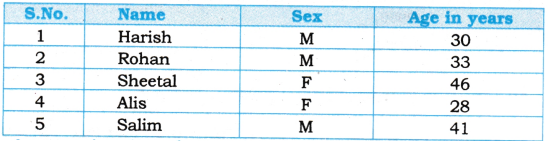
A person is selected at random from this group to act as a spokesperson. What is the probability that the spokesperson will be either male or over 35 years ?
Solution:
Let E be the event in which the spokesperson will be a male and F be the event in which the spokesperson will be over 35 years of age.
Accordingly, P(E) = \(\frac{3}{5}\) and P(F) = \(\frac{2}{5}\)
Since there is only one male who is over 35 years of age. ⇒ P(E ∩ F) = \(\frac{1}{5}\)
We know that P(E ∪ F) = P(E) + P(F) – P(E ∩ F)
∴ Required probability = P(E ∪ F) = \(\frac{1}{2}\)
Thus, the probability that the spokesperson will either be a male or over 35 years of 4 age is \(\frac{4}{5}\).
Question 3.
If 4-digit numbers greater than 5,000 are randomly formed from the digits 0, 1, 3, 5 and 7, what is the probability of forming a number divisible by 5 when, (i) the digits are repeated ? (ii) the repetition of digits is not allowed.
Solution:
i) When the digits are repeated
Since four-digit numbers greater than 5000 are formed, the leftmost digit is either 7 or 5.
The remaining 3 places can be filled by any of the digits 0, 1, 3, 5, or 7 as repetition of digits is allowed.
∴ Total number of 4-digit numbers greater than 5000 = 2 × 5 × 5 × 5 = 250 – 1 = 249
A number is divisible by 5 if the digit at its units place is either 0 or 5.
Total number of 4-digit numbers greater than 5000 that are divisible by 5 =2 × 5 × 5 × 2 = 100 – 1 = 99
Thus, the probability of forming a number divisible by 5 when the digits are repeated is \(\frac{99}{249}=\frac{33}{83}\).
ii) When the repetition of digits is not allowed.
The thousands place can be filled with either of the two digits 5 or 7.
The remaining 3 places can be filled with any of the remaining 4 digits.
∴ Total number of 4-digit numbers greater than 5000 = 2 × 4 × 3 × 2 = 48.
When the digit at the thousands place is 5, the units place can be filled only with 0 and the ten’s and hundred’s places can be filled with any two of the remaining 3 digits.
∴ Here, number of 4-digit numbers starting with 5 and divisible by 5 = 3 × 2 = 6
When the digit at the thousands place is 7, the units place can be filled in two ways (0 or 5) and the ten’s and hundred’s places can be filled with any two of the remaining 3 digits.
∴ Here, number of 4-digit numbers starting with 7 and divisible by 5 = 1 × 2 × 3 × 2 =12
∴ Total number of 4-digit numbers greater than 5000 that are divisible by 5 = 6 + 12 = 18
Thus, the probability of forming a number divisible by 5 when the repetition of \(\frac{18}{48}=\frac{3}{8}\).
Question 4.
The number lock of a suitcase has 4 wheels, each labelled with ten digits i.e., from 0 to 9. The lock opens with a sequence of four digits with no repeats. What is the probability of a person getting the right sequence to open the suitcase ?
Solution:
The number lock has 4 wheels, each labelled with ten digits i.e., from 0 to 9.
Number of ways of selecting 4 different digits out of the 10 digits = 10C4.
Now, each combination of 4 different digits can be arranged in 4! ways.
Number of four digits with no repetitions = 10C4 × 4! = \(\frac{10!}{4!6!}\) × 4!
= 7 × 8 × 9 × 10 = 5040
There is only one number that can open the suitcase. Thus, the required probability \(\frac{1}{5040}\).