TS Inter 2nd Year Maths 2A Solutions Chapter 5 Permutations and Combinations Ex 5(e)

Students must practice this TS Intermediate Maths 2A Solutions Chapter 5 Permutations and Combinations Ex 5(e) to find a better approach to solving the problems.

TS Inter 2nd Year Maths 2A Solutions Chapter 5 Permutations and Combinations Ex 5(e)

I.
Question 1.
If \({ }^{\mathrm{n}} \mathrm{C}_4\) = 210, find n.
Solution:
Given \({ }^{\mathrm{n}} \mathrm{C}_4\) = 210
⇒ \(\frac{n(n-1)(n-2)(n-3)}{4 !}\) = 210
⇒ n (n – 1) (n – 2) (n – 3) = 41 × 210
= 24 × 210
= 7 × 8 × 9 × 10
On comparing largest integers, we get n = 10.

Question 2.
If \({ }^{12} \mathrm{C}_{\mathrm{r}}\) = 495, find the possible values of ‘r’.
Solution:
Given \({ }^{12} \mathrm{C}_{\mathrm{r}}\) = 495
= 11 × 9 × 5
= \(\frac{12 \times 11 \times 9 \times 10}{4 \times 3 \times 2 \times 1}\)
⇒ \({ }^{12} \mathrm{C}_{\mathrm{r}}={ }^{12} \mathrm{C}_4 \text { or }{ }^{12} \mathrm{C}_8\)
⇒ r = 4 or 8.

Question 3.
If 10 . \({ }^n \mathrm{C}_2\) = 3 . \({ }^{n+1} C_3\), find n.
Solution:
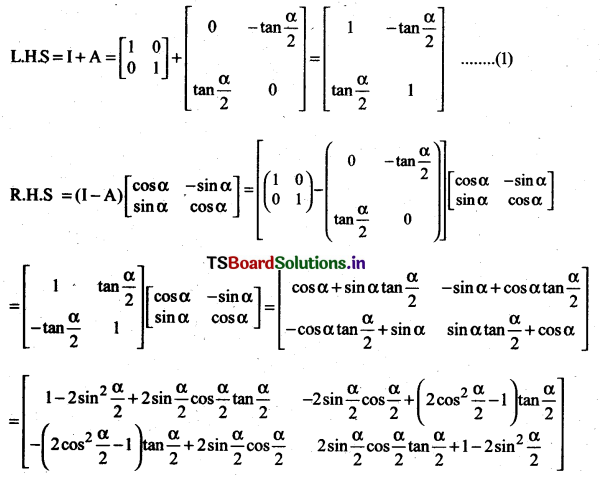
Given 10 . \({ }^n C_2\) = 3 . \({ }^{n+1} C_3\)
\(10 \times \frac{n(n-1)}{2}=3 \cdot \frac{(n+1) n(n-1)}{3 \times 2 \times 1}\)
⇒ 10 = n + 1
⇒ n = 9.

TS Board Inter 2nd Year Maths 2A Solutions Chapter 5 Permutations and Combinations Ex 5(e)

Question 4.
If \({ }^n P_r\) = 5040 and \({ }^n C_r\) = 210, find n and r.
Solution:
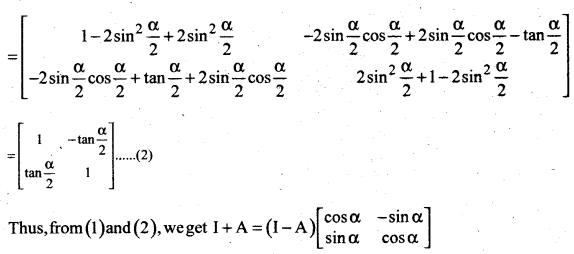
Given \({ }^n P_r\) = 5040 and \({ }^n C_r\) = 210, \({ }^n P_r=r !^n C_r\)
5040 = r! × 210
⇒ r! = 24
⇒ r! = 4!
∴ r = 4
∴ \({ }^n \mathrm{P}_4\) = 5040
⇒ n (n – 1) (n – 2) (n – 3) = 10 × 9 × 8 × 7
On comparing largest integers, we get n = 10
∴ n = 10 and r = 4.

Question 5.
If \({ }^n C_4={ }^n C_6\), find n.
Solution:
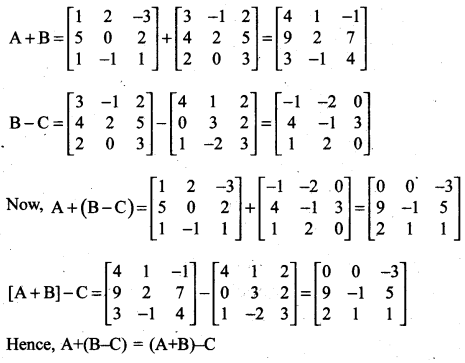
Given \({ }^n C_4={ }^n C_6\)
If \({ }^n C_r={ }^n C_s\), then either r = s or r + s = n.
Clearly, we have n = 4 + 6
⇒ n = 10.

Question 6.
If \({ }^{15} \mathrm{C}_{2 \mathrm{r}-1}={ }^{15} \mathrm{C}_{2 \mathrm{r}+4}\), find r.
Solution:
Given \({ }^{15} \mathrm{C}_{2 \mathrm{r}-1}={ }^{15} \mathrm{C}_{2 \mathrm{r}+4}\)
If \({ }^n C_r={ }^n C_s\) then either r = s or r + s = n.
∴ 2r – 1 = 2r + 4
Which is impossible.
or
2r – 1 + 2r + 4 = 15
⇒ 4r + 3 = 15
⇒ r = 3
∴ r = 3.

TS Board Inter 2nd Year Maths 2A Solutions Chapter 5 Permutations and Combinations Ex 5(e)

Question 7.
If \({ }^{17} C_{2 t+1}={ }^{17} C_{3 t-5}\), find t.
Solution:
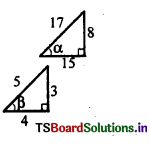
Given \({ }^{17} C_{2 t+1}={ }^{17} C_{3 t-5}\)
If \({ }^n C_r={ }^n C_s\), then either r = s or n = r + s.
i.e., either
2t + 1 = 3t – 5
⇒ t = 6 = 17
2t + 1 + 3t – 5 = 17
⇒ 5t = 21
⇒ t = \(\frac{21}{5}\)
Since t’ is an integer, we have t = 6.

Question 8.
If \({ }^{12} C_{r+1}={ }^{12} C_{3 r-5}\), find r.
Solution:
Given \({ }^{12} C_{r+1}={ }^{12} C_{3 r-5}\).
If \({ }^n C_r={ }^n C_s\), then either r = s or n = r + s.
i.e., r + 1 = 3r – 5
or 12 = r + 1 + 3r – 5
⇒ r = 3 or r = 4.

Question 9.
If \({ }^9 C_3+{ }^9 C_5={ }^{10} C_r\), then find r.
Solution:
Given \({ }^9 C_3+{ }^9 C_5={ }^{10} C_r\)
⇒ \({ }^9 \mathrm{C}_3+{ }^9 \mathrm{C}_4={ }^{10} \mathrm{C}_r\) (∵ \({ }^n C_r={ }^n C_s\))
⇒ \({ }^{10} \mathrm{C}_4={ }^{10} \mathrm{C}_{\mathrm{r}}\) (or) \({ }^{10} \mathrm{C}_6={ }^{10} \mathrm{C}_{\mathrm{r}}\)
⇒ r = 4 or r = 6.

TS Board Inter 2nd Year Maths 2A Solutions Chapter 5 Permutations and Combinations Ex 5(e)

Question 10.
Find the number of ways of forming a com-mittee of 5 members from 6 men and 3 ladies.
Solution:
Selecting 5 members to form a commitee from 6 men and 3 ladies (i.e., 9 members) can be done in \({ }^9 \mathrm{C}_5\) = 126 ways.

Question 11.
In question 10, how many committees contain atleast two ladies.
Solution:
In selecting 5 members from 6 men and 3 ladies to form a committee containing atleast two ladies, two cases arises.

Case – (1):
(When committee contains exactly two ladies) :
Number of ways of selecting 2 ladies from 3 ladies is \({ }^3 \mathrm{C}_2\).
Now the remaining 3 members are selected from 6 men and this can be done in C3 ways
∴ Number of ways to form a committee with 2 ladies = \({ }^3 \mathrm{C}_2 \times{ }^6 \mathrm{C}_3\) = 60.

Case – (2)
(When committee contains 3 ladies) :
Selecting 3 ladies from 3 ladies can be done in \({ }^3 \mathrm{C}_3\) ways.
Selecting remaining 2 members from 6 men can be done in \({ }^6 \mathrm{C}_2\) ways.
∴ Number of ways to form a committee with 3 ladies = \({ }^3 \mathrm{C}_3 \times{ }^6 \mathrm{C}_2\) = 15
∴ Total number of ways = 60 + 15 = 75.

Question 12.
If \({ }^n C_5={ }^n C_6\), then \({ }^{13} \mathrm{C}_{\mathrm{n}}\).
Solution:
Given, \({ }^n C_5={ }^n C_6\)
⇒ n = 5 + 6
(If \({ }^n C_r={ }^n C_s\) then either n = r + s or r = s)
⇒ n = 11
Now, \({ }^{13} C_n={ }^{13} C_{11}={ }^{13} C_2\) = 78.

TS Board Inter 2nd Year Maths 2A Solutions Chapter 5 Permutations and Combinations Ex 5(e)

II.
Question 1.
Prove that 3 ≤ r ≤ n, \({ }^{(n-3)} C_r+3 \cdot{ }^{(n-3)} C_{(r-1)}+3 \cdot{ }^{(n-3)} C_{(r-2)}+{ }^{(n-3)} C_{(r-3)}={ }^n C_r\).
Solution:
Given 3 ≤ r ≤ n

TS Inter 2nd Year Maths 2A Solutions Chapter 5 Permutations and Combinations Ex 5(e) 1

Question 2.
Find the value of \({ }^{10} C_5+2 \cdot{ }^{10} C_4+{ }^{10} C_3\).
Solution:
\({ }^{10} C_5+2 \cdot{ }^{10} C_4+{ }^{10} C_3\)
= \({ }^{10} C_5+{ }^{10} C_4+{ }^{10} C_4+{ }^{10} C_3\)
= \({ }^{11} C_5+{ }^{11} C_4\) (∵ \({ }^n C_{r-1}+{ }^n C_r={ }^{n+1} C_r\))
= \({ }^{12} \mathrm{C}_5\) = 792.

Question 3.
Simplify \({ }^{34} C_5+\sum_{r=0}^4(38-r) C_4\).
Solution:

TS Inter 2nd Year Maths 2A Solutions Chapter 5 Permutations and Combinations Ex 5(e) 2

TS Board Inter 2nd Year Maths 2A Solutions Chapter 5 Permutations and Combinations Ex 5(e)

Question 4.
In a class there are 30 students. If each student plays a chess gaine with each of the other student, then find the total number of chess games played by them.
Solution:
Number of students in a class = 30.
Given each students plays a chess game with each of the other student.
∴ The total number of chess games played is equal to number of ways of selecting 2 students to play a game from 30 students.
This can be done in \({ }^{30} \mathrm{C}_2\) ways.
∴ The number of chess games played = \({ }^{30} \mathrm{C}_2\) = 435.

Question 5.
Find the number of ways of selectIng 3 girls and 3 boys out of 7 girls and 6 boys.
Solution:
Number of ways of selecting 3 girls out of 7 girls = \({ }^7 \mathrm{C}_3\)
Number of ways of selecting 3 boys ouf of 6 boys = \({ }^6 \mathrm{C}_3\)
∴ The total number of ways = \({ }^7 \mathrm{c}_3 \cdot{ }^6 \mathrm{c}_3\)
= 35 . 20 = 700.

Question 6.
Find the number of ways of selecting a committee of 6 members out of 10 mem bers always Including a specified member.
Solution:
A committee of 6 members is to be formed out of 10 members in which a specified member is always included.
So, remaining 5 members are to be selected from rest of 9 members.
This can be done in \({ }^9 \mathrm{C}_5\) ways.
∴ Required number of ways \({ }^9 \mathrm{C}_5\) = 126.

TS Board Inter 2nd Year Maths 2A Solutions Chapter 5 Permutations and Combinations Ex 5(e)

Question 7.
Find the number of ways of selecting 5 books from 9 different mathematics books such that a particular book ¡s not included.
Solution:
Given out of 9 different mathematics books a particular book is not included.
∴Number of book left are ‘8′.
∴ Number of ways of selecting 5 books out of 8 different books are \({ }^8 C_5\) = 56.

Question 8.
Find the number of ways of selecting 3 vowels and 2 consonants from the letters of the word EQUATION.
Solution:
The word EQUATION contains 5 vowels and 3 consonants.
Number of ways of selecting 3 vowels out of 5 = \({ }^5 \mathrm{C}_3\) = 10
Number of ways of selecting 2 consonants out of 3 = \({ }^3 \mathrm{C}_2\) = 3
∴ Total number of ways = 10 x 3 = 30.

Question 9.
Find the number of diagonals of a polygon with 12 sides.
Solution:
Number of sides of a polygon = 12
Number of diagonals of a n – sided polygon = \({ }^n C_2\) – n
∴ Number of diagonals of 12 sided polygon = \({ }^{12} C_2\) – 12 = 54.

TS Board Inter 2nd Year Maths 2A Solutions Chapter 5 Permutations and Combinations Ex 5(e)

Question 10.
If n persons are sitting in a row, find the number of ways of selecting two persons, who are sitting adjacent to each other.
Solution:
Number of ways of selecting 2 persons out of n persons sitting in a row, who are sitting adjacent to each other = n – 1.

Question 11.
Find the number of ways of giving away 4 similar coins to 5 boys if each boy can be given any number (less than or equal to 4) of coins.
Solution:
In distribution of 4 similar coins to 5 boys, the following cases arises.

Case – (i) :
Giving all 4 coins to one boys. This is done in \({ }^5 \mathrm{C}_1\) ways.

Case – (ii) :
Giving 4 coins to two boys so that one of them gets 1 and the other 3 coins.
This is done in 2 x \({ }^5 \mathrm{C}_2\) ways.

Case – (iii) :
Giving 4 coins to two boys so that each get 2 coins. This can be done in \({ }^5 \mathrm{C}_2\) ways.

Case – (iv) :
Giving 4 coins to three boys so that, two of them gets 1 coin and the other gets 2. This is done in \({ }^5 \mathrm{C}_3 \times \frac{3 !}{2 !}\) ways.

Case – (v):
Giving 4 coins to four boys so that each gets 1.
This is done in \({ }^5 \mathrm{C}_4\) ways.
∴ Total number of ways = \({ }^5 \mathrm{C}_1+2 \times{ }^5 \mathrm{C}_2+{ }^5 \mathrm{C}_2+\frac{3 !}{2 !}{ }^5 \mathrm{C}_3+{ }^5 \mathrm{C}_4\) = 70.

TS Board Inter 2nd Year Maths 2A Solutions Chapter 5 Permutations and Combinations Ex 5(e)

III .
Question 1.
Prove that \(\frac{{ }^{4 n} C_{2 n}}{{ }^{2 n} C_n}=\frac{1 \cdot 3 \cdot 5 \ldots \ldots(4 n-1)}{\{1 \cdot 3 \cdot 5 \ldots \ldots(2 n-1)\}^2}\).
Solution:

TS Inter 2nd Year Maths 2A Solutions Chapter 5 Permutations and Combinations Ex 5(e) 3

TS Board Inter 2nd Year Maths 2A Solutions Chapter 5 Permutations and Combinations Ex 5(e)

Question 2.
If a set A has 12 elements, find the number of subsets of A having
i) 4 elements
ii) Atleast 3 elements
iii) Atmost 3 elements.
Solution:
Given number of elements in set A are 12.

i) Subsets of A having 4 elements :
Number of subsets of A having 4 elements is equal to number of ways of selecting 4 elements from 12 elements in set ‘A’.
This can be done in \({ }^{12} C_4\) ways.
∴ Number of subsets of A having 4 elements = \({ }^{12} C_4\) = 495.

ii) Subset of A contains atleast 3 elements:
Number of subsets of A, having ‘r’ elements is equal to number of ways of selecting ‘r’ elements from 12 elements in set A’, i.e., \({ }^{12} \mathrm{C}_{\mathrm{r}}\) ways.
∴ Number of ways of selecting at least 3 elements from 12 elements in set A is \({ }^{12} \mathrm{C}_3+{ }^{12} \mathrm{C}_4+\ldots \ldots+{ }^{12} \mathrm{C}_{12}\)
Number of subsets of A having atleast 3 elements = \({ }^{12} \mathrm{C}_3+{ }^{12} \mathrm{C}_4+\ldots \ldots+{ }^{12} \mathrm{C}_{12}\)
= \(\left({ }^{12} \mathrm{C}_0+{ }^{12} \mathrm{C}_1+\ldots \ldots+{ }^{12} \mathrm{C}_{12}\right)-{ }^{12} \mathrm{C}_0-{ }^{12} \mathrm{C}_1-{ }^{12} \mathrm{C}_2\)
= 212 – \({ }^{12} \mathrm{C}_0+{ }^{12} \mathrm{C}_1+{ }^{12} \mathrm{C}_2\) = 4017.

iii) Number of subsets of ‘A’ having atmost 3 elements :
Number of subsets of A having ‘r’ elements is equal to number of ways of selecting r’ elements from 12 elements in set ‘A’ i.e., \({ }^{12} C_r\) ways.
∴ Number of ways of selecting atmost 3 elements from 12 elements in set A is \({ }^{12} \mathrm{C}_0+{ }^{12} \mathrm{C}_1+{ }^{12} \mathrm{C}_2+{ }^{12} \mathrm{C}_3\).
∴ Number of subsets of ‘A’ having atmost 3 elements = \({ }^{12} \mathrm{C}_0+{ }^{12} \mathrm{C}_1+{ }^{12} \mathrm{C}_2+{ }^{12} \mathrm{C}_3\) = 299.

TS Board Inter 2nd Year Maths 2A Solutions Chapter 5 Permutations and Combinations Ex 5(e)

Question 3.
Find the numbers of ways of selecting a cricket team of 11 players from 7 batsmen and 6 bowlers such that there will be atleast 5 bowlers in the team.
Solution:
Number of batsmen = 7
Number of bowlers = 6
In selecting 11 players in a team out of given 13 players so that the team contains atleast 5 bowlers, two cases arises.

Case (i) : (Selecting 5 bowlers) :
Number of ways of selecting 5 bowlers from 6 = \({ }^6 \mathrm{C}_5\)
The remaining 6 players are selected from 7 batsmen can be done in \({ }^7 \mathrm{C}_6\) ways.
Number of ways of selecting = \({ }^7 \mathrm{C}_6 \times{ }^6 \mathrm{C}_5\).

Case – (ii) (Selecting 6 bowlers) :
Number of ways of selecting 6 bowlers from 6 = \({ }^6 \mathrm{C}_6\)
The remaining 5 players to be selected from 7 batsmen can be done in \({ }^7 \mathrm{C}_5\) ways.
∴ Number of ways of selecting = \(\mathrm{C}_6 \times{ }^7 \mathrm{C}_5\)
Total number of ways of selecting = \({ }^7 \mathrm{C}_6 \times{ }^7 \mathrm{C}_5+{ }^7 \mathrm{C}_5 \times{ }^6 \mathrm{C}_6\) = 63.

Question 4.
In 5 vowels and 6 consonants are given, then how many 6 letter words can be formed with 3 vowels and 3 consonants.
Solution:
Given 5 vowels and 6 consonants.
6 letter word is formed with 3 vowels and 3 consonants.
Number of ways of selecting 3 vowels from 5 vowels is \({ }^5 \mathrm{C}_3\).
Number of ways of selecting 3 consonants from 6 consonants is \({ }^6 \mathrm{C}_3\).
∴ Total number of ways of selecting = \({ }^5 \mathrm{C}_3 \times{ }^6 \mathrm{C}_3\)
These letters can be arranged themselves in 6! ways.
∴ Number of 6 letter words formed = \({ }^5 \mathrm{C}_3 \times{ }^6 \mathrm{C}_3\) × 6!.

TS Board Inter 2nd Year Maths 2A Solutions Chapter 5 Permutations and Combinations Ex 5(e)

Question 5.
There are 8 railway stations along a rail-way line. In how many ways can a train be stopped at 3 of these stations such that no two of them are consecutive ?
Solution:
Let S1, S2, S3 ……. S8 be 8 railway stations along a railway line.
Train is to be stopped at 3 stations.
Number of ways of selecting 3 stations out of 8 stations is 8Cr
Number of ways of selecting 3 consecutive stations is 6.
(i.e., (S1, S2, S3), (S2, S3, S4), ………. (S6, S7, S8)}
Number of ways of selecting only 2 consecu¬tive stations = 2 × 5 + 5 × 4 = 30
As no two stops are consecutive, number of ways of selecting = \({ }^8 \mathrm{C}_3\) – 6 – 30 = 20.

Question 6.
Find the number of ways of forming a com¬mittee of 5 members out of 6 Indians and 5 Americans so that always the Indians will be in majority in the committee.
Solution:
A committee of 5 members is to be formed out of 6 Indians and 5 Americans.
As committee contains the majority of Indians, 3 cases arises.

i) Selecting 3 Indians and 2 Americans :
Number of ways of selecting 3 Indians out of 6 Indians = \({ }^6 \mathrm{C}_3\)
Number of ways of selecting 2 Americans out of 3 Indians = \({ }^5 \mathrm{C}_2\)
Number of ways of selecting 3 Indians and 2 Americans = \({ }^6 \mathrm{C}_3 \times{ }^5 \mathrm{C}_2\).

ii) Selecting 4 Indians and 1 American :
Number of ways of selecting 4 Indians out of 6 Indians = \({ }^6 \mathrm{C}_4\)
Number of ways of selecting 1 American out of 5 Americans = \({ }^5 \mathrm{C}_1\)
Number of ways of selecting 4 Indians and 1 American = \({ }^6 \mathrm{C}_4 \times{ }^5 \mathrm{C}_1\).

iii) Selecting 5 Indians :
Number of ways of selecting all 5 members
Indians out of 6 Indians = \({ }^6 \mathrm{C}_5\).
∴ Total numbers of ways of forming a committee = \({ }^6 \mathrm{C}_3 \times{ }^5 \mathrm{C}_2+{ }^6 \mathrm{C}_4 \times{ }^5 \mathrm{C}_1+{ }^6 \mathrm{C}_5\) = 281.

TS Board Inter 2nd Year Maths 2A Solutions Chapter 5 Permutations and Combinations Ex 5(e)

Question 7.
A question paper is divided into 3 sections A, B, C containing 3, 4, 5 questions respectively, Find the number of ways of attempting 6 questions choosing atleast one from each section.
Solution:
A question paper contains 3 sections A, B, C containing 3, 4, 5 questions respectively.
Number of ways of selectng 6 questions out of these 12 questions = \({ }^{12} \mathrm{C}_6\)
Number of ways of selecting 6 questions from sections B and C (i.e., from 9 questions) = \({ }^{9} \mathrm{C}_6\)
Number of ways of selecting 6 questions from sections A and C (i.e., from 8 questions) = \({ }^{8} \mathrm{C}_6\)
Number of ways of selecting 6 questions from sections A and B (i.e., 7 questions) = \({ }^{7} \mathrm{C}_6\)
∴ Number of ways of selecting 6 questions choosing atleast one from each section = \({ }^{12} \mathrm{C}_6-{ }^7 \mathrm{C}_6-{ }^8 \mathrm{C}_6-{ }^9 \mathrm{C}_6\) = 805.

Question 8.
Find the number of ways in which 12 things be
(i) divided into 4 equal groups
(ii) distributed to 4 persons equally.
Solution:
i) Dividing 12 things in 4 equal groups :
Number of ways of dividing 12 things into 4 equal groups = \(\frac{12 !}{(3 !)^4 \cdot 4 !}\).

ii) Distributing 12 things to 4 persons equally
Number of ways of distributing 12 things to 4 persons equally = \(\frac{12 !}{(3 !)^4 \cdot 4 !}\).

TS Board Inter 2nd Year Maths 2A Solutions Chapter 5 Permutations and Combinations Ex 5(e)

Question 9.
A class contains 4 boys and g girls. Every Sunday, five students with atleast 3 boys go for a picnic. A different group is being sent every week. During the picnic, the class teacher gives each girl in the group a doll. If the total number of dolls distributed is 85, find g.
Solution:
A class contains 4 boys and ‘g’ girls,
In selecting 5 students with atleast 3 boys for picnic two cases arises.

i) Selecting 3 boys and 2 girls :
Number of ways of selecting 3 boys and 2 girls = \({ }^4 C_3 \times{ }^g C_2=4\left({ }^g C_2\right)\)
As each group contains 2 girls, number of dolls required = 8 \(8\left({ }^8 \mathrm{C}_2\right)\).

ii) Selecting 4 boys and 1 girl :
Number of ways of selecting 4 boys and 1 girl = \({ }^4 \mathrm{C}_4 \times{ }^{\mathrm{g}} \mathrm{C}_1\) = g
∴ As each group contains only 1 girl, number of dolls required = g
∴ Total number of dolls = 8 (\(\left({ }^g \mathrm{C}_2\right)\)) + g
i.e., 85 = \(\frac{g(g-1)}{2}\) + g
⇒ 85 = 4g2 – 3g
⇒ 4g2 – 3g – 85 = 0
⇒ (4g + 17) (g – 5) = 0
⇒ g = 5 (∵ ‘g’ is non-negative integer).

TS Inter 2nd Year Economics Study Material Chapter 9 పర్యావరణ అర్థశాస్త్రం

TS Inter 2nd Year Economics Study Material 9th Lesson పర్యావరణ అర్థశాస్త్రం

వ్యాసరూప సమాధాన ప్రశ్నలు:

ప్రశ్న 1.
వివిధ రకాల కాలుష్యాలను వివరించి, వాటి ప్రభావాలను పరిశీలించండి.
జవాబు.
కాలుష్యం (Pollution) :
గాలి, నీటితో కలసిన కాలుష్యకాలు కాలుష్యాన్ని సృష్టిస్తాయి. ఇవి వాతావరణాన్ని కలుషితం చేసి పరిసరాలకు నష్టాన్ని కలిగిస్తాయి. కాలుష్యం అన్ని జీవరాశులకు ప్రమాదాన్ని కలిగిస్తుంది. భౌతిక పర్యావరణ విచ్ఛేదనకు కూడా కాలుష్యం కారణమవుతుంది. కాలుష్యం ప్రధానంగా వాయు కాలుష్యం, జల కాలుష్యం, ధ్వని కాలుష్యం అనే మూడు రూపాలలో ఉంటుంది.

1. వాయు కాలుష్యం :
వాయు కాలుష్యానికి కారణాలు లేదా ఆధారాలు :

  1. వ్యవసాయ కార్యకలాపాలు
  2. పదార్థాల దహనం
  3. యంత్రాల సహాయంతో జరిగే ఉత్పత్తి ప్రక్రియలు
  4. ద్రావకం ఉపయోగిత
  5. న్యూక్లియర్ శక్తి కార్యక్రమాల నిర్వహణ, మానవులు, జంతువులు, పక్షులు మొదలైన జీవరాశి శ్వాస వ్యవస్థపై వాయు కాలుష్యం తీవ్ర ప్రభావాన్ని చూపుతుంది.

ఆహార వస్తువులు, కూరగాయలు, పండ్లపై వాయు కాలుష్య ప్రభావం ఉంటుంది. మొక్కలు, పంటలు, పచ్చిక భూములపై దుమ్ము పొరలు ఏర్పడటంవల్ల భూమి ఉత్పాదక శక్తి తగ్గుతుంది. హరిత గృహంపై దీని ప్రభావంవల్ల భూమి మీది ఉష్ణోగ్రతలు ఎక్కువగా పెరిగి ధ్రువ ప్రాంతాలలోని మంచుగడ్డలు, హిమానీనదాలు కరిగిపోయే ప్రమాదం ఉంది. ఆమ్ల వర్షాలు, వాయు కాలుష్యం ద్వారా ఏర్పడి భూమి మీద భవనాలను, చెట్లను, మొక్కలను, అటవీ ప్రాంతాలను నష్టపరుస్తాయి.

2. జల కాలుష్యం (Water Pollution) :
నీటి స్వభావాన్ని మార్చి ఉపయోగానికి పనికి రాకుండా ప్రమాదకరమైన రీతిలో జల కాలుష్యం నీటిని పాడుచేస్తుంది. ప్రాణి కోటికి ప్రమాదకరమైన అదనపు పదార్థాలు నీటిలో కలవడమే జల కాలుష్యంగా నిర్వచించవచ్చు. కాలుష్యం వల్ల వీటి మధ్య సమతుల్యత దెబ్బతింటుంది.

  1. మురుగు వ్యర్థ పదార్థాలు
  2. అంటు వ్యాధుల ఏజెంట్లు
  3. విదేశీ సేంద్రియ రసాయనాలు
  4. రసాయనిక ఖనిజ పదార్థాలు, సమ్మేళనాలు మొదలైన వాటిని నీటి కాలుష్య కారకాలుగా చెప్పవచ్చు.

నీటి కాలుష్యం అనేక సమస్యలను సృష్టిస్తుంది. వాస్తవానికి ఎన్నో వ్యాధులకు ఇతర పర్యావరణ ప్రమాదాలకంటే నీటి కాలుష్యమే ప్రధానమైంది. కలరా, టైఫాయిడ్ అతి విరోచనాలవంటి వ్యాధులు నీటి కాలుష్యం ద్వారా వ్యాప్తి చెందుతాయి.

కొన్ని పరిశ్రమలు తమకు కావలసిన స్థాయిలో నీటిని శుభ్రపరచడంకోసం అధిక మొత్తాలలో వెచ్చించాల్సి రావడంవల్ల ఉత్పత్తి వ్యయాలు పెరుగుతున్నాయి. నీటి కాలుష్యం చేపలను చంపి జల ఆహార నిల్వలను నశింపచేస్తుంది.

3. ధ్వని కాలుష్యం (Noise Pollution) :
ధ్వని కాలుష్యం శరీర సంబంధమైన లేదా మానసిక సంబంధమైన హానిని కలగజేస్తుంది. రైల్వేలు, పరిశ్రమలు, నిర్మాణ రంగ కార్యకలాపాలు, ప్రజా సమూహాల కలయికల, లౌడ్ స్పీకర్లను ఉపయోగించడం `వంటి క్రియలు ధ్వనిని వ్యాప్తి చేస్తాయి.

చెవికి ఇబ్బంది కలిగించే ధ్వని కాలుష్యం తాత్కాలికంగా కాని, శాశ్వతంగా కాని వినికిడి సామర్థ్యాన్ని తగ్గిస్తుంది. కొంతకాలంపాటు ధ్వని కాలుష్యానికి లోనైతే చెవిటితనం వచ్చే ప్రమాదముంది. ధ్వని కాలుష్యంవల్ల మెదడు, నరాల వ్యవస్థ దెబ్బతిని, చికాకు స్వభావం పెరుగుతుంది. నిరంతర ధ్వని కాలుష్య ప్రభావంవల్ల శ్రామిక సామర్థ్యం, వారి వృత్తిపరమైన పనితీరు క్షీణిస్తుంది.

TS Board Inter Second Year Economics Study Material Chapter 9 పర్యావరణ అర్థశాస్త్రం

ప్రశ్న 2.
పర్యావరణ క్షీణత ఆర్థిక వ్యవస్థను ఏ విధంగా ప్రభావితం చేస్తుంది ? ఈ సమస్యను అధిగమించడానికి నివారణ చర్యలను సూచించండి.
జవాబు.
I. పర్యావరణ విచ్ఛేదన భావన :
పర్యావరణ విచ్ఛేదనం అంటే భూమిపై జరిగిన ఛిద్రత లేదా పర్యావరణంలోని సహజ వనరుల రూపంలో ఉన్న ఆస్తుల క్షీణత అనవచ్చు. ప్రకృతి ఉపరితలంలో రాకూడని మార్పులు లేదా తీవ్రతను పర్యావరణ విచ్ఛేదనంగా చెప్పవచ్చు. భూమిపైగల సహజ వనరులు క్రమంగా క్షీణించి కొన్ని జీవరాశులు అంతరించి పోవడం పర్యావరణ విచ్ఛేదనను కలుగజేస్తుంది. వాయు కాలుష్యం, జల కాలుష్యం, భూమిపై పొరలలో ఉన్న సహజ శక్తుల క్షీణతవంటి సమస్యలు ఈ విచ్ఛేదనంవల్ల సృష్టించబడతాయి.

II. పర్యావరణ విచ్ఛేదనకు కారణాలు :

1. భూసార క్షీణత :
పనికిరాని పిచ్చి మొక్కలు ప్రకృతిని, పరిసరాలను ఆవరించే సహజంగా ఉన్న హరిత ప్రదేశాలను క్రమంగా క్షీణింపచేస్తాయి. ఈ విధమైన వృక్ష సంబంధమైన జీవరాశులు భూమి, భూమిలోని పర్యావరణపరమైన ఆస్తులను నాశనం చేస్తాయి. అటవీ ప్రాంతాలలో, మైదాన ప్రాంతాలలో, పంట భూములలో పశువుల మేతకోసం తొక్కిడి అధికంగా ఉన్నప్పుడు సారవంతమైన భూమి ఉపరితలంలోని పొరలు దెబ్బతిని భూమి గట్టితనాన్ని సంతరించుకుంటుంది.

2. కాలుష్యం :
వాయు, జల, ధ్వని పరమైన కాలుష్యాలు పర్యావరణానికి ప్రమాదకరమైనవి. ఈ కాలుష్యాలు గాలి, నీరు, భూమి నాణ్యతలను క్షీణింప చేస్తాయి. ధ్వని కాలుష్యం చెవులకు కలిగించే నష్టంతోపాటు పక్షులకు, జంతువులకు భయాందోళనలను కలిగిస్తుంది. అమితమైన జనాభా పెరుగుదల సహజ వనరులపై ఒత్తిడిని పెంచి పర్యావరణ విచ్ఛేదనకు దారితీస్తుంది.

3. చెత్తా చెదారాల సమూహం (Landfills) :
చెత్తా చెదారాల కుప్పలు వాయు కాలుష్యాన్ని సృష్టిస్తాయి. ఇవి చెడు వాసనలు సృష్టించడంతోపాటు అధికస్థాయిలో పర్యావరణ విచ్ఛేదనకు కారణమవుతాయి. వ్యర్థ పదార్థాలు, అపరిశుభ్రమైన మురుగు నీటితో ఇవి నిండి ఉంటాయి.

4. వన నిర్మూలన:
గృహ నిర్మాణ కార్యకలాపాల దృష్ట్యా, పరిశ్రమల స్థాపన దృష్ట్యా అడవులను నరికివేయడాన్ని వన నిర్మూలన అంటారు. వ్యవసాయ భూమి విస్తరణకోసం, వంట చెరకు అవసరాలకోసం అడవులలోని వృక్షాలను నరికి వేస్తున్నారు. పెద్ద తరహా నీటిపారుదల ప్రాజెక్టులకోసం కొన్ని ప్రాంతాలలో వన నిర్మూలన జరుగుతుంది. ఇందువల్ల పర్యావరణంలోకి చేరే కార్బన్ పరిమాణం పెరిగి ప్రపంచవ్యాప్తంగా భూతాపం పెరుగుతూ ఉంది. వర్షాభావం కూడా ఏర్పడే ప్రమాదం ఉంది.

5. సహజ కారణాలు :
భూకంపాలు, సముద్ర కెరటాలు, ఉప్పెనలు, సునామీలు, వన దహనాలు, జంతువులను, వృక్ష సముదాయాలను నాశనం చేస్తాయి. వీటివల్ల వర్తమానంలోనూ మరియు దీర్ఘకాలంలోనూ పర్యావరణంపై ప్రభావాలు ఉంటాయి.

6. పారిశ్రామికీకరణ, అధికోత్పత్తి:
శాస్త్ర, సాంకేతిక రంగాల అభివృద్ధితో ప్రపంచదేశాలలో ఉత్పాదక సామర్థ్యాలు విస్తరించాయి. ఉత్పత్తిని విస్తరించడానికి సహజ వనరులు, ముడి పదార్థాలు విరివిగా వినియోగించబడుతున్నాయి. పరిశ్రమల పొగ, ధ్వని, వ్యర్థ పదార్థాల విసర్జకాల ద్వారా పర్యావరణ విచ్ఛేదనానికి కారణాలు అవుతున్నాయి.

III. పర్యావరణ విచ్ఛేదన ప్రభావాలు :

  1. మానవాళి ఆరోగ్యంపై పర్యావరణ విచ్ఛేదన ప్రభావం తీవ్రంగా ఉంది. ఆస్తమా, క్షయ, న్యూమోనియా, అతి విరోచనాలు వంటి వ్యాధులు కాలుష్యంవల్ల పెరుగుతున్నాయి. వాయు, జల, ధ్వని కాలుష్యంవల్ల సంబంధిత సమస్యలు క్రమంగా పెరుగుతున్నాయి.
  2. జీవావరణ వ్యవస్థ సమతుల్యంగా ఉండటానికి జీవ వైవిధ్యం అవసరం. పర్యావరణ క్షీణత జీవ వైవిధ్యాన్ని క్షీణింపచేస్తుంది. పర్యావరణ విచ్ఛేదన ఓజోన్ పొరను క్షీణింపచేస్తుంది. ఇందువల్ల హానికరమైన కాంతి కిరణాలు భూమిపైకి వస్తాయి.
  3. పర్యాటకులు ఒకే దేశంలోని లేదా ప్రాంతంలోని ప్రకృతిని, జంతు జాలాన్ని పక్షులను పచ్చదనంతో కూడిన భూభాగాన్ని దర్శించి ఆనందించాలని భావిస్తారు. కానీ, పర్యావరణ విచ్ఛేదన పర్యాటక బృందాలను నిరుత్సాహపరుస్తుంది.
  4. పర్యావరణ విచ్ఛేదన ప్రభుత్వాలపై అధిక ఆర్థిక భారాన్ని మోపుతుంది. అధిక మొత్తాలను పర్యావరణం పరిరక్షణపై వ్యయం చేయడం ప్రభుత్వాలకు తప్పనిసరి భారం అవుతుంది.
    పర్యావరణం విచ్ఛేదనను తగ్గించి పుడమి తల్లిని రక్షించుకోవలసిన బాధ్యత అందరిపైనా ఉంది. ఇందుకు ప్రజలను పర్యావరణపరమైన విద్య ద్వారా చైతన్య పరచవలసిన అవసరం ఎంతో ఉంది.

TS Board Inter Second Year Economics Study Material Chapter 9 పర్యావరణ అర్థశాస్త్రం

ప్రశ్న 3.
వివిధ రకాల కాలుష్యాలకు గల కారణాలను, వాటివల్ల ఏర్పడే ప్రభావాలను తెలియజేయండి.
జవాబు.
వ్యాసరూప సమాధాన ప్రశ్న – 1 చూడుము.

ప్రశ్న 4.
పర్యావరణ సుస్థిరత లక్ష్యాలు ఏవి ? సుస్థిర అభివృద్ధి ప్రాధాన్యతను వివరించండి.
జవాబు.
సుస్థిర అభివృద్ధి లక్ష్యాలు :

1.వృద్ధి లేదా ఆదాయాలలో పెరుగుదల :
సుస్థిర అభివృద్ధి అన్ని వర్గాల జీవన ప్రమాణాలను పెంపొందించే ఉద్దేశంలో ఉంటుంది. విద్య, ఆరోగ్య, ప్రజా జీవనంలో భాగస్వామ్యం, స్వచ్ఛమైన పర్యావరణం, సమ న్యాయం పెంపొందించడం భావి తరాల జీవన ప్రమాణాలను పెంపొందించడానికి, సుస్థిర అభివృద్ధిలో సమ్మేళనం చేయబడ్డాయి.

2. అభివృద్ధి కొనసాగింపు :
సుస్థిర అభివృద్ధిలో భౌతిక, మానవపరమైన, సహజ మూలధనాలు పరిరక్షించబడి నియమబద్ధంగా ఉపయోగించబడతాయి.

3. క్షీణత నియంత్రణ :
ఆర్థికాభివృద్ధి పర్యావరణ క్షీణతకు దారితీస్తూ, నాణ్యమైన జీవన విధానానికి హాని కలిగించే రీతిలో ఉండకూడదు. భూమి, నీరు, గాలి, భూసార నాణ్యతలను సుస్థిర అభివృద్ధికోసం కొనసాగించాలి. ఆర్థికాభివృద్ధికి సంబంధించిన ప్రస్తుత నిర్ణయాలు, భావితరాల జీవన ప్రమాణాలను దెబ్బతీయకూడదు.

4. జీవ వైవిధ్య రక్షణ :
సుస్థిర అభివృద్ధిలో జీవ వైవిధ్య రక్షణకు ప్రాధాన్యతను ఇస్తుంది. ఈ విధానంలో అన్ని ఉత్పాదక కార్యక్రమాలు జీవ వైవిధ్యంతో, జన్యు వైవిధ్యంతో జీవరాశుల వైవిధ్యంతో ఆవరణాత్మక వైవిధ్యంతో సంబంధాన్ని కలిగి ఉంటాయి. కాబట్టి ఈ వైవిధ్యాలను సుస్థిర అభివృద్ధి కోసం కొనసాగించవలసి ఉంటుంది.

TS Board Inter Second Year Economics Study Material Chapter 9 పర్యావరణ అర్థశాస్త్రం

సుస్థిర అభివృద్ధి ప్రాధాన్యత :
ప్రపంచ స్థాయిలో సుస్థిర అభివృద్ధి ప్రాధాన్యతను దృష్టిలో ఉంచుకొని ఐక్యరాజ్యసమితి 2005-15 దశాబ్దాన్ని సుస్థిర అభివృద్ధి కోసం విద్య’గా ప్రకటించింది. సుస్థిర అభివృద్ధి ప్రాధాన్యతలను కింది విధంగా సంక్షిప్తంగా వివరించడమైంది.

1. దృక్పథాలలో మార్పులు :
సుస్థిర అభివృద్ధి భావన ప్రజల దృక్పథాలను మారుస్తుంది. అత్యాశకు కాకుండా మన ‘అవసరాలకు మాత్రమే వనరులు ఉపయోగించినట్లయితే వినియోగాన్ని నియంత్రించే దృక్పథాన్ని పెంపొందిస్తుంది.

2. స్నేహపూర్వక నవకల్పనలు :
ఆర్థికాభివృద్ధికి పర్యావరణంతో స్నేహపూర్వకంగా ఉండే పద్ధతులను, నవ కల్పనలను ప్రోత్సాహిస్తుంది.

3. ఆర్థిక కార్యకలాపాలకు పరిమితి :
పర్యావరణానికిగల పోషక సామర్థ్యాన్ని దృష్టిలో ఉంచుకొని ఆర్థిక కార్యకలాపాలకు పరిమితులను విధిస్తుంది.

4. భవిష్యత్ అభివృద్ధి :
పర్యావరణాన్ని పరిరక్షిస్తూ భావితరాల ఆర్థిక బాగోగుల అభివృద్ధి తోడ్పడుతుంది.

5. ప్రభుత్వ చర్యల విస్తరణ :
సుస్థిర అభివృద్ధి పరిపాలనాపరమైన ప్రభుత్వ పాత్రను విస్తరింపచేస్తుంది. ఈ అభివృద్ధి దృష్ట్యా .ప్రభుత్వ కార్యకలపాల కింద

  • సామాజిక భాగస్వామ్యం
  • వికేంద్రీకరణ
  • ధనాత్మక ప్రోత్సాహకాలు
  • (నూతన విధానం, పాలనా యంత్రాంగాల సృష్టి
  • పర్యావరణ కార్యక్రమాలకు స్వచ్ఛంధ సంస్థలకు NGO ప్రోత్సాహం’ వంటివి ఉంటాయి.

6. వృద్ధికి కొత్త నిర్వచనం :
నాణ్యమైన జీవన రూపంలో సుస్థిర అభివృద్ధి ఆర్థికాభివృద్ధికి ఒక కొత్త నిర్వచనాన్ని ఇస్తుంది.

7. వనరుల సంరక్షణ :
అభివృద్ధి. నిరంతరం సాగుతూ సమానత్వ స్వభావంతో ఉండటానికి వనరుల సంరక్షణ అవసరాన్ని పదే పదే గుర్తు చేస్తుంది. ఈ విధమైన వృద్ధి వనరుల పునఃసృష్టిని ప్రోత్సాహిస్తుంది.

8. జీవ వైవిధ్య పరిరక్షణ :
సుస్థిర అభివృద్ధి జీవ వైవిధ్య ప్రాధాన్యతను గుర్తిస్తుంది. జీవ వైవిధ్య పరిరక్షణ నిర్వాహణలకై మానవుడి మనుగడ ఆధారపడి ఉంది.

  • పర్యావరణం
  • కాలుష్యం
  • సహజ వనరులను అతిగా వినియోగించడం
  • వృక్ష, జంతు కోటి క్షీణత
  • ప్రపంచ పర్యావరణ వ్యత్యాసాలు మొదలైన సమస్యల నియంత్రణకు అవసరమైన విధానాలను ప్రోత్సాహిస్తాయి.

9. అభివృద్ధిలో ఆర్థిక, సామాజిక, పర్యావరణ కోణాల సమతుల్యత :
దీనికి సంబంధించిన కింద పేర్కొన్న మూడు విభాగాలు పరస్పరం ఆధారపడి ఉంటాయి. దీనిని కింద పటంలో చూపడమైంది.

TS Inter 2nd Year Economics Study Material 9th Lesson పర్యావరణ అర్థశాస్త్రం 1

10. ప్రకృతికిగల ప్రాధాన్యతను గుర్తించడం:
సుస్థిర అభివృద్ధి ప్రకృతి ప్రాధాన్యతను అభివృద్ధితో సంబంధం కలిగిన భాగస్వాముల గుర్తించేటట్లు చేస్తుంది. మనందరం సమిష్టిగా భూమాతను సుస్థిరంగా ఆరోగ్యప్రదంగా పంచడానికి కృషి చేయవలసిన అవసరాన్ని సుస్థిర అభివృద్ధి గుర్తుచేస్తుంది. పర్యావరణాన్ని, అందులోని వనరులను పదిలపరచవలసిన, పరిరక్షించవలసిన అవసరాన్ని కూడా దృఢంగా తెలియజేస్తుంది.

TS Board Inter Second Year Economics Study Material Chapter 9 పర్యావరణ అర్థశాస్త్రం

స్వల్ప సమాధాన ప్రశ్నలు:

ప్రశ్న 1.
సహజ వనరులు అంటే ఏమిటి ?
జవాబు.
ఒక నిర్ణీత ప్రదేశంలో, సమయంలో మానవ అవసరాలను తీర్చగలిగే సాధనాలే వనరులు. వివిధ రూపాలలో ఉన్న వనరుల సంపదనే ప్రకృతి కల్గి ఉంటుంది. సహజ వనరులు ఆర్థిక వ్యవస్థకు అతీతంగా కర్బనజనిత, మూలక లేదా అకర్బన పదార్థాల ద్వారా సమకూరుతాయి.

సహజ వనరుల లక్షణాలు :

  1. సహజ వనరులు ప్రకృతి ఉచితంగా ప్రసాదించిన కానుకలు, మానవులు వాటిని అన్వేషించి ఉపయుక్తంగా మారుస్తారు.
  2. ఒక నిర్ణీత కాలంలో సహజ వనరుల సంపద స్థిరంగా ఉంటుంది.
  3. సహజ వనరులు ప్రకృతిలో నిక్షిప్తమై ఉంటాయి. మానవుడు సాంకేతిక విజ్ఞానం సహాయంతో పరిశోధనచేసి వీటిని కనుగొంటాడు.
  4. సహజ వనరులు, సహజ, సజీవ భాగంలో మార్పులద్వారా కొంతకాలం పరిమితిలో సహజ వనరుల పరిమాణంలో మార్పులు సంభవిస్తాయి.
  5. శాస్త్రీయ, సాంకేతిక విజ్ఞానాలు అభివృద్ధిచెందడంతో నూతన వనరులు ప్రకృతినుంచి కాలానుగుణంగా ఆవిర్భవిస్తాయి. తౌడు నుంచి నూనెను వెలికి తీయడం ఒక ఉదాహరణగా చెప్పవచ్చు.

సహజ వనరుల వర్గీకరణ :
మన్నిక, పునరుద్ధరణ వ్యూహం ప్రాతిపదికలపై సహజ వనరులను వర్గీకరిస్తారు. సహజ వనరుల వర్గీకరణ ఈ కింది విభాగాలలో ఉంటుంది.

TS Inter 2nd Year Economics Study Material 9th Lesson పర్యావరణ అర్థశాస్త్రం 2

ప్రశ్న 2.
సుస్థిర అభివృద్ధి అంటే ఏమిటి ?
జవాబు.
సుస్థిర అభివృద్ధి భావన :
పర్యావరణ విధ్వంసం లేకుండా జరిగే ఆర్థికాభివృద్ధిని సుస్థిర అభివృద్ధి అంటారు. ఈ విధమైన అభివృద్ధి ప్రక్రియలో పర్యావరణం విలీనం చేయబడుతుంది. వర్తమానంలో అవసరాలను తీర్చుకొంటూ భావి తరాల అవసరాలు తీర్చుకోవడంలో రాజీలేని అభివృద్ధిని సుస్థిర అభివృద్ధి అంటారు.

అంటే భావితరాల అవసరాలను సుస్థిర అభివృద్ధిలో దృష్టిలో ఉంచుకొంటుంది. వనరుల వినియోగం, పునఃకల్పనం మధ్య సమతుల్యతను ఏర్పరిచి అభివృద్ధి ప్రక్రియను కొనసాగిస్తే సుస్థిర వృద్ధి సాధ్యపడుతుంది. కాబట్టి ప్రస్తుతకాలంలో అభివృద్ధి వ్యూహాలు సహజం, ఆర్థిక వ్యవస్థ, పర్యావరణాలు సామూహిక అభివృద్ధికి ప్రాధాన్యత ఇస్తున్నాయి. సుస్థిర రూపంలో ఉన్న అభివృద్ధికి ప్రాధాన్యత ఇస్తున్నాయి. ‘సుస్థిర రూపంలో ఉన్న అభివృద్ధి నిరాటంకంగా కొనసాగుతుంది.

ప్రకృతి, సహజ వనరుల రక్షణకు సంబంధించిన అంతర్జాతీయ సంఘం (International Union for the Con- servation of Nature and Natural Resources) ప్రపంచ వ్యాప్తంగా సంరక్షణ వ్యూహంలో మొట్ట మొదట 1980లో సుస్థిర అభివృద్ధి భావనను తెలియజేసింది. ఈ పదం సాధారణ ఉపయోగంలోకి Brundtland నివేదిక ద్వారా క్రమంగా వచ్చింది. డాలీ 1990లో సుస్థిర అభివృద్ధికి మూడు నియమాలు తెలియచేశారు.

  1. పునరుద్ధరించగల వనరులను పునఃకల్పన రేటులకు (regeneration rate) మించి ఉపయోగించరాదు.
  2. పునరుద్ధరించడానికి వీలులేని వనరులు ప్రత్యామ్నాయ వనరులు లభించే రేటుకన్నా ఎక్కువ రేటులో ఉపయోగించకూడదు.
  3. పర్యావరణం విలీనం చేసుకోగల్గిన సామర్థ్యంకంటే ఎక్కువ పరిమాణంలో కాలుష్య పదార్థాలు పర్యావరణంలోకి విసర్జించరాదు.

TS Board Inter Second Year Economics Study Material Chapter 9 పర్యావరణ అర్థశాస్త్రం

ప్రశ్న 3.
పర్యావరణాన్ని ఎందుకు సంరక్షించాలి ?
జవాబు.

  1. భారతదేశంవంటి ఎన్నో అభివృద్ధి చెందుతున్న దేశాలు వ్యవసాయంపై ఆధారపడ్డాయి. మంచి వర్షపాతం, అనుకూల వాతావరణం, భూసారం నాణ్యమైన విత్తనాలు పర్యావరణం ద్వారా అందజేయబడతాయి. అయితే రసాయనిక ఎరువులు, క్రిమి సంహారక మందులు అధికంగా వినియోగించడంవల్ల పర్యావరణపు సమతుల్యత విచ్ఛిత్తి చెంది దీర్ఘకాలంలో భూమి యొక్క సహజ భూసారం క్షీణిస్తుంది.
  2. అడవులు, వృక్ష సంపద సకాలంలో వర్షాలకు తోడ్పడి వాతావరణ సమతుల్యతను కాపాడతాయి. అందువల్ల క్షీణిస్తున్న అటవీ సంపదను అధికంగా మొక్కలు నాటడం ద్వారా పెంపొందించాలి.
  3. ఖనిజాలు వెలికితీయడం, పాడి పరిశ్రమ, చేపల పెంపకం, పారిశ్రామిక కార్యకలాపాలవంటి ఆర్థిక కార్యకలాపాలకు పర్యావరణ పరిరక్షణ సహాయపడుతుంది.
  4. పర్యావరణ పరిరక్షణ ఒకదేశ ప్రజల సంపదను, ఆరోగ్య జీవనాన్ని పెంపొందించడం ద్వారా సామాజిక అభివృద్ధికి దోహదపడుతుంది.
  5. పర్యావరణ పరిరక్షణ మానవుల సుఖ సంతోషాలను పెంపొందిస్తుంది. పర్యావరణ అసమతుల్యత, వరదలు, భూకంపాలు, కరువులు, తుఫానులువంటి సమస్యలు సమాజాన్ని, ఆర్థిక వ్యవస్థను ఛిన్నాభిన్నం చేస్తాయి.
  6. సహజ వనరులను ప్రస్తుతం ఎక్కువగా దుర్వినియోగంచేస్తే, భావితరాల సంక్షేమం దెబ్బతింటుంది. కాబట్టి సుస్థిర అభివృద్ధి ద్వారా పర్యావరణ పరిరక్షణ భావితరాల సంక్షేమానికి సహాయపడుతుంది.
  7. పర్యావరణ పరిరక్షణ కాలుష్య రహిత జీవితాన్ని అందజేస్తుంది. కాలుష్యరహిత పరిస్థితులలో మానవాళి ఆరోగ్యకరమైన సుఖ సంతోషాలు మెరుగుపడతాయి.
  8. జీవ వైవిధ్యాన్ని, ఆవరణ సంతులతను పెంపొందించడానికి పర్యావరణ పరిరక్షణ సహాయపడుతుంది. ఓజోన్ పొర, హిమానీ నదాలు ఇతర ప్రకృతిపరమైన అంశాలు సరైన క్రమంలో నిర్వహించడానికి పర్యావరణ పరిరక్షణ సహాయపడుతుంది.

ప్రశ్న 4.
కాలుష్యం రకాలను చర్చించండి..
జవాబు.

వివిధ రకాల కాలుష్యాలను వివరించి, వాటి ప్రభావాలను పరిశీలించండి.
జవాబు.
కాలుష్యం (Pollution) :
గాలి, నీటితో కలసిన కాలుష్యకాలు కాలుష్యాన్ని సృష్టిస్తాయి. ఇవి వాతావరణాన్ని కలుషితం చేసి పరిసరాలకు నష్టాన్ని కలిగిస్తాయి. కాలుష్యం అన్ని జీవరాశులకు ప్రమాదాన్ని కలిగిస్తుంది. భౌతిక పర్యావరణ విచ్ఛేదనకు కూడా కాలుష్యం కారణమవుతుంది. కాలుష్యం ప్రధానంగా వాయు కాలుష్యం, జల కాలుష్యం, ధ్వని కాలుష్యం అనే మూడు రూపాలలో ఉంటుంది.

1. వాయు కాలుష్యం :
వాయు కాలుష్యానికి కారణాలు లేదా ఆధారాలు :

  1. వ్యవసాయ కార్యకలాపాలు
  2. పదార్థాల దహనం
  3. యంత్రాల సహాయంతో జరిగే ఉత్పత్తి ప్రక్రియలు
  4. ద్రావకం ఉపయోగిత
  5. న్యూక్లియర్ శక్తి కార్యక్రమాల నిర్వహణ, మానవులు, జంతువులు, పక్షులు మొదలైన జీవరాశి శ్వాస వ్యవస్థపై వాయు కాలుష్యం తీవ్ర ప్రభావాన్ని చూపుతుంది.

ఆహార వస్తువులు, కూరగాయలు, పండ్లపై వాయు కాలుష్య ప్రభావం ఉంటుంది. మొక్కలు, పంటలు, పచ్చిక భూములపై దుమ్ము పొరలు ఏర్పడటంవల్ల భూమి ఉత్పాదక శక్తి తగ్గుతుంది. హరిత గృహంపై దీని ప్రభావంవల్ల భూమి మీది ఉష్ణోగ్రతలు ఎక్కువగా పెరిగి ధ్రువ ప్రాంతాలలోని మంచుగడ్డలు, హిమానీనదాలు కరిగిపోయే ప్రమాదం ఉంది. ఆమ్ల వర్షాలు, వాయు కాలుష్యం ద్వారా ఏర్పడి భూమి మీద భవనాలను, చెట్లను, మొక్కలను, అటవీ ప్రాంతాలను నష్టపరుస్తాయి.

2. జల కాలుష్యం (Water Pollution) :
నీటి స్వభావాన్ని మార్చి ఉపయోగానికి పనికి రాకుండా ప్రమాదకరమైన రీతిలో జల కాలుష్యం నీటిని పాడుచేస్తుంది. ప్రాణి కోటికి ప్రమాదకరమైన అదనపు పదార్థాలు నీటిలో కలవడమే జల కాలుష్యంగా నిర్వచించవచ్చు. కాలుష్యం వల్ల వీటి మధ్య సమతుల్యత దెబ్బతింటుంది.

  1. మురుగు వ్యర్థ పదార్థాలు
  2. అంటు వ్యాధుల ఏజెంట్లు
  3. విదేశీ సేంద్రియ రసాయనాలు
  4. రసాయనిక ఖనిజ పదార్థాలు, సమ్మేళనాలు మొదలైన వాటిని నీటి కాలుష్య కారకాలుగా చెప్పవచ్చు.

నీటి కాలుష్యం అనేక సమస్యలను సృష్టిస్తుంది. వాస్తవానికి ఎన్నో వ్యాధులకు ఇతర పర్యావరణ ప్రమాదాలకంటే నీటి కాలుష్యమే ప్రధానమైంది. కలరా, టైఫాయిడ్ అతి విరోచనాలవంటి వ్యాధులు నీటి కాలుష్యం ద్వారా వ్యాప్తి చెందుతాయి.

కొన్ని పరిశ్రమలు తమకు కావలసిన స్థాయిలో నీటిని శుభ్రపరచడంకోసం అధిక మొత్తాలలో వెచ్చించాల్సి రావడంవల్ల ఉత్పత్తి వ్యయాలు పెరుగుతున్నాయి. నీటి కాలుష్యం చేపలను చంపి జల ఆహార నిల్వలను నశింపచేస్తుంది.

3. ధ్వని కాలుష్యం (Noise Pollution) :
ధ్వని కాలుష్యం శరీర సంబంధమైన లేదా మానసిక సంబంధమైన హానిని కలగజేస్తుంది. రైల్వేలు, పరిశ్రమలు, నిర్మాణ రంగ కార్యకలాపాలు, ప్రజా సమూహాల కలయికల, లౌడ్ స్పీకర్లను ఉపయోగించడం `వంటి క్రియలు ధ్వనిని వ్యాప్తి చేస్తాయి.

చెవికి ఇబ్బంది కలిగించే ధ్వని కాలుష్యం తాత్కాలికంగా కాని, శాశ్వతంగా కాని వినికిడి సామర్థ్యాన్ని తగ్గిస్తుంది. కొంతకాలంపాటు ధ్వని కాలుష్యానికి లోనైతే చెవిటితనం వచ్చే ప్రమాదముంది. ధ్వని కాలుష్యంవల్ల మెదడు, నరాల వ్యవస్థ దెబ్బతిని, చికాకు స్వభావం పెరుగుతుంది. నిరంతర ధ్వని కాలుష్య ప్రభావంవల్ల శ్రామిక సామర్థ్యం, వారి వృత్తిపరమైన పనితీరు క్షీణిస్తుంది.

TS Board Inter Second Year Economics Study Material Chapter 9 పర్యావరణ అర్థశాస్త్రం

ప్రశ్న 5.
పర్యావరణానికి, ఆర్థికాభివృద్ధికి మధ్యగల సంబంధాన్ని వివరించండి.
జవాబు.
అభివృద్ధిచెందుతున్న భారతదేశంలాంటి దేశాలలో పర్యావరణం వనరులపై ఒత్తిడి, స్వయం సమృద్ధి, ఆదాయ పంపిణీ, భవిష్యత్తులో ఆర్థికవృద్ధిపై తీవ్ర ప్రభావాలను సృష్టిస్తుంది. ఈ ప్రభావాలను జనాభాలో ఉన్న 22-30% పేద ప్రజలు ఎక్కువ భరించవలసి రావడం దురదృష్టకరం.

ఆర్థిక వృద్ధి ప్రక్రియలో పర్యావరణానికి సంబంధించిన అవగాహన చారిత్రాత్మకంగా లేకపోవడం దీనికి కారణం. భవిష్యత్లో ఆర్థిక కార్యకలాపాలు క్షీణించిన పర్యావరణంలోనే జరగవలసి ఉంటుంది.

బీహార్, ఒడిస్సా, మధ్యప్రదేశ్, గోవా వంటి రాష్ట్రాలు కొన్ని ప్రాజెక్టులను చేపట్టాయి. ఇవి సమాజంలో ప్రాబల్యం ఉన్న శక్తివంతమైన వర్గాల ప్రయోజనాలను కాపాడటానికి ఉద్దేశించబడ్డాయి. వీటివల్ల బలహీన వర్గాలు, ఆదిమ జాతులు, పేద వర్గాలు సమస్యలను ఎదుర్కోవలసి వస్తోంది. పర్యావరణ విచ్ఛేదన ప్రభావాలు ఆ ప్రాంతంలో నివసించే అధిక శాతం ప్రజలపై పడతాయి. సామాజిక, ఆర్థిక, సాంస్కృతిక, జనాభాపరమైన నష్టాలను ఎక్కువ శాతం అక్కడి ప్రజలు భరించాల్సి ఉంటుంది.

ఆర్థిక కార్యకలాపాలకు ముడి పదార్థాలను అందజేయడంతోపాటు అనువైన వాతావరణ పరిస్థితులను పర్యావరణం కల్పిస్తుంది. అంతేగాక, ఉత్పాదక సంస్థలు విడుదలచేసే వ్యర్థాలు పర్యావరణం ఇముడ్చుకొంటుంది. ఇందుమూలంగా పర్యావరణ సమతుల్యత దెబ్బతిని పర్యావరణ క్షీణతకు కారణభూతమవుతుంది.

కెన్నత్. ఇ. బౌల్డింగ్ వంటి ఆర్థికవేత్తలు ఈ దృష్టితో పర్యావరణ వనరులపై ఒత్తిడి ద్వారా ఏర్పడే ఫలితాల గురించి ప్రపంచానికి హెచ్చరికలు చేశారు. వర్తమాన, భవిష్యత్ తరాల శ్రేయస్సుకు ప్రపంచ దేశాలు పర్యావరణ వనరులను పరిమితంగా ఉపయోగించాలి.

ఇంకో విధంగా చెప్పాలంటే, వస్తువుల ఉత్పత్తికి ఉపయోగించే ఉత్పాదకాలు, వ్యర్థ పదార్థాల విడుదల మధ్య సమతుల్యత ఏర్పడాలి. వ్యర్థ పదార్థాల పరిమాణం, విసర్జకాల పరిమాణం తక్కువగా ఉన్నప్పుడు పర్యావరణం తేలికగా విలీనం చేసుకోగలుగుతుంది.

వాస్తవానికి ఆర్థికాభివృద్ధికి అవసరమైన వనరులన్నీ పర్యావరణంలో లభిస్తాయి. పునరుద్ధరించగలిగిన, పునరుద్ధరించలేని సహజ వనరులు పర్యావరణం నుంచి సేకరించబడతాయి. సరైన పర్యావరణం లేకుండా ఏ దేశం కూడా ఆర్థికాభివృద్ధి సాధించలేదు.

పర్యావరణానికి సంబంధించిన ఆర్థిక విధులను శ్రద్ధగా గమనించవలసిన అవసరం ఉంది. ఆర్థికాభివృద్ధి ప్రక్రియకు పర్యావరణానికి మధ్యగల అంతర్గత సంబంధాలను గుర్తించవలసిన అవసరం కూడా ఉంది.

TS Inter 2nd Year Economics Study Material 9th Lesson పర్యావరణ అర్థశాస్త్రం 3

ఆర్థికాభివృద్ధికి, పర్యావరణానికి మధ్య గల సంబంధం :
ప్రకృతి నుంచి ఆర్థికాభివృద్ధికి అవసరమైన అన్ని వనరులు లభిస్తాయి. ఈ భూగోళం మీద జీవకోటి పర్యావరణంలోనే మనుగడ సాగిస్తుంది. ఆర్థికాభివృద్ధిని కొనసాగిస్తూనే వనరుల సంరక్షణ ప్రత్యేక శ్రద్ధతో జరగాలి. ఆర్థిక లక్ష్యాలను రూపొందించేటప్పుడు వనరుల సంరక్షణ కార్యక్రమాలకు సంబంధించిన ప్రణాళికలను సిద్ధం చేసుకోవాలి.

ఆర్థికాభివృద్ధి సుస్థిరతను దృష్టిలో ఉంచుకోవాలి. సుస్థిర వృద్ధి భావితరాలను, పర్యావరణ మూలధనాన్ని రక్షించే లక్ష్యంతో పనిచేస్తుంది. ఒకదేశం వాయు, జల, ధ్వని కాలుష్యాలను అధిక ఉత్పత్తులను సృష్టిస్తాయి.

వ్యవసాయం, గ్రామీణాభివృద్ధికి సంబంధించిన ఆర్థిక విధానాలు పర్యావరణానికి స్నేహపూర్వకంగా ఉండాలి. సేద్య పద్ధతులు, జీవ వైవిధ్యం, రసాయనిక ఎరువులు పరిమితంగా ఉపయోగించడం, వర్షపు నీటిని సంరక్షించుకోవడం, మొక్కల పెంపకాన్ని అభివృద్ధి చేయడం మొదలైన అంశాలకు పర్యావరణ సంరక్షణ, సుస్థిర వృద్ధి లక్ష్యాల దృష్ట్యా ప్రాధాన్యతను ఇవ్వాలి.

పెరుగుతున్న పట్టణీకరణ పర్యావరణానికి సమస్యలను సృష్టిస్తుంది. అందువల్ల జల, వాయు, దృశ్య కాలుష్యాలు ఏర్పడే ప్రమాదం ఉంది. వేగవంతమైన పారిశ్రామికీకరణ పెరుగుతున్న ఆర్థిక కార్యకలాపాలు పట్టణ ప్రాంతాలలో పర్యావరణానికి నష్టాన్ని కలిగిస్తున్నాయి.

అభివృద్ధి ప్రక్రియలో భాగంగా వినియోగత్వం పెరుగుతూ ఉంటుంది. హరిత గృహ ప్రభావం, ఓజోన్ పొరను హరింపచేసే కాలుష్యం, భూతాప, అకాల వర్షాలు, వరదలు మొదలైనవి వనరులను అతిగా ఉపయోగించడం, అధిక ఉత్పత్తుల తయారీవల్ల ఏర్పడిన సమస్యలు.

ఆర్థికాభివృద్ధికి అవసరమైన అన్ని వనరులను పర్యావరణం అందచేస్తుంది. అదే సమయంలో ఆర్థికాభివృద్ధి కార్యకలాపాల వల్ల పర్యావరణ విచ్ఛేదన సమస్య ఏర్పడుతుంది. ఆర్థికాభివృద్ధి, పర్యావరణ విచ్ఛేదనాల మధ్య సమతుల్యత ఉండేలా ప్రపంప దేశాలన్నీ కృషి చేయాలి.

TS Board Inter Second Year Economics Study Material Chapter 9 పర్యావరణ అర్థశాస్త్రం

ప్రశ్న 6.
పర్యావరణ క్షీణత ఆర్థిక వ్యవస్థను ఏ విధంగా ప్రభావితం చేస్తుంది ? ఈ సమస్యను అధిగమించడానికి నివారణ చర్యలను సూచించండి.
జవాబు.
I. పర్యావరణ విచ్ఛేదన భావన :
పర్యావరణ విచ్ఛేదనం అంటే భూమిపై జరిగిన ఛిద్రత లేదా పర్యావరణంలోని సహజ వనరుల రూపంలో ఉన్న ఆస్తుల క్షీణత అనవచ్చు. ప్రకృతి ఉపరితలంలో రాకూడని మార్పులు లేదా తీవ్రతను పర్యావరణ విచ్ఛేదనంగా చెప్పవచ్చు. భూమిపైగల సహజ వనరులు క్రమంగా క్షీణించి కొన్ని జీవరాశులు అంతరించి పోవడం పర్యావరణ విచ్ఛేదనను కలుగజేస్తుంది. వాయు కాలుష్యం, జల కాలుష్యం, భూమిపై పొరలలో ఉన్న సహజ శక్తుల క్షీణతవంటి సమస్యలు ఈ విచ్ఛేదనంవల్ల సృష్టించబడతాయి.

II. పర్యావరణ విచ్ఛేదనకు కారణాలు :

1. భూసార క్షీణత :
పనికిరాని పిచ్చి మొక్కలు ప్రకృతిని, పరిసరాలను ఆవరించే సహజంగా ఉన్న హరిత ప్రదేశాలను క్రమంగా క్షీణింపచేస్తాయి. ఈ విధమైన వృక్ష సంబంధమైన జీవరాశులు భూమి, భూమిలోని పర్యావరణపరమైన ఆస్తులను నాశనం చేస్తాయి. ` అటవీ ప్రాంతాలలో, మైదాన ప్రాంతాలలో, పంట భూములలో పశువుల మేతకోసం తొక్కిడి అధికంగా ఉన్నప్పుడు సారవంతమైన భూమి ఉపరితలంలోని పొరలు దెబ్బతిని భూమి గట్టితనాన్ని సంతరించుకుంటుంది.

2. కాలుష్యం :
వాయు, జల, ధ్వని పరమైన కాలుష్యాలు పర్యావరణానికి ప్రమాదకరమైనవి. ఈ కాలుష్యాలు గాలి, నీరు, – భూమి నాణ్యతలను క్షీణింప చేస్తాయి. ధ్వని కాలుష్యం చెవులకు కలిగించే నష్టంతోపాటు పక్షులకు, జంతువులకు భయాందోళనలను కలిగిస్తుంది. అమితమైన జనాభా పెరుగుదల సహజ వనరులపై ఒత్తిడిని పెంచి పర్యావరణ విచ్ఛేదనకు దారితీస్తుంది.

3. చెత్తా చెదారాల సమూహం (Landfills) :
చెత్తా చెదారాల కుప్పలు వాయు కాలుష్యాన్ని సృష్టిస్తాయి. ఇవి చెడు వాసనలు సృష్టించడంతోపాటు అధికస్థాయిలో పర్యావరణ విచ్ఛేదనకు కారణమవుతాయి. వ్యర్థ పదార్థాలు, అపరిశుభ్రమైన మురుగు నీటితో నిండి ఉంటాయి.

4. వన నిర్మూలన :
గృహ నిర్మాణ కార్యకలాపాల దృష్ట్యా, పరిశ్రమల స్థాపన దృష్ట్యా అడవులను నరికివేయడాన్ని వన నిర్మూలన అంటారు. వ్యవసాయ భూమి విస్తరణకోసం, వంట చెరకు అవసరాలకోసం అడవులలోని వృక్షాలను నరికి వేస్తున్నారు. పెద్ద తరహా నీటిపారుదల ప్రాజెక్టులకోసం కొన్ని ప్రాంతాలలో వన నిర్మూలన జరుగుతుంది. ఇందువల్ల పర్యావరణంలోకి చేరే కార్భన్ పరిమాణం పెరిగి ప్రపంచవ్యాప్తంగా భూతాపం పెరుగుతూ ఉంది. వర్షాభావం కూడా ఏర్పడే ప్రమాదం ఉంది.

5. సహజ కారణాలు :
భూకంపాలు, సముద్ర కెరటాలు, ఉప్పెనలు, సునామీలు, వన దహనాలు, జంతువులను, వృక్ష సముదాయాలను నాశనం చేస్తాయి. వీటివల్ల వర్తమానంలోనూ మరియు దీర్ఘకాలంలోనూ పర్యావరణంపై ప్రభావాలు ఉంటాయి.

6. పారిశ్రామికీకరణ, అధికోత్పత్తి:
శాస్త్ర, సాంకేతిక రంగాల అభివృద్ధితో ప్రపంచదేశాలలో ఉత్పాదక సామర్థ్యాలు విస్తరించాయి. ఉత్పత్తిని విస్తరించడానికి సహజ వనరులు, ముడి పదార్థాలు విరివిగా వినియోగించబడుతున్నాయి. పరిశ్రమల పొగ, ధ్వని, వ్యర్థ పదార్థాల విసర్జకాల ద్వారా పర్యావరణ విచ్ఛేదనానికి కారణాలు అవుతున్నాయి.

TS Board Inter Second Year Economics Study Material Chapter 9 పర్యావరణ అర్థశాస్త్రం

అతిస్వల్ప సమాధాన ప్రశ్నలు:

ప్రశ్న 1.
పర్యావరణ రకాలు.
జవాబు.
మనచుట్టూ ఆవరించి ఉన్న అన్ని అంశాలను పర్యావరణంగా చెప్పవచ్చు. ఈ పర్యావరణంలో సజీవ, నిర్జీవ నిర్మాణాలు పరస్పరం ఆధారపడి ఒకదానిని మరొకటి ప్రభావితం చేసుకొంటాయి. ఇవి ప్రధానంగా నాలుగు రకాలు.

  • భౌతిక పర్యావరణం
  • జీవ పర్యావరణం
  • సామాజిక లేదా సాంస్కృతిపరమైన పర్యావరణం.

ప్రశ్న 2.
ఆవరణ వ్యవస్థ (Eco-System)
జవాబు.
మన చుట్టూ పర్యావరణం ఉంది. పర్యావరణంలో ఆవరణ వ్యవస్థలు (Eco-System) ఉంటాయి. ఆవరణ వ్యవస్థను వివిధ రూపాలలో నిర్వచించారు. ఈ నిర్వచనాలకు మూడు సాధారణ లక్షణాలు ఉన్నాయి. అవి :

  1. జీవ అంశాలు (biotic)
  2. నిర్జీవ అంశాలు (abiotic components)
  3. ఈ రెండింటి పరస్పర ప్రభావాలు (their inetractions) పరస్పర ప్రభావాల ద్వారా వీటి మధ్య శక్తి (energy), పదార్థం (matter), సమాచారాలు (information)
    వాప్తి చెందుతుంటాయి.

ప్రశ్న 3.
వాయు కాలుష్యం.
జవాబు.
భూమి చుట్టూ ఉన్న వాతావరణంలోని అనేక వాయువులను అన్నింటిని ఉమ్మడిగా కలిపి వాయువు (గాలి) అని సామాన్య అర్థంగా చెబుతారు. గాలిలో ఇతర కాలుష్యకారక పదార్థాల గాఢత ఎక్కువైపోయి మానవుని శ్రేయస్సును, జీవకోటికి మరియు వివిధ రూపాలలోఉన్న ఆస్తులపై ప్రతికూల ప్రభావాన్ని చూపడాన్ని వాయు లేదా గాలి కాలుష్యం అంటారు.

TS Board Inter Second Year Economics Study Material Chapter 9 పర్యావరణ అర్థశాస్త్రం

ప్రశ్న 4.
జల కాలుష్యం.
జవాబు.
భూమి మీద ఉండే నీటిలో 97 శాతం వరకు సముద్రాల్లో ఉంటుంది. మిగతా 3 శాతం మాత్రమే స్వచ్ఛమైన నీరు. కొన్ని పదార్థాలుగాని, కారకాలు గాని నీటిలో ఎక్కువగా చేరిపోయి నీటి యొక్క స్వచ్ఛతను తగ్గించి వేసి, దానిని ఆరోగ్యానికి హానికరంగాను వాడుకోవడానికి పనికి రాకుండా మార్చివేస్తాయి. దానినే జలకాలుష్యం అంటారు.

ప్రశ్న 5.
భౌతిక కాలుష్యం.
జవాబు.
భౌతిక, రసాయన మరియు జీవ అంశాలు అయిన భూమి, వాతావరణం, వృక్షసంపద, వన్యమృగాలు, చుట్టుప్రక్కల ఉన్న భూమి మరియు దాని స్వభావం, అవస్థాపనా సౌకర్యాలు, గాలి మరియు శబ్ద కాలుష్య స్థాయి మొదలైన వాటిని కలిగి ఉంటుంది. వీటి నాణ్యత తగ్గడాన్ని భౌతిక కాలుష్యం అంటారు.

ప్రశ్న 6.
పర్యావరణ విచ్ఛేదన.
జవాబు.
పర్యావరణ విచ్ఛేదనం అంటే భూమిపై జరిగిన ఛిద్రత లేదా పర్యావరణంలోని సహజ వనరుల రూపంలో ఉన్న ఆస్తుల క్షీణత అనవచ్చు. ప్రకృతి ఉపరితలంలో రాకూడని మార్పులు లేదా తీవ్రతను పర్యావరణ విచ్ఛేదనంగా చెప్పవచ్చు.

భూమిపైగల సహజ వనరులు క్రమంగా క్షీణించి కొన్ని జీవరాశులు అంతరించి పోవడం పర్యావరణ విచ్ఛేదనను కలుగజేస్తుంది. వాయు కాలుష్యం, జల కాలుష్యం, భూమిపై పొరలలో ఉన్న సహజ శక్తుల క్షీణతవంటి సమస్యలు ఈ విచ్ఛేదనంవల్ల సృష్టించబడతాయి.

TS Board Inter Second Year Economics Study Material Chapter 9 పర్యావరణ అర్థశాస్త్రం

ప్రశ్న 7.
సుస్థిరమైన అభివృద్ధి.
జవాబు.
పర్యావరణ విధ్వంసం లేకుండా జరిగే ఆర్థికాభివృద్ధిని సుస్థిర అభివృద్ధి అంటారు. ఈ విధమైన అభివృద్ధి ప్రక్రియలో పర్యావరణం విలీనం చేయబడుతుంది. వర్తమానంలో అవసరాలను తీర్చుకొంటూ భావి తరాల అవసరాలు తీర్చుకోవడంలో రాజీలేని అభివృద్ధిని సుస్థిర అభివృద్ధి అంటారు.

ప్రశ్న 8.
పునరుద్ధరించగల, పునరుద్ధరించలేని సహజ వనరులు.
జవాబు.
తిరిగి సమకూర్చుకోగలిగిన లేదా సృష్టించుకోగలిగిన వనరులను పునరుద్ధరించగల సహజ వనరులు అని అంటారు. వీటినే ప్రవాహ వనరులు అని కూడా అంటారు.
ఉదా : నీరు, అడవులు, మత్స్య సంపద, సౌరశక్తి, తరంగ శక్తి.

పునరుద్ధరించలేని సహజ వనరులను అంతరించిపోయే స్వభావం గల వనరులు అని అంటారు. ఒక నిర్ణీత సమయంలో వీటి పరిమాణం స్థిరంగా ఉంటుంది.
ఉదా : బొగ్గు, ఖనిజాలు, పెట్రోలియం, గ్యాస్ నిల్వలు.

TS Inter 2nd Year Economics Study Material

TS Inter 2nd Year Maths 2A Solutions Chapter 2 De Moivre’s Theorem Exercise 2(a)

Students must practice this TS Intermediate Maths 2A Solutions Chapter 2 De Moivre’s Theorem Ex 2(a) to find a better approach to solving the problems.

TS Inter 2nd Year Maths 2A Solutions Chapter 2 De Moivre’s Theorem Exercise 2(a)

I.
Question 1.
If n is an integer then show that (1 + i)2n + (1 – i)2n = 2n + 1 cos \(\frac{n \pi}{2}\)
Solution:
L.H.S = (1 + i)2n + (1 – i)2n

TS Inter 2nd Year Maths 2A Solutions Chapter 2 De Moivre’s Theorem Exercise 2(a) 1

TS Board Inter 2nd Year Maths 2A Solutions Chapter 2 De Moivre’s Theorem Ex 2(a)

Question 2.
Find the values of the following:
i) (1 + √3)3
ii) (1 – i)8
iii) (1 + i)16
iv) \(\left(\frac{\sqrt{3}}{2}+\frac{i}{2}\right)^5-\left(\frac{\sqrt{3}}{2}-\frac{i}{2}\right)^5\)
Solution:
i) z = (1 + i√3)3
= (\(\left(\frac{1}{2}+\mathrm{i} \frac{\sqrt{3}}{2}\right)^3\))3 . 23
= [cos \(\frac{\pi}{3}\) + i sin \(\frac{\pi}{3}\)]3 . 23
=[cos \(\frac{\pi}{3}\) . 3 + i sin \(\frac{\pi}{3}\) . 3] . 23
= 8 [cos π + i sin π]
∴ z = – 8.

ii) z = (1 – i)8
z = \(\left[(\sqrt{2})\left[\frac{1}{\sqrt{2}}-\frac{\mathrm{i}}{\sqrt{2}}\right]\right]^8\)
z = (2)4 [cos \(\frac{\pi}{2}\) – i sin \(\frac{\pi}{2}\)]8
z = 16 [cos 2π – i sin 2π]
z = 16.

iii) z = (1 + i)16
z = \(\left[(\sqrt{2})\left(\frac{1}{\sqrt{2}}+\frac{i}{\sqrt{2}}\right)\right]^{16}\)
z = 28 [(cos \(\frac{\pi}{4}\) + i sin \(\frac{\pi}{4}\))16]
z = 28 [cos 4π + i sin 4π]
z = 256.

iv) \(\left(\frac{\sqrt{3}}{2}+\frac{i}{2}\right)^5-\left(\frac{\sqrt{3}}{2}-\frac{i}{2}\right)^5\)

TS Inter 2nd Year Maths 2A Solutions Chapter 2 De Moivre’s Theorem Exercise 2(a) 2

TS Board Inter 2nd Year Maths 2A Solutions Chapter 2 De Moivre’s Theorem Ex 2(a)

II.
Question 1.
If α, β are roots of the equation x2 – 2x + 4 = 0 then for any n ∈ N show that αn + βn = 2n+1 cos \(\frac{n \pi}{3}\).
Solution:
x2 – 2x + 4 = 0
x = \(\frac{2 \pm \sqrt{4-16}}{2}\)
x = \(\frac{2 \pm 2 \sqrt{3} i}{2}\)
x = 1 ± √3i
α = 1 + √3i ; β = 1 – √3i

TS Inter 2nd Year Maths 2A Solutions Chapter 2 De Moivre’s Theorem Exercise 2(a) 3

Question 2.
If cos α + cos β + cos γ = 0 = sin α + sin β + sin γ then show that
i) cos 3α + cos 3β + cos 3γ = 3cos (α + β + γ)
ii) sin 3α + sin 3β + sin 3γ = 3sin(α + β + γ)
iii) cos (α + β) + cos (β + γ) + cos (γ + α) = 0
Solution:
1) cos α + cos β + cos γ = 0
sin α + sin β + sin γ = 0
(cos α + i sin α) + (cos β + i sin β) + (cos γ + i sin γ) = 0
A + B + C = 0
A3 + B3 + C3 = 3ABC
A = e, B = e, C = e
A3 + B3 + C3 = e3αi + e3βi + e3γi ……………(1)
= cos 3α + i sin 3α + cos 3β + i sin 3β + cos 3γ + isin 3γ …………..(1)
3ABC = 3ei(α + β + γ)
= 3[cos (α + β + γ) + isin (α + β + γ)] …………..(2)
(1) = (2)
Comparing real and Imaginary parts
cos 3α + cos 3β . cos 3γ = 3 cos (α + β + γ)
sin3α. sin 3β + Sin 3γ = 3 sin (α + β + γ).

TS Board Inter 2nd Year Maths 2A Solutions Chapter 2 De Moivre’s Theorem Ex 2(a)

ii) cos (α + β) cos (β + γ) cos (γ + α) = 0
A + B + C = 0
\(\frac{1}{A}+\frac{1}{B}+\frac{1}{C}\) = 0
AB + BC + CA = 0
ei(α + β) + ei(β + γ) + ei(α + γ) = o
cos (α + β) + i sin (α + β) + cos(β + γ) + isin(β + γ) + cos (α + γ) + isin (α + γ) = 0 + 0i
cos (α + β) cos (β + γ)) + cos (α + γ) = 0
sin (α + β) sin (β + γ)) + sin (α + γ) = 0.

Question 3.
If n is an integer and z = cis θ, (θ ≠ (2n + 1)\(\frac{\pi}{2}\)], then show that \(\frac{z^{2 n}-1}{z^{2 n}+1}\) = i tan nθ
Solution:
z = e
z2n = (e)2n
z2n = e2nθi
z2n = cos 2nθ + isin2nθ – 1
z – 1 = cos 2nθ + isin 2nθ – 1
= – 2 sin2nθ + 2i sin nθ . cos nθ
= i 2 sin nθ [cos nθ + i sin nθ]
= 2i sin nθ [cos nθ + i sin nθ] …………..(1)
z2n + 1 = cos 2nθ + i sin 2nθ + 1
= 2 cos2 nθ + 2 i sin nθ cos nθ
= 2 cos nθ [cos nθ + i sin bθ] ……………..(2)
\(\frac{z^{2 n}-1}{z^{2 n}+1}=\frac{2 i \sin n \theta}{2 \cos n \theta}\) = i tan nθ.

TS Board Inter 2nd Year Maths 2A Solutions Chapter 2 De Moivre’s Theorem Ex 2(a)

Question 4.
If (1 + x)n = a0 + a1x + a2x2 + ………….. + anxn, then show that
i) a0 – a2 + a4 – a6 + ………….. = 2n/2 cos \(\frac{n \pi}{4}\)
ii) a1 – a3 + a5 ……………. = 2n/2 sin \(\frac{n \pi}{4}\)
Solution:
(1 + x)n = a0 + a1x + a2x2 + ………….. + anxn
(1 + i) = a0 + a1i + a2i2 + ………………… + anin
(√2)n \(\left(\frac{1}{\sqrt{2}}+\frac{i}{\sqrt{2}}\right)\)n = (a0 – a2 + a4 – ………….) + i(a1 – a3 …………………)
Equating Real parts both sides
(√2)n cos \(\frac{n \pi}{4}\) = a0 – a2 + a4 ……………
Equating Imaginary parts
(√2)n sin \(\frac{n \pi}{4}\) = a1 – a3 + a5 ………………

TS Inter 2nd Year Maths 2A Solutions Chapter 3 Quadratic Expressions Ex 3(c)

Students must practice this TS Intermediate Maths 2A Solutions Chapter 3 Quadratic Expressions Ex 3(c) to find a better approach to solving the problems.

TS Inter 2nd Year Maths 2A Solutions Chapter 3 Quadratic Expressions Exercise 3(c)

I.
Question 1.
Solve the following inequatlons by algebraic method.
i) 15x2 – 4x – 4 ≤ 0
ii) x2 – 2x + 1 < 0
iii) 2 – 3x – 2x2 ≥ 0
iv) x2 – 4x – 21 ≥ 0
Solution:
i) 15x2 – 4x – 4 ≤ 0
15x2 + 10x – 6x – 4 ≤ 0
5x (3x + 2) – 2 (3x + 2) ≤ 0
(3x + 2) (5x – 2) ≤ 0
\(\frac{-2}{3}\) ≤ x ≤ \(\frac{2}{5}\).

ii) x2 – 2x + 1 < 0
(x- 1)2 < 0
Not possible
∵ (x – 1)2 ≥ 0
No solution.

TS Board Inter 2nd Year Maths 2A Solutions Chapter 3 Quadratic Expressions Ex 3(c)

iii) 2 – 3x – 2x2 ≥ 0
2x2 + 3x – 2 ≤ 0
2x2 + 4x – x – 2 ≤ 0
2x (x + 2) – 1 (x + 2) ≤ 0
(2x – 1)(x + 2) ≤ 0
– 2 ≤ x ≤ \(\frac{1}{2}\)

iv) x2 – 4x – 21 ≥ 0
x2 – 7x + 3x – 21 ≥ 0
x (x – 7) + 3 (x – 7) ≥ 0
(x + 3) (x – 7) ≥ 0
x ≥ 7 or x ≤ – 3
(- ∞ < x ≤ – 3) ∪ (7 ≤ x < ∞).

TS Board Inter 2nd Year Maths 2A Solutions Chapter 3 Quadratic Expressions Ex 3(c)

II.
Question 1.
Solve the following inequations by graphical method.
i) x2 – 7x + 6 > 0
ii) 4 – x2 > o
iii) 15x2 + 4x – 4 ≤ 0
iv) x2 – 4x – 21 ≥ 0
Solution:
i) (x – 6) (x – 1) > 0

TS Inter 2nd Year Maths 2A Solutions Chapter 3 De Moivre’s Theorem Ex 3(c) 1

ii) 4 – x2 > 0
x2 – 4 > 0
(x – 2) (x + 2) > 0
– 2 < x < 2

TS Inter 2nd Year Maths 2A Solutions Chapter 3 De Moivre’s Theorem Ex 3(c) 2

TS Board Inter 2nd Year Maths 2A Solutions Chapter 3 Quadratic Expressions Ex 3(c)

iii) 15x2 + 4x – 4 ≤ 0
15x2 + 10x – 6x – 4 ≤ 0
5x (3x + 2) – 2 (3x + 2) ≤ 0
\(\frac{-2}{3} \leq x \leq \frac{2}{5}\)

TS Inter 2nd Year Maths 2A Solutions Chapter 3 De Moivre’s Theorem Ex 3(c) 3

iv) x2 – 4x – 21 ≥ 0
(x – 7) (x + 3) ≥ 0
x ≥ 7 or x ≤ – 3

TS Inter 2nd Year Maths 2A Solutions Chapter 3 De Moivre’s Theorem Ex 3(c) 4

TS Board Inter 2nd Year Maths 2A Solutions Chapter 3 Quadratic Expressions Ex 3(c)

Question 2.
Solve the following Inequations.
i) \(\sqrt{3 x-8}\) < – 2
ii) \(\sqrt{-x^2+6 x-5}\) > 8 – 2x
Solution:
\(\sqrt{3 x-8}\) < – 2 Possible when 3x – 8 > 0
x > \(\frac{8}{3}\)
also \(\sqrt{3 x-8}\) ≥ 0
∴ Solution does not exist.

ii) \(\sqrt{-x^2+6 x-5}\) > 8 – 2x
Possible
– x2 + 6x – 5 ≥ 0
x2 – 6x + 5 ≤ 0
(x – 5) (x – 1) ≤ 0
1 ≤ x ≤ 5 …………….(1)
Squaring on both sides we get
– x2 + 6x – 5 > 64 + 4x2 – 32x
0 > 5x2 – 38x + 64 + 5
or 5x2 – 38x + 69 < 0
5x2 – 23x – 15x + 69 < 0
5x (x – 3) – 23(x – 3)< 0
(x – 3) (5x – 23) < 0

TS Inter 2nd Year Maths 2A Solutions Chapter 1 Complex Numbers Ex 1(d)

Students must practice this TS Intermediate Maths 2A Solutions Chapter 1 Functions Ex 1(d) to find a better approach to solving the problems.

TS Inter 2nd Year Maths 2A Solutions Chapter 1 Complex Numbers Exercise 1(d)

I.
Question 1.
i) Find the equation of the perpendicular bisector of the line segment joining the points 7 + 7i, 7 – 7i.
ii) Find the equation of the straight line joining the points – 9 + 6i, 11 – 4i in the Argand plane.
Solution:
i) z1 = 7 + 7i
z2 = 7 – 71
A (7, 7) B (7, – 7)

TS Inter 2nd Year Maths 2A Solutions Chapter 1 Complex Numbers Exercise 1(d) 1

M(7, 0)

Slope of AB = \(\frac{7+7}{7-7}\) → ∞
Line ⊥ to AB slope is zero,
y = 0 is line.

ii) A (- 9, 6) B (11, – 4)
Slope of AB = \(\frac{6+4}{-9-11}\)
= \(\frac{10}{-20}=\frac{-1}{2}\)
Equation of line AB,
y – 6 = \(\frac{- 1}{2}\) (x + 9)
2y – 12 = – x – 9
x + 2y = 3.

TS Board Inter 2nd Year Maths 2A Solutions Chapter 1 Complex Numbers Ex 1(d)

Question 2.
If z = x + ily and if the point Pin the Argand plane represents z, then describe geometrically the locus of z satisfying the equations
i) |z – 2 – 3i| = 5
ii) 2|z – 2| = |z – 1|
iii) im z2 = 4
iv) Arg \(\left(\frac{z-1}{z+1}\right)=\frac{\pi}{4}\)
Solution:
i) |z – 2 – 3i| = 5
|(x – 2) + (y – 3)i| = 5
(x – 2)2 + (y – 3)2 = 25
x2 + y2 – 4x – 6y + 4 + 9 – 25 = 0
x2 + y2 – 4x – 6y – 12 = 0

ii) 2|z – 2| = |z – 1|
4(z – 2) (- 2) = (z – 1) (\(\overline{\mathbf{z}}\) – 1)
4z\(\overline{\mathbf{z}}\) – 8z – 8\(\overline{\mathbf{z}}\) + 16 = z\(\overline{\mathbf{z}}\) – z – \(\overline{\mathbf{z}}\) + 1
3z\(\overline{\mathbf{z}}\) – 7z – 7\(\overline{\mathbf{z}}\) + 15 = 0
3(x2 + y2) – 7(2x) + 15 = 0.

iii) Im (z2) = 4
Im (z2) = 4
z = x + iy
z2 = (x + iy)2
z2 = x2 – y2 + 2xyi
Im(z2) = 2xy
2xy = 4
xy = 2 rectangualr hyperbola

iv) Arg \(\left(\frac{z-1}{z+1}\right)=\frac{\pi}{4}\)

TS Inter 2nd Year Maths 2A Solutions Chapter 1 Complex Numbers Exercise 1(d) 2

TS Board Inter 2nd Year Maths 2A Solutions Chapter 1 Complex Numbers Ex 1(d)

Question 3.
Show that the points in the Argand diagram represented by the complex numbers 2 + 2i, – 2 – 2i, – 2√3 + 2√3i are the vertices of an equilateral triangle..
Solution:
A(2, 2), B(- 2, – 2), C (- 2√3 + 2√3)
AB = \(\sqrt{(2+2)^2+(2+2)^2}\) = 4√2
BC = \(\sqrt{(-2+2 \sqrt{3})^2+(-2-2 \sqrt{3})^2}\)
BC = \(\sqrt{4+12-8 \sqrt{3}+4+12+8 \sqrt{3}}\)= 4√2
AC = \(\sqrt{\left(2+2 \sqrt{3}^2\right)+(2-2 \sqrt{3})^2}\) = 4√2
AB = AC = BC
∆ ABC is equilateral.

Question 4.
Find the eccentricity of the ellipse whose equtaion is | z – 4 | + |z – \(\frac{12}{5}\)| = 10
Solution:
SP + S’P = 2a
S (4, 0) S’(\(\frac{12}{5}\), 0)
2a = 10
a = 5
SS’ = 2ae
4 – \(\frac{12}{5}\) = 2 × 5e
\(\frac{8}{5}\) = 10e
e = \(\frac{4}{25}\).

TS Board Inter 2nd Year Maths 2A Solutions Chapter 1 Complex Numbers Ex 1(d)

II.
Question 1.
If \(\frac{z_3-z_1}{z_2-z_1}\) is a real number, show that the points represented by the complex numbers z1, z2, z3 are collinear.
Solution:

TS Inter 2nd Year Maths 2A Solutions Chapter 1 Complex Numbers Exercise 1(d) 3

Arg \(\left(\frac{z_1-z_3}{z_1-z_2}\right)\) = 0 then \(\frac{z_1-z_3}{z_1-z_2}\) is real θ = 0.
∴ z1, z2, z3 are collinear.

Question 2.
Show that the four points in the Argand plane represented by the complex numbers 2 + i, 4 + 3i, 2 + 5i, 3i are vertices of a square.
Solution:
A (2, 1), B (4, 3), C (2, 5), D (0, 3)
AB = \(\sqrt{(4-2)^2+(3-1)^2}\) = 2√2
BC = \(\sqrt{(4-2)^2+(3-5)^2}\) = 2√2
CD = \(\sqrt{(2-0)^2+(5-3)^2}\) = 2√2
AD = \(\sqrt{(2-0)^2+(1-3)^2}\) = 2√2
Slope of AB = \(\frac{5-3}{2-4}\)= 1
Slope of BC = \(\frac{3-1}{4-2}\) = 1
AB ⊥ BC
BC ⊥ CD
⇒ ABCD is a square.

Question 3.
Show that die points in the Argand plane represented by the complex numbers – 2 + 7i, – \(\frac{-3}{2}\) + \(\frac{1}{2}\)i, 4 – 3i, \(\frac{7}{2}\) (1 + i) are the vertices of a rhombus.
Solution:

TS Inter 2nd Year Maths 2A Solutions Chapter 1 Complex Numbers Exercise 1(d) 4

AC ⊥ BD
∴ ABCD is rhombus.

TS Board Inter 2nd Year Maths 2A Solutions Chapter 1 Complex Numbers Ex 1(d)

Question 4.
Show that the points in the Argand diagram represented by the complex numbers z1, z2, z3 are collhitear if and only if there exists three real numbers p, q, r not all zero satisfying p + qz2 + rz3 = 0 and p + q + r = 0.
Solution:
pz1 + qz2 + rz3 = 0
pz1 + qz2 = – rz3
\(\left(\frac{p z_1+q z_2}{p+q}\right)\) (p + q) = – rz3
Now p + q = – r
\(\left(\frac{p z_1+q z_2}{p+q}\right)\) = z3
⇒ z3 divides z1 and z2 is q : p ratio.
∴ z1, z2, z3 are collinear.

Question 5.
The points P, Q denote the complex numbers z1, z2 in the Argand diagram. O is
origin. If z1\(\overline{\mathbf{z}}_2\) + \(\overline{\mathbf{z}}_1\)z2 = 0 tlien show that ∠POQ = 90°.
Solution:
z1\(\overline{\mathbf{z}}_2\) + \(\overline{\mathbf{z}}_1\)z2 = 0
\(\frac{\mathbf{z}_1 \overline{\mathbf{z}}_2+\overline{\mathbf{z}}_1 \mathbf{z}_2}{\mathbf{z}_2 \overline{\mathrm{z}}_2}\) = 0
⇒ Real of \(\frac{\mathrm{z}_1}{\mathrm{z}_2}\) = 0
\(\left(\frac{\mathrm{z}_1}{\mathrm{z}_2}+\frac{\overline{\mathrm{z}}_1}{\mathrm{z}_2}\right)\)
Imaginary part of (\(\frac{\mathrm{z}_1}{\mathrm{z}_2}\)) is k.
\(\left(\frac{\mathrm{z}_1}{\mathrm{z}_2}\right)+\left(\frac{\overline{\mathrm{z}}_1}{\mathrm{z}_2}\right)\) = 0 or
\(\frac{\mathrm{z}_1}{\mathrm{z}_2}\) is purely imaginary.
\(\frac{\mathrm{z}_1}{\mathrm{z}_2}\) = ki
⇒ Arg\(\frac{\mathrm{z}_1}{\mathrm{z}_2}\) = \(\frac{\pi}{2}\).

TS Board Inter 2nd Year Maths 2A Solutions Chapter 1 Complex Numbers Ex 1(d)

Question 6.
The complex number z has argument θ 0 < θ < \(\frac{\pi}{2}\) and satisfy the equation |z – 3i| = 3. Then prove that (cot θ – \(\frac{6}{z}\)) = 1.
Solution:
(x2) + (y – 3)2 = 9
x + y = 0
x + y = 6y

TS Inter 2nd Year Maths 2A Solutions Chapter 1 Complex Numbers Exercise 1(d) 5

TS Inter 2nd Year Maths 2A Solutions Chapter 4 Theory of Equations Ex 4(d)

Students must practice this TS Intermediate Maths 2A Solutions Chapter 4 Theory of Equations Ex 4(d) to find a better approach to solving the problems.

TS Inter 2nd Year Maths 2A Solutions Chapter 4 Theory of Equations Ex 4(d)

I.
Question 1.
Find the algebraic equation whose roots are 3 times the roots of x3 + 2x2 – 4x + 1 = 0.
Solution:
Given equation is x3 – 2x2 – 4x + 1 = 0 ……………(1)
Let f(x) = x3 + 2x2 – 4x + 1
The equation whose roots are 3 times the roots of f(x) = 0 is given by f(\(\frac{x}{3}\)) = 0.
i.e., \(\left(\frac{x}{3}\right)^3+2\left(\frac{x}{3}\right)^2-4\left(\frac{x}{3}\right)\) + 1 = 0
⇒ \(\frac{x^3}{27}+\frac{2 x^2}{9}-\frac{4 x}{3}\) + 1 = 0
⇒ x3 + 6x2 – 36x + 27 = 0.

Question 2.
Find the algebraic equation whose roots are 2 times the roots of x5 – 2×4 + 3×3 – 2×2 + 4x + 3 = 0.
Solution:
Given equation is x5 – 2x4 + 3x3 – 2x2 + 4x + 3 = 0 ……..(1)
Let f(x) = x5 – 2x4 + 3x3 – 2x2 + 4x + 3
The equation whose roots are 2 times the roots of f(x) = 0 is given by f(\(\frac{x}{2}\)) = 0
i.e., \(\left(\frac{x}{2}\right)^5-2\left(\frac{x}{2}\right)^4+3\left(\frac{x}{2}\right)^3-2\left(\frac{x}{2}\right)^2+4\left(\frac{x}{2}\right)+3\) = 0
⇒ x5 – 4x4 + 12x3 – 16x2 + 64x + 96 = 0.

TS Board Inter 2nd Year Maths 2A Solutions Chapter 4 Theory of Equations Ex 4(d)

Question 3.
Find the transformed equation whose roots are the negatives of the roots of x4 + 5×3 + lix + = 0.
Solution:
Given equation is x4 + 5x3 + 11x + 3 = 0
Let f(x) = x4 + 5x3 + 11x + 3
The transformed equation whose roots are the negatives of the roots of f(x) = 0 is
f(- x) = 0.
i.e., (- x)4 + 5(- x)3 + 11 (- x) + 3 = 0
⇒ x4 – 5x3 – 11x + 3 = 0.

Question 4.
Find the transformed equation whose roots are the negatives of the root of x7 + 3x5 + x3 – x2 + 7x + 2 = 0.
Solution:
Given equation is
x7 + 3x5 + x3 – x2 + 7x + 2 = 0
Let f(x) = x7 + 3x5 + x3 – x2 + 7x + 2
The transformed equation whose roots are the negatives of the roots of f(x) = 0 is
f(- x) = 0.
i.e., (- x)2 + 3(- x)5 + (- x)3 – (- x)2 + 7(- x) + 2 = 0
x7 + 3x5 + x3 + x2 + 7x – 2 = 0.

Question 5.
Find the polynomial equation whose roots are the reciprocals of the roots of x4 – 3x3 + 7x2 + 5x – 2 = 0.
Solution:
Given equation is x4 – 3x3 + 7x2 + 5x – 2 = 0 ………….(1)
Let f(x) = x4 – 3x3 + 7x2 + 5x – 2
The polynomial equation whose roots are the reciprocals of the roots of (1) is given by
f(\(\frac{1}{x}\)) = 0
i.e., \(\left(\frac{1}{x}\right)^4-3\left(\frac{1}{x}\right)^3+7\left(\frac{1}{x}\right)^2+5\left(\frac{1}{x}\right)\) – 2 = 0
⇒ 1 – 3x + 7x2 + 5x3 – 2x4 = 0
⇒ 2x4 – 5x3 – 7x2 + 3x – 1 = 0.

TS Board Inter 2nd Year Maths 2A Solutions Chapter 4 Theory of Equations Ex 4(d)

Question 6.
Find the polynomial equation whose roots are the reciprocals of the roots of x5 + 11x4 + x3 + 4x2 – 13x + 6 = 0.
Solution:
Given equation is x5 + 11x4 + x3 + 4x2 – 13x + 6 = 0 …………(1)
Let f(x) = x5 + 11x4 + x3 + 4x2 – 13x + 6
The polynomial equation whose roots are the reciprocals of the roots of f(x) = 0 is
f(\(\frac{1}{x}\)) = 0
i.e., \(\left(\frac{1}{x}\right)^5+11\left(\frac{1}{x}\right)^4+\left(\frac{1}{x}\right)^3\) + 6 = 0
⇒ 6x5 – 13x4 + 4x3 + x2 + 11x + 1 = 0.

II.
Question 1.
Find the polynomial equation whose roots are the squares of the roots of x4 + x3 + 2x2 + x + 1 = 0.
Solution:
Given equation is x4 + x3 + 2x2 + x + 1 = 0
Let f(x) = x4 + x3 + 2x2 + x + 1
The polynomial equation whose roots are squares of the roots of f(x) = 0 is f (√x) = 0.
i.e.. (4√x)4 + (√x)3 + 2(√x)2 + √x + 1 = 0
⇒ x2 + 2x + 1 = √x (x + 1)
⇒ (x + 1)2 = √x (x + 1)
⇒ (x + 1)4 = x (x + 1)2
⇒ x4 + 4x3 + 6x2 + 4x + 1 = x(x2 +2x + 1)
⇒ x4 + 3x3 + 4x2 + 3x + 1 = 0 is the required equation.

TS Board Inter 2nd Year Maths 2A Solutions Chapter 4 Theory of Equations Ex 4(d)

Question 2.
Form the polynomial equation whose roots are the squares of the roots of x3 + 3x2 – 7x + 6 = 0.
Solution:
Given equation is x3 + 3x2 – 7x + 6 = 0 …… (1)
Let f(x) = x3 + 3x2 – 7x + 6
The polynomial equation whose roots are the squares of the roots of f(x) = 0 is f(√x) = 0.
i.e., (√x)3 + 3(√x)2 – 7(√x) + 6 = 0
⇒ x√x – 7√x = – 3x – 6
⇒ √x (x – 7) = – (3x + 6)
⇒ x (x2 + 49 – 14x) = 9x2 + 36 + 36x
⇒ x3 – 23x2 + 13x – 36 = 0 is the required equation.

Question 3.
Form the polynomial equation whose roots are the cubes of the roots of x3 + 3x2 + 2 = 0.
Solution:
Given equation is x3 + 3x2 + 2 = 0 …………. (1)
Let f(x) = x3 + 3x2 + 2
The polynomial equation whose roots are the cubes of the roots of f(x) = 0 is f(\(\sqrt[3]{x}\)) = 0.
i.e., \((\sqrt[3]{x})^3\) + 3 (\((\sqrt[3]{x})^2\)) + 2 = 0
⇒ x + 2 = – 3x2/3
⇒ (x + 2)3 = – 27 (x2)
⇒ x3 + 6x2 + 12x + 8 = – 27x2
⇒ x3 + 33x2 + 12x + 8 = 0 is the required equation.

TS Board Inter 2nd Year Maths 2A Solutions Chapter 4 Theory of Equations Ex 4(d)

III.
Question 1.
Find the polynomial equation whose roots are the translates of those of the equation – 5x3 + 7x2 – 17x + 11 = 0 by – 2.
Solution:
Given equation is
x4 – 5x3 + 7x2 – 17x + 11 = 0 ………(1)
Let f(x) = x4 – 5x3 + 7x2 – 17x + 11
The polynomial equation, whose roots are
the translates of those of the f(x) = 0 by – 2 is f(x + 2) = 0.
Suppose that
f(x + 2) = A0x4 + A1x3 + A2x2+ A3x + A4
By synthetic division, the coefficients A0, A1, A2, A3 and A4 are obtained as follows.

TS Inter 2nd Year Maths 2A Solutions Chapter 4 Theory of Equations Ex 4(d) 1

∴ The roots ol the equation x4 – 3x3 + x2 – 17x + 19 = 0 are the translates of the roots of the given equation by – 2.

Question 2.
Find the polynomial equation whose roots are the translates of those of the equation x5 – 4x4 + 3x2 – 4x + 6 = 0 by – 3.
Solution:
Given equation is x5 – 4x4 + 3x2 – 4x 4 6 = 0 ………….(1)
Let f(x) = x5 – 4x4 + 3x2 – 4x + 6
The polynomial equation, whose roots are the translates of those of the f(x) = 0 by – 3 is f(x + 3) = 0.
Suppose that f(x + 3) = A0x5 + A1x4 + A2x3 + A3x2 + A4x + A5
By synthetic division, the coefficients A0, A1, A2, A3, A4 and A5 are obtained as follows.

TS Inter 2nd Year Maths 2A Solutions Chapter 4 Theory of Equations Ex 4(d) 2

∴ The roots of the equation x5 + 11x4 + 42x3 + 57x2 – 13x – 60 = 0 are the translates of the roots of the given equation by – 3.

TS Board Inter 2nd Year Maths 2A Solutions Chapter 4 Theory of Equations Ex 4(d)

Question 3.
Find the polynomial equation whose roots are the translates of the roots of the equation x4 – x3 – 10x2 + 4x + 24 = 0 by 2.
Solution:
Given equation is x4 – x3 – 10x2 + 4x + 24 = 0
Let f(x) = x4 – x3 – 10x2 + 4x + 24
The polynomial equation whose roots are trans-lates of those of the f(x) = 0 by 2 is f(x – 2) = 0.
Suppose that f(x – 2) = A0x4 + A1x3 + A2x2 + A3x + A4
By synthetic division, the coefficients A0, A1, A2, A3, A4 are obtained as follows – 2.

TS Inter 2nd Year Maths 2A Solutions Chapter 4 Theory of Equations Ex 4(d) 3

∴ The roots of the equation x4 – 9x3 + 20x2 = 0 are the translates of the roots of the given equati on by 2.

Question 4.
Find the polynomial equation whose roots are the translates of the roots of the equation 3x5 – 5x3 + 7 = 0 by 4.
Solution:
Given equation is 3x5 – 5x3 + 7 = 0
Let f(x) = 3x5 – 5x3 + 7
The polynomial equation whose roots are the translates of those of the f(x) = 0 by 4 is f(x – 4) = 0.
Suppose that
f(x – 4) = A0x5 + A1x4 + A2x3 + A3x2 + A4x + A5
By synthetic division, the coefficients A0, A1, A2, A3, A4, A5 are obtained as follows.

TS Inter 2nd Year Maths 2A Solutions Chapter 4 Theory of Equations Ex 4(d) 4

∴ The roots of the equation 3x5 – 60x4 + 475x2 – 1860x3 + 3600x – 2745 = 0 are the translates of the roots of the given equation by 4.

TS Board Inter 2nd Year Maths 2A Solutions Chapter 4 Theory of Equations Ex 4(d)

Question 5.
Transform e jach of the following equations into ones i n which the coefficients of the second hig >hest power of x is zero and also find their transformed equations.
i) x3 – 6x2 + 10x – 3 = 0
ii) x4 + 4x3 + 2x2 – 4x – 2 = 0
iii) x3 – 6x2 + 4x – 7 = 0
iv) x3 + 6x2+ 4x + 4 = 0
Solution:
i) Given equation is x3 – 6x + 10x – 3 = 0
Let f(x) = x3 – 6x2 + 10x – 3
We have to find ’h’ so that the coefficient of the Second highest power of x in f(x + h) is zero.
i.e., Coefficient of x2 in f(x + h) is zero,
f (x + h) = (x + h)3 – 6 (x + h)2 + 10 (x + h) – 3 Coefficients of x2 in f(x + h) is 3h – 6.
We choose ‘h‘ such that 3h – 6 = 0 i.e., h = 2
∴ f (x + 2) = (x + 2)3 – 6 (x + 2)2 + 10 (x + 2) – 3
= x3 + 6x2 + 12x + 8 – 6 (x2 + x + 4) + 10x + 20 – 3
= x3 – 2x + 1
∴ x3 – 2x + 1 = 0 is the required equation.

ii) Given equation is
x4 + 4x3 + 2x2 – 4x – 2 = 0
Let f(x) = x4 + 4x3 + 2x2 – 4x – 2
We have to find ‘h’ so that the coefficient of the second highest power of x in f(x + h) is zero.
i.e., coefficient of x2 in f(x + h) is zero,
f (x + h) = (x + h)4 + 4 (x + h)3 + 2 (x + h)2 , – 4 (x + h) – 2
Coefficient of x2 in f(x + h) is 4h + 4.
We choose ‘h‘ such that 4h + 4 = 0 i.e., h = – 1
∴ f(x – 1) = (x – 1)4 + 4 (x – 1)3 + 2 (x – 1)2 – 4 (x – 1) – 2
= (x4 – 4x3 + 6x2 – 4x + 1) + 4 (x3 – 3x2 + 3x – 1) + 2 (x2 – 2x + 1) – 4 (x – 1) – 2
= x4 – 4x2 + 1
∴ x4 – 4x2 + 1 = 0 is the required equation.

iii) Given equation is x3 – 6x2 + 4x – 7 = 0
Let f(x) = x3 – 6x2 + 4x – 7
We have to find ‘h’ so that the coefficient of the second highest power of x in f(x + h) is zero.
i.e., coefficient of x2 in f(x + h) is zero.
f(x + h) = (x + h)3 – 6 (x + h)2 + 4 (x + h) – 7
Coefficient of x2 in f(x + h) is 3h – 6
We choose ‘h’ such that 3h – 6 = 0 i.e., h = 2
∴ f(x + 2) = (x + 2)3 – 6 (x + 2)2 + 4 (x + 2) – 7
= (x3 + 6x2 + 12x + 8) – 6 (x2 + 4x + 4) + 4 (x + 2) – 7
= x3 – 8x – 15
∴ x3 – 8x – 15 = 0 is the required equation.

iv) Given equation is x3 + 6x2 + 4x + 4 = 0
Let f(x) = x3 + 6x2 + 4x + 4
We have to find ’h’ so that the coefficient of the second highest power of x in f(x + h) is zero, i.e., coefficient of x2 in f(x + h) is zero.
f(x + h) = (x + h)3 + 6(x + h)2 + 4(x + h) + 4
Coefficient of x2 in 1(x + h) is 3h + 6.
We have to choose ‘h’ such that 3h + 6 = 0 i.e., h = – 2
∴ f(x – 2)= (x – 2)3 + 6(x – 2)2 + 4(x – 2) + 4
= (x3 – 6x2 + 12x – 8) + 6 (x2 – 4x + 4) + 4 (x – 2) + 4
= x3 – 8x + 12
∴ x3 – 8x + 12 = is the required equation.

TS Board Inter 2nd Year Maths 2A Solutions Chapter 4 Theory of Equations Ex 4(d)

Question 6.
Transform each of the following equations into ones in which the coefficients of the third highest power of x is zero.
i) x4 + 2x<sup3 – 12x2 + 2x – 1 = 0
ii) x3 + 2x2 + x + 1 = 0
Solution:
i) Given equation is
x4 + 2x3 – 12x2 + 2x – 1 = 0
Let f(x) = x4 + 2x3 – 12x2 + 2x – 1
We have to find h’ so that the coefficient of the third highest power of ‘x’ in f(x + h) is zero.
i.e., Coefficient of x2 in [(x + h) is zero.
f(x + h) = (x + h)4 + 2 (x + h)3 – 12 (x + h)2 + 2 (x + h) – 1
Coefficient of x3 in 1(x + h) is 6h2 + 6h – 12
We have to choose ‘h’ such that
6h2 + 6h – 12 = 0
⇒ (h + 2) (h – 1) = 0
⇒ h = – 2 or 1.

Case – (I):
When h = – 2
f(x – 2) = (x – 2)4 + 2 (x – 2)3 – 12(x – 2)2 + 2 (x – 2) – 1
= x4 – 8x3 + 24x2 – 32x + 16 + 2(x3 – 6x2 + 12x – 8) – 12(x2 – 4x + 4) + 2(x – 2) – 1
= x4 – 6x3 + 42x – 53
∴ Tranformed equation is x4 – 6x3 + 42x – 53 = 0.

Case-(ii):
When h = 1
f(x + 1) = (x + 1)4 + 2(x + 1)3 – 12(x + 1)2 + 2 (x + 1) – 1
= (x4 + 4x3 + 6x2 + 4x + 1) + 2(x3 + 3x2 + 3x + 1) – 12 (x2 + 2x + 1) + 2(x + 1) – 1
= x4 + 6x3 – 12x – 8
∴ Tranformed equation is x4 + 6x3 – 12x – 8 = 0
∴ Required equation is x4 – 6x3 + 4x – 53 = 0
or x4 + 6x3 – 12x – 8 = 0.

ii) Given equation is x3 + 2x2 + x + 1 = 0
Let f(x) = x3 + 2x2 + x + 1
We have o find ‘h’ so that the coefficient of the third highest power of ‘x’ in f(x + h) is zero.
i.e., Coefficient of x in f(x + h) is zero.
f(x + h) = (x + h)3 + 2(x + h)2 + (x + h) + 1
Coefficient of ‘x3’ in f(x + h) is 3h2 + 4h + 1
We have to Choose ‘h’ such that 3h2 + 4h + 1 = 0
i.e., h = – 1 or h = – \(\frac{1}{3}\).

Case – (I):
When h = – 1
f(x – 1) = (x – 1)3 + 2(x – 1)2 +(x – 1) + 1
= (x3 – 3x2 + 3x – 1)2 + 2 (x2 – 2x + 1) + x – 1 + 1
= x3 – x2 + 1
∴ Transformed euluation is x3 – x2 + 1 = 0.

Case – (ii):
When h = – \(\frac{1}{3}\)
\(f\left(x-\frac{1}{3}\right)=\left(x-\frac{1}{3}\right)^3+2\left(x-\frac{1}{3}\right)^2+\left(x-\frac{1}{3}\right)\)
= \(\left(x^3-x^2+\frac{x}{3}-\frac{1}{27}\right)+2\left(x^2-\frac{2}{3} x+\frac{1}{9}\right)\) + x – \(\frac{1}{3}\) + 1
= x3 + x2 + \(\frac{23}{27}\)
∴ Transformed equation is x3 + x2 + \(\frac{23}{27}\)
⇒ 27x3 + 27x2 + 23 = 0
∴ Required equation is x3 – x2 + 1 = 0 or 27x3 + 27x2 + 23 = 0.

TS Board Inter 2nd Year Maths 2A Solutions Chapter 4 Theory of Equations Ex 4(d)

Question 7.
Solve the following equations.
i) x4 – 10x3 + 26x2 – 10x + 1 = 0.
ii) 2x5 + x4 – 12x3 – 12x2 + x + 2 = 0
Solution:
i) Given equatIon is
x4 – 10x3 + 26x2 – 10x + 1 = 0 (1)
This is even degree reciprocal equation of class one.
On dividing (1) by x2,
x2 – 10x + 26 – \(\frac{10}{x}+\frac{1}{x^2}\) = 0
⇒ \(\left(x^2+\frac{1}{x^2}\right)-10\left(x+\frac{1}{x}\right)\) + 26 = 0
⇒ \(\left(x^2+\frac{1}{x^2}\right)-10\left(x+\frac{1}{x}\right)\) + 24 = 0
[Put x + \(\frac{1}{x}\) = y)
⇒ y2 – 10y + 24 = 0
⇒ (y – 4) (y – 6) = 0
⇒ y = 4 or y = 6.

Case – (i):
When y = 4
⇒ x + \(\frac{1}{x}\) = 4
⇒ x2 – 4x + 1 = 0
⇒ x = 2 ± √3.

Case – (ii):
When y = 6
⇒ x + \(\frac{1}{x}\) = 4
⇒ x2 – 6x + 1 = 0
⇒ x = 3 ± 2√2
∴ The roots are 2 ± √3, 3 ± 2√2.

TS Board Inter 2nd Year Maths 2A Solutions Chapter 4 Theory of Equations Ex 4(d)

ii) Given equation is
2x5 + x4 – 12x3 – 12x2 + x + 2 = 0 ………………. (1)
Let f(x) = 2x5 + x4 – 12x3 – 12x2 + x + 2
(1) is an odd degree reciprocal equation of class one.
∴ x = – 1 is a root of (1)
x + 1 is a factor of f(x).
We divide f(x) with x + 1.
By synthetic division,

TS Inter 2nd Year Maths 2A Solutions Chapter 4 Theory of Equations Ex 4(d) 5

∴ f(x) = (x + 1) (2x4 – x3 – 11x2 – x + 2)
Let g(x) = 2x4 – x3 – 11x2 – x + 2
g(x) = 0 is an even degree reciprocal equation 0f class one.
Dividing g(x) = 0 by x2
We get 2x2 – x – 11 – \(\frac{1}{x}+\frac{2}{x^2}\) = 0
⇒ \(2\left(x^2+\frac{1}{x^2}\right)-\left(x+\frac{1}{x}\right)\) – 11 = 0
⇒ \(2\left(x+\frac{1}{x}\right)^2-\left(x+\frac{1}{x}\right)\) – 15 = 0
(Put x + \(\frac{1}{x}\) = y)
⇒ 2y2 – y – 15 = 0
⇒ (2y + 5) (y – 3) = 0
∴ y = 3 or y = – 1.

Case – (i) :
When y = 3
x + \(\frac{1}{x}\) = 3
⇒ x2 – 3x + 1 = 0
⇒ x = \(\frac{3 \pm \sqrt{5}}{2}\)

Case – (ii):
When y = \(\frac{-5}{2}\)
x + \(\frac{1}{x}\) = \(\frac{-5}{2}\)
⇒ 2x2 + 2 = – 5x
⇒ 2x2 + 5x + 2 = 0
⇒ (2x + 1) (x + 2) = 0
∴ x = – \(\frac{-1}{2}\) or x = – 2
∴ The roots are – 1, 2, \(\frac{3 \pm \sqrt{5}}{2}\).

TS Inter 2nd Year Maths 2A Solutions Chapter 4 Theory of Equations Ex 4(b)

Students must practice this TS Intermediate Maths 2A Solutions Chapter 4 Theory of Equations Ex 4(b) to find a better approach to solving the problems.

TS Inter 2nd Year Maths 2A Solutions Chapter 4 Theory of Equations Ex 4(b)

I.
Question 1.
Solve x3 – 3x2 – 16x + 48 = 0, given that the sum of two roots is zero.
Solution:
Let α, β, γ be the roots of
x3 – 3x2 – 16x + 48 = 0 ………….(1)
Given that the sum of two roots is zero.
Let α + β = 0 …………(2)
But from (1) we have α + β + γ = 3
⇒ γ = 3
Hence αβγ = – 48
⇒ αβ = – 16
We know that,
(α + β)2 – (α – β)2 = 4αβ
⇒ (α – β)2 = 64
⇒ α – β = ± 8.

i) When α – β = 8
⇒ 2α = 8 (∵ from (2))
⇒ α = 4
∴ β = – 4.

ii) When α – β = – 8
⇒ 2α = – 8 (∵ from (2))
⇒ α = – 4
∴ β = 4.
The roots of given equation are 4, – 4 and 3.

TS Board Inter 2nd Year Maths 2A Solutions Chapter 4 Theory of Equations Ex 4(b)

Question 2.
Find the condition that x3 – px2 + qx – r = 0 may have the sum of two of its roots zero.
Solution:
Given equation is x3 – px2 + qx – r = 0
Let α, β, γ be the roots.
∴ α + β + γ = p …………..(1)
Given sum of two of its roots is zero.
∴ (1) ⇒ α + 0 = p
i. e„ α = p
Substituting in given equation, we get p3 – p3 + pq – r = 0
⇒ pq – r = 0
⇒ Pq = r.

Question 3.
Given that the roots of x3 + 3px2 + 3qx + r = 0 are in
i) A.P., show that 2p3 – 3qp + r = 0
ii) G.P., show that p3r = q3
iii) H.P., show that 2q3 = r (3pq – r).
Solution:
Given cubic equation is
x3 + 3px2 + 3qx + r = 0 ……………..(1)
Let α, β, γ be its roots.

i) When the roots are in A.P. :
i.e., 2β = α + γ
from (1) α + β + γ = – 3p
⇒ (α + γ) + P = – 3p
⇒ 2β + β = – 3p
⇒ 3β = – 3p
⇒ β = – P
Substituting in given equation, we get
– p3 + 3p3 – 3pq + r = 0
⇒ 2p3 – 3pq + r = 0.

ii) When the roots are in G.P. :
∴ β2 = αγ
from (1) αβγ = – r
⇒ β3 = – r
⇒ β = – r1/3
Substituting in (1), we get
(- r1/3)3 + 3pr2/3 – 3qr1/3 + r = 0
⇒ 3pr2/3 = 3qr1/3
⇒ P3r = q3.

iii) When the roots are in H.P. :
β = \(\frac{2 \alpha \gamma}{\alpha+\gamma}\)
⇒ β2 = \(\frac{2 \alpha \beta \gamma}{(\alpha+\beta+\gamma)-\beta}\)
⇒ β2 = \(\frac{-2 r}{-3 p-\beta}\)
⇒ β2 + 3pβ2 = 2r (∵ β is a root of (1))
⇒ – 3qβ – r = 2r
β = – \(\frac{r}{q}\)
Substituting in (1) we get
\(\frac{-r^3}{q^3}+\frac{3 p r^2}{q^2}-\frac{3 q r}{q}\) + r = 0
⇒ 2q3 = r(3pq – r).

TS Board Inter 2nd Year Maths 2A Solutions Chapter 4 Theory of Equations Ex 4(b)

Question 4.
Find the condition that x3 – px2 + qx – r = 0 may have the roots in G.P.
Solution:
Let α, β, γ be the roots of
x3 – px2 + qx – r = 0
If α, β, γ are in G.P., then
β2 = αγ
(1) ⇒ αβγ = r
⇒ β3 = r
β = r1/3
Substituting in (1), we get
(r1/3)3 – p(r1/3)2 + q(r1/3) – r = 0
⇒ pr2/3 = qr1/3
⇒ p3r2 = q3r
⇒ q3 = p3r.

II.
Question 1.
Solve 9x3 – 15x2 7x – 1 = 0, given that two of its roots are equal.
Solution:
Given cubic equation is
9x3 – 15x2 – 7x – 1 = 0 ……………. (1)
Suppose α, β, γ are the roots of (1)
∴ α + β + γ = \(\frac{15}{9}=\frac{5}{3}\)
αβ + βγ + γα = \(\frac{7}{9}\)
αβγ = \(\frac{1}{9}\)
According to the problem, α = β (∵ two of its roots are equal)
∴ 2α + γ = \(\frac{5}{3}\)
⇒ γ = \(\frac{5}{3}\) – 2α
Also, α2 + 2αγ = \(\frac{7}{9}\)
⇒ α2 + 2α (\(\frac{5}{3}\) – 2α) = \(\frac{7}{9}\)
⇒ 27α2 – 30α + 7 = 0
⇒ (3α – 1) (9α – 7) = 0
∴ α = \(\frac{1}{3}\) or α = \(\frac{7}{9}\)

Case (i) :
when α = \(\frac{1}{3}\)
γ = \(\frac{5}{3}\) – 2α
= \(\frac{5}{3}\) – \(\frac{2}{3}\) = 1
∴ The roots are \(\frac{1}{3}\), \(\frac{1}{3}\), 1.

Case – (ii):
When α = \(\frac{7}{9}\)
γ = \(\frac{5}{3}\) – 2α
= \(\frac{5}{3}-\frac{14}{9}\) = \(\frac{1}{9}\)
Which is impossible as
αβγ = \(\frac{7}{9} \cdot \frac{7}{9} \cdot \frac{1}{9}\) ≠ \(\frac{1}{9}\)
∴ The roots are \(\frac{1}{3}\), \(\frac{1}{3}\), 1.

TS Board Inter 2nd Year Maths 2A Solutions Chapter 4 Theory of Equations Ex 4(b)

Question 2.
Given that one root of 2x3 + 3x2 – 8x + 3 = 0 is double the other root, find the roots of equation.
Solution:
Given cubic equation is
2x3 + 3x2 – 8x + 3= 0 ……………..(1)
Suppose α, β, γ are the roots of (1).
∴ α + β + γ = \(\frac{-3}{2}\)
αβ + βγ + γα = \(\frac{-8}{2}\) = – 4 …………….(2)
αβγ = \(\frac{-3}{2}\)
Given one root is double the other.
3α + γ = \(\frac{-3}{2}\)
⇒ γ = \(\frac{-3}{2}\) – 3α
Also from (2):
2 – 3α (\(\frac{3}{2}\) + 3α) = – 4
14α2 + 9α – 8 = 0
(2α – 1) (7α + 8) = 0
α = \(\frac{1}{2}\) or α = \(\frac{-8}{7}\).

Case (i):
When α = \(\frac{1}{2}\)
β = 2α = 2 (\(\frac{1}{2}\)) = 1
γ = \(\frac{-3}{2}\) – 3α
= \(\frac{-3}{2} \frac{-3}{2}\) = – 3.
∴ α = \(\frac{1}{2}\), β = 1 and γ = – 3
satisfies αβγ = \(\frac{-3}{2}\)
∴ The roots are \(\frac{1}{2}\), 1, – 3.

Case (ii):
When α = \(\frac{-8}{7}\)
β = 2α = \(\frac{-16}{7}\)
γ = \(\frac{-3}{2}\) – 3α
= \(\frac{-3}{2}+\frac{48}{7}=\frac{75}{14}\)
But α = \(\frac{-8}{7}\), β = \(\frac{-16}{7}\) and γ = \(\frac{75}{14}\) do not satisfy αβγ = \(\frac{-3}{2}\).
Hence the roots of given equation are \(\frac{1}{2}\), 1, – 3.

TS Board Inter 2nd Year Maths 2A Solutions Chapter 4 Theory of Equations Ex 4(b)

Question 3.
Solve x3 – 9x2 + 14x + 24 = 0, given that two of the roots are in the ratio 3 : 2.
Solution:
Given cubic equation is
x3 – 9x2 + 14x + 24 = 0 ……….(1)
Let α, β, γ be the roots of (1)
∴ α + β + γ = 9, αβ + βγ + γα = 14, αβγ = – 24 ……………..(2)
Given two roots are in the ratio 3 : 2,
let α : β = 3 : 2
⇒ β = \(\frac{2 \alpha}{3}\)
Now from (2) \(\frac{5 \alpha}{3}\) + γ = 9
⇒ γ = 9 – \(\frac{5 \alpha}{3}\)
Also, \(\frac{2}{3}\) α2 + (9 – \(\frac{5 \alpha}{3}\)) \(\frac{5 \alpha}{3}\) = 14
⇒ 2α2 + \(\frac{5 \alpha(27-5 \alpha)}{3}\) = 42
⇒ 19α2 – 135α + 126 = 0
⇒ (19α – 21) (α – 6) = 0
⇒ α = \(\frac{21}{19}\) or α = 6.

Case (i):
When α = \(\frac{21}{19}\)
β = \(\frac{2}{3}(\alpha)=\frac{2}{3}\left(\frac{21}{19}\right)=\frac{14}{19}\)
γ = \(9-\frac{5 \alpha}{3}=9-\frac{5}{3}\left(\frac{21}{19}\right)=\frac{136}{19}\)
These values do not satisfy αβγ = – 24.

Case – (ii) :
When α = 6
β = \(\frac{2}{3}(\alpha)=\frac{2}{3}(6)\) = 4
γ = \(9-\frac{5 \alpha}{3}=9-\frac{5}{3}(6)\) = – 1
These values satisfy αβγ = – 24.
∴ The roots of given equation are 6, 4, – 1.

TS Board Inter 2nd Year Maths 2A Solutions Chapter 4 Theory of Equations Ex 4(b)

Question 4.
Solve the following equations, given that the roots of each are in A.P.
i) 8x3 – 36x2 – 18x + 81 = 0
ii) x3 – 3x2 – 6x + 8 = 0
Solution:
i) Given cubic equation is
8x3 – 36x2 – 18x + 81 = 0 …………….(1)
Given the roots are in A.P.
∴ α – d, α, α + d be the roots.
∴ Sum of the roots 3α = \(\frac{36}{8}\)
⇒ α = \(\frac{3}{2}\)
∴ x – \(\frac{3}{2}\) is a factor of 8x3 – 36x2 – 18x + 81
By synthetic division,

TS Inter 2nd Year Maths 2A Solutions Chapter 4 Theory of Equations Ex 4(b) 1

8x3 – 36x2 – 18x + 81 = (x – \(\frac{3}{2}\)) (8x2 – 24x – 54)
∴ Equation (1)
⇒ (x – \(\frac{3}{2}\)) (8x2 – 24x – 54) = 0
⇒ (x – \(\frac{3}{2}\)) (2x + 3) (2x – 9) = 0
⇒ x = – \(\frac{3}{2}\) or x = \(\frac{3}{2}\) or x = \(\frac{9}{2}\)
∴ The roots are \(\frac{-3}{2}\), \(\frac{3}{2}\), \(\frac{3}{2}\).

ii) Given roots of cubic equation
x3 – 3x2 – 6x + 8 = 0 ……………(1) are in G.P.
Let α – d, α, α + d be the roots.
∴ Sum of the roots 3α = 3
⇒ α = 1
∴ (x – 1) is a factor of x3 – 3x2 – 6x + 8.
By synthetic division,

TS Inter 2nd Year Maths 2A Solutions Chapter 4 Theory of Equations Ex 4(b) 2

x3 – 3x2 – 6x + 8 = (x – 1) (x2 – 2x – 8)
∴ Equation (1)
⇒ (x – 1) (x2 – 2x – 8) = 0
⇒ (x – 1) (x – 4) (x + 2) = 0
∴ x = 1 or x = 4 or x = – 2.
∴ The roots are – 2, 1, 4.

TS Board Inter 2nd Year Maths 2A Solutions Chapter 4 Theory of Equations Ex 4(b)

Question 5.
Solve the following equations, given that the roots of each are in GP.
i) 3x3 – 26x2 + 52x – 24= 0
ii) 54x3 – 39x2 – 26x + 16 = 0
Solution:
i) Given roots of cubic equation
3x3 – 26x2 + 52x – 24 = 0 ……………. (1) are in G.P.
Let \(\frac{\alpha}{r}\), α, αr be the roots.
∴ Product of the roots α3 = \(\frac{24}{3}\) = 8
⇒ α = 2
∴ (x – 2) is a factor of 3x3 – 26x3 + 52x – 24
By synthetic division,

TS Inter 2nd Year Maths 2A Solutions Chapter 4 Theory of Equations Ex 4(b) 3

3x3 – 26x2 + 52x – 24 = (x – 2) (3x2 – 20x + 12)
∴ Equation (1) ⇒ (x – 2) (3x2 – 20x + 12) = 0
⇒ (x – 2) (3x – 2) (x – 6) = 0
∴ x = 2 or x = \(\frac{2}{3}\) or x = 6
∴ The roots are \(\frac{2}{3}\), 2, 6.

ii) Given roots of cubic equation.
54x3 – 39x2 – 26x + 16 = 0 (1) are in GP.
Let \(\frac{\alpha}{r}\), α, αr be the roots.
∴ Product of the roots α3 = \(\frac{-16}{54}\)
⇒ α3 = \(\frac{-2}{3}\)
∴ (x + \(\frac{2}{3}\)) is a factor 54x3 – 39x2 – 26x + 16
By synthetic division,

TS Inter 2nd Year Maths 2A Solutions Chapter 4 Theory of Equations Ex 4(b) 4

54x3 – 39x2 – 26x + 16 = (x + \(\frac{2}{3}\)) (54x2 – 75x + 24)
∴ Equation (1),
(x + \(\frac{2}{3}\)) (54x2 – 75x + 24) = 0
(x + \(\frac{2}{3}\)) (18x2 – 25x + 8) = 0
(x + \(\frac{2}{3}\)) (9x – 8)(2x – 1) = 0
∴ x = – \(\frac{2}{3}\) or x = \(\frac{8}{9}\) or x = \(\frac{1}{2}\)
∴ The roots are \(\frac{8}{9}\), \(\frac{-2}{3}\), \(\frac{1}{2}\).

TS Board Inter 2nd Year Maths 2A Solutions Chapter 4 Theory of Equations Ex 4(b)

Question 6.
Solve the following equations, given that the roots of each are In H.P.
i) 6x3 – 11x2 + 6x – 1 = 0
ii) 15x3 – 23x2 – 9x – 1 = 0
Solution:
i) Given cubic equation is
6x3 – 11x2 + 6x – 1 = 0 …………..(1)
Put y = \(\frac{1}{x}\)
∴ (1) ⇒ \(\frac{6}{y^3}-\frac{11}{y^2}+\frac{6}{y}\) – 1 = 0
⇒ y3 – 6y2 + 11y – 6 = 0 ………… (2)
Given roots of (1) are in H.P.
⇒ Roots of (2) are in AP.
Let a – d, a, a + d be the roots of (2),
∴ Sum of the roots, 3a = 6
⇒ α = 2
∴ (x – 2) is a factor of y3 – 6y2 + 11y – 6
By synthetic division

TS Inter 2nd Year Maths 2A Solutions Chapter 4 Theory of Equations Ex 4(b) 5

∴ y3 – 6y2 + 11y – 6 = (y – 2) (y2 – 4y 3)
∴ Equation (2) = (y – 2) (y2 – 4y + 3) = 0
⇒ (y – 2) (y – 3) (y – 1) = 0
∴ y = 1 or y = 2 ory = – 3
The roots of (2) are 1, 2, 3.
Hence the roots of (1) are 1, \(\frac{1}{2}\), \(\frac{1}{3}\).

ii) Given cubic equation is
15x3 – 23x2 + 9x – 1 = 0 …………….(1)
put y = \(\frac{1}{x}\)
∴ (1) ⇒ y3 – 9y + 23y2 – 15 = 0 ………..(2)
Given roots of (1) are in 1-LP.
⇒ Roots of (2) are in A.P.
Let a – d, a, a + d be the roots of (2),
∴ Sum of the roots, 3α = 9
⇒ α = 3
∴ (y – 3) is a factor of y3 – 9y + 23y2 – 15.
By synthetic division,

TS Inter 2nd Year Maths 2A Solutions Chapter 4 Theory of Equations Ex 4(b) 6

∴ y3 – 9y + 23y2 – 15 = (y – 3) (y2 – 6y + 5)
∴ Equation (2) = (y – 3) (y2 – 6y + 5) = 0
⇒ (y – 3) (y – 1) (y – 5) = 0
∴ y = 1 or y = 3 or y = 5
∴ The roots of (2) are 1, 3, 5.
Hence the roots of (2) are 1, \(\frac{1}{3}\), \(\frac{1}{5}\).

TS Board Inter 2nd Year Maths 2A Solutions Chapter 4 Theory of Equations Ex 4(b)

Question 7.
Solve the following equations, given that they have multiple roots.
i) x4 – 6x3 + 13x2 – 24x + 36 = 0
ii) 3x4 + 16x3 + 24x2 – 16 = 0
Solution:
i) Given equation,
x4 – 6x3 + 13x2 – 24x + 36 = 0 …………..(1)
Let f(x) = x4 – 6x3 + 13x2 – 24x + 36
f’(x) = 4x3 – 18x2 + 26x – 24
= 2 (2x3 – 9x2 + 13x – 12)
f’(3) = 2(54 – 81 + 39 – 12)
⇒ f'(3) = o
Now
f(3) = 81 – 162 + 117 – 72 + 36
= f(3) = 0
∴ (x – 3) is a factor of f(x) and f’(x).
∴ 3 is the repeated root of f(x) = 0.
Now we divide f(x) by (x – 3) by using synthetic division.

TS Inter 2nd Year Maths 2A Solutions Chapter 4 Theory of Equations Ex 4(b) 7

∴ f(x) = (x – 3) (x – 3) (x2 + 4)
∴ Equation (1)
⇒ f(x) = 0
⇒ (x – 3) (x – 3) (x2 + 4) = 0
∴ x = 3 or x2 + 4 = 0
⇒ x = ±2i
∴ The roots of given equation are 3, 3, ± 2i.

ii) Given equation is
3x4 + 16x3 + 24x2 – 16 = 0 …………..(1)
Let f(x) = 3x4 + 16x3+ 24x2 – 16
⇒ f'(x) = 12x3 + 48x2 + 48x
= 12 (x3 + 4x2 + 4x)
= 12x (x + 2)2
⇒ f’ (- 2) = 0
Also f(- 2) = 3(16) + 16(- 8) + 24(4) – 16 = 0
∴ (x + 2) is a factor of f(x) and f'(x).
∴ – 2 is a repeated root of f(x) = 0.
Now we divide f(x) by (x + 2) using synthetic division.

TS Inter 2nd Year Maths 2A Solutions Chapter 4 Theory of Equations Ex 4(b) 8

∴ f(x) = (x + 2) (x + 2) (3x2 + 4x – 4)
Equation (1)
⇒ f(x) = 0
⇒ (x + 2) (x + 2) (3x2 + 4x – 4) = 0
⇒ (x + 2) (x + 2) (3x – 2) (x + 2) = 0
⇒ x = – 2 or x = \(\frac{2}{3}\)
∴ The roots of given equation are – 2, – 2, – 2, \(\frac{2}{3}\).

TS Board Inter 2nd Year Maths 2A Solutions Chapter 4 Theory of Equations Ex 4(b)

III.
Question 1.
Solve x4 + x3 – 16x2 – 4x + 48 = 0, given that the product of two of the roots is 6.
Solution:
Given equation is
x4 + x3 – 16x2 – 4x + 48 = 0 ………….(1)
Let α, β, γ, δ be the roots
∴ x4 + x3 – 16x2 – 4x + 48 = (x + α) (x – β) (x – γ) (x – δ) ……….(2)
∴ Sum of the roots α + β + γ + δ = – 1
and product of roots ⇒ αβγδ = 48 …………..(3)
Given product of two roots = 6
Let αβ = 6
∴ γδ = \(\frac{48}{\alpha \beta}\)
γδ = 8
Let α + β = a and γ + δ = b
Now (2)
⇒ x4 + x3 – 16x2 – 4x + 48 = (x2 – (α + β) x + αβ) (x2 – (γ + δ) x + γδ)
⇒ x4 + x3 – 16x2 – 4x + 48 = (x2 – ax + 6) (x2 – bx + 8)
Comparing like terms.
we get, a + b = – 1 and
8a – 6b = 5 ……………..(4)
⇒ 4a + 3b = 2 (5)
(5) ⇒ 4a + 3 (- 1 – a) = 2 (∵ from (4))
⇒ a = 5
∴ b = – 6
∴ x4 + x3 – 16x2 – 4x + 48 = (x2 – 5x + 6) (x2 + 6x + 8)
= (x – 2) (x – 3) (x + 2) (x + 4)
∴ Equation (1),
⇒ (x – 2) (x – 3) (x + 2) (x + 4) = 0
∴ x = – 4; x = – 2 or x = 2 or x = 3
∴ The roots of the given equation are 2, 3, – 4, – 2.

TS Board Inter 2nd Year Maths 2A Solutions Chapter 4 Theory of Equations Ex 4(b)

Question 2.
Solve 8x4 – 2x3 – 27x2 + 6x + 9 = 0 given that two roots have the same absolute value, but are opposite in sign.
Solution:
Given equation is
8x4 – 2x3 – 27x2 + 6x + 9 = 0
⇒ x4 – \(\frac{1}{4} x^3-\frac{27}{8} x^2+\frac{3}{4} x+\frac{9}{8}\) = 0 ……………(1)
Let α, β, γ, δ be the roots of (1)
∴ Sum of the roots α + β + γ + δ = \(\frac{1}{4}\)
and product of roots αβγδ = \(\frac{9}{8}\)
But given two roots have same absolute value but are opposite sign.
Let α = – β
⇒ α + β = 0
∴ γ + δ = \(\frac{-1}{4}\)
Let αβ = a and γδ = b
Now(x – α) (x – β) = x2 – (α + β)x + αβ
⇒ (x – α) (x – β) = x2 + a …………(2)
Also (x – γ) (x – δ) = x2 – (γ + δ)x + γδ
= (x – γ) (x – δ) = x2 – \(\frac{1}{4}\) x + b ………….(3)
From (1), (2) and (3)
x4 – \(\frac{1}{4} x^3-\frac{27}{8} x^2+\frac{3}{4} x+\frac{9}{8}\) = (x2 + a) (x2 – \(\frac{1}{4}\) x + b)
Comparing like terms,
\(\frac{3}{4}=\frac{-a}{4}\) and ab = \(\frac{9}{8}\)
a = – 3
∴ b = \(\frac{9}{8(-3)}\)
b = \(\frac{-3}{8}\)
∴ (2) ⇒ (x – α) (x – β) = x2 – 3
& (3) ⇒ (x – γ) (x – δ) = (x2 – \(\frac{1}{4}\) x + \(\frac{3}{8}\))
⇒ \(\frac{1}{8}\) (8x2 – 2x – 3)
⇒ (x – γ) (x – δ) = \(\frac{1}{8}\) (2x + 1) (4x – 3)
(x – γ) (x – δ) = (x + \(\frac{1}{2}\)) (x – \(\frac{3}{4}\))
∴ Equation (1)
(x2 – 3) (x + \(\frac{1}{2}\)) (x – \(\frac{3}{4}\)) = 0
⇒ x = ± √3 or x = – \(\frac{1}{2}\) or x = \(\frac{3}{4}\)
∴ The roots of given equation are – √3, √3, – \(\frac{1}{2}\), \(\frac{3}{4}\).

TS Board Inter 2nd Year Maths 2A Solutions Chapter 4 Theory of Equations Ex 4(b)

Question 3.
Solve 18x3 + 81x2 + 121x + 60 = 0 given that one root is equal to half the sum of the remaining roots.
Solution:
Given equation is
18x3 + 81x2 + 121x + 60 = 0 ……………(1)
Let α, β, γ, δ be the roots
∴ Sum of roots, α + β + γ = \(\frac{-81}{18}=\frac{-9}{2}\)
αβ + βγ + γδ = \(\frac{121}{18}\)
and product of roots αβγ = \(\)
given one root is equal to halt of the sum of the remaining roots.
∴ Let α = \(\frac{\beta+\gamma}{2}\)
∴ α + 2α = \(\frac{-9}{2}\)
⇒ 3α = \(\frac{-9}{2}\)
⇒ α = \(\frac{-9}{2}\)
∴ x + \(\frac{3}{2}\) is a factor of 18x3 + 81x2 + 121x + 60.
By synthetic division,

TS Inter 2nd Year Maths 2A Solutions Chapter 4 Theory of Equations Ex 4(b) 9

∴ 18x3 + 81x2 + 121x + 60 = (x + \(\frac{3}{2}\)) (18x2 + 54x + 40)
= (x + \(\frac{3}{2}\)) (9x2 + 27x + 60)
∴ 18x3 + 81x2 + 121x + 60 = 2 (x + \(\frac{3}{2}\)) (3x + 4) (3x + 5)
∴ Equation (1),
⇒ 2 (x + \(\frac{3}{2}\)) (3x + 4) (3x + 5) = 0
∴ x = \(\frac{-3}{2}\) or x = \(\frac{-4}{3}\) or x = \(\frac{-5}{3}\).
∴ The roots of given equation are \(\frac{-3}{2}\), \(\frac{-4}{3}\), \(\frac{-5}{3}\).

TS Board Inter 2nd Year Maths 2A Solutions Chapter 4 Theory of Equations Ex 4(b)

Question 4.
Find the condition In order that the equation ax4 + 4bx3 + 6cx2 + 4dx + e = 0 may have two pairs of equal roots.
Solution:
Given equation is
ax4 + 4bx3 + 6cx2 + 4dx + e = 0 ………………..(1)
Given (1) has two pairs of equal roots.
∴ Let α, α, β, β be the root of (1).
(1) ⇒ x4 + \(\frac{4 b}{a} x^3+\frac{6 c}{a} x^2+\frac{4 d}{a} x+\frac{e}{a}\) = 0

TS Inter 2nd Year Maths 2A Solutions Chapter 4 Theory of Equations Ex 4(b) 10

3abc = 2b3 + a2d and ad2 = eb2.
∴ The required conditions are 2b3 + a2d = 3abc and ad2 = eb2.

TS Board Inter 2nd Year Maths 2A Solutions Chapter 4 Theory of Equations Ex 4(b)

Question 5.
i) Show that x5 – 5x3 + 5x2 – 1 = 0 has three equal roots and and this root.
ii) Find the repeated roots of x5 – 3x4 – 5x3 + 27x2 – 32x + 12 = 0.
Solution:
i) Given equation is x5 – 5x3 + 5x2 – 1 = 0
Let f(x) = x5 – 5x3 + 5x2 – 1
f’(x) = 5x4 – 15x2 + 10x
f”(x) = 20x3 – 30x + 10
f”(1) = 20 – 30 + 10 = 0
Similarly, f’(1) = 0 and f(1) = 0
∴ (x – 1) is a factor of f”(x), f’(x) & f(x).
Thus f(x) = 0 has three equal roots and it is ‘1’.

ii) Given equation is
x5 – 3x4 – 5x3 + 27x2 – 32x + 12 = 0 …………(1)
Let f(x) = x5 – 3x4 – 5x3 + 27x2 – 32x + 12
f’(x) = 5x4 – 12x3 – 15x2 + 54x – 32
f’(1) = 5 – 12 – 15 + 54 – 32 = 0
Similarly f'(1) = 0 and f(1) = 0
∴ (x – 1) is a factor of f”(x), f'(x) & f(x).
Thus f(x) = 0 has three equal roots and it is ‘1’.
By synthetic division,

TS Inter 2nd Year Maths 2A Solutions Chapter 4 Theory of Equations Ex 4(b) 11

∴ f(x) = (x – 1)2 (x3 – x2 – 8x + 12)
Let g(x) = x3 – x2 – 8x + 12
g’(x) = 3x2 – 2x – 8
g’(2) = 3(4) – 2(2) – 8 = 0
and g(2) = 23 – 22 – 8(2) + 12 = 0.
∴ (x – 2) is a factor of g(x) and g’(x).
∴ 2 is a multiple root of g(x) = 0.
By synthetic division,

TS Inter 2nd Year Maths 2A Solutions Chapter 4 Theory of Equations Ex 4(b) 12

∴ g(x) = (x – 2)2 (x + 3)
∴ f(x) = (x – 1)2 (x – 2)2 (x + 3)
The roots of given equation are 1, 1, 2, 2, 3.
Hence repeated roots are 1 and 2.

TS Board Inter 2nd Year Maths 2A Solutions Chapter 4 Theory of Equations Ex 4(b)

Question 6.
Solve the equation 8x3 – 20x2 + 6x + 9 = 0 given that the equation has multiple roots.
Solution:
Given equation is 8x3 – 20x2 + 6x + 9 = 0 …………..(1)
Let f(x) = 8x3 – 20x2 + 6x + 9
f’(x) = 24x2 – 40x + 6
= 2 (12x2 – 20x + 3)
= 2 (2x – 3) (6x – 1)
\(f\left(\frac{3}{2}\right)=8\left(\frac{27}{8}\right)-20\left(\frac{9}{4}\right)+6\left(\frac{3}{2}\right)+9\)
= 27 – 45 + 9 + 9 = 0
∴ f(\(\frac{3}{2}\)) = 0
∴ f(x) and f'(x) has a common factor ‘2x – 3’.
∴ \(\frac{3}{2}\) is a multiple root of f(x) = 0.
By synthetic division,

TS Inter 2nd Year Maths 2A Solutions Chapter 4 Theory of Equations Ex 4(b) 13

∴ 8x3 – 20x2 + 6x + 9 = 0
(x – \(\frac{3}{2}\))2 (8x + 4) = 0
⇒ x = \(\frac{3}{2}\) or x = \(\frac{-1}{2}\)
∴ The roots of given equation are \(\frac{-1}{2}\), \(\frac{3}{2}\), \(\frac{3}{2}\).

TS Inter 2nd Year Maths 2A Solutions Chapter 3 Quadratic Expressions Ex 3(b)

Students must practice this TS Intermediate Maths 2A Solutions Chapter 3 Quadratic Expressions Ex 3(b) to find a better approach to solving the problems.

TS Inter 2nd Year Maths 2A Solutions Chapter 3 Quadratic Expressions Exercise 3(b)

I.
Question 1.
If the quadratic equations ax2 + 2bx + c = 0 and ax2 + 2cx + b = 0, (b ≠ c) have a common root then show that a + 4b + 4c = 0.
Solution:
ax2 + 2bx + c = 0
ax2 + 2cx + c = 0
Let a be common root.
2 + 2bα + c = 0
2 + 2cα + b = 0
2α (b – c) + c – b = 0
(2α – 1) (b – c) = 0
α = \(\frac{1}{2}\)
\(\frac{a}{4}+\frac{2 b}{2}\) + c = 0
a + 4b + 4c = 0.

Question 2.
If x2 – 6x + 5 = 0 and x2 – 12x + p = 0 have a common root, then find p.
Solution:
x2 – 6x + 5 = 0
(x – 5) (x – 1) = 0
x = 1, 5
Now x2 – 12x + p = 0, can have 1 or 5 as root then 1 – 12 + p = 0
p = 11 (or)
25 – 60 + p = 0
p = 35.

TS Board Inter 2nd Year Maths 2A Solutions Chapter 3 Quadratic Expressions Ex 3(b)

Question 3.
If x2 – 6x + 5 = 0 and x2 – 3ax + 35 = 0 have a common root, then find a.
Solution:
(x2 – 6x + 5) = 0
(x – 5) (x – 1) = 0
x = 5, 1
Now, 5, 1 satisfy
x2 – 3ax + 35 = 0
25 – 15a + 35 = 0
60 = 15a
a = 4
1 – 3a + 35 = 0
3a = 36
a = 12.

Question 4.
If the equations x2 + ax + b = 0 and x2 + cx + d = 0 have a common root and the first equation have equal roots, then prove that 2 (b + d) = ac.
Solution:
x2 + ax + b = 0
x2 + cx + d = 0
x2 + ax + b = 0 have equal roots.
⇒ a2 – 4b = 0
a2 = 4b
x2 + ax + b = 0
x2 + cx + d = 0
α (a – c) + b – d = 0
as 2α = – a
α = \({-a}{2}\)
\(\frac{a^2}{4}+c\left(\frac{-a}{2}\right)\) + d = 0
a2 – 2ac + 4d = 0
4b + 4d = 2ac
or (b + d) = ac.

TS Board Inter 2nd Year Maths 2A Solutions Chapter 3 Quadratic Expressions Ex 3(b)

Question 5.
Discuss the signs of the following quadratic expressions when x is real.
i) x2 – 5x + 4
ii) x2 – x + 3
Solution:
i) f(x) = x2 – 5x + 4
f(x) = (x – 4) (x – 1)
y = \(\left(x-\frac{5}{2}\right)^2+4-\frac{25}{4}\)
y = \(\left(x-\frac{5}{2}\right)^2-\frac{9}{4}\)
y + \(\frac{9}{4}\) = \(\left(x-\frac{5}{2}\right)^2\)

TS Inter 2nd Year Maths 2A Solutions Chapter 3 De Moivre’s Theorem Ex 3(b) 1

f(x) < 0
1 < x < 4 f(x) > 0
x > 4 and x < 1
(- ∞ < x < 1) ∪ (4 < x < ∞).

ii) x2 – x + 3
f(x) = x2 – x + 3
= \(\left(x-\frac{1}{2}\right)^2+3-\frac{1}{4}\)
y = \(\left(x-\frac{1}{2}\right)^2+\frac{11}{4}\)
y – \(\frac{11}{4}\) = \(\left(x-\frac{1}{2}\right)^2\)
Now discriminant = 1 – 12 < 0

TS Inter 2nd Year Maths 2A Solutions Chapter 3 De Moivre’s Theorem Ex 3(b) 2

f(x) > 0 ∀ x ∈ Real numbers.

TS Board Inter 2nd Year Maths 2A Solutions Chapter 3 Quadratic Expressions Ex 3(b)

Question 6.
For what values of x the following expressions are positive?
i) x2 – 5x + 6
ii) 3x2 + 4x + 4
iii) 4x – 5x2 + 2
iv) x2 – 5x + 14
Solution:
i) f(x) = x2 – 5x + 6
f(x) > 0
x2 – 5x + 6 > 0
(x – 3) (x – 1)> 0
x > 3 or x < 1
(- ∞ < x < 1) ∪ (3 < x < ∞)

ii) 3x2 + 4x + 4
f(x) = 3x2 + 4x + 4
f(x) > 0
3x2 + 4x + 4> 0
x2 + \(\frac{4}{3}\)x + \(\frac{4}{3}\) > 0
\(\left(x+\frac{2}{3}\right)^2+\frac{4}{3}-\frac{4}{9}\) > 0
\(\left(x+\frac{2}{3}\right)^2+\frac{8}{9}\) > 0 ∀ x ∈ Real numbers.

iii) f(x) = 4x – 5x2 + 2
= [5x2 – 4x – 2]

TS Inter 2nd Year Maths 2A Solutions Chapter 3 De Moivre’s Theorem Ex 3(b) 3

iv) f(x) = x2 – 5x + 14
f(x) > 0
\(\left(x-\frac{5}{2}\right)^2+14-\frac{25}{4}\) > 0
\(\left(x-\frac{5}{2}\right)^2+\frac{31}{4}\) > 0.

TS Board Inter 2nd Year Maths 2A Solutions Chapter 3 Quadratic Expressions Ex 3(b)

Question 7.
For what values of x, the following expres¬sions are negative ?
i) x2 – 7x + 10
ii) 15 + 4x – 3x2
iii) 2x2 + 5x – 3
iv) x2 – 5x – 6
Solution:
i) f(x) = x2 – 7x + 10
f(x) < 0
(x – 5) (x – 2) < 0
2 < x < 5.

ii) f(x) = 15 + 4x – 3x2
f(x) < 0
15 + 4x – 3x2 < 0
3x2 – 9x + 5x – 15 > 0
3x (x – 3) + 5 (x – 3) > 0
(x – 3) (3x + 5) > 0
x > 3, x < \(\frac{-5}{3}\)
(- ∞ < x < \(\frac{-5}{3}\)) ∪ (3 < x < ∞).

iii) if(x) = 2x2 + 5x – 3
f(x) < 0
2x2 + 5x – 3 < 0
2x2 + 6x – x – 3 < 0
2x (x + 3) – 1 (x + 3) < 0
(2x – 1) (x + 3) < 0
– 3 < x < \(\frac{1}{2}\).

iv) f(x) = x2 – 5x – 6
f(x) < 0
x2 – 5x – 6 < 0
(x – 6) (x + 1) < 0
– 1 < x < 6.

TS Board Inter 2nd Year Maths 2A Solutions Chapter 3 Quadratic Expressions Ex 3(b)

Question 8.
Find the changes in the sign of the following expressions and find their extreme values.
i) x2 – 5x + 6
ii) 15 + 4x – 3x2
Solution:
i) f(x) = x2 – 5x + 6
= (x – 3) (x – 2)
f(x) < 0
2 < x < 3 and f(x) > 0
(- ∞ < x < 2) (3 < x < ∞)
y = \(\left(x-\frac{5}{2}\right)^2+\frac{6-25}{4}\)
ymin. = \(\frac{-1}{4}\)

ii) f(x) = 15 + 4x – 3x2
f(x) <0
15 + 4x – 3x2 < 0
3x2 – 4x – 15 < 0
3x2 – 9x + 5x – 15 < 0
3x (x – 3) 5 (x – 3) < 0
(x – 3) (3x + 5) < 0
\(\frac{-3}{5}\) < x < 3 f(x) > 0
(- ∞ < x < \(\frac{-3}{5}\)) ∪ (3 < x < ∞)
y = 15 + 4x – 3x2

TS Inter 2nd Year Maths 2A Solutions Chapter 3 De Moivre’s Theorem Ex 3(b) 4

TS Board Inter 2nd Year Maths 2A Solutions Chapter 3 Quadratic Expressions Ex 3(b)

Question 9.
Find the maximum or minimum of the following expressions as x varies over R.
i) x2 – x + 7
ii) 12x – x2 – 32
iii) 2x+ 5 – 3x2
iv) ax2 + bx + a (a, b ∈ R and a ≠ 0)
Solution:
i) y = x2 – x + 7
y = (x – \(\frac{1}{2}\))2 – \(\frac{1}{4}\) + 7
y = (x – \(\frac{1}{2}\))2 + \(\frac{27}{4}\)
ymin = \(\frac{27}{4}\)

ii) y = 12x – x2 – 32
y = – [x2 – 12x + 32]
= – [(x – 6)2 – 36 +32]
y = – [x – 6]2 + 4
ymax = 4

iii) f(x) = 2x + 5 – 3x2
y = – 3 [x2 – \(\frac{2}{3}\) x – \(\frac{5}{3}\)]
= – 3 \(\left[\left(x-\frac{1}{3}\right)^2-\frac{1}{9}-\frac{15}{9}\right]\)
= – 3 \(\left(x-\frac{1}{3}\right)^2+\frac{16}{3}\)
ymax = \(\frac{16}{3}\)

iv) f(x) = ax2 + bx + a

TS Inter 2nd Year Maths 2A Solutions Chapter 3 De Moivre’s Theorem Ex 3(b) 5

TS Board Inter 2nd Year Maths 2A Solutions Chapter 3 Quadratic Expressions Ex 3(b)

II.
Determine the range of the following expressions.
Question 1.
i) \(\frac{x^2+x+1}{x^2-x+1}\)
ii) \(\frac{x+2}{2 x^2+3 x+6}\)
iii) \(\frac{(x-1)(x+2)}{x+3}\)
iv) \(\frac{2 x^2-6 x+5}{x^2-3 x+2}\)
Solution:
\(\frac{x^2+x+1}{x^2-x+1}\)
yx2 – yx + y = x2 + x + 1
x2 (y2 – 1) + x (- y – 1) + y – 1 = 0
Discriminant ≥ 0
(- y- 1)2 – 4(y – 1) (y – 1) ≥ 0
(y2 + 2y + 1) – 4 (y2 – 2y + 1) ≥ 0
– 3y2 +10y – 3 ≤ 0
3y2 – 10y + 3 ≤ 0
3y2 – 9y – y + 3 ≤ 0
3y (y – 3) – 1 (y – 3) ≤ 0
(3y – 1) (y – 3)≤ 0
\(\frac{1}{3}\) ≤ y ≤ 3.

ii) y = \([\frac{x+2}{2 x^2+3 x+6}/latex]
2x2y + 3xy + 6y – x – 2 = 0
x2 (2y) + x (3y – 1) + 6y – 2 = 0
Discriminant ≥ 0
(3y – 1)2 – 4 (2y) (6y – 2) ≥ 0
9y2 – 6y + 1 – 48y2 + 16y ≥ 0
– 39y2 + 10y + 1 ≥ 0
39y2 – 10y – 1 ≥ 0
39y2 – 13y + 3y – 1 ≤ 0
13y (3y – 1) + (3y – 1) ≤ 0
(13y – 1) (3y – 1) ≤ 0
[latex]-\frac{1}{13}\) ≤ y ≤ \(\frac{1}{3}\).

TS Board Inter 2nd Year Maths 2A Solutions Chapter 3 Quadratic Expressions Ex 3(b)

iii) y = \(\frac{(x-1)(x+2)}{x+3}\)
y = \(\frac{x^2+x-2}{x+3}\)
yx + 3y = x2 + x – 2
x2 + x(1 – y) – 2 – 3y = 0
Discriminant ≥ 0
(1 – y)2 + 4(2 + 3y) ≥ 0
y2 – 2y + 1 + 8 + 12y ≥ 0
y2 + 10y + 9 ≥ 0
(y + 1) (y + 9) ≥ 0
y ≥ – 1 or y ≤ – 9
(- ∞ < y ≤ – 9) ∪ (- 1 ≤ y < ∞)

iv) y = \(\frac{2 x^2-6 x+5}{x^2-3 x+2}\)
y (x2 – 3x . 2) = 2x2 – 6x + 5
x2 (y – 2) + x(- 3y + 6) + 2y – 5 = 0
Discriminant ≥ 0
(6 – 3y)2 – 4(y – 2) (2y – 5)≥0
9y2 – 36y + 36 – 8y2 + 36y – 40 ≥ 0
y2 -4 ≥ 0
(y – 2) (y + 2) ≥ 0
y ≥ 2 or y ≤ – 2
(- ∞ < y ≤ – 2) ∪ (2 ≤ y < ∞)

Question 2.
Prove that \(\frac{1}{3 x+1}+\frac{1}{x+1}-\frac{1}{(3 x+1)(x+1)}\) does not lie between 1 and 4 if x ∈ Real number.
Solution:
y = \(\frac{1}{3 x+1}+\frac{1}{x+1}-\frac{1}{(3 x+1)(x+1)}\)
y = \(\frac{4 x+1}{3 x^2+4 x+1}\)
3yx2 + x(4y – 4) + y – 1 = 0
Discriminant ≤ 0
[4 (y – 1)]2 – 4 . 3y (y- 1) ≤ 0
16 (y- 1)2 – 12y(y- 1) ≤ 0
4(y – 1) [4(y – 1) – 3y)]≤ 0
4(3 – 1) [y – 4] ≤ 0
(y – 1) (y – 4) ≤ 0
⇒ y ≤ 4 or y ≥ 1.

TS Board Inter 2nd Year Maths 2A Solutions Chapter 3 Quadratic Expressions Ex 3(b)

Question 3.
If x is real, prove that \(\frac{x}{x^2-5 x+9}\) lies between \(\frac{-1}{11}\) and 1.
Solution:
y = \(\frac{x}{x^2-5 x+9}\)
y (x2 – 5x + 9) = x
x2y + x(- 5y – 1) + 9y = 0
Discriminant ≤ 0
(- 5y – 1)2 – 4 . 9y2 ≥ 0
25y2 + 10y + 1 – 36y2 ≥ 0
– 11y2 + 10y + 1 ≥ 0
11y2 – 10y – 1 ≤ 0
11y2 – 11y + y – 1 ≤ 0
11y (y- 1) + (y- 1) ≤ 0
(y – 1) (11y + 1) ≤ 0
\(\frac{-1}{11}\) ≤ y ≤1.

Question 4.
If the expression \(\frac{x-p}{x^2-3 x+2}\) takes all values of x ∈ R, then find the bounds for p.
Solution:
y = \(\frac{x-p}{x^2-3 x+2}\)
y(x2 – 3x + 2) = x – p
x2y + x(- 3y – 1) + p = 0
Discriminant ≥ 0
(- 3y- 1)2 – 4y(2y + p) ≥ 0
9y2 + 6y + 1 – 8y2 – 4p ≥ 0
y2 + y(6 – 4p)+ 1 ≥ 0
Discriminant< 0
(6 – 4p)2 – 4 < 0
16p2 – 48p + 36 – 4< 0
16p2 – 48p + 32 < 0
p2 – 48p + 32 < 0
p2 – 3p + 2 < 0
(p – 2) (p – 10)
1 < p < 2.

TS Board Inter 2nd Year Maths 2A Solutions Chapter 3 Quadratic Expressions Ex 3(b)

Question 5.
If c2 ≠ ab and the roots of (c2 – ab) x2 – 2 (a2 – bc) x + (b2 – ac) = 0 are equal, then show that a3 + b3 + c3 = 3abc or a = 0.
Solution:
Roots are equal = Discriminant = 0
4 (a2 – bc)2 – 4 (c2 – ab) (b2 – ac) = 0
a4 + b2c2 – 2a2bc – b2c2 + c3a + b3a – a2bc = 0
a4 – 2a2bc + c3a. b3a – a2bc = 0
a (a3 + b3 + c3 – 3abc = 0
a3 + b3 + c3 – 3abc = 0 or a = 0

TS Inter 2nd Year Maths 2A Solutions Chapter 5 Permutations and Combinations Ex 5(d)

Students must practice this TS Intermediate Maths 2A Solutions Chapter 5 Permutations and Combinations Ex 5(d) to find a better approach to solving the problems.

TS Inter 2nd Year Maths 2A Solutions Chapter 5 Permutations and Combinations Ex 5(d)

I.
Question 1.
Find the number of ways of arranging the letters of the words.
i) INDEPENDENCE
ii) MATHEMATICS
iii) SINGING
iv) PERMUTATION
v) COMBINATION vQ INTERMEDIATE
Solution:
i) Given word is INDEPENDENCE
The given 12 letters word INDEPENDENCE contains 3N’s, 2D’s and 4I’s.
Hence they can be arranged in \(\frac{12 !}{2 ! \times 3 ! \times 4 !}\) ways.

ii) Given word is MATHEMATICS
The given 11 letters word MATHEMATICS contains 2 M’s, 2 A’s and 2 T’s.
Hence they can be arranged in \(\frac{11 !}{2 ! \cdot 2 ! \cdot 2 !}\) ways.

iii) Given word is SINGING.
The given 7 letters word SINGING contains 2 I’s, 2 N’s and 2 G’s.
Hence they can be arranged in \(\frac{7 !}{2 ! \cdot 2 ! \cdot 2 !}\) ways.

iv) Given Word is PERMUTATION
The given 11 letters word PERMUTATION contains 2T’s.
Hence they can be arranged in \(\frac{11 !}{2 !}\) ways.

v) Given word is COMBINATION.
Given 12 letters word COMBINATION contains 2 O’s, 2 I’s, 3 N’s.
Hence they can be arranged in \(\frac{11 !}{2 ! \cdot 2 ! \cdot 2 !}\) ways.

vi) Given word is INTERMEDIATE.
Given 12 letters word INTERMEDIATE’ contains 2 I s, 2 T’s, 3 E’s.
Hence they can be arranged in \(\frac{12 !}{3 ! \times 2 ! \times 2 !}\) ways.

TS Board Inter 2nd Year Maths 2A Solutions Chapter 5 Permutations and Combinations Ex 5(d)

Question 2.
Find the number of 7- digit numbers that can be formed using 2, 2, 2, 3, 3, 4, 4.
Solution:
The 7 digit numbers that can be formed using three 2’s, two 3’s and two 4’s are \(\frac{7 !}{3 ! \cdot 2 ! \cdot 2 !}\).

II.
Question 1.
Find the number of 4 – letter words that can be formed using the letters of the word RAMANA.
Solution:
Given word is RAMANA.
The given word RAMANA has 6 letters which contains 3 A’s and rest are different.
In forming 4 letter words, these cases arises.

Case – (i) :
When all are different i.e., R, M, N, A.
∴ Number of 4 letter words formed = 4! = 24.

Case – (ii) :
When two are alike (i.e., A, A) and two are different, i.e., selected from R, M, N.
Two different letters are selected in \({ }^3 \mathrm{C}_2\) ways.
∴ Number of 4 letter words formed are \({ }^3 C_2 \times \frac{4 !}{2 !}\) = 36.

Case (iii):
When three are alike (i.e., A, A, A) and one different letter, selected out of R, M, N.
Now one different letters is selected in \({ }^3 \mathrm{C}_1\) ways.
∴ Number of 4 letter words formed = \({ }^3 \mathrm{C}_1 \times \frac{4 !}{3 !}\) = 12
∴ Total number of 4 letter words formed are 24 + 36 + 12 = 72.

TS Board Inter 2nd Year Maths 2A Solutions Chapter 5 Permutations and Combinations Ex 5(d)

Question 2.
How many numbers can be formed using all digits 1, 2, 3, 4, 3, 2, 1 such that even digits always occupy even places?
Solution:
Given digits 1, 2, 3, 4, 3, 2, 1 contains 3 even digits i.e., 2, 4, 2 and 3 even places.
Number of ways of arranging 3 even digits 2, 4, 2 in three even places is \(\frac{3 !}{2 !}\) 3.
The remaining 4 digits 1, 3, 3, 1 in remaining 4 places can be arranged in \(\frac{4 !}{2 ! \cdot 2 !}\) ways.
∴ Number of numbers formed using all the digits 1, 2, 3, 4, 3, 2, 1 such that even digits always occupy even places = 3 × \(\frac{4 !}{2 ! \cdot 2 !}\) = 18.

Question 3.
In a library, there are 6 copies of one book, 4 copies each of two different books, 5 copies each of three different books and 3 copies each of two different books. Find the number of ways of arranging all these books in a shelf in a single row.
Solution:
There are 6 copies of one book, 4 copies each of two different books, 5 copies each of three different books and 3 copies of two different books.
∴ Total number of books = 6 + 4(2) + 5(3) + 3(2) = 35
∴ Number of ways of arranging these 35 books = \(\frac{35 !}{6 ! \times 4 ! \times 4 ! \times 5 ! \times 5 ! \times 5 ! \times 3 ! \times 3 !}\)
= \(\frac{35 !}{6 ! \cdot(4 !)^2 \cdot(5 !)^3 \cdot(3 !)^2}\).

TS Board Inter 2nd Year Maths 2A Solutions Chapter 5 Permutations and Combinations Ex 5(d)

Question 4.
A book store has ‘m’ copies each of ‘n’ different books. Find the number of ways of arranging these books in a shelf in a single row.
Solution:
Book store has m’ copies each of n’ different books.
∴ Total number of books = mn
∴ Number of ways of arranging these mn books = \(\frac{(m n) !}{m ! \times m ! \times \underbrace{\ldots \ldots m !}_{n \text { times }}}=\frac{(m n) !}{(m !)^n}\)

Question 5.
Find the number of 5-digit numbers that can be formed using the digits 0, 1, 1, 2, 3.
Solution:
Given digits are 0, 1, 1, 2, 3.
The ten thousand’s place of a ‘5’ digit number can be filled by any of non-zero digit in 4 ways.
The remaining 4 places can be filled with remaining 4 digits in 4! ways.
∴ Number of ways = 4 × 4!
Since there are two 1’s in every arrangement, the number of 5 digited numbers formed are \(\frac{4 \times 4 !}{2 !}\) = 48.

Question 6.
In how many ways can the letters of the word CHEESE be arranged so that no two E’s come together ?
Solution:
Given word is ‘CHEESE’.
As no two E’s come together, first arrange letters C, H, S.
Number of ways of arranging C, H, S is 3!.
∴ Number of gaps formed are 4.
Number of ways of arranging 3 E’s in 4 gaps = \(\frac{{ }^4 P_3}{3 !}\)
∴ Required number of ways = 3! × \(\frac{{ }^4 P_3}{3 !}\) = 24.

TS Board Inter 2nd Year Maths 2A Solutions Chapter 5 Permutations and Combinations Ex 5(d)

III.
Question 1.
Find the number of ways of arranging the letters of the word ASSOCIATIONS. In how many of them
i) all the three S’s together
ii) the two A’s do not come together.
Solution:
Given word is ‘ASSOCIATIONS’.
The given 12 letters word ‘ASSOCIATIONS’ contains 2 A’s, 3 S’s, 2 O’s and 2 I s.
∴ Number of ways of arranging them = \(\frac{12 !}{2 ! \cdot 2 ! \cdot 2 ! \cdot 3 !}\).

i) All the three S’s come together :
Treat 3 S’s as one unit. This unit with remain¬ing 9 letters becomes 10 entities which contain 2 A’s, 2 O’s and 2 I’s.
Number of ways of arranging so that all the three S’s come together = \(\frac{10 !}{2 ! \cdot 2 ! \cdot 2 !}\).

ii) The two A’s do not come together :
As 2 A’s do not come together, arrange remaining 10 letters.
Remaining 10 letters contains 3 S’s, 2 O’s and 2 I’s.
∴ Number of ways of arranging = \(\frac{10 !}{3 ! \cdot 2 ! \cdot 2 !}\)
∴ Number of gaps formed are ’11’.
2 A’s in these 11 gaps can be arranged in up \(\frac{{ }^{11} \mathrm{P}_2}{2 !}\) ways.
∴ Required number of ways of arranging = \(\frac{10 !}{3 ! \times 2 ! \times 2 !} \times \frac{{ }^{11} P_2}{2 !}\).

Question 2.
Find the number of ways of arranging the letters of the word MISSING so that the two S’s are together and the two l’s are together.
Solution:
Given word is MISSING.
Treat 2 S’s as 1 unit and 2 l’s as another unit.
These 2 unit with remaining 3 letters be comes 5 entities.
Number of ways of arranging them = 5!
2 S’s and 21’s can arrange themselves in only 1 way.
∴ Required nunther of ways of arranging = 5! = 120.

TS Board Inter 2nd Year Maths 2A Solutions Chapter 5 Permutations and Combinations Ex 5(d)

Question 3.
If the letters of the word AJANTA are per muted in all possible ways and the words thus formed are arranged In dictionary order, find the ranks of the words
(i) AJANTA
(ii) JANATA.
Solution:
Given word MANTA in Alphabetic order is AAAJNT.

i) Rank of ‘AJANTA’:
In the dictionary order first comes that words which begin with letter A. Also the second place is to be filled by A.
The remaining 4 places can be filled in 4! ways.
On proceeding like this, we get
The number of word begin with AA is 4! = 24
The number of word begin with AJAA is 2! = 2
The number of word begin with AJANA = 1
Next word is AJANTA
∴ Rank of word AJANTA = 24 + 2 + 1 + 1 = 28.

ii) Rank of JANATA :
In the dictionary order first comes that words which begin with the letter A.
The remaining 5 places to be filled in \(\frac{5 !}{2 !}\) ways.
On proceeding like this
The number of words begin with A = \(\frac{5 !}{2 !}\) = 60.
The number of words begin with JAA = 3! = 6
The number of words begin with JANAA = 1! = 1
Next word is JANATA
∴ Rank of word JANATA = 60 + 6 + 1 + 1 = 68.

TS Inter 1st Year English Study Material Chapter 13 The Short-sighted Brothers

Telangana TSBIE TS Inter 1st Year English Study Material 13th Lesson The Short-sighted Brothers Textbook Questions and Answers.

TS Inter 1st Year English Study Material 13th Lesson The Short-sighted Brothers

Paragraph Answer Questions (Section – A, Q.No. 5, Marks : 4)

Question 1.
Is the title, “The Short-sighted Brothers” apt to the story ? Explain.
Answer:
Yes. The name “The Short-sighted Brothers” and the content of the story look like made-for- each-other things. The title matches perfectly well with the theme. Three brothers are the lead characters. All the three brothers were very short-sighted. It was a physical disability. And they all suffered from the related mental disability too. They failed to see the possible result of their crooked,plans. They were selfish. They were greedy. They tried to cheat one another. Finally their follies were exposed. As the entire story deals with their physical and mental short- sightedness, the title is appropriate to this ancient chinese folk tale.

అవును. “హ్రస్వదృష్టి కల సోదరులు” అనే పేరు, ఆ కథ ప్రధానాంశం ఒకరికోసం ఒకరు సృష్టించబడినవి లాగా కనిపిస్తాయి. కథ నామము, కథ అంశము సరిగ్గా జతకలుస్తాయి. ముగ్గురు సోదరులు ప్రధాన పాత్రలు. ముగ్గురికీ తీవ్ర హ్రస్వదృష్టి. అది భౌతిక, శారీరక లోపము. అయితే వారికి సంబంధిత మనోవైకల్యం కూడా ఉంది. వారి యొక్క హేయ, దురుద్దేశ పూర్వక ఎత్తుగడల పరిణామాలను ఊహించలేకపోయారు. వారు స్వార్థపరులు. వారిది అత్యాశ. వారు ఒకరినొకరు మోసం చేయాలనుకున్నారు. అంతిమంగా వారి మూర్ఖత్వం బహిర్గతం చేయబడింది. కథ మొత్తం కూడా వారి యొక్క భౌతిక, మనోవైకల్యాల (హ్రస్వదృష్టి) గురించిన చర్చే కాబట్టి, ఈ ప్రాచీన చైనీయుల జానపద గాథకు ఆ పేరు సరిగ్గా సరిపోయింది.

TS Inter 1st Year English Study Material Chapter 13 The Short-sighted Brothers

Question 2.
How did the three brothers try to outsmart one another ?
Answer:
“The Short-sighted Brothers” is a famous Chiness folk story. It exposes the folly of the three brothers. All the three brothers were very short-sighted. Even their personality suffered from the same flaw. They tried to deceive themselves and one another. The youngest brother one day proposed to take charge of their family finances.

He cited his eldest brother’s short- sightedness to support his claim. The second brother too joined the race. The eldest brother proposed a test to prove the power of their sight. They should read the inscription on the newly installed tablet on the door way of the nearest monastery. To outsmart one another, each met the monk secretly and learnt about the writing on it.

“హ్రస్వదృష్టి కల సోదరులు” అనేది ప్రఖ్యాత చైనీయుల జానపద గాథ. అది ఆ ముగ్గురు సోదరుల మూర్ఖత్వాన్ని ఎత్తి చూపుతుంది. ఆ ముగ్గురు సోదరులూ చాలా తీవ్రంగా హ్రస్వదృష్టి కలవారు. వారి వ్యక్తిత్వంలో కూడా అదే లోపము. వారిని వారు మోసం చేసుకుంటూ, ఒకరినొకరు మోసం చేసుకునే ప్రయత్నం చేస్తారు. ఒక రోజున అందరిలో చిన్న సోదరుడు కుటుంబ ఆర్థిక వ్యవహారాల బాధ్యతను తనకు అప్పగించమని ప్రతిపాదన చేస్తాడు.

అందుకు మద్దతుగా పెద్దన్నయ్య హ్రస్వదృష్టిని కారణంగా పేర్కొంటాడు. రెండవ సోదరుడూ పోటీలో జతకలుస్తాడు. వారి చూపుడు శక్తిని పరీక్షించుకోవడానికి పెద్ద సోదరుడు ఒక ప్రతిపాదన చేస్తాడు. వారు కొత్తగా, సమీప సన్యాశ్రమ ద్వారంపై ఏర్పాటు చేసిన శిలాఫలకంపై రాతను చదవాలి. మోసపూరితంగా తమదే పై చేయి అనిపించుకొనుటకు, ప్రతి ఒక్కరూ రహస్యంగా ఒక సన్యాసిని కలిసి, ఆ రాతి పలకపైన ఉన్న రాత గురించి తెలుసుకుంటారు.

TS Inter 1st Year English Study Material Chapter 13 The Short-sighted Brothers

Question 3.
Were the three brothers successful in executing their tricks ? Support your answer.
Answer:
No. The three brothers failed in their efforts. The famous Chinese folk tale “The Short-sighted Brothers”, explains their failure. All the three brothers were very short-sighted. Once, they wanted to prove the power of their sight. They were to read an inscription. Each learnt secretly from the monk about the writing.

They thought they could outsmart the others. They visited the monastery the next day. They started READING from the TABLET. Each one READ out. Then the monk came out. He told them that the TABLET was not yet put up! They READ from the TABLET that WAS NOT there! Their folly was exposed. They realised it!

లేదు. ఆ ముగ్గురు సోదరులు తమ ప్రయత్నాలలో విఫలమయ్యారు. ఈ ప్రఖ్యాత చైనీయుల జానపద గాథ. “హ్రస్వదృష్టి కల సోదరులు” వారి వైఫల్యాన్ని వివరిస్తుంది. ఆ ముగ్గురు సోదరులు అందరిదీ తీవ్ర హ్రస్వదృష్టి లోపము. ఒకసారి వారు తమ దృష్టి శక్తిని నిరూపించుకోదలిచారు. వారు ఒక రాతిపలక మీద రాతను చదవాలి. ఒక సన్యాసి ద్వారా వారిలో ప్రతి ఒక్కరూ రహస్యంగా ఆ రాత గురించి తెలుసుకున్నారు.

వారు ప్రతి ఒక్కరు ఇతరులపై తమదే పై చేయి అని నిరూపించగలము అనుకున్నారు. మరుసటి రోజు వారు ఆ సన్యాసాశ్రమాన్ని సందర్శించారు. వారు ఆ శిలాఫలకము చూసి చదవనారంభించారు. ప్రతి ఒక్కరూ చదివారు. అప్పుడు ఆ సన్యాసి బయటకు వచ్చారు. వారితో ఆ రాతి పలకను ఇంకా ఏర్పాటు చేయలేదు అని వివరిస్తారు. అక్కడ లేని రాతిపలకపై రాతను వారు చదివారు ! వారి మూర్ఖత్వం బహిర్గతమైంది. వారూ గుర్తించారు దాన్ని,

Question 4.
Does the story “The Short-sighted Brothers’ support the wise saying, ‘Honesty is the best policy’ ? Discuss. * (Imp) (Model Paper)
Answer:
Yes. Honesty is undoubtedly the best policy. It is certainly very difficult to practise the policy. The story, The Short-sighted Brothers’ proves both these points clearly. All the three brothers were short-sighted. They were selfish. They had no ethical values. They thought they could easily cheat others.

TS Inter 1st Year English Study Material Chapter 13 The Short-sighted Brothers

They got by heart the inscription ‘Be Honest At All Times’. But they never understood its meaning or its importance. They followed dishonest means to prove the power of their sight. Their follies were exposed. Thus, they learnt that their deceptive tricks failed. Only honesty shines forever! And through the brothers, the readers too get a valuable lesson.

అవును. నిజాయితీ నిస్సందేహంగా అత్యుత్తమ విధానం. ఆ విధానాన్ని పాటించడం నిశ్చయంగా చాలా కష్టము. “హ్రస్వదృష్టి కల సోదరులు” అనే కథ ఈ రెండు విషయాలను స్పష్టంగా నిరూపిస్తుంది. వారికి నైతిక విలువలు లేవు. వారు ఇతరులను తేలికగా మోసం చేయగలము అనుకున్నారు. ‘అన్ని వేళలా నిజాయితీగా ఉండండి’ అనే శిలాక్షరాలను కంఠస్థము అయితే చేశారు.

కాని దాని భావాన్ని అర్థం చేసుకోవటం కాని, దాని ప్రాధాన్యతను గుర్తించటం కానీ ఎప్పుడూ చేయలేదు. వారి దృష్టి శక్తిని నిరూపించుకోవడానికి తప్పుడు మార్గాలు అవలంబించారు. వారి మూర్ఖత్వము బహిర్గతం చేయబడింది. ఈ విధంగా వారు గ్రహించారు తమ మోసపూరిత ఎత్తుగడలు విఫలమయ్యాయని. కేవలం నిజాయితీ మాత్రమే శాశ్వతంగా వర్ధిల్లుతుంది. ఆ ముగ్గురు సోదరుల ద్వారా పాఠకులకు కూడా ఒక విలువైన పాఠం అందుతుంది.

The Short-sighted Brothers Summary in English

TS Inter 1st Year English Study Material Chapter 13 The Short-sighted Brothers 1
The folk tale, ‘The Short-sighted Brothers’ makes an interesting reading. With its gripping narration, the story excites the reader thoroughly. In the end takes a sudden twrist, stunning and surprising the reader. Equally shocked were the brothers in the story. It exposes the follies of the brothers, prompting many a reader to introspent.

The three aged brothers were the central characters in the story. They were short sighted, both physically and mentally. They were selfish and greedy. Citing their eldest brother’s short- sightedness as a reason, the youngest brother proposed to manage their family finales. He was blind to his own disability. All of them suffered from the same flow, sight problems and lack of values. Yet, each tried to outmart the other.

TS Inter 1st Year English Study Material Chapter 13 The Short-sighted Brothers

Therefore, they planned to test their own vision by reading the inscription above the doorway of nearby monastery. Each knew that he couldn’t read it. So, they secretly and separately enquired with monk there as to what was written on the tablet. And later, they pretended they were reading the inscription with their own eyes. In the process, they fooled themselves they memorised the quotation, “Be honest at all times”. But, they did not adopt it in their own lives! They failed to see the outcome of their evil plans. It was then, that the monk revealed that the tablet was not put up yet. The brothers realized how foolish they were !

Finally, the story clearly shows the physical weakness of the brothers. It also exposes their follies. Hence, we can very strongly say that the title suits the story well. If at once tells us what we are going to find in it.

The Short-sighted Brothers Summary in Telugu

హ్రస్వదృష్టి కల సోదరులు. (The Short-sighted Brothers) అనే కథ ఒక చైనీయుల జానపద గాథ. అది చక్కని సందేశాన్ని, ఆకట్టుకునే రీతిలో తెలుపుతుంది. మితిమీరిన స్వార్థం, ముందు చూపు లోపించి చేసే తప్పుడు పనులు మనల్ని నవ్వుల పాలు చేస్తాయి అని వివరిస్తుంది ఈ కథ. ఒక నగరంలో (చైనాలో) ముగ్గురు అన్నదమ్ములు నివసించేవారు. ముగ్గురికీ తీవ్ర స్థాయిలో హ్రస్వదృష్టి. చాలా దగ్గరలో ఉంటే మాత్రమే కనిపిస్తాయి. అపరిమిత స్వార్థం. అడ్డదారిలో కోరికలు నెరవేర్చుకోవాలని తపన. ఒక రోజు చిన్న తమ్ముడు అంటాడు : పెద్ద అన్నయ్య చూపు లోపాన్ని ఇతరులు దుర్వినియోగం చేసుకుంటారు.

కావున ఇంటి డబ్బు విషయాలు నేను చూస్తాను అని. ఆ విషయానికి వస్తే, అందరికన్నా నా చూపు మెరుగు, కావున ఆ పెత్తనం నాకు కావాలి అంటాడు, రెండవ సోదరుడు. అలానా ? అయితే, ఎవరి చూపు నిజంగా బాగా ఉందో పరీక్షించుకుందాము అని పెద్ద సోదరుడు ప్రతిపాదిస్తాడు. ఊరి చివరి ఉన్న ఒక సన్యాసాశ్రమం ముఖద్వారంపై ఒక మంచి సూక్తి చెక్కబడిన శిలాఫలకాన్ని ఈ రాత్రి ఏర్పరుస్తారట.

రేపు ఉదయం _ ముగ్గురం అక్కడికి వెళ్ళి, ఎవరు ఎంత చక్కగా చూడగలరో తేల్చుకుందాము అంటాడు. అందరూ ఒప్పుకుంటారు. ఆ రాత్రి ఒకరికి తెలియకుండా ఒకరు రహస్యంగా ఆ ఆశ్రమానికి వెళ్ళి, అక్కడి సన్యాసిని వివరాలు అడుగుతారు. “ఎప్పటికీ నిజాయితీగా ఉండు” అనే సూక్తి, చైనీయుల ప్రసిద్ధ తత్వవేత్త కన్ఫ్యూషన్ చెప్పినది, ఆ రాతి పలక మీద చెక్కించాము అని సన్యాసి వివరిస్తారు పెద్ద అన్నయ్యకు.

TS Inter 1st Year English Study Material Chapter 13 The Short-sighted Brothers

రెండవ సోదరుడు ఏమైనా అలంకారం ఉందా అని ప్రశ్నించి, పువ్వుల తీగ అలంకారం ఉంది అనే సమాధానాన్ని పొంది, తన తెలివికి తానే సంతోషిస్తూ వెను తిరుగుతాడు. అందరికంటే చిన్నవాడు, మరింత అదనపు సమాచారం కింద ఒక మూలగా, దాత పేరు ఉన్నట్లు సేకరిస్తాడు. మరునాడు ఏమీ ఎరగనట్లు ముగ్గురు సోదరులూ సన్యాశ్రమం చేరుకుంటారు. పెద్దవాడు ముఖ ద్వారం వైపు చూస్తూ, రాత్రి తెలుసుకున్న సూక్తిని “చదువుతాడు”.

దానికి అదనంగా రెండవ వాడు పూవుల తీగ అలంకారం ఉంది అంటాడు. ఆ ఇద్దరికన్నా మిన్నగా దాత పేరు “చదువుతాడు” చిన్నవాడు. ఒకరిని మరొకరు ఓడించగలిగినట్లు సంబరపడుతున్న సమయంలో, రాత్రి వీరు ముగ్గురూ మాట్లాడిన సన్యాసి బయటికి వచ్చి, వారితో “క్షమించండి. రాత్రి ఆ శిలాఫలకం పెట్టలేకపోయాము. ఈ రోజు ఏర్పరుస్తాము. మీరు అది చూడాలని వచ్చారు” అంటాడు. వారి మూర్ఖత్వం బయటపడింది. తమ తెలివితక్కువతనం బయటపడగా, తలలు వంచుకున్నారు. “ఎప్పుడూ నిజాయితీగా ఉండండి” అనే సూక్తిని కంఠస్థం చేశారు. ఆచరించలేకపోయారు.

The Short-sighted Brothers Summary in Hindi

‘हस्व दुष्टि होनेवाले भाई” – The Short- Sights Brootters’ नामक कहानी चीनी देश को लोक कथा है | यह कथ शिक्षा देती है कि अति स्वार्थ, दुर दर्षित के अभाव के कारण होने वाली वाले गलत काम हमें अपहास करते है । एक चीनी शहर में तीन भाई रहते हैं। तीनों ह्रस्व दृष्टि वाले हैं। सभी अपरमित स्वार्थी, बेर्ढतनी से अपनी इच्छाएँ पूरे करने के लिए छटपटानेवाले हैं । एक दिन छोटा भाई कहता है कि वड़े बाई की ह्रस्व दृष्टि का दूसरे लोग दुरुपयोग करते है ।

इसलिए प्यार के पैसे का मामला मैं देख लेता हुँ । दुसरा भाई कहता है कि ऐसा है। बड़ाभाई कहता है कि किसकी दृष्टि अच्छी है, इसकी जाँच करेंगे । गाँव के एक कोने में स्थित सन्यासाश्रम के मुख्यद्वार पर इस रात को सूक्ति अचित शिलाफलक आयोगित किया जाएगा । पालुस करेगे कि कल सबेरे तीनों जाकर कौन कितना अच्छा देख सकता है । सभी मान लेते हैं । उस रात को सभी एक-एक करके रहस्य से अश्रम जाकर वहाँ के सन्यासी से जानाकारी लेते हैं। अगले दिन तीनों जाकर बडा भाई पहली पंक्ति याद रखकर पढता है । दूसरा भाई दूसरी पंक्ति याद रखकर पढता है ।

TS Inter 1st Year English Study Material Chapter 13 The Short-sighted Brothers

छोटा भाई अंतिम पंक्ति याद रखकर पढता है। हर एक भाई खुशी में है कि उसने बाकी दूसरों को हराया है । इनकी बातों को सुनकर सन्यासी बाहर आकर बताता है कि माफ़ कीजिए, कल रात को शिलाफलक का प्रबंध नहीं हो पाया । आज इसका आयोजन किया जाएगा । इस देखने आप लोग आए होंगे। उनकी मूर्खता मालूम होने पर सब अपना-अपना सिर ॠकाते हैं। शिलाफलक पर उत्कीर्ण सूक्ति ‘हमेशा ईमानदारी से रहो का कंठस्थ करते हैं, लेकिन ने उस सूक्ति का पालन नहीं कर पाते हैं ।

Meanings and Explanations

short-sighted (adj) /sɔ:(r)t saıtıd/ (షో(ర్)ట్ సైటిడ్) (trisyllabic) = not able to see things etc clearly when they are not very near to that person; హ్రస్వదృష్టి లోపం కల; దగ్గరి వస్తువులను మాత్రమే చూడగల.

folklore (n) /fǝuklɔ:(r)/ (ఫఉక్ లో(ర్)) (disyllabic) a collection of conventional tales passed on to posterity orally : మౌఖికంగా భావితరాలకు అందించబడే సాంప్రదాయ కథలు; జానపద గాథలు

to take charge of (phrasal verb) to be in the control of; to take responsibility of : అదుపులో, అధీనంలో ఉంచుకొను; బాధ్యత వహించు

to take advantage of (phrasal verb) = to make use of a situation for one’s selfish interests: ఒక పరిస్థితిని తమ స్వార్థ ప్రయోజనాలకు వాడుకొను

sneer (v) /sniǝ(r)/ (స్నిఅ(ర్)) (monosyllabic) = speak harshly; say something without respect: కఠినంగా, అవమానకరంగా మాట్లాడు, अवहेलना, तिरस्कार

monastery (n) /monǝstri/ (మొనస్ ట్ రి) (trisyllabic) = a place where sages, ascetics, etc. live: సన్యాసాశ్రమము, मट

tablet (n) /tæblet/ (ట్యాబ్ లెట్ ) (disyllabic) = a slab of stone/clay for carving: రాతి (మట్టి) పలక; pill = మాత్ర; an electronic device = ఒక ఎలక్ట్రానిక్ పరికరము; చిన్న కంప్యూటర్, गोली

inscription (n) /inskripsən/ (ఇన్ స్ క్రిప్ షన్) (trisyllabic) = writing or carving on a stone surface : రాతిపలకపైని రాత

strain (n) /strein/ (స్ట్రైఇ న్) (monosyllabic) pressure; difficulty: ఒత్తిడి, కష్టము, कसकर तीनाना

TS Inter 1st Year English Study Material Chapter 13 The Short-sighted Brothers

in unison (phrase – functions as an adverbial) = all together and at a time: అందరూ కలిసి ఒకే సమయంలో (చెప్పు)

get a few winks (idiom) = sleep for a little while: కొద్దిసేపు నిద్రించు

sneak (v) /sni:k/(స్నేక్ ) (monosyllabic) = go without anyone’s knowledge: ఎవరికీ తెలియకుండా (రహస్యంగా) వెళ్ళు, जाव

monk (n) /maŋk/ (మంక్ ) (monosyllabic) a member of an all male-member religious group : సన్యాసి; అందరూ మగవారు మాత్రమే ఉండే మత బృంద సభ్యుడు, मट

Confucius (proper noun) /kənfjʊ:səs/ (కన్ ఫ్యూషన్) = a very famous philosopher from ancient China (550-479 B.C) : చైనాకు చెందిన ప్రాచీన కాలపు ప్రఖ్యాత తత్వవేత్త

chuckle (v) /tsakǝl/ (చకల్) (disyllabic) = laugh silently and inwardly : తమలో తాము నిశ్శబ్దాన్గా నవ్వుకొను

triumphantly (adv) /trai^mfǝntli/ (ట్రయ్ అమ్ షన్ ట్ లి) (polysyllabic-4 syllables) over the success : విజయ గర్వంతో, ఆనందంగా

applaud (v) /ǝplɔ:d/ (అప్లౌడ్) (disyllabic) = praise; appreciate; పొగడు, మెచ్చుకొను

TS Inter 1st Year English Study Material Chapter 13 The Short-sighted Brothers

besides (preposition) /basardz/ (బసైడ్) (disyllabic) = in addition to : అదనముగా

face falling (phrase) = looking sad; విచారంగా కనిపించు

intone (v) /Intaun/ (ఇన్టఉన్) (disyllabic) = say something and emphatically; నెమ్మదిగా, నొక్కి, నొక్కి అను, చెప్పు

follies (n-pl. of ‘folly’) /foliz/ (ఫొలిజ్) = foolishness; మూర్ఖత్వము, క్లాత్

TS 6th Class Science 5th Lesson Questions and Answers Telangana – Materials and Things

TS Board Telangana SCERT Class 6 Science Solutions 5th Lesson Materials and Things Textbook Questions and Answers.

Materials and Things – TS 6th Class Science 5th Lesson Questions and Answers Telangana

Improve Your Learning

Question 1.
Name any five objects which are made up of only one material. (Conceptual Understanding) 2M
Answer:
Five objects which are made up of plastic.

  1. Chairs,
  2. Boxes,
  3. Table,
  4. Bottles,
  5. Dolls.

Question 2.
Name any five objects which are made up of more than two materials. (Conceptual Understanding) 2 M
Answer:
Five objects which are made up of more than two materials.

  1. Bicycle,
  2. Bullock cart,
  3. Doors,
  4. Wall clock,
  5. Shuttle bat.

TS 6th Class Science 5th Lesson Questions and Answers Telangana - Materials and Things

Question 3.
List five things which we can make using each of the following materials: a) Glass b) Metal c) Plastic d) Wood. (Conceptual Understanding) 4 M
Answer:
Five things which we can make using each of the following material.
(A) Glass Mirror, car window, TV screen, photo frame, dining bowls, plates etc.
(B) Metal Wheels, chairs, cup board, vessels, machines etc.
(C) Plastic Jars, covers (carry bags), chairs, bottles, plates etc.
(D) Wood Tables, chairs, doors, windows, cots, frames etc.

Question 4.
Mary saw a ship travelling on a sea. She knows that iron nail sinks in water. She has many doubts, what are her doubts ? Write them. (Asking Questions and Making Hypothesis) 4 M
Answer:
Mary raises the following questions (doubts) for floating of ship in the sea.

  1. Flow does a ship float on the surface of sea ?
  2. What principle helps the ship to sail on the sea easily ?
  3. Do all material have a chance of floating on the sea water ?
  4. Are there any properties which help the ship floating ?
  5. Can I travel on the surface of sea as ship sails ?

Question 5.
Mary, while examining whether a boiled egg sinks or floats, found that it floats but Vakula made it sink, how is it possible? Guess and write it. (Asking questions and Making hypothesis) 4 M
Answer:

  1. At first Mary used salt water for testing the sinking or floating character of the boiled egg Naturally boiled egg floats on the surface of salt water. Therefore the egg floats on salt water.
  2. But Vakula made the egg sink in by using normal water. She observed that the boiled egg simply sinks In the normal water.

Question 6.
Drop an egg in a beaker of water. Now drop the same egg in another beaker of water in which excessive salt is added. Write your observation. (Experimentation and Field Investigation) 4 M
Answer:
Procedure of the experiment : The egg is dropped in a beaker of water. After sometime, the same egg is dropped in another beaker of water in which excessive salt is added.

Observation : When the egg is placed in the beaker full of water, the egg sinks normally. On the other hand if the same egg is placed in another beaker of salt water, it floats.

Inference : The salt water and normal water exhibit their character to sinking or floating of an egg.

TS 6th Class Science 5th Lesson Questions and Answers Telangana - Materials and Things

Question 7.
Do the following activities. Write down your observations. What do you conclude ? (Experimentation and Field Investigation) 8 M
a) Mix chalk powder in water.
b) Place a piece of candle in water.
c) Add some oil drops to a beaker of water.
Answer:
Aim : To observe the nature of substances like chalk powder, candle piece and oil drops in water.

Requirements: Three glass beakers full of water, chalk powder, candle piece and oil drops.

Procedure: Three glass beakers are kept on the table. They are filled with water. Certain amount of chalk powder, candle piece and a few drops of oil are taken into the three beakers 1, 2, 3 respectively.

Observation : It is observed that the chalk powder is dissolved in the first beaker, candle piece is not dissolved in the second beaker. It is observed that the oil drops float on the surface of water.

Conclusion : Water has the capacity of dissolving certain substances like chalk powder. Substances like candle in solid state are insoluble in the water. Oil floats on the water surface.

Question 8.
Make a list of items from your kitchen like utensils, food ingredients etc. Classify them as follows.

ItemSink/float in waterSoluble / insoluble in water

Answer:
Utensils : Glass, saucer, small water vessel, spoon.
Ingredients : Sugar, salt, dal, jeera. Based on the sinking or floating of utensils and solubility of ingredients in water the items are classified as follows.
UTENSILS:

ItemSink/float in water
GlassSlowly sinking
SaucerFloats on water
Water vesselFloats on water
SpoonSinking

INGREDIENTS:

ItemSoluble / insoluble in water
SugarSoluble
SaltSoluble
DalInsoluble
JeeraInsoluble

TS 6th Class Science 5th Lesson Questions and Answers Telangana - Materials and Things

Question 9.
Collect different plastic items from your surroundings. Classify them as transparent, opaque and translucent.
Answer:

Item nameTransparent / Opaque / Translucent
Polythene coverTransparent item
Carry bagTranslucent item
BoxOpaque item

Question 10.
Draw different objects made up of wood which we use in our daily life. (Communication through Drawing and Model Making) 8M
Answer:
TS 6th Class Science 5th Lesson Questions and Answers Telangana - Materials and Things 3

Question 11.
Make a few models you like using clay. (Communication through Drawing and Model Making) 8M
Answer:
Models made of clay.
TS 6th Class Science 5th Lesson Questions and Answers Telangana - Materials and Things 2

Question 12.
We know that a ship, even though it is made up of tonnes of iron, floats on water. How do you feel about the scientists, who found the scientific principles and efforts in making a ship ? (Aesthetic Sence, Values and Application to Daily Life and Concern to Bio-diversity) 4M
Answer:

  1. Invention of ship is a great milestone in the human development.
  2. Iron is a heavy metal which sinks in water. But making a ship made with wood and tonnes of iron floats on water is really an appreciable thing.
  3. We have to appreciate the scientists and their efforts in applying scientific principles for the benefit of mankind.

TS 6th Class Science 5th Lesson Questions and Answers Telangana - Materials and Things

Question 13.
We use so many wooden items in our daily life. Is it good to use wood? What happens by excessive use of it? What is the reason? Is there any
alternative for this ? (Aesthetic Sence, Values and Application to Daily Life and Concern to Bio-diversity) 4M
Answer:
Uses of wood :

  1. Indeed the things made of wood are en vironmentally eco – friendly products.
  2. Wooden items do not cause harm to the environment.
  3. To make the items with wood, we should depend on forests and domestic plants.

Demerits of cutting trees :

  1. Cutting trees for wooden items severely affects the decrease in forests and all the plantations is called deforestation.
  2. Deforestation leads to imbalance in nature and there will be a decrease in rainfall.
  3. Oxygen in the atmosphere decreases.
  4. Deforestation causes top most soil erosion. Thus in turn it results in losing of soil fertility. Due to soil erosion we lose food grain harvestation.

Alternative steps to avoid cutting trees for wooden items :

  1. One way is to grow the wood giving plants in the waste land areas with the help of our society.
  2. The wooden furniture, once we purchase them from the shop, should be used them without damage.
  3. We should not cut down non-wood giving trees along with wood giving plants unnecessarily.
  4. We have to find a solution to convert any waste and already used material into wooden like furniture.

TS 6th Class Science 5th Lesson Notes – Materials and Things

  • In our daily life we use several objects for different acHuif les. These objects are made of different materials.
  • Some objects are made of more than one material.
  • Objects around us are made of large variety of materials :
  • Based on their properties, we use different materials for dfferenf purposes.
  • Material has three important states called solids, liquids and gases.
  • Some materials can sink in water and some materials can float on water.
  • Materials are grouped together on the basis of similarities and differences in their properties.
  • Certain materials change their state from solid to liquid, liquid togas on being heated and from gas to liquid, liquid to solid on being cooled.
  • Material : Materials are the things that you need for a particular activity.
  • Object : An object is anything that has a fixed shape that you can touch or see and that is not alive.
  • Metal : It is a hard substance. Eg : Iron, steel, copper etc.
  • Transparent : We can easily see through some materials. Such materials are said to be transparent. Eg: glass, air, water etc.
  • Opaque : We cannot see through some materials. Such materials are said to be opaque. Eg: wood, steel, card board etc.
  • Traslucent : We can see the objects, but not very clearly are said to be translucent. Eg : oily paper etc.
  • Solid : A solid is a substance that stays in the same shape, whether it is in a container or not. Eg: wood, rock etc.
  • Liquid : A liquid is a substance which flows and can be poured and it. takes the shape of the container. Eg: water, kerosene.
  • Gas : A gas is a substance that is neither liquid nor solid. Eg: air, smoke etc.
  • Soluble : The materials which dissolve in a liquid are said to be soluble in water. Eg : Sugar in water.
  • Insoluble : The materials which do not dissolve in a liquid are said to be insoluble in water. Eg: Kerosene in water.
  • Sink : The material which possess more weight can sink in water. Eg: iron nail, stone etc.
  • Float : The material which possess less weight can float on the water; Eg: dry leaf, sponge etc.