
Reviewing AP Inter 2nd Year Botany Study Material Chapter 5 Biotechnology Principles, Processes and Applications Questions and Answers can help students prepare confidently for exams.
AP Inter 2nd Year Botany 5th Lesson Biotechnology Principles, Processes and Applications Questions and Answers
IV. Very Short Answer Questions
Question 1.
Define biotechnology.
Answer:
Biotechnology is a branch of science that makes use of microorganisms, living cells, or their components at an
industrial level to produce useful products and services that benefit human fife and welfare.
Question 2.
What are molecular scissors? Where are they obtained from?
Answer:
- Molecular scissors refer to restriction enzymes that cut DNA at specific recognition sites.
- These enzymes are naturally isolated from bacteria.
Question 3.
What is EcoRI? How does it function?
Answer:
- EcoRI is a restriction endonuclease obtained from the bacterium Escherichia coli.
- It recognizes the specific DNA sequence 5′ GAATTC 3′ and cleaves the DNA between G and A.
Question 4.
What are cloning vectors? Give an example.
Answer:
1. Cloning vectors are DNA molecules used to carry and multiply foreign DNA fragments inside a host cell.
2. Examples include plasmids, bacteriophages, cosmids, and artificial chromosomes.
Question 5.
What is recombinant DNA?
Answer:
Recombinant DNA (rDNA) is a hybrid DNA molecule formed by joining a desired DNA fragment with another DNA molecule using the enzyme DNA ligase.

Question 6.
What is the full form of PCR? How is it useful in biotechnology? [AP MAR-23,25]
Answer:
1- PCR stands for Polymerase Chain Reaction.
2. PCR is widely used in:
- DNA cloning
- Gene amplification
- DNA fingerprinting
Question 7.
What is downstream processing? [AP MAR-17,19]
Answer:
The process of separating, purifying, and preparing a product for commercial use after its production is known as downstream processing.
Question 8.
How can one visualize DNA on an Agar gel? [AP MAR-15,20]
Answer:
DNA fragments separated on agarose gel can be visualized by staining them with ethidium bromide and then exposing the gel to ultraviolet (UV) light.
Question 9.
How can you differentiate exonucleases from endonucleases? [AP MAR-24]
Answer:
- Exonucleases: Remove nucleotides one by one from the ends of DNA molecules.
- Endonucleases: Cut DNA internally at specific sites within the DNA strand.
Question 10.
Write any two beneficial aspects of Genetically Modified plants.
Answer:
- Reduced use of pesticides: Genetically modified plants can be made resistant to insect pests, thereby reducing the need for chemical pesticides. Example: Bt crops.
- Improved nutritional quality: Genetic modification can enhance the nutritional value of crops. Example: Golden Rice enriched with Vitamin A (β-carotene).
V. Short Answer Questions
Question 1.
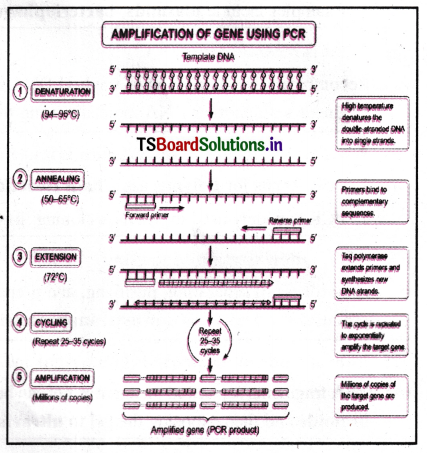
Give brief account of amplification of gene of interest using PCR.
Answer:
- PCR stands for Polymerase Chain Reaction.
- It is a technique used to produce a large number of copies of a desired DNA segment in vitro.
- The process requires two sets of primers (short synthetic oligonucleotides complementary to specific regions of DNA), DNA polymerase enzyme, free nucleotides, and template DNA.
- During PCR, primers bind to the target DNA sequence, and DNA polymerase synthesizes new DNA strands using the available nucleotides and the original DNA as a template.
- Repeated cycles of DNA replication result in exponential amplification of the target DNA. After several cycles, millions to billions of copies of the desired DNA fragment can be produced.
- This amplification is made possible by the use ofa thermostable DNA polymerase, such as Taq polymerase, isolated from the bacterium Thermus aquaticus. This enzyme remains active even at the high temperatures required during the process.
- The amplified DNA fragment can then be inserted into a suitable vector for cloning or used for various molecular biology applications.
- PCR-based gene amplification is also widely used in DNA fingerprinting, where DNA fragment patterns are analyzed for identification purposes.
Question 2.
What is a bioreactor? Describe briefly the stirring type of bioreactor?
Answer:
- Bioreactors are large vessels, generally having a capacity of 100-1000 litres, used for carrying out biological processes on a large scale.
- In these vessels, raw materials are converted into used products such as enzymes, antibiotics, vaccines, and other biomolecules with the help of microorganisms, plant cells or animal cells.
- A bioreactor provides ideal conditions required for maximum product formation, such as optimum temperature, pH, substrate concentration, salts, vitamins, and oxygen supply.
- The stirred-tank bioreactor is usually cylindrical in shape and is designed to ensure proper mixing of the contents.
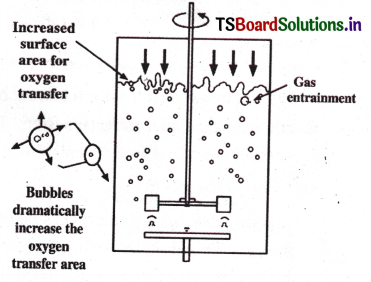
- Continuous stirring helps in uniform distribution of nutrients and efficient oxygen supply throughout the culture medium.
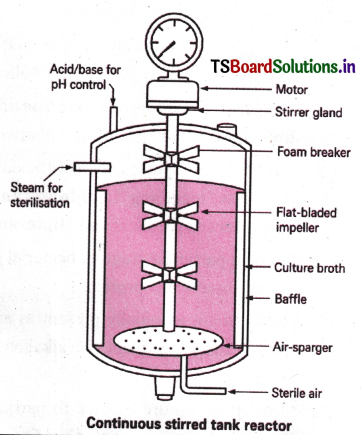
6. A stirred-tank bioreactor generally consists of:
- Agitator (stirring) system
- Oxygen delivery system
- Foam control system
- Temperature regulation system
- pH monitoring and control system
- Sampling outlet for withdrawing small quantities of culture at regular intervals.
Question 3.
Discuss different methods of insertion of recombinant DNA into the Host cell?
Answer:
1. Introduction through competent cells: Recombinant DNA can be introduced into competent bacterial cells by keeping them on ice, exposing them briefly to 42°C (heat shock), and then returning them to ice. This facilitates uptake of recombinant DNA.
2. Microinjection Method: In this method, recombinant DNA is directly injected into the nucleus of an animal cell using fine microscopic needles called microneedles.
3. Gene Gun (Biolistic) Method: This technique is mainly used for plant cells. Tiny particles of gold or tungsten coated with DNA are fired into cells at high velocity to deliver the recombinant DNA.
4. Vector-Mediated Transfer: Disarmed pathogens are used as vectors. When these vectors infect host cells, they transfer the recombinant DNA into the host cell where it can be expressed.
Question 4.
Write a short note on Bt cotton. [Ap MAR – 25]
Answer:
- Bt cotton is a genetically modified (GM) cotton variety developed to provide protection against insect pests, particularly bollworms.
- It is produced by introducing specific genes obtained from the bacterium Bacillus thuringiensis (Bt) into cotton plants.
- This bacterium synthesizes insecticidal proteins that are effective against several groups of insects, including Lepidopterans (tobacco budworm, bollworm, armyworm), Coleopterans (beetles) and Dipterans (flies and mosquitoes).
- During a particular stage of bacterial growth, Bt produces protein crystals that contain a toxic insecticidal protein.
- The Bt toxin is initially present in an inactive form known as a protoxin. When an insect feeds on the plant, the alkaline pH of its gut converts the protoxin into an active toxin.
- Most Bt toxins are specific to particular insect groups. These toxins are encoded by Cry genes. For example, Cry IAc and Cry IIAb provide resistance against cotton bollworm, while Cry IAb is effective against corn borer.
Question 5.
Explain the process of RNA interference.
Answer:
RNA interference (RNAi) is a natural biological mechanism in eukaryotic organisms that functions as a cellular defence system. It suppresses the expression of a specific gene by preventing the corresponding mRNA from producing a protein.
Steps involved :
- Entry of dsRNA: The process begins when double-stranded RNA (dsRNA) enters the cell. This dsRNA is complementary to the target mRNA and may originate from viruses, transposons or experimental introduction.
- Formation of complementary RNA strands: In biotechnology, genes are introduced in such a way that both sense RNA and antisense RNA are produced. These complementary strands pair with each other to form dsRNA.
- Activation of the RNAi pathway: The dsRNA activates the RNA interference machinery, which cuts the dsRNA into small RNA fragments. These fragments help identify and target the matching mRNA molecule.
- Silencing of mRNA: The target mRNA is cleaved or degraded, preventing it from being translated into a protein.
- Protection of the host organism: Since the harmful protein is not produced, disease- causing organisms such as the nematode Meloidogyne incognita are unable to survive effectively. This protects the host plant from infection and damage.
VI. Long Answer Questions
Question 1.
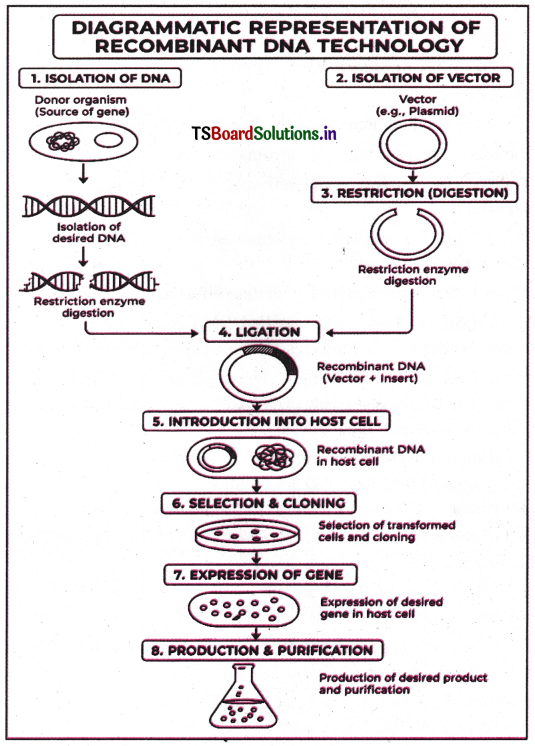
Explain briefly the various processes of Recombinant DNA Technology. [AP MAR-16,17,24,25]
Answer:
Steps involved in Recombinant DNA Technology :
1. Isolation of DNA:
- DNA serves as the hereditary material in living organisms.
- It is enclosed within the cell and surrounded by various cellular components.
- Cell walls are broken down using enzymes such as lysozyme and cellulase to release cellular contents.
- Membranes, proteins, and RNA are removed with the help of detergents and enzymes like ribonuclease.
- Pure DNA is finally precipitated by adding ethanol.
2. Fragmentation of DNA: The purified DNA is cut into smaller fragments using restriction enzymes. This produces DNA pieces of different lengths.
3. Isolation of Desired DNA Fragment: The required DNA fragments are separated using agarose gel electrophoresis. Since DNA carries a negative charge, it migrates through the gel, and the desired fragment is recovered from the gel.
4. Amplification of the Desired Gene by PCR: In Polymerase Chain Reaction (PCR), numerous copies of the selected DNA fragment are produced in vitro using primers and DNA polymerase. Repeated cycles generate millions to billions of copies.
5. Ligation of the DNA Fragment into a Vector: This step requires both a vector DNA and the desired DNA fragment.
- The vector and source DNA are cut using the same restriction enzyme to generate compatible sticky ends.
- The desired gene is then joined to the vector with the help of DNA ligase, resulting in the formation of recombinant DNA
6. Introduction of rDNA into the Host Cell: Recombinant DNA can be introduced into host cells through different methods.
- Host cells can be made competent and exposed to recombinant DNA under suitable conditions to facilitate uptake.
- In microinjection, recombinant DNA is directly injected into the nucleus of an animal cell.
- In the gene gun (biolistic) method, DNA-coated gold or tungsten particles are fired into plant cells.
7. Production of the Desired Gene Product: Once recombinant DNA enters a cloning vector and host cell, the foreign DNA replicates and expresses itself, producing the required product.
8. Downstream Processing: After biosynthesis is complete, the product undergoes processing before commercial use. This includes separation, purification, and formulation of the final product.
Question 2.
Give a brief account of the tools of Recombinant DNA Technology.
Answer:
Tools of Recombinant DNA Technology: The major tools used in recombinant DNA technology are:
1. Restriction Enzymes
2. Polymerase Enzymes
3. Ligases
4. Vectors
5. Host Organisms
- Restriction Enzymes: Restriction enzymes belong to a broader group of enzymes called nucleases.
- Exonucleases: These enzymes remove nucleotides sequentially from the ends of DNA molecules.
- Endonucleases: These enzymes cleave DNA at specific internal recognition sites. Each restriction endonuclease identifies a particular palindromic sequence.
Example: EcoRI recognizes the sequence 51 GAATTC 3′ and cuts between G and A.
5′ G A A T T C 3′
3′ C T T A A G 5′
2. Polymerase Enzymes:
- DNA polymerase is used in PCR to synthesize multiple copies of a target DNA sequence.
- Through repeated cycles, a very large number of DNA copies can be produced.
- Amplification is carried out using Taq polymerase, which remains active even at high temperatures.
- The amplified DNA fragment can subsequently be inserted into a vector for cloning.
3. Ligases :
- DNA ligase joins the ends of vector DNA and the desired DNA fragment through covalent bonds.
- This results in the formation of a circular recombinant DNA molecule.
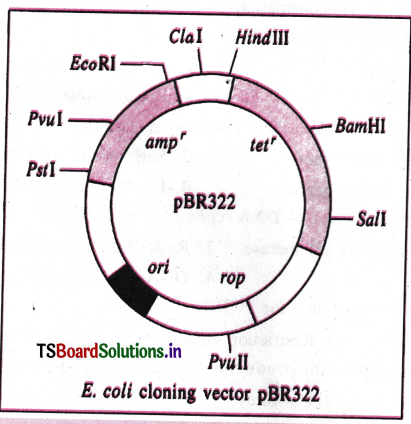
4. Vectors: Vectors are DNA molecules that carry foreign DNA into a suitable host cell.
- Function: They help in the multiplication and maintenance of foreign DNA.
- Examples: Plasmids, Bacteriophages, Cosmids
Properties of Cloning Vectors:
- They should possess a relatively low molecular weight.
- They must contain one or more unique restriction sites.
- They should be capable of autonomous replication inside the host cell.
- They should possess a selectable marker for identifying transformed cells.
5. Host Organisms: A suitable and competent host organism is essential for the successful introduction, replication, and expression of recombinant DNA.
I. Multiple Choice Questions
Question 1.
Being a negatively charged molecule, DNA in Electrophoresis moves towards
1. Anode
2. Cathode
3. Equator
4. None of the above
Answer:
1. Anode
Question 2.
Which of the following are used in gene cloning?
1. Ribosomes
2. Plasmids
3. Mesosomes
4. Histones
Answer:
2. Plasmids
Question 3.
What is the function of restriction enzymes? ‘
1. Restrict the elongation of DNA
2. Amplify the DNA molecules
3. Cut the DNA at specific locations
4. Separate the DNA fragments based on length
Answer:
3. Cut the DNA at specific locations
Question 4.
Agarose extracted from the seaweeds is used in
1. Downstream Processing
2. DNA Isolation
3. PCR
4. Electrophoresis
Answer:
4. Electrophoresis
Question 5.
Which of following bacterium is used for production of transgenic plants
1. Agrobacterium
2. Staphylococcus
3. Pseudomonas
4. Thiobacillus
Answer:
1. Agrobacterium
Question 6.
In genetic engineering, antibiotic resistance gene is used as
1. PCR
2. Selectable marker
3. Replicator
4. Vector
Answer:
2. Selectable marker
Question 7.
The technique of producing large number of plants in a very short time is known as
1. Gene transfer
2. Conventional bree
3. Micropropagation
4. Somatic Hybridisation
Answer:
3. Micropropagation
Question 8.
Somatic hybrids are formed by
1. Meristem Culture
2. RNA interference
3. Microinjection
4. Protoplast fusion
Answer:
4. Protoplast fusion
Question 9.
Which part of the plant is grown in vitro to obtain virus-free plants
1. Meristem
2. Ovule
3. Anther
4. Leaf
Answer:
1. Meristem
Question 10.
Meloidogyne incognita, which infects the roots of a tobacco plant, is a
1. Bacterium
2. Virus
3. Algae
4. Nematode
Answer:
4. Nematode
II. Fill in the Blanks
1. Large volume of culture can be processed by using ………………………. .
Answer:
Bioreactors.
2. Genes are located on long molecules ……………………….. of intertwined with histone proteins.
Answer:
DNA
3. ……………………., in animal cells have the ability to transform normal cells into cancerous cells.
Answer:
Retrovirus
4. The separated bands of DNA are cut out from the agarose gel and extracted from gel piece. This step is known as …………………………………. .
Answer:
Elution.
5. Restriction enzymes belong to a larger class of enzymes called ……………………… .
Answer:
Nucleases.
6. Inactive Bt toxin is converted into an active form due to the ……………………… pH of the insect’s gut.
Answer:
Alkaline.
7. Cells in continuous culture system are maintained in ………………………… phase of growth.
Answer:
Log / Exponential
8. Golden rice is a genetically modified crop enriched with ………………………………….. .
Answer:
Vitamin A
9. The inherent capacity of a plant cell to produce a whole plant is known as ………………………. .
Answer:
Totipotency.
III. One Word Answer Questions
Question 1.
After 10 PCR cycles, how many DNA molecules are formed from one DNA molecule?
Answer:
1024
Question 2.
In plants, which enzyme is used to dissolve cell wall during DNA isolation?
Answer:
Cellulase
Question 3.
Agarose is a natural polymer and is extracted from? ,
Answer:
Seaweeds
Question 4.
What do you call a group of letters that form the same word when read in both forward and backward directions?
Answer:
Palindromic sequence
Question 5.
Which enzyme is commonly used-to join DNA fragments?
Answer:
DNA ligase
Question 6.
Name the plasmid extracted from Agrobacterium and used to deliver the gene of interest into a variety of dicot plants?
Answer:
Ti Plasmid
Question 7.
Which sequence is responsible for controlling the copy number of the linked DNA?
Answer:
Origin of Replication (Ori)
Question 8.
Any part of the plant used to culture in vitro to obtain plantlets is known as?
Answer:
Explant
Question 9.
What do you call the plants that are genetically identical to the original plant from which they were grown?
Answer:
Somaclones
Objective Questions
Question 1.
Restriction enzymes are commonly referred to as
1. Antibiotics
2. Chromosomes
3. Restriction enzymes
4. Genes
Answer:
3. Restriction enzymes
Question 2.
The carrier used to introduce foreign DNA into a host organism is
1. r-DNA
2. Messenger RNA
3. Plasmid
4. Chromosome
Answer:
3. Plasmid
Question 3.
Which enzymes cut DNA strands at specific recognition sites?
1. Ligases
2. Exonucleases
3. Endonucleases
4. Polymerases
Answer:
2. Exonucleases
Question 4.
A palindromic sequence in DNA
1. Serves as the recognition site for restriction enzymes
2. Functions as a plasmid
3. Acts as a vector
4. Represents the origin of replication
Answer:
1. Serves as the recognition site for restriction enzymes
Question 5.
Polymerase Chain Reaction (PCR) is mainly employed for
1. DNA precipitation
2. Gene amplification
3. Cutting DNA with restriction enzymes
4. Isolation of a desired gene
Answer:
2. Gene amplification
Question 6.
In the naming of restriction enzymes, the first letter denotes
1. Species
2. Order of isolation
3. Name of the strain
4. Genus
Answer:
4. Genus
Question 7.
Which of the following represents recombinant (chimeric) DNA?
1. Plasmid DNA
2. rDNA
3. Gene of interest after cutting
4. Primer
Answer:
2. rDNA
Question 8.
Which technique is extensively used in DNA fingerprinting?
1. Restriction digestion
2. Isolation of desired genes
3. Gene amplification
4. Extraction of DNA from agarose gel
Answer:
3. Gene amplification
Question 9.
Introduction of a DNA fragment into a bacterial host cell is known as
1. Translation
2. Transformation
3. Transcription
4. Transduction
Answer:
2. Transformation
Question 10.
DNA fragments stained after electrophoresis appear as
1. Fine crystal clusters
2. Thread-like structures
3. Bright violet bands
4. Bright orange bands
Answer:
4. Bright orange bands
Question 11.
The initial step in recombinant DNA technology is
1. Insertion of gene into vector
2. Selection of transformed cells
3. Isolation of the desired gene
4. Ligation of gene with vector
Answer:
3. Isolation of the desired gene
Question 12.
The major enzyme involved in DNA replication in E. coli is
1. DNA-dependent DNA polymerase
2. Restriction endonuclease
3. Ligase
4. DNA-dependent RNA polymerase
Answer:
1. DNA-dependent DNA polymerase
Question 13.
The chief enzyme responsible for PCR is
1. DNA ligase
2. Restriction enzyme
3. Taq polymerase
4. Hydrolase
Answer:
3. Taq polymerase
Question 14.
A commonly used vector for producing transgenic organisms is
1. Ti plasmid
2. Cos sites
3. pBR322
4. Coliphage lambda
Answer:
1. Ti plasmid
Question 15.
pUC101 belongs to the category of
1. Virus
2. Mutagen
3. Plasmid
4. Cosmid
Answer:
3. Plasmid
Question 16.
The first recombinant DNA molecule was constructed using the plasmid of
1. E. coli
2. Bacillus thuringiensis
3. Yeast
4. Salmonella typhimurium
Answer:
4. Salmonella typhimurium
Question 17.
Which among the following are known as molecular scissors?
1. Hind III
2. Bam I
3. EcoRI
4. All of these
Answer:
4. All of these
Question 18.
A labelled nucleic acid fragment used to detect a specific gene is called
1. DNA probe
2. Plasmid DNA
3. T-DNA
4. cDNA
Answer:
1. DNA probe
Question 19.
The enzyme that cuts host DNA during the restriction-modification system in E. coli is
1. Restriction exonuclease
2. Plasmid
3. Restriction endonuclease
4. Type III restriction enzyme
Answer:
3. Restriction endonuclease
Question 20.
EcoRI digestion produces the sticky end sequence
1. AATTC
2. TTAA
3. GAATTC
4. CTTAA
Answer:
2. TTAA
Question 21.
Which gene transfer method is most suitable for animal cells?
1. Gene gun method
2. Calcium-mediated uptake
3. Microinjection
4. Electroporation
Answer:
3. Microinjection
Question 22.
The ‘rop’ gene present in plasmids is associated with
1. Cloning site
2. Replication site
3. Selectable marker
4. Proteins involved in replication
Answer:
4. Proteins involved in replication
Question 23.
A nucleic acid probe tagged with a radioactive molecule can be
1. Double-stranded DNA only
2. Single-stranded RNA only
3. Single-stranded DNA only
4. Both single-stranded DNA and RNA
Answer:
4. Both single-stranded DNA and RNA
Question 24.
Which of the following is NOT required for PCR?
1. DNA template
2. Helicase enzyme
3. Oligonucleotide primer
4. Taq polymerase
Answer:
2. Helicase enzyme
Question 25.
The matrix most commonly employed in gel electrophoresis is
1. Ethidium bromide
2. Sulphite bromide
3. Agarose
4. Sulphate bromide
Answer:
3. Agarose
Question 26.
Which of the following can serve as the recognition site for EcoRI?
1. AATCT
2. GAATTC
3. ATCATC
4. ATGCAT
Answer:
2. GAATTC
Question 27.
After six PCR cycles, the number of DNA molecules produced is
1. 64
2. 16
3. 4
4. 32
Answer:
1. 64
Question 28.
If foreign DNA is inserted into the Sail site of pBR322, transformants can grow on
1. Ampicillin
2. Both antibiotics
3. Tetracycline
4. None
Answer:
1. Ampicillin
Question 29.
Which vector is commonly used to transfer genes into animal cells?
1. Ti plasmid
2.E. coli
3. Retroviruses
4. Disarmed retroviruses
Answer:
4. Disarmed retroviruses
Question 30.
The ratio of triple hydrogen-bonded to double hydrogen-bonded base pairs in an EcoRI recognition site is
1. 2: 1
2. 1: 2
3. 3: 2
4. 3: 4
Answer:
2. 1: 2
Question 31.
The Ti plasmid used for developing transgenic plants is obtained from
1. Rhizobium
2. Yeast plasmid
3. Agrobacterium
4. Azotobacter
Answer:
3. Agrobacterium
Question 32.
Identify the incorrectly matched pair
1. Restriction endonuclease – PstI
2. Retroviruses – T-DNA
3. Recognition sequence of EcoRI – 5′ GAATTC 3′
4. Plasmid – Ringlet of DNA
Answer:
2. Retroviruses – T-DNA
Question 33.
The thermostable DNA polymerase used in PCR is isolated from
1. Beggiatoa
2. Thiobacillus
3. Thermus aquaticus
4. Thermobacter
Answer:
3. Thermus aquaticus
Question 34.
Gene amplification using primers is carried out by
1. ELISA
2. Polymerase Chain Reaction
3. Gene gun
4. Microinjection
Answer:
2. Polymerase Chain Reaction
Question 35.
An antibiotic resistance gene in a vector is mainly used for selecting
1. Recombinant cells
2. Transformed cells
3. Competent cells
4. None of these
Answer:
2. Transformed cells
Question 36.
Gene-specific probes are employed in
1. Colony isolation
2. Colony identification
3. Colony hybridization
4. Colony hybridization
Answer:
3. Colony hybridization
Question 37.
DNA fragments generated by the same restriction enzyme can be joined together using
1. DNA polymerase
2. Restriction enzyme
3. DNA ligase
4. E. coli
Answer:
3. DNA ligase
Question 38.
If nitrogen bases are randomly distributed, the minimum number of nucleotides required for the sequence GAATTC to appear once is
1. 256
2. 512
3. 1024
4. 4096
Answer:
2. 512
Question 39.
The most essential feature of a plasmid is
1. Selectable marker
2. Restriction sites
3. Origin of replication (ori)
4. All of these
Answer:
3. Origin of replication (ori)
Question 40.
In genetic engineering, antibiotics are mainly used as
1. Selectable markers
2. Sources of replication
3. Culture-protecting agents
4. Healthy vector selectors
Answer:
1. Selectable markers
Question 41.
PCR primarily functions in
1. Translation
2. DNA amplification
3. Transduction
4. None of these
Answer:
2. DNA amplification
Question 42.
While cutting DNA, molecular scissors cleave
1. Phosphodiester bonds only
2. Hydrogen bonds only
3. Both phosphodiester and hydrogen bonds
4. Hydrogen and peptide bonds
Answer:
3. Both phosphodiester and hydrogen bonds
43. Agarose gel is
1. A natural polymer obtained from seaweeds
2. A natural polymer from fungi
3. A synthetic polymer from red algae
4. An artificial polymer
Answer:
1. A natural polymer obtained from seaweeds
Question 44.
Which primers are used to initiate PCR?
1. RNA primers
2. DNA primers
3. Both DNA and RNA primers
4. None of these
Answer:
1. RNA primers
Question 45.
The ori sequence in a plasmid refers to
1. The site from which replication begins
2. A sequence controlling copy number
3. A restriction site
4. Both (1) and (2)
Answer:
4. Both (1) and (2)