
Referring to the AP Inter 1st Year Maths Study Material Chapter 9 Straight Lines Exercise 9c Solutions makes it easier to understand complex problems.
AP Inter 1st Year Maths Straight Lines Solutions Exercise 9c
I.
Question 1.
Reduce the following equations into slope – intercept form and find their slopes and the y-intercepts.
i) x + 7y = 0
Solution:
The given equation is x + 7y = 0. It can be written as y = –\(\frac{1}{7}\)x + 0
Which is in slope-intercept form, where m = –\(\frac{1}{7}\) and c = 0.
ii) 6x + 3y – 5 = 0
Solution:
The given equation is 6x + 3y – 5 = 0. It can be written as y = \(\frac{1}{3}\)(-6x + 5)
y = -2x + \(\frac{5}{3}\)
Which is in slope-intercept form, where m = – 2 and c = \(\frac{5}{3}\).
iii) y = 0
Solution:
The given equation is y = 0.
It can be written as y = 0 . x + 0
Which is in slope-intercept form, where m = 0 and c = 0.
Question 2.
Reduce the following equations into intercept form and find their intercepts on the axes.
(i) 3x + 2y – 12 = 0
Solution:
The equation of a straight line in intercept form is \(\frac{x}{a}+\frac{y}{b}\) = 1.
i) The given equation is 3x + 2y – 12 = 0.
It can be written as 3x + 2y = 12 ⇒ \(\frac{3 x}{12}+\frac{2 y}{12}\) = 1 ⇒ \(\frac{x}{4}+\frac{y}{6}\) = 1.
Which is in intercept form, where x-intercept = a = 4, y-intercept = b = 6.
ii) 4x – 3y = 6
Solution:
The given equation is 4x – 3y = 6.
It can be written as \(\frac{4 x}{6}-\frac{3 y}{6}\) = 1
⇒ \(\frac{2 x}{3}-\frac{y}{2}\) = 1
⇒ \(\frac{x}{\left(\frac{3}{2}\right)}+\frac{y}{(-2)}\) = 1
Which is in intercept form, where x-intercept = a = 3/2, y-intercept = b = -2.
iii) 3y + 2 = 0
Solution:
The given equation is 3y + 2 = 0. It can be written as 3y = – 2 ⇒ \(\frac{y}{\left(\frac{-2}{3}\right)}\) = 1
Which is in intercept form, where the intercept on the Y-axis is \(\frac{-2}{3}\) and it has no intercept on the X-axis.
Question 3.
Find the distance of the point (-1, 1) from the line 12(x + 6) = 5(y – 2)
Solution:
The given equation of the line is 12(x + 6) = 5(y – 2)
⇒ 12x + 72 = 5y – 10 ⇒ 12x— 5y + 82 = 0 ………. (1)
On comparing equation (1) with Ax + By + C = O, we have A = 12, B = -5 and C = 82.
The perpendicular distance (d) of a line Ax + By + C = O from a point (x1, y1) is
d = \(\frac{\left|\mathrm{Ax}_1+\mathrm{By}_1+\mathrm{C}\right|}{\sqrt{\mathrm{A}^2+\mathrm{B}^2}}\)
The given point (x1, y1) = (-1, 1)
Therefore, the distance of point (-1, 1) from the given line
= \(\frac{|12(-1)+(-5)(1)+82|}{\sqrt{(12)^2+(-5)^2}}=\frac{|-12-5+82|}{\sqrt{169}}=\frac{|65|}{13}\) = 5 units
Question 4.
Find the points on the X-axis, whose distances from the line \(\frac{x}{3}+\frac{y}{4}\) = 1 are 4 units.
Solution:
The given equation of the line is \(\frac{x}{3}+\frac{y}{4}\) = 1 ⇒ 4x + 3y – 12 = 0 ………. (1)
On comparing equation (1) with Ax + By + C = 0, we have A = 4, B = 3 and C = -12
Let (a, 0) be the point on the X-axis whose distance from the given line is 4 units. It is known that the perpendicular distance (d) of a line Ax + By + C = 0 from a point (x1, y1) is d = \(\frac{\left|\mathrm{Ax}_1+\mathrm{By}_1+\mathrm{C}\right|}{\sqrt{\mathrm{A}^2+\mathrm{B}^2}}\)
Substitute the values of A, B, C in the above equation.
Therefore, 4 = \(\frac{|4 a+3 \times 0-12|}{\sqrt{4^2+3^2}}\)
⇒ 4 = \(\frac{|4 a-12|}{5}\)
⇒ |4a – 12| = 20
⇒ ±(4a – 12) = 20
⇒ 4a-12 = 20 (or) -(4a – 12) = 20
⇒ 4a = 32 (or)
⇒ 4a = 12 – 20 = -8
⇒ a = 8 (or)
⇒ a = – 2
Thus the required points on the X-axis are (-2, 0) and (8, 0).

Question 5.
Find the distance between parallel lines
(i) 15x + 8y – 34 = 0 and 15x + 8y + 31 = 0
(ii) I(x + y) + p = 0 and I(x + y) – r = 0
Solution:
The distance (d) between the parallel lines Ax + By + C1 = 0 and Ax + By + C2 = 0 is d = \(\frac{\left|\mathrm{C}_1-\mathrm{C}_2\right|}{\sqrt{\mathrm{A}^2+\mathrm{B}^2}}\)
i) The given parallel lines are 15x + 8y – 34 = 0 and 15x + 8y + 31 = 0
Here A = 15, B = 8, C1 = – 34 and C2 = 31
Therefore, the distance between the parallel lines is
d = \(\frac{\left|C_1-C_2\right|}{\sqrt{A^2+B^2}}=\frac{|-34-31|}{\sqrt{(15)^2+8^2}}=\frac{|-65|}{\sqrt{289}}=\frac{65}{17}\) units
ii) The given parallel lines are l (x + y) + p = 0 and l (x + y) – r = 0
⇒ lx + ly + p = 0 and lx + ly – r = 0
⇒ Here, A = l, B = l, C1 = p and C2 = – r
Therefore the distance between the parallel lines is
d = \(\frac{\left|\mathrm{C}_1-\mathrm{C}_2\right|}{\sqrt{\mathrm{A}^2+units\mathrm{B}^2}}=\frac{|\mathrm{p}+\mathrm{r}|}{\sqrt{l^2+l^2}}=\frac{|\mathrm{p}+\mathrm{r}|}{\sqrt{2 l^2}}=\frac{1}{\sqrt{2}}\left|\frac{\mathrm{p}+\mathrm{r}}{l}\right|\)
Question 6.
Find the equation of the line parallel to the line 3x – 4y + 2 = 0 and passing through the point (-2, 3).
Solution:
The equation of the given line is 3x – 4y + 2 = 0
Slope = \(\frac{-a}{b}=\frac{-3}{-4}=\frac{3}{4}\)
The equation of the line parallel to 3x – 4y + 2 = 0 and passing through (-2, 3) is 3
(y – 3) = \(\frac{3}{4}\) (x – (- 2))
⇒ 4y – 12 = 3x + 6
⇒ 3x – 4y + 18 = 0.
Question 7.
Find the equation of the line perpendicular to the line x – 7y + 5 = 0 and having x-intercept 3.
Solution:
The given equation of the line is x – 7y + 5 = 0 ⇒ y = \(\frac{1}{7}\) x + \(\frac{5}{7}\)
This is of the form y = mx + c ⇒ Slope of the given line =
The slope of the line perpendicular to the given line is M = \(-\frac{1}{\left(\frac{1}{7}\right)}\) = -7
The equation of the line with slope -7 and x-intercept 3 is y = M(x – a)
⇒ y = -7(x – 3)
⇒ 7x + y = 21
Question 8.
Find the angles between the lines √3x + y = 1 and x + √3y = 1
Solution:
The given lines are √3x + y = 1 and x + √3y = 1
y = -√3x + 1 (1)
and y = –\(\frac{1}{\sqrt{3}}\)x + \(\frac{1}{\sqrt{3}}\) …. (2)
The slope of line (1} is m1 = -√3 , while the slope of line (2) is m2 = \(-\frac{1}{\sqrt{3}}\).
The acute angle θ between the two lines is tan θ = \(\left|\frac{\mathrm{m}_1-\mathrm{m}_2}{1+\mathrm{m}_1 \mathrm{~m}_2}\right|\)
⇒ tan θ = \(\left|\frac{-\sqrt{3}+\frac{1}{\sqrt{3}}}{1+(-\sqrt{3})\left(-\frac{1}{\sqrt{3}}\right)}\right|\)
⇒ tan θ = \(\frac{\frac{-3+1}{\sqrt{3}}}{1+1}\)
⇒ tan θ = \(\left|\frac{-2}{2 \times \sqrt{3}}\right|\)
θ = 30°
Thus, the angle between the given lines is either 30° or 180° – 30° = 150°
Question 9.
The line through the points (h, 3) and (4, 1) intersects the line 7x – 9y – 19 = 0 at right angle. Find the value of h.
Solution:
The slope of the line passing through the points (h, 3) and (4,1) is m1 = \(\frac{1-3}{4-h}=\frac{-2}{4-h}\)
Equation of the given line is 7x – 9y – 19 = 0 ⇒ y = \(\frac{7}{9}\)x – \(\frac{19}{9}\)
Slope of given line m2 = \(\frac{7}{9}\)
It is given that the two lines are perpendicular m1 × m2 = -1
⇒ \(\left(\frac{-2}{4-h}\right) \times\left(\frac{7}{9}\right)\) = -1
⇒ \(\frac{-14}{36-9 h}\) = -1
⇒ 14 = 36 – 9h
⇒ 9h = 36 – 14
⇒ h = \(\frac{22}{9}\)
∴ h = \(\frac{22}{9}\)
Question 10.
Find the ratio In which straight line 3x + 4y = 6 divIdes the line segment joining the points (2, -1) and (1, 1).
Solution:
Given points (x1 , y1) = (2, —1), (x2, y2) = (1, 1)
Equation of the given line is 3x + 4y = 6
Here, a = 3, b = 4, c = -6
\(\frac{l}{m}=\frac{-\left(\mathrm{ax}_1+\mathrm{by}_1+\mathrm{c}\right)}{\left(\mathrm{ax}_2+\mathrm{by}_2+\mathrm{c}\right)}\)
= \(\frac{-[3(2)+4(-1)+(-6)]}{[3(1)+4(1)+(-6)]}=\frac{-(6-4-6)}{3+4-6}=\frac{-(-4)}{1}=\frac{4}{1}\)
The ratio of the straight lines dividing the line segment joining given points is 4 :1 L1, L2 are of opposite signs.
∴ The given points lie on opposite sides of the line.
Question 11.
Find the point of Intersection of the lines 7x + y + 3 = 0, x + y = 0.
Solution:
L1 = 7x + y + 3 = 0, L2 = x + y = 0, a1 = 7, b1 = 1, c2 = 3 and a2 = 1, b2 = 1, c2 = 0
Point of intersection of the lines L1 and L2 is \(\left[\frac{b_1 c_2-b_2 c_1}{a_1 b_2-a_2 b_1}, \frac{c_1 a_2-c_2 a_1}{a_1 b_2-a_2 b_1}\right]\)
= \(\left[\frac{1(0)-(1)(3)}{7(1)-1(1)}, \frac{(3)(1)-0(7)}{7(1)-1(1)}\right]=\left[\frac{0-3}{7-1}, \frac{3-0}{7-1}\right]\)
= \(\left[\frac{-3}{6}, \frac{3}{6}\right]=\left(\frac{-1}{2}, \frac{1}{2}\right)\)
Question 12.
Show that the straight lines (a – b)x + (b – c)y = c – a, (b – c)x + (c – a)y = a – b and (c – a) z + (a – b) y = b – c are concurrent.
Solution:
Given equation is of the lines are (a – b)x + (b – c)y = c – a ………… (1)
(b – c)x + (c – a)y = a – b ………… (2)
(c – a) z + (a – b) y = b – c ………… (3)
From (1) and (2)
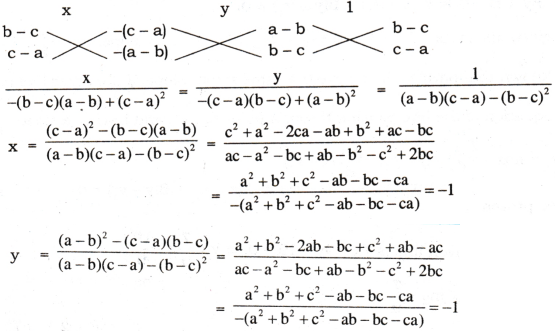
Point of intersection of equations (1) and (2) is P(-1, -1)
Substitute the value of P in equation (3),
LHS = (c – a) (-1) + (a – b) (-1) = -c + a – a + b = b – c = RHS
∴ P (-1, -1) is a point on the equation (3). So, the given lines are concurrent.
Question 13.
Find the value of p, if the straight lines x + p = 0, y + 2 = 0 and 3x + 2y + 5 = 0 are concurrent.
Solution:
Equation of the given straight lines are, x + p = 0 (1); y + 2 = 0 …………(2)
and 3x + 2y + 5 = 0 …………(3)
From (2), y = -2
Substitute ‘y’ value in the equation (3)
⇒ 3x – 4 + 5 = 0
⇒ 3x = 4- 5 = -1
⇒ x = –\(\frac{1}{3}\)
Point of intersection of the straight lines (2) and (3) is P(-\(\frac{1}{3}\), -2)
The given lines are concurrent.
‘P’ is a point on x + p = 0
⇒ –\(\frac{1}{3}\) + p = 0
⇒ p = –\(\frac{1}{3}\)
Question 14.
Find the area of the triangle formed by the following straight lines and the coordinate axes,
i) x – 4y + 2 = 0,
ii) 3x – 4y + 12 = 0.
Solution:
i) Equation of the straight line AB is x – 4y + 2 = 0
⇒ -x + 4y = 2
⇒ \(\frac{x}{-2}+\frac{y}{\left(\frac{1}{2}\right)}\) = 1, a = 2, b = \(\frac{1}{2}\)
Area of the triangle OAB = \(\frac{1}{2}\)|ab| = \(\frac{1}{2}\)|-2 x \(\frac{1}{2}\)| = \(\frac{1}{2}\) sq. units.
ii) 3x – 4y + 12 = 0 is the equation of the straight line AB
⇒ -3x + 4y = 12
⇒ \(\frac{x}{-4}+\frac{y}{3}\) = 1, here a = – 4, b = 3.
Area of the triangle OAB = \(\frac{1}{2}\) |ab| = \(\frac{1}{2}\)(-4)(3)| = \(\frac{1}{2}\) (12) = 6 sq. units.
II.
Question 1.
Prove that the line through the point (x , yx) and parallel to the line Ax + By + C = 0 is A (x – x1) + B(y – y1) = 0.
Solution:
The given line is Ax + By + C = 0 ⇒ y = \(\left(\frac{-\mathrm{A}}{\mathrm{~B}}\right)\)x + \(\left(\frac{-\mathrm{C}}{\mathrm{~B}}\right)\)
⇒ slope, m = \(\frac{-\mathrm{A}}{\mathrm{~B}}\)
It is known that parallel lines have the same slope. Slope of the other line m = \(\frac{-\mathrm{A}}{\mathrm{~B}}\)
The equation of the line passing through point (x1, y1) and having a slope \(\frac{-\mathrm{A}}{\mathrm{~B}}\) is
y – y1 = m(x – x1)
⇒ (y – y1) = \(\frac{-\mathrm{A}}{\mathrm{~B}}\)(x – x1)
⇒ B(y – y1) = -A(x – x1)
⇒ A(x – x1) + B(y – y1) = 0
Hence Proved.
Question 2.
Two lines passing through the point (2, 3) intersects each other at an angle of 609. If slope of one line is 2, find equation of the other line.
Solution:
It is given that the slope of the first line, m1 = 2,
Let the slope of the other line be m2.
The angle between the two lines is 60°.
tan 60° = \(\left|\frac{\mathrm{m}_1-\mathrm{m}_2}{1+\mathrm{m}_1 \mathrm{~m}_2}\right|\)
⇒ √3 = \(\left|\frac{2-\mathrm{m}_2}{1+2 \mathrm{~m}_2}\right|\)
⇒ √3 = \(\pm\left(\frac{2-m_2}{1+2 m_2}\right)\)
⇒ √3 = \(\frac{1}{2}\)
⇒ √3(1 + 2m2) = 2 – m2
⇒ √3 + 2√3m1 + m2 + m2 = 2
⇒ m2 = \(\frac{2-\sqrt{3}}{(2 \sqrt{3}+1)}\)
(or)
√3 = –\(\frac{1}{2}\)
√3(1 + 2m2) = -(2 – m2)
√3 + 2√3m2 – m2 = -2
m2 = \(=\frac{-(2+\sqrt{3})}{(2 \sqrt{3}-1)}\)
Case I:
If m2 = \(\frac{2-\sqrt{3}}{(2 \sqrt{3}+1)}\)
The equation of the line passing through the point (2, 3) and having a slope of
\(\frac{2-\sqrt{3}}{(2 \sqrt{3}+1)}\) is (y – 3) = \(\frac{2-\sqrt{3}}{(2 \sqrt{3}+1)}\)(x – 2)
⇒ (2√3 + 1)(y – 3) = (2 – √3) (x – 2)
⇒ (√3 – 2) x +(2√3 + 1)y = -4 + 2√3 + 6√3 + 3
⇒ (√3 – 2)x + (2√3 + 1)y = -1 + 8√3
In this case, the equation of the other line is (√3 – 2) x + (2√3 + 1) y = -1 + 8√3
Case II :
If m2 = \(\frac{-(2+\sqrt{3})}{(2 \sqrt{3}-1)}\)
The equation of the line passing through (2, 3) and having slope \(\frac{-(2+\sqrt{3})}{(2 \sqrt{3}-1)}\) is
(y – 3) = \(\frac{-(2+\sqrt{3})}{(2 \sqrt{3}-1)}\) (x – 2)
⇒ (2√3 – 1)(y – 3) = -(2 + √3)(x – 2)
⇒ (√3 + 2)x + (2√3 – 1)y = 8√3 + 1
In this case equation of other line is (√3 + 2)x + (2√3 – 1)y = 8√3 + 1
Question 3.
Find the equation of the right bisector of the line segment joining the points (3, 4) and (-1, 2).
Solution:
The right bisector of a line segment bisects the lines segment at (3, 4) and (-1, 2)
The end points of the line segment are given as A(3, 4) and B(-1, 2)
Accordingly, mid pint of AB = \(\left(\frac{3-1}{2}, \frac{4+2}{2}\right)\) = (1, 3)
Slope of AB = \(\frac{2-4}{-1-3}=\frac{-2}{-4}=\frac{1}{2}\). Slope of the line perpendicular
to AB = \(-\frac{1}{\left(\frac{1}{2}\right)}\) = -2
The equation of the line passing through (1,3) and having a slope of – 2 is (y – 3) = – 2(x – 1)
⇒ y – 3 = -2x + 2
⇒ 2x + y = 5
Thus, the required equation of the line is 2x + y = 5.
Question 4.
Find the co-ordinates of the foot of the perpendicular from the point (-1, 3) to the line 3x – 4y – 16 = 0.
Solution:
Let (a, b) be the coordinates of the perpendicular from (-1, 3) to the line 3x – 4y – 16 = 0
Slope of the line joining (-1, 3) and (a, b), m1 = \(\frac{b-3}{a+1}\)
Slope of the line 3x – 4y – 16 = 0 is m2 = \(\frac{-3}{-4}=\frac{3}{4}\)
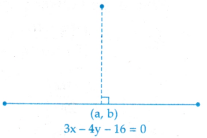
Since these two lines are perpendicular, m1 . m2 = -1
\(\left(\frac{b-3}{a+1}\right) \times\left(\frac{3}{4}\right)\) = -1
⇒ \(\frac{3 b-9}{4 a+4}\) = -1
⇒ 3b -9 = -4a – 4
⇒ 4a + 3b = 5 …………(1)
Point (a, b) lies on line 3x – 4y = 16, therefore 3a – 4b = 15 ……….(2)
On solving equations (1) and (2), we have a = \(\frac{68}{25}\) and b = \(-\frac{49}{25}\)
Thus, the required co-ordinates of the foot of the perpendicular are \(\left(\frac{68}{25}, \frac{-49}{25}\right)\)
Question 5.
The perpendicular from the origin to the line y = mx+c meets it at the point (-1, 2). Find the values of m and c.
Solution:
The given equation of the line is y = mx + c.
It is given that the perpendicular from the origin meets the given line at (-1, 2). Therefore, the line joining the points (0, 0) and (-1, 2) is perpendicular to the given line.
Slope of the line joining (0, 0) and (-1, 2) = \(\frac{2}{-1}\) = -2
The slope of the given line is m.
m × -2 = -1
⇒ m = \(\frac{1}{2}\) [∵ The two lines are perpendicular]
Since point (-1, 2) lies on the given line, it satisfies the equation y = mx + c
⇒ 2 = m(-1) + c
⇒ 2 = \(\frac{1}{2}\)(-1) + c
⇒ c = 2 + \(\frac{1}{2}\)
∴ m= \(\frac{1}{2}\) and c = \(\frac{5}{2}\).
Question 6.
If p and q are the lengths of perpendiculars from the origin to the lines x cos θ – y sin θ = k cos 2θ and x sec θ + y cosec θ = k, respectively, prove that p2 + 4q2 = k2.
Solution:
The equations of given lines are
x cos θ – y sin θ = k cos 20 ………….(1)
x sec θ + y cosec θ = k ……….(2)
The perpendicular distance (d) of a line Ax + By + C = 0 from a point (x1, y1) is
d =
On comparing equation (1) with Ax + By + C = 0, we have A = cos θ, B = – sin θ, and C = – k cos 2θ
It is given that ‘p’ is the length of the perpendicular from (0, 0) to line (1)
p = \(\left|\frac{\mathrm{A}(0)+\mathrm{B}(0)+\mathrm{C}}{\sqrt{\mathrm{~A}^2+\mathrm{B}^2}}\right|=\frac{|\mathrm{C}|}{\sqrt{\mathrm{A}^2+\mathrm{B}^2}}=\frac{|-\mathrm{k} \cos 2 \theta|}{\sqrt{\cos ^2 \theta+\sin ^2 \theta}}\) = |-k cos 2θ| …………..(3)
On comparing equation (2) with Ax + By + C = 0, we have A = sec θ, B = cosec θ, and C = -k
It is given that ‘q’ is the length of the perpendicular from (0, 0) to line (2)
q = \(\left|\frac{A(0)+B(0)+C}{\sqrt{A^2+B^2}}\right|=\frac{|C|}{\sqrt{A^2+B^2}}=\frac{|-k|}{\sqrt{\sec ^2 \theta+{cosec}^2 \theta}}\) ………. (4)
From (3) and (4) we have
p2 + 4q2 = (-k cos 2θ)2 + 4\(\left(\frac{|-\mathrm{k}|}{\sqrt{\sec ^2 \theta+{cosec}^2 \theta}}\right)^2\)
= k2 cos2 2θ + \(\frac{4 k^2}{\left(\frac{\sin ^2 \theta+\cos ^2 \theta}{\sin ^2 \theta \cdot \cos ^2 \theta}\right)}\) = k2 cos2 2θ + \(\frac{4 \mathrm{k}^2}{\left(\frac{1}{\cos ^2 \theta}+\frac{1}{\sin ^2 \theta}\right)}\)
= k2 cos2 2θ + \(\frac{4 \mathbf{k}^2}{\left(\frac{\sin ^2 \theta+\cos ^2 \theta}{\sin ^2 \theta \cdot \cos ^2 \theta}\right)}\)
= k2 cos2 2θ + \(\frac{4 k^2}{\left(\frac{1}{\sin ^2 \theta \cdot \cos ^2 \theta}\right)}\)
= k2 cos2 2θ + 4k2 sin2 θ.cos2 θ
= k2 cos2 2θ + k2(2 sin θ cos θ)2
= k2 cos2 2θ + k2 sin2 2θ
= k2 (cos2 2θ + sin2 2θ) = k2
Hence, we proved that p2 + 4q2 = k2
Question 7.
In the triangle ABC with vertices A(2, 3), B(4, -1) and C(1, 2), find the equation and length of altitude from the vertex A.
Solution:
Let AD be the attitude of triangle ABC from vertex A.
Slope of BC = \(\frac{2-(-1)}{1-4}=-\frac{3}{3}\) = -1
The equation of the line passing through point (2, 3) and having a slope of 1 is (y – 3) = 1(x – 2)
⇒ x – y + 1 = 0
⇒ y – x = 1
Therefore equation of the altitude from vertex A is y – x = 1.
Length of AD = Length of the perpendicular from A(2, 3) to BC.
The equation of BC is (y + 1) = (-1) (x – 4)
⇒ y + 1 = -x + 4
⇒ x + y – 3 = 0 …………. (2)
On comparing the above line with Ax + By + C = 0 we have A = 1, B = 1, and C = -3
Length of AD = \(\frac{|1 \times 2+1 \times 3-3|}{\sqrt{1^2+1^2}}=\frac{|2|}{\sqrt{2}}\) = √2 units
Thus, the equation and the length of the altitude from vertex A are y – x = 1 and 42 units respectively.
Question 8.
If p is the length of the perpendicular from the origin to the line whose intercepts on the axes are a and b, then show that \(\frac{1}{2}\).
Solution:
It is known that the equation of a line whose intercepts on the axes are a and b is
\(\frac{x}{a}+\frac{y}{b}\) = 1
⇒ bx + ay = ab
⇒ bx + ay – ab – 0 …………….(1)
The perpendicular distance (d) of a line Ax + By + C = 0 from a point (x1, y1) is d = \(\left|\frac{\mathrm{Ax}_1+\mathrm{By}_1+\mathrm{C}}{\sqrt{\mathrm{~A}^2+\mathrm{B}^2}}\right|\)
On comparing equation (1) with Ax + By + C = 0, we have A = b, B = a, and C = – ab Therefore, p is the length of the perpendicular from point (0, 0) to line (1), we have
p = \(\left|\frac{\mathrm{A}(0)+\mathrm{B}(0)+(-\mathrm{ab})}{\sqrt{\mathrm{b}^2+\mathrm{a}^2}}\right|=\frac{|-\mathrm{ab}|}{\sqrt{\mathrm{a}^2+\mathrm{b}^2}}\)
Squaring on both sides we have
p2 = \(\frac{(-a b)^2}{a^2+b^2}\)
⇒ p2(a2 + b2) = a2b2
⇒ \(\frac{a^2+b^2}{a^2 b^2}=\frac{1}{p^2}\)
⇒ \(\frac{1}{\mathrm{p}^2}=\frac{1}{\mathrm{a}^2}+\frac{1}{\mathrm{~b}^2}\)
Question 9.
A straight line meets the coordinate axes in A and B. Find the equation of the straight line, when
i) AB is divided in the ratio 2 : 3 at (-5, 2).
Solution:
Let a straight line AB meets the coordinate axes at A and B. Let OA = a and OB = b.
Co- ordinates of A are (a, 0) and co- ordinates of B are (0, b).
P divides AB in the ratio 2:3.
Co – ordinates of P are \(\left(\frac{3 \mathrm{a}}{5}, \frac{2 \mathrm{~b}}{5}\right)\) = (-5, 2)
\(\frac{3 a}{5}\) = -5 ⇒ a = \(-\frac{25}{3} ; \frac{2 b}{5}\) = 2 ⇒ b = 5
Equation of AB is \(\frac{x}{a}+\frac{y}{b}\) = 1
\(\frac{x}{\left(-\frac{25}{3}\right)}+\frac{y}{5}\) = 1
⇒ \(\frac{-3 x}{25}+\frac{y}{5}\) = 1
⇒ -3x + 5y = 25
⇒ 3x – 5y + 25 = 0
ii) AB is divided in the ratio 1 : 2 at (-5, 4).
Solution:
Let a straight line AB meets the coordinate axes at A and B.
Let OA = a and OB = b.
Co – ordinates of A are (a, 0) and co-ordinates of B are (0, b).
P divides AB in the ratio 1:2.
Co – ordinates of P are \(\left(\frac{2 \mathrm{a}}{3}, \frac{\mathrm{~b}}{3}\right)\) = (-5, 4) = \(\frac{2 a}{3}\) = -5
⇒ a = \(-\frac{15}{2} ; \frac{\mathrm{b}}{2}\) = 4
⇒ b = 12
Equation of AB is = \(\frac{x}{a}+\frac{y}{b}\) = 1
⇒ \(\frac{x}{\left(-\frac{15}{2}\right)}+\frac{y}{12}\) = 1
⇒ \(\frac{-2 x}{15}+\frac{y}{12}\) = 1
⇒ -8x + 5y = 60
⇒ 8x – 5y + 60 = 0
iii) (p, q) bisects AB
Solution:
Let OA = a and OB = b.
Co – ordinates of A are (a, 0) and co-ordinates of B are (0, b).
P bisects AB.
⇒ Mid-point of AB \(\left(\frac{\mathrm{a}}{2}, \frac{\mathrm{~b}}{2}\right)\) = (p, q)
Therefore, \(\frac{a}{2}\) = p
⇒ a = 2p, \(\frac{b}{2}\) = q
⇒ b = 2q
Equation of AB is \(\frac{x}{a}+\frac{y}{b}\) = 1
⇒ \(\frac{x}{2 p}+\frac{y}{2 q}\) = 1
⇒ \(\frac{x}{p}+\frac{y}{q}\) = 2
Question 10.
A triangle of area 24 sq. units is formed by a straight line and the coordinate axes in the first quadrant. Find the equation of the straight line, if it passes through (3, 4).
Solution:
Area of a triangle = 24 sq. units.
The line AB passes through the point P (3, 4).
Equation of AB in the intercept form is \(\frac{x}{a}+\frac{y}{b}\) = 1
⇒ \(\frac{3}{a}+\frac{4}{b}\) = 1
⇒ \(\frac{4}{b}\) = 1 – \(\frac{3}{a}=\frac{a-3}{a}\)
b = \(\frac{4 a}{a-3}\)
Area of ∆OAB = 24
⇒ \(\frac{1}{2}\)|ab| = 24
⇒ \(\frac{1}{2}\left|\frac{4 a^2}{a-3}\right|\) = 24
⇒ a2 = 12(a – 3)
⇒ a2 – 12a + 36 = 0
⇒ (a – 6)2 = 0
⇒ a = 6
Substitute the value of ‘a’ in b = \(\frac{4 a}{a-3}=\frac{24}{3}\) = 8
Equation of AB is \(\frac{x}{6}+\frac{y}{8}\) = 1
⇒ 4x + 3y = 24
⇒ 4x + 3y – 24 = 0
Question 11.
Find the set of values of ‘a’ if the points (1, 2) and (3, 4) lie to the same side of the straight line 3x – 5y + a = 0.
Solution:
Equation of the given line is 3x – 5y + a = 0
Let P (x1, y1) = (1, 2) and Q (x2, y2) = (3, 4)
L11 = 3(1) – 5(2) + a = a – 7,
L22 = 3(3) – 5(4) + a = a – 11
Since P and Q lie on same side a – 7 and a – 11 must both be positive or both be negative.
Let a – 7 > 0, a – 11 > 0 ⇒ a > 7 and a > 11 ⇒ a ∈ (11, ∞)
Let a – 7 < 0, a – 11 < 0 ⇒ a < 7, a < 11 ⇒ a ∈ (-∞, 7)
∴ a ∈ (-∞ , 7) ∪ (11, ∞)
Question 12.
Show that the lines 2x + y – 3 = 0, 3x + 2y – 2 = 0 and 2x – 3y – 23 = 0 are concurrent and find the point of concurrency.
Solution:
Equations of the given lines are 2x + y – 3 = 0 ………….(1)
3x + 2y – 2 = 0 ……… (2)
2x – 3y – 23 = 0 ……..(3)

\(\frac{x}{-2+6}=\frac{y}{-9+4}=\frac{1}{4-3}\)
⇒ x = 4, y = -5
Co – ordinates of P are (4, -5)
Substitute ‘P’ value in 2x – 3y – 23 = 2(4) – 3 (-5) – 23 = 8 + 15 – 23 = 0
P lies on (3). So, the given lines are concurrent. Point of concurrency is P (4, -5)
Question 13.
Find the value of p, if 3x + 4y = 5, 2x + 3y = 4, px + 4y = 6 are concurrent.
Solution:
Equations of the lines are 3x + 4y – 5 = 0 ………… (1)
2x + 3y – 4 = 0 ……………. (2)
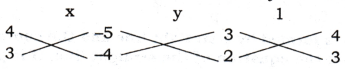
\(\frac{x}{-16+15}=\frac{y}{-10+12}=\frac{1}{9-8}\)
⇒ x = 4, y = 2
Point of intersection of (1) and (2) is P (-1, 2)
The given lines are concurrent. P lies on px + 4y = 6.
-p + 8 = 6 ⇒ p = 8 – 6 = 2.
Question 14.
If 3a + 2b + 4c = 0, then show that the equation ax + by + c = 0 represents a family of concurrent straight lines and find the point of concurrency.
Solution:
Given condition is 3a + 2b + 4c = 0
Divide the equation with 4 ⇒ \(\left(\frac{3}{4}\right)\)a + \(\left(\frac{1}{2}\right)\)b + c = 0
For all values of a, b the line ax + by + c = 0 passes through the point \(\left(\frac{3}{4}, \frac{1}{2}\right)\)
The equation ax + by + c = 0 represents a family of concurrent lines.
Point of concurrency is \(\left(\frac{3}{4}, \frac{1}{2}\right)\)
III.
Question 1.
Find the point on the straight line 3x + y + 4 = 0 which is equidistant from the points (-5, 6) and (3, 2).
Solution:
Points A (-5, 6) and B (3, 2). P(x1, y1) is the point on 3x + y + 4 = 0
3x1 + y2 + 4 = 0 …………. (1)
PA = PB => PA2 = PB2
⇒ (x1 + 5)2 + (y1 – 6)2 = (x2 – 3)2 + (y2 – 2)2
⇒ x1 + 10x1 + 25 + y1 – 12y1 + 36 = x1 – 6x1 + 9 + y1 – 4y1 + 4
16x1 – 8y1 + 48 = 0
⇒ 2x1 – y1 + 6 = 0 …….. (2)
Adding (1) and (2)
⇒ 5x1 + 10 = 0
⇒ x1 = -2
Substitute x1 value (1) -6 + y1 + 4 = 0
⇒ y1 = 6 – 4 = 2
∴ The required point P is (-2, 2)
Question 2.
A straight line through P(3, 4) makes an angle of 60° with the positive direction of the X -axis. Find the coordinates of the points on the line which are 5 units away from P.
Solution:
Let P(x1, y1) = (3, 4), θ = 60°.
Co-ordinates of any point on the line Q are (x1 + r cos θ, y1 + r sin θ)
θ = 60° ⇒ cos θ = cos 60° = \(\frac{1}{2}\) and sin θ = sin 60° = \(\frac{\sqrt{3}}{2}\)
Let r = 5
Co-ordinates of Q are [3 + 5(\(\frac{1}{2}\)), 4 + 5(\(\frac{\sqrt{3}}{2}\))] = \(\left(\frac{11}{2}, \frac{8+5 \sqrt{3}}{2}\right)\)
Let r = -5
Co-ordinates of Q are [3 – 5(\(\frac{1}{2}\)), 4 – 5(\(\frac{\sqrt{3}}{2}\))] = \(\left(\frac{1}{2}, \frac{8-5 \sqrt{3}}{2}\right)\)
Question 3.
A straight line through 9 (√3, 2) makes an angle \(\frac{\pi}{6}\) with the positive direction of the X – axis. If the straight line intersects the line √3 x – 4y + 8 = 0 at P, find the distance PQ.
Solution:
Equation of the straight line AB = √3x – 4y + 8 = 0.
By the problem, AB and PQ are not perpendicular.
PQ makes an angle \(\frac{\pi}{6}\) with the positive direction of X – axis. 6
m = Slope of PQ = tan \(\frac{\pi}{6}=\frac{1}{\sqrt{3}}\) ⇒ PQ passes through Q (√3, 2)
Equation of PQ is y – 2 = (x – √3) ⇒ √3y – 2√3 = x – √3x – √3y = -√3 …….. (1)
Equation of AB is √3x – 4y + 8 = 0 ⇒ √3x – 4y = -8 (2)
Equation (1) x √3 ⇒ √3x – 3y = -3 (3)
Subtract equation (3) from (2) ⇒ -y = -5 ⇒ y = 5
Substitute y value in (1), gives x – √3(5) = – √3 ⇒ x = 4√3
Coordinates of P are (4√3, 5), Coordinates of Q are (√3, 2)
PQ2 = (4√3 – √3 )2 + (5 – 2)2
= 27 + 9 = 36
⇒ PQ = \(\sqrt{36}\) = 6 units.
Question 4.
A straight line through Q (2, 3) makes an angle \(\frac{3 \pi}{4}\) with the negative direction of the X – axis. If the straight line intersects the line x + y – 7 = 0 at P, find the distance PQ.
Solution:
Equation of the straight line AB is x + y – 7 = 0
The line PQ makes an angle \(\frac{3 \pi}{4}\) with the negative direction of X – axis.
i.e., PQ makes an angle π – \(-\frac{3 \pi}{4}=\frac{\pi}{4}\) with the positive direction of X – axis.
Coordinates of Q are (2, 3)
Coordinates of P are (x1 + r cos θ, y1 + r sin θ)
(2 + r.cos\(\frac{\pi}{4}\), 3 + r sin\(\frac{\pi}{4}\)) = (2 + \(\frac{\mathrm{r}}{\sqrt{2}}\), 3 + \(\frac{\mathrm{r}}{\sqrt{2}}\))
P is a point on the line x + y – 7 = 0
⇒ 2 + \(\frac{\mathrm{r}}{\sqrt{2}}\)), 3 + \(\frac{\mathrm{r}}{\sqrt{2}}\)) – 7 = 0
⇒ 2. \(\frac{\mathrm{r}}{\sqrt{2}}\)) = 2
⇒ r = √2
Question 5.
Show that the straight lines x + y = 0, 3x + y- 4 = 0 and x + 3y – 4 = 0 form an isosceles triangle.
Solution:
The equations of the given straight lines are
x + y = 0 ………….. (1)
3x + y – 4 = 0 …………… (2)
x + 3y – 4 = 0 ………… (3)
Let θ1 be the angle between the equations (1) and (2)
cos θ1 = \(\frac{a_1 a_2+b_1 b_2}{\sqrt{a_1^2+b_1^2} \sqrt{a_2^2+b_2^2}}=\frac{3+1}{\sqrt{1+1} \sqrt{9+1}}=\frac{4}{\sqrt{20}}=\frac{2}{\sqrt{5}}\)
θ1 = cos-1\(\left(\frac{2}{\sqrt{5}}\right)\)
Let θ2 be the angle between the equations (2) and (3)
cos θ1 = \(\frac{a_1 a_2+b_1 b_2}{\sqrt{a_1^2+b_1^2} \sqrt{a_2^2+b_2^2}}=\frac{3+3}{\sqrt{9+1} \sqrt{1+9}}=\frac{6}{10}=\frac{3}{5}\)
θ1 = cos-1\(\left(\frac{3}{5}\right)\)
Let θ3 be the angle between the equations (3) and (1)
cos θ1 = \(\frac{a_1 a_2+b_1 b_2}{\sqrt{a_1^2+b_1^2} \sqrt{a_2^2+b_2^2}}=\frac{1+3}{\sqrt{1+1} \sqrt{1+9}}=\frac{4}{\sqrt{20}}=\frac{2}{\sqrt{5}}\)
θ1 = cos-1\(\left(\frac{2}{\sqrt{5}}\right)\)
Since θ1 = θ3
∴ The triangle formed by the given straight lines is an isosceles triangle.