Referring to the AP Inter 1st Year Maths Study Material Chapter 12 Introduction to 3D Geometry Exercise 12c Solutions makes it easier to understand complex problems.
AP Inter 1st Year Maths Introduction to 3D Geometry Solutions Exercise 12c
I. Find the derivative of the following functions (it is to be understood that a, b, c, d, p, q, r and s are fixed non-zero constants and m and n are integers):
Question 1.
(x + a)
Solution:
Let f(x) = (x + a). Accordingly, f(x + h) = x + h + a
By first principle,
f'(x) = \(\lim _{h \rightarrow 0} \frac{f(x+h)-f(x)}{h}\)
= \(\lim _{h \rightarrow 0} \frac{x+h+a-x-a}{h}\)
= \(\lim _{h \rightarrow 0}\left(\frac{h}{h}\right)\)
= \(\lim _{h \rightarrow 0}\) (1)
= 1
Question 2.
(px + q)(\(\frac{r}{x}\) + s)
Solution:
f(x) = (px + q)(\(\frac{r}{x}\) + s), By Leibnitz product rule,
f'(x) = (px + q)(\(\frac{r}{x}\) + s)’ + (\(\frac{r}{x}\) + s)(px + q)’
= (px + q)(rx-1 + s)’ + (\(\frac{r}{x}\) + s)(p)
= (px + q)(-rx-2) + (\(\frac{r}{x}\) + s)p
= \(\frac{-\mathrm{pr}}{\mathrm{x}}-\frac{\mathrm{qr}}{\mathrm{x}^2}+\frac{\mathrm{pr}}{\mathrm{x}}\) + ps
= ps – \(\frac{q r}{x^2}\)
Question 3.
(ax + b)(cx + d)2
Solution:
Let f(x) = (ax + b)(cx + d)2
By Leibnitz Product rule f'(x) = (ax + b)\(\frac{d}{d x}\)(cx + d)2 + (cx + d)2\(\frac{d}{d x}\)(ax + d)
= (ax + b)\(\frac{d}{d x}\)(c2x2 + 2cdx + d2) + (cx + d)2\(\frac{d}{d x}\)(ax + b)
= (ax + b)[\(\frac{d}{d x}\)(c2x2) + \(\frac{d}{d x}\)(2cdx) + \(\frac{d}{d x}\)(d2)] + (cx + d)2[\(\frac{d}{d x}\)(ax) + \(\frac{d}{d x}\)(b)]
= (ax + b)(2c2x + 2cd) + (cx + d)2a
= 2c(ax + b)(cx + d) + a(cx + d)2
Question 4.
\(\frac{a x+b}{c x+d}\)
Solution:
Let f(x) = \(\frac{a x+b}{c x+d}\), By quotient rule,
f'(x) = \(\frac{(c x+d) \frac{d}{d x}(a x+b)-(a x+b) \frac{d}{d x}(c x+d)}{(c x+d)^2}=\frac{(c x+d)(a)-(a x+b)(c)}{(c x+d)^2}\)
= \(\frac{a c x+a d-a c x-b c}{(c x+d)^2}=\frac{a d-b c}{(c x+d)^2}\)
Question 5.
\(\frac{1+\frac{1}{x}}{1-\frac{1}{x}}\)
Solution:
Let f(x) = \(\frac{1+\frac{1}{x}}{1-\frac{1}{x}}=\frac{\frac{x+1}{x}}{\frac{x-1}{x}}=\frac{x+1}{x-1}\), where x ≠ 0
By quotient rule, f(x) = \(\frac{(x-1) \frac{d}{d x}(x+1)-(x+1) \frac{d}{d x}(x-1)}{(x-1)^2}\), x ≠ 0, 1
= \(\frac{(x-1)(1)-(x+1)(1)}{(x-1)^2}\), x ≠ 0, 1
= \(\frac{x-1-x-1}{(x-1)^2}\), x ≠ 0, 1
= \(\frac{-2}{(x-1)^2}\), x ≠ 0, 1
Question 6.
\(\frac{1}{a x^2+b x+c}\)
Solution:
Let f(x) = \(\frac{1}{a x^2+b x+c}\), By quotient rule,
f'(x) = \(\frac{\left(a x^2+b x+c\right) \frac{d}{d x}(1)-\frac{d}{d x}\left(a x^2+b x+c\right)}{\left(a x^2+b x+c\right)^2}\)
= \(\frac{\left(a x^2+b x+c\right)(0)-(2 a x+b)}{\left(a x^2+b x+c\right)^2}=\frac{-(2 a x+b)}{\left(a x^2+b x+c\right)^2}\)

Question 7.
\(\frac{a x+b}{p x^2+q x+r}\)
Solution:
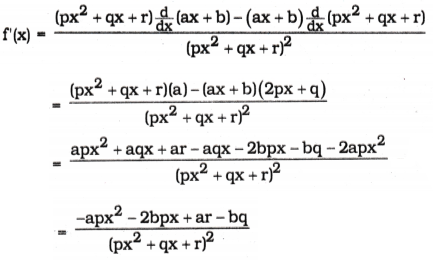
Let f(x) = \(\frac{a x+b}{p x^2+q x+r}\), By quotient rule,
Question 8.
\(\frac{p x^2+q x+r}{a x+b}\)
Solution:
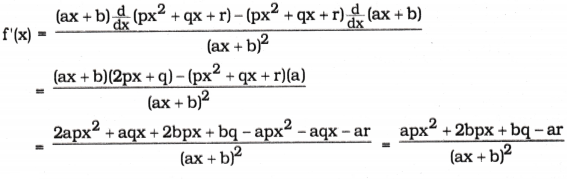
Let f(x) = \(\frac{p x^2+q x+r}{a x+b}\), By quotient rule,
Question 9.
\(\frac{a}{x^4}-\frac{b}{x^2}\) + cos x
Solution:
Let f(x) = \(\frac{a}{x^4}-\frac{b}{x^2}\) + cos x
f'(x) = \(\frac{d}{d x}\left(\frac{a}{x^4}\right)-\frac{d}{d x}\left(\frac{b}{x^2}\right)+\frac{d}{d x}\)(cos x)
= a\(\frac{\mathrm{d}}{\mathrm{dx}}\)(x-4) – b\(\frac{\mathrm{d}}{\mathrm{dx}}\)(x-2) + \(\frac{\mathrm{d}}{\mathrm{dx}}\)(cos x)
= a(-4x-5) – b(-2x-3) + (-sin x) [∵ \(\frac{d}{d x}\)(xn) = nxn-1 and \(\frac{d}{d x}\)(cos x) = -sin x]
= \(\frac{-4 a}{x^5}+\frac{2 b}{x^3}\) – sin x
Question 10.
4√x – 2
Solution:
Let f(x) = 4√x – 2
f'(x) = \(\frac{\mathrm{d}}{\mathrm{dx}}\)(4√x – 2) = \(\frac{\mathrm{d}}{\mathrm{dx}}\)(4√x) – \(\frac{\mathrm{d}}{\mathrm{dx}}\)(2)
= 4\(\frac{1}{2}\)(x\(\frac{1}{2}\)) – 0
= 4(\(\frac{1}{2}\)x\(\frac{1}{2}\) – 1)
= (2x\(\frac{-1}{2}\))
= \(\frac{2}{\sqrt{x}}\)
Question 11.
(ax + b)n
Solution:
Method I : Let y = (ax + b)n
Differentiating w.r.t ‘x’
\(\frac{d y}{d x}=\frac{d}{d x}\) (ax + b)n
⇒ \(\frac{d y}{d x}\) = n(ax + b)n-1 [/latex]\frac{d}{d x}[/latex](ax + b)
⇒ \(\frac{d y}{d x}\) = an(ax + b)n-1
Method II : Let f(x) = (ax + b)n
Accordingly, f(x + h) = {a(x + h) + b}n = (ax + ah + b)n
By first principle,
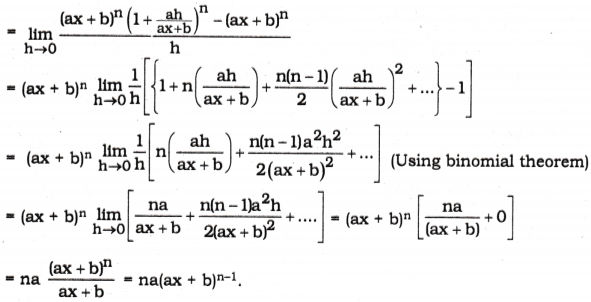
f'(x) = \(\lim _{h \rightarrow 0} \frac{f(x+h)-f(x)}{h}=\lim _{h \rightarrow 0} \frac{(a x+a h+b)^n-(a x+b)^n}{h}\)
Question 12.
(ax + b)n (cx + d)m
Solution:
Method I : Let y = (ax + b)n(cx + d)m
Differentiate w.r.t ‘x’
\(\frac{d y}{d x}\)(ax + b)n m(cx + d)m-1 c + (cx + d)n n (ax + b)n-1a
\(\frac{d y}{d x}\) = (ax + b)n-1 (cx + d)m-1 [mc(ax + b) + na (cx + d)]
Methqd II: Let f(x) = (ax + b)n (cx + d)m
By Leibnitz product rule,
f'(x) = (ax + b)n \(\frac{d}{d x}\) (cx + d)m + (cx + d)m. \(\frac{d}{d x}\) (ax + b)n ……….(1)
Now, Let f1(x) = (cx + d)m
Accordingly, f(x + h) = (cx + ch + d)m
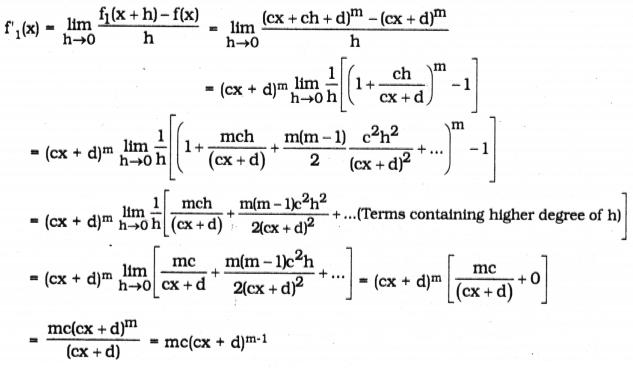
Hence, \(\frac{d}{d x}\)(cx + d)m = mc(cx + d)m-1 ………(2)
Similarly, \(\frac{d}{d x}\)(ax + b)n = na(Ax + b)n-1 ………….(3)
Therefore, from (1), (2) and (3), we obtain
f'(x) = (ax + b)n{mc(cx + d)m-1} + (cx + b)m{na(ax + b)n-1}
= (ax + b)n-1{(cx + d)m-1} + (cx + b)m{na(ax + b)n-1}
= (ax + b)n-1(cx + d)m-1[mc(ax + b) + na(cx + d)]
Question 13.
sin(x + a)
Solution:
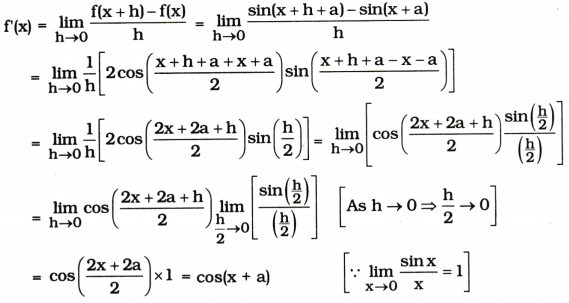
Let f(x) = sin(x + a). Accordingly, f(x + h) = sin(x + h + a)
By first principle,
Question 14.
Find the derivatives of the following functions.
i) cotn x
Solution:
cotnx
Let y = cotn x.
Differentiate w.r.t ‘x’
\(\frac{d y}{d x}\) = -n cotn-1x. cosec2x
ii) cosec4 x
Solution:
Let y = cosec4 x.
Differentiate w.r.t ‘x’
\(\frac{d y}{d x}\) = 4 cosec3x\(\frac{1}{2}\)(cosec x)
⇒ \(\frac{d y}{d x}\) = -4 cosec4 x cot x
iii) sinmx . cosnx
Solution:
Let y = sinmx . cosnx
Differentiate w.r.t ‘x’
\(\frac{d y}{d x}=\frac{d}{d x}\){sinmx . cosnx} = sinmx \(\frac{d}{d x}\)cosnx + cosnx\(\frac{d}{d x}\)sinmx
\(\frac{d y}{d x}\) = msinm-1x cosn+1x – ncosn-1x sinm+1x
iv) sin mx. cos nx
Solution:
Let y = sin mx. cos nx
Differentiate w.r.t ‘x’
\(\frac{d y}{d x}\) = sin mx. \(\frac{d}{d x}\)cos nx + cos nx \(\frac{d}{d x}\)sin mx
\(\frac{d y}{d x}\) = mcosmx cosnx – nsinmx sinnx
v) log (tan 5x)
Solution:
Let y = log (tan 5x)
Differentiate w.r.t ‘x’
⇒ \(\frac{d y}{d x}=\frac{1}{\tan 5 x}\) × sec25x × 5
⇒ \(\frac{d y}{d x}=\frac{5 \sec ^2 5 x}{\tan 5 x}\)
⇒ \(\frac{d y}{d x}=\frac{5}{\sin 5 x \cos 5 x}\)
⇒ \(\frac{d y}{d x}\) = 10 cosec 10x
vi) log \(\left(\frac{x^2+x+2}{x^2-x+2}\right)\)
Solution:
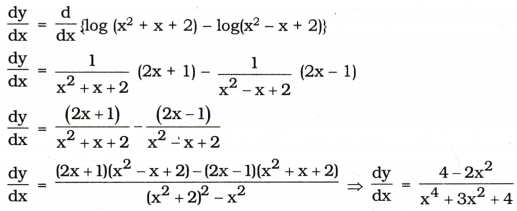
Let y = log \(\left(\frac{x^2+x+2}{x^2-x+2}\right)\)
⇒ y = log(x2 + x + 2) – log(x2 – x + 2)
Differentiate w.r.t ‘x’
vii) cos (log x + ex)
Solution:
Let y = cos (log x + ex)
Differentiate w.r.t ‘x’
\(\frac{d y}{d x}\) = -sin(log x + ex)[\(\frac{1}{x}\) + ex]
II.
Question 1.
Find the derivative of the following function. from first principle.
i) -x
Solution:
Let f(x) = -x
Accordingly, f(x + h) = -(x + h)
By first principle, f'(x) = \(\lim _{h \rightarrow 0} \frac{f(x+h)-f(x)}{h}\)
= \(\lim _{h \rightarrow 0} \frac{-(x+h)+(x)}{h}=\lim _{h \rightarrow 0} \frac{-x-h+x}{h}\)
= \(\lim _{h \rightarrow 0} \frac{-h}{h}=\lim _{h \rightarrow 0}(-1)\)
= -1
ii) (-x)-1
Solution:
Let f(x) = (-x)-1 = \(\frac{-1}{x}\)
Accordingly, f(x + h) = \(\frac{-1}{(x+h)}\)
By first principle, f'(x) = \(\lim _{h \rightarrow 0} \frac{f(x+h)-f(x)}{h}\)
= \(\lim _{h \rightarrow 0} \frac{1}{h}\left[\frac{-1}{(x+h)}-\left(\frac{-1}{x}\right)\right]=\lim _{h \rightarrow 0} \frac{1}{h}\left[\frac{-x+(x+h)}{x(x+h)}\right]\)
= \(\lim _{h \rightarrow 0} \frac{1}{x(x+h)}=\frac{1}{x(x)}=\frac{1}{x^2}\)
iii) sin(x + 1)
Solution:
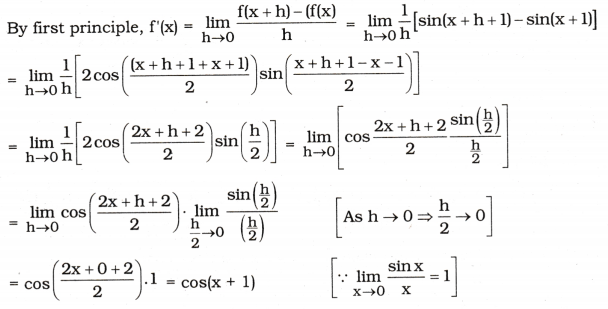
Let f(x) = sin(x + 1)
Accordingly, f(x + h) = sin(x + h + 1)
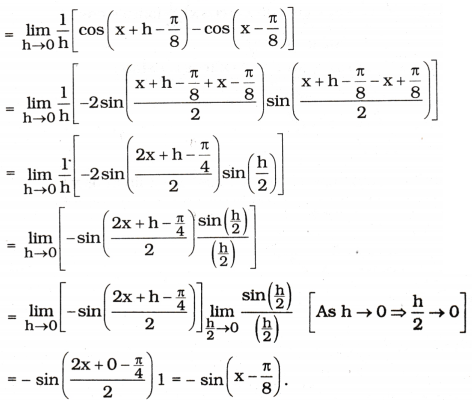
iv) cos(x – \(\frac{\pi}{8}\))
Solution:
Let f(x) = cos(x – \(\frac{\pi}{8}\))
Accordingly, f(x + h) = cos(x + h – \(\frac{\pi}{8}\))
By first principle, f'(x) = \(\lim _{h \rightarrow 0} \frac{f(x+h)-f(x)}{h}\)
Find the derivative of the following functions (it is to be understood that a, b, c, d, p, q. r and s are fixed non-zero constants and m and n are integers).
Question 2.
cosec x cot x
Solution:
Let y = cosec x cot x.
Differentiate w.r.t ‘x’
\(\frac{d y}{d x}\) = cosec x \(\frac{\mathrm{d}}{\mathrm{dx}}\) cot x + cot x\(\frac{\mathrm{d}}{\mathrm{dx}}\)cosecx
= cosec x(-cosec2x) + cot x(- cosecx cot x)
⇒ -cosec3x – cot2x cosec x.
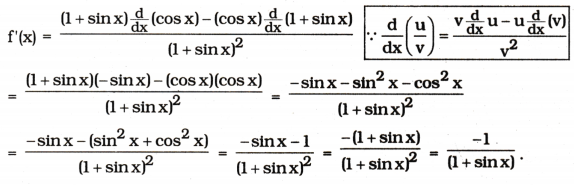
Question 3.
\(\frac{\cos x}{1+\sin x}\)
Sol.
Let f(x) = \(\frac{\cos x}{1+\sin x}\)
By quotient rule,
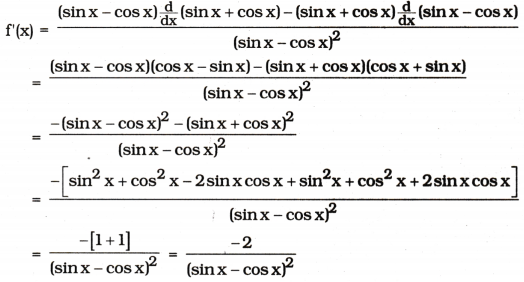
Question 4.
\(\frac{\sin x+\cos x}{\sin x-\cos x}\)
Solution:
Let f(x) = \(\frac{\sin x+\cos x}{\sin x-\cos x}\). By quotient rule,
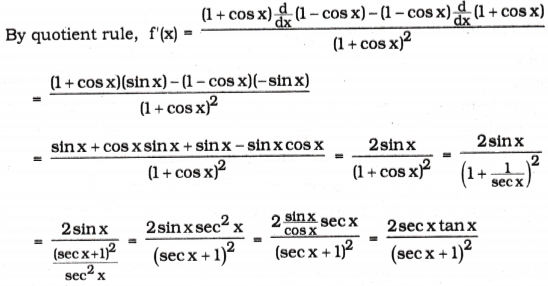
Question 5.
\(\frac{\sec x-1}{\sec x+1}\)
Solution:
Let f(x) = \(\frac{\sec x-1}{\sec x+1}\)
Question 6.
Solution:
Method 1: Let y = sinnx
Differentiate w.r.t ‘x’
\(\frac{d y}{d x}=\frac{d}{d x}\) sinnx = n sinn-1x \(\frac{d}{d x}\) (sin x)
\(\frac{d y}{d x}\) = n sinn-1 x cos x
Method II : Let y = sinnx
Accordingly, for n = 1, y = sin x
Therefore, \(\frac{1}{2}\) = cos x, i.e.. \(\frac{1}{2}\)sin x = cos x
For n = 2, y = sin2x; \(\frac{d y}{d x}=\frac{d}{d x}\) (sin x sin x)
= (sin x)’ (sin x)+ sin x(sin x)’ [By Leibnltz product rule]
= cos x sin x + sin x cos x
= 2 sin x cos x ……….. (1)
For n = 3, y sin3x; \(\frac{d y}{d x}=\frac{d}{d x}\)(sin x sin2x)
= (sin x) sin2x + sin x(sin2x) [By Leibnitz product rule]
= cos x sin2x + sin x (2sin x cos x) [using (1)]
= cos x sin2x + 2 sin2x cos x
= 3 sin2x cos x
We assert that \(\frac{\mathrm{d}}{\mathrm{dx}}\)(sinnx) = n sinn-1x cos x
Let our assertion be true for n = k
i.e., \(\frac{\mathrm{d}}{\mathrm{dx}}\)(sinkx) = k sin(k-1)x cos x ….. (2)
Consider, \(\frac{d}{d x}\)(sink+1x) = \(\frac{d}{d x}\)(sin x sin(k)x)
= (sin x)’ sinkx + sin x (sinkx)’ [By Leibnitz product rule]
= cos x sinkx + sin x(k sink-1 x cos x) [using (2)]
= cos x sinkx + k sinkx cos x-1
= (k + 1)sinkx cos x
Thus, our asssertion is true for n = k + 1
Hence, by mathematicall induction, \(\frac{d}{d x}\)(sinnx) = n sin(n-1)x cos x
Question 7.
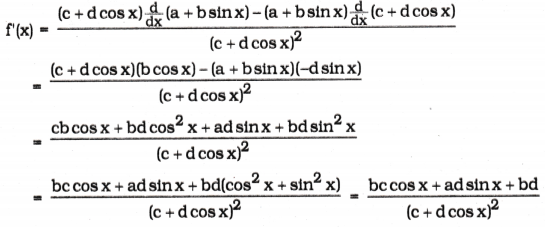
\(\frac{a+b \sin x}{c+d \cos x}\)
Solution:
Let f(x) = \(\frac{a+b \sin x}{c+d \cos x}\), By quotient rule,
Question 8.
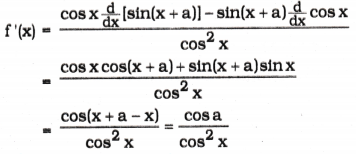
\(\frac{\sin (x+a)}{\cos x}\)
Solution:
Let f(x) = \(\frac{\sin (x+a)}{\cos x}\), By quotient rule,
Question 9.
x4(5 sin x – 3 cos x)
Solution:
Let f (x) = x4(5sin x – 3 cosx)
By product rule,
f ‘(x) = x4 \(\frac{\mathrm{d}}{\mathrm{dx}}\) (5 sin x – 3 cos x) + (5sin x – 3 cos x) \(\frac{\mathrm{d}}{\mathrm{dx}}\) (x4)
= x4[5\(\frac{\mathrm{d}}{\mathrm{dx}}\)(sin x) – 3\(\frac{\mathrm{d}}{\mathrm{dx}}\)(cos x)] + (5 sin x – 3 cos x) \(\frac{\mathrm{d}}{\mathrm{dx}}\)(x4)
= x4 [5 cos x – 3(- sin x)] + (5 sin x – 3 cos x) (4x3)
= x3 [5x cos x + 3x sinx + 20 sinx – 12 cos x]
Question 10.
(x2 + 1) cos x
Solution:
Let f(x) = (x2 + 1) cosx
By product rule,
f ‘(x) = (x2 + 1) \(\frac{\mathrm{d}}{\mathrm{dx}}\) (cos x) + cos x \(\frac{\mathrm{d}}{\mathrm{dx}}\) (x2 + 1)
= (x2 + 1)(-sinx) + cosx (2x)
= -x2 sin x – sin x + 2x cos x
Question 11.
(ax2 + sin x) (p + q cos x)
Solution:
Let f(x) = (ax2 + sin x) (p + q cos x)
By product rule
f'(x) = (ax2 + sin x) \(\frac{\mathrm{d}}{\mathrm{dx}}\)(p + q cos x) + (p + q cos x) \(\frac{\mathrm{d}}{\mathrm{dx}}\) (ax2 + sin x)
= (ax2 + sinx) (-q sin x) + (p + q cos x) (2ax + cos x)
= – q sin x(ax2 + sin x) + (p + q cos x)(2ax + cos x)
Question 12.
(x + cos x) (x – tan x)
Solution:
Let y = (x + cos x) (x – tan x)
Differentiate w.r.t ‘x’
\(\frac{\mathrm{dy}}{\mathrm{dx}}\) = (x + cos x) \(\frac{\mathrm{d}}{\mathrm{dx}}\) (x – tan x) + (x – tan x) \(\frac{\mathrm{d}}{\mathrm{dx}}\) (x + cos x)
\(\frac{\mathrm{dy}}{\mathrm{dx}}\) = (x + cos x)(1 – sec2x) + (x – tan x) ( 1 – sin x)
\(\frac{\mathrm{dy}}{\mathrm{dx}}\) = -tan2x(x + cos x) + (x – tan x)(1 – sin x)
Question 13.
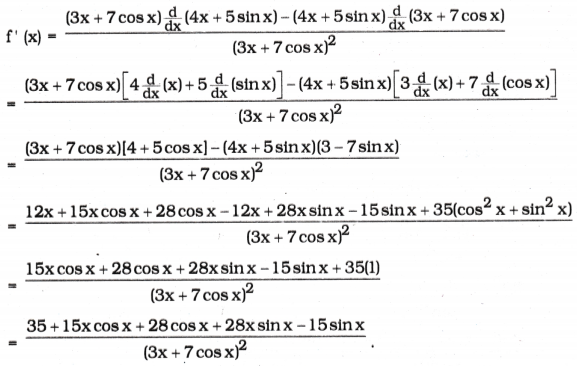
\(\frac{4 x+5 \sin x}{3 x+7 \cos x}\)
Solution:
Let f(x) = \(\frac{4 x+5 \sin x}{3 x+7 \cos x}\)
By product rule
Question 14.
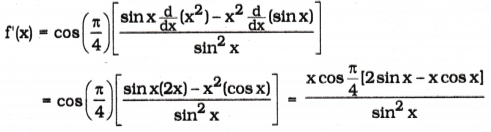
\(\frac{x^2 \cos \left(\frac{\pi}{4}\right)}{\sin x}\)
Solution:
Let f(x) = \(\frac{x^2 \cos \left(\frac{\pi}{4}\right)}{\sin x}\), By wuotient rule,
Question 15.
\(\frac{x}{1+\tan x}\)
Solution:
Let f(x) = \(\frac{x}{1+\tan x}\)
f'(x) = \(\frac{(1+\tan x) \frac{d}{d x}(x)-(x) \frac{d}{d x}(1+\tan x)}{(1+\tan x)^2}\)
= \(=\frac{(1+\tan x)-x \sec ^2 x}{(1+\tan x)^2}\)
⇒ f'(x) = \(\frac{1+\tan x-x \sec ^2 x}{(1+\tan x)^2}\)
Question 16.
(x + sec x) (x – tan x)
Solution:
Let f(x) = (x + sec x)(x – tan x). By product rule,
f’(x) = (x+sec x)(x – tan x) + (x – tan x)\(\frac{\mathrm{d}}{\mathrm{dx}}\)(x + sec x)
= (x + sec x) [\(\frac{\mathrm{d}}{\mathrm{dx}}\)(x) – \(\frac{\mathrm{d}}{\mathrm{dx}}\)tan x] + (x – tan x)[\(\frac{\mathrm{d}}{\mathrm{dx}}\)(x) + \(\frac{\mathrm{d}}{\mathrm{dx}}\)sec x]
f’(x) = (x+ sec x) (1 – sec 2x) + (x – tan x) 1 + (sec x tan x)
Question 17.
\(\frac{x}{\sin ^n x}\)
Solution:
Let f(x) = \(\frac{x}{\sin ^n x}\). By quotient rule,
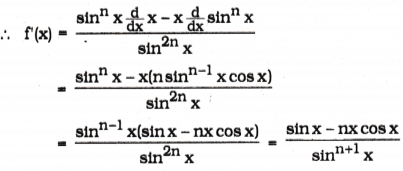
f'(x) = \(\frac{\sin ^n x \frac{d}{d x} x-x \frac{d}{d x} \sin ^n x}{\sin ^{2 n} x}\)
It can be easily shown that \(\frac{d}{d x}\) sinnx = n sinn-1x cos x