
For systematic learning, students can include AP Inter 2nd Year English Grammar with Answers and Note Making in English Inter 1st Year in their daily study routine.
AP Inter 2nd Year English Note Making with Answers
A note is a brief record of ideas or facts. Note making is the skill of capturing the most important information from any text in a concise, well-structured, and easy-to-revise format, Note Making helps to make selective, purpose-driven notes so that you learn quickly without getting lost.
Examples
Questiopn 1.
Make notes using the passage given below:
Holidays give students rare, unhurried time. Reading during this break strengthens attention, grows vocabulary, and offers calm, screen-free relaxation. Yet many children drift away from books because of powerful distractions – mobile games, streaming shows, or constant notifications. Access can be another barrier: library fees, the cost of new books, or uncertainty about which titles are age-appropriate. A simple plan overcomes most hurdles. Fix a short daily reading slot of 20-30 minutes, preferably at the same hour. Use the “five-finger rule” to choose the right level – if five words on a page are too hard, try another book. Mix genres so reading stays fresh: stories, biographies, science comics, travel writing, even magazines. Create social nudges – reading buddies, family read-alouds, or a weekly book-share. Schools can support with classroom libraries, book talks, and reading journals; parents help most by modeling the habit themselves, limiting screen time, and letting children choose. With steady practice, holidays turn into a launchpad for deeper comprehension, creativity, and confidence that lasts through the year.
Answer:
Title : Reading Habit in Holidays
1. Why read in holidays (value)
- 1.1 ↑ attention span; ↑ vocab
- 1.2 Calm, screen-free relaxn
- 1.3 Launchpad for yr-round learning
2. Barriers
- 2.1 Distractors → phone/games/OTT notifs
- 2.2 Access: lib. fees; cost of new bks
- 2.3 Choice: unsure of age-fit titles
3. Simple plan (how)
- 3.1 Daily slot 20-30 mins (same hour)
- 3.2 “5-finger rule” → right diff. level
- 3.3 Mix genres : stories/biographies/sci-comics/travel/magazines
- 3.4 Social nudges : reading buddy; family read-aloud; weekly book-share
4. Support system
- 4.1 School → class library; book talks; reading journals
- 4.2 Parents → model reading; limit screens; allow child choice.
5. Outcomes
- 5.1 → comprehension; creativity; confidence
- 5.2 → Habit sustains beyond holidays
Key (abbr/symbols):
lib. = library; bks = books; diff. = difficulty; mins = minutes; relaxn = relaxation; ↑ = increase/improve; → = leads to/result; OTT = streaming.

Question 2.
MIND MAPPING is another technique of Making Notes :
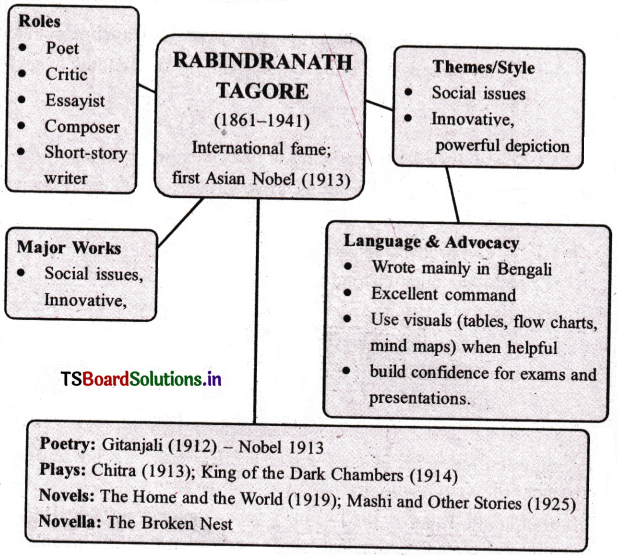
Look at the following passage about Rabindranath Tagore and with the help of Mind Mapping, how one can make notes:
Rabindranath Tagore (1861-1941), most eminent modern Bengali poet was also a critic, essayist, composer and author of short fiction and innovative in Bengali literature. He is known outside India principally in English translation. Gitanjali, a song offering (1912), his free verse recreations of his Bengali poems modelled on medieval Indian devotional lyrics, won the Nobel Prize for Literature in 1913, its first award to an Asian. Representative translations followed, of philosophical plays such as Chitra (1913) and The King of the Dark Chambers (1914) and his novels The Home and the World (1919) and Gora (1924). His short fiction often comments powerfully and courageously on Indian and social concerns, in the collections Hungry Stones (1916) Broken Ties (1925) and The House Warming (1965) and in the novella The Broken Nest brought out his powerful depiction of social issues. Tagore had an excellent command of English, but he wrote primarily in Bengali and tirelessly encouraged other writers of the Indian vernaculars. (The Oxford Companion to English Literature)
Answer:
Read the passage and make notes:
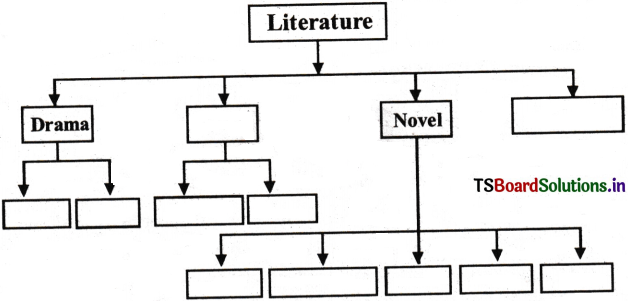
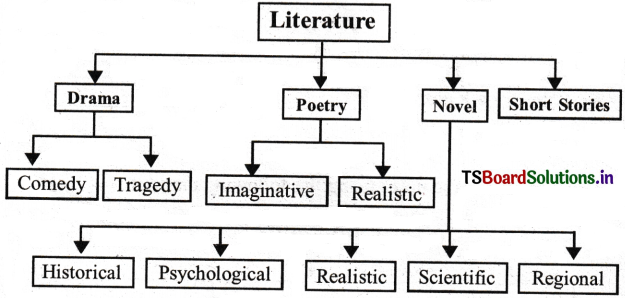
The word ‘Literature’ is really hard to define. Many interpretations are made about the word. But all are incomplete. Some opine that literature is the mirror of life, some others say that it is the criticism of life. Whatever may be the controversy about the word, we may say that literature is that which reflects life. The branches of literature are poetry, drama, novel and short stories. Poetry is of two kinds, imaginative and realistic. Drama is either a comedy or a tragedy.
Novels are also of many kinds historical, psychological, realistic, scientific and regional. Short story is one which stands very close to life despite a little scope.
Your Answer
Title of text : __________________
Make Notes (use headings/subheadings, indents, symbols & abbreviations)
Main Idea
- Literature = ___________________
Views about Literature (very brief points)
- ___________________________
- ___________________________
- ___________________________
Branches of Literature
- Poetry → Kinds :
- Drama → Types :
- Novel → Kinds :
- Short Story → Note :
(OR)
You can also make notes using the following diagram.
Answer :
Title of text: Literature
Make Notes (use headings/subheadings, indents, symbols & abbreviations)
Main Idea:
- Literature = That which reflects life.
Views about Literature (very brief points)
- Literature is the mirror of life.
- Literature is the criticism of life.
- Literature reflects life despite controversies.
Branches of Literature
- Poetry → Kinds : Imaginative, Realistic
- Drama → Types : Comedy, Tragedy
- Novel → Kinds : Historical, Psychological, Realistic,’ Scientific, Regional
- Short Story → Note : Close to life despite little scope
(OR)
Exercise
Make Notes for the following exercises.
Question 1.
Photosynthesis is the process by which chlorophyll-containing, organisms – green plants and algae – capture energy in the form of light and convert it to chemical energy. Almost all the energy available for life in the earth’s biosphere – the zone in which life can exist – is made available through photosynthesis.
In the first stage of photosynthesis, chlorophyll absorbs sunlight. Chlorophyll is the green substance in leaves, which is able to trap the energy of sunlight and use it in the process of making carbohydrates.
Within the leaf, there is a small amount of water. The energy, which the chlorophyll has trapped of the sun, is used to split the water in the leaf into hydrogen and oxygen. Most of the oxygen is released into the air. In the second stage, the chlorophyll uses the energy absorbed from sunlight to combine the hydrogen (which is obtained by splitting the water) with carbon dioxide (which the leaf obtained from the air). Then, after several complicated changes, the hydrogen and the carbon dioxide are combined in such a way that a carbohydrate is produced. This carbohydrate is called glucose. Later, using glucose as its most important building material, the plant can make substances called amino acids and proteins. These chemicals are needed for the growth of both plants and animals.
Something else happens during photosynthesis that is of the greatest importance to us. A constant supply of oxygen is released into the air by plants. At the same time, carbon dioxide, which would poison us if we breathed too much of it, is nearly all used up.
Photosynthesis is one of the most important chemical processes in the world. This is because it is the primary method of food manufacture, and the primary method of oxygen manufacture.
(Adaptedfrom Funk and Wagnall’s New Encyclopedia)
Answer:
Photosynthesis
- Definition : Process where chlorophyll-containing organisms capture light energy and convert it into chemical energy.
- Importance: Supplies energy for all life on Earth.
Stages of Photosynthesis:
1. First Stage
- Chlorophyll absorbs sunlight.
- Water in the leaf splits: Produces hydrogen and oxygen.
- Oxygen: Released into the air.
2. Second Stage
- Hydrogen + Carbon Dioxide: Combined using sunlight energy.
- Glucose produced: Used to create amino acids and proteins.
Key Products
- Oxygen: Released into the air (important for respiration).
- Provides energy and building blocks for plant and animal growth.
Significance
- Oxygen supply: Essential for animal life.
- Carbon dioxide removal: Reduces harmful CO2 levels in the atmosphere.
Question 2.
Intensive reading is aimed at mastering the structures and vocabulary apart from reading for comprehension. The pupils have more opportunities to learn the aspects of the language through intensive reading. If properly carried out, even non-native speakers of English may develop themselves better users of English than the native speakers of English in writing. Intensive reading can also be done in the absence of the teachers. So, by spending more time on intensive reading, one may get language skills in English. And the only practicable means of learning a foreign language as a second language is through intensive reading. The intensive reading has some prerequisites like: the readers should be able to identify the words and sentences spoken orally and acquire sufficient speed in reading.
In intensive reading, the pupils pay attention to almost all aspects of language. And further the effort of learning the language is supplemented by extensive reading. Extensive readers should be interesting stories. Magazines, newspapers and variety of story books will form the material for extensive reader. The two main themes of extensive reading are reading for pleasure and reading for information. Extensive readers facilitate passive vocabulary in the learners. And it also consolidates active vocabulary. So, the teachers should regularly give some assignment and thus forcing the students to library. Sending the students to library can be done as a means of assertive punishment also. As the students read more and more books, their power of phonic analysis improves and makes the learner to pronounce any word that he sees for the first time. Group discussion also can be done on extensive reader.
Answer:
Reading Techniques:
Intensive Reading
- Objective : Master structures and vocabulary, beyond mere comprehension.
- Advantages :
- Enhances language skills (writing, especially).
- Can be done without a teacher.
- Helps in language learning, especially for non-native speakers.
- Prerequisites: Ability to recognize words, read quickly.
Extensive Reading
- Objective : Read for pleasure and information.
- Materials :
- Stories, magazines, newspapers, and books.
- Benefits :
- Increases passive vocabulary.
- Strengthens active vocabulary.
- Activities :
- Group discussions.
- Library visits.
- Assignments and reading tasks to improve pronunciation and phonic skills.
Question 3.
Language that we use keeps the human being in an exalted position when compared to other living things. Language is needed for all the people irrespective of their status. And, it is used from our birth till death. Language is a means of communication. We use the language as a medium through which thoughts are conveyed from person to person. It is considered a means of social control. No society can function without language. Language is part and parcel of our life. We cannot imagine a society without language. If no language, then the progress of mankind will be blocked. We will be deprived all the niceties of life that we enjoy now. Habit formation is necessary for language learning and using. Learning a language involves establishing the links between the language forms and their meanings.
The process of establishing the link between the forms and meanings are three, namely, (i) the form, (ii) the meaning and (iii) their association. In speaking, the speaker associates the exact form with the meaning that he knows, and in understanding he associates the meaning with the form he’leamed from others. The speaker of the language is conscious of the words he uses and form meaningful sentences that can make the listener understand. All the time the speaker adjusts the sounds to meaningful words and words to meaningful sentences. Language has three functions. The first one is the informative function, where information is communicated. The second function of the language is expressive, where we express our feelings, emotions and our opinions. The third function of the language is directive, where we teach others, give advice etc. So, for meaningful life we require language.
Answer:
Title of Text: Language and its Importance
Main Idea
- Language = Essential for communication and social control.
Views about Language (very brief points)
- Language is used from birth till death.
- It is a means of communication and social control.
- Society cannot function without language.
- Language is crucial for human progress.
Branches of Language Learning
- Habit Formation → Necessary for learning and using language.
- Links Between Forms and Meanings → The process involves form, meaning, and association.
- Speaking → Associating forms with meanings.
- Understanding → Associating meaning with the learned form.
Functions of Language
- Informative → Communicates information.
- Expressive → Expresses feelings, emotions, and opinions.
- Directive → Teaches, advises, and guides.
Important Notes:
- Language is crucial for a meaningful life.
- The speaker adjusts sounds and words to convey meaning.
Question 4.
Body shaming is a harmful behaviour where people criticize others based on their physical appearance. This includes making negative comments about someone’s weight, height, skin colour, or other physical traits.
Body shaming can take many forms such as: weight-based shaming: This is one of the most common forms, where people are criticized for being “too fat” or “too thin.” People often comment on someone’s weight without realizing how hurtful it can be. Comments like “Why are you so fat?” or “You look like a stick” are examples of weight-based shaming. Skin Colour Shaming: India has a deep-rooted issue with colorism, where people are judged for having darker skin tones, with people often making comments like “You’ll look better if you lighten your skin.” This type of shaming is not only hurtful but also promotes a harmful preference for fair skin over darker skin. Height Shaming: Tall or short, people can face body shaming based on their height. Comments like “Why are you so short?” or “Do you play basketball because you’re tall?” may seem innocent but can make teenagers feel out of place or self-conscious about their height. Face and Features Shaming: Teenagers often face comments about their facial features, such as nose shape, jawline, or even acne.
Remarks like “Your nose is too big” or “Why do you have so many pimples?” can deeply affect a teenager’s self-Confidence. Social media often promotes unrealistic beauty standards, making young people feel that they must look a certain way to be accepted. Influencers and celebrities post edited pictures that show only their “perfect” sides, leading teenagers to feel pressured to look the same. Unfortunately, this creates a cycle where teenagers compare themselves to these impossible standards and feel inferior when they cannot match them. Moreover, trolls and cyberbullies on social media leave hurtful comments on people’s pictures, furthering body shaming. Movies often show heroes and heroines with fair skin, slim bodies, and certain “ideal” features. Characters who don’t fit these standards are often cast as sidekicks, comedians, or villains, indirectly telling the audience that only certain looks are acceptable for “good” or “successful” people. This sets a high and unrealistic standard for teenagers, who may feel pressured to look like these stars. Some might even resort to extreme diets, over-exercising, or skin- lightening treatments to match these unrealistic standards. (https://en.wikipedia.org/wiki/Bodv shaming!
Answer:
Title of Text: Body Shaming.
Main Idea
- Body Shaming = Harmful behavior of criticizing others based on their physical appearance.
Views about Body Shaming (very brief points)
- Includes criticism of weight, height, skin color, and facial features.
- Often occurs on social media, movies, and by peers.
- Promotes unrealistic beauty standards and self-doubt.
Types of Body Shaming
- Weight-Based Shaming → Criticizing for being too fat or too thin.
- Skin Color Shaming → Judging people for having darker skin tones (colorism).
- Height Shaming → Making comments about being too tall or too short.
- Face and Features Shaming → Criticizing facial features like nose shape or acne.
Impacts of Body Shaming
- Creates pressure to meet unrealistic beauty standards.
- Affects self-confidence, especially among teenagers.
- Encourages harmful .behaviors Hk©.extreme, dieting or skin treatments.
Social Influence
- Social media and celebrities promote edited, unrealistic standards.
- Movies set beauty standards by casting only those who fit certain looks.
Important Notes
- Body shaming can lead to long-lasting negative effects on mental health.
- It’s important to challenge these beauty standards and promote body positivity.
Question 5.
The healthy eating plate is a guide to eating balanced meals, especially for individuals with diabetes. It emphasizes portion control across three main food groups and advises limiting food intake if overweight. To create a healthy plate, start with a small plate or bowl about the size of your outstretched hand: Vegetables: Fill half your plate with a variety of vegetables, either cooked pr raw. Include vegetables of different colors to ensure a range of nutrients. Avoid counting tubers like potatoes as vegetables, as they are starches that can raise blood sugar levels significantly. Starches: Reserve one-quarter of your plate for whole grains and healthy starches, which contain fiber and have a milder effect on blood sugar than refined starches like white rice, bread, or pasta. If refined starches are preferred, consume them in smaller portions.
Protein: Use the remaining quarter for lean protein sources such as beans, nuts, yogurt, fish, eggs, and poultry. These can be eaten alone or incorporated into dishes like soups, salads, and stews. Red meat should be eaten rarely, if at all. Additionally: Use healthy oils, such as sunflower or safflower oil, while avoiding processed oils like margarine or vegetable shortening. For beverages, plain water is best. Coffee or tea without sugar is acceptable. Avoid sugary drinks entirely, and limit fruit juice, as it can rapidly raise blood sugar. Whole fruits with natural fiber are a better alternative. Eating slowly, appreciating food, and stopping when satisfied rather than full are also essential habits. Some people find that replacing starches with proteins and vegetables aids in weight loss and stabilizes blood sugar levels. Hence, use a small plate and divide it as follows: half for vegetables, a quarter for protein, and a quarter for healthy starches.
(Source:https://youtu.be t4WdZLwCdU7?si=Cy518Y_3Dlap8ew6)
Answer:
Title of Text: Healthy Eating Plate
Main Idea
- Healthy Eating Plate = A guide for balanced meals, especially for individuals with diabetes.
Views about Healthy Eating (very brief points)
- Focuses on portion control across three main food groups.
- Advises limiting food intake for overweight individuals.
- Emphasizes using a small plate for meal division.
Components of the Healthy Plate
- Vegetables → Half of the plate should be filled with a variety of vegetables (cooked or raw). Avoid tubers (like potatoes).
- Starches → One-quarter of the plate for whole grains and healthy starches (e.g., brown rice, whole grain pasta).
- Protein → One-quarter of the plate for lean proteins (e.g., beans, nuts, yogurt, fish, eggs, poultry).
Additional Guidelines
- Use healthy oils (e.g., sunflower or safflower oi!) and avoid processed oils (e.g., margarine).
- Beverages: Water is best, and tea or coffee without sugar is acceptable. Avoid sugary drinks and limit fruit juice.
- Eat slowly and stop when satisfied (not full).
- Replace starches with proteins and vegetables for weight loss and better blood sugar control.
Question 6.
Nature is a master storyteller, and nowhere is this more evident than in the changing seasons. Among all seasons, Summer and Winter stand at opposite ends of the spectrum, each bringing its own unique charm, character, and experiences. Together they shape our daily lives, habits, moods, and even our relationships with family and friends.
Summer is a season of warmth, energy, and abundance. Long sunny days fill the world with golden light, and temperatures rise to levels perfect for outdoor activities. Children play freely in parks, families head to beaches and swimming pools, and the air is filled with laughter and excitement. It is the season of barbecues, picnics, and evening gatherings under the open sky. Nature generously offers an abundance of fresh fruits during summer- juicy berries, sweet melons, mangoes, and peaches refresh both body and spirit. People dress lightly in cotton and bright colours, reflecting the cheerful mood of the season. Schools remain closed, making summer the most awaited time for students to relax, travel, and explore new experiences.
Winter, in contrast, wraps the world in a quiet, peaceful stillness. Cold temperatures, shorter daylight hours, and snowfall in many regions transform the landscape into a silver wonderland. Outdoor life slows down considerably as people seek warmth indoors. Families gather around fireplaces, sharing hot drinks like tea, coffee, and soups. Cozy sweaters, blankets, and warm clothing become daily companions. Indoor activities like reading, board games, cooking, and storytelling bring families closer together. Winter festivals and celebrations add colour and warmth to the cold months.
Despite their differences, both seasons share something beautiful and universal—they offer precious time for families to bond, for individuals to relax, and for loved ones to create memories that last a lifetime.
Answer:
Title of Text : Summer and Winter
Main Idea
- Summer and Winter = Opposite seasons that bring unique experiences and shape our daily lives.
Views about Summer and Winter (very brief points)
- Summer = Warmth, energy, and abundance.
- Winter = Quiet, peaceful stillness, with cold temperatures and snowfall.
Characteristics of Summer
- Long sunny days and warm temperatures.
- Outdoor activities: children playing, families at beaches/pools.
- Abundant fresh fruits: berries, melons, mangoes, peaches.
- People dress in light clothing and bright colours.
- Schools closed; students relax, travel, and explore.
Characteristics of Winter
- Cold temperatures, shorter days, and snowfall.
- Outdoor life slows down; people seek warmth indoors.
- Indoor activities: reading, board games, cooking, storytelling.
- Winter festivals and celebrations bring warmth and colour. Shared Beauty of Summer and Winter
- Both seasons offer precious time for family bonding and creating lasting memories.
Question 7.
The First Industrial Revolution kicked off in Britain in the late 1700s, powered by the invention of the steam engine and the mechanization of textile production. Imagine a world where everything is done by hand – then, suddenly, machines begin to take over. This era brought the birth of factories, and people from rural areas moved to cities, hoping to find work in these newly constructed industrial hubs. The Industrial Revolution fundamentally altered the way people lived and worked, making products available at unprecedented scales.
Building on steam power, the Second Industrial Revolution was marked by the rise of electricity, steel, and chemical industries. This is the era that saw the birth of modern mass production. Thanks to inventions like the electric light bulb, telegraph and telephone the Second Industrial Revolution sped up urbanization and reshaped entire economies.
The Third Industrial Revolution, often referred to as the Digital Revolution, began in the latter half of the 20th century. This revolution was powered by computers, internet technology, and automation. The world became “smaller,” as the internet connected people, information, and services across the globe in an instant. The Third Industrial Revolution changed how we work, communicate, and live, creating the digital age and laying the foundation for our current tech-driven world.
We are currently in the midst of the Fourth Industrial Revolution, where the fusion of physical, digital, and biological systems is transforming the world even faster. AI, machine learning, 5G networks, biotechnology, and blockchain are at the . heart of this revolution, making technologies smarter and more interconnected. The Fourth Industrial Revolution is marked by rapid changes that promise to reshape industries, redefine jobs’, and even challenge our notions of what it means to be human. (Source: https://ied.eu/prbiect-updates/the-4-industrial- revolutions/)
Answer:
Title of Text: The Four Industrial Revolutions
Main Idea
- Industrial Revolutions = Major shifts in technology, economy, and society.
Views about Industrial Revolutions (very brief points)
- First Industrial Revolution: Steam power and mechanization of textile production.
- Second Industrial Revolution : Electricity, steel, and mass production.
- Third Industrial Revolution : Computers, internet, and automation.
- Fourth Industrial Revolution : Fusion of physical, digital, and biological systems.
The Four Industrial Revolutions
- First Industrial Revolution → Invention of the steam engine, mechanization of textile production, rise of factories.
- Second Industrial Revolution → Rise of electricity, steel, chemical industries, and mass production.
- Third Industrial Revolution → Digital Revolution, powered by computers, the internet, and automation.
- Fourth Industrial Revolution → Fusion of physical, digital, and biological systems, powered by AI, machine learning, and blockchain.
Key Characteristics of the Fourth Industrial Revolution
- Fast transformation of industries, jobs, and human understanding.
- Technologies : AI, 5G, biotechnology, blockchain, and machine learning.
Question 8.
Civic sense refers to the sense of responsibility that every citizen feels towards the society and the public spaces they share with others. It is the awareness that one’s actions affect not just oneself but the entire community. A person with good civic sense respects public property, follows traffic rules, keeps surroundings clean, and behaves in a manner that promotes the well-being of all. Unfortunately, civic sense remains one of the most neglected values in Indian society today, despite rapid economic and technological progress.
The absence of civic sense is visible everywhere around us. People litter roads and public places without hesitation. Garbage is dumped in open spaces and water bodies, causing severe pollution. Traffic rules are violated openly, leading to accidents and chaos on roads. Public property such as benches, walls, and transport facilities are damaged carelessly. Noise pollution is created through unnecessary use of loudspeakers and vehicle horns. All these actions collectively degrade the quality of life for every citizen.
The root cause of poor civic sense lies in inadequate education and upbringing. Children who are not taught the importance of social responsibility from an early age grow into adults who are indifferent to public welfare. Schools, families, and communities all share the responsibility of nurturing civic values in young minds.
Several steps can be taken to improve civic sense among citizens. Civic education must be made a compulsory part of school curriculum. Awareness campaigns through media, street plays, and community programmes can bring about attitudinal change. Strict enforcement of laws related to littering, traffic violations, and public property damage will create accountability. Most importantly, every citizen must realize that a clean, orderly, and ha’rmonious society begins with their own individual behaviour.
A nation truly progresses when its citizens take pride in both their rights and their responsibilities.
Answer:
Title of Text: Civic Sense
Main Idea
- Civic Sense = The responsibility citizens feel towards society and public spaces.
Views about Civic Sense (very brief points)
- Civic sense affects the well-being of the entire community.
- It includes respecting public property, following traffic rules, and keeping surroundings clean.
Absence of Civic Sense
- Littering in roads and public places.
- Dumping garbage in open spaces and water bodies, causing pollution.
- Violation of traffic rules leading to accidents.
- Damaging public property carelessly.
- Creating noise pollution through loudspeakers and vehicle horns.
Root Cause of Poor Civic Sense
- Lack of adequate education and upbringing.
- Children not taught social responsibility grow into indifferent adults.
Steps to Improve Civic Sense
- Make civic education part of the school curriculum.
- Conduct awareness campaigns through media and community programs.
- Strict enforcement of laws on littering, traffic Violations, and public property damage.
- Foster individual responsibility for a clean, orderly, and harmonious society.
Important Notes
- A nation’s progress depends on citizens taking pride in their rights and responsibilities.
Question 9.
Unified Payments Interface (UPI) and other digital payment tools have changed how we pay for groceries, tuition fees, cab rides, and even street-side tea. The biggest advantage is speed: money moves instantly, twenty-four hours a day, with a simple scan of a QR code or a tap on a contact. Because transaction histories are stored in apps, it’s easier to track expenses, split bills with friends, and budget weekly pocket money. Digital payments also reduce the need to carry cash, lower the risk of loss or theft, and help small shops accept money without card machines. Cashback offers, automatic bill reminders, and linking to savings accounts can nudge better money habits.
However, convenience comes with responsibilities. Fraudsters rely on urgency, confusion, and trust. No legitimate service asks you to enter a PIN to receive money; payment PINs are only for sending. Never share OTPs, screen-share with strangers, or click shortened links that ask for banking details. Keep SIM cards locked with a PIN; a SIM-swap can hijack accounts. Always verify the merchant name that appears before you confirm a transfer, and prefer your saved “trusted” payees for large amounts. On borrowed or public phones, avoid logging into payment apps. Turn on app-level biometrics and enable instant transaction alerts through SMS and email.
For everyday discipline, set a monthly digital spending cap and review the passbook view every Sunday. Reconcile small autopay subscriptions that you no longer use. Update KYC only inside the official app or website, not via links from messages. When a payment fails, wait for the reversal instead of trying repeatedly. Finally, remember that digital trails matter: they help resolve disputes but also reflect your habits. Treat your financial data like your front-door key – guard it, label it, and use it carefully.
Answer:
Title of Text: Unified Payments Interface (UPI) and Digital Payments
Main Idea
- UPI and digital payments = Faster, more convenient, and safer way to pay.
Views about Digital Payments (very brief points)
- Speed and convenience: Instant transactions, 24/7 availability.
- Easy to track expenses, split bills, and budget.
- Reduces need for cash and card machines.
Advantages of Digital Payments
- Speed and instant money transfer.
- Track expenses and set better money habits.
- Reduces the risk of theft and loss.
- Helps small businesses accept payments without card machines.
- Cashback offers and automatic bill reminders promote financial discipline.
Responsibilities and Security in Digital Payments
- Avoid sharing PINs, OTPs, or banking details with strangers.
- Use trusted payees and verify merchant names before transferring large sums.
- Keep SIM cards locked with.a PIN to prevent hijacking.
- Enable app-level biometrics and instant transaction alerts.
Good Practices for Digital Payments
- Set a monthly spending cap and review transactions regularly.
- Reconcile autopay subscriptions that are no longer used. –
- Update KYC only through official channels.
- Avoid logging into payment apps on borrowed-pr public phones.
- Wait for payment reversal if a transaction fails.
Important Notes
- Guard your financial data like a key – treat it carefully and responsibly.
- Digital payment trails can resolve disputes but also reflect your financial habits.
Question 10.
Social media helps us learn, connect, and express opinions, but it also spreads rumours faster than facts. Misinformation thrives on four ingredients: speed, emotion, novelty, and gaps in our knowledge. Posts that provoke outrage or fear are shared quickly, while corrections arrive late. To protect yourself, slow down at the moment of emotion. Ask: Who benefits if I believe this? Does the claim have a date, location, and source I can verify? Screenshots without links, cropped images, and voice notes with anonymous “insiders” deserve extra scepticism.
Simple verification steps go a long way. Search a key sentence in quotes to see if credible news outlets have reported it. Check the account’s history: is it new, posting only extreme content, or using stolen profile pictures? Look for hallmarks of manipulation – mismatched shadows in images, unusual blinking or teeth in videos, or audio that does not match lip movement. When a claim involves health, law, or finance, prioritise official sources and expert bodies over influencer opinions.
Being a responsible user means not amplifying doubtful material. If a forward feels urgent, it’s a red flag. Add friction: wait ten minutes; often the urge passes. When you do share, include the source and date so others can judge reliability. In groups, set norms: “No forwards without links,” or a weekly slot for fact-checks. Schools and families can run short workshops on , confirmation bias – how we favour information that supports what we already believe.
Finally, remember that silence can be strength. You don’t have to comment on every issue to be informed. Curate your feed: follow a few quality sources instead of dozens of noisy ones, and use platform tools to report harmful content. Digital citizenship is not just about freedom to post; it is about discipline to verify, contextualise, and, when needed, refrain.
Answer:
Title of Text : Responsible Social Media Usage
Main Idea
- Social media = Helps connect and express opinions but also spreads misinformation quickly.
Views about Misinformation (very brief points)
- Misinformation spreads through speed, emotion, novelty, and gaps in knowledge.
- Posts triggering fear or outrage spread faster than corrections. Steps to Protect Yourself
- Slow down when emotional; ask who benefits from your belief.
- Verify claims: check date, location, and source.
- Be sceptical of screenshots, cropped images, and anonymous sources.
Verification Tips
- Search key sentences to find credible reports.
- Check the account’s history for credibility.
- Watch for signs of manipulation: mismatched shadows, odd blinking, or lip-sync issues in videos.
- Prioritize expert sources over influencers for health, law, or finance claims.
Responsible Social Media Use
- Don’t amplify doubtful material; if it’s urgent, wait before sharing.
- Add friction by waiting before forwarding posts.
- Share the source and date when sharing information.
- Set group norms: e.g., “No forwards without links” or a weekly fact-check session.
Additional Steps for Education
- Schools and families can teach about confirmation bias and responsible media consumption.
Important Notes
- Silence can be a form of strength; don’t feel pressured to comment on everything.
- Curate your feed by following quality sources and reporting harmful content.
Question 11.
Disasters turn hazards into human loss when exposure and vulnerability are high. India faces cyclones, floods, earthquakes, droughts, heatwaves, and landslides. The Disaster Management Cycle emphasises continuous action across four phases: mitigation, preparedness, response, and recovery. Mitigation reduces risk before events: land-use zoning, coastal embankments, retrofitting schools and hospitals, enforcing building codes in seismic zphes,’ restoring wetlands and mangroves, and risk-informed infrastructure. Preparedness builds capacity: hazard mapping, early-warning systems (IMD, INCOIS), stockpiling relief, drills in schools, mock exercises with NDRF/SDRF, community task forces, and public awareness on evacuation routes and first aid.
Response activates when alerts escalate: Incident Command Systems coordinate search, rescue, and relief; evacuation shelters provide water, sanitation, and health services; special attention goes to elderly, children, and persons with disabilities; and rapid needs assessments guide resource deployment. Recovery begins as waters recede or tremors stop: debris clearance, damage assessments, cash and livelihood assistance, rebuilding homes with “build back better” standards, restoring services (power,. roads, telecom), and psychosocial support. Post-disaster reviews capture lessons for policy and budgets. Linking the phases creates resilience: mitigation lowers impact, preparedness speeds response, effective response shortens recovery, and recovery invests in better mitigation. Communities are strongest when local knowledge, science, and governance align.
Answer:
Title of Text : Disaster Management Cycle
Main Idea
- Disaster Management = A continuous cycle to reduce risks, prepare, respond, and recover from disasters.
Views about Disasters (very brief points)
- Disasters occur when hazards (cyclones, floods, earthquakes) lead to high human loss due to exposure and vulnerability.
- India faces various types of disasters: cyclones, floods, earthquakes, droughts, heatwaves, and landslides.
Disaster Management Cycle Phases
Mitigation → Reduces risk before events:
- Land-use zoning, coastal embankments.
- Retrofitting schools/hospitals.
- Enforcing building codes in seismic zones.
- Restoring wetlands and mangroves.
- Risk-informed infrastructure.
Preparedness → Builds capacity :
- Hazard mapping and early-warning systems (IMD, INCOIS).
- Stockpiling relief and community task forces.
- Drills in schools and mock exercises with NDRF/SDRF.
- Public awareness on evacuation routes and first aid.
Response → Activated during alerts:
- Incident Command Systems for search, rescue, and relief.
- Evacuation shelters with essential services (water, sanitation, health).
- Special attention to vulnerable groups (elderly, children^ disabilities).
- Rapid needs assessments guide resource deployment.
Recovery → Begins after the event:
- Debris clearance and damage assessments.
- Cash and livelihood assistance.
- Rebuilding homes with “build back better” standards.
- Restoring services (power, roads, telecom).
- Psychosocial support and post-disaster reviews.
Linking the Phases
- Mitigation lowers impact, preparedness speeds response.
- Effective response shortens recovery, recovery invests in better mitigation.
- Communities are strongest when local knowledge, science, and governance align.
Question 12.
All living organisms are composed of cells, the fundamental units of life. However, not all cells are structured the same way. Based on their internal complexity, all cells fall into one of two major categories: prokaryotic or eukaryotic.
Despite their differences, both cell types share some essential components that are necessary for life. Every cell is enclosed by a plasma membrane, which acts as a selective barrier between the cell’s interior and the outside world. Inside the membrane is the cytoplasm, a jelly-like substance that fills the cell. Both prokaryotes and eukaryotes use DNA (deoxyribonucleic acid) as their genetic blueprint to store information. They also both contain ribosomes, which are tiny structures responsible for building proteins according to the instructions from the DNA.
The primary distinction between the two lies in their internal organization. Prokaryotic cells, found in organisms like bacteria and archaea, are structurally simpler and typically smaller. Their most defining feature is the absence of a nucleus. Instead, their genetic material, a single circular chromosome, is located in a region of the cytoplasm called the nucleoid. Prokaryotic cells also lack other membrane-bound organelles, meaning their internal components are not separated into compartments.
In contrast, eukaryotic cells are generally larger and more complex. These cells, which make up all other forms of life including plants, animals, fungi, and protists, have a true nucleus. This membrane-enclosed organelle houses the cell’s DNA, keeping it separate from the rest of the cytoplasm. Furthermore, eukaryotic cells contain a variety of other specialized, membrane- bound organelles, such as the mitochondria for energy production, the endoplasmic reticulum for processing proteins and lipids, and the Golgi apparatus for packaging and transport.
Answer:
Title of Text: Prokaryotic and Eukaryotic Cells
Main Idea
- All living organisms are composed of cells, which can be either prokaryotic or eukaryotic.
Views about Prokaryotic and Eukaryotic Cells (very brief points)
- Both cell types share essential components: plasma membrane, cytoplasm, DNA, and ribosomes.
- Prokaryotic cells are simpler and smaller, while eukaryotic cells are larger and more complex.
Prokaryotic Cells
- Found in bacteria and archaea.
- Lack membrane-bound organelles.
- No nucleus; DNA is in the nucleoid.
- Simpler structure, typically smaller.
Eukaryotic Cells
- Found in plants, animals, fungi, and protists.
- Have a true nucleus with membrane-enclosed DNA.
- Contain specialized, membrane-bound organelles (e.g., mitochondria, endoplasmic reticulum, Golgi apparatus).
- Larger and more complex structure.