
Referring to the AP Inter 1st Year Maths Study Material Chapter 10 Conic Sections Exercise 10e Solutions makes it easier to understand complex problems.
AP Inter 1st Year Maths Conic Sections Solutions Exercise 10e
I.
Question 1.
If a parabolic reflector is 20 cm in diameter and 5 cm deep, find the focus.
Solution:
Taking the origin as the vertex and the axis of the reflector as positive X-axis, the equation of the parabolic section is rightward parabola y2 = 4ax
Depth OA = 5 cm, diameter L
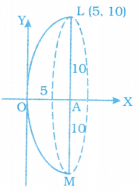
∴ Coordinates of point L are (OA, AL)= (5, 10).
Since point L lies on parabola, we have
(10)2 = 4a(5)
∴ a = \(\frac{100}{20}\) = 5
Focus is (a, 0) = (5, 0) i.e., at A.
Hence, focus is at the mid-point of the given diameter.
Question 2.
An arch is in the form of a semi-ellipse. It is 8 m wide and 2 m high at the centre. Find the height of the arch at a point 1.5 m from one end.
Solution:
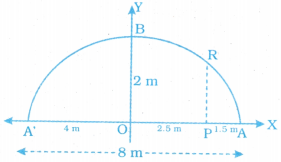
Let ABA’ be the given semi-elliptic arch such that width AA’ = 8 m and OB = 2 m.
The arch is a part of ellipse whose semi-major axis is \(\frac{8}{2}\) = 4 m and
semi-minor axis is OB = 2 m.
i.e., a = 4 m, b = 2 m.
∴ Equation of the ellipse is \(\frac{x^2}{a^2}+\frac{y^2}{b^2}\) = 1.
Putting values of a and b, we have
\(\frac{x^2}{16}+\frac{y^2}{4}\) = 1 ………… (i)
We have, height PR at P where AP (distance from one end say A of the arch APA’) = 1.5 m.
Now OP = OA – AP = 4 – 1.5 = 2.5 m.
For the point R, x = OP = 2.5 = \(\frac{25}{10}=\frac{5}{2}\)
Putting x = \(\frac{5}{2}\) in (i), we get \(\frac{x^2}{16}+\frac{y^2}{4}\) = 1
\(\frac{y^2}{4}\) = 1 – \(\frac{25}{64}\)
y2 = \(\frac{64-25}{16}=\frac{39}{16}\)
y = \(\frac{\sqrt{39}}{4}=\frac{6.24}{4}\) = 1.56
Hence, the required height of arch = PR = ordinate (i.e., y) of R = 1.56 m (approx.)

II.
Question 1.
An arch is in the form of a parabola with its axis vertical. The arch is 10 m high and 5 m wide at the base. How wide is it 2 m from the vertex of the parabola?
Solution:
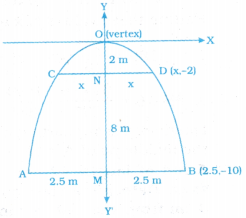
Taking the vertex of the parabola as the origin O and axis along OY’, the equation of the parabolic arch is downward parabola.
x2 = – 4ay [∵ upward parabola can’t have a base] …….(i)
Since MB = \(\frac{1}{2}\)base; AB = \(\frac{5}{2}\) = 2.5 m
(From the figure)
and OM = 10 m, the coordinates of B are (2.5, -10).
B lies on (i) ⇒ (2.5)2 = -4a(-10)
⇒ 6.25 = 40 a
⇒ a = \(\frac{6.25}{40}\)
Putting this value of a in (i),
equation (i) becomes
x2 = –\(-\frac{6.25}{10}\)y
⇒ x2 = -0.625y ……..(ii)
Let the width of the parabola at a distance
2m [= ON (say)] from the vertex of a parabola be CD.
If CD = 2x, then coordinates of D are (x, – 2). Since D(x, – 2) lies on (ii).
∴ x2 = -0.625 × (-2) = 1.250
= \(\frac{1250}{1000}=\frac{125}{100}=\frac{5}{4}\)
⇒ x = \(\frac{\sqrt{5}}{2}\)
Hence, CD = width at depth 2m = 2x = 2 × \(\frac{\sqrt{5}}{2}\) = √5 = 2.33 m (approximately)
Question 2.
The cable of a uniformly loaded suspension bridge hangs in the form of a parabola. The roadway which is horizontal and 100 m long is supported by vertical wires attached to the cable, the longest wire being 30 m and the shortest being 6 m. Find the length of a supporting wire attached to the roadway 18 m from the middle.
Solution:
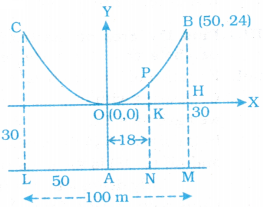
Let the cable of suspension bridge (hanging in the form of a parabola) be the parabolic arc COB with vertex at the lowest point O and axis vertical.
Let LM – 100 m be the horizontal roadway such that CL = BM = (longest wire) 30 m and OA = (shortest wire) 6 m. [∵ O, the vertex of the parabola is the lowest point of this upward parabola].
We have to find the length of supporting wire NP attached to the roadway at N where AN = 18 m. Now AL = AM = 50 m. (∵ LM = 100m )
Let the coordinate axes be chosen as shown in the figure. We know that equation of the upward parabola with vertex at O(0, 0) and axis along positive Y-axis is
x2 = 4ay …….(i)
Since it passes through the point B whose co-ordinates are
x = OH = AM = 50 and
y = BH = BM – HM = BM – OA = 30 – 6 = 24
Putting x = 50 and y = 24 in (i), we have
(50)2 = 4a(24)
⇒ 2500 = 96a
⇒ a = \(\frac{2500}{96}=\frac{625}{24}\)
Putting the value of a in (i), the equation of the parabola is
x2 = 4 × \(\frac{625 y}{24}\)
or
x2 = \(\frac{625 y}{6}\) …………..(ii)
Through the point N draw a vertical line to meet the parabola at point P. Then co¬ordinates of point P are
x = OK = AN = 18 and y = PK = PN – KN = PN – OA = PN – 6.
Putting these values of x and y in (ii),
(18)2 = \(\frac{625}{6}\)(PN – 6)
⇒ 324 × 6 = 625(PN – 6)
Length of the supporting wire attached to the roadway at point N which is 18 m from the middle point A = PN = 9.11 m.
Question 3.
A rod of length 12 cm moves with its ends always touching the coordinate axes. Determine the equation of the locus of a point P on the rod, which is 3 cm from the end in contact with the X-axis.
Solution:
Let AB be the rod of length 12 cm and P(x, y) be the point on it such that AP = 3 cm. (given)
∴ PB = AB – AP = 12 – 3 = 9 cm .
From P, draw PL and PM perpendiculars on Y-axis and X-axis respectively.
∴ PL = x and PM = y.
Let ∠OAB = θ. ∠LPB is also = θ [Corresponding angles]
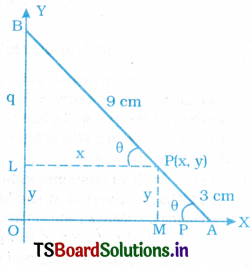
In right angled ΔAMP, sin θ = \(\frac{M P}{A P}=\frac{y}{3}\) …….(i)
In right angled ΔPLB, cos θ = \(\frac{P L}{P B}=\frac{x}{9}\) ……(ii)
Putting these values of cos θ and sin θ
from (ii) and (i) in the relation cos2θ + sin2θ = 1
We have, \(\frac{x^2}{81}+\frac{y^2}{9}\) = 1
⇒ \(\frac{x^2}{81}+\frac{y^2}{9}\) = 1
Which is the required locus of point P.
III.
Question 1.
Find the area of the triangle formed by the lines joining the vertex of the parabola x2 = 12y to the ends of its latus rectum.
Solution:
Equation of the parabola is x2 = 12 y.
Comparing with upward parabola x2 = 4ay, we have 4a = 12. ∴ a = 3.
In the figure, S is the focus, O is the vertex and AB (⊥ OS) is the latus rectum.
(By definition of latus rectum)
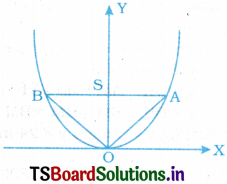
Latus rectum AB = 4a = 12.
Since the focus S is (0, a) = (0, 3). ∴ OS = 3 [
Area of OAB = \(\frac{1}{2}\)AB × OS [∵ Area of the ∆le = \(\frac{1}{2}\) base × height]
= \(\frac{1}{2}\) × 12 × 3 = 18 sq. units.
Question 2.
A man running a race-course notes that the sum of the distances from the two flag posts from him is always 10 m and the distance between the flag posts is 8 m. Find the equation of the path traced by the man.
Solution:
Let S and S’ be the two flag posts and P be the position of the man at any instant. Since PS + PS’ = 10 (given),
By definition of an ellipse, the path traced by the man is an ellipse having its foci at the two flag posts and length of the major axis = 10.
Because length of the major axis = 2a
∴ 2a =10
⇒ a = 5.
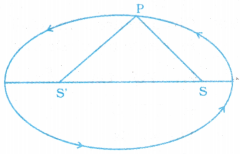
Also SS’ = distance between the foci = (2c) = 8 (given)
2c = 8
⇒ c = 4
Using the relation c2 = a2 – b2, we have 42 = 52 – b2
⇒ b2 = 25 – 16 = 9.
Putting the values of a2 and b2 in (i), the equation of the (ellipse) path is \(\frac{x^2}{25}+\frac{y^2}{9}\) = 1
Question 3.
An equilateral triangle is inscribed in the parabola y2 = 4ax. where one vertex is at the vertex of the parabola. Find the length of the side of the triangle.
Solution:
The given parabola is y2 = 4ax. ………. (i)
Its vertex is the origin O. Let OAB be the equilateral triangle inscribed in the parabola. Let each side of triangle be of length l.
By symmetry, AB ⊥ OX and ∠BOC = ∠AOC = 30°.
In ΔOCA, cos 30° = \(\frac{\mathrm{OC}}{\mathrm{OA}}=\frac{\mathrm{x}}{l} \Rightarrow \frac{\sqrt{3}}{2}=\frac{\mathrm{x}}{l}\)
⇒ x = l\(\frac{\sqrt{3}}{2}\)
and sin 30 = \(\frac{\mathrm{AC}}{\mathrm{OA}}=\frac{\mathrm{y}}{l} \Rightarrow \frac{1}{2}=\frac{\mathrm{y}}{l}\)
⇒ y = \(\frac{l}{2}\)
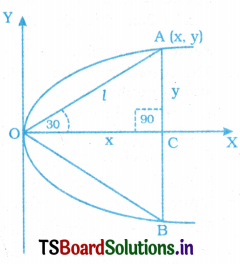
∴ Coordinates of point A are (x, y) = \(\left(\frac{l \sqrt{3}}{2}, \frac{l}{2}\right)\)
Since A lies on parabola (i),
∴ Coordinates of point A satisfy equation (i)
∴ \(\left(\frac{l}{2}\right)^2\) = 4a.\(\frac{\sqrt{3}}{2}\)l
\(\frac{l^2}{4}\) = 2a√3l
l2 = 8a√3l
Dividing both sides by l, ⇒ l = 8√3a
Hence, the length of the side of an equilateral triangle = 8√3a.